Visual Modeling and the UML
Object Oriented Analysis and
Design
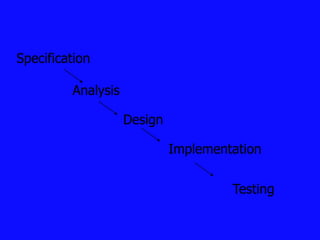
Specification
Analysis
Design
Implementation
Testing
Basic Concepts
 A Class:
– A class is a description used to instantiate objects
 An Object:
– Is an instance of a class, it has a name, attributes and
their values, and methods
– An object models an idea found in reality, (tangible or
abstract)
Basic Concepts (cont’d)
 Attributes
 Methods (Services, Messages)
 Information hiding and Encapsulation: A technique
in which an object reveals as little as possible about
its inner workings.
 Inheritance
 Polymorphism, Overloading, Templates
Object Oriented Analysis
OOA
1. Discovering Objects
– The Data Perspective
• In the problem space or external systems
• Physical devices
• Events that need to be recorded (ex. Measurements)
• Physical or geographical locations
• Organizational units ( departments , etc. )
OOA (cont’d)
– The Functional Perspective
• What responsibilities does the object have? Ex. An event
handler, a controller
– The Behavioral Perspective
• Who does the object interact with? How?
• Use an STD to describe the object behavior
Identifying Objects
– An object may appear as a noun (ex. Measurement) or disguised
in a verb (to measure)
– A method might appear as a verb (ex. Investigate) or disguised in
a noun (investigation)
– Attributes describe some kind of characteristics for the object
(adjectives). Attributes can be simple or complex. Complex
attributes may lead to forming a new object. Attributes can also
be nouns.
Criteria for evaluating candidate Objects/Classes
– One or more attributes
– Needed functionality (one or more methods)
– Common attributes (apply to all objects of a specific class)
– Common functionality (apply to all objects of a specific
class)
Object Types
– External Entities: Sensors, actuators, control panel, devices
– Information Items : Displays, Commands, etc.
– Entities which establishes the context of the problem :
Controller, monitors, schedulers
Nouns and Verbs
 Example
– If you are going to measure something, you might say, “..
Then the measurement is done”
 Question?
– Is measurement an object, or to measure is a method, or
both.
OOA (cont’d)
2. Class Hierarchies
– Generalization
• A manager, a commission worker --> Employee
– Specialization ( IS_A)
• Employee --> A commission worker
OOA (cont’d)
3. Relationships
– Types
• Association
• Aggregation ( Whole Part “HAS_A” )
• A person has two arms, A magazine issue has several
articles
– Cardinality ( Multiplicity)
• ( Binary, Many, .. )
OOA (cont’d)
4. Object Attributes
– Discovering attributes and placing in class hierarchy
– Attribute types
• Naming : Ex. SensorID, Account
• Descriptive Ex. Card expiration date
• Referential Ex. Referring to other objects
OOA (cont’d)
5. Object Behavior
– Discovering states, changes in state, and conditions and
actions
– Building the state diagrams of objects
OOA (cont’d)
6. Object Services
– Implicit Services ( create, modify, search, delete , etc. ) ex.
constructors
– Services associated with messages
– Services associated with object relationships
– Services associated with attributes (accessor methods ex.
get, set . .. )
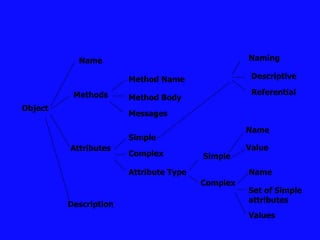
Object
Name
Methods
Method Name
Method Body
Messages
Description
Simple
Attribute Type
Complex
Attributes
Simple
Complex
Name
Set of Simple
attributes
Values
Name
Value
Naming
Descriptive
Referential
Object Oriented Design OOD
1. Notation (Unified Modeling Language)
– Structural description ( class diagrams )
– Dynamics ( Collaboration and interaction diagrams )
2. Detailed Class and object description
– Visibility (Private, protected, .. )
– Persistence
– Exceptions
– Containment (ex. Packages )
– Concurrency
3. Design Goodness Criteria
– Coupling:
• The manner and degree of interdependence between
classes (objects)
– Cohesion:
• The degree and manner to which the tasks performed
by an object are related to each other.
OOD (Cont’d)
– Modularity
• Understandability
• Decomposability
– Clarity
– Simple classes, messages, methods
What is the UML?
 UML stands for Unified Modeling Language
 The UML is the standard language for visualizing,
specifying, constructing, and documenting the artifacts of a
software-intensive system
 It can be used with all processes, throughout the
development life cycle, and across different implementation
technologies.
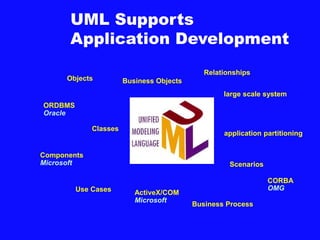
UML Supports
Application Development
Classes
application partitioning
Business Objects
Relationships
Business Process
Objects
Use Cases
large scale system
Scenarios
Components
Microsoft
ActiveX/COM
Microsoft
ORDBMS
Oracle
CORBA
OMG
UML Concepts
 The UML may be used to:
– Display the boundary of a system & its major functions using use
cases and actors
– Illustrate use case realizations with interaction diagrams
– Represent a static structure of a system using class diagrams
– Model the behavior of objects with state transition diagrams
– Reveal the physical implementation architecture with component
& deployment diagrams
– Extend your functionality with stereotypes
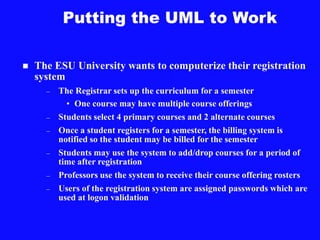
Putting the UML to Work
 The ESU University wants to computerize their registration
system
– The Registrar sets up the curriculum for a semester
• One course may have multiple course offerings
– Students select 4 primary courses and 2 alternate courses
– Once a student registers for a semester, the billing system is
notified so the student may be billed for the semester
– Students may use the system to add/drop courses for a period of
time after registration
– Professors use the system to receive their course offering rosters
– Users of the registration system are assigned passwords which are
used at logon validation
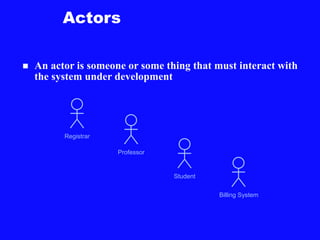
Actors
 An actor is someone or some thing that must interact with
the system under development
Student
Registrar
Professor
Billing System
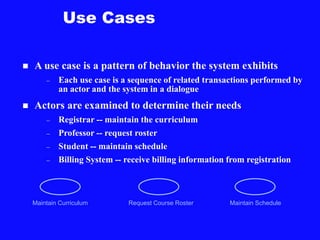
Use Cases
 A use case is a pattern of behavior the system exhibits
– Each use case is a sequence of related transactions performed by
an actor and the system in a dialogue
 Actors are examined to determine their needs
– Registrar -- maintain the curriculum
– Professor -- request roster
– Student -- maintain schedule
– Billing System -- receive billing information from registration
Maintain Schedule
Maintain Curriculum Request Course Roster
Documenting Use Cases
 A flow of events document is created for each use cases
– Written from an actor point of view
 Details what the system must provide to the actor when the
use cases is executed
 Typical contents
– How the use case starts and ends
– Normal flow of events
– Alternate flow of events
– Exceptional flow of events
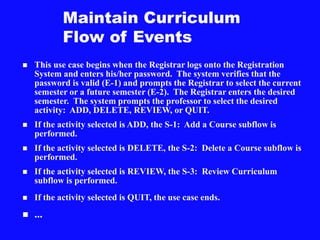
Maintain Curriculum
Flow of Events
 This use case begins when the Registrar logs onto the Registration
System and enters his/her password. The system verifies that the
password is valid (E-1) and prompts the Registrar to select the current
semester or a future semester (E-2). The Registrar enters the desired
semester. The system prompts the professor to select the desired
activity: ADD, DELETE, REVIEW, or QUIT.
 If the activity selected is ADD, the S-1: Add a Course subflow is
performed.
 If the activity selected is DELETE, the S-2: Delete a Course subflow is
performed.
 If the activity selected is REVIEW, the S-3: Review Curriculum
subflow is performed.
 If the activity selected is QUIT, the use case ends.
 ...
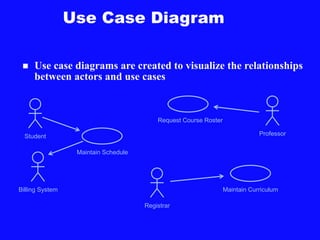
Use Case Diagram
 Use case diagrams are created to visualize the relationships
between actors and use cases
Student
Registrar
Professor
Maintain Schedule
Maintain Curriculum
Request Course Roster
Billing System
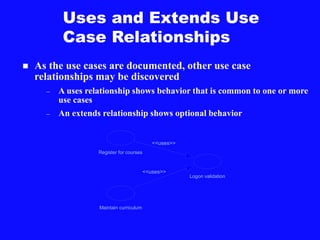
Uses and Extends Use
Case Relationships
 As the use cases are documented, other use case
relationships may be discovered
– A uses relationship shows behavior that is common to one or more
use cases
– An extends relationship shows optional behavior
Register for courses
<<uses>>
Logon validation
<<uses>>
Maintain curriculum
Use Case Realizations
 The use case diagram presents an outside view of the system
 Interaction diagrams describe how use cases are realized as
interactions among societies of objects
 Two types of interaction diagrams
– Sequence diagrams
– Collaboration diagrams
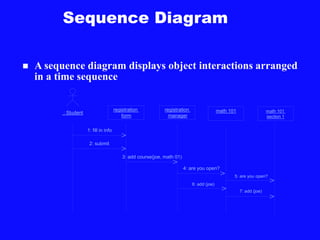
Sequence Diagram
 A sequence diagram displays object interactions arranged
in a time sequence
: Student
registration
form
registration
manager
math 101
1: fill in info
2: submit
3: add course(joe, math 01)
4: are you open?
5: are you open?
6: add (joe)
7: add (joe)
math 101
section 1
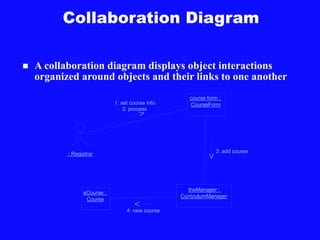
: Registrar
course form :
CourseForm
theManager :
CurriculumManager
aCourse :
Course
1: set course info
2: process
3: add course
4: new course
Collaboration Diagram
 A collaboration diagram displays object interactions
organized around objects and their links to one another
Class Diagrams
 A class diagram shows the existence of classes and their
relationships in the logical view of a system
 UML modeling elements in class diagrams
– Classes and their structure and behavior
– Association, aggregation, dependency, and inheritance
relationships
– Multiplicity and navigation indicators
– Role names
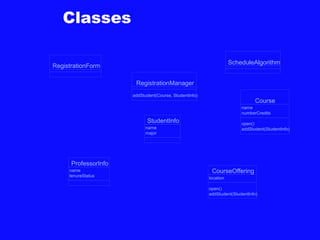
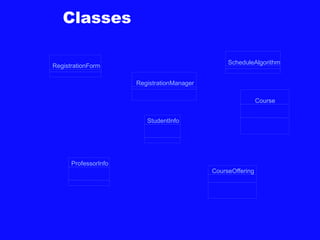
Classes
 A class is a collection of objects with common structure,
common behavior, common relationships and common
semantics
 Classes are found by examining the objects in sequence and
collaboration diagram
 A class is drawn as a rectangle with three compartments
 Classes should be named using the vocabulary of the
domain
– Naming standards should be created
– e.g., all classes are singular nouns starting with a capital letter
Classes
RegistrationForm
RegistrationManager
Course
StudentInfo
CourseOffering
ProfessorInfo
ScheduleAlgorithm
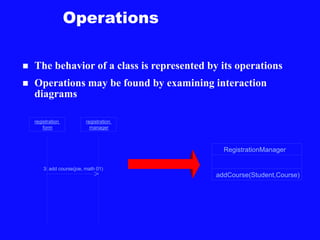
Operations
 The behavior of a class is represented by its operations
 Operations may be found by examining interaction
diagrams
registration
form
registration
manager
3: add course(joe, math 01)
RegistrationManager
addCourse(Student,Course)
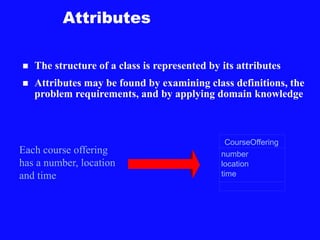
Attributes
 The structure of a class is represented by its attributes
 Attributes may be found by examining class definitions, the
problem requirements, and by applying domain knowledge
Each course offering
has a number, location
and time
CourseOffering
number
location
time
Classes
RegistrationForm
RegistrationManager
addStudent(Course, StudentInfo)
Course
name
numberCredits
open()
addStudent(StudentInfo)
StudentInfo
name
major
CourseOffering
location
open()
addStudent(StudentInfo)
ProfessorInfo
name
tenureStatus
ScheduleAlgorithm
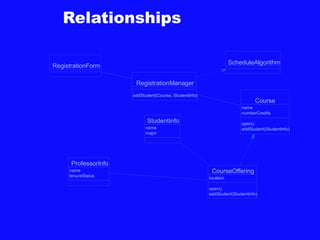
Relationships
 Relationships provide a pathway for communication
between objects
 Sequence and/or collaboration diagrams are examined to
determine what links between objects need to exist to
accomplish the behavior -- if two objects need to “talk”
there must be a link between them
 Three types of relationships are:
– Association
– Aggregation
– Dependency
Relationships
 An association is a bi-directional connection between classes
– An association is shown as a line connecting the related classes
 An aggregation is a stronger form of relationship where the
relationship is between a whole and its parts
– An aggregation is shown as a line connecting the related classes
with a diamond next to the class representing the whole
 A dependency relationship is a weaker form of relationship
showing a relationship between a client and a supplier
where the client does not have semantic knowledge of the
supplier
– A dependency is shown as a dashed line pointing from the client
to the supplier
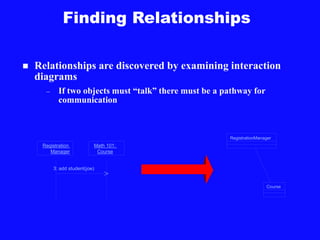
Registration
Manager
Math 101:
Course
3: add student(joe)
RegistrationManager
Course
Finding Relationships
 Relationships are discovered by examining interaction
diagrams
– If two objects must “talk” there must be a pathway for
communication
Relationships
RegistrationForm
RegistrationManager
Course
StudentInfo
CourseOffering
ProfessorInfo
addStudent(Course, StudentInfo)
name
numberCredits
open()
addStudent(StudentInfo)
name
major
location
open()
addStudent(StudentInfo)
name
tenureStatus
ScheduleAlgorithm
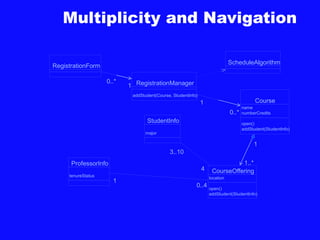
Multiplicity and Navigation
 Multiplicity defines how many objects participate in a
relationships
– Multiplicity is the number of instances of one class related to
ONE instance of the other class
– For each association and aggregation, there are two multiplicity
decisions to make: one for each end of the relationship
 Although associations and aggregations are bi-directional
by default, it is often desirable to restrict navigation to one
direction
– If navigation is restricted, an arrowhead is added to indicate the
direction of the navigation
Multiplicity and Navigation
RegistrationForm
RegistrationManager
Course
StudentInfo
CourseOffering
ProfessorInfo
addStudent(Course, StudentInfo)
name
numberCredits
open()
addStudent(StudentInfo)
major
location
open()
addStudent(StudentInfo)
tenureStatus
ScheduleAlgorithm
1
0..*
0..*
1
1
1..*
4
3..10
0..4
1
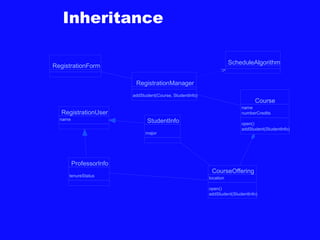
Inheritance
 Inheritance is a relationships between a superclass and its
subclasses
 There are two ways to find inheritance:
– Generalization
– Specialization
 Common attributes, operations, and/or relationships are
shown at the highest applicable level in the hierarchy
Inheritance
RegistrationForm
RegistrationManager
Course
StudentInfo
CourseOffering
ProfessorInfo
addStudent(Course, StudentInfo)
name
numberCredits
open()
addStudent(StudentInfo)
major
location
open()
addStudent(StudentInfo)
tenureStatus
ScheduleAlgorithm
name
RegistrationUser
The State of an Object
 A state transition diagram shows
– The life history of a given class
– The events that cause a transition from one state to another
– The actions that result from a state change
 State transition diagrams are created for objects with
significant dynamic behavior
State Transition Diagram
Initialization
Open
entry: Register student
exit: Increment count
Closed
Canceled
do: Initialize course
do: Finalize course
do: Notify registered students
Add Student /
Set count = 0
Add student[ count < 10 ]
[ count = 10 ]
Cancel
Cancel
Cancel
The Physical World
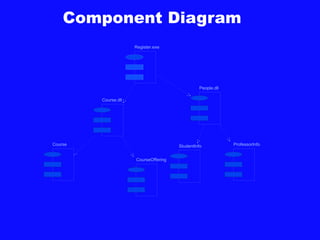
 Component diagrams illustrate the organizations and
dependencies among software components
 A component may be
– A source code component
– A run time components or
– An executable component
Component Diagram
Course.dll
People.dll
Course
CourseOffering
StudentInfo ProfessorInfo
Register.exe
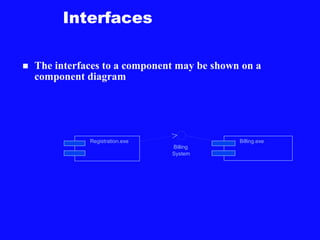
Interfaces
 The interfaces to a component may be shown on a
component diagram
Registration.exe Billing.exe
Billing
System
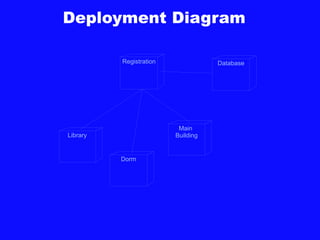
Deploying the System
 The deployment diagram shows the configuration of run-
time processing elements and the software processes living
on them
 The deployment diagram visualizes the distribution of
components across the enterprise.
Deployment Diagram
Registration Database
Library
Dorm
Main
Building
Extending the UML
 Stereotypes can be used to extend the UML notational
elements
 Stereotypes may be used to classify and extend associations,
inheritance relationships, classes, and components
 Examples:
– Class stereotypes: boundary, control, entity, utility, exception
– Inheritance stereotypes: uses and extends
– Component stereotypes: subsystem
Summary
 Visual modeling can be used to:
– Define business process
– Communicate
– Manage complexity
– Define software architecture
– Promote reuse
 The UML is the standard language for visualizing,
specifying, constructing, and documenting the artifacts of a
software-intensive system
– It can be used with all processes, throughout the development life
cycle, and across different implementation technologies.

Visual Modelling and the Unified Modeling Language.ppt

  • 1.
  • 2.
  • 3.
  • 4.
    Basic Concepts  AClass: – A class is a description used to instantiate objects  An Object: – Is an instance of a class, it has a name, attributes and their values, and methods – An object models an idea found in reality, (tangible or abstract)
  • 5.
    Basic Concepts (cont’d) Attributes  Methods (Services, Messages)  Information hiding and Encapsulation: A technique in which an object reveals as little as possible about its inner workings.  Inheritance  Polymorphism, Overloading, Templates
  • 6.
    Object Oriented Analysis OOA 1.Discovering Objects – The Data Perspective • In the problem space or external systems • Physical devices • Events that need to be recorded (ex. Measurements) • Physical or geographical locations • Organizational units ( departments , etc. )
  • 7.
    OOA (cont’d) – TheFunctional Perspective • What responsibilities does the object have? Ex. An event handler, a controller – The Behavioral Perspective • Who does the object interact with? How? • Use an STD to describe the object behavior
  • 8.
    Identifying Objects – Anobject may appear as a noun (ex. Measurement) or disguised in a verb (to measure) – A method might appear as a verb (ex. Investigate) or disguised in a noun (investigation) – Attributes describe some kind of characteristics for the object (adjectives). Attributes can be simple or complex. Complex attributes may lead to forming a new object. Attributes can also be nouns.
  • 9.
    Criteria for evaluatingcandidate Objects/Classes – One or more attributes – Needed functionality (one or more methods) – Common attributes (apply to all objects of a specific class) – Common functionality (apply to all objects of a specific class)
  • 10.
    Object Types – ExternalEntities: Sensors, actuators, control panel, devices – Information Items : Displays, Commands, etc. – Entities which establishes the context of the problem : Controller, monitors, schedulers
  • 11.
    Nouns and Verbs Example – If you are going to measure something, you might say, “.. Then the measurement is done”  Question? – Is measurement an object, or to measure is a method, or both.
  • 12.
    OOA (cont’d) 2. ClassHierarchies – Generalization • A manager, a commission worker --> Employee – Specialization ( IS_A) • Employee --> A commission worker
  • 13.
    OOA (cont’d) 3. Relationships –Types • Association • Aggregation ( Whole Part “HAS_A” ) • A person has two arms, A magazine issue has several articles – Cardinality ( Multiplicity) • ( Binary, Many, .. )
  • 14.
    OOA (cont’d) 4. ObjectAttributes – Discovering attributes and placing in class hierarchy – Attribute types • Naming : Ex. SensorID, Account • Descriptive Ex. Card expiration date • Referential Ex. Referring to other objects
  • 15.
    OOA (cont’d) 5. ObjectBehavior – Discovering states, changes in state, and conditions and actions – Building the state diagrams of objects
  • 16.
    OOA (cont’d) 6. ObjectServices – Implicit Services ( create, modify, search, delete , etc. ) ex. constructors – Services associated with messages – Services associated with object relationships – Services associated with attributes (accessor methods ex. get, set . .. )
  • 17.
    Object Name Methods Method Name Method Body Messages Description Simple AttributeType Complex Attributes Simple Complex Name Set of Simple attributes Values Name Value Naming Descriptive Referential
  • 18.
    Object Oriented DesignOOD 1. Notation (Unified Modeling Language) – Structural description ( class diagrams ) – Dynamics ( Collaboration and interaction diagrams ) 2. Detailed Class and object description – Visibility (Private, protected, .. ) – Persistence – Exceptions – Containment (ex. Packages ) – Concurrency
  • 19.
    3. Design GoodnessCriteria – Coupling: • The manner and degree of interdependence between classes (objects) – Cohesion: • The degree and manner to which the tasks performed by an object are related to each other. OOD (Cont’d)
  • 20.
    – Modularity • Understandability •Decomposability – Clarity – Simple classes, messages, methods
  • 21.
    What is theUML?  UML stands for Unified Modeling Language  The UML is the standard language for visualizing, specifying, constructing, and documenting the artifacts of a software-intensive system  It can be used with all processes, throughout the development life cycle, and across different implementation technologies.
  • 22.
    UML Supports Application Development Classes applicationpartitioning Business Objects Relationships Business Process Objects Use Cases large scale system Scenarios Components Microsoft ActiveX/COM Microsoft ORDBMS Oracle CORBA OMG
  • 23.
    UML Concepts  TheUML may be used to: – Display the boundary of a system & its major functions using use cases and actors – Illustrate use case realizations with interaction diagrams – Represent a static structure of a system using class diagrams – Model the behavior of objects with state transition diagrams – Reveal the physical implementation architecture with component & deployment diagrams – Extend your functionality with stereotypes
  • 24.
    Putting the UMLto Work  The ESU University wants to computerize their registration system – The Registrar sets up the curriculum for a semester • One course may have multiple course offerings – Students select 4 primary courses and 2 alternate courses – Once a student registers for a semester, the billing system is notified so the student may be billed for the semester – Students may use the system to add/drop courses for a period of time after registration – Professors use the system to receive their course offering rosters – Users of the registration system are assigned passwords which are used at logon validation
  • 25.
    Actors  An actoris someone or some thing that must interact with the system under development Student Registrar Professor Billing System
  • 26.
    Use Cases  Ause case is a pattern of behavior the system exhibits – Each use case is a sequence of related transactions performed by an actor and the system in a dialogue  Actors are examined to determine their needs – Registrar -- maintain the curriculum – Professor -- request roster – Student -- maintain schedule – Billing System -- receive billing information from registration Maintain Schedule Maintain Curriculum Request Course Roster
  • 27.
    Documenting Use Cases A flow of events document is created for each use cases – Written from an actor point of view  Details what the system must provide to the actor when the use cases is executed  Typical contents – How the use case starts and ends – Normal flow of events – Alternate flow of events – Exceptional flow of events
  • 28.
    Maintain Curriculum Flow ofEvents  This use case begins when the Registrar logs onto the Registration System and enters his/her password. The system verifies that the password is valid (E-1) and prompts the Registrar to select the current semester or a future semester (E-2). The Registrar enters the desired semester. The system prompts the professor to select the desired activity: ADD, DELETE, REVIEW, or QUIT.  If the activity selected is ADD, the S-1: Add a Course subflow is performed.  If the activity selected is DELETE, the S-2: Delete a Course subflow is performed.  If the activity selected is REVIEW, the S-3: Review Curriculum subflow is performed.  If the activity selected is QUIT, the use case ends.  ...
  • 29.
    Use Case Diagram Use case diagrams are created to visualize the relationships between actors and use cases Student Registrar Professor Maintain Schedule Maintain Curriculum Request Course Roster Billing System
  • 30.
    Uses and ExtendsUse Case Relationships  As the use cases are documented, other use case relationships may be discovered – A uses relationship shows behavior that is common to one or more use cases – An extends relationship shows optional behavior Register for courses <<uses>> Logon validation <<uses>> Maintain curriculum
  • 31.
    Use Case Realizations The use case diagram presents an outside view of the system  Interaction diagrams describe how use cases are realized as interactions among societies of objects  Two types of interaction diagrams – Sequence diagrams – Collaboration diagrams
  • 32.
    Sequence Diagram  Asequence diagram displays object interactions arranged in a time sequence : Student registration form registration manager math 101 1: fill in info 2: submit 3: add course(joe, math 01) 4: are you open? 5: are you open? 6: add (joe) 7: add (joe) math 101 section 1
  • 33.
    : Registrar course form: CourseForm theManager : CurriculumManager aCourse : Course 1: set course info 2: process 3: add course 4: new course Collaboration Diagram  A collaboration diagram displays object interactions organized around objects and their links to one another
  • 34.
    Class Diagrams  Aclass diagram shows the existence of classes and their relationships in the logical view of a system  UML modeling elements in class diagrams – Classes and their structure and behavior – Association, aggregation, dependency, and inheritance relationships – Multiplicity and navigation indicators – Role names
  • 35.
    Classes  A classis a collection of objects with common structure, common behavior, common relationships and common semantics  Classes are found by examining the objects in sequence and collaboration diagram  A class is drawn as a rectangle with three compartments  Classes should be named using the vocabulary of the domain – Naming standards should be created – e.g., all classes are singular nouns starting with a capital letter
  • 36.
  • 37.
    Operations  The behaviorof a class is represented by its operations  Operations may be found by examining interaction diagrams registration form registration manager 3: add course(joe, math 01) RegistrationManager addCourse(Student,Course)
  • 38.
    Attributes  The structureof a class is represented by its attributes  Attributes may be found by examining class definitions, the problem requirements, and by applying domain knowledge Each course offering has a number, location and time CourseOffering number location time
  • 39.
  • 40.
    Relationships  Relationships providea pathway for communication between objects  Sequence and/or collaboration diagrams are examined to determine what links between objects need to exist to accomplish the behavior -- if two objects need to “talk” there must be a link between them  Three types of relationships are: – Association – Aggregation – Dependency
  • 41.
    Relationships  An associationis a bi-directional connection between classes – An association is shown as a line connecting the related classes  An aggregation is a stronger form of relationship where the relationship is between a whole and its parts – An aggregation is shown as a line connecting the related classes with a diamond next to the class representing the whole  A dependency relationship is a weaker form of relationship showing a relationship between a client and a supplier where the client does not have semantic knowledge of the supplier – A dependency is shown as a dashed line pointing from the client to the supplier
  • 42.
    Registration Manager Math 101: Course 3: addstudent(joe) RegistrationManager Course Finding Relationships  Relationships are discovered by examining interaction diagrams – If two objects must “talk” there must be a pathway for communication
  • 43.
  • 44.
    Multiplicity and Navigation Multiplicity defines how many objects participate in a relationships – Multiplicity is the number of instances of one class related to ONE instance of the other class – For each association and aggregation, there are two multiplicity decisions to make: one for each end of the relationship  Although associations and aggregations are bi-directional by default, it is often desirable to restrict navigation to one direction – If navigation is restricted, an arrowhead is added to indicate the direction of the navigation
  • 45.
    Multiplicity and Navigation RegistrationForm RegistrationManager Course StudentInfo CourseOffering ProfessorInfo addStudent(Course,StudentInfo) name numberCredits open() addStudent(StudentInfo) major location open() addStudent(StudentInfo) tenureStatus ScheduleAlgorithm 1 0..* 0..* 1 1 1..* 4 3..10 0..4 1
  • 46.
    Inheritance  Inheritance isa relationships between a superclass and its subclasses  There are two ways to find inheritance: – Generalization – Specialization  Common attributes, operations, and/or relationships are shown at the highest applicable level in the hierarchy
  • 47.
  • 48.
    The State ofan Object  A state transition diagram shows – The life history of a given class – The events that cause a transition from one state to another – The actions that result from a state change  State transition diagrams are created for objects with significant dynamic behavior
  • 49.
    State Transition Diagram Initialization Open entry:Register student exit: Increment count Closed Canceled do: Initialize course do: Finalize course do: Notify registered students Add Student / Set count = 0 Add student[ count < 10 ] [ count = 10 ] Cancel Cancel Cancel
  • 50.
    The Physical World Component diagrams illustrate the organizations and dependencies among software components  A component may be – A source code component – A run time components or – An executable component
  • 51.
  • 52.
    Interfaces  The interfacesto a component may be shown on a component diagram Registration.exe Billing.exe Billing System
  • 53.
    Deploying the System The deployment diagram shows the configuration of run- time processing elements and the software processes living on them  The deployment diagram visualizes the distribution of components across the enterprise.
  • 54.
  • 55.
    Extending the UML Stereotypes can be used to extend the UML notational elements  Stereotypes may be used to classify and extend associations, inheritance relationships, classes, and components  Examples: – Class stereotypes: boundary, control, entity, utility, exception – Inheritance stereotypes: uses and extends – Component stereotypes: subsystem
  • 56.
    Summary  Visual modelingcan be used to: – Define business process – Communicate – Manage complexity – Define software architecture – Promote reuse  The UML is the standard language for visualizing, specifying, constructing, and documenting the artifacts of a software-intensive system – It can be used with all processes, throughout the development life cycle, and across different implementation technologies.