Chapter 6
Merchandising Activities A merchandising company is an enterprise that buys and sells goods to earn a profit. 1. Wholesalers sell to retailers. 2. Retailers sell to consumers. A merchandiser’s primary source of revenue is sales, whereas a service company’s primary source of revenue is service revenue.
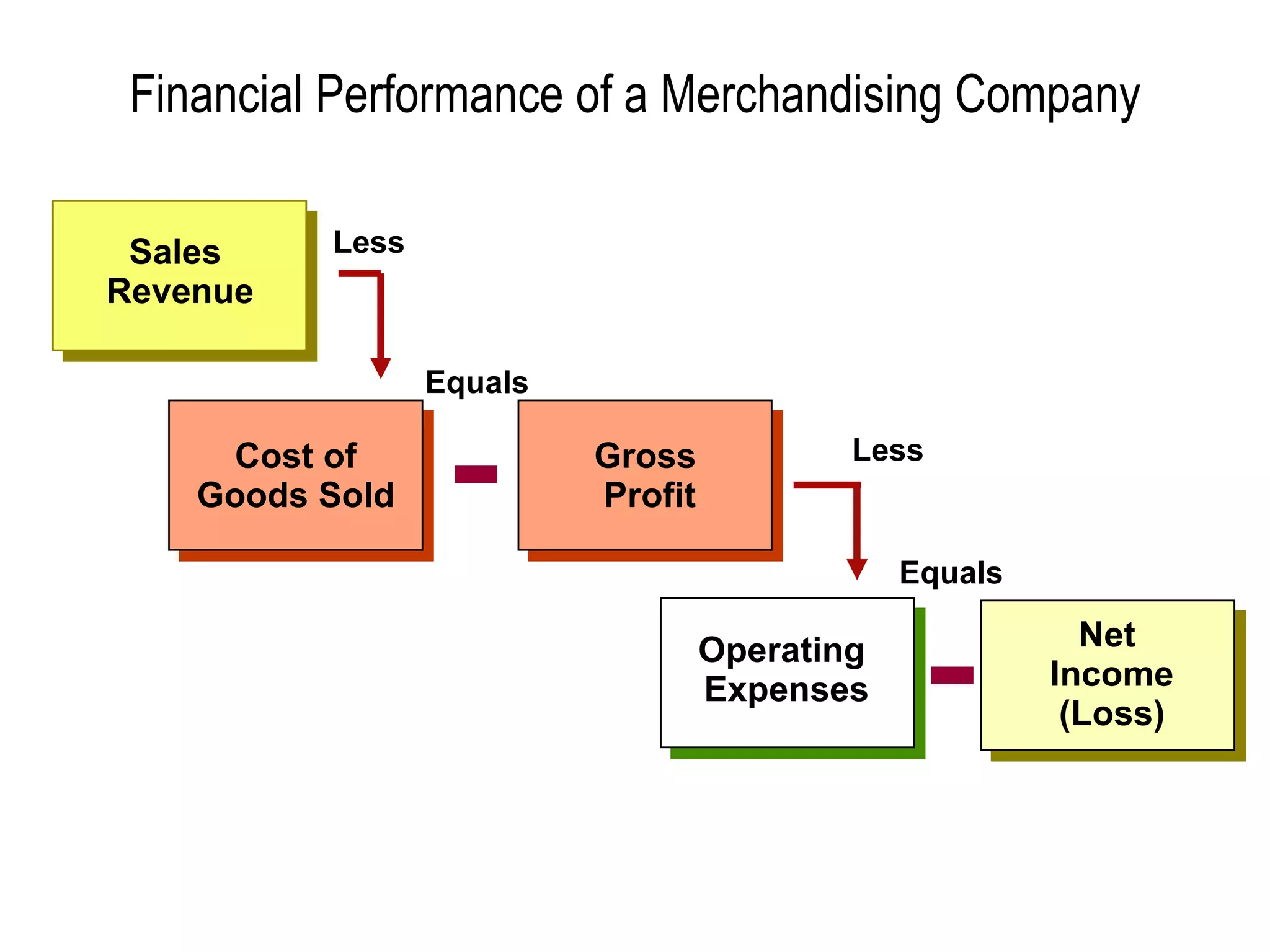
Financial Performance of a Merchandising Company Sales  Revenue Cost of Goods Sold Less Gross Profit Equals Operating  Expenses Less Net  Income (Loss) Equals
Merchandising Cash Flow Beginning Inventory Goods Purchased during period Cost of Goods Available for Sale Ending Inventory  (Balance Sheet) Cost of Goods Sold  (Income Statement) Not Sold Sold
Inventory Systems Merchandising entities may use either (or both) of the following inventory systems: 1. Perpetual – where detailed records of each inventory purchase and sale are maintained. Cost of goods sold is calculated at the time of each sale. 2. Periodic – detailed records are not maintained. Cost of goods sold is calculated only at the end of the accounting period.
Recording Purchases For purchases on account, Merchandise Inventory is debited and Accounts Payable is credited. For cash purchases, Merchandise Inventory is debited and Cash is credited.
Accounting for Merchandise Purchases To determine the inventory value, we must adjust the invoice cost for: Discounts given to a purchaser by a supplier. Any returns and allowances for unsatisfactory items received from a supplier. Any required freight costs paid by a purchaser.
Trade Discounts vs. Purchase/Sales Discounts Trade Discounts:  Used by manufacturers and wholesalers to change selling prices without republishing their catalogues.  Already deducted from the purchase price before the transaction is recorded Sales and Purchase Discounts: A deduction from the invoice price granted to induce early payment of the amount due. Example – 2/10, n30  Deducted after the initial journal entry that recorded the purchase
Purchase Discounts 2/10,n/30 Number of Days Discount is Available Otherwise, Net (or All) is Due  Within Credit Period Discount Percent
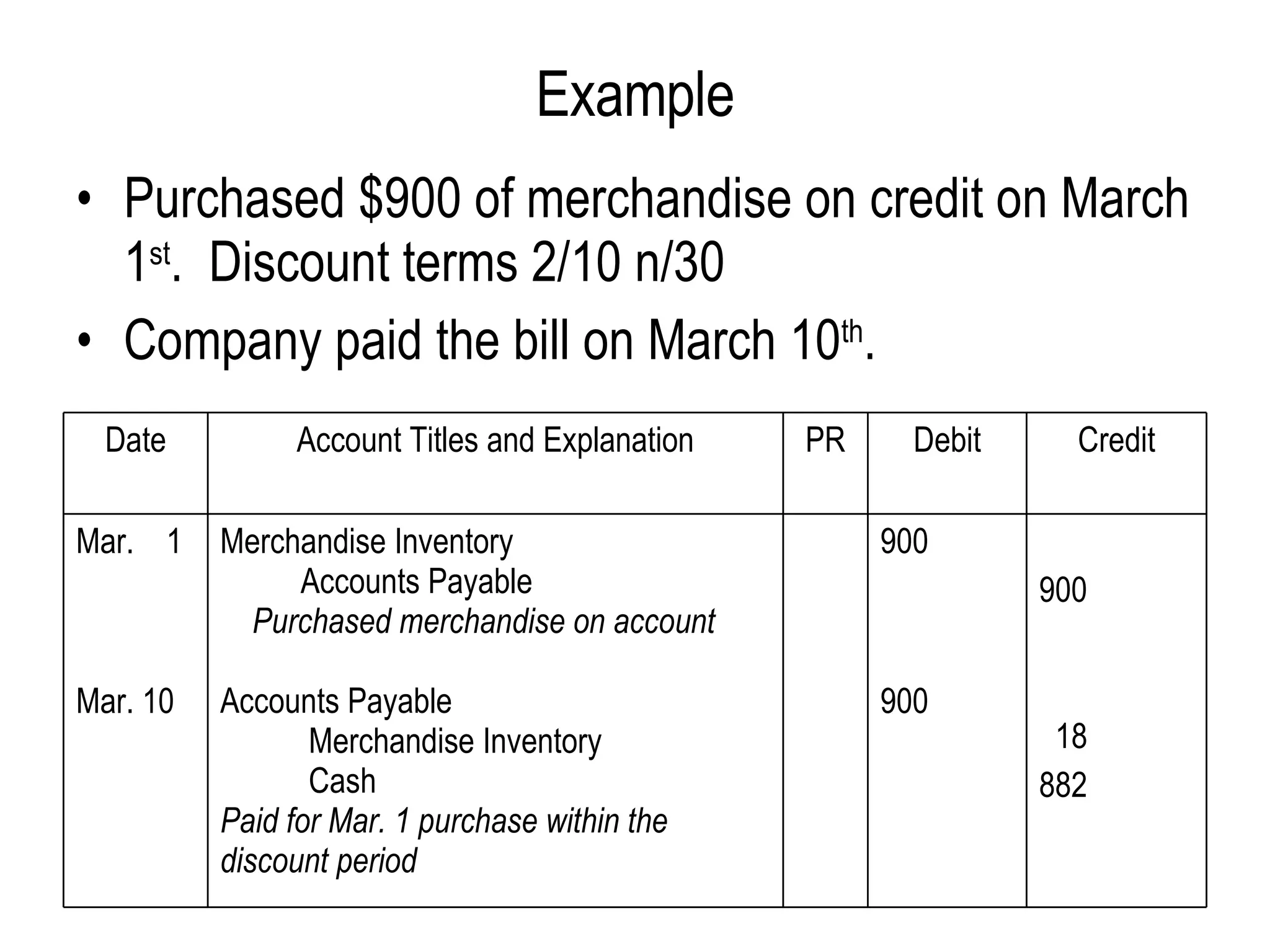
Example Purchased $900 of merchandise on credit on March 1 st .  Discount terms 2/10 n/30 Company paid the bill on March 10 th .  900 18 882 900 900 Merchandise Inventory Accounts Payable Purchased merchandise on account Accounts Payable Merchandise Inventory Cash Paid for Mar. 1 purchase within the discount period  Mar.  1 Mar. 10 Credit Debit PR Account Titles and Explanation Date
Purchase Returns and Allowances Purchase returns  are merchandise received by a purchaser but returned to the supplier. A  purchase allowance  is a reduction in the cost of defective merchandise received by a purchaser from a supplier. A  debit memorandum  is a form issued by the purchaser to inform the supplier of a debit made to the supplier's account, including the reason for a return or allowance.  Memorandum gets its name from the issuer.  Entry (On the books of the purchaser) Debit Accounts Payable or Cash (if refund given) and Credit Inventory
Transportation Costs FOB shipping point—buyer pays shipping costs.  Title transfers at shipping point   Increases cost of merchandise Debit Inventory, Credit Cash or Accounts Payable (if to be paid for with merchandise later) FOB destination—seller pays shipping costs. Title transfers at destination.   Operating expense for seller Debit Delivery Expense (if you are the seller), Credit Cash.
Accounting for Merchandise Sales Sales transactions—Recording has two parts: Recognize revenue—Debit Accounts Receivable (or cash), Credit Sales (both for the invoice amount) Recognize cost—Debit Cost of Goods Sold, Credit Inventory (both for the cost of the inventory sold)
Example A company sold $500 worth of merchandise for $800 on credit on March 1 st .  Credit terms 3/10 n/EOM. Credit Debit PR Account Titles and Explanation Date 800 500 800 500 Accounts Receivable  Revenue Sold merchandise on account Cost of Goods Sold Merchandise Inventory To record the cost of merchandise  Mar.  1
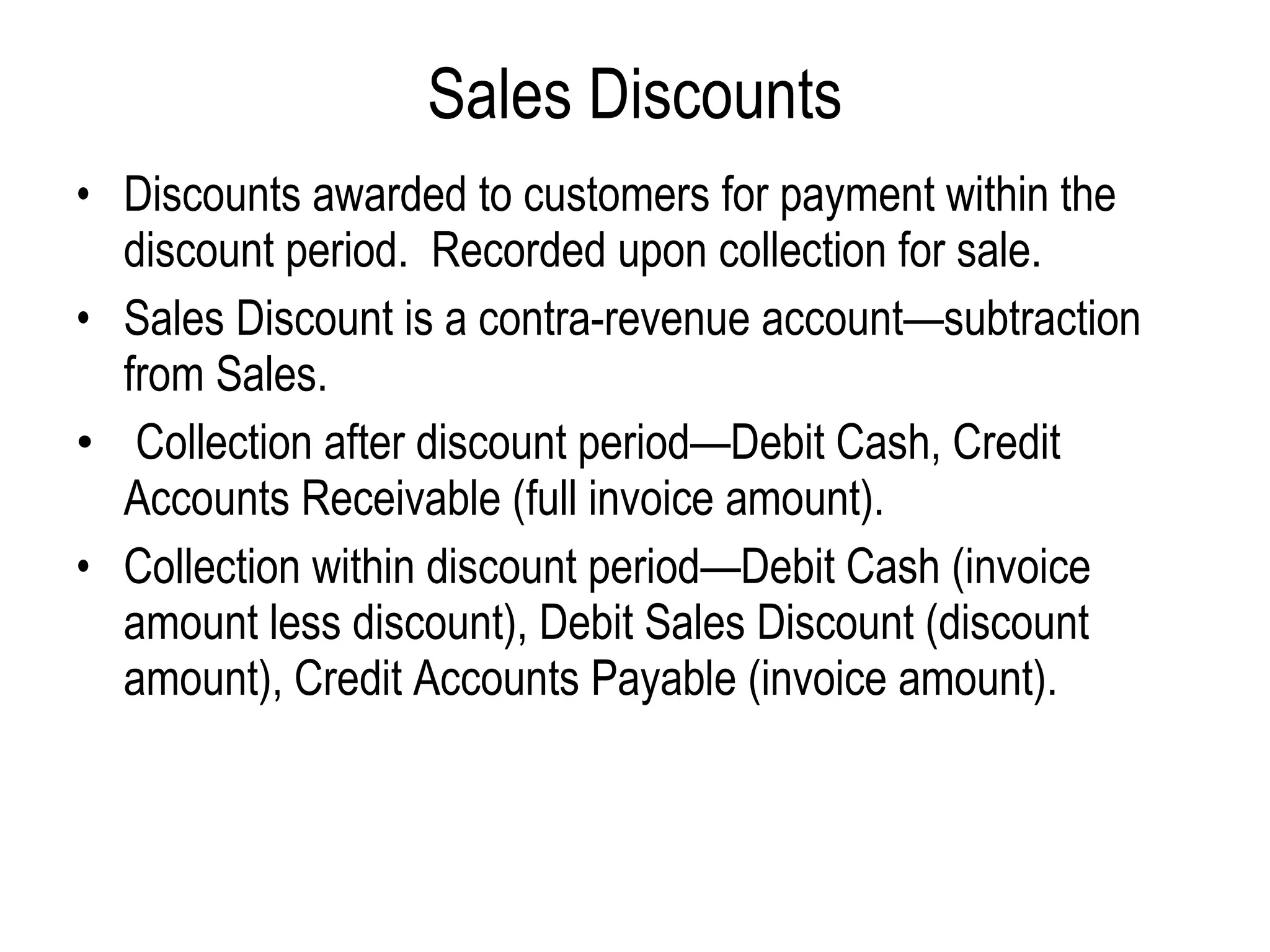
Sales Discounts Discounts awarded to customers for payment within the discount period.  Recorded upon collection for sale.   Sales Discount is a contra-revenue account—subtraction from Sales.   Collection after discount period—Debit Cash, Credit Accounts Receivable (full invoice amount). Collection within discount period—Debit Cash (invoice amount less discount), Debit Sales Discount (discount amount), Credit Accounts Payable (invoice amount).
Example Customer paid for March 1 st  purchase on March 8 th . Credit Debit PR Account Titles and Explanation Date 800 776 24 Cash Sales Discounts  Accounts Receivable Sold merchandise on account Mar.  8
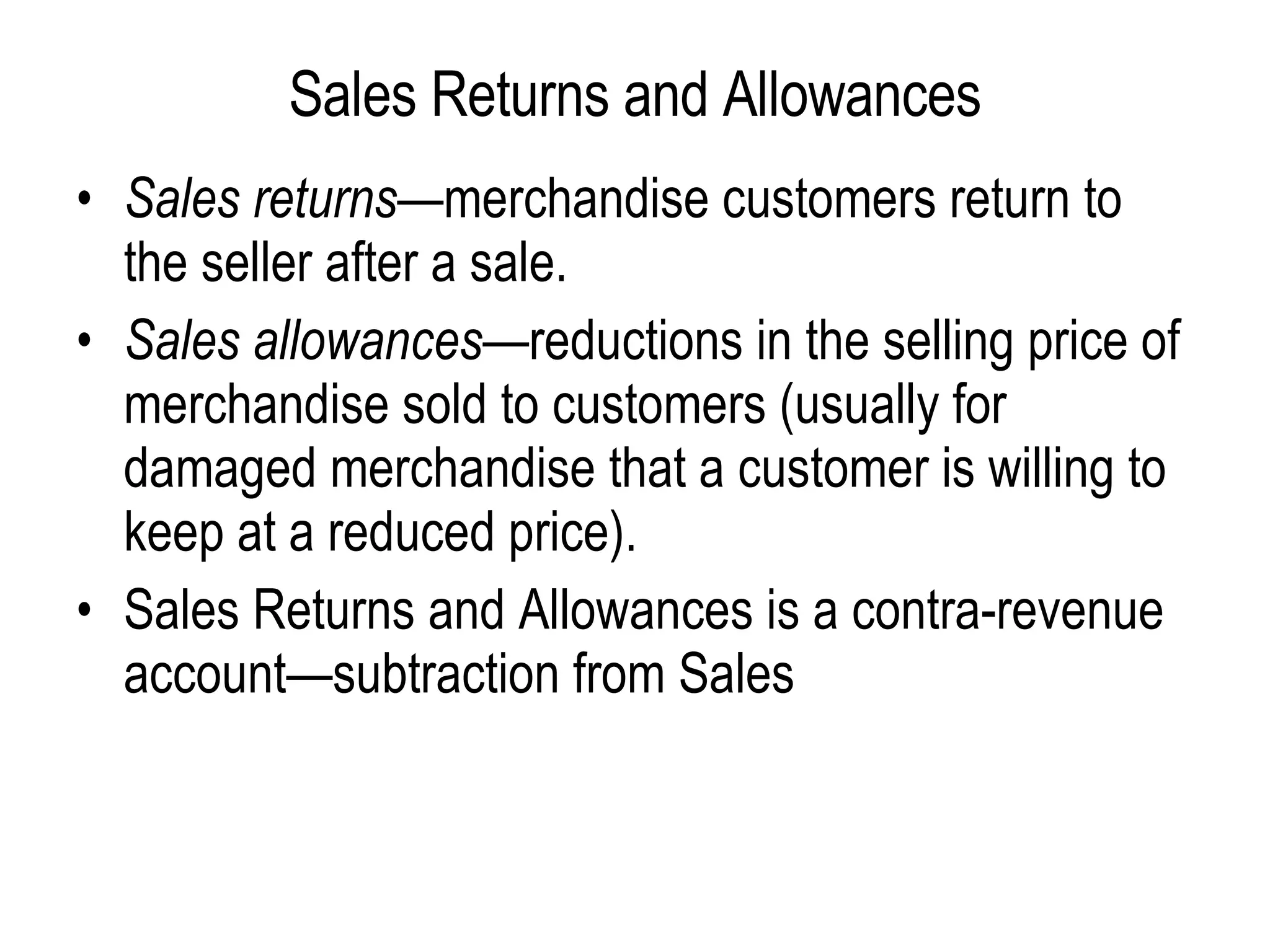
Sales Returns and Allowances Sales returns— merchandise customers return to the seller after a sale.  Sales allowances —reductions in the selling price of merchandise sold to customers (usually for damaged merchandise that a customer is willing to keep at a reduced price).   Sales Returns and Allowances is a contra-revenue account—subtraction from Sales
Sales Returns and Allowances Entry: Debit Sales Returns and Allowances and a Credit Accounts Receivable. Additional entry if returned merchandise is saleable: Debit Inventory, Credit Cost of Goods Sold Sales Returns and Allowances is a contra-revenue account—subtraction from Sales.
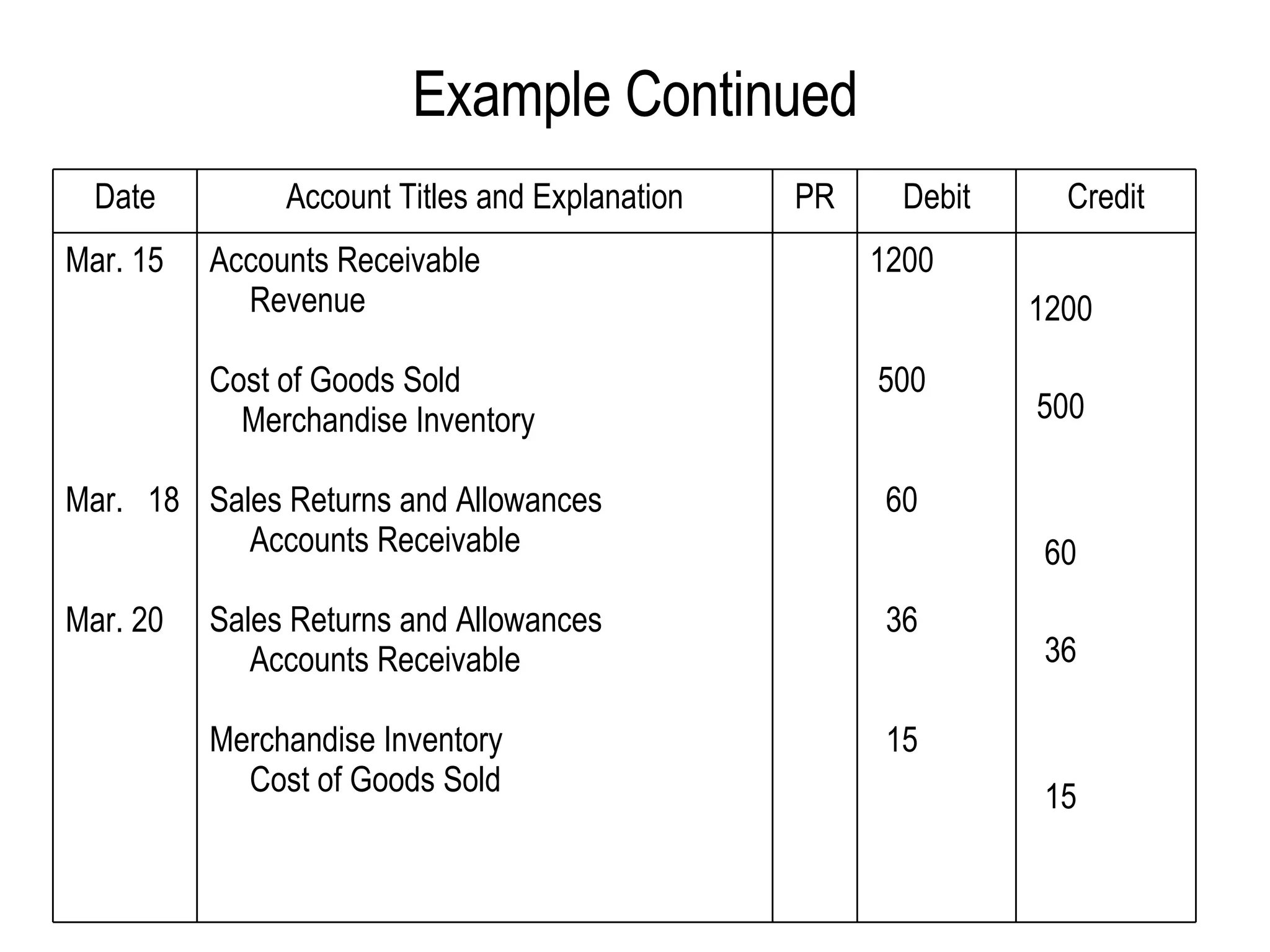
Example March 15: Customer purchased 100 items for $12 per item.  Each item has a cost of $5. March 18: Customer returned 5 items that were damaged.  Items were destroyed. March 20: Customer returned 3 items that were the wrong colour. Items were returned to inventory.
Example Continued Credit Debit PR Account Titles and Explanation Date 1200 500 60 36 15 1200 500 60 36 15 Accounts Receivable Revenue Cost of Goods Sold Merchandise Inventory Sales Returns and Allowances Accounts Receivable Sales Returns and Allowances Accounts Receivable Merchandise Inventory Cost of Goods Sold Mar. 15 Mar.  18 Mar. 20
Shrinkage An adjusting entry is required to account for any inventory loss. Shrinkage is determined by comparing a physical count of the inventory with recorded quantities. Entry:  Debit Cost of Goods Sold, Credit Inventory
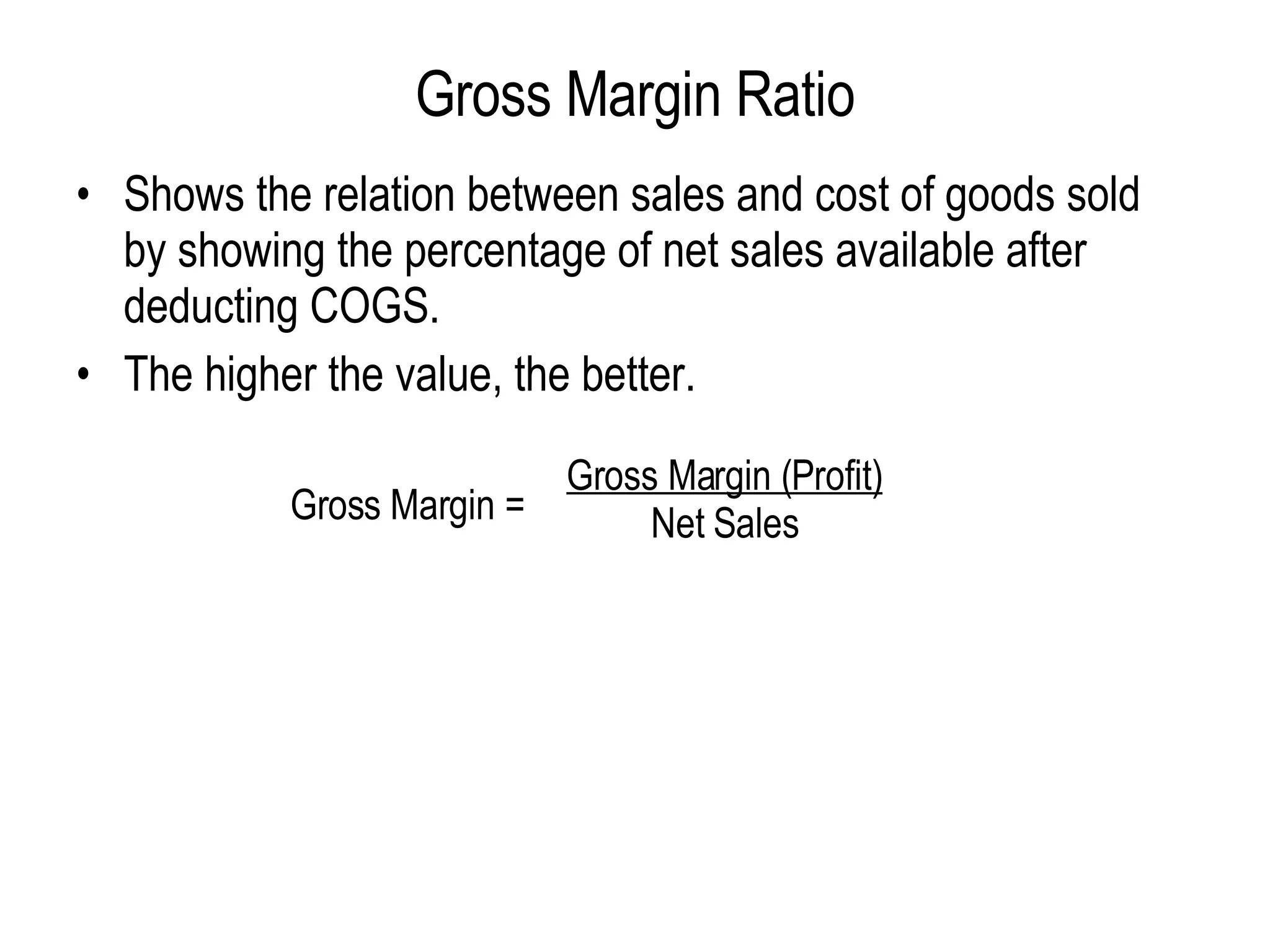
Gross Margin Ratio Shows the relation between sales and cost of goods sold by showing the percentage of net sales available after deducting COGS. The higher the value, the better. Gross Margin = Gross Margin (Profit) Net Sales

Accounting For Merchandising Activities

  • 1.
  • 2.
    Merchandising Activities Amerchandising company is an enterprise that buys and sells goods to earn a profit. 1. Wholesalers sell to retailers. 2. Retailers sell to consumers. A merchandiser’s primary source of revenue is sales, whereas a service company’s primary source of revenue is service revenue.
  • 3.
    Financial Performance ofa Merchandising Company Sales Revenue Cost of Goods Sold Less Gross Profit Equals Operating Expenses Less Net Income (Loss) Equals
  • 4.
    Merchandising Cash FlowBeginning Inventory Goods Purchased during period Cost of Goods Available for Sale Ending Inventory (Balance Sheet) Cost of Goods Sold (Income Statement) Not Sold Sold
  • 5.
    Inventory Systems Merchandisingentities may use either (or both) of the following inventory systems: 1. Perpetual – where detailed records of each inventory purchase and sale are maintained. Cost of goods sold is calculated at the time of each sale. 2. Periodic – detailed records are not maintained. Cost of goods sold is calculated only at the end of the accounting period.
  • 6.
    Recording Purchases Forpurchases on account, Merchandise Inventory is debited and Accounts Payable is credited. For cash purchases, Merchandise Inventory is debited and Cash is credited.
  • 7.
    Accounting for MerchandisePurchases To determine the inventory value, we must adjust the invoice cost for: Discounts given to a purchaser by a supplier. Any returns and allowances for unsatisfactory items received from a supplier. Any required freight costs paid by a purchaser.
  • 8.
    Trade Discounts vs.Purchase/Sales Discounts Trade Discounts: Used by manufacturers and wholesalers to change selling prices without republishing their catalogues. Already deducted from the purchase price before the transaction is recorded Sales and Purchase Discounts: A deduction from the invoice price granted to induce early payment of the amount due. Example – 2/10, n30 Deducted after the initial journal entry that recorded the purchase
  • 9.
    Purchase Discounts 2/10,n/30Number of Days Discount is Available Otherwise, Net (or All) is Due Within Credit Period Discount Percent
  • 10.
    Example Purchased $900of merchandise on credit on March 1 st . Discount terms 2/10 n/30 Company paid the bill on March 10 th . 900 18 882 900 900 Merchandise Inventory Accounts Payable Purchased merchandise on account Accounts Payable Merchandise Inventory Cash Paid for Mar. 1 purchase within the discount period Mar. 1 Mar. 10 Credit Debit PR Account Titles and Explanation Date
  • 11.
    Purchase Returns andAllowances Purchase returns are merchandise received by a purchaser but returned to the supplier. A purchase allowance is a reduction in the cost of defective merchandise received by a purchaser from a supplier. A debit memorandum is a form issued by the purchaser to inform the supplier of a debit made to the supplier's account, including the reason for a return or allowance. Memorandum gets its name from the issuer. Entry (On the books of the purchaser) Debit Accounts Payable or Cash (if refund given) and Credit Inventory
  • 12.
    Transportation Costs FOBshipping point—buyer pays shipping costs. Title transfers at shipping point Increases cost of merchandise Debit Inventory, Credit Cash or Accounts Payable (if to be paid for with merchandise later) FOB destination—seller pays shipping costs. Title transfers at destination. Operating expense for seller Debit Delivery Expense (if you are the seller), Credit Cash.
  • 13.
    Accounting for MerchandiseSales Sales transactions—Recording has two parts: Recognize revenue—Debit Accounts Receivable (or cash), Credit Sales (both for the invoice amount) Recognize cost—Debit Cost of Goods Sold, Credit Inventory (both for the cost of the inventory sold)
  • 14.
    Example A companysold $500 worth of merchandise for $800 on credit on March 1 st . Credit terms 3/10 n/EOM. Credit Debit PR Account Titles and Explanation Date 800 500 800 500 Accounts Receivable Revenue Sold merchandise on account Cost of Goods Sold Merchandise Inventory To record the cost of merchandise Mar. 1
  • 15.
    Sales Discounts Discountsawarded to customers for payment within the discount period. Recorded upon collection for sale. Sales Discount is a contra-revenue account—subtraction from Sales. Collection after discount period—Debit Cash, Credit Accounts Receivable (full invoice amount). Collection within discount period—Debit Cash (invoice amount less discount), Debit Sales Discount (discount amount), Credit Accounts Payable (invoice amount).
  • 16.
    Example Customer paidfor March 1 st purchase on March 8 th . Credit Debit PR Account Titles and Explanation Date 800 776 24 Cash Sales Discounts Accounts Receivable Sold merchandise on account Mar. 8
  • 17.
    Sales Returns andAllowances Sales returns— merchandise customers return to the seller after a sale. Sales allowances —reductions in the selling price of merchandise sold to customers (usually for damaged merchandise that a customer is willing to keep at a reduced price). Sales Returns and Allowances is a contra-revenue account—subtraction from Sales
  • 18.
    Sales Returns andAllowances Entry: Debit Sales Returns and Allowances and a Credit Accounts Receivable. Additional entry if returned merchandise is saleable: Debit Inventory, Credit Cost of Goods Sold Sales Returns and Allowances is a contra-revenue account—subtraction from Sales.
  • 19.
    Example March 15:Customer purchased 100 items for $12 per item. Each item has a cost of $5. March 18: Customer returned 5 items that were damaged. Items were destroyed. March 20: Customer returned 3 items that were the wrong colour. Items were returned to inventory.
  • 20.
    Example Continued CreditDebit PR Account Titles and Explanation Date 1200 500 60 36 15 1200 500 60 36 15 Accounts Receivable Revenue Cost of Goods Sold Merchandise Inventory Sales Returns and Allowances Accounts Receivable Sales Returns and Allowances Accounts Receivable Merchandise Inventory Cost of Goods Sold Mar. 15 Mar. 18 Mar. 20
  • 21.
    Shrinkage An adjustingentry is required to account for any inventory loss. Shrinkage is determined by comparing a physical count of the inventory with recorded quantities. Entry: Debit Cost of Goods Sold, Credit Inventory
  • 22.
    Gross Margin RatioShows the relation between sales and cost of goods sold by showing the percentage of net sales available after deducting COGS. The higher the value, the better. Gross Margin = Gross Margin (Profit) Net Sales