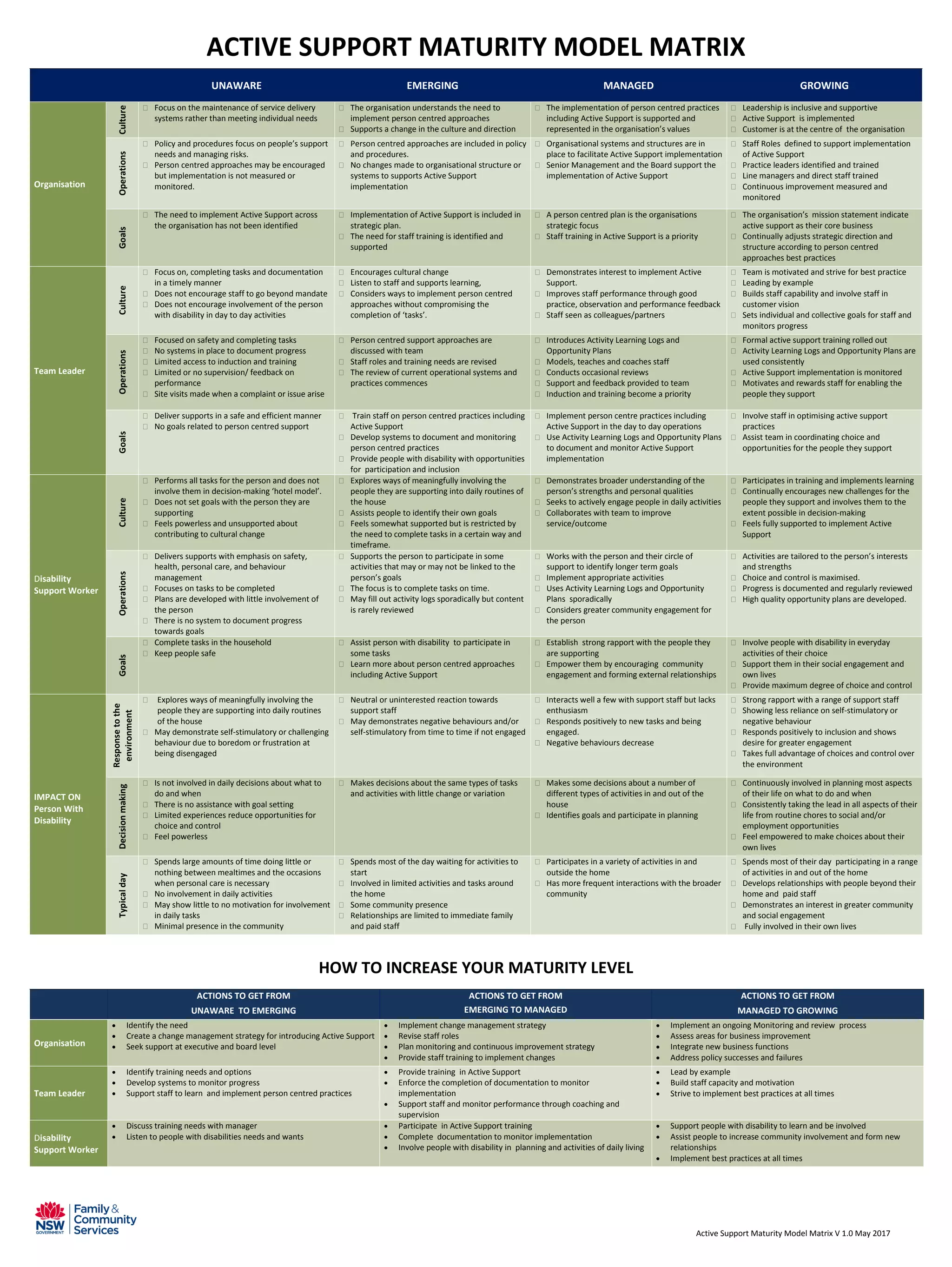
ACTIVE SUPPORT MATURITY MODEL MATRIX
Active Support Maturity Model Matrix V 1.0 May 2017
UNAWARE EMERGING MANAGED GROWING
Organisation
Culture
Focus on the maintenance of service delivery
systems rather than meeting individual needs
The organisation understands the need to
implement person centred approaches
Supports a change in the culture and direction
The implementation of person centred practices
including Active Support is supported and
represented in the organisation’s values
Leadership is inclusive and supportive
Active Support is implemented
Customer is at the centre of the organisation
Operations
Policy and procedures focus on people’s support
needs and managing risks.
Person centred approaches may be encouraged
but implementation is not measured or
monitored.
Person centred approaches are included in policy
and procedures.
No changes made to organisational structure or
systems to supports Active Support
implementation
Organisational systems and structures are in
place to facilitate Active Support implementation
Senior Management and the Board support the
implementation of Active Support
Staff Roles defined to support implementation
of Active Support
Practice leaders identified and trained
Line managers and direct staff trained
Continuous improvement measured and
monitored
Goals
The need to implement Active Support across
the organisation has not been identified
Implementation of Active Support is included in
strategic plan.
The need for staff training is identified and
supported
A person centred plan is the organisations
strategic focus
Staff training in Active Support is a priority
The organisation’s mission statement indicate
active support as their core business
Continually adjusts strategic direction and
structure according to person centred
approaches best practices
Team Leader
Culture
Focus on, completing tasks and documentation
in a timely manner
Does not encourage staff to go beyond mandate
Does not encourage involvement of the person
with disability in day to day activities
Encourages cultural change
Listen to staff and supports learning,
Considers ways to implement person centred
approaches without compromising the
completion of ‘tasks’.
Demonstrates interest to implement Active
Support.
Improves staff performance through good
practice, observation and performance feedback
Staff seen as colleagues/partners
Team is motivated and strive for best practice
Leading by example
Builds staff capability and involve staff in
customer vision
Sets individual and collective goals for staff and
monitors progress
Operations
Focused on safety and completing tasks
No systems in place to document progress
Limited access to induction and training
Limited or no supervision/ feedback on
performance
Site visits made when a complaint or issue arise
Person centred support approaches are
discussed with team
Staff roles and training needs are revised
The review of current operational systems and
practices commences
Introduces Activity Learning Logs and
Opportunity Plans
Models, teaches and coaches staff
Conducts occasional reviews
Support and feedback provided to team
Induction and training become a priority
Formal active support training rolled out
Activity Learning Logs and Opportunity Plans are
used consistently
Active Support implementation is monitored
Motivates and rewards staff for enabling the
people they support
Goals
Deliver supports in a safe and efficient manner
No goals related to person centred support
Train staff on person centred practices including
Active Support
Develop systems to document and monitoring
person centred practices
Provide people with disability with opportunities
for participation and inclusion
Implement person centre practices including
Active Support in the day to day operations
Use Activity Learning Logs and Opportunity Plans
to document and monitor Active Support
implementation
Involve staff in optimising active support
practices
Assist team in coordinating choice and
opportunities for the people they support
Disability
Support Worker
Culture
Performs all tasks for the person and does not
involve them in decision-making ‘hotel model’.
Does not set goals with the person they are
supporting
Feels powerless and unsupported about
contributing to cultural change
Explores ways of meaningfully involving the
people they are supporting into daily routines of
the house
Assists people to identify their own goals
Feels somewhat supported but is restricted by
the need to complete tasks in a certain way and
timeframe.
Demonstrates broader understanding of the
person’s strengths and personal qualities
Seeks to actively engage people in daily activities
Collaborates with team to improve
service/outcome
Participates in training and implements learning
Continually encourages new challenges for the
people they support and involves them to the
extent possible in decision-making
Feels fully supported to implement Active
Support
Operations
Delivers supports with emphasis on safety,
health, personal care, and behaviour
management
Focuses on tasks to be completed
Plans are developed with little involvement of
the person
There is no system to document progress
towards goals
Supports the person to participate in some
activities that may or may not be linked to the
person’s goals
The focus is to complete tasks on time.
May fill out activity logs sporadically but content
is rarely reviewed
Works with the person and their circle of
support to identify longer term goals
Implement appropriate activities
Uses Activity Learning Logs and Opportunity
Plans sporadically
Considers greater community engagement for
the person
Activities are tailored to the person’s interests
and strengths
Choice and control is maximised.
Progress is documented and regularly reviewed
High quality opportunity plans are developed.
Goals
Complete tasks in the household
Keep people safe
Assist person with disability to participate in
some tasks
Learn more about person centred approaches
including Active Support
Establish strong rapport with the people they
are supporting
Empower them by encouraging community
engagement and forming external relationships
Involve people with disability in everyday
activities of their choice
Support them in their social engagement and
own lives
Provide maximum degree of choice and control
IMPACT ON
Person With
Disability
Responsetothe
environment
Explores ways of meaningfully involving the
people they are supporting into daily routines
of the house
May demonstrate self-stimulatory or challenging
behaviour due to boredom or frustration at
being disengaged
Neutral or uninterested reaction towards
support staff
May demonstrates negative behaviours and/or
self-stimulatory from time to time if not engaged
Interacts well a few with support staff but lacks
enthusiasm
Responds positively to new tasks and being
engaged.
Negative behaviours decrease
Strong rapport with a range of support staff
Showing less reliance on self-stimulatory or
negative behaviour
Responds positively to inclusion and shows
desire for greater engagement
Takes full advantage of choices and control over
the environment
Decisionmaking
Is not involved in daily decisions about what to
do and when
There is no assistance with goal setting
Limited experiences reduce opportunities for
choice and control
Feel powerless
Makes decisions about the same types of tasks
and activities with little change or variation
Makes some decisions about a number of
different types of activities in and out of the
house
Identifies goals and participate in planning
Continuously involved in planning most aspects
of their life on what to do and when
Consistently taking the lead in all aspects of their
life from routine chores to social and/or
employment opportunities
Feel empowered to make choices about their
own lives
Typicalday
Spends large amounts of time doing little or
nothing between mealtimes and the occasions
when personal care is necessary
No involvement in daily activities
May show little to no motivation for involvement
in daily tasks
Minimal presence in the community
Spends most of the day waiting for activities to
start
Involved in limited activities and tasks around
the home
Some community presence
Relationships are limited to immediate family
and paid staff
Participates in a variety of activities in and
outside the home
Has more frequent interactions with the broader
community
Spends most of their day participating in a range
of activities in and out of the home
Develops relationships with people beyond their
home and paid staff
Demonstrates an interest in greater community
and social engagement
Fully involved in their own lives
HOW TO INCREASE YOUR MATURITY LEVEL
ACTIONS TO GET FROM
UNAWARE TO EMERGING
ACTIONS TO GET FROM
EMERGING TO MANAGED
ACTIONS TO GET FROM
MANAGED TO GROWING
Organisation
• Identify the need
• Create a change management strategy for introducing Active Support
• Seek support at executive and board level
• Implement change management strategy
• Revise staff roles
• Plan monitoring and continuous improvement strategy
• Provide staff training to implement changes
• Implement an ongoing Monitoring and review process
• Assess areas for business improvement
• Integrate new business functions
• Address policy successes and failures
Team Leader
• Identify training needs and options
• Develop systems to monitor progress
• Support staff to learn and implement person centred practices
• Provide training in Active Support
• Enforce the completion of documentation to monitor
implementation
• Support staff and monitor performance through coaching and
supervision
• Lead by example
• Build staff capacity and motivation
• Strive to implement best practices at all times
Disability
Support Worker
• Discuss training needs with manager
• Listen to people with disabilities needs and wants
• Participate in Active Support training
• Complete documentation to monitor implementation
• Involve people with disability in planning and activities of daily living
• Support people with disability to learn and be involved
• Assist people to increase community involvement and form new
relationships
• Implement best practices at all times

Active support-maturity-model

  • 1.
    ACTIVE SUPPORT MATURITYMODEL MATRIX Active Support Maturity Model Matrix V 1.0 May 2017 UNAWARE EMERGING MANAGED GROWING Organisation Culture Focus on the maintenance of service delivery systems rather than meeting individual needs The organisation understands the need to implement person centred approaches Supports a change in the culture and direction The implementation of person centred practices including Active Support is supported and represented in the organisation’s values Leadership is inclusive and supportive Active Support is implemented Customer is at the centre of the organisation Operations Policy and procedures focus on people’s support needs and managing risks. Person centred approaches may be encouraged but implementation is not measured or monitored. Person centred approaches are included in policy and procedures. No changes made to organisational structure or systems to supports Active Support implementation Organisational systems and structures are in place to facilitate Active Support implementation Senior Management and the Board support the implementation of Active Support Staff Roles defined to support implementation of Active Support Practice leaders identified and trained Line managers and direct staff trained Continuous improvement measured and monitored Goals The need to implement Active Support across the organisation has not been identified Implementation of Active Support is included in strategic plan. The need for staff training is identified and supported A person centred plan is the organisations strategic focus Staff training in Active Support is a priority The organisation’s mission statement indicate active support as their core business Continually adjusts strategic direction and structure according to person centred approaches best practices Team Leader Culture Focus on, completing tasks and documentation in a timely manner Does not encourage staff to go beyond mandate Does not encourage involvement of the person with disability in day to day activities Encourages cultural change Listen to staff and supports learning, Considers ways to implement person centred approaches without compromising the completion of ‘tasks’. Demonstrates interest to implement Active Support. Improves staff performance through good practice, observation and performance feedback Staff seen as colleagues/partners Team is motivated and strive for best practice Leading by example Builds staff capability and involve staff in customer vision Sets individual and collective goals for staff and monitors progress Operations Focused on safety and completing tasks No systems in place to document progress Limited access to induction and training Limited or no supervision/ feedback on performance Site visits made when a complaint or issue arise Person centred support approaches are discussed with team Staff roles and training needs are revised The review of current operational systems and practices commences Introduces Activity Learning Logs and Opportunity Plans Models, teaches and coaches staff Conducts occasional reviews Support and feedback provided to team Induction and training become a priority Formal active support training rolled out Activity Learning Logs and Opportunity Plans are used consistently Active Support implementation is monitored Motivates and rewards staff for enabling the people they support Goals Deliver supports in a safe and efficient manner No goals related to person centred support Train staff on person centred practices including Active Support Develop systems to document and monitoring person centred practices Provide people with disability with opportunities for participation and inclusion Implement person centre practices including Active Support in the day to day operations Use Activity Learning Logs and Opportunity Plans to document and monitor Active Support implementation Involve staff in optimising active support practices Assist team in coordinating choice and opportunities for the people they support Disability Support Worker Culture Performs all tasks for the person and does not involve them in decision-making ‘hotel model’. Does not set goals with the person they are supporting Feels powerless and unsupported about contributing to cultural change Explores ways of meaningfully involving the people they are supporting into daily routines of the house Assists people to identify their own goals Feels somewhat supported but is restricted by the need to complete tasks in a certain way and timeframe. Demonstrates broader understanding of the person’s strengths and personal qualities Seeks to actively engage people in daily activities Collaborates with team to improve service/outcome Participates in training and implements learning Continually encourages new challenges for the people they support and involves them to the extent possible in decision-making Feels fully supported to implement Active Support Operations Delivers supports with emphasis on safety, health, personal care, and behaviour management Focuses on tasks to be completed Plans are developed with little involvement of the person There is no system to document progress towards goals Supports the person to participate in some activities that may or may not be linked to the person’s goals The focus is to complete tasks on time. May fill out activity logs sporadically but content is rarely reviewed Works with the person and their circle of support to identify longer term goals Implement appropriate activities Uses Activity Learning Logs and Opportunity Plans sporadically Considers greater community engagement for the person Activities are tailored to the person’s interests and strengths Choice and control is maximised. Progress is documented and regularly reviewed High quality opportunity plans are developed. Goals Complete tasks in the household Keep people safe Assist person with disability to participate in some tasks Learn more about person centred approaches including Active Support Establish strong rapport with the people they are supporting Empower them by encouraging community engagement and forming external relationships Involve people with disability in everyday activities of their choice Support them in their social engagement and own lives Provide maximum degree of choice and control IMPACT ON Person With Disability Responsetothe environment Explores ways of meaningfully involving the people they are supporting into daily routines of the house May demonstrate self-stimulatory or challenging behaviour due to boredom or frustration at being disengaged Neutral or uninterested reaction towards support staff May demonstrates negative behaviours and/or self-stimulatory from time to time if not engaged Interacts well a few with support staff but lacks enthusiasm Responds positively to new tasks and being engaged. Negative behaviours decrease Strong rapport with a range of support staff Showing less reliance on self-stimulatory or negative behaviour Responds positively to inclusion and shows desire for greater engagement Takes full advantage of choices and control over the environment Decisionmaking Is not involved in daily decisions about what to do and when There is no assistance with goal setting Limited experiences reduce opportunities for choice and control Feel powerless Makes decisions about the same types of tasks and activities with little change or variation Makes some decisions about a number of different types of activities in and out of the house Identifies goals and participate in planning Continuously involved in planning most aspects of their life on what to do and when Consistently taking the lead in all aspects of their life from routine chores to social and/or employment opportunities Feel empowered to make choices about their own lives Typicalday Spends large amounts of time doing little or nothing between mealtimes and the occasions when personal care is necessary No involvement in daily activities May show little to no motivation for involvement in daily tasks Minimal presence in the community Spends most of the day waiting for activities to start Involved in limited activities and tasks around the home Some community presence Relationships are limited to immediate family and paid staff Participates in a variety of activities in and outside the home Has more frequent interactions with the broader community Spends most of their day participating in a range of activities in and out of the home Develops relationships with people beyond their home and paid staff Demonstrates an interest in greater community and social engagement Fully involved in their own lives HOW TO INCREASE YOUR MATURITY LEVEL ACTIONS TO GET FROM UNAWARE TO EMERGING ACTIONS TO GET FROM EMERGING TO MANAGED ACTIONS TO GET FROM MANAGED TO GROWING Organisation • Identify the need • Create a change management strategy for introducing Active Support • Seek support at executive and board level • Implement change management strategy • Revise staff roles • Plan monitoring and continuous improvement strategy • Provide staff training to implement changes • Implement an ongoing Monitoring and review process • Assess areas for business improvement • Integrate new business functions • Address policy successes and failures Team Leader • Identify training needs and options • Develop systems to monitor progress • Support staff to learn and implement person centred practices • Provide training in Active Support • Enforce the completion of documentation to monitor implementation • Support staff and monitor performance through coaching and supervision • Lead by example • Build staff capacity and motivation • Strive to implement best practices at all times Disability Support Worker • Discuss training needs with manager • Listen to people with disabilities needs and wants • Participate in Active Support training • Complete documentation to monitor implementation • Involve people with disability in planning and activities of daily living • Support people with disability to learn and be involved • Assist people to increase community involvement and form new relationships • Implement best practices at all times