SIMPLE
PROGRESSIVE
PERFECT
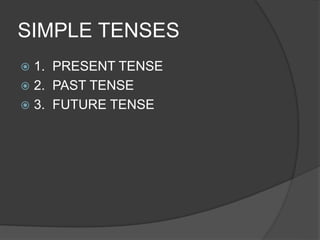
SIMPLE TENSES
 1. PRESENT TENSE
 2. PAST TENSE
 3. FUTURE TENSE
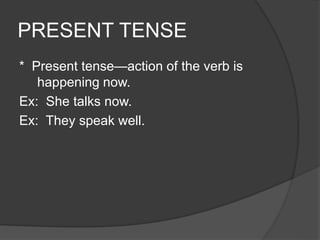
PRESENT TENSE
* Present tense—action of the verb is
happening now.
Ex: She talks now.
Ex: They speak well.
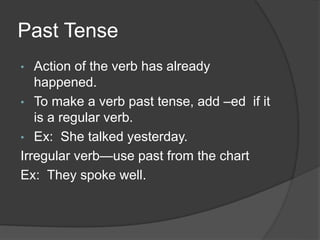
Past Tense
• Action of the verb has already
happened.
• To make a verb past tense, add –ed if it
is a regular verb.
• Ex: She talked yesterday.
Irregular verb—use past from the chart
Ex: They spoke well.
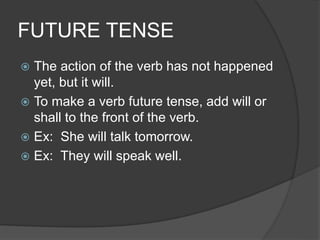
FUTURE TENSE
 The action of the verb has not happened
yet, but it will.
 To make a verb future tense, add will or
shall to the front of the verb.
 Ex: She will talk tomorrow.
 Ex: They will speak well.
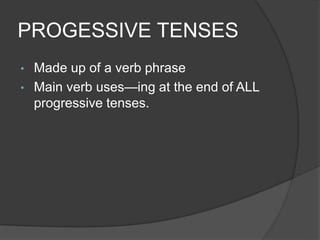
PROGESSIVE TENSES
• Made up of a verb phrase
• Main verb uses—ing at the end of ALL
progressive tenses.
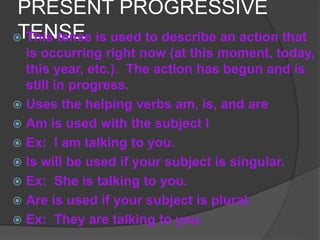
PRESENT PROGRESSIVE
TENSE
 This tense is used to describe an action that
is occurring right now (at this moment, today,
this year, etc.). The action has begun and is
still in progress.
 Uses the helping verbs am, is, and are
 Am is used with the subject I
 Ex: I am talking to you.
 Is will be used if your subject is singular.
 Ex: She is talking to you.
 Are is used if your subject is plural.
 Ex: They are talking to you.
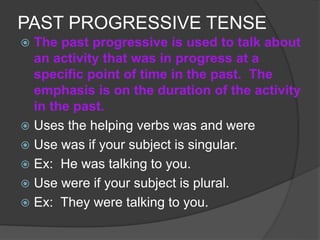
PAST PROGRESSIVE TENSE
 The past progressive is used to talk about
an activity that was in progress at a
specific point of time in the past. The
emphasis is on the duration of the activity
in the past.
 Uses the helping verbs was and were
 Use was if your subject is singular.
 Ex: He was talking to you.
 Use were if your subject is plural.
 Ex: They were talking to you.
PERFECT TENSES
• Is made up of a verb phrase
• Add –ed to the end of the main verb if
the action verb is a regular verb.
• Use perfect tense chart if verb is
irregular.
• Uses helping verbs have, has, or had
BEFORE the main verb.
PRESENT PERFECT
TENSE
 The present perfect is used to talk about
an event that began in the past and
continues up to the present.
 Use has if your subject is singular.
 Ex: She has talked to you already.
 Use have if your subject is plural.
 Ex: They have talked to you already.
 Ex with irregular verb: She has known
you for a while.
PAST PERFECT TENSE
 This tense describes completed events
that took place in the past before another
past event.
 Uses the helping verb had plus the main
verb with –ed on the end if it is a regular
verb.
 Example: She had talked to you before
you ordered the gift.
 Example(irregular verb) They had known
about the play.
FUTURE PERFECT TENSE
 This tense is used to describe an event or
action that will be completed before
another event or time in the future.
 Uses will have with the main verb ending
in –ed if it is a regular verb.
 Irregular verb also uses will have +the
main verb from column labeled perfect
tense.
 Ex: I will have studied for the test before
the circus comes to town.
 Ex: (irregular verb) I will have gone to the
store before you get home.
PRACTICE SENTENCES
 1. Rosetta has ____ her juggling act at
our talent show. (do)
 Done
 2. After she had _____ them, she
juggled. (throw)
 Thrown
 3. She is ______ right now. (speak)
 Speaking
 4. Laughter was _____ throughout the
audience. (ring)
 ringing

Verb tenses

  • 1.
  • 2.
    SIMPLE TENSES  1.PRESENT TENSE  2. PAST TENSE  3. FUTURE TENSE
  • 3.
    PRESENT TENSE * Presenttense—action of the verb is happening now. Ex: She talks now. Ex: They speak well.
  • 4.
    Past Tense • Actionof the verb has already happened. • To make a verb past tense, add –ed if it is a regular verb. • Ex: She talked yesterday. Irregular verb—use past from the chart Ex: They spoke well.
  • 5.
    FUTURE TENSE  Theaction of the verb has not happened yet, but it will.  To make a verb future tense, add will or shall to the front of the verb.  Ex: She will talk tomorrow.  Ex: They will speak well.
  • 6.
    PROGESSIVE TENSES • Madeup of a verb phrase • Main verb uses—ing at the end of ALL progressive tenses.
  • 7.
    PRESENT PROGRESSIVE TENSE  Thistense is used to describe an action that is occurring right now (at this moment, today, this year, etc.). The action has begun and is still in progress.  Uses the helping verbs am, is, and are  Am is used with the subject I  Ex: I am talking to you.  Is will be used if your subject is singular.  Ex: She is talking to you.  Are is used if your subject is plural.  Ex: They are talking to you.
  • 8.
    PAST PROGRESSIVE TENSE The past progressive is used to talk about an activity that was in progress at a specific point of time in the past. The emphasis is on the duration of the activity in the past.  Uses the helping verbs was and were  Use was if your subject is singular.  Ex: He was talking to you.  Use were if your subject is plural.  Ex: They were talking to you.
  • 9.
    PERFECT TENSES • Ismade up of a verb phrase • Add –ed to the end of the main verb if the action verb is a regular verb. • Use perfect tense chart if verb is irregular. • Uses helping verbs have, has, or had BEFORE the main verb.
  • 10.
    PRESENT PERFECT TENSE  Thepresent perfect is used to talk about an event that began in the past and continues up to the present.  Use has if your subject is singular.  Ex: She has talked to you already.  Use have if your subject is plural.  Ex: They have talked to you already.  Ex with irregular verb: She has known you for a while.
  • 11.
    PAST PERFECT TENSE This tense describes completed events that took place in the past before another past event.  Uses the helping verb had plus the main verb with –ed on the end if it is a regular verb.  Example: She had talked to you before you ordered the gift.  Example(irregular verb) They had known about the play.
  • 12.
    FUTURE PERFECT TENSE This tense is used to describe an event or action that will be completed before another event or time in the future.  Uses will have with the main verb ending in –ed if it is a regular verb.  Irregular verb also uses will have +the main verb from column labeled perfect tense.  Ex: I will have studied for the test before the circus comes to town.  Ex: (irregular verb) I will have gone to the store before you get home.
  • 13.
    PRACTICE SENTENCES  1.Rosetta has ____ her juggling act at our talent show. (do)  Done  2. After she had _____ them, she juggled. (throw)  Thrown  3. She is ______ right now. (speak)  Speaking  4. Laughter was _____ throughout the audience. (ring)  ringing