Active
Listening in
Mediation
Before mediators can effectively help the parties resolve their
disputes, mediators themselves must first understand and
recognize the different needs and interests of the disputing
parties, which requires actively listening to the parties.
However, active listening – arguably the purest form of listening –
is not an easy skill to acquire and apply in practice.
Practice Active Listening
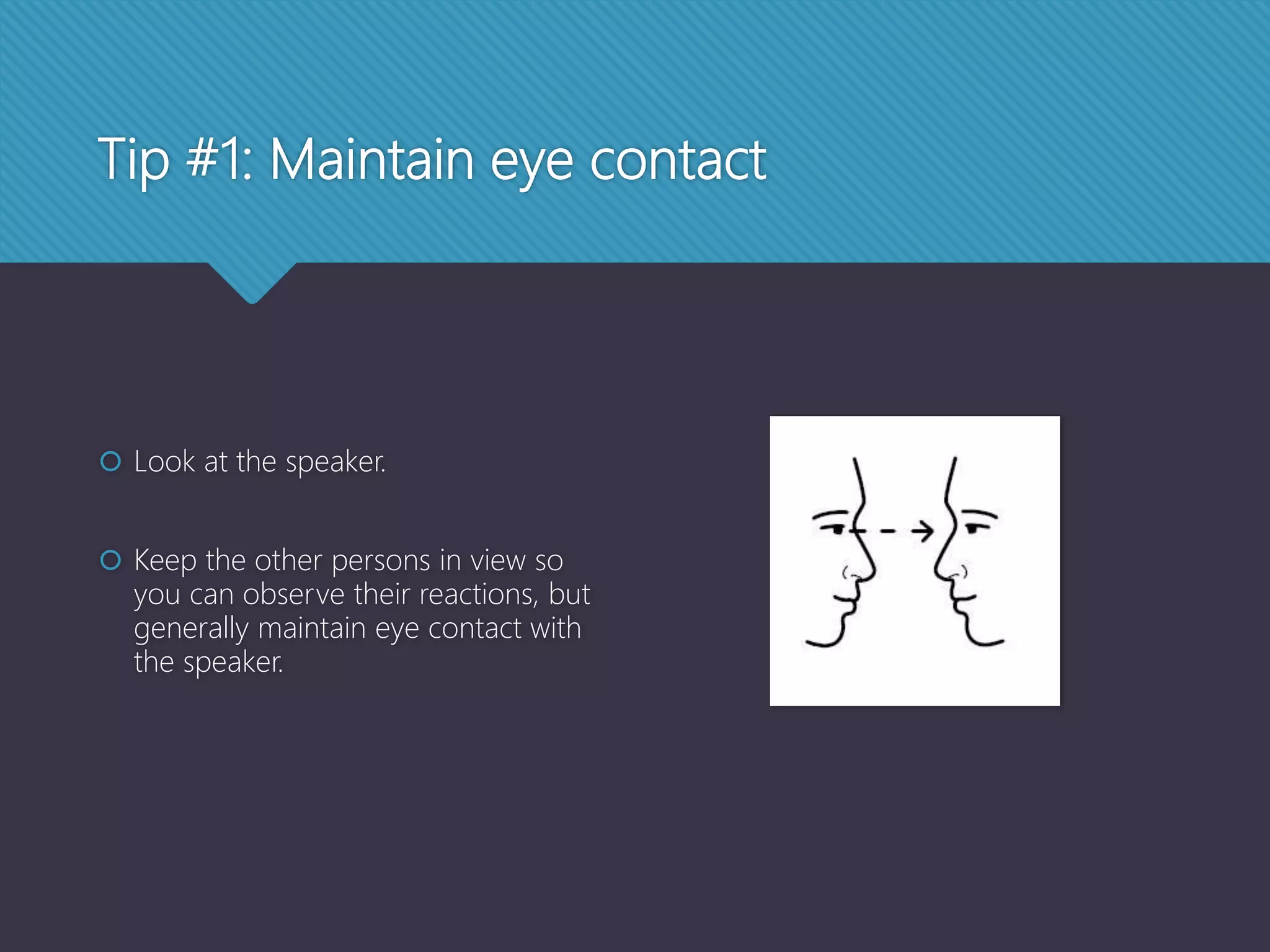
Tip #1: Maintain eye contact
 Look at the speaker.
 Keep the other persons in view so
you can observe their reactions, but
generally maintain eye contact with
the speaker.
Tip #2: Think only about what the person is
saying.
 Resist the urge to begin formulating
your reply or your position on the
issue.
 Show that you're interested in what
he/she is saying. Encourage by
unobtrusive use of "yes," "I see," "um
hum." Use positive body cues at
appropriate points -- nods, smiles
etc.
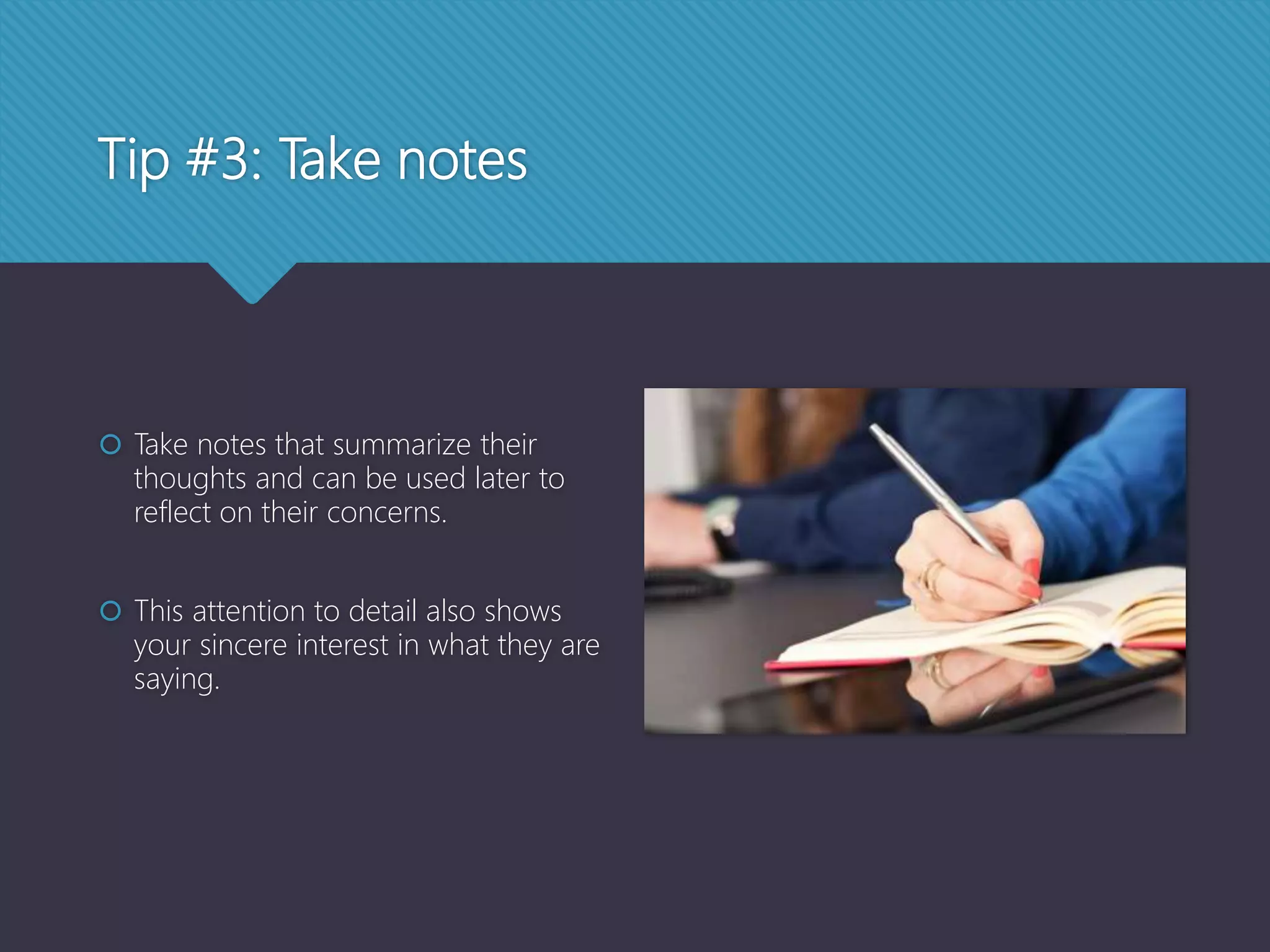
Tip #3: Take notes
 Take notes that summarize their
thoughts and can be used later to
reflect on their concerns.
 This attention to detail also shows
your sincere interest in what they are
saying.
Tip #4: Pay attention to body language
 Pay attention to the disputants body
language, including any significant
aspects in your notes.
 Observe HOW things are said -- the
emotions and attitudes behind the
words may be more important than
what is actually said.
 Look beyond the mere words the
speaker uses -- remember that much
information is displayed in voice
intonation and body language.
Tip #5: Ask questions
 Show that you're listening and interested by
asking Questions and Feeding Back,
Reframing and Summarizing. However,
particularly in early stages, be careful not to
interrupt the speaker's flow.
 Ask reflective questions to let the person
know you are listening and that you
understand their position.
 Repeat in your own words what you have
heard to ensure that you have understood it
and to let the party know you understood it
correctly.
 Ask probing questions about any aspect that
is not entirely clear to you. Draw the speaker
out. Say something like, "I'd like to hear a little
more about [subject]."
Thank You
References:
The Art of Negotiation and Mediation – A wishbone, funny bone and a bacbone, Anuroop Omkar &
Kritika Krishnamurthy
https://www.va.gov/ADR/ALM.asp

Active listening in Mediation

  • 1.
  • 2.
    Before mediators caneffectively help the parties resolve their disputes, mediators themselves must first understand and recognize the different needs and interests of the disputing parties, which requires actively listening to the parties. However, active listening – arguably the purest form of listening – is not an easy skill to acquire and apply in practice.
  • 3.
  • 4.
    Tip #1: Maintaineye contact  Look at the speaker.  Keep the other persons in view so you can observe their reactions, but generally maintain eye contact with the speaker.
  • 5.
    Tip #2: Thinkonly about what the person is saying.  Resist the urge to begin formulating your reply or your position on the issue.  Show that you're interested in what he/she is saying. Encourage by unobtrusive use of "yes," "I see," "um hum." Use positive body cues at appropriate points -- nods, smiles etc.
  • 6.
    Tip #3: Takenotes  Take notes that summarize their thoughts and can be used later to reflect on their concerns.  This attention to detail also shows your sincere interest in what they are saying.
  • 7.
    Tip #4: Payattention to body language  Pay attention to the disputants body language, including any significant aspects in your notes.  Observe HOW things are said -- the emotions and attitudes behind the words may be more important than what is actually said.  Look beyond the mere words the speaker uses -- remember that much information is displayed in voice intonation and body language.
  • 8.
    Tip #5: Askquestions  Show that you're listening and interested by asking Questions and Feeding Back, Reframing and Summarizing. However, particularly in early stages, be careful not to interrupt the speaker's flow.  Ask reflective questions to let the person know you are listening and that you understand their position.  Repeat in your own words what you have heard to ensure that you have understood it and to let the party know you understood it correctly.  Ask probing questions about any aspect that is not entirely clear to you. Draw the speaker out. Say something like, "I'd like to hear a little more about [subject]."
  • 9.
    Thank You References: The Artof Negotiation and Mediation – A wishbone, funny bone and a bacbone, Anuroop Omkar & Kritika Krishnamurthy https://www.va.gov/ADR/ALM.asp