By Kamol Karmakar
Lecturer, DELL, USTC.
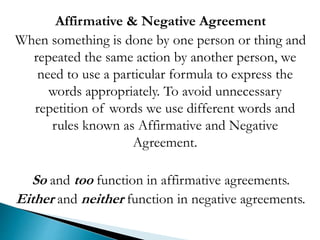
Affirmative & Negative Agreement
When something is done by one person or thing and
repeated the same action by another person, we
need to use a particular formula to express the
words appropriately. To avoid unnecessary
repetition of words we use different words and
rules known as Affirmative and Negative
Agreement.
So and too function in affirmative agreements.
Either and neither function in negative agreements.
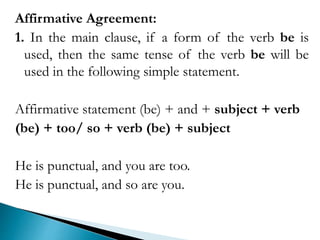
Affirmative Agreement:
1. In the main clause, if a form of the verb be is
used, then the same tense of the verb be will be
used in the following simple statement.
Affirmative statement (be) + and + subject + verb
(be) + too/ so + verb (be) + subject
He is punctual, and you are too.
He is punctual, and so are you.
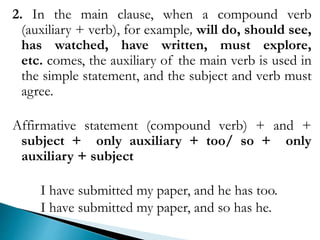
2. In the main clause, when a compound verb
(auxiliary + verb), for example, will do, should see,
has watched, have written, must explore,
etc. comes, the auxiliary of the main verb is used in
the simple statement, and the subject and verb must
agree.
Affirmative statement (compound verb) + and +
subject + only auxiliary + too/ so + only
auxiliary + subject
I have submitted my paper, and he has too.
I have submitted my paper, and so has he.
3. In the main clause, when any
verb except be comes without any auxiliaries, the
auxiliary do, does, or did is used in the simple
statement. The tense must be the same and the
subject and verb must agree.
Affirmative statement (single verb except be) + and +
subject + do, does, or did + too/ so + do, does,
or did + subject
I saw her this morning, and my friends did too.
I saw her this morning, and so did my friends.
Negative Agreement:
The same rules for auxiliaries, have, be and do,
does, or did apply for this agreement.
1. We aren’t scared of losing. He isn’t scared of losing.
We aren’t scared of losing, and he isn’t either.
We aren’t scared of losing, and neither is he.
2. I didn’t see Pooja this morning. Aarav didn’t see
Pooja this morning.
I didn’t see Pooja this morning, and Aarav didn’t either.
I didn’t see Pooja this morning, and neither did Aarav.
Thank You

Affirmative and Negative Agreement

  • 1.
  • 2.
    Affirmative & NegativeAgreement When something is done by one person or thing and repeated the same action by another person, we need to use a particular formula to express the words appropriately. To avoid unnecessary repetition of words we use different words and rules known as Affirmative and Negative Agreement. So and too function in affirmative agreements. Either and neither function in negative agreements.
  • 3.
    Affirmative Agreement: 1. Inthe main clause, if a form of the verb be is used, then the same tense of the verb be will be used in the following simple statement. Affirmative statement (be) + and + subject + verb (be) + too/ so + verb (be) + subject He is punctual, and you are too. He is punctual, and so are you.
  • 4.
    2. In themain clause, when a compound verb (auxiliary + verb), for example, will do, should see, has watched, have written, must explore, etc. comes, the auxiliary of the main verb is used in the simple statement, and the subject and verb must agree. Affirmative statement (compound verb) + and + subject + only auxiliary + too/ so + only auxiliary + subject I have submitted my paper, and he has too. I have submitted my paper, and so has he.
  • 5.
    3. In themain clause, when any verb except be comes without any auxiliaries, the auxiliary do, does, or did is used in the simple statement. The tense must be the same and the subject and verb must agree. Affirmative statement (single verb except be) + and + subject + do, does, or did + too/ so + do, does, or did + subject I saw her this morning, and my friends did too. I saw her this morning, and so did my friends.
  • 6.
    Negative Agreement: The samerules for auxiliaries, have, be and do, does, or did apply for this agreement. 1. We aren’t scared of losing. He isn’t scared of losing. We aren’t scared of losing, and he isn’t either. We aren’t scared of losing, and neither is he. 2. I didn’t see Pooja this morning. Aarav didn’t see Pooja this morning. I didn’t see Pooja this morning, and Aarav didn’t either. I didn’t see Pooja this morning, and neither did Aarav.
  • 7.