PEC
discussion
July 13, 2011
ACT IMPLEMENTATION
IN SAFTINET:
SUMMARY AND
REMAINING QUESTIONS
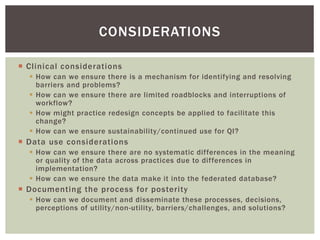
 Clinical considerations
 How can we ensure there is a mechanism for identifying and resolving
barriers and problems?
 How can we ensure there are limited roadblocks and interruptions of
workflow?
 How might practice redesign concepts be applied to facilitate this
change?
 How can we ensure sustainability/continued use for QI?
 Data use considerations
 How can we ensure there are no systematic differences in the meaning
or quality of the data across practices due to differences in
implementation?
 How can we ensure the data make it into the federated database?
 Documenting the process for posterity
 How can we document and disseminate these processes, decisions,
perceptions of utility/non-utility, barriers/challenges, and solutions?
CONSIDERATIONS
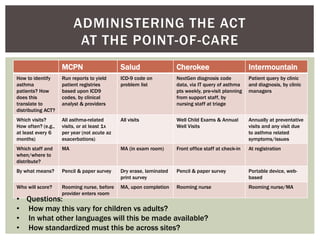
MCPN Salud Cherokee Intermountain
How to identify
asthma
patients? How
does this
translate to
distributing ACT?
Run reports to yield
patient registries
based upon ICD9
codes, by clinical
analyst & providers
ICD-9 code on
problem list
NextGen diagnosis code
data, via IT query of asthma
pts weekly, pre-visit planning
from support staff, by
nursing staff at triage
Patient query by clinic
and diagnosis, by clinic
managers
Which visits?
How often? (e.g.,
at least every 6
months)
All asthma-related
visits, or at least 1x
per year (not acute az
exacerbations)
All visits Well Child Exams & Annual
Well Visits
Annually at preventative
visits and any visit due
to asthma related
symptoms/issues
Which staff and
when/where to
distribute?
MA MA (in exam room) Front office staff at check-in At registration
By what means? Pencil & paper survey Dry erase, laminated
print survey
Pencil & paper survey Portable device, web-
based
Who will score? Rooming nurse, before
provider enters room
MA, upon completion Rooming nurse Rooming nurse/MA
ADMINISTERING THE ACT
AT THE POINT-OF-CARE
• Questions:
• How may this vary for children vs adults?
• In what other languages will this be made available?
• How standardized must this be across sites?
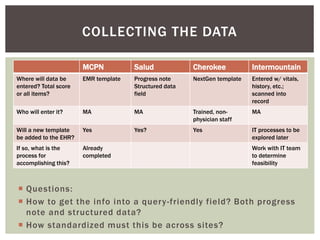
 Questions:
 How to get the info into a query-friendly field? Both progress
note and structured data?
 How standardized must this be across sites?
COLLECTING THE DATA
MCPN Salud Cherokee Intermountain
Where will data be
entered? Total score
or all items?
EMR template Progress note
Structured data
field
NextGen template Entered w/ vitals,
history, etc.;
scanned into
record
Who will enter it? MA MA Trained, non-
physician staff
MA
Will a new template
be added to the EHR?
Yes Yes? Yes IT processes to be
explored later
If so, what is the
process for
accomplishing this?
Already
completed
Work with IT team
to determine
feasibility
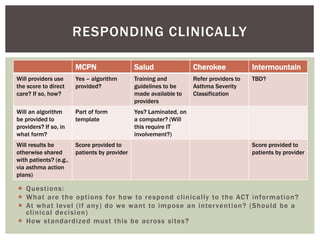
 Questions:
 What are the options for how to respond clinically to the ACT information?
 At what level (if any) do we want to impose an intervention? (Should be a
clinical decision)
 How standardized must this be across sites?
RESPONDING CLINICALLY
MCPN Salud Cherokee Intermountain
Will providers use
the score to direct
care? If so, how?
Yes – algorithm
provided?
Training and
guidelines to be
made available to
providers
Refer providers to
Asthma Severity
Classification
TBD?
Will an algorithm
be provided to
providers? If so, in
what form?
Part of form
template
Yes? Laminated, on
a computer? (Will
this require IT
involvement?)
Will results be
otherwise shared
with patients? (e.g.,
via asthma action
plans)
Score provided to
patients by provider
Score provided to
patients by provider
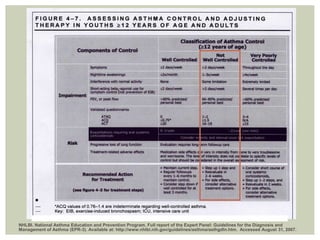
NHLBI. National Asthma Education and Prevention Program. Full report of the Expert Panel: Guidelines for the Diagnosis and
Management of Asthma (EPR-3). Available at: http://www.nhlbi.nih.gov/guidelines/asthma/asthgdln.htm. Accessed August 31, 2007.
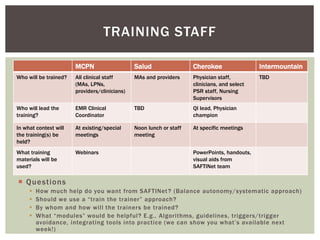
 Questions
 How much help do you want from SAFTINet? (Balance autonomy/systematic approach)
 Should we use a “train the trainer” approach?
 By whom and how will the trainers be trained?
 What “modules” would be helpful? E.g., Algorithms, guidelines, triggers/trigger
avoidance, integrating tools into practice (we can show you what’s available next
week!)
TRAINING STAFF
MCPN Salud Cherokee Intermountain
Who will be trained? All clinical staff
(MAs, LPNs,
providers/clinicians)
MAs and providers Physician staff,
clinicians, and select
PSR staff, Nursing
Supervisors
TBD
Who will lead the
training?
EMR Clinical
Coordinator
TBD QI lead, Physician
champion
In what context will
the training(s) be
held?
At existing/special
meetings
Noon lunch or staff
meeting
At specific meetings
What training
materials will be
used?
Webinars PowerPoints, handouts,
visual aids from
SAFTINet team
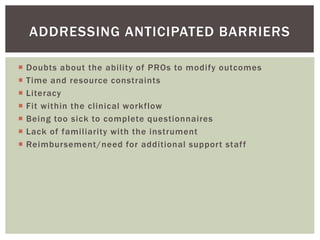
 Doubts about the ability of PROs to modify outcomes
 Time and resource constraints
 Literacy
 Fit within the clinical workflow
 Being too sick to complete questionnaires
 Lack of familiarity with the instrument
 Reimbursement/need for additional support staff
ADDRESSING ANTICIPATED BARRIERS
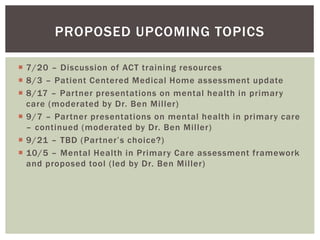
 7/20 – Discussion of ACT training resources
 8/3 – Patient Centered Medical Home assessment update
 8/17 – Partner presentations on mental health in primary
care (moderated by Dr. Ben Miller)
 9/7 – Partner presentations on mental health in primary care
– continued (moderated by Dr. Ben Miller)
 9/21 – TBD (Partner’s choice?)
 10/5 – Mental Health in Primary Care assessment framework
and proposed tool (led by Dr. Ben Miller)
PROPOSED UPCOMING TOPICS

ACT Implementation in SAFTINet

  • 1.
    PEC discussion July 13, 2011 ACTIMPLEMENTATION IN SAFTINET: SUMMARY AND REMAINING QUESTIONS
  • 2.
     Clinical considerations How can we ensure there is a mechanism for identifying and resolving barriers and problems?  How can we ensure there are limited roadblocks and interruptions of workflow?  How might practice redesign concepts be applied to facilitate this change?  How can we ensure sustainability/continued use for QI?  Data use considerations  How can we ensure there are no systematic differences in the meaning or quality of the data across practices due to differences in implementation?  How can we ensure the data make it into the federated database?  Documenting the process for posterity  How can we document and disseminate these processes, decisions, perceptions of utility/non-utility, barriers/challenges, and solutions? CONSIDERATIONS
  • 3.
    MCPN Salud CherokeeIntermountain How to identify asthma patients? How does this translate to distributing ACT? Run reports to yield patient registries based upon ICD9 codes, by clinical analyst & providers ICD-9 code on problem list NextGen diagnosis code data, via IT query of asthma pts weekly, pre-visit planning from support staff, by nursing staff at triage Patient query by clinic and diagnosis, by clinic managers Which visits? How often? (e.g., at least every 6 months) All asthma-related visits, or at least 1x per year (not acute az exacerbations) All visits Well Child Exams & Annual Well Visits Annually at preventative visits and any visit due to asthma related symptoms/issues Which staff and when/where to distribute? MA MA (in exam room) Front office staff at check-in At registration By what means? Pencil & paper survey Dry erase, laminated print survey Pencil & paper survey Portable device, web- based Who will score? Rooming nurse, before provider enters room MA, upon completion Rooming nurse Rooming nurse/MA ADMINISTERING THE ACT AT THE POINT-OF-CARE • Questions: • How may this vary for children vs adults? • In what other languages will this be made available? • How standardized must this be across sites?
  • 4.
     Questions:  Howto get the info into a query-friendly field? Both progress note and structured data?  How standardized must this be across sites? COLLECTING THE DATA MCPN Salud Cherokee Intermountain Where will data be entered? Total score or all items? EMR template Progress note Structured data field NextGen template Entered w/ vitals, history, etc.; scanned into record Who will enter it? MA MA Trained, non- physician staff MA Will a new template be added to the EHR? Yes Yes? Yes IT processes to be explored later If so, what is the process for accomplishing this? Already completed Work with IT team to determine feasibility
  • 5.
     Questions:  Whatare the options for how to respond clinically to the ACT information?  At what level (if any) do we want to impose an intervention? (Should be a clinical decision)  How standardized must this be across sites? RESPONDING CLINICALLY MCPN Salud Cherokee Intermountain Will providers use the score to direct care? If so, how? Yes – algorithm provided? Training and guidelines to be made available to providers Refer providers to Asthma Severity Classification TBD? Will an algorithm be provided to providers? If so, in what form? Part of form template Yes? Laminated, on a computer? (Will this require IT involvement?) Will results be otherwise shared with patients? (e.g., via asthma action plans) Score provided to patients by provider Score provided to patients by provider
  • 6.
    NHLBI. National AsthmaEducation and Prevention Program. Full report of the Expert Panel: Guidelines for the Diagnosis and Management of Asthma (EPR-3). Available at: http://www.nhlbi.nih.gov/guidelines/asthma/asthgdln.htm. Accessed August 31, 2007.
  • 7.
     Questions  Howmuch help do you want from SAFTINet? (Balance autonomy/systematic approach)  Should we use a “train the trainer” approach?  By whom and how will the trainers be trained?  What “modules” would be helpful? E.g., Algorithms, guidelines, triggers/trigger avoidance, integrating tools into practice (we can show you what’s available next week!) TRAINING STAFF MCPN Salud Cherokee Intermountain Who will be trained? All clinical staff (MAs, LPNs, providers/clinicians) MAs and providers Physician staff, clinicians, and select PSR staff, Nursing Supervisors TBD Who will lead the training? EMR Clinical Coordinator TBD QI lead, Physician champion In what context will the training(s) be held? At existing/special meetings Noon lunch or staff meeting At specific meetings What training materials will be used? Webinars PowerPoints, handouts, visual aids from SAFTINet team
  • 8.
     Doubts aboutthe ability of PROs to modify outcomes  Time and resource constraints  Literacy  Fit within the clinical workflow  Being too sick to complete questionnaires  Lack of familiarity with the instrument  Reimbursement/need for additional support staff ADDRESSING ANTICIPATED BARRIERS
  • 9.
     7/20 –Discussion of ACT training resources  8/3 – Patient Centered Medical Home assessment update  8/17 – Partner presentations on mental health in primary care (moderated by Dr. Ben Miller)  9/7 – Partner presentations on mental health in primary care – continued (moderated by Dr. Ben Miller)  9/21 – TBD (Partner’s choice?)  10/5 – Mental Health in Primary Care assessment framework and proposed tool (led by Dr. Ben Miller) PROPOSED UPCOMING TOPICS