SAFTINet CER
Asthma Protocol: Design & Methods
November 12, 2012
Aims & Hypotheses
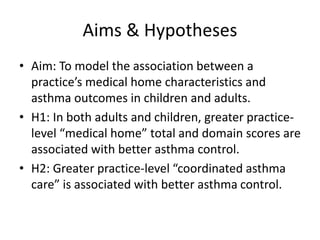
• Aim: To model the association between a
practice’s medical home characteristics and
asthma outcomes in children and adults.
• H1: In both adults and children, greater practice-
level “medical home” total and domain scores are
associated with better asthma control.
• H2: Greater practice-level “coordinated asthma
care” is associated with better asthma control.
Design
• Prospective, longitudinal cohort study, utilizing survey
methodologies and secondary use of existing
structured clinical, administrative, and claims data
(henceforth “electronic health data”)
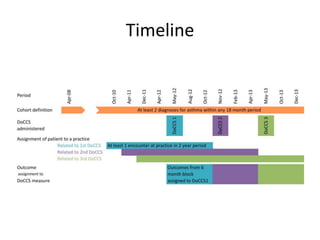
• Baseline period: January 1, 2011 through June 30, 2012
– Determining baseline cohort membership, assignment to
practice, and baseline severity/risk for poor asthma control
• Follow-up period: July 1, 2012 through December 31,
2013
– Three consecutive 6-month blocks
– Rolling cohort membership
Timeline
Concepts
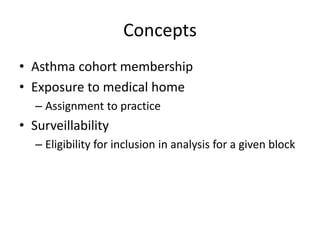
• Asthma cohort membership
• Exposure to medical home
– Assignment to practice
• Surveillability
– Eligibility for inclusion in analysis for a given block
Data Sources
• Practice surveys of medical home characteristics
and general practice characteristics
• Structured electronic health data (including
patient-reported outcomes) from the SAFTINet
federated database
– Outcomes:
• Asthma control test (*control category: good, poor, very
poor)
• Asthma exacerbations (at least one of: steroid bursts, cluster
of asthma encounters, inhaled beta-agonist administration,
asthma-related hospitalization/ED visit)
Analytic Approach
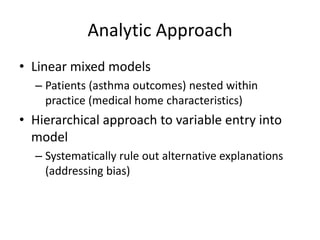
• Linear mixed models
– Patients (asthma outcomes) nested within
practice (medical home characteristics)
• Hierarchical approach to variable entry into
model
– Systematically rule out alternative explanations
(addressing bias)
Bias & Confounding
• Selection bias
– Cohort membership/asthma diagnosis
– Patient demographics
– Asthma severity
– Risk for uncontrolled asthma
• Misclassification bias
– Incorrectly assigned to practice, exposure to MH
– Incorrectly indicating absence/presence of exacerbation
• Information bias
– Systematic differences in collection of outcomes
data/documentation (e.g., mode of data collection,
increased access = more data)
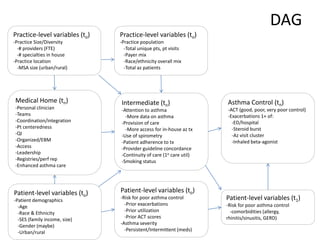
DAG
Asthma Control (tn)
-ACT (good, poor, very poor control)
-Exacerbations 1+ of:
-ED/hospital
-Steroid burst
-Az visit cluster
-Inhaled beta-agonist
Medical Home (tn)
-Personal clinician
-Teams
-Coordination/integration
-Pt centeredness
-QI
-Organized/EBM
-Access
-Leadership
-Registries/perf rep
-Enhanced asthma care
Intermediate (tn)
-Attention to asthma
-More data on asthma
-Provision of care
-More access for in-house az tx
-Use of spirometry
-Patient adherence to tx
-Provider guideline concordance
-Continuity of care (1o care util)
-Smoking status
Practice-level variables (to)
-Practice population
-Total unique pts, pt visits
-Payer mix
-Race/ethnicity overall mix
-Total az patients
Practice-level variables (to)
-Practice Size/Diversity
-# providers (FTE)
-# specialties in house
-Practice location
-MSA size (urban/rural)
Patient-level variables (to)
-Patient demographics
-Age
-Race & Ethnicity
-SES (family income, size)
-Gender (maybe)
-Urban/rural
Patient-level variables (to)
-Risk for poor asthma control
-Prior exacerbations
-Prior utilization
-Prior ACT scores
-Asthma severity
-Persistent/Intermittent (meds)
Patient-level variables (t1)
-Risk for poor asthma control
-comorbidities (allergy,
rhinitis/sinusitis, GERD)
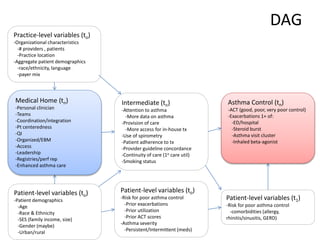
DAG
Asthma Control (tn)
-ACT (good, poor, very poor control)
-Exacerbations 1+ of:
-ED/hospital
-Steroid burst
-Asthma visit cluster
-Inhaled beta-agonist
Medical Home (tn)
-Personal clinician
-Teams
-Coordination/integration
-Pt centeredness
-QI
-Organized/EBM
-Access
-Leadership
-Registries/perf rep
-Enhanced asthma care
Intermediate (tn)
-Attention to asthma
-More data on asthma
-Provision of care
-More access for in-house tx
-Use of spirometry
-Patient adherence to tx
-Provider guideline concordance
-Continuity of care (1o care util)
-Smoking status
Practice-level variables (to)
-Organizational characteristics
-# providers , patients
-Practice location
-Aggregate patient demographics
-race/ethnicity, language
-payer mix
Patient-level variables (to)
-Patient demographics
-Age
-Race & Ethnicity
-SES (family income, size)
-Gender (maybe)
-Urban/rural
Patient-level variables (to)
-Risk for poor asthma control
-Prior exacerbations
-Prior utilization
-Prior ACT scores
-Asthma severity
-Persistent/Intermittent (meds)
Patient-level variables (t1)
-Risk for poor asthma control
-comorbidities (allergy,
rhinitis/sinusitis, GERD)
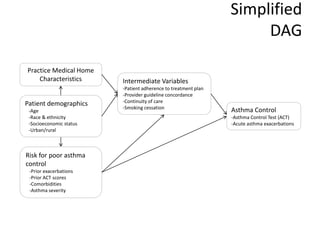
Simplified
DAG
Asthma Control
-Asthma Control Test (ACT)
-Acute asthma exacerbations
Practice Medical Home
Characteristics Intermediate Variables
-Patient adherence to treatment plan
-Provider guideline concordance
-Continuity of care
-Smoking cessation
Patient demographics
-Age
-Race & ethnicity
-Socioeconomic status
-Urban/rural
Risk for poor asthma
control
-Prior exacerbations
-Prior ACT scores
-Comorbidities
-Asthma severity
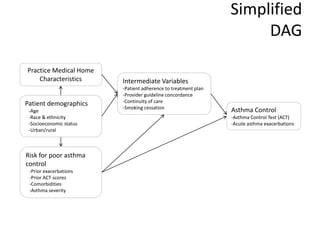
Simplified
DAG
Asthma Control
-Asthma Control Test (ACT)
-Acute asthma exacerbations
Practice Medical Home
Characteristics Intermediate Variables
-Patient adherence to treatment plan
-Provider guideline concordance
-Continuity of care
-Smoking cessation
Patient demographics
-Age
-Race & ethnicity
-Socioeconomic status
-Urban/rural
Risk for poor asthma
control
-Prior exacerbations
-Prior ACT scores
-Comorbidities
-Asthma severity
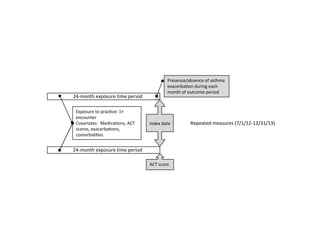
24-month exposure time period
Repeated measures (7/1/12-12/31/13)
24-month exposure time period
Presence/absence of asthma
exacerba on during each
month of outcome period
ACT score
index date
Exposure to prac ce: 1+
encounter
Covariates: Medica ons, ACT
scores, exacerba ons,
comorbidi es
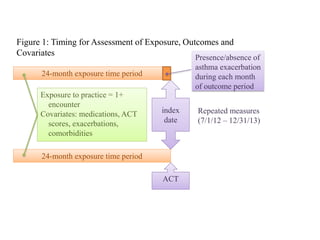
24-month exposure time period
Exposure to practice = 1+
encounter
Covariates: medications, ACT
scores, exacerbations,
comorbidities
index
date
ACT
Repeated measures
(7/1/12 – 12/31/13)
Presence/absence of
asthma exacerbation
during each month
of outcome period
Figure 1: Timing for Assessment of Exposure, Outcomes and
Covariates
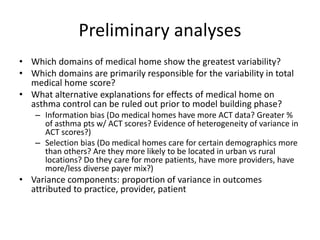
Preliminary analyses
• Which domains of medical home show the greatest variability?
• Which domains are primarily responsible for the variability in total
medical home score?
• What alternative explanations for effects of medical home on
asthma control can be ruled out prior to model building phase?
– Information bias (Do medical homes have more ACT data? Greater %
of asthma pts w/ ACT scores? Evidence of heterogeneity of variance in
ACT scores?)
– Selection bias (Do medical homes care for certain demographics more
than others? Are they more likely to be located in urban vs rural
locations? Do they care for more patients, have more providers, have
more/less diverse payer mix?)
• Variance components: proportion of variance in outcomes
attributed to practice, provider, patient
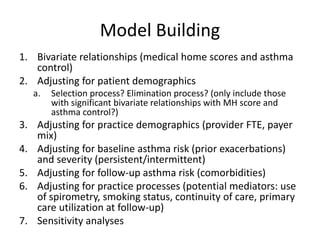
Model Building
1. Bivariate relationships (medical home scores and asthma
control)
2. Adjusting for patient demographics
a. Selection process? Elimination process? (only include those
with significant bivariate relationships with MH score and
asthma control?)
3. Adjusting for practice demographics (provider FTE, payer
mix)
4. Adjusting for baseline asthma risk (prior exacerbations)
and severity (persistent/intermittent)
5. Adjusting for follow-up asthma risk (comorbidities)
6. Adjusting for practice processes (potential mediators: use
of spirometry, smoking status, continuity of care, primary
care utilization at follow-up)
7. Sensitivity analyses
Sensitivity Analyses
• If claims data available
– Asthma exacerbations w/ and w/o hospital/ED
– Can answer question, “Compared to non-medical
homes, do medical homes show evidence of
increased rates of exacerbations when using only
clinical/administrative data, but similar or even
lower rates when including claims data?”
• Potential to bias effect of medical homes on asthma
control towards worse outcomes, due to differences in
access to primary care
Sensitivity Analyses
• Assignment to practice
– Linking patient outcomes with appropriate medical home
exposure – have we properly identified which practice is
responsible for any given ACT value or asthma exacerbation?
– Misclassification bias
– Assignment to practice based on utilization 18 months prior
AND 6 months inclusive of block
• Could bias effect of medical home towards worse outcomes if
increased access for patients who have not been able to get in
elsewhere
– Assignment to practice based on utilization 18 months prior to
block only
• Potential to limit sample size if first visit is exacerbation event; may
also bias non-medical homes towards better outcomes (excluding
more exacerbations, lower ACT scores because no prior visits, but lack
of visits is reason for poor control)
Tables of asthma results
• Separately for child and adult cohorts
• Descriptive: patient demographics
– Break down into men/women?
• Descriptive: practice demographics
• Descriptive: outcomes
• Descriptive: medical home total & domain scores
• Bivariate analysis (simple relationship between MH and
asthma outcomes)
• Bivariate analysis: relationships among covariates
• Hierarchical models
• Sensitivity analyses

SAFTINet CER Asthma Protocol

  • 1.
    SAFTINet CER Asthma Protocol:Design & Methods November 12, 2012
  • 2.
    Aims & Hypotheses •Aim: To model the association between a practice’s medical home characteristics and asthma outcomes in children and adults. • H1: In both adults and children, greater practice- level “medical home” total and domain scores are associated with better asthma control. • H2: Greater practice-level “coordinated asthma care” is associated with better asthma control.
  • 3.
    Design • Prospective, longitudinalcohort study, utilizing survey methodologies and secondary use of existing structured clinical, administrative, and claims data (henceforth “electronic health data”) • Baseline period: January 1, 2011 through June 30, 2012 – Determining baseline cohort membership, assignment to practice, and baseline severity/risk for poor asthma control • Follow-up period: July 1, 2012 through December 31, 2013 – Three consecutive 6-month blocks – Rolling cohort membership
  • 4.
  • 5.
    Concepts • Asthma cohortmembership • Exposure to medical home – Assignment to practice • Surveillability – Eligibility for inclusion in analysis for a given block
  • 6.
    Data Sources • Practicesurveys of medical home characteristics and general practice characteristics • Structured electronic health data (including patient-reported outcomes) from the SAFTINet federated database – Outcomes: • Asthma control test (*control category: good, poor, very poor) • Asthma exacerbations (at least one of: steroid bursts, cluster of asthma encounters, inhaled beta-agonist administration, asthma-related hospitalization/ED visit)
  • 7.
    Analytic Approach • Linearmixed models – Patients (asthma outcomes) nested within practice (medical home characteristics) • Hierarchical approach to variable entry into model – Systematically rule out alternative explanations (addressing bias)
  • 8.
    Bias & Confounding •Selection bias – Cohort membership/asthma diagnosis – Patient demographics – Asthma severity – Risk for uncontrolled asthma • Misclassification bias – Incorrectly assigned to practice, exposure to MH – Incorrectly indicating absence/presence of exacerbation • Information bias – Systematic differences in collection of outcomes data/documentation (e.g., mode of data collection, increased access = more data)
  • 9.
    DAG Asthma Control (tn) -ACT(good, poor, very poor control) -Exacerbations 1+ of: -ED/hospital -Steroid burst -Az visit cluster -Inhaled beta-agonist Medical Home (tn) -Personal clinician -Teams -Coordination/integration -Pt centeredness -QI -Organized/EBM -Access -Leadership -Registries/perf rep -Enhanced asthma care Intermediate (tn) -Attention to asthma -More data on asthma -Provision of care -More access for in-house az tx -Use of spirometry -Patient adherence to tx -Provider guideline concordance -Continuity of care (1o care util) -Smoking status Practice-level variables (to) -Practice population -Total unique pts, pt visits -Payer mix -Race/ethnicity overall mix -Total az patients Practice-level variables (to) -Practice Size/Diversity -# providers (FTE) -# specialties in house -Practice location -MSA size (urban/rural) Patient-level variables (to) -Patient demographics -Age -Race & Ethnicity -SES (family income, size) -Gender (maybe) -Urban/rural Patient-level variables (to) -Risk for poor asthma control -Prior exacerbations -Prior utilization -Prior ACT scores -Asthma severity -Persistent/Intermittent (meds) Patient-level variables (t1) -Risk for poor asthma control -comorbidities (allergy, rhinitis/sinusitis, GERD)
  • 10.
    DAG Asthma Control (tn) -ACT(good, poor, very poor control) -Exacerbations 1+ of: -ED/hospital -Steroid burst -Asthma visit cluster -Inhaled beta-agonist Medical Home (tn) -Personal clinician -Teams -Coordination/integration -Pt centeredness -QI -Organized/EBM -Access -Leadership -Registries/perf rep -Enhanced asthma care Intermediate (tn) -Attention to asthma -More data on asthma -Provision of care -More access for in-house tx -Use of spirometry -Patient adherence to tx -Provider guideline concordance -Continuity of care (1o care util) -Smoking status Practice-level variables (to) -Organizational characteristics -# providers , patients -Practice location -Aggregate patient demographics -race/ethnicity, language -payer mix Patient-level variables (to) -Patient demographics -Age -Race & Ethnicity -SES (family income, size) -Gender (maybe) -Urban/rural Patient-level variables (to) -Risk for poor asthma control -Prior exacerbations -Prior utilization -Prior ACT scores -Asthma severity -Persistent/Intermittent (meds) Patient-level variables (t1) -Risk for poor asthma control -comorbidities (allergy, rhinitis/sinusitis, GERD)
  • 11.
    Simplified DAG Asthma Control -Asthma ControlTest (ACT) -Acute asthma exacerbations Practice Medical Home Characteristics Intermediate Variables -Patient adherence to treatment plan -Provider guideline concordance -Continuity of care -Smoking cessation Patient demographics -Age -Race & ethnicity -Socioeconomic status -Urban/rural Risk for poor asthma control -Prior exacerbations -Prior ACT scores -Comorbidities -Asthma severity
  • 12.
    Simplified DAG Asthma Control -Asthma ControlTest (ACT) -Acute asthma exacerbations Practice Medical Home Characteristics Intermediate Variables -Patient adherence to treatment plan -Provider guideline concordance -Continuity of care -Smoking cessation Patient demographics -Age -Race & ethnicity -Socioeconomic status -Urban/rural Risk for poor asthma control -Prior exacerbations -Prior ACT scores -Comorbidities -Asthma severity
  • 13.
    24-month exposure timeperiod Repeated measures (7/1/12-12/31/13) 24-month exposure time period Presence/absence of asthma exacerba on during each month of outcome period ACT score index date Exposure to prac ce: 1+ encounter Covariates: Medica ons, ACT scores, exacerba ons, comorbidi es
  • 14.
    24-month exposure timeperiod 24-month exposure time period Exposure to practice = 1+ encounter Covariates: medications, ACT scores, exacerbations, comorbidities index date ACT Repeated measures (7/1/12 – 12/31/13) Presence/absence of asthma exacerbation during each month of outcome period Figure 1: Timing for Assessment of Exposure, Outcomes and Covariates
  • 15.
    Preliminary analyses • Whichdomains of medical home show the greatest variability? • Which domains are primarily responsible for the variability in total medical home score? • What alternative explanations for effects of medical home on asthma control can be ruled out prior to model building phase? – Information bias (Do medical homes have more ACT data? Greater % of asthma pts w/ ACT scores? Evidence of heterogeneity of variance in ACT scores?) – Selection bias (Do medical homes care for certain demographics more than others? Are they more likely to be located in urban vs rural locations? Do they care for more patients, have more providers, have more/less diverse payer mix?) • Variance components: proportion of variance in outcomes attributed to practice, provider, patient
  • 16.
    Model Building 1. Bivariaterelationships (medical home scores and asthma control) 2. Adjusting for patient demographics a. Selection process? Elimination process? (only include those with significant bivariate relationships with MH score and asthma control?) 3. Adjusting for practice demographics (provider FTE, payer mix) 4. Adjusting for baseline asthma risk (prior exacerbations) and severity (persistent/intermittent) 5. Adjusting for follow-up asthma risk (comorbidities) 6. Adjusting for practice processes (potential mediators: use of spirometry, smoking status, continuity of care, primary care utilization at follow-up) 7. Sensitivity analyses
  • 17.
    Sensitivity Analyses • Ifclaims data available – Asthma exacerbations w/ and w/o hospital/ED – Can answer question, “Compared to non-medical homes, do medical homes show evidence of increased rates of exacerbations when using only clinical/administrative data, but similar or even lower rates when including claims data?” • Potential to bias effect of medical homes on asthma control towards worse outcomes, due to differences in access to primary care
  • 18.
    Sensitivity Analyses • Assignmentto practice – Linking patient outcomes with appropriate medical home exposure – have we properly identified which practice is responsible for any given ACT value or asthma exacerbation? – Misclassification bias – Assignment to practice based on utilization 18 months prior AND 6 months inclusive of block • Could bias effect of medical home towards worse outcomes if increased access for patients who have not been able to get in elsewhere – Assignment to practice based on utilization 18 months prior to block only • Potential to limit sample size if first visit is exacerbation event; may also bias non-medical homes towards better outcomes (excluding more exacerbations, lower ACT scores because no prior visits, but lack of visits is reason for poor control)
  • 19.
    Tables of asthmaresults • Separately for child and adult cohorts • Descriptive: patient demographics – Break down into men/women? • Descriptive: practice demographics • Descriptive: outcomes • Descriptive: medical home total & domain scores • Bivariate analysis (simple relationship between MH and asthma outcomes) • Bivariate analysis: relationships among covariates • Hierarchical models • Sensitivity analyses

Editor's Notes

  • #5 Questions: Must patients meet cohort membership criteria based on data available prior to and/or inclusive of the block in order to be eligible for inclusion in analysis for that block? (i.e.., can meet criteria for asthma even if evidence arises AFTER the block?)