Building Customized Clinical Pathway Order Sets Implementing the Order Entry Component of an Existing Emergency Department Electronic Documentation SystemAnna M. Rogers, MSN, RN
Develop fully operational and customizedClinical Pathways Order Sets (CPOS) that replace handwritten order sheets in the ED.Project Goal
The Problem With Paper OrdersMedical errors and waste.
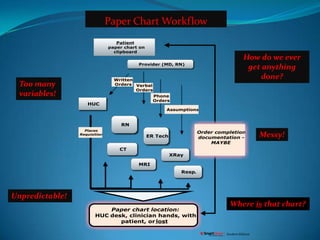
Illegible, incomplete, not clinically indicated and duplicate  orders.Limits communication to paper, verbal, phone, pager - and even by assumption!Paper Chart WorkflowHow do we ever get anything done?Too many variables!Messy!Unpredictable!Where is that chart?
Why Order Entry?Impact on patient safety:     Medication errorsAmbiguity of ordersOmission/redundancy of orders
Why Order Entry?Impact on clinical decisions:Best Practices and Standards of Care.	Clinical Decision Support Service (CDSS)
Project ObjectivesBuild CPOS using best practices and clinical standardsInclude end users and stakeholdersCPOS in TEST site for clinician approval and practiceTraining of end usersEvaluate training and OE acceptance by surveyShare survey results at wrap up
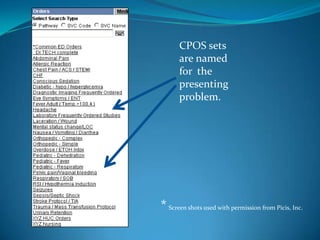
CPOS setsare named for  thepresenting problem.*Screen shots used with permission from Picis, Inc.
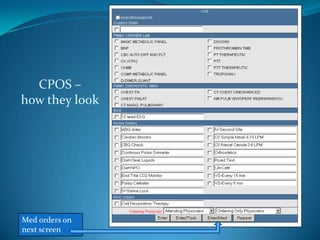
CPOS – how they lookMed orders on next screen
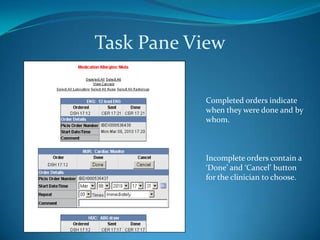
Task Pane ViewCompleted orders indicate when they were done and by whom.Incomplete orders contain a ‘Done’ and ‘Cancel’ button for the clinician to choose.
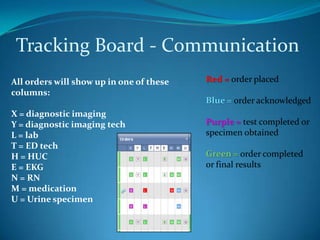
Tracking Board - CommunicationRed =order placedBlue =order acknowledgedPurple =test completed or specimen obtainedGreen =order completed or final resultsAll orders will show up in one of these columns:X = diagnostic imagingY = diagnostic imaging techL = labT = ED techH = HUCE = EKGN = RNM = medicationU = Urine specimen
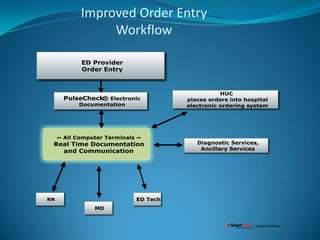
Improved Order Entry Workflow
Order Entry: Evaluation Surveys were distributed one 	week after go-live
 Results presented at the Project 	Wrap-Up meeting
Supported Clinicians Provide HigherQuality Care!
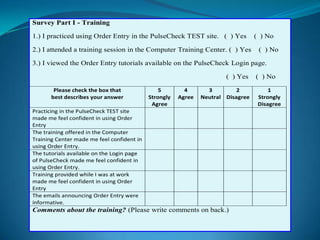
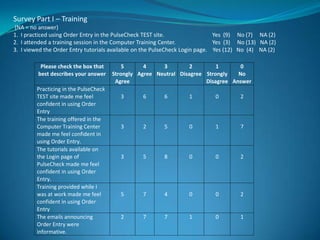
Survey Part I – Training(NA = no answer)1.  I practiced using Order Entry in the PulseCheck TEST site.		     Yes  (9)     No (7)     NA (2)2.  I attended a training session in the Computer Training Center.   	     Yes  (3)     No (13)   NA (2)3.  I viewed the Order Entry tutorials available on the PulseCheck Login page.    Yes (12)   No  (4)    NA (2)
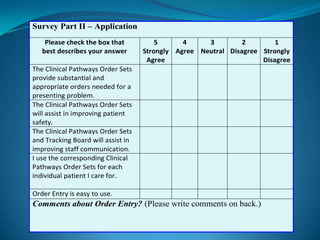
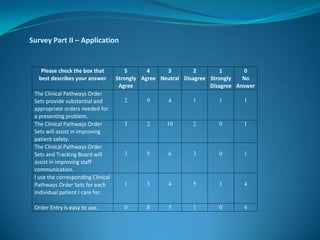
Survey Part II – Application
ConclusionsTrainingOf the eighteen surveys returned, training methods were regarded as neutral or positive. Most of the respondents utilized the TEST site and the training tutorials, while only three said they attended the hands on training. ApplicationMost respondents indicated acceptance of Order Entry with mostly positive or neutral answers. However, usage of the corresponding clinical pathways order sets for each patient indicates that they may not be fully utilized (8 neutral or agree, 10 disagree or did not answer). Most of the responding nurses who did not answer or disagreed because they thought that the order sets were for physician use only.  The negative answers regarding usefulness (safety, communication, etc.) of the application warrant some concern if they are from those who carry influence among their peers, which could jeopardize the continued successfulness of Order Entry.
ReferencesFarrell, A. (2008, Nov. 13). Preparing for clinical documentation: A strategic 	view [webinar]. Healthcare Information and Management Systems 	Society (HIMSS). Retrieved from http://www.himss.orgLee, P. D., and Hirshfield, M. (2006). Project planning for healthcare. The 	Health Care Manager, 25 (4), 310-314.Mewshaw, M. R., White, K. M., and Walrath, J. (2006, October). Medical 	errors: Where are we now? Nursing Management, 37(10), pp. 50–54.Piechowski, R. (2006). Making CPOE work: Redesign workflows to optimize 	benefits. Patient Safety & Quality Healthcare, March/April. 	Retrieved from http://www.psqh.com/marapr06/cpoe.htmlSengstack, P. P. and Gugerty, B. (2004, Winter). CPOE systems: Success factors 	and implementation issues. Journal of Healthcare Information 	Management, 18 (1), pp. 36-45.
References (cont.)The Standish Group Report. (2006). Chaos. Retrieved from 	http://www.cs.nmt.edu/~cs328/reading/Standish.pdf U. S. Department of Health and Human Services (HHS). (2006). HHS strategic 	plan: Fiscal years 2007–2012.Retrieved from http://www.hhs.govWang, X. S., Nayda, L. and Dettinger, R. (2007). Infrastructure for a clinical 	decision-intelligence system. IBM Systems Journal, 46 (1), pp. 151-169.

Building Customized Clinical Pathway Order Sets for CPOE Implementation

  • 1.
    Building Customized ClinicalPathway Order Sets Implementing the Order Entry Component of an Existing Emergency Department Electronic Documentation SystemAnna M. Rogers, MSN, RN
  • 2.
    Develop fully operationaland customizedClinical Pathways Order Sets (CPOS) that replace handwritten order sheets in the ED.Project Goal
  • 3.
    The Problem WithPaper OrdersMedical errors and waste.
  • 4.
    Illegible, incomplete, notclinically indicated and duplicate orders.Limits communication to paper, verbal, phone, pager - and even by assumption!Paper Chart WorkflowHow do we ever get anything done?Too many variables!Messy!Unpredictable!Where is that chart?
  • 5.
    Why Order Entry?Impacton patient safety: Medication errorsAmbiguity of ordersOmission/redundancy of orders
  • 6.
    Why Order Entry?Impacton clinical decisions:Best Practices and Standards of Care. Clinical Decision Support Service (CDSS)
  • 7.
    Project ObjectivesBuild CPOSusing best practices and clinical standardsInclude end users and stakeholdersCPOS in TEST site for clinician approval and practiceTraining of end usersEvaluate training and OE acceptance by surveyShare survey results at wrap up
  • 8.
    CPOS setsare namedfor thepresenting problem.*Screen shots used with permission from Picis, Inc.
  • 9.
    CPOS – howthey lookMed orders on next screen
  • 10.
    Task Pane ViewCompletedorders indicate when they were done and by whom.Incomplete orders contain a ‘Done’ and ‘Cancel’ button for the clinician to choose.
  • 11.
    Tracking Board -CommunicationRed =order placedBlue =order acknowledgedPurple =test completed or specimen obtainedGreen =order completed or final resultsAll orders will show up in one of these columns:X = diagnostic imagingY = diagnostic imaging techL = labT = ED techH = HUCE = EKGN = RNM = medicationU = Urine specimen
  • 12.
  • 13.
    Order Entry: EvaluationSurveys were distributed one week after go-live
  • 14.
    Results presentedat the Project Wrap-Up meeting
  • 16.
    Supported Clinicians ProvideHigherQuality Care!
  • 17.
    Survey Part I– Training(NA = no answer)1. I practiced using Order Entry in the PulseCheck TEST site. Yes (9) No (7) NA (2)2. I attended a training session in the Computer Training Center. Yes (3) No (13) NA (2)3. I viewed the Order Entry tutorials available on the PulseCheck Login page. Yes (12) No (4) NA (2)
  • 18.
    Survey Part II– Application
  • 19.
    ConclusionsTrainingOf the eighteensurveys returned, training methods were regarded as neutral or positive. Most of the respondents utilized the TEST site and the training tutorials, while only three said they attended the hands on training. ApplicationMost respondents indicated acceptance of Order Entry with mostly positive or neutral answers. However, usage of the corresponding clinical pathways order sets for each patient indicates that they may not be fully utilized (8 neutral or agree, 10 disagree or did not answer). Most of the responding nurses who did not answer or disagreed because they thought that the order sets were for physician use only. The negative answers regarding usefulness (safety, communication, etc.) of the application warrant some concern if they are from those who carry influence among their peers, which could jeopardize the continued successfulness of Order Entry.
  • 20.
    ReferencesFarrell, A. (2008,Nov. 13). Preparing for clinical documentation: A strategic view [webinar]. Healthcare Information and Management Systems Society (HIMSS). Retrieved from http://www.himss.orgLee, P. D., and Hirshfield, M. (2006). Project planning for healthcare. The Health Care Manager, 25 (4), 310-314.Mewshaw, M. R., White, K. M., and Walrath, J. (2006, October). Medical errors: Where are we now? Nursing Management, 37(10), pp. 50–54.Piechowski, R. (2006). Making CPOE work: Redesign workflows to optimize benefits. Patient Safety & Quality Healthcare, March/April. Retrieved from http://www.psqh.com/marapr06/cpoe.htmlSengstack, P. P. and Gugerty, B. (2004, Winter). CPOE systems: Success factors and implementation issues. Journal of Healthcare Information Management, 18 (1), pp. 36-45.
  • 21.
    References (cont.)The StandishGroup Report. (2006). Chaos. Retrieved from http://www.cs.nmt.edu/~cs328/reading/Standish.pdf U. S. Department of Health and Human Services (HHS). (2006). HHS strategic plan: Fiscal years 2007–2012.Retrieved from http://www.hhs.govWang, X. S., Nayda, L. and Dettinger, R. (2007). Infrastructure for a clinical decision-intelligence system. IBM Systems Journal, 46 (1), pp. 151-169.