EMR IMPLEMENTATION
KEYS TO OUR SUCCESS
  Consultants In Gastroenterology P.C.
          Kansas City Missouri
      Presenter Michelle Morgan
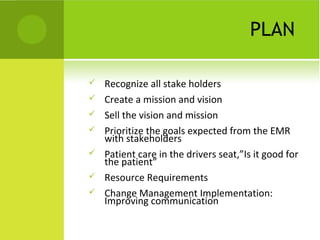
PLAN

   Recognize all stake holders
   Create a mission and vision
   Sell the vision and mission
   Prioritize the goals expected from the EMR
    with stakeholders
   Patient care in the drivers seat,”Is it good for
    the patient”
   Resource Requirements
   Change Management Implementation:
    Improving communication
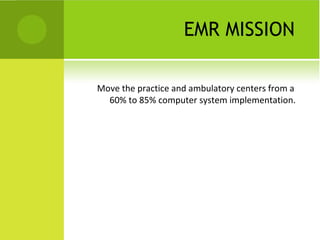
EMR MISSION

Move the practice and ambulatory centers from a
  60% to 85% computer system implementation.
EMR VISION

   To accomplish our mission we envision patient
    care to exceed customer expectations. We will
    strive to meet the needs of the community. Our
    work environment is one of mutual trust, respect
    and open communication promoting positive
    professional staff and physician relationships.
    We will exercise fiscal responsibility and
    encourage innovation.
MISSION AND VISION
                                        CREATION

        The long-term vision statement outlines what
         the organization wants to be
        Focuses on tomorrow
        Can be inspirational
        Timeless
        Ask: What inspires your organization?

(GE Healthcare summit, 2007)
STAKEHOLDERS

   Physician
   Nurse NP, PA, MA
   Residents, Interns
   Front Desk- scheduling/registration
   Billing Clerk
   Clerical Staff
COMPUTER
                  IMPLEMENTATION
                       COMMITTEE
   Select individuals from each department to
    represent the stakeholders
   Each department will play a role (believe me)
   Set specific guidelines for communication for
    implementation recommendations, workflow
    ideas, problems, concerns. Example: Project
    management program, designated helpdesk
    centralize an area for documentation
FINALIZING AND
             ANALYZING PLAN

   Does the computer
    implementation team satisfy
    each stakeholder?
   Are they included in the
    Mission and Vision
    statement?
MEETING AGENDA

   Discuss Mission and Vision, make adjustments
   Set goals
   Assign tasks to stakeholders
   Software representative and support
   Discuss resource requirements
   Change Management: pre-implementation
EXAMPLES OF GOALS

   Approved standardized physician order sets
   Seamless linkage of information between the MD
    office and the hospital
   Ability to have results, registration and
    appointments online
   Multidisciplinary plan of care and nurse
    admission screen that automatically populate
    previously collected data
   Our Ultimate Goal:100% EMR
GOALS

   Look at these goals and prioritize
   Each department are going to have different
    goals
   As a Team we need to focus on a set of goals.
   Using SMART to finalize the goals.
   SMART- Specific, Measurable, Attainable,
    Realistic, Time based (Stick to the schedule)
RESOURCE
                           REQUIREMENTS
   Budget needs to be established and keep in mind future
    investments, additional storage, future hardware needs,
    upgrades and updating systems.
       Project management
       Interface development

       Network infrastructure
       Ongoing support
       Software

       Hardware
       Additional staff
CHECKLIST FOR DECISION
                     MAKING

           Do the proposed ideas support patient safety?

           Do the proposed ideas support customer service?

           Do the proposed ideas improve communication efficiency?

           Do the proposed ideas fit the vision?

           Are the proposed ideas urgent and required for progress?

           Are the proposed ideas funded?

           Are the proposed ideas the most cost effective?

           Are the proposed ideas sufficiently clear?

           Does the outcome promote a smooth, natural transition?

           Will people easily take ownership of the end result?
(Scripps, 2007 GE Healthcare summit)
RECOMMENDATIONS

   TRAINING, TRAINING, AND MORE TRAINING IT IS NOT
    AN OPTION
   Establish and Develop a training program for the
    implementation and incorporate that into new
    employee orientation for future training.
   Keep a designated area with test applications for
    training.
   Have realistic expectations for the changes
   Expected frustration with implementing a new
    workflow. There is a period of learning before a
    comfort level is reached.
STRONGLY
                           ENCOURAGED

   Have onsite help for physicians and staff in the initial
    stages of implementation.
   For Return on Investment Jump Head first and face your
    fears and implement All or none with the system.
    Decreases resistance to change each time something
    changes.
   Have follow up training
   Really Involve stakeholders on Hardware needs and
    usage abilities, also physicians likes and dislikes.
   Make a uniform plan most physicians will agree on and
    stick to it. Try not to let one physician do his on thing
    while the other does something entirely different.
WORKFLOW TIPS

   Involve all stakeholders involved in the workflow
    development
   Stay away from “this is how we have always done this”
    therefore think outside the box
   Utilize similar practices for workflow help, CHUG email
    for tips and recommendations.
   Give sufficient time and communicate information about
    workflow change is going to happen and what to expect.
   TEST the WORKFLOW mulitple times, VERY frustrating
    and confusing when the workflow has to change several
    times.
DISCOURAGE

   Don’t expect staff to change their processes and
    culture in one day.
   Don’t implement one little piece at a time the system
    works collaboratively.
   Don’t forget to embrace the change as a learning
    experience
   Don’t forget change is guaranteed.
   Don’t buy Hardware physicians won’t use so ask
    them.
   Don’t underestimate how much storage you will
    need.
BOTTOM LINE

   Point to Ponder……


    If the Physicians don’t use it, nothing else
                  matters (GE Healthcare summit, 2007)
QUESTIONS OR
                    COMMENTS?

   Please feel free to share about
    your experiences
GE RESOURCES

   http://www.centricityusers.com/
   http://centricitypractice.gehealthcare.com/
   http://support.centricityservices.com/
   http://cpstraining-gehc.com/
   http://hls.gehealthcare.com/
OUTSIDE SITES

   http://www.healthcareitnews.com/
   http://www.himss.org/ASP/index.asp
   www.cms.gov (Meaningful use)
RESOURCES

   GE Healthcare Summit 2007, Powerpoint
    presentation.
   Scripps, 2007. What a Bear attack and
    implementing EMR taught me. Powerpoint.

Emr implementation

  • 1.
    EMR IMPLEMENTATION KEYS TOOUR SUCCESS Consultants In Gastroenterology P.C. Kansas City Missouri Presenter Michelle Morgan
  • 2.
    PLAN  Recognize all stake holders  Create a mission and vision  Sell the vision and mission  Prioritize the goals expected from the EMR with stakeholders  Patient care in the drivers seat,”Is it good for the patient”  Resource Requirements  Change Management Implementation: Improving communication
  • 3.
    EMR MISSION Move thepractice and ambulatory centers from a 60% to 85% computer system implementation.
  • 4.
    EMR VISION  To accomplish our mission we envision patient care to exceed customer expectations. We will strive to meet the needs of the community. Our work environment is one of mutual trust, respect and open communication promoting positive professional staff and physician relationships. We will exercise fiscal responsibility and encourage innovation.
  • 5.
    MISSION AND VISION CREATION  The long-term vision statement outlines what the organization wants to be  Focuses on tomorrow  Can be inspirational  Timeless  Ask: What inspires your organization? (GE Healthcare summit, 2007)
  • 6.
    STAKEHOLDERS  Physician  Nurse NP, PA, MA  Residents, Interns  Front Desk- scheduling/registration  Billing Clerk  Clerical Staff
  • 7.
    COMPUTER IMPLEMENTATION COMMITTEE  Select individuals from each department to represent the stakeholders  Each department will play a role (believe me)  Set specific guidelines for communication for implementation recommendations, workflow ideas, problems, concerns. Example: Project management program, designated helpdesk centralize an area for documentation
  • 8.
    FINALIZING AND ANALYZING PLAN  Does the computer implementation team satisfy each stakeholder?  Are they included in the Mission and Vision statement?
  • 9.
    MEETING AGENDA  Discuss Mission and Vision, make adjustments  Set goals  Assign tasks to stakeholders  Software representative and support  Discuss resource requirements  Change Management: pre-implementation
  • 10.
    EXAMPLES OF GOALS  Approved standardized physician order sets  Seamless linkage of information between the MD office and the hospital  Ability to have results, registration and appointments online  Multidisciplinary plan of care and nurse admission screen that automatically populate previously collected data  Our Ultimate Goal:100% EMR
  • 11.
    GOALS  Look at these goals and prioritize  Each department are going to have different goals  As a Team we need to focus on a set of goals.  Using SMART to finalize the goals.  SMART- Specific, Measurable, Attainable, Realistic, Time based (Stick to the schedule)
  • 12.
    RESOURCE REQUIREMENTS  Budget needs to be established and keep in mind future investments, additional storage, future hardware needs, upgrades and updating systems.  Project management  Interface development  Network infrastructure  Ongoing support  Software  Hardware  Additional staff
  • 13.
    CHECKLIST FOR DECISION MAKING  Do the proposed ideas support patient safety?  Do the proposed ideas support customer service?  Do the proposed ideas improve communication efficiency?  Do the proposed ideas fit the vision?  Are the proposed ideas urgent and required for progress?  Are the proposed ideas funded?  Are the proposed ideas the most cost effective?  Are the proposed ideas sufficiently clear?  Does the outcome promote a smooth, natural transition?  Will people easily take ownership of the end result? (Scripps, 2007 GE Healthcare summit)
  • 14.
    RECOMMENDATIONS  TRAINING, TRAINING, AND MORE TRAINING IT IS NOT AN OPTION  Establish and Develop a training program for the implementation and incorporate that into new employee orientation for future training.  Keep a designated area with test applications for training.  Have realistic expectations for the changes  Expected frustration with implementing a new workflow. There is a period of learning before a comfort level is reached.
  • 15.
    STRONGLY ENCOURAGED  Have onsite help for physicians and staff in the initial stages of implementation.  For Return on Investment Jump Head first and face your fears and implement All or none with the system. Decreases resistance to change each time something changes.  Have follow up training  Really Involve stakeholders on Hardware needs and usage abilities, also physicians likes and dislikes.  Make a uniform plan most physicians will agree on and stick to it. Try not to let one physician do his on thing while the other does something entirely different.
  • 16.
    WORKFLOW TIPS  Involve all stakeholders involved in the workflow development  Stay away from “this is how we have always done this” therefore think outside the box  Utilize similar practices for workflow help, CHUG email for tips and recommendations.  Give sufficient time and communicate information about workflow change is going to happen and what to expect.  TEST the WORKFLOW mulitple times, VERY frustrating and confusing when the workflow has to change several times.
  • 17.
    DISCOURAGE  Don’t expect staff to change their processes and culture in one day.  Don’t implement one little piece at a time the system works collaboratively.  Don’t forget to embrace the change as a learning experience  Don’t forget change is guaranteed.  Don’t buy Hardware physicians won’t use so ask them.  Don’t underestimate how much storage you will need.
  • 18.
    BOTTOM LINE  Point to Ponder…… If the Physicians don’t use it, nothing else matters (GE Healthcare summit, 2007)
  • 19.
    QUESTIONS OR COMMENTS?  Please feel free to share about your experiences
  • 20.
    GE RESOURCES  http://www.centricityusers.com/  http://centricitypractice.gehealthcare.com/  http://support.centricityservices.com/  http://cpstraining-gehc.com/  http://hls.gehealthcare.com/
  • 21.
    OUTSIDE SITES  http://www.healthcareitnews.com/  http://www.himss.org/ASP/index.asp  www.cms.gov (Meaningful use)
  • 22.
    RESOURCES  GE Healthcare Summit 2007, Powerpoint presentation.  Scripps, 2007. What a Bear attack and implementing EMR taught me. Powerpoint.

Editor's Notes

  • #7 We as a group need to make sure we are working on common goals. We need to prioritize our goals for our organization and work on them as a team. We need to make it a specific, measurable, attainable, realistic and time based goals. As a group we need to do this