
PRESENTATION ON ARCHITECTURAL
ACOUSTICS
SUBMITTED TO;
RAVI SIR
SUBMITTED BY;
RIYAS.MS
13061AA004
6TH SEM
SARCA
UNIT- 2--------SOUND
INTRODUCTION
SOUND
Sound is a vibration that propagates as a typically
audible mechanical wave of pressure and
displacement, through a medium such as air or
water. In physiology and psychology, sound is the
reception of such waves and their perception by
the brain.
Generation
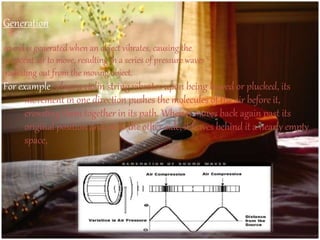
sound is generated when an object vibrates, causing the
adjacent air to move, resulting in a series of pressure waves
radiating out from the moving object.
For example, when a violin string vibrates upon being bowed or plucked, its
movement in one direction pushes the molecules of the air before it,
crowding them together in its path. When it moves back again past its
original position and on to the other side, it leaves behind it a nearly empty
space,
PROPOGATIONOF SOUND.
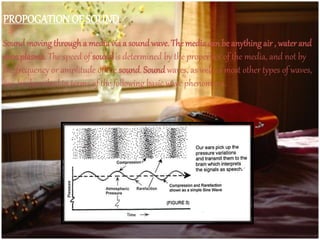
Soundmoving througha mediavia a soundwave. The mediacan be anythingair , waterand
even plasma. The speed of sound is determined by the properties of the media, and not by
the frequency or amplitude of the sound. Sound waves, as well as most other types of waves,
can be described in terms of the following basic wave phenomena.
RECEPTIONOF SOUND
A drum produces sound via a vibrating membrane. In physics, sound is a vibration
that propagates as a typically audible mechanical wave of pressure and
displacement, through a medium such as air or water. In physiology and
psychology, sound is the reception of such waves and their perception by the brain.
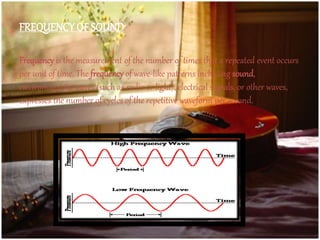
Frequency is the measurement of the number of times that a repeated event occurs
per unit of time. The frequency of wave-like patterns including sound,
electromagnetic waves (such as radio or light), electrical signals, or other waves,
expresses the number of cycles of the repetitive waveform per second.
FREQUENCYOF SOUND
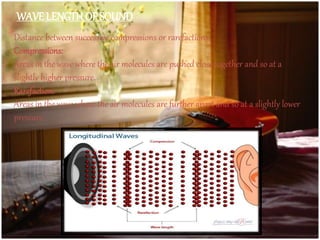
Distance between successive compressions or rarefactions.
Compressions:
Areas in the wave where the air molecules are pushed close together and so at a
slightly higher pressure.
Rarefaction:
Areas in the wave where the air molecules are further apart and so at a slightly lower
pressure.
WAVE LENGTH OF SOUND
VELOCITYOF SOUND
The velocity of sound, or of acoustic traveling waves, is a physical constant for any
given medium at a specific pressure and temperature. In dry air at sea level at 0
degrees Celsius , the speed of sound is approximately 331.4 meter s per second (m/s).
Temperature, pressure, and humidity affect this value to some extent.
In most liquids and solids, the speed of sound is greater than in air at sea level. In
part, this is because traveling waves in air occur because of compression, but
traveling waves in solids and liquids occur because of lateral motion of the
molecules, a phenomenon that generally propagates faster.
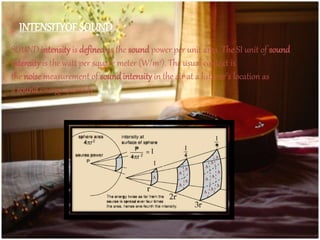
SOUND intensity is defined as the sound power per unit area. The SI unit of sound
intensity is the watt per square meter (W/m2). The usual context is
the noise measurement of soundintensity in the air at a listener's location as
a sound energy quantity
INTENSITYOF SOUND
INVERSE SQUARELAWOF SOUND
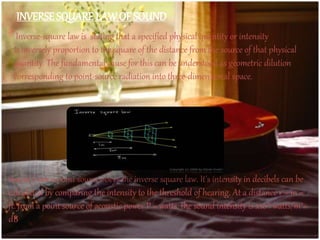
Sound from a point source obeys the inverse square law. It's intensity in decibels can be
calculated by comparing the intensity to the threshold of hearing. At a distance r = m =
ft. from a point source of acoustic power P = watts. the sound intensity is x10^ watts/m2=
dB
Inverse-square law is stating that a specified physical quantity or intensity
is inversely proportion to the square of the distance from the source of that physical
quantity. The fundamental cause for this can be understood as geometric dilution
corresponding to point-source radiation into three-dimensional space.
DECIBEL
A unit used to measure the intensity of a sound or the power level of an electrical
signal by comparing it with a given level on a logarithmic scale. The decibel (dB) is
a logarithmic unit used to express the ratio of two values of a physical quantity,
often power or intensity. One of these values is often a standard reference value, in
which case the decibel is used to express the level of the other value relative to this
reference. The number of decibels is ten times the logarithm to base 10 of the ratio of
two power quantities, or of the ratio of the squares of two field amplitude quantities.
One decibel is one tenth of one bell, named in honor of Alexander Graham Bell;
however, the bell is seldom used.
THANK
YOU…

Acoustic 2

  • 1.
    PRESENTATION ON ARCHITECTURAL ACOUSTICS SUBMITTEDTO; RAVI SIR SUBMITTED BY; RIYAS.MS 13061AA004 6TH SEM SARCA UNIT- 2--------SOUND
  • 2.
    INTRODUCTION SOUND Sound is avibration that propagates as a typically audible mechanical wave of pressure and displacement, through a medium such as air or water. In physiology and psychology, sound is the reception of such waves and their perception by the brain.
  • 3.
    Generation sound is generatedwhen an object vibrates, causing the adjacent air to move, resulting in a series of pressure waves radiating out from the moving object. For example, when a violin string vibrates upon being bowed or plucked, its movement in one direction pushes the molecules of the air before it, crowding them together in its path. When it moves back again past its original position and on to the other side, it leaves behind it a nearly empty space,
  • 4.
    PROPOGATIONOF SOUND. Soundmoving throughamediavia a soundwave. The mediacan be anythingair , waterand even plasma. The speed of sound is determined by the properties of the media, and not by the frequency or amplitude of the sound. Sound waves, as well as most other types of waves, can be described in terms of the following basic wave phenomena.
  • 5.
    RECEPTIONOF SOUND A drumproduces sound via a vibrating membrane. In physics, sound is a vibration that propagates as a typically audible mechanical wave of pressure and displacement, through a medium such as air or water. In physiology and psychology, sound is the reception of such waves and their perception by the brain.
  • 6.
    Frequency is themeasurement of the number of times that a repeated event occurs per unit of time. The frequency of wave-like patterns including sound, electromagnetic waves (such as radio or light), electrical signals, or other waves, expresses the number of cycles of the repetitive waveform per second. FREQUENCYOF SOUND
  • 7.
    Distance between successivecompressions or rarefactions. Compressions: Areas in the wave where the air molecules are pushed close together and so at a slightly higher pressure. Rarefaction: Areas in the wave where the air molecules are further apart and so at a slightly lower pressure. WAVE LENGTH OF SOUND
  • 8.
    VELOCITYOF SOUND The velocityof sound, or of acoustic traveling waves, is a physical constant for any given medium at a specific pressure and temperature. In dry air at sea level at 0 degrees Celsius , the speed of sound is approximately 331.4 meter s per second (m/s). Temperature, pressure, and humidity affect this value to some extent. In most liquids and solids, the speed of sound is greater than in air at sea level. In part, this is because traveling waves in air occur because of compression, but traveling waves in solids and liquids occur because of lateral motion of the molecules, a phenomenon that generally propagates faster.
  • 9.
    SOUND intensity isdefined as the sound power per unit area. The SI unit of sound intensity is the watt per square meter (W/m2). The usual context is the noise measurement of soundintensity in the air at a listener's location as a sound energy quantity INTENSITYOF SOUND
  • 10.
    INVERSE SQUARELAWOF SOUND Soundfrom a point source obeys the inverse square law. It's intensity in decibels can be calculated by comparing the intensity to the threshold of hearing. At a distance r = m = ft. from a point source of acoustic power P = watts. the sound intensity is x10^ watts/m2= dB Inverse-square law is stating that a specified physical quantity or intensity is inversely proportion to the square of the distance from the source of that physical quantity. The fundamental cause for this can be understood as geometric dilution corresponding to point-source radiation into three-dimensional space.
  • 11.
    DECIBEL A unit usedto measure the intensity of a sound or the power level of an electrical signal by comparing it with a given level on a logarithmic scale. The decibel (dB) is a logarithmic unit used to express the ratio of two values of a physical quantity, often power or intensity. One of these values is often a standard reference value, in which case the decibel is used to express the level of the other value relative to this reference. The number of decibels is ten times the logarithm to base 10 of the ratio of two power quantities, or of the ratio of the squares of two field amplitude quantities. One decibel is one tenth of one bell, named in honor of Alexander Graham Bell; however, the bell is seldom used.
  • 12.