Anion Gap


The difference between [Na+] and the sum of
[HC03-] and [Cl-].
 [Na+] – ([HC0 -] + [Cl-]) =
3





140 - (24 + 105) = 11
 Normal = 12 + 2

Clinicians use the anion gap to identify the cause
of metabolic acidosis.
Types of Acids in the Body


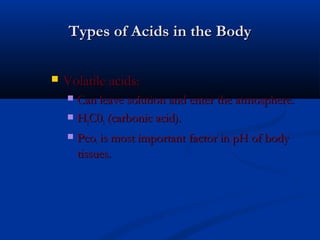
Volatile acids:
Can leave solution and enter the atmosphere.
 H C0 (carbonic acid).
2
3




Pco2 is most important factor in pH of body
tissues.
Buffer: any substance which reversibly consumes or releases H+. Buffers minimize or
attenuate changes in pH by consuming or adding H+ in such a way to minimize discrete
changes.

Valence does not matter, ie for buffer “B”
Protonated form in equilibrium with deporotonated form
Weak acid

HB (n+1)

Weak base

B (n) + H (+)

=

The buffers distribute themselves via their dissociation constant (K) defined as the ratio
[B(n)] [H+] = K
[HB(n=1)]
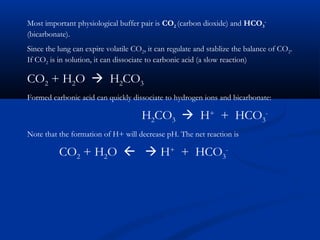
Most important physiological buffer pair is CO2 (carbon dioxide) and HCO3(bicarbonate).
Since the lung can expire volatile CO2, it can regulate and stablize the balance of CO2.
If CO2 is in solution, it can dissociate to carbonic acid (a slow reaction)

CO2 + H2O  H2CO3
Formed carbonic acid can quickly dissociate to hydrogen ions and bicarbonate:

H2CO3  H+ + HCO3Note that the formation of H+ will decrease pH. The net reaction is

CO2 + H2O   H+ + HCO3-
Proteins


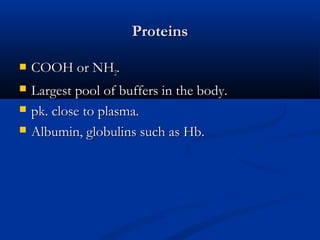
COOH or NH2.



Largest pool of buffers in the body.
pk. close to plasma.
Albumin, globulins such as Hb.



Other important buffers


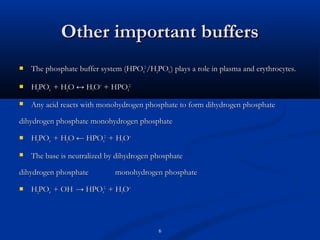
The phosphate buffer system (HPO42-/H2PO4-) plays a role in plasma and erythrocytes.



H2PO4- + H2O ↔ H3O+ + HPO42-



Any acid reacts with monohydrogen phosphate to form dihydrogen phosphate

dihydrogen phosphate monohydrogen phosphate


H2PO4- + H2O ← HPO42- + H3O+



The base is neutralized by dihydrogen phosphate

dihydrogen phosphate


monohydrogen phosphate

H2PO4- + OH- → HPO42- + H3O+

6
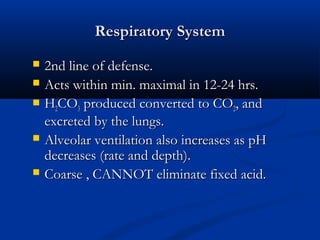
Respiratory System







2nd line of defense.
Acts within min. maximal in 12-24 hrs.
H2CO3 produced converted to CO2, and
excreted by the lungs.
Alveolar ventilation also increases as pH
decreases (rate and depth).
Coarse , CANNOT eliminate fixed acid.
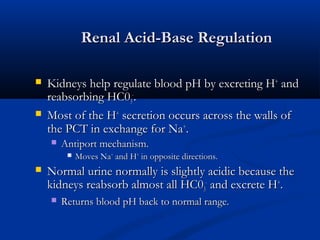
Renal Acid-Base Regulation




Kidneys help regulate blood pH by excreting H+ and
reabsorbing HC03-.
Most of the H+ secretion occurs across the walls of
the PCT in exchange for Na+.


Antiport mechanism.




Moves Na+ and H+ in opposite directions.

Normal urine normally is slightly acidic because the
kidneys reabsorb almost all HC03- and excrete H+.


Returns blood pH back to normal range.
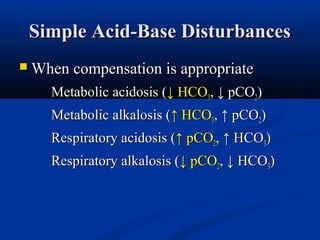
Simple Acid-Base Disturbances


When compensation is appropriate
Metabolic acidosis (↓ HCO3, ↓ pCO2)
Metabolic alkalosis (↑ HCO3, ↑ pCO2)
Respiratory acidosis (↑ pCO2, ↑ HCO3)
Respiratory alkalosis (↓ pCO2, ↓ HCO3)
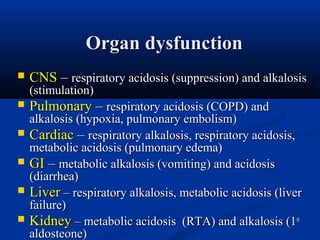
Organ dysfunction


CNS – respiratory acidosis (suppression) and alkalosis
(stimulation)







Pulmonary – respiratory acidosis (COPD) and

alkalosis (hypoxia, pulmonary embolism)
Cardiac – respiratory alkalosis, respiratory acidosis,
metabolic acidosis (pulmonary edema)
GI – metabolic alkalosis (vomiting) and acidosis
(diarrhea)
Liver – respiratory alkalosis, metabolic acidosis (liver
failure)
Kidney – metabolic acidosis (RTA) and alkalosis (1st
aldosteone)
Metabolic (Nonrespiratory) Acidosis:
H+ ↑ pH ↓





Symptoms: Increased ventilation, fatigue, confusion
Causes: Renal disease, including hepatitis and cirrhosis;
increased acid production in diabetes mellitus,
hyperthyroidism, alcoholism, and starvation; loss of
alkali in diarrhea; acid retention in renal failure
Treatment: Sodium bicarbonate given orally, dialysis for
renal failure, insulin treatment for diabetic ketosis

11
Organ Dysfunction


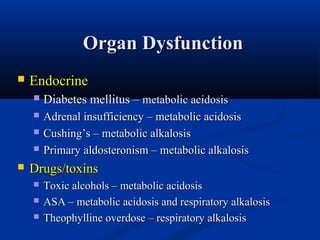
Endocrine


Diabetes mellitus – metabolic acidosis



Adrenal insufficiency – metabolic acidosis
Cushing’s – metabolic alkalosis
Primary aldosteronism – metabolic alkalosis






Drugs/toxins




Toxic alcohols – metabolic acidosis
ASA – metabolic acidosis and respiratory alkalosis
Theophylline overdose – respiratory alkalosis
Generation of Metabolic Acidosis
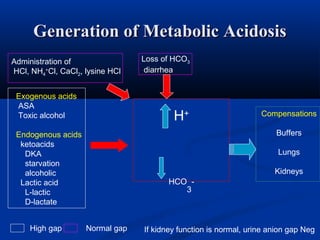
Administration of
HCl, NH4+Cl, CaCl2, lysine HCl
Exogenous acids
ASA
Toxic alcohol

H+

Compensations
Buffers

Endogenous acids
ketoacids
DKA
starvation
alcoholic
Lactic acid
L-lactic
D-lactate
High gap

Loss of HCO3
diarrhea

Lungs
Kidneys

HCO 3

Normal gap

If kidney function is normal, urine anion gap Neg
Respiratory acidosis
PCO2 greater than expected
Acute or chronic
Causes
 excess CO2 in inspired air
(rebreathing of CO2-containing expired air, addition of
CO2 to inspired air, insufflation of CO2 into body
cavity)
 decreased alveolar ventilation
(central respiratory depression & other CNS
problems, nerve or muscle disorders, lung or chest
wall defects, airway disorders, external factors)
 increased production of CO2
(hypercatabolic disorders)
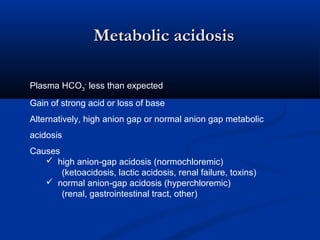
Metabolic acidosis
Plasma HCO3- less than expected
Gain of strong acid or loss of base
Alternatively, high anion gap or normal anion gap metabolic
acidosis
Causes
 high anion-gap acidosis (normochloremic)
(ketoacidosis, lactic acidosis, renal failure, toxins)
 normal anion-gap acidosis (hyperchloremic)
(renal, gastrointestinal tract, other)
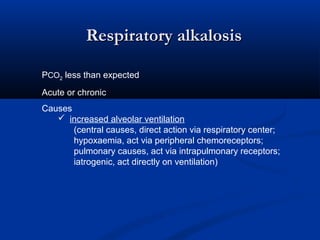
Respiratory alkalosis
PCO2 less than expected
Acute or chronic
Causes
 increased alveolar ventilation
(central causes, direct action via respiratory center;
hypoxaemia, act via peripheral chemoreceptors;
pulmonary causes, act via intrapulmonary receptors;
iatrogenic, act directly on ventilation)
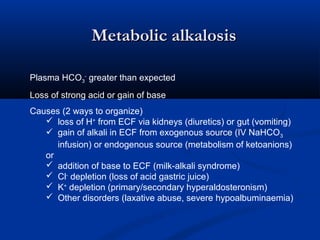
Metabolic alkalosis
Plasma HCO3- greater than expected
Loss of strong acid or gain of base
Causes (2 ways to organize)
 loss of H+ from ECF via kidneys (diuretics) or gut (vomiting)
 gain of alkali in ECF from exogenous source (IV NaHCO 3
infusion) or endogenous source (metabolism of ketoanions)
or
 addition of base to ECF (milk-alkali syndrome)
 Cl- depletion (loss of acid gastric juice)
 K+ depletion (primary/secondary hyperaldosteronism)
 Other disorders (laxative abuse, severe hypoalbuminaemia)
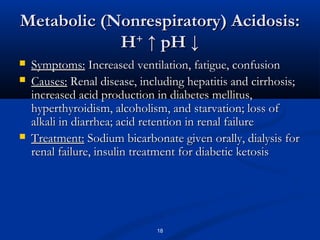
Metabolic (Nonrespiratory) Acidosis:
H+ ↑ pH ↓





Symptoms: Increased ventilation, fatigue, confusion
Causes: Renal disease, including hepatitis and cirrhosis;
increased acid production in diabetes mellitus,
hyperthyroidism, alcoholism, and starvation; loss of
alkali in diarrhea; acid retention in renal failure
Treatment: Sodium bicarbonate given orally, dialysis for
renal failure, insulin treatment for diabetic ketosis

18
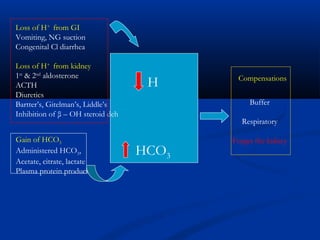
Loss of H+ from GI
Vomiting, NG suction
Congenital Cl diarrhea
Loss of H+ from kidney
1st & 2nd aldosterone
ACTH
Diuretics
Bartter’s, Gitelman’s, Liddle’s
Inhibition of β – OH steroid deh
Gain of HCO3
Administered HCO3,
Acetate, citrate, lactate
Plasma protein products

H

Compensations
Buffer
Respiratory

HCO3

Forget the kidney
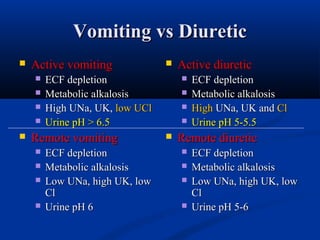
Vomiting vs Diuretic


Active vomiting







ECF depletion
Metabolic alkalosis
High UNa, UK, low UCl
Urine pH > 6.5

Remote vomiting







ECF depletion
Metabolic alkalosis
Low UNa, high UK, low
Cl
Urine pH 6

Active diuretic







ECF depletion
Metabolic alkalosis
High UNa, UK and Cl
Urine pH 5-5.5

Remote diuretic





ECF depletion
Metabolic alkalosis
Low UNa, high UK, low
Cl
Urine pH 5-6
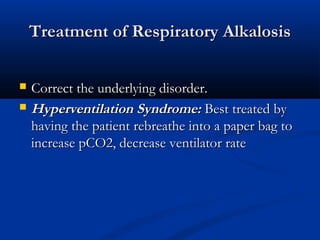
Treatment of Respiratory Alkalosis



Correct the underlying disorder.
Hyperventilation Syndrome: Best treated by
having the patient rebreathe into a paper bag to
increase pCO2, decrease ventilator rate
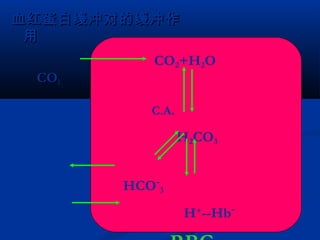
血红蛋白缓冲对的缓冲作
用
CO2+H2O
CO2
C.A.

H2CO3
HCO-3
H+--Hb-

Acid base disturbances

  • 1.
    Anion Gap  The differencebetween [Na+] and the sum of [HC03-] and [Cl-].  [Na+] – ([HC0 -] + [Cl-]) = 3   140 - (24 + 105) = 11  Normal = 12 + 2 Clinicians use the anion gap to identify the cause of metabolic acidosis.
  • 2.
    Types of Acidsin the Body  Volatile acids: Can leave solution and enter the atmosphere.  H C0 (carbonic acid). 2 3   Pco2 is most important factor in pH of body tissues.
  • 3.
    Buffer: any substancewhich reversibly consumes or releases H+. Buffers minimize or attenuate changes in pH by consuming or adding H+ in such a way to minimize discrete changes. Valence does not matter, ie for buffer “B” Protonated form in equilibrium with deporotonated form Weak acid HB (n+1) Weak base B (n) + H (+) = The buffers distribute themselves via their dissociation constant (K) defined as the ratio [B(n)] [H+] = K [HB(n=1)]
  • 4.
    Most important physiologicalbuffer pair is CO2 (carbon dioxide) and HCO3(bicarbonate). Since the lung can expire volatile CO2, it can regulate and stablize the balance of CO2. If CO2 is in solution, it can dissociate to carbonic acid (a slow reaction) CO2 + H2O  H2CO3 Formed carbonic acid can quickly dissociate to hydrogen ions and bicarbonate: H2CO3  H+ + HCO3Note that the formation of H+ will decrease pH. The net reaction is CO2 + H2O   H+ + HCO3-
  • 5.
    Proteins  COOH or NH2.  Largestpool of buffers in the body. pk. close to plasma. Albumin, globulins such as Hb.  
  • 6.
    Other important buffers  Thephosphate buffer system (HPO42-/H2PO4-) plays a role in plasma and erythrocytes.  H2PO4- + H2O ↔ H3O+ + HPO42-  Any acid reacts with monohydrogen phosphate to form dihydrogen phosphate dihydrogen phosphate monohydrogen phosphate  H2PO4- + H2O ← HPO42- + H3O+  The base is neutralized by dihydrogen phosphate dihydrogen phosphate  monohydrogen phosphate H2PO4- + OH- → HPO42- + H3O+ 6
  • 7.
    Respiratory System      2nd lineof defense. Acts within min. maximal in 12-24 hrs. H2CO3 produced converted to CO2, and excreted by the lungs. Alveolar ventilation also increases as pH decreases (rate and depth). Coarse , CANNOT eliminate fixed acid.
  • 8.
    Renal Acid-Base Regulation   Kidneyshelp regulate blood pH by excreting H+ and reabsorbing HC03-. Most of the H+ secretion occurs across the walls of the PCT in exchange for Na+.  Antiport mechanism.   Moves Na+ and H+ in opposite directions. Normal urine normally is slightly acidic because the kidneys reabsorb almost all HC03- and excrete H+.  Returns blood pH back to normal range.
  • 9.
    Simple Acid-Base Disturbances  Whencompensation is appropriate Metabolic acidosis (↓ HCO3, ↓ pCO2) Metabolic alkalosis (↑ HCO3, ↑ pCO2) Respiratory acidosis (↑ pCO2, ↑ HCO3) Respiratory alkalosis (↓ pCO2, ↓ HCO3)
  • 10.
    Organ dysfunction  CNS –respiratory acidosis (suppression) and alkalosis (stimulation)      Pulmonary – respiratory acidosis (COPD) and alkalosis (hypoxia, pulmonary embolism) Cardiac – respiratory alkalosis, respiratory acidosis, metabolic acidosis (pulmonary edema) GI – metabolic alkalosis (vomiting) and acidosis (diarrhea) Liver – respiratory alkalosis, metabolic acidosis (liver failure) Kidney – metabolic acidosis (RTA) and alkalosis (1st aldosteone)
  • 11.
    Metabolic (Nonrespiratory) Acidosis: H+↑ pH ↓    Symptoms: Increased ventilation, fatigue, confusion Causes: Renal disease, including hepatitis and cirrhosis; increased acid production in diabetes mellitus, hyperthyroidism, alcoholism, and starvation; loss of alkali in diarrhea; acid retention in renal failure Treatment: Sodium bicarbonate given orally, dialysis for renal failure, insulin treatment for diabetic ketosis 11
  • 12.
    Organ Dysfunction  Endocrine  Diabetes mellitus– metabolic acidosis  Adrenal insufficiency – metabolic acidosis Cushing’s – metabolic alkalosis Primary aldosteronism – metabolic alkalosis    Drugs/toxins    Toxic alcohols – metabolic acidosis ASA – metabolic acidosis and respiratory alkalosis Theophylline overdose – respiratory alkalosis
  • 13.
    Generation of MetabolicAcidosis Administration of HCl, NH4+Cl, CaCl2, lysine HCl Exogenous acids ASA Toxic alcohol H+ Compensations Buffers Endogenous acids ketoacids DKA starvation alcoholic Lactic acid L-lactic D-lactate High gap Loss of HCO3 diarrhea Lungs Kidneys HCO 3 Normal gap If kidney function is normal, urine anion gap Neg
  • 14.
    Respiratory acidosis PCO2 greaterthan expected Acute or chronic Causes  excess CO2 in inspired air (rebreathing of CO2-containing expired air, addition of CO2 to inspired air, insufflation of CO2 into body cavity)  decreased alveolar ventilation (central respiratory depression & other CNS problems, nerve or muscle disorders, lung or chest wall defects, airway disorders, external factors)  increased production of CO2 (hypercatabolic disorders)
  • 15.
    Metabolic acidosis Plasma HCO3-less than expected Gain of strong acid or loss of base Alternatively, high anion gap or normal anion gap metabolic acidosis Causes  high anion-gap acidosis (normochloremic) (ketoacidosis, lactic acidosis, renal failure, toxins)  normal anion-gap acidosis (hyperchloremic) (renal, gastrointestinal tract, other)
  • 16.
    Respiratory alkalosis PCO2 lessthan expected Acute or chronic Causes  increased alveolar ventilation (central causes, direct action via respiratory center; hypoxaemia, act via peripheral chemoreceptors; pulmonary causes, act via intrapulmonary receptors; iatrogenic, act directly on ventilation)
  • 17.
    Metabolic alkalosis Plasma HCO3-greater than expected Loss of strong acid or gain of base Causes (2 ways to organize)  loss of H+ from ECF via kidneys (diuretics) or gut (vomiting)  gain of alkali in ECF from exogenous source (IV NaHCO 3 infusion) or endogenous source (metabolism of ketoanions) or  addition of base to ECF (milk-alkali syndrome)  Cl- depletion (loss of acid gastric juice)  K+ depletion (primary/secondary hyperaldosteronism)  Other disorders (laxative abuse, severe hypoalbuminaemia)
  • 18.
    Metabolic (Nonrespiratory) Acidosis: H+↑ pH ↓    Symptoms: Increased ventilation, fatigue, confusion Causes: Renal disease, including hepatitis and cirrhosis; increased acid production in diabetes mellitus, hyperthyroidism, alcoholism, and starvation; loss of alkali in diarrhea; acid retention in renal failure Treatment: Sodium bicarbonate given orally, dialysis for renal failure, insulin treatment for diabetic ketosis 18
  • 19.
    Loss of H+from GI Vomiting, NG suction Congenital Cl diarrhea Loss of H+ from kidney 1st & 2nd aldosterone ACTH Diuretics Bartter’s, Gitelman’s, Liddle’s Inhibition of β – OH steroid deh Gain of HCO3 Administered HCO3, Acetate, citrate, lactate Plasma protein products H Compensations Buffer Respiratory HCO3 Forget the kidney
  • 20.
    Vomiting vs Diuretic  Activevomiting      ECF depletion Metabolic alkalosis High UNa, UK, low UCl Urine pH > 6.5 Remote vomiting      ECF depletion Metabolic alkalosis Low UNa, high UK, low Cl Urine pH 6 Active diuretic      ECF depletion Metabolic alkalosis High UNa, UK and Cl Urine pH 5-5.5 Remote diuretic     ECF depletion Metabolic alkalosis Low UNa, high UK, low Cl Urine pH 5-6
  • 21.
    Treatment of RespiratoryAlkalosis   Correct the underlying disorder. Hyperventilation Syndrome: Best treated by having the patient rebreathe into a paper bag to increase pCO2, decrease ventilator rate
  • 22.

Editor's Notes

  • #15 Examples: Central respiratory depression & other CNS problems - drug depression of respiratory center (eg by opiates, sedatives, anaesthetics) Nerve or muscle disorders - myasthenia gravis Lung or chest wall defects - restrictive lung disease Airway disorders – bronchospasm/asthma External factors - Inadequate mechanical ventilation Hypercatabolic disorders – malignant hyperthermia see http://www.anaesthesiamcq.com/AcidBaseBook/ab4_2.php for more examples.
  • #16 Examples: Ketoacidosis – alcoholic ketoacidosis Lactic acidosis - Type A lactic acidosis (impaired perfusion) Renal failure – uremic acidosis Toxins – salicylates Renal – renal tubular acidosis Gastrointestinal gract – severe diarrhea Other - Addition of HCl, NH4Cl see http://www.anaesthesiamcq.com/AcidBaseBook/ab5_2.php for more examples.
  • #17 Examples: Central causes (direct action via respiratory center) - various drugs (eg, analeptics, propanidid, salicylate intoxication) Hypoxaemia (act via peripheral chemoreceptors) - respiratory stimulation via peripheral chemoreceptors Pulmonary causes (act via intrapulmonary receptors) – pulmonary embolism Iatrogenic (act directly on ventilation)– excessive controlled ventilation see http://www.anaesthesiamcq.com/AcidBaseBook/ab6_2.php for more examples.
  • #18 Examples: Addition of base to ECF – milk-alkali syndrome, excessive NaHCO3 intake, recovery phase from organic acidosis, massive blood transfusion Cl- depletion - loss of acid gastric juice, diuretics, post-hypercapnia, excess fecal loss K+ depletion – primary/secondary hyperaldosteronism, Cushing syndrome, some drugs, kaliuretic diuretics see http://www.anaesthesiamcq.com/AcidBaseBook/ab7_2.php for more information.