Additional information to support
river health assessment
Dr Nick Bond
Talk outline
• Some additional ideas to think about in relation
  to river health assessment.
     – Things we may have overlooked in other talks
     – Not necessarily linked to one another


1.   Quality assurance
2.   Site selection
3.   Pressure indicators
4.   Classification
5.   Refinement and adaptation
1. Quality assurance
• Managers and the public expect a high level of
  confidence in assessments.
• Requires
   – A scientific basis for the assessment
   – High standards of quality control & quality assurance (QA/QC)
       • Field and laboratory work
       • Data analysis and data storage
       • Data interpretation
   – Careful evaluation of the results (do they make sense?)
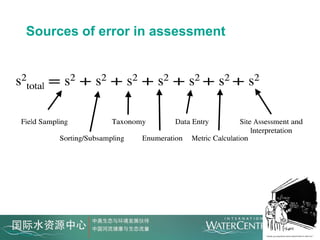
Sources of error in assessment


   Scientists like to
   make things
   complicated
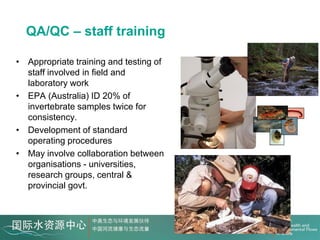
QA/QC – staff training

• Appropriate training and testing of
  staff involved in field and
  laboratory work
• EPA (Australia) ID 20% of
  invertebrate samples twice for
  consistency.
• Development of standard
  operating procedures
• May involve collaboration between
  organisations - universities,
  research groups, central &
  provincial govt.
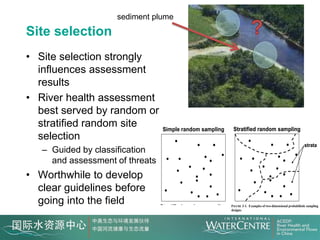
sediment plume

Site selection                                                          found on the EMAP website:
                                                                        (http://www.epa.gov/nheerl/arm/designpages/design&analysis.htm).


                                                                                                  Simple random sampling
• Site selection strongly
  influences assessment
  results
• River health assessment
  best served by random or
                     found on the EMAP website:
                     (http://www.epa.gov/nheerl/arm/designpages/design&analysis.htm).

  stratified random site                     Simple random sampling                             Stratified random sampling
  selection
                                                                                                                                                   strata
      – Guided by classification
        and assessment of threats
• Worthwhile to develop
  clear guidelines before
  going into the field                                   Stratified random sampling            FIGURE 3-1. Examples of two-dimensional probabilistic sampling
                                                                                               designs.


                                                                                               strata
                                                                        Quantifying trends in resource condition is often an important objective for regiona
                                                                        Although there are different approaches for allocating sampling effort over time, o
                                                                        covered in this document: permanent station and serially alternating (Rathbun 1999
                                                                        station approaches use a random sample of n sites that are all sampled during each
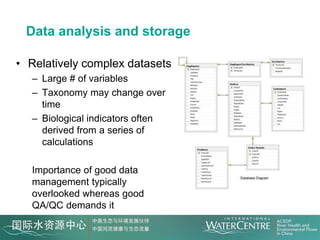
Data analysis and storage

• Relatively complex datasets
  – Large # of variables
  – Taxonomy may change over
    time
  – Biological indicators often
    derived from a series of
    calculations

  Importance of good data
  management typically
  overlooked whereas good
  QA/QC demands it
Evaluating results
• Indicators are not perfect – sometimes results
  will conflict with expectations
  – Requires transparent process of review and
    refinement.
  – Often several possibilities
     • Sampling error, natural disturbance effects (e.g. floods),
       localised pollution event.
  – Local expertise/input is valuable
  – Look to explain conflicting patterns rather than
    simply discarding the result.
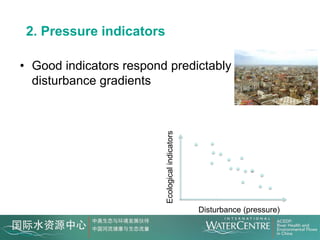
2. Pressure indicators

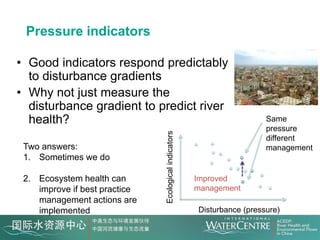
• Good indicators respond predictably to
  disturbance gradients


                          Ecological indicators


                                                  Disturbance (pressure)
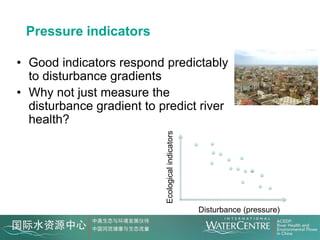
Pressure indicators

• Good indicators respond predictably
  to disturbance gradients
• Why not just measure the
  disturbance gradient to predict river
  health?


                           Ecological indicators


                                                   Disturbance (pressure)
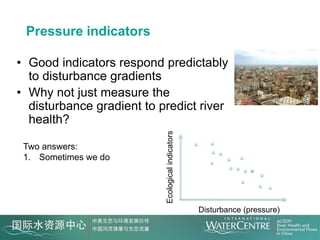
Pressure indicators

• Good indicators respond predictably
  to disturbance gradients
• Why not just measure the
  disturbance gradient to predict river
  health?


                           Ecological indicators
 Two answers:
 1. Sometimes we do


                                                   Disturbance (pressure)
Pressure indicators

• Good indicators respond predictably
  to disturbance gradients
• Why not just measure the
  disturbance gradient to predict river
  health?                                                                Same
                                                                         pressure


                               Ecological indicators
                                                                         different
 Two answers:                                                            management
 1. Sometimes we do

 2. Ecosystem health can                               Improved
    improve if best practice                           management
    management actions are
    implemented                                        Disturbance (pressure)
Example - urbanisation

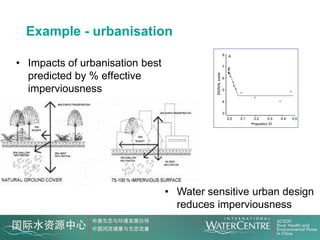
• Impacts of urbanisation best
  predicted by % effective
  imperviousness


                                 • Water sensitive urban design
                                   reduces imperviousness
Pressure indicators as an element of river
health assessment
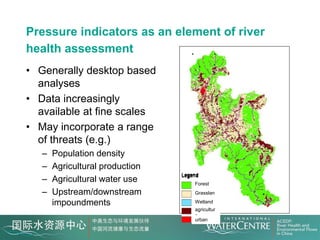
• Generally desktop based
  analyses
• Data increasingly
  available at fine scales
• May incorporate a range
  of threats (e.g.)
   –   Population density
   –   Agricultural production
   –   Agricultural water use    Forest
   –   Upstream/downstream       Grasslan
                                 d
       impoundments              Wetland
                                 agricultur
                                 e
                                 urban
Pressure indicators as an element of river
health assessment

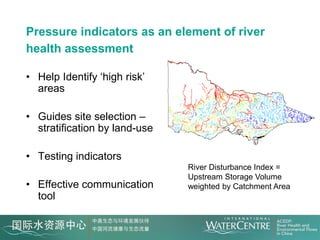
• Help Identify ‘high risk’
  areas

• Guides site selection –
  stratification by land-use

• Testing indicators
                               River Disturbance Index =
                               Upstream Storage Volume
• Effective communication      weighted by Catchment Area
  tool
3. Classification

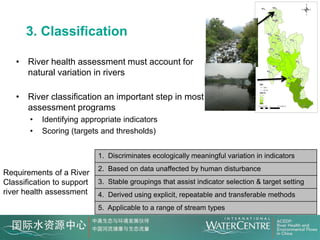
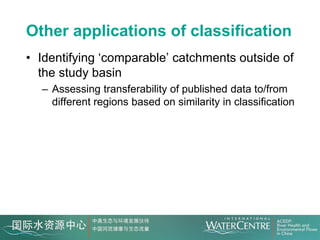
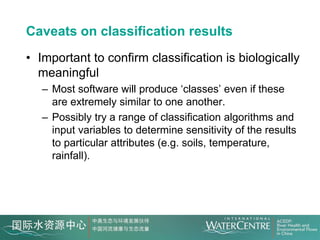
   • River health assessment must account for
     natural variation in rivers

   • River classification an important step in most
     assessment programs
       •   Identifying appropriate indicators
       •   Scoring (targets and thresholds)


                            1. Discriminates ecologically meaningful variation in indicators
                            2. Based on data unaffected by human disturbance
Requirements of a River
Classification to support   3. Stable groupings that assist indicator selection & target setting
river health assessment     4. Derived using explicit, repeatable and transferable methods
                            5. Applicable to a range of stream types
Other applications of classification
• Identifying ‘comparable’ catchments outside of
  the study basin
  – Assessing transferability of published data to/from
    different regions based on similarity in classification
Caveats on classification results
• Important to confirm classification is biologically
  meaningful
   – Most software will produce ‘classes’ even if these
     are extremely similar to one another.
   – Possibly try a range of classification algorithms and
     input variables to determine sensitivity of the results
     to particular attributes (e.g. soils, temperature,
     rainfall).
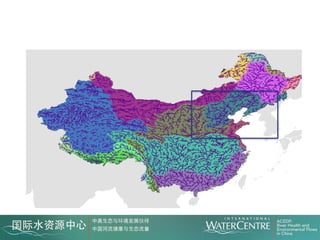
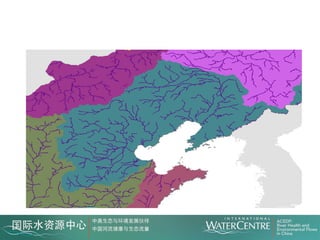
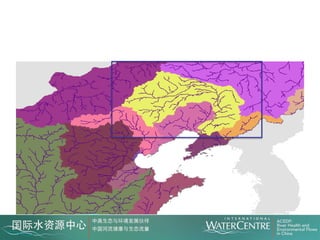
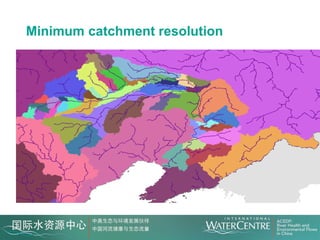
USGS Hydro 1K global dataset
• DEM stream network
• Nested subcatchment codes (Pfaffstetter,
  1989)
     • Allows linking of catchment data without complex
       geoprocessing


• not as fine-scaled as some catchment
  delineations so less well suited to local
  analyses.
• Climate, ecosystem type layers also available
  at global/national scales
Minimum catchment resolution
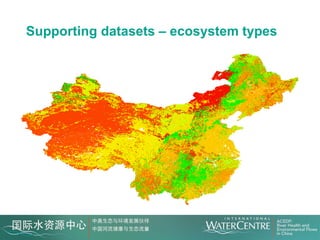
Supporting datasets – ecosystem types
4. Refinement and adaptation
• River health monitoring and environmental flows
  assessment strategies will evolve over time
• 15+ years in Australia (>20 years in USA)
   – Changes in indicators
   – Refinement of targets and scoring systems
   – Continues to evolve
• Many good Chinese examples of applying these
  methods in a research context

• Incorporating into management is the next step
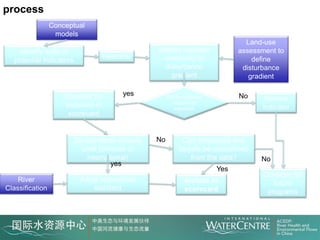
e process
                   Conceptual
                    models
                                                                                   Land-use
     Identify suite of                            Assess indicator               assessment to
    potential indicators           Field trial     sensitivity to                    define
                                                    disturbance                   disturbance
                                                      gradient                      gradient

                       Consider for        yes         Did the indicator         No
                                                         respond as
                                                                                        Review
                       inclusion in                       expected                     indicator
                        scorecard


                           Do standards already   No           Can thresholds and
                             exist (chinese or               targets be established
                               international)                    from the data?        No
                                       yes
                                                                           Yes
                                                                                        Consider for
      River                 Adopt appropriate                  Include in                  future
  Classification               standard                        scorecard                 programs
Acedp november 2010 beijing workshop bond

Acedp november 2010 beijing workshop bond

  • 1.
    Additional information tosupport river health assessment Dr Nick Bond
  • 2.
    Talk outline • Someadditional ideas to think about in relation to river health assessment. – Things we may have overlooked in other talks – Not necessarily linked to one another 1. Quality assurance 2. Site selection 3. Pressure indicators 4. Classification 5. Refinement and adaptation
  • 3.
    1. Quality assurance •Managers and the public expect a high level of confidence in assessments. • Requires – A scientific basis for the assessment – High standards of quality control & quality assurance (QA/QC) • Field and laboratory work • Data analysis and data storage • Data interpretation – Careful evaluation of the results (do they make sense?)
  • 4.
    Sources of errorin assessment Scientists like to make things complicated
  • 5.
    QA/QC – stafftraining • Appropriate training and testing of staff involved in field and laboratory work • EPA (Australia) ID 20% of invertebrate samples twice for consistency. • Development of standard operating procedures • May involve collaboration between organisations - universities, research groups, central & provincial govt.
  • 6.
    sediment plume Site selection found on the EMAP website: (http://www.epa.gov/nheerl/arm/designpages/design&analysis.htm). Simple random sampling • Site selection strongly influences assessment results • River health assessment best served by random or found on the EMAP website: (http://www.epa.gov/nheerl/arm/designpages/design&analysis.htm). stratified random site Simple random sampling Stratified random sampling selection strata – Guided by classification and assessment of threats • Worthwhile to develop clear guidelines before going into the field Stratified random sampling FIGURE 3-1. Examples of two-dimensional probabilistic sampling designs. strata Quantifying trends in resource condition is often an important objective for regiona Although there are different approaches for allocating sampling effort over time, o covered in this document: permanent station and serially alternating (Rathbun 1999 station approaches use a random sample of n sites that are all sampled during each
  • 7.
    Data analysis andstorage • Relatively complex datasets – Large # of variables – Taxonomy may change over time – Biological indicators often derived from a series of calculations Importance of good data management typically overlooked whereas good QA/QC demands it
  • 8.
    Evaluating results • Indicatorsare not perfect – sometimes results will conflict with expectations – Requires transparent process of review and refinement. – Often several possibilities • Sampling error, natural disturbance effects (e.g. floods), localised pollution event. – Local expertise/input is valuable – Look to explain conflicting patterns rather than simply discarding the result.
  • 9.
    2. Pressure indicators •Good indicators respond predictably to disturbance gradients Ecological indicators Disturbance (pressure)
  • 10.
    Pressure indicators • Goodindicators respond predictably to disturbance gradients • Why not just measure the disturbance gradient to predict river health? Ecological indicators Disturbance (pressure)
  • 11.
    Pressure indicators • Goodindicators respond predictably to disturbance gradients • Why not just measure the disturbance gradient to predict river health? Ecological indicators Two answers: 1. Sometimes we do Disturbance (pressure)
  • 12.
    Pressure indicators • Goodindicators respond predictably to disturbance gradients • Why not just measure the disturbance gradient to predict river health? Same pressure Ecological indicators different Two answers: management 1. Sometimes we do 2. Ecosystem health can Improved improve if best practice management management actions are implemented Disturbance (pressure)
  • 13.
    Example - urbanisation •Impacts of urbanisation best predicted by % effective imperviousness • Water sensitive urban design reduces imperviousness
  • 14.
    Pressure indicators asan element of river health assessment • Generally desktop based analyses • Data increasingly available at fine scales • May incorporate a range of threats (e.g.) – Population density – Agricultural production – Agricultural water use Forest – Upstream/downstream Grasslan d impoundments Wetland agricultur e urban
  • 15.
    Pressure indicators asan element of river health assessment • Help Identify ‘high risk’ areas • Guides site selection – stratification by land-use • Testing indicators River Disturbance Index = Upstream Storage Volume • Effective communication weighted by Catchment Area tool
  • 16.
    3. Classification • River health assessment must account for natural variation in rivers • River classification an important step in most assessment programs • Identifying appropriate indicators • Scoring (targets and thresholds) 1. Discriminates ecologically meaningful variation in indicators 2. Based on data unaffected by human disturbance Requirements of a River Classification to support 3. Stable groupings that assist indicator selection & target setting river health assessment 4. Derived using explicit, repeatable and transferable methods 5. Applicable to a range of stream types
  • 17.
    Other applications ofclassification • Identifying ‘comparable’ catchments outside of the study basin – Assessing transferability of published data to/from different regions based on similarity in classification
  • 18.
    Caveats on classificationresults • Important to confirm classification is biologically meaningful – Most software will produce ‘classes’ even if these are extremely similar to one another. – Possibly try a range of classification algorithms and input variables to determine sensitivity of the results to particular attributes (e.g. soils, temperature, rainfall).
  • 19.
    USGS Hydro 1Kglobal dataset • DEM stream network • Nested subcatchment codes (Pfaffstetter, 1989) • Allows linking of catchment data without complex geoprocessing • not as fine-scaled as some catchment delineations so less well suited to local analyses. • Climate, ecosystem type layers also available at global/national scales
  • 23.
  • 24.
    Supporting datasets –ecosystem types
  • 25.
    4. Refinement andadaptation • River health monitoring and environmental flows assessment strategies will evolve over time • 15+ years in Australia (>20 years in USA) – Changes in indicators – Refinement of targets and scoring systems – Continues to evolve • Many good Chinese examples of applying these methods in a research context • Incorporating into management is the next step
  • 26.
    e process Conceptual models Land-use Identify suite of Assess indicator assessment to potential indicators Field trial sensitivity to define disturbance disturbance gradient gradient Consider for yes Did the indicator No respond as Review inclusion in expected indicator scorecard Do standards already No Can thresholds and exist (chinese or targets be established international) from the data? No yes Yes Consider for River Adopt appropriate Include in future Classification standard scorecard programs