ma ny)
   (o f
Five Obstacles to Effective 
    Climate Decisions: 
 A Decision Science Perspective 

             Dr. Joseph Arvai 
    Environmental Science & Policy Program 
           Michigan State University 
               East Lansing, MI 

              Decision Research 
                Eugene, OR 
Acknowledgements 
National Science Foundation 
       SES 0350777 

University of British Columbia 

 Natural Resources Canada 

The Government of Nunavut
Introduction 
•  The following 
   discussion stems 
   from decision aiding 
   work carried out in 
   two contexts; 
   adaptation to 
   climate change in: 
   –  Coastal British 
      Columbia 
   –  Nunavut Territory
Introduction 
•  Though quite different 
   in terms of the levels of 
   development and 
   infrastructure, both 
   study sites shared a 
   common complaint: 
   –  Despite years of 
      research (and millions of 
      dollars spent) people 
      were seeing very little in 
      the way of adaptation 
      action. 
   –  “You can’t study our 
      problems away…”
Introduction 
•  Five common concerns: 
   1.  The data used to describe the problems associated with 
       climate change are frequently not meaningful or helpful. 
   2.  The objectives and concerns of affected stakeholders 
       are not receiving sufficient attention. 
   3.  The attributes and measures used to characterize 
       climate change impacts, and the anticipated 
       consequences of alternative management plans, are 
       often inadequate. 
   4.  Ongoing research is often only loosely tied to the 
       decisions that need to be made. 
   5.  There seems to be very little learning from past success 
       stories as well as mistakes.
Data
Numeracy Issues 
•  Probabilistic information, even in the absence of 
   uncertainty, proves to be difficult for most people.
Dual Processing 
•  SYSTEM 1 is fast, 
   intuitive, highly 
   inductive, and based 
   heavily on our 
   instinctive emotional 
   (affective) responses to 
   stimuli. 
•  SYSTEM 2, is slower, 
   based on rules of logic 
   and rationality, highly 
   deductive, and based 
   heavily on effortful 
   calculation.
Numeracy Issues 
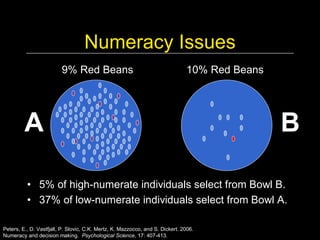
                         9% Red Beans                                           10% Red Beans 


         A                                                                                       B 

          •  5% of high­numerate individuals select from Bowl B. 
          •  37% of low­numerate individuals select from Bowl A. 

Peters, E., D. Vastfjall, P. Slovic, C.K. Mertz, K. Mazzocco, and S. Dickert. 2006. 
Numeracy and decision making.  Psychological Science, 17: 407­413.
Numbers and Nerves 
                         15 
                                                   13.6 
                                                                  12.9 
                                                                                  11.7 
                                                                                                 10.9 
                                   10.4 
                         10 


                          5 


                          0 
                                    150            98%            95%             90%            85% 
                                             Number and Percent of 150 Lives Saved 


Slovic, P., M. Finucane, E. Peters, and D.G. MacGregor. 2004.  Risk as analysis and risk as 
feelings: Some thoughts about affect, reason, risk, and rationality.  Risk Analysis, 24: 1­12.
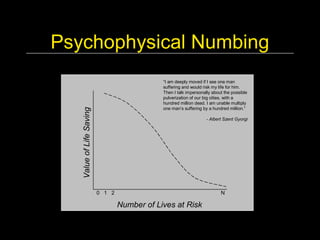
Psychophysical Numbing
Psychophysical Numbing 
                                                   “I am deeply moved if I see one man 
                                                   suffering and would risk my life for him. 
                                                   Then I talk impersonally about the possible 
                                                   pulverization of our big cities, with a 
                                                   hundred million dead. I am unable multiply 
   Value of Life Saving 

                                                   one man’s suffering by a hundred million.” 

                                                                         ­ Albert Szent Gyorgi


                           0   1  2                                             N 

                                       Number of Lives at Risk 
Psychophysical Numbing
Objectives 
•  The objectives of stakeholders and decision 
   makers are the basis for considering any 
   decision. 
•  Therefore, the first step in any decision process 
   is for those involved to carefully consider their 
   objectives by clearly defining what it is they want 
   to achieve in a given decision context. 
•  This objectives­focus is in contrast to an 
   alternatives­focus, which involves analyzing the 
   available alternatives and selecting the ‘best’ one 
   from a set of implied, and often poorly defined, 
   criteria.
Objectives 
•  Despite their importance during decision making, 
   a thoughtful and thorough exploration of 
   objectives that will guide a decision is only 
   seldom undertaken. 

•  Decision makers and stakeholders seldom 
   differentiate between means and ends 
   objectives. 
   –  This is important because decisions about climate 
      change are also linked to other areas of concern.
Attributes & Measures 
•  World Summit on Sustainable Development, 
   Johannesburg 2002 
•  Indicators in Integrated Coastal Management, 
   Ottawa 2002 
•  Much of the focus has been on the 
   identification of natural processes that require 
   further scientific study and/or should be 
   closely monitored in response to climate 
   drivers. 
•  Inventories with an emphasis on establishing 
   changes relative to some baseline.
Attributes & Measures 
•  Inventory data frequently does not provide 
   the kinds of insights that decision makers 
   desire (but they end up “using” it anyway): 
   –  …because they often remove focus from what 
      matters to stakeholders and decision makers (i.e., 
      their objectives). 
   –  …because they are not presented at the 
      appropriate temporal or geographic scale. 
   –  …because they fail to expose key tradeoffs that 
      will need to be addressed.
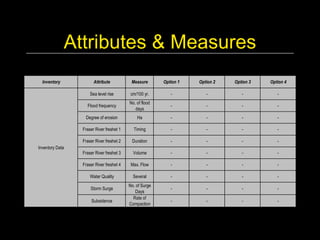
Attributes & Measures 
  Inventory            Attribute            Measure        Option 1    Option 2    Option 3    Option 4 

                     Sea level rise         cm/100 yr.        ­           ­           ­           ­ 
                                           No. of flood 
                   Flood frequency                            ­           ­           ­           ­ 
                                              days 
                  Degree of erosion            Ha             ­           ­           ­           ­ 

                 Fraser River freshet 1      Timing           ­           ­           ­           ­ 

                 Fraser River freshet 2     Duration          ­           ­           ­           ­ 
Inventory Data
                 Fraser River freshet 3      Volume           ­           ­           ­           ­ 

                 Fraser River freshet 4     Max. Flow         ­           ­           ­           ­ 

                     Water Quality           Several          ­           ­           ­           ­ 
                                           No. of Surge 
                     Storm Surge                              ­           ­           ­           ­ 
                                              Days 
                                             Rate of 
                      Subsidence                              ­           ­           ­           ­ 
                                           Compaction 
Attributes & Measures 

     Objective                 Attribute             Measure       Option 1    Option 2    Option 3    Option 4 

                       Area of shorebird habitat        Ha            ­           ­           ­           ­ 

                           Biofilm exposure             Ha            ­           ­           ­           ­ 
                       % Change in key indicator 
                        spp. (Dunlin, Western           %             ­           ­           ­           ­ 
                              Sandpiper) 
  Maintain/Improve 
Environmental Health    Extent of eelgrass beds         Ha            ­           ­           ­           ­ 
                                                    Constructed 
                            Marsh stability                           ­           ­           ­           ­ 
                                                      Index 
                                                          2 
                           Benthic biomass            gC/m            ­           ­           ­           ­ 

                              TEK­based                TEK            ­           ­           ­           ­ 
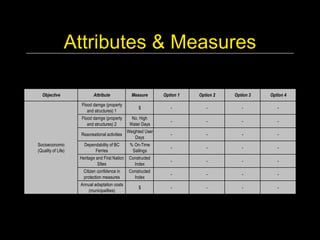
Attributes & Measures 

  Objective                Attribute              Measure        Option 1    Option 2    Option 3    Option 4 

                     Flood damge (property 
                                                      $             ­           ­           ­           ­ 
                        and structures) 1 
                     Flood damge (property        No. High 
                                                                    ­           ­           ­           ­ 
                        and structures) 2        Water Days 
                                                Weighted User 
                    Reacreational activities                        ­           ­           ­           ­ 
                                                    Days 
Socioeconomic         Dependability of BC        % On­Time 
                                                                    ­           ­           ­           ­ 
(Quality of Life)          Ferries                Sailings 
                    Heritage and First Nation  Constructed 
                                                                    ­           ­           ­           ­ 
                              SItes              Index 
                      Citizen confidence in      Constructed 
                                                                    ­           ­           ­           ­ 
                      protection measures          Index 
                    Annual adaptation costs 
                                                      $             ­           ­           ­           ­ 
                       (municipailties) 
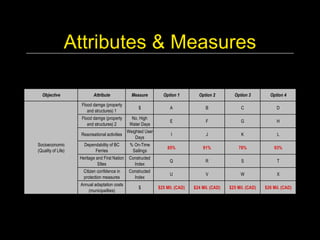
Attributes & Measures 

  Objective                Attribute              Measure          Option 1          Option 2          Option 3          Option 4 

                     Flood damge (property 
                                                      $                A                 B                 C                 D 
                        and structures) 1 
                     Flood damge (property        No. High 
                                                                       E                 F                 G                 H 
                        and structures) 2        Water Days 
                                                Weighted User 
                    Reacreational activities                           I                 J                 K                 L 
                                                    Days 
Socioeconomic         Dependability of BC        % On­Time 
                                                                       M                 N                 O                 P 
(Quality of Life)          Ferries                Sailings 
                    Heritage and First Nation  Constructed 
                                                                       Q                 R                 S                 T 
                              SItes              Index 
                      Citizen confidence in      Constructed 
                                                                       U                 V                 W                 X 
                      protection measures          Index 
                    Annual adaptation costs 
                                                      $          $25 Mil. (CAD)    $24 Mil. (CAD)    $25 Mil. (CAD)    $26 Mil. (CAD) 
                       (municipailties) 
Attributes & Measures 

  Objective                Attribute              Measure          Option 1         Option 2         Option 3         Option 4 

                     Flood damge (property 
                                                      $                A                B                C                D 
                        and structures) 1 
                     Flood damge (property        No. High 
                                                                       E                F                G                H 
                        and structures) 2        Water Days 
                                                Weighted User 
                    Reacreational activities                           I                J                K                L 
                                                    Days 
Socioeconomic         Dependability of BC        % On­Time 
                                                                     85%              91%              78%               93% 
(Quality of Life)          Ferries                Sailings
                    Heritage and First Nation  Constructed 
                                                                       Q                R                S                T 
                              SItes              Index 
                      Citizen confidence in      Constructed 
                                                                       U                V               W                 X 
                      protection measures          Index 
                    Annual adaptation costs 
                                                      $          $25 Mil. (CAD)   $24 Mil. (CAD)   $25 Mil. (CAD)   $26 Mil. (CAD) 
                       (municipailties) 
Research & Monitoring Needs 
         •  Analytic­Deliberative Process. 
             –  Several successive rounds of deliberation by 
                stakeholders and analysis by technical experts 
                as part of a deliberate march towards a risk 
                management decision. 
         •  Each successive round of analysis and 
            deliberation is meant to yield an improved 
            understanding on the part of both the 
            stakeholders and experts regarding the 
            various attributes that are “at risk” in an 
            ecological system. 
         •  The analytic­deliberative process is not 
            simply a means for synthesizing the 
            information obtained through a set of 
            unrelated and predominantly expert­driven 
            risk assessments; it is an important shaper of 
            a long­range risk assessment and decision 
            making process.
Learning Over Time 
     •  Climate decisions are questions 
        masquerading as answers. 
     •  If we view decisions as 
        questions, then the outcomes of 
        these decisions become 
        treatments, in an experimental 
        sense. 
     •  Adaptive management has two 
        key parts: 
           1.  Implementing varied climate 
               “treatments” (e.g., across space and 
               time). 
           2.  Monitoring, learning, and adjusting.
Learning Over Time 
              RESILIENCE 

       •  Many would argue that, 
          globally speaking, we’ve 
          already done serious 
          damage to the climate. 
       •  Decisions aimed at 
          reducing and responding 
          to the effects of climate 
          change should help (vs. 
          hurt).
Learning Over Time 
                    SCALE 
       •  There is often a need to 
          focus narrowly, in terms 
          of time and space, during 
          decision making. 
       •  Spatially varied climate 
          management 
          “treatments” are already 
          in place. 
           –  e.g., forestry projects in 
              India; energy projects in 
              Europe, fuel taxes in 
              Canada, Daylight Saving 
              Time in Australia (2000).
Learning Over Time 
         ETHICAL CONCERNS 

       •  Sadly, the global 
          economy in concert with 
          regional variability  in 
          climate already 
          inequitably distributes 
          costs and vulnerability 
          across communities and 
          places.
Learning Over Time 
             COMPLEXITY 

       •  Overall, the basic 
          framework for carrying 
          out adaptive climate 
          management is already 
          in place. 
       •  What’s missing is a 
          system for monitoring 
          and learning.
Recommendations 
          Time 

Not (Necessarily) Software 

      Commitment 

        Expertise
Contact Information 

            Dr. Joe Arvai 
      E­Mail: arvai@msu.edu 
    Telephone: 517­353­0694 
     Facsimile: 517­353­8994 
Web: http://www.msu.edu/~sknkwrks

Arvai Cc

  • 1.
    ma ny) (o f Five Obstacles to Effective  Climate Decisions:  A Decision Science Perspective  Dr. Joseph Arvai  Environmental Science & Policy Program  Michigan State University  East Lansing, MI  Decision Research  Eugene, OR 
  • 2.
    Acknowledgements  National Science Foundation  SES 0350777  University of British Columbia  Natural Resources Canada  The Government of Nunavut
  • 3.
    Introduction  •  The following  discussion stems  from decision aiding  work carried out in  two contexts;  adaptation to  climate change in:  –  Coastal British  Columbia  –  Nunavut Territory
  • 4.
    Introduction  •  Though quite different  in terms of the levels of  development and  infrastructure, both  study sites shared a  common complaint:  –  Despite years of  research (and millions of  dollars spent) people  were seeing very little in  the way of adaptation  action.  –  “You can’t study our  problems away…”
  • 5.
    Introduction  •  Five common concerns:  1.  The data used to describe the problems associated with  climate change are frequently not meaningful or helpful.  2.  The objectives and concerns of affected stakeholders  are not receiving sufficient attention.  3.  The attributes and measures used to characterize  climate change impacts, and the anticipated  consequences of alternative management plans, are  often inadequate.  4.  Ongoing research is often only loosely tied to the  decisions that need to be made.  5.  There seems to be very little learning from past success  stories as well as mistakes.
  • 6.
  • 7.
    Numeracy Issues  •  Probabilistic information, even in the absence of  uncertainty, proves to be difficult for most people.
  • 8.
    Dual Processing  •  SYSTEM 1 is fast,  intuitive, highly  inductive, and based  heavily on our  instinctive emotional  (affective) responses to  stimuli.  •  SYSTEM 2, is slower,  based on rules of logic  and rationality, highly  deductive, and based  heavily on effortful  calculation.
  • 9.
    Numeracy Issues  9% Red Beans  10% Red Beans  A  B  •  5% of high­numerate individuals select from Bowl B.  •  37% of low­numerate individuals select from Bowl A.  Peters, E., D. Vastfjall, P. Slovic, C.K. Mertz, K. Mazzocco, and S. Dickert. 2006.  Numeracy and decision making.  Psychological Science, 17: 407­413.
  • 10.
    Numbers and Nerves  15  13.6  12.9  11.7  10.9  10.4  10  5  0  150  98%  95%  90%  85%  Number and Percent of 150 Lives Saved  Slovic, P., M. Finucane, E. Peters, and D.G. MacGregor. 2004.  Risk as analysis and risk as  feelings: Some thoughts about affect, reason, risk, and rationality.  Risk Analysis, 24: 1­12.
  • 11.
  • 12.
    Psychophysical Numbing  “I am deeply moved if I see one man  suffering and would risk my life for him.  Then I talk impersonally about the possible  pulverization of our big cities, with a  hundred million dead. I am unable multiply  Value of Life Saving  one man’s suffering by a hundred million.”  ­ Albert Szent Gyorgi 0   1  2  N  Number of Lives at Risk 
  • 13.
  • 14.
    Objectives  •  The objectives of stakeholders and decision  makers are the basis for considering any  decision.  •  Therefore, the first step in any decision process  is for those involved to carefully consider their  objectives by clearly defining what it is they want  to achieve in a given decision context.  •  This objectives­focus is in contrast to an  alternatives­focus, which involves analyzing the  available alternatives and selecting the ‘best’ one  from a set of implied, and often poorly defined,  criteria.
  • 15.
    Objectives  •  Despite their importance during decision making,  a thoughtful and thorough exploration of  objectives that will guide a decision is only  seldom undertaken.  •  Decision makers and stakeholders seldom  differentiate between means and ends  objectives.  –  This is important because decisions about climate  change are also linked to other areas of concern.
  • 17.
    Attributes & Measures  •  World Summit on Sustainable Development,  Johannesburg 2002  •  Indicators in Integrated Coastal Management,  Ottawa 2002  •  Much of the focus has been on the  identification of natural processes that require  further scientific study and/or should be  closely monitored in response to climate  drivers.  •  Inventories with an emphasis on establishing  changes relative to some baseline.
  • 18.
    Attributes & Measures  •  Inventory data frequently does not provide  the kinds of insights that decision makers  desire (but they end up “using” it anyway):  –  …because they often remove focus from what  matters to stakeholders and decision makers (i.e.,  their objectives).  –  …because they are not presented at the  appropriate temporal or geographic scale.  –  …because they fail to expose key tradeoffs that  will need to be addressed.
  • 19.
    Attributes & Measures  Inventory  Attribute  Measure  Option 1  Option 2  Option 3  Option 4  Sea level rise  cm/100 yr.  ­  ­  ­  ­  No. of flood  Flood frequency  ­  ­  ­  ­  days  Degree of erosion  Ha  ­  ­  ­  ­  Fraser River freshet 1  Timing  ­  ­  ­  ­  Fraser River freshet 2  Duration  ­  ­  ­  ­  Inventory Data Fraser River freshet 3  Volume  ­  ­  ­  ­  Fraser River freshet 4  Max. Flow  ­  ­  ­  ­  Water Quality  Several  ­  ­  ­  ­  No. of Surge  Storm Surge  ­  ­  ­  ­  Days  Rate of  Subsidence  ­  ­  ­  ­  Compaction 
  • 20.
    Attributes & Measures  Objective  Attribute  Measure  Option 1  Option 2  Option 3  Option 4  Area of shorebird habitat  Ha  ­  ­  ­  ­  Biofilm exposure  Ha  ­  ­  ­  ­  % Change in key indicator  spp. (Dunlin, Western  %  ­  ­  ­  ­  Sandpiper)  Maintain/Improve  Environmental Health Extent of eelgrass beds  Ha  ­  ­  ­  ­  Constructed  Marsh stability  ­  ­  ­  ­  Index  2  Benthic biomass  gC/m  ­  ­  ­  ­  TEK­based  TEK  ­  ­  ­  ­ 
  • 21.
    Attributes & Measures  Objective  Attribute  Measure  Option 1  Option 2  Option 3  Option 4  Flood damge (property  $  ­  ­  ­  ­  and structures) 1  Flood damge (property  No. High  ­  ­  ­  ­  and structures) 2  Water Days  Weighted User  Reacreational activities  ­  ­  ­  ­  Days  Socioeconomic  Dependability of BC  % On­Time  ­  ­  ­  ­  (Quality of Life) Ferries  Sailings  Heritage and First Nation  Constructed  ­  ­  ­  ­  SItes  Index  Citizen confidence in  Constructed  ­  ­  ­  ­  protection measures  Index  Annual adaptation costs  $  ­  ­  ­  ­  (municipailties) 
  • 22.
    Attributes & Measures  Objective  Attribute  Measure  Option 1  Option 2  Option 3  Option 4  Flood damge (property  $  A  B  C  D  and structures) 1  Flood damge (property  No. High  E  F  G  H  and structures) 2  Water Days  Weighted User  Reacreational activities  I  J  K  L  Days  Socioeconomic  Dependability of BC  % On­Time  M  N  O  P  (Quality of Life) Ferries  Sailings  Heritage and First Nation  Constructed  Q  R  S  T  SItes  Index  Citizen confidence in  Constructed  U  V  W  X  protection measures  Index  Annual adaptation costs  $  $25 Mil. (CAD)  $24 Mil. (CAD)  $25 Mil. (CAD)  $26 Mil. (CAD)  (municipailties) 
  • 23.
    Attributes & Measures  Objective  Attribute  Measure  Option 1  Option 2  Option 3  Option 4  Flood damge (property  $  A  B  C  D  and structures) 1  Flood damge (property  No. High  E  F  G  H  and structures) 2  Water Days  Weighted User  Reacreational activities  I  J  K  L  Days  Socioeconomic  Dependability of BC  % On­Time  85% 91% 78% 93%  (Quality of Life) Ferries  Sailings Heritage and First Nation  Constructed  Q  R  S  T  SItes  Index  Citizen confidence in  Constructed  U  V  W  X  protection measures  Index  Annual adaptation costs  $ $25 Mil. (CAD) $24 Mil. (CAD) $25 Mil. (CAD) $26 Mil. (CAD)  (municipailties) 
  • 24.
    Research & Monitoring Needs  •  Analytic­Deliberative Process.  –  Several successive rounds of deliberation by  stakeholders and analysis by technical experts  as part of a deliberate march towards a risk  management decision.  •  Each successive round of analysis and  deliberation is meant to yield an improved  understanding on the part of both the  stakeholders and experts regarding the  various attributes that are “at risk” in an  ecological system.  •  The analytic­deliberative process is not  simply a means for synthesizing the  information obtained through a set of  unrelated and predominantly expert­driven  risk assessments; it is an important shaper of  a long­range risk assessment and decision  making process.
  • 25.
    Learning Over Time  •  Climate decisions are questions  masquerading as answers.  •  If we view decisions as  questions, then the outcomes of  these decisions become  treatments, in an experimental  sense.  •  Adaptive management has two  key parts:  1.  Implementing varied climate  “treatments” (e.g., across space and  time).  2.  Monitoring, learning, and adjusting.
  • 26.
    Learning Over Time  RESILIENCE  •  Many would argue that,  globally speaking, we’ve  already done serious  damage to the climate.  •  Decisions aimed at  reducing and responding  to the effects of climate  change should help (vs.  hurt).
  • 27.
    Learning Over Time  SCALE  •  There is often a need to  focus narrowly, in terms  of time and space, during  decision making.  •  Spatially varied climate  management  “treatments” are already  in place.  –  e.g., forestry projects in  India; energy projects in  Europe, fuel taxes in  Canada, Daylight Saving  Time in Australia (2000).
  • 28.
    Learning Over Time  ETHICAL CONCERNS  •  Sadly, the global  economy in concert with  regional variability  in  climate already  inequitably distributes  costs and vulnerability  across communities and  places.
  • 29.
    Learning Over Time  COMPLEXITY  •  Overall, the basic  framework for carrying  out adaptive climate  management is already  in place.  •  What’s missing is a  system for monitoring  and learning.
  • 30.
    Recommendations  Time  Not (Necessarily) Software  Commitment  Expertise
  • 31.
    Contact Information  Dr. Joe Arvai  E­Mail: arvai@msu.edu  Telephone: 517­353­0694  Facsimile: 517­353­8994  Web: http://www.msu.edu/~sknkwrks