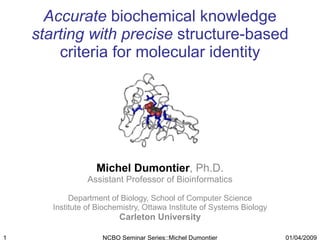
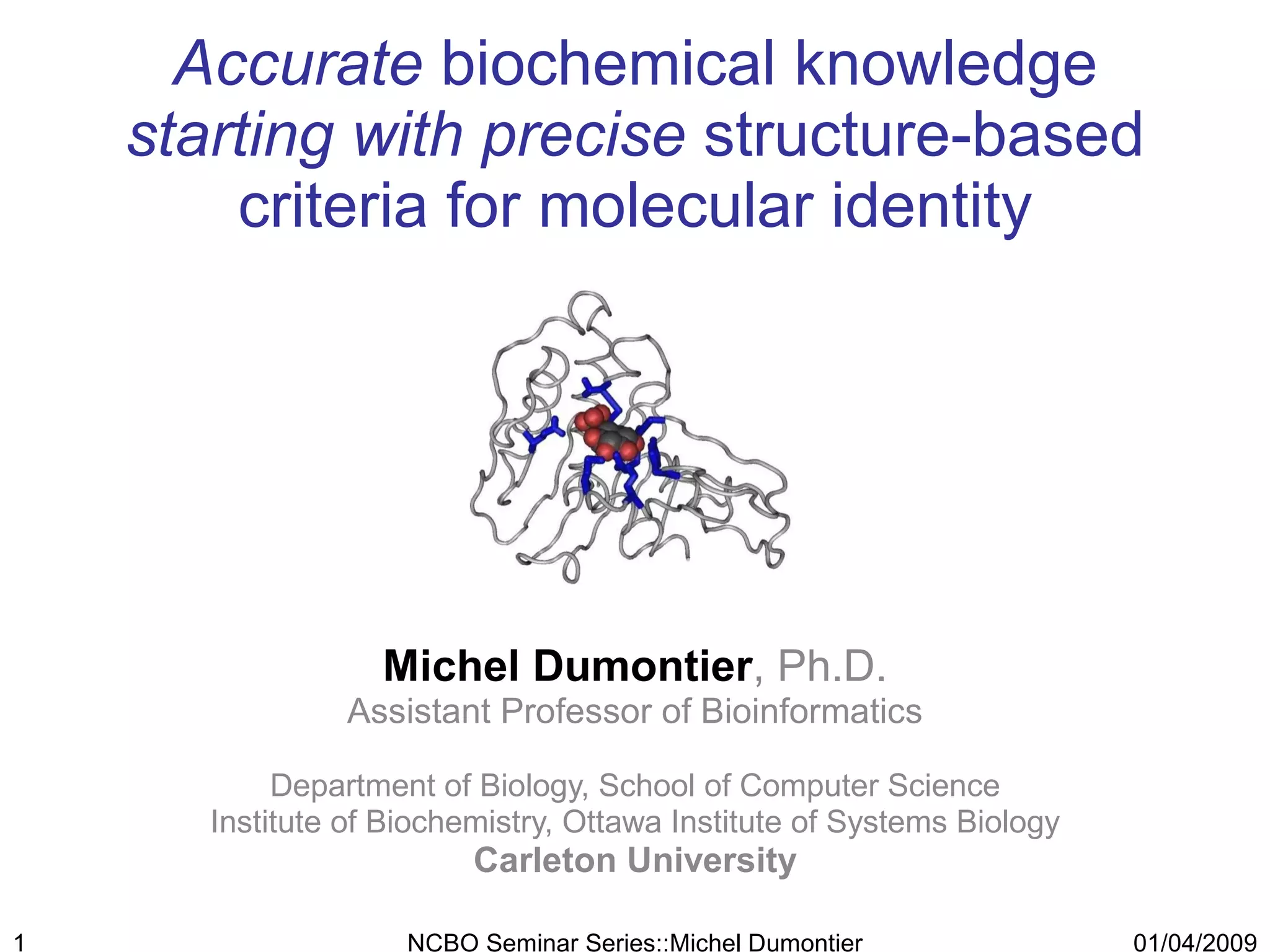
Accurate  biochemical knowledge  starting with precise  structure-based criteria for molecular identity Michel Dumontier , Ph.D. Assistant Professor of Bioinformatics Department of Biology, School of Computer Science Institute of Biochemistry, Ottawa Institute of Systems Biology Carleton University 01/04/2009 NCBO Seminar Series::Michel Dumontier
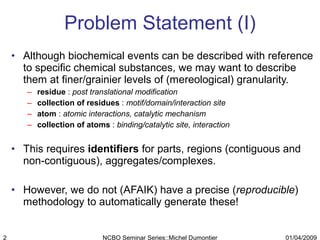
Problem Statement (I) Although biochemical events can be described with reference to specific chemical substances, we may want to describe them at finer/grainier levels of (mereological) granularity. residue  :  post translational modification collection of residues  :  motif/domain/interaction site atom  :  atomic interactions, catalytic mechanism collection of atoms  :  binding/catalytic site, interaction This requires  identifiers  for parts, regions (contiguous and non-contiguous), aggregates/complexes. However, we do not (AFAIK) have a precise ( reproducible ) methodology to automatically generate these! 01/04/2009 NCBO Seminar Series::Michel Dumontier
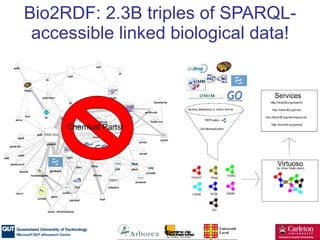
Bio2RDF: 2.3B triples of SPARQL-accessible linked biological data! Chemical Parts!
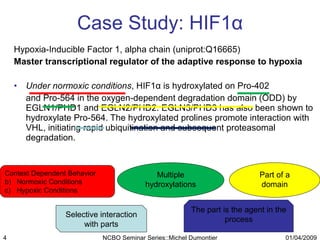
Case Study: HIF1 α Hypoxia-Inducible Factor 1, alpha chain (uniprot:Q16665) Master transcriptional regulator of the adaptive response to hypoxia Under normoxic conditions , HIF1 α  is hydroxylated on Pro-402  and Pro-564 in the oxygen-dependent degradation domain (ODD) by EGLN1/PHD1 and EGLN2/PHD2. EGLN3/PHD3 has also been shown to hydroxylate Pro-564. The hydroxylated prolines promote interaction with VHL, initiating rapid ubiquitination and subsequent proteasomal degradation.  Context Dependent Behavior Normoxic Conditions Hypoxic Conditions Multiple hydroxylations Part of a domain The part is the agent in the process Selective interaction with parts 01/04/2009 NCBO Seminar Series::Michel Dumontier
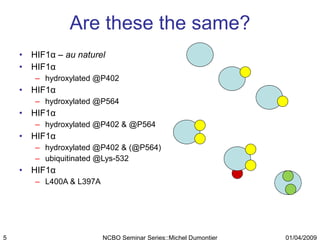
Are these the same? HIF1 α  –  au naturel HIF1 α hydroxylated @P402 HIF1 α hydroxylated @P564 HIF1 α hydroxylated @P402 & @P564 HIF1 α hydroxylated @P402 & (@P564) ubiquitinated @Lys-532 HIF1 α L400A & L397A 01/04/2009 NCBO Seminar Series::Michel Dumontier
NO!!!! These are structurally different Each exhibits distinct functionality! Yet most databases ( Uniprot / Genbank ) don’t have separate identifiers for them Reactome  has an internal identifier for referring to different forms, but links to Uniprot entries and doesn’t provide an explicit description of the structure that it corresponds to! 01/04/2009 NCBO Seminar Series::Michel Dumontier
So We have a clear  need  for being able to refer to  distinct  biochemical entities, based at least on their structure. We also need to refer to arbitrary structural parts. Should we generate  all  the combinations a priori???     NO!!  Should we be able to  automatically generate  the identifier from the structural attributes? ->  YES!!!  Should we semantically annotate (manually or otherwise) those forms known to be involved in specific processes???  ->  YES!!! What identifiers are unique for a given structure? 01/04/2009 NCBO Seminar Series::Michel Dumontier
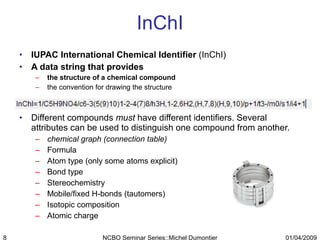
InChI IUPAC International Chemical Identifier  (InChI) A data string that provides the structure of a chemical compound  the convention for drawing the structure Different compounds  must  have different identifiers. Several attributes can be used to distinguish one compound from another.  chemical graph (connection table)  Formula Atom type (only some atoms explicit) Bond type Stereochemistry Mobile/fixed H-bonds (tautomers) Isotopic composition Atomic charge 01/04/2009 NCBO Seminar Series::Michel Dumontier
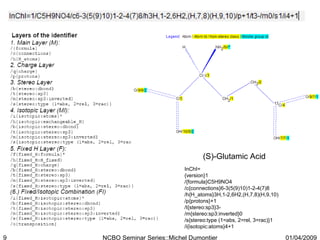
(S)-Glutamic Acid InChI= {version}1 /{formula}C5H9NO4 /c{connections}6-3(5(9)10)1-2-4(7)8 /h{H_atoms}3H,1-2,6H2,(H,7,8)(H,9,10) /p{protons}+1 /t{stereo:sp3}3- /m{stereo:sp3:inverted}0 /s{stereo:type (1=abs, 2=rel, 3=rac)}1 /i{isotopic:atoms}4+1 01/04/2009 NCBO Seminar Series::Michel Dumontier
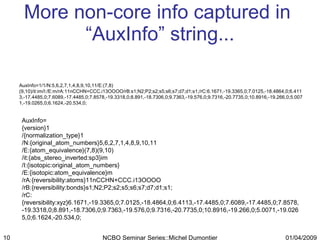
More non-core info captured in  ā€œAuxInfoā€ string... AuxInfo= {version}1 /{normalization_type}1 /N:{original_atom_numbers}5,6,2,7,1,4,8,9,10,11 /E:{atom_equivalence}(7,8)(9,10) /it:{abs_stereo_inverted:sp3}im /I:{isotopic:original_atom_numbers} /E:{isotopic:atom_equivalence}m /rA:{reversibility:atoms}11nCCHN+CCC.i13OOOO /rB:{reversibility:bonds}s1;N2;P2;s2;s5;s6;s7;d7;d1;s1; /rC:{reversibility:xyz}6.1671,-19.3365,0;7.0125,-18.4864,0;6.4113,-17.4485,0;7.6089,-17.4485,0;7.8578,-19.3318,0;8.891,-18.7306,0;9.7363,-19.576,0;9.7316,-20.7735,0;10.8916,-19.266,0;5.0071,-19.0265,0;6.1624,-20.534,0; AuxInfo=1/1/N:5,6,2,7,1,4,8,9,10,11/E:(7,8)(9,10)/it:im/I:/E:m/rA:11nCCHN+CCC.i13OOOO/rB:s1;N2;P2;s2;s5;s6;s7;d7;d1;s1;/rC:6.1671,-19.3365,0;7.0125,-18.4864,0;6.4113,-17.4485,0;7.6089,-17.4485,0;7.8578,-19.3318,0;8.891,-18.7306,0;9.7363,-19.576,0;9.7316,-20.7735,0;10.8916,-19.266,0;5.0071,-19.0265,0;6.1624,-20.534,0; 01/04/2009 NCBO Seminar Series::Michel Dumontier
So... InChi a really just a cryptic  data  identifier Clever  software required to gradually build the chemical identifiers in a series of well-defined steps – normalization, canonicalization then serialization Humans can’t (easily) generate them nor can they easily understand them. But that’s OK. It’s not (user) extensible. But that’s OK. 01/04/2009 NCBO Seminar Series::Michel Dumontier
Possible... but a 1000 residue protein would contain ~15,000 atoms on average....  OpenBabel seemed to struggle with anything over 100 residues  Maybe needs some performance tweaking? Size of the string will be enormous We can use InChiKeys (SHA1 hash), but then we need to provide a  you-submit-InChI ,  we-store-both and they-look-it-up service. Modularize InChI construction for (linear) polymers? Make InChi strings for each residue, and concatenate – rename the atoms according to the residue position We still need to translate the InChi string ... InCHI for Proteins??? 01/04/2009 NCBO Seminar Series::Michel Dumontier
OpenBabel CML SDF O1[C@@H]([C@@H](O)([C@H](O)([C@@H](O)([C@@H]1(O)))))(CO) 79025 IUPAC InChI=1/C6H12O6/c7-1-2-3(8)4(9)5(10)6(11)12-2/h2-11H,1H2/t2-,3-,4+,5-,6+/m1/s1 InCHI α -D-Glucose 6-(hydroxymethyl)oxane-2,3,4,5-tetrol OR (2R,3R,4S,5R,6R)-6 -(hydroxymethyl)tetrahydro -2H-pyran-2,3,4,5-tetraol  SMILES
OWL Has Explicit Semantics Can therefore be used to capture knowledge in a machine understandable way 01/04/2009 NCBO Seminar Series::Michel Dumontier
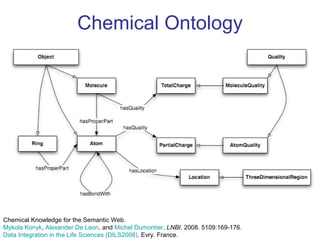
Chemical Ontology Chemical Knowledge for the Semantic Web. Mykola Konyk ,Ā  Alexander De Leon , andĀ  Michel Dumontier .  LNBI .Ā 2008.Ā 5109:169-176.Ā  Data Integration in the Life Sciences (DILS2008) .Ā Evry.Ā France.Ā 
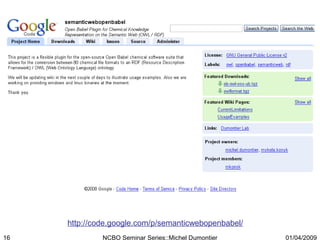
http://code.google.com/p/semanticwebopenbabel/ 01/04/2009 NCBO Seminar Series::Michel Dumontier
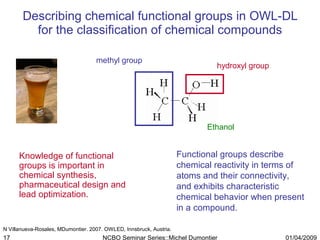
Describing chemical functional groups in OWL-DL for the classification of chemical compounds hydroxyl group methyl group Knowledge of functional groups is important in chemical synthesis, pharmaceutical design and lead optimization. Functional groups describe chemical reactivity in terms of atoms and their connectivity, and exhibits characteristic chemical behavior when present in a compound.  N Villanueva-Rosales, MDumontier. 2007. OWLED, Innsbruck, Austria. Ethanol 01/04/2009 NCBO Seminar Series::Michel Dumontier
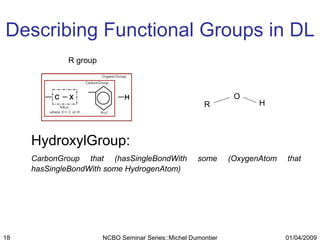
Describing Functional Groups in DL HydroxylGroup:  CarbonGroup that (hasSingleBondWith some (OxygenAtom that hasSingleBondWith some HydrogenAtom)  O H R R group 01/04/2009 NCBO Seminar Series::Michel Dumontier
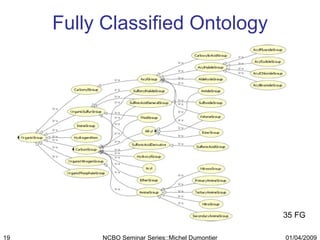
Fully Classified Ontology 35 FG 01/04/2009 NCBO Seminar Series::Michel Dumontier
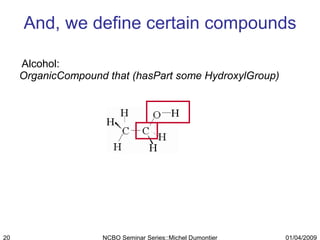
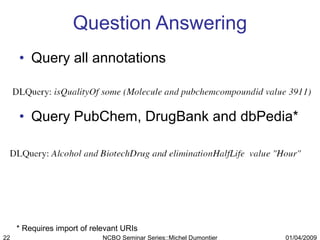
And, we define certain compounds Alcohol:  OrganicCompound that (hasPart some HydroxylGroup)  01/04/2009 NCBO Seminar Series::Michel Dumontier
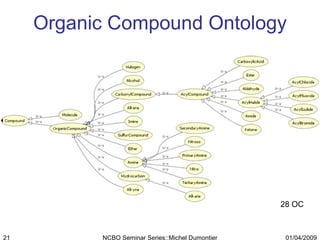
Organic Compound Ontology 28 OC 01/04/2009 NCBO Seminar Series::Michel Dumontier
Question Answering Query all annotations Query PubChem, DrugBank and dbPedia* * Requires import of relevant URIs 01/04/2009 NCBO Seminar Series::Michel Dumontier
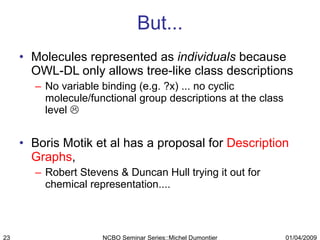
But... Molecules represented as  individuals  because OWL-DL only allows tree-like class descriptions No variable binding (e.g. ?x) ... no cyclic molecule/functional group descriptions at the class level   Boris Motik et al has a proposal for  Description Graphs ,  Robert Stevens & Duncan Hull trying it out for chemical representation.... 01/04/2009 NCBO Seminar Series::Michel Dumontier
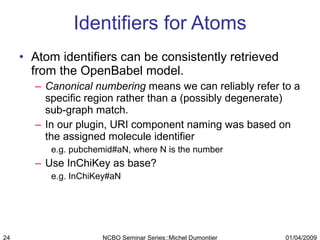
Identifiers for Atoms Atom identifiers can be consistently retrieved from the OpenBabel model. Canonical numbering  means we can reliably refer to a specific region rather than a (possibly degenerate) sub-graph match. In our plugin, URI component naming was based on the assigned molecule identifier e.g. pubchemid#aN, where N is the number Use InChiKey as base? e.g. InChiKey#aN 01/04/2009 NCBO Seminar Series::Michel Dumontier
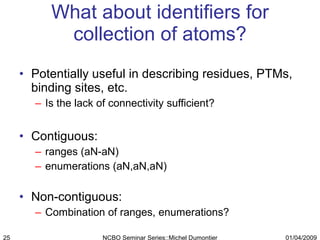
What about identifiers for collection of atoms? Potentially useful in describing residues, PTMs, binding sites, etc.  Is the lack of connectivity sufficient? Contiguous:  ranges (aN-aN) enumerations (aN,aN,aN) Non-contiguous: Combination of ranges, enumerations? 01/04/2009 NCBO Seminar Series::Michel Dumontier
Can we reuse our positional nomenclature for residues? Residues are generally referred to by their absolute position in the biopolymer sequence. e.g. Pro @ X on Protein Y InChiKey#a50-a65 owl:sameAs InChiKey#r5 InChiKey#r5_a1-r5_a15 owl:sameAs InChiKey#r5 Collection of Residues might follow the same rules as a Collection of Atoms. Useful for defining domains, motifs, etc 01/04/2009 NCBO Seminar Series::Michel Dumontier
We already have a  simplified  representation for biopolymers...  Canonical sequence is represented by a string of single letter characters DNA: ACGT RNA: ACGU Proteins: 20 amino acids (not B,J,O,U,X,Z) Modifications can be referred to with ChEBI/PSI-MOD ontology  (e.g. Prolyl hydroxylated residue @ 402) Each (modified) residue must have its InChi description so as to capture explicit structural deviations (de-protonation, etc)  An Alternative Scheme 01/04/2009 NCBO Seminar Series::Michel Dumontier
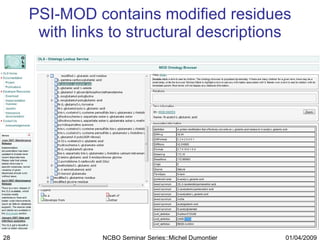
PSI-MOD contains modified residues with links to structural descriptions 01/04/2009 NCBO Seminar Series::Michel Dumontier
But what if we have a modification that isn’t contained in the ontology! No problem... define your own term, with the corresponding structural description (InChi, SMILES), and add to an ontology document... If you’re using OWL, you can add the import statement and publish it. And, of course, you should submit it to the appropriate ontology development teams. (and later make it equivalent to) 01/04/2009 NCBO Seminar Series::Michel Dumontier
While we’re at it, we could extend our expressive capability to match that of OWL: Specification  Exactly  mod1@pos X Only  mod1@posX Minimum  :  At least  [email_address] Combination: mod1@posX  AND  mod2@posY, X != Y Possibilities/Uncertainty:  (mod1  OR  mod2) @posX  Exclusion : not  mod1 @ posX 01/04/2009 NCBO Seminar Series::Michel Dumontier
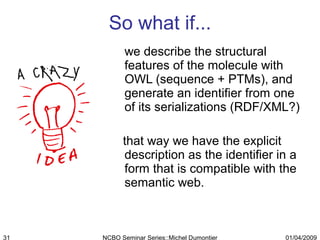
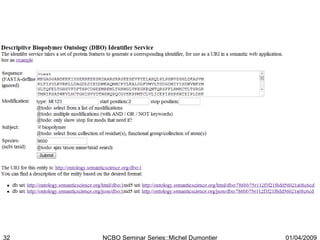
So what if... we describe the structural features of the molecule with OWL (sequence + PTMs), and generate an identifier from one of its serializations (RDF/XML?) that way we have the explicit description as the identifier in a form that is compatible with the semantic web. 01/04/2009 NCBO Seminar Series::Michel Dumontier
01/04/2009 NCBO Seminar Series::Michel Dumontier
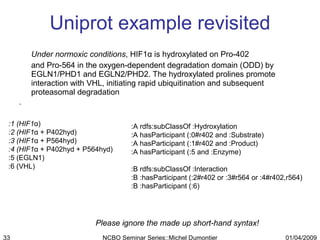
Uniprot example revisited Under normoxic conditions , HIF1 α  is hydroxylated on Pro-402  and Pro-564 in the oxygen-dependent degradation domain (ODD) by EGLN1/PHD1 and EGLN2/PHD2. The hydroxylated prolines promote interaction with VHL, initiating rapid ubiquitination and subsequent proteasomal degradation  .  :A rdfs:subClassOf :Hydroxylation :A hasParticipant (:0#r402 and :Substrate) :A hasParticipant (:1#r402 and :Product) :A hasParticipant (:5 and :Enzyme) :B rdfs:subClassOf :Interaction :B :hasParticipant (:2#r402 or :3#r564 or :4#r402,r564) :B :hasParticipant (:6) :1 (HIF1 α ) :2 (HIF1 α  + P402hyd) :3 (HIF1 α  + P564hyd) :4 (HIF1 α  + P402hyd + P564hyd) :5 (EGLN1) :6 (VHL) Please ignore the made up short-hand syntax! 01/04/2009 NCBO Seminar Series::Michel Dumontier
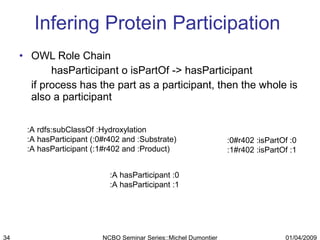
Infering Protein Participation  OWL Role Chain hasParticipant o isPartOf -> hasParticipant if process has the part as a participant, then the whole is also a participant :0#r402 :isPartOf :0 :1#r402 :isPartOf :1 :A rdfs:subClassOf :Hydroxylation :A hasParticipant (:0#r402 and :Substrate) :A hasParticipant (:1#r402 and :Product) :A hasParticipant :0 :A hasParticipant :1 01/04/2009 NCBO Seminar Series::Michel Dumontier
Contextual, but non-structural considerations in identifier generation? Chemical? pH? Temperature? Environment ( in vitro, in vivo, in silico )? Biological? Species? mRNA/Gene from which it was transcribed/encoded? Indirect Relationships? Point & Multiple Mutations? Alternative Splice Variants? Sequence Similarity? 01/04/2009 NCBO Seminar Series::Michel Dumontier
Summary We  need  a precise method to generate identifiers for biopolymers and arbitrary sets of their parts. Consistent  identifier generation will allow anybody to specify findings according to the biopolymers for which it was observed, whether it exists in a database or not, and will allow us to link biochemical knowledge at finer levels of granularity. (at least) two identifier schemes were put forward to initiate discussion, with the goal of setting a standard naming convention. 01/04/2009 NCBO Seminar Series::Michel Dumontier
dumontierlab.com [email_address] Special thanks to PhD Student Leonid Chepelev for insightful discussions   semanticscience.org 01/04/2009 NCBO Seminar Series::Michel Dumontier

Accurate biochemical knowledge starting with precise structure-based criteria for molecular identity

  • 1.
    Accurate biochemicalknowledge starting with precise structure-based criteria for molecular identity Michel Dumontier , Ph.D. Assistant Professor of Bioinformatics Department of Biology, School of Computer Science Institute of Biochemistry, Ottawa Institute of Systems Biology Carleton University 01/04/2009 NCBO Seminar Series::Michel Dumontier
  • 2.
    Problem Statement (I)Although biochemical events can be described with reference to specific chemical substances, we may want to describe them at finer/grainier levels of (mereological) granularity. residue : post translational modification collection of residues : motif/domain/interaction site atom : atomic interactions, catalytic mechanism collection of atoms : binding/catalytic site, interaction This requires identifiers for parts, regions (contiguous and non-contiguous), aggregates/complexes. However, we do not (AFAIK) have a precise ( reproducible ) methodology to automatically generate these! 01/04/2009 NCBO Seminar Series::Michel Dumontier
  • 3.
    Bio2RDF: 2.3B triplesof SPARQL-accessible linked biological data! Chemical Parts!
  • 4.
    Case Study: HIF1α Hypoxia-Inducible Factor 1, alpha chain (uniprot:Q16665) Master transcriptional regulator of the adaptive response to hypoxia Under normoxic conditions , HIF1 α is hydroxylated on Pro-402 and Pro-564 in the oxygen-dependent degradation domain (ODD) by EGLN1/PHD1 and EGLN2/PHD2. EGLN3/PHD3 has also been shown to hydroxylate Pro-564. The hydroxylated prolines promote interaction with VHL, initiating rapid ubiquitination and subsequent proteasomal degradation. Context Dependent Behavior Normoxic Conditions Hypoxic Conditions Multiple hydroxylations Part of a domain The part is the agent in the process Selective interaction with parts 01/04/2009 NCBO Seminar Series::Michel Dumontier
  • 5.
    Are these thesame? HIF1 α – au naturel HIF1 α hydroxylated @P402 HIF1 α hydroxylated @P564 HIF1 α hydroxylated @P402 & @P564 HIF1 α hydroxylated @P402 & (@P564) ubiquitinated @Lys-532 HIF1 α L400A & L397A 01/04/2009 NCBO Seminar Series::Michel Dumontier
  • 6.
    NO!!!! These arestructurally different Each exhibits distinct functionality! Yet most databases ( Uniprot / Genbank ) don’t have separate identifiers for them Reactome has an internal identifier for referring to different forms, but links to Uniprot entries and doesn’t provide an explicit description of the structure that it corresponds to! 01/04/2009 NCBO Seminar Series::Michel Dumontier
  • 7.
    So We havea clear need for being able to refer to distinct biochemical entities, based at least on their structure. We also need to refer to arbitrary structural parts. Should we generate all the combinations a priori???  NO!! Should we be able to automatically generate the identifier from the structural attributes? -> YES!!! Should we semantically annotate (manually or otherwise) those forms known to be involved in specific processes??? -> YES!!! What identifiers are unique for a given structure? 01/04/2009 NCBO Seminar Series::Michel Dumontier
  • 8.
    InChI IUPAC InternationalChemical Identifier (InChI) A data string that provides the structure of a chemical compound the convention for drawing the structure Different compounds must have different identifiers. Several attributes can be used to distinguish one compound from another. chemical graph (connection table) Formula Atom type (only some atoms explicit) Bond type Stereochemistry Mobile/fixed H-bonds (tautomers) Isotopic composition Atomic charge 01/04/2009 NCBO Seminar Series::Michel Dumontier
  • 9.
    (S)-Glutamic Acid InChI={version}1 /{formula}C5H9NO4 /c{connections}6-3(5(9)10)1-2-4(7)8 /h{H_atoms}3H,1-2,6H2,(H,7,8)(H,9,10) /p{protons}+1 /t{stereo:sp3}3- /m{stereo:sp3:inverted}0 /s{stereo:type (1=abs, 2=rel, 3=rac)}1 /i{isotopic:atoms}4+1 01/04/2009 NCBO Seminar Series::Michel Dumontier
  • 10.
    More non-core infocaptured in ā€œAuxInfoā€ string... AuxInfo= {version}1 /{normalization_type}1 /N:{original_atom_numbers}5,6,2,7,1,4,8,9,10,11 /E:{atom_equivalence}(7,8)(9,10) /it:{abs_stereo_inverted:sp3}im /I:{isotopic:original_atom_numbers} /E:{isotopic:atom_equivalence}m /rA:{reversibility:atoms}11nCCHN+CCC.i13OOOO /rB:{reversibility:bonds}s1;N2;P2;s2;s5;s6;s7;d7;d1;s1; /rC:{reversibility:xyz}6.1671,-19.3365,0;7.0125,-18.4864,0;6.4113,-17.4485,0;7.6089,-17.4485,0;7.8578,-19.3318,0;8.891,-18.7306,0;9.7363,-19.576,0;9.7316,-20.7735,0;10.8916,-19.266,0;5.0071,-19.0265,0;6.1624,-20.534,0; AuxInfo=1/1/N:5,6,2,7,1,4,8,9,10,11/E:(7,8)(9,10)/it:im/I:/E:m/rA:11nCCHN+CCC.i13OOOO/rB:s1;N2;P2;s2;s5;s6;s7;d7;d1;s1;/rC:6.1671,-19.3365,0;7.0125,-18.4864,0;6.4113,-17.4485,0;7.6089,-17.4485,0;7.8578,-19.3318,0;8.891,-18.7306,0;9.7363,-19.576,0;9.7316,-20.7735,0;10.8916,-19.266,0;5.0071,-19.0265,0;6.1624,-20.534,0; 01/04/2009 NCBO Seminar Series::Michel Dumontier
  • 11.
    So... InChi areally just a cryptic data identifier Clever software required to gradually build the chemical identifiers in a series of well-defined steps – normalization, canonicalization then serialization Humans can’t (easily) generate them nor can they easily understand them. But that’s OK. It’s not (user) extensible. But that’s OK. 01/04/2009 NCBO Seminar Series::Michel Dumontier
  • 12.
    Possible... but a1000 residue protein would contain ~15,000 atoms on average.... OpenBabel seemed to struggle with anything over 100 residues Maybe needs some performance tweaking? Size of the string will be enormous We can use InChiKeys (SHA1 hash), but then we need to provide a you-submit-InChI , we-store-both and they-look-it-up service. Modularize InChI construction for (linear) polymers? Make InChi strings for each residue, and concatenate – rename the atoms according to the residue position We still need to translate the InChi string ... InCHI for Proteins??? 01/04/2009 NCBO Seminar Series::Michel Dumontier
  • 13.
    OpenBabel CML SDFO1[C@@H]([C@@H](O)([C@H](O)([C@@H](O)([C@@H]1(O)))))(CO) 79025 IUPAC InChI=1/C6H12O6/c7-1-2-3(8)4(9)5(10)6(11)12-2/h2-11H,1H2/t2-,3-,4+,5-,6+/m1/s1 InCHI α -D-Glucose 6-(hydroxymethyl)oxane-2,3,4,5-tetrol OR (2R,3R,4S,5R,6R)-6 -(hydroxymethyl)tetrahydro -2H-pyran-2,3,4,5-tetraol SMILES
  • 14.
    OWL Has ExplicitSemantics Can therefore be used to capture knowledge in a machine understandable way 01/04/2009 NCBO Seminar Series::Michel Dumontier
  • 15.
    Chemical Ontology ChemicalKnowledge for the Semantic Web. Mykola Konyk ,Ā  Alexander De Leon , andĀ  Michel Dumontier . LNBI .Ā 2008.Ā 5109:169-176.Ā  Data Integration in the Life Sciences (DILS2008) .Ā Evry.Ā France.Ā 
  • 16.
  • 17.
    Describing chemical functionalgroups in OWL-DL for the classification of chemical compounds hydroxyl group methyl group Knowledge of functional groups is important in chemical synthesis, pharmaceutical design and lead optimization. Functional groups describe chemical reactivity in terms of atoms and their connectivity, and exhibits characteristic chemical behavior when present in a compound. N Villanueva-Rosales, MDumontier. 2007. OWLED, Innsbruck, Austria. Ethanol 01/04/2009 NCBO Seminar Series::Michel Dumontier
  • 18.
    Describing Functional Groupsin DL HydroxylGroup: CarbonGroup that (hasSingleBondWith some (OxygenAtom that hasSingleBondWith some HydrogenAtom) O H R R group 01/04/2009 NCBO Seminar Series::Michel Dumontier
  • 19.
    Fully Classified Ontology35 FG 01/04/2009 NCBO Seminar Series::Michel Dumontier
  • 20.
    And, we definecertain compounds Alcohol: OrganicCompound that (hasPart some HydroxylGroup) 01/04/2009 NCBO Seminar Series::Michel Dumontier
  • 21.
    Organic Compound Ontology28 OC 01/04/2009 NCBO Seminar Series::Michel Dumontier
  • 22.
    Question Answering Queryall annotations Query PubChem, DrugBank and dbPedia* * Requires import of relevant URIs 01/04/2009 NCBO Seminar Series::Michel Dumontier
  • 23.
    But... Molecules representedas individuals because OWL-DL only allows tree-like class descriptions No variable binding (e.g. ?x) ... no cyclic molecule/functional group descriptions at the class level  Boris Motik et al has a proposal for Description Graphs , Robert Stevens & Duncan Hull trying it out for chemical representation.... 01/04/2009 NCBO Seminar Series::Michel Dumontier
  • 24.
    Identifiers for AtomsAtom identifiers can be consistently retrieved from the OpenBabel model. Canonical numbering means we can reliably refer to a specific region rather than a (possibly degenerate) sub-graph match. In our plugin, URI component naming was based on the assigned molecule identifier e.g. pubchemid#aN, where N is the number Use InChiKey as base? e.g. InChiKey#aN 01/04/2009 NCBO Seminar Series::Michel Dumontier
  • 25.
    What about identifiersfor collection of atoms? Potentially useful in describing residues, PTMs, binding sites, etc. Is the lack of connectivity sufficient? Contiguous: ranges (aN-aN) enumerations (aN,aN,aN) Non-contiguous: Combination of ranges, enumerations? 01/04/2009 NCBO Seminar Series::Michel Dumontier
  • 26.
    Can we reuseour positional nomenclature for residues? Residues are generally referred to by their absolute position in the biopolymer sequence. e.g. Pro @ X on Protein Y InChiKey#a50-a65 owl:sameAs InChiKey#r5 InChiKey#r5_a1-r5_a15 owl:sameAs InChiKey#r5 Collection of Residues might follow the same rules as a Collection of Atoms. Useful for defining domains, motifs, etc 01/04/2009 NCBO Seminar Series::Michel Dumontier
  • 27.
    We already havea simplified representation for biopolymers... Canonical sequence is represented by a string of single letter characters DNA: ACGT RNA: ACGU Proteins: 20 amino acids (not B,J,O,U,X,Z) Modifications can be referred to with ChEBI/PSI-MOD ontology (e.g. Prolyl hydroxylated residue @ 402) Each (modified) residue must have its InChi description so as to capture explicit structural deviations (de-protonation, etc) An Alternative Scheme 01/04/2009 NCBO Seminar Series::Michel Dumontier
  • 28.
    PSI-MOD contains modifiedresidues with links to structural descriptions 01/04/2009 NCBO Seminar Series::Michel Dumontier
  • 29.
    But what ifwe have a modification that isn’t contained in the ontology! No problem... define your own term, with the corresponding structural description (InChi, SMILES), and add to an ontology document... If you’re using OWL, you can add the import statement and publish it. And, of course, you should submit it to the appropriate ontology development teams. (and later make it equivalent to) 01/04/2009 NCBO Seminar Series::Michel Dumontier
  • 30.
    While we’re atit, we could extend our expressive capability to match that of OWL: Specification Exactly mod1@pos X Only mod1@posX Minimum : At least [email_address] Combination: mod1@posX AND mod2@posY, X != Y Possibilities/Uncertainty: (mod1 OR mod2) @posX Exclusion : not mod1 @ posX 01/04/2009 NCBO Seminar Series::Michel Dumontier
  • 31.
    So what if...we describe the structural features of the molecule with OWL (sequence + PTMs), and generate an identifier from one of its serializations (RDF/XML?) that way we have the explicit description as the identifier in a form that is compatible with the semantic web. 01/04/2009 NCBO Seminar Series::Michel Dumontier
  • 32.
    01/04/2009 NCBO SeminarSeries::Michel Dumontier
  • 33.
    Uniprot example revisitedUnder normoxic conditions , HIF1 α is hydroxylated on Pro-402 and Pro-564 in the oxygen-dependent degradation domain (ODD) by EGLN1/PHD1 and EGLN2/PHD2. The hydroxylated prolines promote interaction with VHL, initiating rapid ubiquitination and subsequent proteasomal degradation . :A rdfs:subClassOf :Hydroxylation :A hasParticipant (:0#r402 and :Substrate) :A hasParticipant (:1#r402 and :Product) :A hasParticipant (:5 and :Enzyme) :B rdfs:subClassOf :Interaction :B :hasParticipant (:2#r402 or :3#r564 or :4#r402,r564) :B :hasParticipant (:6) :1 (HIF1 α ) :2 (HIF1 α + P402hyd) :3 (HIF1 α + P564hyd) :4 (HIF1 α + P402hyd + P564hyd) :5 (EGLN1) :6 (VHL) Please ignore the made up short-hand syntax! 01/04/2009 NCBO Seminar Series::Michel Dumontier
  • 34.
    Infering Protein Participation OWL Role Chain hasParticipant o isPartOf -> hasParticipant if process has the part as a participant, then the whole is also a participant :0#r402 :isPartOf :0 :1#r402 :isPartOf :1 :A rdfs:subClassOf :Hydroxylation :A hasParticipant (:0#r402 and :Substrate) :A hasParticipant (:1#r402 and :Product) :A hasParticipant :0 :A hasParticipant :1 01/04/2009 NCBO Seminar Series::Michel Dumontier
  • 35.
    Contextual, but non-structuralconsiderations in identifier generation? Chemical? pH? Temperature? Environment ( in vitro, in vivo, in silico )? Biological? Species? mRNA/Gene from which it was transcribed/encoded? Indirect Relationships? Point & Multiple Mutations? Alternative Splice Variants? Sequence Similarity? 01/04/2009 NCBO Seminar Series::Michel Dumontier
  • 36.
    Summary We need a precise method to generate identifiers for biopolymers and arbitrary sets of their parts. Consistent identifier generation will allow anybody to specify findings according to the biopolymers for which it was observed, whether it exists in a database or not, and will allow us to link biochemical knowledge at finer levels of granularity. (at least) two identifier schemes were put forward to initiate discussion, with the goal of setting a standard naming convention. 01/04/2009 NCBO Seminar Series::Michel Dumontier
  • 37.
    dumontierlab.com [email_address] Specialthanks to PhD Student Leonid Chepelev for insightful discussions  semanticscience.org 01/04/2009 NCBO Seminar Series::Michel Dumontier