Accumulo 1.4 & 1.5


    Keith Turner
What is Accumulo?
A re-implementation of Big Table
●   Distributed Database
●   Does not support SQL
●   Data is arranged by
    ●   Row
    ●   Column
    ●   Time
●   No need to declare columns, types
Massively Distributed
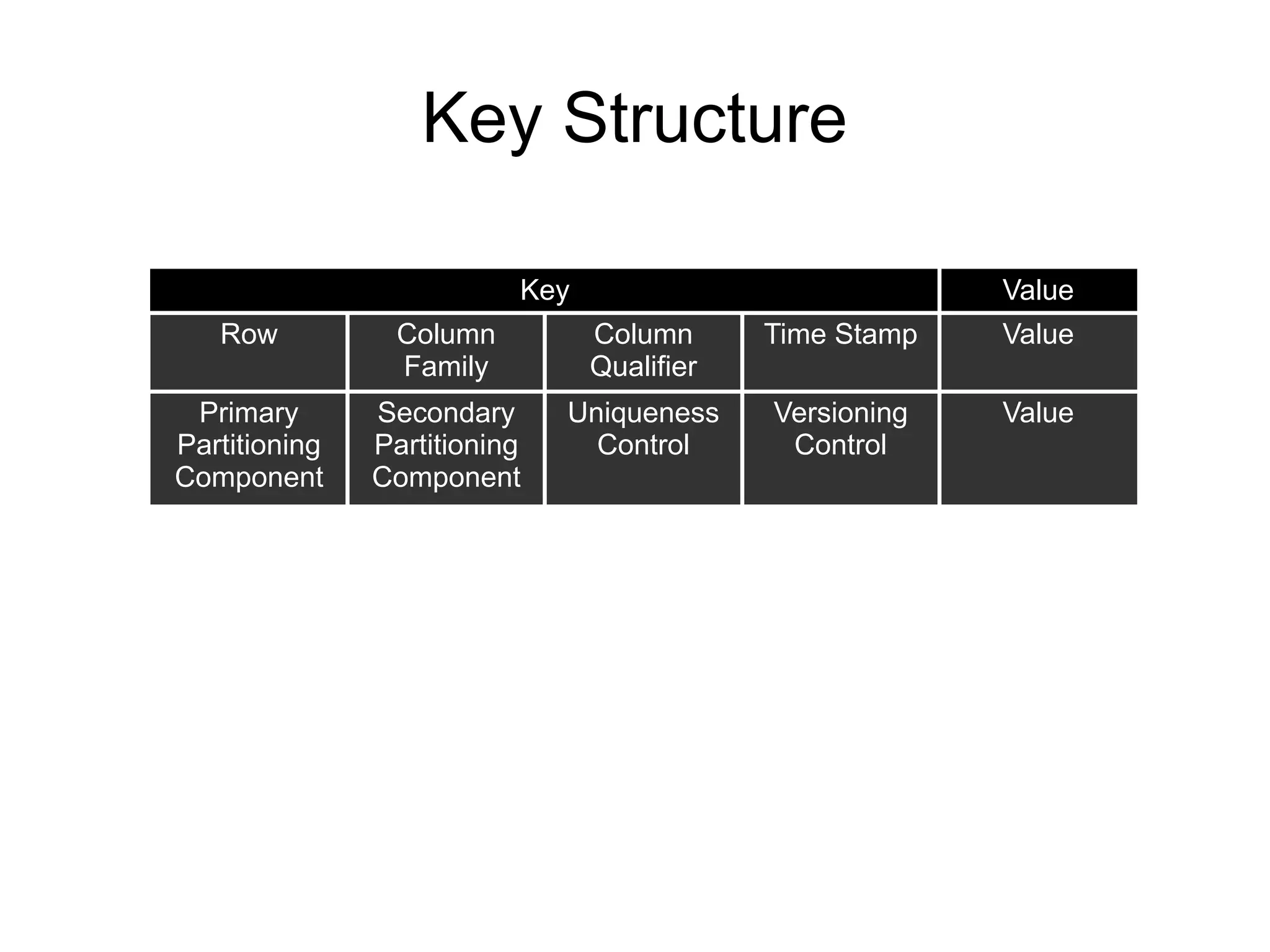
Key Structure

                          Key                            Value
   Row          Column          Column      Time Stamp   Value
                Family          Qualifier
 Primary       Secondary      Uniqueness    Versioning   Value
Partitioning   Partitioning     Control      Control
Component      Component
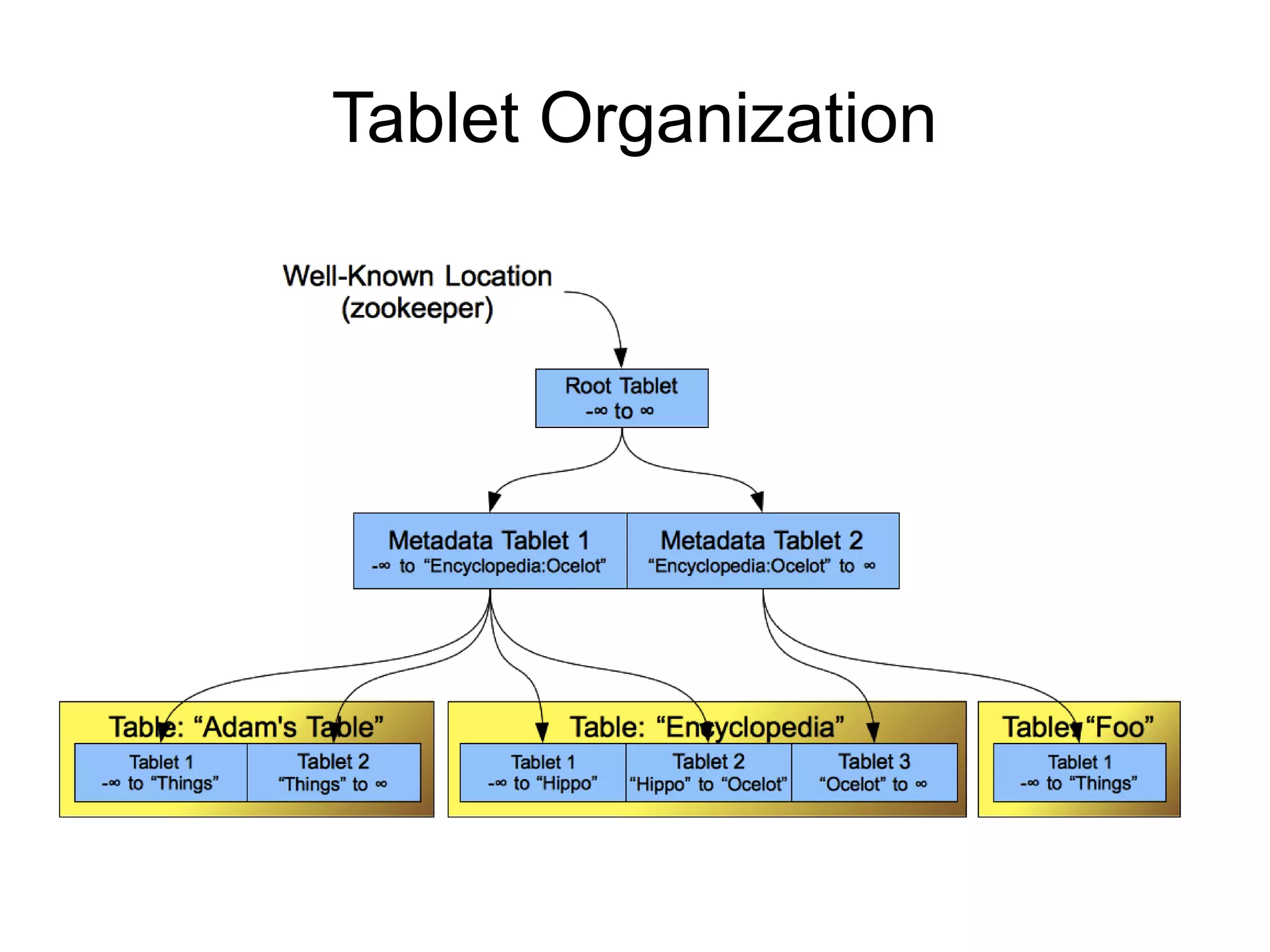
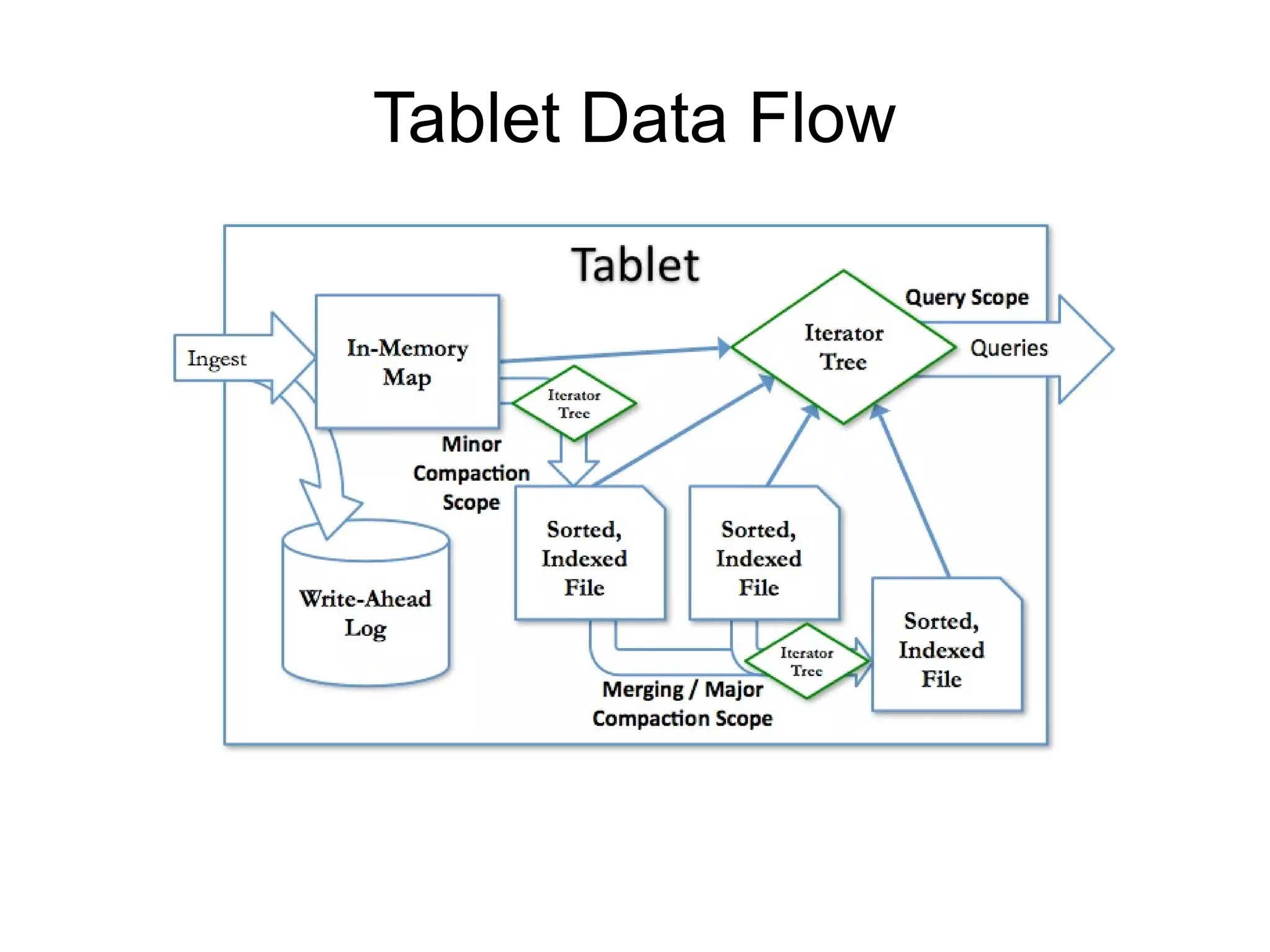
Tablet Organization
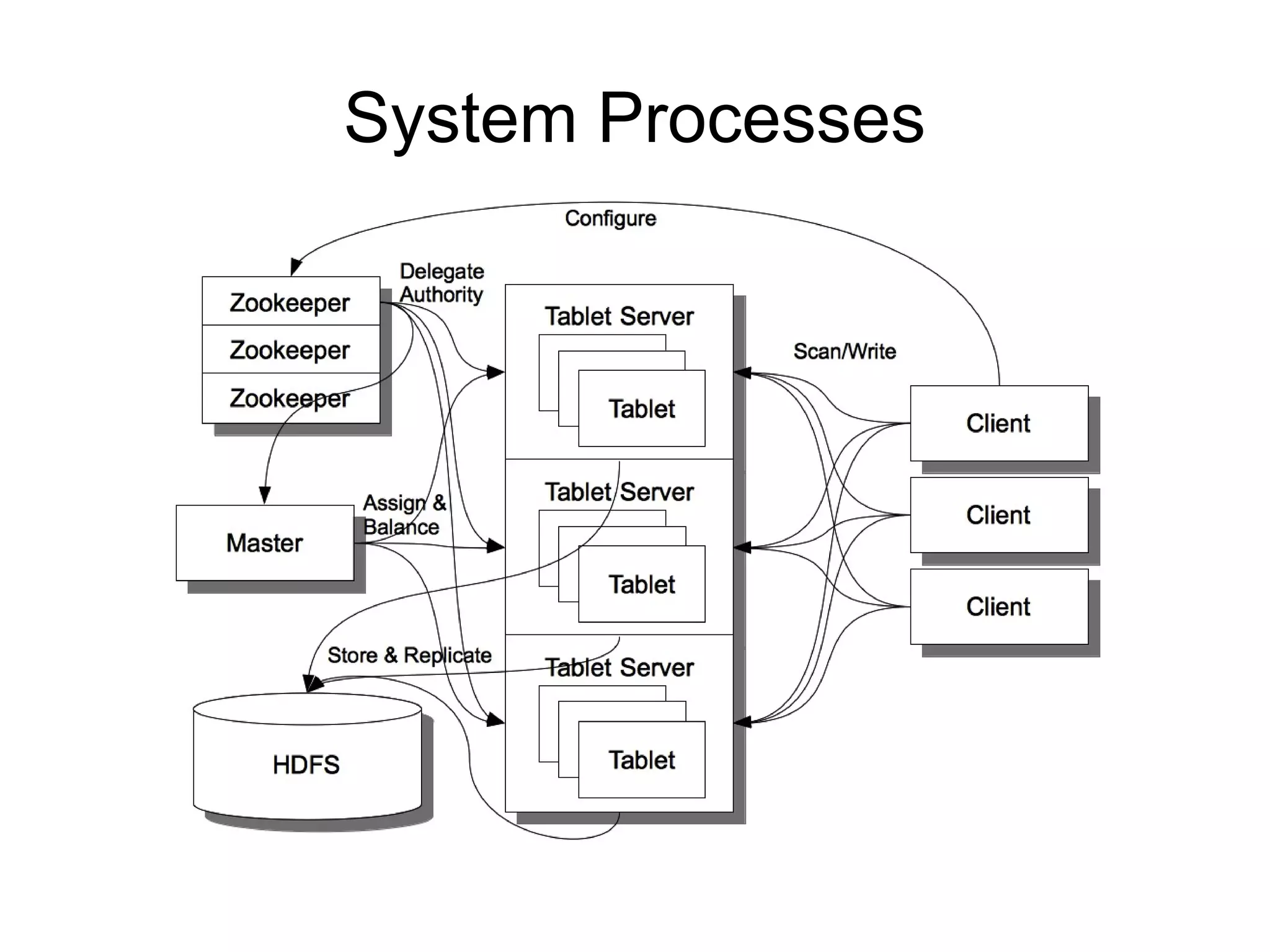
System Processes
Tablet Data Flow
Rfile Multi-level index
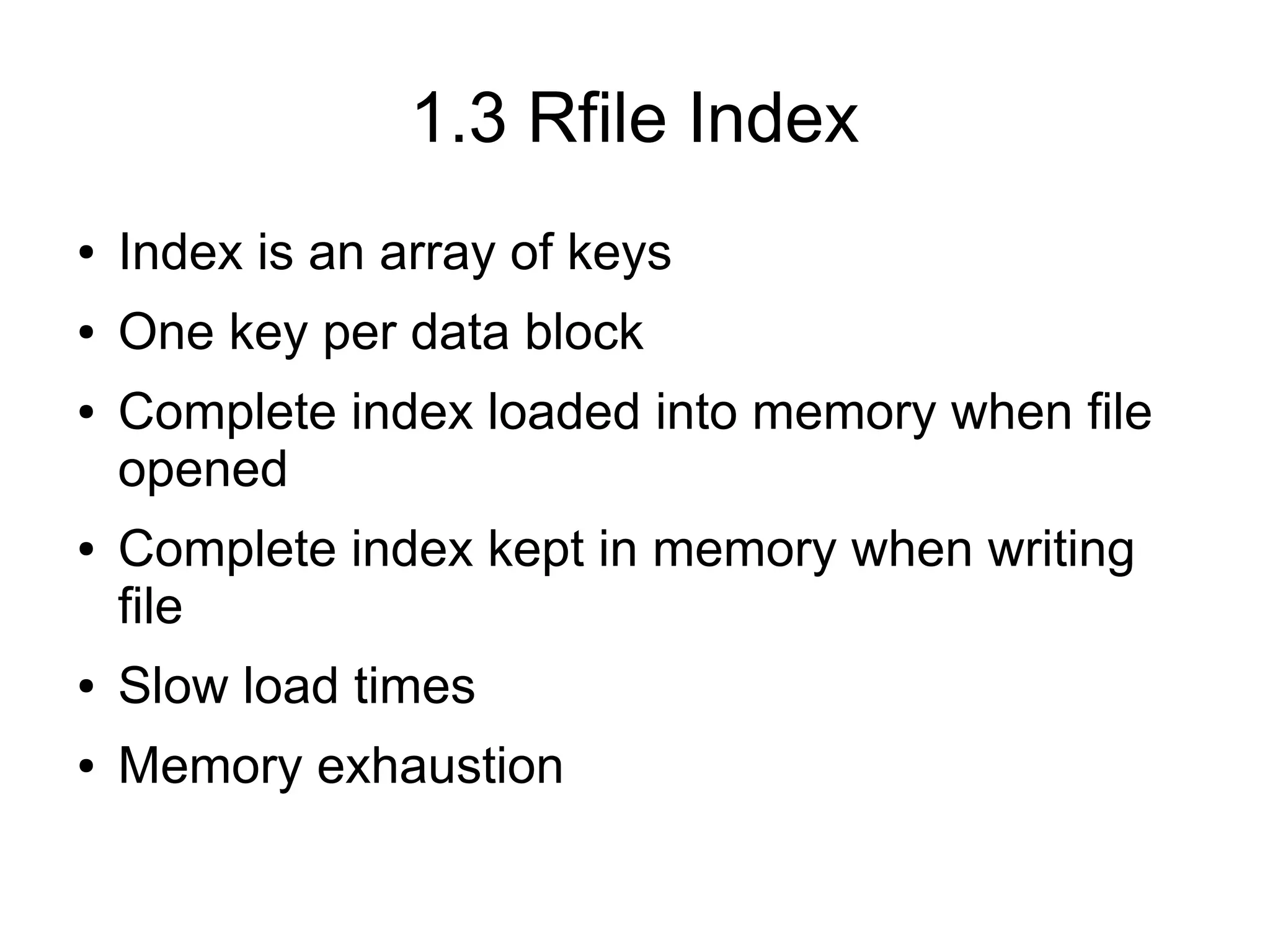
1.3 Rfile Index
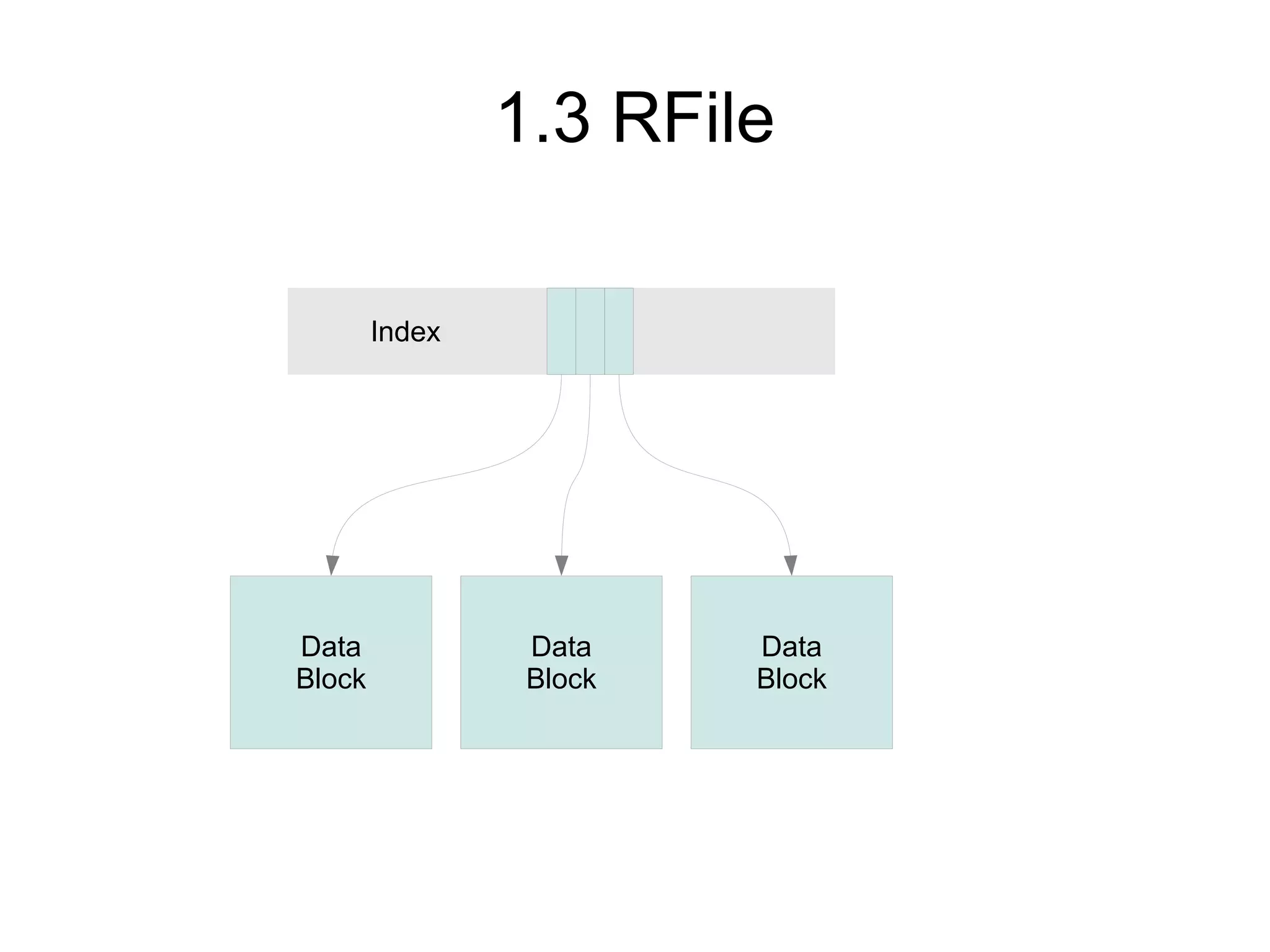
●   Index is an array of keys
●   One key per data block
●   Complete index loaded into memory when file
    opened
●   Complete index kept in memory when writing
    file
●   Slow load times
●   Memory exhaustion
1.3 RFile

        Index


Data             Data    Data
Block            Block   Block
Non multi-level 9G file

Locality group          : <DEFAULT>
   Start block           : 0
   Num   blocks          : 182,691
   Index level 0 size    : 8,038,404 bytes
   First key             : 00000008611ae5d6 0e94:74e1 [] 1310491465052 false
   Last key              : 7ffffff7daec0b4e 43ee:1c1e [] 1310491475396 false
   Num entries           : 172,014,468
   Column families       : <UNKNOWN>

Meta block     : BCFile.index
   Raw size             : 2,148,491 bytes
   Compressed size      : 1,485,697 bytes
   Compression type     : lzo

Meta block     : RFile.index
   Raw size             : 8,038,470 bytes
   Compressed size      : 5,664,704 bytes
   Compression type     : lzo
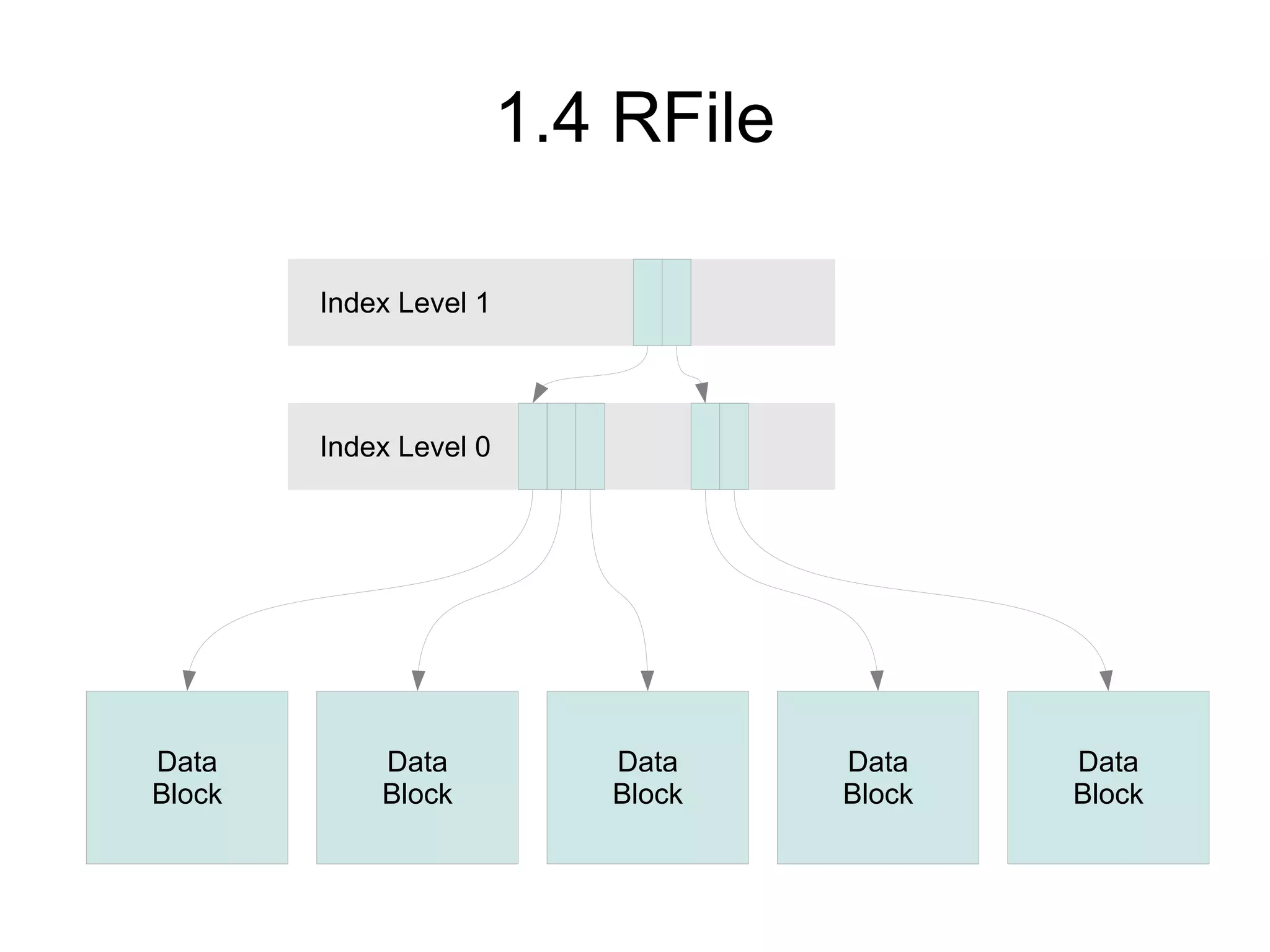
1.4 RFile

        Index Level 1


        Index Level 0


Data        Data           Data     Data    Data
Block       Block          Block    Block   Block
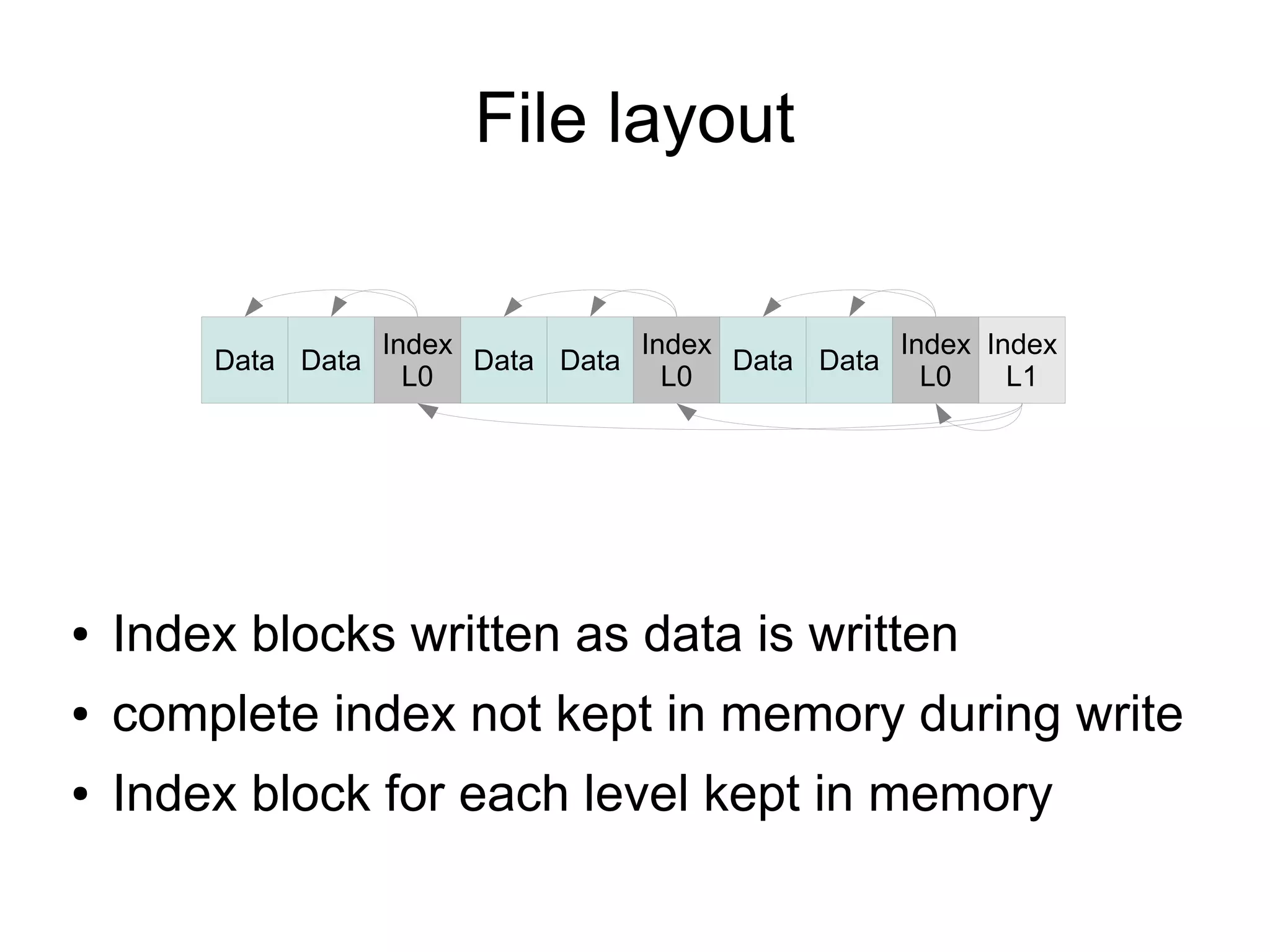
File layout


                    Index           Index           Index Index
        Data Data         Data Data       Data Data
                      L0              L0              L0    L1


●   Index blocks written as data is written
●   complete index not kept in memory during write
●   Index block for each level kept in memory
Multi-level 9G file

Locality group        : <DEFAULT>
   Start block         : 0
   Num   blocks        : 187,070
   Index level 1       : 4,573 bytes 1 blocks
   Index level 0       : 10,431,126 bytes 82 blocks
   First key           : 00000008611ae5d6 0e94:74e1 [] 1310491465052 false
   Last key            : 7ffffff7daec0b4e 43ee:1c1e [] 1310491475396 false
   Num entries         : 172,014,468
   Column families     : <UNKNOWN>

Meta block     : BCFile.index
   Raw size             : 5 bytes
   Compressed size      : 17 bytes
   Compression type     : lzo
Meta block     : RFile.index
   Raw size             : 4,652 bytes
   Compressed size      : 3,745 bytes
   Compression type     : lzo
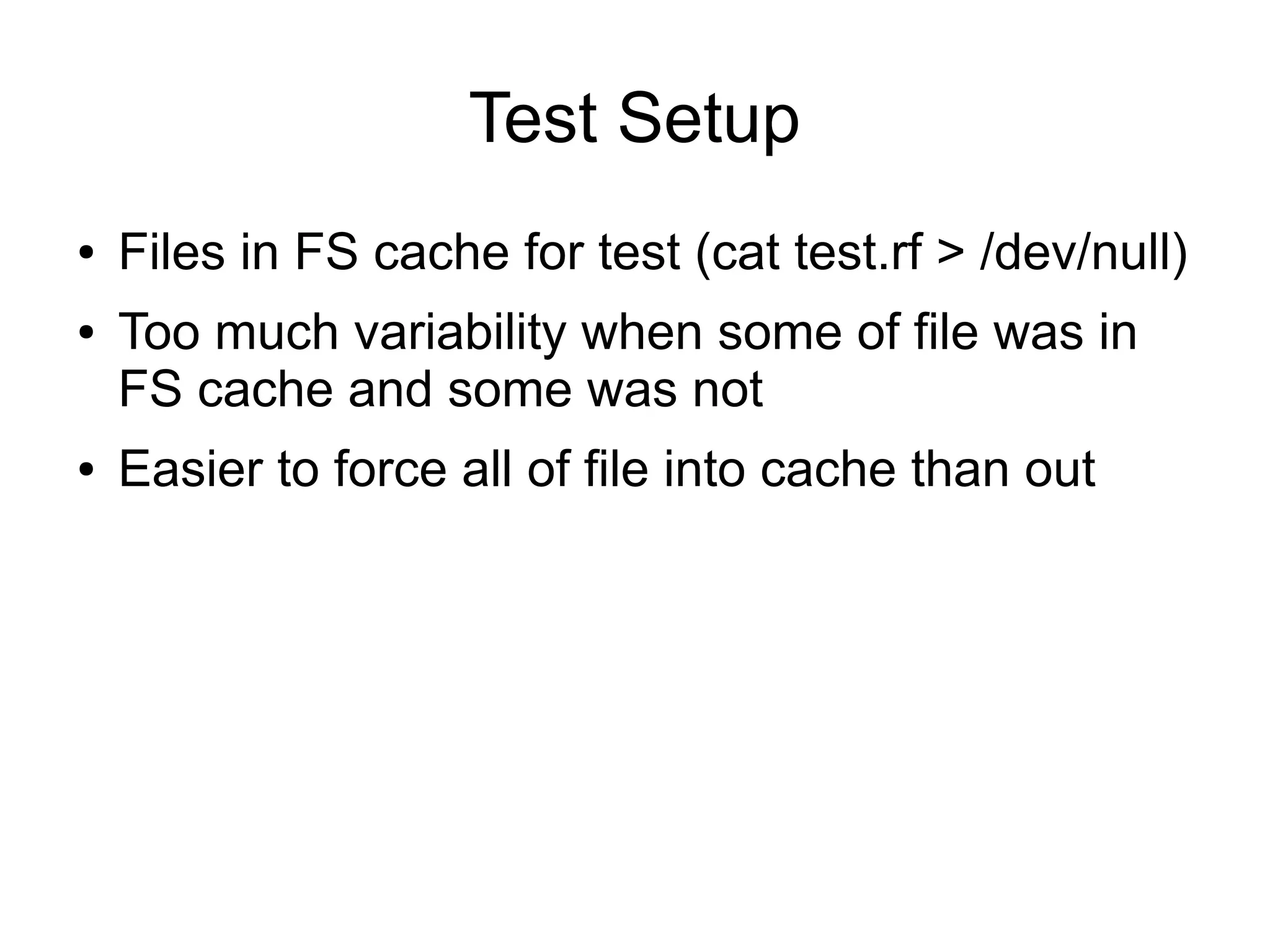
Test Setup
●   Files in FS cache for test (cat test.rf > /dev/null)
●   Too much variability when some of file was in
    FS cache and some was not
●   Easier to force all of file into cache than out
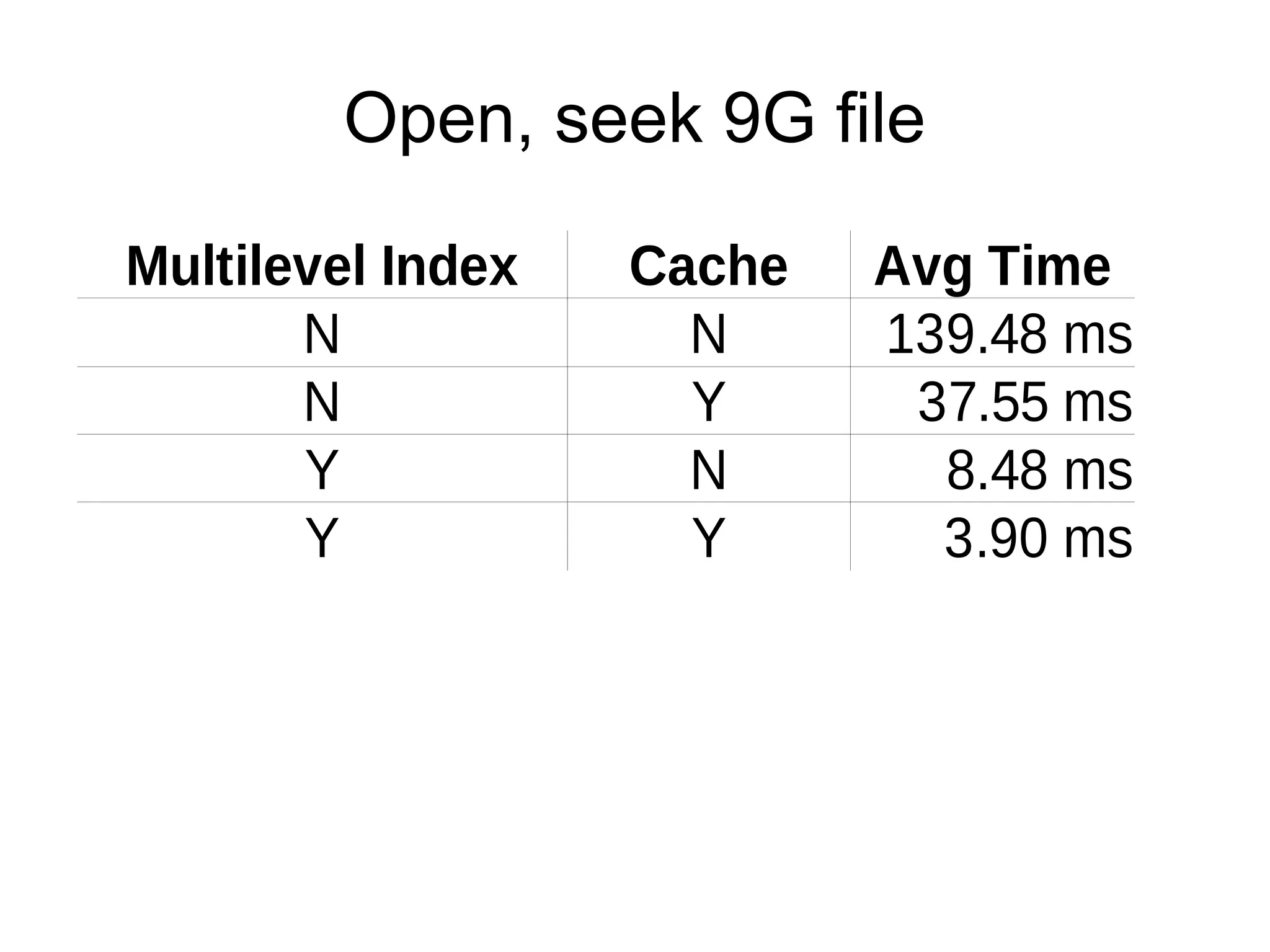
Open, seek 9G file

Multilevel Index   Cache   Avg Time
       N             N     139.48 ms
       N             Y      37.55 ms
       Y             N       8.48 ms
       Y             Y       3.90 ms
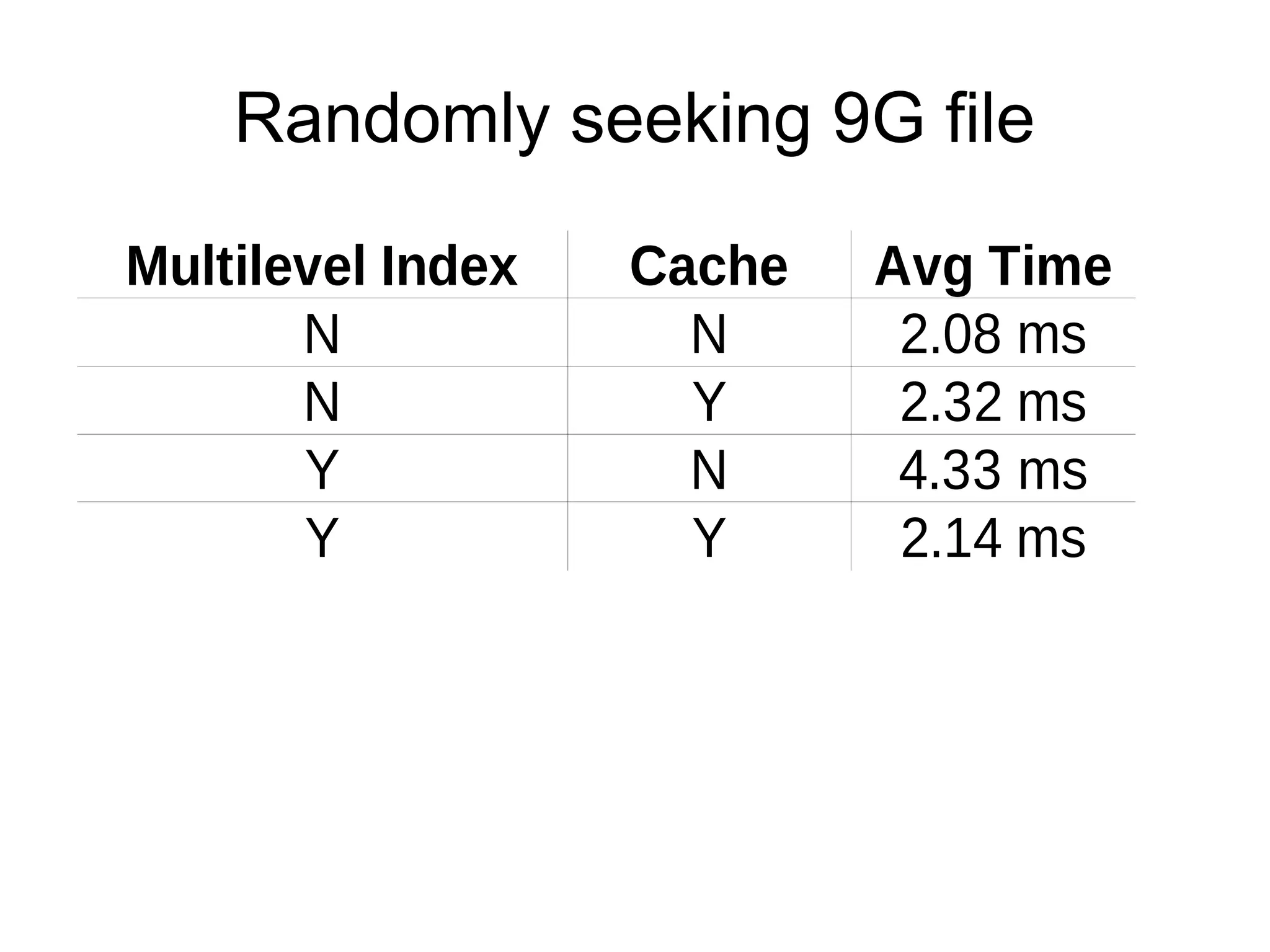
Randomly seeking 9G file

Multilevel Index   Cache   Avg Time
       N             N      2.08 ms
       N             Y      2.32 ms
       Y             N      4.33 ms
       Y             Y      2.14 ms
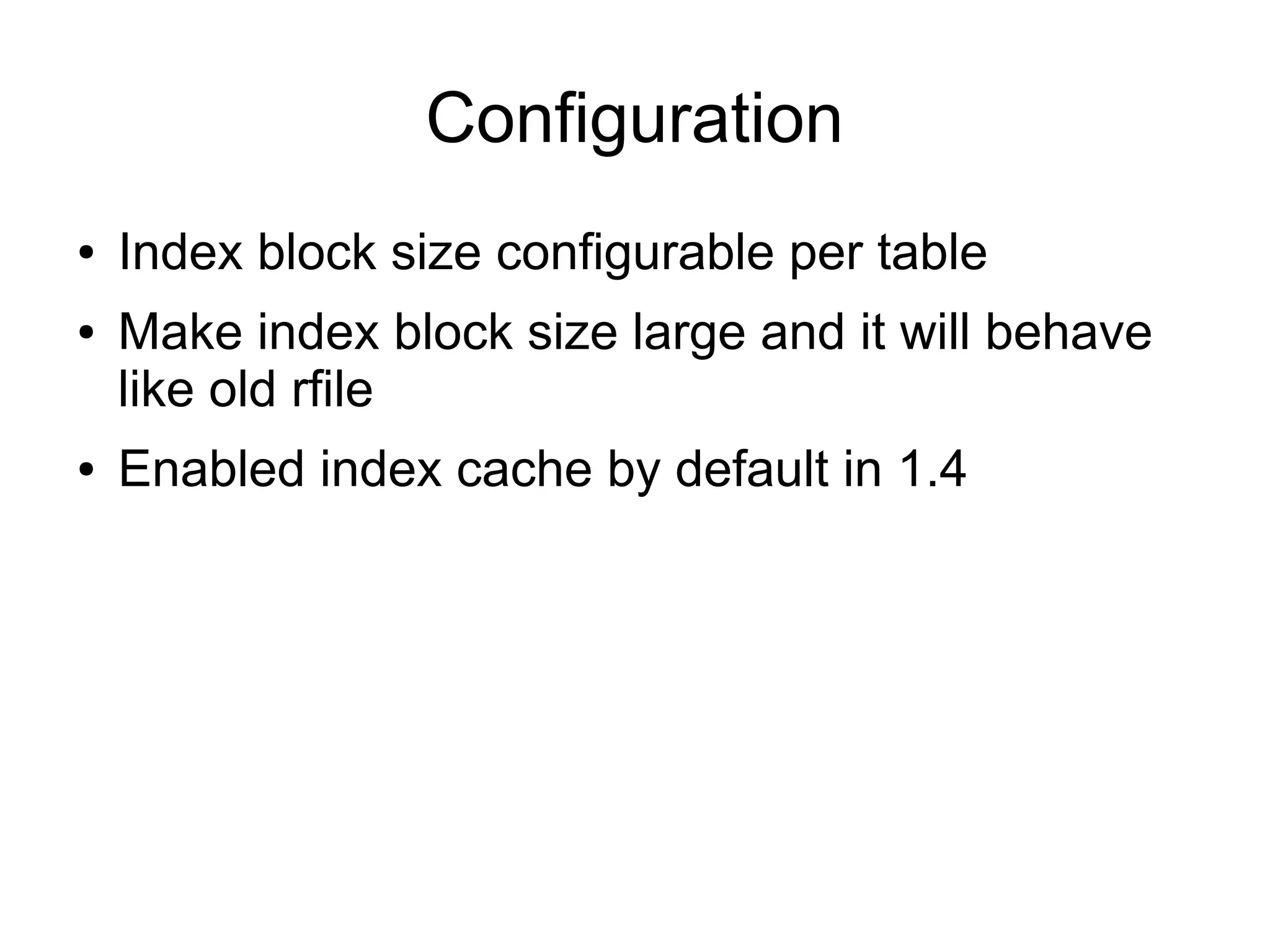
Configuration
●   Index block size configurable per table
●   Make index block size large and it will behave
    like old rfile
●   Enabled index cache by default in 1.4
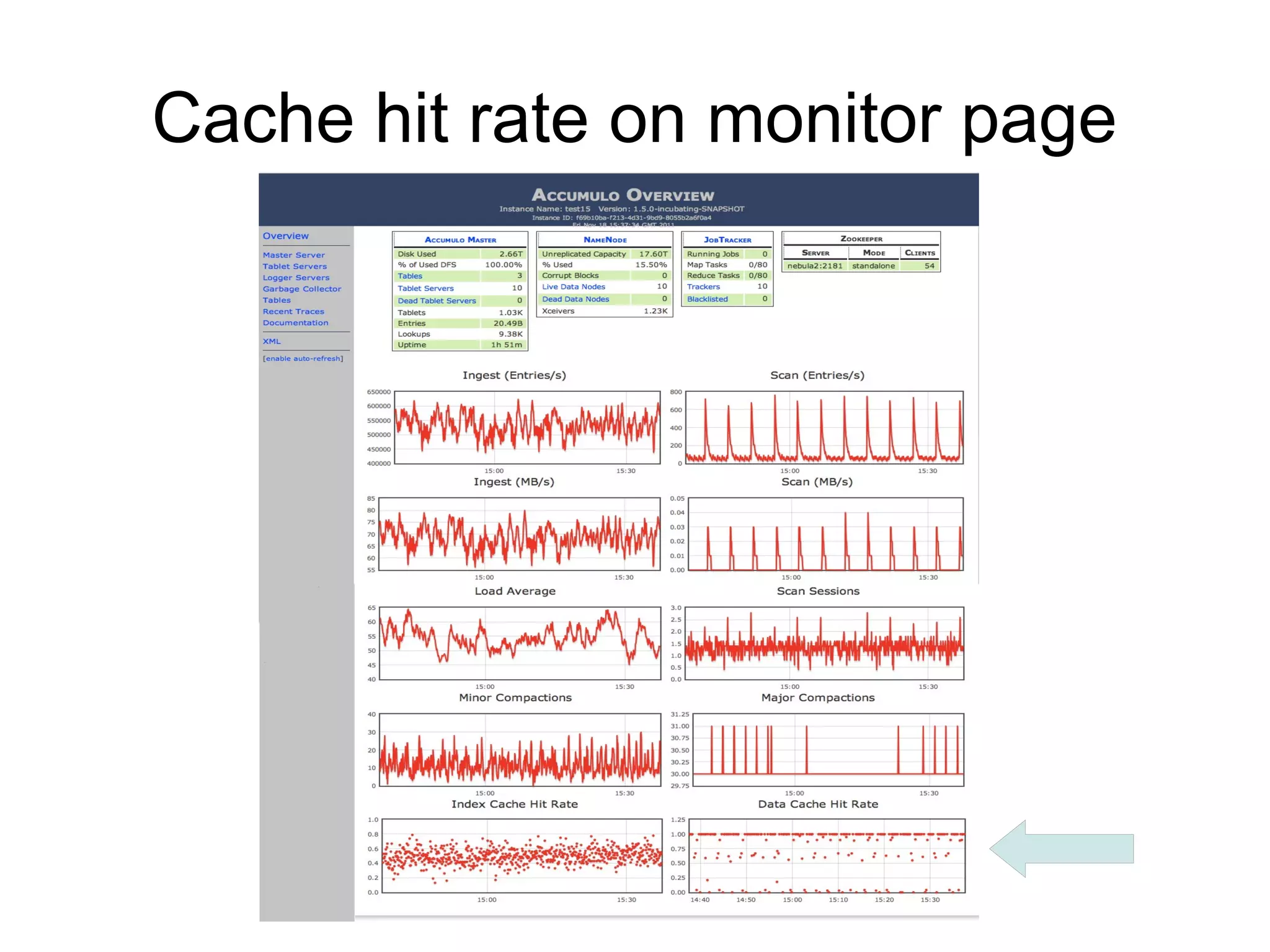
Cache hit rate on monitor page
Fault tolerant concurrent table operations
Problematic situations
●   Master dies during create table
●   Create and delete table run concurrently
●   Client dies during bulk ingest
●   Table deleted while writing or scanning
Create table fault
●   Master dies during
    ●   Could leave accumulo metadata in bad state
●   Master creates table, but then dies before
    notifying client
    ●   If client retries, it gets table exist exception
FATE
          Fault Tolerant Executor
●   If process dies, previously submitted operations
    continue to execute on restart.
●   Serializes operation in zookeeper before
    execution
●   Master uses FATE to execute table operations
Bulk import test
●   Create table with summation aggregator
●   Bulk import files of +1 or -1, graph ensures final
    sum is 0
●   Concurrently merge, split, compact, and
    consistency check table
●   Exit point verifies 0
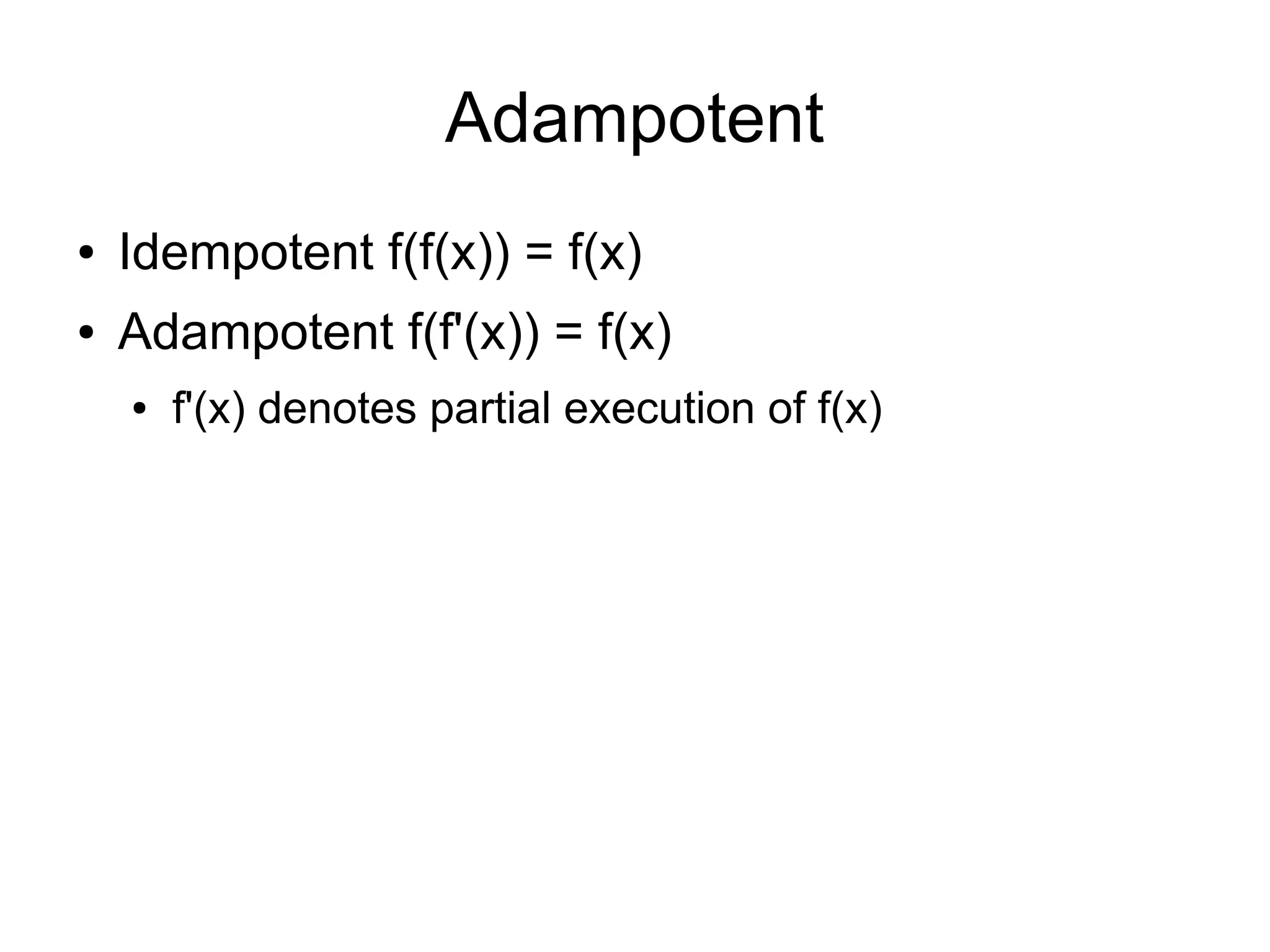
Adampotent
●   Idempotent f(f(x)) = f(x)
●   Adampotent f(f'(x)) = f(x)
    ●   f'(x) denotes partial execution of f(x)
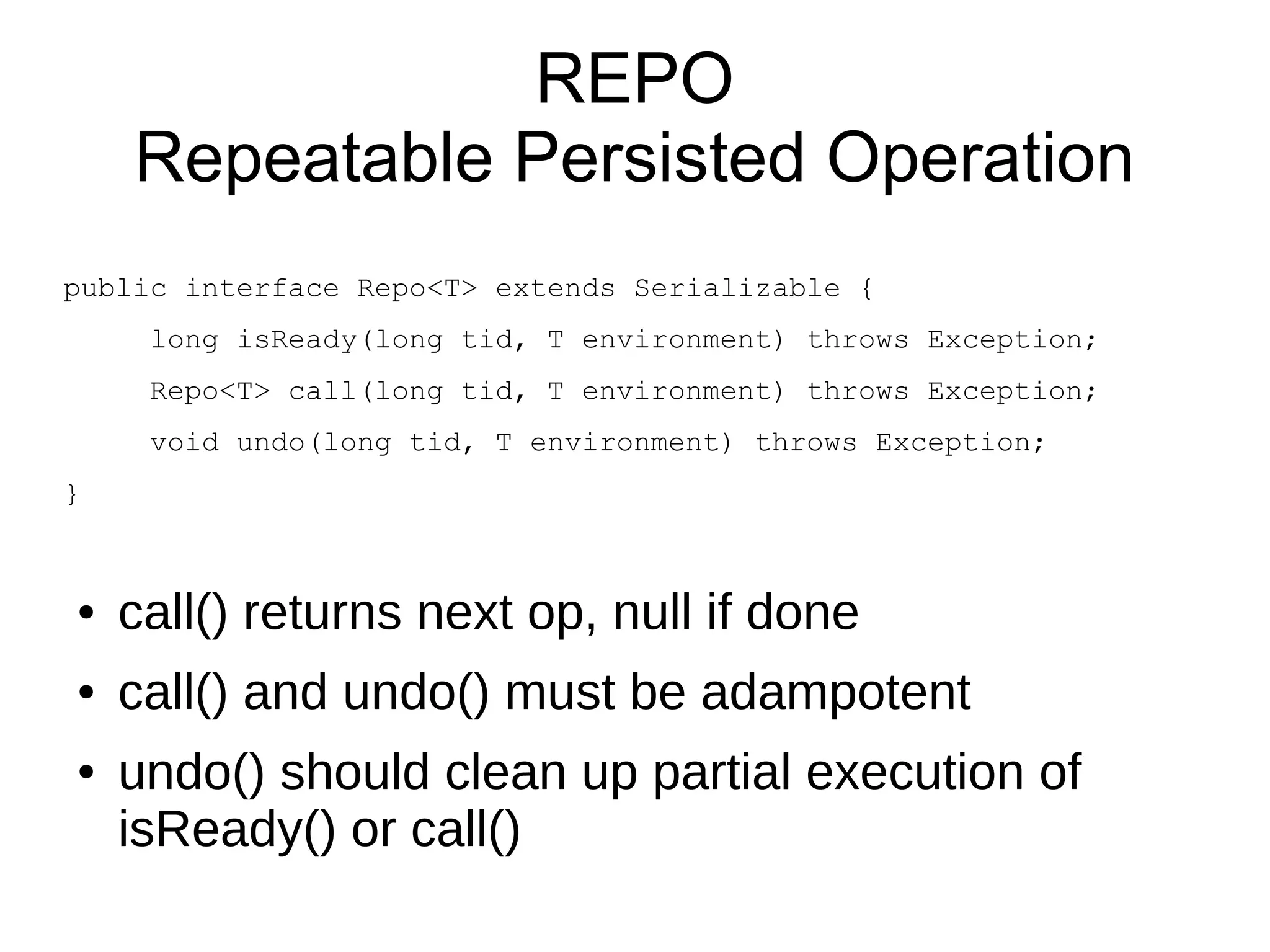
REPO
    Repeatable Persisted Operation
public interface Repo<T> extends Serializable {
     long isReady(long tid, T environment) throws Exception;
     Repo<T> call(long tid, T environment) throws Exception;
     void undo(long tid, T environment) throws Exception;
}


●   call() returns next op, null if done
●   call() and undo() must be adampotent
●   undo() should clean up partial execution of
    isReady() or call()
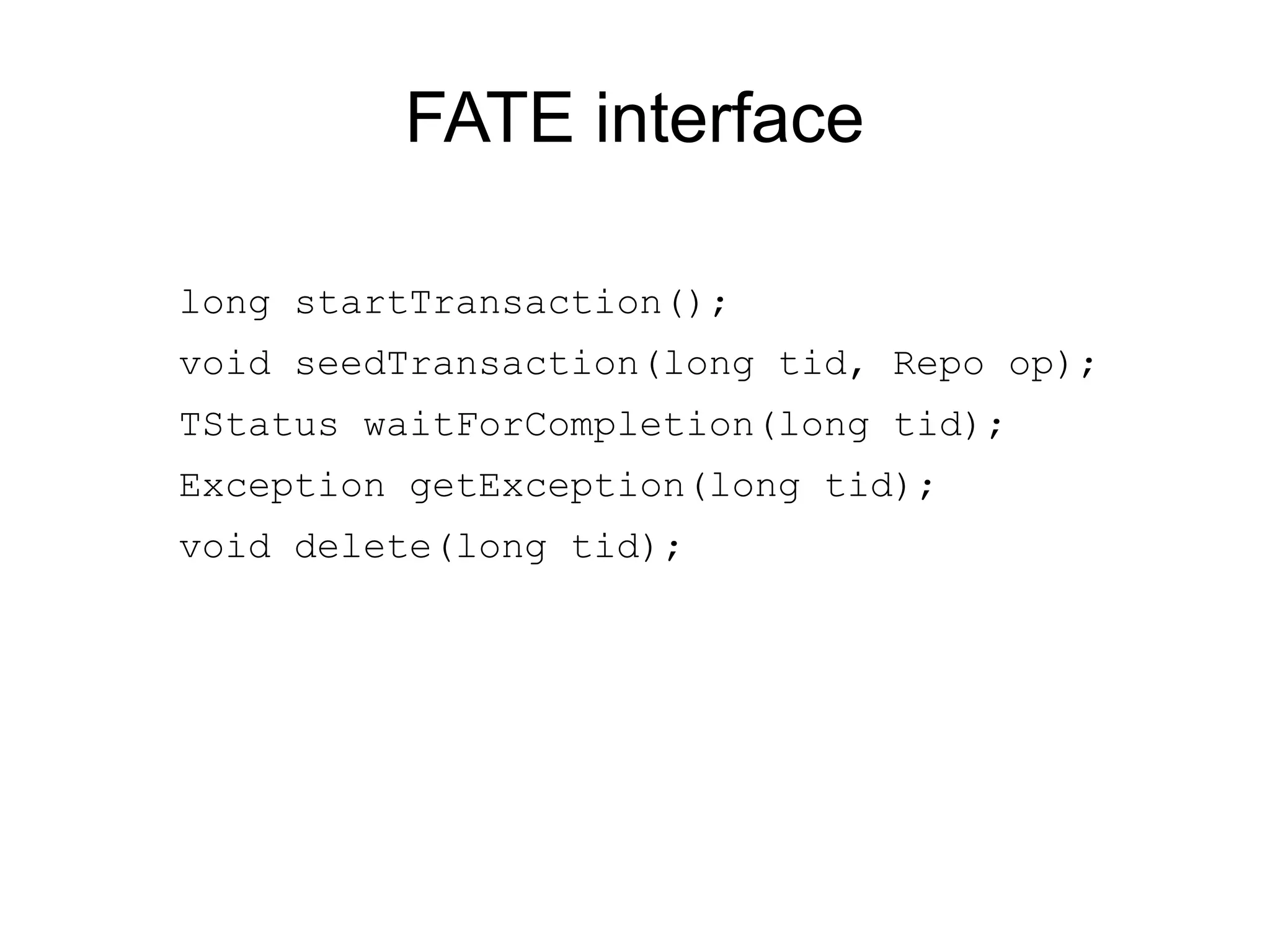
FATE interface

long startTransaction();
void seedTransaction(long tid, Repo op);
TStatus waitForCompletion(long tid);
Exception getException(long tid);
void delete(long tid);
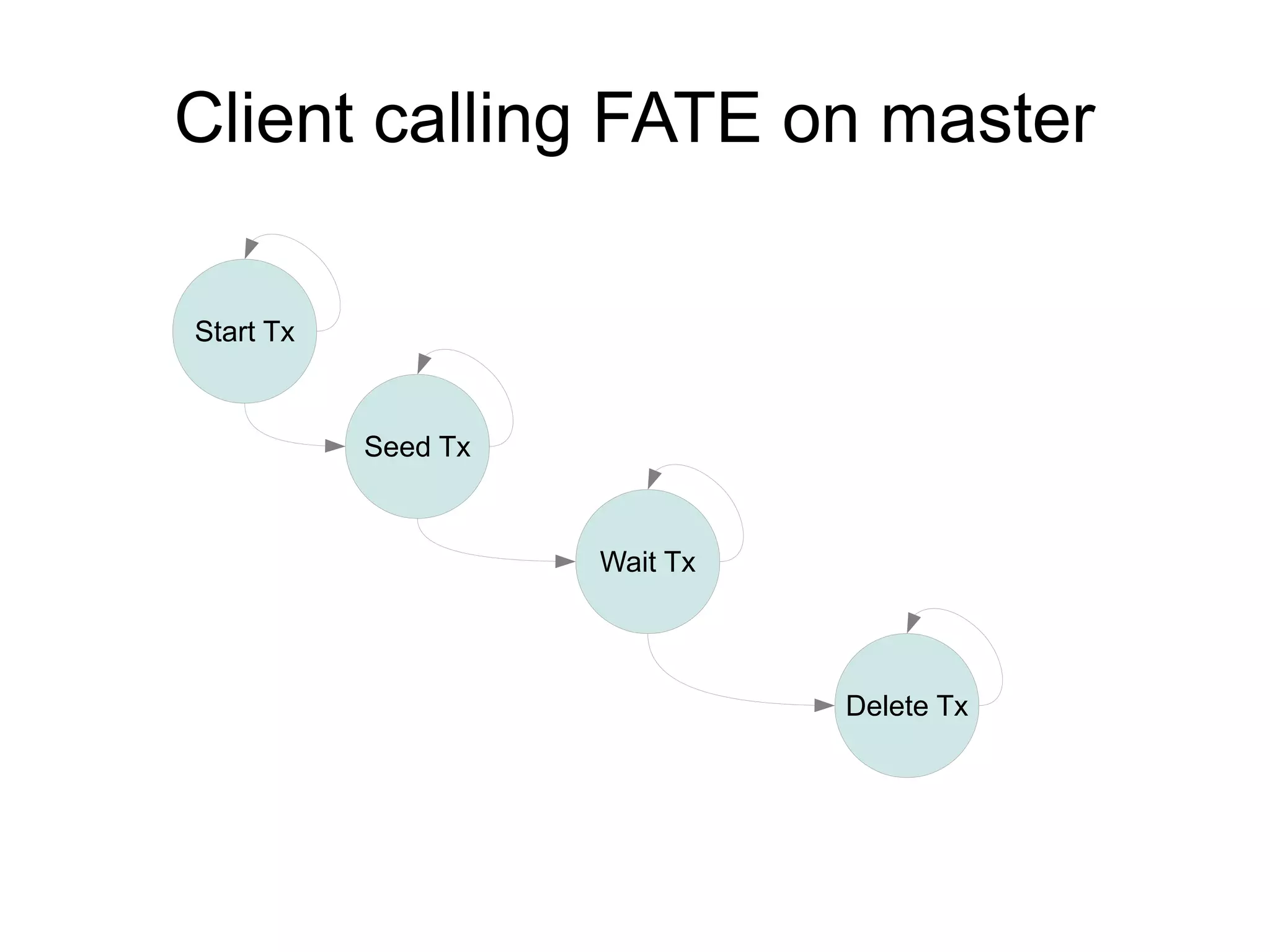
Client calling FATE on master

Start Tx


           Seed Tx


                     Wait Tx


                               Delete Tx
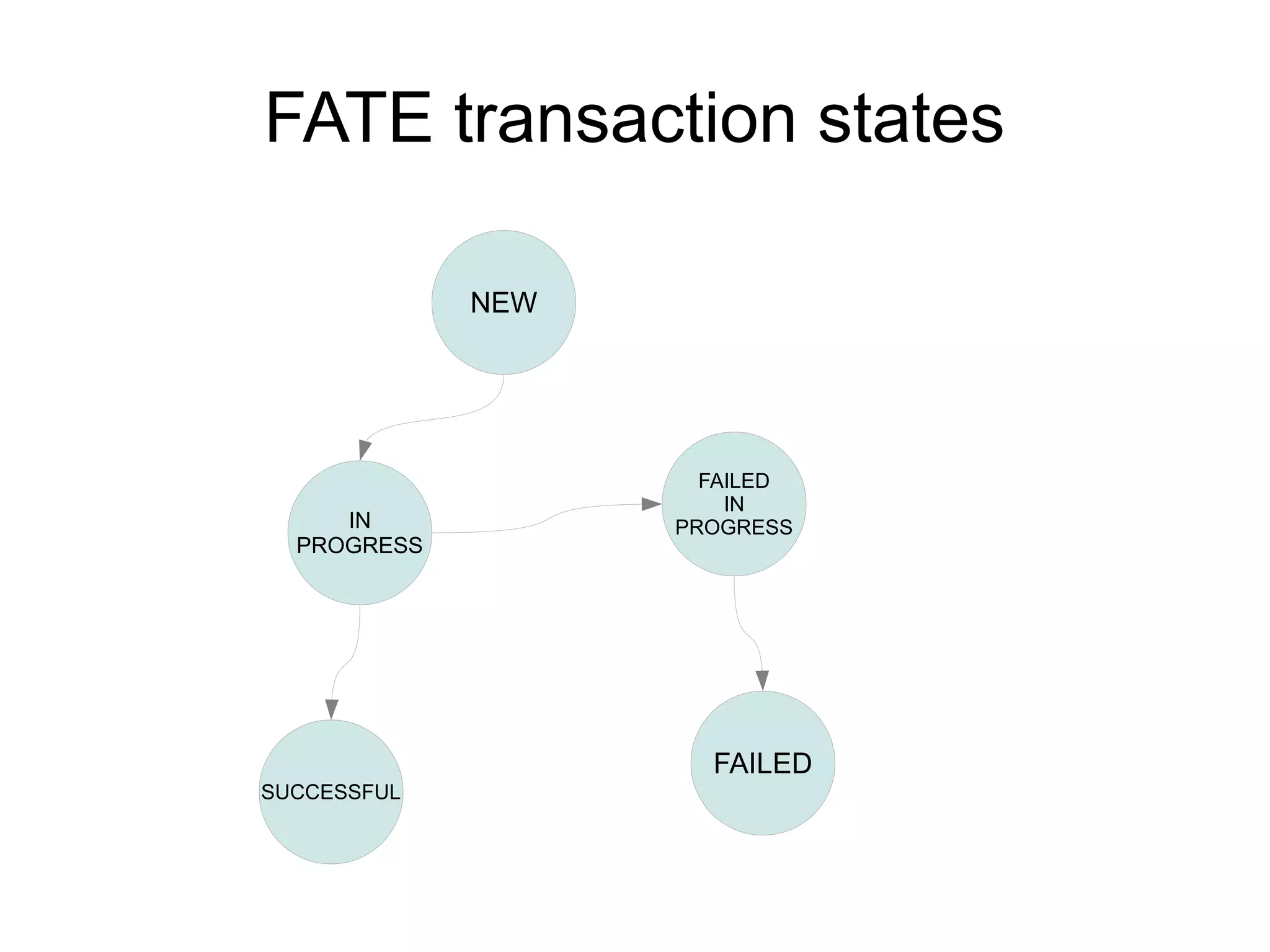
FATE transaction states

             NEW


                     FAILED
                       IN
     IN            PROGRESS
  PROGRESS


                     FAILED
SUCCESSFUL
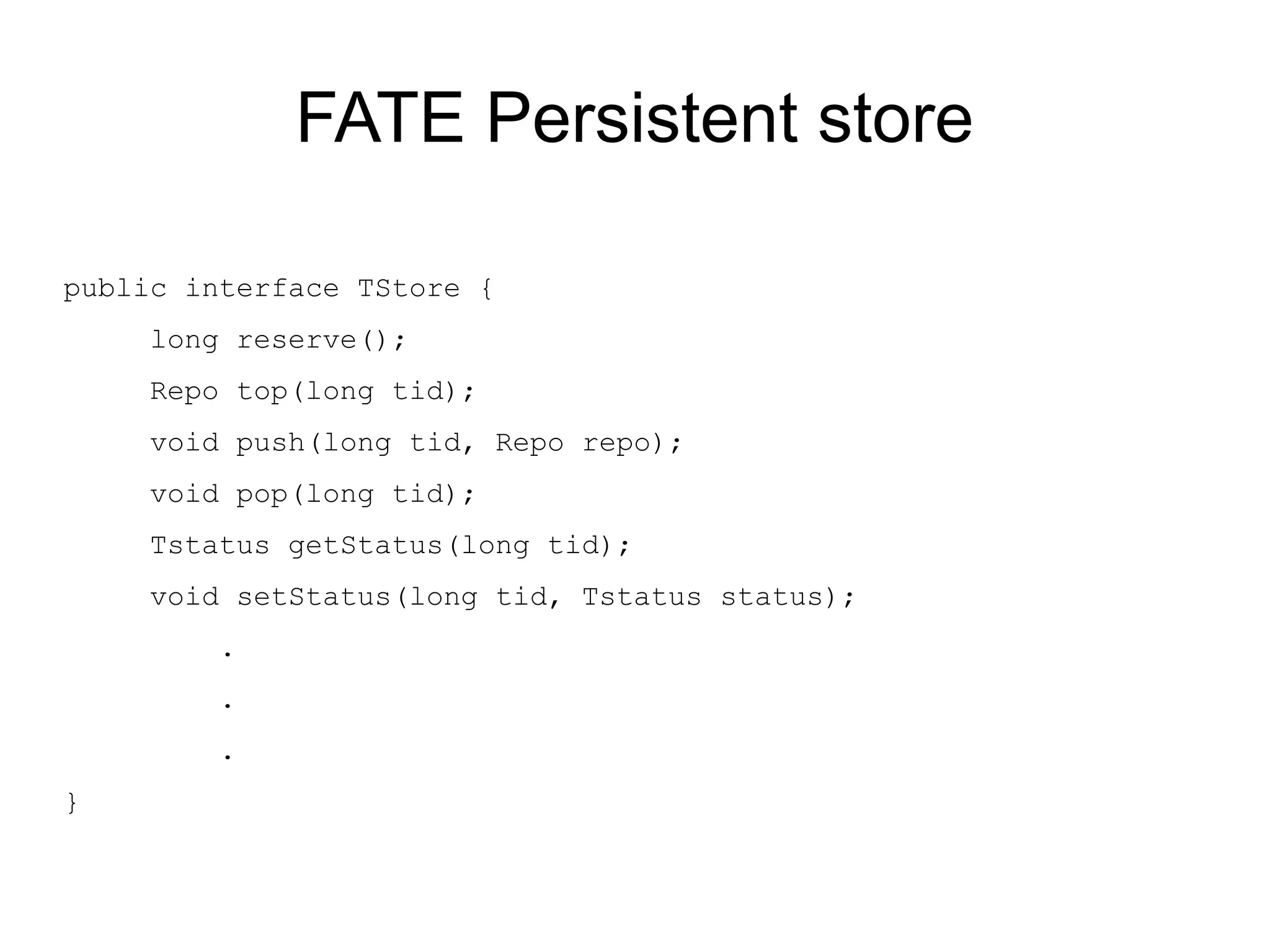
FATE Persistent store

public interface TStore {
    long reserve();
    Repo top(long tid);
    void push(long tid, Repo repo);
    void pop(long tid);
    Tstatus getStatus(long tid);
    void setStatus(long tid, Tstatus status);
        .
        .
        .
}
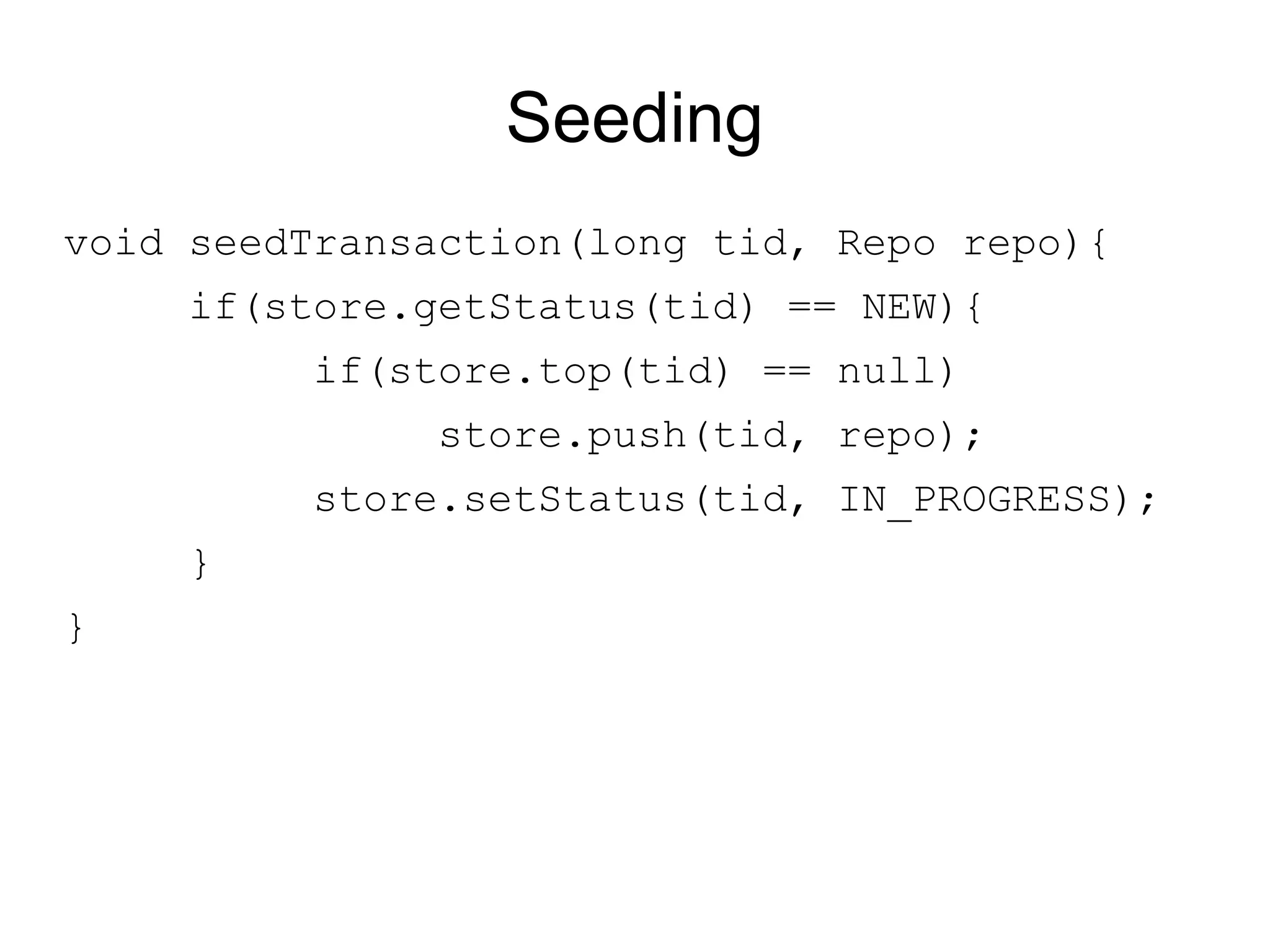
Seeding
void seedTransaction(long tid, Repo repo){
    if(store.getStatus(tid) == NEW){
         if(store.top(tid) == null)
              store.push(tid, repo);
         store.setStatus(tid, IN_PROGRESS);
    }
}
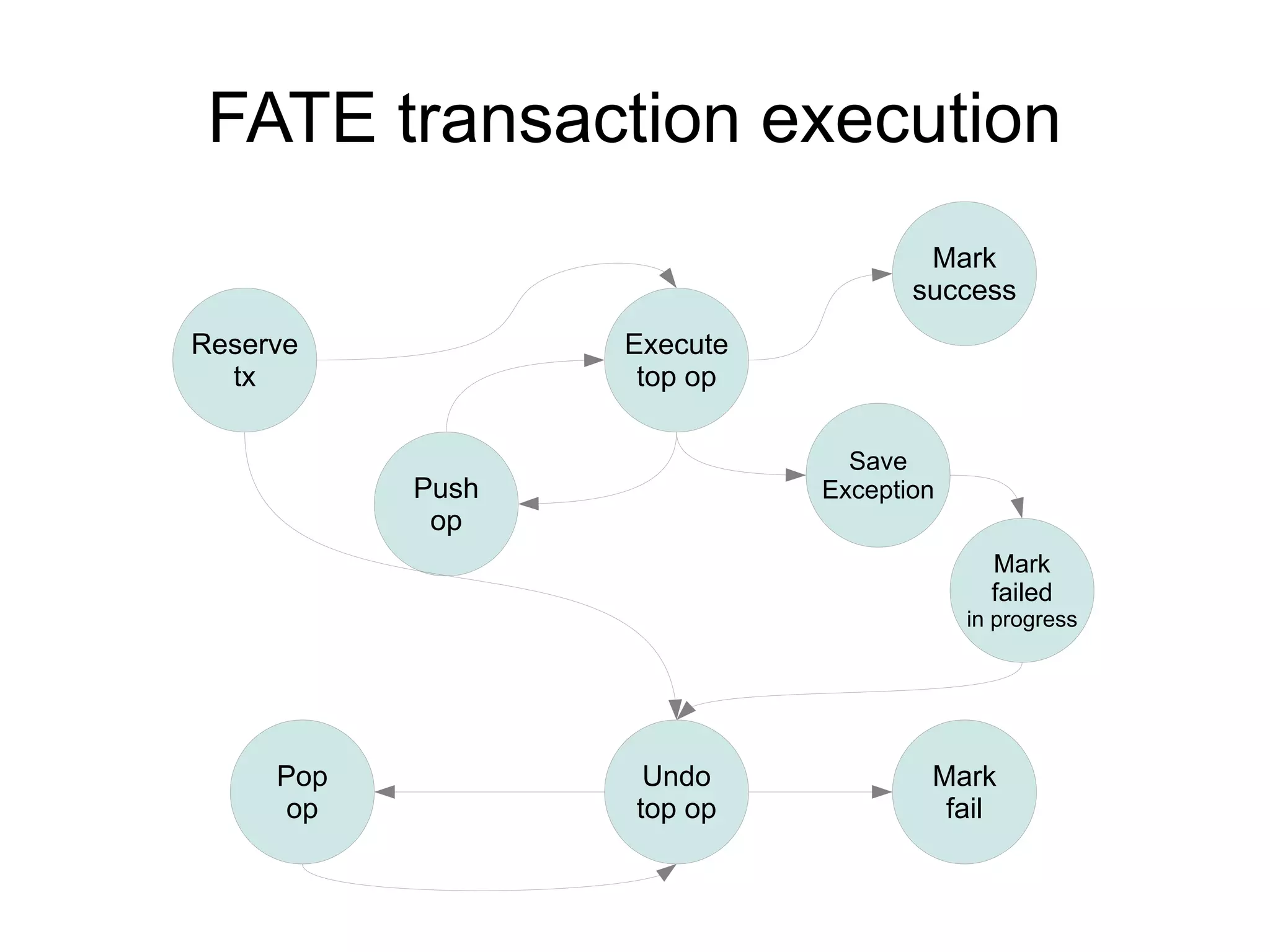
FATE transaction execution
                                    Mark
                                   success
Reserve           Execute
  tx               top op

                              Save
           Push             Exception
            op
                                          Mark
                                          failed
                                        in progress


     Pop           Undo             Mark
      op          top op             fail
Concurrent table ops
●   Per-table read/write lock in zookeeper
●   Zookeeper recipe with slight modification :
    ●   store fate tid as lock data
    ●   Use persistent sequential instead of ephemeral
        sequential
Concurrent delete table
●   Table deleted during read or write 1.3
    ●   Most likely, scan hangs forever
    ●   Rarely, permission exception thrown (seen in test)
●   In 1.4 check if table exists when :
    ●   Nothing in !METADATA
    ●   See a permission exception
Rogue threads
●   Bulk import fate op pushes work to tservers
●   Threads on tserver execute after fate op done
●   Master deletes WID in ZK, waits until counts 0
                        Tablet server worker thread


             Synchronized                             Synchronized

                WID                            Do
     Start                  cnt[WID]++                 cnt[WID]--
               Exist?                         work


                                              exit
Create Table Ops
1. CreateTable
 ●   Allocates table id
2. SetupPermissions
3. PopulateZookeeper
 ●   Reentrantly lock table in isReady()
 ●   Relate table name to table id
4. CreateDir
5. PopulateMetadata
6. FinishCreateTable
Random walk concurrent test
●   Perform all table operation on 5 well known
    tables
●   Run multiple test clients concurrently
●   Ensure accumulo or test client does not crash
    or hang
●   Too chaotic to verify data correctness
●   Found many bugs
Future Work
●   Allow multiple processes to run fate operations
●   Stop polling
●   Hulk Smash Tolerant
Other 1.4 Features
Tablet Merging
●   Splits exists forever; data is often aged off
●   Admin requested, not automatic
●   Merge by range or size
Merging Minor Compaction
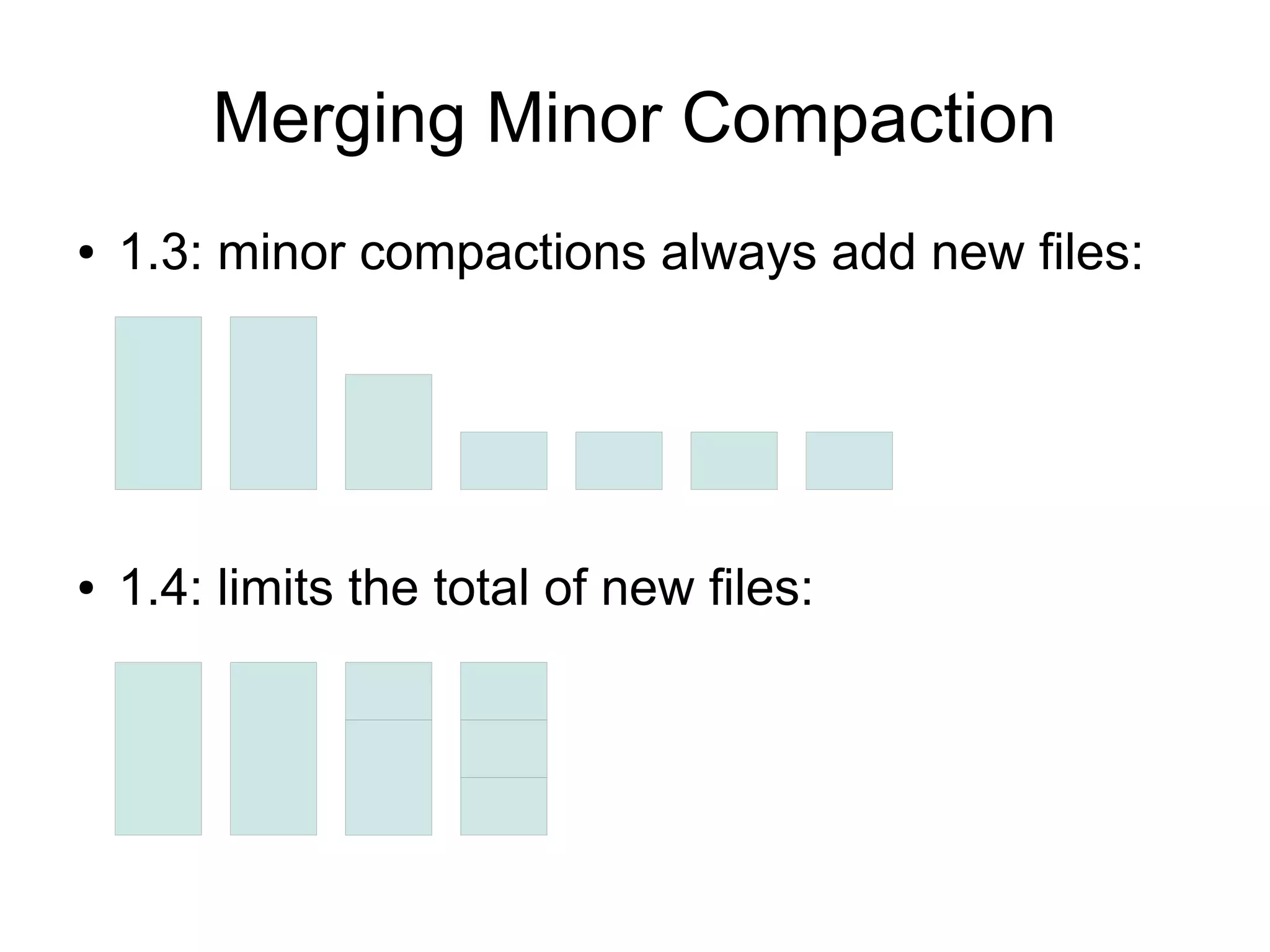
●   1.3: minor compactions always add new files:


●   1.4: limits the total of new files:
Merging Minor Compactions
●   Slows down minor compactions
●   Memory fills up
●   Creates back-pressure on ingest
●   Prevents “unable to open enough files to scan”
Table Cloning
●   Create a new table using the same read-only
    files
●   Fast
●   Testing
    ●   At scale, with representative data
    ●   Compaction with a broken iterator: no more data
●   Offline and Copy
    ●   create an consistent snapshot in minutes
Range Operations
●   Compact Range
    ●   Compact all tablets that fall within a row range down
        to a single file
    ●   Useful for tail-insert indexes
    ●   Data purge
●   Delete Range
    ●   Delete all the content within a row range
    ●   Uses split and will delete whole tablets for efficiency
    ●   Useful for data purge
Logical Time for Bulk Import
●   Bulk files created on different machines will get
    different actual times (hours)
●   Bulk files always contain the timestamp created
    by the client
●   A single bulk import request can set a
    consistent time across all files
●   Implemented using iterators
Roadmap
1.4.1 Improvements
●   Snappy, LZ4
●   HDFS Kerberos compatability
●   Bloom filter improvements
●   Map Reduce directly over Accumulo files
●   Server side row select iterator
●   Bulk ingest support for map only jobs
●   BigTop support
●   Wikisearch example improvements
Possible 1.5 features
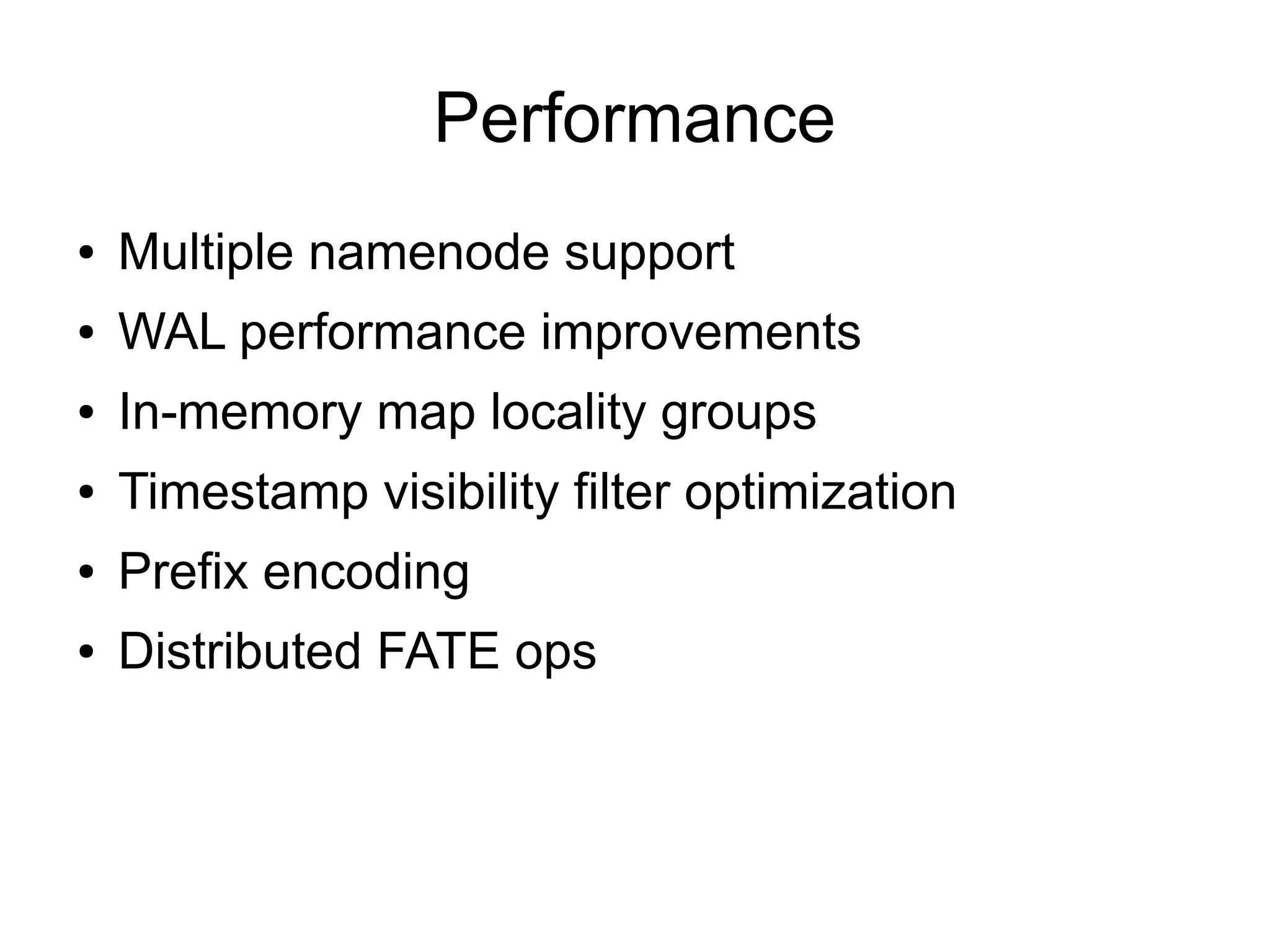
Performance
●   Multiple namenode support
●   WAL performance improvements
●   In-memory map locality groups
●   Timestamp visibility filter optimization
●   Prefix encoding
●   Distributed FATE ops
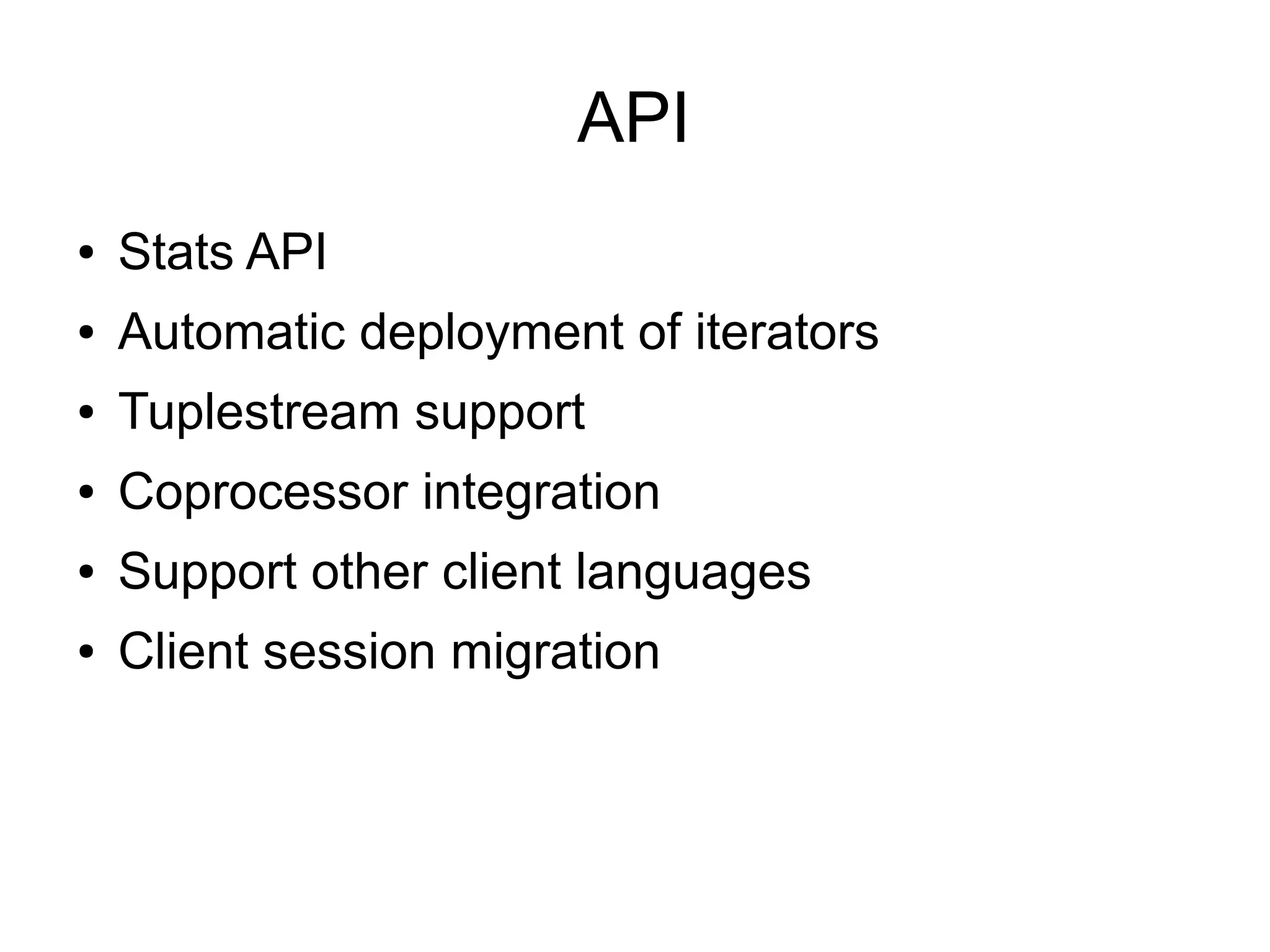
API
●   Stats API
●   Automatic deployment of iterators
●   Tuplestream support
●   Coprocessor integration
●   Support other client languages
●   Client session migration
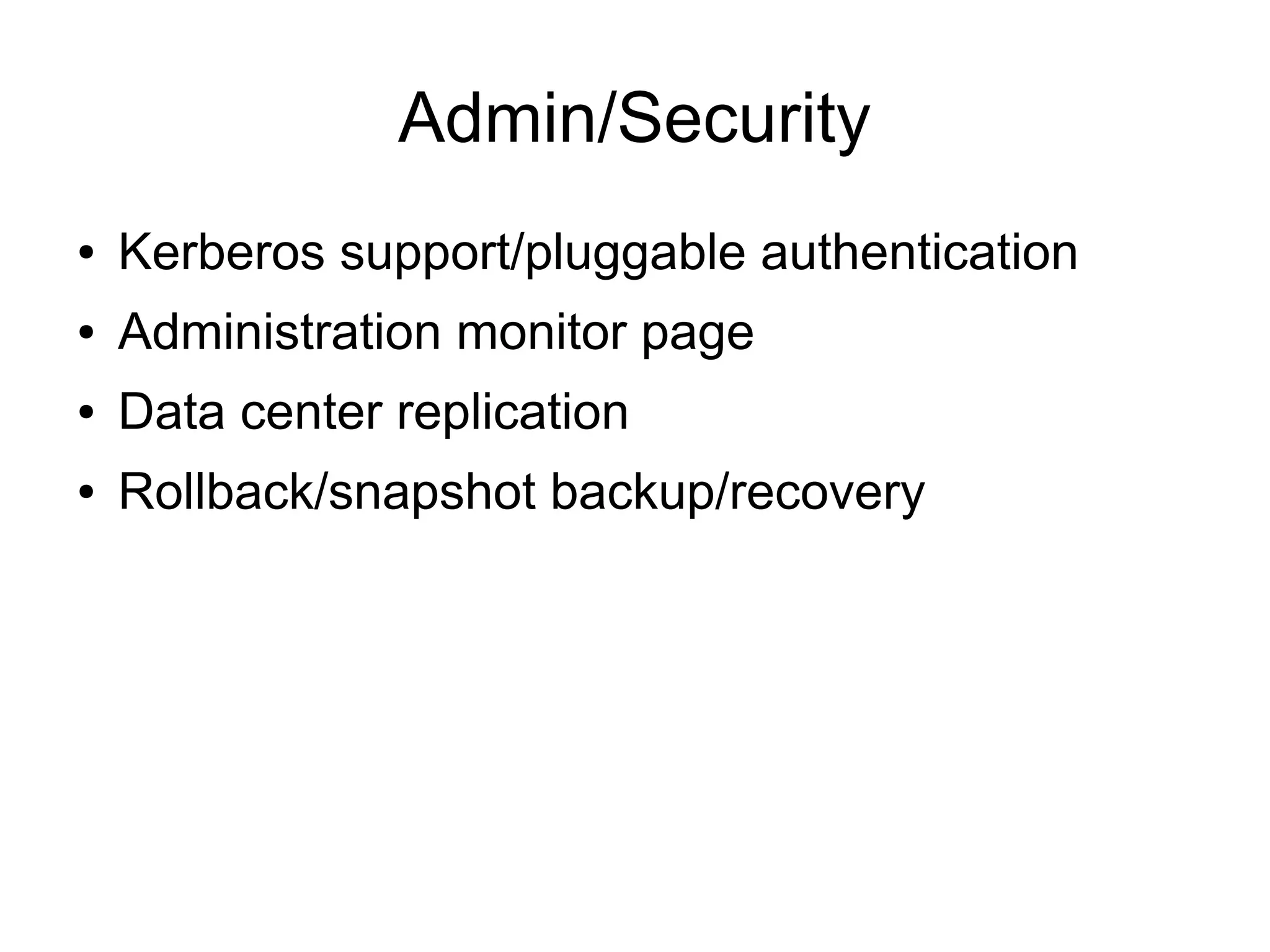
Admin/Security
●   Kerberos support/pluggable authentication
●   Administration monitor page
●   Data center replication
●   Rollback/snapshot backup/recovery
Reliability
●   Decentralize master operations
●   Tablet server state model
Testing
●   Mini-cluster test harness
●   Continuous random walk testing

Accumulo 1.4 Features and Roadmap

  • 1.
    Accumulo 1.4 &1.5 Keith Turner
  • 2.
    What is Accumulo? Are-implementation of Big Table ● Distributed Database ● Does not support SQL ● Data is arranged by ● Row ● Column ● Time ● No need to declare columns, types
  • 3.
  • 4.
    Key Structure Key Value Row Column Column Time Stamp Value Family Qualifier Primary Secondary Uniqueness Versioning Value Partitioning Partitioning Control Control Component Component
  • 5.
  • 6.
  • 7.
  • 8.
  • 9.
    1.3 Rfile Index ● Index is an array of keys ● One key per data block ● Complete index loaded into memory when file opened ● Complete index kept in memory when writing file ● Slow load times ● Memory exhaustion
  • 10.
    1.3 RFile Index Data Data Data Block Block Block
  • 11.
    Non multi-level 9Gfile Locality group : <DEFAULT> Start block : 0 Num blocks : 182,691 Index level 0 size : 8,038,404 bytes First key : 00000008611ae5d6 0e94:74e1 [] 1310491465052 false Last key : 7ffffff7daec0b4e 43ee:1c1e [] 1310491475396 false Num entries : 172,014,468 Column families : <UNKNOWN> Meta block : BCFile.index Raw size : 2,148,491 bytes Compressed size : 1,485,697 bytes Compression type : lzo Meta block : RFile.index Raw size : 8,038,470 bytes Compressed size : 5,664,704 bytes Compression type : lzo
  • 12.
    1.4 RFile Index Level 1 Index Level 0 Data Data Data Data Data Block Block Block Block Block
  • 13.
    File layout Index Index Index Index Data Data Data Data Data Data L0 L0 L0 L1 ● Index blocks written as data is written ● complete index not kept in memory during write ● Index block for each level kept in memory
  • 14.
    Multi-level 9G file Localitygroup : <DEFAULT> Start block : 0 Num blocks : 187,070 Index level 1 : 4,573 bytes 1 blocks Index level 0 : 10,431,126 bytes 82 blocks First key : 00000008611ae5d6 0e94:74e1 [] 1310491465052 false Last key : 7ffffff7daec0b4e 43ee:1c1e [] 1310491475396 false Num entries : 172,014,468 Column families : <UNKNOWN> Meta block : BCFile.index Raw size : 5 bytes Compressed size : 17 bytes Compression type : lzo Meta block : RFile.index Raw size : 4,652 bytes Compressed size : 3,745 bytes Compression type : lzo
  • 15.
    Test Setup ● Files in FS cache for test (cat test.rf > /dev/null) ● Too much variability when some of file was in FS cache and some was not ● Easier to force all of file into cache than out
  • 16.
    Open, seek 9Gfile Multilevel Index Cache Avg Time N N 139.48 ms N Y 37.55 ms Y N 8.48 ms Y Y 3.90 ms
  • 17.
    Randomly seeking 9Gfile Multilevel Index Cache Avg Time N N 2.08 ms N Y 2.32 ms Y N 4.33 ms Y Y 2.14 ms
  • 18.
    Configuration ● Index block size configurable per table ● Make index block size large and it will behave like old rfile ● Enabled index cache by default in 1.4
  • 19.
    Cache hit rateon monitor page
  • 20.
    Fault tolerant concurrenttable operations
  • 21.
    Problematic situations ● Master dies during create table ● Create and delete table run concurrently ● Client dies during bulk ingest ● Table deleted while writing or scanning
  • 22.
    Create table fault ● Master dies during ● Could leave accumulo metadata in bad state ● Master creates table, but then dies before notifying client ● If client retries, it gets table exist exception
  • 23.
    FATE Fault Tolerant Executor ● If process dies, previously submitted operations continue to execute on restart. ● Serializes operation in zookeeper before execution ● Master uses FATE to execute table operations
  • 24.
    Bulk import test ● Create table with summation aggregator ● Bulk import files of +1 or -1, graph ensures final sum is 0 ● Concurrently merge, split, compact, and consistency check table ● Exit point verifies 0
  • 25.
    Adampotent ● Idempotent f(f(x)) = f(x) ● Adampotent f(f'(x)) = f(x) ● f'(x) denotes partial execution of f(x)
  • 26.
    REPO Repeatable Persisted Operation public interface Repo<T> extends Serializable { long isReady(long tid, T environment) throws Exception; Repo<T> call(long tid, T environment) throws Exception; void undo(long tid, T environment) throws Exception; } ● call() returns next op, null if done ● call() and undo() must be adampotent ● undo() should clean up partial execution of isReady() or call()
  • 27.
    FATE interface long startTransaction(); voidseedTransaction(long tid, Repo op); TStatus waitForCompletion(long tid); Exception getException(long tid); void delete(long tid);
  • 28.
    Client calling FATEon master Start Tx Seed Tx Wait Tx Delete Tx
  • 29.
    FATE transaction states NEW FAILED IN IN PROGRESS PROGRESS FAILED SUCCESSFUL
  • 30.
    FATE Persistent store publicinterface TStore { long reserve(); Repo top(long tid); void push(long tid, Repo repo); void pop(long tid); Tstatus getStatus(long tid); void setStatus(long tid, Tstatus status); . . . }
  • 31.
    Seeding void seedTransaction(long tid,Repo repo){ if(store.getStatus(tid) == NEW){ if(store.top(tid) == null) store.push(tid, repo); store.setStatus(tid, IN_PROGRESS); } }
  • 32.
    FATE transaction execution Mark success Reserve Execute tx top op Save Push Exception op Mark failed in progress Pop Undo Mark op top op fail
  • 33.
    Concurrent table ops ● Per-table read/write lock in zookeeper ● Zookeeper recipe with slight modification : ● store fate tid as lock data ● Use persistent sequential instead of ephemeral sequential
  • 34.
    Concurrent delete table ● Table deleted during read or write 1.3 ● Most likely, scan hangs forever ● Rarely, permission exception thrown (seen in test) ● In 1.4 check if table exists when : ● Nothing in !METADATA ● See a permission exception
  • 35.
    Rogue threads ● Bulk import fate op pushes work to tservers ● Threads on tserver execute after fate op done ● Master deletes WID in ZK, waits until counts 0 Tablet server worker thread Synchronized Synchronized WID Do Start cnt[WID]++ cnt[WID]-- Exist? work exit
  • 36.
    Create Table Ops 1.CreateTable ● Allocates table id 2. SetupPermissions 3. PopulateZookeeper ● Reentrantly lock table in isReady() ● Relate table name to table id 4. CreateDir 5. PopulateMetadata 6. FinishCreateTable
  • 37.
    Random walk concurrenttest ● Perform all table operation on 5 well known tables ● Run multiple test clients concurrently ● Ensure accumulo or test client does not crash or hang ● Too chaotic to verify data correctness ● Found many bugs
  • 38.
    Future Work ● Allow multiple processes to run fate operations ● Stop polling ● Hulk Smash Tolerant
  • 39.
  • 40.
    Tablet Merging ● Splits exists forever; data is often aged off ● Admin requested, not automatic ● Merge by range or size
  • 41.
    Merging Minor Compaction ● 1.3: minor compactions always add new files: ● 1.4: limits the total of new files:
  • 42.
    Merging Minor Compactions ● Slows down minor compactions ● Memory fills up ● Creates back-pressure on ingest ● Prevents “unable to open enough files to scan”
  • 43.
    Table Cloning ● Create a new table using the same read-only files ● Fast ● Testing ● At scale, with representative data ● Compaction with a broken iterator: no more data ● Offline and Copy ● create an consistent snapshot in minutes
  • 44.
    Range Operations ● Compact Range ● Compact all tablets that fall within a row range down to a single file ● Useful for tail-insert indexes ● Data purge ● Delete Range ● Delete all the content within a row range ● Uses split and will delete whole tablets for efficiency ● Useful for data purge
  • 45.
    Logical Time forBulk Import ● Bulk files created on different machines will get different actual times (hours) ● Bulk files always contain the timestamp created by the client ● A single bulk import request can set a consistent time across all files ● Implemented using iterators
  • 46.
  • 47.
    1.4.1 Improvements ● Snappy, LZ4 ● HDFS Kerberos compatability ● Bloom filter improvements ● Map Reduce directly over Accumulo files ● Server side row select iterator ● Bulk ingest support for map only jobs ● BigTop support ● Wikisearch example improvements
  • 48.
  • 49.
    Performance ● Multiple namenode support ● WAL performance improvements ● In-memory map locality groups ● Timestamp visibility filter optimization ● Prefix encoding ● Distributed FATE ops
  • 50.
    API ● Stats API ● Automatic deployment of iterators ● Tuplestream support ● Coprocessor integration ● Support other client languages ● Client session migration
  • 51.
    Admin/Security ● Kerberos support/pluggable authentication ● Administration monitor page ● Data center replication ● Rollback/snapshot backup/recovery
  • 52.
    Reliability ● Decentralize master operations ● Tablet server state model
  • 53.
    Testing ● Mini-cluster test harness ● Continuous random walk testing