CHAPTER 23
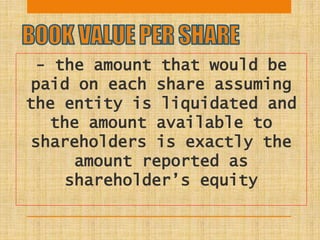
- the amount that would be
paid on each share assuming
the entity is liquidated and
the amount available to
shareholders is exactly the
amount reported as
shareholder’s equity
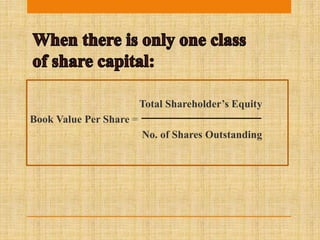
Total Shareholder’s Equity
Book Value Per Share =
No. of Shares Outstanding
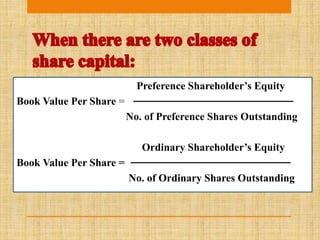
Preference Shareholder’s Equity
Book Value Per Share =
No. of Preference Shares Outstanding
Ordinary Shareholder’s Equity
Book Value Per Share =
No. of Ordinary Shares Outstanding
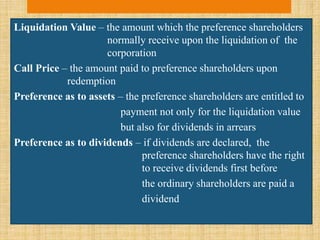
Liquidation Value – the amount which the preference shareholders
normally receive upon the liquidation of the
corporation
Call Price – the amount paid to preference shareholders upon
redemption
Preference as to assets – the preference shareholders are entitled to
payment not only for the liquidation value
but also for dividends in arrears
Preference as to dividends – if dividends are declared, the
preference shareholders have the right
to receive dividends first before
the ordinary shareholders are paid a
dividend
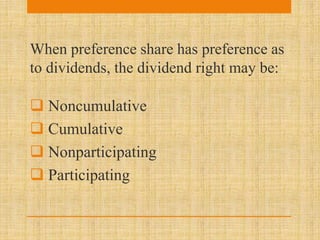
When preference share has preference as
to dividends, the dividend right may be:
 Noncumulative
 Cumulative
 Nonparticipating
 Participating
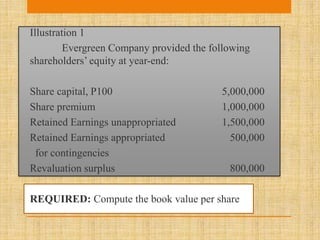
Illustration 1
Evergreen Company provided the following
shareholders’ equity at year-end:
Share capital, P100 5,000,000
Share premium 1,000,000
Retained Earnings unappropriated 1,500,000
Retained Earnings appropriated 500,000
for contingencies
Revaluation surplus 800,000
REQUIRED: Compute the book value per share
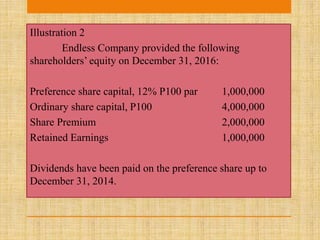
Illustration 2
Endless Company provided the following
shareholders’ equity on December 31, 2016:
Preference share capital, 12% P100 par 1,000,000
Ordinary share capital, P100 4,000,000
Share Premium 2,000,000
Retained Earnings 1,000,000
Dividends have been paid on the preference share up to
December 31, 2014.
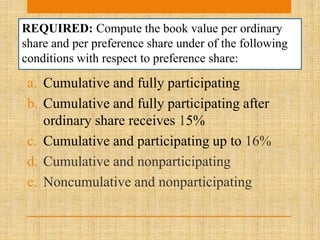
REQUIRED: Compute the book value per ordinary
share and per preference share under of the following
conditions with respect to preference share:
a. Cumulative and fully participating
b. Cumulative and fully participating after
ordinary share receives 15%
c. Cumulative and participating up to 16%
d. Cumulative and nonparticipating
e. Noncumulative and nonparticipating

BOOK VALUE PER SHARE

  • 1.
  • 2.
    - the amountthat would be paid on each share assuming the entity is liquidated and the amount available to shareholders is exactly the amount reported as shareholder’s equity
  • 3.
    Total Shareholder’s Equity BookValue Per Share = No. of Shares Outstanding
  • 4.
    Preference Shareholder’s Equity BookValue Per Share = No. of Preference Shares Outstanding Ordinary Shareholder’s Equity Book Value Per Share = No. of Ordinary Shares Outstanding
  • 5.
    Liquidation Value –the amount which the preference shareholders normally receive upon the liquidation of the corporation Call Price – the amount paid to preference shareholders upon redemption Preference as to assets – the preference shareholders are entitled to payment not only for the liquidation value but also for dividends in arrears Preference as to dividends – if dividends are declared, the preference shareholders have the right to receive dividends first before the ordinary shareholders are paid a dividend
  • 6.
    When preference sharehas preference as to dividends, the dividend right may be:  Noncumulative  Cumulative  Nonparticipating  Participating
  • 7.
    Illustration 1 Evergreen Companyprovided the following shareholders’ equity at year-end: Share capital, P100 5,000,000 Share premium 1,000,000 Retained Earnings unappropriated 1,500,000 Retained Earnings appropriated 500,000 for contingencies Revaluation surplus 800,000 REQUIRED: Compute the book value per share
  • 8.
    Illustration 2 Endless Companyprovided the following shareholders’ equity on December 31, 2016: Preference share capital, 12% P100 par 1,000,000 Ordinary share capital, P100 4,000,000 Share Premium 2,000,000 Retained Earnings 1,000,000 Dividends have been paid on the preference share up to December 31, 2014.
  • 9.
    REQUIRED: Compute thebook value per ordinary share and per preference share under of the following conditions with respect to preference share: a. Cumulative and fully participating b. Cumulative and fully participating after ordinary share receives 15% c. Cumulative and participating up to 16% d. Cumulative and nonparticipating e. Noncumulative and nonparticipating