Accounting Principles
Thirteenth Edition
JERRY J. WEYGANDT PhD, CPA
University of Wisconsin—Madison
Madison, Wisconsin
PAUL D. KIMMEL PhD, CPA
University of Wisconsin—Milwaukee
Milwaukee, Wisconsin
DONALD E. KIESO PhD, CPA
Northern Illinois University
DeKalb, Illinois
DIRECTOR Michael McDonald
ACQUISITIONS EDITOR Lauren Harrell Krassow
LEAD PRODUCT DESIGNER Ed Brislin
PRODUCT DESIGNER Matt Origoni
MARKETING MANAGER Carolyn Wells
EDITORIAL SUPERVISOR Terry Ann Tatro
EDITORIAL ASSOCIATE Margaret Thompson
MARKETING ASSISTANT Ashley Migliaro
EDITORIAL ASSISTANT Alyce Pellegrino
SENIOR CONTENT MANAGER Dorothy Sinclair
SENIOR PRODUCTION EDITOR Elena Saccaro
SENIOR DESIGNER Wendy Lai
SENIOR PHOTO EDITOR Mary Ann Price
COVER IMAGE Kurt Heim/Stocksy
This book was set in Stix Regular by Aptara®, Inc. and printed and bound by Quad Graphics/Versailles.
The cover was printed by Quad Graphics/Versailles.
Founded in 1807, John Wiley & Sons, Inc. has been a valued source of knowledge and understanding for
more than 200 years, helping people around the world meet their needs and fulfill their aspirations. Our
company is built on a foundation of principles that include responsibility to the communities we serve
and where we live and work. In 2008, we launched a Corporate Citizenship Initiative, a global effort
to address the environmental, social, economic, and ethical challenges we face in our business. Among
the issues we are addressing are carbon impact, paper specifications and procurement, ethical conduct
within our business and among our vendors, and community and charitable support. For more informa-
tion, please visit our website: www.wiley.com/go/citizenship.
Copyright © 2018 John Wiley & Sons, Inc. All rights reserved. No part of this publication may be
reproduced, stored in a retrieval system or transmitted in any form or by any means, electronic, mechan-
ical, photocopying, recording, scanning or otherwise, except as permitted under Sections 107 or 108 of
the 1976 United States Copyright Act, without either the prior written permission of the Publisher, or
authorization through payment of the appropriate per-copy fee to the Copyright Clearance Center, Inc.
222 Rosewood Drive, Danvers, MA 01923, website www.copyright.com. Requests to the Publisher for
permission should be addressed to the Permissions Department, John Wiley & Sons, Inc., 111 River
Street, Hoboken, NJ 07030-5774, (201)748-6011, fax (201)748-6008, website http://www.wiley.com/
go/permissions.
ISBN-13: 978-1-119-41101-7
The inside back cover will contain printing identification and country of origin if omitted from this
page. In addition, if the ISBN on the back cover differs from the ISBN on this page, the one on the
back cover is correct.
Printed in America.
10 9 8 7 6 5 4 3 2 1
D E D I C A T E D T O
Our wives,
Enid, Merlynn, and Donna, for their love,
support, and encouragement.
Brief Contents
1 Accounting in Action 1-1
2 The Recording Process 2-1
3 Adjusting the Accounts 3-1
4 Completing the Accounting Cycle 4-1
5 Accounting for Merchandising Operations 5-1
5A Accounting for Merchandising Operations (periodic approach)*
6 Inventories 6-1
6A Inventories (perpetual approach)*
7 Accounting Information Systems 7-1
8 Fraud, Internal Control, and Cash 8-1
9 Accounting for Receivables 9-1
10 Plant Assets, Natural Resources, and Intangible Assets 10-1
11 Current Liabilities and Payroll Accounting 11-1
12 Accounting for Partnerships 12-1
13 Corporations: Organization and Capital Stock Transactions 13-1
14 Corporations: Dividends, Retained Earnings, and Income
Reporting 14-1
15 Long-Term Liabilities 15-1
16 Investments 16-1
17 Statement of Cash Flows 17-1
18 Financial Analysis: The Big Picture 18-1
19 Managerial Accounting 19-1
20 Job Order Costing 20-1
20A Job Order Costing (non-debit and credit approach)*
21 Process Costing 21-1
21A Process Costing (non-debit and credit approach)*
iii
iv Brief Contents
22 Cost-Volume-Profit 22-1
23 Incremental Analysis 23-1
24 Budgetary Planning 24-1
25 Budgetary Control and Responsibility Accounting 25-1
26 Standard Costs and Balanced Scorecard 26-1
27 Planning for Capital Investments 27-1
APPENDICES
A Specimen Financial Statements: Apple Inc. A-1
B Specimen Financial Statements: PepsiCo, Inc. B-1
C Specimen Financial Statements: The Coca-Cola Company C-1
D Specimen Financial Statements: Amazon.com, Inc. D-1
E Specimen Financial Statements: Wal-Mart Stores, Inc. E-1
F Specimen Financial Statements: Louis Vuitton F-1
G Time Value of Money G-1
H Just-in-Time Processing and Activity-Based Costing H-1
CASES FOR MANAGERIAL DECISION MAKING*
COMPANY INDEX / SUBJECT INDEX I-1
* Available in WileyPLUS and Wiley Custom.
From the Authors
Dear Student,
WHY THIS COURSE? Remember your biology
course in high school? Did you have one of those “invis-
ible man” models (or maybe something more high-tech
than that) that gave you the opportunity to look “inside”
the human body? This accounting course offers something
similar. To understand a
business, you have to under-
stand the financial insides of
a business organization. An
accounting course will help
you understand the essen-
tial financial components of
businesses. Whether you are
looking at a large multina-
tional company like Apple or Starbucks or a single-owner
software consulting business or coffee shop, knowing the
fundamentals of accounting will help you understand what
is happening. As an employee, a manager, an investor, a
business owner, or a director of your own personal finances—
any of which roles you will have at some point in your
life—you will make better decisions for having taken this
course.
WHY THIS TEXT? Your instructor has chosen this text for
you because of the authors’ trusted reputation. The authors have
worked hard to write a text that is engaging, timely, and accurate.
HOW TO SUCCEED? We’ve asked many students and many
instructors whether there is a secret for success in this course.
The nearly unanimous answer turns out to be not much of a
secret: “Do the homework.” This is one
course where doing is learning. The
more time you spend on the homework
assignments—using the various tools
that this text provides—the more likely
you are to learn the essential concepts,
techniques, and methods of accounting.
Besides the text itself, WileyPLUS also
offers various support resources.
Good luck in this course. We hope you enjoy the experience
and that you put to good use throughout a lifetime of success
the knowledge you obtain in this course. We are sure you will
not be disappointed.
Jerry J. Weygandt
Paul D. Kimmel
Donald E. Kieso
“Whether you are looking at a large multina-
tional company like Apple or Starbucks or
a single-owner software consulting business
or coffee shop, knowing the fundamentals of
accounting will help you understand what is
happening.”
v
Author Commitment
Jerry Weygandt
JERRY J. WEYGANDT, PhD,
CPA, is Arthur Andersen Alumni Emeritus
Professor of Accounting at the University of
Wisconsin—Madison. He holds a Ph.D. in
accounting from the University of Illinois.
Articles by Professor Weygandt have appeared
in The Accounting Review, Journal of Account-
ing Research, Accounting Horizons, Journal of
Accountancy, and other academic and profes-
sional journals. These articles have examined
such financial reporting issues as accounting for
price-level adjustments, pensions, convertible
securities, stock option contracts, and interim
reports. Professor Weygandt is author of other
accounting and financial reporting books and
is a member of the American Accounting
Association, the American Institute of Cer-
tified Public Accountants, and the Wiscon-
sin Society of Certified Public Accountants.
He has served on numerous committees of
the American Accounting Association and
as a member of the editorial board of The
Accounting Review; he also has served as Pres-
ident and Secretary-Treasurer of the American
Accounting Association. In addition, he has
been actively involved with the American
Institute of Certified Public Accountants and
has been a member of the Accounting Standards
Executive Committee (AcSEC) of that organ-
ization. He has served on the FASB task force
that examined the reporting issues related to
accounting for income taxes and served as a trus-
tee of the Financial Accounting Foundation. Pro-
fessor Weygandt has received the Chancellor’s
Award for Excellence in Teaching and the Beta
Gamma Sigma Dean’s Teaching Award. He is on
the board of directors of M & I Bank of Southern
Wisconsin. He is the recipient of the Wisconsin
Institute of CPA’s Outstanding Educator’s Award
and the Lifetime Achievement Award. In 2001
he received the American Accounting Associa-
tion’s Outstanding Educator Award.
Paul Kimmel
PAUL D. KIMMEL, PhD, CPA,
received his bachelor’s degree from the Uni-
versity of Minnesota and his doctorate in ac-
counting from the University of Wisconsin.
He teaches at the University of Wisconsin—
Milwaukee, and has public accounting expe-
rience with Deloitte & Touche (Minneapolis).
He was the recipient of the UWM School of
Business Advisory Council Teaching Award,
the Reggie Taite Excellence in Teaching Award
and a three-time winner of the Outstanding
Teaching Assistant Award at the University of
Wisconsin. He is also a recipient of the Elijah
Watts Sells Award for Honorary Distinction for
his results on the CPA exam. He is a member of
the American Accounting Association and the
Institute of Management Accountants and has
published articles in The Accounting Review,
Accounting Horizons, Advances in Manage-
ment Accounting, Managerial Finance, Issues
in Accounting Education, Journal of Account-
ing Education, as well as other journals. His
research interests include accounting for finan-
cial instruments and innovation in accounting
education. He has published papers and given
numerous talks on incorporating critical think-
ing into accounting education, and helped pre-
pare a catalog of critical thinking resources for
the Federated Schools of Accountancy.
Don Kieso
DONALD E. KIESO, PhD, CPA,
received his bachelor’s degree from Aurora Uni-
versity and his doctorate in accounting from the
University of Illinois. He has served as chairman
oftheDepartmentofAccountancyandiscurrently
the KPMG Emeritus Professor of Accountancy
at Northern Illinois University. He has public
accounting experience with Price Waterhouse
& Co. (San Francisco and Chicago) and Arthur
Andersen & Co. (Chicago) and research experi-
ence with the Research Division of the American
Institute of Certified Public Accountants (New
York). He has done post doctorate work as a
Visiting Scholar at the University of California
at Berkeley and is a recipient of NIU’s Teach-
ing Excellence Award and four Golden Apple
Teaching Awards. Professor Kieso is the author
of other accounting and business books and is a
member of the American Accounting Associa-
tion, the American Institute of Certified Public
Accountants, and the Illinois CPA Society.
He has served as a member of the Board of
Directors of the Illinois CPA Society, then
AACSB’s Accounting Accreditation Commit-
tees, the State of Illinois Comptroller’s Commis-
sion, as Secretary-Treasurer of the Federation
of Schools of Accountancy, and as Secretary-
Treasurer of the American Accounting Associa-
tion. Professor Kieso is currently serving on the
Board of Trustees and Executive Committee of
Aurora University, as a member of the Board of
Directors of Kishwaukee Community Hospital,
and as Treasurer and Director of Valley West
Community Hospital. From 1989 to 1993 he
served as a charter member of the national Ac-
counting Education Change Commission. He
is the recipient of the Outstanding Accounting
Educator Award from the Illinois CPA Society,
the FSA’s Joseph A. Silvoso Award of Merit,
the NIU Foundation’s Humanitarian Award for
Service to Higher Education, a Distinguished
Service Award from the Illinois CPA Society,
and in 2003 an honorary doctorate from Aurora
University.
vi
Hallmark Features
Accounting Principles, Thirteenth Edition, provides a simple and practical introduction to the
fundamentals of accounting. It explains the concepts you need to know. This edition continues
this approach by offering even more explanations, illustrations, and homework problems to
help students get a firm understanding of the accounting cycle.
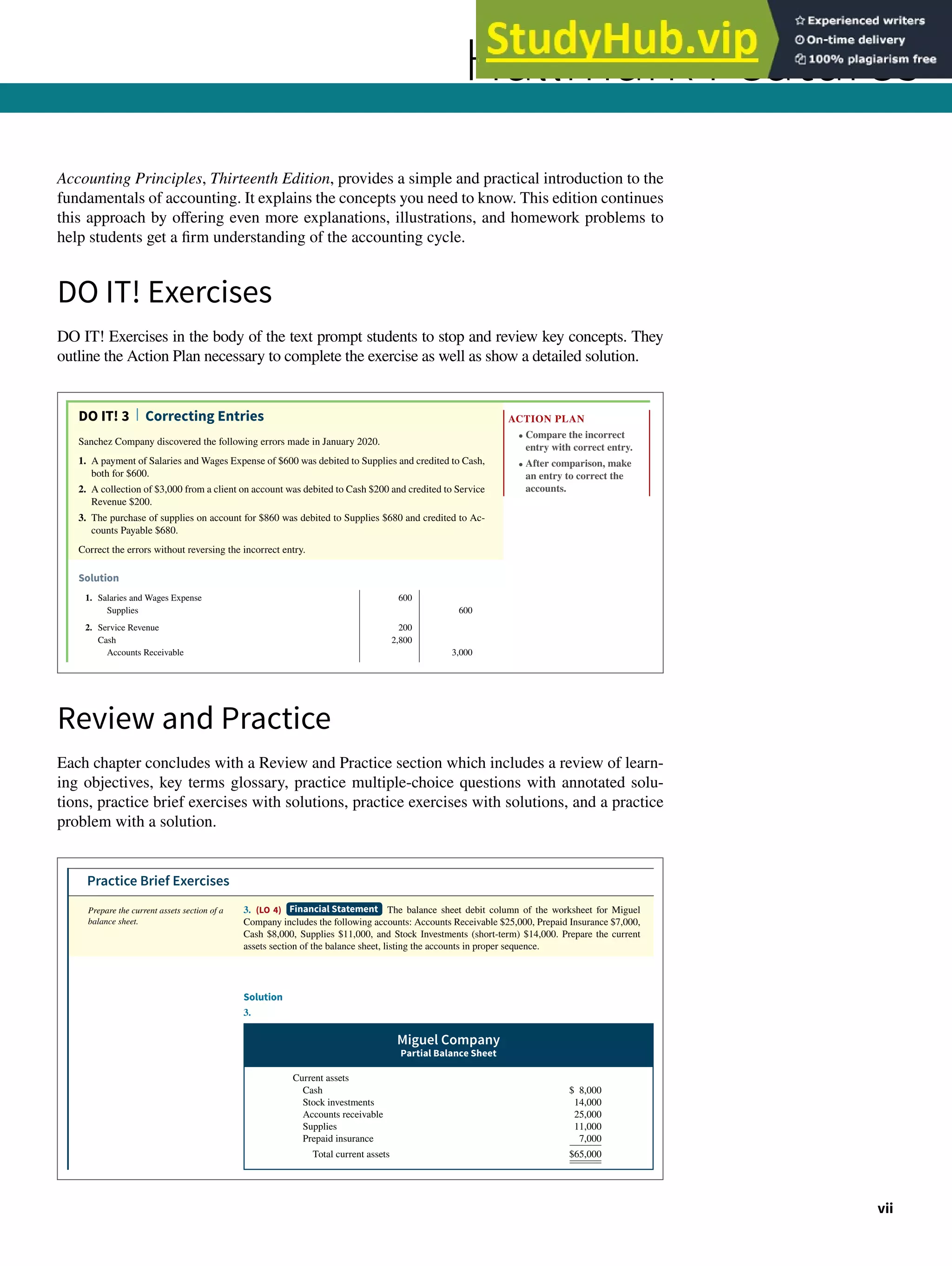
DO IT! Exercises
DO IT! Exercises in the body of the text prompt students to stop and review key concepts. They
outline the Action Plan necessary to complete the exercise as well as show a detailed solution.
DO IT! 3 Correcting Entries
Sanchez Company discovered the following errors made in January 2020.
1. A payment of Salaries and Wages Expense of $600 was debited to Supplies and credited to Cash,
both for $600.
2. A collection of $3,000 from a client on account was debited to Cash $200 and credited to Service
Revenue $200.
3. The purchase of supplies on account for $860 was debited to Supplies $680 and credited to Ac-
counts Payable $680.
Correct the errors without reversing the incorrect entry.
ACTION PLAN
• Compare the incorrect
entry with correct entry.
• After comparison, make
an entry to correct the
accounts.
Solution
1. Salaries and Wages Expense 600
Supplies 600
2. Service Revenue 200
Cash 2,800
Accounts Receivable 3,000
vii
Review and Practice
Each chapter concludes with a Review and Practice section which includes a review of learn-
ing objectives, key terms glossary, practice multiple-choice questions with annotated solu-
tions, practice brief exercises with solutions, practice exercises with solutions, and a practice
problem with a solution.
3. (LO 4) Financial Statement The balance sheet debit column of the worksheet for Miguel
Company includes the following accounts: Accounts Receivable $25,000, Prepaid Insurance $7,000,
Cash $8,000, Supplies $11,000, and Stock Investments (short-term) $14,000. Prepare the current
assets section of the balance sheet, listing the accounts in proper sequence.
Prepare the current assets section of a
balance sheet.
Solution
3.
Miguel Company
Partial Balance Sheet
Current assets
Cash $ 8,000
Stock investments 14,000
Accounts receivable 25,000
Supplies 11,000
Prepaid insurance 7,000
Total current assets $65,000
Practice Brief Exercises
Infographic Learning
Over half of the text is visual, providing students alternative ways of learning about accounting.
In addition, a new interior design promotes accessibility.
Title of Account
Left or debit side Right or credit side
ILLUSTRATION 2.1
Basic form of account
Real-World Decision-Making
Real-world examples that illustrate interesting situations in companies and how accounting
information is used are integrated throughout the text, such as in the opening Feature Story as
well as the Insight boxes.
People, Planet, and Profit Insight
Regaining Goodwill
After falling to unforeseen lows
amidst scandals, recalls, and eco-
nomic crises, the American pub-
lic’s positive perception of the
reputation of corporate America
is on the rise. Overall corporate
reputation is experiencing reha-
bilitation as the American public
gives high marks overall to cor-
porate America, specific indus-
tries, and the largest number of
individual companies in a dozen
years. This is according to the
findings of a Harris Interactive
RQ Study, which measures the reputations of the 60 most visible
companies in the United States.
The survey focuses on six reputational dimensions that influence
reputation and consumer behavior. Four of these dimensions, along
with the five corporations that ranked highest within each, are as
follows.
• Social Responsibility: (1) Whole Foods Market, (2) Johnson &
Johnson, (3) Google, (4) The Walt Disney Company, (5) Procter
& Gamble Co.
• Emotional Appeal: (1) Johnson & Johnson, (2) Amazon.com,
(3) UPS, (4) General Mills, (5) Kraft Foods
• Financial Performance: (1) Google, (2) Berkshire Hathaway,
(3) Apple, (4) Intel, (5) The Walt Disney Company
• Products and Services: (1) Intel Corporation, (2) 3M Company,
(3) Johnson & Johnson, (4) Google, (5) Procter & Gamble Co.
Source: www.harrisinteractive.com.
Name two industries today which are probably rated low on
the reputational characteristics of “being trusted” and “having
high ethical standards.” (Go to WileyPLUS for this answer and
additional questions.)
© Gehringi/iStockphoto
viii Hallmark Features
Additional Guidance
Throughout the text, marginal notes, such as Helpful Hints, Alternative Terminology, and
Ethics Notes, are provided as additional guidance. In addition, more than 100 new solution
walkthrough videos are now available in WileyPLUS.
Correcting Entries—An Avoidable Step
Unfortunately, errors may occur in the recording process. Companies should correct errors, as
soon as they discover them, by journalizing and posting correcting entries. If the account-
ing records are free of errors, no correcting entries are needed.
You should recognize several differences between correcting entries and adjusting en-
tries. First, adjusting entries are an integral part of the accounting cycle. Correcting entries,
on the other hand, are unnecessary if the records are error-free. Second, companies journalize
and post adjustments only at the end of an accounting period. In contrast, companies make
correcting entries whenever they discover an error (see Ethics Note). Finally, adjusting
entries always affect at least one balance sheet account and one income statement account. In
ETHICS NOTE
When companies find errors
in previously released
income statements, they
restate those numbers. Per-
haps because of the in-
creased scrutiny caused by
Sarbanes-Oxley, in a recent
year companies filed a re-
cord 1,195 restatements
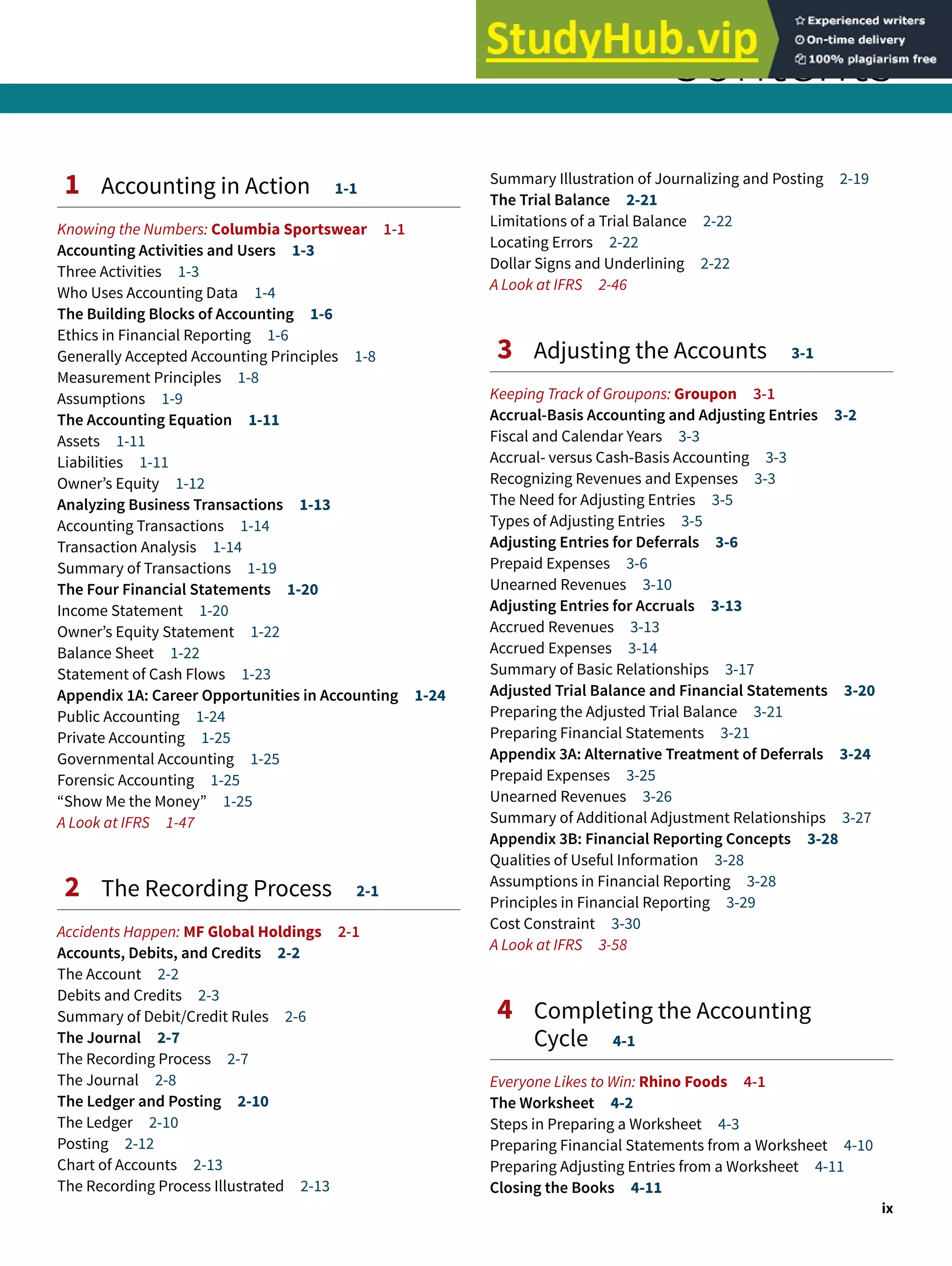
Contents
1 Accounting in Action 1-1
Knowing the Numbers: Columbia Sportswear 1-1
Accounting Activities and Users 1-3
Three Activities 1-3
Who Uses Accounting Data 1-4
The Building Blocks of Accounting 1-6
Ethics in Financial Reporting 1-6
Generally Accepted Accounting Principles 1-8
Measurement Principles 1-8
Assumptions 1-9
The Accounting Equation 1-11
Assets 1-11
Liabilities 1-11
Owner’s Equity 1-12
Analyzing Business Transactions 1-13
Accounting Transactions 1-14
Transaction Analysis 1-14
Summary of Transactions 1-19
The Four Financial Statements 1-20
Income Statement 1-20
Owner’s Equity Statement 1-22
Balance Sheet 1-22
Statement of Cash Flows 1-23
Appendix 1A: Career Opportunities in Accounting 1-24
Public Accounting 1-24
Private Accounting 1-25
Governmental Accounting 1-25
Forensic Accounting 1-25
“Show Me the Money” 1-25
A Look at IFRS 1-47
2 The Recording Process 2-1
Accidents Happen: MF Global Holdings 2-1
Accounts, Debits, and Credits 2-2
The Account 2-2
Debits and Credits 2-3
Summary of Debit/Credit Rules 2-6
The Journal 2-7
The Recording Process 2-7
The Journal 2-8
The Ledger and Posting 2-10
The Ledger 2-10
Posting 2-12
Chart of Accounts 2-13
The Recording Process Illustrated 2-13
Summary Illustration of Journalizing and Posting 2-19
The Trial Balance 2-21
Limitations of a Trial Balance 2-22
Locating Errors 2-22
Dollar Signs and Underlining 2-22
A Look at IFRS 2-46
3 Adjusting the Accounts 3-1
Keeping Track of Groupons: Groupon 3-1
Accrual-Basis Accounting and Adjusting Entries 3-2
Fiscal and Calendar Years 3-3
Accrual- versus Cash-Basis Accounting 3-3
Recognizing Revenues and Expenses 3-3
The Need for Adjusting Entries 3-5
Types of Adjusting Entries 3-5
Adjusting Entries for Deferrals 3-6
Prepaid Expenses 3-6
Unearned Revenues 3-10
Adjusting Entries for Accruals 3-13
Accrued Revenues 3-13
Accrued Expenses 3-14
Summary of Basic Relationships 3-17
Adjusted Trial Balance and Financial Statements 3-20
Preparing the Adjusted Trial Balance 3-21
Preparing Financial Statements 3-21
Appendix 3A: Alternative Treatment of Deferrals 3-24
Prepaid Expenses 3-25
Unearned Revenues 3-26
Summary of Additional Adjustment Relationships 3-27
Appendix 3B: Financial Reporting Concepts 3-28
Qualities of Useful Information 3-28
Assumptions in Financial Reporting 3-28
Principles in Financial Reporting 3-29
Cost Constraint 3-30
A Look at IFRS 3-58
4 Completing the Accounting
Cycle 4-1
Everyone Likes to Win: Rhino Foods 4-1
The Worksheet 4-2
Steps in Preparing a Worksheet 4-3
Preparing Financial Statements from a Worksheet 4-10
Preparing Adjusting Entries from a Worksheet 4-11
Closing the Books 4-11
ix
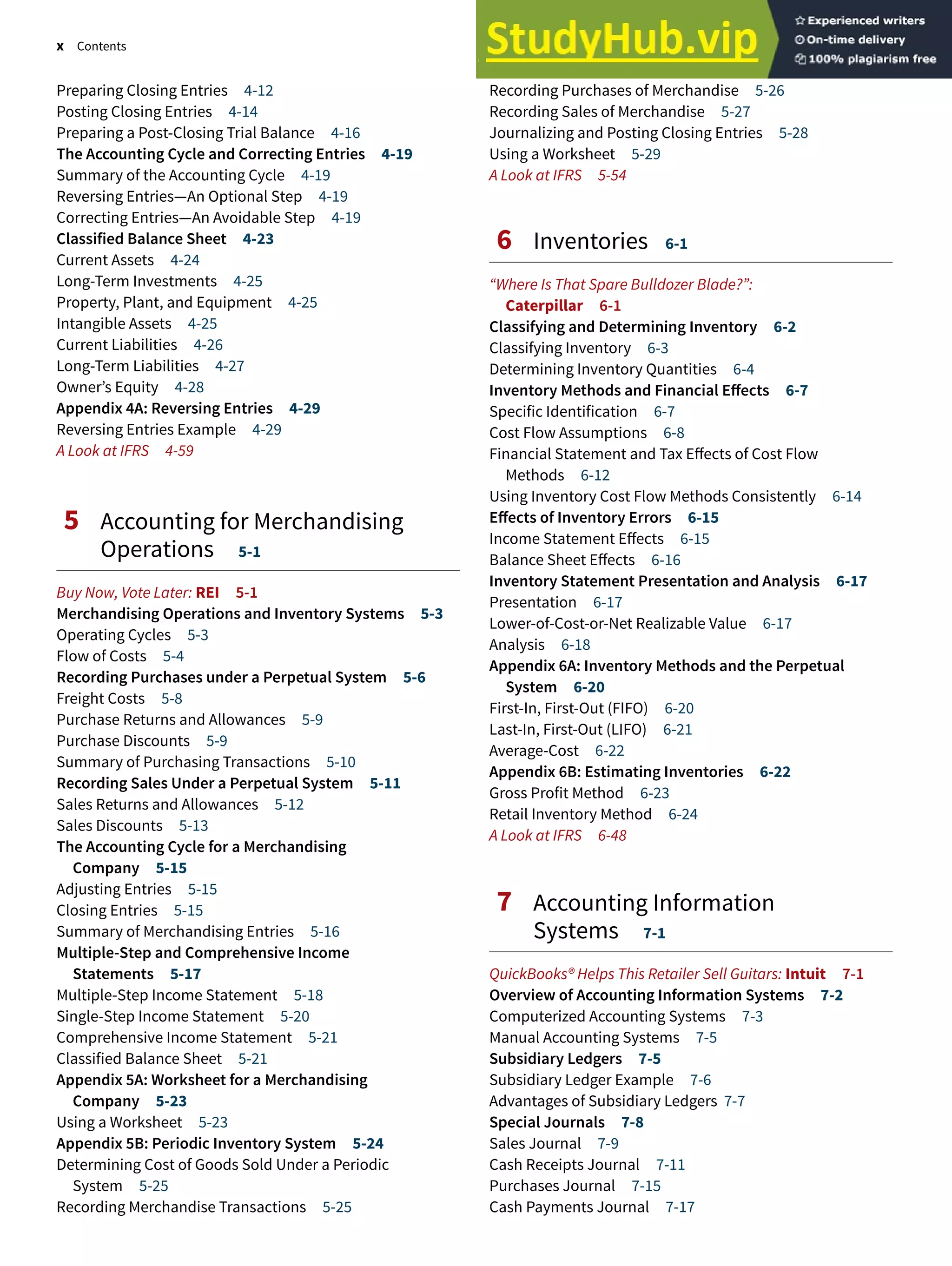
x Contents
Preparing Closing Entries 4-12
Posting Closing Entries 4-14
Preparing a Post-Closing Trial Balance 4-16
The Accounting Cycle and Correcting Entries 4-19
Summary of the Accounting Cycle 4-19
Reversing Entries—An Optional Step 4-19
Correcting Entries—An Avoidable Step 4-19
Classified Balance Sheet 4-23
Current Assets 4-24
Long-Term Investments 4-25
Property, Plant, and Equipment 4-25
Intangible Assets 4-25
Current Liabilities 4-26
Long-Term Liabilities 4-27
Owner’s Equity 4-28
Appendix 4A: Reversing Entries 4-29
Reversing Entries Example 4-29
A Look at IFRS 4-59
5 Accounting for Merchandising
Operations 5-1
Buy Now, Vote Later: REI 5-1
Merchandising Operations and Inventory Systems 5-3
Operating Cycles 5-3
Flow of Costs 5-4
Recording Purchases under a Perpetual System 5-6
Freight Costs 5-8
Purchase Returns and Allowances 5-9
Purchase Discounts 5-9
Summary of Purchasing Transactions 5-10
Recording Sales Under a Perpetual System 5-11
Sales Returns and Allowances 5-12
Sales Discounts 5-13
The Accounting Cycle for a Merchandising
Company 5-15
Adjusting Entries 5-15
Closing Entries 5-15
Summary of Merchandising Entries 5-16
Multiple-Step and Comprehensive Income
Statements 5-17
Multiple-Step Income Statement 5-18
Single-Step Income Statement 5-20
Comprehensive Income Statement 5-21
Classified Balance Sheet 5-21
Appendix 5A: Worksheet for a Merchandising
Company 5-23
Using a Worksheet 5-23
Appendix 5B: Periodic Inventory System 5-24
Determining Cost of Goods Sold Under a Periodic
System 5-25
Recording Merchandise Transactions 5-25
Recording Purchases of Merchandise 5-26
Recording Sales of Merchandise 5-27
Journalizing and Posting Closing Entries 5-28
Using a Worksheet 5-29
A Look at IFRS 5-54
6 Inventories 6-1
“Where Is That Spare Bulldozer Blade?”:
Caterpillar 6-1
Classifying and Determining Inventory 6-2
Classifying Inventory 6-3
Determining Inventory Quantities 6-4
Inventory Methods and Financial Effects 6-7
Specific Identification 6-7
Cost Flow Assumptions 6-8
Financial Statement and Tax Effects of Cost Flow
Methods 6-12
Using Inventory Cost Flow Methods Consistently 6-14
Effects of Inventory Errors 6-15
Income Statement Effects 6-15
Balance Sheet Effects 6-16
Inventory Statement Presentation and Analysis 6-17
Presentation 6-17
Lower-of-Cost-or-Net Realizable Value 6-17
Analysis 6-18
Appendix 6A: Inventory Methods and the Perpetual
System 6-20
First-In, First-Out (FIFO) 6-20
Last-In, First-Out (LIFO) 6-21
Average-Cost 6-22
Appendix 6B: Estimating Inventories 6-22
Gross Profit Method 6-23
Retail Inventory Method 6-24
A Look at IFRS 6-48
7 Accounting Information
Systems 7-1
QuickBooks® Helps This Retailer Sell Guitars: Intuit 7-1
Overview of Accounting Information Systems 7-2
Computerized Accounting Systems 7-3
Manual Accounting Systems 7-5
Subsidiary Ledgers 7-5
Subsidiary Ledger Example 7-6
Advantages of Subsidiary Ledgers 7-7
Special Journals 7-8
Sales Journal 7-9
Cash Receipts Journal 7-11
Purchases Journal 7-15
Cash Payments Journal 7-17
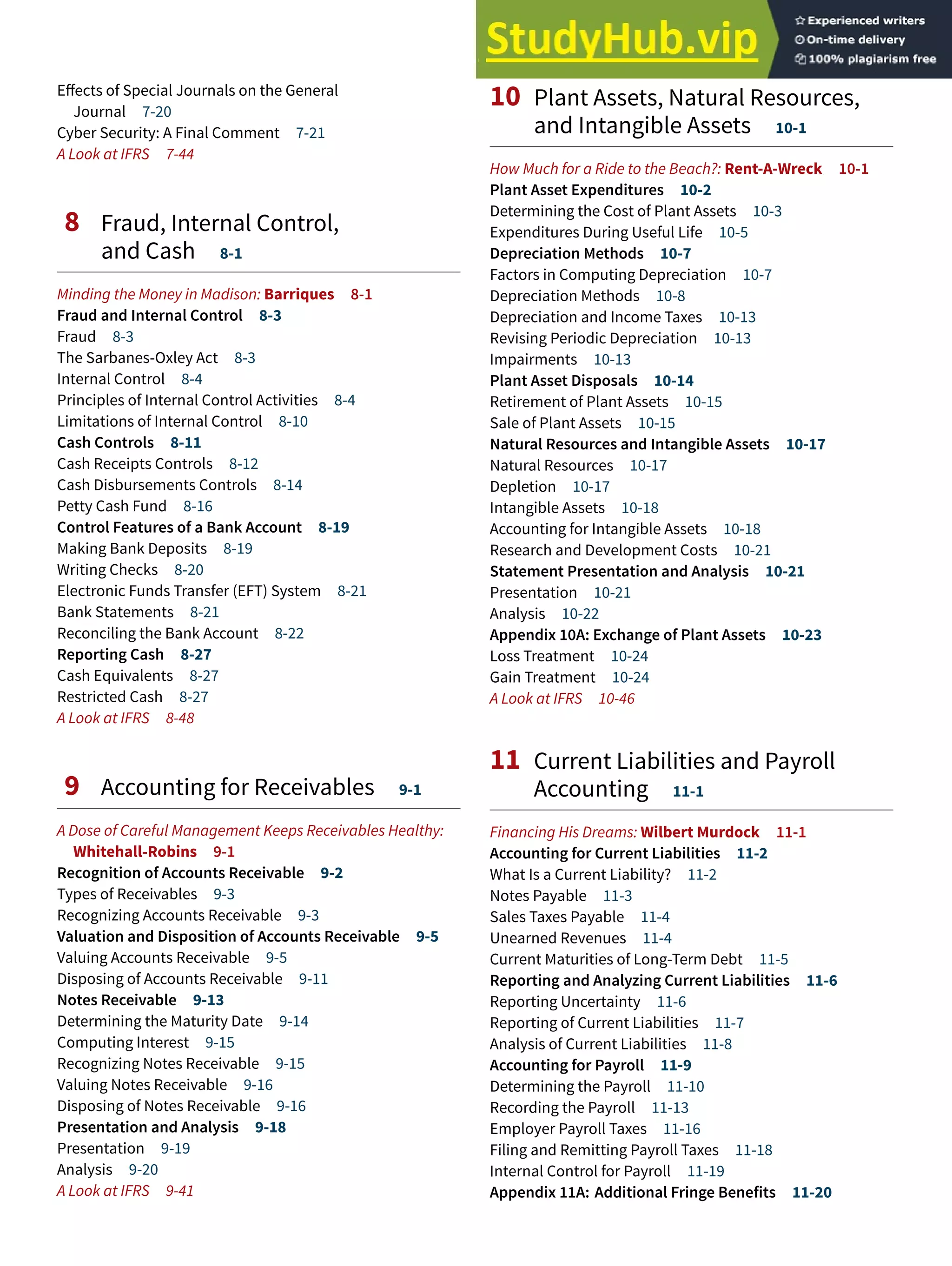
Contents xi
Effects of Special Journals on the General
Journal 7-20
Cyber Security: A Final Comment 7-21
A Look at IFRS 7-44
8 Fraud, Internal Control,
and Cash 8-1
Minding the Money in Madison: Barriques 8-1
Fraud and Internal Control 8-3
Fraud 8-3
The Sarbanes-Oxley Act 8-3
Internal Control 8-4
Principles of Internal Control Activities 8-4
Limitations of Internal Control 8-10
Cash Controls 8-11
Cash Receipts Controls 8-12
Cash Disbursements Controls 8-14
Petty Cash Fund 8-16
Control Features of a Bank Account 8-19
Making Bank Deposits 8-19
Writing Checks 8-20
Electronic Funds Transfer (EFT) System 8-21
Bank Statements 8-21
Reconciling the Bank Account 8-22
Reporting Cash 8-27
Cash Equivalents 8-27
Restricted Cash 8-27
A Look at IFRS 8-48
9 Accounting for Receivables 9-1
A Dose of Careful Management Keeps Receivables Healthy:
Whitehall-Robins 9-1
Recognition of Accounts Receivable 9-2
Types of Receivables 9-3
Recognizing Accounts Receivable 9-3
Valuation and Disposition of Accounts Receivable 9-5
Valuing Accounts Receivable 9-5
Disposing of Accounts Receivable 9-11
Notes Receivable 9-13
Determining the Maturity Date 9-14
Computing Interest 9-15
Recognizing Notes Receivable 9-15
Valuing Notes Receivable 9-16
Disposing of Notes Receivable 9-16
Presentation and Analysis 9-18
Presentation 9-19
Analysis 9-20
A Look at IFRS 9-41
10 Plant Assets, Natural Resources,
and Intangible Assets 10-1
How Much for a Ride to the Beach?: Rent-A-Wreck 10-1
Plant Asset Expenditures 10-2
Determining the Cost of Plant Assets 10-3
Expenditures During Useful Life 10-5
Depreciation Methods 10-7
Factors in Computing Depreciation 10-7
Depreciation Methods 10-8
Depreciation and Income Taxes 10-13
Revising Periodic Depreciation 10-13
Impairments 10-13
Plant Asset Disposals 10-14
Retirement of Plant Assets 10-15
Sale of Plant Assets 10-15
Natural Resources and Intangible Assets 10-17
Natural Resources 10-17
Depletion 10-17
Intangible Assets 10-18
Accounting for Intangible Assets 10-18
Research and Development Costs 10-21
Statement Presentation and Analysis 10-21
Presentation 10-21
Analysis 10-22
Appendix 10A: Exchange of Plant Assets 10-23
Loss Treatment 10-24
Gain Treatment 10-24
A Look at IFRS 10-46
11 Current Liabilities and Payroll
Accounting 11-1
Financing His Dreams: Wilbert Murdock 11-1
Accounting for Current Liabilities 11-2
What Is a Current Liability? 11-2
Notes Payable 11-3
Sales Taxes Payable 11-4
Unearned Revenues 11-4
Current Maturities of Long-Term Debt 11-5
Reporting and Analyzing Current Liabilities 11-6
Reporting Uncertainty 11-6
Reporting of Current Liabilities 11-7
Analysis of Current Liabilities 11-8
Accounting for Payroll 11-9
Determining the Payroll 11-10
Recording the Payroll 11-13
Employer Payroll Taxes 11-16
Filing and Remitting Payroll Taxes 11-18
Internal Control for Payroll 11-19
Appendix 11A: Additional Fringe Benefits 11-20
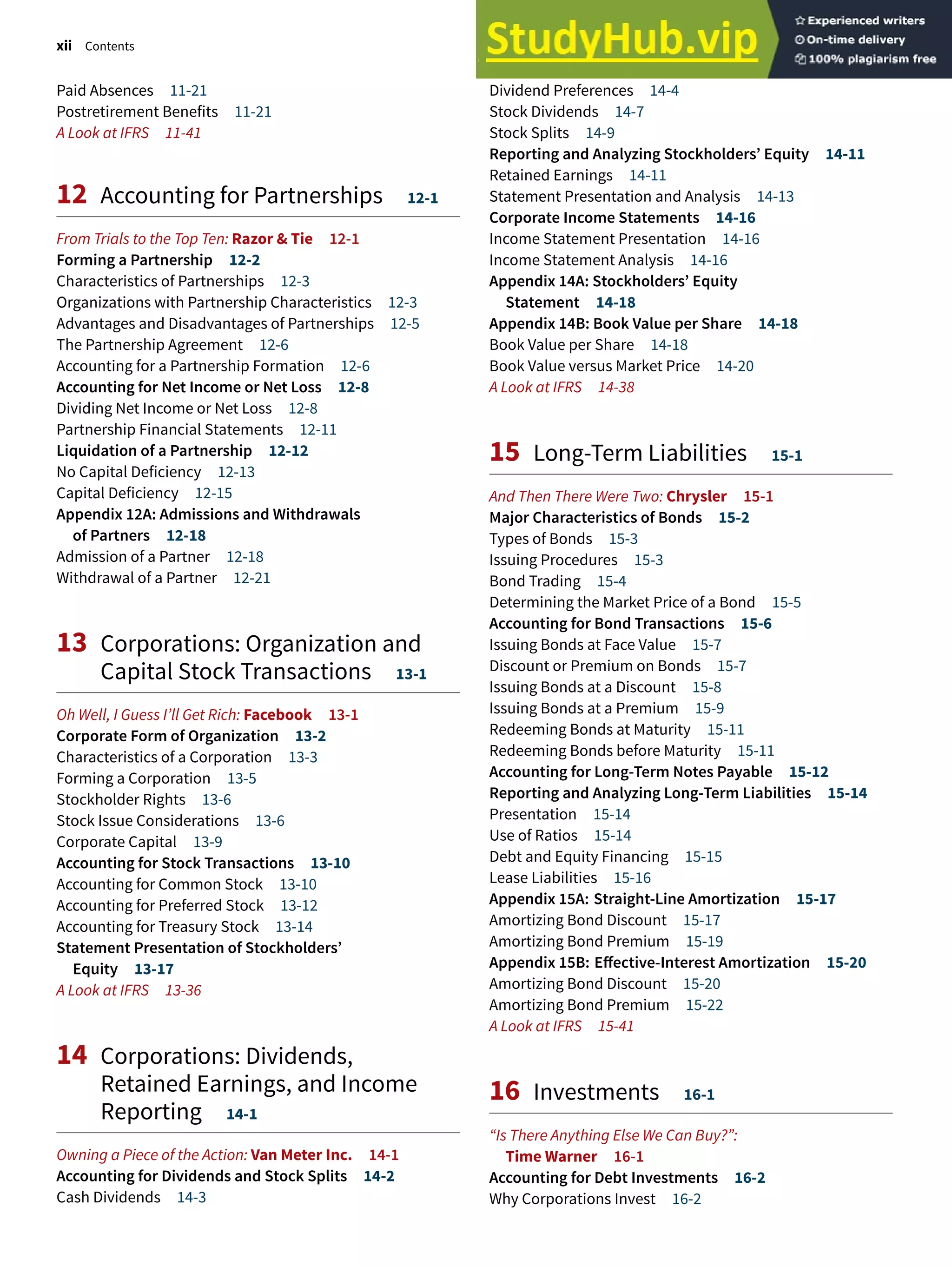
xii Contents
Dividend Preferences 14-4
Stock Dividends 14-7
Stock Splits 14-9
Reporting and Analyzing Stockholders’ Equity 14-11
Retained Earnings 14-11
Statement Presentation and Analysis 14-13
Corporate Income Statements 14-16
Income Statement Presentation 14-16
Income Statement Analysis 14-16
Appendix 14A: Stockholders’ Equity
Statement 14-18
Appendix 14B: Book Value per Share 14-18
Book Value per Share 14-18
Book Value versus Market Price 14-20
A Look at IFRS 14-38
15 Long-Term Liabilities 15-1
And Then There Were Two: Chrysler 15-1
Major Characteristics of Bonds 15-2
Types of Bonds 15-3
Issuing Procedures 15-3
Bond Trading 15-4
Determining the Market Price of a Bond 15-5
Accounting for Bond Transactions 15-6
Issuing Bonds at Face Value 15-7
Discount or Premium on Bonds 15-7
Issuing Bonds at a Discount 15-8
Issuing Bonds at a Premium 15-9
Redeeming Bonds at Maturity 15-11
Redeeming Bonds before Maturity 15-11
Accounting for Long-Term Notes Payable 15-12
Reporting and Analyzing Long-Term Liabilities 15-14
Presentation 15-14
Use of Ratios 15-14
Debt and Equity Financing 15-15
Lease Liabilities 15-16
Appendix 15A: Straight-Line Amortization 15-17
Amortizing Bond Discount 15-17
Amortizing Bond Premium 15-19
Appendix 15B: Effective-Interest Amortization 15-20
Amortizing Bond Discount 15-20
Amortizing Bond Premium 15-22
A Look at IFRS 15-41
16 Investments 16-1
“Is There Anything Else We Can Buy?”:
Time Warner 16-1
Accounting for Debt Investments 16-2
Why Corporations Invest 16-2
Paid Absences 11-21
Postretirement Benefits 11-21
A Look at IFRS 11-41
12 Accounting for Partnerships 12-1
From Trials to the Top Ten: Razor & Tie 12-1
Forming a Partnership 12-2
Characteristics of Partnerships 12-3
Organizations with Partnership Characteristics 12-3
Advantages and Disadvantages of Partnerships 12-5
The Partnership Agreement 12-6
Accounting for a Partnership Formation 12-6
Accounting for Net Income or Net Loss 12-8
Dividing Net Income or Net Loss 12-8
Partnership Financial Statements 12-11
Liquidation of a Partnership 12-12
No Capital Deficiency 12-13
Capital Deficiency 12-15
Appendix 12A: Admissions and Withdrawals
of Partners 12-18
Admission of a Partner 12-18
Withdrawal of a Partner 12-21
13 Corporations: Organization and
Capital Stock Transactions 13-1
Oh Well, I Guess I’ll Get Rich: Facebook 13-1
Corporate Form of Organization 13-2
Characteristics of a Corporation 13-3
Forming a Corporation 13-5
Stockholder Rights 13-6
Stock Issue Considerations 13-6
Corporate Capital 13-9
Accounting for Stock Transactions 13-10
Accounting for Common Stock 13-10
Accounting for Preferred Stock 13-12
Accounting for Treasury Stock 13-14
Statement Presentation of Stockholders’
Equity 13-17
A Look at IFRS 13-36
14 Corporations: Dividends,
Retained Earnings, and Income
Reporting 14-1
Owning a Piece of the Action: Van Meter Inc. 14-1
Accounting for Dividends and Stock Splits 14-2
Cash Dividends 14-3
Contents xiii
Quality of Earnings 18-7
Horizontal Analysis and Vertical Analysis 18-9
Horizontal Analysis 18-10
Vertical Analysis 18-12
Ratio Analysis 18-14
Liquidity Ratios 18-15
Solvency Ratios 18-16
Profitability Ratios 18-16
Comprehensive Example of Ratio Analysis 18-17
A Look at IFRS 18-51
19 Managerial Accounting 19-1
Just Add Water . . . and Paddle: Current Designs 19-1
Managerial Accounting Basics 19-3
Comparing Managerial and Financial Accounting 19-3
Management Functions 19-3
Organizational Structure 19-5
Managerial Cost Concepts 19-7
Manufacturing Costs 19-7
Product Versus Period Costs 19-8
Illustration of Cost Concepts 19-9
Manufacturing Costs in Financial Statements 19-10
Income Statement 19-11
Cost of Goods Manufactured 19-11
Cost of Goods Manufactured Schedule 19-12
Balance Sheet 19-13
Managerial Accounting Today 19-14
Service Industries 19-14
Focus on the Value Chain 19-15
Balanced Scorecard 19-17
Business Ethics 19-17
Corporate Social Responsibility 19-18
20 Job Order Costing 20-1
Profiting from the Silver Screen: Disney 20-1
Cost Accounting Systems 20-3
Process Cost System 20-3
Job Order Cost System 20-3
Job Order Cost Flow 20-4
Accumulating Manufacturing Costs 20-5
Assigning Manufacturing Costs 20-7
Raw Materials Costs 20-8
Factory Labor Costs 20-10
Predetermined Overhead Rates 20-12
Entries for Jobs Completed and Sold 20-15
Assigning Costs to Finished Goods 20-15
Assigning Costs to Cost of Goods Sold 20-16
Summary of Job Order Cost Flows 20-17
Job Order Costing for Service Companies 20-18
Advantages and Disadvantages of Job
Order Costing 20-19
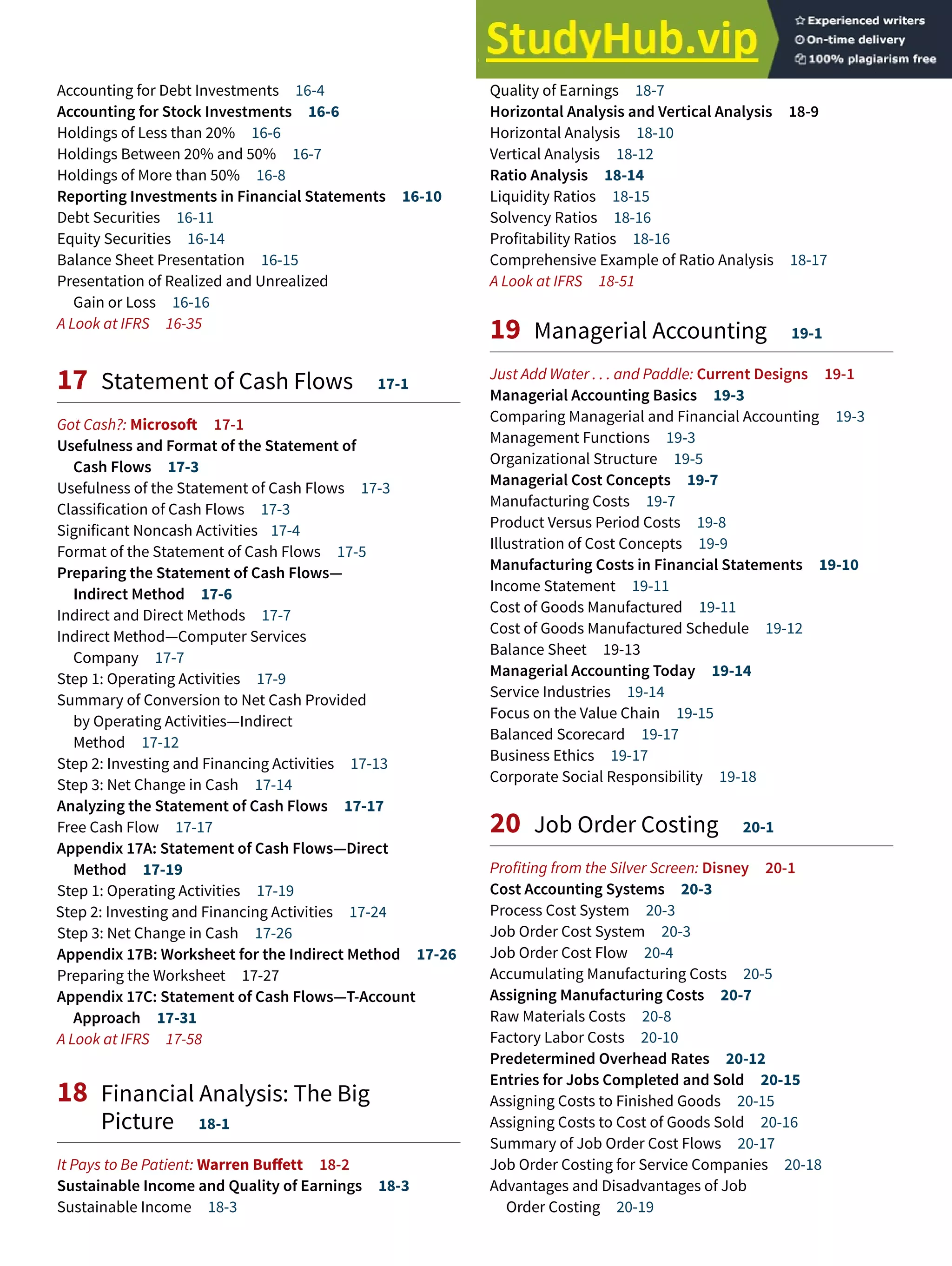
Accounting for Debt Investments 16-4
Accounting for Stock Investments 16-6
Holdings of Less than 20% 16-6
Holdings Between 20% and 50% 16-7
Holdings of More than 50% 16-8
Reporting Investments in Financial Statements 16-10
Debt Securities 16-11
Equity Securities 16-14
Balance Sheet Presentation 16-15
Presentation of Realized and Unrealized
Gain or Loss 16-16
A Look at IFRS 16-35
17 Statement of Cash Flows 17-1
Got Cash?: Microsoft 17-1
Usefulness and Format of the Statement of
Cash Flows 17-3
Usefulness of the Statement of Cash Flows 17-3
Classification of Cash Flows 17-3
Significant Noncash Activities 17-4
Format of the Statement of Cash Flows 17-5
Preparing the Statement of Cash Flows—
Indirect Method 17-6
Indirect and Direct Methods 17-7
Indirect Method—Computer Services
Company 17-7
Step 1: Operating Activities 17-9
Summary of Conversion to Net Cash Provided
by Operating Activities—Indirect
Method 17-12
Step 2: Investing and Financing Activities 17-13
Step 3: Net Change in Cash 17-14
Analyzing the Statement of Cash Flows 17-17
Free Cash Flow 17-17
Appendix 17A: Statement of Cash Flows—Direct
Method 17-19
Step 1: Operating Activities 17-19
Step 2: Investing and Financing Activities 17-24
Step 3: Net Change in Cash 17-26
Appendix 17B: Worksheet for the Indirect Method 17-26
Preparing the Worksheet 17-27
Appendix 17C: Statement of Cash Flows—T-Account
Approach 17-31
A Look at IFRS 17-58
18 Financial Analysis: The Big
Picture 18-1
It Pays to Be Patient: Warren Buffett 18-2
Sustainable Income and Quality of Earnings 18-3
Sustainable Income 18-3
Target Net Income 22-18
Margin of Safety 22-20
Appendix 22A: Regression Analysis 22-21
23 Incremental Analysis 23-1
Keeping It Clean: Method Products 23-1
Decision-Making and Incremental
Analysis 23-3
Incremental Analysis Approach 23-3
How Incremental Analysis Works 23-4
Qualitative Factors 23-5
Relationship of Incremental Analysis
and Activity-Based Costing 23-5
Types of Incremental Analysis 23-6
Special Orders 23-6
Make or Buy 23-8
Opportunity Cost 23-9
Sell or Process Further 23-10
Single-Product Case 23-11
Multiple-Product Case 23-11
Repair, Retain, or Replace Equipment 23-14
Eliminate Unprofitable Segment or
Product 23-15
24 Budgetary Planning 24-1
What’s in Your Cupcake?: BabyCakes NYC 24-1
Effective Budgeting and the Master
Budget 24-3
Budgeting and Accounting 24-3
The Benefits of Budgeting 24-3
Essentials of Effective Budgeting 24-3
The Master Budget 24-6
Sales, Production, and Direct Materials
Budgets 24-8
Sales Budget 24-8
Production Budget 24-9
Direct Materials Budget 9-10
Direct Labor, Manufacturing Overhead, and S&A
Expense Budgets 24-13
Direct Labor Budget 24-13
Manufacturing Overhead Budget 24-14
Selling and Administrative Expense Budget 24-15
Budgeted Income Statement 24-15
Cash Budget and Budgeted Balance Sheet 24-17
Cash Budget 24-17
Budgeted Balance Sheet 24-20
Budgeting in Nonmanufacturing
Companies 24-22
Merchandisers 24-22
Service Companies 24-23
Not-for-Profit Organizations 24-24
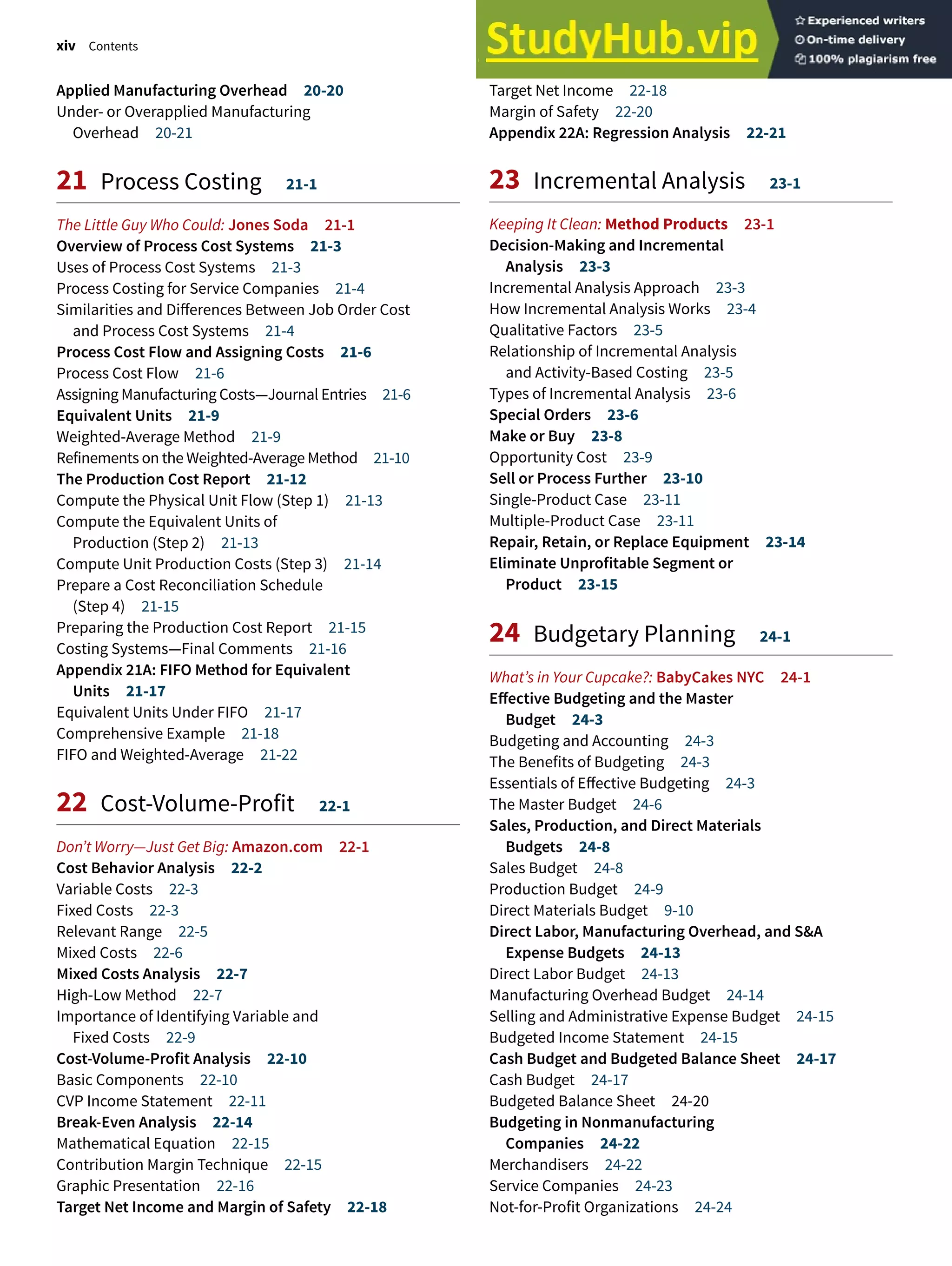
Applied Manufacturing Overhead 20-20
Under- or Overapplied Manufacturing
Overhead 20-21
21 Process Costing 21-1
The Little Guy Who Could: Jones Soda 21-1
Overview of Process Cost Systems 21-3
Uses of Process Cost Systems 21-3
Process Costing for Service Companies 21-4
Similarities and Differences Between Job Order Cost
and Process Cost Systems 21-4
Process Cost Flow and Assigning Costs 21-6
Process Cost Flow 21-6
Assigning Manufacturing Costs—Journal Entries 21-6
Equivalent Units 21-9
Weighted-Average Method 21-9
Refinements on the Weighted-Average Method 21-10
The Production Cost Report 21-12
Compute the Physical Unit Flow (Step 1) 21-13
Compute the Equivalent Units of
Production (Step 2) 21-13
Compute Unit Production Costs (Step 3) 21-14
Prepare a Cost Reconciliation Schedule
(Step 4) 21-15
Preparing the Production Cost Report 21-15
Costing Systems—Final Comments 21-16
Appendix 21A: FIFO Method for Equivalent
Units 21-17
Equivalent Units Under FIFO 21-17
Comprehensive Example 21-18
FIFO and Weighted-Average 21-22
22 Cost-Volume-Profit 22-1
Don’t Worry—Just Get Big: Amazon.com 22-1
Cost Behavior Analysis 22-2
Variable Costs 22-3
Fixed Costs 22-3
Relevant Range 22-5
Mixed Costs 22-6
Mixed Costs Analysis 22-7
High-Low Method 22-7
Importance of Identifying Variable and
Fixed Costs 22-9
Cost-Volume-Profit Analysis 22-10
Basic Components 22-10
CVP Income Statement 22-11
Break-Even Analysis 22-14
Mathematical Equation 22-15
Contribution Margin Technique 22-15
Graphic Presentation 22-16
Target Net Income and Margin of Safety 22-18
xiv Contents
Contents xv
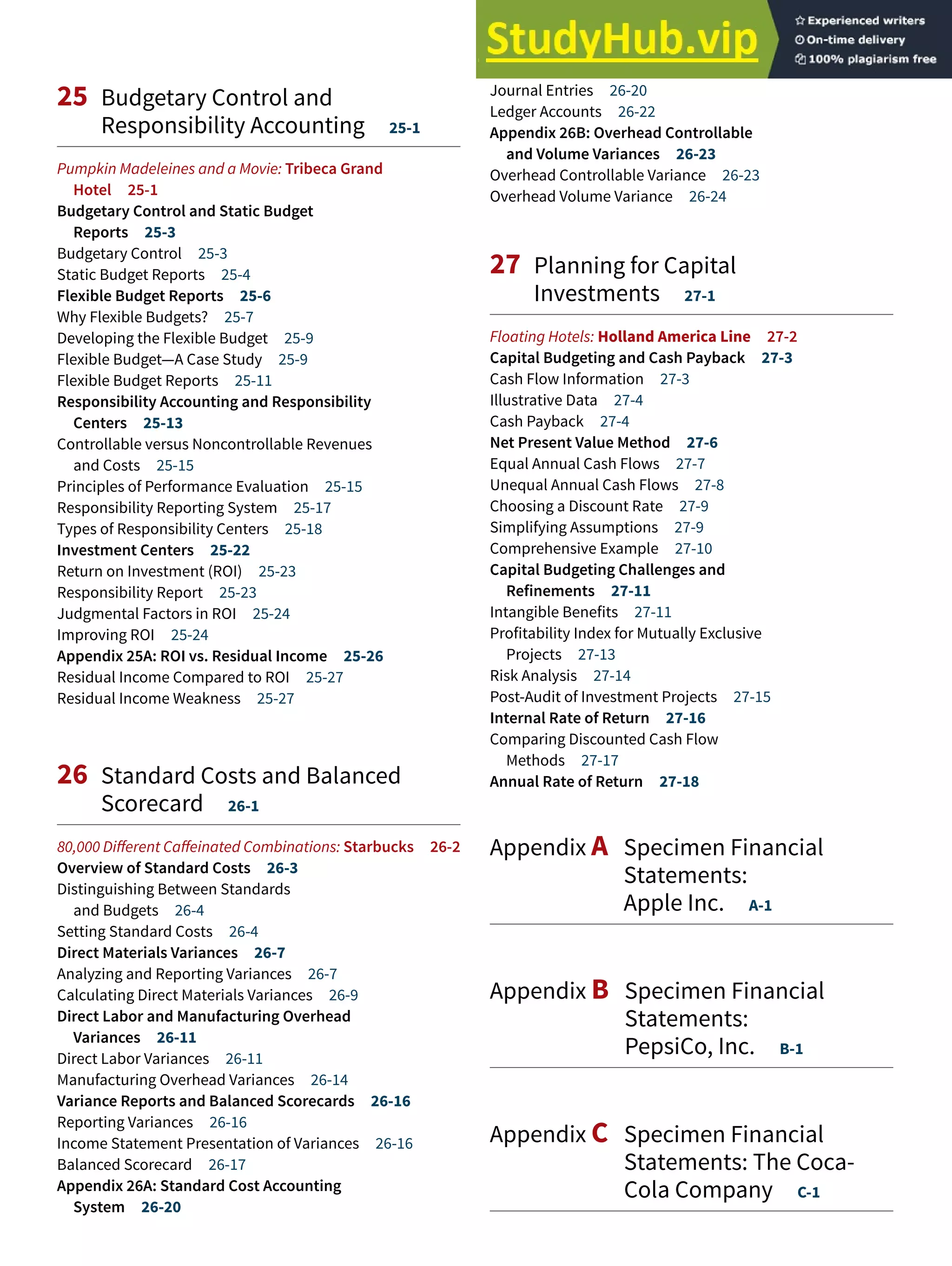
25 Budgetary Control and
Responsibility Accounting 25-1
Pumpkin Madeleines and a Movie: Tribeca Grand
Hotel 25-1
Budgetary Control and Static Budget
Reports 25-3
Budgetary Control 25-3
Static Budget Reports 25-4
Flexible Budget Reports 25-6
Why Flexible Budgets? 25-7
Developing the Flexible Budget 25-9
Flexible Budget—A Case Study 25-9
Flexible Budget Reports 25-11
Responsibility Accounting and Responsibility
Centers 25-13
Controllable versus Noncontrollable Revenues
and Costs 25-15
Principles of Performance Evaluation 25-15
Responsibility Reporting System 25-17
Types of Responsibility Centers 25-18
Investment Centers 25-22
Return on Investment (ROI) 25-23
Responsibility Report 25-23
Judgmental Factors in ROI 25-24
Improving ROI 25-24
Appendix 25A: ROI vs. Residual Income 25-26
Residual Income Compared to ROI 25-27
Residual Income Weakness 25-27
26 Standard Costs and Balanced
Scorecard 26-1
80,000 Different Caffeinated Combinations: Starbucks 26-2
Overview of Standard Costs 26-3
Distinguishing Between Standards
and Budgets 26-4
Setting Standard Costs 26-4
Direct Materials Variances 26-7
Analyzing and Reporting Variances 26-7
Calculating Direct Materials Variances 26-9
Direct Labor and Manufacturing Overhead
Variances 26-11
Direct Labor Variances 26-11
Manufacturing Overhead Variances 26-14
Variance Reports and Balanced Scorecards 26-16
Reporting Variances 26-16
Income Statement Presentation of Variances 26-16
Balanced Scorecard 26-17
Appendix 26A: Standard Cost Accounting
System 26-20
Journal Entries 26-20
Ledger Accounts 26-22
Appendix 26B: Overhead Controllable
and Volume Variances 26-23
Overhead Controllable Variance 26-23
Overhead Volume Variance 26-24
27 Planning for Capital
Investments 27-1
Floating Hotels: Holland America Line 27-2
Capital Budgeting and Cash Payback 27-3
Cash Flow Information 27-3
Illustrative Data 27-4
Cash Payback 27-4
Net Present Value Method 27-6
Equal Annual Cash Flows 27-7
Unequal Annual Cash Flows 27-8
Choosing a Discount Rate 27-9
Simplifying Assumptions 27-9
Comprehensive Example 27-10
Capital Budgeting Challenges and
Refinements 27-11
Intangible Benefits 27-11
Profitability Index for Mutually Exclusive
Projects 27-13
Risk Analysis 27-14
Post-Audit of Investment Projects 27-15
Internal Rate of Return 27-16
Comparing Discounted Cash Flow
Methods 27-17
Annual Rate of Return 27-18
Appendix A Specimen Financial
Statements:
Apple Inc. A-1
Appendix B Specimen Financial
Statements:
PepsiCo, Inc. B-1
Appendix C Specimen Financial
Statements: The Coca-
Cola Company C-1
xvi Contents
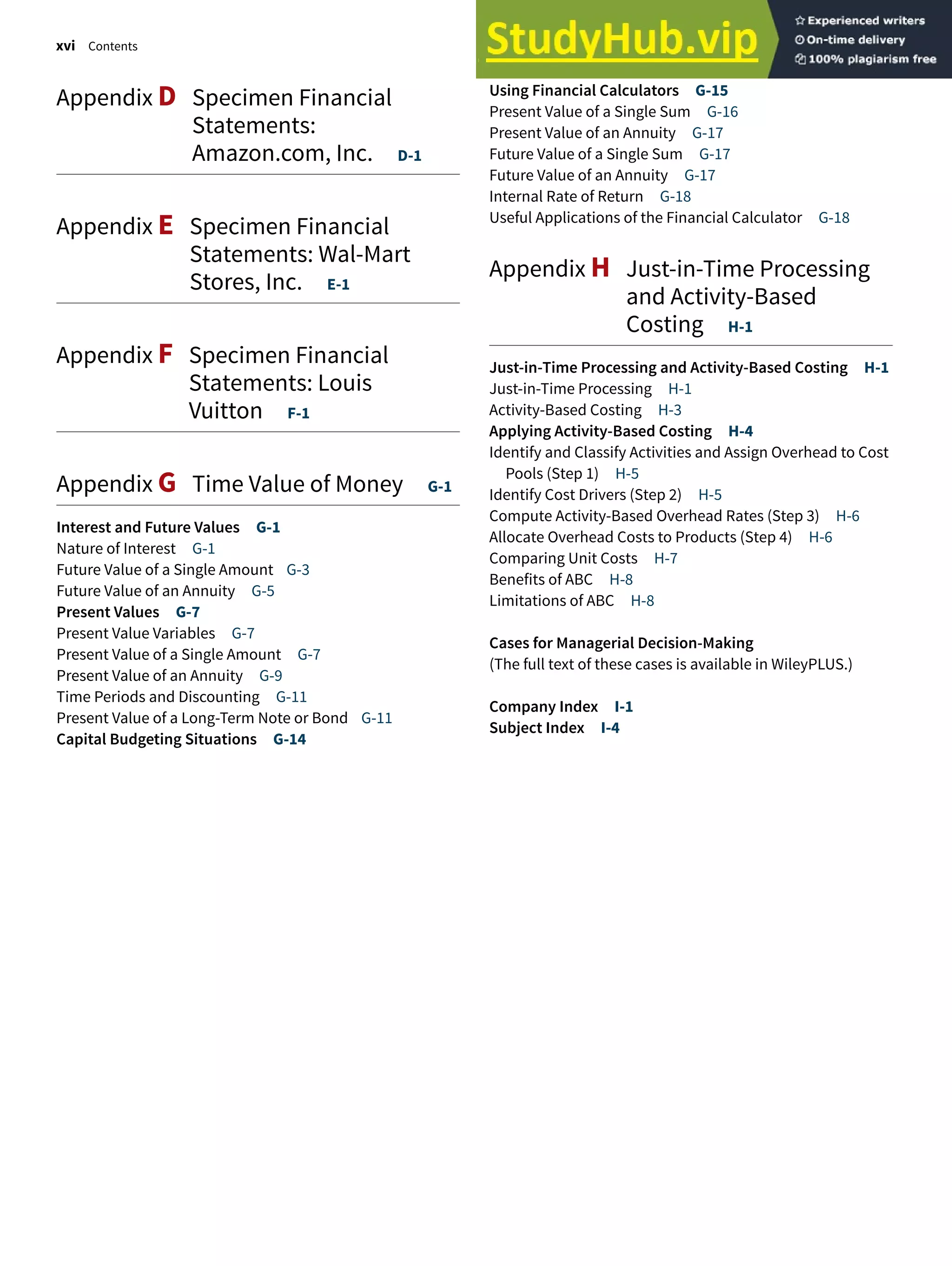
Using Financial Calculators G-15
Present Value of a Single Sum G-16
Present Value of an Annuity G-17
Future Value of a Single Sum G-17
Future Value of an Annuity G-17
Internal Rate of Return G-18
Useful Applications of the Financial Calculator G-18
Appendix H Just-in-Time Processing
and Activity-Based
Costing H-1
Just-in-Time Processing and Activity-Based Costing H-1
Just-in-Time Processing H-1
Activity-Based Costing H-3
Applying Activity-Based Costing H-4
Identify and Classify Activities and Assign Overhead to Cost
Pools (Step 1) H-5
Identify Cost Drivers (Step 2) H-5
Compute Activity-Based Overhead Rates (Step 3) H-6
Allocate Overhead Costs to Products (Step 4) H-6
Comparing Unit Costs H-7
Benefits of ABC H-8
Limitations of ABC H-8
Cases for Managerial Decision-Making
(The full text of these cases is available in WileyPLUS.)
Company Index I-1
Subject Index I-4
Appendix D Specimen Financial
Statements:
Amazon.com, Inc. D-1
Appendix E Specimen Financial
Statements: Wal-Mart
Stores, Inc. E-1
Appendix F Specimen Financial
Statements: Louis
Vuitton F-1
Appendix G Time Value of Money G-1
Interest and Future Values G-1
Nature of Interest G-1
Future Value of a Single Amount G-3
Future Value of an Annuity G-5
Present Values G-7
Present Value Variables G-7
Present Value of a Single Amount G-7
Present Value of an Annuity G-9
Time Periods and Discounting G-11
Present Value of a Long-Term Note or Bond G-11
Capital Budgeting Situations G-14
xvii
Karen Andrews
Lewis-Clark State College
Sandra Bailey
Oregon Institute of Technology
Shele Bannon
Queensborough Community College
Robert Barta
Suffolk County Community College
Ellen Bartley
St. Joseph’s College
LuAnn Bean
Florida Institute of Technology
Quent Below
Roane State Community College
Lila Bergman
Hunter College
Jack Borke
University of Wisconsin—Platteville
Glen Brauchle
Dowling College
Douglas Brown
Forsyth Technical Community College
Ronald Campbell
North Carolina A&T State University
Elizabeth Capener
Dominican University of California
Beth Carraway
Horry-Georgetown Technical College
Jackie Caseu
Cape Fear Community College
Kim Charland
Kansas State University
Sandee Cohen
Columbia College Chicago
Suzanne Cory
St. Mary’s University
Paul Cox
Medgar Evers College
Joseph Cunningham
Harford Community College
Kate Demarest
Carroll Community College
Richard Dugger
Kilgore College
Bill Elliott
Oral Roberts University
James Emig
Villanova University
Cole Engel
Fort Hays State University
Larry Falcetto
Emporia State University
Gary Ford
Tompkins Cortland Community College
Alan Foster
J.S. Reynolds Community College
Dale Fowler
Ohio Christian University
George Gardner
Bemidji State University
Willard Garman
University of California, Los Angeles
Heidi Hansel
Kirkwood Community College
Coby Harmon
University of California—Santa Barbara
Derek Jackson
St. Mary’s University of Minnesota
Jospeh Jurkowski
D’youville College
Randy Kidd
Metropolitan Community College
Cindy Killian
Wilkes Community College
Shirly Kleiner
Johnson County Community College
David Krug
Johnson County Community College
Christy Land
Catawba Valley Community College
Anita Leslie
York Technical College
Lori Major
Luzerne County Community College
Charles Malone
North Carolina A&T State University
Ken Mark
Kansas City Kansas Community College
Barbara Michal
University of Rio Grande
Jill Misuraca
University of Tampa
Allison Moore
Los Angeles Southwest College
Barbara Muller
Arizona State University
Yvonne Phang
Borough of Manhattan Community College
Brandis Phillips
North Carolina A&T State University
Mary Phillips
North Carolina Central University
Laura Prosser
Black Hills State University
La Vonda Ramey
Schoolcraft College
J. Ramos-Alexander
New Jersey City University
Michelle Randall
Schoolcraft College
Ruthie Reynolds
Tennessee State University
Kathie Rogers
Suffolk Community College
Kent Schneider
East Tennessee State University
Nadia Schwartz
Augustana College
Mehdi Sheikholeslami
Bemidji State University
Alice Sineath
University of Maryland University College
Bradley Smith
Des Moines Area Community College
Emil Soriano
Contra Costa College
Teresa Speck
St. Mary’s University of Minnesota
Lynn Stallworth
Appalachian State University
John Stancil
Florida Southern College
Linda Summey
Central Carolina Community College
Joan Van Hise
Fairfield University
Dick Wasson
Southwestern College
Pat Wright
Long Island University
Lori Grady Zaher
Bucks County Community College
Judith Zander
Grossmont College
Accounting Principles has benefited greatly from the input of focus group participants,
manuscript reviewers, those who have sent comments by letter or e-mail, ancillary authors,
and proofers. We greatly appreciate the constructive suggestions and innovative ideas of
reviewers and the creativity and accuracy of the ancillary authors and checkers.
Acknowledgments
We thank Benjamin Huegel and Teresa Speck of St. Mary’s
University for their extensive efforts in the preparation of the
homework materials related to Current Designs. We also appreciate
the considerable support provided to us by the following people at
Current Designs: Mike Cichanowski, Jim Brown, Diane Buswell,
and Jake Greseth. We also benefited from the assistance and sugges-
tions provided to us by Joan Van Hise in the preparation of materials
related to sustainability.
We appreciate the exemplary support and commitment given to us
by editor Lauren Harrell Krassow, marketing manager Carolyn Wells,
lead product designer Ed Brislin, editorial supervisor Terry Ann Tatro,
editorial associate Margaret Thompson, product designer Matt Origoni,
assistant project manager Cyndy Taylor, designer Wendy Lai, photo
editor Mary Ann Price, indexer Steve Ingle, senior production editor
Elena Saccaro, and Denise Showers at Aptara. All of these professionals
provided innumerable services that helped the text take shape.
We will appreciate suggestions and comments from users—
instructors and students alike. You can send your thoughts and ideas
about the text to us via email at: AccountingAuthors@yahoo.com.
Jerry J. Weygandt Paul D. Kimmel Donald E. Kieso
Madison, Wisconsin Milwaukee, Wisconsin DeKalb, Illinois
xviii Acknowledgments
Accounting in Action
1-1
Feature Story
Knowing the Numbers
Many students who take this course do not plan to be accoun-
tants. If you are in that group, you might be thinking, “If I’m
not going to be an accountant, why do I need to know account-
ing?” Well, consider this quote from Harold Geneen, the for-
mer chairman of IT&T: “To be good at your business, you
have to know the numbers—cold.” In business, accounting
and financial statements are the means for communicating the
numbers. If you don’t know how to read financial statements,
you can’t really know your business.
Knowing the numbers is sometimes even a matter of cor-
porate survival. Consider the story of Columbia Sportswear
Company, headquartered in Portland, Oregon. Gert Boyle’s
family fled Nazi Germany when she was 13 years old and
then purchased a small hat company in Oregon, Columbia Hat
CHAPTER 1
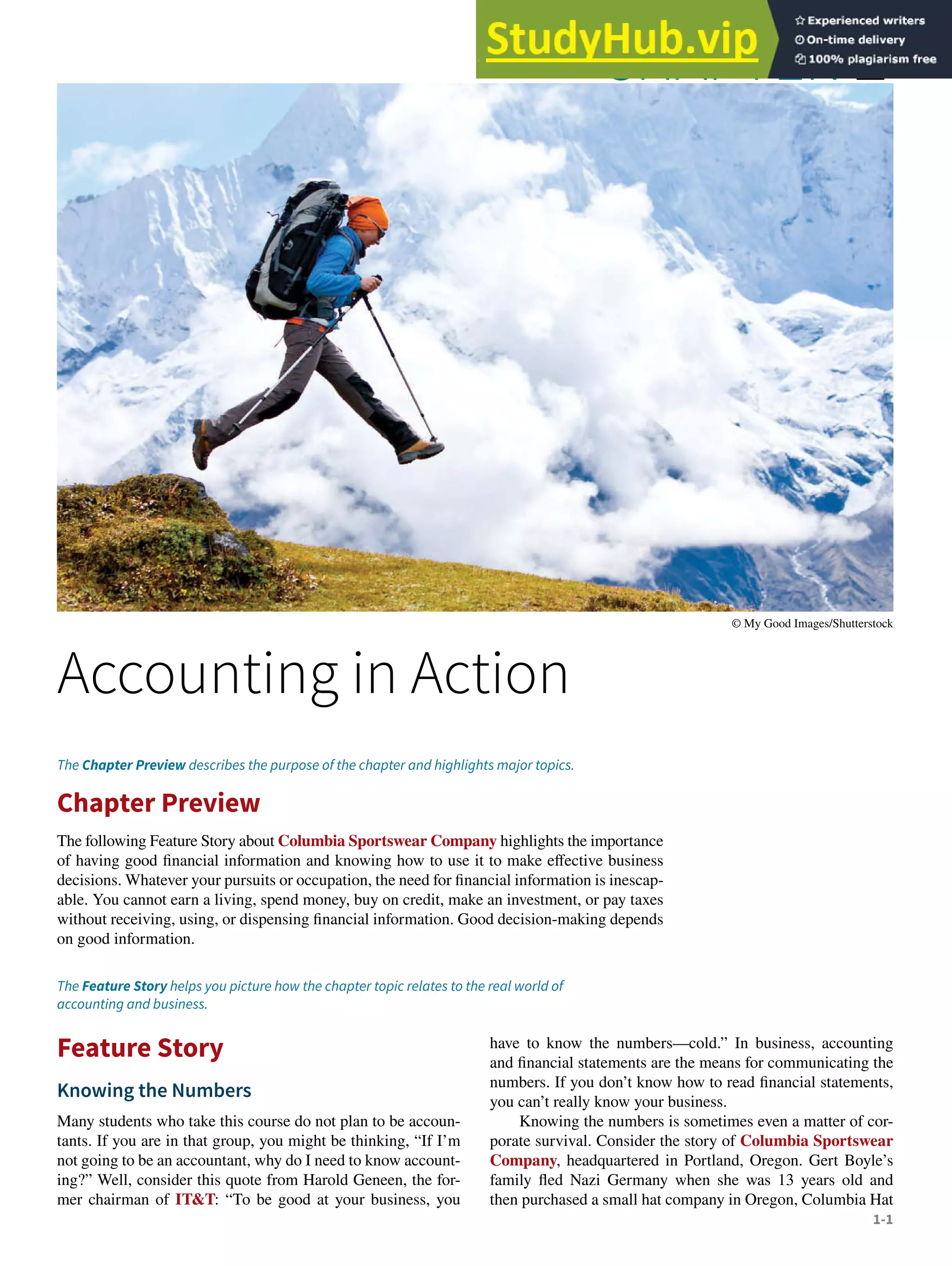
© My Good Images/Shutterstock
Chapter Preview
The following Feature Story about Columbia Sportswear Company highlights the importance
of having good financial information and knowing how to use it to make effective business
decisions. Whatever your pursuits or occupation, the need for financial information is inescap-
able. You cannot earn a living, spend money, buy on credit, make an investment, or pay taxes
without receiving, using, or dispensing financial information. Good decision-making depends
on good information.
The Chapter Preview describes the purpose of the chapter and highlights major topics.
The Feature Story helps you picture how the chapter topic relates to the real world of
accounting and business.
1-2 CHAPTER 1 Accounting in Action
Company. In 1971, Gert’s husband, who was then running the
company, died suddenly of a heart attack. The company was
in the midst of an aggressive expansion, which had taken its
sales above $1 million for the first time but which had also
left the company financially stressed. Gert took over the small,
struggling company with help from her son Tim, who was then
a senior at the University of Oregon. Somehow, they kept the
company afloat. Today, Columbia has more than 4,000 em-
ployees and annual sales in excess of $1 billion. Its brands
include Columbia, Mountain Hardwear, Sorel, and Montrail.
Gert still heads up the Board of Directors, and Tim is the
company’s President and CEO.
Columbia doesn’t just focus on financial success. The
company is very committed to corporate, social, and envi-
ronmental responsibility. For example, several of its factories
have participated in a project to increase health awareness of
female factory workers in developing countries. Columbia was
also a founding member of the Sustainable Apparel Coalition,
which is a group that strives to reduce the environmental and
social impact of the apparel industry. In addition, it monitors
all of the independent factories that produce its products to en-
sure that they comply with the company’s Standards of Manu-
facturing Practices. These standards address issues including
forced labor, child labor, harassment, wages and benefits,
health and safety, and the environment.
Employers such as Columbia Sportswear generally as-
sume that managers in all areas of the company are “finan-
cially literate.” To help prepare you for that, in this textbook
you will learn how to read and prepare financial statements,
and how to use basic tools to evaluate financial results.
Chapter Outline
LEARNING OBJECTIVES
LO 1 Identify the activities and
users associated with accounting.
• Three activities
• Who uses accounting data
DO IT! 1 Basic Concepts
LO 2 Explain the building blocks of
accounting: ethics, principles, and
assumptions.
• Ethics
• GAAP
• Measurement principles
• Assumptions
DO IT! 2 Building Blocks of
Accounting
LO 3 State the accounting equation,
and define its components.
• Assets
• Liabilities
• Owner’s equity
DO IT! 3 Owner’s Equity Effects
LO 4 Analyze the effects of business
transactions on the accounting
equation.
• Accounting transactions
• Transaction analysis
• Summary of transactions
DO IT! 4 Tabular Analysis
LO 5 Describe the four financial
statements and how they are
prepared.
• Income statement
• Owner’s equity statement
• Balance sheet
• Statement of cash flows
DO IT! 5 Financial Statement
Items
Go to the Review and Practice section at the end of the chapter for a review of key concepts
and practice applications with solutions.
Visit WileyPLUS with ORION for additional tutorials and practice opportunities.
The Chapter Outline presents the chapter’s topics and subtopics, as well as practice opportunities.
Accounting Activities and Users 1-3
Accounting Activities and Users
LEARNING OBJECTIVE 1
Identify the activities and users associated with accounting.
What consistently ranks as one of the top career opportunities in business? What frequently
rates among the most popular majors on campus? What was the undergraduate degree chosen
by Nike founder Phil Knight, Home Depot co-founder Arthur Blank, former acting director
of the Federal Bureau of Investigation (FBI) Thomas Pickard, and numerous members of
Congress? Accounting.1
Why did these people choose accounting? They wanted to understand
what was happening financially to their organizations. Accounting is the financial information
system that provides these insights. In short, to understand your organization, you have to
know the numbers.
Accounting consists of three basic activities—it identifies, records, and communicates
the economic events of an organization to interested users. Let’s take a closer look at these
three activities.
Three Activities
As a starting point to the accounting process, a company identifies the economic events
relevant to its business. Examples of economic events are the sale of snack chips by
PepsiCo, the provision of cell phone services by AT&T, and the payment of wages by
Facebook.
Once a company like PepsiCo identifies economic events, it records those events in order
to provide a history of its financial activities. Recording consists of keeping a systematic,
chronological diary of events, measured in dollars and cents. In recording, PepsiCo also
classifies and summarizes economic events.
Finally, PepsiCo communicates the collected information to interested users by means
of accounting reports. The most common of these reports are called financial statements.
To make the reported financial information meaningful, PepsiCo reports the recorded data in
a standardized way. It accumulates information resulting from similar transactions. For exam-
ple, PepsiCo accumulates all sales transactions over a certain period of time and reports the
data as one amount in the company’s financial statements. Such data are said to be reported
in the aggregate. By presenting the recorded data in the aggregate, the accounting process
simplifies a multitude of transactions and makes a series of activities understandable and
meaningful.
A vital element in communicating economic events is the accountant’s ability to ana-
lyze and interpret the reported information. Analysis involves use of ratios, percentages,
graphs, and charts to highlight significant financial trends and relationships. Interpretation
involves explaining the uses, meaning, and limitations of reported data. Appendices
A–E show the financial statements of Apple Inc., PepsiCo Inc., The Coca-Cola Com-
pany, Amazon.com, Inc., and Wal-Mart Stores, Inc., respectively. (In addition, in the
A Look at IFRS section at the end of each chapter, the French company Louis Vuitton
Moët Hennessy is analyzed.) We refer to these statements at various places throughout the
textbook. At this point, these financial statements probably strike you as complex and con-
fusing. By the end of this course, you’ll be surprised at your ability to understand, analyze,
and interpret them.
1
The appendix to this chapter describes job opportunities for accounting majors and explains why accounting is
such a popular major.
Essential terms are printed in
blue when they first appear, and
are defined in the end-of-chapter
Glossary Review.
1-4 CHAPTER 1 Accounting in Action
You should understand that the accounting process includes the bookkeeping function.
Bookkeeping usually involves only the recording of economic events. It is therefore just one
part of the accounting process. In total, accounting involves the entire process of identifying,
recording, and communicating economic events.2
Who Uses Accounting Data
The financial information that users need depends upon the kinds of decisions they make.
There are two broad groups of users of financial information: internal users and external users.
Internal Users
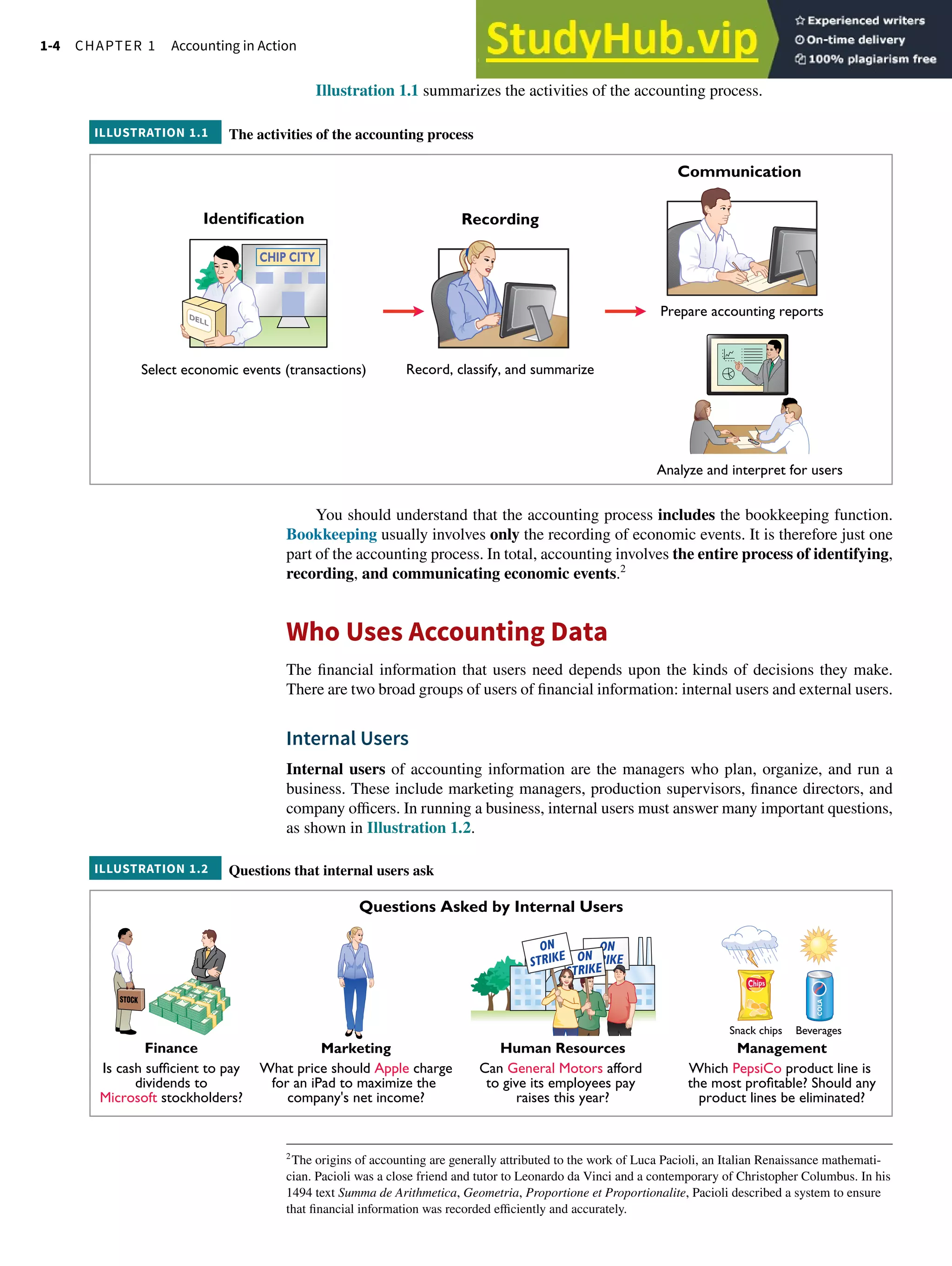
Internal users of accounting information are the managers who plan, organize, and run a
business. These include marketing managers, production supervisors, finance directors, and
company officers. In running a business, internal users must answer many important questions,
as shown in Illustration 1.2.
2
The origins of accounting are generally attributed to the work of Luca Pacioli, an Italian Renaissance mathemati-
cian. Pacioli was a close friend and tutor to Leonardo da Vinci and a contemporary of Christopher Columbus. In his
1494 text Summa de Arithmetica, Geometria, Proportione et Proportionalite, Pacioli described a system to ensure
that financial information was recorded efficiently and accurately.
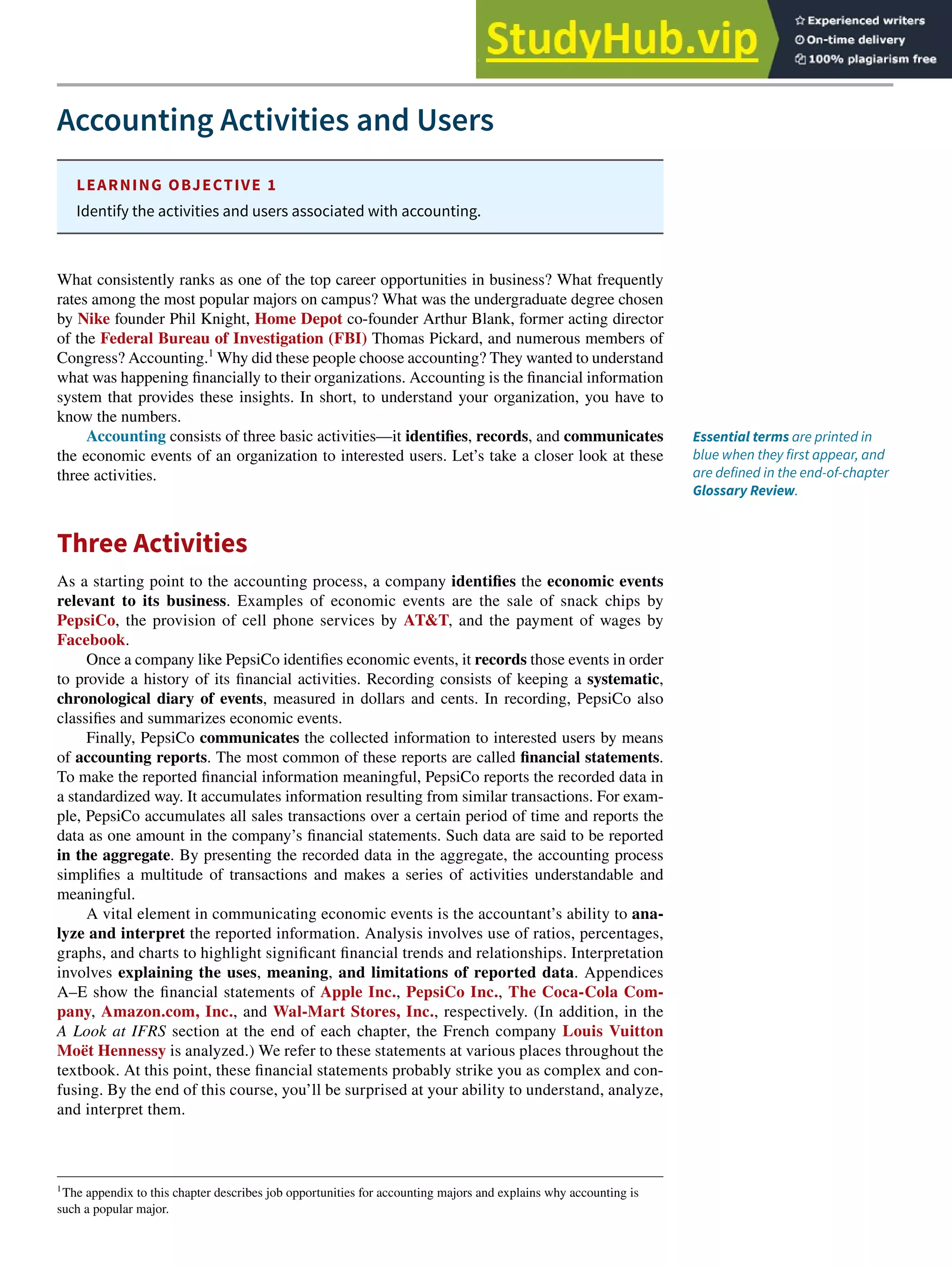
Identification Recording
Communication
Select economic events (transactions) Record, classify, and summarize
Prepare accounting reports
Analyze and interpret for users
CHIP CITY
DELL
. . . .
.
.
.
.
.
.
.
.
.
ILLUSTRATION 1.1 The activities of the accounting process
STOCK
ON
STRIKE
ON
STRIKE
ON
STRIKE
Snack chips Beverages
COLA
Questions Asked by Internal Users
Is cash sufficient to pay
dividends to
Microsoft stockholders?
Finance
Can General Motors afford
to give its employees pay
raises this year?
Human Resources
Which PepsiCo product line is
the most profitable? Should any
product lines be eliminated?
Management
What price should Apple charge
for an iPad to maximize the
company's net income?
Marketing
ILLUSTRATION 1.2 Questions that internal users ask
Illustration 1.1 summarizes the activities of the accounting process.
Accounting Activities and Users 1-5
External Users
External users are individuals and organizations outside a company who want financial in-
formation about the company. The two most common types of external users are investors and
creditors. Investors (owners) use accounting information to decide whether to buy, hold, or
sell ownership shares of a company. Creditors (such as suppliers and bankers) use accounting
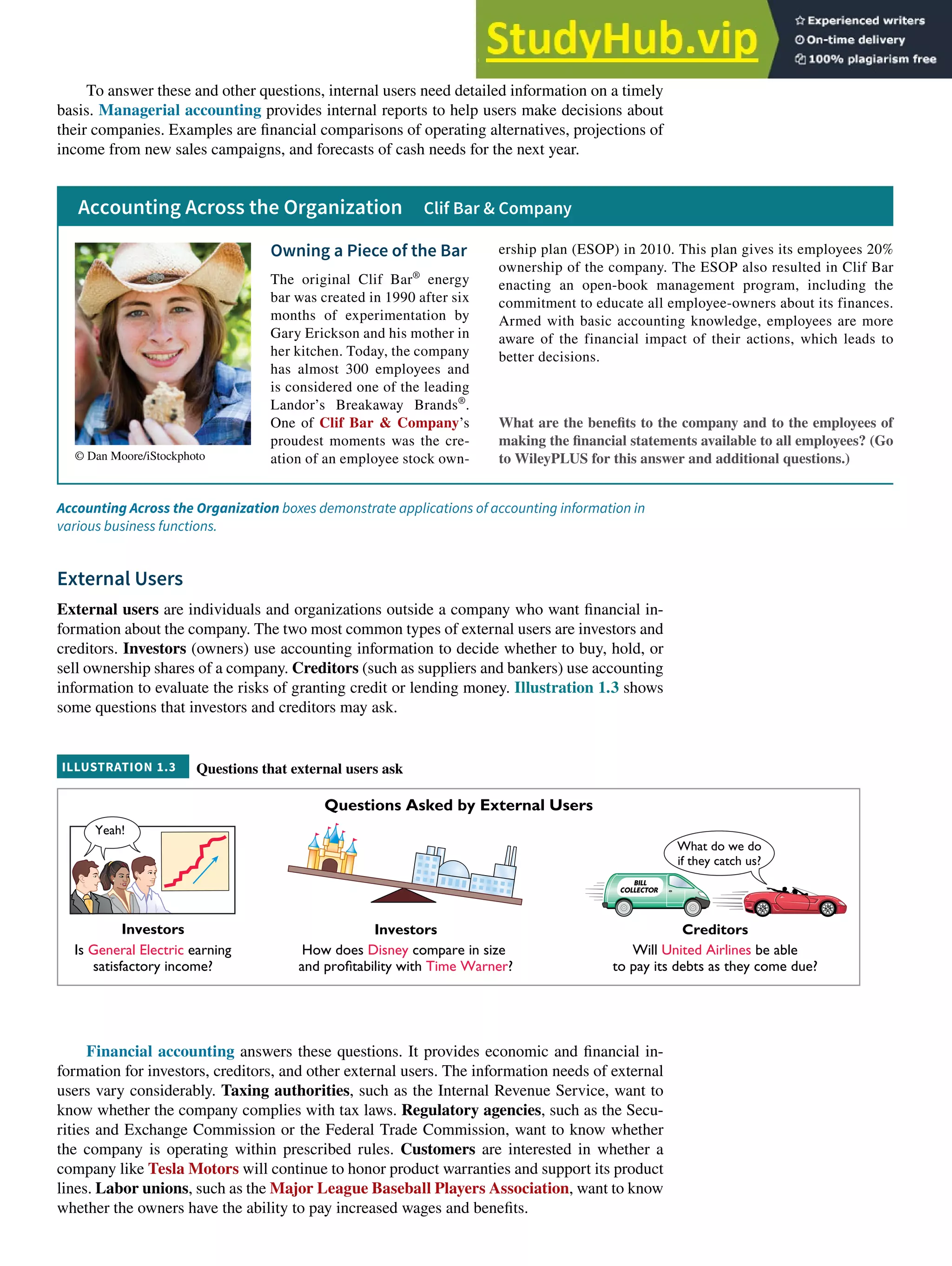
information to evaluate the risks of granting credit or lending money. Illustration 1.3 shows
some questions that investors and creditors may ask.
What do we do
if they catch us?
BILL
COLLECTOR
Yeah!
Questions Asked by External Users
Is General Electric earning
satisfactory income?
Investors
How does Disney compare in size
and profitability with Time Warner?
Investors
Will United Airlines be able
to pay its debts as they come due?
Creditors
ILLUSTRATION 1.3 Questions that external users ask
Financial accounting answers these questions. It provides economic and financial in-
formation for investors, creditors, and other external users. The information needs of external
users vary considerably. Taxing authorities, such as the Internal Revenue Service, want to
know whether the company complies with tax laws. Regulatory agencies, such as the Secu-
rities and Exchange Commission or the Federal Trade Commission, want to know whether
the company is operating within prescribed rules. Customers are interested in whether a
company like Tesla Motors will continue to honor product warranties and support its product
lines. Labor unions, such as the Major League Baseball Players Association, want to know
whether the owners have the ability to pay increased wages and benefits.
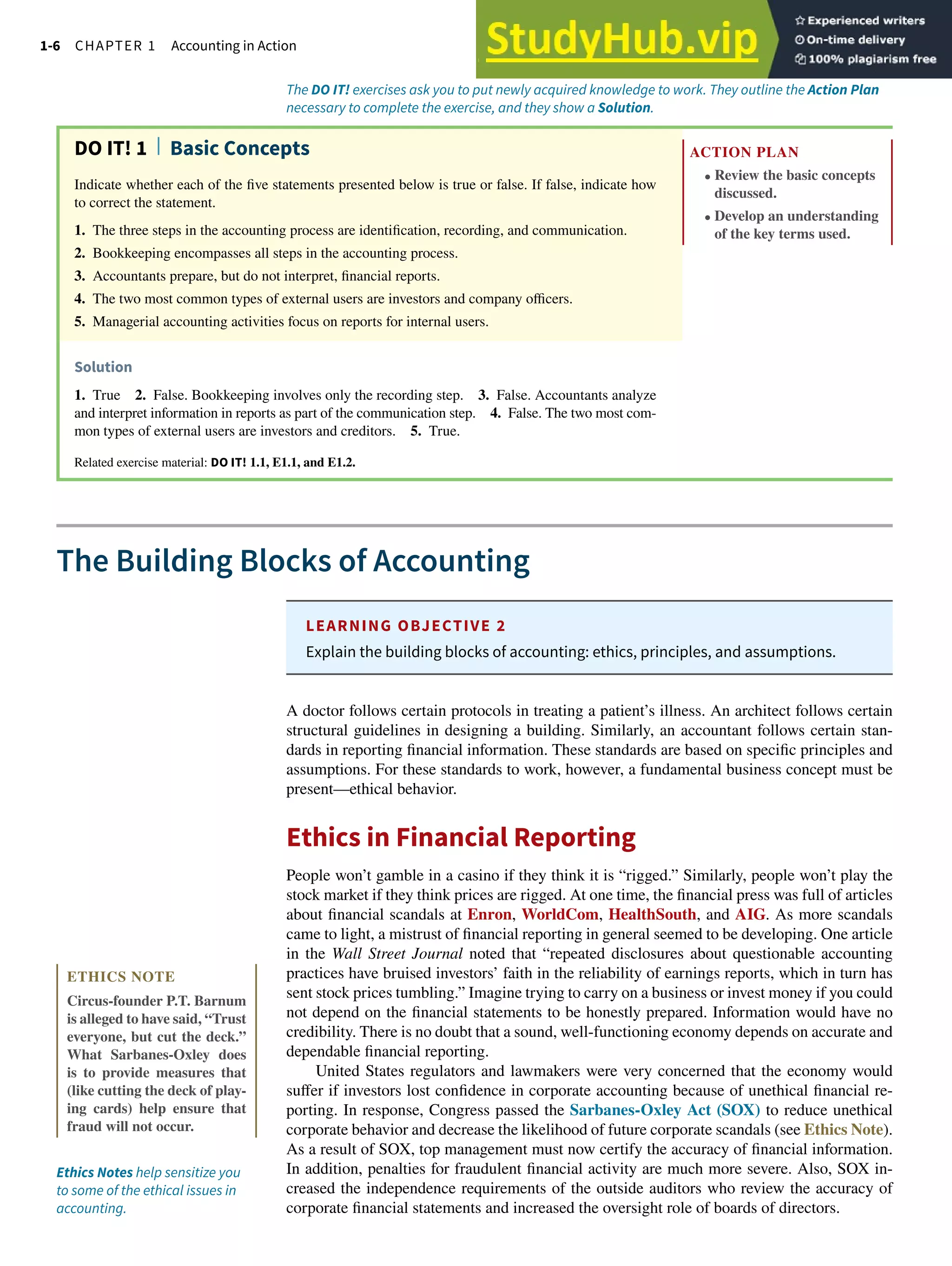
Accounting Across the Organization Clif Bar & Company
Owning a Piece of the Bar
The original Clif Bar®
energy
bar was created in 1990 after six
months of experimentation by
Gary Erickson and his mother in
her kitchen. Today, the company
has almost 300 employees and
is considered one of the leading
Landor’s Breakaway Brands®
.
One of Clif Bar & Company’s
proudest moments was the cre-
ation of an employee stock own-
ership plan (ESOP) in 2010. This plan gives its employees 20%
ownership of the company. The ESOP also resulted in Clif Bar
enacting an open-book management program, including the
commitment to educate all employee-owners about its finances.
Armed with basic accounting knowledge, employees are more
aware of the financial impact of their actions, which leads to
better decisions.
What are the benefits to the company and to the employees of
making the financial statements available to all employees? (Go
to WileyPLUS for this answer and additional questions.)
© Dan Moore/iStockphoto
Accounting Across the Organization boxes demonstrate applications of accounting information in
various business functions.
To answer these and other questions, internal users need detailed information on a timely
basis. Managerial accounting provides internal reports to help users make decisions about
their companies. Examples are financial comparisons of operating alternatives, projections of
income from new sales campaigns, and forecasts of cash needs for the next year.
1-6 CHAPTER 1 Accounting in Action
DO IT! 1 Basic Concepts
Indicate whether each of the five statements presented below is true or false. If false, indicate how
to correct the statement.
1. The three steps in the accounting process are identification, recording, and communication.
2. Bookkeeping encompasses all steps in the accounting process.
3. Accountants prepare, but do not interpret, financial reports.
4. The two most common types of external users are investors and company officers.
5. Managerial accounting activities focus on reports for internal users.
ACTION PLAN
• Review the basic concepts
discussed.
• Develop an understanding
of the key terms used.
Solution
1. True 2. False. Bookkeeping involves only the recording step. 3. False. Accountants analyze
and interpret information in reports as part of the communication step. 4. False. The two most com-
mon types of external users are investors and creditors. 5. True.
Related exercise material: DO IT! 1.1, E1.1, and E1.2.
The DO IT! exercises ask you to put newly acquired knowledge to work. They outline the Action Plan
necessary to complete the exercise, and they show a Solution.
The Building Blocks of Accounting
LEARNING OBJECTIVE 2
Explain the building blocks of accounting: ethics, principles, and assumptions.
A doctor follows certain protocols in treating a patient’s illness. An architect follows certain
structural guidelines in designing a building. Similarly, an accountant follows certain stan-
dards in reporting financial information. These standards are based on specific principles and
assumptions. For these standards to work, however, a fundamental business concept must be
present—ethical behavior.
Ethics in Financial Reporting
People won’t gamble in a casino if they think it is “rigged.” Similarly, people won’t play the
stock market if they think prices are rigged. At one time, the financial press was full of articles
about financial scandals at Enron, WorldCom, HealthSouth, and AIG. As more scandals
came to light, a mistrust of financial reporting in general seemed to be developing. One article
in the Wall Street Journal noted that “repeated disclosures about questionable accounting
practices have bruised investors’ faith in the reliability of earnings reports, which in turn has
sent stock prices tumbling.” Imagine trying to carry on a business or invest money if you could
not depend on the financial statements to be honestly prepared. Information would have no
credibility. There is no doubt that a sound, well-functioning economy depends on accurate and
dependable financial reporting.
United States regulators and lawmakers were very concerned that the economy would
suffer if investors lost confidence in corporate accounting because of unethical financial re-
porting. In response, Congress passed the Sarbanes-Oxley Act (SOX) to reduce unethical
corporate behavior and decrease the likelihood of future corporate scandals (see Ethics Note).
As a result of SOX, top management must now certify the accuracy of financial information.
In addition, penalties for fraudulent financial activity are much more severe. Also, SOX in-
creased the independence requirements of the outside auditors who review the accuracy of
corporate financial statements and increased the oversight role of boards of directors.
ETHICS NOTE
Circus-founder P.T. Barnum
is alleged to have said, “Trust
everyone, but cut the deck.”
What Sarbanes-Oxley does
is to provide measures that
(like cutting the deck of play-
ing cards) help ensure that
fraud will not occur.
Ethics Notes help sensitize you
to some of the ethical issues in
accounting.
The Building Blocks of Accounting 1-7
The standards of conduct by which actions are judged as right or wrong, honest or dishon-
est, fair or not fair, are ethics. Effective financial reporting depends on sound ethical behavior.
To sensitize you to ethical situations in business and to give you practice at solving ethical
dilemmas, we address ethics in a number of ways in this textbook:
1. A number of the Feature Stories and other parts of the textbook discuss the central impor-
tance of ethical behavior to financial reporting.
2. Ethics Insight boxes and marginal Ethics Notes highlight ethics situations and issues in
actual business settings.
3. Many of the People, Planet, and Profit Insight boxes focus on ethical issues that compa-
nies face in measuring and reporting social and environmental issues.
4. At the end of the chapter, an Ethics Case simulates a business situation and asks you to
put yourself in the position of a decision-maker in that case.
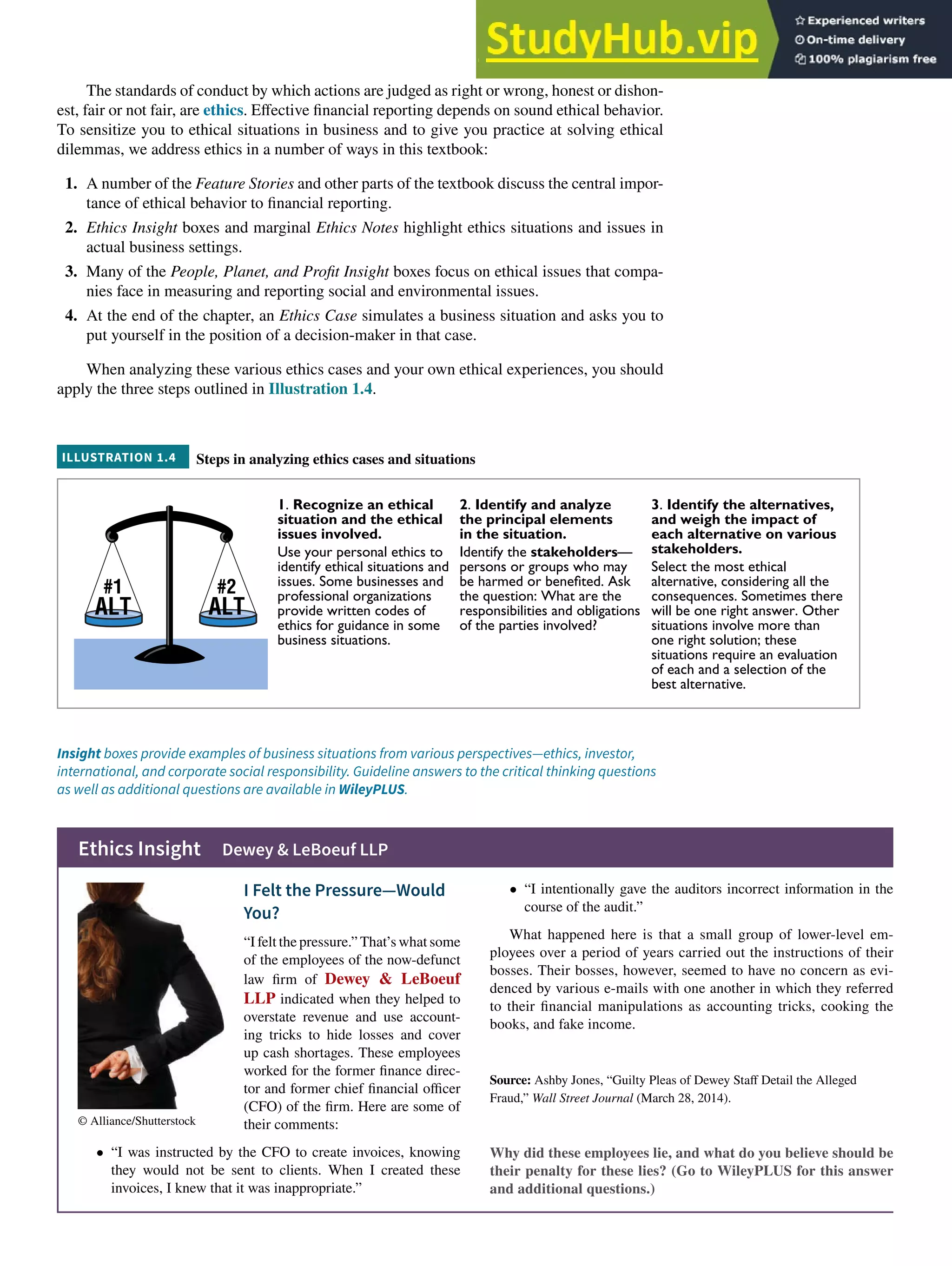
When analyzing these various ethics cases and your own ethical experiences, you should
apply the three steps outlined in Illustration 1.4.
#1
ALT
#2
ALT
2. Identify and analyze
the principal elements
in the situation.
Identify the stakeholders—
persons or groups who may
be harmed or benefited. Ask
the question: What are the
responsibilities and obligations
of the parties involved?
3. Identify the alternatives,
and weigh the impact of
each alternative on various
stakeholders.
Select the most ethical
alternative, considering all the
consequences. Sometimes there
will be one right answer. Other
situations involve more than
one right solution; these
situations require an evaluation
of each and a selection of the
best alternative.
1. Recognize an ethical
situation and the ethical
issues involved.
Use your personal ethics to
identify ethical situations and
issues. Some businesses and
professional organizations
provide written codes of
ethics for guidance in some
business situations.
ILLUSTRATION 1.4 Steps in analyzing ethics cases and situations
Insight boxes provide examples of business situations from various perspectives—ethics, investor,
international, and corporate social responsibility. Guideline answers to the critical thinking questions
as well as additional questions are available in WileyPLUS.
© Alliance/Shutterstock
Ethics Insight Dewey & LeBoeuf LLP
I Felt the Pressure—Would
You?
“I felt the pressure.” That’s what some
of the employees of the now-defunct
law firm of Dewey & LeBoeuf
LLP indicated when they helped to
overstate revenue and use account-
ing tricks to hide losses and cover
up cash shortages. These employees
worked for the former finance direc-
tor and former chief financial officer
(CFO) of the firm. Here are some of
their comments:
• “I was instructed by the CFO to create invoices, knowing
they would not be sent to clients. When I created these
invoices, I knew that it was inappropriate.”
• “I intentionally gave the auditors incorrect information in the
course of the audit.”
What happened here is that a small group of lower-level em-
ployees over a period of years carried out the instructions of their
bosses. Their bosses, however, seemed to have no concern as evi-
denced by various e-mails with one another in which they referred
to their financial manipulations as accounting tricks, cooking the
books, and fake income.
Source: Ashby Jones, “Guilty Pleas of Dewey Staff Detail the Alleged
Fraud,” Wall Street Journal (March 28, 2014).
Why did these employees lie, and what do you believe should be
their penalty for these lies? (Go to WileyPLUS for this answer
and additional questions.)
1-8 CHAPTER 1 Accounting in Action
Generally Accepted Accounting Principles
The accounting profession has developed standards that are generally accepted and universally
practiced. This common set of standards is called generally accepted accounting principles
(GAAP). These standards indicate how to report economic events.
The primary accounting standard-setting body in the United States is the Financial
Accounting Standards Board (FASB). The Securities and Exchange Commission (SEC)
is the agency of the U.S. government that oversees U.S. financial markets and accounting
standard-setting bodies. The SEC relies on the FASB to develop accounting standards, which
public companies must follow. Many countries outside of the United States have adopted the
accounting standards issued by the International Accounting Standards Board (IASB).
These standards are called International Financial Reporting Standards (IFRS) (see
International Note).
As markets become more global, it is often desirable to compare the results of companies
from different countries that report using different accounting standards. In order to increase
comparability, in recent years the two standard-setting bodies have made efforts to reduce the
differences between U.S. GAAP and IFRS. This process is referred to as convergence. As a
result of these convergence efforts, someday there may be a single set of high-quality account-
ing standards that are used by companies around the world. Because convergence is such an
important issue, we highlight any major differences between GAAP and IFRS in International
Notes (as shown in the margin here) and provide a more in-depth discussion in the A Look at
IFRS section at the end of each chapter.
International Notes highlight
differences between U.S. and
international accounting
standards.
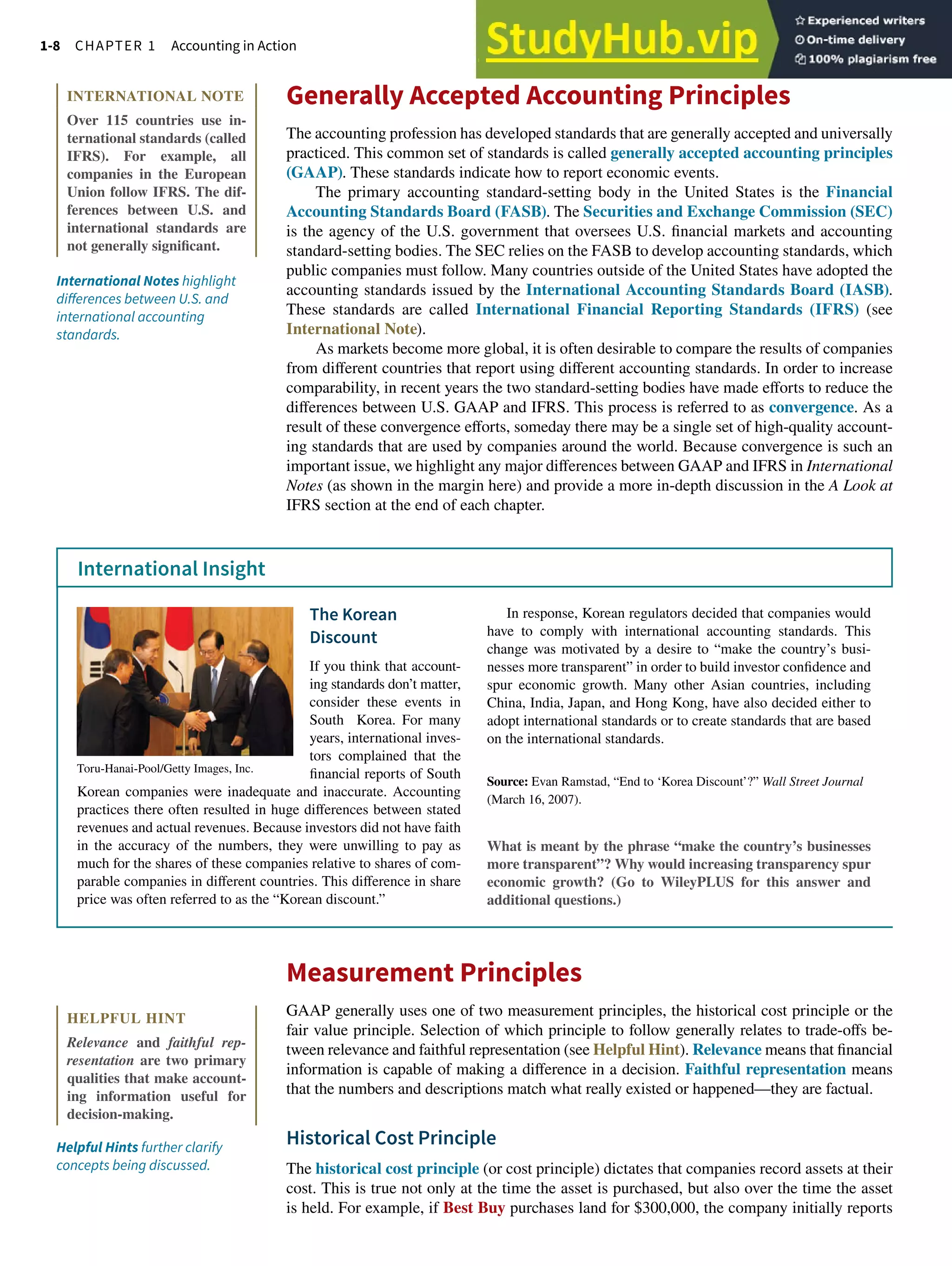
The Korean
Discount
If you think that account-
ing standards don’t matter,
consider these events in
South Korea. For many
years, international inves-
tors complained that the
financial reports of South
Korean companies were inadequate and inaccurate. Accounting
practices there often resulted in huge differences between stated
revenues and actual revenues. Because investors did not have faith
in the accuracy of the numbers, they were unwilling to pay as
much for the shares of these companies relative to shares of com-
parable companies in different countries. This difference in share
price was often referred to as the “Korean discount.”
In response, Korean regulators decided that companies would
have to comply with international accounting standards. This
change was motivated by a desire to “make the country’s busi-
nesses more transparent” in order to build investor confidence and
spur economic growth. Many other Asian countries, including
China, India, Japan, and Hong Kong, have also decided either to
adopt international standards or to create standards that are based
on the international standards.
Source: Evan Ramstad, “End to ‘Korea Discount’?” Wall Street Journal
(March 16, 2007).
What is meant by the phrase “make the country’s businesses
more transparent”? Why would increasing transparency spur
economic growth? (Go to WileyPLUS for this answer and
additional questions.)
Toru-Hanai-Pool/Getty Images, Inc.
Measurement Principles
GAAP generally uses one of two measurement principles, the historical cost principle or the
fair value principle. Selection of which principle to follow generally relates to trade-offs be-
tween relevance and faithful representation (see Helpful Hint). Relevance means that financial
information is capable of making a difference in a decision. Faithful representation means
that the numbers and descriptions match what really existed or happened—they are factual.
Historical Cost Principle
The historical cost principle (or cost principle) dictates that companies record assets at their
cost. This is true not only at the time the asset is purchased, but also over the time the asset
is held. For example, if Best Buy purchases land for $300,000, the company initially reports
HELPFUL HINT
Relevance and faithful rep-
resentation are two primary
qualities that make account-
ing information useful for
decision-making.
Helpful Hints further clarify
concepts being discussed.
INTERNATIONAL NOTE
Over 115 countries use in-
ternational standards (called
IFRS). For example, all
companies in the European
Union follow IFRS. The dif-
ferences between U.S. and
international standards are
not generally significant.
International Insight
The Building Blocks of Accounting 1-9
it in its accounting records at $300,000. But what does Best Buy do if, by the end of the next
year, the fair value of the land has increased to $400,000? Under the historical cost principle,
it continues to report the land at $300,000.
Fair Value Principle
The fair value principle states that assets and liabilities should be reported at fair value (the
price received to sell an asset or settle a liability). Fair value information may be more useful
than historical cost for certain types of assets and liabilities. For example, certain investment
securities are reported at fair value because market price information is usually readily avail-
able for these types of assets. In determining which measurement principle to use, companies
weigh the factual nature of cost figures versus the relevance of fair value. In general, most
companies choose to use cost. Only in situations where assets are actively traded, such as
investment securities, do companies apply the fair value principle extensively.
Assumptions
Assumptions provide a foundation for the accounting process. Two main assumptions are the
monetary unit assumption and the economic entity assumption.
Monetary Unit Assumption
The monetary unit assumption requires that companies include in the accounting records
only transaction data that can be expressed in money terms. This assumption enables account-
ing to quantify (measure) economic events. The monetary unit assumption is vital to applying
the historical cost principle.
This assumption prevents the inclusion of some relevant information in the accounting
records. For example, the health of a company’s owner, the quality of service, and the morale
of employees are not included. The reason: Companies cannot quantify this information in
money terms. Though this information is important, companies record only events that can be
measured in money.
Economic Entity Assumption
An economic entity can be any organization or unit in society. It may be a company (such as
Crocs, Inc.), a governmental unit (the state of Ohio), a municipality (Seattle), a school district
(St. Louis District 48), or a church (Southern Baptist). The economic entity assumption requires
that the activities of the entity be kept separate and distinct from the activities of its owner and all
other economic entities (see Ethics Note). To illustrate, Sally Rider, owner of Sally’s Boutique,
must keep her personal living costs separate from the expenses of the business. Similarly, J. Crew
and Gap Inc. are segregated into separate economic entities for accounting purposes.
Proprietorship. A business owned by one person is generally a proprietorship. The
owner is often the manager/operator of the business. Small service-type businesses (plumbing
companies, beauty salons, and auto repair shops), farms, and small retail stores (antique shops,
clothing stores, and used-book stores) are often proprietorships. Usually, only a relatively
small amount of money (capital) is necessary to start in business as a proprietorship. The
owner (proprietor) receives any profits, suffers any losses, and is personally liable for all
debts of the business. There is no legal distinction between the business as an economic unit
and the owner, but the accounting records of the business activities are kept separate from the
personal records and activities of the owner.
Partnership. A business owned by two or more persons associated as partners is a part-
nership. In most respects a partnership is like a proprietorship except that more than one
owner is involved. Typically, a partnership agreement (written or oral) sets forth such terms as
initial investment, duties of each partner, division of net income (or net loss), and settlement to
ETHICS NOTE
The importance of the eco-
nomic entity assumption is
illustrated by scandals in-
volving Adelphia. In this
case, senior company em-
ployees entered into transac-
tions that blurred the line
between the employees’ fi-
nancial interests and those of
the company. For example,
Adelphia guaranteed over $2
billion of loans to the found-
ing family.
1-10 CHAPTER 1 Accounting in Action
be made upon death or withdrawal of a partner. Each partner generally has unlimited personal
liability for the debts of the partnership. Like a proprietorship, for accounting purposes
the partnership transactions must be kept separate from the personal activities of the
partners. Partnerships are often used to organize retail and service-type businesses, including
professional practices (lawyers, doctors, architects, and certified public accountants).
Corporation. A business organized as a separate legal entity under state corporation law
and having ownership divided into transferable shares of stock is a corporation. The holders
of the shares (stockholders) enjoy limited liability; that is, they are not personally liable for
the debts of the corporate entity. Stockholders may transfer all or part of their ownership
shares to other investors at any time (i.e., sell their shares). The ease with which ownership
can change adds to the attractiveness of investing in a corporation. Because ownership can
be transferred without dissolving the corporation, the corporation enjoys an unlimited life.
Although the combined number of proprietorships and partnerships in the United States
is more than five times the number of corporations, the revenue produced by corporations is
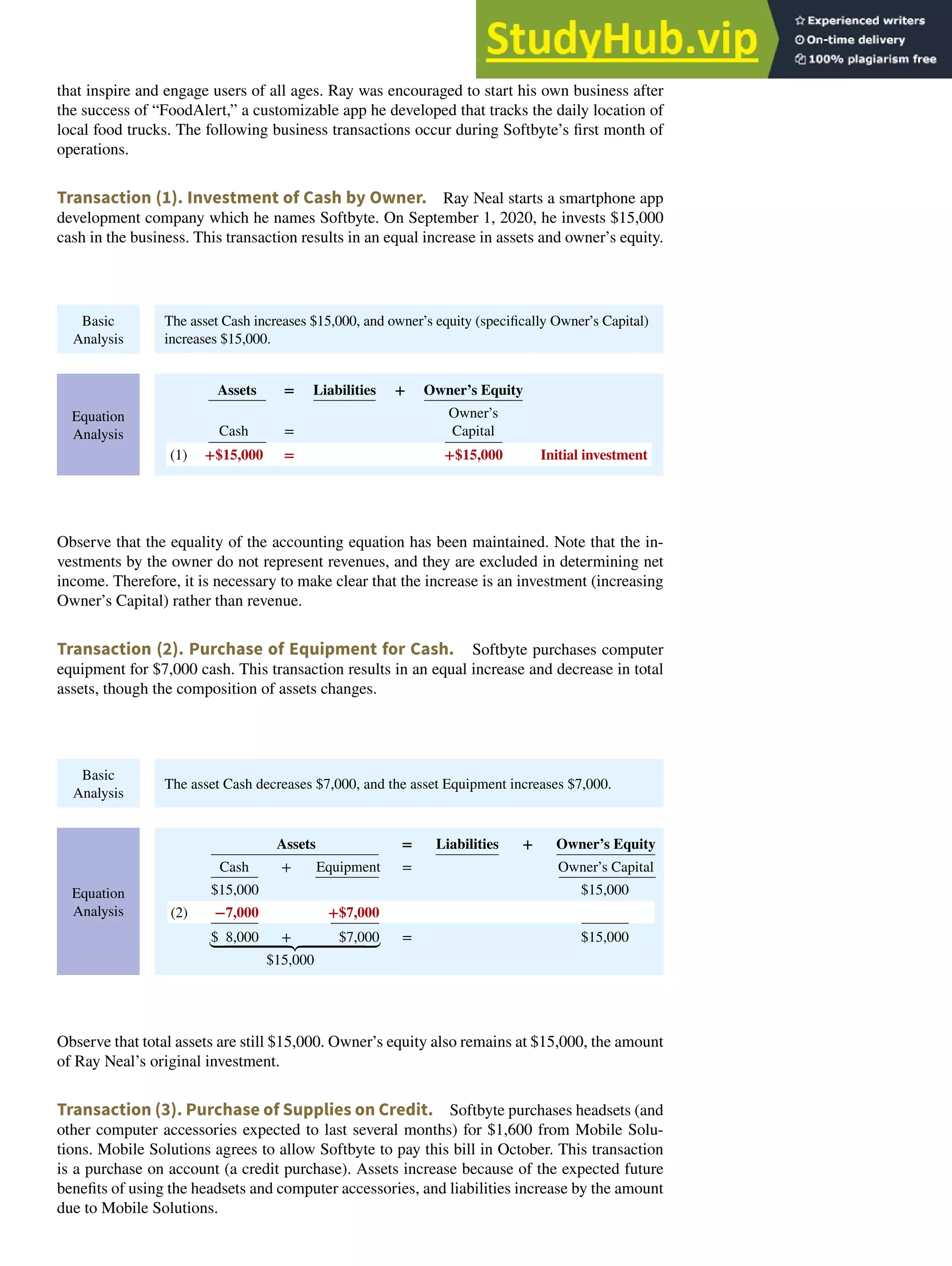
eight times greater. Most of the largest companies in the United States—for example, Exxon-
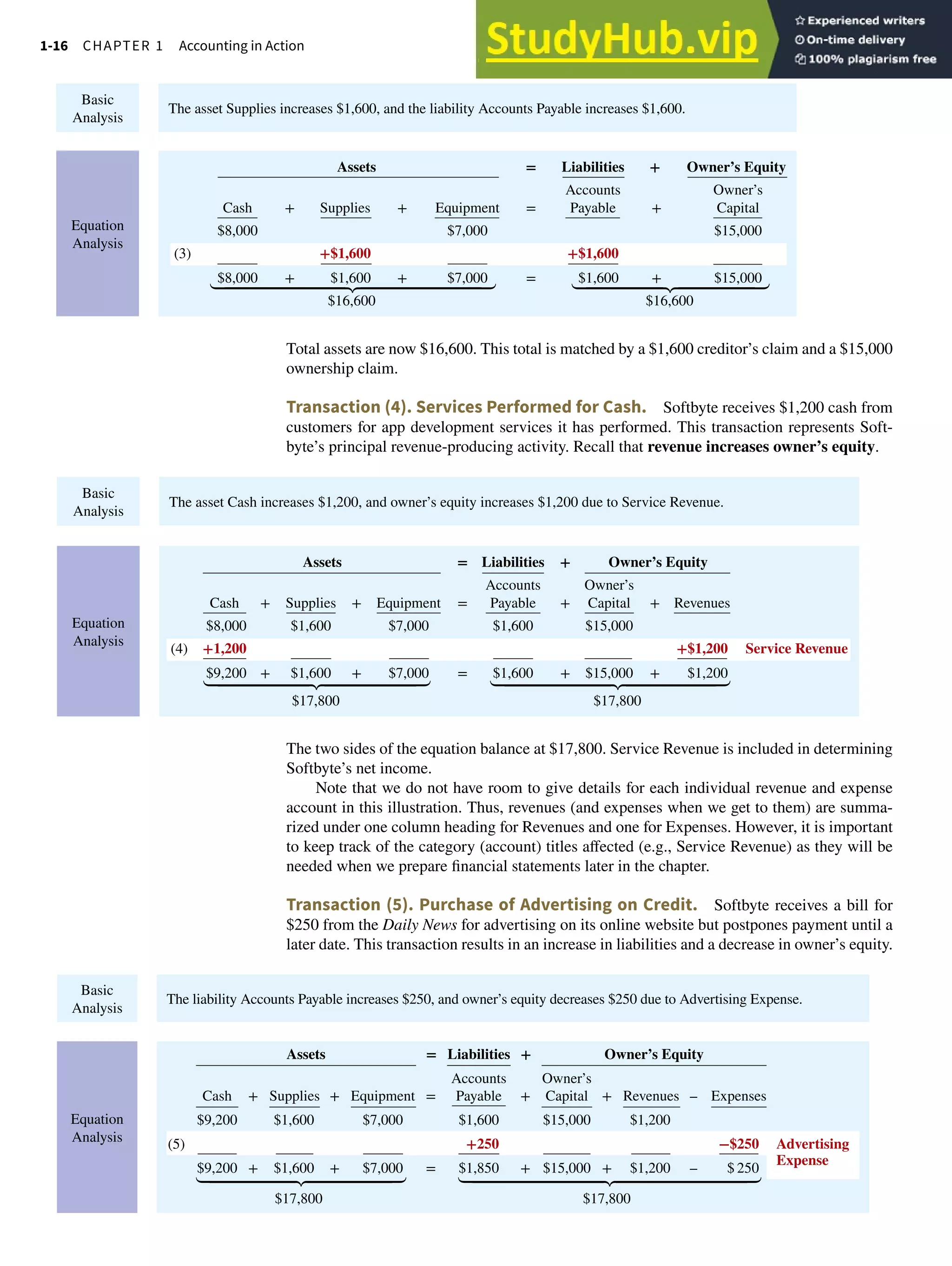
Mobil, Ford, Wal-Mart Stores, Inc., Citigroup, and Apple—are corporations.
Accounting Across the Organization
Spinning the Career
Wheel
How will the study of accounting
help you? A working knowledge
of accounting is desirable for
virtually every field of business.
Some examples of how accounting
is used in business careers include:
General management: Man-
agers at Ford Motors, Massachu-
setts General Hospital, California
State University—Fullerton, a
McDonald’s franchise, and a Trek
bike shop all need to understand
accounting data in order to make
wise business decisions.
Marketing: Marketing specialists at Procter & Gamble must be
sensitive to costs and benefits, which accounting helps them quantify
and understand. Making a sale is meaningless unless it is a profit-
able sale.
Finance: Do you want to be a banker for Citicorp, an investment
analyst for Goldman Sachs, or a stock broker for Merrill Lynch?
These fields rely heavily on accounting knowledge to analyze finan-
cial statements. In fact, it is difficult to get a good job in a finance
function without two or three courses in accounting.
Real estate: Are you interested in being a real estate broker for
Prudential Real Estate? Because a third party—the bank—is al-
most always involved in financing a real estate transaction, brokers
must understand the numbers involved: Can the buyer afford to
make the payments to the bank? Does the cash flow from an indus-
trial property justify the purchase price? What are the tax benefits
of the purchase?
How might accounting help you? (Go to WileyPLUS for this
answer and additional questions.)
Josef Volavka/iStockphoto
DO IT! 2 Building Blocks of Accounting
Indicate whether each of the five statements presented below is true or false. If false, indicate how
to correct the statement.
1. Congress passed the Sarbanes-Oxley Act to reduce unethical behavior and decrease the likeli-
hood of future corporate scandals.
2. The primary accounting standard-setting body in the United States is the Financial Accounting
Standards Board (FASB).
3. The historical cost principle dictates that companies record assets at their cost. In later periods,
however, the fair value of the asset must be used if fair value is higher than its cost.
4. Relevance means that financial information matches what really happened; the information is factual.
5. A business owner’s personal expenses must be separated from expenses of the business to comply
with accounting’s economic entity assumption.
ACTION PLAN
• Review the discussion
of ethics and financial
reporting standards.
• Develop an understanding
of the key terms used.
The Accounting Equation 1-11
Solution
1. True. 2. True. 3. False. The historical cost principle dictates that companies record assets at
their cost. Under the historical cost principle, the company must also use cost in later periods. 4. False.
Faithful representation, not relevance, means that financial information matches what really happened;
the information is factual. 5. True.
Related exercise material: DO IT! 1.2, E1.3, and E1.4.
The Accounting Equation
LEARNING OBJECTIVE 3
State the accounting equation, and define its components.
The two basic elements of a business are what it owns and what it owes. Assets are the re-
sources a business owns. For example, Alphabet Inc. has total assets of approximately $167.5
billion. Liabilities and owner’s equity are the rights or claims against these resources. Thus,
Alphabet has $167.5 billion of claims against its $167.5 billion of assets. Claims of those to
whom the company owes money (creditors) are called liabilities. Claims of owners are called
owner’s equity. Alphabet has liabilities of $28.5 billion and owners’ equity of $139.0 billion.
We can express the relationship of assets, liabilities, and owner’s equity as an equation, as
shown in Illustration 1.5.
Assets = Liabilities + Owner’s Equity ILLUSTRATION 1.5
The basic accounting equation
This relationship is the basic accounting equation. Assets must equal the sum of liabilities
and owner’s equity. Liabilities appear before owner’s equity in the basic accounting equation
because they are paid first if a business is liquidated.
The accounting equation applies to all economic entities regardless of size, nature of
business, or form of business organization. It applies to a small proprietorship such as a corner
grocery store as well as to a giant corporation such as PepsiCo. The equation provides the
underlying framework for recording and summarizing economic events.
Let’s look in more detail at the categories in the basic accounting equation.
Assets
As noted above, assets are resources a business owns. The business uses its assets in carrying
out such activities as production and sales. The common characteristic possessed by all assets
is the capacity to provide future services or benefits. In a business, that service potential
or future economic benefit eventually results in cash inflows (receipts). For example, consider
Campus Pizza, a local restaurant. It owns a delivery truck that provides economic benefits
from delivering pizzas. Other assets of Campus Pizza are tables, chairs, jukebox, cash register,
oven, tableware, and, of course, cash.
Liabilities
Liabilities are claims against assets—that is, existing debts and obligations. Businesses of all
sizes usually borrow money and purchase merchandise on credit. These economic activities
result in payables of various sorts:
• Campus Pizza, for instance, purchases cheese, sausage, flour, and beverages on credit
from suppliers. These obligations are called accounts payable.
1-12 CHAPTER 1 Accounting in Action
• Campus Pizza also has a note payable to First National Bank for the money borrowed
to purchase the delivery truck.
• Campus Pizza may also have salaries and wages payable to employees and sales and
real estate taxes payable to the local government.
All of these persons or entities to whom Campus Pizza owes money are its creditors.
Creditors may legally force the liquidation of a business that does not pay its debts. In that
case, the law requires that creditor claims be paid before ownership claims.
Owner’s Equity
The ownership claim on total assets is owner’s equity (see Helpful Hint). It is equal to to-
tal assets minus total liabilities. Here is why: The assets of a business are claimed by either
creditors or owners. To find out what belongs to owners, we subtract the creditors’ claims (the
liabilities) from assets. The remainder is the owner’s claim on the assets—the owner’s equity.
Since the claims of creditors must be paid before ownership claims, owner’s equity is often
referred to as residual equity.
Increases in Owner’s Equity
In a proprietorship, owner’s investments and revenues increase owner’s equity.
Investments by Owner. Investments by owner are the assets the owner puts into the
business. These investments increase owner’s equity. They are recorded in a category called
owner’s capital.
Revenues. Revenues are the increases in assets or decreases in liabilities resulting
from the sale of goods or the performance of services in the normal course of business.
Revenues usually result in an increase in an asset. They may arise from different sources
and are called different names depending on the nature of the business. Campus Pizza, for
instance, has two categories of sales revenues—pizza sales and beverage sales.
Decreases in Owner’s Equity
In a proprietorship, owner’s drawings and expenses decrease owner’s equity.
Drawings. An owner may withdraw cash or other assets for personal use. We use a sep-
arate classification called drawings to determine the total withdrawals for each accounting
period. Drawings decrease owner’s equity. They are recorded in a category called owner’s
drawings.
Expenses. Expenses are the cost of assets consumed or services used in the process of
generating revenue. They are decreases in owner’s equity that result from operating the
business. For example, Campus Pizza recognizes the following expenses: cost of ingredients
(meat, flour, cheese, tomato paste, mushrooms, etc.); cost of beverages; salaries and wages
expense; utilities expense (electric, gas, and water expense); delivery expense (gasoline, re-
pairs, licenses, etc.); supplies expense (napkins, detergents, aprons, etc.); rent expense; inter-
est expense; and property tax expense.
In summary, owner’s equity is increased by an owner’s investments and by revenues
from business operations. Owner’s equity is decreased by an owner’s withdrawals of assets
and by expenses. Illustration 1.6 expands the basic accounting equation by showing the
items that comprise owner’s equity. This format is referred to as the expanded accounting
equation.
HELPFUL HINT
In some places, we use the
term “owner’s equity” and
in others we use “owners’ eq-
uity.” Owner’s (singular, pos-
sessive) refers to one owner
(the case with a sole propri-
etorship). Owners’ (plural,
possessive) refers to multiple
owners (the case with part-
nerships or corporations).
Analyzing Business Transactions 1-13
ILLUSTRATION 1.6 Expanded accounting equation
Basic Equation Assets = Liabilities + Owner’s Equity
Expanded Equation Assets = Liabilities +
Owner’s
−
Owner’s
+ Revenues − Expenses
Capital Drawings
DO IT! 3 Owner’s Equity Effects
Classify the following items as investment by owner (I), owner’s drawings (D), revenues (R), or
expenses (E). Then indicate whether each item increases or decreases owner’s equity.
1. Rent Expense. 3. Drawings.
2. Service Revenue. 4. Salaries and Wages Expense.
ACTION PLAN
• Understand the sources of
revenue.
• Understand what causes
expenses.
• Review the rules for
changes in owner’s equity.
• Recognize that drawings
are withdrawals of cash
or other assets from the
business for personal use.
Solution
1. Rent Expense is an expense (E); it decreases owner’s equity. 2. Service Revenue is revenue (R); it
increases owner’s equity. 3. Drawings is owner’s drawings (D); it decreases owner’s equity. 4. Sala-
ries and Wages Expense is an expense (E); it decreases owner’s equity.
Related exercise material: BE1.1, BE1.2, BE1.3, BE1.4, BE1.5, BE1.6, DO IT! 1.3, and E1.5.
Analyzing Business Transactions
LEARNING OBJECTIVE 4
Analyze the effects of business transactions on the accounting equation.
The system of collecting and processing transaction data and communicating financial in-
formation to decision-makers is known as the accounting information system. Factors that
shape an accounting information system include the nature of the company’s business, the
types of transactions, the size of the company, the volume of data, and the information demands
of management and others.
Most businesses use computerized accounting systems—sometimes referred to as elec-
tronic data processing (EDP) systems. These systems handle all the steps involved in the
recording process, from initial data entry to preparation of the financial statements. In order
to remain competitive, companies continually improve their accounting systems to provide
accurate and timely data for decision-making. For example, in a recent annual report, Tootsie
Roll stated, “We also invested in additional processing and data storage hardware during the
year. We view information technology as a key strategic tool, and are committed to deploying
leading edge technology in this area.” In addition, many companies have upgraded their ac-
counting information systems in response to the requirements of Sarbanes-Oxley.
Accounting information systems rely on a process referred to as the accounting cycle. As
you can see from the graphic above, the accounting cycle begins with the analysis of business
transactions and ends with the preparation of a post-closing trial balance. We explain each of
the steps, starting in this chapter and continuing in Chapters 2–4.
JOURNALIZE POST
TRIAL
BALANCE
ADJUSTING
ENTRIES
ADJUSTED
TRIAL
BALANCE
FINANCIAL
STATEMENTS
CLOSING
ENTRIES
POST-CLOSING
TRIAL BALANCE
JO
J
Analyze
business
transactions
This accounting cycle graphic
illustrates the steps companies
follow each period to record
transactions and eventually
prepare financial statements.
1-14 CHAPTER 1 Accounting in Action
In this textbook, in order to emphasize the underlying concepts and principles, we fo-
cus on a manual accounting system. The accounting concepts and principles do not change
whether a system is computerized or manual.
Accounting Transactions
Transactions (business transactions) are a business’s economic events recorded by accountants.
Transactions may be external or internal. External transactions involve economic events between
the company and some outside enterprise. For example, Campus Pizza’s purchase of cooking
equipment from a supplier, payment of monthly rent to the landlord, and sale of pizzas to custom-
ers are external transactions. Internal transactions are economic events that occur entirely within
one company. The use of cooking and cleaning supplies are internal transactions for Campus Pizza.
Companies carry on many activities that do not represent business transactions. Examples
are hiring employees, responding to e-mails, talking with customers, and placing merchandise
orders. Some of these activities may lead to business transactions. Employees will earn wages,
and suppliers will deliver ordered merchandise. The company must analyze each event to find
out if it affects the components of the accounting equation. If it does, the company will record
the transaction. Illustration 1.7 demonstrates the transaction identification process.
RENT
CHIP CITY
DELL
Yes
No
Yes
Events
Criterion
Record/
Don’t Record
Pay rent
Discuss product design with
potential customer
Purchase computer
Is the financial position (assets, liabilities, or owner’s equity) of the company changed?
ILLUSTRATION 1.7 Transaction identification process
Each transaction must have a dual effect on the accounting equation. For example, if an
asset is increased, there must be a corresponding:
• Decrease in another asset, or
• Increase in a specific liability, or
• Increase in owner’s equity.
Two or more items could be affected. For example, as one asset is increased $10,000,
another asset could decrease $6,000 and a liability could increase $4,000. Any change in a
liability or ownership claim is subject to similar analysis.
Transaction Analysis
To demonstrate how to analyze transactions in terms of the accounting equation, we will re-
view the business activities of Softbyte, a smartphone app development company (see Helpful
Hint). Softbyte is the creation of Ray Neal, an entrepreneur who wants to create focused apps
HELPFUL HINT
Study these transactions until
you are sure you understand
them. They are not difficult,
but understanding them is
important to your success in
this course. The ability to an-
alyze transactions in terms of
the basic accounting equation
is essential in accounting.
Analyzing Business Transactions 1-15
that inspire and engage users of all ages. Ray was encouraged to start his own business after
the success of “FoodAlert,” a customizable app he developed that tracks the daily location of
local food trucks. The following business transactions occur during Softbyte’s first month of
operations.
Transaction (1). Investment of Cash by Owner. Ray Neal starts a smartphone app
development company which he names Softbyte. On September 1, 2020, he invests $15,000
cash in the business. This transaction results in an equal increase in assets and owner’s equity.
Observe that the equality of the accounting equation has been maintained. Note that the in-
vestments by the owner do not represent revenues, and they are excluded in determining net
income. Therefore, it is necessary to make clear that the increase is an investment (increasing
Owner’s Capital) rather than revenue.
Transaction (2). Purchase of Equipment for Cash. Softbyte purchases computer
equipment for $7,000 cash. This transaction results in an equal increase and decrease in total
assets, though the composition of assets changes.
The asset Cash increases $15,000, and owner’s equity (specifically Owner’s Capital)
increases $15,000.
Assets = Liabilities + Owner’s Equity
Owner’s
Cash = Capital
(1) +$15,000 = +$15,000 Initial investment
Basic
Analysis
Equation
Analysis
The asset Cash decreases $7,000, and the asset Equipment increases $7,000.
Basic
Analysis
Equation
Analysis
Assets = Liabilities + Owner’s Equity
Cash + Equipment = Owner’s Capital
$15,000 $15,000
(2) −7,000 +$7,000
$ 8,000 + $7,000 = $15,000
$15,000
⎧
⎪
⎪
⎪
⎪
⎨
⎪
⎪
⎪
⎪
⎩
Observe that total assets are still $15,000. Owner’s equity also remains at $15,000, the amount
of Ray Neal’s original investment.
Transaction (3). Purchase of Supplies on Credit. Softbyte purchases headsets (and
other computer accessories expected to last several months) for $1,600 from Mobile Solu-
tions. Mobile Solutions agrees to allow Softbyte to pay this bill in October. This transaction
is a purchase on account (a credit purchase). Assets increase because of the expected future
benefits of using the headsets and computer accessories, and liabilities increase by the amount
due to Mobile Solutions.
1-16 CHAPTER 1 Accounting in Action
Total assets are now $16,600. This total is matched by a $1,600 creditor’s claim and a $15,000
ownership claim.
Transaction (4). Services Performed for Cash. Softbyte receives $1,200 cash from
customers for app development services it has performed. This transaction represents Soft-
byte’s principal revenue-producing activity. Recall that revenue increases owner’s equity.
The asset Supplies increases $1,600, and the liability Accounts Payable increases $1,600.
Basic
Analysis
Equation
Analysis
Assets = Liabilities + Owner’s Equity
Accounts Owner’s
Cash + Supplies + Equipment = Payable + Capital
$8,000 $7,000 $15,000
(3) +$1,600 +$1,600
$8,000 + $1,600 + $7,000 = $1,600 + $15,000
$16,600 $16,600
⎧
⎪
⎪
⎪
⎪
⎪
⎪
⎪
⎪
⎨
⎪
⎪
⎪
⎪
⎪
⎪
⎪
⎪
⎩
⎧
⎪
⎪
⎪
⎪
⎪
⎨
⎪
⎪
⎪
⎪
⎪
⎩
The asset Cash increases $1,200, and owner’s equity increases $1,200 due to Service Revenue.
Basic
Analysis
Equation
Analysis
Assets = Liabilities + Owner’s Equity
Accounts Owner’s
Cash + Supplies + Equipment = Payable + Capital + Revenues
$8,000 $1,600 $7,000 $1,600 $15,000
(4) +1,200 +$1,200 Service Revenue
$9,200 + $1,600 + $7,000 = $1,600 + $15,000 + $1,200
$17,800 $17,800
⎧
⎪
⎪
⎪
⎪
⎪
⎪
⎨
⎪
⎪
⎪
⎪
⎪
⎪
⎩
⎧
⎪
⎪
⎪
⎪
⎪
⎪
⎪
⎨
⎪
⎪
⎪
⎪
⎪
⎪
⎩
The two sides of the equation balance at $17,800. Service Revenue is included in determining
Softbyte’s net income.
Note that we do not have room to give details for each individual revenue and expense
account in this illustration. Thus, revenues (and expenses when we get to them) are summa-
rized under one column heading for Revenues and one for Expenses. However, it is important
to keep track of the category (account) titles affected (e.g., Service Revenue) as they will be
needed when we prepare financial statements later in the chapter.
Transaction (5). Purchase of Advertising on Credit. Softbyte receives a bill for
$250 from the Daily News for advertising on its online website but postpones payment until a
later date. This transaction results in an increase in liabilities and a decrease in owner’s equity.
Basic
Analysis
The liability Accounts Payable increases $250, and owner’s equity decreases $250 due to Advertising Expense.
Equation
Analysis
Assets = Liabilities + Owner’s Equity
Accounts Owner’s
Cash + Supplies + Equipment = Payable + Capital + Revenues – Expenses
$9,200 $1,600 $7,000 $1,600 $15,000 $1,200
(5) +250 −$250 Advertising
Expense
$9,200 + $1,600 + $7,000 = $1,850 + $15,000 + $1,200 – $ 250
$17,800 $17,800
⎧
⎪
⎪
⎪
⎪
⎪
⎪
⎨
⎪
⎪
⎪
⎪
⎪
⎪
⎩
⎧
⎪
⎪
⎪
⎪
⎪
⎪
⎪
⎪
⎪
⎨
⎪
⎪
⎪
⎪
⎪
⎪
⎪
⎪
⎪
⎩
Analyzing Business Transactions 1-17
The two sides of the equation still balance at $17,800. Owner’s equity decreases when Soft-
byte incurs the expense. Expenses are not always paid in cash at the time they are incurred.
When Softbyte pays at a later date, the liability Accounts Payable will decrease, and the asset
Cash will decrease [see Transaction (8)]. The cost of advertising is an expense (rather than an
asset) because the company has used the benefits. Advertising Expense is included in deter-
mining net income.
Transaction (6). Services Performed for Cash and Credit. Softbyte performs
$3,500 of app development services for customers. The company receives cash of $1,500
from customers, and it bills the balance of $2,000 on account. This transaction results in an
equal increase in assets and owner’s equity.
Three specific items are affected: The asset Cash increases $1,500, the asset Accounts Receivable increases $2,000,
and owner’s equity increases $3,500 due to Service Revenue.
Basic
Analysis
Equation
Analysis
Assets = Liabilities + Owner’s Equity
Accounts Accounts Owner’s
Cash + Receivable + Supplies + Equipment = Payable + Capital + Revenues – Expenses
$9,200 $1,600 $7,000 $1,850 $15,000 $1,200 $250
(6) +1,500 +$2,000 +3,500
$10,700 + $ 2,000 + $1,600 + $7,000 = $1,850 + $15,000 + $4,700 – $250
$21,300 $21,300
Service
Revenue
⎧
⎪
⎪
⎪
⎪
⎪
⎪
⎪
⎪
⎨
⎪
⎪
⎪
⎪
⎪
⎪
⎪
⎪
⎩
⎧
⎪
⎪
⎪
⎪
⎪
⎪
⎪
⎪
⎨
⎪
⎪
⎪
⎪
⎪
⎪
⎪
⎪
⎩
Softbyte recognizes $3,500 in revenue when it performs the service. In exchange for
this service, it received $1,500 in Cash and Accounts Receivable of $2,000. This Accounts
Receivable represents customers’ promises to pay $2,000 to Softbyte in the future. When it
later receives collections on account, Softbyte will increase Cash and will decrease Accounts
Receivable [see Transaction (9)].
Transaction (7). Payment of Expenses. Softbyte pays the following expenses in cash
for September: office rent $600, salaries and wages of employees $900, and utilities $200.
These payments result in an equal decrease in assets and owner’s equity.
The two sides of the equation now balance at $19,600. Three lines in the analysis indicate the
different types of expenses that have been incurred.
Transaction (8). Payment of Accounts Payable. Softbyte pays its $250 Daily News
bill in cash. The company previously [in Transaction (5)] recorded the bill as an increase in
Accounts Payable and a decrease in owner’s equity.
The asset Cash decreases $1,700, and owner’s equity decreases $1,700 due to the specific expense categories
(Rent Expense, Salaries and Wages Expense, and Utilities Expense).
Basic
Analysis
Equation
Analysis
Assets = Liabilities + Owner’s Equity
Accounts Accounts Owner’s
Cash + Receivable + Supplies + Equipment = Payable + Capital + Revenues – Expenses
$10,700 $2,000 $1,600 $7,000 $1,850 $15,000 $4,700 $ 250
(7) −1,700 −600
−900
−200
$9,000 + $2,000 + $1,600 + $7,000 = $1,850 + $15,000 + $4,700 – $1,950
$19,600 $19,600
Rent Expense
Sal.andWagesExp.
Utilities Exp.
⎧
⎪
⎪
⎪
⎪
⎪
⎪
⎪
⎨
⎪
⎪
⎪
⎪
⎪
⎪
⎪
⎩
⎧
⎪
⎪
⎪
⎪
⎪
⎪
⎪
⎨
⎪
⎪
⎪
⎪
⎪
⎪
⎪
⎩
1-18 CHAPTER 1 Accounting in Action
Observe that the payment of a liability related to an expense that has previously been recorded
does not affect owner’s equity. The company recorded this expense in Transaction (5) and
should not record it again.
Transaction (9). Receipt of Cash on Account. Softbyte receives $600 in cash from
customers who had been billed for services [in Transaction (6)]. Transaction (9) does not
change total assets, but it changes the composition of those assets.
Note that the collection of an account receivable for services previously billed and recorded
does not affect owner’s equity. Softbyte already recorded this revenue in Transaction (6) and
should not record it again.
Transaction (10). Withdrawal of Cash by Owner. Ray Neal withdraws $1,300 in
cash from the business for his personal use. This transaction results in an equal decrease in
assets and owner’s equity.
This cash payment “on account” decreases the asset Cash by $250 and also decreases the liability Accounts Payable
by $250.
Basic
Analysis
Equation
Analysis
Assets = Liabilities + Owner’s Equity
Accounts Accounts Owner’s
Cash + Receivable + Supplies + Equipment = Payable + Capital + Revenues – Expenses
$9,000 $2,000 $1,600 $7,000 $1,850 $15,000 $4,700 $1,950
−250 −250
$8,750 + $2,000 + $1,600 + $7,000 = $1,600 + $15,000 + $4,700 – $1,950
$19,350 $19,350
(8) ⎧
⎪
⎪
⎪
⎪
⎪
⎪
⎪
⎪
⎨
⎪
⎪
⎪
⎪
⎪
⎪
⎪
⎪
⎩
⎧
⎪
⎪
⎪
⎪
⎪
⎪
⎪
⎪
⎪
⎨
⎪
⎪
⎪
⎪
⎪
⎪
⎪
⎪
⎪
⎩
The asset Cash increases $600, and the asset Accounts Receivable decreases $600.
Basic
Analysis
Equation
Analysis
Assets = Liabilities + Owner’s Equity
Accounts Accounts Owner’s
Cash + Receivable + Supplies + Equipment = Payable + Capital + Revenues – Expenses
$8,750 $2,000 $1,600 $7,000 $1,600 $15,000 $4,700 $1,950
+600 −600
$9,350 + $1,400 + $1,600 + $7,000 = $1,600 + $15,000 + $4,700 – $1,950
$19,350 $19,350
(9)
⎧
⎪
⎪
⎪
⎪
⎪
⎪
⎪
⎪
⎨
⎪
⎪
⎪
⎪
⎪
⎪
⎪
⎪
⎩
⎧
⎪
⎪
⎪
⎪
⎪
⎪
⎪
⎪
⎪
⎨
⎪
⎪
⎪
⎪
⎪
⎪
⎪
⎪
⎪
⎩
The asset Cash decreases $1,300, and owner’s equity decreases $1,300 due to owner’s withdrawal (Owner’s
Drawings).
Basic
Analysis
Equation
Analysis
Assets = Liabilities + Owner’s Equity
Accounts Accounts Owner’s Owner’s
Cash + Receivable + Supplies + Equipment = Payable + Capital – Drawings + Revenues – Expenses
$9,350 $1,400 $1,600 $7,000 $1,600 $15,000 $4,700 $1,950
(10) −1,300 −$1,300
$8,050 + $1,400 + $1,600 + $7,000 = $1,600 + $15,000 – $1,300 + $4,700 – $1,950
$18,050 $18,050
Drawings
⎧
⎪
⎪
⎪
⎪
⎪
⎪
⎪
⎨
⎪
⎪
⎪
⎪
⎪
⎪
⎪
⎩
⎧
⎪
⎪
⎪
⎪
⎪
⎪
⎪
⎪
⎪
⎨
⎪
⎪
⎪
⎪
⎪
⎪
⎪
⎪
⎪
⎩
Analyzing Business Transactions 1-19
Observe that the effect of a cash withdrawal by the owner is the opposite of the effect of an
investment by the owner. Owner’s drawings are not expenses. Expenses are incurred for the
purpose of earning revenue. Drawings do not generate revenue. They are a disinvestment.
Like owner’s investment, the company excludes owner’s drawings in determining net income.
Summary of Transactions
Illustration 1.8 summarizes the September transactions of Softbyte to show their cumulative
effect on the basic accounting equation. It also indicates the transaction number and the spe-
cific effects of each transaction.
Illustration 1.8 demonstrates some significant facts:
1. Each transaction is analyzed in terms of its effect on:
a. The three components of the basic accounting equation (assets, liabilities, and owner’s
equity).
b. Specific types (kinds) of items within each component (such as the asset Cash).
2. The two sides of the equation must always be equal.
3. The Owner’s Capital, Owner’s Drawings, Revenues, and Expenses columns indicate the
causes of each change in the owner’s claim on assets.
ILLUSTRATION 1.8 Tabular summary of Softbyte transactions
Assets = Liabilities + Owner’s Equity
Trans- Accounts Accounts Owner’s Owner’s
action Cash + Receivable + Supplies + Equipment = Payable + Capital – Drawings + Rev. – Exp.
(1) +$15,000 + $15,000
(2) –7,000 +$7,000
(3) +$1,600 +$1,600
(4) +1,200 +$1,200
(5) +250 –$250
(6) +1,500 +$2,000 +3,500
(7) –600 –600
–900 –900
–200 –200
(8) –250 –250
(9) +600 –600
(10) –1,300 –$1,300
$ 8,050 + $1,400 + $1,600 + $7,000 = $1,600 + $15,000 – $1,300 + $4,700 – $1,950
$18,050 $18,050
Rent Expense
Sal./Wages Exp.
Utilities Expense
Service Revenue
Adver. Expense
Service Revenue
Drawings
Initial invest.
⎧
⎪
⎪
⎪
⎪
⎪
⎪
⎪
⎪
⎪
⎨
⎪
⎪
⎪
⎪
⎪
⎪
⎪
⎪
⎪
⎩
⎧
⎪
⎪
⎪
⎪
⎪
⎪
⎪
⎪
⎪
⎨
⎪
⎪
⎪
⎪
⎪
⎪
⎪
⎪
⎪
⎩
There! You made it through your first transaction analysis. If you feel a bit shaky on any
of the transactions, it might be a good idea at this point to get up, take a short break, and come
back again for a brief (10- to 15-minute) review of the transactions, to make sure you under-
stand them before you go on to the next section.
DO IT! 4 Tabular Analysis
Transactions made by Virmari & Co., a public accounting firm, for the month of August are shown
below. Prepare a tabular analysis which shows the effects of these transactions on the expanded
accounting equation, similar to that shown in Illustration 1.8.
1. The owner invested $25,000 cash in the business.
2. The company purchased $7,000 of office equipment on credit.
3. The company received $8,000 cash in exchange for services performed.
4. The company paid $850 for this month’s rent.
5. The owner withdrew $1,000 cash for personal use.
ACTION PLAN
• Analyze the effects of
each transaction on the
accounting equation.
• Use appropriate category
names (not descriptions).
• Keep the accounting
equation in balance.
1-20 CHAPTER 1 Accounting in Action
Solution
Assets = Liabilities + Owner’s Equity
Trans-
action Cash + Equipment =
Accounts
Payable +
Owner’s
Capital –
Owner’s
Drawings + Revenues – Expenses
(1) +$25,000 +$25,000
(2) +$7,000 +$7,000
(3) +8,000 +$8,000
(4) –850 –$850
(5) –1,000 –$1,000
$31,150 + $7,000 = $7,000 + $25,000 – $1,000 + $8,000 – $850
$38,150 $38,150
Related exercise material: BE1.7, BE1.9, DO IT! 1.4, E1.6, E1.7, and E1.8.
Service Revenue
Rent Expense
Drawings
⎧
⎪
⎪
⎪
⎪
⎪
⎪
⎪
⎪
⎪
⎪
⎪
⎪
⎪
⎨
⎪
⎪
⎪
⎪
⎪
⎪
⎪
⎪
⎪
⎪
⎪
⎪
⎪
⎩
⎧
⎪
⎪
⎪
⎪
⎨
⎪
⎪
⎪
⎪
⎩
The Four Financial Statements
LEARNING OBJECTIVE 5
Describe the four financial statements and how they are prepared.
Companies prepare four financial statements from the summarized accounting data (see
Helpful Hint):
1. An income statement presents the revenues and expenses and resulting net income or net
loss for a specific period of time.
2. An owner’s equity statement summarizes the changes in owner’s equity for a specific
period of time.
3. A balance sheet reports the assets, liabilities, and owner’s equity at a specific date.
4. A statement of cash flows summarizes information about the cash inflows (receipts) and
outflows (payments) for a specific period of time.
These statements provide relevant financial data for internal and external users. Illustration 1.9
shows the financial statements of Softbyte.
Note that the statements shown in Illustration 1.9 are interrelated:
1. Net income of $2,750 on the income statement is added to the beginning balance of
owner’s capital in the owner’s equity statement.
2. Owner’s capital of $16,450 at the end of the reporting period shown in the owner’s equity
statement is reported on the balance sheet.
3. Cash of $8,050 on the balance sheet is reported on the statement of cash flows.
Also, explanatory notes and supporting schedules are an integral part of every set of finan-
cial statements. We illustrate these notes and schedules in later chapters of this textbook.
Be sure to carefully examine the format and content of each statement in Illustration 1.9.
We describe the essential features of each in the following sections.
Income Statement
Theincomestatementreportstherevenuesandexpensesforaspecificperiodoftime(seeAlternative
Terminology).(InSoftbyte’scase,thisis“FortheMonthEndedSeptember30,2020.”)Softbyte’sin-
come statement is prepared from the data appearing in the owner’s equity columns of Illustration 1.8.
HELPFUL HINT
The income statement,
owner’s equity statement,
and statement of cash flows
are all for a period of time,
whereas the balance sheet is
for a point in time.
ALTERNATIVE
TERMINOLOGY
The income statement is
sometimes referred to as
the statement of operations,
earnings statement, or profit
and loss statement.
Alternative Terminology notes
introduce synonymous terms you
may come across in practice.
The Four Financial Statements 1-21
The heading of each statement
identifies the company, the
type of statement, and the
specific date or time period
covered by the statement.
Note that final sums are
double-underlined, and nega-
tive amounts (in the statement
of cash flows) are presented in
parentheses.
The arrows show the interrela-
tionships of the four financial
statements.
1. Net income is computed
first and is needed to deter-
mine the ending balance in
owner’s equity.
2. The ending balance in
owner’s equity is needed in
preparing the balance sheet.
3. The cash shown on the
balance sheet is needed in
preparing the statement of
cash flows.
Softbyte
Income Statement
For the Month Ended September 30, 2020
Revenues
Service revenue $ 4,700
Expenses
Salaries and wages expense $900
Rent expense 600
Advertising expense 250
Utilities expense 200
Total expenses 1,950
Net income $ 2,750
Softbyte
Balance Sheet
September 30, 2020
Assets
Cash $ 8,050
Accounts receivable 1,400
Supplies 1,600
Equipment 7,000
Total assets $ 18,050
Liabilities and Owner’s Equity
Liabilities
Accounts payable $ 1,600
Owner’s equity
Owner’s capital 16,450
Total liabilities and owner’s equity $ 18,050
1
Softbyte
Owner’s Equity Statement
For the Month Ended September 30, 2020
Owner’s capital, September 1 $ –0–
Add: Investments $15,000
Net income 2,750 17,750
17,750
Less: Drawings 1,300
Owner’s capital, September 30 $ 16,450
2
3
Softbyte
Statement of Cash Flows
For the Month Ended September 30, 2020
Cash flows from operating activities
Cash receipts from revenues $ 3,300
Cash payments for expenses (1,950)
Net cash provided by operating activities 1,350
Cash flows from investing activities
Purchase of equipment (7,000)
Cash flows from financing activities
Investments by owner $15,000
Drawings by owner (1,300) 13,700
Net increase in cash 8,050
Cash at the beginning of the period 0
Cash at the end of the period $ 8,050
ILLUSTRATION 1.9
Financial statements and their
interrelationships
1-22 CHAPTER 1 Accounting in Action
The income statement lists revenues first, followed by expenses. Finally the statement
shows net income (or net loss). Net income results when revenues exceed expenses. A net loss
occurs when expenses exceed revenues.
Although practice varies, we have chosen in our illustrations and homework solutions
to list expenses in order of magnitude. (We will consider alternative formats for the income
statement in later chapters.)
Note that the income statement does not include investment and withdrawal transactions
between the owner and the business in measuring net income. For example, as explained ear-
lier, Ray Neal’s withdrawal of cash from Softbyte was not regarded as a business expense.
Owner’s Equity Statement
The owner’s equity statement reports the changes in owner’s equity for a specific period of
time. The time period is the same as that covered by the income statement (in Softbyte’s case,
this is “For the Month Ended September 30, 2020”). Data for the preparation of the owner’s
equity statement come from the owner’s equity columns of the tabular summary (Illustra-
tion 1.8) and from the income statement. The first line of the statement shows the beginning
owner’s equity amount (which was zero at the start of the business). Then come the owner’s
investments, net income (or loss), and the owner’s drawings. This statement indicates why
owner’s equity has increased or decreased during the period.
What if Softbyte had reported a net loss in its first month? Let’s assume that during the
month of September 2020, Softbyte lost $10,000. Illustration 1.10 shows the presentation of
a net loss in the owner’s equity statement.
If the owner makes any additional investments, the company reports them in the owner’s
equity statement as investments.
Balance Sheet
Softbyte’s balance sheet reports the assets, liabilities, and owner’s equity at a specific date (in
Softbyte’s case, September 30, 2020). The company prepares the balance sheet from the column
headings of the tabular summary (Illustration 1.8) and the month-end data shown in its last line.
Observe that the balance sheet lists assets at the top, followed by liabilities and owner’s
equity. Total assets must equal total liabilities and owner’s equity. Softbyte reports only one
liability—accounts payable—in its balance sheet. In most cases, there will be more than one
liability. When two or more liabilities are involved, a customary way of listing is as shown in
Illustration 1.11.
Softbyte
Owner’s Equity Statement
For the Month Ended September 30, 2020
Owner’s capital, September 1 $ –0–
Add: Investments 15,000
15,000
Less: Drawings $ 1,300
Net loss 10,000 11,300
Owner’s capital, September 30 $ 3,700
ILLUSTRATION 1.10
Presentation of net loss
Liabilities
Notes payable $10,000
Accounts payable 63,000
Salaries and wages payable 18,000
Total liabilities $91,000
ILLUSTRATION 1.11
Presentation of liabilities
The balance sheet is a snapshot of the company’s financial condition at a specific moment in
time (usually the month-end or year-end).
The Four Financial Statements 1-23
Statement of Cash Flows
The primary purpose of a statement of cash flows is to provide financial information about
the cash receipts and cash payments of a company for a specific period of time (see Helpful
Hint). To help investors, creditors, and others in their analysis of a company’s cash position,
the statement of cash flows reports the cash effects of a company’s operating, investing, and fi-
nancing activities. In addition, the statement shows the net increase or decrease in cash during
the period, and the amount of cash at the end of the period.
Reporting the sources, uses, and change in cash is useful because investors, creditors, and
others want to know what is happening to a company’s most liquid resource. The statement of
cash flows provides answers to the following simple but important questions.
1. Where did cash come from during the period?
2. What was cash used for during the period?
3. What was the change in the cash balance during the period?
As shown in Softbyte’s statement of cash flows in Illustration 1.9, cash increased $8,050
during the period. Net cash provided by operating activities increased cash $1,350 (cash re-
ceipts from revenue less cash payments for expenses). Cash flow from investing activities
decreased cash $7,000 (purchase of equipment). And cash flow from financing activities in-
creased cash $13,700 (investment by owner less drawings by owner). At this time, you need
not be concerned with how these amounts are determined. Chapter 17 will examine the state-
ment of cash flows in detail.
HELPFUL HINT
The statement of cash flows
helps users determine if the
company generates enough
cash from operations to fund
its investing and financing
activities.
People, Planet, and Profit Insight
Beyond Financial
Statements
Should we expand our financial
statements beyond the income
statement, owner’s equity state-
ment, balance sheet, and statement
of cash flows? Some believe we
should take into account ecologi-
cal and social performance, in ad-
dition to financial results, in evaluating a company. The argument is
that a company’s responsibility lies with anyone who is influenced by
its actions. In other words, a company should be interested in benefit-
ing many different parties, instead of only maximizing stockholders’
interests.
A socially responsible business does not exploit or endanger
any group of individuals. It follows fair trade practices, provides
safe environments for workers, and bears responsibility for en-
vironmental damage. Granted, measurement of these factors is
difficult. How to report this information is also controversial. But
many interesting and useful efforts are underway. Throughout
this textbook, we provide additional insights into how companies
are attempting to meet the challenge of measuring and reporting
their contributions to society, as well as their financial results, to
stockholders.
Why might a company’s stockholders be interested in its envi-
ronmental and social performance? (Go to WileyPLUS for this
answer and additional questions.)
© Marek Uliasz/iStockphoto
DO IT! 5 Financial Statement Items
Presented below is selected information related to Flanagan Company at December 31, 2020.
Flanagan reports financial information monthly.
Equipment $10,000 Utilities Expense $ 4,000
Cash 8,000 Accounts Receivable 9,000
Service Revenue 36,000 Salaries and Wages Expense 7,000
Rent Expense 11,000 Notes Payable 16,500
Accounts Payable 2,000 Owner’s Drawings 5,000
a. Determine the total assets of Flanagan Company at December 31, 2020.
b. Determine the net income that Flanagan Company reported for December 2020.
c. Determine the owner’s equity of Flanagan Company at December 31, 2020.
ACTION PLAN
• Remember the basic
accounting equation: assets
must equal liabilities plus
owner’s equity.
• Review previous financial
statements to determine
how total assets, net
income, and owner’s equity
are computed.
1-24 CHAPTER 1 Accounting in Action
Solution
a. The total assets are $27,000, comprised of Cash $8,000, Accounts Receivable $9,000, and Equip-
ment $10,000.
b. Net income is $14,000, computed as follows.
Revenues
Service revenue $36,000
Expenses
Rent expense $11,000
Salaries and wages expense 7,000
Utilities expense 4,000
Total expenses 22,000
Net income $14,000
c. The ending owner’s equity of Flanagan Company is $8,500. By rewriting the accounting equation,
we can compute owner’s equity as assets minus liabilities, as follows.
Total assets [as computed in (a)] $27,000
Less: Liabilities
Notes payable $16,500
Accounts payable 2,000 18,500
Owner’s equity $ 8,500
Note that it is not possible to determine the company’s owner’s equity in any other way because the
beginning total for owner’s equity is not provided.
Related exercise material: BE1.10, BE1.11, DO IT! 1.5, E1.9, E1.10, E1.11, E1.12, E1.13, E1.14, E1.15, E1.16 ,
E1.17, and E1.18
Appendix 1A Career Opportunities in Accounting
LEARNING OBJECTIVE *6
Explain the career opportunities in accounting.
Why is accounting such a popular major and career choice? First, there are a lot of jobs. In
many cities in recent years, the demand for accountants exceeded the supply. Not only are
there a lot of jobs, but there are a wide array of opportunities. As one accounting organization
observed, “accounting is one degree with 360 degrees of opportunity.”
Accounting is also hot because it is obvious that accounting matters. Interest in accounting
has increased, ironically, because of the attention caused by the accounting failures of compa-
nies such as Enron and WorldCom. These widely publicized scandals revealed the important
role that accounting plays in society. Most people want to make a difference, and an accounting
career provides many opportunities to contribute to society. Finally, the Sarbanes-Oxley Act
(SOX) significantly increased the accounting and internal control requirements for corpora-
tions. This dramatically increased demand for professionals with accounting training.
Accountants are in such demand that it is not uncommon for accounting students to have
accepted a job offer a year before graduation. As the following discussion reveals, the job
options of people with accounting degrees are virtually unlimited.
Public Accounting
Individuals in public accounting offer expert service to the general public, in much the same way
that doctors serve patients and lawyers serve clients. A major portion of public accounting
Appendix 1A: Career Opportunities in Accounting 1-25
involves auditing. In auditing, a certified public accountant (CPA) examines company finan-
cial statements and provides an opinion as to how accurately the financial statements present
the company’s results and financial position. Analysts, investors, and creditors rely heavily on
these “audit opinions,” which CPAs have the exclusive authority to issue.
Taxation is another major area of public accounting. The work that tax specialists per-
form includes tax advice and planning, preparing tax returns, and representing clients before
governmental agencies such as the Internal Revenue Service.
A third area in public accounting is management consulting. It ranges from installing
basic accounting software or highly complex enterprise resource planning systems, to per-
forming support services for major marketing projects and merger and acquisition activities.
Many CPAs are entrepreneurs. They form small- or medium-sized practices that fre-
quently specialize in tax or consulting services.
Private Accounting
Instead of working in public accounting, you might choose to be an employee of a for-profit
company such as Starbucks, Alphabet, or PepsiCo. In managerial (or private) account-
ing, you would be involved in activities such as cost accounting (finding the cost of produc-
ing specific products), budgeting, accounting information system design and support, and
tax planning and preparation. You might also be a member of your company’s internal audit
team. In response to SOX, the internal auditors’ job of reviewing the company’s operations to
ensure compliance with company policies and to increase efficiency has taken on increased
importance.
Alternatively, many accountants work for not-for-profit organizations such as the Red
Cross or the Bill and Melinda Gates Foundation, or for museums, libraries, or performing
arts organizations.
Governmental Accounting
Another option is to pursue one of the many accounting opportunities in governmental
agencies. For example, the Internal Revenue Service (IRS), Federal Bureau of Investigation
(FBI), and the Securities and Exchange Commission (SEC) all employ accountants. The FBI
has a stated goal that at least 15% of its new agents should be CPAs. There is also a very high
demand for accounting educators at public colleges and universities and in state and local
governments.
Forensic Accounting
Forensic accounting uses accounting, auditing, and investigative skills to conduct investi-
gations into theft and fraud. It is listed among the top 20 career paths of the future. The job
of forensic accountants is to catch the perpetrators of the estimated $600 billion per year of
theft and fraud occurring at U.S. companies. This includes tracing money-laundering and
identity-theft activities as well as tax evasion. Insurance companies hire forensic accoun-
tants to detect frauds such as arson, and law offices employ forensic accountants to identify
marital assets in divorces. Forensic accountants often have FBI, IRS, or similar government
experience.
“Show Me the Money”
How much can a new accountant make? Take a look at the average salaries for college gradu-
ates in public and private accounting listed in Illustration 1A.1. Keep in mind if you also have
a CPA license, you’ll make 10–15% more when you start out.
1-26 CHAPTER 1 Accounting in Action
Illustration 1A.2 offers some examples of upper-level salaries for managers in corporate
accounting. Note that geographic region, experience, education, CPA certification, and com-
pany size each play a role in determining salary.
Employer Jr. Level (0–3 yrs.) Sr. Level (4–6 yrs.)
Public accounting (large firm) $63,250–$83,250 $78,500–$106,500
Public accounting (small firm) $51,500–$60,500 $63,750–$ 81,500
Corporate accounting (large company) $53,750–$69,500 $68,750–$ 87,750
Corporate accounting (small company) $45,000–$59,000 $57,500–$ 70,000
ILLUSTRATION 1A.1
Salary estimates for jobs in
public and corporate
accounting
Position Large Company Small to Medium Company
Chief financial officer $207,000–$465,750 $105,250–$208,750
Corporate controller $140,000–$224,750 $ 92,000–$161,250
Tax manager $112,000–$158,250 $ 88,000–$124,750
ILLUSTRATION 1A.2
Upper-level management
salaries in corporate
accounting
Review and Practice
Learning Objectives Review
1 Identify the activities and users associated with
accounting.
Accounting is an information system that identifies, records, and
communicates the economic events of an organization to inter-
ested users. The major users and uses of accounting are as follows.
(a) Management uses accounting information to plan, organize, and run
the business. (b) Investors (owners) decide whether to buy, hold, or sell
their financial interests on the basis of accounting data. (c) Creditors
(suppliers and bankers) evaluate the risks of granting credit or lend-
ing money on the basis of accounting information. Other groups that
use accounting information are taxing authorities, regulatory agencies,
customers, and labor unions.
2 Explain the building blocks of accounting: ethics, princi-
ples, and assumptions.
Ethics are the standards of conduct by which actions are judged as
right or wrong. Effective financial reporting depends on sound ethical
behavior.
Generally accepted accounting principles are a common set of
standards used by accountants. The primary accounting standard-
setting body in the United States is the Financial Accounting Stand-
ards Board. The monetary unit assumption requires that companies
include in the accounting records only transaction data that can be ex-
pressed in terms of money. The economic entity assumption requires
that the activities of each economic entity be kept separate from the
activities of its owner(s) and other economic entities.
3 Statetheaccountingequation,anddefineitscomponents.
The basic accounting equation is:
Assets = Liabilities + Owner’s Equity
Assets are resources a business owns. Liabilities are creditorship claims
on total assets. Owner’s equity is the ownership claim on total assets.
The expanded accounting equation is:
Assets = Liabilities + Owner’s Capital – Owner’s
Drawings + Revenues – Expenses
Investments by owners (assets the owner puts into the business) are re-
corded in a category called owner’s capital. Owner’s drawings are the
withdrawal of assets by the owner for personal use. Revenues are the
gross increase in owner’s equity from business activities for the purpose
of earning income. Expenses are the costs of assets consumed or ser-
vices used in the process of earning revenue.
4 Analyze the effects of business transactions on the
accounting equation.
Each business transaction must have a dual effect on the accounting
equation. For example, if an individual asset increases, there must be
The Review and Practice section provides opportunities for students to review key concepts and terms
as well as complete multiple-choice questions, exercises, and a comprehensive problem. Detailed
solutions are also included.
Glossary Review 1-27
a corresponding (1) decrease in another asset, (2) increase in a spe-
cific liability, or (3) increase in owner’s equity.
5 Describe the four financial statements and how they are
prepared.
An income statement presents the revenues and expenses, and result-
ing net income or net loss, for a specific period of time. An owner’s
equity statement summarizes the changes in owner’s equity for a spe-
cific period of time. A balance sheet reports the assets, liabilities,
and owner’s equity at a specific date. A statement of cash flows sum-
marizes information about the cash inflows (receipts) and outflows
(payments) for a specific period of time.
*6 Explain the career opportunities in accounting.
Accounting offers many different jobs in fields such as public and
private accounting, governmental, and forensic accounting. Account-
ing is a popular major because there are many different types of jobs,
with unlimited potential for career advancement.
Glossary Review
Accounting The information system that identifies, records, and
communicates the economic events of an organization to interested
users. (p. 1-3).
Accounting information system The system of collecting and process-
ing transaction data and communicating financial information to decision-
makers. (p. 1-13)
Assets Resources a business owns. (p. 1-11).
*Auditing The examination of financial statements by a certified public
accountant in order to express an opinion as to the fairness of presentation.
(p. 1-25).
Balance sheet A financial statement that reports the assets, liabilities,
and owner’s equity at a specific date. (p. 1-20).
Basic accounting equation Assets = Liabilities + Owner’s equity. (p. 1-11).
Bookkeeping A part of the accounting process that involves only the
recording of economic events. (p. 1-4).
Convergence The process of reducing the differences between U.S.
GAAP and IFRS. (p. 1-8).
Corporation A business organized as a separate legal entity under state
corporation law, having ownership divided into transferable shares of
stock. (p. 1-10).
Drawings Withdrawal of cash or other assets from an unincorporated
business for the personal use of the owner(s). (p. 1-12).
Economic entity assumption An assumption that requires that the ac-
tivities of the entity be kept separate and distinct from the activities of its
owner and all other economic entities. (p. 1-9).
Ethics The standards of conduct by which actions are judged as right or
wrong, honest or dishonest, fair or not fair. (p. 1-7).
Expanded accounting equation Assets = Liabilities + Owner’s
capital – Owner’s drawings + Revenues – Expenses. (p. 1-12).
Expenses The cost of assets consumed or services used in the process of
generating revenue. (p. 1-12).
Fair value principle An accounting principle stating that assets and lia-
bilities should be reported at fair value (the price received to sell an asset
or settle a liability). (p. 1-9).
Faithful representation Numbers and descriptions match what really
existed or happened—they are factual. (p. 1-8).
Financial accounting The field of accounting that provides economic
and financial information for investors, creditors, and other external users.
(p. 1-5).
Financial Accounting Standards Board (FASB) A private organiza-
tion that establishes generally accepted accounting principles (GAAP) in
the United States. (p. 1-8).
*Forensic accounting An area of accounting that uses accounting, au-
diting, and investigative skills to conduct investigations into theft and
fraud. (p. 1-25).
Generally accepted accounting principles (GAAP) Common stan-
dards that indicate how to report economic events. (p. 1-8).
Historical cost principle An accounting principle that states that com-
panies should record assets at their cost. (p. 1-8).
Income statement A financial statement that presents the revenues and
expenses and resulting net income or net loss of a company for a specific
period of time. (p. 1-20).
International Accounting Standards Board (IASB) An accounting
standard-setting body that issues standards adopted by many countries
outside of the United States. (p. 1-8).
International Financial Reporting Standards (IFRS) International
accounting standards set by the International Accounting Standards
Board (IASB). (p. 1-8).
Investments by owner The assets an owner puts into the business. (p. 1-12).
Liabilities Creditor claims against total assets. (p. 1-11).
*Management consulting An area of public accounting ranging from de-
velopment of accounting and computer systems to support services for
marketing projects and merger and acquisition activities. (p. 1-25).
Managerial accounting The field of accounting that provides internal
reports to help users make decisions about their companies. (p. 1-5).
Monetary unit assumption An assumption stating that companies
include in the accounting records only transaction data that can be ex-
pressed in terms of money. (p. 1-9).
Net income The amount by which revenues exceed expenses. (p. 1-22).
Net loss The amount by which expenses exceed revenues. (p. 1-22).
Owner’s equity The ownership claim on total assets. (p. 1-12).
Owner’s equity statement A financial statement that summarizes the
changes in owner’s equity for a specific period of time. (p. 1-20).
Partnership A business owned by two or more persons associated as
partners. (p. 1-9).
Proprietorship A business owned by one person. (p. 1-9).
*Public accounting An area of accounting in which the accountant offers
expert service to the general public. (p. 1-24).
Relevance Financial information that is capable of making a difference
in a decision. (p. 1-8).
Revenues The increases in assets or decreases in liabilities resulting
from the sale of goods or the performance of services in the normal
course of business. (p. 1-12).
1-28 CHAPTER 1 Accounting in Action
Practice Multiple-Choice Questions
Sarbanes-Oxley Act (SOX) Law passed by Congress intended to reduce
unethical corporate behavior. (p. 1-6).
Securities and Exchange Commission (SEC) A governmental agency
that oversees U.S. financial markets and accounting standard-setting
bodies. (p. 1-8).
Statement of cash flows A financial statement that summarizes informa-
tion about the cash inflows (receipts) and cash outflows (payments) for a
specific period of time. (p. 1-20).
*Taxation An area of public accounting involving tax advice, tax plan-
ning, preparing tax returns, and representing clients before governmental
agencies. (p. 1-25).
Transactions The economic events of a business that are recorded by
accountants. (p. 1-14).
1. (LO 1) Which of the following is not a step in the accounting
process?
a. Identification. c. Recording.
b. Economic entity. d. Communication.
2. (LO 1) Which of the following statements about users of account-
ing information is incorrect?
a. Management is an internal user.
b. Taxing authorities are external users.
c. Present creditors are external users.
d. Regulatory authorities are internal users.
3. (LO 2) The historical cost principle states that:
a. assets should be initially recorded at cost and adjusted when
the fair value changes.
b. activities of an entity are to be kept separate and distinct from
its owner.
c. assets should be recorded at their cost.
d. only transaction data capable of being expressed in terms of
money be included in the accounting records.
4. (LO 2) Which of the following statements about basic assump-
tions is correct?
a. Basic assumptions are the same as accounting principles.
b. The economic entity assumption states that there should be a
particular unit of accountability.
c. The monetary unit assumption enables accounting to mea-
sure employee morale.
d. Partnerships are not economic entities.
5. (LO 2) The three types of business entities are:
a. proprietorships, small businesses, and partnerships.
b. proprietorships, partnerships, and corporations.
c. proprietorships, partnerships, and large businesses.
d. financial, manufacturing, and service companies.
6. (LO 3) Net income will result during a time period when:
a. assets exceed liabilities.
b. assets exceed revenues.
c. expenses exceed revenues.
d. revenues exceed expenses.
7. (LO 3) As of December 31, 2020, Kent Company has assets of
$3,500 and owner’s equity of $2,000. What are the liabilities for Kent
Company as of December 31, 2020?
a. $1,500. c. $2,500.
b. $1,000. d. $2,000.
8. (LO 4) Performing services on account will have the following
effects on the components of the basic accounting equation:
a. increase assets and decrease owner’s equity.
b. increase assets and increase owner’s equity.
c. increase assets and increase liabilities.
d. increase liabilities and increase owner’s equity.
9. (LO4) Which of the following events is not recorded in the account-
ing records?
a. Equipment is purchased on account.
b. An employee is terminated.
c. A cash investment is made into the business.
d. The owner withdraws cash for personal use.
10. (LO 4) During 2020, Bruske Company’s assets decreased
$50,000 and its liabilities decreased $50,000. Its owner’s equity
therefore:
a. increased $50,000. c. decreased $100,000.
b. decreased $50,000. d. did not change.
11. (LO 4) Payment of an account payable affects the components of
the accounting equation in the following way.
a. Decreases owner’s equity and decreases liabilities.
b. Increases assets and decreases liabilities.
c. Decreases assets and increases owner’s equity.
d. Decreases assets and decreases liabilities.
12. (LO 5) Which of the following statements is false?
a. A statement of cash flows summarizes information about the
cash inflows (receipts) and outflows (payments) for a specific
period of time.
b. A balance sheet reports the assets, liabilities, and owner’s
equity at a specific date.
c. An income statement presents the revenues, expenses,
changes in owner’s equity, and resulting net income or net
loss for a specific period of time.
d. An owner’s equity statement summarizes the changes in
owner’s equity for a specific period of time.
13. (LO 5) On the last day of the period, Alan Cesska Company buys
a $900 machine on credit. This transaction will affect the:
a. income statement only.
Practice Brief Exercises 1-29
b. balance sheet only.
c. income statement and owner’s equity statement only.
d. income statement, owner’s equity statement, and balance
sheet.
14. (LO 5) The financial statement that reports assets, liabilities, and
owner’s equity is the:
a. income statement.
b. owner’s equity statement.
c. balance sheet.
d. statement of cash flows.
*15. (LO 6) Services performed by a public accountant include:
a. auditing, taxation, and management consulting.
b. auditing, budgeting, and management consulting.
c. auditing, budgeting, and cost accounting.
d. auditing, budgeting, and management consulting.
Solutions
1. b. Economic entity is not one of the steps in the accounting
process. The other choices are true because (a) identification is the
first step in the accounting process, (c) recording is the second step in
the accounting process, and (d) communication is the third and final
step in the accounting process.
2. d. Regulatory authorities are external, not internal, users of
accounting information. The other choices are true statements.
3. c. The historical cost principle states that assets should be re-
corded at their cost. The other choices are incorrect because (a) the
historical cost principle does not say that assets should be adjusted
for changes in fair value, (b) describes the economic entity assump-
tion, and (d) describes the monetary unit assumption.
4. b. The economic entity assumption states that there should be
a particular unit of accountability. The other choices are incor-
rect because (a) basic assumptions are not the same as accounting
principles, (c) the monetary unit assumption allows accounting
to measure economic events, and (d) partnerships are economic
entities.
5. b. Proprietorships, partnerships, and corporations are the three
types of business entities. Choices (a) and (c) are incorrect because
small and large businesses only denote the sizes of businesses.
Choice (d) is incorrect because financial, manufacturing, and service
companies are types of businesses, not business entities.
6. d. Net income results when revenues exceed expenses. The other
choices are incorrect because (a) assets and liabilities are not used in
the computation of net income; (b) revenues, not assets, are included
in the computation of net income; and (c) when expenses exceed
revenues, a net loss results.
7. a. Using a variation of the basic accounting equation, Assets −
Owner’s equity = Liabilities, $3,500 − $2,000 = $1,500. Therefore,
choices (b) $1,000, (c) $2,500, and (d) $2,000 are incorrect.
8. b. When services are performed on account, assets are increased
and owner’s equity is increased. The other choices are incorrect be-
cause when services are performed on account (a) owner’s equity is
increased, not decreased; (c) liabilities are not affected; and (d) owner’s
equity is increased and liabilities are not affected.
9. b. If an employee is terminated, this represents an activity of a
company, not a business transaction. Assets, liabilities, and owner’s
equity are not affected. Thus, there is no effect on the accounting
equation. The other choices are incorrect because they are all recorded:
(a) when equipment is purchased on account, both assets and lia-
bilities increase; (c) when a cash investment is made into a business,
both assets and owner’s equity increase; and (d) when an owner with-
draws cash for personal use, both assets and owner’s equity decrease.
10. d. In this situation, owner’s equity does not change because only
assets and liabilities decreased $50,000. Therefore, the other choices
are incorrect.
11. d. Payment of an account payable results in an equal decrease of
assets (cash) and liabilities (accounts payable). The other choices are
incorrect because payment of an account payable (a) does not affect
owner’s equity, (b) does not increase assets, and (c) does not affect
owner’s equity.
12. c. An income statement represents the revenues, expenses, and
the resulting net income or net loss for a specific period of time but not
the changes in owner’s equity. The other choices are true statements.
13. b. This transaction will cause assets to increase by $900 and lia-
bilities to increase by $900. The other choices are incorrect because
this transaction (a) will have no effect on the income statement, (c) will
have no effect on the income statement or the owner’s equity statement,
and (d) will affect the balance sheet but not the income statement or
the owner’s equity statement.
14. c. The balance sheet is the statement that reports assets, lia-
bilities and owner’s equity. The other choices are incorrect because
(a) the income statement reports revenues and expenses, (b) the owner’s
equity statement reports details about owner’s equity, and (d) the
statement of cash flows reports inflows and outflows of cash.
*15. a. Auditing, taxation, and management consulting are all services
performed by public accountants. The other choices are incorrect be-
cause public accountants do not perform budgeting or cost accounting.
Practice Brief Exercises
1. (LO 3) At the beginning of the year, Ortiz Company had total assets of $900,000 and total liabili-
ties of $440,000. Answer the following questions.
a. If total assets decreased $100,000 during the year and total liabilities increased $80,000
during the year, what is the amount of owner’s equity at the end of the year?
b. During the year, total liabilities decreased $100,000 and owner’s equity increased $200,000.
What is the amount of total assets at the end of the year?
Use basic accounting equation.
1-30 CHAPTER 1 Accounting in Action
Solution
1. a. ($900,000 − $440,000) − $100,000 − $80,000 = $280,000 owner’s equity
b. $900,000 − $100,000 + $200,000 = $1,000,000 total assets
c. $440,000 − $60,000 + $50,000 = $430,000 total liabilities
Solution
Assets Liabilities Owner’s Equity
2. a. + + NE
b. − NE −
c. − NE −
Solution
Assets Liabilities Owner’s Equity
3. a. + NE +
b. + + NE
c. − NE −
c. If total assets increased $50,000 during the year and owner’s equity increased $60,000 during
the year, what is the amount of total liabilities at the end of the year?
2. (LO 4) Presented below are three business transactions. List the letters (a), (b), and (c) with
columns for assets, liabilities and owner’s equity. For each column, indicate whether the transactions
increased (+), decreased (−), or had no effect (NE) on assets, liabilities, and owner’s equity.
a. Purchased equipment on account.
b. Withdrawal of cash by owner.
c. Paid expenses in cash.
Determine effect of transactions on
basic accounting equation
3. (LO 4) Follow the same format as in Practice Brief Exercise 2. Determine the effect on assets,
liabilities, and owner’s equity of the following three transactions.
a. Performed accounting services for clients for cash.
b. Borrowed cash from a bank on a note payable.
c. Paid cash for rent for the month.
Determine effect of transactions on
basic accounting equation.
4. (LO 5) Financial Statement Indicate whether the following items would appear on the income
statement (IS), balance sheet (BS), or owner’s equity statement (OE).
a. Owner’s capital.
b. Cash.
c. Salaries and wages expense.
d. Service revenue.
e. Accounts payable.
Determine where items appear on
financial statements.
Solution
4. a. Owner’s capital OE, BS
b. Cash BS
c. Salaries and wages expense IS
d. Service revenue IS
e. Accounts payable BS
Practice Exercises 1-31
5. (LO 5) Financial Statement Presented below in alphabetical order are balance sheet items
for Feagler Company at December 31, 2020. Carole Feagler is the owner of the company. Prepare a
balance sheet following the format of Illustration 1.9.
Accounts receivable $12,500
Cash 38,000
Notes payable 40,000
Owner’s capital 10,500
Prepare a balance sheet.
Solution
5.
Feagler Company
Balance Sheet
December 31, 2020
Assets
Cash $38,000
Accounts receivable 12,500
Total assets $50,500
Liabilities and Owner’s Equity
Liabilities
Notes payable $40,000
Owner’s equity
Owner’s capital 10,500
Total liabilities and owner’s equity $50,500
Practice Exercises
1. (LO 3, 4) Selected transactions for Fabulous Flora Company are listed below.
1. Made cash investment to start business.
2. Purchased equipment on account.
3. Paid salaries.
4. Billed customers for services performed.
5. Received cash from customers billed in (4).
6. Withdrew cash for owner’s personal use.
7. Incurred advertising expense on account.
8. Purchased additional equipment for cash.
9. Received cash from customers when service was performed.
Instructions
List the numbers of the above transactions and describe the effect of each transaction on assets,
liabilities, and owner’s equity. For example, the first answer is: (1) Increase in assets and increase in
owner’s equity.
Analyze the effect of transactions.
Solution
1. 1. Increase in assets and increase in owner’s equity.
2. Increase in assets and increase in liabilities.
3. Decrease in assets and decrease in owner’s equity.
4. Increase in assets and increase in owner’s equity.
5. Increase in assets and decrease in assets.
6. Decrease in assets and decrease in owner’s equity.
1-32 CHAPTER 1 Accounting in Action
7. Increase in liabilities and decrease in owner’s equity.
8. Increase in assets and decrease in assets.
9. Increase in assets and increase in owner’s equity.
Solution
2. 1. c 3. a 5. d 7. e
2. d 4. b 6. b 8. f
2. (LO 3, 4) Alma’s Payroll Services Company entered into the following transactions during
May 2020.
1. Purchased computers for $15,000 from Bytes of Data on account.
2. Paid $3,000 cash for May rent on storage space.
3. Received $12,000 cash from customers for contracts billed in April.
4. Performed payroll services for Magic Construction Company for $2,500 cash.
5. Paid Northern Ohio Power Co. $7,000 cash for energy usage in May.
6. Alma invested an additional $25,000 in the business.
7. Paid Bytes of Data for the computers purchased in (1) above.
8. Incurred advertising expense for May of $900 on account.
Instructions
Indicate with the appropriate letter whether each of the transactions above results in:
a. an increase in assets and a decrease in assets.
b. an increase in assets and an increase in owner’s equity.
c. an increase in assets and an increase in liabilities.
d. a decrease in assets and a decrease in owner’s equity.
e. a decrease in assets and a decrease in liabilities.
f. an increase in liabilities and a decrease in owner’s equity.
g. an increase in owner’s equity and a decrease in liabilities.
Analyze the effect of transactions on
assets, liabilities, and owner’s equity.
Practice Problem
(LO 4, 5) Joan Robinson opens her own law office on July 1, 2020. During the first month of oper-
ations, the following transactions occurred.
1. Joan invested $11,000 in cash in the law practice.
2. Paid $800 for July rent on office space.
3. Purchased equipment on account $3,000.
4. Performed legal services for clients for cash $1,500.
5. Borrowed $700 cash from a bank on a note payable.
6. Performed legal services for client on account $2,000.
7. Paid monthly expenses: salaries and wages $500, utilities $300, and advertising $100.
8. Joan withdrew $1,000 cash for personal use.
Instructions
a. Prepare a tabular summary of the transactions.
b. Financial Statement Prepare the income statement, owner’s equity statement, and balance
sheet at July 31, 2020, for Joan Robinson, Attorney.
Prepare a tabular presentation and
financial statements.
Practice Problem 1-33
Solution
Assets = Liabilities + Owner’s Equity
Trans- Accounts Notes Accounts Owner’s Owner’s
action Cash + Receivable + Equipment = Payable + Payable + Capital − Drawings + Revenues − Expenses
1. +$11,000 = +$11,000
2. −800 −$800
3. +$3,000 = +$3,000
4. +1,500 +$1,500
5. +700 +$700
6. +$2,000 +2,000
7. −500 −500
−300 −300
−100 −100
8. −1,000 −$1,000
$10,500 + $2,000 + $3,000 = $700 + $3,000 + $11,000 − $1,000 + $3,500 − $1,700
$15,500 $15,500
⎧
⎪
⎪
⎪
⎪
⎪
⎪
⎨
⎪
⎪
⎪
⎪
⎪
⎪
⎪
⎩
⎧
⎪
⎪
⎪
⎪
⎪
⎪
⎪
⎪
⎪
⎪
⎪
⎪
⎪
⎪
⎨
⎪
⎪
⎪
⎪
⎪
⎪
⎪
⎪
⎪
⎪
⎪
⎪
⎪
⎪
⎪
⎪
⎩
a.
Joan Robinson, Attorney
Income Statement
For the Month Ended July 31, 2020
Revenues
Service revenue $3,500
Expenses
Rent expense $800
Salaries and wages expense 500
Utilities expense 300
Advertising expense 100
Total expenses 1,700
Net income $1,800
Joan Robinson, Attorney
Owner’s Equity Statement
For the Month Ended July 31, 2020
Owner’s capital, July 1 $ 0
Add: Investments $11,000
Net income 1,800 12,800
12,800
Less: Drawings 1,000
Owner’s capital, July 31 $11,800
Joan Robinson, Attorney
Balance Sheet
July 31, 2020
Assets
Cash $10,500
Accounts receivable 2,000
Equipment 3,000
Total assets $15,500
Liabilities and Owner’s Equity
Liabilities
Notes payable $ 700
Accounts payable 3,000
Total liabilities 3,700
Owner’s equity
Owner’s capital 11,800
Total liabilities and owner’s equity $15,500
b.
1-34 CHAPTER 1 Accounting in Action
Brief Exercises, DO IT! Exercises, Exercises, Problems, and many additional resources are
available for practice in WileyPLUS.
c. An employee is fired.
d. The owner of the business withdraws cash from the business
for personal use.
16. Indicate how the following business transactions affect the basic
accounting equation.
a. Paid cash for janitorial services.
b. Purchased equipment for cash.
c. Invested cash in the business.
d. Paid accounts payable in full.
17. Listed below are some items found in the financial statements of
Tony Gruber Co. Indicate in which financial statement(s) the follow-
ing items would appear.
a. Service revenue.
b. Equipment.
c. Advertising expense.
d. Accounts receivable.
e. Owner’s capital.
f. Salaries and wages payable.
18. In February 2020, Ola Gott invested an additional $12,000 in her
business, Gott’s Pharmacy, which is organized as a proprietorship.
Gott’s accountant, Sal Costa, recorded this receipt as an increase in
cash and revenues. Is this treatment appropriate? Why or why not?
19. “A company’s net income appears directly on the income state-
ment and the owner’s equity statement, and it is included indirectly in
the company’s balance sheet.” Do you agree? Explain.
20. Bayler Enterprises had a capital balance of $186,000 at the be-
ginning of the period. At the end of the accounting period, the capital
balance was $189,000.
a. Assuming no additional investment or withdrawals during the
period, what is the net income for the period?
b. Assuming an additional investment of $13,000 but no withdraw-
als during the period, what is the net income for the period?
21. Summarized operations for Bayles Co. for the month of July are
as follows.
Revenues recognized: for cash $20,000; on account $70,000.
Expenses incurred: for cash $26,000; on account $40,000.
Indicate for Bayles Co. (a) the total revenues, (b) the total expenses, and
(c) net income for the month of July.
22. The basic accounting equation is Assets = Liabilities + Owner’s
equity. Replacing the words in that equation with dollar amounts,
what is Apple’s accounting equation at September 26, 2015? (Hint:
Owner’s equity is equivalent to shareholders’ equity.)
Questions
1. “Accounting is ingrained in our society and it is vital to our eco-
nomic system.” Do you agree? Explain.
2. Identify and describe the steps in the accounting process.
3. (a) Who are internal users of accounting data? (b) How does
accounting provide relevant data to these users?
4. What uses of financial accounting information are made by
(a) investors and (b) creditors?
5. “Bookkeeping and accounting are the same.” Do you agree?
Explain.
6. Benton Travel Agency purchased land for $90,000 cash on
December 10, 2020. At December 31, 2020, the land’s value has
increased to $92,000. What amount should be reported for land on
Benton’s balance sheet at December 31, 2020? Explain.
7. What is the monetary unit assumption?
8. What is the economic entity assumption?
9. What are the three basic forms of business organizations for profit-
oriented enterprises?
10. Helen Rupp is the owner of a successful printing shop. Recently,
her business has been increasing, and Helen has been thinking about
changing the organization of her business from a proprietorship to a
corporation. Discuss some of the advantages Helen would enjoy if
she were to incorporate her business.
11. What is the basic accounting equation?
12. a. Define the terms assets, liabilities, and owner’s equity.
b. What items affect owner’s equity?
13. Which of the following items are liabilities of Siebers Jewelry
Stores?
a. Cash.
b. Accounts payable.
c. Owner’s drawings.
d. Accounts receivable.
e. Supplies.
f. Equipment.
g. Salaries and wages payable.
h. Service revenue.
i. Rent expense.
14. Can a business enter into a transaction in which only the left side
of the basic accounting equation is affected? If so, give an example.
15. Are the following events recorded in the accounting records? Ex-
plain your answer in each case.
a. The owner of the company dies.
b. Supplies are purchased on account.
Note: All asterisked Questions, Exercises, and Problems relate to material in the appendix to the chapter.
Brief Exercises 1-35
Brief Exercises
BE1.1 (LO 3) Presented below is the basic accounting equation. Determine the missing amounts.
Assets = Liabilities + Owner’s Equity
a. $90,000 $50,000 ?
b. ? $44,000 $70,000
c. $94,000 ? $53,000
BE1.2 (LO 3) Given the accounting equation, answer each of the following questions.
a. The liabilities of Berber Company are $120,000 and the owner’s equity is $230,000. What is the
amount of Berber Company’s total assets?
b. The total assets of Berber Company are $190,000 and its owner’s equity is $89,000. What is the
amount of its total liabilities?
c. The total assets of Berber Company are $900,000 and its liabilities are equal to one-half of its total
assets. What is the amount of Berber Company’s owner’s equity?
BE1.3 (LO 3) At the beginning of the year, Gilles Company had total assets of $800,000 and total liabil-
ities of $300,000. Answer the following questions.
a. If total assets increased $150,000 during the year and total liabilities decreased $60,000, what is the
amount of owner’s equity at the end of the year?
b. During the year, total liabilities increased $100,000 and owner’s equity decreased $70,000. What is
the amount of total assets at the end of the year?
c. If total assets decreased $80,000 and owner’s equity increased $120,000 during the year, what is the
amount of total liabilities at the end of the year?
BE1.4 (LO 3) Use the expanded accounting equation to answer each of the following questions.
a. The liabilities of Platt Company are $90,000. Owner’s capital is $150,000; drawings are $40,000;
revenues, $450,000; and expenses, $340,000. What is the amount of Platt Company’s total assets?
b. The total assets of Sierra Company are $57,000. Owner’s capital is $35,000; drawings are $7,000;
revenues, $52,000; and expenses, $35,000. What is the amount of the company’s total liabilities?
c. The total assets of Birch Co. are $660,000 and its liabilities are equal to two-thirds of its total assets.
What is the amount of Birch Co.’s owner’s equity?
BE1.5 (LO 3) Indicate whether each of the following items is an asset (A), liability (L), or part of owner’s
equity (OE).
a. Accounts receivable d. Supplies
b. Salaries and wages payable e. Owner’s capital
c. Equipment f. Notes payable
BE1.6 (LO 3) Classify each of the following items as owner’s drawings (D), revenue (R), or expense (E).
a. Advertising expense e. Owner’s drawings
b. Service revenue f. Rent revenue
c. Insurance expense g. Utilities expense
d. Salaries and wages expense
BE1.7 (LO 4) Presented below are three business transactions. On a sheet of paper, list the letters (a), (b),
and (c) with columns for assets, liabilities, and owner’s equity. For each column, indicate whether the
transactions increased (+), decreased (–), or had no effect (NE) on assets, liabilities, and owner’s equity.
a. Purchased supplies on account.
b. Received cash for performing a service.
c. Paid expenses in cash.
BE1.8 (LO 4) Follow the same format as in BE1.7. Determine the effect on assets, liabilities, and owner’s
equity of the following three transactions.
a. Invested cash in the business.
b. Withdrawal of cash by owner.
c. Received cash from a customer who had previously been billed for services performed.
Use basic accounting equation.
Solve expanded accounting equation.
Identify assets, liabilities, and owner’s
equity.
Classify items affecting owner’s
equity.
Determine effect of transactions on
basic accounting equation.
Determine effect of transactions on
basic accounting equation.
1-36 CHAPTER 1 Accounting in Action
DO IT! Exercises
DO IT! 1.1 (LO 1) Indicate whether each of the five statements presented below is true or false.
1. The three steps in the accounting process are identification, recording, and examination.
2. The accounting process includes the bookkeeping function.
3. Managerial accounting provides reports to help investors and creditors evaluate a company.
4. The two most common types of external users are investors and creditors.
5. Internal users include human resources managers.
DO IT! 1.2 (LO 2) Indicate whether each of the five statements presented below is true or false.
1. Congress passed the Sarbanes-Oxley Act to ensure that investors invest only in companies that
will be profitable.
2. The standards of conduct by which actions are judged as loyal or disloyal are ethics.
3. The primary accounting standard-setting body in the United States is the Securities and Exchange
Commission (SEC).
4. The historical cost principle dictates that companies record assets at their cost and continue to
report them at their cost over the time the assets are held.
5. The monetary unit assumption requires that companies record only transactions that can be mea-
sured in money.
DO IT! 1.3 (LO 3) Classify the following items as investment by owner (I), owner’s drawings (D),
revenues (R), or expenses (E). Then indicate whether each item increases or decreases owner’s equity.
1. Drawings. 3. Advertising expense.
2. Rent revenue. 4. Owner puts personal assets into the business.
DO IT! 1.4 (LO 4) Transactions made by A. Marti and Co., a law firm, for the month of March
are shown below. Prepare a tabular analysis which shows the effects of these transactions on the
expanded accounting equation, similar to that shown in Illustration 1.8.
1. The company performed $20,000 of services for customers, on credit.
2. The company received $20,000 in cash from customers who had been billed for services (in
transaction 1).
3. The company received a bill for $3,200 of advertising but will not pay it until a later date.
4. A. Marti withdrew $2,500 cash from the business for personal use.
Review basic concepts.
Identify building blocks of accounting.
Evaluate effects of transactions on
owner’s equity.
Prepare tabular analysis.
BE1.9 (LO 4) Presented below are three transactions. Mark each transaction as affecting owner’s invest-
ment (I), owner’s drawings (D), revenue (R), expense (E), or not affecting owner’s equity (NOE).
a. Received cash for services performed
b. Paid cash to purchase equipment
c. Paid employee salaries
BE1.10 (LO 5) Financial Statement In alphabetical order below are balance sheet items for Smyth
Company at December 31, 2020. Kathy Smyth is the owner of Smyth Company. Prepare a balance sheet,
following the format of Illustration 1.9.
Accounts payable $90,000
Accounts receivable 62,500
Cash 49,000
Owner’s capital 21,500
BE1.11 (LO 5) Financial Statement Indicate whether the following items would appear on the in-
come statement (IS), balance sheet (BS), or owner’s equity statement (OE).
a. Notes payable d. Cash
b. Advertising expense e. Service revenue
c. Owner’s capital
Determine effect of transactions on
basic owner’s equity.
Prepare a balance sheet.
Determine where items appear on
financial statements.
Exercises 1-37
Exercises
E1.1 (LO 1) Genesis Company performs the following accounting tasks during the year.
Analyzing and interpreting information.
Classifying economic events.
Explaining uses, meaning, and limitations of data.
Keeping a systematic chronological diary of events.
Measuring events in dollars and cents.
Preparing accounting reports.
Reporting information in a standard format.
Selecting economic activities relevant to the company.
Summarizing economic events.
Accounting is “an information system that identifies, records, and communicates the economic events
of an organization to interested users.”
Instructions
Categorize the accounting tasks performed by Genesis as relating to either the identification (I), record-
ing (R), or communication (C) aspects of accounting.
E1.2 (LO 1) a. The following are users of financial statements.
Customers Securities and Exchange Commission
Internal Revenue Service Store manager
Labor unions Suppliers
Marketing manager Vice president of finance
Production supervisor
Instructions
Identify the users as being either external users or internal users.
b. The following questions could be asked by an internal user or an external user.
Can we afford to give our employees a pay raise?
Did the company earn a satisfactory income?
Do we need to borrow in the near future?
How does the company’s profitability compare to other companies?
What does it cost us to manufacture each unit produced?
Which product should we emphasize?
Will the company be able to pay its short-term debts?
Classify the three activities of
accounting.
Identify users of accounting
information.
DO IT! 1.5 (LO 5) Presented below is selected information related to Kirby Company at December
31, 2020. Kirby reports financial information monthly.
Accounts Payable $ 3,000 Salaries and Wages Expense $16,500
Cash 6,500 Notes Payable 25,000
Advertising Expense 6,000 Rent Expense 10,500
Service Revenue 53,500 Accounts Receivable 13,500
Equipment 29,000 Owner’s Drawings 7,500
a. Determine the total assets of Kirby Company at December 31, 2020.
b. Determine the net income that Kirby Company reported for December 2020.
c. Determine the owner’s equity of Kirby Company at December 31, 2020.
Determine specific amounts on the
financial statements.
1-38 CHAPTER 1 Accounting in Action
Instructions
Identify each of the questions as being more likely asked by an internal user or an external user.
E1.3 (LO 2) Angela Duffy, president of Duffy Company, has instructed Jana Barth, the head of the ac-
counting department for Duffy Company, to report the company’s land in the company’s accounting reports
at its fair value of $170,000 instead of its cost of $100,000. Duffy says, “Showing the land at $170,000 will
make our company look like a better investment when we try to attract new investors next month.”
Instructions
Explain the ethical situation involved for Jana Barth, identifying the stakeholders and the alternatives.
E1.4 (LO 2) The following situations involve accounting principles and assumptions.
1. Sosa Company owns buildings that are worth substantially more than they originally cost. In an effort
to provide more relevant information, Sosa reports the buildings at fair value in its accounting
reports.
2. Mays Company includes in its accounting records only transaction data that can be expressed in
terms of money.
3. Curt Russell, owner of Curt’s Photography, records his personal living costs as expenses of the
business.
Instructions
For each of the three situations, say if the accounting method used is correct or incorrect. If correct,
identify which principle or assumption supports the method used. If incorrect, identify which principle
or assumption has been violated.
E1.5 (LO 3) Diehl Cleaners has the following balance sheet items.
Accounts payable Accounts receivable
Cash Notes payable
Equipment Salaries and wages payable
Supplies Owner’s capital
Instructions
Classify each item as an asset, liability, or owner’s equity.
E1.6 (LO 4) Selected transactions for Poway Landscaping Company are listed below.
1. Made cash investment to start business.
2. Paid monthly rent.
3. Purchased equipment on account.
4. Billed customers for services performed.
5. Withdrew cash for owner’s personal use.
6. Received cash from customers billed in (4).
7. Incurred advertising expense on account.
8. Purchased additional equipment for cash.
9. Received cash from customers when service was performed.
Instructions
List the numbers of the above transactions and describe the effect of each transaction on assets, liabili-
ties, and owner’s equity. For example, the first answer is: (1) Increase in assets and increase in owner’s
equity.
E1.7 (LO 4) Falske Computer Timeshare Company entered into the following transactions during May
2020.
1. Purchased computers for $20,000 from Digital Equipment on account.
2. Paid $4,000 cash for May rent on storage space.
3. Received $17,000 cash from customers for contracts billed in April.
4. Performed computer services for Viking Construction Company for $4,000 cash.
5. Paid Tri-State Power Co. $11,000 cash for energy usage in May.
Discuss ethics and the historical cost
principle.
Use accounting concepts.
Classify accounts as assets, liabilities,
and owner’s equity.
Analyze the effect of transactions.
Analyze the effect of transactions on
assets, liabilities, and owner’s equity.
Exercises 1-39
6. Falske invested an additional $29,000 in the business.
7. Paid Digital Equipment for the computers purchased in (1) above.
8. Incurred advertising expense for May of $1,200 on account.
Instructions
Indicate with the appropriate letter whether each of the transactions above results in:
a. An increase in assets and a decrease in assets.
b. An increase in assets and an increase in owner’s equity.
c. An increase in assets and an increase in liabilities.
d. A decrease in assets and a decrease in owner’s equity.
e. A decrease in assets and a decrease in liabilities.
f. An increase in liabilities and a decrease in owner’s equity.
g. An increase in owner’s equity and a decrease in liabilities.
E1.8 (LO 4) Writing An analysis of the transactions made by Peat Deloitte & Co., a certified public
accounting firm, for the month of August is shown below. The expenses were $560 for rent, $4,800 for
salaries and wages, and $400 for utilities.
Accounts Accounts Owner’s Owner’s
Cash + Receivable + Supplies + Equipment = Payable + Capital – Drawings + Revenues – Expenses
1. +$15,000 +$15,000
2. –2,000 +$5,000 +$3,000
3. –750 +$750
4. +4,000 +$4,500 +$8,500
5. –1,500 –1,500
6. –2,000 –$2,000
7. –560 –$560
8. +450 –450
9. –4,800 –4,800
10. +400 –400
Instructions
a. Describe each transaction that occurred for the month.
b. Determine how much owner’s equity increased for the month.
c. Compute the amount of net income for the month.
E1.9 (LO 5) Financial Statement An analysis of transactions for Peat DeLoitte & Co. was presented
in E1.8.
Instructions
Prepare an income statement and an owner’s equity statement for August and a balance sheet at August
31, 2020. Assume that August is the company’s first month of business.
E1.10 (LO 5) Hawke Company had the following assets and liabilities on the dates indicated.
December 31 Total Assets Total Liabilities
2019 $400,000 $250,000
2020 $460,000 $300,000
2021 $590,000 $400,000
Hawke began business on January 1, 2019, with an investment of $100,000.
Instructions
From an analysis of the change in owner’s equity during the year, compute the net income (or loss) for:
a. 2019, assuming Hawke’s drawings were $12,000 for the year.
b. 2020, assuming Hawke made an additional investment of $34,000 and had no drawings in 2020.
c. 2021, assuming Hawke made an additional investment of $12,000 and had drawings of $25,000 in 2021.
Analyze transactions and compute net
income.
Prepare financial statements.
Determine net income (or loss).
1-40 CHAPTER 1 Accounting in Action
E1.11 (LO 5) Two items are omitted from each of the following summaries of balance sheet and income
statement data for two proprietorships for the year 2020, Greene’s Goods and Solar Enterprises.
Greene’s Solar
Goods Enterprises
Beginning of year:
Total assets $110,000 $129,000
Total liabilities 85,000 (c)
Total owner’s equity (a) 80,000
End of year:
Total assets 160,000 180,000
Total liabilities 120,000 50,000
Total owner’s equity 40,000 130,000
Changes during year in owner’s equity:
Additional investment (b) 25,000
Drawings 37,000 (d)
Total revenues 220,000 100,000
Total expenses 175,000 60,000
Instructions
Determine the missing amounts.
E1.12 (LO 5) Financial Statement The following information relates to Fleete Co. for the year 2020.
Owner’s capital, January 1, 2020 $42,000 Advertising expense $ 1,800
Owner’s drawings during 2020 6,000 Rent expense 10,400
Service revenue 63,600 Utilities expense 3,100
Salaries and wages expense 30,200
Instructions
After analyzing the data, prepare an income statement and an owner’s equity statement for the year
ending December 31, 2020.
E1.13 (LO 5) Financial Statement Abby Roland is the bookkeeper for Cheng Company. Abby has
been trying to determine the correct balance sheet for Cheng Company. Cheng’s balance sheet is shown
below.
Cheng Company
Balance Sheet
December 31, 2020
Assets Liabilities
Cash $15,000 Accounts payable $21,000
Supplies 8,000 Accounts receivable (6,500)
Equipment 46,000 Owner’s capital 67,500
Owner’s drawings 13,000 Total liabilities and
Total assets $82,000 owner’s equity $82,000
Instructions
Prepare a correct balance sheet.
E1.14 (LO 5) Financial Statement Saira Morrow is the sole owner of Buena Vista Park, a public
camping ground near the Crater Lake National Recreation Area. Saira has compiled the following finan-
cial information as of December 31, 2020.
Revenues during 2020—camping fees $140,000 Fair value of equipment $140,000
Revenues during 2020—general store 65,000 Notes payable 60,000
Accounts payable 11,000 Expenses during 2020 160,000
Cash on hand 23,000 Accounts receivable 17,500
Original cost of equipment 115,500
Analyze financial statements items.
Prepare income statement and
owner’s equity statement.
Correct an incorrectly prepared
balance sheet.
Compute net income and prepare a
balance sheet.
Exercises 1-41
Instructions
a. Determine Saira Morrow’s net income from Buena Vista Park for 2020.
b. Prepare a balance sheet for Buena Vista Park as of December 31, 2020.
E1.15 (LO 5) Financial Statement Presented below is financial information related to the 2020
operations of Sea Legs Cruise Company.
Maintenance and repairs expense $ 95,000
Utilities expense 13,000
Salaries and wages expense 142,000
Advertising expense 24,500
Ticket revenue 410,000
Instructions
Prepare the 2020 income statement for Sea Legs Cruise Company.
E1.16 (LO 5) Financial Statement Presented below is information related to the sole proprietorship
of Helen Archer, attorney.
Legal service revenue—2020 $330,000
Total expenses—2020 211,000
Assets, January 1, 2020 98,000
Liabilities, January 1, 2020 62,000
Assets, December 31, 2020 168,000
Liabilities, December 31, 2020 100,000
Drawings—2020 ?
Instructions
Prepare the 2020 owner’s equity statement for Helen Archer’s legal practice.
E1.17 (LO 5) Financial Statement This information is for Paulo Company for the year ended
December 31, 2020.
Cash received from revenues from customers $600,000
Cash received from investment by owner 280,000
Cash paid for new equipment 115,000
Cash drawings by owner paid 18,000
Cash paid for expenses 430,000
Cash balance 1/1/20 30,000
Instructions
Prepare the 2020 statement of cash flows for Paulo Company.
E1.18 (LO 5) The statement of cash flows classifies each transaction as an operating activity, an invest-
ing activity, or a financing activity. Operating activities are the types of activities the company performs
to generate profits. Investing activities include the purchase of long-lived assets such as equipment or the
purchase of investment securities. Financing activities are borrowing money, investment by owner, and
cash drawings by owner.
Presented below are the following transactions.
1. Owner invested $20,000 cash.
2. Issued note payable for $12,000 cash.
3. Purchased office equipment for $11,000 cash.
4. Received $15,000 cash for services performed.
5. Paid $1,000 cash for rent.
6. Paid $600 cash drawings to owner.
7. Paid $5,700 cash for salaries.
Instructions
Classify each of these transactions as operating, investing, or financing activities.
Prepare an income statement.
Prepare an owner’s equity statement.
Prepare a cash flow statement.
Identify cash flow activities.
1-42 CHAPTER 1 Accounting in Action
Problems: Set A
P1.1A (LO 3, 4) On April 1, Julie Spengel established Spengel’s Travel Agency. The following trans-
actions were completed during the month.
1. Invested $15,000 cash to start the agency.
2. Paid $600 cash for April office rent.
3. Purchased equipment for $3,000 cash.
4. Incurred $700 of advertising costs in the Chicago Tribune, on account.
5. Paid $900 cash for office supplies.
6. Performed services worth $10,000: $3,000 cash is received from customers, and the balance of
$7,000 is billed to customers on account.
7. Withdrew $600 cash for personal use.
8. Paid Chicago Tribune $500 of the amount due in transaction (4).
9. Paid employees’ salaries $2,500.
10. Received $4,000 in cash from customers who have previously been billed in transaction (6).
Instructions
a. Prepare a tabular analysis of the transactions using the following column headings: Cash, Accounts
Receivable, Supplies, Equipment, Accounts Payable, Owner’s Capital, Owner’s Drawings, Reve-
nues, and Expenses.
b. From an analysis of the owner’s equity columns, compute the net income or net loss for April.
P1.2A (LO 4, 5) Financial Statement Sonya Jared opened a law office on July 1, 2020. On July 31, the
balance sheet showed Cash $5,000, Accounts Receivable $1,500, Supplies $500, Equipment $6,000,
Accounts Payable $4,200, and Owner’s Capital $8,800. During August, the following transactions
occurred.
1. Collected $1,200 of accounts receivable.
2. Paid $2,800 cash on accounts payable.
3. Recognized revenue of $7,500 of which $4,000 is collected in cash and the balance is due in
September.
4. Purchased additional equipment for $2,000, paying $400 in cash and the balance on account.
5. Paid salaries $2,800, rent for August $900, and advertising expenses $400.
6. Withdrew $700 in cash for personal use.
7. Received $2,000 from Standard Federal Bank—money borrowed on a note payable.
8. Incurred utility expenses for month on account $270.
Instructions
a. Prepare a tabular analysis of the August transactions beginning with July 31 balances. The column
headings should be as follows: Cash + Accounts Receivable + Supplies + Equipment = Notes
Payable + Accounts Payable + Owner’s Capital – Owner’s Drawings + Revenues – Expenses.
b. Prepare an income statement for August, an owner’s equity statement for August, and a balance
sheet at August 31.
P1.3A (LO 5) Financial Statement On June 1, Cindy Godfrey started Divine Designs Co., a com-
pany that provides craft opportunities, by investing $12,000 cash in the business. Following are the
assets and liabilities of the company at June 30 and the revenues and expenses for the month of June.
Cash $10,150 Service Revenue $6,500
Accounts Receivable 2,800 Advertising Expense 500
Supplies 2,000 Rent Expense 1,600
Equipment 10,000 Gasoline Expense 200
Notes Payable 9,000 Utilities Expense 150
Accounts Payable 1,200
Cindy made no additional investment in June but withdrew $1,300 in cash for personal use during the
month.
Analyze transactions and compute net
income.
Excel
Check figures provide a key
number to let you know you are
on the right track.
a. Total assets $20,800
b. Net income $6,200
Excel
Analyze transactions and prepare
income statement, owner’s equity
statement, and balance sheet.
a. Total assets $16,500
b. Net income $3,130
Ending capital $11,230
Prepare income statement, owner’s
equity statement, and balance sheet.
Problems: Set A 1-43
Instructions
a. Prepare an income statement and owner’s equity statement for the month of June and a balance sheet
at June 30, 2020.
b. Prepare an income statement and owner’s equity statement for June assuming the following data are
not included above: (1) $900 of services were performed and billed but not collected at June 30, and
(2) $150 of gasoline expense was incurred but not paid.
P1.4A (LO 4, 5) Financial Statement Maisie Taft started her own consulting firm, Maisie Consult-
ing, on May 1, 2020. The following transactions occurred during the month of May.
May 1 Maisie invested $7,000 cash in the business.
2 Paid $900 for office rent for the month.
3 Purchased $800 of supplies on account.
5 Paid $125 to advertise in the County News.
9 Received $4,000 cash for services performed.
12 Withdrew $1,000 cash for personal use.
15 Performed $6,400 of services on account.
17 Paid $2,500 for employee salaries.
20 Made a partial payment of $600 for the supplies purchased on account on May 3.
23 Received a cash payment of $4,000 for services performed on account on May 15.
26 Borrowed $5,000 from the bank on a note payable.
29 Purchased equipment for $4,200 on account.
30 Paid $275 for utilities.
Instructions
a. Show the effects of the previous transactions on the accounting equation using the following format.
Assets Liabilities Owner’s Equity
Accounts Notes Accounts Owner’s Owner’s
Date Cash + Receivable + Supplies + Equipment = Payable + Payable + Capital – Drawings + Revenues – Expenses
b. Prepare an income statement for the month of May.
c. Prepare a balance sheet at May 31, 2020.
P1.5A (LO 4, 5) Writing Financial Statement Financial statement information about four differ-
ent companies is as follows.
Alpha Beta Psi Omega
Company Company Company Company
January 1, 2020
Assets $ 80,000 $ 90,000 (g) $150,000
Liabilities 41,000 (d) 80,000 (j)
Owner’s equity (a) 40,000 49,000 90,000
December 31, 2020
Assets (b) 112,000 170,000 (k)
Liabilities 60,000 72,000 (h) 100,000
Owner’s equity 50,000 (e) 82,000 151,000
Owner’s equity changes in year
Additional investment (c) 8,000 10,000 15,000
Drawings 15,000 (f) 12,000 10,000
Total revenues 350,000 410,000 (i) 500,000
Total expenses 333,000 385,000 350,000 (l)
Instructions
a. Determine the missing amounts. (Hint: For example, to solve for (a), Assets – Liabilities = Owner’s
equity = $39,000.)
b. Prepare the owner’s equity statement for Alpha Company.
c. Write a memorandum explaining the sequence for preparing financial statements and the interrela-
tionship of the owner’s equity statement to the income statement and balance sheet.
a. Net income $4,050
Owner’s equity $14,750
Total assets $24,950
b. Owner’s equity $15,500
Analyze transactions and prepare
financial statements.
a. Total assets $22,000
b. Net income $6,600
c. Cash $14,600
Determine financial statement
amounts and prepare owner’s equity
statement.
1-44 CHAPTER 1 Accounting in Action
Expand Your Critical Thinking
Financial Reporting Problem: Apple Inc.
CT1.1 The financial statements of Apple Inc. for 2015 are presented in Appendix A. The complete
annual report, including the notes to the financial statements, is available at the company’s website.
Continuing Case
Cookie Creations
CC1 Natalie Koebel spent much of her childhood learning the art of cookie-making from her grand-
mother. They passed many happy hours mastering every type of cookie imaginable and later creating
new recipes that were both healthy and delicious. Now at the start of her second year in college, Natalie
is investigating various possibilities for starting her own business as part of the requirements of the en-
trepreneurship program in which she is enrolled.
A long-time friend insists that Natalie has to include cookies in her business plan. After a series of
brainstorming sessions, Natalie settles on the idea of operating a cookie-making school. She will start
on a part-time basis and offer her services in people’s homes. Now that she has started thinking about
it, the possibilities seem endless. During the fall, she will concentrate on holiday cookies. She will offer
individual lessons and group sessions (which will probably be more entertainment than education for the
participants). Natalie also decides to include children in her target market.
The first difficult decision is coming up with the perfect name for her business. Natalie settles on
“Cookie Creations” and then moves on to more important issues.
Instructions
a. What form of business organization—proprietorship, partnership, or corporation—do you recom-
mend that Natalie use for her business? Discuss the benefits and weaknesses of each form and give
the reasons for your choice.
b. Will Natalie need accounting information? If yes, what information will she need and why? How
often will she need this information?
c. Identify specific asset, liability, and owner’s equity accounts that Cookie Creations will likely use to
record its business transactions.
d. Should Natalie open a separate bank account for the business? Why or why not?
© leungchopan/
Shutterstock
The Cookie Creations case starts in this chapter and continues through Chapter 18. The business
begins as a sole proprietorship and then evolves into a partnership and finally a corporation. You
also can find this case in WileyPLUS.
Ethics Case
EC1 After numerous campus interviews, Travis Chase, a senior at Great Northern College, received
two office interview invitations from the Baltimore offices of two large firms. Both firms offered to cover
his out-of-pocket expenses (travel, hotel, and meals). He scheduled the interviews for both firms on the
same day, one in the morning and one in the afternoon. At the conclusion of each interview, he submit-
ted to both firms his total out-of-pocket expenses for the trip to Baltimore: mileage $112 (280 miles at
$0.40), hotel $130, meals $36, and parking and tolls $18, for a total of $296. He believes this approach
is appropriate. If he had made two trips, his cost would have been two times $296. He is also certain that
neither firm knew he had visited the other on that same trip. Within 10 days, Travis received two checks
in the mail, each in the amount of $296.
Instructions
a. Who are the stakeholders (affected parties) in this situation?
b. What are the ethical issues in this case?
c. What would you do in this situation?
Expand Your Critical Thinking 1-45
Instructions
Refer to Apple’s financial statements and answer the following questions.
a. What were Apple’s total assets at September 26, 2015? At September 27, 2014?
b. How much cash (and cash equivalents) did Apple have on September 26, 2015?
c. What amount of accounts payable did Apple report on September 26, 2015? On September 27, 2014?
d. What were Apple’s net sales in 2013? In 2014? In 2015?
e. What is the amount of the change in Apple’s net income from 2014 to 2015?
Comparative Analysis Problem: PepsiCo, Inc. vs. The Coca-Cola Company
CT1.2 PepsiCo, Inc.’s financial statements are presented in Appendix B. Financial statements of
The Coca-Cola Company are presented in Appendix C. The complete annual reports of PepsiCo and
Coca-Cola, including the notes to the financial statements, are available at each company’s respective
website.
Instructions
a. Based on the information contained in these financial statements, determine the following for each
company.
1. Total assets at December 26, 2015, for PepsiCo and for Coca-Cola at December 31, 2015.
2. Accounts (notes) receivable, net at December 26, 2015, for PepsiCo and at December 31, 2015,
for Coca-Cola.
3. Net revenues for year ended in 2015.
4. Net income for year ended in 2015.
b. What conclusions concerning the two companies can be drawn from these data?
Comparative Analysis Problem: Amazon.com, Inc. vs. Wal-Mart Stores, Inc.
CT1.3 Amazon.com, Inc.’s financial statements are presented in Appendix D. Financial statements
of Wal-Mart Stores, Inc. are presented in Appendix E. The complete annual reports of Amazon and
Wal-Mart, including the notes to the financial statements, are available at each company’s respective
website.
Instructions
a. Based on the information contained in these financial statements, determine the following for each
company.
1. Total assets at December 31, 2015, for Amazon and for Wal-Mart at January 31, 2016.
2. Receivables (net) at December 31, 2015, for Amazon and for Wal-Mart at January 31, 2016.
3. Net sales (product only) for year ended in 2015 (2016 for Wal-Mart).
4. Net income for the year ended in 2015 (2016 for Wal-Mart).
b. What conclusions concerning these two companies can be drawn from these data?
Real-World Focus
CT1.4 This exercise will familiarize you with the skills needed (other than accounting skills) to be a
successful accountant.
Instructions
Search the Internet for “start here go places” to access free accounting resources for future CPAs and
then answer the following questions.
a. What are the four skill sets that are useful for success in accounting?
b. Why are these skill sets useful for a successful accounting career?
Decision-Making Across the Organization
CT1.5 Anya and Nick Ramon, local golf stars, opened the Chip-Shot Driving Range on March 1, 2020,
by investing $25,000 of their cash savings in the business. A caddy shack was constructed for cash at a
cost of $8,000, and $800 was spent on golf balls and golf clubs. The Ramons leased five acres of land
1-46 CHAPTER 1 Accounting in Action
at a cost of $1,000 per month and paid the first month’s rent. During the first month, advertising costs
totaled $750, of which $100 was unpaid at March 31, and $400 was paid to members of the high-school
golf team for retrieving golf balls. All revenues from customers were deposited in the company’s bank
account. On March 15, Anya and Nick withdrew a total of $1,000 in cash for personal living expenses. A
$120 utility bill was received on March 31 but was not paid. On March 31, the balance in the company’s
bank account was $18,900.
Anya and Nick thought they had a pretty good first month of operations. But, their estimates of
profitability ranged from a loss of $6,100 to net income of $2,480.
Instructions
With the class divided into groups, answer the following.
a. How could the Ramons have concluded that the business operated at a loss of $6,100? Was this a
valid basis on which to determine net income?
b. How could the Ramons have concluded that the business operated at a net income of $2,480? (Hint:
Prepare a balance sheet at March 31.) Was this a valid basis on which to determine net income?
c. Without preparing an income statement, determine the actual net income for March.
d. What was the revenue recognized in March?
Communication Activity
CT1.6 Amy Sawyer, the bookkeeper for New Hampshire Company, has been trying to determine the
correct balance sheet for the company. The company’s balance sheet is shown below.
New Hampshire Company
Balance Sheet
For the Month Ended December 31, 2020
Assets Liabilities
Equipment $25,500 Owner’s capital $26,000
Cash 9,000 Accounts receivable (5,000)
Supplies 3,000 Owner’s drawings (2,000)
Accounts payable (8,000) Notes payable 10,500
$29,500 $29,500
Instructions
Explain to Amy Sawyer in a memo why the original balance sheet is incorrect, and what should be done
to correct it.
All About You
CT1.7 Some people are tempted to make their finances look worse to get financial aid. Companies
sometimes also manage their financial numbers in order to accomplish certain goals. Earnings manage-
ment is the planned timing of revenues, expenses, gains, and losses to smooth out bumps in net income.
In managing earnings, companies’ actions vary from being within the range of ethical activity to being
both unethical and illegal attempts to mislead investors and creditors.
Instructions
Provide responses for each of the following questions.
a. Discuss whether you think each of the following actions (adapted from the FAFSA website) to
increase the chances of receiving financial aid is ethical.
1. Spend the student’s assets and income first, before spending parents’ assets and income.
2. Accelerate necessary expenses to reduce available cash. For example, if you need a new car, buy
it before applying for financial aid.
3. State that a truly financially dependent child is independent.
4. Have a parent take an unpaid leave of absence for long enough to get below the “threshold” level
of income.
b. What are some reasons why a company might want to overstate its earnings?
A Look at IFRS 1-47
c. What are some reasons why a company might want to understate its earnings?
d. Under what circumstances might an otherwise ethical person decide to illegally overstate or under-
state earnings?
Considering People, Planet, and Profit
CT1.8 Although Clif Bar & Company is not a public company, it does share its financial information
with its employees as part of its open-book management approach. Further, although it does not publicly
share its financial information, it does provide a different form of an annual report to external users. In
this report, the company provides information regarding its sustainability efforts.
Instructions
Go to the Who We Are page at the Clif Bar website and identify the five aspirations.
FASB Codification Activity
CT1.9 The FASB has developed the Financial Accounting Standards Board Accounting Standards
Codification (or more simply “the Codification”). The FASB’s primary goal in developing the Codifica-
tion is to provide in one place all the authoritative literature related to a particular topic. To provide easy
access to the Codification, the FASB also developed the Financial Accounting Standards Board Codi-
fication Research System (CRS). CRS is an online, real-time database that provides easy access to the
Codification. The Codification and the related CRS provide a topically organized structure, subdivided
into topic, subtopics, sections, and paragraphs, using a numerical index system.
You may find this system useful in your present and future studies, and so we have provided an
opportunity to use this online system as part of the Expand Your Critical Thinking section.
Instructions
Academic access to the FASB Codification is available through university subscriptions, obtained from
the American Accounting Association, for an annual fee of $150. This subscription covers an unlimited
number of students within a single institution. Once this access has been obtained by your school, you
should log in and familiarize yourself with the resources that are accessible at the FASB Codification site.
LEARNING OBJECTIVE 7
Describe the impact of international accounting standards on U.S. financial reporting.
Most agree that there is a need for one set of international accounting standards. Here is why:
Multinational corporations. Today’s companies view the entire world as their market. For example,
Coca-Cola, Intel, and McDonald’s generate more than 50% of their sales outside the United States.
Many foreign companies, such as Toyota, Nestlé, and Sony, find their largest market to be the United States.
Mergers and acquisitions. The mergers between Fiat/Chrysler and Vodafone/Mannesmann suggest
that we will see even more such business combinations of companies from different countries in the
future.
Information technology. As communication barriers continue to topple through advances in technol-
ogy, companies and individuals in different countries and markets are becoming more comfortable buy-
ing and selling goods and services from one another.
Financial markets. Financial markets are of international significance today. Whether it is currency,
equity securities (stocks), bonds, or derivatives, there are active markets throughout the world trading
these types of instruments.
Key Points
Following are the key similarities and differences between GAAP and IFRS as related to accounting
fundamentals.
A Look at IFRS
1-48 CHAPTER 1 Accounting in Action
IFRS Exercises
IFRS1.1 Who are the two key international players in the development of international accounting stan-
dards? Explain their role.
IFRS1.2 What is the benefit of a single set of high-quality accounting standards?
International Financial Reporting Problem: Louis Vuitton
IFRS1.3 The financial statements of Louis Vuitton are presented in Appendix F. The complete annual
report, including the notes to its financial statements, is available at the company’s website.
Instructions
Visit Louis Vuitton’s corporate website and answer the following questions from the company’s 2015
annual report.
a. What accounting firm performed the audit of Louis Vuitton’s financial statements?
b. What is the address of the company’s corporate headquarters?
c. What is the company’s reporting currency?
Answers to IFRS Self-Test Questions
1. d 2. c 3. a
Similarities
• The basic techniques for recording business transactions are the same for U.S. and international
companies.
• Both international and U. S. accounting standards emphasize transparency in financial reporting.
Both sets of standards are primarily driven by meeting the needs of investors and creditors.
• The three most common forms of business organizations, proprietorships, partnerships, and corpo-
rations, are also found in countries that use international accounting standards.
Differences
• International standards are referred to as International Financial Reporting Standards (IFRS), de-
veloped by the International Accounting Standards Board. Accounting standards in the United
States are referred to as generally accepted accounting principles (GAAP) and are developed by
the Financial Accounting Standards Board.
• IFRS tends to be simpler in its accounting and disclosure requirements; some people say it is more
“principles-based.” GAAP is more detailed; some people say it is more “rules-based.”
• The internal control standards applicable to Sarbanes-Oxley (SOX) apply only to large public
companies listed on U.S. exchanges. There is continuing debate as to whether non-U.S. companies
should have to comply with this extra layer of regulation.
Looking to the Future
Both the IASB and the FASB are hard at work developing standards that will lead to the elimination of
major differences in the way certain transactions are accounted for and reported.
IFRS Self-Test Questions
1. Which of the following is not a reason why a single set of high-
quality international accounting standards would be beneficial?
a. Mergers and acquisition activity.
b. Financial markets.
c. Multinational corporations.
d. GAAP is widely considered to be a superior reporting system.
2. The Sarbanes-Oxley Act determines:
a. international tax regulations.
b. internal control standards as enforced by the IASB.
c. internal control standards of U.S. publicly traded companies.
d. U.S. tax regulations.
3. IFRS is considered to be more:
a. principles-based and less rules-based than GAAP.
b. rules-based and less principles-based than GAAP.
c. detailed than GAAP.
d. None of the above.
IFRS Practice
The Recording Process
2-1
Feature Story
Accidents Happen
How organized are you financially? Take a short quiz. Answer
yes or no to each question:
• Does your wallet contain so many cash machine receipts
that you’ve been declared a walking fire hazard?
• Do you wait until your debit card is denied before checking
the status of your funds?
• Was Aaron Rodgers (the quarterback for the Green Bay
Packers) playing high school football the last time you
verified the accuracy of your bank account?
If you think it is hard to keep track of the many transactions
that make up your life, imagine how difficult it is for a big cor-
poration to do so. Not only that, but now consider how impor-
tant it is for a large company to have good accounting records,
especially if it has control of your life savings. MF Global
Holdings Ltd was such a company. As a large investment
broker, it held billions of dollars of investments for clients. If
CHAPTER 2
© Nick Laham/Getty Images, Inc.
Chapter Preview
In Chapter 1, we analyzed business transactions in terms of the accounting equation, and we
presented the cumulative effects of these transactions in tabular form. Imagine a company
like MF Global (as in the following Feature Story) using the same tabular format as Softbyte
to keep track of its transactions. In a single day, MF Global engaged in thousands of busi-
ness transactions. To record each transaction this way would be impractical, expensive, and
unnecessary. Instead, companies use a set of procedures and records to keep track of transaction
data more easily. This chapter introduces and illustrates these basic procedures and records.
2-2 CHAPTER 2 The Recording Process
you had your life savings invested at MF Global, you might be
slightly displeased if you heard this from one of its representa-
tives: “You know, I kind of remember an account for someone
with a name like yours—now what did we do with that?”
Unfortunately, that is almost exactly what happened to MF
Global’s clients shortly before it filed for bankruptcy. During
the days immediately following the bankruptcy filing, regula-
tors and auditors struggled to piece things together. In the words
of one regulator, “Their books are a disaster . . . we’re trying to
figure out what numbers are real numbers.” One company that
considered buying an interest in MF Global walked away from
the deal because it “couldn’t get a sense of what was on the
balance sheet.” That company said the information that should
have been instantly available instead took days to produce.
It now appears that MF Global did not properly segregate
customer accounts from company accounts. And, because of
its sloppy recordkeeping, customers were not protected when
the company had financial troubles. Total customer losses were
approximately $1 billion. As you can see, accounting matters!
Source: S. Patterson and A. Lucchetti, “Inside the Hunt for MF Global
Cash,” Wall Street Journal Online (November 11, 2011).
Chapter Outline
LEARNING OBJECTIVES
LO 1 Describe how accounts,
debits, and credits are used to
record business transactions.
• The account
• Debits and credits
• Summary of debit/credit rules
DO IT! 1 Normal Account Balances
LO 2 Indicate how a journal is used
in the recording process.
• The recording process
• The journal
DO IT! 2 Recording Business
Activities
LO 3 Explain how a ledger and
posting help in the recording
process.
• The ledger
• Posting
• Chart of accounts
• The recording process illustrated
• Summary illustration of journalizing
and posting
DO IT! 3 Posting
LO 4 Prepare a trial balance. • Limitations of a trial balance
• Locating errors
• Dollar signs and underlining
DO IT! 4 Trial Balance
Go to the Review and Practice section at the end of the chapter for a review of key concepts
and practice applications with solutions.
Visit WileyPLUS with ORION for additional tutorials and practice opportunities.
Accounts, Debits, and Credits
LEARNING OBJECTIVE 1
Describe how accounts, debits, and credits are used to record business transactions.
The Account
An account is an individual accounting record of increases and decreases in a specific asset,
liability, or owner’s equity item. For example, Softbyte (the company discussed in Chapter 1)
would have separate accounts for Cash, Accounts Receivable, Accounts Payable, Service
Accounts, Debits, and Credits 2-3
Revenue, Salaries and Wages Expense, and so on. (Note that whenever we are referring to a
specific account, we capitalize the name.)
In its simplest form, an account consists of three parts: (1) a title, (2) a left or debit side,
and (3) a right or credit side. Because the format of an account resembles the letter T, we refer
to it as a T-account. Illustration 2.1 shows the basic form of an account.
Title of Account
Left or debit side Right or credit side
ILLUSTRATION 2.1
Basic form of account
Account Form
Tabular Summary
$15,000
–7,000
1,200
1,500
–1,700
–250
600
–1,300
$ 8,050
Cash Cash
15,000
1,200
1,500
600
7,000
1,700
250
1,300
Balance
(Debits) (Credits)
(Debit)
8,050
ILLUSTRATION 2.2
Tabular summary and account
form for Softbyte’s Cash
account
We use this form often throughout this book to explain basic accounting relationships.
Debits and Credits
The term debit indicates the left side of an account, and credit indicates the right side. They
are commonly abbreviated as Dr. for debit and Cr. for credit. They do not mean increase or
decrease, as is commonly thought. We use the terms debit and credit repeatedly in the record-
ing process to describe where entries are made in accounts. For example, the act of entering
an amount on the left side of an account is called debiting the account. Making an entry on
the right side is crediting the account.
When comparing the totals of the two sides, an account shows a debit balance if the
total of the debit amounts exceeds the credits. An account shows a credit balance if the credit
amounts exceed the debits. Note the position of the debit side and credit side in Illustration 2.1.
The procedure of recording debits and credits in an account is shown in Illustration 2.2
for the transactions affecting the Cash account of Softbyte. The data are taken from the Cash
column of the tabular summary in Illustration 1.8.
Every positive item in the tabular summary represents a receipt of cash. Every negative
amount represents a payment of cash. Notice that in the account form, we record the increases
in cash as debits and the decreases in cash as credits. For example, the $15,000 receipt of cash
(in blue) is debited to Cash, and the –$7,000 payment of cash (in red) is credited to Cash.
Having increases on one side and decreases on the other reduces recording errors and helps
in determining the totals of each side of the account as well as the account balance. The balance
is determined by netting the two sides (subtracting one amount from the other). The account bal-
ance, a debit of $8,050, indicates that Softbyte had $8,050 more increases than decreases in cash.
In other words, Softbyte started with a balance of zero and now has $8,050 in its Cash account.
2-4 CHAPTER 2 The Recording Process
Debit and Credit Procedure
In Chapter 1, you learned the effect of a transaction on the basic accounting equation. Remem-
ber that each transaction must affect two or more accounts to keep the basic accounting equa-
tion in balance. In other words, for each transaction, debits must equal credits. The equality
of debits and credits provides the basis for the double-entry system of recording transactions
(see International Note).
Under the double-entry system, the dual (two-sided) effect of each transaction is recorded
in appropriate accounts. This system provides a logical method for recording transactions and
also helps ensure the accuracy of the recorded amounts as well as the detection of errors. If
every transaction is recorded with equal debits and credits, the sum of all the debits to the
accounts must equal the sum of all the credits.
The double-entry system for determining the equality of the accounting equation is much
more efficient than the plus/minus procedure used in Chapter 1. The following discussion
illustrates debit and credit procedures in the double-entry system.
Dr./Cr. Procedures for Assets and Liabilities
In Illustration 2.2 for Softbyte, increases in Cash—an asset—are entered on the left side, and
decreases in Cash are entered on the right side. We know that both sides of the basic equation
(Assets = Liabilities + Owner’s Equity) must be equal. It therefore follows that increases and
decreases in liabilities have to be recorded opposite from increases and decreases in assets.
Thus, increases in liabilities are entered on the right or credit side, and decreases in liabilities
are entered on the left or debit side. The effects that debits and credits have on assets and
liabilities are summarized in Illustration 2.3.
INTERNATIONAL NOTE
Rules for accounting for spe-
cific events sometimes differ
across countries. Despite the
differences, the double-entry
accounting system is the
basis of accounting systems
worldwide.
Debits Credits
Increase assets Decrease assets
Decrease liabilities Increase liabilities
ILLUSTRATION 2.3
Debit and credit effects—assets
and liabilities
Asset accounts normally show debit balances. That is, debits to a specific asset account
should exceed credits to that account. Likewise, liability accounts normally show credit
balances. That is, credits to a liability account should exceed debits to that account. The
normal balance of an account is on the side where an increase in the account is recorded.
Illustration 2.4 shows the normal balances for assets and liabilities.
ILLUSTRATION 2.4
Normal balances—assets and
liabilities Debit for
increase
Assets
Credit for
decrease
Normal
balance
Normal
balance
Debit for
decrease
Liabilities
Credit for
increase
Normal
balance
Normal
balance
Knowing the normal balance in an account may help you trace errors. For example, a
credit balance in an asset account such as Land or a debit balance in a liability account such
as Salaries and Wages Payable usually indicates an error. Occasionally, though, an abnormal
balance may be correct. The Cash account, for example, will have a credit balance when a
company has overdrawn its bank balance by spending more than it has in its account.
Dr./Cr. Procedures for Owner’s Equity
As Chapter 1 indicated, owner’s investments and revenues increase owner’s equity. Owner’s
drawings and expenses decrease owner’s equity. Companies keep accounts for each of these
types of transactions.
Accounts, Debits, and Credits 2-5
Owner’s Capital. Investments by owners are credited to the Owner’s Capital account.
Credits increase this account, and debits decrease it. When an owner invests cash in the
business, the company debits (increases) Cash and credits (increases) Owner’s Capital. When
the owner’s investment in the business is reduced, Owner’s Capital is debited (decreased).
Illustration 2.5 shows the rules of debit and credit for the Owner’s Capital account.
Debits Credits
Decrease Owner’s Capital Increase Owner’s Capital
ILLUSTRATION 2.5
Debit and credit effects—
Owner’s Capital
We can diagram the normal balance in Owner’s Capital as shown in Illustration 2.6.
Owner’s Capital
Debit for Credit for
decrease increase
Normal
balance
ILLUSTRATION 2.6
Normal balance—Owner’s
Capital
Owner’s Drawings. An owner may withdraw cash or other assets for personal use. With-
drawals could be debited directly to Owner’s Capital to indicate a decrease in owner’s equity.
However, it is preferable to use a separate account, called Owner’s Drawings. This separate
account makes it easier to determine total withdrawals for each accounting period. Owner’s
Drawings is increased by debits and decreased by credits. Normally, the drawings account will
have a debit balance.
Illustration 2.7 shows the rules of debit and credit for the Owner’s Drawings account.
ILLUSTRATION 2.7
Debit and credit effects—
Owner’s Drawings
Debits Credits
Increase Owner’s Drawings Decrease Owner’s Drawings
We can diagram the normal balance as shown in Illustration 2.8.
Owner’s Drawings
Debit for Credit for
increase decrease
Normal
balance
ILLUSTRATION 2.8
Normal balance—Owner’s
Drawings
The Owner’s Drawings account decreases owner’s equity. It is not an income state-
ment account like revenues and expenses.
Revenues and Expenses. The purpose of earning revenues is to benefit the owner(s)
of the business. When a company recognizes revenues, owner’s equity increases. There-
fore, the effect of debits and credits on revenue accounts is the same as their effect on
Owner’s Capital. That is, revenue accounts are increased by credits and decreased by debits
(see Helpful Hint).
Expenses have the opposite effect. Expenses decrease owner’s equity. Since expenses
decrease net income and revenues increase it, it is logical that the increase and decrease sides
of expense accounts should be the opposite of revenue accounts. Thus, expense accounts are
increased by debits and decreased by credits. Illustration 2.9 shows the rules of debits and
credits for revenues and expenses.
HELPFUL HINT
Because revenues increase
owner’s equity, a revenue
account has the same debit/
credit rules as the Owner’s
Capital account. Expenses
have the opposite effect.
2-6 CHAPTER 2 The Recording Process
Debits Credits
Decrease revenues Increase revenues
Increase expenses Decrease expenses
ILLUSTRATION 2.9
Debit and credit effects—
revenues and expenses
Credits to revenue accounts should exceed debits. Debits to expense accounts should exceed
credits. Thus, revenue accounts normally show credit balances, and expense accounts normally
show debit balances. Illustration 2.10 shows the normal balances for revenues and expenses.
Revenues Expenses
Debit for Credit for Debit for Credit for
decrease increase increase decrease
Normal Normal
balance balance
ILLUSTRATION 2.10
Normal balances—revenues
and expenses
Investor Insight Chicago Cubs
Keeping Score
The Chicago Cubs base-
ball team probably has these
major revenue and expense
accounts:
Revenues Expenses
Admissions (ticket sales) Players’ salaries
Concessions Administrative salaries
Television and radio Travel
Advertising Ballpark maintenance
Do you think that the Chicago Bears football team would be
likely to have the same major revenue and expense accounts as
the Cubs? (Go to WileyPLUS for this answer and additional
questions.)
Jonathan Daniel/Getty Images, Inc.
Summary of Debit/Credit Rules
Illustration 2.11 shows a summary of the debit/credit rules and effects on each type of
account. Study this diagram carefully. It will help you understand the fundamentals of the
double-entry system (see Helpful Hint).
HELPFUL HINT
You may want to bookmark
Illustration 2.11. You proba-
bly will refer to it often.
Assets Owner’s Equity
+
Basic
Equation
Expanded
Equation = + – + –
Debit / Credit
Effects
Liabilities
=
Dr.
+
Assets
Cr.
–
Dr.
–
Liabilities
Cr.
+
Dr.
–
Owner’s
Capital
Cr.
+
Dr.
+
Owner’s
Drawings
Cr.
–
Dr.
–
Revenues
Cr.
+
Dr.
+
Expenses
Cr.
–
ILLUSTRATION 2.11 Summary of debit/credit rules
The Journal 2-7
DO IT! 1 Normal Account Balances
Kate Browne has just rented space in a shopping mall. In this space, she will open a hair salon to be
called “Hair It Is.” A friend has advised Kate to set up a double-entry set of accounting records in
which to record all of her business transactions.
Identify the balance sheet accounts that Kate will likely need to record the transactions needed
to open her business. Indicate whether the normal balance of each account is a debit or a credit.
ACTION PLAN
• Determine the types of
accounts needed. Kate will
need asset accounts for
each different type of asset
she invests in the business
and liability accounts for
any debts she incurs.
• Understand the types of
owner’s equity accounts.
Only Owner’s Capital
will be needed when Kate
begins the business. Other
owner’s equity accounts
will be needed later.
Solution
Kate would likely need the following accounts in which to record the transactions necessary to ready
her hair salon for opening day:
Cash (debit balance) If she borrows money: Notes Payable
Equipment (debit balance) (credit balance)
Supplies (debit balance) Owner’s Capital (credit balance)
Accounts Payable (credit balance)
Related exercise material: BE2.1, BE2.2, DO IT! 2.1, E2.1, E2.2, and E2.4.
The Journal
LEARNING OBJECTIVE 2
Indicate how a journal is used in the recording process.
The Recording Process
Although it is possible to enter transaction information directly into the accounts, few busi-
nesses do so. Practically every business uses the basic steps shown in Illustration 2.12 in the
recording process (an integral part of the accounting cycle):
1. Analyze each transaction in terms of its effect on the accounts.
2. Enter the transaction information in a journal.
3. Transfer the journal information to the appropriate accounts in the ledger.
ANALYZE POST
TRIAL
BALANCE
ADJUSTING
ENTRIES
ADJUSTED
TRIAL
BALANCE
FINANCIAL
STATEMENTS
CLOSING
ENTRIES
POST-CLOSING
TRIAL BALANCE
Journalize the
transactions
1. Analyze transaction 2. Enter transaction in journal
3. Transfer journal information
to ledger accounts
The Recording Process
Journal
Journal
Invoice
Journal
Ledger
Assets Liabilities
Owner’s Equity
ILLUSTRATION 2.12 The recording process
2-8 CHAPTER 2 The Recording Process
The steps in the recording process occur repeatedly. In Chapter 1, we illustrated the first
step, the analysis of transactions, and will give further examples in this and later chapters. The
other two steps in the recording process are explained in the next sections.
The Journal
Companies initially record transactions in chronological order (the order in which they occur).
Thus, the journal is referred to as the book of original entry. For each transaction, the journal
shows the debit and credit effects on specific accounts.
Companies may use various kinds of journals, but every company has the most basic
form of journal, a general journal. Typically, a general journal has spaces for dates, account
titles and explanations, references, and two amount columns. See the format of the journal in
Illustration 2.13. Whenever we use the term “journal” in this textbook, we mean the general
journal unless we specify otherwise.
The journal makes several significant contributions to the recording process:
1. It discloses in one place the complete effects of a transaction.
2. It provides a chronological record of transactions.
3. It helps to prevent or locate errors because the debit and credit amounts for each entry
can be easily compared.
Journalizing
Entering transaction data in the journal is known as journalizing. Companies make separate jour-
nal entries for each transaction. A complete entry consists of (1) the date of the transaction, (2) the
accounts and amounts to be debited and credited, and (3) a brief explanation of the transaction.
Illustration 2.13 shows the technique of journalizing, using the first two transactions of
Softbyte. Recall that on September 1, Ray Neal invested $15,000 cash in the business, and
Softbyte purchased computer equipment for $7,000 cash. The number J1 indicates that these
two entries are recorded on the first page of the journal. Illustration 2.13 shows the standard
form of journal entries for these two transactions. (The boxed numbers correspond to explana-
tions in the list below the illustration.)
1 The date of the transaction is entered in the Date column.
2 The debit account title (that is, the account to be debited) is entered first at the extreme
left margin of the column headed “Account Titles and Explanation,” and the amount of
the debit is recorded in the Debit column.
3 The credit account title (that is, the account to be credited) is indented and entered on the
next line in the column headed “Account Titles and Explanation,” and the amount of the
credit is recorded in the Credit column.
4 A brief explanation of the transaction appears on the line below the credit account title. A
space is left between journal entries. The blank space separates individual journal entries
and makes the entire journal easier to read.
5 The column titled Ref. (which stands for Reference) is left blank when the journal entry is
made. This column is used later when the journal entries are transferred to the individual
accounts.
ILLUSTRATION 2.13
Technique of journalizing
Date Account Titles and Explanation Ref. Debit Credit
2020
Sept. 1 Cash 15,000
Owner’s Capital 15,000
(Owner’s investment of cash in business)
1 Equipment 7,000
Cash 7,000
(Purchase of equipment for cash)
GENERAL JOURNAL J1
2
3
4
1
5
The Journal 2-9
It is important to use correct and specific account titles in journalizing. Erroneous
account titles lead to incorrect financial statements. However, some flexibility exists initially
in selecting account titles. The main criterion is that each title must appropriately describe
the content of the account. Once a company chooses the specific title to use, it should record
under that account title all later transactions involving the account. In homework problems,
you should use specific account titles when they are given. When account titles are not
given, you may select account titles that identify the nature and content of each account. The
account titles used in journalizing should not contain explanations such as Cash Paid or Cash
Received.
Simple and Compound Entries
Some entries involve only two accounts, one debit and one credit. (See, for example, the
entries in Illustration 2.13.) This type of entry is called a simple entry. Some transac-
tions, however, require more than two accounts in journalizing. An entry that requires
three or more accounts is a compound entry. To illustrate, assume that on July 1, Butler
Company purchases a delivery truck costing $14,000. It pays $8,000 cash now and agrees
to pay the remaining $6,000 on account (to be paid later). Illustration 2.14 shows the
compound entry.
In a compound entry, the standard format requires that all debits be listed before the credits.
ILLUSTRATION 2.14
Compound journal entry
Date Account Titles and Explanation Ref. Debit Credit
2020
July 1 Equipment 14,000
Cash 8,000
Accounts Payable 6,000
(Purchased truck for cash with balance
on account)
GENERAL JOURNAL J1
Accounting Across the Organization Hain Celestial Group
It Starts with the Transaction
Recording financial transactions in a company’s
records should be straightforward. If a company
determines that a transaction involves revenue, it
records revenue. If it has an expense, then it records
an expense. However, sometimes this is difficult
to do. For example, for more than a year, Hain
Celestial Group (an organic food company) did
not provide income information to investors and
regulators. The reason was that the company dis-
covered revenue irregularities and said it could not
release financial results until it determined when
and how to record revenue for certain transactions.
When Hain missed four deadlines for reporting earnings informa-
tion, the food company suffered a 34% drop in its stock price. As
one analyst noted, it was hard to fathom why a seemingly simple
revenue recognition issue took one year to resolve.
In other situations, outright fraud may occur. For example,
regulators charged Obsidian Energy for fraudulently moving
millions of dollars in expenses from operating expenses to capital
expenditure accounts. By understating reported operating expenses,
Obsidian made it appear that it was efficiently managing its costs as
well as increasing its income.
These examples demonstrate that “getting the basic transaction
right” is the foundation for relevant and reliable financial state-
ments. Starting with an incorrect or inappropriate transaction leads
to distortions in the financial statements.
Sources: Shawn Tully, “The Mystery of Hain Celestial’s Accounting,”
Fortune.com (August 20, 2016); and Kelly Cryderman, “U.S. Charges
Obsidian, Formerly Penn West, with Accounting Fraud,” The Globe and
Mail (June 28, 2017).
Why is it important for companies to record financial trans-
actions completely and accurately? (Go to WileyPLUS for this
answer and additional questions.)
Keith Homan/
Shutterstock
2-10 CHAPTER 2 The Recording Process
The Ledger and Posting
LEARNING OBJECTIVE 3
Explain how a ledger and posting help in the recording process.
DO IT! 2 Recording Business Activities
Kate Browne engaged in the following activities in establishing her salon, Hair It Is:
1. Opened a bank account in the name of Hair It Is and deposited $20,000 of her own money in this
account as her initial investment.
2. Purchased equipment on account (to be paid in 30 days) for a total cost of $4,800.
3. Interviewed three people for the position of hair stylist.
Prepare the journal entries to record the transactions.
ACTION PLAN
• Understand which
activities need to be
recorded and which do
not. Any that affect assets,
liabilities, or owner’s
equity should be recorded
in a journal.
• Analyze the effects of
transactions on asset,
liability, and owner’s
equity accounts.
Solution
The three activities would be recorded as follows.
1. Cash 20,000
Owner’s Capital 20,000
(Owner’s investment of cash in business)
2. Equipment 4,800
Accounts Payable 4,800
(Purchase of equipment on account)
3. No entry because no transaction has occurred.
Related exercise material: BE2.3, BE2.4, BE2.5, BE2.6, DO IT! 2.2, E2.3, E2.5, E2.6, E2.7, E2.8, and E2.9.
ANALYZE JOURNALIZE
TRIAL
BALANCE
ADJUSTING
ENTRIES
ADJUSTED
TRIAL
BALANCE
FINANCIAL
STATEMENTS
CLOSING
ENTRIES
POST-CLOSING
TRIAL BALANCE
E
B
Post to ledger
accounts
ILLUSTRATION 2.15
The general ledger, which
contains all of a company’s
accounts
Asset
Accounts
Liability
Accounts
Owner's Equity
Accounts
Equipment
Land
Supplies
Cash
Interest Payable
Salaries and Wages Payable
Accounts Payable
Notes Payable
Salaries and Wages Expense
Service Revenue
Owner's Drawings
Owner's Capital
The Ledger
The entire group of accounts maintained by a company is the ledger. The ledger provides the
balance in each of the accounts as well as keeps track of changes in these balances.
Companies may use various kinds of ledgers, but every company has a general ledger.
A general ledger contains all the asset, liability, and owner’s equity accounts, as shown in
Illustration 2.15. Whenever we use the term “ledger” in this textbook, we are referring to the
general ledger unless we specify otherwise.
The Ledger and Posting 2-11
Companies arrange the ledger in the sequence in which they present the accounts in the
financial statements, beginning with the balance sheet accounts. First in order are the asset
accounts, followed by liability accounts, owner’s capital, owner’s drawings, revenues, and
expenses. Each account is numbered for easier identification.
The ledger provides the balance in each of the accounts. For example, the Cash
account shows the amount of cash available to meet current obligations. The Accounts
Receivable account shows amounts due from customers. Accounts Payable shows amounts
owed to creditors.
Ethics Insight Credit Suisse Group
A Convenient
Overstatement
Sometimes a company’s invest-
ment securities suffer a permanent
decline in value below their origi-
nal cost. When this occurs, the
company is supposed to reduce
the recorded value of the securi-
ties on its balance sheet (“write
them down” in common financial
lingo) and record a loss. It appears,
however, that during the financial
crisis of 2008, employees at some
financial institutions chose to look
the other way as the value of their
investments skidded.
A number of Wall Street traders that worked for the invest-
ment bank Credit Suisse Group were charged with intentionally
overstating the value of securities that had suffered declines of
approximately $2.85 billion. One reason that they may have been
reluctant to record the losses is out of fear that the company’s share-
holders and clients would panic if they saw the magnitude of the
losses. However, personal self-interest might have been equally
to blame—the bonuses of the traders were tied to the value of the
investment securities.
Source: S. Pulliam, J. Eaglesham, and M. Siconolfi, “U.S. Plans Changes
on Bond Fraud,” Wall Street Journal Online (February 1, 2012).
What incentives might employees have had to overstate the
value of these investment securities on the company’s financial
statements? (Go to WileyPLUS for this answer and additional
questions.)
© Nuno Silva/iStockphoto
Standard Form of Account
The simple T-account form used in accounting textbooks is often very useful for illustration
purposes. However, in practice, the account forms used in ledgers are much more structured.
Illustration 2.16 shows a typical form, using assumed data from a cash account.
ILLUSTRATION 2.16
Three-column form of account
CASH NO. 101
Date Explanation Ref. Debit Credit Balance
2020
June 1 25,000 25,000
2 8,000 17,000
3 4,200 21,200
9 7,500 28,700
17 11,700 17,000
20 250 16,750
30 7,300 9,450
This format is called the three-column form of account. It has three money columns—
debit, credit, and balance. The balance in the account is determined after each transaction.
Companies use the explanation space and reference columns to provide special information
about the transaction.
2-12 CHAPTER 2 The Recording Process
Posting
The procedure of transferring journal entries to the ledger accounts is called posting. This
phase of the recording process accumulates the effects of journalized transactions into the
individual accounts. Posting involves the following steps.
1. In the ledger, in the appropriate columns of the account(s) debited, enter the date, journal
page, and debit amount shown in the journal.
2. In the reference column of the journal, write the account number to which the debit
amount was posted.
3. In the ledger, in the appropriate columns of the account(s) credited, enter the date, jour-
nal page, and credit amount shown in the journal.
4. In the reference column of the journal, write the account number to which the credit
amount was posted.
Illustration 2.17 shows these four steps using Softbyte’s first journal entry. The boxed num-
bers indicate the sequence of the steps.
Posting should be performed in chronological order. That is, the company should post all
the debits and credits of one journal entry before proceeding to the next journal entry. Post-
ings should be made on a timely basis to ensure that the ledger is up-to-date. In homework
problems, you can journalize all transactions before posting any of the journal entries.
The reference column of a ledger account indicates the journal page from which the
transaction was posted. (After the last entry has been posted, the accountant should scan the
reference column in the journal, to confirm that all postings have been made.) The explana-
tion space of the ledger account is used infrequently because an explanation already appears
in the journal.
2020
Sept.1 Cash
Owner's Capital
(Owner’s investment of
cash in business)
Date Account Titles and Explanation
GENERAL JOURNAL
Ref. Debit Credit
J1
2020
Sept.1
Date Explanation Ref. Debit Credit Balance
No.101
Cash
GENERAL LEDGER
Key: Post to debit account–date, journal page number, and amount.
Enter debit account number in journal reference column.
Post to credit account–date, journal page number, and amount.
Enter credit account number in journal reference column.
No.301
2020
Sept.1
Date Explanation Ref. Debit Credit Balance
Owner's Capital
2
2
4
4
1
1
3
3
15,000
15,000
J1 15,000 15,000
J1 15,000 15,000
101
301
ILLUSTRATION 2.17
Posting a journal entry
The Ledger and Posting 2-13
Chart of Accounts
The number and type of accounts differ for each company. The number of accounts depends
on the amount of detail management desires. For example, the management of one company
may want a single account for all types of utility expense. Another may keep separate expense
accounts for each type of utility, such as gas, electricity, and water. Similarly, a small company
like Softbyte will have fewer accounts than a corporate giant like Dell. Softbyte may be able
to manage and report its activities in 20 to 30 accounts, while Dell may require thousands of
accounts to keep track of its worldwide activities.
Most companies have a chart of accounts. This chart lists the accounts and the account
numbers that identify their location in the ledger. The numbering system that identifies the
accounts usually starts with the balance sheet accounts and follows with the income statement
accounts.
In this and the next two chapters, we explain the accounting for Pioneer Advertising (a
service company). Accounts 101–199 indicate asset accounts; 200–299 indicate liabilities;
301–350 indicate owner’s equity accounts; 400–499, revenues; 601–799, expenses; 800–899,
other revenues; and 900–999, other expenses. Illustration 2.18 shows Pioneer’s chart of
accounts. Accounts listed in red are used in this chapter; accounts shown in black are
explained in later chapters.
You will notice that there are gaps in the numbering system of the chart of accounts for
Pioneer. Companies leave gaps to permit the insertion of new accounts as needed during the
life of the business.
The Recording Process Illustrated
Illustrations 2.19 through 2.28 show the basic steps in the recording process, using the Oc-
tober transactions of Pioneer Advertising (see Helpful Hint). Pioneer’s accounting period is a
month. In these illustrations, a basic analysis, an equation analysis, and a debit-credit analysis
precede the journal entry and posting of each transaction. For simplicity, we use the T-account
form to show the posting instead of the standard account form.
Study these transaction analyses carefully. The purpose of transaction analysis is first
to identify the type of account involved, and then to determine whether to make a debit
HELPFUL HINT
The Accounting Cycle Tuto-
rial in WileyPLUS provides
an interactive presentation
of the accounting cycle using
these transaction analyses.
ILLUSTRATION 2.18
Chart of accounts
Pioneer Advertising
Chart of Accounts
Assets Owner’s Equity
101 Cash 301 Owner’s Capital
112 Accounts Receivable 306 Owner’s Drawings
126 Supplies 350 Income Summary
130 Prepaid Insurance
157 Equipment Revenues
158 Accumulated Depreciation—Equipment 400 Service Revenue
Liabilities Expenses
200 Notes Payable 631 Supplies Expense
201 Accounts Payable 711 Depreciation Expense
209 Unearned Service Revenue 722 Insurance Expense
212 Salaries and Wages Payable 726 Salaries and Wages
230 Interest Payable Expense
729 Rent Expense
732 Utilities Expense
905 Interest Expense
2-14 CHAPTER 2 The Recording Process
or a credit to the account. You should always perform this type of analysis before preparing
a journal entry. Doing so will help you understand the journal entries discussed in this chapter
as well as more complex journal entries in later chapters (see Helpful Hint).
ILLUSTRATION 2.20
Purchase of office equipment Transaction
On October 1, Pioneer purchases office equipment costing
$5,000 by signing a 3-month, 12%, $5,000 note payable.
Basic
Analysis
The asset Equipment increases $5,000;
the liability Notes Payable increases $5,000.
Debit–Credit
Analysis
Debits increase assets: debit Equipment $5,000.
Credits increase liabilities: credit Notes Payable $5,000.
Journal
Entry
Oct. 1 5,000
Equipment 157
Oct. 1 5,000
Notes Payable 200
Posting
Oct. 1 Equipment
Notes Payable
(Issued 3-month, 12% note
for office equipment)
157
200
5,000
5,000
Equation
Analysis
Owner's Equity
Equipment
+$5,000
Notes
Payable
+$5,000
Assets = Liabilities
=
+
Cash Flows
no effect
ILLUSTRATION 2.19
Investment of cash by owner Transaction
On October 1, C. R. Byrd invests $10,000 cash in an advertising
company called Pioneer Advertising.
Basic
Analysis
The asset Cash increases $10,000; owner’s equity
(specifically, Owner's Capital) increases $10,000.
Debit–Credit
Analysis
Debits increase assets: debit Cash $10,000.
Credits increase owner's equity: credit Owner's
Capital $10,000.
Journal
Entry
Posting Oct. 1 10,000
Cash 101
Oct. 1 10,000
Owner's Capital 301
Oct. 1 Cash
Owner's Capital
(Owner’s investment of
cash in business)
101
301
10,000
10,000
Equation
Analysis
+$10,000
Liabilities Owner's Equity
Owner's
Capital
+$10,000
Assets =
Cash =
+
Cash flow analyses show the
impact of each transaction on
cash.
Cash Flows
+10,000
HELPFUL HINT
Follow these steps:
1. Determine what type of
account is involved.
2. Determine what items
increased or decreased
and by how much.
3. Translate the increases
and decreases into debits
and credits.
The Ledger and Posting 2-15
ILLUSTRATION 2.21
Receipt of cash for future
service
Transaction
On October 2, Pioneer receives a $1,200 cash advance from
R. Knox, a client, for advertising services that are expected
to be completed by December 31.
Basic
Analysis
Debit–Credit
Analysis
Debits increase assets: debit Cash $1,200.
Credits increase liabilities: credit Unearned Service Revenue $1,200.
The asset Cash increases $1,200; the liability Unearned Service
Revenue increases $1,200 because the service has not been
performed yet. That is, when Pioneer receives an advance
payment, it should record an unearned revenue (a liability) in
order to recognize the obligation that exists.
Journal
Entry
Posting
Cash 101
Oct. 2 1,200
Unearned Service Revenue 209
Oct. 2 Cash
Unearned Service Revenue
(Received cash from
R. Knox for future services)
101
209
1,200
1,200
Equation
Analysis
+$1,200
Unearned Service
Revenue
+$1,200
Assets Liabilities Owner's Equity
=
=
Cash
+
Oct. 1 10,000
2 1,200
ILLUSTRATION 2.22
Payment of monthly rent
Transaction
Basic
Analysis
Debit–Credit
Analysis
Debits increase expenses: debit Rent Expense $900.
Credits decrease assets: credit Cash $900.
The expense account Rent Expense increases $900 because
the payment pertains only to the current month; the asset
Cash decreases $900.
Journal
Entry
Posting Oct. 1 10,000
2 1,200
Cash 101 Rent Expense 729
Oct. 3 Rent Expense
Cash
(Paid cash for October office rent)
729
101
900
900
Oct. 3 900 Oct. 3 900
On October 3, Pioneer pays office rent for October in
cash, $900.
Equation
Analysis Cash
-$900
Rent
Expense
-$900
Owner's Equity
Assets = +
Liabilities
=
Many liabilities have the
word “payable” in their
title. But, note that Un-
earned Service Revenue is
considered a liability even
though the word payable is
not used.
Cash Flows
+1,200
Cash Flows
−900
2-16 CHAPTER 2 The Recording Process
ILLUSTRATION 2.23
Payment for insurance Transaction
On October 4, Pioneer pays $600 for a one-year insurance
policy that will expire next year on September 30.
Basic
Analysis
Debit–Credit
Analysis
Debits increase assets: debit Prepaid Insurance $600.
Credits decrease assets: credit Cash $600.
The asset Prepaid Insurance increases $600 because the
payment extends to more than the current month; the asset
Cash decreases $600. Payments of expenses that will benefit
more than one accounting period are prepaid expenses or
prepayments. When a company makes a payment, it debits
an asset account in order to show the service or benefit that
will be received in the future.
Journal
Entry
Posting Oct. 4 600
Oct. 1 10,000
2 1,200
Oct. 3 900
4 600
130
101
Cash 101 Prepaid Insurance 130
Oct. 4 Prepaid Insurance
Cash
(Paid one-year policy;
effective date October 1)
600
600
Equation
Analysis +
Owner's Equity
Cash
Prepaid
Insurance
+$600
-$600
Assets = Liabilities +
ILLUSTRATION 2.24
Purchase of supplies on credit Transaction
On October 5, Pioneer purchases an estimated 3-month supply
of advertising materials on account from Aero Supply for $2,500.
Basic
Analysis
Debit–Credit
Analysis
Debits increase assets: debit Supplies $2,500.
Credits increase liabilities: credit Accounts Payable $2,500.
The asset Supplies increases $2,500; the liability
Accounts Payable increases $2,500.
Journal
Entry
Posting Oct. 5 2,500
Supplies 126
Oct. 5 2,500
Accounts Payable 201
Oct. 5 Supplies
Accounts Payable
(Purchased supplies on
account from Aero Supply)
126
201
2,500
2,500
Equation
Analysis
+$2,500 +$2,500
Owner's Equity
Accounts
Payable
Supplies
Assets = Liabilities
=
+
Cash Flows
−600
Cash Flows
no effect
The Ledger and Posting 2-17
ILLUSTRATION 2.25
Hiring of employees
ILLUSTRATION 2.26
Withdrawal of cash by owner
Event
On October 9, Pioneer hires four employees to begin work on
October 15. Each employee is to receive a weekly salary of $500
for a 5-day work week, payable every 2 weeks—first payment
made on October 26.
Basic
Analysis
A business transaction has not occurred. There is only an
agreement between the employer and the employees to enter
into a business transaction beginning on October 15. Thus, a
debit–credit analysis is not needed because there is no accounting
entry (see October 26 transaction for first entry).
Transaction
On October 20, C. R. Byrd withdraws $500 cash for
personal use.
Basic
Analysis
Debit–Credit
Analysis
Debits increase drawings: debit Owner's Drawings $500.
Credits decrease assets: credit Cash $500.
The owner’s equity account Owner’s Drawings increases
$500; the asset Cash decreases $500.
Journal
Entry
Posting Oct. 1 10,000
2 1,200
Cash 101
Oct. 3 900
4 600
20 500
Oct. 20 Owner's Drawings
Cash
(Withdrew cash for
personal use)
306
101
500
500
Oct. 20 500
Owner's Drawings 306
Equation
Analysis Cash
-$500
Owner's Equity
Owner's
Drawings
-$500
Assets = Liabilities +
=
Cash Flows
no effect
Cash Flows
−500
2-18 CHAPTER 2 The Recording Process
ILLUSTRATION 2.27
Payment of salaries Transaction
On October 26, Pioneer owes employee salaries of $4,000
and pays them in cash (see October 9 event).
Basic
Analysis
Debit–Credit
Analysis
Debits increase expenses: debit Salaries and
Wages Expense $4,000.
Credits decrease assets: credit Cash $4,000.
The expense account Salaries and Wages Expense increases
$4,000; the asset Cash decreases $4,000.
Journal
Entry
Posting
Oct. 26 Salaries and Wages Expense
Cash
(Paid salaries to date)
726
101
4,000
4,000
Oct. 1 10,000
2 1,200
Cash 101
Oct. 26 4,000
Salaries and
Wages Expense 726
Equation
Analysis
Assets = +
Liabilities Owner's Equity
Cash
-$4,000
=
Salaries and Wages
Expense
-$4,000
3
4
20
26
900
600
500
4,000
Oct.
ILLUSTRATION 2.28
Receipt of cash for services
performed
Transaction
On October 31, Pioneer receives $10,000 in cash from Copa
Company for advertising services performed in October.
Basic
Analysis
Debit–Credit
Analysis
Debits increase assets: debit Cash $10,000.
Credits increase revenues: credit Service Revenue $10,000.
The asset Cash increases $10,000; the revenue account
Service Revenue increases $10,000.
Journal
Entry
Posting
Oct. 31 10,000
Service Revenue 400
Oct. 1 10,000
2 1,200
31 10,000
Cash 101
Oct. 3 900
4 600
20 500
26 4,000
Oct. 31 Cash
Service Revenue
(Received cash for
services performed)
101
400
10,000
10,000
Equation
Analysis Cash
+$10,000
Owner's Equity
Service
Revenue
+$10,000
Assets = Liabilities +
=
Cash Flows
−4,000
Cash Flows
+10,000
The Ledger and Posting 2-19
Summary Illustration of Journalizing and Posting
Illustration 2.29 shows the journal for Pioneer Advertising for October.
ILLUSTRATION 2.29
General journal entries
GENERAL JOURNAL PAGE J1
Date Account Titles and Explanation Ref. Debit Credit
2020
Oct. 1 Cash 101 10,000
Owner’s Capital 301 10,000
(Owner’s investment of cash in business)
1 Equipment 157 5,000
Notes Payable 200 5,000
(Issued 3-month, 12% note for office
equipment)
2 Cash 101 1,200
Unearned Service Revenue 209 1,200
(Received cash from R. Knox for
future services)
3 Rent Expense 729 900
Cash 101 900
(Paid cash for October office rent)
4 Prepaid Insurance 130 600
Cash 101 600
(Paid one-year policy; effective date
October 1)
5 Supplies 126 2,500
Accounts Payable 201 2,500
(Purchased supplies on account from
Aero Supply)
20 Owner’s Drawings 306 500
Cash 101 500
(Withdrew cash for personal use)
26 Salaries and Wages Expense 726 4,000
Cash 101 4,000
(Paid salaries to date)
31 Cash 101 10,000
Service Revenue 400 10,000
(Received cash for services performed)
2-20 CHAPTER 2 The Recording Process
Illustration 2.30 shows the ledger, with all balances in red.
ILLUSTRATION 2.30 General ledger
GENERAL LEDGER
Cash No. 101
Date Explanation Ref. Debit Credit Balance
2020
Oct. 1 J1 10,000 10,000
2 J1 1,200 11,200
3 J1 900 10,300
4 J1 600 9,700
20 J1 500 9,200
26 J1 4,000 5,200
31 J1 10,000 15,200
Prepaid Insurance No. 130
Date Explanation Ref. Debit Credit Balance
2020
Oct. 4 J1 600 600
Equipment No. 157
Date Explanation Ref. Debit Credit Balance
2020
Oct. 1 J1 5,000 5,000
Notes Payable No. 200
Date Explanation Ref. Debit Credit Balance
2020
Oct. 1 J1 5,000 5,000
Supplies No. 126
Date Explanation Ref. Debit Credit Balance
2020
Oct. 5 J1 2,500 2,500
Accounts Payable No. 201
Date Explanation Ref. Debit Credit Balance
2020
Oct. 5 J1 2,500 2,500
Unearned Service Revenue No. 209
Date Explanation Ref. Debit Credit Balance
2020
Oct. 2 J1 1,200 1,200
Owner’s Capital No. 301
Date Explanation Ref. Debit Credit Balance
2020
Oct. 1 J1 10,000 10,000
Service Revenue No. 400
Date Explanation Ref. Debit Credit Balance
2020
Oct. 31 J1 10,000 10,000
Owner’s Drawings No. 306
Date Explanation Ref. Debit Credit Balance
2020
Oct. 20 J1 500 500
Salaries and Wages Expense No. 726
Date Explanation Ref. Debit Credit Balance
2020
Oct. 26 J1 4,000 4,000
Rent Expense No. 729
Date Explanation Ref. Debit Credit Balance
2020
Oct. 3 J1 900 900
DO IT! 3 Posting
Kate Browne recorded the following transactions in a general journal during the month of March.
Mar. 4 Cash 2,280
Service Revenue 2,280
15 Salaries and Wages Expense 400
Cash 400
19 Utilities Expense 92
Cash 92
Post these entries to the Cash account of the general ledger to determine its ending balance. The
beginning balance of Cash on March 1 was $600.
ACTION PLAN
• Recall that posting
involves transferring the
journalized debits and
credits to specific accounts
in the ledger.
• Determine the ending
balance by netting the total
debits and credits.
Solution
Cash
3/1 Bal. 600 3/15 400
3/4 2,280 3/19 92
3/31 Bal. 2,388
Related exercise material: BE2.7, BE2.8, DO IT! 2.3, E2.11, and E2.14.
The Trial Balance 2-21
The Trial Balance
LEARNING OBJECTIVE 4
Prepare a trial balance.
A trial balance is a list of accounts and their balances at a given time. Companies usually
prepare a trial balance at the end of an accounting period. They list accounts in the order in
which they appear in the ledger. Debit balances appear in the left column and credit balances
in the right column. The totals of the two columns must equal.
The trial balance proves the mathematical equality of debits and credits after
posting. Under the double-entry system, this equality occurs when the sum of the debit
account balances equals the sum of the credit account balances. A trial balance may also
uncover errors in journalizing and posting. For example, a trial balance may well have
detected the error at MF Global discussed in the Feature Story. In addition, a trial bal-
ance is useful in the preparation of financial statements, as we will explain in the next
two chapters.
The steps for preparing a trial balance are:
1. List the account titles and their balances in the appropriate debit or credit column.
2. Total the debit and credit columns.
3. Verify the equality of the two columns.
Illustration 2.31 shows the trial balance prepared from Pioneer Advertising’s ledger.
Note that the total debits equal the total credits.
JOURNALIZE
ANALYZE POST
ADJUSTING
ENTRIES
ADJUSTED
TRIAL
BALANCE
FINANCIAL
STATEMENTS
CLOSING
ENTRIES
POST-CLOSING
TRIAL BALANCE
T
AD
A
E
Prepare a
trial balance
ILLUSTRATION 2.31
A Trial balance
Pioneer Advertising
Trial Balance
October 31, 2020
Debit Credit
Cash $15,200
Supplies 2,500
Prepaid Insurance 600
Equipment 5,000
Notes Payable $ 5,000
Accounts Payable 2,500
Unearned Service Revenue 1,200
Owner’s Capital 10,000
Owner’s Drawings 500
Service Revenue 10,000
Salaries and Wages Expense 4,000
Rent Expense 900
$28,700 $28,700
Note that the order of
presentation in the trial
balance is:
Assets
Liabilities
Owner’s equity
Revenues
Expenses
2-22 CHAPTER 2 The Recording Process
A trial balance is a necessary checkpoint for uncovering certain types of errors. For
example, if only the debit portion of a journal entry has been posted, the trial balance would
bring this error to light.
Limitations of a Trial Balance
A trial balance does not guarantee freedom from recording errors, however (see Ethics Note).
Numerous errors may exist even though the totals of the trial balance columns agree. For
example, the trial balance may balance even when:
1. A transaction is not journalized.
2. A correct journal entry is not posted.
3. A journal entry is posted twice.
4. Incorrect accounts are used in journalizing or posting.
5. Offsetting errors are made in recording the amount of a transaction.
As long as equal debits and credits are posted, even to the wrong account or in the wrong
amount, the total debits will equal the total credits. The trial balance does not prove that the
company has recorded all transactions or that the ledger is correct.
Locating Errors
Errors in a trial balance generally result from mathematical mistakes, incorrect postings,
or simply transcribing data incorrectly. What do you do if you are faced with a trial bal-
ance that does not balance? First, determine the amount of the difference between the two
columns of the trial balance. After this amount is known, the following steps are often
helpful:
1. If the error is $1, $10, $100, or $1,000, re-add the trial balance columns and recompute
the account balances.
2. If the error is divisible by 2, scan the trial balance to see whether a balance equal to half
the error has been entered in the wrong column.
3. If the error is divisible by 9, retrace the account balances on the trial balance to see whether
they are incorrectly copied from the ledger. For example, if a balance was $12 and it
was listed as $21, a $9 error has been made. Reversing the order of numbers is called a
transposition error.
4. If the error is not divisible by 2 or 9, scan the ledger to see whether an account balance in
the amount of the error has been omitted from the trial balance, and scan the journal to
see whether a posting of that amount has been omitted.
Dollar Signs and Underlining
Note that dollar signs do not appear in journals or ledgers. Dollar signs are typically used only
in the trial balance and the financial statements. Generally, a dollar sign is shown only for the
first item in the column and for the total of that column. A single line (a totaling rule) is placed
under the column of figures to be added or subtracted. Total amounts are double-underlined
to indicate they are final sums.
ETHICS NOTE
An error is the result of an
unintentional mistake; it is
neither ethical nor unethical.
An irregularity is an inten-
tional misstatement, which is
viewed as unethical.
The Trial Balance 2-23
Investor Insight Fannie Mae
Why Accuracy Matters
While most companies record
transactions very carefully, the
reality is that mistakes still hap-
pen. For example, bank regula-
tors fined Bank One Corpora-
tion (now Chase) $1.8 million
because they felt that the unreli-
ability of the bank’s accounting
system caused it to violate regu-
latory requirements.
Also, in recent years
Fannie Mae, the government-
chartered mortgage association, announced a series of large
accounting errors. These announcements caused alarm among in-
vestors, regulators, and politicians because they fear that the errors
may suggest larger, undetected problems. This is important because
the home-mortgage market depends on Fannie Mae to buy hundreds
of billions of dollars of mortgages each year from banks, thus en-
abling the banks to issue new mortgages.
Finally, before a major overhaul of its accounting system, the
financial records of Waste Management Inc. were in such disarray
that of the company’s 57,000 employees, 10,000 were receiving pay
slips that were in error.
The Sarbanes-Oxley Act was created to minimize the occur-
rence of errors like these by increasing every employee’s responsi-
bility for accurate financial reporting.
In order for these companies to prepare and issue financial
statements, their accounting equations (debits and credits)
must have been in balance at year-end. How could these errors
or misstatements have occurred? (Go to WileyPLUS for this
answer and additional questions.)
Enviromatic/iStockphoto
DO IT! 4 Trial Balance
The following accounts come from the ledger of SnowGo Company at December 31, 2020.
157 Equipment $88,000 301 Owner’s Capital $20,000
306 Owner’s Drawings 8,000 212 Salaries and Wages
201 Accounts Payable 22,000 Payable 2,000
726 Salaries and Wages 200 Notes Payable (due in 3 months) 19,000
Expense 42,000 732 Utilities Expense 3,000
112 Accounts Receivable 4,000 130 Prepaid Insurance 6,000
400 Service Revenue 95,000 101 Cash 7,000
Prepare a trial balance in good form.
ACTION PLAN
• Determine normal
balances and list accounts
in the order they appear in
the ledger.
• Accounts with debit
balances appear in the left
column, and those with
credit balances in the right
column.
• Total the debit and credit
columns to prove equality.
Solution
Related exercise material: BE2.9, BE2.10, DO IT! 2.4, E2.11, E2.12, E2.13, E2.15, and E2.16.
SnowGo Company
Trial Balance
December 31, 2020
Debit Credit
Cash $ 7,000
Accounts Receivable 4,000
Prepaid Insurance 6,000
Equipment 88,000
Notes Payable $ 19,000
Accounts Payable 22,000
Salaries and Wages Payable 2,000
Owner’s Capital 20,000
Owner’s Drawings 8,000
Service Revenue 95,000
Utilities Expense 3,000
Salaries and Wages Expense 42,000
$158,000 $158,000
2-24 CHAPTER 2 The Recording Process
Review and Practice
Learning Objectives Review
1 Describe how accounts, debits, and credits are used to
record business transactions.
An account is a record of increases and decreases in specific asset,
liability, and owner’s equity items. The terms debit and credit are
synonymous with left and right. Assets, drawings, and expenses are
increased by debits and decreased by credits. Liabilities, owner’s cap-
ital, and revenues are increased by credits and decreased by debits.
2 Indicate how a journal is used in the recording process.
The basic steps in the recording process are (a) analyze each trans-
action for its effects on the accounts, (b) enter the transaction infor-
mation in a journal, and (c) transfer the journal information to the
appropriate accounts in the ledger.
The initial accounting record of a transaction is entered in
a journal before the data are entered in the accounts. A journal
(a) discloses in one place the complete effects of a transaction,
(b) provides a chronological record of transactions, and (c) prevents
or locates errors because the debit and credit amounts for each
entry can be easily compared.
3 Explain how a ledger and posting help in the recording
process.
The ledger is the entire group of accounts maintained by a company.
The ledger provides the balance in each of the accounts as well as
keeps track of changes in these balances. Posting is the transfer of
journal entries to the ledger accounts. This phase of the recording
process accumulates the effects of journalized transactions in the
individual accounts.
4 Prepare a trial balance.
A trial balance is a list of accounts and their balances at a given time.
Its primary purpose is to prove the equality of debits and credits after
posting. A trial balance also uncovers errors in journalizing and post-
ing and is useful in preparing financial statements.
Glossary Review
Account A record of increases and decreases in specific asset, liability,
or owner’s equity items. (p. 2-2).
Chart of accounts A list of accounts and the account numbers that iden-
tify their location in the ledger. (p. 2-13).
Compound entry A journal entry that involves three or more accounts.
(p. 2-9).
Credit The right side of an account. (p. 2-3).
Debit The left side of an account. (p. 2-3).
Double-entry system A system that records in appropriate accounts the
dual effect of each transaction. (p. 2-4).
General journal The most basic form of journal. (p. 2-8).
General ledger A ledger that contains all asset, liability, and owner’s
equity accounts. (p. 2-10).
Journal An accounting record in which transactions are initially
recorded in chronological order. (p. 2-8).
Journalizing The entering of transaction data in the journal. (p. 2-8).
Ledger The entire group of accounts maintained by a company. (p. 2-10).
Normal balance An account balance on the side where an increase in
the account is recorded. (p. 2-4).
Posting The procedure of transferring journal entries to the ledger
accounts. (p. 2-12).
Simple entry A journal entry that involves only two accounts. (p. 2-9).
T-account The basic form of an account, consisting of (1) a title, (2) a
left or debit side, and (3) a right or credit side. (p. 2-3).
Three-column form of account A form with columns for debit, credit,
and balance amounts in an account. (p. 2-11).
Trial balance A list of accounts and their balances at a given time.
(p. 2-21).
1. (LO 1) Which of the following statements about an account is
true?
a. The right side of an account is the debit, or increase, side.
b. An account is an individual accounting record of increases and
decreases in specific asset, liability, and owner’s equity items.
c. There are separate accounts for specific assets and liabilities
but only one account for owner’s equity items.
d. The left side of an account is the credit, or decrease, side.
Practice Multiple-Choice Questions
Practice Multiple-Choice Questions 2-25
2. (LO 1) Debits:
a. increase both assets and liabilities.
b. decrease both assets and liabilities.
c. increase assets and decrease liabilities.
d. decrease assets and increase liabilities.
3. (LO 1) A revenue account:
a. is increased by debits.
b. is decreased by credits.
c. has a normal balance of a debit.
d. is increased by credits.
4. (LO 1) Accounts that normally have debit balances are:
a. assets, expenses, and revenues.
b. assets, expenses, and owner’s capital.
c. assets, liabilities, and owner’s drawings.
d. assets, owner’s drawings, and expenses.
5. (LO 1) The expanded accounting equation is:
a. Assets + Liabilities = Owner’s Capital + Owner’s Drawings +
Revenues + Expenses.
b. Assets = Liabilities + Owner’s Capital + Owner’s Drawings +
Revenues – Expenses.
c. Assets = Liabilities – Owner’s Capital – Owner’s Drawings –
Revenues – Expenses.
d. Assets = Liabilities + Owner’s Capital – Owner’s Drawings +
Revenues – Expenses.
6. (LO 2) Which of the following is not part of the recording process?
a. Analyzing transactions.
b. Preparing an income statement.
c. Entering transactions in a journal.
d. Posting journal entries.
7. (LO 2) Which of the following statements about a journal is false?
a. It is not a book of original entry.
b. It provides a chronological record of transactions.
c. It helps to locate errors because the debit and credit amounts
for each entry can be readily compared.
d. It discloses in one place the complete effect of a transaction.
8. (LO 2) The purchase of supplies on account should result in:
a. a debit to Supplies Expense and a credit to Cash.
b. a debit to Supplies Expense and a credit to Accounts Payable.
c. a debit to Supplies and a credit to Accounts Payable.
d. a debit to Supplies and a credit to Accounts Receivable.
9. (LO 3) The order of the accounts in the ledger is:
a. assets, revenues, expenses, liabilities, owner’s capital, owner’s
drawings.
b. assets, liabilities, owner’s capital, owner’s drawings, revenues,
expenses.
c. owner’s capital, assets, revenues, expenses, liabilities, owner’s
drawings.
d. revenues, assets, expenses, liabilities, owner’s capital, owner’s
drawings.
10. (LO 3) A ledger:
a. contains only asset and liability accounts.
b. should show accounts in alphabetical order.
c. is a collection of the entire group of accounts maintained by
a company.
d. is a book of original entry.
11. (LO 3) Posting:
a. normally occurs before journalizing.
b. transfers ledger transaction data to the journal.
c. is an optional step in the recording process.
d. transfers journal entries to ledger accounts.
12. (LO 3) Before posting a payment of $5,000, the Accounts Paya-
ble of Senator Company had a normal balance of $16,000. The bal-
ance after posting this transaction was:
a. $21,000. c. $11,000.
b. $5,000. d. Cannot be determined.
13. (LO 4) A trial balance:
a. is a list of accounts with their balances at a given time.
b. proves the journalized transactions are correct.
c. will not balance if a correct journal entry is posted twice.
d. proves that all transactions have been recorded.
14. (LO 4) A trial balance will not balance if:
a. a correct journal entry is posted twice.
b. the purchase of supplies on account is debited to Supplies
and credited to Cash.
c. a $100 cash drawing by the owner is debited to Owner’s
Drawings for $1,000 and credited to Cash for $100.
d. a $450 payment on account is debited to Accounts Payable
for $45 and credited to Cash for $45.
15. (LO 4) The trial balance of Jeong Company had accounts with
the following normal balances: Cash $5,000, Service Revenue
$85,000, Salaries and Wages Payable $4,000, Salaries and Wages
Expense $40,000, Rent Expense $10,000, Owner’s Capital $42,000,
Owner’s Drawings $15,000, and Equipment $61,000. In preparing a
trial balance, the total in the debit column is:
a. $131,000. c. $91,000.
b. $216,000. d. $116,000.
Solutions
1. b. An account is an individual accounting record of increases
and decreases in specific asset, liability, and owner’s equity items.
The other choices are incorrect because (a) the right side of the ac-
count is the credit side, not the debit side, and can be the increase or
the decrease side, depending on the specific classification account;
(c) there are also separate accounts for different owner’s equity items;
and (d) the left side of the account is the debit side, not the credit side,
and can be either the decrease or the increase side, depending on the
specific classification account.
2-26 CHAPTER 2 The Recording Process
2. c. Debits increase assets but they decrease liabilities. The other
choices are incorrect because debits (a) decrease, not increase, liabil-
ities; (b) increase, not decrease, assets; and (d) increase, not decrease,
assets and decrease, not increase, liabilities.
3. d. A revenue account is increased by credits. The other choices
are incorrect because a revenue account (a) is increased by credits,
not debits; (b) is decreased by debits, not credits; and (c) has a normal
balance of a credit, not a debit.
4. d. Assets, owner’s drawings, and expenses all have normal debit
balances. The other choices are incorrect because (a) revenues have
normal credit balances, (b) owner’s capital has a normal credit bal-
ance, and (c) liabilities have normal credit balances.
5. d. The expanded accounting equation is Assets = Liabilities +
Owner’s Capital – Owner’s Drawings + Revenue – Expenses. The
other choices are incorrect because (a) both Owner’s Drawings and
Expenses must be subtracted, not added, and Liabilities should be
added to the right side of equation, not to the left side; (b) Owner’s
Drawings must be subtracted, not added; and (c) Owner’s Capital and
Revenues must be added, not subtracted.
6. b. Preparing an income statement is not part of the recording
process. Choices (a) analyzing transactions, (c) entering transactions
in a journal, and (d) posting journal entries are all part of the record-
ing process.
7. a. The journal is a book of original entry. The other choices are
all true statements.
8. c. The purchase of supplies on account results in a debit to Sup-
plies and a credit to Accounts Payable. The other choices are incor-
rect because the purchase of supplies on account results in (a) a debit
to Supplies, not Supplies Expense, and a credit to Accounts Payable,
not Cash; (b) a debit to Supplies, not Supplies Expense; and (d) a
credit to Accounts Payable, not Accounts Receivable.
9. b. The correct order of the accounts in the ledger is assets, liabili-
ties, owner’s capital, owner’s drawing, revenues, expenses. The other
choices are incorrect because they do not reflect this order. The order
of the accounts in the ledger is (1) balance sheet accounts: assets,
liabilities, and owner’s equity accounts (owner’s capital and owner’s
drawings); and then (2) income statement accounts: revenues and
expenses.
10. c. A ledger is a collection of all the accounts maintained by a
company. The other choices are incorrect because a ledger (a) contains
all account types—assets, liabilities, and owner’s equity—not just
assets and liability accounts; (b) usually shows accounts in account
number order, not alphabetical order; and (d) is not a book of original
entry because entries made in the ledger come from the journals (the
books of original entry).
11. d. Posting transfers journal entries to ledger accounts. The other
choices are incorrect because posting (a) occurs after journalizing,
(b) transfers journal transaction data to the ledger; and (c) is not an
optional step in the recording process.
12. c. The balance is $11,000 ($16,000 normal balance – $5,000
payment), not (a) $21,000 or (b) $5,000. Choice (d) is incorrect
because the balance can be determined.
13. a. A trial balance is a list of accounts with their balances at a
given time. The other choices are incorrect because (b) the trial bal-
ance does not prove that journalized transactions are mathematically
correct; (c) if a journal entry is posted twice, the trial balance will
still balance; and (d) the trial balance does not prove that all transac-
tions have been recorded.
14. c. The trial balance will not balance in this case because the
debit of $1,000 to Owner’s Drawings is not equal to the credit of $100
to Cash. The other choices are incorrect because (a) if a correct jour-
nal entry is posted twice, the trial balance will still balance; (b) if the
purchase of supplies on account is debited to Supplies and credited
to Cash, Cash and Accounts Payable will be understated but the trial
balance will still balance; and (d) since the debit and credit amounts
are the same, the trial balance will still balance but both Accounts
Payable and Cash will be overstated.
15. a. The total debit column = $5,000 (Cash) + $40,000 (Salaries
and Wages Expense) + $10,000 (Rent Expense) + $15,000 (Owner’s
Drawings) + $61,000 (Equipment) = $131,000. The normal balance
for Assets, Expenses, and Owner’s Drawings is a debit. The other
choices are incorrect because (b) revenue of $85,000 should not be
included in the total of $216,000 and its normal balance is a credit;
(c) the total of $91,000 is missing the Salaries and Wages Expense of
$40,000, which has a normal balance of a debit; and (d) the total of
$116,000 is missing the Owner’s Drawings of $15,000, which has a
normal balance of a debit.
Practice Brief Exercises
1. (LO 1) Transactions for the Warren Potter Company for the month of May are presented below.
Identify the accounts to be debited and credited for each transaction.
May 1 Warren Potter invested $22,000 in the business.
6 Paid office rent of $900.
12 Performed consulting services and billed client $4,400.
18 Purchased equipment on account for $1,200.
Solution
1. Account Debited Account Credited
May 1 Cash Owner’s Capital
6 Rent Expense Cash
12 Accounts Receivable Service Revenue
18 Equipment Accounts Payable
Identify accounts to be debited and
credited.
2. (LO 2) Using the data from Practice Brief Exercise 1, journalize the transactions (omit explanations).
Journalize transactions.
Practice Brief Exercises 2-27
4. (LO 3) Selected journal entries for Carlos Santana Company are presented in Practice Brief
Exercise 3. Post the transactions using the standard form of account.
Post journal entries to standard form
of account.
Solution
2. May 1 Cash 22,000
Owner’s Capital 22,000
6 Rent Expense 900
Cash 900
12 Accounts Receivable 4,400
Service Revenue 4,400
18 Equipment 1,200
Accounts Payable 1,200
Solution
4. Cash
Date Explanation Ref. Debit Credit Balance
June 6 J1 22,000 22,000
14 J1 3,700 25,700
Accounts Receivable
Date Explanation Ref. Debit Credit Balance
June 13 J1 8,200 8,200
14 J1 3,700 4,500
Service Revenue
Date Explanation Ref. Debit Credit Balance
June 13 J1 8,200 8,200
Owner’s Capital
Date Explanation Ref. Debit Credit Balance
June 6 J1 22,000 22,000
3. (LO 3) Selected transactions for Carlos Santana Company are presented in journal form below.
Post the transactions to T-accounts. Make one T-account for each and determine each account’s
ending balance.
Post journal entries to T-accounts.
J1
Date Account Titles and Explanation Ref. Debit Credit
June 6 Cash 22,000
Owner’s Capital 22,000
(Owner’s investment of cash in business)
13 Accounts Receivable 8,200
Service Revenue 8,200
(Billed for services performed)
14 Cash 3,700
Accounts Receivable 3,700
(Received cash in payment of account)
Solution
3. Cash Accounts Receivable
6/6 22,000 6/13 8,200 6/14 3,700
6/14 3,700 Bal. 4,500
Bal. 25,700
Service Revenue Owner’s Capital
6/13 8,200 6/6 22,000
Bal. 8,200 Bal. 22,000
2-28 CHAPTER 2 The Recording Process
5. (LO 4) From the ledger accounts below, prepare a trial balance for Bundy Company at December 31,
2020. List the accounts in the order shown in the textbook. All account balances are normal.
Prepare a trial balance.
Accounts Receivable $10,000
Supplies 4,100
Accounts Payable 3,500
Owner’s Drawing 1,100
Service Revenue 11,000
Salaries and Wages Expense $ 2,300
Rent Expense 1,200
Owner’s Capital 10,200
Cash 6,000
Solution
5.
Bundy Company
Trial Balance
December 31, 2020
Debit Credit
Cash $ 6,000
Accounts Receivable 10,000
Supplies 4,100
Accounts Payable $ 3,500
Owner’s Capital 10,200
Owner’s Drawings 1,100
Service Revenue 11,000
Salaries and Wages Expense 2,300
Rent Expense 1,200
$24,700 $24,700
Practice Exercises
1. (LO 2) Presented below is information related to Hammond Real Estate Agency.
Oct. 1 Lia Berge begins business as a real estate agent with a cash investment of $30,000.
2 Paid rent, $700, on office space.
3 Purchases office equipment for $2,800, on account.
6 Sells a house and lot for Hal Smith; bills Hal Smith $4,400 for realty services performed.
27 Pays $1,100 on the balance related to the transaction of October 3.
30 Receives bill for October utilities, $130 (not paid at this time).
Instructions
Journalize the transactions. (You may omit explanations)
Analyze and journalize transactions.
Solution
1. GENERAL JOURNAL
Date Account Titles and Explanation Ref. Debit Credit
Oct. 1 Cash 30,000
Owner’s Capital 30,000
2 Rent Expense 700
Cash 700
3 Equipment 2,800
Accounts Payable 2,800
6 Accounts Receivable 4,400
Service Revenue 4,400
27 Accounts Payable 1,100
Cash 1,100
30 Utilities Expense 130
Accounts Payable 130
Practice Exercises 2-29
Analyze accounts in an unadjusted
trial balance.
2. (LO 2, 4) The T-accounts below summarize the ledger of Depot Company at the end of the first
month of operations.
Journalize transactions from account
data and prepare a trial balance.
Cash No. 101 Unearned Service Revenue No. 209
4/1 16,000 4/15 700 4/30 1,600
4/12 1,200 4/25 1,600
4/29 900
4/30 1,600
2. a. GENERAL JOURNAL
Date Account Titles and Explanation Ref. Debit Credit
Apr. 1 Cash 16,000
Owner’s Capital 16,000
(Owner’s investment of cash in business)
4 Supplies 1,900
Accounts Payable 1,900
(Purchased supplies on account)
7 Accounts Receivable 2,900
Service Revenue 2,900
(Billed customers for services performed)
12 Cash 1,200
Service Revenue 1,200
(Received cash for services performed)
15 Salaries and Wages Expense 700
Cash 700
(Paid salaries to date)
25 Accounts Payable 1,600
Cash 1,600
(Paid creditors on account)
29 Cash 900
Accounts Receivable 900
(Received cash in payment of account)
30 Cash 1,600
Unearned Service Revenue 1,600
(Received cash for future services)
Solution
Instructions
a. Prepare the complete general journal (including explanations) from which the postings to Cash
were made.
b. Prepare a trial balance at April 30, 2020.
Accounts Receivable No. 112 Owner’s Capital No. 301
4/7 2,900 4/29 900 4/1 16,000
Supplies No. 126 Service Revenue No. 400
4/4 1,900 4/7 2,900
4/12 1,200
Accounts Payable No. 201 Salaries and Wages Expense No. 726
4/25 1,600 4/4 1,900 4/15 700
b.
Depot Company
Trial Balance
April 30, 2020
Debit Credit
Cash $17,400
Accounts Receivable 2,000
Supplies 1,900
2-30 CHAPTER 2 The Recording Process
(LO 1, 2, 3, 4) Bob Sample opened the Campus Laundromat on September 1, 2020. During the first
month of operations, the following transactions occurred.
Sept. 1 Bob invested $20,000 cash in the business.
2 The company paid $1,000 cash for store rent for September.
3 Purchased washers and dryers for $25,000, paying $10,000 in cash and signing a
$15,000, 6-month, 12% note payable.
4 Paid $1,200 for a one-year accident insurance policy.
10 Received a bill from the Daily News for online advertising of the opening of the
laundromat $200.
20 Bob withdrew $700 cash for personal use.
30 The company determined that cash receipts for laundry services for the month were $6,200.
The chart of accounts for the company is the same as that for Pioneer Advertising plus No. 610
Advertising Expense.
Instructions
a. Journalize the September transactions. (Use J1 for the journal page number.)
b. Open ledger accounts and post the September transactions.
c. Prepare a trial balance at September 30, 2020.
Journalize transactions, post, and
prepare a trial balance.
Practice Problem
Solution
GENERAL JOURNAL J1
Date Account Titles and Explanation Ref. Debit Credit
2020
Sept. 1 Cash 101 20,000
Owner’s Capital 301 20,000
(Owner’s investment of cash in business)
2 Rent Expense 729 1,000
Cash 101 1,000
(Paid September rent)
3 Equipment 157 25,000
Cash 101 10,000
Notes Payable 200 15,000
(Purchased laundry equipment for cash
and 6-month, 12% note payable)
4 Prepaid Insurance 130 1,200
Cash 101 1,200
(Paid one-year insurance policy)
10 Advertising Expense 610 200
Accounts Payable 201 200
(Received bill from Daily News for
advertising)
20 Owner’s Drawings 306 700
Cash 101 700
(Withdrew cash for personal use)
30 Cash 101 6,200
Service Revenue 400 6,200
(Received cash for services performed)
a.
Accounts Payable $ 300
Unearned Service Revenue 1,600
Owner’s Capital 16,000
Service Revenue 4,100
Salaries and Wages Expense 700
$22,000 $22,000
Practice Problem 2-31
GENERAL LEDGER
Cash No. 101
Date Explanation Ref. Debit Credit Balance
2020
Sept. 1 J1 20,000 20,000
2 J1 1,000 19,000
3 J1 10,000 9,000
4 J1 1,200 7,800
20 J1 700 7,100
30 J1 6,200 13,300
Prepaid Insurance No. 130
Date Explanation Ref. Debit Credit Balance
2020
Sept. 4 J1 1,200 1,200
Equipment No. 157
Date Explanation Ref. Debit Credit Balance
2020
Sept. 3 J1 25,000 25,000
Service Revenue No. 400
Date Explanation Ref. Debit Credit Balance
2020
Sept. 30 J1 6,200 6,200
Advertising Expense No. 610
Date Explanation Ref. Debit Credit Balance
2020
Sept. 10 J1 200 200
Rent Expense No. 729
Date Explanation Ref. Debit Credit Balance
2020
Sept. 2 J1 1,000 1,000
c.
Notes Payable No. 200
Date Explanation Ref. Debit Credit Balance
2020
Sept. 3 J1 15,000 15,000
Accounts Payable No. 201
Date Explanation Ref. Debit Credit Balance
2020
Sept. 10 J1 200 200
Owner’s Capital No. 301
Date Explanation Ref. Debit Credit Balance
2020
Sept. 1 J1 20,000 20,000
Owner’s Drawings No. 306
Date Explanation Ref. Debit Credit Balance
2020
Sept. 20 J1 700 700
b.
Campus Laundromat
Trial Balance
September 30, 2020
Debit Credit
Cash $13,300
Prepaid Insurance 1,200
Equipment 25,000
Notes Payable $15,000
Accounts Payable 200
Owner’s Capital 20,000
Owner’s Drawings 700
Service Revenue 6,200
Advertising Expense 200
Rent Expense 1,000
$41,400 $41,400
Brief Exercises, DO IT! Exercises, Exercises, Problems, and many additional resources are
available for practice in WileyPLUS.
2-32 CHAPTER 2 The Recording Process
13. Describe a compound entry, and provide an example.
14. a. Should business transaction debits and credits be recorded
directly in the ledger accounts?
b. What are the advantages of first recording transactions in the
journal and then posting to the ledger?
15. The account number is entered as the last step in posting the
amounts from the journal to the ledger. What is the advantage of this
step?
16. Journalize the following business transactions.
a. Wes Lee invests $7,000 cash in the business.
b. Insurance of $800 is paid for the year.
c. Supplies of $2,000 are purchased on account.
d. Cash of $8,500 is received for services performed.
17. a. What is a ledger?
b. What is a chart of accounts and why is it important?
18. What is a trial balance and what are its purposes?
19. Victor Grimm is confused about how accounting information
flows through the accounting system. He believes the flow of infor-
mation is as follows.
a. Debits and credits posted to the ledger.
b. Business transaction occurs.
c. Information entered in the journal.
d. Financial statements are prepared.
e. Trial balance is prepared.
Is Victor correct? If not, indicate to Victor the proper flow of the
information.
20. Two students are discussing the use of a trial balance. They won-
der whether the following errors, each considered separately, would
prevent the trial balance from balancing.
a. The bookkeeper debited Cash for $600 and credited Salaries
and Wages Expense for $600 for payment of wages.
b. Cash collected on account was debited to Cash for $800 and
Service Revenue was credited for $80.
What would you tell them?
21. What are the normal balances for Apple’s Cash, Accounts Pay-
able, and Interest Expense accounts?
Questions
1. Describe the parts of a T-account.
2. “The terms debit and credit mean increase and decrease, respec-
tively.” Do you agree? Explain.
3. Pete Harcourt, a fellow student, contends that the double-
entry system means each transaction must be recorded twice. Is Pete
correct? Explain.
4. Melissa Estes, a beginning accounting student, believes debit bal-
ances are favorable and credit balances are unfavorable. Is Melissa
correct? Discuss.
5. State the rules of debit and credit as applied to (a) asset accounts,
(b) liability accounts, and (c) the owner’s equity accounts (revenue,
expenses, owner’s drawings, and owner’s capital).
6. What is the normal balance for each of the following accounts?
(a) Accounts Receivable. (b) Cash. (c) Owner’s Drawings. (d) Accounts
Payable. (e) Service Revenue. (f) Salaries and Wages Expense.
(g) Owner’s Capital.
7. Indicate whether each of the following accounts is an asset, a
liability, or an owner’s equity account and whether it has a normal
debit or credit balance: (a) Accounts Receivable, (b) Accounts Payable,
(c) Equipment, (d) Owner’s Drawings, and (e) Supplies.
8. For the following transactions, indicate the account debited and
the account credited.
a. Supplies are purchased on account.
b. Cash is received on signing a note payable.
c. Employees are paid salaries in cash.
9. Indicate whether the following accounts generally will have
(a) debit entries only, (b) credit entries only, or (c) both debit and
credit entries.
1. Cash. 5. Salaries and Wages
2. Accounts Receivable. Expense.
3. Owner’s Drawings. 6. Service Revenue.
4. Accounts Payable.
10. What are the basic steps in the recording process?
11. What are the advantages of using a journal in the recording
process?
12. a. When entering a transaction in the journal, should the debit or
credit be written first?
b. Which should be indented, the debit or credit?
Brief Exercises
BE2.1 (LO 1) For each of the following accounts, indicate the effects of (a) a debit and (b) a credit on the
accounts and (c) the normal balance of the account.
1. Accounts Payable. 4. Accounts Receivable.
2. Advertising Expense. 5. Owner’s Capital.
3. Service Revenue. 6. Owner’s Drawings.
Indicate debit and credit effects and
normal balance.
Brief Exercises 2-33
BE2.2 (LO 1) Transactions for the Oleg Thorn Company for the month of June are presented below.
Identify the accounts to be debited and credited for each transaction.
June 1 Oleg Thorn invests $5,000 cash in a small welding business of which he is the sole
proprietor.
2 Purchases equipment on account for $3,600.
3 $800 cash is paid to landlord for June rent.
12 Sends a bill to K. Johnsen for $400 after completing welding work done on account.
BE2.3 (LO 2) Using the data in BE2.2, journalize the transactions. (You may omit explanations.)
BE2.4 (LO 2) Writing Shea Jonas, a fellow student, is unclear about the basic steps in the recording
process. Identify and briefly explain the steps in the order in which they occur.
BE2.5 (LO 2) M. Gonzales has the following transactions during August of the current year. Indicate
(a) the effect on the accounting equation and (b) the debit-credit analysis illustrated in the textbook.
Aug. 1 Opens an office as a financial advisor, investing $9,000 in cash.
4 Pays insurance in advance for 6 months, $2,100 cash.
16 Receives $3,600 from clients for services performed.
27 Pays secretary $1,000 salary.
BE2.6 (LO 2) Using the data in BE2.5, journalize the transactions. (You may omit explanations.)
BE2.7 (LO 3) Selected transactions for the Walt Bryce Company are presented in journal form below.
Post the transactions to T-accounts. Make one T-account for each item and determine each account’s
ending balance.
Identify accounts to be debited and
credited.
Journalize transactions.
Identify and explain steps in
recording process.
Indicate basic and debit-credit
analysis.
Journalize transactions.
Post journal entries to T-accounts.
J1
Date Account Titles and Explanation Ref. Debit Credit
May 5 Accounts Receivable 5,400
Service Revenue 5,400
(Billed for services performed)
12 Cash 4,200
Accounts Receivable 4,200
(Received cash in payment of account)
15 Cash 3,000
Service Revenue 3,000
(Received cash for services performed)
BE2.8 (LO 3) Selected journal entries for the Walt Bryce Company are presented in BE2.7. Post the
transactions using the standard form of account.
BE2.9 (LO 4) From the ledger balances given below, prepare a trial balance for the Amaro Company at
June 30, 2020. List the accounts in the order shown in the textbook. All account balances are normal.
Accounts Payable $8,100, Cash $5,800, Owner’s Capital $15,000, Owner’s Drawings $1,200,
Equipment $17,000, Service Revenue $10,000, Accounts Receivable $3,000, Salaries and Wages
Expense $5,100, and Rent Expense $1,000.
BE2.10 (LO 4) An inexperienced bookkeeper prepared the following trial balance. Prepare a correct trial
balance, assuming all account balances are normal.
Shaushank Company
Trial Balance
December 31, 2020
Debit Credit
Cash $10,600
Prepaid Insurance $ 3,500
Accounts Payable 3,000
Unearned Service Revenue 2,200
Owner’s Capital 9,000
Owner’s Drawings 4,500
Service Revenue 25,400
Salaries and Wages Expense 18,600
Rent Expense 2,400
$31,400 $47,800
Post journal entries to standard form
of account.
Prepare a trial balance.
Prepare a correct trial balance.
2-34 CHAPTER 2 The Recording Process
DO IT! Exercises
DO IT! 2.1 (LO 1) Tom Rast has just rented space in a strip mall. In this space, he will open a pho-
tography studio, to be called “Picture This!” A friend has advised Tom to set up a double-entry set of
accounting records in which to record all of his business transactions.
Identify the balance sheet accounts that Tom will likely need to record the transactions needed to
open his business. Indicate whether the normal balance of each account is a debit or credit.
DO IT! 2.2 (LO 2) Ron Tost engaged in the following activities in establishing his photography
studio, Shutter Bug:
1. Opened a bank account in the name of Shutter Bug and deposited $6,500 of his own money into
this account as his initial investment.
2. Purchased photography supplies at a total cost of $1,200. The business paid $400 in cash and the
balance is on account.
3. Obtained estimates on the cost of photography equipment from three different manufacturers.
Prepare the journal entries to record the transactions. (You may omit explanations.)
DO IT! 2.3 (LO 3) Tom Rast recorded the following transactions during the month of April.
April 3 Cash 3,400
Service Revenue 3,400
April 16 Rent Expense 700
Cash 700
April 20 Salaries and Wages Expense 250
Cash 250
Post these entries to the Cash T-account of the general ledger to determine the ending balance in cash.
The beginning balance in cash on April 1 was $1,600.
DO IT! 2.4 (LO 4) The following accounts are taken from the ledger of Macon Company at December
31, 2020.
200 Notes Payable $20,000 101 Cash $ 6,000
301 Owner’s Capital 28,000 126 Supplies 7,000
157 Equipment 80,000 729 Rent Expense 4,000
306 Owner’s Drawings 9,000 212 Salaries and Wages Payable 3,000
726 Salaries and Wages Expense 38,000 201 Accounts Payable 11,000
400 Service Revenue 90,000 112 Accounts Receivable 8,000
Prepare a trial balance in good form.
Identify normal balances.
Record business activities.
Post transactions.
Prepare a trial balance.
Exercises
E2.1 (LO 1) Kim Yi has prepared the following list of statements about accounts.
1. An account is an accounting record of either a specific asset or a specific liability.
2. An account shows only increases, not decreases, in the item it relates to.
3. Some items, such as Cash and Accounts Receivable, are combined into one account.
4. An account has a left, or credit side, and a right, or debit side.
5. A simple form of an account consisting of just the account title, the left side, and the right side, is
called a T-account.
Instructions
Identify each statement as true or false. If false, indicate how to correct the statement.
Analyze statements about accounting
and the recording process.
Exercises 2-35
E2.2 (LO 1) Selected transactions for M. Acosta, an interior decorator, in her first month of business,
are as follows.
Jan. 2 Invested $10,000 cash in business.
3 Purchased used car for $3,000 cash for use in business.
9 Purchased supplies on account for $600.
11 Billed customers $2,400 for services performed.
16 Paid $350 cash for advertising.
20 Received $900 cash from customers billed on January 11.
23 Paid creditor $300 cash on balance owed.
28 Withdrew $1,000 cash for personal use by owner.
Instructions
For each transaction, indicate the following.
a. The basic type of account debited and credited (asset, liability, owner’s equity).
b. The specific account debited and credited (Cash, Rent Expense, Service Revenue, etc.).
c. Whether the specific account is increased or decreased.
d. The normal balance of the specific account.
Use the following format, in which the January 2 transaction is given as an example.
Identify debits, credits, and normal
balances.
Account Debited Account Credited
(a) (b) (c) (d) (a) (b) (c) (d)
Basic Specific Normal Basic Specific Normal
Date Type Account Effect Balance Type Account Effect Balance
Jan. 2 Asset Cash Increase Debit Owner’s Owner’s Increase Credit
Equity Capital
E2.3 (LO 2) Data for M. Acosta, interior decorator, are presented in E2.2.
Instructions
Journalize the transactions using journal page J1. (You may omit explanations.)
E2.4 (LO 1) The following information relates to Royale Real Estate Agency.
Oct. 1 James Royale begins business as a real estate agent with a cash investment of $17,000.
2 Hires an administrative assistant.
3 Purchases office furniture for $1,900, on account.
6 Sells a house and lot for C. Rouse; bills C. Rouse $3,800 for realty services performed.
27 Pays $1,300 on the balance related to the transaction of October 3.
30 Pays the administrative assistant $2,500 in salary for October.
Instructions
Prepare the debit-credit analysis for each transaction as illustrated in the textbook.
E2.5 (LO 2) Transaction data for Royale Real Estate Agency are presented in E2.4.
Instructions
Journalize the transactions. (You may omit explanations.)
E2.6 (LO 1, 2) Lennon Industries had the following transactions.
1. Borrowed $5,000 from the bank by signing a note.
2. Paid $3,900 cash for a computer.
3. Purchased $650 of supplies on account.
Instructions
a. Indicate what accounts are increased and decreased by each transaction.
b. Journalize each transaction. (Omit explanations.)
Journalize transactions.
Analyze transactions and determine
their effect on accounts.
Journalize transactions.
Analyze transactions and journalize.
2-36 CHAPTER 2 The Recording Process
E2.7 (LO 1, 2) Halladay Enterprises had the following selected transactions.
1. Bo Halladay invested $4,000 cash in the business.
2. Paid office rent of $840.
3. Performed consulting services and billed a client $5,200.
4. Bo Halladay withdrew $750 cash for personal use.
Instructions
a. Indicate the effect each transaction has on the accounting equation
(Assets = Liabilities + Owner’s Equity), using plus and minus signs.
b. Journalize each transaction. (Omit explanations.)
E2.8 (LO 2) Selected transactions for Sophie’s Dog Care are as follows during the month of March.
March 1 Paid monthly rent of $1,200.
3 Performed services for $160 on account.
5 Performed services for cash of $75.
8 Purchased equipment for $600. The company paid cash of $90 and the balance was on
account.
12 Received cash from customers billed on March 3.
14 Paid salaries and wages to employees of $525.
22 Paid utilities of $72.
24 Borrowed $1,500 from Grafton State Bank by signing a note.
27 Paid $220 to repair service for plumbing repairs.
28 Paid balance amount owed from equipment purchase on March 8.
30 Paid $1,800 for six months of insurance.
Instructions
Journalize the transactions. (Omit explanations.)
E2.9 (LO 2) On April 1, Adventures Travel Agency began operations. The following transactions were
completed during the month.
1. Owner invested $24,000 in the business.
2. Obtained a bank loan for $7,000 by issuing a note payable.
3. Paid $11,000 cash to buy equipment.
4. Paid $1,200 cash for April office rent.
5. Paid $1,450 for supplies.
6. Purchased $600 of advertising in the Daily Herald, on account.
7. Performed services for $18,000: cash of $2,000 was received from customers, and the balance of
$16,000 was billed to customers on account.
8. Cash withdrawal of $400 by owner for personal use.
9. Paid the utility bill for the month, $2,000.
10. Paid Daily Herald the amount due in transaction (6).
11. Paid $40 of interest on the bank loan obtained in transaction (2).
12. Paid employees’ salaries and wages, $6,400.
13. Received $12,000 cash from customers billed in transaction (7).
Instructions
Journalize the transactions. (Omit explanations).
E2.10 (LO 3) Alma Ortiz has prepared the following list of statements about the general ledger.
1. The general ledger contains all the asset and liability accounts but no owner’s equity accounts.
2. The general ledger is sometimes referred to as simply the ledger.
3. The accounts in the general ledger are arranged in alphabetical order.
4. Each account in the general ledger is numbered for easier identification.
5. The general ledger is a book of original entry.
Analyze transactions and journalize.
Journalize a series of transactions.
Record journal entries.
Analyze statements about the ledger.
Exercises 2-37
E2.11 (LO 3, 4) Selected transactions from the journal of June Feldman, investment broker, are pre-
sented below.
Post journal entries and prepare a
trial balance.
Date Account Titles and Explanation Ref. Debit Credit
Aug. 1 Cash 5,000
Owner’s Capital 5,000
(Owner’s investment of cash in business)
10 Cash 2,600
Service Revenue 2,600
(Received cash for services performed)
12 Equipment 5,000
Cash 2,300
Notes Payable 2,700
(Purchased equipment for cash
and notes payable)
25 Accounts Receivable 1,700
Service Revenue 1,700
(Billed clients for services performed)
31 Cash 900
Accounts Receivable 900
(Receipt of cash on account)
Cash No. 101 Unearned Service Revenue No. 209
4/1 14,000 4/15 1,300 4/30 1,000
4/12 900 4/25 1,500
4/29 400
4/30 1,000
Accounts Receivable No. 112 Owner’s Capital No. 301
4/7 3,000 4/29 400 4/1 14,000
Supplies No. 126 Service Revenue No. 400
4/4 1,800 4/7 3,000
4/12 900
Accounts Payable No. 201 Salaries and Wages Expense No. 726
4/25 1,500 4/4 1,800 4/15 1,300
Instructions
a. Post the transactions to T-accounts.
b. Prepare a trial balance at August 31, 2020.
E2.12 (LO 2, 4) The T-accounts below summarize the ledger of Negrete Landscaping Company at the
end of the first month of operations.
Journalize transactions from account
data and prepare a trial balance.
Instructions
a. Prepare the complete general journal (including explanations) from which the postings to Cash were
made.
b. Prepare a trial balance at April 30, 2020.
Instructions
Identify each statement as true or false. If false, indicate how to correct the statement.
2-38 CHAPTER 2 The Recording Process
E2.13 (LO 2, 4) Presented below is the ledger for Shumway Co.
Journalize transactions from account
data and prepare a trial balance.
Cash No. 101
10/1 3,000 10/4 400
10/10 750 10/12 1,500
10/10 4,000 10/15 350
10/20 500 10/30 300
10/25 2,000 10/31 500
Owner’s Capital No. 301
10/1 3,000
10/25 2,000
Owner’s Drawings No. 306
10/30 300
Accounts Receivable No. 112
10/6 800 10/20 500
10/20 940
Service Revenue No. 400
10/6 800
10/10 750
10/20 940
Supplies No. 126
10/4 400
Salaries and Wages Expense No. 726
10/31 500
Equipment No. 157
10/3 2,000
Rent Expense No. 729
10/15 350
Notes Payable No. 200
10/10 4,000
Accounts Payable No. 201
10/12 1,500 10/3 2,000
Instructions
a. Reproduce the journal entries for the transactions that occurred on October 1, 10, and 20, and pro-
vide explanations for each.
b. Determine the October 31 balance for each of the accounts above, and prepare a trial balance at
October 31, 2020.
E2.14 (LO 2, 3) Selected transactions for Bonnie Donne Company during its first month in business are
presented below.
Sept. 1 Invested $10,000 cash in the business.
5 Purchased equipment for $14,000 paying $4,000 in cash and the balance on account.
25 Paid $3,000 cash on balance owed for equipment.
30 Withdrew $900 cash for personal use.
Donne’s chart of accounts shows No. 101 Cash, No. 157 Equipment, No. 201 Accounts Payable, No. 301
Owner’s Capital, and No. 306 Owner’s Drawings.
Instructions
a. Journalize the transactions on page J1 of the journal. (Omit explanations.)
b. Post the transactions using the standard account form.
E2.15 (LO 4) The bookkeeper for J.L. Kang Equipment Repair made a number of errors in journalizing
and posting, as described below.
1. A credit posting of $525 to Accounts Receivable was omitted.
2. A debit posting of $750 for Prepaid Insurance was debited to Insurance Expense.
3. A collection from a customer of $100 in payment of its account owed was journalized and posted
as a debit to Cash $100 and a credit to Service Revenue $100.
4. A credit posting of $415 to Property Taxes Payable was made twice.
5. A cash purchase of supplies for $250 was journalized and posted as a debit to Supplies $25 and a
credit to Cash $25.
6. A debit of $625 to Advertising Expense was posted as $652.
Prepare journal entries and post
using standard account form.
Analyze errors and their effects on
trial balance.
Problems: Set A 2-39
Instructions
For each error:
a. Indicate whether the trial balance will balance.
b. If the trial balance will not balance, indicate the amount of the difference.
c. Indicate the trial balance column that will have the larger total.
Consider each error separately. Use the following form, in which error (1) is given as an example.
(a) (b) (c)
Error In Balance Difference Larger Column
(1) No $525 debit
E2.16 (LO 4) The accounts in the ledger of Prompt Delivery Service contain the following balances on
July 31, 2020.
Accounts Receivable $ 7,640 Prepaid Insurance $ 1,968
Accounts Payable 8,394 Maintenance and Repairs Expense 961
Cash ? Service Revenue 10,610
Equipment 45,360 Owner’s Drawings 700
Gasoline Expense 758 Owner’s Capital 38,000
Utilities Expense 523 Salaries and Wages Expense 4,428
Notes Payable 17,000 Salaries and Wages Payable 815
Instructions
Prepare a trial balance with the accounts arranged as illustrated in the chapter and fill in the missing
amount for Cash.
E2.17 (LO 2, 3, 4) Beyers Security Company provides security services. Selected transactions for Beyers
are presented below.
Oct. 1 Invested $66,000 cash in the business.
2 Hired part-time security consultant. Salary will be $2,000 per month. First day of work will
be October 15.
4 Paid one month of rent for building for $2,000.
7 Purchased equipment for $18,000, paying $4,000 cash and the balance on account.
8 Paid $500 for advertising.
10 Received bill for equipment repair cost of $390.
12 Provided security services for event for $3,200 on account.
16 Purchased supplies for $410 on account.
21 Paid balance due from October 7 purchase of equipment.
24 Received and paid utility bill for $148.
27 Received payment from customer for October 12 services performed.
31 Paid employee salaries and wages of $5,100.
Instructions
a. Journalize the transactions. Do not provide explanations.
b. Post the transactions to T-accounts.
c. Prepare a trial balance at October 31, 2020. (Hint: Compute ending balances of T-accounts first.)
Prepare a trial balance.
Journalize transactions, post transac-
tions to T-accounts, and prepare trial
balance.
Problems: Set A
P2.1A (LO 1, 2) Holz Disc Golf Course was opened on March 1 by Ian Holz. The following selected
events and transactions occurred during March.
Mar. 1 Invested $20,000 cash in the business.
3 Purchased Rainbow Golf Land for $15,000 cash. The price consists of land $12,000, shed
$2,000, and equipment $1,000. (Make one compound entry.)
5 Paid advertising expenses of $900.
6 Paid cash $600 for a one-year insurance policy.
10 Purchased golf discs and other equipment for $1,050 from Stevenson Company payable in
30 days.
Journalize a series of transactions.
GLS
2-40 CHAPTER 2 The Recording Process
Mar. 18 Received $1,100 in cash for golf fees (Holz records golf fees as service revenue).
19 Sold 150 coupon books for $10 each. Each book contains 4 coupons that enable the holder
to play one round of disc golf.
25 Withdrew $800 cash for personal use.
30 Paid salaries of $250.
30 Paid Stevenson Company in full.
31 Received $2,700 cash for golf fees.
Holz Disc Golf uses the following accounts: Cash, Prepaid Insurance, Land, Buildings, Equipment,
Accounts Payable, Unearned Service Revenue, Owner’s Capital, Owner’s Drawings, Service Revenue,
Advertising Expense, and Salaries and Wages Expense.
Instructions
Journalize the March transactions.
P2.2A (LO 1, 2, 3, 4) Vera Ernst is a licensed dentist. During the first month of the operation of her
business, the following events and transactions occurred.
April 1 Invested $20,000 cash in her business.
1 Hired a secretary-receptionist at a salary of $700 per week payable monthly.
2 Paid office rent for the month $1,500.
3 Purchased dental supplies on account from Dazzle Company $4,000.
10 Performed dental services and billed insurance companies $5,100.
11 Received $1,000 cash advance from Leah Mataruka for an implant.
20 Received $2,100 cash for services performed from Michael Santos.
30 Paid secretary-receptionist for the month $2,800.
30 Paid $2,600 to Dazzle for accounts payable due.
Vera uses the following chart of accounts: No. 101 Cash, No. 112 Accounts Receivable, No. 126 Sup-
plies, No. 201 Accounts Payable, No. 209 Unearned Service Revenue, No. 301 Owner’s Capital, No. 400
Service Revenue, No. 726 Salaries and Wages Expense, and No. 729 Rent Expense.
Instructions
a. Journalize the transactions.
b. Post to the ledger accounts.
c. Prepare a trial balance on April 30, 2020.
P2.3A (LO 1, 2, 3, 4) Maquoketa Services was formed on May 1, 2020. The following transactions took
place during the first month.
Transactions on May 1:
1. Jay Bradford invested $40,000 cash in the company, as its sole owner.
2. Hired two employees to work in the warehouse. They will each be paid a salary of $3,050 per month.
3. Signed a 2-year rental agreement on a warehouse; paid $24,000 cash in advance for the first year.
4. Purchased furniture and equipment costing $30,000. A cash payment of $10,000 was made imme-
diately; the remainder will be paid in 6 months.
5. Paid $1,800 cash for a one-year insurance policy on the furniture and equipment.
Transactions during the remainder of the month:
6. Purchased basic office supplies for $420 cash.
7. Purchased more office supplies for $1,500 on account.
8. Total revenues earned were $20,000—$8,000 cash and $12,000 on account.
9. Paid $400 to suppliers for accounts payable due.
10. Received $3,000 from customers in payment of accounts receivable.
11. Received utility bills in the amount of $380, to be paid next month.
12. Paid the monthly salaries of the two employees, totaling $6,100.
Instructions
a. Prepare journal entries to record each of the events listed. (Omit explanations.)
b. Post the journal entries to T-accounts.
c. Prepare a trial balance as of May 31, 2020.
Journalize transactions, post,
and prepare a trial balance.
GLS
c. Trial balance totals $29,600
Journalize transactions, post, and
prepare a trial balance.
c. Trial balance totals $81,480
Problems: Set A 2-41
Sergei Asbrecht Co.
Trial Balance
June 30, 2020
Debit Credit
Cash $ 3,140
Accounts Receivable $ 2,812
Supplies 1,200
Equipment 2,600
Accounts Payable 3,666
Unearned Service Revenue 1,100
Owner’s Capital 8,000
Owner’s Drawings 800
Service Revenue 2,480
Salaries and Wages Expense 3,200
Utilities Expense 810
$12,522 $17,286
Each of the listed accounts has a normal balance per the general ledger. An examination of the ledger
and journal reveals the following errors.
1. Cash received from a customer in payment of its account was debited for $850, and Accounts
Receivable was credited for the same amount. The actual collection was for $580.
2. The purchase of a computer on account for $710 was recorded as a debit to Supplies for $710 and a
credit to Accounts Payable for $710.
3. Services were performed on account for a client for $980. Accounts Receivable was debited for
$980, and Service Revenue was credited for $98.
4. A debit posting to Salaries and Wages Expense of $900 was omitted.
5. A payment of a balance due for $306 was credited to Cash for $306 and credited to Accounts
Payable for $360.
6. The withdrawal of $600 cash for Sergei’s personal use was debited to Salaries and Wages Expense
for $600 and credited to Cash for $600.
Instructions
Prepare a correct trial balance. (Hint: It helps to prepare the correct journal entry for the transaction
described and compare it to the mistake made.)
P2.5A (LO 1, 2, 3, 4) The Starr Theater, owned by Meg Vargo, will begin operations in March. The
Starr will be unique in that it will show only triple features of sequential theme movies. As of March 1, the
ledger of Starr showed No. 101 Cash $3,000, No. 140 Land $24,000, No. 145 Buildings (concession stand,
projection room, ticket booth, and screen) $10,000, No. 157 Equipment $10,000, No. 201 Accounts
Payable $7,000, and No. 301 Owner’s Capital $40,000. During the month of March, the following events
and transactions occurred.
Mar. 2 Rented the three Indiana Jones movies to be shown for the first 3 weeks of March. The film
rental was $3,500; $1,500 was paid in cash and $2,000 will be paid on March 10.
3 Ordered the Lord of the Rings movies to be shown the last 10 days of March. It will cost
$200 per night.
9 Received $4,300 cash from admissions.
10 Paid balance due on Indiana Jones movies rental and $2,100 on March 1 accounts payable.
11 Starr Theater contracted with Adam Ladd to operate the concession stand. Ladd is to pay
15% of gross concession receipts, payable monthly, for the rental of the concession stand.
12 Paid advertising expenses $900.
20 Received $5,000 cash from customers for admissions.
20 Received the Lord of the Rings movies and paid the rental fee of $2,000.
31 Paid salaries of $3,100.
31 Received statement from Adam Ladd showing gross receipts from concessions of $6,000
and the balance due to Starr Theater of $900 ($6,000 × 15%) for March. Ladd paid one-
half the balance due and will remit the remainder on April 5.
31 Received $9,000 cash from customers for admissions.
Trial balance totals $15,462
Journalize transactions, post, and
prepare a trial balance.
GLS
P2.4A (LO 4) The following trial balance of Sergei Asbrecht Co. does not balance. Prepare a correct trial balance.
Excel
2-42 CHAPTER 2 The Recording Process
In addition to the accounts identified above, the chart of accounts includes No. 112 Accounts Receivable,
No. 400 Service Revenue, No. 429 Rent Revenue, No. 610 Advertising Expense, No. 726 Salaries and
Wages Expense, and No. 729 Rent Expense.
Instructions
a. Enter the beginning balances in the ledger. Insert a check mark (✓) in the reference column of the
ledger for the beginning balance.
b. Journalize the March transactions. Starr records admission revenue as service revenue, rental of the
concession stand as rent revenue, and film rental expense as rent expense.
c. Post the March journal entries to the ledger. Assume that all entries are posted from page 1 of the
journal.
d. Prepare a trial balance on March 31, 2020.
d. Trial balance totals $64,100
Continuing Case
Cookie Creations
(Note: This is a continuation of the Cookie Creations case from Chapter 1.)
CC2 After researching the different forms of business organization. Natalie Koebel decides to operate
“Cookie Creations” as a proprietorship. She then starts the process of getting the business running. In
November 2019, the following activities take place.
Nov. 8 Natalie cashes her U.S. Savings Bonds and receives $520, which she deposits in her per-
sonal bank account.
8 She opens a bank account under the name “Cookie Creations” and transfers $500 from her
personal account to the new account.
11 Natalie pays $65 for advertising.
13 She buys baking supplies, such as flour, sugar, butter, and chocolate chips, for $125 cash.
(Hint: Use Supplies account.)
14 Natalie starts to gather some baking equipment to take with her when teaching the cookie
classes. She has an excellent top-of-the-line food processor and mixer that originally cost
her $750. Natalie decides to start using it only in her new business. She estimates that the
equipment is currently worth $300. She invests the equipment in the business.
16 Natalie realizes that her initial cash investment is not enough. Her grandmother lends her
$2,000 cash, for which Natalie signs a note payable in the name of the business. Natalie
deposits the money in the business bank account. (Hint: The note does not have to be
repaid for 24 months. As a result, the note payable should be reported in the accounts as the
last liability and also on the balance sheet as the last liability.)
17 She buys more baking equipment for $900 cash.
20 She teaches her first class and collects $125 cash.
25 Natalie books a second class for December 4 for $150. She receives $30 cash in advance as
a down payment.
30 Natalie pays $1,320 for a one-year insurance policy that will expire on December 1, 2020.
Instructions
a. Prepare journal entries to record the November transactions.
b. Post the journal entries to general ledger accounts.
c. Prepare a trial balance at November 30.
© leungchopan/
Shutterstock
Ethics Cases
EC2.1 Ellynn Kole is the assistant chief accountant at Doman Company, a manufacturer of computer
chips and cellular phones. The company presently has total sales of $20 million. It is the end of the first
quarter. Ellynn is hurriedly trying to prepare a trial balance so that quarterly financial statements can be
prepared and released to management and the regulatory agencies. The total credits on the trial balance
exceed the debits by $1,000. In order to meet the 4 p.m. deadline, Ellynn decides to force the debits
and credits into balance by adding the amount of the difference to the Equipment account. She chooses
Expand Your Critical Thinking 2-43
Equipment because it is one of the larger account balances; percentage-wise, it will be the least misstated.
Ellynn “plugs” the difference! She believes that the difference will not affect anyone’s decisions. She wishes
that she had another few days to find the error but realizes that the financial statements are already late.
Instructions
a. Who are the stakeholders in this situation?
b. What are the ethical issues involved in this case?
c. What are Ellynn’s alternatives?
EC2.2 If you haven’t already done so, in the not-too-distant future you will prepare a résumé. In some
ways, your résumé is like a company’s annual report. Its purpose is to enable others to evaluate your past,
in an effort to predict your future.
A résumé is your opportunity to create a positive first impression. It is important that it be
impressive—but it should also be accurate. In order to increase their job prospects, some people are
tempted to “inflate” their résumés by overstating the importance of some past accomplishments or
positions. In fact, you might even think that “everybody does it” and that if you don’t do it, you will be
at a disadvantage.
David Edmondson, the president and CEO of well-known electronics retailer Radio Shack, over-
stated his accomplishments by claiming that he had earned a bachelor’s of science degree, when in fact
he had not. Apparently, his employer had not done a background check to ensure the accuracy of his
résumé. Should Radio Shack have fired him?
YES: Radio Shack is a publicly traded company. Investors, creditors, employees, and others doing
business with the company will not trust it if its leader is known to have poor integrity. The “tone at
the top” is vital to creating an ethical organization.
NO: Mr. Edmondson had been a Radio Shack employee for 11 years. He had served the company in
a wide variety of positions, and had earned the position of CEO through exceptional performance.
While the fact that he lied 11 years earlier on his résumé was unfortunate, his service since then made
this past transgression irrelevant. In addition, the company was in the midst of a massive restructuring,
which included closing 700 of its 7,000 stores. It could not afford additional upheaval at this time.
Instructions
Write a response indicating your position regarding this situation. Provide support for your view.
Expand Your Critical Thinking
Financial Reporting Problem: Apple Inc.
CT2.1 The financial statements of Apple Inc. are presented in Appendix A. The complete annual
report, including the notes to the financial statements, is available at the company’s website.
Apple’s financial statements contain the following selected accounts, stated in millions of dollars.
Accounts Payable Cash and Cash Equivalents
Accounts Receivable Research and Development Expense
Property, Plant, and Equipment Inventories
Instructions
a. Answer the following questions.
1. What is the increase and decrease side for each account?
2. What is the normal balance for each account?
b. Identify the probable other account in the transaction and the effect on that account when:
1. Accounts Receivable is decreased.
2. Accounts Payable is decreased.
3. Inventories are increased.
c. Identify the other account(s) that ordinarily would be involved when:
1. Research and Development Expense is increased.
2. Property, Plant, and Equipment is increased.
2-44 CHAPTER 2 The Recording Process
Comparative Analysis Problem: PepsiCo, Inc. vs. The Coca-Cola Company
CT2.2 PepsiCo, Inc.’s financial statements are presented in Appendix B. Financial statement of The
Coca-Cola Company are presented in Appendix C. The complete annual reports of PepsiCo and
Coca-Cola, including the notes to the financial statements, are available at each company’s respective
website.
Instructions
a. Based on the information contained in the financial statements, determine the normal balance of the
listed accounts for each company.
PepsiCo Coca-Cola
1. Inventory 1. Accounts Receivable
2. Property, Plant, and Equipment 2. Cash and Cash Equivalents
3. Accounts Payable 3. Cost of Goods Sold (expense)
4. Interest Expense 4. Sales (revenue)
b. Identify the other account ordinarily involved when:
1. Accounts Receivable is increased.
2. Salaries and Wages Payable is decreased.
3. Property, Plant, and Equipment is increased.
4. Interest Expense is increased.
Comparative Analysis Problem: Amazon.com, Inc. vs. Wal-Mart Stores, Inc.
CT2.3 Amazon.com, Inc.’s financial statements are presented in Appendix D. Financial statements
of Wal-Mart Stores, Inc. are presented in Appendix E. The complete annual reports of Amazon and
Wal-Mart, including the notes to the financial statements, are available at each company’s respective
website.
Instructions
a. Based on the information contained in the financial statements, determine the normal balance of the
listed accounts for each company.
Amazon Wal-Mart
1. Interest Expense 1. Net Product Revenues
2. Cash and Cash Equivalents 2. Inventories
3. Accounts Payable 3. Cost of Sales
b. Identify the other account ordinarily involved when:
1. Accounts Receivable is increased.
2. Interest Expense is increased.
3. Salaries and Wages Payable is decreased.
4. Service Revenue is increased.
Real-World Focus
CT2.4 Much information about specific companies is available on the Internet. Such information
includes basic descriptions of the company’s location, activities, industry, financial health, and financial
performance.
Instructions
Go to the Yahoo! Finance website and then answer the following questions.
a. What is the company’s industry?
b. What is the company’s total sales?
c. What is the company’s net income?
d. What are the names of four of the company’s competitors?
e. Choose one of these competitors.
f. What is this competitor’s name? What are its sales? What is its net income?
g. Which of these two companies is larger by size of sales? Which one reported higher net income?
Expand Your Critical Thinking 2-45
CT2.5 The January 27, 2011, edition of the New York Times contains an article by Richard Sandomir
entitled “N.F.L. Finances, as Seen Through Packers’ Records.” The author of the article discusses the
fact that the Green Bay Packers are the only NFL team that publicly publishes its annual report.
Instructions
Read the article and answer the following questions.
a. Why are the Green Bay Packers the only professional football team to publish and distribute an
annual report?
b. Why is the football players’ labor union particularly interested in the Packers’ annual report?
c. In addition to the players’ labor union, what other outside party might be interested in the annual report?
d. Even though the Packers’ revenue increased in recent years, the company’s operating profit fell
significantly. How does the article explain this decline?
Communication Activity
CT2.6 Melia’s Maid Company offers home-cleaning service. Two recurring transactions for the
company are billing customers for services performed and paying employee salaries. For example, on
March 15, bills totaling $6,000 were sent to customers and $2,000 was paid in salaries to employees.
Instructions
Write a memo to your instructor that explains and illustrates the steps in the recording process for each
of the March 15 transactions. Use the format illustrated in the textbook.
All About You
CT2.7 Every company needs to plan in order to move forward. Its top management must consider
where it wants the company to be in three to five years. Like a company, you need to think about where
you want to be three to five years from now, and you need to start taking steps now in order to get there.
Instructions
Provide responses to each of the following items.
a. Where would you like to be working in three to five years? Describe your plan for getting there by
identifying between five and 10 specific steps that you need to take.
b. In order to get the job you want, you will need a résumé. Your résumé is the equivalent of a com-
pany’s annual report. It needs to provide relevant and reliable information about your past accom-
plishments so that employers can decide whether to “invest” in you. Do a search on the Internet to
find a good résumé format. What are the basic elements of a résumé?
c. A company’s annual report provides information about a company’s accomplishments. In order for
investors to use the annual report, the information must be reliable; that is, users must have faith that
the information is accurate and believable. How can you provide assurance that the information on
your résumé is reliable?
d. Prepare a résumé assuming that you have accomplished the five to 10 specific steps you identified
in part (a). Also, provide evidence that would give assurance that the information is reliable.
Considering People, Planet, and Profit
CT2.8 Auditors provide a type of certification of corporate financial statements. Certification is used in
many other aspects of business as well. For example, it plays a critical role in the sustainability move-
ment. The February 7, 2012, issue of the New York Times contained an article by S. Amanda Caudill
entitled “Better Lives in Better Coffee,” which discusses the role of certification in the coffee business.
Instructions
Conduct an Internet search to locate and read the article, and then answer the following questions.
a. The article mentions three different certification types that coffee growers can obtain from three dif-
ferent certification bodies. Using financial reporting as an example, what potential problems might
the existence of multiple certification types present to coffee purchasers?
b. According to the author, which certification is most common among coffee growers? What are the
possible reasons for this?
c. What social and environmental benefits are coffee certifications trying to achieve? Are there also
potential financial benefits to the parties involved?
2-46 CHAPTER 2 The Recording Process
LEARNING OBJECTIVE 5
Compare the procedures for the recording process under GAAP and IFRS.
International companies use the same set of procedures and records to keep track of transaction data.
Thus, the material in Chapter 2 dealing with the account, general rules of debit and credit, and steps in the
recording process—the journal, ledger, and chart of accounts—is the same under both GAAP and IFRS.
Key Points
Following are the key similarities and differences between GAAP and IFRS as related to the recording
process.
Similarities
• Transaction analysis is the same under IFRS and GAAP.
• Both the IASB and the FASB go beyond the basic definitions provided in the textbook for the key
elements of financial statements, that is assets, liabilities, equity, revenue, and expenses. The impli-
cations of the expanded definitions are discussed in more advanced accounting courses.
• As shown in the textbook, dollar signs are typically used only in the trial balance and the financial
statements. The same practice is followed under IFRS, using the currency of the country where the
reporting company is headquartered.
• A trial balance under IFRS follows the same format as shown in the textbook.
Differences
• IFRS relies less on historical cost and more on fair value than do FASB standards.
• Internal controls are a system of checks and balances designed to prevent and detect fraud and errors.
While most public U.S. companies have these systems in place, many non-U.S. companies have never
completely documented the controls nor had an independent auditors attest to their effectiveness.
Looking to the Future
The basic recording process shown in this textbook is followed by companies across the globe. It is
unlikely to change in the future. The definitional structure of assets, liabilities, equity, revenues, and
expenses may change over time as the IASB and FASB evaluate their overall conceptual framework for
establishing accounting standards.
A Look at IFRS
IFRS Self-Test Questions
1. Which statement is correct regarding IFRS?
a. IFRS reverses the rules of debits and credits, that is, debits are
on the right and credits are on the left.
b. IFRS uses the same process for recording transactions as GAAP.
c. The chart of accounts under IFRS is different because reve-
nues follow assets.
d. None of the above statements are correct.
2. The expanded accounting equation under IFRS is as follows:
a. Assets = Liabilities + Owner’s Capital + Owner’s Drawings +
Revenues – Expenses.
b. Assets + Liabilities = Owner’s Capital + Owner’s Drawings +
Revenues – Expenses.
c. Assets = Liabilities + Owner’s Capital – Owner’s Drawings +
Revenues – Expenses.
d. Assets = Liabilities + Owner’s Capital + Owner’s Drawings –
Revenues – Expenses.
3. A trial balance:
a. is the same under IFRS and GAAP.
b. proves that transactions are recorded correctly.
c. proves that all transactions have been recorded.
d. will not balance if a correct journal entry is posted twice.
4. One difference between IFRS and GAAP is that:
a. GAAP uses accrual-accounting concepts and IFRS uses
primarily the cash basis of accounting.
b. IFRS uses a different posting process than GAAP.
IFRS Practice
A Look at IFRS 2-47
c. IFRS uses more fair value measurements than GAAP.
d. the limitations of a trial balance are different between IFRS
and GAAP.
5. The general policy for using proper currency signs (dollar, yen,
pound, etc.) is the same for both IFRS and this textbook. This
policy is as follows:
a. Currency signs only appear in ledgers and journal entries.
b. Currency signs are only shown in the trial balance.
c. Currency signs are shown for all compound journal entries.
d. Currency signs are shown in trial balances and financial
statements.
International Financial Reporting Problem: Louis Vuitton
IFRS2.1 The financial statements of Louis Vuitton are presented in Appendix F. The complete annual
report, including the notes to its financial statements, is available at the company’s website.
Instructions
Describe in which statement each of the following items is reported, and the position in the statement
(e.g., current asset).
a. Other operating income and expenses.
b. Cash and cash equivalents.
c. Trade accounts payable.
d. Cost of net financial debt.
Answers to IFRS Self-Test Questions
1. b 2. c 3. a 4. c 5. d
Adjusting the Accounts
3-1
Feature Story
Keeping Track of Groupons
Who doesn’t like buying things at a discount? That’s why it’s not
surprising that three years after it started as a company, Groupon,
Inc. was estimated to be worth $16 billion. This translates into an
average increase in value of almost $15 million per day.
Now consider that Groupon had previously been estimated
to be worth even more than that. What happened? Well, ac-
counting regulators and investors began to question the way
that Groupon had accounted for some of its transactions.
Groupon sells coupons (“groupons”), so how hard can it be
to accurately account for that? It turns out that accounting for
coupons is not as easy as you might think.
First, consider what happens when Groupon makes a sale.
Suppose it sells a groupon for $30 for Highrise Hamburgers.
When it receives the $30 from the customer, it must turn over
half of that amount ($15) to Highrise Hamburgers. So should
Groupon record revenue for the full $30 or just $15? Until re-
cently, Groupon recorded the full $30. But, in response to an SEC
ruling on the issue, Groupon now records revenue of $15 instead.
A second issue is a matter of timing. When should Groupon
record this $15 revenue? Should it record the revenue when it
sells the groupon, or must it wait until the customer uses the
groupon at Highrise Hamburgers? You can find the answer to
CHAPTER 3
Rudy Archuleta/Redux Pictures
Chapter Preview
In Chapter 1, you learned a neat little formula: Net income = Revenues – Expenses. In
Chapter 2, you learned some rules for recording revenue and expense transactions. Guess
what? Things are not really that nice and neat. In fact, it is often difficult for companies to
determine in what time period they should report some revenues and expenses. In other words,
in measuring net income, timing is everything.
3-2 CHAPTER 3 Adjusting the Accounts
this question in the notes to Groupon’s financial statements. It
recognizes the revenue once “the number of customers who
purchase the daily deal exceeds the predetermined threshold,
the Groupon has been electronically delivered to the purchaser
and a listing of Groupons sold has been made available to the
merchant.”
The accounting becomes even more complicated when you
consider the company’s loyalty programs. Groupon offers free or
discounted groupons to its subscribers for doing things such as
referring new customers or participating in promotions. These
groupons are to be used for future purchases, yet the company
must record the expense at the time the customer receives the
groupon. The cost of these programs is huge for Groupon, so the
timing of this expense can definitely affect its reported income.
Finally, Groupon, like all other companies, relies on many
estimates in its financial reporting. For example, Groupon
reports that “estimates are utilized for, but not limited to,
stock-based compensation, income taxes, valuation of acquired
goodwill and intangible assets, customer refunds, contingent
liabilities and the depreciable lives of fixed assets.” It notes
that “actual results could differ materially from those esti-
mates.” So, next time you use a coupon, think about what that
means for the company’s accountants!
Chapter Outline
LEARNING OBJECTIVES
LO 1 Explain the accrual basis of
accounting and the reasons for
adjusting entries.
• Fiscal and calendar years
• Accrual- vs. cash-basis accounting
• Recognizing revenues and expenses
• Need for adjusting entries
• Types of adjusting entries
DO IT! 1 Timing Concepts
LO 2 Prepare adjusting entries for
deferrals.
• Prepaid expenses
• Unearned revenues
DO IT! 2 Adjusting Entries for
Deferrals
LO 3 Prepare adjusting entries for
accruals.
• Accrued revenues
• Accrued expenses
• Summary of basic relationships
DO IT! 3 Adjusting Entries for
Accruals
LO 4 Describe the nature and pur-
pose of an adjusted trial
balance.
• Preparing the adjusted trial balance
• Preparing financial statements
DO IT! 4 Trial Balance
Go to the Review and Practice section at the end of the chapter for a review of key concepts
and practice applications with solutions.
Visit WileyPLUS with ORION for additional tutorials and practice opportunities.
Accrual-Basis Accounting and Adjusting Entries
LEARNING OBJECTIVE 1
Explain the accrual basis of accounting and the reasons for adjusting entries.
If we could wait to prepare financial statements until a company ended its operations, no ad-
justments would be needed. At that point, we could easily determine its final balance sheet and
the amount of lifetime income it earned.
However, most companies need feedback about how well they are performing during a
period of time. For example, management usually wants monthly financial statements. The In-
ternal Revenue Service requires all businesses to file annual tax returns. Therefore, accountants
Accrual-Basis Accounting and Adjusting Entries 3-3
divide the economic life of a business into artificial time periods. This convenient assumption
is referred to as the time period assumption (see Alternative Terminology).
Many business transactions affect more than one of these arbitrary time periods. For exam-
ple, the airplanes purchased by Southwest Airlines five years ago are still in use today. It would
not make sense to expense the full cost of the airplanes at the time of purchase because they
will be used for many subsequent periods. Instead, companies must therefore allocate the costs
to the periods of use (how much of the cost of an airplane contributed to operations this year?).
Fiscal and Calendar Years
Both small and large companies prepare financial statements periodically in order to assess
their financial condition and results of operations. Accounting time periods are generally a
month, a quarter, or a year. Monthly and quarterly time periods are called interim periods.
Most large companies must prepare both quarterly and annual financial statements.
An accounting time period that is one year in length is a fiscal year. A fiscal year usually
begins with the first day of a month and ends 12 months later on the last day of a month. Many
businesses use the calendar year (January 1 to December 31) as their accounting period.
Some do not. Companies whose fiscal year differs from the calendar year include Delta Air
Lines, June 30, and The Walt Disney Company, September 30. Sometimes a company’s
year-end will vary from year to year. For example, PepsiCo’s fiscal year ends on the Friday
closest to December 31, which was December 27 in 2014 and December 26 in 2015.
Accrual- versus Cash-Basis Accounting
What you will learn in this chapter is accrual-basis accounting. Under the accrual basis,
companies record transactions that change a company’s financial statements in the periods in
which the events occur. For example, using the accrual basis to determine net income means
companies recognize revenues when they perform services (rather than when they receive
cash). It also means recognizing expenses when incurred (rather than when paid).
An alternative to the accrual basis is the cash basis. Under cash-basis accounting, com-
panies record revenue at the time they receive cash. They record an expense at the time they
pay out cash. The cash basis seems appealing due to its simplicity, but it often produces
misleading financial statements. For example, it fails to record revenue for a company that
has performed services but has not yet received payment. As a result, the cash basis may not
recognize revenue in the period that a performance obligation is satisfied.
Accrual-basis accounting is therefore in accordance with generally accepted ac-
counting principles (GAAP). Individuals and some small companies, however, do use
cash-basis accounting. The cash basis is justified for small businesses because they often have
few receivables and payables. Medium and large companies use accrual-basis accounting.
Recognizing Revenues and Expenses
It can be difficult to determine when to report revenues and expenses. The revenue recognition
principle and the expense recognition principle help in this task.
Revenue Recognition Principle
When a company agrees to perform a service or sell a product to a customer, it has a per-
formance obligation. When the company meets this performance obligation, it recognizes
revenue. The revenue recognition principle therefore requires that companies recognize
revenue in the accounting period in which the performance obligation is satisfied. A company
satisfies its performance obligation by performing a service or providing a good to a customer.
To illustrate, assume that Dave’s Dry Cleaning cleans clothing on June 30 but custom-
ers do not claim and pay for their clothes until the first week of July. Dave’s should record
revenue in June when it performed the service (satisfied the performance obligation) rather
than in July when it received the cash. At June 30, Dave’s would report a receivable on its
balance sheet and revenue in its income statement for the service performed.
ALTERNATIVE
TERMINOLOGY
The time period assumption
is also called the periodicity
assumption.
Time Period
Assumption
Year 1 Year 10
Year 6
Revenue is recog-
nized when performance
obligation is satisfied.
Revenue Recognition
Customer
requests
service
Satisfied
performance
obligation
Cash
received
3-4 CHAPTER 3 Adjusting the Accounts
Expense Recognition Principle
Accountants follow a simple rule in recognizing expenses: “Let the expenses follow the reve-
nues.” Thus, expense recognition is tied to revenue recognition. In the dry cleaning example,
this means that Dave’s should report the salary expense incurred in performing the June 30
cleaning service in the same period in which it recognizes the service revenue. The critical
issue in expense recognition is when the expense makes its contribution to revenue. This may
or may not be the same period in which the expense is paid. If Dave’s does not pay the salary
incurred on June 30 until July, it would report salaries payable on its June 30 balance sheet.
This practice of expense recognition is referred to as the expense recognition principle.
It requires that companies recognize expenses in the period in which they make efforts (con-
sume assets or incur liabilities) to generate revenue. The term matching is sometimes used in
expense recognition to indicate the relationship between the effort expended and the revenue
generated. Illustration 3.1 summarizes the revenue and expense recognition principles.
Advertising
Delivery
Utilities
Expense Recognition
Expense is recognized
when efforts are made to
generate revenue.
Efforts generated
revenue
Revenue and Expense
Recognition
In accordance with generally
accepted accounting principles
(GAAP).
Expense Recognition Principle
Recognize expense in the period
that efforts are made to
generate revenue.
Time Period Assumption
Economic life of business
can be divided into
artificial time periods.
Revenue Recognition
Principle
Recognize revenue in the
accounting period in which the
performance obligation is satisfied.
ILLUSTRATION 3.1 GAAP relationships in revenue and expense recognition
Investor Insight Apple Inc.
Reporting Revenue
Accurately
Until recently, electronics man-
ufacturer Apple was required to
spread the revenues from iPhone
sales over the two year period
following the sale of the phone.
Accounting standards required
this because Apple was obligated
to provide software updates after
the phone was sold. Since Apple
had service obligations after the
initial date of sale, it was forced
to spread the revenue over a two-
year period.
As a result, the rapid growth of iPhone sales was not fully re-
flected in the revenue amounts reported in Apple’s income statement.
A new accounting standard now enables Apples to report much more
of its iPhone revenue at the point of sale. It was estimated that under
the new rule revenues would have been about 17% higher and earn-
ings per share almost 50% higher.
In the past, why was it argued that Apple should spread the
recognition of iPhone revenue over a two-year period, rather
than recording it upfront? (Go to WileyPLUS for this answer
and additional questions.)
PhotoAlto/James Hardy/Getty
Images, Inc.
Accrual-Basis Accounting and Adjusting Entries 3-5
The Need for Adjusting Entries
In order for revenues to be recorded in the period in which services are performed and for
expenses to be recognized in the period in which they are incurred, companies make adjusting
entries. Adjusting entries ensure that the revenue recognition and expense recognition
principles are followed (see International Note).
Adjusting entries are necessary because the trial balance—the first pulling together of the
transaction data—may not contain up-to-date and complete data. This is true for several reasons:
1. Some events are not recorded daily because it is not efficient to do so. Examples are the
use of supplies and the earning of wages by employees.
2. Some costs are not recorded during the accounting period because these costs expire with
the passage of time rather than as a result of recurring daily transactions. Examples are
charges related to the use of buildings and equipment, rent, and insurance.
3. Some items may be unrecorded. An example is a utility service bill that will not be
received until the next accounting period.
Adjusting entries are required every time a company prepares financial statements.
The company analyzes each account in the trial balance to determine whether it is complete
and up-to-date for financial statement purposes. Every adjusting entry will include one
income statement account and one balance sheet account.
Types of Adjusting Entries
Adjusting entries are classified as either deferrals or accruals. As Illustration 3.2 shows,
each of these classes has two subcategories.
Deferrals:
1. Prepaid expenses: Expenses paid in cash before they are used or consumed.
2. Unearned revenues: Cash received before services are performed.
Accruals:
1. Accrued revenues: Revenues for services performed but not yet received in cash or recorded.
2. Accrued expenses: Expenses incurred but not yet paid in cash or recorded.
ILLUSTRATION 3.2
Categories of adjusting entries
Subsequent sections give examples of each type of adjustment. Each example is based on the
October 31 trial balance of Pioneer Advertising from Chapter 2, reproduced in Illustration 3.3.
ILLUSTRATION 3.3
Trial balance
Pioneer Advertising
Trial Balance
October 31, 2020
Debit Credit
Cash $15,200
Supplies 2,500
Prepaid Insurance 600
Equipment 5,000
Notes Payable $ 5,000
Accounts Payable 2,500
Unearned Service Revenue 1,200
Owner’s Capital 10,000
Owner’s Drawings 500
Service Revenue 10,000
Salaries and Wages Expense 4,000
Rent Expense 900
$28,700 $28,700
INTERNATIONAL NOTE
Internal controls are a system
of checks and balances de-
signed to detect and prevent
fraud and errors. The
Sarbanes-Oxley Act requires
U.S. companies to enhance
their systems of internal con-
trol. However, many foreign
companies do not have to
meet strict internal control
requirements. Some U.S.
companies believe that this
gives foreign firms an unfair
advantage because develop-
ing and maintaining internal
controls can be very expensive.
3-6 CHAPTER 3 Adjusting the Accounts
We assume that Pioneer uses an accounting period of one month. Thus, monthly adjusting
entries are made. The entries are dated October 31.
Adjusting Entries for Deferrals
LEARNING OBJECTIVE 2
Prepare adjusting entries for deferrals.
JOURNALIZE
ANALYZE POST
TRIAL
BALANCE
ADJUSTED
TRIAL
BALANCE
FINANCIAL
STATEMENTS
CLOSING
ENTRIES
POST-CLOSING
TRIAL BALANCE
ADJ
T
B
B
BA
Journalize and
post adjusting
entries:
deferrals/accruals
To defer means to postpone or delay. Deferrals are expenses or revenues that are recognized
at a date later than the point when cash was originally exchanged. The two types of deferrals
are prepaid expenses and unearned revenues.
Prepaid Expenses
When companies record payments of expenses that will benefit more than one accounting
period, they record an asset called prepaid expenses or prepayments. When expenses are
prepaid, an asset account is increased (debited) to show the service or benefit that the company
will receive in the future. Examples of common prepayments are insurance, supplies, adver-
tising, and rent. In addition, companies make prepayments when they purchase buildings and
equipment.
DO IT! 1 Timing Concepts
Below is a list of timing concepts in the left column, with a description of the concept in the right
column. There are more descriptions provided than concepts. Match the description to the concept.
1. ____Accrual-basis accounting.
2. ____Calendar year.
3. ____Time period assumption.
4. ____Expense recognition principle.
ACTION PLAN
• Review the definitions of
the timing concepts in the
Glossary Review section.
• Study carefully the revenue
recognition principle,
the expense recognition
principle, and the time
period assumption.
Solution
1. f 2. e 3. c 4. b
Related exercise material: BE3.1, BE3.2, DO IT! 3.1, E3.1, E3.2, and E3.3.
(a) Monthly and quarterly time periods.
(b) Efforts (expenses) should be recognized in the
period in which a company uses assets or incurs
liabilities to generate results (revenues).
(c) Accountants divide the economic life of a
business into artificial time periods.
(d) Companies record revenues when they receive
cash and record expenses when they pay out
cash.
(e) An accounting time period that starts on
January 1 and ends on December 31.
(f) Companies record transactions in the period in
which the events occur.
Adjusting Entries for Deferrals 3-7
Prepaid expenses are costs that expire either with the passage of time (e.g., rent and
insurance) or through use (e.g., supplies). The expiration of these costs does not require daily
entries, which would be impractical and unnecessary. Accordingly, companies postpone the
recognition of such cost expirations until they prepare financial statements. At each statement
date, they make adjusting entries to record the expenses applicable to the current accounting
period and to show the remaining amounts in the asset accounts.
Prior to adjustment, assets are overstated and expenses are understated. Therefore, as
shown in Illustration 3.4, an adjusting entry for prepaid expenses results in an increase
(a debit) to an expense account and a decrease (a credit) to an asset account.
Prepaid Expenses
Asset
Credit
Adjusting
Entry (–)
Unadjusted
Balance
Expense
Debit
Adjusting
Entry (+)
ILLUSTRATION 3.4
Adjusting entries for prepaid
expenses
Let’s look in more detail at some specific types of prepaid expenses, beginning with supplies.
Supplies
The purchase of supplies, such as paper and envelopes, results in an increase (a debit) to an
asset account. During the accounting period, the company uses supplies. Rather than record
supplies expense as the supplies are used, companies recognize supplies expense at the end of
the accounting period. At the end of the accounting period, the company counts the remaining
supplies. As shown in Illustration 3.5, the difference between the unadjusted balance in the
Supplies (asset) account and the actual cost of supplies on hand represents the supplies used
(an expense) for that period.
Recall from Chapter 2 that Pioneer Advertising purchased supplies costing $2,500 on
October 5. Pioneer recorded the purchase by increasing (debiting) the asset Supplies. This
account shows a balance of $2,500 in the October 31 trial balance. An inventory count at the
close of business on October 31 reveals that $1,000 of supplies are still on hand. Thus, the cost
of supplies used is $1,500 ($2,500 – $1,000). This use of supplies decreases an asset, Supplies.
It also decreases owner’s equity by increasing an expense account, Supplies Expense. This is
shown in Illustration 3.5.
Supplies used;
record supplies expense
Supplies purchased;
record asset
Oct. 31
Oct. 5
Supplies
Debit–Credit
Analysis
Journal
Entry
Posting
Basic
Analysis
Equation
Analysis
Oct. 5 2,500
Oct.31 Bal. 1,000
Oct. 31 Adj. 1,500
Supplies 126 631
Oct. 31 Adj. 1,500
Oct. 31 Bal. 1,500
Supplies Expense
Debits increase expenses: debit Supplies Expense $1,500.
Credits decrease assets: credit Supplies $1,500.
Oct. 31 Supplies Expense
Supplies
(To record supplies used)
1,500
631
126 1,500
The expense Supplies Expense is increased $1,500; the asset
Supplies is decreased $1,500.
Assets
Supplies
–$1,500
=
=
+
Liabilities Owner’s Equity
Supplies Expense
–$1,500
(1)
ILLUSTRATION 3.5 Adjustment for supplies
3-8 CHAPTER 3 Adjusting the Accounts
After adjustment, the asset account Supplies shows a balance of $1,000, which is equal
to the cost of supplies on hand at the statement date. In addition, Supplies Expense shows
a balance of $1,500, which equals the cost of supplies used in October. If Pioneer does not
make the adjusting entry, October expenses are understated and net income is over-
stated by $1,500. Moreover, both assets and owner’s equity will be overstated by $1,500
on the October 31 balance sheet.
Insurance
Companies purchase insurance to protect themselves from losses due to fire, theft, and un-
foreseen events. Insurance must be paid in advance, often for multiple months. The cost of
insurance (premiums) paid in advance is recorded as an increase (debit) in the asset account
Prepaid Insurance. At the financial statement date, companies increase (debit) Insurance
Expense and decrease (credit) Prepaid Insurance for the cost of insurance that has expired
during the period.
On October 4, Pioneer Advertising paid $600 for a one-year fire insurance policy.
Coverage began on October 1. Pioneer recorded the payment by increasing (debiting) Pre-
paid Insurance. This account shows a balance of $600 in the October 31 trial balance. Insur-
ance of $50 ($600 ÷ 12) expires each month. The expiration of prepaid insurance decreases an
asset, Prepaid Insurance. It also decreases owner’s equity by increasing an expense account,
Insurance Expense.
As shown in Illustration 3.6, the asset Prepaid Insurance shows a balance of $550, which
represents the unexpired cost for the remaining 11 months of coverage. At the same time, the
balance in Insurance Expense equals the insurance cost that expired in October. If Pioneer
does not make this adjustment, October expenses are understated by $50 and net income
is overstated by $50. Moreover, both assets and owner’s equity will be overstated by $50
on the October 31 balance sheet.
Insurance Policy
Nov
$50
Dec
$50
Jan
$50
Feb
$50
March
$50
April
$50
May
$50
June
$50
July
$50
Aug
$50
Sept
$50
1 YEAR $600
Oct
$50
FIRE INSURANCE
1 year
insurance policy
$600
Insurance expired;
record insurance expense
Insurance purchased;
record asset
Oct. 4
Oct. 31
Insurance
Depreciation
A company typically owns a variety of assets that have long lives, such as buildings, equip-
ment, and motor vehicles. The period of service is referred to as the useful life of the asset.
Because a building is expected to be of service for many years, it is recorded as an asset, rather
than an expense, on the date it is acquired. As explained in Chapter 1, companies record such
assets at cost, as required by the historical cost principle. To follow the expense recognition
principle, companies allocate a portion of this cost as an expense during each period of the
Debit–Credit
Analysis
Journal
Entry
Basic
Analysis
Debits increase expenses: debit Insurance Expense $50.
Credits decrease assets: credit Prepaid Insurance $50.
Oct. 31 Insurance Expense
Prepaid Insurance
(To record insurance expired)
50
50
The expense Insurance Expense is increased $50; the asset
Prepaid Insurance is decreased $50.
Assets
Prepaid Insurance
–$50
(2)
=
=
+
Liabilities Owner’s Equity
Insurance Expense
–$50
Equation
Analysis
Posting
Prepaid Insurance 130 722
Insurance Expense
Oct. 4 600
Oct. 31 Bal. 550
Oct. 31 Adj. 50 Oct. 31 Adj. 50
Oct. 31 Bal. 50
722
130
ILLUSTRATION 3.6 Adjustment for insurance
Adjusting Entries for Deferrals 3-9
asset’s useful life. Depreciation is the process of allocating the cost of an asset to expense
over its useful life.
Need for Adjustment. The acquisition of long-lived assets is essentially a long-term
prepayment for the use of an asset. An adjusting entry for depreciation is needed to recognize
the cost that has been used (an expense) during the period and to report the unused cost (an
asset) at the end of the period. One very important point to understand: Depreciation is an
allocation concept, not a valuation concept. That is, depreciation allocates an asset’s cost
to the periods in which it is used. Depreciation does not attempt to report the actual
change in the value of the asset.
For Pioneer Advertising, assume that depreciation on the equipment is $480 a year, or
$40 per month. As shown in Illustration 3.7, rather than decrease (credit) the asset account
directly, Pioneer instead credits Accumulated Depreciation—Equipment. Accumulated De-
preciation is called a contra asset account. Such an account is offset against an asset account
on the balance sheet (see Helpful Hint). Thus, the Accumulated Depreciation—Equipment
account offsets the asset Equipment. This account keeps track of the total amount of depre-
ciation expense taken over the life of the asset. To keep the accounting equation in balance,
Pioneer decreases owner’s equity by increasing an expense account, Depreciation Expense.
HELPFUL HINT
All contra accounts have
increases, decreases, and
normal balances oppo-
site to the account to
which they relate.
Depreciation recognized;
record depreciation expense
Equipment purchased;
record asset
Oct. 1
Oct. 31
Depreciation
Equipment
Nov
$40
Dec
$40
Jan
$40
Feb
$40
March
$40
April
$40
May
$40
June
$40
July
$40
Aug
$40
Sept
$40
Oct
$40
Depreciation = $480/year
Debit–Credit
Analysis
Journal
Entry
Posting
Basic
Analysis
Oct. 31 Adj. 40
Oct. 31 Bal. 40
Accumulated Depreciation—
Equipment 711
158
Oct. 31 Adj. 40
Oct. 31 Bal. 40
Depreciation
Expense
Oct. 1 5,000
Oct. 31 Bal. 5,000
Equipment 157
Debits increase expenses: debit Depreciation Expense $40.
Credits increase contra assets: credit Accumulated
Depreciation—Equipment $40.
Oct. 31 Depreciation Expense
Accumulated Depreciation—Equipment
(To record monthly
depreciation)
40
40
The expense Depreciation Expense is increased $40; the contra asset
Accumulated Depreciation—Equipment is increased $40.
Assets
Accumulated
Depreciation—Equipment
–$40
=
=
+
Liabilities Owner’s Equity
Depreciation Expense
–$40
Equation
Analysis
711
158
ILLUSTRATION 3.7 Adjustment for depreciation
The balance in the Accumulated Depreciation—Equipment account will increase $40
each month, and the balance in Equipment remains $5,000.
Statement Presentation. As indicated, Accumulated Depreciation—Equipment is a
contra asset account. It is offset against Equipment on the balance sheet. The normal balance
of a contra asset account is a credit. A theoretical alternative to using a contra asset account
would be to decrease (credit) the asset account by the amount of depreciation each period. But
using the contra account is preferable for a simple reason: It discloses both the original cost
of the equipment and the total cost that has been expensed to date. Thus, in the balance sheet,
Pioneer deducts Accumulated Depreciation—Equipment from the related asset account, as
shown in Illustration 3.8.
3-10 CHAPTER 3 Adjusting the Accounts
Book value is the difference between the cost of any depreciable asset and its related
accumulated depreciation (see Alternative Terminology). In Illustration 3.8, the book value
of the equipment at the balance sheet date is $4,960. The book value and the fair value of the
asset are generally two different values. As noted earlier, the purpose of depreciation is not
valuation but a means of cost allocation.
Depreciation expense identifies the portion of an asset’s cost that expired during the period
(in this case, in October). The accounting equation shows that without this adjusting entry,
total assets, total owner’s equity, and net income are overstated by $40 and depreciation
expense is understated by $40.
Illustration 3.9 summarizes the accounting for prepaid expenses.
ALTERNATIVE
TERMINOLOGY
Book value is also referred to
as carrying value.
Equipment $5,000
Less: Accumulated depreciation—equipment 40
$4,960
ILLUSTRATION 3.8
Balance sheet presentation of
accumulated depreciation
ILLUSTRATION 3.9
Accounting for prepaid
expenses
Accounting for Prepaid Expenses
Reason for Accounts Before Adjusting
Examples Adjustment Adjustment Entry
Insurance, supplies, Prepaid expenses Assets overstated. Dr. Expenses
advertising, rent, originally recorded Expenses Cr. Assets
depreciation in asset accounts understated. or Contra
have been used. Assets
Unearned Revenues
When companies receive cash before services are performed, they record a liability by in-
creasing (crediting) a liability account called unearned revenues. In other words, a company
now has a performance obligation (liability) to transfer a service to one of its customers.
Items like rent, magazine subscriptions, and customer deposits for future service may result in
unearned revenues. Airlines such as United, Southwest, and Delta, for instance, treat receipts
from the sale of tickets as unearned revenue until the flight service is provided.
Unearned revenues are the opposite of prepaid expenses. Indeed, unearned revenue on
the books of one company is likely to be a prepaid expense on the books of the company that
has made the advance payment. For example, if identical accounting periods are assumed, a
landlord will have unearned rent revenue when a tenant has prepaid rent.
When a company receives payment for services to be performed in a future accounting
period, it increases (credits) an unearned revenue (a liability) account to recognize the liabil-
ity that exists. The company subsequently recognizes revenues when it performs the service
(see Illustration 3.10).
$1,200
Thank you
in advance for
your work
I will finish
by Dec. 31
Some service has been
performed; some revenue
is recorded
Cash is received in advance;
liability is recorded
Oct. 2
Oct. 31
Unearned Revenues
Unearned Revenues
Liability Revenue
Credit
Adjusting
Entry (+)
Debit
Adjusting
Entry (–)
Unadjusted
Balance
ILLUSTRATION 3.10
Adjusting entries for unearned
revenues
Adjusting Entries for Deferrals 3-11
During the accounting period, it is not practical to make daily entries as the company
performs services. Instead, the company delays recognition of revenue until the adjustment
process. Then, the company makes an adjusting entry to record the revenue for services per-
formed during the period and to show the liability that remains at the end of the accounting
period. Typically, prior to adjustment, liabilities are overstated and revenues are understated.
Therefore, the adjusting entry for unearned revenues results in a decrease (a debit) to a
liability account and an increase (a credit) to a revenue account.
Pioneer Advertising received $1,200 on October 2 from R. Knox for advertising services
expected to be completed by December 31. Pioneer credited the payment to Unearned Service
Revenue. This liability account shows a balance of $1,200 in the October 31 trial balance.
From an evaluation of the services Pioneer performed for Knox during October, the company
determines that it should recognize $400 of revenue in October. The liability (Unearned
Service Revenue) is therefore decreased, and owner’s equity (Service Revenue) is increased.
As shown in Illustration 3.11, the liability Unearned Service Revenue now shows
a balance of $800. That amount represents the remaining advertising services Pioneer is
obligated to perform in the future. At the same time, Service Revenue shows total revenue
recognized in October of $10,400. Without this adjustment, revenues and net income are
understated by $400 in the income statement. Moreover, liabilities will be overstated and
owner’s equity will be understated by $400 on the October 31 balance sheet.
Illustration 3.12 summarizes the accounting for unearned revenues.
Debit–Credit
Analysis
Journal
Entry
Posting
Basic
Analysis
Oct. 31 Adj. 400 Oct. 2 1,200
Oct. 31 Bal. 800
Oct. 31 10,000
31 Adj. 400
Oct. 31 Bal. 10,400
Unearned Service Revenue 209 Service Revenue 400
Debits decrease liabilities: debit Unearned Service Revenue $400.
Credits increase revenues: credit Service Revenue $400.
Oct. 31 Unearned Service Revenue
Service Revenue
(To record revenue for services
performed)
400
400
The liability Unearned Service Revenue is decreased $400; the revenue
Service Revenue is increased $400.
Assets
Unearned
Service Revenue
= +
Liabilities Owner’s Equity
Service Revenue
Equation
Analysis
–$400 +$400
209
400
ILLUSTRATION 3.11 Service revenue accounts after adjustment
ILLUSTRATION 3.12
Accounting for unearned
revenues
Accounting for Unearned Revenues
Reason for Accounts Before Adjusting
Examples Adjustment Adjustment Entry
Rent, magazine Unearned revenues Liabilities Dr. Liabilities
subscriptions, recorded in liability overstated. Cr. Revenues
customer deposits accounts are now Revenues
for future service recognized as understated.
revenue for services
performed.
3-12 CHAPTER 3 Adjusting the Accounts
Accounting Across the Organization Best Buy
Turning Gift Cards
into Revenue
Those of you who are mar-
keting majors (and even most
of you who are not) know
that gift cards are among the
hottest marketing tools in
merchandising today. Cus-
tomers purchase gift cards
and give them to someone
for later use. In a recent year,
gift-card sales were expected
to exceed $124 billion.
Although these programs
are popular with marketing
executives, they create ac-
counting questions. Should
revenue be recorded at the time the gift card is sold, or when it is
exercised? How should expired gift cards be accounted for? In a
recent balance sheet, Best Buy reported unearned revenue related
to gift cards of $427 million.
Source: “2014 Gift Card Sales to Top $124 Billion, but Growth Slowing,”
PR Newswire (December 10, 2014).
Suppose that Robert Jones purchases a $100 gift card at Best
Buy on December 24, 2019, and gives it to his wife, Mary Jones,
on December 25, 2019. On January 3, 2020, Mary uses the card
to purchase $100 worth of CDs. When do you think Best Buy
should recognize revenue and why? (Go to WileyPLUS for this
answer and additional questions.)
© Skip ODonnell/iStockphoto
DO IT! 2 Adjusting Entries for Deferrals
The ledger of Hammond Company, on March 31, 2020, includes these selected accounts before
adjusting entries are prepared.
Debit Credit
Prepaid Insurance $ 3,600
Supplies 2,800
Equipment 25,000
Accumulated Depreciation—Equipment $5,000
Unearned Service Revenue 9,200
An analysis of the accounts shows the following.
1. Insurance expires at the rate of $100 per month.
2. Supplies on hand total $800.
3. The equipment depreciates $200 a month.
4. During March, services were performed for $4,000 of the unearned service revenue reported.
Prepare the adjusting entries for the month of March.
ACTION PLAN
• Make adjusting entries at
the end of the period for
revenues recognized and
expenses incurred in the
period.
• Don’t forget to make
adjusting entries for
deferrals. Failure to
adjust for deferrals leads
to overstatement of the
asset or liability and
understatement of the
related expense or revenue.
Solution
1. Insurance Expense 100
Prepaid Insurance 100
(To record insurance expired)
2. Supplies Expense ($2,800 – $800) 2,000
Supplies 2,000
(To record supplies used)
3. Depreciation Expense 200
Accumulated Depreciation—Equipment 200
(To record monthly depreciation)
4. Unearned Service Revenue 4,000
Service Revenue 4,000
(To record revenue for services performed)
Related exercise material: BE3.2, BE3.3, BE3.4, BE3.5, BE3.6, and DO IT! 3.2.
Adjusting Entries for Accruals 3-13
In October, Pioneer Advertising performed services worth $200 that were not billed to
clients on or before October 31. Because these services were not billed, they were not recorded.
The accrual of unrecorded service revenue increases an asset account, Accounts Receivable. It
also increases owner’s equity by increasing a revenue account, Service Revenue, as shown in
Illustration 3.14.
$200
My fee
is $200
Cash is received;
receivable is reduced
Revenue and receivable
are recorded for
unbilled services
Nov. 10
Accrued Revenues
Adjusting Entries for Accruals
LEARNING OBJECTIVE 3
Prepare adjusting entries for accruals.
JOURNALIZE
ANALYZE POST
TRIAL
BALANCE
ADJUSTED
TRIAL
BALANCE
FINANCIAL
STATEMENTS
CLOSING
ENTRIES
POST-CLOSING
TRIAL BALANCE
ADJ
T
B
B
BA
Journalize and
post adjusting
entries:
deferrals/accruals
The second category of adjusting entries is accruals. Prior to an accrual adjustment, the
revenue account (and the related asset account) or the expense account (and the related
liability account) are understated. Thus, the adjusting entry for accruals will increase both a
balance sheet and an income statement account.
Accrued Revenues
Revenues for services performed but not yet recorded at the statement date are accrued
revenues. Accrued revenues may accumulate (accrue) with the passing of time, as in the case
of interest revenue. These are unrecorded because the earning of interest does not involve
daily transactions. Companies do not record interest revenue on a daily basis because it is
often impractical to do so. Accrued revenues also may result from services that have been
performed but not yet billed nor collected, as in the case of commissions and fees. These may
be unrecorded because only a portion of the total service has been performed and the clients
will not be billed until the service has been completed.
An adjusting entry records the receivable that exists at the balance sheet date and the reve-
nue for the services performed during the period. Prior to adjustment, both assets and revenues
are understated. As shown in Illustration 3.13, an adjusting entry for accrued revenues
results in an increase (a debit) to an asset account and an increase (a credit) to a revenue
account.
Accrued Revenues
Asset Revenue
Debit
Adjusting
Entry (+)
Credit
Adjusting
Entry (+)
ILLUSTRATION 3.13 Adjusting entries for accrued revenues
3-14 CHAPTER 3 Adjusting the Accounts
The asset Accounts Receivable shows that clients owe Pioneer $200 at the balance sheet
date. The balance of $10,600 in Service Revenue represents the total revenue for services
performed by Pioneer during the month ($10,000 + $400 + $200). Without the adjusting
entry, assets and owner’s equity on the balance sheet and revenues and net income on the
income statement are understated.
On November 10, Pioneer receives cash of $200 for the services performed in October
and makes the following entry.
Nov. 10 Cash 200
Accounts Receivable 200
(To record cash collected on account)
The company records the collection of the receivables by a debit (increase) to Cash and a
credit (decrease) to Accounts Receivable.
Illustration 3.15 summarizes the accounting for accrued revenues.
+200
–200
Cash Flows
+200
A OE
L
= +
Debit–Credit
Analysis
Journal
Entry
Posting
Basic
Analysis
Oct. 31 Adj. 200
Oct. 31 Bal. 200
Accounts Receivable 112
Debits increase assets: debit Accounts Receivable $200.
Credits increase revenues: credit Service Revenue $200.
Oct. 31 Accounts Receivable
Service Revenue
(To record revenue for services
performed)
200
200
The asset Accounts Receivable is increased $200; the revenue Service
Revenue is increased $200.
Assets = +
Liabilities Owner’s Equity
Service Revenue
+$200
Accounts
Receivable
+$200
Equation
Analysis
Oct. 31 10,000
31 400
31 Adj. 200
Oct. 31 Bal. 10,600
Service Revenue 400
112
400
ILLUSTRATION 3.14 Adjustment for accrued revenue
Equation analyses summarize
the effects of transactions on the
three elements of the accounting
equation, as well as the effect on
cash flows.
ILLUSTRATION 3.15
Accounting for accrued
revenues
Accounting for Accrued Revenues
Reason for Accounts Before Adjusting
Examples Adjustment Adjustment Entry
Interest, rent, Services performed Assets Dr. Assets
services but not yet received understated. Cr. Revenues
in cash or recorded. Revenues
understated.
Accrued Expenses
Expenses incurred but not yet paid or recorded at the statement date are called accrued
expenses. Interest, taxes, and salaries are common examples of accrued expenses.
Companies make adjustments for accrued expenses to record the obligations that exist at
the balance sheet date and to recognize the expenses that apply to the current accounting period
(see Ethics Note). Prior to adjustment, both liabilities and expenses are understated. Therefore,
as Illustration 3.16 shows, an adjusting entry for accrued expenses results in an increase
(a debit) to an expense account and an increase (a credit) to a liability account.
ETHICS NOTE
A report released by Fannie
Mae’s board of directors
stated that improper adjust-
ing entries at the mortgage-
finance company resulted
in delayed recognition of
expenses caused by interest
rate changes. The motivation
for such accounting appar-
ently was the desire to hit
earnings estimates.
Adjusting Entries for Accruals 3-15
Accrued Expenses
Expense Liability
Credit
Adjusting
Entry (+)
Debit
Adjusting
Entry (+)
ILLUSTRATION 3.16
Adjusting entries for accrued
expenses
Let’s look in more detail at some specific types of accrued expenses, beginning with
accrued interest.
Accrued Interest
Pioneer Advertising signed a three-month note payable in the amount of $5,000 on October 1.
The note requires Pioneer to pay interest at an annual rate of 12%.
The amount of the interest recorded is determined by three factors: (1) the face value of
the note; (2) the interest rate, which is always expressed as an annual rate; and (3) the length
of time the note is outstanding. For Pioneer, the total interest due on the $5,000 note at its
maturity date three months in the future is $150 ($5,000 × 12% ×
3
12), or $50 for one month.
Illustration 3.17 shows the formula for computing interest and its application to Pioneer for
the month of October (see Helpful Hint).
HELPFUL HINT
In computing interest, we
express the time period as a
fraction of a year.
Face Value
Annual Time in
of Note
× Interest × Terms of = Interest
Rate One Year
$5,000 × 12% ×
1
12 = $50
ILLUSTRATION 3.17
Formula for computing interest
As Illustration 3.18 shows, the accrual of interest at October 31 increases a liability
account, Interest Payable. It also decreases owner’s equity by increasing an expense account,
Interest Expense.
Debit–Credit
Analysis
Journal
Entry
Posting
Basic
Analysis
Equation
Analysis
Oct. 31 Adj. 50
Oct. 31 Bal. 50
Oct. 31 Adj. 50
Oct. 31 Bal. 50
Interest Expense 905 Interest Payable 230
Debits increase expenses: debit Interest Expense $50.
Credits increase liabilities: credit Interest Payable $50.
Oct. 31 Interest Expense
Interest Payable
(To record interest on notes
payable)
50
50
The expense Interest Expense is increased $50; the liability Interest
Payable is increased $50.
Assets =
Interest Payable
+$50
+
Liabilities Owner’s Equity
Interest Expense
–$50
905
230
ILLUSTRATION 3.18 Adjustment for accrued interest
3-16 CHAPTER 3 Adjusting the Accounts
Interest Expense shows the interest charges for the month of October. Interest Payable
shows the amount of interest the company owes at the statement date. Pioneer will not pay
the interest until the note comes due at the end of three months. Companies use the Interest
Payable account, instead of crediting Notes Payable, to disclose the two different types of
obligations—interest and principal—in the accounts and statements. Without this adjust-
ing entry, liabilities and interest expense are understated, and net income and owner’s
equity are overstated.
Accrued Salaries and Wages
Companies pay for some types of expenses, such as employee salaries and wages, after the ser-
vices have been performed. Pioneer Advertising paid salaries and wages on October 26 for its
employees’ first two weeks of work. The next payment of salaries will not occur until Novem-
ber 9. As Illustration 3.19 shows, three working days remain in October (October 29–31).
At October 31, the salaries and wages for these three days represent an accrued expense
and a related liability to Pioneer. The employees receive total salaries and wages of $2,000
for a five-day work week, or $400 per day. Thus, accrued salaries and wages at October 31
are $1,200 ($400 × 3). This accrual increases a liability, Salaries and Wages Payable. It also
decreases owner’s equity by increasing an expense account, Salaries and Wages Expense, as
shown in Illustration 3.20.
October
Adjustment period
Start of
pay period
Payday Payday
S M Tu W Th F S
1 2 3 4 5 6
7 8 9 10 11 12 13
14 16 17 18 19 20
21 22 23 24 25 27
28 29 30 31
26
15
November
S M Tu W Th F S
1 2 3
4 5 6 7 8 10
11 13 14 15 16 17
18 19 20 21 22 24
25 26 27 28
23
29 30
12
9
ILLUSTRATION 3.19
Calendar showing Pioneer’s
pay periods
Debit–Credit
Analysis
Journal
Entry
Posting
Basic
Analysis
Equation
Analysis
Oct. 26 4,000
31 Adj. 1,200
Oct. 31 Bal. 5,200
Oct. 31 Adj. 1,200
Oct. 31 Bal. 1,200
Salaries and Wages Expense 726 Salaries and Wages Payable 212
Debits increase expenses: debit Salaries and Wages Expense $1,200.
Credits increase liabilities: credit Salaries and Wages Payable $1,200.
Oct. 31 Salaries and Wages Expense
Salaries and Wages Payable
(To record accrued salaries
and wages)
1,200
1,200
The expense Salaries and Wages Expense is increased $1,200; the liability
Salaries and Wages Payable is increased $1,200.
Assets
Salaries and Wages Payable
+$1,200
= +
Liabilities Owner’s Equity
Salaries and Wages Expense
–$1,200
726
212
ILLUSTRATION 3.20 Adjustment for accrued salaries and wages
Adjusting Entries for Accruals 3-17
After this adjustment, the balance in Salaries and Wages Expense of $5,200 (13 days ×
$400) is the actual salary and wages expense for October. The balance in Salaries and Wages
Payable of $1,200 is the amount of the liability for salaries and wages Pioneer owes as of
October 31. Without the $1,200 adjustment for salaries and wages, Pioneer’s expenses
are understated $1,200 and its liabilities are understated $1,200.
Pioneer pays salaries and wages every two weeks. Consequently, the next payday is
November 9, when the company will again pay total salaries and wages of $4,000. The payment
consists of $1,200 of salaries and wages payable at October 31 plus $2,800 of salaries and
wages expense for November (7 working days, as shown in the November calendar × $400).
Therefore, Pioneer makes the following entry on November 9.
Nov. 9 Salaries and Wages Payable 1,200
Salaries and Wages Expense 2,800
Cash 4,000
(To record November 9 payroll)
This entry eliminates the liability for Salaries and Wages Payable that Pioneer recorded in the
October 31 adjusting entry, and it records the proper amount of Salaries and Wages Expense
for the period between November 1 and November 9.
Illustration 3.21 summarizes the accounting for accrued expenses.
ILLUSTRATION 3.21
Accounting for accrued
expenses
Accounting for Accrued Expenses
Reason for Accounts Before Adjusting
Examples Adjustment Adjustment Entry
Interest, rent, Expenses have Expenses understated. Dr. Expenses
salaries been incurred but Liabilities understated. Cr. Liabilities
not yet paid in
cash or recorded.
People, Planet, and Profit Insight
Got Junk?
Do you have an old computer
or two that you no longer use?
How about an old TV that needs
replacing? Many people do.
Approximately 163,000 computers
and televisions become obsolete
each day. Yet, in a recent year, only
11% of computers were recycled.
It is estimated that 75% of all
computers ever sold are sitting in storage somewhere, waiting to be
disposed of. Each of these old TVs and computers is loaded with
lead, cadmium, mercury, and other toxic chemicals. If you have one
of these electronic gadgets, you have a responsibility, and a proba-
ble cost, for disposing of it. Companies have the same problem, but
their discarded materials may include lead paint, asbestos, and other
toxic chemicals.
What accounting issue might this cause for companies? (Go to
WileyPLUS for this answer and additional questions.)
© Nathan Gleave/iStockphoto
Summary of Basic Relationships
Illustration 3.22 summarizes the four basic types of adjusting entries. Take some time to
study and analyze the adjusting entries. Be sure to note that each adjusting entry affects one
balance sheet account and one income statement account.
–1,200
–2,800
–4,000
Cash Flows
–4,000
A OE
L
= +
3-18 CHAPTER 3 Adjusting the Accounts
Illustrations 3.23 and 3.24 show the journalizing and posting of adjusting entries for
Pioneer Advertising on October 31. The ledger identifies all adjustments by the reference J2
because they have been recorded on page 2 of the general journal. The company may insert
a center caption “Adjusting Entries” between the last transaction entry and the first adjusting
entry in the journal. When you review the general ledger in Illustration 3.24, note that the
entries highlighted in red are the adjustments.
Date Account Titles and Explanation Ref. Debit Credit
2020 Adjusting Entries
Oct. 31 Supplies Expense 631 1,500
Supplies 126 1,500
(To record supplies used)
31 Insurance Expense 722 50
Prepaid Insurance 130 50
(To record insurance expired)
31 Depreciation Expense 711 40
Accumulated Depreciation—Equipment 158 40
(To record monthly depreciation)
31 Unearned Service Revenue 209 400
Service Revenue 400 400
(To record revenue for services
performed)
31 Accounts Receivable 112 200
Service Revenue 400 200
(To record revenue for services
performed)
31 Interest Expense 905 50
Interest Payable 230 50
(To record interest on notes payable)
31 Salaries and Wages Expense 726 1,200
Salaries and Wages Payable 212 1,200
(To record accrued salaries
and wages)
GENERAL JOURNAL J2
ILLUSTRATION 3.23
General journal showing
adjusting entries
(1) Adjusting entries should
not involve debits or credits to
Cash.
(2) Evaluate whether the
adjustment makes sense. For
example, an adjustment to
recognize supplies used should
increase Supplies Expense.
(3) Double-check all
computations.
(4) Each adjusting entry affects
one balance sheet account and
one income statement account.
ILLUSTRATION 3.22
Summary of adjusting entries
Type of Adjustment
Prepaid expenses
Unearned revenues
Accrued revenues
Accrued expenses
Accounts Before Adjustment
Assets overstated.
Expenses understated.
Liabilities overstated.
Revenues understated.
Assets understated.
Revenues understated.
Expenses understated.
Liabilities understated.
Adjusting Entry
Dr. Expenses
Cr. Assets or
Contra Assets
Dr. Liabilities
Cr. Revenues
Dr. Assets
Cr. Revenues
Dr. Expenses
Cr. Liabilities
GENERAL LEDGER
Cash No. 101
Date Explanation Ref. Debit Credit Balance
2020
Oct. 1 J1 10,000 10,000
2 J1 1,200 11,200
3 J1 900 10,300
4 J1 600 9,700
20 J1 500 9,200
26 J1 4,000 5,200
31 J1 10,000 15,200
Supplies No. 126
Date Explanation Ref. Debit Credit Balance
2020
Oct. 5 J1 2,500 2,500
31 Adj. entry J2 1,500 1,000
Prepaid Insurance No. 130
Date Explanation Ref. Debit Credit Balance
2020
Oct. 4 J1 600 600
31 Adj. entry J2 50 550
Unearned Service Revenue No. 209
Date Explanation Ref. Debit Credit Balance
2020
Oct. 2 J1 1,200 1,200
31 Adj. entry J2 400 800
Equipment No. 157
Date Explanation Ref. Debit Credit Balance
2020
Oct. 1 J1 5,000 5,000
Notes Payable No. 200
Date Explanation Ref. Debit Credit Balance
2020
Oct. 1 J1 5,000 5,000
Accounts Payable No. 201
Date Explanation Ref. Debit Credit Balance
2020
Oct. 5 J1 2,500 2,500
Accounts Receivable No. 112
Date Explanation Ref. Debit Credit Balance
2020
Oct. 31 Adj. entry J2 200 200
Salaries and Wages Payable No. 212
Date Explanation Ref. Debit Credit Balance
2020
Oct. 31 Adj. entry J2 1,200 1,200
Accumulated Depreciation—Equipment No. 158
Date Explanation Ref. Debit Credit Balance
2020
Oct. 31 Adj. entry J2 40 40
Interest Payable No. 230
Date Explanation Ref. Debit Credit Balance
2020
Oct. 31 Adj. entry J2 50 50
Owner’s Capital No. 301
Date Explanation Ref. Debit Credit Balance
2020
Oct. 1 J1 10,000 10,000
Owner’s Drawings No. 306
Date Explanation Ref. Debit Credit Balance
2020
Oct. 20 J1 500 500
Supplies Expense No. 631
Date Explanation Ref. Debit Credit Balance
2020
Oct. 31 Adj. entry J2 1,500 1,500
Service Revenue No. 400
Date Explanation Ref. Debit Credit Balance
2020
Oct. 31 J1 10,000 10,000
31 Adj. entry J2 400 10,400
31 Adj. entry J2 200 10,600
Depreciation Expense No. 711
Date Explanation Ref. Debit Credit Balance
2020
Oct. 31 Adj. entry J2 40 40
Insurance Expense No. 722
Date Explanation Ref. Debit Credit Balance
2020
Oct. 31 Adj. entry J2 50 50
Salaries and Wages Expense No. 726
Date Explanation Ref. Debit Credit Balance
2020
Oct. 26 J1 4,000 4,000
31 Adj. entry J2 1,200 5,200
Rent Expense No. 729
Date Explanation Ref. Debit Credit Balance
2020
Oct. 3 J1 900 900
Interest Expense No. 905
Date Explanation Ref. Debit Credit Balance
2020
Oct. 31 Adj. entry J2 50 50
ILLUSTRATION 3.24 General ledger after adjustment
3-19
3-20 CHAPTER 3 Adjusting the Accounts
Adjusted Trial Balance and Financial Statements
LEARNING OBJECTIVE 4
Describe the nature and purpose of an adjusted trial balance.
After a company has journalized and posted all adjusting entries, it prepares another trial
balance from the ledger accounts. This trial balance is called an adjusted trial balance. It
shows the balances of all accounts, including those adjusted, at the end of the accounting
period. The purpose of an adjusted trial balance is to prove the equality of the total debit
balances and the total credit balances in the ledger after all adjustments. Because the accounts
contain all data needed for financial statements, the adjusted trial balance is the primary basis
for the preparation of financial statements.
JOURNALIZE
PREPARE A
POST-CLOSING
TRIAL BALANCE
ANALYZE
JOURNALIZE AND
POST CLOSING
ENTRIES
POST
TRIAL
BALANCE
ADJUSTING
ENTRIES
J
Prepare
financial
statements
f
s
s
st
Adjusted
trial
balance
DO IT! 3 Adjusting Entries for Accruals
Micro Computer Services began operations on August 1, 2020. At the end of August 2020, management
prepares monthly financial statements. The following information relates to August.
1. At August 31, the company owed its employees $800 in salaries and wages that will be paid on
September 1.
2. On August 1, the company borrowed $30,000 from a local bank on a 15-year mortgage. The
annual interest rate is 10%.
3. Revenue for services performed but unrecorded for August totaled $1,100.
Prepare the adjusting entries needed at August 31, 2020.
ACTION PLAN
• Make adjusting entries
at the end of the period
to recognize revenues for
services performed and for
expenses incurred.
• Don’t forget to make
adjusting entries for
accruals. Adjusting entries
for accruals will increase
both a balance sheet and
an income statement
account.
Solution
1. Salaries and Wages Expense 800
Salaries and Wages Payable 800
(To record accrued salaries)
2. Interest Expense 250
Interest Payable 250
(To record accrued interest:
$30,000 × 10% ×
1
12 = $250)
3. Accounts Receivable 1,100
Service Revenue 1,100
(To record revenue for services performed)
Related exercise material: BE3.7, DO IT! 3.3, E3.5, E3.6, E3.7, E3.8 and E3.9.
Adjusted Trial Balance and Financial Statements 3-21
Preparing Financial Statements
Companies can prepare financial statements directly from the adjusted trial balance.
Illustrations 3.26 and 3.27 present the interrelationships of data in the adjusted trial balance
and the financial statements.
As Illustration 3.26 shows, companies prepare the income statement from the revenue
and expense accounts. Next, they use the owner’s capital and drawings accounts and the net
income (or net loss) from the income statement to prepare the owner’s equity statement.
ILLUSTRATION 3.25
Adjusted trial balance
Pioneer Advertising
Adjusted Trial Balance
October 31, 2020
Debit Credit
Cash $15,200
Accounts Receivable 200
Supplies 1,000
Prepaid Insurance 550
Equipment 5,000
Accumulated Depreciation—Equipment $ 40
Notes Payable 5,000
Accounts Payable 2,500
Interest Payable 50
Unearned Service Revenue 800
Salaries and Wages Payable 1,200
Owner’s Capital 10,000
Owner’s Drawings 500
Service Revenue 10,600
Salaries and Wages Expense 5,200
Supplies Expense 1,500
Rent Expense 900
Insurance Expense 50
Interest Expense 50
Depreciation Expense 40
$30,190 $30,190
Preparing the Adjusted Trial Balance
Illustration 3.25 presents the adjusted trial balance for Pioneer Advertising prepared from the
ledger accounts in Illustration 3.24. The amounts affected by the adjusting entries are highlighted
in red. Compare these amounts to those in the unadjusted trial balance in Illustration 3.3. In this
comparison, you will see that there are more accounts in the adjusted trial balance as a result of
the adjusting entries made at the end of the month.
3-22 CHAPTER 3 Adjusting the Accounts
As Illustration 3.27 shows, companies then prepare the balance sheet from the asset and
liability accounts and the ending owner’s capital balance as reported in the owner’s equity
statement.
Pioneer Advertising
Adjusted Trial Balance
October 31, 2020
Cash
Accounts Receivable
Supplies
Prepaid Insurance
Equipment
Accumulated Depreciation—
Equipment
Notes Payable
Accounts Payable
Unearned Service Revenue
Salaries and Wages Payable
Interest Payable
$15,200
200
1,000
550
5,000
500
5,200
1,500
900
50
50
40
$ 40
5,000
2,500
800
1,200
50
10,000
10,600
$30,190 $30,190
Debit Credit
Pioneer Advertising
Income Statement
For the Month Ended October 31, 2020
Revenues
Service revenue
Expenses
Salaries and wages expense
Supplies expense
Rent expense
Insurance expense
Interest expense
Depreciation expense
Total expenses
Net income
$5,200
1,500
900
50
50
40
$10,600
7,740
$ 2,860
Pioneer Advertising
Owner’s Equity Statement
For the Month Ended October 31, 2020
Owner’s capital, October 1
Add: Investments
Net income
$ –0–
10,000
10,000
2,860
12,860
Service Revenue
Salaries and Wages Expense
Supplies Expense
Rent Expense
Insurance Expense
Interest Expense
Depreciation Expense
Owner’s Capital
Owner’s Drawings
Account
500
$12,360
Owner’s drawings
Owner’s capital, October 31
To balance sheet
ILLUSTRATION 3.26 Preparation of the income statement and owner’s equity statement from
the adjusted trial balance
Adjusted Trial Balance and Financial Statements 3-23
Cash
Accounts Receivable
Supplies
Prepaid Insurance
Equipment
Accumulated Depreciation—
Equipment
Notes Payable
Accounts Payable
Unearned Service Revenue
Salaries and Wages Payable
Interest Payable
Owner’s Capital
Owner’s Drawings
Service Revenue
Salaries and Wages Expense
Supplies Expense
Rent Expense
Insurance Expense
Interest Expense
Depreciation Expense
$15,200
200
1,000
550
5,000
500
5,200
1,500
900
50
50
40
$ 40
5,000
2,500
800
1,200
50
10,000
10,600
$30,190 $30,190
Account Debit Credit
Pioneer Advertising
Balance Sheet
October 31, 2020
Cash
Accounts receivable
Supplies
Prepaid insurance
Equipment
Less: Accumulated
depreciation—equip.
Total assets
$5,000
40
Assets
Liabilities
Notes payable
Accounts payable
Unearned service revenue
Salaries and wages payable
Interest payable
Total liabilities
Owner’s equity
Owner’s capital
Total liabilities and
owner’s equity
$15,200
200
1,000
550
4,960
$21,910
Liabilities and Owner’s Equity
$ 5,000
2,500
800
1,200
50
9,550
12,360
$21,910
Capital balance at Oct. 31
from owner’s equity
statement in Illustration 3.26
Pioneer Advertising
Adjusted Trial Balance
October 31, 2020
ILLUSTRATION 3.27 Preparation of the balance sheet from the adjusted trial balance
DO IT! 4 Trial Balance
Skolnick Co. was organized on April 1, 2020. The company prepares quarterly financial statements. The
adjusted trial balance amounts at June 30 are shown below.
Debit Credit
Cash $ 6,700 Accumulated Depreciation—
Accounts Receivable 600 Equipment $ 850
Prepaid Rent 900 Notes Payable 5,000
Supplies 1,000 Accounts Payable 1,510
Equipment 15,000 Salaries and Wages Payable 400
Owner’s Drawings 600 Interest Payable 50
Salaries and Wages Expense 9,400 Unearned Rent Revenue 500
Rent Expense 1,500 Owner’s Capital 14,000
Depreciation Expense 850 Service Revenue 14,200
Supplies Expense 200 Rent Revenue 800
Utilities Expense 510
Interest Expense 50
$37,310 $37,310
a. Determine the net income for the quarter April 1 to June 30.
b. Determine the total assets and total liabilities at June 30, 2020, for Skolnick Co.
c. Determine the amount of owner’s capital at June 30, 2020.
ACTION PLAN
• In an adjusted trial
balance, all asset, liability,
revenue, and expense
accounts are properly
stated.
• To determine the ending
balance in Owner’s
Capital, add net income
and subtract dividends.
3-24 CHAPTER 3 Adjusting the Accounts
Solution
a. The net income is determined by adding revenues and subtracting expenses. The net income is
computed as follows.
Revenues
Service revenue $14,200
Rent revenue 800
Total revenues $15,000
Expenses
Salaries and wages expense 9,400
Rent expense 1,500
Depreciation expense 850
Utilities expense 510
Supplies expense 200
Interest expense 50
Total expenses 12,510
Net income $ 2,490
b. Total assets and liabilities are computed as follows.
Assets Liabilities
Cash $ 6,700 Notes payable $5,000
Accounts receivable 600 Accounts payable 1,510
Supplies 1,000 Unearned rent
Prepaid rent 900 revenue 500
Equipment $15,000 Salaries and wages
Less: Accumulated payable 400
depreciation— Interest payable 50
equipment 850 14,150
Total assets $23,350 Total liabilities $7,460
c. Owner’s capital, April 1 $ 0
Add: Investments 14,000
Net income 2,490
Less: Owner’s drawings 600
Owner’s capital, June 30 $15,890
Related exercise material: BE3.9, BE3.10, DO IT! 3.4, and E3.11.
Appendix 3A Alternative Treatment of Deferrals
LEARNING OBJECTIVE *5
Prepare adjusting entries for the alternative treatment of deferrals.
In discussing adjusting entries for prepaid expenses and unearned revenues, we illustrated
transactions for which companies made the initial entries to balance sheet accounts. In the
case of prepaid expenses, the company debited the prepayment to an asset account. In the case
of unearned revenue, the company credited a liability account to record the cash received.
Some companies use an alternative treatment. (1) When a company prepays an expense,
it debits that amount to an expense account. (2) When it receives payment for future services,
it credits the amount to a revenue account. In this appendix, we describe the circumstances
Appendix 3A: Alternative Treatment of Deferrals 3-25
that justify such entries and the different adjusting entries that may be required. This alterna-
tive treatment of prepaid expenses and unearned revenues has the same effect on the financial
statements as the procedures described in the chapter.
Prepaid Expenses
Prepaid expenses become expired costs either through the passage of time (e.g., insurance) or
through consumption (e.g., advertising supplies). If at the time of purchase the company
expects to consume the supplies before the next financial statement date, it may choose to debit
(increase) an expense account rather than an asset account. This alternative treatment
is simply more convenient.
Assume that Pioneer Advertising expects that it will use before the end of the month all of
the supplies purchased on October 5. A debit of $2,500 to Supplies Expense (rather than to the
asset account Supplies) on October 5 will eliminate the need for an adjusting entry on October
31. At October 31, the Supplies Expense account will show a balance of $2,500, which is the
cost of supplies used between October 5 and October 31.
But what if the company does not use all the supplies? For example, what if an inventory
of $1,000 of advertising supplies remains on October 31? Obviously, the company would
need to make an adjusting entry. Prior to adjustment, the expense account Supplies Expense is
overstated $1,000, and the asset account Supplies is understated $1,000. Thus, Pioneer makes
the following adjusting entry.
After adjustment, the asset account Supplies shows a balance of $1,000, which is equal to
the cost of supplies on hand at October 31. In addition, Supplies Expense shows a balance of
$1,500. This is equal to the cost of supplies used between October 5 and October 31. Without
the adjusting entry, expenses are overstated and net income is understated by $1,000 in the
October income statement. Also, both assets and owner’s equity are understated by $1,000 on
the October 31 balance sheet.
Illustration 3A.2 compares the entries and accounts for advertising supplies in the two
adjustment approaches.
Illustration 3A.1 shows the accounts after the company posts the adjusting entry.
Supplies Supplies Expense
10/31 Adj. 1,000 10/5 2,500 10/31 Adj. 1,000
10/31 Bal. 1,500
ILLUSTRATION 3A.1
Prepaid expenses accounts
after adjustment
Prepayment Initially Prepayment Initially
Debited to Asset Account Debited to Expense Account
(per chapter) (per appendix)
Oct. 5 Supplies 2,500 Oct. 5 Supplies Expense 2,500
Accounts Payable 2,500 Accounts Payable 2,500
Oct. 31 Supplies Expense 1,500 Oct. 31 Supplies 1,000
Supplies 1,500 Supplies Expense 1,000
ILLUSTRATION 3A.2
Adjustment approaches—
a comparison
Oct. 31 Supplies 1,000
Supplies Expense 1,000
(To record supplies inventory)
+1,000
+1,000 Exp
Cash Flows
no effect
A OE
L
= +
3-26 CHAPTER 3 Adjusting the Accounts
Note that the account balances under each alternative are the same at October 31: Supplies
$1,000 and Supplies Expense $1,500.
Unearned Revenues
Unearned revenues are recognized as revenue at the time services are performed. Similar to
the case for prepaid expenses, companies may credit (increase) a revenue account when they
receive cash for future services.
To illustrate, assume that Pioneer Advertising received $1,200 for future services on
October 2. Pioneer expects to perform the services before October 31.1
In such a case, the
company credits Service Revenue. If Pioneer in fact performs the service before October 31,
no adjustment is needed.
However, if at the statement date Pioneer has not performed $800 of the services, it would
make an adjusting entry (see Helpful Hint). Without the entry, the revenue account Service
Revenue is overstated $800, and the liability account Unearned Service Revenue is under-
stated $800. Thus, Pioneer makes the following adjusting entry.
HELPFUL HINT
The required adjusted
balances here are Service
Revenue $400 and Unearned
Service Revenue $800.
After Pioneer posts the entries, the accounts appear as shown in Illustration 3A.3.
1
This example focuses only on the alternative treatment of unearned revenues. For simplicity, we have ignored the
entries to Service Revenue pertaining to the immediate recognition of revenue ($10,000) and the adjusting entry for
accrued revenue ($200).
Illustration 3A.4 shows the accounts after Pioneer posts the adjusting entry.
(per chapter) (per appendix)
Supplies Supplies
10/5 2,500 10/31 Adj. 1,500 10/31 Adj. 1,000
10/31 Bal. 1,000
Supplies Expense Supplies Expense
10/31 Adj. 1,500 10/5 2,500 10/31 Adj. 1,000
10/31 Bal. 1,500
ILLUSTRATION 3A.3
Comparison of accounts
Unearned Service Revenue Service Revenue
10/31 Adj. 800 10/31 Adj. 800 10/2 1,200
10/31 Bal. 400
ILLUSTRATION 3A.4
Unearned service revenue
accounts after adjustment
The liability account Unearned Service Revenue shows a balance of $800. This equals the ser-
vices that will be performed in the future. In addition, the balance in Service Revenue equals
the services performed in October. Without the adjusting entry, both revenues and net income
are overstated by $800 in the October income statement. Also, liabilities are understated by
$800 and owner’s equity is overstated by $800 on the October 31 balance sheet.
Oct. 31 Service Revenue 800
Unearned Service Revenue 800
(To record unearned service revenue)
–800 Rev
+800
Cash Flows
no effect
A OE
L
= +
Appendix 3A: Alternative Treatment of Deferrals 3-27
Illustration 3A.5 compares the entries and accounts for initially recording unearned
service revenue in (1) a liability account or (2) a revenue account.
After Pioneer posts the entries, the accounts appear as shown in Illustration 3A.6.
Note that the balances in the accounts are the same under the two alternatives: Unearned
Service Revenue $800 and Service Revenue $400.
Summary of Additional Adjustment Relationships
Illustration 3A.7 provides a summary of basic relationships for deferrals.
Alternative adjusting entries do not apply to accrued revenues and accrued expenses
because no entries occur before companies make these types of adjusting entries.
Unearned Service Revenue Unearned Service Revenue
Initially Credited Initially Credited
to Liability Account to Revenue Account
(per chapter) (per appendix)
Oct. 2 Cash 1,200 Oct. 2 Cash 1,200
Unearned Service Service Revenue 1,200
Revenue 1,200
Oct. 31 Unearned Service Oct. 31 Service Revenue 800
Revenue 400 Unearned Service
Service Revenue 400 Revenue 800
ILLUSTRATION 3A.5
Adjustment approaches—
a comparison
(per chapter) (per appendix)
Unearned Service Revenue Unearned Service Revenue
10/31 Adj. 400 10/2 1,200 10/31 Adj. 800
10/31 Bal. 800
Service Revenue Service Revenue
10/31 Adj. 400 10/31 Adj. 800 10/2 1,200
10/31 Bal. 400
ILLUSTRATION 3A.6
Comparison of accounts
Type of Reason for Account Balances Adjusting
Adjustment Adjustment before Adjustment Entry
1. Prepaid expenses (a) Prepaid expenses initially recorded Assets overstated. Dr. Expenses
in asset accounts have been used. Expenses understated. Cr. Assets
(b) Prepaid expenses initially recorded Assets understated. Dr. Assets
in expense accounts have not Expenses overstated. Cr. Expenses
been used.
2. Unearned revenues (a) Unearned revenues initially recorded
in liability accounts are now Liabilities overstated. Dr. Liabilities
recognized as revenue. Revenues understated. Cr. Revenues
(b) Unearned revenues initially recorded Liabilities understated. Dr. Revenues
in revenue accounts are still unearned. Revenues overstated. Cr. Liabilities
ILLUSTRATION 3A.7 Summary of basic relationships for deferrals
3-28 CHAPTER 3 Adjusting the Accounts
Enhancing Qualities
In addition to the two fundamental qualities, the FASB also describes a number of enhanc-
ing qualities of useful information. These include comparability, verifiability, timeliness,
and understandability. In accounting, comparability results when different companies use
the same accounting principles. Another type of comparability is consistency. Consistency
means that a company uses the same accounting principles and methods from year to year.
Information is verifiable if independent observers, using the same methods, obtain similar
results. For accounting information to have relevance, it must be timely. That is, it must be
available to decision-makers before it loses its capacity to influence decisions. For example,
public companies like Google or Best Buy provide their annual reports to investors within 60 days
of their year-end. Information has the quality of understandability if it is presented in a clear
and concise fashion, so that reasonably informed users of that information can interpret it and
comprehend its meaning.
Assumptions in Financial Reporting
To develop accounting standards, the FASB relies on some key assumptions, as shown in
Illustration 3B.2. These include assumptions about the monetary unit, economic entity, time
period, and going concern.
Appendix 3B Financial Reporting Concepts
LEARNING OBJECTIVE *6
Discuss financial reporting concepts.
This appendix provides a summary of the concepts in action used in this textbook. In addition,
it provides other useful concepts which accountants use as a basis for recording and reporting
financial information.
Qualities of Useful Information
Recently, the FASB completed the first phase of a project in which it developed a conceptual
framework to serve as the basis for future accounting standards. The framework begins by
stating that the primary objective of financial reporting is to provide financial information
that is useful to investors and creditors for making decisions about providing capital. Useful
information should possess two fundamental qualities, relevance and faithful representation,
as shown in Illustration 3B.1.
BIG SHOT
Tell me
what I need
to know
Relevance Accounting information has relevance if it would
make a difference in a business decision. Information is
considered relevant if it provides information that has
predictive value, that is, helps provide accurate expectations
about the future, and has confirmatory value, that is, confirms
or corrects prior expectations. Materiality is a company-
specific aspect of relevance. An item is material when its size
makes it likely to influence the decision of an investor or
creditor.
Faithful Representation Faithful representation means that
information accurately depicts what really happened. To provide
a faithful representation, information must be complete (nothing
important has been omitted), neutral (is not biased toward one
position or another), and free from error.
ILLUSTRATION 3B.1
Fundamental qualities of
useful information
Appendix 3B: Financial Reporting Concepts 3-29
Principles in Financial Reporting
Measurement Principles
GAAP generally uses one of two measurement principles, the historical cost principle or the fair
value principle. Selection of which principle to follow generally relates to trade-offs between
relevance and faithful representation.
Historical Cost Principle. The historical cost principle (or cost principle, discussed
in Chapter 1) dictates that companies record assets at their cost. This is true not only at the
time the asset is purchased but also over the time the asset is held. For example, if land
that was purchased for $30,000 increases in value to $40,000, it continues to be reported at
$30,000.
Fair Value Principle. The fair value principle (discussed in Chapter 1) indicates that
assets and liabilities should be reported at fair value (the price received to sell an asset or settle
a liability). Fair value information may be more useful than historical cost for certain types
of assets and liabilities. For example, certain investment securities are reported at fair value
because market price information is often readily available for these types of assets. In choos-
ing between cost and fair value, two qualities that make accounting information useful for
decision-making are used—relevance and faithful representation. In determining which mea-
surement principle to use, the factual nature of cost figures are weighed versus the relevance of
fair value. In general, most assets follow the historical cost principle because fair values may
not be representationally faithful. Only in situations where assets are actively traded, such as
investment securities, is the fair value principle applied.
ILLUSTRATION 3B.2
Key assumptions in financial
reporting
Monetary Unit Assumption The monetary unit
assumption requires that only those things that can be
expressed in money are included in the accounting records.
This means that certain important information needed by
investors, creditors, and managers, such as customer
satisfaction, is not reported in the financial statements. This
assumption relies on the monetary unit remaining relatively
stable in value.
Economic Entity Assumption The economic entity
assumption states that every economic entity can be
separately identified and accounted for. In order to assess a
company’s performance and financial position accurately, it
is important to not blur company transactions with personal
transactions (especially those of its managers) or transactions
of other companies.
Time Period Assumption Notice that the income statement,
retained earnings statement, and statement of cash flows all
cover periods of one year, and the balance sheet is prepared
at the end of each year. The time period assumption states
that the life of a business can be divided into artificial time
periods and that useful reports covering those periods can
be prepared for the business.
Going Concern Assumption The going concern assumption
states that the business will remain in operation for the
foreseeable future. Of course, many businesses do fail, but
in general it is reasonable to assume that the business will
continue operating.
Accounting
Records
– Salaries
paid
$ $ $ $ $
Measure of
employee
satisfaction
Total number
of employees
Salaries paid
Percent of
international
employees
$
Ford
Chrysler
GM
Ford
Chrysler
GM
Start of
business
End of
business
2016
2018 2020 2022 2024
2026
J F
QTR
1
QTR
2
QTR
3
QTR
4
M A M J J A S O N D
Now Future
3-30 CHAPTER 3 Adjusting the Accounts
Revenue Recognition Principle
The revenue recognition principle requires that companies recognize revenue in the ac-
counting period in which the performance obligation is satisfied. As discussed earlier in the
chapter, in a service company, revenue is recognized at the time the service is performed. In
a merchandising company, the performance obligation is generally satisfied when the goods
transfer from the seller to the buyer (discussed in Chapter 5). At this point, the sales transac-
tion is complete and the sales price established.
Expense Recognition Principle
The expense recognition principle (discussed earlier in the chapter) dictates that companies
recognize expense in the period in which they make efforts to generate revenue. Thus, ex-
penses follow revenues.
Full Disclosure Principle
The full disclosure principle (discussed in Chapter 11) requires that companies disclose
all circumstances and events that would make a difference to financial statement users. If an
important item cannot reasonably be reported directly in one of the four types of financial
statements, then it should be discussed in notes that accompany the statements.
Cost Constraint
Providing information is costly. In deciding whether companies should be required to provide
a certain type of information, accounting standard-setters consider the cost constraint. It
weighs the cost that companies will incur to provide the information against the benefit that
financial statement users will gain from having the information available.
Cost
Benefits
Review and Practice
Learning Objectives Review
1 Explain the accrual basis of accounting and the reasons
for adjusting entries.
The time period assumption assumes that the economic life of a busi-
ness is divided into artificial time periods. Accrual-basis accounting
means that companies record events that change a company’s finan-
cial statements in the periods in which those events occur, rather than
in the periods in which the company receives or pays cash.
Companies make adjusting entries at the end of an account-
ing period. Such entries ensure that companies recognize revenues
in the period in which the performance obligation is satisfied and
recognize expenses in the period in which they are incurred. The
major types of adjusting entries are deferrals (prepaid expenses and
unearned revenues) and accruals (accrued revenues and accrued
expenses).
2 Prepare adjusting entries for deferrals.
Deferrals are either prepaid expenses or unearned revenues. Compa-
nies make adjusting entries for deferrals to record the portion of the
prepayment that represents the expense incurred or the revenue for
services performed in the current accounting period.
3 Prepare adjusting entries for accruals.
Accruals are either accrued revenues or accrued expenses. Compa-
nies make adjusting entries for accruals to record revenues for ser-
vices performed and expenses incurred in the current accounting period
that have not been recognized through daily entries.
Glossary Review 3-31
4 Describethenatureandpurposeofanadjustedtrialbalance.
An adjusted trial balance shows the balances of all accounts, includ-
ing those that have been adjusted, at the end of an accounting period.
Its purpose is to prove the equality of the total debit balances and total
credit balances in the ledger after all adjustments.
*5 Prepare adjusting entries for the alternative treatment
of deferrals.
Companies may initially debit prepayments to an expense account.
Likewise, they may credit unearned revenues to a revenue account. At
the end of the period, these accounts may be overstated. The adjust-
ing entries for prepaid expenses are a debit to an asset account and a
credit to an expense account. Adjusting entries for unearned revenues
are a debit to a revenue account and a credit to a liability account.
*6 Discuss financial reporting concepts.
To be judged useful, information should have the primary char-
acteristics of relevance and faithful representation. In addition, it
should be comparable, consistent, verifiable, timely, and under-
standable.
The monetary unit assumption requires that companies in-
clude in the accounting records only transaction data that can be
expressed in terms of money. The economic entity assumption
states that economic events can be identified with a particular unit
of accountability. The time period assumption states that the eco-
nomic life of a business can be divided into artificial time periods
and that meaningful accounting reports can be prepared for each period.
The going concern assumption states that the company will con-
tinue in operation long enough to carry out its existing objectives
and commitments.
The historical cost principle states that companies should re-
cord assets at their cost. The fair value principle indicates that assets
and liabilities should be reported at fair value. The revenue recog-
nition principle requires that companies recognize revenue in the
accounting period in which the performance obligation is satisfied.
The expense recognition principle dictates that efforts (expenses)
be matched with results (revenues). The full disclosure principle re-
quires that companies disclose circumstances and events that matter
to financial statement users.
The cost constraint weighs the cost that companies incur to pro-
vide a type of information against its benefits to financial statement
users.
Glossary Review
Accrual-basis accounting Accounting basis in which companies record
transactions that change a company’s financial statements in the periods
in which the events occur. (p. 3-3).
Accruals Adjusting entries for either accrued revenues or accrued
expenses. (p. 3-5).
Accrued expenses Expenses incurred but not yet paid in cash or
recorded. (p. 3-14).
Accrued revenues Revenues for services performed but not yet received
in cash or recorded. (p. 3-13).
Adjusted trial balance A list of accounts and their balances after the
company has made all adjustments. (p. 3-20).
Adjusting entries Entries made at the end of an accounting period to
ensure that companies follow the revenue recognition and expense recog-
nition principles. (p. 3-5).
Book value The difference between the cost of a depreciable asset and
its related accumulated depreciation. (p. 3-10).
Calendar year An accounting period that extends from January 1 to
December 31. (p. 3-3).
Cash-basis accounting Accounting basis in which companies record
revenue when they receive cash and an expense when they pay out cash.
(p. 3-3).
*Comparability Ability to compare the accounting information of differ-
ent companies because they use the same accounting principles. (p. 3-28).
*Consistency Use of the same accounting principles and methods from
year to year within a company. (p. 3-28).
Contra asset account An account offset against an asset account on the
balance sheet. (p. 3-9).
*Cost constraint Constraint that weighs the cost that companies will
incur to provide the information against the benefit that financial state-
ment users will gain from having the information available. (p. 3-30).
Deferrals Adjusting entries for either prepaid expenses or unearned
revenues. (p. 3-5).
Depreciation The process of allocating the cost of an asset to expense
over its useful life. (p. 3-9).
*Economic entity assumption An assumption that every economic
entity can be separately identified and accounted for. (p. 3-29).
Expense recognition principle (matching principle) The principle
that companies recognize expense in the period in which they make efforts
(consume assets or incur liabilities) to generate revenue. (pp. 3-4, 3-30).
*Fair value principle Assets and liabilities should be reported at fair
value (the price received to sell an asset or settle a liability). (p. 3-29).
*Faithful representation Information that accurately depicts what really
happened. (p. 3-28).
Fiscal year An accounting period that is one year in length. (p. 3-3).
*Full disclosure principle Accounting principle that dictates that com-
panies disclose circumstances and events that make a difference to finan-
cial statement users. (p. 3-30).
*Going concern assumption The assumption that the company will con-
tinue in operation for the foreseeable future. (p. 3-29).
*Historical cost principle An accounting principle that states that com-
panies should record assets at their cost. (p. 3-29).
Interim periods Monthly or quarterly accounting time periods. (p. 3-3).
*Materiality A company-specific aspect of relevance. An item is mate-
rial when its size makes it likely to influence the decision of an investor
or creditor. (p. 3-28).
*Monetary unit assumption An assumption that requires that only those
things that can be expressed in money are included in the accounting
records. (p. 3-29).
Prepaid expenses (prepayments) Expenses paid in cash before they are
used or consumed. (p. 3-6).
*Relevance The quality of information that indicates the information
makes a difference in a decision. (p. 3-28).
Revenue recognition principle The principle that companies recognize
revenue in the accounting period in which the performance obligation is
satisfied. (pp. 3-3, 3-30).
3-32 CHAPTER 3 Adjusting the Accounts
*Timely Information that is available to decision-makers before it loses
its capacity to influence decisions. (p. 3-28).
Time period assumption An assumption that accountants can divide
the economic life of a business into artificial time periods. (pp. 3-3, 3-29).
*Understandability Information presented in a clear and concise fashion
so that users can interpret it and comprehend its meaning. (p. 3-28).
Unearned revenues A liability recorded for cash received before ser-
vices are performed. (p. 3-10).
Useful life The length of service of a long-lived asset. (p. 3-8).
*Verifiable The quality of information that occurs when independent
observers, using the same methods, obtain similar results. (p. 3-28).
1. (LO 1) The revenue recognition principle states that:
a. revenue should be recognized in the accounting period in
which a performance obligation is satisfied.
b. expenses should be matched with revenues.
c. the economic life of a business can be divided into artificial
time periods.
d. the fiscal year should correspond with the calendar year.
2. (LO 1) The time period assumption states that:
a. companies must wait until the calendar year is completed to
prepare financial statements.
b. companies use the fiscal year to report financial information.
c. the economic life of a business can be divided into artificial
time periods.
d. companies record information in the time period in which the
events occur.
3. (LO 1) Which of the following statements about the accrual basis
of accounting is false?
a. Events that change a company’s financial statements are
recorded in the periods in which the events occur.
b. Revenue is recognized in the period in which services are
performed.
c. This basis is in accordance with generally accepted account-
ing principles.
d. Revenue is recorded only when cash is received, and expense
is recorded only when cash is paid.
4. (LO 1) The principle or assumption dictating that efforts (expenses)
should be recognized in the period in which a company consumes
assets or incurs liabilities to generate revenue is the:
a. expense recognition principle.
b. cost assumption.
c. time period assumption.
d. revenue recognition principle.
5. (LO 1) Adjusting entries are made to ensure that:
a. expenses are recognized in the period in which they are
incurred.
b. revenues are recorded in the period in which services are
performed.
c. balance sheet and income statement accounts have correct
balances at the end of an accounting period.
d. All the responses above are correct.
6. (LO 1) Each of the following is a major type (or category) of ad-
justing entries except:
a. prepaid expenses. c. accrued expenses.
b. accrued revenues. d. recognized revenues.
7. (LO 2) The trial balance shows Supplies $1,350 and Supplies
Expense $0. If $600 of supplies are on hand at the end of the period,
the adjusting entry is:
a. Supplies 600
Supplies Expense 600
b. Supplies 750
Supplies Expense 750
c. Supplies Expense 750
Supplies 750
d. Supplies Expense 600
Supplies 600
8. (LO 2) Adjustments for prepaid expenses:
a. decrease assets and increase revenues.
b. decrease expenses and increase assets.
c. decrease assets and increase expenses.
d. decrease revenues and increase assets.
9. (LO 2) Accumulated Depreciation is:
a. a contra asset account. c. an owner’s equity account.
b. an expense account. d. a liability account.
10. (LO 2) Rivera Company computes depreciation on delivery
equipment at $1,000 for the month of June. The adjusting entry to
record this depreciation is as follows.
a. Depreciation Expense 1,000
Accumulated Depreciation—
Rivera Company 1,000
b. Depreciation Expense 1,000
Equipment 1,000
c. Depreciation Expense 1,000
Accumulated Depreciation—
Equipment 1,000
d. Equipment Expense 1,000
Accumulated Depreciation—
Equipment 1,000
11. (LO 2) Adjustments for unearned revenues:
a. decrease liabilities and increase revenues.
b. have an assets-and-revenues-account relationship.
c. increase assets and increase revenues.
d. decrease revenues and decrease assets.
12. (LO 3) Adjustments for accrued revenues:
a. have a liabilities-and-revenues-account relationship.
b. have an assets-and-revenues-account relationship.
c. decrease assets and revenues.
d. decrease liabilities and increase revenues.
Practice Multiple-Choice Questions
13. (LO 3) Anika Wilson earned a salary of $400 for the last week
of September. She will be paid on October 1. The adjusting entry for
Anika’s employer at September 30 is:
a. No entry is required.
b. Salaries and Wages Expense 400
Salaries and Wages Payable 400
c. Salaries and Wages Expense 400
Cash 400
d. Salaries and Wages Payable 400
Cash 400
14. (LO 4) Which of the following statements is incorrect concern-
ing the adjusted trial balance?
a. An adjusted trial balance proves the equality of the total debit
balances and the total credit balances in the ledger after all
adjustments are made.
b. The adjusted trial balance provides the primary basis for the
preparation of financial statements.
c. The adjusted trial balance lists the account balances segre-
gated by assets and liabilities.
d. The adjusted trial balance is prepared after the adjusting
entries have been journalized and posted.
*15. (LO 5) The trial balance shows Supplies $0 and Supplies Expense
$1,500. If $800 of supplies are on hand at the end of the period, the
adjusting entry is:
a. debit Supplies $800 and credit Supplies Expense $800.
b. debit Supplies Expense $800 and credit Supplies $800.
c. debit Supplies $700 and credit Supplies Expense $700.
d. debit Supplies Expense $700 and credit Supplies $700.
*16. (LO 6) Neutrality is an ingredient of:
Faithful Representation Relevance
a. Yes Yes
b. No No
c. Yes No
d. No Yes
*17. (LO 6) Which item is a constraint in financial accounting?
a. Comparability. c. Cost.
b. Materiality. d. Consistency.
Practice Multiple-Choice Questions 3-33
Solutions
1. a. Revenue should be recognized in the accounting period in
which a performance obligation is satisfied. The other choices are
incorrect because (b) defines the expense recognition principle,
(c) describes the time period assumption, and (d) a company’s fiscal
year does not need to correspond with the calendar year.
2. c. The economic life of a business can be divided into artificial
time periods. The other choices are incorrect because (a) companies
report their activities on a more frequent basis and not necessarily
based on a calendar year; (b) companies report financial information
more frequently than annually, such as monthly or quarterly, in order
to evaluate results of operations; and (d) describes accrual-basis
accounting.
3. d. Under the accrual basis of accounting, revenue is recognized
when the performance obligation is satisfied, not when cash is received,
and expense is recognized when incurred, not when cash is paid. The
other choices are all true statements.
4. a. The expense recognition principle dictates that companies rec-
ognize expense in the period in which they make efforts to generate
revenue. The other choices are incorrect because (b) there is no cost
assumption, but the historical cost principle states that assets should
be recorded at their cost; (c) the time period assumption states that
the economic life of a business can be divided into artificial time
periods; and (d) the revenue recognition principle indicates that
revenue should be recognized in the accounting period in which a
performance obligation is satisfied.
5. d. Adjusting entries are made for the reasons noted in choices
(a), (b), and (c). The other choices are true statements, but (d) is the
best answer.
6. d. Unearned revenues, not recognized revenues, is one of the
major categories of adjusting entries. The other choices all list one of
the major categories of adjusting entries.
7. c. Debiting Supplies Expense for $750 and crediting Supplies for
$750 ($1,350 – $600) will decrease Supplies and increase Supplies
Expense. The other choices are incorrect because (a) will increase
Supplies and decrease Supplies Expense and also for the wrong
amounts, (b) will increase Supplies and decrease Supplies Expense,
and (d) will cause Supplies to have an incorrect balance of $750
($1,350 – $600) and Supplies Expense to have an incorrect balance
of $600 ($0 + $600).
8. c. Adjustments for prepaid expenses decrease assets and increase
expenses. The other choices are incorrect because an adjusting entry
for prepaid expenses (a) increases expenses, not revenues; (b) in-
creases, not decreases, expenses and decreases, not increases, assets;
and (d) increases expenses, not decreases, revenues and decreases,
not increases, assets.
9. a. Accumulated Depreciation is a contra asset account; it is offset
against an asset account on the balance sheet. The other choices are
incorrect because Accumulated Depreciation is not (b) an expense
account nor located on the income statement, (c) an owner’s equity
account, or (d) a liability account.
10. c. The adjusting entry is to debit Depreciation Expense and
credit Accumulated Depreciation—Equipment. The other choices
are incorrect because (a) the contra asset account title includes the
asset being depreciated, not the company name; (b) the credit should
be to the contra asset account, not directly to the asset; and (d) the
debit for this entry should be Depreciation Expense, not Equipment
Expense.
11. a. Adjustments for unearned revenues will consist of a debit
(decrease) to unearned revenues (a liability) and a credit (increase)
to a revenue account. Choices (b), (c), and (d) are incorrect because
adjustments for unearned revenues will increase revenues but will
have no effect on assets.
12. b. Adjustments for accrued revenues will have an assets-and-
revenues-account relationship. Choices (a) and (d) are incorrect
because adjustments for accrued revenues have no effect on liabilities.
Choice (c) is incorrect because these adjustments will increase, not
decrease, both assets and revenues.
13. b. The adjusting entry should be to debit Salaries and Wages
Expense for $400 and credit Salaries and Wages Payable for $400.
3-34 CHAPTER 3 Adjusting the Accounts
Prepare adjusting entries for
accruals.
The other choices are incorrect because (a) if an adjusting entry is
not made, the amount of money owed (liability) that is shown on
the balance sheet will be understated and the amount of salaries and
wages expense will also be understated; (c) the credit account is incor-
rect as adjusting entries never affect cash; and (d) the debit account
should be Salaries and Wages Expense and the credit account should
be Salaries and Wages Payable. Adjusting entries never affect cash.
14. c. The accounts on the trial balance can be segregated by the
balance in the account—either debit or credit—not whether they are
assets or liabilities. All accounts in the ledger are included in the ad-
justed trial balance, not just assets and liabilities. The other choices
are all true statements.
*15. a. This adjusting entry correctly states the Supplies account
at $800 ($0 + $800) and the Supplies Expense account at $700
($1,500 – $800). The other choices are incorrect because (b) will cause
the Supplies account to have a credit balance (assets have a normal
debit balance) and the Supplies Expense account to be stated at
$2,300, which is too high; (c) will result in a $700 balance in the
Supplies account ($100 too low) and an $800 balance in the Sup-
plies Expense account ($100 too high); and (d) will cause the Sup-
plies account to have a credit balance (assets have a normal debit
balance) and the Supplies Expense account to be stated at $2,200,
which is too high.
*16. c. Neutrality is one of the enhancing qualities that makes in-
formation more representationally faithful, not relevant. Therefore,
choices (a), (b), and (d) are incorrect.
*17. c. Cost is a constraint in financial accounting. The other choices
are all enhancing qualities of useful information.
Practice Brief Exercises
1. (LO 1) The ledger of Dey Company includes the following accounts. Explain why each account
may need adjustment.
a. Supplies. c. Salaries and Wages Payable.
b. Unearned Service Revenue. d. Interest Payable.
Indicate why adjusting entries are
needed.
Solution
1. a. Supplies: to recognize supplies used during the period.
b. Unearned Service Revenue: to record revenue generated for services performed.
c. Salaries and Wages Payable: to recognize salaries and wages accrual to employees at the end
of a reporting period.
d. Interest Payable: to recognize interest accrued but unpaid on notes payable.
2. (LO 2) Financial Statement At the end of its first year, the trial balance of Denton Company
shows Equipment of $40,000 and zero balances in Accumulated Depreciation—Equipment and De-
preciation Expense. Depreciation for the year is estimated to be $8,000. Prepare the adjusting entry
for depreciation at December 31, post the adjustments to T-accounts, and indicate the balance sheet
presentation of the equipment at December 31.
Prepare adjusting entry for
depreciation.
3. (LO 3) You are asked to prepare the following accrued adjusting entries at December 31.
1. Services performed but not recorded are $4,200.
2. Utility expenses incurred but not paid are $660.
3. Salaries and wages earned by employees of $3,000 are unpaid.
Use the following account titles: Accounts Payable, Accounts Receivable, Service Revenue, Salaries
and Wages Expense, Salaries and Wages Payable, and Utility Expense.
Solution
2. Dec. 31 Depreciation Expense 8,000
Accumulated Depreciation—Equipment 8,000
Depreciation Expense Accum. Depreciation—Equipment
12/31 8,000 12/31 8,000
Balance Sheet:
Equipment $40,000
Less: Accumulated Depreciation—Equipment 8,000 $32,000
Practice Exercises 3-35
Solution
3. Dec. 31 Accounts Receivable 4,200
Service Revenue 4,200
31 Utility Expense 660
Accounts Payable 660
31 Salaries and Wage Expense 3,000
Salaries and Wages Payable 3,000
4. (LO 1, 2, 3) The trial balance for Blair Company includes the following balance sheet accounts.
Identify the accounts that may require adjustment. For each account that requires adjustment, indi-
cate (a) the type of adjusting entry (prepaid expense, unearned revenue, accrued revenue, or accrued
expense) and (b) the related account in the adjusting entry.
Accounts Receivable Interest Payable
Supplies Unearned Service Revenue
Prepaid Insurance
Analyze accounts in an unadjusted
trial balance.
5. (LO 4) Financial Statement The adjusted trial balance of Harmony Company includes the
following accounts at December 31, 2020: Cash $12,000, Owner’s Capital $22,000, Owner’s Draw-
ing $3,000, Service Revenue $41,000, Rent Expense $900, Salaries and Wages Expense $6,000,
Supplies Expense $700, and Depreciation Expense $1,800. Prepare an income statement for the year.
Prepare an income statement from
an adjusted trial balance.
Solution
4. Account Type of Adjustment Related Account
Accounts Receivable Accrued Revenue Service Revenue
Supplies Prepaid Expense Supplies Expense
Prepaid Insurance Prepaid Expense Insurance Expense
Interest Payable Accrued Expense Interest Expense
Unearned Service Revenue Unearned Revenue Service Revenue
Solution
5. Harmony Company
Income Statement
For the Year Ended December 31, 2020
Revenues
Service revenue $41,000
Expenses
Salaries and wages expense $6,000
Rent expense 900
Depreciation expense 1,800
Supplies expense 700
Total expenses 9,400
Net income $31,600
Practice Exercises
1. (LO 2, 3) Evan Watts, D.D.S., opened a dental practice on January 1, 2020. During the first month
of operations, the following transactions occurred.
1. Watts performed services for patients totaling $2,400. These services have not yet been recorded.
2. Utility expenses incurred but not paid prior to January 31 totaled $400.
3. Purchased dental equipment on January 1 for $80,000, paying $20,000 in cash and signing a
$60,000, 3-year note payable. The equipment depreciates $500 per month. Interest is $600 per
month.
4. Purchased a one-year malpractice insurance policy on January 1 for $12,000.
5. Purchased $2,600 of dental supplies. On January 31, determined that $900 of supplies were on hand.
Prepare adjusting entries.
3-36 CHAPTER 3 Adjusting the Accounts
Instructions
Prepare the adjusting entries on January 31. Account titles are Accumulated Depreciation—Equip-
ment, Depreciation Expense, Service Revenue, Accounts Receivable, Insurance Expense, Interest
Expense, Interest Payable, Prepaid Insurance, Supplies, Supplies Expense, Utilities Expense, and
Utilities Payable.
2. (LO 2, 3, 4) Financial Statement The income statement of Venden Co. for the month of July
shows net income of $4,000 based on Service Revenue $8,700, Salaries and Wages Expense $2,500,
Supplies Expense $1,700, and Utilities Expense $500. In reviewing the statement, you discover the
following.
1. Insurance expired during July of $700 was omitted.
2. Supplies expense includes $250 of supplies that are still on hand at July 31.
3. Depreciation on equipment of $300 was omitted.
4. Accrued but unpaid wages at July 31 of $400 were not included.
5. Services performed but unrecorded totaled $650.
Instructions
Prepare a correct income statement for July 2020.
Prepare correct income statement.
Solution
1.
Jan. 31 Accounts Receivable 2,400
Service Revenue 2,400
Utilities Expense 400
Utilities Payable 400
Depreciation Expense 500
Accumulated Depreciation—Equipment 500
Interest Expense 600
Interest Payable 600
Insurance Expense ($12,000 ÷ 12) 1,000
Prepaid Insurance 1,000
Supplies Expense ($2,600 – $900) 1,700
Supplies 1,700
Solution
2.
Venden Co.
Income Statement
For the Month Ended July 31, 2020
Revenues
Service revenue ($8,700 + $650) $9,350
Expenses
Salaries and wages expense ($2,500 + $400) $2,900
Supplies expense ($1,700 – $250) 1,450
Utilities expense 500
Insurance expense 700
Depreciation expense 300
Total expenses 5,850
Net income $3,500
Practice Problem 3-37
(LO 2, 3) The Green Thumb Lawn Care Company began operations on April 1. At April 30, the trial
balance shows the following balances for selected accounts.
Prepaid Insurance $ 3,600
Equipment 28,000
Notes Payable 20,000
Unearned Service Revenue 4,200
Service Revenue 1,800
Analysis reveals the following additional data.
1. Prepaid insurance is the cost of a 2-year insurance policy, effective April 1.
2. Depreciation on the equipment is $500 per month.
3. The note payable is dated April 1. It is a 6-month, 12% note.
4. Seven customers paid for the company’s 6-month lawn service package of $600 beginning in
April. The company performed services for these customers in April.
5. Lawn services performed for other customers but not recorded at April 30 totaled $1,500.
Instructions
Prepare the adjusting entries for the month of April. Show computations.
Prepare adjusting entries from selected
data.
Practice Problem
Solution
GENERAL JOURNAL J1
Date Account Titles and Explanation Ref. Debit Credit
Adjusting Entries
Apr. 30 Insurance Expense 150
Prepaid Insurance 150
(To record insurance expired:
$3,600 ÷ 24 = $150 per month)
30 Depreciation Expense 500
Accumulated Depreciation—Equipment 500
(To record monthly depreciation)
30 Interest Expense 200
Interest Payable 200
(To record interest on notes payable:
$20,000 × 12% × 1/12 = $200)
30 Unearned Service Revenue 700
Service Revenue 700
(To record revenue for services
performed: $600 ÷ 6 = $100;
$100 per month × 7 = $700)
30 Accounts Receivable 1,500
Service Revenue 1,500
(To record revenue for services
performed)
Brief Exercises, DO IT! Exercises, Exercises, Problems, and many additional resources are
available for practice in WileyPLUS.
3-38 CHAPTER 3 Adjusting the Accounts
Brief Exercises
17. On January 9, a company pays $5,000 for salaries and wages of
which $2,000 was reported as Salaries and Wages Payable on Decem-
ber 31. Give the entry to record the payment.
18. For each of the following items before adjustment, indicate the
type of adjusting entry (prepaid expense, unearned revenue, accrued
revenue, or accrued expense) that is needed to correct the misstate-
ment. If an item could result in more than one type of adjusting entry,
indicate each of the types.
a. Assets are understated. d. Expenses are understated.
b. Liabilities are overstated. e. Assets are overstated.
c. Liabilities are understated. f. Revenue is understated.
19. One-half of the adjusting entry is given below. Indicate the account
title for the other half of the entry.
a. Salaries and Wages Expense is debited.
b. Depreciation Expense is debited.
c. Interest Payable is credited.
d. Supplies is credited.
e. Accounts Receivable is debited.
f. Unearned Service Revenue is debited.
20. “An adjusting entry may affect more than one balance sheet or
income statement account.” Do you agree? Why or why not?
21. Why is it possible to prepare financial statements directly from
an adjusted trial balance?
*22. Dashan Company debits Supplies Expense for all purchases of
supplies and credits Rent Revenue for all advanced rentals. For each
type of adjustment, give the adjusting entry.
*23. a. What is the primary objective of financial reporting?
b. Identify the characteristics of useful accounting information.
*24. Dan Fineman, the president of King Company, is pleased. King
substantially increased its net income in 2020 while keeping its unit in-
ventory relatively the same. Howard Gross, chief accountant, cautions
Dan, however. Gross says that since King changed its method of in-
ventory valuation, there is a consistency problem and it is difficult to
determine whether King is better off. Is Gross correct? Why or why not?
*25. What is the distinction between comparability and consistency?
*26. Describe the constraint inherent in the presentation of account-
ing information.
*27. Quinn Becker is president of Better Books. She has no account-
ing background. Becker cannot understand why fair value is not used
as the basis for all accounting measurement and reporting. Discuss.
*28. What is the economic entity assumption? Give an example of its
violation.
Questions
1. a. How does the time period assumption affect an accountant’s
analysis of business transactions?
b. Explain the terms fiscal year, calendar year, and interim periods.
2. Define two generally accepted accounting principles that relate to
adjusting the accounts.
3. Susan Hardy, a lawyer, accepts a legal engagement in March,
performs the work in April, and is paid in May. If Hardy’s law firm
prepares monthly financial statements, when should it recognize
revenue from this engagement? Why?
4. Why do accrual-basis financial statements provide more useful
information than cash-basis statements?
5. In completing the engagement in Question 3, Hardy pays no costs
in March, $2,000 in April, and $2,500 in May (incurred in April).
How much expense should the firm deduct from revenues in the
month when it recognizes the revenue? Why?
6. “Adjusting entries are required by the historical cost principle of
accounting.” Do you agree? Explain.
7. Why may a trial balance not contain up-to-date and complete finan-
cial information?
8. Distinguish between the two categories of adjusting entries, and
identify the types of adjustments applicable to each category.
9. What is the debit/credit effect of a prepaid expense adjusting entry?
10. “Depreciation is a valuation process that results in the reporting
of the fair value of the asset.” Do you agree? Explain.
11. Explain the differences between depreciation expense and accu-
mulated depreciation.
12. G. Phillips Company purchased equipment for $18,000. By the
current balance sheet date, $6,000 had been depreciated. Indicate the
balance sheet presentation of the data.
13. What is the debit/credit effect of an unearned revenue adjusting
entry?
14. Whistler Corp. performed services for a customer but has not yet
recorded payment, nor has it recorded any entry related to the work.
Which of the following accounts are involved in the adjusting entry:
(a) asset, (b) liability, (c) revenue, or (d) expense? For the accounts
selected, indicate whether they would be debited or credited in the
entry.
15. A company fails to recognize an expense incurred but not paid. In-
dicate which of the following accounts is debited and which is credited
in the adjusting entry: (a) asset, (b) liability, (c) revenue, or (d) expense.
16. A company makes an accrued revenue adjusting entry for $900
and an accrued expense adjusting entry for $700. How much was net
income understated prior to these entries? Explain.
Note: All asterisked Questions, Exercises, and Problems relate to material in the appendices to the chapter.
BE3.1 (LO 1) The ledger of Althukair Company includes the following accounts. Explain why each
account may require adjustment.
a. Prepaid Insurance. c. Unearned Service Revenue.
b. Depreciation Expense. d. Interest Payable.
Indicate why adjusting entries are
needed.
Brief Exercises 3-39
BE3.2 (LO 1, 2) Gee Company accumulates the following adjustment data at December 31. Indicate
(a) the type of adjustment (prepaid expense, accrued revenue, and so on), and (b) the status of accounts
before adjustment (for example, “assets understated and revenues understated”).
1. Supplies of $150 are on hand.
2. Services performed but not recorded total $900.
3. Interest of $200 has accumulated on a note payable.
4. Rent collected in advance totaling $850 has been earned.
BE3.3 (LO 2) Schramel Advertising Company’s trial balance at December 31 shows Supplies $6,700
and Supplies Expense $0. On December 31, there are $2,100 of supplies on hand. Prepare the adjusting
entry at December 31, and using T-accounts, enter the balances in the accounts, post the adjusting entry,
and indicate the adjusted balance in each account.
BE3.4 (LO 2) At the end of its first year, the trial balance of Wolowitz Company shows Equipment
$30,000 and zero balances in Accumulated Depreciation—Equipment and Depreciation Expense. De-
preciation for the year is estimated to be $3,750. Prepare the annual adjusting entry for depreciation at
December 31, post the adjustments to T-accounts, and indicate the balance sheet presentation of the
equipment at December 31.
BE3.5 (LO 2) On July 1, 2019, Major Co. pays $15,120 to Mesa Insurance Co. for a 4-year insurance
contract. Both companies have fiscal years ending December 31. For Major Co., journalize and post the
entry on July 1 and the annual adjusting entry on December 31.
BE3.6 (LO 2) Using the data in BE3.5, journalize and post the entry on July 1 and the adjusting entry on
December 31 for Mesa Insurance Co. Mesa uses the accounts Unearned Service Revenue and Service
Revenue.
BE3.7 (LO 3) The bookkeeper for Abduli Company asks you to prepare the following accrued adjusting
entries at December 31.
1. Interest on notes payable of $400 is accrued.
2. Services performed but not recorded total $2,300.
3. Salaries earned by employees of $900 have not been recorded.
Use the following account titles: Service Revenue, Accounts Receivable, Interest Expense, Interest
Payable, Salaries and Wages Expense, and Salaries and Wages Payable.
BE3.8 (LO 1, 2, 3) The trial balance of Beowulf Company includes the following balance sheet ac-
counts, which may require adjustment. For each account that requires adjustment, indicate (a) the type
of adjusting entry (prepaid expense, unearned revenue, accrued revenue, or accrued expense) and (b) the
related account in the adjusting entry.
Accounts Receivable Interest Payable
Prepaid Insurance Unearned Service Revenue
Accumulated Depreciation—Equipment
BE3.9 (LO 4) Financial Statement The adjusted trial balance of Miller Company at December 31,
2020, includes the following accounts: Owner’s Capital $16,400, Owner’s Drawings $7,000, Service
Revenue $39,000, Salaries and Wages Expense $16,000, Insurance Expense $2,000, Rent Expense
$4,000, Supplies Expense $1,500, and Depreciation Expense $1,300. Prepare an income statement for
the year.
BE3.10 (LO 4) Financial Statement Partial adjusted trial balance data for Miller Company is pre-
sented in BE3.9. The balance in Owner’s Capital is the balance as of January 1. Prepare an owner’s
equity statement for the year assuming net income is $14,200 for the year.
*BE3.11 (LO 5) Eckholm Company records all prepayments in income statement accounts. At April 30,
the trial balance shows Supplies Expense $2,800, Service Revenue $9,200, and zero balances in related
Identify the major types of adjusting
entries.
Prepare adjusting entry for supplies.
Prepare adjusting entry for
depreciation.
Prepare adjusting entry for prepaid
expense.
Prepare adjusting entry for unearned
revenue.
Prepare adjusting entries for
accruals.
Analyze accounts in an unadjusted
trial balance.
Prepare an income statement from an
adjusted trial balance.
Prepare an owner’s equity statement
from an adjusted trial balance.
Prepare adjusting entries under
alternative treatment of deferrals.
3-40 CHAPTER 3 Adjusting the Accounts
balance sheet accounts. Prepare the adjusting entries at April 30 assuming (a) $400 of supplies on hand
and (b) $3,000 of service revenue should be reported as unearned.
*BE3.12 (LO 6) The accompanying chart shows the qualitative characteristics of useful accounting infor-
mation. Fill in the blanks.
Usefulness
Enhancing
Qualities
Relevance
(a)
(b)
(c)
(f)
(g)
(h)
Understandability
Fundamental
Qualities
Faithful
Representation
(d)
Neutral
(e)
*BE3.13 (LO 6) Given the characteristics of useful accounting information, complete each of the follow-
ing statements.
a. For information to be _____, it should have predictive value, confirmatory value, and be material.
b. _____ is the quality of information that gives assurance that the information accurately depicts what
really happened.
c. _____ means using the same accounting principles and methods from year to year within a company.
*BE3.14 (LO 6) Here are some qualitative characteristics of useful accounting information:
1. Predictive value. 3. Verifiable.
2. Neutral. 4. Timely.
Match each qualitative characteristic to one of the following statements.
________ a. Accounting information should help provide accurate expectations about future events.
________ b. Accounting information cannot be selected, prepared, or presented to favor one set of
interested users over another.
________ c. The quality of information that occurs when independent observers, using the same
methods, obtain similar results.
________ d. Accounting information must be available to decision-makers before it loses its capacity
to influence their decisions.
*BE3.15 (LO 6) Select the response that completes the following statement correctly. The full disclosure
principle dictates that:
a. financial statements should disclose all assets at their cost.
b. financial statements should disclose only those events that can be measured in currency.
c. financial statements should disclose all events and circumstances that would matter to users of
financial statements.
d. financial statements should not be relied on unless an auditor has expressed an unqualified opinion
on them.
Identify characteristics of useful
information.
Identify characteristics of useful
information.
Identify characteristics of useful
information.
Define full disclosure principle.
DO IT! Exercises
DO IT! 3.1 (LO 1) Below is a list of concepts in the left column, with a description of the concept in
the right column. There are more descriptions provided than concepts. Match the description of the
concept to the concept.
1. ____ Cash-basis accounting.
2. ____ Fiscal year.
3. ____ Revenue recognition principle.
4. ____ Expense recognition principle.
Identify timing concepts.
a. Monthly and quarterly time periods.
b. Accountants divide the economic life of a
business into artificial time periods.
c. Efforts (expenses) should be recognized
in the period in which a company uses
assets or incurs liabilities to generate ac-
complishments (revenues).
d. Companies record revenues when they re-
ceive cash and record expenses when they
pay out cash.
e. An accounting time period that is one year
in length.
f. An accounting time period that starts on
January 1 and ends on December 31.
g. Companies record transactions in the
period in which the events occur.
h. Recognize revenue in the accounting
period in which a performance obligation
is satisfied.
DO IT! 3.2 (LO 2) The ledger of Milton, Inc. on March 31, 2020, includes the following selected accounts
before adjusting entries.
Debit Credit
Prepaid Insurance $ 2,400
Supplies 2,500
Equipment 30,000
Unearned Service Revenue $9,000
An analysis of the accounts shows the following.
1. Insurance expires at the rate of $400 per month.
2. Supplies on hand total $1,600.
3. The equipment depreciates $480 per month.
4. During March, services were performed for two-fifths of the unearned service revenue.
Prepare the adjusting entries for the month of March.
DO IT! 3.3 (LO 3) Fiske Computer Services began operations in July 2020. At the end of the month,
the company prepares monthly financial statements. It has the following information for the month.
1. At July 31, the company owed employees $1,300 in salaries that the company will pay in August.
2. On July 1, the company borrowed $20,000 from a local bank on a 10-year note. The annual inter-
est rate is 6%.
3. Service revenue unrecorded in July totaled $2,400.
Prepare the adjusting entries needed at July 31, 2020.
DO IT! 3.4 (LO 4) Financial Statement Ming Company was organized on April 1, 2020. The
company prepares quarterly financial statements. The adjusted trial balance amounts at June 30 are
as follows.
Prepare adjusting entries for
deferrals.
Prepare adjusting entries for
accruals.
Calculate amounts from trial balance.
DO IT! Exercises 3-41
3-42 CHAPTER 3 Adjusting the Accounts
Debit
Cash $ 5,360
Accounts Receivable 580
Prepaid Rent 1,120
Supplies 920
Equipment 12,000
Owner’s Drawings 500
Salaries and Wages Expense 7,400
Rent Expense 1,200
Depreciation Expense 700
Supplies Expense 160
Utilities Expense 410
Interest Expense 40
$30,390
a. Determine the net income for the quarter April 1 to June 30.
b. Determine the total assets and total liabilities at June 30, 2020, for Ming Company.
c. Determine the amount that appears for Owner’s Capital at June 30, 2020.
Credit
Accumulated Depreciation—
Equipment $ 700
Notes Payable 4,000
Accounts Payable 790
Salaries and Wages Payable 300
Interest Payable 40
Unearned Rent Revenue 400
Owner’s Capital 11,200
Service Revenue 11,360
Rent Revenue 1,600
$30,390
Exercises
E3.1 (LO 1) Chloe Davis has prepared the following list of statements about the time period assumption.
1. Adjusting entries would not be necessary if a company’s life were not divided into artificial time
periods.
2. The IRS requires companies to file annual tax returns.
3. Accountants divide the economic life of a business into artificial time periods, but each transaction
affects only one of these periods.
4. Accounting time periods are generally a month, a quarter, or a year.
5. A time period lasting one year is called an interim period.
6. All fiscal years are calendar years, but not all calendar years are fiscal years.
Instructions
Identify each statement as true or false. If false, indicate how to correct the statement.
E3.2 (LO 1) Writing On numerous occasions, proposals have surfaced to put the federal govern-
ment on the accrual basis of accounting. This is no small issue. If this basis were used, it would mean
that billions in unrecorded liabilities would have to be booked, and the federal deficit would increase
substantially.
Instructions
a. What is the difference between accrual-basis accounting and cash-basis accounting?
b. Why would politicians prefer the cash basis over the accrual basis?
c. Write a letter to your senator explaining why the federal government should adopt the accrual basis
of accounting.
E3.3 (LO 1) Carillo Industries collected $108,000 from customers in 2020. Of the amount collected,
$25,000 was for services performed in 2019. In addition, Carillo performed services worth $36,000 in
2020, which will not be collected until 2021.
Carillo Industries also paid $72,000 for expenses in 2020. Of the amount paid, $30,000 was for
expenses incurred on account in 2019. In addition, Carillo incurred $42,000 of expenses in 2020, which
will not be paid until 2021.
Explain the time period assumption.
Distinguish between cash and accrual
basis of accounting.
Compute cash and accrual
accounting income.
Exercises 3-43
Instructions
a. Compute 2020 cash-basis net income.
b. Compute 2020 accrual-basis net income.
E3.4 (LO 1, 2, 3) Luong Corporation encounters the following situations:
1. Luong collects $1,300 from a customer in 2020 for services to be performed in 2021.
2. Luong incurs utility expense which is not yet paid in cash or recorded.
3. Luong’s employees worked 3 days in 2020 but will not be paid until 2021.
4. Luong performs services for customers but has not yet received cash or recorded the transaction.
5. Luong paid $2,800 rent on December 1 for the 4 months starting December 1.
6. Luong received cash for future services and recorded a liability until the service was performed.
7. Luong performed consulting services for a client in December 2020. On December 31, it had not
billed the client for services provided of $1,200.
8. Luong paid cash for an expense and recorded an asset until the item was used up.
9. Luong purchased $900 of supplies in 2020; at year-end, $400 of supplies remain unused.
10. Luong purchased equipment on January 1, 2020; the equipment will be used for 5 years.
11. Luong borrowed $12,000 on October 1, 2020, signing an 8% one-year note payable.
Instructions
Identify what type of adjusting entry (prepaid expense, unearned revenue, accrued expense, or accrued
revenue) is needed in each situation at December 31, 2020.
E3.5 (LO 2, 3) Devin Wolf Company has the following balances in selected accounts on December 31,
2020.
Accounts Receivable $ –0–
Accumulated Depreciation—Equipment –0–
Equipment 7,000
Interest Payable –0–
Notes Payable 10,000
Prepaid Insurance 2,100
Salaries and Wages Payable –0–
Supplies 2,450
Unearned Service Revenue 32,000
All the accounts have normal balances. The information below has been gathered at December 31, 2020.
1. Devin Wolf Company borrowed $10,000 by signing a 9%, one-year note on September 1, 2020.
2. A count of supplies on December 31, 2020, indicates that supplies of $900 are on hand.
3. Depreciation on the equipment for 2020 is $1,000.
4. Devin Wolf Company paid $2,100 for 12 months of insurance coverage on June 1, 2020.
5. On December 1, 2020, Devin Wolf collected $32,000 for consulting services to be performed from
December 1, 2020, through March 31, 2021.
6. Devin Wolf performed consulting services for a client in December 2020. The client will be billed
$4,200.
7. Devin Wolf Company pays its employees total salaries of $9,000 every Monday for the preceding
5-day week (Monday through Friday). On Monday, December 29, employees were paid for the
week ending December 26. All employees worked the last 3 days of 2020.
Instructions
Prepare adjusting entries for the seven items described above.
E3.6 (LO 2, 3, 4) Mendoza Company accumulates the following adjustment data at December 31.
1. Services performed but unbilled total $3,000.
2. Supplies of $300 have been used.
3. Utility expenses of $552 are unpaid.
4. Services performed of $260 collected in advance.
5. Salaries of $800 are unpaid.
6. Prepaid insurance totaling $350 has expired.
Identify the type of adjusting entry
needed.
Prepare adjusting entries from
selected data.
Identify types of adjustments and
account relationships.
3-44 CHAPTER 3 Adjusting the Accounts
Instructions
For each of the above items indicate the following.
a. The type of adjustment (prepaid expense, unearned revenue, accrued revenue, or accrued expense).
b. The status of accounts before adjustment (overstatement or understatement).
E3.7 (LO 2, 3) The ledger of Passehl Rental Agency on March 31 of the current year includes the se-
lected accounts, shown below, before adjusting entries have been prepared.
Debit Credit
Prepaid Insurance $ 3,600
Supplies 2,800
Equipment 25,000
Accumulated
Depreciation—Equipment $ 8,400
Notes Payable 20,000
Unearned Rent Revenue 10,200
Rent Revenue 60,000
Interest Expense –0–
Salaries and Wages Expense 14,000
An analysis of the accounts shows the following.
1. The equipment depreciates $400 per month.
2. One-third of the unearned rent revenue was earned during the quarter.
3. Interest of $500 is accrued on the notes payable.
4. Supplies on hand total $750.
5. Insurance expires at the rate of $300 per month.
Instructions
Prepare the adjusting entries at March 31, assuming that adjusting entries are made quarterly. Addi-
tional accounts are Depreciation Expense, Insurance Expense, Interest Payable, and Supplies Expense.
E3.8 (LO 2, 3) Lorena Manzone, D.D.S., opened a dental practice on January 1, 2020. During the first
month of operations, the following transactions occurred.
1. Performed services for patients who had dental plan insurance. At January 31, $785 of such services
were performed but not yet recorded.
2. Utility expenses incurred but not paid prior to January 31 totaled $650.
3. Purchased dental equipment on January 1 for $80,000, paying $30,000 in cash and signing a $50,000,
3-year note payable. The equipment depreciates $400 per month. Interest is $500 per month.
4. Purchased a one-year malpractice insurance policy on January 1 for $24,000.
5. Purchased $1,600 of dental supplies. On January 31, determined that $400 of supplies were on hand.
Instructions
Prepare the adjusting entries on January 31. Account titles are Accumulated Depreciation—Equipment,
Depreciation Expense, Service Revenue, Accounts Receivable, Insurance Expense, Interest Expense,
Interest Payable, Prepaid Insurance, Supplies, Supplies Expense, Utilities Expense, and Utilities Payable.
E3.9 (LO 2, 3) The trial balance for Pioneer Advertising is shown in Illustration 3.3. Instead of the ad-
justing entries shown in the textbook at October 31, assume the following adjustment data.
1. Supplies on hand at October 31 total $500.
2. Expired insurance for the month is $120.
3. Depreciation for the month is $50.
4. Services related to unearned service revenue in October worth $600 were performed.
5. Services performed but not recorded at October 31 are $360.
6. Interest accrued at October 31 is $95.
7. Accrued salaries at October 31 are $1,625.
Instructions
Prepare the adjusting entries for the items above.
Prepare adjusting entries from
selected account data.
Prepare adjusting entries.
Exercises 3-45
E3.10 (LO 1, 2, 3, 4) Financial Statement The income statement of Lundeen Co. for the month
of July shows net income of $1,400 based on Service Revenue $5,500, Salaries and Wages Expense
$2,300, Supplies Expense $1,200, and Utilities Expense $600. In reviewing the statement, you discover
the following.
1. Insurance expired during July of $500 was omitted.
2. Supplies expense includes $250 of supplies that are still on hand at July 31.
3. Depreciation on equipment of $150 was omitted.
4. Accrued but unpaid salaries and wages at July 31 of $400 were not included.
5. Services performed but unrecorded totaled $650.
Instructions
Prepare a correct income statement for July 2020.
E3.11 (LO 1, 2, 3, 4) A partial adjusted trial balance of Frangesch Company at January 31, 2020, shows
the following.
Frangesch Company
Adjusted Trial Balance
January 31, 2020
Debit Credit
Supplies $ 850
Prepaid Insurance 2,400
Salaries and Wages Payable $ 920
Unearned Service Revenue 750
Supplies Expense 950
Insurance Expense 400
Salaries and Wages Expense 2,900
Service Revenue 2,000
Instructions
Answer the following questions, assuming the year begins January 1.
a. If the amount in Supplies Expense is the January 31 adjusting entry and $1,000 of supplies was
purchased in January, what was the balance in Supplies on January 1?
b. If the amount in Insurance Expense is the January 31 adjusting entry and the original insurance
premium was for one year, what was the total premium and when was the policy purchased?
c. If $3,800 of salaries was paid in January, what was the balance in Salaries and Wages Payable at
December 31, 2019?
E3.12 (LO 2, 3) Selected accounts of Shannon Company are shown as follows.
Supplies Expense
7/31 900
Supplies Salaries and Wages Payable
7/1 Bal. 1,100 7/31 900 7/31 1,200
7/10 650
Accounts Receivable Unearned Service Revenue
7/31 500 7/31 1,150 7/1 Bal. 1,500
7/20 1,000
Salaries and Wages Expense Service Revenue
7/15 1,200 7/14 2,200
7/31 1,200 7/31 1,150
7/31 500
Instructions
After analyzing the accounts, journalize (a) the July transactions and (b) the adjusting entries that were
made on July 31. (Hint: July transactions were for cash.)
Prepare correct income statement.
Analyze adjusted data.
Journalize basic transactions and
adjusting entries.
Excel
Excel
3-46 CHAPTER 3 Adjusting the Accounts
E3.13 (LO 2, 3) The ledger of Armour Lake Lumber Supply on July 31, 2020, includes the selected
accounts below before adjusting entries have been prepared.
Debit Credit
Notes Payable $ 20,000
Supplies $ 24,000
Prepaid Rent 3,600
Buildings 250,000
Accumulated Depreciation—Buildings 140,000
Unearned Service Revenue 11,500
An analysis of the company’s accounts shows the following.
1. The notes payable pays interest at a rate of 6% per year.
2. Supplies on hand at the end of the month totaled $18,600.
3. The balance in Prepaid Rent represents 4 months of rent costs.
4. Employees were owed $3,100 related to unpaid salaries and wages.
5. Depreciation on buildings is $6,000 per year.
6. During the month, the company satisfied obligations worth $4,700 related to the Unearned Services
Revenue.
7. Unpaid maintenance and repairs costs were $2,300.
Instructions
Prepare the adjusting entries at July 31 assuming that adjusting entries are made monthly. Use additional
accounts as needed.
E3.14 (LO 2, 3) On December 31, 2020, Waters Company prepared an income statement and balance
sheet, but failed to take into account three adjusting entries. The balance sheet showed total assets
$150,000, total liabilities $70,000, and owner’s equity $80,000. The incorrect income statement showed
net income of $70,000.
The data for the three adjusting entries were:
1. Salaries and wages amounting to $10,000 for the last 2 days in December were not paid and not
recorded. The next payroll will be in January.
2. Rent payments of $8,000 was received for two months in advance on December 1. The entire
amount was credited to Unearned Rent Revenue when paid.
3. Depreciation expense for 2020 is $9,000.
Instructions
Complete the following table to correct the financial statement amounts shown (indicate deductions with
parentheses).
Total Owner’s
Item Net Income Total Assets Liabilities Equity
Incorrect balances $70,000 $150,000 $70,000 $80,000
Effects of:
Salaries and Wages _______ ________ _______ _______
Rent Revenue _______ ________ _______ _______
Depreciation _______ ________ _______ _______
Correct balances _______ ________ _______ _______
_______ ________ _______ _______
E3.15 (LO 2) Action Quest Games Co. adjusts its accounts annually. The following information is avail-
able for the year ended December 31, 2020.
1. Purchased a 1-year insurance policy on June 1 for $1,800 cash.
2. Paid $6,500 on August 31 for 5 months’ rent in advance.
3. On September 4, received $3,600 cash in advance from a company to sponsor a game each month
for a total of 9 months for the most improved students at a local school.
4. Signed a contract for cleaning services starting December 1 for $1,000 per month. Paid for the first
2 months on November 30. (Hint: Use the account Prepaid Cleaning to record prepayments.)
5. On December 5, received $1,500 in advance from a gaming club. Determined that on December 31,
$475 of these games had not yet been played.
Prepare adjusting entries from
selected account data.
Determine effect of adjusting entries.
Prepare and post transaction and
adjusting entries for prepayments.
Exercises 3-47
Instructions
a. For each of the above transactions, prepare the journal entry to record the initial transaction.
b. For each of the above transactions, prepare the adjusting journal entry that is required on December 31,
(Hint: Use the account Service Revenue for item 3 and Repairs and Maintenance Expense for item 4.)
c. Post the journal entries in parts (a) and (b) to T-accounts and determine the final balance in each
account balance. (Note: Posting to the Cash account is not required.)
E3.16 (LO 3) Greenock Company has the following information available for accruals for the year ended
December 31, 2020. The company adjusts its accounts annually.
1. The December utility bill for $425 was unrecorded on December 31. Greenock paid the bill on
January 11.
2. Greenock is open 7 days a week and employees are paid a total of $3,500 every Monday for a 7-day
(Monday–Sunday) workweek. December 31 is a Thursday, so employees will have worked 4 days
(Monday, December 28–Thursday, December 31) that they have not been paid for by year-end.
Employees will be paid next on January 4.
3. Greenock signed a $48,000, 5% bank loan on November 1, 2019, due in 2 years. Interest is payable
on the first day of each following month.
4. Greenock receives a fee from Pizza Shop next door for all pizzas sold to customers using Greenock’s
facility. The amount owed for December is $300, which Pizza Shop will pay on January 4. (Hint:
Use the Service Revenue account.)
5. Greenock rented some of its unused warehouse space to a client for $6,000 a month, payable the
first day of the following month. It received the rent for the month of December on January 2.
Instructions
a. For each situation, prepare the adjusting entry required at December 31. (Round all calculations to
the nearest dollar.)
b. For each situation, prepare the journal entry to record the subsequent cash transaction in 2021.
E3.17 (LO 2, 3, 4) The trial balances before and after adjustment for Renfro Company at the end of its
fiscal year are presented below.
Prepare adjusting and subsequent
entries for accruals.
Prepare adjusting entries from
analysis of trial balances.
Renfro Company
Trial Balance
August 31, 2020
Before After
Adjustment Adjustment
Dr. Cr. Dr. Cr.
Cash $10,400 $10,400
Accounts Receivable 8,800 11,200
Supplies 2,300 700
Prepaid Insurance 4,000 2,500
Equipment 14,000 14,000
Accumulated Depreciation—Equipment $ 3,600 $ 4,500
Accounts Payable 5,800 5,800
Salaries and Wages Payable –0– 1,100
Unearned Rent Revenue 1,500 400
Owner’s Capital 15,600 15,600
Service Revenue 34,000 36,400
Rent Revenue 11,000 12,100
Salaries and Wages Expense 17,000 18,100
Supplies Expense –0– 1,600
Rent Expense 15,000 15,000
Insurance Expense –0– 1,500
Depreciation Expense –0– 900
$71,500 $71,500 $75,900 $75,900
Instructions
Prepare the adjusting entries that were made.
3-48 CHAPTER 3 Adjusting the Accounts
E3.18 (LO 4) Financial Statement The adjusted trial balance for Renfro Company is given in E3.17.
Instructions
Prepare the income and owner’s equity statements for the year and the balance sheet at August 31.
E3.19 (LO 2, 3) The following data are taken from the comparative balance sheets of Bundies Billiards
Club, which prepares its financial statements using the accrual basis of accounting.
December 31 2020 2019
Accounts receivable from members $16,000 $ 8,000
Unearned service revenue 17,000 25,000
Members are billed based upon their use of the club’s facilities. Unearned service revenues arise from
the sale of gift certificates, which members can apply to their future use of club facilities. The 2020 in-
come statement for the club showed that service revenue of $161,000 was earned during the year.
Instructions
(Hint: You will probably find it helpful to use T-accounts to analyze these data.)
a. Prepare journal entries for each of the following events that took place during 2020.
1. Accounts receivable from 2019 were all collected.
2. Gift certificates outstanding at the end of 2019 were all redeemed.
3. An additional $38,000 worth of gift certificates were sold during 2020. A portion of these was
used by the recipients during the year; the remainder was still outstanding at the end of 2020.
4. Services performed for members for 2020 were billed to members.
5. Accounts receivable for 2020 (i.e., those billed in item [4] above) were partially collected.
b. Determine the amount of cash received by the club, with respect to member services, during 2020.
*E3.20 (LO 5) Bob Zeller Company has the following balances in selected accounts on December 31,
2020.
Service Revenue $40,000
Insurance Expense 2,400
Supplies Expense 2,450
All the accounts have normal balances. Bob Zeller Company debits prepayments to expense accounts
when paid, and credits unearned revenues to revenue accounts when received. The following information
below has been gathered at December 31, 2020.
1. Bob Zeller Company paid $2,400 for 12 months of insurance coverage on June 1, 2020.
2. On December 1, 2020, Bob Zeller Company collected $40,000 for consulting services to be per-
formed from December 1, 2020, through March 31, 2021.
3. A count of supplies on December 31, 2020, indicates that supplies of $600 are on hand.
Instructions
Prepare the adjusting entries needed at December 31, 2020.
*E3.21 (LO 5) At Sekon Company, prepayments are debited to expense when paid, and unearned reve-
nues are credited to revenue when cash is received. During January of the current year, the following
transactions occurred.
Jan. 2 Paid $1,920 for fire insurance protection for the year.
10 Paid $1,700 for supplies.
15 Received $6,100 for services to be performed in the future.
On January 31, it is determined that $2,100 of the services were performed and that there are $650 of
supplies on hand.
Instructions
a. Journalize and post the January transactions. (Use T-accounts.)
b. Journalize and post the adjusting entries at January 31.
c. Determine the ending balance in each of the accounts.
Prepare financial statements from
adjusted trial balance.
Record transactions on accrual basis;
convert revenue to cash receipts.
Journalize adjusting entries.
Journalize transactions and adjusting
entries.
Exercises 3-49
*E3.22 (LO 6) Presented below are the assumptions and principles discussed in this chapter.
1. Full disclosure principle. 4. Time period assumption.
2. Going concern assumption. 5. Historical cost principle.
3. Monetary unit assumption. 6. Economic entity assumption.
Instructions
Identify by number the accounting assumption or principle that is described below. Do not use a number
more than once.
_______ a. Is the rationale for why plant assets are not reported at liquidation value. (Note: Do not use
the historical cost principle.)
_______ b. Indicates that personal and business recordkeeping should be separately maintained.
_______ c. Assumes that the monetary unit is the “measuring stick” used to report on financial perfor-
mance.
_______ d. Separates financial information into time periods for reporting purposes.
_______ e. Measurement basis used when a reliable estimate of fair value is not available.
_______ f. Dictates that companies should disclose all circumstances and events that make a difference
to financial statement users.
*E3.23 (LO 6) Weber Co. had three major business transactions during 2020.
a. Reported at its fair value of $260,000 merchandise inventory with a cost of $208,000.
b. The president of Weber Co., Austin Weber, purchased a truck for personal use and charged it to his
expense account.
c. Weber Co. wanted to make its 2020 income look better, so it added 2 more weeks to the year (a 54-
week year). Previous years were 52 weeks.
Instructions
In each situation, identify the assumption or principle that has been violated, if any, and discuss what the
company should have done.
*E3.24 (LO 6) The following characteristics, assumptions, principles, or constraint guide the FASB when
it creates accounting standards.
Relevance Expense recognition principle
Faithful representation Time period assumption
Comparability Going concern assumption
Consistency Historical cost principle
Monetary unit assumption Full disclosure principle
Economic entity assumption Materiality
Match each item above with a description below.
1. ________ Ability to easily evaluate one company’s results relative to another’s.
2. ________ Requirement that a company will continue to operate for the foreseeable future.
3. ________ The judgment concerning whether an item’s size is large enough to matter to decision-
makers.
4. ________ The reporting of all information that would make a difference to financial statement
users.
5. ________ The practice of preparing financial statements at regular intervals.
6. ________ The quality of information that indicates the information makes a difference in a
decision.
7. ________ A belief that items should be reported on the balance sheet at the price that was paid to
acquire them.
8. ________ A company’s use of the same accounting principles and methods from year to year.
9. ________ Tracing accounting events to particular companies.
10. ________ The desire to minimize bias in financial statements.
11. ________ Reporting only those things that can be measured in monetary units.
12. ________ Dictates that efforts (expenses) be recognized in the period in which a company gener-
ates results (revenues).
Identify accounting assumptions and
principles.
Identify the assumption or principle
that has been violated.
Identity financial accounting concepts
and principles.
3-50 CHAPTER 3 Adjusting the Accounts
*E3.25 (LO 6) Writing Speyeware International Inc., headquartered in Vancouver, Canada, specializes
in Internet safety and computer security products for both the home and commercial markets. In a recent
balance sheet, it reported a deficit of US$5,678,288. It has reported only net losses since its inception. In
spite of these losses, Speyeware’s shares of stock have traded anywhere from a high of $3.70 to a low of
$0.32 on the Canadian Venture Exchange.
Speyeware’s financial statements have historically been prepared in Canadian dollars. Recently, the
company adopted the U.S. dollar as its reporting currency.
Instructions
a. What is the objective of financial reporting? How does this objective meet or not meet Speyeware’s
investors’ needs?
b. Why would investors want to buy Speyeware’s shares if the company has consistently reported losses
over the last few years? Include in your answer an assessment of the relevance of the information
reported on Speyeware’s financial statements.
c. Comment on how the change in reporting information from Canadian dollars to U.S. dollars likely
affected the readers of Speyeware’s financial statements. Include in your answer an assessment of
the comparability of the information.
*E3.26 (LO 6) Writing A friend of yours, Mindy Gare, recently completed an undergraduate degree in
science and has just started working with a biotechnology company. Mindy tells you that the owners of
the business are trying to secure new sources of financing which are needed in order for the company to
proceed with development of a new healthcare product. Mindy said that her boss told her that the com-
pany must put together a report to present to potential investors.
Mindy thought that the company should include in this package the detailed scientific findings re-
lated to the Phase I clinical trials for this product. She said, “I know that the biotech industry sometimes
has only a 10% success rate with new products, but if we report all the scientific findings, everyone will
see what a sure success this is going to be! The president was talking about the importance of following
some set of accounting principles. Why do we need to look at some accounting rules? What they need to
realize is that we have scientific results that are quite encouraging, some of the most talented employees
around, and the start of some really great customer relationships. We haven’t made any sales yet, but we
will. We just need the funds to get through all the clinical testing and get government approval for our
product. Then these investors will be quite happy that they bought in to our company early!”
Instructions
a. What is accounting information?
b. Comment on how Mindy’s suggestions for what should be reported to prospective investors conforms
to the qualitative characteristics of accounting information. Do you think that the things that Mindy
wants to include in the information for investors will conform to financial reporting guidelines?
Comment on the objective and
qualitative characteristics of
accounting information.
Comment on the objective and
qualitative characteristics of financial
reporting.
Problems: Set A
P3.1A (LO 2, 3, 4) Logan Krause started her own consulting firm, Krause Consulting, on May 1, 2020.
The trial balance at May 31 is as follows.
Prepare adjusting entries, post to
ledger accounts, and prepare an
adjusted trial balance.
Krause Consulting
Trial Balance
May 31, 2020
Account Number Debit Credit
101 Cash $ 4,500
112 Accounts Receivable 6,000
126 Supplies 1,900
130 Prepaid Insurance 3,600
149 Equipment 11,400
201 Accounts Payable $ 4,500
209 Unearned Service Revenue 2,000
301 Owner’s Capital 18,700
400 Service Revenue 9,500
726 Salaries and Wages Expense 6,400
729 Rent Expense 900
$34,700 $34,700
Problems: Set A 3-51
In addition to those accounts listed on the trial balance, the chart of accounts for Krause Consulting also
contains the following accounts and account numbers: No. 150 Accumulated Depreciation—Equipment,
No. 212 Salaries and Wages Payable, No. 631 Supplies Expense, No. 717 Depreciation Expense, No.
722 Insurance Expense, and No. 732 Utilities Expense.
Other data:
1. $900 of supplies have been used during the month.
2. Utilities expense incurred but not paid on May 31, 2020, $250.
3. The insurance policy is for 2 years.
4. $400 of the balance in the unearned service revenue account remains unearned at the end of the
month.
5. May 31 is a Wednesday, and employees are paid on Fridays. Krause Consulting has two employees,
who are paid $920 each for a 5-day work week.
6. The office furniture has a 5-year life with no salvage value. It is being depreciated at $190 per month
for 60 months.
7. Invoices representing $1,700 of services performed during the month have not been recorded as of
May 31.
Instructions
a. Prepare the adjusting entries for the month of May. Use J4 as the page number for your journal.
b. Post the adjusting entries to the ledger accounts. Enter the totals from the trial balance as beginning
account balances and place a check mark in the posting reference column.
c. Prepare an adjusted trial balance at May 31, 2020.
P3.2A (LO 2, 3, 4) Financial Statement Hank’s Hotel opened for business on May 1, 2020. Its trial
balance before adjustment on May 31 is as follows.
c. Adj. trial balance $37,944
Prepare adjusting entries, post, and
prepare adjusted trial balance and
financial statements.
GLS
In addition to those accounts listed on the trial balance, the chart of accounts for Hank’s Hotel also contains
the following accounts and account numbers: No. 142 Accumulated Depreciation—Buildings, No. 150 Accu-
mulated Depreciation—Equipment, No. 212 Salaries and Wages Payable, No. 230 Interest Payable, No. 619
Depreciation Expense, No. 631 Supplies Expense, No. 718 Interest Expense, and No. 722 Insurance Expense.
Other data:
1. Prepaid insurance is a 1-year policy starting May 1, 2020.
2. A count of supplies shows $750 of unused supplies on May 31.
3. Annual depreciation is $3,600 on the buildings and $1,500 on equipment.
4. The mortgage interest rate is 6%. (The mortgage was taken out on May 1.)
5. Two-thirds of the unearned rent revenue has been earned.
6. Salaries of $750 are accrued and unpaid at May 31.
Hank’s Hotel
Trial Balance
May 31, 2020
Account Number Debit Credit
101 Cash $ 3,400
126 Supplies 2,080
130 Prepaid Insurance 2,400
140 Land 12,000
141 Buildings 60,000
149 Equipment 15,000
201 Accounts Payable $ 4,700
208 Unearned Rent Revenue 3,300
275 Mortgage Payable 40,000
301 Owner’s Capital 41,380
429 Rent Revenue 10,300
610 Advertising Expense 600
726 Salaries and Wages Expense 3,300
732 Utilities Expense 900
$99,680 $99,680
3-52 CHAPTER 3 Adjusting the Accounts
Instructions
a. Journalize the adjusting entries on May 31.
b. Prepare a ledger using the three-column form of account. Enter the trial balance amounts and post
the adjusting entries. (Use J1 as the posting reference.)
c. Prepare an adjusted trial balance on May 31.
d. Prepare an income statement and an owner’s equity statement for the month of May and a balance
sheet at May 31.
P3.3A (LO 2, 3, 4) Financial Statement Alena Co. was organized on July 1, 2020. Quarterly finan-
cial statements are prepared. The unadjusted and adjusted trial balances as of September 30 are shown
below.
c. Adj. trial balance $101,055
d. Net income $4,795
Ending capital $46,175
Total assets $92,925
Prepare adjusting entries and financial
statements.
Instructions
a. Journalize the adjusting entries that were made.
b. Prepare an income statement and an owner’s equity statement for the 3 months ending September 30
and a balance sheet at September 30.
c. If the note bears interest at 12%, how many months has it been outstanding?
P3.4A (LO 2, 3) A review of the ledger of Gina Company at December 31, 2020, produces the following
data pertaining to the preparation of annual adjusting entries.
1. Prepaid Insurance $10,440. The company has separate insurance policies on its buildings and its
motor vehicles. Policy B4564 on the building was purchased on April 1, 2019, for $7,920. The
policy has a term of 3 years. Policy A2958 on the vehicles was purchased on January 1, 2020, for
$4,400. This policy has a term of 2 years.
2. Unearned Rent Revenue $429,000. The company began subleasing office space in its new building
on November 1. At December 31, the company had the following rental contracts that are paid in
full for the entire term of the lease.
b. Net income $4,475
Ending capital $24,875
Total assets $38,650
Prepare adjusting entries.
1. Insurance expense $4,840
2. Rent revenue $75,500
Term Number of
Date (in months) Monthly Rent Leases
Nov. 1 9 $5,000 5
Dec. 1 6 $8,500 3
Alena Co.
Trial Balance
September 30, 2020
Unadjusted Adjusted
Dr. Cr. Dr. Cr.
Cash $ 8,700 $ 8,700
Accounts Receivable 10,400 11,500
Supplies 1,500 650
Prepaid Rent 2,200 500
Equipment 18,000 18,000
Accumulated Depreciation—Equipment $ –0– $ 700
Notes Payable 10,000 10,000
Accounts Payable 2,500 2,500
Salaries and Wages Payable –0– 725
Interest Payable –0– 100
Unearned Rent Revenue 1,900 450
Owner’s Capital 22,000 22,000
Owner’s Drawings 1,600 1,600
Service Revenue 16,000 17,100
Rent Revenue 1,410 2,860
Salaries and Wages Expense 8,000 8,725
Rent Expense 1,900 3,600
Depreciation Expense 700
Supplies Expense 850
Utilities Expense 1,510 1,510
Interest Expense 100
$53,810 $53,810 $56,435 $56,435
Problems: Set A 3-53
3. Notes Payable $120,000. This balance consists of a note for 9 months at an annual interest rate of
6%, dated November 1.
4. Salaries and Wages Payable $0. There are eight salaried employees. Salaries are paid every Friday
for the current week. Five employees receive a salary of $700 each per week, and three employees
earn $500 each per week. Assume December 31 is a Tuesday. Employees do not work weekends.
All employees worked the last 2 days of December.
Instructions
Prepare the adjusting entries at December 31, 2020.
P3.5A (LO 2, 3, 4) Financial Statement On November 1, 2020, the account balances of Hamm
Equipment Repair were as follows.
3. Interest expense $1,200
4. Salaries and wages expense
$2,000
Journalize transactions and follow
through accounting cycle to
preparation of financial statements.
GLS
During November, the following summary transactions were completed.
Nov. 8 Paid $1,700 for salaries due employees, of which $700 is for October salaries.
10 Received $3,620 cash from customers on account.
12 Received $3,100 cash for services performed in November.
15 Purchased equipment on account $2,000.
17 Purchased supplies on account $700.
20 Paid creditors on account $2,700.
22 Paid November rent $400.
25 Paid salaries $1,700.
27 Performed services on account and billed customers for these services $2,200.
29 Received $600 from customers for future service.
Adjustment data consist of:
1. Supplies on hand $1,400.
2. Accrued salaries payable $350.
3. Depreciation for the month is $200.
4. Services related to unearned service revenue of $1,220 were performed.
Instructions
a. Enter the November 1 balances in the ledger accounts.
b. Journalize the November transactions.
c. Post to the ledger accounts. Use J1 for the posting reference. Use the following additional accounts:
No. 407 Service Revenue, No. 615 Depreciation Expense, No. 631 Supplies Expense, No. 726 Salaries
and Wages Expense, and No. 729 Rent Expense.
d. Prepare a trial balance at November 30.
e. Journalize and post adjusting entries.
f. Prepare an adjusted trial balance.
g. Prepare an income statement and an owner’s equity statement for November and a balance sheet at
November 30.
*P3.6A (LO 2, 3, 4, 5) Financial Statement Gabriel’s Graphics Company was organized on
January 1, 2020, by Gabriel Medin̈a. At the end of the first 6 months of operations, the trial balance
contained the following accounts.
d. Trial balance $25,650
f. Adj. trial balance $26,200
g. Net income $1,770;
Ending capital $15,720
Total assets $19,250
Prepare adjusting entries, adjusted
trial balance, and financial statements
using appendix.
No. Debit No. Credit
101 Cash $ 2,400 154 Accumulated Depreciation—Equipment $ 2,000
112 Accounts Receivable 4,250 201 Accounts Payable 2,600
126 Supplies 1,800 209 Unearned Service Revenue 1,200
153 Equipment 12,000 212 Salaries and Wages Payable 700
301 Owner’s Capital 13,950
$20,450 $20,450
3-54 CHAPTER 3 Adjusting the Accounts
Analysis reveals the following additional data.
1. The $3,700 balance in Supplies Expense represents supplies purchased in January. At June 30,
$1,300 of supplies are on hand.
2. The note payable was issued on February 1. It is a 6%, 6-month note.
3. The balance in Insurance Expense is the premium on a one-year policy, dated April 1, 2020.
4. Service revenues are credited to revenue when received. At June 30, services revenue of $1,300 are
unearned.
5. Revenue for services performed but unrecorded at June 30 totals $2,000.
6. Depreciation is $2,250 per year.
Instructions
a. Journalize the adjusting entries at June 30. (Assume adjustments are recorded every 6 months.)
b. Prepare an adjusted trial balance.
c. Prepare an income statement and owner’s equity statement for the 6 months ended June 30 and a
balance sheet at June 30.
b. Adj. trial balance $112,725
c. Net income $19,000
Ending capital $41,000
Total assets $71,800
Debit Credit
Cash $ 8,600 Notes Payable $ 20,000
Accounts Receivable 14,000 Accounts Payable 9,000
Equipment 45,000 Owner’s Capital 22,000
Insurance Expense 2,700 Sales Revenue 52,100
Salaries and Wages Expense 30,000 Service Revenue 6,000
Supplies Expense 3,700
Advertising Expense 1,900
Rent Expense 1,500
Utilities Expense 1,700
$109,100 $109,100
Continuing Case
Cookie Creations
(Note: This is a continuation of the Cookie Creations case from Chapters 1 and 2. Use the information
from the previous chapters and follow the instructions below using the general ledger accounts you have
already prepared.)
CC3 It is the end of November and Natalie has been in touch with her grandmother. Her grandmother
asked Natalie how well things went in her first month of business. Natalie, too, would like to know if she
has been profitable or not during November. Natalie realizes that in order to determine Cookie Creations’
income, she must first make adjustments.
Natalie puts together the following additional information.
1. A count reveals that $35 of baking supplies were used during November.
2. Natalie estimates that all of her baking equipment will have a useful life of 5 years or 60 months.
(Assume Natalie decides to record a full month’s worth of depreciation, regardless of when the
equipment was obtained by the business.)
3. Natalie’s grandmother has decided to charge interest of 6% on the note payable extended on Novem-
ber 16. The loan plus interest is to be repaid in 24 months. (Assume that half a month of interest
accrued during November.)
4. On November 30, a friend of Natalie’s asks her to teach a class at the neighborhood school. Natalie
agrees and teaches a group of 35 first-grade students how to make gingerbread cookies. The next
© leungchopan/
Shutterstock
Expand Your Critical Thinking 3-55
Expand Your Critical Thinking
Financial Reporting Problem: Apple Inc.
CT3.1 The financial statements of Apple Inc. are presented in Appendix A at the end of this textbook.
The complete annual report, including the notes to the financial statements, is available at the company’s
website.
Instructions
a. Using the consolidated financial statements and related information, identify items that may result
in adjusting entries for prepayments.
b. Using the consolidated financial statements and related information, identify items that may result
in adjusting entries for accruals.
c. What has been the trend since 2013 for net income?
Comparative Analysis Problem: PepsiCo, Inc. vs. The Coca-Cola Company
CT3.2 PepsiCo, Inc.’s financial statements are presented in Appendix B. Financial statements of
The Coca-Cola Company are presented in Appendix C. The complete annual reports of PepsiCo and
Coca-Cola, including the notes to the financial statements, are available at each company’s respective
website.
day, Natalie prepares an invoice for $300 and leaves it with the school principal. The principal says
that he will pass the invoice along to the head office, and it will be paid sometime in December.
5. Natalie receives a utilities bill for $45. The bill is for utilities consumed by Natalie’s business during
November and is due December 15.
Instructions
Using the information that you have gathered through Chapter 2, and based on the new information
above, do the following.
a. Prepare and post the adjusting journal entries.
b. Prepare an adjusted trial balance.
c. Using the adjusted trial balance, calculate Cookie Creations’ net income or net loss for the month of
November. Do not prepare an income statement.
Ethics Case
EC3 Russell Company is a pesticide manufacturer. Its sales declined greatly this year due to the passage
of legislation outlawing the sale of several of Russell’s chemical pesticides. In the coming year, Russell
will have environmentally safe and competitive chemicals to replace these discontinued products. Sales
in the next year are expected to greatly exceed any prior year’s. The decline in sales and profits appears
to be a one-year aberration. But even so, the company president fears a large dip in the current year’s
profits. He believes that such a dip could cause a significant drop in the market price of Russell’s stock
and make the company a takeover target.
To avoid this possibility, the company president calls in Zoe Baas, controller, to discuss this
period’s year-end adjusting entries. He urges her to accrue every possible revenue and to defer as many
expenses as possible. He says to Zoe, “We need the revenues this year, and next year can easily absorb
expenses deferred from this year. We can’t let our stock price be hammered down!” Zoe didn’t get around
to recording the adjusting entries until January 17, but she dated the entries December 31 as if they were
recorded then. Zoe also made every effort to comply with the president’s request.
Instructions
a. Who are the stakeholders in this situation?
b. What are the ethical considerations of (1) the president’s request and (2) Zoe dating the adjusting
entries December 31?
c. Can Zoe accrue revenues and defer expenses and still be ethical?
3-56 CHAPTER 3 Adjusting the Accounts
Instructions
Based on information contained in these financial statements, determine the following for each company.
a. Net increase (decrease) in property, plant, and equipment (net) from 2014 to 2015.
b. Increase (decrease) in selling, general, and administrative expenses from 2014 to 2015.
c. Increase (decrease) in long-term debt (obligations) from 2014 to 2015.
d. Increase (decrease) in net income from 2014 to 2015.
e. Increase (decrease) in cash and cash equivalents from 2014 to 2015.
Comparative Analysis Problem: Amazon.com, Inc. vs. Wal-Mart Stores, Inc.
CT3.3 Amazon.com, Inc.’s financial statements are presented in Appendix D. Financial statements
of Wal-Mart Stores, Inc. are presented in Appendix E. The complete annual reports of Amazon and
Wal-Mart, including the notes to the financial statements, are available at each company’s respective
website.
Instructions
Based on information contained in these financial statements, determine the following for each company.
1. a. Increase (decrease) in interest expense from 2014 to 2015.
b. Increase (decrease) in net income from 2014 to 2015.
c. Increase (decrease) in cash flow from operations from 2014 to 2015.
2. Cash flow from operations and net income for each company is different. What are some possible
reasons for these differences?
Real-World Focus
CT3.4 No financial decision-maker should ever rely solely on the financial information reported in the
annual report to make decisions. It is important to keep abreast of financial news. This activity demon-
strates how to search for financial news on the Internet.
Instructions
Conduct an Internet search and select an article that sounds interesting to you and that would be relevant
to an investor in Wal-Mart, Target Corp., or Kmart.
a. What was the source of the article (e.g., Reuters, Businesswire, Prnewswire)?
b. Assume that you are a personal financial planner and that one of your clients owns stock in the com-
pany. Write a brief memo to your client summarizing the article and explaining the implications of
the article for his or her investment.
Decision-Making Across the Organization
CT3.5 Financial Statement Happy Camper Park was organized on April 1, 2019, by Erica
Hatt. Erica is a good manager but a poor accountant. From the trial balance prepared by a part-time
bookkeeper, Erica prepared the following income statement for the quarter that ended March 31,
2020.
Happy Camper Park
Income Statement
For the Quarter Ended March 31, 2020
Revenues
Rent revenue $90,000
Operating expenses
Advertising $ 5,200
Salaries and wages 29,800
Utilities 900
Depreciation 800
Maintenance and repairs 4,000
Total operating expenses 40,700
Net income $49,300
Expand Your Critical Thinking 3-57
Erica thought that something was wrong with the statement because net income had never exceeded
$20,000 in any one quarter. Knowing that you are an experienced accountant, she asks you to review the
income statement and other data.
You first look at the trial balance. In addition to the account balances reported above in the income
statement, the ledger contains the following additional selected balances at March 31, 2020.
Supplies $ 6,200
Prepaid Insurance 7,200
Notes Payable 12,000
You then make inquiries and discover the following.
1. Rent revenues include advanced rentals for summer occupancy $15,000.
2. There were $1,700 of supplies on hand at March 31.
3. Prepaid insurance resulted from the payment of a one-year policy on January 1, 2020.
4. The mail on April 1, 2020, brought the following bills: advertising for week of March 24, $110;
repairs made March 10, $260; and utilities, $180.
5. Salaries and wages expense total $300 per day. At March 31, 2 days’ salaries and wages have been
incurred but not paid.
6. The note payable is a 3-month, 10% note dated January 1, 2020.
Instructions
With the class divided into groups, answer the following.
a. Prepare a correct income statement for the quarter ended March 31, 2020.
b. Explain to Erica the generally accepted accounting principles that she did not recognize in prepar-
ing her income statement and their effect on her results.
Communication Activity
CT3.6 In reviewing the accounts of Terri Kahn Co. at the end of the year, you discover that adjusting
entries have not been made.
Instructions
Write a memo to Terri Kahn, the owner of Terri Kahn Co., that explains the following: the nature and
purpose of adjusting entries, why adjusting entries are needed, and the types of adjusting entries that
may be made.
All About You
CT3.7 Companies must report or disclose in their financial statement information about all lia-
bilities, including potential liabilities related to environmental cleanup. There are many situations
in which you will be asked to provide personal financial information about your assets, liabilities,
revenue, and expenses. Sometimes you will face difficult decisions regarding what to disclose and
how to disclose it.
Instructions
Suppose that you are putting together a loan application to purchase a home. Based on your income and
assets, you qualify for the mortgage loan, but just barely. How would you address each of the following
situations in reporting your financial position for the loan application? Provide responses for each of the
following situations.
a. You signed a guarantee for a bank loan that a friend took out for $25,000. If your friend doesn’t pay,
you will have to pay. Your friend has made all of the payments so far, and it appears he will be able to
pay in the future.
b. You were involved in an auto accident in which you were at fault. There is the possibility that you
may have to pay as much as $60,000 as part of a settlement. The issue will not be resolved before
the bank processes your mortgage request.
c. The company for which you work isn’t doing very well, and it has recently laid off employees. You
are still employed, but it is quite possible that you will lose your job in the next few months.
3-58 CHAPTER 3 Adjusting the Accounts
Considering People, Planet, and Profit
CT3.8 Many companies have potential pollution or environmental-disposal problems—not only for
electronic gadgets, but also for the lead paint or asbestos they sold. How do we fit these issues into the
accounting equation? Are these costs and related liabilities that companies should report?
YES: As more states impose laws holding companies responsible, and as more courts levy pollution-
related fines, it becomes increasingly likely that companies will have to pay large amounts in the
future.
NO: The amounts still are too difficult to estimate. Putting inaccurate estimates on the financial
statements reduces their usefulness. Instead, why not charge the costs later, when the actual envi-
ronmental cleanup or disposal occurs, at which time the company knows the actual cost?
Instructions
Write a response indicating your position regarding this situation. Provide support for your view.
FASB Codification Activity
CT3.9 If your school has a subscription to the FASB Codification, log in and prepare responses to the
following.
Instructions
Access the glossary (“Master Glossary”) to answer the following.
a. What is the definition of revenue?
b. What is the definition of compensation?
LEARNING OBJECTIVE 7
Compare the procedures for adjusting entries under GAAP and IFRS.
It is often difficult for companies to determine in what time period they should report particular revenues
and expenses. Both the IASB and FASB are working on a joint project to develop a common conceptual
framework that will enable companies to better use the same principles to record transactions con-
sistently over time.
Key Points
Following are the key similarities and differences between GAAP and IFRS as related to accrual
accounting.
Similarities
• In this chapter, you learned accrual-basis accounting applied under GAAP. Companies applying
IFRS also use accrual-basis accounting to ensure that they record transactions that change a com-
pany’s financial statements in the period in which events occur.
• Similar to GAAP, cash-basis accounting is not in accordance with IFRS.
• IFRS also divides the economic life of companies into artificial time periods. Under both GAAP
and IFRS, this is referred to as the time period assumption.
• The general revenue recognition principle required by GAAP that is used in this textbook is similar
to that used under IFRS.
• Revenue recognition fraud is a major issue in U.S. financial reporting. The same situation occurs
in other countries, as evidenced by revenue recognition breakdowns at Dutch software company
Baan NV, Japanese electronics giant NEC, and Dutch grocer Ahold NV.
A Look at IFRS
A Look at IFRS 3-59
IFRS Self-Test Questions
1. IFRS:
a. uses accrual accounting.
b. uses cash-basis accounting.
c. allows revenue to be recognized when a customer makes an
order.
d. requires that revenue not be recognized until cash is received.
2. Which of the following statements is false?
a. IFRS employs the time period assumption.
b. IFRS employs accrual accounting.
c. IFRS requires that revenues and costs must be capable of
being measured reliably.
d. IFRS uses the cash basis of accounting.
3. As a result of the revenue recognition project by the FASB and
IASB:
a. revenue recognition places more emphasis on when the per-
formance obligation is satisfied.
b. revenue recognition places more emphasis on when revenue
is realized.
c. revenue recognition places more emphasis on when expenses
are incurred.
d. revenue is no longer recorded unless cash has been received.
4. Which of the following is false?
a. Under IFRS, the term income describes both revenues and
gains.
b. Under IFRS, the term expenses includes losses.
c. Under IFRS, companies do not engage in the adjusting process.
d. Under IFRS, revenue recognition fraud is a major issue.
5. Accrual-basis accounting:
a. is optional under IFRS.
b. results in companies recording transactions that change a
company’s financial statements in the period in which events
occur.
c. has been eliminated as a result of the IASB/FASB joint pro-
ject on revenue recognition.
d. is not consistent with the IASB conceptual framework.
IFRS Practice
Differences
• Under IFRS, revaluation (using fair value) of items such as land and buildings is permitted. IFRS
allows depreciation based on revaluation of assets, which is not permitted under GAAP.
• The terminology used for revenues and gains, and expenses and losses, differs somewhat between
IFRS and GAAP. For example, income under IFRS includes both revenues, which arise during the
normal course of operating activities, and gains, which arise from activities outside of the normal
sales of goods and services. The term income is not used this way under GAAP. Instead, under
GAAP income refers to the net difference between revenues and expenses.
• Under IFRS, expenses include both those costs incurred in the normal course of operations as well
as losses that are not part of normal operations. This is in contrast to GAAP, which defines each
separately.
Looking to the Future
The IASB and FASB are completing a joint project on revenue recognition. The purpose of this project
is to develop comprehensive guidance on when to recognize revenue. It is hoped that this approach will
lead to more consistent accounting in this area.
3-60 CHAPTER 3 Adjusting the Accounts
International Financial Reporting Problem: Louis Vuitton
IFRS3.1 The financial statements of Louis Vuitton are presented in Appendix F. The complete annual
report, including the notes to its financial statements, is available at the company’s website.
Instructions
Visit Louis Vuitton’s corporate website and answer the following questions from Louis Vuitton’s 2015
annual report.
a. From the notes to the financial statements, how does the company determine the amount of revenue
to record at the time of a sale?
b. From the notes to the financial statements, how does the company determine the provision for prod-
uct returns?
c. Using the consolidated income statement and consolidated statement of financial position, identify
items that may result in adjusting entries for deferrals.
d. Using the consolidated income statement, identify two items that may result in adjusting entries for
accruals.
Answers to IFRS Self-Test Questions
1. a 2. d 3. a 4. c 5. b
Completing the Accounting Cycle
4-1
Feature Story
Everyone Likes to Win
When Ted Castle was a hockey coach at the University of Ver-
mont, his players were self-motivated by their desire to win.
Hockey was a game you usually either won or lost. But at Rhino
Foods, Inc., a bakery-foods company he founded in Burlington,
Vermont, he discovered that manufacturing-line workers were
not so self-motivated. Ted thought, what if he turned the food-
making business into a game, with rules, strategies, and trophies?
In a game, knowing the score is all-important. Ted felt
that only if the employees know the score—know exactly
how the business is doing daily, weekly, monthly—could he
turn food-making into a game. But Rhino is a closely held,
family-owned business, and its financial statements and
profits were confidential. Ted wondered, should he open
Rhino’s books to the employees?
CHAPTER 4
Comstock/Getty Images, Inc.
Chapter Preview
As the following Feature Story highlights, at Rhino Foods, Inc., financial statements help
employees understand what is happening in the business. In Chapter 3, we prepared financial
statements directly from the adjusted trial balance. However, with so many details involved
in the end-of-period accounting procedures, it is easy to make errors. One way to minimize
errors in the records and to simplify the end-of-period procedures is to use a worksheet.
In this chapter, we will explain the role of the worksheet in accounting. We also will
study the remaining steps in the accounting cycle, especially the closing process, again using
Pioneer Advertising as an example. Then, we will consider correcting entries and classified
balance sheets.
4-2 CHAPTER 4 Completing the Accounting Cycle
A consultant put Ted’s concerns in perspective when he
said, “Imagine you’re playing touch football. You play for
an hour or two, and the whole time I’m sitting there with a
book, keeping score. All of a sudden I blow the whistle, and I
say, ‘OK, that’s it. Everybody go home.’ I close my book and
walk away. How would you feel?” Ted opened his books and
revealed the financial statements to his employees.
The next step was to teach employees the rules and strate-
gies of how to “win” at making food. The first lesson: “Your
opponent at Rhino is expenses. You must cut and control
expenses.” Ted and his staff distilled those lessons into daily
scorecards—production reports and income statements—that
keep Rhino’s employees up-to-date on the game. At noon each
day, Ted posts the previous day’s results at the entrance to
the production room. Everyone checks whether they made or
lost money on what they produced the day before. And it’s
not just an academic exercise: There’s a bonus check for each
employee at the end of every four-week “game” that meets
profitability guidelines.
Rhino has flourished since the first game. Employment
has increased from 20 to 130 people, while both revenues and
profits have grown dramatically.
Chapter Outline
LEARNING OBJECTIVES
LO 1 Prepare a worksheet. • Steps in preparing a worksheet
• Preparing financial statements from
a worksheet
• Preparing adjusting entries from a
worksheet
DO IT! 1 Worksheet
LO 2 Prepare closing entries and a
post-closing trial balance.
• Preparing closing entries
• Posting closing entries
• Preparing a post-closing trial
balance
DO IT! 2 Closing Entries
LO 3 Explain the steps in the ac-
counting cycle and how to prepare
correcting entries.
• Summary of the accounting cycle
• Reversing entries
• Correcting entries
DO IT! 3 Correcting Entries
LO 4 Identify the sections of a clas-
sified balance sheet.
• Current assets
• Long-term investments
• Property, plant, and equipment
• Intangible assets
• Current liabilities
• Long-term liabilities
• Owner’s equity
DO IT! 4 Balance Sheet
Classifications
Go to the Review and Practice section at the end of the chapter for a review of key concepts
and practice applications with solutions.
Visit WileyPLUS with ORION for additional tutorials and practice opportunities.
The Worksheet
LEARNING OBJECTIVE 1
Prepare a worksheet.
A worksheet is a multiple-column form used in the adjustment process and in prepar-
ing financial statements. As its name suggests, the worksheet is a working tool. It is not a
The Worksheet 4-3
permanent accounting record. It is neither a journal nor a part of the general ledger. The
worksheet is merely a device used in preparing adjusting entries and the financial statements.
Companies generally computerize worksheets using an electronic spreadsheet program such
as Microsoft Excel.
Illustration 4.1 shows the basic form of a worksheet and the five steps for prepar-
ing it. Each step is performed in sequence. The use of a worksheet is optional. When a
company chooses to use one, it prepares financial statements directly from the worksheet.
It enters the adjustments in the worksheet columns and then journalizes and posts the
adjustments after it has prepared the financial statements. Thus, worksheets make it pos-
sible to provide the financial statements to management and other interested parties at an
earlier date.
Steps in Preparing a Worksheet
We will use the October 31 trial balance and adjustment data of Pioneer Advertising from
Chapter 3 to illustrate how to prepare a worksheet. In the following pages, we describe and
then demonstrate each step of the process.
Formulas Data Review View
Page Layout
Insert
A
P18 fx
E F G
B C D H J K
I
Worksheet
Worksheet
Home
1
2
3
4
5
6
7
8
9
10
11
12
13
14
15
16
17
18
19
20
21
22
23
24
25
Dr. Cr. Dr. Cr. Dr. Cr. Dr. Cr. Dr. Cr.
Account Titles
Trial Balance Adjustments
Adjusted
Trial Balance
Income
Statement
Balance
Sheet
Worksheet
Extend adjusted
balances to appropriate
statement columns.
Total the statement columns,
compute net income
(or net loss), and
complete worksheet.
Enter
adjustment
data.
2 4
5
Prepare a
trial balance
on the
worksheet.
1
Enter
adjusted
balances.
3
ILLUSTRATION 4.1
Form and procedure for a
worksheet
4-4 CHAPTER 4 Completing the Accounting Cycle
Include all accounts with
balances from ledger.
Trial balance amounts come
directly from ledger
accounts.
Formulas Data Review View
Page Layout
Insert
A
P18 fx
E F G
B C D H I J K
Pioneer Advertising
Pioneer Advertising
Home
1
2
3
4
5
6
7
8
9
10
11
12
13
14
15
16
17
18
19
20
21
22
23
24
25
26
27
28
29
30
31
32
33
34
35
36
Trial Balance Adjustments
Adjusted
Trial Balance
Income
Statement
Balance
Sheet
Dr. Cr. Dr. Cr. Dr. Cr. Dr. Cr. Dr. Cr.
Account Titles
Cash
Supplies
Prepaid Insurance
Equipment
Notes Payable
Accounts Payable
Unearned Service Revenue
Owner’s Capital
Owner’s Drawings
Service Revenue
Salaries and Wages Expense
Rent Expense
Totals
15,200
2,500
600
5,000
500
4,000
900
28,700
5,000
2,500
1,200
10,000
10,000
28,700
Pioneer Advertising
Worksheet
For the Month Ended October 31, 2020
ILLUSTRATION 4.2 Preparing a trial balance
Step 1 Prepare a Trial Balance on the Worksheet
The first step in preparing a worksheet is to enter all ledger accounts with balances in the ac-
count titles column and then enter debit and credit amounts from the ledger in the trial balance
columns. Illustration 4.2 shows the worksheet trial balance for Pioneer Advertising. This trial
balance is the same one that appears in Illustration 2.31 and Illustration 3.3.
The Worksheet 4-5
Step 2 Enter the Adjustments in the Adjustments Columns
As shown in Illustration 4.3, the second step when using a worksheet is to enter all adjust-
ments in the adjustments columns. In entering the adjustments, use applicable trial balance
accounts. If additional accounts are needed, insert them on the lines immediately below the
trial balance totals. A different letter identifies the debit and credit for each adjusting entry.
The term used to describe this process is keying. Companies do not journalize the adjust-
ments until after they complete the worksheet and prepare the financial statements.
The adjustments for Pioneer Advertising are the same as the adjustments in Illustration 3.23.
They are keyed in the adjustments columns of the worksheet as follows.
a. Pioneer debits an additional account, Supplies Expense, $1,500 for the cost of supplies
used, and credits Supplies $1,500.
b. Pioneer debits an additional account, Insurance Expense, $50 for the insurance that has
expired, and credits Prepaid Insurance $50.
c. The company needs two additional depreciation accounts. It debits Depreciation
Expense $40 for the month’s depreciation, and credits Accumulated Depreciation—
Equipment $40.
d. Pioneer debits Unearned Service Revenue $400 for services performed, and credits
Service Revenue $400.
e. Pioneer debits an additional account, Accounts Receivable, $200 for services performed
but not billed, and credits Service Revenue $200.
f. The company needs two additional accounts relating to interest. It debits Interest Expense
$50 for accrued interest, and credits Interest Payable $50.
g. Pioneer debits Salaries and Wages Expense $1,200 for accrued salaries, and credits an
additional account, Salaries and Wages Payable, $1,200.
After Pioneer has entered all the adjustments, the adjustments columns are totaled to prove
their equality.
4-6 CHAPTER 4 Completing the Accounting Cycle
Formulas Data Review View
Page Layout
Insert
A
P18 fx
E F G
B C D H I J K
Pioneer Advertising
Pioneer Advertising
Home
1
2
3
4
5
6
7
8
9
10
11
12
13
14
15
16
17
18
19
20
21
22
23
24
25
26
27
28
29
30
31
32
33
34
35
36
Trial Balance Adjustments
Adjusted
Trial Balance
Income
Statement
Balance
Sheet
Dr. Cr. Dr. Cr. Dr. Cr. Dr. Cr. Dr. Cr.
Account Titles
Cash
Supplies
Prepaid Insurance
Equipment
Notes Payable
Accounts Payable
Unearned Service Revenue
Owner’s Capital
Owner’s Drawings
Service Revenue
Salaries and Wages Expense
Rent Expense
Totals
15,200
2,500
600
5,000
500
4,000
900
28,700
5,000
2,500
1,200
10,000
10,000
28,700
Pioneer Advertising
Worksheet
For the Month Ended October 31, 2020
Supplies Expense
Insurance Expense
Accum. Depreciation—
Equipment
Depreciation Expense
Accounts Receivable
Interest Expense
Interest Payable
Salaries and Wages Payable
Totals 3,440 3,440
Add additional accounts
as needed to complete
the adjustments:
(a) Supplies Used.
(b) Insurance Expired.
(c) Depreciation Expensed.
(d) Service Revenue Recognized.
(e) Service Revenue Accrued.
(f) Interest Accrued.
(g) Salaries Accrued.
Enter adjustment amounts
in appropriate columns,
and use letters to cross-
reference the debit and
credit adjustments.
Total adjustments columns
and check for equality.
400
1,200
1,500
50
40
200
50
(d)
(g)
(a)
(b)
(c)
(e)
(f)
1,500
50
400
200
40
50
1,200
(a)
(b)
(d)
(e)
(c)
(f)
(g)
ILLUSTRATION 4.3 Entering the adjustments in the adjustments columns
The Worksheet 4-7
Step 3 Enter Adjusted Balances in the Adjusted
Trial Balance Columns
As shown in Illustration 4.4, Pioneer Advertising next determines the adjusted balance of
an account by combining the amounts entered in the first four columns of the worksheet for
each account. For example, the Prepaid Insurance account in the trial balance columns has a
$600 debit balance and a $50 credit in the adjustments columns. The result is a $550 debit
balance recorded in the adjusted trial balance columns. For each account, the amount in the
adjusted trial balance columns is the balance that will appear in the ledger after journal-
izing and posting the adjusting entries. The balances in these columns are the same as those
in the adjusted trial balance in Illustration 3.25.
After Pioneer has entered all account balances in the adjusted trial balance columns, the
columns are totaled to prove their equality. If the column totals do not agree, the financial
statement columns will not balance and the financial statements will be incorrect.
Formulas Data Review View
Page Layout
Insert
A
P18 fx
E F G
B C D H I J K
Pioneer Advertising
Pioneer Advertising
Home
1
2
3
4
5
6
7
8
9
10
11
12
13
14
15
16
17
18
19
20
21
22
23
24
25
26
27
28
29
30
31
32
33
34
35
36
Trial Balance Adjustments
Adjusted
Trial Balance
Income
Statement
Balance
Sheet
Dr. Cr. Dr. Cr. Dr. Cr. Dr. Cr. Dr. Cr.
Account Titles
Cash
Supplies
Prepaid Insurance
Equipment
Notes Payable
Accounts Payable
Unearned Service Revenue
Owner’s Capital
Owner’s Drawings
Service Revenue
Salaries and Wages Expense
Rent Expense
Totals
15,200
2,500
600
5,000
500
4,000
900
28,700
5,000
2,500
1,200
10,000
10,000
28,700
Pioneer Advertising
Worksheet
For the Month Ended October 31, 2020
Supplies Expense
Insurance Expense
Accum. Depreciation—
Equipment
Depreciation Expense
Accounts Receivable
Interest Expense
Interest Payable
Salaries and Wages Payable
Totals 3,440 3,440
400
1,200
1,500
50
40
200
50
(d)
(g)
(a)
(b)
(c)
(e)
(f)
1,500
50
400
200
40
50
1,200
(a)
(b)
(d)
(e)
(c)
(f)
(g)
15,200
1,000
550
5,000
500
5,200
900
1,500
50
40
200
50
5,000
2,500
800
10,000
10,600
40
50
1,200
30,190 30,190
Combine trial balance amounts with adjustment amounts to obtain the adjusted trial balance.
Total adjusted trial balance columns and check for equality.
ILLUSTRATION 4.4 Entering adjusted balances in the adjusted trial balance columns
4-8 CHAPTER 4 Completing the Accounting Cycle
Formulas Data Review View
Page Layout
Insert
A
P18 fx
E F G
B C D H I J K
Pioneer Advertising
Pioneer Advertising
Home
1
2
3
4
5
6
7
8
9
10
11
12
13
14
15
16
17
18
19
20
21
22
23
24
25
26
27
28
29
30
31
32
33
34
35
36
Trial Balance Adjustments
Adjusted
Trial Balance
Income
Statement
Balance
Sheet
Dr. Cr. Dr. Cr. Dr. Cr. Dr. Cr. Dr. Cr.
Account Titles
Cash
Supplies
Prepaid Insurance
Equipment
Notes Payable
Accounts Payable
Unearned Service Revenue
Owner’s Capital
Owner’s Drawings
Service Revenue
Salaries and Wages Expense
Rent Expense
Totals
15,200
2,500
600
5,000
500
4,000
900
28,700
5,000
2,500
1,200
10,000
10,000
28,700
Pioneer Advertising
Worksheet
For the Month Ended October 31, 2020
Supplies Expense
Insurance Expense
Accum. Depreciation—
Equipment
Depreciation Expense
Accounts Receivable
Interest Expense
Interest Payable
Salaries and Wages Payable
Totals 3,440 3,440
400
1,200
1,500
50
40
200
50
(d)
(g)
(a)
(b)
(c)
(e)
(f)
1,500
50
400
200
40
50
1,200
(a)
(b)
(d)
(e)
(c)
(f)
(g)
15,200
1,000
550
5,000
500
5,200
900
1,500
50
40
200
50
5,000
2,500
800
10,000
10,600
40
50
1,200
30,190 30,190
5,200
900
1,500
50
40
50
10,600
Extend all revenue and expense account balances to the income statement columns.
Extend all asset and liability account balances, as well as owner’s capital and drawings account
balances, to the balance sheet columns.
15,200
1,000
550
5,000
500
200
5,000
2,500
800
10,000
40
50
1,200
ILLUSTRATION 4.5 Extending the adjusted trial balance amounts to appropriate financial
statement columns
Step 4 Extend Adjusted Trial Balance Amounts to
Appropriate Financial Statement Columns
As shown in Illustration 4.5, the fourth step is to extend adjusted trial balance amounts to the
income statement and balance sheet columns of the worksheet (see Helpful Hint). Pioneer Adver-
tising enters balance sheet accounts in the appropriate balance sheet debit and credit columns. For
instance, it enters Cash in the balance sheet debit column, and Notes Payable in the balance sheet
credit column. Pioneer extends Accumulated Depreciation—Equipment to the balance sheet credit
column. The reason is that accumulated depreciation is a contra asset account with a credit balance.
Because the worksheet does not have columns for the owner’s equity statement, Pio-
neer extends the balance in owner’s capital to the balance sheet credit column. In addition,
it extends the balance in owner’s drawings to the balance sheet debit column because it is an
owner’s equity account with a debit balance.
The company enters the expense and revenue accounts such as Salaries and Wages Ex-
pense and Service Revenue in the appropriate income statement columns.
HELPFUL HINT
Every adjusted trial balance
amount must be extended
to one of the four statement
columns.
The Worksheet 4-9
Step 5 Total the Statement Columns, Compute the Net
Income (or Net Loss), and Complete the Worksheet
As shown in Illustration 4.6, Pioneer Advertising must now total each of the financial state-
ment columns. The net income or loss for the period is the difference between the totals of the
two income statement columns. If total credits exceed total debits, the result is net income. In
such a case, the company inserts the words “Net Income” in the account titles space. It then
enters the amount in the income statement debit column and the balance sheet credit column.
The debit amount balances the income statement columns; the credit amount balances
the balance sheet columns. In addition, the credit in the balance sheet column indicates the
increase in owner’s equity resulting from net income.
What if total debits in the income statement columns exceed total credits? In that case,
Pioneer has a net loss. It enters the amount of the net loss in the income statement credit col-
umn and the balance sheet debit column.
After entering the net income or net loss, Pioneer determines new column totals. The
totals shown in the debit and credit income statement columns will match. So will the totals
shown in the debit and credit balance sheet columns. If either the income statement columns
or the balance sheet columns are not equal after the net income or net loss has been entered,
there is an error in the worksheet.
Formulas Data Review View
Page Layout
Insert
A E F G
B C D H I J K
Home
1
2
3
4
5
6
7
8
9
10
11
12
13
14
15
16
17
18
19
20
21
22
23
24
25
26
27
28
29
30
31
32
33
34
35
36
Trial Balance Adjustments
Adjusted
Trial Balance
Income
Statement
Balance
Sheet
Dr. Cr. Dr. Cr. Dr. Cr. Dr. Cr. Dr. Cr.
Account Titles
Cash
Supplies
Prepaid Insurance
Equipment
Notes Payable
Accounts Payable
Unearned Service Revenue
Owner’s Capital
Owner’s Drawings
Service Revenue
Salaries and Wages Expense
Rent Expense
Totals
15,200
2,500
600
5,000
500
4,000
900
28,700
5,000
2,500
1,200
10,000
10,000
28,700
Pioneer Advertising
Worksheet
For the Month Ended October 31, 2020
Supplies Expense
Insurance Expense
Accum. Depreciation—
Equipment
Depreciation Expense
Accounts Receivable
Interest Expense
Interest Payable
Salaries and Wages Payable
Totals 3,440 3,440
400
1,200
1,500
50
40
200
50
(d)
(g)
(a)
(b)
(c)
(e)
(f)
1,500
50
400
200
40
50
1,200
(a)
(b)
(d)
(e)
(c)
(f)
(g)
15,200
1,000
550
5,000
500
5,200
900
1,500
50
40
200
50
5,000
2,500
800
10,000
10,600
40
50
1,200
30,190 30,190
5,200
900
1,500
50
40
50
10,600
15,200
1,000
550
5,000
500
200
5,000
2,500
800
10,000
40
50
1,200
7,740
2,860
10,600
10,600
10,600
22,450
22,450
19,590
2,860
22,450
The difference between the totals of the two income statement columns determines net income
or net loss.
Net income is extended to the credit column of the balance sheet columns. (Net loss would be
extended to the debit column.)
Net Income
Totals
Pioneer Advertising
Pioneer Advertising
ILLUSTRATION 4.6 Computing net income or net loss and completing the worksheet
4-10 CHAPTER 4 Completing the Accounting Cycle
Preparing Financial Statements from a Worksheet
After a company has completed a worksheet, it has at hand all the data required for prepara-
tion of financial statements. The income statement is prepared from the income statement
columns. The owner’s equity statement and balance sheet are prepared from the balance sheet
columns. Illustration 4.7 shows the financial statements prepared from Pioneer Advertising’s
ILLUSTRATION 4.7
Financial statements from a
worksheet
Pioneer Advertising
Income Statement
For the Month Ended October 31, 2020
Revenues
Service revenue $10,600
Expenses
Salaries and wages expense $5,200
Supplies expense 1,500
Rent expense 900
Insurance expense 50
Interest expense 50
Depreciation expense 40
Total expenses 7,740
Net income $ 2,860
Pioneer Advertising
Owner’s Equity Statement
For the Month Ended October 31, 2020
Owner’s capital, October 1 $ –0–
Add: Investments $10,000
Net income 2,860 12,860
12,860
Less: Drawings 500
Owner’s capital, October 31 $12,360
Pioneer Advertising
Balance Sheet
October 31, 2020
Assets
Cash $15,200
Accounts receivable 200
Supplies 1,000
Prepaid insurance 550
Equipment $5,000
Less: Accumulated depreciation—equipment 40 4,960
Total assets $21,910
Liabilities and Owner’s Equity
Liabilities
Notes payable $5,000
Accounts payable 2,500
Interest payable 50
Unearned service revenue 800
Salaries and wages payable 1,200
Total liabilities $ 9,550
Owner’s equity
Owner’s capital 12,360
Total liabilities and owner’s equity $21,910
Closing the Books 4-11
worksheet. At this point, the company has not journalized or posted adjusting entries. There-
fore, ledger balances for some accounts are not the same as the financial statement amounts.
The amount shown for owner’s capital on the worksheet is the account balance before
considering drawings and net income (or loss). When the owner has made no additional
investments of capital during the period, this worksheet amount for owner’s capital is the bal-
ance at the beginning of the period.
Using a worksheet, companies can prepare financial statements before they journalize and
post adjusting entries. However, the completed worksheet is not a substitute for formal
financial statements. The format of the data in the financial statement columns of the worksheet
is not the same as the format of the financial statements. A worksheet is essentially a working
tool of the accountant; companies do not distribute it to management and other parties.
Preparing Adjusting Entries from a Worksheet
A worksheet is not a journal, and it cannot be used as a basis for posting to ledger
accounts. To adjust the accounts, the company must journalize the adjustments and post them
to the ledger. The adjusting entries are prepared from the adjustments columns of the
worksheet. The reference letters in the adjustments columns and the explanations of the adjust-
ments at the bottom of the worksheet help identify the adjusting entries (see Helpful Hint). The
journalizing and posting of adjusting entries follows the preparation of financial statements
when a worksheet is used. The adjusting entries on October 31 for Pioneer Advertising are the
same as those shown in Illustration 3.23.
HELPFUL HINT
Note that writing the expla-
nation to the adjustment at
the bottom of the worksheet
is not required.
DO IT! 1 Worksheet
Susan Elbe is preparing a worksheet. Explain to Susan how she should extend the following adjusted
trial balance accounts to the financial statement columns of the worksheet.
Cash Owner’s Drawings
Accumulated Depreciation—Equipment Service Revenue
Accounts Payable Salaries and Wages Expense
ACTION PLAN
• Balance sheet: Extend
assets to debit column.
Extend liabilities to credit
column. Extend contra
assets to credit column.
Extend drawings account
to debit column.
• Income statement: Extend
expenses to debit column.
Extend revenues to credit
column.
Solution
Income statement debit column—Salaries and Wages Expense
Income statement credit column—Service Revenue
Balance sheet debit column—Cash; Owner’s Drawings
Balance sheet credit column—Accumulated Depreciation—Equipment; Accounts Payable
Related exercise material: BE4.1, BE4.2, BE4.3, DO IT! 4.1, E4.1, E4.2, E4.3, E4.5, and E4.6.
Closing the Books
LEARNING OBJECTIVE 2
Prepare closing entries and a post-closing trial balance.
At the end of the accounting period, the company makes the accounts ready for the next
period. This is called closing the books. In closing the books, the company distinguishes
between temporary and permanent accounts.
JOURNALIZE
ANALYZE POST
TRIAL
BALANCE
ADJUSTING
ENTRIES
ADJUSTED
TRIAL
BALANCE
PREPARE
FINANCIAL
STATEMENTS
Prepare a
post-closing
trial balance
t
p
t
tr
Journalize and
post closing
entries
4-12 CHAPTER 4 Completing the Accounting Cycle
Temporary accounts relate only to a given accounting period. They include all income
statement accounts and the owner’s drawings account. The company closes all temporary
accounts at the end of the period.
In contrast, permanent accounts relate to one or more future accounting periods. They
consist of all balance sheet accounts, including the owner’s capital account. Permanent
accounts are not closed from period to period. Instead, the company carries forward the
balances of permanent accounts into the next accounting period. Illustration 4.8 identifies the
accounts in each category (see Alternative Terminology).
ALTERNATIVE
TERMINOLOGY
Temporary accounts are
sometimes called nominal
accounts, and permanent ac-
counts are sometimes called
real accounts.
Preparing Closing Entries
At the end of the accounting period, the company transfers temporary account balances to the
permanent owner’s equity account, Owner’s Capital, by means of closing entries.1
Closing entries formally recognize in the ledger the transfer of net income (or net loss)
and owner’s drawings to owner’s capital. The owner’s equity statement shows the results of
these entries. Closing entries also produce a zero balance in each temporary account. The
temporary accounts are then ready to accumulate data in the next accounting period separate
from the data of prior periods. Permanent accounts are not closed.
Journalizing and posting closing entries is a required step in the accounting cycle
(see Illustration 4.15). The company performs this step after it has prepared financial state-
ments. In contrast to the steps in the cycle that you have already studied, companies generally
journalize and post closing entries only at the end of the annual accounting period. Thus,
all temporary accounts will contain data for the entire accounting period.
In preparing closing entries, companies could close each income statement account
directly to owner’s capital. However, to do so would result in excessive detail in the perma-
nent Owner’s Capital account. Instead, companies close the revenue and expense accounts to
another temporary account, Income Summary, and then transfer the resulting net income or
net loss from this account to owner’s capital.
Companies record closing entries in the general journal. A center caption, Clos-
ing Entries, inserted in the journal between the last adjusting entry and the first closing
entry, identifies these entries. Then the company posts the closing entries to the ledger
accounts.
Companies generally prepare closing entries directly from the adjusted balances in the
ledger. They could prepare separate closing entries for each nominal account, but the follow-
ing four entries accomplish the desired result more efficiently:
1. Debit each revenue account for its balance, and credit Income Summary for total
revenues.
1
We explain closing entries for a partnership and for a corporation in Chapters 12 and 13, respectively.
PERMANENT
These accounts are not closed
TEMPORARY
These accounts are closed
Owner’s drawings account
All expense accounts
All revenue accounts
Owner’s capital account
All liability accounts
All asset accounts
ILLUSTRATION 4.8
Temporary versus permanent
accounts
Closing the Books 4-13
2. Debit Income Summary for total expenses, and credit each expense account for its
balance.
3. Debit Income Summary and credit Owner’s Capital for the amount of net income.
4. Debit Owner’s Capital for the balance in the Owner’s Drawings account, and credit
Owner’s Drawings for the same amount (see Helpful Hint).
Illustration 4.9 presents a diagram of the closing process. In it, the boxed numbers refer
to the four entries required in the closing process.
HELPFUL HINT
Owner’s Drawings is closed
directly to Owner’s Capital
and not to Income Summary.
Owner’s Drawings is not an
expense.
If there were a net loss (because expenses exceeded revenues), entry 3 in Illustration 4.9
would be reversed: there would be a credit to Income Summary and a debit to Owner’s Capital.
Closing Entries Illustrated
In practice, companies generally prepare closing entries only at the end of the annual account-
ing period. However, to illustrate the journalizing and posting of closing entries, we will
assume that Pioneer Advertising closes its books monthly. Illustration 4.10 shows the closing
entries at October 31. (The numbers in parentheses before each entry correspond to the four
entries diagrammed in Illustration 4.9.)
Owner’s Capital is a
permanent account.
All other accounts are
temporary accounts.
(Individual)
Revenues
Income
Summary
2 1
(Individual)
Expenses
Owner’s
Capital
3
Owner’s
Drawings
4
Key:
Close Revenues to Income Summary.
Close Expenses to Income Summary.
Close Income Summary to Owner’s Capital.
Close Owner’s Drawings to Owner’s Capital.
2
4
1
3
ILLUSTRATION 4.9 Diagram of closing process—proprietorship
4-14 CHAPTER 4 Completing the Accounting Cycle
Note that the amounts for Income Summary in entries (1) and (2) are the totals of the income
statement credit and debit columns, respectively, in the worksheet.
A couple of cautions in preparing closing entries. (1) Avoid unintentionally doubling the
revenue and expense balances rather than zeroing them. (2) Do not close Owner’s Drawings
through the Income Summary account. Owner’s Drawings is not an expense, and it is not a
factor in determining net income.
Posting Closing Entries
Illustration 4.11 shows the posting of the closing entries and the underlining (ruling) of
the accounts. Note that all temporary accounts have zero balances after posting the closing
entries. In addition, notice that the balance in owner’s capital (Owner’s Capital) represents
the total equity of the owner at the end of the accounting period. This balance is shown
on the balance sheet and is the ending capital reported on the owner’s equity statement,
as shown in Illustration 4.7. Pioneer Advertising uses the Income Summary account
only in closing. It does not journalize and post entries to this account during the year (see
Helpful Hint).
As part of the closing process, Pioneer totals, balances, and double-underlines its tem-
porary accounts—revenues, expenses, and Owner’s Drawings, as shown in T-account form
in Illustration 4.11. It does not close its permanent accounts—assets, liabilities, and Owner’s
Capital. Instead, Pioneer draws a single underline beneath the current-period entries for the
permanent accounts. The account balance is then entered below the single underline and is
carried forward to the next period (for example, see Owner’s Capital).
HELPFUL HINT
The balance in Income Sum-
mary before it is closed must
equal the net income or net
loss for the period.
Date Account Titles and Explanation Ref. Debit Credit
Closing Entries
2020 (1)
Oct. 31 Service Revenue 400 10,600
Income Summary 350 10,600
(To close revenue account)
(2)
31 Income Summary 350 7,740
Supplies Expense 631 1,500
Depreciation Expense 711 40
Insurance Expense 722 50
Salaries and Wages Expense 726 5,200
Rent Expense 729 900
Interest Expense 905 50
(To close expense accounts)
(3)
31 Income Summary 350 2,860
Owner’s Capital 301 2,860
(To close net income to capital)
(4)
31 Owner’s Capital 301 500
Owner’s Drawings 306 500
(To close drawings to capital)
GENERAL JOURNAL J3
ILLUSTRATION 4.10
Closing entries journalized
Closing the Books 4-15
4,000
1,200
Salaries and Wages
Expense
5,200 5,200
(2)
726
900
Rent
Expense 729
Insurance
Expense 722
40
Depreciation
Expense 711
50
Interest
Expense 905
1,500
Supplies
Expense
1,500
(2)
1,500
Bal.
40
(2)
40
Bal.
50
(2)
50
Bal.
Bal.
50
900
(2)
900
Bal.
Bal. 50
(2)
50 500
(4)
500
Bal.
631
500
Owner’s
Capital
2,860
Bal. 2,360
(3)
301
(4)
(1)
Service
Revenue
Bal.
10,600
10,000
400
200
10,600
400
500
Owner’s
Drawings 306
350
(3) Bal.
7,740
Income
Summary
2,860
10,600
2,860
(1)
(2)
3
4
Key:
Close Revenues to Income Summary.
Close Expenses to Income Summary.
Close Income Summary to Owner’s Capital.
Close Owner’s Drawings to Owner’s Capital.
2
4
1
3
1
2
2
350
ILLUSTRATION 4.11 Posting of closing entries
Accounting Across the Organization Cisco Systems
Performing the
Virtual Close
Technology has dramatically
shortened the closing process.
Recent surveys have reported
that the average company now
takes only six to seven days to
close, rather than the previous
20 days. But a few companies do
much better. Cisco Systems can
perform a “virtual close”—clos-
ing within 24 hours on any day
in the quarter. The same is true at Lockheed Martin Corp., which
improved its closing time by 85% in just the last few years. Not very
long ago, it took 14 to 16 days. Managers at these companies em-
phasize that this increased speed has not reduced the accuracy and
completeness of the data.
This is not just showing off. Knowing exactly where you are
financially all of the time allows the company to respond faster than
its competitors. It also means that the hundreds of people who used
to spend 10 to 20 days a quarter tracking transactions can now be
more usefully employed on things such as mining data for business
intelligence to find new business opportunities.
Source: “Reporting Practices: Few Do It All,” Financial Executive
(November 2003), p. 11.
Who else benefits from a shorter closing process? (Go to
WileyPLUS for this answer and additional questions.)
© Steve Cole/iStockphoto
4-16 CHAPTER 4 Completing the Accounting Cycle
Preparing a Post-Closing Trial Balance
After Pioneer Advertising has journalized and posted all closing entries, it prepares another
trial balance, called a post-closing trial balance, from the ledger. The post-closing trial
balance lists permanent accounts and their balances after the journalizing and posting of
closing entries. The purpose of the post-closing trial balance is to prove the equality of the
permanent account balances carried forward into the next accounting period. Since all
temporary accounts will have zero balances, the post-closing trial balance will contain only
permanent—balance sheet—accounts.
Illustration 4.12 shows the post-closing trial balance for Pioneer Advertising.
Pioneer prepares the post-closing trial balance from the permanent accounts in the ledger.
Illustration 4.13 shows the permanent accounts in Pioneer’s general ledger.
ILLUSTRATION 4.12
Post-closing trial balance
Pioneer Advertising
Post-Closing Trial Balance
October 31, 2020
Debit Credit
Cash $15,200
Accounts Receivable 200
Supplies 1,000
Prepaid Insurance 550
Equipment 5,000
Accumulated Depreciation—Equipment $ 40
Notes Payable 5,000
Accounts Payable 2,500
Unearned Service Revenue 800
Salaries and Wages Payable 1,200
Interest Payable 50
Owner’s Capital 12,360
$21,950 $21,950
Closing the Books 4-17
A post-closing trial balance provides evidence that the company has properly journalized
and posted the closing entries. It also shows that the accounting equation is in balance at the
end of the accounting period. However, like the trial balance, it does not prove that Pioneer
has recorded all transactions or that the ledger is correct. For example, the post-closing trial
balance still will balance even if a transaction is not journalized and posted or if a transaction
is journalized and posted twice.
The remaining accounts in the general ledger are temporary accounts, shown in Illustra-
tion 4.14. After Pioneer correctly posts the closing entries, each temporary account has a zero
balance. These accounts are double-underlined to finalize the closing process.
ILLUSTRATION 4.13 General ledger, permanent accounts
Cash No. 101
Date Explanation Ref. Debit Credit Balance
2020
Oct. 1 J1 10,000 10,000
2 J1 1,200 11,200
3 J1 900 10,300
4 J1 600 9,700
20 J1 500 9,200
26 J1 4,000 5,200
31 J1 10,000 15,200
Accounts Receivable No. 112
Date Explanation Ref. Debit Credit Balance
2020
Oct. 31 Adj. entry J2 200 200
Supplies No. 126
Date Explanation Ref. Debit Credit Balance
2020
Oct. 5 J1 2,500 2,500
31 Adj. entry J2 1,500 1,000
Prepaid Insurance No. 130
Date Explanation Ref. Debit Credit Balance
2020
Oct. 4 J1 600 600
31 Adj. entry J2 50 550
Equipment No. 157
Date Explanation Ref. Debit Credit Balance
2020
Oct. 1 J1 5,000 5,000
Accumulated Depreciation—Equipment No. 158
Date Explanation Ref. Debit Credit Balance
2020
Oct. 31 Adj. entry J2 40 40
Notes Payable No. 200
Date Explanation Ref. Debit Credit Balance
2020
Oct. 1 J1 5,000 5,000
Accounts Payable No. 201
Date Explanation Ref. Debit Credit Balance
2020
Oct. 5 J1 2,500 2,500
Unearned Service Revenue No. 209
Date Explanation Ref. Debit Credit Balance
2020
Oct. 2 J1 1,200 1,200
31 Adj. entry J2 400 800
Salaries and Wages Payable No. 212
Date Explanation Ref. Debit Credit Balance
2020
Oct. 31 Adj. entry J2 1,200 1,200
Interest Payable No. 230
Date Explanation Ref. Debit Credit Balance
2020
Oct. 31 Adj. entry J2 50 50
Owner’s Capital No. 301
Date Explanation Ref. Debit Credit Balance
2020
Oct. 1 J1 10,000 10,000
31 Closing entry J3 2,860 12,860
31 Closing entry J3 500 12,360
Note: The permanent accounts for Pioneer Advertising are shown here.
Illustration 4.14 shows the temporary accounts. Both permanent and
temporary accounts are part of the general ledger. They are segregated
here to aid in learning.
GENERAL LEDGER
(Permanent Accounts Only)
4-18 CHAPTER 4 Completing the Accounting Cycle
GENERAL LEDGER
(Temporary Accounts Only)
Owner’s Drawings No. 306
Date Explanation Ref. Debit Credit Balance
2020
Oct. 20 J1 500 500
31 Closing entry J3 500 –0–
Income Summary No. 350
Date Explanation Ref. Debit Credit Balance
2020
Oct. 31 Closing entry J3 10,600 10,600
31 Closing entry J3 7,740 2,860
31 Closing entry J3 2,860 –0–
Service Revenue No. 400
Date Explanation Ref. Debit Credit Balance
2020
Oct. 31 J1 10,000 10,000
31 Adj. entry J2 400 10,400
31 Adj. entry J2 200 10,600
31 Closing entry J3 10,600 –0–
Supplies Expense No. 631
Date Explanation Ref. Debit Credit Balance
2020
Oct. 31 Adj. entry J2 1,500 1,500
31 Closing entry J3 1,500 –0–
Depreciation Expense No. 711
Date Explanation Ref. Debit Credit Balance
2020
Oct. 31 Adj. entry J2 40 40
31 Closing entry J3 40 –0–
Insurance Expense No. 722
Date Explanation Ref. Debit Credit Balance
2020
Oct. 31 Adj. entry J2 50 50
31 Closing entry J3 50 –0–
Salaries and Wages Expense No. 726
Date Explanation Ref. Debit Credit Balance
2020
Oct. 26 J1 4,000 4,000
31 Adj. entry J2 1,200 5,200
31 Closing entry J3 5,200 –0–
Rent Expense No. 729
Date Explanation Ref. Debit Credit Balance
2020
Oct. 3 J1 900 900
31 Closing entry J3 900 –0–
Interest Expense No. 905
Date Explanation Ref. Debit Credit Balance
2020
Oct. 31 Adj. entry J2 50 50
31 Closing entry J3 50 –0–
Note: The temporary accounts for Pioneer Advertising are shown here.
Illustration 4.13 shows the permanent accounts. Both permanent and
temporary accounts are part of the general ledger. They are segregated
here to aid in learning.
ILLUSTRATION 4.14 General ledger, temporary accounts
DO IT! 2 Closing Entries
Hancock Company has the following balances in selected accounts of its adjusted trial balance.
Accounts Payable $27,000 Owner’s Drawings $15,000
Service Revenue 98,000 Owner’s Capital 42,000
Rent Expense 22,000 Accounts Receivable 38,000
Salaries and Wages Expense 51,000 Supplies Expense 7,000
Prepare the closing entries at December 31.
ACTION PLAN
• Close revenue and expense
accounts to Income
Summary.
• Close Income Summary to
Owner’s Capital.
• Close Owner’s Drawings to
Owner’s Capital.
Solution
Dec. 31 Service Revenue 98,000
Income Summary 98,000
(To close revenue account to Income
Summary)
31 Income Summary 80,000
Salaries and Wages Expense 51,000
Rent Expense 22,000
Supplies Expense 7,000
(To close expense accounts to Income
Summary)
The Accounting Cycle and Correcting Entries 4-19
31 Income Summary ($98,000 − $80,000) 18,000
Owner’s Capital 18,000
(To close net income to owner’s capital)
31 Owner’s Capital 15,000
Owner’s Drawings 15,000
(To close owner’s drawings to owner’s capital)
Related exercise material: BE4.4, BE4.5, BE4.6, DO IT! 4.2, E4.4, E4.7, E4.8, and E4.11.
The Accounting Cycle and Correcting Entries
LEARNING OBJECTIVE 3
Explain the steps in the accounting cycle and how to prepare correcting entries.
Summary of the Accounting Cycle
Illustration 4.15 summarizes the steps in the accounting cycle. You can see that the cycle
begins with the analysis of business transactions and ends with the preparation of a post-
closing trial balance. Companies perform the steps in the cycle in sequence and repeat them
in each accounting period.
Steps 1–3 may occur daily during the accounting period. Companies perform Steps 4–7
on a periodic basis, such as monthly, quarterly, or annually. Steps 8 and 9—closing entries
and a post-closing trial balance—usually take place only at the end of a company’s annual
accounting period.
There are also two optional steps in the accounting cycle. As you have seen, companies
may use a worksheet in preparing adjusting entries and financial statements. In addition, they
may use reversing entries, as explained below.
Reversing Entries—An Optional Step
Some accountants prefer to reverse certain adjusting entries by making a reversing entry at
the beginning of the next accounting period. A reversing entry is the exact opposite of the
adjusting entry made in the previous period. Use of reversing entries is an optional book-
keeping procedure; it is not a required step in the accounting cycle. Accordingly, we have
chosen to cover this topic in an appendix at the end of the chapter.
Correcting Entries—An Avoidable Step
Unfortunately, errors may occur in the recording process. Companies should correct errors, as
soon as they discover them, by journalizing and posting correcting entries. If the account-
ing records are free of errors, no correcting entries are needed.
You should recognize several differences between correcting entries and adjusting en-
tries. First, adjusting entries are an integral part of the accounting cycle. Correcting entries,
on the other hand, are unnecessary if the records are error-free. Second, companies journalize
and post adjustments only at the end of an accounting period. In contrast, companies make
correcting entries whenever they discover an error (see Ethics Note). Finally, adjusting
entries always affect at least one balance sheet account and one income statement account. In
ETHICS NOTE
When companies find errors
in previously released
income statements, they
restate those numbers. Per-
haps because of the in-
creased scrutiny caused by
Sarbanes-Oxley, in a recent
year companies filed a re-
cord 1,195 restatements
4-20 CHAPTER 4 Completing the Accounting Cycle
Date Account Titles and Explanation Ref. Debit Credit
2020 Adjusting Entries
Oct. 31 Supplies Expense 631 1,500
Supplies 126 1,500
(To record supplies used)
31 Insurance Expense 722 50
Prepaid Insurance 130 50
(To record insurance expired)
31 Depreciation Expense 711 40
A l t d D i ti E i t 158 40
GENERAL JOURNAL J2
1. ANALYZE BUSINESS TRANSACTIONS
9. PREPARE A POST-CLOSING TRIAL BALANCE
4. PREPARE A TRIAL BALANCE
3. POST TO THE LEDGER ACCOUNTS
6. PREPARE AN ADJUSTED TRIAL BALANCE
7. PREPARE FINANCIAL STATEMENTS
8. JOURNALIZE AND POST CLOSING ENTRIES
5. JOURNALIZE AND POST ADJUSTING
ENTRIES: DEFERRALS/ACCRUALS
2. JOURNALIZE THE TRANSACTIONS
THE ACCOUNTING CYCLE
Equation
Analysis
Assets = Liabilities + Owner’s Equity
Accounts Accounts Owner’s
Cash + Receivable + Supplies + Equipment = Payable + Capital + Revenues – Expenses
$9,200 $1,600 $7,000 $1,850 $15,000 $1,200 $250
(6) +1,500 +$2,000 +3,500
$10,700 + $ 2,000 + $1,600 + $7,000 = $1,850 + $15,000 + $4,700 – $250
$21,300 $21,300
Service
Revenue
⎧
⎪
⎪
⎪
⎪
⎪
⎪
⎪
⎪
⎨
⎪
⎪
⎪
⎪
⎪
⎪
⎪
⎪
⎩
⎧
⎪
⎪
⎪
⎪
⎪
⎪
⎪
⎪
⎨
⎪
⎪
⎪
⎪
⎪
⎪
⎪
⎪
⎩
GENERAL JOURNAL PAGE J1
Date Account Titles and Explanation Ref. Debit Credit
2020
Oct. 1 Cash 101 10,000
Owner’s Capital 301 10,000
(Owner’s investment of cash in business)
1 Equipment 157 5,000
Notes Payable 200 5,000
(Issued 3-month, 12% note for office
equipment)
2 Cash 101 1,200
Unearned Service Revenue 209 1,200
(Received cash from R. Knox for
future services)
GENERAL LEDGER
Cash No. 101
Date Explanation Ref. Debit Credit Balance
2020
Oct. 1 J1 10,000 10,000
2 J1 1,200 11,200
3 J1 900 10,300
4 J1 600 9,700
20 J1 500 9,200
26 J1 4,000 5,200
31 J1 10,000 15,200
Supplies No. 126
Date Explanation Ref. Debit Credit Balance
2020
Oct. 5 J1 2,500 2,500
Accounts Payable No. 201
Date Explanation Ref. Debit Credit Balance
2020
Oct. 5 J1 2,500 2,500
Unearned Service Revenue No. 209
Date Explanation Ref. Debit Credit Balance
2020
Oct. 2 J1 1,200 1,200
Owner’s Capital No. 301
Date Explanation Ref. Debit Credit Balance
2020
Oct. 1 J1 10,000 10,000
Owner’s Drawings No. 306
Pioneer Advertising
Trial Balance
October 31, 2020
Debit Credit
Cash $15,200
Supplies 2,500
Prepaid Insurance 600
Equipment 5,000
Notes Payable $ 5,000
Accounts Payable 2,500
Unearned Service Revenue 1,200
Owner’s Capital 10,000
Owner’s Drawings 500
Service Revenue 10,000
Pioneer Advertising
Adjusted Trial Balance
October 31, 2020
Debit Credit
Cash $15,200
Accounts Receivable 200
Supplies 1,000
Prepaid Insurance 550
Equipment 5,000
Accumulated Depreciation—Equipment $ 40
Notes Payable 5,000
Accounts Payable 2,500
Interest Payable 50
Unearned Service Revenue 800
Salaries and Wages Payable 1,200
Date Account Titles and Explanation Ref. Debit Credit
Closing Entries
2020 (1)
Oct. 31 Service Revenue 400 10,600
Income Summary 350 10,600
(To close revenue account)
(2)
31 Income Summary 350 7,740
Supplies Expense 631 1,500
Depreciation Expense 711 40
Insurance Expense 722 50
Salaries and Wages Expense 726 5,200
Rent Expense 729 900
GENERAL JOURNAL J3
Pioneer Advertising
Post-Closing Trial Balance
October 31, 2020
Debit Credit
Cash $15,200
Accounts Receivable 200
Supplies 1,000
Prepaid Insurance 550
Equipment 5,000
Accumulated Depreciation—Equipment $ 40
Notes Payable 5,000
Accounts Payable 2,500
Unearned Service Revenue 800
Salaries and Wages Payable 1,200
Pioneer Advertising
Income Statement
For the Month Ended October 31, 2020
Revenues
Service revenue $10,600
Pioneer Advertising
Owner’s Equity Statement
For the Month Ended October 31, 2020
Pioneer Advertising
Balance Sheet
October 31, 2020
Cash
Accounts receivable
Supplies
Prepaid insurance
Assets
$15,200
200
1,000
550
GENERAL LEDGER
Cash No. 101
Date Explanation Ref. Debit Credit Balance
2020
Oct. 1 J1 10,000 10,000
2 J1 1,200 11,200
3 J1 900 10,300
4 J1 600 9,700
20 J1 500 9,200
26 J1 4,000 5,200
Interest Payable No. 230
Date Explanation Ref. Debit Credit Balance
2020
Oct. 31 Adj. entry J2 50 50
Owner’s Capital No. 301
Date Explanation Ref. Debit Credit Balance
2020
Oct. 1 J1 10,000 10,000
ILLUSTRATION 4.15
Required steps in the
accounting cycle
The Accounting Cycle and Correcting Entries 4-21
contrast, correcting entries may involve any combination of accounts in need of correction.
Correcting entries must be posted before closing entries.
To determine the correcting entry, it is useful to compare the incorrect entry with the cor-
rect entry. Doing so helps identify the accounts and amounts that should—and should not—be
corrected. After comparison, the accountant makes an entry to correct the accounts. The fol-
lowing two cases for Mercato Co. illustrate this approach.
Case 1
On May 10, Mercato Co. journalized and posted a $50 cash collection on account from a cus-
tomer as a debit to Cash $50 and a credit to Service Revenue $50. The company discovered the
error on May 20, when the customer paid the remaining balance in full (see Illustration 4.16).
ILLUSTRATION 4.16
Comparison of entries
Incorrect Entry (May 10) Correct Entry (May 10)
Cash 50 Cash 50
Service Revenue 50 Accounts Receivable 50
ILLUSTRATION 4.18
Comparison of entries
Incorrect Entry (May 18) Correct Entry (May 18)
Equipment 45 Equipment 450
Accounts Payable 45 Accounts Payable 450
Comparison of the incorrect entry with the correct entry reveals that the debit to Cash $50
is correct. However, the $50 credit to Service Revenue should have been credited to Accounts
Receivable. As a result, both Service Revenue and Accounts Receivable are overstated in the
ledger. Mercato makes the correcting entry shown in Illustration 4.17.
Case 2
On May 18, Mercato purchased on account equipment costing $450. The transaction was
journalized and posted as a debit to Equipment $45 and a credit to Accounts Payable $45. The
error was discovered on June 3, when Mercato received the monthly statement for May from
the creditor (see Illustration 4.18).
ILLUSTRATION 4.17
Correcting entry
Correcting Entry
May 20 Service Revenue 50
Accounts Receivable 50
(To correct entry of May 10)
+405
+405
Cash Flows
no effect
A OE
L
= +
ILLUSTRATION 4.19
Correcting entry
Correcting Entry
June 3 Equipment 405
Accounts Payable 405
(To correct entry of May 18)
Comparison of the two entries shows that two accounts are incorrect. Equipment is under-
stated $405, and Accounts Payable is understated $405. Mercato makes the correcting entry
shown in Illustration 4.19.
–50 Rev
–50
Cash Flows
no effect
A OE
L
= +
4-22 CHAPTER 4 Completing the Accounting Cycle
Accounting Across the Organization Yale Express
Lost in Transportation
Yale Express, a short-haul
trucking firm, turned over
much of its cargo to local
truckers to complete deliver-
ies. Yale collected the entire
delivery charge. When billed
by the local trucker, Yale sent
payment for the final phase to
the local trucker. Yale used a
cutoff period of 20 days into
the next accounting period in
making its adjusting entries
for accrued liabilities. That is,
it waited 20 days to receive the
local truckers’ bills to deter-
mine the amount of the unpaid
but incurred delivery charges
as of the balance sheet date.
On the other hand, Republic Carloading, a nationwide, long-
distance freight forwarder, frequently did not receive transportation
bills from truckers to whom it passed on cargo until months after the
year-end. In making its year-end adjusting entries, Republic waited
for months in order to include all of these outstanding transporta-
tion bills.
When Yale Express merged with Republic Carloading,
Yale’s vice president employed the 20-day cutoff procedure for
both firms. As a result, millions of dollars of Republic’s ac-
crued transportation bills went unrecorded. When the company
detected the error and made correcting entries, these and other
errors changed a reported profit of $1.14 million into a loss of
$1.88 million!
What might Yale Express’s vice president have done to produce
more accurate financial statements without waiting months for
Republic’s outstanding transportation bills? (Go to WileyPLUS
for this answer and additional questions.)
© Christian Lagereek/iStockphoto
DO IT! 3 Correcting Entries
Sanchez Company discovered the following errors made in January 2020.
1. A payment of Salaries and Wages Expense of $600 was debited to Supplies and credited to Cash,
both for $600.
2. A collection of $3,000 from a client on account was debited to Cash $200 and credited to Service
Revenue $200.
3. The purchase of supplies on account for $860 was debited to Supplies $680 and credited to Ac-
counts Payable $680.
Correct the errors without reversing the incorrect entry.
ACTION PLAN
• Compare the incorrect
entry with correct entry.
• After comparison, make
an entry to correct the
accounts.
Solution
1. Salaries and Wages Expense 600
Supplies 600
2. Service Revenue 200
Cash 2,800
Accounts Receivable 3,000
3. Supplies ($860 − $680) 180
Accounts Payable 180
Related exercise material: BE4.9, DO IT! 4.3, E4.12, and E4.13.
Instead of preparing a correcting entry, it is possible to reverse the incorrect entry and
then prepare the correct entry. This approach will result in more entries and postings than
a correcting entry, but it will accomplish the desired result.
Classified Balance Sheet 4-23
These groupings help financial statement readers determine such things as (1) whether
the company has enough assets to pay its debts as they come due, and (2) the claims of short-
and long-term creditors on the company’s total assets. Many of these groupings can be seen in
the balance sheet of Franklin Company shown in Illustration 4.21 (see Helpful Hint). In the
sections that follow, we explain each of these groupings.
Classified Balance Sheet
LEARNING OBJECTIVE 4
Identify the sections of a classified balance sheet.
The balance sheet presents a snapshot of a company’s financial position at a point in time.
To improve users’ understanding of a company’s financial position, companies often use a
classified balance sheet. A classified balance sheet groups together similar assets and simi-
lar liabilities, using a number of standard classifications and sections. This is useful because
items within a group have similar economic characteristics. A classified balance sheet gener-
ally contains the standard classifications listed in Illustration 4.20.
HELPFUL HINT
Recall that the basic ac-
counting equation is Assets =
Liabilities + Owner’s Equity.
ILLUSTRATION 4.21
Classified balance sheet
Franklin Company
Balance Sheet
October 31, 2020
Assets
Current assets
Cash $ 6,600
Debt investments 2,000
Accounts receivable 7,000
Notes receivable 1,000
Inventory 3,000
Supplies 2,100
Prepaid insurance 400
Total current assets $22,100
Long-term investments
Stock investments 5,200
Investment in real estate 2,000 7,200
Property, plant, and equipment
Land 10,000
Equipment $24,000
Less: Accumulated depreciation—
equipment 5,000 19,000 29,000
Intangible assets
Patents 3,100
Total assets $61,400
Assets Liabilities and Owner’s Equity
Current assets Current liabilities
Long-term investments Long-term liabilities
Property, plant, and equipment Owner’s (Stockholders’) equity
Intangible assets
ILLUSTRATION 4.20
Standard balance sheet
classifications
4-24 CHAPTER 4 Completing the Accounting Cycle
Current Assets
Current assets are assets that a company expects to convert to cash or use up within one year
or its operating cycle, whichever is longer. In Illustration 4.21, Franklin Company had current
assets of $22,100. For most businesses, the cutoff for classification as current assets is one
year from the balance sheet date. For example, accounts receivable are current assets because
the company will collect them and convert them to cash within one year. Supplies is a current
asset because the company expects to use them up in operations within one year.
Some companies use a period longer than one year to classify assets and liabilities as
current because they have an operating cycle longer than one year. The operating cycle of a
company is the average time that it takes to purchase inventory, sell it on account, and then
collect cash from customers. For most businesses, this cycle takes less than a year so they use
a one-year cutoff. But for some businesses, such as vineyards or airplane manufacturers, this
period may be longer than a year. Except where noted, we will assume that companies use
one year to determine whether an asset or liability is current or long-term.
Common types of current assets are (1) cash, (2) investments (such as short-term U.S.
government securities), (3) receivables (notes receivable, accounts receivable, and interest
receivable), (4) inventories, and (5) prepaid expenses (supplies and insurance). On the bal-
ance sheet, companies usually list these items in the order in which they expect to convert
them into cash. Illustration 4.22 presents the current assets of Southwest Airlines Co.
ILLUSTRATION 4.21
(continued)
ILLUSTRATION 4.22
Current assets section
Southwest Airlines Co.
Balance Sheet (partial)
(in millions)
Current assets
Cash and cash equivalents $1,355
Short-term investments 1,797
Accounts receivable 419
Inventories 467
Prepaid expenses and other current assets 418
Total current assets $4,456
Real
World
As we explain later in the chapter, a company’s current assets are important in assessing
its short-term debt-paying ability.
Liabilities and Owner’s Equity
Current liabilities
Notes payable $11,000
Accounts payable 2,100
Unearned service revenue 900
Salaries and wages payable 1,600
Interest payable 450
Total current liabilities $16,050
Long-term liabilities
Mortgage payable 10,000
Notes payable 1,300
Total long-term liabilities 11,300
Total liabilities 27,350
Owner’s equity
Owner’s capital 34,050
Total liabilities and owner’s equity $61,400
Classified Balance Sheet 4-25
Long-Term Investments
Long-term investments are generally (1) investments in stocks and bonds of other companies
that are normally held for many years, (2) long-term assets such as land or buildings that a
company is not currently using in its operating activities, and (3) long-term notes receivable
(see Alternative Terminology). In Illustration 4.21, Franklin Company reported total long-
term investments of $7,200 on its balance sheet. Alphabet Inc. reported long-term invest-
ments in its balance sheet, as shown in Illustration 4.23.
ILLUSTRATION 4.23
Long-term investments section
Alphabet Inc.
Balance Sheet (partial)
(in millions)
Long-term investments
Non-marketable equity investments $1,469
Real
World
Property, Plant, and Equipment
Property, plant, and equipment are assets with relatively long useful lives that a company
is currently using in operating the business. This category includes land, buildings, machinery
and equipment, delivery equipment, and furniture (see Alternative Terminology). In Illustra-
tion 4.21, Franklin Company reported property, plant, and equipment of $29,000.
Depreciation is the practice of allocating the cost of assets to a number of years. Com-
panies do this by systematically assigning a portion of an asset’s cost as an expense each year
(rather than expensing the full purchase price in the year of purchase). The assets that the com-
pany depreciates are reported on the balance sheet at cost less accumulated depreciation. The
accumulated depreciation account shows the total amount of depreciation that the company
has expensed thus far in the asset’s life. In Illustration 4.21, Franklin Company reported accu-
mulated depreciation of $5,000. Illustration 4.24 presents the property, plant, and equipment
of Tesla Motors, Inc.
ALTERNATIVE
TERMINOLOGY
Long-term investments are
often referred to simply as
investments.
ALTERNATIVE
TERMINOLOGY
Property, plant, and equip-
ment is sometimes called
fixed assets or plant assets.
ILLUSTRATION 4.24
Property, plant, and equipment
section
Tesla Motors, Inc.
Balance Sheet (partial)
(in thousands)
Property, plant, and equipment
Machinery, equipment and office furniture $ 322,394
Tooling 230,385
Leasehold improvements 94,763
Building and building improvements 67,707
Land 45,020
Computer equipment and software 42,073
Construction in progress 76,294
878,636
Less: Accumulated depreciation 140,142
Total $ 738,494
Real
World
Intangible Assets
Many companies have long-lived assets that do not have physical substance yet often are very
valuable. We call these assets intangible assets (see Helpful Hint). One significant intangible
asset is goodwill. Others include patents, copyrights, and trademarks or trade names that give
HELPFUL HINT
Sometimes intangible assets
are reported under a broader
heading called “Other assets.”
4-26 CHAPTER 4 Completing the Accounting Cycle
the company exclusive right of use for a specified period of time. In Illustration 4.21, Frank-
lin Company reported intangible assets of $3,100. Illustration 4.25 shows the intangible as-
sets of media and theme-park giant The Walt Disney Company in a recent year.
Current Liabilities
In the liabilities and owner’s equity section of the balance sheet, the first grouping is current
liabilities. Current liabilities are obligations that the company is to pay within the coming
year or its operating cycle, whichever is longer (see Ethics Note). Common examples are
accounts payable, salaries and wages payable, notes payable, interest payable, and income
taxes payable. Also included as current liabilities are current maturities of long-term obli-
gations—payments to be made within the next year on long-term obligations. In Illustra-
tion 4.21, Franklin Company reported five different types of current liabilities, for a total of
ETHICS NOTE
A company that has more
current assets than current li-
abilities can increase the ratio
of current assets to current li-
abilities by using cash to pay
off some current liabilities.
This gives the appearance of
being more liquid. Do you
think this move is ethical?
ILLUSTRATION 4.25
Intangible assets section
The Walt Disney Company
Balance Sheet (partial)
(in millions)
Intangible assets and goodwill
Character/franchise intangibles and copyrights $ 5,830
Other amortizable intangible assets 903
Accumulated amortization (1,204)
Net amortizable intangible assets 5,529
FCC licenses 667
Trademarks 1,218
Other indefinite lived intangible assets 20
7,434
Goodwill 27,881
$35,315
Real
World
People, Planet, and Profit Insight
Regaining Goodwill
After falling to unforeseen lows
amidst scandals, recalls, and eco-
nomic crises, the American pub-
lic’s positive perception of the
reputation of corporate America
is on the rise. Overall corporate
reputation is experiencing reha-
bilitation as the American public
gives high marks overall to cor-
porate America, specific indus-
tries, and the largest number of
individual companies in a dozen
years. This is according to the
findings of a Harris Interactive
RQ Study, which measures the reputations of the 60 most visible
companies in the United States.
The survey focuses on six reputational dimensions that influence
reputation and consumer behavior. Four of these dimensions, along
with the five corporations that ranked highest within each, are as
follows.
• Social Responsibility: (1) Whole Foods Market, (2) Johnson &
Johnson, (3) Google, (4) The Walt Disney Company, (5) Procter
& Gamble Co.
• Emotional Appeal: (1) Johnson & Johnson, (2) Amazon.com,
(3) UPS, (4) General Mills, (5) Kraft Foods
• Financial Performance: (1) Google, (2) Berkshire Hathaway,
(3) Apple, (4) Intel, (5) The Walt Disney Company
• Products and Services: (1) Intel Corporation, (2) 3M Company,
(3) Johnson & Johnson, (4) Google, (5) Procter & Gamble Co.
Source: www.harrisinteractive.com.
Name two industries today which are probably rated low on
the reputational characteristics of “being trusted” and “having
high ethical standards.” (Go to WileyPLUS for this answer and
additional questions.)
© Gehringi/iStockphoto
Classified Balance Sheet 4-27
$16,050. Illustration 4.26 shows the current liabilities section adapted from the balance
sheet of Marcus Corporation.
ILLUSTRATION 4.26
Current liabilities section
Marcus Corporation
Balance Sheet (partial)
(in thousands)
Current liabilities
Notes payable $ 239
Accounts payable 24,242
Current maturities of long-term debt 57,250
Other current liabilities 27,477
Income taxes payable 11,215
Salaries and wages payable 6,720
Total current liabilities $127,143
Real
World
Users of financial statements look closely at the relationship between current assets and
current liabilities. This relationship is important in evaluating a company’s liquidity—its abil-
ity to pay obligations expected to be due within the next year. When current assets exceed
current liabilities, the likelihood for paying the liabilities is favorable. When the reverse is
true, short-term creditors may not be paid, and the company may ultimately be forced into
bankruptcy.
Long-Term Liabilities
Long-term liabilities are obligations that a company expects to pay after one year. Liabili-
ties in this category include bonds payable, mortgages payable, long-term notes payable,
lease liabilities, and pension liabilities. Many companies report long-term debt maturing
after one year as a single amount in the balance sheet and show the details of the debt in
notes that accompany the financial statements. Others list the various types of long-term
liabilities. In Illustration 4.21, Franklin Company reported long-term liabilities of $11,300.
Illustration 4.27 shows the long-term liabilities that Nike, Inc. reported in its balance sheet
in a recent year.
Accounting Across the Organization REL Consultancy Group
Can a Company Be
Too Liquid?
There actually is a point where a
company can be too liquid—that
is, it can have too much working
capital (current assets less current
liabilities). While it is important
to be liquid enough to be able to
pay short-term bills as they come
due, a company does not want to
tie up its cash in extra inventory or
receivables that are not earning the
company money.
By one estimate from the
REL Consultancy Group, the
thousand largest U.S. companies have on their books cumula-
tive excess working capital of $764 billion. Based on this figure,
companies could have reduced debt by 36% or increased net
income by 9%. Given that managers throughout a company are
interested in improving profitability, it is clear that they should
have an eye toward managing working capital. They need to aim
for a “Goldilocks solution”—not too much, not too little, but just
right.
Source: K. Richardson, “Companies Fall Behind in Cash Management,”
Wall Street Journal (June 19, 2007).
What can various company managers do to ensure that working
capital is managed efficiently to maximize net income? (Go to
WileyPLUS for this answer and additional questions.)
© Jorge Salcedo/iStockphoto
S.S. Ongoing
Liquidity
S.S. Bankruptcy
Illiquidity
4-28 CHAPTER 4 Completing the Accounting Cycle
Owner’s Equity
The content of the owner’s equity section varies with the form of business organization. In a pro-
prietorship, there is one capital account. In a partnership, there is a capital account for each part-
ner. Corporations divide owners’ equity into two accounts—Common Stock (sometimes referred
to as Capital Stock) and Retained Earnings. Corporations record stockholders’ investments in the
company by debiting an asset account and crediting the Common Stock account. They record in
the Retained Earnings account income retained for use in the business. Corporations combine
the Common Stock and Retained Earnings accounts and report them on the balance sheet as
stockholders’ equity. (We discuss these corporation accounts in later chapters.) Nordstrom, Inc.
recently reported its stockholders’ equity section as shown in Illustration 4.28.
ILLUSTRATION 4.27
Long-term liabilities section
Nike, Inc.
Balance Sheet (partial)
(in millions)
Long-term liabilities
Bonds payable $1,106
Notes payable 51
Deferred income taxes and other 1,544
Total long-term liabilities $2,701
ILLUSTRATION 4.28
Stockholders’ equity section
Nordstrom, Inc.
Balance Sheet (partial)
(in thousands)
Stockholders’ equity
Common stock, 271,331 shares $ 685,934
Retained earnings 1,406,747
Total stockholders’ equity $2,092,681
DO IT! 4 Balance Sheet Classifications
The following accounts were taken from the financial statements of Callahan Company.
________ Salaries and wages payable ________ Stock investments (long-term)
________ Service revenue ________ Equipment
________ Interest payable ________ Accumulated depreciation—
________ Goodwill equipment
________ Debt investments (short-term) ________ Depreciation expense
________ Mortgage payable (due in 3 years) ________ Owner’s capital
________ Unearned service revenue
Match each of the following to its proper balance sheet classification, shown below. If the item
would not appear on a balance sheet, use “NA.”
Current assets (CA) Current liabilities (CL)
Long-term investments (LTI) Long-term liabilities (LTL)
Property, plant, and equipment (PPE) Owner’s equity (OE)
Intangible assets (IA)
ACTION PLAN
• Analyze whether each
financial statement item
is an asset, liability, or
owner’s equity.
• Determine if asset and
liability items are short-
term or long-term.
Solution
__CL__ Salaries and wages payable __LTI__ Stock investments (long-term)
__NA__ Service revenue __PPE__ Equipment
__CL__ Interest payable __PPE__ Accumulated depreciation—
__IA__ Goodwill equipment
__CA__ Debt investments (short-term) __NA__ Depreciation expense
__LTL__ Mortgage payable (due in __OE__ Owner’s capital
3 years) __CL__ Unearned service revenue
Related exercise material: BE4.11, DO IT! 4.4, E4.14, E4.15, E4.16, and E4.17.
Real
World
Real
World
Appendix 4A: Reversing Entries 4-29
Appendix 4A Reversing Entries
LEARNING OBJECTIVE *5
Prepare reversing entries.
After preparing the financial statements and closing the books, it is often helpful to reverse some
of the adjusting entries before recording the regular transactions of the next period. Such entries
are reversing entries. Companies make a reversing entry at the beginning of the next ac-
counting period. Each reversing entry is the exact opposite of the adjusting entry made in the
previous period. The recording of reversing entries is an optional step in the accounting cycle.
The purpose of reversing entries is to simplify the recording of a subsequent transaction related
to an adjusting entry. For example, in Chapter 3, the payment of salaries after an adjusting entry
resulted in two debits: one to Salaries and Wages Payable and the other to Salaries and Wages
Expense. With reversing entries, the company can debit the entire subsequent payment to Salaries
and Wages Expense. The use of reversing entries does not change the amounts reported in the
financial statements. What it does is simplify the recording of subsequent transactions.
Reversing Entries Example
Companies most often use reversing entries to reverse two types of adjusting entries: accrued
revenues and accrued expenses. To illustrate the optional use of reversing entries for accrued
expenses, we will use the salaries expense transactions for Pioneer Advertising as illustrated
in Chapters 2, 3, and 4. The transaction and adjustment data are as follows.
1. October 26 (initial salary entry): Pioneer pays $4,000 of salaries and wages earned
between October 15 and October 26.
2. October 31 (adjusting entry): Salaries and wages earned between October 29 and October 31
are $1,200. The company will pay these in the November 9 payroll.
3. November 9 (subsequent salary entry): Salaries and wages paid are $4,000. Of this
amount, $1,200 applied to accrued salaries and wages payable and $2,800 was earned
between November 1 and November 9.
Illustration 4A.1 shows the entries with and without reversing entries.
ILLUSTRATION 4A.1 Comparative entries—without and with reversing
Without Reversing Entries
(per chapter)
Initial Salary Entry
Oct. 26 Salaries and Wages Expense 4,000
Cash 4,000
Adjusting Entry
Oct. 31 Salaries and Wages Expense 1,200
Salaries and Wages Payable 1,200
Closing Entry
Oct. 31 Income Summary 5,200
Salaries and Wages Expense 5,200
Reversing Entry
Nov. 1 No reversing entry is made.
Subsequent Salary Entry
Nov. 9 Salaries and Wages Payable 1,200
Salaries and Wages Expense 2,800
Cash 4,000
With Reversing Entries
(per appendix)
Initial Salary Entry
Oct. 26 (Same entry)
Adjusting Entry
Oct. 31 (Same entry)
Closing Entry
Oct. 31 (Same entry)
Reversing Entry
Nov. 1 Salaries and Wages Payable 1,200
Salaries and Wages Expense 1,200
Subsequent Salary Entry
Nov. 9 Salaries and Wages Expense 4,000
Cash 4,000
4-30 CHAPTER 4 Completing the Accounting Cycle
The first three entries are the same whether or not Pioneer uses reversing entries. The last
two entries are different. The November 1 reversing entry eliminates the $1,200 balance in
Salaries and Wages Payable created by the October 31 adjusting entry. The reversing entry
also creates a $1,200 credit balance in the Salaries and Wages Expense account. As you know,
it is unusual for an expense account to have a credit balance. The balance is correct in this
instance, though, because it anticipates that the entire amount of the first salaries and wages
payment in the new accounting period will be debited to Salaries and Wages Expense. This
debit will eliminate the credit balance. The resulting debit balance in the expense account will
equal the salaries and wages expense incurred in the new accounting period ($2,800 in this
example).
If Pioneer makes reversing entries, it can debit all cash payments of expenses to the ex-
pense account. This means that on November 9 (and every payday) Pioneer can debit Salaries
and Wages Expense for the amount paid, without regard to any accrued salaries and wages
payable. Being able to make the same entry each time simplifies the recording process. The
company can record subsequent transactions as if the related adjusting entry had never been
made.
Illustration 4A.2 shows the posting of the entries with reversing entries.
Salaries and Wages Expense
10/26 Paid 4,000
31 Adjusting 1,200
5,200 10/31 Closing 5,200
11/9 Paid 4,000 11/1 Reversing 1,200
Salaries and Wages Payable
11/1 Reversing 1,200 10/31 Adjusting 1,200
ILLUSTRATION 4A.2 Postings with reversing entries
A company can also use reversing entries for accrued revenue adjusting entries. For
Pioneer, the adjusting entry was Accounts Receivable (Dr.) $200 and Service Revenue (Cr.)
$200. Thus, the reversing entry on November 1 is:
–200 Rev
+200
Cash Flows
no effect
A OE
L
= +
Nov. 1 Service Revenue 200
Accounts Receivable 200
(To reverse October 31 adjusting entry)
When Pioneer collects the accrued service revenue, it debits Cash and credits Service
Revenue.
Review and Practice
Learning Objectives Review
1 Prepare a worksheet.
The steps in preparing a worksheet are as follows. (a) Prepare a
trial balance on the worksheet. (b) Enter the adjustments in the
adjustments columns. (c) Enter adjusted balances in the adjusted trial
balance columns. (d) Extend adjusted trial balance amounts to appro-
priate financial statement columns. (e) Total the statement columns,
compute net income (or net loss), and complete the worksheet.
2 Prepare closing entries and a post-closing trial balance.
Closing the books occurs at the end of an accounting period. The pro-
cess is to journalize and post closing entries and then underline and
balance all accounts. In closing the books, companies make separate
entries to close revenues and expenses to Income Summary, Income
Summary to Owner’s Capital, and Owner’s Drawings to Owner’s
Capital. Only temporary accounts are closed. A post-closing trial
Practice Multiple-Choice Questions 4-31
balance contains the balances in permanent accounts that are carried
forward to the next accounting period. The purpose of this trial bal-
ance is to prove the equality of these balances.
3 Explain the steps in the accounting cycle and how to
prepare correcting entries.
The required steps in the accounting cycle are (1) analyze business
transactions, (2) journalize the transactions, (3) post to ledger ac-
counts, (4) prepare a trial balance, (5) journalize and post adjusting
entries, (6) prepare an adjusted trial balance, (7) prepare financial
statements, (8) journalize and post closing entries, and (9) prepare a
post-closing trial balance.
One way to determine the correcting entry is to compare the incor-
rect entry with the correct entry. After comparison, the company makes
a correcting entry to correct the accounts. An alternative to a correcting
entry is to reverse the incorrect entry and then prepare the correct entry.
4 Identify the sections of a classified balance sheet.
A classified balance sheet categorizes assets as current assets; long-
term investments; property, plant, and equipment; and intangibles.
Liabilities are classified as either current or long-term. There is also
an owner’s (owners’) equity section, which varies with the form of
business organization.
*5 Prepare reversing entries.
Reversing entries are the opposite of the adjusting entries made in the
preceding period. Some companies choose to make reversing entries
at the beginning of a new accounting period to simplify the recording
of later transactions related to the adjusting entries. In most cases,
only accrued adjusting entries are reversed.
Glossary Review
Classified balance sheet A balance sheet that contains standard clas-
sifications or sections. (p. 4-23).
Closing entries Entries made at the end of an accounting period to trans-
fer the balances of temporary accounts to a permanent owner’s equity
account, Owner’s Capital. (p. 4-12).
Correcting entries Entries to correct errors made in recording transac-
tions. (p. 4-19).
Current assets Assets that a company expects to convert to cash or use
up within one year or its operating cycle, whichever is longer. (p. 4-24).
Current liabilities Obligations that a company expects to pay within the
coming year or its operating cycle, whichever is longer. (p. 4-26).
Income Summary A temporary account used in closing revenue and
expense accounts. (p. 4-12).
Intangible assets Long-lived assets that do not have physical substance.
(p. 4-25).
Liquidity The ability of a company to pay obligations expected to be due
within the next year. (p. 4-27).
Long-term investments Generally, (1) investments in stocks and
bonds of other companies that companies normally hold for many years;
(2) long-term assets, such as land and buildings, not currently being used
in operating activities; and (3) long-term notes receivable. (p. 4-25).
Long-term liabilities Obligations that a company expects to pay after
one year. (p. 4-27).
Operating cycle The average time that it takes to purchase inventory,
sell it on account, and then collect cash from customers. (p. 4-24).
Permanent (real) accounts Accounts that relate to one or more future
accounting periods. Consist of all balance sheet accounts. Balances are
carried forward to the next accounting period. (p. 4-12).
Post-closing trial balance A list of permanent accounts and their
balances after a company has journalized and posted closing entries.
(p. 4-16).
Property, plant, and equipment Assets with relatively long useful lives
and currently being used in operations. (p. 4-25).
Reversing entry An entry, made at the beginning of the next accounting
period that is the exact opposite of the adjusting entry made in the previ-
ous period. (p. 4-19).
Stockholders’ equity The ownership claim of shareholders on total
assets. It is to a corporation what owner’s equity is to a proprietorship.
(p. 4-28).
Temporary (nominal) accounts Accounts that relate only to a given
accounting period. Consist of all income statement accounts and
owner’s drawings account. All temporary accounts are closed at end of
the accounting period. (p. 4-12).
Worksheet A multiple-column form that may be used in making adjust-
ments and in preparing financial statements. (p. 4-2).
1. (LO 1) Which of the following statements is incorrect concerning
the worksheet?
a. The worksheet is essentially a working tool of the
accountant.
b. The worksheet is distributed to management and other inter-
ested parties.
c. The worksheet cannot be used as a basis for posting to ledger
accounts.
d. Financial statements can be prepared directly from the work-
sheet before journalizing and posting the adjusting entries.
2. (LO 1) In a worksheet, net income is entered in the following
columns:
a. income statement (Dr) and balance sheet (Dr).
b. income statement (Cr) and balance sheet (Dr).
c. income statement (Dr) and balance sheet (Cr).
d. income statement (Cr) and balance sheet (Cr).
3. (LO 1) In the unadjusted trial balance of its worksheet for the year
ended December 31, 2020, Knox Company reported Equipment of
$120,000. The year-end adjusting entries require an adjustment of
Practice Multiple-Choice Questions
4-32 CHAPTER 4 Completing the Accounting Cycle
$15,000 for depreciation expense for the equipment. After the ad-
justed trial balance is completed, what amount should be shown in
the financial statement columns?
a. A debit of $105,000 for Equipment in the balance sheet
column.
b. A credit of $15,000 for Depreciation Expense in the income
statement column.
c. A debit of $120,000 for Equipment in the balance sheet
column.
d. A debit of $15,000 for Accumulated Depreciation—
Equipment in the balance sheet column.
4. (LO 2) An account that will have a zero balance after closing
entries have been journalized and posted is:
a. Service Revenue.
b. Supplies.
c. Prepaid Insurance.
d. Accumulated Depreciation—Equipment.
5. (LO 2) When a net loss has occurred, Income Summary is:
a. debited and Owner’s Capital is credited.
b. credited and Owner’s Capital is debited.
c. debited and Owner’s Drawings is credited.
d. credited and Owner’s Drawings is debited.
6. (LO 2) The closing process involves separate entries to close
(1) expenses, (2) drawings, (3) revenues, and (4) income summary.
The correct sequencing of the entries is:
a. (4), (3), (2), (1).
b. (1), (2), (3), (4).
c. (3), (1), (4), (2).
d. (3), (2), (1), (4).
7. (LO 2) Which types of accounts will appear in the post-closing
trial balance?
a. Permanent (real) accounts.
b. Temporary (nominal) accounts.
c. Accounts shown in the income statement columns of a work-
sheet.
d. None of these answer choices is correct.
8. (LO 3) All of the following are required steps in the accounting
cycle except:
a. journalizing and posting closing entries.
b. preparing financial statements.
c. journalizing the transactions.
d. preparing a worksheet.
9. (LO 3) The proper order of the following steps in the accounting
cycle is:
a. prepare unadjusted trial balance, journalize transactions,
post to ledger accounts, journalize and post adjusting
entries.
b. journalize transactions, prepare unadjusted trial balance, post
to ledger accounts, journalize and post adjusting entries.
c. journalize transactions, post to ledger accounts, prepare un-
adjusted trial balance, journalize and post adjusting entries.
d. prepare unadjusted trial balance, journalize and post adjust-
ing entries, journalize transactions, post to ledger accounts.
10. (LO 3) When Lopez Company purchased supplies worth $600,
it incorrectly recorded a credit to Supplies for $6,000 and a debit to
Cash for $6,000. Before correcting this error:
a. Cash is overstated and Supplies is overstated.
b. Cash is understated and Supplies is understated.
c. Cash is understated and Supplies is overstated.
d. Cash is overstated and Supplies is understated.
11. (LO 3) Cash of $100 received at the time the service was per-
formed was journalized and posted as a debit to Cash $100 and a
credit to Accounts Receivable $100. Assuming the incorrect entry is
not reversed, the correcting entry is:
a. debit Service Revenue $100 and credit Accounts Receivable
$100.
b. debit Accounts Receivable $100 and credit Service Revenue
$100.
c. debit Cash $100 and credit Service Revenue $100.
d. debit Accounts Receivable $100 and credit Cash $100.
12. (LO 4) The correct order of presentation in a classified balance
sheet for the following current assets is:
a. accounts receivable, cash, prepaid insurance, inventory.
b. cash, inventory, accounts receivable, prepaid insurance.
c. cash, accounts receivable, inventory, prepaid insurance.
d. inventory, cash, accounts receivable, prepaid insurance.
13. (LO 4) A company has purchased a tract of land. It expects to
build a production plant on the land in approximately 5 years. During
the 5 years before construction, the land will be idle. The land should
be reported as:
a. property, plant, and equipment.
b. land expense.
c. a long-term investment.
d. an intangible asset.
14. (LO 4) In a classified balance sheet, assets are usually classified
using the following categories:
a. current assets; long-term assets; property, plant, and equip-
ment; and intangible assets.
b. current assets; long-term investments; property, plant, and
equipment; and tangible assets.
c. current assets; long-term investments; tangible assets; and
intangible assets.
d. current assets; long-term investments; property, plant, and
equipment; and intangible assets.
15. (LO 4) Current assets are listed:
a. by expected conversion to cash.
b. by importance.
c. by longevity.
d. alphabetically.
*16. (LO 5) On December 31, Harvey Kohl Company correctly made
an adjusting entry to recognize $2,000 of accrued salaries payable. On
January 8 of the next year, total salaries of $3,800 were paid. Assuming
Practice Brief Exercises 4-33
the correct reversing entry was made on January 1, the entry on Janu-
ary 8 will result in a credit to Cash $3,800 and the following debit(s):
a. Salaries and Wages Payable $1,800 and Salaries and Wages
Expense $2,000.
b. Salaries and Wages Payable $2,000 and Salaries and Wages
Expense $1,800.
c. Salaries and Wages Expense $3,800.
d. Salaries and Wages Payable $3,800.
Solutions
1. b. The worksheet is a working tool of the accountant; it is not
distributed to management and other interested parties. The other
choices are all true statements.
2. c. Net income is entered in the Dr column of the income state-
ment and the Cr column of the balance sheet. The other choices are
incorrect because net income is entered in the (a) Cr (not Dr) column
of the balance sheet, (b) Dr (not Cr) column of the income statement
and in the Cr (not Dr) column of the balance sheet, and (d) Dr (not
Cr) column of the income statement.
3. c. A debit of $120,000 for Equipment would appear in the
balance sheet column. The other choices are incorrect because
(a) Equipment, less accumulated depreciation of $15,000, would total
$105,000 under assets on the balance sheet, not on the worksheet;
(b) a debit, not credit, for Depreciation Expense would appear in the
income statement column; and (d) a credit, not debit, of $15,000 for
Accumulated Depreciation—Equipment would appear in the balance
sheet column.
4. a. The Service Revenue account will have a zero balance after
closing entries have been journalized and posted because it is a tem-
porary account. The other choices are incorrect because (b) Supplies,
(c) Prepaid Insurance, and (d) Accumulated Depreciation—Equip-
ment are all permanent accounts and therefore not closed in the clos-
ing process.
5. b. The effect of a net loss is a credit to Income Summary and
a debit to Owner’s Capital. The other choices are incorrect because
(a) Income Summary is credited, not debited, and Owner’s Capital is
debited, not credited; (c) Income Summary is credited, not debited,
and Owner’s Drawings is not affected; and (d) Owner’s Capital, not
Owner’s Drawings, is debited.
6. c. The correct order is (3) revenues, (1) expenses, (4) income
summary, and (2) drawings. Therefore, choices (a), (b), and (d) are
incorrect.
7. a. Permanent accounts appear in the post-closing trial balance.
The other choices are incorrect because (b) temporary accounts and
(c) income statement accounts are closed to a zero balance and are
therefore not included in the post-closing trial balance. Choice (d) is
wrong as there is only one correct answer for this question.
8. d. Preparing a worksheet is not a required step in the accounting
cycle. The other choices are all required steps in the accounting cycle.
9. c. The proper order of the steps in the accounting cycle is
(1) journalize transactions, (2) post to ledger accounts, (3) prepare
unadjusted trial balance, and (4) journalize and post adjusting entries.
Therefore, choices (a), (b), and (d) are incorrect.
10. d. This entry causes Cash to be overstated and Supplies to be
understated. Supplies should have been debited (increasing supplies)
and Cash should have been credited (decreasing cash). The other
choices are incorrect because (a) Supplies is understated, not over-
stated; (b) Cash is overstated, not understated; and (c) Cash is over-
stated, not understated, and Supplies is understated, not overstated.
11. b. The correcting entry is to debit Accounts Receivable $100
and credit Service Revenue $100. The other choices are incorrect
because (a) Service Revenue should be credited, not debited, and
Accounts Receivable should be debited, not credited; (c) Service
Revenue should be credited for $100, and Cash should not be in-
cluded in the correcting entry as it was recorded properly; and (d)
Accounts Receivable should be debited for $100 and Cash should not
be included in the correcting entry as it was recorded properly.
12. c. Companies list current assets on balance sheet in the order
of liquidity: cash, accounts receivable, inventory, and prepaid insur-
ance. Therefore, choices (a), (b), and (d) are incorrect.
13. c. Long-term investments include long-term assets such as land
that a company is not currently using in its operating activities. The
other choices are incorrect because (a) land would be reported as
property, plant, and equipment only if it is being currently used in
the business; (b) land is an asset, not an expense; and (d) land has
physical substance and thus is a tangible property.
14. d. These are the categories usually used in a classified balance
sheet. The other choices are incorrect because the categories (a) “long-
term assets” and (b) and (c) “tangible assets” are generally not used.
15. a. Current assets are listed in order of their liquidity, not (b) by
importance, (c) by longevity, or (d) alphabetically.
*16. c. The use of reversing entries simplifies the recording of the
first payroll following the end of the year by eliminating the need
to make an entry to the Salaries and Wages Payable account. The
other choices are incorrect because (a) Salaries and Wages Payable
is not part of the payroll entry on January 8, and the debit to Salaries
and Wages Expense should be for $3,800, not $2,000; and (b) and
(d) the Salaries and Wages Expense account, not the Salaries and
Wages Payable account, should be debited.
Practice Brief Exercises
1. (LO 2) The ledger of Quintana Company contains the following balances: Owner’s Capital
$40,000, Owner’s Drawings $3,000, Service Revenue $65,000, Salaries and Wages Expense $39,000,
and Maintenance and Repairs Expense $9,000. Prepare the closing entries at December 31.
Prepare closing entries from ledger
balances.
4-34 CHAPTER 4 Completing the Accounting Cycle
Solution
1. Dec. 31 Service Revenue 65,000
Income Summary 65,000
31 Income Summary 48,000
Salaries and Wages Expense 39,000
Maintenance and Repairs Expense 9,000
31 Income Summary 17,000
Owner’s Capital 17,000
31 Owner’s Capital 3,000
Owner’s Drawing 3,000
Solution
2. a. Accounts Receivable 780
Service Revenue 780
b. Equipment ($1,730 − $1,370) 360
Accounts Payable 360
2. (LO 3) At Shields Company, the following errors were discovered after the transactions had been
journalized and posted. Prepare the correcting entries.
a. A cash sale to a customer for $780 was recorded as a debit to Cash $780 and a credit to
Accounts Receivable $780.
b. The purchase of equipment on account for $1,730 was recorded as a debit to Equipment
$1,370 and a credit to Accounts Payable $1,370.
Prepare correcting entries.
3. (LO 4) Financial Statement The balance sheet debit column of the worksheet for Miguel
Company includes the following accounts: Accounts Receivable $25,000, Prepaid Insurance $7,000,
Cash $8,000, Supplies $11,000, and Stock Investments (short-term) $14,000. Prepare the current
assets section of the balance sheet, listing the accounts in proper sequence.
Prepare the current assets section of a
balance sheet.
Solution
3.
Miguel Company
Partial Balance Sheet
Current assets
Cash $ 8,000
Stock investments 14,000
Accounts receivable 25,000
Supplies 11,000
Prepaid insurance 7,000
Total current assets $65,000
Practice Exercises
1. (LO 2) Hercules Company ended its fiscal year on August 31, 2020. The company’s adjusted trial
balance as of the end of its fiscal year is as shown below.
Journalize and post closing entries,
and prepare a post-closing trial
balance.
Practice Exercises 4-35
1. a.
Hercules Company
Adjusted Trial Balance
August 31, 2020
No. Account Titles Debit Credit
101 Cash $10,900
112 Accounts Receivable 6,200
157 Equipment 10,600
167 Accumulated Depr.—Equip. $ 5,400
201 Accounts Payable 2,800
208 Unearned Rent Revenue 1,200
301 Owner’s Capital 31,700
306 Owner’s Drawings 12,000
404 Service Revenue 42,400
429 Rent Revenue 6,100
711 Depreciation Expense 2,700
720 Salaries and Wages Expense 37,100
732 Utilities Expense 10,100
$89,600 $89,600
Instructions
a. Prepare the closing entries using page J15 in a general journal.
b. Post to Owner’s Capital and No. 350 Income Summary accounts. (Use the three-column form.)
c. Prepare a post-closing trial balance at August 31, 2020.
Solution
GENERAL JOURNAL J15
Date Account Titles Ref. Debit Credit
Aug. 31 Service Revenue 404 42,400
Rent Revenue 429 6,100
Income Summary 350 48,500
(To close revenue accounts)
31 Income Summary 350 49,900
Salaries and Wages Expense 720 37,100
Utilities Expense 732 10,100
Depreciation Expense 711 2,700
(To close expense accounts)
31 Owner’s Capital ($49,900 − $48,500) 301 1,400
Income Summary 350 1,400
(To close net loss to capital)
31 Owner’s Capital 301 12,000
Owner’s Drawings 306 12,000
(To close drawings to capital)
Owner’s Capital No. 301
Date Explanation Ref. Debit Credit Balance
Aug. 31 Balance 31,700
31 Close net loss J15 1,400 30,300
31 Close drawings J15 12,000 18,300
Income Summary No. 350
Date Explanation Ref. Debit Credit Balance
Aug. 31 Close revenue J15 48,500 48,500
31 Close expenses J15 49,000 (1,400)
31 Close net loss J15 1,400 0
b.
4-36 CHAPTER 4 Completing the Accounting Cycle
Hercules Company
Post-Closing Trial Balance
August 31, 2020
Debit Credit
Cash $10,900
Accounts Receivable 6,200
Equipment 10,600
Accumulated Depreciation—Equipment $ 5,400
Accounts Payable 2,800
Unearned Rent Revenue 1,200
Owner’s Capital 18,300
$27,700 $27,700
c.
2. (LO 4) Financial Statement The adjusted trial balance for Hercules Company is presented in
Practice Exercise 1.
Instructions
a. Prepare an income statement and an owner’s equity statement for the year ended August 31,
2020. Hercules did not make any capital investments during the year.
b. Prepare a classified balance sheet at August 31, 2020.
Prepare financial statements.
Solution
2. a.
Hercules Company
Income Statement
For the Year Ended August 31, 2020
Revenues
Service revenue $42,400
Rent revenue 6,100
Total revenues $48,500
Expenses
Salaries and wages expense 37,100
Utilities expense 10,100
Depreciation expense 2,700
Total expenses 49,900
Net loss $ (1,400)
Hercules Company
Owner’s Equity Statement
For the Year Ended August 31, 2020
Owner’s capital, September 1, 2019 $ 31,700
Less: Net loss $ 1,400
Owner’s drawings 12,000 13,400
Owner’s capital, August 31, 2020 $ 18,300
Practice Problem 4-37
b.
(LO1,2,4) Financial Statement At the end of its first month of operations, Pampered Pet Service
has the following unadjusted trial balance.
Prepare worksheet and classified
balance sheet, and journalize closing
entries.
Practice Problem
Other data:
1. Insurance expires at the rate of $200 per month.
2. $1,000 of supplies are on hand at August 31.
3. Monthly depreciation on the equipment is $900.
4. Interest of $500 on the notes payable has accrued during August.
Pampered Pet Service
August 31, 2020
Trial Balance
Debit Credit
Cash $ 5,400
Accounts Receivable 2,800
Supplies 1,300
Prepaid Insurance 2,400
Equipment 60,000
Notes Payable $40,000
Accounts Payable 2,400
Owner’s Capital 30,000
Owner’s Drawings 1,000
Service Revenue 4,900
Salaries and Wages Expense 3,200
Utilities Expense 800
Advertising Expense 400
$77,300 $77,300
Hercules Company
Balance Sheet
August 31, 2020
Assets
Current assets
Cash $10,900
Accounts receivable 6,200
Total current assets $17,100
Property, plant, and equipment
Equipment 10,600
Less: Accumulated depreciation—equip. 5,400 5,200
Total assets $22,300
Liabilities and Owner’s Equity
Current liabilities
Accounts payable $ 2,800
Unearned rent revenue 1,200
Total current liabilities $ 4,000
Owner’s equity
Owner’s capital 18,300
Total liabilities and owner’s equity $22,300
4-38 CHAPTER 4 Completing the Accounting Cycle
Instructions
a. Prepare a worksheet.
b. Prepare a classified balance sheet assuming $35,000 of the notes payable are long-term.
c. Journalize the closing entries.
Solution
Pampered Pet Service
Worksheet for the Month Ended August 31, 2020
Trial Adjusted Trial Income Balance
Balance Adjustments Balance Statement Sheet
Account Titles Dr. Cr. Dr. Cr. Dr. Cr. Dr. Cr. Dr. Cr.
Cash 5,400 5,400 5,400
Accounts Receivable 2,800 2,800 2,800
Supplies 1,300 (b) 300 1,000 1,000
Prepaid Insurance 2,400 (a) 200 2,200 2,200
Equipment 60,000 60,000 60,000
Notes Payable 40,000 40,000 40,000
Accounts Payable 2,400 2,400 2,400
Owner’s Capital 30,000 30,000 30,000
Owner’s Drawings 1,000 1,000 1,000
Service Revenue 4,900 4,900 4,900
Salaries and
Wages Expense 3,200 3,200 3,200
Utilities Expense 800 800 800
Advertising Expense 400 400 400
Totals 77,300 77,300
Insurance Expense (a) 200 200 200
Supplies Expense (b) 300 300 300
Depreciation Expense (c) 900 900 900
Accumulated Depreciation—
Equipment (c) 900 900 900
Interest Expense (d) 500 500 500
Interest Payable (d) 500 500 500
Totals 1,900 1,900 78,700 78,700 6,300 4,900 72,400 73,800
Net Loss 1,400 1,400
Totals 6,300 6,300 73,800 73,800
Explanation: (a) insurance expired, (b) supplies used, (c) depreciation expensed, and (d) interest accrued.
a.
Pampered Pet Service
Balance Sheet
August 31, 2020
Assets
Current assets
Cash $ 5,400
Accounts receivable 2,800
Supplies 1,000
Prepaid insurance 2,200
Total current assets $11,400
Property, plant, and equipment
Equipment 60,000
Less: Accumulated depreciation—equipment 900 59,100
Total assets $70,500
b.
c.
Aug. 31 Service Revenue 4,900
Income Summary 4,900
(To close revenue account)
31 Income Summary 6,300
Salaries and Wages Expense 3,200
Depreciation Expense 900
Utilities Expense 800
Interest Expense 500
Advertising Expense 400
Supplies Expense 300
Insurance Expense 200
(To close expense accounts)
31 Owner’s Capital ($6,300 − $4,900) 1,400
Income Summary 1,400
(To close net loss to capital)
31 Owner’s Capital 1,000
Owner’s Drawings 1,000
(To close drawings to capital)
Liabilities and Owner’s Equity
Current liabilities
Notes payable $ 5,000
Accounts payable 2,400
Interest payable 500
Total current liabilities $ 7,900
Long-term liabilities
Notes payable 35,000
Total liabilities 42,900
Owner’s equity
Owner’s capital 27,600*
Total liabilities and owner’s equity $70,500
*Owner’s capital $30,000 less drawings $1,000 and net loss $1,400.
Brief Exercises, DO IT! Exercises, Exercises, Problems, and many additional resources are
available for practice in WileyPLUS.
the net income of $12,000 appear? When expenses exceed revenues,
in which columns will the difference appear?
5. Why is it necessary to prepare formal financial statements if all of
the data are in the statement columns of the worksheet?
6. Identify the account(s) debited and credited in each of the four
closing entries, assuming the company has net income for the year.
7. Describe the nature of the Income Summary account and identify
the types of summary data that may be posted to this account.
Questions
1. “A worksheet is a permanent accounting record and its use is
required in the accounting cycle.” Do you agree? Explain.
2. Explain the purpose of the worksheet.
3. What is the relationship, if any, between the amount shown in the
adjusted trial balance column for an account and that account’s ledger
balance?
4. If a company’s revenues are $125,000 and its expenses are
$113,000, in which financial statement columns of the worksheet will
Note: All asterisked Questions, Exercises, and Problems relate to material in the appendix to the chapter.
Questions 4-39
4-40 CHAPTER 4 Completing the Accounting Cycle
17. Distinguish between long-term investments and property, plant,
and equipment.
18. (a) What is the term used to describe the owner’s equity section
of a corporation? (b) Identify the two owners’ equity accounts in a
corporation and indicate the purpose of each.
19. Using Apple’s annual report, determine its current liabilities at
September 27, 2014, and September 26, 2015. Were current liabilities
higher or lower than current assets in these two years?
*20. Cigale Company prepares reversing entries. If the adjusting entry
for interest payable is reversed, what type of an account balance, if
any, will there be in Interest Payable and Interest Expense after the
reversing entry is posted?
*21. At December 31, accrued salaries payable totaled $3,500. On
January 10, total salaries of $8,000 are paid. (a) Assume that reversing
entries are made at January 1. Give the January 10 entry, and indicate
the Salaries and Wages Expense account balance after the entry is
posted. (b) Repeat part (a) assuming reversing entries are not made.
8. What are the content and purpose of a post-closing trial balance?
9. Which of the following accounts would not appear in the post-
closing trial balance? Interest Payable, Equipment, Depreciation
Expense, Owner’s Drawings, Unearned Service Revenue, Accumu-
lated Depreciation—Equipment, and Service Revenue.
10. Distinguish between a reversing entry and an adjusting entry.
Are reversing entries required?
11. Indicate, in the sequence in which they are made, the three
required steps in the accounting cycle that involve journalizing.
12. Identify, in the sequence in which they are prepared, the three
trial balances that are used in the accounting cycles.
13. How do correcting entries differ from adjusting entries?
14. What standard classifications are used in preparing a classified
balance sheet?
15. What is meant by the term “operating cycle?”
16. Define current assets. What basis is used for arranging individual
items within the current assets section?
Brief Exercises
BE4.1 (LO 1) The steps in using a worksheet are presented in random order below. List the steps in the
proper order by placing numbers 1–5 in the blank spaces.
a. _____ Prepare a trial balance on the worksheet.
b. _____ Enter adjusted balances.
c. _____ Extend adjusted balances to appropriate statement columns.
d. _____ Total the statement columns, compute net income (loss), and complete the worksheet.
e. _____ Enter adjustment data.
BE4.2 (LO 1) The ledger of Walters Company includes the following unadjusted balances: Prepaid
Insurance $3,000, Service Revenue $60,000, and Salaries and Wages Expense $25,000. Adjusting
entries are required for (a) expired insurance $1,800, (b) services performed $1,100 are billed and not
yet collected, and (c) accrued salaries payable $900. Enter the unadjusted balances and adjustments into
a worksheet and complete the worksheet for all accounts. (Note: You will need to add the following
accounts: Accounts Receivable, Salaries and Wages Payable, and Insurance Expense.)
BE4.3 (LO 1) The following selected accounts appear in the adjusted trial balance columns of the
worksheet for Ashram Company: Accumulated Depreciation, Depreciation Expense, Owner’s Capital,
Owner’s Drawings, Service Revenue, Supplies, and Accounts Payable. Indicate the financial statement
column (income statement Dr., balance sheet Cr., etc.) to which each balance should be extended.
BE4.4 (LO 2) The ledger of Pitt Company contains the following balances: Owner’s Capital $30,000,
Owner’s Drawings $2,000, Service Revenue $58,000, Salaries and Wages Expense $39,000, and Sup-
plies Expense $7,000. Prepare the closing entries at December 31.
BE4.5 (LO 2) Using the data in BE4.4, enter the balances in T-accounts, post the closing entries, and
underline and balance the accounts.
BE4.6 (LO 2) The income statement for Salt Creek Golf Club for the month ending July 31 shows Ser-
vice Revenue $17,800, Salaries and Wages Expense $9,600, Maintenance and Repairs Expense $2,500,
and Net Income $5,700. Prepare the entries to close the revenue and expense accounts. Post the entries
to the revenue and expense accounts, and complete the closing process for these accounts using the
three-column form of account.
BE4.7 (LO 2) Using the data in BE4.3, identify the accounts that would be included in a post-closing
trial balance.
List the steps in preparing a worksheet.
Prepare partial worksheet.
Identify worksheet columns for
selected accounts.
Prepare closing entries from ledger
balances.
Post closing entries; underline and
balance T-accounts.
Journalize and post closing entries
using the three-column form of
account.
Identify post-closing trial balance
accounts.
DO IT! Exercises 4-41
DO IT! Exercises
BE4.8 (LO 3) The steps in the accounting cycle are listed in random order below. List the steps in proper
sequence, assuming no worksheet is prepared, by placing numbers 1–9 in the blank spaces.
a. ________ Prepare a trial balance.
b. ________ Journalize the transactions.
c. ________ Journalize and post closing entries.
d. ________ Prepare financial statements.
e. ________ Journalize and post adjusting entries.
f. ________ Post to ledger accounts.
g. ________ Prepare a post-closing trial balance.
h. ________ Prepare an adjusted trial balance.
i. ________ Analyze business transactions.
BE4.9 (LO 3) At Raymond Company, the following errors were discovered after the transactions had
been journalized and posted. Prepare the correcting entries.
1. A collection on account from a customer for $870 was recorded as a debit to Cash $870 and a credit
to Service Revenue $870.
2. The purchase of store supplies on account for $1,510 was recorded as a debit to Supplies $1,150 and
a credit to Accounts Payable $1,150.
BE4.10 (LO 4) Financial Statement The balance sheet debit column of the worksheet for Jolie
Company includes the following accounts: Accounts Receivable $12,500, Prepaid Insurance $4,500,
Cash $4,100, Supplies $5,200, and Debt Investments (short-term) $7,600. Prepare the current assets
section of the balance sheet, listing the accounts in proper sequence.
BE4.11 (LO 4) The following are the major balance sheet classifications:
Current assets (CA) Current liabilities (CL)
Long-term investments (LTI) Long-term liabilities (LTL)
Property, plant, and equipment (PPE) Owner’s equity (OE)
Intangible assets (IA)
Match each of the following accounts to its proper balance sheet classification.
________ Accounts payable ________ Income taxes payable
________ Accounts receivable ________ Debt investments (long-term)
________ Accumulated depreciation—buildings ________ Land
________ Buildings ________ Inventory
________ Cash ________ Patents
________ Copyrights ________ Supplies
*BE4.12 (LO 5) At October 31, Miras Company made an accrued expense adjusting entry of $3,300 for
salaries. Prepare the reversing entry on November 1, and indicate the balances in Salaries and Wages
Payable and Salaries and Wages Expense after posting the reversing entry.
List the required steps in the
accounting cycle in sequence.
Prepare correcting entries.
Prepare the current assets section
of a balance sheet.
Classify accounts on balance sheet.
Prepare reversing entries.
DO IT! 4.1 (LO 1) Jordan Carr is preparing a worksheet. Explain to Jordan how he should extend the
following adjusted trial balance accounts to the financial statement columns of the worksheet.
Service Revenue Accounts Receivable
Notes Payable Accumulated Depreciation
Owner’s Capital Utilities Expense
DO IT! 4.2 (LO2) Paloma Company shows the following balances in selected accounts of its adjusted
trial balance.
Supplies $32,000 Service Revenue $108,000
Supplies Expense 6,000 Salaries and Wages Expense 40,000
Accounts Receivable 12,000 Utilities Expense 8,000
Owner’s Drawings 22,000 Rent Expense 18,000
Owner’s Capital 70,000
Prepare the closing entries at December 31.
Prepare a worksheet.
Prepare closing entries.
4-42 CHAPTER 4 Completing the Accounting Cycle
Exercises
E4.1 (LO 1, 3) The trial balance columns of the worksheet for Dixon Company at June 30, 2020, are as
follows.
Dixon Company
Worksheet
For the Month Ended June 30, 2020
Trial Balance
Account Titles Dr. Cr.
Cash 2,320
Accounts Receivable 2,440
Supplies 1,880
Accounts Payable 1,120
Unearned Service Revenue 240
Owner’s Capital 3,600
Service Revenue 2,400
Salaries and Wages Expense 560
Miscellaneous Expense 160
7,360 7,360
Other data:
1. A physical count reveals $500 of supplies on hand.
2. $100 of the unearned revenue is still unearned at month-end.
3. Accrued salaries are $210.
Instructions
Enter the trial balance on a worksheet and complete the worksheet.
Complete the worksheet.
DO IT! 4.3 (LO 3) Hanson Company has an inexperienced accountant. During the first month on the
job, the accountant made the following errors in journalizing transactions. All entries were posted
as made.
1. The purchase of supplies for $650 cash was debited to Equipment $210 and credited to Cash $210.
2. A $500 withdrawal of cash for B. Hanson’s personal use was debited to Salaries and Wages
Expense $900 and credited to Cash $900.
3. A payment on account of $820 to a creditor was debited to Accounts Payable $280 and credited
to Cash $280.
Prepare the correcting entries.
DO IT! 4.4 (LO 4) The following accounts were taken from the financial statements of Giles Company.
________ Interest revenue ________ Owner’s capital
________ Utilities payable ________ Accumulated depreciation—equipment
________ Accounts payable ________ Equipment
________ Supplies ________ Salaries and wages expense
________ Bonds payable ________ Debt investments (long-term)
________ Goodwill ________ Unearned rent revenue
Match each of the accounts to its proper balance sheet classification, as shown below. If the item
would not appear on a balance sheet, use “NA.”
Current assets (CA) Current liabilities (CL)
Long-term investments (LTI) Long-term liabilities (LTL)
Property, plant, and equipment (PPE) Owner’s equity (OE)
Intangible assets (IA)
Prepare correcting entries.
Match accounts to balance
sheet classifications.
Exercises 4-43
E4.2 (LO 1) The adjusted trial balance columns of the worksheet for Auburn Company are as
follows.
Auburn Company
Worksheet (partial)
For the Month Ended April 30, 2020
Adjusted Income
Trial Balance Statement Balance Sheet
Account Titles Dr. Cr. Dr. Cr. Dr. Cr.
Cash 10,000
Accounts Receivable 7,840
Prepaid Rent 2,280
Equipment 23,050
Accumulated
Depreciation—Equip. 4,900
Notes Payable 5,700
Accounts Payable 4,920
Owner’s Capital 27,960
Owner’s Drawings 3,650
Service Revenue 15,590
Salaries and Wages Expense 10,840
Rent Expense 760
Depreciation Expense 650
Interest Expense 57
Interest Payable 57
Totals 59,127 59,127
Instructions
Complete the worksheet.
E4.3 (LO 1, 4) Financial Statement Worksheet data for Auburn Company are presented in E4.2.
The owner did not make any additional investments in the business in April.
Instructions
Prepare an income statement, an owner’s equity statement, and a classified balance sheet.
E4.4 (LO 2) Worksheet data for Auburn Company are presented in E4.2.
Instructions
a. Journalize the closing entries at April 30.
b. Post the closing entries to Income Summary and Owner’s Capital. Use T-accounts.
c. Prepare a post-closing trial balance at April 30.
E4.5 (LO 1) The adjustments columns of the worksheet for Becker Company are shown below.
Adjustments
Account Titles Debit Credit
Accounts Receivable 1,100
Prepaid Insurance 300
Accumulated Depreciation—Equipment 900
Salaries and Wages Payable 500
Service Revenue 1,100
Salaries and Wages Expense 500
Insurance Expense 300
Depreciation Expense 900
2,800 2,800
Complete the worksheet.
Prepare financial statements from
worksheet.
Excel
Journalize and post closing entries
and prepare a post-closing trial
balance.
Prepare adjusting entries from a
worksheet, and extend balances to
worksheet columns.
Excel
4-44 CHAPTER 4 Completing the Accounting Cycle
Instructions
a. Prepare the adjusting entries.
b. Assuming the adjusted trial balance amount for each account is normal, indicate the financial state-
ment column to which each balance should be extended.
E4.6 (LO 1) Selected worksheet data for Bonita Company are presented below.
Adjusted
Account Titles Trial Balance Trial Balance
Dr. Cr. Dr. Cr.
Accounts Receivable ? 34,000
Prepaid Insurance 26,000 20,000
Supplies 7,000 ?
Accumulated Depreciation—Equipment 12,000 ?
Salaries and Wages Payable ? 5,600
Service Revenue 88,000 97,000
Insurance Expense ?
Depreciation Expense 10,000
Supplies Expense 4,500
Salaries and Wages Expense ? 49,000
Instructions
a. Fill in the missing amounts.
b. Prepare the adjusting entries that were made.
E4.7 (LO 2) Victoria Lee Company had the following adjusted trial balance.
Victoria Lee Company
Adjusted Trial Balance
For the Month Ended June 30, 2020
Adjusted Trial Balance
Account Titles Debit Credit
Cash $ 3,712
Accounts Receivable 3,904
Supplies 480
Accounts Payable $ 1,382
Unearned Service Revenue 160
Owner’s Capital 5,760
Owner’s Drawings 550
Service Revenue 4,300
Salaries and Wages Expense 1,260
Miscellaneous Expense 256
Supplies Expense 1,900
Salaries and Wages Payable 460
$12,062 $12,062
Instructions
a. Prepare closing entries at June 30, 2020.
b. Prepare a post-closing trial balance.
E4.8 (LO 2) Phoebe Company ended its fiscal year on July 31, 2020. The company’s adjusted trial bal-
ance as of the end of its fiscal year is as follows.
Derive adjusting entries from
worksheet data.
Prepare closing entries, and prepare
a post-closing trial balance.
Journalize and post closing entries,
and prepare a post-closing trial
balance.
Exercises 4-45
Phoebe Company
Adjusted Trial Balance
July 31, 2020
No. Account Titles Debit Credit
101 Cash $ 9,840
112 Accounts Receivable 8,780
157 Equipment 15,900
158 Accumulated Depreciation—Equip. $ 7,400
201 Accounts Payable 4,220
208 Unearned Rent Revenue 1,800
301 Owner’s Capital 45,200
306 Owner’s Drawings 16,000
400 Service Revenue 64,000
429 Rent Revenue 6,500
711 Depreciation Expense 8,000
726 Salaries and Wages Expense 55,700
732 Utilities Expense 14,900
$129,120 $129,120
Instructions
a. Prepare the closing entries using page J15.
b. Post to Owner’s Capital and No. 350 Income Summary accounts. (Use the three-column form.)
c. Prepare a post-closing trial balance at July 31.
E4.9 (LO 4) Financial Statement The adjusted trial balance for Phoebe Company is presented in E4.8.
Instructions
a. Prepare an income statement and an owner’s equity statement for the year. Phoebe did not make any
capital investments during the year.
b. Prepare a classified balance sheet at July 31.
E4.10 (LO 3) Ray Louis has prepared the following list of statements about the accounting cycle.
1. “Journalize the transactions” is the first step in the accounting cycle.
2. Reversing entries are a required step in the accounting cycle.
3. Correcting entries do not have to be part of the accounting cycle.
4. If a worksheet is prepared, some steps of the accounting cycle are incorporated into the worksheet.
5. The accounting cycle begins with the analysis of business transactions and ends with the prepara-
tion of a post-closing trial balance.
6. All steps of the accounting cycle occur daily during the accounting period.
7. The step of “post to the ledger accounts” occurs before the step of “journalize the transactions.”
8. Closing entries must be prepared before financial statements can be prepared.
Instructions
Identify each statement as true or false. If false, indicate how to correct the statement.
E4.11 (LO 2) Selected accounts for Tamora’s Salon are presented below. All June 30 postings are from
closing entries.
Prepare financial statements.
Answer questions related to the
accounting cycle.
Prepare closing entries.
Salaries and Wages Expense
6/10 3,200
6/28 5,600
Bal. 8,800 6/30 8,800
Supplies Expense
6/12 600
6/24 700
Bal. 1,300 6/30 1,300
Service Revenue
6/15 9,700
6/24 8,400
6/30 18,100 Bal. 18,100
Rent Expense
6/1 3,000
Bal. 3,000 6/30 3,000
Owner’s Capital
6/30 2,500 6/1 12,000
6/30 5,000
Bal. 14,500
Owner’s Drawings
6/13 1,000
6/25 1,500
Bal. 2,500 6/30 2,500
4-46 CHAPTER 4 Completing the Accounting Cycle
Instructions
a. Prepare the closing entries that were made.
b. Post the closing entries to Income Summary.
E4.12 (LO 3) Blair Natt Company discovered the following errors made in January 2020.
1. A payment of Salaries and Wages Expense of $700 was debited to Equipment and credited to Cash,
both for $700.
2. A collection of $1,500 from a client on account was debited to Cash $150 and credited to Service
Revenue $150.
3. The purchase of equipment on account for $670 was debited to Equipment $760 and credited to
Accounts Payable $760.
Instructions
a. Correct the errors by reversing the incorrect entry and preparing the correct entry.
b. Correct the errors without reversing the incorrect entry.
E4.13 (LO 3) Patel Company has an inexperienced accountant. During the first 2 weeks on the job, the
accountant made the following errors in journalizing transactions. All entries were posted as made.
1. A payment on account of $750 to a creditor was debited to Accounts Payable $570 and credited to
Cash $570.
2. The purchase of supplies on account for $560 was debited to Equipment $56 and credited to Accounts
Payable $56.
3. A $500 withdrawal of cash for N. Patel’s personal use was debited to Salaries and Wages Expense
$500 and credited to Cash $500.
Instructions
Prepare the correcting entries.
E4.14 (LO 4) Writing Financial Statement The adjusted trial balance for Carter Bowling Alley at
December 31, 2020, contains the following accounts.
Debit Credit
Buildings $128,800 Owner’s Capital $113,000
Accounts Receivable 14,520 Accumulated Depreciation—Buildings 42,600
Prepaid Insurance 4,680 Accounts Payable 12,300
Cash 18,040 Notes Payable 97,780
Equipment 62,400 Accumulated Depreciation—Equipment 18,720
Land 65,000 Interest Payable 3,800
Insurance Expense 780 Service Revenue 17,180
Depreciation Expense 7,360 $305,380
Interest Expense 3,800
$305,380
Instructions
a. Prepare a classified balance sheet; assume that $30,000 of the note payable will be paid in 2021.
b. Comment on the liquidity of the company.
E4.15 (LO 4) The following are the major balance sheet classifications.
Current assets (CA) Current liabilities (CL)
Long-term investments (LTI) Long-term liabilities (LTL)
Property, plant, and equipment (PPE) Owner’s equity (OE)
Intangible assets (IA)
Instructions
Classify each of the following accounts taken from Faust Company’s balance sheet.
________ Accounts payable ________ Accumulated depreciation—equipment
________ Accounts receivable ________ Buildings
________ Cash ________ Land (in use)
________ Owner’s capital ________ Notes payable (due in 2 years)
________ Patents ________ Supplies
________ Salaries and wages payable ________ Equipment
________ Inventory ________ Prepaid expenses
________ Stock investments (to be sold in 7 months)
Prepare correcting entries.
Prepare a classified balance sheet.
Classify accounts on balance sheet.
Problems: Set A 4-47
Problems: Set A
E4.16 (LO 4) Financial Statement The following items were taken from the financial statements of
P. Jimenez Company. (All amounts are in thousands.)
Long-term debt $ 1,000 Accumulated depreciation—equipment $ 5,655
Prepaid insurance 650 Accounts payable 1,214
Equipment 11,500 Notes payable (due after 2021) 400
Stock investments (long-term) 264 Owner’s capital 12,955
Debt investments (short-term) 3,690 Accounts receivable 1,696
Notes payable (due in 2021) 500 Inventory 1,256
Cash 2,668
Instructions
Prepare a classified balance sheet in good form as of December 31, 2020.
E4.17 (LO 4) Financial Statement These financial statement items are for Basten Company at year-
end, July 31, 2020.
Salaries and wages payable $ 2,080 Notes payable (long-term) $ 1,800
Salaries and wages expense 48,700 Cash 14,200
Utilities expense 22,600 Accounts receivable 9,780
Equipment 34,400 Accumulated depreciation—equipment 6,000
Accounts payable 4,100 Owner’s drawings 3,000
Service revenue 63,000 Depreciation expense 4,000
Rent revenue 8,500 Owner’s capital (beginning of the year) 51,200
Instructions
a. Prepare an income statement and an owner’s equity statement for the year. The owner did not make
any new investments during the year.
b. Prepare a classified balance sheet at July 31.
*E4.18 (LO 5) Krantz Company pays salaries of $15,000 every Monday for the preceding 5-day week
(Monday through Friday). Assume December 31 falls on a Tuesday, so Krantz’s employees have worked
2 days without being paid at the end of the fiscal year.
Instructions
a. Assume the company does not use reversing entries. Prepare the December 31 adjusting entry and
the entry on Monday, January 6, when Krantz pays the payroll.
b. Assume the company does use reversing entries. Prepare the December 31 adjusting entry, the
January 1 reversing entry, and the entry on Monday, January 6, when Krantz pays the payroll.
*E4.19 (LO 2, 5) On December 31, the adjusted trial balance of Shihata Employment Agency shows the
following selected data.
Accounts Receivable $24,500 Service Revenue $92,500
Interest Expense 7,700 Interest Payable 2,200
Analysis shows that adjusting entries were made to (1) accrue $5,000 of service revenue and (2) accrue
$2,200 interest expense.
Instructions
a. Prepare the closing entries for the temporary accounts shown above at December 31.
b. Prepare the reversing entries on January 1.
c. Post the entries in (a) and (b). Underline and balance the accounts. (Use T-accounts.)
d. Prepare the entries to record (1) the collection of the accrued revenue on January 10 and (2) the
payment of all interest due ($3,000) on January 15.
e. Post the entries in (d) to the temporary accounts.
Prepare a classified balance sheet.
Prepare financial statements.
Use reversing entries.
Prepare closing and reversing entries.
P4.1A (LO 1, 2, 4) Financial Statement The trial balance columns of the worksheet for Warren
Roofing at March 31, 2020, are as follows.
Excel
Prepare a worksheet, financial state-
ments, and adjusting and closing entries.
4-48 CHAPTER 4 Completing the Accounting Cycle
Warren Roofing
Worksheet
For the Month Ended March 31, 2020
Trial Balance
Account Titles Dr. Cr.
Cash 4,500
Accounts Receivable 3,200
Supplies 2,000
Equipment 11,000
Accumulated Depreciation—Equipment 1,250
Accounts Payable 2,500
Unearned Service Revenue 550
Owner’s Capital 12,900
Owner’s Drawings 1,100
Service Revenue 6,300
Salaries and Wages Expense 1,300
Miscellaneous Expense 400
23,500 23,500
Other data:
1. A physical count reveals only $480 of roofing supplies on hand.
2. Depreciation for March is $250.
3. Unearned revenue amounted to $260 at March 31.
4. Accrued salaries are $700.
Instructions
a. Enter the trial balance on a worksheet and complete the worksheet.
b. Prepare an income statement and owner’s equity statement for the month of March and a classified bal-
ance sheet at March 31. T. Warren made an additional investment in the business of $10,000 in March.
c. Journalize the adjusting entries from the adjustments columns of the worksheet.
d. Journalize the closing entries from the financial statement columns of the worksheet.
P4.2A (LO 1, 2, 4) Financial Statement The adjusted trial balance columns of the worksheet for
Nguyen Company, owned by C. Nguyen, are as follows.
Nguyen Company
Worksheet
For the Year Ended December 31, 2020
Adjusted
Account Trial Balance
No. Account Titles Dr. Cr.
101 Cash 5,300
112 Accounts Receivable 10,800
126 Supplies 1,500
130 Prepaid Insurance 2,000
157 Equipment 27,000
158 Accumulated Depreciation—Equipment 5,600
200 Notes Payable 15,000
201 Accounts Payable 6,100
212 Salaries and Wages Payable 3,600
230 Interest Payable 600
301 Owner’s Capital 13,000
306 Owner’s Drawings 7,600
400 Service Revenue 61,000
610 Advertising Expense 9,000
631 Supplies Expense 4,000
711 Depreciation Expense 5,600
722 Insurance Expense 3,500
726 Salaries and Wages Expense 28,000
905 Interest Expense 600
Totals 104,900 104,900
a. Adjusted trial balance
$24,450
b. Net income $2,420
Total assets $17,680
Complete worksheet; prepare finan-
cial statements, closing entries, and
post-closing trial balance.
GLS
Problems: Set A 4-49
Instructions
a. Complete the worksheet by extending the balances to the financial statement columns.
b. Prepare an income statement, owner’s equity statement, and a classified balance sheet. (Note: $4,000
of the notes payable become due in 2021.) C. Nguyen did not make any additional investments in
the business during the year.
c. Prepare the closing entries. Use J14 for the journal page.
d. Post the closing entries. Use the three-column form of account. Income Summary is No. 350.
e. Prepare a post-closing trial balance.
P4.3A (LO 1, 2, 4) Financial Statement The completed financial statement columns of the work-
sheet for Bray Company are shown as follows.
Bray Company
Worksheet
For the Year Ended December 31, 2020
Account Income Statement Balance Sheet
No. Account Titles Dr. Cr. Dr. Cr.
101 Cash 8,800
112 Accounts Receivable 10,800
130 Prepaid Insurance 2,800
157 Equipment 24,000
158 Accumulated Depreciation—Equip. 4,200
201 Accounts Payable 9,000
212 Salaries and Wages Payable 2,400
301 Owner’s Capital 19,500
306 Owner’s Drawings 11,000
400 Service Revenue 60,000
622 Maintenance and Repairs Expense 1,700
711 Depreciation Expense 2,800
722 Insurance Expense 1,800
726 Salaries and Wages Expense 30,000
732 Utilities Expense 1,400
Totals 37,700 60,000 57,400 35,100
Net Income 22,300 22,300
60,000 60,000 57,400 57,400
Instructions
a. Prepare an income statement, an owner’s equity statement, and a classified balance sheet.
b. Prepare the closing entries. L. Bray did not make any additional investments during the year.
c. Post the closing entries and underline and balance the accounts. (Use T-accounts.) Income Sum-
mary is account No. 350.
d. Prepare a post-closing trial balance.
P4.4A (LO 1, 2, 4) Financial Statement Rusthe Management Services began business on January 1,
2020, with a capital investment of $120,000. The company manages condominiums for owners (Service
Revenue) and rents space in its own office building (Rent Revenue). The trial balance and adjusted trial
balance columns of the worksheet at the end of the first year are as follows.
Rusthe Management Services
Worksheet
For the Year Ended December 31, 2020
Adjusted
Trial Balance Trial Balance
Account Titles Dr. Cr. Dr. Cr.
Cash 13,800 13,800
Accounts Receivable 28,300 28,300
Prepaid Insurance 3,600 2,100
Land 67,000 67,000
Buildings 127,000 127,000
a. Net income $10,300
b. Current assets $19,600
Current liabilities $14,300
e. Post-closing trial balance
$46,600
Prepare financial statements, closing
entries, and post-closing trial
balance.
a. Ending capital $30,800
Total current assets $22,400
d. Post-closing trial balance
$46,400
Complete worksheet; prepare
classified balance sheet, entries,
and post-closing trial balance.
4-50 CHAPTER 4 Completing the Accounting Cycle
Adjusted
Trial Balance Trial Balance
Account Titles Dr. Cr. Dr. Cr.
Equipment 59,000 59,000
Accounts Payable 12,500 12,500
Unearned Rent Revenue 6,000 1,000
Mortgage Payable 120,000 120,000
Owner’s Capital 144,000 144,000
Owner’s Drawings 22,000 22,000
Service Revenue 90,700 90,700
Rent Revenue 29,000 34,000
Salaries and Wages Expense 42,000 42,000
Advertising Expense 20,500 20,500
Utilities Expense 19,000 19,000
Totals 402,200 402,200
Insurance Expense 1,500
Depreciation Expense 6,600
Accumulated Depreciation—Buildings 3,000
Accumulated Depreciation—Equipment 3,600
Interest Expense 10,000
Interest Payable 10,000
Totals 418,800 418,800
Instructions
a. Prepare a complete worksheet.
b. Prepare a classified balance sheet. (Note: $45,000 of the mortgage note payable is due for payment
next year.)
c. Journalize the adjusting entries.
d. Journalize the closing entries.
e. Prepare a post-closing trial balance.
P4.5A (LO 1, 2, 4) Anya Clark opened Anya’s Cleaning Service on July 1, 2020. During July, the fol-
lowing transactions were completed.
July 1 Anya invested $20,000 cash in the business.
1 Purchased used truck for $12,000, paying $4,000 cash and the balance on account.
3 Purchased cleaning supplies for $2,100 on account.
5 Paid $1,800 cash on a 1-year insurance policy effective July 1.
12 Billed customers $4,500 for cleaning services.
18 Paid $1,500 cash on amount owed on truck and $1,400 on amount owed on cleaning supplies.
20 Paid $2,800 cash for employee salaries.
21 Collected $3,400 cash from customers billed on July 12.
25 Billed customers $6,000 for cleaning services.
31 Paid $350 for the monthly gasoline bill for the truck.
31 Withdraw $5,600 cash for personal use.
The chart of accounts for Anya’s Cleaning Service contains the following accounts: No. 101 Cash,
No. 112 Accounts Receivable, No. 126 Supplies, No. 130 Prepaid Insurance, No. 157 Equipment, No. 158
Accumulated Depreciation—Equipment, No. 201 Accounts Payable, No. 212 Salaries and Wages Paya-
ble, No. 301 Owner’s Capital, No. 306 Owner’s Drawings, No. 350 Income Summary, No. 400 Service
Revenue, No. 631 Supplies Expense, No. 633 Gasoline Expense, No. 711 Depreciation Expense, No. 722
Insurance Expense, and No. 726 Salaries and Wages Expense.
Instructions
a. Journalize and post the July transactions. Use page J1 for the journal and the three-column form of
account.
b. Prepare a trial balance at July 31 on a worksheet.
c. Enter the following adjustments on the worksheet and complete the worksheet.
1. Unbilled and uncollected revenue for services performed at July 31 were $2,700.
2. Depreciation on equipment for the month was $500.
a. Net income $25,100
b. Total current assets $44,200
e. Post-closing trial balance
$297,200
Complete all steps in accounting cycle.
GLS
b. Trial balance $37,700
c. Adjusted trial balance
$41,900
Continuing Case 4-51
3. One-twelfth of the insurance expired.
4. An inventory count shows $600 of cleaning supplies on hand at July 31.
5. Accrued but unpaid employee salaries were $1,000.
d. Prepare the income statement and owner’s equity statement for July and a classified balance sheet at
July 31.
e. Journalize and post adjusting entries. Use page J2 for the journal.
f. Journalize and post closing entries and complete the closing process. Use page J3 for the journal.
g. Prepare a post-closing trial balance at July 31.
P4.6A (LO 3) Horace Culpepper, CPA, was retained by Pulsar Cable to prepare financial statements for
April 2020. Horace accumulated all the ledger balances per Pulsar’s records and found the following.
Pulsar Cable
Trial Balance
April 30, 2020
Debit Credit
Cash $ 4,100
Accounts Receivable 3,200
Supplies 800
Equipment 10,800
Accumulated Depreciation—Equip. $ 1,350
Accounts Payable 2,100
Salaries and Wages Payable 700
Unearned Service Revenue 890
Owner’s Capital 12,900
Service Revenue 5,650
Salaries and Wages Expense 3,300
Advertising Expense 600
Miscellaneous Expense 290
Depreciation Expense 500
$23,590 $23,590
Horace Culpepper then reviewed the records and found the following errors.
1. Cash received from a customer on account was recorded as $950 instead of $590.
2. A payment of $75 for advertising expense was entered as a debit to Miscellaneous Expense $75 and
a credit to Cash $75.
3. The first salary payment in April was for $1,900, which included $900 of salaries payable on
March 31. The payment was recorded as a debit to Salaries and Wages Expense $1,900 and a credit
to Cash $1,900. (No reversing entries were made on April 1.)
4. The purchase on account of a printer costing $510 was recorded as a debit to Supplies and a credit
to Accounts Payable for $510.
5. A cash payment of repair expense on equipment for $96 was recorded as a debit to Equipment $69
and a credit to Cash $69.
Instructions
a. Prepare an analysis of each error showing (1) the incorrect entry, (2) the correct entry, and (3) the
correcting entry. Items 4 and 5 occurred on April 30, 2020.
b. Prepare a correct trial balance.
d.Net income $6,900
Total assets $29,500
g.Post-closing trial balance
$30,000
Analyze errors and prepare correcting
entries and trial balance.
b. Trial balance $22,890
Continuing Case
Cookie Creations
(Note: This is a continuation of the Cookie Creations case from Chapters 1 through 3.)
CC4 Natalie had a very busy December. At the end of the month, after journalizing and posting the
December transactions and adjusting entries, Natalie prepared the following adjusted trial balance.
4-52 CHAPTER 4 Completing the Accounting Cycle
Cookie Creations
Adjusted Trial Balance
December 31, 2019
Debit Credit
Cash $1,180
Accounts Receivable 875
Supplies 350
Prepaid Insurance 1,210
Equipment 1,200
Accumulated Depreciation—Equipment $ 40
Accounts Payable 75
Salaries and Wages Payable 56
Interest Payable 15
Unearned Service Revenue 300
Notes Payable 2,000
Owner’s Capital 800
Owner’s Drawings 500
Service Revenue 4,515
Salaries and Wages Expense 1,006
Utilities Expense 125
Advertising Expense 165
Supplies Expense 1,025
Depreciation Expense 40
Insurance Expense 110
Interest Expense 15
$7,801 $7,801
Instructions
Using the information in the adjusted trial balance, do the following.
a. Prepare an income statement and an owner’s equity statement for the 2 months ended December 31,
2019, and a classified balance sheet at December 31, 2019. The note payable has a stated interest
rate of 6%, and the principal and interest are due on November 16, 2021.
b. Natalie has decided that her year-end will be December 31, 2019. Prepare and post closing entries
as of December 31, 2019.
c. Prepare a post-closing trial balance.
© leungchopan/
Shutterstock
Comprehensive Accounting Cycle Review
ACR4.1 Financial Statement Mike Greenberg opened Kleene Window Washing Co. on July 1,
2020. During July, the following transactions were completed.
Complete all steps in
accounting cycle.
GLS
Ethics Case
EC4 As the controller of Take No Prisoners Perfume Company, you discover a misstatement that over-
stated net income in the prior year’s financial statements. The misleading financial statements appear in
the company’s annual report which was issued to banks and other creditors less than a month ago. After
much thought about the consequences of telling the president, Mike Flanary, about this misstatement,
you gather your courage to inform him. Mike says, “Hey! What they don’t know won’t hurt them. But,
just so we set the record straight, we’ll adjust this year’s financial statements for last year’s misstatement.
We can absorb that misstatement better in this year than in last year anyway! Just don’t make such a
mistake again.”
Instructions
a. Who are the stakeholders in this situation?
b. What are the ethical issues in this situation?
c. What would you do as a controller in this situation?
Comprehensive Accounting Cycle Review 4-53
July 1 Owner invested $12,000 cash in the company.
1 Purchased used truck for $8,000, paying $2,000 cash and the balance on account.
3 Purchased cleaning supplies for $900 on account.
5 Paid $1,800 cash on a 1-year insurance policy effective July 1.
12 Billed customers $3,700 for cleaning services performed.
18 Paid $1,000 cash on amount owed on truck and $500 on amount owed on cleaning
supplies.
20 Paid $2,000 cash for employee salaries.
21 Collected $1,600 cash from customers billed on July 12.
25 Billed customers $2,500 for cleaning services performed.
31 Paid $290 for maintenance of the truck during month.
31 Owner withdrew $600 cash from the company.
The chart of accounts for Kleene Window Washing contains the following accounts: Cash, Accounts
Receivable, Supplies, Prepaid Insurance, Equipment, Accumulated Depreciation—Equipment, Ac-
counts Payable, Salaries and Wages Payable, Owner’s Capital, Owner’s Drawings, Income Summary,
Service Revenue, Maintenance and Repairs Expense, Supplies Expense, Depreciation Expense, Insur-
ance Expense, and Salaries and Wages Expense.
Instructions
a. Journalize the July transactions.
b. Post to the ledger accounts. (Use T-accounts.)
c. Prepare a trial balance at July 31.
d. Journalize the following adjustments.
1. Services performed but unbilled and uncollected at July 31 were $1,700.
2. Depreciation on equipment for the month was $180.
3. One-twelfth of the insurance expired.
4. A count shows $320 of cleaning supplies on hand at July 31.
5. Accrued but unpaid employee salaries were $400.
e. Post adjusting entries to the T-accounts.
f. Prepare an adjusted trial balance.
g. Prepare the income statement and an owner’s equity statement for July and a classified balance sheet
at July 31.
h. Journalize and post closing entries and complete the closing process.
i. Prepare a post-closing trial balance at July 31.
ACR4.2 Financial Statement Lars Linken opened Lars Cleaners on March 1, 2020. During March,
the following transactions were completed.
Mar. 1 Owner invested $15,000 cash in the company.
1 Borrowed $6,000 cash by signing a 6-month, 6%, $6,000 note payable. Interest will be paid
the first day of each subsequent month.
1 Purchased used truck for $8,000 cash.
2 Paid $1,500 cash to cover rent from March 1 through May 31.
3 Paid $2,400 cash on a 6-month insurance policy effective March 1.
6 Purchased cleaning supplies for $2,000 on account.
14 Billed customers $3,700 for cleaning services performed.
18 Paid $500 on amount owed on cleaning supplies.
20 Paid $1,750 cash for employee salaries.
21 Collected $1,600 cash from customers billed on March 14.
28 Billed customers $4,200 for cleaning services performed.
31 Paid $350 for gas and oil used in truck during month (use Maintenance and Repairs
Expense).
31 Owner withdrew $900 cash from the company.
The chart of accounts for Lars Cleaners contains the following accounts: Cash, Accounts Receivable,
Supplies, Prepaid Insurance, Prepaid Rent, Equipment, Accumulated Depreciation—Equipment, Ac-
counts Payable, Salaries and Wages Payable, Notes Payable, Interest Payable, Owner’s Capital, Owner’s
Drawings, Income Summary, Service Revenue, Maintenance and Repairs Expense, Supplies Expense,
Depreciation Expense, Insurance Expense, Salaries and Wages Expense, Rent Expense, and Interest
Expense.
f. Cash $5,410
g. Tot. assets $21,500
Complete all steps in accounting
cycle.
GLS
4-54 CHAPTER 4 Completing the Accounting Cycle
Instructions
a. Journalize the March transactions.
b. Post to the ledger accounts. (Use T-accounts.)
c. Prepare a trial balance at March 31.
d. Journalize the following adjustments.
1. Services performed but unbilled and uncollected at March 31 were $200.
2. Depreciation on equipment for the month was $250.
3. One-sixth of the insurance expired.
4. An inventory count shows $280 of cleaning supplies on hand at March 31.
5. Accrued but unpaid employee salaries were $1,080.
6. One month of the prepaid rent has expired.
7. One month of interest expense related to the note payable has accrued and will be paid April 1.
(Hint: Use the formula from Illustration 3.17 to compute interest.)
e. Post adjusting entries to the T-accounts.
f. Prepare an adjusted trial balance.
g. Prepare the income statement and an owner’s equity statement for March and a classified balance
sheet at March 31.
h. Journalize and post closing entries and complete the closing process.
i. Prepare a post-closing trial balance at March 31.
ACR4.3 Financial Statement On August 1, 2020, the following were the account balances of B&B
Repair Services.
Debit Credit
Cash $ 6,040 Accumulated Depreciation—Equipment $ 600
Accounts Receivable 2,910 Accounts Payable 2,300
Notes Receivable 4,000 Unearned Service Revenue 1,260
Supplies 1,030 Salaries and Wages Payable 1,420
Equipment 10,000 Owner’s Capital 18,400
$23,980 $23,980
During August, the following summary transactions were completed.
Aug. 1 Paid $400 cash for advertising in local newspapers. Advertising flyers will be included with
newspapers delivered during August and September.
3 Paid August rent $380.
5 Received $1,200 cash from customers in payment on account.
10 Paid $3,120 for salaries due employees, of which $1,700 is for August and $1,420 is for
July salaries payable.
12 Received $2,800 cash for services performed in August.
15 Purchased store equipment on account $2,000.
20 Paid creditors $2,000 of accounts payable due.
22 Purchased supplies on account $800.
25 Paid $2,900 cash for employees’ salaries.
27 Billed customers $3,760 for services performed.
29 Received $780 from customers for services to be performed in the future.
Adjustment data:
1. A count shows supplies on hand of $960.
2. Accrued but unpaid employees’ salaries are $1,540.
3. Depreciation on equipment for the month is $320.
4. Services were performed to satisfy $800 of unearned service revenue.
5. One month’s worth of advertising services has been received.
6. One month of interest revenue related to the $4,000 note receivable has accrued. The 4-month note
has a 6% annual interest rate. (Hint: Use the formula from Illustration 3.17 to compute interest.)
Instructions
a. Enter the August 1 balances in the ledger accounts. (Use T-accounts.)
b. Journalize the August transactions.
f. Tot. adj. trial balance
$31,960
g. Tot. assets $24,730
Journalize transactions and follow
through accounting cycle to
preparation of financial statements.
GLS
Comprehensive Accounting Cycle Review 4-55
c. Post to the ledger accounts. B&B’s chart of accounts includes Prepaid Advertising, Interest Receiv-
able, Service Revenue, Interest Revenue, Advertising Expense, Depreciation Expense, Supplies
Expense, Salaries and Wages Expense, and Rent Expense.
d. Prepare a trial balance at August 31.
e. Journalize and post adjusting entries.
f. Prepare an adjusted trial balance.
g. Prepare an income statement and an owner’s equity statement for August and a classified balance
sheet at August 31.
h. Journalize and post closing entries and complete the closing process.
i. Prepare a post-closing trial balance at August 31.
ACR4.4 Financial Statement At June 30, 2020, the end of its most recent fiscal year, Green River
Computer Consultants’ post-closing trial balance was as follows:
Debit Credit
Cash $5,230
Accounts receivable 1,200
Supplies 690
Accounts payable $ 400
Unearned service revenue 1,120
Owner’s capital 5,600
$7,120 $7,120
The company underwent a major expansion in July. New staff was hired and more financing was
obtained. Green River conducted the following transactions during July 2020, and adjusts its accounts
monthly.
July 1 Purchased equipment, paying $4,000 cash and signing a 2-year note payable for $20,000.
The equipment has a 4-year useful life. The note has a 6% interest rate which is payable on
the first day of each following month.
2 Owner invested $50,000 cash in the company.
3 Paid $3,600 cash for a 12-month insurance policy effective July 1.
3 Paid the first 2 (July and August 2020) months’ rent for an annual lease of office space for
$4,000 per month.
6 Paid $3,800 for supplies.
9 Visited client offices and agreed on the terms of a consulting project. Green River will bill
the client, Connor Productions, on the 20th of each month for services performed.
10 Collected $1,200 cash on account from Milani Brothers. This client was billed in June
when Green River performed the service.
13 Performed services for Fitzgerald Enterprises. This client paid $1,120 in advance last
month. All services relating to this payment are now completed.
14 Paid $400 cash for a utility bill. This related to June utilities that were accrued at the end of
June.
16 Met with a new client, Thunder Bay Technologies. Received $12,000 cash in advance for
future services to be performed.
18 Paid semi-monthly salaries for $11,000.
20 Performed services worth $28,000 on account and billed customers.
20 Received a bill for $2,200 for advertising services received during July. The amount is not
due until August 15.
23 Performed the first phase of the project for Thunder Bay Technologies. Recognized
$10,000 of revenue from the cash advance received July 16.
27 Received $15,000 cash from customers billed on July 20.
Adjustment data:
1. Adjustment of prepaid insurance.
2. Adjustment of prepaid rent.
3. Supplies used, $1,250.
4. Equipment depreciation, $500 per month.
5. Accrual of interest on note payable. (Hint: Use the formula from Illustration 3.17 to compute interest.)
6. Salaries for the second half of July, $11,000, to be paid on August 1.
Record and post transaction,
adjusting, and closing journal
entries; prepare adjusted trial
balance and financial statements.
f. Cash $2,020
Tot. adj. trial balance $32,580
g. Net loss $530
4-56 CHAPTER 4 Completing the Accounting Cycle
7. Estimated utilities expense for July, $800 (invoice will be received in August).
8. Income tax for July, $1,200, will be paid in August. (Hint: Use the accounts Income Tax Expense
and Income Taxes Payable.)
The chart of accounts for Green River Computer Consultants contains the following accounts: Cash,
Accounts Receivable, Supplies, Prepaid Insurance. Prepaid Rent, Equipment, Accumulated Depreciation—
Equipment, Accounts Payable, Notes Payable, Interest Payable, Income Taxes Payable, Salaries and
Wages Payable, Unearned Service Revenue, Owner’s Capital, Owner’s Drawings, Income Summary,
Service Revenue, Supplies Expense, Depreciation Expense, Insurance Expense, Salaries and Wages
Expense, Advertising Expense, Income Tax Expense, Interest Expense, Rent Expense, and Utilities
Expense.
Instructions
a. Enter the July 1 balances in the ledger accounts. (Use T-accounts.)
b. Journalize the July transactions.
c. Post to the ledger accounts.
d. Prepare a trial balance at July 31.
e. Journalize and post adjusting entries for the month ending July 31.
f. Prepare an adjusted trial balance.
g. Prepare an income statement and an owner’s equity statement for July and a classified balance sheet
at July 31.
h. Journalize and post closing entries and complete the closing process.
i. Prepare a post-closing trial balance at July 31.
g. Net income $6,770
Tot. assets $99,670
Expand Your Critical Thinking
Financial Reporting Problem: Apple Inc.
CT4.1 The financial statements of Apple Inc. are presented in Appendix A at the end of this textbook.
The complete annual report, including the notes to the financial statements, is available at the company’s
website.
Instructions
Answer the questions below using Apple’s Consolidated Balance Sheets.
a. What were Apple’s total current assets at September 26, 2015, and September 27, 2014?
b. Are assets that Apple included under current assets listed in proper order? Explain.
c. How are Apple’s assets classified?
d. What was Apple’s “Cash and cash equivalents” at September 26, 2015?
e. What were Apple’s total current liabilities at September 26, 2015, and September 27, 2014?
Comparative Analysis Problem: PepsiCo, Inc. vs. The Coca-Cola Company
CT4.2 PepsiCo, Inc.’s financial statements are presented in Appendix B. Financial statements of
The Coca-Cola Company are presented in Appendix C. The complete annual reports of PepsiCo and
Coca-Cola, including the notes to the financial statements, are available at each company’s respective
website.
Instructions
a. Based on the information contained in these financial statements, determine each of the following
for PepsiCo at December 26, 2015, and for Coca-Cola at December 31, 2015.
1. Total current assets.
2. Net amount of property, plant, and equipment (land, buildings, and equipment).
3. Total current liabilities.
4. Total equity.
b. What conclusions concerning the companies’ respective financial positions can be drawn?
Expand Your Critical Thinking 4-57
Comparative Analysis Problem: Amazon.com, Inc. vs. Wal-Mart Stores, Inc.
CT4.3 Amazon.com, Inc.’s financial statements are presented in Appendix D. Financial statements
of Wal-Mart Stores, Inc. are presented in Appendix E. The complete annual reports of Amazon and
Wal-Mart, including the notes to the financial statements, are available at each company’s respective
website.
Instructions
a. Based on the information contained in these financial statements, determine the following for
Amazon at December 31, 2015, and Wal-Mart at January 31, 2016.
1. Total current assets.
2. Net amount of property and equipment (fixed assets), net.
3. Total current liabilities.
4. Total equity.
b. What conclusions concerning these two companies can be drawn from these data?
Real-World Focus
CT4.4 Most companies have established home pages on the Internet, but each might offer different
types of information.
Instructions
Examine the home pages of any two companies and then answer the following questions.
a. What type of information is available?
b. Is any accounting-related information presented?
c. Would you describe the home page as informative, promotional, or both? Why?
Decision-Making Across the Organization
CT4.5 Whitegloves Janitorial Service was started 2 years ago by Jenna Olson. Because business
has been exceptionally good, Jenna decided on July 1, 2020, to expand operations by acquiring an
additional truck and hiring two more assistants. To finance the expansion, Jenna obtained on July 1,
2020, a $25,000, 10% bank loan, payable $10,000 on July 1, 2021, and the balance on July 1, 2022.
The terms of the loan require the borrower to have $10,000 more current assets than current liabilities
at December 31, 2020. If these terms are not met, the bank loan will be refinanced at 15% interest. At
December 31, 2020, the accountant for Whitegloves Janitorial Service prepared the balance sheet shown
below.
Whitegloves Janitorial Service
Balance Sheet
December 31, 2020
Assets
Current assets
Cash $ 6,500
Accounts receivable 9,000
Supplies 5,200
Prepaid insurance 4,800
Total current assets 25,500
Property, plant, and equipment
Equipment (net) 22,000
Delivery trucks (net) 34,000
Total property, plant, and
equipment 56,000
Total assets $81,500
Liabilities and Owner’s Equity
Current liabilities
Notes payable $10,000
Accounts payable 2,500
Total current liabilities 12,500
Long-term liability
Notes payable 15,000
Total liabilities 27,500
Owner’s equity
Owner’s capital 54,000
Total liabilities and owner’s equity $81,500
4-58 CHAPTER 4 Completing the Accounting Cycle
Jenna presented the balance sheet to the bank’s loan officer on January 2, 2021, confident that the
company had met the terms of the loan. The loan officer was not impressed. She said, “We need financial
statements audited by a CPA.” A CPA was hired and immediately realized that the balance sheet had
been prepared from a trial balance and not from an adjusted trial balance. The adjustment data at the
balance sheet date consisted of the following.
1. Unbilled janitorial services performed were $3,700.
2. Janitorial supplies on hand were $2,500.
3. Prepaid insurance was a 3-year policy dated January 1, 2020.
4. December expenses incurred but unpaid at December 31, $500.
5. Interest on the bank loan was not recorded.
6. The amounts for property, plant, and equipment presented in the balance sheet were reported net
of accumulated depreciation (cost less accumulated depreciation). These amounts were $4,000 for
cleaning equipment and $5,000 for delivery trucks as of January 1, 2020. Depreciation for 2020,
still unrecorded, was $2,000 for cleaning equipment and $5,000 for delivery trucks.
Instructions
With the class divided into groups, answer the following.
a. Prepare a correct balance sheet.
b. Were the terms of the bank loan met? Explain.
Communication Activity
CT4.6 The accounting cycle is important in understanding the accounting process.
Instructions
Write a memo to your instructor that lists the steps of the accounting cycle in the order they should be
completed. End with a paragraph that explains the optional steps in the cycle.
All About You
CT4.7 Companies prepare balance sheets in order to know their financial position at a specific point in
time. This enables them to make a comparison to their position at previous points in time, and gives them
a basis for planning for the future. In order to evaluate your financial position, you need to prepare a per-
sonal balance sheet. Assume that you have compiled the following information regarding your finances.
(Note: Some of the items might not be used in your personal balance sheet.)
Amount owed on student loan balance (long-term) $ 5,000
Balance in checking account 1,200
Certificate of deposit (6-month) 3,000
Annual earnings from part-time job 11,300
Automobile 7,000
Balance on automobile loan (current portion) 1,500
Balance on automobile loan (long-term portion) 4,000
Home computer 800
Amount owed to you by younger brother 300
Balance in money market account 1,800
Annual tuition 6,400
Video and stereo equipment 1,250
Balance owed on credit card (current portion) 150
Balance owed on credit card (long-term portion) 1,650
Instructions
Prepare a personal balance sheet using the format you have learned for a classified balance sheet for a
company. For the capital account, use Owner’s Capital.
A Look at IFRS 4-59
FASB Codification Activity
CT4.8 If your school has a subscription to the FASB Codification, log in and prepare responses to the
following.
Instructions
a. Access the glossary (“Master Glossary”) at the FASB Codification website to answer the following.
1. What is the definition of current assets?
2. What is the definition of current liabilities?
b. A company wants to offset its accounts payable against its cash account and show a cash amount
net of accounts payable on its balance sheet. Identify the criteria (found in the FASB Codification)
under which a company has the right of set off. Does the company have the right to offset accounts
payable against the cash account?
LEARNING OBJECTIVE 6
Compare the procedures for the closing process under GAAP and IFRS.
The classified balance sheet, although generally required internationally, contains certain variations in
format when reporting under IFRS.
Key Points
Following are the key similarities and differences between GAAP and IFRS related to the closing process
and the financial statements.
Similarities
• The procedures of the closing process are applicable to all companies, whether they are using IFRS
or GAAP.
• IFRS generally requires a classified statement of financial position similar to the classified balance
sheet under GAAP.
• IFRS follows the same guidelines as GAAP for distinguishing between current and non-current
assets and liabilities.
Differences
• IFRS recommends but does not require the use of the title “statement of financial position” rather
than balance sheet.
• The format of statement of financial position information is often presented differently under IFRS.
Although no specific format is required, many companies that follow IFRS present statement of
financial position information in this order:
⧫ Non-current assets
⧫ Current assets
⧫ Equity
⧫ Non-current liabilities
⧫ Current liabilities
• Under IFRS, current assets are usually listed in the reverse order of liquidity. For example, under
GAAP cash is listed first, but under IFRS it is listed last.
• IFRS has many differences in terminology from what are shown in your textbook. For example, in
the following sample statement of financial position, notice in the investment category that stock
is called shares.
A Look at IFRS
4-60 CHAPTER 4 Completing the Accounting Cycle
• Both GAAP and IFRS are increasing the use of fair value to report assets. However, at this point
IFRS has adopted it more broadly. As examples, under IFRS, companies can apply fair value to
property, plant, and equipment, and in some cases intangible assets.
Looking to the Future
The IASB and the FASB are working on a project to converge their standards related to financial state-
ment presentation. A key feature of the proposed framework is that each of the statements will be or-
ganized in the same format, to separate an entity’s financing activities from its operating and investing
activities and, further, to separate financing activities into transactions with owners and creditors. Thus,
the same classifications used in the statement of financial position would also be used in the income
statement and the statement of cash flows. The project has three phases. You can follow the joint finan-
cial presentation project at the FASB website.
Franklin Company
Statement of Financial Position
October 31, 2020
Assets
Intangible assets
Patents $ 3,100
Property, plant, and equipment
Land $10,000
Equipment $24,000
Less: Accumulated depreciation 5,000 19,000 29,000
Long-term investments
Share investments 5,200
Investment in real estate 2,000 7,200
Current assets
Prepaid insurance 400
Supplies 2,100
Inventory 3,000
Notes receivable 1,000
Accounts receivable 7,000
Debt investments 2,000
Cash 6,600 22,100
Total assets $61,400
Equity and Liabilities
Equity
Owner’s capital $34,050
Non-current liabilities
Mortgage payable $10,000
Notes payable 1,300 11,300
Current liabilities
Notes payable 11,000
Accounts payable 2,100
Salaries and wages payable 1,600
Unearned service revenue 900
Interest payable 450 16,050
Total equity and liabilities $61,400
A Look at IFRS 4-61
IFRS Self-Test Questions
1. A company has purchased a tract of land and expects to build a
production plant on the land in approximately 5 years. During the
5 years before construction, the land will be idle. Under IFRS, the
land should be reported as:
a. land expense.
b. property, plant, and equipment.
c. an intangible asset.
d. a long-term investment.
2. Current assets under IFRS are listed generally:
a. by importance.
b. in the reverse order of their expected conversion to cash.
c. by longevity.
d. alphabetically.
3. Companies that use IFRS:
a. may report all their assets on the statement of financial posi-
tion at fair value.
b. may offset assets against liabilities and show net assets and
net liabilities on their statements of financial position, rather
than the underlying detailed line items.
c. may report non-current assets before current assets on the
statement of financial position.
d. do not have any guidelines as to what should be reported on
the statement of financial position.
4. Companies that follow IFRS to prepare a statement of financial
position generally use the following order of classification:
a. current assets, current liabilities, non-current assets, non-
current liabilities, equity.
b. non-current assets, non-current liabilities, current assets, cur-
rent liabilities, equity.
c. non-current assets, current assets, equity, non-current liabili-
ties, current liabilities.
d. equity, non-current assets, current assets, non-current liabili-
ties, current liabilities.
IFRS Practice
IFRS Exercises
IFRS4.1 In what ways does the format of a statement of financial of position under IFRS often differ
from a balance sheet presented under GAAP?
IFRS4.2 What term is commonly used under IFRS in reference to the balance sheet?
IFRS4.3 The statement of financial position for Wallby Company includes the following accounts
(in British pounds): Accounts Receivable £12,500, Prepaid Insurance £3,600, Cash £15,400, Supplies
£5,200, and Debt Investments (short-term) £6,700. Prepare the current assets section of the statement of
financial position, listing the accounts in proper sequence.
IFRS4.4 The following information is available for Sutter Bowling Alley at December 31, 2020.
Buildings $128,800 Owner’s Capital $115,000
Accounts Receivable 14,520 Accumulated Depreciation—Buildings 42,600
Prepaid Insurance 4,680 Accounts Payable 12,300
Cash 18,040 Notes Payable 97,780
Equipment 62,400 Accumulated Depreciation—Equipment 18,720
Land 64,000 Interest Payable 2,600
Insurance Expense 780 Bowling Revenues 14,180
Depreciation Expense 7,360
Interest Expense 2,600
Prepare a classified statement of financial position. Assume that $13,900 of the notes payable will be
paid in 2021.
4-62 CHAPTER 4 Completing the Accounting Cycle
International Comparative Analysis Problem: Apple vs. Louis Vuitton
IFRS4.5 The financial statements of Louis Vuitton are presented in Appendix F. The complete annual
report, including the notes to its financial statements, is available at the company’s website.
Instructions
Identify five differences in the format of the statement of financial position used by Louis Vuitton
compared to a company, such as Apple, that follows GAAP. (Apple’s financial statements are available
in Appendix A.)
Answers to IFRS Self-Test Questions
1. d 2. b 3. c 4. c
Accounting for Merchandising
Operations
5-1
Feature Story
Buy Now, Vote Later
Have you ever shopped for outdoor gear at an REI (Recreational
Equipment Incorporated) store? If so, you might have been
surprised if a salesclerk asked if you were a member. A member?
What do you mean a member? REI is a consumer cooperative,
or “co-op” for short. To figure out what that means, consider this
quote from the company’s annual stewardship report:
As a cooperative, the Company is owned by its members.
Each member is entitled to one vote in the election of the
Company’s Board of Directors. Since January 1, 2008, the
nonrefundable, nontransferable, one-time membership fee has
been 20 dollars. As of December 31, 2010, there were approx-
imately 10.8 million members.
CHAPTER 5
© omgimages/iStockphoto
Chapter Preview
Merchandising is one of the largest and most influential industries in the United States. It is
likely that a number of you will work for a merchandiser. Therefore, understanding the financial
statements of merchandising companies is important. In this chapter, you will learn the basics
about reporting merchandising transactions. In addition, you will learn how to prepare and ana-
lyze a commonly used form of the income statement—the multiple-step income statement.
5-2 CHAPTER 5 Accounting for Merchandising Operations
Voting rights? Now that’s something you don’t get from
shopping at Wal-Mart. REI members get other benefits as
well, including sharing in the company’s profits through a div-
idend at the end of the year. The more you spend, the bigger
your dividend.
Since REI is a co-op, you might also wonder whether
management’s incentives might be a little different than at
other stores. Management is still concerned about making a
profit as it ensures the long-term viability of the company.
REI’s members also want the company to be run efficiently,
so that prices remain low. In order for its members to evaluate
just how well management is doing, REI publishes an audited
annual report, just like publicly traded companies do.
How well is this business model working for REI? Well,
it has consistently been rated as one of the best places to work
in the United States by Fortune magazine. It is one of only five
companies named each year since the list was created in 1998.
Also, REI had sustainable business practices long before social
responsibility became popular at other companies. The CEO’s
stewardship report states “we reduced the absolute amount of
energy we use despite opening four new stores and growing
our business; we grew the amount of FSC-certified paper we
use to 58.4 percent of our total paper footprint—including our
cash register receipt paper; we facilitated 2.2 million volunteer
hours and we provided $3.7 million to more than 330 conser-
vation and recreation nonprofits.”
So, while REI, like other retailers, closely monitors its fi-
nancial results, it also strives to succeed in other areas. And,
with over 10 million votes at stake, REI’s management knows
that it has to deliver.
Chapter Outline
LEARNING OBJECTIVES
LO 1 Describe merchandising oper-
ations and inventory systems.
• Operating cycles
• Flow of costs
DO IT! 1 Merchandising
Operations and Inventory
Systems
LO 2 Record purchases under a
perpetual inventory system.
• Freight costs
• Purchase returns and allowances
• Purchase discounts
• Summary of purchasing
transactions
DO IT! 2 Purchase Transactions
LO 3 Record sales under a
perpetual inventory system.
• Sales returns and allowances
• Sales discounts
DO IT! 3 Sales Transactions
LO 4 Apply the steps in
the accounting cycle to a
merchandising company.
• Adjusting entries
• Closing entries
• Summary of merchandising entries
DO IT! 4 Closing Entries
LO 5 Prepare a multiple-step
income statement and a
comprehensive income statement.
• Multiple-step income statement
• Single-step income statement
• Comprehensive income statement
• Classified balance sheet
DO IT! 5 Multiple-Step Income
Statement
Go to the Review and Practice section at the end of the chapter for a review of key concepts
and practice applications with solutions.
Visit WileyPLUS with ORION for additional tutorials and practice opportunities.
Merchandising Operations and Inventory Systems 5-3
Merchandising Operations and Inventory Systems
LEARNING OBJECTIVE 1
Describe merchandising operations and inventory systems.
REI, Wal-Mart, and Amazon.com are called merchandising companies because they
buy and sell merchandise rather than perform services as their primary source of revenue.
Merchandising companies that purchase and sell directly to consumers are called retailers.
Merchandising companies that sell to retailers are known as wholesalers. For example, retailer
Walgreens might buy goods from wholesaler McKesson. Retailer Office Depot might buy
office supplies from wholesaler United Stationers. The primary source of revenue for mer-
chandising companies is the sale of merchandise, often referred to simply as sales revenue
or sales. A merchandising company has two categories of expenses: cost of goods sold and
operating expenses.
Cost of goods sold is the total cost of merchandise sold during the period. This expense
is directly related to the revenue recognized from the sale of goods. Illustration 5.1 shows the
income measurement process for a merchandising company. The items in the two blue boxes
are unique to a merchandising company; they are not used by a service company.
Sales
Revenue
Cost of
Goods Sold
Gross
Profit
Operating
Expenses
Net
Income
(Loss)
Less
Equals Less
Equals
ILLUSTRATION 5.1
Income measurement process
for a merchandising company
Operating Cycles
The operating cycle of a merchandising company ordinarily is longer than that of a service
company. The purchase of merchandise inventory and its eventual sale lengthen the cycle.
Illustration 5.2 shows the operating cycle of a service company.
ILLUSTRATION 5.2
Operating cycle for a service
company
Service Company
Cash
Accounts
Receivable
Receive Cash Perform Services
MAIL
5-4 CHAPTER 5 Accounting for Merchandising Operations
Illustration 5.3 shows the operating cycle of a merchandising company.
Sell Inventory
Merchandising Company
Cash
Inventory
Accounts
Receivable
Receive Cash Buy Inventory
TV
TV
TV
TV
MAIL
ILLUSTRATION 5.3
Operating cycle for a
merchandising company
Note that the added asset account for a merchandising company is the Inventory account.
Companies report inventory as a current asset on the balance sheet.
Flow of Costs
The flow of costs for a merchandising company is as follows. Beginning inventory plus the
cost of goods purchased is the cost of goods available for sale. As goods are sold, they are
assigned to cost of goods sold. Those goods that are not sold by the end of the accounting
period represent ending inventory. Illustration 5.4 describes these relationships. Companies
use one of two systems to account for inventory: a perpetual inventory system or a periodic
inventory system.
Beginning
Inventory
Cost of Goods
Purchased
Cost of Goods
Available for Sale
Cost of
Goods Sold
Ending
Inventory
ILLUSTRATION 5.4
Flow of costs
Perpetual System
In a perpetual inventory system, companies keep detailed records of the cost of each in-
ventory purchase and sale (see Helpful Hint). These records continuously—perpetually—
show the inventory that should be on hand for every item. For example, a Ford dealership
has separate inventory records for each automobile, truck, and van on its lot and showroom
floor. Similarly, a Kroger grocery store uses bar codes and optical scanners to keep a daily
running record of every box of cereal and every jar of jelly that it buys and sells. Under a
perpetual inventory system, a company determines the cost of goods sold each time a sale
occurs.
HELPFUL HINT
Even under perpetual inven-
tory systems, companies take
a physical inventory count.
This is done as a control pro-
cedure to verify inventory
levels, in order to detect theft
or “shrinkage.”
Merchandising Operations and Inventory Systems 5-5
Periodic System
In a periodic inventory system, companies do not keep detailed inventory records of the
goods on hand throughout the period. Instead, they determine the cost of goods sold only at
the end of the accounting period—that is, periodically. At that point, the company takes a
physical inventory count to determine the cost of goods on hand.
To determine the cost of goods sold under a periodic inventory system, the following
steps are necessary:
1. Determine the cost of goods on hand at the beginning of the accounting period.
2. Add to it the cost of goods purchased.
3. Subtract the cost of goods on hand as determined by the physical inventory count at the
end of the accounting period.
Illustration 5.5 compares the sequence of activities and the timing of the cost of goods
sold computation under the two inventory systems.
Perpetual
System
End of Period
Inventory Purchased
Record revenue
and
compute and record
cost of goods sold
Record purchase
of inventory
Item Sold
End of Period
Inventory Purchased Item Sold
No entry
Periodic
System
Record revenue
only
Compute and
record cost
of goods sold
SOLD
SOLD
Record purchase
of inventory
ILLUSTRATION 5.5
Comparing perpetual and
periodic inventory systems
Advantages of the Perpetual System
Companies that sell merchandise with high unit values, such as automobiles, furniture, and
major home appliances, have traditionally used perpetual systems. The growing use of com-
puters and electronic scanners has enabled many more companies to install perpetual inven-
tory systems. The perpetual inventory system is so named because the accounting records
continuously—perpetually—show the quantity and cost of the inventory that should be on
hand at any time.
A perpetual inventory system provides better control over inventories than a periodic sys-
tem. Since the inventory records show the quantities that should be on hand, the company can
count the goods at any time to see whether the amount of goods actually on hand agrees with
the inventory records. If shortages are uncovered, the company can investigate immediately.
Although a perpetual inventory system requires both additional clerical work and expense
to maintain the subsidiary records, a computerized system can minimize this cost. Much of
Amazon.com’s success is attributed to its sophisticated inventory system.
Some businesses find it either unnecessary or uneconomical to invest in a sophisticated,
computerized perpetual inventory system such as Amazon’s. Many small merchandising busi-
nesses now use basic accounting software which provides some of the essential benefits of a
5-6 CHAPTER 5 Accounting for Merchandising Operations
perpetual inventory system. Also, managers of some small businesses still find that they can
control their merchandise and manage day-to-day operations using a periodic inventory system.
Because of the widespread use of the perpetual inventory system, we illustrate it in
this chapter. We discuss and illustrate the periodic system in Appendix 5B.
Investor Insight Morrow Snowboards, Inc.
© Ben Blankenburg/iStockphoto
DO IT! 1 Merchandising Operations and Inventory Systems
Indicate whether the following statements are true or false. If false, indicate how to correct the
statement.
1. The primary source of revenue for a merchandising company results from performing services
for customers.
2. The operating cycle of a service company is usually shorter than that of a merchandising company.
3. Sales revenue less cost of goods sold equals gross profit.
4. Ending inventory plus the cost of goods purchased equals cost of goods available for sale.
ACTION PLAN
• Review merchandising
concepts.
• Understand the flow of
costs in a merchandising
company.
Solution
1. False. The primary source of revenue for a service company results from performing services for
customers. 2. True. 3. True. 4. False. Beginning inventory plus the cost of goods purchased
equals cost of goods available for sale.
Related exercise material: BE5.1, BE5.2, DO IT! 5.1, and E5.1.
Recording Purchases under a Perpetual System
LEARNING OBJECTIVE 2
Record purchases under a perpetual inventory system.
Companies purchase inventory using cash or credit (on account). They normally record pur-
chases when they receive the goods from the seller. Every purchase should be supported by
Improving Stock Appeal
Investors are often eager to
invest in a company that has
a hot new product. However,
when snowboard-maker Mor-
row Snowboards, Inc. issued
shares of stock to the public for
the first time, some investors
expressed reluctance to invest
in Morrow because of a num-
ber of accounting control prob-
lems. To reduce investor con-
cerns, Morrow implemented a
perpetual inventory system to improve its control over inventory.
In addition, the company stated that it would perform a physical
inventory count every quarter until it felt that its perpetual inven-
tory system was reliable.
If a perpetual system keeps track of inventory on a daily basis,
why do companies ever need to do a physical count? (Go to
WileyPLUS for this answer and additional questions.)
Recording Purchases under a Perpetual System 5-7
business documents that provide written evidence of the transaction. Each cash purchase
should be supported by a canceled check or a cash register receipt indicating the items pur-
chased and amounts paid. Companies record cash purchases by an increase in Inventory and
a decrease in Cash.
A purchase invoice should support each credit purchase. This invoice indicates the to-
tal purchase price and other relevant information. However, the purchaser does not prepare a
separate purchase invoice. Instead, the purchaser uses as a purchase invoice a copy of the sales
invoice sent by the seller. In Illustration 5.6, for example, Sauk Stereo (the buyer) uses as a
purchase invoice the sales invoice prepared by PW Audio Supply (the seller) (see Helpful Hint).
HELPFUL HINT
To better understand the
contents of this invoice, iden-
tify these items:
1. Seller
2. Invoice date
3. Purchaser
4. Salesperson
5. Credit terms
6. Freight terms
7. Goods sold: catalog num-
ber, description, quantity,
price per unit
8. Total invoice amount
27 Circle Drive
Harding, Michigan 48281
PW Audio Supply
INVOICE NO. 731
Firm Name
Attention of
Address
S
O
L
D
T
O
City State Zip
IMPORTANT: ALL RETURNS MUST BE MADE WITHIN 10 DAYS TOTAL
Date 5/4/20 Salesperson Malone Terms 2/10, n/30 FOB Shipping Point
Catalog No. Description Quantity Price Amount
X572Y9820 Printed Circuit
Board-prototype 1 2,300 $2,300
A2547Z45 Production Model
Circuits 5 300 1,500
$3,800
Sauk Stereo
James Hoover, Purchasing Agent
125 Main Street
Chelsea Illinois 60915
ILLUSTRATION 5.6
Sales invoice used as purchase
invoice by Sauk Stereo
Sauk Stereo makes the following journal entry to record its purchase from PW Audio
Supply on account. The entry increases (debits) Inventory and increases (credits) Accounts
Payable.
May 4 Inventory 3,800
Accounts Payable 3,800
(To record goods purchased on account
from PW Audio Supply)
Under the perpetual inventory system, companies record purchases of merchandise for
sale in the Inventory account. Thus, REI would increase (debit) Inventory for clothing, sport-
ing goods, and anything else purchased for resale to customers.
Not all purchases are debited to Inventory, however. Companies record purchases of as-
sets acquired for use and not for resale, such as supplies, equipment, and similar items, as in-
creases to specific asset accounts rather than to Inventory. For example, to record the purchase
+3,800
+3,800
Cash Flows
no effect
A OE
L
= +
5-8 CHAPTER 5 Accounting for Merchandising Operations
of materials used to make shelf signs or for cash register receipt paper, REI would increase
(debit) Supplies.
Freight Costs
The sales agreement should indicate who—the seller or the buyer—is to pay for transporting
the goods to the buyer’s place of business. When a common carrier such as a railroad, trucking
company, or airline transports the goods, the carrier prepares a freight bill in accord with the
sales agreement.
Freight terms are expressed as either FOB shipping point or FOB destination. The letters
FOB mean free on board. Thus, FOB shipping point means that the seller places the goods
free on board the carrier, and the buyer pays the freight costs. Conversely, FOB destination
means that the seller places the goods free on board to the buyer’s place of business, and the
seller pays the freight. For example, the sales invoice in Illustration 5.6 indicates FOB ship-
ping point. Thus, the buyer (Sauk Stereo) pays the freight charges. Illustration 5.7 illustrates
these shipping terms.
Freight Costs Incurred by the Buyer
When the buyer incurs the transportation costs, these costs are considered part of the cost of
purchasing inventory. Therefore, the buyer debits (increases) the Inventory account. For ex-
ample, if Sauk Stereo (the buyer) pays Public Carrier Co. $150 for freight charges on May 6,
the entry on Sauk Stereo’s books is:
May 6 Inventory 150
Cash 150
(To record payment of freight on goods purchased)
Thus, any freight costs incurred by the buyer are part of the cost of merchandise purchased.
The reason: Inventory cost should include all costs to acquire the inventory, including freight
necessary to deliver the goods to the buyer. Companies recognize these costs as cost of goods
sold when inventory is sold.
Freight Costs Incurred by the Seller
In contrast, freight costs incurred by the seller on outgoing merchandise are an operating
expense to the seller. These costs increase an expense account titled Freight-Out (sometimes
called Delivery Expense). For example, if the freight terms on the invoice in Illustration 5.6
had required PW Audio Supply (the seller) to pay the freight charges, the entry by PW Audio
Supply would be:
May 4 Freight-Out (or Delivery Expense) 150
Cash 150
(To record payment of freight on goods sold)
+150
–150
Cash Flows
–150
A OE
L
= +
–150 Exp
–150
Cash Flows
–150
A OE
L
= +
Ownership
passes to
buyer here
Seller Seller
Ownership
passes to
buyer here
FOB Shipping Point
Buyer pays freight costs
FOB Destination
Seller pays freight costs
Buyer Buyer
Public
Carrier
Co.
Public
Carrier
Co.
ILLUSTRATION 5.7 Shipping terms
Recording Purchases under a Perpetual System 5-9
When the seller pays the freight charges, the seller will usually establish a higher invoice price
for the goods to cover the shipping expense.
Purchase Returns and Allowances
A purchaser may be dissatisfied with the merchandise received because the goods are dam-
aged or defective, of inferior quality, or do not meet the purchaser’s specifications. In such
cases, the purchaser may return the goods to the seller for credit if the sale was made on credit,
or for a cash refund if the purchase was for cash. This transaction is known as a purchase
return. Alternatively, the purchaser may choose to keep the merchandise if the seller is will-
ing to grant an allowance (deduction) from the purchase price. This transaction is known as a
purchase allowance.
Assume that Sauk Stereo returned goods costing $300 to PW Audio Supply on May 8.
The following entry by Sauk Stereo for the returned merchandise decreases (debits) Accounts
Payable and decreases (credits) Inventory.
May 8 Accounts Payable 300
Inventory 300
(To record return of goods purchased
from PW Audio Supply)
Because Sauk Stereo increased Inventory when the goods were received, Inventory is de-
creased when Sauk Stereo returns the goods.
Suppose instead that Sauk Stereo chose to keep the goods after being granted a $50 al-
lowance (reduction in price). It would reduce (debit) Accounts Payable and reduce (credit)
Inventory for $50.
Purchase Discounts
The credit terms of a purchase on account may permit the buyer to claim a cash discount for
prompt payment. The buyer calls this cash discount a purchase discount. This incentive
offers advantages to both parties. The purchaser saves money, and the seller is able to shorten
the operating cycle by converting the accounts receivable into cash.
Credit terms specify the amount of the cash discount and time period in which it is
offered. They also indicate the time period in which the purchaser is expected to pay the full
invoice price. In the sales invoice in Illustration 5.6, credit terms are 2/10, n/30, which is
read “two-ten, net thirty” (see Helpful Hint). This means that the buyer may take a 2% cash
discount on the invoice price, less (“net of”) any returns or allowances, if payment is made
within 10 days of the invoice date (the discount period). Otherwise, the invoice price, less
any returns or allowances, is due 30 days from the invoice date.
Alternatively, the discount period may extend to a specified number of days following
the month in which the sale occurs. For example, 1/10 EOM (end of month) means that a 1%
discount is available if the invoice is paid within the first 10 days of the next month.
When the seller elects not to offer a cash discount for prompt payment, credit terms will
specify only the maximum time period for paying the balance due. For example, the invoice
may state the time period as n/30, n/60, or n/10 EOM. This means, respectively, that the
buyer must pay the net amount in 30 days, 60 days, or within the first 10 days of the next
month.
When the buyer pays an invoice within the discount period, the amount of the discount
decreases Inventory. Why? Because companies record inventory at cost and, by paying within
the discount period, the buyer has reduced its cost. To illustrate, assume Sauk Stereo pays the
balance due of $3,500 (gross invoice price of $3,800 less purchase returns and allowances
of $300) on May 14, the last day of the discount period. Since the terms are 2/10, n/30, the
cash discount is $70 ($3,500 × 2%), and Sauk Stereo pays $3,430 ($3,500 − $70). The entry
Sauk Stereo makes to record its May 14 payment decreases (debits) Accounts Payable by
–300
–300
Cash Flows
no effect
A OE
L
= +
HELPFUL HINT
The term net in “net 30”
means the remaining amount
due after subtracting any
sales returns and allowances
and partial payments.
5-10 CHAPTER 5 Accounting for Merchandising Operations
the amount of the gross invoice price, reduces (credits) Inventory by the $70 discount, and
reduces (credits) Cash by the net amount owed.
May 14 Accounts Payable 3,500
Cash 3,430
Inventory 70
(To record payment within discount period)
If Sauk Stereo failed to take the discount and instead made full payment of $3,500 on June 3,
it would debit Accounts Payable and credit Cash for $3,500 each.
June 3 Accounts Payable 3,500
Cash 3,500
(To record payment with no discount taken)
A merchandising company usually should take all available discounts. Passing up the
discount may be viewed as paying interest for use of the money. For example, passing up the
discount offered by PW Audio Supply would be comparable to Sauk Stereo paying an interest
rate of 2% for the use of $3,500 for 20 days. This is the equivalent of an annual interest rate of
approximately 36.5% (2% × 365/20). Obviously, it would be better for Sauk Stereo to borrow
at prevailing bank interest rates of 6% to 10% than to lose the discount.
Summary of Purchasing Transactions
The following T-account (with transaction descriptions in red) provides a summary of the ef-
fect of the previous transactions on Inventory. Sauk Stereo originally purchased $3,800 worth
of inventory on account for resale. It then returned $300 of goods. It paid $150 in freight
charges, and finally, it received a $70 discount off the balance owed because it paid within the
discount period. This results in a balance in Inventory of $3,580.
–3,500
–3,430
–70
Cash Flows
–3,430
A OE
L
= +
–3500
–3,500
Cash Flows
–3,500
A OE
L
= +
Inventory
Purchase May 4 3,800 May 8 300 Purchase return
Freight-in 6 150 14 70 Purchase discount
Balance 3,580
DO IT! 2 Purchase Transactions
On September 5, De La Hoya Company buys merchandise on account from Junot Diaz Company.
The purchase price of the goods paid by De La Hoya is $1,500, and the cost to Diaz Company was
$800. On September 8, De La Hoya returns defective goods with a selling price of $200. Record the
transactions on the books of De La Hoya Company.
ACTION PLAN
• Purchaser records goods
at cost.
• When goods are returned,
purchaser reduces
Inventory.
Solution
Sept. 5 Inventory 1,500
Accounts Payable 1,500
(To record goods purchased on account)
8 Accounts Payable 200
Inventory 200
(To record return of defective goods)
Related exercise material: BE5.3, BE5.5, DO IT! 5.2, E5.2, E5.3, and E5.4.
Recording Sales Under a Perpetual System 5-11
Recording Sales Under a Perpetual System
LEARNING OBJECTIVE 3
Record sales under a perpetual inventory system.
In accordance with the revenue recognition principle, companies record sales revenue when
the performance obligation is satisfied. Typically, the performance obligation is satisfied when
the goods transfer from the seller to the buyer. At this point, the sales transaction is complete
and the sales price established.
Sales may be made on credit or for cash. A business document should support every
sales transaction, to provide written evidence of the sale. Cash register documents provide
evidence of cash sales. A sales invoice, like the one shown in Illustration 5.6, provides support
for a credit sale. The original copy of the invoice goes to the customer, and the seller keeps a
copy for use in recording the sale. The invoice shows the date of sale, customer name, total
sales price, and other relevant information.
The seller makes two entries for each sale. The first entry records the sale: The seller
increases (debits) Cash (or Accounts Receivable if a credit sale) and also increases (credits)
Sales Revenue. The second entry records the cost of the merchandise sold: The seller in-
creases (debits) Cost of Goods Sold and also decreases (credits) Inventory for the cost of those
goods. As a result, the Inventory account will show at all times the amount of inventory that
should be on hand.
To illustrate a credit sales transaction, PW Audio Supply records its May 4 sale of $3,800
to Sauk Stereo (see Illustration 5.6) as follows (assume the merchandise cost PW Audio Sup-
ply $2,400).
May 4 Accounts Receivable 3,800
Sales Revenue 3,800
(To record credit sale to Sauk Stereo
per invoice #731)
4 Cost of Goods Sold 2,400
Inventory 2,400
(To record cost of merchandise sold on
invoice #731 to Sauk Stereo)
For internal decision-making purposes, merchandising companies may use more than one
sales account. For example, PW Audio Supply may decide to keep separate sales accounts for
its sales of TVs, Blu-ray players, and headsets. REI might use separate accounts for camping
gear, children’s clothing, and ski equipment—or it might have even more narrowly defined
accounts. By using separate sales accounts for major product lines, rather than a single com-
bined sales account, company management can more closely monitor sales trends and respond
to changes in sales patterns more strategically. For example, if TV sales are increasing while
Blu-ray player sales are decreasing, PW Audio Supply might reevaluate both its advertising
and pricing policies on these items to ensure they are optimal.
On its income statement presented to outside investors, a merchandising company nor-
mally would provide only a single sales figure—the sum of all of its individual sales accounts.
This is done for two reasons. First, providing detail on all of its individual sales accounts
would add considerable length to its income statement. Second, companies do not want their
competitors to know the details of their operating results. However, Microsoft recently ex-
panded its disclosure of revenue from three to five types. The reason: The additional catego-
ries enabled financial statement users to better evaluate the growth of the company’s consumer
and Internet businesses (see Ethics Note).
+3,800
+3,800 Rev
Cash Flows
no effect
A OE
L
= +
–2,400 Exp
–2,400
Cash Flows
no effect
A OE
L
= +
ETHICS NOTE
Many companies are trying
to improve the quality of
their financial reporting. For
example, General Electric
now provides more detail on
its revenues and operating
profits.
5-12 CHAPTER 5 Accounting for Merchandising Operations
Sales Returns and Allowances
We now look at the “flip side” of purchase returns and allowances, which the seller records as
sales returns and allowances. These are transactions where the seller either accepts goods
back from the buyer (a return) or grants a reduction in the purchase price (an allowance) so
the buyer will keep the goods. PW Audio Supply’s entries to record credit for returned goods
involve (1) an increase (debit) in Sales Returns and Allowances (a contra account to Sales
Revenue) and a decrease (credit) in Accounts Receivable at the $300 selling price, and (2) an
increase (debit) in Inventory (assume a $140 cost) and a decrease (credit) in Cost of Goods
Sold, as shown below (assuming that the goods were not defective).
May 8 Sales Returns and Allowances 300
Accounts Receivable 300
(To record credit granted to Sauk Stereo
for returned goods)
8 Inventory 140
Cost of Goods Sold 140
(To record cost of goods returned)
If Sauk Stereo returns goods because they are damaged or defective, then PW Audio Sup-
ply’s entry to Inventory and Cost of Goods Sold should be for the fair value of the returned
goods, rather than their cost. For example, if the returned goods were defective and had a fair
value of $50, PW Audio Supply would debit Inventory for $50 and credit Cost of Goods Sold
for $50.
–300 Rev
–300
Cash Flows
no effect
A OE
L
= +
+140
+140 Exp
Cash Flows
no effect
A OE
L
= +
1
The “Anatomy of a Fraud” stories in this textbook are adapted from Fraud Casebook: Lessons from the Bad
Side of Business, edited by Joseph T. Wells (Hoboken, NJ: John Wiley & Sons, Inc., 2007). Used by permission.
The names of some of the people and organizations in the stories are fictitious, but the facts in the stories
are true.
At the end of “Anatomy of a Fraud” stories, which describe some recent real-world frauds, we discuss
the missing control activities that would likely have prevented or uncovered the fraud.
Holly Harmon was a cashier at a national superstore for only
a short time when she began stealing merchandise using three
methods. Under the first method, her husband or friends took
UPC labels from cheaper items and put them on more expen-
sive items. Holly then scanned the goods at the register. Using
the second method, Holly scanned an item at the register but
then voided the sale and left the merchandise in the shopping
cart. A third approach was to put goods into large plastic con-
tainers. She scanned the plastic containers but not the goods
within them. After Holly quit, a review of past surveillance
tapes enabled the store to observe the thefts and to identify the
participants.
Total take: $12,000
The Missing Controls
Human resource controls. A background check would have re-
vealed Holly’s previous criminal record. She would not have been
hired as a cashier.
Physical controls. Software can flag high numbers of voided
transactions or a high number of sales of low-priced goods. Ran-
dom comparisons of video records with cash register records can
ensure that the goods reported as sold on the register are the same
goods that are shown being purchased on the video recording. Fi-
nally, employees should be aware that they are being monitored.
Source: Adapted from Wells, Fraud Casebook (2007), pp. 251–259.
Anatomy of a Fraud1
Recording Sales Under a Perpetual System 5-13
What happens if the goods are not returned but the seller grants the buyer an allowance by
reducing the purchase price? In this case, the seller debits Sales Returns and Allowances and
credits Accounts Receivable for the amount of the allowance. An allowance has no impact on
Inventory or Cost of Goods Sold.
Sales Returns and Allowances is a contra revenue account to Sales Revenue. This means
that it is offset against a revenue account on the income statement. The normal balance of
Sales Returns and Allowances is a debit. Companies use a contra account, instead of debiting
Sales Revenue, to disclose in the accounts and in the income statement the amount of sales
returns and allowances. Disclosure of this information is important to management. Excessive
returns and allowances may suggest problems—inferior merchandise, inefficiencies in filling
orders, errors in billing customers, or delivery or shipment mistakes. Moreover, a decrease
(debit) recorded directly to Sales Revenue would obscure the relative importance of sales re-
turns and allowances as a percentage of sales. It also could distort comparisons between total
sales in different accounting periods.
At the end of the accounting period, if the company anticipates that sales returns and
allowances will be material, the company should make an adjusting entry to estimate the
amount of returns. In some industries, such as those relating to the sale of books and periodi-
cals, returns are often material. The accounting for situations where returns must be estimated
is addressed in advanced accounting courses.
Sales Discounts
As mentioned in our discussion of purchase transactions, the seller may offer the customer a
cash discount—called by the seller a sales discount—for the prompt payment of the balance
due. Like a purchase discount, a sales discount is based on the invoice price less returns and
allowances, if any. The seller increases (debits) the Sales Discounts account for discounts that
are taken. For example, PW Audio Supply makes the following entry to record the cash receipt
on May 14 from Sauk Stereo within the discount period.
May 14 Cash 3,430
Sales Discounts 70
Accounts Receivable 3,500
(To record collection within 2/10, n/30
discount period from Sauk Stereo)
Like Sales Returns and Allowances, Sales Discounts is a contra revenue account to
Sales Revenue. Its normal balance is a debit. PW Audio Supply uses this account, instead of
debiting Sales Revenue, to disclose the amount of cash discounts taken by customers. If Sauk
+3,430
–70 Rev
–3,500
Cash Flows
+3,430
A OE
L
= +
Accounting Across the Organization Costco Wholesale Corp.
The Point of
No Returns?
In most industries, sales re-
turns are relatively minor.
But returns of consumer
electronics can really take a
bite out of profits. Recently,
the marketing executives at
Costco Wholesale Corp.
faced a difficult decision.
Costco has always prided
itself on its generous return
policy. Most goods have had
an unlimited grace period for returns. However, a new policy re-
quires that certain electronics must be returned within 90 days of
their purchase. The reason? The cost of returned products such as
high-definition TVs, computers, and iPods cut an estimated 8¢ per
share off Costco’s earnings per share, which was $2.30.
Source: Kris Hudson, “Costco Tightens Policy on Returning Electronics,”
Wall Street Journal (February 27, 2007), p. B4.
If a company expects significant returns, what are the impli-
cations for revenue recognition? (Go to WileyPLUS for this
answer and additional questions.)
© Jacob Wackerhausen/iStockphoto
5-14 CHAPTER 5 Accounting for Merchandising Operations
Stereo does not take the discount, PW Audio Supply increases (debits) Cash for $3,500 and
decreases (credits) Accounts Receivable for the same amount at the date of collection.
At the end of the accounting period, if the amount of potential discounts is material, the
company should make an adjusting entry to estimate the discounts. This would not usually be
the case for sales discounts but might be necessary for other types of discounts such as volume
discounts, which are addressed in more advanced accounting courses.
The following T-accounts summarize the three sales-related transactions and show their
combined effect on net sales.
Sales Revenue Sales Returns and Allowances Sales Discounts
3,800 300 70
Net Sales
$3,430
and
s and
People, Planet, and Profit Insight PepsiCo
Selling Green
Here is a question an executive
of PepsiCo was asked: Should
PepsiCo market green? The exec-
utive indicated that the company
should, as he believes it’s the No.
1 thing consumers all over the
world care about. Here are some
of his thoughts on this issue:
“Sun Chips are part of the
food business I run. It’s a ’healthy
snack.’ We decided that Sun
Chips, if it’s a healthy snack,
should be made in facilities that
have a net-zero footprint. In other
words, I want off the electric grid
everywhere we make Sun Chips.
We did that. Sun Chips should be made in a facility that puts back
more water than it uses. It does that. And we partnered with our
suppliers and came out with the world’s first compostable chip
package.
Now, there was an issue with this package: It was louder than the
New York subway, louder than jet engines taking off. What would a
company that’s committed to green do: walk away or stay commit-
ted? If your people are passionate, they’re going to fix it for you as
long as you stay committed. Six months later, the compostable bag
has half the noise of our current package.
So the view today is: we should market green, we should be
proud to do it . . . it has to be a 360-degree process, both internal
and external. And if you do that, you can monetize environmental
sustainability for the shareholders.”
Source: “Four Problems—and Solutions,” Wall Street Journal (March 7,
2011), p. R2.
What is meant by “monetize environmental sustainability” for
shareholders? (Go to WileyPLUS for this answer and additional
questions.)
Helen Sessions/Alamy
DO IT! 3 Sales Transactions
On September 5, De La Hoya Company buys merchandise on account from Junot Diaz Company.
The selling price of the goods is $1,500, and the cost to Diaz Company was $800. On September 8,
De La Hoya returns defective goods with a selling price of $200 and a fair value of $30. Record the
transactions on the books of Junot Diaz Company.
ACTION PLAN
• Seller records both the sale
and the cost of goods sold
at the time of the sale.
• When goods are returned,
the seller records the
return in a contra account,
Sales Returns and
Allowances, and reduces
Accounts Receivable.
Solution
Sept. 5 Accounts Receivable 1,500
Sales Revenue 1,500
(To record credit sale)
5 Cost of Goods Sold 800
Inventory 800
(To record cost of goods sold on account)
The Accounting Cycle for a Merchandising Company 5-15
8 Sales Returns and Allowances 200
Accounts Receivable 200
(To record credit granted for receipt of returned goods)
8 Inventory 30
Cost of Goods Sold 30
(To record fair value of goods returned)
Related exercise material: BE5.3, BE5.4, DO IT! 5.3, E5.3, E5.4, and E5.5.
ACTION PLAN (cont.)
• Any goods returned
increase Inventory and
reduce Cost of Goods Sold.
Defective or damaged
inventory is recorded at
fair value (scrap value).
The Accounting Cycle for a Merchandising Company
LEARNING OBJECTIVE 4
Apply the steps in the accounting cycle to a merchandising company.
Up to this point, we have illustrated the basic entries for transactions relating to purchases and
sales in a perpetual inventory system. Now we consider the remaining steps in the accounting
cycle for a merchandising company. Each of the required steps described in Chapter 4 for ser-
vice companies apply to merchandising companies. Appendix 5A to this chapter shows use of
a worksheet by a merchandiser (an optional step).
Adjusting Entries
A merchandising company generally has the same types of adjusting entries as a service com-
pany. However, a merchandiser using a perpetual system will require one additional adjust-
ment to make the records agree with the actual inventory on hand. Here’s why. At the end of
each period, for control purposes, a merchandising company that uses a perpetual system will
take a physical count of its goods on hand. The company’s unadjusted balance in Inventory
usually does not agree with the actual amount of inventory on hand. The perpetual inventory
records may be incorrect due to recording errors, theft, or waste. Thus, the company needs to
adjust the perpetual records to make the recorded inventory amount agree with the inventory
on hand. This involves adjusting Inventory and Cost of Goods Sold.
For example, suppose that PW Audio Supply has an unadjusted balance of $40,500 in
Inventory. Through a physical count, PW Audio Supply determines that its actual merchandise
inventory at December 31 is $40,000. The company would make an adjusting entry as follows.
Dec. 31 Cost of Goods Sold 500
Inventory ($40,500 – $40,000) 500
(To adjust inventory to physical count)
Closing Entries
A merchandising company, like a service company, closes to Income Summary all accounts
that affect net income. In journalizing, the company credits all temporary accounts with debit
balances, and debits all temporary accounts with credit balances, as the following shows for
PW Audio Supply (see Helpful Hint). Note that PW Audio Supply closes Cost of Goods Sold
to Income Summary.
Dec. 31 Sales Revenue 480,000
Income Summary 480,000
(To close income statement accounts
with credit balances)
–500
–500 Exp
Cash Flows
no effect
A OE
L
= +
HELPFUL HINT
The easiest way to prepare
the first two closing entries
is to identify the temporary
accounts by their balances
and then prepare one entry
for the credits and one for
the debits.
5-16 CHAPTER 5 Accounting for Merchandising Operations
31 Income Summary 450,000
Sales Returns and Allowances 12,000
Sales Discounts 8,000
Cost of Goods Sold 316,000
Salaries and Wages Expense 64,000
Freight-Out 7,000
Advertising Expense 16,000
Utilities Expense 17,000
Depreciation Expense 8,000
Insurance Expense 2,000
(To close income statement accounts
with debit balances)
31 Income Summary 30,000
Owner’s Capital 30,000
(To close net income to capital)
31 Owner’s Capital 15,000
Owner’s Drawings 15,000
(To close drawings to capital)
After PW Audio Supply has posted the closing entries, all temporary accounts have zero
balances. Also, Owner’s Capital has a balance that is carried over to the next period.
Summary of Merchandising Entries
Illustration 5.8 summarizes the entries for the merchandising accounts using a perpetual
inventory system.
Transactions Daily Recurring Entries Dr. Cr.
Selling merchandise to customers. Cash or Accounts Receivable XX
Sales Revenue XX
Cost of Goods Sold XX
Inventory XX
Granting sales returns or allowances Sales Returns and Allowances XX
to customers. Cash or Accounts Receivable XX
Inventory XX
Cost of Goods Sold XX
Paying freight costs on sales; FOB Freight-Out XX
destination. Cash XX
Receiving payment from customers Cash XX
within discount period. Sales Discounts XX
Accounts Receivable XX
Purchasing merchandise for resale. Inventory XX
Cash or Accounts Payable XX
Paying freight costs on merchandise Inventory XX
purchased; FOB shipping point. Cash XX
Receiving purchase returns or Cash or Accounts Payable XX
allowances from suppliers. Inventory XX
Paying suppliers within discount period. Accounts Payable XX
Inventory XX
Cash XX
Purchase
Transactions
Sales
Transactions
ILLUSTRATION 5.8 Daily recurring and adjusting and closing entries
Multiple-Step and Comprehensive Income Statements 5-17
Events Adjusting and Closing Entries
Adjust because book amount is higher than the Cost of Goods Sold XX
inventory amount determined to be on hand. Inventory XX
Closing temporary accounts with credit balances. Sales Revenue XX
Income Summary XX
Closing temporary accounts with debit balances. Income Summary XX
Sales Returns and Allowances XX
Sales Discounts XX
Cost of Goods Sold XX
Freight-Out XX
Expenses XX
ILLUSTRATION 5.8 (Continued)
DO IT! 4 Closing Entries
The trial balance of Celine’s Sports Wear Shop at December 31 shows Inventory $25,000, Sales
Revenue $162,400, Sales Returns and Allowances $4,800, Sales Discounts $3,600, Cost of Goods
Sold $110,000, Rent Revenue $6,000, Freight-Out $1,800, Rent Expense $8,800, and Salaries and
Wages Expense $22,000. Prepare the closing entries for the above accounts.
ACTION PLAN
• Close all temporary
accounts with credit
balances to Income
Summary by debiting
these accounts.
• Close all temporary
accounts with debit
balances, except drawings,
to Income Summary by
crediting these accounts.
Solution
The two closing entries are:
Dec. 31 Sales Revenue 162,400
Rent Revenue 6,000
Income Summary 168,400
(To close accounts with credit balances)
31 Income Summary 151,000
Cost of Goods Sold 110,000
Sales Returns and Allowances 4,800
Sales Discounts 3,600
Freight-Out 1,800
Rent Expense 8,800
Salaries and Wages Expense 22,000
(To close accounts with debit balances)
Related exercise material: BE5.6, BE5.7, DO IT! 5.4, E5.6, E5.7, and E5.8.
Multiple-Step and Comprehensive Income Statements
LEARNING OBJECTIVE 5
Prepare a multiple-step income statement and a comprehensive income statement.
Merchandising companies widely use the classified balance sheet introduced in Chapter 4 and
one of two forms for the income statement. This section explains the use of these financial
statements by merchandisers.
5-18 CHAPTER 5 Accounting for Merchandising Operations
Multiple-Step Income Statement
The multiple-step income statement is so named because it shows several steps in determining
net income. Two of these steps relate to the company’s principal operating activities. A multi-
ple-step statement also distinguishes between operating and nonoperating activities. Finally, the
statement highlights intermediate components of income and shows subgroupings of expenses.
Income Statement Presentation of Sales
The multiple-step income statement begins by presenting sales revenue. It then deducts con-
tra revenue accounts—sales returns and allowances, and sales discounts—from sales revenue
to arrive at net sales. Illustration 5.9 presents the sales section for PW Audio Supply, using
assumed data.
ILLUSTRATION 5.9
Computation of net sales
PW Audio Supply
Income Statement (partial)
Sales
Sales revenue $480,000
Less: Sales returns and allowances $12,000
Sales discounts 8,000 20,000
Net sales $460,000
Gross Profit
From Illustration 5.1, you learned that companies deduct cost of goods sold from sales revenue
to determine gross profit (see Alternative Terminology). For this computation, companies use
net sales (which takes into consideration Sales Returns and Allowances and Sales Discounts)
as the amount of sales revenue. On the basis of the sales data in Illustration 5.9 (net sales of
$460,000) and cost of goods sold under the perpetual inventory system (assume $316,000), PW
Audio Supply’s gross profit is $144,000, computed as shown in Illustration 5.10.
ALTERNATIVE
TERMINOLOGY
Gross profit is sometimes
referred to as gross margin.
We also can express a company’s gross profit as a percentage, called the gross profit
rate. To do so, we divide the amount of gross profit by net sales. For PW Audio Supply, the
gross profit rate is 31.3%, computed as shown in Illustration 5.11.
Analysts generally consider the gross profit rate to be more useful than the gross profit
amount. The rate expresses a more meaningful (qualitative) relationship between net sales
and gross profit. For example, a gross profit of $1,000,000 may sound impressive. But if it is
the result of a gross profit rate of only 7%, it is not so impressive. The gross profit rate tells
how many cents of each sales dollar go to gross profit.
Gross profit represents the merchandising profit of a company. It is not a measure of the
overall profitability because operating expenses are not yet deducted. But managers and other
interested parties closely watch the amount and trend of gross profit. They compare current
gross profit with amounts reported in past periods. They also compare the company’s gross
profit rate with rates of competitors and with industry averages. Such comparisons provide
Net sales $460,000
Cost of goods sold 316,000
Gross profit $144,000
ILLUSTRATION 5.10
Computation of gross profit
Gross Profit ÷ Net Sales = Gross Profit Rate
$144,000 ÷ $460,000 = 31.3%
ILLUSTRATION 5.11
Gross profit rate formula and
computation
Multiple-Step and Comprehensive Income Statements 5-19
information about the effectiveness of a company’s purchasing function and the soundness of
its pricing policies.
Operating Expenses and Net Income
Operating expenses are the next component in measuring net income for a merchandis-
ing company. They are the expenses incurred in the process of earning sales revenue. These
expenses are similar in merchandising and service companies. Companies sometimes segregate
operating expenses into selling expenses and administrative expenses to provide additional
information. Selling expenses include such items as expenses for sales salaries and advertising.
Administrative expenses include such items as insurance expense and utility expense.
At PW Audio Supply, operating expenses were $114,000. The company determines its
net income by subtracting operating expenses from gross profit. Thus, net income is $30,000,
as Illustration 5.12 shows.
The net income amount is the so-called “bottom line” of a company’s income statement.
Nonoperating Activities
Nonoperating activities consist of various revenues and expenses and gains and losses that
are unrelated to the company’s main line of operations. When nonoperating items are in-
cluded, the label “Income from operations” (or “Operating income”) precedes them. This
label clearly identifies the results of the company’s normal operations, an amount determined
by subtracting cost of goods sold and operating expenses from net sales. The results of non-
operating activities are shown in the categories “Other revenues and gains” and “Other
expenses and losses.” Illustration 5.13 lists examples of each.
Merchandising companies report the nonoperating activities in the income statement
immediately after the company’s operating activities. Illustration 5.14 shows these sections
for PW Audio Supply, using assumed data.
The distinction between operating and nonoperating activities is crucial to many external
users of financial data. These users view operating income as sustainable and many nonoper-
ating activities as non-recurring (see Ethics Note). Therefore, when forecasting next year’s
income, analysts put the most weight on this year’s operating income and less weight on this
year’s nonoperating activities.
ETHICS NOTE
Companies manage earnings
in various ways. ConAgra
Foods recorded a non-
recurring gain for $186 mil-
lion from the sale of Pil-
grim’s Pride stock to help
meet an earnings projection
for the quarter.
Gross profit $144,000
Operating expenses 114,000
Net income $ 30,000
ILLUSTRATION 5.12
Operating expenses in
computing net income
Other Revenues and Gains
Interest revenue from notes receivable and marketable securities.
Dividend revenue from investments in common stock.
Rent revenue from subleasing a portion of the store.
Gain from the sale of property, plant, and equipment.
Other Expenses and Losses
Interest expense on notes and loans payable.
Casualty losses from recurring causes, such as vandalism and accidents.
Loss from the sale or abandonment of property, plant, and equipment.
Loss from strikes by employees and suppliers.
ILLUSTRATION 5.13
Other items of nonoperating
activities
5-20 CHAPTER 5 Accounting for Merchandising Operations
ILLUSTRATION 5.14
Multiple-step income
statement
PW Audio Supply
Income Statement
For the Year Ended December 31, 2020
Sales
Sales revenue $480,000
Less: Sales returns and allowances $12,000
Sales discounts 8,000 20,000
Net sales 460,000
Cost of goods sold 316,000
Gross profit 144,000
Operating expenses
Salaries and wages expense 64,000
Utilities expense 17,000
Advertising expense 16,000
Depreciation expense 8,000
Freight-out 7,000
Insurance expense 2,000
Total operating expenses 114,000
Income from operations 30,000
Other revenues and gains
Interest revenue 3,000
Gain on disposal of plant assets 600 3,600
Other expenses and losses
Interest expense 1,800
Casualty loss from vandalism 200 2,000
Net income $ 31,600
Calculation
of
gross profit
Calculation
of income
from
operations
Results
of
nonoperating
activities
Ethics Insight IBM
Disclosing More Details
After Enron, increased inves-
tor criticism and regulator scru-
tiny forced many companies
to improve the clarity of their
financial disclosures. For exam-
ple, IBM began providing more
detail regarding its “Other gains
and losses.” It had previously
included these items in its sell-
ing, general, and administrative
expenses, with little disclosure.
For example, previously if IBM
sold off one of its buildings at a gain, it would include this gain in the
selling, general and administrative expense line item, thus reducing
that expense. This made it appear that the company had done a better
job of controlling operating expenses than it actually had.
As another example, when eBay sold the remainder of its invest-
ment in Skype to Microsoft, it reported a gain in “Other revenues
and gains” of $1.7 billion. Since eBay’s total income from operations
was $2.4 billion, it was very important that the gain from the Skype
sale not be buried in operating income.
Why have investors and analysts demanded more accuracy in
isolating “Other gains and losses” from operating items? (Go to
WileyPLUS for this answer and additional questions.)
ImageRite/Getty Images, Inc.
Single-Step Income Statement
Another income statement format is the single-step income statement. The statement is so
named because only one step—subtracting total expenses from total revenues—is required in
determining net income.
In a single-step statement, all data are classified into two categories: (1) revenues, which
include both operating revenues and other revenues and gains; and (2) expenses, which
include cost of goods sold, operating expenses, and other expenses and losses. Illustration 5.15
shows a single-step statement for PW Audio Supply.
Multiple-Step and Comprehensive Income Statements 5-21
ILLUSTRATION 5.15
Single-step income statement
PW Audio Supply
Income Statement
For the Year Ended December 31, 2020
Revenues
Net sales $460,000
Interest revenue 3,000
Gain on disposal of plant assets 600
Total revenues 463,600
Expenses
Cost of goods sold $316,000
Operating expenses 114,000
Interest expense 1,800
Casualty loss from vandalism 200
Total expenses 432,000
Net income $ 31,600
There are two primary reasons for using the single-step format. (1) A company does not
realize any type of profit or income until total revenues exceed total expenses, so it makes
sense to divide the statement into these two categories. (2) The format is simpler and easier
to read. For homework problems, however, you should use the single-step format only when
specifically instructed to do so.
Comprehensive Income Statement
Chapter 1 discussed the fair value principle. Accounting standards require companies to adjust
the recorded values of certain types of assets and liabilities to their fair values at the end
of each reporting period. In some instances, the unrealized gains or losses that result from
adjusting recorded amounts to fair value are included in net income. However, in other cases,
these unrealized gains and losses are not included in net income. Instead, these excluded items
are reported as part of a more inclusive earnings measure, called comprehensive income.
Examples of such items include certain adjustments to pension plan assets, gains and losses
on foreign currency translation, and unrealized gains and losses on certain types of invest-
ments. Items that are excluded from net income but included in comprehensive income are
either reported in a combined statement of net income and comprehensive income, or in a
separate comprehensive income statement. The comprehensive income statement presents
items that are not included in the determination of net income, referred to as other comprehen-
sive income. Illustration 5.16 shows how comprehensive income is presented in a separate
comprehensive income statement. It assumes that PW Audio Supply had an unrealized gain of
$2,300. Use this format when preparing your homework.
ILLUSTRATION 5.16
Combined statement of net
income and comprehensive
income
PW Audio Supply
Comprehensive Income Statement
For the Year Ended December 31, 2020
Net income $31,600
Other comprehensive income
Unrealized holding gain on investment securities 2,300
Comprehensive income $33,900
Classified Balance Sheet
In the balance sheet, merchandising companies report inventory as a current asset immedi-
ately below accounts receivable. Recall from Chapter 4 that companies generally list current
asset items in the order of their closeness to cash (liquidity). Inventory is less close to cash
than accounts receivable because the goods must first be sold and then collection made from
5-22 CHAPTER 5 Accounting for Merchandising Operations
the customer. Illustration 5.17 presents the assets section of a classified balance sheet for PW
Audio Supply (see Helpful Hint).
HELPFUL HINT
The $40,000 is the cost of the
inventory on hand, not its
expected selling price.
ILLUSTRATION 5.17 Assets section of a classified balance sheet
PW Audio Supply
Balance Sheet (Partial)
December 31, 2020
Assets
Current assets
Cash $ 9,500
Accounts receivable 16,100
Inventory 40,000
Prepaid insurance 1,800
Total current assets 67,400
Property, plant, and equipment
Equipment $80,000
Less: Accumulated depreciation—equipment 24,000 56,000
Total assets $123,400
DO IT! 5 Multiple-Step Income Statement
The following information is available for Art Center for the year ended December 31, 2020.
Other revenues and gains $ 8,000 Sales revenue $462,000
Other expenses and losses 3,000 Operating expenses 187,000
Cost of goods sold 147,000 Sales discounts 20,000
Other comprehensive loss 10,000
Prepare a multiple-step income statement and comprehensive income statement for Art Center.
ACTION PLAN
• Subtract cost of goods sold
from net sales to determine
gross profit.
• Subtract operating
expenses from gross profit
to determine income from
operations.
• Add/subtract nonoperating
items to determine net
income.
Solution
Art Center
Income Statement
For the Year Ended December 31, 2020
Sales
Sales revenue $462,000
Sales discounts 20,000
Net sales 442,000
Cost of goods sold 147,000
Gross profit 295,000
Operating expenses 187,000
Income from operations 108,000
Other revenues and gains $8,000
Other expenses and losses 3,000 5,000
Net income $113,000
Art Center
Comprehensive Income Statement
For the Year Ended December 31, 2020
Net income $113,000
Other comprehensive loss 10,000
Comprehensive income $103,000
Related exercise material: BE5.8, BE5.9, DO IT! 5.5, E5.9, E5.10, E5.12, E5.13, and E5.14.
Appendix 5A: Worksheet for a Merchandising Company 5-23
Appendix 5A Worksheet for a Merchandising Company
LEARNING OBJECTIVE *6
Prepare a worksheet for a merchandising company.
Using a Worksheet
As indicated in Chapter 4, a worksheet enables companies to prepare financial statements
before they journalize and post adjusting entries. The steps in preparing a worksheet for a
merchandising company are the same as for a service company. Illustration 5A.1 shows the
worksheet for PW Audio Supply (excluding nonoperating items). The unique accounts for a
merchandiser using a perpetual inventory system are in red.
Formulas Data Review View
Page Layout
Insert
A
P18 fx
E F G
B C D H I J K
PW Audio Supply
PW Audio Supply
Home
1
2
3
4
5
6
7
8
9
10
11
12
13
14
15
16
17
18
19
20
21
22
23
24
25
26
27
28
29
30
31
32
33
Trial Balance Adjustments
Adjusted
Trial Balance
Income
Statement
Balance
Sheet
Dr. Cr. Dr. Cr. Dr. Cr. Dr. Cr. Dr. Cr.
Accounts
PW Audio Supply
Worksheet
For the Year Ended December 31, 2020
9,500
16,100
40,500
3,800
80,000
15,000
12,000
8,000
315,500
7,000
16,000
59,000
17,000
599,400
16,000
20,400
83,000
480,000
599,400
480,000
480,000
480,000
(a) 500
(b) 2,000
(c) 8,000
(d) 5,000
15,500
24,000
20,400
83,000
5,000
132,400
30,000
162,400
Cash
Accounts Receivable
Inventory
Prepaid Insurance
Equipment
Accumulated Depreciation—
Equipment
Accounts Payable
Owner's Capital
Owner's Drawings
Sales Revenue
Sales Returns and Allowances
Sales Discounts
Cost of Goods Sold
Freight-Out
Advertising Expense
Salaries and Wages Expense
Utilities Expense
Totals
Insurance Expense
Depreciation Expense
Salaries and Wages Payable
Totals
Net Income
Totals
(a) 500
(d) 5,000
(b) 2,000
(c) 8,000
15,500
9,500
16,100
40,000
1,800
80,000
15,000
12,000
8,000
316,000
7,000
16,000
64,000
17,000
2,000
8,000
612,400
24,000
20,400
83,000
480,000
5,000
612,400
12,000
8,000
316,000
7,000
16,000
64,000
17,000
2,000
8,000
450,000
30,000
480,000
9,500
16,100
40,000
1,800
80,000
15,000
162,400
162,400
Key: (a) Adjustment to inventory on hand. (b) Insurance expired. (c) Depreciation expense.
(d) Salaries and wages accrued.
ILLUSTRATION 5A.1 Worksheet for merchandising company—perpetual inventory system
5-24 CHAPTER 5 Accounting for Merchandising Operations
Trial Balance Columns
Data for the trial balance come from the ledger balances of PW Audio Supply at December
31. The amount shown for Inventory, $40,500, is the year-end inventory amount from the
perpetual inventory system.
Adjustments Columns
A merchandising company generally has the same types of adjustments as a service company.
As you see in the worksheet, adjustments (b), (c), and (d) are for insurance, depreciation, and
salaries. Pioneer Advertising, as illustrated in Chapters 3 and 4, also had these adjustments. Ad-
justment (a) was required to adjust the perpetual inventory carrying amount to the actual count.
After PW Audio Supply enters all adjustments data on the worksheet, it establishes the
equality of the adjustments column totals. It then extends the balances in all accounts to the
adjusted trial balance columns.
Adjusted Trial Balance
The adjusted trial balance shows the balance of all accounts after adjustment at the end of the
accounting period.
Income Statement Columns
Next, the merchandising company transfers the accounts and balances that affect the income
statement from the adjusted trial balance columns to the income statement columns. PW Audio
Supply shows Sales Revenue of $480,000 in the credit column. It shows the contra revenue ac-
counts Sales Returns and Allowances $12,000 and Sales Discounts $8,000 in the debit column.
The difference of $460,000 is the net sales shown on the income statement (Illustration 5.14).
Finally, the company totals all the credits in the income statement column and compares
those totals to the total of the debits in the income statement column. If the credits exceed
the debits, the company has net income. PW Audio Supply has net income of $30,000. If the
debits exceed the credits, the company would report a net loss.
Balance Sheet Columns
The major difference between the balance sheets of a service company and a merchandiser is
inventory. PW Audio Supply shows the ending inventory amount of $40,000 in the balance
sheet debit column. The information to prepare the owner’s equity statement is also found
in these columns. That is, the Owner’s Capital account is $83,000. Owner’s Drawings are
$15,000. Net income results when the total of the debit column exceeds the total of the credit
column in the balance sheet columns. A net loss results when the total of the credits exceeds
the total of the debit balances.
Appendix 5B Periodic Inventory System
LEARNING OBJECTIVE *7
Record purchases and sales under a periodic inventory system.
As described in this chapter, companies may use one of two basic systems of accounting for
inventories: (1) the perpetual inventory system or (2) the periodic inventory system. In the
chapter, we focused on the characteristics of the perpetual inventory system. In this appendix,
we discuss and illustrate the periodic inventory system. One key difference between the two
systems is the point at which the company computes cost of goods sold. For a visual reminder
of this difference, refer back to Illustration 5.5.
Appendix 5B: Periodic Inventory System 5-25
Determining Cost of Goods Sold Under a
Periodic System
Determining cost of goods sold is different when a periodic inventory system is used rather
than a perpetual system. As you have seen, a company using a perpetual system makes an en-
try to record cost of goods sold and to reduce inventory each time a sale is made. A company
using a periodic system does not determine cost of goods sold until the end of the period. At
the end of the period, the company performs a count to determine the ending balance of inven-
tory. It then calculates cost of goods sold by subtracting ending inventory from the cost of
goods available for sale. Cost of goods available for sale is the sum of beginning inventory
plus purchases, as shown in Illustration 5B.1.
Beginning Inventory
+ Cost of Goods Purchased
Cost of Goods Available for Sale
− Ending Inventory
Cost of Goods Sold
ILLUSTRATION 5B.1
Basic formula for cost of goods
sold using the periodic system
Another difference between the two approaches is that the perpetual system directly ad-
justs the Inventory account for any transaction that affects inventory (such as freight costs,
returns, and discounts). The periodic system does not do this. Instead, it creates different
accounts for purchases, freight costs, returns, and discounts. These various accounts are
shown in Illustration 5B.2, which presents the calculation of cost of goods sold for PW
Audio Supply using the periodic approach (see Helpful Hint).
HELPFUL HINT
The far right column iden-
tifies the primary items that
make up cost of goods sold
of $316,000. The middle col-
umn explains cost of goods
purchased of $320,000. The
left column reports contra
purchase items of $17,200.
ILLUSTRATION 5B.2
Cost of goods sold for a
merchandiser using a periodic
inventory system
PW Audio Supply
Cost of Goods Sold
For the Year Ended December 31, 2020
Cost of goods sold
Inventory, January 1 $ 36,000
Purchases $325,000
Less: Purchase returns and
allowances $10,400
Purchase discounts 6,800 17,200
Net purchases 307,800
Add: Freight-in 12,200
Cost of goods purchased 320,000
Cost of goods available for sale 356,000
Less: Inventory, December 31 40,000
Cost of goods sold $316,000
Note that the basic elements from Illustration 5B.1 are highlighted in Illustration 5B.2. You
will learn more in Chapter 6 about how to determine cost of goods sold using the periodic system.
The use of the periodic inventory system does not affect the form of presentation in the
balance sheet. As under the perpetual system, a company reports inventory in the current
assets section.
Recording Merchandise Transactions
In a periodic inventory system, companies record revenues from the sale of merchandise
when sales are made, just as in a perpetual system. Unlike the perpetual system, however,
companies do not attempt on the date of sale to record the cost of the merchandise sold.
5-26 CHAPTER 5 Accounting for Merchandising Operations
Instead, they take a physical inventory count at the end of the period to determine (1) the cost
of the merchandise then on hand and (2) the cost of the goods sold during the period. And,
under a periodic system, companies record purchases of merchandise in the Purchases
account rather than in the Inventory account. Purchase returns and allowances, purchase
discounts, and freight costs on purchases are recorded in separate accounts.
To illustrate the recording of merchandise transactions under a periodic inventory system,
we will use purchase/sales transactions between PW Audio Supply and Sauk Stereo, as illus-
trated for the perpetual inventory system in this chapter.
Recording Purchases of Merchandise
On the basis of the sales invoice (Illustration 5.6) and receipt of the merchandise ordered from
PW Audio Supply, Sauk Stereo records the $3,800 purchase as follows (see Helpful Hint).
May 4 Purchases 3,800
Accounts Payable 3,800
(To record goods purchased on account
from PW Audio Supply)
Purchases is a temporary account whose normal balance is a debit.
Freight Costs
When the purchaser directly incurs the freight costs, it debits the account Freight-In (or
Transportation-In). For example, if Sauk Stereo pays Public Carrier Co. $150 for freight
charges on its purchase from PW Audio Supply on May 6, the entry on Sauk Stereo’s books
is as follows.
May 6 Freight-In (Transportation-In) 150
Cash 150
(To record payment of freight on goods
purchased)
LikePurchases,Freight-Inisatemporaryaccountwhosenormalbalanceisadebit.Freight-In
is part of cost of goods purchased. The reason is that cost of goods purchased should include
any freight charges necessary to bring the goods to the purchaser. Freight costs are not subject to
a purchase discount. Purchase discounts apply only to the invoice cost of the merchandise.
Purchase Returns and Allowances
Sauk Stereo returns goods costing $300 to PW Audio Supply and prepares the following entry
to recognize the return.
May 8 Accounts Payable 300
Purchase Returns and Allowances 300
(To record return of goods purchased
from PW Audio Supply)
Purchase Returns and Allowances is a temporary account whose normal balance is a credit.
Purchase Discounts
On May 14, Sauk Stereo pays the balance due on account to PW Audio Supply, taking the 2%
cash discount allowed by PW Audio Supply for payment within 10 days. Sauk Stereo records
the payment and discount as follows.
May 14 Accounts Payable ($3,800 – $300) 3,500
Purchase Discounts ($3,500 × .02) 70
Cash 3,430
(To record payment within the discount period)
Purchase Discounts is a temporary account whose normal balance is a credit.
HELPFUL HINT
Be careful not to debit pur-
chases of equipment or sup-
plies to a Purchases account.
Appendix 5B: Periodic Inventory System 5-27
Recording Sales of Merchandise
The seller, PW Audio Supply, records the sale of $3,800 of merchandise to Sauk Stereo on
May 4 (sales invoice No. 731, Illustration 5.6) as follows.
May 4 Accounts Receivable 3,800
Sales Revenue 3,800
(To record credit sales per invoice #731
to Sauk Stereo)
Sales Returns and Allowances
To record the returned goods received from Sauk Stereo on May 8, PW Audio Supply records
the $300 sales return as follows.
May 8 Sales Returns and Allowances 300
Accounts Receivable 300
(To record credit granted to Sauk
Stereo for returned goods)
Sales Discounts
On May 14, PW Audio Supply receives payment of $3,430 on account from Sauk Stereo. PW
Audio Supply honors the 2% cash discount and records the payment of Sauk Stereo’s account
receivable in full as follows.
May 14 Cash 3,430
Sales Discounts ($3,500 × .02) 70
Accounts Receivable ($3,800 – $300) 3,500
(To record collection within 2/10, n/30
discount period from Sauk Stereo)
Comparison of Entries—Perpetual vs. Periodic
Illustration 5B.3 summarizes the periodic inventory entries shown in this appendix and com-
pares them to the perpetual system entries from the chapter. Entries that differ in the two
systems are shown in color.
ENTRIES ON SAUK STEREO’S BOOKS
Transaction Perpetual Inventory System Periodic Inventory System
May 4 Purchase of Inventory 3,800 Purchases 3,800
merchandise on credit. Accounts Payable 3,800 Accounts Payable 3,800
6 Freight costs on Inventory 150 Freight-In 150
purchases. Cash 150 Cash 150
8 Purchase returns and Accounts Payable 300 Accounts Payable 300
allowances. Inventory 300 Purchase Returns
and Allowances 300
14 Payment on account Accounts Payable 3,500 Accounts Payable 3,500
with a discount. Cash 3,430 Cash 3,430
Inventory 70 Purchase Discounts 70
ILLUSTRATION 5B.3 Comparison of entries for perpetual and periodic inventory systems
5-28 CHAPTER 5 Accounting for Merchandising Operations
Journalizing and Posting Closing Entries
For a merchandising company, like a service company, all accounts that affect the determina-
tion of net income are closed to Income Summary. Data for the preparation of closing entries
may be obtained from the income statement columns of the worksheet. In journalizing, all
debit column amounts are credited, and all credit columns amounts are debited. To close the
merchandise inventory in a periodic inventory system:
1. The beginning inventory balance is debited to Income Summary and credited to Inventory.
2. The ending inventory balance is debited to Inventory and credited to Income Summary.
The two entries for PW Audio Supply are as follows.
(1)
Dec.31 Income Summary 36,000
Inventory 36,000
(To close beginning inventory)
(2)
31 Inventory 40,000
Income Summary 40,000
(To record ending inventory)
Illustration 5B.4 shows the Inventory and Income Summary accounts after posting.
ENTRIES ON PW AUDIO SUPPLY’S BOOKS
Transaction Perpetual Inventory System Periodic Inventory System
May 4 Sale of merchandise Accounts Receivable 3,800 Accounts Receivable 3,800
on credit. Sales Revenue 3,800 Sales Revenue 3,800
Cost of Goods Sold 2,400 No entry for cost of
Inventory 2,400 goods sold
8 Return of Sales Returns and Sales Returns and
merchandise sold. Allowances 300 Allowances 300
Accounts Receivable 300 Accounts Receivable 300
Inventory 140 No entry
Cost of Goods Sold 140
14 Cash received on Cash 3,430 Cash 3,430
account with a Sales Discounts 70 Sales Discounts 70
discount. Accounts Receivable 3,500 Accounts Receivable 3,500
Inventory Income Summary
1/1 Bal. 36,000 12/31 Close 36,000 12/31 Close 36,000 12/31 Close 40,000
12/31 Close 40,000
12/31 Bal. 40,000
ILLUSTRATION 5B.4
Posting closing entries for
merchandise inventory
Often, the closing of inventory is included with other closing entries, as shown below
for PW Audio Supply (see Helpful Hint). (Close inventory with other accounts in homework
problems unless stated otherwise.)
Dec.31 Inventory (Dec. 31) 40,000
Sales Revenue 480,000
Purchase Returns and Allowances 10,400
Purchase Discounts 6,800
Income Summary 537,200
(To record ending inventory and close
accounts with credit balances)
HELPFUL HINT
Except for merchandise in-
ventory, the easiest way to
prepare the first two clos-
ing entries is to identify the
temporary accounts by their
balances and then prepare
one entry for the credits and
one for the debits.
ILLUSTRATION 5B.3 (Continued)
Appendix 5B: Periodic Inventory System 5-29
31 Income Summary 507,200
Inventory (Jan. 1) 36,000
Sales Returns and Allowances 12,000
Sales Discounts 8,000
Purchases 325,000
Freight-In 12,200
Salaries and Wages Expense 64,000
Freight-Out 7,000
Advertising Expense 16,000
Utilities Expense 17,000
Depreciation Expense 8,000
Insurance Expense 2,000
(To close beginning inventory and other income
statement accounts with debit balances)
31 Income Summary 30,000
Owner’s Capital 30,000
(To transfer net income to capital)
31 Owner’s Capital 15,000
Owner’s Drawings 15,000
(To close drawings to capital)
After the closing entries are posted, all temporary accounts have zero balances. In ad-
dition, Owner’s Capital has a credit balance of $98,000: beginning balance + net income –
drawings ($83,000 + $30,000 – $15,000).
Using a Worksheet
As indicated in Chapter 4, a worksheet enables companies to prepare financial statements
before journalizing and posting adjusting entries. The steps in preparing a worksheet for a
merchandising company are the same as they are for a service company.
Trial Balance Columns
Data for the trial balance come from the ledger balances of PW Audio Supply at December 31. The
amount shown for Inventory, $36,000, is the beginning inventory amount from the periodic
inventory system.
Adjustments Columns
A merchandising company generally has the same types of adjustments as a service company.
As you see in the worksheet in Illustration 5B.5, adjustments (a), (b), and (c) are for insur-
ance, depreciation, and salaries and wages. These adjustments were also required for Pioneer
Advertising, as illustrated in Chapters 3 and 4. The unique accounts for a merchandiser using a
periodic inventory system are shown in capital red letters. Note, however, that the worksheet
excludes nonoperating items.
After all adjustment data are entered on the worksheet, the equality of the adjustment col-
umn totals is established. The balances in all accounts are then extended to the adjusted trial
balance columns.
Income Statement Columns
Next, PW Audio Supply transfers the accounts and balances that affect the income state-
ment from the adjusted trial balance columns to the income statement columns. The company
shows Sales Revenue of $480,000 in the credit column. It shows the contra revenue accounts,
Sales Returns and Allowances of $12,000 and Sales Discounts of $8,000 in the debit column.
The difference of $460,000 is the net sales shown on the income statement (Illustration 5.9).
5-30 CHAPTER 5 Accounting for Merchandising Operations
Similarly, Purchases of $325,000 and Freight-In of $12,200 are extended to the debit column.
The contra purchase accounts, Purchase Returns and Allowances of $10,400 and Purchase
Discounts of $6,800, are extended to the credit columns.
The worksheet procedures for the Inventory account merit specific comment. The proce-
dures are:
1. The beginning balance, $36,000, is extended from the adjusted trial balance column to the
income statement debit column. From there, it can be added in reporting cost of goods
available for sale in the income statement.
2. The ending inventory, $40,000, is added to the worksheet by an income statement credit
and a balance sheet debit. The credit makes it possible to deduct ending inventory from
Formulas Data Review View
Page Layout
Insert
A
P18 fx
E F G
B C D H I J K
PW Audio Supply
PW Audio Supply
Home
1
2
3
4
5
6
7
8
9
10
11
12
13
14
15
16
17
18
19
20
21
22
23
24
25
26
27
28
29
30
31
32
33
34
35
36
Trial Balance Adjustments
Adjusted
Trial Balance
Income
Statement
Balance
Sheet
Dr. Cr. Dr. Cr. Dr. Cr. Dr. Cr. Dr. Cr.
Accounts
PW Audio Supply
Worksheet
For the Year Ended December 31, 2020
Cash
Accounts Receivable
INVENTORY
Prepaid Insurance
Equipment
Accumulated Depreciation—
Equipment
Accounts Payable
Owner's Capital
Owner's Drawings
SALES REVENUE
SALES RETURNS AND
ALLOWANCES
SALES DISCOUNTS
PURCHASES
PURCHASE RETURNS
AND ALLOWANCES
PURCHASE DISCOUNTS
FREIGHT-IN
Freight-Out
Advertising Expense
Salaries and Wages Expense
Utilities Expense
Totals
Insurance Expense
Depreciation Expense
Salaries and Wages Payable
Totals
Net Income
Totals
9,500
16,100
36,000
3,800
80,000
15,000
12,000
8,000
325,000
12,200
7,000
16,000
59,000
17,000
616,600
16,000
20,400
83,000
480,000
10,400
6,800
616,600
(c) 5,000
(a) 2,000
(b) 8,000
15,000
(a) 2,000
(b) 8,000
(c) 5,000
15,000
9,500
16,100
36,000
1,800
80,000
15,000
12,000
8,000
325,000
12,200
7,000
16,000
64,000
17,000
2,000
8,000
629,600
9,500
16,100
40,000
1,800
80,000
15,000
162,400
162,400
36,000
12,000
8,000
325,000
12,200
7,000
16,000
64,000
17,000
2,000
8,000
507,200
30,000
537,200
24,000
20,400
83,000
480,000
10,400
6,800
5,000
629,600
24,000
20,400
83,000
5,000
132,400
30,000
162,400
40,000
480,000
10,400
6,800
537,200
537,200
Key: (a) Insurance expired. (b) Depreciation expense. (c) Salaries and wages accrued.
ILLUSTRATION 5B.5 Worksheet for merchandising company—periodic inventory system
Review and Practice 5-31
the cost of goods available for sale in the income statement to determine cost of goods sold.
The debit means the ending inventory can be reported as an asset on the balance sheet.
Illustration 5B.6 shows these two procedures.
HELPFUL HINT
In a periodic system, cost of
goods sold is a computation—
it is not a separate account
with a balance.
Income Statement Balance Sheet
Dr. Cr. Dr. Cr.
Inventory (1) 36,000 40,000 (2) 40,000
ILLUSTRATION 5B.6
Worksheet procedures for
inventories
The computation for cost of goods sold, taken from the income statement column in
Illustration 5B.5, is as shown in Illustration on 5B.7 (see Helpful Hint).
ILLUSTRATION 5B.7
Computation of cost of goods
sold from worksheet columns
Debit Column Credit Column
Beginning inventory $ 36,000 Ending inventory $40,000
Purchases 325,000 Purchase returns and allowances 10,400
Freight-in 12,200 Purchase discounts 6,800
Total debits 373,200 Total credits $57,200
Less: Total credits 57,200
Cost of goods sold $316,000
Finally, PW Audio Supply totals all the credits in the income statement column and compares
these totals to the total of the debits in the income statement column. If the credits exceed
the debits, the company has net income. PW Audio Supply has net income of $30,000. If the
debits exceed the credits, the company would report a net loss.
Balance Sheet Columns
The major difference between the balance sheets of a service company and a merchandising
company is inventory. PW Audio Supply shows ending inventory of $40,000 in the balance
sheet debit column. The information to prepare the owner’s equity statement is also found
in these columns. That is, the Owner’s Capital account is $83,000. Owner’s Drawings are
$15,000. Net income results when the total of the debit column exceeds the total of the credit
column in the balance sheet columns. A net loss results when the total of the credits exceeds
the total of the debit balances.
Review and Practice
Learning Objectives Review
1 Describe merchandising operations and inventory systems.
Because of inventory, a merchandising company has sales revenue,
cost of goods sold, and gross profit. To account for inventory, a mer-
chandising company must choose between a perpetual and a periodic
inventory system.
2 Record purchases under a perpetual inventory system.
The company debits the Inventory account for all purchases of mer-
chandise and freight-in, and credits it for purchase discounts and pur-
chase returns and allowances.
5-32 CHAPTER 5 Accounting for Merchandising Operations
3 Record sales under a perpetual inventory system.
When a merchandising company sells inventory, it debits Accounts
Receivable (or Cash) and credits Sales Revenue for the selling price
of the merchandise. At the same time, it debits Cost of Goods Sold
and credits Inventory for the cost of the inventory items sold. Sales
Returns and Allowances and Sales Discounts are debited and are con-
tra revenue accounts.
4 Apply the steps in the accounting cycle to a merchandis-
ing company.
Each of the required steps in the accounting cycle for a service com-
pany applies to a merchandising company. A worksheet is again an
optional step. Under a perpetual inventory system, the company must
adjust the Inventory account to agree with the physical count.
5 Prepare a multiple-step income statement and a com-
prehensive income statement.
A multiple-step income statement shows numerous steps in deter-
mining net income, including nonoperating activities sections. A
single-step income statement classifies all data under two catego-
ries, revenues or expenses, and determines net income in one step.
A comprehensive income statement adds or subtracts any items of
other comprehensive income to net income to arrive at comprehen-
sive income.
*6 Prepare a worksheet for a merchandising company.
The steps in preparing a worksheet for a merchandising company are
the same as for a service company. The unique accounts for a mer-
chandiser are Inventory, Sales Revenue, Sales Returns and Allow-
ances, Sales Discounts, and Cost of Goods Sold.
*7 Record purchases and sales under a periodic inventory
system.
In recording purchases under a periodic system, companies must
make entries for (a) cash and credit purchases, (b) purchase
returns and allowances, (c) purchase discounts, and (d) freight
costs. In recording sales, companies must make entries for
(a) cash and credit sales, (b) sales returns and allowances, and
(c) sales discounts.
Glossary Review
Comprehensive income An income measure that includes gains and
losses that are excluded from the determination of net income. (p. 5-21).
Comprehensive income statement A statement that presents items that
are not included in the determination of net income, referred to as other
comprehensive income. (p. 5-21).
Contra revenue account An account that is offset against a revenue
account on the income statement. (p. 5-13).
Cost of goods sold The total cost of merchandise sold during the period.
(p. 5-3).
FOB destination Freight terms indicating that the seller places the
goods free on board to the buyer’s place of business, and the seller pays
the freight. (p. 5-8).
FOB shipping point Freight terms indicating that the seller places goods
free on board the carrier, and the buyer pays the freight costs. (p. 5-8).
Gross profit The excess of net sales over the cost of goods sold. (p. 5-18).
Gross profit rate Gross profit expressed as a percentage, by dividing the
amount of gross profit by net sales. (p. 5-18).
Income from operations Income from a company’s principal operat-
ing activity; determined by subtracting cost of goods sold and operating
expenses from net sales. (p. 5-19).
Multiple-step income statement An income statement that shows sev-
eral steps in determining net income. (p. 5-18).
Net sales Sales revenue less sales returns and allowances and less sales
discounts. (p. 5-18).
Nonoperating activities Various revenues, expenses, gains, and losses
that are unrelated to a company’s main line of operations. (p. 5-19).
Operating expenses Expenses incurred in the process of earning sales
revenue. (p. 5-19).
Other expenses and losses A nonoperating-activities section of the
income statement that shows expenses and losses unrelated to the com-
pany’s main line of operations. (p. 5-19).
Other revenues and gains A nonoperating-activities section of the in-
come statement that shows revenues and gains unrelated to the company’s
main line of operations. (p. 5-19).
Periodic inventory system An inventory system under which the com-
pany does not keep detailed inventory records throughout the accounting
period but determines the cost of goods sold only at the end of an
accounting period. (p. 5-5).
Perpetual inventory system An inventory system under which the com-
pany keeps detailed records of the cost of each inventory purchase and
sale, and the records continuously show the inventory that should be on
hand. (p. 5-4).
Purchase allowance A deduction made to the selling price of merchan-
dise, granted by the seller so that the buyer will keep the merchandise.
(p. 5-9).
Purchase discount A cash discount claimed by a buyer for prompt
payment of a balance due. (p. 5-9).
Purchase invoice A document that supports each credit purchase.
(p. 5-7).
Purchase return A return of goods from the buyer to the seller for a cash
or credit refund. (p. 5-9).
Sales discount A reduction given by a seller for prompt payment of a
credit sale. (p. 5-13).
Sales invoice A document that supports each credit sale. (p. 5-11).
Sales returns and allowances Purchase returns and allowances from the
seller’s perspective. See Purchase return and Purchase allowance, above.
(p. 5-12).
Sales revenue (Sales) The primary source of revenue in a merchandising
company. (p. 5-3).
Single-step income statement An income statement that shows only
one step in determining net income. (p. 5-20).
Practice Multiple-Choice Questions 5-33
Practice Multiple-Choice Questions
1. (LO 1) Gross profit will result if:
a. operating expenses are less than net income.
b. net sales are greater than operating expenses.
c. net sales are greater than cost of goods sold.
d. operating expenses are greater than cost of goods sold.
2. (LO 2) Under a perpetual inventory system, when goods are pur-
chased for resale by a company:
a. purchases on account are debited to Inventory.
b. purchases on account are debited to Purchases.
c. purchase returns are debited to Purchase Returns and
Allowances.
d. freight costs are debited to Freight-Out.
3. (LO 3) The sales accounts that normally have a debit balance are:
a. Sales Discounts.
b. Sales Returns and Allowances.
c. Both (a) and (b).
d. Neither (a) nor (b).
4. (LO 3) A credit sale of $750 is made on June 13, terms 2/10,
net/30. A return of $50 is granted on June 16. The amount received
as payment in full on June 23 is:
a. $700. c. $685.
b. $686. d. $650.
5. (LO 2) Which of the following accounts will normally appear in
the ledger of a merchandising company that uses a perpetual inven-
tory system?
a. Purchases. c. Cost of Goods Sold.
b. Freight-In. d. Purchase Discounts.
6. (LO 3) To record the sale of goods for cash in a perpetual inven-
tory system:
a. only one journal entry is necessary to record cost of goods
sold and reduction of inventory.
b. only one journal entry is necessary to record the receipt of
cash and the sales revenue.
c. two journal entries are necessary: one to record the receipt of
cash and sales revenue, and one to record the cost of goods
sold and reduction of inventory.
d. two journal entries are necessary: one to record the receipt of
cash and reduction of inventory, and one to record the cost of
goods sold and sales revenue.
7. (LO 4) The steps in the accounting cycle for a merchandising
company are the same as those in a service company except:
a. an additional adjusting journal entry for inventory may be
needed in a merchandising company.
b. closing journal entries are not required for a merchandising
company.
c. a post-closing trial balance is not required for a merchandis-
ing company.
d. a multiple-step income statement is required for a merchan-
dising company.
8. (LO 5) The multiple-step income statement for a merchandising
company shows each of the following features except:
a. gross profit.
b. cost of goods sold.
c. a sales section.
d. an investing activities section.
9. (LO 5) If net sales are $400,000, cost of goods sold is $310,000,
and operating expenses are $60,000, the gross profit is:
a. $30,000. c. $340,000.
b. $90,000. d. $400,000.
10. (LO 5) A single-step income statement:
a. reports gross profit.
b. does not report cost of goods sold.
c. reports sales revenue and “Other revenues and gains” in the
revenues section of the income statement.
d. reports operating income separately.
11. (LO 5) Which of the following appears on both a single-step and
a multiple-step income statement?
a. Inventory.
b. Gross profit.
c. Income from operations.
d. Cost of goods sold.
*12. (LO 6) In a worksheet using a perpetual inventory system, Inven-
tory is shown in the following columns:
a. adjusted trial balance debit and balance sheet debit.
b. income statement debit and balance sheet debit.
c. income statement credit and balance sheet debit.
d. income statement credit and adjusted trial balance debit.
*13. (LO 7) In determining cost of goods sold in a periodic system:
a. purchase discounts are deducted from net purchases.
b. freight-out is added to net purchases.
c. purchase returns and allowances are deducted from net pur-
chases.
d. freight-in is added to net purchases.
*14. (LO 7) If beginning inventory is $60,000, cost of goods pur-
chased is $380,000, and ending inventory is $50,000, cost of goods
sold is:
a. $390,000. c. $330,000.
b. $370,000. d. $420,000.
*15. (LO 7) When goods are purchased for resale by a company using
a periodic inventory system:
a. purchases on account are debited to Inventory.
b. purchases on account are debited to Purchases.
c. purchase returns are debited to Purchase Returns and Allowances.
d. freight costs are debited to Purchases.
5-34 CHAPTER 5 Accounting for Merchandising Operations
Solutions
1. c. Gross profit will result if net sales are greater than cost of goods
sold. The other choices are incorrect because (a) operating expenses
and net income are not used in the computation of gross profit; (b)
gross profit results when net sales are greater than cost of goods sold,
not operating expenses; and (d) gross profit results when net sales,
not operating expenses, are greater than cost of goods sold.
2. a. Under a perpetual inventory system, when a company pur-
chases goods for resale, purchases on account are debited to the
Inventory account, not (b) Purchases or (c) Purchase Returns and
Allowances. Choice (d) is incorrect because freight costs are also
debited to the Inventory account, not the Freight-Out account.
3. c. Both Sales Discounts and Sales Returns and Allowances nor-
mally have a debit balance. Choices (a) and (b) are both correct, but
(c) is the better answer. Choice (d) is incorrect as both (a) and (b) are
correct.
4. b. The full amount of $686 is paid within 10 days of the pur-
chase ($750 – $50) – [($750 – $50) × 2%]. The other choices are
incorrect because (a) does not consider the discount of $14; (c) the
amount of the discount is based upon the amount after the return
is granted ($700 × 2%), not the amount before the return of mer-
chandise ($750 × 2%); and (d) does not constitute payment in full
on June 23.
5. c. The Cost of Goods Sold account normally appears in the ledger
of a merchandising company using a perpetual inventory system.
The other choices are incorrect because (a) the Purchases account,
(b) the Freight-In account, and (d) the Purchase Discounts account all
appear in the ledger of a merchandising company that uses a periodic
inventory system.
6. c. Two journal entries are necessary: one to record the receipt
of cash and sales revenue, and one to record the cost of goods sold
and reduction of inventory. The other choices are incorrect because
(a) only considers the recognition of the expense and ignores the rev-
enue, (b) only considers the recognition of revenue and leaves out the
expense or cost of merchandise sold, and (d) the receipt of cash and
sales revenue, not reduction of inventory, are paired together, and the
cost of goods sold and reduction of inventory, not sales revenue, are
paired together.
7. a. An additional adjusting journal entry for inventory may be
needed in a merchandising company to adjust for a physical inventory
count, but it is not needed for a service company. The other choices
are incorrect because (b) closing journal entries and (c) a post-
closing trial balance are required for both types of companies. Choice
(d) is incorrect because while a multiple-step income statement is
not required for a merchandising company, it is useful to distinguish
income generated from operating the business versus income or loss
from non-recurring, nonoperating items.
8. d. An investing activities section appears on the statement
of cash flows, not on a multiple-step income statement. Choices
(a) gross profit, (b) cost of goods sold, and (c) a sales section are all
features of a multiple-step income statement.
9. b. Gross profit = Net sales ($400,000) – Cost of goods sold
($310,000) = $90,000, not (a) $30,000, (c) $340,000, or (d) $400,000.
10. c. Both sales revenue and “Other revenues and gains” are
reported in the revenues section of a single-step income statement.
The other choices are incorrect because (a) gross profit is not reported
on a single-step income statement, (b) cost of goods sold is included
in the expenses section of a single-step income statement, and
(d) income from operations is not shown separately on a single-step
income statement.
11. d. Cost of goods sold appears on both a single-step and a
multiple-step income statement. The other choices are incorrect
because (a) inventory does not appear on either a single-step or a
multiple-step income statement and (b) gross profit and (c) income
from operations appear on a multiple-step income statement but not
on a single-step income statement.
12. a. In a worksheet using a perpetual inventory system, inven-
tory is shown in the adjusted trial balance debit column and in
the balance sheet debit column. The other choices are incorrect
because the Inventory account is not shown in the income state-
ment columns.
*13. d. In determining cost of goods sold in a periodic system,
freight-in is added to net purchases. The other choices are incorrect
because (a) purchase discounts are deducted from purchases, not net
purchases; (b) freight-out is a cost of sales, not a cost of purchases;
and (c) purchase returns and allowances are deducted from purchases,
not net purchases.
*14. a. Beginning inventory ($60,000) + Cost of goods purchased
($380,000) – Ending inventory ($50,000) = Cost of goods sold
($390,000), not (b) $370,000, (c) $330,000, or (d) $420,000.
*15. b. Purchases for resale are debited to the Purchases account.
The other choices are incorrect because (a) purchases on account
are debited to Purchases, not Inventory; (c) Purchase Returns and
Allowances are always credited; and (d) freight costs are debited to
Freight-In, not Purchases.
Practice Brief Exercises
1. (LO 1) Presented below are the components in determining cost of goods sold for (a) Frazier
Company, (b) Todd Company, and (c) Abreu Enterprises. Determine the missing amounts.
Beginning Cost of Goods Ending Cost of
Inventory Purchases Available for Sale Inventory Goods Sold
a. $120,000 $150,000 ? ? $160,000
b. $ 50,000 ? $125,000 $45,000 ?
c. ? $220,000 $330,000 $61,000 ?
Compute the missing amounts in
determining cost of goods sold.
Solution
1. a. Cost of goods available for sale = $120,000 + $150,000 = $270,000
Ending inventory = $270,000 – $160,000 = $110,000
Practice Exercises
1. (LO 2, 3) On June 10, Spinner Company purchased $10,000 of merchandise on account from
Lawrence Company, FOB shipping point, terms 2/10, n/30. Spinner pays the freight costs of $600 on
June 11. Damaged goods totaling $700 are returned to Lawrence for credit on June 12. The fair value
of these goods is $300. On June 19, Spinner pays Lawrence in full, less the purchase discount. Both
companies use a perpetual inventory system.
Prepare purchase and sales entries.
Practice Exercises 5-35
b. Purchases = $125,000 – $50,000 = $75,000
Cost of goods sold = $125,000 – $45,000 = $80,000
c. Beginning inventory = $330,000 – $220,000 = $110,000
Cost of goods sold = $330,000 – $61,000 = $269,000
2. (LO 2) Prepare the journal entries to record the following transactions on Robertson Company’s
books using a perpetual inventory system.
a. On March 2, Melky Company sold $800,000 of merchandise to Robertson Company, terms
2/10, n/30.
b. On March 6, Robertson Company returned $100,000 of the merchandise purchased on March 2.
c. On March 12, Robertson Company paid the balance due to Melky Company.
Journalize purchase transactions.
Solution
2. a. Inventory 800,000
Accounts Payable 800,000
b. Accounts Payable 100,000
Inventory 100,000
c. Accounts Payable ($800,000 – $100,000) 700,000
Inventory ($700,000 × 2%) 14,000
Cash ($700,000 – $14,000) 686,000
3. (LO 4) Cabrera Company has the following account balances: Sales Revenue $300,000, Sales
Returns and Allowances $10,000, Cost of Goods Sold $174,000, and Inventory $50,000. Prepare the
entries to record the closing of these items to Income Summary.
Prepare closing entries.
Solution
3. Sales Revenue 300,000
Income Summary 300,000
Income Summary 184,000
Cost of Goods Sold 174,000
Sales Returns and Allowances 10,000
4. (LO 5) Assume Yoan Company has the following reported amounts: Sales revenue $400,000,
Sales discounts $10,000, Cost of goods sold $234,000, and Operating expenses $60,000. Compute
the following: (a) net sales, (b) gross profit, (c) income from operations, and (d) gross profit rate.
(Round to one decimal place.)
Compute net sales, gross profit,
income from operations, and gross
profit rate.
Solution
4. a. Net sales = $400,000 – $10,000 = $390,000
b. Gross profit = $390,000 – $234,000 = $156,000
c. Income from operations = $156,000 – $60,000 = $96,000
d. Gross profit rate = $156,000 ÷ $390,000 = 40%
5-36 CHAPTER 5 Accounting for Merchandising Operations
2. (LO 5) Financial Statement In its income statement for the year ended December 31, 2020,
Sale Company reported the following condensed data.
Interest expense $ 50,000 Net sales $1,650,000
Operating expenses 590,000 Interest revenue 20,000
Cost of goods sold 902,000 Loss on disposal of equipment 7,000
Instructions
a. Prepare a multiple-step income statement.
b. Prepare a single-step income statement.
Prepare multiple-step and single-step
income statements.
Solution
2. a.
Instructions
a. Prepare separate entries for each transaction on the books of Spinner Company.
b. Prepare separate entries for each transaction for Lawrence Company. The merchandise pur-
chased by Spinner on June 10 had cost Lawrence $6,400.
Solution
1. a.
June 10 Inventory 10,000
Accounts Payable 10,000
11 Inventory 600
Cash 600
12 Accounts Payable 700
Inventory 700
19 Accounts Payable ($10,000 – $700) 9,300
Inventory ($9,300 × 2%) 186
Cash ($9,300 – $186) 9,114
b.
June 10 Accounts Receivable 10,000
Sales Revenue 10,000
Cost of Goods Sold 6,400
Inventory 6,400
12 Sales Returns and Allowances 700
Accounts Receivable 700
Inventory 300
Cost of Goods Sold 300
19 Cash ($9,300 – $186) 9,114
Sales Discounts ($9,300 × 2%) 186
Accounts Receivable ($10,000 – $700) 9,300
Sale Company
Income Statement
For the Year Ended December 31, 2020
Net sales $1,650,000
Cost of goods sold 902,000
Gross profit 748,000
Operating expenses 590,000
Income from operations 158,000
Other revenues and gains
Interest revenue $20,000
Other expenses and losses
Interest expense $50,000
Loss on disposal of equipment 7,000 57,000 (37,000)
Net income $ 121,000
Practice Problem 5-37
Practice Problem
(LO 5) Financial Statement The adjusted trial balance columns of Falcetto Company’s work-
sheet for the year ended December 31, 2020, are as follows.
Debit Credit
Cash 14,500 Accumulated Depreciation—
Accounts Receivable 11,100 Equipment 18,000
Inventory 29,000 Notes Payable 25,000
Prepaid Insurance 2,500 Accounts Payable 10,600
Equipment 95,000 Owner’s Capital 81,000
Owner’s Drawings 12,000 Sales Revenue 536,800
Sales Returns and Allowances 6,700 Interest Revenue 2,500
Sales Discounts 5,000 673,900
Cost of Goods Sold 363,400
Freight-Out 7,600
Advertising Expense 12,000
Salaries and Wages Expense 56,000
Utilities Expense 18,000
Rent Expense 24,000
Depreciation Expense 9,000
Insurance Expense 4,500
Interest Expense 3,600
673,900
Instructions
Prepare a multiple-step income statement for Falcetto Company.
Prepare a multiple-step income
statement.
Sale Company
Income Statement
For the Year Ended December 31, 2020
Revenues
Net sales $1,650,000
Interest revenue 20,000
Total revenues $1,670,000
Expenses
Cost of goods sold 902,000
Operating expenses 590,000
Interest expenses 50,000
Loss on sale of equipment 7,000
Total expenses 1,549,000
Net income $ 121,000
b.
Falcetto Company
Income Statement
For the Year Ended December 31, 2020
Sales
Sales revenue $536,800
Less: Sales returns and allowances $ 6,700
Sales discounts 5,000 11,700
Solution
5-38 CHAPTER 5 Accounting for Merchandising Operations
Brief Exercises, DO IT! Exercises, Exercises, Problems, and many additional resources are
available for practice in WileyPLUS.
Questions
Note: All asterisked Questions, Exercises, and Problems relate to material in the appendices to the chapter.
to record payment of the balance due within the discount period using
a perpetual inventory system.
9. Celina Harris believes revenues from credit sales may be recorded
before they are collected in cash. Do you agree? Explain.
10. (a) What is the primary source document for recording (1) cash
sales and (2) credit sales? (b) Using XXs for amounts, give the journal
entry for each of the transactions in part (a).
11. A credit sale is made on July 10 for $900, terms 2/10, n/30. On July
12, $100 of goods are returned for credit. Give the journal entry on July
19 to record the receipt of the balance due within the discount period.
12. Explain why the Inventory account will usually require adjust-
ment at year-end.
13. Prepare the closing entries for the Sales Revenue account, as-
suming a balance of $200,000 and the Cost of Goods Sold account
with a $145,000 balance.
14. What merchandising account(s) will appear in the post-closing
trial balance?
15. Cupery Co. has net sales of $105,000, cost of goods sold of
$70,000, and operating expenses of $20,000. What is its gross profit
and its gross profit rate?
1. (a) “The steps in the accounting cycle for a merchandising com-
pany are different from the accounting cycle for a service company.”
Do you agree or disagree? (b) Is the measurement of net income
for a merchandising company conceptually the same as for a service
company? Explain.
2. Why is the normal operating cycle for a merchandising company
likely to be longer than for a service company?
3. What components of revenues and expenses are different between
merchandising and service companies?
4. How does income measurement differ between a merchandising
and a service company?
5. When is cost of goods sold determined in a perpetual inventory
system?
6. Distinguish between FOB shipping point and FOB destination.
Identify the freight terms that will result in a debit to Inventory by the
buyer and a debit to Freight-Out by the seller.
7. Explain the meaning of the credit terms 2/10, n/30.
8. Goods costing $2,000 are purchased on account on July 15 with
credit terms of 2/10, n/30. On July 18, a $200 credit memo is received
from the supplier for damaged goods. Give the journal entry on July 24
Net sales 525,100
Cost of goods sold 363,400
Gross profit 161,700
Operating expenses
Salaries and wages expense 56,000
Rent expense 24,000
Utilities expense 18,000
Advertising expense 12,000
Depreciation expense 9,000
Freight-out 7,600
Insurance expense 4,500
Total operating expenses 131,100
Income from operations 30,600
Other revenues and gains
Interest revenue 2,500
Other expenses and losses
Interest expense 3,600 1,100
Net income $ 29,500
Brief Exercises 5-39
16. Stefan Page Company reports net sales of $800,000, gross profit
of $370,000, and net income of $240,000. What are its operating
expenses?
17. Identify the distinguishing features of an income statement for a
merchandising company.
18. Identify the sections of a multiple-step income statement that
relate to (a) operating activities, and (b) nonoperating activities.
19. How does the single-step form of income statement differ from
the multiple-step form?
20. Determine Apple’s gross profit rate for 2015 and 2014. Indicate
whether it increased or decreased from 2014 to 2015.
*21. Indicate the columns of the worksheet in a perpetual system in
which (a) inventory and (b) cost of goods sold will be shown.
*22. Identify the accounts that are added to or deducted from
Purchases in a periodic system to determine the cost of goods pur-
chased. For each account, indicate whether it is added or deducted.
*23. Goods costing $3,000 are purchased on account on July 15 with
credit terms of 2/10, n/30. On July 18, a $200 credit was received
from the supplier for damaged goods. Give the journal entry on
July 24 to record payment of the balance due within the discount
period, assuming a periodic inventory system.
Brief Exercises
BE5.1 (LO 1) Presented below are the components in determining cost of goods sold. Determine the
missing amounts.
Beginning Cost of Goods Ending Cost of
Inventory Purchases Available for Sale Inventory Goods Sold
a. $80,000 $100,000 ? ? $120,000
b. $50,000 ? $115,000 $35,000 ?
c. ? $110,000 $160,000 $29,000 ?
BE5.2 (LO 1) Presented below are the components in Veasy Company’s income statement. Determine
the missing amounts.
Sales Cost of Gross Operating Net
Revenue Goods Sold Profit Expenses Income
a. $ 75,000 ? $28,000 ? $ 9,800
b. $108,000 $70,000 ? ? $29,500
c. ? $83,900 $79,600 $39,500 ?
BE5.3 (LO 2, 3) Cha Company buys merchandise on account from Wirtz Company. The selling price of
the goods is $780, and the cost of the goods is $470. Both companies use perpetual inventory systems.
Journalize the transaction on the books of both companies.
BE5.4 (LO 3) Prepare the journal entries to record the following transactions on Novy Company’s books
using a perpetual inventory system.
a. On March 2, Novy Company sold $900,000 of merchandise on account to Opps Company, terms
2/10, n/30. The cost of the merchandise sold was $590,000.
b. On March 6, Opps Company returned $90,000 of the merchandise purchased on March 2. The cost
of the returned merchandise was $62,000.
c. On March 12, Novy Company received the balance due from Opps Company.
BE5.5 (LO 2) From the information in BE5.4, prepare the journal entries to record these transactions on
Opps Company’s books under a perpetual inventory system.
BE5.6 (LO 4) At year-end, the perpetual inventory records of Gutierrez Company showed merchandise
inventory of $98,000. The company determined, however, that its actual inventory on hand was $96,100.
Record the necessary adjusting entry.
BE5.7 (LO 4) Brueser Company has the following account balances: Sales Revenue $195,000, Sales
Discounts $2,000, Cost of Goods Sold $117,000, and Inventory $40,000. Prepare the entries to record
the closing of these items to Income Summary.
BE5.8 (LO 5) Financial Statement Nelson Company provides the following information for the
month ended October 31, 2020: sales on credit $280,000, cash sales $95,000, sales discounts $5,000,
and sales returns and allowances $11,000. Prepare the sales section of the income statement based on
this information.
Compute missing amounts in
determining cost of goods sold.
Compute missing amounts in
determining net income.
Journalize perpetual inventory
entries.
Journalize sales transactions.
Journalize purchase transactions.
Prepare adjusting entry for inventory.
Prepare closing entries for accounts.
Prepare sales section of income
statement.
5-40 CHAPTER 5 Accounting for Merchandising Operations
BE5.9 (LO 5) Writing Financial Statement Explain where each of the following items would
appear on (1) a multiple-step income statement, and on (2) a single-step income statement: (a) gain on
sale of equipment, (b) interest expense, (c) casualty loss from vandalism, and (d) cost of goods sold.
BE5.10 (LO 5) Assume Kupfer Company has the following reported amounts: Sales revenue $510,000,
Sales returns and allowances $15,000, Cost of goods sold $330,000, and Operating expenses $90,000.
Compute the following: (a) net sales, (b) gross profit, (c) income from operations, and (d) gross profit
rate. (Round to one decimal place.)
*BE5.11 (LO 6) Presented below is the format of the worksheet using the perpetual inventory system
presented in Appendix 5A.
Trial Balance Adjustments
Adjusted Trial
Balance
Income
Statement Balance Sheet
Dr. Cr. Dr. Cr. Dr. Cr. Dr. Cr. Dr. Cr.
Indicate where the following items will appear on the worksheet: (a) Cash, (b) Inventory, (c) Sales
revenue, and (d) Cost of goods sold.
Example:
Cash: Trial balance debit column; Adjusted trial balance debit column; and Balance sheet debit column.
*BE5.12 (LO 7) Assume that Morgan Company uses a periodic inventory system and has these account
balances: Purchases $450,000, Purchase Returns and Allowances $13,000, Purchase Discounts $9,000,
and Freight-In $18,000. Determine net purchases and cost of goods purchased.
*BE5.13 (LO 7) Assume the same information as in BE5.12 and also that Morgan Company has be-
ginning inventory of $60,000, ending inventory of $90,000, and net sales of $730,000. Determine the
amounts to be reported for cost of goods sold and gross profit.
*BE5.14 (LO 7) Prepare the journal entries to record these transactions on Shabani Company’s books
using a periodic inventory system.
a. On March 2, Shabani Company purchased $900,000 of merchandise on account from Ballas
Company, terms 2/10, n/30.
b. On March 6, Shabani Company returned $110,000 of the merchandise purchased on March 2.
c. On March 12, Shabani Company paid the balance due to Ballas Company.
*BE5.15 (LO 7) T. Corlett Company has the following merchandise account balances: Sales Revenue
$180,000, Sales Discounts $2,000, Purchases $120,000, and Purchases Returns and Allowances $30,000.
In addition, it has a beginning inventory of $40,000 and an ending inventory of $30,000. Prepare the
entries to record the closing of these items to Income Summary using the periodic inventory system.
*BE5.16 (LO 7) Presented below is the format of the worksheet using the periodic inventory system
presented in Appendix 5B.
Trial Balance Adjustments
Adjusted Trial
Balance
Income
Statement Balance Sheet
Dr. Cr. Dr. Cr. Dr. Cr. Dr. Cr. Dr. Cr.
Indicate where the following items will appear on the worksheet: (a) Cash, (b) Beginning inventory,
(c) Accounts payable, and (d) Ending inventory.
Example
Cash: Trial balance debit column; Adjustment trial balance debit column; and Balance sheet debit column.
Contrast presentation in multiple-step
and single-step income statements.
Compute net sales, gross profit,
income from operations, and gross
profit rate.
Identify worksheet columns for
selected accounts.
Compute net purchases and cost of
goods purchased.
Compute cost of goods sold and
gross profit.
Journalize purchase transactions.
Prepare closing entries for
merchandise accounts.
Identify worksheet columns for
selected accounts
DO IT! Exercises
DO IT! 5.1 (LO 1) Indicate whether the following statements are true or false. If false, indicate how
to correct the statement.
1. A merchandising company reports gross profit but a service company does not.
2. Under a periodic inventory system, a company determines the cost of goods sold each time a sale
occurs.
Answer general questions about
merchandisers.
Exercises 5-41
Exercises
E5.1 (LO 1) Mr. McKenzie has prepared the following list of statements about service companies and
merchandisers.
1. Measuring net income for a merchandiser is conceptually the same as for a service company.
2. For a merchandiser, sales less operating expenses is called gross profit.
3. For a merchandiser, the primary source of revenues is the sale of inventory.
4. Sales salaries and wages is an example of an operating expense.
5. The operating cycle of a merchandiser is the same as that of a service company.
6. In a perpetual inventory system, no detailed inventory records of goods on hand are maintained.
7. In a periodic inventory system, the cost of goods sold is determined only at the end of the accounting
period.
8. A periodic inventory system provides better control over inventories than a perpetual system.
Instructions
Identify each statement as true or false. If false, indicate how to correct the statement.
E5.2 (LO 2) Information related to Kerber Co. is presented below.
1. On April 5, purchased merchandise on account from Wilkes Company for $23,000, terms 2/10,
net/30, FOB shipping point.
2. On April 6, paid freight costs of $900 on merchandise purchased from Wilkes.
3. On April 7, purchased equipment on account for $26,000.
4. On April 8, returned damaged merchandise to Wilkes Company and was granted a $3,000 credit for
returned merchandise.
5. On April 15, paid the amount due to Wilkes Company in full.
Answer general questions about
merchandisers.
Journalize purchase transactions.
3. A service company is likely to use accounts receivable but a merchandising company is not likely
to do so.
4. Under a periodic inventory system, the cost of goods on hand at the beginning of the accounting
period plus the cost of goods purchased less the cost of goods on hand at the end of the accounting
period equals cost of goods sold.
DO IT! 5.2 (LO 2) On October 5, Wang Company buys merchandise on account from Davis Company.
The selling price of the goods is $4,800, and the cost to Davis Company is $3,100. On October 8,
Wang returns defective goods with a selling price of $650 and a fair value of $100. Record the trans-
actions on the books of Wang Company.
DO IT! 5.3 (LO 3) Assume information similar to that in DO IT! 5.2. On October 5, Wang Company
buys merchandise on account from Davis Company. The selling price of the goods is $4,800, and the
cost to Davis Company is $3,100. On October 8, Wang returns defective goods with a selling price of
$650 and a fair value of $100. Record the transactions on the books of Davis Company.
DO IT! 5.4 (LO 4) The trial balance of Beads and Bangles at December 31 shows Inventory $21,000,
Sales Revenue $156,000, Sales Returns and Allowances $4,000, Sales Discounts $3,000, Cost of Goods
Sold $92,400, Interest Revenue $5,000, Freight-Out $1,800, Utilities Expense $7,700, and Salaries and
Wages Expense $19,500. Prepare the closing entries for Beads and Bangles for these accounts.
DO IT! 5.5 (LO 5) Financial Statement The following information is available for Berlin Corp.
for the year ended -December 31, 2020:
Other revenues and gains $ 12,700 Sales revenue $592,000
Other expenses and losses 13,300 Operating expenses 186,000
Cost of goods sold 156,000 Sales returns and
Other comprehensive income 5,400 allowances 40,000
Prepare a multiple-step income statement for Berlin Corp. and a comprehensive income statement.
Record transactions of purchasing
company.
Record transactions of selling
company.
Prepare closing entries for a
merchandising company.
Prepare a multiple-step income
statement and comprehensive income
statement.
5-42 CHAPTER 5 Accounting for Merchandising Operations
Instructions
a. Prepare the journal entries to record these transactions on the books of Kerber Co. under a perpetual
inventory system.
b. Assume that Kerber Co. paid the balance due to Wilkes Company on May 4 instead of April 15.
Prepare the journal entry to record this payment.
E5.3 (LO 2, 3) On September 1, Nixa Office Supply had an inventory of 30 calculators at a cost of $18
each. The company uses a perpetual inventory system. During September, the following transactions
occurred.
Sept. 6 Purchased 90 calculators at $22 each from York.
9 Paid freight of $90 on calculators purchased from York Co.
10 Returned 3 calculators to York Co. for $69 cash (including freight) because they did not
meet specifications.
12 Sold 26 calculators costing $23 (including freight) for $31 each on account to Sura
Book Store, terms n/30.
14 Granted credit of $31 to Sura Book Store for the return of one calculator that was not
ordered.
20 Sold 30 calculators costing $23 for $32 each on account to Davis Card Shop,
terms n/30.
Instructions
Journalize the September transactions.
E5.4 (LO 2, 3) On June 10, Diaz Company purchased $8,000 of merchandise on account from Taylor
Company, FOB shipping point, terms 2/10, n/30. Diaz pays the freight costs of $400 on June 11. Dam-
aged goods totaling $300 are returned to Taylor for credit on June 12. The fair value of these goods is
$70. On June 19, Diaz pays Taylor Company in full, less the purchase discount. Both companies use a
perpetual inventory system.
Instructions
a. Prepare separate entries for each transaction on the books of Diaz Company.
b. Prepare separate entries for each transaction for Taylor Company. The merchandise purchased by
Diaz on June 10 had cost Taylor $4,800.
E5.5 (LO 3) Presented below are transactions related to R. Humphrey Company.
1. On December 3, R. Humphrey Company sold $570,000 of merchandise on account to Frazier Co.,
terms 1/10, n/30, FOB destination. R. Humphrey paid $400 for freight charges. The cost of the
merchandise sold was $350,000.
2. On December 8, Frazier Co. was granted an allowance of $20,000 for merchandise purchased on
December 3.
3. On December 13, R. Humphrey Company received the balance due from Frazier Co.
Instructions
a. Prepare the journal entries to record these transactions on the books of R. Humphrey Company
using a perpetual inventory system.
b. Assume that R. Humphrey Company received the balance due from Frazier Co. on January 2 of the
following year instead of December 13. Prepare the journal entry to record the receipt of payment
on January 2.
E5.6 (LO 4, 5) Financial Statement The adjusted trial balance of Sang Company shows the fol-
lowing data pertaining to sales at the end of its fiscal year October 31, 2020: Sales Revenue $820,000,
Freight-Out $16,000, Sales Returns and Allowances $25,000, and Sales Discounts $13,000.
Instructions
a. Prepare the sales section of the income statement.
b. Prepare separate closing entries for (1) sales revenue, and (2) the contra accounts to sales revenue.
E5.7 (LO 4) Tim Jarosz Company had the following account balances at year-end: Cost of Goods Sold
$60,000, Inventory $15,000, Operating Expenses $29,000, Sales Revenue $115,000, Sales Discounts
Journalize perpetual inventory
entries.
Prepare purchase and sales entries.
Journalize sales transactions.
Prepare sales section and closing
entries.
Prepare adjusting and closing entries.
Exercises 5-43
$1,200, and Sales Returns and Allowances $1,700. A physical count of inventory determines that mer-
chandise inventory on hand is $13,600.
Instructions
a. Prepare the adjusting entry necessary as a result of the physical count.
b. Prepare closing entries.
E5.8 (LO 4) Presented below is information related to Hoerl Co. for the month of January 2020.
Ending inventory per Insurance expense $ 12,000
perpetual records $ 21,600 Rent expense 20,000
Ending inventory actually Salaries and wages expense 55,000
on hand 21,000 Sales discounts 10,000
Cost of goods sold 218,000 Sales returns and allowances 13,000
Freight-out 7,000 Sales revenue 380,000
Instructions
a. Prepare the necessary adjusting entry for inventory.
b. Prepare the necessary closing entries.
E5.9 (LO 5) Financial Statement Presented below is information for Kaila Company for the month
of March 2020.
Cost of goods sold $215,000 Rent expense $ 30,000
Freight-out 7,000 Sales discounts 8,000
Insurance expense 6,000 Sales returns and allowances 13,000
Salaries and wages expense 58,000 Sales revenue 380,000
Instructions
a. Prepare a multiple-step income statement.
b. Compute the gross profit rate.
E5.10 (LO 5) Financial Statement In its income statement for the year ended December 31, 2020,
Anhad Company reported the following condensed data.
Operating expenses $ 725,000 Interest revenue $ 28,000
Cost of goods sold 1,289,000 Loss on disposal of plant assets 17,000
Interest expense 70,000 Net sales 2,200,000
Other comprehensive loss 8,300
Instructions
a. Prepare a multiple-step income statement.
b. Prepare a single-step income statement.
c. Prepare a comprehensive income statement.
E5.11 (LO 2, 3) An inexperienced accountant for Stahr Company made the following errors in recording
merchandising transactions.
1. A $210 refund to a customer for faulty merchandise was debited to Sales Revenue $210 and cred-
ited to Cash $210.
2. A $180 credit purchase of supplies was debited to Inventory $180 and credited to Cash $180.
3. A $215 sales discount was debited to Sales Revenue.
4. A cash payment of $20 for freight on merchandise purchases was debited to Freight-Out $200 and
credited to Cash $200.
Instructions
Prepare separate correcting entries for each error, assuming that the incorrect entry is not reversed. (Omit
explanations.)
E5.12 (LO 5) Financial Statement In 2020, Laquen Company had net sales of $900,000 and cost of
goods sold of $522,000. Operating expenses were $225,000, and interest expense was $11,000. Laquen
prepares a multiple-step income statement.
Prepare adjusting and closing entries.
Prepare a multiple-step income
statement and calculate profitability.
Prepare income statements and a
comprehensive income statement.
Excel
Prepare correcting entries for sales
and purchases.
Compute various income measures.
5-44 CHAPTER 5 Accounting for Merchandising Operations
Instructions
a. Compute Laquen’s gross profit.
b. Compute the gross profit rate. Why is this rate computed by financial statement users?
c. What is Laquen’s income from operations and net income?
d. If Laquen prepared a single-step income statement, what amount would it report for net income?
e. In what section of its classified balance sheet should Laquen report inventory?
E5.13 (LO 5) Presented below is financial information for two different companies.
Summer Company Winter Company
Sales revenue $92,000 (d)
Sales returns (a) $ 5,000
Net sales 87,000 102,000
Cost of goods sold 56,000 (e)
Gross profit (b) 41,500
Operating expenses 15,000 (f)
Net income (c) 18,000
Instructions
a. Determine the missing amounts.
b. Determine the gross profit rates. (Round to one decimal place.)
E5.14 (LO 5) Financial information is presented below for three different companies.
Hardy Yee Wang
Cosmetics Grocery Wholesalers
Sales revenue $90,000 $ (e) $122,000
Sales returns and allowances (a) 5,000 12,000
Net sales 86,000 95,000 (i)
Cost of goods sold 56,000 (f) (j)
Gross profit (b) 38,000 24,000
Operating expenses 15,000 (g) 18,000
Income from operations (c) (h) (k)
Other expenses and losses 4,000 7,000 (l)
Net income (d) 11,000 5,000
Instructions
Determine the missing amounts.
*E5.15 (LO 6) The following are selected accounts for McPhan Company as reported in the worksheet
using a perpetual inventory system at the end of May 2020.
Accounts
Adjusted Trial
Balance
Income
Statement Balance Sheet
Dr. Cr. Dr. Cr. Dr. Cr.
Cash 11,000
Inventory 76,000
Sales Revenue 480,000
Sales Returns and Allowances 10,000
Sales Discounts 9,000
Cost of Goods Sold 300,000
Instructions
Complete the worksheet by extending amounts reported in the adjusted trial balance to the appropriate
columns in the worksheet. Do not total individual columns.
*E5.16 (LO 6) The trial balance columns of the worksheet using a perpetual inventory system for
Balistreri Company at June 30, 2020, are as follows.
Compute missing amounts and
compute gross profit rate.
Compute missing amounts.
Complete worksheet using a perpetual
inventory system.
Prepare a worksheet using a
perpetual inventory system.
Exercises 5-45
Balistreri Company
Worksheet
For the Month Ended June 30, 2020
Trial Balance
Account Titles Debit Credit
Cash 1,920
Accounts Receivable 2,440
Inventory 11,640
Accounts Payable 1,120
Owner’s Capital 3,500
Sales Revenue 42,500
Cost of Goods Sold 20,560
Operating Expenses 10,560
47,120 47,120
Other data:
Operating expenses incurred on account, but not yet recorded, total $1,500.
Instructions
Enter the trial balance on a worksheet and complete the worksheet.
*E5.17 (LO 7) The trial balance of A. Wiencek Company at the end of its fiscal year, August 31, 2020,
includes these accounts: Inventory $19,500; Purchases $149,000; Sales Revenue $190,000; Freight-In
$5,000; Sales Returns and Allowances $3,000; Freight-Out $1,000; and Purchase Returns and Allow-
ances $2,000. The ending inventory is $23,000.
Instructions
Prepare a cost of goods sold section for the year ending August 31 (periodic inventory).
*E5.18 (LO 7) On January 1, 2020, Brooke Hanson Corporation had inventory of $50,000. At December
31, 2020, Brooke Hanson had the following account balances.
Freight-in $ 4,000
Purchases 509,000
Purchase discounts 6,000
Purchase returns and allowances 2,000
Sales revenue 840,000
Sales discounts 5,000
Sales returns and allowances 10,000
At December 31, 2020, Brooke Hanson determines that its ending inventory is $60,000.
Instructions
a. Compute Brooke Hanson’s 2020 gross profit.
b. Compute Brooke Hanson’s 2020 operating expenses if net income is $130,000 and there are no
nonoperating activities.
*E5.19 (LO 7) Below is a series of cost of goods sold sections for companies B, F, L, and R.
B F L R
Beginning inventory $ 180 $ 70 $1,000 $ (j)
Purchases 1,620 1,060 (g) 43,590
Purchase returns and allowances 40 (d) 290 (k)
Net purchases (a) 1,030 6,210 41,090
Freight-in 110 (e) (h) 2,240
Cost of goods purchased (b) 1,280 7,940 (l)
Cost of goods available for sale 1,870 1,350 (i) 49,530
Ending inventory 250 (f) 1,450 6,230
Cost of goods sold (c) 1,230 7,490 43,300
Instruction
Fill in the lettered blanks to complete the cost of goods sold sections.
Prepare cost of goods sold section.
Compute various income statement
items.
Prepare cost of goods sold section.
5-46 CHAPTER 5 Accounting for Merchandising Operations
Problems: Set A
P5.1A (LO 2, 3) Kern’s Book Warehouse distributes hardcover books to retail stores and extends credit
terms of 2/10, n/30 to all of its customers. At the end of May, Kern’s inventory consisted of books pur-
chased for $1,800. During June, the following merchandising transactions occurred.
Journalize purchase and
sales transactions under
a perpetual inventory
system.
*E5.20 (LO 7) This information relates to Nandi Co.
1. On April 5, purchased merchandise on account from Dion Company for $25,000, terms 2/10,
net/30, FOB shipping point.
2. On April 6, paid freight costs of $900 on merchandise purchased from Dion Company.
3. On April 7, purchased equipment on account for $30,000.
4. On April 8, returned some of April 5 merchandise, which cost $2,800, to Dion Company.
5. On April 15, paid the amount due to Dion Company in full.
Instructions
a. Prepare the journal entries to record these transactions on the books of Nandi Co. using a periodic
inventory system.
b. Assume that Nandi Co. paid the balance due to Dion Company on May 4 instead of April 15.
Prepare the journal entry to record this payment.
*E5.21 (LO 7) Presented below is information related to Chung Co.
1. On April 5, purchased merchandise on account from Jose Company for $21,000, terms 2/10, net/30,
FOB shipping point.
2. On April 6, paid freight costs of $800 on merchandise purchased from Jose.
3. On April 7, purchased equipment on account from Winker Mfg. Co. for $26,000.
4. On April 8, returned merchandise, which cost $4,000, to Jose Company.
5. On April 15, paid the amount due to Jose Company in full.
Instructions
a. Prepare the journal entries to record these transactions on the books of Chung Co. using a periodic
inventory system.
b. Assume that Chung Co. paid the balance due to Jose Company on May 4 instead of April 15.
Prepare the journal entry to record this payment.
*E5.22 (LO 7) Presented below are selected accounts for T. Swift Company as reported in the worksheet
at the end of May 2020. Ending inventory is $75,000.
Accounts
Adjusted
Trial Balance
Income
Statement Balance Sheet
Dr. Cr. Dr. Cr. Dr. Cr.
Cash 9,000
Inventory 80,000
Purchases 240,000
Purchase Returns and Allowances 30,000
Sales Revenue 450,000
Sales Returns and Allowances 10,000
Sales Discounts 5,000
Rent Expense 42,000
Instructions
Complete the worksheet by extending amounts reported in the adjustment trial balance to the appropriate
columns in the worksheet. The company uses the periodic inventory system.
Journalize purchase transactions.
Complete worksheet for selected
accounts.
Excel
Problems: Set A 5-47
June 1 Purchased books on account for $1,600 from Binsfeld Publishers, FOB destination,
terms 2/10, n/30. The appropriate party also made a cash payment of $50 for the freight on
this date.
3 Sold books on account to Reading Rainbow for $2,500. The cost of the books sold was
$1,440.
6 Received $100 credit for books returned to Binsfeld Publishers.
9 Paid Binsfeld Publishers in full, less discount.
15 Received payment in full from Reading Rainbow.
17 Sold books on account to Rapp Books for $1,800. The cost of the books sold was $1,080.
20 Purchased books on account for $1,800 from McGinn Publishers, FOB destination, terms
2/15, n/30. The appropriate party also made a cash payment of $60 for the freight on this
date.
24 Received payment in full from Rapp Books.
26 Paid McGinn Publishers in full, less discount.
28 Sold books on account to Baeten Bookstore for $1,600. The cost of the books sold was
$970.
30 Granted Baeten Bookstore $120 credit for books returned costing $72.
Kern’s Book Warehouse’s chart of accounts includes the following: No. 101 Cash, No. 112 Accounts
Receivable, No. 120 Inventory, No. 201 Accounts Payable, No. 401 Sales Revenue, No. 412 Sales
Returns and Allowances, No. 414 Sales Discounts, and No. 505 Cost of Goods Sold.
Instructions
Journalize the transactions for the month of June for Kern’s Book Warehouse using a perpetual inventory
system.
P5.2A (LO 2, 3, 5) Financial Statement Renner Hardware Store completed the following merchan-
dising transactions in the month of May. At the beginning of May, the ledger of Renner showed Cash of
$5,000 and Owner’s Capital of $5,000.
May 1 Purchased merchandise on account from Braun’s Wholesale Supply $4,200, terms 2/10,
n/30.
2 Sold merchandise on account $2,100, terms 1/10, n/30. The cost of the merchandise sold
was $1,300.
5 Received credit from Braun’s Wholesale Supply for merchandise returned $300.
9 Received collections in full, less discounts, from customers billed on sales of $2,100 on
May 2.
10 Paid Braun’s Wholesale Supply in full, less discount.
11 Purchased supplies for cash $400.
12 Purchased merchandise for cash $1,400.
15 Received refund for poor quality merchandise from supplier on cash purchase $150.
17 Purchased merchandise from Valley Distributors $1,300, FOB shipping point, terms 2/10,
n/30.
19 Paid freight on May 17 purchase $130.
24 Sold merchandise for cash $3,200. The merchandise sold had a cost of $2,000.
25 Purchased merchandise on account from Lumley, Inc. $620, FOB destination, terms 2/10,
n/30.
27 Paid Valley Distributors in full, less discount.
29 Made refunds to cash customers for defective merchandise $70. The returned merchandise
had a fair value of $30.
31 Sold merchandise on account $1,000 terms n/30. The cost of the merchandise sold was
$560.
Renner Hardware’s chart of accounts includes the following: No. 101 Cash, No. 112 Accounts
Receivable, No. 120 Inventory, No. 126 Supplies, No. 201 Accounts Payable, No. 301 Owner’s Capital,
No. 401 Sales Revenue, No. 412 Sales Returns and Allowances, No. 414 Sales Discounts, and No. 505
Cost of Goods Sold.
Instructions
a. Journalize the transactions using a perpetual inventory system.
b. Enter the beginning cash and capital balances and post the transactions. (Use J1 for the journal
reference.)
c. Prepare an income statement through gross profit for the month of May 2020.
Journalize, post, and prepare a
partial income statement.
GLS
c. Gross profit $2,379
5-48 CHAPTER 5 Accounting for Merchandising Operations
P5.3A (LO 4, 5) Financial Statement Big Box Store is located in midtown Madison. During the
past several years, net income has been declining because of suburban shopping centers. At the end of
the company’s fiscal year on November 30, 2020, the following accounts appeared in two of its trial
balances.
Unadjusted Adjusted Unadjusted Adjusted
Accounts Payable $ 25,200 $ 25,200 Notes Payable $ 37,000 $ 37,000
Accounts Receivable 30,500 30,500 Owner’s Capital 101,700 101,700
Accumulated Depr.—Equip. 34,000 45,000 Owner’s Drawings 10,000 10,000
Cash 26,000 26,000 Prepaid Insurance 10,500 3,500
Cost of Goods Sold 518,000 518,000 Property Tax Expense 2,500
Freight-Out 6,500 6,500 Property Taxes Payable 2,500
Equipment 146,000 146,000 Rent Expense 15,000 15,000
Depreciation Expense 11,000 Salaries and Wages Expense 96,000 96,000
Insurance Expense 7,000 Sales Revenue 720,000 720,000
Interest Expense 6,400 6,400 Sales Commissions Expense 6,500 11,000
Interest Revenue 2,000 2,000 Sales Commissions Payable 4,500
Inventory 32,000 32,000 Sales Returns and Allowances 8,000 8,000
Utilities Expense 8,500 8,500
Instructions
a. Prepare a multiple-step income statement, an owner’s equity statement, and a classified balance
sheet. Notes payable are due in 2023.
b. Journalize the adjusting entries that were made.
c. Journalize the closing entries that are necessary.
P5.4A (LO 2, 3, 4) Financial Statement Yolanda Hagen, a former disc golf star, operates Yolanda’s
Discorama. At the beginning of the current season on April 1, the ledger of Yolanda’s Discorama showed
Cash $1,800, Inventory $2,500, and Owner’s Capital $4,300. The following transactions were completed
during April.
Apr. 5 Purchased golf discs, bags, and other inventory on account from Mumford Co. $1,200,
FOB shipping point, terms 2/10, n/60.
7 Paid freight on the Mumford purchase $50.
9 Received credit from Mumford Co. for merchandise returned $100.
10 Sold merchandise on account for $900, terms n/30. The merchandise sold had a cost of
$540.
12 Purchased disc golf shirts and other accessories on account from Saucer Sportswear $670,
terms 1/10, n/30.
14 Paid Mumford Co. in full, less discount.
17 Received credit from Saucer Sportswear for merchandise returned $70.
20 Made sales on account for $610, terms n/30. The cost of the merchandise sold was $370.
21 Paid Saucer Sportswear in full, less discount.
27 Granted an allowance to customers for clothing that was flawed $20.
30 Received payments on account from customers $900.
The chart of accounts for the store includes the following: No. 101 Cash, No. 112 Accounts Receivable,
No. 120 Inventory, No. 201 Accounts Payable, No. 301 Owner’s Capital, No. 401 Sales Revenue, No. 412
Sales Returns and Allowances, and No. 505 Cost of Goods Sold.
Instructions
a. Journalize the April transactions using a perpetual inventory system.
b. Enter the beginning balances in the ledger accounts and post the April transactions. (Use J1 for the
journal reference.)
c. Prepare a trial balance on April 30, 2020.
P5.5A (LO 4, 5, 6) Financial Statement The trial balance of Gaolee Fashion Center contained the
following accounts at November 30, the end of the company’s fiscal year.
Prepare financial statements and
adjusting and closing entries.
a. Net income $32,100
Owner’s capital $123,800
Total assets $193,000
Journalize, post, and prepare a trial
balance.
GLS
c. Total debits $5,810
Complete accounting cycle beginning
with a worksheet.
Excel
Problems: Set A 5-49
Gaolee Fashion Center
Trial Balance
November 30, 2020
Debit Credit
Cash $ 20,700
Accounts Receivable 30,700
Inventory 44,700
Supplies 6,200
Equipment 133,000
Accumulated Depreciation—Equipment $ 28,000
Notes Payable 60,000
Accounts Payable 48,500
Owner’s Capital 93,000
Owner’s Drawings 12,000
Sales Revenue 755,200
Sales Returns and Allowances 8,800
Cost of Goods Sold 497,400
Salaries and Wages Expense 140,000
Advertising Expense 24,400
Utilities Expense 14,000
Maintenance and Repairs Expense 12,100
Freight-Out 16,700
Rent Expense 24,000
Totals $984,700 $984,700
Adjustment data:
1. Supplies on hand totaled $2,600.
2. Depreciation is $11,500 on the equipment.
3. Interest of $3,800 is accrued on notes payable at November 30.
4. Inventory actually on hand is $44,400.
Instructions
a. Enter the trial balance on a worksheet, and complete the worksheet.
b. Prepare a multiple-step income statement and an owner’s equity statement for the year, and a
classified balance sheet as of November 30, 2020. Notes payable of $20,000 are due in January
2021.
c. Journalize the adjusting entries.
d. Journalize the closing entries.
e. Prepare a post-closing trial balance.
P5.6A (LO 5, 7) Financial Statement At the end of Donaldson Department Store’s fiscal year on
November 30, 2020, these accounts appeared in its adjusted trial balance.
Freight-In $ 7,500
Inventory 40,000
Purchases 585,000
Purchase Discounts 6,300
Purchase Returns and Allowances 2,700
Sales Revenue 1,000,000
Sales Returns and Allowances 20,000
Additional facts:
1. Merchandise inventory on November 30, 2020, is $52,600.
2. Donaldson Department Store uses a periodic system.
Instructions
Prepare an income statement through gross profit for the year ended November 30, 2020.
a. Adj. trial balance $1,000,000
Net loss $1,400
b. Gross profit $248,700
Total assets $191,900
Determine cost of goods sold and
gross profit under periodic approach.
Gross profit $409,100
5-50 CHAPTER 5 Accounting for Merchandising Operations
P5.7A (LO 5, 7) Writing Kayla Inc. operates a retail operation that purchases and sells home
entertainment products. The company purchases all merchandise inventory on credit and uses a periodic
inventory system. The Accounts Payable account is used for recording inventory purchases only; all
other current liabilities are accrued in separate accounts. You are provided with the following selected
information for the fiscal years 2017 through 2020, inclusive.
2017 2018 2019 2020
Income Statement Data
Sales revenue $55,000 $ (e) $47,000
Cost of goods sold (a) 14,800 14,300
Gross profit 38,300 35,200 (i)
Operating expenses 34,900 (f) 28,800
Net income $ (b) $ 2,500 $ (j)
Balance Sheet Data
Inventory $7,200 $ (c) $ 8,100 $ (k)
Accounts payable 3,200 3,600 2,500 (l)
Additional Information
Purchases of merchandise
inventory on account $14,200 $ (g) $13,200
Cash payments to suppliers (d) (h) 13,600
Instructions
a. Calculate the missing amounts.
b. Sales declined over the 3-year fiscal period, 2018–2020. Does that mean that profitability
necessarily also declined? Explain, computing the gross profit rate and the profit margin (Net
income ÷ Sales revenue) for each fiscal year to help support your answer. (Round to one decimal
place.)
P5.8A (LO 7) Financial Statement At the beginning of the current season on April 1, the ledger of
Gage Pro Shop showed Cash $3,000, Inventory $4,000, and Owner’s Capital $7,000. These transactions
occurred during April 2020.
Apr. 5 Purchased golf bags, clubs, and balls on account from Tiger Co. $1,200, FOB shipping
point, terms 2/10, n/60.
7 Paid freight on Tiger Co. purchases $50.
9 Received credit from Tiger Co. for merchandise returned $100.
10 Sold merchandise on account to customers $600, terms n/30.
12 Purchased golf shoes, sweaters, and other accessories on account from Classic Sportswear
$450, terms 1/10, n/30.
14 Paid Tiger Co. in full.
17 Received credit from Classic Sportswear for merchandise returned $50.
20 Made sales on account to customers $600, terms n/30.
21 Paid Classic Sportswear in full.
27 Granted credit to customers for clothing that had flaws $35.
30 Received payments on account from customers $600.
The chart of accounts for the pro shop includes Cash, Accounts Receivable, Inventory, Accounts Paya-
ble, Owner’s Capital, Sales Revenue, Sales Returns and Allowances, Purchases, Purchase Returns and
Allowances, Purchase Discounts, and Freight-In.
Instructions
a. Journalize the April transactions using a periodic inventory system.
b. Using T-accounts, enter the beginning balances in the ledger accounts and post the April transactions.
c. Prepare a trial balance on April 30, 2020.
d. Prepare an income statement through gross profit, assuming merchandise inventory on hand at
April 30 is $4,824.
Calculate missing amounts and assess
profitability.
c. $4,700
g. $18,200
i. $32,700
Journalize, post, and prepare trial
balance and partial income statement
using periodic approach.
GLS
c. Tot. trial balance $8,376
d. Gross profit $465
Comprehensive Accounting Cycle Review 5-51
Comprehensive Accounting Cycle Review
ACR5 Financial Statement On December 1, 2020, Rodriguez Distributing Company had the fol-
lowing account balances.
Debit Credit
Cash $ 7,200 Accumulated Depreciation—
Accounts Receivable 4,600 Equipment $ 2,200
Inventory 12,000 Accounts Payable 4,500
Supplies 1,200 Salaries and Wages Payable 1,000
Equipment 22,000 Owner’s Capital 39,300
$47,000 $47,000
During December, the company completed the following summary transactions.
Dec. 6 Paid $1,600 for salaries and wages due employees, of which $600 is for December and
$1,000 is for November salaries and wages payable.
8 Received $2,200 cash from customers in payment of account (no discount allowed).
10 Sold merchandise for cash $6,300. The cost of the merchandise sold was $4,100.
13 Purchased merchandise on account from Boehm Co. $9,000, terms 2/10, n/30.
15 Purchased supplies for cash $2,000.
18 Sold merchandise on account $15,000, terms 3/10, n/30. The cost of the merchandise sold
was $10,000.
20 Paid salaries and wages $1,800.
23 Paid Boehm Co. in full, less discount.
27 Received collections in full, less discounts, from customers billed on December 18.
Continuing Case
Cookie Creations
(Note: This is a continuation of the Cookie Creations case from Chapters 1 through 4.)
CC5 Because Natalie has had such a successful first few months, she is considering other opportunities
to develop her business. One opportunity is the sale of fine European mixers. The owner of Kzinski
Supply Company has approached Natalie to become the exclusive U.S. distributor of these fine mixers.
The current cost of a mixer is approximately $525 (U.S.), and Natalie would sell each one for $1,050.
Natalie comes to you for advice on how to account for these mixers.
Go to WileyPLUS for complete case details and instructions.
© leungchopan/
Shutterstock
Ethics Case
EC5 Tiffany Lyons was just hired as the assistant treasurer of Key West Stores. The company is a
specialty chain store with nine retail stores concentrated in one metropolitan area. Among other things,
the payment of all invoices is centralized in one of the departments Tiffany will manage. Her primary
responsibility is to maintain the company’s high credit rating by paying all bills when due and to take
advantage of all cash discounts.
Jay Barnes, the former assistant treasurer who has been promoted to treasurer, is training Tiffany in her
new duties. He instructs Tiffany that she is to continue the practice of preparing all checks “net of discount”
and dating the checks the last day of the discount period. “But,” Jay continues, “we always hold the checks
at least 4 days beyond the discount period before mailing them. That way, we get another 4 days of interest
on our money. Most of our creditors need our business and don’t complain. And, if they scream about our
missing the discount period, we blame it on the mailroom or the post office. We’ve only lost one discount out
of every hundred we take that way. I think everybody does it. By the way, welcome to our team!”
Instructions
a. What are the ethical considerations in this case?
b. Who are the stakeholders that are harmed or benefitted in this situation?
c. Should Tiffany continue the practice started by Jay? Does she have any choice?
5-52 CHAPTER 5 Accounting for Merchandising Operations
Expand Your Critical Thinking
Financial Reporting Problem: Apple Inc.
CT5.1 The financial statements of Apple Inc. are presented in Appendix A at the end of this textbook.
The complete annual report, including the notes to the financial statements, is available at the company’s
website.
Instructions
Answer the following questions using Apple’s Consolidated Statement of Income.
a. What was the percentage change in (1) net sales and in (2) net income from 2013 to 2014 and from
2014 to 2015?
b. What was the company’s gross profit rate in 2013, 2014, and 2015?
c. What was the company’s percentage of net income to net sales in 2013, 2014, and 2015? Comment
on any trend in this percentage.
Comparative Analysis Problem: PepsiCo, Inc. vs. The Coca-Cola Company
CT5.2 PepsiCo, Inc.’s financial statements are presented in Appendix B. Financial statements of
The Coca-Cola Company are presented in Appendix C. The complete annual reports of PepsiCo and
Coca-Cola, including the notes to the financial statements, are available at each company’s respective
website.
Instructions
a. Based on the information contained in these financial statements, determine each of the following
for each company.
1. Gross profit for 2015.
2. Gross profit rate for 2015.
3. Operating income for 2015.
4. Percentage change in operating income from 2014 to 2015.
b. What conclusions concerning the relative profitability of the two companies can you draw from
these data?
Comparative Analysis Problem: Amazon.com, Inc. vs. Wal-Mart Stores, Inc.
CT5.3 Amazon.com, Inc.’s financial statements are presented in Appendix D. Financial statements
of Wal-Mart Stores, Inc. are presented in Appendix E. (Use Wal-Mart’s January 31, 2016, financial
statements for comparative purposes.) The complete annual reports of Amazon and Wal-Mart, includ-
ing the notes to the financial statements, are available at each company’s respective website.
Instructions
a. Based on the information contained in these financial statements, determine each of the following
for each company. Use Amazon’s net product sales to compute gross profit information.
Adjustment data:
1. Accrued salaries and wages payable $840.
2. Depreciation $200 per month.
3. Supplies on hand $1,500.
Instructions
a. Journalize the December transactions using a perpetual inventory system.
b. Enter the December 1 balances in the ledger T-accounts and post the December transactions. Use
Cost of Goods Sold, Depreciation Expense, Salaries and Wages Expense, Sales Revenue, Sales
Discounts, and Supplies Expense.
c. Journalize and post adjusting entries.
d. Prepare an adjusted trial balance.
e. Prepare an income statement and an owner’s equity statement for December and a classified balance
sheet at December 31.
d. Totals $68,340
e. Net income $1,610
Expand Your Critical Thinking 5-53
1. Gross profit for 2015.
2. Gross profit rate for 2015.
3. Operating income for 2015.
4. Percentage change in operating income from 2014 to 2015.
b. What conclusions concerning the relative profitability of the two companies can you draw from
these data?
Real-World Focus
CT5.4 No financial decision-maker should ever rely solely on the financial information reported in
the annual report to make decisions. It is important to keep abreast of financial news. This activity
demonstrates how to search for financial news on the Web.
Instructions
Search the Internet for an article on either PepsiCo or Coca-Cola that sounds interesting to you and then
answer the following questions.
a. What was the source of the article (e.g., Reuters, Businesswire, PR Newswire)?
b. Assume that you are a personal financial planner and that one of your clients owns stock in the com-
pany. Write a brief memo to your client, summarizing the article and explaining the implications of
the article for his or her investment.
Decision-Making Across the Organization
CT5.5 Financial Statement Three years ago, Amy Hessler and her brother-in-law Jacob Seelig
opened Family Department Store. For the first two years, business was good, but the following condensed
income results for 2019 were disappointing.
Family Department Store
Income Statement
For the Year Ended December 31, 2019
Net sales $700,000
Cost of goods sold 553,000
Gross profit 147,000
Operating expenses
Selling expenses $100,000
Administrative expenses 20,000 120,000
Net income $ 27,000
Amy believes the problem lies in the relatively low gross profit rate (gross profit divided by net sales) of
21%. Jacob believes the problem is that operating expenses are too high.
Amy thinks the gross profit rate can be improved by making both of the following changes. She
does not anticipate that these changes will have any effect on operating expenses.
1. Increase average selling prices by 17%. This increase is expected to lower sales volume so that total
sales will increase only 6%.
2. Buy merchandise in larger quantities and take all purchase discounts. These changes to selling
prices and purchasing practices are expected to increase the gross profit rate from 21% to 24%.
Jacob thinks expenses can be cut by making both of the following changes. He feels that these
changes will not have any effect on net sales.
1. Cut sales salaries (selling expense) of $60,000 in half and give sales personnel a commission of 2%
of net sales.
2. Reduce store deliveries to one day per week rather than twice a week. This change will reduce
delivery expenses (selling expense) of $30,000 by 40%.
Amy and Jacob come to you for help in deciding the best way to improve net income.
Instructions
With the class divided into groups, answer the following.
a. Prepare a condensed income statement for 2020, assuming (1) Amy’s changes are implemented and
(2) Jacob’s ideas are adopted.
5-54 CHAPTER 5 Accounting for Merchandising Operations
LEARNING OBJECTIVE 8
Compare the accounting for merchandising under GAAP and IFRS.
The basic accounting entries for merchandising are the same under both GAAP and IFRS. The income
statement is a required statement under both sets of standards. The basic format is similar although some
differences do exist.
A Look at IFRS
b. What is your recommendation to Amy and Jacob?
c. Prepare a condensed income statement for 2020, assuming both sets of proposed changes are made.
Communication Activity
CT5.6 The following situation is in chronological order.
1. Parker decides to buy a surfboard.
2. He calls Surfing USA Co. to inquire about its surfboards.
3. Two days later, he requests Surfing USA Co. to make a surfboard.
4. Three days later, Surfing USA Co. sends him a purchase order to fill out.
5. He sends back the purchase order.
6. Surfing USA Co. receives the completed purchase order.
7. Surfing USA Co. completes the surfboard.
8. Parker picks up the surfboard.
9. Surfing USA Co. bills Parker.
10. Surfing USA Co. receives payment from Parker.
Instructions
In a memo to the president of Surfing USA Co., answer the following.
a. When should Surfing USA Co. record the sale?
b. Suppose that with his purchase order, Parker is required to make a down payment. Would that
change your answer?
All About You
CT5.7 There are many situations in business where it is difficult to determine the proper period in which
to record revenue. Suppose that after graduation with a degree in finance, you take a job as a manager at
a consumer electronics store called Impact Electronics. The company has expanded rapidly in order to
compete with Best Buy. Impact has also begun selling gift cards for its electronic products. The cards
are available in any dollar amount and allow the holder of the card to purchase an item for up to 2 years
from the time the card is purchased. If the card is not used during that 2 years, it expires.
Instructions
Answer the following questions.
At what point should the revenue from the gift cards be recognized? Should the revenue be recognized
at the time the card is sold, or should it be recorded when the card is redeemed? Explain the reasoning
to support your answers.
FASB Codification Activity
CT5.8 If your school has a subscription to the FASB Codification, log in and prepare responses to the
following.
Instructions
a. Access the glossary (“Master Glossary”) to answer the following:
1. What is the definition provided for inventory?
2. What is a customer?
b. What guidance does the Codification provide concerning reporting inventories above cost?
A Look at IFRS 5-55
IFRS Self-Test Questions
1. Which of the following would not be included in the definition of
inventory under IFRS?
a. Photocopy paper held for sale by an office supply store.
b. Stereo equipment held for sale by an electronics store.
c. Used office equipment held for sale by the human relations
department of a plastics company.
d. All of the above would meet the definition.
2. Which of the following would not be a line item of a company
reporting costs by nature?
a. Depreciation expense. c. Interest expense.
b. Salaries expense. d. Manufacturing expense.
3. Which of the following would not be a line item of a company
reporting costs by function?
a. Administration. c. Utilities expense.
b. Manufacturing. d. Distribution.
4. Which of the following statements is false?
a. IFRS specifically requires use of a multiple-step income
statement.
b. Under IFRS, companies can use either a perpetual or periodic
system.
c. The proposed new format for financial statements was heavily
influenced by the suggestions of financial statement analysts.
d. The new income statement format will try to de-emphasize
the focus on the “net income” line item.
IFRS Practice
Key Points
Following are the key similarities and differences between GAAP and IFRS related to inventories.
Similarities
• Under both GAAP and IFRS, a company can choose to use either a perpetual or periodic inventory
systems.
• The definition of inventories is basically the same under GAAP and IFRS.
• As indicated above, the basic accounting entries for merchandising are the same under both GAAP
and IFRS.
• Both GAAP and IFRS require that income statement information be presented for multiple years.
For example, IFRS requires that 2 years of income statement information be presented, whereas
GAAP requires 3 years.
Differences
• Under GAAP companies generally classify income statement items by function. Classification by
function leads to descriptions like administration, distribution (selling), and manufacturing. Under
IFRS, companies must classify expenses either by nature or by function. Classification by nature
leads to descriptions such as the following: salaries, depreciation expense, and utilities expense. If
a company uses the functional-expense method on the income statement, disclosure by nature is
required in the notes to the financial statements.
• Presentation of the income statement under GAAP follows either a single-step or multiple-step
format. IFRS does not mention a single-step or multiple-step approach.
• Under IFRS revaluation of land, buildings, and intangible assets is permitted. The initial gains and
losses resulting from this revaluation are reported as adjustments to equity, often referred to as
other comprehensive income. The effect of this difference is that the use of IFRS results in more
transactions affecting equity (other comprehensive income) but not net income.
Looking to the Future
The IASB and FASB are working on a project that would rework the structure of financial statements.
Specifically, this project will address the issue of how to classify various items in the income statement.
A main goal of this new approach is to provide information that better represents how businesses are
run. In addition, this approach draws attention away from just one number—net income. It will adopt
major groupings similar to those currently used by the statement of cash flows (operating, investing, and
financing), so that numbers can be more readily traced across statements. For example, the amount of
income that is generated by operations would be traceable to the assets and liabilities used to generate the
income. Finally, this approach would also provide detail, beyond that currently seen in most statements
(either GAAP or IFRS), by requiring that line items be presented both by function and by nature. The
new financial statement format was heavily influenced by suggestions from financial statement analysts.
5-56 CHAPTER 5 Accounting for Merchandising Operations
IFRS Exercises
IFRS5.1 Explain the difference between the “nature-of-expense” and “function-of-expense” classifi-
cations.
IFRS5.2 For each of the following income statement line items, state whether the item is a “by nature”
expense item or a “by function” expense item.
________ Cost of goods sold ________ Utilities expense
________ Depreciation expense ________ Delivery expense
________ Salaries and wages expense ________ General and administrative expenses
________ Selling expenses
IFRS5.3 Matilda Company reported the following amounts (in euros) in 2020: Net income, €150,000;
Unrealized gain related to revaluation of buildings, €10,000; and Unrealized loss on non-trading securi-
ties, €(35,000). Determine Matilda’s total comprehensive income for 2020.
International Financial Reporting Problem: Louis Vuitton
IFRS5.4 The financial statements of Louis Vuitton are presented in Appendix F. The complete annual
report, including the notes to its financial statements, is available at the company’s website.
Instructions
Use Louis Vuitton’s annual report to answer the following questions.
a. Does Louis Vuitton use a multiple-step or a single-step income statement format? Explain how you
made your determination.
b. Instead of “interest expense,” what label does Louis Vuitton use for interest costs that it incurs?
c. Using the notes to the company’s financial statements, determine the following:
1. Composition of the inventory.
2. Amount of inventory (gross) before impairment.
Answers to IFRS Self-Test Questions
1. c 2. d 3. c 4. a
Inventories
6-1
Feature Story
“Where Is That Spare Bulldozer Blade?”
Let’s talk inventory—big, bulldozer-size inventory. Caterpil-
lar Inc. is the world’s largest manufacturer of construction and
mining equipment, diesel and natural gas engines, and indus-
trial gas turbines. It sells its products in over 200 countries,
making it one of the most successful U.S. exporters. More
than 70% of its productive assets are located domestically, and
nearly 50% of its sales are foreign.
In the past, Caterpillar’s profitability suffered, but today it
is very successful. A big part of this turnaround can be attrib-
uted to effective management of its inventory. Imagine what it
costs Caterpillar to have too many bulldozers sitting around in
inventory—a situation the company definitely wants to avoid.
Yet Caterpillar must also make sure it has enough inventory to
meet demand.
At one time during a 7-year period, Caterpillar’s sales in-
creased by 100% while its inventory increased by only 50%. To
achieve this dramatic reduction in the amount of resources tied
up in inventory while continuing to meet customers’ needs,
Caterpillar used a two-pronged approach. First, it completed
a factory modernization program, which greatly increased
its production efficiency. The program reduced by 60% the
amount of inventory the company processes at any one time.
It also reduced by an incredible 75% the time it takes to manu-
facture a part.
Second, Caterpillar dramatically improved its parts distri-
bution system. It ships more than 100,000 items daily from its
CHAPTER 6
James Porter/Workbook/Getty Images, Inc.
Chapter Preview
In the previous chapter, we discussed the accounting for merchandise inventory using a per-
petual inventory system. In this chapter, we explain the methods used to calculate the cost of
inventory on hand at the balance sheet date and the cost of goods sold.
6-2 CHAPTER 6 Inventories
23 distribution centers strategically located around the world
(10 million square feet of warehouse space—remember, we’re
talking bulldozers). The company can virtually guarantee that
it can get any part to anywhere in the world within 24 hours.
These changes led to record exports, profits, and rev-
enues for Caterpillar. It would seem that things couldn’t be
better. But industry analysts, as well as the company’s man-
agers, thought otherwise. In order to maintain Caterpillar’s
position as the industry leader, management began another
major overhaul of inventory production and inventory man-
agement processes. The goal: to cut the number of repairs in
half, increase productivity by 20%, and increase inventory
turnover by 40%.
In short, Caterpillar’s ability to manage its inventory has
been a key reason for its past success and will very likely play
a huge part in its future profitability as well.
Chapter Outline
LEARNING OBJECTIVES
LO 1 Discuss how to classify and
determine inventory.
• Classifying inventory
• Determining inventory quantities
DO IT! 1 Rules of Ownership
LO 2 Apply inventory cost flow
methods and discuss their financial
effects.
• Specific identification
• Cost flow assumptions
• Financial statement and tax effects
• Using inventory cost flow methods
consistently
DO IT! 2 Cost Flow Methods
LO 3 Indicate the effects of
inventory errors on the financial
statements.
• Income statement effects
• Balance sheet effects
DO IT! 3 Inventory Errors
LO 4 Explain the statement
presentation and analysis of
inventory.
• Presentation
• Lower-of-cost-or-net realizable
value
• Analysis
DO IT! 4 LCNRV and Inventory
Turnover
Go to the Review and Practice section at the end of the chapter for a review of key concepts
and practice applications with solutions.
Visit WileyPLUS with ORION for additional tutorials and practice opportunities.
Classifying and Determining Inventory
LEARNING OBJECTIVE 1
Discuss how to classify and determine inventory.
Two important steps in the reporting of inventory at the end of the accounting period are the
classification of inventory based on its degree of completeness and the determination of inven-
tory amounts.
Classifying and Determining Inventory 6-3
Classifying Inventory
How a company classifies its inventory depends on whether the firm is a merchandiser or a
manufacturer. In a merchandising company, such as those described in Chapter 5, inventory
consists of many different items. For example, in a grocery store, canned goods, dairy prod-
ucts, meats, and produce are just a few of the inventory items on hand. These items have two
common characteristics: (1) they are owned by the company, and (2) they are in a form ready
for sale to customers in the ordinary course of business. Thus, merchandisers need only one
inventory classification, merchandise inventory, to describe the many different items that
make up the total inventory.
In a manufacturing company, some inventory may not yet be ready for sale. As a result,
manufacturers usually classify inventory into three categories: finished goods, work in pro-
cess, and raw materials (see Helpful Hint). Finished goods inventory is manufactured items
that are completed and ready for sale. Work in process is that portion of manufactured
inventory that has been placed into the production process but is not yet complete. Raw
materials are the basic goods that will be used in production but have not yet been placed
into production.
For example, Caterpillar classifies earth-moving tractors completed and ready for sale as
finished goods. It classifies the tractors on the assembly line in various stages of production
as work in process. The steel, glass, tires, and other components that are on hand waiting to
be used in the production of tractors are identified as raw materials. Illustration 6.1 shows an
adapted excerpt from Note 7 of Caterpillar’s annual report.
HELPFUL HINT
Regardless of the classifica-
tion, companies report all
inventories under Current
Assets on the balance sheet.
ILLUSTRATION 6.1
Composition of Caterpillar’s
inventory
December 31
(millions of dollars) 2016 2015
Raw materials $2,102 $2,467
Work-in-process 1,719 1,857
Finished goods 4,576 5,122
Supplies 217 254
Total inventories $8,614 $9,700
By observing the levels and changes in the levels of these three inventory types,
financial statement users can gain insight into management’s production plans. For
example, low levels of raw materials and high levels of finished goods suggest that manage-
ment believes it has enough inventory on hand and production will be slowing down—perhaps
in anticipation of a recession. Conversely, high levels of raw materials and low levels of fin-
ished goods probably signal that management is planning to step up production.
Many companies have significantly lowered inventory levels and costs using just-in-time
(JIT) inventory methods. Under a just-in-time method, companies manufacture or purchase
goods only when needed. Dell is famous for having developed a system for making comput-
ers in response to individual customer requests. Even though it makes each computer to meet
each customer’s particular specifications, Dell is able to assemble the computer and put it on
a truck in less than 48 hours. The success of the JIT system depends on reliable suppliers. By
integrating its information systems with those of its suppliers, Dell reduced its inventories to
nearly zero. This is a huge advantage in an industry where products become obsolete nearly
overnight.
The accounting concepts discussed in this chapter apply to the inventory classifications of
both merchandising and manufacturing companies. Our focus here is on merchandise inven-
tory. Additional issues specific to manufacturing companies are discussed as part of mana-
gerial accounting.
6-4 CHAPTER 6 Inventories
Determining Inventory Quantities
No matter whether they are using a periodic or perpetual inventory system, all companies
need to determine inventory quantities at the end of the accounting period. If using a perpetual
system, companies take a physical inventory for the following reasons:
1. To check the accuracy of their perpetual inventory records.
2. To determine the amount of inventory lost due to wasted raw materials, shoplifting, or
employee theft.
Companies using a periodic inventory system take a physical inventory for two different
purposes: to determine the inventory on hand at the balance sheet date, and to determine the
cost of goods sold for the period.
Determining inventory quantities involves two steps: (1) taking a physical inventory of
goods on hand and (2) determining the ownership of goods.
Taking a Physical Inventory
Companies take a physical inventory at the end of the accounting period. Taking a physical
inventory involves actually counting, weighing, or measuring each kind of inventory on hand
(see Ethics Note). In many companies, taking an inventory is a formidable task. Retailers
such as Target, True Value Hardware, or Home Depot have thousands of different inven-
tory items. An inventory count is generally more accurate when goods are not being sold
or received during the counting. Consequently, companies often “take inventory” when the
business is closed or when business is slow. Many retailers close early on a chosen day in
January—after the holiday sales and returns, when inventories are at their lowest level—to
count inventory. Wal-Mart Stores, Inc., for example, has a year-end of January 31.
Determining Ownership of Goods
One challenge in computing inventory quantities is determining what inventory a company
owns. To determine ownership of goods, two questions must be answered: Do all of the goods
included in the count belong to the company? Does the company own any goods that were not
included in the count?
ETHICS NOTE
In a famous fraud, a salad oil
company filled its storage
tanks mostly with water. The
oil rose to the top, so audi-
tors thought the tanks were
full of oil. The company also
said it had more tanks than
it really did: It repainted
numbers on the tanks to con-
fuse auditors.
Accounting Across the Organization Ford
A Big Hiccup
JIT can save a company a lot
of money, but it isn’t with-
out risk. An unexpected dis-
ruption in the supply chain
can cost a company a lot of
money. Japanese automakers
experienced just such a dis-
ruption when a 6.8-magnitude
earthquake caused major
damage to the company that
produces 50% of their piston
rings. The rings themselves
cost only $1.50, but you can’t
make a car without them. As
a result, the automakers were
forced to shut down production for a few days—a loss of tens of
thousands of cars.
Similarly, a major snowstorm halted production at the Canadian
plants of Ford. A Ford spokesperson said, “Because the plants run
with just-in-time inventory, we don’t have large stockpiles of parts
sitting around. When you have a somewhat significant disruption,
you can pretty quickly run out of parts.”
Sources: Amy Chozick, “A Key Strategy of Japan’s Car Makers Backfires,”
Wall Street Journal (July 20, 2007); and Kate Linebaugh, “Canada Military
Evacuates Motorists Stranded by Snow,” Wall Street Journal (December 15,
2010).
What steps might the companies take to avoid such a serious
disruption in the future? (Go to WileyPLUS for this answer and
additional questions.)
© PeskyMonkey/iStockphoto
Classifying and Determining Inventory 6-5
Goods in Transit. A complication in determining ownership is goods in transit (on board
a truck, train, ship, or plane) at the end of the period. The company may have purchased goods
that have not yet been received, or it may have sold goods that have not yet been delivered. To
arrive at an accurate count, the company must determine ownership of these goods.
Goods in transit should be included in the inventory of the company that has legal title to
the goods. Legal title is determined by the terms of the sale, as shown in Illustration 6.2 and
described below.
Ethics Insight Leslie Fay
Falsifying Inventory to
Boost Income
Managers at women’s apparel
maker Leslie Fay were con-
victed of falsifying inventory
records to boost net income in
an attempt to increase manage-
ment bonuses. In another case,
executives at Craig Consumer
Electronics were accused of
defrauding lenders by manipu-
lating inventory records. The
indictment said the company classified “defective goods as new
or refurbished” and claimed that it owned certain shipments “from
overseas suppliers” when, in fact, Craig either did not own the ship-
ments or the shipments did not exist.
What effect does an overstatement of inventory have on a com-
pany’s financial statements? (Go to WileyPLUS for this answer
and additional questions.)
© Greg Brookes/iStockphoto
Ownership
passes to
buyer here
Seller Seller
Ownership
passes to
buyer here
FOB Shipping Point
Buyer pays freight costs
FOB Destination
Seller pays freight costs
Buyer Buyer
Public
Carrier
Co.
Public
Carrier
Co.
ILLUSTRATION 6.2 Terms of sale
1. When the terms are FOB (free on board) shipping point, ownership of the goods passes
to the buyer when the public carrier accepts the goods from the seller.
2. When the terms are FOB destination, ownership of the goods remains with the seller
until the goods reach the buyer.
If goods in transit at the statement date are ignored, inventory quantities may be seriously
miscounted. Assume, for example, that Hargrove Company has 20,000 units of inventory on
hand on December 31. It also has the following goods in transit:
1. Sales of 1,500 units shipped December 31 FOB destination.
2. Purchases of 2,500 units shipped FOB shipping point by the seller on December 31.
Hargrove has legal title to both the 1,500 units sold and the 2,500 units purchased. If the
company ignores the units in transit, it would understate inventory quantities by 4,000 units
(1,500 + 2,500).
6-6 CHAPTER 6 Inventories
As we will see later in the chapter, inaccurate inventory counts affect not only the inven-
tory amount shown on the balance sheet but also the cost of goods sold calculation on the
income statement.
Consigned Goods. In some lines of business, it is common to hold the goods of other
parties and try to sell the goods for them for a fee, but without taking ownership of the goods.
These are called consigned goods.
For example, you might have a used car that you would like to sell. If you take the item to
a dealer, the dealer might be willing to put the car on its lot and charge you a commission if it
is sold. Under this agreement, the dealer would not take ownership of the car, which would
still belong to you. Therefore, if an inventory count were taken, the car would not be included
in the dealer’s inventory because the dealer does not own it.
Many car, boat, and antique dealers sell goods on consignment to keep their inventory
costs down and to avoid the risk of purchasing an item that they will not be able to sell.
Today, even some manufacturers are making consignment agreements with their suppliers
in order to keep their inventory levels low.
Ted Nickerson, CEO of clock manufacturer Dally Industries, had
expensive tastes. To support this habit, Ted took out large loans,
which he collateralized with his shares of Dally Industries stock.
If the price of Dally’s stock fell, he was required to provide the
bank with more shares of stock. To achieve target net income fig-
ures and thus maintain the stock price, Ted coerced employees in
the company to alter inventory figures. Inventory quantities were
manipulated by changing the amounts on inventory control tags
after the year-end physical inventory count. For example, if a tag
said there were 20 units of a particular item, the tag was changed
to 220. Similarly, the unit costs that were used to determine the
value of ending inventory were increased from, for example,
$125 per unit to $1,250. Both of these fraudulent changes had the
effect of increasing the amount of reported ending inventory. This
reduced cost of goods sold and increased net income.
Total take: $245,000
The Missing Control
Independent internal verification. The company should have
spot-checked its inventory records periodically, verifying that the
number of units in the records agreed with the amount on hand
and that the unit costs agreed with vendor price sheets.
Source: Adapted from Wells, Fraud Casebook (2007), pp. 502–509.
Anatomy of a Fraud
DO IT! 1 Rules of Ownership
Hasbeen Company completed its inventory count. It arrived at a total inventory value of $200,000.
As a new member of Hasbeen’s accounting department, you have been given the information listed
below. Discuss how this information affects the reported cost of inventory.
1. Hasbeen included in the inventory goods held on consignment for Falls Co., costing $15,000.
2. The company did not include in the count purchased goods of $10,000 which were in transit
(terms: FOB shipping point).
3. The company did not include in the count sold inventory with a cost of $12,000 which was in
transit (terms: FOB shipping point).
ACTION PLAN
• Apply the rules of
ownership to goods held
on consignment.
• Apply the rules of
ownership to goods in
transit.
Solution
The goods of $15,000 held on consignment should be deducted from the inventory count. The goods
of $10,000 purchased FOB shipping point should be added to the inventory count. Sold goods of
$12,000 which were in transit FOB shipping point should not be included in the ending inventory.
Thus, inventory should be carried at $195,000 ($200,000 − $15,000 + $10,000).
Related exercise material: BE6.1, BE6.2, DO IT! 6.1, E6.1, E6.2, and E6.3.
Inventory Methods and Financial Effects 6-7
Cost of goods sold will differ depending on which two TVs the company sold. For
example, it might be $1,470 ($720 + $750), or $1,520 ($720 + $800), or $1,550 ($750 +
$800). In this section, we discuss alternative costing methods available to Crivitz.
Specific Identification
If Crivitz can positively identify which particular units it sold and which are still in ending
inventory, it can use the specific identification method of inventory costing. For example,
if Crivitz sold the TVs it purchased on February 3 and May 22, then its cost of goods sold
is $1,520 ($720 + $800), and its ending inventory is $750 (see Illustration 6.4). Using this
method, companies can accurately determine ending inventory and cost of goods sold.
Inventory Methods and Financial Effects
LEARNING OBJECTIVE 2
Apply inventory cost flow methods and discuss their financial effects.
Inventory is accounted for at cost. Cost includes all expenditures necessary to acquire goods
and place them in a condition ready for sale. For example, freight costs incurred to acquire
inventory are added to the cost of inventory, but the cost of shipping goods to a customer is a
selling expense.
After a company has determined the quantity of units of inventory, it applies unit costs
to the quantities to compute the total cost of the inventory and the cost of goods sold. This
process can be complicated if a company has purchased inventory items at different times and
at different prices.
For example, assume that Crivitz TV Company purchases three identical 50-inch TVs on
different dates at costs of $720, $750, and $800. During the year, Crivitz sold two TVs at $1,200
each. These facts are summarized in Illustration 6.3.
Purchases
February 3 1 TV at $720
March 5 1 TV at $750
May 22 1 TV at $800
Sales
June 1 2 TVs for $2,400 ($1,200 × 2)
ILLUSTRATION 6.3
Data for inventory costing
example
Cost of goods sold = $720 + $800 = $1,520
Ending inventory = $750
SO
LD
$800
SO
LD
$720
$750
Ending inventory
ILLUSTRATION 6.4
Specific identification method
6-8 CHAPTER 6 Inventories
Specific identification requires that companies keep records of the original cost of each indi-
vidual inventory item. Historically, specific identification was possible only when a company sold
a limited variety of high-unit-cost items that could be identified clearly from the time of purchase
through the time of sale. Examples of such products are cars, pianos, or expensive antiques.
Today, bar coding, electronic product codes, and radio frequency identification make it
theoretically possible to do specific identification with nearly any type of product. The reality
is, however, that this practice is still relatively rare (see Ethics Note). Instead, rather than keep
track of the cost of each particular item sold, most companies make assumptions, called cost
flow assumptions, about which units were sold.
Cost Flow Assumptions
Because specific identification is often impractical, other cost flow methods are permitted.
These differ from specific identification in that they assume flows of costs that may be unre-
lated to the physical flow of goods. There are three assumed cost flow methods:
1. First-in, first-out (FIFO)
2. Last-in, first-out (LIFO)
3. Average-cost
There is no accounting requirement that the cost flow assumption be consistent with the
physical movement of the goods. Company management selects the appropriate cost flow method.
To demonstrate the three cost flow methods, we will use a periodic inventory system.
We assume a periodic system because very few companies use perpetual LIFO, FIFO, or
average-cost to cost their inventory and related cost of goods sold. Instead, companies that
use perpetual systems often use an assumed cost (called a standard cost) to record cost of
goods sold at the time of sale. Then, at the end of the period when they count their inventory,
they recalculate cost of goods sold using periodic FIFO, LIFO, or average-cost as shown
in this chapter and adjust cost of goods sold to this recalculated number.1
To illustrate the three inventory cost flow methods, we will use the data for Houston
Electronics’ Astro condensers, shown in Illustration 6.5.
ETHICS NOTE
A major disadvantage of the
specific identification method
is that management may be
able to manipulate net in-
come. For example, it can
boost net income by selling
units purchased at a low cost,
or reduce net income by sell-
ing units purchased at a high
cost.
1
Also, some companies use a perpetual system to keep track of units, but they do not make an entry for perpetual
cost of goods sold. In addition, firms that employ LIFO tend to use dollar-value LIFO, a method discussed in
upper-level courses. FIFO periodic and FIFO perpetual give the same result. Therefore, companies should not incur
the additional cost to use FIFO perpetual. Few companies use perpetual average-cost because of the added cost of
recordkeeping. Finally, for instructional purposes, we believe it is easier to demonstrate the cost flow assumptions
under the periodic system, which makes it more pedagogically appropriate.
Houston Electronics
Astro Condensers
Date Explanation Units Unit Cost Total Cost
Jan. 1 Beginning inventory 100 $10 $ 1,000
Apr. 15 Purchase 200 11 2,200
Aug. 24 Purchase 300 12 3,600
Nov. 27 Purchase 400 13 5,200
Total units available for sale 1,000 $12,000
Units in ending inventory 450
Units sold 550
ILLUSTRATION 6.5
Data for Houston Electronics
The cost of goods sold formula in a periodic system is:
Beginning
Cost of
Ending
Cost of
+ Goods − = Goods
Inventory
Purchased
Inventory
Sold
Inventory Methods and Financial Effects 6-9
Houston Electronics had a total of 1,000 units available to sell during the period (beginning
inventory plus purchases). The total cost of these 1,000 units is $12,000, referred to as cost of
goods available for sale. A physical inventory taken at December 31 determined that there
were 450 units in ending inventory. Therefore, Houston sold 550 units (1,000 − 450) during the
period. To determine the cost of the 550 units that were sold (the cost of goods sold), we assign
a cost to the ending inventory and subtract that value from the cost of goods available for sale.
The value assigned to the ending inventory depends on which cost flow method we use. No
matter which cost flow assumption we use, though, the sum of cost of goods sold plus the cost
of the ending inventory must equal the cost of goods available for sale—in this case, $12,000.
First-In, First-Out (FIFO)
The first-in, first-out (FIFO) method assumes that the earliest goods purchased are the first
to be sold. FIFO often parallels the actual physical flow of merchandise. That is, it generally
is good business practice to sell the oldest units first. Under the FIFO method, therefore, the
costs of the earliest goods purchased are the first to be recognized in determining cost of goods
sold. (This does not necessarily mean that the oldest units are sold first, but that the costs of
the oldest units are recognized first. In a bin of picture hangers at the hardware store, for ex-
ample, no one really knows, nor would it matter, which hangers are sold first.) Illustration 6.6
shows the allocation of the cost of goods available for sale at Houston Electronics under FIFO
(see Helpful Hint).
Cost of
goods sold
Another way of thinking
about the calculation of
FIFO ending inventory is the
LISH assumption—last
in still here.
$1,000
$2,200
$5,200
$ 600
$3,000
$6,200
Ending inventory
$5,800
Warehouse
COST OF GOODS AVAILABLE FOR SALE
Date Explanation Units Unit Cost Total Cost
Jan. 1 Beginning inventory 100 $10 $ 1,000
Apr. 15 Purchase 200 11 2,200
Aug. 24 Purchase 300 12 3,600
Nov. 27 Purchase 400 13 5,200
Total 1,000 $12,000
STEP 1: ENDING INVENTORY STEP 2: COST OF GOODS SOLD
Unit Total
Date Units Cost Cost
Nov. 27 400 $13 $5,200 Cost of goods available for sale $12,000
Aug. 24 50 12 600 Less: Ending inventory 5,800
Total 450 $5,800 Cost of goods sold $ 6,200
ILLUSTRATION 6.6
Allocation of costs—FIFO
method
HELPFUL HINT
Note the sequencing of the
allocation: (1) compute end-
ing inventory, and (2) deter-
mine cost of goods sold.
Under FIFO, since it is assumed that the first goods purchased were the first goods
sold, ending inventory is based on the prices of the most recent units purchased. That is,
under FIFO, companies obtain the cost of the ending inventory by taking the unit cost
6-10 CHAPTER 6 Inventories
Cost of
goods sold
$1,000
$2,200
$5,200
$1,800
$1,800
$7,000
Ending inventory
$5,000
Warehouse
Another way of thinking
about the calculation of
LIFO ending inventory is the
FISH assumption—first
in still here.
of the most recent purchase and working backward until all units of inventory have
been costed. In this example, Houston Electronics prices the 450 units of ending inventory
using the most recent prices. The last purchase was 400 units at $13 on November 27. The
remaining 50 units are priced using the unit cost of the second most recent purchase, $12, on
August 24. Next, Houston Electronics calculates cost of goods sold by subtracting the cost of
the units not sold (ending inventory) from the cost of all goods available for sale.
Illustration 6.7 demonstrates that companies also can calculate cost of goods sold by
pricing the 550 units sold using the prices of the first 550 units acquired. Note that of the 300
units purchased on August 24, only 250 units are assumed sold. This agrees with our calcula-
tion of the cost of ending inventory, where 50 of these units were assumed unsold and thus
included in ending inventory.
Date Units Unit Cost Total Cost
Jan. 1 100 $10 $1,000
Apr. 15 200 11 2,200
Aug. 24 250 12 3,000
Total 550 $6,200
ILLUSTRATION 6.7
Proof of cost of goods sold
ILLUSTRATION 6.8
Allocation of costs—LIFO
method
Last-In, First-Out (LIFO)
The last-in, first-out (LIFO) method assumes that the latest goods purchased are the first
to be sold. LIFO seldom coincides with the actual physical flow of inventory. (Exceptions in-
clude goods stored in piles, such as coal or hay, where goods are removed from the top of the
pile as they are sold.) Under the LIFO method, the costs of the latest goods purchased are the
first to be recognized in determining cost of goods sold. Illustration 6.8 shows the allocation
of the cost of goods available for sale at Houston Electronics under LIFO.
COST OF GOODS AVAILABLE FOR SALE
Date Explanation Units Unit Cost Total Cost
Jan. 1 Beginning inventory 100 $10 $ 1,000
Apr. 15 Purchase 200 11 2,200
Aug. 24 Purchase 300 12 3,600
Nov. 27 Purchase 400 13 5,200
Total 1,000 $12,000
STEP 1: ENDING INVENTORY STEP 2: COST OF GOODS SOLD
Unit Total
Date Units Cost Cost
Jan. 1 100 $10 $1,000 Cost of goods available for sale $12,000
Apr. 15 200 11 2,200 Less: Ending inventory 5,000
Aug. 24 150 12 1,800 Cost of goods sold $ 7,000
Total 450 $5,000
Inventory Methods and Financial Effects 6-11
Under LIFO, since it is assumed that the first goods sold were those that were most re-
cently purchased, ending inventory is based on the prices of the oldest units purchased. That
is, under LIFO, companies obtain the cost of the ending inventory by taking the unit
cost of the earliest goods available for sale and working forward until all units of inven-
tory have been costed. In this example, Houston Electronics prices the 450 units of ending
inventory using the earliest prices. The first purchase was 100 units at $10 in the January 1
beginning inventory. Then, 200 units were purchased at $11. The remaining 150 units needed
are priced at $12 per unit (August 24 purchase). Next, Houston Electronics calculates cost of
goods sold by subtracting the cost of the units not sold (ending inventory) from the cost of all
goods available for sale.
Illustration 6.9 demonstrates that companies also can calculate cost of goods sold by
pricing the 550 units sold using the prices of the last 550 units acquired. Note that of the 300
units purchased on August 24, only 150 units are assumed sold. This agrees with our calcula-
tion of the cost of ending inventory, where 150 of these units were assumed unsold and thus
included in ending inventory.
Date Units Unit Cost Total Cost
Nov. 27 400 $13 $5,200
Aug. 24 150 12 1,800
Total 550 $7,000
ILLUSTRATION 6.9
Proof of cost of goods sold
Under a periodic inventory system, which we are using here, all goods purchased dur-
ing the period are assumed to be available for the first sale, regardless of the date of
purchase.
Average-Cost
The average-cost method allocates the cost of goods available for sale on the basis of the
weighted-average unit cost incurred. The average-cost method assumes that goods are
similar in nature. Illustration 6.10 presents the formula and a sample computation of the
weighted-average unit cost.
Cost of Goods
÷
Total Units
=
Weighted-
Available for Sale Available for Sale Average Unit Cost
$12,000 ÷ 1,000 = $12
ILLUSTRATION 6.10
Formula for weighted-average
unit cost
COST OF GOODS AVAILABLE FOR SALE
Date Explanation Units Unit Cost Total Cost
Jan. 1 Beginning inventory 100 $10 $ 1,000
Apr. 15 Purchase 200 11 2,200
Aug. 24 Purchase 300 12 3,600
Nov. 27 Purchase 400 13 5,200
Total 1,000 $12,000
ILLUSTRATION 6.11
Allocation of costs—
average-cost method
The company then applies the weighted-average unit cost to the units on hand to deter-
mine the cost of the ending inventory. Illustration 6.11 shows the allocation of the cost of
goods available for sale at Houston Electronics using average-cost.
6-12 CHAPTER 6 Inventories
We can verify the cost of goods sold under this method by multiplying the units sold times
the weighted-average unit cost (550 × $12 = $6,600). Note that this method does not use the
average of the unit costs. That average is $11.50 ($10 + $11 + $12 + $13 = $46; $46 ÷ 4). The
average-cost method instead uses the average weighted by the quantities purchased at each
unit cost.
Financial Statement and Tax Effects
of Cost Flow Methods
Each of the three assumed cost flow methods is acceptable for use. For example, Reebok
International Ltd. and Wendy’s International currently use the FIFO method of inventory
costing. Campbell Soup Company, Kroger, and Walgreen Drugs use LIFO for part or all
of their inventory. Bristol-Myers Squibb, Starbucks, and Motorola use the average-cost
method. In fact, a company may also use more than one cost flow method at the same time.
Stanley Black & Decker Manufacturing Company, for example, uses LIFO for domestic
inventories and FIFO for foreign inventories. Illustration 6.12 shows the use of the three cost
flow methods in 500 large U.S. companies.
The reasons companies adopt different inventory cost flow methods are varied, but they
usually involve one of three factors: (1) income statement effects, (2) balance sheet effects, or
(3) tax effects.
Income Statement Effects
To understand why companies might choose a particular cost flow method, let’s examine the
effects of the different cost flow assumptions on the financial statements of Houston Electronics.
The condensed income statements in Illustration 6.13 assume that Houston sold its 550 units
for $18,500, had operating expenses of $9,000, and is subject to an income tax rate of 30%.
Note the cost of goods available for sale ($12,000) is the same under each of the three
inventory cost flow methods. However, the ending inventories and the costs of goods sold are
different. This difference is due to the unit costs that the company allocated to cost of goods
sold and to ending inventory. Each dollar of difference in ending inventory results in a cor-
responding dollar difference in income before income taxes. For Houston, an $800 difference
exists between FIFO and LIFO cost of goods sold.
Cost of
goods sold
$12,000 – $5,400
= $6,600
Cost per unit
$12,000
–––––––––
1,000 units
= $12 per unit
Warehouse
450 units × $12
= $5,400
Ending inventory
STEP 1: ENDING INVENTORY STEP 2: COST OF GOODS SOLD
$12,000 ÷ 1,000 = $12 Cost of goods available for sale $12,000
Unit Total Less: Ending inventory 5,400
Units Cost Cost Cost of goods sold $ 6,600
450 $12 $5,400
ILLUSTRATION 6.11
(Continued)
24%
LIFO
45%
FIFO
16%
Average-
Cost
15%
Other
ILLUSTRATION 6.12
Use of cost flow methods in
major U.S. companies
Inventory Methods and Financial Effects 6-13
In periods of changing prices, the cost flow assumption can have significant impacts both
on income and on evaluations of income, such as the following.
1. In a period of inflation, FIFO produces a higher net income because lower unit costs of
the first units purchased are matched against revenue.
2. In a period of inflation, LIFO produces a lower net income because higher unit costs of
the last goods purchased are matched against revenue.
3. If prices are falling, the results from the use of FIFO and LIFO are reversed. FIFO will
report the lowest net income and LIFO the highest.
4. Regardless of whether prices are rising or falling, average-cost produces net income be-
tween FIFO and LIFO.
As shown in the Houston example (Illustration 6.13), in a period of rising prices FIFO reports
the highest net income ($2,310) and LIFO the lowest ($1,750); average-cost falls between
these two amounts ($2,030).
To management, higher net income is an advantage. It causes external users to view the
company more favorably. In addition, management bonuses, if based on net income, will be
higher. Therefore, when prices are rising (which is usually the case), companies tend to prefer
FIFO because it results in higher net income.
Others believe that LIFO presents a more realistic net income number. That is, LIFO
matches the more recent costs against current revenues to provide a better measure of net
income. During periods of inflation, many challenge the quality of non-LIFO earnings, noting
that failing to match current costs against current revenues leads to an understatement of cost of
goods sold and an overstatement of net income. As some indicate, net income computed using
FIFO creates “paper or phantom profits”—that is, earnings that do not really exist.
Balance Sheet Effects
A major advantage of the FIFO method is that in a period of inflation, the costs allocated to
ending inventory will approximate their current cost. For example, for Houston Electronics,
400 of the 450 units in the ending inventory are costed under FIFO at the higher November 27
unit cost of $13.
Conversely, a major shortcoming of the LIFO method is that in a period of infla-
tion, the costs allocated to ending inventory may be significantly understated in terms
of current cost. The understatement becomes greater over prolonged periods of inflation
if the inventory includes goods purchased in one or more prior accounting periods. For
example, Caterpillar has used LIFO for more than 50 years. Its balance sheet shows
Houston Electronics
Condensed Income Statements
FIFO LIFO Average-Cost
Sales revenue $18,500 $18,500 $18,500
Beginning inventory 1,000 1,000 1,000
Purchases 11,000 11,000 11,000
Cost of goods available for sale 12,000 12,000 12,000
Ending inventory 5,800 5,000 5,400
Cost of goods sold 6,200 7,000 6,600
Gross profit 12,300 11,500 11,900
Operating expenses 9,000 9,000 9,000
Income before income taxes* 3,300 2,500 2,900
Income tax expense (30%) 990 750 870
Net income $ 2,310 $ 1,750 $ 2,030
*We are assuming that Houston Electronics is a corporation, and corporations are required to pay income
taxes.
ILLUSTRATION 6.13
Comparative effects of cost flow
methods
6-14 CHAPTER 6 Inventories
ending inventory of $9,700 million. But the inventory’s actual current cost if FIFO had
been used is $12,189 million.
Tax Effects
We have seen that both inventory on the balance sheet and net income on the income state-
ment are higher when companies use FIFO in a period of inflation. Yet, many companies have
selected LIFO. Why? The reason is that LIFO results in the lowest income taxes (because of
lower net income) during times of rising prices (see Helpful Hint). For example, at Houston
Electronics, income taxes are $750 under LIFO, compared to $990 under FIFO. The tax sav-
ings of $240 makes more cash available for use in the business.
Using Inventory Cost Flow Methods Consistently
Whatever cost flow method a company chooses, it should use that method consistently from
one accounting period to another. This approach is often referred to as the consistency
concept, which means that a company uses the same accounting principles and methods from
year to year. Consistent application enhances the comparability of financial statements over
successive time periods. In contrast, using the FIFO method one year and the LIFO method
the next year would make it difficult to compare the net incomes of the two years.
Although consistent application is preferred, it does not mean that a company may never
change its inventory costing method. When a company adopts a different method, it should
disclose in the financial statements the change and its effects on net income. Illustration 6.14
shows a typical disclosure, using information from recent financial statements of Quaker
Oats (now a unit of PepsiCo).
HELPFUL HINT
A tax rule, often referred to
as the LIFO conformity rule,
requires that if companies
use LIFO for tax purposes
they must also use it for
financial reporting purposes.
This means that if a com-
pany chooses the LIFO
method to reduce its tax
bills, it will also have to re-
port lower net income in its
financial statements.
Quaker Oats
Notes to the Financial Statements
Note 1: Effective July 1, the Company adopted the LIFO cost flow assumption for valuing
the majority of U.S. Grocery Products inventories. The Company believes that the use of the
LIFO method better matches current costs with current revenues. The effect of this change on the
current year was to decrease net income by $16.0 million.
Real
World
ILLUSTRATION 6.14
Disclosure of change in cost
flow method
International Insight ExxonMobil Corporation
Is LIFO Fair?
ExxonMobil Corporation, like
many U.S. companies, uses LIFO
to value its inventory for finan-
cial reporting and tax purposes.
In one year, this resulted in a
cost of goods sold figure that
was $5.6 billion higher than un-
der FIFO. By increasing cost of
goods sold, ExxonMobil reduces
net income, which reduces taxes.
Critics say that LIFO provides an
unfair “tax dodge.” As Congress
looks for more sources of tax rev-
enue, some lawmakers favor the
elimination of LIFO. Supporters of LIFO argue that the method is
conceptually sound because it matches current costs with current
revenues. In addition, they point out that this matching provides
protection against inflation.
International accounting standards do not allow the use of
LIFO. Because of this, the net income of foreign oil companies
such as BP and Royal Dutch Shell are not directly comparable to
U.S. companies, which can make analysis difficult.
Source: David Reilly, “Big Oil’s Accounting Methods Fuel Criticism,” Wall
Street Journal (August 8, 2006), p. C1.
What are the arguments for and against the use of LIFO? (Go
to WileyPLUS for this answer and additional questions.)
Bloomberg/Getty Images
Effects of Inventory Errors 6-15
DO IT! 2 Cost Flow Methods
The accounting records of Shumway Ag Implements show the following data.
Beginning inventory 4,000 units at $ 3
Purchases 6,000 units at $ 4
Sales 7,000 units at $12
Determine the cost of goods sold during the period under a periodic inventory system using (a) the
FIFO method, (b) the LIFO method, and (c) the average-cost method.
ACTION PLAN
• Understand the periodic
inventory system.
• Allocate costs between
goods sold and goods on
hand (ending inventory)
for each cost flow method.
• Compute cost of goods sold
for each method.
Solution
Cost of goods available for sale = (4,000 × $3) + (6,000 × $4) = $36,000
Ending inventory = 10,000 − 7,000 = 3,000 units
a. FIFO: $36,000 − (3,000 × $4) = $24,000
b. LIFO: $36,000 − (3,000 × $3) = $27,000
c. Average cost per unit: [(4,000 @ $3) + (6,000 @ $4)] ÷ 10,000 = $3.60
Average-cost: $36,000 − (3,000 × $3.60) = $25,200
Related exercise material: BE6.3, BE6.4, BE6.5, BE6.6, DO IT! 6.2, E6.4, E6.5, E6.6, E6.7, E6.8, and E6.9.
Effects of Inventory Errors
LEARNING OBJECTIVE 3
Indicate the effects of inventory errors on the financial statements.
Unfortunately, errors occasionally occur in accounting for inventory. In some cases, errors are
caused by failure to count or price the inventory correctly. In other cases, errors occur because
companies do not properly recognize the transfer of legal title to goods that are in transit.
When errors occur, they affect both the income statement and the balance sheet.
Income Statement Effects
The ending inventory of one period automatically becomes the beginning inventory of the
next period. Thus, inventory errors affect the computation of cost of goods sold and net in-
come in two periods.
The effects on cost of goods sold can be computed by first entering incorrect data in the
formula in Illustration 6.15 and then substituting the correct data.
Beginning
Cost of
Ending
Cost of
+ Goods − = Goods
Inventory
Purchased
Inventory
Sold
ILLUSTRATION 6.15
Formula for cost of goods sold
If beginning inventory is understated, cost of goods sold will be understated. If ending
inventory is understated, cost of goods sold will be overstated. Illustration 6.16 shows the
effects of inventory errors on the current year’s income statement.
6-16 CHAPTER 6 Inventories
An error in the ending inventory of the current period will have a reverse effect on net
income of the next accounting period. Illustration 6.17 shows this effect. Note that the un-
derstatement of ending inventory in 2019 results in an understatement of beginning inventory
in 2020 and an overstatement of net income in 2020.
Over the two years, though, total net income is correct because the errors offset each
other. Notice that total income using incorrect data is $35,000 ($22,000 + $13,000), which
is the same as the total income of $35,000 ($25,000 + $10,000) using correct data. Also note
in this example that an error in the beginning inventory does not result in a corresponding er-
ror in the ending inventory for that period. The correctness of the ending inventory depends
entirely on the accuracy of taking and costing the inventory at the balance sheet date under the
periodic inventory system (see Ethics Note).
ETHICS NOTE
Inventory fraud increases
during recessions. Such
fraud includes pricing inven-
tory at amounts in excess of
its actual value, or claiming
to have inventory when no
inventory exists. Inventory
fraud usually overstates end-
ing inventory, thereby un-
derstating cost of goods sold
and creating higher income.
Cost of
When Inventory Error: Goods Sold Is: Net Income Is:
Understates beginning inventory Understated Overstated
Overstates beginning inventory Overstated Understated
Understates ending inventory Overstated Understated
Overstates ending inventory Understated Overstated
ILLUSTRATION 6.16
Effects of inventory errors
on current year’s income
statement
Sample Company
Condensed Income Statements
2019 2020
Incorrect Correct Incorrect Correct
Sales revenue $80,000 $80,000 $90,000 $90,000
Beginning inventory $ 20,000 $20,000 $12,000 $15,000
Cost of goods purchased 40,000 40,000 68,000 68,000
Cost of goods available for sale 60,000 60,000 80,000 83,000
Ending inventory 12,000 15,000 23,000 23,000
Cost of goods sold 48,000 45,000 57,000 60,000
Gross profit 32,000 35,000 33,000 30,000
Operating expenses 10,000 10,000 20,000 20,000
Net income $22,000 $25,000 $13,000 $10,000
$(3,000) $3,000
Net income Net income
understated overstated
The errors cancel. Thus, the combined total
income for the 2-year period is correct.
ILLUSTRATION 6.17 Effects of inventory errors on two years’ income statements
Balance Sheet Effects
Companies can determine the effect of ending inventory errors on the balance sheet by using
the basic accounting equation: Assets = Liabilities + Owner’s Equity. Errors in the ending
inventory have the effects shown in Illustration 6.18.
Ending
Inventory Error Assets Liabilities Owner’s Equity
Overstated Overstated No effect Overstated
Understated Understated No effect Understated
ILLUSTRATION 6.18
Effects of ending inventory
errors on balance sheet
Inventory Statement Presentation and Analysis 6-17
The effect of an error in ending inventory on the subsequent period was shown in Illus-
tration 6.17. Note that if the error is not corrected, the combined total net income for the two
periods would be correct. Thus, total owner’s equity reported on the balance sheet at the end
of 2020 will also be correct.
DO IT! 3 Inventory Errors
Visual Company overstated its 2019 ending inventory by $22,000. Determine the impact this error
has on ending inventory, cost of goods sold, and owner’s equity in 2019 and 2020.
ACTION PLAN
• An ending inventory error
in one period will have an
equal and opposite effect
on cost of goods sold and
net income in the next
period.
• After two years, the errors
have offset each other.
Solution
2019 2020
Ending inventory $22,000 overstated No effect
Cost of goods sold $22,000 understated $22,000 overstated
Owner’s equity $22,000 overstated No effect
Related exercise material: BE6.7, DO IT! 6.3, E6.10, and E6.11.
Inventory Statement Presentation and Analysis
LEARNING OBJECTIVE 4
Explain the statement presentation and analysis of inventory.
Presentation
As indicated in Chapter 5, inventory is classified in the balance sheet as a current asset im-
mediately below receivables. In a multiple-step income statement, cost of goods sold is sub-
tracted from net sales. There also should be disclosure of (1) the major inventory classifica-
tions, (2) the basis of accounting (cost, or lower-of-cost-or-net realizable value), and (3) the
cost method (FIFO, LIFO, or average-cost).
Lower-of-Cost-or-Net Realizable Value
The value of inventory for companies selling high-technology or fashion goods can drop very
quickly due to continual changes in technology or fashions. These circumstances sometimes
call for inventory valuation methods other than those presented so far. For example, purchas-
ing managers at Ford at one time decided to make a large purchase of palladium, a precious
metal used in vehicle emission devices. They made this purchase because they feared a future
shortage. The shortage did not materialize, and by the end of the year the price of palladium
had plummeted. Ford’s inventory was then worth $1 billion less than its original cost. Do you
think Ford’s inventory should have been stated at cost, in accordance with the historical cost
principle, or at its lower net realizable value?
As you probably reasoned, this situation requires a departure from the cost basis of
accounting. When the value of inventory is lower than its cost, companies must “write
down” the inventory to its net realizable value. This is done by valuing the inventory at the
lower-of-cost-or-net realizable value (LCNRV) in the period in which the price decline
occurs. LCNRV is an example of the accounting concept of conservatism, which means
6-18 CHAPTER 6 Inventories
that the best choice among accounting alternatives is the method that is least likely to over-
state assets and net income.
Under the LCNRV basis, net realizable value refers to the net amount that a company
excepts to realize (receive) from the sale of inventory. Specifically, net realizable value is
the estimated selling price in the normal course of business, less estimated costs to complete
and sell.
Companies apply LCNRV to the items in inventory after they have used one of the inven-
tory costing methods (specific identification, FIFO, or average-cost) to determine cost.2
To
illustrate the application of LCNRV, assume that Ken Tuckie TV has the following lines of
merchandise with costs and net realizable values as indicated. LCNRV produces the results
shown in Illustration 6.19. Note that the amounts shown in the final column are the lower-of-
cost-or-net realizable value amounts for each item.
Net
Cost Realizable Lower-of-Cost-or-Net
Units per Unit Value per Unit Realizable Value
Flat-screen TVs 100 $600 $550 $ 55,000 ($550 × 100)
Satellite radios 500 90 104 45,000 ($90 × 500)
DVD recorders 850 50 48 40,800 ($48 × 850)
DVDs 3,000 5 6 15,000 ($5 × 3,000)
Total inventory $155,800
ILLUSTRATION 6.19
Computation of lower-of-cost-
or-net realizable value
Analysis
The amount of inventory carried by a company has significant economic consequences. And
inventory management is a double-edged sword that requires constant attention. On the one
hand, management wants to have a great variety and quantity available so that customers have
a wide selection and items are always in stock. But, such a policy may incur high carrying
costs (e.g., investment, storage, insurance, obsolescence, and damage). On the other hand, low
inventory levels lead to stock-outs and lost sales. Common ratios used to manage and evaluate
inventory levels are inventory turnover and a related measure, days in inventory.
Inventory turnover measures the number of times on average the inventory is sold dur-
ing the period. Its purpose is to measure the liquidity of the inventory. The inventory turnover
is computed by dividing cost of goods sold by the average inventory during the period. Unless
seasonal factors are significant, average inventory can be computed from the beginning and
ending inventory balances. For example, Wal-Mart reported in its January 31, 2016, annual
report a beginning inventory of $45,141 million, an ending inventory of $44,469 million, and
cost of goods sold for the year ended January 31, 2016, of $360,984 million. The inventory
turnover formula and computation for Wal-Mart are shown in Illustration 6.20.
ILLUSTRATION 6.20
Inventory turnover formula
and computation for Wal-Mart
Cost of
Goods Sold
÷ Average Inventory = Inventory Turnover
$360,984 ÷
$44,469 + $45,141
= 8.1 times
2
A variant of the inventory turnover is days in inventory. This measures the average
number of days inventory is held. It is calculated as 365 divided by the inventory turnover. For
example, Wal-Mart’s inventory turnover of 8.1 times divided into 365 is approximately 45.1
days. This is the approximate time that it takes a company to sell the inventory once it arrives
at the store.
2
Special rules apply to companies that use LIFO, which are discussed in more advanced courses.
Inventory Statement Presentation and Analysis 6-19
There are typical levels of inventory in every industry. Companies that are able to keep
their inventory at lower levels and higher turnovers and still satisfy customer needs are the
most successful.
Accounting Across the Organization Sony
Too Many TVs
or Too Few?
Financial analysts closely
monitor the inventory man-
agement practices of com-
panies. For example, some
analysts following Sony
expressed concern because
the company built up its in-
ventory of televisions in an
attempt to sell 25 million
liquid crystal display (LCD)
TVs—a 60% increase over
the prior year. A year earlier,
Sony had cut its inventory
levels so that its quarterly days in inventory was down to 38 days,
compared to 61 days for the same quarter a year before that. But in
the next year, as a result of its inventory build-up, days in inventory
rose to 59 days. Management said that it didn’t think that Sony’s
inventory levels were too high. However, analysts were concerned
that the company would have to engage in very heavy discounting
in order to sell off its inventory. Analysts noted that the losses from
discounting can be “punishing.”
Source: Daisuke Wakabayashi, “Sony Pledges to Corral Inventory,” Wall
Street Journal Online (November 2, 2010).
For Sony, what are the advantages and disadvantages of having
a low days in inventory measure? (Go to WileyPLUS for this
answer and additional questions.)
© Dmitry Kutlayev/iStockphoto
DO IT! 4 LCNRV and Inventory Turnover
a. Tracy Company sells three different types of home heating stoves (gas, wood, and pellet). The
cost and net realizable value of its inventory of stoves are as follows.
Net
Cost Realizable Value
Gas $ 84,000 $ 79,000
Wood 250,000 280,000
Pellet 112,000 101,000
Determine the value of the company’s inventory under the lower-of-cost-or-net realizable value
approach.
ACTION PLAN
• Determine whether cost
or net realizable value is
lower for each inventory
type.
• Sum the lowest value of
each inventory type to
determine the total value
of inventory.
Solution
The lowest value for each inventory type is gas $79,000, wood $250,000, and pellet $101,000. The
total inventory value is the sum of these amounts, $430,000.
b. Early in 2020, Westmoreland Company switched to a just-in-time inventory system. Its sales
revenue, cost of goods sold, and inventory amounts for 2019 and 2020 are shown below.
2019 2020
Sales revenue $2,000,000 $1,800,000
Cost of goods sold 1,000,000 910,000
Beginning inventory 290,000 210,000
Ending inventory 210,000 50,000
Determine the inventory turnover and days in inventory for 2019 and 2020. Discuss the changes in
the amount of inventory, the inventory turnover and days in inventory, and the amount of sales across
the two years.
ACTION PLAN
• To find the inventory
turnover, divide cost of
goods sold by average
inventory.
• To determine days in
inventory, divide 365 days
by the inventory turnover.
6-20 CHAPTER 6 Inventories
Solution
2019 2020
Inventory turnover $1,000,000
= 4
$910,000
= 7
($290,000 + $210,000)/2 ($210,000 + $50,000)/2
Days in
365 ÷ 4 = 91.3 days 365 ÷ 7 = 52.1 days
inventory
The company experienced a very significant decline in its ending inventory as a result of the just-
in-time inventory. This decline improved its inventory turnover and its days in inventory. However,
its sales declined by 10%. It is possible that this decline was caused by the dramatic reduction in the
amount of inventory that was on hand, which increased the likelihood of “stock-outs.” To determine
the optimal inventory level, management must weigh the benefits of reduced inventory against the
potential lost sales caused by stock-outs.
Related exercise material: BE6.8, BE6.9, DO IT! 6.4, E6.12, E6.13, E6.14, and E6.15.
ACTION PLAN (CONT.)
• Just-in-time inventory
reduces the amount of
inventory on hand, which
reduces carrying costs.
Reducing inventory levels
by too much has potential
negative implications for
sales.
Appendix 6A Inventory Methods and the Perpetual System
LEARNING OBJECTIVE *5
Apply the inventory cost flow methods to perpetual inventory records.
What inventory cost flow methods can companies employ if they use a perpetual inventory
system? Simple—they can use any of the inventory cost flow methods described in the chap-
ter. To illustrate the application of the three assumed cost flow methods (FIFO, LIFO, and
average-cost), we will use the data shown in Illustration 6A.1 and in this chapter for Houston
Electronics’ Astro condensers.
Houston Electronics
Astro Condensers
Unit Total Balance
Date Explanation Units Cost Cost in Units
1/1 Beginning inventory 100 $10 $ 1,000 100
4/15 Purchases 200 11 2,200 300
8/24 Purchases 300 12 3,600 600
9/10 Sale 550 50
11/27 Purchases 400 13 5,200 450
$12,000
ILLUSTRATION 6A.1
Inventoriable units and costs
First-In, First-Out (FIFO)
Under perpetual FIFO, the company charges to cost of goods sold the cost of the earliest goods
on hand prior to each sale. Therefore, the cost of goods sold on September 10 consists of the
units on hand January 1 and the units purchased April 15 and August 24. Illustration 6A.2
shows the inventory under a FIFO method perpetual system.
Appendix 6A: Inventory Methods and the Perpetual System 6-21
Balance
Date Purchases Cost of Goods Sold (in units and cost)
January 1 (100 @ $10) $1,000
April 15 (200 @ $11) $2,200 (100 @ $10)
(200 @ $11)
$3,200
August 24 (300 @ $12) $3,600 (100 @ $10)
(200 @ $11) $6,800
(300 @ $12)
September 10 (300 @ $12)
(200 @ $11)
( 50 @ $10) (50 @ $10) $ 500
$6,300
November 27 (400 @ $13) $5,200 (50 @ $10)
$5,700
(400 @ $13)
The ending inventory in this situation is $5,800, and the cost of goods sold is $6,200 [(100 @
$10) + (200 @ $11) + (250 @ $12)].
Compare Illustrations 6.6 and 6A.2. You can see that the results under FIFO in a per-
petual system are the same as in a periodic system. In both cases, the ending inventory is
$5,800 and cost of goods sold is $6,200. Regardless of the system, the first costs in are the
costs assigned to cost of goods sold.
Last-In, First-Out (LIFO)
Under the LIFO method using a perpetual system, the company charges to cost of goods sold
the cost of the most recent purchase prior to sale. Therefore, the cost of the goods sold on
September 10 consists of all the units from the August 24 and April 15 purchases plus 50 of the
units in beginning inventory. Illustration 6A.3 shows the computation of the ending inventory
under the LIFO method.
Balance
Date Purchases Cost of Goods Sold (in units and cost)
January 1 (100 @ $10) $1,000
April 15 (200 @ $11) $2,200 (100 @ $10)
(200 @ $11)
$3,200
August 24 (300 @ $12) $3,600 (100 @ $10)
(200 @ $11) $6,800
(300 @ $12)
September 10 (100 @ $10)
(200 @ $11)
(250 @ $12) ( 50 @ $12) $ 600
$6,200
November 27 (400 @ $13) $5,200 ( 50 @ $12)
$5,800
(400 @ $13) Ending inventory
Cost of goods sold
⎧
⎪
⎪
⎨
⎪
⎪
⎩
⎧
⎨
⎩
⎧
⎨
⎩
⎧
⎪
⎨
⎪
⎩
ILLUSTRATION 6A.2
Perpetual system—FIFO
Ending inventory
Cost of goods sold
⎧
⎪
⎨
⎪
⎩
⎧
⎨
⎩
⎧
⎪
⎨
⎪
⎩
⎧
⎨
⎩
ILLUSTRATION 6A.3
Perpetual system—LIFO
The use of LIFO in a perpetual system will usually produce cost allocations that differ
from those using LIFO in a periodic system. In a perpetual system, the latest units purchased
prior to each sale are allocated to cost of goods sold. In contrast, in a periodic system, the
latest units purchased during the period are allocated to cost of goods sold. Thus, when a
purchase is made after the last sale, the LIFO periodic system will apply this purchase to the
previous sale.
See Illustration 6.9, which shows the proof that the 400 units at $13 purchased on
November 27 applied to the sale of 550 units on September 10.
6-22 CHAPTER 6 Inventories
Under the LIFO perpetual system in Illustration 6A.3, the 400 units at $13 purchased
on November 27 are all applied to the ending inventory. The ending inventory in this LIFO
perpetual illustration is $5,700, and cost of goods sold is $6,300, as compared to the LIFO
periodic Illustration 6.8 where the ending inventory is $5,000 and cost of goods sold is
$7,000.
Average-Cost
The average-cost method in a perpetual inventory system is called the moving-average
method. Under this method, the company computes a new average after each purchase, by
dividing the cost of goods available for sale by the units on hand. The average cost is then
applied to (1) the units sold, to determine the cost of goods sold, and (2) the remaining units
on hand, to determine the ending inventory amount. Illustration 6A.4 shows the application
of the moving-average cost method by Houston Electronics (computations of the moving-
average unit cost are shown after Illustration 6A.4).
Balance
Date Purchases Cost of Goods Sold (in units and cost)
January 1 (100 @ $10) $1,000
April 15 (200 @ $11) $2,200 (300 @ $10.667) $3,200
August 24 (300 @ $12) $3,600 (600 @ $11.333) $6,800
September 10 (550 @ $11.333) (50 @ $11.333) $ 567
$6,233
November 27 (400 @ $13) $5,200 (450 @ $12.816) $5,767
Ending inventory
Cost of goods sold
ILLUSTRATION 6A.4
Perpetual system—
moving-average method
As indicated, Houston Electronics computes a new average each time it makes a purchase.
1. On April 15, after Houston buys 200 units for $2,200, a total of 300 units costing $3,200
($1,000 + $2,200) are on hand. The average unit cost is $10.667 ($3,200 ÷ 300).
2. On August 24, after Houston buys 300 units for $3,600, a total of 600 units costing $6,800
($1,000 + $2,200 + $3,600) are on hand. The average cost per unit is $11.333 ($6,800 ÷ 600).
3. On September 10, to compute cost of goods sold, Houston uses this unit cost of $11.333
until it makes another purchase, when the company computes a new unit cost. Accord-
ingly, the unit cost of the 550 units sold on September 10 is $11.333, and the total cost of
goods sold is $6,233.
4. On November 27, following the purchase of 400 units for $5,200, there are 450 units on
hand costing $5,767 ($567 + $5,200) with a new average cost of $12.816 ($5,767 ÷ 450).
Compare this moving-average cost under the perpetual inventory system to Illustration 6.11,
which shows the average-cost method under a periodic inventory system.
Appendix 6B Estimating Inventories
LEARNING OBJECTIVE *6
Describe the two methods of estimating inventories.
In the chapter, we assumed that a company would be able to physically count its inventory.
What if it cannot? What if the inventory were destroyed by fire or flood, for example? In that
case, the company would use an estimate.
Appendix 6B: Estimating Inventories 6-23
Two circumstances explain why companies sometimes estimate inventories. First, a casu-
alty such as fire, flood, or earthquake may make it impossible to take a physical inventory. Sec-
ond, managers may want monthly or quarterly financial statements, but a physical inventory
is taken only annually. The need for estimating inventories occurs primarily with a periodic
inventory system because of the absence of perpetual inventory records.
There are two widely used methods of estimating inventories: (1) the gross profit method,
and (2) the retail inventory method.
Gross Profit Method
The gross profit method estimates the cost of ending inventory by applying a gross profit rate
to net sales. This method is relatively simple but effective. Accountants, auditors, and manag-
ers frequently use the gross profit method to test the reasonableness of the ending inventory
amount. It will detect large errors.
To use this method, a company needs to know its net sales, cost of goods available for
sale, and gross profit rate. The company then can estimate its gross profit for the period.
Illustration 6B.1 shows the formulas for using the gross profit method.
Estimated Estimated
Step 1: Net Sales − Gross = Cost of
Profit Goods Sold
Cost of Goods Estimated Estimated
Step 2: Available for − Cost of = Cost of
Sale Goods Sold Ending Inventory
ILLUSTRATION 6B.1
Gross profit method formulas
To illustrate, assume that Kishwaukee Company wishes to prepare an income statement
for the month of January. Its records show net sales of $200,000, beginning inventory $40,000,
and cost of goods purchased $120,000. In the preceding year, the company realized a 30%
gross profit rate. It expects to earn the same rate this year. Given these facts and assumptions,
Kishwaukee can compute the estimated cost of the ending inventory at January 31 under the
gross profit method as shown in Illustration 6B.2.
Step 1:
Net sales $200,000
Less: Estimated gross profit (30% × $200,000) 60,000
Estimated cost of goods sold $140,000
Step 2:
Beginning inventory $ 40,000
Cost of goods purchased 120,000
Cost of goods available for sale 160,000
Less: Estimated cost of goods sold 140,000
Estimated cost of ending inventory $ 20,000
ILLUSTRATION 6B.2
Example of gross profit method
The gross profit method is based on the assumption that the gross profit rate will remain
constant. But, it may not remain constant, due to a change in merchandising policies or in
market conditions. In such cases, the company should adjust the rate to reflect current operat-
ing conditions. In some cases, companies can obtain a more accurate estimate by applying this
method on a department or product-line basis.
Note that companies should not use the gross profit method to prepare financial state-
ments at the end of the year. These statements should be based on a physical inventory count.
6-24 CHAPTER 6 Inventories
Retail Inventory Method
A retail store such as Home Depot, Ace Hardware, or Walmart has thousands of different
types of merchandise at low unit costs. In such cases, it is difficult and time-consuming to ap-
ply unit costs to inventory quantities. An alternative is to use the retail inventory method to
estimate the cost of inventory. Most retail companies can establish a relationship between cost
and sales price. The company then applies the cost-to-retail percentage to the ending inventory
at retail prices to determine inventory at cost.
Under the retail inventory method, a company’s records must show both the cost and
retail value of the goods available for sale. Illustration 6B.3 presents the formulas for using
the retail inventory method.
Goods Ending
Step 1: Available for − Net Sales = Inventory
Sale at Retail at Retail
Goods Goods Cost-to-
Step 2: Available for ÷ Available for = Retail
Sale at Cost Sale at Retail Ratio
Ending Cost-to- Estimated
Step 3: Inventory × Retail = Cost of
at Retail Ratio Ending Inventory
ILLUSTRATION 6B.3
Retail inventory method
formulas
We can demonstrate the logic of the retail method by using unit-cost data. Assume that
Ortiz Inc. has marked 10 units purchased at $7 to sell for $10 per unit. Thus, the cost-to-retail
ratio is 70% ($70 ÷ $100). If four units remain unsold, their retail value is $40 (4 × $10), and
their cost is $28 ($40 × 70%). This amount agrees with the total cost of goods on hand on a
per unit basis (4 × $7).
Illustration 6B.4 shows application of the retail method for Valley West. Note that it is
not necessary to take a physical inventory to determine the estimated cost of goods on hand at
any given time.
ILLUSTRATION 6B.4
Application of retail inventory
method
At Cost At Retail
Beginning inventory $14,000 $ 21,500
Goods purchased 61,000 78,500
Goods available for sale $75,000 100,000
Less: Net sales 70,000
Step (1) Ending inventory at retail = $ 30,000
Step (2) Cost-to-retail ratio = $75,000 ÷ $100,000 = 75%
Step (3) Estimated cost of ending inventory = $30,000 × 75% = $22,500
The retail inventory method also facilitates taking a physical inventory at the end of the
year. Valley West can value the goods on hand at the prices marked on the merchandise, and
then apply the cost-to-retail ratio to the goods on hand at retail to determine the ending inven-
tory at cost (see Helpful Hint).
The major disadvantage of the retail method is that it is an averaging technique. Thus, it
may produce an incorrect inventory valuation if the mix of the ending inventory is not rep-
resentative of the mix in the goods available for sale. Assume, for example, that the cost-to-
retail ratio of 75% for Valley West consists of equal proportions of inventory items that have
cost-to-retail ratios of 70%, 75%, and 80%. If the ending inventory contains only items with
a 70% ratio, an incorrect inventory cost will result. Companies can minimize this problem by
applying the retail method on a department or product-line basis.
HELPFUL HINT
In determining inventory at
retail, companies use selling
prices of the units.
Glossary Review 6-25
Review and Practice
Learning Objectives Review
1 Discuss how to classify and determine inventory.
Merchandisers need only one inventory classification, merchandise
inventory, to describe the different items that make up total inven-
tory. Manufacturers, on the other hand, usually classify inventory into
three categories: finished goods, work in process, and raw materials.
To determine inventory quantities, manufacturers (1) take a physical
inventory of goods on hand and (2) determine the ownership of goods
in transit or on consignment.
2 Apply inventory cost flow methods and discuss their
financial effects.
The primary basis of accounting for inventories is cost. Cost of
goods available for sale includes (a) cost of beginning inventory and
(b) cost of goods purchased. The inventory cost flow methods are
specific identification and three assumed cost flow methods—FIFO,
LIFO, and average-cost.
When prices are rising, the first-in, first-out (FIFO) method re-
sults in lower cost of goods sold and higher net income than the other
methods. The last-in, first-out (LIFO) method results in the lowest in-
come taxes. The reverse is true when prices are falling. In the balance
sheet, FIFO results in an ending inventory that is closest to current
value. Inventory under LIFO is the farthest from current value.
3 Indicate the effects of inventory errors on the financial
statements.
In the income statement of the current year: (a) If beginning inven-
tory is understated, net income is overstated. The reverse occurs if
beginning inventory is overstated. (b) If ending inventory is over-
stated, net income is overstated. If ending inventory is understated,
net income is understated. In the following period, its effect on net
income for that period is reversed, and total net income for the two
years will be correct.
In the balance sheet: Ending inventory errors will have the same
effect on total assets and total owner’s equity and no effect on liabilities.
4 Explain the statement presentation and analysis of
inventory.
Inventory is classified in the balance sheet as a current asset imme-
diately below receivables. There also should be disclosure of (1)
the major inventory classifications, (2) the basis of accounting, and
(3) the cost method.
Companies use the lower-of-cost-or-net realizable value (LCNRV)
basis when the net realizable value is less than cost. Under LCNRV, com-
panies recognize the loss in the period in which the price decline occurs.
The inventory turnover is cost of goods sold divided by average
inventory. To convert it to average days in inventory, divide 365 days
by the inventory turnover.
*5 Apply the inventory cost flow methods to perpetual
inventory records.
Under FIFO and a perpetual inventory system, companies charge to
cost of goods sold the cost of the earliest goods on hand prior to each
sale. Under LIFO and a perpetual system, companies charge to cost of
goods sold the cost of the most recent purchase prior to sale. Under
the moving-average (average-cost) method and a perpetual sys-
tem, companies compute a new average cost after each purchase.
*6 Describe the two methods of estimating inventories.
The two methods of estimating inventories are the gross profit method
and the retail inventory method. Under the gross profit method, com-
panies apply a gross profit rate to net sales to determine estimated
gross profit and cost of goods sold. They then subtract estimated cost
of goods sold from cost of goods available for sale to determine the
estimated cost of the ending inventory.
Under the retail inventory method, companies compute a cost-
to-retail ratio by dividing the cost of goods available for sale by the
retail value of the goods available for sale. They then apply this ratio
to the ending inventory at retail to determine the estimated cost of the
ending inventory.
Glossary Review
Average-cost method Inventory costing method that uses the weighted-
average unit cost to allocate to ending inventory and cost of goods sold
the cost of goods available for sale. (p. 6-11).
Consigned goods Goods held for sale by one party although ownership
of the goods is retained by another party. (p. 6-6).
Consistency concept Dictates that a company use the same accounting
principles and methods from year to year. (p. 6-14).
Days in inventory Measure of the average number of days inventory is
held; calculated as 365 divided by inventory turnover. (p. 6-18).
Finished goods inventory Manufactured items that are completed and
ready for sale. (p. 6-3).
First-in, first-out (FIFO) method Inventory costing method that
assumes that the costs of the earliest goods purchased are the first to be
recognized as cost of goods sold. (p. 6-9).
FOB (free on board) destination Freight terms indicating that owner-
ship of the goods remains with the seller until the goods reach the buyer.
(p. 6-5).
6-26 CHAPTER 6 Inventories
FOB (free on board) shipping point Freight terms indicating that own-
ership of the goods passes to the buyer when the public carrier accepts the
goods from the seller. (p. 6-5).
Gross profit method A method for estimating the cost of the ending
inventory by applying a gross profit rate to net sales and subtracting
estimated cost of goods sold from cost of goods available for sale.
(p. 6-23).
Inventory turnover A ratio that measures the number of times on aver-
age the inventory sold during the period; computed by dividing cost of
goods sold by the average inventory during the period. (p. 6-18).
Just-in-time (JIT) inventory Inventory system in which companies
manufacture or purchase goods only when needed for use. (p. 6-3).
Last-in, first-out (LIFO) method Inventory costing method that as-
sumes the costs of the latest units purchased are the first to be allocated to
cost of goods sold. (p. 6-10).
Lower-of-cost-or-net realizable value (LCNRV) basis A basis whereby
inventory is stated at the lower of either its cost or its net realizable value.
(p. 6-17).
*
Moving-average method A new average is computed after each purchase,
by dividing the cost of goods available for sale by the units on hand. (p. 6-22).
Net realizable value Net amount that a company expects to realize (re-
ceive) from the sale of inventory. Specifically, it is the estimated selling
price in the normal course of business, less estimated costs to complete
and sell. (p. 6-18)
Raw materials Basic goods that will be used in production but have not yet
been placed into production. (p. 6-3).
Retail inventory method A method for estimating the cost of the end-
ing inventory by applying a cost-to-retail ratio to the ending inventory at
retail. (p. 6-24).
Specific identification method An actual physical flow costing method
in which items still in inventory are specifically costed to arrive at the
total cost of the ending inventory. (p. 6-7).
Weighted-average unit cost Average cost that is weighted by the num-
ber of units purchased at each unit cost. (p. 6-11).
Work in process That portion of manufactured inventory that has been
placed into the production process but is not yet complete. (p. 6-3).
*
*
1. (LO 1) When is a physical inventory usually taken?
a. When the company has its greatest amount of inventory.
b. When a limited number of goods are being sold or received.
c. At the end of the company’s fiscal year.
d. Both (b) and (c).
2. (LO 1) Which of the following should not be included in the
physical inventory of a company?
a. Goods held on consignment from another company.
b. Goods shipped on consignment to another company.
c. Goods in transit from another company shipped FOB
shipping point.
d. None of the above.
3. (LO 1) As a result of a thorough physical inventory, Railway Com-
pany determined that it had inventory worth $180,000 at December
31, 2020. This count did not take into consideration the following
facts: Rogers Consignment store currently has goods worth $35,000
on its sales floor that belong to Railway but are being sold on consign-
ment by Rogers. The selling price of these goods is $50,000. Railway
purchased $13,000 of goods that were shipped on December 27, FOB
destination, that will be received by Railway on January 3. Determine
the correct amount of inventory that Railway should report.
a. $230,000. c. $228,000.
b. $215,000. d. $193,000.
4. (LO 2) Cost of goods available for sale consists of two elements:
beginning inventory and
a. ending inventory.
b. cost of goods purchased.
c. cost of goods sold.
d. All of the answer choices are correct.
5. (LO 2) Poppins Company has the following:
Units Unit Cost
Inventory, Jan. 1 8,000 $11
Purchase, June 19 13,000 12
Purchase, Nov. 8 5,000 13
If 9,000 units are on hand at December 31, the cost of the ending
inventory under FIFO is:
a. $99,000. c. $113,000.
b. $108,000. d. $117,000.
6. (LO 2) Using the data in Question 5, the cost of the ending inven-
tory under LIFO is:
a. $113,000. c. $99,000.
b. $108,000. d. $100,000.
7. (LO 2) Hansel Electronics has the following:
Units Unit Cost
Inventory, Jan. 1 5,000 $ 8
Purchase, April 2 15,000 $10
Purchase, Aug. 28 20,000 $12
If Hansel has 7,000 units on hand at December 31, the cost of ending
inventory under the average-cost method is:
a. $84,000. c. $56,000.
b. $70,000. d. $75,250.
8. (LO 2) In periods of rising prices, LIFO will produce:
a. higher net income than FIFO.
b. the same net income as FIFO.
c. lower net income than FIFO.
d. higher net income than average-cost.
9. (LO 2) Considerations that affect the selection of an inventory
costing method do not include:
a. tax effects.
b. balance sheet effects.
c. income statement effects.
d. perpetual vs. periodic inventory system.
10. (LO 3) Falk Company’s ending inventory is understated $4,000.
The effects of this error on the current year’s cost of goods sold and
net income, respectively, are:
a. understated, overstated.
b. overstated, understated.
Practice Multiple-Choice Questions
Practice Multiple-Choice Questions 6-27
c. overstated, overstated.
d. understated, understated.
11. (LO 3) Pauline Company overstated its inventory by $15,000 at
December 31, 2019. It did not correct the error in 2019 or 2020. As a
result, Pauline’s owner’s equity was:
a. overstated at December 31, 2019, and understated at Decem-
ber 31, 2020.
b. overstated at December 31, 2019, and properly stated at
December 31, 2020.
c. understated at December 31, 2019, and understated at
December 31, 2020.
d. overstated at December 31, 2019, and overstated at Decem-
ber 31, 2020.
12. (LO 4) The lower-of-cost-or-net realizable value rule for
inventory is an example of the application of:
a. the conservatism convention.
b. the historical cost principle.
c. the materiality concept.
d. the economics entity assumption.
13. (LO 4) Norton Company purchased 1,000 widgets and has 200
widgets in its ending inventory at a cost of $91 each and a net realiz-
able value of $80 each. The ending inventory under lower-of-cost-or-
net realizable value is:
a. $91,000. c. $18,200.
b. $80,000. d. $16,000.
14. (LO 4) Santana Company had beginning inventory of $80,000,
ending inventory of $110,000, cost of goods sold of $285,000, and
sales of $475,000. Santana’s days in inventory is:
a. 73 days. c. 102.5 days.
b. 121.7 days. d. 84.5 days.
15. (LO 4) Which of these would cause the inventory turnover to
increase the most?
a. Increasing the amount of inventory on hand.
b. Keeping the amount of inventory on hand constant but
increasing sales.
c. Keeping the amount of inventory on hand constant but
decreasing sales.
d. Decreasing the amount of inventory on hand and increasing
sales.
16. (LO 5) In a perpetual inventory system:
a. LIFO cost of goods sold will be the same as in a periodic
inventory system.
b. average costs are a simple average of unit costs incurred.
c. a new average is computed under the average-cost method
after each sale.
d. FIFO cost of goods sold will be the same as in a periodic
inventory system.
17. (LO 6) King Company has sales of $150,000 and cost of goods
available for sale of $135,000. If the gross profit rate is 30%, the esti-
mated cost of the ending inventory under the gross profit method is:
a. $15,000. c. $45,000.
b. $30,000. d. $75,000.
*
*
Solutions
1. d. A physical inventory is usually taken when a limited number of
goods are being sold or received, and at the end of the company’s fis-
cal year. Choice (a) is incorrect because a physical inventory count is
usually taken when the company has the least, not greatest, amount of
inventory. Choices (b) and (c) are correct, but (d) is the better answer.
2. a. Goods held on consignment should not be included because
another company has title (ownership) to the goods. The other
choices are incorrect because (b) goods shipped on consignment
to another company and (c) goods in transit from another company
shipped FOB shipping point should be included in a company’s end-
ing inventory. Choice (d) is incorrect because (a) is not included in
the physical inventory.
3. b. The inventory held on consignment by Rogers should be in-
cluded in Railway’s inventory balance at cost ($35,000). The pur-
chased goods of $13,000 should not be included in inventory until
January 3 because the goods are shipped FOB destination. Therefore,
the correct amount of inventory is $215,000 ($180,000 + $35,000),
not (a) $230,000, (c) $228,000, or (d) $193,000.
4. b. Cost of goods available for sale consists of beginning inven-
tory and cost of goods purchased, not (a) ending inventory or (c) cost
of goods sold. Therefore, choice (d) All of the above is also incorrect.
5. c. Under FIFO, ending inventory will consist of 5,000 units from
the Nov. 8 purchase and 4,000 units from the June 19 purchase.
Therefore, ending inventory is (5,000 × $13) + (4,000 × $12) =
$113,000, not (a) $99,000, (b) $108,000, or (d) $117,000.
6. d. Under LIFO, ending inventory will consist of 8,000 units from
the inventory at Jan. 1 and 1,000 units from the June 19 purchase.
Therefore, ending inventory is (8,000 × $11) + (1,000 × $12) =
$100,000, not (a) $113,000, (b) $108,000, or (c) $99,000.
7. d. Under the average-cost method, total cost of goods available
for sale needs to be calculated in order to determine average cost
per unit. The total cost of goods available is $430,000 = (5,000 ×
$8) + (15,000 × $10) + (20,000 × $12). The average cost per unit =
($430,000/40,000 total units available for sale) = $10.75. Therefore,
ending inventory is ($10.75 × 7,000) = $75,250, not (a) $84,000,
(b) $70,000, or (c) $56,000.
8. c. In periods of rising prices, LIFO will produce lower net in-
come than FIFO, not (a) higher than FIFO or (b) the same as FIFO.
Choice (d) is incorrect because in periods of rising prices, LIFO
will produce lower net income than average-cost. LIFO therefore
charges the highest inventory cost against revenues in a period of
rising prices.
9. d. Perpetual vs. periodic inventory system is not one of the fac-
tors that affect the selection of an inventory costing method. The
other choices are incorrect because (a) tax effects, (b) balance sheet
effects, and (c) income statement effects all affect the selection of an
inventory costing method.
10. b. Because ending inventory is too low, cost of goods sold will
be too high (overstated) and since cost of goods sold (an expense)
is too high, net income will be too low (understated). Therefore, the
other choices are incorrect.
6-28 CHAPTER 6 Inventories
Practice Brief Exercises
1. (LO 2) In its first month of operations, Moncada Company made three purchases of merchandise
in the following sequence: (1) 200 units at $7, (2) 300 units at $8, and (3) 150 units at $9. Assuming
there are 220 units on hand, compute the cost of the ending inventory under the (a) FIFO method and
(b) LIFO method. Moncada uses a periodic inventory system.
Compute ending inventory using
FIFO and LIFO.
Solution
1. a. The ending inventory under FIFO consists of (150 units at $9) + (70 units at $8) for a total
allocation of $1,910 ($1,350 + $560).
b. The ending inventory under LIFO consists of (200 units at $7) + (20 units at $8) for a total
allocation of $1,560 ($1,400 + $160).
11. b. Owner’s equity is overstated by $15,000 at December 31,
2019, and is properly stated at December 31, 2020. An ending inven-
tory error in one period will have an equal and opposite effect on cost
of goods sold and net income in the next period; after two years, the
errors have offset each other. The other choices are incorrect because
owner’s equity (a) is properly stated, not understated, at December 31,
2020; (c) is overstated, not understated, by $15,000 at December 31,
2019, and is properly stated, not understated, at December 31, 2020;
and (d) is properly stated at December 31, 2020, not overstated.
12. a. Conservatism means to use the lowest value for assets and
revenues when in doubt. The other choices are incorrect because
(b) historical cost means that companies value assets at the original
cost, (c) materiality means that an amount is large enough to affect a
decision-maker, and (d) economic entity means to keep the company’s
transactions separate from the transactions of other entities.
13. d. Under the LCNRV basis, net realizable value is defined
as the estimated selling price in the normal course of business,
less estimated costs to complete and sell. Therefore, ending inven-
tory would be valued at 200 widgets × $80 each = $16,000 not
(a) $91,000, (b) $80,000, or (c) $18,200.
14. b. Santana’s days in inventory = 365/Inventory turnover = 365/
[$285,000/($80,000 + $110,000)/2)] = 121.7 days, not (a) 73 days,
(c) 102.5 days, or (d) 84.5 days.
15. d. Decreasing the amount of inventory on hand will cause the
denominator to decrease, causing inventory turnover to increase.
Increasing sales will cause the numerator of the ratio to increase
(higher sales means higher COGS), thus causing inventory turnover
to increase even more. The other choices are incorrect because (a) in-
creasing the amount of inventory on hand causes the denominator of
the ratio to increase while the numerator stays the same, causing inven-
tory turnover to decrease; (b) keeping the amount of inventory on hand
constant but increasing sales will cause inventory turnover to increase
because the numerator of the ratio will increase (higher sales means
higher COGS) while the denominator stays the same, which will result
in a lesser inventory increase than decreasing amount of inventory on
hand and increasing sales; and (c) keeping the amount of inventory
on hand constant but decreasing sales will cause inventory turnover to
decrease because the numerator of the ratio will decrease (lower sales
means lower COGS) while the denominator stays the same.
16. d. FIFO cost of goods sold is the same under both a periodic
and a perpetual inventory system. The other choices are incorrect
because (a) LIFO cost of goods sold is not the same under a periodic
and a perpetual inventory system; (b) average costs are based on a
moving average of unit costs, not an average of unit costs; and (c) a
new average is computed under the average-cost method after each
purchase, not sale.
17. b. COGS = Sales ($150,000) − Gross profit ($150,000 ×
30%) = $105,000. Ending inventory = Cost of goods available for
sale ($135,000) − COGS ($105,000) = $30,000, not (a) $15,000,
(c) $45,000, or (d) $75,000.
*
*
2. (LO 3) Financial Statement Avisail Company reports net income of $80,000 in 2020. How-
ever, ending inventory was overstated $9,000. What is the correct net income for 2020? What effect,
if any, will this error have on total assets as reported in the balance sheet at December 31, 2020?
Determine correct income statement
amounts.
Solution
2. The overstatement of ending inventory caused cost of goods sold to be understated $9,000 and net
income to be overstated $9,000. The correct net income for 2020 is $71,000 ($80,000 − $9,000).
Total assets in the balance sheet will be overstated by the amount that ending inventory is over-
stated, $9,000.
3. (LO 4) At December 31, 2020, the following information was available for Garcia Company:
ending inventory $30,000, beginning inventory $42,000, cost of goods sold $240,000, and sales
revenue $400,000. Calculate inventory turnover and days in inventory for Garcia Company.
Compute inventory turnover and days
in inventory.
Practice Exercises 6-29
Solution
1. Ending inventory—as reported $600,000
1. No effect—title does not pass to Parson until goods are received (Jan. 3). 0
2. Subtract from inventory: The goods belong to Alvarez Corporation. Parson
is merely holding them for Alvarez. (150,000)
3. Subtract from inventory: Office supplies should be carried in a separate
account. They are not considered inventory held for resale. (21,000)
4. Add to inventory: The goods belong to Parson until they are shipped (Jan. 1). 19,000
5. Add to inventory: Decco ordered goods with a cost of $6,000. Parson should
record the corresponding sales revenue of $10,000. Parson’s decision to ship extra
“unordered” goods does not constitute a sale. The manager’s statement that
Decco could ship the goods back indicates that Parson knows this overshipment
is not a legitimate sale. The manager acted unethically in an attempt to improve
Parson’s reported income by overshipping. 34,000
6. Subtract from inventory: GAAP require that inventory be valued at the
lower-of-cost-or-net realizable value. Obsolete parts should be adjusted from cost
to zero if they have no other use. (27,000)
Correct inventory $455,000
Solution
3. Inventory turnover:
$240,000
=
$240,000
= 6.67
($30,000 + $42,000)/2 $36,000
Days in inventory:
365
= 54.7 days
6.67
Practice Exercises
1. (LO 1) Matt Clark, an auditor with Grant CPAs, is performing a review of Parson Company’s
inventory account. Parson did not have a good year and top management is under pressure to boost
reported income. According to its records. the inventory balance at year-end was $600,000. However,
the following information was not considered when determining that amount.
1. The physical count did not include goods purchased by Parson with a cost of $30,000 that
were shipped FOB destination on December 28 and did not arrive at Parson’s warehouse until
January 3.
2. Included in the company’s count were goods with a cost of $150,000 that the company is hold-
ing on consignment. The goods belong to Alvarez Corporation.
3. Included in the inventory account was $21,000 of office supplies that were stored in the ware-
house and were to be used by the company’s supervisors and managers during the coming year.
4. The company received an order on December 28 that was boxed and was sitting on the loading
dock awaiting pick-up on December 31. The shipper picked up the goods on January 1 and deliv-
ered them on January 6. The shipping terms were FOB shipping point. The goods had a selling
price of $29,000 and a cost of $19,000. The goods were not included in the count because they
were sitting on the dock.
5. On December 29, Parson shipped goods with a selling price of $56,000 and a cost of $40,000
to Decco Corporation FOB shipping point. The goods arrived on January 3. Decco had only
ordered goods with a selling price of $10,000 and a cost of $6,000. However, a Parson’s sales
manager had authorized the shipment and said that if Decco wanted to ship the goods back next
week, it could.
6. Included in the count was $27,000 of goods that were parts for a machine that the company no
longer made. Given the high-tech nature of Parson’s products, it was unlikely that these obsolete
parts had any other use. However, management would prefer to keep them on the books at cost,
“since that is what we paid for them, after all.”
Instructions
Prepare a schedule to determine the correct inventory amount. Provide explanations for each item
above, saying why you did or did not make an adjustment for each item.
Determine the correct inventory
amount.
3. (LO 4) Creve Couer Camera uses the lower-of-cost-or-net realizable value basis for its inventory.
The following data are available at December 31.
Cost Net Realizable Value
Units per Unit per Unit
Cameras:
Minolta 5 $160 $156
Canon 7 145 153
Light Meters:
Vivitar 12 120 114
Kodak 10 130 142
Instructions
What amount should be reported on Creve Couer Camera’s financial statements, assuming the lower-
of-cost-or-net realizable value rule is applied?
Determine LCNRV valuation.
Solution
3.
Inventory
at Lower-of-
Lower-of-Cost Cost-or-Net
Cost per Net Realizable or-Net Realizable Realizable
Unit Value per Unit Value Units Value
Cameras:
Minolta $160 $156 $156 5 $ 780
Canon 145 153 145 7 1,015
Light Meters:
Vivitar 120 114 114 12 1,368
Kodak 130 142 130 10 1,300
Total $4,463
6-30 CHAPTER 6 Inventories
2. (LO 3) Rhode Software reported cost of goods sold as follows.
2019 2020
Beginning inventory $ 27,000 $ 40,000
Cost of goods purchased 200,000 235,000
Cost of goods available for sale 227,000 275,000
Ending inventory 40,000 45,000
Cost of goods sold $187,000 $230,000
Rhode made two errors: (1) 2019 ending inventory was overstated $4,000, and (2) 2020 ending in-
ventory was understated $9,000.
Instructions
Compute the correct cost of goods sold for each year.
Determine effects of inventory errors.
Solution
2. 2019 2020
Beginning inventory $ 27,000 $ 36,000
Cost of goods purchased 200,000 235,000
Cost of goods available for sale 227,000 271,000
Corrected ending inventory (36,000)a
(54,000)b
Cost of goods sold $191,000 $217,000
a
$40,000 − $4,000 = $36,000; b
$45,000 + $9,000 = $54,000
Practice Problems 6-31
Solution
1. The cost of goods available for sale is $6,450, as follows.
Inventory: 200 units @ $4.00 $ 800
Purchases: March 10 500 units @ $4.50 2,250
March 20 400 units @ $4.75 1,900
March 30 300 units @ $5.00 1,500
Total goods available for sale $6,450
a. FIFO Method
Ending inventory:
Unit Total
Date Units Cost Cost
March 30 300 $5.00 $1,500
March 20 200 4.75 950 $2,450
Cost of goods sold: $6,450 − $2,450 = $4,000
b. LIFO Method
Ending inventory:
Unit Total
Date Units Cost Cost
March 1 200 $4.00 $ 800
March 10 300 4.50 1,350 $2,150
Cost of goods sold: $6,450 − $2,150 = $4,300
c. Average-Cost Method
Average unit cost: $6,450 ÷ 1,400 = $4.607
Ending inventory: 500 × $4.607 = $2,303.50
Cost of goods sold: $6,450 − $2,303.50 = $4,146.50
*2. (LO 5) Practice Problem 1 showed cost of goods sold computations under a periodic inventory
system. Now let’s assume that Englehart Company uses a perpetual inventory system. The company
has the same inventory, purchases, and sales data for the month of March as shown earlier:
Inventory: March 1 200 units @ $4.00 $ 800
Purchases: March 10 500 units @ $4.50 2,250
March 20 400 units @ $4.75 1,900
March 30 300 units @ $5.00 1,500
Sales: March 15 500 units
March 25 400 units
Compute inventory and cost of goods
sold using three cost flow methods in
a perpetual inventory system.
1. (LO 2) Englehart Company has the following inventory, purchases, and sales data for the month
of March.
Inventory: March 1 200 units @ $4.00 $ 800
Purchases: March 10 500 units @ $4.50 2,250
March 20 400 units @ $4.75 1,900
March 30 300 units @ $5.00 1,500
Sales: March 15 500 units
March 25 400 units
The physical inventory count on March 31 shows 500 units on hand.
Instructions
Under a periodic inventory system, determine the cost of inventory on hand at March 31 and the cost
of goods sold for March under (a) FIFO, (b) LIFO, and (c) average-cost. (For average-cost, carry cost
per unit to three decimal places.)
Compute inventory and cost of goods
sold using three cost flow methods in
a periodic inventory system.
Practice Problems
6-32 CHAPTER 6 Inventories
The physical inventory count on March 31 shows 500 units on hand.
Instructions
Under a perpetual inventory system, determine the cost of inventory on hand at March 31 and the cost
of goods sold for March under (a) FIFO, (b) LIFO, and (c) moving-average cost.
Solution
2. The cost of goods available for sale is $6,450, as follows.
Inventory: 200 units @ $4.00 $ 800
Purchases: March 10 500 units @ $4.50 2,250
March 20 400 units @ $4.75 1,900
March 30 300 units @ $5.00 1,500
Total: $6,450
Under a perpetual inventory system, the cost of goods sold under each cost flow method is as
follows.
a. FIFO Method
Date Purchases Cost of Goods Sold Balance
March 1 (200 @ $4.00) $ 800
March 10 (500 @ $4.50) $2,250 (200 @ $4.00)
(500 @ $4.50)
$3,050
March 15 (200 @ $4.00)
(300 @ $4.50) (200 @ $4.50) $ 900
$2,150
March 20 (400 @ $4.75) $1,900 (200 @ $4.50)
(400 @ $4.75)
$2,800
March 25 (200 @ $4.50)
(200 @ $4.75) (200 @ $4.75) $ 950
$1,850
March 30 (300 @ $5.00) $1,500 (200 @ $4.75)
(300 @ $5.00)
$2,450
Ending inventory $2,450 Cost of goods sold: $2,150 + $1,850 = $4,000
b. LIFO Method
Date Purchases Cost of Goods Sold Balance
March 1 (200 @ $4.00) $ 800
March 10 (500 @ $4.50) $2,250 (200 @ $4.00)
(500 @ $4.50)
$3,050
March 15 (500 @ $4.50) $2,250 (200 @ $4.00) $ 800
March 20 (400 @ $4.75) $1,900 (200 @ $4.00)
(400 @ $4.75)
$2,700
March 25 (400 @ $4.75) $1,900 (200 @ $4.00) $ 800
March 30 (300 @ $5.00) $1,500 (200 @ $4.00)
(300 @ $5.00)
$2,300
Ending inventory $2,300 Cost of goods sold: $2,250 + $1,900 = $4,150
c. Moving-Average Cost Method
Date Purchases Cost of Goods Sold Balance
March 1 (200 @ $ 4.00) $ 800
March 10 (500 @ $4.50) $2,250 (700 @ $4.357) $3,050
March 15 (500 @ $4.357) $2,179 (200 @ $4.357) $ 871
March 20 (400 @ $4.75) $1,900 (600 @ $4.618) $2,771
March 25 (400 @ $4.618) $1,847 (200 @ $4.618) $ 924
March 30 (300 @ $5.00) $1,500 (500 @ $4.848) $2,424
Ending inventory $2,424 Cost of goods sold: $2,179 + $1,847 = $4,026
⎧
⎨
⎩
⎧
⎪
⎪
⎨
⎪
⎪
⎩
⎧
⎨
⎩
⎧
⎪
⎪
⎨
⎪
⎪
⎩
⎧
⎨
⎩
⎧
⎨
⎩
⎧
⎨
⎩
⎧
⎨
⎩
Questions 6-33
Brief Exercises, DO IT! Exercises, Exercises, Problems, and many additional resources are
available for practice in WileyPLUS.
Oscar has been paying out all of its net income as dividends. What
adverse effects may result from this policy?
13. Kyle Adams is studying for the next accounting mid-term
examination. What should Kyle know about (a) departing from the
cost basis of accounting for inventories and (b) the meaning of “net
realizable value” in the lower-of-cost-or-net realizable value method?
14. Hendrix Entertainment Center has 5 TVs on hand at the balance
sheet date that cost $400 each. The net realizable value is $380 per
unit. Under the lower-of-cost-or-net realizable value basis of account-
ing for inventories, what value should Hendrix report for the TVs on
the balance sheet? Why?
15. Warnke Stores has 20 toasters on hand at the balance sheet date.
Each costs $27. The net realizable value is $30 per unit. Under the
lower-of-cost-or-net realizable value basis of accounting for invento-
ries, what value should Warnke report for the toasters on the balance
sheet? Why?
16. Sayaovang Company discovers in 2020 that its ending inventory
at December 31, 2019, was $7,000 understated. What effect will this
error have on (a) 2019 net income, (b) 2020 net income, and (c) the
combined net income for the 2 years?
17. Dreher Company’s balance sheet shows Inventory $162,800. What
additional disclosures should be made?
18. Under what circumstances might inventory turnover be too high?
That is, what possible negative consequences might occur?
19. What inventory cost flow does Apple use for its inventories?
(Hint: You will need to examine the notes for Apple’s financial
statements.)
*20. “When perpetual inventory records are kept, the results under the
FIFO and LIFO methods are the same as they would be in a periodic
inventory system.” Do you agree? Explain.
*21. How does the average-cost method of inventory costing differ be-
tween a perpetual inventory system and a periodic inventory system?
*22. When is it necessary to estimate inventories?
*23. Both the gross profit method and the retail inventory method are
based on averages. For each method, indicate the average used, how
it is determined, and how it is applied.
*24. Pawlowski Company has net sales of $400,000 and cost of goods
available for sale of $300,000. If the gross profit rate is 35%, what is
the estimated cost of the ending inventory? Show computations.
*25. Cinderella Shoe Shop had goods available for sale in 2020 with a
retail price of $120,000. The cost of these goods was $84,000. If sales
during the period were $80,000, what is the ending inventory at cost
using the retail inventory method?
Questions
1. “The key to successful business operations is effective inventory
management.” Do you agree? Explain.
2. An item must possess two characteristics to be classified as inven-
tory by a merchandiser. What are these two characteristics?
3. Your friend Ben Johnson has been hired to help take the physical
inventory in Pearson Hardware Store. Explain to Ben what this job
will entail.
4. a. Jovad Company ships merchandise to Martin Company on De-
cember 30. The merchandise reaches the buyer on January 6.
Indicate the terms of sale that will result in the goods being in-
cluded in (1) Jovad’s December 31 inventory, and (2) Martin’s
December 31 inventory.
b. Under what circumstances should Jovad Company include
consigned goods in its inventory?
5. Topp Hat Shop received a shipment of hats for which it paid the
wholesaler $2,970. The price of the hats was $3,000 but Topp was
given a $30 cash discount and required to pay freight charges of $50.
What amount will Topp record for inventory? Why?
6. Explain the difference between the terms FOB shipping point and
FOB destination.
7. Leah Clement believes that the allocation of cost of goods
available for sale should be based on the actual physical flow of
the goods. Explain to Leah why this may be both impractical and
inappropriate.
8. What is the major advantage and the major disadvantage of the
specific identification method of inventory costing?
9. “The selection of an inventory cost flow method is a decision
made by accountants.” Do you agree? Explain. Once a method has
been selected, what accounting requirement applies?
10. Which assumed inventory cost flow method:
a. usually parallels the actual physical flow of merchandise?
b. divides cost of goods available by total units available for sale
to determine a unit cost?
c. assumes that the latest units purchased are the first to be sold?
11. In a period of rising prices, the inventory reported in Bert Com-
pany’s balance sheet is close to the current cost of the inventory,
whereas Ernie Company’s inventory is considerably below its cur-
rent cost. Identify the inventory cost flow method being used by each
company. Which company probably has been reporting the higher
gross profit?
12. Oscar Company has been using the FIFO cost flow method
during a prolonged period of inflation. During the same time period,
Note: All asterisked Questions, Exercises, and Problems relate to material in the appendices to the chapter.
6-34 CHAPTER 6 Inventories
Brief Exercises
BE6.1 (LO 1) Peosta Company identifies the following items for possible inclusion in the taking of
a physical inventory. Indicate whether each item should be included or excluded from the inventory
taking.
a. Goods shipped on consignment by Peosta to another company.
b. Goods in transit from a supplier shipped FOB destination.
c. Goods held on consignment from another company.
BE6.2 (LO 1) Stallman Company took a physical inventory on December 31 and determined that goods
costing $200,000 were on hand. Not included in the physical count were $25,000 of goods purchased
from Pelzer Corporation, FOB shipping point, and $22,000 of goods sold to Alvarez Company for $30,000,
FOB destination. Both the Pelzer purchase and the Alvarez sale were in transit at year-end. What amount
should Stallman report as its December 31 inventory?
BE6.3 (LO 2) In its first month of operations, Weatherall Company made three purchases of merchan-
dise in the following sequence: (1) 300 units at $6, (2) 400 units at $7, and (3) 200 units at $8. Assuming
there are 380 units on hand, compute the cost of the ending inventory under the (a) FIFO method and (b) LIFO
method. Weatherall uses a periodic inventory system.
BE6.4 (LO 2) Data for Weatherall Company are presented in BE6.3. Compute the cost of the ending inven-
tory under the average-cost method, assuming there are 380 units on hand.
BE6.5 (LO 2) Financial Statement The management of Mastronardo Corp. is considering the ef-
fects of inventory-costing methods on its financial statements and its income tax expense. Assuming that
the price the company pays for inventory is increasing, which method will:
a. Provide the highest net income?
b. Provide the highest ending inventory?
c. Result in the lowest income tax expense?
d. Result in the most stable earnings over a number of years?
BE6.6 (LO 2) Financial Statement In its first month of operation, Hoffman Company purchased
100 units of inventory for $6, then 200 units for $7, and finally 140 units for $8. At the end of the
month, 180 units remained. Compute the amount of phantom profit that would result if the company
used FIFO rather than LIFO. Explain why this amount is referred to as phantom profit. The com-
pany uses the periodic method.
BE6.7 (LO 3) Larkin Company reports net income of $90,000 in 2020. However, ending inventory was
understated $7,000. What is the correct net income for 2020? What effect, if any, will this error have on
total assets as reported in the balance sheet at December 31, 2020?
BE6.8 (LO 4) Cruz Video Center accumulates the following cost and net realizable data at December 31.
Inventory Cost Net Realizable
Categories Data Data
Cameras $12,000 $12,300
Camcorders 9,500 9,700
Blu-ray players 14,000 12,900
Compute the lower-of-cost-or-net realizable value valuation for the company’s total inventory.
BE6.9 (LO 4) At December 31, 2020, the following information was available for E. Hetzel Company:
ending inventory $40,000, beginning inventory $56,000, cost of goods sold $270,000, and sales revenue
$380,000. Calculate inventory turnover and days in inventory for E. Hetzel Company.
BE6.10 (LO 5) Rosario Department Store uses a perpetual inventory system. Data for product E2-D2
include the following purchases.
Identify items to be included in taking
a physical inventory.
Determine ending inventory amount.
Compute ending inventory using
FIFO and LIFO.
Compute the ending inventory using
average-cost.
Explain the financial statement effect
of inventory cost flow assumptions.
Explain the financial statement effect
of inventory cost flow assumptions.
Determine correct income statement
amounts.
Determine the LCNRV valuation
using inventory categories.
Compute inventory turnover and days
in inventory.
*
Apply cost flow methods to perpetual
inventory records.
DO IT! Exercises 6-35
DO IT! Exercises
DO IT! 6.1 (LO 1) Gresa Company just took its physical inventory. The count of inventory items on
hand at the company’s business locations resulted in a total inventory cost of $300,000. In reviewing
the details of the count and related inventory transactions, you have discovered the following.
1. Gresa has sent inventory costing $26,000 on consignment to Alissa Company. All of this inven-
tory was at Alissa’s showrooms on December 31.
2. The company did not include in the count inventory (cost, $20,000) that was sold on December 28,
terms FOB shipping point. The goods were in transit on December 31.
3. The company did not include in the count inventory (cost, $14,000) that was purchased with
terms of FOB shipping point. The goods were in transit on December 31.
Compute the correct December 31 inventory.
DO IT! 6.2 (LO 2) The accounting records of Americo Electronics show the following data.
Beginning inventory 3,000 units at $5
Purchases 8,000 units at $7
Sales 9,400 units at $10
Determine cost of goods sold during the period under a periodic inventory system using (a) the FIFO
method, (b) the LIFO method, and (c) the average-cost method. (Round unit cost to nearest tenth of a cent.)
DO IT! 6.3 (LO 3) Vanida Company understated its 2019 ending inventory by $27,000. Determine
the impact this error has on ending inventory, cost of goods sold, and owner’s equity in 2019 and
2020.
DO IT! 6.4a (LO 4) Cody Company sells three different categories of tools (small, medium, and
large). The cost and net realizable value of its inventory of tools are as follows.
Cost Net Realizable Value
Small $ 64,000 $ 73,000
Medium 290,000 260,000
Large 152,000 171,000
Determine the value of the company’s inventory under the lower-of-cost-or-net realizable value
approach.
DO IT! 6.4b (LO 4) Early in 2020, Yeng Company switched to a just-in-time inventory system.
Its sales revenue, cost of goods sold, and inventory amounts for 2019 and 2020 are shown below.
2019 2020
Sales $3,120,000 $3,713,000
Cost of goods sold 1,200,000 1,425,000
Beginning inventory 180,000 220,000
Ending inventory 220,000 100,000
Determine the inventory turnover and days in inventory for 2019 and 2020. Discuss the changes in
the amount of inventory, the inventory turnover and days in inventory, and the amount of sales across
the two years.
Apply rules of ownership to determine
inventory cost.
Compute cost of goods sold under
different cost flow methods.
Determine effect of inventory error.
Compute inventory value under
LCNRV.
Compute inventory turnover and
assess inventory level.
Number of
Date Units Unit Price
May 7 50 $10
July 28 30 13
On June 1, Rosario sold 26 units, and on August 27, 40 more units. Prepare the perpetual inventory
schedule for the above transactions using (a) FIFO, (b) LIFO, and (c) moving-average cost. (Round average
cost per unit to nearest cent.)
BE6.11 (LO 6) At May 31, Brunet Company has net sales of $340,000 and cost of goods available for sale
of $230,000. Compute the estimated cost of the ending inventory, assuming the gross profit rate is 35%.
BE6.12 (LO 6) On June 30, Joanna Fabrics has the following data pertaining to the retail inventory method.
Goods available for sale: at cost $38,000; at retail $50,000; net sales $40,000; and ending inventory at retail
$10,000. Compute the estimated cost of the ending inventory using the retail inventory method.
* Apply the gross profit method.
* Apply the retail inventory method.
6-36 CHAPTER 6 Inventories
Exercises
E6.1 (LO 1) Tri-State Bank and Trust is considering giving Wilfred Company a loan. Before doing so,
management decides that further discussions with Wilfred’s accountant may be desirable. One area of
particular concern is the inventory account, which has a year-end balance of $297,000. Discussions
with the accountant reveal the following.
1. Wilfred shipped goods costing $38,000 to Lilja Company, FOB shipping point, on December 28.
The goods are not expected to arrive at Lilja until January 12. The goods were not included in the
physical inventory because they were not in the warehouse.
2. The physical count of the inventory did not include goods costing $95,000 that were shipped to Wil-
fred FOB destination on December 27 and were still in transit at year-end.
3. Wilfred received goods costing $22,000 on January 2. The goods were shipped FOB shipping point
on December 26 by Brent Co. The goods were not included in the physical count.
4. Wilfred shipped goods costing $35,000 to Jesse Co., FOB destination, on December 30. The goods
were received at Jesse on January 8. They were not included in Wilfred’s physical inventory.
5. Wilfred received goods costing $44,000 on January 2 that were shipped FOB destination on De-
cember 29. The shipment was a rush order that was supposed to arrive December 31. This purchase
was included in the ending inventory of $297,000.
Instructions
Determine the correct inventory amount on December 31.
E6.2 (LO 1) Kari Downs, an auditor with Wheeler CPAs, is performing a review of Depue Company’s
inventory account. Depue did not have a good year, and top management is under pressure to boost re-
ported income. According to its records, the inventory balance at year-end was $740,000. However, the
following information was not considered when determining that amount.
1. Included in the company’s count were goods with a cost of $250,000 that the company is holding
on consignment. The goods belong to Kroeger Corporation.
2. The physical count did not include goods purchased by Depue with a cost of $40,000 that were
shipped FOB destination on December 28 and did not arrive at Depue warehouse until January 3.
3. Included in the inventory account was $14,000 of office supplies that were stored in the warehouse
and were to be used by the company’s supervisors and managers during the coming year.
4. The company received an order on December 29 that was boxed and sitting on the loading dock
awaiting pick-up on December 31. The shipper picked up the goods on January 1 and delivered
them on January 6. The shipping terms were FOB shipping point. The goods had a selling price of
$40,000 and a cost of $28,000. The goods were not included in the count because they were sitting
on the dock.
5. On December 29, Depue shipped goods with a selling price of $80,000 and a cost of $60,000 to
Macchia Sales Corporation FOB shipping point. The goods arrived on January 3. Macchia had
only ordered goods with a selling price of $10,000 and a cost of $8,000. However, a sales manager
at Depue had authorized the shipment and said that if Machia wanted to ship the goods back next
week, it could.
6. Included in the count was $40,000 of goods that were parts for a machine that the company no lon-
ger made. Given the high-tech nature of Depue’s products, it was unlikely that these obsolete parts
had any other use. However, management would prefer to keep them on the books at cost, “since
that is what we paid for them, after all.”
Instructions
Prepare a schedule to determine the correct inventory amount. Provide explanations for each item above,
saying why you did or did not make an adjustment for each item.
E6.3 (LO 1) Gato Inc. had the following inventory situations to consider at January 31, its year-end.
a. Goods held on consignment for Steele Corp. since December 12.
b. Goods shipped on consignment to Logan Holdings Inc. on January 5.
c. Goods shipped to a customer, FOB destination, on January 29 that are still in transit.
d. Goods shipped to a customer, FOB shipping point, on January 29 that are still in transit.
e. Goods purchased FOB destination from a supplier on January 25 that are still in transit.
Determine the correct inventory
amount.
Determine the correct inventory
amount.
Identify items in inventory.
Exercises 6-37
f. Goods purchased FOB shipping point from a supplier on January 25 that are still in transit.
g. Office supplies on hand at January 31.
Instructions
Identify which of the preceding items should be included in inventory. If the item should not be included
in inventory, state in what account, if any, it should have been recorded.
E6.4 (LO 2) On December 1, Kiyak Electronics Ltd. has three DVD players left in stock. All are iden-
tical, all are priced to sell at $150. One of the three DVD players left in stock, with serial #1012, was
purchased on June 1 at a cost of $100. Another, with serial #1045, was purchased on November 1 for
$88. The last player, serial #1056, was purchased on November 30 for $80.
Instructions
a. Calculate the cost of goods sold using the FIFO periodic inventory method assuming that two of the
three players were sold by the end of December, Kiyak Electronics’ year-end.
b. If Kiyak Electronics used the specific identification method instead of the FIFO method, how might it
alter its earnings by “selectively choosing” which particular players to sell to the two customers? What
would Kiyak’s cost of goods sold be if the company wished to minimize earnings? Maximize earnings?
c. Which of the two inventory methods do you recommend that Kiyak use? Explain why.
E6.5 (LO 2) Elsa’s Boards sells a snowboard, Xpert, that is popular with snowboard enthusiasts. Infor-
mation relating to Elsa’s purchases of Xpert snowboards during September is shown below. During the
same month, 121 Xpert snowboards were sold. Elsa’s uses a periodic inventory system.
Date Explanation Units Unit Cost Total Cost
Sept. 1 Inventory 26 $ 97 $ 2,522
Sept. 12 Purchases 45 102 4,590
Sept. 19 Purchases 20 104 2,080
Sept. 26 Purchases 50 105 5,250
Totals 141 $14,442
Instructions
a. Compute the ending inventory at September 30 and cost of goods sold using the FIFO and LIFO
methods. Prove the amount allocated to cost of goods sold under each method.
b. For both FIFO and LIFO, calculate the sum of ending inventory and cost of goods sold. What do
you notice about the answers you found for each method?
E6.6 (LO 2) Ballas Co. uses a periodic inventory system. Its records show the following for the month
of May, in which 68 units were sold.
Units Unit Cost Total Cost
May 1 Inventory 30 $ 8 $240
15 Purchases 25 11 275
24 Purchases 35 12 420
Totals 90 $935
Instructions
Compute the ending inventory at May 31 and cost of goods sold using the FIFO and LIFO methods.
Prove the amount allocated to cost of goods sold under each method.
E6.7 (LO 2) Moath Company reports the following for the month of June.
Units Unit Cost Total Cost
June 1 Inventory 200 $5 $1,000
12 Purchase 400 6 2,400
23 Purchase 300 7 2,100
30 Inventory 100
Instructions
a. Compute the cost of the ending inventory and the cost of goods sold under (1) FIFO and (2) LIFO.
b. Which costing method gives the higher ending inventory? Why?
c. Which method results in the higher cost of goods sold? Why?
Calculate cost of goods sold using
specific identification and FIFO.
Compute inventory and cost of goods
sold using FIFO and LIFO.
Compute inventory and cost of goods
sold using FIFO and LIFO.
Compute inventory and cost of goods
sold using FIFO and LIFO.
6-38 CHAPTER 6 Inventories
E6.8 (LO 2) Shawn Company had 100 units in beginning inventory at a total cost of $10,000. The com-
pany purchased 200 units at a total cost of $26,000. At the end of the year, Shawn had 75 units in ending
inventory.
Instructions
a. Compute the cost of the ending inventory and the cost of goods sold under (1) FIFO, (2) LIFO, and
(3) average-cost.
b. Which cost flow method would result in the highest net income?
c. Which cost flow method would result in inventories approximating current cost in the balance
sheet?
d. Which cost flow method would result in Shawn paying the least taxes in the first year?
E6.9 (LO 2) Inventory data for Moath Company are presented in E6.7.
Instructions
a. Compute the cost of the ending inventory and the cost of goods sold using the average-cost
method.
b. Will the results in (a) be higher or lower than the results under (1) FIFO and (2) LIFO?
c. Why is the average unit cost not $6?
E6.10 (LO 3) Elliott’s Hardware reported cost of goods sold as follows.
2019 2020
Beginning inventory $ 20,000 $ 30,000
Cost of goods purchased 150,000 175,000
Cost of goods available for sale 170,000 205,000
Ending inventory 30,000 35,000
Cost of goods sold $140,000 $170,000
Elliott’s made two errors: (1) 2019 ending inventory was overstated $3,000, and (2) 2020 ending inven-
tory was understated $5,000.
Instructions
Compute the correct cost of goods sold for each year.
E6.11 (LO 3) Financial Statement Writing Smart Watch Company reported the following in-
come statement data for a 2-year period.
2019 2020
Sales revenue $220,000 $250,000
Cost of goods sold
Beginning inventory 32,000 44,000
Cost of goods purchased 173,000 202,000
Cost of goods available for sale 205,000 246,000
Ending inventory 44,000 52,000
Cost of goods sold 161,000 194,000
Gross profit $ 59,000 $ 56,000
Smart uses a periodic inventory system. The inventories at January 1, 2019, and December 31, 2020, are
correct. However, the ending inventory at December 31, 2019, was overstated $6,000.
Instructions
a. Prepare correct income statement data for the 2 years.
b. What is the cumulative effect of the inventory error on total gross profit for the 2 years?
c. Explain in a letter to the president of Smart Watch Company what has happened, i.e., the nature of
the error and its effect on the financial statements.
E6.12 (LO 4) Freeze Frame Camera Shop uses the lower-of-cost-or-net realizable value basis for its
inventory. The following data are available at December 31.
Compute inventory under FIFO,
LIFO, and average-cost.
Compute inventory and cost of goods
sold using average-cost.
Determine effects of inventory errors.
Prepare correct income statements.
Determine ending inventory under
LCNRV.
Exercises 6-39
Item Units Unit Cost Net Realizable Value
Cameras:
Minolta 5 $170 $156
Canon 6 150 152
Light meters:
Vivitar 10 125 115
Kodak 14 120 135
Instructions
Determine the amount of the ending inventory by applying the lower-of-cost-or-net realizable value
basis.
E6.13 (LO 4) Charapata Company applied FIFO to its inventory and got the following results for its
ending inventory.
Cameras 100 units at a cost per unit of $65
Blu-ray players 150 units at a cost per unit of $75
iPods 125 units at a cost per unit of $80
The net realizable value at year-end was cameras $71, Blu-ray players $67, and iPods $78.
Instructions
Determine the amount of ending inventory at lower-of-cost-or-net realizable value.
E6.14 (LO 4) This information is available for Abdullah’s Photo Corporation for 2018, 2019, and 2020.
2018 2019 2020
Beginning inventory $ 100,000 $ 300,000 $ 400,000
Ending inventory 300,000 400,000 480,000
Cost of goods sold 900,000 1,152,000 1,300,000
Sales revenue 1,200,000 1,600,000 1,900,000
Instructions
Calculate inventory turnover (round to two decimal places), days in inventory (round to one decimal
place), and gross profit rate (from Chapter 5, round to nearest percentage) for Abdullah’s Photo Corpora-
tion for 2018, 2019, and 2020. Comment on any trends.
E6.15 (LO 4) The cost of goods sold computations for Sooner Company and Later Company are shown
below.
Sooner Company Later Company
Beginning inventory $ 45,000 $ 71,000
Cost of goods purchased 200,000 290,000
Cost of goods available for sale 245,000 361,000
Ending inventory 55,000 69,000
Cost of goods sold $190,000 $292,000
Instructions
a. Compute inventory turnover (round to two decimal places) and days in inventory (round to nearest
day) for each company.
b. Which company moves its inventory more quickly?
E6.16 (LO 5) Ehrhart Appliance uses a perpetual inventory system. For its flat-screen television sets, the
January 1 inventory was 3 sets at $600 each. On January 10, Ehrhart purchased 6 units at $660 each. The
company sold 2 units on January 8 and 5 units on January 15.
Instructions
Compute the ending inventory under (a) FIFO, (b) LIFO, and (c) moving-average cost.
E6.17 (LO 5) Moath Company reports the following for the month of June.
Date Explanation Units Unit Cost Total Cost
June 1 Inventory 200 $5 $1,000
12 Purchase 400 6 2,400
23 Purchase 300 7 2,100
30 Inventory 100
Compute lower-of-cost-or-net
realizable value.
Compute inventory turnover, days in
inventory, and gross profit rate.
Compute inventory turnover and days
in inventory.
* Apply cost flow methods to perpetual
records.
* Calculate inventory and cost of goods
sold using three cost flow methods in
a perpetual inventory system.
6-40 CHAPTER 6 Inventories
Instructions
a. Calculate the cost of the ending inventory and the cost of goods sold for each cost flow assumption,
using a perpetual inventory system. Assume a sale of 440 units occurred on June 15 for a selling
price of $8 and a sale of 360 units on June 27 for $9.
b. How do the results differ from the answers to E6.7 and E6.9?
c. Why is the average unit cost not $6 [($5 + $6 + $7) ÷ 3 = $6]?
E6.18 (LO 5) Information about Elsa’s Boards is presented in E6.5. Additional data regarding Elsa’s
sales of Xpert snowboards are provided below. Assume that Elsa’s uses a perpetual inventory system.
Date Units Unit Price Total Revenue
Sept. 5 Sale 12 $199 $ 2,388
Sept. 16 Sale 50 199 9,950
Sept. 29 Sale 59 209 12,331
Totals 121 $24,669
Instructions
a. Compute ending inventory at September 30 using FIFO, LIFO, and moving-average cost.
b. Compare ending inventory using a perpetual inventory system to ending inventory using a periodic
inventory system (from E6.5).
c. Which inventory cost flow method (FIFO, LIFO) gives the same ending inventory value under both
periodic and perpetual? Which method gives different ending inventory values?
E6.19 (LO 6) Shereen Company reported the following information for November and
December 2020.
November December
Cost of goods purchased $536,000 $ 610,000
Inventory, beginning-of-month 130,000 120,000
Inventory, end-of-month 120,000 ?
Sales revenue 840,000 1,000,000
Shereen’s ending inventory at December 31 was destroyed in a fire.
Instructions
a. Compute the gross profit rate for November.
b. Using the gross profit rate for November, determine the estimated cost of inventory lost in the fire.
E6.20 (LO 6) The inventory of Hang Company was destroyed by fire on March 1. From an examination
of the accounting records, the following data for the first 2 months of the year are obtained: Sales Reve-
nue $51,000, Sales Returns and Allowances $1,000, Purchases $31,200, Freight-In $1,200, and Purchase
Returns and Allowances $1,400.
Instructions
Determine the merchandise lost by fire, assuming:
a. A beginning inventory of $20,000 and a gross profit rate of 30% on net sales.
b. A beginning inventory of $30,000 and a gross profit rate of 40% on net sales.
E6.21 (LO 6) Kicks Shoe Store uses the retail inventory method for its two departments, Women’s Shoes
and Men’s Shoes. The following information for each department is obtained.
Women’s Men’s
Item Shoes Shoes
Beginning inventory at cost $ 25,000 $ 45,000
Cost of goods purchased at cost 110,000 136,300
Net sales 178,000 185,000
Beginning inventory at retail 46,000 60,000
Cost of goods purchased at retail 179,000 185,000
Instructions
Compute the estimated cost of the ending inventory for each department under the retail inventory
method.
*
Apply cost flow methods to perpetual
records.
*
Use the gross profit method to
estimate inventory.
*
Determine merchandise lost using
the gross profit method of estimating
inventory.
*
Determine ending inventory at cost
using retail method.
Excel
Problems: Set A 6-41
Problems: Set A
P6.1A (LO 1) Houghton Limited is trying to determine the value of its ending inventory as of
February 28, 2020, the company’s year-end. The following transactions occurred, and the accountant
asked your help in determining whether they should be recorded or not.
a. On February 26, Houghton shipped goods costing $800 to a customer and charged the customer
$1,000. The goods were shipped with terms FOB shipping point and the receiving report indicates
that the customer received the goods on March 2.
b. On February 26, Crain Inc. shipped goods to Houghton under terms FOB shipping point. The
invoice price was $450 plus $30 for freight. The receiving report indicates that the goods were
received by Houghton on March 2.
c. Houghton had $720 of inventory isolated in the warehouse. The inventory is designated for a cus-
tomer who has requested that the goods be shipped on March 10.
d. Also included in Houghton’s warehouse is $700 of inventory that Korenic Producers shipped to
Houghton on consignment.
e. On February 26, Houghton issued a purchase order to acquire goods costing $900. The goods were
shipped with terms FOB destination on February 27. Houghton received the goods on March 2.
f. On February 26, Houghton shipped goods to a customer under terms FOB destination. The invoice
price was $390; the cost of the items was $240. The receiving report indicates that the goods were
received by the customer on March 2.
g. Houghton had damaged goods set aside in the warehouse because they are no longer saleable. These
goods originally cost $400, and Houghton had expected to sell these items for $600.
Instructions
For each of the preceding transactions, specify whether the item in question should be included in ending
inventory, and if so, at what amount. For each item that is not included in ending inventory, indicate who owns
it and in what account, if any, it should have been recorded.
P6.2A (LO 2) Glee Distribution markets CDs of the performing artist Unique. At the beginning of
October, Glee had in beginning inventory 2,000 of Unique’s CDs with a unit cost of $7. During October,
Glee made the following purchases of Unique’s CDs.
Oct. 3 2,500 @ $8 Oct. 19 3,000 @ $10
Oct. 9 3,500 @ $9 Oct. 25 4,000 @ $11
During October, 10,900 units were sold. Glee uses a periodic inventory system.
Instructions
a. Determine the cost of goods available for sale.
b. Determine (1) the ending inventory and (2) the cost of goods sold under each of the assumed cost
flow methods (FIFO, LIFO, and average-cost). Prove the accuracy of the cost of goods sold under
the FIFO and LIFO methods.
c. Which cost flow method results in (1) the highest inventory amount for the balance sheet and (2) the
highest cost of goods sold for the income statement?
P6.3A (LO 2) Financial Statement Sekhon Company had a beginning inventory on January 1 of 160
units of Product 4-18-15 at a cost of $20 per unit. During the year, the following purchases were made.
Mar. 15 400 units at $23 Sept. 4 330 units at $26
July 20 250 units at $24 Dec. 2 100 units at $29
1,000 units were sold. Sekhon Company uses a periodic inventory system.
Instructions
a. Determine the cost of goods available for sale.
b. Determine (1) the ending inventory, and (2) the cost of goods sold under each of the assumed cost
flow methods (FIFO, LIFO, and average-cost). Prove the accuracy of the cost of goods sold under
the FIFO and LIFO methods.
c. Which cost flow method results in (1) the highest inventory amount for the balance sheet, and
(2) the highest cost of goods sold for the income statement?
Determine items and amounts to be
recorded in inventory.
Determine cost of goods sold and
ending inventory using FIFO, LIFO,
and average-cost with analysis.
Excel
b. (2) Cost of goods sold:
FIFO $ 94,500
LIFO $108,700
Average $101,370
Determine cost of goods sold and
ending inventory, using FIFO, LIFO,
and average-cost with analysis.
b. (2) Cost of goods sold:
FIFO $23,340
LIFO $24,840
Average $24,097
6-42 CHAPTER 6 Inventories
P6.4A (LO 2) Financial Statement Writing The management of Gresa Inc. is reevaluating the
appropriateness of using its present inventory cost flow method, which is average-cost. The company
requests your help in determining the results of operations for 2020 if either the FIFO or the LIFO
method had been used. For 2020, the accounting records show these data:
Inventories Purchases and Sales
Beginning (7,000 units) $14,000 Total net sales (180,000 units) $747,000
Ending (17,000 units) Total cost of goods purchased
(190,000 units) 466,000
Purchases were made quarterly as follows.
Quarter Units Unit Cost Total Cost
1 50,000 $2.20 $110,000
2 40,000 2.35 94,000
3 40,000 2.50 100,000
4 60,000 2.70 162,000
190,000 $466,000
Operating expenses were $130,000, and the company’s income tax rate is 40%.
Instructions
a. Prepare comparative condensed income statements for 2020 under FIFO and LIFO. (Show compu-
tations of ending inventory.)
b. Answer the following questions for management.
1. Which cost flow method (FIFO or LIFO) produces the more meaningful inventory amount for
the balance sheet? Why?
2. Which cost flow method (FIFO or LIFO) produces the more meaningful net income? Why?
3. Which cost flow method (FIFO or LIFO) is more likely to approximate the actual physical flow
of goods? Why?
4. How much more cash will be available for management under LIFO than under FIFO? Why?
5. Will gross profit under the average-cost method be higher or lower than FIFO? Than LIFO?
(Note: It is not necessary to quantify your answer.)
P6.5A (LO 2) You are provided with the following information for Koetteritz Inc. for the month ended
June 30, 2020. Koetteritz uses the periodic method for inventory.
Unit Cost or
Date Description Quantity Selling Price
June 1 Beginning inventory 40 $40
June 4 Purchase 135 43
June 10 Sale 110 70
June 11 Sale return 15 70
June 18 Purchase 55 46
June 18 Purchase return 10 46
June 25 Sale 65 76
June 28 Purchase 35 50
Instructions
a. Calculate (i) ending inventory, (ii) cost of goods sold, (iii) gross profit, and (iv) gross profit rate
under each of the following methods.
(1) LIFO. (2) FIFO. (3) Average-cost.
b. Compare results for the three cost flow assumptions.
P6.6A (LO 2) Financial Statement You are provided with the following information for Gobler Inc.
Gobler Inc. uses the periodic method of accounting for its inventory transactions.
March 1 Beginning inventory 2,000 liters at a cost of 60¢ per liter.
March 3 Purchased 2,500 liters at a cost of 65¢ per liter.
March 5 Sold 2,300 liters for $1.05 per liter.
March 10 Purchased 4,000 liters at a cost of 72¢ per liter.
March 20 Purchased 2,500 liters at a cost of 80¢ per liter.
March 30 Sold 5,200 liters for $1.25 per liter.
Compute ending inventory, prepare
income statements, and answer
questions using FIFO and LIFO.
a. Gross profit:
FIFO $312,900
LIFO $303,000
Calculate ending inventory, cost of
goods sold, gross profit, and gross
profit rate under periodic method;
compare results.
a. (iii) Gross profit:
LIFO $4,330
FIFO $4,830
Average $4,546.90
Compare specific identification,
FIFO, and LIFO under periodic
method; use cost flow assumption to
justify price increase.
Problems: Set A 6-43
Instructions
a. Prepare partial income statements for 2020 through gross profit, and calculate the value of end-
ing inventory that would be reported on the balance sheet, under each of the following cost flow
assumptions. (Round ending inventory and cost of goods sold to the nearest dollar.)
1. Specific identification method assuming:
(i) The March 5 sale consisted of 1,000 liters from the March 1 beginning inventory and 1,300
liters from the March 3 purchase; and
(ii) The March 30 sale consisted of the following number of units sold from beginning inven-
tory and each purchase: 450 liters from March 1; 550 liters from March 3; 2,900 liters from
March 10; 1,300 liters from March 20.
2. FIFO.
3. LIFO.
b. How can companies use a cost flow method to justify price increases? Which cost flow method
would best support an argument to increase prices?
P6.7A (LO 2) Financial Statement Writing The management of Danica Co. asks your help in
determining the comparative effects of the FIFO and LIFO inventory cost flow methods. For 2020, the
accounting records provide the following data.
Inventory, January 1 (10,000 units) $ 47,000
Cost of 100,000 units purchased 532,000
Selling price of 84,000 units sold 735,000
Operating expenses 140,000
Units purchased consisted of 35,000 units at $5.10 on May 10; 35,000 units at $5.30 on August 15; and
30,000 units at $5.60 on November 20. Income taxes are 30%.
Instructions
a. Prepare comparative condensed income statements for 2020 under FIFO and LIFO. (Show compu-
tations of ending inventory.)
b. Answer the following questions for management.
1. Which inventory cost flow method produces the most meaningful inventory amount for the bal-
ance sheet? Why?
2. Which inventory cost flow method produces the most meaningful net income? Why?
3. Which inventory cost flow method is most likely to approximate actual physical flow of the
goods? Why?
4. How much additional cash will be available for management under LIFO than under FIFO? Why?
5. How much of the gross profit under FIFO is illusory in comparison with the gross profit under LIFO?
P6.8A (LO 5) Dempsey Inc. is a retailer operating in British Columbia. Dempsey uses the perpetual
inventory method. All sales returns from customers result in the goods being returned to inventory; the
inventory is not damaged. Assume that there are no credit transactions; all amounts are settled in cash.
You are provided with the following information for Dempsey Inc. for the month of January 2020.
Unit Cost or
Date Description Quantity Selling Price
January 1 Beginning inventory 100 $15
January 5 Purchase 140 18
January 8 Sale 110 28
January 10 Sale return 10 28
January 15 Purchase 55 20
January 16 Purchase return 5 20
January 20 Sale 90 32
January 25 Purchase 20 22
Instructions
a. For each of the following cost flow assumptions, calculate (i) cost of goods sold, (ii) ending
inventory, and (iii) gross profit.
1. LIFO.
2. FIFO.
3. Moving-average cost. (Round cost per unit to three decimal places.)
b. Compare results for the three cost flow assumptions.
a. Gross profit:
1. Specific identification
$3,715
2. FIFO $3,930
3. LIFO $3,385
Compute ending inventory, prepare
income statements, and answer
questions using FIFO and LIFO.
a. Net income
FIFO $113,120
LIFO $101,220
* Calculate cost of goods sold and
ending inventory under LIFO, FIFO,
and moving-average cost under the
perpetual system; compare gross
profit under each assumption.
a. (iii) Gross profit:
LIFO $2,160
FIFO $2,560
Average $2,421
6-44 CHAPTER 6 Inventories
P6.9A (LO 5) Wittmann Co. began operations on July 1. It uses a perpetual inventory system. During
July, the company had the following purchases and sales.
Purchases
Date Units Unit Cost Sales Units
July 1 5 $122
July 6 3
July 11 7 $136
July 14 5
July 21 8 $147
July 27 5
Instructions
a. Determine the ending inventory under a perpetual inventory system using (1) FIFO, (2) moving-
average cost, and (3) LIFO.
b. Which costing method produces the highest ending inventory valuation?
P6.10A (LO 6) Bao Company lost all of its inventory in a fire on December 26, 2020. The accounting
records showed the following gross profit data for November and December.
December
November (to 12/26)
Net sales $600,000 $700,000
Beginning inventory 32,000 36,000
Purchases 389,000 420,000
Purchase returns and allowances 13,300 14,900
Purchase discounts 8,500 9,500
Freight-in 8,800 9,900
Ending inventory 36,000 ?
Bao is fully insured for fire losses but must prepare a report for the insurance company.
Instructions
a. Compute the gross profit rate for November.
b. Using the gross profit rate for November, determine the estimated cost of the inventory lost in
the fire.
P6.11A (LO 6) Rayre Books uses the retail inventory method to estimate its monthly ending inventories.
The following information is available for two of its departments at October 31, 2020.
Hardcovers Paperbacks
Cost Retail Cost Retail
Beginning inventory $ 420,000 $ 640,000 $ 280,000 $ 360,000
Purchases 2,135,000 3,200,000 1,155,000 1,540,000
Freight-in 24,000 12,000
Purchase discounts 44,000 22,000
Net sales 3,100,000 1,570,000
At December 31, Rayre Books takes a physical inventory at retail. The actual retail values of the inven-
tories in each department are Hardcovers $744,000 and Paperbacks $335,000.
Instructions
a. Determine the estimated cost of the ending inventory for each department at October 31, 2020, using
the retail inventory method.
b. Compute the ending inventory at cost for each department at December 31, assuming the cost-to-
retail ratios for the year are 65% for Hardcovers and 75% for Paperbacks.
*
Determine ending inventory under a
perpetual inventory system.
a. Ending inventory
FIFO $1,029
Avg. $996
LIFO $957
*
Excel
Compute gross profit rate and inven-
tory loss using gross profit method.
a. Gross profit rate 38%
*
Compute ending inventory using retail
method.
a. Hardcovers: End. Inv.
$488,400
ACR6 Financial Statement On December 1, 2020, Annalise Company had the account balances
shown below.
Debit Credit
Cash $ 4,800 Accumulated Depreciation—Equipment $ 1,500
Accounts Receivable 3,900 Accounts Payable 3,000
Inventory 1,800* Owner’s Capital 27,000
Equipment 21,000 $31,500
$31,500
*(3,000 × $0.60)
The following transactions occurred during December.
Dec. 3 Purchased 4,000 units of inventory on account at a cost of $0.74 per unit.
5 Sold 4,400 units of inventory on account for $0.90 per unit. (Annalise sold 3,000 of the
$0.60 units and 1,400 of the $0.74.)
7 Granted the December 5 customer $180 credit for 200 units of inventory returned costing
$120. These units were returned to inventory.
17 Purchased 2,200 units of inventory for cash at $0.80 each.
22 Sold 2,100 units of inventory on account for $0.95 per unit. (Annalise sold 2,100 of the $0.74
units.)
Adjustment data:
1. Accrued salaries payable $400.
2. Depreciation $200 per month.
Comprehensive Accounting Cycle Review 6-45
Comprehensive Accounting Cycle Review
Continuing Case
Ethics Case
Cookie Creations
(Note: This is a continuation of the Cookie Creations case from Chapters 1 through 5.)
CC6 Natalie is busy establishing both divisions of her business (cookie classes and mixer sales) and
completing her business degree. Her goals for the next 11 months are to sell one mixer per month and to
give two to three classes per week.
The cost of the fine European mixers is expected to increase. Natalie has just negotiated new terms
with Kzinski that include shipping costs in the negotiated purchase price (mixers will be shipped FOB
destination). Natalie must choose a cost flow assumption for her mixer inventory.
Go to WileyPLUS for complete case details and instructions.
© leungchopan/
Shutterstock
EC6 R. J. Graziano Wholesale Corp. uses the LIFO method of inventory costing. In the current year,
profit at R. J. Graziano is running unusually high. The corporate tax rate is also high this year, but it is
scheduled to decline significantly next year. In an effort to lower the current year’s net income and to take
advantage of the changing income tax rate, the president of R. J. Graziano Wholesale instructs the plant
accountant to recommend to the purchasing department a large purchase of inventory for delivery 3 days
before the end of the year. The price of the inventory to be purchased has doubled during the year, and
the purchase will represent a major portion of the ending inventory value.
Instructions
a. What is the effect of this transaction on this year’s and next year’s income statement and income tax
expense? Why?
b. If R. J. Graziano Wholesale had been using the FIFO method of inventory costing, would the presi-
dent give the same directive?
c. Should the plant accountant order the inventory purchase to lower income? What are the ethical
implications of this order?
6-46 CHAPTER 6 Inventories
Instructions
a. Journalize the December transactions and adjusting entries, assuming Annalise uses the perpetual
inventory method.
b. Enter the December 1 balances in the ledger T-accounts and post the December transactions. In ad-
dition to the accounts mentioned above, use the following additional accounts: Cost of Goods Sold,
Depreciation Expense, Salaries and Wages Expense, Salaries and Wages Payable, Sales Revenue,
and Sales Returns and Allowances.
c. Prepare an adjusted trial balance as of December 31, 2020.
d. Prepare an income statement for December 2020 and a classified balance sheet at December 31, 2020.
e. Compute ending inventory and cost of goods sold under FIFO, assuming Annalise Company uses
the periodic inventory system.
f. Compute ending inventory and cost of goods sold under LIFO, assuming Annalise Company uses
the periodic inventory system.
Expand Your Critical Thinking
Financial Reporting Problem: Apple Inc.
CT6.1 The notes that accompany a company’s financial statements provide informative details that
would clutter the amounts and descriptions presented in the statements. Refer to the financial statements
of Apple Inc. in Appendix A as well as its annual report. The complete annual report, including the
notes to the financial statements, is available at the company’s website.
Instructions
Answer the following questions. Complete the requirements in millions of dollars, as shown in Apple’s
annual report.
a. What did Apple report for the amount of inventories in its consolidated balance sheet at September
27, 2014? At September 26, 2015?
b. Compute the dollar amount of change and the percentage change in inventories between 2014 and
2015. Compute inventory as a percentage of current assets at September 26, 2015.
c. How does Apple value its inventories? Which inventory cost flow method does Apple use? (See
Notes to the Financial Statements.)
d. What is the cost of sales (cost of goods sold) reported by Apple for 2015, 2014, and 2013? Compute
the percentage of cost of sales to net sales in 2015.
Comparative Analysis Problem: PepsiCo, Inc. vs. The Coca-Cola Company
CT6.2 PepsiCo’s financial statements are presented in Appendix B. Financial statements of The
Coca-Cola Company are presented in Appendix C. The complete annual reports of PepsiCo and
Coca-Cola, including the notes to the financial statements, are available at each company’s respective
website.
Instructions
a. Based on the information contained in these financial statements, compute the following 2015 ratios
for each company.
1. Inventory turnover.
2. Days in inventory.
b. What conclusions concerning the management of the inventory can you draw from these data?
Comparative Analysis Problem: Amazon.com, Inc. vs. Wal-Mart Stores, Inc.
CT6.3 Amazon.com, Inc.’s financial statements are presented in Appendix D. Financial statements
of Wal-Mart Stores, Inc. are presented in Appendix E. The complete annual reports of Amazon and
Wal-Mart, including the notes to the financial statements, are available at each company’s respective
website.
Expand Your Critical Thinking 6-47
Instructions
a. Based on the information contained in these financial statements, compute the following 2015 ratios
for each company.
1. Inventory turnover.
2. Days in inventory.
b. What conclusions concerning the management of the inventory can you draw from these data?
Real-World Focus
CT6.4 A company’s annual report usually will identify the inventory method used. Knowing that, you
can analyze the effects of the inventory method on the income statement and balance sheet.
Instructions
Answer the following questions based on Cisco’s current year’s annual report (available on the com-
pany’s website).
a. At Cisco’s fiscal year-end, what was the inventory on the balance sheet?
b. How has this changed from the previous fiscal year-end?
c. How much of the inventory was finished goods?
Decision-Making Across the Organization
CT6.5 On April 10, 2020, fire damaged the office and warehouse of Corvet Company. Most of the ac-
counting records were destroyed, but the following account balances were determined as of March 31,
2020: Inventory (January 1, 2020), $80,000; Sales Revenue (January 1–March 31, 2020), $180,000;
Purchases (January 1–March 31, 2020), $94,000.
The company’s fiscal year ends on December 31. It uses a periodic inventory system.
From an analysis of the April bank statement, you discover cancelled checks of $4,200 for cash pur-
chases during the period April 1–10. Deposits during the same period totaled $18,500. Of that amount,
60% were collections on accounts receivable, and the balance was cash sales.
Correspondence with the company’s principal suppliers revealed $12,400 of purchases on account
from April 1 to April 10. Of that amount, $1,600 was for merchandise in transit on April 10 that was
shipped FOB destination.
Correspondence with the company’s principal customers produced acknowledgments of credit
sales totaling $37,000 from April 1 to April 10. It was estimated that $5,600 of credit sales will never be
acknowledged or recovered from customers.
Corvet Company reached an agreement with the insurance company that its fire-loss claim should
be based on the average of the gross profit rates for the preceding 2 years. The financial statements for
2018 and 2019 showed the following data.
2019 2018
Net sales $600,000 $480,000
Cost of goods purchased 404,000 356,000
Beginning inventory 60,000 40,000
Ending inventory 80,000 60,000
Inventory with a cost of $17,000 was salvaged from the fire.
Instructions
With the class divided into groups, answer the following.
a. Determine the balances in (1) Sales Revenue and (2) Purchases at April 10.
*b. Determine the average gross profit rate for the years 2018 and 2019. (Hint: Find the gross profit rate
for each year and divide the sum by 2.)
*c. Determine the inventory loss as a result of the fire, using the gross profit method.
Communication Activity
CT6.6 You are the controller of Small Toys Inc. Pamela Bames, the president, recently mentioned to
you that she found an error in the 2019 financial statements which she believes has corrected itself. She
determined, in discussions with the Purchasing Department, that 2019 ending inventory was overstated
by $1 million. Pamela says that the 2020 ending inventory is correct. Thus, she assumes that 2020 in-
come is correct. Pamela says to you, “What happened has happened—there’s no point in worrying about
it anymore.”
6-48 CHAPTER 6 Inventories
Instructions
You conclude that Pamela is incorrect. Write a brief, tactful memo to Pamela, clarifying the situation.
All About You
CT6.7 Some of the largest business frauds ever perpetrated have involved the misstatement of inventory.
Two classics were at Leslie Fay and McKesson Corporation.
Instructions
There is considerable information regarding inventory frauds available on the Internet. Search for in-
formation about one of the two cases mentioned above, or inventory fraud at any other company, and
prepare a short explanation of the nature of the inventory fraud.
FASB Codification Activity
CT6.8 IfyourschoolhasasubscriptiontotheFASBCodification,loginandprepareresponsestothefollowing.
Instructions
a. The primary basis for accounting for inventories is cost. How is cost defined in the Codification?
b. What does the Codification state regarding the use of consistency in the selection or employment of
a basis for inventory?
LEARNING OBJECTIVE 7
Compare the accounting for inventories under GAAP and IFRS.
The major IFRS requirements related to accounting and reporting for inventories are the same as GAAP.
The major difference is that IFRS prohibits the use of the LIFO cost flow assumption.
Key Points
Following are the key similarities and differences between GAAP and IFRS related to inventories.
Similarities
• IFRS and GAAP account for inventory acquisitions at historical cost and value inventory at the
lower-of-cost-or-net realizable value subsequent to acquisition.
• Who owns the goods—goods in transit or consigned goods—as well as the costs to include in
inventory are essentially accounted for the same under IFRS and GAAP.
Differences
• The requirements for accounting for and reporting inventories are more principles-based under
IFRS. That is, GAAP provides more detailed guidelines in inventory accounting.
• A major difference between IFRS and GAAP relates to the LIFO cost flow assumption. GAAP
permits the use of LIFO for inventory valuation. IFRS prohibits its use. FIFO and average-cost are
the only two acceptable cost flow assumptions permitted under IFRS. Both sets of standards permit
specific identification where appropriate.
Looking to the Future
One convergence issue that will be difficult to resolve relates to the use of the LIFO cost flow assump-
tion. As indicated, IFRS specifically prohibits its use. Conversely, the LIFO cost flow assumption is
widely used in the United States because of its favorable tax advantages. In addition, many argue that
LIFO from a financial reporting point of view provides a better matching of current costs against revenue
and, therefore, enables companies to compute a more realistic income.
A Look at IFRS
A Look at IFRS 6-49
IFRS Self-Test Questions
1. Which of the following should not be included in the inventory of
a company using IFRS?
a. Goods held on consignment from another company.
b. Goods shipped on consignment to another company.
c. Goods in transit from another company shipped FOB ship-
ping point.
d. All of the above are included in inventory.
2. Which method of inventory costing is prohibited under IFRS?
a. Specific identification. c. FIFO.
b. LIFO. d. Average-cost.
IFRS Practice
IFRS Exercises
IFRS6.1 Briefly describe some of the similarities and differences between GAAP and IFRS with re-
spect to the accounting for inventories.
IFRS6.2 LaTour Inc. is based in France and prepares its financial statements (in euros) in accordance with
IFRS. In 2020, it reported cost of goods sold of €578 million and average inventory of €154 million. Briefly
discuss how analysis of LaTour’s inventory turnover (and comparisons to a company using GAAP)
might be affected by differences in inventory accounting between IFRS and GAAP.
International Financial Reporting Problem: Louis Vuitton
IFRS6.3 The financial statements of Louis Vuitton are presented in Appendix F. The complete annual
report, including the notes to its financial statements, is available at the company’s website.
Instructions
Using the notes to the company’s financial statements, answer the following questions.
a. What cost flow assumption does the company use to value inventory other than wine?
b. What amount of goods purchased for retail and finished products did the company report at Decem-
ber 31, 2015?
Answers to IFRS Self-Test Questions
1. a 2. b
Accounting Information Systems
7-1
Feature Story
QuickBooks® Helps This Retailer Sell Guitars
Starting a small business requires many decisions. For example,
you have to decide where to locate, how much space you need,
how much inventory to have, how many employees to hire, and
where to advertise. Small business owners are typically so con-
cerned about the product and sales side of their business that
they often do not give enough thought to something that is also
critical to their success—how to keep track of financial results.
Small business owners today can choose either manual or
computerized accounting systems. For example, Paul and Laura
West were the owners of the first independent dealership of
Carvin guitars and professional audio equipment. When they
founded their company in Sacramento, California, they decided
to purchase a computerized accounting system that would inte-
grate many aspects of their retail operations. They wanted to use
their accounting software to manage their inventory of guitars
and amplifiers, enter sales, record and report financial data, and
process credit card and debit card transactions. They evaluated a
number of options and chose QuickBooks®
by Intuit Inc.
QuickBooks®
, like most other popular software packages,
has programs designed for the needs of a specific type of busi-
ness, which in this case is retailing. This QuickBooks®
retail-
ing package automatically collects sales information from its
point-of-sale scanning devices. It also keeps track of inventory
levels and automatically generates purchase orders for popular
CHAPTER 7
Terra Images/Age Fotostock America, Inc.
Chapter Preview
As the following Feature Story demonstrates, a reliable information system is a necessity for
any company. Whether companies use pen, pencil, or computers in maintaining accounting
records, certain principles and procedures apply. The purpose of this chapter is to explain and
illustrate these features.
7-2 CHAPTER 7 Accounting Information Systems
items when re-order points are reached. It even supports spe-
cialized advertising campaigns.
For example, QuickBooks®
compiled a customer data-
base from which the Wests sent out targeted direct mailings
to potential customers. The computerized system also enabled
data files to be emailed to the company’s accountant. This
kept down costs and made it easier and more efficient for the
Wests to generate financial reports as needed. The Wests be-
lieved that the investment in the computerized system saved
them time and money, and allowed them to spend more time
on other aspects of their business.
Source: Intuit Inc., “QuickBooks®
and ProAdvisor®
Help Make Guitar Store
a Hit,” Journal of Accountancy (May 2006), p. 101.
Chapter Outline
LEARNING OBJECTIVES
LO 1 Explain the basic concepts of
an accounting information system.
• Computerized accounting systems
• Manual accounting systems
DO IT! 1 Basic AIS Concepts
LO 2 Describe the nature and
purpose of a subsidiary ledger.
• Subsidiary ledger example
• Advantages of subsidiary ledgers
DO IT! 2 Subsidiary Ledgers
LO 3 Record transactions in special
journals.
• Sales journal
• Cash receipts journal
• Purchases journal
• Cash payments journal
• Effects of special journals
• Cyber security
DO IT! 3 Special Journals
Go to the Review and Practice section at the end of the chapter for a review of key concepts
and practice applications with solutions.
Visit WileyPLUS with ORION for additional tutorials and practice opportunities.
Overview of Accounting Information Systems
LEARNING OBJECTIVE 1
Explain the basic concepts of an accounting information system.
The accounting information system collects and processes transaction data and communi-
cates financial information to decision-makers. It includes each of the steps in the accounting
cycle that you studied in earlier chapters. It also includes the documents that provide evidence
of the transactions, and the records, trial balances, worksheets, and financial statements that
result. An accounting system may be either manual or computerized. Most businesses use
some sort of computerized accounting system, whether it is an off-the-shelf system for small
businesses, like QuickBooks®
or Sage 50, or a more complex custom-made system.
Efficient and effective accounting information systems are based on certain basic prin-
ciples. These principles, as described in Illustration 7.1, are (1) cost-effectiveness, (2) useful-
ness, and (3) flexibility. If the accounting system is cost-effective, provides useful output, and
Overview of Accounting Information Systems 7-3
has the flexibility to meet future needs, it can contribute to both individual and organizational
goals.
Computerized Accounting Systems
Many small businesses use a computerized general ledger accounting system. General led-
ger accounting systems are software programs that integrate the various accounting func-
tions related to sales, purchases, receivables, payables, cash receipts and disbursements, and
payroll. They also generate financial statements. Computerized systems have a number of
advantages over manual systems. First, the company typically enters data only once in a com-
puterized system. Second, because the computer does most steps automatically, it eliminates
many errors resulting from human intervention in a manual system, such as errors in posting
or preparation of financial statements. Computerized systems also provide up-to-the-minute
information. More timely information often results in better business decisions. Many differ-
ent general ledger software packages are available.
Choosing a Software Package
To identify the right software for your business, you must understand your company’s op-
erations. For example, consider its needs with regard to inventory, billing, payroll, and cash
management. In addition, the company might have specific needs that are not supported by
all software systems. For example, you might want to track employees’ hours on individual
jobs or to extract information for determining sales commissions. Choosing the right system
is critical because installation of even a basic system is time-consuming, and learning a new
system will require many hours of employee time.
Entry-Level Software
Software publishers tend to classify businesses into groups based on revenue and the number of
employees. Companies with revenues of less than $5 million and up to 20 employees generally
Cost-Effectiveness
Useful Output
Flexibility
The accounting system must be cost-
effective. Benefits of information must
outweigh the costs of providing it.
To be useful, information must be
understandable, relevant, reliable,
timely, and accurate. Designers of
accounting systems must consider
the needs and knowledge of
various users.
The accounting system should
accommodate a variety of users
and changing information needs.
The system should be sufficiently
flexible to meet the resulting changes
in the demands made upon it.
Technological
advances
Increased
competition
Changing
accounting
principles
Organizational
growth
Government
regulation and
deregulation
Costs
Benefits
“I want it to
be accurate.”
“I want it to
be reliable!” “It must be
relevant.”
ILLUSTRATION 7.1
Principles of an efficient and
effective accounting
information system
7-4 CHAPTER 7 Accounting Information Systems
use entry-level programs. The two leading entry-level programs are Intuit’s QuickBooks®
and The Sage Group’s Sage 50. These programs control more than 90% of the market. Each
of these entry-level programs comes in many different industry-specific versions. For exam-
ple, some are designed for very specific industry applications such as restaurants, retailing,
construction, manufacturing, or nonprofit.
Quality entry-level packages typically involve more than recording transactions and pre-
paring financial statements. Here are some common features and benefits:
• Easy data access and report preparation. Users can easily access information related
to specific customers or suppliers. For example, you can view all transactions, invoices,
payments, as well as contact information for a specific client.
• Audit trail. As a result of the Sarbanes-Oxley Act, companies are now far more concerned
that their accounting system minimizes opportunities for fraud. Many programs provide
an “audit trail” that enables the tracking of all transactions.
• Internal controls. Some systems have an internal accounting review that identifies
suspicious transactions or likely mistakes such as wrong account numbers or duplicate
transactions (see Ethics Note).
• Customization. This feature enables the company to create data fields specific to the
needs of its business.
• Network-compatibility. Multiple users in the company can access the system at the
same time.
Enterprise Resource Planning Systems
Enterprise resource planning (ERP) systems are typically used by manufacturing com-
panies with more than 500 employees and $500 million in sales. The best-known of these
systems are SAP AG’s SAP ERP (the most widely used) and Oracle’s ERP. ERP systems go
far beyond the functions of an entry-level general ledger package. They integrate all aspects
of the organization, including accounting, sales, human resource management, and manufactur-
ing. Because of the complexity of an ERP system, implementation can take three years and
cost five times as much as the purchase price of the system. Purchase and implementation of
ERP systems can cost from $250,000 to as much as $50 million for the largest multinational
corporations.
ETHICS NOTE
Entire books and movies
have used cyber attacks as a
major theme. Most program-
mers would agree that ensur-
ing cyber security is the most
difficult and time-consuming
phase of their jobs.
Ethics Insight
Curbing Fraudulent
Activity with Software
The Sarbanes-Oxley Act (SOX)
requires that companies demon-
strate that they have adequate con-
trols in place to detect significant
fraudulent behavior by employ-
ees. The SOX requirements have
created a huge market for software
that can monitor and trace every
recorded transaction and adjust-
ing entry. This enables companies
to pinpoint who used the account-
ing system and when they used it.
These systems also require “electronic signatures” by employees for
all significant transactions. Such signatures verify that employees
have followed all required procedures, and that all actions are prop-
erly authorized. One firm that specializes in compliance software
had 10 clients prior to SOX and 250 after SOX.
Note that small businesses have no standards like SOX and often
do not have the resources to implement a fraud–prevention system.
As a result, small businesses lose nearly $630 billion to fraud each
year. To address this problem, more sophisticated software is being
designed for small business fraud prevention.
Sources: W. M. Bulkeley and C. Forelle, “Anti-Crime Program: How
Corporate Scandals Gave Tech Firms a New Business Line,” Wall Street
Journal (December 9, 2005), p. A1; and “New Software Fights Small
Business Fraud,” FOX Business (August 9, 2013).
Why might this software help reduce fraudulent activity by
employees? (Go to WileyPLUS for this answer and additional
questions.)
© Sean Locke/iStockphoto
Subsidiary Ledgers 7-5
Manual Accounting Systems
In manual accounting systems, someone performs each of the steps in the accounting cycle by
hand.Forexample,someonemanuallyenterseachaccountingtransactioninthejournalandmanually
posts each to the ledger. Other manual computations must be made to obtain ledger account balances
and to prepare a trial balance and financial statements. In the remainder of this chapter, we illustrate
the use of a manual system.
You might be wondering, “Why cover manual accounting systems if the real world uses
computerized systems?” First, small businesses still abound. Most of them begin operations
with manual accounting systems and convert to computerized systems as the business grows.
You may work in a small business or start your own someday, so it is useful to know how a
manual system works. Second, to understand what computerized accounting systems do, you
also need to understand manual accounting systems.
The manual accounting system represented in the first six chapters of this textbook is sat-
isfactory in a company with a low volume of transactions. However, in most companies, it is
necessary to add additional ledgers and journals to the accounting system to record transaction
data efficiently.
DO IT! 1 Basic AIS Concepts
Indicate whether the following statements are true or false. If false, indicate how to correct the
statement.
1. An accounting information system collects and processes transaction data and communicates
financial information to decision-makers.
2. A company typically enters data only once in a manual accounting system.
3. Enterprise resource planning (ERP) systems are typically used by companies with revenues of
less than $5 million and up to 20 employees.
ACTION PLAN
• Understand the principles
of an effective accounting
information system.
• Recognize the types of
available general ledger
software packages.
Solution
1. True. 2. False. A company typically enters data only once in a computerized accounting sys-
tem. 3. False. Enterprise resource planning (ERP) systems are typically used by manufacturing
companies with more than 500 employees and $500 million in sales.
Related exercise material: BE7.1, BE7.2, BE7.3, and DO IT! 7.1.
Subsidiary Ledgers
LEARNING OBJECTIVE 2
Describe the nature and purpose of a subsidiary ledger.
Imagine a business that has several thousand charge (credit) customers and shows the trans-
actions with these customers in only one general ledger account—Accounts Receivable. It
would be nearly impossible to determine the balance owed by an individual customer at any
specific time. Similarly, the amount payable to one creditor would be difficult to locate quickly
from a single Accounts Payable account in the general ledger.
Instead, companies use subsidiary ledgers to keep track of individual balances. A subsid-
iary ledger is a group of accounts with a common characteristic (for example, all accounts
receivable). It is an addition to and an expansion of the general ledger. The subsidiary ledger
frees the general ledger from the details of individual balances.
7-6 CHAPTER 7 Accounting Information Systems
Two common subsidiary ledgers are as follows.
1. The accounts receivable (or customers’) subsidiary ledger, which collects transaction
data of individual customers.
2. The accounts payable (or creditors’) subsidiary ledger, which collects transaction data
of individual creditors.
In each of these subsidiary ledgers, companies usually arrange individual accounts in alpha-
betical order.
A general ledger account summarizes the detailed data from a subsidiary ledger. For
example, the detailed data from the accounts receivable subsidiary ledger are summarized
in Accounts Receivable in the general ledger. The general ledger account that summarizes
subsidiary ledger data is called a control account. Illustration 7.2 presents an overview of
the relationship of subsidiary ledgers to the general ledger. There, the general ledger control
accounts and subsidiary ledger accounts are in green. Note that Cash and Owner’s Capital
in this illustration are not control accounts because there are no subsidiary ledger accounts
related to these accounts.
Cash
General
Ledger
Control
accounts
Subsidiary
Ledgers
Accounts
Receivable
Customer
B
Customer
C
Customer
A
Accounts
Payable
Owner's Capital
Creditor
Y
Creditor
Z
Creditor
X
ILLUSTRATION 7.2 Relationship of general ledger and subsidiary ledgers
At the end of an accounting period, each general ledger control account balance
must equal the composite balance of the individual accounts in the related subsidiary
ledger. For example, the balance in Accounts Payable in Illustration 7.2 must equal the total
of the subsidiary balances of Creditors X + Y + Z.
Subsidiary Ledger Example
Illustration 7.3 lists credit sales and collections on account for Pujols Company.
Credit Sales Collections on Account
Jan. 10 Aaron Co. $ 6,000 Jan. 19 Aaron Co. $4,000
12 Branden Inc. 3,000 21 Branden Inc. 3,000
20 Caron Co. 3,000 29 Caron Co. 1,000
$12,000 $8,000
ILLUSTRATION 7.3
Sales and collection
transactions
Illustration 7.4 provides an example of a control account and subsidiary ledger for Pujols
Company. (Due to space considerations, the explanation column in these accounts is not
Subsidiary Ledgers 7-7
shown in this and subsequent illustrations.) Illustration 7.4 is based on the transactions listed
in Illustration 7.3.
Pujols can reconcile the total debits ($12,000) and credits ($8,000) in Accounts Receiv-
able in the general ledger to the detailed debits and credits in the subsidiary accounts. Also,
the balance of $4,000 in the control account agrees with the total of the balances in the indi-
vidual accounts (Aaron Co. $2,000 + Branden Inc. $0 + Caron Co. $2,000) in the subsidiary
ledger.
As Illustration 7.4 shows, companies make monthly postings to the control accounts in
the general ledger. This practice allows them to prepare monthly financial statements. Compa-
nies post to the individual accounts in the subsidiary ledger daily. Daily posting ensures that
account information is current. This enables the company to monitor credit limits, bill custom-
ers, and answer inquiries from customers about their account balances.
Advantages of Subsidiary Ledgers
Subsidiary ledgers have several advantages:
1. They show in a single account transactions affecting one customer or one creditor,
thus providing up-to-date information on specific account balances.
2. They free the general ledger of excessive details. As a result, a trial balance of the gen-
eral ledger does not contain vast numbers of individual account balances.
3. They help locate errors in individual accounts by reducing the number of accounts in
one ledger and by using control accounts.
4. They make possible a division of labor in posting. One employee can post to the general
ledger while someone else posts to the subsidiary ledgers.
General Ledger Software for Accounting
File Edit View Go Bookmarks Tools Help
? Problem Post
Entries Closing Reports Tools Help
General Ledger General Jrnl Sales Jrnl Cash Receipts Jrnl Purchases Jrnl
Date Ref. Debit Credit Balance
2020
Jan 12
21
Branden Inc.
3,000
3,000
3,000
------
Date Ref. Debit Credit Balance
2020
Jan 31
31
Accounts Receivable No. 112
12,000
8,000
12,000
4,000
The subsidiary ledger
is separate from the
general ledger.
Accounts Receivable
is a control account.
Date Ref. Debit Credit Balance
2020
Jan 20
29
Caron Co.
3,000
1,000
3,000
2,000
Date Ref. Debit Credit Balance
2020
Jan 10
19
Aaron Co.
6,000
4,000
6,000
2,000
ACCOUNTS RECEIVABLE SUBSIDIARY LEDGER GENERAL LEDGER
ILLUSTRATION 7.4 Relationship between general and subsidiary ledgers
7-8 CHAPTER 7 Accounting Information Systems
Accounting Across the Organization
“I’m John Smith, a.k.a.
13695071642”
Rather than relying on cus-
tomer or creditor names in a
subsidiary ledger, a comput-
erized system expands the
account number of the con-
trol account in a prespecified
manner. For example, if the control account Accounts Receiv-
able was numbered 10010, the first account in the accounts
receivable subsidiary ledger might be numbered 10010–0001.
Most systems allow inquiries about specific accounts in the sub-
sidiary ledger (by account number) or about the control account.
With the latter, the system would automatically total all the sub-
sidiary accounts whenever an inquiry to the control account was
made.
Why use numbers to identify names in a computerized
system? (Go to WileyPLUS for this answer and additional
questions.)
© Niels Laan/iStockphoto
Special Journals
LEARNING OBJECTIVE 3
Record transactions in special journals.
So far, you have learned to journalize transactions in a two-column general journal and post
each entry to the general ledger. This procedure is satisfactory in only very small companies.
To expedite journalizing and posting, most companies use special journals in addition to the
general journal.
Companies use special journals to record similar types of transactions. Examples
are all sales of merchandise on account or all cash receipts. The types of transactions
DO IT! 2 Subsidiary Ledgers
Presented below is information related to Sims Company for its first month of operations. Determine
the balances that appear in the accounts payable subsidiary ledger. What Accounts Payable balance
appears in the general ledger at the end of January?
Credit Purchases Cash Paid
Jan. 5 Devon Co. $11,000 Jan. 9 Devon Co. $7,000
11 Shelby Co. 7,000 14 Shelby Co. 2,000
22 Taylor Co. 14,000 27 Taylor Co. 9,000
ACTION PLAN
• Subtract cash paid from
credit purchases to
determine the balances
in the accounts payable
subsidiary ledger.
• Sum the individual
balances to determine the
Accounts Payable balance.
Solution
Subsidiary ledger balances:
Devon Co.: $4,000 ($11,000 − $7,000)
Shelby Co.: $5,000 ($7,000 − $2,000)
Taylor Co.: $5,000 ($14,000 − $9,000)
General ledger Accounts Payable balance: $14,000 ($4,000 + $5,000 + $5,000)
Related exercise material: BE7.4, BE7.5, DO IT! 7.2, E7.1, E7.2, E7.3, E7.4, and E7.5.
Special Journals 7-9
If a transaction cannot be recorded in a special journal, the company records it
in the general journal. For example, if a company had special journals for only the four
types of transactions listed above, it would record purchase returns and allowances that
do not affect cash in the general journal. Similarly, correcting, adjusting, and closing
entries are recorded in the general journal. In some situations, companies might use
special journals other than those listed above. For example, when sales returns and allow-
ances that do not affect cash are frequent, a company might use a special journal to record
these transactions.
Special journals permit greater division of labor because several people can record
entries in different journals at the same time. For example, one employee may journalize all
cash receipts, and another may journalize all credit sales. Also, the use of special journals re-
duces the time needed to complete the posting process. With special journals, companies
may post some accounts monthly instead of daily, as we will illustrate later in the chapter
(see Helpful Hint). On the following pages, we discuss the four special journals shown in
Illustration 7.5.
Sales Journal
In the sales journal, companies record sales of merchandise on account. Cash sales of mer-
chandise go in the cash receipts journal. Credit sales of assets other than merchandise go in
the general journal.
Journalizing Credit Sales
To demonstrate use of a sales journal, we will use data for Karns Wholesale Supply, which
uses a perpetual inventory system. Under this system, each entry in the sales journal results
in one entry at selling price and another entry at cost. The entry at selling price is a debit
to Accounts Receivable (a control account) and a credit of equal amount to Sales Revenue.
The entry at cost is a debit to Cost of Goods Sold and a credit of equal amount to Inventory
(a control account). Using a sales journal with two amount columns, the company can show
on only one line a sales transaction at both selling price and cost. Illustration 7.6 shows this
two-column sales journal of Karns Wholesale Supply, using assumed credit sales transactions
(for sales invoices 101–107).
HELPFUL HINT
Postings are also made daily
to individual ledger accounts
in the inventory subsidiary
ledger to maintain a perpet-
ual inventory.
Sales
Journal
All sales of
merchandise
on account
Used for:
Cash Receipts
Journal
All cash received
(including cash
sales)
Used for:
Purchases
Journal
All purchases
of merchandise
on account
Used for:
Cash Payments
Journal
All cash paid
(including cash
purchases)
Used for:
General
Journal
Transactions that
cannot be entered
in a special journal,
including correcting,
adjusting, and
closing entries
Used for:
ILLUSTRATION 7.5 Use of special journals and the general journal
that occur frequently in a company determine what special journals the company uses.
Most merchandising companies record daily transactions using the journals shown in
Illustration 7.5.
7-10 CHAPTER 7 Accounting Information Systems
Note that, unlike the general journal, an explanation is not required for each entry in a
special journal. Also, the use of prenumbered invoices ensures that all invoices are journalized
and no invoices are duplicated. Finally, the reference (Ref.) column is not used in journalizing.
It is used in posting the sales journal, as explained in the next section.
Posting the Sales Journal
Companies make daily postings from the sales journal to the individual accounts receivable
in the subsidiary ledger. Posting to the general ledger is done monthly. Illustration 7.7
shows both the daily and monthly postings.
A check mark (✓) is inserted in the reference column to indicate that the daily posting to
the customer’s account has been made. If the subsidiary ledger accounts were numbered, the
account number would be entered in place of the check mark. At the end of the month, Karns
posts the column totals of the sales journal to the general ledger. Here, the column totals are
as follows: From the selling-price column, a debit of $90,230 to Accounts Receivable (account
No. 112) and a credit of $90,230 to Sales Revenue (account No. 401); from the cost column, a
debit of $62,190 to Cost of Goods Sold (account No. 505) and a credit of $62,190 to Inventory
(account No. 120). Karns inserts the account numbers below the column totals to indicate that
the postings have been made. In both the general ledger and subsidiary ledger accounts, the
reference S1 indicates that the posting came from page 1 of the sales journal.
Proving the Ledgers
The next step is to “prove” the ledgers. To do so, Karns must determine two things: (1) The total
of the general ledger debit balances must equal the total of the general ledger credit balances.
(2) The sum of the subsidiary ledger balances must equal the balance in the control account.
Illustration 7.8 shows the proof of the postings from the sales journal to the general and sub-
sidiary ledgers.
Advantages of the Sales Journal
The use of a special journal to record sales on account has a number of advantages. First, the
one-line entry for each sales transaction saves time. In the sales journal, it is not necessary to
write out the four account titles for each transaction. Second, only totals, rather than individual
entries, are posted to the general ledger. This saves posting time and reduces the possibilities
General Ledger Software for Accounting
File Edit View Go Bookmarks Tools Help
? Problem Post
Entries Closing Reports Tools Help
General Ledger General Jrnl Sales Jrnl Cash Receipts Jrnl Purchases Jrnl
SALES JOURNAL S1
Date Account Debited
Invoice
No.
Accts. Receivable Dr.
Sales Revenue Cr.
Cost of Goods Sold Dr.
Inventory Cr.
Ref.
Abbot Sisters
Babson Co.
Carson Bros.
Deli Co.
Abbot Sisters
Deli Co.
Babson Co.
2020
May 3
7
14
19
21
24
27
101
102
103
104
105
106
107
10,600
11,350
7,800
9,300
15,400
21,210
14,570
90,230
6,360
7,370
5,070
6,510
10,780
15,900
10,200
62,190
ILLUSTRATION 7.6 Journalizing the sales journal—perpetual inventory system
Special Journals 7-11
of errors in posting. Finally, a division of labor results because one individual can take respon-
sibility for the sales journal.
Cash Receipts Journal
In the cash receipts journal, companies record all receipts of cash. The most common types
of cash receipts are cash sales of merchandise and collections of accounts receivable. Many
General Ledger Software for Accounting
File Edit View Go Bookmarks Tools Help
? Problem Post
Entries Closing Reports Tools Help
General Ledger General Jrnl Sales Jrnl Cash Receipts Jrnl Purchases Jrnl
SALES JOURNAL S1
Date Account Debited
Invoice
No.
Accts. Receivable Dr.
Sales Revenue Cr.
Cost of Goods Sold Dr.
Inventory Cr.
Ref.
Abbot Sisters
Babson Co.
Carson Bros.
Deli Co.
Abbot Sisters
Deli Co.
Babson Co.
2020
May 3
7
14
19
21
24
27
101
102
103
104
105
106
107
10,600
11,350
7,800
9,300
15,400
21,210
14,570
90,230
6,360
7,370
5,070
6,510
10,780
15,900
10,200
62,190
(112) / (401) (505) / (120)
Date Ref. Debit Credit Balance
2020
May 3
21
Abbot Sisters
10,600
15,400
10,600
26,000
Date Ref. Debit Credit Balance
2020
May 7
27
Babson Co.
11,350
14,570
11,350
25,920
Date Ref. Debit Credit Balance
2020
May 14
Carson Bros.
7,800 7,800
Date Ref. Debit Credit Balance
2020
May 31
Accounts Receivable
90,230 90,230
Date Ref. Debit Credit Balance
2020
May 19
24
Deli Co.
9,300
21,210
9,300
30,510
Date Ref. Debit Credit Balance
2020
May 31
Sales Revenue
90,230 90,230
The company posts individual
amounts to the subsidiary ledger daily.
At the end of the
accounting period,
the company posts
totals to the general
ledger.
S1
S1
S1
S1
S1
S1
S1
S1
S1
No. 112
Date Ref. Debit Credit Balance
2020
May 31
Inventory
62,1901
62,190
S1
No. 120
No. 401
Date Ref. Debit Credit Balance
2020
May 31
Cost of Goods Sold
62,190 62,190
S1
No. 505
The subsidiary ledger is separate
from the general ledger.
Accounts Receivable is a control
account.
1
The normal balance for Inventory is a debit. But because of the sequence in which we have posted the special journals,
with the sales journal first, the credits to Inventory are posted before the debits.This posting sequence explains the credit
balance in Inventory, which exists only until the other journals are posted.
ACCOUNTS RECEIVABLE SUBSIDIARY LEDGER
GENERAL LEDGER
ILLUSTRATION 7.7 Posting the sales journal
7-12 CHAPTER 7 Accounting Information Systems
other possibilities exist, such as receipt of money from bank loans and cash proceeds from
disposal of equipment. A one- or two-column cash receipts journal would not have space
enough for all possible cash receipt transactions. Therefore, companies use a multiple-column
cash receipts journal.
Generally, a cash receipts journal includes the following columns: debit columns for Cash
and Sales Discounts, and credit columns for Accounts Receivable, Sales Revenue, and “Other
Accounts.” Companies use the Other Accounts category when the cash receipt does not in-
volve a cash sale or a collection of accounts receivable. Under a perpetual inventory system,
each sales entry also is accompanied by an entry that debits Cost of Goods Sold and credits
Inventory for the cost of the merchandise sold. Illustration 7.9 shows a six-column cash
receipts journal.
Companies may use additional credit columns if these columns significantly reduce post-
ings to a specific account. For example, a loan company such as Household International
receives thousands of cash collections from customers. Using separate credit columns for
Loans Receivable and Interest Revenue, rather than the Other Accounts credit column, would
reduce postings.
Journalizing Cash Receipts Transactions
To illustrate the journalizing of cash receipts transactions, we will continue with the May
transactions of Karns Wholesale Supply. Collections from customers relate to the entries
recorded in the sales journal in Illustration 7.6. The entries in the cash receipts journal are
based on the following cash receipts.
May 1 D. A. Karns makes an investment of $5,000 in the business.
7 Cash sales of merchandise total $1,900 (cost, $1,240).
10 Received a check for $10,388 from Abbot Sisters in payment of invoice No. 101 for $10,600
less a 2% discount.
12 Cash sales of merchandise total $2,600 (cost, $1,690).
17 Received a check for $11,123 from Babson Co. in payment of invoice No. 102 for $11,350
less a 2% discount.
22 Received cash by signing a note for $6,000.
23 Received a check for $7,644 from Carson Bros. in full for invoice No. 103 for $7,800 less a
2% discount.
28 Received a check for $9,114 from Deli Co. in full for invoice No. 104 for $9,300 less a 2%
discount.
The following discussion provides further information about the columns in the cash receipts
journal.
Debit Columns:
1. Cash. Karns enters in this column the amount of cash actually received in each transac-
tion. The column total indicates the total cash receipts for the month.
Postings to
General Ledger
General Ledger
Credits
Debits
Debit Postings to the Accounts
Receivable Subsidiary Ledger
Subsidiary Ledger
$26,000
25,920
7,800
30,510
$90,230
Abbot Sisters
Babson Co.
Carson Bros.
Deli Co.
$62,190
90,230
$152,420
$90,230
62,190
$152,420
Inventory
Sales Revenue
Accounts Receivable
Cost of Goods Sold
ILLUSTRATION 7.8
Proving the equality of the
postings from the sales journal
Special Journals 7-13
General Ledger Software for Accounting
File Edit View Go Bookmarks Tools Help
? Problem Post
Entries Closing Reports Tools Help
General Ledger General Jrnl Sales Jrnl Cash Receipts Jrnl Purchases Jrnl
Date Ref. Debit Credit Balance
2020
May 3
10
21
Abbot Sisters
10,600
15,400
10,600
--------
15,400
Date Ref. Debit Credit Balance
2020
May 7
17
27
Babson Co.
11,350
14,570
11,350
--------
14,570
Date Ref. Debit Credit Balance
2020
May 14
23
Carson Bros.
7,800 7,800
-------
The subsidiary ledger
is separate from the
general ledger.
Date Ref. Debit Credit Balance
2020
May 19
24
28
Deli Co.
9,300
21,210
9,300
30,510
21,210
S1
CR1
S1
S1
CR1
S1
S1
CR1
S1
S1
CR1
Accounts
Receivable
Cr.
Sales
Discounts
Dr.
Cash
Dr.
Sales
Revenue
Cr.
Other
Accounts
Cr.
Cost of Goods
Sold Dr.
Inventory Cr.
Ref.
Account
Credited
Date
Owner's Capital
2020
May 1
7
10
12
17
22
23
28
5,000
1,900
10,388
2,600
11,123
6,000
7,644
9,114
200
301
53,769
1,900
2,600
4,500
5,000
6,000
11,000
(101) (414) (112) (401)
1,240
1,690
2,930
(505)/(120)
(x)
10,600
11,350
7,800
9,300
Date Ref. Debit Credit Balance
2020
May 31
Cash
53,769
Date Ref. Debit Credit Balance
2020
May 31
31
Accounts Receivable
90,230 90,230
51,180
Date Ref. Debit Credit Balance
2020
May 22
Notes Payable
6,000
Date Ref. Debit Credit Balance
2020
May 1
Owner's Capital
5,000
CR1
S1
CR1
CR1
CR1
39,050
6,000
5,000
53,769
Date Ref. Debit Credit Balance
2020
May 31
31
Sales Revenue
90,230
94,730
S1
CR1
90,230
4,500
Date Ref. Debit Credit Balance
2020
May 31
31
62,190
65,120
S1
CR1
62,190
2,930
Sales Discounts
No. 101
No. 112
No. 200
No. 301
No. 401
No. 414
Date Ref. Debit Credit Balance
2020
May 31
31
Inventory
(62,190)
(65,120)
S1
CR1
62,190
2,930
No. 120
Date Ref. Debit Credit Balance
2020
May 31 781 781
CR1
Cost of Goods Sold No. 505
Accounts Receivable
is a control account.
Abbot Sisters
Babson Co.
Notes Payable
Carson Bros.
Deli Co.
212
227
156
186
781
10,600
11,350
7,800
9,300
39,050
The company posts individual
amounts to the subsidiary ledger daily.
At the end of the accounting period, the
company posts totals to the general ledger.
GENERAL LEDGER
ACCOUNTS RECEIVABLE SUBSIDIARY LEDGER
CASH RECEIPTS JOURNAL CR1
ILLUSTRATION 7.9 Journalizing and posting the cash receipts journal
7-14 CHAPTER 7 Accounting Information Systems
2. Sales Discounts. Karns includes a Sales Discounts column in its cash receipts journal.
By doing so, it does not need to enter sales discount items in the general journal. As a
result, the cash receipts journal shows on one line the collection of an account receiv-
able within the discount period.
Credit Columns:
3. Accounts Receivable. Karns uses the Accounts Receivable column to record cash col-
lections on account (see Helpful Hint). The amount entered here is the amount to be
credited to the individual customer’s account.
4. Sales Revenue. The Sales Revenue column records all cash sales of merchandise. Cash
sales of other assets (plant assets, for example) are not reported in this column.
5. Other Accounts. Karns uses the Other Accounts column whenever the credit is other
than to Accounts Receivable or Sales Revenue. For example, in the first entry, Karns
enters $5,000 as a credit to Owner’s Capital. This column is often referred to as the
sundry accounts column.
Debit and Credit Column:
6. Cost of Goods Sold and Inventory. This column records debits to Cost of Goods Sold
and credits to Inventory.
In a multi-column journal, generally only one line is needed for each entry. Debit and
credit amounts for each line must be equal. When Karns journalizes the collection from Abbot
Sisters on May 10, for example, three amounts are indicated. Note also that the Account Cred-
ited column identifies both general ledger and subsidiary ledger account titles. General ledger
accounts are illustrated in the May 1 and May 22 entries. A subsidiary account is illustrated in
the May 10 entry for the collection from Abbot Sisters.
When Karns has finished journalizing a multi-column journal, it totals the amount columns
and compares the totals to prove the equality of debits and credits. Illustration 7.10 shows the
proof of the equality of Karns’s cash receipts journal.
HELPFUL HINT
A subsidiary ledger account
is credited when the entry in-
volves a collection of ac-
counts receivable. A general
ledger account is credited
when the account is not
shown in a special column
(and an amount must be en-
tered in the Other Accounts
column). Otherwise, no ac-
count is shown in the “Ac-
count Credited” column.
Debits Credits
$39,050
4,500
11,000
2,930
$57,480
Accounts Receivable
Sales Revenue
Other Accounts
Inventory
$53,769
781
2,930
$57,480
Cash
Sales Discounts
Cost of Goods Sold
ILLUSTRATION 7.10
Proving the equality of the cash
receipts journal
Totaling the columns of a journal and proving the equality of the totals is called footing and
cross-footing a journal.
Posting the Cash Receipts Journal
Posting a multi-column journal (Illustration 7.9) involves the following steps.
1. Attheendofthemonth,thecompanypostsallcolumntotals,exceptfortheOtherAccounts
total, to the account title(s) specified in the column heading (such as Cash or Accounts Re-
ceivable). The company then enters account numbers below the column totals to show that
they have been posted. For example, Karns has posted Cash to account No. 101, Accounts
Receivable to account No. 112, Inventory to account No. 120, Sales Revenue to account
No. 401, Sales Discounts to account No. 414, and Cost of Goods Sold to account No. 505.
2. The company separately posts the individual amounts comprising the Other Accounts
total to the general ledger accounts specified in the Account Credited column. See, for
Special Journals 7-15
example, the credit posting to Owner’s Capital. The total amount of this column has not
been posted. The symbol (X) is inserted below the total to this column to indicate that the
amount has not been posted.
3. The individual amounts in a column, posted in total to a control account (Accounts
Receivable, in this case), are posted daily to the subsidiary ledger account specified in
the Account Credited column. See, for example, the credit posting of $10,600 to Abbot
Sisters.
The symbol CR, used in both the subsidiary and general ledgers, identifies postings from the
cash receipts journal.
Proving the Ledgers
After posting of the cash receipts journal is completed, Karns proves the ledgers. As shown
in Illustration 7.11, the general ledger totals agree. Also, the sum of the subsidiary ledger
balances equals the control account balance.
$ 53,769
51,180
781
65,120
$170,850
Cash
Accounts Receivable
Sales Discounts
Cost of Goods Sold
$15,400
14,570
21,210
$51,180
Abbot Sisters
Babson Co.
Deli Co.
Schedule of Accounts Receivable
(from accounts receivable subsidiary ledger)
$ 6,000
5,000
94,730
65,120
$170,850
Notes Payable
Owner's Capital
Sales Revenue
Inventory
Credits
General Ledger
Debits
ILLUSTRATION 7.11
Proving the ledgers after
posting the sales and the cash
receipts journals
Purchases Journal
In the purchases journal, companies record all purchases of merchandise on account. Each
entry in this journal results in a debit to Inventory and a credit to Accounts Payable (see
Helpful Hint). For example, consider the following credit purchase transactions for Karns
Wholesale Supply in Illustration 7.12.
HELPFUL HINT
A single-column purchases
journal needs only to be
footed to prove the equality
of debits and credits.
Date Supplier Amount
5/6 Jasper Manufacturing Inc. $11,000
5/10 Eaton and Howe Inc. 7,200
5/14 Fabor and Son 6,900
5/19 Jasper Manufacturing Inc. 17,500
5/26 Fabor and Son 8,700
5/29 Eaton and Howe Inc. 12,600
ILLUSTRATION 7.12
Credit purchase transactions
Illustration 7.13 shows the purchases journal for Karns Wholesale Supply. When using
a one-column purchases journal (as in Illustration 7.13), a company cannot journalize other
types of purchases on account or cash purchases in it. For example, if the company used the
purchases journal in Illustration 7.13, Karns would have to record credit purchases of equip-
ment or supplies in the general journal. Likewise, all cash purchases would be entered in the
cash payments journal.
7-16 CHAPTER 7 Accounting Information Systems
Journalizing Credit Purchases of Merchandise
The journalizing procedure is similar to that for a sales journal. Companies make entries in
the purchases journal from purchase invoices. In contrast to the sales journal, the purchases
journal may not have an invoice number column because invoices received from different
suppliers will not be in numerical sequence. To ensure that they record all purchase invoices,
some companies consecutively number each invoice upon receipt and then use an internal
document number column in the purchases journal. The entries for Karns Wholesale Supply
are based on the assumed credit purchases listed in Illustration 7.12.
Posting the Purchases Journal
The procedures for posting the purchases journal are similar to those for the sales journal. In
this case, Karns makes daily postings to the accounts payable ledger (see Helpful Hint).
HELPFUL HINT
Postings to subsidiary ledger
accounts are done daily be-
cause it is often necessary to
know a current balance for
the subsidiary accounts.
ACCOUNTS PAYABLE SUBSIDIARY LEDGER
The company posts individual
amounts to the subsidiary ledger daily.
Date Ref. Debit Credit Balance
2020
May 10
29
Eaton and Howe Inc.
7,200
12,600
7,200
19,800
Date Ref. Debit Credit Balance
2020
May 14
26
Fabor and Son
6,900
8,700
6,900
15,600
Date Ref. Debit Credit Balance
2020
May 6
19
Jasper Manufacturing Inc.
11,000
28,500
P1
P1
P1
P1
P1
P1
11,000
17,500
PURCHASES JOURNAL P1
GENERAL LEDGER
At the end of the
accounting period,
the company posts
totals to the general
ledger.
Accounts Payable
Inventory
Date Account Credited
Inventory Dr.
Accounts Payable Cr.
Ref.
2020
6
10
14
19
26
29
2/10, n/30
3/10, n/30
1/10, n/30
2/10, n/30
1/10, n/30
3/10, n/30
11,000
7,200
6,900
17,500
8,700
12,600
63,900
No. 201
No. 120
Terms
(120)/(201)
The subsidiary ledger
is separate from the
general ledger.
Accounts Payable
is a control account.
Jasper Manufacturing Inc.
Eaton and Howe Inc.
Fabor and Son
Jasper Manufacturing Inc.
Fabor and Son
Eaton and Howe Inc.
May
Date Ref. Debit Credit Balance
2020
May 31
31
31 63,900
(62,190)
(65,120)
(1,220)
62,190
2,930
S1
CR1
P1
Date Ref. Debit Credit Balance
2020
63,900 63,900
P1
May 31
General Ledger Software for Accounting
File Edit View Go Bookmarks Tools Help
? Problem Post
Entries Closing Reports Tools Help
General Ledger General Jrnl Sales Jrnl Cash Receipts Jrnl Purchases Jrnl
ILLUSTRATION 7.13 Journalizing and posting the purchases journal
Special Journals 7-17
It makes monthly postings to Inventory and Accounts Payable in the general ledger. In both
ledgers, Karns uses P1 in the reference column to show that the postings are from page 1 of
the purchases journal.
Proof of the equality of the postings from the purchases journal to both ledgers is shown
in Illustration 7.14.
Postings to
General Ledger
Credit Postings to
Accounts Payable Ledger
$19,800
15,600
28,500
$63,900
Eaton and Howe Inc.
Fabor and Son
Jasper Manufacturing Inc.
$63,900
$63,900
Inventory (debit)
Accounts Payable (credit)
ILLUSTRATION 7.14
Proving the equality of the
purchases journal
Expanding the Purchases Journal
Some companies expand the purchases journal to include all types of purchases on account,
not just merchandise. Instead of one column for inventory and accounts payable, they use a
multiple-column format. This format usually includes a credit column for Accounts Payable
and debit columns for purchases of Inventory, Supplies, and Other Accounts. Illustration 7.15
shows a multi-column purchases journal for Hanover Co. The posting procedures are similar to
those shown earlier for posting the cash receipts journal. For homework problems, assume the
use of a single-column purchases journal unless instructed otherwise.
General Ledger Software for Accounting
File Edit View Go Bookmarks Tools Help
? Problem Post
Entries Closing Reports Tools Help
General Ledger General Jrnl Sales Jrnl Cash Receipts Jrnl Purchases Jrnl
PURCHASES JOURNAL P1
Date Account Credited
Accounts
Payable
Cr.
2020
June 1
3
5
30
2,000
1,500
2,600
800
56,600 4,900
2,000
Inventory Dr.
Other Accounts
Dr.
Account Ref. Amount
Equipment 157 2,600
1,500
Ref.
Signe Audio
Wight Co.
Orange Tree Co.
Sue's Business Forms
8,700
800
43,000
Supplies Dr.
ILLUSTRATION 7.15 Multi-column purchases journal
Cash Payments Journal
In a cash payments (cash disbursements) journal, companies record all disbursements of
cash. Entries are made from prenumbered checks. Because companies make cash payments
for various purposes, the cash payments journal has multiple columns. Illustration 7.16 shows
a four-column journal.
7-18 CHAPTER 7 Accounting Information Systems
General Ledger Software for Accounting
File Edit View Go Bookmarks Tools Help
? Problem Post
Entries Closing Reports Tools Help
General Ledger General Jrnl Sales Jrnl Cash Receipts Jrnl Purchases Jrnl
ACCOUNTS PAYABLE SUBSIDIARY LEDGER GENERAL LEDGER
At the end of the accounting period, the
company posts totals to the general ledger.
CASH PAYMENTS JOURNAL CP1
The subsidiary ledger
is separate from the
general ledger.
Accounts Payable
is a control account.
The company posts individual
amounts to the subsidiary ledger daily.
Date Ref. Debit Credit Balance
2020
May 10
19
29
Eaton and Howe Inc.
7,200
12,600
7,200
-------
12,600
Date Ref. Debit Credit Balance
2020
May 14
23
26
Fabor and Son
6,900
8,700
6,900
-------
8,700
Date Ref. Debit Credit Balance
2020
May 6
10
19
28
Jasper Manufacturing Inc.
11,000
--------
17,500
--------
Date Ref. Debit Credit Balance
2020
May 31
31
Accounts Payable
42,600
63,900
21,300
101
102
103
104
105
106
107
108
2020
May 1
3
8
10
19
23
28
30
130
120
120
306
1,200
100
4,400
10,780
6,984
6,831
17,150
500
47,945
P1
CP1
P1
P1
CP1
P1
P1
CP1
P1
CP1
P1
CP1
Date Ref. Debit Credit Balance
2020
May 31
31
Cash
47,945
53,769
5,824
CR1
CP1
No. 101
No. 201
11,000
17,500
(x)
Date
Ck.
No. Account Debited Ref.
Other
Accounts Dr.
Accounts
Payable Dr. Inventory Cr.
Cash
Cr.
1,200
100
4,400
500
6,200
11,000
7,200
6,900
17,500
42,600
220
216
69
350
855
(201) (120) (101)
7,200
6,900
11,000
17,500
Date Ref. Debit Credit Balance
2020
May 3
8
31
31
31
31
Inventory
62,190
2,930
855
100
4,500
57,690
60,620
3,280
2,425
CPI
CPI
SI
CRI
Pl
CPI
100
4,400
63,900
No. 120
Date Ref. Debit Credit Balance
2020
May 1
Prepaid Insurance
1,200 1,200
CP1
No. 130
Date Ref. Debit Credit Balance
2020
May 30
Owner's Drawings
500 500
CP1
No. 306
53,769
63,900
Prepaid Insurance
Inventory
Inventory
Jasper Manuf. Inc.
Eaton & Howe Inc.
Fabor and Son
Jasper Manuf. Inc.
Owner's Drawings
ILLUSTRATION 7.16 Journalizing and posting the cash payments journal
Special Journals 7-19
Journalizing Cash Payments Transactions
The procedures for journalizing transactions in this journal are similar to those for the cash
receipts journal. Karns records each transaction on one line, and for each line there must be
equal debit and credit amounts. The entries in the cash payments journal in Illustration 7.16
are based on the following transactions for Karns Wholesale Supply.
May 1 Issued check No. 101 for $1,200 for the annual premium on a fire insurance policy.
3 Issued check No. 102 for $100 in payment of freight when terms were FOB shipping point.
8 Issued check No. 103 for $4,400 for the purchase of merchandise.
10 Sent check No. 104 for $10,780 to Jasper Manufacturing Inc. in payment of May 6 invoice
for $11,000 less a 2% discount.
19 Mailed check No. 105 for $6,984 to Eaton and Howe Inc. in payment of May 10 invoice for
$7,200 less a 3% discount.
23 Sent check No. 106 for $6,831 to Fabor and Son in payment of May 14 invoice for $6,900
less a 1% discount.
28 Sent check No. 107 for $17,150 to Jasper Manufacturing Inc. in payment of May 19 invoice
for $17,500 less a 2% discount.
30 Issued check No. 108 for $500 to D. A. Karns as a cash withdrawal for personal use.
Note that whenever Karns enters an amount in the Other Accounts column, it must identify
a specific general ledger account in the Account Debited column. The entries for checks No.
101, 102, 103, and 108 illustrate this situation. Similarly, Karns must identify a subsidiary ac-
count in the Account Debited column whenever it enters an amount in the Accounts Payable
column. See, for example, the entry for check No. 104.
After Karns journalizes the cash payments journal, it totals the columns. The totals are
then balanced to prove the equality of debits and credits.
Posting the Cash Payments Journal
The procedures for posting the cash payments journal are similar to those for the cash receipts
journal. Karns posts the amounts recorded in the Accounts Payable column individually to the
subsidiary ledger and in total to the control account. It posts Inventory and Cash only in total
at the end of the month. Transactions in the Other Accounts column are posted individually to
the appropriate account(s) affected. The company does not post totals for the Other Accounts
column.
Illustration 7.16 shows the posting of the cash payments journal. Note that Karns uses the
symbol CP as the posting reference. After postings are completed, the company proves the
equality of the debit and credit balances in the general ledger. In addition, the control account
balances should agree with the subsidiary ledger total balance. Illustration 7.17 shows the
agreement of these balances.
5,824
51,180
2,425
1,200
500
781
65,120
$127,030
Cash
Accounts Receivable
Inventory
Prepaid Insurance
Owner's Drawings
Sales Discounts
Cost of Goods Sold
$12,600
8,700
$21,300
Eaton and Howe Inc.
Fabor and Son
Schedule of Accounts Payable
(from accounts payable subsidiary ledger)
General Ledger
Debits
6,000
21,300
5,000
94,730
$127,030
Notes Payable
Accounts Payable
Owner's Capital
Sales Revenue
Credits
$
$
ILLUSTRATION 7.17
Proving the ledgers after
postings from the sales, cash
receipts, purchases, and cash
payments journals
7-20 CHAPTER 7 Accounting Information Systems
Effects of Special Journals on the General Journal
Special journals for sales, purchases, and cash substantially reduce the number of entries
that companies make in the general journal. Only transactions that cannot be entered in
a special journal are recorded in the general journal. For example, a company may use
the general journal to record such transactions as granting of credit to a customer for a sales
return or allowance, granting of credit from a supplier for purchases returned, acceptance of
a note receivable from a customer, and purchase of equipment by issuing a note payable. Also,
correcting, adjusting, and closing entries are made in the general journal.
The general journal has columns for date, account title and explanation, reference, and
debit and credit amounts. When control and subsidiary accounts are not involved, the proce-
dures for journalizing and posting of transactions are the same as those described in earlier
chapters. When control and subsidiary accounts are involved, companies make two changes
from the earlier procedures:
1. In journalizing, they identify both the control and the subsidiary accounts.
2. In posting, there must be a dual posting: once to the control account and once to the
subsidiary account.
To illustrate, assume that on May 31, Karns Wholesale Supply returns $500 of merchandise for
credit to Fabor and Son. Illustration 7.18 shows the entry in the general journal and the posting of
the entry.
General Ledger Software for Accounting
File Edit View Go Bookmarks Tools Help
? Problem Post
Entries Closing Reports Tools Help
General Ledger General Jrnl Sales Jrnl Cash Receipts Jrnl Purchases Jrnl
GENERAL JOURNAL
ACCOUNTS PAYABLE SUBSIDIARY LEDGER GENERAL LEDGER
Date Ref. Debit Credit Balance
2020
May 14
23
26
31
Fabor and Son
6,900
8,700
6,900
-------
8,700
8,200
Date Ref. Debit Credit Balance
2020
May 31
31
31
Accounts Payable
63,900 63,900
21,300
20,800
Date Ref. Debit Credit Balance
2020
May 31
Inventory
500 500
Date AccountTitle and Explanation Ref.
Accounts Payable–Fabor and Son
Inventory
(Received credit for returned goods)
2020
May 31 500
P1
CP1
P1
G1
P1
CP1
G1
G1
No. 201
No. 120
G1
Credit
Debit
500
201/
120
6,900
500
42,600
500
ILLUSTRATION 7.18 Journalizing and posting the general journal
Note that the general journal indicates two accounts (Accounts Payable, and Fabor and
Son) for the debit, and two postings (“201/✓”) in the reference column. One debit is posted
to the control account and another debit is posted to the creditor’s account in the subsidiary
Special Journals 7-21
ledger. If Karns receives cash instead of credit on this return, then it would record the transaction in
the cash receipts journal.
Cyber Security: A Final Comment
Have you ever been hacked? With the increasing use of cell phones, tablets, and other social
media outlets, a real risk exists that your confidential information may be stolen and used
illegally. Companies, individuals, and even nations have all been victims of cybercrime—a
crime that involves the Internet, a computer system, or computer technology.
For companies, cybercrime is clearly a major threat as the hacking of employees’ or
customers’ records related to cybercrime can cost millions of dollars. Unfortunately, the num-
bers of security breaches are increasing. A security breach at Target, for example, cost the
company a minimum of $20 million, the CEO lost his job, and sales plummeted.
Here are three reasons for the rise in the successful hacks of corporate computer records.
1. Companies and their employees continue to increase their activity on the Internet,
primarily due to the use of mobile devices and cloud computing.
2. Companies today collect and store unprecedented amounts of personal data on customers
and employees.
3. Companies often take measures to protect themselves from cyber security attacks but
then fail to check if employees are carrying out the proper security guidelines.
Note that cyber security risks extend far beyond company operations and compliance.
Many hackers target highly sensitive intellectual information or other strategic assets.
Illustration 7.19 highlights the type of hackers and their motives, targets and impacts.
ILLUSTRATION 7.19 Profiles of hackers
Nation-state
Organized crime
Hacktivists
Insiders
• Economic, political, and/ or
military advantage
• Immediate financial gain
• Collect information for
future financial gains
• Influence political and/or
social change
• Pressure businesses to
change their practices
• Personal advantage,
monetary gain
• Professional revenge
• Patriotism
• Trade secrets
• Sensitive business
information
• Emerging technologies
• Critical infrastructure
• Financial/payment systems
• Personally identifiable
information
• Payment card information
• Protected health
information
• Corporate secrets
• Sensitive business
information
• Information related to key
executives, employees,
customers, and business
partners
• Sales, deals, market
strategies
• Corporate secrets,
intellectual property
• Business operations
• Personnel information
• Loss of competitive
advantage
• Disruption to critical
infrastructure
• Costly regulatory inquiries
and penalties
• Consumer and shareholder
lawsuits
• Loss of consumer
confidence
• Disruption of business
activities
• Harm to brand and
reputation
• Loss of consumer
confidence
• Trade secret disclosure
• Operational disruption
• Harm to brand and
reputation
• National security impact
Source: PriceWaterhouseCoopers, “Answering Your Cybersecurity Questions” (January 2014).
Malicious Actors Motives Targets Impacts
7-22 CHAPTER 7 Accounting Information Systems
Companies now recognize that cyber security systems that protect confidential data must
be implemented. It follows that companies (and nations and individuals) must continually
verify that their cyber security defenses are sound and uncompromised.
DO IT! 3 Special Journals
Swisher Company had the following transactions during March.
1. Collected cash on account from Oakland Company.
2. Purchased equipment by signing a note payable.
3. Sold merchandise on account.
4. Purchased merchandise on account.
5. Paid $2,400 for a 2-year insurance policy.
Identify the journal in which each of the transactions above is recorded. The company uses the spe-
cial journals described in the chapter plus a general journal.
ACTION PLAN
• Determine if the transaction
involves the receipt of cash
(cash receipts journal) or the
payment of cash (cash pay-
ments journal).
• Determine if the transaction
is a sale of merchandise on
account (sales journal) or a
purchase of merchandise on
account (purchases journal).
• All other transactions are
recorded in the general
journal.
Solution
1. Collected cash on account from Oakland Company. Cash receipts journal
2. Purchased equipment by signing a note payable. General journal
3. Sold merchandise on account. Sales journal
4. Purchased merchandise on account. Purchases journal
5. Paid $2,400 for a 2-year insurance policy. Cash payments journal
Related exercise material: BE7.6, BE7.7, BE7.8, BE7.9, BE7.10, DO IT! 7.3, E7.6, E7.7, E7.8, and E7.10.
Review and Practice
Learning Objectives Review
1 Explain the basic concepts of an accounting information
system.
The basic principles in developing an accounting information system
are cost-effectiveness, useful output, and flexibility. Most companies
use a computerized accounting system. Smaller companies use
entry-level software such as QuickBooks®
or Sage 50. Larger com-
panies use custom-made software packages, which often integrate all
aspects of the organization.
2 Describe the nature and purpose of a subsidiary ledger.
A subsidiary ledger is a group of accounts with a common character-
istic. It facilitates the recording process by freeing the general ledger
from details of individual balances.
3 Record transactions in special journals.
Companies use special journals to group similar types of transac-
tions. In a special journal, generally only one line is used to record a
complete transaction.
Glossary Review
Accounting information system A system that collects and processes
transaction data and communicates financial information to decision-
makers. (p. 7-2).
Accounts payable (creditors’) subsidiary ledger A subsidiary ledger
that collects transaction data of individual creditors. (p. 7-6).
Accounts receivable (customers’) subsidiary ledger A subsidiary led-
ger that collects transaction data of individual customers. (p. 7-6).
Cash payments (cash disbursements) journal A special journal that
records all disbursements of cash. (p. 7-17).
Cash receipts journal A special journal that records all cash received.
(p. 7-11).
Practice Multiple-Choice Questions 7-23
Control account An account in the general ledger that summarizes sub-
sidiary ledger data. (p. 7-6).
Cybercrime A crime that involves the Internet, a computer system, or
computer technology. (p. 7-21).
Manual accounting system A system in which someone performs each
of the steps in the accounting cycle by hand. (p. 7-5).
Purchases journal A special journal that records all purchases of
merchandise on account. (p. 7-15).
Sales journal A special journal that records all sales of merchandise on
account. (p. 7-9).
Special journals Journals that record similar types of transactions, such
as all credit sales. (p. 7-8).
Subsidiary ledger A group of accounts with a common characteristic.
(p. 7-5).
1. (LO 1) The basic principles of an accounting information system
include all of the following except:
a. cost-effectiveness. c. useful output.
b. flexibility. d. periodicity.
2. (LO 1) Which of the following is not an advantage of computer-
ized accounting systems?
a. Data is entered only once in computerized accounting systems.
b. Computerized accounting systems provide up-to-date
information.
c. Computerized accounting systems eliminate entering of
transaction information.
d. Computerized accounting systems eliminate many errors re-
sulting from human intervention.
3. (LO 2) Which of the following is incorrect concerning subsidiary
ledgers?
a. The purchases ledger is a common subsidiary ledger for
creditor accounts.
b. The accounts receivable ledger is a subsidiary ledger.
c. A subsidiary ledger is a group of accounts with a common
characteristic.
d. An advantage of the subsidiary ledger is that it permits a divi-
sion of labor in posting.
4. (LO 2) Two common subsidiary ledgers are:
a. accounts receivable and cash receipts.
b. accounts payable and cash payments.
c. accounts receivable and accounts payable.
d. sales and cost of goods sold.
5. (LO 2) At the beginning of the month, the accounts receivable
subsidiary ledger showed balances for Apple Company $5,000 and
Berry Company $7,000. During the month, credit sales were made
to Apple $6,000, Berry $4,500, and Cantaloupe $8,500. Cash was
collected on account from Berry $11,500 and Cantaloupe $3,000. At
the end of the month, the control account Accounts Receivable in the
general ledger should have a balance of:
a. $11,000. c. $16,500.
b. $12,000. d. $31,000.
6. (LO 3) A sales journal will be used for:
Credit Cash Sales
Sales Sales Discounts
a. no yes yes
b. yes no yes
c. yes no no
d. yes yes no
7. (LO 3) A purchase of equipment on account is recorded in the:
a. cash receipts journal. c. cash payments journal.
b. purchases journal. d. general journal.
8. (LO 3) A purchase of equipment using cash is recorded in the:
a. cash receipts journal. c. cash payments journal.
b. purchases journal. d. general journal.
9. (LO 3) Which of the following statements is correct?
a. The sales discount column is included in the cash receipts
journal.
b. The purchases journal records all purchases of merchandise
whether for cash or on account.
c. The cash receipts journal records sales on account.
d. Merchandise returned by the buyer is recorded by the seller
in the purchases journal.
10. (LO 3) Dotel Company’s cash receipts journal includes an
Accounts Receivable column and an Other Accounts column. At the
end of the month, these columns are posted to the general ledger as:
Accounts Receivable Other Accounts
a. a column total a column total
b. individual amounts a column total
c. individual amounts individual amounts
d. a column total individual amounts
11. (LO 3) Which of the following is incorrect concerning the post-
ing of the cash receipts journal?
a. The total of the Other Accounts column is not posted.
b. All column totals except the total for the Other Accounts col-
umn are posted once at the end of the month to the account
title(s) specified in the column heading.
c. The totals of all columns are posted daily to the accounts
specified in the column heading.
d. The individual amounts in a column posted in total to a con-
trol account are posted daily to the subsidiary ledger account
specified in the Account Credited column.
12. (LO 3) Postings from the purchases journal to the subsidiary
ledger are generally made:
a. yearly. c. weekly.
b. monthly. d. daily.
13. (LO 3) Which statement is incorrect regarding the general
journal?
a. Only transactions that cannot be entered in a special journal
are recorded in the general journal.
Practice Multiple-Choice Questions
7-24 CHAPTER 7 Accounting Information Systems
b. Dual postings are always required in the general journal.
c. The general journal may be used to record acceptance of a
note receivable in payment of an account receivable.
d. Correcting, adjusting, and closing entries are made in the
general journal.
14. (LO 3) When companies use special journals:
a. they record all purchase transactions in the purchases journal.
b. they record all cash received, except from cash sales, in the
cash receipts journal.
c. they record all cash disbursements in the cash payments
journal.
d. a general journal is not necessary.
15. (LO 3) If a customer returns goods for credit, the selling com-
pany normally makes an entry in the:
a. cash payments journal. c. general journal.
b. sales journal. d. cash receipts journal.
Solutions
1. d. Periodicity is not one of the basic principles of accounting
information systems. The other choices are true statements.
2. c. Computerized accounting systems do not eliminate the enter-
ing of transaction information. The other choices are advantages of
computerized accounting systems.
3. a. The accounts payable ledger, not the purchases ledger, is a
common subsidiary ledger for creditor accounts. The other choices
are true statements.
4. c. Accounts receivable and accounts payable are two com-
mon subsidiary ledgers. The other choices are incorrect because
(a) cash receipts, (b) cash payments, and (d) sales revenue and cost of
goods sold are not subsidiary ledgers.
5. c. The accounts receivable subsidiary ledger balances are the
following: Apple Company $11,000 (beginning balance $5,000 +
credit sales $6,000), Berry Company $0 (beginning balance $7,000 +
credit sales $4,500 − cash collected on account $11,500), and
Cantaloupe $5,500 (credit sales $8,500 − cash collected on account
$3,000). The Accounts Receivable control account in the general
ledger therefore has a balance of $16,500 ($11,000 + $0 + $5,500),
not (a) $11,000, (b) $12,000, or (d) $31,000.
6. c. The sales journal is used for credit sales. The cash receipts
journal is used for cash sales and sales discounts. Therefore, choices
(a), (b), and (d) are incorrect.
7. d. Unless the company uses a multi-column purchases journal,
the general journal is used to record the purchase of equipment on
account. The other choices are incorrect because (a) the cash receipts
journal would be used only if cash is received, (b) a one-column pur-
chases journal cannot be used to record a purchase of equipment on
account, and (c) the cash payments journal would be used only if this
is a cash purchase.
8. c. The cash payments journal includes all cash paid, including all
cash purchases. The other choices are incorrect because (a) the cash
receipts journal includes all cash received, including cash sales, not
cash purchases; (b) the purchases journal includes only purchases of
inventory on account, not cash purchases; and (d) the general journal
is only used if a transaction cannot be entered in a special journal.
In this case, this transaction can be entered into the cash payments
journal.
9. a. The sales discount column is included in the cash receipts
journal. The other choices are incorrect because (b) the purchases
journal only records purchases of inventory on account, not for
cash; (c) the sales journal, not the cash receipts journal, records
sales on account; and (d) when merchandise is returned by a buyer,
the seller records this sales return in the general journal.
10. d. The Accounts Receivable column would be posted to the
general ledger as a column total, and the Other Accounts column
would be posted as individual amounts. Therefore, the other choices
are incorrect.
11. c. The totals of all columns are not posted daily to the accounts
specified in the column heading. Instead, all column totals except
the total for the Other Accounts column (which is never posted) are
posted once at the end of the month to the account title(s) specified in
the column heading. The other choices are true statements.
12. d. Postings from the purchases journal to the subsidiary ledger are
usually made daily, not (a) yearly, (b) monthly, or (c) weekly.
13. b. Dual postings are not always required in the general journal.
Only when control and subsidiary accounts are involved are companies
required to dual post: once to the control account and once to the sub-
sidiary account. The other choices are true statements.
14. c. When special journals are used, companies record all cash
disbursements in the cash payments journal. The other choices are
incorrect because when special journals are used, (a) companies re-
cord only purchases of inventory on account in the purchases journal;
(b) companies record all cash receipts, including cash sales, in the
cash receipts journal; and (d) a general journal is still needed.
15. c. When a customer returns goods for credit (i.e., no cash is
involved), the selling company records the transaction in the general
journal, not the (a) cash payments journal, (b) sales journal, or
(d) cash receipts journal.
Practice Brief Exercises
1. (LO 2) The following information is related to Garcia Company for its first month of operations.
Identify the balances that appear in the accounts receivable subsidiary ledger and the accounts receiv-
able balance that appears in the general ledger at the end of January.
Credit Sales Cash Collections
Jan. 7 Rodan Co. $11,000 Jan. 17 Rodan Co. $6,000
15 Lawry Co. 7,000 24 Lawry Co. 5,000
23 Anderson Co. 10,000 29 Anderson Co. 8,000
Identify subsidiary ledger balances.
Practice Brief Exercises 7-25
Solution
1.
Accounts Receivable Subsidiary Ledger General Ledger
Rodan Co. Accounts Receivable
Date Ref. Debit Credit Balance Date Ref. Debit Credit Balance
Jan. 7 11,000 11,000 Jan. 31 28,000 28,000
17 6,000 5,000 31 19,000 9,000
Lawry Co.
Date Ref. Debit Credit Balance
Jan. 15 7,000 7,000
24 5,000 2,000
Anderson Co.
Date Ref. Debit Credit Balance
Jan. 23 10,000 10,000
29 8,000 2,000
2. (LO 2) Presented below is information related to Garcia Company for its first month of operations.
Identify the balances that appear in the accounts payable subsidiary ledger and the accounts payable
balance that appears in the general ledger at the end of January.
Credit Purchases Cash Payments
Jan. 4 Jones Co. $22,000 Jan. 13 Jones Co. $13,000
12 Holland Co. 14,000 20 Holland Co. 11,000
19 Geovany Co. 20,000 25 Geovany Co. 17,000
Solution
2.
Accounts Payable Subsidiary Ledger General Ledger
Jones Co. Accounts Payable
Date Ref. Debit Credit Balance Date Ref. Debit Credit Balance
Jan. 4 22,000 22,000 Jan. 31 56,000 56,000
13 13,000 9,000 31 41,000 15,000
Holland Co.
Date Ref. Debit Credit Balance
Jan. 12 14,000 14,000
20 11,000 3,000
Geovany Co.
Date Ref. Debit Credit Balance
Jan. 19 20,000 20,000
25 17,000 3,000
3. (LO 3) Soto Company has the following selected transactions during March.
Mar. 2 Purchased equipment costing $9,400 from Jennings Company on account.
5 Received credit of $630 from May Company for merchandise damaged in shipment to Soto.
7 Issued credit of $500 to Morneau Company for merchandise the customer returned. The
returned merchandise had a cost of $300.
Soto Company uses a one-column purchases journal, a sales journal, the columnar cash journals
used in the text, and a general journal. Journalize the transactions in the general journal.
Identify subsidiary ledger balances.
Journalize transactions in general
journal.
7-26 CHAPTER 7 Accounting Information Systems
Solution
3.
Mar. 2 Equipment 9,400
Accounts Payable 9,400
5 Accounts Payable 630
Inventory 630
7 Sales Returns and Allowances 500
Accounts Receivable 500
Inventory 300
Cost of Goods Sold 300
Practice Exercises
1. (LO 2, 3) On June 1, the balance of the Accounts Receivable control account in the general ledger
of Rath Company was $13,620. The customers’ subsidiary ledger contained account balances as
follows: Wilson $2,000, Sanchez $3,140, Roberts $2,560, and Marks $5,920. At the end of June, the
various journals contained the following information.
Sales journal: Sales to Roberts $900, to Wilson $1,400, to Hardy $1,500, and to Marks $1,200.
Cash receipts journal: Cash received from Roberts $1,610, from Marks $2,600, from Hardy $580,
from Sanchez $2,100, and from Wilson $1,540.
General journal: An allowance is granted to Marks $325.
Instructions
a. Set up control and subsidiary accounts and enter the beginning balances. Do not construct the
journals.
b. Post the various journals. Post the items as individual items or as totals, whichever would be the
appropriate procedure. (No sales discounts given.)
c. Prepare a schedule of accounts receivable and prove the agreement of the control account with
the subsidiary ledger at June 30, 2020.
Post various journals to control and
subsidiary accounts.
Solution
GENERAL LEDGER
Accounts Receivable
Date Explanation Ref. Debit Credit Balance
June 1 Balance ✓ 13,620
S 5,000 18,620
CR 8,430 10,190
G 325 9,865
1. a. and b.
Sanchez
Date Explanation Ref. Debit Credit Balance
June 1 Balance ✓ 3,140
CR 2,100 1,040
Wilson
Date Explanation Ref. Debit Credit Balance
June 1 Balance ✓ 2,000
S 1,400 3,400
CR 1,540 1,860
Hardy
Date Explanation Ref. Debit Credit Balance
June 1 0
S 1,500 1,500
CR 580 920
Marks
Date Explanation Ref. Debit Credit Balance
June 1 Balance ✓ 5,920
S 1,200 7,120
CR 2,600 4,520
G 325 4,195
Roberts
Date Explanation Ref. Debit Credit Balance
June 1 Balance ✓ 2,560
S 900 3,460
CR 1,610 1,850
ACCOUNTS RECEIVABLE SUBSIDIARY LEDGER
Practice Problem 7-27
2. (LO 3) Below are some typical transactions incurred by Brimmer Company.
1. Received credit for merchandise purchased on credit.
2. Payment of employee wages.
3. Sales discount taken on goods sold.
4. Income summary closed to owner’s capital.
5. Purchase of office supplies for cash.
6. Depreciation on building.
7. Purchase of merchandise on account.
8. Return of merchandise sold for credit.
9. Payment of creditors on account.
10. Collection on account from customers.
11. Sale of merchandise on account.
12. Sale of land for cash.
13. Sale of merchandise for cash.
Instructions
For each transaction, indicate whether it would normally be recorded in a cash receipts journal, cash
payments journal, sales journal, single-column purchases journal, or general journal.
Solution
Indicate use of special journals.
c.
Rath Company
Schedule of Accounts Receivable
As of June 30, 2020
Hardy $ 920
Marks 4,195
Roberts 1,850
Sanchez 1,040
Wilson 1,860
Total $9,865
Accounts Receivable $9,865
2. 1. General journal
2. Cash payments journal
3. Cash receipts journal
4. General journal
5. Cash payments journal
6. General journal
7. Purchases journal
8. General journal
9. Cash payments journal
10. Cash receipts journal
11. Sales journal
12. Cash receipts journal
13. Cash receipts journal
Practice Problem
(LO 3) Cassandra Wilson Company uses a six-column cash receipts journal with the following
columns.
Cash (Dr.) Other Accounts (Cr.)
Sales Discounts (Dr.) Cost of Goods Sold (Dr.) and
Accounts Receivable (Cr.) Inventory (Cr.)
Sales Revenue (Cr.)
Cash receipts transactions for the month of July 2020 are as follows.
July 3 Cash sales total $5,800 (cost, $3,480).
5 Received a check for $6,370 from Jeltz Company in payment of an invoice dated June 26
for $6,500, terms 2/10, n/30.
Journalize transactions in cash
receipts journal and explain posting
procedure.
7-28 CHAPTER 7 Accounting Information Systems
9 Cassandra Wilson, the proprietor, made an additional investment of $5,000
in cash in the business.
10 Cash sales total $12,519 (cost, $7,511).
12 Received a check for $7,275 from R. Eliot & Co. in payment of a $7,500
invoice dated July 3, terms 3/10, n/30.
15 Received an advance of $700 cash for future services.
20 Cash sales total $15,472 (cost, $9,283).
22 Received a check for $5,880 from Beck Company in payment of $6,000
invoice dated July 13, terms 2/10, n/30.
29 Cash sales total $17,660 (cost, $10,596).
31 Received cash of $200 for interest earned for July.
Instructions
a. Journalize the transactions in the cash receipts journal.
b. Contrast the posting of the Accounts Receivable and Other Accounts columns.
Solution
CASSANDRA WILSON COMPANY
Cash Receipts Journal CR1
Sales Accounts Sales Other Cost of Goods
Cash Discounts Receivable Revenue Accounts Sold Dr.
Date Account Credited Ref. Dr. Dr. Cr. Cr. Cr. Inventory Cr.
2020
7/3 5,800 5,800 3,480
5 Jeltz Company 6,370 130 6,500
9 Owner’s Capital 5,000 5,000
10 12,519 12,519 7,511
12 R. Eliot & Co. 7,275 225 7,500
15 UnearnedServiceRevenue 700 700
20 15,472 15,472 9,283
22 Beck Company 5,880 120 6,000
29 17,660 17,660 10,596
31 Interest Revenue 200 200
76,876 475 20,000 51,451 5,900 30,870
b. The Accounts Receivable column total is posted as a credit to Accounts Receivable. The individual amounts are credited to the
customers’ ac
Accounting Principles Thirteenth Edition.pdf

Accounting Principles Thirteenth Edition.pdf

  • 2.
    Accounting Principles Thirteenth Edition JERRYJ. WEYGANDT PhD, CPA University of Wisconsin—Madison Madison, Wisconsin PAUL D. KIMMEL PhD, CPA University of Wisconsin—Milwaukee Milwaukee, Wisconsin DONALD E. KIESO PhD, CPA Northern Illinois University DeKalb, Illinois
  • 3.
    DIRECTOR Michael McDonald ACQUISITIONSEDITOR Lauren Harrell Krassow LEAD PRODUCT DESIGNER Ed Brislin PRODUCT DESIGNER Matt Origoni MARKETING MANAGER Carolyn Wells EDITORIAL SUPERVISOR Terry Ann Tatro EDITORIAL ASSOCIATE Margaret Thompson MARKETING ASSISTANT Ashley Migliaro EDITORIAL ASSISTANT Alyce Pellegrino SENIOR CONTENT MANAGER Dorothy Sinclair SENIOR PRODUCTION EDITOR Elena Saccaro SENIOR DESIGNER Wendy Lai SENIOR PHOTO EDITOR Mary Ann Price COVER IMAGE Kurt Heim/Stocksy This book was set in Stix Regular by Aptara®, Inc. and printed and bound by Quad Graphics/Versailles. The cover was printed by Quad Graphics/Versailles. Founded in 1807, John Wiley & Sons, Inc. has been a valued source of knowledge and understanding for more than 200 years, helping people around the world meet their needs and fulfill their aspirations. Our company is built on a foundation of principles that include responsibility to the communities we serve and where we live and work. In 2008, we launched a Corporate Citizenship Initiative, a global effort to address the environmental, social, economic, and ethical challenges we face in our business. Among the issues we are addressing are carbon impact, paper specifications and procurement, ethical conduct within our business and among our vendors, and community and charitable support. For more informa- tion, please visit our website: www.wiley.com/go/citizenship. Copyright © 2018 John Wiley & Sons, Inc. All rights reserved. No part of this publication may be reproduced, stored in a retrieval system or transmitted in any form or by any means, electronic, mechan- ical, photocopying, recording, scanning or otherwise, except as permitted under Sections 107 or 108 of the 1976 United States Copyright Act, without either the prior written permission of the Publisher, or authorization through payment of the appropriate per-copy fee to the Copyright Clearance Center, Inc. 222 Rosewood Drive, Danvers, MA 01923, website www.copyright.com. Requests to the Publisher for permission should be addressed to the Permissions Department, John Wiley & Sons, Inc., 111 River Street, Hoboken, NJ 07030-5774, (201)748-6011, fax (201)748-6008, website http://www.wiley.com/ go/permissions. ISBN-13: 978-1-119-41101-7 The inside back cover will contain printing identification and country of origin if omitted from this page. In addition, if the ISBN on the back cover differs from the ISBN on this page, the one on the back cover is correct. Printed in America. 10 9 8 7 6 5 4 3 2 1 D E D I C A T E D T O Our wives, Enid, Merlynn, and Donna, for their love, support, and encouragement.
  • 4.
    Brief Contents 1 Accountingin Action 1-1 2 The Recording Process 2-1 3 Adjusting the Accounts 3-1 4 Completing the Accounting Cycle 4-1 5 Accounting for Merchandising Operations 5-1 5A Accounting for Merchandising Operations (periodic approach)* 6 Inventories 6-1 6A Inventories (perpetual approach)* 7 Accounting Information Systems 7-1 8 Fraud, Internal Control, and Cash 8-1 9 Accounting for Receivables 9-1 10 Plant Assets, Natural Resources, and Intangible Assets 10-1 11 Current Liabilities and Payroll Accounting 11-1 12 Accounting for Partnerships 12-1 13 Corporations: Organization and Capital Stock Transactions 13-1 14 Corporations: Dividends, Retained Earnings, and Income Reporting 14-1 15 Long-Term Liabilities 15-1 16 Investments 16-1 17 Statement of Cash Flows 17-1 18 Financial Analysis: The Big Picture 18-1 19 Managerial Accounting 19-1 20 Job Order Costing 20-1 20A Job Order Costing (non-debit and credit approach)* 21 Process Costing 21-1 21A Process Costing (non-debit and credit approach)* iii
  • 5.
    iv Brief Contents 22Cost-Volume-Profit 22-1 23 Incremental Analysis 23-1 24 Budgetary Planning 24-1 25 Budgetary Control and Responsibility Accounting 25-1 26 Standard Costs and Balanced Scorecard 26-1 27 Planning for Capital Investments 27-1 APPENDICES A Specimen Financial Statements: Apple Inc. A-1 B Specimen Financial Statements: PepsiCo, Inc. B-1 C Specimen Financial Statements: The Coca-Cola Company C-1 D Specimen Financial Statements: Amazon.com, Inc. D-1 E Specimen Financial Statements: Wal-Mart Stores, Inc. E-1 F Specimen Financial Statements: Louis Vuitton F-1 G Time Value of Money G-1 H Just-in-Time Processing and Activity-Based Costing H-1 CASES FOR MANAGERIAL DECISION MAKING* COMPANY INDEX / SUBJECT INDEX I-1 * Available in WileyPLUS and Wiley Custom.
  • 6.
    From the Authors DearStudent, WHY THIS COURSE? Remember your biology course in high school? Did you have one of those “invis- ible man” models (or maybe something more high-tech than that) that gave you the opportunity to look “inside” the human body? This accounting course offers something similar. To understand a business, you have to under- stand the financial insides of a business organization. An accounting course will help you understand the essen- tial financial components of businesses. Whether you are looking at a large multina- tional company like Apple or Starbucks or a single-owner software consulting business or coffee shop, knowing the fundamentals of accounting will help you understand what is happening. As an employee, a manager, an investor, a business owner, or a director of your own personal finances— any of which roles you will have at some point in your life—you will make better decisions for having taken this course. WHY THIS TEXT? Your instructor has chosen this text for you because of the authors’ trusted reputation. The authors have worked hard to write a text that is engaging, timely, and accurate. HOW TO SUCCEED? We’ve asked many students and many instructors whether there is a secret for success in this course. The nearly unanimous answer turns out to be not much of a secret: “Do the homework.” This is one course where doing is learning. The more time you spend on the homework assignments—using the various tools that this text provides—the more likely you are to learn the essential concepts, techniques, and methods of accounting. Besides the text itself, WileyPLUS also offers various support resources. Good luck in this course. We hope you enjoy the experience and that you put to good use throughout a lifetime of success the knowledge you obtain in this course. We are sure you will not be disappointed. Jerry J. Weygandt Paul D. Kimmel Donald E. Kieso “Whether you are looking at a large multina- tional company like Apple or Starbucks or a single-owner software consulting business or coffee shop, knowing the fundamentals of accounting will help you understand what is happening.” v
  • 7.
    Author Commitment Jerry Weygandt JERRYJ. WEYGANDT, PhD, CPA, is Arthur Andersen Alumni Emeritus Professor of Accounting at the University of Wisconsin—Madison. He holds a Ph.D. in accounting from the University of Illinois. Articles by Professor Weygandt have appeared in The Accounting Review, Journal of Account- ing Research, Accounting Horizons, Journal of Accountancy, and other academic and profes- sional journals. These articles have examined such financial reporting issues as accounting for price-level adjustments, pensions, convertible securities, stock option contracts, and interim reports. Professor Weygandt is author of other accounting and financial reporting books and is a member of the American Accounting Association, the American Institute of Cer- tified Public Accountants, and the Wiscon- sin Society of Certified Public Accountants. He has served on numerous committees of the American Accounting Association and as a member of the editorial board of The Accounting Review; he also has served as Pres- ident and Secretary-Treasurer of the American Accounting Association. In addition, he has been actively involved with the American Institute of Certified Public Accountants and has been a member of the Accounting Standards Executive Committee (AcSEC) of that organ- ization. He has served on the FASB task force that examined the reporting issues related to accounting for income taxes and served as a trus- tee of the Financial Accounting Foundation. Pro- fessor Weygandt has received the Chancellor’s Award for Excellence in Teaching and the Beta Gamma Sigma Dean’s Teaching Award. He is on the board of directors of M & I Bank of Southern Wisconsin. He is the recipient of the Wisconsin Institute of CPA’s Outstanding Educator’s Award and the Lifetime Achievement Award. In 2001 he received the American Accounting Associa- tion’s Outstanding Educator Award. Paul Kimmel PAUL D. KIMMEL, PhD, CPA, received his bachelor’s degree from the Uni- versity of Minnesota and his doctorate in ac- counting from the University of Wisconsin. He teaches at the University of Wisconsin— Milwaukee, and has public accounting expe- rience with Deloitte & Touche (Minneapolis). He was the recipient of the UWM School of Business Advisory Council Teaching Award, the Reggie Taite Excellence in Teaching Award and a three-time winner of the Outstanding Teaching Assistant Award at the University of Wisconsin. He is also a recipient of the Elijah Watts Sells Award for Honorary Distinction for his results on the CPA exam. He is a member of the American Accounting Association and the Institute of Management Accountants and has published articles in The Accounting Review, Accounting Horizons, Advances in Manage- ment Accounting, Managerial Finance, Issues in Accounting Education, Journal of Account- ing Education, as well as other journals. His research interests include accounting for finan- cial instruments and innovation in accounting education. He has published papers and given numerous talks on incorporating critical think- ing into accounting education, and helped pre- pare a catalog of critical thinking resources for the Federated Schools of Accountancy. Don Kieso DONALD E. KIESO, PhD, CPA, received his bachelor’s degree from Aurora Uni- versity and his doctorate in accounting from the University of Illinois. He has served as chairman oftheDepartmentofAccountancyandiscurrently the KPMG Emeritus Professor of Accountancy at Northern Illinois University. He has public accounting experience with Price Waterhouse & Co. (San Francisco and Chicago) and Arthur Andersen & Co. (Chicago) and research experi- ence with the Research Division of the American Institute of Certified Public Accountants (New York). He has done post doctorate work as a Visiting Scholar at the University of California at Berkeley and is a recipient of NIU’s Teach- ing Excellence Award and four Golden Apple Teaching Awards. Professor Kieso is the author of other accounting and business books and is a member of the American Accounting Associa- tion, the American Institute of Certified Public Accountants, and the Illinois CPA Society. He has served as a member of the Board of Directors of the Illinois CPA Society, then AACSB’s Accounting Accreditation Commit- tees, the State of Illinois Comptroller’s Commis- sion, as Secretary-Treasurer of the Federation of Schools of Accountancy, and as Secretary- Treasurer of the American Accounting Associa- tion. Professor Kieso is currently serving on the Board of Trustees and Executive Committee of Aurora University, as a member of the Board of Directors of Kishwaukee Community Hospital, and as Treasurer and Director of Valley West Community Hospital. From 1989 to 1993 he served as a charter member of the national Ac- counting Education Change Commission. He is the recipient of the Outstanding Accounting Educator Award from the Illinois CPA Society, the FSA’s Joseph A. Silvoso Award of Merit, the NIU Foundation’s Humanitarian Award for Service to Higher Education, a Distinguished Service Award from the Illinois CPA Society, and in 2003 an honorary doctorate from Aurora University. vi
  • 8.
    Hallmark Features Accounting Principles,Thirteenth Edition, provides a simple and practical introduction to the fundamentals of accounting. It explains the concepts you need to know. This edition continues this approach by offering even more explanations, illustrations, and homework problems to help students get a firm understanding of the accounting cycle. DO IT! Exercises DO IT! Exercises in the body of the text prompt students to stop and review key concepts. They outline the Action Plan necessary to complete the exercise as well as show a detailed solution. DO IT! 3 Correcting Entries Sanchez Company discovered the following errors made in January 2020. 1. A payment of Salaries and Wages Expense of $600 was debited to Supplies and credited to Cash, both for $600. 2. A collection of $3,000 from a client on account was debited to Cash $200 and credited to Service Revenue $200. 3. The purchase of supplies on account for $860 was debited to Supplies $680 and credited to Ac- counts Payable $680. Correct the errors without reversing the incorrect entry. ACTION PLAN • Compare the incorrect entry with correct entry. • After comparison, make an entry to correct the accounts. Solution 1. Salaries and Wages Expense 600 Supplies 600 2. Service Revenue 200 Cash 2,800 Accounts Receivable 3,000 vii Review and Practice Each chapter concludes with a Review and Practice section which includes a review of learn- ing objectives, key terms glossary, practice multiple-choice questions with annotated solu- tions, practice brief exercises with solutions, practice exercises with solutions, and a practice problem with a solution. 3. (LO 4) Financial Statement The balance sheet debit column of the worksheet for Miguel Company includes the following accounts: Accounts Receivable $25,000, Prepaid Insurance $7,000, Cash $8,000, Supplies $11,000, and Stock Investments (short-term) $14,000. Prepare the current assets section of the balance sheet, listing the accounts in proper sequence. Prepare the current assets section of a balance sheet. Solution 3. Miguel Company Partial Balance Sheet Current assets Cash $ 8,000 Stock investments 14,000 Accounts receivable 25,000 Supplies 11,000 Prepaid insurance 7,000 Total current assets $65,000 Practice Brief Exercises
  • 9.
    Infographic Learning Over halfof the text is visual, providing students alternative ways of learning about accounting. In addition, a new interior design promotes accessibility. Title of Account Left or debit side Right or credit side ILLUSTRATION 2.1 Basic form of account Real-World Decision-Making Real-world examples that illustrate interesting situations in companies and how accounting information is used are integrated throughout the text, such as in the opening Feature Story as well as the Insight boxes. People, Planet, and Profit Insight Regaining Goodwill After falling to unforeseen lows amidst scandals, recalls, and eco- nomic crises, the American pub- lic’s positive perception of the reputation of corporate America is on the rise. Overall corporate reputation is experiencing reha- bilitation as the American public gives high marks overall to cor- porate America, specific indus- tries, and the largest number of individual companies in a dozen years. This is according to the findings of a Harris Interactive RQ Study, which measures the reputations of the 60 most visible companies in the United States. The survey focuses on six reputational dimensions that influence reputation and consumer behavior. Four of these dimensions, along with the five corporations that ranked highest within each, are as follows. • Social Responsibility: (1) Whole Foods Market, (2) Johnson & Johnson, (3) Google, (4) The Walt Disney Company, (5) Procter & Gamble Co. • Emotional Appeal: (1) Johnson & Johnson, (2) Amazon.com, (3) UPS, (4) General Mills, (5) Kraft Foods • Financial Performance: (1) Google, (2) Berkshire Hathaway, (3) Apple, (4) Intel, (5) The Walt Disney Company • Products and Services: (1) Intel Corporation, (2) 3M Company, (3) Johnson & Johnson, (4) Google, (5) Procter & Gamble Co. Source: www.harrisinteractive.com. Name two industries today which are probably rated low on the reputational characteristics of “being trusted” and “having high ethical standards.” (Go to WileyPLUS for this answer and additional questions.) © Gehringi/iStockphoto viii Hallmark Features Additional Guidance Throughout the text, marginal notes, such as Helpful Hints, Alternative Terminology, and Ethics Notes, are provided as additional guidance. In addition, more than 100 new solution walkthrough videos are now available in WileyPLUS. Correcting Entries—An Avoidable Step Unfortunately, errors may occur in the recording process. Companies should correct errors, as soon as they discover them, by journalizing and posting correcting entries. If the account- ing records are free of errors, no correcting entries are needed. You should recognize several differences between correcting entries and adjusting en- tries. First, adjusting entries are an integral part of the accounting cycle. Correcting entries, on the other hand, are unnecessary if the records are error-free. Second, companies journalize and post adjustments only at the end of an accounting period. In contrast, companies make correcting entries whenever they discover an error (see Ethics Note). Finally, adjusting entries always affect at least one balance sheet account and one income statement account. In ETHICS NOTE When companies find errors in previously released income statements, they restate those numbers. Per- haps because of the in- creased scrutiny caused by Sarbanes-Oxley, in a recent year companies filed a re- cord 1,195 restatements
  • 10.
    Contents 1 Accounting inAction 1-1 Knowing the Numbers: Columbia Sportswear 1-1 Accounting Activities and Users 1-3 Three Activities 1-3 Who Uses Accounting Data 1-4 The Building Blocks of Accounting 1-6 Ethics in Financial Reporting 1-6 Generally Accepted Accounting Principles 1-8 Measurement Principles 1-8 Assumptions 1-9 The Accounting Equation 1-11 Assets 1-11 Liabilities 1-11 Owner’s Equity 1-12 Analyzing Business Transactions 1-13 Accounting Transactions 1-14 Transaction Analysis 1-14 Summary of Transactions 1-19 The Four Financial Statements 1-20 Income Statement 1-20 Owner’s Equity Statement 1-22 Balance Sheet 1-22 Statement of Cash Flows 1-23 Appendix 1A: Career Opportunities in Accounting 1-24 Public Accounting 1-24 Private Accounting 1-25 Governmental Accounting 1-25 Forensic Accounting 1-25 “Show Me the Money” 1-25 A Look at IFRS 1-47 2 The Recording Process 2-1 Accidents Happen: MF Global Holdings 2-1 Accounts, Debits, and Credits 2-2 The Account 2-2 Debits and Credits 2-3 Summary of Debit/Credit Rules 2-6 The Journal 2-7 The Recording Process 2-7 The Journal 2-8 The Ledger and Posting 2-10 The Ledger 2-10 Posting 2-12 Chart of Accounts 2-13 The Recording Process Illustrated 2-13 Summary Illustration of Journalizing and Posting 2-19 The Trial Balance 2-21 Limitations of a Trial Balance 2-22 Locating Errors 2-22 Dollar Signs and Underlining 2-22 A Look at IFRS 2-46 3 Adjusting the Accounts 3-1 Keeping Track of Groupons: Groupon 3-1 Accrual-Basis Accounting and Adjusting Entries 3-2 Fiscal and Calendar Years 3-3 Accrual- versus Cash-Basis Accounting 3-3 Recognizing Revenues and Expenses 3-3 The Need for Adjusting Entries 3-5 Types of Adjusting Entries 3-5 Adjusting Entries for Deferrals 3-6 Prepaid Expenses 3-6 Unearned Revenues 3-10 Adjusting Entries for Accruals 3-13 Accrued Revenues 3-13 Accrued Expenses 3-14 Summary of Basic Relationships 3-17 Adjusted Trial Balance and Financial Statements 3-20 Preparing the Adjusted Trial Balance 3-21 Preparing Financial Statements 3-21 Appendix 3A: Alternative Treatment of Deferrals 3-24 Prepaid Expenses 3-25 Unearned Revenues 3-26 Summary of Additional Adjustment Relationships 3-27 Appendix 3B: Financial Reporting Concepts 3-28 Qualities of Useful Information 3-28 Assumptions in Financial Reporting 3-28 Principles in Financial Reporting 3-29 Cost Constraint 3-30 A Look at IFRS 3-58 4 Completing the Accounting Cycle 4-1 Everyone Likes to Win: Rhino Foods 4-1 The Worksheet 4-2 Steps in Preparing a Worksheet 4-3 Preparing Financial Statements from a Worksheet 4-10 Preparing Adjusting Entries from a Worksheet 4-11 Closing the Books 4-11 ix
  • 11.
    x Contents Preparing ClosingEntries 4-12 Posting Closing Entries 4-14 Preparing a Post-Closing Trial Balance 4-16 The Accounting Cycle and Correcting Entries 4-19 Summary of the Accounting Cycle 4-19 Reversing Entries—An Optional Step 4-19 Correcting Entries—An Avoidable Step 4-19 Classified Balance Sheet 4-23 Current Assets 4-24 Long-Term Investments 4-25 Property, Plant, and Equipment 4-25 Intangible Assets 4-25 Current Liabilities 4-26 Long-Term Liabilities 4-27 Owner’s Equity 4-28 Appendix 4A: Reversing Entries 4-29 Reversing Entries Example 4-29 A Look at IFRS 4-59 5 Accounting for Merchandising Operations 5-1 Buy Now, Vote Later: REI 5-1 Merchandising Operations and Inventory Systems 5-3 Operating Cycles 5-3 Flow of Costs 5-4 Recording Purchases under a Perpetual System 5-6 Freight Costs 5-8 Purchase Returns and Allowances 5-9 Purchase Discounts 5-9 Summary of Purchasing Transactions 5-10 Recording Sales Under a Perpetual System 5-11 Sales Returns and Allowances 5-12 Sales Discounts 5-13 The Accounting Cycle for a Merchandising Company 5-15 Adjusting Entries 5-15 Closing Entries 5-15 Summary of Merchandising Entries 5-16 Multiple-Step and Comprehensive Income Statements 5-17 Multiple-Step Income Statement 5-18 Single-Step Income Statement 5-20 Comprehensive Income Statement 5-21 Classified Balance Sheet 5-21 Appendix 5A: Worksheet for a Merchandising Company 5-23 Using a Worksheet 5-23 Appendix 5B: Periodic Inventory System 5-24 Determining Cost of Goods Sold Under a Periodic System 5-25 Recording Merchandise Transactions 5-25 Recording Purchases of Merchandise 5-26 Recording Sales of Merchandise 5-27 Journalizing and Posting Closing Entries 5-28 Using a Worksheet 5-29 A Look at IFRS 5-54 6 Inventories 6-1 “Where Is That Spare Bulldozer Blade?”: Caterpillar 6-1 Classifying and Determining Inventory 6-2 Classifying Inventory 6-3 Determining Inventory Quantities 6-4 Inventory Methods and Financial Effects 6-7 Specific Identification 6-7 Cost Flow Assumptions 6-8 Financial Statement and Tax Effects of Cost Flow Methods 6-12 Using Inventory Cost Flow Methods Consistently 6-14 Effects of Inventory Errors 6-15 Income Statement Effects 6-15 Balance Sheet Effects 6-16 Inventory Statement Presentation and Analysis 6-17 Presentation 6-17 Lower-of-Cost-or-Net Realizable Value 6-17 Analysis 6-18 Appendix 6A: Inventory Methods and the Perpetual System 6-20 First-In, First-Out (FIFO) 6-20 Last-In, First-Out (LIFO) 6-21 Average-Cost 6-22 Appendix 6B: Estimating Inventories 6-22 Gross Profit Method 6-23 Retail Inventory Method 6-24 A Look at IFRS 6-48 7 Accounting Information Systems 7-1 QuickBooks® Helps This Retailer Sell Guitars: Intuit 7-1 Overview of Accounting Information Systems 7-2 Computerized Accounting Systems 7-3 Manual Accounting Systems 7-5 Subsidiary Ledgers 7-5 Subsidiary Ledger Example 7-6 Advantages of Subsidiary Ledgers 7-7 Special Journals 7-8 Sales Journal 7-9 Cash Receipts Journal 7-11 Purchases Journal 7-15 Cash Payments Journal 7-17
  • 12.
    Contents xi Effects ofSpecial Journals on the General Journal 7-20 Cyber Security: A Final Comment 7-21 A Look at IFRS 7-44 8 Fraud, Internal Control, and Cash 8-1 Minding the Money in Madison: Barriques 8-1 Fraud and Internal Control 8-3 Fraud 8-3 The Sarbanes-Oxley Act 8-3 Internal Control 8-4 Principles of Internal Control Activities 8-4 Limitations of Internal Control 8-10 Cash Controls 8-11 Cash Receipts Controls 8-12 Cash Disbursements Controls 8-14 Petty Cash Fund 8-16 Control Features of a Bank Account 8-19 Making Bank Deposits 8-19 Writing Checks 8-20 Electronic Funds Transfer (EFT) System 8-21 Bank Statements 8-21 Reconciling the Bank Account 8-22 Reporting Cash 8-27 Cash Equivalents 8-27 Restricted Cash 8-27 A Look at IFRS 8-48 9 Accounting for Receivables 9-1 A Dose of Careful Management Keeps Receivables Healthy: Whitehall-Robins 9-1 Recognition of Accounts Receivable 9-2 Types of Receivables 9-3 Recognizing Accounts Receivable 9-3 Valuation and Disposition of Accounts Receivable 9-5 Valuing Accounts Receivable 9-5 Disposing of Accounts Receivable 9-11 Notes Receivable 9-13 Determining the Maturity Date 9-14 Computing Interest 9-15 Recognizing Notes Receivable 9-15 Valuing Notes Receivable 9-16 Disposing of Notes Receivable 9-16 Presentation and Analysis 9-18 Presentation 9-19 Analysis 9-20 A Look at IFRS 9-41 10 Plant Assets, Natural Resources, and Intangible Assets 10-1 How Much for a Ride to the Beach?: Rent-A-Wreck 10-1 Plant Asset Expenditures 10-2 Determining the Cost of Plant Assets 10-3 Expenditures During Useful Life 10-5 Depreciation Methods 10-7 Factors in Computing Depreciation 10-7 Depreciation Methods 10-8 Depreciation and Income Taxes 10-13 Revising Periodic Depreciation 10-13 Impairments 10-13 Plant Asset Disposals 10-14 Retirement of Plant Assets 10-15 Sale of Plant Assets 10-15 Natural Resources and Intangible Assets 10-17 Natural Resources 10-17 Depletion 10-17 Intangible Assets 10-18 Accounting for Intangible Assets 10-18 Research and Development Costs 10-21 Statement Presentation and Analysis 10-21 Presentation 10-21 Analysis 10-22 Appendix 10A: Exchange of Plant Assets 10-23 Loss Treatment 10-24 Gain Treatment 10-24 A Look at IFRS 10-46 11 Current Liabilities and Payroll Accounting 11-1 Financing His Dreams: Wilbert Murdock 11-1 Accounting for Current Liabilities 11-2 What Is a Current Liability? 11-2 Notes Payable 11-3 Sales Taxes Payable 11-4 Unearned Revenues 11-4 Current Maturities of Long-Term Debt 11-5 Reporting and Analyzing Current Liabilities 11-6 Reporting Uncertainty 11-6 Reporting of Current Liabilities 11-7 Analysis of Current Liabilities 11-8 Accounting for Payroll 11-9 Determining the Payroll 11-10 Recording the Payroll 11-13 Employer Payroll Taxes 11-16 Filing and Remitting Payroll Taxes 11-18 Internal Control for Payroll 11-19 Appendix 11A: Additional Fringe Benefits 11-20
  • 13.
    xii Contents Dividend Preferences14-4 Stock Dividends 14-7 Stock Splits 14-9 Reporting and Analyzing Stockholders’ Equity 14-11 Retained Earnings 14-11 Statement Presentation and Analysis 14-13 Corporate Income Statements 14-16 Income Statement Presentation 14-16 Income Statement Analysis 14-16 Appendix 14A: Stockholders’ Equity Statement 14-18 Appendix 14B: Book Value per Share 14-18 Book Value per Share 14-18 Book Value versus Market Price 14-20 A Look at IFRS 14-38 15 Long-Term Liabilities 15-1 And Then There Were Two: Chrysler 15-1 Major Characteristics of Bonds 15-2 Types of Bonds 15-3 Issuing Procedures 15-3 Bond Trading 15-4 Determining the Market Price of a Bond 15-5 Accounting for Bond Transactions 15-6 Issuing Bonds at Face Value 15-7 Discount or Premium on Bonds 15-7 Issuing Bonds at a Discount 15-8 Issuing Bonds at a Premium 15-9 Redeeming Bonds at Maturity 15-11 Redeeming Bonds before Maturity 15-11 Accounting for Long-Term Notes Payable 15-12 Reporting and Analyzing Long-Term Liabilities 15-14 Presentation 15-14 Use of Ratios 15-14 Debt and Equity Financing 15-15 Lease Liabilities 15-16 Appendix 15A: Straight-Line Amortization 15-17 Amortizing Bond Discount 15-17 Amortizing Bond Premium 15-19 Appendix 15B: Effective-Interest Amortization 15-20 Amortizing Bond Discount 15-20 Amortizing Bond Premium 15-22 A Look at IFRS 15-41 16 Investments 16-1 “Is There Anything Else We Can Buy?”: Time Warner 16-1 Accounting for Debt Investments 16-2 Why Corporations Invest 16-2 Paid Absences 11-21 Postretirement Benefits 11-21 A Look at IFRS 11-41 12 Accounting for Partnerships 12-1 From Trials to the Top Ten: Razor & Tie 12-1 Forming a Partnership 12-2 Characteristics of Partnerships 12-3 Organizations with Partnership Characteristics 12-3 Advantages and Disadvantages of Partnerships 12-5 The Partnership Agreement 12-6 Accounting for a Partnership Formation 12-6 Accounting for Net Income or Net Loss 12-8 Dividing Net Income or Net Loss 12-8 Partnership Financial Statements 12-11 Liquidation of a Partnership 12-12 No Capital Deficiency 12-13 Capital Deficiency 12-15 Appendix 12A: Admissions and Withdrawals of Partners 12-18 Admission of a Partner 12-18 Withdrawal of a Partner 12-21 13 Corporations: Organization and Capital Stock Transactions 13-1 Oh Well, I Guess I’ll Get Rich: Facebook 13-1 Corporate Form of Organization 13-2 Characteristics of a Corporation 13-3 Forming a Corporation 13-5 Stockholder Rights 13-6 Stock Issue Considerations 13-6 Corporate Capital 13-9 Accounting for Stock Transactions 13-10 Accounting for Common Stock 13-10 Accounting for Preferred Stock 13-12 Accounting for Treasury Stock 13-14 Statement Presentation of Stockholders’ Equity 13-17 A Look at IFRS 13-36 14 Corporations: Dividends, Retained Earnings, and Income Reporting 14-1 Owning a Piece of the Action: Van Meter Inc. 14-1 Accounting for Dividends and Stock Splits 14-2 Cash Dividends 14-3
  • 14.
    Contents xiii Quality ofEarnings 18-7 Horizontal Analysis and Vertical Analysis 18-9 Horizontal Analysis 18-10 Vertical Analysis 18-12 Ratio Analysis 18-14 Liquidity Ratios 18-15 Solvency Ratios 18-16 Profitability Ratios 18-16 Comprehensive Example of Ratio Analysis 18-17 A Look at IFRS 18-51 19 Managerial Accounting 19-1 Just Add Water . . . and Paddle: Current Designs 19-1 Managerial Accounting Basics 19-3 Comparing Managerial and Financial Accounting 19-3 Management Functions 19-3 Organizational Structure 19-5 Managerial Cost Concepts 19-7 Manufacturing Costs 19-7 Product Versus Period Costs 19-8 Illustration of Cost Concepts 19-9 Manufacturing Costs in Financial Statements 19-10 Income Statement 19-11 Cost of Goods Manufactured 19-11 Cost of Goods Manufactured Schedule 19-12 Balance Sheet 19-13 Managerial Accounting Today 19-14 Service Industries 19-14 Focus on the Value Chain 19-15 Balanced Scorecard 19-17 Business Ethics 19-17 Corporate Social Responsibility 19-18 20 Job Order Costing 20-1 Profiting from the Silver Screen: Disney 20-1 Cost Accounting Systems 20-3 Process Cost System 20-3 Job Order Cost System 20-3 Job Order Cost Flow 20-4 Accumulating Manufacturing Costs 20-5 Assigning Manufacturing Costs 20-7 Raw Materials Costs 20-8 Factory Labor Costs 20-10 Predetermined Overhead Rates 20-12 Entries for Jobs Completed and Sold 20-15 Assigning Costs to Finished Goods 20-15 Assigning Costs to Cost of Goods Sold 20-16 Summary of Job Order Cost Flows 20-17 Job Order Costing for Service Companies 20-18 Advantages and Disadvantages of Job Order Costing 20-19 Accounting for Debt Investments 16-4 Accounting for Stock Investments 16-6 Holdings of Less than 20% 16-6 Holdings Between 20% and 50% 16-7 Holdings of More than 50% 16-8 Reporting Investments in Financial Statements 16-10 Debt Securities 16-11 Equity Securities 16-14 Balance Sheet Presentation 16-15 Presentation of Realized and Unrealized Gain or Loss 16-16 A Look at IFRS 16-35 17 Statement of Cash Flows 17-1 Got Cash?: Microsoft 17-1 Usefulness and Format of the Statement of Cash Flows 17-3 Usefulness of the Statement of Cash Flows 17-3 Classification of Cash Flows 17-3 Significant Noncash Activities 17-4 Format of the Statement of Cash Flows 17-5 Preparing the Statement of Cash Flows— Indirect Method 17-6 Indirect and Direct Methods 17-7 Indirect Method—Computer Services Company 17-7 Step 1: Operating Activities 17-9 Summary of Conversion to Net Cash Provided by Operating Activities—Indirect Method 17-12 Step 2: Investing and Financing Activities 17-13 Step 3: Net Change in Cash 17-14 Analyzing the Statement of Cash Flows 17-17 Free Cash Flow 17-17 Appendix 17A: Statement of Cash Flows—Direct Method 17-19 Step 1: Operating Activities 17-19 Step 2: Investing and Financing Activities 17-24 Step 3: Net Change in Cash 17-26 Appendix 17B: Worksheet for the Indirect Method 17-26 Preparing the Worksheet 17-27 Appendix 17C: Statement of Cash Flows—T-Account Approach 17-31 A Look at IFRS 17-58 18 Financial Analysis: The Big Picture 18-1 It Pays to Be Patient: Warren Buffett 18-2 Sustainable Income and Quality of Earnings 18-3 Sustainable Income 18-3
  • 15.
    Target Net Income22-18 Margin of Safety 22-20 Appendix 22A: Regression Analysis 22-21 23 Incremental Analysis 23-1 Keeping It Clean: Method Products 23-1 Decision-Making and Incremental Analysis 23-3 Incremental Analysis Approach 23-3 How Incremental Analysis Works 23-4 Qualitative Factors 23-5 Relationship of Incremental Analysis and Activity-Based Costing 23-5 Types of Incremental Analysis 23-6 Special Orders 23-6 Make or Buy 23-8 Opportunity Cost 23-9 Sell or Process Further 23-10 Single-Product Case 23-11 Multiple-Product Case 23-11 Repair, Retain, or Replace Equipment 23-14 Eliminate Unprofitable Segment or Product 23-15 24 Budgetary Planning 24-1 What’s in Your Cupcake?: BabyCakes NYC 24-1 Effective Budgeting and the Master Budget 24-3 Budgeting and Accounting 24-3 The Benefits of Budgeting 24-3 Essentials of Effective Budgeting 24-3 The Master Budget 24-6 Sales, Production, and Direct Materials Budgets 24-8 Sales Budget 24-8 Production Budget 24-9 Direct Materials Budget 9-10 Direct Labor, Manufacturing Overhead, and S&A Expense Budgets 24-13 Direct Labor Budget 24-13 Manufacturing Overhead Budget 24-14 Selling and Administrative Expense Budget 24-15 Budgeted Income Statement 24-15 Cash Budget and Budgeted Balance Sheet 24-17 Cash Budget 24-17 Budgeted Balance Sheet 24-20 Budgeting in Nonmanufacturing Companies 24-22 Merchandisers 24-22 Service Companies 24-23 Not-for-Profit Organizations 24-24 Applied Manufacturing Overhead 20-20 Under- or Overapplied Manufacturing Overhead 20-21 21 Process Costing 21-1 The Little Guy Who Could: Jones Soda 21-1 Overview of Process Cost Systems 21-3 Uses of Process Cost Systems 21-3 Process Costing for Service Companies 21-4 Similarities and Differences Between Job Order Cost and Process Cost Systems 21-4 Process Cost Flow and Assigning Costs 21-6 Process Cost Flow 21-6 Assigning Manufacturing Costs—Journal Entries 21-6 Equivalent Units 21-9 Weighted-Average Method 21-9 Refinements on the Weighted-Average Method 21-10 The Production Cost Report 21-12 Compute the Physical Unit Flow (Step 1) 21-13 Compute the Equivalent Units of Production (Step 2) 21-13 Compute Unit Production Costs (Step 3) 21-14 Prepare a Cost Reconciliation Schedule (Step 4) 21-15 Preparing the Production Cost Report 21-15 Costing Systems—Final Comments 21-16 Appendix 21A: FIFO Method for Equivalent Units 21-17 Equivalent Units Under FIFO 21-17 Comprehensive Example 21-18 FIFO and Weighted-Average 21-22 22 Cost-Volume-Profit 22-1 Don’t Worry—Just Get Big: Amazon.com 22-1 Cost Behavior Analysis 22-2 Variable Costs 22-3 Fixed Costs 22-3 Relevant Range 22-5 Mixed Costs 22-6 Mixed Costs Analysis 22-7 High-Low Method 22-7 Importance of Identifying Variable and Fixed Costs 22-9 Cost-Volume-Profit Analysis 22-10 Basic Components 22-10 CVP Income Statement 22-11 Break-Even Analysis 22-14 Mathematical Equation 22-15 Contribution Margin Technique 22-15 Graphic Presentation 22-16 Target Net Income and Margin of Safety 22-18 xiv Contents
  • 16.
    Contents xv 25 BudgetaryControl and Responsibility Accounting 25-1 Pumpkin Madeleines and a Movie: Tribeca Grand Hotel 25-1 Budgetary Control and Static Budget Reports 25-3 Budgetary Control 25-3 Static Budget Reports 25-4 Flexible Budget Reports 25-6 Why Flexible Budgets? 25-7 Developing the Flexible Budget 25-9 Flexible Budget—A Case Study 25-9 Flexible Budget Reports 25-11 Responsibility Accounting and Responsibility Centers 25-13 Controllable versus Noncontrollable Revenues and Costs 25-15 Principles of Performance Evaluation 25-15 Responsibility Reporting System 25-17 Types of Responsibility Centers 25-18 Investment Centers 25-22 Return on Investment (ROI) 25-23 Responsibility Report 25-23 Judgmental Factors in ROI 25-24 Improving ROI 25-24 Appendix 25A: ROI vs. Residual Income 25-26 Residual Income Compared to ROI 25-27 Residual Income Weakness 25-27 26 Standard Costs and Balanced Scorecard 26-1 80,000 Different Caffeinated Combinations: Starbucks 26-2 Overview of Standard Costs 26-3 Distinguishing Between Standards and Budgets 26-4 Setting Standard Costs 26-4 Direct Materials Variances 26-7 Analyzing and Reporting Variances 26-7 Calculating Direct Materials Variances 26-9 Direct Labor and Manufacturing Overhead Variances 26-11 Direct Labor Variances 26-11 Manufacturing Overhead Variances 26-14 Variance Reports and Balanced Scorecards 26-16 Reporting Variances 26-16 Income Statement Presentation of Variances 26-16 Balanced Scorecard 26-17 Appendix 26A: Standard Cost Accounting System 26-20 Journal Entries 26-20 Ledger Accounts 26-22 Appendix 26B: Overhead Controllable and Volume Variances 26-23 Overhead Controllable Variance 26-23 Overhead Volume Variance 26-24 27 Planning for Capital Investments 27-1 Floating Hotels: Holland America Line 27-2 Capital Budgeting and Cash Payback 27-3 Cash Flow Information 27-3 Illustrative Data 27-4 Cash Payback 27-4 Net Present Value Method 27-6 Equal Annual Cash Flows 27-7 Unequal Annual Cash Flows 27-8 Choosing a Discount Rate 27-9 Simplifying Assumptions 27-9 Comprehensive Example 27-10 Capital Budgeting Challenges and Refinements 27-11 Intangible Benefits 27-11 Profitability Index for Mutually Exclusive Projects 27-13 Risk Analysis 27-14 Post-Audit of Investment Projects 27-15 Internal Rate of Return 27-16 Comparing Discounted Cash Flow Methods 27-17 Annual Rate of Return 27-18 Appendix A Specimen Financial Statements: Apple Inc. A-1 Appendix B Specimen Financial Statements: PepsiCo, Inc. B-1 Appendix C Specimen Financial Statements: The Coca- Cola Company C-1
  • 17.
    xvi Contents Using FinancialCalculators G-15 Present Value of a Single Sum G-16 Present Value of an Annuity G-17 Future Value of a Single Sum G-17 Future Value of an Annuity G-17 Internal Rate of Return G-18 Useful Applications of the Financial Calculator G-18 Appendix H Just-in-Time Processing and Activity-Based Costing H-1 Just-in-Time Processing and Activity-Based Costing H-1 Just-in-Time Processing H-1 Activity-Based Costing H-3 Applying Activity-Based Costing H-4 Identify and Classify Activities and Assign Overhead to Cost Pools (Step 1) H-5 Identify Cost Drivers (Step 2) H-5 Compute Activity-Based Overhead Rates (Step 3) H-6 Allocate Overhead Costs to Products (Step 4) H-6 Comparing Unit Costs H-7 Benefits of ABC H-8 Limitations of ABC H-8 Cases for Managerial Decision-Making (The full text of these cases is available in WileyPLUS.) Company Index I-1 Subject Index I-4 Appendix D Specimen Financial Statements: Amazon.com, Inc. D-1 Appendix E Specimen Financial Statements: Wal-Mart Stores, Inc. E-1 Appendix F Specimen Financial Statements: Louis Vuitton F-1 Appendix G Time Value of Money G-1 Interest and Future Values G-1 Nature of Interest G-1 Future Value of a Single Amount G-3 Future Value of an Annuity G-5 Present Values G-7 Present Value Variables G-7 Present Value of a Single Amount G-7 Present Value of an Annuity G-9 Time Periods and Discounting G-11 Present Value of a Long-Term Note or Bond G-11 Capital Budgeting Situations G-14
  • 18.
    xvii Karen Andrews Lewis-Clark StateCollege Sandra Bailey Oregon Institute of Technology Shele Bannon Queensborough Community College Robert Barta Suffolk County Community College Ellen Bartley St. Joseph’s College LuAnn Bean Florida Institute of Technology Quent Below Roane State Community College Lila Bergman Hunter College Jack Borke University of Wisconsin—Platteville Glen Brauchle Dowling College Douglas Brown Forsyth Technical Community College Ronald Campbell North Carolina A&T State University Elizabeth Capener Dominican University of California Beth Carraway Horry-Georgetown Technical College Jackie Caseu Cape Fear Community College Kim Charland Kansas State University Sandee Cohen Columbia College Chicago Suzanne Cory St. Mary’s University Paul Cox Medgar Evers College Joseph Cunningham Harford Community College Kate Demarest Carroll Community College Richard Dugger Kilgore College Bill Elliott Oral Roberts University James Emig Villanova University Cole Engel Fort Hays State University Larry Falcetto Emporia State University Gary Ford Tompkins Cortland Community College Alan Foster J.S. Reynolds Community College Dale Fowler Ohio Christian University George Gardner Bemidji State University Willard Garman University of California, Los Angeles Heidi Hansel Kirkwood Community College Coby Harmon University of California—Santa Barbara Derek Jackson St. Mary’s University of Minnesota Jospeh Jurkowski D’youville College Randy Kidd Metropolitan Community College Cindy Killian Wilkes Community College Shirly Kleiner Johnson County Community College David Krug Johnson County Community College Christy Land Catawba Valley Community College Anita Leslie York Technical College Lori Major Luzerne County Community College Charles Malone North Carolina A&T State University Ken Mark Kansas City Kansas Community College Barbara Michal University of Rio Grande Jill Misuraca University of Tampa Allison Moore Los Angeles Southwest College Barbara Muller Arizona State University Yvonne Phang Borough of Manhattan Community College Brandis Phillips North Carolina A&T State University Mary Phillips North Carolina Central University Laura Prosser Black Hills State University La Vonda Ramey Schoolcraft College J. Ramos-Alexander New Jersey City University Michelle Randall Schoolcraft College Ruthie Reynolds Tennessee State University Kathie Rogers Suffolk Community College Kent Schneider East Tennessee State University Nadia Schwartz Augustana College Mehdi Sheikholeslami Bemidji State University Alice Sineath University of Maryland University College Bradley Smith Des Moines Area Community College Emil Soriano Contra Costa College Teresa Speck St. Mary’s University of Minnesota Lynn Stallworth Appalachian State University John Stancil Florida Southern College Linda Summey Central Carolina Community College Joan Van Hise Fairfield University Dick Wasson Southwestern College Pat Wright Long Island University Lori Grady Zaher Bucks County Community College Judith Zander Grossmont College Accounting Principles has benefited greatly from the input of focus group participants, manuscript reviewers, those who have sent comments by letter or e-mail, ancillary authors, and proofers. We greatly appreciate the constructive suggestions and innovative ideas of reviewers and the creativity and accuracy of the ancillary authors and checkers. Acknowledgments
  • 19.
    We thank BenjaminHuegel and Teresa Speck of St. Mary’s University for their extensive efforts in the preparation of the homework materials related to Current Designs. We also appreciate the considerable support provided to us by the following people at Current Designs: Mike Cichanowski, Jim Brown, Diane Buswell, and Jake Greseth. We also benefited from the assistance and sugges- tions provided to us by Joan Van Hise in the preparation of materials related to sustainability. We appreciate the exemplary support and commitment given to us by editor Lauren Harrell Krassow, marketing manager Carolyn Wells, lead product designer Ed Brislin, editorial supervisor Terry Ann Tatro, editorial associate Margaret Thompson, product designer Matt Origoni, assistant project manager Cyndy Taylor, designer Wendy Lai, photo editor Mary Ann Price, indexer Steve Ingle, senior production editor Elena Saccaro, and Denise Showers at Aptara. All of these professionals provided innumerable services that helped the text take shape. We will appreciate suggestions and comments from users— instructors and students alike. You can send your thoughts and ideas about the text to us via email at: AccountingAuthors@yahoo.com. Jerry J. Weygandt Paul D. Kimmel Donald E. Kieso Madison, Wisconsin Milwaukee, Wisconsin DeKalb, Illinois xviii Acknowledgments
  • 20.
    Accounting in Action 1-1 FeatureStory Knowing the Numbers Many students who take this course do not plan to be accoun- tants. If you are in that group, you might be thinking, “If I’m not going to be an accountant, why do I need to know account- ing?” Well, consider this quote from Harold Geneen, the for- mer chairman of IT&T: “To be good at your business, you have to know the numbers—cold.” In business, accounting and financial statements are the means for communicating the numbers. If you don’t know how to read financial statements, you can’t really know your business. Knowing the numbers is sometimes even a matter of cor- porate survival. Consider the story of Columbia Sportswear Company, headquartered in Portland, Oregon. Gert Boyle’s family fled Nazi Germany when she was 13 years old and then purchased a small hat company in Oregon, Columbia Hat CHAPTER 1 © My Good Images/Shutterstock Chapter Preview The following Feature Story about Columbia Sportswear Company highlights the importance of having good financial information and knowing how to use it to make effective business decisions. Whatever your pursuits or occupation, the need for financial information is inescap- able. You cannot earn a living, spend money, buy on credit, make an investment, or pay taxes without receiving, using, or dispensing financial information. Good decision-making depends on good information. The Chapter Preview describes the purpose of the chapter and highlights major topics. The Feature Story helps you picture how the chapter topic relates to the real world of accounting and business.
  • 21.
    1-2 CHAPTER 1Accounting in Action Company. In 1971, Gert’s husband, who was then running the company, died suddenly of a heart attack. The company was in the midst of an aggressive expansion, which had taken its sales above $1 million for the first time but which had also left the company financially stressed. Gert took over the small, struggling company with help from her son Tim, who was then a senior at the University of Oregon. Somehow, they kept the company afloat. Today, Columbia has more than 4,000 em- ployees and annual sales in excess of $1 billion. Its brands include Columbia, Mountain Hardwear, Sorel, and Montrail. Gert still heads up the Board of Directors, and Tim is the company’s President and CEO. Columbia doesn’t just focus on financial success. The company is very committed to corporate, social, and envi- ronmental responsibility. For example, several of its factories have participated in a project to increase health awareness of female factory workers in developing countries. Columbia was also a founding member of the Sustainable Apparel Coalition, which is a group that strives to reduce the environmental and social impact of the apparel industry. In addition, it monitors all of the independent factories that produce its products to en- sure that they comply with the company’s Standards of Manu- facturing Practices. These standards address issues including forced labor, child labor, harassment, wages and benefits, health and safety, and the environment. Employers such as Columbia Sportswear generally as- sume that managers in all areas of the company are “finan- cially literate.” To help prepare you for that, in this textbook you will learn how to read and prepare financial statements, and how to use basic tools to evaluate financial results. Chapter Outline LEARNING OBJECTIVES LO 1 Identify the activities and users associated with accounting. • Three activities • Who uses accounting data DO IT! 1 Basic Concepts LO 2 Explain the building blocks of accounting: ethics, principles, and assumptions. • Ethics • GAAP • Measurement principles • Assumptions DO IT! 2 Building Blocks of Accounting LO 3 State the accounting equation, and define its components. • Assets • Liabilities • Owner’s equity DO IT! 3 Owner’s Equity Effects LO 4 Analyze the effects of business transactions on the accounting equation. • Accounting transactions • Transaction analysis • Summary of transactions DO IT! 4 Tabular Analysis LO 5 Describe the four financial statements and how they are prepared. • Income statement • Owner’s equity statement • Balance sheet • Statement of cash flows DO IT! 5 Financial Statement Items Go to the Review and Practice section at the end of the chapter for a review of key concepts and practice applications with solutions. Visit WileyPLUS with ORION for additional tutorials and practice opportunities. The Chapter Outline presents the chapter’s topics and subtopics, as well as practice opportunities.
  • 22.
    Accounting Activities andUsers 1-3 Accounting Activities and Users LEARNING OBJECTIVE 1 Identify the activities and users associated with accounting. What consistently ranks as one of the top career opportunities in business? What frequently rates among the most popular majors on campus? What was the undergraduate degree chosen by Nike founder Phil Knight, Home Depot co-founder Arthur Blank, former acting director of the Federal Bureau of Investigation (FBI) Thomas Pickard, and numerous members of Congress? Accounting.1 Why did these people choose accounting? They wanted to understand what was happening financially to their organizations. Accounting is the financial information system that provides these insights. In short, to understand your organization, you have to know the numbers. Accounting consists of three basic activities—it identifies, records, and communicates the economic events of an organization to interested users. Let’s take a closer look at these three activities. Three Activities As a starting point to the accounting process, a company identifies the economic events relevant to its business. Examples of economic events are the sale of snack chips by PepsiCo, the provision of cell phone services by AT&T, and the payment of wages by Facebook. Once a company like PepsiCo identifies economic events, it records those events in order to provide a history of its financial activities. Recording consists of keeping a systematic, chronological diary of events, measured in dollars and cents. In recording, PepsiCo also classifies and summarizes economic events. Finally, PepsiCo communicates the collected information to interested users by means of accounting reports. The most common of these reports are called financial statements. To make the reported financial information meaningful, PepsiCo reports the recorded data in a standardized way. It accumulates information resulting from similar transactions. For exam- ple, PepsiCo accumulates all sales transactions over a certain period of time and reports the data as one amount in the company’s financial statements. Such data are said to be reported in the aggregate. By presenting the recorded data in the aggregate, the accounting process simplifies a multitude of transactions and makes a series of activities understandable and meaningful. A vital element in communicating economic events is the accountant’s ability to ana- lyze and interpret the reported information. Analysis involves use of ratios, percentages, graphs, and charts to highlight significant financial trends and relationships. Interpretation involves explaining the uses, meaning, and limitations of reported data. Appendices A–E show the financial statements of Apple Inc., PepsiCo Inc., The Coca-Cola Com- pany, Amazon.com, Inc., and Wal-Mart Stores, Inc., respectively. (In addition, in the A Look at IFRS section at the end of each chapter, the French company Louis Vuitton Moët Hennessy is analyzed.) We refer to these statements at various places throughout the textbook. At this point, these financial statements probably strike you as complex and con- fusing. By the end of this course, you’ll be surprised at your ability to understand, analyze, and interpret them. 1 The appendix to this chapter describes job opportunities for accounting majors and explains why accounting is such a popular major. Essential terms are printed in blue when they first appear, and are defined in the end-of-chapter Glossary Review.
  • 23.
    1-4 CHAPTER 1Accounting in Action You should understand that the accounting process includes the bookkeeping function. Bookkeeping usually involves only the recording of economic events. It is therefore just one part of the accounting process. In total, accounting involves the entire process of identifying, recording, and communicating economic events.2 Who Uses Accounting Data The financial information that users need depends upon the kinds of decisions they make. There are two broad groups of users of financial information: internal users and external users. Internal Users Internal users of accounting information are the managers who plan, organize, and run a business. These include marketing managers, production supervisors, finance directors, and company officers. In running a business, internal users must answer many important questions, as shown in Illustration 1.2. 2 The origins of accounting are generally attributed to the work of Luca Pacioli, an Italian Renaissance mathemati- cian. Pacioli was a close friend and tutor to Leonardo da Vinci and a contemporary of Christopher Columbus. In his 1494 text Summa de Arithmetica, Geometria, Proportione et Proportionalite, Pacioli described a system to ensure that financial information was recorded efficiently and accurately. Identification Recording Communication Select economic events (transactions) Record, classify, and summarize Prepare accounting reports Analyze and interpret for users CHIP CITY DELL . . . . . . . . . . . . . ILLUSTRATION 1.1 The activities of the accounting process STOCK ON STRIKE ON STRIKE ON STRIKE Snack chips Beverages COLA Questions Asked by Internal Users Is cash sufficient to pay dividends to Microsoft stockholders? Finance Can General Motors afford to give its employees pay raises this year? Human Resources Which PepsiCo product line is the most profitable? Should any product lines be eliminated? Management What price should Apple charge for an iPad to maximize the company's net income? Marketing ILLUSTRATION 1.2 Questions that internal users ask Illustration 1.1 summarizes the activities of the accounting process.
  • 24.
    Accounting Activities andUsers 1-5 External Users External users are individuals and organizations outside a company who want financial in- formation about the company. The two most common types of external users are investors and creditors. Investors (owners) use accounting information to decide whether to buy, hold, or sell ownership shares of a company. Creditors (such as suppliers and bankers) use accounting information to evaluate the risks of granting credit or lending money. Illustration 1.3 shows some questions that investors and creditors may ask. What do we do if they catch us? BILL COLLECTOR Yeah! Questions Asked by External Users Is General Electric earning satisfactory income? Investors How does Disney compare in size and profitability with Time Warner? Investors Will United Airlines be able to pay its debts as they come due? Creditors ILLUSTRATION 1.3 Questions that external users ask Financial accounting answers these questions. It provides economic and financial in- formation for investors, creditors, and other external users. The information needs of external users vary considerably. Taxing authorities, such as the Internal Revenue Service, want to know whether the company complies with tax laws. Regulatory agencies, such as the Secu- rities and Exchange Commission or the Federal Trade Commission, want to know whether the company is operating within prescribed rules. Customers are interested in whether a company like Tesla Motors will continue to honor product warranties and support its product lines. Labor unions, such as the Major League Baseball Players Association, want to know whether the owners have the ability to pay increased wages and benefits. Accounting Across the Organization Clif Bar & Company Owning a Piece of the Bar The original Clif Bar® energy bar was created in 1990 after six months of experimentation by Gary Erickson and his mother in her kitchen. Today, the company has almost 300 employees and is considered one of the leading Landor’s Breakaway Brands® . One of Clif Bar & Company’s proudest moments was the cre- ation of an employee stock own- ership plan (ESOP) in 2010. This plan gives its employees 20% ownership of the company. The ESOP also resulted in Clif Bar enacting an open-book management program, including the commitment to educate all employee-owners about its finances. Armed with basic accounting knowledge, employees are more aware of the financial impact of their actions, which leads to better decisions. What are the benefits to the company and to the employees of making the financial statements available to all employees? (Go to WileyPLUS for this answer and additional questions.) © Dan Moore/iStockphoto Accounting Across the Organization boxes demonstrate applications of accounting information in various business functions. To answer these and other questions, internal users need detailed information on a timely basis. Managerial accounting provides internal reports to help users make decisions about their companies. Examples are financial comparisons of operating alternatives, projections of income from new sales campaigns, and forecasts of cash needs for the next year.
  • 25.
    1-6 CHAPTER 1Accounting in Action DO IT! 1 Basic Concepts Indicate whether each of the five statements presented below is true or false. If false, indicate how to correct the statement. 1. The three steps in the accounting process are identification, recording, and communication. 2. Bookkeeping encompasses all steps in the accounting process. 3. Accountants prepare, but do not interpret, financial reports. 4. The two most common types of external users are investors and company officers. 5. Managerial accounting activities focus on reports for internal users. ACTION PLAN • Review the basic concepts discussed. • Develop an understanding of the key terms used. Solution 1. True 2. False. Bookkeeping involves only the recording step. 3. False. Accountants analyze and interpret information in reports as part of the communication step. 4. False. The two most com- mon types of external users are investors and creditors. 5. True. Related exercise material: DO IT! 1.1, E1.1, and E1.2. The DO IT! exercises ask you to put newly acquired knowledge to work. They outline the Action Plan necessary to complete the exercise, and they show a Solution. The Building Blocks of Accounting LEARNING OBJECTIVE 2 Explain the building blocks of accounting: ethics, principles, and assumptions. A doctor follows certain protocols in treating a patient’s illness. An architect follows certain structural guidelines in designing a building. Similarly, an accountant follows certain stan- dards in reporting financial information. These standards are based on specific principles and assumptions. For these standards to work, however, a fundamental business concept must be present—ethical behavior. Ethics in Financial Reporting People won’t gamble in a casino if they think it is “rigged.” Similarly, people won’t play the stock market if they think prices are rigged. At one time, the financial press was full of articles about financial scandals at Enron, WorldCom, HealthSouth, and AIG. As more scandals came to light, a mistrust of financial reporting in general seemed to be developing. One article in the Wall Street Journal noted that “repeated disclosures about questionable accounting practices have bruised investors’ faith in the reliability of earnings reports, which in turn has sent stock prices tumbling.” Imagine trying to carry on a business or invest money if you could not depend on the financial statements to be honestly prepared. Information would have no credibility. There is no doubt that a sound, well-functioning economy depends on accurate and dependable financial reporting. United States regulators and lawmakers were very concerned that the economy would suffer if investors lost confidence in corporate accounting because of unethical financial re- porting. In response, Congress passed the Sarbanes-Oxley Act (SOX) to reduce unethical corporate behavior and decrease the likelihood of future corporate scandals (see Ethics Note). As a result of SOX, top management must now certify the accuracy of financial information. In addition, penalties for fraudulent financial activity are much more severe. Also, SOX in- creased the independence requirements of the outside auditors who review the accuracy of corporate financial statements and increased the oversight role of boards of directors. ETHICS NOTE Circus-founder P.T. Barnum is alleged to have said, “Trust everyone, but cut the deck.” What Sarbanes-Oxley does is to provide measures that (like cutting the deck of play- ing cards) help ensure that fraud will not occur. Ethics Notes help sensitize you to some of the ethical issues in accounting.
  • 26.
    The Building Blocksof Accounting 1-7 The standards of conduct by which actions are judged as right or wrong, honest or dishon- est, fair or not fair, are ethics. Effective financial reporting depends on sound ethical behavior. To sensitize you to ethical situations in business and to give you practice at solving ethical dilemmas, we address ethics in a number of ways in this textbook: 1. A number of the Feature Stories and other parts of the textbook discuss the central impor- tance of ethical behavior to financial reporting. 2. Ethics Insight boxes and marginal Ethics Notes highlight ethics situations and issues in actual business settings. 3. Many of the People, Planet, and Profit Insight boxes focus on ethical issues that compa- nies face in measuring and reporting social and environmental issues. 4. At the end of the chapter, an Ethics Case simulates a business situation and asks you to put yourself in the position of a decision-maker in that case. When analyzing these various ethics cases and your own ethical experiences, you should apply the three steps outlined in Illustration 1.4. #1 ALT #2 ALT 2. Identify and analyze the principal elements in the situation. Identify the stakeholders— persons or groups who may be harmed or benefited. Ask the question: What are the responsibilities and obligations of the parties involved? 3. Identify the alternatives, and weigh the impact of each alternative on various stakeholders. Select the most ethical alternative, considering all the consequences. Sometimes there will be one right answer. Other situations involve more than one right solution; these situations require an evaluation of each and a selection of the best alternative. 1. Recognize an ethical situation and the ethical issues involved. Use your personal ethics to identify ethical situations and issues. Some businesses and professional organizations provide written codes of ethics for guidance in some business situations. ILLUSTRATION 1.4 Steps in analyzing ethics cases and situations Insight boxes provide examples of business situations from various perspectives—ethics, investor, international, and corporate social responsibility. Guideline answers to the critical thinking questions as well as additional questions are available in WileyPLUS. © Alliance/Shutterstock Ethics Insight Dewey & LeBoeuf LLP I Felt the Pressure—Would You? “I felt the pressure.” That’s what some of the employees of the now-defunct law firm of Dewey & LeBoeuf LLP indicated when they helped to overstate revenue and use account- ing tricks to hide losses and cover up cash shortages. These employees worked for the former finance direc- tor and former chief financial officer (CFO) of the firm. Here are some of their comments: • “I was instructed by the CFO to create invoices, knowing they would not be sent to clients. When I created these invoices, I knew that it was inappropriate.” • “I intentionally gave the auditors incorrect information in the course of the audit.” What happened here is that a small group of lower-level em- ployees over a period of years carried out the instructions of their bosses. Their bosses, however, seemed to have no concern as evi- denced by various e-mails with one another in which they referred to their financial manipulations as accounting tricks, cooking the books, and fake income. Source: Ashby Jones, “Guilty Pleas of Dewey Staff Detail the Alleged Fraud,” Wall Street Journal (March 28, 2014). Why did these employees lie, and what do you believe should be their penalty for these lies? (Go to WileyPLUS for this answer and additional questions.)
  • 27.
    1-8 CHAPTER 1Accounting in Action Generally Accepted Accounting Principles The accounting profession has developed standards that are generally accepted and universally practiced. This common set of standards is called generally accepted accounting principles (GAAP). These standards indicate how to report economic events. The primary accounting standard-setting body in the United States is the Financial Accounting Standards Board (FASB). The Securities and Exchange Commission (SEC) is the agency of the U.S. government that oversees U.S. financial markets and accounting standard-setting bodies. The SEC relies on the FASB to develop accounting standards, which public companies must follow. Many countries outside of the United States have adopted the accounting standards issued by the International Accounting Standards Board (IASB). These standards are called International Financial Reporting Standards (IFRS) (see International Note). As markets become more global, it is often desirable to compare the results of companies from different countries that report using different accounting standards. In order to increase comparability, in recent years the two standard-setting bodies have made efforts to reduce the differences between U.S. GAAP and IFRS. This process is referred to as convergence. As a result of these convergence efforts, someday there may be a single set of high-quality account- ing standards that are used by companies around the world. Because convergence is such an important issue, we highlight any major differences between GAAP and IFRS in International Notes (as shown in the margin here) and provide a more in-depth discussion in the A Look at IFRS section at the end of each chapter. International Notes highlight differences between U.S. and international accounting standards. The Korean Discount If you think that account- ing standards don’t matter, consider these events in South Korea. For many years, international inves- tors complained that the financial reports of South Korean companies were inadequate and inaccurate. Accounting practices there often resulted in huge differences between stated revenues and actual revenues. Because investors did not have faith in the accuracy of the numbers, they were unwilling to pay as much for the shares of these companies relative to shares of com- parable companies in different countries. This difference in share price was often referred to as the “Korean discount.” In response, Korean regulators decided that companies would have to comply with international accounting standards. This change was motivated by a desire to “make the country’s busi- nesses more transparent” in order to build investor confidence and spur economic growth. Many other Asian countries, including China, India, Japan, and Hong Kong, have also decided either to adopt international standards or to create standards that are based on the international standards. Source: Evan Ramstad, “End to ‘Korea Discount’?” Wall Street Journal (March 16, 2007). What is meant by the phrase “make the country’s businesses more transparent”? Why would increasing transparency spur economic growth? (Go to WileyPLUS for this answer and additional questions.) Toru-Hanai-Pool/Getty Images, Inc. Measurement Principles GAAP generally uses one of two measurement principles, the historical cost principle or the fair value principle. Selection of which principle to follow generally relates to trade-offs be- tween relevance and faithful representation (see Helpful Hint). Relevance means that financial information is capable of making a difference in a decision. Faithful representation means that the numbers and descriptions match what really existed or happened—they are factual. Historical Cost Principle The historical cost principle (or cost principle) dictates that companies record assets at their cost. This is true not only at the time the asset is purchased, but also over the time the asset is held. For example, if Best Buy purchases land for $300,000, the company initially reports HELPFUL HINT Relevance and faithful rep- resentation are two primary qualities that make account- ing information useful for decision-making. Helpful Hints further clarify concepts being discussed. INTERNATIONAL NOTE Over 115 countries use in- ternational standards (called IFRS). For example, all companies in the European Union follow IFRS. The dif- ferences between U.S. and international standards are not generally significant. International Insight
  • 28.
    The Building Blocksof Accounting 1-9 it in its accounting records at $300,000. But what does Best Buy do if, by the end of the next year, the fair value of the land has increased to $400,000? Under the historical cost principle, it continues to report the land at $300,000. Fair Value Principle The fair value principle states that assets and liabilities should be reported at fair value (the price received to sell an asset or settle a liability). Fair value information may be more useful than historical cost for certain types of assets and liabilities. For example, certain investment securities are reported at fair value because market price information is usually readily avail- able for these types of assets. In determining which measurement principle to use, companies weigh the factual nature of cost figures versus the relevance of fair value. In general, most companies choose to use cost. Only in situations where assets are actively traded, such as investment securities, do companies apply the fair value principle extensively. Assumptions Assumptions provide a foundation for the accounting process. Two main assumptions are the monetary unit assumption and the economic entity assumption. Monetary Unit Assumption The monetary unit assumption requires that companies include in the accounting records only transaction data that can be expressed in money terms. This assumption enables account- ing to quantify (measure) economic events. The monetary unit assumption is vital to applying the historical cost principle. This assumption prevents the inclusion of some relevant information in the accounting records. For example, the health of a company’s owner, the quality of service, and the morale of employees are not included. The reason: Companies cannot quantify this information in money terms. Though this information is important, companies record only events that can be measured in money. Economic Entity Assumption An economic entity can be any organization or unit in society. It may be a company (such as Crocs, Inc.), a governmental unit (the state of Ohio), a municipality (Seattle), a school district (St. Louis District 48), or a church (Southern Baptist). The economic entity assumption requires that the activities of the entity be kept separate and distinct from the activities of its owner and all other economic entities (see Ethics Note). To illustrate, Sally Rider, owner of Sally’s Boutique, must keep her personal living costs separate from the expenses of the business. Similarly, J. Crew and Gap Inc. are segregated into separate economic entities for accounting purposes. Proprietorship. A business owned by one person is generally a proprietorship. The owner is often the manager/operator of the business. Small service-type businesses (plumbing companies, beauty salons, and auto repair shops), farms, and small retail stores (antique shops, clothing stores, and used-book stores) are often proprietorships. Usually, only a relatively small amount of money (capital) is necessary to start in business as a proprietorship. The owner (proprietor) receives any profits, suffers any losses, and is personally liable for all debts of the business. There is no legal distinction between the business as an economic unit and the owner, but the accounting records of the business activities are kept separate from the personal records and activities of the owner. Partnership. A business owned by two or more persons associated as partners is a part- nership. In most respects a partnership is like a proprietorship except that more than one owner is involved. Typically, a partnership agreement (written or oral) sets forth such terms as initial investment, duties of each partner, division of net income (or net loss), and settlement to ETHICS NOTE The importance of the eco- nomic entity assumption is illustrated by scandals in- volving Adelphia. In this case, senior company em- ployees entered into transac- tions that blurred the line between the employees’ fi- nancial interests and those of the company. For example, Adelphia guaranteed over $2 billion of loans to the found- ing family.
  • 29.
    1-10 CHAPTER 1Accounting in Action be made upon death or withdrawal of a partner. Each partner generally has unlimited personal liability for the debts of the partnership. Like a proprietorship, for accounting purposes the partnership transactions must be kept separate from the personal activities of the partners. Partnerships are often used to organize retail and service-type businesses, including professional practices (lawyers, doctors, architects, and certified public accountants). Corporation. A business organized as a separate legal entity under state corporation law and having ownership divided into transferable shares of stock is a corporation. The holders of the shares (stockholders) enjoy limited liability; that is, they are not personally liable for the debts of the corporate entity. Stockholders may transfer all or part of their ownership shares to other investors at any time (i.e., sell their shares). The ease with which ownership can change adds to the attractiveness of investing in a corporation. Because ownership can be transferred without dissolving the corporation, the corporation enjoys an unlimited life. Although the combined number of proprietorships and partnerships in the United States is more than five times the number of corporations, the revenue produced by corporations is eight times greater. Most of the largest companies in the United States—for example, Exxon- Mobil, Ford, Wal-Mart Stores, Inc., Citigroup, and Apple—are corporations. Accounting Across the Organization Spinning the Career Wheel How will the study of accounting help you? A working knowledge of accounting is desirable for virtually every field of business. Some examples of how accounting is used in business careers include: General management: Man- agers at Ford Motors, Massachu- setts General Hospital, California State University—Fullerton, a McDonald’s franchise, and a Trek bike shop all need to understand accounting data in order to make wise business decisions. Marketing: Marketing specialists at Procter & Gamble must be sensitive to costs and benefits, which accounting helps them quantify and understand. Making a sale is meaningless unless it is a profit- able sale. Finance: Do you want to be a banker for Citicorp, an investment analyst for Goldman Sachs, or a stock broker for Merrill Lynch? These fields rely heavily on accounting knowledge to analyze finan- cial statements. In fact, it is difficult to get a good job in a finance function without two or three courses in accounting. Real estate: Are you interested in being a real estate broker for Prudential Real Estate? Because a third party—the bank—is al- most always involved in financing a real estate transaction, brokers must understand the numbers involved: Can the buyer afford to make the payments to the bank? Does the cash flow from an indus- trial property justify the purchase price? What are the tax benefits of the purchase? How might accounting help you? (Go to WileyPLUS for this answer and additional questions.) Josef Volavka/iStockphoto DO IT! 2 Building Blocks of Accounting Indicate whether each of the five statements presented below is true or false. If false, indicate how to correct the statement. 1. Congress passed the Sarbanes-Oxley Act to reduce unethical behavior and decrease the likeli- hood of future corporate scandals. 2. The primary accounting standard-setting body in the United States is the Financial Accounting Standards Board (FASB). 3. The historical cost principle dictates that companies record assets at their cost. In later periods, however, the fair value of the asset must be used if fair value is higher than its cost. 4. Relevance means that financial information matches what really happened; the information is factual. 5. A business owner’s personal expenses must be separated from expenses of the business to comply with accounting’s economic entity assumption. ACTION PLAN • Review the discussion of ethics and financial reporting standards. • Develop an understanding of the key terms used.
  • 30.
    The Accounting Equation1-11 Solution 1. True. 2. True. 3. False. The historical cost principle dictates that companies record assets at their cost. Under the historical cost principle, the company must also use cost in later periods. 4. False. Faithful representation, not relevance, means that financial information matches what really happened; the information is factual. 5. True. Related exercise material: DO IT! 1.2, E1.3, and E1.4. The Accounting Equation LEARNING OBJECTIVE 3 State the accounting equation, and define its components. The two basic elements of a business are what it owns and what it owes. Assets are the re- sources a business owns. For example, Alphabet Inc. has total assets of approximately $167.5 billion. Liabilities and owner’s equity are the rights or claims against these resources. Thus, Alphabet has $167.5 billion of claims against its $167.5 billion of assets. Claims of those to whom the company owes money (creditors) are called liabilities. Claims of owners are called owner’s equity. Alphabet has liabilities of $28.5 billion and owners’ equity of $139.0 billion. We can express the relationship of assets, liabilities, and owner’s equity as an equation, as shown in Illustration 1.5. Assets = Liabilities + Owner’s Equity ILLUSTRATION 1.5 The basic accounting equation This relationship is the basic accounting equation. Assets must equal the sum of liabilities and owner’s equity. Liabilities appear before owner’s equity in the basic accounting equation because they are paid first if a business is liquidated. The accounting equation applies to all economic entities regardless of size, nature of business, or form of business organization. It applies to a small proprietorship such as a corner grocery store as well as to a giant corporation such as PepsiCo. The equation provides the underlying framework for recording and summarizing economic events. Let’s look in more detail at the categories in the basic accounting equation. Assets As noted above, assets are resources a business owns. The business uses its assets in carrying out such activities as production and sales. The common characteristic possessed by all assets is the capacity to provide future services or benefits. In a business, that service potential or future economic benefit eventually results in cash inflows (receipts). For example, consider Campus Pizza, a local restaurant. It owns a delivery truck that provides economic benefits from delivering pizzas. Other assets of Campus Pizza are tables, chairs, jukebox, cash register, oven, tableware, and, of course, cash. Liabilities Liabilities are claims against assets—that is, existing debts and obligations. Businesses of all sizes usually borrow money and purchase merchandise on credit. These economic activities result in payables of various sorts: • Campus Pizza, for instance, purchases cheese, sausage, flour, and beverages on credit from suppliers. These obligations are called accounts payable.
  • 31.
    1-12 CHAPTER 1Accounting in Action • Campus Pizza also has a note payable to First National Bank for the money borrowed to purchase the delivery truck. • Campus Pizza may also have salaries and wages payable to employees and sales and real estate taxes payable to the local government. All of these persons or entities to whom Campus Pizza owes money are its creditors. Creditors may legally force the liquidation of a business that does not pay its debts. In that case, the law requires that creditor claims be paid before ownership claims. Owner’s Equity The ownership claim on total assets is owner’s equity (see Helpful Hint). It is equal to to- tal assets minus total liabilities. Here is why: The assets of a business are claimed by either creditors or owners. To find out what belongs to owners, we subtract the creditors’ claims (the liabilities) from assets. The remainder is the owner’s claim on the assets—the owner’s equity. Since the claims of creditors must be paid before ownership claims, owner’s equity is often referred to as residual equity. Increases in Owner’s Equity In a proprietorship, owner’s investments and revenues increase owner’s equity. Investments by Owner. Investments by owner are the assets the owner puts into the business. These investments increase owner’s equity. They are recorded in a category called owner’s capital. Revenues. Revenues are the increases in assets or decreases in liabilities resulting from the sale of goods or the performance of services in the normal course of business. Revenues usually result in an increase in an asset. They may arise from different sources and are called different names depending on the nature of the business. Campus Pizza, for instance, has two categories of sales revenues—pizza sales and beverage sales. Decreases in Owner’s Equity In a proprietorship, owner’s drawings and expenses decrease owner’s equity. Drawings. An owner may withdraw cash or other assets for personal use. We use a sep- arate classification called drawings to determine the total withdrawals for each accounting period. Drawings decrease owner’s equity. They are recorded in a category called owner’s drawings. Expenses. Expenses are the cost of assets consumed or services used in the process of generating revenue. They are decreases in owner’s equity that result from operating the business. For example, Campus Pizza recognizes the following expenses: cost of ingredients (meat, flour, cheese, tomato paste, mushrooms, etc.); cost of beverages; salaries and wages expense; utilities expense (electric, gas, and water expense); delivery expense (gasoline, re- pairs, licenses, etc.); supplies expense (napkins, detergents, aprons, etc.); rent expense; inter- est expense; and property tax expense. In summary, owner’s equity is increased by an owner’s investments and by revenues from business operations. Owner’s equity is decreased by an owner’s withdrawals of assets and by expenses. Illustration 1.6 expands the basic accounting equation by showing the items that comprise owner’s equity. This format is referred to as the expanded accounting equation. HELPFUL HINT In some places, we use the term “owner’s equity” and in others we use “owners’ eq- uity.” Owner’s (singular, pos- sessive) refers to one owner (the case with a sole propri- etorship). Owners’ (plural, possessive) refers to multiple owners (the case with part- nerships or corporations).
  • 32.
    Analyzing Business Transactions1-13 ILLUSTRATION 1.6 Expanded accounting equation Basic Equation Assets = Liabilities + Owner’s Equity Expanded Equation Assets = Liabilities + Owner’s − Owner’s + Revenues − Expenses Capital Drawings DO IT! 3 Owner’s Equity Effects Classify the following items as investment by owner (I), owner’s drawings (D), revenues (R), or expenses (E). Then indicate whether each item increases or decreases owner’s equity. 1. Rent Expense. 3. Drawings. 2. Service Revenue. 4. Salaries and Wages Expense. ACTION PLAN • Understand the sources of revenue. • Understand what causes expenses. • Review the rules for changes in owner’s equity. • Recognize that drawings are withdrawals of cash or other assets from the business for personal use. Solution 1. Rent Expense is an expense (E); it decreases owner’s equity. 2. Service Revenue is revenue (R); it increases owner’s equity. 3. Drawings is owner’s drawings (D); it decreases owner’s equity. 4. Sala- ries and Wages Expense is an expense (E); it decreases owner’s equity. Related exercise material: BE1.1, BE1.2, BE1.3, BE1.4, BE1.5, BE1.6, DO IT! 1.3, and E1.5. Analyzing Business Transactions LEARNING OBJECTIVE 4 Analyze the effects of business transactions on the accounting equation. The system of collecting and processing transaction data and communicating financial in- formation to decision-makers is known as the accounting information system. Factors that shape an accounting information system include the nature of the company’s business, the types of transactions, the size of the company, the volume of data, and the information demands of management and others. Most businesses use computerized accounting systems—sometimes referred to as elec- tronic data processing (EDP) systems. These systems handle all the steps involved in the recording process, from initial data entry to preparation of the financial statements. In order to remain competitive, companies continually improve their accounting systems to provide accurate and timely data for decision-making. For example, in a recent annual report, Tootsie Roll stated, “We also invested in additional processing and data storage hardware during the year. We view information technology as a key strategic tool, and are committed to deploying leading edge technology in this area.” In addition, many companies have upgraded their ac- counting information systems in response to the requirements of Sarbanes-Oxley. Accounting information systems rely on a process referred to as the accounting cycle. As you can see from the graphic above, the accounting cycle begins with the analysis of business transactions and ends with the preparation of a post-closing trial balance. We explain each of the steps, starting in this chapter and continuing in Chapters 2–4. JOURNALIZE POST TRIAL BALANCE ADJUSTING ENTRIES ADJUSTED TRIAL BALANCE FINANCIAL STATEMENTS CLOSING ENTRIES POST-CLOSING TRIAL BALANCE JO J Analyze business transactions This accounting cycle graphic illustrates the steps companies follow each period to record transactions and eventually prepare financial statements.
  • 33.
    1-14 CHAPTER 1Accounting in Action In this textbook, in order to emphasize the underlying concepts and principles, we fo- cus on a manual accounting system. The accounting concepts and principles do not change whether a system is computerized or manual. Accounting Transactions Transactions (business transactions) are a business’s economic events recorded by accountants. Transactions may be external or internal. External transactions involve economic events between the company and some outside enterprise. For example, Campus Pizza’s purchase of cooking equipment from a supplier, payment of monthly rent to the landlord, and sale of pizzas to custom- ers are external transactions. Internal transactions are economic events that occur entirely within one company. The use of cooking and cleaning supplies are internal transactions for Campus Pizza. Companies carry on many activities that do not represent business transactions. Examples are hiring employees, responding to e-mails, talking with customers, and placing merchandise orders. Some of these activities may lead to business transactions. Employees will earn wages, and suppliers will deliver ordered merchandise. The company must analyze each event to find out if it affects the components of the accounting equation. If it does, the company will record the transaction. Illustration 1.7 demonstrates the transaction identification process. RENT CHIP CITY DELL Yes No Yes Events Criterion Record/ Don’t Record Pay rent Discuss product design with potential customer Purchase computer Is the financial position (assets, liabilities, or owner’s equity) of the company changed? ILLUSTRATION 1.7 Transaction identification process Each transaction must have a dual effect on the accounting equation. For example, if an asset is increased, there must be a corresponding: • Decrease in another asset, or • Increase in a specific liability, or • Increase in owner’s equity. Two or more items could be affected. For example, as one asset is increased $10,000, another asset could decrease $6,000 and a liability could increase $4,000. Any change in a liability or ownership claim is subject to similar analysis. Transaction Analysis To demonstrate how to analyze transactions in terms of the accounting equation, we will re- view the business activities of Softbyte, a smartphone app development company (see Helpful Hint). Softbyte is the creation of Ray Neal, an entrepreneur who wants to create focused apps HELPFUL HINT Study these transactions until you are sure you understand them. They are not difficult, but understanding them is important to your success in this course. The ability to an- alyze transactions in terms of the basic accounting equation is essential in accounting.
  • 34.
    Analyzing Business Transactions1-15 that inspire and engage users of all ages. Ray was encouraged to start his own business after the success of “FoodAlert,” a customizable app he developed that tracks the daily location of local food trucks. The following business transactions occur during Softbyte’s first month of operations. Transaction (1). Investment of Cash by Owner. Ray Neal starts a smartphone app development company which he names Softbyte. On September 1, 2020, he invests $15,000 cash in the business. This transaction results in an equal increase in assets and owner’s equity. Observe that the equality of the accounting equation has been maintained. Note that the in- vestments by the owner do not represent revenues, and they are excluded in determining net income. Therefore, it is necessary to make clear that the increase is an investment (increasing Owner’s Capital) rather than revenue. Transaction (2). Purchase of Equipment for Cash. Softbyte purchases computer equipment for $7,000 cash. This transaction results in an equal increase and decrease in total assets, though the composition of assets changes. The asset Cash increases $15,000, and owner’s equity (specifically Owner’s Capital) increases $15,000. Assets = Liabilities + Owner’s Equity Owner’s Cash = Capital (1) +$15,000 = +$15,000 Initial investment Basic Analysis Equation Analysis The asset Cash decreases $7,000, and the asset Equipment increases $7,000. Basic Analysis Equation Analysis Assets = Liabilities + Owner’s Equity Cash + Equipment = Owner’s Capital $15,000 $15,000 (2) −7,000 +$7,000 $ 8,000 + $7,000 = $15,000 $15,000 ⎧ ⎪ ⎪ ⎪ ⎪ ⎨ ⎪ ⎪ ⎪ ⎪ ⎩ Observe that total assets are still $15,000. Owner’s equity also remains at $15,000, the amount of Ray Neal’s original investment. Transaction (3). Purchase of Supplies on Credit. Softbyte purchases headsets (and other computer accessories expected to last several months) for $1,600 from Mobile Solu- tions. Mobile Solutions agrees to allow Softbyte to pay this bill in October. This transaction is a purchase on account (a credit purchase). Assets increase because of the expected future benefits of using the headsets and computer accessories, and liabilities increase by the amount due to Mobile Solutions.
  • 35.
    1-16 CHAPTER 1Accounting in Action Total assets are now $16,600. This total is matched by a $1,600 creditor’s claim and a $15,000 ownership claim. Transaction (4). Services Performed for Cash. Softbyte receives $1,200 cash from customers for app development services it has performed. This transaction represents Soft- byte’s principal revenue-producing activity. Recall that revenue increases owner’s equity. The asset Supplies increases $1,600, and the liability Accounts Payable increases $1,600. Basic Analysis Equation Analysis Assets = Liabilities + Owner’s Equity Accounts Owner’s Cash + Supplies + Equipment = Payable + Capital $8,000 $7,000 $15,000 (3) +$1,600 +$1,600 $8,000 + $1,600 + $7,000 = $1,600 + $15,000 $16,600 $16,600 ⎧ ⎪ ⎪ ⎪ ⎪ ⎪ ⎪ ⎪ ⎪ ⎨ ⎪ ⎪ ⎪ ⎪ ⎪ ⎪ ⎪ ⎪ ⎩ ⎧ ⎪ ⎪ ⎪ ⎪ ⎪ ⎨ ⎪ ⎪ ⎪ ⎪ ⎪ ⎩ The asset Cash increases $1,200, and owner’s equity increases $1,200 due to Service Revenue. Basic Analysis Equation Analysis Assets = Liabilities + Owner’s Equity Accounts Owner’s Cash + Supplies + Equipment = Payable + Capital + Revenues $8,000 $1,600 $7,000 $1,600 $15,000 (4) +1,200 +$1,200 Service Revenue $9,200 + $1,600 + $7,000 = $1,600 + $15,000 + $1,200 $17,800 $17,800 ⎧ ⎪ ⎪ ⎪ ⎪ ⎪ ⎪ ⎨ ⎪ ⎪ ⎪ ⎪ ⎪ ⎪ ⎩ ⎧ ⎪ ⎪ ⎪ ⎪ ⎪ ⎪ ⎪ ⎨ ⎪ ⎪ ⎪ ⎪ ⎪ ⎪ ⎩ The two sides of the equation balance at $17,800. Service Revenue is included in determining Softbyte’s net income. Note that we do not have room to give details for each individual revenue and expense account in this illustration. Thus, revenues (and expenses when we get to them) are summa- rized under one column heading for Revenues and one for Expenses. However, it is important to keep track of the category (account) titles affected (e.g., Service Revenue) as they will be needed when we prepare financial statements later in the chapter. Transaction (5). Purchase of Advertising on Credit. Softbyte receives a bill for $250 from the Daily News for advertising on its online website but postpones payment until a later date. This transaction results in an increase in liabilities and a decrease in owner’s equity. Basic Analysis The liability Accounts Payable increases $250, and owner’s equity decreases $250 due to Advertising Expense. Equation Analysis Assets = Liabilities + Owner’s Equity Accounts Owner’s Cash + Supplies + Equipment = Payable + Capital + Revenues – Expenses $9,200 $1,600 $7,000 $1,600 $15,000 $1,200 (5) +250 −$250 Advertising Expense $9,200 + $1,600 + $7,000 = $1,850 + $15,000 + $1,200 – $ 250 $17,800 $17,800 ⎧ ⎪ ⎪ ⎪ ⎪ ⎪ ⎪ ⎨ ⎪ ⎪ ⎪ ⎪ ⎪ ⎪ ⎩ ⎧ ⎪ ⎪ ⎪ ⎪ ⎪ ⎪ ⎪ ⎪ ⎪ ⎨ ⎪ ⎪ ⎪ ⎪ ⎪ ⎪ ⎪ ⎪ ⎪ ⎩
  • 36.
    Analyzing Business Transactions1-17 The two sides of the equation still balance at $17,800. Owner’s equity decreases when Soft- byte incurs the expense. Expenses are not always paid in cash at the time they are incurred. When Softbyte pays at a later date, the liability Accounts Payable will decrease, and the asset Cash will decrease [see Transaction (8)]. The cost of advertising is an expense (rather than an asset) because the company has used the benefits. Advertising Expense is included in deter- mining net income. Transaction (6). Services Performed for Cash and Credit. Softbyte performs $3,500 of app development services for customers. The company receives cash of $1,500 from customers, and it bills the balance of $2,000 on account. This transaction results in an equal increase in assets and owner’s equity. Three specific items are affected: The asset Cash increases $1,500, the asset Accounts Receivable increases $2,000, and owner’s equity increases $3,500 due to Service Revenue. Basic Analysis Equation Analysis Assets = Liabilities + Owner’s Equity Accounts Accounts Owner’s Cash + Receivable + Supplies + Equipment = Payable + Capital + Revenues – Expenses $9,200 $1,600 $7,000 $1,850 $15,000 $1,200 $250 (6) +1,500 +$2,000 +3,500 $10,700 + $ 2,000 + $1,600 + $7,000 = $1,850 + $15,000 + $4,700 – $250 $21,300 $21,300 Service Revenue ⎧ ⎪ ⎪ ⎪ ⎪ ⎪ ⎪ ⎪ ⎪ ⎨ ⎪ ⎪ ⎪ ⎪ ⎪ ⎪ ⎪ ⎪ ⎩ ⎧ ⎪ ⎪ ⎪ ⎪ ⎪ ⎪ ⎪ ⎪ ⎨ ⎪ ⎪ ⎪ ⎪ ⎪ ⎪ ⎪ ⎪ ⎩ Softbyte recognizes $3,500 in revenue when it performs the service. In exchange for this service, it received $1,500 in Cash and Accounts Receivable of $2,000. This Accounts Receivable represents customers’ promises to pay $2,000 to Softbyte in the future. When it later receives collections on account, Softbyte will increase Cash and will decrease Accounts Receivable [see Transaction (9)]. Transaction (7). Payment of Expenses. Softbyte pays the following expenses in cash for September: office rent $600, salaries and wages of employees $900, and utilities $200. These payments result in an equal decrease in assets and owner’s equity. The two sides of the equation now balance at $19,600. Three lines in the analysis indicate the different types of expenses that have been incurred. Transaction (8). Payment of Accounts Payable. Softbyte pays its $250 Daily News bill in cash. The company previously [in Transaction (5)] recorded the bill as an increase in Accounts Payable and a decrease in owner’s equity. The asset Cash decreases $1,700, and owner’s equity decreases $1,700 due to the specific expense categories (Rent Expense, Salaries and Wages Expense, and Utilities Expense). Basic Analysis Equation Analysis Assets = Liabilities + Owner’s Equity Accounts Accounts Owner’s Cash + Receivable + Supplies + Equipment = Payable + Capital + Revenues – Expenses $10,700 $2,000 $1,600 $7,000 $1,850 $15,000 $4,700 $ 250 (7) −1,700 −600 −900 −200 $9,000 + $2,000 + $1,600 + $7,000 = $1,850 + $15,000 + $4,700 – $1,950 $19,600 $19,600 Rent Expense Sal.andWagesExp. Utilities Exp. ⎧ ⎪ ⎪ ⎪ ⎪ ⎪ ⎪ ⎪ ⎨ ⎪ ⎪ ⎪ ⎪ ⎪ ⎪ ⎪ ⎩ ⎧ ⎪ ⎪ ⎪ ⎪ ⎪ ⎪ ⎪ ⎨ ⎪ ⎪ ⎪ ⎪ ⎪ ⎪ ⎪ ⎩
  • 37.
    1-18 CHAPTER 1Accounting in Action Observe that the payment of a liability related to an expense that has previously been recorded does not affect owner’s equity. The company recorded this expense in Transaction (5) and should not record it again. Transaction (9). Receipt of Cash on Account. Softbyte receives $600 in cash from customers who had been billed for services [in Transaction (6)]. Transaction (9) does not change total assets, but it changes the composition of those assets. Note that the collection of an account receivable for services previously billed and recorded does not affect owner’s equity. Softbyte already recorded this revenue in Transaction (6) and should not record it again. Transaction (10). Withdrawal of Cash by Owner. Ray Neal withdraws $1,300 in cash from the business for his personal use. This transaction results in an equal decrease in assets and owner’s equity. This cash payment “on account” decreases the asset Cash by $250 and also decreases the liability Accounts Payable by $250. Basic Analysis Equation Analysis Assets = Liabilities + Owner’s Equity Accounts Accounts Owner’s Cash + Receivable + Supplies + Equipment = Payable + Capital + Revenues – Expenses $9,000 $2,000 $1,600 $7,000 $1,850 $15,000 $4,700 $1,950 −250 −250 $8,750 + $2,000 + $1,600 + $7,000 = $1,600 + $15,000 + $4,700 – $1,950 $19,350 $19,350 (8) ⎧ ⎪ ⎪ ⎪ ⎪ ⎪ ⎪ ⎪ ⎪ ⎨ ⎪ ⎪ ⎪ ⎪ ⎪ ⎪ ⎪ ⎪ ⎩ ⎧ ⎪ ⎪ ⎪ ⎪ ⎪ ⎪ ⎪ ⎪ ⎪ ⎨ ⎪ ⎪ ⎪ ⎪ ⎪ ⎪ ⎪ ⎪ ⎪ ⎩ The asset Cash increases $600, and the asset Accounts Receivable decreases $600. Basic Analysis Equation Analysis Assets = Liabilities + Owner’s Equity Accounts Accounts Owner’s Cash + Receivable + Supplies + Equipment = Payable + Capital + Revenues – Expenses $8,750 $2,000 $1,600 $7,000 $1,600 $15,000 $4,700 $1,950 +600 −600 $9,350 + $1,400 + $1,600 + $7,000 = $1,600 + $15,000 + $4,700 – $1,950 $19,350 $19,350 (9) ⎧ ⎪ ⎪ ⎪ ⎪ ⎪ ⎪ ⎪ ⎪ ⎨ ⎪ ⎪ ⎪ ⎪ ⎪ ⎪ ⎪ ⎪ ⎩ ⎧ ⎪ ⎪ ⎪ ⎪ ⎪ ⎪ ⎪ ⎪ ⎪ ⎨ ⎪ ⎪ ⎪ ⎪ ⎪ ⎪ ⎪ ⎪ ⎪ ⎩ The asset Cash decreases $1,300, and owner’s equity decreases $1,300 due to owner’s withdrawal (Owner’s Drawings). Basic Analysis Equation Analysis Assets = Liabilities + Owner’s Equity Accounts Accounts Owner’s Owner’s Cash + Receivable + Supplies + Equipment = Payable + Capital – Drawings + Revenues – Expenses $9,350 $1,400 $1,600 $7,000 $1,600 $15,000 $4,700 $1,950 (10) −1,300 −$1,300 $8,050 + $1,400 + $1,600 + $7,000 = $1,600 + $15,000 – $1,300 + $4,700 – $1,950 $18,050 $18,050 Drawings ⎧ ⎪ ⎪ ⎪ ⎪ ⎪ ⎪ ⎪ ⎨ ⎪ ⎪ ⎪ ⎪ ⎪ ⎪ ⎪ ⎩ ⎧ ⎪ ⎪ ⎪ ⎪ ⎪ ⎪ ⎪ ⎪ ⎪ ⎨ ⎪ ⎪ ⎪ ⎪ ⎪ ⎪ ⎪ ⎪ ⎪ ⎩
  • 38.
    Analyzing Business Transactions1-19 Observe that the effect of a cash withdrawal by the owner is the opposite of the effect of an investment by the owner. Owner’s drawings are not expenses. Expenses are incurred for the purpose of earning revenue. Drawings do not generate revenue. They are a disinvestment. Like owner’s investment, the company excludes owner’s drawings in determining net income. Summary of Transactions Illustration 1.8 summarizes the September transactions of Softbyte to show their cumulative effect on the basic accounting equation. It also indicates the transaction number and the spe- cific effects of each transaction. Illustration 1.8 demonstrates some significant facts: 1. Each transaction is analyzed in terms of its effect on: a. The three components of the basic accounting equation (assets, liabilities, and owner’s equity). b. Specific types (kinds) of items within each component (such as the asset Cash). 2. The two sides of the equation must always be equal. 3. The Owner’s Capital, Owner’s Drawings, Revenues, and Expenses columns indicate the causes of each change in the owner’s claim on assets. ILLUSTRATION 1.8 Tabular summary of Softbyte transactions Assets = Liabilities + Owner’s Equity Trans- Accounts Accounts Owner’s Owner’s action Cash + Receivable + Supplies + Equipment = Payable + Capital – Drawings + Rev. – Exp. (1) +$15,000 + $15,000 (2) –7,000 +$7,000 (3) +$1,600 +$1,600 (4) +1,200 +$1,200 (5) +250 –$250 (6) +1,500 +$2,000 +3,500 (7) –600 –600 –900 –900 –200 –200 (8) –250 –250 (9) +600 –600 (10) –1,300 –$1,300 $ 8,050 + $1,400 + $1,600 + $7,000 = $1,600 + $15,000 – $1,300 + $4,700 – $1,950 $18,050 $18,050 Rent Expense Sal./Wages Exp. Utilities Expense Service Revenue Adver. Expense Service Revenue Drawings Initial invest. ⎧ ⎪ ⎪ ⎪ ⎪ ⎪ ⎪ ⎪ ⎪ ⎪ ⎨ ⎪ ⎪ ⎪ ⎪ ⎪ ⎪ ⎪ ⎪ ⎪ ⎩ ⎧ ⎪ ⎪ ⎪ ⎪ ⎪ ⎪ ⎪ ⎪ ⎪ ⎨ ⎪ ⎪ ⎪ ⎪ ⎪ ⎪ ⎪ ⎪ ⎪ ⎩ There! You made it through your first transaction analysis. If you feel a bit shaky on any of the transactions, it might be a good idea at this point to get up, take a short break, and come back again for a brief (10- to 15-minute) review of the transactions, to make sure you under- stand them before you go on to the next section. DO IT! 4 Tabular Analysis Transactions made by Virmari & Co., a public accounting firm, for the month of August are shown below. Prepare a tabular analysis which shows the effects of these transactions on the expanded accounting equation, similar to that shown in Illustration 1.8. 1. The owner invested $25,000 cash in the business. 2. The company purchased $7,000 of office equipment on credit. 3. The company received $8,000 cash in exchange for services performed. 4. The company paid $850 for this month’s rent. 5. The owner withdrew $1,000 cash for personal use. ACTION PLAN • Analyze the effects of each transaction on the accounting equation. • Use appropriate category names (not descriptions). • Keep the accounting equation in balance.
  • 39.
    1-20 CHAPTER 1Accounting in Action Solution Assets = Liabilities + Owner’s Equity Trans- action Cash + Equipment = Accounts Payable + Owner’s Capital – Owner’s Drawings + Revenues – Expenses (1) +$25,000 +$25,000 (2) +$7,000 +$7,000 (3) +8,000 +$8,000 (4) –850 –$850 (5) –1,000 –$1,000 $31,150 + $7,000 = $7,000 + $25,000 – $1,000 + $8,000 – $850 $38,150 $38,150 Related exercise material: BE1.7, BE1.9, DO IT! 1.4, E1.6, E1.7, and E1.8. Service Revenue Rent Expense Drawings ⎧ ⎪ ⎪ ⎪ ⎪ ⎪ ⎪ ⎪ ⎪ ⎪ ⎪ ⎪ ⎪ ⎪ ⎨ ⎪ ⎪ ⎪ ⎪ ⎪ ⎪ ⎪ ⎪ ⎪ ⎪ ⎪ ⎪ ⎪ ⎩ ⎧ ⎪ ⎪ ⎪ ⎪ ⎨ ⎪ ⎪ ⎪ ⎪ ⎩ The Four Financial Statements LEARNING OBJECTIVE 5 Describe the four financial statements and how they are prepared. Companies prepare four financial statements from the summarized accounting data (see Helpful Hint): 1. An income statement presents the revenues and expenses and resulting net income or net loss for a specific period of time. 2. An owner’s equity statement summarizes the changes in owner’s equity for a specific period of time. 3. A balance sheet reports the assets, liabilities, and owner’s equity at a specific date. 4. A statement of cash flows summarizes information about the cash inflows (receipts) and outflows (payments) for a specific period of time. These statements provide relevant financial data for internal and external users. Illustration 1.9 shows the financial statements of Softbyte. Note that the statements shown in Illustration 1.9 are interrelated: 1. Net income of $2,750 on the income statement is added to the beginning balance of owner’s capital in the owner’s equity statement. 2. Owner’s capital of $16,450 at the end of the reporting period shown in the owner’s equity statement is reported on the balance sheet. 3. Cash of $8,050 on the balance sheet is reported on the statement of cash flows. Also, explanatory notes and supporting schedules are an integral part of every set of finan- cial statements. We illustrate these notes and schedules in later chapters of this textbook. Be sure to carefully examine the format and content of each statement in Illustration 1.9. We describe the essential features of each in the following sections. Income Statement Theincomestatementreportstherevenuesandexpensesforaspecificperiodoftime(seeAlternative Terminology).(InSoftbyte’scase,thisis“FortheMonthEndedSeptember30,2020.”)Softbyte’sin- come statement is prepared from the data appearing in the owner’s equity columns of Illustration 1.8. HELPFUL HINT The income statement, owner’s equity statement, and statement of cash flows are all for a period of time, whereas the balance sheet is for a point in time. ALTERNATIVE TERMINOLOGY The income statement is sometimes referred to as the statement of operations, earnings statement, or profit and loss statement. Alternative Terminology notes introduce synonymous terms you may come across in practice.
  • 40.
    The Four FinancialStatements 1-21 The heading of each statement identifies the company, the type of statement, and the specific date or time period covered by the statement. Note that final sums are double-underlined, and nega- tive amounts (in the statement of cash flows) are presented in parentheses. The arrows show the interrela- tionships of the four financial statements. 1. Net income is computed first and is needed to deter- mine the ending balance in owner’s equity. 2. The ending balance in owner’s equity is needed in preparing the balance sheet. 3. The cash shown on the balance sheet is needed in preparing the statement of cash flows. Softbyte Income Statement For the Month Ended September 30, 2020 Revenues Service revenue $ 4,700 Expenses Salaries and wages expense $900 Rent expense 600 Advertising expense 250 Utilities expense 200 Total expenses 1,950 Net income $ 2,750 Softbyte Balance Sheet September 30, 2020 Assets Cash $ 8,050 Accounts receivable 1,400 Supplies 1,600 Equipment 7,000 Total assets $ 18,050 Liabilities and Owner’s Equity Liabilities Accounts payable $ 1,600 Owner’s equity Owner’s capital 16,450 Total liabilities and owner’s equity $ 18,050 1 Softbyte Owner’s Equity Statement For the Month Ended September 30, 2020 Owner’s capital, September 1 $ –0– Add: Investments $15,000 Net income 2,750 17,750 17,750 Less: Drawings 1,300 Owner’s capital, September 30 $ 16,450 2 3 Softbyte Statement of Cash Flows For the Month Ended September 30, 2020 Cash flows from operating activities Cash receipts from revenues $ 3,300 Cash payments for expenses (1,950) Net cash provided by operating activities 1,350 Cash flows from investing activities Purchase of equipment (7,000) Cash flows from financing activities Investments by owner $15,000 Drawings by owner (1,300) 13,700 Net increase in cash 8,050 Cash at the beginning of the period 0 Cash at the end of the period $ 8,050 ILLUSTRATION 1.9 Financial statements and their interrelationships
  • 41.
    1-22 CHAPTER 1Accounting in Action The income statement lists revenues first, followed by expenses. Finally the statement shows net income (or net loss). Net income results when revenues exceed expenses. A net loss occurs when expenses exceed revenues. Although practice varies, we have chosen in our illustrations and homework solutions to list expenses in order of magnitude. (We will consider alternative formats for the income statement in later chapters.) Note that the income statement does not include investment and withdrawal transactions between the owner and the business in measuring net income. For example, as explained ear- lier, Ray Neal’s withdrawal of cash from Softbyte was not regarded as a business expense. Owner’s Equity Statement The owner’s equity statement reports the changes in owner’s equity for a specific period of time. The time period is the same as that covered by the income statement (in Softbyte’s case, this is “For the Month Ended September 30, 2020”). Data for the preparation of the owner’s equity statement come from the owner’s equity columns of the tabular summary (Illustra- tion 1.8) and from the income statement. The first line of the statement shows the beginning owner’s equity amount (which was zero at the start of the business). Then come the owner’s investments, net income (or loss), and the owner’s drawings. This statement indicates why owner’s equity has increased or decreased during the period. What if Softbyte had reported a net loss in its first month? Let’s assume that during the month of September 2020, Softbyte lost $10,000. Illustration 1.10 shows the presentation of a net loss in the owner’s equity statement. If the owner makes any additional investments, the company reports them in the owner’s equity statement as investments. Balance Sheet Softbyte’s balance sheet reports the assets, liabilities, and owner’s equity at a specific date (in Softbyte’s case, September 30, 2020). The company prepares the balance sheet from the column headings of the tabular summary (Illustration 1.8) and the month-end data shown in its last line. Observe that the balance sheet lists assets at the top, followed by liabilities and owner’s equity. Total assets must equal total liabilities and owner’s equity. Softbyte reports only one liability—accounts payable—in its balance sheet. In most cases, there will be more than one liability. When two or more liabilities are involved, a customary way of listing is as shown in Illustration 1.11. Softbyte Owner’s Equity Statement For the Month Ended September 30, 2020 Owner’s capital, September 1 $ –0– Add: Investments 15,000 15,000 Less: Drawings $ 1,300 Net loss 10,000 11,300 Owner’s capital, September 30 $ 3,700 ILLUSTRATION 1.10 Presentation of net loss Liabilities Notes payable $10,000 Accounts payable 63,000 Salaries and wages payable 18,000 Total liabilities $91,000 ILLUSTRATION 1.11 Presentation of liabilities The balance sheet is a snapshot of the company’s financial condition at a specific moment in time (usually the month-end or year-end).
  • 42.
    The Four FinancialStatements 1-23 Statement of Cash Flows The primary purpose of a statement of cash flows is to provide financial information about the cash receipts and cash payments of a company for a specific period of time (see Helpful Hint). To help investors, creditors, and others in their analysis of a company’s cash position, the statement of cash flows reports the cash effects of a company’s operating, investing, and fi- nancing activities. In addition, the statement shows the net increase or decrease in cash during the period, and the amount of cash at the end of the period. Reporting the sources, uses, and change in cash is useful because investors, creditors, and others want to know what is happening to a company’s most liquid resource. The statement of cash flows provides answers to the following simple but important questions. 1. Where did cash come from during the period? 2. What was cash used for during the period? 3. What was the change in the cash balance during the period? As shown in Softbyte’s statement of cash flows in Illustration 1.9, cash increased $8,050 during the period. Net cash provided by operating activities increased cash $1,350 (cash re- ceipts from revenue less cash payments for expenses). Cash flow from investing activities decreased cash $7,000 (purchase of equipment). And cash flow from financing activities in- creased cash $13,700 (investment by owner less drawings by owner). At this time, you need not be concerned with how these amounts are determined. Chapter 17 will examine the state- ment of cash flows in detail. HELPFUL HINT The statement of cash flows helps users determine if the company generates enough cash from operations to fund its investing and financing activities. People, Planet, and Profit Insight Beyond Financial Statements Should we expand our financial statements beyond the income statement, owner’s equity state- ment, balance sheet, and statement of cash flows? Some believe we should take into account ecologi- cal and social performance, in ad- dition to financial results, in evaluating a company. The argument is that a company’s responsibility lies with anyone who is influenced by its actions. In other words, a company should be interested in benefit- ing many different parties, instead of only maximizing stockholders’ interests. A socially responsible business does not exploit or endanger any group of individuals. It follows fair trade practices, provides safe environments for workers, and bears responsibility for en- vironmental damage. Granted, measurement of these factors is difficult. How to report this information is also controversial. But many interesting and useful efforts are underway. Throughout this textbook, we provide additional insights into how companies are attempting to meet the challenge of measuring and reporting their contributions to society, as well as their financial results, to stockholders. Why might a company’s stockholders be interested in its envi- ronmental and social performance? (Go to WileyPLUS for this answer and additional questions.) © Marek Uliasz/iStockphoto DO IT! 5 Financial Statement Items Presented below is selected information related to Flanagan Company at December 31, 2020. Flanagan reports financial information monthly. Equipment $10,000 Utilities Expense $ 4,000 Cash 8,000 Accounts Receivable 9,000 Service Revenue 36,000 Salaries and Wages Expense 7,000 Rent Expense 11,000 Notes Payable 16,500 Accounts Payable 2,000 Owner’s Drawings 5,000 a. Determine the total assets of Flanagan Company at December 31, 2020. b. Determine the net income that Flanagan Company reported for December 2020. c. Determine the owner’s equity of Flanagan Company at December 31, 2020. ACTION PLAN • Remember the basic accounting equation: assets must equal liabilities plus owner’s equity. • Review previous financial statements to determine how total assets, net income, and owner’s equity are computed.
  • 43.
    1-24 CHAPTER 1Accounting in Action Solution a. The total assets are $27,000, comprised of Cash $8,000, Accounts Receivable $9,000, and Equip- ment $10,000. b. Net income is $14,000, computed as follows. Revenues Service revenue $36,000 Expenses Rent expense $11,000 Salaries and wages expense 7,000 Utilities expense 4,000 Total expenses 22,000 Net income $14,000 c. The ending owner’s equity of Flanagan Company is $8,500. By rewriting the accounting equation, we can compute owner’s equity as assets minus liabilities, as follows. Total assets [as computed in (a)] $27,000 Less: Liabilities Notes payable $16,500 Accounts payable 2,000 18,500 Owner’s equity $ 8,500 Note that it is not possible to determine the company’s owner’s equity in any other way because the beginning total for owner’s equity is not provided. Related exercise material: BE1.10, BE1.11, DO IT! 1.5, E1.9, E1.10, E1.11, E1.12, E1.13, E1.14, E1.15, E1.16 , E1.17, and E1.18 Appendix 1A Career Opportunities in Accounting LEARNING OBJECTIVE *6 Explain the career opportunities in accounting. Why is accounting such a popular major and career choice? First, there are a lot of jobs. In many cities in recent years, the demand for accountants exceeded the supply. Not only are there a lot of jobs, but there are a wide array of opportunities. As one accounting organization observed, “accounting is one degree with 360 degrees of opportunity.” Accounting is also hot because it is obvious that accounting matters. Interest in accounting has increased, ironically, because of the attention caused by the accounting failures of compa- nies such as Enron and WorldCom. These widely publicized scandals revealed the important role that accounting plays in society. Most people want to make a difference, and an accounting career provides many opportunities to contribute to society. Finally, the Sarbanes-Oxley Act (SOX) significantly increased the accounting and internal control requirements for corpora- tions. This dramatically increased demand for professionals with accounting training. Accountants are in such demand that it is not uncommon for accounting students to have accepted a job offer a year before graduation. As the following discussion reveals, the job options of people with accounting degrees are virtually unlimited. Public Accounting Individuals in public accounting offer expert service to the general public, in much the same way that doctors serve patients and lawyers serve clients. A major portion of public accounting
  • 44.
    Appendix 1A: CareerOpportunities in Accounting 1-25 involves auditing. In auditing, a certified public accountant (CPA) examines company finan- cial statements and provides an opinion as to how accurately the financial statements present the company’s results and financial position. Analysts, investors, and creditors rely heavily on these “audit opinions,” which CPAs have the exclusive authority to issue. Taxation is another major area of public accounting. The work that tax specialists per- form includes tax advice and planning, preparing tax returns, and representing clients before governmental agencies such as the Internal Revenue Service. A third area in public accounting is management consulting. It ranges from installing basic accounting software or highly complex enterprise resource planning systems, to per- forming support services for major marketing projects and merger and acquisition activities. Many CPAs are entrepreneurs. They form small- or medium-sized practices that fre- quently specialize in tax or consulting services. Private Accounting Instead of working in public accounting, you might choose to be an employee of a for-profit company such as Starbucks, Alphabet, or PepsiCo. In managerial (or private) account- ing, you would be involved in activities such as cost accounting (finding the cost of produc- ing specific products), budgeting, accounting information system design and support, and tax planning and preparation. You might also be a member of your company’s internal audit team. In response to SOX, the internal auditors’ job of reviewing the company’s operations to ensure compliance with company policies and to increase efficiency has taken on increased importance. Alternatively, many accountants work for not-for-profit organizations such as the Red Cross or the Bill and Melinda Gates Foundation, or for museums, libraries, or performing arts organizations. Governmental Accounting Another option is to pursue one of the many accounting opportunities in governmental agencies. For example, the Internal Revenue Service (IRS), Federal Bureau of Investigation (FBI), and the Securities and Exchange Commission (SEC) all employ accountants. The FBI has a stated goal that at least 15% of its new agents should be CPAs. There is also a very high demand for accounting educators at public colleges and universities and in state and local governments. Forensic Accounting Forensic accounting uses accounting, auditing, and investigative skills to conduct investi- gations into theft and fraud. It is listed among the top 20 career paths of the future. The job of forensic accountants is to catch the perpetrators of the estimated $600 billion per year of theft and fraud occurring at U.S. companies. This includes tracing money-laundering and identity-theft activities as well as tax evasion. Insurance companies hire forensic accoun- tants to detect frauds such as arson, and law offices employ forensic accountants to identify marital assets in divorces. Forensic accountants often have FBI, IRS, or similar government experience. “Show Me the Money” How much can a new accountant make? Take a look at the average salaries for college gradu- ates in public and private accounting listed in Illustration 1A.1. Keep in mind if you also have a CPA license, you’ll make 10–15% more when you start out.
  • 45.
    1-26 CHAPTER 1Accounting in Action Illustration 1A.2 offers some examples of upper-level salaries for managers in corporate accounting. Note that geographic region, experience, education, CPA certification, and com- pany size each play a role in determining salary. Employer Jr. Level (0–3 yrs.) Sr. Level (4–6 yrs.) Public accounting (large firm) $63,250–$83,250 $78,500–$106,500 Public accounting (small firm) $51,500–$60,500 $63,750–$ 81,500 Corporate accounting (large company) $53,750–$69,500 $68,750–$ 87,750 Corporate accounting (small company) $45,000–$59,000 $57,500–$ 70,000 ILLUSTRATION 1A.1 Salary estimates for jobs in public and corporate accounting Position Large Company Small to Medium Company Chief financial officer $207,000–$465,750 $105,250–$208,750 Corporate controller $140,000–$224,750 $ 92,000–$161,250 Tax manager $112,000–$158,250 $ 88,000–$124,750 ILLUSTRATION 1A.2 Upper-level management salaries in corporate accounting Review and Practice Learning Objectives Review 1 Identify the activities and users associated with accounting. Accounting is an information system that identifies, records, and communicates the economic events of an organization to inter- ested users. The major users and uses of accounting are as follows. (a) Management uses accounting information to plan, organize, and run the business. (b) Investors (owners) decide whether to buy, hold, or sell their financial interests on the basis of accounting data. (c) Creditors (suppliers and bankers) evaluate the risks of granting credit or lend- ing money on the basis of accounting information. Other groups that use accounting information are taxing authorities, regulatory agencies, customers, and labor unions. 2 Explain the building blocks of accounting: ethics, princi- ples, and assumptions. Ethics are the standards of conduct by which actions are judged as right or wrong. Effective financial reporting depends on sound ethical behavior. Generally accepted accounting principles are a common set of standards used by accountants. The primary accounting standard- setting body in the United States is the Financial Accounting Stand- ards Board. The monetary unit assumption requires that companies include in the accounting records only transaction data that can be ex- pressed in terms of money. The economic entity assumption requires that the activities of each economic entity be kept separate from the activities of its owner(s) and other economic entities. 3 Statetheaccountingequation,anddefineitscomponents. The basic accounting equation is: Assets = Liabilities + Owner’s Equity Assets are resources a business owns. Liabilities are creditorship claims on total assets. Owner’s equity is the ownership claim on total assets. The expanded accounting equation is: Assets = Liabilities + Owner’s Capital – Owner’s Drawings + Revenues – Expenses Investments by owners (assets the owner puts into the business) are re- corded in a category called owner’s capital. Owner’s drawings are the withdrawal of assets by the owner for personal use. Revenues are the gross increase in owner’s equity from business activities for the purpose of earning income. Expenses are the costs of assets consumed or ser- vices used in the process of earning revenue. 4 Analyze the effects of business transactions on the accounting equation. Each business transaction must have a dual effect on the accounting equation. For example, if an individual asset increases, there must be The Review and Practice section provides opportunities for students to review key concepts and terms as well as complete multiple-choice questions, exercises, and a comprehensive problem. Detailed solutions are also included.
  • 46.
    Glossary Review 1-27 acorresponding (1) decrease in another asset, (2) increase in a spe- cific liability, or (3) increase in owner’s equity. 5 Describe the four financial statements and how they are prepared. An income statement presents the revenues and expenses, and result- ing net income or net loss, for a specific period of time. An owner’s equity statement summarizes the changes in owner’s equity for a spe- cific period of time. A balance sheet reports the assets, liabilities, and owner’s equity at a specific date. A statement of cash flows sum- marizes information about the cash inflows (receipts) and outflows (payments) for a specific period of time. *6 Explain the career opportunities in accounting. Accounting offers many different jobs in fields such as public and private accounting, governmental, and forensic accounting. Account- ing is a popular major because there are many different types of jobs, with unlimited potential for career advancement. Glossary Review Accounting The information system that identifies, records, and communicates the economic events of an organization to interested users. (p. 1-3). Accounting information system The system of collecting and process- ing transaction data and communicating financial information to decision- makers. (p. 1-13) Assets Resources a business owns. (p. 1-11). *Auditing The examination of financial statements by a certified public accountant in order to express an opinion as to the fairness of presentation. (p. 1-25). Balance sheet A financial statement that reports the assets, liabilities, and owner’s equity at a specific date. (p. 1-20). Basic accounting equation Assets = Liabilities + Owner’s equity. (p. 1-11). Bookkeeping A part of the accounting process that involves only the recording of economic events. (p. 1-4). Convergence The process of reducing the differences between U.S. GAAP and IFRS. (p. 1-8). Corporation A business organized as a separate legal entity under state corporation law, having ownership divided into transferable shares of stock. (p. 1-10). Drawings Withdrawal of cash or other assets from an unincorporated business for the personal use of the owner(s). (p. 1-12). Economic entity assumption An assumption that requires that the ac- tivities of the entity be kept separate and distinct from the activities of its owner and all other economic entities. (p. 1-9). Ethics The standards of conduct by which actions are judged as right or wrong, honest or dishonest, fair or not fair. (p. 1-7). Expanded accounting equation Assets = Liabilities + Owner’s capital – Owner’s drawings + Revenues – Expenses. (p. 1-12). Expenses The cost of assets consumed or services used in the process of generating revenue. (p. 1-12). Fair value principle An accounting principle stating that assets and lia- bilities should be reported at fair value (the price received to sell an asset or settle a liability). (p. 1-9). Faithful representation Numbers and descriptions match what really existed or happened—they are factual. (p. 1-8). Financial accounting The field of accounting that provides economic and financial information for investors, creditors, and other external users. (p. 1-5). Financial Accounting Standards Board (FASB) A private organiza- tion that establishes generally accepted accounting principles (GAAP) in the United States. (p. 1-8). *Forensic accounting An area of accounting that uses accounting, au- diting, and investigative skills to conduct investigations into theft and fraud. (p. 1-25). Generally accepted accounting principles (GAAP) Common stan- dards that indicate how to report economic events. (p. 1-8). Historical cost principle An accounting principle that states that com- panies should record assets at their cost. (p. 1-8). Income statement A financial statement that presents the revenues and expenses and resulting net income or net loss of a company for a specific period of time. (p. 1-20). International Accounting Standards Board (IASB) An accounting standard-setting body that issues standards adopted by many countries outside of the United States. (p. 1-8). International Financial Reporting Standards (IFRS) International accounting standards set by the International Accounting Standards Board (IASB). (p. 1-8). Investments by owner The assets an owner puts into the business. (p. 1-12). Liabilities Creditor claims against total assets. (p. 1-11). *Management consulting An area of public accounting ranging from de- velopment of accounting and computer systems to support services for marketing projects and merger and acquisition activities. (p. 1-25). Managerial accounting The field of accounting that provides internal reports to help users make decisions about their companies. (p. 1-5). Monetary unit assumption An assumption stating that companies include in the accounting records only transaction data that can be ex- pressed in terms of money. (p. 1-9). Net income The amount by which revenues exceed expenses. (p. 1-22). Net loss The amount by which expenses exceed revenues. (p. 1-22). Owner’s equity The ownership claim on total assets. (p. 1-12). Owner’s equity statement A financial statement that summarizes the changes in owner’s equity for a specific period of time. (p. 1-20). Partnership A business owned by two or more persons associated as partners. (p. 1-9). Proprietorship A business owned by one person. (p. 1-9). *Public accounting An area of accounting in which the accountant offers expert service to the general public. (p. 1-24). Relevance Financial information that is capable of making a difference in a decision. (p. 1-8). Revenues The increases in assets or decreases in liabilities resulting from the sale of goods or the performance of services in the normal course of business. (p. 1-12).
  • 47.
    1-28 CHAPTER 1Accounting in Action Practice Multiple-Choice Questions Sarbanes-Oxley Act (SOX) Law passed by Congress intended to reduce unethical corporate behavior. (p. 1-6). Securities and Exchange Commission (SEC) A governmental agency that oversees U.S. financial markets and accounting standard-setting bodies. (p. 1-8). Statement of cash flows A financial statement that summarizes informa- tion about the cash inflows (receipts) and cash outflows (payments) for a specific period of time. (p. 1-20). *Taxation An area of public accounting involving tax advice, tax plan- ning, preparing tax returns, and representing clients before governmental agencies. (p. 1-25). Transactions The economic events of a business that are recorded by accountants. (p. 1-14). 1. (LO 1) Which of the following is not a step in the accounting process? a. Identification. c. Recording. b. Economic entity. d. Communication. 2. (LO 1) Which of the following statements about users of account- ing information is incorrect? a. Management is an internal user. b. Taxing authorities are external users. c. Present creditors are external users. d. Regulatory authorities are internal users. 3. (LO 2) The historical cost principle states that: a. assets should be initially recorded at cost and adjusted when the fair value changes. b. activities of an entity are to be kept separate and distinct from its owner. c. assets should be recorded at their cost. d. only transaction data capable of being expressed in terms of money be included in the accounting records. 4. (LO 2) Which of the following statements about basic assump- tions is correct? a. Basic assumptions are the same as accounting principles. b. The economic entity assumption states that there should be a particular unit of accountability. c. The monetary unit assumption enables accounting to mea- sure employee morale. d. Partnerships are not economic entities. 5. (LO 2) The three types of business entities are: a. proprietorships, small businesses, and partnerships. b. proprietorships, partnerships, and corporations. c. proprietorships, partnerships, and large businesses. d. financial, manufacturing, and service companies. 6. (LO 3) Net income will result during a time period when: a. assets exceed liabilities. b. assets exceed revenues. c. expenses exceed revenues. d. revenues exceed expenses. 7. (LO 3) As of December 31, 2020, Kent Company has assets of $3,500 and owner’s equity of $2,000. What are the liabilities for Kent Company as of December 31, 2020? a. $1,500. c. $2,500. b. $1,000. d. $2,000. 8. (LO 4) Performing services on account will have the following effects on the components of the basic accounting equation: a. increase assets and decrease owner’s equity. b. increase assets and increase owner’s equity. c. increase assets and increase liabilities. d. increase liabilities and increase owner’s equity. 9. (LO4) Which of the following events is not recorded in the account- ing records? a. Equipment is purchased on account. b. An employee is terminated. c. A cash investment is made into the business. d. The owner withdraws cash for personal use. 10. (LO 4) During 2020, Bruske Company’s assets decreased $50,000 and its liabilities decreased $50,000. Its owner’s equity therefore: a. increased $50,000. c. decreased $100,000. b. decreased $50,000. d. did not change. 11. (LO 4) Payment of an account payable affects the components of the accounting equation in the following way. a. Decreases owner’s equity and decreases liabilities. b. Increases assets and decreases liabilities. c. Decreases assets and increases owner’s equity. d. Decreases assets and decreases liabilities. 12. (LO 5) Which of the following statements is false? a. A statement of cash flows summarizes information about the cash inflows (receipts) and outflows (payments) for a specific period of time. b. A balance sheet reports the assets, liabilities, and owner’s equity at a specific date. c. An income statement presents the revenues, expenses, changes in owner’s equity, and resulting net income or net loss for a specific period of time. d. An owner’s equity statement summarizes the changes in owner’s equity for a specific period of time. 13. (LO 5) On the last day of the period, Alan Cesska Company buys a $900 machine on credit. This transaction will affect the: a. income statement only.
  • 48.
    Practice Brief Exercises1-29 b. balance sheet only. c. income statement and owner’s equity statement only. d. income statement, owner’s equity statement, and balance sheet. 14. (LO 5) The financial statement that reports assets, liabilities, and owner’s equity is the: a. income statement. b. owner’s equity statement. c. balance sheet. d. statement of cash flows. *15. (LO 6) Services performed by a public accountant include: a. auditing, taxation, and management consulting. b. auditing, budgeting, and management consulting. c. auditing, budgeting, and cost accounting. d. auditing, budgeting, and management consulting. Solutions 1. b. Economic entity is not one of the steps in the accounting process. The other choices are true because (a) identification is the first step in the accounting process, (c) recording is the second step in the accounting process, and (d) communication is the third and final step in the accounting process. 2. d. Regulatory authorities are external, not internal, users of accounting information. The other choices are true statements. 3. c. The historical cost principle states that assets should be re- corded at their cost. The other choices are incorrect because (a) the historical cost principle does not say that assets should be adjusted for changes in fair value, (b) describes the economic entity assump- tion, and (d) describes the monetary unit assumption. 4. b. The economic entity assumption states that there should be a particular unit of accountability. The other choices are incor- rect because (a) basic assumptions are not the same as accounting principles, (c) the monetary unit assumption allows accounting to measure economic events, and (d) partnerships are economic entities. 5. b. Proprietorships, partnerships, and corporations are the three types of business entities. Choices (a) and (c) are incorrect because small and large businesses only denote the sizes of businesses. Choice (d) is incorrect because financial, manufacturing, and service companies are types of businesses, not business entities. 6. d. Net income results when revenues exceed expenses. The other choices are incorrect because (a) assets and liabilities are not used in the computation of net income; (b) revenues, not assets, are included in the computation of net income; and (c) when expenses exceed revenues, a net loss results. 7. a. Using a variation of the basic accounting equation, Assets − Owner’s equity = Liabilities, $3,500 − $2,000 = $1,500. Therefore, choices (b) $1,000, (c) $2,500, and (d) $2,000 are incorrect. 8. b. When services are performed on account, assets are increased and owner’s equity is increased. The other choices are incorrect be- cause when services are performed on account (a) owner’s equity is increased, not decreased; (c) liabilities are not affected; and (d) owner’s equity is increased and liabilities are not affected. 9. b. If an employee is terminated, this represents an activity of a company, not a business transaction. Assets, liabilities, and owner’s equity are not affected. Thus, there is no effect on the accounting equation. The other choices are incorrect because they are all recorded: (a) when equipment is purchased on account, both assets and lia- bilities increase; (c) when a cash investment is made into a business, both assets and owner’s equity increase; and (d) when an owner with- draws cash for personal use, both assets and owner’s equity decrease. 10. d. In this situation, owner’s equity does not change because only assets and liabilities decreased $50,000. Therefore, the other choices are incorrect. 11. d. Payment of an account payable results in an equal decrease of assets (cash) and liabilities (accounts payable). The other choices are incorrect because payment of an account payable (a) does not affect owner’s equity, (b) does not increase assets, and (c) does not affect owner’s equity. 12. c. An income statement represents the revenues, expenses, and the resulting net income or net loss for a specific period of time but not the changes in owner’s equity. The other choices are true statements. 13. b. This transaction will cause assets to increase by $900 and lia- bilities to increase by $900. The other choices are incorrect because this transaction (a) will have no effect on the income statement, (c) will have no effect on the income statement or the owner’s equity statement, and (d) will affect the balance sheet but not the income statement or the owner’s equity statement. 14. c. The balance sheet is the statement that reports assets, lia- bilities and owner’s equity. The other choices are incorrect because (a) the income statement reports revenues and expenses, (b) the owner’s equity statement reports details about owner’s equity, and (d) the statement of cash flows reports inflows and outflows of cash. *15. a. Auditing, taxation, and management consulting are all services performed by public accountants. The other choices are incorrect be- cause public accountants do not perform budgeting or cost accounting. Practice Brief Exercises 1. (LO 3) At the beginning of the year, Ortiz Company had total assets of $900,000 and total liabili- ties of $440,000. Answer the following questions. a. If total assets decreased $100,000 during the year and total liabilities increased $80,000 during the year, what is the amount of owner’s equity at the end of the year? b. During the year, total liabilities decreased $100,000 and owner’s equity increased $200,000. What is the amount of total assets at the end of the year? Use basic accounting equation.
  • 49.
    1-30 CHAPTER 1Accounting in Action Solution 1. a. ($900,000 − $440,000) − $100,000 − $80,000 = $280,000 owner’s equity b. $900,000 − $100,000 + $200,000 = $1,000,000 total assets c. $440,000 − $60,000 + $50,000 = $430,000 total liabilities Solution Assets Liabilities Owner’s Equity 2. a. + + NE b. − NE − c. − NE − Solution Assets Liabilities Owner’s Equity 3. a. + NE + b. + + NE c. − NE − c. If total assets increased $50,000 during the year and owner’s equity increased $60,000 during the year, what is the amount of total liabilities at the end of the year? 2. (LO 4) Presented below are three business transactions. List the letters (a), (b), and (c) with columns for assets, liabilities and owner’s equity. For each column, indicate whether the transactions increased (+), decreased (−), or had no effect (NE) on assets, liabilities, and owner’s equity. a. Purchased equipment on account. b. Withdrawal of cash by owner. c. Paid expenses in cash. Determine effect of transactions on basic accounting equation 3. (LO 4) Follow the same format as in Practice Brief Exercise 2. Determine the effect on assets, liabilities, and owner’s equity of the following three transactions. a. Performed accounting services for clients for cash. b. Borrowed cash from a bank on a note payable. c. Paid cash for rent for the month. Determine effect of transactions on basic accounting equation. 4. (LO 5) Financial Statement Indicate whether the following items would appear on the income statement (IS), balance sheet (BS), or owner’s equity statement (OE). a. Owner’s capital. b. Cash. c. Salaries and wages expense. d. Service revenue. e. Accounts payable. Determine where items appear on financial statements. Solution 4. a. Owner’s capital OE, BS b. Cash BS c. Salaries and wages expense IS d. Service revenue IS e. Accounts payable BS
  • 50.
    Practice Exercises 1-31 5.(LO 5) Financial Statement Presented below in alphabetical order are balance sheet items for Feagler Company at December 31, 2020. Carole Feagler is the owner of the company. Prepare a balance sheet following the format of Illustration 1.9. Accounts receivable $12,500 Cash 38,000 Notes payable 40,000 Owner’s capital 10,500 Prepare a balance sheet. Solution 5. Feagler Company Balance Sheet December 31, 2020 Assets Cash $38,000 Accounts receivable 12,500 Total assets $50,500 Liabilities and Owner’s Equity Liabilities Notes payable $40,000 Owner’s equity Owner’s capital 10,500 Total liabilities and owner’s equity $50,500 Practice Exercises 1. (LO 3, 4) Selected transactions for Fabulous Flora Company are listed below. 1. Made cash investment to start business. 2. Purchased equipment on account. 3. Paid salaries. 4. Billed customers for services performed. 5. Received cash from customers billed in (4). 6. Withdrew cash for owner’s personal use. 7. Incurred advertising expense on account. 8. Purchased additional equipment for cash. 9. Received cash from customers when service was performed. Instructions List the numbers of the above transactions and describe the effect of each transaction on assets, liabilities, and owner’s equity. For example, the first answer is: (1) Increase in assets and increase in owner’s equity. Analyze the effect of transactions. Solution 1. 1. Increase in assets and increase in owner’s equity. 2. Increase in assets and increase in liabilities. 3. Decrease in assets and decrease in owner’s equity. 4. Increase in assets and increase in owner’s equity. 5. Increase in assets and decrease in assets. 6. Decrease in assets and decrease in owner’s equity.
  • 51.
    1-32 CHAPTER 1Accounting in Action 7. Increase in liabilities and decrease in owner’s equity. 8. Increase in assets and decrease in assets. 9. Increase in assets and increase in owner’s equity. Solution 2. 1. c 3. a 5. d 7. e 2. d 4. b 6. b 8. f 2. (LO 3, 4) Alma’s Payroll Services Company entered into the following transactions during May 2020. 1. Purchased computers for $15,000 from Bytes of Data on account. 2. Paid $3,000 cash for May rent on storage space. 3. Received $12,000 cash from customers for contracts billed in April. 4. Performed payroll services for Magic Construction Company for $2,500 cash. 5. Paid Northern Ohio Power Co. $7,000 cash for energy usage in May. 6. Alma invested an additional $25,000 in the business. 7. Paid Bytes of Data for the computers purchased in (1) above. 8. Incurred advertising expense for May of $900 on account. Instructions Indicate with the appropriate letter whether each of the transactions above results in: a. an increase in assets and a decrease in assets. b. an increase in assets and an increase in owner’s equity. c. an increase in assets and an increase in liabilities. d. a decrease in assets and a decrease in owner’s equity. e. a decrease in assets and a decrease in liabilities. f. an increase in liabilities and a decrease in owner’s equity. g. an increase in owner’s equity and a decrease in liabilities. Analyze the effect of transactions on assets, liabilities, and owner’s equity. Practice Problem (LO 4, 5) Joan Robinson opens her own law office on July 1, 2020. During the first month of oper- ations, the following transactions occurred. 1. Joan invested $11,000 in cash in the law practice. 2. Paid $800 for July rent on office space. 3. Purchased equipment on account $3,000. 4. Performed legal services for clients for cash $1,500. 5. Borrowed $700 cash from a bank on a note payable. 6. Performed legal services for client on account $2,000. 7. Paid monthly expenses: salaries and wages $500, utilities $300, and advertising $100. 8. Joan withdrew $1,000 cash for personal use. Instructions a. Prepare a tabular summary of the transactions. b. Financial Statement Prepare the income statement, owner’s equity statement, and balance sheet at July 31, 2020, for Joan Robinson, Attorney. Prepare a tabular presentation and financial statements.
  • 52.
    Practice Problem 1-33 Solution Assets= Liabilities + Owner’s Equity Trans- Accounts Notes Accounts Owner’s Owner’s action Cash + Receivable + Equipment = Payable + Payable + Capital − Drawings + Revenues − Expenses 1. +$11,000 = +$11,000 2. −800 −$800 3. +$3,000 = +$3,000 4. +1,500 +$1,500 5. +700 +$700 6. +$2,000 +2,000 7. −500 −500 −300 −300 −100 −100 8. −1,000 −$1,000 $10,500 + $2,000 + $3,000 = $700 + $3,000 + $11,000 − $1,000 + $3,500 − $1,700 $15,500 $15,500 ⎧ ⎪ ⎪ ⎪ ⎪ ⎪ ⎪ ⎨ ⎪ ⎪ ⎪ ⎪ ⎪ ⎪ ⎪ ⎩ ⎧ ⎪ ⎪ ⎪ ⎪ ⎪ ⎪ ⎪ ⎪ ⎪ ⎪ ⎪ ⎪ ⎪ ⎪ ⎨ ⎪ ⎪ ⎪ ⎪ ⎪ ⎪ ⎪ ⎪ ⎪ ⎪ ⎪ ⎪ ⎪ ⎪ ⎪ ⎪ ⎩ a. Joan Robinson, Attorney Income Statement For the Month Ended July 31, 2020 Revenues Service revenue $3,500 Expenses Rent expense $800 Salaries and wages expense 500 Utilities expense 300 Advertising expense 100 Total expenses 1,700 Net income $1,800 Joan Robinson, Attorney Owner’s Equity Statement For the Month Ended July 31, 2020 Owner’s capital, July 1 $ 0 Add: Investments $11,000 Net income 1,800 12,800 12,800 Less: Drawings 1,000 Owner’s capital, July 31 $11,800 Joan Robinson, Attorney Balance Sheet July 31, 2020 Assets Cash $10,500 Accounts receivable 2,000 Equipment 3,000 Total assets $15,500 Liabilities and Owner’s Equity Liabilities Notes payable $ 700 Accounts payable 3,000 Total liabilities 3,700 Owner’s equity Owner’s capital 11,800 Total liabilities and owner’s equity $15,500 b.
  • 53.
    1-34 CHAPTER 1Accounting in Action Brief Exercises, DO IT! Exercises, Exercises, Problems, and many additional resources are available for practice in WileyPLUS. c. An employee is fired. d. The owner of the business withdraws cash from the business for personal use. 16. Indicate how the following business transactions affect the basic accounting equation. a. Paid cash for janitorial services. b. Purchased equipment for cash. c. Invested cash in the business. d. Paid accounts payable in full. 17. Listed below are some items found in the financial statements of Tony Gruber Co. Indicate in which financial statement(s) the follow- ing items would appear. a. Service revenue. b. Equipment. c. Advertising expense. d. Accounts receivable. e. Owner’s capital. f. Salaries and wages payable. 18. In February 2020, Ola Gott invested an additional $12,000 in her business, Gott’s Pharmacy, which is organized as a proprietorship. Gott’s accountant, Sal Costa, recorded this receipt as an increase in cash and revenues. Is this treatment appropriate? Why or why not? 19. “A company’s net income appears directly on the income state- ment and the owner’s equity statement, and it is included indirectly in the company’s balance sheet.” Do you agree? Explain. 20. Bayler Enterprises had a capital balance of $186,000 at the be- ginning of the period. At the end of the accounting period, the capital balance was $189,000. a. Assuming no additional investment or withdrawals during the period, what is the net income for the period? b. Assuming an additional investment of $13,000 but no withdraw- als during the period, what is the net income for the period? 21. Summarized operations for Bayles Co. for the month of July are as follows. Revenues recognized: for cash $20,000; on account $70,000. Expenses incurred: for cash $26,000; on account $40,000. Indicate for Bayles Co. (a) the total revenues, (b) the total expenses, and (c) net income for the month of July. 22. The basic accounting equation is Assets = Liabilities + Owner’s equity. Replacing the words in that equation with dollar amounts, what is Apple’s accounting equation at September 26, 2015? (Hint: Owner’s equity is equivalent to shareholders’ equity.) Questions 1. “Accounting is ingrained in our society and it is vital to our eco- nomic system.” Do you agree? Explain. 2. Identify and describe the steps in the accounting process. 3. (a) Who are internal users of accounting data? (b) How does accounting provide relevant data to these users? 4. What uses of financial accounting information are made by (a) investors and (b) creditors? 5. “Bookkeeping and accounting are the same.” Do you agree? Explain. 6. Benton Travel Agency purchased land for $90,000 cash on December 10, 2020. At December 31, 2020, the land’s value has increased to $92,000. What amount should be reported for land on Benton’s balance sheet at December 31, 2020? Explain. 7. What is the monetary unit assumption? 8. What is the economic entity assumption? 9. What are the three basic forms of business organizations for profit- oriented enterprises? 10. Helen Rupp is the owner of a successful printing shop. Recently, her business has been increasing, and Helen has been thinking about changing the organization of her business from a proprietorship to a corporation. Discuss some of the advantages Helen would enjoy if she were to incorporate her business. 11. What is the basic accounting equation? 12. a. Define the terms assets, liabilities, and owner’s equity. b. What items affect owner’s equity? 13. Which of the following items are liabilities of Siebers Jewelry Stores? a. Cash. b. Accounts payable. c. Owner’s drawings. d. Accounts receivable. e. Supplies. f. Equipment. g. Salaries and wages payable. h. Service revenue. i. Rent expense. 14. Can a business enter into a transaction in which only the left side of the basic accounting equation is affected? If so, give an example. 15. Are the following events recorded in the accounting records? Ex- plain your answer in each case. a. The owner of the company dies. b. Supplies are purchased on account. Note: All asterisked Questions, Exercises, and Problems relate to material in the appendix to the chapter.
  • 54.
    Brief Exercises 1-35 BriefExercises BE1.1 (LO 3) Presented below is the basic accounting equation. Determine the missing amounts. Assets = Liabilities + Owner’s Equity a. $90,000 $50,000 ? b. ? $44,000 $70,000 c. $94,000 ? $53,000 BE1.2 (LO 3) Given the accounting equation, answer each of the following questions. a. The liabilities of Berber Company are $120,000 and the owner’s equity is $230,000. What is the amount of Berber Company’s total assets? b. The total assets of Berber Company are $190,000 and its owner’s equity is $89,000. What is the amount of its total liabilities? c. The total assets of Berber Company are $900,000 and its liabilities are equal to one-half of its total assets. What is the amount of Berber Company’s owner’s equity? BE1.3 (LO 3) At the beginning of the year, Gilles Company had total assets of $800,000 and total liabil- ities of $300,000. Answer the following questions. a. If total assets increased $150,000 during the year and total liabilities decreased $60,000, what is the amount of owner’s equity at the end of the year? b. During the year, total liabilities increased $100,000 and owner’s equity decreased $70,000. What is the amount of total assets at the end of the year? c. If total assets decreased $80,000 and owner’s equity increased $120,000 during the year, what is the amount of total liabilities at the end of the year? BE1.4 (LO 3) Use the expanded accounting equation to answer each of the following questions. a. The liabilities of Platt Company are $90,000. Owner’s capital is $150,000; drawings are $40,000; revenues, $450,000; and expenses, $340,000. What is the amount of Platt Company’s total assets? b. The total assets of Sierra Company are $57,000. Owner’s capital is $35,000; drawings are $7,000; revenues, $52,000; and expenses, $35,000. What is the amount of the company’s total liabilities? c. The total assets of Birch Co. are $660,000 and its liabilities are equal to two-thirds of its total assets. What is the amount of Birch Co.’s owner’s equity? BE1.5 (LO 3) Indicate whether each of the following items is an asset (A), liability (L), or part of owner’s equity (OE). a. Accounts receivable d. Supplies b. Salaries and wages payable e. Owner’s capital c. Equipment f. Notes payable BE1.6 (LO 3) Classify each of the following items as owner’s drawings (D), revenue (R), or expense (E). a. Advertising expense e. Owner’s drawings b. Service revenue f. Rent revenue c. Insurance expense g. Utilities expense d. Salaries and wages expense BE1.7 (LO 4) Presented below are three business transactions. On a sheet of paper, list the letters (a), (b), and (c) with columns for assets, liabilities, and owner’s equity. For each column, indicate whether the transactions increased (+), decreased (–), or had no effect (NE) on assets, liabilities, and owner’s equity. a. Purchased supplies on account. b. Received cash for performing a service. c. Paid expenses in cash. BE1.8 (LO 4) Follow the same format as in BE1.7. Determine the effect on assets, liabilities, and owner’s equity of the following three transactions. a. Invested cash in the business. b. Withdrawal of cash by owner. c. Received cash from a customer who had previously been billed for services performed. Use basic accounting equation. Use basic accounting equation. Use basic accounting equation. Solve expanded accounting equation. Identify assets, liabilities, and owner’s equity. Classify items affecting owner’s equity. Determine effect of transactions on basic accounting equation. Determine effect of transactions on basic accounting equation.
  • 55.
    1-36 CHAPTER 1Accounting in Action DO IT! Exercises DO IT! 1.1 (LO 1) Indicate whether each of the five statements presented below is true or false. 1. The three steps in the accounting process are identification, recording, and examination. 2. The accounting process includes the bookkeeping function. 3. Managerial accounting provides reports to help investors and creditors evaluate a company. 4. The two most common types of external users are investors and creditors. 5. Internal users include human resources managers. DO IT! 1.2 (LO 2) Indicate whether each of the five statements presented below is true or false. 1. Congress passed the Sarbanes-Oxley Act to ensure that investors invest only in companies that will be profitable. 2. The standards of conduct by which actions are judged as loyal or disloyal are ethics. 3. The primary accounting standard-setting body in the United States is the Securities and Exchange Commission (SEC). 4. The historical cost principle dictates that companies record assets at their cost and continue to report them at their cost over the time the assets are held. 5. The monetary unit assumption requires that companies record only transactions that can be mea- sured in money. DO IT! 1.3 (LO 3) Classify the following items as investment by owner (I), owner’s drawings (D), revenues (R), or expenses (E). Then indicate whether each item increases or decreases owner’s equity. 1. Drawings. 3. Advertising expense. 2. Rent revenue. 4. Owner puts personal assets into the business. DO IT! 1.4 (LO 4) Transactions made by A. Marti and Co., a law firm, for the month of March are shown below. Prepare a tabular analysis which shows the effects of these transactions on the expanded accounting equation, similar to that shown in Illustration 1.8. 1. The company performed $20,000 of services for customers, on credit. 2. The company received $20,000 in cash from customers who had been billed for services (in transaction 1). 3. The company received a bill for $3,200 of advertising but will not pay it until a later date. 4. A. Marti withdrew $2,500 cash from the business for personal use. Review basic concepts. Identify building blocks of accounting. Evaluate effects of transactions on owner’s equity. Prepare tabular analysis. BE1.9 (LO 4) Presented below are three transactions. Mark each transaction as affecting owner’s invest- ment (I), owner’s drawings (D), revenue (R), expense (E), or not affecting owner’s equity (NOE). a. Received cash for services performed b. Paid cash to purchase equipment c. Paid employee salaries BE1.10 (LO 5) Financial Statement In alphabetical order below are balance sheet items for Smyth Company at December 31, 2020. Kathy Smyth is the owner of Smyth Company. Prepare a balance sheet, following the format of Illustration 1.9. Accounts payable $90,000 Accounts receivable 62,500 Cash 49,000 Owner’s capital 21,500 BE1.11 (LO 5) Financial Statement Indicate whether the following items would appear on the in- come statement (IS), balance sheet (BS), or owner’s equity statement (OE). a. Notes payable d. Cash b. Advertising expense e. Service revenue c. Owner’s capital Determine effect of transactions on basic owner’s equity. Prepare a balance sheet. Determine where items appear on financial statements.
  • 56.
    Exercises 1-37 Exercises E1.1 (LO1) Genesis Company performs the following accounting tasks during the year. Analyzing and interpreting information. Classifying economic events. Explaining uses, meaning, and limitations of data. Keeping a systematic chronological diary of events. Measuring events in dollars and cents. Preparing accounting reports. Reporting information in a standard format. Selecting economic activities relevant to the company. Summarizing economic events. Accounting is “an information system that identifies, records, and communicates the economic events of an organization to interested users.” Instructions Categorize the accounting tasks performed by Genesis as relating to either the identification (I), record- ing (R), or communication (C) aspects of accounting. E1.2 (LO 1) a. The following are users of financial statements. Customers Securities and Exchange Commission Internal Revenue Service Store manager Labor unions Suppliers Marketing manager Vice president of finance Production supervisor Instructions Identify the users as being either external users or internal users. b. The following questions could be asked by an internal user or an external user. Can we afford to give our employees a pay raise? Did the company earn a satisfactory income? Do we need to borrow in the near future? How does the company’s profitability compare to other companies? What does it cost us to manufacture each unit produced? Which product should we emphasize? Will the company be able to pay its short-term debts? Classify the three activities of accounting. Identify users of accounting information. DO IT! 1.5 (LO 5) Presented below is selected information related to Kirby Company at December 31, 2020. Kirby reports financial information monthly. Accounts Payable $ 3,000 Salaries and Wages Expense $16,500 Cash 6,500 Notes Payable 25,000 Advertising Expense 6,000 Rent Expense 10,500 Service Revenue 53,500 Accounts Receivable 13,500 Equipment 29,000 Owner’s Drawings 7,500 a. Determine the total assets of Kirby Company at December 31, 2020. b. Determine the net income that Kirby Company reported for December 2020. c. Determine the owner’s equity of Kirby Company at December 31, 2020. Determine specific amounts on the financial statements.
  • 57.
    1-38 CHAPTER 1Accounting in Action Instructions Identify each of the questions as being more likely asked by an internal user or an external user. E1.3 (LO 2) Angela Duffy, president of Duffy Company, has instructed Jana Barth, the head of the ac- counting department for Duffy Company, to report the company’s land in the company’s accounting reports at its fair value of $170,000 instead of its cost of $100,000. Duffy says, “Showing the land at $170,000 will make our company look like a better investment when we try to attract new investors next month.” Instructions Explain the ethical situation involved for Jana Barth, identifying the stakeholders and the alternatives. E1.4 (LO 2) The following situations involve accounting principles and assumptions. 1. Sosa Company owns buildings that are worth substantially more than they originally cost. In an effort to provide more relevant information, Sosa reports the buildings at fair value in its accounting reports. 2. Mays Company includes in its accounting records only transaction data that can be expressed in terms of money. 3. Curt Russell, owner of Curt’s Photography, records his personal living costs as expenses of the business. Instructions For each of the three situations, say if the accounting method used is correct or incorrect. If correct, identify which principle or assumption supports the method used. If incorrect, identify which principle or assumption has been violated. E1.5 (LO 3) Diehl Cleaners has the following balance sheet items. Accounts payable Accounts receivable Cash Notes payable Equipment Salaries and wages payable Supplies Owner’s capital Instructions Classify each item as an asset, liability, or owner’s equity. E1.6 (LO 4) Selected transactions for Poway Landscaping Company are listed below. 1. Made cash investment to start business. 2. Paid monthly rent. 3. Purchased equipment on account. 4. Billed customers for services performed. 5. Withdrew cash for owner’s personal use. 6. Received cash from customers billed in (4). 7. Incurred advertising expense on account. 8. Purchased additional equipment for cash. 9. Received cash from customers when service was performed. Instructions List the numbers of the above transactions and describe the effect of each transaction on assets, liabili- ties, and owner’s equity. For example, the first answer is: (1) Increase in assets and increase in owner’s equity. E1.7 (LO 4) Falske Computer Timeshare Company entered into the following transactions during May 2020. 1. Purchased computers for $20,000 from Digital Equipment on account. 2. Paid $4,000 cash for May rent on storage space. 3. Received $17,000 cash from customers for contracts billed in April. 4. Performed computer services for Viking Construction Company for $4,000 cash. 5. Paid Tri-State Power Co. $11,000 cash for energy usage in May. Discuss ethics and the historical cost principle. Use accounting concepts. Classify accounts as assets, liabilities, and owner’s equity. Analyze the effect of transactions. Analyze the effect of transactions on assets, liabilities, and owner’s equity.
  • 58.
    Exercises 1-39 6. Falskeinvested an additional $29,000 in the business. 7. Paid Digital Equipment for the computers purchased in (1) above. 8. Incurred advertising expense for May of $1,200 on account. Instructions Indicate with the appropriate letter whether each of the transactions above results in: a. An increase in assets and a decrease in assets. b. An increase in assets and an increase in owner’s equity. c. An increase in assets and an increase in liabilities. d. A decrease in assets and a decrease in owner’s equity. e. A decrease in assets and a decrease in liabilities. f. An increase in liabilities and a decrease in owner’s equity. g. An increase in owner’s equity and a decrease in liabilities. E1.8 (LO 4) Writing An analysis of the transactions made by Peat Deloitte & Co., a certified public accounting firm, for the month of August is shown below. The expenses were $560 for rent, $4,800 for salaries and wages, and $400 for utilities. Accounts Accounts Owner’s Owner’s Cash + Receivable + Supplies + Equipment = Payable + Capital – Drawings + Revenues – Expenses 1. +$15,000 +$15,000 2. –2,000 +$5,000 +$3,000 3. –750 +$750 4. +4,000 +$4,500 +$8,500 5. –1,500 –1,500 6. –2,000 –$2,000 7. –560 –$560 8. +450 –450 9. –4,800 –4,800 10. +400 –400 Instructions a. Describe each transaction that occurred for the month. b. Determine how much owner’s equity increased for the month. c. Compute the amount of net income for the month. E1.9 (LO 5) Financial Statement An analysis of transactions for Peat DeLoitte & Co. was presented in E1.8. Instructions Prepare an income statement and an owner’s equity statement for August and a balance sheet at August 31, 2020. Assume that August is the company’s first month of business. E1.10 (LO 5) Hawke Company had the following assets and liabilities on the dates indicated. December 31 Total Assets Total Liabilities 2019 $400,000 $250,000 2020 $460,000 $300,000 2021 $590,000 $400,000 Hawke began business on January 1, 2019, with an investment of $100,000. Instructions From an analysis of the change in owner’s equity during the year, compute the net income (or loss) for: a. 2019, assuming Hawke’s drawings were $12,000 for the year. b. 2020, assuming Hawke made an additional investment of $34,000 and had no drawings in 2020. c. 2021, assuming Hawke made an additional investment of $12,000 and had drawings of $25,000 in 2021. Analyze transactions and compute net income. Prepare financial statements. Determine net income (or loss).
  • 59.
    1-40 CHAPTER 1Accounting in Action E1.11 (LO 5) Two items are omitted from each of the following summaries of balance sheet and income statement data for two proprietorships for the year 2020, Greene’s Goods and Solar Enterprises. Greene’s Solar Goods Enterprises Beginning of year: Total assets $110,000 $129,000 Total liabilities 85,000 (c) Total owner’s equity (a) 80,000 End of year: Total assets 160,000 180,000 Total liabilities 120,000 50,000 Total owner’s equity 40,000 130,000 Changes during year in owner’s equity: Additional investment (b) 25,000 Drawings 37,000 (d) Total revenues 220,000 100,000 Total expenses 175,000 60,000 Instructions Determine the missing amounts. E1.12 (LO 5) Financial Statement The following information relates to Fleete Co. for the year 2020. Owner’s capital, January 1, 2020 $42,000 Advertising expense $ 1,800 Owner’s drawings during 2020 6,000 Rent expense 10,400 Service revenue 63,600 Utilities expense 3,100 Salaries and wages expense 30,200 Instructions After analyzing the data, prepare an income statement and an owner’s equity statement for the year ending December 31, 2020. E1.13 (LO 5) Financial Statement Abby Roland is the bookkeeper for Cheng Company. Abby has been trying to determine the correct balance sheet for Cheng Company. Cheng’s balance sheet is shown below. Cheng Company Balance Sheet December 31, 2020 Assets Liabilities Cash $15,000 Accounts payable $21,000 Supplies 8,000 Accounts receivable (6,500) Equipment 46,000 Owner’s capital 67,500 Owner’s drawings 13,000 Total liabilities and Total assets $82,000 owner’s equity $82,000 Instructions Prepare a correct balance sheet. E1.14 (LO 5) Financial Statement Saira Morrow is the sole owner of Buena Vista Park, a public camping ground near the Crater Lake National Recreation Area. Saira has compiled the following finan- cial information as of December 31, 2020. Revenues during 2020—camping fees $140,000 Fair value of equipment $140,000 Revenues during 2020—general store 65,000 Notes payable 60,000 Accounts payable 11,000 Expenses during 2020 160,000 Cash on hand 23,000 Accounts receivable 17,500 Original cost of equipment 115,500 Analyze financial statements items. Prepare income statement and owner’s equity statement. Correct an incorrectly prepared balance sheet. Compute net income and prepare a balance sheet.
  • 60.
    Exercises 1-41 Instructions a. DetermineSaira Morrow’s net income from Buena Vista Park for 2020. b. Prepare a balance sheet for Buena Vista Park as of December 31, 2020. E1.15 (LO 5) Financial Statement Presented below is financial information related to the 2020 operations of Sea Legs Cruise Company. Maintenance and repairs expense $ 95,000 Utilities expense 13,000 Salaries and wages expense 142,000 Advertising expense 24,500 Ticket revenue 410,000 Instructions Prepare the 2020 income statement for Sea Legs Cruise Company. E1.16 (LO 5) Financial Statement Presented below is information related to the sole proprietorship of Helen Archer, attorney. Legal service revenue—2020 $330,000 Total expenses—2020 211,000 Assets, January 1, 2020 98,000 Liabilities, January 1, 2020 62,000 Assets, December 31, 2020 168,000 Liabilities, December 31, 2020 100,000 Drawings—2020 ? Instructions Prepare the 2020 owner’s equity statement for Helen Archer’s legal practice. E1.17 (LO 5) Financial Statement This information is for Paulo Company for the year ended December 31, 2020. Cash received from revenues from customers $600,000 Cash received from investment by owner 280,000 Cash paid for new equipment 115,000 Cash drawings by owner paid 18,000 Cash paid for expenses 430,000 Cash balance 1/1/20 30,000 Instructions Prepare the 2020 statement of cash flows for Paulo Company. E1.18 (LO 5) The statement of cash flows classifies each transaction as an operating activity, an invest- ing activity, or a financing activity. Operating activities are the types of activities the company performs to generate profits. Investing activities include the purchase of long-lived assets such as equipment or the purchase of investment securities. Financing activities are borrowing money, investment by owner, and cash drawings by owner. Presented below are the following transactions. 1. Owner invested $20,000 cash. 2. Issued note payable for $12,000 cash. 3. Purchased office equipment for $11,000 cash. 4. Received $15,000 cash for services performed. 5. Paid $1,000 cash for rent. 6. Paid $600 cash drawings to owner. 7. Paid $5,700 cash for salaries. Instructions Classify each of these transactions as operating, investing, or financing activities. Prepare an income statement. Prepare an owner’s equity statement. Prepare a cash flow statement. Identify cash flow activities.
  • 61.
    1-42 CHAPTER 1Accounting in Action Problems: Set A P1.1A (LO 3, 4) On April 1, Julie Spengel established Spengel’s Travel Agency. The following trans- actions were completed during the month. 1. Invested $15,000 cash to start the agency. 2. Paid $600 cash for April office rent. 3. Purchased equipment for $3,000 cash. 4. Incurred $700 of advertising costs in the Chicago Tribune, on account. 5. Paid $900 cash for office supplies. 6. Performed services worth $10,000: $3,000 cash is received from customers, and the balance of $7,000 is billed to customers on account. 7. Withdrew $600 cash for personal use. 8. Paid Chicago Tribune $500 of the amount due in transaction (4). 9. Paid employees’ salaries $2,500. 10. Received $4,000 in cash from customers who have previously been billed in transaction (6). Instructions a. Prepare a tabular analysis of the transactions using the following column headings: Cash, Accounts Receivable, Supplies, Equipment, Accounts Payable, Owner’s Capital, Owner’s Drawings, Reve- nues, and Expenses. b. From an analysis of the owner’s equity columns, compute the net income or net loss for April. P1.2A (LO 4, 5) Financial Statement Sonya Jared opened a law office on July 1, 2020. On July 31, the balance sheet showed Cash $5,000, Accounts Receivable $1,500, Supplies $500, Equipment $6,000, Accounts Payable $4,200, and Owner’s Capital $8,800. During August, the following transactions occurred. 1. Collected $1,200 of accounts receivable. 2. Paid $2,800 cash on accounts payable. 3. Recognized revenue of $7,500 of which $4,000 is collected in cash and the balance is due in September. 4. Purchased additional equipment for $2,000, paying $400 in cash and the balance on account. 5. Paid salaries $2,800, rent for August $900, and advertising expenses $400. 6. Withdrew $700 in cash for personal use. 7. Received $2,000 from Standard Federal Bank—money borrowed on a note payable. 8. Incurred utility expenses for month on account $270. Instructions a. Prepare a tabular analysis of the August transactions beginning with July 31 balances. The column headings should be as follows: Cash + Accounts Receivable + Supplies + Equipment = Notes Payable + Accounts Payable + Owner’s Capital – Owner’s Drawings + Revenues – Expenses. b. Prepare an income statement for August, an owner’s equity statement for August, and a balance sheet at August 31. P1.3A (LO 5) Financial Statement On June 1, Cindy Godfrey started Divine Designs Co., a com- pany that provides craft opportunities, by investing $12,000 cash in the business. Following are the assets and liabilities of the company at June 30 and the revenues and expenses for the month of June. Cash $10,150 Service Revenue $6,500 Accounts Receivable 2,800 Advertising Expense 500 Supplies 2,000 Rent Expense 1,600 Equipment 10,000 Gasoline Expense 200 Notes Payable 9,000 Utilities Expense 150 Accounts Payable 1,200 Cindy made no additional investment in June but withdrew $1,300 in cash for personal use during the month. Analyze transactions and compute net income. Excel Check figures provide a key number to let you know you are on the right track. a. Total assets $20,800 b. Net income $6,200 Excel Analyze transactions and prepare income statement, owner’s equity statement, and balance sheet. a. Total assets $16,500 b. Net income $3,130 Ending capital $11,230 Prepare income statement, owner’s equity statement, and balance sheet.
  • 62.
    Problems: Set A1-43 Instructions a. Prepare an income statement and owner’s equity statement for the month of June and a balance sheet at June 30, 2020. b. Prepare an income statement and owner’s equity statement for June assuming the following data are not included above: (1) $900 of services were performed and billed but not collected at June 30, and (2) $150 of gasoline expense was incurred but not paid. P1.4A (LO 4, 5) Financial Statement Maisie Taft started her own consulting firm, Maisie Consult- ing, on May 1, 2020. The following transactions occurred during the month of May. May 1 Maisie invested $7,000 cash in the business. 2 Paid $900 for office rent for the month. 3 Purchased $800 of supplies on account. 5 Paid $125 to advertise in the County News. 9 Received $4,000 cash for services performed. 12 Withdrew $1,000 cash for personal use. 15 Performed $6,400 of services on account. 17 Paid $2,500 for employee salaries. 20 Made a partial payment of $600 for the supplies purchased on account on May 3. 23 Received a cash payment of $4,000 for services performed on account on May 15. 26 Borrowed $5,000 from the bank on a note payable. 29 Purchased equipment for $4,200 on account. 30 Paid $275 for utilities. Instructions a. Show the effects of the previous transactions on the accounting equation using the following format. Assets Liabilities Owner’s Equity Accounts Notes Accounts Owner’s Owner’s Date Cash + Receivable + Supplies + Equipment = Payable + Payable + Capital – Drawings + Revenues – Expenses b. Prepare an income statement for the month of May. c. Prepare a balance sheet at May 31, 2020. P1.5A (LO 4, 5) Writing Financial Statement Financial statement information about four differ- ent companies is as follows. Alpha Beta Psi Omega Company Company Company Company January 1, 2020 Assets $ 80,000 $ 90,000 (g) $150,000 Liabilities 41,000 (d) 80,000 (j) Owner’s equity (a) 40,000 49,000 90,000 December 31, 2020 Assets (b) 112,000 170,000 (k) Liabilities 60,000 72,000 (h) 100,000 Owner’s equity 50,000 (e) 82,000 151,000 Owner’s equity changes in year Additional investment (c) 8,000 10,000 15,000 Drawings 15,000 (f) 12,000 10,000 Total revenues 350,000 410,000 (i) 500,000 Total expenses 333,000 385,000 350,000 (l) Instructions a. Determine the missing amounts. (Hint: For example, to solve for (a), Assets – Liabilities = Owner’s equity = $39,000.) b. Prepare the owner’s equity statement for Alpha Company. c. Write a memorandum explaining the sequence for preparing financial statements and the interrela- tionship of the owner’s equity statement to the income statement and balance sheet. a. Net income $4,050 Owner’s equity $14,750 Total assets $24,950 b. Owner’s equity $15,500 Analyze transactions and prepare financial statements. a. Total assets $22,000 b. Net income $6,600 c. Cash $14,600 Determine financial statement amounts and prepare owner’s equity statement.
  • 63.
    1-44 CHAPTER 1Accounting in Action Expand Your Critical Thinking Financial Reporting Problem: Apple Inc. CT1.1 The financial statements of Apple Inc. for 2015 are presented in Appendix A. The complete annual report, including the notes to the financial statements, is available at the company’s website. Continuing Case Cookie Creations CC1 Natalie Koebel spent much of her childhood learning the art of cookie-making from her grand- mother. They passed many happy hours mastering every type of cookie imaginable and later creating new recipes that were both healthy and delicious. Now at the start of her second year in college, Natalie is investigating various possibilities for starting her own business as part of the requirements of the en- trepreneurship program in which she is enrolled. A long-time friend insists that Natalie has to include cookies in her business plan. After a series of brainstorming sessions, Natalie settles on the idea of operating a cookie-making school. She will start on a part-time basis and offer her services in people’s homes. Now that she has started thinking about it, the possibilities seem endless. During the fall, she will concentrate on holiday cookies. She will offer individual lessons and group sessions (which will probably be more entertainment than education for the participants). Natalie also decides to include children in her target market. The first difficult decision is coming up with the perfect name for her business. Natalie settles on “Cookie Creations” and then moves on to more important issues. Instructions a. What form of business organization—proprietorship, partnership, or corporation—do you recom- mend that Natalie use for her business? Discuss the benefits and weaknesses of each form and give the reasons for your choice. b. Will Natalie need accounting information? If yes, what information will she need and why? How often will she need this information? c. Identify specific asset, liability, and owner’s equity accounts that Cookie Creations will likely use to record its business transactions. d. Should Natalie open a separate bank account for the business? Why or why not? © leungchopan/ Shutterstock The Cookie Creations case starts in this chapter and continues through Chapter 18. The business begins as a sole proprietorship and then evolves into a partnership and finally a corporation. You also can find this case in WileyPLUS. Ethics Case EC1 After numerous campus interviews, Travis Chase, a senior at Great Northern College, received two office interview invitations from the Baltimore offices of two large firms. Both firms offered to cover his out-of-pocket expenses (travel, hotel, and meals). He scheduled the interviews for both firms on the same day, one in the morning and one in the afternoon. At the conclusion of each interview, he submit- ted to both firms his total out-of-pocket expenses for the trip to Baltimore: mileage $112 (280 miles at $0.40), hotel $130, meals $36, and parking and tolls $18, for a total of $296. He believes this approach is appropriate. If he had made two trips, his cost would have been two times $296. He is also certain that neither firm knew he had visited the other on that same trip. Within 10 days, Travis received two checks in the mail, each in the amount of $296. Instructions a. Who are the stakeholders (affected parties) in this situation? b. What are the ethical issues in this case? c. What would you do in this situation?
  • 64.
    Expand Your CriticalThinking 1-45 Instructions Refer to Apple’s financial statements and answer the following questions. a. What were Apple’s total assets at September 26, 2015? At September 27, 2014? b. How much cash (and cash equivalents) did Apple have on September 26, 2015? c. What amount of accounts payable did Apple report on September 26, 2015? On September 27, 2014? d. What were Apple’s net sales in 2013? In 2014? In 2015? e. What is the amount of the change in Apple’s net income from 2014 to 2015? Comparative Analysis Problem: PepsiCo, Inc. vs. The Coca-Cola Company CT1.2 PepsiCo, Inc.’s financial statements are presented in Appendix B. Financial statements of The Coca-Cola Company are presented in Appendix C. The complete annual reports of PepsiCo and Coca-Cola, including the notes to the financial statements, are available at each company’s respective website. Instructions a. Based on the information contained in these financial statements, determine the following for each company. 1. Total assets at December 26, 2015, for PepsiCo and for Coca-Cola at December 31, 2015. 2. Accounts (notes) receivable, net at December 26, 2015, for PepsiCo and at December 31, 2015, for Coca-Cola. 3. Net revenues for year ended in 2015. 4. Net income for year ended in 2015. b. What conclusions concerning the two companies can be drawn from these data? Comparative Analysis Problem: Amazon.com, Inc. vs. Wal-Mart Stores, Inc. CT1.3 Amazon.com, Inc.’s financial statements are presented in Appendix D. Financial statements of Wal-Mart Stores, Inc. are presented in Appendix E. The complete annual reports of Amazon and Wal-Mart, including the notes to the financial statements, are available at each company’s respective website. Instructions a. Based on the information contained in these financial statements, determine the following for each company. 1. Total assets at December 31, 2015, for Amazon and for Wal-Mart at January 31, 2016. 2. Receivables (net) at December 31, 2015, for Amazon and for Wal-Mart at January 31, 2016. 3. Net sales (product only) for year ended in 2015 (2016 for Wal-Mart). 4. Net income for the year ended in 2015 (2016 for Wal-Mart). b. What conclusions concerning these two companies can be drawn from these data? Real-World Focus CT1.4 This exercise will familiarize you with the skills needed (other than accounting skills) to be a successful accountant. Instructions Search the Internet for “start here go places” to access free accounting resources for future CPAs and then answer the following questions. a. What are the four skill sets that are useful for success in accounting? b. Why are these skill sets useful for a successful accounting career? Decision-Making Across the Organization CT1.5 Anya and Nick Ramon, local golf stars, opened the Chip-Shot Driving Range on March 1, 2020, by investing $25,000 of their cash savings in the business. A caddy shack was constructed for cash at a cost of $8,000, and $800 was spent on golf balls and golf clubs. The Ramons leased five acres of land
  • 65.
    1-46 CHAPTER 1Accounting in Action at a cost of $1,000 per month and paid the first month’s rent. During the first month, advertising costs totaled $750, of which $100 was unpaid at March 31, and $400 was paid to members of the high-school golf team for retrieving golf balls. All revenues from customers were deposited in the company’s bank account. On March 15, Anya and Nick withdrew a total of $1,000 in cash for personal living expenses. A $120 utility bill was received on March 31 but was not paid. On March 31, the balance in the company’s bank account was $18,900. Anya and Nick thought they had a pretty good first month of operations. But, their estimates of profitability ranged from a loss of $6,100 to net income of $2,480. Instructions With the class divided into groups, answer the following. a. How could the Ramons have concluded that the business operated at a loss of $6,100? Was this a valid basis on which to determine net income? b. How could the Ramons have concluded that the business operated at a net income of $2,480? (Hint: Prepare a balance sheet at March 31.) Was this a valid basis on which to determine net income? c. Without preparing an income statement, determine the actual net income for March. d. What was the revenue recognized in March? Communication Activity CT1.6 Amy Sawyer, the bookkeeper for New Hampshire Company, has been trying to determine the correct balance sheet for the company. The company’s balance sheet is shown below. New Hampshire Company Balance Sheet For the Month Ended December 31, 2020 Assets Liabilities Equipment $25,500 Owner’s capital $26,000 Cash 9,000 Accounts receivable (5,000) Supplies 3,000 Owner’s drawings (2,000) Accounts payable (8,000) Notes payable 10,500 $29,500 $29,500 Instructions Explain to Amy Sawyer in a memo why the original balance sheet is incorrect, and what should be done to correct it. All About You CT1.7 Some people are tempted to make their finances look worse to get financial aid. Companies sometimes also manage their financial numbers in order to accomplish certain goals. Earnings manage- ment is the planned timing of revenues, expenses, gains, and losses to smooth out bumps in net income. In managing earnings, companies’ actions vary from being within the range of ethical activity to being both unethical and illegal attempts to mislead investors and creditors. Instructions Provide responses for each of the following questions. a. Discuss whether you think each of the following actions (adapted from the FAFSA website) to increase the chances of receiving financial aid is ethical. 1. Spend the student’s assets and income first, before spending parents’ assets and income. 2. Accelerate necessary expenses to reduce available cash. For example, if you need a new car, buy it before applying for financial aid. 3. State that a truly financially dependent child is independent. 4. Have a parent take an unpaid leave of absence for long enough to get below the “threshold” level of income. b. What are some reasons why a company might want to overstate its earnings?
  • 66.
    A Look atIFRS 1-47 c. What are some reasons why a company might want to understate its earnings? d. Under what circumstances might an otherwise ethical person decide to illegally overstate or under- state earnings? Considering People, Planet, and Profit CT1.8 Although Clif Bar & Company is not a public company, it does share its financial information with its employees as part of its open-book management approach. Further, although it does not publicly share its financial information, it does provide a different form of an annual report to external users. In this report, the company provides information regarding its sustainability efforts. Instructions Go to the Who We Are page at the Clif Bar website and identify the five aspirations. FASB Codification Activity CT1.9 The FASB has developed the Financial Accounting Standards Board Accounting Standards Codification (or more simply “the Codification”). The FASB’s primary goal in developing the Codifica- tion is to provide in one place all the authoritative literature related to a particular topic. To provide easy access to the Codification, the FASB also developed the Financial Accounting Standards Board Codi- fication Research System (CRS). CRS is an online, real-time database that provides easy access to the Codification. The Codification and the related CRS provide a topically organized structure, subdivided into topic, subtopics, sections, and paragraphs, using a numerical index system. You may find this system useful in your present and future studies, and so we have provided an opportunity to use this online system as part of the Expand Your Critical Thinking section. Instructions Academic access to the FASB Codification is available through university subscriptions, obtained from the American Accounting Association, for an annual fee of $150. This subscription covers an unlimited number of students within a single institution. Once this access has been obtained by your school, you should log in and familiarize yourself with the resources that are accessible at the FASB Codification site. LEARNING OBJECTIVE 7 Describe the impact of international accounting standards on U.S. financial reporting. Most agree that there is a need for one set of international accounting standards. Here is why: Multinational corporations. Today’s companies view the entire world as their market. For example, Coca-Cola, Intel, and McDonald’s generate more than 50% of their sales outside the United States. Many foreign companies, such as Toyota, Nestlé, and Sony, find their largest market to be the United States. Mergers and acquisitions. The mergers between Fiat/Chrysler and Vodafone/Mannesmann suggest that we will see even more such business combinations of companies from different countries in the future. Information technology. As communication barriers continue to topple through advances in technol- ogy, companies and individuals in different countries and markets are becoming more comfortable buy- ing and selling goods and services from one another. Financial markets. Financial markets are of international significance today. Whether it is currency, equity securities (stocks), bonds, or derivatives, there are active markets throughout the world trading these types of instruments. Key Points Following are the key similarities and differences between GAAP and IFRS as related to accounting fundamentals. A Look at IFRS
  • 67.
    1-48 CHAPTER 1Accounting in Action IFRS Exercises IFRS1.1 Who are the two key international players in the development of international accounting stan- dards? Explain their role. IFRS1.2 What is the benefit of a single set of high-quality accounting standards? International Financial Reporting Problem: Louis Vuitton IFRS1.3 The financial statements of Louis Vuitton are presented in Appendix F. The complete annual report, including the notes to its financial statements, is available at the company’s website. Instructions Visit Louis Vuitton’s corporate website and answer the following questions from the company’s 2015 annual report. a. What accounting firm performed the audit of Louis Vuitton’s financial statements? b. What is the address of the company’s corporate headquarters? c. What is the company’s reporting currency? Answers to IFRS Self-Test Questions 1. d 2. c 3. a Similarities • The basic techniques for recording business transactions are the same for U.S. and international companies. • Both international and U. S. accounting standards emphasize transparency in financial reporting. Both sets of standards are primarily driven by meeting the needs of investors and creditors. • The three most common forms of business organizations, proprietorships, partnerships, and corpo- rations, are also found in countries that use international accounting standards. Differences • International standards are referred to as International Financial Reporting Standards (IFRS), de- veloped by the International Accounting Standards Board. Accounting standards in the United States are referred to as generally accepted accounting principles (GAAP) and are developed by the Financial Accounting Standards Board. • IFRS tends to be simpler in its accounting and disclosure requirements; some people say it is more “principles-based.” GAAP is more detailed; some people say it is more “rules-based.” • The internal control standards applicable to Sarbanes-Oxley (SOX) apply only to large public companies listed on U.S. exchanges. There is continuing debate as to whether non-U.S. companies should have to comply with this extra layer of regulation. Looking to the Future Both the IASB and the FASB are hard at work developing standards that will lead to the elimination of major differences in the way certain transactions are accounted for and reported. IFRS Self-Test Questions 1. Which of the following is not a reason why a single set of high- quality international accounting standards would be beneficial? a. Mergers and acquisition activity. b. Financial markets. c. Multinational corporations. d. GAAP is widely considered to be a superior reporting system. 2. The Sarbanes-Oxley Act determines: a. international tax regulations. b. internal control standards as enforced by the IASB. c. internal control standards of U.S. publicly traded companies. d. U.S. tax regulations. 3. IFRS is considered to be more: a. principles-based and less rules-based than GAAP. b. rules-based and less principles-based than GAAP. c. detailed than GAAP. d. None of the above. IFRS Practice
  • 68.
    The Recording Process 2-1 FeatureStory Accidents Happen How organized are you financially? Take a short quiz. Answer yes or no to each question: • Does your wallet contain so many cash machine receipts that you’ve been declared a walking fire hazard? • Do you wait until your debit card is denied before checking the status of your funds? • Was Aaron Rodgers (the quarterback for the Green Bay Packers) playing high school football the last time you verified the accuracy of your bank account? If you think it is hard to keep track of the many transactions that make up your life, imagine how difficult it is for a big cor- poration to do so. Not only that, but now consider how impor- tant it is for a large company to have good accounting records, especially if it has control of your life savings. MF Global Holdings Ltd was such a company. As a large investment broker, it held billions of dollars of investments for clients. If CHAPTER 2 © Nick Laham/Getty Images, Inc. Chapter Preview In Chapter 1, we analyzed business transactions in terms of the accounting equation, and we presented the cumulative effects of these transactions in tabular form. Imagine a company like MF Global (as in the following Feature Story) using the same tabular format as Softbyte to keep track of its transactions. In a single day, MF Global engaged in thousands of busi- ness transactions. To record each transaction this way would be impractical, expensive, and unnecessary. Instead, companies use a set of procedures and records to keep track of transaction data more easily. This chapter introduces and illustrates these basic procedures and records.
  • 69.
    2-2 CHAPTER 2The Recording Process you had your life savings invested at MF Global, you might be slightly displeased if you heard this from one of its representa- tives: “You know, I kind of remember an account for someone with a name like yours—now what did we do with that?” Unfortunately, that is almost exactly what happened to MF Global’s clients shortly before it filed for bankruptcy. During the days immediately following the bankruptcy filing, regula- tors and auditors struggled to piece things together. In the words of one regulator, “Their books are a disaster . . . we’re trying to figure out what numbers are real numbers.” One company that considered buying an interest in MF Global walked away from the deal because it “couldn’t get a sense of what was on the balance sheet.” That company said the information that should have been instantly available instead took days to produce. It now appears that MF Global did not properly segregate customer accounts from company accounts. And, because of its sloppy recordkeeping, customers were not protected when the company had financial troubles. Total customer losses were approximately $1 billion. As you can see, accounting matters! Source: S. Patterson and A. Lucchetti, “Inside the Hunt for MF Global Cash,” Wall Street Journal Online (November 11, 2011). Chapter Outline LEARNING OBJECTIVES LO 1 Describe how accounts, debits, and credits are used to record business transactions. • The account • Debits and credits • Summary of debit/credit rules DO IT! 1 Normal Account Balances LO 2 Indicate how a journal is used in the recording process. • The recording process • The journal DO IT! 2 Recording Business Activities LO 3 Explain how a ledger and posting help in the recording process. • The ledger • Posting • Chart of accounts • The recording process illustrated • Summary illustration of journalizing and posting DO IT! 3 Posting LO 4 Prepare a trial balance. • Limitations of a trial balance • Locating errors • Dollar signs and underlining DO IT! 4 Trial Balance Go to the Review and Practice section at the end of the chapter for a review of key concepts and practice applications with solutions. Visit WileyPLUS with ORION for additional tutorials and practice opportunities. Accounts, Debits, and Credits LEARNING OBJECTIVE 1 Describe how accounts, debits, and credits are used to record business transactions. The Account An account is an individual accounting record of increases and decreases in a specific asset, liability, or owner’s equity item. For example, Softbyte (the company discussed in Chapter 1) would have separate accounts for Cash, Accounts Receivable, Accounts Payable, Service
  • 70.
    Accounts, Debits, andCredits 2-3 Revenue, Salaries and Wages Expense, and so on. (Note that whenever we are referring to a specific account, we capitalize the name.) In its simplest form, an account consists of three parts: (1) a title, (2) a left or debit side, and (3) a right or credit side. Because the format of an account resembles the letter T, we refer to it as a T-account. Illustration 2.1 shows the basic form of an account. Title of Account Left or debit side Right or credit side ILLUSTRATION 2.1 Basic form of account Account Form Tabular Summary $15,000 –7,000 1,200 1,500 –1,700 –250 600 –1,300 $ 8,050 Cash Cash 15,000 1,200 1,500 600 7,000 1,700 250 1,300 Balance (Debits) (Credits) (Debit) 8,050 ILLUSTRATION 2.2 Tabular summary and account form for Softbyte’s Cash account We use this form often throughout this book to explain basic accounting relationships. Debits and Credits The term debit indicates the left side of an account, and credit indicates the right side. They are commonly abbreviated as Dr. for debit and Cr. for credit. They do not mean increase or decrease, as is commonly thought. We use the terms debit and credit repeatedly in the record- ing process to describe where entries are made in accounts. For example, the act of entering an amount on the left side of an account is called debiting the account. Making an entry on the right side is crediting the account. When comparing the totals of the two sides, an account shows a debit balance if the total of the debit amounts exceeds the credits. An account shows a credit balance if the credit amounts exceed the debits. Note the position of the debit side and credit side in Illustration 2.1. The procedure of recording debits and credits in an account is shown in Illustration 2.2 for the transactions affecting the Cash account of Softbyte. The data are taken from the Cash column of the tabular summary in Illustration 1.8. Every positive item in the tabular summary represents a receipt of cash. Every negative amount represents a payment of cash. Notice that in the account form, we record the increases in cash as debits and the decreases in cash as credits. For example, the $15,000 receipt of cash (in blue) is debited to Cash, and the –$7,000 payment of cash (in red) is credited to Cash. Having increases on one side and decreases on the other reduces recording errors and helps in determining the totals of each side of the account as well as the account balance. The balance is determined by netting the two sides (subtracting one amount from the other). The account bal- ance, a debit of $8,050, indicates that Softbyte had $8,050 more increases than decreases in cash. In other words, Softbyte started with a balance of zero and now has $8,050 in its Cash account.
  • 71.
    2-4 CHAPTER 2The Recording Process Debit and Credit Procedure In Chapter 1, you learned the effect of a transaction on the basic accounting equation. Remem- ber that each transaction must affect two or more accounts to keep the basic accounting equa- tion in balance. In other words, for each transaction, debits must equal credits. The equality of debits and credits provides the basis for the double-entry system of recording transactions (see International Note). Under the double-entry system, the dual (two-sided) effect of each transaction is recorded in appropriate accounts. This system provides a logical method for recording transactions and also helps ensure the accuracy of the recorded amounts as well as the detection of errors. If every transaction is recorded with equal debits and credits, the sum of all the debits to the accounts must equal the sum of all the credits. The double-entry system for determining the equality of the accounting equation is much more efficient than the plus/minus procedure used in Chapter 1. The following discussion illustrates debit and credit procedures in the double-entry system. Dr./Cr. Procedures for Assets and Liabilities In Illustration 2.2 for Softbyte, increases in Cash—an asset—are entered on the left side, and decreases in Cash are entered on the right side. We know that both sides of the basic equation (Assets = Liabilities + Owner’s Equity) must be equal. It therefore follows that increases and decreases in liabilities have to be recorded opposite from increases and decreases in assets. Thus, increases in liabilities are entered on the right or credit side, and decreases in liabilities are entered on the left or debit side. The effects that debits and credits have on assets and liabilities are summarized in Illustration 2.3. INTERNATIONAL NOTE Rules for accounting for spe- cific events sometimes differ across countries. Despite the differences, the double-entry accounting system is the basis of accounting systems worldwide. Debits Credits Increase assets Decrease assets Decrease liabilities Increase liabilities ILLUSTRATION 2.3 Debit and credit effects—assets and liabilities Asset accounts normally show debit balances. That is, debits to a specific asset account should exceed credits to that account. Likewise, liability accounts normally show credit balances. That is, credits to a liability account should exceed debits to that account. The normal balance of an account is on the side where an increase in the account is recorded. Illustration 2.4 shows the normal balances for assets and liabilities. ILLUSTRATION 2.4 Normal balances—assets and liabilities Debit for increase Assets Credit for decrease Normal balance Normal balance Debit for decrease Liabilities Credit for increase Normal balance Normal balance Knowing the normal balance in an account may help you trace errors. For example, a credit balance in an asset account such as Land or a debit balance in a liability account such as Salaries and Wages Payable usually indicates an error. Occasionally, though, an abnormal balance may be correct. The Cash account, for example, will have a credit balance when a company has overdrawn its bank balance by spending more than it has in its account. Dr./Cr. Procedures for Owner’s Equity As Chapter 1 indicated, owner’s investments and revenues increase owner’s equity. Owner’s drawings and expenses decrease owner’s equity. Companies keep accounts for each of these types of transactions.
  • 72.
    Accounts, Debits, andCredits 2-5 Owner’s Capital. Investments by owners are credited to the Owner’s Capital account. Credits increase this account, and debits decrease it. When an owner invests cash in the business, the company debits (increases) Cash and credits (increases) Owner’s Capital. When the owner’s investment in the business is reduced, Owner’s Capital is debited (decreased). Illustration 2.5 shows the rules of debit and credit for the Owner’s Capital account. Debits Credits Decrease Owner’s Capital Increase Owner’s Capital ILLUSTRATION 2.5 Debit and credit effects— Owner’s Capital We can diagram the normal balance in Owner’s Capital as shown in Illustration 2.6. Owner’s Capital Debit for Credit for decrease increase Normal balance ILLUSTRATION 2.6 Normal balance—Owner’s Capital Owner’s Drawings. An owner may withdraw cash or other assets for personal use. With- drawals could be debited directly to Owner’s Capital to indicate a decrease in owner’s equity. However, it is preferable to use a separate account, called Owner’s Drawings. This separate account makes it easier to determine total withdrawals for each accounting period. Owner’s Drawings is increased by debits and decreased by credits. Normally, the drawings account will have a debit balance. Illustration 2.7 shows the rules of debit and credit for the Owner’s Drawings account. ILLUSTRATION 2.7 Debit and credit effects— Owner’s Drawings Debits Credits Increase Owner’s Drawings Decrease Owner’s Drawings We can diagram the normal balance as shown in Illustration 2.8. Owner’s Drawings Debit for Credit for increase decrease Normal balance ILLUSTRATION 2.8 Normal balance—Owner’s Drawings The Owner’s Drawings account decreases owner’s equity. It is not an income state- ment account like revenues and expenses. Revenues and Expenses. The purpose of earning revenues is to benefit the owner(s) of the business. When a company recognizes revenues, owner’s equity increases. There- fore, the effect of debits and credits on revenue accounts is the same as their effect on Owner’s Capital. That is, revenue accounts are increased by credits and decreased by debits (see Helpful Hint). Expenses have the opposite effect. Expenses decrease owner’s equity. Since expenses decrease net income and revenues increase it, it is logical that the increase and decrease sides of expense accounts should be the opposite of revenue accounts. Thus, expense accounts are increased by debits and decreased by credits. Illustration 2.9 shows the rules of debits and credits for revenues and expenses. HELPFUL HINT Because revenues increase owner’s equity, a revenue account has the same debit/ credit rules as the Owner’s Capital account. Expenses have the opposite effect.
  • 73.
    2-6 CHAPTER 2The Recording Process Debits Credits Decrease revenues Increase revenues Increase expenses Decrease expenses ILLUSTRATION 2.9 Debit and credit effects— revenues and expenses Credits to revenue accounts should exceed debits. Debits to expense accounts should exceed credits. Thus, revenue accounts normally show credit balances, and expense accounts normally show debit balances. Illustration 2.10 shows the normal balances for revenues and expenses. Revenues Expenses Debit for Credit for Debit for Credit for decrease increase increase decrease Normal Normal balance balance ILLUSTRATION 2.10 Normal balances—revenues and expenses Investor Insight Chicago Cubs Keeping Score The Chicago Cubs base- ball team probably has these major revenue and expense accounts: Revenues Expenses Admissions (ticket sales) Players’ salaries Concessions Administrative salaries Television and radio Travel Advertising Ballpark maintenance Do you think that the Chicago Bears football team would be likely to have the same major revenue and expense accounts as the Cubs? (Go to WileyPLUS for this answer and additional questions.) Jonathan Daniel/Getty Images, Inc. Summary of Debit/Credit Rules Illustration 2.11 shows a summary of the debit/credit rules and effects on each type of account. Study this diagram carefully. It will help you understand the fundamentals of the double-entry system (see Helpful Hint). HELPFUL HINT You may want to bookmark Illustration 2.11. You proba- bly will refer to it often. Assets Owner’s Equity + Basic Equation Expanded Equation = + – + – Debit / Credit Effects Liabilities = Dr. + Assets Cr. – Dr. – Liabilities Cr. + Dr. – Owner’s Capital Cr. + Dr. + Owner’s Drawings Cr. – Dr. – Revenues Cr. + Dr. + Expenses Cr. – ILLUSTRATION 2.11 Summary of debit/credit rules
  • 74.
    The Journal 2-7 DOIT! 1 Normal Account Balances Kate Browne has just rented space in a shopping mall. In this space, she will open a hair salon to be called “Hair It Is.” A friend has advised Kate to set up a double-entry set of accounting records in which to record all of her business transactions. Identify the balance sheet accounts that Kate will likely need to record the transactions needed to open her business. Indicate whether the normal balance of each account is a debit or a credit. ACTION PLAN • Determine the types of accounts needed. Kate will need asset accounts for each different type of asset she invests in the business and liability accounts for any debts she incurs. • Understand the types of owner’s equity accounts. Only Owner’s Capital will be needed when Kate begins the business. Other owner’s equity accounts will be needed later. Solution Kate would likely need the following accounts in which to record the transactions necessary to ready her hair salon for opening day: Cash (debit balance) If she borrows money: Notes Payable Equipment (debit balance) (credit balance) Supplies (debit balance) Owner’s Capital (credit balance) Accounts Payable (credit balance) Related exercise material: BE2.1, BE2.2, DO IT! 2.1, E2.1, E2.2, and E2.4. The Journal LEARNING OBJECTIVE 2 Indicate how a journal is used in the recording process. The Recording Process Although it is possible to enter transaction information directly into the accounts, few busi- nesses do so. Practically every business uses the basic steps shown in Illustration 2.12 in the recording process (an integral part of the accounting cycle): 1. Analyze each transaction in terms of its effect on the accounts. 2. Enter the transaction information in a journal. 3. Transfer the journal information to the appropriate accounts in the ledger. ANALYZE POST TRIAL BALANCE ADJUSTING ENTRIES ADJUSTED TRIAL BALANCE FINANCIAL STATEMENTS CLOSING ENTRIES POST-CLOSING TRIAL BALANCE Journalize the transactions 1. Analyze transaction 2. Enter transaction in journal 3. Transfer journal information to ledger accounts The Recording Process Journal Journal Invoice Journal Ledger Assets Liabilities Owner’s Equity ILLUSTRATION 2.12 The recording process
  • 75.
    2-8 CHAPTER 2The Recording Process The steps in the recording process occur repeatedly. In Chapter 1, we illustrated the first step, the analysis of transactions, and will give further examples in this and later chapters. The other two steps in the recording process are explained in the next sections. The Journal Companies initially record transactions in chronological order (the order in which they occur). Thus, the journal is referred to as the book of original entry. For each transaction, the journal shows the debit and credit effects on specific accounts. Companies may use various kinds of journals, but every company has the most basic form of journal, a general journal. Typically, a general journal has spaces for dates, account titles and explanations, references, and two amount columns. See the format of the journal in Illustration 2.13. Whenever we use the term “journal” in this textbook, we mean the general journal unless we specify otherwise. The journal makes several significant contributions to the recording process: 1. It discloses in one place the complete effects of a transaction. 2. It provides a chronological record of transactions. 3. It helps to prevent or locate errors because the debit and credit amounts for each entry can be easily compared. Journalizing Entering transaction data in the journal is known as journalizing. Companies make separate jour- nal entries for each transaction. A complete entry consists of (1) the date of the transaction, (2) the accounts and amounts to be debited and credited, and (3) a brief explanation of the transaction. Illustration 2.13 shows the technique of journalizing, using the first two transactions of Softbyte. Recall that on September 1, Ray Neal invested $15,000 cash in the business, and Softbyte purchased computer equipment for $7,000 cash. The number J1 indicates that these two entries are recorded on the first page of the journal. Illustration 2.13 shows the standard form of journal entries for these two transactions. (The boxed numbers correspond to explana- tions in the list below the illustration.) 1 The date of the transaction is entered in the Date column. 2 The debit account title (that is, the account to be debited) is entered first at the extreme left margin of the column headed “Account Titles and Explanation,” and the amount of the debit is recorded in the Debit column. 3 The credit account title (that is, the account to be credited) is indented and entered on the next line in the column headed “Account Titles and Explanation,” and the amount of the credit is recorded in the Credit column. 4 A brief explanation of the transaction appears on the line below the credit account title. A space is left between journal entries. The blank space separates individual journal entries and makes the entire journal easier to read. 5 The column titled Ref. (which stands for Reference) is left blank when the journal entry is made. This column is used later when the journal entries are transferred to the individual accounts. ILLUSTRATION 2.13 Technique of journalizing Date Account Titles and Explanation Ref. Debit Credit 2020 Sept. 1 Cash 15,000 Owner’s Capital 15,000 (Owner’s investment of cash in business) 1 Equipment 7,000 Cash 7,000 (Purchase of equipment for cash) GENERAL JOURNAL J1 2 3 4 1 5
  • 76.
    The Journal 2-9 Itis important to use correct and specific account titles in journalizing. Erroneous account titles lead to incorrect financial statements. However, some flexibility exists initially in selecting account titles. The main criterion is that each title must appropriately describe the content of the account. Once a company chooses the specific title to use, it should record under that account title all later transactions involving the account. In homework problems, you should use specific account titles when they are given. When account titles are not given, you may select account titles that identify the nature and content of each account. The account titles used in journalizing should not contain explanations such as Cash Paid or Cash Received. Simple and Compound Entries Some entries involve only two accounts, one debit and one credit. (See, for example, the entries in Illustration 2.13.) This type of entry is called a simple entry. Some transac- tions, however, require more than two accounts in journalizing. An entry that requires three or more accounts is a compound entry. To illustrate, assume that on July 1, Butler Company purchases a delivery truck costing $14,000. It pays $8,000 cash now and agrees to pay the remaining $6,000 on account (to be paid later). Illustration 2.14 shows the compound entry. In a compound entry, the standard format requires that all debits be listed before the credits. ILLUSTRATION 2.14 Compound journal entry Date Account Titles and Explanation Ref. Debit Credit 2020 July 1 Equipment 14,000 Cash 8,000 Accounts Payable 6,000 (Purchased truck for cash with balance on account) GENERAL JOURNAL J1 Accounting Across the Organization Hain Celestial Group It Starts with the Transaction Recording financial transactions in a company’s records should be straightforward. If a company determines that a transaction involves revenue, it records revenue. If it has an expense, then it records an expense. However, sometimes this is difficult to do. For example, for more than a year, Hain Celestial Group (an organic food company) did not provide income information to investors and regulators. The reason was that the company dis- covered revenue irregularities and said it could not release financial results until it determined when and how to record revenue for certain transactions. When Hain missed four deadlines for reporting earnings informa- tion, the food company suffered a 34% drop in its stock price. As one analyst noted, it was hard to fathom why a seemingly simple revenue recognition issue took one year to resolve. In other situations, outright fraud may occur. For example, regulators charged Obsidian Energy for fraudulently moving millions of dollars in expenses from operating expenses to capital expenditure accounts. By understating reported operating expenses, Obsidian made it appear that it was efficiently managing its costs as well as increasing its income. These examples demonstrate that “getting the basic transaction right” is the foundation for relevant and reliable financial state- ments. Starting with an incorrect or inappropriate transaction leads to distortions in the financial statements. Sources: Shawn Tully, “The Mystery of Hain Celestial’s Accounting,” Fortune.com (August 20, 2016); and Kelly Cryderman, “U.S. Charges Obsidian, Formerly Penn West, with Accounting Fraud,” The Globe and Mail (June 28, 2017). Why is it important for companies to record financial trans- actions completely and accurately? (Go to WileyPLUS for this answer and additional questions.) Keith Homan/ Shutterstock
  • 77.
    2-10 CHAPTER 2The Recording Process The Ledger and Posting LEARNING OBJECTIVE 3 Explain how a ledger and posting help in the recording process. DO IT! 2 Recording Business Activities Kate Browne engaged in the following activities in establishing her salon, Hair It Is: 1. Opened a bank account in the name of Hair It Is and deposited $20,000 of her own money in this account as her initial investment. 2. Purchased equipment on account (to be paid in 30 days) for a total cost of $4,800. 3. Interviewed three people for the position of hair stylist. Prepare the journal entries to record the transactions. ACTION PLAN • Understand which activities need to be recorded and which do not. Any that affect assets, liabilities, or owner’s equity should be recorded in a journal. • Analyze the effects of transactions on asset, liability, and owner’s equity accounts. Solution The three activities would be recorded as follows. 1. Cash 20,000 Owner’s Capital 20,000 (Owner’s investment of cash in business) 2. Equipment 4,800 Accounts Payable 4,800 (Purchase of equipment on account) 3. No entry because no transaction has occurred. Related exercise material: BE2.3, BE2.4, BE2.5, BE2.6, DO IT! 2.2, E2.3, E2.5, E2.6, E2.7, E2.8, and E2.9. ANALYZE JOURNALIZE TRIAL BALANCE ADJUSTING ENTRIES ADJUSTED TRIAL BALANCE FINANCIAL STATEMENTS CLOSING ENTRIES POST-CLOSING TRIAL BALANCE E B Post to ledger accounts ILLUSTRATION 2.15 The general ledger, which contains all of a company’s accounts Asset Accounts Liability Accounts Owner's Equity Accounts Equipment Land Supplies Cash Interest Payable Salaries and Wages Payable Accounts Payable Notes Payable Salaries and Wages Expense Service Revenue Owner's Drawings Owner's Capital The Ledger The entire group of accounts maintained by a company is the ledger. The ledger provides the balance in each of the accounts as well as keeps track of changes in these balances. Companies may use various kinds of ledgers, but every company has a general ledger. A general ledger contains all the asset, liability, and owner’s equity accounts, as shown in Illustration 2.15. Whenever we use the term “ledger” in this textbook, we are referring to the general ledger unless we specify otherwise.
  • 78.
    The Ledger andPosting 2-11 Companies arrange the ledger in the sequence in which they present the accounts in the financial statements, beginning with the balance sheet accounts. First in order are the asset accounts, followed by liability accounts, owner’s capital, owner’s drawings, revenues, and expenses. Each account is numbered for easier identification. The ledger provides the balance in each of the accounts. For example, the Cash account shows the amount of cash available to meet current obligations. The Accounts Receivable account shows amounts due from customers. Accounts Payable shows amounts owed to creditors. Ethics Insight Credit Suisse Group A Convenient Overstatement Sometimes a company’s invest- ment securities suffer a permanent decline in value below their origi- nal cost. When this occurs, the company is supposed to reduce the recorded value of the securi- ties on its balance sheet (“write them down” in common financial lingo) and record a loss. It appears, however, that during the financial crisis of 2008, employees at some financial institutions chose to look the other way as the value of their investments skidded. A number of Wall Street traders that worked for the invest- ment bank Credit Suisse Group were charged with intentionally overstating the value of securities that had suffered declines of approximately $2.85 billion. One reason that they may have been reluctant to record the losses is out of fear that the company’s share- holders and clients would panic if they saw the magnitude of the losses. However, personal self-interest might have been equally to blame—the bonuses of the traders were tied to the value of the investment securities. Source: S. Pulliam, J. Eaglesham, and M. Siconolfi, “U.S. Plans Changes on Bond Fraud,” Wall Street Journal Online (February 1, 2012). What incentives might employees have had to overstate the value of these investment securities on the company’s financial statements? (Go to WileyPLUS for this answer and additional questions.) © Nuno Silva/iStockphoto Standard Form of Account The simple T-account form used in accounting textbooks is often very useful for illustration purposes. However, in practice, the account forms used in ledgers are much more structured. Illustration 2.16 shows a typical form, using assumed data from a cash account. ILLUSTRATION 2.16 Three-column form of account CASH NO. 101 Date Explanation Ref. Debit Credit Balance 2020 June 1 25,000 25,000 2 8,000 17,000 3 4,200 21,200 9 7,500 28,700 17 11,700 17,000 20 250 16,750 30 7,300 9,450 This format is called the three-column form of account. It has three money columns— debit, credit, and balance. The balance in the account is determined after each transaction. Companies use the explanation space and reference columns to provide special information about the transaction.
  • 79.
    2-12 CHAPTER 2The Recording Process Posting The procedure of transferring journal entries to the ledger accounts is called posting. This phase of the recording process accumulates the effects of journalized transactions into the individual accounts. Posting involves the following steps. 1. In the ledger, in the appropriate columns of the account(s) debited, enter the date, journal page, and debit amount shown in the journal. 2. In the reference column of the journal, write the account number to which the debit amount was posted. 3. In the ledger, in the appropriate columns of the account(s) credited, enter the date, jour- nal page, and credit amount shown in the journal. 4. In the reference column of the journal, write the account number to which the credit amount was posted. Illustration 2.17 shows these four steps using Softbyte’s first journal entry. The boxed num- bers indicate the sequence of the steps. Posting should be performed in chronological order. That is, the company should post all the debits and credits of one journal entry before proceeding to the next journal entry. Post- ings should be made on a timely basis to ensure that the ledger is up-to-date. In homework problems, you can journalize all transactions before posting any of the journal entries. The reference column of a ledger account indicates the journal page from which the transaction was posted. (After the last entry has been posted, the accountant should scan the reference column in the journal, to confirm that all postings have been made.) The explana- tion space of the ledger account is used infrequently because an explanation already appears in the journal. 2020 Sept.1 Cash Owner's Capital (Owner’s investment of cash in business) Date Account Titles and Explanation GENERAL JOURNAL Ref. Debit Credit J1 2020 Sept.1 Date Explanation Ref. Debit Credit Balance No.101 Cash GENERAL LEDGER Key: Post to debit account–date, journal page number, and amount. Enter debit account number in journal reference column. Post to credit account–date, journal page number, and amount. Enter credit account number in journal reference column. No.301 2020 Sept.1 Date Explanation Ref. Debit Credit Balance Owner's Capital 2 2 4 4 1 1 3 3 15,000 15,000 J1 15,000 15,000 J1 15,000 15,000 101 301 ILLUSTRATION 2.17 Posting a journal entry
  • 80.
    The Ledger andPosting 2-13 Chart of Accounts The number and type of accounts differ for each company. The number of accounts depends on the amount of detail management desires. For example, the management of one company may want a single account for all types of utility expense. Another may keep separate expense accounts for each type of utility, such as gas, electricity, and water. Similarly, a small company like Softbyte will have fewer accounts than a corporate giant like Dell. Softbyte may be able to manage and report its activities in 20 to 30 accounts, while Dell may require thousands of accounts to keep track of its worldwide activities. Most companies have a chart of accounts. This chart lists the accounts and the account numbers that identify their location in the ledger. The numbering system that identifies the accounts usually starts with the balance sheet accounts and follows with the income statement accounts. In this and the next two chapters, we explain the accounting for Pioneer Advertising (a service company). Accounts 101–199 indicate asset accounts; 200–299 indicate liabilities; 301–350 indicate owner’s equity accounts; 400–499, revenues; 601–799, expenses; 800–899, other revenues; and 900–999, other expenses. Illustration 2.18 shows Pioneer’s chart of accounts. Accounts listed in red are used in this chapter; accounts shown in black are explained in later chapters. You will notice that there are gaps in the numbering system of the chart of accounts for Pioneer. Companies leave gaps to permit the insertion of new accounts as needed during the life of the business. The Recording Process Illustrated Illustrations 2.19 through 2.28 show the basic steps in the recording process, using the Oc- tober transactions of Pioneer Advertising (see Helpful Hint). Pioneer’s accounting period is a month. In these illustrations, a basic analysis, an equation analysis, and a debit-credit analysis precede the journal entry and posting of each transaction. For simplicity, we use the T-account form to show the posting instead of the standard account form. Study these transaction analyses carefully. The purpose of transaction analysis is first to identify the type of account involved, and then to determine whether to make a debit HELPFUL HINT The Accounting Cycle Tuto- rial in WileyPLUS provides an interactive presentation of the accounting cycle using these transaction analyses. ILLUSTRATION 2.18 Chart of accounts Pioneer Advertising Chart of Accounts Assets Owner’s Equity 101 Cash 301 Owner’s Capital 112 Accounts Receivable 306 Owner’s Drawings 126 Supplies 350 Income Summary 130 Prepaid Insurance 157 Equipment Revenues 158 Accumulated Depreciation—Equipment 400 Service Revenue Liabilities Expenses 200 Notes Payable 631 Supplies Expense 201 Accounts Payable 711 Depreciation Expense 209 Unearned Service Revenue 722 Insurance Expense 212 Salaries and Wages Payable 726 Salaries and Wages 230 Interest Payable Expense 729 Rent Expense 732 Utilities Expense 905 Interest Expense
  • 81.
    2-14 CHAPTER 2The Recording Process or a credit to the account. You should always perform this type of analysis before preparing a journal entry. Doing so will help you understand the journal entries discussed in this chapter as well as more complex journal entries in later chapters (see Helpful Hint). ILLUSTRATION 2.20 Purchase of office equipment Transaction On October 1, Pioneer purchases office equipment costing $5,000 by signing a 3-month, 12%, $5,000 note payable. Basic Analysis The asset Equipment increases $5,000; the liability Notes Payable increases $5,000. Debit–Credit Analysis Debits increase assets: debit Equipment $5,000. Credits increase liabilities: credit Notes Payable $5,000. Journal Entry Oct. 1 5,000 Equipment 157 Oct. 1 5,000 Notes Payable 200 Posting Oct. 1 Equipment Notes Payable (Issued 3-month, 12% note for office equipment) 157 200 5,000 5,000 Equation Analysis Owner's Equity Equipment +$5,000 Notes Payable +$5,000 Assets = Liabilities = + Cash Flows no effect ILLUSTRATION 2.19 Investment of cash by owner Transaction On October 1, C. R. Byrd invests $10,000 cash in an advertising company called Pioneer Advertising. Basic Analysis The asset Cash increases $10,000; owner’s equity (specifically, Owner's Capital) increases $10,000. Debit–Credit Analysis Debits increase assets: debit Cash $10,000. Credits increase owner's equity: credit Owner's Capital $10,000. Journal Entry Posting Oct. 1 10,000 Cash 101 Oct. 1 10,000 Owner's Capital 301 Oct. 1 Cash Owner's Capital (Owner’s investment of cash in business) 101 301 10,000 10,000 Equation Analysis +$10,000 Liabilities Owner's Equity Owner's Capital +$10,000 Assets = Cash = + Cash flow analyses show the impact of each transaction on cash. Cash Flows +10,000 HELPFUL HINT Follow these steps: 1. Determine what type of account is involved. 2. Determine what items increased or decreased and by how much. 3. Translate the increases and decreases into debits and credits.
  • 82.
    The Ledger andPosting 2-15 ILLUSTRATION 2.21 Receipt of cash for future service Transaction On October 2, Pioneer receives a $1,200 cash advance from R. Knox, a client, for advertising services that are expected to be completed by December 31. Basic Analysis Debit–Credit Analysis Debits increase assets: debit Cash $1,200. Credits increase liabilities: credit Unearned Service Revenue $1,200. The asset Cash increases $1,200; the liability Unearned Service Revenue increases $1,200 because the service has not been performed yet. That is, when Pioneer receives an advance payment, it should record an unearned revenue (a liability) in order to recognize the obligation that exists. Journal Entry Posting Cash 101 Oct. 2 1,200 Unearned Service Revenue 209 Oct. 2 Cash Unearned Service Revenue (Received cash from R. Knox for future services) 101 209 1,200 1,200 Equation Analysis +$1,200 Unearned Service Revenue +$1,200 Assets Liabilities Owner's Equity = = Cash + Oct. 1 10,000 2 1,200 ILLUSTRATION 2.22 Payment of monthly rent Transaction Basic Analysis Debit–Credit Analysis Debits increase expenses: debit Rent Expense $900. Credits decrease assets: credit Cash $900. The expense account Rent Expense increases $900 because the payment pertains only to the current month; the asset Cash decreases $900. Journal Entry Posting Oct. 1 10,000 2 1,200 Cash 101 Rent Expense 729 Oct. 3 Rent Expense Cash (Paid cash for October office rent) 729 101 900 900 Oct. 3 900 Oct. 3 900 On October 3, Pioneer pays office rent for October in cash, $900. Equation Analysis Cash -$900 Rent Expense -$900 Owner's Equity Assets = + Liabilities = Many liabilities have the word “payable” in their title. But, note that Un- earned Service Revenue is considered a liability even though the word payable is not used. Cash Flows +1,200 Cash Flows −900
  • 83.
    2-16 CHAPTER 2The Recording Process ILLUSTRATION 2.23 Payment for insurance Transaction On October 4, Pioneer pays $600 for a one-year insurance policy that will expire next year on September 30. Basic Analysis Debit–Credit Analysis Debits increase assets: debit Prepaid Insurance $600. Credits decrease assets: credit Cash $600. The asset Prepaid Insurance increases $600 because the payment extends to more than the current month; the asset Cash decreases $600. Payments of expenses that will benefit more than one accounting period are prepaid expenses or prepayments. When a company makes a payment, it debits an asset account in order to show the service or benefit that will be received in the future. Journal Entry Posting Oct. 4 600 Oct. 1 10,000 2 1,200 Oct. 3 900 4 600 130 101 Cash 101 Prepaid Insurance 130 Oct. 4 Prepaid Insurance Cash (Paid one-year policy; effective date October 1) 600 600 Equation Analysis + Owner's Equity Cash Prepaid Insurance +$600 -$600 Assets = Liabilities + ILLUSTRATION 2.24 Purchase of supplies on credit Transaction On October 5, Pioneer purchases an estimated 3-month supply of advertising materials on account from Aero Supply for $2,500. Basic Analysis Debit–Credit Analysis Debits increase assets: debit Supplies $2,500. Credits increase liabilities: credit Accounts Payable $2,500. The asset Supplies increases $2,500; the liability Accounts Payable increases $2,500. Journal Entry Posting Oct. 5 2,500 Supplies 126 Oct. 5 2,500 Accounts Payable 201 Oct. 5 Supplies Accounts Payable (Purchased supplies on account from Aero Supply) 126 201 2,500 2,500 Equation Analysis +$2,500 +$2,500 Owner's Equity Accounts Payable Supplies Assets = Liabilities = + Cash Flows −600 Cash Flows no effect
  • 84.
    The Ledger andPosting 2-17 ILLUSTRATION 2.25 Hiring of employees ILLUSTRATION 2.26 Withdrawal of cash by owner Event On October 9, Pioneer hires four employees to begin work on October 15. Each employee is to receive a weekly salary of $500 for a 5-day work week, payable every 2 weeks—first payment made on October 26. Basic Analysis A business transaction has not occurred. There is only an agreement between the employer and the employees to enter into a business transaction beginning on October 15. Thus, a debit–credit analysis is not needed because there is no accounting entry (see October 26 transaction for first entry). Transaction On October 20, C. R. Byrd withdraws $500 cash for personal use. Basic Analysis Debit–Credit Analysis Debits increase drawings: debit Owner's Drawings $500. Credits decrease assets: credit Cash $500. The owner’s equity account Owner’s Drawings increases $500; the asset Cash decreases $500. Journal Entry Posting Oct. 1 10,000 2 1,200 Cash 101 Oct. 3 900 4 600 20 500 Oct. 20 Owner's Drawings Cash (Withdrew cash for personal use) 306 101 500 500 Oct. 20 500 Owner's Drawings 306 Equation Analysis Cash -$500 Owner's Equity Owner's Drawings -$500 Assets = Liabilities + = Cash Flows no effect Cash Flows −500
  • 85.
    2-18 CHAPTER 2The Recording Process ILLUSTRATION 2.27 Payment of salaries Transaction On October 26, Pioneer owes employee salaries of $4,000 and pays them in cash (see October 9 event). Basic Analysis Debit–Credit Analysis Debits increase expenses: debit Salaries and Wages Expense $4,000. Credits decrease assets: credit Cash $4,000. The expense account Salaries and Wages Expense increases $4,000; the asset Cash decreases $4,000. Journal Entry Posting Oct. 26 Salaries and Wages Expense Cash (Paid salaries to date) 726 101 4,000 4,000 Oct. 1 10,000 2 1,200 Cash 101 Oct. 26 4,000 Salaries and Wages Expense 726 Equation Analysis Assets = + Liabilities Owner's Equity Cash -$4,000 = Salaries and Wages Expense -$4,000 3 4 20 26 900 600 500 4,000 Oct. ILLUSTRATION 2.28 Receipt of cash for services performed Transaction On October 31, Pioneer receives $10,000 in cash from Copa Company for advertising services performed in October. Basic Analysis Debit–Credit Analysis Debits increase assets: debit Cash $10,000. Credits increase revenues: credit Service Revenue $10,000. The asset Cash increases $10,000; the revenue account Service Revenue increases $10,000. Journal Entry Posting Oct. 31 10,000 Service Revenue 400 Oct. 1 10,000 2 1,200 31 10,000 Cash 101 Oct. 3 900 4 600 20 500 26 4,000 Oct. 31 Cash Service Revenue (Received cash for services performed) 101 400 10,000 10,000 Equation Analysis Cash +$10,000 Owner's Equity Service Revenue +$10,000 Assets = Liabilities + = Cash Flows −4,000 Cash Flows +10,000
  • 86.
    The Ledger andPosting 2-19 Summary Illustration of Journalizing and Posting Illustration 2.29 shows the journal for Pioneer Advertising for October. ILLUSTRATION 2.29 General journal entries GENERAL JOURNAL PAGE J1 Date Account Titles and Explanation Ref. Debit Credit 2020 Oct. 1 Cash 101 10,000 Owner’s Capital 301 10,000 (Owner’s investment of cash in business) 1 Equipment 157 5,000 Notes Payable 200 5,000 (Issued 3-month, 12% note for office equipment) 2 Cash 101 1,200 Unearned Service Revenue 209 1,200 (Received cash from R. Knox for future services) 3 Rent Expense 729 900 Cash 101 900 (Paid cash for October office rent) 4 Prepaid Insurance 130 600 Cash 101 600 (Paid one-year policy; effective date October 1) 5 Supplies 126 2,500 Accounts Payable 201 2,500 (Purchased supplies on account from Aero Supply) 20 Owner’s Drawings 306 500 Cash 101 500 (Withdrew cash for personal use) 26 Salaries and Wages Expense 726 4,000 Cash 101 4,000 (Paid salaries to date) 31 Cash 101 10,000 Service Revenue 400 10,000 (Received cash for services performed)
  • 87.
    2-20 CHAPTER 2The Recording Process Illustration 2.30 shows the ledger, with all balances in red. ILLUSTRATION 2.30 General ledger GENERAL LEDGER Cash No. 101 Date Explanation Ref. Debit Credit Balance 2020 Oct. 1 J1 10,000 10,000 2 J1 1,200 11,200 3 J1 900 10,300 4 J1 600 9,700 20 J1 500 9,200 26 J1 4,000 5,200 31 J1 10,000 15,200 Prepaid Insurance No. 130 Date Explanation Ref. Debit Credit Balance 2020 Oct. 4 J1 600 600 Equipment No. 157 Date Explanation Ref. Debit Credit Balance 2020 Oct. 1 J1 5,000 5,000 Notes Payable No. 200 Date Explanation Ref. Debit Credit Balance 2020 Oct. 1 J1 5,000 5,000 Supplies No. 126 Date Explanation Ref. Debit Credit Balance 2020 Oct. 5 J1 2,500 2,500 Accounts Payable No. 201 Date Explanation Ref. Debit Credit Balance 2020 Oct. 5 J1 2,500 2,500 Unearned Service Revenue No. 209 Date Explanation Ref. Debit Credit Balance 2020 Oct. 2 J1 1,200 1,200 Owner’s Capital No. 301 Date Explanation Ref. Debit Credit Balance 2020 Oct. 1 J1 10,000 10,000 Service Revenue No. 400 Date Explanation Ref. Debit Credit Balance 2020 Oct. 31 J1 10,000 10,000 Owner’s Drawings No. 306 Date Explanation Ref. Debit Credit Balance 2020 Oct. 20 J1 500 500 Salaries and Wages Expense No. 726 Date Explanation Ref. Debit Credit Balance 2020 Oct. 26 J1 4,000 4,000 Rent Expense No. 729 Date Explanation Ref. Debit Credit Balance 2020 Oct. 3 J1 900 900 DO IT! 3 Posting Kate Browne recorded the following transactions in a general journal during the month of March. Mar. 4 Cash 2,280 Service Revenue 2,280 15 Salaries and Wages Expense 400 Cash 400 19 Utilities Expense 92 Cash 92 Post these entries to the Cash account of the general ledger to determine its ending balance. The beginning balance of Cash on March 1 was $600. ACTION PLAN • Recall that posting involves transferring the journalized debits and credits to specific accounts in the ledger. • Determine the ending balance by netting the total debits and credits. Solution Cash 3/1 Bal. 600 3/15 400 3/4 2,280 3/19 92 3/31 Bal. 2,388 Related exercise material: BE2.7, BE2.8, DO IT! 2.3, E2.11, and E2.14.
  • 88.
    The Trial Balance2-21 The Trial Balance LEARNING OBJECTIVE 4 Prepare a trial balance. A trial balance is a list of accounts and their balances at a given time. Companies usually prepare a trial balance at the end of an accounting period. They list accounts in the order in which they appear in the ledger. Debit balances appear in the left column and credit balances in the right column. The totals of the two columns must equal. The trial balance proves the mathematical equality of debits and credits after posting. Under the double-entry system, this equality occurs when the sum of the debit account balances equals the sum of the credit account balances. A trial balance may also uncover errors in journalizing and posting. For example, a trial balance may well have detected the error at MF Global discussed in the Feature Story. In addition, a trial bal- ance is useful in the preparation of financial statements, as we will explain in the next two chapters. The steps for preparing a trial balance are: 1. List the account titles and their balances in the appropriate debit or credit column. 2. Total the debit and credit columns. 3. Verify the equality of the two columns. Illustration 2.31 shows the trial balance prepared from Pioneer Advertising’s ledger. Note that the total debits equal the total credits. JOURNALIZE ANALYZE POST ADJUSTING ENTRIES ADJUSTED TRIAL BALANCE FINANCIAL STATEMENTS CLOSING ENTRIES POST-CLOSING TRIAL BALANCE T AD A E Prepare a trial balance ILLUSTRATION 2.31 A Trial balance Pioneer Advertising Trial Balance October 31, 2020 Debit Credit Cash $15,200 Supplies 2,500 Prepaid Insurance 600 Equipment 5,000 Notes Payable $ 5,000 Accounts Payable 2,500 Unearned Service Revenue 1,200 Owner’s Capital 10,000 Owner’s Drawings 500 Service Revenue 10,000 Salaries and Wages Expense 4,000 Rent Expense 900 $28,700 $28,700 Note that the order of presentation in the trial balance is: Assets Liabilities Owner’s equity Revenues Expenses
  • 89.
    2-22 CHAPTER 2The Recording Process A trial balance is a necessary checkpoint for uncovering certain types of errors. For example, if only the debit portion of a journal entry has been posted, the trial balance would bring this error to light. Limitations of a Trial Balance A trial balance does not guarantee freedom from recording errors, however (see Ethics Note). Numerous errors may exist even though the totals of the trial balance columns agree. For example, the trial balance may balance even when: 1. A transaction is not journalized. 2. A correct journal entry is not posted. 3. A journal entry is posted twice. 4. Incorrect accounts are used in journalizing or posting. 5. Offsetting errors are made in recording the amount of a transaction. As long as equal debits and credits are posted, even to the wrong account or in the wrong amount, the total debits will equal the total credits. The trial balance does not prove that the company has recorded all transactions or that the ledger is correct. Locating Errors Errors in a trial balance generally result from mathematical mistakes, incorrect postings, or simply transcribing data incorrectly. What do you do if you are faced with a trial bal- ance that does not balance? First, determine the amount of the difference between the two columns of the trial balance. After this amount is known, the following steps are often helpful: 1. If the error is $1, $10, $100, or $1,000, re-add the trial balance columns and recompute the account balances. 2. If the error is divisible by 2, scan the trial balance to see whether a balance equal to half the error has been entered in the wrong column. 3. If the error is divisible by 9, retrace the account balances on the trial balance to see whether they are incorrectly copied from the ledger. For example, if a balance was $12 and it was listed as $21, a $9 error has been made. Reversing the order of numbers is called a transposition error. 4. If the error is not divisible by 2 or 9, scan the ledger to see whether an account balance in the amount of the error has been omitted from the trial balance, and scan the journal to see whether a posting of that amount has been omitted. Dollar Signs and Underlining Note that dollar signs do not appear in journals or ledgers. Dollar signs are typically used only in the trial balance and the financial statements. Generally, a dollar sign is shown only for the first item in the column and for the total of that column. A single line (a totaling rule) is placed under the column of figures to be added or subtracted. Total amounts are double-underlined to indicate they are final sums. ETHICS NOTE An error is the result of an unintentional mistake; it is neither ethical nor unethical. An irregularity is an inten- tional misstatement, which is viewed as unethical.
  • 90.
    The Trial Balance2-23 Investor Insight Fannie Mae Why Accuracy Matters While most companies record transactions very carefully, the reality is that mistakes still hap- pen. For example, bank regula- tors fined Bank One Corpora- tion (now Chase) $1.8 million because they felt that the unreli- ability of the bank’s accounting system caused it to violate regu- latory requirements. Also, in recent years Fannie Mae, the government- chartered mortgage association, announced a series of large accounting errors. These announcements caused alarm among in- vestors, regulators, and politicians because they fear that the errors may suggest larger, undetected problems. This is important because the home-mortgage market depends on Fannie Mae to buy hundreds of billions of dollars of mortgages each year from banks, thus en- abling the banks to issue new mortgages. Finally, before a major overhaul of its accounting system, the financial records of Waste Management Inc. were in such disarray that of the company’s 57,000 employees, 10,000 were receiving pay slips that were in error. The Sarbanes-Oxley Act was created to minimize the occur- rence of errors like these by increasing every employee’s responsi- bility for accurate financial reporting. In order for these companies to prepare and issue financial statements, their accounting equations (debits and credits) must have been in balance at year-end. How could these errors or misstatements have occurred? (Go to WileyPLUS for this answer and additional questions.) Enviromatic/iStockphoto DO IT! 4 Trial Balance The following accounts come from the ledger of SnowGo Company at December 31, 2020. 157 Equipment $88,000 301 Owner’s Capital $20,000 306 Owner’s Drawings 8,000 212 Salaries and Wages 201 Accounts Payable 22,000 Payable 2,000 726 Salaries and Wages 200 Notes Payable (due in 3 months) 19,000 Expense 42,000 732 Utilities Expense 3,000 112 Accounts Receivable 4,000 130 Prepaid Insurance 6,000 400 Service Revenue 95,000 101 Cash 7,000 Prepare a trial balance in good form. ACTION PLAN • Determine normal balances and list accounts in the order they appear in the ledger. • Accounts with debit balances appear in the left column, and those with credit balances in the right column. • Total the debit and credit columns to prove equality. Solution Related exercise material: BE2.9, BE2.10, DO IT! 2.4, E2.11, E2.12, E2.13, E2.15, and E2.16. SnowGo Company Trial Balance December 31, 2020 Debit Credit Cash $ 7,000 Accounts Receivable 4,000 Prepaid Insurance 6,000 Equipment 88,000 Notes Payable $ 19,000 Accounts Payable 22,000 Salaries and Wages Payable 2,000 Owner’s Capital 20,000 Owner’s Drawings 8,000 Service Revenue 95,000 Utilities Expense 3,000 Salaries and Wages Expense 42,000 $158,000 $158,000
  • 91.
    2-24 CHAPTER 2The Recording Process Review and Practice Learning Objectives Review 1 Describe how accounts, debits, and credits are used to record business transactions. An account is a record of increases and decreases in specific asset, liability, and owner’s equity items. The terms debit and credit are synonymous with left and right. Assets, drawings, and expenses are increased by debits and decreased by credits. Liabilities, owner’s cap- ital, and revenues are increased by credits and decreased by debits. 2 Indicate how a journal is used in the recording process. The basic steps in the recording process are (a) analyze each trans- action for its effects on the accounts, (b) enter the transaction infor- mation in a journal, and (c) transfer the journal information to the appropriate accounts in the ledger. The initial accounting record of a transaction is entered in a journal before the data are entered in the accounts. A journal (a) discloses in one place the complete effects of a transaction, (b) provides a chronological record of transactions, and (c) prevents or locates errors because the debit and credit amounts for each entry can be easily compared. 3 Explain how a ledger and posting help in the recording process. The ledger is the entire group of accounts maintained by a company. The ledger provides the balance in each of the accounts as well as keeps track of changes in these balances. Posting is the transfer of journal entries to the ledger accounts. This phase of the recording process accumulates the effects of journalized transactions in the individual accounts. 4 Prepare a trial balance. A trial balance is a list of accounts and their balances at a given time. Its primary purpose is to prove the equality of debits and credits after posting. A trial balance also uncovers errors in journalizing and post- ing and is useful in preparing financial statements. Glossary Review Account A record of increases and decreases in specific asset, liability, or owner’s equity items. (p. 2-2). Chart of accounts A list of accounts and the account numbers that iden- tify their location in the ledger. (p. 2-13). Compound entry A journal entry that involves three or more accounts. (p. 2-9). Credit The right side of an account. (p. 2-3). Debit The left side of an account. (p. 2-3). Double-entry system A system that records in appropriate accounts the dual effect of each transaction. (p. 2-4). General journal The most basic form of journal. (p. 2-8). General ledger A ledger that contains all asset, liability, and owner’s equity accounts. (p. 2-10). Journal An accounting record in which transactions are initially recorded in chronological order. (p. 2-8). Journalizing The entering of transaction data in the journal. (p. 2-8). Ledger The entire group of accounts maintained by a company. (p. 2-10). Normal balance An account balance on the side where an increase in the account is recorded. (p. 2-4). Posting The procedure of transferring journal entries to the ledger accounts. (p. 2-12). Simple entry A journal entry that involves only two accounts. (p. 2-9). T-account The basic form of an account, consisting of (1) a title, (2) a left or debit side, and (3) a right or credit side. (p. 2-3). Three-column form of account A form with columns for debit, credit, and balance amounts in an account. (p. 2-11). Trial balance A list of accounts and their balances at a given time. (p. 2-21). 1. (LO 1) Which of the following statements about an account is true? a. The right side of an account is the debit, or increase, side. b. An account is an individual accounting record of increases and decreases in specific asset, liability, and owner’s equity items. c. There are separate accounts for specific assets and liabilities but only one account for owner’s equity items. d. The left side of an account is the credit, or decrease, side. Practice Multiple-Choice Questions
  • 92.
    Practice Multiple-Choice Questions2-25 2. (LO 1) Debits: a. increase both assets and liabilities. b. decrease both assets and liabilities. c. increase assets and decrease liabilities. d. decrease assets and increase liabilities. 3. (LO 1) A revenue account: a. is increased by debits. b. is decreased by credits. c. has a normal balance of a debit. d. is increased by credits. 4. (LO 1) Accounts that normally have debit balances are: a. assets, expenses, and revenues. b. assets, expenses, and owner’s capital. c. assets, liabilities, and owner’s drawings. d. assets, owner’s drawings, and expenses. 5. (LO 1) The expanded accounting equation is: a. Assets + Liabilities = Owner’s Capital + Owner’s Drawings + Revenues + Expenses. b. Assets = Liabilities + Owner’s Capital + Owner’s Drawings + Revenues – Expenses. c. Assets = Liabilities – Owner’s Capital – Owner’s Drawings – Revenues – Expenses. d. Assets = Liabilities + Owner’s Capital – Owner’s Drawings + Revenues – Expenses. 6. (LO 2) Which of the following is not part of the recording process? a. Analyzing transactions. b. Preparing an income statement. c. Entering transactions in a journal. d. Posting journal entries. 7. (LO 2) Which of the following statements about a journal is false? a. It is not a book of original entry. b. It provides a chronological record of transactions. c. It helps to locate errors because the debit and credit amounts for each entry can be readily compared. d. It discloses in one place the complete effect of a transaction. 8. (LO 2) The purchase of supplies on account should result in: a. a debit to Supplies Expense and a credit to Cash. b. a debit to Supplies Expense and a credit to Accounts Payable. c. a debit to Supplies and a credit to Accounts Payable. d. a debit to Supplies and a credit to Accounts Receivable. 9. (LO 3) The order of the accounts in the ledger is: a. assets, revenues, expenses, liabilities, owner’s capital, owner’s drawings. b. assets, liabilities, owner’s capital, owner’s drawings, revenues, expenses. c. owner’s capital, assets, revenues, expenses, liabilities, owner’s drawings. d. revenues, assets, expenses, liabilities, owner’s capital, owner’s drawings. 10. (LO 3) A ledger: a. contains only asset and liability accounts. b. should show accounts in alphabetical order. c. is a collection of the entire group of accounts maintained by a company. d. is a book of original entry. 11. (LO 3) Posting: a. normally occurs before journalizing. b. transfers ledger transaction data to the journal. c. is an optional step in the recording process. d. transfers journal entries to ledger accounts. 12. (LO 3) Before posting a payment of $5,000, the Accounts Paya- ble of Senator Company had a normal balance of $16,000. The bal- ance after posting this transaction was: a. $21,000. c. $11,000. b. $5,000. d. Cannot be determined. 13. (LO 4) A trial balance: a. is a list of accounts with their balances at a given time. b. proves the journalized transactions are correct. c. will not balance if a correct journal entry is posted twice. d. proves that all transactions have been recorded. 14. (LO 4) A trial balance will not balance if: a. a correct journal entry is posted twice. b. the purchase of supplies on account is debited to Supplies and credited to Cash. c. a $100 cash drawing by the owner is debited to Owner’s Drawings for $1,000 and credited to Cash for $100. d. a $450 payment on account is debited to Accounts Payable for $45 and credited to Cash for $45. 15. (LO 4) The trial balance of Jeong Company had accounts with the following normal balances: Cash $5,000, Service Revenue $85,000, Salaries and Wages Payable $4,000, Salaries and Wages Expense $40,000, Rent Expense $10,000, Owner’s Capital $42,000, Owner’s Drawings $15,000, and Equipment $61,000. In preparing a trial balance, the total in the debit column is: a. $131,000. c. $91,000. b. $216,000. d. $116,000. Solutions 1. b. An account is an individual accounting record of increases and decreases in specific asset, liability, and owner’s equity items. The other choices are incorrect because (a) the right side of the ac- count is the credit side, not the debit side, and can be the increase or the decrease side, depending on the specific classification account; (c) there are also separate accounts for different owner’s equity items; and (d) the left side of the account is the debit side, not the credit side, and can be either the decrease or the increase side, depending on the specific classification account.
  • 93.
    2-26 CHAPTER 2The Recording Process 2. c. Debits increase assets but they decrease liabilities. The other choices are incorrect because debits (a) decrease, not increase, liabil- ities; (b) increase, not decrease, assets; and (d) increase, not decrease, assets and decrease, not increase, liabilities. 3. d. A revenue account is increased by credits. The other choices are incorrect because a revenue account (a) is increased by credits, not debits; (b) is decreased by debits, not credits; and (c) has a normal balance of a credit, not a debit. 4. d. Assets, owner’s drawings, and expenses all have normal debit balances. The other choices are incorrect because (a) revenues have normal credit balances, (b) owner’s capital has a normal credit bal- ance, and (c) liabilities have normal credit balances. 5. d. The expanded accounting equation is Assets = Liabilities + Owner’s Capital – Owner’s Drawings + Revenue – Expenses. The other choices are incorrect because (a) both Owner’s Drawings and Expenses must be subtracted, not added, and Liabilities should be added to the right side of equation, not to the left side; (b) Owner’s Drawings must be subtracted, not added; and (c) Owner’s Capital and Revenues must be added, not subtracted. 6. b. Preparing an income statement is not part of the recording process. Choices (a) analyzing transactions, (c) entering transactions in a journal, and (d) posting journal entries are all part of the record- ing process. 7. a. The journal is a book of original entry. The other choices are all true statements. 8. c. The purchase of supplies on account results in a debit to Sup- plies and a credit to Accounts Payable. The other choices are incor- rect because the purchase of supplies on account results in (a) a debit to Supplies, not Supplies Expense, and a credit to Accounts Payable, not Cash; (b) a debit to Supplies, not Supplies Expense; and (d) a credit to Accounts Payable, not Accounts Receivable. 9. b. The correct order of the accounts in the ledger is assets, liabili- ties, owner’s capital, owner’s drawing, revenues, expenses. The other choices are incorrect because they do not reflect this order. The order of the accounts in the ledger is (1) balance sheet accounts: assets, liabilities, and owner’s equity accounts (owner’s capital and owner’s drawings); and then (2) income statement accounts: revenues and expenses. 10. c. A ledger is a collection of all the accounts maintained by a company. The other choices are incorrect because a ledger (a) contains all account types—assets, liabilities, and owner’s equity—not just assets and liability accounts; (b) usually shows accounts in account number order, not alphabetical order; and (d) is not a book of original entry because entries made in the ledger come from the journals (the books of original entry). 11. d. Posting transfers journal entries to ledger accounts. The other choices are incorrect because posting (a) occurs after journalizing, (b) transfers journal transaction data to the ledger; and (c) is not an optional step in the recording process. 12. c. The balance is $11,000 ($16,000 normal balance – $5,000 payment), not (a) $21,000 or (b) $5,000. Choice (d) is incorrect because the balance can be determined. 13. a. A trial balance is a list of accounts with their balances at a given time. The other choices are incorrect because (b) the trial bal- ance does not prove that journalized transactions are mathematically correct; (c) if a journal entry is posted twice, the trial balance will still balance; and (d) the trial balance does not prove that all transac- tions have been recorded. 14. c. The trial balance will not balance in this case because the debit of $1,000 to Owner’s Drawings is not equal to the credit of $100 to Cash. The other choices are incorrect because (a) if a correct jour- nal entry is posted twice, the trial balance will still balance; (b) if the purchase of supplies on account is debited to Supplies and credited to Cash, Cash and Accounts Payable will be understated but the trial balance will still balance; and (d) since the debit and credit amounts are the same, the trial balance will still balance but both Accounts Payable and Cash will be overstated. 15. a. The total debit column = $5,000 (Cash) + $40,000 (Salaries and Wages Expense) + $10,000 (Rent Expense) + $15,000 (Owner’s Drawings) + $61,000 (Equipment) = $131,000. The normal balance for Assets, Expenses, and Owner’s Drawings is a debit. The other choices are incorrect because (b) revenue of $85,000 should not be included in the total of $216,000 and its normal balance is a credit; (c) the total of $91,000 is missing the Salaries and Wages Expense of $40,000, which has a normal balance of a debit; and (d) the total of $116,000 is missing the Owner’s Drawings of $15,000, which has a normal balance of a debit. Practice Brief Exercises 1. (LO 1) Transactions for the Warren Potter Company for the month of May are presented below. Identify the accounts to be debited and credited for each transaction. May 1 Warren Potter invested $22,000 in the business. 6 Paid office rent of $900. 12 Performed consulting services and billed client $4,400. 18 Purchased equipment on account for $1,200. Solution 1. Account Debited Account Credited May 1 Cash Owner’s Capital 6 Rent Expense Cash 12 Accounts Receivable Service Revenue 18 Equipment Accounts Payable Identify accounts to be debited and credited. 2. (LO 2) Using the data from Practice Brief Exercise 1, journalize the transactions (omit explanations). Journalize transactions.
  • 94.
    Practice Brief Exercises2-27 4. (LO 3) Selected journal entries for Carlos Santana Company are presented in Practice Brief Exercise 3. Post the transactions using the standard form of account. Post journal entries to standard form of account. Solution 2. May 1 Cash 22,000 Owner’s Capital 22,000 6 Rent Expense 900 Cash 900 12 Accounts Receivable 4,400 Service Revenue 4,400 18 Equipment 1,200 Accounts Payable 1,200 Solution 4. Cash Date Explanation Ref. Debit Credit Balance June 6 J1 22,000 22,000 14 J1 3,700 25,700 Accounts Receivable Date Explanation Ref. Debit Credit Balance June 13 J1 8,200 8,200 14 J1 3,700 4,500 Service Revenue Date Explanation Ref. Debit Credit Balance June 13 J1 8,200 8,200 Owner’s Capital Date Explanation Ref. Debit Credit Balance June 6 J1 22,000 22,000 3. (LO 3) Selected transactions for Carlos Santana Company are presented in journal form below. Post the transactions to T-accounts. Make one T-account for each and determine each account’s ending balance. Post journal entries to T-accounts. J1 Date Account Titles and Explanation Ref. Debit Credit June 6 Cash 22,000 Owner’s Capital 22,000 (Owner’s investment of cash in business) 13 Accounts Receivable 8,200 Service Revenue 8,200 (Billed for services performed) 14 Cash 3,700 Accounts Receivable 3,700 (Received cash in payment of account) Solution 3. Cash Accounts Receivable 6/6 22,000 6/13 8,200 6/14 3,700 6/14 3,700 Bal. 4,500 Bal. 25,700 Service Revenue Owner’s Capital 6/13 8,200 6/6 22,000 Bal. 8,200 Bal. 22,000
  • 95.
    2-28 CHAPTER 2The Recording Process 5. (LO 4) From the ledger accounts below, prepare a trial balance for Bundy Company at December 31, 2020. List the accounts in the order shown in the textbook. All account balances are normal. Prepare a trial balance. Accounts Receivable $10,000 Supplies 4,100 Accounts Payable 3,500 Owner’s Drawing 1,100 Service Revenue 11,000 Salaries and Wages Expense $ 2,300 Rent Expense 1,200 Owner’s Capital 10,200 Cash 6,000 Solution 5. Bundy Company Trial Balance December 31, 2020 Debit Credit Cash $ 6,000 Accounts Receivable 10,000 Supplies 4,100 Accounts Payable $ 3,500 Owner’s Capital 10,200 Owner’s Drawings 1,100 Service Revenue 11,000 Salaries and Wages Expense 2,300 Rent Expense 1,200 $24,700 $24,700 Practice Exercises 1. (LO 2) Presented below is information related to Hammond Real Estate Agency. Oct. 1 Lia Berge begins business as a real estate agent with a cash investment of $30,000. 2 Paid rent, $700, on office space. 3 Purchases office equipment for $2,800, on account. 6 Sells a house and lot for Hal Smith; bills Hal Smith $4,400 for realty services performed. 27 Pays $1,100 on the balance related to the transaction of October 3. 30 Receives bill for October utilities, $130 (not paid at this time). Instructions Journalize the transactions. (You may omit explanations) Analyze and journalize transactions. Solution 1. GENERAL JOURNAL Date Account Titles and Explanation Ref. Debit Credit Oct. 1 Cash 30,000 Owner’s Capital 30,000 2 Rent Expense 700 Cash 700 3 Equipment 2,800 Accounts Payable 2,800 6 Accounts Receivable 4,400 Service Revenue 4,400 27 Accounts Payable 1,100 Cash 1,100 30 Utilities Expense 130 Accounts Payable 130
  • 96.
    Practice Exercises 2-29 Analyzeaccounts in an unadjusted trial balance. 2. (LO 2, 4) The T-accounts below summarize the ledger of Depot Company at the end of the first month of operations. Journalize transactions from account data and prepare a trial balance. Cash No. 101 Unearned Service Revenue No. 209 4/1 16,000 4/15 700 4/30 1,600 4/12 1,200 4/25 1,600 4/29 900 4/30 1,600 2. a. GENERAL JOURNAL Date Account Titles and Explanation Ref. Debit Credit Apr. 1 Cash 16,000 Owner’s Capital 16,000 (Owner’s investment of cash in business) 4 Supplies 1,900 Accounts Payable 1,900 (Purchased supplies on account) 7 Accounts Receivable 2,900 Service Revenue 2,900 (Billed customers for services performed) 12 Cash 1,200 Service Revenue 1,200 (Received cash for services performed) 15 Salaries and Wages Expense 700 Cash 700 (Paid salaries to date) 25 Accounts Payable 1,600 Cash 1,600 (Paid creditors on account) 29 Cash 900 Accounts Receivable 900 (Received cash in payment of account) 30 Cash 1,600 Unearned Service Revenue 1,600 (Received cash for future services) Solution Instructions a. Prepare the complete general journal (including explanations) from which the postings to Cash were made. b. Prepare a trial balance at April 30, 2020. Accounts Receivable No. 112 Owner’s Capital No. 301 4/7 2,900 4/29 900 4/1 16,000 Supplies No. 126 Service Revenue No. 400 4/4 1,900 4/7 2,900 4/12 1,200 Accounts Payable No. 201 Salaries and Wages Expense No. 726 4/25 1,600 4/4 1,900 4/15 700 b. Depot Company Trial Balance April 30, 2020 Debit Credit Cash $17,400 Accounts Receivable 2,000 Supplies 1,900
  • 97.
    2-30 CHAPTER 2The Recording Process (LO 1, 2, 3, 4) Bob Sample opened the Campus Laundromat on September 1, 2020. During the first month of operations, the following transactions occurred. Sept. 1 Bob invested $20,000 cash in the business. 2 The company paid $1,000 cash for store rent for September. 3 Purchased washers and dryers for $25,000, paying $10,000 in cash and signing a $15,000, 6-month, 12% note payable. 4 Paid $1,200 for a one-year accident insurance policy. 10 Received a bill from the Daily News for online advertising of the opening of the laundromat $200. 20 Bob withdrew $700 cash for personal use. 30 The company determined that cash receipts for laundry services for the month were $6,200. The chart of accounts for the company is the same as that for Pioneer Advertising plus No. 610 Advertising Expense. Instructions a. Journalize the September transactions. (Use J1 for the journal page number.) b. Open ledger accounts and post the September transactions. c. Prepare a trial balance at September 30, 2020. Journalize transactions, post, and prepare a trial balance. Practice Problem Solution GENERAL JOURNAL J1 Date Account Titles and Explanation Ref. Debit Credit 2020 Sept. 1 Cash 101 20,000 Owner’s Capital 301 20,000 (Owner’s investment of cash in business) 2 Rent Expense 729 1,000 Cash 101 1,000 (Paid September rent) 3 Equipment 157 25,000 Cash 101 10,000 Notes Payable 200 15,000 (Purchased laundry equipment for cash and 6-month, 12% note payable) 4 Prepaid Insurance 130 1,200 Cash 101 1,200 (Paid one-year insurance policy) 10 Advertising Expense 610 200 Accounts Payable 201 200 (Received bill from Daily News for advertising) 20 Owner’s Drawings 306 700 Cash 101 700 (Withdrew cash for personal use) 30 Cash 101 6,200 Service Revenue 400 6,200 (Received cash for services performed) a. Accounts Payable $ 300 Unearned Service Revenue 1,600 Owner’s Capital 16,000 Service Revenue 4,100 Salaries and Wages Expense 700 $22,000 $22,000
  • 98.
    Practice Problem 2-31 GENERALLEDGER Cash No. 101 Date Explanation Ref. Debit Credit Balance 2020 Sept. 1 J1 20,000 20,000 2 J1 1,000 19,000 3 J1 10,000 9,000 4 J1 1,200 7,800 20 J1 700 7,100 30 J1 6,200 13,300 Prepaid Insurance No. 130 Date Explanation Ref. Debit Credit Balance 2020 Sept. 4 J1 1,200 1,200 Equipment No. 157 Date Explanation Ref. Debit Credit Balance 2020 Sept. 3 J1 25,000 25,000 Service Revenue No. 400 Date Explanation Ref. Debit Credit Balance 2020 Sept. 30 J1 6,200 6,200 Advertising Expense No. 610 Date Explanation Ref. Debit Credit Balance 2020 Sept. 10 J1 200 200 Rent Expense No. 729 Date Explanation Ref. Debit Credit Balance 2020 Sept. 2 J1 1,000 1,000 c. Notes Payable No. 200 Date Explanation Ref. Debit Credit Balance 2020 Sept. 3 J1 15,000 15,000 Accounts Payable No. 201 Date Explanation Ref. Debit Credit Balance 2020 Sept. 10 J1 200 200 Owner’s Capital No. 301 Date Explanation Ref. Debit Credit Balance 2020 Sept. 1 J1 20,000 20,000 Owner’s Drawings No. 306 Date Explanation Ref. Debit Credit Balance 2020 Sept. 20 J1 700 700 b. Campus Laundromat Trial Balance September 30, 2020 Debit Credit Cash $13,300 Prepaid Insurance 1,200 Equipment 25,000 Notes Payable $15,000 Accounts Payable 200 Owner’s Capital 20,000 Owner’s Drawings 700 Service Revenue 6,200 Advertising Expense 200 Rent Expense 1,000 $41,400 $41,400 Brief Exercises, DO IT! Exercises, Exercises, Problems, and many additional resources are available for practice in WileyPLUS.
  • 99.
    2-32 CHAPTER 2The Recording Process 13. Describe a compound entry, and provide an example. 14. a. Should business transaction debits and credits be recorded directly in the ledger accounts? b. What are the advantages of first recording transactions in the journal and then posting to the ledger? 15. The account number is entered as the last step in posting the amounts from the journal to the ledger. What is the advantage of this step? 16. Journalize the following business transactions. a. Wes Lee invests $7,000 cash in the business. b. Insurance of $800 is paid for the year. c. Supplies of $2,000 are purchased on account. d. Cash of $8,500 is received for services performed. 17. a. What is a ledger? b. What is a chart of accounts and why is it important? 18. What is a trial balance and what are its purposes? 19. Victor Grimm is confused about how accounting information flows through the accounting system. He believes the flow of infor- mation is as follows. a. Debits and credits posted to the ledger. b. Business transaction occurs. c. Information entered in the journal. d. Financial statements are prepared. e. Trial balance is prepared. Is Victor correct? If not, indicate to Victor the proper flow of the information. 20. Two students are discussing the use of a trial balance. They won- der whether the following errors, each considered separately, would prevent the trial balance from balancing. a. The bookkeeper debited Cash for $600 and credited Salaries and Wages Expense for $600 for payment of wages. b. Cash collected on account was debited to Cash for $800 and Service Revenue was credited for $80. What would you tell them? 21. What are the normal balances for Apple’s Cash, Accounts Pay- able, and Interest Expense accounts? Questions 1. Describe the parts of a T-account. 2. “The terms debit and credit mean increase and decrease, respec- tively.” Do you agree? Explain. 3. Pete Harcourt, a fellow student, contends that the double- entry system means each transaction must be recorded twice. Is Pete correct? Explain. 4. Melissa Estes, a beginning accounting student, believes debit bal- ances are favorable and credit balances are unfavorable. Is Melissa correct? Discuss. 5. State the rules of debit and credit as applied to (a) asset accounts, (b) liability accounts, and (c) the owner’s equity accounts (revenue, expenses, owner’s drawings, and owner’s capital). 6. What is the normal balance for each of the following accounts? (a) Accounts Receivable. (b) Cash. (c) Owner’s Drawings. (d) Accounts Payable. (e) Service Revenue. (f) Salaries and Wages Expense. (g) Owner’s Capital. 7. Indicate whether each of the following accounts is an asset, a liability, or an owner’s equity account and whether it has a normal debit or credit balance: (a) Accounts Receivable, (b) Accounts Payable, (c) Equipment, (d) Owner’s Drawings, and (e) Supplies. 8. For the following transactions, indicate the account debited and the account credited. a. Supplies are purchased on account. b. Cash is received on signing a note payable. c. Employees are paid salaries in cash. 9. Indicate whether the following accounts generally will have (a) debit entries only, (b) credit entries only, or (c) both debit and credit entries. 1. Cash. 5. Salaries and Wages 2. Accounts Receivable. Expense. 3. Owner’s Drawings. 6. Service Revenue. 4. Accounts Payable. 10. What are the basic steps in the recording process? 11. What are the advantages of using a journal in the recording process? 12. a. When entering a transaction in the journal, should the debit or credit be written first? b. Which should be indented, the debit or credit? Brief Exercises BE2.1 (LO 1) For each of the following accounts, indicate the effects of (a) a debit and (b) a credit on the accounts and (c) the normal balance of the account. 1. Accounts Payable. 4. Accounts Receivable. 2. Advertising Expense. 5. Owner’s Capital. 3. Service Revenue. 6. Owner’s Drawings. Indicate debit and credit effects and normal balance.
  • 100.
    Brief Exercises 2-33 BE2.2(LO 1) Transactions for the Oleg Thorn Company for the month of June are presented below. Identify the accounts to be debited and credited for each transaction. June 1 Oleg Thorn invests $5,000 cash in a small welding business of which he is the sole proprietor. 2 Purchases equipment on account for $3,600. 3 $800 cash is paid to landlord for June rent. 12 Sends a bill to K. Johnsen for $400 after completing welding work done on account. BE2.3 (LO 2) Using the data in BE2.2, journalize the transactions. (You may omit explanations.) BE2.4 (LO 2) Writing Shea Jonas, a fellow student, is unclear about the basic steps in the recording process. Identify and briefly explain the steps in the order in which they occur. BE2.5 (LO 2) M. Gonzales has the following transactions during August of the current year. Indicate (a) the effect on the accounting equation and (b) the debit-credit analysis illustrated in the textbook. Aug. 1 Opens an office as a financial advisor, investing $9,000 in cash. 4 Pays insurance in advance for 6 months, $2,100 cash. 16 Receives $3,600 from clients for services performed. 27 Pays secretary $1,000 salary. BE2.6 (LO 2) Using the data in BE2.5, journalize the transactions. (You may omit explanations.) BE2.7 (LO 3) Selected transactions for the Walt Bryce Company are presented in journal form below. Post the transactions to T-accounts. Make one T-account for each item and determine each account’s ending balance. Identify accounts to be debited and credited. Journalize transactions. Identify and explain steps in recording process. Indicate basic and debit-credit analysis. Journalize transactions. Post journal entries to T-accounts. J1 Date Account Titles and Explanation Ref. Debit Credit May 5 Accounts Receivable 5,400 Service Revenue 5,400 (Billed for services performed) 12 Cash 4,200 Accounts Receivable 4,200 (Received cash in payment of account) 15 Cash 3,000 Service Revenue 3,000 (Received cash for services performed) BE2.8 (LO 3) Selected journal entries for the Walt Bryce Company are presented in BE2.7. Post the transactions using the standard form of account. BE2.9 (LO 4) From the ledger balances given below, prepare a trial balance for the Amaro Company at June 30, 2020. List the accounts in the order shown in the textbook. All account balances are normal. Accounts Payable $8,100, Cash $5,800, Owner’s Capital $15,000, Owner’s Drawings $1,200, Equipment $17,000, Service Revenue $10,000, Accounts Receivable $3,000, Salaries and Wages Expense $5,100, and Rent Expense $1,000. BE2.10 (LO 4) An inexperienced bookkeeper prepared the following trial balance. Prepare a correct trial balance, assuming all account balances are normal. Shaushank Company Trial Balance December 31, 2020 Debit Credit Cash $10,600 Prepaid Insurance $ 3,500 Accounts Payable 3,000 Unearned Service Revenue 2,200 Owner’s Capital 9,000 Owner’s Drawings 4,500 Service Revenue 25,400 Salaries and Wages Expense 18,600 Rent Expense 2,400 $31,400 $47,800 Post journal entries to standard form of account. Prepare a trial balance. Prepare a correct trial balance.
  • 101.
    2-34 CHAPTER 2The Recording Process DO IT! Exercises DO IT! 2.1 (LO 1) Tom Rast has just rented space in a strip mall. In this space, he will open a pho- tography studio, to be called “Picture This!” A friend has advised Tom to set up a double-entry set of accounting records in which to record all of his business transactions. Identify the balance sheet accounts that Tom will likely need to record the transactions needed to open his business. Indicate whether the normal balance of each account is a debit or credit. DO IT! 2.2 (LO 2) Ron Tost engaged in the following activities in establishing his photography studio, Shutter Bug: 1. Opened a bank account in the name of Shutter Bug and deposited $6,500 of his own money into this account as his initial investment. 2. Purchased photography supplies at a total cost of $1,200. The business paid $400 in cash and the balance is on account. 3. Obtained estimates on the cost of photography equipment from three different manufacturers. Prepare the journal entries to record the transactions. (You may omit explanations.) DO IT! 2.3 (LO 3) Tom Rast recorded the following transactions during the month of April. April 3 Cash 3,400 Service Revenue 3,400 April 16 Rent Expense 700 Cash 700 April 20 Salaries and Wages Expense 250 Cash 250 Post these entries to the Cash T-account of the general ledger to determine the ending balance in cash. The beginning balance in cash on April 1 was $1,600. DO IT! 2.4 (LO 4) The following accounts are taken from the ledger of Macon Company at December 31, 2020. 200 Notes Payable $20,000 101 Cash $ 6,000 301 Owner’s Capital 28,000 126 Supplies 7,000 157 Equipment 80,000 729 Rent Expense 4,000 306 Owner’s Drawings 9,000 212 Salaries and Wages Payable 3,000 726 Salaries and Wages Expense 38,000 201 Accounts Payable 11,000 400 Service Revenue 90,000 112 Accounts Receivable 8,000 Prepare a trial balance in good form. Identify normal balances. Record business activities. Post transactions. Prepare a trial balance. Exercises E2.1 (LO 1) Kim Yi has prepared the following list of statements about accounts. 1. An account is an accounting record of either a specific asset or a specific liability. 2. An account shows only increases, not decreases, in the item it relates to. 3. Some items, such as Cash and Accounts Receivable, are combined into one account. 4. An account has a left, or credit side, and a right, or debit side. 5. A simple form of an account consisting of just the account title, the left side, and the right side, is called a T-account. Instructions Identify each statement as true or false. If false, indicate how to correct the statement. Analyze statements about accounting and the recording process.
  • 102.
    Exercises 2-35 E2.2 (LO1) Selected transactions for M. Acosta, an interior decorator, in her first month of business, are as follows. Jan. 2 Invested $10,000 cash in business. 3 Purchased used car for $3,000 cash for use in business. 9 Purchased supplies on account for $600. 11 Billed customers $2,400 for services performed. 16 Paid $350 cash for advertising. 20 Received $900 cash from customers billed on January 11. 23 Paid creditor $300 cash on balance owed. 28 Withdrew $1,000 cash for personal use by owner. Instructions For each transaction, indicate the following. a. The basic type of account debited and credited (asset, liability, owner’s equity). b. The specific account debited and credited (Cash, Rent Expense, Service Revenue, etc.). c. Whether the specific account is increased or decreased. d. The normal balance of the specific account. Use the following format, in which the January 2 transaction is given as an example. Identify debits, credits, and normal balances. Account Debited Account Credited (a) (b) (c) (d) (a) (b) (c) (d) Basic Specific Normal Basic Specific Normal Date Type Account Effect Balance Type Account Effect Balance Jan. 2 Asset Cash Increase Debit Owner’s Owner’s Increase Credit Equity Capital E2.3 (LO 2) Data for M. Acosta, interior decorator, are presented in E2.2. Instructions Journalize the transactions using journal page J1. (You may omit explanations.) E2.4 (LO 1) The following information relates to Royale Real Estate Agency. Oct. 1 James Royale begins business as a real estate agent with a cash investment of $17,000. 2 Hires an administrative assistant. 3 Purchases office furniture for $1,900, on account. 6 Sells a house and lot for C. Rouse; bills C. Rouse $3,800 for realty services performed. 27 Pays $1,300 on the balance related to the transaction of October 3. 30 Pays the administrative assistant $2,500 in salary for October. Instructions Prepare the debit-credit analysis for each transaction as illustrated in the textbook. E2.5 (LO 2) Transaction data for Royale Real Estate Agency are presented in E2.4. Instructions Journalize the transactions. (You may omit explanations.) E2.6 (LO 1, 2) Lennon Industries had the following transactions. 1. Borrowed $5,000 from the bank by signing a note. 2. Paid $3,900 cash for a computer. 3. Purchased $650 of supplies on account. Instructions a. Indicate what accounts are increased and decreased by each transaction. b. Journalize each transaction. (Omit explanations.) Journalize transactions. Analyze transactions and determine their effect on accounts. Journalize transactions. Analyze transactions and journalize.
  • 103.
    2-36 CHAPTER 2The Recording Process E2.7 (LO 1, 2) Halladay Enterprises had the following selected transactions. 1. Bo Halladay invested $4,000 cash in the business. 2. Paid office rent of $840. 3. Performed consulting services and billed a client $5,200. 4. Bo Halladay withdrew $750 cash for personal use. Instructions a. Indicate the effect each transaction has on the accounting equation (Assets = Liabilities + Owner’s Equity), using plus and minus signs. b. Journalize each transaction. (Omit explanations.) E2.8 (LO 2) Selected transactions for Sophie’s Dog Care are as follows during the month of March. March 1 Paid monthly rent of $1,200. 3 Performed services for $160 on account. 5 Performed services for cash of $75. 8 Purchased equipment for $600. The company paid cash of $90 and the balance was on account. 12 Received cash from customers billed on March 3. 14 Paid salaries and wages to employees of $525. 22 Paid utilities of $72. 24 Borrowed $1,500 from Grafton State Bank by signing a note. 27 Paid $220 to repair service for plumbing repairs. 28 Paid balance amount owed from equipment purchase on March 8. 30 Paid $1,800 for six months of insurance. Instructions Journalize the transactions. (Omit explanations.) E2.9 (LO 2) On April 1, Adventures Travel Agency began operations. The following transactions were completed during the month. 1. Owner invested $24,000 in the business. 2. Obtained a bank loan for $7,000 by issuing a note payable. 3. Paid $11,000 cash to buy equipment. 4. Paid $1,200 cash for April office rent. 5. Paid $1,450 for supplies. 6. Purchased $600 of advertising in the Daily Herald, on account. 7. Performed services for $18,000: cash of $2,000 was received from customers, and the balance of $16,000 was billed to customers on account. 8. Cash withdrawal of $400 by owner for personal use. 9. Paid the utility bill for the month, $2,000. 10. Paid Daily Herald the amount due in transaction (6). 11. Paid $40 of interest on the bank loan obtained in transaction (2). 12. Paid employees’ salaries and wages, $6,400. 13. Received $12,000 cash from customers billed in transaction (7). Instructions Journalize the transactions. (Omit explanations). E2.10 (LO 3) Alma Ortiz has prepared the following list of statements about the general ledger. 1. The general ledger contains all the asset and liability accounts but no owner’s equity accounts. 2. The general ledger is sometimes referred to as simply the ledger. 3. The accounts in the general ledger are arranged in alphabetical order. 4. Each account in the general ledger is numbered for easier identification. 5. The general ledger is a book of original entry. Analyze transactions and journalize. Journalize a series of transactions. Record journal entries. Analyze statements about the ledger.
  • 104.
    Exercises 2-37 E2.11 (LO3, 4) Selected transactions from the journal of June Feldman, investment broker, are pre- sented below. Post journal entries and prepare a trial balance. Date Account Titles and Explanation Ref. Debit Credit Aug. 1 Cash 5,000 Owner’s Capital 5,000 (Owner’s investment of cash in business) 10 Cash 2,600 Service Revenue 2,600 (Received cash for services performed) 12 Equipment 5,000 Cash 2,300 Notes Payable 2,700 (Purchased equipment for cash and notes payable) 25 Accounts Receivable 1,700 Service Revenue 1,700 (Billed clients for services performed) 31 Cash 900 Accounts Receivable 900 (Receipt of cash on account) Cash No. 101 Unearned Service Revenue No. 209 4/1 14,000 4/15 1,300 4/30 1,000 4/12 900 4/25 1,500 4/29 400 4/30 1,000 Accounts Receivable No. 112 Owner’s Capital No. 301 4/7 3,000 4/29 400 4/1 14,000 Supplies No. 126 Service Revenue No. 400 4/4 1,800 4/7 3,000 4/12 900 Accounts Payable No. 201 Salaries and Wages Expense No. 726 4/25 1,500 4/4 1,800 4/15 1,300 Instructions a. Post the transactions to T-accounts. b. Prepare a trial balance at August 31, 2020. E2.12 (LO 2, 4) The T-accounts below summarize the ledger of Negrete Landscaping Company at the end of the first month of operations. Journalize transactions from account data and prepare a trial balance. Instructions a. Prepare the complete general journal (including explanations) from which the postings to Cash were made. b. Prepare a trial balance at April 30, 2020. Instructions Identify each statement as true or false. If false, indicate how to correct the statement.
  • 105.
    2-38 CHAPTER 2The Recording Process E2.13 (LO 2, 4) Presented below is the ledger for Shumway Co. Journalize transactions from account data and prepare a trial balance. Cash No. 101 10/1 3,000 10/4 400 10/10 750 10/12 1,500 10/10 4,000 10/15 350 10/20 500 10/30 300 10/25 2,000 10/31 500 Owner’s Capital No. 301 10/1 3,000 10/25 2,000 Owner’s Drawings No. 306 10/30 300 Accounts Receivable No. 112 10/6 800 10/20 500 10/20 940 Service Revenue No. 400 10/6 800 10/10 750 10/20 940 Supplies No. 126 10/4 400 Salaries and Wages Expense No. 726 10/31 500 Equipment No. 157 10/3 2,000 Rent Expense No. 729 10/15 350 Notes Payable No. 200 10/10 4,000 Accounts Payable No. 201 10/12 1,500 10/3 2,000 Instructions a. Reproduce the journal entries for the transactions that occurred on October 1, 10, and 20, and pro- vide explanations for each. b. Determine the October 31 balance for each of the accounts above, and prepare a trial balance at October 31, 2020. E2.14 (LO 2, 3) Selected transactions for Bonnie Donne Company during its first month in business are presented below. Sept. 1 Invested $10,000 cash in the business. 5 Purchased equipment for $14,000 paying $4,000 in cash and the balance on account. 25 Paid $3,000 cash on balance owed for equipment. 30 Withdrew $900 cash for personal use. Donne’s chart of accounts shows No. 101 Cash, No. 157 Equipment, No. 201 Accounts Payable, No. 301 Owner’s Capital, and No. 306 Owner’s Drawings. Instructions a. Journalize the transactions on page J1 of the journal. (Omit explanations.) b. Post the transactions using the standard account form. E2.15 (LO 4) The bookkeeper for J.L. Kang Equipment Repair made a number of errors in journalizing and posting, as described below. 1. A credit posting of $525 to Accounts Receivable was omitted. 2. A debit posting of $750 for Prepaid Insurance was debited to Insurance Expense. 3. A collection from a customer of $100 in payment of its account owed was journalized and posted as a debit to Cash $100 and a credit to Service Revenue $100. 4. A credit posting of $415 to Property Taxes Payable was made twice. 5. A cash purchase of supplies for $250 was journalized and posted as a debit to Supplies $25 and a credit to Cash $25. 6. A debit of $625 to Advertising Expense was posted as $652. Prepare journal entries and post using standard account form. Analyze errors and their effects on trial balance.
  • 106.
    Problems: Set A2-39 Instructions For each error: a. Indicate whether the trial balance will balance. b. If the trial balance will not balance, indicate the amount of the difference. c. Indicate the trial balance column that will have the larger total. Consider each error separately. Use the following form, in which error (1) is given as an example. (a) (b) (c) Error In Balance Difference Larger Column (1) No $525 debit E2.16 (LO 4) The accounts in the ledger of Prompt Delivery Service contain the following balances on July 31, 2020. Accounts Receivable $ 7,640 Prepaid Insurance $ 1,968 Accounts Payable 8,394 Maintenance and Repairs Expense 961 Cash ? Service Revenue 10,610 Equipment 45,360 Owner’s Drawings 700 Gasoline Expense 758 Owner’s Capital 38,000 Utilities Expense 523 Salaries and Wages Expense 4,428 Notes Payable 17,000 Salaries and Wages Payable 815 Instructions Prepare a trial balance with the accounts arranged as illustrated in the chapter and fill in the missing amount for Cash. E2.17 (LO 2, 3, 4) Beyers Security Company provides security services. Selected transactions for Beyers are presented below. Oct. 1 Invested $66,000 cash in the business. 2 Hired part-time security consultant. Salary will be $2,000 per month. First day of work will be October 15. 4 Paid one month of rent for building for $2,000. 7 Purchased equipment for $18,000, paying $4,000 cash and the balance on account. 8 Paid $500 for advertising. 10 Received bill for equipment repair cost of $390. 12 Provided security services for event for $3,200 on account. 16 Purchased supplies for $410 on account. 21 Paid balance due from October 7 purchase of equipment. 24 Received and paid utility bill for $148. 27 Received payment from customer for October 12 services performed. 31 Paid employee salaries and wages of $5,100. Instructions a. Journalize the transactions. Do not provide explanations. b. Post the transactions to T-accounts. c. Prepare a trial balance at October 31, 2020. (Hint: Compute ending balances of T-accounts first.) Prepare a trial balance. Journalize transactions, post transac- tions to T-accounts, and prepare trial balance. Problems: Set A P2.1A (LO 1, 2) Holz Disc Golf Course was opened on March 1 by Ian Holz. The following selected events and transactions occurred during March. Mar. 1 Invested $20,000 cash in the business. 3 Purchased Rainbow Golf Land for $15,000 cash. The price consists of land $12,000, shed $2,000, and equipment $1,000. (Make one compound entry.) 5 Paid advertising expenses of $900. 6 Paid cash $600 for a one-year insurance policy. 10 Purchased golf discs and other equipment for $1,050 from Stevenson Company payable in 30 days. Journalize a series of transactions. GLS
  • 107.
    2-40 CHAPTER 2The Recording Process Mar. 18 Received $1,100 in cash for golf fees (Holz records golf fees as service revenue). 19 Sold 150 coupon books for $10 each. Each book contains 4 coupons that enable the holder to play one round of disc golf. 25 Withdrew $800 cash for personal use. 30 Paid salaries of $250. 30 Paid Stevenson Company in full. 31 Received $2,700 cash for golf fees. Holz Disc Golf uses the following accounts: Cash, Prepaid Insurance, Land, Buildings, Equipment, Accounts Payable, Unearned Service Revenue, Owner’s Capital, Owner’s Drawings, Service Revenue, Advertising Expense, and Salaries and Wages Expense. Instructions Journalize the March transactions. P2.2A (LO 1, 2, 3, 4) Vera Ernst is a licensed dentist. During the first month of the operation of her business, the following events and transactions occurred. April 1 Invested $20,000 cash in her business. 1 Hired a secretary-receptionist at a salary of $700 per week payable monthly. 2 Paid office rent for the month $1,500. 3 Purchased dental supplies on account from Dazzle Company $4,000. 10 Performed dental services and billed insurance companies $5,100. 11 Received $1,000 cash advance from Leah Mataruka for an implant. 20 Received $2,100 cash for services performed from Michael Santos. 30 Paid secretary-receptionist for the month $2,800. 30 Paid $2,600 to Dazzle for accounts payable due. Vera uses the following chart of accounts: No. 101 Cash, No. 112 Accounts Receivable, No. 126 Sup- plies, No. 201 Accounts Payable, No. 209 Unearned Service Revenue, No. 301 Owner’s Capital, No. 400 Service Revenue, No. 726 Salaries and Wages Expense, and No. 729 Rent Expense. Instructions a. Journalize the transactions. b. Post to the ledger accounts. c. Prepare a trial balance on April 30, 2020. P2.3A (LO 1, 2, 3, 4) Maquoketa Services was formed on May 1, 2020. The following transactions took place during the first month. Transactions on May 1: 1. Jay Bradford invested $40,000 cash in the company, as its sole owner. 2. Hired two employees to work in the warehouse. They will each be paid a salary of $3,050 per month. 3. Signed a 2-year rental agreement on a warehouse; paid $24,000 cash in advance for the first year. 4. Purchased furniture and equipment costing $30,000. A cash payment of $10,000 was made imme- diately; the remainder will be paid in 6 months. 5. Paid $1,800 cash for a one-year insurance policy on the furniture and equipment. Transactions during the remainder of the month: 6. Purchased basic office supplies for $420 cash. 7. Purchased more office supplies for $1,500 on account. 8. Total revenues earned were $20,000—$8,000 cash and $12,000 on account. 9. Paid $400 to suppliers for accounts payable due. 10. Received $3,000 from customers in payment of accounts receivable. 11. Received utility bills in the amount of $380, to be paid next month. 12. Paid the monthly salaries of the two employees, totaling $6,100. Instructions a. Prepare journal entries to record each of the events listed. (Omit explanations.) b. Post the journal entries to T-accounts. c. Prepare a trial balance as of May 31, 2020. Journalize transactions, post, and prepare a trial balance. GLS c. Trial balance totals $29,600 Journalize transactions, post, and prepare a trial balance. c. Trial balance totals $81,480
  • 108.
    Problems: Set A2-41 Sergei Asbrecht Co. Trial Balance June 30, 2020 Debit Credit Cash $ 3,140 Accounts Receivable $ 2,812 Supplies 1,200 Equipment 2,600 Accounts Payable 3,666 Unearned Service Revenue 1,100 Owner’s Capital 8,000 Owner’s Drawings 800 Service Revenue 2,480 Salaries and Wages Expense 3,200 Utilities Expense 810 $12,522 $17,286 Each of the listed accounts has a normal balance per the general ledger. An examination of the ledger and journal reveals the following errors. 1. Cash received from a customer in payment of its account was debited for $850, and Accounts Receivable was credited for the same amount. The actual collection was for $580. 2. The purchase of a computer on account for $710 was recorded as a debit to Supplies for $710 and a credit to Accounts Payable for $710. 3. Services were performed on account for a client for $980. Accounts Receivable was debited for $980, and Service Revenue was credited for $98. 4. A debit posting to Salaries and Wages Expense of $900 was omitted. 5. A payment of a balance due for $306 was credited to Cash for $306 and credited to Accounts Payable for $360. 6. The withdrawal of $600 cash for Sergei’s personal use was debited to Salaries and Wages Expense for $600 and credited to Cash for $600. Instructions Prepare a correct trial balance. (Hint: It helps to prepare the correct journal entry for the transaction described and compare it to the mistake made.) P2.5A (LO 1, 2, 3, 4) The Starr Theater, owned by Meg Vargo, will begin operations in March. The Starr will be unique in that it will show only triple features of sequential theme movies. As of March 1, the ledger of Starr showed No. 101 Cash $3,000, No. 140 Land $24,000, No. 145 Buildings (concession stand, projection room, ticket booth, and screen) $10,000, No. 157 Equipment $10,000, No. 201 Accounts Payable $7,000, and No. 301 Owner’s Capital $40,000. During the month of March, the following events and transactions occurred. Mar. 2 Rented the three Indiana Jones movies to be shown for the first 3 weeks of March. The film rental was $3,500; $1,500 was paid in cash and $2,000 will be paid on March 10. 3 Ordered the Lord of the Rings movies to be shown the last 10 days of March. It will cost $200 per night. 9 Received $4,300 cash from admissions. 10 Paid balance due on Indiana Jones movies rental and $2,100 on March 1 accounts payable. 11 Starr Theater contracted with Adam Ladd to operate the concession stand. Ladd is to pay 15% of gross concession receipts, payable monthly, for the rental of the concession stand. 12 Paid advertising expenses $900. 20 Received $5,000 cash from customers for admissions. 20 Received the Lord of the Rings movies and paid the rental fee of $2,000. 31 Paid salaries of $3,100. 31 Received statement from Adam Ladd showing gross receipts from concessions of $6,000 and the balance due to Starr Theater of $900 ($6,000 × 15%) for March. Ladd paid one- half the balance due and will remit the remainder on April 5. 31 Received $9,000 cash from customers for admissions. Trial balance totals $15,462 Journalize transactions, post, and prepare a trial balance. GLS P2.4A (LO 4) The following trial balance of Sergei Asbrecht Co. does not balance. Prepare a correct trial balance. Excel
  • 109.
    2-42 CHAPTER 2The Recording Process In addition to the accounts identified above, the chart of accounts includes No. 112 Accounts Receivable, No. 400 Service Revenue, No. 429 Rent Revenue, No. 610 Advertising Expense, No. 726 Salaries and Wages Expense, and No. 729 Rent Expense. Instructions a. Enter the beginning balances in the ledger. Insert a check mark (✓) in the reference column of the ledger for the beginning balance. b. Journalize the March transactions. Starr records admission revenue as service revenue, rental of the concession stand as rent revenue, and film rental expense as rent expense. c. Post the March journal entries to the ledger. Assume that all entries are posted from page 1 of the journal. d. Prepare a trial balance on March 31, 2020. d. Trial balance totals $64,100 Continuing Case Cookie Creations (Note: This is a continuation of the Cookie Creations case from Chapter 1.) CC2 After researching the different forms of business organization. Natalie Koebel decides to operate “Cookie Creations” as a proprietorship. She then starts the process of getting the business running. In November 2019, the following activities take place. Nov. 8 Natalie cashes her U.S. Savings Bonds and receives $520, which she deposits in her per- sonal bank account. 8 She opens a bank account under the name “Cookie Creations” and transfers $500 from her personal account to the new account. 11 Natalie pays $65 for advertising. 13 She buys baking supplies, such as flour, sugar, butter, and chocolate chips, for $125 cash. (Hint: Use Supplies account.) 14 Natalie starts to gather some baking equipment to take with her when teaching the cookie classes. She has an excellent top-of-the-line food processor and mixer that originally cost her $750. Natalie decides to start using it only in her new business. She estimates that the equipment is currently worth $300. She invests the equipment in the business. 16 Natalie realizes that her initial cash investment is not enough. Her grandmother lends her $2,000 cash, for which Natalie signs a note payable in the name of the business. Natalie deposits the money in the business bank account. (Hint: The note does not have to be repaid for 24 months. As a result, the note payable should be reported in the accounts as the last liability and also on the balance sheet as the last liability.) 17 She buys more baking equipment for $900 cash. 20 She teaches her first class and collects $125 cash. 25 Natalie books a second class for December 4 for $150. She receives $30 cash in advance as a down payment. 30 Natalie pays $1,320 for a one-year insurance policy that will expire on December 1, 2020. Instructions a. Prepare journal entries to record the November transactions. b. Post the journal entries to general ledger accounts. c. Prepare a trial balance at November 30. © leungchopan/ Shutterstock Ethics Cases EC2.1 Ellynn Kole is the assistant chief accountant at Doman Company, a manufacturer of computer chips and cellular phones. The company presently has total sales of $20 million. It is the end of the first quarter. Ellynn is hurriedly trying to prepare a trial balance so that quarterly financial statements can be prepared and released to management and the regulatory agencies. The total credits on the trial balance exceed the debits by $1,000. In order to meet the 4 p.m. deadline, Ellynn decides to force the debits and credits into balance by adding the amount of the difference to the Equipment account. She chooses
  • 110.
    Expand Your CriticalThinking 2-43 Equipment because it is one of the larger account balances; percentage-wise, it will be the least misstated. Ellynn “plugs” the difference! She believes that the difference will not affect anyone’s decisions. She wishes that she had another few days to find the error but realizes that the financial statements are already late. Instructions a. Who are the stakeholders in this situation? b. What are the ethical issues involved in this case? c. What are Ellynn’s alternatives? EC2.2 If you haven’t already done so, in the not-too-distant future you will prepare a résumé. In some ways, your résumé is like a company’s annual report. Its purpose is to enable others to evaluate your past, in an effort to predict your future. A résumé is your opportunity to create a positive first impression. It is important that it be impressive—but it should also be accurate. In order to increase their job prospects, some people are tempted to “inflate” their résumés by overstating the importance of some past accomplishments or positions. In fact, you might even think that “everybody does it” and that if you don’t do it, you will be at a disadvantage. David Edmondson, the president and CEO of well-known electronics retailer Radio Shack, over- stated his accomplishments by claiming that he had earned a bachelor’s of science degree, when in fact he had not. Apparently, his employer had not done a background check to ensure the accuracy of his résumé. Should Radio Shack have fired him? YES: Radio Shack is a publicly traded company. Investors, creditors, employees, and others doing business with the company will not trust it if its leader is known to have poor integrity. The “tone at the top” is vital to creating an ethical organization. NO: Mr. Edmondson had been a Radio Shack employee for 11 years. He had served the company in a wide variety of positions, and had earned the position of CEO through exceptional performance. While the fact that he lied 11 years earlier on his résumé was unfortunate, his service since then made this past transgression irrelevant. In addition, the company was in the midst of a massive restructuring, which included closing 700 of its 7,000 stores. It could not afford additional upheaval at this time. Instructions Write a response indicating your position regarding this situation. Provide support for your view. Expand Your Critical Thinking Financial Reporting Problem: Apple Inc. CT2.1 The financial statements of Apple Inc. are presented in Appendix A. The complete annual report, including the notes to the financial statements, is available at the company’s website. Apple’s financial statements contain the following selected accounts, stated in millions of dollars. Accounts Payable Cash and Cash Equivalents Accounts Receivable Research and Development Expense Property, Plant, and Equipment Inventories Instructions a. Answer the following questions. 1. What is the increase and decrease side for each account? 2. What is the normal balance for each account? b. Identify the probable other account in the transaction and the effect on that account when: 1. Accounts Receivable is decreased. 2. Accounts Payable is decreased. 3. Inventories are increased. c. Identify the other account(s) that ordinarily would be involved when: 1. Research and Development Expense is increased. 2. Property, Plant, and Equipment is increased.
  • 111.
    2-44 CHAPTER 2The Recording Process Comparative Analysis Problem: PepsiCo, Inc. vs. The Coca-Cola Company CT2.2 PepsiCo, Inc.’s financial statements are presented in Appendix B. Financial statement of The Coca-Cola Company are presented in Appendix C. The complete annual reports of PepsiCo and Coca-Cola, including the notes to the financial statements, are available at each company’s respective website. Instructions a. Based on the information contained in the financial statements, determine the normal balance of the listed accounts for each company. PepsiCo Coca-Cola 1. Inventory 1. Accounts Receivable 2. Property, Plant, and Equipment 2. Cash and Cash Equivalents 3. Accounts Payable 3. Cost of Goods Sold (expense) 4. Interest Expense 4. Sales (revenue) b. Identify the other account ordinarily involved when: 1. Accounts Receivable is increased. 2. Salaries and Wages Payable is decreased. 3. Property, Plant, and Equipment is increased. 4. Interest Expense is increased. Comparative Analysis Problem: Amazon.com, Inc. vs. Wal-Mart Stores, Inc. CT2.3 Amazon.com, Inc.’s financial statements are presented in Appendix D. Financial statements of Wal-Mart Stores, Inc. are presented in Appendix E. The complete annual reports of Amazon and Wal-Mart, including the notes to the financial statements, are available at each company’s respective website. Instructions a. Based on the information contained in the financial statements, determine the normal balance of the listed accounts for each company. Amazon Wal-Mart 1. Interest Expense 1. Net Product Revenues 2. Cash and Cash Equivalents 2. Inventories 3. Accounts Payable 3. Cost of Sales b. Identify the other account ordinarily involved when: 1. Accounts Receivable is increased. 2. Interest Expense is increased. 3. Salaries and Wages Payable is decreased. 4. Service Revenue is increased. Real-World Focus CT2.4 Much information about specific companies is available on the Internet. Such information includes basic descriptions of the company’s location, activities, industry, financial health, and financial performance. Instructions Go to the Yahoo! Finance website and then answer the following questions. a. What is the company’s industry? b. What is the company’s total sales? c. What is the company’s net income? d. What are the names of four of the company’s competitors? e. Choose one of these competitors. f. What is this competitor’s name? What are its sales? What is its net income? g. Which of these two companies is larger by size of sales? Which one reported higher net income?
  • 112.
    Expand Your CriticalThinking 2-45 CT2.5 The January 27, 2011, edition of the New York Times contains an article by Richard Sandomir entitled “N.F.L. Finances, as Seen Through Packers’ Records.” The author of the article discusses the fact that the Green Bay Packers are the only NFL team that publicly publishes its annual report. Instructions Read the article and answer the following questions. a. Why are the Green Bay Packers the only professional football team to publish and distribute an annual report? b. Why is the football players’ labor union particularly interested in the Packers’ annual report? c. In addition to the players’ labor union, what other outside party might be interested in the annual report? d. Even though the Packers’ revenue increased in recent years, the company’s operating profit fell significantly. How does the article explain this decline? Communication Activity CT2.6 Melia’s Maid Company offers home-cleaning service. Two recurring transactions for the company are billing customers for services performed and paying employee salaries. For example, on March 15, bills totaling $6,000 were sent to customers and $2,000 was paid in salaries to employees. Instructions Write a memo to your instructor that explains and illustrates the steps in the recording process for each of the March 15 transactions. Use the format illustrated in the textbook. All About You CT2.7 Every company needs to plan in order to move forward. Its top management must consider where it wants the company to be in three to five years. Like a company, you need to think about where you want to be three to five years from now, and you need to start taking steps now in order to get there. Instructions Provide responses to each of the following items. a. Where would you like to be working in three to five years? Describe your plan for getting there by identifying between five and 10 specific steps that you need to take. b. In order to get the job you want, you will need a résumé. Your résumé is the equivalent of a com- pany’s annual report. It needs to provide relevant and reliable information about your past accom- plishments so that employers can decide whether to “invest” in you. Do a search on the Internet to find a good résumé format. What are the basic elements of a résumé? c. A company’s annual report provides information about a company’s accomplishments. In order for investors to use the annual report, the information must be reliable; that is, users must have faith that the information is accurate and believable. How can you provide assurance that the information on your résumé is reliable? d. Prepare a résumé assuming that you have accomplished the five to 10 specific steps you identified in part (a). Also, provide evidence that would give assurance that the information is reliable. Considering People, Planet, and Profit CT2.8 Auditors provide a type of certification of corporate financial statements. Certification is used in many other aspects of business as well. For example, it plays a critical role in the sustainability move- ment. The February 7, 2012, issue of the New York Times contained an article by S. Amanda Caudill entitled “Better Lives in Better Coffee,” which discusses the role of certification in the coffee business. Instructions Conduct an Internet search to locate and read the article, and then answer the following questions. a. The article mentions three different certification types that coffee growers can obtain from three dif- ferent certification bodies. Using financial reporting as an example, what potential problems might the existence of multiple certification types present to coffee purchasers? b. According to the author, which certification is most common among coffee growers? What are the possible reasons for this? c. What social and environmental benefits are coffee certifications trying to achieve? Are there also potential financial benefits to the parties involved?
  • 113.
    2-46 CHAPTER 2The Recording Process LEARNING OBJECTIVE 5 Compare the procedures for the recording process under GAAP and IFRS. International companies use the same set of procedures and records to keep track of transaction data. Thus, the material in Chapter 2 dealing with the account, general rules of debit and credit, and steps in the recording process—the journal, ledger, and chart of accounts—is the same under both GAAP and IFRS. Key Points Following are the key similarities and differences between GAAP and IFRS as related to the recording process. Similarities • Transaction analysis is the same under IFRS and GAAP. • Both the IASB and the FASB go beyond the basic definitions provided in the textbook for the key elements of financial statements, that is assets, liabilities, equity, revenue, and expenses. The impli- cations of the expanded definitions are discussed in more advanced accounting courses. • As shown in the textbook, dollar signs are typically used only in the trial balance and the financial statements. The same practice is followed under IFRS, using the currency of the country where the reporting company is headquartered. • A trial balance under IFRS follows the same format as shown in the textbook. Differences • IFRS relies less on historical cost and more on fair value than do FASB standards. • Internal controls are a system of checks and balances designed to prevent and detect fraud and errors. While most public U.S. companies have these systems in place, many non-U.S. companies have never completely documented the controls nor had an independent auditors attest to their effectiveness. Looking to the Future The basic recording process shown in this textbook is followed by companies across the globe. It is unlikely to change in the future. The definitional structure of assets, liabilities, equity, revenues, and expenses may change over time as the IASB and FASB evaluate their overall conceptual framework for establishing accounting standards. A Look at IFRS IFRS Self-Test Questions 1. Which statement is correct regarding IFRS? a. IFRS reverses the rules of debits and credits, that is, debits are on the right and credits are on the left. b. IFRS uses the same process for recording transactions as GAAP. c. The chart of accounts under IFRS is different because reve- nues follow assets. d. None of the above statements are correct. 2. The expanded accounting equation under IFRS is as follows: a. Assets = Liabilities + Owner’s Capital + Owner’s Drawings + Revenues – Expenses. b. Assets + Liabilities = Owner’s Capital + Owner’s Drawings + Revenues – Expenses. c. Assets = Liabilities + Owner’s Capital – Owner’s Drawings + Revenues – Expenses. d. Assets = Liabilities + Owner’s Capital + Owner’s Drawings – Revenues – Expenses. 3. A trial balance: a. is the same under IFRS and GAAP. b. proves that transactions are recorded correctly. c. proves that all transactions have been recorded. d. will not balance if a correct journal entry is posted twice. 4. One difference between IFRS and GAAP is that: a. GAAP uses accrual-accounting concepts and IFRS uses primarily the cash basis of accounting. b. IFRS uses a different posting process than GAAP. IFRS Practice
  • 114.
    A Look atIFRS 2-47 c. IFRS uses more fair value measurements than GAAP. d. the limitations of a trial balance are different between IFRS and GAAP. 5. The general policy for using proper currency signs (dollar, yen, pound, etc.) is the same for both IFRS and this textbook. This policy is as follows: a. Currency signs only appear in ledgers and journal entries. b. Currency signs are only shown in the trial balance. c. Currency signs are shown for all compound journal entries. d. Currency signs are shown in trial balances and financial statements. International Financial Reporting Problem: Louis Vuitton IFRS2.1 The financial statements of Louis Vuitton are presented in Appendix F. The complete annual report, including the notes to its financial statements, is available at the company’s website. Instructions Describe in which statement each of the following items is reported, and the position in the statement (e.g., current asset). a. Other operating income and expenses. b. Cash and cash equivalents. c. Trade accounts payable. d. Cost of net financial debt. Answers to IFRS Self-Test Questions 1. b 2. c 3. a 4. c 5. d
  • 116.
    Adjusting the Accounts 3-1 FeatureStory Keeping Track of Groupons Who doesn’t like buying things at a discount? That’s why it’s not surprising that three years after it started as a company, Groupon, Inc. was estimated to be worth $16 billion. This translates into an average increase in value of almost $15 million per day. Now consider that Groupon had previously been estimated to be worth even more than that. What happened? Well, ac- counting regulators and investors began to question the way that Groupon had accounted for some of its transactions. Groupon sells coupons (“groupons”), so how hard can it be to accurately account for that? It turns out that accounting for coupons is not as easy as you might think. First, consider what happens when Groupon makes a sale. Suppose it sells a groupon for $30 for Highrise Hamburgers. When it receives the $30 from the customer, it must turn over half of that amount ($15) to Highrise Hamburgers. So should Groupon record revenue for the full $30 or just $15? Until re- cently, Groupon recorded the full $30. But, in response to an SEC ruling on the issue, Groupon now records revenue of $15 instead. A second issue is a matter of timing. When should Groupon record this $15 revenue? Should it record the revenue when it sells the groupon, or must it wait until the customer uses the groupon at Highrise Hamburgers? You can find the answer to CHAPTER 3 Rudy Archuleta/Redux Pictures Chapter Preview In Chapter 1, you learned a neat little formula: Net income = Revenues – Expenses. In Chapter 2, you learned some rules for recording revenue and expense transactions. Guess what? Things are not really that nice and neat. In fact, it is often difficult for companies to determine in what time period they should report some revenues and expenses. In other words, in measuring net income, timing is everything.
  • 117.
    3-2 CHAPTER 3Adjusting the Accounts this question in the notes to Groupon’s financial statements. It recognizes the revenue once “the number of customers who purchase the daily deal exceeds the predetermined threshold, the Groupon has been electronically delivered to the purchaser and a listing of Groupons sold has been made available to the merchant.” The accounting becomes even more complicated when you consider the company’s loyalty programs. Groupon offers free or discounted groupons to its subscribers for doing things such as referring new customers or participating in promotions. These groupons are to be used for future purchases, yet the company must record the expense at the time the customer receives the groupon. The cost of these programs is huge for Groupon, so the timing of this expense can definitely affect its reported income. Finally, Groupon, like all other companies, relies on many estimates in its financial reporting. For example, Groupon reports that “estimates are utilized for, but not limited to, stock-based compensation, income taxes, valuation of acquired goodwill and intangible assets, customer refunds, contingent liabilities and the depreciable lives of fixed assets.” It notes that “actual results could differ materially from those esti- mates.” So, next time you use a coupon, think about what that means for the company’s accountants! Chapter Outline LEARNING OBJECTIVES LO 1 Explain the accrual basis of accounting and the reasons for adjusting entries. • Fiscal and calendar years • Accrual- vs. cash-basis accounting • Recognizing revenues and expenses • Need for adjusting entries • Types of adjusting entries DO IT! 1 Timing Concepts LO 2 Prepare adjusting entries for deferrals. • Prepaid expenses • Unearned revenues DO IT! 2 Adjusting Entries for Deferrals LO 3 Prepare adjusting entries for accruals. • Accrued revenues • Accrued expenses • Summary of basic relationships DO IT! 3 Adjusting Entries for Accruals LO 4 Describe the nature and pur- pose of an adjusted trial balance. • Preparing the adjusted trial balance • Preparing financial statements DO IT! 4 Trial Balance Go to the Review and Practice section at the end of the chapter for a review of key concepts and practice applications with solutions. Visit WileyPLUS with ORION for additional tutorials and practice opportunities. Accrual-Basis Accounting and Adjusting Entries LEARNING OBJECTIVE 1 Explain the accrual basis of accounting and the reasons for adjusting entries. If we could wait to prepare financial statements until a company ended its operations, no ad- justments would be needed. At that point, we could easily determine its final balance sheet and the amount of lifetime income it earned. However, most companies need feedback about how well they are performing during a period of time. For example, management usually wants monthly financial statements. The In- ternal Revenue Service requires all businesses to file annual tax returns. Therefore, accountants
  • 118.
    Accrual-Basis Accounting andAdjusting Entries 3-3 divide the economic life of a business into artificial time periods. This convenient assumption is referred to as the time period assumption (see Alternative Terminology). Many business transactions affect more than one of these arbitrary time periods. For exam- ple, the airplanes purchased by Southwest Airlines five years ago are still in use today. It would not make sense to expense the full cost of the airplanes at the time of purchase because they will be used for many subsequent periods. Instead, companies must therefore allocate the costs to the periods of use (how much of the cost of an airplane contributed to operations this year?). Fiscal and Calendar Years Both small and large companies prepare financial statements periodically in order to assess their financial condition and results of operations. Accounting time periods are generally a month, a quarter, or a year. Monthly and quarterly time periods are called interim periods. Most large companies must prepare both quarterly and annual financial statements. An accounting time period that is one year in length is a fiscal year. A fiscal year usually begins with the first day of a month and ends 12 months later on the last day of a month. Many businesses use the calendar year (January 1 to December 31) as their accounting period. Some do not. Companies whose fiscal year differs from the calendar year include Delta Air Lines, June 30, and The Walt Disney Company, September 30. Sometimes a company’s year-end will vary from year to year. For example, PepsiCo’s fiscal year ends on the Friday closest to December 31, which was December 27 in 2014 and December 26 in 2015. Accrual- versus Cash-Basis Accounting What you will learn in this chapter is accrual-basis accounting. Under the accrual basis, companies record transactions that change a company’s financial statements in the periods in which the events occur. For example, using the accrual basis to determine net income means companies recognize revenues when they perform services (rather than when they receive cash). It also means recognizing expenses when incurred (rather than when paid). An alternative to the accrual basis is the cash basis. Under cash-basis accounting, com- panies record revenue at the time they receive cash. They record an expense at the time they pay out cash. The cash basis seems appealing due to its simplicity, but it often produces misleading financial statements. For example, it fails to record revenue for a company that has performed services but has not yet received payment. As a result, the cash basis may not recognize revenue in the period that a performance obligation is satisfied. Accrual-basis accounting is therefore in accordance with generally accepted ac- counting principles (GAAP). Individuals and some small companies, however, do use cash-basis accounting. The cash basis is justified for small businesses because they often have few receivables and payables. Medium and large companies use accrual-basis accounting. Recognizing Revenues and Expenses It can be difficult to determine when to report revenues and expenses. The revenue recognition principle and the expense recognition principle help in this task. Revenue Recognition Principle When a company agrees to perform a service or sell a product to a customer, it has a per- formance obligation. When the company meets this performance obligation, it recognizes revenue. The revenue recognition principle therefore requires that companies recognize revenue in the accounting period in which the performance obligation is satisfied. A company satisfies its performance obligation by performing a service or providing a good to a customer. To illustrate, assume that Dave’s Dry Cleaning cleans clothing on June 30 but custom- ers do not claim and pay for their clothes until the first week of July. Dave’s should record revenue in June when it performed the service (satisfied the performance obligation) rather than in July when it received the cash. At June 30, Dave’s would report a receivable on its balance sheet and revenue in its income statement for the service performed. ALTERNATIVE TERMINOLOGY The time period assumption is also called the periodicity assumption. Time Period Assumption Year 1 Year 10 Year 6 Revenue is recog- nized when performance obligation is satisfied. Revenue Recognition Customer requests service Satisfied performance obligation Cash received
  • 119.
    3-4 CHAPTER 3Adjusting the Accounts Expense Recognition Principle Accountants follow a simple rule in recognizing expenses: “Let the expenses follow the reve- nues.” Thus, expense recognition is tied to revenue recognition. In the dry cleaning example, this means that Dave’s should report the salary expense incurred in performing the June 30 cleaning service in the same period in which it recognizes the service revenue. The critical issue in expense recognition is when the expense makes its contribution to revenue. This may or may not be the same period in which the expense is paid. If Dave’s does not pay the salary incurred on June 30 until July, it would report salaries payable on its June 30 balance sheet. This practice of expense recognition is referred to as the expense recognition principle. It requires that companies recognize expenses in the period in which they make efforts (con- sume assets or incur liabilities) to generate revenue. The term matching is sometimes used in expense recognition to indicate the relationship between the effort expended and the revenue generated. Illustration 3.1 summarizes the revenue and expense recognition principles. Advertising Delivery Utilities Expense Recognition Expense is recognized when efforts are made to generate revenue. Efforts generated revenue Revenue and Expense Recognition In accordance with generally accepted accounting principles (GAAP). Expense Recognition Principle Recognize expense in the period that efforts are made to generate revenue. Time Period Assumption Economic life of business can be divided into artificial time periods. Revenue Recognition Principle Recognize revenue in the accounting period in which the performance obligation is satisfied. ILLUSTRATION 3.1 GAAP relationships in revenue and expense recognition Investor Insight Apple Inc. Reporting Revenue Accurately Until recently, electronics man- ufacturer Apple was required to spread the revenues from iPhone sales over the two year period following the sale of the phone. Accounting standards required this because Apple was obligated to provide software updates after the phone was sold. Since Apple had service obligations after the initial date of sale, it was forced to spread the revenue over a two- year period. As a result, the rapid growth of iPhone sales was not fully re- flected in the revenue amounts reported in Apple’s income statement. A new accounting standard now enables Apples to report much more of its iPhone revenue at the point of sale. It was estimated that under the new rule revenues would have been about 17% higher and earn- ings per share almost 50% higher. In the past, why was it argued that Apple should spread the recognition of iPhone revenue over a two-year period, rather than recording it upfront? (Go to WileyPLUS for this answer and additional questions.) PhotoAlto/James Hardy/Getty Images, Inc.
  • 120.
    Accrual-Basis Accounting andAdjusting Entries 3-5 The Need for Adjusting Entries In order for revenues to be recorded in the period in which services are performed and for expenses to be recognized in the period in which they are incurred, companies make adjusting entries. Adjusting entries ensure that the revenue recognition and expense recognition principles are followed (see International Note). Adjusting entries are necessary because the trial balance—the first pulling together of the transaction data—may not contain up-to-date and complete data. This is true for several reasons: 1. Some events are not recorded daily because it is not efficient to do so. Examples are the use of supplies and the earning of wages by employees. 2. Some costs are not recorded during the accounting period because these costs expire with the passage of time rather than as a result of recurring daily transactions. Examples are charges related to the use of buildings and equipment, rent, and insurance. 3. Some items may be unrecorded. An example is a utility service bill that will not be received until the next accounting period. Adjusting entries are required every time a company prepares financial statements. The company analyzes each account in the trial balance to determine whether it is complete and up-to-date for financial statement purposes. Every adjusting entry will include one income statement account and one balance sheet account. Types of Adjusting Entries Adjusting entries are classified as either deferrals or accruals. As Illustration 3.2 shows, each of these classes has two subcategories. Deferrals: 1. Prepaid expenses: Expenses paid in cash before they are used or consumed. 2. Unearned revenues: Cash received before services are performed. Accruals: 1. Accrued revenues: Revenues for services performed but not yet received in cash or recorded. 2. Accrued expenses: Expenses incurred but not yet paid in cash or recorded. ILLUSTRATION 3.2 Categories of adjusting entries Subsequent sections give examples of each type of adjustment. Each example is based on the October 31 trial balance of Pioneer Advertising from Chapter 2, reproduced in Illustration 3.3. ILLUSTRATION 3.3 Trial balance Pioneer Advertising Trial Balance October 31, 2020 Debit Credit Cash $15,200 Supplies 2,500 Prepaid Insurance 600 Equipment 5,000 Notes Payable $ 5,000 Accounts Payable 2,500 Unearned Service Revenue 1,200 Owner’s Capital 10,000 Owner’s Drawings 500 Service Revenue 10,000 Salaries and Wages Expense 4,000 Rent Expense 900 $28,700 $28,700 INTERNATIONAL NOTE Internal controls are a system of checks and balances de- signed to detect and prevent fraud and errors. The Sarbanes-Oxley Act requires U.S. companies to enhance their systems of internal con- trol. However, many foreign companies do not have to meet strict internal control requirements. Some U.S. companies believe that this gives foreign firms an unfair advantage because develop- ing and maintaining internal controls can be very expensive.
  • 121.
    3-6 CHAPTER 3Adjusting the Accounts We assume that Pioneer uses an accounting period of one month. Thus, monthly adjusting entries are made. The entries are dated October 31. Adjusting Entries for Deferrals LEARNING OBJECTIVE 2 Prepare adjusting entries for deferrals. JOURNALIZE ANALYZE POST TRIAL BALANCE ADJUSTED TRIAL BALANCE FINANCIAL STATEMENTS CLOSING ENTRIES POST-CLOSING TRIAL BALANCE ADJ T B B BA Journalize and post adjusting entries: deferrals/accruals To defer means to postpone or delay. Deferrals are expenses or revenues that are recognized at a date later than the point when cash was originally exchanged. The two types of deferrals are prepaid expenses and unearned revenues. Prepaid Expenses When companies record payments of expenses that will benefit more than one accounting period, they record an asset called prepaid expenses or prepayments. When expenses are prepaid, an asset account is increased (debited) to show the service or benefit that the company will receive in the future. Examples of common prepayments are insurance, supplies, adver- tising, and rent. In addition, companies make prepayments when they purchase buildings and equipment. DO IT! 1 Timing Concepts Below is a list of timing concepts in the left column, with a description of the concept in the right column. There are more descriptions provided than concepts. Match the description to the concept. 1. ____Accrual-basis accounting. 2. ____Calendar year. 3. ____Time period assumption. 4. ____Expense recognition principle. ACTION PLAN • Review the definitions of the timing concepts in the Glossary Review section. • Study carefully the revenue recognition principle, the expense recognition principle, and the time period assumption. Solution 1. f 2. e 3. c 4. b Related exercise material: BE3.1, BE3.2, DO IT! 3.1, E3.1, E3.2, and E3.3. (a) Monthly and quarterly time periods. (b) Efforts (expenses) should be recognized in the period in which a company uses assets or incurs liabilities to generate results (revenues). (c) Accountants divide the economic life of a business into artificial time periods. (d) Companies record revenues when they receive cash and record expenses when they pay out cash. (e) An accounting time period that starts on January 1 and ends on December 31. (f) Companies record transactions in the period in which the events occur.
  • 122.
    Adjusting Entries forDeferrals 3-7 Prepaid expenses are costs that expire either with the passage of time (e.g., rent and insurance) or through use (e.g., supplies). The expiration of these costs does not require daily entries, which would be impractical and unnecessary. Accordingly, companies postpone the recognition of such cost expirations until they prepare financial statements. At each statement date, they make adjusting entries to record the expenses applicable to the current accounting period and to show the remaining amounts in the asset accounts. Prior to adjustment, assets are overstated and expenses are understated. Therefore, as shown in Illustration 3.4, an adjusting entry for prepaid expenses results in an increase (a debit) to an expense account and a decrease (a credit) to an asset account. Prepaid Expenses Asset Credit Adjusting Entry (–) Unadjusted Balance Expense Debit Adjusting Entry (+) ILLUSTRATION 3.4 Adjusting entries for prepaid expenses Let’s look in more detail at some specific types of prepaid expenses, beginning with supplies. Supplies The purchase of supplies, such as paper and envelopes, results in an increase (a debit) to an asset account. During the accounting period, the company uses supplies. Rather than record supplies expense as the supplies are used, companies recognize supplies expense at the end of the accounting period. At the end of the accounting period, the company counts the remaining supplies. As shown in Illustration 3.5, the difference between the unadjusted balance in the Supplies (asset) account and the actual cost of supplies on hand represents the supplies used (an expense) for that period. Recall from Chapter 2 that Pioneer Advertising purchased supplies costing $2,500 on October 5. Pioneer recorded the purchase by increasing (debiting) the asset Supplies. This account shows a balance of $2,500 in the October 31 trial balance. An inventory count at the close of business on October 31 reveals that $1,000 of supplies are still on hand. Thus, the cost of supplies used is $1,500 ($2,500 – $1,000). This use of supplies decreases an asset, Supplies. It also decreases owner’s equity by increasing an expense account, Supplies Expense. This is shown in Illustration 3.5. Supplies used; record supplies expense Supplies purchased; record asset Oct. 31 Oct. 5 Supplies Debit–Credit Analysis Journal Entry Posting Basic Analysis Equation Analysis Oct. 5 2,500 Oct.31 Bal. 1,000 Oct. 31 Adj. 1,500 Supplies 126 631 Oct. 31 Adj. 1,500 Oct. 31 Bal. 1,500 Supplies Expense Debits increase expenses: debit Supplies Expense $1,500. Credits decrease assets: credit Supplies $1,500. Oct. 31 Supplies Expense Supplies (To record supplies used) 1,500 631 126 1,500 The expense Supplies Expense is increased $1,500; the asset Supplies is decreased $1,500. Assets Supplies –$1,500 = = + Liabilities Owner’s Equity Supplies Expense –$1,500 (1) ILLUSTRATION 3.5 Adjustment for supplies
  • 123.
    3-8 CHAPTER 3Adjusting the Accounts After adjustment, the asset account Supplies shows a balance of $1,000, which is equal to the cost of supplies on hand at the statement date. In addition, Supplies Expense shows a balance of $1,500, which equals the cost of supplies used in October. If Pioneer does not make the adjusting entry, October expenses are understated and net income is over- stated by $1,500. Moreover, both assets and owner’s equity will be overstated by $1,500 on the October 31 balance sheet. Insurance Companies purchase insurance to protect themselves from losses due to fire, theft, and un- foreseen events. Insurance must be paid in advance, often for multiple months. The cost of insurance (premiums) paid in advance is recorded as an increase (debit) in the asset account Prepaid Insurance. At the financial statement date, companies increase (debit) Insurance Expense and decrease (credit) Prepaid Insurance for the cost of insurance that has expired during the period. On October 4, Pioneer Advertising paid $600 for a one-year fire insurance policy. Coverage began on October 1. Pioneer recorded the payment by increasing (debiting) Pre- paid Insurance. This account shows a balance of $600 in the October 31 trial balance. Insur- ance of $50 ($600 ÷ 12) expires each month. The expiration of prepaid insurance decreases an asset, Prepaid Insurance. It also decreases owner’s equity by increasing an expense account, Insurance Expense. As shown in Illustration 3.6, the asset Prepaid Insurance shows a balance of $550, which represents the unexpired cost for the remaining 11 months of coverage. At the same time, the balance in Insurance Expense equals the insurance cost that expired in October. If Pioneer does not make this adjustment, October expenses are understated by $50 and net income is overstated by $50. Moreover, both assets and owner’s equity will be overstated by $50 on the October 31 balance sheet. Insurance Policy Nov $50 Dec $50 Jan $50 Feb $50 March $50 April $50 May $50 June $50 July $50 Aug $50 Sept $50 1 YEAR $600 Oct $50 FIRE INSURANCE 1 year insurance policy $600 Insurance expired; record insurance expense Insurance purchased; record asset Oct. 4 Oct. 31 Insurance Depreciation A company typically owns a variety of assets that have long lives, such as buildings, equip- ment, and motor vehicles. The period of service is referred to as the useful life of the asset. Because a building is expected to be of service for many years, it is recorded as an asset, rather than an expense, on the date it is acquired. As explained in Chapter 1, companies record such assets at cost, as required by the historical cost principle. To follow the expense recognition principle, companies allocate a portion of this cost as an expense during each period of the Debit–Credit Analysis Journal Entry Basic Analysis Debits increase expenses: debit Insurance Expense $50. Credits decrease assets: credit Prepaid Insurance $50. Oct. 31 Insurance Expense Prepaid Insurance (To record insurance expired) 50 50 The expense Insurance Expense is increased $50; the asset Prepaid Insurance is decreased $50. Assets Prepaid Insurance –$50 (2) = = + Liabilities Owner’s Equity Insurance Expense –$50 Equation Analysis Posting Prepaid Insurance 130 722 Insurance Expense Oct. 4 600 Oct. 31 Bal. 550 Oct. 31 Adj. 50 Oct. 31 Adj. 50 Oct. 31 Bal. 50 722 130 ILLUSTRATION 3.6 Adjustment for insurance
  • 124.
    Adjusting Entries forDeferrals 3-9 asset’s useful life. Depreciation is the process of allocating the cost of an asset to expense over its useful life. Need for Adjustment. The acquisition of long-lived assets is essentially a long-term prepayment for the use of an asset. An adjusting entry for depreciation is needed to recognize the cost that has been used (an expense) during the period and to report the unused cost (an asset) at the end of the period. One very important point to understand: Depreciation is an allocation concept, not a valuation concept. That is, depreciation allocates an asset’s cost to the periods in which it is used. Depreciation does not attempt to report the actual change in the value of the asset. For Pioneer Advertising, assume that depreciation on the equipment is $480 a year, or $40 per month. As shown in Illustration 3.7, rather than decrease (credit) the asset account directly, Pioneer instead credits Accumulated Depreciation—Equipment. Accumulated De- preciation is called a contra asset account. Such an account is offset against an asset account on the balance sheet (see Helpful Hint). Thus, the Accumulated Depreciation—Equipment account offsets the asset Equipment. This account keeps track of the total amount of depre- ciation expense taken over the life of the asset. To keep the accounting equation in balance, Pioneer decreases owner’s equity by increasing an expense account, Depreciation Expense. HELPFUL HINT All contra accounts have increases, decreases, and normal balances oppo- site to the account to which they relate. Depreciation recognized; record depreciation expense Equipment purchased; record asset Oct. 1 Oct. 31 Depreciation Equipment Nov $40 Dec $40 Jan $40 Feb $40 March $40 April $40 May $40 June $40 July $40 Aug $40 Sept $40 Oct $40 Depreciation = $480/year Debit–Credit Analysis Journal Entry Posting Basic Analysis Oct. 31 Adj. 40 Oct. 31 Bal. 40 Accumulated Depreciation— Equipment 711 158 Oct. 31 Adj. 40 Oct. 31 Bal. 40 Depreciation Expense Oct. 1 5,000 Oct. 31 Bal. 5,000 Equipment 157 Debits increase expenses: debit Depreciation Expense $40. Credits increase contra assets: credit Accumulated Depreciation—Equipment $40. Oct. 31 Depreciation Expense Accumulated Depreciation—Equipment (To record monthly depreciation) 40 40 The expense Depreciation Expense is increased $40; the contra asset Accumulated Depreciation—Equipment is increased $40. Assets Accumulated Depreciation—Equipment –$40 = = + Liabilities Owner’s Equity Depreciation Expense –$40 Equation Analysis 711 158 ILLUSTRATION 3.7 Adjustment for depreciation The balance in the Accumulated Depreciation—Equipment account will increase $40 each month, and the balance in Equipment remains $5,000. Statement Presentation. As indicated, Accumulated Depreciation—Equipment is a contra asset account. It is offset against Equipment on the balance sheet. The normal balance of a contra asset account is a credit. A theoretical alternative to using a contra asset account would be to decrease (credit) the asset account by the amount of depreciation each period. But using the contra account is preferable for a simple reason: It discloses both the original cost of the equipment and the total cost that has been expensed to date. Thus, in the balance sheet, Pioneer deducts Accumulated Depreciation—Equipment from the related asset account, as shown in Illustration 3.8.
  • 125.
    3-10 CHAPTER 3Adjusting the Accounts Book value is the difference between the cost of any depreciable asset and its related accumulated depreciation (see Alternative Terminology). In Illustration 3.8, the book value of the equipment at the balance sheet date is $4,960. The book value and the fair value of the asset are generally two different values. As noted earlier, the purpose of depreciation is not valuation but a means of cost allocation. Depreciation expense identifies the portion of an asset’s cost that expired during the period (in this case, in October). The accounting equation shows that without this adjusting entry, total assets, total owner’s equity, and net income are overstated by $40 and depreciation expense is understated by $40. Illustration 3.9 summarizes the accounting for prepaid expenses. ALTERNATIVE TERMINOLOGY Book value is also referred to as carrying value. Equipment $5,000 Less: Accumulated depreciation—equipment 40 $4,960 ILLUSTRATION 3.8 Balance sheet presentation of accumulated depreciation ILLUSTRATION 3.9 Accounting for prepaid expenses Accounting for Prepaid Expenses Reason for Accounts Before Adjusting Examples Adjustment Adjustment Entry Insurance, supplies, Prepaid expenses Assets overstated. Dr. Expenses advertising, rent, originally recorded Expenses Cr. Assets depreciation in asset accounts understated. or Contra have been used. Assets Unearned Revenues When companies receive cash before services are performed, they record a liability by in- creasing (crediting) a liability account called unearned revenues. In other words, a company now has a performance obligation (liability) to transfer a service to one of its customers. Items like rent, magazine subscriptions, and customer deposits for future service may result in unearned revenues. Airlines such as United, Southwest, and Delta, for instance, treat receipts from the sale of tickets as unearned revenue until the flight service is provided. Unearned revenues are the opposite of prepaid expenses. Indeed, unearned revenue on the books of one company is likely to be a prepaid expense on the books of the company that has made the advance payment. For example, if identical accounting periods are assumed, a landlord will have unearned rent revenue when a tenant has prepaid rent. When a company receives payment for services to be performed in a future accounting period, it increases (credits) an unearned revenue (a liability) account to recognize the liabil- ity that exists. The company subsequently recognizes revenues when it performs the service (see Illustration 3.10). $1,200 Thank you in advance for your work I will finish by Dec. 31 Some service has been performed; some revenue is recorded Cash is received in advance; liability is recorded Oct. 2 Oct. 31 Unearned Revenues Unearned Revenues Liability Revenue Credit Adjusting Entry (+) Debit Adjusting Entry (–) Unadjusted Balance ILLUSTRATION 3.10 Adjusting entries for unearned revenues
  • 126.
    Adjusting Entries forDeferrals 3-11 During the accounting period, it is not practical to make daily entries as the company performs services. Instead, the company delays recognition of revenue until the adjustment process. Then, the company makes an adjusting entry to record the revenue for services per- formed during the period and to show the liability that remains at the end of the accounting period. Typically, prior to adjustment, liabilities are overstated and revenues are understated. Therefore, the adjusting entry for unearned revenues results in a decrease (a debit) to a liability account and an increase (a credit) to a revenue account. Pioneer Advertising received $1,200 on October 2 from R. Knox for advertising services expected to be completed by December 31. Pioneer credited the payment to Unearned Service Revenue. This liability account shows a balance of $1,200 in the October 31 trial balance. From an evaluation of the services Pioneer performed for Knox during October, the company determines that it should recognize $400 of revenue in October. The liability (Unearned Service Revenue) is therefore decreased, and owner’s equity (Service Revenue) is increased. As shown in Illustration 3.11, the liability Unearned Service Revenue now shows a balance of $800. That amount represents the remaining advertising services Pioneer is obligated to perform in the future. At the same time, Service Revenue shows total revenue recognized in October of $10,400. Without this adjustment, revenues and net income are understated by $400 in the income statement. Moreover, liabilities will be overstated and owner’s equity will be understated by $400 on the October 31 balance sheet. Illustration 3.12 summarizes the accounting for unearned revenues. Debit–Credit Analysis Journal Entry Posting Basic Analysis Oct. 31 Adj. 400 Oct. 2 1,200 Oct. 31 Bal. 800 Oct. 31 10,000 31 Adj. 400 Oct. 31 Bal. 10,400 Unearned Service Revenue 209 Service Revenue 400 Debits decrease liabilities: debit Unearned Service Revenue $400. Credits increase revenues: credit Service Revenue $400. Oct. 31 Unearned Service Revenue Service Revenue (To record revenue for services performed) 400 400 The liability Unearned Service Revenue is decreased $400; the revenue Service Revenue is increased $400. Assets Unearned Service Revenue = + Liabilities Owner’s Equity Service Revenue Equation Analysis –$400 +$400 209 400 ILLUSTRATION 3.11 Service revenue accounts after adjustment ILLUSTRATION 3.12 Accounting for unearned revenues Accounting for Unearned Revenues Reason for Accounts Before Adjusting Examples Adjustment Adjustment Entry Rent, magazine Unearned revenues Liabilities Dr. Liabilities subscriptions, recorded in liability overstated. Cr. Revenues customer deposits accounts are now Revenues for future service recognized as understated. revenue for services performed.
  • 127.
    3-12 CHAPTER 3Adjusting the Accounts Accounting Across the Organization Best Buy Turning Gift Cards into Revenue Those of you who are mar- keting majors (and even most of you who are not) know that gift cards are among the hottest marketing tools in merchandising today. Cus- tomers purchase gift cards and give them to someone for later use. In a recent year, gift-card sales were expected to exceed $124 billion. Although these programs are popular with marketing executives, they create ac- counting questions. Should revenue be recorded at the time the gift card is sold, or when it is exercised? How should expired gift cards be accounted for? In a recent balance sheet, Best Buy reported unearned revenue related to gift cards of $427 million. Source: “2014 Gift Card Sales to Top $124 Billion, but Growth Slowing,” PR Newswire (December 10, 2014). Suppose that Robert Jones purchases a $100 gift card at Best Buy on December 24, 2019, and gives it to his wife, Mary Jones, on December 25, 2019. On January 3, 2020, Mary uses the card to purchase $100 worth of CDs. When do you think Best Buy should recognize revenue and why? (Go to WileyPLUS for this answer and additional questions.) © Skip ODonnell/iStockphoto DO IT! 2 Adjusting Entries for Deferrals The ledger of Hammond Company, on March 31, 2020, includes these selected accounts before adjusting entries are prepared. Debit Credit Prepaid Insurance $ 3,600 Supplies 2,800 Equipment 25,000 Accumulated Depreciation—Equipment $5,000 Unearned Service Revenue 9,200 An analysis of the accounts shows the following. 1. Insurance expires at the rate of $100 per month. 2. Supplies on hand total $800. 3. The equipment depreciates $200 a month. 4. During March, services were performed for $4,000 of the unearned service revenue reported. Prepare the adjusting entries for the month of March. ACTION PLAN • Make adjusting entries at the end of the period for revenues recognized and expenses incurred in the period. • Don’t forget to make adjusting entries for deferrals. Failure to adjust for deferrals leads to overstatement of the asset or liability and understatement of the related expense or revenue. Solution 1. Insurance Expense 100 Prepaid Insurance 100 (To record insurance expired) 2. Supplies Expense ($2,800 – $800) 2,000 Supplies 2,000 (To record supplies used) 3. Depreciation Expense 200 Accumulated Depreciation—Equipment 200 (To record monthly depreciation) 4. Unearned Service Revenue 4,000 Service Revenue 4,000 (To record revenue for services performed) Related exercise material: BE3.2, BE3.3, BE3.4, BE3.5, BE3.6, and DO IT! 3.2.
  • 128.
    Adjusting Entries forAccruals 3-13 In October, Pioneer Advertising performed services worth $200 that were not billed to clients on or before October 31. Because these services were not billed, they were not recorded. The accrual of unrecorded service revenue increases an asset account, Accounts Receivable. It also increases owner’s equity by increasing a revenue account, Service Revenue, as shown in Illustration 3.14. $200 My fee is $200 Cash is received; receivable is reduced Revenue and receivable are recorded for unbilled services Nov. 10 Accrued Revenues Adjusting Entries for Accruals LEARNING OBJECTIVE 3 Prepare adjusting entries for accruals. JOURNALIZE ANALYZE POST TRIAL BALANCE ADJUSTED TRIAL BALANCE FINANCIAL STATEMENTS CLOSING ENTRIES POST-CLOSING TRIAL BALANCE ADJ T B B BA Journalize and post adjusting entries: deferrals/accruals The second category of adjusting entries is accruals. Prior to an accrual adjustment, the revenue account (and the related asset account) or the expense account (and the related liability account) are understated. Thus, the adjusting entry for accruals will increase both a balance sheet and an income statement account. Accrued Revenues Revenues for services performed but not yet recorded at the statement date are accrued revenues. Accrued revenues may accumulate (accrue) with the passing of time, as in the case of interest revenue. These are unrecorded because the earning of interest does not involve daily transactions. Companies do not record interest revenue on a daily basis because it is often impractical to do so. Accrued revenues also may result from services that have been performed but not yet billed nor collected, as in the case of commissions and fees. These may be unrecorded because only a portion of the total service has been performed and the clients will not be billed until the service has been completed. An adjusting entry records the receivable that exists at the balance sheet date and the reve- nue for the services performed during the period. Prior to adjustment, both assets and revenues are understated. As shown in Illustration 3.13, an adjusting entry for accrued revenues results in an increase (a debit) to an asset account and an increase (a credit) to a revenue account. Accrued Revenues Asset Revenue Debit Adjusting Entry (+) Credit Adjusting Entry (+) ILLUSTRATION 3.13 Adjusting entries for accrued revenues
  • 129.
    3-14 CHAPTER 3Adjusting the Accounts The asset Accounts Receivable shows that clients owe Pioneer $200 at the balance sheet date. The balance of $10,600 in Service Revenue represents the total revenue for services performed by Pioneer during the month ($10,000 + $400 + $200). Without the adjusting entry, assets and owner’s equity on the balance sheet and revenues and net income on the income statement are understated. On November 10, Pioneer receives cash of $200 for the services performed in October and makes the following entry. Nov. 10 Cash 200 Accounts Receivable 200 (To record cash collected on account) The company records the collection of the receivables by a debit (increase) to Cash and a credit (decrease) to Accounts Receivable. Illustration 3.15 summarizes the accounting for accrued revenues. +200 –200 Cash Flows +200 A OE L = + Debit–Credit Analysis Journal Entry Posting Basic Analysis Oct. 31 Adj. 200 Oct. 31 Bal. 200 Accounts Receivable 112 Debits increase assets: debit Accounts Receivable $200. Credits increase revenues: credit Service Revenue $200. Oct. 31 Accounts Receivable Service Revenue (To record revenue for services performed) 200 200 The asset Accounts Receivable is increased $200; the revenue Service Revenue is increased $200. Assets = + Liabilities Owner’s Equity Service Revenue +$200 Accounts Receivable +$200 Equation Analysis Oct. 31 10,000 31 400 31 Adj. 200 Oct. 31 Bal. 10,600 Service Revenue 400 112 400 ILLUSTRATION 3.14 Adjustment for accrued revenue Equation analyses summarize the effects of transactions on the three elements of the accounting equation, as well as the effect on cash flows. ILLUSTRATION 3.15 Accounting for accrued revenues Accounting for Accrued Revenues Reason for Accounts Before Adjusting Examples Adjustment Adjustment Entry Interest, rent, Services performed Assets Dr. Assets services but not yet received understated. Cr. Revenues in cash or recorded. Revenues understated. Accrued Expenses Expenses incurred but not yet paid or recorded at the statement date are called accrued expenses. Interest, taxes, and salaries are common examples of accrued expenses. Companies make adjustments for accrued expenses to record the obligations that exist at the balance sheet date and to recognize the expenses that apply to the current accounting period (see Ethics Note). Prior to adjustment, both liabilities and expenses are understated. Therefore, as Illustration 3.16 shows, an adjusting entry for accrued expenses results in an increase (a debit) to an expense account and an increase (a credit) to a liability account. ETHICS NOTE A report released by Fannie Mae’s board of directors stated that improper adjust- ing entries at the mortgage- finance company resulted in delayed recognition of expenses caused by interest rate changes. The motivation for such accounting appar- ently was the desire to hit earnings estimates.
  • 130.
    Adjusting Entries forAccruals 3-15 Accrued Expenses Expense Liability Credit Adjusting Entry (+) Debit Adjusting Entry (+) ILLUSTRATION 3.16 Adjusting entries for accrued expenses Let’s look in more detail at some specific types of accrued expenses, beginning with accrued interest. Accrued Interest Pioneer Advertising signed a three-month note payable in the amount of $5,000 on October 1. The note requires Pioneer to pay interest at an annual rate of 12%. The amount of the interest recorded is determined by three factors: (1) the face value of the note; (2) the interest rate, which is always expressed as an annual rate; and (3) the length of time the note is outstanding. For Pioneer, the total interest due on the $5,000 note at its maturity date three months in the future is $150 ($5,000 × 12% × 3 12), or $50 for one month. Illustration 3.17 shows the formula for computing interest and its application to Pioneer for the month of October (see Helpful Hint). HELPFUL HINT In computing interest, we express the time period as a fraction of a year. Face Value Annual Time in of Note × Interest × Terms of = Interest Rate One Year $5,000 × 12% × 1 12 = $50 ILLUSTRATION 3.17 Formula for computing interest As Illustration 3.18 shows, the accrual of interest at October 31 increases a liability account, Interest Payable. It also decreases owner’s equity by increasing an expense account, Interest Expense. Debit–Credit Analysis Journal Entry Posting Basic Analysis Equation Analysis Oct. 31 Adj. 50 Oct. 31 Bal. 50 Oct. 31 Adj. 50 Oct. 31 Bal. 50 Interest Expense 905 Interest Payable 230 Debits increase expenses: debit Interest Expense $50. Credits increase liabilities: credit Interest Payable $50. Oct. 31 Interest Expense Interest Payable (To record interest on notes payable) 50 50 The expense Interest Expense is increased $50; the liability Interest Payable is increased $50. Assets = Interest Payable +$50 + Liabilities Owner’s Equity Interest Expense –$50 905 230 ILLUSTRATION 3.18 Adjustment for accrued interest
  • 131.
    3-16 CHAPTER 3Adjusting the Accounts Interest Expense shows the interest charges for the month of October. Interest Payable shows the amount of interest the company owes at the statement date. Pioneer will not pay the interest until the note comes due at the end of three months. Companies use the Interest Payable account, instead of crediting Notes Payable, to disclose the two different types of obligations—interest and principal—in the accounts and statements. Without this adjust- ing entry, liabilities and interest expense are understated, and net income and owner’s equity are overstated. Accrued Salaries and Wages Companies pay for some types of expenses, such as employee salaries and wages, after the ser- vices have been performed. Pioneer Advertising paid salaries and wages on October 26 for its employees’ first two weeks of work. The next payment of salaries will not occur until Novem- ber 9. As Illustration 3.19 shows, three working days remain in October (October 29–31). At October 31, the salaries and wages for these three days represent an accrued expense and a related liability to Pioneer. The employees receive total salaries and wages of $2,000 for a five-day work week, or $400 per day. Thus, accrued salaries and wages at October 31 are $1,200 ($400 × 3). This accrual increases a liability, Salaries and Wages Payable. It also decreases owner’s equity by increasing an expense account, Salaries and Wages Expense, as shown in Illustration 3.20. October Adjustment period Start of pay period Payday Payday S M Tu W Th F S 1 2 3 4 5 6 7 8 9 10 11 12 13 14 16 17 18 19 20 21 22 23 24 25 27 28 29 30 31 26 15 November S M Tu W Th F S 1 2 3 4 5 6 7 8 10 11 13 14 15 16 17 18 19 20 21 22 24 25 26 27 28 23 29 30 12 9 ILLUSTRATION 3.19 Calendar showing Pioneer’s pay periods Debit–Credit Analysis Journal Entry Posting Basic Analysis Equation Analysis Oct. 26 4,000 31 Adj. 1,200 Oct. 31 Bal. 5,200 Oct. 31 Adj. 1,200 Oct. 31 Bal. 1,200 Salaries and Wages Expense 726 Salaries and Wages Payable 212 Debits increase expenses: debit Salaries and Wages Expense $1,200. Credits increase liabilities: credit Salaries and Wages Payable $1,200. Oct. 31 Salaries and Wages Expense Salaries and Wages Payable (To record accrued salaries and wages) 1,200 1,200 The expense Salaries and Wages Expense is increased $1,200; the liability Salaries and Wages Payable is increased $1,200. Assets Salaries and Wages Payable +$1,200 = + Liabilities Owner’s Equity Salaries and Wages Expense –$1,200 726 212 ILLUSTRATION 3.20 Adjustment for accrued salaries and wages
  • 132.
    Adjusting Entries forAccruals 3-17 After this adjustment, the balance in Salaries and Wages Expense of $5,200 (13 days × $400) is the actual salary and wages expense for October. The balance in Salaries and Wages Payable of $1,200 is the amount of the liability for salaries and wages Pioneer owes as of October 31. Without the $1,200 adjustment for salaries and wages, Pioneer’s expenses are understated $1,200 and its liabilities are understated $1,200. Pioneer pays salaries and wages every two weeks. Consequently, the next payday is November 9, when the company will again pay total salaries and wages of $4,000. The payment consists of $1,200 of salaries and wages payable at October 31 plus $2,800 of salaries and wages expense for November (7 working days, as shown in the November calendar × $400). Therefore, Pioneer makes the following entry on November 9. Nov. 9 Salaries and Wages Payable 1,200 Salaries and Wages Expense 2,800 Cash 4,000 (To record November 9 payroll) This entry eliminates the liability for Salaries and Wages Payable that Pioneer recorded in the October 31 adjusting entry, and it records the proper amount of Salaries and Wages Expense for the period between November 1 and November 9. Illustration 3.21 summarizes the accounting for accrued expenses. ILLUSTRATION 3.21 Accounting for accrued expenses Accounting for Accrued Expenses Reason for Accounts Before Adjusting Examples Adjustment Adjustment Entry Interest, rent, Expenses have Expenses understated. Dr. Expenses salaries been incurred but Liabilities understated. Cr. Liabilities not yet paid in cash or recorded. People, Planet, and Profit Insight Got Junk? Do you have an old computer or two that you no longer use? How about an old TV that needs replacing? Many people do. Approximately 163,000 computers and televisions become obsolete each day. Yet, in a recent year, only 11% of computers were recycled. It is estimated that 75% of all computers ever sold are sitting in storage somewhere, waiting to be disposed of. Each of these old TVs and computers is loaded with lead, cadmium, mercury, and other toxic chemicals. If you have one of these electronic gadgets, you have a responsibility, and a proba- ble cost, for disposing of it. Companies have the same problem, but their discarded materials may include lead paint, asbestos, and other toxic chemicals. What accounting issue might this cause for companies? (Go to WileyPLUS for this answer and additional questions.) © Nathan Gleave/iStockphoto Summary of Basic Relationships Illustration 3.22 summarizes the four basic types of adjusting entries. Take some time to study and analyze the adjusting entries. Be sure to note that each adjusting entry affects one balance sheet account and one income statement account. –1,200 –2,800 –4,000 Cash Flows –4,000 A OE L = +
  • 133.
    3-18 CHAPTER 3Adjusting the Accounts Illustrations 3.23 and 3.24 show the journalizing and posting of adjusting entries for Pioneer Advertising on October 31. The ledger identifies all adjustments by the reference J2 because they have been recorded on page 2 of the general journal. The company may insert a center caption “Adjusting Entries” between the last transaction entry and the first adjusting entry in the journal. When you review the general ledger in Illustration 3.24, note that the entries highlighted in red are the adjustments. Date Account Titles and Explanation Ref. Debit Credit 2020 Adjusting Entries Oct. 31 Supplies Expense 631 1,500 Supplies 126 1,500 (To record supplies used) 31 Insurance Expense 722 50 Prepaid Insurance 130 50 (To record insurance expired) 31 Depreciation Expense 711 40 Accumulated Depreciation—Equipment 158 40 (To record monthly depreciation) 31 Unearned Service Revenue 209 400 Service Revenue 400 400 (To record revenue for services performed) 31 Accounts Receivable 112 200 Service Revenue 400 200 (To record revenue for services performed) 31 Interest Expense 905 50 Interest Payable 230 50 (To record interest on notes payable) 31 Salaries and Wages Expense 726 1,200 Salaries and Wages Payable 212 1,200 (To record accrued salaries and wages) GENERAL JOURNAL J2 ILLUSTRATION 3.23 General journal showing adjusting entries (1) Adjusting entries should not involve debits or credits to Cash. (2) Evaluate whether the adjustment makes sense. For example, an adjustment to recognize supplies used should increase Supplies Expense. (3) Double-check all computations. (4) Each adjusting entry affects one balance sheet account and one income statement account. ILLUSTRATION 3.22 Summary of adjusting entries Type of Adjustment Prepaid expenses Unearned revenues Accrued revenues Accrued expenses Accounts Before Adjustment Assets overstated. Expenses understated. Liabilities overstated. Revenues understated. Assets understated. Revenues understated. Expenses understated. Liabilities understated. Adjusting Entry Dr. Expenses Cr. Assets or Contra Assets Dr. Liabilities Cr. Revenues Dr. Assets Cr. Revenues Dr. Expenses Cr. Liabilities
  • 134.
    GENERAL LEDGER Cash No.101 Date Explanation Ref. Debit Credit Balance 2020 Oct. 1 J1 10,000 10,000 2 J1 1,200 11,200 3 J1 900 10,300 4 J1 600 9,700 20 J1 500 9,200 26 J1 4,000 5,200 31 J1 10,000 15,200 Supplies No. 126 Date Explanation Ref. Debit Credit Balance 2020 Oct. 5 J1 2,500 2,500 31 Adj. entry J2 1,500 1,000 Prepaid Insurance No. 130 Date Explanation Ref. Debit Credit Balance 2020 Oct. 4 J1 600 600 31 Adj. entry J2 50 550 Unearned Service Revenue No. 209 Date Explanation Ref. Debit Credit Balance 2020 Oct. 2 J1 1,200 1,200 31 Adj. entry J2 400 800 Equipment No. 157 Date Explanation Ref. Debit Credit Balance 2020 Oct. 1 J1 5,000 5,000 Notes Payable No. 200 Date Explanation Ref. Debit Credit Balance 2020 Oct. 1 J1 5,000 5,000 Accounts Payable No. 201 Date Explanation Ref. Debit Credit Balance 2020 Oct. 5 J1 2,500 2,500 Accounts Receivable No. 112 Date Explanation Ref. Debit Credit Balance 2020 Oct. 31 Adj. entry J2 200 200 Salaries and Wages Payable No. 212 Date Explanation Ref. Debit Credit Balance 2020 Oct. 31 Adj. entry J2 1,200 1,200 Accumulated Depreciation—Equipment No. 158 Date Explanation Ref. Debit Credit Balance 2020 Oct. 31 Adj. entry J2 40 40 Interest Payable No. 230 Date Explanation Ref. Debit Credit Balance 2020 Oct. 31 Adj. entry J2 50 50 Owner’s Capital No. 301 Date Explanation Ref. Debit Credit Balance 2020 Oct. 1 J1 10,000 10,000 Owner’s Drawings No. 306 Date Explanation Ref. Debit Credit Balance 2020 Oct. 20 J1 500 500 Supplies Expense No. 631 Date Explanation Ref. Debit Credit Balance 2020 Oct. 31 Adj. entry J2 1,500 1,500 Service Revenue No. 400 Date Explanation Ref. Debit Credit Balance 2020 Oct. 31 J1 10,000 10,000 31 Adj. entry J2 400 10,400 31 Adj. entry J2 200 10,600 Depreciation Expense No. 711 Date Explanation Ref. Debit Credit Balance 2020 Oct. 31 Adj. entry J2 40 40 Insurance Expense No. 722 Date Explanation Ref. Debit Credit Balance 2020 Oct. 31 Adj. entry J2 50 50 Salaries and Wages Expense No. 726 Date Explanation Ref. Debit Credit Balance 2020 Oct. 26 J1 4,000 4,000 31 Adj. entry J2 1,200 5,200 Rent Expense No. 729 Date Explanation Ref. Debit Credit Balance 2020 Oct. 3 J1 900 900 Interest Expense No. 905 Date Explanation Ref. Debit Credit Balance 2020 Oct. 31 Adj. entry J2 50 50 ILLUSTRATION 3.24 General ledger after adjustment 3-19
  • 135.
    3-20 CHAPTER 3Adjusting the Accounts Adjusted Trial Balance and Financial Statements LEARNING OBJECTIVE 4 Describe the nature and purpose of an adjusted trial balance. After a company has journalized and posted all adjusting entries, it prepares another trial balance from the ledger accounts. This trial balance is called an adjusted trial balance. It shows the balances of all accounts, including those adjusted, at the end of the accounting period. The purpose of an adjusted trial balance is to prove the equality of the total debit balances and the total credit balances in the ledger after all adjustments. Because the accounts contain all data needed for financial statements, the adjusted trial balance is the primary basis for the preparation of financial statements. JOURNALIZE PREPARE A POST-CLOSING TRIAL BALANCE ANALYZE JOURNALIZE AND POST CLOSING ENTRIES POST TRIAL BALANCE ADJUSTING ENTRIES J Prepare financial statements f s s st Adjusted trial balance DO IT! 3 Adjusting Entries for Accruals Micro Computer Services began operations on August 1, 2020. At the end of August 2020, management prepares monthly financial statements. The following information relates to August. 1. At August 31, the company owed its employees $800 in salaries and wages that will be paid on September 1. 2. On August 1, the company borrowed $30,000 from a local bank on a 15-year mortgage. The annual interest rate is 10%. 3. Revenue for services performed but unrecorded for August totaled $1,100. Prepare the adjusting entries needed at August 31, 2020. ACTION PLAN • Make adjusting entries at the end of the period to recognize revenues for services performed and for expenses incurred. • Don’t forget to make adjusting entries for accruals. Adjusting entries for accruals will increase both a balance sheet and an income statement account. Solution 1. Salaries and Wages Expense 800 Salaries and Wages Payable 800 (To record accrued salaries) 2. Interest Expense 250 Interest Payable 250 (To record accrued interest: $30,000 × 10% × 1 12 = $250) 3. Accounts Receivable 1,100 Service Revenue 1,100 (To record revenue for services performed) Related exercise material: BE3.7, DO IT! 3.3, E3.5, E3.6, E3.7, E3.8 and E3.9.
  • 136.
    Adjusted Trial Balanceand Financial Statements 3-21 Preparing Financial Statements Companies can prepare financial statements directly from the adjusted trial balance. Illustrations 3.26 and 3.27 present the interrelationships of data in the adjusted trial balance and the financial statements. As Illustration 3.26 shows, companies prepare the income statement from the revenue and expense accounts. Next, they use the owner’s capital and drawings accounts and the net income (or net loss) from the income statement to prepare the owner’s equity statement. ILLUSTRATION 3.25 Adjusted trial balance Pioneer Advertising Adjusted Trial Balance October 31, 2020 Debit Credit Cash $15,200 Accounts Receivable 200 Supplies 1,000 Prepaid Insurance 550 Equipment 5,000 Accumulated Depreciation—Equipment $ 40 Notes Payable 5,000 Accounts Payable 2,500 Interest Payable 50 Unearned Service Revenue 800 Salaries and Wages Payable 1,200 Owner’s Capital 10,000 Owner’s Drawings 500 Service Revenue 10,600 Salaries and Wages Expense 5,200 Supplies Expense 1,500 Rent Expense 900 Insurance Expense 50 Interest Expense 50 Depreciation Expense 40 $30,190 $30,190 Preparing the Adjusted Trial Balance Illustration 3.25 presents the adjusted trial balance for Pioneer Advertising prepared from the ledger accounts in Illustration 3.24. The amounts affected by the adjusting entries are highlighted in red. Compare these amounts to those in the unadjusted trial balance in Illustration 3.3. In this comparison, you will see that there are more accounts in the adjusted trial balance as a result of the adjusting entries made at the end of the month.
  • 137.
    3-22 CHAPTER 3Adjusting the Accounts As Illustration 3.27 shows, companies then prepare the balance sheet from the asset and liability accounts and the ending owner’s capital balance as reported in the owner’s equity statement. Pioneer Advertising Adjusted Trial Balance October 31, 2020 Cash Accounts Receivable Supplies Prepaid Insurance Equipment Accumulated Depreciation— Equipment Notes Payable Accounts Payable Unearned Service Revenue Salaries and Wages Payable Interest Payable $15,200 200 1,000 550 5,000 500 5,200 1,500 900 50 50 40 $ 40 5,000 2,500 800 1,200 50 10,000 10,600 $30,190 $30,190 Debit Credit Pioneer Advertising Income Statement For the Month Ended October 31, 2020 Revenues Service revenue Expenses Salaries and wages expense Supplies expense Rent expense Insurance expense Interest expense Depreciation expense Total expenses Net income $5,200 1,500 900 50 50 40 $10,600 7,740 $ 2,860 Pioneer Advertising Owner’s Equity Statement For the Month Ended October 31, 2020 Owner’s capital, October 1 Add: Investments Net income $ –0– 10,000 10,000 2,860 12,860 Service Revenue Salaries and Wages Expense Supplies Expense Rent Expense Insurance Expense Interest Expense Depreciation Expense Owner’s Capital Owner’s Drawings Account 500 $12,360 Owner’s drawings Owner’s capital, October 31 To balance sheet ILLUSTRATION 3.26 Preparation of the income statement and owner’s equity statement from the adjusted trial balance
  • 138.
    Adjusted Trial Balanceand Financial Statements 3-23 Cash Accounts Receivable Supplies Prepaid Insurance Equipment Accumulated Depreciation— Equipment Notes Payable Accounts Payable Unearned Service Revenue Salaries and Wages Payable Interest Payable Owner’s Capital Owner’s Drawings Service Revenue Salaries and Wages Expense Supplies Expense Rent Expense Insurance Expense Interest Expense Depreciation Expense $15,200 200 1,000 550 5,000 500 5,200 1,500 900 50 50 40 $ 40 5,000 2,500 800 1,200 50 10,000 10,600 $30,190 $30,190 Account Debit Credit Pioneer Advertising Balance Sheet October 31, 2020 Cash Accounts receivable Supplies Prepaid insurance Equipment Less: Accumulated depreciation—equip. Total assets $5,000 40 Assets Liabilities Notes payable Accounts payable Unearned service revenue Salaries and wages payable Interest payable Total liabilities Owner’s equity Owner’s capital Total liabilities and owner’s equity $15,200 200 1,000 550 4,960 $21,910 Liabilities and Owner’s Equity $ 5,000 2,500 800 1,200 50 9,550 12,360 $21,910 Capital balance at Oct. 31 from owner’s equity statement in Illustration 3.26 Pioneer Advertising Adjusted Trial Balance October 31, 2020 ILLUSTRATION 3.27 Preparation of the balance sheet from the adjusted trial balance DO IT! 4 Trial Balance Skolnick Co. was organized on April 1, 2020. The company prepares quarterly financial statements. The adjusted trial balance amounts at June 30 are shown below. Debit Credit Cash $ 6,700 Accumulated Depreciation— Accounts Receivable 600 Equipment $ 850 Prepaid Rent 900 Notes Payable 5,000 Supplies 1,000 Accounts Payable 1,510 Equipment 15,000 Salaries and Wages Payable 400 Owner’s Drawings 600 Interest Payable 50 Salaries and Wages Expense 9,400 Unearned Rent Revenue 500 Rent Expense 1,500 Owner’s Capital 14,000 Depreciation Expense 850 Service Revenue 14,200 Supplies Expense 200 Rent Revenue 800 Utilities Expense 510 Interest Expense 50 $37,310 $37,310 a. Determine the net income for the quarter April 1 to June 30. b. Determine the total assets and total liabilities at June 30, 2020, for Skolnick Co. c. Determine the amount of owner’s capital at June 30, 2020. ACTION PLAN • In an adjusted trial balance, all asset, liability, revenue, and expense accounts are properly stated. • To determine the ending balance in Owner’s Capital, add net income and subtract dividends.
  • 139.
    3-24 CHAPTER 3Adjusting the Accounts Solution a. The net income is determined by adding revenues and subtracting expenses. The net income is computed as follows. Revenues Service revenue $14,200 Rent revenue 800 Total revenues $15,000 Expenses Salaries and wages expense 9,400 Rent expense 1,500 Depreciation expense 850 Utilities expense 510 Supplies expense 200 Interest expense 50 Total expenses 12,510 Net income $ 2,490 b. Total assets and liabilities are computed as follows. Assets Liabilities Cash $ 6,700 Notes payable $5,000 Accounts receivable 600 Accounts payable 1,510 Supplies 1,000 Unearned rent Prepaid rent 900 revenue 500 Equipment $15,000 Salaries and wages Less: Accumulated payable 400 depreciation— Interest payable 50 equipment 850 14,150 Total assets $23,350 Total liabilities $7,460 c. Owner’s capital, April 1 $ 0 Add: Investments 14,000 Net income 2,490 Less: Owner’s drawings 600 Owner’s capital, June 30 $15,890 Related exercise material: BE3.9, BE3.10, DO IT! 3.4, and E3.11. Appendix 3A Alternative Treatment of Deferrals LEARNING OBJECTIVE *5 Prepare adjusting entries for the alternative treatment of deferrals. In discussing adjusting entries for prepaid expenses and unearned revenues, we illustrated transactions for which companies made the initial entries to balance sheet accounts. In the case of prepaid expenses, the company debited the prepayment to an asset account. In the case of unearned revenue, the company credited a liability account to record the cash received. Some companies use an alternative treatment. (1) When a company prepays an expense, it debits that amount to an expense account. (2) When it receives payment for future services, it credits the amount to a revenue account. In this appendix, we describe the circumstances
  • 140.
    Appendix 3A: AlternativeTreatment of Deferrals 3-25 that justify such entries and the different adjusting entries that may be required. This alterna- tive treatment of prepaid expenses and unearned revenues has the same effect on the financial statements as the procedures described in the chapter. Prepaid Expenses Prepaid expenses become expired costs either through the passage of time (e.g., insurance) or through consumption (e.g., advertising supplies). If at the time of purchase the company expects to consume the supplies before the next financial statement date, it may choose to debit (increase) an expense account rather than an asset account. This alternative treatment is simply more convenient. Assume that Pioneer Advertising expects that it will use before the end of the month all of the supplies purchased on October 5. A debit of $2,500 to Supplies Expense (rather than to the asset account Supplies) on October 5 will eliminate the need for an adjusting entry on October 31. At October 31, the Supplies Expense account will show a balance of $2,500, which is the cost of supplies used between October 5 and October 31. But what if the company does not use all the supplies? For example, what if an inventory of $1,000 of advertising supplies remains on October 31? Obviously, the company would need to make an adjusting entry. Prior to adjustment, the expense account Supplies Expense is overstated $1,000, and the asset account Supplies is understated $1,000. Thus, Pioneer makes the following adjusting entry. After adjustment, the asset account Supplies shows a balance of $1,000, which is equal to the cost of supplies on hand at October 31. In addition, Supplies Expense shows a balance of $1,500. This is equal to the cost of supplies used between October 5 and October 31. Without the adjusting entry, expenses are overstated and net income is understated by $1,000 in the October income statement. Also, both assets and owner’s equity are understated by $1,000 on the October 31 balance sheet. Illustration 3A.2 compares the entries and accounts for advertising supplies in the two adjustment approaches. Illustration 3A.1 shows the accounts after the company posts the adjusting entry. Supplies Supplies Expense 10/31 Adj. 1,000 10/5 2,500 10/31 Adj. 1,000 10/31 Bal. 1,500 ILLUSTRATION 3A.1 Prepaid expenses accounts after adjustment Prepayment Initially Prepayment Initially Debited to Asset Account Debited to Expense Account (per chapter) (per appendix) Oct. 5 Supplies 2,500 Oct. 5 Supplies Expense 2,500 Accounts Payable 2,500 Accounts Payable 2,500 Oct. 31 Supplies Expense 1,500 Oct. 31 Supplies 1,000 Supplies 1,500 Supplies Expense 1,000 ILLUSTRATION 3A.2 Adjustment approaches— a comparison Oct. 31 Supplies 1,000 Supplies Expense 1,000 (To record supplies inventory) +1,000 +1,000 Exp Cash Flows no effect A OE L = +
  • 141.
    3-26 CHAPTER 3Adjusting the Accounts Note that the account balances under each alternative are the same at October 31: Supplies $1,000 and Supplies Expense $1,500. Unearned Revenues Unearned revenues are recognized as revenue at the time services are performed. Similar to the case for prepaid expenses, companies may credit (increase) a revenue account when they receive cash for future services. To illustrate, assume that Pioneer Advertising received $1,200 for future services on October 2. Pioneer expects to perform the services before October 31.1 In such a case, the company credits Service Revenue. If Pioneer in fact performs the service before October 31, no adjustment is needed. However, if at the statement date Pioneer has not performed $800 of the services, it would make an adjusting entry (see Helpful Hint). Without the entry, the revenue account Service Revenue is overstated $800, and the liability account Unearned Service Revenue is under- stated $800. Thus, Pioneer makes the following adjusting entry. HELPFUL HINT The required adjusted balances here are Service Revenue $400 and Unearned Service Revenue $800. After Pioneer posts the entries, the accounts appear as shown in Illustration 3A.3. 1 This example focuses only on the alternative treatment of unearned revenues. For simplicity, we have ignored the entries to Service Revenue pertaining to the immediate recognition of revenue ($10,000) and the adjusting entry for accrued revenue ($200). Illustration 3A.4 shows the accounts after Pioneer posts the adjusting entry. (per chapter) (per appendix) Supplies Supplies 10/5 2,500 10/31 Adj. 1,500 10/31 Adj. 1,000 10/31 Bal. 1,000 Supplies Expense Supplies Expense 10/31 Adj. 1,500 10/5 2,500 10/31 Adj. 1,000 10/31 Bal. 1,500 ILLUSTRATION 3A.3 Comparison of accounts Unearned Service Revenue Service Revenue 10/31 Adj. 800 10/31 Adj. 800 10/2 1,200 10/31 Bal. 400 ILLUSTRATION 3A.4 Unearned service revenue accounts after adjustment The liability account Unearned Service Revenue shows a balance of $800. This equals the ser- vices that will be performed in the future. In addition, the balance in Service Revenue equals the services performed in October. Without the adjusting entry, both revenues and net income are overstated by $800 in the October income statement. Also, liabilities are understated by $800 and owner’s equity is overstated by $800 on the October 31 balance sheet. Oct. 31 Service Revenue 800 Unearned Service Revenue 800 (To record unearned service revenue) –800 Rev +800 Cash Flows no effect A OE L = +
  • 142.
    Appendix 3A: AlternativeTreatment of Deferrals 3-27 Illustration 3A.5 compares the entries and accounts for initially recording unearned service revenue in (1) a liability account or (2) a revenue account. After Pioneer posts the entries, the accounts appear as shown in Illustration 3A.6. Note that the balances in the accounts are the same under the two alternatives: Unearned Service Revenue $800 and Service Revenue $400. Summary of Additional Adjustment Relationships Illustration 3A.7 provides a summary of basic relationships for deferrals. Alternative adjusting entries do not apply to accrued revenues and accrued expenses because no entries occur before companies make these types of adjusting entries. Unearned Service Revenue Unearned Service Revenue Initially Credited Initially Credited to Liability Account to Revenue Account (per chapter) (per appendix) Oct. 2 Cash 1,200 Oct. 2 Cash 1,200 Unearned Service Service Revenue 1,200 Revenue 1,200 Oct. 31 Unearned Service Oct. 31 Service Revenue 800 Revenue 400 Unearned Service Service Revenue 400 Revenue 800 ILLUSTRATION 3A.5 Adjustment approaches— a comparison (per chapter) (per appendix) Unearned Service Revenue Unearned Service Revenue 10/31 Adj. 400 10/2 1,200 10/31 Adj. 800 10/31 Bal. 800 Service Revenue Service Revenue 10/31 Adj. 400 10/31 Adj. 800 10/2 1,200 10/31 Bal. 400 ILLUSTRATION 3A.6 Comparison of accounts Type of Reason for Account Balances Adjusting Adjustment Adjustment before Adjustment Entry 1. Prepaid expenses (a) Prepaid expenses initially recorded Assets overstated. Dr. Expenses in asset accounts have been used. Expenses understated. Cr. Assets (b) Prepaid expenses initially recorded Assets understated. Dr. Assets in expense accounts have not Expenses overstated. Cr. Expenses been used. 2. Unearned revenues (a) Unearned revenues initially recorded in liability accounts are now Liabilities overstated. Dr. Liabilities recognized as revenue. Revenues understated. Cr. Revenues (b) Unearned revenues initially recorded Liabilities understated. Dr. Revenues in revenue accounts are still unearned. Revenues overstated. Cr. Liabilities ILLUSTRATION 3A.7 Summary of basic relationships for deferrals
  • 143.
    3-28 CHAPTER 3Adjusting the Accounts Enhancing Qualities In addition to the two fundamental qualities, the FASB also describes a number of enhanc- ing qualities of useful information. These include comparability, verifiability, timeliness, and understandability. In accounting, comparability results when different companies use the same accounting principles. Another type of comparability is consistency. Consistency means that a company uses the same accounting principles and methods from year to year. Information is verifiable if independent observers, using the same methods, obtain similar results. For accounting information to have relevance, it must be timely. That is, it must be available to decision-makers before it loses its capacity to influence decisions. For example, public companies like Google or Best Buy provide their annual reports to investors within 60 days of their year-end. Information has the quality of understandability if it is presented in a clear and concise fashion, so that reasonably informed users of that information can interpret it and comprehend its meaning. Assumptions in Financial Reporting To develop accounting standards, the FASB relies on some key assumptions, as shown in Illustration 3B.2. These include assumptions about the monetary unit, economic entity, time period, and going concern. Appendix 3B Financial Reporting Concepts LEARNING OBJECTIVE *6 Discuss financial reporting concepts. This appendix provides a summary of the concepts in action used in this textbook. In addition, it provides other useful concepts which accountants use as a basis for recording and reporting financial information. Qualities of Useful Information Recently, the FASB completed the first phase of a project in which it developed a conceptual framework to serve as the basis for future accounting standards. The framework begins by stating that the primary objective of financial reporting is to provide financial information that is useful to investors and creditors for making decisions about providing capital. Useful information should possess two fundamental qualities, relevance and faithful representation, as shown in Illustration 3B.1. BIG SHOT Tell me what I need to know Relevance Accounting information has relevance if it would make a difference in a business decision. Information is considered relevant if it provides information that has predictive value, that is, helps provide accurate expectations about the future, and has confirmatory value, that is, confirms or corrects prior expectations. Materiality is a company- specific aspect of relevance. An item is material when its size makes it likely to influence the decision of an investor or creditor. Faithful Representation Faithful representation means that information accurately depicts what really happened. To provide a faithful representation, information must be complete (nothing important has been omitted), neutral (is not biased toward one position or another), and free from error. ILLUSTRATION 3B.1 Fundamental qualities of useful information
  • 144.
    Appendix 3B: FinancialReporting Concepts 3-29 Principles in Financial Reporting Measurement Principles GAAP generally uses one of two measurement principles, the historical cost principle or the fair value principle. Selection of which principle to follow generally relates to trade-offs between relevance and faithful representation. Historical Cost Principle. The historical cost principle (or cost principle, discussed in Chapter 1) dictates that companies record assets at their cost. This is true not only at the time the asset is purchased but also over the time the asset is held. For example, if land that was purchased for $30,000 increases in value to $40,000, it continues to be reported at $30,000. Fair Value Principle. The fair value principle (discussed in Chapter 1) indicates that assets and liabilities should be reported at fair value (the price received to sell an asset or settle a liability). Fair value information may be more useful than historical cost for certain types of assets and liabilities. For example, certain investment securities are reported at fair value because market price information is often readily available for these types of assets. In choos- ing between cost and fair value, two qualities that make accounting information useful for decision-making are used—relevance and faithful representation. In determining which mea- surement principle to use, the factual nature of cost figures are weighed versus the relevance of fair value. In general, most assets follow the historical cost principle because fair values may not be representationally faithful. Only in situations where assets are actively traded, such as investment securities, is the fair value principle applied. ILLUSTRATION 3B.2 Key assumptions in financial reporting Monetary Unit Assumption The monetary unit assumption requires that only those things that can be expressed in money are included in the accounting records. This means that certain important information needed by investors, creditors, and managers, such as customer satisfaction, is not reported in the financial statements. This assumption relies on the monetary unit remaining relatively stable in value. Economic Entity Assumption The economic entity assumption states that every economic entity can be separately identified and accounted for. In order to assess a company’s performance and financial position accurately, it is important to not blur company transactions with personal transactions (especially those of its managers) or transactions of other companies. Time Period Assumption Notice that the income statement, retained earnings statement, and statement of cash flows all cover periods of one year, and the balance sheet is prepared at the end of each year. The time period assumption states that the life of a business can be divided into artificial time periods and that useful reports covering those periods can be prepared for the business. Going Concern Assumption The going concern assumption states that the business will remain in operation for the foreseeable future. Of course, many businesses do fail, but in general it is reasonable to assume that the business will continue operating. Accounting Records – Salaries paid $ $ $ $ $ Measure of employee satisfaction Total number of employees Salaries paid Percent of international employees $ Ford Chrysler GM Ford Chrysler GM Start of business End of business 2016 2018 2020 2022 2024 2026 J F QTR 1 QTR 2 QTR 3 QTR 4 M A M J J A S O N D Now Future
  • 145.
    3-30 CHAPTER 3Adjusting the Accounts Revenue Recognition Principle The revenue recognition principle requires that companies recognize revenue in the ac- counting period in which the performance obligation is satisfied. As discussed earlier in the chapter, in a service company, revenue is recognized at the time the service is performed. In a merchandising company, the performance obligation is generally satisfied when the goods transfer from the seller to the buyer (discussed in Chapter 5). At this point, the sales transac- tion is complete and the sales price established. Expense Recognition Principle The expense recognition principle (discussed earlier in the chapter) dictates that companies recognize expense in the period in which they make efforts to generate revenue. Thus, ex- penses follow revenues. Full Disclosure Principle The full disclosure principle (discussed in Chapter 11) requires that companies disclose all circumstances and events that would make a difference to financial statement users. If an important item cannot reasonably be reported directly in one of the four types of financial statements, then it should be discussed in notes that accompany the statements. Cost Constraint Providing information is costly. In deciding whether companies should be required to provide a certain type of information, accounting standard-setters consider the cost constraint. It weighs the cost that companies will incur to provide the information against the benefit that financial statement users will gain from having the information available. Cost Benefits Review and Practice Learning Objectives Review 1 Explain the accrual basis of accounting and the reasons for adjusting entries. The time period assumption assumes that the economic life of a busi- ness is divided into artificial time periods. Accrual-basis accounting means that companies record events that change a company’s finan- cial statements in the periods in which those events occur, rather than in the periods in which the company receives or pays cash. Companies make adjusting entries at the end of an account- ing period. Such entries ensure that companies recognize revenues in the period in which the performance obligation is satisfied and recognize expenses in the period in which they are incurred. The major types of adjusting entries are deferrals (prepaid expenses and unearned revenues) and accruals (accrued revenues and accrued expenses). 2 Prepare adjusting entries for deferrals. Deferrals are either prepaid expenses or unearned revenues. Compa- nies make adjusting entries for deferrals to record the portion of the prepayment that represents the expense incurred or the revenue for services performed in the current accounting period. 3 Prepare adjusting entries for accruals. Accruals are either accrued revenues or accrued expenses. Compa- nies make adjusting entries for accruals to record revenues for ser- vices performed and expenses incurred in the current accounting period that have not been recognized through daily entries.
  • 146.
    Glossary Review 3-31 4Describethenatureandpurposeofanadjustedtrialbalance. An adjusted trial balance shows the balances of all accounts, includ- ing those that have been adjusted, at the end of an accounting period. Its purpose is to prove the equality of the total debit balances and total credit balances in the ledger after all adjustments. *5 Prepare adjusting entries for the alternative treatment of deferrals. Companies may initially debit prepayments to an expense account. Likewise, they may credit unearned revenues to a revenue account. At the end of the period, these accounts may be overstated. The adjust- ing entries for prepaid expenses are a debit to an asset account and a credit to an expense account. Adjusting entries for unearned revenues are a debit to a revenue account and a credit to a liability account. *6 Discuss financial reporting concepts. To be judged useful, information should have the primary char- acteristics of relevance and faithful representation. In addition, it should be comparable, consistent, verifiable, timely, and under- standable. The monetary unit assumption requires that companies in- clude in the accounting records only transaction data that can be expressed in terms of money. The economic entity assumption states that economic events can be identified with a particular unit of accountability. The time period assumption states that the eco- nomic life of a business can be divided into artificial time periods and that meaningful accounting reports can be prepared for each period. The going concern assumption states that the company will con- tinue in operation long enough to carry out its existing objectives and commitments. The historical cost principle states that companies should re- cord assets at their cost. The fair value principle indicates that assets and liabilities should be reported at fair value. The revenue recog- nition principle requires that companies recognize revenue in the accounting period in which the performance obligation is satisfied. The expense recognition principle dictates that efforts (expenses) be matched with results (revenues). The full disclosure principle re- quires that companies disclose circumstances and events that matter to financial statement users. The cost constraint weighs the cost that companies incur to pro- vide a type of information against its benefits to financial statement users. Glossary Review Accrual-basis accounting Accounting basis in which companies record transactions that change a company’s financial statements in the periods in which the events occur. (p. 3-3). Accruals Adjusting entries for either accrued revenues or accrued expenses. (p. 3-5). Accrued expenses Expenses incurred but not yet paid in cash or recorded. (p. 3-14). Accrued revenues Revenues for services performed but not yet received in cash or recorded. (p. 3-13). Adjusted trial balance A list of accounts and their balances after the company has made all adjustments. (p. 3-20). Adjusting entries Entries made at the end of an accounting period to ensure that companies follow the revenue recognition and expense recog- nition principles. (p. 3-5). Book value The difference between the cost of a depreciable asset and its related accumulated depreciation. (p. 3-10). Calendar year An accounting period that extends from January 1 to December 31. (p. 3-3). Cash-basis accounting Accounting basis in which companies record revenue when they receive cash and an expense when they pay out cash. (p. 3-3). *Comparability Ability to compare the accounting information of differ- ent companies because they use the same accounting principles. (p. 3-28). *Consistency Use of the same accounting principles and methods from year to year within a company. (p. 3-28). Contra asset account An account offset against an asset account on the balance sheet. (p. 3-9). *Cost constraint Constraint that weighs the cost that companies will incur to provide the information against the benefit that financial state- ment users will gain from having the information available. (p. 3-30). Deferrals Adjusting entries for either prepaid expenses or unearned revenues. (p. 3-5). Depreciation The process of allocating the cost of an asset to expense over its useful life. (p. 3-9). *Economic entity assumption An assumption that every economic entity can be separately identified and accounted for. (p. 3-29). Expense recognition principle (matching principle) The principle that companies recognize expense in the period in which they make efforts (consume assets or incur liabilities) to generate revenue. (pp. 3-4, 3-30). *Fair value principle Assets and liabilities should be reported at fair value (the price received to sell an asset or settle a liability). (p. 3-29). *Faithful representation Information that accurately depicts what really happened. (p. 3-28). Fiscal year An accounting period that is one year in length. (p. 3-3). *Full disclosure principle Accounting principle that dictates that com- panies disclose circumstances and events that make a difference to finan- cial statement users. (p. 3-30). *Going concern assumption The assumption that the company will con- tinue in operation for the foreseeable future. (p. 3-29). *Historical cost principle An accounting principle that states that com- panies should record assets at their cost. (p. 3-29). Interim periods Monthly or quarterly accounting time periods. (p. 3-3). *Materiality A company-specific aspect of relevance. An item is mate- rial when its size makes it likely to influence the decision of an investor or creditor. (p. 3-28). *Monetary unit assumption An assumption that requires that only those things that can be expressed in money are included in the accounting records. (p. 3-29). Prepaid expenses (prepayments) Expenses paid in cash before they are used or consumed. (p. 3-6). *Relevance The quality of information that indicates the information makes a difference in a decision. (p. 3-28). Revenue recognition principle The principle that companies recognize revenue in the accounting period in which the performance obligation is satisfied. (pp. 3-3, 3-30).
  • 147.
    3-32 CHAPTER 3Adjusting the Accounts *Timely Information that is available to decision-makers before it loses its capacity to influence decisions. (p. 3-28). Time period assumption An assumption that accountants can divide the economic life of a business into artificial time periods. (pp. 3-3, 3-29). *Understandability Information presented in a clear and concise fashion so that users can interpret it and comprehend its meaning. (p. 3-28). Unearned revenues A liability recorded for cash received before ser- vices are performed. (p. 3-10). Useful life The length of service of a long-lived asset. (p. 3-8). *Verifiable The quality of information that occurs when independent observers, using the same methods, obtain similar results. (p. 3-28). 1. (LO 1) The revenue recognition principle states that: a. revenue should be recognized in the accounting period in which a performance obligation is satisfied. b. expenses should be matched with revenues. c. the economic life of a business can be divided into artificial time periods. d. the fiscal year should correspond with the calendar year. 2. (LO 1) The time period assumption states that: a. companies must wait until the calendar year is completed to prepare financial statements. b. companies use the fiscal year to report financial information. c. the economic life of a business can be divided into artificial time periods. d. companies record information in the time period in which the events occur. 3. (LO 1) Which of the following statements about the accrual basis of accounting is false? a. Events that change a company’s financial statements are recorded in the periods in which the events occur. b. Revenue is recognized in the period in which services are performed. c. This basis is in accordance with generally accepted account- ing principles. d. Revenue is recorded only when cash is received, and expense is recorded only when cash is paid. 4. (LO 1) The principle or assumption dictating that efforts (expenses) should be recognized in the period in which a company consumes assets or incurs liabilities to generate revenue is the: a. expense recognition principle. b. cost assumption. c. time period assumption. d. revenue recognition principle. 5. (LO 1) Adjusting entries are made to ensure that: a. expenses are recognized in the period in which they are incurred. b. revenues are recorded in the period in which services are performed. c. balance sheet and income statement accounts have correct balances at the end of an accounting period. d. All the responses above are correct. 6. (LO 1) Each of the following is a major type (or category) of ad- justing entries except: a. prepaid expenses. c. accrued expenses. b. accrued revenues. d. recognized revenues. 7. (LO 2) The trial balance shows Supplies $1,350 and Supplies Expense $0. If $600 of supplies are on hand at the end of the period, the adjusting entry is: a. Supplies 600 Supplies Expense 600 b. Supplies 750 Supplies Expense 750 c. Supplies Expense 750 Supplies 750 d. Supplies Expense 600 Supplies 600 8. (LO 2) Adjustments for prepaid expenses: a. decrease assets and increase revenues. b. decrease expenses and increase assets. c. decrease assets and increase expenses. d. decrease revenues and increase assets. 9. (LO 2) Accumulated Depreciation is: a. a contra asset account. c. an owner’s equity account. b. an expense account. d. a liability account. 10. (LO 2) Rivera Company computes depreciation on delivery equipment at $1,000 for the month of June. The adjusting entry to record this depreciation is as follows. a. Depreciation Expense 1,000 Accumulated Depreciation— Rivera Company 1,000 b. Depreciation Expense 1,000 Equipment 1,000 c. Depreciation Expense 1,000 Accumulated Depreciation— Equipment 1,000 d. Equipment Expense 1,000 Accumulated Depreciation— Equipment 1,000 11. (LO 2) Adjustments for unearned revenues: a. decrease liabilities and increase revenues. b. have an assets-and-revenues-account relationship. c. increase assets and increase revenues. d. decrease revenues and decrease assets. 12. (LO 3) Adjustments for accrued revenues: a. have a liabilities-and-revenues-account relationship. b. have an assets-and-revenues-account relationship. c. decrease assets and revenues. d. decrease liabilities and increase revenues. Practice Multiple-Choice Questions
  • 148.
    13. (LO 3)Anika Wilson earned a salary of $400 for the last week of September. She will be paid on October 1. The adjusting entry for Anika’s employer at September 30 is: a. No entry is required. b. Salaries and Wages Expense 400 Salaries and Wages Payable 400 c. Salaries and Wages Expense 400 Cash 400 d. Salaries and Wages Payable 400 Cash 400 14. (LO 4) Which of the following statements is incorrect concern- ing the adjusted trial balance? a. An adjusted trial balance proves the equality of the total debit balances and the total credit balances in the ledger after all adjustments are made. b. The adjusted trial balance provides the primary basis for the preparation of financial statements. c. The adjusted trial balance lists the account balances segre- gated by assets and liabilities. d. The adjusted trial balance is prepared after the adjusting entries have been journalized and posted. *15. (LO 5) The trial balance shows Supplies $0 and Supplies Expense $1,500. If $800 of supplies are on hand at the end of the period, the adjusting entry is: a. debit Supplies $800 and credit Supplies Expense $800. b. debit Supplies Expense $800 and credit Supplies $800. c. debit Supplies $700 and credit Supplies Expense $700. d. debit Supplies Expense $700 and credit Supplies $700. *16. (LO 6) Neutrality is an ingredient of: Faithful Representation Relevance a. Yes Yes b. No No c. Yes No d. No Yes *17. (LO 6) Which item is a constraint in financial accounting? a. Comparability. c. Cost. b. Materiality. d. Consistency. Practice Multiple-Choice Questions 3-33 Solutions 1. a. Revenue should be recognized in the accounting period in which a performance obligation is satisfied. The other choices are incorrect because (b) defines the expense recognition principle, (c) describes the time period assumption, and (d) a company’s fiscal year does not need to correspond with the calendar year. 2. c. The economic life of a business can be divided into artificial time periods. The other choices are incorrect because (a) companies report their activities on a more frequent basis and not necessarily based on a calendar year; (b) companies report financial information more frequently than annually, such as monthly or quarterly, in order to evaluate results of operations; and (d) describes accrual-basis accounting. 3. d. Under the accrual basis of accounting, revenue is recognized when the performance obligation is satisfied, not when cash is received, and expense is recognized when incurred, not when cash is paid. The other choices are all true statements. 4. a. The expense recognition principle dictates that companies rec- ognize expense in the period in which they make efforts to generate revenue. The other choices are incorrect because (b) there is no cost assumption, but the historical cost principle states that assets should be recorded at their cost; (c) the time period assumption states that the economic life of a business can be divided into artificial time periods; and (d) the revenue recognition principle indicates that revenue should be recognized in the accounting period in which a performance obligation is satisfied. 5. d. Adjusting entries are made for the reasons noted in choices (a), (b), and (c). The other choices are true statements, but (d) is the best answer. 6. d. Unearned revenues, not recognized revenues, is one of the major categories of adjusting entries. The other choices all list one of the major categories of adjusting entries. 7. c. Debiting Supplies Expense for $750 and crediting Supplies for $750 ($1,350 – $600) will decrease Supplies and increase Supplies Expense. The other choices are incorrect because (a) will increase Supplies and decrease Supplies Expense and also for the wrong amounts, (b) will increase Supplies and decrease Supplies Expense, and (d) will cause Supplies to have an incorrect balance of $750 ($1,350 – $600) and Supplies Expense to have an incorrect balance of $600 ($0 + $600). 8. c. Adjustments for prepaid expenses decrease assets and increase expenses. The other choices are incorrect because an adjusting entry for prepaid expenses (a) increases expenses, not revenues; (b) in- creases, not decreases, expenses and decreases, not increases, assets; and (d) increases expenses, not decreases, revenues and decreases, not increases, assets. 9. a. Accumulated Depreciation is a contra asset account; it is offset against an asset account on the balance sheet. The other choices are incorrect because Accumulated Depreciation is not (b) an expense account nor located on the income statement, (c) an owner’s equity account, or (d) a liability account. 10. c. The adjusting entry is to debit Depreciation Expense and credit Accumulated Depreciation—Equipment. The other choices are incorrect because (a) the contra asset account title includes the asset being depreciated, not the company name; (b) the credit should be to the contra asset account, not directly to the asset; and (d) the debit for this entry should be Depreciation Expense, not Equipment Expense. 11. a. Adjustments for unearned revenues will consist of a debit (decrease) to unearned revenues (a liability) and a credit (increase) to a revenue account. Choices (b), (c), and (d) are incorrect because adjustments for unearned revenues will increase revenues but will have no effect on assets. 12. b. Adjustments for accrued revenues will have an assets-and- revenues-account relationship. Choices (a) and (d) are incorrect because adjustments for accrued revenues have no effect on liabilities. Choice (c) is incorrect because these adjustments will increase, not decrease, both assets and revenues. 13. b. The adjusting entry should be to debit Salaries and Wages Expense for $400 and credit Salaries and Wages Payable for $400.
  • 149.
    3-34 CHAPTER 3Adjusting the Accounts Prepare adjusting entries for accruals. The other choices are incorrect because (a) if an adjusting entry is not made, the amount of money owed (liability) that is shown on the balance sheet will be understated and the amount of salaries and wages expense will also be understated; (c) the credit account is incor- rect as adjusting entries never affect cash; and (d) the debit account should be Salaries and Wages Expense and the credit account should be Salaries and Wages Payable. Adjusting entries never affect cash. 14. c. The accounts on the trial balance can be segregated by the balance in the account—either debit or credit—not whether they are assets or liabilities. All accounts in the ledger are included in the ad- justed trial balance, not just assets and liabilities. The other choices are all true statements. *15. a. This adjusting entry correctly states the Supplies account at $800 ($0 + $800) and the Supplies Expense account at $700 ($1,500 – $800). The other choices are incorrect because (b) will cause the Supplies account to have a credit balance (assets have a normal debit balance) and the Supplies Expense account to be stated at $2,300, which is too high; (c) will result in a $700 balance in the Supplies account ($100 too low) and an $800 balance in the Sup- plies Expense account ($100 too high); and (d) will cause the Sup- plies account to have a credit balance (assets have a normal debit balance) and the Supplies Expense account to be stated at $2,200, which is too high. *16. c. Neutrality is one of the enhancing qualities that makes in- formation more representationally faithful, not relevant. Therefore, choices (a), (b), and (d) are incorrect. *17. c. Cost is a constraint in financial accounting. The other choices are all enhancing qualities of useful information. Practice Brief Exercises 1. (LO 1) The ledger of Dey Company includes the following accounts. Explain why each account may need adjustment. a. Supplies. c. Salaries and Wages Payable. b. Unearned Service Revenue. d. Interest Payable. Indicate why adjusting entries are needed. Solution 1. a. Supplies: to recognize supplies used during the period. b. Unearned Service Revenue: to record revenue generated for services performed. c. Salaries and Wages Payable: to recognize salaries and wages accrual to employees at the end of a reporting period. d. Interest Payable: to recognize interest accrued but unpaid on notes payable. 2. (LO 2) Financial Statement At the end of its first year, the trial balance of Denton Company shows Equipment of $40,000 and zero balances in Accumulated Depreciation—Equipment and De- preciation Expense. Depreciation for the year is estimated to be $8,000. Prepare the adjusting entry for depreciation at December 31, post the adjustments to T-accounts, and indicate the balance sheet presentation of the equipment at December 31. Prepare adjusting entry for depreciation. 3. (LO 3) You are asked to prepare the following accrued adjusting entries at December 31. 1. Services performed but not recorded are $4,200. 2. Utility expenses incurred but not paid are $660. 3. Salaries and wages earned by employees of $3,000 are unpaid. Use the following account titles: Accounts Payable, Accounts Receivable, Service Revenue, Salaries and Wages Expense, Salaries and Wages Payable, and Utility Expense. Solution 2. Dec. 31 Depreciation Expense 8,000 Accumulated Depreciation—Equipment 8,000 Depreciation Expense Accum. Depreciation—Equipment 12/31 8,000 12/31 8,000 Balance Sheet: Equipment $40,000 Less: Accumulated Depreciation—Equipment 8,000 $32,000
  • 150.
    Practice Exercises 3-35 Solution 3.Dec. 31 Accounts Receivable 4,200 Service Revenue 4,200 31 Utility Expense 660 Accounts Payable 660 31 Salaries and Wage Expense 3,000 Salaries and Wages Payable 3,000 4. (LO 1, 2, 3) The trial balance for Blair Company includes the following balance sheet accounts. Identify the accounts that may require adjustment. For each account that requires adjustment, indi- cate (a) the type of adjusting entry (prepaid expense, unearned revenue, accrued revenue, or accrued expense) and (b) the related account in the adjusting entry. Accounts Receivable Interest Payable Supplies Unearned Service Revenue Prepaid Insurance Analyze accounts in an unadjusted trial balance. 5. (LO 4) Financial Statement The adjusted trial balance of Harmony Company includes the following accounts at December 31, 2020: Cash $12,000, Owner’s Capital $22,000, Owner’s Draw- ing $3,000, Service Revenue $41,000, Rent Expense $900, Salaries and Wages Expense $6,000, Supplies Expense $700, and Depreciation Expense $1,800. Prepare an income statement for the year. Prepare an income statement from an adjusted trial balance. Solution 4. Account Type of Adjustment Related Account Accounts Receivable Accrued Revenue Service Revenue Supplies Prepaid Expense Supplies Expense Prepaid Insurance Prepaid Expense Insurance Expense Interest Payable Accrued Expense Interest Expense Unearned Service Revenue Unearned Revenue Service Revenue Solution 5. Harmony Company Income Statement For the Year Ended December 31, 2020 Revenues Service revenue $41,000 Expenses Salaries and wages expense $6,000 Rent expense 900 Depreciation expense 1,800 Supplies expense 700 Total expenses 9,400 Net income $31,600 Practice Exercises 1. (LO 2, 3) Evan Watts, D.D.S., opened a dental practice on January 1, 2020. During the first month of operations, the following transactions occurred. 1. Watts performed services for patients totaling $2,400. These services have not yet been recorded. 2. Utility expenses incurred but not paid prior to January 31 totaled $400. 3. Purchased dental equipment on January 1 for $80,000, paying $20,000 in cash and signing a $60,000, 3-year note payable. The equipment depreciates $500 per month. Interest is $600 per month. 4. Purchased a one-year malpractice insurance policy on January 1 for $12,000. 5. Purchased $2,600 of dental supplies. On January 31, determined that $900 of supplies were on hand. Prepare adjusting entries.
  • 151.
    3-36 CHAPTER 3Adjusting the Accounts Instructions Prepare the adjusting entries on January 31. Account titles are Accumulated Depreciation—Equip- ment, Depreciation Expense, Service Revenue, Accounts Receivable, Insurance Expense, Interest Expense, Interest Payable, Prepaid Insurance, Supplies, Supplies Expense, Utilities Expense, and Utilities Payable. 2. (LO 2, 3, 4) Financial Statement The income statement of Venden Co. for the month of July shows net income of $4,000 based on Service Revenue $8,700, Salaries and Wages Expense $2,500, Supplies Expense $1,700, and Utilities Expense $500. In reviewing the statement, you discover the following. 1. Insurance expired during July of $700 was omitted. 2. Supplies expense includes $250 of supplies that are still on hand at July 31. 3. Depreciation on equipment of $300 was omitted. 4. Accrued but unpaid wages at July 31 of $400 were not included. 5. Services performed but unrecorded totaled $650. Instructions Prepare a correct income statement for July 2020. Prepare correct income statement. Solution 1. Jan. 31 Accounts Receivable 2,400 Service Revenue 2,400 Utilities Expense 400 Utilities Payable 400 Depreciation Expense 500 Accumulated Depreciation—Equipment 500 Interest Expense 600 Interest Payable 600 Insurance Expense ($12,000 ÷ 12) 1,000 Prepaid Insurance 1,000 Supplies Expense ($2,600 – $900) 1,700 Supplies 1,700 Solution 2. Venden Co. Income Statement For the Month Ended July 31, 2020 Revenues Service revenue ($8,700 + $650) $9,350 Expenses Salaries and wages expense ($2,500 + $400) $2,900 Supplies expense ($1,700 – $250) 1,450 Utilities expense 500 Insurance expense 700 Depreciation expense 300 Total expenses 5,850 Net income $3,500
  • 152.
    Practice Problem 3-37 (LO2, 3) The Green Thumb Lawn Care Company began operations on April 1. At April 30, the trial balance shows the following balances for selected accounts. Prepaid Insurance $ 3,600 Equipment 28,000 Notes Payable 20,000 Unearned Service Revenue 4,200 Service Revenue 1,800 Analysis reveals the following additional data. 1. Prepaid insurance is the cost of a 2-year insurance policy, effective April 1. 2. Depreciation on the equipment is $500 per month. 3. The note payable is dated April 1. It is a 6-month, 12% note. 4. Seven customers paid for the company’s 6-month lawn service package of $600 beginning in April. The company performed services for these customers in April. 5. Lawn services performed for other customers but not recorded at April 30 totaled $1,500. Instructions Prepare the adjusting entries for the month of April. Show computations. Prepare adjusting entries from selected data. Practice Problem Solution GENERAL JOURNAL J1 Date Account Titles and Explanation Ref. Debit Credit Adjusting Entries Apr. 30 Insurance Expense 150 Prepaid Insurance 150 (To record insurance expired: $3,600 ÷ 24 = $150 per month) 30 Depreciation Expense 500 Accumulated Depreciation—Equipment 500 (To record monthly depreciation) 30 Interest Expense 200 Interest Payable 200 (To record interest on notes payable: $20,000 × 12% × 1/12 = $200) 30 Unearned Service Revenue 700 Service Revenue 700 (To record revenue for services performed: $600 ÷ 6 = $100; $100 per month × 7 = $700) 30 Accounts Receivable 1,500 Service Revenue 1,500 (To record revenue for services performed) Brief Exercises, DO IT! Exercises, Exercises, Problems, and many additional resources are available for practice in WileyPLUS.
  • 153.
    3-38 CHAPTER 3Adjusting the Accounts Brief Exercises 17. On January 9, a company pays $5,000 for salaries and wages of which $2,000 was reported as Salaries and Wages Payable on Decem- ber 31. Give the entry to record the payment. 18. For each of the following items before adjustment, indicate the type of adjusting entry (prepaid expense, unearned revenue, accrued revenue, or accrued expense) that is needed to correct the misstate- ment. If an item could result in more than one type of adjusting entry, indicate each of the types. a. Assets are understated. d. Expenses are understated. b. Liabilities are overstated. e. Assets are overstated. c. Liabilities are understated. f. Revenue is understated. 19. One-half of the adjusting entry is given below. Indicate the account title for the other half of the entry. a. Salaries and Wages Expense is debited. b. Depreciation Expense is debited. c. Interest Payable is credited. d. Supplies is credited. e. Accounts Receivable is debited. f. Unearned Service Revenue is debited. 20. “An adjusting entry may affect more than one balance sheet or income statement account.” Do you agree? Why or why not? 21. Why is it possible to prepare financial statements directly from an adjusted trial balance? *22. Dashan Company debits Supplies Expense for all purchases of supplies and credits Rent Revenue for all advanced rentals. For each type of adjustment, give the adjusting entry. *23. a. What is the primary objective of financial reporting? b. Identify the characteristics of useful accounting information. *24. Dan Fineman, the president of King Company, is pleased. King substantially increased its net income in 2020 while keeping its unit in- ventory relatively the same. Howard Gross, chief accountant, cautions Dan, however. Gross says that since King changed its method of in- ventory valuation, there is a consistency problem and it is difficult to determine whether King is better off. Is Gross correct? Why or why not? *25. What is the distinction between comparability and consistency? *26. Describe the constraint inherent in the presentation of account- ing information. *27. Quinn Becker is president of Better Books. She has no account- ing background. Becker cannot understand why fair value is not used as the basis for all accounting measurement and reporting. Discuss. *28. What is the economic entity assumption? Give an example of its violation. Questions 1. a. How does the time period assumption affect an accountant’s analysis of business transactions? b. Explain the terms fiscal year, calendar year, and interim periods. 2. Define two generally accepted accounting principles that relate to adjusting the accounts. 3. Susan Hardy, a lawyer, accepts a legal engagement in March, performs the work in April, and is paid in May. If Hardy’s law firm prepares monthly financial statements, when should it recognize revenue from this engagement? Why? 4. Why do accrual-basis financial statements provide more useful information than cash-basis statements? 5. In completing the engagement in Question 3, Hardy pays no costs in March, $2,000 in April, and $2,500 in May (incurred in April). How much expense should the firm deduct from revenues in the month when it recognizes the revenue? Why? 6. “Adjusting entries are required by the historical cost principle of accounting.” Do you agree? Explain. 7. Why may a trial balance not contain up-to-date and complete finan- cial information? 8. Distinguish between the two categories of adjusting entries, and identify the types of adjustments applicable to each category. 9. What is the debit/credit effect of a prepaid expense adjusting entry? 10. “Depreciation is a valuation process that results in the reporting of the fair value of the asset.” Do you agree? Explain. 11. Explain the differences between depreciation expense and accu- mulated depreciation. 12. G. Phillips Company purchased equipment for $18,000. By the current balance sheet date, $6,000 had been depreciated. Indicate the balance sheet presentation of the data. 13. What is the debit/credit effect of an unearned revenue adjusting entry? 14. Whistler Corp. performed services for a customer but has not yet recorded payment, nor has it recorded any entry related to the work. Which of the following accounts are involved in the adjusting entry: (a) asset, (b) liability, (c) revenue, or (d) expense? For the accounts selected, indicate whether they would be debited or credited in the entry. 15. A company fails to recognize an expense incurred but not paid. In- dicate which of the following accounts is debited and which is credited in the adjusting entry: (a) asset, (b) liability, (c) revenue, or (d) expense. 16. A company makes an accrued revenue adjusting entry for $900 and an accrued expense adjusting entry for $700. How much was net income understated prior to these entries? Explain. Note: All asterisked Questions, Exercises, and Problems relate to material in the appendices to the chapter. BE3.1 (LO 1) The ledger of Althukair Company includes the following accounts. Explain why each account may require adjustment. a. Prepaid Insurance. c. Unearned Service Revenue. b. Depreciation Expense. d. Interest Payable. Indicate why adjusting entries are needed.
  • 154.
    Brief Exercises 3-39 BE3.2(LO 1, 2) Gee Company accumulates the following adjustment data at December 31. Indicate (a) the type of adjustment (prepaid expense, accrued revenue, and so on), and (b) the status of accounts before adjustment (for example, “assets understated and revenues understated”). 1. Supplies of $150 are on hand. 2. Services performed but not recorded total $900. 3. Interest of $200 has accumulated on a note payable. 4. Rent collected in advance totaling $850 has been earned. BE3.3 (LO 2) Schramel Advertising Company’s trial balance at December 31 shows Supplies $6,700 and Supplies Expense $0. On December 31, there are $2,100 of supplies on hand. Prepare the adjusting entry at December 31, and using T-accounts, enter the balances in the accounts, post the adjusting entry, and indicate the adjusted balance in each account. BE3.4 (LO 2) At the end of its first year, the trial balance of Wolowitz Company shows Equipment $30,000 and zero balances in Accumulated Depreciation—Equipment and Depreciation Expense. De- preciation for the year is estimated to be $3,750. Prepare the annual adjusting entry for depreciation at December 31, post the adjustments to T-accounts, and indicate the balance sheet presentation of the equipment at December 31. BE3.5 (LO 2) On July 1, 2019, Major Co. pays $15,120 to Mesa Insurance Co. for a 4-year insurance contract. Both companies have fiscal years ending December 31. For Major Co., journalize and post the entry on July 1 and the annual adjusting entry on December 31. BE3.6 (LO 2) Using the data in BE3.5, journalize and post the entry on July 1 and the adjusting entry on December 31 for Mesa Insurance Co. Mesa uses the accounts Unearned Service Revenue and Service Revenue. BE3.7 (LO 3) The bookkeeper for Abduli Company asks you to prepare the following accrued adjusting entries at December 31. 1. Interest on notes payable of $400 is accrued. 2. Services performed but not recorded total $2,300. 3. Salaries earned by employees of $900 have not been recorded. Use the following account titles: Service Revenue, Accounts Receivable, Interest Expense, Interest Payable, Salaries and Wages Expense, and Salaries and Wages Payable. BE3.8 (LO 1, 2, 3) The trial balance of Beowulf Company includes the following balance sheet ac- counts, which may require adjustment. For each account that requires adjustment, indicate (a) the type of adjusting entry (prepaid expense, unearned revenue, accrued revenue, or accrued expense) and (b) the related account in the adjusting entry. Accounts Receivable Interest Payable Prepaid Insurance Unearned Service Revenue Accumulated Depreciation—Equipment BE3.9 (LO 4) Financial Statement The adjusted trial balance of Miller Company at December 31, 2020, includes the following accounts: Owner’s Capital $16,400, Owner’s Drawings $7,000, Service Revenue $39,000, Salaries and Wages Expense $16,000, Insurance Expense $2,000, Rent Expense $4,000, Supplies Expense $1,500, and Depreciation Expense $1,300. Prepare an income statement for the year. BE3.10 (LO 4) Financial Statement Partial adjusted trial balance data for Miller Company is pre- sented in BE3.9. The balance in Owner’s Capital is the balance as of January 1. Prepare an owner’s equity statement for the year assuming net income is $14,200 for the year. *BE3.11 (LO 5) Eckholm Company records all prepayments in income statement accounts. At April 30, the trial balance shows Supplies Expense $2,800, Service Revenue $9,200, and zero balances in related Identify the major types of adjusting entries. Prepare adjusting entry for supplies. Prepare adjusting entry for depreciation. Prepare adjusting entry for prepaid expense. Prepare adjusting entry for unearned revenue. Prepare adjusting entries for accruals. Analyze accounts in an unadjusted trial balance. Prepare an income statement from an adjusted trial balance. Prepare an owner’s equity statement from an adjusted trial balance. Prepare adjusting entries under alternative treatment of deferrals.
  • 155.
    3-40 CHAPTER 3Adjusting the Accounts balance sheet accounts. Prepare the adjusting entries at April 30 assuming (a) $400 of supplies on hand and (b) $3,000 of service revenue should be reported as unearned. *BE3.12 (LO 6) The accompanying chart shows the qualitative characteristics of useful accounting infor- mation. Fill in the blanks. Usefulness Enhancing Qualities Relevance (a) (b) (c) (f) (g) (h) Understandability Fundamental Qualities Faithful Representation (d) Neutral (e) *BE3.13 (LO 6) Given the characteristics of useful accounting information, complete each of the follow- ing statements. a. For information to be _____, it should have predictive value, confirmatory value, and be material. b. _____ is the quality of information that gives assurance that the information accurately depicts what really happened. c. _____ means using the same accounting principles and methods from year to year within a company. *BE3.14 (LO 6) Here are some qualitative characteristics of useful accounting information: 1. Predictive value. 3. Verifiable. 2. Neutral. 4. Timely. Match each qualitative characteristic to one of the following statements. ________ a. Accounting information should help provide accurate expectations about future events. ________ b. Accounting information cannot be selected, prepared, or presented to favor one set of interested users over another. ________ c. The quality of information that occurs when independent observers, using the same methods, obtain similar results. ________ d. Accounting information must be available to decision-makers before it loses its capacity to influence their decisions. *BE3.15 (LO 6) Select the response that completes the following statement correctly. The full disclosure principle dictates that: a. financial statements should disclose all assets at their cost. b. financial statements should disclose only those events that can be measured in currency. c. financial statements should disclose all events and circumstances that would matter to users of financial statements. d. financial statements should not be relied on unless an auditor has expressed an unqualified opinion on them. Identify characteristics of useful information. Identify characteristics of useful information. Identify characteristics of useful information. Define full disclosure principle.
  • 156.
    DO IT! Exercises DOIT! 3.1 (LO 1) Below is a list of concepts in the left column, with a description of the concept in the right column. There are more descriptions provided than concepts. Match the description of the concept to the concept. 1. ____ Cash-basis accounting. 2. ____ Fiscal year. 3. ____ Revenue recognition principle. 4. ____ Expense recognition principle. Identify timing concepts. a. Monthly and quarterly time periods. b. Accountants divide the economic life of a business into artificial time periods. c. Efforts (expenses) should be recognized in the period in which a company uses assets or incurs liabilities to generate ac- complishments (revenues). d. Companies record revenues when they re- ceive cash and record expenses when they pay out cash. e. An accounting time period that is one year in length. f. An accounting time period that starts on January 1 and ends on December 31. g. Companies record transactions in the period in which the events occur. h. Recognize revenue in the accounting period in which a performance obligation is satisfied. DO IT! 3.2 (LO 2) The ledger of Milton, Inc. on March 31, 2020, includes the following selected accounts before adjusting entries. Debit Credit Prepaid Insurance $ 2,400 Supplies 2,500 Equipment 30,000 Unearned Service Revenue $9,000 An analysis of the accounts shows the following. 1. Insurance expires at the rate of $400 per month. 2. Supplies on hand total $1,600. 3. The equipment depreciates $480 per month. 4. During March, services were performed for two-fifths of the unearned service revenue. Prepare the adjusting entries for the month of March. DO IT! 3.3 (LO 3) Fiske Computer Services began operations in July 2020. At the end of the month, the company prepares monthly financial statements. It has the following information for the month. 1. At July 31, the company owed employees $1,300 in salaries that the company will pay in August. 2. On July 1, the company borrowed $20,000 from a local bank on a 10-year note. The annual inter- est rate is 6%. 3. Service revenue unrecorded in July totaled $2,400. Prepare the adjusting entries needed at July 31, 2020. DO IT! 3.4 (LO 4) Financial Statement Ming Company was organized on April 1, 2020. The company prepares quarterly financial statements. The adjusted trial balance amounts at June 30 are as follows. Prepare adjusting entries for deferrals. Prepare adjusting entries for accruals. Calculate amounts from trial balance. DO IT! Exercises 3-41
  • 157.
    3-42 CHAPTER 3Adjusting the Accounts Debit Cash $ 5,360 Accounts Receivable 580 Prepaid Rent 1,120 Supplies 920 Equipment 12,000 Owner’s Drawings 500 Salaries and Wages Expense 7,400 Rent Expense 1,200 Depreciation Expense 700 Supplies Expense 160 Utilities Expense 410 Interest Expense 40 $30,390 a. Determine the net income for the quarter April 1 to June 30. b. Determine the total assets and total liabilities at June 30, 2020, for Ming Company. c. Determine the amount that appears for Owner’s Capital at June 30, 2020. Credit Accumulated Depreciation— Equipment $ 700 Notes Payable 4,000 Accounts Payable 790 Salaries and Wages Payable 300 Interest Payable 40 Unearned Rent Revenue 400 Owner’s Capital 11,200 Service Revenue 11,360 Rent Revenue 1,600 $30,390 Exercises E3.1 (LO 1) Chloe Davis has prepared the following list of statements about the time period assumption. 1. Adjusting entries would not be necessary if a company’s life were not divided into artificial time periods. 2. The IRS requires companies to file annual tax returns. 3. Accountants divide the economic life of a business into artificial time periods, but each transaction affects only one of these periods. 4. Accounting time periods are generally a month, a quarter, or a year. 5. A time period lasting one year is called an interim period. 6. All fiscal years are calendar years, but not all calendar years are fiscal years. Instructions Identify each statement as true or false. If false, indicate how to correct the statement. E3.2 (LO 1) Writing On numerous occasions, proposals have surfaced to put the federal govern- ment on the accrual basis of accounting. This is no small issue. If this basis were used, it would mean that billions in unrecorded liabilities would have to be booked, and the federal deficit would increase substantially. Instructions a. What is the difference between accrual-basis accounting and cash-basis accounting? b. Why would politicians prefer the cash basis over the accrual basis? c. Write a letter to your senator explaining why the federal government should adopt the accrual basis of accounting. E3.3 (LO 1) Carillo Industries collected $108,000 from customers in 2020. Of the amount collected, $25,000 was for services performed in 2019. In addition, Carillo performed services worth $36,000 in 2020, which will not be collected until 2021. Carillo Industries also paid $72,000 for expenses in 2020. Of the amount paid, $30,000 was for expenses incurred on account in 2019. In addition, Carillo incurred $42,000 of expenses in 2020, which will not be paid until 2021. Explain the time period assumption. Distinguish between cash and accrual basis of accounting. Compute cash and accrual accounting income.
  • 158.
    Exercises 3-43 Instructions a. Compute2020 cash-basis net income. b. Compute 2020 accrual-basis net income. E3.4 (LO 1, 2, 3) Luong Corporation encounters the following situations: 1. Luong collects $1,300 from a customer in 2020 for services to be performed in 2021. 2. Luong incurs utility expense which is not yet paid in cash or recorded. 3. Luong’s employees worked 3 days in 2020 but will not be paid until 2021. 4. Luong performs services for customers but has not yet received cash or recorded the transaction. 5. Luong paid $2,800 rent on December 1 for the 4 months starting December 1. 6. Luong received cash for future services and recorded a liability until the service was performed. 7. Luong performed consulting services for a client in December 2020. On December 31, it had not billed the client for services provided of $1,200. 8. Luong paid cash for an expense and recorded an asset until the item was used up. 9. Luong purchased $900 of supplies in 2020; at year-end, $400 of supplies remain unused. 10. Luong purchased equipment on January 1, 2020; the equipment will be used for 5 years. 11. Luong borrowed $12,000 on October 1, 2020, signing an 8% one-year note payable. Instructions Identify what type of adjusting entry (prepaid expense, unearned revenue, accrued expense, or accrued revenue) is needed in each situation at December 31, 2020. E3.5 (LO 2, 3) Devin Wolf Company has the following balances in selected accounts on December 31, 2020. Accounts Receivable $ –0– Accumulated Depreciation—Equipment –0– Equipment 7,000 Interest Payable –0– Notes Payable 10,000 Prepaid Insurance 2,100 Salaries and Wages Payable –0– Supplies 2,450 Unearned Service Revenue 32,000 All the accounts have normal balances. The information below has been gathered at December 31, 2020. 1. Devin Wolf Company borrowed $10,000 by signing a 9%, one-year note on September 1, 2020. 2. A count of supplies on December 31, 2020, indicates that supplies of $900 are on hand. 3. Depreciation on the equipment for 2020 is $1,000. 4. Devin Wolf Company paid $2,100 for 12 months of insurance coverage on June 1, 2020. 5. On December 1, 2020, Devin Wolf collected $32,000 for consulting services to be performed from December 1, 2020, through March 31, 2021. 6. Devin Wolf performed consulting services for a client in December 2020. The client will be billed $4,200. 7. Devin Wolf Company pays its employees total salaries of $9,000 every Monday for the preceding 5-day week (Monday through Friday). On Monday, December 29, employees were paid for the week ending December 26. All employees worked the last 3 days of 2020. Instructions Prepare adjusting entries for the seven items described above. E3.6 (LO 2, 3, 4) Mendoza Company accumulates the following adjustment data at December 31. 1. Services performed but unbilled total $3,000. 2. Supplies of $300 have been used. 3. Utility expenses of $552 are unpaid. 4. Services performed of $260 collected in advance. 5. Salaries of $800 are unpaid. 6. Prepaid insurance totaling $350 has expired. Identify the type of adjusting entry needed. Prepare adjusting entries from selected data. Identify types of adjustments and account relationships.
  • 159.
    3-44 CHAPTER 3Adjusting the Accounts Instructions For each of the above items indicate the following. a. The type of adjustment (prepaid expense, unearned revenue, accrued revenue, or accrued expense). b. The status of accounts before adjustment (overstatement or understatement). E3.7 (LO 2, 3) The ledger of Passehl Rental Agency on March 31 of the current year includes the se- lected accounts, shown below, before adjusting entries have been prepared. Debit Credit Prepaid Insurance $ 3,600 Supplies 2,800 Equipment 25,000 Accumulated Depreciation—Equipment $ 8,400 Notes Payable 20,000 Unearned Rent Revenue 10,200 Rent Revenue 60,000 Interest Expense –0– Salaries and Wages Expense 14,000 An analysis of the accounts shows the following. 1. The equipment depreciates $400 per month. 2. One-third of the unearned rent revenue was earned during the quarter. 3. Interest of $500 is accrued on the notes payable. 4. Supplies on hand total $750. 5. Insurance expires at the rate of $300 per month. Instructions Prepare the adjusting entries at March 31, assuming that adjusting entries are made quarterly. Addi- tional accounts are Depreciation Expense, Insurance Expense, Interest Payable, and Supplies Expense. E3.8 (LO 2, 3) Lorena Manzone, D.D.S., opened a dental practice on January 1, 2020. During the first month of operations, the following transactions occurred. 1. Performed services for patients who had dental plan insurance. At January 31, $785 of such services were performed but not yet recorded. 2. Utility expenses incurred but not paid prior to January 31 totaled $650. 3. Purchased dental equipment on January 1 for $80,000, paying $30,000 in cash and signing a $50,000, 3-year note payable. The equipment depreciates $400 per month. Interest is $500 per month. 4. Purchased a one-year malpractice insurance policy on January 1 for $24,000. 5. Purchased $1,600 of dental supplies. On January 31, determined that $400 of supplies were on hand. Instructions Prepare the adjusting entries on January 31. Account titles are Accumulated Depreciation—Equipment, Depreciation Expense, Service Revenue, Accounts Receivable, Insurance Expense, Interest Expense, Interest Payable, Prepaid Insurance, Supplies, Supplies Expense, Utilities Expense, and Utilities Payable. E3.9 (LO 2, 3) The trial balance for Pioneer Advertising is shown in Illustration 3.3. Instead of the ad- justing entries shown in the textbook at October 31, assume the following adjustment data. 1. Supplies on hand at October 31 total $500. 2. Expired insurance for the month is $120. 3. Depreciation for the month is $50. 4. Services related to unearned service revenue in October worth $600 were performed. 5. Services performed but not recorded at October 31 are $360. 6. Interest accrued at October 31 is $95. 7. Accrued salaries at October 31 are $1,625. Instructions Prepare the adjusting entries for the items above. Prepare adjusting entries from selected account data. Prepare adjusting entries. Prepare adjusting entries.
  • 160.
    Exercises 3-45 E3.10 (LO1, 2, 3, 4) Financial Statement The income statement of Lundeen Co. for the month of July shows net income of $1,400 based on Service Revenue $5,500, Salaries and Wages Expense $2,300, Supplies Expense $1,200, and Utilities Expense $600. In reviewing the statement, you discover the following. 1. Insurance expired during July of $500 was omitted. 2. Supplies expense includes $250 of supplies that are still on hand at July 31. 3. Depreciation on equipment of $150 was omitted. 4. Accrued but unpaid salaries and wages at July 31 of $400 were not included. 5. Services performed but unrecorded totaled $650. Instructions Prepare a correct income statement for July 2020. E3.11 (LO 1, 2, 3, 4) A partial adjusted trial balance of Frangesch Company at January 31, 2020, shows the following. Frangesch Company Adjusted Trial Balance January 31, 2020 Debit Credit Supplies $ 850 Prepaid Insurance 2,400 Salaries and Wages Payable $ 920 Unearned Service Revenue 750 Supplies Expense 950 Insurance Expense 400 Salaries and Wages Expense 2,900 Service Revenue 2,000 Instructions Answer the following questions, assuming the year begins January 1. a. If the amount in Supplies Expense is the January 31 adjusting entry and $1,000 of supplies was purchased in January, what was the balance in Supplies on January 1? b. If the amount in Insurance Expense is the January 31 adjusting entry and the original insurance premium was for one year, what was the total premium and when was the policy purchased? c. If $3,800 of salaries was paid in January, what was the balance in Salaries and Wages Payable at December 31, 2019? E3.12 (LO 2, 3) Selected accounts of Shannon Company are shown as follows. Supplies Expense 7/31 900 Supplies Salaries and Wages Payable 7/1 Bal. 1,100 7/31 900 7/31 1,200 7/10 650 Accounts Receivable Unearned Service Revenue 7/31 500 7/31 1,150 7/1 Bal. 1,500 7/20 1,000 Salaries and Wages Expense Service Revenue 7/15 1,200 7/14 2,200 7/31 1,200 7/31 1,150 7/31 500 Instructions After analyzing the accounts, journalize (a) the July transactions and (b) the adjusting entries that were made on July 31. (Hint: July transactions were for cash.) Prepare correct income statement. Analyze adjusted data. Journalize basic transactions and adjusting entries. Excel Excel
  • 161.
    3-46 CHAPTER 3Adjusting the Accounts E3.13 (LO 2, 3) The ledger of Armour Lake Lumber Supply on July 31, 2020, includes the selected accounts below before adjusting entries have been prepared. Debit Credit Notes Payable $ 20,000 Supplies $ 24,000 Prepaid Rent 3,600 Buildings 250,000 Accumulated Depreciation—Buildings 140,000 Unearned Service Revenue 11,500 An analysis of the company’s accounts shows the following. 1. The notes payable pays interest at a rate of 6% per year. 2. Supplies on hand at the end of the month totaled $18,600. 3. The balance in Prepaid Rent represents 4 months of rent costs. 4. Employees were owed $3,100 related to unpaid salaries and wages. 5. Depreciation on buildings is $6,000 per year. 6. During the month, the company satisfied obligations worth $4,700 related to the Unearned Services Revenue. 7. Unpaid maintenance and repairs costs were $2,300. Instructions Prepare the adjusting entries at July 31 assuming that adjusting entries are made monthly. Use additional accounts as needed. E3.14 (LO 2, 3) On December 31, 2020, Waters Company prepared an income statement and balance sheet, but failed to take into account three adjusting entries. The balance sheet showed total assets $150,000, total liabilities $70,000, and owner’s equity $80,000. The incorrect income statement showed net income of $70,000. The data for the three adjusting entries were: 1. Salaries and wages amounting to $10,000 for the last 2 days in December were not paid and not recorded. The next payroll will be in January. 2. Rent payments of $8,000 was received for two months in advance on December 1. The entire amount was credited to Unearned Rent Revenue when paid. 3. Depreciation expense for 2020 is $9,000. Instructions Complete the following table to correct the financial statement amounts shown (indicate deductions with parentheses). Total Owner’s Item Net Income Total Assets Liabilities Equity Incorrect balances $70,000 $150,000 $70,000 $80,000 Effects of: Salaries and Wages _______ ________ _______ _______ Rent Revenue _______ ________ _______ _______ Depreciation _______ ________ _______ _______ Correct balances _______ ________ _______ _______ _______ ________ _______ _______ E3.15 (LO 2) Action Quest Games Co. adjusts its accounts annually. The following information is avail- able for the year ended December 31, 2020. 1. Purchased a 1-year insurance policy on June 1 for $1,800 cash. 2. Paid $6,500 on August 31 for 5 months’ rent in advance. 3. On September 4, received $3,600 cash in advance from a company to sponsor a game each month for a total of 9 months for the most improved students at a local school. 4. Signed a contract for cleaning services starting December 1 for $1,000 per month. Paid for the first 2 months on November 30. (Hint: Use the account Prepaid Cleaning to record prepayments.) 5. On December 5, received $1,500 in advance from a gaming club. Determined that on December 31, $475 of these games had not yet been played. Prepare adjusting entries from selected account data. Determine effect of adjusting entries. Prepare and post transaction and adjusting entries for prepayments.
  • 162.
    Exercises 3-47 Instructions a. Foreach of the above transactions, prepare the journal entry to record the initial transaction. b. For each of the above transactions, prepare the adjusting journal entry that is required on December 31, (Hint: Use the account Service Revenue for item 3 and Repairs and Maintenance Expense for item 4.) c. Post the journal entries in parts (a) and (b) to T-accounts and determine the final balance in each account balance. (Note: Posting to the Cash account is not required.) E3.16 (LO 3) Greenock Company has the following information available for accruals for the year ended December 31, 2020. The company adjusts its accounts annually. 1. The December utility bill for $425 was unrecorded on December 31. Greenock paid the bill on January 11. 2. Greenock is open 7 days a week and employees are paid a total of $3,500 every Monday for a 7-day (Monday–Sunday) workweek. December 31 is a Thursday, so employees will have worked 4 days (Monday, December 28–Thursday, December 31) that they have not been paid for by year-end. Employees will be paid next on January 4. 3. Greenock signed a $48,000, 5% bank loan on November 1, 2019, due in 2 years. Interest is payable on the first day of each following month. 4. Greenock receives a fee from Pizza Shop next door for all pizzas sold to customers using Greenock’s facility. The amount owed for December is $300, which Pizza Shop will pay on January 4. (Hint: Use the Service Revenue account.) 5. Greenock rented some of its unused warehouse space to a client for $6,000 a month, payable the first day of the following month. It received the rent for the month of December on January 2. Instructions a. For each situation, prepare the adjusting entry required at December 31. (Round all calculations to the nearest dollar.) b. For each situation, prepare the journal entry to record the subsequent cash transaction in 2021. E3.17 (LO 2, 3, 4) The trial balances before and after adjustment for Renfro Company at the end of its fiscal year are presented below. Prepare adjusting and subsequent entries for accruals. Prepare adjusting entries from analysis of trial balances. Renfro Company Trial Balance August 31, 2020 Before After Adjustment Adjustment Dr. Cr. Dr. Cr. Cash $10,400 $10,400 Accounts Receivable 8,800 11,200 Supplies 2,300 700 Prepaid Insurance 4,000 2,500 Equipment 14,000 14,000 Accumulated Depreciation—Equipment $ 3,600 $ 4,500 Accounts Payable 5,800 5,800 Salaries and Wages Payable –0– 1,100 Unearned Rent Revenue 1,500 400 Owner’s Capital 15,600 15,600 Service Revenue 34,000 36,400 Rent Revenue 11,000 12,100 Salaries and Wages Expense 17,000 18,100 Supplies Expense –0– 1,600 Rent Expense 15,000 15,000 Insurance Expense –0– 1,500 Depreciation Expense –0– 900 $71,500 $71,500 $75,900 $75,900 Instructions Prepare the adjusting entries that were made.
  • 163.
    3-48 CHAPTER 3Adjusting the Accounts E3.18 (LO 4) Financial Statement The adjusted trial balance for Renfro Company is given in E3.17. Instructions Prepare the income and owner’s equity statements for the year and the balance sheet at August 31. E3.19 (LO 2, 3) The following data are taken from the comparative balance sheets of Bundies Billiards Club, which prepares its financial statements using the accrual basis of accounting. December 31 2020 2019 Accounts receivable from members $16,000 $ 8,000 Unearned service revenue 17,000 25,000 Members are billed based upon their use of the club’s facilities. Unearned service revenues arise from the sale of gift certificates, which members can apply to their future use of club facilities. The 2020 in- come statement for the club showed that service revenue of $161,000 was earned during the year. Instructions (Hint: You will probably find it helpful to use T-accounts to analyze these data.) a. Prepare journal entries for each of the following events that took place during 2020. 1. Accounts receivable from 2019 were all collected. 2. Gift certificates outstanding at the end of 2019 were all redeemed. 3. An additional $38,000 worth of gift certificates were sold during 2020. A portion of these was used by the recipients during the year; the remainder was still outstanding at the end of 2020. 4. Services performed for members for 2020 were billed to members. 5. Accounts receivable for 2020 (i.e., those billed in item [4] above) were partially collected. b. Determine the amount of cash received by the club, with respect to member services, during 2020. *E3.20 (LO 5) Bob Zeller Company has the following balances in selected accounts on December 31, 2020. Service Revenue $40,000 Insurance Expense 2,400 Supplies Expense 2,450 All the accounts have normal balances. Bob Zeller Company debits prepayments to expense accounts when paid, and credits unearned revenues to revenue accounts when received. The following information below has been gathered at December 31, 2020. 1. Bob Zeller Company paid $2,400 for 12 months of insurance coverage on June 1, 2020. 2. On December 1, 2020, Bob Zeller Company collected $40,000 for consulting services to be per- formed from December 1, 2020, through March 31, 2021. 3. A count of supplies on December 31, 2020, indicates that supplies of $600 are on hand. Instructions Prepare the adjusting entries needed at December 31, 2020. *E3.21 (LO 5) At Sekon Company, prepayments are debited to expense when paid, and unearned reve- nues are credited to revenue when cash is received. During January of the current year, the following transactions occurred. Jan. 2 Paid $1,920 for fire insurance protection for the year. 10 Paid $1,700 for supplies. 15 Received $6,100 for services to be performed in the future. On January 31, it is determined that $2,100 of the services were performed and that there are $650 of supplies on hand. Instructions a. Journalize and post the January transactions. (Use T-accounts.) b. Journalize and post the adjusting entries at January 31. c. Determine the ending balance in each of the accounts. Prepare financial statements from adjusted trial balance. Record transactions on accrual basis; convert revenue to cash receipts. Journalize adjusting entries. Journalize transactions and adjusting entries.
  • 164.
    Exercises 3-49 *E3.22 (LO6) Presented below are the assumptions and principles discussed in this chapter. 1. Full disclosure principle. 4. Time period assumption. 2. Going concern assumption. 5. Historical cost principle. 3. Monetary unit assumption. 6. Economic entity assumption. Instructions Identify by number the accounting assumption or principle that is described below. Do not use a number more than once. _______ a. Is the rationale for why plant assets are not reported at liquidation value. (Note: Do not use the historical cost principle.) _______ b. Indicates that personal and business recordkeeping should be separately maintained. _______ c. Assumes that the monetary unit is the “measuring stick” used to report on financial perfor- mance. _______ d. Separates financial information into time periods for reporting purposes. _______ e. Measurement basis used when a reliable estimate of fair value is not available. _______ f. Dictates that companies should disclose all circumstances and events that make a difference to financial statement users. *E3.23 (LO 6) Weber Co. had three major business transactions during 2020. a. Reported at its fair value of $260,000 merchandise inventory with a cost of $208,000. b. The president of Weber Co., Austin Weber, purchased a truck for personal use and charged it to his expense account. c. Weber Co. wanted to make its 2020 income look better, so it added 2 more weeks to the year (a 54- week year). Previous years were 52 weeks. Instructions In each situation, identify the assumption or principle that has been violated, if any, and discuss what the company should have done. *E3.24 (LO 6) The following characteristics, assumptions, principles, or constraint guide the FASB when it creates accounting standards. Relevance Expense recognition principle Faithful representation Time period assumption Comparability Going concern assumption Consistency Historical cost principle Monetary unit assumption Full disclosure principle Economic entity assumption Materiality Match each item above with a description below. 1. ________ Ability to easily evaluate one company’s results relative to another’s. 2. ________ Requirement that a company will continue to operate for the foreseeable future. 3. ________ The judgment concerning whether an item’s size is large enough to matter to decision- makers. 4. ________ The reporting of all information that would make a difference to financial statement users. 5. ________ The practice of preparing financial statements at regular intervals. 6. ________ The quality of information that indicates the information makes a difference in a decision. 7. ________ A belief that items should be reported on the balance sheet at the price that was paid to acquire them. 8. ________ A company’s use of the same accounting principles and methods from year to year. 9. ________ Tracing accounting events to particular companies. 10. ________ The desire to minimize bias in financial statements. 11. ________ Reporting only those things that can be measured in monetary units. 12. ________ Dictates that efforts (expenses) be recognized in the period in which a company gener- ates results (revenues). Identify accounting assumptions and principles. Identify the assumption or principle that has been violated. Identity financial accounting concepts and principles.
  • 165.
    3-50 CHAPTER 3Adjusting the Accounts *E3.25 (LO 6) Writing Speyeware International Inc., headquartered in Vancouver, Canada, specializes in Internet safety and computer security products for both the home and commercial markets. In a recent balance sheet, it reported a deficit of US$5,678,288. It has reported only net losses since its inception. In spite of these losses, Speyeware’s shares of stock have traded anywhere from a high of $3.70 to a low of $0.32 on the Canadian Venture Exchange. Speyeware’s financial statements have historically been prepared in Canadian dollars. Recently, the company adopted the U.S. dollar as its reporting currency. Instructions a. What is the objective of financial reporting? How does this objective meet or not meet Speyeware’s investors’ needs? b. Why would investors want to buy Speyeware’s shares if the company has consistently reported losses over the last few years? Include in your answer an assessment of the relevance of the information reported on Speyeware’s financial statements. c. Comment on how the change in reporting information from Canadian dollars to U.S. dollars likely affected the readers of Speyeware’s financial statements. Include in your answer an assessment of the comparability of the information. *E3.26 (LO 6) Writing A friend of yours, Mindy Gare, recently completed an undergraduate degree in science and has just started working with a biotechnology company. Mindy tells you that the owners of the business are trying to secure new sources of financing which are needed in order for the company to proceed with development of a new healthcare product. Mindy said that her boss told her that the com- pany must put together a report to present to potential investors. Mindy thought that the company should include in this package the detailed scientific findings re- lated to the Phase I clinical trials for this product. She said, “I know that the biotech industry sometimes has only a 10% success rate with new products, but if we report all the scientific findings, everyone will see what a sure success this is going to be! The president was talking about the importance of following some set of accounting principles. Why do we need to look at some accounting rules? What they need to realize is that we have scientific results that are quite encouraging, some of the most talented employees around, and the start of some really great customer relationships. We haven’t made any sales yet, but we will. We just need the funds to get through all the clinical testing and get government approval for our product. Then these investors will be quite happy that they bought in to our company early!” Instructions a. What is accounting information? b. Comment on how Mindy’s suggestions for what should be reported to prospective investors conforms to the qualitative characteristics of accounting information. Do you think that the things that Mindy wants to include in the information for investors will conform to financial reporting guidelines? Comment on the objective and qualitative characteristics of accounting information. Comment on the objective and qualitative characteristics of financial reporting. Problems: Set A P3.1A (LO 2, 3, 4) Logan Krause started her own consulting firm, Krause Consulting, on May 1, 2020. The trial balance at May 31 is as follows. Prepare adjusting entries, post to ledger accounts, and prepare an adjusted trial balance. Krause Consulting Trial Balance May 31, 2020 Account Number Debit Credit 101 Cash $ 4,500 112 Accounts Receivable 6,000 126 Supplies 1,900 130 Prepaid Insurance 3,600 149 Equipment 11,400 201 Accounts Payable $ 4,500 209 Unearned Service Revenue 2,000 301 Owner’s Capital 18,700 400 Service Revenue 9,500 726 Salaries and Wages Expense 6,400 729 Rent Expense 900 $34,700 $34,700
  • 166.
    Problems: Set A3-51 In addition to those accounts listed on the trial balance, the chart of accounts for Krause Consulting also contains the following accounts and account numbers: No. 150 Accumulated Depreciation—Equipment, No. 212 Salaries and Wages Payable, No. 631 Supplies Expense, No. 717 Depreciation Expense, No. 722 Insurance Expense, and No. 732 Utilities Expense. Other data: 1. $900 of supplies have been used during the month. 2. Utilities expense incurred but not paid on May 31, 2020, $250. 3. The insurance policy is for 2 years. 4. $400 of the balance in the unearned service revenue account remains unearned at the end of the month. 5. May 31 is a Wednesday, and employees are paid on Fridays. Krause Consulting has two employees, who are paid $920 each for a 5-day work week. 6. The office furniture has a 5-year life with no salvage value. It is being depreciated at $190 per month for 60 months. 7. Invoices representing $1,700 of services performed during the month have not been recorded as of May 31. Instructions a. Prepare the adjusting entries for the month of May. Use J4 as the page number for your journal. b. Post the adjusting entries to the ledger accounts. Enter the totals from the trial balance as beginning account balances and place a check mark in the posting reference column. c. Prepare an adjusted trial balance at May 31, 2020. P3.2A (LO 2, 3, 4) Financial Statement Hank’s Hotel opened for business on May 1, 2020. Its trial balance before adjustment on May 31 is as follows. c. Adj. trial balance $37,944 Prepare adjusting entries, post, and prepare adjusted trial balance and financial statements. GLS In addition to those accounts listed on the trial balance, the chart of accounts for Hank’s Hotel also contains the following accounts and account numbers: No. 142 Accumulated Depreciation—Buildings, No. 150 Accu- mulated Depreciation—Equipment, No. 212 Salaries and Wages Payable, No. 230 Interest Payable, No. 619 Depreciation Expense, No. 631 Supplies Expense, No. 718 Interest Expense, and No. 722 Insurance Expense. Other data: 1. Prepaid insurance is a 1-year policy starting May 1, 2020. 2. A count of supplies shows $750 of unused supplies on May 31. 3. Annual depreciation is $3,600 on the buildings and $1,500 on equipment. 4. The mortgage interest rate is 6%. (The mortgage was taken out on May 1.) 5. Two-thirds of the unearned rent revenue has been earned. 6. Salaries of $750 are accrued and unpaid at May 31. Hank’s Hotel Trial Balance May 31, 2020 Account Number Debit Credit 101 Cash $ 3,400 126 Supplies 2,080 130 Prepaid Insurance 2,400 140 Land 12,000 141 Buildings 60,000 149 Equipment 15,000 201 Accounts Payable $ 4,700 208 Unearned Rent Revenue 3,300 275 Mortgage Payable 40,000 301 Owner’s Capital 41,380 429 Rent Revenue 10,300 610 Advertising Expense 600 726 Salaries and Wages Expense 3,300 732 Utilities Expense 900 $99,680 $99,680
  • 167.
    3-52 CHAPTER 3Adjusting the Accounts Instructions a. Journalize the adjusting entries on May 31. b. Prepare a ledger using the three-column form of account. Enter the trial balance amounts and post the adjusting entries. (Use J1 as the posting reference.) c. Prepare an adjusted trial balance on May 31. d. Prepare an income statement and an owner’s equity statement for the month of May and a balance sheet at May 31. P3.3A (LO 2, 3, 4) Financial Statement Alena Co. was organized on July 1, 2020. Quarterly finan- cial statements are prepared. The unadjusted and adjusted trial balances as of September 30 are shown below. c. Adj. trial balance $101,055 d. Net income $4,795 Ending capital $46,175 Total assets $92,925 Prepare adjusting entries and financial statements. Instructions a. Journalize the adjusting entries that were made. b. Prepare an income statement and an owner’s equity statement for the 3 months ending September 30 and a balance sheet at September 30. c. If the note bears interest at 12%, how many months has it been outstanding? P3.4A (LO 2, 3) A review of the ledger of Gina Company at December 31, 2020, produces the following data pertaining to the preparation of annual adjusting entries. 1. Prepaid Insurance $10,440. The company has separate insurance policies on its buildings and its motor vehicles. Policy B4564 on the building was purchased on April 1, 2019, for $7,920. The policy has a term of 3 years. Policy A2958 on the vehicles was purchased on January 1, 2020, for $4,400. This policy has a term of 2 years. 2. Unearned Rent Revenue $429,000. The company began subleasing office space in its new building on November 1. At December 31, the company had the following rental contracts that are paid in full for the entire term of the lease. b. Net income $4,475 Ending capital $24,875 Total assets $38,650 Prepare adjusting entries. 1. Insurance expense $4,840 2. Rent revenue $75,500 Term Number of Date (in months) Monthly Rent Leases Nov. 1 9 $5,000 5 Dec. 1 6 $8,500 3 Alena Co. Trial Balance September 30, 2020 Unadjusted Adjusted Dr. Cr. Dr. Cr. Cash $ 8,700 $ 8,700 Accounts Receivable 10,400 11,500 Supplies 1,500 650 Prepaid Rent 2,200 500 Equipment 18,000 18,000 Accumulated Depreciation—Equipment $ –0– $ 700 Notes Payable 10,000 10,000 Accounts Payable 2,500 2,500 Salaries and Wages Payable –0– 725 Interest Payable –0– 100 Unearned Rent Revenue 1,900 450 Owner’s Capital 22,000 22,000 Owner’s Drawings 1,600 1,600 Service Revenue 16,000 17,100 Rent Revenue 1,410 2,860 Salaries and Wages Expense 8,000 8,725 Rent Expense 1,900 3,600 Depreciation Expense 700 Supplies Expense 850 Utilities Expense 1,510 1,510 Interest Expense 100 $53,810 $53,810 $56,435 $56,435
  • 168.
    Problems: Set A3-53 3. Notes Payable $120,000. This balance consists of a note for 9 months at an annual interest rate of 6%, dated November 1. 4. Salaries and Wages Payable $0. There are eight salaried employees. Salaries are paid every Friday for the current week. Five employees receive a salary of $700 each per week, and three employees earn $500 each per week. Assume December 31 is a Tuesday. Employees do not work weekends. All employees worked the last 2 days of December. Instructions Prepare the adjusting entries at December 31, 2020. P3.5A (LO 2, 3, 4) Financial Statement On November 1, 2020, the account balances of Hamm Equipment Repair were as follows. 3. Interest expense $1,200 4. Salaries and wages expense $2,000 Journalize transactions and follow through accounting cycle to preparation of financial statements. GLS During November, the following summary transactions were completed. Nov. 8 Paid $1,700 for salaries due employees, of which $700 is for October salaries. 10 Received $3,620 cash from customers on account. 12 Received $3,100 cash for services performed in November. 15 Purchased equipment on account $2,000. 17 Purchased supplies on account $700. 20 Paid creditors on account $2,700. 22 Paid November rent $400. 25 Paid salaries $1,700. 27 Performed services on account and billed customers for these services $2,200. 29 Received $600 from customers for future service. Adjustment data consist of: 1. Supplies on hand $1,400. 2. Accrued salaries payable $350. 3. Depreciation for the month is $200. 4. Services related to unearned service revenue of $1,220 were performed. Instructions a. Enter the November 1 balances in the ledger accounts. b. Journalize the November transactions. c. Post to the ledger accounts. Use J1 for the posting reference. Use the following additional accounts: No. 407 Service Revenue, No. 615 Depreciation Expense, No. 631 Supplies Expense, No. 726 Salaries and Wages Expense, and No. 729 Rent Expense. d. Prepare a trial balance at November 30. e. Journalize and post adjusting entries. f. Prepare an adjusted trial balance. g. Prepare an income statement and an owner’s equity statement for November and a balance sheet at November 30. *P3.6A (LO 2, 3, 4, 5) Financial Statement Gabriel’s Graphics Company was organized on January 1, 2020, by Gabriel Medin̈a. At the end of the first 6 months of operations, the trial balance contained the following accounts. d. Trial balance $25,650 f. Adj. trial balance $26,200 g. Net income $1,770; Ending capital $15,720 Total assets $19,250 Prepare adjusting entries, adjusted trial balance, and financial statements using appendix. No. Debit No. Credit 101 Cash $ 2,400 154 Accumulated Depreciation—Equipment $ 2,000 112 Accounts Receivable 4,250 201 Accounts Payable 2,600 126 Supplies 1,800 209 Unearned Service Revenue 1,200 153 Equipment 12,000 212 Salaries and Wages Payable 700 301 Owner’s Capital 13,950 $20,450 $20,450
  • 169.
    3-54 CHAPTER 3Adjusting the Accounts Analysis reveals the following additional data. 1. The $3,700 balance in Supplies Expense represents supplies purchased in January. At June 30, $1,300 of supplies are on hand. 2. The note payable was issued on February 1. It is a 6%, 6-month note. 3. The balance in Insurance Expense is the premium on a one-year policy, dated April 1, 2020. 4. Service revenues are credited to revenue when received. At June 30, services revenue of $1,300 are unearned. 5. Revenue for services performed but unrecorded at June 30 totals $2,000. 6. Depreciation is $2,250 per year. Instructions a. Journalize the adjusting entries at June 30. (Assume adjustments are recorded every 6 months.) b. Prepare an adjusted trial balance. c. Prepare an income statement and owner’s equity statement for the 6 months ended June 30 and a balance sheet at June 30. b. Adj. trial balance $112,725 c. Net income $19,000 Ending capital $41,000 Total assets $71,800 Debit Credit Cash $ 8,600 Notes Payable $ 20,000 Accounts Receivable 14,000 Accounts Payable 9,000 Equipment 45,000 Owner’s Capital 22,000 Insurance Expense 2,700 Sales Revenue 52,100 Salaries and Wages Expense 30,000 Service Revenue 6,000 Supplies Expense 3,700 Advertising Expense 1,900 Rent Expense 1,500 Utilities Expense 1,700 $109,100 $109,100 Continuing Case Cookie Creations (Note: This is a continuation of the Cookie Creations case from Chapters 1 and 2. Use the information from the previous chapters and follow the instructions below using the general ledger accounts you have already prepared.) CC3 It is the end of November and Natalie has been in touch with her grandmother. Her grandmother asked Natalie how well things went in her first month of business. Natalie, too, would like to know if she has been profitable or not during November. Natalie realizes that in order to determine Cookie Creations’ income, she must first make adjustments. Natalie puts together the following additional information. 1. A count reveals that $35 of baking supplies were used during November. 2. Natalie estimates that all of her baking equipment will have a useful life of 5 years or 60 months. (Assume Natalie decides to record a full month’s worth of depreciation, regardless of when the equipment was obtained by the business.) 3. Natalie’s grandmother has decided to charge interest of 6% on the note payable extended on Novem- ber 16. The loan plus interest is to be repaid in 24 months. (Assume that half a month of interest accrued during November.) 4. On November 30, a friend of Natalie’s asks her to teach a class at the neighborhood school. Natalie agrees and teaches a group of 35 first-grade students how to make gingerbread cookies. The next © leungchopan/ Shutterstock
  • 170.
    Expand Your CriticalThinking 3-55 Expand Your Critical Thinking Financial Reporting Problem: Apple Inc. CT3.1 The financial statements of Apple Inc. are presented in Appendix A at the end of this textbook. The complete annual report, including the notes to the financial statements, is available at the company’s website. Instructions a. Using the consolidated financial statements and related information, identify items that may result in adjusting entries for prepayments. b. Using the consolidated financial statements and related information, identify items that may result in adjusting entries for accruals. c. What has been the trend since 2013 for net income? Comparative Analysis Problem: PepsiCo, Inc. vs. The Coca-Cola Company CT3.2 PepsiCo, Inc.’s financial statements are presented in Appendix B. Financial statements of The Coca-Cola Company are presented in Appendix C. The complete annual reports of PepsiCo and Coca-Cola, including the notes to the financial statements, are available at each company’s respective website. day, Natalie prepares an invoice for $300 and leaves it with the school principal. The principal says that he will pass the invoice along to the head office, and it will be paid sometime in December. 5. Natalie receives a utilities bill for $45. The bill is for utilities consumed by Natalie’s business during November and is due December 15. Instructions Using the information that you have gathered through Chapter 2, and based on the new information above, do the following. a. Prepare and post the adjusting journal entries. b. Prepare an adjusted trial balance. c. Using the adjusted trial balance, calculate Cookie Creations’ net income or net loss for the month of November. Do not prepare an income statement. Ethics Case EC3 Russell Company is a pesticide manufacturer. Its sales declined greatly this year due to the passage of legislation outlawing the sale of several of Russell’s chemical pesticides. In the coming year, Russell will have environmentally safe and competitive chemicals to replace these discontinued products. Sales in the next year are expected to greatly exceed any prior year’s. The decline in sales and profits appears to be a one-year aberration. But even so, the company president fears a large dip in the current year’s profits. He believes that such a dip could cause a significant drop in the market price of Russell’s stock and make the company a takeover target. To avoid this possibility, the company president calls in Zoe Baas, controller, to discuss this period’s year-end adjusting entries. He urges her to accrue every possible revenue and to defer as many expenses as possible. He says to Zoe, “We need the revenues this year, and next year can easily absorb expenses deferred from this year. We can’t let our stock price be hammered down!” Zoe didn’t get around to recording the adjusting entries until January 17, but she dated the entries December 31 as if they were recorded then. Zoe also made every effort to comply with the president’s request. Instructions a. Who are the stakeholders in this situation? b. What are the ethical considerations of (1) the president’s request and (2) Zoe dating the adjusting entries December 31? c. Can Zoe accrue revenues and defer expenses and still be ethical?
  • 171.
    3-56 CHAPTER 3Adjusting the Accounts Instructions Based on information contained in these financial statements, determine the following for each company. a. Net increase (decrease) in property, plant, and equipment (net) from 2014 to 2015. b. Increase (decrease) in selling, general, and administrative expenses from 2014 to 2015. c. Increase (decrease) in long-term debt (obligations) from 2014 to 2015. d. Increase (decrease) in net income from 2014 to 2015. e. Increase (decrease) in cash and cash equivalents from 2014 to 2015. Comparative Analysis Problem: Amazon.com, Inc. vs. Wal-Mart Stores, Inc. CT3.3 Amazon.com, Inc.’s financial statements are presented in Appendix D. Financial statements of Wal-Mart Stores, Inc. are presented in Appendix E. The complete annual reports of Amazon and Wal-Mart, including the notes to the financial statements, are available at each company’s respective website. Instructions Based on information contained in these financial statements, determine the following for each company. 1. a. Increase (decrease) in interest expense from 2014 to 2015. b. Increase (decrease) in net income from 2014 to 2015. c. Increase (decrease) in cash flow from operations from 2014 to 2015. 2. Cash flow from operations and net income for each company is different. What are some possible reasons for these differences? Real-World Focus CT3.4 No financial decision-maker should ever rely solely on the financial information reported in the annual report to make decisions. It is important to keep abreast of financial news. This activity demon- strates how to search for financial news on the Internet. Instructions Conduct an Internet search and select an article that sounds interesting to you and that would be relevant to an investor in Wal-Mart, Target Corp., or Kmart. a. What was the source of the article (e.g., Reuters, Businesswire, Prnewswire)? b. Assume that you are a personal financial planner and that one of your clients owns stock in the com- pany. Write a brief memo to your client summarizing the article and explaining the implications of the article for his or her investment. Decision-Making Across the Organization CT3.5 Financial Statement Happy Camper Park was organized on April 1, 2019, by Erica Hatt. Erica is a good manager but a poor accountant. From the trial balance prepared by a part-time bookkeeper, Erica prepared the following income statement for the quarter that ended March 31, 2020. Happy Camper Park Income Statement For the Quarter Ended March 31, 2020 Revenues Rent revenue $90,000 Operating expenses Advertising $ 5,200 Salaries and wages 29,800 Utilities 900 Depreciation 800 Maintenance and repairs 4,000 Total operating expenses 40,700 Net income $49,300
  • 172.
    Expand Your CriticalThinking 3-57 Erica thought that something was wrong with the statement because net income had never exceeded $20,000 in any one quarter. Knowing that you are an experienced accountant, she asks you to review the income statement and other data. You first look at the trial balance. In addition to the account balances reported above in the income statement, the ledger contains the following additional selected balances at March 31, 2020. Supplies $ 6,200 Prepaid Insurance 7,200 Notes Payable 12,000 You then make inquiries and discover the following. 1. Rent revenues include advanced rentals for summer occupancy $15,000. 2. There were $1,700 of supplies on hand at March 31. 3. Prepaid insurance resulted from the payment of a one-year policy on January 1, 2020. 4. The mail on April 1, 2020, brought the following bills: advertising for week of March 24, $110; repairs made March 10, $260; and utilities, $180. 5. Salaries and wages expense total $300 per day. At March 31, 2 days’ salaries and wages have been incurred but not paid. 6. The note payable is a 3-month, 10% note dated January 1, 2020. Instructions With the class divided into groups, answer the following. a. Prepare a correct income statement for the quarter ended March 31, 2020. b. Explain to Erica the generally accepted accounting principles that she did not recognize in prepar- ing her income statement and their effect on her results. Communication Activity CT3.6 In reviewing the accounts of Terri Kahn Co. at the end of the year, you discover that adjusting entries have not been made. Instructions Write a memo to Terri Kahn, the owner of Terri Kahn Co., that explains the following: the nature and purpose of adjusting entries, why adjusting entries are needed, and the types of adjusting entries that may be made. All About You CT3.7 Companies must report or disclose in their financial statement information about all lia- bilities, including potential liabilities related to environmental cleanup. There are many situations in which you will be asked to provide personal financial information about your assets, liabilities, revenue, and expenses. Sometimes you will face difficult decisions regarding what to disclose and how to disclose it. Instructions Suppose that you are putting together a loan application to purchase a home. Based on your income and assets, you qualify for the mortgage loan, but just barely. How would you address each of the following situations in reporting your financial position for the loan application? Provide responses for each of the following situations. a. You signed a guarantee for a bank loan that a friend took out for $25,000. If your friend doesn’t pay, you will have to pay. Your friend has made all of the payments so far, and it appears he will be able to pay in the future. b. You were involved in an auto accident in which you were at fault. There is the possibility that you may have to pay as much as $60,000 as part of a settlement. The issue will not be resolved before the bank processes your mortgage request. c. The company for which you work isn’t doing very well, and it has recently laid off employees. You are still employed, but it is quite possible that you will lose your job in the next few months.
  • 173.
    3-58 CHAPTER 3Adjusting the Accounts Considering People, Planet, and Profit CT3.8 Many companies have potential pollution or environmental-disposal problems—not only for electronic gadgets, but also for the lead paint or asbestos they sold. How do we fit these issues into the accounting equation? Are these costs and related liabilities that companies should report? YES: As more states impose laws holding companies responsible, and as more courts levy pollution- related fines, it becomes increasingly likely that companies will have to pay large amounts in the future. NO: The amounts still are too difficult to estimate. Putting inaccurate estimates on the financial statements reduces their usefulness. Instead, why not charge the costs later, when the actual envi- ronmental cleanup or disposal occurs, at which time the company knows the actual cost? Instructions Write a response indicating your position regarding this situation. Provide support for your view. FASB Codification Activity CT3.9 If your school has a subscription to the FASB Codification, log in and prepare responses to the following. Instructions Access the glossary (“Master Glossary”) to answer the following. a. What is the definition of revenue? b. What is the definition of compensation? LEARNING OBJECTIVE 7 Compare the procedures for adjusting entries under GAAP and IFRS. It is often difficult for companies to determine in what time period they should report particular revenues and expenses. Both the IASB and FASB are working on a joint project to develop a common conceptual framework that will enable companies to better use the same principles to record transactions con- sistently over time. Key Points Following are the key similarities and differences between GAAP and IFRS as related to accrual accounting. Similarities • In this chapter, you learned accrual-basis accounting applied under GAAP. Companies applying IFRS also use accrual-basis accounting to ensure that they record transactions that change a com- pany’s financial statements in the period in which events occur. • Similar to GAAP, cash-basis accounting is not in accordance with IFRS. • IFRS also divides the economic life of companies into artificial time periods. Under both GAAP and IFRS, this is referred to as the time period assumption. • The general revenue recognition principle required by GAAP that is used in this textbook is similar to that used under IFRS. • Revenue recognition fraud is a major issue in U.S. financial reporting. The same situation occurs in other countries, as evidenced by revenue recognition breakdowns at Dutch software company Baan NV, Japanese electronics giant NEC, and Dutch grocer Ahold NV. A Look at IFRS
  • 174.
    A Look atIFRS 3-59 IFRS Self-Test Questions 1. IFRS: a. uses accrual accounting. b. uses cash-basis accounting. c. allows revenue to be recognized when a customer makes an order. d. requires that revenue not be recognized until cash is received. 2. Which of the following statements is false? a. IFRS employs the time period assumption. b. IFRS employs accrual accounting. c. IFRS requires that revenues and costs must be capable of being measured reliably. d. IFRS uses the cash basis of accounting. 3. As a result of the revenue recognition project by the FASB and IASB: a. revenue recognition places more emphasis on when the per- formance obligation is satisfied. b. revenue recognition places more emphasis on when revenue is realized. c. revenue recognition places more emphasis on when expenses are incurred. d. revenue is no longer recorded unless cash has been received. 4. Which of the following is false? a. Under IFRS, the term income describes both revenues and gains. b. Under IFRS, the term expenses includes losses. c. Under IFRS, companies do not engage in the adjusting process. d. Under IFRS, revenue recognition fraud is a major issue. 5. Accrual-basis accounting: a. is optional under IFRS. b. results in companies recording transactions that change a company’s financial statements in the period in which events occur. c. has been eliminated as a result of the IASB/FASB joint pro- ject on revenue recognition. d. is not consistent with the IASB conceptual framework. IFRS Practice Differences • Under IFRS, revaluation (using fair value) of items such as land and buildings is permitted. IFRS allows depreciation based on revaluation of assets, which is not permitted under GAAP. • The terminology used for revenues and gains, and expenses and losses, differs somewhat between IFRS and GAAP. For example, income under IFRS includes both revenues, which arise during the normal course of operating activities, and gains, which arise from activities outside of the normal sales of goods and services. The term income is not used this way under GAAP. Instead, under GAAP income refers to the net difference between revenues and expenses. • Under IFRS, expenses include both those costs incurred in the normal course of operations as well as losses that are not part of normal operations. This is in contrast to GAAP, which defines each separately. Looking to the Future The IASB and FASB are completing a joint project on revenue recognition. The purpose of this project is to develop comprehensive guidance on when to recognize revenue. It is hoped that this approach will lead to more consistent accounting in this area.
  • 175.
    3-60 CHAPTER 3Adjusting the Accounts International Financial Reporting Problem: Louis Vuitton IFRS3.1 The financial statements of Louis Vuitton are presented in Appendix F. The complete annual report, including the notes to its financial statements, is available at the company’s website. Instructions Visit Louis Vuitton’s corporate website and answer the following questions from Louis Vuitton’s 2015 annual report. a. From the notes to the financial statements, how does the company determine the amount of revenue to record at the time of a sale? b. From the notes to the financial statements, how does the company determine the provision for prod- uct returns? c. Using the consolidated income statement and consolidated statement of financial position, identify items that may result in adjusting entries for deferrals. d. Using the consolidated income statement, identify two items that may result in adjusting entries for accruals. Answers to IFRS Self-Test Questions 1. a 2. d 3. a 4. c 5. b
  • 176.
    Completing the AccountingCycle 4-1 Feature Story Everyone Likes to Win When Ted Castle was a hockey coach at the University of Ver- mont, his players were self-motivated by their desire to win. Hockey was a game you usually either won or lost. But at Rhino Foods, Inc., a bakery-foods company he founded in Burlington, Vermont, he discovered that manufacturing-line workers were not so self-motivated. Ted thought, what if he turned the food- making business into a game, with rules, strategies, and trophies? In a game, knowing the score is all-important. Ted felt that only if the employees know the score—know exactly how the business is doing daily, weekly, monthly—could he turn food-making into a game. But Rhino is a closely held, family-owned business, and its financial statements and profits were confidential. Ted wondered, should he open Rhino’s books to the employees? CHAPTER 4 Comstock/Getty Images, Inc. Chapter Preview As the following Feature Story highlights, at Rhino Foods, Inc., financial statements help employees understand what is happening in the business. In Chapter 3, we prepared financial statements directly from the adjusted trial balance. However, with so many details involved in the end-of-period accounting procedures, it is easy to make errors. One way to minimize errors in the records and to simplify the end-of-period procedures is to use a worksheet. In this chapter, we will explain the role of the worksheet in accounting. We also will study the remaining steps in the accounting cycle, especially the closing process, again using Pioneer Advertising as an example. Then, we will consider correcting entries and classified balance sheets.
  • 177.
    4-2 CHAPTER 4Completing the Accounting Cycle A consultant put Ted’s concerns in perspective when he said, “Imagine you’re playing touch football. You play for an hour or two, and the whole time I’m sitting there with a book, keeping score. All of a sudden I blow the whistle, and I say, ‘OK, that’s it. Everybody go home.’ I close my book and walk away. How would you feel?” Ted opened his books and revealed the financial statements to his employees. The next step was to teach employees the rules and strate- gies of how to “win” at making food. The first lesson: “Your opponent at Rhino is expenses. You must cut and control expenses.” Ted and his staff distilled those lessons into daily scorecards—production reports and income statements—that keep Rhino’s employees up-to-date on the game. At noon each day, Ted posts the previous day’s results at the entrance to the production room. Everyone checks whether they made or lost money on what they produced the day before. And it’s not just an academic exercise: There’s a bonus check for each employee at the end of every four-week “game” that meets profitability guidelines. Rhino has flourished since the first game. Employment has increased from 20 to 130 people, while both revenues and profits have grown dramatically. Chapter Outline LEARNING OBJECTIVES LO 1 Prepare a worksheet. • Steps in preparing a worksheet • Preparing financial statements from a worksheet • Preparing adjusting entries from a worksheet DO IT! 1 Worksheet LO 2 Prepare closing entries and a post-closing trial balance. • Preparing closing entries • Posting closing entries • Preparing a post-closing trial balance DO IT! 2 Closing Entries LO 3 Explain the steps in the ac- counting cycle and how to prepare correcting entries. • Summary of the accounting cycle • Reversing entries • Correcting entries DO IT! 3 Correcting Entries LO 4 Identify the sections of a clas- sified balance sheet. • Current assets • Long-term investments • Property, plant, and equipment • Intangible assets • Current liabilities • Long-term liabilities • Owner’s equity DO IT! 4 Balance Sheet Classifications Go to the Review and Practice section at the end of the chapter for a review of key concepts and practice applications with solutions. Visit WileyPLUS with ORION for additional tutorials and practice opportunities. The Worksheet LEARNING OBJECTIVE 1 Prepare a worksheet. A worksheet is a multiple-column form used in the adjustment process and in prepar- ing financial statements. As its name suggests, the worksheet is a working tool. It is not a
  • 178.
    The Worksheet 4-3 permanentaccounting record. It is neither a journal nor a part of the general ledger. The worksheet is merely a device used in preparing adjusting entries and the financial statements. Companies generally computerize worksheets using an electronic spreadsheet program such as Microsoft Excel. Illustration 4.1 shows the basic form of a worksheet and the five steps for prepar- ing it. Each step is performed in sequence. The use of a worksheet is optional. When a company chooses to use one, it prepares financial statements directly from the worksheet. It enters the adjustments in the worksheet columns and then journalizes and posts the adjustments after it has prepared the financial statements. Thus, worksheets make it pos- sible to provide the financial statements to management and other interested parties at an earlier date. Steps in Preparing a Worksheet We will use the October 31 trial balance and adjustment data of Pioneer Advertising from Chapter 3 to illustrate how to prepare a worksheet. In the following pages, we describe and then demonstrate each step of the process. Formulas Data Review View Page Layout Insert A P18 fx E F G B C D H J K I Worksheet Worksheet Home 1 2 3 4 5 6 7 8 9 10 11 12 13 14 15 16 17 18 19 20 21 22 23 24 25 Dr. Cr. Dr. Cr. Dr. Cr. Dr. Cr. Dr. Cr. Account Titles Trial Balance Adjustments Adjusted Trial Balance Income Statement Balance Sheet Worksheet Extend adjusted balances to appropriate statement columns. Total the statement columns, compute net income (or net loss), and complete worksheet. Enter adjustment data. 2 4 5 Prepare a trial balance on the worksheet. 1 Enter adjusted balances. 3 ILLUSTRATION 4.1 Form and procedure for a worksheet
  • 179.
    4-4 CHAPTER 4Completing the Accounting Cycle Include all accounts with balances from ledger. Trial balance amounts come directly from ledger accounts. Formulas Data Review View Page Layout Insert A P18 fx E F G B C D H I J K Pioneer Advertising Pioneer Advertising Home 1 2 3 4 5 6 7 8 9 10 11 12 13 14 15 16 17 18 19 20 21 22 23 24 25 26 27 28 29 30 31 32 33 34 35 36 Trial Balance Adjustments Adjusted Trial Balance Income Statement Balance Sheet Dr. Cr. Dr. Cr. Dr. Cr. Dr. Cr. Dr. Cr. Account Titles Cash Supplies Prepaid Insurance Equipment Notes Payable Accounts Payable Unearned Service Revenue Owner’s Capital Owner’s Drawings Service Revenue Salaries and Wages Expense Rent Expense Totals 15,200 2,500 600 5,000 500 4,000 900 28,700 5,000 2,500 1,200 10,000 10,000 28,700 Pioneer Advertising Worksheet For the Month Ended October 31, 2020 ILLUSTRATION 4.2 Preparing a trial balance Step 1 Prepare a Trial Balance on the Worksheet The first step in preparing a worksheet is to enter all ledger accounts with balances in the ac- count titles column and then enter debit and credit amounts from the ledger in the trial balance columns. Illustration 4.2 shows the worksheet trial balance for Pioneer Advertising. This trial balance is the same one that appears in Illustration 2.31 and Illustration 3.3.
  • 180.
    The Worksheet 4-5 Step2 Enter the Adjustments in the Adjustments Columns As shown in Illustration 4.3, the second step when using a worksheet is to enter all adjust- ments in the adjustments columns. In entering the adjustments, use applicable trial balance accounts. If additional accounts are needed, insert them on the lines immediately below the trial balance totals. A different letter identifies the debit and credit for each adjusting entry. The term used to describe this process is keying. Companies do not journalize the adjust- ments until after they complete the worksheet and prepare the financial statements. The adjustments for Pioneer Advertising are the same as the adjustments in Illustration 3.23. They are keyed in the adjustments columns of the worksheet as follows. a. Pioneer debits an additional account, Supplies Expense, $1,500 for the cost of supplies used, and credits Supplies $1,500. b. Pioneer debits an additional account, Insurance Expense, $50 for the insurance that has expired, and credits Prepaid Insurance $50. c. The company needs two additional depreciation accounts. It debits Depreciation Expense $40 for the month’s depreciation, and credits Accumulated Depreciation— Equipment $40. d. Pioneer debits Unearned Service Revenue $400 for services performed, and credits Service Revenue $400. e. Pioneer debits an additional account, Accounts Receivable, $200 for services performed but not billed, and credits Service Revenue $200. f. The company needs two additional accounts relating to interest. It debits Interest Expense $50 for accrued interest, and credits Interest Payable $50. g. Pioneer debits Salaries and Wages Expense $1,200 for accrued salaries, and credits an additional account, Salaries and Wages Payable, $1,200. After Pioneer has entered all the adjustments, the adjustments columns are totaled to prove their equality.
  • 181.
    4-6 CHAPTER 4Completing the Accounting Cycle Formulas Data Review View Page Layout Insert A P18 fx E F G B C D H I J K Pioneer Advertising Pioneer Advertising Home 1 2 3 4 5 6 7 8 9 10 11 12 13 14 15 16 17 18 19 20 21 22 23 24 25 26 27 28 29 30 31 32 33 34 35 36 Trial Balance Adjustments Adjusted Trial Balance Income Statement Balance Sheet Dr. Cr. Dr. Cr. Dr. Cr. Dr. Cr. Dr. Cr. Account Titles Cash Supplies Prepaid Insurance Equipment Notes Payable Accounts Payable Unearned Service Revenue Owner’s Capital Owner’s Drawings Service Revenue Salaries and Wages Expense Rent Expense Totals 15,200 2,500 600 5,000 500 4,000 900 28,700 5,000 2,500 1,200 10,000 10,000 28,700 Pioneer Advertising Worksheet For the Month Ended October 31, 2020 Supplies Expense Insurance Expense Accum. Depreciation— Equipment Depreciation Expense Accounts Receivable Interest Expense Interest Payable Salaries and Wages Payable Totals 3,440 3,440 Add additional accounts as needed to complete the adjustments: (a) Supplies Used. (b) Insurance Expired. (c) Depreciation Expensed. (d) Service Revenue Recognized. (e) Service Revenue Accrued. (f) Interest Accrued. (g) Salaries Accrued. Enter adjustment amounts in appropriate columns, and use letters to cross- reference the debit and credit adjustments. Total adjustments columns and check for equality. 400 1,200 1,500 50 40 200 50 (d) (g) (a) (b) (c) (e) (f) 1,500 50 400 200 40 50 1,200 (a) (b) (d) (e) (c) (f) (g) ILLUSTRATION 4.3 Entering the adjustments in the adjustments columns
  • 182.
    The Worksheet 4-7 Step3 Enter Adjusted Balances in the Adjusted Trial Balance Columns As shown in Illustration 4.4, Pioneer Advertising next determines the adjusted balance of an account by combining the amounts entered in the first four columns of the worksheet for each account. For example, the Prepaid Insurance account in the trial balance columns has a $600 debit balance and a $50 credit in the adjustments columns. The result is a $550 debit balance recorded in the adjusted trial balance columns. For each account, the amount in the adjusted trial balance columns is the balance that will appear in the ledger after journal- izing and posting the adjusting entries. The balances in these columns are the same as those in the adjusted trial balance in Illustration 3.25. After Pioneer has entered all account balances in the adjusted trial balance columns, the columns are totaled to prove their equality. If the column totals do not agree, the financial statement columns will not balance and the financial statements will be incorrect. Formulas Data Review View Page Layout Insert A P18 fx E F G B C D H I J K Pioneer Advertising Pioneer Advertising Home 1 2 3 4 5 6 7 8 9 10 11 12 13 14 15 16 17 18 19 20 21 22 23 24 25 26 27 28 29 30 31 32 33 34 35 36 Trial Balance Adjustments Adjusted Trial Balance Income Statement Balance Sheet Dr. Cr. Dr. Cr. Dr. Cr. Dr. Cr. Dr. Cr. Account Titles Cash Supplies Prepaid Insurance Equipment Notes Payable Accounts Payable Unearned Service Revenue Owner’s Capital Owner’s Drawings Service Revenue Salaries and Wages Expense Rent Expense Totals 15,200 2,500 600 5,000 500 4,000 900 28,700 5,000 2,500 1,200 10,000 10,000 28,700 Pioneer Advertising Worksheet For the Month Ended October 31, 2020 Supplies Expense Insurance Expense Accum. Depreciation— Equipment Depreciation Expense Accounts Receivable Interest Expense Interest Payable Salaries and Wages Payable Totals 3,440 3,440 400 1,200 1,500 50 40 200 50 (d) (g) (a) (b) (c) (e) (f) 1,500 50 400 200 40 50 1,200 (a) (b) (d) (e) (c) (f) (g) 15,200 1,000 550 5,000 500 5,200 900 1,500 50 40 200 50 5,000 2,500 800 10,000 10,600 40 50 1,200 30,190 30,190 Combine trial balance amounts with adjustment amounts to obtain the adjusted trial balance. Total adjusted trial balance columns and check for equality. ILLUSTRATION 4.4 Entering adjusted balances in the adjusted trial balance columns
  • 183.
    4-8 CHAPTER 4Completing the Accounting Cycle Formulas Data Review View Page Layout Insert A P18 fx E F G B C D H I J K Pioneer Advertising Pioneer Advertising Home 1 2 3 4 5 6 7 8 9 10 11 12 13 14 15 16 17 18 19 20 21 22 23 24 25 26 27 28 29 30 31 32 33 34 35 36 Trial Balance Adjustments Adjusted Trial Balance Income Statement Balance Sheet Dr. Cr. Dr. Cr. Dr. Cr. Dr. Cr. Dr. Cr. Account Titles Cash Supplies Prepaid Insurance Equipment Notes Payable Accounts Payable Unearned Service Revenue Owner’s Capital Owner’s Drawings Service Revenue Salaries and Wages Expense Rent Expense Totals 15,200 2,500 600 5,000 500 4,000 900 28,700 5,000 2,500 1,200 10,000 10,000 28,700 Pioneer Advertising Worksheet For the Month Ended October 31, 2020 Supplies Expense Insurance Expense Accum. Depreciation— Equipment Depreciation Expense Accounts Receivable Interest Expense Interest Payable Salaries and Wages Payable Totals 3,440 3,440 400 1,200 1,500 50 40 200 50 (d) (g) (a) (b) (c) (e) (f) 1,500 50 400 200 40 50 1,200 (a) (b) (d) (e) (c) (f) (g) 15,200 1,000 550 5,000 500 5,200 900 1,500 50 40 200 50 5,000 2,500 800 10,000 10,600 40 50 1,200 30,190 30,190 5,200 900 1,500 50 40 50 10,600 Extend all revenue and expense account balances to the income statement columns. Extend all asset and liability account balances, as well as owner’s capital and drawings account balances, to the balance sheet columns. 15,200 1,000 550 5,000 500 200 5,000 2,500 800 10,000 40 50 1,200 ILLUSTRATION 4.5 Extending the adjusted trial balance amounts to appropriate financial statement columns Step 4 Extend Adjusted Trial Balance Amounts to Appropriate Financial Statement Columns As shown in Illustration 4.5, the fourth step is to extend adjusted trial balance amounts to the income statement and balance sheet columns of the worksheet (see Helpful Hint). Pioneer Adver- tising enters balance sheet accounts in the appropriate balance sheet debit and credit columns. For instance, it enters Cash in the balance sheet debit column, and Notes Payable in the balance sheet credit column. Pioneer extends Accumulated Depreciation—Equipment to the balance sheet credit column. The reason is that accumulated depreciation is a contra asset account with a credit balance. Because the worksheet does not have columns for the owner’s equity statement, Pio- neer extends the balance in owner’s capital to the balance sheet credit column. In addition, it extends the balance in owner’s drawings to the balance sheet debit column because it is an owner’s equity account with a debit balance. The company enters the expense and revenue accounts such as Salaries and Wages Ex- pense and Service Revenue in the appropriate income statement columns. HELPFUL HINT Every adjusted trial balance amount must be extended to one of the four statement columns.
  • 184.
    The Worksheet 4-9 Step5 Total the Statement Columns, Compute the Net Income (or Net Loss), and Complete the Worksheet As shown in Illustration 4.6, Pioneer Advertising must now total each of the financial state- ment columns. The net income or loss for the period is the difference between the totals of the two income statement columns. If total credits exceed total debits, the result is net income. In such a case, the company inserts the words “Net Income” in the account titles space. It then enters the amount in the income statement debit column and the balance sheet credit column. The debit amount balances the income statement columns; the credit amount balances the balance sheet columns. In addition, the credit in the balance sheet column indicates the increase in owner’s equity resulting from net income. What if total debits in the income statement columns exceed total credits? In that case, Pioneer has a net loss. It enters the amount of the net loss in the income statement credit col- umn and the balance sheet debit column. After entering the net income or net loss, Pioneer determines new column totals. The totals shown in the debit and credit income statement columns will match. So will the totals shown in the debit and credit balance sheet columns. If either the income statement columns or the balance sheet columns are not equal after the net income or net loss has been entered, there is an error in the worksheet. Formulas Data Review View Page Layout Insert A E F G B C D H I J K Home 1 2 3 4 5 6 7 8 9 10 11 12 13 14 15 16 17 18 19 20 21 22 23 24 25 26 27 28 29 30 31 32 33 34 35 36 Trial Balance Adjustments Adjusted Trial Balance Income Statement Balance Sheet Dr. Cr. Dr. Cr. Dr. Cr. Dr. Cr. Dr. Cr. Account Titles Cash Supplies Prepaid Insurance Equipment Notes Payable Accounts Payable Unearned Service Revenue Owner’s Capital Owner’s Drawings Service Revenue Salaries and Wages Expense Rent Expense Totals 15,200 2,500 600 5,000 500 4,000 900 28,700 5,000 2,500 1,200 10,000 10,000 28,700 Pioneer Advertising Worksheet For the Month Ended October 31, 2020 Supplies Expense Insurance Expense Accum. Depreciation— Equipment Depreciation Expense Accounts Receivable Interest Expense Interest Payable Salaries and Wages Payable Totals 3,440 3,440 400 1,200 1,500 50 40 200 50 (d) (g) (a) (b) (c) (e) (f) 1,500 50 400 200 40 50 1,200 (a) (b) (d) (e) (c) (f) (g) 15,200 1,000 550 5,000 500 5,200 900 1,500 50 40 200 50 5,000 2,500 800 10,000 10,600 40 50 1,200 30,190 30,190 5,200 900 1,500 50 40 50 10,600 15,200 1,000 550 5,000 500 200 5,000 2,500 800 10,000 40 50 1,200 7,740 2,860 10,600 10,600 10,600 22,450 22,450 19,590 2,860 22,450 The difference between the totals of the two income statement columns determines net income or net loss. Net income is extended to the credit column of the balance sheet columns. (Net loss would be extended to the debit column.) Net Income Totals Pioneer Advertising Pioneer Advertising ILLUSTRATION 4.6 Computing net income or net loss and completing the worksheet
  • 185.
    4-10 CHAPTER 4Completing the Accounting Cycle Preparing Financial Statements from a Worksheet After a company has completed a worksheet, it has at hand all the data required for prepara- tion of financial statements. The income statement is prepared from the income statement columns. The owner’s equity statement and balance sheet are prepared from the balance sheet columns. Illustration 4.7 shows the financial statements prepared from Pioneer Advertising’s ILLUSTRATION 4.7 Financial statements from a worksheet Pioneer Advertising Income Statement For the Month Ended October 31, 2020 Revenues Service revenue $10,600 Expenses Salaries and wages expense $5,200 Supplies expense 1,500 Rent expense 900 Insurance expense 50 Interest expense 50 Depreciation expense 40 Total expenses 7,740 Net income $ 2,860 Pioneer Advertising Owner’s Equity Statement For the Month Ended October 31, 2020 Owner’s capital, October 1 $ –0– Add: Investments $10,000 Net income 2,860 12,860 12,860 Less: Drawings 500 Owner’s capital, October 31 $12,360 Pioneer Advertising Balance Sheet October 31, 2020 Assets Cash $15,200 Accounts receivable 200 Supplies 1,000 Prepaid insurance 550 Equipment $5,000 Less: Accumulated depreciation—equipment 40 4,960 Total assets $21,910 Liabilities and Owner’s Equity Liabilities Notes payable $5,000 Accounts payable 2,500 Interest payable 50 Unearned service revenue 800 Salaries and wages payable 1,200 Total liabilities $ 9,550 Owner’s equity Owner’s capital 12,360 Total liabilities and owner’s equity $21,910
  • 186.
    Closing the Books4-11 worksheet. At this point, the company has not journalized or posted adjusting entries. There- fore, ledger balances for some accounts are not the same as the financial statement amounts. The amount shown for owner’s capital on the worksheet is the account balance before considering drawings and net income (or loss). When the owner has made no additional investments of capital during the period, this worksheet amount for owner’s capital is the bal- ance at the beginning of the period. Using a worksheet, companies can prepare financial statements before they journalize and post adjusting entries. However, the completed worksheet is not a substitute for formal financial statements. The format of the data in the financial statement columns of the worksheet is not the same as the format of the financial statements. A worksheet is essentially a working tool of the accountant; companies do not distribute it to management and other parties. Preparing Adjusting Entries from a Worksheet A worksheet is not a journal, and it cannot be used as a basis for posting to ledger accounts. To adjust the accounts, the company must journalize the adjustments and post them to the ledger. The adjusting entries are prepared from the adjustments columns of the worksheet. The reference letters in the adjustments columns and the explanations of the adjust- ments at the bottom of the worksheet help identify the adjusting entries (see Helpful Hint). The journalizing and posting of adjusting entries follows the preparation of financial statements when a worksheet is used. The adjusting entries on October 31 for Pioneer Advertising are the same as those shown in Illustration 3.23. HELPFUL HINT Note that writing the expla- nation to the adjustment at the bottom of the worksheet is not required. DO IT! 1 Worksheet Susan Elbe is preparing a worksheet. Explain to Susan how she should extend the following adjusted trial balance accounts to the financial statement columns of the worksheet. Cash Owner’s Drawings Accumulated Depreciation—Equipment Service Revenue Accounts Payable Salaries and Wages Expense ACTION PLAN • Balance sheet: Extend assets to debit column. Extend liabilities to credit column. Extend contra assets to credit column. Extend drawings account to debit column. • Income statement: Extend expenses to debit column. Extend revenues to credit column. Solution Income statement debit column—Salaries and Wages Expense Income statement credit column—Service Revenue Balance sheet debit column—Cash; Owner’s Drawings Balance sheet credit column—Accumulated Depreciation—Equipment; Accounts Payable Related exercise material: BE4.1, BE4.2, BE4.3, DO IT! 4.1, E4.1, E4.2, E4.3, E4.5, and E4.6. Closing the Books LEARNING OBJECTIVE 2 Prepare closing entries and a post-closing trial balance. At the end of the accounting period, the company makes the accounts ready for the next period. This is called closing the books. In closing the books, the company distinguishes between temporary and permanent accounts. JOURNALIZE ANALYZE POST TRIAL BALANCE ADJUSTING ENTRIES ADJUSTED TRIAL BALANCE PREPARE FINANCIAL STATEMENTS Prepare a post-closing trial balance t p t tr Journalize and post closing entries
  • 187.
    4-12 CHAPTER 4Completing the Accounting Cycle Temporary accounts relate only to a given accounting period. They include all income statement accounts and the owner’s drawings account. The company closes all temporary accounts at the end of the period. In contrast, permanent accounts relate to one or more future accounting periods. They consist of all balance sheet accounts, including the owner’s capital account. Permanent accounts are not closed from period to period. Instead, the company carries forward the balances of permanent accounts into the next accounting period. Illustration 4.8 identifies the accounts in each category (see Alternative Terminology). ALTERNATIVE TERMINOLOGY Temporary accounts are sometimes called nominal accounts, and permanent ac- counts are sometimes called real accounts. Preparing Closing Entries At the end of the accounting period, the company transfers temporary account balances to the permanent owner’s equity account, Owner’s Capital, by means of closing entries.1 Closing entries formally recognize in the ledger the transfer of net income (or net loss) and owner’s drawings to owner’s capital. The owner’s equity statement shows the results of these entries. Closing entries also produce a zero balance in each temporary account. The temporary accounts are then ready to accumulate data in the next accounting period separate from the data of prior periods. Permanent accounts are not closed. Journalizing and posting closing entries is a required step in the accounting cycle (see Illustration 4.15). The company performs this step after it has prepared financial state- ments. In contrast to the steps in the cycle that you have already studied, companies generally journalize and post closing entries only at the end of the annual accounting period. Thus, all temporary accounts will contain data for the entire accounting period. In preparing closing entries, companies could close each income statement account directly to owner’s capital. However, to do so would result in excessive detail in the perma- nent Owner’s Capital account. Instead, companies close the revenue and expense accounts to another temporary account, Income Summary, and then transfer the resulting net income or net loss from this account to owner’s capital. Companies record closing entries in the general journal. A center caption, Clos- ing Entries, inserted in the journal between the last adjusting entry and the first closing entry, identifies these entries. Then the company posts the closing entries to the ledger accounts. Companies generally prepare closing entries directly from the adjusted balances in the ledger. They could prepare separate closing entries for each nominal account, but the follow- ing four entries accomplish the desired result more efficiently: 1. Debit each revenue account for its balance, and credit Income Summary for total revenues. 1 We explain closing entries for a partnership and for a corporation in Chapters 12 and 13, respectively. PERMANENT These accounts are not closed TEMPORARY These accounts are closed Owner’s drawings account All expense accounts All revenue accounts Owner’s capital account All liability accounts All asset accounts ILLUSTRATION 4.8 Temporary versus permanent accounts
  • 188.
    Closing the Books4-13 2. Debit Income Summary for total expenses, and credit each expense account for its balance. 3. Debit Income Summary and credit Owner’s Capital for the amount of net income. 4. Debit Owner’s Capital for the balance in the Owner’s Drawings account, and credit Owner’s Drawings for the same amount (see Helpful Hint). Illustration 4.9 presents a diagram of the closing process. In it, the boxed numbers refer to the four entries required in the closing process. HELPFUL HINT Owner’s Drawings is closed directly to Owner’s Capital and not to Income Summary. Owner’s Drawings is not an expense. If there were a net loss (because expenses exceeded revenues), entry 3 in Illustration 4.9 would be reversed: there would be a credit to Income Summary and a debit to Owner’s Capital. Closing Entries Illustrated In practice, companies generally prepare closing entries only at the end of the annual account- ing period. However, to illustrate the journalizing and posting of closing entries, we will assume that Pioneer Advertising closes its books monthly. Illustration 4.10 shows the closing entries at October 31. (The numbers in parentheses before each entry correspond to the four entries diagrammed in Illustration 4.9.) Owner’s Capital is a permanent account. All other accounts are temporary accounts. (Individual) Revenues Income Summary 2 1 (Individual) Expenses Owner’s Capital 3 Owner’s Drawings 4 Key: Close Revenues to Income Summary. Close Expenses to Income Summary. Close Income Summary to Owner’s Capital. Close Owner’s Drawings to Owner’s Capital. 2 4 1 3 ILLUSTRATION 4.9 Diagram of closing process—proprietorship
  • 189.
    4-14 CHAPTER 4Completing the Accounting Cycle Note that the amounts for Income Summary in entries (1) and (2) are the totals of the income statement credit and debit columns, respectively, in the worksheet. A couple of cautions in preparing closing entries. (1) Avoid unintentionally doubling the revenue and expense balances rather than zeroing them. (2) Do not close Owner’s Drawings through the Income Summary account. Owner’s Drawings is not an expense, and it is not a factor in determining net income. Posting Closing Entries Illustration 4.11 shows the posting of the closing entries and the underlining (ruling) of the accounts. Note that all temporary accounts have zero balances after posting the closing entries. In addition, notice that the balance in owner’s capital (Owner’s Capital) represents the total equity of the owner at the end of the accounting period. This balance is shown on the balance sheet and is the ending capital reported on the owner’s equity statement, as shown in Illustration 4.7. Pioneer Advertising uses the Income Summary account only in closing. It does not journalize and post entries to this account during the year (see Helpful Hint). As part of the closing process, Pioneer totals, balances, and double-underlines its tem- porary accounts—revenues, expenses, and Owner’s Drawings, as shown in T-account form in Illustration 4.11. It does not close its permanent accounts—assets, liabilities, and Owner’s Capital. Instead, Pioneer draws a single underline beneath the current-period entries for the permanent accounts. The account balance is then entered below the single underline and is carried forward to the next period (for example, see Owner’s Capital). HELPFUL HINT The balance in Income Sum- mary before it is closed must equal the net income or net loss for the period. Date Account Titles and Explanation Ref. Debit Credit Closing Entries 2020 (1) Oct. 31 Service Revenue 400 10,600 Income Summary 350 10,600 (To close revenue account) (2) 31 Income Summary 350 7,740 Supplies Expense 631 1,500 Depreciation Expense 711 40 Insurance Expense 722 50 Salaries and Wages Expense 726 5,200 Rent Expense 729 900 Interest Expense 905 50 (To close expense accounts) (3) 31 Income Summary 350 2,860 Owner’s Capital 301 2,860 (To close net income to capital) (4) 31 Owner’s Capital 301 500 Owner’s Drawings 306 500 (To close drawings to capital) GENERAL JOURNAL J3 ILLUSTRATION 4.10 Closing entries journalized
  • 190.
    Closing the Books4-15 4,000 1,200 Salaries and Wages Expense 5,200 5,200 (2) 726 900 Rent Expense 729 Insurance Expense 722 40 Depreciation Expense 711 50 Interest Expense 905 1,500 Supplies Expense 1,500 (2) 1,500 Bal. 40 (2) 40 Bal. 50 (2) 50 Bal. Bal. 50 900 (2) 900 Bal. Bal. 50 (2) 50 500 (4) 500 Bal. 631 500 Owner’s Capital 2,860 Bal. 2,360 (3) 301 (4) (1) Service Revenue Bal. 10,600 10,000 400 200 10,600 400 500 Owner’s Drawings 306 350 (3) Bal. 7,740 Income Summary 2,860 10,600 2,860 (1) (2) 3 4 Key: Close Revenues to Income Summary. Close Expenses to Income Summary. Close Income Summary to Owner’s Capital. Close Owner’s Drawings to Owner’s Capital. 2 4 1 3 1 2 2 350 ILLUSTRATION 4.11 Posting of closing entries Accounting Across the Organization Cisco Systems Performing the Virtual Close Technology has dramatically shortened the closing process. Recent surveys have reported that the average company now takes only six to seven days to close, rather than the previous 20 days. But a few companies do much better. Cisco Systems can perform a “virtual close”—clos- ing within 24 hours on any day in the quarter. The same is true at Lockheed Martin Corp., which improved its closing time by 85% in just the last few years. Not very long ago, it took 14 to 16 days. Managers at these companies em- phasize that this increased speed has not reduced the accuracy and completeness of the data. This is not just showing off. Knowing exactly where you are financially all of the time allows the company to respond faster than its competitors. It also means that the hundreds of people who used to spend 10 to 20 days a quarter tracking transactions can now be more usefully employed on things such as mining data for business intelligence to find new business opportunities. Source: “Reporting Practices: Few Do It All,” Financial Executive (November 2003), p. 11. Who else benefits from a shorter closing process? (Go to WileyPLUS for this answer and additional questions.) © Steve Cole/iStockphoto
  • 191.
    4-16 CHAPTER 4Completing the Accounting Cycle Preparing a Post-Closing Trial Balance After Pioneer Advertising has journalized and posted all closing entries, it prepares another trial balance, called a post-closing trial balance, from the ledger. The post-closing trial balance lists permanent accounts and their balances after the journalizing and posting of closing entries. The purpose of the post-closing trial balance is to prove the equality of the permanent account balances carried forward into the next accounting period. Since all temporary accounts will have zero balances, the post-closing trial balance will contain only permanent—balance sheet—accounts. Illustration 4.12 shows the post-closing trial balance for Pioneer Advertising. Pioneer prepares the post-closing trial balance from the permanent accounts in the ledger. Illustration 4.13 shows the permanent accounts in Pioneer’s general ledger. ILLUSTRATION 4.12 Post-closing trial balance Pioneer Advertising Post-Closing Trial Balance October 31, 2020 Debit Credit Cash $15,200 Accounts Receivable 200 Supplies 1,000 Prepaid Insurance 550 Equipment 5,000 Accumulated Depreciation—Equipment $ 40 Notes Payable 5,000 Accounts Payable 2,500 Unearned Service Revenue 800 Salaries and Wages Payable 1,200 Interest Payable 50 Owner’s Capital 12,360 $21,950 $21,950
  • 192.
    Closing the Books4-17 A post-closing trial balance provides evidence that the company has properly journalized and posted the closing entries. It also shows that the accounting equation is in balance at the end of the accounting period. However, like the trial balance, it does not prove that Pioneer has recorded all transactions or that the ledger is correct. For example, the post-closing trial balance still will balance even if a transaction is not journalized and posted or if a transaction is journalized and posted twice. The remaining accounts in the general ledger are temporary accounts, shown in Illustra- tion 4.14. After Pioneer correctly posts the closing entries, each temporary account has a zero balance. These accounts are double-underlined to finalize the closing process. ILLUSTRATION 4.13 General ledger, permanent accounts Cash No. 101 Date Explanation Ref. Debit Credit Balance 2020 Oct. 1 J1 10,000 10,000 2 J1 1,200 11,200 3 J1 900 10,300 4 J1 600 9,700 20 J1 500 9,200 26 J1 4,000 5,200 31 J1 10,000 15,200 Accounts Receivable No. 112 Date Explanation Ref. Debit Credit Balance 2020 Oct. 31 Adj. entry J2 200 200 Supplies No. 126 Date Explanation Ref. Debit Credit Balance 2020 Oct. 5 J1 2,500 2,500 31 Adj. entry J2 1,500 1,000 Prepaid Insurance No. 130 Date Explanation Ref. Debit Credit Balance 2020 Oct. 4 J1 600 600 31 Adj. entry J2 50 550 Equipment No. 157 Date Explanation Ref. Debit Credit Balance 2020 Oct. 1 J1 5,000 5,000 Accumulated Depreciation—Equipment No. 158 Date Explanation Ref. Debit Credit Balance 2020 Oct. 31 Adj. entry J2 40 40 Notes Payable No. 200 Date Explanation Ref. Debit Credit Balance 2020 Oct. 1 J1 5,000 5,000 Accounts Payable No. 201 Date Explanation Ref. Debit Credit Balance 2020 Oct. 5 J1 2,500 2,500 Unearned Service Revenue No. 209 Date Explanation Ref. Debit Credit Balance 2020 Oct. 2 J1 1,200 1,200 31 Adj. entry J2 400 800 Salaries and Wages Payable No. 212 Date Explanation Ref. Debit Credit Balance 2020 Oct. 31 Adj. entry J2 1,200 1,200 Interest Payable No. 230 Date Explanation Ref. Debit Credit Balance 2020 Oct. 31 Adj. entry J2 50 50 Owner’s Capital No. 301 Date Explanation Ref. Debit Credit Balance 2020 Oct. 1 J1 10,000 10,000 31 Closing entry J3 2,860 12,860 31 Closing entry J3 500 12,360 Note: The permanent accounts for Pioneer Advertising are shown here. Illustration 4.14 shows the temporary accounts. Both permanent and temporary accounts are part of the general ledger. They are segregated here to aid in learning. GENERAL LEDGER (Permanent Accounts Only)
  • 193.
    4-18 CHAPTER 4Completing the Accounting Cycle GENERAL LEDGER (Temporary Accounts Only) Owner’s Drawings No. 306 Date Explanation Ref. Debit Credit Balance 2020 Oct. 20 J1 500 500 31 Closing entry J3 500 –0– Income Summary No. 350 Date Explanation Ref. Debit Credit Balance 2020 Oct. 31 Closing entry J3 10,600 10,600 31 Closing entry J3 7,740 2,860 31 Closing entry J3 2,860 –0– Service Revenue No. 400 Date Explanation Ref. Debit Credit Balance 2020 Oct. 31 J1 10,000 10,000 31 Adj. entry J2 400 10,400 31 Adj. entry J2 200 10,600 31 Closing entry J3 10,600 –0– Supplies Expense No. 631 Date Explanation Ref. Debit Credit Balance 2020 Oct. 31 Adj. entry J2 1,500 1,500 31 Closing entry J3 1,500 –0– Depreciation Expense No. 711 Date Explanation Ref. Debit Credit Balance 2020 Oct. 31 Adj. entry J2 40 40 31 Closing entry J3 40 –0– Insurance Expense No. 722 Date Explanation Ref. Debit Credit Balance 2020 Oct. 31 Adj. entry J2 50 50 31 Closing entry J3 50 –0– Salaries and Wages Expense No. 726 Date Explanation Ref. Debit Credit Balance 2020 Oct. 26 J1 4,000 4,000 31 Adj. entry J2 1,200 5,200 31 Closing entry J3 5,200 –0– Rent Expense No. 729 Date Explanation Ref. Debit Credit Balance 2020 Oct. 3 J1 900 900 31 Closing entry J3 900 –0– Interest Expense No. 905 Date Explanation Ref. Debit Credit Balance 2020 Oct. 31 Adj. entry J2 50 50 31 Closing entry J3 50 –0– Note: The temporary accounts for Pioneer Advertising are shown here. Illustration 4.13 shows the permanent accounts. Both permanent and temporary accounts are part of the general ledger. They are segregated here to aid in learning. ILLUSTRATION 4.14 General ledger, temporary accounts DO IT! 2 Closing Entries Hancock Company has the following balances in selected accounts of its adjusted trial balance. Accounts Payable $27,000 Owner’s Drawings $15,000 Service Revenue 98,000 Owner’s Capital 42,000 Rent Expense 22,000 Accounts Receivable 38,000 Salaries and Wages Expense 51,000 Supplies Expense 7,000 Prepare the closing entries at December 31. ACTION PLAN • Close revenue and expense accounts to Income Summary. • Close Income Summary to Owner’s Capital. • Close Owner’s Drawings to Owner’s Capital. Solution Dec. 31 Service Revenue 98,000 Income Summary 98,000 (To close revenue account to Income Summary) 31 Income Summary 80,000 Salaries and Wages Expense 51,000 Rent Expense 22,000 Supplies Expense 7,000 (To close expense accounts to Income Summary)
  • 194.
    The Accounting Cycleand Correcting Entries 4-19 31 Income Summary ($98,000 − $80,000) 18,000 Owner’s Capital 18,000 (To close net income to owner’s capital) 31 Owner’s Capital 15,000 Owner’s Drawings 15,000 (To close owner’s drawings to owner’s capital) Related exercise material: BE4.4, BE4.5, BE4.6, DO IT! 4.2, E4.4, E4.7, E4.8, and E4.11. The Accounting Cycle and Correcting Entries LEARNING OBJECTIVE 3 Explain the steps in the accounting cycle and how to prepare correcting entries. Summary of the Accounting Cycle Illustration 4.15 summarizes the steps in the accounting cycle. You can see that the cycle begins with the analysis of business transactions and ends with the preparation of a post- closing trial balance. Companies perform the steps in the cycle in sequence and repeat them in each accounting period. Steps 1–3 may occur daily during the accounting period. Companies perform Steps 4–7 on a periodic basis, such as monthly, quarterly, or annually. Steps 8 and 9—closing entries and a post-closing trial balance—usually take place only at the end of a company’s annual accounting period. There are also two optional steps in the accounting cycle. As you have seen, companies may use a worksheet in preparing adjusting entries and financial statements. In addition, they may use reversing entries, as explained below. Reversing Entries—An Optional Step Some accountants prefer to reverse certain adjusting entries by making a reversing entry at the beginning of the next accounting period. A reversing entry is the exact opposite of the adjusting entry made in the previous period. Use of reversing entries is an optional book- keeping procedure; it is not a required step in the accounting cycle. Accordingly, we have chosen to cover this topic in an appendix at the end of the chapter. Correcting Entries—An Avoidable Step Unfortunately, errors may occur in the recording process. Companies should correct errors, as soon as they discover them, by journalizing and posting correcting entries. If the account- ing records are free of errors, no correcting entries are needed. You should recognize several differences between correcting entries and adjusting en- tries. First, adjusting entries are an integral part of the accounting cycle. Correcting entries, on the other hand, are unnecessary if the records are error-free. Second, companies journalize and post adjustments only at the end of an accounting period. In contrast, companies make correcting entries whenever they discover an error (see Ethics Note). Finally, adjusting entries always affect at least one balance sheet account and one income statement account. In ETHICS NOTE When companies find errors in previously released income statements, they restate those numbers. Per- haps because of the in- creased scrutiny caused by Sarbanes-Oxley, in a recent year companies filed a re- cord 1,195 restatements
  • 195.
    4-20 CHAPTER 4Completing the Accounting Cycle Date Account Titles and Explanation Ref. Debit Credit 2020 Adjusting Entries Oct. 31 Supplies Expense 631 1,500 Supplies 126 1,500 (To record supplies used) 31 Insurance Expense 722 50 Prepaid Insurance 130 50 (To record insurance expired) 31 Depreciation Expense 711 40 A l t d D i ti E i t 158 40 GENERAL JOURNAL J2 1. ANALYZE BUSINESS TRANSACTIONS 9. PREPARE A POST-CLOSING TRIAL BALANCE 4. PREPARE A TRIAL BALANCE 3. POST TO THE LEDGER ACCOUNTS 6. PREPARE AN ADJUSTED TRIAL BALANCE 7. PREPARE FINANCIAL STATEMENTS 8. JOURNALIZE AND POST CLOSING ENTRIES 5. JOURNALIZE AND POST ADJUSTING ENTRIES: DEFERRALS/ACCRUALS 2. JOURNALIZE THE TRANSACTIONS THE ACCOUNTING CYCLE Equation Analysis Assets = Liabilities + Owner’s Equity Accounts Accounts Owner’s Cash + Receivable + Supplies + Equipment = Payable + Capital + Revenues – Expenses $9,200 $1,600 $7,000 $1,850 $15,000 $1,200 $250 (6) +1,500 +$2,000 +3,500 $10,700 + $ 2,000 + $1,600 + $7,000 = $1,850 + $15,000 + $4,700 – $250 $21,300 $21,300 Service Revenue ⎧ ⎪ ⎪ ⎪ ⎪ ⎪ ⎪ ⎪ ⎪ ⎨ ⎪ ⎪ ⎪ ⎪ ⎪ ⎪ ⎪ ⎪ ⎩ ⎧ ⎪ ⎪ ⎪ ⎪ ⎪ ⎪ ⎪ ⎪ ⎨ ⎪ ⎪ ⎪ ⎪ ⎪ ⎪ ⎪ ⎪ ⎩ GENERAL JOURNAL PAGE J1 Date Account Titles and Explanation Ref. Debit Credit 2020 Oct. 1 Cash 101 10,000 Owner’s Capital 301 10,000 (Owner’s investment of cash in business) 1 Equipment 157 5,000 Notes Payable 200 5,000 (Issued 3-month, 12% note for office equipment) 2 Cash 101 1,200 Unearned Service Revenue 209 1,200 (Received cash from R. Knox for future services) GENERAL LEDGER Cash No. 101 Date Explanation Ref. Debit Credit Balance 2020 Oct. 1 J1 10,000 10,000 2 J1 1,200 11,200 3 J1 900 10,300 4 J1 600 9,700 20 J1 500 9,200 26 J1 4,000 5,200 31 J1 10,000 15,200 Supplies No. 126 Date Explanation Ref. Debit Credit Balance 2020 Oct. 5 J1 2,500 2,500 Accounts Payable No. 201 Date Explanation Ref. Debit Credit Balance 2020 Oct. 5 J1 2,500 2,500 Unearned Service Revenue No. 209 Date Explanation Ref. Debit Credit Balance 2020 Oct. 2 J1 1,200 1,200 Owner’s Capital No. 301 Date Explanation Ref. Debit Credit Balance 2020 Oct. 1 J1 10,000 10,000 Owner’s Drawings No. 306 Pioneer Advertising Trial Balance October 31, 2020 Debit Credit Cash $15,200 Supplies 2,500 Prepaid Insurance 600 Equipment 5,000 Notes Payable $ 5,000 Accounts Payable 2,500 Unearned Service Revenue 1,200 Owner’s Capital 10,000 Owner’s Drawings 500 Service Revenue 10,000 Pioneer Advertising Adjusted Trial Balance October 31, 2020 Debit Credit Cash $15,200 Accounts Receivable 200 Supplies 1,000 Prepaid Insurance 550 Equipment 5,000 Accumulated Depreciation—Equipment $ 40 Notes Payable 5,000 Accounts Payable 2,500 Interest Payable 50 Unearned Service Revenue 800 Salaries and Wages Payable 1,200 Date Account Titles and Explanation Ref. Debit Credit Closing Entries 2020 (1) Oct. 31 Service Revenue 400 10,600 Income Summary 350 10,600 (To close revenue account) (2) 31 Income Summary 350 7,740 Supplies Expense 631 1,500 Depreciation Expense 711 40 Insurance Expense 722 50 Salaries and Wages Expense 726 5,200 Rent Expense 729 900 GENERAL JOURNAL J3 Pioneer Advertising Post-Closing Trial Balance October 31, 2020 Debit Credit Cash $15,200 Accounts Receivable 200 Supplies 1,000 Prepaid Insurance 550 Equipment 5,000 Accumulated Depreciation—Equipment $ 40 Notes Payable 5,000 Accounts Payable 2,500 Unearned Service Revenue 800 Salaries and Wages Payable 1,200 Pioneer Advertising Income Statement For the Month Ended October 31, 2020 Revenues Service revenue $10,600 Pioneer Advertising Owner’s Equity Statement For the Month Ended October 31, 2020 Pioneer Advertising Balance Sheet October 31, 2020 Cash Accounts receivable Supplies Prepaid insurance Assets $15,200 200 1,000 550 GENERAL LEDGER Cash No. 101 Date Explanation Ref. Debit Credit Balance 2020 Oct. 1 J1 10,000 10,000 2 J1 1,200 11,200 3 J1 900 10,300 4 J1 600 9,700 20 J1 500 9,200 26 J1 4,000 5,200 Interest Payable No. 230 Date Explanation Ref. Debit Credit Balance 2020 Oct. 31 Adj. entry J2 50 50 Owner’s Capital No. 301 Date Explanation Ref. Debit Credit Balance 2020 Oct. 1 J1 10,000 10,000 ILLUSTRATION 4.15 Required steps in the accounting cycle
  • 196.
    The Accounting Cycleand Correcting Entries 4-21 contrast, correcting entries may involve any combination of accounts in need of correction. Correcting entries must be posted before closing entries. To determine the correcting entry, it is useful to compare the incorrect entry with the cor- rect entry. Doing so helps identify the accounts and amounts that should—and should not—be corrected. After comparison, the accountant makes an entry to correct the accounts. The fol- lowing two cases for Mercato Co. illustrate this approach. Case 1 On May 10, Mercato Co. journalized and posted a $50 cash collection on account from a cus- tomer as a debit to Cash $50 and a credit to Service Revenue $50. The company discovered the error on May 20, when the customer paid the remaining balance in full (see Illustration 4.16). ILLUSTRATION 4.16 Comparison of entries Incorrect Entry (May 10) Correct Entry (May 10) Cash 50 Cash 50 Service Revenue 50 Accounts Receivable 50 ILLUSTRATION 4.18 Comparison of entries Incorrect Entry (May 18) Correct Entry (May 18) Equipment 45 Equipment 450 Accounts Payable 45 Accounts Payable 450 Comparison of the incorrect entry with the correct entry reveals that the debit to Cash $50 is correct. However, the $50 credit to Service Revenue should have been credited to Accounts Receivable. As a result, both Service Revenue and Accounts Receivable are overstated in the ledger. Mercato makes the correcting entry shown in Illustration 4.17. Case 2 On May 18, Mercato purchased on account equipment costing $450. The transaction was journalized and posted as a debit to Equipment $45 and a credit to Accounts Payable $45. The error was discovered on June 3, when Mercato received the monthly statement for May from the creditor (see Illustration 4.18). ILLUSTRATION 4.17 Correcting entry Correcting Entry May 20 Service Revenue 50 Accounts Receivable 50 (To correct entry of May 10) +405 +405 Cash Flows no effect A OE L = + ILLUSTRATION 4.19 Correcting entry Correcting Entry June 3 Equipment 405 Accounts Payable 405 (To correct entry of May 18) Comparison of the two entries shows that two accounts are incorrect. Equipment is under- stated $405, and Accounts Payable is understated $405. Mercato makes the correcting entry shown in Illustration 4.19. –50 Rev –50 Cash Flows no effect A OE L = +
  • 197.
    4-22 CHAPTER 4Completing the Accounting Cycle Accounting Across the Organization Yale Express Lost in Transportation Yale Express, a short-haul trucking firm, turned over much of its cargo to local truckers to complete deliver- ies. Yale collected the entire delivery charge. When billed by the local trucker, Yale sent payment for the final phase to the local trucker. Yale used a cutoff period of 20 days into the next accounting period in making its adjusting entries for accrued liabilities. That is, it waited 20 days to receive the local truckers’ bills to deter- mine the amount of the unpaid but incurred delivery charges as of the balance sheet date. On the other hand, Republic Carloading, a nationwide, long- distance freight forwarder, frequently did not receive transportation bills from truckers to whom it passed on cargo until months after the year-end. In making its year-end adjusting entries, Republic waited for months in order to include all of these outstanding transporta- tion bills. When Yale Express merged with Republic Carloading, Yale’s vice president employed the 20-day cutoff procedure for both firms. As a result, millions of dollars of Republic’s ac- crued transportation bills went unrecorded. When the company detected the error and made correcting entries, these and other errors changed a reported profit of $1.14 million into a loss of $1.88 million! What might Yale Express’s vice president have done to produce more accurate financial statements without waiting months for Republic’s outstanding transportation bills? (Go to WileyPLUS for this answer and additional questions.) © Christian Lagereek/iStockphoto DO IT! 3 Correcting Entries Sanchez Company discovered the following errors made in January 2020. 1. A payment of Salaries and Wages Expense of $600 was debited to Supplies and credited to Cash, both for $600. 2. A collection of $3,000 from a client on account was debited to Cash $200 and credited to Service Revenue $200. 3. The purchase of supplies on account for $860 was debited to Supplies $680 and credited to Ac- counts Payable $680. Correct the errors without reversing the incorrect entry. ACTION PLAN • Compare the incorrect entry with correct entry. • After comparison, make an entry to correct the accounts. Solution 1. Salaries and Wages Expense 600 Supplies 600 2. Service Revenue 200 Cash 2,800 Accounts Receivable 3,000 3. Supplies ($860 − $680) 180 Accounts Payable 180 Related exercise material: BE4.9, DO IT! 4.3, E4.12, and E4.13. Instead of preparing a correcting entry, it is possible to reverse the incorrect entry and then prepare the correct entry. This approach will result in more entries and postings than a correcting entry, but it will accomplish the desired result.
  • 198.
    Classified Balance Sheet4-23 These groupings help financial statement readers determine such things as (1) whether the company has enough assets to pay its debts as they come due, and (2) the claims of short- and long-term creditors on the company’s total assets. Many of these groupings can be seen in the balance sheet of Franklin Company shown in Illustration 4.21 (see Helpful Hint). In the sections that follow, we explain each of these groupings. Classified Balance Sheet LEARNING OBJECTIVE 4 Identify the sections of a classified balance sheet. The balance sheet presents a snapshot of a company’s financial position at a point in time. To improve users’ understanding of a company’s financial position, companies often use a classified balance sheet. A classified balance sheet groups together similar assets and simi- lar liabilities, using a number of standard classifications and sections. This is useful because items within a group have similar economic characteristics. A classified balance sheet gener- ally contains the standard classifications listed in Illustration 4.20. HELPFUL HINT Recall that the basic ac- counting equation is Assets = Liabilities + Owner’s Equity. ILLUSTRATION 4.21 Classified balance sheet Franklin Company Balance Sheet October 31, 2020 Assets Current assets Cash $ 6,600 Debt investments 2,000 Accounts receivable 7,000 Notes receivable 1,000 Inventory 3,000 Supplies 2,100 Prepaid insurance 400 Total current assets $22,100 Long-term investments Stock investments 5,200 Investment in real estate 2,000 7,200 Property, plant, and equipment Land 10,000 Equipment $24,000 Less: Accumulated depreciation— equipment 5,000 19,000 29,000 Intangible assets Patents 3,100 Total assets $61,400 Assets Liabilities and Owner’s Equity Current assets Current liabilities Long-term investments Long-term liabilities Property, plant, and equipment Owner’s (Stockholders’) equity Intangible assets ILLUSTRATION 4.20 Standard balance sheet classifications
  • 199.
    4-24 CHAPTER 4Completing the Accounting Cycle Current Assets Current assets are assets that a company expects to convert to cash or use up within one year or its operating cycle, whichever is longer. In Illustration 4.21, Franklin Company had current assets of $22,100. For most businesses, the cutoff for classification as current assets is one year from the balance sheet date. For example, accounts receivable are current assets because the company will collect them and convert them to cash within one year. Supplies is a current asset because the company expects to use them up in operations within one year. Some companies use a period longer than one year to classify assets and liabilities as current because they have an operating cycle longer than one year. The operating cycle of a company is the average time that it takes to purchase inventory, sell it on account, and then collect cash from customers. For most businesses, this cycle takes less than a year so they use a one-year cutoff. But for some businesses, such as vineyards or airplane manufacturers, this period may be longer than a year. Except where noted, we will assume that companies use one year to determine whether an asset or liability is current or long-term. Common types of current assets are (1) cash, (2) investments (such as short-term U.S. government securities), (3) receivables (notes receivable, accounts receivable, and interest receivable), (4) inventories, and (5) prepaid expenses (supplies and insurance). On the bal- ance sheet, companies usually list these items in the order in which they expect to convert them into cash. Illustration 4.22 presents the current assets of Southwest Airlines Co. ILLUSTRATION 4.21 (continued) ILLUSTRATION 4.22 Current assets section Southwest Airlines Co. Balance Sheet (partial) (in millions) Current assets Cash and cash equivalents $1,355 Short-term investments 1,797 Accounts receivable 419 Inventories 467 Prepaid expenses and other current assets 418 Total current assets $4,456 Real World As we explain later in the chapter, a company’s current assets are important in assessing its short-term debt-paying ability. Liabilities and Owner’s Equity Current liabilities Notes payable $11,000 Accounts payable 2,100 Unearned service revenue 900 Salaries and wages payable 1,600 Interest payable 450 Total current liabilities $16,050 Long-term liabilities Mortgage payable 10,000 Notes payable 1,300 Total long-term liabilities 11,300 Total liabilities 27,350 Owner’s equity Owner’s capital 34,050 Total liabilities and owner’s equity $61,400
  • 200.
    Classified Balance Sheet4-25 Long-Term Investments Long-term investments are generally (1) investments in stocks and bonds of other companies that are normally held for many years, (2) long-term assets such as land or buildings that a company is not currently using in its operating activities, and (3) long-term notes receivable (see Alternative Terminology). In Illustration 4.21, Franklin Company reported total long- term investments of $7,200 on its balance sheet. Alphabet Inc. reported long-term invest- ments in its balance sheet, as shown in Illustration 4.23. ILLUSTRATION 4.23 Long-term investments section Alphabet Inc. Balance Sheet (partial) (in millions) Long-term investments Non-marketable equity investments $1,469 Real World Property, Plant, and Equipment Property, plant, and equipment are assets with relatively long useful lives that a company is currently using in operating the business. This category includes land, buildings, machinery and equipment, delivery equipment, and furniture (see Alternative Terminology). In Illustra- tion 4.21, Franklin Company reported property, plant, and equipment of $29,000. Depreciation is the practice of allocating the cost of assets to a number of years. Com- panies do this by systematically assigning a portion of an asset’s cost as an expense each year (rather than expensing the full purchase price in the year of purchase). The assets that the com- pany depreciates are reported on the balance sheet at cost less accumulated depreciation. The accumulated depreciation account shows the total amount of depreciation that the company has expensed thus far in the asset’s life. In Illustration 4.21, Franklin Company reported accu- mulated depreciation of $5,000. Illustration 4.24 presents the property, plant, and equipment of Tesla Motors, Inc. ALTERNATIVE TERMINOLOGY Long-term investments are often referred to simply as investments. ALTERNATIVE TERMINOLOGY Property, plant, and equip- ment is sometimes called fixed assets or plant assets. ILLUSTRATION 4.24 Property, plant, and equipment section Tesla Motors, Inc. Balance Sheet (partial) (in thousands) Property, plant, and equipment Machinery, equipment and office furniture $ 322,394 Tooling 230,385 Leasehold improvements 94,763 Building and building improvements 67,707 Land 45,020 Computer equipment and software 42,073 Construction in progress 76,294 878,636 Less: Accumulated depreciation 140,142 Total $ 738,494 Real World Intangible Assets Many companies have long-lived assets that do not have physical substance yet often are very valuable. We call these assets intangible assets (see Helpful Hint). One significant intangible asset is goodwill. Others include patents, copyrights, and trademarks or trade names that give HELPFUL HINT Sometimes intangible assets are reported under a broader heading called “Other assets.”
  • 201.
    4-26 CHAPTER 4Completing the Accounting Cycle the company exclusive right of use for a specified period of time. In Illustration 4.21, Frank- lin Company reported intangible assets of $3,100. Illustration 4.25 shows the intangible as- sets of media and theme-park giant The Walt Disney Company in a recent year. Current Liabilities In the liabilities and owner’s equity section of the balance sheet, the first grouping is current liabilities. Current liabilities are obligations that the company is to pay within the coming year or its operating cycle, whichever is longer (see Ethics Note). Common examples are accounts payable, salaries and wages payable, notes payable, interest payable, and income taxes payable. Also included as current liabilities are current maturities of long-term obli- gations—payments to be made within the next year on long-term obligations. In Illustra- tion 4.21, Franklin Company reported five different types of current liabilities, for a total of ETHICS NOTE A company that has more current assets than current li- abilities can increase the ratio of current assets to current li- abilities by using cash to pay off some current liabilities. This gives the appearance of being more liquid. Do you think this move is ethical? ILLUSTRATION 4.25 Intangible assets section The Walt Disney Company Balance Sheet (partial) (in millions) Intangible assets and goodwill Character/franchise intangibles and copyrights $ 5,830 Other amortizable intangible assets 903 Accumulated amortization (1,204) Net amortizable intangible assets 5,529 FCC licenses 667 Trademarks 1,218 Other indefinite lived intangible assets 20 7,434 Goodwill 27,881 $35,315 Real World People, Planet, and Profit Insight Regaining Goodwill After falling to unforeseen lows amidst scandals, recalls, and eco- nomic crises, the American pub- lic’s positive perception of the reputation of corporate America is on the rise. Overall corporate reputation is experiencing reha- bilitation as the American public gives high marks overall to cor- porate America, specific indus- tries, and the largest number of individual companies in a dozen years. This is according to the findings of a Harris Interactive RQ Study, which measures the reputations of the 60 most visible companies in the United States. The survey focuses on six reputational dimensions that influence reputation and consumer behavior. Four of these dimensions, along with the five corporations that ranked highest within each, are as follows. • Social Responsibility: (1) Whole Foods Market, (2) Johnson & Johnson, (3) Google, (4) The Walt Disney Company, (5) Procter & Gamble Co. • Emotional Appeal: (1) Johnson & Johnson, (2) Amazon.com, (3) UPS, (4) General Mills, (5) Kraft Foods • Financial Performance: (1) Google, (2) Berkshire Hathaway, (3) Apple, (4) Intel, (5) The Walt Disney Company • Products and Services: (1) Intel Corporation, (2) 3M Company, (3) Johnson & Johnson, (4) Google, (5) Procter & Gamble Co. Source: www.harrisinteractive.com. Name two industries today which are probably rated low on the reputational characteristics of “being trusted” and “having high ethical standards.” (Go to WileyPLUS for this answer and additional questions.) © Gehringi/iStockphoto
  • 202.
    Classified Balance Sheet4-27 $16,050. Illustration 4.26 shows the current liabilities section adapted from the balance sheet of Marcus Corporation. ILLUSTRATION 4.26 Current liabilities section Marcus Corporation Balance Sheet (partial) (in thousands) Current liabilities Notes payable $ 239 Accounts payable 24,242 Current maturities of long-term debt 57,250 Other current liabilities 27,477 Income taxes payable 11,215 Salaries and wages payable 6,720 Total current liabilities $127,143 Real World Users of financial statements look closely at the relationship between current assets and current liabilities. This relationship is important in evaluating a company’s liquidity—its abil- ity to pay obligations expected to be due within the next year. When current assets exceed current liabilities, the likelihood for paying the liabilities is favorable. When the reverse is true, short-term creditors may not be paid, and the company may ultimately be forced into bankruptcy. Long-Term Liabilities Long-term liabilities are obligations that a company expects to pay after one year. Liabili- ties in this category include bonds payable, mortgages payable, long-term notes payable, lease liabilities, and pension liabilities. Many companies report long-term debt maturing after one year as a single amount in the balance sheet and show the details of the debt in notes that accompany the financial statements. Others list the various types of long-term liabilities. In Illustration 4.21, Franklin Company reported long-term liabilities of $11,300. Illustration 4.27 shows the long-term liabilities that Nike, Inc. reported in its balance sheet in a recent year. Accounting Across the Organization REL Consultancy Group Can a Company Be Too Liquid? There actually is a point where a company can be too liquid—that is, it can have too much working capital (current assets less current liabilities). While it is important to be liquid enough to be able to pay short-term bills as they come due, a company does not want to tie up its cash in extra inventory or receivables that are not earning the company money. By one estimate from the REL Consultancy Group, the thousand largest U.S. companies have on their books cumula- tive excess working capital of $764 billion. Based on this figure, companies could have reduced debt by 36% or increased net income by 9%. Given that managers throughout a company are interested in improving profitability, it is clear that they should have an eye toward managing working capital. They need to aim for a “Goldilocks solution”—not too much, not too little, but just right. Source: K. Richardson, “Companies Fall Behind in Cash Management,” Wall Street Journal (June 19, 2007). What can various company managers do to ensure that working capital is managed efficiently to maximize net income? (Go to WileyPLUS for this answer and additional questions.) © Jorge Salcedo/iStockphoto S.S. Ongoing Liquidity S.S. Bankruptcy Illiquidity
  • 203.
    4-28 CHAPTER 4Completing the Accounting Cycle Owner’s Equity The content of the owner’s equity section varies with the form of business organization. In a pro- prietorship, there is one capital account. In a partnership, there is a capital account for each part- ner. Corporations divide owners’ equity into two accounts—Common Stock (sometimes referred to as Capital Stock) and Retained Earnings. Corporations record stockholders’ investments in the company by debiting an asset account and crediting the Common Stock account. They record in the Retained Earnings account income retained for use in the business. Corporations combine the Common Stock and Retained Earnings accounts and report them on the balance sheet as stockholders’ equity. (We discuss these corporation accounts in later chapters.) Nordstrom, Inc. recently reported its stockholders’ equity section as shown in Illustration 4.28. ILLUSTRATION 4.27 Long-term liabilities section Nike, Inc. Balance Sheet (partial) (in millions) Long-term liabilities Bonds payable $1,106 Notes payable 51 Deferred income taxes and other 1,544 Total long-term liabilities $2,701 ILLUSTRATION 4.28 Stockholders’ equity section Nordstrom, Inc. Balance Sheet (partial) (in thousands) Stockholders’ equity Common stock, 271,331 shares $ 685,934 Retained earnings 1,406,747 Total stockholders’ equity $2,092,681 DO IT! 4 Balance Sheet Classifications The following accounts were taken from the financial statements of Callahan Company. ________ Salaries and wages payable ________ Stock investments (long-term) ________ Service revenue ________ Equipment ________ Interest payable ________ Accumulated depreciation— ________ Goodwill equipment ________ Debt investments (short-term) ________ Depreciation expense ________ Mortgage payable (due in 3 years) ________ Owner’s capital ________ Unearned service revenue Match each of the following to its proper balance sheet classification, shown below. If the item would not appear on a balance sheet, use “NA.” Current assets (CA) Current liabilities (CL) Long-term investments (LTI) Long-term liabilities (LTL) Property, plant, and equipment (PPE) Owner’s equity (OE) Intangible assets (IA) ACTION PLAN • Analyze whether each financial statement item is an asset, liability, or owner’s equity. • Determine if asset and liability items are short- term or long-term. Solution __CL__ Salaries and wages payable __LTI__ Stock investments (long-term) __NA__ Service revenue __PPE__ Equipment __CL__ Interest payable __PPE__ Accumulated depreciation— __IA__ Goodwill equipment __CA__ Debt investments (short-term) __NA__ Depreciation expense __LTL__ Mortgage payable (due in __OE__ Owner’s capital 3 years) __CL__ Unearned service revenue Related exercise material: BE4.11, DO IT! 4.4, E4.14, E4.15, E4.16, and E4.17. Real World Real World
  • 204.
    Appendix 4A: ReversingEntries 4-29 Appendix 4A Reversing Entries LEARNING OBJECTIVE *5 Prepare reversing entries. After preparing the financial statements and closing the books, it is often helpful to reverse some of the adjusting entries before recording the regular transactions of the next period. Such entries are reversing entries. Companies make a reversing entry at the beginning of the next ac- counting period. Each reversing entry is the exact opposite of the adjusting entry made in the previous period. The recording of reversing entries is an optional step in the accounting cycle. The purpose of reversing entries is to simplify the recording of a subsequent transaction related to an adjusting entry. For example, in Chapter 3, the payment of salaries after an adjusting entry resulted in two debits: one to Salaries and Wages Payable and the other to Salaries and Wages Expense. With reversing entries, the company can debit the entire subsequent payment to Salaries and Wages Expense. The use of reversing entries does not change the amounts reported in the financial statements. What it does is simplify the recording of subsequent transactions. Reversing Entries Example Companies most often use reversing entries to reverse two types of adjusting entries: accrued revenues and accrued expenses. To illustrate the optional use of reversing entries for accrued expenses, we will use the salaries expense transactions for Pioneer Advertising as illustrated in Chapters 2, 3, and 4. The transaction and adjustment data are as follows. 1. October 26 (initial salary entry): Pioneer pays $4,000 of salaries and wages earned between October 15 and October 26. 2. October 31 (adjusting entry): Salaries and wages earned between October 29 and October 31 are $1,200. The company will pay these in the November 9 payroll. 3. November 9 (subsequent salary entry): Salaries and wages paid are $4,000. Of this amount, $1,200 applied to accrued salaries and wages payable and $2,800 was earned between November 1 and November 9. Illustration 4A.1 shows the entries with and without reversing entries. ILLUSTRATION 4A.1 Comparative entries—without and with reversing Without Reversing Entries (per chapter) Initial Salary Entry Oct. 26 Salaries and Wages Expense 4,000 Cash 4,000 Adjusting Entry Oct. 31 Salaries and Wages Expense 1,200 Salaries and Wages Payable 1,200 Closing Entry Oct. 31 Income Summary 5,200 Salaries and Wages Expense 5,200 Reversing Entry Nov. 1 No reversing entry is made. Subsequent Salary Entry Nov. 9 Salaries and Wages Payable 1,200 Salaries and Wages Expense 2,800 Cash 4,000 With Reversing Entries (per appendix) Initial Salary Entry Oct. 26 (Same entry) Adjusting Entry Oct. 31 (Same entry) Closing Entry Oct. 31 (Same entry) Reversing Entry Nov. 1 Salaries and Wages Payable 1,200 Salaries and Wages Expense 1,200 Subsequent Salary Entry Nov. 9 Salaries and Wages Expense 4,000 Cash 4,000
  • 205.
    4-30 CHAPTER 4Completing the Accounting Cycle The first three entries are the same whether or not Pioneer uses reversing entries. The last two entries are different. The November 1 reversing entry eliminates the $1,200 balance in Salaries and Wages Payable created by the October 31 adjusting entry. The reversing entry also creates a $1,200 credit balance in the Salaries and Wages Expense account. As you know, it is unusual for an expense account to have a credit balance. The balance is correct in this instance, though, because it anticipates that the entire amount of the first salaries and wages payment in the new accounting period will be debited to Salaries and Wages Expense. This debit will eliminate the credit balance. The resulting debit balance in the expense account will equal the salaries and wages expense incurred in the new accounting period ($2,800 in this example). If Pioneer makes reversing entries, it can debit all cash payments of expenses to the ex- pense account. This means that on November 9 (and every payday) Pioneer can debit Salaries and Wages Expense for the amount paid, without regard to any accrued salaries and wages payable. Being able to make the same entry each time simplifies the recording process. The company can record subsequent transactions as if the related adjusting entry had never been made. Illustration 4A.2 shows the posting of the entries with reversing entries. Salaries and Wages Expense 10/26 Paid 4,000 31 Adjusting 1,200 5,200 10/31 Closing 5,200 11/9 Paid 4,000 11/1 Reversing 1,200 Salaries and Wages Payable 11/1 Reversing 1,200 10/31 Adjusting 1,200 ILLUSTRATION 4A.2 Postings with reversing entries A company can also use reversing entries for accrued revenue adjusting entries. For Pioneer, the adjusting entry was Accounts Receivable (Dr.) $200 and Service Revenue (Cr.) $200. Thus, the reversing entry on November 1 is: –200 Rev +200 Cash Flows no effect A OE L = + Nov. 1 Service Revenue 200 Accounts Receivable 200 (To reverse October 31 adjusting entry) When Pioneer collects the accrued service revenue, it debits Cash and credits Service Revenue. Review and Practice Learning Objectives Review 1 Prepare a worksheet. The steps in preparing a worksheet are as follows. (a) Prepare a trial balance on the worksheet. (b) Enter the adjustments in the adjustments columns. (c) Enter adjusted balances in the adjusted trial balance columns. (d) Extend adjusted trial balance amounts to appro- priate financial statement columns. (e) Total the statement columns, compute net income (or net loss), and complete the worksheet. 2 Prepare closing entries and a post-closing trial balance. Closing the books occurs at the end of an accounting period. The pro- cess is to journalize and post closing entries and then underline and balance all accounts. In closing the books, companies make separate entries to close revenues and expenses to Income Summary, Income Summary to Owner’s Capital, and Owner’s Drawings to Owner’s Capital. Only temporary accounts are closed. A post-closing trial
  • 206.
    Practice Multiple-Choice Questions4-31 balance contains the balances in permanent accounts that are carried forward to the next accounting period. The purpose of this trial bal- ance is to prove the equality of these balances. 3 Explain the steps in the accounting cycle and how to prepare correcting entries. The required steps in the accounting cycle are (1) analyze business transactions, (2) journalize the transactions, (3) post to ledger ac- counts, (4) prepare a trial balance, (5) journalize and post adjusting entries, (6) prepare an adjusted trial balance, (7) prepare financial statements, (8) journalize and post closing entries, and (9) prepare a post-closing trial balance. One way to determine the correcting entry is to compare the incor- rect entry with the correct entry. After comparison, the company makes a correcting entry to correct the accounts. An alternative to a correcting entry is to reverse the incorrect entry and then prepare the correct entry. 4 Identify the sections of a classified balance sheet. A classified balance sheet categorizes assets as current assets; long- term investments; property, plant, and equipment; and intangibles. Liabilities are classified as either current or long-term. There is also an owner’s (owners’) equity section, which varies with the form of business organization. *5 Prepare reversing entries. Reversing entries are the opposite of the adjusting entries made in the preceding period. Some companies choose to make reversing entries at the beginning of a new accounting period to simplify the recording of later transactions related to the adjusting entries. In most cases, only accrued adjusting entries are reversed. Glossary Review Classified balance sheet A balance sheet that contains standard clas- sifications or sections. (p. 4-23). Closing entries Entries made at the end of an accounting period to trans- fer the balances of temporary accounts to a permanent owner’s equity account, Owner’s Capital. (p. 4-12). Correcting entries Entries to correct errors made in recording transac- tions. (p. 4-19). Current assets Assets that a company expects to convert to cash or use up within one year or its operating cycle, whichever is longer. (p. 4-24). Current liabilities Obligations that a company expects to pay within the coming year or its operating cycle, whichever is longer. (p. 4-26). Income Summary A temporary account used in closing revenue and expense accounts. (p. 4-12). Intangible assets Long-lived assets that do not have physical substance. (p. 4-25). Liquidity The ability of a company to pay obligations expected to be due within the next year. (p. 4-27). Long-term investments Generally, (1) investments in stocks and bonds of other companies that companies normally hold for many years; (2) long-term assets, such as land and buildings, not currently being used in operating activities; and (3) long-term notes receivable. (p. 4-25). Long-term liabilities Obligations that a company expects to pay after one year. (p. 4-27). Operating cycle The average time that it takes to purchase inventory, sell it on account, and then collect cash from customers. (p. 4-24). Permanent (real) accounts Accounts that relate to one or more future accounting periods. Consist of all balance sheet accounts. Balances are carried forward to the next accounting period. (p. 4-12). Post-closing trial balance A list of permanent accounts and their balances after a company has journalized and posted closing entries. (p. 4-16). Property, plant, and equipment Assets with relatively long useful lives and currently being used in operations. (p. 4-25). Reversing entry An entry, made at the beginning of the next accounting period that is the exact opposite of the adjusting entry made in the previ- ous period. (p. 4-19). Stockholders’ equity The ownership claim of shareholders on total assets. It is to a corporation what owner’s equity is to a proprietorship. (p. 4-28). Temporary (nominal) accounts Accounts that relate only to a given accounting period. Consist of all income statement accounts and owner’s drawings account. All temporary accounts are closed at end of the accounting period. (p. 4-12). Worksheet A multiple-column form that may be used in making adjust- ments and in preparing financial statements. (p. 4-2). 1. (LO 1) Which of the following statements is incorrect concerning the worksheet? a. The worksheet is essentially a working tool of the accountant. b. The worksheet is distributed to management and other inter- ested parties. c. The worksheet cannot be used as a basis for posting to ledger accounts. d. Financial statements can be prepared directly from the work- sheet before journalizing and posting the adjusting entries. 2. (LO 1) In a worksheet, net income is entered in the following columns: a. income statement (Dr) and balance sheet (Dr). b. income statement (Cr) and balance sheet (Dr). c. income statement (Dr) and balance sheet (Cr). d. income statement (Cr) and balance sheet (Cr). 3. (LO 1) In the unadjusted trial balance of its worksheet for the year ended December 31, 2020, Knox Company reported Equipment of $120,000. The year-end adjusting entries require an adjustment of Practice Multiple-Choice Questions
  • 207.
    4-32 CHAPTER 4Completing the Accounting Cycle $15,000 for depreciation expense for the equipment. After the ad- justed trial balance is completed, what amount should be shown in the financial statement columns? a. A debit of $105,000 for Equipment in the balance sheet column. b. A credit of $15,000 for Depreciation Expense in the income statement column. c. A debit of $120,000 for Equipment in the balance sheet column. d. A debit of $15,000 for Accumulated Depreciation— Equipment in the balance sheet column. 4. (LO 2) An account that will have a zero balance after closing entries have been journalized and posted is: a. Service Revenue. b. Supplies. c. Prepaid Insurance. d. Accumulated Depreciation—Equipment. 5. (LO 2) When a net loss has occurred, Income Summary is: a. debited and Owner’s Capital is credited. b. credited and Owner’s Capital is debited. c. debited and Owner’s Drawings is credited. d. credited and Owner’s Drawings is debited. 6. (LO 2) The closing process involves separate entries to close (1) expenses, (2) drawings, (3) revenues, and (4) income summary. The correct sequencing of the entries is: a. (4), (3), (2), (1). b. (1), (2), (3), (4). c. (3), (1), (4), (2). d. (3), (2), (1), (4). 7. (LO 2) Which types of accounts will appear in the post-closing trial balance? a. Permanent (real) accounts. b. Temporary (nominal) accounts. c. Accounts shown in the income statement columns of a work- sheet. d. None of these answer choices is correct. 8. (LO 3) All of the following are required steps in the accounting cycle except: a. journalizing and posting closing entries. b. preparing financial statements. c. journalizing the transactions. d. preparing a worksheet. 9. (LO 3) The proper order of the following steps in the accounting cycle is: a. prepare unadjusted trial balance, journalize transactions, post to ledger accounts, journalize and post adjusting entries. b. journalize transactions, prepare unadjusted trial balance, post to ledger accounts, journalize and post adjusting entries. c. journalize transactions, post to ledger accounts, prepare un- adjusted trial balance, journalize and post adjusting entries. d. prepare unadjusted trial balance, journalize and post adjust- ing entries, journalize transactions, post to ledger accounts. 10. (LO 3) When Lopez Company purchased supplies worth $600, it incorrectly recorded a credit to Supplies for $6,000 and a debit to Cash for $6,000. Before correcting this error: a. Cash is overstated and Supplies is overstated. b. Cash is understated and Supplies is understated. c. Cash is understated and Supplies is overstated. d. Cash is overstated and Supplies is understated. 11. (LO 3) Cash of $100 received at the time the service was per- formed was journalized and posted as a debit to Cash $100 and a credit to Accounts Receivable $100. Assuming the incorrect entry is not reversed, the correcting entry is: a. debit Service Revenue $100 and credit Accounts Receivable $100. b. debit Accounts Receivable $100 and credit Service Revenue $100. c. debit Cash $100 and credit Service Revenue $100. d. debit Accounts Receivable $100 and credit Cash $100. 12. (LO 4) The correct order of presentation in a classified balance sheet for the following current assets is: a. accounts receivable, cash, prepaid insurance, inventory. b. cash, inventory, accounts receivable, prepaid insurance. c. cash, accounts receivable, inventory, prepaid insurance. d. inventory, cash, accounts receivable, prepaid insurance. 13. (LO 4) A company has purchased a tract of land. It expects to build a production plant on the land in approximately 5 years. During the 5 years before construction, the land will be idle. The land should be reported as: a. property, plant, and equipment. b. land expense. c. a long-term investment. d. an intangible asset. 14. (LO 4) In a classified balance sheet, assets are usually classified using the following categories: a. current assets; long-term assets; property, plant, and equip- ment; and intangible assets. b. current assets; long-term investments; property, plant, and equipment; and tangible assets. c. current assets; long-term investments; tangible assets; and intangible assets. d. current assets; long-term investments; property, plant, and equipment; and intangible assets. 15. (LO 4) Current assets are listed: a. by expected conversion to cash. b. by importance. c. by longevity. d. alphabetically. *16. (LO 5) On December 31, Harvey Kohl Company correctly made an adjusting entry to recognize $2,000 of accrued salaries payable. On January 8 of the next year, total salaries of $3,800 were paid. Assuming
  • 208.
    Practice Brief Exercises4-33 the correct reversing entry was made on January 1, the entry on Janu- ary 8 will result in a credit to Cash $3,800 and the following debit(s): a. Salaries and Wages Payable $1,800 and Salaries and Wages Expense $2,000. b. Salaries and Wages Payable $2,000 and Salaries and Wages Expense $1,800. c. Salaries and Wages Expense $3,800. d. Salaries and Wages Payable $3,800. Solutions 1. b. The worksheet is a working tool of the accountant; it is not distributed to management and other interested parties. The other choices are all true statements. 2. c. Net income is entered in the Dr column of the income state- ment and the Cr column of the balance sheet. The other choices are incorrect because net income is entered in the (a) Cr (not Dr) column of the balance sheet, (b) Dr (not Cr) column of the income statement and in the Cr (not Dr) column of the balance sheet, and (d) Dr (not Cr) column of the income statement. 3. c. A debit of $120,000 for Equipment would appear in the balance sheet column. The other choices are incorrect because (a) Equipment, less accumulated depreciation of $15,000, would total $105,000 under assets on the balance sheet, not on the worksheet; (b) a debit, not credit, for Depreciation Expense would appear in the income statement column; and (d) a credit, not debit, of $15,000 for Accumulated Depreciation—Equipment would appear in the balance sheet column. 4. a. The Service Revenue account will have a zero balance after closing entries have been journalized and posted because it is a tem- porary account. The other choices are incorrect because (b) Supplies, (c) Prepaid Insurance, and (d) Accumulated Depreciation—Equip- ment are all permanent accounts and therefore not closed in the clos- ing process. 5. b. The effect of a net loss is a credit to Income Summary and a debit to Owner’s Capital. The other choices are incorrect because (a) Income Summary is credited, not debited, and Owner’s Capital is debited, not credited; (c) Income Summary is credited, not debited, and Owner’s Drawings is not affected; and (d) Owner’s Capital, not Owner’s Drawings, is debited. 6. c. The correct order is (3) revenues, (1) expenses, (4) income summary, and (2) drawings. Therefore, choices (a), (b), and (d) are incorrect. 7. a. Permanent accounts appear in the post-closing trial balance. The other choices are incorrect because (b) temporary accounts and (c) income statement accounts are closed to a zero balance and are therefore not included in the post-closing trial balance. Choice (d) is wrong as there is only one correct answer for this question. 8. d. Preparing a worksheet is not a required step in the accounting cycle. The other choices are all required steps in the accounting cycle. 9. c. The proper order of the steps in the accounting cycle is (1) journalize transactions, (2) post to ledger accounts, (3) prepare unadjusted trial balance, and (4) journalize and post adjusting entries. Therefore, choices (a), (b), and (d) are incorrect. 10. d. This entry causes Cash to be overstated and Supplies to be understated. Supplies should have been debited (increasing supplies) and Cash should have been credited (decreasing cash). The other choices are incorrect because (a) Supplies is understated, not over- stated; (b) Cash is overstated, not understated; and (c) Cash is over- stated, not understated, and Supplies is understated, not overstated. 11. b. The correcting entry is to debit Accounts Receivable $100 and credit Service Revenue $100. The other choices are incorrect because (a) Service Revenue should be credited, not debited, and Accounts Receivable should be debited, not credited; (c) Service Revenue should be credited for $100, and Cash should not be in- cluded in the correcting entry as it was recorded properly; and (d) Accounts Receivable should be debited for $100 and Cash should not be included in the correcting entry as it was recorded properly. 12. c. Companies list current assets on balance sheet in the order of liquidity: cash, accounts receivable, inventory, and prepaid insur- ance. Therefore, choices (a), (b), and (d) are incorrect. 13. c. Long-term investments include long-term assets such as land that a company is not currently using in its operating activities. The other choices are incorrect because (a) land would be reported as property, plant, and equipment only if it is being currently used in the business; (b) land is an asset, not an expense; and (d) land has physical substance and thus is a tangible property. 14. d. These are the categories usually used in a classified balance sheet. The other choices are incorrect because the categories (a) “long- term assets” and (b) and (c) “tangible assets” are generally not used. 15. a. Current assets are listed in order of their liquidity, not (b) by importance, (c) by longevity, or (d) alphabetically. *16. c. The use of reversing entries simplifies the recording of the first payroll following the end of the year by eliminating the need to make an entry to the Salaries and Wages Payable account. The other choices are incorrect because (a) Salaries and Wages Payable is not part of the payroll entry on January 8, and the debit to Salaries and Wages Expense should be for $3,800, not $2,000; and (b) and (d) the Salaries and Wages Expense account, not the Salaries and Wages Payable account, should be debited. Practice Brief Exercises 1. (LO 2) The ledger of Quintana Company contains the following balances: Owner’s Capital $40,000, Owner’s Drawings $3,000, Service Revenue $65,000, Salaries and Wages Expense $39,000, and Maintenance and Repairs Expense $9,000. Prepare the closing entries at December 31. Prepare closing entries from ledger balances.
  • 209.
    4-34 CHAPTER 4Completing the Accounting Cycle Solution 1. Dec. 31 Service Revenue 65,000 Income Summary 65,000 31 Income Summary 48,000 Salaries and Wages Expense 39,000 Maintenance and Repairs Expense 9,000 31 Income Summary 17,000 Owner’s Capital 17,000 31 Owner’s Capital 3,000 Owner’s Drawing 3,000 Solution 2. a. Accounts Receivable 780 Service Revenue 780 b. Equipment ($1,730 − $1,370) 360 Accounts Payable 360 2. (LO 3) At Shields Company, the following errors were discovered after the transactions had been journalized and posted. Prepare the correcting entries. a. A cash sale to a customer for $780 was recorded as a debit to Cash $780 and a credit to Accounts Receivable $780. b. The purchase of equipment on account for $1,730 was recorded as a debit to Equipment $1,370 and a credit to Accounts Payable $1,370. Prepare correcting entries. 3. (LO 4) Financial Statement The balance sheet debit column of the worksheet for Miguel Company includes the following accounts: Accounts Receivable $25,000, Prepaid Insurance $7,000, Cash $8,000, Supplies $11,000, and Stock Investments (short-term) $14,000. Prepare the current assets section of the balance sheet, listing the accounts in proper sequence. Prepare the current assets section of a balance sheet. Solution 3. Miguel Company Partial Balance Sheet Current assets Cash $ 8,000 Stock investments 14,000 Accounts receivable 25,000 Supplies 11,000 Prepaid insurance 7,000 Total current assets $65,000 Practice Exercises 1. (LO 2) Hercules Company ended its fiscal year on August 31, 2020. The company’s adjusted trial balance as of the end of its fiscal year is as shown below. Journalize and post closing entries, and prepare a post-closing trial balance.
  • 210.
    Practice Exercises 4-35 1.a. Hercules Company Adjusted Trial Balance August 31, 2020 No. Account Titles Debit Credit 101 Cash $10,900 112 Accounts Receivable 6,200 157 Equipment 10,600 167 Accumulated Depr.—Equip. $ 5,400 201 Accounts Payable 2,800 208 Unearned Rent Revenue 1,200 301 Owner’s Capital 31,700 306 Owner’s Drawings 12,000 404 Service Revenue 42,400 429 Rent Revenue 6,100 711 Depreciation Expense 2,700 720 Salaries and Wages Expense 37,100 732 Utilities Expense 10,100 $89,600 $89,600 Instructions a. Prepare the closing entries using page J15 in a general journal. b. Post to Owner’s Capital and No. 350 Income Summary accounts. (Use the three-column form.) c. Prepare a post-closing trial balance at August 31, 2020. Solution GENERAL JOURNAL J15 Date Account Titles Ref. Debit Credit Aug. 31 Service Revenue 404 42,400 Rent Revenue 429 6,100 Income Summary 350 48,500 (To close revenue accounts) 31 Income Summary 350 49,900 Salaries and Wages Expense 720 37,100 Utilities Expense 732 10,100 Depreciation Expense 711 2,700 (To close expense accounts) 31 Owner’s Capital ($49,900 − $48,500) 301 1,400 Income Summary 350 1,400 (To close net loss to capital) 31 Owner’s Capital 301 12,000 Owner’s Drawings 306 12,000 (To close drawings to capital) Owner’s Capital No. 301 Date Explanation Ref. Debit Credit Balance Aug. 31 Balance 31,700 31 Close net loss J15 1,400 30,300 31 Close drawings J15 12,000 18,300 Income Summary No. 350 Date Explanation Ref. Debit Credit Balance Aug. 31 Close revenue J15 48,500 48,500 31 Close expenses J15 49,000 (1,400) 31 Close net loss J15 1,400 0 b.
  • 211.
    4-36 CHAPTER 4Completing the Accounting Cycle Hercules Company Post-Closing Trial Balance August 31, 2020 Debit Credit Cash $10,900 Accounts Receivable 6,200 Equipment 10,600 Accumulated Depreciation—Equipment $ 5,400 Accounts Payable 2,800 Unearned Rent Revenue 1,200 Owner’s Capital 18,300 $27,700 $27,700 c. 2. (LO 4) Financial Statement The adjusted trial balance for Hercules Company is presented in Practice Exercise 1. Instructions a. Prepare an income statement and an owner’s equity statement for the year ended August 31, 2020. Hercules did not make any capital investments during the year. b. Prepare a classified balance sheet at August 31, 2020. Prepare financial statements. Solution 2. a. Hercules Company Income Statement For the Year Ended August 31, 2020 Revenues Service revenue $42,400 Rent revenue 6,100 Total revenues $48,500 Expenses Salaries and wages expense 37,100 Utilities expense 10,100 Depreciation expense 2,700 Total expenses 49,900 Net loss $ (1,400) Hercules Company Owner’s Equity Statement For the Year Ended August 31, 2020 Owner’s capital, September 1, 2019 $ 31,700 Less: Net loss $ 1,400 Owner’s drawings 12,000 13,400 Owner’s capital, August 31, 2020 $ 18,300
  • 212.
    Practice Problem 4-37 b. (LO1,2,4)Financial Statement At the end of its first month of operations, Pampered Pet Service has the following unadjusted trial balance. Prepare worksheet and classified balance sheet, and journalize closing entries. Practice Problem Other data: 1. Insurance expires at the rate of $200 per month. 2. $1,000 of supplies are on hand at August 31. 3. Monthly depreciation on the equipment is $900. 4. Interest of $500 on the notes payable has accrued during August. Pampered Pet Service August 31, 2020 Trial Balance Debit Credit Cash $ 5,400 Accounts Receivable 2,800 Supplies 1,300 Prepaid Insurance 2,400 Equipment 60,000 Notes Payable $40,000 Accounts Payable 2,400 Owner’s Capital 30,000 Owner’s Drawings 1,000 Service Revenue 4,900 Salaries and Wages Expense 3,200 Utilities Expense 800 Advertising Expense 400 $77,300 $77,300 Hercules Company Balance Sheet August 31, 2020 Assets Current assets Cash $10,900 Accounts receivable 6,200 Total current assets $17,100 Property, plant, and equipment Equipment 10,600 Less: Accumulated depreciation—equip. 5,400 5,200 Total assets $22,300 Liabilities and Owner’s Equity Current liabilities Accounts payable $ 2,800 Unearned rent revenue 1,200 Total current liabilities $ 4,000 Owner’s equity Owner’s capital 18,300 Total liabilities and owner’s equity $22,300
  • 213.
    4-38 CHAPTER 4Completing the Accounting Cycle Instructions a. Prepare a worksheet. b. Prepare a classified balance sheet assuming $35,000 of the notes payable are long-term. c. Journalize the closing entries. Solution Pampered Pet Service Worksheet for the Month Ended August 31, 2020 Trial Adjusted Trial Income Balance Balance Adjustments Balance Statement Sheet Account Titles Dr. Cr. Dr. Cr. Dr. Cr. Dr. Cr. Dr. Cr. Cash 5,400 5,400 5,400 Accounts Receivable 2,800 2,800 2,800 Supplies 1,300 (b) 300 1,000 1,000 Prepaid Insurance 2,400 (a) 200 2,200 2,200 Equipment 60,000 60,000 60,000 Notes Payable 40,000 40,000 40,000 Accounts Payable 2,400 2,400 2,400 Owner’s Capital 30,000 30,000 30,000 Owner’s Drawings 1,000 1,000 1,000 Service Revenue 4,900 4,900 4,900 Salaries and Wages Expense 3,200 3,200 3,200 Utilities Expense 800 800 800 Advertising Expense 400 400 400 Totals 77,300 77,300 Insurance Expense (a) 200 200 200 Supplies Expense (b) 300 300 300 Depreciation Expense (c) 900 900 900 Accumulated Depreciation— Equipment (c) 900 900 900 Interest Expense (d) 500 500 500 Interest Payable (d) 500 500 500 Totals 1,900 1,900 78,700 78,700 6,300 4,900 72,400 73,800 Net Loss 1,400 1,400 Totals 6,300 6,300 73,800 73,800 Explanation: (a) insurance expired, (b) supplies used, (c) depreciation expensed, and (d) interest accrued. a. Pampered Pet Service Balance Sheet August 31, 2020 Assets Current assets Cash $ 5,400 Accounts receivable 2,800 Supplies 1,000 Prepaid insurance 2,200 Total current assets $11,400 Property, plant, and equipment Equipment 60,000 Less: Accumulated depreciation—equipment 900 59,100 Total assets $70,500 b.
  • 214.
    c. Aug. 31 ServiceRevenue 4,900 Income Summary 4,900 (To close revenue account) 31 Income Summary 6,300 Salaries and Wages Expense 3,200 Depreciation Expense 900 Utilities Expense 800 Interest Expense 500 Advertising Expense 400 Supplies Expense 300 Insurance Expense 200 (To close expense accounts) 31 Owner’s Capital ($6,300 − $4,900) 1,400 Income Summary 1,400 (To close net loss to capital) 31 Owner’s Capital 1,000 Owner’s Drawings 1,000 (To close drawings to capital) Liabilities and Owner’s Equity Current liabilities Notes payable $ 5,000 Accounts payable 2,400 Interest payable 500 Total current liabilities $ 7,900 Long-term liabilities Notes payable 35,000 Total liabilities 42,900 Owner’s equity Owner’s capital 27,600* Total liabilities and owner’s equity $70,500 *Owner’s capital $30,000 less drawings $1,000 and net loss $1,400. Brief Exercises, DO IT! Exercises, Exercises, Problems, and many additional resources are available for practice in WileyPLUS. the net income of $12,000 appear? When expenses exceed revenues, in which columns will the difference appear? 5. Why is it necessary to prepare formal financial statements if all of the data are in the statement columns of the worksheet? 6. Identify the account(s) debited and credited in each of the four closing entries, assuming the company has net income for the year. 7. Describe the nature of the Income Summary account and identify the types of summary data that may be posted to this account. Questions 1. “A worksheet is a permanent accounting record and its use is required in the accounting cycle.” Do you agree? Explain. 2. Explain the purpose of the worksheet. 3. What is the relationship, if any, between the amount shown in the adjusted trial balance column for an account and that account’s ledger balance? 4. If a company’s revenues are $125,000 and its expenses are $113,000, in which financial statement columns of the worksheet will Note: All asterisked Questions, Exercises, and Problems relate to material in the appendix to the chapter. Questions 4-39
  • 215.
    4-40 CHAPTER 4Completing the Accounting Cycle 17. Distinguish between long-term investments and property, plant, and equipment. 18. (a) What is the term used to describe the owner’s equity section of a corporation? (b) Identify the two owners’ equity accounts in a corporation and indicate the purpose of each. 19. Using Apple’s annual report, determine its current liabilities at September 27, 2014, and September 26, 2015. Were current liabilities higher or lower than current assets in these two years? *20. Cigale Company prepares reversing entries. If the adjusting entry for interest payable is reversed, what type of an account balance, if any, will there be in Interest Payable and Interest Expense after the reversing entry is posted? *21. At December 31, accrued salaries payable totaled $3,500. On January 10, total salaries of $8,000 are paid. (a) Assume that reversing entries are made at January 1. Give the January 10 entry, and indicate the Salaries and Wages Expense account balance after the entry is posted. (b) Repeat part (a) assuming reversing entries are not made. 8. What are the content and purpose of a post-closing trial balance? 9. Which of the following accounts would not appear in the post- closing trial balance? Interest Payable, Equipment, Depreciation Expense, Owner’s Drawings, Unearned Service Revenue, Accumu- lated Depreciation—Equipment, and Service Revenue. 10. Distinguish between a reversing entry and an adjusting entry. Are reversing entries required? 11. Indicate, in the sequence in which they are made, the three required steps in the accounting cycle that involve journalizing. 12. Identify, in the sequence in which they are prepared, the three trial balances that are used in the accounting cycles. 13. How do correcting entries differ from adjusting entries? 14. What standard classifications are used in preparing a classified balance sheet? 15. What is meant by the term “operating cycle?” 16. Define current assets. What basis is used for arranging individual items within the current assets section? Brief Exercises BE4.1 (LO 1) The steps in using a worksheet are presented in random order below. List the steps in the proper order by placing numbers 1–5 in the blank spaces. a. _____ Prepare a trial balance on the worksheet. b. _____ Enter adjusted balances. c. _____ Extend adjusted balances to appropriate statement columns. d. _____ Total the statement columns, compute net income (loss), and complete the worksheet. e. _____ Enter adjustment data. BE4.2 (LO 1) The ledger of Walters Company includes the following unadjusted balances: Prepaid Insurance $3,000, Service Revenue $60,000, and Salaries and Wages Expense $25,000. Adjusting entries are required for (a) expired insurance $1,800, (b) services performed $1,100 are billed and not yet collected, and (c) accrued salaries payable $900. Enter the unadjusted balances and adjustments into a worksheet and complete the worksheet for all accounts. (Note: You will need to add the following accounts: Accounts Receivable, Salaries and Wages Payable, and Insurance Expense.) BE4.3 (LO 1) The following selected accounts appear in the adjusted trial balance columns of the worksheet for Ashram Company: Accumulated Depreciation, Depreciation Expense, Owner’s Capital, Owner’s Drawings, Service Revenue, Supplies, and Accounts Payable. Indicate the financial statement column (income statement Dr., balance sheet Cr., etc.) to which each balance should be extended. BE4.4 (LO 2) The ledger of Pitt Company contains the following balances: Owner’s Capital $30,000, Owner’s Drawings $2,000, Service Revenue $58,000, Salaries and Wages Expense $39,000, and Sup- plies Expense $7,000. Prepare the closing entries at December 31. BE4.5 (LO 2) Using the data in BE4.4, enter the balances in T-accounts, post the closing entries, and underline and balance the accounts. BE4.6 (LO 2) The income statement for Salt Creek Golf Club for the month ending July 31 shows Ser- vice Revenue $17,800, Salaries and Wages Expense $9,600, Maintenance and Repairs Expense $2,500, and Net Income $5,700. Prepare the entries to close the revenue and expense accounts. Post the entries to the revenue and expense accounts, and complete the closing process for these accounts using the three-column form of account. BE4.7 (LO 2) Using the data in BE4.3, identify the accounts that would be included in a post-closing trial balance. List the steps in preparing a worksheet. Prepare partial worksheet. Identify worksheet columns for selected accounts. Prepare closing entries from ledger balances. Post closing entries; underline and balance T-accounts. Journalize and post closing entries using the three-column form of account. Identify post-closing trial balance accounts.
  • 216.
    DO IT! Exercises4-41 DO IT! Exercises BE4.8 (LO 3) The steps in the accounting cycle are listed in random order below. List the steps in proper sequence, assuming no worksheet is prepared, by placing numbers 1–9 in the blank spaces. a. ________ Prepare a trial balance. b. ________ Journalize the transactions. c. ________ Journalize and post closing entries. d. ________ Prepare financial statements. e. ________ Journalize and post adjusting entries. f. ________ Post to ledger accounts. g. ________ Prepare a post-closing trial balance. h. ________ Prepare an adjusted trial balance. i. ________ Analyze business transactions. BE4.9 (LO 3) At Raymond Company, the following errors were discovered after the transactions had been journalized and posted. Prepare the correcting entries. 1. A collection on account from a customer for $870 was recorded as a debit to Cash $870 and a credit to Service Revenue $870. 2. The purchase of store supplies on account for $1,510 was recorded as a debit to Supplies $1,150 and a credit to Accounts Payable $1,150. BE4.10 (LO 4) Financial Statement The balance sheet debit column of the worksheet for Jolie Company includes the following accounts: Accounts Receivable $12,500, Prepaid Insurance $4,500, Cash $4,100, Supplies $5,200, and Debt Investments (short-term) $7,600. Prepare the current assets section of the balance sheet, listing the accounts in proper sequence. BE4.11 (LO 4) The following are the major balance sheet classifications: Current assets (CA) Current liabilities (CL) Long-term investments (LTI) Long-term liabilities (LTL) Property, plant, and equipment (PPE) Owner’s equity (OE) Intangible assets (IA) Match each of the following accounts to its proper balance sheet classification. ________ Accounts payable ________ Income taxes payable ________ Accounts receivable ________ Debt investments (long-term) ________ Accumulated depreciation—buildings ________ Land ________ Buildings ________ Inventory ________ Cash ________ Patents ________ Copyrights ________ Supplies *BE4.12 (LO 5) At October 31, Miras Company made an accrued expense adjusting entry of $3,300 for salaries. Prepare the reversing entry on November 1, and indicate the balances in Salaries and Wages Payable and Salaries and Wages Expense after posting the reversing entry. List the required steps in the accounting cycle in sequence. Prepare correcting entries. Prepare the current assets section of a balance sheet. Classify accounts on balance sheet. Prepare reversing entries. DO IT! 4.1 (LO 1) Jordan Carr is preparing a worksheet. Explain to Jordan how he should extend the following adjusted trial balance accounts to the financial statement columns of the worksheet. Service Revenue Accounts Receivable Notes Payable Accumulated Depreciation Owner’s Capital Utilities Expense DO IT! 4.2 (LO2) Paloma Company shows the following balances in selected accounts of its adjusted trial balance. Supplies $32,000 Service Revenue $108,000 Supplies Expense 6,000 Salaries and Wages Expense 40,000 Accounts Receivable 12,000 Utilities Expense 8,000 Owner’s Drawings 22,000 Rent Expense 18,000 Owner’s Capital 70,000 Prepare the closing entries at December 31. Prepare a worksheet. Prepare closing entries.
  • 217.
    4-42 CHAPTER 4Completing the Accounting Cycle Exercises E4.1 (LO 1, 3) The trial balance columns of the worksheet for Dixon Company at June 30, 2020, are as follows. Dixon Company Worksheet For the Month Ended June 30, 2020 Trial Balance Account Titles Dr. Cr. Cash 2,320 Accounts Receivable 2,440 Supplies 1,880 Accounts Payable 1,120 Unearned Service Revenue 240 Owner’s Capital 3,600 Service Revenue 2,400 Salaries and Wages Expense 560 Miscellaneous Expense 160 7,360 7,360 Other data: 1. A physical count reveals $500 of supplies on hand. 2. $100 of the unearned revenue is still unearned at month-end. 3. Accrued salaries are $210. Instructions Enter the trial balance on a worksheet and complete the worksheet. Complete the worksheet. DO IT! 4.3 (LO 3) Hanson Company has an inexperienced accountant. During the first month on the job, the accountant made the following errors in journalizing transactions. All entries were posted as made. 1. The purchase of supplies for $650 cash was debited to Equipment $210 and credited to Cash $210. 2. A $500 withdrawal of cash for B. Hanson’s personal use was debited to Salaries and Wages Expense $900 and credited to Cash $900. 3. A payment on account of $820 to a creditor was debited to Accounts Payable $280 and credited to Cash $280. Prepare the correcting entries. DO IT! 4.4 (LO 4) The following accounts were taken from the financial statements of Giles Company. ________ Interest revenue ________ Owner’s capital ________ Utilities payable ________ Accumulated depreciation—equipment ________ Accounts payable ________ Equipment ________ Supplies ________ Salaries and wages expense ________ Bonds payable ________ Debt investments (long-term) ________ Goodwill ________ Unearned rent revenue Match each of the accounts to its proper balance sheet classification, as shown below. If the item would not appear on a balance sheet, use “NA.” Current assets (CA) Current liabilities (CL) Long-term investments (LTI) Long-term liabilities (LTL) Property, plant, and equipment (PPE) Owner’s equity (OE) Intangible assets (IA) Prepare correcting entries. Match accounts to balance sheet classifications.
  • 218.
    Exercises 4-43 E4.2 (LO1) The adjusted trial balance columns of the worksheet for Auburn Company are as follows. Auburn Company Worksheet (partial) For the Month Ended April 30, 2020 Adjusted Income Trial Balance Statement Balance Sheet Account Titles Dr. Cr. Dr. Cr. Dr. Cr. Cash 10,000 Accounts Receivable 7,840 Prepaid Rent 2,280 Equipment 23,050 Accumulated Depreciation—Equip. 4,900 Notes Payable 5,700 Accounts Payable 4,920 Owner’s Capital 27,960 Owner’s Drawings 3,650 Service Revenue 15,590 Salaries and Wages Expense 10,840 Rent Expense 760 Depreciation Expense 650 Interest Expense 57 Interest Payable 57 Totals 59,127 59,127 Instructions Complete the worksheet. E4.3 (LO 1, 4) Financial Statement Worksheet data for Auburn Company are presented in E4.2. The owner did not make any additional investments in the business in April. Instructions Prepare an income statement, an owner’s equity statement, and a classified balance sheet. E4.4 (LO 2) Worksheet data for Auburn Company are presented in E4.2. Instructions a. Journalize the closing entries at April 30. b. Post the closing entries to Income Summary and Owner’s Capital. Use T-accounts. c. Prepare a post-closing trial balance at April 30. E4.5 (LO 1) The adjustments columns of the worksheet for Becker Company are shown below. Adjustments Account Titles Debit Credit Accounts Receivable 1,100 Prepaid Insurance 300 Accumulated Depreciation—Equipment 900 Salaries and Wages Payable 500 Service Revenue 1,100 Salaries and Wages Expense 500 Insurance Expense 300 Depreciation Expense 900 2,800 2,800 Complete the worksheet. Prepare financial statements from worksheet. Excel Journalize and post closing entries and prepare a post-closing trial balance. Prepare adjusting entries from a worksheet, and extend balances to worksheet columns. Excel
  • 219.
    4-44 CHAPTER 4Completing the Accounting Cycle Instructions a. Prepare the adjusting entries. b. Assuming the adjusted trial balance amount for each account is normal, indicate the financial state- ment column to which each balance should be extended. E4.6 (LO 1) Selected worksheet data for Bonita Company are presented below. Adjusted Account Titles Trial Balance Trial Balance Dr. Cr. Dr. Cr. Accounts Receivable ? 34,000 Prepaid Insurance 26,000 20,000 Supplies 7,000 ? Accumulated Depreciation—Equipment 12,000 ? Salaries and Wages Payable ? 5,600 Service Revenue 88,000 97,000 Insurance Expense ? Depreciation Expense 10,000 Supplies Expense 4,500 Salaries and Wages Expense ? 49,000 Instructions a. Fill in the missing amounts. b. Prepare the adjusting entries that were made. E4.7 (LO 2) Victoria Lee Company had the following adjusted trial balance. Victoria Lee Company Adjusted Trial Balance For the Month Ended June 30, 2020 Adjusted Trial Balance Account Titles Debit Credit Cash $ 3,712 Accounts Receivable 3,904 Supplies 480 Accounts Payable $ 1,382 Unearned Service Revenue 160 Owner’s Capital 5,760 Owner’s Drawings 550 Service Revenue 4,300 Salaries and Wages Expense 1,260 Miscellaneous Expense 256 Supplies Expense 1,900 Salaries and Wages Payable 460 $12,062 $12,062 Instructions a. Prepare closing entries at June 30, 2020. b. Prepare a post-closing trial balance. E4.8 (LO 2) Phoebe Company ended its fiscal year on July 31, 2020. The company’s adjusted trial bal- ance as of the end of its fiscal year is as follows. Derive adjusting entries from worksheet data. Prepare closing entries, and prepare a post-closing trial balance. Journalize and post closing entries, and prepare a post-closing trial balance.
  • 220.
    Exercises 4-45 Phoebe Company AdjustedTrial Balance July 31, 2020 No. Account Titles Debit Credit 101 Cash $ 9,840 112 Accounts Receivable 8,780 157 Equipment 15,900 158 Accumulated Depreciation—Equip. $ 7,400 201 Accounts Payable 4,220 208 Unearned Rent Revenue 1,800 301 Owner’s Capital 45,200 306 Owner’s Drawings 16,000 400 Service Revenue 64,000 429 Rent Revenue 6,500 711 Depreciation Expense 8,000 726 Salaries and Wages Expense 55,700 732 Utilities Expense 14,900 $129,120 $129,120 Instructions a. Prepare the closing entries using page J15. b. Post to Owner’s Capital and No. 350 Income Summary accounts. (Use the three-column form.) c. Prepare a post-closing trial balance at July 31. E4.9 (LO 4) Financial Statement The adjusted trial balance for Phoebe Company is presented in E4.8. Instructions a. Prepare an income statement and an owner’s equity statement for the year. Phoebe did not make any capital investments during the year. b. Prepare a classified balance sheet at July 31. E4.10 (LO 3) Ray Louis has prepared the following list of statements about the accounting cycle. 1. “Journalize the transactions” is the first step in the accounting cycle. 2. Reversing entries are a required step in the accounting cycle. 3. Correcting entries do not have to be part of the accounting cycle. 4. If a worksheet is prepared, some steps of the accounting cycle are incorporated into the worksheet. 5. The accounting cycle begins with the analysis of business transactions and ends with the prepara- tion of a post-closing trial balance. 6. All steps of the accounting cycle occur daily during the accounting period. 7. The step of “post to the ledger accounts” occurs before the step of “journalize the transactions.” 8. Closing entries must be prepared before financial statements can be prepared. Instructions Identify each statement as true or false. If false, indicate how to correct the statement. E4.11 (LO 2) Selected accounts for Tamora’s Salon are presented below. All June 30 postings are from closing entries. Prepare financial statements. Answer questions related to the accounting cycle. Prepare closing entries. Salaries and Wages Expense 6/10 3,200 6/28 5,600 Bal. 8,800 6/30 8,800 Supplies Expense 6/12 600 6/24 700 Bal. 1,300 6/30 1,300 Service Revenue 6/15 9,700 6/24 8,400 6/30 18,100 Bal. 18,100 Rent Expense 6/1 3,000 Bal. 3,000 6/30 3,000 Owner’s Capital 6/30 2,500 6/1 12,000 6/30 5,000 Bal. 14,500 Owner’s Drawings 6/13 1,000 6/25 1,500 Bal. 2,500 6/30 2,500
  • 221.
    4-46 CHAPTER 4Completing the Accounting Cycle Instructions a. Prepare the closing entries that were made. b. Post the closing entries to Income Summary. E4.12 (LO 3) Blair Natt Company discovered the following errors made in January 2020. 1. A payment of Salaries and Wages Expense of $700 was debited to Equipment and credited to Cash, both for $700. 2. A collection of $1,500 from a client on account was debited to Cash $150 and credited to Service Revenue $150. 3. The purchase of equipment on account for $670 was debited to Equipment $760 and credited to Accounts Payable $760. Instructions a. Correct the errors by reversing the incorrect entry and preparing the correct entry. b. Correct the errors without reversing the incorrect entry. E4.13 (LO 3) Patel Company has an inexperienced accountant. During the first 2 weeks on the job, the accountant made the following errors in journalizing transactions. All entries were posted as made. 1. A payment on account of $750 to a creditor was debited to Accounts Payable $570 and credited to Cash $570. 2. The purchase of supplies on account for $560 was debited to Equipment $56 and credited to Accounts Payable $56. 3. A $500 withdrawal of cash for N. Patel’s personal use was debited to Salaries and Wages Expense $500 and credited to Cash $500. Instructions Prepare the correcting entries. E4.14 (LO 4) Writing Financial Statement The adjusted trial balance for Carter Bowling Alley at December 31, 2020, contains the following accounts. Debit Credit Buildings $128,800 Owner’s Capital $113,000 Accounts Receivable 14,520 Accumulated Depreciation—Buildings 42,600 Prepaid Insurance 4,680 Accounts Payable 12,300 Cash 18,040 Notes Payable 97,780 Equipment 62,400 Accumulated Depreciation—Equipment 18,720 Land 65,000 Interest Payable 3,800 Insurance Expense 780 Service Revenue 17,180 Depreciation Expense 7,360 $305,380 Interest Expense 3,800 $305,380 Instructions a. Prepare a classified balance sheet; assume that $30,000 of the note payable will be paid in 2021. b. Comment on the liquidity of the company. E4.15 (LO 4) The following are the major balance sheet classifications. Current assets (CA) Current liabilities (CL) Long-term investments (LTI) Long-term liabilities (LTL) Property, plant, and equipment (PPE) Owner’s equity (OE) Intangible assets (IA) Instructions Classify each of the following accounts taken from Faust Company’s balance sheet. ________ Accounts payable ________ Accumulated depreciation—equipment ________ Accounts receivable ________ Buildings ________ Cash ________ Land (in use) ________ Owner’s capital ________ Notes payable (due in 2 years) ________ Patents ________ Supplies ________ Salaries and wages payable ________ Equipment ________ Inventory ________ Prepaid expenses ________ Stock investments (to be sold in 7 months) Prepare correcting entries. Prepare correcting entries. Prepare a classified balance sheet. Classify accounts on balance sheet.
  • 222.
    Problems: Set A4-47 Problems: Set A E4.16 (LO 4) Financial Statement The following items were taken from the financial statements of P. Jimenez Company. (All amounts are in thousands.) Long-term debt $ 1,000 Accumulated depreciation—equipment $ 5,655 Prepaid insurance 650 Accounts payable 1,214 Equipment 11,500 Notes payable (due after 2021) 400 Stock investments (long-term) 264 Owner’s capital 12,955 Debt investments (short-term) 3,690 Accounts receivable 1,696 Notes payable (due in 2021) 500 Inventory 1,256 Cash 2,668 Instructions Prepare a classified balance sheet in good form as of December 31, 2020. E4.17 (LO 4) Financial Statement These financial statement items are for Basten Company at year- end, July 31, 2020. Salaries and wages payable $ 2,080 Notes payable (long-term) $ 1,800 Salaries and wages expense 48,700 Cash 14,200 Utilities expense 22,600 Accounts receivable 9,780 Equipment 34,400 Accumulated depreciation—equipment 6,000 Accounts payable 4,100 Owner’s drawings 3,000 Service revenue 63,000 Depreciation expense 4,000 Rent revenue 8,500 Owner’s capital (beginning of the year) 51,200 Instructions a. Prepare an income statement and an owner’s equity statement for the year. The owner did not make any new investments during the year. b. Prepare a classified balance sheet at July 31. *E4.18 (LO 5) Krantz Company pays salaries of $15,000 every Monday for the preceding 5-day week (Monday through Friday). Assume December 31 falls on a Tuesday, so Krantz’s employees have worked 2 days without being paid at the end of the fiscal year. Instructions a. Assume the company does not use reversing entries. Prepare the December 31 adjusting entry and the entry on Monday, January 6, when Krantz pays the payroll. b. Assume the company does use reversing entries. Prepare the December 31 adjusting entry, the January 1 reversing entry, and the entry on Monday, January 6, when Krantz pays the payroll. *E4.19 (LO 2, 5) On December 31, the adjusted trial balance of Shihata Employment Agency shows the following selected data. Accounts Receivable $24,500 Service Revenue $92,500 Interest Expense 7,700 Interest Payable 2,200 Analysis shows that adjusting entries were made to (1) accrue $5,000 of service revenue and (2) accrue $2,200 interest expense. Instructions a. Prepare the closing entries for the temporary accounts shown above at December 31. b. Prepare the reversing entries on January 1. c. Post the entries in (a) and (b). Underline and balance the accounts. (Use T-accounts.) d. Prepare the entries to record (1) the collection of the accrued revenue on January 10 and (2) the payment of all interest due ($3,000) on January 15. e. Post the entries in (d) to the temporary accounts. Prepare a classified balance sheet. Prepare financial statements. Use reversing entries. Prepare closing and reversing entries. P4.1A (LO 1, 2, 4) Financial Statement The trial balance columns of the worksheet for Warren Roofing at March 31, 2020, are as follows. Excel Prepare a worksheet, financial state- ments, and adjusting and closing entries.
  • 223.
    4-48 CHAPTER 4Completing the Accounting Cycle Warren Roofing Worksheet For the Month Ended March 31, 2020 Trial Balance Account Titles Dr. Cr. Cash 4,500 Accounts Receivable 3,200 Supplies 2,000 Equipment 11,000 Accumulated Depreciation—Equipment 1,250 Accounts Payable 2,500 Unearned Service Revenue 550 Owner’s Capital 12,900 Owner’s Drawings 1,100 Service Revenue 6,300 Salaries and Wages Expense 1,300 Miscellaneous Expense 400 23,500 23,500 Other data: 1. A physical count reveals only $480 of roofing supplies on hand. 2. Depreciation for March is $250. 3. Unearned revenue amounted to $260 at March 31. 4. Accrued salaries are $700. Instructions a. Enter the trial balance on a worksheet and complete the worksheet. b. Prepare an income statement and owner’s equity statement for the month of March and a classified bal- ance sheet at March 31. T. Warren made an additional investment in the business of $10,000 in March. c. Journalize the adjusting entries from the adjustments columns of the worksheet. d. Journalize the closing entries from the financial statement columns of the worksheet. P4.2A (LO 1, 2, 4) Financial Statement The adjusted trial balance columns of the worksheet for Nguyen Company, owned by C. Nguyen, are as follows. Nguyen Company Worksheet For the Year Ended December 31, 2020 Adjusted Account Trial Balance No. Account Titles Dr. Cr. 101 Cash 5,300 112 Accounts Receivable 10,800 126 Supplies 1,500 130 Prepaid Insurance 2,000 157 Equipment 27,000 158 Accumulated Depreciation—Equipment 5,600 200 Notes Payable 15,000 201 Accounts Payable 6,100 212 Salaries and Wages Payable 3,600 230 Interest Payable 600 301 Owner’s Capital 13,000 306 Owner’s Drawings 7,600 400 Service Revenue 61,000 610 Advertising Expense 9,000 631 Supplies Expense 4,000 711 Depreciation Expense 5,600 722 Insurance Expense 3,500 726 Salaries and Wages Expense 28,000 905 Interest Expense 600 Totals 104,900 104,900 a. Adjusted trial balance $24,450 b. Net income $2,420 Total assets $17,680 Complete worksheet; prepare finan- cial statements, closing entries, and post-closing trial balance. GLS
  • 224.
    Problems: Set A4-49 Instructions a. Complete the worksheet by extending the balances to the financial statement columns. b. Prepare an income statement, owner’s equity statement, and a classified balance sheet. (Note: $4,000 of the notes payable become due in 2021.) C. Nguyen did not make any additional investments in the business during the year. c. Prepare the closing entries. Use J14 for the journal page. d. Post the closing entries. Use the three-column form of account. Income Summary is No. 350. e. Prepare a post-closing trial balance. P4.3A (LO 1, 2, 4) Financial Statement The completed financial statement columns of the work- sheet for Bray Company are shown as follows. Bray Company Worksheet For the Year Ended December 31, 2020 Account Income Statement Balance Sheet No. Account Titles Dr. Cr. Dr. Cr. 101 Cash 8,800 112 Accounts Receivable 10,800 130 Prepaid Insurance 2,800 157 Equipment 24,000 158 Accumulated Depreciation—Equip. 4,200 201 Accounts Payable 9,000 212 Salaries and Wages Payable 2,400 301 Owner’s Capital 19,500 306 Owner’s Drawings 11,000 400 Service Revenue 60,000 622 Maintenance and Repairs Expense 1,700 711 Depreciation Expense 2,800 722 Insurance Expense 1,800 726 Salaries and Wages Expense 30,000 732 Utilities Expense 1,400 Totals 37,700 60,000 57,400 35,100 Net Income 22,300 22,300 60,000 60,000 57,400 57,400 Instructions a. Prepare an income statement, an owner’s equity statement, and a classified balance sheet. b. Prepare the closing entries. L. Bray did not make any additional investments during the year. c. Post the closing entries and underline and balance the accounts. (Use T-accounts.) Income Sum- mary is account No. 350. d. Prepare a post-closing trial balance. P4.4A (LO 1, 2, 4) Financial Statement Rusthe Management Services began business on January 1, 2020, with a capital investment of $120,000. The company manages condominiums for owners (Service Revenue) and rents space in its own office building (Rent Revenue). The trial balance and adjusted trial balance columns of the worksheet at the end of the first year are as follows. Rusthe Management Services Worksheet For the Year Ended December 31, 2020 Adjusted Trial Balance Trial Balance Account Titles Dr. Cr. Dr. Cr. Cash 13,800 13,800 Accounts Receivable 28,300 28,300 Prepaid Insurance 3,600 2,100 Land 67,000 67,000 Buildings 127,000 127,000 a. Net income $10,300 b. Current assets $19,600 Current liabilities $14,300 e. Post-closing trial balance $46,600 Prepare financial statements, closing entries, and post-closing trial balance. a. Ending capital $30,800 Total current assets $22,400 d. Post-closing trial balance $46,400 Complete worksheet; prepare classified balance sheet, entries, and post-closing trial balance.
  • 225.
    4-50 CHAPTER 4Completing the Accounting Cycle Adjusted Trial Balance Trial Balance Account Titles Dr. Cr. Dr. Cr. Equipment 59,000 59,000 Accounts Payable 12,500 12,500 Unearned Rent Revenue 6,000 1,000 Mortgage Payable 120,000 120,000 Owner’s Capital 144,000 144,000 Owner’s Drawings 22,000 22,000 Service Revenue 90,700 90,700 Rent Revenue 29,000 34,000 Salaries and Wages Expense 42,000 42,000 Advertising Expense 20,500 20,500 Utilities Expense 19,000 19,000 Totals 402,200 402,200 Insurance Expense 1,500 Depreciation Expense 6,600 Accumulated Depreciation—Buildings 3,000 Accumulated Depreciation—Equipment 3,600 Interest Expense 10,000 Interest Payable 10,000 Totals 418,800 418,800 Instructions a. Prepare a complete worksheet. b. Prepare a classified balance sheet. (Note: $45,000 of the mortgage note payable is due for payment next year.) c. Journalize the adjusting entries. d. Journalize the closing entries. e. Prepare a post-closing trial balance. P4.5A (LO 1, 2, 4) Anya Clark opened Anya’s Cleaning Service on July 1, 2020. During July, the fol- lowing transactions were completed. July 1 Anya invested $20,000 cash in the business. 1 Purchased used truck for $12,000, paying $4,000 cash and the balance on account. 3 Purchased cleaning supplies for $2,100 on account. 5 Paid $1,800 cash on a 1-year insurance policy effective July 1. 12 Billed customers $4,500 for cleaning services. 18 Paid $1,500 cash on amount owed on truck and $1,400 on amount owed on cleaning supplies. 20 Paid $2,800 cash for employee salaries. 21 Collected $3,400 cash from customers billed on July 12. 25 Billed customers $6,000 for cleaning services. 31 Paid $350 for the monthly gasoline bill for the truck. 31 Withdraw $5,600 cash for personal use. The chart of accounts for Anya’s Cleaning Service contains the following accounts: No. 101 Cash, No. 112 Accounts Receivable, No. 126 Supplies, No. 130 Prepaid Insurance, No. 157 Equipment, No. 158 Accumulated Depreciation—Equipment, No. 201 Accounts Payable, No. 212 Salaries and Wages Paya- ble, No. 301 Owner’s Capital, No. 306 Owner’s Drawings, No. 350 Income Summary, No. 400 Service Revenue, No. 631 Supplies Expense, No. 633 Gasoline Expense, No. 711 Depreciation Expense, No. 722 Insurance Expense, and No. 726 Salaries and Wages Expense. Instructions a. Journalize and post the July transactions. Use page J1 for the journal and the three-column form of account. b. Prepare a trial balance at July 31 on a worksheet. c. Enter the following adjustments on the worksheet and complete the worksheet. 1. Unbilled and uncollected revenue for services performed at July 31 were $2,700. 2. Depreciation on equipment for the month was $500. a. Net income $25,100 b. Total current assets $44,200 e. Post-closing trial balance $297,200 Complete all steps in accounting cycle. GLS b. Trial balance $37,700 c. Adjusted trial balance $41,900
  • 226.
    Continuing Case 4-51 3.One-twelfth of the insurance expired. 4. An inventory count shows $600 of cleaning supplies on hand at July 31. 5. Accrued but unpaid employee salaries were $1,000. d. Prepare the income statement and owner’s equity statement for July and a classified balance sheet at July 31. e. Journalize and post adjusting entries. Use page J2 for the journal. f. Journalize and post closing entries and complete the closing process. Use page J3 for the journal. g. Prepare a post-closing trial balance at July 31. P4.6A (LO 3) Horace Culpepper, CPA, was retained by Pulsar Cable to prepare financial statements for April 2020. Horace accumulated all the ledger balances per Pulsar’s records and found the following. Pulsar Cable Trial Balance April 30, 2020 Debit Credit Cash $ 4,100 Accounts Receivable 3,200 Supplies 800 Equipment 10,800 Accumulated Depreciation—Equip. $ 1,350 Accounts Payable 2,100 Salaries and Wages Payable 700 Unearned Service Revenue 890 Owner’s Capital 12,900 Service Revenue 5,650 Salaries and Wages Expense 3,300 Advertising Expense 600 Miscellaneous Expense 290 Depreciation Expense 500 $23,590 $23,590 Horace Culpepper then reviewed the records and found the following errors. 1. Cash received from a customer on account was recorded as $950 instead of $590. 2. A payment of $75 for advertising expense was entered as a debit to Miscellaneous Expense $75 and a credit to Cash $75. 3. The first salary payment in April was for $1,900, which included $900 of salaries payable on March 31. The payment was recorded as a debit to Salaries and Wages Expense $1,900 and a credit to Cash $1,900. (No reversing entries were made on April 1.) 4. The purchase on account of a printer costing $510 was recorded as a debit to Supplies and a credit to Accounts Payable for $510. 5. A cash payment of repair expense on equipment for $96 was recorded as a debit to Equipment $69 and a credit to Cash $69. Instructions a. Prepare an analysis of each error showing (1) the incorrect entry, (2) the correct entry, and (3) the correcting entry. Items 4 and 5 occurred on April 30, 2020. b. Prepare a correct trial balance. d.Net income $6,900 Total assets $29,500 g.Post-closing trial balance $30,000 Analyze errors and prepare correcting entries and trial balance. b. Trial balance $22,890 Continuing Case Cookie Creations (Note: This is a continuation of the Cookie Creations case from Chapters 1 through 3.) CC4 Natalie had a very busy December. At the end of the month, after journalizing and posting the December transactions and adjusting entries, Natalie prepared the following adjusted trial balance.
  • 227.
    4-52 CHAPTER 4Completing the Accounting Cycle Cookie Creations Adjusted Trial Balance December 31, 2019 Debit Credit Cash $1,180 Accounts Receivable 875 Supplies 350 Prepaid Insurance 1,210 Equipment 1,200 Accumulated Depreciation—Equipment $ 40 Accounts Payable 75 Salaries and Wages Payable 56 Interest Payable 15 Unearned Service Revenue 300 Notes Payable 2,000 Owner’s Capital 800 Owner’s Drawings 500 Service Revenue 4,515 Salaries and Wages Expense 1,006 Utilities Expense 125 Advertising Expense 165 Supplies Expense 1,025 Depreciation Expense 40 Insurance Expense 110 Interest Expense 15 $7,801 $7,801 Instructions Using the information in the adjusted trial balance, do the following. a. Prepare an income statement and an owner’s equity statement for the 2 months ended December 31, 2019, and a classified balance sheet at December 31, 2019. The note payable has a stated interest rate of 6%, and the principal and interest are due on November 16, 2021. b. Natalie has decided that her year-end will be December 31, 2019. Prepare and post closing entries as of December 31, 2019. c. Prepare a post-closing trial balance. © leungchopan/ Shutterstock Comprehensive Accounting Cycle Review ACR4.1 Financial Statement Mike Greenberg opened Kleene Window Washing Co. on July 1, 2020. During July, the following transactions were completed. Complete all steps in accounting cycle. GLS Ethics Case EC4 As the controller of Take No Prisoners Perfume Company, you discover a misstatement that over- stated net income in the prior year’s financial statements. The misleading financial statements appear in the company’s annual report which was issued to banks and other creditors less than a month ago. After much thought about the consequences of telling the president, Mike Flanary, about this misstatement, you gather your courage to inform him. Mike says, “Hey! What they don’t know won’t hurt them. But, just so we set the record straight, we’ll adjust this year’s financial statements for last year’s misstatement. We can absorb that misstatement better in this year than in last year anyway! Just don’t make such a mistake again.” Instructions a. Who are the stakeholders in this situation? b. What are the ethical issues in this situation? c. What would you do as a controller in this situation?
  • 228.
    Comprehensive Accounting CycleReview 4-53 July 1 Owner invested $12,000 cash in the company. 1 Purchased used truck for $8,000, paying $2,000 cash and the balance on account. 3 Purchased cleaning supplies for $900 on account. 5 Paid $1,800 cash on a 1-year insurance policy effective July 1. 12 Billed customers $3,700 for cleaning services performed. 18 Paid $1,000 cash on amount owed on truck and $500 on amount owed on cleaning supplies. 20 Paid $2,000 cash for employee salaries. 21 Collected $1,600 cash from customers billed on July 12. 25 Billed customers $2,500 for cleaning services performed. 31 Paid $290 for maintenance of the truck during month. 31 Owner withdrew $600 cash from the company. The chart of accounts for Kleene Window Washing contains the following accounts: Cash, Accounts Receivable, Supplies, Prepaid Insurance, Equipment, Accumulated Depreciation—Equipment, Ac- counts Payable, Salaries and Wages Payable, Owner’s Capital, Owner’s Drawings, Income Summary, Service Revenue, Maintenance and Repairs Expense, Supplies Expense, Depreciation Expense, Insur- ance Expense, and Salaries and Wages Expense. Instructions a. Journalize the July transactions. b. Post to the ledger accounts. (Use T-accounts.) c. Prepare a trial balance at July 31. d. Journalize the following adjustments. 1. Services performed but unbilled and uncollected at July 31 were $1,700. 2. Depreciation on equipment for the month was $180. 3. One-twelfth of the insurance expired. 4. A count shows $320 of cleaning supplies on hand at July 31. 5. Accrued but unpaid employee salaries were $400. e. Post adjusting entries to the T-accounts. f. Prepare an adjusted trial balance. g. Prepare the income statement and an owner’s equity statement for July and a classified balance sheet at July 31. h. Journalize and post closing entries and complete the closing process. i. Prepare a post-closing trial balance at July 31. ACR4.2 Financial Statement Lars Linken opened Lars Cleaners on March 1, 2020. During March, the following transactions were completed. Mar. 1 Owner invested $15,000 cash in the company. 1 Borrowed $6,000 cash by signing a 6-month, 6%, $6,000 note payable. Interest will be paid the first day of each subsequent month. 1 Purchased used truck for $8,000 cash. 2 Paid $1,500 cash to cover rent from March 1 through May 31. 3 Paid $2,400 cash on a 6-month insurance policy effective March 1. 6 Purchased cleaning supplies for $2,000 on account. 14 Billed customers $3,700 for cleaning services performed. 18 Paid $500 on amount owed on cleaning supplies. 20 Paid $1,750 cash for employee salaries. 21 Collected $1,600 cash from customers billed on March 14. 28 Billed customers $4,200 for cleaning services performed. 31 Paid $350 for gas and oil used in truck during month (use Maintenance and Repairs Expense). 31 Owner withdrew $900 cash from the company. The chart of accounts for Lars Cleaners contains the following accounts: Cash, Accounts Receivable, Supplies, Prepaid Insurance, Prepaid Rent, Equipment, Accumulated Depreciation—Equipment, Ac- counts Payable, Salaries and Wages Payable, Notes Payable, Interest Payable, Owner’s Capital, Owner’s Drawings, Income Summary, Service Revenue, Maintenance and Repairs Expense, Supplies Expense, Depreciation Expense, Insurance Expense, Salaries and Wages Expense, Rent Expense, and Interest Expense. f. Cash $5,410 g. Tot. assets $21,500 Complete all steps in accounting cycle. GLS
  • 229.
    4-54 CHAPTER 4Completing the Accounting Cycle Instructions a. Journalize the March transactions. b. Post to the ledger accounts. (Use T-accounts.) c. Prepare a trial balance at March 31. d. Journalize the following adjustments. 1. Services performed but unbilled and uncollected at March 31 were $200. 2. Depreciation on equipment for the month was $250. 3. One-sixth of the insurance expired. 4. An inventory count shows $280 of cleaning supplies on hand at March 31. 5. Accrued but unpaid employee salaries were $1,080. 6. One month of the prepaid rent has expired. 7. One month of interest expense related to the note payable has accrued and will be paid April 1. (Hint: Use the formula from Illustration 3.17 to compute interest.) e. Post adjusting entries to the T-accounts. f. Prepare an adjusted trial balance. g. Prepare the income statement and an owner’s equity statement for March and a classified balance sheet at March 31. h. Journalize and post closing entries and complete the closing process. i. Prepare a post-closing trial balance at March 31. ACR4.3 Financial Statement On August 1, 2020, the following were the account balances of B&B Repair Services. Debit Credit Cash $ 6,040 Accumulated Depreciation—Equipment $ 600 Accounts Receivable 2,910 Accounts Payable 2,300 Notes Receivable 4,000 Unearned Service Revenue 1,260 Supplies 1,030 Salaries and Wages Payable 1,420 Equipment 10,000 Owner’s Capital 18,400 $23,980 $23,980 During August, the following summary transactions were completed. Aug. 1 Paid $400 cash for advertising in local newspapers. Advertising flyers will be included with newspapers delivered during August and September. 3 Paid August rent $380. 5 Received $1,200 cash from customers in payment on account. 10 Paid $3,120 for salaries due employees, of which $1,700 is for August and $1,420 is for July salaries payable. 12 Received $2,800 cash for services performed in August. 15 Purchased store equipment on account $2,000. 20 Paid creditors $2,000 of accounts payable due. 22 Purchased supplies on account $800. 25 Paid $2,900 cash for employees’ salaries. 27 Billed customers $3,760 for services performed. 29 Received $780 from customers for services to be performed in the future. Adjustment data: 1. A count shows supplies on hand of $960. 2. Accrued but unpaid employees’ salaries are $1,540. 3. Depreciation on equipment for the month is $320. 4. Services were performed to satisfy $800 of unearned service revenue. 5. One month’s worth of advertising services has been received. 6. One month of interest revenue related to the $4,000 note receivable has accrued. The 4-month note has a 6% annual interest rate. (Hint: Use the formula from Illustration 3.17 to compute interest.) Instructions a. Enter the August 1 balances in the ledger accounts. (Use T-accounts.) b. Journalize the August transactions. f. Tot. adj. trial balance $31,960 g. Tot. assets $24,730 Journalize transactions and follow through accounting cycle to preparation of financial statements. GLS
  • 230.
    Comprehensive Accounting CycleReview 4-55 c. Post to the ledger accounts. B&B’s chart of accounts includes Prepaid Advertising, Interest Receiv- able, Service Revenue, Interest Revenue, Advertising Expense, Depreciation Expense, Supplies Expense, Salaries and Wages Expense, and Rent Expense. d. Prepare a trial balance at August 31. e. Journalize and post adjusting entries. f. Prepare an adjusted trial balance. g. Prepare an income statement and an owner’s equity statement for August and a classified balance sheet at August 31. h. Journalize and post closing entries and complete the closing process. i. Prepare a post-closing trial balance at August 31. ACR4.4 Financial Statement At June 30, 2020, the end of its most recent fiscal year, Green River Computer Consultants’ post-closing trial balance was as follows: Debit Credit Cash $5,230 Accounts receivable 1,200 Supplies 690 Accounts payable $ 400 Unearned service revenue 1,120 Owner’s capital 5,600 $7,120 $7,120 The company underwent a major expansion in July. New staff was hired and more financing was obtained. Green River conducted the following transactions during July 2020, and adjusts its accounts monthly. July 1 Purchased equipment, paying $4,000 cash and signing a 2-year note payable for $20,000. The equipment has a 4-year useful life. The note has a 6% interest rate which is payable on the first day of each following month. 2 Owner invested $50,000 cash in the company. 3 Paid $3,600 cash for a 12-month insurance policy effective July 1. 3 Paid the first 2 (July and August 2020) months’ rent for an annual lease of office space for $4,000 per month. 6 Paid $3,800 for supplies. 9 Visited client offices and agreed on the terms of a consulting project. Green River will bill the client, Connor Productions, on the 20th of each month for services performed. 10 Collected $1,200 cash on account from Milani Brothers. This client was billed in June when Green River performed the service. 13 Performed services for Fitzgerald Enterprises. This client paid $1,120 in advance last month. All services relating to this payment are now completed. 14 Paid $400 cash for a utility bill. This related to June utilities that were accrued at the end of June. 16 Met with a new client, Thunder Bay Technologies. Received $12,000 cash in advance for future services to be performed. 18 Paid semi-monthly salaries for $11,000. 20 Performed services worth $28,000 on account and billed customers. 20 Received a bill for $2,200 for advertising services received during July. The amount is not due until August 15. 23 Performed the first phase of the project for Thunder Bay Technologies. Recognized $10,000 of revenue from the cash advance received July 16. 27 Received $15,000 cash from customers billed on July 20. Adjustment data: 1. Adjustment of prepaid insurance. 2. Adjustment of prepaid rent. 3. Supplies used, $1,250. 4. Equipment depreciation, $500 per month. 5. Accrual of interest on note payable. (Hint: Use the formula from Illustration 3.17 to compute interest.) 6. Salaries for the second half of July, $11,000, to be paid on August 1. Record and post transaction, adjusting, and closing journal entries; prepare adjusted trial balance and financial statements. f. Cash $2,020 Tot. adj. trial balance $32,580 g. Net loss $530
  • 231.
    4-56 CHAPTER 4Completing the Accounting Cycle 7. Estimated utilities expense for July, $800 (invoice will be received in August). 8. Income tax for July, $1,200, will be paid in August. (Hint: Use the accounts Income Tax Expense and Income Taxes Payable.) The chart of accounts for Green River Computer Consultants contains the following accounts: Cash, Accounts Receivable, Supplies, Prepaid Insurance. Prepaid Rent, Equipment, Accumulated Depreciation— Equipment, Accounts Payable, Notes Payable, Interest Payable, Income Taxes Payable, Salaries and Wages Payable, Unearned Service Revenue, Owner’s Capital, Owner’s Drawings, Income Summary, Service Revenue, Supplies Expense, Depreciation Expense, Insurance Expense, Salaries and Wages Expense, Advertising Expense, Income Tax Expense, Interest Expense, Rent Expense, and Utilities Expense. Instructions a. Enter the July 1 balances in the ledger accounts. (Use T-accounts.) b. Journalize the July transactions. c. Post to the ledger accounts. d. Prepare a trial balance at July 31. e. Journalize and post adjusting entries for the month ending July 31. f. Prepare an adjusted trial balance. g. Prepare an income statement and an owner’s equity statement for July and a classified balance sheet at July 31. h. Journalize and post closing entries and complete the closing process. i. Prepare a post-closing trial balance at July 31. g. Net income $6,770 Tot. assets $99,670 Expand Your Critical Thinking Financial Reporting Problem: Apple Inc. CT4.1 The financial statements of Apple Inc. are presented in Appendix A at the end of this textbook. The complete annual report, including the notes to the financial statements, is available at the company’s website. Instructions Answer the questions below using Apple’s Consolidated Balance Sheets. a. What were Apple’s total current assets at September 26, 2015, and September 27, 2014? b. Are assets that Apple included under current assets listed in proper order? Explain. c. How are Apple’s assets classified? d. What was Apple’s “Cash and cash equivalents” at September 26, 2015? e. What were Apple’s total current liabilities at September 26, 2015, and September 27, 2014? Comparative Analysis Problem: PepsiCo, Inc. vs. The Coca-Cola Company CT4.2 PepsiCo, Inc.’s financial statements are presented in Appendix B. Financial statements of The Coca-Cola Company are presented in Appendix C. The complete annual reports of PepsiCo and Coca-Cola, including the notes to the financial statements, are available at each company’s respective website. Instructions a. Based on the information contained in these financial statements, determine each of the following for PepsiCo at December 26, 2015, and for Coca-Cola at December 31, 2015. 1. Total current assets. 2. Net amount of property, plant, and equipment (land, buildings, and equipment). 3. Total current liabilities. 4. Total equity. b. What conclusions concerning the companies’ respective financial positions can be drawn?
  • 232.
    Expand Your CriticalThinking 4-57 Comparative Analysis Problem: Amazon.com, Inc. vs. Wal-Mart Stores, Inc. CT4.3 Amazon.com, Inc.’s financial statements are presented in Appendix D. Financial statements of Wal-Mart Stores, Inc. are presented in Appendix E. The complete annual reports of Amazon and Wal-Mart, including the notes to the financial statements, are available at each company’s respective website. Instructions a. Based on the information contained in these financial statements, determine the following for Amazon at December 31, 2015, and Wal-Mart at January 31, 2016. 1. Total current assets. 2. Net amount of property and equipment (fixed assets), net. 3. Total current liabilities. 4. Total equity. b. What conclusions concerning these two companies can be drawn from these data? Real-World Focus CT4.4 Most companies have established home pages on the Internet, but each might offer different types of information. Instructions Examine the home pages of any two companies and then answer the following questions. a. What type of information is available? b. Is any accounting-related information presented? c. Would you describe the home page as informative, promotional, or both? Why? Decision-Making Across the Organization CT4.5 Whitegloves Janitorial Service was started 2 years ago by Jenna Olson. Because business has been exceptionally good, Jenna decided on July 1, 2020, to expand operations by acquiring an additional truck and hiring two more assistants. To finance the expansion, Jenna obtained on July 1, 2020, a $25,000, 10% bank loan, payable $10,000 on July 1, 2021, and the balance on July 1, 2022. The terms of the loan require the borrower to have $10,000 more current assets than current liabilities at December 31, 2020. If these terms are not met, the bank loan will be refinanced at 15% interest. At December 31, 2020, the accountant for Whitegloves Janitorial Service prepared the balance sheet shown below. Whitegloves Janitorial Service Balance Sheet December 31, 2020 Assets Current assets Cash $ 6,500 Accounts receivable 9,000 Supplies 5,200 Prepaid insurance 4,800 Total current assets 25,500 Property, plant, and equipment Equipment (net) 22,000 Delivery trucks (net) 34,000 Total property, plant, and equipment 56,000 Total assets $81,500 Liabilities and Owner’s Equity Current liabilities Notes payable $10,000 Accounts payable 2,500 Total current liabilities 12,500 Long-term liability Notes payable 15,000 Total liabilities 27,500 Owner’s equity Owner’s capital 54,000 Total liabilities and owner’s equity $81,500
  • 233.
    4-58 CHAPTER 4Completing the Accounting Cycle Jenna presented the balance sheet to the bank’s loan officer on January 2, 2021, confident that the company had met the terms of the loan. The loan officer was not impressed. She said, “We need financial statements audited by a CPA.” A CPA was hired and immediately realized that the balance sheet had been prepared from a trial balance and not from an adjusted trial balance. The adjustment data at the balance sheet date consisted of the following. 1. Unbilled janitorial services performed were $3,700. 2. Janitorial supplies on hand were $2,500. 3. Prepaid insurance was a 3-year policy dated January 1, 2020. 4. December expenses incurred but unpaid at December 31, $500. 5. Interest on the bank loan was not recorded. 6. The amounts for property, plant, and equipment presented in the balance sheet were reported net of accumulated depreciation (cost less accumulated depreciation). These amounts were $4,000 for cleaning equipment and $5,000 for delivery trucks as of January 1, 2020. Depreciation for 2020, still unrecorded, was $2,000 for cleaning equipment and $5,000 for delivery trucks. Instructions With the class divided into groups, answer the following. a. Prepare a correct balance sheet. b. Were the terms of the bank loan met? Explain. Communication Activity CT4.6 The accounting cycle is important in understanding the accounting process. Instructions Write a memo to your instructor that lists the steps of the accounting cycle in the order they should be completed. End with a paragraph that explains the optional steps in the cycle. All About You CT4.7 Companies prepare balance sheets in order to know their financial position at a specific point in time. This enables them to make a comparison to their position at previous points in time, and gives them a basis for planning for the future. In order to evaluate your financial position, you need to prepare a per- sonal balance sheet. Assume that you have compiled the following information regarding your finances. (Note: Some of the items might not be used in your personal balance sheet.) Amount owed on student loan balance (long-term) $ 5,000 Balance in checking account 1,200 Certificate of deposit (6-month) 3,000 Annual earnings from part-time job 11,300 Automobile 7,000 Balance on automobile loan (current portion) 1,500 Balance on automobile loan (long-term portion) 4,000 Home computer 800 Amount owed to you by younger brother 300 Balance in money market account 1,800 Annual tuition 6,400 Video and stereo equipment 1,250 Balance owed on credit card (current portion) 150 Balance owed on credit card (long-term portion) 1,650 Instructions Prepare a personal balance sheet using the format you have learned for a classified balance sheet for a company. For the capital account, use Owner’s Capital.
  • 234.
    A Look atIFRS 4-59 FASB Codification Activity CT4.8 If your school has a subscription to the FASB Codification, log in and prepare responses to the following. Instructions a. Access the glossary (“Master Glossary”) at the FASB Codification website to answer the following. 1. What is the definition of current assets? 2. What is the definition of current liabilities? b. A company wants to offset its accounts payable against its cash account and show a cash amount net of accounts payable on its balance sheet. Identify the criteria (found in the FASB Codification) under which a company has the right of set off. Does the company have the right to offset accounts payable against the cash account? LEARNING OBJECTIVE 6 Compare the procedures for the closing process under GAAP and IFRS. The classified balance sheet, although generally required internationally, contains certain variations in format when reporting under IFRS. Key Points Following are the key similarities and differences between GAAP and IFRS related to the closing process and the financial statements. Similarities • The procedures of the closing process are applicable to all companies, whether they are using IFRS or GAAP. • IFRS generally requires a classified statement of financial position similar to the classified balance sheet under GAAP. • IFRS follows the same guidelines as GAAP for distinguishing between current and non-current assets and liabilities. Differences • IFRS recommends but does not require the use of the title “statement of financial position” rather than balance sheet. • The format of statement of financial position information is often presented differently under IFRS. Although no specific format is required, many companies that follow IFRS present statement of financial position information in this order: ⧫ Non-current assets ⧫ Current assets ⧫ Equity ⧫ Non-current liabilities ⧫ Current liabilities • Under IFRS, current assets are usually listed in the reverse order of liquidity. For example, under GAAP cash is listed first, but under IFRS it is listed last. • IFRS has many differences in terminology from what are shown in your textbook. For example, in the following sample statement of financial position, notice in the investment category that stock is called shares. A Look at IFRS
  • 235.
    4-60 CHAPTER 4Completing the Accounting Cycle • Both GAAP and IFRS are increasing the use of fair value to report assets. However, at this point IFRS has adopted it more broadly. As examples, under IFRS, companies can apply fair value to property, plant, and equipment, and in some cases intangible assets. Looking to the Future The IASB and the FASB are working on a project to converge their standards related to financial state- ment presentation. A key feature of the proposed framework is that each of the statements will be or- ganized in the same format, to separate an entity’s financing activities from its operating and investing activities and, further, to separate financing activities into transactions with owners and creditors. Thus, the same classifications used in the statement of financial position would also be used in the income statement and the statement of cash flows. The project has three phases. You can follow the joint finan- cial presentation project at the FASB website. Franklin Company Statement of Financial Position October 31, 2020 Assets Intangible assets Patents $ 3,100 Property, plant, and equipment Land $10,000 Equipment $24,000 Less: Accumulated depreciation 5,000 19,000 29,000 Long-term investments Share investments 5,200 Investment in real estate 2,000 7,200 Current assets Prepaid insurance 400 Supplies 2,100 Inventory 3,000 Notes receivable 1,000 Accounts receivable 7,000 Debt investments 2,000 Cash 6,600 22,100 Total assets $61,400 Equity and Liabilities Equity Owner’s capital $34,050 Non-current liabilities Mortgage payable $10,000 Notes payable 1,300 11,300 Current liabilities Notes payable 11,000 Accounts payable 2,100 Salaries and wages payable 1,600 Unearned service revenue 900 Interest payable 450 16,050 Total equity and liabilities $61,400
  • 236.
    A Look atIFRS 4-61 IFRS Self-Test Questions 1. A company has purchased a tract of land and expects to build a production plant on the land in approximately 5 years. During the 5 years before construction, the land will be idle. Under IFRS, the land should be reported as: a. land expense. b. property, plant, and equipment. c. an intangible asset. d. a long-term investment. 2. Current assets under IFRS are listed generally: a. by importance. b. in the reverse order of their expected conversion to cash. c. by longevity. d. alphabetically. 3. Companies that use IFRS: a. may report all their assets on the statement of financial posi- tion at fair value. b. may offset assets against liabilities and show net assets and net liabilities on their statements of financial position, rather than the underlying detailed line items. c. may report non-current assets before current assets on the statement of financial position. d. do not have any guidelines as to what should be reported on the statement of financial position. 4. Companies that follow IFRS to prepare a statement of financial position generally use the following order of classification: a. current assets, current liabilities, non-current assets, non- current liabilities, equity. b. non-current assets, non-current liabilities, current assets, cur- rent liabilities, equity. c. non-current assets, current assets, equity, non-current liabili- ties, current liabilities. d. equity, non-current assets, current assets, non-current liabili- ties, current liabilities. IFRS Practice IFRS Exercises IFRS4.1 In what ways does the format of a statement of financial of position under IFRS often differ from a balance sheet presented under GAAP? IFRS4.2 What term is commonly used under IFRS in reference to the balance sheet? IFRS4.3 The statement of financial position for Wallby Company includes the following accounts (in British pounds): Accounts Receivable £12,500, Prepaid Insurance £3,600, Cash £15,400, Supplies £5,200, and Debt Investments (short-term) £6,700. Prepare the current assets section of the statement of financial position, listing the accounts in proper sequence. IFRS4.4 The following information is available for Sutter Bowling Alley at December 31, 2020. Buildings $128,800 Owner’s Capital $115,000 Accounts Receivable 14,520 Accumulated Depreciation—Buildings 42,600 Prepaid Insurance 4,680 Accounts Payable 12,300 Cash 18,040 Notes Payable 97,780 Equipment 62,400 Accumulated Depreciation—Equipment 18,720 Land 64,000 Interest Payable 2,600 Insurance Expense 780 Bowling Revenues 14,180 Depreciation Expense 7,360 Interest Expense 2,600 Prepare a classified statement of financial position. Assume that $13,900 of the notes payable will be paid in 2021.
  • 237.
    4-62 CHAPTER 4Completing the Accounting Cycle International Comparative Analysis Problem: Apple vs. Louis Vuitton IFRS4.5 The financial statements of Louis Vuitton are presented in Appendix F. The complete annual report, including the notes to its financial statements, is available at the company’s website. Instructions Identify five differences in the format of the statement of financial position used by Louis Vuitton compared to a company, such as Apple, that follows GAAP. (Apple’s financial statements are available in Appendix A.) Answers to IFRS Self-Test Questions 1. d 2. b 3. c 4. c
  • 238.
    Accounting for Merchandising Operations 5-1 FeatureStory Buy Now, Vote Later Have you ever shopped for outdoor gear at an REI (Recreational Equipment Incorporated) store? If so, you might have been surprised if a salesclerk asked if you were a member. A member? What do you mean a member? REI is a consumer cooperative, or “co-op” for short. To figure out what that means, consider this quote from the company’s annual stewardship report: As a cooperative, the Company is owned by its members. Each member is entitled to one vote in the election of the Company’s Board of Directors. Since January 1, 2008, the nonrefundable, nontransferable, one-time membership fee has been 20 dollars. As of December 31, 2010, there were approx- imately 10.8 million members. CHAPTER 5 © omgimages/iStockphoto Chapter Preview Merchandising is one of the largest and most influential industries in the United States. It is likely that a number of you will work for a merchandiser. Therefore, understanding the financial statements of merchandising companies is important. In this chapter, you will learn the basics about reporting merchandising transactions. In addition, you will learn how to prepare and ana- lyze a commonly used form of the income statement—the multiple-step income statement.
  • 239.
    5-2 CHAPTER 5Accounting for Merchandising Operations Voting rights? Now that’s something you don’t get from shopping at Wal-Mart. REI members get other benefits as well, including sharing in the company’s profits through a div- idend at the end of the year. The more you spend, the bigger your dividend. Since REI is a co-op, you might also wonder whether management’s incentives might be a little different than at other stores. Management is still concerned about making a profit as it ensures the long-term viability of the company. REI’s members also want the company to be run efficiently, so that prices remain low. In order for its members to evaluate just how well management is doing, REI publishes an audited annual report, just like publicly traded companies do. How well is this business model working for REI? Well, it has consistently been rated as one of the best places to work in the United States by Fortune magazine. It is one of only five companies named each year since the list was created in 1998. Also, REI had sustainable business practices long before social responsibility became popular at other companies. The CEO’s stewardship report states “we reduced the absolute amount of energy we use despite opening four new stores and growing our business; we grew the amount of FSC-certified paper we use to 58.4 percent of our total paper footprint—including our cash register receipt paper; we facilitated 2.2 million volunteer hours and we provided $3.7 million to more than 330 conser- vation and recreation nonprofits.” So, while REI, like other retailers, closely monitors its fi- nancial results, it also strives to succeed in other areas. And, with over 10 million votes at stake, REI’s management knows that it has to deliver. Chapter Outline LEARNING OBJECTIVES LO 1 Describe merchandising oper- ations and inventory systems. • Operating cycles • Flow of costs DO IT! 1 Merchandising Operations and Inventory Systems LO 2 Record purchases under a perpetual inventory system. • Freight costs • Purchase returns and allowances • Purchase discounts • Summary of purchasing transactions DO IT! 2 Purchase Transactions LO 3 Record sales under a perpetual inventory system. • Sales returns and allowances • Sales discounts DO IT! 3 Sales Transactions LO 4 Apply the steps in the accounting cycle to a merchandising company. • Adjusting entries • Closing entries • Summary of merchandising entries DO IT! 4 Closing Entries LO 5 Prepare a multiple-step income statement and a comprehensive income statement. • Multiple-step income statement • Single-step income statement • Comprehensive income statement • Classified balance sheet DO IT! 5 Multiple-Step Income Statement Go to the Review and Practice section at the end of the chapter for a review of key concepts and practice applications with solutions. Visit WileyPLUS with ORION for additional tutorials and practice opportunities.
  • 240.
    Merchandising Operations andInventory Systems 5-3 Merchandising Operations and Inventory Systems LEARNING OBJECTIVE 1 Describe merchandising operations and inventory systems. REI, Wal-Mart, and Amazon.com are called merchandising companies because they buy and sell merchandise rather than perform services as their primary source of revenue. Merchandising companies that purchase and sell directly to consumers are called retailers. Merchandising companies that sell to retailers are known as wholesalers. For example, retailer Walgreens might buy goods from wholesaler McKesson. Retailer Office Depot might buy office supplies from wholesaler United Stationers. The primary source of revenue for mer- chandising companies is the sale of merchandise, often referred to simply as sales revenue or sales. A merchandising company has two categories of expenses: cost of goods sold and operating expenses. Cost of goods sold is the total cost of merchandise sold during the period. This expense is directly related to the revenue recognized from the sale of goods. Illustration 5.1 shows the income measurement process for a merchandising company. The items in the two blue boxes are unique to a merchandising company; they are not used by a service company. Sales Revenue Cost of Goods Sold Gross Profit Operating Expenses Net Income (Loss) Less Equals Less Equals ILLUSTRATION 5.1 Income measurement process for a merchandising company Operating Cycles The operating cycle of a merchandising company ordinarily is longer than that of a service company. The purchase of merchandise inventory and its eventual sale lengthen the cycle. Illustration 5.2 shows the operating cycle of a service company. ILLUSTRATION 5.2 Operating cycle for a service company Service Company Cash Accounts Receivable Receive Cash Perform Services MAIL
  • 241.
    5-4 CHAPTER 5Accounting for Merchandising Operations Illustration 5.3 shows the operating cycle of a merchandising company. Sell Inventory Merchandising Company Cash Inventory Accounts Receivable Receive Cash Buy Inventory TV TV TV TV MAIL ILLUSTRATION 5.3 Operating cycle for a merchandising company Note that the added asset account for a merchandising company is the Inventory account. Companies report inventory as a current asset on the balance sheet. Flow of Costs The flow of costs for a merchandising company is as follows. Beginning inventory plus the cost of goods purchased is the cost of goods available for sale. As goods are sold, they are assigned to cost of goods sold. Those goods that are not sold by the end of the accounting period represent ending inventory. Illustration 5.4 describes these relationships. Companies use one of two systems to account for inventory: a perpetual inventory system or a periodic inventory system. Beginning Inventory Cost of Goods Purchased Cost of Goods Available for Sale Cost of Goods Sold Ending Inventory ILLUSTRATION 5.4 Flow of costs Perpetual System In a perpetual inventory system, companies keep detailed records of the cost of each in- ventory purchase and sale (see Helpful Hint). These records continuously—perpetually— show the inventory that should be on hand for every item. For example, a Ford dealership has separate inventory records for each automobile, truck, and van on its lot and showroom floor. Similarly, a Kroger grocery store uses bar codes and optical scanners to keep a daily running record of every box of cereal and every jar of jelly that it buys and sells. Under a perpetual inventory system, a company determines the cost of goods sold each time a sale occurs. HELPFUL HINT Even under perpetual inven- tory systems, companies take a physical inventory count. This is done as a control pro- cedure to verify inventory levels, in order to detect theft or “shrinkage.”
  • 242.
    Merchandising Operations andInventory Systems 5-5 Periodic System In a periodic inventory system, companies do not keep detailed inventory records of the goods on hand throughout the period. Instead, they determine the cost of goods sold only at the end of the accounting period—that is, periodically. At that point, the company takes a physical inventory count to determine the cost of goods on hand. To determine the cost of goods sold under a periodic inventory system, the following steps are necessary: 1. Determine the cost of goods on hand at the beginning of the accounting period. 2. Add to it the cost of goods purchased. 3. Subtract the cost of goods on hand as determined by the physical inventory count at the end of the accounting period. Illustration 5.5 compares the sequence of activities and the timing of the cost of goods sold computation under the two inventory systems. Perpetual System End of Period Inventory Purchased Record revenue and compute and record cost of goods sold Record purchase of inventory Item Sold End of Period Inventory Purchased Item Sold No entry Periodic System Record revenue only Compute and record cost of goods sold SOLD SOLD Record purchase of inventory ILLUSTRATION 5.5 Comparing perpetual and periodic inventory systems Advantages of the Perpetual System Companies that sell merchandise with high unit values, such as automobiles, furniture, and major home appliances, have traditionally used perpetual systems. The growing use of com- puters and electronic scanners has enabled many more companies to install perpetual inven- tory systems. The perpetual inventory system is so named because the accounting records continuously—perpetually—show the quantity and cost of the inventory that should be on hand at any time. A perpetual inventory system provides better control over inventories than a periodic sys- tem. Since the inventory records show the quantities that should be on hand, the company can count the goods at any time to see whether the amount of goods actually on hand agrees with the inventory records. If shortages are uncovered, the company can investigate immediately. Although a perpetual inventory system requires both additional clerical work and expense to maintain the subsidiary records, a computerized system can minimize this cost. Much of Amazon.com’s success is attributed to its sophisticated inventory system. Some businesses find it either unnecessary or uneconomical to invest in a sophisticated, computerized perpetual inventory system such as Amazon’s. Many small merchandising busi- nesses now use basic accounting software which provides some of the essential benefits of a
  • 243.
    5-6 CHAPTER 5Accounting for Merchandising Operations perpetual inventory system. Also, managers of some small businesses still find that they can control their merchandise and manage day-to-day operations using a periodic inventory system. Because of the widespread use of the perpetual inventory system, we illustrate it in this chapter. We discuss and illustrate the periodic system in Appendix 5B. Investor Insight Morrow Snowboards, Inc. © Ben Blankenburg/iStockphoto DO IT! 1 Merchandising Operations and Inventory Systems Indicate whether the following statements are true or false. If false, indicate how to correct the statement. 1. The primary source of revenue for a merchandising company results from performing services for customers. 2. The operating cycle of a service company is usually shorter than that of a merchandising company. 3. Sales revenue less cost of goods sold equals gross profit. 4. Ending inventory plus the cost of goods purchased equals cost of goods available for sale. ACTION PLAN • Review merchandising concepts. • Understand the flow of costs in a merchandising company. Solution 1. False. The primary source of revenue for a service company results from performing services for customers. 2. True. 3. True. 4. False. Beginning inventory plus the cost of goods purchased equals cost of goods available for sale. Related exercise material: BE5.1, BE5.2, DO IT! 5.1, and E5.1. Recording Purchases under a Perpetual System LEARNING OBJECTIVE 2 Record purchases under a perpetual inventory system. Companies purchase inventory using cash or credit (on account). They normally record pur- chases when they receive the goods from the seller. Every purchase should be supported by Improving Stock Appeal Investors are often eager to invest in a company that has a hot new product. However, when snowboard-maker Mor- row Snowboards, Inc. issued shares of stock to the public for the first time, some investors expressed reluctance to invest in Morrow because of a num- ber of accounting control prob- lems. To reduce investor con- cerns, Morrow implemented a perpetual inventory system to improve its control over inventory. In addition, the company stated that it would perform a physical inventory count every quarter until it felt that its perpetual inven- tory system was reliable. If a perpetual system keeps track of inventory on a daily basis, why do companies ever need to do a physical count? (Go to WileyPLUS for this answer and additional questions.)
  • 244.
    Recording Purchases undera Perpetual System 5-7 business documents that provide written evidence of the transaction. Each cash purchase should be supported by a canceled check or a cash register receipt indicating the items pur- chased and amounts paid. Companies record cash purchases by an increase in Inventory and a decrease in Cash. A purchase invoice should support each credit purchase. This invoice indicates the to- tal purchase price and other relevant information. However, the purchaser does not prepare a separate purchase invoice. Instead, the purchaser uses as a purchase invoice a copy of the sales invoice sent by the seller. In Illustration 5.6, for example, Sauk Stereo (the buyer) uses as a purchase invoice the sales invoice prepared by PW Audio Supply (the seller) (see Helpful Hint). HELPFUL HINT To better understand the contents of this invoice, iden- tify these items: 1. Seller 2. Invoice date 3. Purchaser 4. Salesperson 5. Credit terms 6. Freight terms 7. Goods sold: catalog num- ber, description, quantity, price per unit 8. Total invoice amount 27 Circle Drive Harding, Michigan 48281 PW Audio Supply INVOICE NO. 731 Firm Name Attention of Address S O L D T O City State Zip IMPORTANT: ALL RETURNS MUST BE MADE WITHIN 10 DAYS TOTAL Date 5/4/20 Salesperson Malone Terms 2/10, n/30 FOB Shipping Point Catalog No. Description Quantity Price Amount X572Y9820 Printed Circuit Board-prototype 1 2,300 $2,300 A2547Z45 Production Model Circuits 5 300 1,500 $3,800 Sauk Stereo James Hoover, Purchasing Agent 125 Main Street Chelsea Illinois 60915 ILLUSTRATION 5.6 Sales invoice used as purchase invoice by Sauk Stereo Sauk Stereo makes the following journal entry to record its purchase from PW Audio Supply on account. The entry increases (debits) Inventory and increases (credits) Accounts Payable. May 4 Inventory 3,800 Accounts Payable 3,800 (To record goods purchased on account from PW Audio Supply) Under the perpetual inventory system, companies record purchases of merchandise for sale in the Inventory account. Thus, REI would increase (debit) Inventory for clothing, sport- ing goods, and anything else purchased for resale to customers. Not all purchases are debited to Inventory, however. Companies record purchases of as- sets acquired for use and not for resale, such as supplies, equipment, and similar items, as in- creases to specific asset accounts rather than to Inventory. For example, to record the purchase +3,800 +3,800 Cash Flows no effect A OE L = +
  • 245.
    5-8 CHAPTER 5Accounting for Merchandising Operations of materials used to make shelf signs or for cash register receipt paper, REI would increase (debit) Supplies. Freight Costs The sales agreement should indicate who—the seller or the buyer—is to pay for transporting the goods to the buyer’s place of business. When a common carrier such as a railroad, trucking company, or airline transports the goods, the carrier prepares a freight bill in accord with the sales agreement. Freight terms are expressed as either FOB shipping point or FOB destination. The letters FOB mean free on board. Thus, FOB shipping point means that the seller places the goods free on board the carrier, and the buyer pays the freight costs. Conversely, FOB destination means that the seller places the goods free on board to the buyer’s place of business, and the seller pays the freight. For example, the sales invoice in Illustration 5.6 indicates FOB ship- ping point. Thus, the buyer (Sauk Stereo) pays the freight charges. Illustration 5.7 illustrates these shipping terms. Freight Costs Incurred by the Buyer When the buyer incurs the transportation costs, these costs are considered part of the cost of purchasing inventory. Therefore, the buyer debits (increases) the Inventory account. For ex- ample, if Sauk Stereo (the buyer) pays Public Carrier Co. $150 for freight charges on May 6, the entry on Sauk Stereo’s books is: May 6 Inventory 150 Cash 150 (To record payment of freight on goods purchased) Thus, any freight costs incurred by the buyer are part of the cost of merchandise purchased. The reason: Inventory cost should include all costs to acquire the inventory, including freight necessary to deliver the goods to the buyer. Companies recognize these costs as cost of goods sold when inventory is sold. Freight Costs Incurred by the Seller In contrast, freight costs incurred by the seller on outgoing merchandise are an operating expense to the seller. These costs increase an expense account titled Freight-Out (sometimes called Delivery Expense). For example, if the freight terms on the invoice in Illustration 5.6 had required PW Audio Supply (the seller) to pay the freight charges, the entry by PW Audio Supply would be: May 4 Freight-Out (or Delivery Expense) 150 Cash 150 (To record payment of freight on goods sold) +150 –150 Cash Flows –150 A OE L = + –150 Exp –150 Cash Flows –150 A OE L = + Ownership passes to buyer here Seller Seller Ownership passes to buyer here FOB Shipping Point Buyer pays freight costs FOB Destination Seller pays freight costs Buyer Buyer Public Carrier Co. Public Carrier Co. ILLUSTRATION 5.7 Shipping terms
  • 246.
    Recording Purchases undera Perpetual System 5-9 When the seller pays the freight charges, the seller will usually establish a higher invoice price for the goods to cover the shipping expense. Purchase Returns and Allowances A purchaser may be dissatisfied with the merchandise received because the goods are dam- aged or defective, of inferior quality, or do not meet the purchaser’s specifications. In such cases, the purchaser may return the goods to the seller for credit if the sale was made on credit, or for a cash refund if the purchase was for cash. This transaction is known as a purchase return. Alternatively, the purchaser may choose to keep the merchandise if the seller is will- ing to grant an allowance (deduction) from the purchase price. This transaction is known as a purchase allowance. Assume that Sauk Stereo returned goods costing $300 to PW Audio Supply on May 8. The following entry by Sauk Stereo for the returned merchandise decreases (debits) Accounts Payable and decreases (credits) Inventory. May 8 Accounts Payable 300 Inventory 300 (To record return of goods purchased from PW Audio Supply) Because Sauk Stereo increased Inventory when the goods were received, Inventory is de- creased when Sauk Stereo returns the goods. Suppose instead that Sauk Stereo chose to keep the goods after being granted a $50 al- lowance (reduction in price). It would reduce (debit) Accounts Payable and reduce (credit) Inventory for $50. Purchase Discounts The credit terms of a purchase on account may permit the buyer to claim a cash discount for prompt payment. The buyer calls this cash discount a purchase discount. This incentive offers advantages to both parties. The purchaser saves money, and the seller is able to shorten the operating cycle by converting the accounts receivable into cash. Credit terms specify the amount of the cash discount and time period in which it is offered. They also indicate the time period in which the purchaser is expected to pay the full invoice price. In the sales invoice in Illustration 5.6, credit terms are 2/10, n/30, which is read “two-ten, net thirty” (see Helpful Hint). This means that the buyer may take a 2% cash discount on the invoice price, less (“net of”) any returns or allowances, if payment is made within 10 days of the invoice date (the discount period). Otherwise, the invoice price, less any returns or allowances, is due 30 days from the invoice date. Alternatively, the discount period may extend to a specified number of days following the month in which the sale occurs. For example, 1/10 EOM (end of month) means that a 1% discount is available if the invoice is paid within the first 10 days of the next month. When the seller elects not to offer a cash discount for prompt payment, credit terms will specify only the maximum time period for paying the balance due. For example, the invoice may state the time period as n/30, n/60, or n/10 EOM. This means, respectively, that the buyer must pay the net amount in 30 days, 60 days, or within the first 10 days of the next month. When the buyer pays an invoice within the discount period, the amount of the discount decreases Inventory. Why? Because companies record inventory at cost and, by paying within the discount period, the buyer has reduced its cost. To illustrate, assume Sauk Stereo pays the balance due of $3,500 (gross invoice price of $3,800 less purchase returns and allowances of $300) on May 14, the last day of the discount period. Since the terms are 2/10, n/30, the cash discount is $70 ($3,500 × 2%), and Sauk Stereo pays $3,430 ($3,500 − $70). The entry Sauk Stereo makes to record its May 14 payment decreases (debits) Accounts Payable by –300 –300 Cash Flows no effect A OE L = + HELPFUL HINT The term net in “net 30” means the remaining amount due after subtracting any sales returns and allowances and partial payments.
  • 247.
    5-10 CHAPTER 5Accounting for Merchandising Operations the amount of the gross invoice price, reduces (credits) Inventory by the $70 discount, and reduces (credits) Cash by the net amount owed. May 14 Accounts Payable 3,500 Cash 3,430 Inventory 70 (To record payment within discount period) If Sauk Stereo failed to take the discount and instead made full payment of $3,500 on June 3, it would debit Accounts Payable and credit Cash for $3,500 each. June 3 Accounts Payable 3,500 Cash 3,500 (To record payment with no discount taken) A merchandising company usually should take all available discounts. Passing up the discount may be viewed as paying interest for use of the money. For example, passing up the discount offered by PW Audio Supply would be comparable to Sauk Stereo paying an interest rate of 2% for the use of $3,500 for 20 days. This is the equivalent of an annual interest rate of approximately 36.5% (2% × 365/20). Obviously, it would be better for Sauk Stereo to borrow at prevailing bank interest rates of 6% to 10% than to lose the discount. Summary of Purchasing Transactions The following T-account (with transaction descriptions in red) provides a summary of the ef- fect of the previous transactions on Inventory. Sauk Stereo originally purchased $3,800 worth of inventory on account for resale. It then returned $300 of goods. It paid $150 in freight charges, and finally, it received a $70 discount off the balance owed because it paid within the discount period. This results in a balance in Inventory of $3,580. –3,500 –3,430 –70 Cash Flows –3,430 A OE L = + –3500 –3,500 Cash Flows –3,500 A OE L = + Inventory Purchase May 4 3,800 May 8 300 Purchase return Freight-in 6 150 14 70 Purchase discount Balance 3,580 DO IT! 2 Purchase Transactions On September 5, De La Hoya Company buys merchandise on account from Junot Diaz Company. The purchase price of the goods paid by De La Hoya is $1,500, and the cost to Diaz Company was $800. On September 8, De La Hoya returns defective goods with a selling price of $200. Record the transactions on the books of De La Hoya Company. ACTION PLAN • Purchaser records goods at cost. • When goods are returned, purchaser reduces Inventory. Solution Sept. 5 Inventory 1,500 Accounts Payable 1,500 (To record goods purchased on account) 8 Accounts Payable 200 Inventory 200 (To record return of defective goods) Related exercise material: BE5.3, BE5.5, DO IT! 5.2, E5.2, E5.3, and E5.4.
  • 248.
    Recording Sales Undera Perpetual System 5-11 Recording Sales Under a Perpetual System LEARNING OBJECTIVE 3 Record sales under a perpetual inventory system. In accordance with the revenue recognition principle, companies record sales revenue when the performance obligation is satisfied. Typically, the performance obligation is satisfied when the goods transfer from the seller to the buyer. At this point, the sales transaction is complete and the sales price established. Sales may be made on credit or for cash. A business document should support every sales transaction, to provide written evidence of the sale. Cash register documents provide evidence of cash sales. A sales invoice, like the one shown in Illustration 5.6, provides support for a credit sale. The original copy of the invoice goes to the customer, and the seller keeps a copy for use in recording the sale. The invoice shows the date of sale, customer name, total sales price, and other relevant information. The seller makes two entries for each sale. The first entry records the sale: The seller increases (debits) Cash (or Accounts Receivable if a credit sale) and also increases (credits) Sales Revenue. The second entry records the cost of the merchandise sold: The seller in- creases (debits) Cost of Goods Sold and also decreases (credits) Inventory for the cost of those goods. As a result, the Inventory account will show at all times the amount of inventory that should be on hand. To illustrate a credit sales transaction, PW Audio Supply records its May 4 sale of $3,800 to Sauk Stereo (see Illustration 5.6) as follows (assume the merchandise cost PW Audio Sup- ply $2,400). May 4 Accounts Receivable 3,800 Sales Revenue 3,800 (To record credit sale to Sauk Stereo per invoice #731) 4 Cost of Goods Sold 2,400 Inventory 2,400 (To record cost of merchandise sold on invoice #731 to Sauk Stereo) For internal decision-making purposes, merchandising companies may use more than one sales account. For example, PW Audio Supply may decide to keep separate sales accounts for its sales of TVs, Blu-ray players, and headsets. REI might use separate accounts for camping gear, children’s clothing, and ski equipment—or it might have even more narrowly defined accounts. By using separate sales accounts for major product lines, rather than a single com- bined sales account, company management can more closely monitor sales trends and respond to changes in sales patterns more strategically. For example, if TV sales are increasing while Blu-ray player sales are decreasing, PW Audio Supply might reevaluate both its advertising and pricing policies on these items to ensure they are optimal. On its income statement presented to outside investors, a merchandising company nor- mally would provide only a single sales figure—the sum of all of its individual sales accounts. This is done for two reasons. First, providing detail on all of its individual sales accounts would add considerable length to its income statement. Second, companies do not want their competitors to know the details of their operating results. However, Microsoft recently ex- panded its disclosure of revenue from three to five types. The reason: The additional catego- ries enabled financial statement users to better evaluate the growth of the company’s consumer and Internet businesses (see Ethics Note). +3,800 +3,800 Rev Cash Flows no effect A OE L = + –2,400 Exp –2,400 Cash Flows no effect A OE L = + ETHICS NOTE Many companies are trying to improve the quality of their financial reporting. For example, General Electric now provides more detail on its revenues and operating profits.
  • 249.
    5-12 CHAPTER 5Accounting for Merchandising Operations Sales Returns and Allowances We now look at the “flip side” of purchase returns and allowances, which the seller records as sales returns and allowances. These are transactions where the seller either accepts goods back from the buyer (a return) or grants a reduction in the purchase price (an allowance) so the buyer will keep the goods. PW Audio Supply’s entries to record credit for returned goods involve (1) an increase (debit) in Sales Returns and Allowances (a contra account to Sales Revenue) and a decrease (credit) in Accounts Receivable at the $300 selling price, and (2) an increase (debit) in Inventory (assume a $140 cost) and a decrease (credit) in Cost of Goods Sold, as shown below (assuming that the goods were not defective). May 8 Sales Returns and Allowances 300 Accounts Receivable 300 (To record credit granted to Sauk Stereo for returned goods) 8 Inventory 140 Cost of Goods Sold 140 (To record cost of goods returned) If Sauk Stereo returns goods because they are damaged or defective, then PW Audio Sup- ply’s entry to Inventory and Cost of Goods Sold should be for the fair value of the returned goods, rather than their cost. For example, if the returned goods were defective and had a fair value of $50, PW Audio Supply would debit Inventory for $50 and credit Cost of Goods Sold for $50. –300 Rev –300 Cash Flows no effect A OE L = + +140 +140 Exp Cash Flows no effect A OE L = + 1 The “Anatomy of a Fraud” stories in this textbook are adapted from Fraud Casebook: Lessons from the Bad Side of Business, edited by Joseph T. Wells (Hoboken, NJ: John Wiley & Sons, Inc., 2007). Used by permission. The names of some of the people and organizations in the stories are fictitious, but the facts in the stories are true. At the end of “Anatomy of a Fraud” stories, which describe some recent real-world frauds, we discuss the missing control activities that would likely have prevented or uncovered the fraud. Holly Harmon was a cashier at a national superstore for only a short time when she began stealing merchandise using three methods. Under the first method, her husband or friends took UPC labels from cheaper items and put them on more expen- sive items. Holly then scanned the goods at the register. Using the second method, Holly scanned an item at the register but then voided the sale and left the merchandise in the shopping cart. A third approach was to put goods into large plastic con- tainers. She scanned the plastic containers but not the goods within them. After Holly quit, a review of past surveillance tapes enabled the store to observe the thefts and to identify the participants. Total take: $12,000 The Missing Controls Human resource controls. A background check would have re- vealed Holly’s previous criminal record. She would not have been hired as a cashier. Physical controls. Software can flag high numbers of voided transactions or a high number of sales of low-priced goods. Ran- dom comparisons of video records with cash register records can ensure that the goods reported as sold on the register are the same goods that are shown being purchased on the video recording. Fi- nally, employees should be aware that they are being monitored. Source: Adapted from Wells, Fraud Casebook (2007), pp. 251–259. Anatomy of a Fraud1
  • 250.
    Recording Sales Undera Perpetual System 5-13 What happens if the goods are not returned but the seller grants the buyer an allowance by reducing the purchase price? In this case, the seller debits Sales Returns and Allowances and credits Accounts Receivable for the amount of the allowance. An allowance has no impact on Inventory or Cost of Goods Sold. Sales Returns and Allowances is a contra revenue account to Sales Revenue. This means that it is offset against a revenue account on the income statement. The normal balance of Sales Returns and Allowances is a debit. Companies use a contra account, instead of debiting Sales Revenue, to disclose in the accounts and in the income statement the amount of sales returns and allowances. Disclosure of this information is important to management. Excessive returns and allowances may suggest problems—inferior merchandise, inefficiencies in filling orders, errors in billing customers, or delivery or shipment mistakes. Moreover, a decrease (debit) recorded directly to Sales Revenue would obscure the relative importance of sales re- turns and allowances as a percentage of sales. It also could distort comparisons between total sales in different accounting periods. At the end of the accounting period, if the company anticipates that sales returns and allowances will be material, the company should make an adjusting entry to estimate the amount of returns. In some industries, such as those relating to the sale of books and periodi- cals, returns are often material. The accounting for situations where returns must be estimated is addressed in advanced accounting courses. Sales Discounts As mentioned in our discussion of purchase transactions, the seller may offer the customer a cash discount—called by the seller a sales discount—for the prompt payment of the balance due. Like a purchase discount, a sales discount is based on the invoice price less returns and allowances, if any. The seller increases (debits) the Sales Discounts account for discounts that are taken. For example, PW Audio Supply makes the following entry to record the cash receipt on May 14 from Sauk Stereo within the discount period. May 14 Cash 3,430 Sales Discounts 70 Accounts Receivable 3,500 (To record collection within 2/10, n/30 discount period from Sauk Stereo) Like Sales Returns and Allowances, Sales Discounts is a contra revenue account to Sales Revenue. Its normal balance is a debit. PW Audio Supply uses this account, instead of debiting Sales Revenue, to disclose the amount of cash discounts taken by customers. If Sauk +3,430 –70 Rev –3,500 Cash Flows +3,430 A OE L = + Accounting Across the Organization Costco Wholesale Corp. The Point of No Returns? In most industries, sales re- turns are relatively minor. But returns of consumer electronics can really take a bite out of profits. Recently, the marketing executives at Costco Wholesale Corp. faced a difficult decision. Costco has always prided itself on its generous return policy. Most goods have had an unlimited grace period for returns. However, a new policy re- quires that certain electronics must be returned within 90 days of their purchase. The reason? The cost of returned products such as high-definition TVs, computers, and iPods cut an estimated 8¢ per share off Costco’s earnings per share, which was $2.30. Source: Kris Hudson, “Costco Tightens Policy on Returning Electronics,” Wall Street Journal (February 27, 2007), p. B4. If a company expects significant returns, what are the impli- cations for revenue recognition? (Go to WileyPLUS for this answer and additional questions.) © Jacob Wackerhausen/iStockphoto
  • 251.
    5-14 CHAPTER 5Accounting for Merchandising Operations Stereo does not take the discount, PW Audio Supply increases (debits) Cash for $3,500 and decreases (credits) Accounts Receivable for the same amount at the date of collection. At the end of the accounting period, if the amount of potential discounts is material, the company should make an adjusting entry to estimate the discounts. This would not usually be the case for sales discounts but might be necessary for other types of discounts such as volume discounts, which are addressed in more advanced accounting courses. The following T-accounts summarize the three sales-related transactions and show their combined effect on net sales. Sales Revenue Sales Returns and Allowances Sales Discounts 3,800 300 70 Net Sales $3,430 and s and People, Planet, and Profit Insight PepsiCo Selling Green Here is a question an executive of PepsiCo was asked: Should PepsiCo market green? The exec- utive indicated that the company should, as he believes it’s the No. 1 thing consumers all over the world care about. Here are some of his thoughts on this issue: “Sun Chips are part of the food business I run. It’s a ’healthy snack.’ We decided that Sun Chips, if it’s a healthy snack, should be made in facilities that have a net-zero footprint. In other words, I want off the electric grid everywhere we make Sun Chips. We did that. Sun Chips should be made in a facility that puts back more water than it uses. It does that. And we partnered with our suppliers and came out with the world’s first compostable chip package. Now, there was an issue with this package: It was louder than the New York subway, louder than jet engines taking off. What would a company that’s committed to green do: walk away or stay commit- ted? If your people are passionate, they’re going to fix it for you as long as you stay committed. Six months later, the compostable bag has half the noise of our current package. So the view today is: we should market green, we should be proud to do it . . . it has to be a 360-degree process, both internal and external. And if you do that, you can monetize environmental sustainability for the shareholders.” Source: “Four Problems—and Solutions,” Wall Street Journal (March 7, 2011), p. R2. What is meant by “monetize environmental sustainability” for shareholders? (Go to WileyPLUS for this answer and additional questions.) Helen Sessions/Alamy DO IT! 3 Sales Transactions On September 5, De La Hoya Company buys merchandise on account from Junot Diaz Company. The selling price of the goods is $1,500, and the cost to Diaz Company was $800. On September 8, De La Hoya returns defective goods with a selling price of $200 and a fair value of $30. Record the transactions on the books of Junot Diaz Company. ACTION PLAN • Seller records both the sale and the cost of goods sold at the time of the sale. • When goods are returned, the seller records the return in a contra account, Sales Returns and Allowances, and reduces Accounts Receivable. Solution Sept. 5 Accounts Receivable 1,500 Sales Revenue 1,500 (To record credit sale) 5 Cost of Goods Sold 800 Inventory 800 (To record cost of goods sold on account)
  • 252.
    The Accounting Cyclefor a Merchandising Company 5-15 8 Sales Returns and Allowances 200 Accounts Receivable 200 (To record credit granted for receipt of returned goods) 8 Inventory 30 Cost of Goods Sold 30 (To record fair value of goods returned) Related exercise material: BE5.3, BE5.4, DO IT! 5.3, E5.3, E5.4, and E5.5. ACTION PLAN (cont.) • Any goods returned increase Inventory and reduce Cost of Goods Sold. Defective or damaged inventory is recorded at fair value (scrap value). The Accounting Cycle for a Merchandising Company LEARNING OBJECTIVE 4 Apply the steps in the accounting cycle to a merchandising company. Up to this point, we have illustrated the basic entries for transactions relating to purchases and sales in a perpetual inventory system. Now we consider the remaining steps in the accounting cycle for a merchandising company. Each of the required steps described in Chapter 4 for ser- vice companies apply to merchandising companies. Appendix 5A to this chapter shows use of a worksheet by a merchandiser (an optional step). Adjusting Entries A merchandising company generally has the same types of adjusting entries as a service com- pany. However, a merchandiser using a perpetual system will require one additional adjust- ment to make the records agree with the actual inventory on hand. Here’s why. At the end of each period, for control purposes, a merchandising company that uses a perpetual system will take a physical count of its goods on hand. The company’s unadjusted balance in Inventory usually does not agree with the actual amount of inventory on hand. The perpetual inventory records may be incorrect due to recording errors, theft, or waste. Thus, the company needs to adjust the perpetual records to make the recorded inventory amount agree with the inventory on hand. This involves adjusting Inventory and Cost of Goods Sold. For example, suppose that PW Audio Supply has an unadjusted balance of $40,500 in Inventory. Through a physical count, PW Audio Supply determines that its actual merchandise inventory at December 31 is $40,000. The company would make an adjusting entry as follows. Dec. 31 Cost of Goods Sold 500 Inventory ($40,500 – $40,000) 500 (To adjust inventory to physical count) Closing Entries A merchandising company, like a service company, closes to Income Summary all accounts that affect net income. In journalizing, the company credits all temporary accounts with debit balances, and debits all temporary accounts with credit balances, as the following shows for PW Audio Supply (see Helpful Hint). Note that PW Audio Supply closes Cost of Goods Sold to Income Summary. Dec. 31 Sales Revenue 480,000 Income Summary 480,000 (To close income statement accounts with credit balances) –500 –500 Exp Cash Flows no effect A OE L = + HELPFUL HINT The easiest way to prepare the first two closing entries is to identify the temporary accounts by their balances and then prepare one entry for the credits and one for the debits.
  • 253.
    5-16 CHAPTER 5Accounting for Merchandising Operations 31 Income Summary 450,000 Sales Returns and Allowances 12,000 Sales Discounts 8,000 Cost of Goods Sold 316,000 Salaries and Wages Expense 64,000 Freight-Out 7,000 Advertising Expense 16,000 Utilities Expense 17,000 Depreciation Expense 8,000 Insurance Expense 2,000 (To close income statement accounts with debit balances) 31 Income Summary 30,000 Owner’s Capital 30,000 (To close net income to capital) 31 Owner’s Capital 15,000 Owner’s Drawings 15,000 (To close drawings to capital) After PW Audio Supply has posted the closing entries, all temporary accounts have zero balances. Also, Owner’s Capital has a balance that is carried over to the next period. Summary of Merchandising Entries Illustration 5.8 summarizes the entries for the merchandising accounts using a perpetual inventory system. Transactions Daily Recurring Entries Dr. Cr. Selling merchandise to customers. Cash or Accounts Receivable XX Sales Revenue XX Cost of Goods Sold XX Inventory XX Granting sales returns or allowances Sales Returns and Allowances XX to customers. Cash or Accounts Receivable XX Inventory XX Cost of Goods Sold XX Paying freight costs on sales; FOB Freight-Out XX destination. Cash XX Receiving payment from customers Cash XX within discount period. Sales Discounts XX Accounts Receivable XX Purchasing merchandise for resale. Inventory XX Cash or Accounts Payable XX Paying freight costs on merchandise Inventory XX purchased; FOB shipping point. Cash XX Receiving purchase returns or Cash or Accounts Payable XX allowances from suppliers. Inventory XX Paying suppliers within discount period. Accounts Payable XX Inventory XX Cash XX Purchase Transactions Sales Transactions ILLUSTRATION 5.8 Daily recurring and adjusting and closing entries
  • 254.
    Multiple-Step and ComprehensiveIncome Statements 5-17 Events Adjusting and Closing Entries Adjust because book amount is higher than the Cost of Goods Sold XX inventory amount determined to be on hand. Inventory XX Closing temporary accounts with credit balances. Sales Revenue XX Income Summary XX Closing temporary accounts with debit balances. Income Summary XX Sales Returns and Allowances XX Sales Discounts XX Cost of Goods Sold XX Freight-Out XX Expenses XX ILLUSTRATION 5.8 (Continued) DO IT! 4 Closing Entries The trial balance of Celine’s Sports Wear Shop at December 31 shows Inventory $25,000, Sales Revenue $162,400, Sales Returns and Allowances $4,800, Sales Discounts $3,600, Cost of Goods Sold $110,000, Rent Revenue $6,000, Freight-Out $1,800, Rent Expense $8,800, and Salaries and Wages Expense $22,000. Prepare the closing entries for the above accounts. ACTION PLAN • Close all temporary accounts with credit balances to Income Summary by debiting these accounts. • Close all temporary accounts with debit balances, except drawings, to Income Summary by crediting these accounts. Solution The two closing entries are: Dec. 31 Sales Revenue 162,400 Rent Revenue 6,000 Income Summary 168,400 (To close accounts with credit balances) 31 Income Summary 151,000 Cost of Goods Sold 110,000 Sales Returns and Allowances 4,800 Sales Discounts 3,600 Freight-Out 1,800 Rent Expense 8,800 Salaries and Wages Expense 22,000 (To close accounts with debit balances) Related exercise material: BE5.6, BE5.7, DO IT! 5.4, E5.6, E5.7, and E5.8. Multiple-Step and Comprehensive Income Statements LEARNING OBJECTIVE 5 Prepare a multiple-step income statement and a comprehensive income statement. Merchandising companies widely use the classified balance sheet introduced in Chapter 4 and one of two forms for the income statement. This section explains the use of these financial statements by merchandisers.
  • 255.
    5-18 CHAPTER 5Accounting for Merchandising Operations Multiple-Step Income Statement The multiple-step income statement is so named because it shows several steps in determining net income. Two of these steps relate to the company’s principal operating activities. A multi- ple-step statement also distinguishes between operating and nonoperating activities. Finally, the statement highlights intermediate components of income and shows subgroupings of expenses. Income Statement Presentation of Sales The multiple-step income statement begins by presenting sales revenue. It then deducts con- tra revenue accounts—sales returns and allowances, and sales discounts—from sales revenue to arrive at net sales. Illustration 5.9 presents the sales section for PW Audio Supply, using assumed data. ILLUSTRATION 5.9 Computation of net sales PW Audio Supply Income Statement (partial) Sales Sales revenue $480,000 Less: Sales returns and allowances $12,000 Sales discounts 8,000 20,000 Net sales $460,000 Gross Profit From Illustration 5.1, you learned that companies deduct cost of goods sold from sales revenue to determine gross profit (see Alternative Terminology). For this computation, companies use net sales (which takes into consideration Sales Returns and Allowances and Sales Discounts) as the amount of sales revenue. On the basis of the sales data in Illustration 5.9 (net sales of $460,000) and cost of goods sold under the perpetual inventory system (assume $316,000), PW Audio Supply’s gross profit is $144,000, computed as shown in Illustration 5.10. ALTERNATIVE TERMINOLOGY Gross profit is sometimes referred to as gross margin. We also can express a company’s gross profit as a percentage, called the gross profit rate. To do so, we divide the amount of gross profit by net sales. For PW Audio Supply, the gross profit rate is 31.3%, computed as shown in Illustration 5.11. Analysts generally consider the gross profit rate to be more useful than the gross profit amount. The rate expresses a more meaningful (qualitative) relationship between net sales and gross profit. For example, a gross profit of $1,000,000 may sound impressive. But if it is the result of a gross profit rate of only 7%, it is not so impressive. The gross profit rate tells how many cents of each sales dollar go to gross profit. Gross profit represents the merchandising profit of a company. It is not a measure of the overall profitability because operating expenses are not yet deducted. But managers and other interested parties closely watch the amount and trend of gross profit. They compare current gross profit with amounts reported in past periods. They also compare the company’s gross profit rate with rates of competitors and with industry averages. Such comparisons provide Net sales $460,000 Cost of goods sold 316,000 Gross profit $144,000 ILLUSTRATION 5.10 Computation of gross profit Gross Profit ÷ Net Sales = Gross Profit Rate $144,000 ÷ $460,000 = 31.3% ILLUSTRATION 5.11 Gross profit rate formula and computation
  • 256.
    Multiple-Step and ComprehensiveIncome Statements 5-19 information about the effectiveness of a company’s purchasing function and the soundness of its pricing policies. Operating Expenses and Net Income Operating expenses are the next component in measuring net income for a merchandis- ing company. They are the expenses incurred in the process of earning sales revenue. These expenses are similar in merchandising and service companies. Companies sometimes segregate operating expenses into selling expenses and administrative expenses to provide additional information. Selling expenses include such items as expenses for sales salaries and advertising. Administrative expenses include such items as insurance expense and utility expense. At PW Audio Supply, operating expenses were $114,000. The company determines its net income by subtracting operating expenses from gross profit. Thus, net income is $30,000, as Illustration 5.12 shows. The net income amount is the so-called “bottom line” of a company’s income statement. Nonoperating Activities Nonoperating activities consist of various revenues and expenses and gains and losses that are unrelated to the company’s main line of operations. When nonoperating items are in- cluded, the label “Income from operations” (or “Operating income”) precedes them. This label clearly identifies the results of the company’s normal operations, an amount determined by subtracting cost of goods sold and operating expenses from net sales. The results of non- operating activities are shown in the categories “Other revenues and gains” and “Other expenses and losses.” Illustration 5.13 lists examples of each. Merchandising companies report the nonoperating activities in the income statement immediately after the company’s operating activities. Illustration 5.14 shows these sections for PW Audio Supply, using assumed data. The distinction between operating and nonoperating activities is crucial to many external users of financial data. These users view operating income as sustainable and many nonoper- ating activities as non-recurring (see Ethics Note). Therefore, when forecasting next year’s income, analysts put the most weight on this year’s operating income and less weight on this year’s nonoperating activities. ETHICS NOTE Companies manage earnings in various ways. ConAgra Foods recorded a non- recurring gain for $186 mil- lion from the sale of Pil- grim’s Pride stock to help meet an earnings projection for the quarter. Gross profit $144,000 Operating expenses 114,000 Net income $ 30,000 ILLUSTRATION 5.12 Operating expenses in computing net income Other Revenues and Gains Interest revenue from notes receivable and marketable securities. Dividend revenue from investments in common stock. Rent revenue from subleasing a portion of the store. Gain from the sale of property, plant, and equipment. Other Expenses and Losses Interest expense on notes and loans payable. Casualty losses from recurring causes, such as vandalism and accidents. Loss from the sale or abandonment of property, plant, and equipment. Loss from strikes by employees and suppliers. ILLUSTRATION 5.13 Other items of nonoperating activities
  • 257.
    5-20 CHAPTER 5Accounting for Merchandising Operations ILLUSTRATION 5.14 Multiple-step income statement PW Audio Supply Income Statement For the Year Ended December 31, 2020 Sales Sales revenue $480,000 Less: Sales returns and allowances $12,000 Sales discounts 8,000 20,000 Net sales 460,000 Cost of goods sold 316,000 Gross profit 144,000 Operating expenses Salaries and wages expense 64,000 Utilities expense 17,000 Advertising expense 16,000 Depreciation expense 8,000 Freight-out 7,000 Insurance expense 2,000 Total operating expenses 114,000 Income from operations 30,000 Other revenues and gains Interest revenue 3,000 Gain on disposal of plant assets 600 3,600 Other expenses and losses Interest expense 1,800 Casualty loss from vandalism 200 2,000 Net income $ 31,600 Calculation of gross profit Calculation of income from operations Results of nonoperating activities Ethics Insight IBM Disclosing More Details After Enron, increased inves- tor criticism and regulator scru- tiny forced many companies to improve the clarity of their financial disclosures. For exam- ple, IBM began providing more detail regarding its “Other gains and losses.” It had previously included these items in its sell- ing, general, and administrative expenses, with little disclosure. For example, previously if IBM sold off one of its buildings at a gain, it would include this gain in the selling, general and administrative expense line item, thus reducing that expense. This made it appear that the company had done a better job of controlling operating expenses than it actually had. As another example, when eBay sold the remainder of its invest- ment in Skype to Microsoft, it reported a gain in “Other revenues and gains” of $1.7 billion. Since eBay’s total income from operations was $2.4 billion, it was very important that the gain from the Skype sale not be buried in operating income. Why have investors and analysts demanded more accuracy in isolating “Other gains and losses” from operating items? (Go to WileyPLUS for this answer and additional questions.) ImageRite/Getty Images, Inc. Single-Step Income Statement Another income statement format is the single-step income statement. The statement is so named because only one step—subtracting total expenses from total revenues—is required in determining net income. In a single-step statement, all data are classified into two categories: (1) revenues, which include both operating revenues and other revenues and gains; and (2) expenses, which include cost of goods sold, operating expenses, and other expenses and losses. Illustration 5.15 shows a single-step statement for PW Audio Supply.
  • 258.
    Multiple-Step and ComprehensiveIncome Statements 5-21 ILLUSTRATION 5.15 Single-step income statement PW Audio Supply Income Statement For the Year Ended December 31, 2020 Revenues Net sales $460,000 Interest revenue 3,000 Gain on disposal of plant assets 600 Total revenues 463,600 Expenses Cost of goods sold $316,000 Operating expenses 114,000 Interest expense 1,800 Casualty loss from vandalism 200 Total expenses 432,000 Net income $ 31,600 There are two primary reasons for using the single-step format. (1) A company does not realize any type of profit or income until total revenues exceed total expenses, so it makes sense to divide the statement into these two categories. (2) The format is simpler and easier to read. For homework problems, however, you should use the single-step format only when specifically instructed to do so. Comprehensive Income Statement Chapter 1 discussed the fair value principle. Accounting standards require companies to adjust the recorded values of certain types of assets and liabilities to their fair values at the end of each reporting period. In some instances, the unrealized gains or losses that result from adjusting recorded amounts to fair value are included in net income. However, in other cases, these unrealized gains and losses are not included in net income. Instead, these excluded items are reported as part of a more inclusive earnings measure, called comprehensive income. Examples of such items include certain adjustments to pension plan assets, gains and losses on foreign currency translation, and unrealized gains and losses on certain types of invest- ments. Items that are excluded from net income but included in comprehensive income are either reported in a combined statement of net income and comprehensive income, or in a separate comprehensive income statement. The comprehensive income statement presents items that are not included in the determination of net income, referred to as other comprehen- sive income. Illustration 5.16 shows how comprehensive income is presented in a separate comprehensive income statement. It assumes that PW Audio Supply had an unrealized gain of $2,300. Use this format when preparing your homework. ILLUSTRATION 5.16 Combined statement of net income and comprehensive income PW Audio Supply Comprehensive Income Statement For the Year Ended December 31, 2020 Net income $31,600 Other comprehensive income Unrealized holding gain on investment securities 2,300 Comprehensive income $33,900 Classified Balance Sheet In the balance sheet, merchandising companies report inventory as a current asset immedi- ately below accounts receivable. Recall from Chapter 4 that companies generally list current asset items in the order of their closeness to cash (liquidity). Inventory is less close to cash than accounts receivable because the goods must first be sold and then collection made from
  • 259.
    5-22 CHAPTER 5Accounting for Merchandising Operations the customer. Illustration 5.17 presents the assets section of a classified balance sheet for PW Audio Supply (see Helpful Hint). HELPFUL HINT The $40,000 is the cost of the inventory on hand, not its expected selling price. ILLUSTRATION 5.17 Assets section of a classified balance sheet PW Audio Supply Balance Sheet (Partial) December 31, 2020 Assets Current assets Cash $ 9,500 Accounts receivable 16,100 Inventory 40,000 Prepaid insurance 1,800 Total current assets 67,400 Property, plant, and equipment Equipment $80,000 Less: Accumulated depreciation—equipment 24,000 56,000 Total assets $123,400 DO IT! 5 Multiple-Step Income Statement The following information is available for Art Center for the year ended December 31, 2020. Other revenues and gains $ 8,000 Sales revenue $462,000 Other expenses and losses 3,000 Operating expenses 187,000 Cost of goods sold 147,000 Sales discounts 20,000 Other comprehensive loss 10,000 Prepare a multiple-step income statement and comprehensive income statement for Art Center. ACTION PLAN • Subtract cost of goods sold from net sales to determine gross profit. • Subtract operating expenses from gross profit to determine income from operations. • Add/subtract nonoperating items to determine net income. Solution Art Center Income Statement For the Year Ended December 31, 2020 Sales Sales revenue $462,000 Sales discounts 20,000 Net sales 442,000 Cost of goods sold 147,000 Gross profit 295,000 Operating expenses 187,000 Income from operations 108,000 Other revenues and gains $8,000 Other expenses and losses 3,000 5,000 Net income $113,000 Art Center Comprehensive Income Statement For the Year Ended December 31, 2020 Net income $113,000 Other comprehensive loss 10,000 Comprehensive income $103,000 Related exercise material: BE5.8, BE5.9, DO IT! 5.5, E5.9, E5.10, E5.12, E5.13, and E5.14.
  • 260.
    Appendix 5A: Worksheetfor a Merchandising Company 5-23 Appendix 5A Worksheet for a Merchandising Company LEARNING OBJECTIVE *6 Prepare a worksheet for a merchandising company. Using a Worksheet As indicated in Chapter 4, a worksheet enables companies to prepare financial statements before they journalize and post adjusting entries. The steps in preparing a worksheet for a merchandising company are the same as for a service company. Illustration 5A.1 shows the worksheet for PW Audio Supply (excluding nonoperating items). The unique accounts for a merchandiser using a perpetual inventory system are in red. Formulas Data Review View Page Layout Insert A P18 fx E F G B C D H I J K PW Audio Supply PW Audio Supply Home 1 2 3 4 5 6 7 8 9 10 11 12 13 14 15 16 17 18 19 20 21 22 23 24 25 26 27 28 29 30 31 32 33 Trial Balance Adjustments Adjusted Trial Balance Income Statement Balance Sheet Dr. Cr. Dr. Cr. Dr. Cr. Dr. Cr. Dr. Cr. Accounts PW Audio Supply Worksheet For the Year Ended December 31, 2020 9,500 16,100 40,500 3,800 80,000 15,000 12,000 8,000 315,500 7,000 16,000 59,000 17,000 599,400 16,000 20,400 83,000 480,000 599,400 480,000 480,000 480,000 (a) 500 (b) 2,000 (c) 8,000 (d) 5,000 15,500 24,000 20,400 83,000 5,000 132,400 30,000 162,400 Cash Accounts Receivable Inventory Prepaid Insurance Equipment Accumulated Depreciation— Equipment Accounts Payable Owner's Capital Owner's Drawings Sales Revenue Sales Returns and Allowances Sales Discounts Cost of Goods Sold Freight-Out Advertising Expense Salaries and Wages Expense Utilities Expense Totals Insurance Expense Depreciation Expense Salaries and Wages Payable Totals Net Income Totals (a) 500 (d) 5,000 (b) 2,000 (c) 8,000 15,500 9,500 16,100 40,000 1,800 80,000 15,000 12,000 8,000 316,000 7,000 16,000 64,000 17,000 2,000 8,000 612,400 24,000 20,400 83,000 480,000 5,000 612,400 12,000 8,000 316,000 7,000 16,000 64,000 17,000 2,000 8,000 450,000 30,000 480,000 9,500 16,100 40,000 1,800 80,000 15,000 162,400 162,400 Key: (a) Adjustment to inventory on hand. (b) Insurance expired. (c) Depreciation expense. (d) Salaries and wages accrued. ILLUSTRATION 5A.1 Worksheet for merchandising company—perpetual inventory system
  • 261.
    5-24 CHAPTER 5Accounting for Merchandising Operations Trial Balance Columns Data for the trial balance come from the ledger balances of PW Audio Supply at December 31. The amount shown for Inventory, $40,500, is the year-end inventory amount from the perpetual inventory system. Adjustments Columns A merchandising company generally has the same types of adjustments as a service company. As you see in the worksheet, adjustments (b), (c), and (d) are for insurance, depreciation, and salaries. Pioneer Advertising, as illustrated in Chapters 3 and 4, also had these adjustments. Ad- justment (a) was required to adjust the perpetual inventory carrying amount to the actual count. After PW Audio Supply enters all adjustments data on the worksheet, it establishes the equality of the adjustments column totals. It then extends the balances in all accounts to the adjusted trial balance columns. Adjusted Trial Balance The adjusted trial balance shows the balance of all accounts after adjustment at the end of the accounting period. Income Statement Columns Next, the merchandising company transfers the accounts and balances that affect the income statement from the adjusted trial balance columns to the income statement columns. PW Audio Supply shows Sales Revenue of $480,000 in the credit column. It shows the contra revenue ac- counts Sales Returns and Allowances $12,000 and Sales Discounts $8,000 in the debit column. The difference of $460,000 is the net sales shown on the income statement (Illustration 5.14). Finally, the company totals all the credits in the income statement column and compares those totals to the total of the debits in the income statement column. If the credits exceed the debits, the company has net income. PW Audio Supply has net income of $30,000. If the debits exceed the credits, the company would report a net loss. Balance Sheet Columns The major difference between the balance sheets of a service company and a merchandiser is inventory. PW Audio Supply shows the ending inventory amount of $40,000 in the balance sheet debit column. The information to prepare the owner’s equity statement is also found in these columns. That is, the Owner’s Capital account is $83,000. Owner’s Drawings are $15,000. Net income results when the total of the debit column exceeds the total of the credit column in the balance sheet columns. A net loss results when the total of the credits exceeds the total of the debit balances. Appendix 5B Periodic Inventory System LEARNING OBJECTIVE *7 Record purchases and sales under a periodic inventory system. As described in this chapter, companies may use one of two basic systems of accounting for inventories: (1) the perpetual inventory system or (2) the periodic inventory system. In the chapter, we focused on the characteristics of the perpetual inventory system. In this appendix, we discuss and illustrate the periodic inventory system. One key difference between the two systems is the point at which the company computes cost of goods sold. For a visual reminder of this difference, refer back to Illustration 5.5.
  • 262.
    Appendix 5B: PeriodicInventory System 5-25 Determining Cost of Goods Sold Under a Periodic System Determining cost of goods sold is different when a periodic inventory system is used rather than a perpetual system. As you have seen, a company using a perpetual system makes an en- try to record cost of goods sold and to reduce inventory each time a sale is made. A company using a periodic system does not determine cost of goods sold until the end of the period. At the end of the period, the company performs a count to determine the ending balance of inven- tory. It then calculates cost of goods sold by subtracting ending inventory from the cost of goods available for sale. Cost of goods available for sale is the sum of beginning inventory plus purchases, as shown in Illustration 5B.1. Beginning Inventory + Cost of Goods Purchased Cost of Goods Available for Sale − Ending Inventory Cost of Goods Sold ILLUSTRATION 5B.1 Basic formula for cost of goods sold using the periodic system Another difference between the two approaches is that the perpetual system directly ad- justs the Inventory account for any transaction that affects inventory (such as freight costs, returns, and discounts). The periodic system does not do this. Instead, it creates different accounts for purchases, freight costs, returns, and discounts. These various accounts are shown in Illustration 5B.2, which presents the calculation of cost of goods sold for PW Audio Supply using the periodic approach (see Helpful Hint). HELPFUL HINT The far right column iden- tifies the primary items that make up cost of goods sold of $316,000. The middle col- umn explains cost of goods purchased of $320,000. The left column reports contra purchase items of $17,200. ILLUSTRATION 5B.2 Cost of goods sold for a merchandiser using a periodic inventory system PW Audio Supply Cost of Goods Sold For the Year Ended December 31, 2020 Cost of goods sold Inventory, January 1 $ 36,000 Purchases $325,000 Less: Purchase returns and allowances $10,400 Purchase discounts 6,800 17,200 Net purchases 307,800 Add: Freight-in 12,200 Cost of goods purchased 320,000 Cost of goods available for sale 356,000 Less: Inventory, December 31 40,000 Cost of goods sold $316,000 Note that the basic elements from Illustration 5B.1 are highlighted in Illustration 5B.2. You will learn more in Chapter 6 about how to determine cost of goods sold using the periodic system. The use of the periodic inventory system does not affect the form of presentation in the balance sheet. As under the perpetual system, a company reports inventory in the current assets section. Recording Merchandise Transactions In a periodic inventory system, companies record revenues from the sale of merchandise when sales are made, just as in a perpetual system. Unlike the perpetual system, however, companies do not attempt on the date of sale to record the cost of the merchandise sold.
  • 263.
    5-26 CHAPTER 5Accounting for Merchandising Operations Instead, they take a physical inventory count at the end of the period to determine (1) the cost of the merchandise then on hand and (2) the cost of the goods sold during the period. And, under a periodic system, companies record purchases of merchandise in the Purchases account rather than in the Inventory account. Purchase returns and allowances, purchase discounts, and freight costs on purchases are recorded in separate accounts. To illustrate the recording of merchandise transactions under a periodic inventory system, we will use purchase/sales transactions between PW Audio Supply and Sauk Stereo, as illus- trated for the perpetual inventory system in this chapter. Recording Purchases of Merchandise On the basis of the sales invoice (Illustration 5.6) and receipt of the merchandise ordered from PW Audio Supply, Sauk Stereo records the $3,800 purchase as follows (see Helpful Hint). May 4 Purchases 3,800 Accounts Payable 3,800 (To record goods purchased on account from PW Audio Supply) Purchases is a temporary account whose normal balance is a debit. Freight Costs When the purchaser directly incurs the freight costs, it debits the account Freight-In (or Transportation-In). For example, if Sauk Stereo pays Public Carrier Co. $150 for freight charges on its purchase from PW Audio Supply on May 6, the entry on Sauk Stereo’s books is as follows. May 6 Freight-In (Transportation-In) 150 Cash 150 (To record payment of freight on goods purchased) LikePurchases,Freight-Inisatemporaryaccountwhosenormalbalanceisadebit.Freight-In is part of cost of goods purchased. The reason is that cost of goods purchased should include any freight charges necessary to bring the goods to the purchaser. Freight costs are not subject to a purchase discount. Purchase discounts apply only to the invoice cost of the merchandise. Purchase Returns and Allowances Sauk Stereo returns goods costing $300 to PW Audio Supply and prepares the following entry to recognize the return. May 8 Accounts Payable 300 Purchase Returns and Allowances 300 (To record return of goods purchased from PW Audio Supply) Purchase Returns and Allowances is a temporary account whose normal balance is a credit. Purchase Discounts On May 14, Sauk Stereo pays the balance due on account to PW Audio Supply, taking the 2% cash discount allowed by PW Audio Supply for payment within 10 days. Sauk Stereo records the payment and discount as follows. May 14 Accounts Payable ($3,800 – $300) 3,500 Purchase Discounts ($3,500 × .02) 70 Cash 3,430 (To record payment within the discount period) Purchase Discounts is a temporary account whose normal balance is a credit. HELPFUL HINT Be careful not to debit pur- chases of equipment or sup- plies to a Purchases account.
  • 264.
    Appendix 5B: PeriodicInventory System 5-27 Recording Sales of Merchandise The seller, PW Audio Supply, records the sale of $3,800 of merchandise to Sauk Stereo on May 4 (sales invoice No. 731, Illustration 5.6) as follows. May 4 Accounts Receivable 3,800 Sales Revenue 3,800 (To record credit sales per invoice #731 to Sauk Stereo) Sales Returns and Allowances To record the returned goods received from Sauk Stereo on May 8, PW Audio Supply records the $300 sales return as follows. May 8 Sales Returns and Allowances 300 Accounts Receivable 300 (To record credit granted to Sauk Stereo for returned goods) Sales Discounts On May 14, PW Audio Supply receives payment of $3,430 on account from Sauk Stereo. PW Audio Supply honors the 2% cash discount and records the payment of Sauk Stereo’s account receivable in full as follows. May 14 Cash 3,430 Sales Discounts ($3,500 × .02) 70 Accounts Receivable ($3,800 – $300) 3,500 (To record collection within 2/10, n/30 discount period from Sauk Stereo) Comparison of Entries—Perpetual vs. Periodic Illustration 5B.3 summarizes the periodic inventory entries shown in this appendix and com- pares them to the perpetual system entries from the chapter. Entries that differ in the two systems are shown in color. ENTRIES ON SAUK STEREO’S BOOKS Transaction Perpetual Inventory System Periodic Inventory System May 4 Purchase of Inventory 3,800 Purchases 3,800 merchandise on credit. Accounts Payable 3,800 Accounts Payable 3,800 6 Freight costs on Inventory 150 Freight-In 150 purchases. Cash 150 Cash 150 8 Purchase returns and Accounts Payable 300 Accounts Payable 300 allowances. Inventory 300 Purchase Returns and Allowances 300 14 Payment on account Accounts Payable 3,500 Accounts Payable 3,500 with a discount. Cash 3,430 Cash 3,430 Inventory 70 Purchase Discounts 70 ILLUSTRATION 5B.3 Comparison of entries for perpetual and periodic inventory systems
  • 265.
    5-28 CHAPTER 5Accounting for Merchandising Operations Journalizing and Posting Closing Entries For a merchandising company, like a service company, all accounts that affect the determina- tion of net income are closed to Income Summary. Data for the preparation of closing entries may be obtained from the income statement columns of the worksheet. In journalizing, all debit column amounts are credited, and all credit columns amounts are debited. To close the merchandise inventory in a periodic inventory system: 1. The beginning inventory balance is debited to Income Summary and credited to Inventory. 2. The ending inventory balance is debited to Inventory and credited to Income Summary. The two entries for PW Audio Supply are as follows. (1) Dec.31 Income Summary 36,000 Inventory 36,000 (To close beginning inventory) (2) 31 Inventory 40,000 Income Summary 40,000 (To record ending inventory) Illustration 5B.4 shows the Inventory and Income Summary accounts after posting. ENTRIES ON PW AUDIO SUPPLY’S BOOKS Transaction Perpetual Inventory System Periodic Inventory System May 4 Sale of merchandise Accounts Receivable 3,800 Accounts Receivable 3,800 on credit. Sales Revenue 3,800 Sales Revenue 3,800 Cost of Goods Sold 2,400 No entry for cost of Inventory 2,400 goods sold 8 Return of Sales Returns and Sales Returns and merchandise sold. Allowances 300 Allowances 300 Accounts Receivable 300 Accounts Receivable 300 Inventory 140 No entry Cost of Goods Sold 140 14 Cash received on Cash 3,430 Cash 3,430 account with a Sales Discounts 70 Sales Discounts 70 discount. Accounts Receivable 3,500 Accounts Receivable 3,500 Inventory Income Summary 1/1 Bal. 36,000 12/31 Close 36,000 12/31 Close 36,000 12/31 Close 40,000 12/31 Close 40,000 12/31 Bal. 40,000 ILLUSTRATION 5B.4 Posting closing entries for merchandise inventory Often, the closing of inventory is included with other closing entries, as shown below for PW Audio Supply (see Helpful Hint). (Close inventory with other accounts in homework problems unless stated otherwise.) Dec.31 Inventory (Dec. 31) 40,000 Sales Revenue 480,000 Purchase Returns and Allowances 10,400 Purchase Discounts 6,800 Income Summary 537,200 (To record ending inventory and close accounts with credit balances) HELPFUL HINT Except for merchandise in- ventory, the easiest way to prepare the first two clos- ing entries is to identify the temporary accounts by their balances and then prepare one entry for the credits and one for the debits. ILLUSTRATION 5B.3 (Continued)
  • 266.
    Appendix 5B: PeriodicInventory System 5-29 31 Income Summary 507,200 Inventory (Jan. 1) 36,000 Sales Returns and Allowances 12,000 Sales Discounts 8,000 Purchases 325,000 Freight-In 12,200 Salaries and Wages Expense 64,000 Freight-Out 7,000 Advertising Expense 16,000 Utilities Expense 17,000 Depreciation Expense 8,000 Insurance Expense 2,000 (To close beginning inventory and other income statement accounts with debit balances) 31 Income Summary 30,000 Owner’s Capital 30,000 (To transfer net income to capital) 31 Owner’s Capital 15,000 Owner’s Drawings 15,000 (To close drawings to capital) After the closing entries are posted, all temporary accounts have zero balances. In ad- dition, Owner’s Capital has a credit balance of $98,000: beginning balance + net income – drawings ($83,000 + $30,000 – $15,000). Using a Worksheet As indicated in Chapter 4, a worksheet enables companies to prepare financial statements before journalizing and posting adjusting entries. The steps in preparing a worksheet for a merchandising company are the same as they are for a service company. Trial Balance Columns Data for the trial balance come from the ledger balances of PW Audio Supply at December 31. The amount shown for Inventory, $36,000, is the beginning inventory amount from the periodic inventory system. Adjustments Columns A merchandising company generally has the same types of adjustments as a service company. As you see in the worksheet in Illustration 5B.5, adjustments (a), (b), and (c) are for insur- ance, depreciation, and salaries and wages. These adjustments were also required for Pioneer Advertising, as illustrated in Chapters 3 and 4. The unique accounts for a merchandiser using a periodic inventory system are shown in capital red letters. Note, however, that the worksheet excludes nonoperating items. After all adjustment data are entered on the worksheet, the equality of the adjustment col- umn totals is established. The balances in all accounts are then extended to the adjusted trial balance columns. Income Statement Columns Next, PW Audio Supply transfers the accounts and balances that affect the income state- ment from the adjusted trial balance columns to the income statement columns. The company shows Sales Revenue of $480,000 in the credit column. It shows the contra revenue accounts, Sales Returns and Allowances of $12,000 and Sales Discounts of $8,000 in the debit column. The difference of $460,000 is the net sales shown on the income statement (Illustration 5.9).
  • 267.
    5-30 CHAPTER 5Accounting for Merchandising Operations Similarly, Purchases of $325,000 and Freight-In of $12,200 are extended to the debit column. The contra purchase accounts, Purchase Returns and Allowances of $10,400 and Purchase Discounts of $6,800, are extended to the credit columns. The worksheet procedures for the Inventory account merit specific comment. The proce- dures are: 1. The beginning balance, $36,000, is extended from the adjusted trial balance column to the income statement debit column. From there, it can be added in reporting cost of goods available for sale in the income statement. 2. The ending inventory, $40,000, is added to the worksheet by an income statement credit and a balance sheet debit. The credit makes it possible to deduct ending inventory from Formulas Data Review View Page Layout Insert A P18 fx E F G B C D H I J K PW Audio Supply PW Audio Supply Home 1 2 3 4 5 6 7 8 9 10 11 12 13 14 15 16 17 18 19 20 21 22 23 24 25 26 27 28 29 30 31 32 33 34 35 36 Trial Balance Adjustments Adjusted Trial Balance Income Statement Balance Sheet Dr. Cr. Dr. Cr. Dr. Cr. Dr. Cr. Dr. Cr. Accounts PW Audio Supply Worksheet For the Year Ended December 31, 2020 Cash Accounts Receivable INVENTORY Prepaid Insurance Equipment Accumulated Depreciation— Equipment Accounts Payable Owner's Capital Owner's Drawings SALES REVENUE SALES RETURNS AND ALLOWANCES SALES DISCOUNTS PURCHASES PURCHASE RETURNS AND ALLOWANCES PURCHASE DISCOUNTS FREIGHT-IN Freight-Out Advertising Expense Salaries and Wages Expense Utilities Expense Totals Insurance Expense Depreciation Expense Salaries and Wages Payable Totals Net Income Totals 9,500 16,100 36,000 3,800 80,000 15,000 12,000 8,000 325,000 12,200 7,000 16,000 59,000 17,000 616,600 16,000 20,400 83,000 480,000 10,400 6,800 616,600 (c) 5,000 (a) 2,000 (b) 8,000 15,000 (a) 2,000 (b) 8,000 (c) 5,000 15,000 9,500 16,100 36,000 1,800 80,000 15,000 12,000 8,000 325,000 12,200 7,000 16,000 64,000 17,000 2,000 8,000 629,600 9,500 16,100 40,000 1,800 80,000 15,000 162,400 162,400 36,000 12,000 8,000 325,000 12,200 7,000 16,000 64,000 17,000 2,000 8,000 507,200 30,000 537,200 24,000 20,400 83,000 480,000 10,400 6,800 5,000 629,600 24,000 20,400 83,000 5,000 132,400 30,000 162,400 40,000 480,000 10,400 6,800 537,200 537,200 Key: (a) Insurance expired. (b) Depreciation expense. (c) Salaries and wages accrued. ILLUSTRATION 5B.5 Worksheet for merchandising company—periodic inventory system
  • 268.
    Review and Practice5-31 the cost of goods available for sale in the income statement to determine cost of goods sold. The debit means the ending inventory can be reported as an asset on the balance sheet. Illustration 5B.6 shows these two procedures. HELPFUL HINT In a periodic system, cost of goods sold is a computation— it is not a separate account with a balance. Income Statement Balance Sheet Dr. Cr. Dr. Cr. Inventory (1) 36,000 40,000 (2) 40,000 ILLUSTRATION 5B.6 Worksheet procedures for inventories The computation for cost of goods sold, taken from the income statement column in Illustration 5B.5, is as shown in Illustration on 5B.7 (see Helpful Hint). ILLUSTRATION 5B.7 Computation of cost of goods sold from worksheet columns Debit Column Credit Column Beginning inventory $ 36,000 Ending inventory $40,000 Purchases 325,000 Purchase returns and allowances 10,400 Freight-in 12,200 Purchase discounts 6,800 Total debits 373,200 Total credits $57,200 Less: Total credits 57,200 Cost of goods sold $316,000 Finally, PW Audio Supply totals all the credits in the income statement column and compares these totals to the total of the debits in the income statement column. If the credits exceed the debits, the company has net income. PW Audio Supply has net income of $30,000. If the debits exceed the credits, the company would report a net loss. Balance Sheet Columns The major difference between the balance sheets of a service company and a merchandising company is inventory. PW Audio Supply shows ending inventory of $40,000 in the balance sheet debit column. The information to prepare the owner’s equity statement is also found in these columns. That is, the Owner’s Capital account is $83,000. Owner’s Drawings are $15,000. Net income results when the total of the debit column exceeds the total of the credit column in the balance sheet columns. A net loss results when the total of the credits exceeds the total of the debit balances. Review and Practice Learning Objectives Review 1 Describe merchandising operations and inventory systems. Because of inventory, a merchandising company has sales revenue, cost of goods sold, and gross profit. To account for inventory, a mer- chandising company must choose between a perpetual and a periodic inventory system. 2 Record purchases under a perpetual inventory system. The company debits the Inventory account for all purchases of mer- chandise and freight-in, and credits it for purchase discounts and pur- chase returns and allowances.
  • 269.
    5-32 CHAPTER 5Accounting for Merchandising Operations 3 Record sales under a perpetual inventory system. When a merchandising company sells inventory, it debits Accounts Receivable (or Cash) and credits Sales Revenue for the selling price of the merchandise. At the same time, it debits Cost of Goods Sold and credits Inventory for the cost of the inventory items sold. Sales Returns and Allowances and Sales Discounts are debited and are con- tra revenue accounts. 4 Apply the steps in the accounting cycle to a merchandis- ing company. Each of the required steps in the accounting cycle for a service com- pany applies to a merchandising company. A worksheet is again an optional step. Under a perpetual inventory system, the company must adjust the Inventory account to agree with the physical count. 5 Prepare a multiple-step income statement and a com- prehensive income statement. A multiple-step income statement shows numerous steps in deter- mining net income, including nonoperating activities sections. A single-step income statement classifies all data under two catego- ries, revenues or expenses, and determines net income in one step. A comprehensive income statement adds or subtracts any items of other comprehensive income to net income to arrive at comprehen- sive income. *6 Prepare a worksheet for a merchandising company. The steps in preparing a worksheet for a merchandising company are the same as for a service company. The unique accounts for a mer- chandiser are Inventory, Sales Revenue, Sales Returns and Allow- ances, Sales Discounts, and Cost of Goods Sold. *7 Record purchases and sales under a periodic inventory system. In recording purchases under a periodic system, companies must make entries for (a) cash and credit purchases, (b) purchase returns and allowances, (c) purchase discounts, and (d) freight costs. In recording sales, companies must make entries for (a) cash and credit sales, (b) sales returns and allowances, and (c) sales discounts. Glossary Review Comprehensive income An income measure that includes gains and losses that are excluded from the determination of net income. (p. 5-21). Comprehensive income statement A statement that presents items that are not included in the determination of net income, referred to as other comprehensive income. (p. 5-21). Contra revenue account An account that is offset against a revenue account on the income statement. (p. 5-13). Cost of goods sold The total cost of merchandise sold during the period. (p. 5-3). FOB destination Freight terms indicating that the seller places the goods free on board to the buyer’s place of business, and the seller pays the freight. (p. 5-8). FOB shipping point Freight terms indicating that the seller places goods free on board the carrier, and the buyer pays the freight costs. (p. 5-8). Gross profit The excess of net sales over the cost of goods sold. (p. 5-18). Gross profit rate Gross profit expressed as a percentage, by dividing the amount of gross profit by net sales. (p. 5-18). Income from operations Income from a company’s principal operat- ing activity; determined by subtracting cost of goods sold and operating expenses from net sales. (p. 5-19). Multiple-step income statement An income statement that shows sev- eral steps in determining net income. (p. 5-18). Net sales Sales revenue less sales returns and allowances and less sales discounts. (p. 5-18). Nonoperating activities Various revenues, expenses, gains, and losses that are unrelated to a company’s main line of operations. (p. 5-19). Operating expenses Expenses incurred in the process of earning sales revenue. (p. 5-19). Other expenses and losses A nonoperating-activities section of the income statement that shows expenses and losses unrelated to the com- pany’s main line of operations. (p. 5-19). Other revenues and gains A nonoperating-activities section of the in- come statement that shows revenues and gains unrelated to the company’s main line of operations. (p. 5-19). Periodic inventory system An inventory system under which the com- pany does not keep detailed inventory records throughout the accounting period but determines the cost of goods sold only at the end of an accounting period. (p. 5-5). Perpetual inventory system An inventory system under which the com- pany keeps detailed records of the cost of each inventory purchase and sale, and the records continuously show the inventory that should be on hand. (p. 5-4). Purchase allowance A deduction made to the selling price of merchan- dise, granted by the seller so that the buyer will keep the merchandise. (p. 5-9). Purchase discount A cash discount claimed by a buyer for prompt payment of a balance due. (p. 5-9). Purchase invoice A document that supports each credit purchase. (p. 5-7). Purchase return A return of goods from the buyer to the seller for a cash or credit refund. (p. 5-9). Sales discount A reduction given by a seller for prompt payment of a credit sale. (p. 5-13). Sales invoice A document that supports each credit sale. (p. 5-11). Sales returns and allowances Purchase returns and allowances from the seller’s perspective. See Purchase return and Purchase allowance, above. (p. 5-12). Sales revenue (Sales) The primary source of revenue in a merchandising company. (p. 5-3). Single-step income statement An income statement that shows only one step in determining net income. (p. 5-20).
  • 270.
    Practice Multiple-Choice Questions5-33 Practice Multiple-Choice Questions 1. (LO 1) Gross profit will result if: a. operating expenses are less than net income. b. net sales are greater than operating expenses. c. net sales are greater than cost of goods sold. d. operating expenses are greater than cost of goods sold. 2. (LO 2) Under a perpetual inventory system, when goods are pur- chased for resale by a company: a. purchases on account are debited to Inventory. b. purchases on account are debited to Purchases. c. purchase returns are debited to Purchase Returns and Allowances. d. freight costs are debited to Freight-Out. 3. (LO 3) The sales accounts that normally have a debit balance are: a. Sales Discounts. b. Sales Returns and Allowances. c. Both (a) and (b). d. Neither (a) nor (b). 4. (LO 3) A credit sale of $750 is made on June 13, terms 2/10, net/30. A return of $50 is granted on June 16. The amount received as payment in full on June 23 is: a. $700. c. $685. b. $686. d. $650. 5. (LO 2) Which of the following accounts will normally appear in the ledger of a merchandising company that uses a perpetual inven- tory system? a. Purchases. c. Cost of Goods Sold. b. Freight-In. d. Purchase Discounts. 6. (LO 3) To record the sale of goods for cash in a perpetual inven- tory system: a. only one journal entry is necessary to record cost of goods sold and reduction of inventory. b. only one journal entry is necessary to record the receipt of cash and the sales revenue. c. two journal entries are necessary: one to record the receipt of cash and sales revenue, and one to record the cost of goods sold and reduction of inventory. d. two journal entries are necessary: one to record the receipt of cash and reduction of inventory, and one to record the cost of goods sold and sales revenue. 7. (LO 4) The steps in the accounting cycle for a merchandising company are the same as those in a service company except: a. an additional adjusting journal entry for inventory may be needed in a merchandising company. b. closing journal entries are not required for a merchandising company. c. a post-closing trial balance is not required for a merchandis- ing company. d. a multiple-step income statement is required for a merchan- dising company. 8. (LO 5) The multiple-step income statement for a merchandising company shows each of the following features except: a. gross profit. b. cost of goods sold. c. a sales section. d. an investing activities section. 9. (LO 5) If net sales are $400,000, cost of goods sold is $310,000, and operating expenses are $60,000, the gross profit is: a. $30,000. c. $340,000. b. $90,000. d. $400,000. 10. (LO 5) A single-step income statement: a. reports gross profit. b. does not report cost of goods sold. c. reports sales revenue and “Other revenues and gains” in the revenues section of the income statement. d. reports operating income separately. 11. (LO 5) Which of the following appears on both a single-step and a multiple-step income statement? a. Inventory. b. Gross profit. c. Income from operations. d. Cost of goods sold. *12. (LO 6) In a worksheet using a perpetual inventory system, Inven- tory is shown in the following columns: a. adjusted trial balance debit and balance sheet debit. b. income statement debit and balance sheet debit. c. income statement credit and balance sheet debit. d. income statement credit and adjusted trial balance debit. *13. (LO 7) In determining cost of goods sold in a periodic system: a. purchase discounts are deducted from net purchases. b. freight-out is added to net purchases. c. purchase returns and allowances are deducted from net pur- chases. d. freight-in is added to net purchases. *14. (LO 7) If beginning inventory is $60,000, cost of goods pur- chased is $380,000, and ending inventory is $50,000, cost of goods sold is: a. $390,000. c. $330,000. b. $370,000. d. $420,000. *15. (LO 7) When goods are purchased for resale by a company using a periodic inventory system: a. purchases on account are debited to Inventory. b. purchases on account are debited to Purchases. c. purchase returns are debited to Purchase Returns and Allowances. d. freight costs are debited to Purchases.
  • 271.
    5-34 CHAPTER 5Accounting for Merchandising Operations Solutions 1. c. Gross profit will result if net sales are greater than cost of goods sold. The other choices are incorrect because (a) operating expenses and net income are not used in the computation of gross profit; (b) gross profit results when net sales are greater than cost of goods sold, not operating expenses; and (d) gross profit results when net sales, not operating expenses, are greater than cost of goods sold. 2. a. Under a perpetual inventory system, when a company pur- chases goods for resale, purchases on account are debited to the Inventory account, not (b) Purchases or (c) Purchase Returns and Allowances. Choice (d) is incorrect because freight costs are also debited to the Inventory account, not the Freight-Out account. 3. c. Both Sales Discounts and Sales Returns and Allowances nor- mally have a debit balance. Choices (a) and (b) are both correct, but (c) is the better answer. Choice (d) is incorrect as both (a) and (b) are correct. 4. b. The full amount of $686 is paid within 10 days of the pur- chase ($750 – $50) – [($750 – $50) × 2%]. The other choices are incorrect because (a) does not consider the discount of $14; (c) the amount of the discount is based upon the amount after the return is granted ($700 × 2%), not the amount before the return of mer- chandise ($750 × 2%); and (d) does not constitute payment in full on June 23. 5. c. The Cost of Goods Sold account normally appears in the ledger of a merchandising company using a perpetual inventory system. The other choices are incorrect because (a) the Purchases account, (b) the Freight-In account, and (d) the Purchase Discounts account all appear in the ledger of a merchandising company that uses a periodic inventory system. 6. c. Two journal entries are necessary: one to record the receipt of cash and sales revenue, and one to record the cost of goods sold and reduction of inventory. The other choices are incorrect because (a) only considers the recognition of the expense and ignores the rev- enue, (b) only considers the recognition of revenue and leaves out the expense or cost of merchandise sold, and (d) the receipt of cash and sales revenue, not reduction of inventory, are paired together, and the cost of goods sold and reduction of inventory, not sales revenue, are paired together. 7. a. An additional adjusting journal entry for inventory may be needed in a merchandising company to adjust for a physical inventory count, but it is not needed for a service company. The other choices are incorrect because (b) closing journal entries and (c) a post- closing trial balance are required for both types of companies. Choice (d) is incorrect because while a multiple-step income statement is not required for a merchandising company, it is useful to distinguish income generated from operating the business versus income or loss from non-recurring, nonoperating items. 8. d. An investing activities section appears on the statement of cash flows, not on a multiple-step income statement. Choices (a) gross profit, (b) cost of goods sold, and (c) a sales section are all features of a multiple-step income statement. 9. b. Gross profit = Net sales ($400,000) – Cost of goods sold ($310,000) = $90,000, not (a) $30,000, (c) $340,000, or (d) $400,000. 10. c. Both sales revenue and “Other revenues and gains” are reported in the revenues section of a single-step income statement. The other choices are incorrect because (a) gross profit is not reported on a single-step income statement, (b) cost of goods sold is included in the expenses section of a single-step income statement, and (d) income from operations is not shown separately on a single-step income statement. 11. d. Cost of goods sold appears on both a single-step and a multiple-step income statement. The other choices are incorrect because (a) inventory does not appear on either a single-step or a multiple-step income statement and (b) gross profit and (c) income from operations appear on a multiple-step income statement but not on a single-step income statement. 12. a. In a worksheet using a perpetual inventory system, inven- tory is shown in the adjusted trial balance debit column and in the balance sheet debit column. The other choices are incorrect because the Inventory account is not shown in the income state- ment columns. *13. d. In determining cost of goods sold in a periodic system, freight-in is added to net purchases. The other choices are incorrect because (a) purchase discounts are deducted from purchases, not net purchases; (b) freight-out is a cost of sales, not a cost of purchases; and (c) purchase returns and allowances are deducted from purchases, not net purchases. *14. a. Beginning inventory ($60,000) + Cost of goods purchased ($380,000) – Ending inventory ($50,000) = Cost of goods sold ($390,000), not (b) $370,000, (c) $330,000, or (d) $420,000. *15. b. Purchases for resale are debited to the Purchases account. The other choices are incorrect because (a) purchases on account are debited to Purchases, not Inventory; (c) Purchase Returns and Allowances are always credited; and (d) freight costs are debited to Freight-In, not Purchases. Practice Brief Exercises 1. (LO 1) Presented below are the components in determining cost of goods sold for (a) Frazier Company, (b) Todd Company, and (c) Abreu Enterprises. Determine the missing amounts. Beginning Cost of Goods Ending Cost of Inventory Purchases Available for Sale Inventory Goods Sold a. $120,000 $150,000 ? ? $160,000 b. $ 50,000 ? $125,000 $45,000 ? c. ? $220,000 $330,000 $61,000 ? Compute the missing amounts in determining cost of goods sold. Solution 1. a. Cost of goods available for sale = $120,000 + $150,000 = $270,000 Ending inventory = $270,000 – $160,000 = $110,000
  • 272.
    Practice Exercises 1. (LO2, 3) On June 10, Spinner Company purchased $10,000 of merchandise on account from Lawrence Company, FOB shipping point, terms 2/10, n/30. Spinner pays the freight costs of $600 on June 11. Damaged goods totaling $700 are returned to Lawrence for credit on June 12. The fair value of these goods is $300. On June 19, Spinner pays Lawrence in full, less the purchase discount. Both companies use a perpetual inventory system. Prepare purchase and sales entries. Practice Exercises 5-35 b. Purchases = $125,000 – $50,000 = $75,000 Cost of goods sold = $125,000 – $45,000 = $80,000 c. Beginning inventory = $330,000 – $220,000 = $110,000 Cost of goods sold = $330,000 – $61,000 = $269,000 2. (LO 2) Prepare the journal entries to record the following transactions on Robertson Company’s books using a perpetual inventory system. a. On March 2, Melky Company sold $800,000 of merchandise to Robertson Company, terms 2/10, n/30. b. On March 6, Robertson Company returned $100,000 of the merchandise purchased on March 2. c. On March 12, Robertson Company paid the balance due to Melky Company. Journalize purchase transactions. Solution 2. a. Inventory 800,000 Accounts Payable 800,000 b. Accounts Payable 100,000 Inventory 100,000 c. Accounts Payable ($800,000 – $100,000) 700,000 Inventory ($700,000 × 2%) 14,000 Cash ($700,000 – $14,000) 686,000 3. (LO 4) Cabrera Company has the following account balances: Sales Revenue $300,000, Sales Returns and Allowances $10,000, Cost of Goods Sold $174,000, and Inventory $50,000. Prepare the entries to record the closing of these items to Income Summary. Prepare closing entries. Solution 3. Sales Revenue 300,000 Income Summary 300,000 Income Summary 184,000 Cost of Goods Sold 174,000 Sales Returns and Allowances 10,000 4. (LO 5) Assume Yoan Company has the following reported amounts: Sales revenue $400,000, Sales discounts $10,000, Cost of goods sold $234,000, and Operating expenses $60,000. Compute the following: (a) net sales, (b) gross profit, (c) income from operations, and (d) gross profit rate. (Round to one decimal place.) Compute net sales, gross profit, income from operations, and gross profit rate. Solution 4. a. Net sales = $400,000 – $10,000 = $390,000 b. Gross profit = $390,000 – $234,000 = $156,000 c. Income from operations = $156,000 – $60,000 = $96,000 d. Gross profit rate = $156,000 ÷ $390,000 = 40%
  • 273.
    5-36 CHAPTER 5Accounting for Merchandising Operations 2. (LO 5) Financial Statement In its income statement for the year ended December 31, 2020, Sale Company reported the following condensed data. Interest expense $ 50,000 Net sales $1,650,000 Operating expenses 590,000 Interest revenue 20,000 Cost of goods sold 902,000 Loss on disposal of equipment 7,000 Instructions a. Prepare a multiple-step income statement. b. Prepare a single-step income statement. Prepare multiple-step and single-step income statements. Solution 2. a. Instructions a. Prepare separate entries for each transaction on the books of Spinner Company. b. Prepare separate entries for each transaction for Lawrence Company. The merchandise pur- chased by Spinner on June 10 had cost Lawrence $6,400. Solution 1. a. June 10 Inventory 10,000 Accounts Payable 10,000 11 Inventory 600 Cash 600 12 Accounts Payable 700 Inventory 700 19 Accounts Payable ($10,000 – $700) 9,300 Inventory ($9,300 × 2%) 186 Cash ($9,300 – $186) 9,114 b. June 10 Accounts Receivable 10,000 Sales Revenue 10,000 Cost of Goods Sold 6,400 Inventory 6,400 12 Sales Returns and Allowances 700 Accounts Receivable 700 Inventory 300 Cost of Goods Sold 300 19 Cash ($9,300 – $186) 9,114 Sales Discounts ($9,300 × 2%) 186 Accounts Receivable ($10,000 – $700) 9,300 Sale Company Income Statement For the Year Ended December 31, 2020 Net sales $1,650,000 Cost of goods sold 902,000 Gross profit 748,000 Operating expenses 590,000 Income from operations 158,000 Other revenues and gains Interest revenue $20,000 Other expenses and losses Interest expense $50,000 Loss on disposal of equipment 7,000 57,000 (37,000) Net income $ 121,000
  • 274.
    Practice Problem 5-37 PracticeProblem (LO 5) Financial Statement The adjusted trial balance columns of Falcetto Company’s work- sheet for the year ended December 31, 2020, are as follows. Debit Credit Cash 14,500 Accumulated Depreciation— Accounts Receivable 11,100 Equipment 18,000 Inventory 29,000 Notes Payable 25,000 Prepaid Insurance 2,500 Accounts Payable 10,600 Equipment 95,000 Owner’s Capital 81,000 Owner’s Drawings 12,000 Sales Revenue 536,800 Sales Returns and Allowances 6,700 Interest Revenue 2,500 Sales Discounts 5,000 673,900 Cost of Goods Sold 363,400 Freight-Out 7,600 Advertising Expense 12,000 Salaries and Wages Expense 56,000 Utilities Expense 18,000 Rent Expense 24,000 Depreciation Expense 9,000 Insurance Expense 4,500 Interest Expense 3,600 673,900 Instructions Prepare a multiple-step income statement for Falcetto Company. Prepare a multiple-step income statement. Sale Company Income Statement For the Year Ended December 31, 2020 Revenues Net sales $1,650,000 Interest revenue 20,000 Total revenues $1,670,000 Expenses Cost of goods sold 902,000 Operating expenses 590,000 Interest expenses 50,000 Loss on sale of equipment 7,000 Total expenses 1,549,000 Net income $ 121,000 b. Falcetto Company Income Statement For the Year Ended December 31, 2020 Sales Sales revenue $536,800 Less: Sales returns and allowances $ 6,700 Sales discounts 5,000 11,700 Solution
  • 275.
    5-38 CHAPTER 5Accounting for Merchandising Operations Brief Exercises, DO IT! Exercises, Exercises, Problems, and many additional resources are available for practice in WileyPLUS. Questions Note: All asterisked Questions, Exercises, and Problems relate to material in the appendices to the chapter. to record payment of the balance due within the discount period using a perpetual inventory system. 9. Celina Harris believes revenues from credit sales may be recorded before they are collected in cash. Do you agree? Explain. 10. (a) What is the primary source document for recording (1) cash sales and (2) credit sales? (b) Using XXs for amounts, give the journal entry for each of the transactions in part (a). 11. A credit sale is made on July 10 for $900, terms 2/10, n/30. On July 12, $100 of goods are returned for credit. Give the journal entry on July 19 to record the receipt of the balance due within the discount period. 12. Explain why the Inventory account will usually require adjust- ment at year-end. 13. Prepare the closing entries for the Sales Revenue account, as- suming a balance of $200,000 and the Cost of Goods Sold account with a $145,000 balance. 14. What merchandising account(s) will appear in the post-closing trial balance? 15. Cupery Co. has net sales of $105,000, cost of goods sold of $70,000, and operating expenses of $20,000. What is its gross profit and its gross profit rate? 1. (a) “The steps in the accounting cycle for a merchandising com- pany are different from the accounting cycle for a service company.” Do you agree or disagree? (b) Is the measurement of net income for a merchandising company conceptually the same as for a service company? Explain. 2. Why is the normal operating cycle for a merchandising company likely to be longer than for a service company? 3. What components of revenues and expenses are different between merchandising and service companies? 4. How does income measurement differ between a merchandising and a service company? 5. When is cost of goods sold determined in a perpetual inventory system? 6. Distinguish between FOB shipping point and FOB destination. Identify the freight terms that will result in a debit to Inventory by the buyer and a debit to Freight-Out by the seller. 7. Explain the meaning of the credit terms 2/10, n/30. 8. Goods costing $2,000 are purchased on account on July 15 with credit terms of 2/10, n/30. On July 18, a $200 credit memo is received from the supplier for damaged goods. Give the journal entry on July 24 Net sales 525,100 Cost of goods sold 363,400 Gross profit 161,700 Operating expenses Salaries and wages expense 56,000 Rent expense 24,000 Utilities expense 18,000 Advertising expense 12,000 Depreciation expense 9,000 Freight-out 7,600 Insurance expense 4,500 Total operating expenses 131,100 Income from operations 30,600 Other revenues and gains Interest revenue 2,500 Other expenses and losses Interest expense 3,600 1,100 Net income $ 29,500
  • 276.
    Brief Exercises 5-39 16.Stefan Page Company reports net sales of $800,000, gross profit of $370,000, and net income of $240,000. What are its operating expenses? 17. Identify the distinguishing features of an income statement for a merchandising company. 18. Identify the sections of a multiple-step income statement that relate to (a) operating activities, and (b) nonoperating activities. 19. How does the single-step form of income statement differ from the multiple-step form? 20. Determine Apple’s gross profit rate for 2015 and 2014. Indicate whether it increased or decreased from 2014 to 2015. *21. Indicate the columns of the worksheet in a perpetual system in which (a) inventory and (b) cost of goods sold will be shown. *22. Identify the accounts that are added to or deducted from Purchases in a periodic system to determine the cost of goods pur- chased. For each account, indicate whether it is added or deducted. *23. Goods costing $3,000 are purchased on account on July 15 with credit terms of 2/10, n/30. On July 18, a $200 credit was received from the supplier for damaged goods. Give the journal entry on July 24 to record payment of the balance due within the discount period, assuming a periodic inventory system. Brief Exercises BE5.1 (LO 1) Presented below are the components in determining cost of goods sold. Determine the missing amounts. Beginning Cost of Goods Ending Cost of Inventory Purchases Available for Sale Inventory Goods Sold a. $80,000 $100,000 ? ? $120,000 b. $50,000 ? $115,000 $35,000 ? c. ? $110,000 $160,000 $29,000 ? BE5.2 (LO 1) Presented below are the components in Veasy Company’s income statement. Determine the missing amounts. Sales Cost of Gross Operating Net Revenue Goods Sold Profit Expenses Income a. $ 75,000 ? $28,000 ? $ 9,800 b. $108,000 $70,000 ? ? $29,500 c. ? $83,900 $79,600 $39,500 ? BE5.3 (LO 2, 3) Cha Company buys merchandise on account from Wirtz Company. The selling price of the goods is $780, and the cost of the goods is $470. Both companies use perpetual inventory systems. Journalize the transaction on the books of both companies. BE5.4 (LO 3) Prepare the journal entries to record the following transactions on Novy Company’s books using a perpetual inventory system. a. On March 2, Novy Company sold $900,000 of merchandise on account to Opps Company, terms 2/10, n/30. The cost of the merchandise sold was $590,000. b. On March 6, Opps Company returned $90,000 of the merchandise purchased on March 2. The cost of the returned merchandise was $62,000. c. On March 12, Novy Company received the balance due from Opps Company. BE5.5 (LO 2) From the information in BE5.4, prepare the journal entries to record these transactions on Opps Company’s books under a perpetual inventory system. BE5.6 (LO 4) At year-end, the perpetual inventory records of Gutierrez Company showed merchandise inventory of $98,000. The company determined, however, that its actual inventory on hand was $96,100. Record the necessary adjusting entry. BE5.7 (LO 4) Brueser Company has the following account balances: Sales Revenue $195,000, Sales Discounts $2,000, Cost of Goods Sold $117,000, and Inventory $40,000. Prepare the entries to record the closing of these items to Income Summary. BE5.8 (LO 5) Financial Statement Nelson Company provides the following information for the month ended October 31, 2020: sales on credit $280,000, cash sales $95,000, sales discounts $5,000, and sales returns and allowances $11,000. Prepare the sales section of the income statement based on this information. Compute missing amounts in determining cost of goods sold. Compute missing amounts in determining net income. Journalize perpetual inventory entries. Journalize sales transactions. Journalize purchase transactions. Prepare adjusting entry for inventory. Prepare closing entries for accounts. Prepare sales section of income statement.
  • 277.
    5-40 CHAPTER 5Accounting for Merchandising Operations BE5.9 (LO 5) Writing Financial Statement Explain where each of the following items would appear on (1) a multiple-step income statement, and on (2) a single-step income statement: (a) gain on sale of equipment, (b) interest expense, (c) casualty loss from vandalism, and (d) cost of goods sold. BE5.10 (LO 5) Assume Kupfer Company has the following reported amounts: Sales revenue $510,000, Sales returns and allowances $15,000, Cost of goods sold $330,000, and Operating expenses $90,000. Compute the following: (a) net sales, (b) gross profit, (c) income from operations, and (d) gross profit rate. (Round to one decimal place.) *BE5.11 (LO 6) Presented below is the format of the worksheet using the perpetual inventory system presented in Appendix 5A. Trial Balance Adjustments Adjusted Trial Balance Income Statement Balance Sheet Dr. Cr. Dr. Cr. Dr. Cr. Dr. Cr. Dr. Cr. Indicate where the following items will appear on the worksheet: (a) Cash, (b) Inventory, (c) Sales revenue, and (d) Cost of goods sold. Example: Cash: Trial balance debit column; Adjusted trial balance debit column; and Balance sheet debit column. *BE5.12 (LO 7) Assume that Morgan Company uses a periodic inventory system and has these account balances: Purchases $450,000, Purchase Returns and Allowances $13,000, Purchase Discounts $9,000, and Freight-In $18,000. Determine net purchases and cost of goods purchased. *BE5.13 (LO 7) Assume the same information as in BE5.12 and also that Morgan Company has be- ginning inventory of $60,000, ending inventory of $90,000, and net sales of $730,000. Determine the amounts to be reported for cost of goods sold and gross profit. *BE5.14 (LO 7) Prepare the journal entries to record these transactions on Shabani Company’s books using a periodic inventory system. a. On March 2, Shabani Company purchased $900,000 of merchandise on account from Ballas Company, terms 2/10, n/30. b. On March 6, Shabani Company returned $110,000 of the merchandise purchased on March 2. c. On March 12, Shabani Company paid the balance due to Ballas Company. *BE5.15 (LO 7) T. Corlett Company has the following merchandise account balances: Sales Revenue $180,000, Sales Discounts $2,000, Purchases $120,000, and Purchases Returns and Allowances $30,000. In addition, it has a beginning inventory of $40,000 and an ending inventory of $30,000. Prepare the entries to record the closing of these items to Income Summary using the periodic inventory system. *BE5.16 (LO 7) Presented below is the format of the worksheet using the periodic inventory system presented in Appendix 5B. Trial Balance Adjustments Adjusted Trial Balance Income Statement Balance Sheet Dr. Cr. Dr. Cr. Dr. Cr. Dr. Cr. Dr. Cr. Indicate where the following items will appear on the worksheet: (a) Cash, (b) Beginning inventory, (c) Accounts payable, and (d) Ending inventory. Example Cash: Trial balance debit column; Adjustment trial balance debit column; and Balance sheet debit column. Contrast presentation in multiple-step and single-step income statements. Compute net sales, gross profit, income from operations, and gross profit rate. Identify worksheet columns for selected accounts. Compute net purchases and cost of goods purchased. Compute cost of goods sold and gross profit. Journalize purchase transactions. Prepare closing entries for merchandise accounts. Identify worksheet columns for selected accounts DO IT! Exercises DO IT! 5.1 (LO 1) Indicate whether the following statements are true or false. If false, indicate how to correct the statement. 1. A merchandising company reports gross profit but a service company does not. 2. Under a periodic inventory system, a company determines the cost of goods sold each time a sale occurs. Answer general questions about merchandisers.
  • 278.
    Exercises 5-41 Exercises E5.1 (LO1) Mr. McKenzie has prepared the following list of statements about service companies and merchandisers. 1. Measuring net income for a merchandiser is conceptually the same as for a service company. 2. For a merchandiser, sales less operating expenses is called gross profit. 3. For a merchandiser, the primary source of revenues is the sale of inventory. 4. Sales salaries and wages is an example of an operating expense. 5. The operating cycle of a merchandiser is the same as that of a service company. 6. In a perpetual inventory system, no detailed inventory records of goods on hand are maintained. 7. In a periodic inventory system, the cost of goods sold is determined only at the end of the accounting period. 8. A periodic inventory system provides better control over inventories than a perpetual system. Instructions Identify each statement as true or false. If false, indicate how to correct the statement. E5.2 (LO 2) Information related to Kerber Co. is presented below. 1. On April 5, purchased merchandise on account from Wilkes Company for $23,000, terms 2/10, net/30, FOB shipping point. 2. On April 6, paid freight costs of $900 on merchandise purchased from Wilkes. 3. On April 7, purchased equipment on account for $26,000. 4. On April 8, returned damaged merchandise to Wilkes Company and was granted a $3,000 credit for returned merchandise. 5. On April 15, paid the amount due to Wilkes Company in full. Answer general questions about merchandisers. Journalize purchase transactions. 3. A service company is likely to use accounts receivable but a merchandising company is not likely to do so. 4. Under a periodic inventory system, the cost of goods on hand at the beginning of the accounting period plus the cost of goods purchased less the cost of goods on hand at the end of the accounting period equals cost of goods sold. DO IT! 5.2 (LO 2) On October 5, Wang Company buys merchandise on account from Davis Company. The selling price of the goods is $4,800, and the cost to Davis Company is $3,100. On October 8, Wang returns defective goods with a selling price of $650 and a fair value of $100. Record the trans- actions on the books of Wang Company. DO IT! 5.3 (LO 3) Assume information similar to that in DO IT! 5.2. On October 5, Wang Company buys merchandise on account from Davis Company. The selling price of the goods is $4,800, and the cost to Davis Company is $3,100. On October 8, Wang returns defective goods with a selling price of $650 and a fair value of $100. Record the transactions on the books of Davis Company. DO IT! 5.4 (LO 4) The trial balance of Beads and Bangles at December 31 shows Inventory $21,000, Sales Revenue $156,000, Sales Returns and Allowances $4,000, Sales Discounts $3,000, Cost of Goods Sold $92,400, Interest Revenue $5,000, Freight-Out $1,800, Utilities Expense $7,700, and Salaries and Wages Expense $19,500. Prepare the closing entries for Beads and Bangles for these accounts. DO IT! 5.5 (LO 5) Financial Statement The following information is available for Berlin Corp. for the year ended -December 31, 2020: Other revenues and gains $ 12,700 Sales revenue $592,000 Other expenses and losses 13,300 Operating expenses 186,000 Cost of goods sold 156,000 Sales returns and Other comprehensive income 5,400 allowances 40,000 Prepare a multiple-step income statement for Berlin Corp. and a comprehensive income statement. Record transactions of purchasing company. Record transactions of selling company. Prepare closing entries for a merchandising company. Prepare a multiple-step income statement and comprehensive income statement.
  • 279.
    5-42 CHAPTER 5Accounting for Merchandising Operations Instructions a. Prepare the journal entries to record these transactions on the books of Kerber Co. under a perpetual inventory system. b. Assume that Kerber Co. paid the balance due to Wilkes Company on May 4 instead of April 15. Prepare the journal entry to record this payment. E5.3 (LO 2, 3) On September 1, Nixa Office Supply had an inventory of 30 calculators at a cost of $18 each. The company uses a perpetual inventory system. During September, the following transactions occurred. Sept. 6 Purchased 90 calculators at $22 each from York. 9 Paid freight of $90 on calculators purchased from York Co. 10 Returned 3 calculators to York Co. for $69 cash (including freight) because they did not meet specifications. 12 Sold 26 calculators costing $23 (including freight) for $31 each on account to Sura Book Store, terms n/30. 14 Granted credit of $31 to Sura Book Store for the return of one calculator that was not ordered. 20 Sold 30 calculators costing $23 for $32 each on account to Davis Card Shop, terms n/30. Instructions Journalize the September transactions. E5.4 (LO 2, 3) On June 10, Diaz Company purchased $8,000 of merchandise on account from Taylor Company, FOB shipping point, terms 2/10, n/30. Diaz pays the freight costs of $400 on June 11. Dam- aged goods totaling $300 are returned to Taylor for credit on June 12. The fair value of these goods is $70. On June 19, Diaz pays Taylor Company in full, less the purchase discount. Both companies use a perpetual inventory system. Instructions a. Prepare separate entries for each transaction on the books of Diaz Company. b. Prepare separate entries for each transaction for Taylor Company. The merchandise purchased by Diaz on June 10 had cost Taylor $4,800. E5.5 (LO 3) Presented below are transactions related to R. Humphrey Company. 1. On December 3, R. Humphrey Company sold $570,000 of merchandise on account to Frazier Co., terms 1/10, n/30, FOB destination. R. Humphrey paid $400 for freight charges. The cost of the merchandise sold was $350,000. 2. On December 8, Frazier Co. was granted an allowance of $20,000 for merchandise purchased on December 3. 3. On December 13, R. Humphrey Company received the balance due from Frazier Co. Instructions a. Prepare the journal entries to record these transactions on the books of R. Humphrey Company using a perpetual inventory system. b. Assume that R. Humphrey Company received the balance due from Frazier Co. on January 2 of the following year instead of December 13. Prepare the journal entry to record the receipt of payment on January 2. E5.6 (LO 4, 5) Financial Statement The adjusted trial balance of Sang Company shows the fol- lowing data pertaining to sales at the end of its fiscal year October 31, 2020: Sales Revenue $820,000, Freight-Out $16,000, Sales Returns and Allowances $25,000, and Sales Discounts $13,000. Instructions a. Prepare the sales section of the income statement. b. Prepare separate closing entries for (1) sales revenue, and (2) the contra accounts to sales revenue. E5.7 (LO 4) Tim Jarosz Company had the following account balances at year-end: Cost of Goods Sold $60,000, Inventory $15,000, Operating Expenses $29,000, Sales Revenue $115,000, Sales Discounts Journalize perpetual inventory entries. Prepare purchase and sales entries. Journalize sales transactions. Prepare sales section and closing entries. Prepare adjusting and closing entries.
  • 280.
    Exercises 5-43 $1,200, andSales Returns and Allowances $1,700. A physical count of inventory determines that mer- chandise inventory on hand is $13,600. Instructions a. Prepare the adjusting entry necessary as a result of the physical count. b. Prepare closing entries. E5.8 (LO 4) Presented below is information related to Hoerl Co. for the month of January 2020. Ending inventory per Insurance expense $ 12,000 perpetual records $ 21,600 Rent expense 20,000 Ending inventory actually Salaries and wages expense 55,000 on hand 21,000 Sales discounts 10,000 Cost of goods sold 218,000 Sales returns and allowances 13,000 Freight-out 7,000 Sales revenue 380,000 Instructions a. Prepare the necessary adjusting entry for inventory. b. Prepare the necessary closing entries. E5.9 (LO 5) Financial Statement Presented below is information for Kaila Company for the month of March 2020. Cost of goods sold $215,000 Rent expense $ 30,000 Freight-out 7,000 Sales discounts 8,000 Insurance expense 6,000 Sales returns and allowances 13,000 Salaries and wages expense 58,000 Sales revenue 380,000 Instructions a. Prepare a multiple-step income statement. b. Compute the gross profit rate. E5.10 (LO 5) Financial Statement In its income statement for the year ended December 31, 2020, Anhad Company reported the following condensed data. Operating expenses $ 725,000 Interest revenue $ 28,000 Cost of goods sold 1,289,000 Loss on disposal of plant assets 17,000 Interest expense 70,000 Net sales 2,200,000 Other comprehensive loss 8,300 Instructions a. Prepare a multiple-step income statement. b. Prepare a single-step income statement. c. Prepare a comprehensive income statement. E5.11 (LO 2, 3) An inexperienced accountant for Stahr Company made the following errors in recording merchandising transactions. 1. A $210 refund to a customer for faulty merchandise was debited to Sales Revenue $210 and cred- ited to Cash $210. 2. A $180 credit purchase of supplies was debited to Inventory $180 and credited to Cash $180. 3. A $215 sales discount was debited to Sales Revenue. 4. A cash payment of $20 for freight on merchandise purchases was debited to Freight-Out $200 and credited to Cash $200. Instructions Prepare separate correcting entries for each error, assuming that the incorrect entry is not reversed. (Omit explanations.) E5.12 (LO 5) Financial Statement In 2020, Laquen Company had net sales of $900,000 and cost of goods sold of $522,000. Operating expenses were $225,000, and interest expense was $11,000. Laquen prepares a multiple-step income statement. Prepare adjusting and closing entries. Prepare a multiple-step income statement and calculate profitability. Prepare income statements and a comprehensive income statement. Excel Prepare correcting entries for sales and purchases. Compute various income measures.
  • 281.
    5-44 CHAPTER 5Accounting for Merchandising Operations Instructions a. Compute Laquen’s gross profit. b. Compute the gross profit rate. Why is this rate computed by financial statement users? c. What is Laquen’s income from operations and net income? d. If Laquen prepared a single-step income statement, what amount would it report for net income? e. In what section of its classified balance sheet should Laquen report inventory? E5.13 (LO 5) Presented below is financial information for two different companies. Summer Company Winter Company Sales revenue $92,000 (d) Sales returns (a) $ 5,000 Net sales 87,000 102,000 Cost of goods sold 56,000 (e) Gross profit (b) 41,500 Operating expenses 15,000 (f) Net income (c) 18,000 Instructions a. Determine the missing amounts. b. Determine the gross profit rates. (Round to one decimal place.) E5.14 (LO 5) Financial information is presented below for three different companies. Hardy Yee Wang Cosmetics Grocery Wholesalers Sales revenue $90,000 $ (e) $122,000 Sales returns and allowances (a) 5,000 12,000 Net sales 86,000 95,000 (i) Cost of goods sold 56,000 (f) (j) Gross profit (b) 38,000 24,000 Operating expenses 15,000 (g) 18,000 Income from operations (c) (h) (k) Other expenses and losses 4,000 7,000 (l) Net income (d) 11,000 5,000 Instructions Determine the missing amounts. *E5.15 (LO 6) The following are selected accounts for McPhan Company as reported in the worksheet using a perpetual inventory system at the end of May 2020. Accounts Adjusted Trial Balance Income Statement Balance Sheet Dr. Cr. Dr. Cr. Dr. Cr. Cash 11,000 Inventory 76,000 Sales Revenue 480,000 Sales Returns and Allowances 10,000 Sales Discounts 9,000 Cost of Goods Sold 300,000 Instructions Complete the worksheet by extending amounts reported in the adjusted trial balance to the appropriate columns in the worksheet. Do not total individual columns. *E5.16 (LO 6) The trial balance columns of the worksheet using a perpetual inventory system for Balistreri Company at June 30, 2020, are as follows. Compute missing amounts and compute gross profit rate. Compute missing amounts. Complete worksheet using a perpetual inventory system. Prepare a worksheet using a perpetual inventory system.
  • 282.
    Exercises 5-45 Balistreri Company Worksheet Forthe Month Ended June 30, 2020 Trial Balance Account Titles Debit Credit Cash 1,920 Accounts Receivable 2,440 Inventory 11,640 Accounts Payable 1,120 Owner’s Capital 3,500 Sales Revenue 42,500 Cost of Goods Sold 20,560 Operating Expenses 10,560 47,120 47,120 Other data: Operating expenses incurred on account, but not yet recorded, total $1,500. Instructions Enter the trial balance on a worksheet and complete the worksheet. *E5.17 (LO 7) The trial balance of A. Wiencek Company at the end of its fiscal year, August 31, 2020, includes these accounts: Inventory $19,500; Purchases $149,000; Sales Revenue $190,000; Freight-In $5,000; Sales Returns and Allowances $3,000; Freight-Out $1,000; and Purchase Returns and Allow- ances $2,000. The ending inventory is $23,000. Instructions Prepare a cost of goods sold section for the year ending August 31 (periodic inventory). *E5.18 (LO 7) On January 1, 2020, Brooke Hanson Corporation had inventory of $50,000. At December 31, 2020, Brooke Hanson had the following account balances. Freight-in $ 4,000 Purchases 509,000 Purchase discounts 6,000 Purchase returns and allowances 2,000 Sales revenue 840,000 Sales discounts 5,000 Sales returns and allowances 10,000 At December 31, 2020, Brooke Hanson determines that its ending inventory is $60,000. Instructions a. Compute Brooke Hanson’s 2020 gross profit. b. Compute Brooke Hanson’s 2020 operating expenses if net income is $130,000 and there are no nonoperating activities. *E5.19 (LO 7) Below is a series of cost of goods sold sections for companies B, F, L, and R. B F L R Beginning inventory $ 180 $ 70 $1,000 $ (j) Purchases 1,620 1,060 (g) 43,590 Purchase returns and allowances 40 (d) 290 (k) Net purchases (a) 1,030 6,210 41,090 Freight-in 110 (e) (h) 2,240 Cost of goods purchased (b) 1,280 7,940 (l) Cost of goods available for sale 1,870 1,350 (i) 49,530 Ending inventory 250 (f) 1,450 6,230 Cost of goods sold (c) 1,230 7,490 43,300 Instruction Fill in the lettered blanks to complete the cost of goods sold sections. Prepare cost of goods sold section. Compute various income statement items. Prepare cost of goods sold section.
  • 283.
    5-46 CHAPTER 5Accounting for Merchandising Operations Problems: Set A P5.1A (LO 2, 3) Kern’s Book Warehouse distributes hardcover books to retail stores and extends credit terms of 2/10, n/30 to all of its customers. At the end of May, Kern’s inventory consisted of books pur- chased for $1,800. During June, the following merchandising transactions occurred. Journalize purchase and sales transactions under a perpetual inventory system. *E5.20 (LO 7) This information relates to Nandi Co. 1. On April 5, purchased merchandise on account from Dion Company for $25,000, terms 2/10, net/30, FOB shipping point. 2. On April 6, paid freight costs of $900 on merchandise purchased from Dion Company. 3. On April 7, purchased equipment on account for $30,000. 4. On April 8, returned some of April 5 merchandise, which cost $2,800, to Dion Company. 5. On April 15, paid the amount due to Dion Company in full. Instructions a. Prepare the journal entries to record these transactions on the books of Nandi Co. using a periodic inventory system. b. Assume that Nandi Co. paid the balance due to Dion Company on May 4 instead of April 15. Prepare the journal entry to record this payment. *E5.21 (LO 7) Presented below is information related to Chung Co. 1. On April 5, purchased merchandise on account from Jose Company for $21,000, terms 2/10, net/30, FOB shipping point. 2. On April 6, paid freight costs of $800 on merchandise purchased from Jose. 3. On April 7, purchased equipment on account from Winker Mfg. Co. for $26,000. 4. On April 8, returned merchandise, which cost $4,000, to Jose Company. 5. On April 15, paid the amount due to Jose Company in full. Instructions a. Prepare the journal entries to record these transactions on the books of Chung Co. using a periodic inventory system. b. Assume that Chung Co. paid the balance due to Jose Company on May 4 instead of April 15. Prepare the journal entry to record this payment. *E5.22 (LO 7) Presented below are selected accounts for T. Swift Company as reported in the worksheet at the end of May 2020. Ending inventory is $75,000. Accounts Adjusted Trial Balance Income Statement Balance Sheet Dr. Cr. Dr. Cr. Dr. Cr. Cash 9,000 Inventory 80,000 Purchases 240,000 Purchase Returns and Allowances 30,000 Sales Revenue 450,000 Sales Returns and Allowances 10,000 Sales Discounts 5,000 Rent Expense 42,000 Instructions Complete the worksheet by extending amounts reported in the adjustment trial balance to the appropriate columns in the worksheet. The company uses the periodic inventory system. Journalize purchase transactions. Journalize purchase transactions. Complete worksheet for selected accounts. Excel
  • 284.
    Problems: Set A5-47 June 1 Purchased books on account for $1,600 from Binsfeld Publishers, FOB destination, terms 2/10, n/30. The appropriate party also made a cash payment of $50 for the freight on this date. 3 Sold books on account to Reading Rainbow for $2,500. The cost of the books sold was $1,440. 6 Received $100 credit for books returned to Binsfeld Publishers. 9 Paid Binsfeld Publishers in full, less discount. 15 Received payment in full from Reading Rainbow. 17 Sold books on account to Rapp Books for $1,800. The cost of the books sold was $1,080. 20 Purchased books on account for $1,800 from McGinn Publishers, FOB destination, terms 2/15, n/30. The appropriate party also made a cash payment of $60 for the freight on this date. 24 Received payment in full from Rapp Books. 26 Paid McGinn Publishers in full, less discount. 28 Sold books on account to Baeten Bookstore for $1,600. The cost of the books sold was $970. 30 Granted Baeten Bookstore $120 credit for books returned costing $72. Kern’s Book Warehouse’s chart of accounts includes the following: No. 101 Cash, No. 112 Accounts Receivable, No. 120 Inventory, No. 201 Accounts Payable, No. 401 Sales Revenue, No. 412 Sales Returns and Allowances, No. 414 Sales Discounts, and No. 505 Cost of Goods Sold. Instructions Journalize the transactions for the month of June for Kern’s Book Warehouse using a perpetual inventory system. P5.2A (LO 2, 3, 5) Financial Statement Renner Hardware Store completed the following merchan- dising transactions in the month of May. At the beginning of May, the ledger of Renner showed Cash of $5,000 and Owner’s Capital of $5,000. May 1 Purchased merchandise on account from Braun’s Wholesale Supply $4,200, terms 2/10, n/30. 2 Sold merchandise on account $2,100, terms 1/10, n/30. The cost of the merchandise sold was $1,300. 5 Received credit from Braun’s Wholesale Supply for merchandise returned $300. 9 Received collections in full, less discounts, from customers billed on sales of $2,100 on May 2. 10 Paid Braun’s Wholesale Supply in full, less discount. 11 Purchased supplies for cash $400. 12 Purchased merchandise for cash $1,400. 15 Received refund for poor quality merchandise from supplier on cash purchase $150. 17 Purchased merchandise from Valley Distributors $1,300, FOB shipping point, terms 2/10, n/30. 19 Paid freight on May 17 purchase $130. 24 Sold merchandise for cash $3,200. The merchandise sold had a cost of $2,000. 25 Purchased merchandise on account from Lumley, Inc. $620, FOB destination, terms 2/10, n/30. 27 Paid Valley Distributors in full, less discount. 29 Made refunds to cash customers for defective merchandise $70. The returned merchandise had a fair value of $30. 31 Sold merchandise on account $1,000 terms n/30. The cost of the merchandise sold was $560. Renner Hardware’s chart of accounts includes the following: No. 101 Cash, No. 112 Accounts Receivable, No. 120 Inventory, No. 126 Supplies, No. 201 Accounts Payable, No. 301 Owner’s Capital, No. 401 Sales Revenue, No. 412 Sales Returns and Allowances, No. 414 Sales Discounts, and No. 505 Cost of Goods Sold. Instructions a. Journalize the transactions using a perpetual inventory system. b. Enter the beginning cash and capital balances and post the transactions. (Use J1 for the journal reference.) c. Prepare an income statement through gross profit for the month of May 2020. Journalize, post, and prepare a partial income statement. GLS c. Gross profit $2,379
  • 285.
    5-48 CHAPTER 5Accounting for Merchandising Operations P5.3A (LO 4, 5) Financial Statement Big Box Store is located in midtown Madison. During the past several years, net income has been declining because of suburban shopping centers. At the end of the company’s fiscal year on November 30, 2020, the following accounts appeared in two of its trial balances. Unadjusted Adjusted Unadjusted Adjusted Accounts Payable $ 25,200 $ 25,200 Notes Payable $ 37,000 $ 37,000 Accounts Receivable 30,500 30,500 Owner’s Capital 101,700 101,700 Accumulated Depr.—Equip. 34,000 45,000 Owner’s Drawings 10,000 10,000 Cash 26,000 26,000 Prepaid Insurance 10,500 3,500 Cost of Goods Sold 518,000 518,000 Property Tax Expense 2,500 Freight-Out 6,500 6,500 Property Taxes Payable 2,500 Equipment 146,000 146,000 Rent Expense 15,000 15,000 Depreciation Expense 11,000 Salaries and Wages Expense 96,000 96,000 Insurance Expense 7,000 Sales Revenue 720,000 720,000 Interest Expense 6,400 6,400 Sales Commissions Expense 6,500 11,000 Interest Revenue 2,000 2,000 Sales Commissions Payable 4,500 Inventory 32,000 32,000 Sales Returns and Allowances 8,000 8,000 Utilities Expense 8,500 8,500 Instructions a. Prepare a multiple-step income statement, an owner’s equity statement, and a classified balance sheet. Notes payable are due in 2023. b. Journalize the adjusting entries that were made. c. Journalize the closing entries that are necessary. P5.4A (LO 2, 3, 4) Financial Statement Yolanda Hagen, a former disc golf star, operates Yolanda’s Discorama. At the beginning of the current season on April 1, the ledger of Yolanda’s Discorama showed Cash $1,800, Inventory $2,500, and Owner’s Capital $4,300. The following transactions were completed during April. Apr. 5 Purchased golf discs, bags, and other inventory on account from Mumford Co. $1,200, FOB shipping point, terms 2/10, n/60. 7 Paid freight on the Mumford purchase $50. 9 Received credit from Mumford Co. for merchandise returned $100. 10 Sold merchandise on account for $900, terms n/30. The merchandise sold had a cost of $540. 12 Purchased disc golf shirts and other accessories on account from Saucer Sportswear $670, terms 1/10, n/30. 14 Paid Mumford Co. in full, less discount. 17 Received credit from Saucer Sportswear for merchandise returned $70. 20 Made sales on account for $610, terms n/30. The cost of the merchandise sold was $370. 21 Paid Saucer Sportswear in full, less discount. 27 Granted an allowance to customers for clothing that was flawed $20. 30 Received payments on account from customers $900. The chart of accounts for the store includes the following: No. 101 Cash, No. 112 Accounts Receivable, No. 120 Inventory, No. 201 Accounts Payable, No. 301 Owner’s Capital, No. 401 Sales Revenue, No. 412 Sales Returns and Allowances, and No. 505 Cost of Goods Sold. Instructions a. Journalize the April transactions using a perpetual inventory system. b. Enter the beginning balances in the ledger accounts and post the April transactions. (Use J1 for the journal reference.) c. Prepare a trial balance on April 30, 2020. P5.5A (LO 4, 5, 6) Financial Statement The trial balance of Gaolee Fashion Center contained the following accounts at November 30, the end of the company’s fiscal year. Prepare financial statements and adjusting and closing entries. a. Net income $32,100 Owner’s capital $123,800 Total assets $193,000 Journalize, post, and prepare a trial balance. GLS c. Total debits $5,810 Complete accounting cycle beginning with a worksheet. Excel
  • 286.
    Problems: Set A5-49 Gaolee Fashion Center Trial Balance November 30, 2020 Debit Credit Cash $ 20,700 Accounts Receivable 30,700 Inventory 44,700 Supplies 6,200 Equipment 133,000 Accumulated Depreciation—Equipment $ 28,000 Notes Payable 60,000 Accounts Payable 48,500 Owner’s Capital 93,000 Owner’s Drawings 12,000 Sales Revenue 755,200 Sales Returns and Allowances 8,800 Cost of Goods Sold 497,400 Salaries and Wages Expense 140,000 Advertising Expense 24,400 Utilities Expense 14,000 Maintenance and Repairs Expense 12,100 Freight-Out 16,700 Rent Expense 24,000 Totals $984,700 $984,700 Adjustment data: 1. Supplies on hand totaled $2,600. 2. Depreciation is $11,500 on the equipment. 3. Interest of $3,800 is accrued on notes payable at November 30. 4. Inventory actually on hand is $44,400. Instructions a. Enter the trial balance on a worksheet, and complete the worksheet. b. Prepare a multiple-step income statement and an owner’s equity statement for the year, and a classified balance sheet as of November 30, 2020. Notes payable of $20,000 are due in January 2021. c. Journalize the adjusting entries. d. Journalize the closing entries. e. Prepare a post-closing trial balance. P5.6A (LO 5, 7) Financial Statement At the end of Donaldson Department Store’s fiscal year on November 30, 2020, these accounts appeared in its adjusted trial balance. Freight-In $ 7,500 Inventory 40,000 Purchases 585,000 Purchase Discounts 6,300 Purchase Returns and Allowances 2,700 Sales Revenue 1,000,000 Sales Returns and Allowances 20,000 Additional facts: 1. Merchandise inventory on November 30, 2020, is $52,600. 2. Donaldson Department Store uses a periodic system. Instructions Prepare an income statement through gross profit for the year ended November 30, 2020. a. Adj. trial balance $1,000,000 Net loss $1,400 b. Gross profit $248,700 Total assets $191,900 Determine cost of goods sold and gross profit under periodic approach. Gross profit $409,100
  • 287.
    5-50 CHAPTER 5Accounting for Merchandising Operations P5.7A (LO 5, 7) Writing Kayla Inc. operates a retail operation that purchases and sells home entertainment products. The company purchases all merchandise inventory on credit and uses a periodic inventory system. The Accounts Payable account is used for recording inventory purchases only; all other current liabilities are accrued in separate accounts. You are provided with the following selected information for the fiscal years 2017 through 2020, inclusive. 2017 2018 2019 2020 Income Statement Data Sales revenue $55,000 $ (e) $47,000 Cost of goods sold (a) 14,800 14,300 Gross profit 38,300 35,200 (i) Operating expenses 34,900 (f) 28,800 Net income $ (b) $ 2,500 $ (j) Balance Sheet Data Inventory $7,200 $ (c) $ 8,100 $ (k) Accounts payable 3,200 3,600 2,500 (l) Additional Information Purchases of merchandise inventory on account $14,200 $ (g) $13,200 Cash payments to suppliers (d) (h) 13,600 Instructions a. Calculate the missing amounts. b. Sales declined over the 3-year fiscal period, 2018–2020. Does that mean that profitability necessarily also declined? Explain, computing the gross profit rate and the profit margin (Net income ÷ Sales revenue) for each fiscal year to help support your answer. (Round to one decimal place.) P5.8A (LO 7) Financial Statement At the beginning of the current season on April 1, the ledger of Gage Pro Shop showed Cash $3,000, Inventory $4,000, and Owner’s Capital $7,000. These transactions occurred during April 2020. Apr. 5 Purchased golf bags, clubs, and balls on account from Tiger Co. $1,200, FOB shipping point, terms 2/10, n/60. 7 Paid freight on Tiger Co. purchases $50. 9 Received credit from Tiger Co. for merchandise returned $100. 10 Sold merchandise on account to customers $600, terms n/30. 12 Purchased golf shoes, sweaters, and other accessories on account from Classic Sportswear $450, terms 1/10, n/30. 14 Paid Tiger Co. in full. 17 Received credit from Classic Sportswear for merchandise returned $50. 20 Made sales on account to customers $600, terms n/30. 21 Paid Classic Sportswear in full. 27 Granted credit to customers for clothing that had flaws $35. 30 Received payments on account from customers $600. The chart of accounts for the pro shop includes Cash, Accounts Receivable, Inventory, Accounts Paya- ble, Owner’s Capital, Sales Revenue, Sales Returns and Allowances, Purchases, Purchase Returns and Allowances, Purchase Discounts, and Freight-In. Instructions a. Journalize the April transactions using a periodic inventory system. b. Using T-accounts, enter the beginning balances in the ledger accounts and post the April transactions. c. Prepare a trial balance on April 30, 2020. d. Prepare an income statement through gross profit, assuming merchandise inventory on hand at April 30 is $4,824. Calculate missing amounts and assess profitability. c. $4,700 g. $18,200 i. $32,700 Journalize, post, and prepare trial balance and partial income statement using periodic approach. GLS c. Tot. trial balance $8,376 d. Gross profit $465
  • 288.
    Comprehensive Accounting CycleReview 5-51 Comprehensive Accounting Cycle Review ACR5 Financial Statement On December 1, 2020, Rodriguez Distributing Company had the fol- lowing account balances. Debit Credit Cash $ 7,200 Accumulated Depreciation— Accounts Receivable 4,600 Equipment $ 2,200 Inventory 12,000 Accounts Payable 4,500 Supplies 1,200 Salaries and Wages Payable 1,000 Equipment 22,000 Owner’s Capital 39,300 $47,000 $47,000 During December, the company completed the following summary transactions. Dec. 6 Paid $1,600 for salaries and wages due employees, of which $600 is for December and $1,000 is for November salaries and wages payable. 8 Received $2,200 cash from customers in payment of account (no discount allowed). 10 Sold merchandise for cash $6,300. The cost of the merchandise sold was $4,100. 13 Purchased merchandise on account from Boehm Co. $9,000, terms 2/10, n/30. 15 Purchased supplies for cash $2,000. 18 Sold merchandise on account $15,000, terms 3/10, n/30. The cost of the merchandise sold was $10,000. 20 Paid salaries and wages $1,800. 23 Paid Boehm Co. in full, less discount. 27 Received collections in full, less discounts, from customers billed on December 18. Continuing Case Cookie Creations (Note: This is a continuation of the Cookie Creations case from Chapters 1 through 4.) CC5 Because Natalie has had such a successful first few months, she is considering other opportunities to develop her business. One opportunity is the sale of fine European mixers. The owner of Kzinski Supply Company has approached Natalie to become the exclusive U.S. distributor of these fine mixers. The current cost of a mixer is approximately $525 (U.S.), and Natalie would sell each one for $1,050. Natalie comes to you for advice on how to account for these mixers. Go to WileyPLUS for complete case details and instructions. © leungchopan/ Shutterstock Ethics Case EC5 Tiffany Lyons was just hired as the assistant treasurer of Key West Stores. The company is a specialty chain store with nine retail stores concentrated in one metropolitan area. Among other things, the payment of all invoices is centralized in one of the departments Tiffany will manage. Her primary responsibility is to maintain the company’s high credit rating by paying all bills when due and to take advantage of all cash discounts. Jay Barnes, the former assistant treasurer who has been promoted to treasurer, is training Tiffany in her new duties. He instructs Tiffany that she is to continue the practice of preparing all checks “net of discount” and dating the checks the last day of the discount period. “But,” Jay continues, “we always hold the checks at least 4 days beyond the discount period before mailing them. That way, we get another 4 days of interest on our money. Most of our creditors need our business and don’t complain. And, if they scream about our missing the discount period, we blame it on the mailroom or the post office. We’ve only lost one discount out of every hundred we take that way. I think everybody does it. By the way, welcome to our team!” Instructions a. What are the ethical considerations in this case? b. Who are the stakeholders that are harmed or benefitted in this situation? c. Should Tiffany continue the practice started by Jay? Does she have any choice?
  • 289.
    5-52 CHAPTER 5Accounting for Merchandising Operations Expand Your Critical Thinking Financial Reporting Problem: Apple Inc. CT5.1 The financial statements of Apple Inc. are presented in Appendix A at the end of this textbook. The complete annual report, including the notes to the financial statements, is available at the company’s website. Instructions Answer the following questions using Apple’s Consolidated Statement of Income. a. What was the percentage change in (1) net sales and in (2) net income from 2013 to 2014 and from 2014 to 2015? b. What was the company’s gross profit rate in 2013, 2014, and 2015? c. What was the company’s percentage of net income to net sales in 2013, 2014, and 2015? Comment on any trend in this percentage. Comparative Analysis Problem: PepsiCo, Inc. vs. The Coca-Cola Company CT5.2 PepsiCo, Inc.’s financial statements are presented in Appendix B. Financial statements of The Coca-Cola Company are presented in Appendix C. The complete annual reports of PepsiCo and Coca-Cola, including the notes to the financial statements, are available at each company’s respective website. Instructions a. Based on the information contained in these financial statements, determine each of the following for each company. 1. Gross profit for 2015. 2. Gross profit rate for 2015. 3. Operating income for 2015. 4. Percentage change in operating income from 2014 to 2015. b. What conclusions concerning the relative profitability of the two companies can you draw from these data? Comparative Analysis Problem: Amazon.com, Inc. vs. Wal-Mart Stores, Inc. CT5.3 Amazon.com, Inc.’s financial statements are presented in Appendix D. Financial statements of Wal-Mart Stores, Inc. are presented in Appendix E. (Use Wal-Mart’s January 31, 2016, financial statements for comparative purposes.) The complete annual reports of Amazon and Wal-Mart, includ- ing the notes to the financial statements, are available at each company’s respective website. Instructions a. Based on the information contained in these financial statements, determine each of the following for each company. Use Amazon’s net product sales to compute gross profit information. Adjustment data: 1. Accrued salaries and wages payable $840. 2. Depreciation $200 per month. 3. Supplies on hand $1,500. Instructions a. Journalize the December transactions using a perpetual inventory system. b. Enter the December 1 balances in the ledger T-accounts and post the December transactions. Use Cost of Goods Sold, Depreciation Expense, Salaries and Wages Expense, Sales Revenue, Sales Discounts, and Supplies Expense. c. Journalize and post adjusting entries. d. Prepare an adjusted trial balance. e. Prepare an income statement and an owner’s equity statement for December and a classified balance sheet at December 31. d. Totals $68,340 e. Net income $1,610
  • 290.
    Expand Your CriticalThinking 5-53 1. Gross profit for 2015. 2. Gross profit rate for 2015. 3. Operating income for 2015. 4. Percentage change in operating income from 2014 to 2015. b. What conclusions concerning the relative profitability of the two companies can you draw from these data? Real-World Focus CT5.4 No financial decision-maker should ever rely solely on the financial information reported in the annual report to make decisions. It is important to keep abreast of financial news. This activity demonstrates how to search for financial news on the Web. Instructions Search the Internet for an article on either PepsiCo or Coca-Cola that sounds interesting to you and then answer the following questions. a. What was the source of the article (e.g., Reuters, Businesswire, PR Newswire)? b. Assume that you are a personal financial planner and that one of your clients owns stock in the com- pany. Write a brief memo to your client, summarizing the article and explaining the implications of the article for his or her investment. Decision-Making Across the Organization CT5.5 Financial Statement Three years ago, Amy Hessler and her brother-in-law Jacob Seelig opened Family Department Store. For the first two years, business was good, but the following condensed income results for 2019 were disappointing. Family Department Store Income Statement For the Year Ended December 31, 2019 Net sales $700,000 Cost of goods sold 553,000 Gross profit 147,000 Operating expenses Selling expenses $100,000 Administrative expenses 20,000 120,000 Net income $ 27,000 Amy believes the problem lies in the relatively low gross profit rate (gross profit divided by net sales) of 21%. Jacob believes the problem is that operating expenses are too high. Amy thinks the gross profit rate can be improved by making both of the following changes. She does not anticipate that these changes will have any effect on operating expenses. 1. Increase average selling prices by 17%. This increase is expected to lower sales volume so that total sales will increase only 6%. 2. Buy merchandise in larger quantities and take all purchase discounts. These changes to selling prices and purchasing practices are expected to increase the gross profit rate from 21% to 24%. Jacob thinks expenses can be cut by making both of the following changes. He feels that these changes will not have any effect on net sales. 1. Cut sales salaries (selling expense) of $60,000 in half and give sales personnel a commission of 2% of net sales. 2. Reduce store deliveries to one day per week rather than twice a week. This change will reduce delivery expenses (selling expense) of $30,000 by 40%. Amy and Jacob come to you for help in deciding the best way to improve net income. Instructions With the class divided into groups, answer the following. a. Prepare a condensed income statement for 2020, assuming (1) Amy’s changes are implemented and (2) Jacob’s ideas are adopted.
  • 291.
    5-54 CHAPTER 5Accounting for Merchandising Operations LEARNING OBJECTIVE 8 Compare the accounting for merchandising under GAAP and IFRS. The basic accounting entries for merchandising are the same under both GAAP and IFRS. The income statement is a required statement under both sets of standards. The basic format is similar although some differences do exist. A Look at IFRS b. What is your recommendation to Amy and Jacob? c. Prepare a condensed income statement for 2020, assuming both sets of proposed changes are made. Communication Activity CT5.6 The following situation is in chronological order. 1. Parker decides to buy a surfboard. 2. He calls Surfing USA Co. to inquire about its surfboards. 3. Two days later, he requests Surfing USA Co. to make a surfboard. 4. Three days later, Surfing USA Co. sends him a purchase order to fill out. 5. He sends back the purchase order. 6. Surfing USA Co. receives the completed purchase order. 7. Surfing USA Co. completes the surfboard. 8. Parker picks up the surfboard. 9. Surfing USA Co. bills Parker. 10. Surfing USA Co. receives payment from Parker. Instructions In a memo to the president of Surfing USA Co., answer the following. a. When should Surfing USA Co. record the sale? b. Suppose that with his purchase order, Parker is required to make a down payment. Would that change your answer? All About You CT5.7 There are many situations in business where it is difficult to determine the proper period in which to record revenue. Suppose that after graduation with a degree in finance, you take a job as a manager at a consumer electronics store called Impact Electronics. The company has expanded rapidly in order to compete with Best Buy. Impact has also begun selling gift cards for its electronic products. The cards are available in any dollar amount and allow the holder of the card to purchase an item for up to 2 years from the time the card is purchased. If the card is not used during that 2 years, it expires. Instructions Answer the following questions. At what point should the revenue from the gift cards be recognized? Should the revenue be recognized at the time the card is sold, or should it be recorded when the card is redeemed? Explain the reasoning to support your answers. FASB Codification Activity CT5.8 If your school has a subscription to the FASB Codification, log in and prepare responses to the following. Instructions a. Access the glossary (“Master Glossary”) to answer the following: 1. What is the definition provided for inventory? 2. What is a customer? b. What guidance does the Codification provide concerning reporting inventories above cost?
  • 292.
    A Look atIFRS 5-55 IFRS Self-Test Questions 1. Which of the following would not be included in the definition of inventory under IFRS? a. Photocopy paper held for sale by an office supply store. b. Stereo equipment held for sale by an electronics store. c. Used office equipment held for sale by the human relations department of a plastics company. d. All of the above would meet the definition. 2. Which of the following would not be a line item of a company reporting costs by nature? a. Depreciation expense. c. Interest expense. b. Salaries expense. d. Manufacturing expense. 3. Which of the following would not be a line item of a company reporting costs by function? a. Administration. c. Utilities expense. b. Manufacturing. d. Distribution. 4. Which of the following statements is false? a. IFRS specifically requires use of a multiple-step income statement. b. Under IFRS, companies can use either a perpetual or periodic system. c. The proposed new format for financial statements was heavily influenced by the suggestions of financial statement analysts. d. The new income statement format will try to de-emphasize the focus on the “net income” line item. IFRS Practice Key Points Following are the key similarities and differences between GAAP and IFRS related to inventories. Similarities • Under both GAAP and IFRS, a company can choose to use either a perpetual or periodic inventory systems. • The definition of inventories is basically the same under GAAP and IFRS. • As indicated above, the basic accounting entries for merchandising are the same under both GAAP and IFRS. • Both GAAP and IFRS require that income statement information be presented for multiple years. For example, IFRS requires that 2 years of income statement information be presented, whereas GAAP requires 3 years. Differences • Under GAAP companies generally classify income statement items by function. Classification by function leads to descriptions like administration, distribution (selling), and manufacturing. Under IFRS, companies must classify expenses either by nature or by function. Classification by nature leads to descriptions such as the following: salaries, depreciation expense, and utilities expense. If a company uses the functional-expense method on the income statement, disclosure by nature is required in the notes to the financial statements. • Presentation of the income statement under GAAP follows either a single-step or multiple-step format. IFRS does not mention a single-step or multiple-step approach. • Under IFRS revaluation of land, buildings, and intangible assets is permitted. The initial gains and losses resulting from this revaluation are reported as adjustments to equity, often referred to as other comprehensive income. The effect of this difference is that the use of IFRS results in more transactions affecting equity (other comprehensive income) but not net income. Looking to the Future The IASB and FASB are working on a project that would rework the structure of financial statements. Specifically, this project will address the issue of how to classify various items in the income statement. A main goal of this new approach is to provide information that better represents how businesses are run. In addition, this approach draws attention away from just one number—net income. It will adopt major groupings similar to those currently used by the statement of cash flows (operating, investing, and financing), so that numbers can be more readily traced across statements. For example, the amount of income that is generated by operations would be traceable to the assets and liabilities used to generate the income. Finally, this approach would also provide detail, beyond that currently seen in most statements (either GAAP or IFRS), by requiring that line items be presented both by function and by nature. The new financial statement format was heavily influenced by suggestions from financial statement analysts.
  • 293.
    5-56 CHAPTER 5Accounting for Merchandising Operations IFRS Exercises IFRS5.1 Explain the difference between the “nature-of-expense” and “function-of-expense” classifi- cations. IFRS5.2 For each of the following income statement line items, state whether the item is a “by nature” expense item or a “by function” expense item. ________ Cost of goods sold ________ Utilities expense ________ Depreciation expense ________ Delivery expense ________ Salaries and wages expense ________ General and administrative expenses ________ Selling expenses IFRS5.3 Matilda Company reported the following amounts (in euros) in 2020: Net income, €150,000; Unrealized gain related to revaluation of buildings, €10,000; and Unrealized loss on non-trading securi- ties, €(35,000). Determine Matilda’s total comprehensive income for 2020. International Financial Reporting Problem: Louis Vuitton IFRS5.4 The financial statements of Louis Vuitton are presented in Appendix F. The complete annual report, including the notes to its financial statements, is available at the company’s website. Instructions Use Louis Vuitton’s annual report to answer the following questions. a. Does Louis Vuitton use a multiple-step or a single-step income statement format? Explain how you made your determination. b. Instead of “interest expense,” what label does Louis Vuitton use for interest costs that it incurs? c. Using the notes to the company’s financial statements, determine the following: 1. Composition of the inventory. 2. Amount of inventory (gross) before impairment. Answers to IFRS Self-Test Questions 1. c 2. d 3. c 4. a
  • 294.
    Inventories 6-1 Feature Story “Where IsThat Spare Bulldozer Blade?” Let’s talk inventory—big, bulldozer-size inventory. Caterpil- lar Inc. is the world’s largest manufacturer of construction and mining equipment, diesel and natural gas engines, and indus- trial gas turbines. It sells its products in over 200 countries, making it one of the most successful U.S. exporters. More than 70% of its productive assets are located domestically, and nearly 50% of its sales are foreign. In the past, Caterpillar’s profitability suffered, but today it is very successful. A big part of this turnaround can be attrib- uted to effective management of its inventory. Imagine what it costs Caterpillar to have too many bulldozers sitting around in inventory—a situation the company definitely wants to avoid. Yet Caterpillar must also make sure it has enough inventory to meet demand. At one time during a 7-year period, Caterpillar’s sales in- creased by 100% while its inventory increased by only 50%. To achieve this dramatic reduction in the amount of resources tied up in inventory while continuing to meet customers’ needs, Caterpillar used a two-pronged approach. First, it completed a factory modernization program, which greatly increased its production efficiency. The program reduced by 60% the amount of inventory the company processes at any one time. It also reduced by an incredible 75% the time it takes to manu- facture a part. Second, Caterpillar dramatically improved its parts distri- bution system. It ships more than 100,000 items daily from its CHAPTER 6 James Porter/Workbook/Getty Images, Inc. Chapter Preview In the previous chapter, we discussed the accounting for merchandise inventory using a per- petual inventory system. In this chapter, we explain the methods used to calculate the cost of inventory on hand at the balance sheet date and the cost of goods sold.
  • 295.
    6-2 CHAPTER 6Inventories 23 distribution centers strategically located around the world (10 million square feet of warehouse space—remember, we’re talking bulldozers). The company can virtually guarantee that it can get any part to anywhere in the world within 24 hours. These changes led to record exports, profits, and rev- enues for Caterpillar. It would seem that things couldn’t be better. But industry analysts, as well as the company’s man- agers, thought otherwise. In order to maintain Caterpillar’s position as the industry leader, management began another major overhaul of inventory production and inventory man- agement processes. The goal: to cut the number of repairs in half, increase productivity by 20%, and increase inventory turnover by 40%. In short, Caterpillar’s ability to manage its inventory has been a key reason for its past success and will very likely play a huge part in its future profitability as well. Chapter Outline LEARNING OBJECTIVES LO 1 Discuss how to classify and determine inventory. • Classifying inventory • Determining inventory quantities DO IT! 1 Rules of Ownership LO 2 Apply inventory cost flow methods and discuss their financial effects. • Specific identification • Cost flow assumptions • Financial statement and tax effects • Using inventory cost flow methods consistently DO IT! 2 Cost Flow Methods LO 3 Indicate the effects of inventory errors on the financial statements. • Income statement effects • Balance sheet effects DO IT! 3 Inventory Errors LO 4 Explain the statement presentation and analysis of inventory. • Presentation • Lower-of-cost-or-net realizable value • Analysis DO IT! 4 LCNRV and Inventory Turnover Go to the Review and Practice section at the end of the chapter for a review of key concepts and practice applications with solutions. Visit WileyPLUS with ORION for additional tutorials and practice opportunities. Classifying and Determining Inventory LEARNING OBJECTIVE 1 Discuss how to classify and determine inventory. Two important steps in the reporting of inventory at the end of the accounting period are the classification of inventory based on its degree of completeness and the determination of inven- tory amounts.
  • 296.
    Classifying and DeterminingInventory 6-3 Classifying Inventory How a company classifies its inventory depends on whether the firm is a merchandiser or a manufacturer. In a merchandising company, such as those described in Chapter 5, inventory consists of many different items. For example, in a grocery store, canned goods, dairy prod- ucts, meats, and produce are just a few of the inventory items on hand. These items have two common characteristics: (1) they are owned by the company, and (2) they are in a form ready for sale to customers in the ordinary course of business. Thus, merchandisers need only one inventory classification, merchandise inventory, to describe the many different items that make up the total inventory. In a manufacturing company, some inventory may not yet be ready for sale. As a result, manufacturers usually classify inventory into three categories: finished goods, work in pro- cess, and raw materials (see Helpful Hint). Finished goods inventory is manufactured items that are completed and ready for sale. Work in process is that portion of manufactured inventory that has been placed into the production process but is not yet complete. Raw materials are the basic goods that will be used in production but have not yet been placed into production. For example, Caterpillar classifies earth-moving tractors completed and ready for sale as finished goods. It classifies the tractors on the assembly line in various stages of production as work in process. The steel, glass, tires, and other components that are on hand waiting to be used in the production of tractors are identified as raw materials. Illustration 6.1 shows an adapted excerpt from Note 7 of Caterpillar’s annual report. HELPFUL HINT Regardless of the classifica- tion, companies report all inventories under Current Assets on the balance sheet. ILLUSTRATION 6.1 Composition of Caterpillar’s inventory December 31 (millions of dollars) 2016 2015 Raw materials $2,102 $2,467 Work-in-process 1,719 1,857 Finished goods 4,576 5,122 Supplies 217 254 Total inventories $8,614 $9,700 By observing the levels and changes in the levels of these three inventory types, financial statement users can gain insight into management’s production plans. For example, low levels of raw materials and high levels of finished goods suggest that manage- ment believes it has enough inventory on hand and production will be slowing down—perhaps in anticipation of a recession. Conversely, high levels of raw materials and low levels of fin- ished goods probably signal that management is planning to step up production. Many companies have significantly lowered inventory levels and costs using just-in-time (JIT) inventory methods. Under a just-in-time method, companies manufacture or purchase goods only when needed. Dell is famous for having developed a system for making comput- ers in response to individual customer requests. Even though it makes each computer to meet each customer’s particular specifications, Dell is able to assemble the computer and put it on a truck in less than 48 hours. The success of the JIT system depends on reliable suppliers. By integrating its information systems with those of its suppliers, Dell reduced its inventories to nearly zero. This is a huge advantage in an industry where products become obsolete nearly overnight. The accounting concepts discussed in this chapter apply to the inventory classifications of both merchandising and manufacturing companies. Our focus here is on merchandise inven- tory. Additional issues specific to manufacturing companies are discussed as part of mana- gerial accounting.
  • 297.
    6-4 CHAPTER 6Inventories Determining Inventory Quantities No matter whether they are using a periodic or perpetual inventory system, all companies need to determine inventory quantities at the end of the accounting period. If using a perpetual system, companies take a physical inventory for the following reasons: 1. To check the accuracy of their perpetual inventory records. 2. To determine the amount of inventory lost due to wasted raw materials, shoplifting, or employee theft. Companies using a periodic inventory system take a physical inventory for two different purposes: to determine the inventory on hand at the balance sheet date, and to determine the cost of goods sold for the period. Determining inventory quantities involves two steps: (1) taking a physical inventory of goods on hand and (2) determining the ownership of goods. Taking a Physical Inventory Companies take a physical inventory at the end of the accounting period. Taking a physical inventory involves actually counting, weighing, or measuring each kind of inventory on hand (see Ethics Note). In many companies, taking an inventory is a formidable task. Retailers such as Target, True Value Hardware, or Home Depot have thousands of different inven- tory items. An inventory count is generally more accurate when goods are not being sold or received during the counting. Consequently, companies often “take inventory” when the business is closed or when business is slow. Many retailers close early on a chosen day in January—after the holiday sales and returns, when inventories are at their lowest level—to count inventory. Wal-Mart Stores, Inc., for example, has a year-end of January 31. Determining Ownership of Goods One challenge in computing inventory quantities is determining what inventory a company owns. To determine ownership of goods, two questions must be answered: Do all of the goods included in the count belong to the company? Does the company own any goods that were not included in the count? ETHICS NOTE In a famous fraud, a salad oil company filled its storage tanks mostly with water. The oil rose to the top, so audi- tors thought the tanks were full of oil. The company also said it had more tanks than it really did: It repainted numbers on the tanks to con- fuse auditors. Accounting Across the Organization Ford A Big Hiccup JIT can save a company a lot of money, but it isn’t with- out risk. An unexpected dis- ruption in the supply chain can cost a company a lot of money. Japanese automakers experienced just such a dis- ruption when a 6.8-magnitude earthquake caused major damage to the company that produces 50% of their piston rings. The rings themselves cost only $1.50, but you can’t make a car without them. As a result, the automakers were forced to shut down production for a few days—a loss of tens of thousands of cars. Similarly, a major snowstorm halted production at the Canadian plants of Ford. A Ford spokesperson said, “Because the plants run with just-in-time inventory, we don’t have large stockpiles of parts sitting around. When you have a somewhat significant disruption, you can pretty quickly run out of parts.” Sources: Amy Chozick, “A Key Strategy of Japan’s Car Makers Backfires,” Wall Street Journal (July 20, 2007); and Kate Linebaugh, “Canada Military Evacuates Motorists Stranded by Snow,” Wall Street Journal (December 15, 2010). What steps might the companies take to avoid such a serious disruption in the future? (Go to WileyPLUS for this answer and additional questions.) © PeskyMonkey/iStockphoto
  • 298.
    Classifying and DeterminingInventory 6-5 Goods in Transit. A complication in determining ownership is goods in transit (on board a truck, train, ship, or plane) at the end of the period. The company may have purchased goods that have not yet been received, or it may have sold goods that have not yet been delivered. To arrive at an accurate count, the company must determine ownership of these goods. Goods in transit should be included in the inventory of the company that has legal title to the goods. Legal title is determined by the terms of the sale, as shown in Illustration 6.2 and described below. Ethics Insight Leslie Fay Falsifying Inventory to Boost Income Managers at women’s apparel maker Leslie Fay were con- victed of falsifying inventory records to boost net income in an attempt to increase manage- ment bonuses. In another case, executives at Craig Consumer Electronics were accused of defrauding lenders by manipu- lating inventory records. The indictment said the company classified “defective goods as new or refurbished” and claimed that it owned certain shipments “from overseas suppliers” when, in fact, Craig either did not own the ship- ments or the shipments did not exist. What effect does an overstatement of inventory have on a com- pany’s financial statements? (Go to WileyPLUS for this answer and additional questions.) © Greg Brookes/iStockphoto Ownership passes to buyer here Seller Seller Ownership passes to buyer here FOB Shipping Point Buyer pays freight costs FOB Destination Seller pays freight costs Buyer Buyer Public Carrier Co. Public Carrier Co. ILLUSTRATION 6.2 Terms of sale 1. When the terms are FOB (free on board) shipping point, ownership of the goods passes to the buyer when the public carrier accepts the goods from the seller. 2. When the terms are FOB destination, ownership of the goods remains with the seller until the goods reach the buyer. If goods in transit at the statement date are ignored, inventory quantities may be seriously miscounted. Assume, for example, that Hargrove Company has 20,000 units of inventory on hand on December 31. It also has the following goods in transit: 1. Sales of 1,500 units shipped December 31 FOB destination. 2. Purchases of 2,500 units shipped FOB shipping point by the seller on December 31. Hargrove has legal title to both the 1,500 units sold and the 2,500 units purchased. If the company ignores the units in transit, it would understate inventory quantities by 4,000 units (1,500 + 2,500).
  • 299.
    6-6 CHAPTER 6Inventories As we will see later in the chapter, inaccurate inventory counts affect not only the inven- tory amount shown on the balance sheet but also the cost of goods sold calculation on the income statement. Consigned Goods. In some lines of business, it is common to hold the goods of other parties and try to sell the goods for them for a fee, but without taking ownership of the goods. These are called consigned goods. For example, you might have a used car that you would like to sell. If you take the item to a dealer, the dealer might be willing to put the car on its lot and charge you a commission if it is sold. Under this agreement, the dealer would not take ownership of the car, which would still belong to you. Therefore, if an inventory count were taken, the car would not be included in the dealer’s inventory because the dealer does not own it. Many car, boat, and antique dealers sell goods on consignment to keep their inventory costs down and to avoid the risk of purchasing an item that they will not be able to sell. Today, even some manufacturers are making consignment agreements with their suppliers in order to keep their inventory levels low. Ted Nickerson, CEO of clock manufacturer Dally Industries, had expensive tastes. To support this habit, Ted took out large loans, which he collateralized with his shares of Dally Industries stock. If the price of Dally’s stock fell, he was required to provide the bank with more shares of stock. To achieve target net income fig- ures and thus maintain the stock price, Ted coerced employees in the company to alter inventory figures. Inventory quantities were manipulated by changing the amounts on inventory control tags after the year-end physical inventory count. For example, if a tag said there were 20 units of a particular item, the tag was changed to 220. Similarly, the unit costs that were used to determine the value of ending inventory were increased from, for example, $125 per unit to $1,250. Both of these fraudulent changes had the effect of increasing the amount of reported ending inventory. This reduced cost of goods sold and increased net income. Total take: $245,000 The Missing Control Independent internal verification. The company should have spot-checked its inventory records periodically, verifying that the number of units in the records agreed with the amount on hand and that the unit costs agreed with vendor price sheets. Source: Adapted from Wells, Fraud Casebook (2007), pp. 502–509. Anatomy of a Fraud DO IT! 1 Rules of Ownership Hasbeen Company completed its inventory count. It arrived at a total inventory value of $200,000. As a new member of Hasbeen’s accounting department, you have been given the information listed below. Discuss how this information affects the reported cost of inventory. 1. Hasbeen included in the inventory goods held on consignment for Falls Co., costing $15,000. 2. The company did not include in the count purchased goods of $10,000 which were in transit (terms: FOB shipping point). 3. The company did not include in the count sold inventory with a cost of $12,000 which was in transit (terms: FOB shipping point). ACTION PLAN • Apply the rules of ownership to goods held on consignment. • Apply the rules of ownership to goods in transit. Solution The goods of $15,000 held on consignment should be deducted from the inventory count. The goods of $10,000 purchased FOB shipping point should be added to the inventory count. Sold goods of $12,000 which were in transit FOB shipping point should not be included in the ending inventory. Thus, inventory should be carried at $195,000 ($200,000 − $15,000 + $10,000). Related exercise material: BE6.1, BE6.2, DO IT! 6.1, E6.1, E6.2, and E6.3.
  • 300.
    Inventory Methods andFinancial Effects 6-7 Cost of goods sold will differ depending on which two TVs the company sold. For example, it might be $1,470 ($720 + $750), or $1,520 ($720 + $800), or $1,550 ($750 + $800). In this section, we discuss alternative costing methods available to Crivitz. Specific Identification If Crivitz can positively identify which particular units it sold and which are still in ending inventory, it can use the specific identification method of inventory costing. For example, if Crivitz sold the TVs it purchased on February 3 and May 22, then its cost of goods sold is $1,520 ($720 + $800), and its ending inventory is $750 (see Illustration 6.4). Using this method, companies can accurately determine ending inventory and cost of goods sold. Inventory Methods and Financial Effects LEARNING OBJECTIVE 2 Apply inventory cost flow methods and discuss their financial effects. Inventory is accounted for at cost. Cost includes all expenditures necessary to acquire goods and place them in a condition ready for sale. For example, freight costs incurred to acquire inventory are added to the cost of inventory, but the cost of shipping goods to a customer is a selling expense. After a company has determined the quantity of units of inventory, it applies unit costs to the quantities to compute the total cost of the inventory and the cost of goods sold. This process can be complicated if a company has purchased inventory items at different times and at different prices. For example, assume that Crivitz TV Company purchases three identical 50-inch TVs on different dates at costs of $720, $750, and $800. During the year, Crivitz sold two TVs at $1,200 each. These facts are summarized in Illustration 6.3. Purchases February 3 1 TV at $720 March 5 1 TV at $750 May 22 1 TV at $800 Sales June 1 2 TVs for $2,400 ($1,200 × 2) ILLUSTRATION 6.3 Data for inventory costing example Cost of goods sold = $720 + $800 = $1,520 Ending inventory = $750 SO LD $800 SO LD $720 $750 Ending inventory ILLUSTRATION 6.4 Specific identification method
  • 301.
    6-8 CHAPTER 6Inventories Specific identification requires that companies keep records of the original cost of each indi- vidual inventory item. Historically, specific identification was possible only when a company sold a limited variety of high-unit-cost items that could be identified clearly from the time of purchase through the time of sale. Examples of such products are cars, pianos, or expensive antiques. Today, bar coding, electronic product codes, and radio frequency identification make it theoretically possible to do specific identification with nearly any type of product. The reality is, however, that this practice is still relatively rare (see Ethics Note). Instead, rather than keep track of the cost of each particular item sold, most companies make assumptions, called cost flow assumptions, about which units were sold. Cost Flow Assumptions Because specific identification is often impractical, other cost flow methods are permitted. These differ from specific identification in that they assume flows of costs that may be unre- lated to the physical flow of goods. There are three assumed cost flow methods: 1. First-in, first-out (FIFO) 2. Last-in, first-out (LIFO) 3. Average-cost There is no accounting requirement that the cost flow assumption be consistent with the physical movement of the goods. Company management selects the appropriate cost flow method. To demonstrate the three cost flow methods, we will use a periodic inventory system. We assume a periodic system because very few companies use perpetual LIFO, FIFO, or average-cost to cost their inventory and related cost of goods sold. Instead, companies that use perpetual systems often use an assumed cost (called a standard cost) to record cost of goods sold at the time of sale. Then, at the end of the period when they count their inventory, they recalculate cost of goods sold using periodic FIFO, LIFO, or average-cost as shown in this chapter and adjust cost of goods sold to this recalculated number.1 To illustrate the three inventory cost flow methods, we will use the data for Houston Electronics’ Astro condensers, shown in Illustration 6.5. ETHICS NOTE A major disadvantage of the specific identification method is that management may be able to manipulate net in- come. For example, it can boost net income by selling units purchased at a low cost, or reduce net income by sell- ing units purchased at a high cost. 1 Also, some companies use a perpetual system to keep track of units, but they do not make an entry for perpetual cost of goods sold. In addition, firms that employ LIFO tend to use dollar-value LIFO, a method discussed in upper-level courses. FIFO periodic and FIFO perpetual give the same result. Therefore, companies should not incur the additional cost to use FIFO perpetual. Few companies use perpetual average-cost because of the added cost of recordkeeping. Finally, for instructional purposes, we believe it is easier to demonstrate the cost flow assumptions under the periodic system, which makes it more pedagogically appropriate. Houston Electronics Astro Condensers Date Explanation Units Unit Cost Total Cost Jan. 1 Beginning inventory 100 $10 $ 1,000 Apr. 15 Purchase 200 11 2,200 Aug. 24 Purchase 300 12 3,600 Nov. 27 Purchase 400 13 5,200 Total units available for sale 1,000 $12,000 Units in ending inventory 450 Units sold 550 ILLUSTRATION 6.5 Data for Houston Electronics The cost of goods sold formula in a periodic system is: Beginning Cost of Ending Cost of + Goods − = Goods Inventory Purchased Inventory Sold
  • 302.
    Inventory Methods andFinancial Effects 6-9 Houston Electronics had a total of 1,000 units available to sell during the period (beginning inventory plus purchases). The total cost of these 1,000 units is $12,000, referred to as cost of goods available for sale. A physical inventory taken at December 31 determined that there were 450 units in ending inventory. Therefore, Houston sold 550 units (1,000 − 450) during the period. To determine the cost of the 550 units that were sold (the cost of goods sold), we assign a cost to the ending inventory and subtract that value from the cost of goods available for sale. The value assigned to the ending inventory depends on which cost flow method we use. No matter which cost flow assumption we use, though, the sum of cost of goods sold plus the cost of the ending inventory must equal the cost of goods available for sale—in this case, $12,000. First-In, First-Out (FIFO) The first-in, first-out (FIFO) method assumes that the earliest goods purchased are the first to be sold. FIFO often parallels the actual physical flow of merchandise. That is, it generally is good business practice to sell the oldest units first. Under the FIFO method, therefore, the costs of the earliest goods purchased are the first to be recognized in determining cost of goods sold. (This does not necessarily mean that the oldest units are sold first, but that the costs of the oldest units are recognized first. In a bin of picture hangers at the hardware store, for ex- ample, no one really knows, nor would it matter, which hangers are sold first.) Illustration 6.6 shows the allocation of the cost of goods available for sale at Houston Electronics under FIFO (see Helpful Hint). Cost of goods sold Another way of thinking about the calculation of FIFO ending inventory is the LISH assumption—last in still here. $1,000 $2,200 $5,200 $ 600 $3,000 $6,200 Ending inventory $5,800 Warehouse COST OF GOODS AVAILABLE FOR SALE Date Explanation Units Unit Cost Total Cost Jan. 1 Beginning inventory 100 $10 $ 1,000 Apr. 15 Purchase 200 11 2,200 Aug. 24 Purchase 300 12 3,600 Nov. 27 Purchase 400 13 5,200 Total 1,000 $12,000 STEP 1: ENDING INVENTORY STEP 2: COST OF GOODS SOLD Unit Total Date Units Cost Cost Nov. 27 400 $13 $5,200 Cost of goods available for sale $12,000 Aug. 24 50 12 600 Less: Ending inventory 5,800 Total 450 $5,800 Cost of goods sold $ 6,200 ILLUSTRATION 6.6 Allocation of costs—FIFO method HELPFUL HINT Note the sequencing of the allocation: (1) compute end- ing inventory, and (2) deter- mine cost of goods sold. Under FIFO, since it is assumed that the first goods purchased were the first goods sold, ending inventory is based on the prices of the most recent units purchased. That is, under FIFO, companies obtain the cost of the ending inventory by taking the unit cost
  • 303.
    6-10 CHAPTER 6Inventories Cost of goods sold $1,000 $2,200 $5,200 $1,800 $1,800 $7,000 Ending inventory $5,000 Warehouse Another way of thinking about the calculation of LIFO ending inventory is the FISH assumption—first in still here. of the most recent purchase and working backward until all units of inventory have been costed. In this example, Houston Electronics prices the 450 units of ending inventory using the most recent prices. The last purchase was 400 units at $13 on November 27. The remaining 50 units are priced using the unit cost of the second most recent purchase, $12, on August 24. Next, Houston Electronics calculates cost of goods sold by subtracting the cost of the units not sold (ending inventory) from the cost of all goods available for sale. Illustration 6.7 demonstrates that companies also can calculate cost of goods sold by pricing the 550 units sold using the prices of the first 550 units acquired. Note that of the 300 units purchased on August 24, only 250 units are assumed sold. This agrees with our calcula- tion of the cost of ending inventory, where 50 of these units were assumed unsold and thus included in ending inventory. Date Units Unit Cost Total Cost Jan. 1 100 $10 $1,000 Apr. 15 200 11 2,200 Aug. 24 250 12 3,000 Total 550 $6,200 ILLUSTRATION 6.7 Proof of cost of goods sold ILLUSTRATION 6.8 Allocation of costs—LIFO method Last-In, First-Out (LIFO) The last-in, first-out (LIFO) method assumes that the latest goods purchased are the first to be sold. LIFO seldom coincides with the actual physical flow of inventory. (Exceptions in- clude goods stored in piles, such as coal or hay, where goods are removed from the top of the pile as they are sold.) Under the LIFO method, the costs of the latest goods purchased are the first to be recognized in determining cost of goods sold. Illustration 6.8 shows the allocation of the cost of goods available for sale at Houston Electronics under LIFO. COST OF GOODS AVAILABLE FOR SALE Date Explanation Units Unit Cost Total Cost Jan. 1 Beginning inventory 100 $10 $ 1,000 Apr. 15 Purchase 200 11 2,200 Aug. 24 Purchase 300 12 3,600 Nov. 27 Purchase 400 13 5,200 Total 1,000 $12,000 STEP 1: ENDING INVENTORY STEP 2: COST OF GOODS SOLD Unit Total Date Units Cost Cost Jan. 1 100 $10 $1,000 Cost of goods available for sale $12,000 Apr. 15 200 11 2,200 Less: Ending inventory 5,000 Aug. 24 150 12 1,800 Cost of goods sold $ 7,000 Total 450 $5,000
  • 304.
    Inventory Methods andFinancial Effects 6-11 Under LIFO, since it is assumed that the first goods sold were those that were most re- cently purchased, ending inventory is based on the prices of the oldest units purchased. That is, under LIFO, companies obtain the cost of the ending inventory by taking the unit cost of the earliest goods available for sale and working forward until all units of inven- tory have been costed. In this example, Houston Electronics prices the 450 units of ending inventory using the earliest prices. The first purchase was 100 units at $10 in the January 1 beginning inventory. Then, 200 units were purchased at $11. The remaining 150 units needed are priced at $12 per unit (August 24 purchase). Next, Houston Electronics calculates cost of goods sold by subtracting the cost of the units not sold (ending inventory) from the cost of all goods available for sale. Illustration 6.9 demonstrates that companies also can calculate cost of goods sold by pricing the 550 units sold using the prices of the last 550 units acquired. Note that of the 300 units purchased on August 24, only 150 units are assumed sold. This agrees with our calcula- tion of the cost of ending inventory, where 150 of these units were assumed unsold and thus included in ending inventory. Date Units Unit Cost Total Cost Nov. 27 400 $13 $5,200 Aug. 24 150 12 1,800 Total 550 $7,000 ILLUSTRATION 6.9 Proof of cost of goods sold Under a periodic inventory system, which we are using here, all goods purchased dur- ing the period are assumed to be available for the first sale, regardless of the date of purchase. Average-Cost The average-cost method allocates the cost of goods available for sale on the basis of the weighted-average unit cost incurred. The average-cost method assumes that goods are similar in nature. Illustration 6.10 presents the formula and a sample computation of the weighted-average unit cost. Cost of Goods ÷ Total Units = Weighted- Available for Sale Available for Sale Average Unit Cost $12,000 ÷ 1,000 = $12 ILLUSTRATION 6.10 Formula for weighted-average unit cost COST OF GOODS AVAILABLE FOR SALE Date Explanation Units Unit Cost Total Cost Jan. 1 Beginning inventory 100 $10 $ 1,000 Apr. 15 Purchase 200 11 2,200 Aug. 24 Purchase 300 12 3,600 Nov. 27 Purchase 400 13 5,200 Total 1,000 $12,000 ILLUSTRATION 6.11 Allocation of costs— average-cost method The company then applies the weighted-average unit cost to the units on hand to deter- mine the cost of the ending inventory. Illustration 6.11 shows the allocation of the cost of goods available for sale at Houston Electronics using average-cost.
  • 305.
    6-12 CHAPTER 6Inventories We can verify the cost of goods sold under this method by multiplying the units sold times the weighted-average unit cost (550 × $12 = $6,600). Note that this method does not use the average of the unit costs. That average is $11.50 ($10 + $11 + $12 + $13 = $46; $46 ÷ 4). The average-cost method instead uses the average weighted by the quantities purchased at each unit cost. Financial Statement and Tax Effects of Cost Flow Methods Each of the three assumed cost flow methods is acceptable for use. For example, Reebok International Ltd. and Wendy’s International currently use the FIFO method of inventory costing. Campbell Soup Company, Kroger, and Walgreen Drugs use LIFO for part or all of their inventory. Bristol-Myers Squibb, Starbucks, and Motorola use the average-cost method. In fact, a company may also use more than one cost flow method at the same time. Stanley Black & Decker Manufacturing Company, for example, uses LIFO for domestic inventories and FIFO for foreign inventories. Illustration 6.12 shows the use of the three cost flow methods in 500 large U.S. companies. The reasons companies adopt different inventory cost flow methods are varied, but they usually involve one of three factors: (1) income statement effects, (2) balance sheet effects, or (3) tax effects. Income Statement Effects To understand why companies might choose a particular cost flow method, let’s examine the effects of the different cost flow assumptions on the financial statements of Houston Electronics. The condensed income statements in Illustration 6.13 assume that Houston sold its 550 units for $18,500, had operating expenses of $9,000, and is subject to an income tax rate of 30%. Note the cost of goods available for sale ($12,000) is the same under each of the three inventory cost flow methods. However, the ending inventories and the costs of goods sold are different. This difference is due to the unit costs that the company allocated to cost of goods sold and to ending inventory. Each dollar of difference in ending inventory results in a cor- responding dollar difference in income before income taxes. For Houston, an $800 difference exists between FIFO and LIFO cost of goods sold. Cost of goods sold $12,000 – $5,400 = $6,600 Cost per unit $12,000 ––––––––– 1,000 units = $12 per unit Warehouse 450 units × $12 = $5,400 Ending inventory STEP 1: ENDING INVENTORY STEP 2: COST OF GOODS SOLD $12,000 ÷ 1,000 = $12 Cost of goods available for sale $12,000 Unit Total Less: Ending inventory 5,400 Units Cost Cost Cost of goods sold $ 6,600 450 $12 $5,400 ILLUSTRATION 6.11 (Continued) 24% LIFO 45% FIFO 16% Average- Cost 15% Other ILLUSTRATION 6.12 Use of cost flow methods in major U.S. companies
  • 306.
    Inventory Methods andFinancial Effects 6-13 In periods of changing prices, the cost flow assumption can have significant impacts both on income and on evaluations of income, such as the following. 1. In a period of inflation, FIFO produces a higher net income because lower unit costs of the first units purchased are matched against revenue. 2. In a period of inflation, LIFO produces a lower net income because higher unit costs of the last goods purchased are matched against revenue. 3. If prices are falling, the results from the use of FIFO and LIFO are reversed. FIFO will report the lowest net income and LIFO the highest. 4. Regardless of whether prices are rising or falling, average-cost produces net income be- tween FIFO and LIFO. As shown in the Houston example (Illustration 6.13), in a period of rising prices FIFO reports the highest net income ($2,310) and LIFO the lowest ($1,750); average-cost falls between these two amounts ($2,030). To management, higher net income is an advantage. It causes external users to view the company more favorably. In addition, management bonuses, if based on net income, will be higher. Therefore, when prices are rising (which is usually the case), companies tend to prefer FIFO because it results in higher net income. Others believe that LIFO presents a more realistic net income number. That is, LIFO matches the more recent costs against current revenues to provide a better measure of net income. During periods of inflation, many challenge the quality of non-LIFO earnings, noting that failing to match current costs against current revenues leads to an understatement of cost of goods sold and an overstatement of net income. As some indicate, net income computed using FIFO creates “paper or phantom profits”—that is, earnings that do not really exist. Balance Sheet Effects A major advantage of the FIFO method is that in a period of inflation, the costs allocated to ending inventory will approximate their current cost. For example, for Houston Electronics, 400 of the 450 units in the ending inventory are costed under FIFO at the higher November 27 unit cost of $13. Conversely, a major shortcoming of the LIFO method is that in a period of infla- tion, the costs allocated to ending inventory may be significantly understated in terms of current cost. The understatement becomes greater over prolonged periods of inflation if the inventory includes goods purchased in one or more prior accounting periods. For example, Caterpillar has used LIFO for more than 50 years. Its balance sheet shows Houston Electronics Condensed Income Statements FIFO LIFO Average-Cost Sales revenue $18,500 $18,500 $18,500 Beginning inventory 1,000 1,000 1,000 Purchases 11,000 11,000 11,000 Cost of goods available for sale 12,000 12,000 12,000 Ending inventory 5,800 5,000 5,400 Cost of goods sold 6,200 7,000 6,600 Gross profit 12,300 11,500 11,900 Operating expenses 9,000 9,000 9,000 Income before income taxes* 3,300 2,500 2,900 Income tax expense (30%) 990 750 870 Net income $ 2,310 $ 1,750 $ 2,030 *We are assuming that Houston Electronics is a corporation, and corporations are required to pay income taxes. ILLUSTRATION 6.13 Comparative effects of cost flow methods
  • 307.
    6-14 CHAPTER 6Inventories ending inventory of $9,700 million. But the inventory’s actual current cost if FIFO had been used is $12,189 million. Tax Effects We have seen that both inventory on the balance sheet and net income on the income state- ment are higher when companies use FIFO in a period of inflation. Yet, many companies have selected LIFO. Why? The reason is that LIFO results in the lowest income taxes (because of lower net income) during times of rising prices (see Helpful Hint). For example, at Houston Electronics, income taxes are $750 under LIFO, compared to $990 under FIFO. The tax sav- ings of $240 makes more cash available for use in the business. Using Inventory Cost Flow Methods Consistently Whatever cost flow method a company chooses, it should use that method consistently from one accounting period to another. This approach is often referred to as the consistency concept, which means that a company uses the same accounting principles and methods from year to year. Consistent application enhances the comparability of financial statements over successive time periods. In contrast, using the FIFO method one year and the LIFO method the next year would make it difficult to compare the net incomes of the two years. Although consistent application is preferred, it does not mean that a company may never change its inventory costing method. When a company adopts a different method, it should disclose in the financial statements the change and its effects on net income. Illustration 6.14 shows a typical disclosure, using information from recent financial statements of Quaker Oats (now a unit of PepsiCo). HELPFUL HINT A tax rule, often referred to as the LIFO conformity rule, requires that if companies use LIFO for tax purposes they must also use it for financial reporting purposes. This means that if a com- pany chooses the LIFO method to reduce its tax bills, it will also have to re- port lower net income in its financial statements. Quaker Oats Notes to the Financial Statements Note 1: Effective July 1, the Company adopted the LIFO cost flow assumption for valuing the majority of U.S. Grocery Products inventories. The Company believes that the use of the LIFO method better matches current costs with current revenues. The effect of this change on the current year was to decrease net income by $16.0 million. Real World ILLUSTRATION 6.14 Disclosure of change in cost flow method International Insight ExxonMobil Corporation Is LIFO Fair? ExxonMobil Corporation, like many U.S. companies, uses LIFO to value its inventory for finan- cial reporting and tax purposes. In one year, this resulted in a cost of goods sold figure that was $5.6 billion higher than un- der FIFO. By increasing cost of goods sold, ExxonMobil reduces net income, which reduces taxes. Critics say that LIFO provides an unfair “tax dodge.” As Congress looks for more sources of tax rev- enue, some lawmakers favor the elimination of LIFO. Supporters of LIFO argue that the method is conceptually sound because it matches current costs with current revenues. In addition, they point out that this matching provides protection against inflation. International accounting standards do not allow the use of LIFO. Because of this, the net income of foreign oil companies such as BP and Royal Dutch Shell are not directly comparable to U.S. companies, which can make analysis difficult. Source: David Reilly, “Big Oil’s Accounting Methods Fuel Criticism,” Wall Street Journal (August 8, 2006), p. C1. What are the arguments for and against the use of LIFO? (Go to WileyPLUS for this answer and additional questions.) Bloomberg/Getty Images
  • 308.
    Effects of InventoryErrors 6-15 DO IT! 2 Cost Flow Methods The accounting records of Shumway Ag Implements show the following data. Beginning inventory 4,000 units at $ 3 Purchases 6,000 units at $ 4 Sales 7,000 units at $12 Determine the cost of goods sold during the period under a periodic inventory system using (a) the FIFO method, (b) the LIFO method, and (c) the average-cost method. ACTION PLAN • Understand the periodic inventory system. • Allocate costs between goods sold and goods on hand (ending inventory) for each cost flow method. • Compute cost of goods sold for each method. Solution Cost of goods available for sale = (4,000 × $3) + (6,000 × $4) = $36,000 Ending inventory = 10,000 − 7,000 = 3,000 units a. FIFO: $36,000 − (3,000 × $4) = $24,000 b. LIFO: $36,000 − (3,000 × $3) = $27,000 c. Average cost per unit: [(4,000 @ $3) + (6,000 @ $4)] ÷ 10,000 = $3.60 Average-cost: $36,000 − (3,000 × $3.60) = $25,200 Related exercise material: BE6.3, BE6.4, BE6.5, BE6.6, DO IT! 6.2, E6.4, E6.5, E6.6, E6.7, E6.8, and E6.9. Effects of Inventory Errors LEARNING OBJECTIVE 3 Indicate the effects of inventory errors on the financial statements. Unfortunately, errors occasionally occur in accounting for inventory. In some cases, errors are caused by failure to count or price the inventory correctly. In other cases, errors occur because companies do not properly recognize the transfer of legal title to goods that are in transit. When errors occur, they affect both the income statement and the balance sheet. Income Statement Effects The ending inventory of one period automatically becomes the beginning inventory of the next period. Thus, inventory errors affect the computation of cost of goods sold and net in- come in two periods. The effects on cost of goods sold can be computed by first entering incorrect data in the formula in Illustration 6.15 and then substituting the correct data. Beginning Cost of Ending Cost of + Goods − = Goods Inventory Purchased Inventory Sold ILLUSTRATION 6.15 Formula for cost of goods sold If beginning inventory is understated, cost of goods sold will be understated. If ending inventory is understated, cost of goods sold will be overstated. Illustration 6.16 shows the effects of inventory errors on the current year’s income statement.
  • 309.
    6-16 CHAPTER 6Inventories An error in the ending inventory of the current period will have a reverse effect on net income of the next accounting period. Illustration 6.17 shows this effect. Note that the un- derstatement of ending inventory in 2019 results in an understatement of beginning inventory in 2020 and an overstatement of net income in 2020. Over the two years, though, total net income is correct because the errors offset each other. Notice that total income using incorrect data is $35,000 ($22,000 + $13,000), which is the same as the total income of $35,000 ($25,000 + $10,000) using correct data. Also note in this example that an error in the beginning inventory does not result in a corresponding er- ror in the ending inventory for that period. The correctness of the ending inventory depends entirely on the accuracy of taking and costing the inventory at the balance sheet date under the periodic inventory system (see Ethics Note). ETHICS NOTE Inventory fraud increases during recessions. Such fraud includes pricing inven- tory at amounts in excess of its actual value, or claiming to have inventory when no inventory exists. Inventory fraud usually overstates end- ing inventory, thereby un- derstating cost of goods sold and creating higher income. Cost of When Inventory Error: Goods Sold Is: Net Income Is: Understates beginning inventory Understated Overstated Overstates beginning inventory Overstated Understated Understates ending inventory Overstated Understated Overstates ending inventory Understated Overstated ILLUSTRATION 6.16 Effects of inventory errors on current year’s income statement Sample Company Condensed Income Statements 2019 2020 Incorrect Correct Incorrect Correct Sales revenue $80,000 $80,000 $90,000 $90,000 Beginning inventory $ 20,000 $20,000 $12,000 $15,000 Cost of goods purchased 40,000 40,000 68,000 68,000 Cost of goods available for sale 60,000 60,000 80,000 83,000 Ending inventory 12,000 15,000 23,000 23,000 Cost of goods sold 48,000 45,000 57,000 60,000 Gross profit 32,000 35,000 33,000 30,000 Operating expenses 10,000 10,000 20,000 20,000 Net income $22,000 $25,000 $13,000 $10,000 $(3,000) $3,000 Net income Net income understated overstated The errors cancel. Thus, the combined total income for the 2-year period is correct. ILLUSTRATION 6.17 Effects of inventory errors on two years’ income statements Balance Sheet Effects Companies can determine the effect of ending inventory errors on the balance sheet by using the basic accounting equation: Assets = Liabilities + Owner’s Equity. Errors in the ending inventory have the effects shown in Illustration 6.18. Ending Inventory Error Assets Liabilities Owner’s Equity Overstated Overstated No effect Overstated Understated Understated No effect Understated ILLUSTRATION 6.18 Effects of ending inventory errors on balance sheet
  • 310.
    Inventory Statement Presentationand Analysis 6-17 The effect of an error in ending inventory on the subsequent period was shown in Illus- tration 6.17. Note that if the error is not corrected, the combined total net income for the two periods would be correct. Thus, total owner’s equity reported on the balance sheet at the end of 2020 will also be correct. DO IT! 3 Inventory Errors Visual Company overstated its 2019 ending inventory by $22,000. Determine the impact this error has on ending inventory, cost of goods sold, and owner’s equity in 2019 and 2020. ACTION PLAN • An ending inventory error in one period will have an equal and opposite effect on cost of goods sold and net income in the next period. • After two years, the errors have offset each other. Solution 2019 2020 Ending inventory $22,000 overstated No effect Cost of goods sold $22,000 understated $22,000 overstated Owner’s equity $22,000 overstated No effect Related exercise material: BE6.7, DO IT! 6.3, E6.10, and E6.11. Inventory Statement Presentation and Analysis LEARNING OBJECTIVE 4 Explain the statement presentation and analysis of inventory. Presentation As indicated in Chapter 5, inventory is classified in the balance sheet as a current asset im- mediately below receivables. In a multiple-step income statement, cost of goods sold is sub- tracted from net sales. There also should be disclosure of (1) the major inventory classifica- tions, (2) the basis of accounting (cost, or lower-of-cost-or-net realizable value), and (3) the cost method (FIFO, LIFO, or average-cost). Lower-of-Cost-or-Net Realizable Value The value of inventory for companies selling high-technology or fashion goods can drop very quickly due to continual changes in technology or fashions. These circumstances sometimes call for inventory valuation methods other than those presented so far. For example, purchas- ing managers at Ford at one time decided to make a large purchase of palladium, a precious metal used in vehicle emission devices. They made this purchase because they feared a future shortage. The shortage did not materialize, and by the end of the year the price of palladium had plummeted. Ford’s inventory was then worth $1 billion less than its original cost. Do you think Ford’s inventory should have been stated at cost, in accordance with the historical cost principle, or at its lower net realizable value? As you probably reasoned, this situation requires a departure from the cost basis of accounting. When the value of inventory is lower than its cost, companies must “write down” the inventory to its net realizable value. This is done by valuing the inventory at the lower-of-cost-or-net realizable value (LCNRV) in the period in which the price decline occurs. LCNRV is an example of the accounting concept of conservatism, which means
  • 311.
    6-18 CHAPTER 6Inventories that the best choice among accounting alternatives is the method that is least likely to over- state assets and net income. Under the LCNRV basis, net realizable value refers to the net amount that a company excepts to realize (receive) from the sale of inventory. Specifically, net realizable value is the estimated selling price in the normal course of business, less estimated costs to complete and sell. Companies apply LCNRV to the items in inventory after they have used one of the inven- tory costing methods (specific identification, FIFO, or average-cost) to determine cost.2 To illustrate the application of LCNRV, assume that Ken Tuckie TV has the following lines of merchandise with costs and net realizable values as indicated. LCNRV produces the results shown in Illustration 6.19. Note that the amounts shown in the final column are the lower-of- cost-or-net realizable value amounts for each item. Net Cost Realizable Lower-of-Cost-or-Net Units per Unit Value per Unit Realizable Value Flat-screen TVs 100 $600 $550 $ 55,000 ($550 × 100) Satellite radios 500 90 104 45,000 ($90 × 500) DVD recorders 850 50 48 40,800 ($48 × 850) DVDs 3,000 5 6 15,000 ($5 × 3,000) Total inventory $155,800 ILLUSTRATION 6.19 Computation of lower-of-cost- or-net realizable value Analysis The amount of inventory carried by a company has significant economic consequences. And inventory management is a double-edged sword that requires constant attention. On the one hand, management wants to have a great variety and quantity available so that customers have a wide selection and items are always in stock. But, such a policy may incur high carrying costs (e.g., investment, storage, insurance, obsolescence, and damage). On the other hand, low inventory levels lead to stock-outs and lost sales. Common ratios used to manage and evaluate inventory levels are inventory turnover and a related measure, days in inventory. Inventory turnover measures the number of times on average the inventory is sold dur- ing the period. Its purpose is to measure the liquidity of the inventory. The inventory turnover is computed by dividing cost of goods sold by the average inventory during the period. Unless seasonal factors are significant, average inventory can be computed from the beginning and ending inventory balances. For example, Wal-Mart reported in its January 31, 2016, annual report a beginning inventory of $45,141 million, an ending inventory of $44,469 million, and cost of goods sold for the year ended January 31, 2016, of $360,984 million. The inventory turnover formula and computation for Wal-Mart are shown in Illustration 6.20. ILLUSTRATION 6.20 Inventory turnover formula and computation for Wal-Mart Cost of Goods Sold ÷ Average Inventory = Inventory Turnover $360,984 ÷ $44,469 + $45,141 = 8.1 times 2 A variant of the inventory turnover is days in inventory. This measures the average number of days inventory is held. It is calculated as 365 divided by the inventory turnover. For example, Wal-Mart’s inventory turnover of 8.1 times divided into 365 is approximately 45.1 days. This is the approximate time that it takes a company to sell the inventory once it arrives at the store. 2 Special rules apply to companies that use LIFO, which are discussed in more advanced courses.
  • 312.
    Inventory Statement Presentationand Analysis 6-19 There are typical levels of inventory in every industry. Companies that are able to keep their inventory at lower levels and higher turnovers and still satisfy customer needs are the most successful. Accounting Across the Organization Sony Too Many TVs or Too Few? Financial analysts closely monitor the inventory man- agement practices of com- panies. For example, some analysts following Sony expressed concern because the company built up its in- ventory of televisions in an attempt to sell 25 million liquid crystal display (LCD) TVs—a 60% increase over the prior year. A year earlier, Sony had cut its inventory levels so that its quarterly days in inventory was down to 38 days, compared to 61 days for the same quarter a year before that. But in the next year, as a result of its inventory build-up, days in inventory rose to 59 days. Management said that it didn’t think that Sony’s inventory levels were too high. However, analysts were concerned that the company would have to engage in very heavy discounting in order to sell off its inventory. Analysts noted that the losses from discounting can be “punishing.” Source: Daisuke Wakabayashi, “Sony Pledges to Corral Inventory,” Wall Street Journal Online (November 2, 2010). For Sony, what are the advantages and disadvantages of having a low days in inventory measure? (Go to WileyPLUS for this answer and additional questions.) © Dmitry Kutlayev/iStockphoto DO IT! 4 LCNRV and Inventory Turnover a. Tracy Company sells three different types of home heating stoves (gas, wood, and pellet). The cost and net realizable value of its inventory of stoves are as follows. Net Cost Realizable Value Gas $ 84,000 $ 79,000 Wood 250,000 280,000 Pellet 112,000 101,000 Determine the value of the company’s inventory under the lower-of-cost-or-net realizable value approach. ACTION PLAN • Determine whether cost or net realizable value is lower for each inventory type. • Sum the lowest value of each inventory type to determine the total value of inventory. Solution The lowest value for each inventory type is gas $79,000, wood $250,000, and pellet $101,000. The total inventory value is the sum of these amounts, $430,000. b. Early in 2020, Westmoreland Company switched to a just-in-time inventory system. Its sales revenue, cost of goods sold, and inventory amounts for 2019 and 2020 are shown below. 2019 2020 Sales revenue $2,000,000 $1,800,000 Cost of goods sold 1,000,000 910,000 Beginning inventory 290,000 210,000 Ending inventory 210,000 50,000 Determine the inventory turnover and days in inventory for 2019 and 2020. Discuss the changes in the amount of inventory, the inventory turnover and days in inventory, and the amount of sales across the two years. ACTION PLAN • To find the inventory turnover, divide cost of goods sold by average inventory. • To determine days in inventory, divide 365 days by the inventory turnover.
  • 313.
    6-20 CHAPTER 6Inventories Solution 2019 2020 Inventory turnover $1,000,000 = 4 $910,000 = 7 ($290,000 + $210,000)/2 ($210,000 + $50,000)/2 Days in 365 ÷ 4 = 91.3 days 365 ÷ 7 = 52.1 days inventory The company experienced a very significant decline in its ending inventory as a result of the just- in-time inventory. This decline improved its inventory turnover and its days in inventory. However, its sales declined by 10%. It is possible that this decline was caused by the dramatic reduction in the amount of inventory that was on hand, which increased the likelihood of “stock-outs.” To determine the optimal inventory level, management must weigh the benefits of reduced inventory against the potential lost sales caused by stock-outs. Related exercise material: BE6.8, BE6.9, DO IT! 6.4, E6.12, E6.13, E6.14, and E6.15. ACTION PLAN (CONT.) • Just-in-time inventory reduces the amount of inventory on hand, which reduces carrying costs. Reducing inventory levels by too much has potential negative implications for sales. Appendix 6A Inventory Methods and the Perpetual System LEARNING OBJECTIVE *5 Apply the inventory cost flow methods to perpetual inventory records. What inventory cost flow methods can companies employ if they use a perpetual inventory system? Simple—they can use any of the inventory cost flow methods described in the chap- ter. To illustrate the application of the three assumed cost flow methods (FIFO, LIFO, and average-cost), we will use the data shown in Illustration 6A.1 and in this chapter for Houston Electronics’ Astro condensers. Houston Electronics Astro Condensers Unit Total Balance Date Explanation Units Cost Cost in Units 1/1 Beginning inventory 100 $10 $ 1,000 100 4/15 Purchases 200 11 2,200 300 8/24 Purchases 300 12 3,600 600 9/10 Sale 550 50 11/27 Purchases 400 13 5,200 450 $12,000 ILLUSTRATION 6A.1 Inventoriable units and costs First-In, First-Out (FIFO) Under perpetual FIFO, the company charges to cost of goods sold the cost of the earliest goods on hand prior to each sale. Therefore, the cost of goods sold on September 10 consists of the units on hand January 1 and the units purchased April 15 and August 24. Illustration 6A.2 shows the inventory under a FIFO method perpetual system.
  • 314.
    Appendix 6A: InventoryMethods and the Perpetual System 6-21 Balance Date Purchases Cost of Goods Sold (in units and cost) January 1 (100 @ $10) $1,000 April 15 (200 @ $11) $2,200 (100 @ $10) (200 @ $11) $3,200 August 24 (300 @ $12) $3,600 (100 @ $10) (200 @ $11) $6,800 (300 @ $12) September 10 (300 @ $12) (200 @ $11) ( 50 @ $10) (50 @ $10) $ 500 $6,300 November 27 (400 @ $13) $5,200 (50 @ $10) $5,700 (400 @ $13) The ending inventory in this situation is $5,800, and the cost of goods sold is $6,200 [(100 @ $10) + (200 @ $11) + (250 @ $12)]. Compare Illustrations 6.6 and 6A.2. You can see that the results under FIFO in a per- petual system are the same as in a periodic system. In both cases, the ending inventory is $5,800 and cost of goods sold is $6,200. Regardless of the system, the first costs in are the costs assigned to cost of goods sold. Last-In, First-Out (LIFO) Under the LIFO method using a perpetual system, the company charges to cost of goods sold the cost of the most recent purchase prior to sale. Therefore, the cost of the goods sold on September 10 consists of all the units from the August 24 and April 15 purchases plus 50 of the units in beginning inventory. Illustration 6A.3 shows the computation of the ending inventory under the LIFO method. Balance Date Purchases Cost of Goods Sold (in units and cost) January 1 (100 @ $10) $1,000 April 15 (200 @ $11) $2,200 (100 @ $10) (200 @ $11) $3,200 August 24 (300 @ $12) $3,600 (100 @ $10) (200 @ $11) $6,800 (300 @ $12) September 10 (100 @ $10) (200 @ $11) (250 @ $12) ( 50 @ $12) $ 600 $6,200 November 27 (400 @ $13) $5,200 ( 50 @ $12) $5,800 (400 @ $13) Ending inventory Cost of goods sold ⎧ ⎪ ⎪ ⎨ ⎪ ⎪ ⎩ ⎧ ⎨ ⎩ ⎧ ⎨ ⎩ ⎧ ⎪ ⎨ ⎪ ⎩ ILLUSTRATION 6A.2 Perpetual system—FIFO Ending inventory Cost of goods sold ⎧ ⎪ ⎨ ⎪ ⎩ ⎧ ⎨ ⎩ ⎧ ⎪ ⎨ ⎪ ⎩ ⎧ ⎨ ⎩ ILLUSTRATION 6A.3 Perpetual system—LIFO The use of LIFO in a perpetual system will usually produce cost allocations that differ from those using LIFO in a periodic system. In a perpetual system, the latest units purchased prior to each sale are allocated to cost of goods sold. In contrast, in a periodic system, the latest units purchased during the period are allocated to cost of goods sold. Thus, when a purchase is made after the last sale, the LIFO periodic system will apply this purchase to the previous sale. See Illustration 6.9, which shows the proof that the 400 units at $13 purchased on November 27 applied to the sale of 550 units on September 10.
  • 315.
    6-22 CHAPTER 6Inventories Under the LIFO perpetual system in Illustration 6A.3, the 400 units at $13 purchased on November 27 are all applied to the ending inventory. The ending inventory in this LIFO perpetual illustration is $5,700, and cost of goods sold is $6,300, as compared to the LIFO periodic Illustration 6.8 where the ending inventory is $5,000 and cost of goods sold is $7,000. Average-Cost The average-cost method in a perpetual inventory system is called the moving-average method. Under this method, the company computes a new average after each purchase, by dividing the cost of goods available for sale by the units on hand. The average cost is then applied to (1) the units sold, to determine the cost of goods sold, and (2) the remaining units on hand, to determine the ending inventory amount. Illustration 6A.4 shows the application of the moving-average cost method by Houston Electronics (computations of the moving- average unit cost are shown after Illustration 6A.4). Balance Date Purchases Cost of Goods Sold (in units and cost) January 1 (100 @ $10) $1,000 April 15 (200 @ $11) $2,200 (300 @ $10.667) $3,200 August 24 (300 @ $12) $3,600 (600 @ $11.333) $6,800 September 10 (550 @ $11.333) (50 @ $11.333) $ 567 $6,233 November 27 (400 @ $13) $5,200 (450 @ $12.816) $5,767 Ending inventory Cost of goods sold ILLUSTRATION 6A.4 Perpetual system— moving-average method As indicated, Houston Electronics computes a new average each time it makes a purchase. 1. On April 15, after Houston buys 200 units for $2,200, a total of 300 units costing $3,200 ($1,000 + $2,200) are on hand. The average unit cost is $10.667 ($3,200 ÷ 300). 2. On August 24, after Houston buys 300 units for $3,600, a total of 600 units costing $6,800 ($1,000 + $2,200 + $3,600) are on hand. The average cost per unit is $11.333 ($6,800 ÷ 600). 3. On September 10, to compute cost of goods sold, Houston uses this unit cost of $11.333 until it makes another purchase, when the company computes a new unit cost. Accord- ingly, the unit cost of the 550 units sold on September 10 is $11.333, and the total cost of goods sold is $6,233. 4. On November 27, following the purchase of 400 units for $5,200, there are 450 units on hand costing $5,767 ($567 + $5,200) with a new average cost of $12.816 ($5,767 ÷ 450). Compare this moving-average cost under the perpetual inventory system to Illustration 6.11, which shows the average-cost method under a periodic inventory system. Appendix 6B Estimating Inventories LEARNING OBJECTIVE *6 Describe the two methods of estimating inventories. In the chapter, we assumed that a company would be able to physically count its inventory. What if it cannot? What if the inventory were destroyed by fire or flood, for example? In that case, the company would use an estimate.
  • 316.
    Appendix 6B: EstimatingInventories 6-23 Two circumstances explain why companies sometimes estimate inventories. First, a casu- alty such as fire, flood, or earthquake may make it impossible to take a physical inventory. Sec- ond, managers may want monthly or quarterly financial statements, but a physical inventory is taken only annually. The need for estimating inventories occurs primarily with a periodic inventory system because of the absence of perpetual inventory records. There are two widely used methods of estimating inventories: (1) the gross profit method, and (2) the retail inventory method. Gross Profit Method The gross profit method estimates the cost of ending inventory by applying a gross profit rate to net sales. This method is relatively simple but effective. Accountants, auditors, and manag- ers frequently use the gross profit method to test the reasonableness of the ending inventory amount. It will detect large errors. To use this method, a company needs to know its net sales, cost of goods available for sale, and gross profit rate. The company then can estimate its gross profit for the period. Illustration 6B.1 shows the formulas for using the gross profit method. Estimated Estimated Step 1: Net Sales − Gross = Cost of Profit Goods Sold Cost of Goods Estimated Estimated Step 2: Available for − Cost of = Cost of Sale Goods Sold Ending Inventory ILLUSTRATION 6B.1 Gross profit method formulas To illustrate, assume that Kishwaukee Company wishes to prepare an income statement for the month of January. Its records show net sales of $200,000, beginning inventory $40,000, and cost of goods purchased $120,000. In the preceding year, the company realized a 30% gross profit rate. It expects to earn the same rate this year. Given these facts and assumptions, Kishwaukee can compute the estimated cost of the ending inventory at January 31 under the gross profit method as shown in Illustration 6B.2. Step 1: Net sales $200,000 Less: Estimated gross profit (30% × $200,000) 60,000 Estimated cost of goods sold $140,000 Step 2: Beginning inventory $ 40,000 Cost of goods purchased 120,000 Cost of goods available for sale 160,000 Less: Estimated cost of goods sold 140,000 Estimated cost of ending inventory $ 20,000 ILLUSTRATION 6B.2 Example of gross profit method The gross profit method is based on the assumption that the gross profit rate will remain constant. But, it may not remain constant, due to a change in merchandising policies or in market conditions. In such cases, the company should adjust the rate to reflect current operat- ing conditions. In some cases, companies can obtain a more accurate estimate by applying this method on a department or product-line basis. Note that companies should not use the gross profit method to prepare financial state- ments at the end of the year. These statements should be based on a physical inventory count.
  • 317.
    6-24 CHAPTER 6Inventories Retail Inventory Method A retail store such as Home Depot, Ace Hardware, or Walmart has thousands of different types of merchandise at low unit costs. In such cases, it is difficult and time-consuming to ap- ply unit costs to inventory quantities. An alternative is to use the retail inventory method to estimate the cost of inventory. Most retail companies can establish a relationship between cost and sales price. The company then applies the cost-to-retail percentage to the ending inventory at retail prices to determine inventory at cost. Under the retail inventory method, a company’s records must show both the cost and retail value of the goods available for sale. Illustration 6B.3 presents the formulas for using the retail inventory method. Goods Ending Step 1: Available for − Net Sales = Inventory Sale at Retail at Retail Goods Goods Cost-to- Step 2: Available for ÷ Available for = Retail Sale at Cost Sale at Retail Ratio Ending Cost-to- Estimated Step 3: Inventory × Retail = Cost of at Retail Ratio Ending Inventory ILLUSTRATION 6B.3 Retail inventory method formulas We can demonstrate the logic of the retail method by using unit-cost data. Assume that Ortiz Inc. has marked 10 units purchased at $7 to sell for $10 per unit. Thus, the cost-to-retail ratio is 70% ($70 ÷ $100). If four units remain unsold, their retail value is $40 (4 × $10), and their cost is $28 ($40 × 70%). This amount agrees with the total cost of goods on hand on a per unit basis (4 × $7). Illustration 6B.4 shows application of the retail method for Valley West. Note that it is not necessary to take a physical inventory to determine the estimated cost of goods on hand at any given time. ILLUSTRATION 6B.4 Application of retail inventory method At Cost At Retail Beginning inventory $14,000 $ 21,500 Goods purchased 61,000 78,500 Goods available for sale $75,000 100,000 Less: Net sales 70,000 Step (1) Ending inventory at retail = $ 30,000 Step (2) Cost-to-retail ratio = $75,000 ÷ $100,000 = 75% Step (3) Estimated cost of ending inventory = $30,000 × 75% = $22,500 The retail inventory method also facilitates taking a physical inventory at the end of the year. Valley West can value the goods on hand at the prices marked on the merchandise, and then apply the cost-to-retail ratio to the goods on hand at retail to determine the ending inven- tory at cost (see Helpful Hint). The major disadvantage of the retail method is that it is an averaging technique. Thus, it may produce an incorrect inventory valuation if the mix of the ending inventory is not rep- resentative of the mix in the goods available for sale. Assume, for example, that the cost-to- retail ratio of 75% for Valley West consists of equal proportions of inventory items that have cost-to-retail ratios of 70%, 75%, and 80%. If the ending inventory contains only items with a 70% ratio, an incorrect inventory cost will result. Companies can minimize this problem by applying the retail method on a department or product-line basis. HELPFUL HINT In determining inventory at retail, companies use selling prices of the units.
  • 318.
    Glossary Review 6-25 Reviewand Practice Learning Objectives Review 1 Discuss how to classify and determine inventory. Merchandisers need only one inventory classification, merchandise inventory, to describe the different items that make up total inven- tory. Manufacturers, on the other hand, usually classify inventory into three categories: finished goods, work in process, and raw materials. To determine inventory quantities, manufacturers (1) take a physical inventory of goods on hand and (2) determine the ownership of goods in transit or on consignment. 2 Apply inventory cost flow methods and discuss their financial effects. The primary basis of accounting for inventories is cost. Cost of goods available for sale includes (a) cost of beginning inventory and (b) cost of goods purchased. The inventory cost flow methods are specific identification and three assumed cost flow methods—FIFO, LIFO, and average-cost. When prices are rising, the first-in, first-out (FIFO) method re- sults in lower cost of goods sold and higher net income than the other methods. The last-in, first-out (LIFO) method results in the lowest in- come taxes. The reverse is true when prices are falling. In the balance sheet, FIFO results in an ending inventory that is closest to current value. Inventory under LIFO is the farthest from current value. 3 Indicate the effects of inventory errors on the financial statements. In the income statement of the current year: (a) If beginning inven- tory is understated, net income is overstated. The reverse occurs if beginning inventory is overstated. (b) If ending inventory is over- stated, net income is overstated. If ending inventory is understated, net income is understated. In the following period, its effect on net income for that period is reversed, and total net income for the two years will be correct. In the balance sheet: Ending inventory errors will have the same effect on total assets and total owner’s equity and no effect on liabilities. 4 Explain the statement presentation and analysis of inventory. Inventory is classified in the balance sheet as a current asset imme- diately below receivables. There also should be disclosure of (1) the major inventory classifications, (2) the basis of accounting, and (3) the cost method. Companies use the lower-of-cost-or-net realizable value (LCNRV) basis when the net realizable value is less than cost. Under LCNRV, com- panies recognize the loss in the period in which the price decline occurs. The inventory turnover is cost of goods sold divided by average inventory. To convert it to average days in inventory, divide 365 days by the inventory turnover. *5 Apply the inventory cost flow methods to perpetual inventory records. Under FIFO and a perpetual inventory system, companies charge to cost of goods sold the cost of the earliest goods on hand prior to each sale. Under LIFO and a perpetual system, companies charge to cost of goods sold the cost of the most recent purchase prior to sale. Under the moving-average (average-cost) method and a perpetual sys- tem, companies compute a new average cost after each purchase. *6 Describe the two methods of estimating inventories. The two methods of estimating inventories are the gross profit method and the retail inventory method. Under the gross profit method, com- panies apply a gross profit rate to net sales to determine estimated gross profit and cost of goods sold. They then subtract estimated cost of goods sold from cost of goods available for sale to determine the estimated cost of the ending inventory. Under the retail inventory method, companies compute a cost- to-retail ratio by dividing the cost of goods available for sale by the retail value of the goods available for sale. They then apply this ratio to the ending inventory at retail to determine the estimated cost of the ending inventory. Glossary Review Average-cost method Inventory costing method that uses the weighted- average unit cost to allocate to ending inventory and cost of goods sold the cost of goods available for sale. (p. 6-11). Consigned goods Goods held for sale by one party although ownership of the goods is retained by another party. (p. 6-6). Consistency concept Dictates that a company use the same accounting principles and methods from year to year. (p. 6-14). Days in inventory Measure of the average number of days inventory is held; calculated as 365 divided by inventory turnover. (p. 6-18). Finished goods inventory Manufactured items that are completed and ready for sale. (p. 6-3). First-in, first-out (FIFO) method Inventory costing method that assumes that the costs of the earliest goods purchased are the first to be recognized as cost of goods sold. (p. 6-9). FOB (free on board) destination Freight terms indicating that owner- ship of the goods remains with the seller until the goods reach the buyer. (p. 6-5).
  • 319.
    6-26 CHAPTER 6Inventories FOB (free on board) shipping point Freight terms indicating that own- ership of the goods passes to the buyer when the public carrier accepts the goods from the seller. (p. 6-5). Gross profit method A method for estimating the cost of the ending inventory by applying a gross profit rate to net sales and subtracting estimated cost of goods sold from cost of goods available for sale. (p. 6-23). Inventory turnover A ratio that measures the number of times on aver- age the inventory sold during the period; computed by dividing cost of goods sold by the average inventory during the period. (p. 6-18). Just-in-time (JIT) inventory Inventory system in which companies manufacture or purchase goods only when needed for use. (p. 6-3). Last-in, first-out (LIFO) method Inventory costing method that as- sumes the costs of the latest units purchased are the first to be allocated to cost of goods sold. (p. 6-10). Lower-of-cost-or-net realizable value (LCNRV) basis A basis whereby inventory is stated at the lower of either its cost or its net realizable value. (p. 6-17). * Moving-average method A new average is computed after each purchase, by dividing the cost of goods available for sale by the units on hand. (p. 6-22). Net realizable value Net amount that a company expects to realize (re- ceive) from the sale of inventory. Specifically, it is the estimated selling price in the normal course of business, less estimated costs to complete and sell. (p. 6-18) Raw materials Basic goods that will be used in production but have not yet been placed into production. (p. 6-3). Retail inventory method A method for estimating the cost of the end- ing inventory by applying a cost-to-retail ratio to the ending inventory at retail. (p. 6-24). Specific identification method An actual physical flow costing method in which items still in inventory are specifically costed to arrive at the total cost of the ending inventory. (p. 6-7). Weighted-average unit cost Average cost that is weighted by the num- ber of units purchased at each unit cost. (p. 6-11). Work in process That portion of manufactured inventory that has been placed into the production process but is not yet complete. (p. 6-3). * * 1. (LO 1) When is a physical inventory usually taken? a. When the company has its greatest amount of inventory. b. When a limited number of goods are being sold or received. c. At the end of the company’s fiscal year. d. Both (b) and (c). 2. (LO 1) Which of the following should not be included in the physical inventory of a company? a. Goods held on consignment from another company. b. Goods shipped on consignment to another company. c. Goods in transit from another company shipped FOB shipping point. d. None of the above. 3. (LO 1) As a result of a thorough physical inventory, Railway Com- pany determined that it had inventory worth $180,000 at December 31, 2020. This count did not take into consideration the following facts: Rogers Consignment store currently has goods worth $35,000 on its sales floor that belong to Railway but are being sold on consign- ment by Rogers. The selling price of these goods is $50,000. Railway purchased $13,000 of goods that were shipped on December 27, FOB destination, that will be received by Railway on January 3. Determine the correct amount of inventory that Railway should report. a. $230,000. c. $228,000. b. $215,000. d. $193,000. 4. (LO 2) Cost of goods available for sale consists of two elements: beginning inventory and a. ending inventory. b. cost of goods purchased. c. cost of goods sold. d. All of the answer choices are correct. 5. (LO 2) Poppins Company has the following: Units Unit Cost Inventory, Jan. 1 8,000 $11 Purchase, June 19 13,000 12 Purchase, Nov. 8 5,000 13 If 9,000 units are on hand at December 31, the cost of the ending inventory under FIFO is: a. $99,000. c. $113,000. b. $108,000. d. $117,000. 6. (LO 2) Using the data in Question 5, the cost of the ending inven- tory under LIFO is: a. $113,000. c. $99,000. b. $108,000. d. $100,000. 7. (LO 2) Hansel Electronics has the following: Units Unit Cost Inventory, Jan. 1 5,000 $ 8 Purchase, April 2 15,000 $10 Purchase, Aug. 28 20,000 $12 If Hansel has 7,000 units on hand at December 31, the cost of ending inventory under the average-cost method is: a. $84,000. c. $56,000. b. $70,000. d. $75,250. 8. (LO 2) In periods of rising prices, LIFO will produce: a. higher net income than FIFO. b. the same net income as FIFO. c. lower net income than FIFO. d. higher net income than average-cost. 9. (LO 2) Considerations that affect the selection of an inventory costing method do not include: a. tax effects. b. balance sheet effects. c. income statement effects. d. perpetual vs. periodic inventory system. 10. (LO 3) Falk Company’s ending inventory is understated $4,000. The effects of this error on the current year’s cost of goods sold and net income, respectively, are: a. understated, overstated. b. overstated, understated. Practice Multiple-Choice Questions
  • 320.
    Practice Multiple-Choice Questions6-27 c. overstated, overstated. d. understated, understated. 11. (LO 3) Pauline Company overstated its inventory by $15,000 at December 31, 2019. It did not correct the error in 2019 or 2020. As a result, Pauline’s owner’s equity was: a. overstated at December 31, 2019, and understated at Decem- ber 31, 2020. b. overstated at December 31, 2019, and properly stated at December 31, 2020. c. understated at December 31, 2019, and understated at December 31, 2020. d. overstated at December 31, 2019, and overstated at Decem- ber 31, 2020. 12. (LO 4) The lower-of-cost-or-net realizable value rule for inventory is an example of the application of: a. the conservatism convention. b. the historical cost principle. c. the materiality concept. d. the economics entity assumption. 13. (LO 4) Norton Company purchased 1,000 widgets and has 200 widgets in its ending inventory at a cost of $91 each and a net realiz- able value of $80 each. The ending inventory under lower-of-cost-or- net realizable value is: a. $91,000. c. $18,200. b. $80,000. d. $16,000. 14. (LO 4) Santana Company had beginning inventory of $80,000, ending inventory of $110,000, cost of goods sold of $285,000, and sales of $475,000. Santana’s days in inventory is: a. 73 days. c. 102.5 days. b. 121.7 days. d. 84.5 days. 15. (LO 4) Which of these would cause the inventory turnover to increase the most? a. Increasing the amount of inventory on hand. b. Keeping the amount of inventory on hand constant but increasing sales. c. Keeping the amount of inventory on hand constant but decreasing sales. d. Decreasing the amount of inventory on hand and increasing sales. 16. (LO 5) In a perpetual inventory system: a. LIFO cost of goods sold will be the same as in a periodic inventory system. b. average costs are a simple average of unit costs incurred. c. a new average is computed under the average-cost method after each sale. d. FIFO cost of goods sold will be the same as in a periodic inventory system. 17. (LO 6) King Company has sales of $150,000 and cost of goods available for sale of $135,000. If the gross profit rate is 30%, the esti- mated cost of the ending inventory under the gross profit method is: a. $15,000. c. $45,000. b. $30,000. d. $75,000. * * Solutions 1. d. A physical inventory is usually taken when a limited number of goods are being sold or received, and at the end of the company’s fis- cal year. Choice (a) is incorrect because a physical inventory count is usually taken when the company has the least, not greatest, amount of inventory. Choices (b) and (c) are correct, but (d) is the better answer. 2. a. Goods held on consignment should not be included because another company has title (ownership) to the goods. The other choices are incorrect because (b) goods shipped on consignment to another company and (c) goods in transit from another company shipped FOB shipping point should be included in a company’s end- ing inventory. Choice (d) is incorrect because (a) is not included in the physical inventory. 3. b. The inventory held on consignment by Rogers should be in- cluded in Railway’s inventory balance at cost ($35,000). The pur- chased goods of $13,000 should not be included in inventory until January 3 because the goods are shipped FOB destination. Therefore, the correct amount of inventory is $215,000 ($180,000 + $35,000), not (a) $230,000, (c) $228,000, or (d) $193,000. 4. b. Cost of goods available for sale consists of beginning inven- tory and cost of goods purchased, not (a) ending inventory or (c) cost of goods sold. Therefore, choice (d) All of the above is also incorrect. 5. c. Under FIFO, ending inventory will consist of 5,000 units from the Nov. 8 purchase and 4,000 units from the June 19 purchase. Therefore, ending inventory is (5,000 × $13) + (4,000 × $12) = $113,000, not (a) $99,000, (b) $108,000, or (d) $117,000. 6. d. Under LIFO, ending inventory will consist of 8,000 units from the inventory at Jan. 1 and 1,000 units from the June 19 purchase. Therefore, ending inventory is (8,000 × $11) + (1,000 × $12) = $100,000, not (a) $113,000, (b) $108,000, or (c) $99,000. 7. d. Under the average-cost method, total cost of goods available for sale needs to be calculated in order to determine average cost per unit. The total cost of goods available is $430,000 = (5,000 × $8) + (15,000 × $10) + (20,000 × $12). The average cost per unit = ($430,000/40,000 total units available for sale) = $10.75. Therefore, ending inventory is ($10.75 × 7,000) = $75,250, not (a) $84,000, (b) $70,000, or (c) $56,000. 8. c. In periods of rising prices, LIFO will produce lower net in- come than FIFO, not (a) higher than FIFO or (b) the same as FIFO. Choice (d) is incorrect because in periods of rising prices, LIFO will produce lower net income than average-cost. LIFO therefore charges the highest inventory cost against revenues in a period of rising prices. 9. d. Perpetual vs. periodic inventory system is not one of the fac- tors that affect the selection of an inventory costing method. The other choices are incorrect because (a) tax effects, (b) balance sheet effects, and (c) income statement effects all affect the selection of an inventory costing method. 10. b. Because ending inventory is too low, cost of goods sold will be too high (overstated) and since cost of goods sold (an expense) is too high, net income will be too low (understated). Therefore, the other choices are incorrect.
  • 321.
    6-28 CHAPTER 6Inventories Practice Brief Exercises 1. (LO 2) In its first month of operations, Moncada Company made three purchases of merchandise in the following sequence: (1) 200 units at $7, (2) 300 units at $8, and (3) 150 units at $9. Assuming there are 220 units on hand, compute the cost of the ending inventory under the (a) FIFO method and (b) LIFO method. Moncada uses a periodic inventory system. Compute ending inventory using FIFO and LIFO. Solution 1. a. The ending inventory under FIFO consists of (150 units at $9) + (70 units at $8) for a total allocation of $1,910 ($1,350 + $560). b. The ending inventory under LIFO consists of (200 units at $7) + (20 units at $8) for a total allocation of $1,560 ($1,400 + $160). 11. b. Owner’s equity is overstated by $15,000 at December 31, 2019, and is properly stated at December 31, 2020. An ending inven- tory error in one period will have an equal and opposite effect on cost of goods sold and net income in the next period; after two years, the errors have offset each other. The other choices are incorrect because owner’s equity (a) is properly stated, not understated, at December 31, 2020; (c) is overstated, not understated, by $15,000 at December 31, 2019, and is properly stated, not understated, at December 31, 2020; and (d) is properly stated at December 31, 2020, not overstated. 12. a. Conservatism means to use the lowest value for assets and revenues when in doubt. The other choices are incorrect because (b) historical cost means that companies value assets at the original cost, (c) materiality means that an amount is large enough to affect a decision-maker, and (d) economic entity means to keep the company’s transactions separate from the transactions of other entities. 13. d. Under the LCNRV basis, net realizable value is defined as the estimated selling price in the normal course of business, less estimated costs to complete and sell. Therefore, ending inven- tory would be valued at 200 widgets × $80 each = $16,000 not (a) $91,000, (b) $80,000, or (c) $18,200. 14. b. Santana’s days in inventory = 365/Inventory turnover = 365/ [$285,000/($80,000 + $110,000)/2)] = 121.7 days, not (a) 73 days, (c) 102.5 days, or (d) 84.5 days. 15. d. Decreasing the amount of inventory on hand will cause the denominator to decrease, causing inventory turnover to increase. Increasing sales will cause the numerator of the ratio to increase (higher sales means higher COGS), thus causing inventory turnover to increase even more. The other choices are incorrect because (a) in- creasing the amount of inventory on hand causes the denominator of the ratio to increase while the numerator stays the same, causing inven- tory turnover to decrease; (b) keeping the amount of inventory on hand constant but increasing sales will cause inventory turnover to increase because the numerator of the ratio will increase (higher sales means higher COGS) while the denominator stays the same, which will result in a lesser inventory increase than decreasing amount of inventory on hand and increasing sales; and (c) keeping the amount of inventory on hand constant but decreasing sales will cause inventory turnover to decrease because the numerator of the ratio will decrease (lower sales means lower COGS) while the denominator stays the same. 16. d. FIFO cost of goods sold is the same under both a periodic and a perpetual inventory system. The other choices are incorrect because (a) LIFO cost of goods sold is not the same under a periodic and a perpetual inventory system; (b) average costs are based on a moving average of unit costs, not an average of unit costs; and (c) a new average is computed under the average-cost method after each purchase, not sale. 17. b. COGS = Sales ($150,000) − Gross profit ($150,000 × 30%) = $105,000. Ending inventory = Cost of goods available for sale ($135,000) − COGS ($105,000) = $30,000, not (a) $15,000, (c) $45,000, or (d) $75,000. * * 2. (LO 3) Financial Statement Avisail Company reports net income of $80,000 in 2020. How- ever, ending inventory was overstated $9,000. What is the correct net income for 2020? What effect, if any, will this error have on total assets as reported in the balance sheet at December 31, 2020? Determine correct income statement amounts. Solution 2. The overstatement of ending inventory caused cost of goods sold to be understated $9,000 and net income to be overstated $9,000. The correct net income for 2020 is $71,000 ($80,000 − $9,000). Total assets in the balance sheet will be overstated by the amount that ending inventory is over- stated, $9,000. 3. (LO 4) At December 31, 2020, the following information was available for Garcia Company: ending inventory $30,000, beginning inventory $42,000, cost of goods sold $240,000, and sales revenue $400,000. Calculate inventory turnover and days in inventory for Garcia Company. Compute inventory turnover and days in inventory.
  • 322.
    Practice Exercises 6-29 Solution 1.Ending inventory—as reported $600,000 1. No effect—title does not pass to Parson until goods are received (Jan. 3). 0 2. Subtract from inventory: The goods belong to Alvarez Corporation. Parson is merely holding them for Alvarez. (150,000) 3. Subtract from inventory: Office supplies should be carried in a separate account. They are not considered inventory held for resale. (21,000) 4. Add to inventory: The goods belong to Parson until they are shipped (Jan. 1). 19,000 5. Add to inventory: Decco ordered goods with a cost of $6,000. Parson should record the corresponding sales revenue of $10,000. Parson’s decision to ship extra “unordered” goods does not constitute a sale. The manager’s statement that Decco could ship the goods back indicates that Parson knows this overshipment is not a legitimate sale. The manager acted unethically in an attempt to improve Parson’s reported income by overshipping. 34,000 6. Subtract from inventory: GAAP require that inventory be valued at the lower-of-cost-or-net realizable value. Obsolete parts should be adjusted from cost to zero if they have no other use. (27,000) Correct inventory $455,000 Solution 3. Inventory turnover: $240,000 = $240,000 = 6.67 ($30,000 + $42,000)/2 $36,000 Days in inventory: 365 = 54.7 days 6.67 Practice Exercises 1. (LO 1) Matt Clark, an auditor with Grant CPAs, is performing a review of Parson Company’s inventory account. Parson did not have a good year and top management is under pressure to boost reported income. According to its records. the inventory balance at year-end was $600,000. However, the following information was not considered when determining that amount. 1. The physical count did not include goods purchased by Parson with a cost of $30,000 that were shipped FOB destination on December 28 and did not arrive at Parson’s warehouse until January 3. 2. Included in the company’s count were goods with a cost of $150,000 that the company is hold- ing on consignment. The goods belong to Alvarez Corporation. 3. Included in the inventory account was $21,000 of office supplies that were stored in the ware- house and were to be used by the company’s supervisors and managers during the coming year. 4. The company received an order on December 28 that was boxed and was sitting on the loading dock awaiting pick-up on December 31. The shipper picked up the goods on January 1 and deliv- ered them on January 6. The shipping terms were FOB shipping point. The goods had a selling price of $29,000 and a cost of $19,000. The goods were not included in the count because they were sitting on the dock. 5. On December 29, Parson shipped goods with a selling price of $56,000 and a cost of $40,000 to Decco Corporation FOB shipping point. The goods arrived on January 3. Decco had only ordered goods with a selling price of $10,000 and a cost of $6,000. However, a Parson’s sales manager had authorized the shipment and said that if Decco wanted to ship the goods back next week, it could. 6. Included in the count was $27,000 of goods that were parts for a machine that the company no longer made. Given the high-tech nature of Parson’s products, it was unlikely that these obsolete parts had any other use. However, management would prefer to keep them on the books at cost, “since that is what we paid for them, after all.” Instructions Prepare a schedule to determine the correct inventory amount. Provide explanations for each item above, saying why you did or did not make an adjustment for each item. Determine the correct inventory amount.
  • 323.
    3. (LO 4)Creve Couer Camera uses the lower-of-cost-or-net realizable value basis for its inventory. The following data are available at December 31. Cost Net Realizable Value Units per Unit per Unit Cameras: Minolta 5 $160 $156 Canon 7 145 153 Light Meters: Vivitar 12 120 114 Kodak 10 130 142 Instructions What amount should be reported on Creve Couer Camera’s financial statements, assuming the lower- of-cost-or-net realizable value rule is applied? Determine LCNRV valuation. Solution 3. Inventory at Lower-of- Lower-of-Cost Cost-or-Net Cost per Net Realizable or-Net Realizable Realizable Unit Value per Unit Value Units Value Cameras: Minolta $160 $156 $156 5 $ 780 Canon 145 153 145 7 1,015 Light Meters: Vivitar 120 114 114 12 1,368 Kodak 130 142 130 10 1,300 Total $4,463 6-30 CHAPTER 6 Inventories 2. (LO 3) Rhode Software reported cost of goods sold as follows. 2019 2020 Beginning inventory $ 27,000 $ 40,000 Cost of goods purchased 200,000 235,000 Cost of goods available for sale 227,000 275,000 Ending inventory 40,000 45,000 Cost of goods sold $187,000 $230,000 Rhode made two errors: (1) 2019 ending inventory was overstated $4,000, and (2) 2020 ending in- ventory was understated $9,000. Instructions Compute the correct cost of goods sold for each year. Determine effects of inventory errors. Solution 2. 2019 2020 Beginning inventory $ 27,000 $ 36,000 Cost of goods purchased 200,000 235,000 Cost of goods available for sale 227,000 271,000 Corrected ending inventory (36,000)a (54,000)b Cost of goods sold $191,000 $217,000 a $40,000 − $4,000 = $36,000; b $45,000 + $9,000 = $54,000
  • 324.
    Practice Problems 6-31 Solution 1.The cost of goods available for sale is $6,450, as follows. Inventory: 200 units @ $4.00 $ 800 Purchases: March 10 500 units @ $4.50 2,250 March 20 400 units @ $4.75 1,900 March 30 300 units @ $5.00 1,500 Total goods available for sale $6,450 a. FIFO Method Ending inventory: Unit Total Date Units Cost Cost March 30 300 $5.00 $1,500 March 20 200 4.75 950 $2,450 Cost of goods sold: $6,450 − $2,450 = $4,000 b. LIFO Method Ending inventory: Unit Total Date Units Cost Cost March 1 200 $4.00 $ 800 March 10 300 4.50 1,350 $2,150 Cost of goods sold: $6,450 − $2,150 = $4,300 c. Average-Cost Method Average unit cost: $6,450 ÷ 1,400 = $4.607 Ending inventory: 500 × $4.607 = $2,303.50 Cost of goods sold: $6,450 − $2,303.50 = $4,146.50 *2. (LO 5) Practice Problem 1 showed cost of goods sold computations under a periodic inventory system. Now let’s assume that Englehart Company uses a perpetual inventory system. The company has the same inventory, purchases, and sales data for the month of March as shown earlier: Inventory: March 1 200 units @ $4.00 $ 800 Purchases: March 10 500 units @ $4.50 2,250 March 20 400 units @ $4.75 1,900 March 30 300 units @ $5.00 1,500 Sales: March 15 500 units March 25 400 units Compute inventory and cost of goods sold using three cost flow methods in a perpetual inventory system. 1. (LO 2) Englehart Company has the following inventory, purchases, and sales data for the month of March. Inventory: March 1 200 units @ $4.00 $ 800 Purchases: March 10 500 units @ $4.50 2,250 March 20 400 units @ $4.75 1,900 March 30 300 units @ $5.00 1,500 Sales: March 15 500 units March 25 400 units The physical inventory count on March 31 shows 500 units on hand. Instructions Under a periodic inventory system, determine the cost of inventory on hand at March 31 and the cost of goods sold for March under (a) FIFO, (b) LIFO, and (c) average-cost. (For average-cost, carry cost per unit to three decimal places.) Compute inventory and cost of goods sold using three cost flow methods in a periodic inventory system. Practice Problems
  • 325.
    6-32 CHAPTER 6Inventories The physical inventory count on March 31 shows 500 units on hand. Instructions Under a perpetual inventory system, determine the cost of inventory on hand at March 31 and the cost of goods sold for March under (a) FIFO, (b) LIFO, and (c) moving-average cost. Solution 2. The cost of goods available for sale is $6,450, as follows. Inventory: 200 units @ $4.00 $ 800 Purchases: March 10 500 units @ $4.50 2,250 March 20 400 units @ $4.75 1,900 March 30 300 units @ $5.00 1,500 Total: $6,450 Under a perpetual inventory system, the cost of goods sold under each cost flow method is as follows. a. FIFO Method Date Purchases Cost of Goods Sold Balance March 1 (200 @ $4.00) $ 800 March 10 (500 @ $4.50) $2,250 (200 @ $4.00) (500 @ $4.50) $3,050 March 15 (200 @ $4.00) (300 @ $4.50) (200 @ $4.50) $ 900 $2,150 March 20 (400 @ $4.75) $1,900 (200 @ $4.50) (400 @ $4.75) $2,800 March 25 (200 @ $4.50) (200 @ $4.75) (200 @ $4.75) $ 950 $1,850 March 30 (300 @ $5.00) $1,500 (200 @ $4.75) (300 @ $5.00) $2,450 Ending inventory $2,450 Cost of goods sold: $2,150 + $1,850 = $4,000 b. LIFO Method Date Purchases Cost of Goods Sold Balance March 1 (200 @ $4.00) $ 800 March 10 (500 @ $4.50) $2,250 (200 @ $4.00) (500 @ $4.50) $3,050 March 15 (500 @ $4.50) $2,250 (200 @ $4.00) $ 800 March 20 (400 @ $4.75) $1,900 (200 @ $4.00) (400 @ $4.75) $2,700 March 25 (400 @ $4.75) $1,900 (200 @ $4.00) $ 800 March 30 (300 @ $5.00) $1,500 (200 @ $4.00) (300 @ $5.00) $2,300 Ending inventory $2,300 Cost of goods sold: $2,250 + $1,900 = $4,150 c. Moving-Average Cost Method Date Purchases Cost of Goods Sold Balance March 1 (200 @ $ 4.00) $ 800 March 10 (500 @ $4.50) $2,250 (700 @ $4.357) $3,050 March 15 (500 @ $4.357) $2,179 (200 @ $4.357) $ 871 March 20 (400 @ $4.75) $1,900 (600 @ $4.618) $2,771 March 25 (400 @ $4.618) $1,847 (200 @ $4.618) $ 924 March 30 (300 @ $5.00) $1,500 (500 @ $4.848) $2,424 Ending inventory $2,424 Cost of goods sold: $2,179 + $1,847 = $4,026 ⎧ ⎨ ⎩ ⎧ ⎪ ⎪ ⎨ ⎪ ⎪ ⎩ ⎧ ⎨ ⎩ ⎧ ⎪ ⎪ ⎨ ⎪ ⎪ ⎩ ⎧ ⎨ ⎩ ⎧ ⎨ ⎩ ⎧ ⎨ ⎩ ⎧ ⎨ ⎩
  • 326.
    Questions 6-33 Brief Exercises,DO IT! Exercises, Exercises, Problems, and many additional resources are available for practice in WileyPLUS. Oscar has been paying out all of its net income as dividends. What adverse effects may result from this policy? 13. Kyle Adams is studying for the next accounting mid-term examination. What should Kyle know about (a) departing from the cost basis of accounting for inventories and (b) the meaning of “net realizable value” in the lower-of-cost-or-net realizable value method? 14. Hendrix Entertainment Center has 5 TVs on hand at the balance sheet date that cost $400 each. The net realizable value is $380 per unit. Under the lower-of-cost-or-net realizable value basis of account- ing for inventories, what value should Hendrix report for the TVs on the balance sheet? Why? 15. Warnke Stores has 20 toasters on hand at the balance sheet date. Each costs $27. The net realizable value is $30 per unit. Under the lower-of-cost-or-net realizable value basis of accounting for invento- ries, what value should Warnke report for the toasters on the balance sheet? Why? 16. Sayaovang Company discovers in 2020 that its ending inventory at December 31, 2019, was $7,000 understated. What effect will this error have on (a) 2019 net income, (b) 2020 net income, and (c) the combined net income for the 2 years? 17. Dreher Company’s balance sheet shows Inventory $162,800. What additional disclosures should be made? 18. Under what circumstances might inventory turnover be too high? That is, what possible negative consequences might occur? 19. What inventory cost flow does Apple use for its inventories? (Hint: You will need to examine the notes for Apple’s financial statements.) *20. “When perpetual inventory records are kept, the results under the FIFO and LIFO methods are the same as they would be in a periodic inventory system.” Do you agree? Explain. *21. How does the average-cost method of inventory costing differ be- tween a perpetual inventory system and a periodic inventory system? *22. When is it necessary to estimate inventories? *23. Both the gross profit method and the retail inventory method are based on averages. For each method, indicate the average used, how it is determined, and how it is applied. *24. Pawlowski Company has net sales of $400,000 and cost of goods available for sale of $300,000. If the gross profit rate is 35%, what is the estimated cost of the ending inventory? Show computations. *25. Cinderella Shoe Shop had goods available for sale in 2020 with a retail price of $120,000. The cost of these goods was $84,000. If sales during the period were $80,000, what is the ending inventory at cost using the retail inventory method? Questions 1. “The key to successful business operations is effective inventory management.” Do you agree? Explain. 2. An item must possess two characteristics to be classified as inven- tory by a merchandiser. What are these two characteristics? 3. Your friend Ben Johnson has been hired to help take the physical inventory in Pearson Hardware Store. Explain to Ben what this job will entail. 4. a. Jovad Company ships merchandise to Martin Company on De- cember 30. The merchandise reaches the buyer on January 6. Indicate the terms of sale that will result in the goods being in- cluded in (1) Jovad’s December 31 inventory, and (2) Martin’s December 31 inventory. b. Under what circumstances should Jovad Company include consigned goods in its inventory? 5. Topp Hat Shop received a shipment of hats for which it paid the wholesaler $2,970. The price of the hats was $3,000 but Topp was given a $30 cash discount and required to pay freight charges of $50. What amount will Topp record for inventory? Why? 6. Explain the difference between the terms FOB shipping point and FOB destination. 7. Leah Clement believes that the allocation of cost of goods available for sale should be based on the actual physical flow of the goods. Explain to Leah why this may be both impractical and inappropriate. 8. What is the major advantage and the major disadvantage of the specific identification method of inventory costing? 9. “The selection of an inventory cost flow method is a decision made by accountants.” Do you agree? Explain. Once a method has been selected, what accounting requirement applies? 10. Which assumed inventory cost flow method: a. usually parallels the actual physical flow of merchandise? b. divides cost of goods available by total units available for sale to determine a unit cost? c. assumes that the latest units purchased are the first to be sold? 11. In a period of rising prices, the inventory reported in Bert Com- pany’s balance sheet is close to the current cost of the inventory, whereas Ernie Company’s inventory is considerably below its cur- rent cost. Identify the inventory cost flow method being used by each company. Which company probably has been reporting the higher gross profit? 12. Oscar Company has been using the FIFO cost flow method during a prolonged period of inflation. During the same time period, Note: All asterisked Questions, Exercises, and Problems relate to material in the appendices to the chapter.
  • 327.
    6-34 CHAPTER 6Inventories Brief Exercises BE6.1 (LO 1) Peosta Company identifies the following items for possible inclusion in the taking of a physical inventory. Indicate whether each item should be included or excluded from the inventory taking. a. Goods shipped on consignment by Peosta to another company. b. Goods in transit from a supplier shipped FOB destination. c. Goods held on consignment from another company. BE6.2 (LO 1) Stallman Company took a physical inventory on December 31 and determined that goods costing $200,000 were on hand. Not included in the physical count were $25,000 of goods purchased from Pelzer Corporation, FOB shipping point, and $22,000 of goods sold to Alvarez Company for $30,000, FOB destination. Both the Pelzer purchase and the Alvarez sale were in transit at year-end. What amount should Stallman report as its December 31 inventory? BE6.3 (LO 2) In its first month of operations, Weatherall Company made three purchases of merchan- dise in the following sequence: (1) 300 units at $6, (2) 400 units at $7, and (3) 200 units at $8. Assuming there are 380 units on hand, compute the cost of the ending inventory under the (a) FIFO method and (b) LIFO method. Weatherall uses a periodic inventory system. BE6.4 (LO 2) Data for Weatherall Company are presented in BE6.3. Compute the cost of the ending inven- tory under the average-cost method, assuming there are 380 units on hand. BE6.5 (LO 2) Financial Statement The management of Mastronardo Corp. is considering the ef- fects of inventory-costing methods on its financial statements and its income tax expense. Assuming that the price the company pays for inventory is increasing, which method will: a. Provide the highest net income? b. Provide the highest ending inventory? c. Result in the lowest income tax expense? d. Result in the most stable earnings over a number of years? BE6.6 (LO 2) Financial Statement In its first month of operation, Hoffman Company purchased 100 units of inventory for $6, then 200 units for $7, and finally 140 units for $8. At the end of the month, 180 units remained. Compute the amount of phantom profit that would result if the company used FIFO rather than LIFO. Explain why this amount is referred to as phantom profit. The com- pany uses the periodic method. BE6.7 (LO 3) Larkin Company reports net income of $90,000 in 2020. However, ending inventory was understated $7,000. What is the correct net income for 2020? What effect, if any, will this error have on total assets as reported in the balance sheet at December 31, 2020? BE6.8 (LO 4) Cruz Video Center accumulates the following cost and net realizable data at December 31. Inventory Cost Net Realizable Categories Data Data Cameras $12,000 $12,300 Camcorders 9,500 9,700 Blu-ray players 14,000 12,900 Compute the lower-of-cost-or-net realizable value valuation for the company’s total inventory. BE6.9 (LO 4) At December 31, 2020, the following information was available for E. Hetzel Company: ending inventory $40,000, beginning inventory $56,000, cost of goods sold $270,000, and sales revenue $380,000. Calculate inventory turnover and days in inventory for E. Hetzel Company. BE6.10 (LO 5) Rosario Department Store uses a perpetual inventory system. Data for product E2-D2 include the following purchases. Identify items to be included in taking a physical inventory. Determine ending inventory amount. Compute ending inventory using FIFO and LIFO. Compute the ending inventory using average-cost. Explain the financial statement effect of inventory cost flow assumptions. Explain the financial statement effect of inventory cost flow assumptions. Determine correct income statement amounts. Determine the LCNRV valuation using inventory categories. Compute inventory turnover and days in inventory. * Apply cost flow methods to perpetual inventory records.
  • 328.
    DO IT! Exercises6-35 DO IT! Exercises DO IT! 6.1 (LO 1) Gresa Company just took its physical inventory. The count of inventory items on hand at the company’s business locations resulted in a total inventory cost of $300,000. In reviewing the details of the count and related inventory transactions, you have discovered the following. 1. Gresa has sent inventory costing $26,000 on consignment to Alissa Company. All of this inven- tory was at Alissa’s showrooms on December 31. 2. The company did not include in the count inventory (cost, $20,000) that was sold on December 28, terms FOB shipping point. The goods were in transit on December 31. 3. The company did not include in the count inventory (cost, $14,000) that was purchased with terms of FOB shipping point. The goods were in transit on December 31. Compute the correct December 31 inventory. DO IT! 6.2 (LO 2) The accounting records of Americo Electronics show the following data. Beginning inventory 3,000 units at $5 Purchases 8,000 units at $7 Sales 9,400 units at $10 Determine cost of goods sold during the period under a periodic inventory system using (a) the FIFO method, (b) the LIFO method, and (c) the average-cost method. (Round unit cost to nearest tenth of a cent.) DO IT! 6.3 (LO 3) Vanida Company understated its 2019 ending inventory by $27,000. Determine the impact this error has on ending inventory, cost of goods sold, and owner’s equity in 2019 and 2020. DO IT! 6.4a (LO 4) Cody Company sells three different categories of tools (small, medium, and large). The cost and net realizable value of its inventory of tools are as follows. Cost Net Realizable Value Small $ 64,000 $ 73,000 Medium 290,000 260,000 Large 152,000 171,000 Determine the value of the company’s inventory under the lower-of-cost-or-net realizable value approach. DO IT! 6.4b (LO 4) Early in 2020, Yeng Company switched to a just-in-time inventory system. Its sales revenue, cost of goods sold, and inventory amounts for 2019 and 2020 are shown below. 2019 2020 Sales $3,120,000 $3,713,000 Cost of goods sold 1,200,000 1,425,000 Beginning inventory 180,000 220,000 Ending inventory 220,000 100,000 Determine the inventory turnover and days in inventory for 2019 and 2020. Discuss the changes in the amount of inventory, the inventory turnover and days in inventory, and the amount of sales across the two years. Apply rules of ownership to determine inventory cost. Compute cost of goods sold under different cost flow methods. Determine effect of inventory error. Compute inventory value under LCNRV. Compute inventory turnover and assess inventory level. Number of Date Units Unit Price May 7 50 $10 July 28 30 13 On June 1, Rosario sold 26 units, and on August 27, 40 more units. Prepare the perpetual inventory schedule for the above transactions using (a) FIFO, (b) LIFO, and (c) moving-average cost. (Round average cost per unit to nearest cent.) BE6.11 (LO 6) At May 31, Brunet Company has net sales of $340,000 and cost of goods available for sale of $230,000. Compute the estimated cost of the ending inventory, assuming the gross profit rate is 35%. BE6.12 (LO 6) On June 30, Joanna Fabrics has the following data pertaining to the retail inventory method. Goods available for sale: at cost $38,000; at retail $50,000; net sales $40,000; and ending inventory at retail $10,000. Compute the estimated cost of the ending inventory using the retail inventory method. * Apply the gross profit method. * Apply the retail inventory method.
  • 329.
    6-36 CHAPTER 6Inventories Exercises E6.1 (LO 1) Tri-State Bank and Trust is considering giving Wilfred Company a loan. Before doing so, management decides that further discussions with Wilfred’s accountant may be desirable. One area of particular concern is the inventory account, which has a year-end balance of $297,000. Discussions with the accountant reveal the following. 1. Wilfred shipped goods costing $38,000 to Lilja Company, FOB shipping point, on December 28. The goods are not expected to arrive at Lilja until January 12. The goods were not included in the physical inventory because they were not in the warehouse. 2. The physical count of the inventory did not include goods costing $95,000 that were shipped to Wil- fred FOB destination on December 27 and were still in transit at year-end. 3. Wilfred received goods costing $22,000 on January 2. The goods were shipped FOB shipping point on December 26 by Brent Co. The goods were not included in the physical count. 4. Wilfred shipped goods costing $35,000 to Jesse Co., FOB destination, on December 30. The goods were received at Jesse on January 8. They were not included in Wilfred’s physical inventory. 5. Wilfred received goods costing $44,000 on January 2 that were shipped FOB destination on De- cember 29. The shipment was a rush order that was supposed to arrive December 31. This purchase was included in the ending inventory of $297,000. Instructions Determine the correct inventory amount on December 31. E6.2 (LO 1) Kari Downs, an auditor with Wheeler CPAs, is performing a review of Depue Company’s inventory account. Depue did not have a good year, and top management is under pressure to boost re- ported income. According to its records, the inventory balance at year-end was $740,000. However, the following information was not considered when determining that amount. 1. Included in the company’s count were goods with a cost of $250,000 that the company is holding on consignment. The goods belong to Kroeger Corporation. 2. The physical count did not include goods purchased by Depue with a cost of $40,000 that were shipped FOB destination on December 28 and did not arrive at Depue warehouse until January 3. 3. Included in the inventory account was $14,000 of office supplies that were stored in the warehouse and were to be used by the company’s supervisors and managers during the coming year. 4. The company received an order on December 29 that was boxed and sitting on the loading dock awaiting pick-up on December 31. The shipper picked up the goods on January 1 and delivered them on January 6. The shipping terms were FOB shipping point. The goods had a selling price of $40,000 and a cost of $28,000. The goods were not included in the count because they were sitting on the dock. 5. On December 29, Depue shipped goods with a selling price of $80,000 and a cost of $60,000 to Macchia Sales Corporation FOB shipping point. The goods arrived on January 3. Macchia had only ordered goods with a selling price of $10,000 and a cost of $8,000. However, a sales manager at Depue had authorized the shipment and said that if Machia wanted to ship the goods back next week, it could. 6. Included in the count was $40,000 of goods that were parts for a machine that the company no lon- ger made. Given the high-tech nature of Depue’s products, it was unlikely that these obsolete parts had any other use. However, management would prefer to keep them on the books at cost, “since that is what we paid for them, after all.” Instructions Prepare a schedule to determine the correct inventory amount. Provide explanations for each item above, saying why you did or did not make an adjustment for each item. E6.3 (LO 1) Gato Inc. had the following inventory situations to consider at January 31, its year-end. a. Goods held on consignment for Steele Corp. since December 12. b. Goods shipped on consignment to Logan Holdings Inc. on January 5. c. Goods shipped to a customer, FOB destination, on January 29 that are still in transit. d. Goods shipped to a customer, FOB shipping point, on January 29 that are still in transit. e. Goods purchased FOB destination from a supplier on January 25 that are still in transit. Determine the correct inventory amount. Determine the correct inventory amount. Identify items in inventory.
  • 330.
    Exercises 6-37 f. Goodspurchased FOB shipping point from a supplier on January 25 that are still in transit. g. Office supplies on hand at January 31. Instructions Identify which of the preceding items should be included in inventory. If the item should not be included in inventory, state in what account, if any, it should have been recorded. E6.4 (LO 2) On December 1, Kiyak Electronics Ltd. has three DVD players left in stock. All are iden- tical, all are priced to sell at $150. One of the three DVD players left in stock, with serial #1012, was purchased on June 1 at a cost of $100. Another, with serial #1045, was purchased on November 1 for $88. The last player, serial #1056, was purchased on November 30 for $80. Instructions a. Calculate the cost of goods sold using the FIFO periodic inventory method assuming that two of the three players were sold by the end of December, Kiyak Electronics’ year-end. b. If Kiyak Electronics used the specific identification method instead of the FIFO method, how might it alter its earnings by “selectively choosing” which particular players to sell to the two customers? What would Kiyak’s cost of goods sold be if the company wished to minimize earnings? Maximize earnings? c. Which of the two inventory methods do you recommend that Kiyak use? Explain why. E6.5 (LO 2) Elsa’s Boards sells a snowboard, Xpert, that is popular with snowboard enthusiasts. Infor- mation relating to Elsa’s purchases of Xpert snowboards during September is shown below. During the same month, 121 Xpert snowboards were sold. Elsa’s uses a periodic inventory system. Date Explanation Units Unit Cost Total Cost Sept. 1 Inventory 26 $ 97 $ 2,522 Sept. 12 Purchases 45 102 4,590 Sept. 19 Purchases 20 104 2,080 Sept. 26 Purchases 50 105 5,250 Totals 141 $14,442 Instructions a. Compute the ending inventory at September 30 and cost of goods sold using the FIFO and LIFO methods. Prove the amount allocated to cost of goods sold under each method. b. For both FIFO and LIFO, calculate the sum of ending inventory and cost of goods sold. What do you notice about the answers you found for each method? E6.6 (LO 2) Ballas Co. uses a periodic inventory system. Its records show the following for the month of May, in which 68 units were sold. Units Unit Cost Total Cost May 1 Inventory 30 $ 8 $240 15 Purchases 25 11 275 24 Purchases 35 12 420 Totals 90 $935 Instructions Compute the ending inventory at May 31 and cost of goods sold using the FIFO and LIFO methods. Prove the amount allocated to cost of goods sold under each method. E6.7 (LO 2) Moath Company reports the following for the month of June. Units Unit Cost Total Cost June 1 Inventory 200 $5 $1,000 12 Purchase 400 6 2,400 23 Purchase 300 7 2,100 30 Inventory 100 Instructions a. Compute the cost of the ending inventory and the cost of goods sold under (1) FIFO and (2) LIFO. b. Which costing method gives the higher ending inventory? Why? c. Which method results in the higher cost of goods sold? Why? Calculate cost of goods sold using specific identification and FIFO. Compute inventory and cost of goods sold using FIFO and LIFO. Compute inventory and cost of goods sold using FIFO and LIFO. Compute inventory and cost of goods sold using FIFO and LIFO.
  • 331.
    6-38 CHAPTER 6Inventories E6.8 (LO 2) Shawn Company had 100 units in beginning inventory at a total cost of $10,000. The com- pany purchased 200 units at a total cost of $26,000. At the end of the year, Shawn had 75 units in ending inventory. Instructions a. Compute the cost of the ending inventory and the cost of goods sold under (1) FIFO, (2) LIFO, and (3) average-cost. b. Which cost flow method would result in the highest net income? c. Which cost flow method would result in inventories approximating current cost in the balance sheet? d. Which cost flow method would result in Shawn paying the least taxes in the first year? E6.9 (LO 2) Inventory data for Moath Company are presented in E6.7. Instructions a. Compute the cost of the ending inventory and the cost of goods sold using the average-cost method. b. Will the results in (a) be higher or lower than the results under (1) FIFO and (2) LIFO? c. Why is the average unit cost not $6? E6.10 (LO 3) Elliott’s Hardware reported cost of goods sold as follows. 2019 2020 Beginning inventory $ 20,000 $ 30,000 Cost of goods purchased 150,000 175,000 Cost of goods available for sale 170,000 205,000 Ending inventory 30,000 35,000 Cost of goods sold $140,000 $170,000 Elliott’s made two errors: (1) 2019 ending inventory was overstated $3,000, and (2) 2020 ending inven- tory was understated $5,000. Instructions Compute the correct cost of goods sold for each year. E6.11 (LO 3) Financial Statement Writing Smart Watch Company reported the following in- come statement data for a 2-year period. 2019 2020 Sales revenue $220,000 $250,000 Cost of goods sold Beginning inventory 32,000 44,000 Cost of goods purchased 173,000 202,000 Cost of goods available for sale 205,000 246,000 Ending inventory 44,000 52,000 Cost of goods sold 161,000 194,000 Gross profit $ 59,000 $ 56,000 Smart uses a periodic inventory system. The inventories at January 1, 2019, and December 31, 2020, are correct. However, the ending inventory at December 31, 2019, was overstated $6,000. Instructions a. Prepare correct income statement data for the 2 years. b. What is the cumulative effect of the inventory error on total gross profit for the 2 years? c. Explain in a letter to the president of Smart Watch Company what has happened, i.e., the nature of the error and its effect on the financial statements. E6.12 (LO 4) Freeze Frame Camera Shop uses the lower-of-cost-or-net realizable value basis for its inventory. The following data are available at December 31. Compute inventory under FIFO, LIFO, and average-cost. Compute inventory and cost of goods sold using average-cost. Determine effects of inventory errors. Prepare correct income statements. Determine ending inventory under LCNRV.
  • 332.
    Exercises 6-39 Item UnitsUnit Cost Net Realizable Value Cameras: Minolta 5 $170 $156 Canon 6 150 152 Light meters: Vivitar 10 125 115 Kodak 14 120 135 Instructions Determine the amount of the ending inventory by applying the lower-of-cost-or-net realizable value basis. E6.13 (LO 4) Charapata Company applied FIFO to its inventory and got the following results for its ending inventory. Cameras 100 units at a cost per unit of $65 Blu-ray players 150 units at a cost per unit of $75 iPods 125 units at a cost per unit of $80 The net realizable value at year-end was cameras $71, Blu-ray players $67, and iPods $78. Instructions Determine the amount of ending inventory at lower-of-cost-or-net realizable value. E6.14 (LO 4) This information is available for Abdullah’s Photo Corporation for 2018, 2019, and 2020. 2018 2019 2020 Beginning inventory $ 100,000 $ 300,000 $ 400,000 Ending inventory 300,000 400,000 480,000 Cost of goods sold 900,000 1,152,000 1,300,000 Sales revenue 1,200,000 1,600,000 1,900,000 Instructions Calculate inventory turnover (round to two decimal places), days in inventory (round to one decimal place), and gross profit rate (from Chapter 5, round to nearest percentage) for Abdullah’s Photo Corpora- tion for 2018, 2019, and 2020. Comment on any trends. E6.15 (LO 4) The cost of goods sold computations for Sooner Company and Later Company are shown below. Sooner Company Later Company Beginning inventory $ 45,000 $ 71,000 Cost of goods purchased 200,000 290,000 Cost of goods available for sale 245,000 361,000 Ending inventory 55,000 69,000 Cost of goods sold $190,000 $292,000 Instructions a. Compute inventory turnover (round to two decimal places) and days in inventory (round to nearest day) for each company. b. Which company moves its inventory more quickly? E6.16 (LO 5) Ehrhart Appliance uses a perpetual inventory system. For its flat-screen television sets, the January 1 inventory was 3 sets at $600 each. On January 10, Ehrhart purchased 6 units at $660 each. The company sold 2 units on January 8 and 5 units on January 15. Instructions Compute the ending inventory under (a) FIFO, (b) LIFO, and (c) moving-average cost. E6.17 (LO 5) Moath Company reports the following for the month of June. Date Explanation Units Unit Cost Total Cost June 1 Inventory 200 $5 $1,000 12 Purchase 400 6 2,400 23 Purchase 300 7 2,100 30 Inventory 100 Compute lower-of-cost-or-net realizable value. Compute inventory turnover, days in inventory, and gross profit rate. Compute inventory turnover and days in inventory. * Apply cost flow methods to perpetual records. * Calculate inventory and cost of goods sold using three cost flow methods in a perpetual inventory system.
  • 333.
    6-40 CHAPTER 6Inventories Instructions a. Calculate the cost of the ending inventory and the cost of goods sold for each cost flow assumption, using a perpetual inventory system. Assume a sale of 440 units occurred on June 15 for a selling price of $8 and a sale of 360 units on June 27 for $9. b. How do the results differ from the answers to E6.7 and E6.9? c. Why is the average unit cost not $6 [($5 + $6 + $7) ÷ 3 = $6]? E6.18 (LO 5) Information about Elsa’s Boards is presented in E6.5. Additional data regarding Elsa’s sales of Xpert snowboards are provided below. Assume that Elsa’s uses a perpetual inventory system. Date Units Unit Price Total Revenue Sept. 5 Sale 12 $199 $ 2,388 Sept. 16 Sale 50 199 9,950 Sept. 29 Sale 59 209 12,331 Totals 121 $24,669 Instructions a. Compute ending inventory at September 30 using FIFO, LIFO, and moving-average cost. b. Compare ending inventory using a perpetual inventory system to ending inventory using a periodic inventory system (from E6.5). c. Which inventory cost flow method (FIFO, LIFO) gives the same ending inventory value under both periodic and perpetual? Which method gives different ending inventory values? E6.19 (LO 6) Shereen Company reported the following information for November and December 2020. November December Cost of goods purchased $536,000 $ 610,000 Inventory, beginning-of-month 130,000 120,000 Inventory, end-of-month 120,000 ? Sales revenue 840,000 1,000,000 Shereen’s ending inventory at December 31 was destroyed in a fire. Instructions a. Compute the gross profit rate for November. b. Using the gross profit rate for November, determine the estimated cost of inventory lost in the fire. E6.20 (LO 6) The inventory of Hang Company was destroyed by fire on March 1. From an examination of the accounting records, the following data for the first 2 months of the year are obtained: Sales Reve- nue $51,000, Sales Returns and Allowances $1,000, Purchases $31,200, Freight-In $1,200, and Purchase Returns and Allowances $1,400. Instructions Determine the merchandise lost by fire, assuming: a. A beginning inventory of $20,000 and a gross profit rate of 30% on net sales. b. A beginning inventory of $30,000 and a gross profit rate of 40% on net sales. E6.21 (LO 6) Kicks Shoe Store uses the retail inventory method for its two departments, Women’s Shoes and Men’s Shoes. The following information for each department is obtained. Women’s Men’s Item Shoes Shoes Beginning inventory at cost $ 25,000 $ 45,000 Cost of goods purchased at cost 110,000 136,300 Net sales 178,000 185,000 Beginning inventory at retail 46,000 60,000 Cost of goods purchased at retail 179,000 185,000 Instructions Compute the estimated cost of the ending inventory for each department under the retail inventory method. * Apply cost flow methods to perpetual records. * Use the gross profit method to estimate inventory. * Determine merchandise lost using the gross profit method of estimating inventory. * Determine ending inventory at cost using retail method. Excel
  • 334.
    Problems: Set A6-41 Problems: Set A P6.1A (LO 1) Houghton Limited is trying to determine the value of its ending inventory as of February 28, 2020, the company’s year-end. The following transactions occurred, and the accountant asked your help in determining whether they should be recorded or not. a. On February 26, Houghton shipped goods costing $800 to a customer and charged the customer $1,000. The goods were shipped with terms FOB shipping point and the receiving report indicates that the customer received the goods on March 2. b. On February 26, Crain Inc. shipped goods to Houghton under terms FOB shipping point. The invoice price was $450 plus $30 for freight. The receiving report indicates that the goods were received by Houghton on March 2. c. Houghton had $720 of inventory isolated in the warehouse. The inventory is designated for a cus- tomer who has requested that the goods be shipped on March 10. d. Also included in Houghton’s warehouse is $700 of inventory that Korenic Producers shipped to Houghton on consignment. e. On February 26, Houghton issued a purchase order to acquire goods costing $900. The goods were shipped with terms FOB destination on February 27. Houghton received the goods on March 2. f. On February 26, Houghton shipped goods to a customer under terms FOB destination. The invoice price was $390; the cost of the items was $240. The receiving report indicates that the goods were received by the customer on March 2. g. Houghton had damaged goods set aside in the warehouse because they are no longer saleable. These goods originally cost $400, and Houghton had expected to sell these items for $600. Instructions For each of the preceding transactions, specify whether the item in question should be included in ending inventory, and if so, at what amount. For each item that is not included in ending inventory, indicate who owns it and in what account, if any, it should have been recorded. P6.2A (LO 2) Glee Distribution markets CDs of the performing artist Unique. At the beginning of October, Glee had in beginning inventory 2,000 of Unique’s CDs with a unit cost of $7. During October, Glee made the following purchases of Unique’s CDs. Oct. 3 2,500 @ $8 Oct. 19 3,000 @ $10 Oct. 9 3,500 @ $9 Oct. 25 4,000 @ $11 During October, 10,900 units were sold. Glee uses a periodic inventory system. Instructions a. Determine the cost of goods available for sale. b. Determine (1) the ending inventory and (2) the cost of goods sold under each of the assumed cost flow methods (FIFO, LIFO, and average-cost). Prove the accuracy of the cost of goods sold under the FIFO and LIFO methods. c. Which cost flow method results in (1) the highest inventory amount for the balance sheet and (2) the highest cost of goods sold for the income statement? P6.3A (LO 2) Financial Statement Sekhon Company had a beginning inventory on January 1 of 160 units of Product 4-18-15 at a cost of $20 per unit. During the year, the following purchases were made. Mar. 15 400 units at $23 Sept. 4 330 units at $26 July 20 250 units at $24 Dec. 2 100 units at $29 1,000 units were sold. Sekhon Company uses a periodic inventory system. Instructions a. Determine the cost of goods available for sale. b. Determine (1) the ending inventory, and (2) the cost of goods sold under each of the assumed cost flow methods (FIFO, LIFO, and average-cost). Prove the accuracy of the cost of goods sold under the FIFO and LIFO methods. c. Which cost flow method results in (1) the highest inventory amount for the balance sheet, and (2) the highest cost of goods sold for the income statement? Determine items and amounts to be recorded in inventory. Determine cost of goods sold and ending inventory using FIFO, LIFO, and average-cost with analysis. Excel b. (2) Cost of goods sold: FIFO $ 94,500 LIFO $108,700 Average $101,370 Determine cost of goods sold and ending inventory, using FIFO, LIFO, and average-cost with analysis. b. (2) Cost of goods sold: FIFO $23,340 LIFO $24,840 Average $24,097
  • 335.
    6-42 CHAPTER 6Inventories P6.4A (LO 2) Financial Statement Writing The management of Gresa Inc. is reevaluating the appropriateness of using its present inventory cost flow method, which is average-cost. The company requests your help in determining the results of operations for 2020 if either the FIFO or the LIFO method had been used. For 2020, the accounting records show these data: Inventories Purchases and Sales Beginning (7,000 units) $14,000 Total net sales (180,000 units) $747,000 Ending (17,000 units) Total cost of goods purchased (190,000 units) 466,000 Purchases were made quarterly as follows. Quarter Units Unit Cost Total Cost 1 50,000 $2.20 $110,000 2 40,000 2.35 94,000 3 40,000 2.50 100,000 4 60,000 2.70 162,000 190,000 $466,000 Operating expenses were $130,000, and the company’s income tax rate is 40%. Instructions a. Prepare comparative condensed income statements for 2020 under FIFO and LIFO. (Show compu- tations of ending inventory.) b. Answer the following questions for management. 1. Which cost flow method (FIFO or LIFO) produces the more meaningful inventory amount for the balance sheet? Why? 2. Which cost flow method (FIFO or LIFO) produces the more meaningful net income? Why? 3. Which cost flow method (FIFO or LIFO) is more likely to approximate the actual physical flow of goods? Why? 4. How much more cash will be available for management under LIFO than under FIFO? Why? 5. Will gross profit under the average-cost method be higher or lower than FIFO? Than LIFO? (Note: It is not necessary to quantify your answer.) P6.5A (LO 2) You are provided with the following information for Koetteritz Inc. for the month ended June 30, 2020. Koetteritz uses the periodic method for inventory. Unit Cost or Date Description Quantity Selling Price June 1 Beginning inventory 40 $40 June 4 Purchase 135 43 June 10 Sale 110 70 June 11 Sale return 15 70 June 18 Purchase 55 46 June 18 Purchase return 10 46 June 25 Sale 65 76 June 28 Purchase 35 50 Instructions a. Calculate (i) ending inventory, (ii) cost of goods sold, (iii) gross profit, and (iv) gross profit rate under each of the following methods. (1) LIFO. (2) FIFO. (3) Average-cost. b. Compare results for the three cost flow assumptions. P6.6A (LO 2) Financial Statement You are provided with the following information for Gobler Inc. Gobler Inc. uses the periodic method of accounting for its inventory transactions. March 1 Beginning inventory 2,000 liters at a cost of 60¢ per liter. March 3 Purchased 2,500 liters at a cost of 65¢ per liter. March 5 Sold 2,300 liters for $1.05 per liter. March 10 Purchased 4,000 liters at a cost of 72¢ per liter. March 20 Purchased 2,500 liters at a cost of 80¢ per liter. March 30 Sold 5,200 liters for $1.25 per liter. Compute ending inventory, prepare income statements, and answer questions using FIFO and LIFO. a. Gross profit: FIFO $312,900 LIFO $303,000 Calculate ending inventory, cost of goods sold, gross profit, and gross profit rate under periodic method; compare results. a. (iii) Gross profit: LIFO $4,330 FIFO $4,830 Average $4,546.90 Compare specific identification, FIFO, and LIFO under periodic method; use cost flow assumption to justify price increase.
  • 336.
    Problems: Set A6-43 Instructions a. Prepare partial income statements for 2020 through gross profit, and calculate the value of end- ing inventory that would be reported on the balance sheet, under each of the following cost flow assumptions. (Round ending inventory and cost of goods sold to the nearest dollar.) 1. Specific identification method assuming: (i) The March 5 sale consisted of 1,000 liters from the March 1 beginning inventory and 1,300 liters from the March 3 purchase; and (ii) The March 30 sale consisted of the following number of units sold from beginning inven- tory and each purchase: 450 liters from March 1; 550 liters from March 3; 2,900 liters from March 10; 1,300 liters from March 20. 2. FIFO. 3. LIFO. b. How can companies use a cost flow method to justify price increases? Which cost flow method would best support an argument to increase prices? P6.7A (LO 2) Financial Statement Writing The management of Danica Co. asks your help in determining the comparative effects of the FIFO and LIFO inventory cost flow methods. For 2020, the accounting records provide the following data. Inventory, January 1 (10,000 units) $ 47,000 Cost of 100,000 units purchased 532,000 Selling price of 84,000 units sold 735,000 Operating expenses 140,000 Units purchased consisted of 35,000 units at $5.10 on May 10; 35,000 units at $5.30 on August 15; and 30,000 units at $5.60 on November 20. Income taxes are 30%. Instructions a. Prepare comparative condensed income statements for 2020 under FIFO and LIFO. (Show compu- tations of ending inventory.) b. Answer the following questions for management. 1. Which inventory cost flow method produces the most meaningful inventory amount for the bal- ance sheet? Why? 2. Which inventory cost flow method produces the most meaningful net income? Why? 3. Which inventory cost flow method is most likely to approximate actual physical flow of the goods? Why? 4. How much additional cash will be available for management under LIFO than under FIFO? Why? 5. How much of the gross profit under FIFO is illusory in comparison with the gross profit under LIFO? P6.8A (LO 5) Dempsey Inc. is a retailer operating in British Columbia. Dempsey uses the perpetual inventory method. All sales returns from customers result in the goods being returned to inventory; the inventory is not damaged. Assume that there are no credit transactions; all amounts are settled in cash. You are provided with the following information for Dempsey Inc. for the month of January 2020. Unit Cost or Date Description Quantity Selling Price January 1 Beginning inventory 100 $15 January 5 Purchase 140 18 January 8 Sale 110 28 January 10 Sale return 10 28 January 15 Purchase 55 20 January 16 Purchase return 5 20 January 20 Sale 90 32 January 25 Purchase 20 22 Instructions a. For each of the following cost flow assumptions, calculate (i) cost of goods sold, (ii) ending inventory, and (iii) gross profit. 1. LIFO. 2. FIFO. 3. Moving-average cost. (Round cost per unit to three decimal places.) b. Compare results for the three cost flow assumptions. a. Gross profit: 1. Specific identification $3,715 2. FIFO $3,930 3. LIFO $3,385 Compute ending inventory, prepare income statements, and answer questions using FIFO and LIFO. a. Net income FIFO $113,120 LIFO $101,220 * Calculate cost of goods sold and ending inventory under LIFO, FIFO, and moving-average cost under the perpetual system; compare gross profit under each assumption. a. (iii) Gross profit: LIFO $2,160 FIFO $2,560 Average $2,421
  • 337.
    6-44 CHAPTER 6Inventories P6.9A (LO 5) Wittmann Co. began operations on July 1. It uses a perpetual inventory system. During July, the company had the following purchases and sales. Purchases Date Units Unit Cost Sales Units July 1 5 $122 July 6 3 July 11 7 $136 July 14 5 July 21 8 $147 July 27 5 Instructions a. Determine the ending inventory under a perpetual inventory system using (1) FIFO, (2) moving- average cost, and (3) LIFO. b. Which costing method produces the highest ending inventory valuation? P6.10A (LO 6) Bao Company lost all of its inventory in a fire on December 26, 2020. The accounting records showed the following gross profit data for November and December. December November (to 12/26) Net sales $600,000 $700,000 Beginning inventory 32,000 36,000 Purchases 389,000 420,000 Purchase returns and allowances 13,300 14,900 Purchase discounts 8,500 9,500 Freight-in 8,800 9,900 Ending inventory 36,000 ? Bao is fully insured for fire losses but must prepare a report for the insurance company. Instructions a. Compute the gross profit rate for November. b. Using the gross profit rate for November, determine the estimated cost of the inventory lost in the fire. P6.11A (LO 6) Rayre Books uses the retail inventory method to estimate its monthly ending inventories. The following information is available for two of its departments at October 31, 2020. Hardcovers Paperbacks Cost Retail Cost Retail Beginning inventory $ 420,000 $ 640,000 $ 280,000 $ 360,000 Purchases 2,135,000 3,200,000 1,155,000 1,540,000 Freight-in 24,000 12,000 Purchase discounts 44,000 22,000 Net sales 3,100,000 1,570,000 At December 31, Rayre Books takes a physical inventory at retail. The actual retail values of the inven- tories in each department are Hardcovers $744,000 and Paperbacks $335,000. Instructions a. Determine the estimated cost of the ending inventory for each department at October 31, 2020, using the retail inventory method. b. Compute the ending inventory at cost for each department at December 31, assuming the cost-to- retail ratios for the year are 65% for Hardcovers and 75% for Paperbacks. * Determine ending inventory under a perpetual inventory system. a. Ending inventory FIFO $1,029 Avg. $996 LIFO $957 * Excel Compute gross profit rate and inven- tory loss using gross profit method. a. Gross profit rate 38% * Compute ending inventory using retail method. a. Hardcovers: End. Inv. $488,400
  • 338.
    ACR6 Financial StatementOn December 1, 2020, Annalise Company had the account balances shown below. Debit Credit Cash $ 4,800 Accumulated Depreciation—Equipment $ 1,500 Accounts Receivable 3,900 Accounts Payable 3,000 Inventory 1,800* Owner’s Capital 27,000 Equipment 21,000 $31,500 $31,500 *(3,000 × $0.60) The following transactions occurred during December. Dec. 3 Purchased 4,000 units of inventory on account at a cost of $0.74 per unit. 5 Sold 4,400 units of inventory on account for $0.90 per unit. (Annalise sold 3,000 of the $0.60 units and 1,400 of the $0.74.) 7 Granted the December 5 customer $180 credit for 200 units of inventory returned costing $120. These units were returned to inventory. 17 Purchased 2,200 units of inventory for cash at $0.80 each. 22 Sold 2,100 units of inventory on account for $0.95 per unit. (Annalise sold 2,100 of the $0.74 units.) Adjustment data: 1. Accrued salaries payable $400. 2. Depreciation $200 per month. Comprehensive Accounting Cycle Review 6-45 Comprehensive Accounting Cycle Review Continuing Case Ethics Case Cookie Creations (Note: This is a continuation of the Cookie Creations case from Chapters 1 through 5.) CC6 Natalie is busy establishing both divisions of her business (cookie classes and mixer sales) and completing her business degree. Her goals for the next 11 months are to sell one mixer per month and to give two to three classes per week. The cost of the fine European mixers is expected to increase. Natalie has just negotiated new terms with Kzinski that include shipping costs in the negotiated purchase price (mixers will be shipped FOB destination). Natalie must choose a cost flow assumption for her mixer inventory. Go to WileyPLUS for complete case details and instructions. © leungchopan/ Shutterstock EC6 R. J. Graziano Wholesale Corp. uses the LIFO method of inventory costing. In the current year, profit at R. J. Graziano is running unusually high. The corporate tax rate is also high this year, but it is scheduled to decline significantly next year. In an effort to lower the current year’s net income and to take advantage of the changing income tax rate, the president of R. J. Graziano Wholesale instructs the plant accountant to recommend to the purchasing department a large purchase of inventory for delivery 3 days before the end of the year. The price of the inventory to be purchased has doubled during the year, and the purchase will represent a major portion of the ending inventory value. Instructions a. What is the effect of this transaction on this year’s and next year’s income statement and income tax expense? Why? b. If R. J. Graziano Wholesale had been using the FIFO method of inventory costing, would the presi- dent give the same directive? c. Should the plant accountant order the inventory purchase to lower income? What are the ethical implications of this order?
  • 339.
    6-46 CHAPTER 6Inventories Instructions a. Journalize the December transactions and adjusting entries, assuming Annalise uses the perpetual inventory method. b. Enter the December 1 balances in the ledger T-accounts and post the December transactions. In ad- dition to the accounts mentioned above, use the following additional accounts: Cost of Goods Sold, Depreciation Expense, Salaries and Wages Expense, Salaries and Wages Payable, Sales Revenue, and Sales Returns and Allowances. c. Prepare an adjusted trial balance as of December 31, 2020. d. Prepare an income statement for December 2020 and a classified balance sheet at December 31, 2020. e. Compute ending inventory and cost of goods sold under FIFO, assuming Annalise Company uses the periodic inventory system. f. Compute ending inventory and cost of goods sold under LIFO, assuming Annalise Company uses the periodic inventory system. Expand Your Critical Thinking Financial Reporting Problem: Apple Inc. CT6.1 The notes that accompany a company’s financial statements provide informative details that would clutter the amounts and descriptions presented in the statements. Refer to the financial statements of Apple Inc. in Appendix A as well as its annual report. The complete annual report, including the notes to the financial statements, is available at the company’s website. Instructions Answer the following questions. Complete the requirements in millions of dollars, as shown in Apple’s annual report. a. What did Apple report for the amount of inventories in its consolidated balance sheet at September 27, 2014? At September 26, 2015? b. Compute the dollar amount of change and the percentage change in inventories between 2014 and 2015. Compute inventory as a percentage of current assets at September 26, 2015. c. How does Apple value its inventories? Which inventory cost flow method does Apple use? (See Notes to the Financial Statements.) d. What is the cost of sales (cost of goods sold) reported by Apple for 2015, 2014, and 2013? Compute the percentage of cost of sales to net sales in 2015. Comparative Analysis Problem: PepsiCo, Inc. vs. The Coca-Cola Company CT6.2 PepsiCo’s financial statements are presented in Appendix B. Financial statements of The Coca-Cola Company are presented in Appendix C. The complete annual reports of PepsiCo and Coca-Cola, including the notes to the financial statements, are available at each company’s respective website. Instructions a. Based on the information contained in these financial statements, compute the following 2015 ratios for each company. 1. Inventory turnover. 2. Days in inventory. b. What conclusions concerning the management of the inventory can you draw from these data? Comparative Analysis Problem: Amazon.com, Inc. vs. Wal-Mart Stores, Inc. CT6.3 Amazon.com, Inc.’s financial statements are presented in Appendix D. Financial statements of Wal-Mart Stores, Inc. are presented in Appendix E. The complete annual reports of Amazon and Wal-Mart, including the notes to the financial statements, are available at each company’s respective website.
  • 340.
    Expand Your CriticalThinking 6-47 Instructions a. Based on the information contained in these financial statements, compute the following 2015 ratios for each company. 1. Inventory turnover. 2. Days in inventory. b. What conclusions concerning the management of the inventory can you draw from these data? Real-World Focus CT6.4 A company’s annual report usually will identify the inventory method used. Knowing that, you can analyze the effects of the inventory method on the income statement and balance sheet. Instructions Answer the following questions based on Cisco’s current year’s annual report (available on the com- pany’s website). a. At Cisco’s fiscal year-end, what was the inventory on the balance sheet? b. How has this changed from the previous fiscal year-end? c. How much of the inventory was finished goods? Decision-Making Across the Organization CT6.5 On April 10, 2020, fire damaged the office and warehouse of Corvet Company. Most of the ac- counting records were destroyed, but the following account balances were determined as of March 31, 2020: Inventory (January 1, 2020), $80,000; Sales Revenue (January 1–March 31, 2020), $180,000; Purchases (January 1–March 31, 2020), $94,000. The company’s fiscal year ends on December 31. It uses a periodic inventory system. From an analysis of the April bank statement, you discover cancelled checks of $4,200 for cash pur- chases during the period April 1–10. Deposits during the same period totaled $18,500. Of that amount, 60% were collections on accounts receivable, and the balance was cash sales. Correspondence with the company’s principal suppliers revealed $12,400 of purchases on account from April 1 to April 10. Of that amount, $1,600 was for merchandise in transit on April 10 that was shipped FOB destination. Correspondence with the company’s principal customers produced acknowledgments of credit sales totaling $37,000 from April 1 to April 10. It was estimated that $5,600 of credit sales will never be acknowledged or recovered from customers. Corvet Company reached an agreement with the insurance company that its fire-loss claim should be based on the average of the gross profit rates for the preceding 2 years. The financial statements for 2018 and 2019 showed the following data. 2019 2018 Net sales $600,000 $480,000 Cost of goods purchased 404,000 356,000 Beginning inventory 60,000 40,000 Ending inventory 80,000 60,000 Inventory with a cost of $17,000 was salvaged from the fire. Instructions With the class divided into groups, answer the following. a. Determine the balances in (1) Sales Revenue and (2) Purchases at April 10. *b. Determine the average gross profit rate for the years 2018 and 2019. (Hint: Find the gross profit rate for each year and divide the sum by 2.) *c. Determine the inventory loss as a result of the fire, using the gross profit method. Communication Activity CT6.6 You are the controller of Small Toys Inc. Pamela Bames, the president, recently mentioned to you that she found an error in the 2019 financial statements which she believes has corrected itself. She determined, in discussions with the Purchasing Department, that 2019 ending inventory was overstated by $1 million. Pamela says that the 2020 ending inventory is correct. Thus, she assumes that 2020 in- come is correct. Pamela says to you, “What happened has happened—there’s no point in worrying about it anymore.”
  • 341.
    6-48 CHAPTER 6Inventories Instructions You conclude that Pamela is incorrect. Write a brief, tactful memo to Pamela, clarifying the situation. All About You CT6.7 Some of the largest business frauds ever perpetrated have involved the misstatement of inventory. Two classics were at Leslie Fay and McKesson Corporation. Instructions There is considerable information regarding inventory frauds available on the Internet. Search for in- formation about one of the two cases mentioned above, or inventory fraud at any other company, and prepare a short explanation of the nature of the inventory fraud. FASB Codification Activity CT6.8 IfyourschoolhasasubscriptiontotheFASBCodification,loginandprepareresponsestothefollowing. Instructions a. The primary basis for accounting for inventories is cost. How is cost defined in the Codification? b. What does the Codification state regarding the use of consistency in the selection or employment of a basis for inventory? LEARNING OBJECTIVE 7 Compare the accounting for inventories under GAAP and IFRS. The major IFRS requirements related to accounting and reporting for inventories are the same as GAAP. The major difference is that IFRS prohibits the use of the LIFO cost flow assumption. Key Points Following are the key similarities and differences between GAAP and IFRS related to inventories. Similarities • IFRS and GAAP account for inventory acquisitions at historical cost and value inventory at the lower-of-cost-or-net realizable value subsequent to acquisition. • Who owns the goods—goods in transit or consigned goods—as well as the costs to include in inventory are essentially accounted for the same under IFRS and GAAP. Differences • The requirements for accounting for and reporting inventories are more principles-based under IFRS. That is, GAAP provides more detailed guidelines in inventory accounting. • A major difference between IFRS and GAAP relates to the LIFO cost flow assumption. GAAP permits the use of LIFO for inventory valuation. IFRS prohibits its use. FIFO and average-cost are the only two acceptable cost flow assumptions permitted under IFRS. Both sets of standards permit specific identification where appropriate. Looking to the Future One convergence issue that will be difficult to resolve relates to the use of the LIFO cost flow assump- tion. As indicated, IFRS specifically prohibits its use. Conversely, the LIFO cost flow assumption is widely used in the United States because of its favorable tax advantages. In addition, many argue that LIFO from a financial reporting point of view provides a better matching of current costs against revenue and, therefore, enables companies to compute a more realistic income. A Look at IFRS
  • 342.
    A Look atIFRS 6-49 IFRS Self-Test Questions 1. Which of the following should not be included in the inventory of a company using IFRS? a. Goods held on consignment from another company. b. Goods shipped on consignment to another company. c. Goods in transit from another company shipped FOB ship- ping point. d. All of the above are included in inventory. 2. Which method of inventory costing is prohibited under IFRS? a. Specific identification. c. FIFO. b. LIFO. d. Average-cost. IFRS Practice IFRS Exercises IFRS6.1 Briefly describe some of the similarities and differences between GAAP and IFRS with re- spect to the accounting for inventories. IFRS6.2 LaTour Inc. is based in France and prepares its financial statements (in euros) in accordance with IFRS. In 2020, it reported cost of goods sold of €578 million and average inventory of €154 million. Briefly discuss how analysis of LaTour’s inventory turnover (and comparisons to a company using GAAP) might be affected by differences in inventory accounting between IFRS and GAAP. International Financial Reporting Problem: Louis Vuitton IFRS6.3 The financial statements of Louis Vuitton are presented in Appendix F. The complete annual report, including the notes to its financial statements, is available at the company’s website. Instructions Using the notes to the company’s financial statements, answer the following questions. a. What cost flow assumption does the company use to value inventory other than wine? b. What amount of goods purchased for retail and finished products did the company report at Decem- ber 31, 2015? Answers to IFRS Self-Test Questions 1. a 2. b
  • 344.
    Accounting Information Systems 7-1 FeatureStory QuickBooks® Helps This Retailer Sell Guitars Starting a small business requires many decisions. For example, you have to decide where to locate, how much space you need, how much inventory to have, how many employees to hire, and where to advertise. Small business owners are typically so con- cerned about the product and sales side of their business that they often do not give enough thought to something that is also critical to their success—how to keep track of financial results. Small business owners today can choose either manual or computerized accounting systems. For example, Paul and Laura West were the owners of the first independent dealership of Carvin guitars and professional audio equipment. When they founded their company in Sacramento, California, they decided to purchase a computerized accounting system that would inte- grate many aspects of their retail operations. They wanted to use their accounting software to manage their inventory of guitars and amplifiers, enter sales, record and report financial data, and process credit card and debit card transactions. They evaluated a number of options and chose QuickBooks® by Intuit Inc. QuickBooks® , like most other popular software packages, has programs designed for the needs of a specific type of busi- ness, which in this case is retailing. This QuickBooks® retail- ing package automatically collects sales information from its point-of-sale scanning devices. It also keeps track of inventory levels and automatically generates purchase orders for popular CHAPTER 7 Terra Images/Age Fotostock America, Inc. Chapter Preview As the following Feature Story demonstrates, a reliable information system is a necessity for any company. Whether companies use pen, pencil, or computers in maintaining accounting records, certain principles and procedures apply. The purpose of this chapter is to explain and illustrate these features.
  • 345.
    7-2 CHAPTER 7Accounting Information Systems items when re-order points are reached. It even supports spe- cialized advertising campaigns. For example, QuickBooks® compiled a customer data- base from which the Wests sent out targeted direct mailings to potential customers. The computerized system also enabled data files to be emailed to the company’s accountant. This kept down costs and made it easier and more efficient for the Wests to generate financial reports as needed. The Wests be- lieved that the investment in the computerized system saved them time and money, and allowed them to spend more time on other aspects of their business. Source: Intuit Inc., “QuickBooks® and ProAdvisor® Help Make Guitar Store a Hit,” Journal of Accountancy (May 2006), p. 101. Chapter Outline LEARNING OBJECTIVES LO 1 Explain the basic concepts of an accounting information system. • Computerized accounting systems • Manual accounting systems DO IT! 1 Basic AIS Concepts LO 2 Describe the nature and purpose of a subsidiary ledger. • Subsidiary ledger example • Advantages of subsidiary ledgers DO IT! 2 Subsidiary Ledgers LO 3 Record transactions in special journals. • Sales journal • Cash receipts journal • Purchases journal • Cash payments journal • Effects of special journals • Cyber security DO IT! 3 Special Journals Go to the Review and Practice section at the end of the chapter for a review of key concepts and practice applications with solutions. Visit WileyPLUS with ORION for additional tutorials and practice opportunities. Overview of Accounting Information Systems LEARNING OBJECTIVE 1 Explain the basic concepts of an accounting information system. The accounting information system collects and processes transaction data and communi- cates financial information to decision-makers. It includes each of the steps in the accounting cycle that you studied in earlier chapters. It also includes the documents that provide evidence of the transactions, and the records, trial balances, worksheets, and financial statements that result. An accounting system may be either manual or computerized. Most businesses use some sort of computerized accounting system, whether it is an off-the-shelf system for small businesses, like QuickBooks® or Sage 50, or a more complex custom-made system. Efficient and effective accounting information systems are based on certain basic prin- ciples. These principles, as described in Illustration 7.1, are (1) cost-effectiveness, (2) useful- ness, and (3) flexibility. If the accounting system is cost-effective, provides useful output, and
  • 346.
    Overview of AccountingInformation Systems 7-3 has the flexibility to meet future needs, it can contribute to both individual and organizational goals. Computerized Accounting Systems Many small businesses use a computerized general ledger accounting system. General led- ger accounting systems are software programs that integrate the various accounting func- tions related to sales, purchases, receivables, payables, cash receipts and disbursements, and payroll. They also generate financial statements. Computerized systems have a number of advantages over manual systems. First, the company typically enters data only once in a com- puterized system. Second, because the computer does most steps automatically, it eliminates many errors resulting from human intervention in a manual system, such as errors in posting or preparation of financial statements. Computerized systems also provide up-to-the-minute information. More timely information often results in better business decisions. Many differ- ent general ledger software packages are available. Choosing a Software Package To identify the right software for your business, you must understand your company’s op- erations. For example, consider its needs with regard to inventory, billing, payroll, and cash management. In addition, the company might have specific needs that are not supported by all software systems. For example, you might want to track employees’ hours on individual jobs or to extract information for determining sales commissions. Choosing the right system is critical because installation of even a basic system is time-consuming, and learning a new system will require many hours of employee time. Entry-Level Software Software publishers tend to classify businesses into groups based on revenue and the number of employees. Companies with revenues of less than $5 million and up to 20 employees generally Cost-Effectiveness Useful Output Flexibility The accounting system must be cost- effective. Benefits of information must outweigh the costs of providing it. To be useful, information must be understandable, relevant, reliable, timely, and accurate. Designers of accounting systems must consider the needs and knowledge of various users. The accounting system should accommodate a variety of users and changing information needs. The system should be sufficiently flexible to meet the resulting changes in the demands made upon it. Technological advances Increased competition Changing accounting principles Organizational growth Government regulation and deregulation Costs Benefits “I want it to be accurate.” “I want it to be reliable!” “It must be relevant.” ILLUSTRATION 7.1 Principles of an efficient and effective accounting information system
  • 347.
    7-4 CHAPTER 7Accounting Information Systems use entry-level programs. The two leading entry-level programs are Intuit’s QuickBooks® and The Sage Group’s Sage 50. These programs control more than 90% of the market. Each of these entry-level programs comes in many different industry-specific versions. For exam- ple, some are designed for very specific industry applications such as restaurants, retailing, construction, manufacturing, or nonprofit. Quality entry-level packages typically involve more than recording transactions and pre- paring financial statements. Here are some common features and benefits: • Easy data access and report preparation. Users can easily access information related to specific customers or suppliers. For example, you can view all transactions, invoices, payments, as well as contact information for a specific client. • Audit trail. As a result of the Sarbanes-Oxley Act, companies are now far more concerned that their accounting system minimizes opportunities for fraud. Many programs provide an “audit trail” that enables the tracking of all transactions. • Internal controls. Some systems have an internal accounting review that identifies suspicious transactions or likely mistakes such as wrong account numbers or duplicate transactions (see Ethics Note). • Customization. This feature enables the company to create data fields specific to the needs of its business. • Network-compatibility. Multiple users in the company can access the system at the same time. Enterprise Resource Planning Systems Enterprise resource planning (ERP) systems are typically used by manufacturing com- panies with more than 500 employees and $500 million in sales. The best-known of these systems are SAP AG’s SAP ERP (the most widely used) and Oracle’s ERP. ERP systems go far beyond the functions of an entry-level general ledger package. They integrate all aspects of the organization, including accounting, sales, human resource management, and manufactur- ing. Because of the complexity of an ERP system, implementation can take three years and cost five times as much as the purchase price of the system. Purchase and implementation of ERP systems can cost from $250,000 to as much as $50 million for the largest multinational corporations. ETHICS NOTE Entire books and movies have used cyber attacks as a major theme. Most program- mers would agree that ensur- ing cyber security is the most difficult and time-consuming phase of their jobs. Ethics Insight Curbing Fraudulent Activity with Software The Sarbanes-Oxley Act (SOX) requires that companies demon- strate that they have adequate con- trols in place to detect significant fraudulent behavior by employ- ees. The SOX requirements have created a huge market for software that can monitor and trace every recorded transaction and adjust- ing entry. This enables companies to pinpoint who used the account- ing system and when they used it. These systems also require “electronic signatures” by employees for all significant transactions. Such signatures verify that employees have followed all required procedures, and that all actions are prop- erly authorized. One firm that specializes in compliance software had 10 clients prior to SOX and 250 after SOX. Note that small businesses have no standards like SOX and often do not have the resources to implement a fraud–prevention system. As a result, small businesses lose nearly $630 billion to fraud each year. To address this problem, more sophisticated software is being designed for small business fraud prevention. Sources: W. M. Bulkeley and C. Forelle, “Anti-Crime Program: How Corporate Scandals Gave Tech Firms a New Business Line,” Wall Street Journal (December 9, 2005), p. A1; and “New Software Fights Small Business Fraud,” FOX Business (August 9, 2013). Why might this software help reduce fraudulent activity by employees? (Go to WileyPLUS for this answer and additional questions.) © Sean Locke/iStockphoto
  • 348.
    Subsidiary Ledgers 7-5 ManualAccounting Systems In manual accounting systems, someone performs each of the steps in the accounting cycle by hand.Forexample,someonemanuallyenterseachaccountingtransactioninthejournalandmanually posts each to the ledger. Other manual computations must be made to obtain ledger account balances and to prepare a trial balance and financial statements. In the remainder of this chapter, we illustrate the use of a manual system. You might be wondering, “Why cover manual accounting systems if the real world uses computerized systems?” First, small businesses still abound. Most of them begin operations with manual accounting systems and convert to computerized systems as the business grows. You may work in a small business or start your own someday, so it is useful to know how a manual system works. Second, to understand what computerized accounting systems do, you also need to understand manual accounting systems. The manual accounting system represented in the first six chapters of this textbook is sat- isfactory in a company with a low volume of transactions. However, in most companies, it is necessary to add additional ledgers and journals to the accounting system to record transaction data efficiently. DO IT! 1 Basic AIS Concepts Indicate whether the following statements are true or false. If false, indicate how to correct the statement. 1. An accounting information system collects and processes transaction data and communicates financial information to decision-makers. 2. A company typically enters data only once in a manual accounting system. 3. Enterprise resource planning (ERP) systems are typically used by companies with revenues of less than $5 million and up to 20 employees. ACTION PLAN • Understand the principles of an effective accounting information system. • Recognize the types of available general ledger software packages. Solution 1. True. 2. False. A company typically enters data only once in a computerized accounting sys- tem. 3. False. Enterprise resource planning (ERP) systems are typically used by manufacturing companies with more than 500 employees and $500 million in sales. Related exercise material: BE7.1, BE7.2, BE7.3, and DO IT! 7.1. Subsidiary Ledgers LEARNING OBJECTIVE 2 Describe the nature and purpose of a subsidiary ledger. Imagine a business that has several thousand charge (credit) customers and shows the trans- actions with these customers in only one general ledger account—Accounts Receivable. It would be nearly impossible to determine the balance owed by an individual customer at any specific time. Similarly, the amount payable to one creditor would be difficult to locate quickly from a single Accounts Payable account in the general ledger. Instead, companies use subsidiary ledgers to keep track of individual balances. A subsid- iary ledger is a group of accounts with a common characteristic (for example, all accounts receivable). It is an addition to and an expansion of the general ledger. The subsidiary ledger frees the general ledger from the details of individual balances.
  • 349.
    7-6 CHAPTER 7Accounting Information Systems Two common subsidiary ledgers are as follows. 1. The accounts receivable (or customers’) subsidiary ledger, which collects transaction data of individual customers. 2. The accounts payable (or creditors’) subsidiary ledger, which collects transaction data of individual creditors. In each of these subsidiary ledgers, companies usually arrange individual accounts in alpha- betical order. A general ledger account summarizes the detailed data from a subsidiary ledger. For example, the detailed data from the accounts receivable subsidiary ledger are summarized in Accounts Receivable in the general ledger. The general ledger account that summarizes subsidiary ledger data is called a control account. Illustration 7.2 presents an overview of the relationship of subsidiary ledgers to the general ledger. There, the general ledger control accounts and subsidiary ledger accounts are in green. Note that Cash and Owner’s Capital in this illustration are not control accounts because there are no subsidiary ledger accounts related to these accounts. Cash General Ledger Control accounts Subsidiary Ledgers Accounts Receivable Customer B Customer C Customer A Accounts Payable Owner's Capital Creditor Y Creditor Z Creditor X ILLUSTRATION 7.2 Relationship of general ledger and subsidiary ledgers At the end of an accounting period, each general ledger control account balance must equal the composite balance of the individual accounts in the related subsidiary ledger. For example, the balance in Accounts Payable in Illustration 7.2 must equal the total of the subsidiary balances of Creditors X + Y + Z. Subsidiary Ledger Example Illustration 7.3 lists credit sales and collections on account for Pujols Company. Credit Sales Collections on Account Jan. 10 Aaron Co. $ 6,000 Jan. 19 Aaron Co. $4,000 12 Branden Inc. 3,000 21 Branden Inc. 3,000 20 Caron Co. 3,000 29 Caron Co. 1,000 $12,000 $8,000 ILLUSTRATION 7.3 Sales and collection transactions Illustration 7.4 provides an example of a control account and subsidiary ledger for Pujols Company. (Due to space considerations, the explanation column in these accounts is not
  • 350.
    Subsidiary Ledgers 7-7 shownin this and subsequent illustrations.) Illustration 7.4 is based on the transactions listed in Illustration 7.3. Pujols can reconcile the total debits ($12,000) and credits ($8,000) in Accounts Receiv- able in the general ledger to the detailed debits and credits in the subsidiary accounts. Also, the balance of $4,000 in the control account agrees with the total of the balances in the indi- vidual accounts (Aaron Co. $2,000 + Branden Inc. $0 + Caron Co. $2,000) in the subsidiary ledger. As Illustration 7.4 shows, companies make monthly postings to the control accounts in the general ledger. This practice allows them to prepare monthly financial statements. Compa- nies post to the individual accounts in the subsidiary ledger daily. Daily posting ensures that account information is current. This enables the company to monitor credit limits, bill custom- ers, and answer inquiries from customers about their account balances. Advantages of Subsidiary Ledgers Subsidiary ledgers have several advantages: 1. They show in a single account transactions affecting one customer or one creditor, thus providing up-to-date information on specific account balances. 2. They free the general ledger of excessive details. As a result, a trial balance of the gen- eral ledger does not contain vast numbers of individual account balances. 3. They help locate errors in individual accounts by reducing the number of accounts in one ledger and by using control accounts. 4. They make possible a division of labor in posting. One employee can post to the general ledger while someone else posts to the subsidiary ledgers. General Ledger Software for Accounting File Edit View Go Bookmarks Tools Help ? Problem Post Entries Closing Reports Tools Help General Ledger General Jrnl Sales Jrnl Cash Receipts Jrnl Purchases Jrnl Date Ref. Debit Credit Balance 2020 Jan 12 21 Branden Inc. 3,000 3,000 3,000 ------ Date Ref. Debit Credit Balance 2020 Jan 31 31 Accounts Receivable No. 112 12,000 8,000 12,000 4,000 The subsidiary ledger is separate from the general ledger. Accounts Receivable is a control account. Date Ref. Debit Credit Balance 2020 Jan 20 29 Caron Co. 3,000 1,000 3,000 2,000 Date Ref. Debit Credit Balance 2020 Jan 10 19 Aaron Co. 6,000 4,000 6,000 2,000 ACCOUNTS RECEIVABLE SUBSIDIARY LEDGER GENERAL LEDGER ILLUSTRATION 7.4 Relationship between general and subsidiary ledgers
  • 351.
    7-8 CHAPTER 7Accounting Information Systems Accounting Across the Organization “I’m John Smith, a.k.a. 13695071642” Rather than relying on cus- tomer or creditor names in a subsidiary ledger, a comput- erized system expands the account number of the con- trol account in a prespecified manner. For example, if the control account Accounts Receiv- able was numbered 10010, the first account in the accounts receivable subsidiary ledger might be numbered 10010–0001. Most systems allow inquiries about specific accounts in the sub- sidiary ledger (by account number) or about the control account. With the latter, the system would automatically total all the sub- sidiary accounts whenever an inquiry to the control account was made. Why use numbers to identify names in a computerized system? (Go to WileyPLUS for this answer and additional questions.) © Niels Laan/iStockphoto Special Journals LEARNING OBJECTIVE 3 Record transactions in special journals. So far, you have learned to journalize transactions in a two-column general journal and post each entry to the general ledger. This procedure is satisfactory in only very small companies. To expedite journalizing and posting, most companies use special journals in addition to the general journal. Companies use special journals to record similar types of transactions. Examples are all sales of merchandise on account or all cash receipts. The types of transactions DO IT! 2 Subsidiary Ledgers Presented below is information related to Sims Company for its first month of operations. Determine the balances that appear in the accounts payable subsidiary ledger. What Accounts Payable balance appears in the general ledger at the end of January? Credit Purchases Cash Paid Jan. 5 Devon Co. $11,000 Jan. 9 Devon Co. $7,000 11 Shelby Co. 7,000 14 Shelby Co. 2,000 22 Taylor Co. 14,000 27 Taylor Co. 9,000 ACTION PLAN • Subtract cash paid from credit purchases to determine the balances in the accounts payable subsidiary ledger. • Sum the individual balances to determine the Accounts Payable balance. Solution Subsidiary ledger balances: Devon Co.: $4,000 ($11,000 − $7,000) Shelby Co.: $5,000 ($7,000 − $2,000) Taylor Co.: $5,000 ($14,000 − $9,000) General ledger Accounts Payable balance: $14,000 ($4,000 + $5,000 + $5,000) Related exercise material: BE7.4, BE7.5, DO IT! 7.2, E7.1, E7.2, E7.3, E7.4, and E7.5.
  • 352.
    Special Journals 7-9 Ifa transaction cannot be recorded in a special journal, the company records it in the general journal. For example, if a company had special journals for only the four types of transactions listed above, it would record purchase returns and allowances that do not affect cash in the general journal. Similarly, correcting, adjusting, and closing entries are recorded in the general journal. In some situations, companies might use special journals other than those listed above. For example, when sales returns and allow- ances that do not affect cash are frequent, a company might use a special journal to record these transactions. Special journals permit greater division of labor because several people can record entries in different journals at the same time. For example, one employee may journalize all cash receipts, and another may journalize all credit sales. Also, the use of special journals re- duces the time needed to complete the posting process. With special journals, companies may post some accounts monthly instead of daily, as we will illustrate later in the chapter (see Helpful Hint). On the following pages, we discuss the four special journals shown in Illustration 7.5. Sales Journal In the sales journal, companies record sales of merchandise on account. Cash sales of mer- chandise go in the cash receipts journal. Credit sales of assets other than merchandise go in the general journal. Journalizing Credit Sales To demonstrate use of a sales journal, we will use data for Karns Wholesale Supply, which uses a perpetual inventory system. Under this system, each entry in the sales journal results in one entry at selling price and another entry at cost. The entry at selling price is a debit to Accounts Receivable (a control account) and a credit of equal amount to Sales Revenue. The entry at cost is a debit to Cost of Goods Sold and a credit of equal amount to Inventory (a control account). Using a sales journal with two amount columns, the company can show on only one line a sales transaction at both selling price and cost. Illustration 7.6 shows this two-column sales journal of Karns Wholesale Supply, using assumed credit sales transactions (for sales invoices 101–107). HELPFUL HINT Postings are also made daily to individual ledger accounts in the inventory subsidiary ledger to maintain a perpet- ual inventory. Sales Journal All sales of merchandise on account Used for: Cash Receipts Journal All cash received (including cash sales) Used for: Purchases Journal All purchases of merchandise on account Used for: Cash Payments Journal All cash paid (including cash purchases) Used for: General Journal Transactions that cannot be entered in a special journal, including correcting, adjusting, and closing entries Used for: ILLUSTRATION 7.5 Use of special journals and the general journal that occur frequently in a company determine what special journals the company uses. Most merchandising companies record daily transactions using the journals shown in Illustration 7.5.
  • 353.
    7-10 CHAPTER 7Accounting Information Systems Note that, unlike the general journal, an explanation is not required for each entry in a special journal. Also, the use of prenumbered invoices ensures that all invoices are journalized and no invoices are duplicated. Finally, the reference (Ref.) column is not used in journalizing. It is used in posting the sales journal, as explained in the next section. Posting the Sales Journal Companies make daily postings from the sales journal to the individual accounts receivable in the subsidiary ledger. Posting to the general ledger is done monthly. Illustration 7.7 shows both the daily and monthly postings. A check mark (✓) is inserted in the reference column to indicate that the daily posting to the customer’s account has been made. If the subsidiary ledger accounts were numbered, the account number would be entered in place of the check mark. At the end of the month, Karns posts the column totals of the sales journal to the general ledger. Here, the column totals are as follows: From the selling-price column, a debit of $90,230 to Accounts Receivable (account No. 112) and a credit of $90,230 to Sales Revenue (account No. 401); from the cost column, a debit of $62,190 to Cost of Goods Sold (account No. 505) and a credit of $62,190 to Inventory (account No. 120). Karns inserts the account numbers below the column totals to indicate that the postings have been made. In both the general ledger and subsidiary ledger accounts, the reference S1 indicates that the posting came from page 1 of the sales journal. Proving the Ledgers The next step is to “prove” the ledgers. To do so, Karns must determine two things: (1) The total of the general ledger debit balances must equal the total of the general ledger credit balances. (2) The sum of the subsidiary ledger balances must equal the balance in the control account. Illustration 7.8 shows the proof of the postings from the sales journal to the general and sub- sidiary ledgers. Advantages of the Sales Journal The use of a special journal to record sales on account has a number of advantages. First, the one-line entry for each sales transaction saves time. In the sales journal, it is not necessary to write out the four account titles for each transaction. Second, only totals, rather than individual entries, are posted to the general ledger. This saves posting time and reduces the possibilities General Ledger Software for Accounting File Edit View Go Bookmarks Tools Help ? Problem Post Entries Closing Reports Tools Help General Ledger General Jrnl Sales Jrnl Cash Receipts Jrnl Purchases Jrnl SALES JOURNAL S1 Date Account Debited Invoice No. Accts. Receivable Dr. Sales Revenue Cr. Cost of Goods Sold Dr. Inventory Cr. Ref. Abbot Sisters Babson Co. Carson Bros. Deli Co. Abbot Sisters Deli Co. Babson Co. 2020 May 3 7 14 19 21 24 27 101 102 103 104 105 106 107 10,600 11,350 7,800 9,300 15,400 21,210 14,570 90,230 6,360 7,370 5,070 6,510 10,780 15,900 10,200 62,190 ILLUSTRATION 7.6 Journalizing the sales journal—perpetual inventory system
  • 354.
    Special Journals 7-11 oferrors in posting. Finally, a division of labor results because one individual can take respon- sibility for the sales journal. Cash Receipts Journal In the cash receipts journal, companies record all receipts of cash. The most common types of cash receipts are cash sales of merchandise and collections of accounts receivable. Many General Ledger Software for Accounting File Edit View Go Bookmarks Tools Help ? Problem Post Entries Closing Reports Tools Help General Ledger General Jrnl Sales Jrnl Cash Receipts Jrnl Purchases Jrnl SALES JOURNAL S1 Date Account Debited Invoice No. Accts. Receivable Dr. Sales Revenue Cr. Cost of Goods Sold Dr. Inventory Cr. Ref. Abbot Sisters Babson Co. Carson Bros. Deli Co. Abbot Sisters Deli Co. Babson Co. 2020 May 3 7 14 19 21 24 27 101 102 103 104 105 106 107 10,600 11,350 7,800 9,300 15,400 21,210 14,570 90,230 6,360 7,370 5,070 6,510 10,780 15,900 10,200 62,190 (112) / (401) (505) / (120) Date Ref. Debit Credit Balance 2020 May 3 21 Abbot Sisters 10,600 15,400 10,600 26,000 Date Ref. Debit Credit Balance 2020 May 7 27 Babson Co. 11,350 14,570 11,350 25,920 Date Ref. Debit Credit Balance 2020 May 14 Carson Bros. 7,800 7,800 Date Ref. Debit Credit Balance 2020 May 31 Accounts Receivable 90,230 90,230 Date Ref. Debit Credit Balance 2020 May 19 24 Deli Co. 9,300 21,210 9,300 30,510 Date Ref. Debit Credit Balance 2020 May 31 Sales Revenue 90,230 90,230 The company posts individual amounts to the subsidiary ledger daily. At the end of the accounting period, the company posts totals to the general ledger. S1 S1 S1 S1 S1 S1 S1 S1 S1 No. 112 Date Ref. Debit Credit Balance 2020 May 31 Inventory 62,1901 62,190 S1 No. 120 No. 401 Date Ref. Debit Credit Balance 2020 May 31 Cost of Goods Sold 62,190 62,190 S1 No. 505 The subsidiary ledger is separate from the general ledger. Accounts Receivable is a control account. 1 The normal balance for Inventory is a debit. But because of the sequence in which we have posted the special journals, with the sales journal first, the credits to Inventory are posted before the debits.This posting sequence explains the credit balance in Inventory, which exists only until the other journals are posted. ACCOUNTS RECEIVABLE SUBSIDIARY LEDGER GENERAL LEDGER ILLUSTRATION 7.7 Posting the sales journal
  • 355.
    7-12 CHAPTER 7Accounting Information Systems other possibilities exist, such as receipt of money from bank loans and cash proceeds from disposal of equipment. A one- or two-column cash receipts journal would not have space enough for all possible cash receipt transactions. Therefore, companies use a multiple-column cash receipts journal. Generally, a cash receipts journal includes the following columns: debit columns for Cash and Sales Discounts, and credit columns for Accounts Receivable, Sales Revenue, and “Other Accounts.” Companies use the Other Accounts category when the cash receipt does not in- volve a cash sale or a collection of accounts receivable. Under a perpetual inventory system, each sales entry also is accompanied by an entry that debits Cost of Goods Sold and credits Inventory for the cost of the merchandise sold. Illustration 7.9 shows a six-column cash receipts journal. Companies may use additional credit columns if these columns significantly reduce post- ings to a specific account. For example, a loan company such as Household International receives thousands of cash collections from customers. Using separate credit columns for Loans Receivable and Interest Revenue, rather than the Other Accounts credit column, would reduce postings. Journalizing Cash Receipts Transactions To illustrate the journalizing of cash receipts transactions, we will continue with the May transactions of Karns Wholesale Supply. Collections from customers relate to the entries recorded in the sales journal in Illustration 7.6. The entries in the cash receipts journal are based on the following cash receipts. May 1 D. A. Karns makes an investment of $5,000 in the business. 7 Cash sales of merchandise total $1,900 (cost, $1,240). 10 Received a check for $10,388 from Abbot Sisters in payment of invoice No. 101 for $10,600 less a 2% discount. 12 Cash sales of merchandise total $2,600 (cost, $1,690). 17 Received a check for $11,123 from Babson Co. in payment of invoice No. 102 for $11,350 less a 2% discount. 22 Received cash by signing a note for $6,000. 23 Received a check for $7,644 from Carson Bros. in full for invoice No. 103 for $7,800 less a 2% discount. 28 Received a check for $9,114 from Deli Co. in full for invoice No. 104 for $9,300 less a 2% discount. The following discussion provides further information about the columns in the cash receipts journal. Debit Columns: 1. Cash. Karns enters in this column the amount of cash actually received in each transac- tion. The column total indicates the total cash receipts for the month. Postings to General Ledger General Ledger Credits Debits Debit Postings to the Accounts Receivable Subsidiary Ledger Subsidiary Ledger $26,000 25,920 7,800 30,510 $90,230 Abbot Sisters Babson Co. Carson Bros. Deli Co. $62,190 90,230 $152,420 $90,230 62,190 $152,420 Inventory Sales Revenue Accounts Receivable Cost of Goods Sold ILLUSTRATION 7.8 Proving the equality of the postings from the sales journal
  • 356.
    Special Journals 7-13 GeneralLedger Software for Accounting File Edit View Go Bookmarks Tools Help ? Problem Post Entries Closing Reports Tools Help General Ledger General Jrnl Sales Jrnl Cash Receipts Jrnl Purchases Jrnl Date Ref. Debit Credit Balance 2020 May 3 10 21 Abbot Sisters 10,600 15,400 10,600 -------- 15,400 Date Ref. Debit Credit Balance 2020 May 7 17 27 Babson Co. 11,350 14,570 11,350 -------- 14,570 Date Ref. Debit Credit Balance 2020 May 14 23 Carson Bros. 7,800 7,800 ------- The subsidiary ledger is separate from the general ledger. Date Ref. Debit Credit Balance 2020 May 19 24 28 Deli Co. 9,300 21,210 9,300 30,510 21,210 S1 CR1 S1 S1 CR1 S1 S1 CR1 S1 S1 CR1 Accounts Receivable Cr. Sales Discounts Dr. Cash Dr. Sales Revenue Cr. Other Accounts Cr. Cost of Goods Sold Dr. Inventory Cr. Ref. Account Credited Date Owner's Capital 2020 May 1 7 10 12 17 22 23 28 5,000 1,900 10,388 2,600 11,123 6,000 7,644 9,114 200 301 53,769 1,900 2,600 4,500 5,000 6,000 11,000 (101) (414) (112) (401) 1,240 1,690 2,930 (505)/(120) (x) 10,600 11,350 7,800 9,300 Date Ref. Debit Credit Balance 2020 May 31 Cash 53,769 Date Ref. Debit Credit Balance 2020 May 31 31 Accounts Receivable 90,230 90,230 51,180 Date Ref. Debit Credit Balance 2020 May 22 Notes Payable 6,000 Date Ref. Debit Credit Balance 2020 May 1 Owner's Capital 5,000 CR1 S1 CR1 CR1 CR1 39,050 6,000 5,000 53,769 Date Ref. Debit Credit Balance 2020 May 31 31 Sales Revenue 90,230 94,730 S1 CR1 90,230 4,500 Date Ref. Debit Credit Balance 2020 May 31 31 62,190 65,120 S1 CR1 62,190 2,930 Sales Discounts No. 101 No. 112 No. 200 No. 301 No. 401 No. 414 Date Ref. Debit Credit Balance 2020 May 31 31 Inventory (62,190) (65,120) S1 CR1 62,190 2,930 No. 120 Date Ref. Debit Credit Balance 2020 May 31 781 781 CR1 Cost of Goods Sold No. 505 Accounts Receivable is a control account. Abbot Sisters Babson Co. Notes Payable Carson Bros. Deli Co. 212 227 156 186 781 10,600 11,350 7,800 9,300 39,050 The company posts individual amounts to the subsidiary ledger daily. At the end of the accounting period, the company posts totals to the general ledger. GENERAL LEDGER ACCOUNTS RECEIVABLE SUBSIDIARY LEDGER CASH RECEIPTS JOURNAL CR1 ILLUSTRATION 7.9 Journalizing and posting the cash receipts journal
  • 357.
    7-14 CHAPTER 7Accounting Information Systems 2. Sales Discounts. Karns includes a Sales Discounts column in its cash receipts journal. By doing so, it does not need to enter sales discount items in the general journal. As a result, the cash receipts journal shows on one line the collection of an account receiv- able within the discount period. Credit Columns: 3. Accounts Receivable. Karns uses the Accounts Receivable column to record cash col- lections on account (see Helpful Hint). The amount entered here is the amount to be credited to the individual customer’s account. 4. Sales Revenue. The Sales Revenue column records all cash sales of merchandise. Cash sales of other assets (plant assets, for example) are not reported in this column. 5. Other Accounts. Karns uses the Other Accounts column whenever the credit is other than to Accounts Receivable or Sales Revenue. For example, in the first entry, Karns enters $5,000 as a credit to Owner’s Capital. This column is often referred to as the sundry accounts column. Debit and Credit Column: 6. Cost of Goods Sold and Inventory. This column records debits to Cost of Goods Sold and credits to Inventory. In a multi-column journal, generally only one line is needed for each entry. Debit and credit amounts for each line must be equal. When Karns journalizes the collection from Abbot Sisters on May 10, for example, three amounts are indicated. Note also that the Account Cred- ited column identifies both general ledger and subsidiary ledger account titles. General ledger accounts are illustrated in the May 1 and May 22 entries. A subsidiary account is illustrated in the May 10 entry for the collection from Abbot Sisters. When Karns has finished journalizing a multi-column journal, it totals the amount columns and compares the totals to prove the equality of debits and credits. Illustration 7.10 shows the proof of the equality of Karns’s cash receipts journal. HELPFUL HINT A subsidiary ledger account is credited when the entry in- volves a collection of ac- counts receivable. A general ledger account is credited when the account is not shown in a special column (and an amount must be en- tered in the Other Accounts column). Otherwise, no ac- count is shown in the “Ac- count Credited” column. Debits Credits $39,050 4,500 11,000 2,930 $57,480 Accounts Receivable Sales Revenue Other Accounts Inventory $53,769 781 2,930 $57,480 Cash Sales Discounts Cost of Goods Sold ILLUSTRATION 7.10 Proving the equality of the cash receipts journal Totaling the columns of a journal and proving the equality of the totals is called footing and cross-footing a journal. Posting the Cash Receipts Journal Posting a multi-column journal (Illustration 7.9) involves the following steps. 1. Attheendofthemonth,thecompanypostsallcolumntotals,exceptfortheOtherAccounts total, to the account title(s) specified in the column heading (such as Cash or Accounts Re- ceivable). The company then enters account numbers below the column totals to show that they have been posted. For example, Karns has posted Cash to account No. 101, Accounts Receivable to account No. 112, Inventory to account No. 120, Sales Revenue to account No. 401, Sales Discounts to account No. 414, and Cost of Goods Sold to account No. 505. 2. The company separately posts the individual amounts comprising the Other Accounts total to the general ledger accounts specified in the Account Credited column. See, for
  • 358.
    Special Journals 7-15 example,the credit posting to Owner’s Capital. The total amount of this column has not been posted. The symbol (X) is inserted below the total to this column to indicate that the amount has not been posted. 3. The individual amounts in a column, posted in total to a control account (Accounts Receivable, in this case), are posted daily to the subsidiary ledger account specified in the Account Credited column. See, for example, the credit posting of $10,600 to Abbot Sisters. The symbol CR, used in both the subsidiary and general ledgers, identifies postings from the cash receipts journal. Proving the Ledgers After posting of the cash receipts journal is completed, Karns proves the ledgers. As shown in Illustration 7.11, the general ledger totals agree. Also, the sum of the subsidiary ledger balances equals the control account balance. $ 53,769 51,180 781 65,120 $170,850 Cash Accounts Receivable Sales Discounts Cost of Goods Sold $15,400 14,570 21,210 $51,180 Abbot Sisters Babson Co. Deli Co. Schedule of Accounts Receivable (from accounts receivable subsidiary ledger) $ 6,000 5,000 94,730 65,120 $170,850 Notes Payable Owner's Capital Sales Revenue Inventory Credits General Ledger Debits ILLUSTRATION 7.11 Proving the ledgers after posting the sales and the cash receipts journals Purchases Journal In the purchases journal, companies record all purchases of merchandise on account. Each entry in this journal results in a debit to Inventory and a credit to Accounts Payable (see Helpful Hint). For example, consider the following credit purchase transactions for Karns Wholesale Supply in Illustration 7.12. HELPFUL HINT A single-column purchases journal needs only to be footed to prove the equality of debits and credits. Date Supplier Amount 5/6 Jasper Manufacturing Inc. $11,000 5/10 Eaton and Howe Inc. 7,200 5/14 Fabor and Son 6,900 5/19 Jasper Manufacturing Inc. 17,500 5/26 Fabor and Son 8,700 5/29 Eaton and Howe Inc. 12,600 ILLUSTRATION 7.12 Credit purchase transactions Illustration 7.13 shows the purchases journal for Karns Wholesale Supply. When using a one-column purchases journal (as in Illustration 7.13), a company cannot journalize other types of purchases on account or cash purchases in it. For example, if the company used the purchases journal in Illustration 7.13, Karns would have to record credit purchases of equip- ment or supplies in the general journal. Likewise, all cash purchases would be entered in the cash payments journal.
  • 359.
    7-16 CHAPTER 7Accounting Information Systems Journalizing Credit Purchases of Merchandise The journalizing procedure is similar to that for a sales journal. Companies make entries in the purchases journal from purchase invoices. In contrast to the sales journal, the purchases journal may not have an invoice number column because invoices received from different suppliers will not be in numerical sequence. To ensure that they record all purchase invoices, some companies consecutively number each invoice upon receipt and then use an internal document number column in the purchases journal. The entries for Karns Wholesale Supply are based on the assumed credit purchases listed in Illustration 7.12. Posting the Purchases Journal The procedures for posting the purchases journal are similar to those for the sales journal. In this case, Karns makes daily postings to the accounts payable ledger (see Helpful Hint). HELPFUL HINT Postings to subsidiary ledger accounts are done daily be- cause it is often necessary to know a current balance for the subsidiary accounts. ACCOUNTS PAYABLE SUBSIDIARY LEDGER The company posts individual amounts to the subsidiary ledger daily. Date Ref. Debit Credit Balance 2020 May 10 29 Eaton and Howe Inc. 7,200 12,600 7,200 19,800 Date Ref. Debit Credit Balance 2020 May 14 26 Fabor and Son 6,900 8,700 6,900 15,600 Date Ref. Debit Credit Balance 2020 May 6 19 Jasper Manufacturing Inc. 11,000 28,500 P1 P1 P1 P1 P1 P1 11,000 17,500 PURCHASES JOURNAL P1 GENERAL LEDGER At the end of the accounting period, the company posts totals to the general ledger. Accounts Payable Inventory Date Account Credited Inventory Dr. Accounts Payable Cr. Ref. 2020 6 10 14 19 26 29 2/10, n/30 3/10, n/30 1/10, n/30 2/10, n/30 1/10, n/30 3/10, n/30 11,000 7,200 6,900 17,500 8,700 12,600 63,900 No. 201 No. 120 Terms (120)/(201) The subsidiary ledger is separate from the general ledger. Accounts Payable is a control account. Jasper Manufacturing Inc. Eaton and Howe Inc. Fabor and Son Jasper Manufacturing Inc. Fabor and Son Eaton and Howe Inc. May Date Ref. Debit Credit Balance 2020 May 31 31 31 63,900 (62,190) (65,120) (1,220) 62,190 2,930 S1 CR1 P1 Date Ref. Debit Credit Balance 2020 63,900 63,900 P1 May 31 General Ledger Software for Accounting File Edit View Go Bookmarks Tools Help ? Problem Post Entries Closing Reports Tools Help General Ledger General Jrnl Sales Jrnl Cash Receipts Jrnl Purchases Jrnl ILLUSTRATION 7.13 Journalizing and posting the purchases journal
  • 360.
    Special Journals 7-17 Itmakes monthly postings to Inventory and Accounts Payable in the general ledger. In both ledgers, Karns uses P1 in the reference column to show that the postings are from page 1 of the purchases journal. Proof of the equality of the postings from the purchases journal to both ledgers is shown in Illustration 7.14. Postings to General Ledger Credit Postings to Accounts Payable Ledger $19,800 15,600 28,500 $63,900 Eaton and Howe Inc. Fabor and Son Jasper Manufacturing Inc. $63,900 $63,900 Inventory (debit) Accounts Payable (credit) ILLUSTRATION 7.14 Proving the equality of the purchases journal Expanding the Purchases Journal Some companies expand the purchases journal to include all types of purchases on account, not just merchandise. Instead of one column for inventory and accounts payable, they use a multiple-column format. This format usually includes a credit column for Accounts Payable and debit columns for purchases of Inventory, Supplies, and Other Accounts. Illustration 7.15 shows a multi-column purchases journal for Hanover Co. The posting procedures are similar to those shown earlier for posting the cash receipts journal. For homework problems, assume the use of a single-column purchases journal unless instructed otherwise. General Ledger Software for Accounting File Edit View Go Bookmarks Tools Help ? Problem Post Entries Closing Reports Tools Help General Ledger General Jrnl Sales Jrnl Cash Receipts Jrnl Purchases Jrnl PURCHASES JOURNAL P1 Date Account Credited Accounts Payable Cr. 2020 June 1 3 5 30 2,000 1,500 2,600 800 56,600 4,900 2,000 Inventory Dr. Other Accounts Dr. Account Ref. Amount Equipment 157 2,600 1,500 Ref. Signe Audio Wight Co. Orange Tree Co. Sue's Business Forms 8,700 800 43,000 Supplies Dr. ILLUSTRATION 7.15 Multi-column purchases journal Cash Payments Journal In a cash payments (cash disbursements) journal, companies record all disbursements of cash. Entries are made from prenumbered checks. Because companies make cash payments for various purposes, the cash payments journal has multiple columns. Illustration 7.16 shows a four-column journal.
  • 361.
    7-18 CHAPTER 7Accounting Information Systems General Ledger Software for Accounting File Edit View Go Bookmarks Tools Help ? Problem Post Entries Closing Reports Tools Help General Ledger General Jrnl Sales Jrnl Cash Receipts Jrnl Purchases Jrnl ACCOUNTS PAYABLE SUBSIDIARY LEDGER GENERAL LEDGER At the end of the accounting period, the company posts totals to the general ledger. CASH PAYMENTS JOURNAL CP1 The subsidiary ledger is separate from the general ledger. Accounts Payable is a control account. The company posts individual amounts to the subsidiary ledger daily. Date Ref. Debit Credit Balance 2020 May 10 19 29 Eaton and Howe Inc. 7,200 12,600 7,200 ------- 12,600 Date Ref. Debit Credit Balance 2020 May 14 23 26 Fabor and Son 6,900 8,700 6,900 ------- 8,700 Date Ref. Debit Credit Balance 2020 May 6 10 19 28 Jasper Manufacturing Inc. 11,000 -------- 17,500 -------- Date Ref. Debit Credit Balance 2020 May 31 31 Accounts Payable 42,600 63,900 21,300 101 102 103 104 105 106 107 108 2020 May 1 3 8 10 19 23 28 30 130 120 120 306 1,200 100 4,400 10,780 6,984 6,831 17,150 500 47,945 P1 CP1 P1 P1 CP1 P1 P1 CP1 P1 CP1 P1 CP1 Date Ref. Debit Credit Balance 2020 May 31 31 Cash 47,945 53,769 5,824 CR1 CP1 No. 101 No. 201 11,000 17,500 (x) Date Ck. No. Account Debited Ref. Other Accounts Dr. Accounts Payable Dr. Inventory Cr. Cash Cr. 1,200 100 4,400 500 6,200 11,000 7,200 6,900 17,500 42,600 220 216 69 350 855 (201) (120) (101) 7,200 6,900 11,000 17,500 Date Ref. Debit Credit Balance 2020 May 3 8 31 31 31 31 Inventory 62,190 2,930 855 100 4,500 57,690 60,620 3,280 2,425 CPI CPI SI CRI Pl CPI 100 4,400 63,900 No. 120 Date Ref. Debit Credit Balance 2020 May 1 Prepaid Insurance 1,200 1,200 CP1 No. 130 Date Ref. Debit Credit Balance 2020 May 30 Owner's Drawings 500 500 CP1 No. 306 53,769 63,900 Prepaid Insurance Inventory Inventory Jasper Manuf. Inc. Eaton & Howe Inc. Fabor and Son Jasper Manuf. Inc. Owner's Drawings ILLUSTRATION 7.16 Journalizing and posting the cash payments journal
  • 362.
    Special Journals 7-19 JournalizingCash Payments Transactions The procedures for journalizing transactions in this journal are similar to those for the cash receipts journal. Karns records each transaction on one line, and for each line there must be equal debit and credit amounts. The entries in the cash payments journal in Illustration 7.16 are based on the following transactions for Karns Wholesale Supply. May 1 Issued check No. 101 for $1,200 for the annual premium on a fire insurance policy. 3 Issued check No. 102 for $100 in payment of freight when terms were FOB shipping point. 8 Issued check No. 103 for $4,400 for the purchase of merchandise. 10 Sent check No. 104 for $10,780 to Jasper Manufacturing Inc. in payment of May 6 invoice for $11,000 less a 2% discount. 19 Mailed check No. 105 for $6,984 to Eaton and Howe Inc. in payment of May 10 invoice for $7,200 less a 3% discount. 23 Sent check No. 106 for $6,831 to Fabor and Son in payment of May 14 invoice for $6,900 less a 1% discount. 28 Sent check No. 107 for $17,150 to Jasper Manufacturing Inc. in payment of May 19 invoice for $17,500 less a 2% discount. 30 Issued check No. 108 for $500 to D. A. Karns as a cash withdrawal for personal use. Note that whenever Karns enters an amount in the Other Accounts column, it must identify a specific general ledger account in the Account Debited column. The entries for checks No. 101, 102, 103, and 108 illustrate this situation. Similarly, Karns must identify a subsidiary ac- count in the Account Debited column whenever it enters an amount in the Accounts Payable column. See, for example, the entry for check No. 104. After Karns journalizes the cash payments journal, it totals the columns. The totals are then balanced to prove the equality of debits and credits. Posting the Cash Payments Journal The procedures for posting the cash payments journal are similar to those for the cash receipts journal. Karns posts the amounts recorded in the Accounts Payable column individually to the subsidiary ledger and in total to the control account. It posts Inventory and Cash only in total at the end of the month. Transactions in the Other Accounts column are posted individually to the appropriate account(s) affected. The company does not post totals for the Other Accounts column. Illustration 7.16 shows the posting of the cash payments journal. Note that Karns uses the symbol CP as the posting reference. After postings are completed, the company proves the equality of the debit and credit balances in the general ledger. In addition, the control account balances should agree with the subsidiary ledger total balance. Illustration 7.17 shows the agreement of these balances. 5,824 51,180 2,425 1,200 500 781 65,120 $127,030 Cash Accounts Receivable Inventory Prepaid Insurance Owner's Drawings Sales Discounts Cost of Goods Sold $12,600 8,700 $21,300 Eaton and Howe Inc. Fabor and Son Schedule of Accounts Payable (from accounts payable subsidiary ledger) General Ledger Debits 6,000 21,300 5,000 94,730 $127,030 Notes Payable Accounts Payable Owner's Capital Sales Revenue Credits $ $ ILLUSTRATION 7.17 Proving the ledgers after postings from the sales, cash receipts, purchases, and cash payments journals
  • 363.
    7-20 CHAPTER 7Accounting Information Systems Effects of Special Journals on the General Journal Special journals for sales, purchases, and cash substantially reduce the number of entries that companies make in the general journal. Only transactions that cannot be entered in a special journal are recorded in the general journal. For example, a company may use the general journal to record such transactions as granting of credit to a customer for a sales return or allowance, granting of credit from a supplier for purchases returned, acceptance of a note receivable from a customer, and purchase of equipment by issuing a note payable. Also, correcting, adjusting, and closing entries are made in the general journal. The general journal has columns for date, account title and explanation, reference, and debit and credit amounts. When control and subsidiary accounts are not involved, the proce- dures for journalizing and posting of transactions are the same as those described in earlier chapters. When control and subsidiary accounts are involved, companies make two changes from the earlier procedures: 1. In journalizing, they identify both the control and the subsidiary accounts. 2. In posting, there must be a dual posting: once to the control account and once to the subsidiary account. To illustrate, assume that on May 31, Karns Wholesale Supply returns $500 of merchandise for credit to Fabor and Son. Illustration 7.18 shows the entry in the general journal and the posting of the entry. General Ledger Software for Accounting File Edit View Go Bookmarks Tools Help ? Problem Post Entries Closing Reports Tools Help General Ledger General Jrnl Sales Jrnl Cash Receipts Jrnl Purchases Jrnl GENERAL JOURNAL ACCOUNTS PAYABLE SUBSIDIARY LEDGER GENERAL LEDGER Date Ref. Debit Credit Balance 2020 May 14 23 26 31 Fabor and Son 6,900 8,700 6,900 ------- 8,700 8,200 Date Ref. Debit Credit Balance 2020 May 31 31 31 Accounts Payable 63,900 63,900 21,300 20,800 Date Ref. Debit Credit Balance 2020 May 31 Inventory 500 500 Date AccountTitle and Explanation Ref. Accounts Payable–Fabor and Son Inventory (Received credit for returned goods) 2020 May 31 500 P1 CP1 P1 G1 P1 CP1 G1 G1 No. 201 No. 120 G1 Credit Debit 500 201/ 120 6,900 500 42,600 500 ILLUSTRATION 7.18 Journalizing and posting the general journal Note that the general journal indicates two accounts (Accounts Payable, and Fabor and Son) for the debit, and two postings (“201/✓”) in the reference column. One debit is posted to the control account and another debit is posted to the creditor’s account in the subsidiary
  • 364.
    Special Journals 7-21 ledger.If Karns receives cash instead of credit on this return, then it would record the transaction in the cash receipts journal. Cyber Security: A Final Comment Have you ever been hacked? With the increasing use of cell phones, tablets, and other social media outlets, a real risk exists that your confidential information may be stolen and used illegally. Companies, individuals, and even nations have all been victims of cybercrime—a crime that involves the Internet, a computer system, or computer technology. For companies, cybercrime is clearly a major threat as the hacking of employees’ or customers’ records related to cybercrime can cost millions of dollars. Unfortunately, the num- bers of security breaches are increasing. A security breach at Target, for example, cost the company a minimum of $20 million, the CEO lost his job, and sales plummeted. Here are three reasons for the rise in the successful hacks of corporate computer records. 1. Companies and their employees continue to increase their activity on the Internet, primarily due to the use of mobile devices and cloud computing. 2. Companies today collect and store unprecedented amounts of personal data on customers and employees. 3. Companies often take measures to protect themselves from cyber security attacks but then fail to check if employees are carrying out the proper security guidelines. Note that cyber security risks extend far beyond company operations and compliance. Many hackers target highly sensitive intellectual information or other strategic assets. Illustration 7.19 highlights the type of hackers and their motives, targets and impacts. ILLUSTRATION 7.19 Profiles of hackers Nation-state Organized crime Hacktivists Insiders • Economic, political, and/ or military advantage • Immediate financial gain • Collect information for future financial gains • Influence political and/or social change • Pressure businesses to change their practices • Personal advantage, monetary gain • Professional revenge • Patriotism • Trade secrets • Sensitive business information • Emerging technologies • Critical infrastructure • Financial/payment systems • Personally identifiable information • Payment card information • Protected health information • Corporate secrets • Sensitive business information • Information related to key executives, employees, customers, and business partners • Sales, deals, market strategies • Corporate secrets, intellectual property • Business operations • Personnel information • Loss of competitive advantage • Disruption to critical infrastructure • Costly regulatory inquiries and penalties • Consumer and shareholder lawsuits • Loss of consumer confidence • Disruption of business activities • Harm to brand and reputation • Loss of consumer confidence • Trade secret disclosure • Operational disruption • Harm to brand and reputation • National security impact Source: PriceWaterhouseCoopers, “Answering Your Cybersecurity Questions” (January 2014). Malicious Actors Motives Targets Impacts
  • 365.
    7-22 CHAPTER 7Accounting Information Systems Companies now recognize that cyber security systems that protect confidential data must be implemented. It follows that companies (and nations and individuals) must continually verify that their cyber security defenses are sound and uncompromised. DO IT! 3 Special Journals Swisher Company had the following transactions during March. 1. Collected cash on account from Oakland Company. 2. Purchased equipment by signing a note payable. 3. Sold merchandise on account. 4. Purchased merchandise on account. 5. Paid $2,400 for a 2-year insurance policy. Identify the journal in which each of the transactions above is recorded. The company uses the spe- cial journals described in the chapter plus a general journal. ACTION PLAN • Determine if the transaction involves the receipt of cash (cash receipts journal) or the payment of cash (cash pay- ments journal). • Determine if the transaction is a sale of merchandise on account (sales journal) or a purchase of merchandise on account (purchases journal). • All other transactions are recorded in the general journal. Solution 1. Collected cash on account from Oakland Company. Cash receipts journal 2. Purchased equipment by signing a note payable. General journal 3. Sold merchandise on account. Sales journal 4. Purchased merchandise on account. Purchases journal 5. Paid $2,400 for a 2-year insurance policy. Cash payments journal Related exercise material: BE7.6, BE7.7, BE7.8, BE7.9, BE7.10, DO IT! 7.3, E7.6, E7.7, E7.8, and E7.10. Review and Practice Learning Objectives Review 1 Explain the basic concepts of an accounting information system. The basic principles in developing an accounting information system are cost-effectiveness, useful output, and flexibility. Most companies use a computerized accounting system. Smaller companies use entry-level software such as QuickBooks® or Sage 50. Larger com- panies use custom-made software packages, which often integrate all aspects of the organization. 2 Describe the nature and purpose of a subsidiary ledger. A subsidiary ledger is a group of accounts with a common character- istic. It facilitates the recording process by freeing the general ledger from details of individual balances. 3 Record transactions in special journals. Companies use special journals to group similar types of transac- tions. In a special journal, generally only one line is used to record a complete transaction. Glossary Review Accounting information system A system that collects and processes transaction data and communicates financial information to decision- makers. (p. 7-2). Accounts payable (creditors’) subsidiary ledger A subsidiary ledger that collects transaction data of individual creditors. (p. 7-6). Accounts receivable (customers’) subsidiary ledger A subsidiary led- ger that collects transaction data of individual customers. (p. 7-6). Cash payments (cash disbursements) journal A special journal that records all disbursements of cash. (p. 7-17). Cash receipts journal A special journal that records all cash received. (p. 7-11).
  • 366.
    Practice Multiple-Choice Questions7-23 Control account An account in the general ledger that summarizes sub- sidiary ledger data. (p. 7-6). Cybercrime A crime that involves the Internet, a computer system, or computer technology. (p. 7-21). Manual accounting system A system in which someone performs each of the steps in the accounting cycle by hand. (p. 7-5). Purchases journal A special journal that records all purchases of merchandise on account. (p. 7-15). Sales journal A special journal that records all sales of merchandise on account. (p. 7-9). Special journals Journals that record similar types of transactions, such as all credit sales. (p. 7-8). Subsidiary ledger A group of accounts with a common characteristic. (p. 7-5). 1. (LO 1) The basic principles of an accounting information system include all of the following except: a. cost-effectiveness. c. useful output. b. flexibility. d. periodicity. 2. (LO 1) Which of the following is not an advantage of computer- ized accounting systems? a. Data is entered only once in computerized accounting systems. b. Computerized accounting systems provide up-to-date information. c. Computerized accounting systems eliminate entering of transaction information. d. Computerized accounting systems eliminate many errors re- sulting from human intervention. 3. (LO 2) Which of the following is incorrect concerning subsidiary ledgers? a. The purchases ledger is a common subsidiary ledger for creditor accounts. b. The accounts receivable ledger is a subsidiary ledger. c. A subsidiary ledger is a group of accounts with a common characteristic. d. An advantage of the subsidiary ledger is that it permits a divi- sion of labor in posting. 4. (LO 2) Two common subsidiary ledgers are: a. accounts receivable and cash receipts. b. accounts payable and cash payments. c. accounts receivable and accounts payable. d. sales and cost of goods sold. 5. (LO 2) At the beginning of the month, the accounts receivable subsidiary ledger showed balances for Apple Company $5,000 and Berry Company $7,000. During the month, credit sales were made to Apple $6,000, Berry $4,500, and Cantaloupe $8,500. Cash was collected on account from Berry $11,500 and Cantaloupe $3,000. At the end of the month, the control account Accounts Receivable in the general ledger should have a balance of: a. $11,000. c. $16,500. b. $12,000. d. $31,000. 6. (LO 3) A sales journal will be used for: Credit Cash Sales Sales Sales Discounts a. no yes yes b. yes no yes c. yes no no d. yes yes no 7. (LO 3) A purchase of equipment on account is recorded in the: a. cash receipts journal. c. cash payments journal. b. purchases journal. d. general journal. 8. (LO 3) A purchase of equipment using cash is recorded in the: a. cash receipts journal. c. cash payments journal. b. purchases journal. d. general journal. 9. (LO 3) Which of the following statements is correct? a. The sales discount column is included in the cash receipts journal. b. The purchases journal records all purchases of merchandise whether for cash or on account. c. The cash receipts journal records sales on account. d. Merchandise returned by the buyer is recorded by the seller in the purchases journal. 10. (LO 3) Dotel Company’s cash receipts journal includes an Accounts Receivable column and an Other Accounts column. At the end of the month, these columns are posted to the general ledger as: Accounts Receivable Other Accounts a. a column total a column total b. individual amounts a column total c. individual amounts individual amounts d. a column total individual amounts 11. (LO 3) Which of the following is incorrect concerning the post- ing of the cash receipts journal? a. The total of the Other Accounts column is not posted. b. All column totals except the total for the Other Accounts col- umn are posted once at the end of the month to the account title(s) specified in the column heading. c. The totals of all columns are posted daily to the accounts specified in the column heading. d. The individual amounts in a column posted in total to a con- trol account are posted daily to the subsidiary ledger account specified in the Account Credited column. 12. (LO 3) Postings from the purchases journal to the subsidiary ledger are generally made: a. yearly. c. weekly. b. monthly. d. daily. 13. (LO 3) Which statement is incorrect regarding the general journal? a. Only transactions that cannot be entered in a special journal are recorded in the general journal. Practice Multiple-Choice Questions
  • 367.
    7-24 CHAPTER 7Accounting Information Systems b. Dual postings are always required in the general journal. c. The general journal may be used to record acceptance of a note receivable in payment of an account receivable. d. Correcting, adjusting, and closing entries are made in the general journal. 14. (LO 3) When companies use special journals: a. they record all purchase transactions in the purchases journal. b. they record all cash received, except from cash sales, in the cash receipts journal. c. they record all cash disbursements in the cash payments journal. d. a general journal is not necessary. 15. (LO 3) If a customer returns goods for credit, the selling com- pany normally makes an entry in the: a. cash payments journal. c. general journal. b. sales journal. d. cash receipts journal. Solutions 1. d. Periodicity is not one of the basic principles of accounting information systems. The other choices are true statements. 2. c. Computerized accounting systems do not eliminate the enter- ing of transaction information. The other choices are advantages of computerized accounting systems. 3. a. The accounts payable ledger, not the purchases ledger, is a common subsidiary ledger for creditor accounts. The other choices are true statements. 4. c. Accounts receivable and accounts payable are two com- mon subsidiary ledgers. The other choices are incorrect because (a) cash receipts, (b) cash payments, and (d) sales revenue and cost of goods sold are not subsidiary ledgers. 5. c. The accounts receivable subsidiary ledger balances are the following: Apple Company $11,000 (beginning balance $5,000 + credit sales $6,000), Berry Company $0 (beginning balance $7,000 + credit sales $4,500 − cash collected on account $11,500), and Cantaloupe $5,500 (credit sales $8,500 − cash collected on account $3,000). The Accounts Receivable control account in the general ledger therefore has a balance of $16,500 ($11,000 + $0 + $5,500), not (a) $11,000, (b) $12,000, or (d) $31,000. 6. c. The sales journal is used for credit sales. The cash receipts journal is used for cash sales and sales discounts. Therefore, choices (a), (b), and (d) are incorrect. 7. d. Unless the company uses a multi-column purchases journal, the general journal is used to record the purchase of equipment on account. The other choices are incorrect because (a) the cash receipts journal would be used only if cash is received, (b) a one-column pur- chases journal cannot be used to record a purchase of equipment on account, and (c) the cash payments journal would be used only if this is a cash purchase. 8. c. The cash payments journal includes all cash paid, including all cash purchases. The other choices are incorrect because (a) the cash receipts journal includes all cash received, including cash sales, not cash purchases; (b) the purchases journal includes only purchases of inventory on account, not cash purchases; and (d) the general journal is only used if a transaction cannot be entered in a special journal. In this case, this transaction can be entered into the cash payments journal. 9. a. The sales discount column is included in the cash receipts journal. The other choices are incorrect because (b) the purchases journal only records purchases of inventory on account, not for cash; (c) the sales journal, not the cash receipts journal, records sales on account; and (d) when merchandise is returned by a buyer, the seller records this sales return in the general journal. 10. d. The Accounts Receivable column would be posted to the general ledger as a column total, and the Other Accounts column would be posted as individual amounts. Therefore, the other choices are incorrect. 11. c. The totals of all columns are not posted daily to the accounts specified in the column heading. Instead, all column totals except the total for the Other Accounts column (which is never posted) are posted once at the end of the month to the account title(s) specified in the column heading. The other choices are true statements. 12. d. Postings from the purchases journal to the subsidiary ledger are usually made daily, not (a) yearly, (b) monthly, or (c) weekly. 13. b. Dual postings are not always required in the general journal. Only when control and subsidiary accounts are involved are companies required to dual post: once to the control account and once to the sub- sidiary account. The other choices are true statements. 14. c. When special journals are used, companies record all cash disbursements in the cash payments journal. The other choices are incorrect because when special journals are used, (a) companies re- cord only purchases of inventory on account in the purchases journal; (b) companies record all cash receipts, including cash sales, in the cash receipts journal; and (d) a general journal is still needed. 15. c. When a customer returns goods for credit (i.e., no cash is involved), the selling company records the transaction in the general journal, not the (a) cash payments journal, (b) sales journal, or (d) cash receipts journal. Practice Brief Exercises 1. (LO 2) The following information is related to Garcia Company for its first month of operations. Identify the balances that appear in the accounts receivable subsidiary ledger and the accounts receiv- able balance that appears in the general ledger at the end of January. Credit Sales Cash Collections Jan. 7 Rodan Co. $11,000 Jan. 17 Rodan Co. $6,000 15 Lawry Co. 7,000 24 Lawry Co. 5,000 23 Anderson Co. 10,000 29 Anderson Co. 8,000 Identify subsidiary ledger balances.
  • 368.
    Practice Brief Exercises7-25 Solution 1. Accounts Receivable Subsidiary Ledger General Ledger Rodan Co. Accounts Receivable Date Ref. Debit Credit Balance Date Ref. Debit Credit Balance Jan. 7 11,000 11,000 Jan. 31 28,000 28,000 17 6,000 5,000 31 19,000 9,000 Lawry Co. Date Ref. Debit Credit Balance Jan. 15 7,000 7,000 24 5,000 2,000 Anderson Co. Date Ref. Debit Credit Balance Jan. 23 10,000 10,000 29 8,000 2,000 2. (LO 2) Presented below is information related to Garcia Company for its first month of operations. Identify the balances that appear in the accounts payable subsidiary ledger and the accounts payable balance that appears in the general ledger at the end of January. Credit Purchases Cash Payments Jan. 4 Jones Co. $22,000 Jan. 13 Jones Co. $13,000 12 Holland Co. 14,000 20 Holland Co. 11,000 19 Geovany Co. 20,000 25 Geovany Co. 17,000 Solution 2. Accounts Payable Subsidiary Ledger General Ledger Jones Co. Accounts Payable Date Ref. Debit Credit Balance Date Ref. Debit Credit Balance Jan. 4 22,000 22,000 Jan. 31 56,000 56,000 13 13,000 9,000 31 41,000 15,000 Holland Co. Date Ref. Debit Credit Balance Jan. 12 14,000 14,000 20 11,000 3,000 Geovany Co. Date Ref. Debit Credit Balance Jan. 19 20,000 20,000 25 17,000 3,000 3. (LO 3) Soto Company has the following selected transactions during March. Mar. 2 Purchased equipment costing $9,400 from Jennings Company on account. 5 Received credit of $630 from May Company for merchandise damaged in shipment to Soto. 7 Issued credit of $500 to Morneau Company for merchandise the customer returned. The returned merchandise had a cost of $300. Soto Company uses a one-column purchases journal, a sales journal, the columnar cash journals used in the text, and a general journal. Journalize the transactions in the general journal. Identify subsidiary ledger balances. Journalize transactions in general journal.
  • 369.
    7-26 CHAPTER 7Accounting Information Systems Solution 3. Mar. 2 Equipment 9,400 Accounts Payable 9,400 5 Accounts Payable 630 Inventory 630 7 Sales Returns and Allowances 500 Accounts Receivable 500 Inventory 300 Cost of Goods Sold 300 Practice Exercises 1. (LO 2, 3) On June 1, the balance of the Accounts Receivable control account in the general ledger of Rath Company was $13,620. The customers’ subsidiary ledger contained account balances as follows: Wilson $2,000, Sanchez $3,140, Roberts $2,560, and Marks $5,920. At the end of June, the various journals contained the following information. Sales journal: Sales to Roberts $900, to Wilson $1,400, to Hardy $1,500, and to Marks $1,200. Cash receipts journal: Cash received from Roberts $1,610, from Marks $2,600, from Hardy $580, from Sanchez $2,100, and from Wilson $1,540. General journal: An allowance is granted to Marks $325. Instructions a. Set up control and subsidiary accounts and enter the beginning balances. Do not construct the journals. b. Post the various journals. Post the items as individual items or as totals, whichever would be the appropriate procedure. (No sales discounts given.) c. Prepare a schedule of accounts receivable and prove the agreement of the control account with the subsidiary ledger at June 30, 2020. Post various journals to control and subsidiary accounts. Solution GENERAL LEDGER Accounts Receivable Date Explanation Ref. Debit Credit Balance June 1 Balance ✓ 13,620 S 5,000 18,620 CR 8,430 10,190 G 325 9,865 1. a. and b. Sanchez Date Explanation Ref. Debit Credit Balance June 1 Balance ✓ 3,140 CR 2,100 1,040 Wilson Date Explanation Ref. Debit Credit Balance June 1 Balance ✓ 2,000 S 1,400 3,400 CR 1,540 1,860 Hardy Date Explanation Ref. Debit Credit Balance June 1 0 S 1,500 1,500 CR 580 920 Marks Date Explanation Ref. Debit Credit Balance June 1 Balance ✓ 5,920 S 1,200 7,120 CR 2,600 4,520 G 325 4,195 Roberts Date Explanation Ref. Debit Credit Balance June 1 Balance ✓ 2,560 S 900 3,460 CR 1,610 1,850 ACCOUNTS RECEIVABLE SUBSIDIARY LEDGER
  • 370.
    Practice Problem 7-27 2.(LO 3) Below are some typical transactions incurred by Brimmer Company. 1. Received credit for merchandise purchased on credit. 2. Payment of employee wages. 3. Sales discount taken on goods sold. 4. Income summary closed to owner’s capital. 5. Purchase of office supplies for cash. 6. Depreciation on building. 7. Purchase of merchandise on account. 8. Return of merchandise sold for credit. 9. Payment of creditors on account. 10. Collection on account from customers. 11. Sale of merchandise on account. 12. Sale of land for cash. 13. Sale of merchandise for cash. Instructions For each transaction, indicate whether it would normally be recorded in a cash receipts journal, cash payments journal, sales journal, single-column purchases journal, or general journal. Solution Indicate use of special journals. c. Rath Company Schedule of Accounts Receivable As of June 30, 2020 Hardy $ 920 Marks 4,195 Roberts 1,850 Sanchez 1,040 Wilson 1,860 Total $9,865 Accounts Receivable $9,865 2. 1. General journal 2. Cash payments journal 3. Cash receipts journal 4. General journal 5. Cash payments journal 6. General journal 7. Purchases journal 8. General journal 9. Cash payments journal 10. Cash receipts journal 11. Sales journal 12. Cash receipts journal 13. Cash receipts journal Practice Problem (LO 3) Cassandra Wilson Company uses a six-column cash receipts journal with the following columns. Cash (Dr.) Other Accounts (Cr.) Sales Discounts (Dr.) Cost of Goods Sold (Dr.) and Accounts Receivable (Cr.) Inventory (Cr.) Sales Revenue (Cr.) Cash receipts transactions for the month of July 2020 are as follows. July 3 Cash sales total $5,800 (cost, $3,480). 5 Received a check for $6,370 from Jeltz Company in payment of an invoice dated June 26 for $6,500, terms 2/10, n/30. Journalize transactions in cash receipts journal and explain posting procedure.
  • 371.
    7-28 CHAPTER 7Accounting Information Systems 9 Cassandra Wilson, the proprietor, made an additional investment of $5,000 in cash in the business. 10 Cash sales total $12,519 (cost, $7,511). 12 Received a check for $7,275 from R. Eliot & Co. in payment of a $7,500 invoice dated July 3, terms 3/10, n/30. 15 Received an advance of $700 cash for future services. 20 Cash sales total $15,472 (cost, $9,283). 22 Received a check for $5,880 from Beck Company in payment of $6,000 invoice dated July 13, terms 2/10, n/30. 29 Cash sales total $17,660 (cost, $10,596). 31 Received cash of $200 for interest earned for July. Instructions a. Journalize the transactions in the cash receipts journal. b. Contrast the posting of the Accounts Receivable and Other Accounts columns. Solution CASSANDRA WILSON COMPANY Cash Receipts Journal CR1 Sales Accounts Sales Other Cost of Goods Cash Discounts Receivable Revenue Accounts Sold Dr. Date Account Credited Ref. Dr. Dr. Cr. Cr. Cr. Inventory Cr. 2020 7/3 5,800 5,800 3,480 5 Jeltz Company 6,370 130 6,500 9 Owner’s Capital 5,000 5,000 10 12,519 12,519 7,511 12 R. Eliot & Co. 7,275 225 7,500 15 UnearnedServiceRevenue 700 700 20 15,472 15,472 9,283 22 Beck Company 5,880 120 6,000 29 17,660 17,660 10,596 31 Interest Revenue 200 200 76,876 475 20,000 51,451 5,900 30,870 b. The Accounts Receivable column total is posted as a credit to Accounts Receivable. The individual amounts are credited to the customers’ ac