This page intentionally left blank
accessible, affordable,
active learning
l
l
...
… …
.
.
... L .
l
LL L L
l ll ll ll
l l
l l
l l
l
ACCOUNTING
C I P L E S
JerryJ.WeygandtPhD,CPA
University of Wisconsin—Madison
Madison, Wisconsin
PaulD.KimmelPhD,CPA
University of Wisconsin—Milwaukee
Milwaukee, Wisconsin
DonaldE.KiesoPhD,CPA
Northern Illinois University
DeKalb, Illinois
P R I N
JohnWiley&Sons,Inc.
10
Dedicated to
the Wiley sales representatives
who sell our books and service
our adopters in a professional
and ethical manner and to
Enid, Merlynn, and Donna
Vice President & Executive Publisher George Hoffman
Associate Publisher Christopher DeJohn
Project Editor Ed Brislin
Development Editor Terry Ann Tatro
Project Editor Yana Mermel
Production Manager Dorothy Sinclair
Senior Production Editor Valerie A. Vargas
Production Editor Erin Bascom
Associate Director of Marketing Amy Scholz
Senior Marketing Manager Ramona Sherman
Executive Media Editor Allison Morris
Media Editor Greg Chaput
Creative Director Harry Nolan
Senior Designer Madelyn Lesure
Production Management Services Ingrao Associates
Senior Photo Editor Mary Ann Price
Editorial Assistant Jacqueline Kepping
Marketing Assistant Courtney Luzzi
Assistant Marketing Manager Diane Mars
Cover Design Maureen Eide
Cover Photo ©Bill Stevenson/Photolibrary
This book was set in Times Ten by Aptara®
, Inc. and printed and bound by RR Donnelley.The cover was printed by RR Donnelley.
Copyright © 2007, 2009, 2012 John Wiley & Sons, Inc. All rights reserved. No part of this publication may be reproduced, stored
in a retrieval system or transmitted in any form or by any means, electronic, mechanical, photocopying, recording, scanning or
otherwise, except as permitted under Sections 107 or 108 of the 1976 United States Copyright Act, without either the prior writ-
ten permission of the Publisher, or authorization through payment of the appropriate per-copy fee to the Copyright Clearance
Center, Inc. 222 Rosewood Drive, Danvers, MA 01923, website www.copyright.com. Requests to the Publisher for permission
should be addressed to the Permissions Department, John Wiley & Sons, Inc., 111 River Street, Hoboken, NJ 07030-5774,
(201)748-6011, fax (201)748-6008, website http://www.wiley.com/go/permissions.
Founded in 1807, John Wiley & Sons, Inc. has been a valued source of knowledge and understanding for more than 200 years,
helping people around the world meet their needs and fulfill their aspirations. Our company is built on a foundation of principles
that include responsibility to the communities we serve and where we live and work. In 2008, we launched a Corporate Citizenship
Initiative, a global effort to address the environmental, social, economic, and ethical challenges we face in our business. Among the
issues we are addressing are carbon impact, paper specifications and procurement, ethical conduct within our business and among
our vendors, and community and charitable support. For more information, please visit our website: www.wiley.com/go/citizenship.
Evaluation copies are provided to qualified academics and professionals for review purposes only, for use in their courses during
the next academic year. These copies are licensed and may not be sold or transferred to a third party. Upon completion of the
review period, please return the evaluation copy to Wiley. Return instructions and a free of charge return shipping label are
available at www.wiley.com/go/returnlabel. Outside of the United States, please contact your local representative.
ISBN-13 978-0-470-53479-3 (main textbook)
ISBN-13 978-1-118-00929-1 (BRV edition)
Printed in the United States of America
10 9 8 7 6 5 4 3 2 1
From the
Authors
Dear Student,
Why This Course? Remember your biology course in high school? Did you have
one of those ―invisible man‖ models (or maybe something more high-tech than that)
that gave you the opportunity to look ―inside‖ the human body? This accounting
course offers something similar: To understand a business, you have to understand the
financial insides of a business organization. An accounting course will help you under-
stand the essential financial components of businesses. Whether you are looking at a
large multinational company like Microsoft or Starbucks or a single-owner software
consulting business or coffee shop, knowing the fundamentals of accounting will help
you understand what is happening. As an employee, a manager, an investor, a business
owner, or a director of your own personal finances—any of which roles you will have at
some point in your life—you will be much the wiser for having taken this course.
Why This Book? Hundreds of thousands of students have used this textbook. Your
instructor has chosen it for you because of its trusted reputation. The authors have
worked hard to keep the book fresh, timely, and accurate.
This textbook contains features to help you learn best, whatever your learning style. T
o
understand what your learning style is, spend about ten minutes to take the learning
style quiz at the book’s companion website. Then, look at page vii for how you can
apply an understanding of your learning style to this course. When you know more
about your own learning style, browse through the Student Owner’s Manual on pages
viii–xi. It shows you the main features you will find in this textbook and explains their
purpose.
How To Succeed? We’ve asked many students and many instructors whether there
is a secret for success in this course. The nearly unanimous answer turns out to be not
much of a secret: ―Do the homework.‖ This is one course where doing is learning, and
the more time you spend on the homework assignments—using the various tools
that this textbook provides—the more likely you are to learn the essential concepts,
techniques, and methods of accounting. Besides the textbook itself, the book’s
companion website offers various support resources.
Good luck in this course. We hope you enjoy the experience and that you put to good
use throughout a lifetime of success the knowledge you obtain in this course. We are
sure you will not be disappointed.
Jerry J. Weygandt
Paul D. Kimmel
Donald E. Kieso
v
Jerry Weygandt
Jerry J. Weygandt, PhD, CPA, is Arthur
Andersen Alumni Emeritus Professor of
Accounting at the University of Wisconsin—
Madison. He holds a Ph.D. in accounting
from the University of Illinois. Articles by
Professor Weygandt have appeared in the
Accounting Review. Journal of Accounting
Research, Accounting Horizons, Journal of
Accountancy, and other academic and
professional journals. These articles have
examined such financial reporting issues
as accounting for price-level adjustments,
pensions, convertible securities, stock option
contracts, and interim reports. Professor
Weygandt is author of other accounting and
financial reporting books and is a member
of the American Accounting Association,
the American Institute of Certified Public
Accountants, and the Wisconsin Society of
Certified Public Accountants. He has served
on numerous committees of the American
Accounting Association and as a member
of the editorial board of the Accounting
Review; he also has served as President
and Secretary-Treasurer of the American
Accounting Association. In addition, he has
been actively involved with the American
Institute of Certified Public Accountants
and has been a member of the Accounting
Standards Executive Committee (AcSEC) of
that organization. He has served on the FASB
task force that examined the reporting issues
related to accounting for income taxes
and served as a trustee of the Financial
Accounting Foundation. Professor Weygandt
has received the Chancellor‘s Award for
Excellence in Teaching and the Beta Gamma
Sigma Dean‘s Teaching Award. He is on the
board of directors of M & I Bank of Southern
Wisconsin. He is the recipient of the
Wisconsin Institute of CPA‘s Outstanding
Educator‘s Award and the Lifetime
Achievement Award. In 2001 he received
the American Accounting Association‘s
Outstanding Educator Award.
About
the
Authors
Don Kieso
Donald E. Kieso, PhD, CPA, received his
bachelor‘s degree from Aurora University
and his doctorate in accounting from the
University of Illinois. He has served as
chairman of the Department of Accountancy
and is currently the KPMG Emeritus Professor
of Accountancy at Northern Illinois University.
He has public accounting experience with
Price Waterhouse & Co. (San Francisco and
Chicago) and Arthur Andersen & Co.
(Chicago) and research experience with the
Research Division of the American Institute of
Certified Public Accountants (New York). He
has done post doctorate work as a Visiting
Scholar at the University of California at
Berkeley and is a recipient of NIU‘s Teaching
Excellence Award and four Golden Apple
Teaching Awards. Professor Kieso is the
author of other accounting and business
books and is a member of the American
Accounting Association, the American
Institute of Certified Public Accountants, and
the Illinois CPA Society. He has served as a
member of the Board of Directors of the
Illinois CPA Society, then AACSB‘s Accounting
Accreditation Committees, the State of
Illinois Comptroller‘s Commission, as
Secretary-Treasurer of the Federation
of Schools of Accountancy, and as
Secretary-Treasurer of the American
Accounting Association. Professor Kieso is
currently serving on the Board of Trustees
and Executive Committee of Aurora
University, as a member of the Board of
Directors of Kishwaukee Community
Hospital, and as Treasurer and Director of
Valley West Community Hospital. From 1989
to 1993 he served as a charter member of
the national Accounting Education Change
Commission. He is the recipient of the
Outstanding Accounting Educator Award
from the Illinois CPA Society, the FSA‘s Joseph
A. Silvoso Award of Merit, the NIU
Foundation‘s Humanitarian Award for Service
to Higher Education, a Distinguished Service
Award from the Illinois CPA Society, and
in 2003 an honorary doctorate from
Aurora University.
Paul Kimmel
Paul D. Kimmel, PhD, CPA, received his
bachelor‘s degree from the University of
Minnesota and his doctorate in accounting
from the University of Wisconsin. He is an
Associate Professor at the University of
Wisconsin—Milwaukee, and has
public accounting experience with Deloitte
& Touche (Minneapolis). He was the recipient
of the UWM School of Business Advisory
Council Teaching Award, the Reggie
Taite Excellence in Teaching Award and a
three-time winner of the Outstanding
Teaching Assistant Award at the University
of Wisconsin. He is also a recipient of the
Elijah Watts Sells Award for Honorary
Distinction for his results on the CPA exam.
He is a member of the American Accounting
Association and the Institute of Management
Accountants and has published articles in
Accounting Review, Accounting Horizons,
Advances in Management Accounting,
Managerial Finance, Issues in Accounting
Education, Journal of Accounting Education,
as well as other journals. His research
interests include accounting for financial
instruments and innovation in accounting
education. He has published papers and
given numerous talks on incorporating
critical thinking into accounting education,
and helped prepare a catalog of critical
thinking resources for the Federated Schools
of Accountancy.
What TYPEof learner are you?
Intake: Text features that may
To take in the information To make a study package help you the most
• Pay close attention to charts, Convert your lecture notes into The Navigator/Feature
drawings, and handouts ―page pictures.‖ Story/Preview
your instructors use. Infographics/Illustrations
• Underline. To do this: Accounting Equation Analyses
• Use different colors. • Use the ―Intake‖ strategies. Highlighted words
• Use symbols, flow charts, • Reconstruct images in Demonstration Problem/
graphs, different different ways. Action Plan
arrangements on the page, • Redraw pages from memory. Questions/Exercises/Problems
white spaces. • Replace words with symbols Financial Reporting Problem
and initials. Comparative Analysis Problem
• Look at your pages. On the Web
Tutorials, video, iPod apps
• Attend lectures and tutorials. You may take poor notes
• Discuss topics with students because you prefer to listen.
and instructors. Therefore:
• Explain new ideas to • Expand your notes by talking
other people. with others and with
• Use a tape recorder. information from
• Leave spaces in your lecture your textbook.
notes for later recall. • Tape-record summarized
• Describe overheads, pictures, notes and listen.
and visuals to somebody • Read summarized notes
who was not in class. out loud.
• Explain your notes to
another ―aural‖ person.
• Use lists and headings. • Write out words again
• Use dictionaries, glossaries, and again.
and definitions. • Reread notes silently.
• Read handouts, textbooks, • Rewrite ideas and principles
and supplementary into other words.
library readings. • Turn charts, diagrams,
• Use lecture notes. and other illustrations
into statements.
• Use all your senses. You may take poor notes
• Go to labs, take field trips. because topics do not seem
• Listen to real-life examples. concrete or relevant.
• Pay attention to applications. Therefore:
• Use hands-on approaches. • Put examples in
• Use trial-and-error methods. your summaries.
• Use case studies and
applications to help with
principles and abstract
concepts.
• Talk about your notes with
another ―kinesthetic‖ person.
• Use pictures and
photographs that
illustrate an idea.
Output:
To do well on exams
• Recall your ―page pictures.‖
• Draw diagrams where
appropriate.
• Practice turning your visuals
back into words.
Communication Activity
Ethics Case
• Talk with the instructor.
• Spend time in quiet places
recalling the ideas.
• Practice writing answers
to old exam questions.
• Say your answers out loud.
• Write exam answers.
• Practice with multiple-choice
questions.
• Write paragraphs, beginnings
and endings.
• Write your lists in
outline form.
• Arrange your words into
hierarchies and points.
Preview
Insight Boxes
Review It/Do it!/Action Plan
Summary of Study Objectives
Glossary
Demonstration Problem/Action
Plan
Self-Test Questions
Questions/Exercises/Problems
Financial Reporting Problem
Comparative Analysis Problem
On the Web
Decision Making Across the
Organization
Tutorials, video
The Navigator/Feature
Story/Study
Objectives/Preview
Review It/Do it!/Action Plan
Summary of Study Objectives
Glossary/Self-Test Questions
Questions/Exercises/Problems
Writing Problems
Financial Reporting Problem
Comparative Analysis Problem
―All About You‖ Activity
On the Web
Decision Making Across
the Organization
Communication Activity
Flashcards
The Navigator/Feature • Write practice answers.
Story/Preview • Role-play the exam situation.
Infographics/Illustrations
Review It/Do it!/Action Plan
Summary of Study Objectives
Demonstration Problem/
Action Plan
Self-T
est Questions
Questions/Exercises/Problems
Financial Reporting Problem
Comparative Analysis Problem
On the Web
Decision Making Across
the Organization
Communication Activity
―All About You‖ Activity
✔[The Navigator]
Scan Study Objectives
Read Feature Story
Read Preview
Read text and answer Do it! p. 102
p. 110 p. 116 p. 121
Work Comprehensive Do it! p. 122
Review Summary of Study Objectives
Answer Self-Test Questions
Complete Assignments
Go to WileyPLUS for practice and tutorials
Read A Look at IFRS p. 148
Helpful Hints in the margins further clarify
concepts being discussed. They are like
having an instructor with you as you read.
Ethics Notes and International Notes
point out ethical and international points
related to the nearby text discussion.
Insight examples give you more glimpses
into how actual companies make decisions
using accounting information. These high-
interest boxes focus on various themes—
ethics, international, and investor concerns.
A critical thinking question asks you to
apply your accounting learning to the
story in the example. Guideline Answers
appear at the end of the chapter.
ACCOUNTING ACROSS THE ORGANIZATION
Wall Street No Friend of Facebook
In the 1990s, it was the dream of every young technology entrepreneur to start a
company and do an initial public offering (IPO), that is, list company shares on a
stock exchange. It seemed like there was a never-ending supply of 20-something
year-old technology entrepreneurs that made millions doing IPOs of companies that never made
a profit and eventually failed. In sharp contrast to this is Mark Zuckerberg, the 25-year-old
founder and CEO of Facebook. If Facebook did an IPO, he would make billions of dollars. But, he
is in no hurry to go public. Because his company doesn‘t need to invest in factories, distribution
systems, or even marketing, it doesn‘t need to raise a lot of cash. Also, by not going public,
Zuckerberg has more control over the direction of the company. Right now, he and the other
founders don‘t have to answer to outside shareholders, who might be more concerned about short-
term investment horizons rather than long-term goals. In addition, publicly traded companies
face many more financial reporting disclosure requirements.
Source: Jessica E. Vascellaro, ―Facebook CEO in No Rush to ‗Friend‘ Wall Street,‖ Wall Street Journal Online
(March 4, 2010).
Why has Mark Zuckerberg, the CEO and founder of Facebook, delayed taking his
company‘s shares public through an initial public offering (IPO)? (See page 629.)
Accrued Revenues
Asset Revenue
Debit Credit
Adjusting Adjusting
Entry (+) Entry (+)
Illustration 3-13
Adjusting entries for accrued
revenues
Helpful Hint
For accruals, there may
have been no prior entry,
and the accounts requiring
adjustment may both have
zero balances prior to
adjustment.
Ethics Note International Note
A report released by Fannie Mae‘s Rules for accounting for specific
board of directors stated that events sometimes differ across
improper adjusting entries at the countries. For example, European
mortgage-finance company companies rely less on historical
resulted in delayed recognition of cost and more on fair value than
expenses caused by interest-rate U.S. companies. Despite the
changes. The motivation for such differences, the double-entry
accounting apparently was the accounting system is the basis of
desire to hit earnings estimates. accounting systems worldwide.
For stocks traded on organized exchanges, how are the dollar prices per share established?
What factors might influence the price of shares in the marketplace? (See page 629.)
?
INVESTORINSIGHT
How to Read Stock Quotes
Organized exchanges trade the stock of publicly held companies at dollar prices per share
established by the interaction between buyers and sellers. For each listed security, the finan-
cial press reports the high and low prices of the stock during the year, the total volume of stock
traded on a given day, the high and low prices for the day, and the closing market price, with the net
change for the day. Nike is listed on the New York Stock Exchange. Here is a recent listing for Nike:
52 Weeks
Stock High Low Volume High Low Close Net Change
Nike 78.55 48.76 5,375,651 72.44 69.78 70.61 21.69
These numbers indicate the following: The high and low market prices for the last 52 weeks have
been $78.55 and $48.76. The trading volume for the day was 5,375,651 shares. The high, low, and
closing prices for that date were $72.44, $69.78, and $70.61, respectively. The net change for the
day was a decrease of $1.69 per share.
Accounting Across the Organization
examples show the use of accounting by
people in non-accounting functions—such
as finance, marketing, or management.
Guideline Answers appear at the end of
the chapter.
viii
?
Student Owner‘s Manual
Using Your Textbook Effectively
The Navigator guides you through each chapter by
pulling learning tools together into one learning system.
Throughout the chapter, The Navigator prompts you to
use listed learning aids and to set priorities as you study.
●
●
●
●
●
●
●
●
●
●
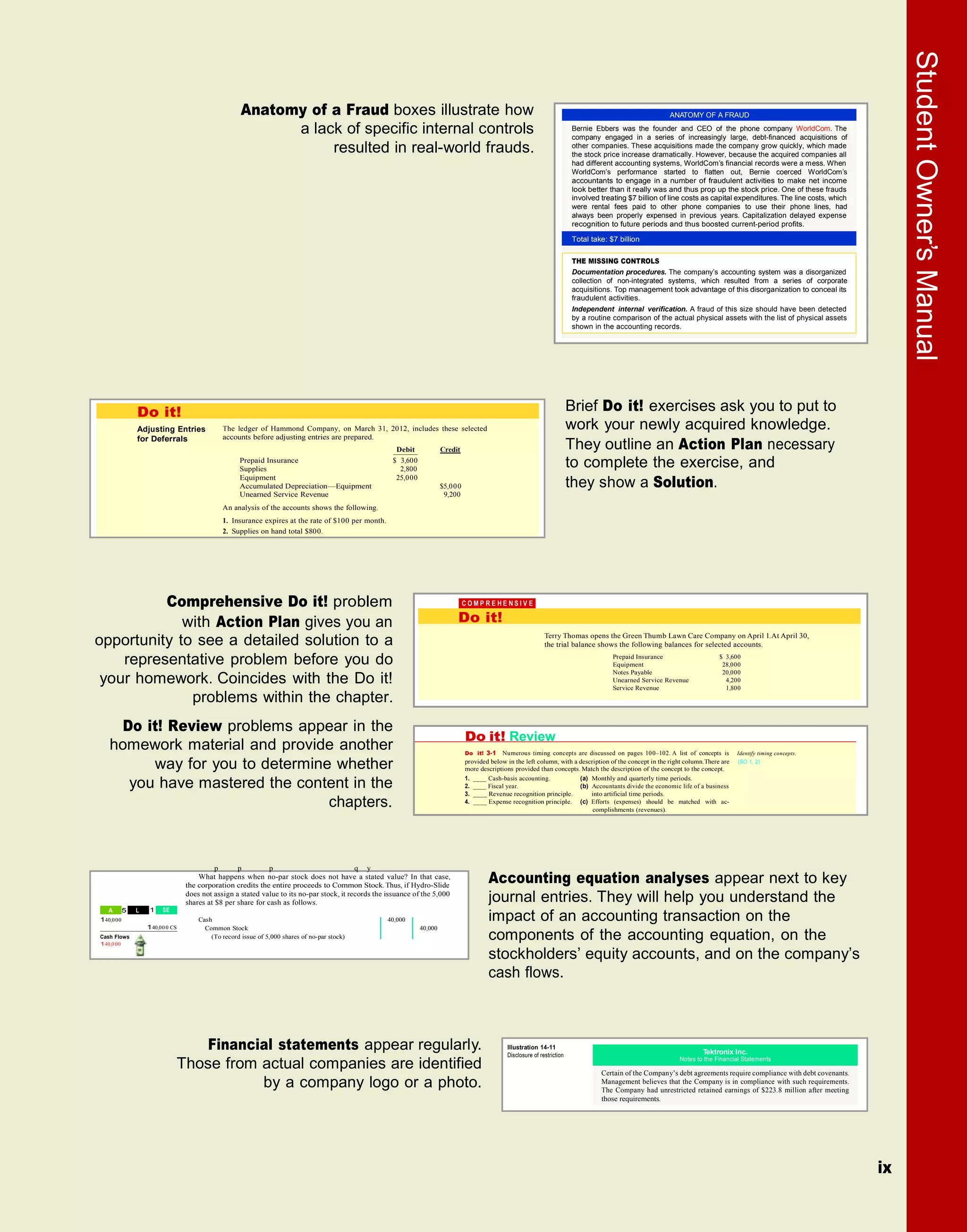
Anatomy of a Fraud boxes illustrate how
a lack of specific internal controls
resulted in real-world frauds.
The ledger of Hammond Company, on March 31, 2012, includes these selected
accounts before adjusting entries are prepared.
Debit Credit
Prepaid Insurance $ 3,600
Supplies 2,800
Equipment 25,000
Accumulated Depreciation—Equipment $5,000
Unearned Service Revenue 9,200
An analysis of the accounts shows the following.
1. Insurance expires at the rate of $100 per month.
2. Supplies on hand total $800.
Comprehensive Do it! problem
with Action Plan gives you an
opportunity to see a detailed solution to a
representative problem before you do
your homework. Coincides with the Do it!
problems within the chapter.
Do it! Review problems appear in the
homework material and provide another
way for you to determine whether
you have mastered the content in the
chapters.
p p p q y
What happens when no-par stock does not have a stated value? In that case,
the corporation credits the entire proceeds to Common Stock.Thus, if Hydro-Slide
does not assign a stated value to its no-par stock, it records the issuance of the 5,000
shares at $8 per share for cash as follows.
A 5 L
140,000
140,00 0 CS
Cash Flows
140,000
Tektronix Inc.
Notes to the Financial Statements
Certain of the Company’s debt agreements require compliance with debt covenants.
Management believes that the Company is in compliance with such requirements.
The Company had unrestricted retained earnings of $223.8 million after meeting
those requirements.
ix
Illustration 14-11
Disclosure of restriction
Accounting equation analyses appear next to key
journal entries. They will help you understand the
impact of an accounting transaction on the
components of the accounting equation, on the
stockholders‘ equity accounts, and on the company‘s
cash flows.
ANATOMY OF A FRAUD
Bernie Ebbers was the founder and CEO of the phone company WorldCom. The
company engaged in a series of increasingly large, debt-financed acquisitions of
other companies. These acquisitions made the company grow quickly, which made
the stock price increase dramatically. However, because the acquired companies all
had different accounting systems, WorldCom‘s financial records were a mess. When
WorldCom‘s performance started to flatten out, Bernie coerced WorldCom‘s
accountants to engage in a number of fraudulent activities to make net income
look better than it really was and thus prop up the stock price. One of these frauds
involved treating $7 billion of line costs as capital expenditures. The line costs, which
were rental fees paid to other phone companies to use their phone lines, had
always been properly expensed in previous years. Capitalization delayed expense
recognition to future periods and thus boosted current-period profits.
Total take: $7 billion
THE MISSING CONTROLS
Documentation procedures. The company‘s accounting system was a disorganized
collection of non-integrated systems, which resulted from a series of corporate
acquisitions. Top management took advantage of this disorganization to conceal its
fraudulent activities.
Independent internal verification. A fraud of this size should have been detected
by a routine comparison of the actual physical assets with the list of physical assets
shown in the accounting records.
C O M P R E H E N S I V E
Do it!
Terry Thomas opens the Green Thumb Lawn Care Company on April 1.At April 30,
the trial balance shows the following balances for selected accounts.
Prepaid Insurance $ 3,600
Equipment 28,000
Notes Payable 20,000
Unearned Service Revenue 4,200
Service Revenue 1,800
Do it! Review
Do it! 3-1 Numerous timing concepts are discussed on pages 100–102. A list of concepts is Identify timing concepts.
provided below in the left column, with a description of the concept in the right column.There are (SO 1, 2)
more descriptions provided than concepts. Match the description of the concept to the concept.
1. ____ Cash-basis accounting. (a) Monthly and quarterly time periods.
2. ____ Fiscal year. (b) Accountants divide the economic life of a business
3. ____ Revenue recognition principle. into artificial time periods.
4. ____ Expense recognition principle. (c) Efforts (expenses) should be matched with ac-
complishments (revenues).
Brief Do it! exercises ask you to put to
work your newly acquired knowledge.
They outline an Action Plan necessary
to complete the exercise, and
they show a Solution.
Do it!
Adjusting Entries
for Deferrals
1 SE
Cash 40,000
Common Stock 40,000
(To record issue of 5,000 shares of no-par stock)
Financial statements appear regularly.
Those from actual companies are identified
by a company logo or a photo.
Exercises: Set B are available online at
www.wiley.com/college/weygandt.
In the textbook, two similar sets of
Problems—A and B—are keyed
to the same study objectives.
Selected problems, identified by this
icon, can be solved using the General
Ledger Software (GLS) package.
E3-10 The income statement of Brandon Co. for the month of July shows net income of $1,400
based on Service Revenue $5,500, Salaries and Wages Expense $2,300, Supplies Expense $1,200,
and Utilities Expense $600. In reviewing the statement, you discover the following.
1. Insurance expired during July of $400 was omitted.
2. Supplies expense includes $250 of supplies that are still on hand at July 31.
Those exercises and problems that focus on
accounting situations faced by service companies
are identified by the icon shown here.
The Continuing Cookie Chronicle exercise
follows the continuing saga of accounting
for a small business begun by an
entrepreneurial student.
h bl
The Broadening Your Perspective
section helps to pull together
concepts from the chapter and apply
them to real-world business situations.
The Financial Reporting Problem
focuses on reading and understanding
the financial statements of PepsiCo,
which are available in Appendix A.
x
Exercises: Set B
Visit the book’s companion website, at www.wiley.com/college/weygandt, and choose the Student
Companion site to access Exercise Set B.
P3-5A On September 1, 2012, the account balances of Moore Equipment Repair were as
follows.
No. Debits No. Credits
101 Cash $ 4,880 154 Accumulated Depreciation—Equipment $ 1,500
112 Accounts Receivable 3,520 201 Accounts Payable 3,400
126 Supplies 2,000 209 Unearned Service Revenue 1,400
153 Equipment 15,000 212 Salaries and Wages Payable 500
301 Owner’s Capital 18,600
$25,400 $25,400
Journalize transactions and
follow through accounting
cycle to preparation of financial
statements.
(SO 5, 6, 7)
Prepare correct income
statement.
(SO 2, 5, 6, 7)
An icon identifies Exercises and
Problems that can be solved using
Excel templates at the student website.
E20-12 Alma Ortiz and Associates, a CPA firm, uses job order costing to capture the costs of
its audit jobs. There were no audit jobs in process at the beginning of November. Listed below
are data concerning the three audit jobs conducted during November.
Perez Rivera Sota
Direct materials $600 $400 $200
Auditor labor costs $5,400 $6,600 $3,375
Auditor hours 72 88 45
Determine cost of jobs and
ending balance in work in
process and overhead accounts.
(SO 3, 4, 6)
An additional parallel set of C Problems
appears at the book‘s companion website.
Comprehensive Problems combine material
from the current chapter with previous
chapters so that you understand how ―it all
fits together.‖
The Waterways Continuing Problem uses the business
activities of a fictional company, to help you apply
managerial accounting topics to a realistic entrepreneurial
situation.
A Comparative Analysis Problem compares
and contrasts the financial reporting of
PepsiCo and The Coca-Cola Company
.
Problems: Set C
Visit the book’s companion website, at www.wiley.com/college/weygandt, and choose the Student
Companion site to access Problem Set C.
Comprehensive Problem: Chapters 3 to 7
CP7 Packard Company has the following opening account balances in its general and subsidiary
ledgers on January 1 and uses the periodic inventory system.All accounts have normal debit and
credit balances.
General Ledger
Account January 1
Number Account Title Opening Balance
101 Cash $33,750
Continuing Cookie Chronicle
(Note: This is a continuation of the Cookie Chronicle from Chapters 1 and 2. Use the infor-
mation from the previous chapters and follow the instructions below using the general ledger
accounts you have already prepared.)
Waterways Continuing Problem
(Note: The Waterways Problem begins in Chapter 19 and continues in the remaining chapters.
You can also find this problem at the book’s Student Companion site.)
BROADENINGYOURPERSPECTIVE
Financial Reporting and Analysis
Financial Reporting Problem: PepsiCo, Inc.
BYP3-1 The financial statements of PepsiCo, Inc.are presented in Appendix A at the end of this textbook.
Instructions
(a) Using the consolidated financial statements and related information, identify items that may result in
Comparative Analysis Problem: PepsiCo, Inc.
vs. The Coca-Cola Company
BYP3-2 PepsiCo’s financial statements are presented in Appendix A. Financial statements for
The Coca-Cola Company are presented in Appendix B.
On the Web exercises guide you to
websites where you can find and analyze
information related to the chapter topic.
Decision Making Across the
Organization cases help you
build decision-making skills by analyzing
accounting information in a less
structured situation. These cases
require you to work in teams.
Communication Activity problems
help you to apply and practice business
communication skills.
id hi ibili h id ll i C hi B ll ll di hi i d
All About You activities are designed to
get you thinking and talking about how
accounting impacts your personal life.
Managerial Analysis assignments build
analytical and decision-making skills in
situations required by managers.
A Look at IFRS provides an overview
of the International Financial Reporting
Standards (IFRS) that relate to
the chapter topics, highlights the
differences between GAAP and IFRS,
discusses IFRS/GAAP convergence
efforts, and tests your understanding
through IFRS Self-Test Questions and
IFRS Concepts and Application.
xi
Ethics Cases ask you to reflect
on typical ethical dilemmas, analyze the
stakeholders and the issues involved, and
decide on an appropriate
course of action.
FASB Codification Activity offers you the
opportunity to use this online system,
which contains all the authoritative literature
related to a particular topic.
( )
Real World Focus problems require you to
apply techniques and concepts learned in
the chapter to specific situations faced by
actual companies.
IFRS
T
A Look at IFRS
It is often difficult for companies to determine in what time period they should report particular
revenues and expenses. Both the IASB and FASB are working on a joint project to develop a
common conceptual framework, as well as a revenue recognition project, that will enable com-
panies to better use the same principles to record transactions consistently over time.
On the Web
BYP3-3 No financial decision maker should ever rely solely on the financial information reported in the
annual report to make decisions. It is important to keep abreast of financial news. This activity demon-
strates how to search for financial news on the Web.
Address: http://biz.yahoo.com/i, or go to www.wiley.com/college/weygandt
Decision Making Across the Organization
BYP20-1 Burgio Parts Company uses a job order cost system. For a number of months, there has been
an ongoing rift between the sales department and the production department concerning a special-order
product, TC-1. TC-1 is a seasonal product that is manufactured in batches of 1,000 units. TC-1 is sold at
cost plus a markup of 40% of cost.
Communication Activity
BYP3-5 In reviewing the accounts of Keri Ann Co. at the end of the year, you discover that adjusting
entries have not been made.
Ethics Case
BYP3-6 Bluestem Company is a pesticide manufacturer. Its sales declined greatly this year due to the
passage of legislation outlawing the sale of several of Bluestem’s chemical pesticides. In the coming year,
Bluestem will have environmentally safe and competitive chemicals to replace these discontinued prod-
ucts. Sales in the next year are expected to greatly exceed any prior year’s.The decline in sales and profits
appears to be a one-year aberration. But even so, the company president fears a large dip in the current
year’s profits. He believes that such a dip could cause a significant drop in the market price of Bluestem’s
stock and make the company a takeover target.
’
“All About You” Activity
BYP3-7 Companies must report or disclose in their financial statements information about all liabilities,
including potential liabilities related to environmental clean-up. There are many situations in which you
will be asked to provide personal financial information about your assets, liabilities, revenue, and expenses.
Sometimes you will face difficult decisions regarding what to disclose and how to disclose it.
FASB Codification Activity
BYP3-8 If your school has a subscription to the FASB Codification, go to http://aaahq.org/asclogin.cfm
to log in and prepare responses to the following.
Instructions
Access the glossary (―Master Glossary‖) to answer the following.
(a) What is the definition of revenue?
(b) What is the definition of compensation?
Managerial Analysis
BYP19-2 B.J. King is a fairly large manufacturing company located in the southern United States. The
company manufactures tennis rackets, tennis balls, tennis clothing, and tennis shoes, all bearing the com-
pany’s distinctive logo, a large green question mark on a white-flocked tennis ball. The company’s sales
have been increasing over the past 10 years.
The tennis racket division has recently implemented several advanced manufacturing techniques.
Robot arms hold the tennis rackets in place while glue dries, and machine vision systems check for defects.
The engineering and design team uses computerized drafting and testing of new products. The following
managers work in the tennis racket division.
Real-World Focus
BYP19-3 Anchor Glass Container Corporation, the third largest manufacturer of glass containers in the
United States, supplies beverage and food producers and consumer products manufacturers nationwide.
Parent company Consumers Packaging Inc. (Toronto Stock Exchange: CGC) is a leading international
designer and manufacturer of glass containers.
The following management discussion appeared in a recent annual report of Anchor Glass.
Acknowledgments
Accounting Principles has benefited greatly from the input of focus group participants, manuscript reviewers,
those who have sent comments by letter or e-mail, ancillary authors, and proofers. We greatly appreciate
the constructive suggestions and innovative ideas of reviewers and the creativity and accuracy of the
ancillary authors and checkers.
Prior Editions
Thanks to the following reviewers and focus group
participants of prior editions of Accounting Principles:
John Ahmad, Northern Virginia Community College—Annandale;
Sylvia Allen, Los Angeles Valley College; Matt Anderson, Michigan
State University; Alan Applebaum, Broward Community College;
Juanita Ardovany, Los Angeles Valley College; Yvonne Baker,
Cincinnati State Tech Community College; Peter Battelle, University
of Vermont; Colin Battle, Broward Community College; Jim
Benedum; Beverly Beatty, Anne Arundel Community College;
Milwaukee Area Technical College; Jaswinder Bhangal, Chabot
College; Bernard Bieg, Bucks County College; Michael Blackett,
National American University; Barry Bomboy, J. Sargeant Reynolds
Community College; Kent D. Bowen, Butler County Community
College; David Boyd, Arkansas State University; Greg Brookins,
Santa Monica College; Kurt H. Buerger, Angelo State University;
Leroy Bugger, Edison Community College; Leon Button, Scottsdale
Community College.
Ann Cardozo, Broward Community College; Steve Carlson,
University of North Dakota; Fatma Cebenoyan, Hunter College;
Kimberly Charland, Kansas State University; Trudy Chiaravelli,
Lansing Community College; Shifei Chung, Rowan University; Siu
Chung, Los Angeles Valley College; Lisa Cole, Johnson County
Community College; Kenneth Couvillion, San Joaquin Delta
College; Alan B. Czyzewski, Indiana State University; Thomas
Davies, University of South Dakota; Peggy DeJong, Kirkwood
Community College; John Delaney, Augustana College; Tony
Dellarte, Luzerne Community College; Kevin Dooley, Kapi’olani
Community College; Pam Donahue, Northern Essex Community
College; Edmond Douville, Indiana University Northwest; Pamela
Druger, Augustana College; Russell Dunn, Broward Community
College; John Eagan, Erie Community College; Richard Ellison,
Middlesex Community College; Dora Estes, Volunteer State
Community College; Mary Falkey, Prince Georges Community
College.
Raymond Gardner, Ocean County College; Lori Grady, Bucks
County Community College; Richard Ghio, San Joaquin Delta
College; Joyce Griffin, Kansas City Community College; Amy Haas,
Kingsborough Community College, CUNY; Lester Hall, Danville
Community College; Becky Hancock, El Paso Community College;
Jeannie Harrington, Middle Tennessee State University; Bonnie
Harrison, College of Southern Maryland; William Harvey, Henry
Ford Community College; Michelle Heard, Metropolitan
Community College; Ruth Henderson, Union Community College;
Ed Hess, Butler County Community College; Kathy Hill, Leeward
Community College; Patty Holmes, Des Moines Area Community
College; Zach Holmes, Oakland Community College; Paul Holt,
Texas A&M—Kingsville; Audrey Hunter, Broward Community
College; Verne Ingram, Red Rocks Community College; Joanne
Johnson, Caldwell Community College; Naomi Karolinski, Monroe
Community College; Anil Khatri, Bowie State University; Shirley
Kleiner, Johnson County Community College; Jo Koehn, Central
Missouri State University; Ken Koerber
, Bucks County Community
College; Adriana Kulakowski, Mynderse Academy.
Sandra Lang, McKendree College; Cathy Xanthaky Larsen,
Middlesex Community College; David Laurel, South Texas
Community College; Robert Laycock, Montgomery College;
Natasha Librizzi, Madison Area Technical College; William P
. Lovell,
Cayuga Community College; Melanie Mackey, Ocean County
College; Jerry Martens, Community College of Aurora; Maureen
McBeth, College of DuPage; Francis McCloskey, Community
College of Philadelphia; Chris McNamara, Finger Lakes Community
College; Lori Major, Luzerne County Community College; Edwin
Mah, University of Maryland, University College; Thomas Marsh,
Northern Virginia Community College—Annandale; Jim Martin,
University of Montevallo; Suneel Maheshwari, Marshall University;
Shea Mears, Des Moines Area Community College; Pam Meyer
,
University of Louisiana—Lafayette; Cathy Montesarchio, Broward
Community College.
Robin Nelson, Community College of Southern Nevada; Joseph M.
Nicassio, Westmoreland County Community College; Michael
O‘Neill, Seattle Central Community College; Mike Palma, Gwinnett
Tech; George Palz, Erie Community College; Michael Papke,
Kellogg Community College; Ruth Parks, Kellogg Community
College; Al Partington, Los Angeles Pierce College; Jennifer Patty,
Des Moines Area Community College; Yvonne Phang, Borough of
Manhattan Community College; Jan Pitera, Broome Community
College; Mike Prockton, Finger Lakes Community College; Laura M.
Prosser, Black Hills State University; Bill Rencher, Seminole
Community College; Jenny Resnick, Santa Monica College; Renee
Rigoni, Monroe Community College; Kathie Rogers, SUNY Suffolk;
Al Ruggiero, SUNY Suffolk; Jill Russell, Camden County College.
Roger Sands, Milwaukee Area Technical College; Marcia Sandvold,
Des Moines Area Community College; Richard Sarkisian, Camden
Community College; Kent Schneider, East T
ennessee State
University; Karen Searle, Paul J. Shinal, Cayuga Community
College; Beth Secrest, Walsh University; Kevin Sinclair, Lehigh
University; Alice Sineath, Forsyth Tech Community College; Leon
Singleton, Santa Monica College; Michael S. Skaff, College of the
Sequoias; Jeff Slater, North Shore Community College; Lois Slutsky,
Broward Community College; Dan Small, J. Sargeant Reynolds
Community College; Lee Smart, Southwest Tennessee Community
College; James Smith, Ivy Tech State College; Carol Springer,
Georgia State University; Jeff Spoelman, Grand Rapids Community
College; Norman Sunderman, Angelo State University.
Donald Terpstra, Jefferson Community College; Lynda Thompson,
Massasoit Community College; Shafi Ullah, Broward Community
College; Sue Van Boven, Paradise Valley Community College;
Christian Widmer, Tidewater Community College; Wanda Wong,
Chabot College; Pat Walczak, Lansing Community College; Kenton
Walker, University of Wyoming; Patricia Wall, Middle Tennessee
State University; Carol N. Welsh, Rowan University; Idalene
Williams, Metropolitan Community College; Gloria Worthy,
Southwest Tennessee Community College.
Thanks also to ―perpetual reviewers‖ Robert Benjamin, Taylor
University; Charles Malone, Tammy Wend, and Carol Wysocki, all
of Columbia Basin College; and William Gregg of Montgomery
College. We appreciate their continuing interest in the textbook
and their regular contributions of ideas to improve it.
Tenth Edition
Thanks to the following reviewers, focus group participants,
and others who provided suggestions for the Tenth Edition:
Sylvia Allen Los Angeles Valley College
Juanita Ardavany Los Angeles Valley College
Shele Bannon Queensborough Community College
Amy Bentley Tallahassee Community College
Timothy Bergsma Davenport University
Teri Bernstein Santa Monica College
Patrick Borja Citrus College
Stanley Carroll New York City College of Technology
Siu Chung Los Angeles Valley College
Carol Collinsworth University of Texas—Brownsville
Kelly Cranford Hinds Community College—Raymond
Liz Diers Black Hills State University
Samuel A. Duah Bowie State University
Carle Essig Montgomery County Community College
Annette Fisher Glendale Community College
Kelly Ford Queensborough Community College
Lori Grady Bucks County Community College
Mary Halford Prince Georges Community College
Thomas Kam Hawaii Pacific University
Naomi Karolinski Monroe Community College
Lynn Krausse Bakersfield College
David Krug Johnson County Community College
Cathy X. Larson Middlesex Community College
David Laurel South Texas College
Christina Manzo Queensborough Community College
Beverly Mason Front Range Community College
Robert Maxwell College of the Canyons
Jill Mitchell Northern Virginia Community College—
Annandale
Ronald O‘Brien Fayetteville Technical Community College
Michael Motes University of Maryland University College
Gregory L. Prescott University of South Alabama
Jan Pitera Broome Community College
Debra A. Sills Porter Tidewater Community College
William Prosser Cuyuga County Community College
Ada Rodriguez Lehman College, The City University of
New York
Eric Rothenburg Kingsborough Community College, The City
University of New York
Al Ruggiero Suffolk County Community College
Marcia Sandvold Des Moines Area Community College
Mary Jane Sauceda University of Texas—Brownsville
Paul J. Shinal Cayauga Community College
Bradley Smith Des Moines Area Community College
Scott Stroher Glendale Community College
Geoffrey Tickell Indiana University of Pennsylvania
Pat Walczak Lansing Community College
Wanda Wong Chabot College
Jack Wiehler San Joaquin Delta College
Our thanks to the publishing ―pros‖ who contribute to our efforts to
publish high-quality products that benefit both teachers and students:
Terry Ann Tatro, development editor; Ed Brislin, project editor; Yana
Mermel, project editor; Allie K. Morris, executive media editor; Greg
Chaput, media editor; Jacqueline Kepping, editorial assistant; Valerie
A. Vargas, senior production editor; Maddy Lesure, textbook designer;
Dorothy Sinclair, managing editor; Erin Bascom, production editor,
Pam Kennedy, director of production and manufacturing; Ann Berlin,
vice president of higher education production and manufacturing;
Mary Ann Price, photo editor; Sandra Rigby, illustration editor;
Suzanne Ingrao of Ingrao Associates, project manager; Jo-Anne
Naples, permissions editor; Denise Showers of Aptara Inc., project
manager at Aptara Inc.; Danielle Urban, project manager at Elm Street
Publishing Services; and Cyndy Taylor. They provided innumerable
services that helped this project take shape.
We also appreciate the exemplary support and professional commit-
ment given us by Chris DeJohn, associate publisher, and the enthusiasm
Ancillary Authors,
Contributors, and Proofers
We sincerely thank the following individuals for their hard work
in preparing the content that accompanies this textbook:
LuAnn Bean Florida Institute of Technology
John C. Borke University of Wisconsin—Platteville
Richard Campbell Rio Grande College
Siu Chung Los Angeles Valley College
Mel Coe DeVry Institute of Technology, Atlanta
Chris Cole Cole Creative Group
Joan Cook Milwaukee Area Technical College
Larry Falcetto Emporia State University
Mark Gleason Metropolitan State University
Lori Grady Bucks County Community College
Coby Harmon University of California, Santa Barbara
Douglas W. Kieso Aurora University
Yvonne Phang Borough of Manhattan Community College
Rex A. Schildhouse San Diego Community College—Miramar
Eileen Shifflett James Madison University
Diane Tanner University of North Florida
Sheila Viel University of Wisconsin—Milwaukee
Dick Wasson Southwestern College
Bernard Weinrich Lindenwood University
Melanie Yon
We also greatly appreciate the expert assistance provided
by the following individuals in checking the accuracy
of the content that accompanies this textbook:
LuAnn Bean Florida Institute of Technology
Jack Borke University of Wisconsin—Platteville
Sandee Cohen Columbia College
Terry Elliott Morehead State University
James Emig Villanova University
Larry Falcetto Emporia State University
Anthony Falgiani Western Illinois University
Lori Grady Bucks County Community College
Kirk Lynch Sandhills Community College
Kevin McNelis New Mexico State University
Jill Misuraca Central Connecticut State University
Barbara Muller Arizona State University
John Plouffe California State University—Los Angeles
Ed Schell University of Hawaii
Rex Schildhouse San Diego Community College—Miramar
Alice Sineath Forsyth Tech Community College
Teresa Speck St. Mary’
s University
Lynn Stallworth Appalachian State University
Sheila Viel University of Wisconsin—Milwaukee
Dick Wasson Southwestern College
Andrea Weickgenannt Xavier University
Bernie Weinrich Lindenwood University
and ideas that Ramona Sherman, senior marketing manager, brings to
the project.
Finally, our thanks to Amy Scholz, Susan Elbe, George Hoffman, Tim
Stookesberry, Joe Heider, Bonnie Lieberman, and Will Pesce for their
support and leadership in Wiley‘s College Division.
We thank PepsiCo, Inc. for permitting us the use of its 2009 annual
reports for our specimen financial statements and accompanying
notes. You can send your thoughts and ideas about the textbook to
us via email at: AccountingAuthors@yahoo.com.
Jerry J. Weygandt
Madison, Wisconsin
Paul D. Kimmel
Milwaukee, Wisconsin
Donald E. Kieso
DeKalb, Illinois
This page intentionally left blank
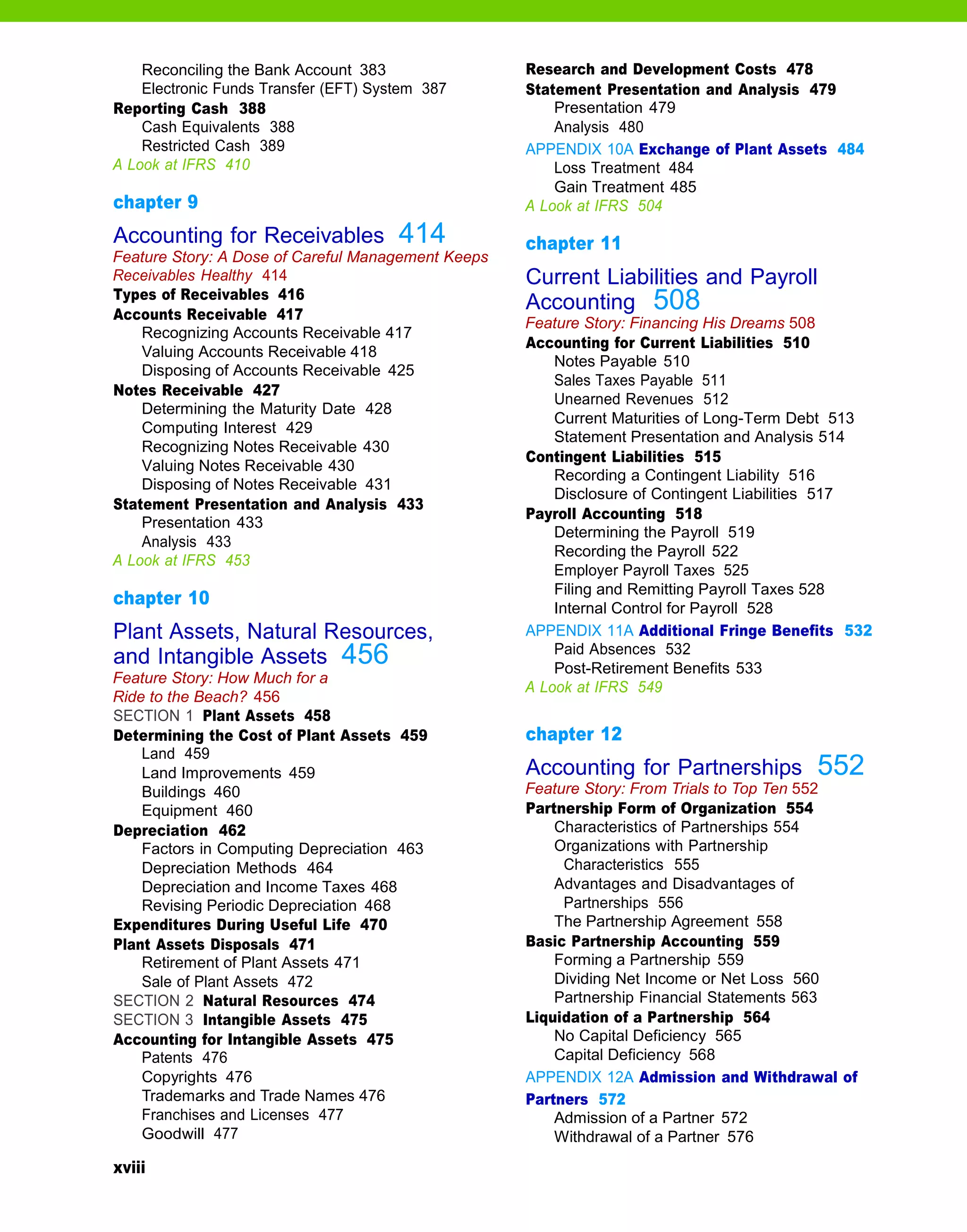
Brief Contents
1 Accounting in Action 2
2 The Recording Process 50
3 Adjusting the Accounts 98
4 Completing the Accounting Cycle 152
5 Accounting for Merchandising Operations 208
6 Inventories 260
7 Accounting Information Systems 314
8 Fraud, Internal Control, and Cash 360
9 Accounting for Receivables 414
10 Plant Assets, Natural Resources, and Intangible
Assets 456
11 Current Liabilities and Payroll Accounting 508
12 Accounting for Partnerships 552
13 Corporations: Organization and Capital Stock
Transactions 592
14 Corporations: Dividends, Retained Earnings, and
Income Reporting 632
15 Long-Term Liabilities 668
16 Investments 722
17 Statement of Cash Flows 760
18 Financial Statement Analysis 824
19 Managerial Accounting 876
20 Job Order Costing 922
21 Process Costing 964
22 Cost-Volume-Profit 1010
23 Budgetary Planning 1052
24 Budgetary Control and Responsibility
Accounting 1096
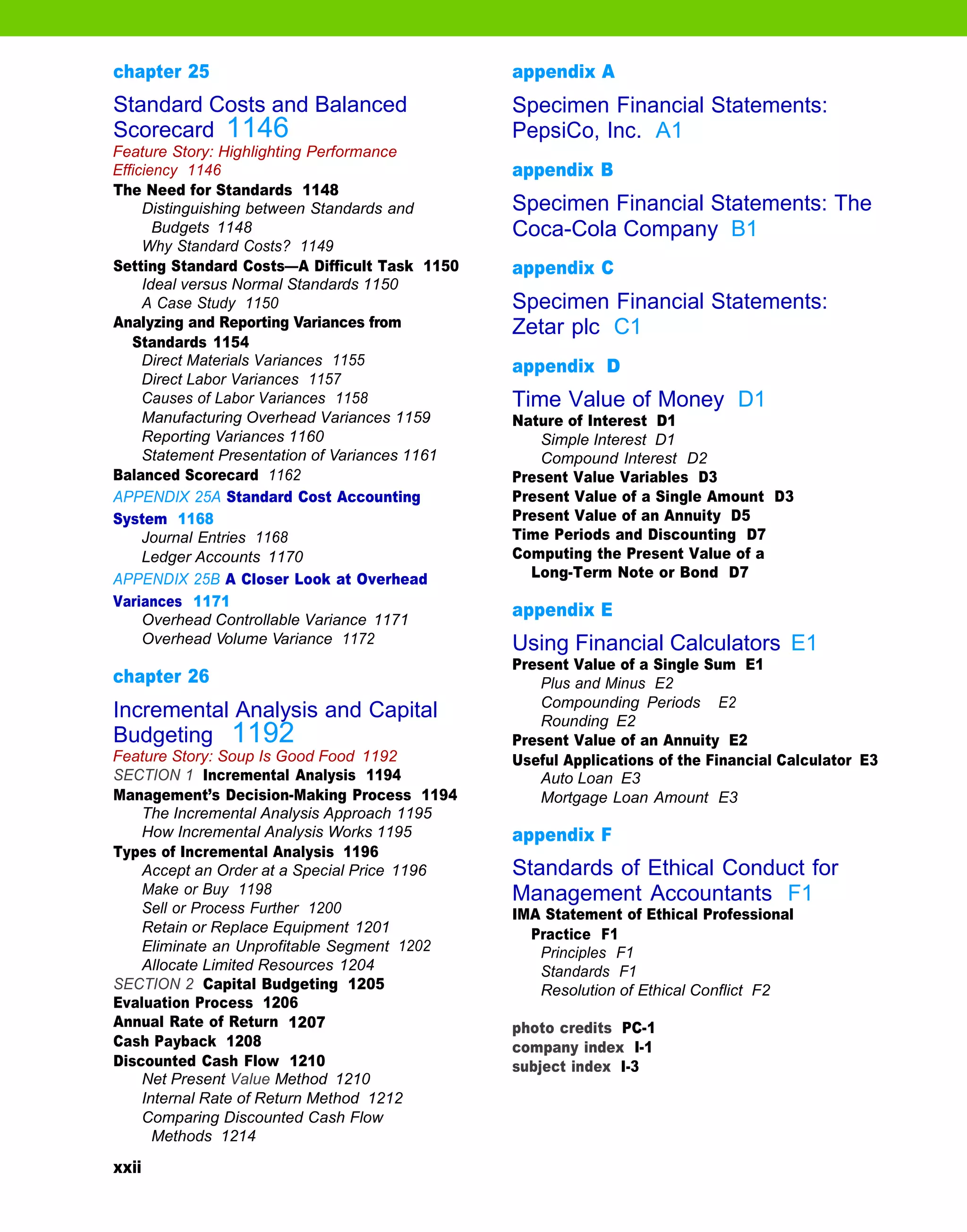
25 Standard Costs and Balanced Scorecard 1146
26 Incremental Analysis and Capital Budgeting 1192
APPENDICES
A Specimen Financial Statements: PepsiCo, Inc. A1
B Specimen Financial Statements: The Coca-Cola
Company, Inc. B1
C Specimen Financial Statements: Zetar plc C1
D Time Value of Money D1
E Using Financial Calculators E1
F Standards of Ethical Conduct for Management
Accountants F1
xv
Contents
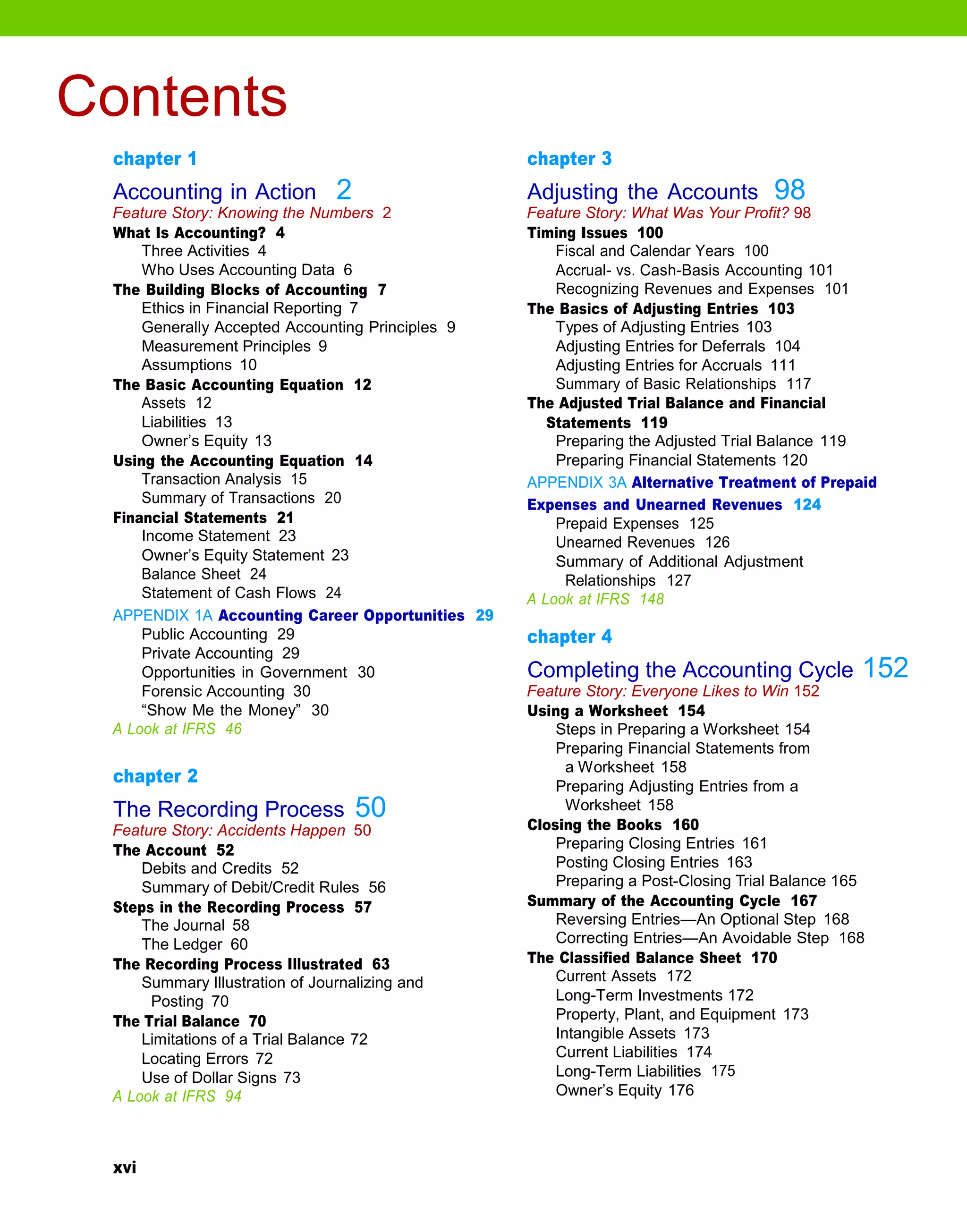
chapter 1
Accounting in Action 2
Feature Story: Knowing the Numbers 2
What Is Accounting? 4
Three Activities 4
Who Uses Accounting Data 6
The Building Blocks of Accounting 7
Ethics in Financial Reporting 7
Generally Accepted Accounting Principles 9
Measurement Principles 9
Assumptions 10
The Basic Accounting Equation 12
Assets 12
Liabilities 13
Owner‘s Equity 13
Using the Accounting Equation 14
Transaction Analysis 15
Summary of Transactions 20
Financial Statements 21
Income Statement 23
Owner‘s Equity Statement 23
Balance Sheet 24
Statement of Cash Flows
APPENDIX 1A Accounting Career Opportunities 29
Public Accounting 29
Private Accounting 29
Opportunities in Government 30
Forensic Accounting 30
―Show Me the Money‖ 30
A Look at IFRS 46
chapter 2
The Recording Process 50
Feature Story: Accidents Happen 50
The Account 52
Debits and Credits 52
Summary of Debit/Credit Rules 56
Steps in the Recording Process 57
The Journal 58
The Ledger 60
The Recording Process Illustrated 63
Summary Illustration of Journalizing and
Posting 70
The Trial Balance 70
Limitations of a Trial Balance 72
Locating Errors 72
Use of Dollar Signs 73
A Look at IFRS 94
xvi
175
124
chapter 3
Adjusting the Accounts 98
Feature Story: What Was Your Profit? 98
Timing Issues 100
Fiscal and Calendar Years 100
Accrual- vs. Cash-Basis Accounting 101
Recognizing Revenues and Expenses 101
The Basics of Adjusting Entries 103
Types of Adjusting Entries 103
Adjusting Entries for Deferrals 104
Adjusting Entries for Accruals 111
Summary of Basic Relationships 117
The Adjusted Trial Balance and Financial
Statements 119
Preparing the Adjusted Trial Balance 119
Preparing Financial Statements 120
APPENDIX 3A Alternative Treatment of Prepaid
Expenses and Unearned Revenues
Prepaid Expenses 125
Unearned Revenues 126
Summary of Additional Adjustment
Relationships 127
A Look at IFRS 148
chapter 4
Completing the Accounting Cycle 152
Feature Story: Everyone Likes to Win 152
Using a Worksheet 154
Steps in Preparing a Worksheet 154
Preparing Financial Statements from
a Worksheet 158
Preparing Adjusting Entries from a
Worksheet 158
Closing the Books 160
Preparing Closing Entries 161
Posting Closing Entries 163
Preparing a Post-Closing Trial Balance 165
Summary of the Accounting Cycle 167
Reversing Entries—An Optional Step 168
Correcting Entries—An Avoidable Step 168
The Classified Balance Sheet 170
Current Assets 172
Long-Term Investments 172
Property, Plant, and Equipment 173
Intangible Assets 173
Current Liabilities 174
Long-Term Liabilities
Owner‘s Equity 176
24
Operations 208
Feature Story: Who Doesn’t Shop at Wal-Mart? 208
Merchandising Operations 210
Operating Cycles 211
Flow of Costs 211
Recording Purchases of Merchandise 213
Freight Costs 215
Purchase Returns and Allowances 216
Purchase Discounts 216
Summary of Purchasing Transactions 217
Recording Sales of Merchandise 218
Sales Returns and Allowances 219
Sales Discounts 220
Completing the Accounting Cycle 222
Adjusting Entries 222
Closing Entries 222
Summary of Merchandising Entries 223
Forms of Financial Statements 224
Multiple-Step Income Statement 224
Single-Step Income Statement 227
Classified Balance Sheet 227
APPENDIX 5A Periodic Inventory System 232
Determining Cost of Goods Sold Under a Periodic
System 232
Recording Merchandise Transactions 233
Recording Purchases of Merchandise 233
Recording Sales of Merchandise 234
APPENDIX 5B Worksheet for a Merchandising
Company 236
Using a Worksheet
A Look at IFRS 257
chapter 6
Inventories 260
Feature Story: ―Where Is That Spare
Bulldozer Blade?‖ 260
Classifying Inventory 262
Determining Inventory Quantities 263
Taking a Physical Inventory 263
Determining Ownership of Goods 264
Inventory Costing 266
Specific Identification 267
Cost Flow Assumptions 267
Financial Statement and Tax Effects of Cost
Flow Methods 272
Using Inventory Cost Flow Methods Making Bank Deposits 380
Consistently 274 Writing Checks 380
Lower-of-Cost-or-Market 275 Bank Statements 381
xvii
APPENDIX 4A Reversing Entries 181
Reversing Entries Example 181
A Look at IFRS 204
chapter 5
Accounting for Merchandising
Inventory Errors 276
Income Statement Effects 276
Balance Sheet Effects 277
Statement Presentation and Analysis 278
Presentation 265
Analysis 279
APPENDIX 6A Inventory Cost Flow Methods in
Perpetual Inventory Systems 283
First-In, First-Out (FIFO) 283
Last-In, First-Out (LIFO) 284
Average-Cost 284
APPENDIX 6B Estimating Inventories 286
Gross Profit Method 287
Retail Inventory Method
A Look at IFRS 310
chapter 7
Accounting Information Systems 314
Feature Story: QuickBooks Helps
This Retailer Sell Guitars 314
Basic Concepts of Accounting Information
Systems 316
Computerized Accounting Systems 316
Manual Accounting Systems 319
Subsidiary Ledgers 319
Subsidiary Ledger Example 320
Advantages of Subsidiary Ledgers 321
Special Journals 322
Sales Journal 323
Cash Receipts Journal 325
Purchases Journal 329
Cash Payments Journal 331
Effects of Special Journals on the General
Journal 334
A Look at IFRS 357
chapter 8
Fraud, Internal Control,
and Cash 360
Feature Story: Minding the Money in
Moose Jaw 360
Fraud and Internal Control
Fraud 362
The Sarbanes-Oxley Act 363
Internal Control 363
Principles of Internal Control Activities 364
Limitations of Internal Control 371
Cash Controls 372
Cash Receipts Controls 372
Cash Disbursements Controls 375
Control Features: Use of a Bank 380
288
®
236
362
Reconciling the Bank Account 383
Electronic Funds Transfer (EFT) System 387
Reporting Cash 388
Cash Equivalents 388
Restricted Cash 389
A Look at IFRS 410
chapter 9
Accounting for Receivables 414
Feature Story: A Dose of Careful Management Keeps
Receivables Healthy 414
Types of Receivables 416
Accounts Receivable 417
Recognizing Accounts Receivable 417
Valuing Accounts Receivable 418
Disposing of Accounts Receivable 425
Notes Receivable 427
Determining the Maturity Date 428
Computing Interest 429
Recognizing Notes Receivable 430
Valuing Notes Receivable 430
Disposing of Notes Receivable 431
Statement Presentation and Analysis 433
Presentation 433
Analysis 433
A Look at IFRS 453
chapter 10
Plant Assets, Natural Resources,
and Intangible Assets 456
Feature Story: How Much for a
Ride to the Beach? 456
SECTION 1 Plant Assets 458
Determining the Cost of Plant Assets 459
Land 459
Land Improvements 459
Buildings 460
Equipment 460
Depreciation 462
Factors in Computing Depreciation 463
Depreciation Methods 464
Depreciation and Income Taxes 468
Revising Periodic Depreciation 468
Expenditures During Useful Life 470
Plant Assets Disposals 471
Retirement of Plant Assets 471
Sale of Plant Assets 472
SECTION 2 Natural Resources 474
SECTION 3 Intangible Assets 475
Accounting for Intangible Assets 475
Patents 476
Copyrights 476
Trademarks and Trade Names 476
Franchises and Licenses 477
Goodwill
xviii
Research and Development Costs 478
Statement Presentation and Analysis 479
Presentation 479
Analysis 480
APPENDIX 10A Exchange of Plant Assets 484
Loss Treatment 484
Gain Treatment 485
A Look at IFRS 504
chapter 11
Current Liabilities and Payroll
532
Accounting 508
Feature Story: Financing His Dreams 508
Accounting for Current Liabilities 510
Notes Payable 510
Sales Taxes Payable 511
Unearned Revenues 512
Current Maturities of Long-Term Debt 513
Statement Presentation and Analysis 514
Contingent Liabilities 515
Recording a Contingent Liability 516
Disclosure of Contingent Liabilities 517
Payroll Accounting 518
Determining the Payroll 519
Recording the Payroll 522
Employer Payroll Taxes 525
Filing and Remitting Payroll Taxes 528
Internal Control for Payroll 528
APPENDIX 11A Additional Fringe Benefits
Paid Absences 532
Post-Retirement Benefits 533
A Look at IFRS 549
chapter 12
Accounting for Partnerships 552
Feature Story: From Trials to Top Ten 552
Partnership Form of Organization 554
Characteristics of Partnerships 554
Organizations with Partnership
Characteristics 555
Advantages and Disadvantages of
Partnerships 556
The Partnership Agreement 558
Basic Partnership Accounting 559
Forming a Partnership 559
Dividing Net Income or Net Loss 560
Partnership Financial Statements 563
Liquidation of a Partnership 564
No Capital Deficiency 565
Capital Deficiency 568
APPENDIX 12A Admission and Withdrawal of
Partners 572
Admission of a Partner 572
Withdrawal of a Partner 576
477
Discount or Premium on Bonds 675
Issuing Bonds at a Discount 676
Issuing Bonds at a Premium 677
Accounting for Bond Retirements 678
Redeeming Bonds at Maturity 679
Redeeming Bonds before Maturity 679
Converting Bonds into Common Stock 679
Accounting for Other Long-Term Liabilities 680
Long-Term Notes Payable 680
Lease Liabilities 683
Statement Presentation and Analysis
Presentation 684
Analysis 685
APPENDIX 15A Present Value Concepts
Related to Bond Pricing 690
Present Value of Face Value
Present Value of Interest Payments
(Annuities) 692
Time Periods and Discounting 693
Computing the Present Value of a Bond 693
APPENDIX 15B Effective-Interest Method of
Bond Amortization
Amortizing Bond Discount 695
Amortizing Bond Premium 697
APPENDIX 15C Straight-Line Amortization 699
Amortizing Bond Discount 699
Amortizing Bond Premium 700
A Look at IFRS 718
chapter 16
Investments
Feature Story: ―Is There Anything
Else We Can Buy?‖ 722
Why Corporations Invest 724
Accounting for Debt Investments 725
Recording Acquisition of Bonds 726
Recording Bond Interest 726
Recording Sale of Bonds 726
Accounting for Stock Investments 727
Holdings of Less than 20% 728
Holdings Between 20% and 50% 729
Holdings of More than 50% 730
Valuing and Reporting Investments 732
Categories of Securities 733
Balance Sheet Presentation 736
Presentation of Realized and Unrealized
Gain or Loss 737
Classified Balance Sheet 738
A Look at IFRS 757
chapter 17
Statement of Cash Flows 760
Feature Story: Got Cash? 760
The Statement of Cash Flows: Usefulness
and Format 762
xix
chapter 13
Corporations: Organization and
Reporting 632
Feature Story: Owning a Piece of the Action 632
Dividends 634
Cash Dividends 634
Stock Dividends
Stock Splits 640
Retained Earnings 642
Retained Earnings Restrictions 643
Prior Period Adjustments 644
Retained Earnings Statement 645
Statement Presentation and Analysis 646
Stockholders‘ Equity Presentation 646
Stockholders‘ Equity Analysis 647
Income Statement Presentation 647
Income Statement Analysis 648
A Look at IFRS 665
chapter 15
Long-Term Liabilities 668
Feature Story: Thanks Goodness
for Bankruptcy 668
Bond Basics 670
Types of Bonds 671
Issuing Procedures 672
Determining the Market Value of Bonds 672
Accounting for Bond Issues 674
Issuing Bonds at Face Value 674
638
Capital Stock Transactions 592
Feature Story: What’s Cooking? 592
The Corporate Form of Organization 594
Characteristics of a Corporation 595
Forming a Corporation 597
Ownership Rights of Stockholders 598
Stock Issue Considerations 598
Corporate Capital 601
Accounting for Issues of Common Stock 603
Issuing Par Value Common Stock for Cash 603
Issuing No-Par Common Stock for Cash 604
Issuing Common Stock for Services or Noncash
Assets 605
Accounting for Treasury Stock 606
Purchase of Treasury Stock 607
Disposal of Treasury Stock 608
Preferred Stock 610
Dividend Preferences 610
Liquidation Preference 611
Statement Presentation 611
A Look at IFRS 629
chapter 14
Corporations: Dividends,
Retained Earnings, and Income
684
690
695
722
Usefulness of the Statement of
Cash Flows 762
Classification of Cash Flows 763
Significant Noncash Activities 764
Format of the Statement of Cash Flows 765
Preparing the Statement of Cash Flows
Indirect and Direct Methods 767
Preparing the Statement of Cash Flows—Indirect
Method 768
Step 1: Operating Activities 769
Summary of Conversion to Net Cash Provided
by Operating Activities—Indirect Method 773
Step 2: Investing and Financing Activities 774
Step 3: Net Change in Cash 775
Using Cash Flows to Evaluate a Company 778
Free Cash Flow 778
APPENDIX 17A Using a Work Sheet to Prepare
the Statement of Cash Flows—Indirect
Method
Preparing the Worksheet 784
APPENDIX 17B Statement of Cash Flows—Direct
Method
Step 1: Operating Activities 790
Step 2: Investing and Financing Activities 794
Step 3: Net Change in Cash 795
A Look at IFRS 820
chapter 18
Financial Statement Analysis 824
Feature Story: It Pays to Be Patient 824
Basics of Financial Statement Analysis 826
Need for Comparative Analysis 826
Tools of Analysis 827
Horizontal Analysis 827
Balance Sheet 828
Income Statement 829
Retained Earnings Statement 830
Vertical Analysis 831
Balance Sheet 831
Income Statement 831
Ratio Analysis 833
Liquidity Ratios 835
Profitability Ratios 838
Solvency Ratios 842
Summary of Ratios 843
Earning Power and Irregular Items 846
Discontinued Operations 846
Extraordinary Items 847
Changes in Accounting Principle 848
Comprehensive Income 849
Quality of Earnings 850
Alternative Accounting Methods 850
Pro Forma Income 850
Improper Recognition 851
A Look at IFRS 874
xx
chapter 19
Managerial Accounting 876
Feature Story: Think Fast 876
Managerial Accounting Basics 878
Comparing Managerial and Financial
Accounting 879
Management Functions 880
Organizational Structure 881
Business Ethics 882
Managerial Cost Concepts 884
Manufacturing Costs 884
Product versus Period Costs 886
Manufacturing Costs in Financial
Statements 887
Income Statement 887
Cost of Goods Manufactured 888
Balance Sheet
Cost Concepts—A Review 891
Managerial Accounting Today 894
The Value Chain 894
Technological Change 895
Just-in-Time Inventory Methods 895
Quality 896
Activity-Based Costing 896
Theory of Constraints 896
Balanced Scorecard 897
chapter 20
Job Order Costing 922
Feature Story: ―. . . And We’d Like It in Red‖ 922
Cost Accounting Systems 924
Job Order Cost System 924
Process Cost System 925
Job Order Cost Flow 926
Accumulating Manufacturing Costs 927
Assigning Manufacturing Costs to Work in
Process 929
Assigning Costs to Finished Goods 936
Assigning Costs to Cost of Goods Sold 937
Job Order Costing for Service Companies 937
Summary of Job Order Cost Flows 938
Advantages and Disadvantages of Job Order
Costing 940
Reporting Job Cost Data 941
Under- or Overapplied Manufacturing
Overhead 941
chapter 21
Process Costing 964
Feature Story: Ben & Jerry’s Tracks
Its Mix-Ups 964
The Nature of Process Cost Systems 966
Uses of Process Cost Systems 966
Process Costing for Service Companies 967
766
890
783
789
Similarities and Differences between Job Order
Cost and Process Cost Systems 967
Process Cost Flow 969
Assignment of Manufacturing Costs—Journal
Entries 970
Equivalent Units 972
Weighted-Average Method 973
Refinements on the Weighted-Average
Method 974
Production Cost Report 975
Comprehensive Example of Process
Costing 976
Compute the Physical Unit Flow (Step 1) 977
Compute Equivalent Units of Production
(Step 2) 978
Compute Unit Production Costs (Step 3) 978
Prepare a Cost Reconciliation Schedule
(Step 4) 979
Preparing the Production Cost Report 980
Costing Systems—Final Comments 981
Contemporary Developments 982
Just-in-Time Processing 982
Activity-Based Costing 984
APPENDIX 21A Example of Traditional Costing
versus Activity-Based Costing 989
Production and Cost Data 989
Unit Costs Under Traditional Costing 989
Unit Costs Under ABC 989
Comparing Unit Costs 990
Benefits and Limitations of Activity-Based
Costing 991
chapter 22
Cost-Volume-Profit 1010
Feature Story: Understanding Medical Costs
Might Lead to Better Health Care 1010
Cost Behavior Analysis 1012
Variable Costs 1012
Fixed Costs 1013
Relevant Range 1014
Mixed Costs 1015
Importance of Identifying Variable and Fixed
Costs 1019
Cost-Volume-Profit Analysis 1020
Basic Components 1020
CVP Income Statement 1020
Break-even Analysis 1023
Target Net Income 1026
Margin of Safety 1027
CVP and Changes in the Business
Environment 1028
CVP Income Statement Revisited 1030
APPENDIX 22A Variable Costing 1034
Effects of Variable Costing on Income 1035
Rationale for Variable Costing 1036
chapter 23
Budgetary Planning 1052
Feature Story: The Next amazon.com?
Not Quite 1052
Budgeting Basics 1054
Budgeting and Accounting 1054
The Benefits of Budgeting 1055
Essentials of Effective Budgeting 1055
Length of the Budget Period 1055
The Budgeting Process 1055
Budgeting and Human Behavior 1056
Budgeting and Long-Range Planning 1058
The Master Budget 1058
Preparing the Operating Budgets 1059
Sales Budget 1059
Production Budget 1060
Direct Materials Budget 1061
Direct Labor Budget 1063
Manufacturing Overhead Budget 1064
Selling and Administrative Expense
Budget 1065
Budgeted Income Statement 1065
Preparing the Financial Budgets 1067
Cash Budget 1067
Budgeted Balance Sheet 1070
Budgeting in Non-Manufacturing
Companies 1072
Merchandisers 1072
Service Enterprises 1073
Not-for-Profit Organizations 1073
chapter 24
Budgetary Control and
Responsibility Accounting 1096
Feature Story: Turning Trash into Treasure 1096
The Concept of Budgetary Control 1098
Static Budget Reports 1099
Examples 1099
Uses and Limitations 1100
Flexible Budgets 1101
Why Flexible Budgets? 1101
Developing the Flexible Budget 1103
Flexible Budget—A Case Study 1104
Flexible Budget Reports 1106
Management by Exception 1108
The Concept of Responsibility Accounting 1109
Controllable versus Non-controllable Revenues
and Costs 1111
Responsibility Reporting System 1111
Types of Responsibility Centers 1112
Responsibility Accounting for Cost Centers 1114
Responsibility Accounting for Profit Centers 1115
Responsibility Accounting for Investment
Centers 1117
Principles of Performance Evaluation 1120
xxi
appendix A
Specimen Financial Statements:
PepsiCo, Inc. A1
appendix B
Specimen Financial Statements: The
Coca-Cola Company B1
appendix C
Specimen Financial Statements:
Zetar plc C1
appendix
Time Value of Money D1
Nature of Interest D1
Simple Interest D1
Compound Interest D2
Present Value Variables D3
Present Value of a Single Amount D3
Present Value of an Annuity D5
Time Periods and Discounting D7
Computing the Present Value of a
Long-Term Note or Bond D7
appendix E
Using Financial Calculators E1
Present Value of a Single Sum E1
Plus and Minus E2
Compounding Periods E2
Rounding E2
Present Value of an Annuity E2
Useful Applications of the Financial Calculator E3
Auto Loan E3
Mortgage Loan Amount E3
appendix F
Standards of Ethical Conduct for
Management Accountants F1
IMA Statement of Ethical Professional
Practice F1
Principles F1
Standards F1
Resolution of Ethical Conflict F2
photo credits PC-1
company index I-1
subject index I-3
Direct Materials Variances
Direct Labor Variances
Causes of Labor Variances
1155
1157
chapter 25
Standard Costs and Balanced
Scorecard 1146
Feature Story: Highlighting Performance
Efficiency 1146
The Need for Standards 1148
Distinguishing between Standards and
Budgets 1148
Why Standard Costs? 1149
Setting Standard Costs—A Difficult Task 1150
Ideal versus Normal Standards 1150
A Case Study 1150
Analyzing and Reporting Variances from
Standards 1154
D
1158
Budgeting 1192
Feature Story: Soup Is Good Food 1192
SECTION 1 Incremental Analysis 1194
Management’s Decision-Making Process 1194
The Incremental Analysis Approach 1195
How Incremental Analysis Works 1195
Types of Incremental Analysis 1196
Accept an Order at a Special Price 1196
Make or Buy 1198
Sell or Process Further 1200
Retain or Replace Equipment 1201
Eliminate an Unprofitable Segment
Allocate Limited Resources 1204
SECTION 2 Capital Budgeting 1205
Evaluation Process 1206
Annual Rate of Return
Cash Payback 1208
Discounted Cash Flow 1210
Net Present Value Method 1210
Internal Rate of Return Method 1212
Comparing Discounted Cash Flow
Methods 1214
xxii
1207
1202
1172
1171
1168
Manufacturing Overhead Variances 1159
Reporting Variances 1160
Statement Presentation of Variances 1161
Balanced Scorecard 1162
APPENDIX 25A Standard Cost Accounting
System 1168
Journal Entries
Ledger Accounts 1170
APPENDIX 25B A Closer Look at Overhead
Variances
Overhead Controllable Variance 1171
Overhead Volume Variance
chapter 26
Incremental Analysis and Capital
This page intentionally left blank
CHAPTER1
Accounting in
Action
Study Objectives
After studying this chapter, you should be able to:
[1] Explain what accounting is.
Feature Story
KNOWING THE NUMBERS
Many students who take this course do not
plan to be accountants. If you are in that
group, you might be thinking, ―If I‘m not
going to be an accountant, why do I need
to know accounting?‖ In response, consider
the quote from Harold Geneen, the former
chairman of IT&T: ―To be good at your
business, you have to know the numbers—
cold.‖ Success in any business comes back to
the numbers. You will rely on them to make
decisions, and managers will use them to
evaluate your performance. That is true
whether your job involves marketing, produc-
tion, management, or information systems.
In business, accounting and financial
statements are the means for communi-
cating the numbers. If you don‘t know how
to read financial statements, you can‘t
really know your business.
Many companies spend significant resources
teaching their employees basic accounting so
[2] Identify the users and uses of accounting.
[3] Understand why ethics is a fundamental
business concept.
[4] Explain generally accepted accounting
principles.
[5] Explain the monetary unit assumption and the
economic entity assumption.
[6] State the accounting equation, and define its
components.
[7] Analyze the effects of business transactions on
the accounting equation.
[8] Understand the four financial statements and
how they are prepared.
Study Objectives give you a framework for
learning the specific concepts covered in the
chapter.
Navigator]
● Scan Study Objectives
● Read Feature Story
● Read Preview
● Read text and answer Do it! p. 11
p. 14 p. 21 p. 25
● Work Comprehensive Do it! p. 26
● Review Summary of Study Objectives
● Answer Self-Test Questions
● Complete Assignments
● Go to WileyPLUS for practice and tutorials
Read A Look at IFRS p. 46
The Navigator is a learning system designed to prompt you to
use the learning aids in the chapter and set priorities as you study.
2
✔
●
[The Navigator]
✔[The
●
that they can read financial statements
and understand how their actions
affect the company‘s financial results.
One such company is Springfield
ReManufacturing Corporation (SRC).
When Jack Stack and 11 other
managers purchased SRC for 10 cents
a share, it was a failing division of
International Harvester. Jack‘s 119
employees, however, were counting
on him for their livelihood. He decided
that for the company to survive, every
employee needed to think like a
businessperson and to act like an
owner. To accomplish this, all
employees at SRC took basic
accounting courses and participated in weekly reviews of the company‘s financial statements.
SRC survived, and eventually thrived. To this day, every employee (now numbering more than
1,000) undergoes this same training.
Many other companies have adopted this approach, which is called ―open-book management.‖
Even in companies that do not practice open-book management, employers generally assume
that managers in all areas of the company are ―financially literate.‖
Taking this course will go a long way to making you financially literate. In this book, you will
learn how to read and prepare financial statements, and how to use basic tools to evaluate
financial results. Appendices A and B provide real financial statements of two well-known
companies, PepsiCo, Inc. and The Coca-Cola Company. Throughout this textbook, we attempt to
increase your familiarity with financial reporting by providing numerous references, questions,
and exercises that encourage you to explore these financial statements.
●
[The Navigator]
The Feature Story helps you picture how the chapter topic relates to the real world of
accounting and business.You will find references to the story throughout the chapter.
InsideCHAPTER1
■ Accounting Across the Organization: The Scoop on Accounting (p. 6)
■ Ethics Insight: The Numbers Behind Not-for-Profit Organizations (p. 8)
■ International Insight: The Korean Discount (p. 10)
■ Accounting Across the Organization: Spinning the Career Wheel (p. 12)
✔
“Inside Chapter x” lists boxes
in the chapter that should be of
special interest to you.
3
PreviewofCHAPTER1
The opening story about Springfield ReManufacturing Corporation highlights the importance of
having good financial information to make effective business decisions. Whatever one‘s pursuits or
occupation, the need for financial information is inescapable. You cannot earn a living, spend money,
buy on credit, make an investment, or pay taxes without receiving, using, or dispensing financial
information. Good decision making depends on good information.
The purpose of this chapter is to show you that accounting is the system used to provide useful financial
information. The content and organization of Chapter 1 are as follows.
Accounting in Action
What Is Accounting?
• Three activities
• Who uses accounting
data
The Preview describes and
outlines the major topics and
subtopics you will see in the
chapter.
What Is Accounting?
Why is accounting so popular? What consistently ranks as one of the top career
opportunities in business? What frequently rates among the most popular majors
on campus? What was the undergraduate degree chosen by Nike founder Phil
Knight, Home Depot co-founder Arthur Blank, former acting director of the
Federal Bureau of Investigation (FBI) Thomas Pickard, and numerous members
of Congress? Accounting.1
Why did these people choose accounting? They wanted
to understand what was happening financially to their organizations. Accounting
is the financial information system that provides these insights. In short, to under-
stand your organization, you have to know the numbers.
Accounting consists of three basic activities—it identifies, records, and com-
municates the economic events of an organization to interested users. Let’s take a
closer look at these three activities.
Three Activities
As a starting point to the accounting process, a company identifies the economic
events relevant to its business. Examples of economic events are the sale of snack
chips by PepsiCo, providing of telephone services by AT&T, and payment of wages
by Ford Motor Company.
Once a company like PepsiCo identifies economic events, it records those
events in order to provide a history of its financial activities. Recording consists of
The appendix to this chapter describes job opportunities for accounting majors and explains why
accounting is such a popular major.
Financial Statements
The Building Blocks
of Accounting
• Ethics in financial
reporting
• Generally accepted
accounting principles
• Measurement
principles
• Assumptions
Using the
Accounting Equation
The Basic Accounting
Equation
• Assets
• Liabilities
• Owner’s equity
✔
• Transaction analysis • Income statement
• Summary of • Owner’s equity
transactions statement
• Balance sheet
• Statement of cash
flows
●
[The Navigator]
Study Objective [1]
Explain what
accounting is.
4
1
keeping a systematic, chronological diary of events, measured in dollars and cents.
In recording, PepsiCo also classifies and summarizes economic events.
Finally, PepsiCo communicates the collected information to interested users by
means of accounting reports. The most common of these reports are called finan-
cial statements. To make the reported financial information meaningful, PepsiCo
reports the recorded data in a standardized way. It accumulates information result-
ing from similar transactions. For example, PepsiCo accumulates all sales transac-
tions over a certain period of time and reports the data as one amount in the
company’s financial statements. Such data are said to be reported in the aggregate.
By presenting the recorded data in the aggregate, the accounting process simplifies
a multitude of transactions and makes a series of activities understandable and
meaningful.
A vital element in communicating economic events is the accountant’s ability to
analyze and interpret the reported information.Analysis involves use of ratios, per-
centages, graphs, and charts to highlight significant financial trends and relationships.
Interpretation involves explaining the uses, meaning, and limitations of reported
data. Appendix A of this textbook shows the financial statements of PepsiCo, Inc.;
Appendix B illustrates the financial statements of The Coca-Cola Company.We re-
fer to these statements at various places throughout the text. At this point, they
probably strike you as complex and confusing. By the end of this course, you’ll be
surprised at your ability to understand, analyze, and interpret them.
Illustration 1-1 summarizes the activities of the accounting process.
Communication
Recording
Prepare accounting reports
Record, classify, and summarize
Analyze and interpret for users
You should understand that the accounting process includes the bookkeeping
function. Bookkeeping usually involves only the recording of economic events. It is
therefore just one part of the accounting process. In total, accounting involves the
entire process of identifying, recording, and communicating economic events.2
The origins of accounting are generally attributed to the work of Luca Pacioli, an Italian Renaissance
mathematician. Pacioli was a close friend and tutor to Leonardo da Vinci and a contemporary of
Christopher Columbus. In his 1494 text Summa de Arithmetica, Geometria, Proportione et Proportionalite,
Pacioli described a system to ensure that financial information was recorded efficiently and accurately.
Essential terms are printed
in blue when they first appear,
and are defined in the end-of-
chapter glossary.
2
What Is Accounting? 5
Illustration 1-1
The activities of the
accounting process
Identification
Select economic events (transactions)
6 1 Accounting in Action
Who Uses Accounting Data
The information that a user of financial information needs depends upon the kinds
of decisions the user makes.There are two broad groups of users of financial infor-
mation: internal users and external users.
INTERNAL USERS
Internal users of accounting information are managers who plan, organize, and run
the business. These include marketing managers, production supervisors, finance
directors, and company officers. In running a business, internal users must answer
many important questions, as shown in Illustration 1-2.
Questions Asked by Internal Users
Snack chips Beverages
Management
Which PepsiCo product line is
the most profitable? Should any
product lines be eliminated?
To answer these and other questions, internal users need detailed information
on a timely basis. Managerial accounting provides internal reports to help users
make decisions about their companies. Examples are financial comparisons of op-
erating alternatives, projections of income from new sales campaigns, and forecasts
of cash needs for the next year.
ACCOUNTING ACROSS THE ORGANIZATION
The Scoop on Accounting
Accounting can serve as a useful recruiting tool even for the human resources
department. Rhino Foods, located in Burlington, Vermont, is a manufacturer of
specialty ice cream. Its corporate website includes the following:
―Wouldn‘t it be great to work where you were part of a team? Where your input
and hard work made a difference? Where you weren‘t kept in the dark about
what management was thinking? . . . Well—it‘s not a dream! It‘s the way we do
business . . . Rhino Foods believes in family, honesty and open communication—
we really care about and appreciate our employees—and it shows. Operating re-
sults are posted and monthly group meetings inform all employees about what‘s
happening in the Company. Employees also share in the Company‘s profits, in
addition to having an excellent comprehensive benefits package.‖
Source: www.rhinofoods.com/workforus/workforus.html.
What are the benefits to the company and to the employees of making the financial
statements available to all employees? (See page 46.)
EXTERNAL USERS
External users are individuals and organizations outside a company who want financial
information about the company. The two most common types of external users are
Human Resources
Can we afford to give
General Motors employees
pay raises this year?
Marketing
What price for an Apple iPod
will maximize the company's
net income?
?
Study Objective [2]
Identify the users and
uses of accounting.
Illustration 1-2
Questions that internal
users ask
Stockholder
Finance
Is cash sufficient to pay
dividends to
Microsoft stockholders?
Accounting Across the
Organization boxes
demonstrate applications of
accounting information in
various business functions.
The Building Blocks of Accounting 7
investors and creditors. Investors (owners) use accounting information to make deci-
sions to buy, hold, or sell ownership shares of a company.Creditors (such as suppliers
and bankers) use accounting information to evaluate the risks of granting credit or
lending money. Illustration 1-3 shows some questions that investors and creditors
may ask.
Financial accounting answers these questions.It provides economic and financial
information for investors, creditors, and other external users.The information needs
of external users vary considerably. Taxing authorities, such as the Internal Revenue
Service, want to know whether the company complies with tax laws. Regulatory
agencies, such as the Securities and Exchange Commission or the Federal Trade
Commission, want to know whether the company is operating within prescribed
rules. Customers are interested in whether a company like General Motors will con-
tinue to honor product warranties and support its product lines.Labor unions such as
the Major League Baseball Players Association want to know whether the owners
have the ability to pay increased wages and benefits.
The Building Blocks of Accounting
A doctor follows certain standards in treating a patient’s illness. An architect
follows certain standards in designing a building. An accountant follows certain
standards in reporting financial information. For these standards to work, a funda-
mental business concept must be at work—ethical behavior.
Ethics in Financial Reporting
People won’t gamble in a casino if they think it is ―rigged.‖ Similarly, people won’t
play the stock market if they think stock prices are rigged.In recent years the finan-
cial press has been full of articles about financial scandals at Enron, WorldCom,
HealthSouth, AIG, and others. As the scandals came to light, mistrust of financial
reporting in general grew. One article in the Wall Street Journal noted that
―repeated disclosures about questionable accounting practices have bruised inves-
tors’ faith in the reliability of earnings reports, which in turn has sent stock prices
tumbling.‖3
Imagine trying to carry on a business or invest money if you could
not depend on the financial statements to be honestly prepared.Information would
have no credibility. There is no doubt that a sound, well-functioning economy
depends on accurate and dependable financial reporting.
United States regulators and lawmakers were very concerned that the econ-
omy would suffer if investors lost confidence in corporate accounting because of
―U.S. Share Prices Slump,‖ Wall Street Journal (February 21, 2002).
Questions Asked by External Users
Yeah!
What do we do
if they catch us?
BILL
COLLECTOR
Investors Investors Creditors
Is General Electric earning How does Disney compare in size Will United Airlines be able
satisfactory income? and profitability with Time Warner? to pay its debts as they come due?
Illustration 1-3
Questions that external
users ask
Study Objective [3]
Understand why ethics is
a fundamental business
concept.
3
8 1 Accounting in Action
unethical financial reporting.In response, Congress passed the Sarbanes-Oxley Act of
2002 (SOX, or Sarbox). Its intent is to reduce unethical corporate behavior and
decrease the likelihood of future corporate scandals. As a result of SOX,
top management must now certify the accuracy of financial information.In
addition, penalties for fraudulent financial activity are much more severe.
Also, SOX increased the independence of the outside auditors who review
the accuracy of corporate financial statements and increased the oversight
role of boards of directors.
The standards of conduct by which one’s actions are judged as right or
wrong, honest or dishonest, fair or not fair, are ethics. Effective financial
reporting depends on sound ethical behavior. To sensitize you to ethical
situations in business and to give you practice at solving ethical dilemmas,
we address ethics in a number of ways in this book:
1. A number of the Feature Stories and other parts of the text discuss the central
accounting. importance of ethical behavior to financial reporting.
2. Ethics Insight boxes and marginal Ethics Notes highlight ethics situations and
issues in actual business settings.
3. Many of the All About You topics (available on the book’s companion website)
focus on ethical issues you may face in your college and early-career years.
4. At the end of the chapter, an Ethics Case simulates a business situation and
asks you to put yourself in the position of a decision maker in that case.
When analyzing these various ethics cases, as well as experiences in your own
life, it is useful to apply the three steps outlined in Illustration 1-4.
1. Recognize an ethical 2. Identify and analyze
situation and the ethical the principal elements
issues involved. in the situation.
Use your personal ethics to Identify the stakeholders—
identify ethical situations and persons or groups who may
issues. Some businesses and be harmed or benefited. Ask
professional organizations the question: What are the
provide written codes of responsibilities and obligations
ethics for guidance in some of the parties involved?
business situations.
Insights provide examples of business situations from various perspectives—ethics, investor, and international.
ETHICS INSIGHT
The Numbers Behind Not-for-Profit Organizations
Accounting plays an important role for a wide range of business organizations world-
wide. Just as the integrity of the numbers matters for business, it matters at least as much
for not-for-profit organizations. Proper control and reporting help ensure that money is used
the way donors intended. Donors are less inclined to give to an organization if they think the
organization is subject to waste or theft. The accounting challenges of some large interna-
tional not-for-profits rival those of the world‘s largest businesses. For example, after the Haitian
earthquake, the Haitian-born musician Wyclef Jean was criticized for the poor accounting
controls in a relief fund that he founded. Since then, he has hired a new accountant and improved
the transparency regarding funds raised and spent.
What benefits does a sound accounting system provide to a not-for-profit organization?
(See page 46.)
Ethics Note
Circus-founder P.T. Barnum is
alleged to have said, ―Trust
everyone, but cut the deck.‖ What
Sarbanes-Oxley does is to provide
measures that (like cutting the
deck of playing cards) help ensure
that fraud will not occur.
Ethics Notes help sensitize you
to some of the ethical issues in
Illustration 1-4
Steps in analyzing ethics
cases and situations
#1 #2
ALT ALT
3. Identify the alternatives,
and weigh the impact of
each alternative on various
stakeholders.
Select the most ethical
alternative, considering all the
consequences. Sometimes there
will be one right answer. Other
situations involve more than
one right solution; these
situations require an evaluation
of each and a selection of the
best alternative.
?
The Building Blocks of Accounting 9
Generally Accepted Accounting Principles
The accounting profession has developed standards that are generally accepted
and universally practiced.This common set of standards is called generally accepted
accounting principles (GAAP). These standards indicate how to report economic
events.
The primary accounting standard-setting body in the United States is the
Financial Accounting Standards Board (FASB). The Securities and Exchange
Commission (SEC) is the agency of the U.S. government that oversees
U.S. financial markets and accounting standard-setting bodies. The SEC
relies on the FASB to develop accounting standards, which public compa-
nies must follow.Many countries outside of the United States have adopted
the accounting standards issued by the International Accounting Standards
Board (IASB).These standards are called International Financial Reporting
Standards (IFRS).
As markets become more global, it is often desirable to compare the
result of companies from different countries that report using different
accounting standards. In order to increase comparability, in recent years
the two standard-setting bodies have made efforts to reduce the differ-
ences between U.S. GAAP and IFRS. This process is referred to as con-
vergence.As a result of these convergence efforts, it is likely that someday there
will be a single set of high-quality accounting standards that are used by compa-
nies around the world. Because convergence is such an important issue, we high- international accounting
light any major differences between GAAP and IFRS in International Notes (as
shown in the margin here) and provide a more in-depth discussion in the A Look
at IRFS section at the end of each chapter.
Measurement Principles
GAAP generally uses one of two measurement principles, the cost principle or the
fair value principle.Selection of which principle to follow generally relates to trade-
offs between relevance and faithful representation. Relevance means that financial
information is capable of making a difference in a decision. Faithful representation
means that the numbers and descriptions match what really existed or happened—
it if factual.
COST PRINCIPLE
The cost principle (or historical cost principle) dictates that companies record as-
sets at their cost. This is true not only at the time the asset is purchased, but also
over the time the asset is held.For example if Best Buy purchases land for $300,000,
the company initially reports it in its accounting records at $300,000. But what
does Best Buy do if, by the end of the next year, the fair value of the land has in-
creased to $400,000? Under the cost principle, it continues to report the land at
$300,000.
FAIR VALUE PRINCIPLE
The fair value principle states that assets and liabilities should be reported at fair
value (the price received to sell an asset or settle a liability). Fair value information
may be more useful than historical cost for certain types of assets and liabilities. For
example, certain investment securities are reported at fair value because market
value information is usually readily available for these types of assets. In determin-
ing which measurement principle to use, companies weigh the factual nature of cost
figures versus the relevance of fair value. In general, most companies choose to use
cost.Only in situations where assets are actively traded, such as investment securities,
do companies apply the fair value principle extensively.
Study Objective [4]
Explain generally accepted
accounting principles.
Over 100 countries use Interna-
tional Financial Reporting Stan-
dards (called IFRS). For example,
all companies in the European
Union follow international
standards. The differences
between U.S. and international
standards are not generally
significant.
International Note
International Notes highlight
differences between U.S. and
standards.
Helpful Hint
Relevance and faithful
representation are two
primary qualities that
make accounting
information useful for
decision making.
Helpful Hints further clarify
concepts being discussed.
The Korean Discount
If you think that accounting standards don‘t matter, consider recent events in South
Korea. For many years, international investors complained that the financial reports
of South Korean companies were inadequate and inaccurate. Accounting practices
there often resulted in huge differences between stated revenues and actual revenues. Because
investors did not have faith in the accuracy of the numbers, they were unwilling to pay as much
for the shares of these companies relative to shares of comparable companies in different coun-
tries. This difference in stock price was often referred to as the ―Korean discount.‖
In response, Korean regulators decided that, beginning in 2011, companies will have to
comply with international accounting standards. This change was motivated by a desire to
―make the country‘s businesses more transparent‖ in order to build investor confidence and
spur economic growth. Many other Asian countries, including China, India, Japan, and Hong
Kong, have also decided either to adopt international standards or to create standards that are
based on the international standards.
Source: Evan Ramstad, ―End to ‗Korea Discount‘?‖ Wall Street Journal (March 16, 2007).
?
Assumptions
Assumptions provide a foundation for the accounting process. Two main assump-
tions are the monetary unit assumption and the economic entity assumption.
MONETARY UNIT ASSUMPTION
The monetary unit assumption requires that companies include in the accounting
records only transaction data that can be expressed in money terms. This assump-
tion enables accounting to quantify (measure) economic events.The monetary unit
assumption is vital to applying the cost principle.
This assumption prevents the inclusion of some relevant information in the
accounting records. For example, the health of a company’s owner, the quality of
service, and the morale of employees are not included.The reason: Companies can-
not quantify this information in money terms. Though this information is impor-
tant, companies record only events that can be measured in money.
ECONOMIC ENTITY ASSUMPTION
An economic entity can be any organization or unit in society. It may be a company
(such as Crocs, Inc.), a governmental unit (the state of Ohio), a municipality
(Seattle), a school district (St. Louis District 48), or a church (Southern Baptist).
The economic entity assumption requires that the activities of the entity be kept
separate and distinct from the activities of its owner and all other economic entities.
To illustrate, Sally Rider, owner of Sally’s Boutique, must keep her personal
living costs separate from the expenses of the Boutique.Similarly,McDonald’s,
Coca-Cola, and Cadbury-Schweppes are segregated into separate economic
entities for accounting purposes.
Proprietorship. A business owned by one person is generally a proprietorship.
The owner is often the manager/operator of the business. Small service-type
businesses (plumbing companies,beauty salons,and auto repair shops),farms,
and small retail stores (antique shops, clothing stores, and used-book stores)
are often proprietorships. Usually only a relatively small amount of money
(capital) is necessary to start in business as a proprietorship. The owner
(proprietor) receives any profits, suffers any losses, and is personally liable
for all debts of the business.There is no legal distinction between the business
What is meant by the phrase ―make the country‘s businesses more transparent‖?
Why would increasing transparency spur economic growth? (See page 46.)
Study Objective [5]
Explain the monetary
unit assumption and
the economic entity
assumption.
Ethics Note
The importance of the economic
entity assumption is illustrated by
scandals involving Adelphia. In this
case, senior company employees
entered into transactions that
blurred the line between the
employees‘ financial interests and
those of the company. For example,
Aldephia guaranteed over $2 billion
of loans to the founding family.
10 1 Accounting in Action
INTERNATIONAL IN I HT
The Building Blocks of Accounting 11
as an economic unit and the owner, but the accounting records of the business activi-
ties are kept separate from the personal records and activities of the owner.
Partnership. A business owned by two or more persons associated as partners is a
partnership. In most respects a partnership is like a proprietorship except that more
than one owner is involved.Typically a partnership agreement (written or oral) sets
forth such terms as initial investment, duties of each partner, division of net income
(or net loss), and settlement to be made upon death or withdrawal of a partner.Each
partner generally has unlimited personal liability for the debts of the partnership.
Like a proprietorship, for accounting purposes the partnership transactions must
be kept separate from the personal activities of the partners. Partnerships are often
used to organize retail and service-type businesses, including professional practices
(lawyers, doctors, architects, and certified public accountants).
Corporation. A business organized as a separate legal entity under state corpora-
tion law and having ownership divided into transferable shares of stock is a corpo-
ration. The holders of the shares (stockholders) enjoy limited liability; that is, they
are not personally liable for the debts of the corporate entity. Stockholders may
transfer all or part of their ownership shares to other investors at any time (i.e., sell
their shares).The ease with which ownership can change adds to the attractiveness
of investing in a corporation. Because ownership can be transferred without dis-
solving the corporation, the corporation enjoys an unlimited life.
Although the combined number of proprietorships and partnerships in the
United States is more than five times the number of corporations, the revenue
produced by corporations is eight times greater. Most of the largest enterprises in
the United States—for example, ExxonMobil, Ford, Wal-Mart, Citigroup, and
Apple—are corporations.
Do it!
Indicate whether each of the five statements presented below is true or false.
1. The three steps in the accounting process are identification, recording, and com-
munication.
2. The two most common types of external users are investors and company
officers.
3. Congress passed the Sarbanes-Oxley Act of 2002 to reduce unethical behavior
and decrease the likelihood of future corporate scandals.
4. The primary accounting standard-setting body in the United States is the
Financial Accounting Standards Board (FASB).
5. The cost principle dictates that companies record assets at their cost. In later
periods, however, the fair value of the asset must be used if fair value is higher
than its cost.
Solution
Related exercise material: E1-1, E1-2, E1-3, E1-4, and Do it! 1-1.
The Do it! exercises ask you to
put newly acquired knowledge
to work.They outline the
Action Plan necessary to
complete the exercise, and they
show a Solution.
Basic Concepts
action plan
✔Review the basic concepts
learned to date.
✔Develop an understanding
of the key terms used.
✔
●
[The Navigator]
1. True 2. False. The two most common types of external users are investors
and creditors. 3.True. 4.True. 5. False. cost principle dictates that com-
panies record assets at their cost. Under the cost principle, the company must
also use cost in later periods as well.
12 1 Accounting in Action
ACCOUNTING ACROSS THE ORGANIZATION
Spinning the Career Wheel
One question that students frequently ask is, ―How will the study of accounting
help me?‖ It should help you a great deal, because a working knowledge of
accounting is desirable for virtually every field of endeavor. Some examples of how
accounting is used in other careers include:
General management: Imagine running Ford Motors, Massachusetts General Hospital,
Northern Virginia Community College, a Subway franchise, a Trek bike shop. All general manag-
ers need to understand accounting data in order to make wise business decisions.
Marketing: A marketing specialist at a company like Procter & Gamble develops strategies
to help the sales force be successful. But making a sale is meaningless unless it is a profitable
sale. Marketing people must be sensitive to costs and benefits, which accounting helps them
quantify and understand.
Finance: Do you want to be a banker for Bank of America, an investment analyst for Goldman
Sachs, a stock broker for Merrill Lynch? These fields rely heavily on accounting. In all of them you
will regularly examine and analyze financial statements. In fact, it is difficult to get a good
finance job without two or three courses in accounting.
Real estate: Are you interested in being a real estate broker for Prudential Real Estate?
Because a third party—the bank—is almost always involved in financing a real estate transac-
tion, brokers must understand the numbers involved: Can the buyer afford to make the pay-
ments to the bank? Does the cash flow from an industrial property justify the purchase price?
What are the tax benefits of the purchase?
?
The Basic Accounting Equation
The two basic elements of a business are what it owns and what it owes. Assets are
the resources a business owns. For example, Google has total assets of approxi-
mately $40.5 billion. Liabilities and owner’s equity are the rights or claims against
these resources. Thus, Google has $40.5 billion of claims against its $40.5 billion of
assets. Claims of those to whom the company owes money (creditors) are called
liabilities. Claims of owners are called owner’s equity. Google has liabilities of $4.5
billion and owners’ equity of $36 billion.
We can express the relationship of assets, liabilities, and owner’s equity as an
equation, as shown in Illustration 1-5.
This relationship is the basic accounting equation. Assets must equal the sum of
liabilities and owner’s equity. Liabilities appear before owner’s equity in the basic
accounting equation because they are paid first if a business is liquidated.
The accounting equation applies to all economic entities regardless of size, nature
of business, or form of business organization. It applies to a small proprietorship such
as a corner grocery store as well as to a giant corporation such as PepsiCo.The equation
provides the underlying framework for recording and summarizing economic events.
Let’s look in more detail at the categories in the basic accounting equation.
Assets
As noted above, assets are resources a business owns.The business uses its assets in
carrying out such activities as production and sales. The common characteristic
How might accounting help you? (See page 46.)
Study Objective [6]
State the accounting
equation, and define its
components.
Illustration 1-5
The basic accounting equation Assets 5 Liabilities 1 Owner’s Equity
The Basic Accounting Equation 13
possessed by all assets is the capacity to provide future services or benefits. In a
business, that service potential or future economic benefit eventually results in cash
inflows (receipts). For example, Campus Pizza owns a delivery truck that provides
economic benefits from delivering pizzas. Other assets of Campus Pizza are tables,
chairs, jukebox, cash register, oven, tableware, and, of course, cash.
Liabilities
Liabilities are claims against assets—that is, existing debts and obligations. Busi-
nesses of all sizes usually borrow money and purchase merchandise on credit.These
economic activities result in payables of various sorts:
• Campus Pizza, for instance, purchases cheese, sausage, flour, and beverages on
credit from suppliers.These obligations are called accounts payable.
• Campus Pizza also has a note payable to First National Bank for the money
borrowed to purchase the delivery truck.
• Campus Pizza may also have salaries and wages payable to employees and
sales and real estate taxes payable to the local government.
All of these persons or entities to whom Campus Pizza owes money are its creditors.
Creditors may legally force the liquidation of a business that does not pay its
debts. In that case, the law requires that creditor claims be paid before ownership
claims.
Owner’s Equity
The ownership claim on total assets is owner’s equity. It is equal to total assets mi-
nus total liabilities. Here is why: The assets of a business are claimed by either cred-
itors or owners.To find out what belongs to owners, we subtract the creditors’ claims
(the liabilities) from assets. The remainder is the owner’s claim on the assets—the
owner’s equity. Since the claims of creditors must be paid before ownership claims,
owner’s equity is often referred to as residual equity.
INCREASES IN OWNER’S EQUITY
In a proprietorship, owner’s investments and revenues increase owner’s equity.
Investments by Owner. Investments by owner are the assets the owner puts into
the business. These investments increase owner’s equity. They are recorded in a
category called owner’s capital.
Revenues. Revenues are the gross increase in owner’s equity resulting from busi-
ness activities entered into for the purpose of earning income. Generally, revenues
result from selling merchandise, performing services, renting property, and lending
money. Common sources of revenue are sales, fees, services, commissions, interest,
dividends, royalties, and rent.
Revenues usually result in an increase in an asset. They may arise from differ-
ent sources and are called various names depending on the nature of the business.
Campus Pizza, for instance, has two categories of sales revenues—pizza sales and
beverage sales.
DECREASES IN OWNER’S EQUITY
In a proprietorship, owner’s drawings and expenses decrease owner’s equity.
Drawings. An owner may withdraw cash or other assets for personal use. We use
a separate classification called drawings to determine the total withdrawals for each
accounting period. Drawings decrease owner’s equity. They are recorded in a
category called owner’s drawings.
Helpful Hint
In some places, we use the
term ‖owner‘s equity‖ and
in others we use ‖owners‘
equity.‖ Owner’s (singular,
possessive) refers to one
owner (the case with a sole
proprietorship). Owners’
(plural, possessive) refers to
multiple owners (the case
with partnerships or
corporations).
14 1 Accounting in Action
Expenses. Expenses are the cost of assets consumed or services used in the process
of earning revenue.They are decreases in owner’s equity that result from operating
the business. For example, Campus Pizza recognizes the following expenses: cost of
ingredients (meat, flour, cheese, tomato paste, mushrooms, etc.); cost of beverages;
salaries and wages expense; utilities expense (electric, gas, and water expense);
delivery expense (gasoline, repairs, licenses, etc.); supplies expense (napkins, deter-
gents, aprons, etc.); rent expense; interest expense; and property tax expense.
In summary, owner’s equity is increased by an owner’s investments and by rev-
enues from business operations. Owner’s equity is decreased by an owner’s with-
drawals of assets and by expenses. Illustration 1-6 expands the basic accounting
equation by showing the accounts that comprise owner’s equity. This format is
referred to as the expanded accounting equation.
Classify the following items as investment by owner (I), owner’s drawings (D),
revenues (R), or expenses (E). Then indicate whether each item increases or
decreases owner’s equity.
(1) Rent Expense (3) Drawings
(2) Service Revenue (4) Salaries and Wages Expense
Solution
Related exercise material: BE1-1, BE1-2, BE1-3, BE1-4, BE1-5, E1-5, E1-6, E1-7, and Do it! 1-2.
●
[The Navigator]
Using the Accounting Equation
Transactions (business transactions) are a business’s economic events recorded by ac-
countants. Transactions may be external or internal. External transactions involve
economic events between the company and some outside enterprise. For example,
Campus Pizza’s purchase of cooking equipment from a supplier, payment of monthly
rent to the landlord, and sale of pizzas to customers are external transactions.Internal
transactions are economic events that occur entirely within one company.The use of
cooking and cleaning supplies are internal transactions for Campus Pizza.
Illustration 1-6
Expanded accounting equation
Do it!
Owner’s Equity
Effects
action plan
✔Understand the sources
of revenue.
✔Understand what causes
expenses.
✔Review the rules for
changes in owner’s equity:
Investments and revenues
increase owner’s equity.
Expenses and drawings
decrease owner’s equity.
✔Recognize that drawings
are withdrawals of cash or
other assets from the business
for personal use.
Basic Equation: Assets 5 Liabilities 1 Owner’s Equity
Expanded Assets 5 Liabilities 1 Owner’s Capital 2 Owner’s Drawings
Equation: 1 Revenues 2 Expenses
✔
1. Rent Expense is an expense (E); it decreases owner’s equity. 2. Service
Revenue is revenue (R); it increases owner’s equity. 3. Drawings is owner’s
drawings (D); it decreases owner’s equity. 4. Salaries and Wages Expense is an
expense (E); it decreases owner’s equity.
Study Objective [7]
Analyze the effects of
business transactions on
the accounting equation.
Using the Accounting Equation 15
Companies carry on many activities that do not represent business transac-
tions. Examples are hiring employees, answering the telephone, talking with cus-
tomers, and placing merchandise orders. Some of these activities may lead to
business transactions: Employees will earn wages, and suppliers will deliver
ordered merchandise. The company must analyze each event to find out if it af-
fects the components of the accounting equation. If it does, the company will
record the transaction. Illustration 1-7 demonstrates the transaction-identification
process.
Events
Purchase computer Discuss product design with Pay rent
potential customer
Is the financial position (assets, liabilities, or owner‘s equity) of the company changed?
No
Don't
record
Record/
Don’t Record
Each transaction must have a dual effect on the accounting equation. For
example, if an asset is increased, there must be a corresponding: (1) decrease in
another asset, or (2) increase in a specific liability, or (3) increase in owner’s
equity.
Two or more items could be affected. For example, as one asset is increased
$10,000, another asset could decrease $6,000 and a liability could increase $4,000.
Any change in a liability or ownership claim is subject to similar analysis.
Transaction Analysis
The following examples are business transactions for a computer programming
business during its first month of operations.
Transaction (1). Investment by Owner. Ray Neal decides to open a computer
programming service which he names Softbyte. On September 1, 2012, he invests
$15,000 cash in the business. This transaction results in an equal increase in assets
and owner’s equity.
Yes
Record
Criterion
Yes
Record
Illustration 1-7
Transaction-identification
process
Helpful Hint
You will want to study
these transactions until
you are sure you under-
stand them. They are not
difficult, but understand-
ing them is important to
your success in this course.
The ability to analyze
transactions in terms of
the basic accounting
equation is essential in
accounting.
The asset Cash increases $15,000, and owner’s equity identified as Owner’s
Capital increases $15,000.
Assets 5 Liabilities 1 Owner’s Equity
Owner’s
Cash 5 Capital
(1) 1$15,000 5 1$15,000 Initial investment
Observe that the equality of the accounting equation has been maintained. Note
that the investments by the owner do not represent revenues, and they are excluded
in determining net income.Therefore it is necessary to make clear that the increase
is an investment (increasing Owner’s Capital) rather than revenue.
Transaction (2). Purchase of Equipment for Cash. Softbyte purchases computer
equipment for $7,000 cash. This transaction results in an equal increase and de-
crease in total assets, though the composition of assets changes. Cash decreases
$7,000, and the asset Equipment increases $7,000. The specific effect of this trans-
action and the cumulative effect of the first two transactions are:
Cash decreases $7,000, and the asset Equipment increases $7,000.
Assets 5 Liabilities 1 Owner’s Equity
Cash 1 Equipment 5 Owner’s Capital
$15,000 $15,000
(2) 27,000 1$7,000
$ 8,000 1 $7,000 5 $15,000
$15,000
Observe that total assets are still $15,000. Neal’s equity also remains at $15,000, the
amount of his original investment.
Transaction (3). Purchase of Supplies on Credit. Softbyte purchases for $1,600
from Acme Supply Company computer paper and other supplies expected to last
several months. Acme agrees to allow Softbyte to pay this bill in October. This
transaction is a purchase on account (a credit purchase).Assets increase because of
the expected future benefits of using the paper and supplies, and liabilities increase
by the amount due Acme Company.
The asset Supplies increases $1,600, and the liability Accounts Payable increases by $1,600.
Assets 5 Liabilities 1 Owner’s Equity
Accounts Owner’s
Cash 1 Supplies 1 Equipment 5 Payable 1 Capital
$8,000 $7,000 $15,000
(3) 1$1,600 1$1,600
$8,000 1 $1,600 1 $7,000 5 $1,600 1 $15,000
$16,600 $16,600
16 1 Accounting in Action
Basic
Analysis
Equation
Analysis
Basic
Analysis
Equation
Analysis
Basic
Analysis
Equation
Analysis
Using the Accounting Equation 17
Total assets are now $16,600.This total is matched by a $1,600 creditor’s claim and
a $15,000 ownership claim.
T
ransaction(4). Services Provided for Cash. Softbyte receives $1,200 cash from
customers for programming services it has provided. This transaction represents
Softbyte’s principal revenue-producing activity.Recall that revenue increases owner’s
equity.
Cash increases $1,200, and revenues (specifically, Service Revenue) increase $1,200.
Assets 5 Liabilities 1 Owner’s Equity
Accounts Owner’s
Cash 1 Supplies 1 Equipment 5 Payable 1 Capital 1 Revenues
$8,000 $1,600 $7,000 $1,600 $15,000
(4) 1$1,200 1$1,200 Service Revenue
$9,200 1 $1,600 1 $7,000 5 $1,600 1 $15,000 1 $1,200
$17,800 $17,800
The two sides of the equation balance at $17,800. Service Revenue is included in
determining Softbyte’s net income.
Note that we do not have room to give details for each individual revenue and
expense account in this illustration. Thus, revenues (and expenses when we get to
them) are summarized under one column heading for Revenues and one for
Expenses. However, it is important to keep track of the category (account) titles
affected (e.g., Service Revenue) as they will be needed when we prepare financial
statements later in the chapter.
Transaction (5). Purchase of Advertising on Credit. Softbyte receives a bill for
$250 from the Daily News for advertising but postpones payment until a later date.
This transaction results in an increase in liabilities and a decrease in owner’s equity.
The specific categories involved are Accounts Payable and expenses (specifically,
Advertising Expense). The effect on the equation is:
Accounts Payable increases $250, and owner’s equity decreases $250 due to Advertising Expense.
Assets 5 Liabilities 1 Owner’s Equity
Accounts Owner’s
1 Supplies 1 Equipment 5 Payable 1 Capital 1 Revenues 2 Expenses
$1,600 $7,000 $1,600 $15,000 $1,200
1250 2$250
1 $1,600 1 $7,000 5 $1,850 1 $15,000 1 $1,200 2 $250
$17,800 $17,800
Basic
Analysis
Equation
Analysis
Basic
Analysis
Equation
Analysis
Cash
$9,200
(5)
$9,200
Advertising
Expense
18 1 Accounting in Action
The two sides of the equation still balance at $17,800. Owner’s equity decreases
when Softbyte incurs the expense. Expenses are not always paid in cash at the time
they are incurred.When Softbyte pays at a later date, the liability Accounts Payable
will decrease, and the asset Cash will decrease [see Transaction (8)]. The cost of
advertising is an expense (rather than an asset) because the company has used the
benefits.Advertising Expense is included in determining net income.
Transaction (6). Services Provided for Cash and Credit. Softbyte provides $3,500
of programming services for customers.The company receives cash of $1,500 from
customers, and it bills the balance of $2,000 on account. This transaction results in
an equal increase in assets and owner’s equity.
Three specific items are affected: Cash increases $1,500, Accounts Receivable increases $2,000, and
Service Revenue increases $3,500.
Assets 5 Liabilities 1
Accounts
1 Receivable 1 Supplies 1 Equipment 5
$1,600 $7,000
1$2,000
$2,000 1 $1,600 1 $7,000 5
$21,300
Softbyte earns revenues when it provides the service, and therefore it recog-
nizes $3,500 in revenue. In exchange for this service, it received $1,500 in Cash and
Accounts Receivable of $2,000. This Accounts Receivable represents customers’
promise to pay $2,000 to Softbyte in the future. When it later receives collections
on account, Softbyte will increase Cash and will decrease Accounts Receivable [see
Transaction (9)].
Transaction (7). Payment of Expenses. Softbyte pays the following expenses in
cash for September: store rent $600, salaries and wages of employees $900, and
utilities $200. These payments result in an equal decrease in assets and expenses.
Cash decreases $1,700, and the specific expense categories (Rent Expense, Salaries
and Wages Expense, and Utilities Expense) decrease owner’s equity by the same
amount.The effect of these payments on the equation is:
Assets 5 Liabilities 1 Owner’s Equity
Accounts Accounts Owner’s
Cash 1 Receivable 1 Supplies 1 Equipment 5 Payable 1 Capital 1 Revenues 2 Expenses
$10,700 $2,000 $1,600 $7,000 $1,850 $15,000 $4,700 $ 250
(7) 21,700 2600
2900
2200
$9,000 1 $2,000 1 $1,600 1 $7,000 5 $1,850 1 $15,000 1 $4,700 2 $1,950
$19,600 $19,600
Basic
Analysis
Equation
Analysis
Cash
$9,200
Accounts
Payable
$1,850
$1,850
Owner’s Equity
1 Revenues 2 Expenses
$1,200 $250
Owner’s
1 Capital
$15,000
(6) 11,500
$10,700 1
Service
Revenue
13,500
1 $15,000 1 $4,700 2 $250
$21,300
Rent Expense
Sal. and Wages Exp.
Utilities Exp.
Using the Accounting Equation 19
The two sides of the equation now balance at $19,600. Three lines in the analysis
indicate the different types of expenses that have been incurred.
Transaction (8). Payment of Accounts Payable. Softbyte pays its $250 Daily
News bill in cash.The company previously [in Transaction (5)] recorded the bill as
an increase in Accounts Payable and a decrease in owner’s equity.
This cash payment ―on account‖ decreases the asset Cash by $250 and also decreases the liability
Accounts Payable by $250.
Assets 5 Liabilities 1 Owner’s Equity
Accounts Accounts Owner’s
Receivable 1 Supplies 1 Equipment 5 Payable 1 Capital 1 Revenues 2
$2,000 $1,600 $7,000 $1,850 $15,000 $4,700
2250
$2,000 1 $1,600 1 $7,000 5 $1,600 1 $15,000 1 $4,700 2
$19,350 $19,350
Observe that the payment of a liability related to an expense that has previously
been recorded does not affect owner’s equity. The company recorded this expense
in Transaction (5) and should not record it again.
Transaction (9). Receipt of Cash on Account. Softbyte receives $600 in cash
from customers who had been billed for services [in Transaction (6)].This does not
change total assets, but it changes the composition of those assets.
Cash increases $600, and Accounts Receivable decreases $600.
Assets 5 Liabilities 1 Owner’s Equity
Accounts Accounts Owner’s
Receivable 1 Supplies 1 Equipment 5 Payable 1 Capital 1 Revenues 2
$2,000 $1,600 $7,000 $1,600 $15,000 $4,700
2600
$1,400 1 $1,600 1 $7,000 5 $1,600 1 $15,000 1 $4,700 2
$19,350 $19,350
Note that the collection of an account receivable for services previously billed and
recorded does not affect owner’s equity. Softbyte already recorded this revenue in
Transaction (6) and should not record it again.
Transaction (10). Withdrawal of Cash by Owner. Ray Neal withdraws $1,300 in
cash from the business for his personal use. This transaction results in an equal
decrease in assets and owner’s equity. Both Cash and Owner’s Drawings decrease
$1,300, as shown on the next page.
Basic
Analysis
Cash 1
$9,000
Expenses
$1,950
$1,950
Expenses
$1,950
$1,950
(8) 2250
$8,750 1
Basic
Analysis
Cash 1
$8,750
(9) 1600
$9,350 1
20 1 Accounting in Action
Cash decreases $1,300, and Owner’s Drawings decreases $1,300 due to owner’s withdrawal.
5 Liabilities 1 Owner’s Equity
Accounts Owner’s Owner’s
Payable 1 Capital 2 Drawings 1 Revenues 2 Expenses
$1,600 $15,000 $4,700 $1,950
2$1,300 Drawings
$1,600 1 $15,000 2 $1,300 1 $4,700 2 $1,950
$18,050
Observe that the effect of a cash withdrawal by the owner is the opposite of the
effect of an investment by the owner.Owner’s drawings are not expenses. Expenses
are incurred for the purpose of earning revenue. Drawings do not generate reve-
nue. They are a disinvestment. Like owner’s investment, the company excludes
owner’s drawings in determining net income.
Summary of Transactions
Illustration 1-8 summarizes the September transactions of Softbyte to show their
cumulative effect on the basic accounting equation. It also indicates the transaction
number and the specific effects of each transaction.
5 Liabilities 1
Accounts Owner’s
Exp.
Initial inv.
Ser. Rev.
2$250 Adv. Exp.
Ser. Rev.
2600 Rent Exp.
2900 Sal./Wages Exp.
2200 Utilities Exp.
Drawings
1 $15,000 2 $1,300 1 $4,700 2 $1,950
$18,050
Illustration 1-8 demonstrates some significant facts:
1. Each transaction is analyzed in terms of its effect on:
(a) the three components of the basic accounting equation.
(b) specific items within each component.
2. The two sides of the equation must always be equal.
Assets
Accounts
1 Receivable 1 Supplies
$1,400 $1,600
1 Equipment 5
$7,000
$1,400 1 $1,600 1 $7,000 5
$18,050
Illustration 1-8
Tabular summary of Softbyte
transactions
Assets
Accounts
1 Receivable 1
1$2,000
Supplies 1 Equipment 5 Payable 1 Capital
1 $15,000
1$7,000
1$1,600 1$1,600
1250
Owner’s Equity
Owner’s
2 Drawings 1 Rev. 2
1$1,200
13,500
2$1,300
$8,050 1
Cash
1$15,000
27,000
11,200
11,500
2600
(1)
(2)
(3)
(4)
(5)
(6)
(7)
(8)
(9)
(10)
2900
2200
2250 2250
1600 2600
21,300
$ 8,050 1 $1,400 1 $1,600 1 $7,000 5 $1,600
$18,050
Basic
Analysis
Cash
$9,350
(10) 21,300
Financial Statements 21
There! You made it through your first transaction analysis. If you feel a bit
shaky on any of the transactions, it might be a good idea at this point to get up, take
a short break, and come back again for a 10- to 15-minute review of the transac-
tions, to make sure you understand them before you go on to the next section.
Do it!
Transactions made byVirmari & Co., a public accounting firm, for the month ofAugust
are shown below. Prepare a tabular analysis which shows the effects of these transac-
tions on the expanded accounting equation, similar to that shown in Illustration 1-8.
1. The owner invested $25,000 cash in the business.
2. The company purchased $7,000 of office equipment on credit.
3. The company received $8,000 cash in exchange for services performed.
4. The company paid $850 for this month’s rent.
5. The owner withdrew $1,000 cash for personal use.
Solution
Assets 5 Liabilities 1 Owner’s Equity
Accounts Owner’s Owner’s
Cash 1 Equipment 5 Payable 1 Capital 2 Drawings 1 Revenues 2 Expenses
1. 1$25,000 1$25,000
2. 1$7,000 1$7,000
3. 18,000 1$8,000
4. 2850 2$850
5. 21,000 2$1,000
$ 31,150 1 $7,000 5 $7,000 1 $25,000 2 $1,000 1 $8,000 2 $850
$38,150 $38,150
Related exercise material: BE1-6, BE1-7, BE1-8, BE1-9, E1-6, E1-7, E1-8, E1-10, E1-11, and Do it! 1-3.
Financial Statements
Companies prepare four financial statements from the summarized accounting data:
1. An income statement presents the revenues and expenses and resulting net
income or net loss for a specific period of time.
2. An owner’s equity statement summarizes the changes in owner’s equity for a
specific period of time.
3. A balance sheet reports the assets, liabilities, and owner’s equity at a
specific date.
4. A statement of cash flows summarizes information about the cash
inflows (receipts) and outflows (payments) for a specific period of
time.
These statements provide relevant financial data for internal and
external users. Illustration 1-9 (page 22) shows the financial state-
ments of Softbyte.
The primary types of financial
statements required by GAAP and
IFRS are the same. In practice, some
format differences do exist in
presentations commonly employed
by GAAP companies compared to
IFRS companies.
Tabular Analysis
action plan
✔Analyze the effects of
each transaction on the
accounting equation.
✔Use appropriate category
names (not descriptions).
✔Keep the accounting
equation in balance.
●
[The Navigator]
Study Objective [8]
Understand the four
financial statements and
how they are prepared.
International Note
✔
22 1 Accounting in Action
Illustration 1-9
Financial statements and their
interrelationships
Helpful Hint
The heading of each
statement identifies the
company, the type of
statement, and the specific
date or time period
covered by the statement.
Helpful Hint
Note that final sums are
double-underlined, and
negative amounts (in the
statement of cash flows)
are presented in
parentheses.
2
Helpful Hint
The arrows in this illustra-
tion show the interrela-
tionships of the four
financial statements.
1. Net income is computed
first and is needed to
determine the ending
balance in owner‘s equity.
2. The ending balance in
owner‘s equity is needed
in preparing the balance
sheet.
3. The cash shown on the
balance sheet is needed in
preparing the statement
of cash flows.
Softbyte
Income Statement
For the Month Ended September 30, 2012
Revenues
Service revenue $ 4,700
Expenses
Salaries and wages expense $900
Rent expense 600
Advertising expense 250
Utilities expense 200
Total expenses 1,950
Net income $ 2,750
1
$ –0–
17,750
17,750
1,300
Softbyte
Owner‘s Equity Statement
For the Month Ended September 30, 2012
Owner’s capital, September 1
Add: Investments $15,000
Net income 2,750
Less: Drawings
Owner’s capital, September 30
Softbyte
Balance Sheet
September 30, 2012
Assets
Cash
Accounts receivable
Supplies
Equipment
Total assets
Liabilities and Owner’s Equity
Liabilities
Accounts payable
Owner’s equity
Owner’s capital
Total liabilities and owner’s equity
Softbyte
Statement of Cash Flows
For the Month Ended September 30, 2012
Cash flows from operating activities
Cash receipts from revenues
Cash payments for expenses
Net cash provided by operating activities
Cash flows from investing activities
Purchase of equipment
Cash flows from financing activities
Investments by owner $15,000)
Drawings by owner (1,300)
Net increase in cash
Cash at the beginning of the period
Cash at the end of the period
$16,450
$ 8,050
1,400
1,600
7,000
$18,050
$ 1,600
16,450
$18,050
$ 3,300
(1,950)
1,350
(7,000)
13,700
8,050
0
$ 8,050
3
Financial Statements 23
Note that the statements shown in Illustration 1-9 are interrelated:
1. Net income of $2,750 on the income statement is added to the beginning balance
of owner’s capital in the owner’s equity statement.
2. Owner’s capital of $16,450 at the end of the reporting period shown in the
owner’s equity statement is reported on the balance sheet.
3. Cash of $8,050 on the balance sheet is reported on the statement of cash
flows.
Also, explanatory notes and supporting schedules are an integral part of every
set of financial statements.We illustrate these notes and schedules in later chapters
of this textbook.
Be sure to carefully examine the format and content of each statement in
Illustration 1-9. We describe the essential features of each in the following
sections.
Income Statement
The income statement reports the revenues and expenses for a specific period of time.
(In Softbyte’s case, this is ―For the Month Ended September 30, 2012.‖) Softbyte’s
income statement is prepared from the data appearing in the owner’s equity columns
of Illustration 1-8 (page 20).
The income statement lists revenues first, followed by expenses. Finally the
statement shows net income (or net loss). Net income results when revenues ex-
ceed expenses.A net loss occurs when expenses exceed revenues.
Although practice varies, we have chosen in our illustrations and homework
solutions to list expenses in order of magnitude. (We will consider alternative for-
mats for the income statement in later chapters.)
Note that the income statement does not include investment and withdrawal
transactions between the owner and the business in measuring net income. For
example, as explained earlier, Ray Neal’s withdrawal of cash from Softbyte was not
regarded as a business expense.
Owner’s Equity Statement
The owner’s equity statement reports the changes in owner’s equity for a spe-
cific period of time. The time period is the same as that covered by the income
statement. Data for the preparation of the owner’s equity statement come
from the owner’s equity columns of the tabular summary (Illustration 1-8) and
from the income statement.The first line of the statement shows the beginning
owner’s equity amount (which was zero at the start of the business).Then come
the owner’s investments, net income (or loss), and the owner’s drawings. This
statement indicates why owner’s equity has increased or decreased during the
period.
What if Softbyte had reported a net loss in its first month? Let’s assume that
during the month of September 2012, Softbyte lost $10,000.Illustration 1-10 (page 24)
shows the presentation of a net loss in the owner’s equity statement.
Helpful Hint
The income statement,
owner‘s equity statement,
and statement of cash
flows are all for a period of
time, whereas the balance
sheet is for a point in time.
Alternative Terminology notes
introduce other terms you
might hear or read.
Alternative Terminology
The income statement is
sometimes referred to
as the statement of
operations, earnings
statement, or profit and
loss statement.
24 1 Accounting in Action
Softbyte
Owner‘s Equity Statement
For the Month Ended September 30, 2012
Owner’s capital, September 1 $ –0–
Add: Investments 15,000
15,000
Less: Drawings $ 1,300
Net loss 10,000 11,300
Owner’s capital, September 30 $ 3,700
If the owner makes any additional investments, the company reports them in
the owner’s equity statement as investments.
Balance Sheet
Softbyte’s balance sheet reports the assets, liabilities, and owner’s equity at a spe-
cific date (in Softbyte’s case, September 30, 2012). The company prepares the
balance sheet from the column headings of the tabular summary (Illustration 1-8)
and the month-end data shown in its last line.
Observe that the balance sheet lists assets at the top, followed by liabilities and
owner’s equity.Total assets must equal total liabilities and owner’s equity. Softbyte
reports only one liability—accounts payable—in its balance sheet. In most cases,
there will be more than one liability. When two or more liabilities are involved, a
customary way of listing is as follows.
Liabilities
Notes payable $10,000
Accounts payable 63,000
Salaries and wages payable 18,000
Total liabilities $91,000
The balance sheet is a snapshot of the company’s financial condition at a specific
moment in time (usually the month-end or year-end).
Statement of Cash Flows
The statement of cash flows provides information on the cash receipts and pay-
ments for a specific period of time.The statement of cash flows reports (1) the cash
effects of a company’s operations during a period, (2) its investing transactions, (3)
its financing transactions, (4) the net increase or decrease in cash during the period,
and (5) the cash amount at the end of the period.
Reporting the sources, uses, and change in cash is useful because investors,
creditors, and others want to know what is happening to a company’s most liquid
resource.The statement of cash flows provides answers to the following simple but
important questions.
1. Where did cash come from during the period?
2. What was cash used for during the period?
3. What was the change in the cash balance during the period?
Illustration 1-10
Presentation of net loss
Illustration 1-11
Presentation of liabilities
Helpful Hint
Investing activities pertain
to investments made
by the company, not
investments made by
the owner.
Financial Statements 25
As shown in Softbyte’s statement of cash flows, cash increased $8,050 during
the period. Net cash flow provided from operating activities increased cash $1,350.
Cash flow from investing transactions decreased cash $7,000. And cash flow from
financing transactions increased cash $13,700. At this time, you need not be con-
cerned with how these amounts are determined. Chapter 17 will examine the state-
ment of cash flows in detail.
Do it!
Presented below is selected information related to Flanagan Company at December
31, 2012. Flanagan reports financial information monthly.
Equipment $10,000 Utilities Expense $ 4,000
Cash 8,000 Accounts Receivable 9,000
Service Revenue 36,000 Salaries and Wages Expense 7,000
Rent Expense 11,000 Notes Payable 16,500
Accounts Payable 2,000 Owner’s Drawings 5,000
(a) Determine the total assets of Flanagan Company at December 31, 2012.
(b) Determine the net income that Flanagan Company reported for December
2012.
(c) Determine the owner’s equity of Flanagan Company at December 31, 2012.
Solution
(a) The total assets are $27,000, comprised of Cash $8,000, Accounts Receivable
$9,000, and Equipment $10,000.
(b) Net income is $14,000, computed as follows.
Revenues
Service revenue $36,000
Expenses
Rent expense $11,000
Salaries and wages expense 7,000
Utilities expense 4,000
Total expenses 22,000
Net income $14,000
(c) The ending owner’s equity of Flanagan Company is $8,500. By rewriting
the accounting equation, we can compute owner’s equity as assets minus
liabilities, as follows:
Total assets [as computed in (a)] $27,000
Less: Liabilities
Notes payable $16,500
Accounts payable 2,000 18,500
Owner’s equity $ 8,500
Note that it is not possible to determine the company’s owner’s equity
in any other way, because the beginning total for owner’s equity is not
provided.
Related exercise material: BE1-10, BE1-11, E1-9, E1-12, E1-13, E1-14, E1-15, E1-16, and Do it! 1-4.
●
[The Navigator]
Financial Statement
Items
action plan
✔Remember the basic
accounting equation: assets
must equal liabilities plus
owner’s equity.
✔Review previous financial
statements to determine
how total assets, net income,
and owner’s equity are
computed.
✔
26 1 Accounting in Action
C O M P R E H E N S I V E
Do it!
Joan Robinson opens her own law office on July 1, 2012. During the first month of
operations, the following transactions occurred.
1. Joan invested $11,000 in cash in the law practice.
2. Paid $800 for July rent on office space.
3. Purchased office equipment on account $3,000.
4. Provided legal services to clients for cash $1,500.
5. Borrowed $700 cash from a bank on a note payable.
6. Performed legal services for client on account $2,000.
7. Paid monthly expenses: salaries and wages $500, utilities $300, and supplies $100.
8. Joan withdraws $1,000 cash for personal use.
Instructions
(a) Prepare a tabular summary of the transactions.
(b) Prepare the income statement, owner’s equity statement, and balance sheet at
July 31 for Joan Robinson, Attorney.
5 Liabilities 1 Owner’s Equity
Notes Accounts Owner’s Owner’s
5 Payable 1 Payable 1 Capital 2 Drawings 1 Revenues 2 Expenses
5 1$11,000
2$800
5 1$3,000
1$1,500
1$700
1$2,000 12,000
2500 2500
2300 2300
2100 2100
21,000 2$1,000
$10,500 1 $2,000 1 $3,000 5 $700 1 $3,000 1 $11,000 2 $1,000 1 $3,500 2 $1,700
$15,500
action plan
✔Make sure that assets
equal liabilities plus owner’s
equity after each transaction.
✔Investments and revenues
increase owner’s equity.
Withdrawals and expenses
decrease owner’s equity.
✔Prepare the financial state-
ments in the order listed.
✔The income statement
shows revenues and expenses
for a period of time.
The Comprehensive Do it! is a
final review of the chapter.The
Action Plan gives tips about
how to approach the problem,
and the Solution demonstrates
both the form and content of
complete answers.
Solution to Comprehensive Do it!
(a) Assets
Accounts
Cash 1 Receivable 1 Equipment
1$11,000
2800
1$3,000
11,500
1700
$15,500
Joan Robinson, Attorney
Income Statement
Month Ended July 31, 2012
Revenues
Service revenue $3,500
Expenses
Rent expense $800
Salaries and wages expense 500
Utilities expense 300
Supplies expense 100
Total expenses 1,700
Net income $1,800
Trans-
action
(1)
(2)
(3)
(4)
(5)
(6)
(7)
(8)
Summary of Study Objectives 27
action plan (cont’d)
✔The owner’s equity
statement shows the changes
in owner’s equity for the same
period of time as the income
statement.
✔The balance sheet reports
assets, liabilities, and owner’s
equity at a specific date.
Joan Robinson, Attorney
Balance Sheet
July 31, 2012
Assets
Cash $10,500
Accounts receivable 2,000
Equipment 3,000
Total assets $15,500
Liabilities and Owner’s Equity
Liabilities
Notes payable $ 700
Accounts payable 3,000
Total liabilities 3,700
Owner’s equity
Owner’s capital 11,800
Total liabilities and owner’s equity $15,500
●
[The Navigator]
This would be a good time to return to the Student Owner’s Manual at the beginning of the book (or look at it for the first time if you skipped
it before) to read about the various types of assignment materials that appear at the end of each chapter. Knowing the purpose of the different
assignments will help you appreciate what each contributes to your accounting skills and competencies.
Summary of Study Objectives
[1] Explain what accounting is. Accounting is an infor-
mation system that identifies, records, and communicates the
economic events of an organization to interested users.
[2] Identify the users and uses of accounting. The
major users and uses of accounting are as follows: (a) Manage-
ment uses accounting information to plan, organize, and run the
business. (b) Investors (owners) decide whether to buy, hold,
or sell their financial interests on the basis of accounting data.
(c) Creditors (suppliers and bankers) evaluate the risks of grant-
ing credit or lending money on the basis of accounting informa-
tion. Other groups that use accounting information are taxing
authorities, regulatory agencies, customers, and labor unions.
[3] Understand why ethics is a fundamental business
concept. Ethics are the standards of conduct by which actions
✔
Joan Robinson, Attorney
Owner‘s Equity Statement
Month Ended July 31, 2012
Owner’s capital, July 1 $ 0
Add: Investments $11,000
Net income 1,800 12,800
12,800
Less: Drawings 1,000
Owner’s capital, July 31 $11,800
are judged as right or wrong. Effective financial reporting
depends on sound ethical behavior.
[4] Explain generally accepted accounting principles.
Generally accepted accounting principles are a common set of
standards used by accountants.
[5] Explain the monetary unit assumption and the
economic entity assumption. The monetary unit as-
sumption requires that companies include in the accounting
records only transaction data that can be expressed in terms
of money. The economic entity assumption requires that the
activities of each economic entity be kept separate from the
activities of its owner(s) and other economic entities.
28 1 Accounting in Action
[6] State the accounting equation, and define its
components. The basic accounting equation is:
Assets 5 Liabilities 1 Owner’s Equity
Assets are resources a business owns. Liabilities are creditor-
ship claims on total assets. Owner’s equity is the ownership
claim on total assets.
The expanded accounting equation is:
Assets 5 Liabilities 1 Owner’s Capital 2 Owner’s
Drawings 1 Revenues 2 Expenses
Owner’s capital is assets the owner puts into the business.
Owner’s drawings are the assets the owner withdraws for
personal use. Revenues are increases in assets resulting from
income-earning activities. Expenses are the costs of assets
consumed or services used in the process of earning revenue.
✔
Glossary
Accounting The information system that identifies, records,
and communicates the economic events of an organization
to interested users. (p. 4).
Assets Resources a business owns. (p. 12).
Balance sheet A financial statement that reports the assets,
liabilities, and owner’s equity at a specific date. (p. 21).
Basic accounting equation
Equity. (p. 12).
Bookkeeping A part of accounting that involves only the
recording of economic events. (p. 5).
Convergence The process of reducing the differences be-
tween GAAP and IFRS. (p. 9).
Corporation A business organized as a separate legal en-
tity under state corporation law, having ownership divided
into transferable shares of stock. (p. 11).
Cost principle An accounting principle that states that
companies should record assets at their cost. (p. 9).
Drawings Withdrawal of cash or other assets from an un-
incorporated business for the personal use of the owner(s).
(p. 13).
Economic entity assumption An assumption that re-
quires that the activities of the entity be kept separate and
distinct from the activities of its owner and all other eco-
nomic entities. (p. 10).
Ethics The standards of conduct by which one’s actions are
judged as right or wrong, honest or dishonest, fair or not
fair. (p. 8).
Expanded accounting equation Assets 5 Liabilities 1
Owner’s Capital 2 Owner’s Drawings 1 Revenues 2
Expenses. (p. 14).
Expenses The cost of assets consumed or services used in
the process of earning revenue. (p. 14).
Fair value principle An accounting principle stating
that assets and liabilities should be reported at fair value
(the price received to sell an asset or settle a liability).
(p. 9).
Faithful representation Numbers and descriptions
match what really existed or happened—it is factual. (p. 9).
The amount by which expenses exceed revenues.
The assets an owner puts into the
[7] Analyze the effects of business transactions on
the accounting equation. Each business transaction must
have a dual effect on the accounting equation. For example,
if an individual asset increases, there must be a corresponding
(1) decrease in another asset, or (2) increase in a specific liability,
or (3) increase in owner’s equity.
[8] Understand the four financial statements and
how they are prepared. An income statement presents the
revenues and expenses, and resulting net income or net loss, for
a specific period of time. An owner’s equity statement summa-
rizes the changes in owner’s equity for a specific period of time.
A balance sheet reports the assets, liabilities, and owner’s equity
at a specific date. A statement of cash flows summarizes informa-
tion about the cash inflows (receipts) and outflows (payments)
for a specific period of time.
●
[The Navigator]
Financial accounting The field of accounting that pro-
vides economic and financial information for investors,
creditors, and other external users. (p. 7).
Financial Accounting Standards Board (FASB) A
private organization that establishes generally accepted
accounting principles (GAAP). (p. 9).
Generally accepted accounting principles (GAAP)
Common standards that indicate how to report economic
events. (p. 9).
Income statement financial statement that presents the
revenues and expenses and resulting net income or net loss
of a company for a specific period of time. (p. 21).
InternationalAccounting StandardsBoard(IASB) An
accounting standard-setting body that issues standards
adopted by many countries outside of the United States.
(p. 9).
Investments by owner
business. (p. 13).
Liabilities Creditor claims on total assets. (p. 13).
Managerial accounting The field of accounting that pro-
vides internal reports to help users make decisions about
their companies. (p. 6).
Monetary unit assumption An assumption stating that
companies include in the accounting records only transac-
tion data that can be expressed in terms of money. (p. 10).
Net income The amount by which revenues exceed ex-
penses. (p. 23).
Net loss
(p. 23).
Owner’s equity The ownership claim on total assets.(p. 13).
Owner’s equity statement A financial statement that
summarizes the changes in owner’s equity for a specific
period of time. (p. 21).
Partnership A business owned by two or more persons
associated as partners. (p. 11).
Proprietorship A business owned by one person. (p. 10).
Relevance Financial information that is capable of making
a difference in a decision. (p. 9).
Assets 5 Liabilities 1 Owner’s
Appendix1A: Accounting Career Opportunities 29
Revenues The gross increase in owner’s equity resulting
from business activities entered into for the purpose of
earning income. (p. 13).
Sarbanes-Oxley Act of 2002 (SOX) Law passed by
Congress in 2002 intended to reduce unethical corporate
behavior. (p. 8).
Securities and Exchange Commission (SEC) A gov-
ernmental agency that oversees U.S. financial markets and
accounting standard-setting bodies. (p. 9).
APPENDIX1A
Accounting Career Opportunities
Why is accounting such a popular major and career choice? First, there are a lot of
jobs. In many cities in recent years, the demand for accountants exceeded the sup-
ply. Not only are there a lot of jobs, but there are a wide array of opportunities. As
one accounting organization observed, ―accounting is one degree with 360 degrees
of opportunity.‖
Accounting is also hot because it is obvious that accounting matters. Interest in
accounting has increased, ironically, because of the attention caused by the accounting
failures of companies such as Enron and WorldCom.These widely publicized scandals
revealed the important role that accounting plays in society. Most people want to
make a difference, and an accounting career provides many opportunities to contrib-
ute to society. Finally, the Sarbanes-Oxley Act of 2002 (SOX) (see page 8) signifi-
cantly increased the accounting and internal control requirements for corporations.
This dramatically increased demand for professionals with accounting training.
Accountants are in such demand that it is not uncommon for accounting students
to have accepted a job offer a year before graduation. As the following discussion
reveals, the job options of people with accounting degrees are virtually unlimited.
Public Accounting
Individuals in public accounting offer expert service to the general public, in much
the same way that doctors serve patients and lawyers serve clients.A major portion
of public accounting involves auditing. In auditing, a certified public accountant
(CPA) examines company financial statements and provides an opinion as to how
accurately the financial statements present the company’s results and financial
position. Analysts, investors, and creditors rely heavily on these ―audit opinions,‖
which CPAs have the exclusive authority to issue.
Taxation is another major area of public accounting.The work that tax special-
ists perform includes tax advice and planning, preparing tax returns, and represent-
ing clients before governmental agencies such as the Internal Revenue Service.
A third area in public accounting is management consulting. It ranges from
installing basic accounting software or highly complex enterprise resource plan-
ning systems, to providing support services for major marketing projects or merger
and acquisition activities.
Many CPAs are entrepreneurs. They form small- or medium-sized practices
that frequently specialize in tax or consulting services.
Private Accounting
Instead of working in public accounting, you might choose to be an employee of a
for-profit company such as Starbucks, Google, or PepsiCo.In private (or managerial)
accounting, you would be involved in activities such as cost accounting (finding
the cost of producing specific products), budgeting, accounting information system
Statement of cash flows A financial statement that
summarizes information about the cash inflows (receipts)
and cash outflows (payments) for a specific period of time.
(p. 21).
Transactions The economic events of a business that are
recorded by accountants. (p. 14).
Study Objective [9]
Explain the career oppor-
tunities in accounting.
30 1 Accounting in Action
design and support, or tax planning and preparation.You might also be a member of
your company’s internal audit team.In response to SOX, the internal auditors’ job of
reviewing the company’s operations to ensure compliance with company policies and
to increase efficiency has taken on increased importance.
Alternatively, many accountants work for not-for-profit organizations such as
the Red Cross or the Bill and Melinda Gates Foundation, or for museums, libraries,
or performing arts organizations.
Opportunities in Government
Another option is to pursue one of the many accounting opportunities in govern-
mental agencies. For example, the Internal Revenue Service (IRS), Federal Bureau
of Investigation (FBI), and the Securities and Exchange Commission (SEC) all
employ accountants. The FBI has a stated goal that at least 15 percent of its new
agents should be CPAs.There is also a very high demand for accounting educators
at public colleges and universities and in state and local governments.
Forensic Accounting
Forensic accounting uses accounting, auditing, and investigative skills to conduct
investigations into theft and fraud. It is listed among the top 20 career paths of the
future.The job of forensic accountants is to catch the perpetrators of the estimated
$600 billion per year of theft and fraud occurring at U.S. companies. This includes
tracing money-laundering and identity-theft activities as well as tax evasion. Insur-
ance companies hire forensic accountants to detect insurance frauds such as arson,
and law offices employ forensic accountants to identify marital assets in divorces.
Forensic accountants often have FBI, IRS, or similar government experience.
“Show Me the Money”
How much can a new accountant make? Salary estimates are constantly changing,
and salaries vary considerably across the country.At the time this text was written,
the following general information was available from Robert Half International.
Illustration 1A-1
Salary estimates for jobs in
public and corporate
accounting
The average salary for a first-year partner in a CPA firm is close to $130,000,
with experienced partners often making substantially more. On the corporate side,
controllers (the head accountant) can earn $150,000, while chief financial officers
can earn as much as $350,000.
For up-to-date salary estimates, as well as a wealth of additional information
regarding accounting as a career, check out www.startheregoplaces.com.
Corporate accounting*—small company, 1–3 years
Corporate accounting*—large company, 1–3 years
Corporate accounting*—small company, up to 1 year
Corporate accounting*—large company, up to 1 year
Public accounting—small firm, 1–3 years
Public accounting—large firm, 1–3 years
Public accounting—small firm, up to 1 year
Public accounting—large firm, up to 1 year
$25,000 $50,000 $75,000
* Internal auditor
Self-Test Questions 31
Summary of Study Objective for Appendix 1A
[9] Explain the career opportunities in accounting.
Accounting offers many different jobs in fields such as public
and private accounting, government, and forensic accounting.
Glossary for Appendix 1A
Auditing The examination of financial statements by a cer-
tified public accountant in order to express an opinion as to
the fairness of presentation. (p. 29).
Forensic accounting An area of accounting that uses ac-
counting, auditing, and investigative skills to conduct inves-
tigations into theft and fraud. (p. 30).
Management consulting An area of public accounting
ranging from development of accounting and computer
systems to support services for marketing projects and
merger and acquisition activities. (p. 29).
Self-Test, Brief Exercises, Exercises, Problem Set A, and many
more components are available for practice in WileyPLUS
*Note: All asterisked Questions, Exercises, and Problems relate to material in the appendix to the chapter.
Self-Test Questions
Answers are on page 46.
1. Which of the following is not a step in the accounting
process?
a. Identification. c. Recording.
b. Verification. d. Communication.
2. Which of the following statements about users of account-
ing information is incorrect?
a. Management is an internal user.
b. Taxing authorities are external users.
c. Present creditors are external users.
d. Regulatory authorities are internal users.
3. The cost principle states that:
a. assets should be initially recorded at cost and adjusted
when the fair value changes.
b. activities of an entity are to be kept separate and dis-
tinct from its owner.
c. assets should be recorded at their cost.
d. only transaction data capable of being expressed in
terms of money be included in the accounting records.
4. Which of the following statements about basic assump-
tions is correct?
a. Basic assumptions are the same as accounting principles.
b. The economic entity assumption states that there
should be a particular unit of accountability.
c. The monetary unit assumption enables accounting to
measure employee morale.
d. Partnerships are not economic entities.
Accounting is a popular major because there are many
different types of jobs, with unlimited potential for career
advancement.
Private (or managerial) accounting An area of ac-
counting within a company that involves such activities as
cost accounting, budgeting, design and support of account-
ing information systems, and tax planning and preparation.
(p. 29).
Public accounting An area of accounting in which the ac-
countant offers expert service to the general public. (p. 29).
Taxation An area of public accounting involving tax advice,
tax planning, preparing tax returns, and representing clients
before governmental agencies. (p. 29).
5. The three types of business entities are:
a. proprietorships, small businesses, and partnerships.
b. proprietorships, partnerships, and corporations.
c. proprietorships, partnerships, and large businesses.
d. financial, manufacturing, and service companies.
6. Net income will result during a time period when:
a. assets exceed liabilities.
b. assets exceed revenues.
c. expenses exceed revenues.
d. revenues exceed expenses.
7. Performing services on account will have the following ef-
fects on the components of the basic accounting equation:
a. increase assets and decrease owner’s equity.
b. increase assets and increase owner’s equity.
c. increase assets and increase liabilities.
(SO 5)
(SO 6)
(SO 7)
(SO 1)
(SO 2)
(SO 4)
(SO 5)
d. increase liabilities and increase owner’s equity.
8. As of December 31, 2012, Stoneland Company has assets (SO 7)
of $3,500 and owner’s equity of $2,000. What are the lia-
bilities for Stoneland Company as of December 31, 2012?
a. $1,500. b. $1,000. c. $2,500. d. $2,000.
9. Which of the following events is not recorded in the (SO 7)
accounting records?
a. Equipment is purchased on account.
b. An employee is terminated.
c. A cash investment is made into the business.
d. The owner withdraws cash for personal use.
32 1 Accounting in Action
10. During 2012, Gibson Company’s assets decreased $50,000
and its liabilities decreased $90,000. Its owner’s equity
therefore:
a. increased $40,000. c. decreased $40,000.
b. decreased $140,000. d. increased $140,000.
11. Payment of an account payable affects the components of
the accounting equation in the following way.
a. Decreases owner’s equity and decreases liabilities.
b. Increases assets and decreases liabilities.
c. Decreases assets and increases owner’s equity.
d. Decreases assets and decreases liabilities.
12. Which of the following statements is false?
a. A statement of cash flows summarizes information
about the cash inflows (receipts) and outflows (pay-
ments) for a specific period of time.
b. A balance sheet reports the assets, liabilities, and owner’s
equity at a specific date.
c. An income statement presents the revenues, expenses,
changes in owner’s equity, and resulting net income or
net loss for a specific period of time.
d. An owner’s equity statement summarizes the changes
in owner’s equity for a specific period of time.
Questions
1. ―Accounting is ingrained in our society and it is vital to our
economic system.‖ Do you agree? Explain.
2. Identify and describe the steps in the accounting process.
3. (a) Who are internal users of accounting data? (b) How
does accounting provide relevant data to these users?
4. What uses of financial accounting information are made
by (a) investors and (b) creditors?
5. ―Bookkeeping and accounting are the same.‖ Do you
agree? Explain.
6. Eve Myles Travel Agency purchased land for $90,000 cash
on December 10, 2012. At December 31, 2012, the land’s
value has increased to $93,000.What amount should be re-
ported for land on Eve Myles’s balance sheet at December
31, 2012? Explain.
7. What is the monetary unit assumption?
8. What is the economic entity assumption?
9. What are the three basic forms of business organizations
for profit-oriented enterprises?
10. Maria Contreras is the owner of a successful printing shop.
Recently, her business has been increasing, and Maria has
been thinking about changing the organization of her
business from a proprietorship to a corporation. Discuss
some of the advantages Maria would enjoy if she were to
incorporate her business.
11. What is the basic accounting equation?
12. (a) Define the terms assets, liabilities, and owner’s equity.
(b) What items affect owner’s equity?
13. Which of the following items are liabilities of Karl Jewelry
Stores?
(a) Cash. (d) Accounts receivable.
(b) Accounts payable. (e) Supplies.
(c) Owner’s drawings. (f) Equipment.
13. On the last day of the period, Jim Otto Company buys a (SO 8)
$900 machine on credit.This transaction will affect the:
a. income statement only.
b. balance sheet only.
c. income statement and owner’s equity statement only.
d. income statement, owner’s equity statement, and bal-
ance sheet.
14. The financial statement that reports assets, liabilities, and (SO 8)
owner’s equity is the:
a. income statement.
b. owner’s equity statement.
c. balance sheet.
d. statement of cash flows.
(SO 7)
(SO 7)
(SO 8)
*15. Services provided by a public accountant include:
a. auditing, taxation, and management consulting.
b. auditing, budgeting, and management consulting.
c. auditing, budgeting, and cost accounting.
d. internal auditing, budgeting, and management consulting.
(SO 9)
✔
●
[The Navigator]
Go to the book’s companion website,
www.wiley.com/college/weygandt,
for additional Self-Test Questions.
(g) Salaries and wages payable.
(h) Service revenue.
(i) Rent expense.
14. Can a business enter into a transaction in which only the
left side of the basic accounting equation is affected? If so,
give an example.
15. Are the following events recorded in the accounting re-
cords? Explain your answer in each case.
(a) The owner of the company dies.
(b) Supplies are purchased on account.
(c) An employee is fired.
(d) The owner of the business withdraws cash from the
business for personal use.
16. Indicate how the following business transactions affect the
basic accounting equation.
(a) Paid cash for janitorial services.
(b) Purchased equipment for cash.
(c) Invested cash in the business.
(d) Paid accounts payable in full.
17. Listed below are some items found in the financial state-
ments of Dave Ramsey Co. Indicate in which financial
statement(s) the following items would appear.
(a) Service revenue. (d) Accounts receivable.
(b) Equipment. (e) Owner’s capital.
(c) Advertising expense. (f) Salaries and wages payable.
18. In February 2012,Betty King invested an additional $10,000
in her business, King’s Pharmacy, which is organized as a
proprietorship. King’s accountant, Leroy James, recorded
this receipt as an increase in cash and revenues. Is this
treatment appropriate? Why or why not?
19. ―A company’s net income appears directly on the income
statement and the owner’s equity statement, and it is
included indirectly in the company’s balance sheet.‖ Do
you agree? Explain.
20. Torchwood Enterprises had a capital balance of $168,000
at the beginning of the period.At the end of the account-
ing period, the capital balance was $198,000.
(a) Assuming no additional investment or withdrawals
during the period, what is the net income for the period?
(b) Assuming an additional investment of $13,000 but no
withdrawals during the period, what is the net income
for the period?
21. Summarized operations for J. R. Ewing Co. for the month
of July are as follows.
Brief Exercises
BE1-1 Presented below is the basic accounting equation. Determine the missing amounts.
Assets 5 Liabilities 1 Owner’s Equity
(a) $90,000 $50,000 ?
(b) ? $40,000 $70,000
(c) $94,000 ? $53,000
BE1-2 Given the accounting equation, answer each of the following questions.
(a) The liabilities of Buerhle Company are $120,000 and the owner’s equity is $232,000.What is
the amount of Buerhle Company’s total assets?
(b) The total assets of Buerhle Company are $190,000 and its owner’s equity is $91,000.What is
the amount of its total liabilities?
(c) The total assets of Buerhle Company are $800,000 and its liabilities are equal to one half of
its total assets.What is the amount of Buerhle Company’s owner’s equity?
BE1-3 At the beginning of the year, Danks Company had total assets of $800,000 and total
liabilities of $300,000.Answer the following questions.
(a) If total assets increased $150,000 during the year and total liabilities decreased $80,000, what
is the amount of owner’s equity at the end of the year?
(b) During the year, total liabilities increased $100,000 and owner’s equity decreased $70,000.
What is the amount of total assets at the end of the year?
(c) If total assets decreased $80,000 and owner’s equity increased $120,000 during the year, what
is the amount of total liabilities at the end of the year?
BE1-4 Use the expanded accounting equation to answer each of the following questions.
(a) The liabilities of Falk Company are $90,000.Owner’s capital account is $150,000; drawings are
$40,000; revenues, $450,000; and expenses, $320,000. What is the amount of Falk Company’s
total assets?
(b) The total assets of Pierogi Company are $57,000. Owner’s capital account is $25,000;
drawings are $7,000; revenues, $52,000; and expenses, $35,000. What is the amount of the
company’s total liabilities?
(c) The total assets of Yanko Co.are $600,000 and its liabilities are equal to two-thirds of its total
assets.What is the amount of Yanko Co.’s owner’s equity?
BE1-5 Indicate whether each of the following items is an asset (A), liability (L), or part of
owner’s equity (OE).
_______(a) Accounts receivable _______(d) Supplies
_______(b) Salaries and wages payable _______(e) Owner’s capital
_______(c) Equipment _______(f) Notes payable
BE1-6 Presented below are three business transactions. On a sheet of paper, list the letters
(a), (b), and (c) with columns for assets, liabilities, and owner’s equity. For each column, indicate
whether the transactions increased (1), decreased (2), or had no effect (NE) on assets, liabilities,
and owner’s equity.
(a) Purchased supplies on account.
(b) Received cash for providing a service.
(c) Paid expenses in cash.
to shareowners’ equity.)
✔
●
[The Navigator]
Use basic accounting equation.
(SO 6)
Use basic accounting equation.
(SO 6)
Use basic accounting equation.
(SO 6)
Solve expanded accounting
equation.
(SO 6)
Identify assets, liabilities, and
owner’s equity.
(SO 6)
Determine effect of transactions
on basic accounting equation.
(SO 7)
Brief Exercises 33
Revenues earned: for cash $20,000; on account $70,000.
Expenses incurred: for cash $26,000; on account $40,000.
Indicate for J. R. Ewing Co. (a) the total revenues, (b) the
total expenses, and (c) net income for the month of July.
22. The basic accounting equation is: Assets 5 Liabilities 1
Owner’s Equity.Replacing the words in that equation with
dollar amounts, what is Coca-Cola’s accounting equation
at December 31, 2009? (Hint: Owner’s equity is equivalent
34 1 Accounting in Action
BE1-7 Follow the same format as BE1-6 on the previous page. Determine the effect on assets,
liabilities, and owner’s equity of the following three transactions.
(a) Invested cash in the business.
(b) Withdrawal of cash by owner.
(c) Received cash from a customer who had previously been billed for services provided.
BE1-8 Classify each of the following items as owner’s drawings (D), revenue (R), or expense (E).
_______(a) Advertising expense _______(e) Owner’s drawings
_______(b) Service revenue _______(f) Rent revenue
_______(c) Insurance expense _______(g) Utilities expense
_______(d) Salaries and wages expense
BE1-9 Presented below are three transactions. Mark each transaction as affecting owner’s in-
vestment (I), owner’s drawings (D), revenue (R), expense (E), or not affecting owner’s equity
(NOE).
_______(a) Received cash for services performed
_______(b) Paid cash to purchase equipment
_______(c) Paid employee salaries
BE1-10 In alphabetical order below are balance sheet items for George Company at December
31, 2012. Kayla George is the owner of George Company. Prepare a balance sheet, following the
format of Illustration 1-9.
Accounts payable $90,000
Accounts receivable $72,500
Cash $49,000
Owner’s capital $31,500
BE1-11 Indicate whether the following items would appear on the income statement (IS),
balance sheet (BS), or owner’s equity statement (OE).
_______(a) Notes payable _______(d) Cash
_______(b) Advertising expense _______(e) Service revenue
_______(c) Owner’s capital
Do it! Review
Do it! 1-1 Indicate whether each of the five statements presented below is true or false.
1. The three steps in the accounting process are identification, recording, and examination.
2. The two most common types of external users are investors and creditors.
3. Congress passed the Sarbanes-Oxley Act of 2002 to ensure that investors invest only in com-
panies that will be profitable.
4. The primary accounting standard-setting body in the United States is the Securities and
Exchange Commission (SEC).
5. The cost principle dictates that companies record assets at their cost and continue to report
them at their cost over the time the asset is held.
Do it! 1-2 Classify the following items as investment by owner (I), owner’s drawings (D),
revenues (R), or expenses (E). Then indicate whether each item increases or decreases owner’s
equity.
(1) Drawings (3) Advertising Expense
(2) Rent Revenue (4) Owner puts personal assets into the business
Do it! 1-3 Transactions made by Orlando Bloom and Co., a law firm, for the month of March
are shown below. Prepare a tabular analysis which shows the effects of these transactions on the
expanded accounting equation, similar to that shown in Illustration 1-8.
1. The company provided $20,000 of services for customers, on credit.
2. The company received $20,000 in cash from customers who had been billed for services [in
transaction (1)].
3. The company received a bill for $2,300 of advertising, but will not pay it until a later date.
4. Orlando Bloom withdrew $3,600 cash from the business for personal use.
Determine effect of transactions
on basic accounting equation.
(SO 7)
Classify items affecting owner’s
equity.
(SO 7)
Determine effect of transactions
on basic owner’s equity.
(SO 7)
Prepare a balance sheet.
(SO 8)
Determine where items appear
on financial statements.
(SO 8)
Review basic concepts.
(SO 1, 2, 4)
Evaluate effects of transactions
on owner’s equity.
(SO 6)
Prepare tabular analysis.
(SO 7)
Do it! 1-4 Presented below is selected information related to Lance Company at December
31, 2012. Lance reports financial information monthly.
Accounts Payable $ 3,000 Salaries and Wages Expense $16,500
Cash 4,500 Notes Payable 25,000
Advertising Expense 6,000 Rent Expense 10,500
Service Revenue 51,500 Accounts Receivable 13,500
Equipment 29,000 Owner’s Drawings 7,500
(a) Determine the total assets of Lance Company at December 31, 2012.
(b) Determine the net income that Lance Company reported for December 2012.
(c) Determine the owner’s equity of Lance Company at December 31, 2012.
Exercises
E1-1 Jenks Company performs the following accounting tasks during the year.
______Analyzing and interpreting information.
______Classifying economic events.
______Explaining uses, meaning, and limitations of data.
______Keeping a systematic chronological diary of events.
______Measuring events in dollars and cents.
______Preparing accounting reports.
______Reporting information in a standard format.
______Selecting economic activities relevant to the company.
______Summarizing economic events.
Accounting is ―an information system that identifies, records, and communicates the economic
events of an organization to interested users.‖
Instructions
Categorize the accounting tasks performed by Jenks as relating to either the identification (I),
recording (R), or communication (C) aspects of accounting.
E1-2 (a) The following are users of financial statements.
______Customers ______Securities and Exchange Commission
______Internal Revenue Service ______Store manager
______Labor unions ______Suppliers
______Marketing manager ______Vice president of finance
______Production supervisor
Instructions
Identify the users as being either external users or internal users.
(b) The following questions could be asked by an internal user or an external user.
______Can we afford to give our employees a pay raise?
______Did the company earn a satisfactory income?
______Do we need to borrow in the near future?
______How does the company’s profitability compare to other companies?
______What does it cost us to manufacture each unit produced?
______Which product should we emphasize?
______Will the company be able to pay its short-term debts?
Instructions
Identify each of the questions as being more likely asked by an internal user or an external
user.
E1-3 Lovie Smith, president of Smith Company, has instructed Michelle Martz, the head of the
accounting department for Smith Company, to report the company’s land in the company’s ac-
counting reports at its fair value of $170,000 instead of its cost of $100,000. Smith says, ―Showing
the land at $170,000 will make our company look like a better investment when we try to attract
new investors next month.‖
Exercises 35
Calculate effects of transactions
on financial statement items.
(SO 8)
Classify the three activities of
accounting.
(SO 1)
Identify users of accounting
information.
(SO 2)
Discuss ethics and the cost
principle.
(SO 3)
36 1 Accounting in Action
Instructions
Explain the ethical situation involved for Michelle Martz, identifying the stakeholders and the
alternatives.
E1-4 The following situations involve accounting principles and assumptions.
1. Rex Company owns buildings that are worth substantially more than they originally cost. In
an effort to provide more relevant information, Rex reports the buildings at fair value in its
accounting reports.
2. Levi Company includes in its accounting records only transaction data that can be expressed
in terms of money.
3. Josh Borke, owner of Josh’s Photography, records his personal living costs as expenses of the
business.
Instructions
For each of the three situations, say if the accounting method used is correct or incorrect. If
correct, identify which principle or assumption supports the method used. If incorrect, identify
which principle or assumption has been violated.
E1-5 Garcia Cleaners has the following balance sheet items.
Accounts payable Accounts receivable
Cash Notes payable
Equipment Salaries and wages payable
Supplies Owner’s capital
Instructions
Classify each item as an asset, liability, or owner’s equity.
E1-6 Selected transactions for Linebrink Lawn Care Company are listed below.
1. Made cash investment to start business.
2. Paid monthly rent.
3. Purchased equipment on account.
4. Billed customers for services performed.
5. Withdrew cash for owner’s personal use.
6. Received cash from customers billed in (4).
7. Incurred advertising expense on account.
8. Purchased additional equipment for cash.
9. Received cash from customers when service was performed.
Instructions
List the numbers of the above transactions and describe the effect of each transaction on assets,
liabilities, and owner’s equity. For example, the first answer is: (1) Increase in assets and increase
in owner’s equity.
E1-7 Thornton Computer Timeshare Company entered into the following transactions during
May 2012.
1. Purchased computer terminals for $20,000 from Digital Equipment on account.
2. Paid $4,000 cash for May rent on storage space.
3. Received $17,000 cash from customers for contracts billed in April.
4. Provided computer services to Fisher Construction Company for $3,000 cash.
5. Paid Northern States Power Co. $11,000 cash for energy usage in May.
6. Thornton invested an additional $29,000 in the business.
7. Paid Digital Equipment for the terminals purchased in (1) above.
8. Incurred advertising expense for May of $1,200 on account.
Instructions
Indicate with the appropriate letter whether each of the transactions above results in:
(a) An increase in assets and a decrease in assets.
(b) An increase in assets and an increase in owner’s equity.
(c) An increase in assets and an increase in liabilities.
(d) A decrease in assets and a decrease in owner’s equity.
(e) A decrease in assets and a decrease in liabilities.
(f) An increase in liabilities and a decrease in owner’s equity.
(g) An increase in owner’s equity and a decrease in liabilities.
Use accounting concepts.
(SO 4, 5)
Classify accounts as assets,
liabilities, and owner’s equity.
(SO 6)
Analyze the effect of
transactions.
(SO 6, 7)
Analyze the effect of transac-
tions on assets, liabilities, and
owner’s equity.
(SO 6, 7)
E1-8 An analysis of the transactions made by Mark Kotsay & Co., a certified public accounting
firm, for the month of August is shown below.The expenses were $650 for rent, $4,800 for salaries
and wages, and $500 for utilities.
Accounts Accounts Owner’s Owner’s
Cash 1 Receivable 1 Supplies 1 Equipment 5 Payable 1 Capital 2 Drawings
1.1$15,000 1$15,000
2. 22,000 1$5,000 1$3,000
3. 2750 1$750
4. 14,600 1$3,900
5. 21,500 21,500
6. 22,000 2$2,000
7
. 2650
8. 1450 2450
9. 24,800
10. 1500
Instructions
(a) Describe each transaction that occurred for the month.
(b) Determine how much owner’s equity increased for the month.
(c) Compute the amount of net income for the month.
E1-9 An analysis of transactions for Mark Kotsay & Co. was presented in E1–8.
Instructions
Prepare an income statement and an owner’s equity statement for August and a balance sheet
at August 31, 2012.
E1-10 Andruw Company had the following assets and liabilities on the dates indicated.
December 31 Total Assets Total Liabilities
2011 $400,000 $250,000
2012 $460,000 $300,000
2013 $590,000 $400,000
Andruw began business on January 1, 2011, with an investment of $100,000.
Instructions
From an analysis of the change in owner’s equity during the year, compute the net income (or
loss) for:
(a) 2011, assuming Andruw’s drawings were $15,000 for the year.
(b) 2012, assuming Andruw made an additional investment of $45,000 and had no drawings in 2012.
(c) 2013, assuming Andruw made an additional investment of $15,000 and had drawings of
$25,000 in 2013.
E1-11 Two items are omitted from each of the following summaries of balance sheet and income
statement data for two proprietorships for the year 2012, Gavin’s Goods and Floyd Enterprises.
Gavin’s Floyd
Goods Enterprises
Beginning of year:
Total assets $110,000 $129,000
Total liabilities 85,000 (c)
Total owner’s equity (a) 80,000
End of year:
Total assets 160,000 180,000
Total liabilities 120,000 50,000
Total owner’s equity 40,000 130,000
Changes during year in owner’s equity:
Additional investment (b) 25,000
Drawings 29,000 (d)
Total revenues 215,000 100,000
Total expenses 175,000 60,000
Instructions
Determine the missing amounts.
Exercises 37
Analyze transactions and
compute net income.
(SO 7)
1 Revenues 2 Expenses
1$8,500
2$650
24,800
2500
Prepare financial statements.
(SO 8)
Determine net income (or loss).
(SO 7)
Analyze financial statements
items.
(SO 6, 7)
38 1 Accounting in Action
E1-12 The following information relates to Jake Peavy Co. for the year 2012.
Owner’s capital, January 1, 2012 $48,000 Advertising expense $ 1,800
Owner’s drawings during 2012 6,000 Rent expense 10,400
Service revenue 63,600 Utilities expense 3,100
Salaries and wages expense 29,500
Instructions
After analyzing the data, prepare an income statement and an owner’s equity statement for the
year ending December 31, 2012.
E1-13 Linda Puff is the bookkeeper for Sajuki Company. Linda has been trying to get the bal-
ance sheet of Sajuki Company to balance. Sajuki’s balance sheet is shown below.
SAJUKI COMPANY
Balance Sheet
December 31, 2012
Liabilities
Accounts payable $21,000
Accounts receivable (9,500)
Owner’s capital 67,500
Total liabilities and
owner’s equity $79,000
Instructions
Prepare a correct balance sheet.
E1-14 Toni Pena is the sole owner of Deer Park, a public camping ground near the Lake Mead
National Recreation Area.Toni has compiled the following financial information as of December
31, 2012.
Revenues during 2012—camping fees $140,000 Fair value of equipment $140,000
Revenues during 2012—general store 65,000 Notes payable 60,000
Accounts payable 11,000 Expenses during 2012 150,000
Cash on hand 23,000 Supplies on hand 17,500
Original cost of equipment 105,500
Instructions
(a) Determine Toni Pena’s net income from Deer Park for 2012.
(b) Prepare a balance sheet for Deer Park as of December 31, 2012.
E1-15 Presented below is financial information related to the 2012 operations of J. J. Putz
Cruise Company.
Maintenance and repairs expense $ 95,000
Supplies expense 10,000
Salaries and wages expense 142,000
Advertising expense 24,500
Ticket revenue 410,000
Instructions
Prepare the 2012 income statement for J. J. Putz Cruise Company.
E1-16 Presented below is information related to the sole proprietorship of Sergio Santos
attorney.
Legal service revenue—2012 $335,000
Total expenses—2012 211,000
Assets, January 1, 2012 96,000
Liabilities, January 1, 2012 62,000
Assets, December 31, 2012 168,000
Liabilities, December 31, 2012 100,000
Drawings—2012 ?
Instructions
Prepare the 2012 owner’s equity statement for Sergio Santos’ legal practice.
Prepare income statement and
owner’s equity statement.
(SO 8)
Correct an incorrectly prepared
balance sheet.
(SO 8)
Compute net income and
prepare a balance sheet.
(SO 8)
Prepare an income statement.
(SO 8)
Prepare an owner’s equity
statement.
(SO 8)
Assets
Cash $15,000
Supplies 8,000
Equipment 46,000
Owner’s drawings 10,000
Total assets $79,000
Problems: Set A 39
Exercises: Set B
Visit the book’s companion website, at www.wiley.com/college/weygandt, and choose the Student
Companion site to access Exercise Set B.
Problems: Set A
P1-1A Threet’s Repair Shop was started on May 1 by Erica Threet.A summary of May transac-
tions is presented below.
1. Invested $10,000 cash to start the repair shop.
2. Purchased equipment for $5,000 cash.
3. Paid $400 cash for May office rent.
4. Paid $500 cash for supplies.
5. Incurred $250 of advertising costs in the Beacon News on account.
6. Received $6,100 in cash from customers for repair service.
7. Withdrew $1,000 cash for personal use.
8. Paid part-time employee salaries $2,000.
9. Paid utility bills $170.
10. Provided repair service on account to customers $750.
11. Collected cash of $120 for services billed in transaction (10).
Instructions
(a) Prepare a tabular analysis of the transactions, using the following column headings: Cash,
Accounts Receivable, Supplies, Equipment, Accounts Payable, Owner’s Capital, Owner’s
Drawings, Revenues, and Expenses.
(b) From an analysis of the owner’s equity columns, compute the net income or net loss for
May.
P1-2A Ramona Castro opened a veterinary business in Nashville, Tennessee, on August 1. On
August 31, the balance sheet showed Cash $9,000, Accounts Receivable $1,700, Supplies $600,
Equipment $6,000, Accounts Payable $3,600, and Owner’s Capital $13,700. During September,
the following transactions occurred.
1. Paid $2,900 cash on accounts payable.
2. Collected $1,300 of accounts receivable.
3. Purchased additional office equipment for $2,100, paying $800 in cash and the balance on
account.
4. Earned revenue of $7,800, of which $2,500 is received in cash and the balance is due in October.
5. Withdrew $1,100 cash for personal use.
6. Paid salaries $1,700, rent for September $900, and advertising expense $450.
7. Incurred utilities expense for month on account $170.
8. Received $10,000 from Capital Bank (money borrowed on a note payable).
Instructions
(a) Prepare a tabular analysis of the September transactions beginning with August 31 balances.
The column headings should be as follows: Cash 1 Accounts Receivable 1 Supplies 1
Equipment 5 Notes Payable 1 Accounts Payable 1 Owner’s Capital 2 Owner’s Drawings 1
Revenues 2 Expenses.
(b) Prepare an income statement for September, an owner’s equity statement for September,
and a balance sheet at September 30.
P1-3A On May 1, A. J. Pierzynski started AJ Flying School, a company that provides flying
lessons, by investing $40,000 cash in the business. Following are the assets and liabilities of the
company on May 31, 2012, and the revenues and expenses for the month of May.
Cash $ 3,400 Notes Payable $30,000
Accounts Receivable 4,900 Rent Expense 1,200
Equipment 64,000 Maintenance and Repairs Expense 400
Service Revenue 8,100 Gasoline Expense 2,500
Advertising Expense 600 Insurance Expense 400
Accounts Payable 800
Analyze transactions and
compute net income.
(SO 6, 7)
(a) Total assets $13,280
(b) Net income $4,030
Analyze transactions and
prepare income statement,
owner’s equity statement,
and balance sheet.
(SO 6, 7, 8)
(a) Total assets $29,350
(b) Net income $4,580
Ending capital $17,180
Prepare income statement,
owner’s equity statement, and
balance sheet.
(SO 8)
40 1 Accounting in Action
A. J. Pierzynski made no additional investment in May, but he withdrew $1,500 in cash for per-
sonal use.
Instructions
(a) Prepare an income statement and owner’s equity statement for the month of May and a bal-
ance sheet at May 31.
(b) Prepare an income statement and owner’s equity statement for May assuming the following
data are not included above: (1) $900 of revenue was earned and billed but not collected at
May 31, and (2) $1,500 of gasoline expense was incurred but not paid.
P1-4A Gordon Beckham started his own delivery service, Beckham Deliveries, on June 1, 2012.
The following transactions occurred during the month of June.
June 1 Gordon invested $10,000 cash in the business.
2 Purchased a used van for deliveries for $12,000. Gordon paid $2,000 cash and signed
a note payable for the remaining balance.
3 Paid $500 for office rent for the month.
5 Performed $4,400 of services on account.
9 Withdrew $200 cash for personal use.
12 Purchased supplies for $150 on account.
15 Received a cash payment of $1,250 for services provided on June 5.
17 Purchased gasoline for $200 on account.
20 Received a cash payment of $1,300 for services provided.
23 Made a cash payment of $600 on the note payable.
26 Paid $250 for utilities.
29 Paid for the gasoline purchased on account on June 17.
30 Paid $1,000 for employee salaries.
Instructions
(a) Show the effects of the previous transactions on the accounting equation using the following
format.
Assets Liabilities Owner’s Equity
Notes Accounts Owner’s Owner’s
Date Cash 1 Receivable 1 Supplies 1 Equipment 5 Payable 1 Payable 1 Capital 2 Drawings 1 Revenues 2 Expenses
(b) Prepare an income statement for the month of June.
(c) Prepare a balance sheet at June 30, 2012.
P1-5A Financial statement information about four different companies is as follows.
Alexei Ramirez Dayan Viciedo
Company Company Company Company
January 1, 2012
Assets $ 95,000 $110,000 (g) $170,000
Liabilities 50,000 (d) 75,000 (j)
Owner’s equity (a) 60,000 45,000 90,000
December 31, 2012
Assets (b) 141,000 200,000 (k)
Liabilities 55,000 75,000 (h) 80,000
Owner’s equity 63,000 (e) 130,000 162,000
Owner’s equity changes in year
Additional investment (c) 15,000 10,000 15,000
Drawings 25,000 (f) 14,000 20,000
Total revenues 350,000 420,000 (i) 520,000
Total expenses 320,000 385,000 342,000 (l)
Instructions
(a) Determine the missing amounts. (Hint: For example, to solve for (a), Assets 2 Liabilities 5
Owner’s equity 5 $45,000.)
(b) Prepare the owner’s equity statement for Ramirez Company.
Write a memorandum explaining the sequence for preparing financial statements and
the interrelationship of the owner’s equity statement to the income statement and balance sheet.
(a) Net income $3,000
Owner‘s equity $41,500
Total assets $72,300
(b) Net income $2,400
Owner‘s equity $40,900
Analyze transactions and
prepare financial statements.
(SO 6, 7, 8)
(a) Total assets $23,100
Accounts
(b) Net income $3,750
(c) Cash $7,800
Determine financial statement
amounts and prepare owner’s
equity statement.
(SO 7, 8)
(c)
Problems: Set B 41
Problems: Set B
P1-1B On April 1, Vince Morelli established Vince’s Travel Agency.The following transactions
were completed during the month.
1. Invested $15,000 cash to start the agency.
2. Paid $600 cash for April office rent.
3. Purchased office equipment for $3,000 cash.
4. Incurred $700 of advertising costs in the Chicago Tribune, on account.
5. Paid $800 cash for office supplies.
6. Earned $10,000 for services rendered: $3,000 cash is received from customers, and the bal-
ance of $7,000 is billed to customers on account.
7. Withdrew $500 cash for personal use.
8. Paid Chicago Tribune $500 of the amount due in transaction (4).
9. Paid employees’ salaries $2,500.
10. Received $4,000 in cash from customers who have previously been billed in transaction (6).
Instructions
(a) Prepare a tabular analysis of the transactions using the following column headings: Cash,
Accounts Receivable, Supplies, Equipment, Accounts Payable, Owner’s Capital, Owner’s
Drawings, Revenues, and Expenses.
(b) From an analysis of the owner’s equity columns, compute the net income or net loss for April.
P1-2B Juanita Pierre opened a law office, on July 1, 2012. On July 31, the balance sheet showed
Cash $5,000, Accounts Receivable $1,500, Supplies $500, Equipment $6,000, Accounts Payable
$4,200, and Owner’s Capital $8,800. During August, the following transactions occurred.
1. Collected $1,200 of accounts receivable.
2. Paid $2,800 cash on accounts payable.
3. Earned revenue of $7,500 of which $3,000 is collected in cash and the balance is due in
September.
4. Purchased additional office equipment for $2,000, paying $400 in cash and the balance on
account.
5. Paid salaries $2,500, rent for August $900, and advertising expenses $400.
6. Withdrew $700 in cash for personal use.
7. Received $2,000 from Standard Federal Bank—money borrowed on a note payable.
8. Incurred utility expenses for month on account $270.
Instructions
(a) Prepare a tabular analysis of the August transactions beginning with July 31 balances.
The column headings should be as follows: Cash 1 Accounts Receivable 1 Supplies 1
Equipment 5 Notes Payable 1 Accounts Payable 1 Owner’s Capital 2 Owner’s Drawings 1
Revenues 2 Expenses.
(b) Prepare an income statement for August, an owner’s equity statement for August, and a bal-
ance sheet at August 31.
P1-3B On June 1, Alexia Rios started Crazy Creations Co., a company that provides craft
opportunities, by investing $12,000 cash in the business. Following are the assets and liabilities of
the company at June 30 and the revenues and expenses for the month of June.
Cash $10,150 Notes Payable $9,000
Accounts Receivable 3,000 Accounts Payable 1,200
Service Revenue 6,700 Supplies Expense 1,600
Supplies 2,000 Gasoline Expense 200
Advertising Expense 500 Utilities Expense 150
Equipment 10,000
Alexia made no additional investment in June but withdrew $1,300 in cash for personal use
during the month.
Instructions
(a) Prepare an income statement and owner’s equity statement for the month of June and a bal-
ance sheet at June 30, 2012.
(b) Prepare an income statement and owner’s equity statement for June assuming the following
data are not included above: (1) $900 of revenue was earned and billed but not collected at
June 30, and (2) $150 of gasoline expense was incurred but not paid.
Analyze transactions and
compute net income.
(SO 6, 7)
(a) Total assets $20,900
(b) Net income $6,200
Analyze transactions and pre-
pare income statement, owner’s
equity statement, and balance
sheet.
(SO 6, 7, 8)
(a) Total assets $16,800
(b) Net income $3,430
Ending capital $11,530
Prepare income statement,
owner’s equity statement, and
balance sheet.
(SO 8)
(a) Net income $4,250
Owner‘s equity $14,950
Total assets $25,150
(b) Net income $5,000
Owner‘s equity $15,700
42 1 Accounting in Action
P1-4B Carla Quentin started her own consulting firm, Quentin Consulting, on May 1, 2012.The
following transactions occurred during the month of May.
May 1 Carla invested $7,000 cash in the business.
2 Paid $900 for office rent for the month.
3 Purchased $600 of supplies on account.
5 Paid $125 to advertise in the County News.
9 Received $4,000 cash for services provided.
12 Withdrew $1,000 cash for personal use.
15 Performed $5,400 of services on account.
17 Paid $2,500 for employee salaries.
20 Paid for the supplies purchased on account on May 3.
23 Received a cash payment of $4,000 for services provided on account on May 15.
26 Borrowed $5,000 from the bank on a note payable.
29 Purchased office equipment for $4,200 on account.
30 Paid $275 for utilities.
Instructions
(a) Show the effects of the previous transactions on the accounting equation using the following
format.
Assets Liabilities Owner’s Equity
Notes Accounts Owner’s Owner’s
Date Cash 1 Receivable 1 Supplies 1 Equipment 5 Payable 1 Payable 1 Capital 2 Drawings 1 Revenues 2 Expenses
(b) Prepare an income statement for the month of May.
(c) Prepare a balance sheet at May 31, 2012.
P1-5B Financial statement information about four different companies is as follows.
Brent Lillibridge Omar Vizquel
Company Company Company Company
January 1, 2012
Assets $ 80,000 $ 90,000 (g) $150,000
Liabilities 48,000 (d) 80,000 (j)
Owner’s equity (a) 40,000 49,000 90,000
December 31, 2012
Assets (b) 112,000 180,000 (k)
Liabilities 60,000 72,000 (h) 100,000
Owner’s equity 50,000 (e) 82,000 151,000
Owner’s equity changes in year
Additional investment (c) 8,000 10,000 15,000
Drawings 15,000 (f) 12,000 10,000
Total revenues 350,000 410,000 (i) 500,000
Total expenses 333,000 385,000 350,000 (l)
Instructions
(a) Determine the missing amounts. (Hint: For example, to solve for (a), Assets 2 Liabilities 5
Owner’s equity 5 $32,000.)
(b) Prepare the owner’s equity statement for Brent Company.
Write a memorandum explaining the sequence for preparing financial statements
and the interrelationship of the owner’s equity statement to the income statement and
balance sheet.
Problems: Set C
Visit the book’s companion website, at www.wiley.com/college/weygandt, and choose the Student
Companion site to access Problem Set C.
Analyze transactions and
prepare financial statements.
(SO 6, 7, 8)
(a) Total assets $20,800
Accounts
(b) Net income $5,600
(c) Cash $14,600
Determine financial statement
amounts and prepare owner’s
equity statement.
(SO 7, 8)
(c)
Broadening Your Perspective 43
Continuing Cookie Chronicle
CCC1 Natalie Koebel spent much of her childhood learning the art of cookie-making from her
grandmother. They passed many happy hours mastering every type of cookie imaginable and
later creating new recipes that were both healthy and delicious. Now at the start of her second
year in college, Natalie is investigating various possibilities for starting her own business as part
of the requirements of the entrepreneurship program in which she is enrolled.
A long-time friend insists that Natalie has to somehow include cookies in her business plan.
After a series of brainstorming sessions, Natalie settles on the idea of operating a cookie-making
school. She will start on a part-time basis and offer her services in people’s homes. Now that she
has started thinking about it, the possibilities seem endless. During the fall, she will concentrate
on holiday cookies. She will offer individual lessons and group sessions (which will probably be
more entertainment than education for the participants). Natalie also decides to include children
in her target market.
The first difficult decision is coming up with the perfect name for her business. In the end,
she settles on ―Cookie Creations‖ and then moves on to more important issues.
Instructions
(a) What form of business organization—proprietorship, partnership, or corporation—do you
recommend that Natalie use for her business? Discuss the benefits and weaknesses of each
form and give the reasons for your choice.
(b) Will Natalie need accounting information? If yes, what information will she need and why?
How often will she need this information?
(c) Identify specific asset, liability, and owner’s equity accounts that Cookie Creations will likely
use to record its business transactions.
(d) Should Natalie open a separate bank account for the business? Why or why not?
BROADENINGYOURPERSPECTIVE
Financial Reporting and Analysis
Financial Reporting Problem: PepsiCo, Inc.
BYP1-1 The actual financial statements of PepsiCo, Inc., as presented in the company’s 2009 annual
report, are contained in Appendix A (at the back of the textbook).
Instructions
Refer to PepsiCo’s financial statements and answer the following questions.
(a) What were PepsiCo’s total assets at December 26, 2009? At December 27, 2008?
(b) How much cash (and cash equivalents) did PepsiCo have on December 26, 2009?
(c) What amount of accounts payable did PepsiCo report on December 26, 2009? On December 27, 2008?
(d) What were PepsiCo’s net revenues in 2007? In 2008? In 2009?
(e) What is the amount of the change in PepsiCo’s net income from 2008 to 2009?
Comparative Analysis Problem:
PepsiCo, Inc. vs. The Coca-Cola Company
BYP1-2 PepsiCo’s financial statements are presented in Appendix A. Financial statements of The Coca-
Cola Company are presented in Appendix B.
Instructions
(a) Based on the information contained in these financial statements, determine the following for each
company.
(1) Total assets at December 26, 2009, for PepsiCo and for Coca-Cola at December 31, 2009.
(2) Accounts (notes) receivable, net at December 26, 2009, for PepsiCo and at December 31, 2009, for
Coca-Cola.
The Continuing Cookie
Chronicle starts in this chapter
and continues in every chapter.
You also can find this
problem at the book’s Student
Companion site.
44 1 Accounting in Action
(3) Net revenues for year ended in 2009.
(4) Net income for year ended in 2009.
(b) What conclusions concerning the two companies can be drawn from these data?
On the Web
BYP1-3 This exercise will familiarize you with skill requirements, job descriptions, and salaries for
accounting careers.
Address: www.careers-in-accounting.com, or go to www.wiley.com/college/weygandt
Instructions
Go to the site shown above.Answer the following questions.
(a) What are the three broad areas of accounting (from ―Skills and Talents‖)?
(b) List eight skills required in accounting.
(c) How do the three accounting areas differ in terms of these eight required skills?
(d) Explain one of the key job options in accounting.
(e) What is the overall salary range for a junior staff accountant?
Critical Thinking
Decision Making Across the Organization
BYP1-4 Mary and Jack Gray, local golf stars, opened the Chip-Shot Driving Range on March 1, 2012, by
investing $25,000 of their cash savings in the business.A caddy shack was constructed for cash at a cost of
$8,000, and $800 was spent on golf balls and golf clubs.The Grays leased five acres of land at a cost of $1,000
per month and paid the first month’s rent. During the first month, advertising costs totaled $750, of which
$150 was unpaid at March 31, and $400 was paid to members of the high-school golf team for retrieving
golf balls.All revenues from customers were deposited in the company’s bank account. On March 15, Mary
and Jack withdrew a total of $1,000 in cash for personal living expenses.A $100 utility bill was received on
March 31 but was not paid. On March 31, the balance in the company’s bank account was $18,900.
Mary and Jack thought they had a pretty good first month of operations. But, their estimates of profit-
ability ranged from a loss of $6,100 to net income of $2,450.
Instructions
With the class divided into groups, answer the following.
(a) How could the Grays have concluded that the business operated at a loss of $6,100? Was this a valid
basis on which to determine net income?
(b) How could the Grays have concluded that the business operated at a net income of $2,450? (Hint:
Prepare a balance sheet at March 31.) Was this a valid basis on which to determine net income?
(c) Without preparing an income statement, determine the actual net income for March.
(d) What was the revenue earned in March?
Communication Activity
BYP1-5 Lynn Benedict, the bookkeeper for New York Company, has been trying to get the balance
sheet to balance.The company’s balance sheet is shown below.
New York Company
Balance Sheet
For the Month Ended December 31, 2012
Assets Liabilities
Equipment $25,500 Owner’s capital $26,000
Cash 9,000 Accounts receivable (6,000)
Supplies 2,000 Owner’s drawings (2,000)
Accounts payable (8,000) Notes payable 10,500
$28,500 $28,500
Broadening Your Perspective 45
Instructions
Explain to Lynn Benedict in a memo why the original balance sheet is incorrect, and what should be done
to correct it.
Ethics Case
BYP1-6 After numerous campus interviews, Steve Baden, a senior at Great Northern College, received
two office interview invitations from the Baltimore offices of two large firms. Both firms offered to cover his
out-of-pocket expenses (travel, hotel, and meals).He scheduled the interviews for both firms on the same day,
one in the morning and one in the afternoon.At the conclusion of each interview, he submitted to both firms
his total out-of-pocket expenses for the trip to Baltimore: mileage $112 (280 miles at $0.40), hotel $130, meals
$36, and parking and tolls $18, for a total of $296. He believes this approach is appropriate. If he had made
two trips, his cost would have been two times $296.He is also certain that neither firm knew he had visited the
other on that same trip.Within ten days, Steve received two checks in the mail, each in the amount of $296.
Instructions
(a) Who are the stakeholders (affected parties) in this situation?
(b) What are the ethical issues in this case?
(c) What would you do in this situation?
“All About You” Activity
BYP1-7 Some people are tempted to make their finances look worse to get financial aid. Companies
sometimes also manage their financial numbers in order to accomplish certain goals. Earnings manage-
ment is the planned timing of revenues, expenses, gains, and losses to smooth out bumps in net income. In
managing earnings, companies’ actions vary from being within the range of ethical activity, to being both
unethical and illegal attempts to mislead investors and creditors.
Instructions
Provide responses for each of the following questions.
(a) Discuss whether you think each of the following actions (adapted from www.finaid.org/fafsa/
maximize.phtml) to increase the chances of receiving financial aid is ethical.
(i) Spend down the student’s assets and income first, before spending parents’ assets and income.
(ii) Accelerate necessary expenses to reduce available cash. For example, if you need a new car, buy
it before applying for financial aid.
(iii) State that a truly financially dependent child is independent.
(iv) Have a parent take an unpaid leave of absence for long enough to get below the ―threshold‖ level
of income.
(b) What are some reasons why a company might want to overstate its earnings?
(c) What are some reasons why a company might want to understate its earnings?
(d) Under what circumstances might an otherwise ethical person decide to illegally overstate or under-
state earnings?
FASB Codification Activity
BYP1-8 The FASB has developed the Financial Accounting Standards Board Accounting Standards
Codification (or more simply ―the Codification‖).The FASB’s primary goal in developing the Codification
is to provide in one place all the authoritative literature related to a particular topic. To provide easy ac-
cess to the Codification, the FASB also developed the Financial Accounting Standards Board Codification
Research System (CRS). CRS is an online, real-time database that provides easy access to the Codifica-
tion. The Codification and the related CRS provide a topically organized structure, subdivided into topic,
subtopics, sections, and paragraphs, using a numerical index system.
You may find this system useful in your present and future studies, and so we have provided an
opportunity to use this online system as part of the Broadening Your Perspective section.
Instructions
Academic access to the FASB Codification is available through university subscriptions, obtained from the
American Accounting Association (at http://aaahq.org/FASB/Access.cfm), for an annual fee of $150. This
subscription covers an unlimited number of students within a single institution. Once this access has been
obtained by your school, you should log in (at http://aaahq.org/ascLogin.cfm) and familiarize yourself with
the resources that are accessible at the FASB Codification site.
46 1 Accounting in Action
Answers to Insight and Accounting Across the Organization Questions
p. 6 The Scoop on Accounting Q: What are the benefits to the company and to the employees of making
the financial statements available to all employees? A: If employees can read and use financial reports, a
company will benefit in the following ways. The marketing department will make better decisions about
products to offer and prices to charge. The finance department will make better decisions about debt and
equity financing and how much to distribute in dividends. The production department will make better
decisions about when to buy new equipment and how much inventory to produce. The human resources
department will be better able to determine whether employees can be given raises. Finally, all employees
will be better informed about the basis on which they are evaluated, which will increase employee morale.
p. 8 The Numbers Behind Not-for-Profit Organizations Q: What benefits does a sound accounting system
provide to a not-for-profit organization? A: Accounting provides at least two benefits to not-for-profit
organizations. First, it helps to ensure that money is used in the way that donors intended.Second, it assures
donors that their money is not going to waste and thus increases the likelihood of future donations.
p. 10 The Korean Discount Q: What is meant by the phrase ―make the country’s businesses more
transparent‖? Why would increasing transparency spur economic growth? A: Transparency refers to the
extent to which outsiders have knowledge regarding a company’s financial performance and financial
position.If a company lacks transparency, its financial reports do not adequately inform investors of critical
information that is needed to make investment decisions. If corporate transparency is increased, investors
will be more willing to supply the financial capital that businesses need in order to grow, which would spur
the country’s economic growth.
p. 12 Spinning the Career Wheel Q: How might accounting help you? A: You will need to understand
financial reports in any enterprise with which you are associated.Whether you become a manager, a doc-
tor, a lawyer, a social worker, a teacher, an engineer, an architect, or an entrepreneur, a working knowledge
of accounting is relevant.
Answers to Self-Test Questions
1. b 2. d 3. c 4. b 5. b 6. d 7. b 8. a ($3,500 2 $2,000) 9. b 10. a ($90,000 2 $50,000) 11. d
12. c 13. b 14. c *15. a
A Look at IFRS
Most agree that there is a need for one set of international accounting standards. Here is why:
Multinational corporations. Today’s companies view the entire world as their market. For ex-
ample, Coca-Cola, Intel, and McDonald’s generate more than 50% of their sales outside the
United States, and many foreign companies, such as Toyota, Nestlé, and Sony, f
ind their largest
market to be the United States.
Mergers and acquisitions. The mergers between Fiat/Chrysler and Vodafone/Mannesmann
suggest that we will see even more such business combinations in the future.
Information technology. As communication barriers continue to topple through advances in
technology, companies and individuals in different countries and markets are becoming more
comfortable buying and selling goods and services from one another.
Financial markets. Financial markets are of international significance today. Whether it is cur-
rency, equity securities (stocks), bonds, or derivatives, there are active markets throughout the
world trading these types of instruments.
Key Points
• International standards are referred to as International Financial Reporting Standards (IFRS),
developed by the International Accounting Standards Board (IASB).
• Recent events in the global capital markets have underscored the importance of financial
disclosure and transparency not only in the United States but in markets around the world.
As a result, many are examining which accounting and financial disclosure rules should be
IFRS
A Look at IFRS 47
Source: http://www.pwc.com/us/en/issues/ifrs-reporting/country-adoption/index.jhtml.
followed. As indicated in the graphic above, much of the world has voted for the standards
issued by the IASB. Over 115 countries require or permit use of IFRS.
• U.S standards, referred to as generally accepted accounting principles (GAAP), are devel-
oped by the Financial Accounting Standards Board (FASB). The fact that there are differ-
ences between what is in this textbook (which is based on U.S. standards) and IFRS should
not be surprising because the FASB and IASB have responded to different user needs. In
some countries, the primary users of financial statements are private investors; in others, the
primary users are tax authorities or central government planners. It appears that the United
States and the international standard-setting environment are primarily driven by meeting
the needs of investors and creditors.
• The internal control standards applicable to Sarbanes-Oxley (SOX) apply only to large pub-
lic companies listed on U.S. exchanges. There is a continuing debate as to whether non-U.S.
companies should have to comply with this extra layer of regulation. Debate about interna-
tional companies (non-U.S.) adopting SOX-type standards centers on whether the benefits
exceed the costs.The concern is that the higher costs of SOX compliance are making the U.S.
securities markets less competitive.
• The textbook mentions a number of ethics violations, such as Enron, WorldCom, and AIG.
These problems have also occurred internationally, for example, at Satyam Computer Services
(India), Parmalat (Italy), and Royal Ahold (the Netherlands).
• IFRS tends to be simpler in its accounting and disclosure requirements; some people say
more ―principles-based.‖ GAAP is more detailed; some people say it is more ―rules-based.‖
This difference in approach has resulted in a debate about the merits of ―principles-based‖
versus ―rules-based‖ standards.
• U.S. regulators have recently eliminated the need for foreign companies that trade shares in
U.S. markets to reconcile their accounting with GAAP.
• The three most common forms of business organization, proprietorships, partnerships, and
corporations, are also found in countries that use IFRS. Because the choice of business
organization is influenced by factors such as legal environment, tax rates and regulations, and
degree of entrepreneurism, the relative use of each form will vary across countries.
• The conceptual framework that underlies IFRS is very similar to that used to develop GAAP.
The basic definitions provided in this textbook for the key elements of financial statements,
Countries that require
or permit IFRS or have
fixed dates for adoption
Countries seeking conver-
gence with the IASB or
pursuing adoption of IFRS
48 1 Accounting in Action
that is, assets, liabilities, equity, revenues (referred to as income), and expenses, are simplified
versions of the official definitions provided by the FASB. The more substantive definitions,
using the IASB definitional structure, are as follows.
Assets. A resource controlled by the entity as a result of past events and from which
future economic benefits are expected to flow to the entity.
Liabilities. A present obligation of the entity arising from past events, the settlement of
which is expected to result in an outflow from the entity of resources embodying economic
benefits. Liabilities may be legally enforceable via a contract or law, but need not be, i.e.,
they can arise due to normal business practice or customs.
Equity. A residual interest in the assets of the entity after deducting all its liabilities.
Income. Increases in economic benefits that result in increases in equity (other than
those related to contributions from shareholders). Income includes both revenues (re-
sulting from ordinary activities) and gains.
Expenses. Decreases in economic benefits that result in decreases in equity (other than
those related to distributions to shareholders). Expenses includes losses that are not the
result of ordinary activities.
Looking to the Future
Both the IASB and the FASB are hard at work developing standards that will lead to the elimina-
tion of major differences in the way certain transactions are accounted for and reported. In fact,
at one time the IASB stated that no new major standards would become effective until 2011.The
major reason for this policy was to provide companies the time to translate and implement IFRS
into practice, as much has happened in a very short period of time. Consider, for example, that as a
result of a joint project on the conceptual framework, the definitions of the most fundamental ele-
ments (assets, liabilities, equity, revenues, and expenses) may actually change. However, whether
the IASB adopts internal control provisions similar to those in SOX remains to be seen.
IFRS Self-Test Questions
1. Which of the following is not a reason why a single set of high-quality international account-
ing standards would be beneficial?
(a) Mergers and acquisition activity.
(b) Financial markets.
(c) Multinational corporations.
(d) GAAP is widely considered to be a superior reporting system.
2. The Sarbanes-Oxley Act determines:
(a) international tax regulations.
(b) internal control standards as enforced by the IASB.
(c) internal control standards of U.S. publicly traded companies.
(d) U.S. tax regulations.
3. IFRS is considered to be more:
(a) principles-based and less rules-based than GAAP.
(b) rules-based and less principles-based than GAAP.
(c) detailed than GAAP.
(d) None of the above.
4. Which of the following statements is false?
(a) IFRS is based on a conceptual framework that is similar to that used to develop GAAP.
(b) Assets are defined by the IASB as resources controlled by the entity as a result of past
events and from which future economic benefits are expected to flow to the entity.
A Look at IFRS 49
(c) Non-U.S. companies that trade shares in U.S. markets must reconcile their accounting
with GAAP.
(d) Proprietorships, partnerships, and corporations are also found in countries that use
IFRS.
5. Which of the following statements is true?
(a) Under IFRS, the term income refers to what would be called revenues and gains under
GAAP.
(b) The term income is not used under IFRS.
(c) The term income refers only to gains on investments.
(d) Under IFRS, expenses include distributions to owners.
IFRS Concepts and Application
IFRS1-1 Who are the two key international players in the development of international
accounting standards? Explain their role.
IFRS1-2 What might explain the fact that different accounting standard-setters have devel-
oped accounting standards that are sometimes quite different in nature?
IFRS1-3 What is the benefit of a single set of high-quality accounting standards?
IFRS1-4 Discuss the potential advantages and disadvantages that countries outside the United
States should consider before adopting regulations, such as those in the Sarbanes-Oxley Act,
that increase corporate internal control requirements.
International Financial Reporting
Problem: Zetar plc
IFRS1-5 The financial statements of Zetar plc are presented in Appendix C. The com-
pany’s complete annual report, including the notes to its financial statements, is available at
www.zetarplc.com.
Instructions
Visit Zetar’s corporate website and answer the following questions from Zetar’s 2009 annual
report.
(a) What accounting firm performed the audit of Zetar’s financial statements?
(b) What is the address of the company’s corporate headquarters?
(c) What is the company’s reporting currency?
(d) What two segments does the company operate in, and what were the sales for each segment
in the year ended April 30, 2009?
Answers to IFRS Self-Test Questions
1. d 2. c 3. a 4. c 5. a
●
[The Navigator]
✔ [Remember to go back to the Navigator box on the chapter
opening page and check off your completed work.]
●
✔
CHAPTER2
Study Objectives
After studying this chapter, you should be able to:
[1] Explain what an account is and how it helps in
the recording process.
[2] Define debits and credits and explain their use
in recording business transactions.
[3] Identify the basic steps in the recording process.
[4] Explain what a journal is and how it helps in
the recording process.
[5] Explain what a ledger is and how it helps in
the recording process.
[6] Explain what posting is and how it helps in the
recording process.
[7] Prepare a trial balance and explain its
purposes.
●
[The Navigator]
✔[The Navigator]
● Scan Study Objectives
● Read Feature Story
● Read Preview
● Read text and answer Do it! p. 56
p. 59 p. 69 p. 73
● Work Comprehensive Do it! p. 74
● Review Summary of Study Objectives
● Answer Self-Test Questions
● Complete Assignments
● Go to WileyPLUS for practice and tutorials
Read A Look at IFRS p. 94
50
The Recording
Process
Feature Story
ACCIDENTS HAPPEN
How organized are you financially? Take
a short quiz. Answer yes or no to each
question:
• Does your wallet contain so many cash
machine receipts that you‘ve been declared
a walking fire hazard?
• Is your wallet such a mess that it is often
faster to fish for money in the crack of your
car seat than to dig around in your wallet?
• Was Dwight Howard playing high school
basketball the last time you balanced your
checkbook?
• Have you ever been tempted to burn
down your house so you don‘t have to try
to find all of the receipts and records that
you need to fill out your tax return?
If you think it is hard to keep track of the
many transactions that make up your
life, imagine what it is like for a major
●
✔
corporation like Fidelity Investments. Fidelity is one
of the largest mutual fund management firms in the
world. If you had your life savings invested at Fidelity
Investments, you might be just slightly displeased if,
when you called to find out your balance, the repre-
sentative said, ―You know, I kind of remember
someone with a name like yours sending us some
money—now what did we do with that?‖
To ensure the accuracy of your balance and the secu-
rity of your funds, Fidelity Investments, like all other
companies large and small, relies on a sophisticated
accounting information system. That‘s not to say that
Fidelity or any other company is error-free. In fact,
if you‘ve ever really messed up your checkbook register, you may take some comfort from one
accountant‘s mistake at Fidelity Investments. The accountant failed to include a minus sign while
doing a calculation, making what was actually a $1.3 billion loss look like a $1.3 billion—yes,
billion—gain! Fortunately, like most accounting errors, it was detected before any real harm
was done.
No one expects that kind of mistake at a company like Fidelity, which has sophisticated computer
systems and top investment managers. In explaining the mistake to shareholders, a spokesperson
wrote, ―Some people have asked how, in this age of technology, such a mistake could be made.
While many of our processes are computerized, accounting systems are complex and dictate that
some steps must be handled manually by our managers and accountants, and people can make
mistakes.‖
●
[The Navigator]
InsideCHAPTER2
■ Investor Insight: Keeping Score (p. 55)
■ Accounting Across the Organization: What Would Sam Do? (p. 61)
■ Investor Insight: Why Accuracy Matters? (p. 73)
51
✔
PreviewofCHAPTER2
In Chapter 1, we analyzed business transactions in terms of the accounting equation, and we presented the
cumulative effects of these transactions in tabular form. Imagine a company like Fidelity Investments (as in
the Feature Story) using the same tabular format as Softbyte to keep track of its transactions. In a single day,
Fidelity engages in thousands of business transactions. To record each transaction this way would be
impractical, expensive, and unnecessary. Instead, companies use a set of procedures and records to keep track
of transaction data more easily. This chapter introduces and illustrates these basic procedures and records.
The content and organization of Chapter 2 are as follows.
The Recording Process
The Recording
Process Illustrated
• Summary illustration of
journalizing and posting
• Locating errors
• Use of dollar signs
●
[The Navigator]
An account is an individual accounting record of increases and decreases in a specific
asset, liability,or owner’s equity item.For example, Softbyte (the company discussed
in Chapter 1) would have separate accounts for Cash, Accounts Receivable, Ac-
counts Payable, Service Revenue, Salaries and Wages Expense, and so on.(Note that
whenever we are referring to a specific account, we capitalize the name.)
In its simplest form, an account consists of three parts: (1) a title, (2) a left or
debit side, and (3) a right or credit side.Because the format of an account resembles
the letter T, we refer to it as a T account. Illustration 2-1 shows the basic form of an
account.
Title of Account
Left or debit side Right or credit side
We use this form often throughout this book to explain basic accounting relationships.
Debits and Credits
The term debit indicates the left side of an account, and credit indicates the right side.
They are commonly abbreviated as Dr. for debit and Cr. for credit.They do not mean
increase or decrease, as is commonly thought. We use the terms debit and credit re-
peatedly in the recording process to describe where entries are made in accounts.For
The Trial Balance
• Limitations of a trial
balance
Steps in the
Recording Process
• Journal
• Ledger
The Account
• Debits and credits
• Summary of debit/credit
rules
The Account
Study Objective [1]
Explain what an account
is and how it helps in
the recording process.
Illustration 2-1
Basic form of account
Study Objective [2]
Define debits and credits
and explain how they
are used to record busi-
ness transactions.
52
✔
The Account 53
example, the act of entering an amount on the left side of an account is called debit-
ing the account. Making an entry on the right side is crediting the account.
When comparing the totals of the two sides, an account shows a debit balance if
the total of the debit amounts exceeds the credits.An account shows a credit balance
if the credit amounts exceed the debits. Note the position of the debit side and credit
side in Illustration 2-1.
The procedure of recording debits and credits in an account is shown in
Illustration 2-2 for the transactions affecting the Cash account of Softbyte. The
data are taken from the Cash column of the tabular summary in Illustration 1-8
(page 20).
Illustration 2-2
Tabular summary and account
form for Softbyte’s Cash
account
Every positive item in the tabular summary represents a receipt of cash; every
negative amount represents a payment of cash. Notice that in the account form we
record the increases in cash as debits, and the decreases in cash as credits. For
example, the $15,000 receipt of cash (in red) is debited to Cash, and the 2$7,000
payment of cash (in blue) is credited to Cash.
Having increases on one side and decreases on the other reduces recording er-
rors and helps in determining the totals of each side of the account as well as the
account balance. The balance is determined by netting the two sides (subtracting
one amount from the other). The account balance, a debit of $8,050, indicates that
Softbyte had $8,050 more increases than decreases in cash. That is, since it started
with a balance of zero, it has $8,050 in its Cash account.
DEBIT AND CREDIT PROCEDURE
In Chapter 1, you learned the effect of a transaction on the basic ac-
counting equation. Remember that each transaction must affect two or
more accounts to keep the basic accounting equation in balance. In other
words, for each transaction, debits must equal credits. The equality of
debits and credits provides the basis for the double-entry system of
recording transactions.
Under the double-entry system, the dual (two-sided) effect of each
transaction is recorded in appropriate accounts. This system provides a U.S. companies. Despite the
logical method for recording transactions. The double-entry system also
helps ensure the accuracy of the recorded amounts and helps to detect
errors such as those at Fidelity Investments as discussed in the Feature
Story. If every transaction is recorded with equal debits and credits, the
sum of all the debits to the accounts must equal the sum of all the credits.
The double-entry system for determining the equality of the accounting equa-
tion is much more efficient than the plus/minus procedure used in Chapter 1. On
the following pages, we will illustrate debit and credit procedures in the double-
entry system.
Tabular Summary Account Form
Cash
$15,000
–7,000
1,200
1,500
–1,700
–250
600
–1,300
$ 8,050
Cash
(Debits) 15,000 (Credits) 7,000
1,200 1,700
1,500 250
600 1,300
Balance 8,050
(Debit)
International Note
Rules for accounting for specific
events sometimes differ across
countries. For example, European
companies rely less on historical
cost and more on fair value than
differences, the double-entry
accounting system is the basis of
accounting systems worldwide.
54 2 The Recording Process
DR./CR. PROCEDURES FOR ASSETS AND LIABILITIES
In Illustration 2-2 for Softbyte, increases in Cash—an asset—were entered on the
left side, and decreases in Cash were entered on the right side. We know that both
sides of the basic equation (Assets 5 Liabilities 1 Owner’s Equity) must be equal.
It therefore follows that increases and decreases in liabilities will have to be recorded
opposite from increases and decreases in assets.Thus, increases in liabilities must be
entered on the right or credit side, and decreases in liabilities must be entered on
the left or debit side.The effects that debits and credits have on assets and liabilities
are summarized in Illustration 2-3.
Debits Credits
Increase assets Decrease assets
Decrease liabilities Increase liabilities
Asset accounts normally show debit balances. That is, debits to a specific asset
account should exceed credits to that account. Likewise, liability accounts normally
show credit balances. That is, credits to a liability account should exceed debits to
that account.The normal balance of an account is on the side where an increase in
the account is recorded. Illustration 2-4 shows the normal balances for assets and
liabilities.
Assets Liabilities
Debit for Credit for Debit for Credit for
increase decrease decrease increase
Normal Normal
balance balance
Knowing the normal balance in an account may help you trace errors. For
example, a credit balance in an asset account such as Land or a debit balance in a
liability account such as Salaries and Wages Payable usually indicates an error.
Occasionally, though, an abnormal balance may be correct.The Cash account, for
example, will have a credit balance when a company has overdrawn its bank bal-
ance (i.e., written a check that ―bounced‖).
DR./CR. PROCEDURES FOR OWNER’S EQUITY
As Chapter 1 indicated, owner’s investments and revenues increase owner’s equity.
Owner’s drawings and expenses decrease owner’s equity.Companies keep accounts
for each of these types of transactions.
Owner’s Capital. Investments by owners are credited to the Owner’s Capital account.
Credits increase this account, and debits decrease it.When an owner invests cash in the
business, the company debits (increases) Cash and credits (increases) Owner’s Capital.
When the owner’s investment in the business is reduced, Owner’s Capital is debited
(decreased).
Illustration 2-5 shows the rules of debit and credit for the Owner’s Capital
account.
Debits Credits
Decrease Owner’s Capital Increase Owner’s Capital
We can diagram the normal balance in Owner’s Capital as follows.
Illustration 2-3
Debit and credit effects—
assets and liabilities
Illustration 2-4
Normal balances—assets
and liabilities
Illustration 2-5
Debit and credit effects—
Owner’s Capital
Owner’s Capital
Debit for Credit for
decrease increase
Normal
balance
Owner’s Drawings. An owner may withdraw cash or other assets for personal
use. Withdrawals could be debited directly to Owner’s Capital to indicate a de-
crease in owner’s equity. However, it is preferable to use a separate account, called
Owner’s Drawings. This separate account makes it easier to determine total with-
drawals for each accounting period. Owner’s Drawings is increased by debits and
decreased by credits. Normally, the drawings account will have a debit balance.
Illustration 2-7 shows the rules of debit and credit for the drawings account.
Debits Credits
Increase Owner’s Drawings Decrease Owner’s Drawings
We can diagram the normal balance as follows.
Owner’s Drawings
Debit for Credit for
increase decrease
Normal
balance
The Owner’s Drawings account decreases owner’s equity. It is not an income
statement account like revenues and expenses.
INVESTOR INSIGHT
Keeping Score
The Chicago Cubs baseball team has these major revenue and expense accounts:
Revenues Expenses
Admissions (ticket sales) Players‘ salaries
Concessions Administrative salaries
Television and radio Travel
Advertising Ballpark maintenance
Do you think that the Chicago Bears football team would be likely to have the same
major revenue and expense accounts as the Cubs? (See page 94.)
Revenues and Expenses. The purpose of earning revenues is to benefit the
owner(s) of the business.When a company earns revenues, owner’s equity increases.
Therefore, the effect of debits and credits on revenue accounts is the same as their
effect on Owner’s Capital. That is, revenue accounts are increased by credits and
decreased by debits.
The Account 55
Illustration 2-6
Normal balance—Owner’s
Capital
Illustration 2-7
Debit and credit effects—
Owner’s Drawings
Illustration 2-8
Normal balance—Owner’s
Drawings
?
56 2 The Recording Process
Expenses have the opposite effect: Expenses decrease owner’s equity. Since
expenses decrease net income, and revenues increase it, it is logical that the
increase and decrease sides of expense accounts should be the opposite of rev-
enue accounts.Thus, expense accounts are increased by debits and decreased by
credits. Illustration 2-9 shows the rules of debits and credits for revenues and
expenses.
Debits Credits
Decrease revenues Increase revenues
Increase expenses Decrease expenses
Credits to revenue accounts should exceed debits. Debits to expense accounts
should exceed credits. Thus, revenue accounts normally show credit balances, and
expense accounts normally show debit balances. We can diagram the normal bal-
ances as follows.
Revenues Expenses
Debit for Credit for Debit for Credit for
decrease increase increase decrease
Normal Normal
balance balance
Summary of Debit/Credit Rules
Illustration 2-11 shows a summary of the debit/credit rules and effects on each type
of account. Study this diagram carefully. It will help you understand the fundamen-
tals of the double-entry system.
Basic
Equation
Expanded
Equation
Debit / Credit
Effects
Kate Browne has just rented space in a shopping mall. In this space, she will open
a hair salon, to be called ―Hair It Is.‖ A friend has advised Kate to set up a double-
entry set of accounting records in which to record all of her business transactions.
Identify the balance sheet accounts that Kate will likely need to record the
transactions needed to open her business. Indicate whether the normal balance of
each account is a debit or a credit.
Helpful Hint
Because revenues increase
owner‘s equity, a revenue
account has the same debit/
credit rules as the Owner‘s
Capital account. Expenses
have the opposite effect.
Illustration 2-9
Debit and credit effects—
revenues and expenses
Illustration 2-10
Normal balances—revenues
and expenses
Helpful Hint
You may want to bookmark
Illustration 2-11. You
probably will refer to it
often.
Owner’s
Drawings
Dr. Cr.
+ –
Dr. Cr. Dr. Cr.
– + + –
Revenues
Owner’s
Capital
Dr. Cr.
– +
–
– +
+ Expenses
Liabilities
Liabilities
Dr. Cr.
– +
Assets
Assets
Dr. Cr.
+ –
=
=
+ Owner’s Equity
Illustration 2-11
Summary of debit/credit rules
Do it!
Normal Balances
Steps in the Recording Process 57
Solution
Kate would likely need the following accounts in which to record the transactions
necessary to ready her hair salon for opening day:
Cash (debit balance)
Equipment (debit balance)
Supplies (debit balance)
Accounts Payable (credit balance)
Related exercise material: BE2-1, BE2-2, BE2-5, E2-1, E2-2, E2-4, and Do it! 2-1.
✔
Steps in the Recording Process
Although it is possible to enter transaction information directly into the accounts
without using a journal, few businesses do so. Practically every business uses three
basic steps in the recording process:
1. Analyze each transaction for its effects on the accounts.
2. Enter the transaction information in a journal.
3. Transfer the journal information to the appropriate accounts in the
ledger.
The recording process begins with the transaction. Business
documents, such as a sales slip, a check, a bill, or a cash register tape,
provide evidence of the transaction. The company analyzes this evidence
to determine the transaction’s effects on specific accounts. The compa-
ny then enters the transaction in the journal. Finally, it transfers the
journal entry to the designated accounts in the ledger. Illustration 2-12
shows the recording process.
The steps in the recording process occur repeatedly. In Chapter 1, we
illustrated the first step, the analysis of transactions, and will give further
examples in this and later chapters. The other two steps in the recording
process are explained in the next sections.
Enter transaction in a journal
If she borrows money: Notes Payable
(credit balance)
Owner’s Capital (credit balance)
action plan
✔Determine the types of
accounts needed: Kate will
need asset accounts for each
different type of asset she
invests in the business, and
liability accounts for any
debts she incurs.
✔Understand the types of
owner’s equity accounts:
Only Owner’s Capital will be
needed when Kate begins the
business. Other owner’s
equity accounts will be
needed later.
●
[The Navigator]
Study Objective [3]
Identify the basic steps
in the recording process.
Ethics Note
Business documents provide
evidence that transactions actually
occurred. International Outsourcing
Services, LLC, was accused of
submitting fraudulent documents
(store coupons) to companies such
as Kraft Foods and PepsiCo for
reimbursement of as much as
$250 million. Ensuring that all
recorded transactions are backed
up by proper business documents
reduces the likelihood of
fraudulent activity.
Transfer journal information
to ledger accounts
Illustration 2-12
The recording process
Analyze each transaction
58 2 The Recording Process
The Journal
Companies initially record transactions in chronological order (the order in
which they occur). Thus, the journal is referred to as the book of original entry.
For each transaction the journal shows the debit and credit effects on specific
accounts.
Companies may use various kinds of journals, but every company has the most
basic form of journal, a general journal. Typically, a general journal has spaces for
dates, account titles and explanations, references, and two amount columns. See the
format of the journal in Illustration 2-13.Whenever we use the term“journal” in this text-
book without a modifying adjective, we mean the general journal.
The journal makes several significant contributions to the recording process:
1. It discloses in one place the complete effects of a transaction.
2. It provides a chronological record of transactions.
3. It helps to prevent or locate errors because the debit and credit amounts for each
entry can be easily compared.
JOURNALIZING
Entering transaction data in the journal is known as journalizing. Companies make
separate journal entries for each transaction. A complete entry consists of (1) the
date of the transaction, (2) the accounts and amounts to be debited and credited,
and (3) a brief explanation of the transaction.
Illustration 2-13 shows the technique of journalizing, using the first two
transactions of Softbyte. On September 1, Ray Neal invested $15,000 cash in the
business, and Softbyte purchased computer equipment for $7,000 cash. The number
J1 indicates that these two entries are recorded on the first page of the journal.
Illustration 2-13 shows the standard form of journal entries for these two trans-
actions. (The boxed numbers correspond to explanations in the list below the
illustration.)
General Journal J1
Account Titles and Explanation Ref. Debit Credit
Cash 15,000
Owner’s Capital 15,000
(Owner’s investment of cash in business)
Equipment 7,000
Cash 7,000
(Purchase of equipment for cash)
The date of the transaction is entered in the Date column.
The debit account title (that is, the account to be debited) is entered first at the
extreme left margin of the column headed ―Account Titles and Explanation,‖
and the amount of the debit is recorded in the Debit column.
The credit account title (that is, the account to be credited) is indented and en-
tered on the next line in the column headed ―Account Titles and Explanation,‖
and the amount of the credit is recorded in the Credit column.
Study Objective [4]
Explain what a journal is
and how it helps in the
recording process.
Illustration 2-13
Technique of journalizing
Date
2012
Sept. 1
1
1
5
2
3
4
1
2
3
Steps in the Recording Process 59
A brief explanation of the transaction appears on the line below the credit ac-
count title. A space is left between journal entries. The blank space separates
individual journal entries and makes the entire journal easier to read.
The column titled Ref. (which stands for Reference) is left blank when the
journal entry is made. This column is used later when the journal entries are
transferred to the ledger accounts.
It is important to use correct and specific account titles in journalizing. Erroneous
account titles lead to incorrect financial statements. However, some flexibility ex-
ists initially in selecting account titles. The main criterion is that each title must
appropriately describe the content of the account. Once a company chooses the
specific title to use, it should record under that account title all later transactions
involving the account.1
SIMPLE AND COMPOUND ENTRIES
Some entries involve only two accounts, one debit and one credit. (See, for exam-
ple, the entries in Illustration 2-13.) An entry like these is considered a simple entry.
Some transactions, however, require more than two accounts in journalizing. An
entry that requires three or more accounts is a compound entry. To illustrate, as-
sume that on July 1, Butler Company purchases a delivery truck costing $14,000. It
pays $8,000 cash now and agrees to pay the remaining $6,000 on account (to be
paid later).The compound entry is as follows.
General Journal J1
Date Account Titles and Explanation Ref. Debit Credit
2012
July 1 Equipment 14,000
Cash 8,000
Accounts Payable 6,000
(Purchased truck for cash with balance
on account)
In a compound entry, the standard format requires that all debits be listed before
the credits.
Do it!
Kate Browne engaged in the following activities in establishing her salon, Hair It Is:
1. Opened a bank account in the name of Hair It Is and deposited $20,000 of her
own money in this account as her initial investment.
2. Purchased equipment on account (to be paid in 30 days) for a total cost of $4,800.
3. Interviewed three persons for the position of hair stylist.
In what form (type of record) should Kate record these three activities? Prepare
the entries to record the transactions.
In homework problems, you should use specific account titles when they are given. When account
titles are not given, you may select account titles that identify the nature and content of each account.
The account titles used in journalizing should not contain explanations such as Cash Paid or Cash
Received.
4
5
Illustration 2-14
Compound journal entry
Recording Business
Activities
1
60 2 The Recording Process
Solution
Each transaction that is recorded is entered in the general journal. The three
activities would be recorded as follows.
1. Cash
Owner’s Capital
(Owner’s investment of cash in business)
2. Equipment
Accounts Payable
(Purchase of equipment on account)
3. No entry because no transaction has occurred.
Related exercise material: BE2-3, BE2-6, E2-3, E2-5, E2-6, E2-7, and Do it! 2-2.
[The Navigator]
The Ledger
The entire group of accounts maintained by a company is the ledger. The ledger
keeps in one place all the information about changes in specific account balances.
Companies may use various kinds of ledgers, but every company has a general
ledger. A general ledger contains all the asset, liability, and owner’s equity
accounts, as shown in Illustration 2-15 for J. Lind Company. Whenever we use the
term “ledger” in this textbook, we are referring to the general ledger, unless we specify
otherwise.
Companies arrange the ledger in the sequence in which they present the ac-
counts in the financial statements, beginning with the balance sheet accounts. First
in order are the asset accounts, followed by liability accounts, owner’s capital,
owner’s drawings, revenues, and expenses. Each account is numbered for easier
identification.
The ledger provides the balance in each of the accounts. For example, the Cash
account shows the amount of cash available to meet current obligations. The
Accounts Receivable account shows amounts due from customers. Accounts Pay-
able shows amounts owed to creditors.
20,000
20,000
4,800
4,800
●
✔
action plan
✔Understand which
activities need to be recorded
and which do not.Any that
affect assets, liabilities, or
owner’s capital should be
recorded in a journal.
✔Analyze the effects of
transactions on asset, liability,
and owner’s equity accounts.
Study Objective [5]
Explain what a ledger is
and how it helps in the
recording process.
Illustration 2-15
The general ledger, which
contains all of a company’s
accounts
Individual Individual Individual
Asset Liability Owner's Equity
Accounts Accounts Accounts
Equipment Interest Payable Salaries and Wages Expense
Land Salaries and Wages Payable Service Revenue
Supplies
Cash
Accounts Payable
Notes Payable
Owner's Drawings
Owner's Capital
Steps in the Recording Process 61
ACCOUNTING ACROSS THE ORGANIZATION
What Would Sam Do?
In his autobiography, Sam Walton described the double-entry accounting system
he used when Wal-Mart was just getting started: ―We kept a little pigeonhole on
the wall for the cash receipts and paperwork of each [Wal-Mart] store. I had a
blue binder ledger book for each store. When we added a store, we added a pigeonhole. We
did this at least up to twenty stores. Then once a month, the bookkeeper and I would enter the
merchandise, enter the sales, enter the cash, and balance it.‖
Source: Sam Walton, Made in America (New York: Doubleday, 1992), p. 53.
Why did Sam Walton keep separate pigeonholes and blue binders? Why bother to keep
separate records for each store? (See page 94.)
STANDARD FORM OF ACCOUNT
The simple T-account form used in accounting textbooks is often very useful for
illustration purposes. However, in practice, the account forms used in ledgers are
much more structured. Illustration 2-16 shows a typical form, using assumed data
from a cash account.
Cash No. 101
Date Explanation Ref. Debit Credit Balance
2012
June 1 25,000 25,000
2 8,000 17,000
3 4,200 21,200
9 7,500 28,700
17 11,700 17,000
20 250 16,750
30 7,300 9,450
This format is called the three-column form of account. It has three money
columns—debit, credit, and balance.The balance in the account is determined after
each transaction. Companies use the explanation space and reference columns to
provide special information about the transaction.
POSTING
Transferring journal entries to the ledger accounts is called posting. This phase of
the recording process accumulates the effects of journalized transactions into the
individual accounts. Posting involves the following steps.
1. In the ledger, in the appropriate columns of the account(s) debited, enter the
date, journal page, and debit amount shown in the journal.
2. In the reference column of the journal, write the account number to which the
debit amount was posted.
3. In the ledger, in the appropriate columns of the account(s) credited, enter the
date, journal page, and credit amount shown in the journal.
4. In the reference column of the journal, write the account number to which the
credit amount was posted.
?
Illustration 2-16
Three-column form of account
Study Objective [6]
Explain what posting is
and how it helps in the
recording process.
62 2 The Recording Process
Illustration 2-17 shows these four steps using Softbyte’s first journal entry. The boxed
numbers indicate the sequence of the steps.
GENERAL JOURNAL
Account Titles and Explanation Ref. Debit
Cash
Owner's Capital
(Owner‘s investment of
cash in business)
GENERAL LEDGER
Cash
Explanation
Owner's Capital
Explanation
Key: Post to debit account–date, journal page number, and amount.
Enter debit account number in journal reference column.
Post to credit account–date, journal page number, and amount.
Enter credit account number in journal reference column.
Posting should be performed in chronological order. That is, the company
should post all the debits and credits of one journal entry before proceeding to the
next journal entry. Postings should be made on a timely basis to ensure that the
ledger is up to date.2
The reference column of a ledger account indicates the journal page from
which the transaction was posted.3
The explanation space of the ledger account is
used infrequently because an explanation already appears in the journal.
CHART OF ACCOUNTS
The number and type of accounts differ for each company.The number of accounts
depends on the amount of detail management desires. For example, the manage-
ment of one company may want a single account for all types of utility expense.
Another may keep separate expense accounts for each type of utility, such as gas,
electricity, and water. Similarly, a small company like Softbyte will have fewer
accounts than a corporate giant like Dell.Softbyte may be able to manage and report
its activities in 20 to 30 accounts, while Dell may require thousands of accounts to
keep track of its worldwide activities.
In homework problems, you can journalize all transactions before posting any of the journal entries.
After the last entry has been posted, the accountant should scan the reference column in the journal,
to confirm that all postings have been made.
J1
Credit
15,000
No.101
Credit Balance
15,000
No.306
Credit Balance
15,000 15,000
101 15,000
306
Ref. Debit
J1 15,000
Ref. Debit
J1
Illustration 2-17
Posting a journal entry
Date
2012
Sept.1
Date
2012
Sept.1
Date
2012
Sept.1
4
2
1
3
1
2
3
4
2
3
The Recording Process Illustrated 63
Most companies have a chart of accounts.This chart lists the accounts and the
account numbers that identify their location in the ledger. The numbering system
that identifies the accounts usually starts with the balance sheet accounts and fol-
lows with the income statement accounts.
In this and the next two chapters, we will be explaining the accounting for
Pioneer Advertising Agency (a service company).Accounts 101–199 indicate asset
accounts; 200–299 indicate liabilities; 301–350 indicate owner’s equity accounts;
400–499, revenues; 601–799, expenses; 800–899, other revenues; and 900–999, other
expenses.Illustration 2-18 shows Pioneer’s chart of accounts.(C.R.Byrd is Pioneer’s
owner.) Accounts listed in red are used in this chapter; accounts shown in black
are explained in later chapters.
Pioneer Advertising Agency
Chart of Accounts
Assets Owner’s Equity
101 Cash 301 Owner’s Capital
112 Accounts Receivable 306 Owner’s Drawings
126 Supplies 350 Income Summary
130 Prepaid Insurance
157 Equipment Revenues
158 Accumulated Depreciation—Equipment 400 Service Revenue
Liabilities Expenses
200 Notes Payable 631 Supplies Expense
201 Accounts Payable 711 Depreciation Expense
209 Unearned Service Revenue 722 Insurance Expense
212 Salaries and Wages Payable 726 Salaries and Wages
230 Interest Payable Expense
729 Rent Expense
905 Interest Expense
You will notice that there are gaps in the numbering system of the chart of ac-
counts for Pioneer Advertising. Companies leave gaps to permit the insertion of
new accounts as needed during the life of the business.
The Recording Process Illustrated
Illustrations 2-19 through 2-28 show the basic steps in the recording process, using
the October transactions of Pioneer Advertising Agency. Pioneer’s accounting
period is a month. In these illustrations, a basic analysis, an equation analysis, and a
debit-credit analysis precede the journal entry and posting of each transaction. For
simplicity, we use the T-account form to show the posting instead of the standard
account form.
Study these transaction analyses carefully. The purpose of transaction analysis
is first to identify the type of account involved, and then to determine whether to
make a debit or a credit to the account. You should always perform this type of
analysis before preparing a journal entry. Doing so will help you understand the
journal entries discussed in this chapter as well as more complex journal entries in
later chapters.
Helpful Hint
On the book‘s endpapers,
you also will find an
expanded chart of
accounts.
Illustration 2-18
Chart of accounts
On October 1, C. R. Byrd invests $10,000 cash in an advertising
company called Pioneer Advertising Agency.
The asset Cash increases $10,000, and owner‘s equity
(specifically, Owner's Capital) increases $10,000.
Liabilities + Owner's Equity
Owner's
Capital
+10,000
Debits increase assets: debit Cash $10,000.
Credits increase owner's equity: credit Owner's
Capital $10,000.
Oct. 1 Cash 101 10,000
Owner's Capital 301 10,000
(Owner‘s investment of
cash in business)
Cash 101 Owner's Capital 301
Oct. 1 10,000 Oct. 1 10,000
On October 1, Pioneer purchases office equipment costing
$5,000 by signing a 3-month, 12%, $5,000 note payable.
The asset Equipment increases $5,000, and the
liability Notes Payable increases $5,000.
Liabilities
Notes
Payable
+5,000
Debits increase assets: debit Equipment $5,000.
Credits increase liabilities: credit Notes Payable $5,000.
Oct. 1 Equipment 157 5,000
Notes Payable 200 5,000
(Issued 3-month, 12% note
for office equipment)
Equipment 157 Notes Payable 200
Oct. 1 5,000 Oct. 1 5,000
64 2 The Recording Process
Illustration 2-19
Investment of cash by owner
Helpful Hint
Follow these steps:
1. Determine what type of
account is involved.
2. Determine what items
increased or decreased
and by how much.
3. Translate the increases
and decreases into
debits and credits.
Illustration 2-20
Purchase of office equipment
=
=
Assets
Cash
+10,000
Transaction
Basic
Analysis
Equation
Analysis
Debit–Credit
Analysis
Journal
Entry
Posting
Transaction
Basic
Analysis
Equation
Analysis
Debit–Credit
Analysis
Journal
Entry
Posting
Owner's Equity
Assets
Equipment
+5,000
+
=
=
The Recording Process Illustrated 65
On October 2, Pioneer receives a $1,200 cash advance from
R. Knox, a client, for advertising services that are expected
to be completed by December 31.
The asset Cash increases $1,200; the liability Unearned Service
Revenue increases $1,200 because the service has not been
provided yet. That is, when Pioneer receives an advance
payment, it should record an unearned revenue (a liability) in
order to recognize the obligation that exists. Note also that
although many liabilities have the word ―payable‖ in their title,
unearned revenue is considered a liability even though the
word payable is not used.
Liabilities + Owner's Equity
Unearned Service
Revenue
+1,200
Debits increase assets: debit Cash $1,200.
Credits increase liabilities: credit Unearned Service Revenue $1,200.
Oct. 2 Cash 101 1,200
Unearned Service Revenue 209 1,200
(Received cash from
R. Knox for future service)
Cash 101 Unearned Service Revenue 209
Oct. 1 10,000 Oct. 2 1,200
2 1,200
On October 3, Pioneer pays office rent for October in
cash, $900.
The expense account Rent Expense increases $900 because
the payment pertains only to the current month; the asset
Cash decreases $900.
Owner's Equity
Rent
Expense
-900 -900
Debits increase expenses: debit Rent Expense $900.
Credits decrease assets: credit Cash $900.
Rent Expense 729 900
Cash 101 900
(Paid October rent)
Rent Expense 729
900
Transaction
Basic
Analysis
Equation
Analysis
Debit–Credit
Analysis
Journal
Entry
Posting
Transaction
Basic
Analysis
Equation
Analysis
Debit–Credit
Analysis
Journal
Entry
Posting
=
=
Assets
Cash
+1,200
Illustration 2-21
Receipt of cash for future
service
Illustration 2-22
Payment of monthly rent
Oct. 3
Oct. 1
2
Oct. 3 900 Oct. 3
Cash 101
10,000
1,200
Assets
Cash
+
=
=
Liabilities
On October 4, Pioneer pays $600 for a one-year insurance
policy that will expire next year on September 30.
The asset Prepaid Insurance increases $600 because the
payment extends to more than the current month; the asset
Cash decreases $600. Payments of expenses that will benefit
more than one accounting period are prepaid expenses or
prepayments. When a company makes a payment, it debits
an asset account in order to show the service or benefit that
will be received in the future.
Owner's Equity
Prepaid
Insurance
+600
Debits increase assets: debit Prepaid Insurance $600.
Credits decrease assets: credit Cash $600.
Oct. 4 Prepaid Insurance
Cash
(Paid one-year policy;
effective date October 1)
Cash 101 Prepaid Insurance 130
Oct. 1 10,000 Oct. 3 900 Oct. 4 600
2 1,200 4 600
On October 5, Pioneer purchases an estimated 3-month supply
of advertising materials on account from Aero Supply for $2,500.
The asset Supplies increases $2,500; the liability
Accounts Payable increases $2,500.
Liabilities
Accounts
Payable
+2,500
Debits increase assets: debit Supplies $2,500.
Credits increase liabilities: credit Accounts Payable $2,500.
Oct. 5 Supplies 126 2,500
Accounts Payable 201
(Purchased supplies on
account from Aero Supply)
Supplies 126 Accounts Payable
Oct. 5 2,500 Oct. 5
Liabilities
130 600
101 600
+
Cash
-600
+
=
Assets
Transaction
Basic
Analysis
Equation
Analysis
Debit–Credit
Analysis
Journal
Entry
Posting
Transaction
Basic
Analysis
Equation
Analysis
Debit–Credit
Analysis
Journal
Entry
Posting
2,500
201
2,500
=
=
+
Assets
Supplies
+2,500
Owner's Equity
66 2 The Recording Process
Illustration 2-23
Payment for insurance
Illustration 2-24
Purchase of supplies on credit
The Recording Process Illustrated 67
On October 9, Pioneer hires four employees to begin work on
October 15. Each employee is to receive a weekly salary of $500
for a 5-day work week, payable every 2 weeks—first payment
made on October 26.
A business transaction has not occurred. There is only an
agreement between the employer and the employees to enter
into a business transaction beginning on October 15. Thus, a
debit–credit analysis is not needed because there is no accounting
entry. (See transaction of October 26 for first entry.)
On October 20, C. R. Byrd withdraws $500 cash for
personal use.
The owner‘s equity account Owner‘s Drawings increases
$500; the asset Cash decreases $500.
Liabilities + Owner's Equity
Owner's
Drawings
-500
Debits increase drawings: debit Owner's Drawings $500.
Credits decrease assets: credit Cash $500.
Oct. 20 Owner's Drawings 306 500
Cash 101 500
(Withdrew cash for
personal use)
Cash 101 Owner's Drawings 306
Oct. 1 10,000 Oct. 3 900 Oct. 20 500
2 1,200 4 600
20 500
Event
Basic
Analysis
Transaction
Basic
Analysis
Equation
Analysis
Debit–Credit
Analysis
Journal
Entry
Posting
Illustration 2-25
Hiring of employees
Illustration 2-26
Withdrawal of cash by owner
Cash =
-500
Assets =
On October 26, Pioneer owes employee salaries of $4,000
and pays them in cash. (See October 9 transaction.)
The expense account Salaries and Wages Expense increases
$4,000; the asset Cash decreases $4,000.
Owner's Equity
Salaries and Wages
Expense
-4,000
Debits increase expenses: debit Salaries and Wages Expense
$4,000. Credits decrease assets: credit Cash $4,000.
Oct. 26 Salaries and Wages Expense 726 4,000
Cash 101 4,000
(Paid salaries to date)
Salaries and
Wages Expense 726
Oct. 26 4,000
On October 31, Pioneer receives $10,000 in cash from Copa
Company for advertising services provided in October.
The asset Cash increases $10,000; the revenue account
Service Revenue increases $10,000.
Owner's Equity
Service
Revenue
+10,000
Debits increase assets: debit Cash $10,000.
Credits increase revenues: credit Service Revenue $10,000.
10,000
10,000
(Received cash for
services provided)
Cash 101 Service Revenue 400
Oct. 3 900 Oct. 31 10,000
4 600
20 500
26 4,000
Liabilities
Oct. 3
4
20
26
Oct. 1 10,000
2 1,200
Cash 101
900
600
500
4,000
Assets
Cash
-4,000
=
=
+
Transaction
Basic
Analysis
Equation
Analysis
Debit–Credit
Analysis
Journal
Entry
Posting
Transaction
Basic
Analysis
Equation
Analysis
Debit–Credit
Analysis
Journal
Entry
Posting
10,000
1,200
10,000
Cash 101
Service Revenue 400
Oct. 31
Oct. 1
2
31
+
=
=
Assets
Cash
+10,000
Liabilities
68 2 The Recording Process
Illustration 2-27
Payment of salaries
Illustration 2-28
Receipt of cash for services
provided
The Recording Process Illustrated 69
Do it!
Kate Brown recorded the following transactions in a general journal during the
month of March.
Mar. 4 Cash 2,280
Service Revenue 2,280
15 Salaries and Wages Expense 400
Cash 400
19 Utilities Expense 92
Cash 92
Post these entries to the Cash account of the general ledger to determine the end-
ing balance in cash.The beginning balance of cash on March 1 was $600.
Solution
Related exercise material: BE2-7, BE2-8, E2-8, E2-12 and Do it! 2-3.
✔
Accounting Cycle
Tutorial
The diagrams in Illustrations
2-19 to 2-28 review the
accounting cycle. If you
would like additional
practice, an Accounting
Cycle Tutorial is available on
WileyPLUS. The illustration
to the left is an example of
a screen from the tutorial.
Posting
action plan
✔Recall that posting
involves transferring the
journalized debits and credits
to specific accounts in the
ledger.
✔Determine the ending
balance by netting the total
debits and credits.
●
[The Navigator]
Cash
3/1 600 3/15 400
3/4 2,280 3/19 92
3/31 Bal. 2,388
70 2 The Recording Process
Summary Illustration of Journalizing
and Posting
Illustration 2-29 shows the journal for Pioneer Advertising Agency for October.
Illustration 2-30 (on page 71) shows the ledger, with all balances in color.
General Journal Page J1
Account Titles and Explanation Ref. Debit Credit
Cash 101 10,000
Owner’s Capital 301 10,000
(Owner’s investment of cash in business)
Equipment 157 5,000
Notes Payable 200 5,000
(Issued 3-month, 12% note for office
equipment)
Cash 101 1,200
Unearned Service Revenue 209 1,200
(Received cash from R. Knox for
future service)
Rent Expense 729 900
Cash 101 900
(Paid October rent)
Prepaid Insurance 130 600
Cash 101 600
(Paid one-year policy; effective date
October 1)
Supplies 126 2,500
Accounts Payable 201 2,500
(Purchased supplies on account from
Aero Supply)
Owner’s Drawings 306 500
Cash 101 500
(Withdrew cash for personal use)
Salaries and Wages Expense 726 4,000
Cash 101 4,000
(Paid salaries to date)
Cash 101 10,000
Service Revenue 400 10,000
(Received cash for services provided)
A trial balance is a list of accounts and their balances at a given time. Customarily,
companies prepare a trial balance at the end of an accounting period. They list
accounts in the order in which they appear in the ledger. Debit balances appear in
the left column and credit balances in the right column.
Illustration 2-29
General journal entries
Date
2012
Oct. 1
1
2
3
4
5
20
26
31
The Trial Balance
Study Objective [7]
Prepare a trial balance
and explain its purposes.
The Trial Balance 71
General Journal
Cash No. 101 Accounts Payable No. 201
Explanation Ref. Debit Credit Balance
J1 2,500 2,500
Unearned Service Revenue No. 209
Explanation Ref. Debit Credit Balance
J1 1,200 1,200
Owner’s Capital No. 301
Explanation Ref. Debit Credit Balance
J1 10,000 10,000
Owner’s Drawings No. 306
Prepaid Insurance No. 130 Date Explanation Ref. Debit Credit Balance
Explanation Ref. Debit Credit Balance 2012
Oct. 20 J1 500 500
J1 600 600 Service Revenue No. 400
Equipment No. 157 Date Explanation Ref. Debit Credit Balance
Explanation Ref. Debit Credit Balance 2012
Oct. 31 J1 10,000 10,000
J1 5,000 5,000 Salaries and Wages Expense No. 726
Notes Payable No. 200 Date Explanation Ref. Debit Credit Balance
Explanation Ref. Debit Credit Balance 2012
Oct. 26 J1 4,000 4,000
J1 5,000 5,000 Rent Expense No. 729
Date Explanation Ref. Debit Credit Balance
2012
Oct. 3 J1 900 900
Illustration 2-30
General ledger
The trial balance proves the mathematical equality of debits and credits after
posting. Under the double-entry system, this equality occurs when the sum of the
debit account balances equals the sum of the credit account balances. A trial
balance may also uncover errors in journalizing and posting. For example, a trial
balance may well have detected the error at Fidelity Investments discussed in the
Feature Story. In addition, a trial balance is useful in the preparation of financial
statements, as we will explain in the next two chapters.
The steps for preparing a trial balance are:
1. List the account titles and their balances in the appropriate debit or credit
column.
2. Total the debit and credit columns.
3. Prove the equality of the two columns.
Illustration 2-31 (on the next page) shows the trial balance prepared from Pioneer
Advertising’s ledger.Note that the total debits equal the total credits.
Explanation Ref. Debit Credit Balance 2012
Oct. 1
J1 2,500 2,500
Date
2012
Oct. 1
2
3
4
20
26
31
Date
2012
Oct. 5
Date
2012
Oct. 4
Date
2012
Oct. 1
Date
2012
Oct. 1
Date
2012
Oct. 5
Date
2012
Oct. 2
Date
Explanation Ref. Debit Credit Balance
J1 10,000 10,000
J1 1,200 11,200
J1 900 10,300
J1 600 9,700
J1 500 9,200
J1 4,000 5,200
J1 10,000 15,200
Supplies No. 126
Pioneer Advertising Agency
Trial Balance
October 31, 2012
Debit Credit
Cash $15,200
Supplies 2,500
Prepaid Insurance 600
Equipment 5,000
Notes Payable $ 5,000
Accounts Payable 2,500
Unearned Service Revenue 1,200
Owner’s Capital 10,000
Owner’s Drawings 500
Service Revenue 10,000
Salaries and Wages Expense 4,000
Rent Expense 900
$28,700 $28,700
A trial balance is a necessary checkpoint for uncovering certain types of errors.
For example, if only the debit portion of a journal entry has been posted, the trial
balance would bring this error to light.
Limitations of a Trial Balance
A trial balance does not guarantee freedom from recording errors, how-
ever. Numerous errors may exist even though the trial balance columns
agree. For example, the trial balance may balance even when:
1. a transaction is not journalized,
2. a correct journal entry is not posted,
3. a journal entry is posted twice,
4. incorrect accounts are used in journalizing or posting, or
5. offsetting errors are made in recording the amount of a transaction.
As long as equal debits and credits are posted, even to the wrong account or in
the wrong amount, the total debits will equal the total credits. The trial balance
does not prove that the company has recorded all transactions or that the ledger
is correct.
Locating Errors
Errors in a trial balance generally result from mathematical mistakes, incorrect
postings, or simply transcribing data incorrectly. What do you do if you are faced
with a trial balance that does not balance? First determine the amount of the dif-
ference between the two columns of the trial balance.After this amount is known,
the following steps are often helpful:
1. If the error is $1, $10, $100, or $1,000, re-add the trial balance columns and
recompute the account balances.
2. If the error is divisible by 2, scan the trial balance to see whether a balance
equal to half the error has been entered in the wrong column.
72 2 The Recording Process
Illustration 2-31
A trial balance
Helpful Hint
Note that the order of
presentation in the trial
balance is:
Assets
Liabilities
Owner‘s equity
Revenues
Expenses
Ethics Note
An error is the result of an uninten-
tional mistake; it is neither ethical
nor unethical. An irregularity is an
intentional misstatement, which is
viewed as unethical.
The Trial Balance 73
3. If the error is divisible by 9, retrace the account balances on the trial balance to
see whether they are incorrectly copied from the ledger. For example, if a bal-
ance was $12 and it was listed as $21, a $9 error has been made. Reversing the
order of numbers is called a transposition error.
4. If the error is not divisible by 2 or 9, scan the ledger to see whether an account
balance in the amount of the error has been omitted from the trial balance, and
scan the journal to see whether a posting of that amount has been omitted.
Use of Dollar Signs
Note that dollar signs do not appear in journals or ledgers. Dollar signs are typi-
cally used only in the trial balance and the financial statements. Generally, a dollar
sign is shown only for the first item in the column and for the total of that column.
A single line (a totaling rule) is placed under the column of figures to be added or
subtracted.Total amounts are double-underlined to indicate they are final sums.
INVESTOR INSIGHT
Why Accuracy Matters
While most companies record transactions very carefully, the reality is that mistakes
still happen. For example, bank regulators fined Bank One Corporation (now Chase)
$1.8 million because they felt that the unreliability of the bank‘s accounting system caused it to
violate regulatory requirements.
Also, in recent years Fannie Mae, the government-chartered mortgage association, an-
nounced a series of large accounting errors. These announcements caused alarm among inves-
tors, regulators, and politicians because they fear that the errors may suggest larger, undetected
problems. This is important because the home-mortgage market depends on Fannie Mae to buy
hundreds of billions of dollars of mortgages each year from banks, thus enabling the banks to
issue new mortgages.
Finally, before a major overhaul of its accounting system, the financial records of Waste
Management Company were in such disarray that of the company‘s 57,000 employees, 10,000
were receiving pay slips that were in error.
The Sarbanes-Oxley Act of 2002 was created to minimize the occurrence of errors like
these by increasing every employee‘s responsibility for accurate financial reporting.
In order for these companies to prepare and issue financial statements, their accounting
equations (debits and credits) must have been in balance at year-end. How could these
errors or misstatements have occurred? (See page 94.)
Do it!
The following accounts come from the ledger of SnowGo Company at December
31, 2012.
157 Equipment $88,000 301 Owner’s Capital $20,000
306 Owner’s Drawings 8,000 212 Salaries and Wages
201 Accounts Payable 22,000 Payable 2,000
726 Salaries and Wages 200 Notes Payable 19,000
Expense 42,000 722 Insurance Expense 3,000
112 Accounts Receivable 4,000 130 Prepaid Insurance 6,000
400 Service Revenue 95,000 101 Cash 7,000
Prepare a trial balance in good form.
Insight boxes provide examples
of business situations from
various perspectives—ethics,
investor, and international.
Guideline answers are provided
on the last page of the chapter.
Trial Balance
?
74 2 The Recording Process
Solution
SNOWGO COMPANY
Trial Balance
December 31, 2012
Debit Credit
Cash $ 7,000
Accounts Receivable 4,000
Prepaid Insurance 6,000
Equipment 88,000
Notes Payable $ 19,000
Accounts Payable 22,000
Salaries and Wages Payable 2,000
Owner’s Capital 20,000
Owner’s Drawings 8,000
Service Revenue 95,000
Insurance Expense 3,000
Salaries and Wages Expense 42,000
$158,000 $158,000
Related exercise material: BE2-9, BE2-10, E2-9, E2-10, E2-11, E2-13, E2-14, and Do it! 2-4.
●
[The Navigator]
Bob Sample opened the Campus Laundromat on September 1, 2012. During the
first month of operations, the following transactions occurred.
Sept. 1 Bob invested $20,000 cash in the business.
2 The company paid $1,000 cash for store rent for September.
3 Purchased washers and dryers for $25,000, paying $10,000 in cash
and signing a $15,000, 6-month, 12% note payable.
4 Paid $1,200 for a one-year accident insurance policy.
10 Received a bill from the Daily News for advertising the opening of
the laundromat $200.
20 Bob withdrew $700 cash for personal use.
30 The company determined that cash receipts for laundry services for
the month were $6,200.
The chart of accounts for the company is the same as that for Pioneer Advertising
Agency plus No. 610 Advertising Expense.
Instructions
(a) Journalize the September transactions. (Use J1 for the journal page number.)
(b) Open ledger accounts and post the September transactions.
(c) Prepare a trial balance at September 30, 2012.
✔
action plan
✔Determine normal
balances and list accounts in
the order they appear in the
ledger.
✔Accounts with debit
balances appear in the left
column, and those with credit
balances in the right column.
✔Total the debit and credit
columns to prove equality.
C O M P R E H E N S I V E
Do it!
Transactions
The Trial Balance 75
action plan
✔Make separate journal
entries for each transaction.
✔In journalizing, make sure
debits equal credits.
✔In journalizing, use
specific account titles taken
from the chart of accounts.
✔Provide appropriate
description of each journal
entry.
✔Arrange ledger in state-
ment order, beginning with
the balance sheet accounts.
✔Post in chronological
order.
✔Use numbers in the refer-
ence column to indicate the
amount has been posted.
✔In the trial balance, list ac-
counts in the order in which
they appear in the ledger.
✔List debit balances in the
left column, and credit bal-
ances in the right column.
700
6,200
Notes Payable No. 200
Date Explanation Ref. Debit Credit Balance
2012
Sept. 3 J1 15,000 15,000
Accounts Payable No. 201
Date Explanation Ref. Debit Credit Balance
2012
Sept. 10 J1 200 200
Owner’s Capital No. 301
Date Explanation Ref. Debit Credit Balance
2012
Sept. 1 J1 20,000 20,000
Owner’s Drawings No. 306
Date Explanation Ref. Debit Credit Balance
2012
Sept. 20 J1 700 700
729 1,000
101
157 25,000
101
200
130 1,200
101
610 200
201
306 700
101
101 6,200
400
1,000
10,000
15,000
1,200
200
Solution to Comprehensive Do it!
(a)
Balance
20,000
19,000
9,000
7,800
7,100
13,300
No. 130
Balance
1,200
No. 157
Balance
25,000
Cash
Explanation Ref. Debit Credit
J1 20,000
J1 1,000
J1 10,000
J1 1,200
J1 700
J1 6,200
Prepaid Insurance
Explanation Ref. Debit Credit
J1 1,200
Equipment
Explanation Ref. Debit Credit
J1 25,000
GENERAL LEDGER
No. 101
Account Titles and Explanation Ref. Debit Credit
GENERAL JOURNAL J1
Cash
Owner’s Capital
(Owner’s investment of cash in business)
Rent Expense
Cash
(Paid September rent)
Equipment
Cash
Notes Payable
(Purchased laundry equipment for cash
and 6-month, 12% note payable)
Prepaid Insurance
Cash
(Paid one-year insurance policy)
Advertising Expense
Accounts Payable
(Received bill from Daily News for
advertising)
Owner’s Drawings
Cash
(Withdrew cash for personal use)
Cash
Service Revenue
(Received cash for services provided)
101 20,000
301 20,000
Date
2012
Sept. 1
2
3
4
10
20
30
(b)
Date
2012
Sept. 1
2
3
4
20
30
Date
2012
Sept. 4
Date
2012
Sept. 3
2 The Recording Process
GENERAL LEDGER (Continued)
Service Revenue No. 400 Advertising Expense No. 610
Date Explanation Ref. Debit Credit Balance Date Explanation Ref. Debit Credit Balance
2012 2012
Sept. 30 J1 6,200 6,200 Sept. 10 J1 200 200
Rent Expense No. 729
Date Explanation Ref. Debit Credit Balance
2012
Sept. 2 J1 1,000 1,000
(c) CAMPUS LAUNDROMAT
Trial Balance
September 30, 2012
Debit Credit
Cash $13,300
Prepaid Insurance 1,200
Equipment 25,000
Notes Payable $15,000
Accounts Payable 200
Owner’s Capital 20,000
Owner’s Drawings 700
Service Revenue 6,200
Advertising Expense 200
Rent Expense 1,000
$41,400 $41,400
●
[The Navigator]
Summary of Study Objectives
[1] Explain what an account is and how it helps in
the recording process. An account is a record of increas-
es and decreases in specific asset, liability, and owner’s equity
items.
[2] Define debits and credits and explain their use
in recording business transactions. The terms debit
and credit are synonymous with left and right. Assets, draw-
ings, and expenses are increased by debits and decreased by
credits. Liabilities, owner’s capital, and revenues are increased
by credits and decreased by debits.
[3] Identify the basic steps in the recording pro-
cess.The basic steps in the recording process are: (a) analyze
each transaction for its effects on the accounts, (b) enter the
transaction information in a journal, (c) transfer the journal
information to the appropriate accounts in the ledger.
[4] Explain what a journal is and how it helps in
the recording process. The initial accounting record of
a transaction is entered in a journal before the data are en-
tered in the accounts.A journal (a) discloses in one place the
complete effects of a transaction, (b) provides a chronological
record of transactions, and (c) prevents or locates errors
76
(b)
✔
✔
because the debit and credit amounts for each entry can be
easily compared.
[5] Explain what a ledger is and how it helps in
the recording process. The ledger is the entire group of
accounts maintained by a company. The ledger keeps in one
place all the information about changes in specific account
balances.
[6] Explain what posting is and how it helps in the
recording process. Posting is the transfer of journal entries
to the ledger accounts. This phase of the recording process
accumulates the effects of journalized transactions in the indi-
vidual accounts.
[7] Prepare a trial balance and explain its purposes.
A trial balance is a list of accounts and their balances at a
given time. Its primary purpose is to prove the equality of
debits and credits after posting. A trial balance also uncovers
errors in journalizing and posting and is useful in preparing
financial statements.
●
[The Navigator]
Glossary
Account A record of increases and decreases in specific asset,
liability, or owner’s equity items. (p. 52).
Chart of accounts
numbers that identify their location in the ledger. (p. 63).
Compound entry A journal entry that involves three or
more accounts. (p. 59).
Credit The right side of an account. (p. 52).
Debit The left side of an account. (p. 52).
Double-entry system A system that records in appropri-
ate accounts the dual effect of each transaction. (p. 53).
General journal The most basic form of journal. (p. 58).
General ledger A ledger that contains all asset, liability,
and owner’s equity accounts. (p. 60).
Journal An accounting record in which transactions are ini-
tially recorded in chronological order. (p. 58).
Self-Test, Brief Exercises, Exercises, Problem Set A, and many
more components are available for practice in WileyPLUS
Self-Test Questions
Answers are on page 94.
1. Which of the following statements about an account is true?
a. In its simplest form, an account consists of two parts.
b. An account is an individual accounting record of in-
creases and decreases in specific asset, liability, and
owner’s equity items.
c. There are separate accounts for specific assets and
liabilities but only one account for owner’s equity
items.
d. The left side of an account is the credit or decrease
side.
2. Debits:
a. increase both assets and liabilities.
b. decrease both assets and liabilities.
c. increase assets and decrease liabilities.
d. decrease assets and increase liabilities.
3. A revenue account:
a. is increased by debits.
b. is decreased by credits.
c. has a normal balance of a debit.
d. is increased by credits.
4. Accounts that normally have debit balances are:
a. assets, expenses, and revenues.
b. assets, expenses, and owner’s capital.
c. assets, liabilities, and owner’s drawings.
d. assets, owner’s drawings, and expenses.
5. The expanded accounting equation is:
a. Assets 1 Liabilities 5 Owner’s Capital 1 Owner’s
Drawings 1 Revenues 1 Expenses
b. Assets 5 Liabilities 1 Owner’s Capital 1 Owner’s
Drawings 1 Revenues 2 Expenses
Self-Test Questions 77
The entering of transaction data in the jour-
The entire group of accounts maintained by a com-
(p. 60).
Journalizing
nal. (p. 58).
Ledger
A list of accounts and the account
pany.
Normal balance An account balance on the side where an
increase in the account is recorded. (p. 54).
Posting The procedure of transferring journal entries to
the ledger accounts. (p. 61).
Simple entry A journal entry that involves only two ac-
counts. (p. 59).
T account The basic form of an account. (p. 52).
Three-column form of account A form with columns for
debit, credit, and balance amounts in an account. (p. 61).
Trial balance A list of accounts and their balances at a
given time. (p. 70).
c. Assets 5 Liabilities 2 Owner’s Capital 2 Owner’s
Drawings 2 Revenues 2 Expenses
d. Assets 5 Liabilities 1 Owner’s Capital 2 Owner’s
Drawings 1 Revenues 2 Expenses
6. Which of the following is not part of the recording process?
a. Analyzing transactions.
b. Preparing a trial balance.
c. Entering transactions in a journal.
d. Posting transactions.
(SO 1)
(SO 2)
(SO 2)
(SO 2)
(SO 2)
(SO 3)
7. Which of the following statements about a journal is false? (SO 4)
a. It is not a book of original entry.
b. It provides a chronological record of transactions.
c. It helps to locate errors because the debit and credit
amounts for each entry can be readily compared.
d. It discloses in one place the complete effect of a
transaction.
8. The purchase of supplies on account should result in: (SO 4)
a. a debit to Supplies Expense and a credit to Cash.
b. a debit to Supplies Expense and a credit to Accounts
Payable.
c. a debit to Supplies and a credit to Accounts Payable.
d. a debit to Supplies and a credit to Accounts Receivable.
9. The order of the accounts in the ledger is: (SO 5)
a. assets, revenues, expenses, liabilities, owner’s capital,
owner’s drawings.
b. assets, liabilities, owner’s capital, owner’s drawings,
revenues, expenses.
c. owner’s capital, assets, revenues, expenses, liabilities,
owner’s drawings.
d. revenues, assets, expenses, liabilities, owner’s capital,
owner’s drawings.
78 2 The Recording Process
10. A ledger:
a. contains only asset and liability accounts.
b. should show accounts in alphabetical order.
c. is a collection of the entire group of accounts maintained
by a company.
d. is a book of original entry.
11. Posting:
a. normally occurs before journalizing.
b. transfers ledger transaction data to the journal.
c. is an optional step in the recording process.
d. transfers journal entries to ledger accounts.
12. Before posting a payment of $5,000, the Accounts Payable
of Senator Company had a normal balance of $16,000.
The balance after posting this transaction was:
a. $21,000. c. $11,000.
b. $5,000. d. Cannot be determined.
13. A trial balance:
a. is a list of accounts with their balances at a given time.
b. proves the mathematical accuracy of journalized
transactions.
c. will not balance if a correct journal entry is posted twice.
d. proves that all transactions have been recorded.
Questions
1. Describe the parts of a T account.
2. ―The terms debit and credit mean increase and decrease,
respectively.‖ Do you agree? Explain.
3. Jeff Hiller, a fellow student, contends that the double-entry
system means each transaction must be recorded twice. Is
Jeff correct? Explain.
4. Maria Alvarez, a beginning accounting student, believes
debit balances are favorable and credit balances are unfa-
vorable. Is Maria correct? Discuss.
5. State the rules of debit and credit as applied to (a) asset
accounts, (b) liability accounts, and (c) the owner’s equity
accounts (revenue, expenses, owner’s drawings, and owner’s
capital).
6. What is the normal balance for each of the following
accounts? (a) Accounts Receivable. (b) Cash. (c) Owner’s
Drawings. (d) Accounts Payable. (e) Service Revenue.
(f) Salaries and Wages Expense. (g) Owner’s Capital.
7. Indicate whether each of the following accounts is an as-
set, a liability, or an owner’s equity account and whether it
has a normal debit or credit balance: (a) Accounts Receiv-
able, (b) Accounts Payable, (c) Equipment, (d) Owner’s
Drawings, (e) Supplies.
8. For the following transactions, indicate the account deb-
ited and the account credited.
(a) Supplies are purchased on account.
(b) Cash is received on signing a note payable.
(c) Employees are paid salaries in cash.
9. Indicate whether the following accounts generally will
have (a) debit entries only, (b) credit entries only, or (c)
both debit and credit entries.
(SO 7)
14. A trial balance will not balance if:
(SO 5)
(SO 6)
(SO 6)
(SO 7)
a. a correct journal entry is posted twice.
b. the purchase of supplies on account is debited to
Supplies and credited to Cash.
c. a $100 cash drawing by the owner is debited to Owner’s
Drawings for $1,000 and credited to Cash for $100.
d. a $450 payment on account is debited to Accounts
Payable for $45 and credited to Cash for $45.
15. The trial balance of Clooney Company had accounts with (SO 7)
the following normal balances: Cash $5,000, Service Rev-
enue $85,000, Salaries and Wages Payable $4,000, Sala-
ries and Wages Expense $40,000, Rent Expense $10,000,
Owner’s Capital $42,000; Owner’s Drawings $15,000;
Equipment $61,000. In preparing a trial balance, the total
in the debit column is:
a. $131,000. c. $91,000.
b. $216,000. d. $116,000.
Go to the book’s companion website,
www.wiley.com/college/weygandt,
for additional Self-Test Questions.
●
[The Navigator]
✔
(1) Cash. (5) Salaries and Wages
(2) Accounts Receivable. Expense.
(3) Owner’s Drawings. (6) Service Revenue.
(4) Accounts Payable.
10. What are the basic steps in the recording process?
11. What are the advantages of using a journal in the record-
ing process?
12. (a) When entering a transaction in the journal, should the
debit or credit be written first?
(b) Which should be indented, the debit or credit?
13. Describe a compound entry, and provide an example.
14. (a) Should business transaction debits and credits be
recorded directly in the ledger accounts?
(b) What are the advantages of first recording transac-
tions in the journal and then posting to the ledger?
15. The account number is entered as the last step in posting
the amounts from the journal to the ledger. What is the
advantage of this step?
16. Journalize the following business transactions.
(a) Hector Molina invests $9,000 cash in the business.
(b) Insurance of $800 is paid for the year.
(c) Supplies of $2,000 are purchased on account.
(d) Cash of $7,500 is received for services rendered.
17. (a) What is a ledger?
(b) What is a chart of accounts and why is it important?
18. What is a trial balance and what are its purposes?
19. Jim Benes is confused about how accounting information
flows through the accounting system. He believes the flow
of information is as follows.
(a) Debits and credits posted to the ledger.
(b) Business transaction occurs.
(c) Information entered in the journal.
(d) Financial statements are prepared.
(e) Trial balance is prepared.
Is Jim correct? If not, indicate to Jim the proper flow of
the information.
20. Two students are discussing the use of a trial balance.
They wonder whether the following errors, each con-
sidered separately, would prevent the trial balance from
balancing.
Brief Exercises
BE2-1 For each of the following accounts, indicate the effects of (a) a debit and (b) a credit on
the accounts and (c) the normal balance of the account.
1. Accounts Payable.
2. Advertising Expense.
3. Service Revenue.
4. Accounts Receivable.
5. Owner’s Capital.
6. Owner’s Drawings.
BE2-2 Transactions for the Daniel Hudson Company for the month of June are presented be-
low. Identify the accounts to be debited and credited for each transaction.
June 1 Dan Hudson invests $5,000 cash in a small welding business of which he is the sole pro-
prietor.
2 Purchases equipment on account for $2,100.
3 $800 cash is paid to landlord for June rent.
12 Bills O. Guillen $300 for welding work done on account.
BE2-3 Using the data in BE2-2, journalize the transactions. (You may omit explanations.)
BE2-4 Kenny Williams a fellow student, is unclear about the basic steps in the re-
cording process. Identify and briefly explain the steps in the order in which they occur.
BE2-5 J. Reinsdorf has the following transactions during August of the current year. Indicate
(a) the effect on the accounting equation and (b) the debit-credit analysis illustrated on pages
64–68 of the text.
Aug. 1 Opens an office as a financial advisor, investing $8,000 in cash.
4 Pays insurance in advance for 6 months, $1,800 cash.
16 Receives $3,400 from clients for services provided.
27 Pays secretary $1,000 salary.
BE2-6 Using the data in BE2-5, journalize the transactions. (You may omit explanations.)
BE2-7 Selected transactions for the Anthony Adams Company are presented in journal form
below. Post the transactions to T accounts. Make one T account for each item and determine each
account’s ending balance.
J1
Date Account Titles and Explanation Ref. Debit Credit
May 5 Accounts Receivable 4,100
Service Revenue 4,100
(Billed for services provided)
12 Cash 2,400
Accounts Receivable 2,400
(Received cash in payment of account)
15 Cash 3,000
Service Revenue 3,000
(Received cash for services provided)
Brief Exercises 79
(a) The bookkeeper debited Cash for $600 and credited
Salaries and Wages Expense for $600 for payment of
wages.
(b) Cash collected on account was debited to Cash for
$900 and Service Revenue was credited for $90.
What would you tell them?
21. What are the normal balances for PepsiCo’s
Cash, Accounts Payable, and Interest Expense accounts?
Indicate debit and credit effects
and normal balance.
(SO 2)
Identify accounts to be debited
and credited.
(SO 2)
Journalize transactions.
(SO 4)
Identify and explain steps in
recording process.
(SO 3)
Indicate basic and debit-credit
analysis.
(SO 2)
Journalize transactions.
(SO 4)
Post journal entries to T
accounts.
(SO 6)
80 2 The Recording Process
BE2-8 Selected journal entries for the Anthony Adams Company are presented in BE2-7
. Post
the transactions using the standard form of account.
BE2-9 From the ledger balances given below, prepare a trial balance for the Afalava Company
at June 30, 2012. List the accounts in the order shown on page 63 of the text. All account balances
are normal.
Accounts Payable $9,000, Cash $5,800, Owner’s Capital $15,000, Owner’s Drawings $1,200,
Equipment $17,000, Service Revenue $10,000, Accounts Receivable $3,000, Salaries and Wages
Expense $6,000, and Rent Expense $1,000.
BE2-10 An inexperienced bookkeeper prepared the following trial balance. Prepare a correct
trial balance, assuming all account balances are normal.
WALTER COMPANY
Trial Balance
December 31, 2012
Debit Credit
Cash $10,800
Prepaid Insurance $ 3,500
Accounts Payable 3,000
Unearned Service Revenue 2,200
Owner’s Capital 9,000
Owner’s Drawings 4,500
Service Revenue 25,600
Salaries and Wages Expense 18,600
Rent Expense 2,400
$31,600 $48,000
Do it! Review
Do it! 2-1 Joe Seacat has just rented space in a strip mall. In this space, he will open a pho-
tography studio, to be called ―Picture This!‖ A friend has advised Joe to set up a double-entry set
of accounting records in which to record all of his business transactions.
Identify the balance sheet accounts that Joe will likely need to record the transactions needed
to open his business. Indicate whether the normal balance of each account is a debit or credit.
Do it! 2-2 Joe Seacat engaged in the following activities in establishing his photography studio,
Picture This!:
1. Opened a bank account in the name of Picture This! and deposited $6,300 of his own money
into this account as his initial investment.
2. Purchased photography supplies at a total cost of $1,100. The business paid $400 in cash and
the balance is on account.
3. Obtained estimates on the cost of photography equipment from three different manufacturers.
In what form (type of record) should Joe record these three activities? Prepare the entries to
record the transactions.
Do it! 2-3 Joe Seacat recorded the following transactions during the month of April.
April 3 Cash 3,400
Service Revenue 3,400
April 16 Rent Expense 700
Cash 700
April 20 Salaries and Wages Expense 300
Cash 300
Post these entries to the Cash T account of the general ledger to determine the ending balance in
cash.The beginning balance in cash on April 1 was $1,600.
Post journal entries to standard
form of account.
(SO 6)
Prepare a trial balance.
(SO 7)
Prepare a correct trial balance.
(SO 7)
Identify normal balances.
(SO 1, 2)
Record business activities.
(SO 4)
Post transactions.
(SO 6)
Do it! 2-4 The following accounts are taken from the ledger of Angulo Company at December
31, 2012.
200 Notes Payable $20,000 101 Cash $ 6,000
301 Owner’s Capital 28,000 126 Supplies 6,000
157 Equipment 80,000 631 Supplies Expense 4,000
306 Owner’s Drawings 8,000 212 Salaries and Wages Payable 3,000
726 Salaries and Wages Expense 38,000 201 Accounts Payable 11,000
400 Service Revenue 88,000 112 Accounts Receivable 8,000
Prepare a trial balance in good form.
Exercises
E2-1 Johan Aslata has prepared the following list of statements about accounts.
1. An account is an accounting record of either a specific asset or a specific liability.
2. An account shows only increases, not decreases, in the item it relates to.
3. Some items, such as Cash and Accounts Receivable, are combined into one account.
4. An account has a left, or credit side, and a right, or debit side.
5. A simple form of an account consisting of just the account title, the left side, and the right side,
is called a T account.
Instructions
Identify each statement as true or false. If false, indicate how to correct the statement.
E2-2 Selected transactions for M. Anderson, an interior decorator, in her first month of busi-
ness, are as follows.
Jan. 2 Invested $10,000 cash in business.
3 Purchased used car for $4,000 cash for use in business.
9 Purchased supplies on account for $500.
11 Billed customers $2,100 for services performed.
16 Paid $350 cash for advertising.
20 Received $700 cash from customers billed on January 11.
23 Paid creditor $300 cash on balance owed.
28 Withdrew $1,000 cash for personal use by owner.
Instructions
For each transaction, indicate the following.
(a) The basic type of account debited and credited (asset, liability, owner’s equity).
(b) The specific account debited and credited (cash, rent expense, service revenue, etc.).
(c) Whether the specific account is increased or decreased.
(d) The normal balance of the specific account.
Use the following format, in which the January 2 transaction is given as an example.
Account Debited Account Credited
(c) (d) (a) (b) (c) (d)
Normal Basic Specific Normal
Effect Balance Type Account Effect Balance
Increase Debit Owner’s Owner’s Increase Credit
Equity Capital
Data for M.Anderson, interior decorator, are presented in E2-2.
Instructions
Journalize the transactions using journal page J1. (You may omit explanations.)
E2-4 Presented below is information related to Aromashodu Real Estate Agency.
Oct. 1 Devin Aromashodu begins business as a real estate agent with a cash investment of
$15,000.
2 Hires an administrative assistant.
3 Purchases office furniture for $1,900, on account.
Exercises 81
Prepare a trial balance.
(SO 7)
Analyze statements about
accounting and the recording
process.
(SO 1)
Identify debits, credits, and
normal balances.
(SO 2)
Journalize transactions.
(SO 4)
Analyze transactions and
determine their effect on
accounts.
(SO 2)
Account
Cash
Date
Jan. 2
E2-3
c
(b)
Specifi
(a)
Basic
Type
Asset
82 2 The Recording Process
6 Sells a house and lot for H. Harrelson; bills H. Harrelson $3,600 for realty services
provided.
27 Pays $1,100 on the balance related to the transaction of October 3.
30 Pays the administrative assistant $2,500 in salary for October.
Instructions
Prepare the debit-credit analysis for each transaction as illustrated on pages 64–68.
E2-5 Transaction data for Aromashodu Real Estate Agency are presented in E2-4.
Instructions
Journalize the transactions. (You may omit explanations.)
E2-6 Barnes Industries had the following transactions.
1. Borrowed $5,000 from the bank by signing a note.
2. Paid $3,100 cash for a computer.
3. Purchased $850 of supplies on account.
Instructions
(a) Indicate what accounts are increased and decreased by each transaction.
(b) Journalize each transaction. (Omit explanations.)
E2-7 Beekman Enterprises had the following selected transactions.
1. Jo Beekman invested $4,000 cash in the business.
2. Paid office rent of $950.
3. Performed consulting services and billed a client $5,200.
4. Jo Beekman withdrew $750 cash for personal use.
Instructions
(a) Indicate the effect each transaction has on the accounting equation
(Assets 5 Liabilities 1 Owner’s Equity), using plus and minus signs.
(b) Journalize each transaction. (Omit explanations.)
E2-8 Kahlil Bell has prepared the following list of statements about the general ledger.
1. The general ledger contains all the asset and liability accounts but no owner’s equity
accounts.
2. The general ledger is sometimes referred to as simply the ledger.
3. The accounts in the general ledger are arranged in alphabetical order.
4. Each account in the general ledger is numbered for easier identification.
5. The general ledger is a book of original entry.
Instructions
Identify each statement as true or false. If false, indicate how to correct the statement.
E2-9 Selected transactions from the journal of Consuela Brown, investment broker, are pre-
sented below.
Account Titles and Explanation Ref. Debit Credit
Cash 5,000
Owner’s Capital 5,000
(Owner’s investment of cash in business)
Cash 2,400
Service Revenue 2,400
(Received cash for services provided)
Equipment 5,000
Cash 3,000
Notes Payable 2,000
(Purchased equipment for cash
and notes payable)
Accounts Receivable 1,700
Service Revenue 1,700
(Billed clients for services provided)
Cash 900
Accounts Receivable 900
(Receipt of cash on account)
Journalize transactions.
(SO 4)
Analyze transactions and
journalize.
(SO 2, 3, 4)
Analyze transactions and
journalize.
(SO 2, 3, 4)
Analyze statements about
the ledger.
(SO 5)
Post journal entries and
prepare a trial balance.
(SO 6, 7)
Date
Aug. 1
10
12
25
31
Instructions
(a) Post the transactions to T accounts.
(b) Prepare a trial balance at August 31, 2012.
E2-10 The T accounts below summarize the ledger of Bennet Landscaping Company at the
end of the first month of operations.
Cash No. 101
4/1 12,000 4/15 1,300
4/12 900 4/25 1,500
4/29 400
4/30 1,000
Accounts Receivable No. 112
4/7 3,200 4/29 400
Supplies No. 126
4/4 1,800
Accounts Payable No. 201
4/25 1,500 4/4 1,800 4/15
Instructions
(a) Prepare the complete general journal (including explanations) from which the postings to
Cash were made.
(b) Prepare a trial balance at April 30, 2012.
E2-11 Presented below is the ledger for Bowman Co.
Owner’s Capital No. 301
10/1 3,000
10/25 2,000
Owner’s Drawings No. 306
300
Service Revenue No. 400
10/6 800
10/10 500
10/20 940
Salaries and Wages Expense No. 726
500
Rent Expense No. 729
250
Instructions
(a) Reproduce the journal entries for the transactions that occurred on October 1, 10, and 20,
and provide explanations for each.
(b) Determine the October 31 balance for each of the accounts above, and prepare a trial balance
at October 31, 2012.
Unearned Service Revenue No. 209
4/30 1,000
Owner’s Capital No. 301
4/1 12,000
Service Revenue No. 400
4/7 3,200
4/12 900
Salaries and Wages Expense No. 726
1,300
No. 126
10/31
No. 157
10/15
No. 200
4,000
No. 201
2,000
Supplies
10/4 400
Equipment
10/3 2,000
Notes Payable
10/10
Accounts Payable
10/12 1,500 10/3
10/30
Cash No. 101
10/1 3,000 10/4 400
10/10 500 10/12 1,500
10/10 4,000 10/15 250
10/20 500 10/30 300
10/25 2,000 10/31 500
Accounts Receivable No. 112
10/6 800 10/20 500
10/20 940
Exercises 83
Journalize transactions from
account data and prepare a
trial balance.
(SO 4, 7)
Journalize transactions from
account data and prepare a
trial balance.
(SO 4, 7)
84 2 The Recording Process
E2-12 Selected transactions for Roberta Garza Company during its first month in business are
presented below.
Sept. 1 Invested $10,000 cash in the business.
5 Purchased equipment for $12,000 paying $4,000 in cash and the balance on account.
25 Paid $3,000 cash on balance owed for equipment.
30 Withdrew $700 cash for personal use.
Garza’s chart of accounts shows: No. 101 Cash, No. 157 Equipment, No. 201 Accounts Payable,
No. 301 Owner’s Capital, and No. 306 Owner’s Drawings.
Instructions
(a) Journalize the transactions on page J1 of the journal. (Omit explanations.)
(b) Post the transactions using the standard account form.
E2-13 The bookkeeper for Lance Briggs Equipment Repair made a number of errors in jour-
nalizing and posting, as described below.
1. A credit posting of $525 to Accounts Receivable was omitted.
2. A debit posting of $750 for Prepaid Insurance was debited to Insurance Expense.
3. A collection from a customer of $100 in payment of its account owed was journalized and
posted as a debit to Cash $100 and a credit to Service Revenue $100.
4. A credit posting of $415 to Property Taxes Payable was made twice.
5. A cash purchase of supplies for $250 was journalized and posted as a debit to Supplies $25 and
a credit to Cash $25.
6. A debit of $475 to Advertising Expense was posted as $457.
Instructions
For each error:
(a) Indicate whether the trial balance will balance.
(b) If the trial balance will not balance, indicate the amount of the difference.
(c) Indicate the trial balance column that will have the larger total.
Consider each error separately. Use the following form, in which error (1) is given as an example.
(a) (b) (c)
Error In Balance Difference Larger Column
(1) No $525 debit
E2-14 The accounts in the ledger of Bullucks Delivery Service contain the following balances
on July 31, 2012.
Accounts Receivable $ 7,642 Prepaid Insurance $ 1,968
Accounts Payable 8,396 Maintenance and Repairs Expense 961
Cash ? Service Revenue 10,610
Equipment 49,360 Owner’s Drawings 700
Gasoline Expense 758 Owner’s Capital 42,000
Insurance Expense 523 Salaries and Wages Expense 4,428
Notes Payable 17,000 Salaries and Wages Payable 815
Instructions
Prepare a trial balance with the accounts arranged as illustrated in the chapter and fill in the
missing amount for Cash.
Set B
Visit the book’s companion website, at www.wiley.com/college/weygandt, and choose the Student
Companion site to access Exercise Set B.
Set A
P2-1A Frontier Park was started on April 1 by H. Hillenmeyer. The following selected events
and transactions occurred during April.
Prepare journal entries and
post using standard account
form.
(SO 4, 6)
Analyze errors and their effects
on trial balance.
(SO 7)
Prepare a trial balance.
(SO 2, 7)
Exercises:
Problems:
Journalize a series of
transactions.
(SO 2, 4)
Problems: Set A 85
Apr. 1 Hillenmeyer invested $35,000 cash in the business.
4 Purchased land costing $27,000 for cash.
8 Incurred advertising expense of $1,800 on account.
11 Paid salaries to employees $1,500.
12 Hired park manager at a salary of $4,000 per month, effective May 1.
13 Paid $1,650 cash for a one-year insurance policy.
17 Withdrew $1,000 cash for personal use.
20 Received $6,800 in cash for admission fees.
25 Sold 100 coupon books for $25 each. Each book contains 10 coupons that entitle the
holder to one admission to the park.
30 Received $8,900 in cash admission fees.
30 Paid $900 on balance owed for advertising incurred on April 8.
Hillenmeyer uses the following accounts: Cash, Prepaid Insurance, Land, Accounts Payable,
Unearned Service Revenue, Owner’s Capital, Owner’s Drawings, Service Revenue, Advertising
Expense, and Salaries and Wages Expense.
Instructions
Journalize the April transactions.
P2-2A Desiree Clark is a licensed CPA. During the first month of operations of her business,
the following events and transactions occurred.
May 1 Clark invested $20,000 cash in her business.
2 Hired a secretary-receptionist at a salary of $2,000 per month.
3 Purchased $2,500 of supplies on account from Read Supply Company.
7 Paid office rent of $900 cash for the month.
11 Completed a tax assignment and billed client $3,200 for services provided.
12 Received $3,500 advance on a management consulting engagement.
17 Received cash of $1,200 for services completed for C. Desmond Co.
31 Paid secretary-receptionist $2,000 salary for the month.
31 Paid 60% of balance due Read Supply Company.
Desiree uses the following chart of accounts: No.101 Cash, No. 112 Accounts Receivable, No. 126
Supplies, No. 201 Accounts Payable, No. 209 Unearned Service Revenue, No. 301 Owner’s Capital,
No. 400 Service Revenue, No. 726 Salaries and Wages Expense, and No. 729 Rent Expense.
Instructions
(a) Journalize the transactions.
(b) Post to the ledger accounts.
(c) Prepare a trial balance on May 31, 2012.
P2-3A Jay Cutler owns and manages a computer repair service, which had the following trial
balance on December 31, 2011 (the end of its fiscal year).
MEGA REPAIR SERVICE
Trial Balance
December 31, 2011
Cash $ 8,000
Accounts Receivable 15,000
Supplies 13,000
Prepaid Rent 3,000
Equipment 20,000
Accounts Payable $19,000
Owner’s Capital 40,000
$59,000 $59,000
Summarized transactions for January 2012 were as follows.
1. Advertising costs, paid in cash, $1,000.
2. Additional supplies acquired on account $4,200.
3. Miscellaneous expenses, paid in cash, $2,000.
4. Cash collected from customers in payment of accounts receivable $14,000.
5. Cash paid to creditors for accounts payable due $15,000.
Journalize transactions, post,
and prepare a trial balance.
(SO 2, 4, 6, 7)
Trial balance totals $28,900
Journalize transactions, post,
and prepare a trial balance.
(SO 2, 4, 6, 7)
86 2 The Recording Process
6. Supplies used during January $4,000.
7. Repair services performed during January: for cash $6,000; on account $9,000.
8. Wages for January, paid in cash, $3,500.
9. Jay’s drawings during January were $3,000.
Instructions
(a) Open T accounts for each of the accounts listed in the trial balance, and enter the opening
balances for 2012.
(b) Prepare journal entries to record each of the January transactions. (Omit explanations.)
(c) Post the journal entries to the accounts in the ledger. (Add accounts as needed.)
(d) Prepare a trial balance as of January 31, 2012.
P2-4A The trial balance of the Kellen Davis Company shown below does not balance.
KELLEN DAVIS COMPANY
Trial Balance
May 31, 2012
Debit Credit
Cash $ 5,850
Accounts Receivable $ 2,750
Prepaid Insurance 700
Equipment 8,000
Accounts Payable 4,500
Unearned Service Revenue 650
Owner’s Capital 11,700
Service Revenue 6,690
Salaries and Wages Expense 4,200
Advertising Expense 1,100
Insurance Expense 890
$26,980 $20,050
Your review of the ledger reveals that each account has a normal balance.You also discover
the following errors.
1. The totals of the debit sides of Prepaid Insurance, Accounts Payable, and Insurance Expense
were each understated $100.
2. Transposition errors were made in Accounts Receivable and Service Revenue. Based on post-
ings made, the correct balances were $2,570 and $6,960, respectively.
3. A debit posting to Salaries and Wages Expense of $200 was omitted.
4. A $1,000 cash drawing by the owner was debited to Owner’s Capital for $1,000 and credited
to Cash for $1,000.
5. A $520 purchase of supplies on account was debited to Equipment for $520 and credited to
Cash for $520.
6. A cash payment of $540 for advertising was debited to Advertising Expense for $54 and cred-
ited to Cash for $54.
7. A collection from a customer for $210 was debited to Cash for $210 and credited to Accounts
Payable for $210.
Instructions
Prepare a correct trial balance. Note that the chart of accounts includes the following: Owner’s
Drawings and Supplies. (Hint: It helps to prepare the correct journal entry for the transaction
described and compare it to the mistake made.)
P2-5A The Chicago Theater is owned by Rashied Davis.All facilities were completed on March 31.
At this time, the ledger showed: No. 101 Cash $4,000, No. 140 Land $10,000, No. 145 Buildings
(concession stand, projection room, ticket booth, and screen) $8,000, No. 157 Equipment $6,000,
No.201 Accounts Payable $2,000, No.275 Mortgage Payable $8,000, and No. 301 Owner’s Capital
$18,000. During April, the following events and transactions occurred.
Apr. 2 Paid film rental of $1,100 on first movie.
3 Ordered two additional films at $1,000 each.
9 Received $2,800 cash from admissions.
10 Made $2,000 payment on mortgage and $1,000 for accounts payable due.
Trial balance totals $63,200
Prepare a correct trial balance.
(SO 7)
Trial balance totals $25,020
Journalize transactions, post,
and prepare a trial balance.
(SO 2, 4, 6, 7)
Problems: Set B 87
11 Chicago Theater contracted with Virginia McCaskey to operate the concession stand.
McCaskey is to pay 17% of gross concession receipts (payable monthly) for the rental
of the concession stand.
12 Paid advertising expenses $500.
20 Received one of the films ordered on April 3 and was billed $1,000. The film will be
shown in April.
25 Received $5,200 cash from admissions.
29 Paid salaries $2,000.
30 Received statement from Virginia McCaskey showing gross concession receipts of
$1,000 and the balance due to The Chicago Theater of $170 ($1,000 3 17%) for April.
McCaskey paid one-half of the balance due and will remit the remainder on May 5.
30 Prepaid $1,200 rental on special film to be run in May.
In addition to the accounts identified above, the chart of accounts shows: No. 112 Accounts
Receivable, No. 136 Prepaid Rent, No. 400 Service Revenue, No. 429 Rent Revenue, No. 610
Advertising Expense, No. 726 Salaries and Wages Expense, and No. 729 Rent Expense.
Instructions
(a) Enter the beginning balances in the ledger as of April 1. Insert a check mark (✓) in the refer-
ence column of the ledger for the beginning balance.
(b) Journalize the April transactions. Chicago records admission revenue as service revenue,
rental of the concession stand as rent revenue, and film rental expense as rent expense.
(c) Post the April journal entries to the ledger.Assume that all entries are posted from page 1 of
the journal.
(d) Prepare a trial balance on April 30, 2012.
Problems: Set B
P2-1B Forte Disc Golf Course was opened on March 1 by Matt Forte. The following selected
events and transactions occurred during March.
Mar. 1 Invested $20,000 cash in the business.
3 Purchased Heeren’s Golf Land for $15,000 cash. The price consists of land $12,000,
shed $2,000, and equipment $1,000. (Make one compound entry.)
5 Paid advertising expenses of $700.
6 Paid cash $600 for a one-year insurance policy.
10 Purchased golf discs and other equipment for $1,050 from Innova Company payable
in 30 days.
18 Received $1,100 in cash for golf fees earned (Forte records golf fees as service
revenue).
19 Sold 150 coupon books for $10 each. Each book contains 4 coupons that enable the
holder to play one round of disc golf.
25 Withdrew $800 cash for personal use.
30 Paid salaries of $250.
30 Paid Innova Company in full.
31 Received $2,100 cash for fees earned.
Matt Forte uses the following accounts: Cash, Prepaid Insurance, Land, Buildings, Equipment,
Accounts Payable, Unearned Service Revenue, Owner’s Capital, Owner’s Drawings, Service
Revenue, Advertising Expense, and Salaries and Wages Expense.
Instructions
Journalize the March transactions.
P2-2B Victoria Hall is a licensed dentist. During the first month of the operation of her busi-
ness, the following events and transactions occurred.
April 1 Invested $20,000 cash in her business.
1 Hired a secretary-receptionist at a salary of $700 per week payable monthly.
2 Paid office rent for the month $1,100.
3 Purchased dental supplies on account from Smile Company $4,000.
Trial balance totals $34,170
Journalize a series of
transactions.
(SO 2, 4)
Journalize transactions, post,
and prepare a trial balance.
(SO 2, 4, 6, 7)
88 2 The Recording Process
10 Provided dental services and billed insurance companies $5,100.
11 Received $1,000 cash advance from Trudy Borke for an implant.
20 Received $2,100 cash for services completed and delivered to John Carl.
30 Paid secretary-receptionist for the month $2,800.
30 Paid $2,400 to Smile Company for accounts payable due.
Victoria uses the following chart of accounts: No. 101 Cash, No. 112 Accounts Receivable, No. 126
Supplies, No. 201 Accounts Payable, No. 209 Unearned Service Revenue, No. 301 Owner’s Capital,
No. 400 Service Revenue, No. 726 Salaries and Wages Expense, and No. 729 Rent Expense.
Instructions
(a) Journalize the transactions.
(b) Post to the ledger accounts.
(c) Prepare a trial balance on April 30, 2012.
P2-3B San Jose Services was formed on May 1, 2012. The following transactions took place
during the first month.
Transactions on May 1:
1. Jarron Gilbert invested $40,000 cash in the company, as its sole owner.
2. Hired two employees to work in the warehouse. They will each be paid a salary of $3,050 per
month.
3. Signed a 2-year rental agreement on a warehouse; paid $24,000 cash in advance for the first
year.
4. Purchased furniture and equipment costing $30,000. A cash payment of $10,000 was made
immediately; the remainder will be paid in 6 months.
5. Paid $1,800 cash for a one-year insurance policy on the furniture and equipment.
Transactions during the remainder of the month:
6. Purchased basic office supplies for $500 cash.
7. Purchased more office supplies for $1,500 on account.
8. Total revenues earned were $20,000—$8,000 cash and $12,000 on account.
9. Paid $400 to suppliers for accounts payable due.
10. Received $3,000 from customers in payment of accounts receivable.
11. Received utility bills in the amount of $350, to be paid next month.
12. Paid the monthly salaries of the two employees, totalling $6,100.
Instructions
(a) Prepare journal entries to record each of the events listed. (Omit explanations.)
(b) Post the journal entries to T accounts.
(c) Prepare a trial balance as of May 31, 2012.
P2-4B The trial balance of Robbie Gould Co. shown below does not balance.
ROBBIE GOULD CO.
Trial Balance
June 30, 2012
Debit Credit
Cash $ 3,340
Accounts Receivable $ 2,812
Supplies 1,200
Equipment 2,600
Accounts Payable 3,666
Unearned Service Revenue 1,100
Owner’s Capital 8,000
Owner’s Drawings 800
Service Revenue 2,480
Salaries and Wages Expense 3,200
Supplies Expense 810
$12,522 $17,486
Trial balance totals $29,800
Journalize transactions, post,
and prepare a trial balance.
(SO 2, 4, 6, 7)
Trial balance totals $81,450
Prepare a correct trial balance.
(SO 7)
Problems: Set B 89
Each of the listed accounts has a normal balance per the general ledger. An examination of the
ledger and journal reveals the following errors.
1. Cash received from a customer in payment of its account was debited for $580, and Accounts
Receivable was credited for the same amount. The actual collection was for $850.
2. The purchase of a computer on account for $710 was recorded as a debit to Supplies for $710
and a credit to Accounts Payable for $710.
3. Services were performed on account for a client for $980. Accounts Receivable was debited
for $980, and Service Revenue was credited for $98.
4. A debit posting to Salaries and Wages Expense of $700 was omitted.
5. A payment of a balance due for $306 was credited to Cash for $306 and credited to Accounts
Payable for $360.
6. The withdrawal of $600 cash for Gould’s personal use was debited to Salaries and Wages
Expense for $600 and credited to Cash for $600.
Instructions
Prepare a correct trial balance.(Hint: It helps to prepare the correct journal entry for the transac-
tion described and compare it to the mistake made.)
P2-5B The Cora Theater, owned by Cora Graham, will begin operations in March. The Cora
will be unique in that it will show only triple features of sequential theme movies.As of March 1,
the ledger of Cora showed: No. 101 Cash $3,000, No. 140 Land $24,000, No. 145 Buildings (con-
cession stand, projection room, ticket booth, and screen) $10,000, No. 157 Equipment $10,000,
No. 201 Accounts Payable $7,000, and No. 301 Owner’s Capital $40,000. During the month of
March the following events and transactions occurred.
Mar. 2 Rented the three Indiana Jones movies to be shown for the first 3 weeks of March.
The film rental was $3,500; $1,500 was paid in cash and $2,000 will be paid on
March 10.
3 Ordered the Lord of the Rings movies to be shown the last 10 days of March. It will
cost $200 per night.
9 Received $4,000 cash from admissions.
10 Paid balance due on Indiana Jones movies rental and $2,100 on March 1 accounts
payable.
11 Cora Theater contracted with Caleb Hanie to operate the concession stand. Hanie
is to pay 15% of gross concession receipts (payable monthly) for the rental of the
concession stand.
12 Paid advertising expenses $800.
20 Received $5,000 cash from customers for admissions.
20 Received the Lord of the Rings movies and paid the rental fee of $2,000.
31 Paid salaries of $3,100.
31 Received statement from Caleb Hanie showing gross receipts from concessions of
$6,000 and the balance due to Cora Theater of $900 ($6,000 3 15%) for March. Hanie
paid one-half the balance due and will remit the remainder on April 5.
31 Received $9,000 cash from customers for admissions.
In addition to the accounts identified above, the chart of accounts includes: No. 112 Accounts
Receivable, No. 400 Service Revenue, No. 429 Rent Revenue, No. 610 Advertising Expense,
No. 726 Salaries and Wages Expense, and No. 729 Rent Expense.
Instructions
(a) Enter the beginning balances in the ledger. Insert a check mark (✓) in the reference column
of the ledger for the beginning balance.
(b) Journalize the March transactions.Cora records admission revenue as service revenue, rental
of the concession stand as rent revenue, and film rental expense as rent expense.
(c) Post the March journal entries to the ledger.Assume that all entries are posted from page 1
of the journal.
(d) Prepare a trial balance on March 31, 2012. Trial balance totals $63,800
Trial balance totals $15,462
Journalize transactions, post,
and prepare a trial balance.
(SO 2, 4, 6, 7)
90 2 The Recording Process
Problems: Set C
Visit the book’s companion website, at www.wiley.com/college/weygandt, and choose the Student
Companion site to access Problem Set C.
Continuing Cookie Chronicle
(Note: This is a continuation of the Cookie Chronicle from Chapter 1.)
CCC2 After researching the different forms of business organization. Nata-
lie Koebel decides to operate ―Cookie Creations‖ as a proprietorship. She then
starts the process of getting the business running.In November 2011, the following activities take
place.
Nov. 8 Natalie cashes her U.S. Savings Bonds and receives $520, which she deposits in her
personal bank account.
8 She opens a bank account under the name ―Cookie Creations‖ and transfers $500
from her personal account to the new account.
11 Natalie pays $65 for advertising.
13 She buys baking supplies, such as flour, sugar, butter, and chocolate chips, for $125
cash. (Hint: Use Supplies account.)
14 Natalie starts to gather some baking equipment to take with her when teaching the
cookie classes. She has an excellent top-of-the-line food processor and mixer that
originally cost her $750. Natalie decides to start using it only in her new business. She
estimates that the equipment is currently worth $300. She invests the equipment in the
business.
16 Natalie realizes that her initial cash investment is not enough. Her grandmother lends
her $2,000 cash, for which Natalie signs a note payable in the name of the business.
Natalie deposits the money in the business bank account. (Hint: The note does not
have to be repaid for 24 months. As a result, the note payable should be reported in
the accounts as the last liability and also on the balance sheet as the last liability.)
17 She buys more baking equipment for $900 cash.
20 She teaches her first class and collects $125 cash.
25 Natalie books a second class for December 4 for $150. She receives $30 cash in advance
as a down payment.
30 Natalie pays $1,320 for a one-year insurance policy that will expire on December 1, 2011.
Instructions
(a) Prepare journal entries to record the November transactions.
(b) Post the journal entries to general ledger accounts.
(c) Prepare a trial balance at November 30.
BROADENINGYOURPERSPECTIVE
Financial Reporting and Analysis
Financial Reporting Problem: PepsiCo, Inc.
BYP2-1 The financial statements of PepsiCo, Inc.are presented in Appendix A.The notes accompanying
the statements contain the following selected accounts, stated in millions of dollars.
Accounts Payable Income Taxes Payable
Accounts Receivable Interest Expense
Property, Plant, and Equipment Inventory
Broadening Your Perspective 91
Instructions
(a) Answer the following questions.
(1) What is the increase and decrease side for each account?
(2) What is the normal balance for each account?
(b) Identify the probable other account in the transaction and the effect on that account when:
(1) Accounts Receivable is decreased.
(2) Accounts Payable is decreased.
(3) Inventory is increased.
(c) Identify the other account(s) that ordinarily would be involved when:
(1) Interest Expense is increased.
(2) Property, Plant, and Equipment is increased.
Comparative Analysis Problem: PepsiCo, Inc.
vs. The Coca-Cola Company
BYP2-2 PepsiCo’s financial statements are presented in Appendix A. Financial statements of The Coca-
Cola Company are presented in Appendix B.
Instructions
(a) Based on the information contained in the financial statements, determine the normal balance of the
listed accounts for each company.
PepsiCo Coca-Cola
1. Inventory 1. Accounts Receivable
2. Property, Plant, and Equipment 2. Cash and Cash Equivalents
3. Accounts Payable 3. Cost of Goods Sold
4. Interest Expense 4. Sales (revenue)
(b) Identify the other account ordinarily involved when:
(1) Accounts Receivable is increased.
(2) Salaries and Wages Payable is decreased.
(3) Property, Plant, and Equipment is increased.
(4) Interest Expense is increased.
On the Web
BYP2-3 Much information about specific companies is available on the Internet. Such information
includes basic descriptions of the company’s location, activities, industry, financial health, and financial
performance.
Address: biz.yahoo.com/i, or go to www.wiley.com/college/weygandt
Steps
1. Type in a company name, or use index to find company name.
2. Choose Profile. Perform instructions (a)–(c) below.
3. Click on the company’s specific industry to identify competitors. Perform instructions (d)–(g) below.
Instructions
Answer the following questions.
(a) What is the company’s industry?
(b) What was the company’s total sales?
(c) What was the company’s net income?
(d) What are the names of four of the company’s competitors?
(e) Choose one of these competitors.
(f) What is this competitor’s name? What were its sales? What was its net income?
(g) Which of these two companies is larger by size of sales? Which one reported higher net income?
92 2 The Recording Process
Critical Thinking
Decision Making Across the Organization
BYP2-4 Lisa Ortega operates Ortega Riding Academy. The academy’s primary sources of revenue are
riding fees and lesson fees, which are paid on a cash basis. Lisa also boards horses for owners, who are
billed monthly for boarding fees. In a few cases, boarders pay in advance of expected use. For its revenue
transactions, the academy maintains the following accounts: No. 1 Cash, No. 5 Boarding Accounts Receiv-
able, No. 27 Unearned Boarding Revenue, No. 51 Riding Revenue, No. 52 Lesson Revenue, and No. 53
Boarding Revenue.
The academy owns 10 horses, a stable, a riding corral, riding equipment, and office equipment.These
assets are accounted for in accounts No. 11 Horses, No. 12 Building, No. 13 Riding Corral, No. 14 Riding
Equipment, and No. 15 Office Equipment.
For its expenses, the academy maintains the following accounts: No. 6 Hay and Feed Supplies, No. 7
Prepaid Insurance, No. 21 Accounts Payable, No. 60 Salaries and Wages Expense, No. 61 Advertising
Expense, No. 62 Utilities Expense, No. 63 Veterinary Expense, No. 64 Hay and Feed Expense, and No. 65
Insurance Expense.
Lisa makes periodic withdrawals of cash for personal living expenses. To record Lisa’s equity in the
business and her drawings, two accounts are maintained: No. 50 Owner’s Capital, and No. 51 Owner’s
Drawings.
During the first month of operations an inexperienced bookkeeper was employed. Lisa Ortega asks
you to review the following eight entries of the 50 entries made during the month. In each case, the expla-
nation for the entry is correct.
May 1 Cash 18,000
Owner’s Capital 18,000
(Invested $18,000 cash in business)
5 Cash 250
Riding Revenue 250
(Received $250 cash for lessons provided)
7 Cash 300
Boarding Revenue 300
(Received $300 for boarding of horses
beginning June 1)
14 Riding Equipment 80
Cash 800
(Purchased desk and other office
equipment for $800 cash)
15 Salaries and Wages Expense 400
Cash 400
(Issued check to Lisa Ortega for personal use)
20 Cash 148
Riding Revenue 184
(Received $184 cash for riding fees)
30 Veterinary Expense 75
Accounts Payable 75
(Received bill of $75 from veterinarian for
services rendered)
31 Hay and Feed Expense 1,700
Cash 1,700
(Purchased an estimated 2 months’
supply of feed and hay for $1,700 on account)
Instructions
With the class divided into groups, answer the following.
(a) Identify each journal entry that is correct. For each journal entry that is incorrect, prepare the entry
that should have been made by the bookkeeper.
Broadening Your Perspective 93
(b) Which of the incorrect entries would prevent the trial balance from balancing?
(c) What was the correct net income for May, assuming the bookkeeper reported net income of $4,500
after posting all 50 entries?
(d) What was the correct cash balance at May 31, assuming the bookkeeper reported a balance of $12,475
after posting all 50 entries (and the only errors occurred in the items listed above)?
Communication Activity
BYP2-5 Woderson’s Maid Company offers home-cleaning service. Two recurring transactions for the
company are billing customers for services rendered and paying employee salaries. For example, on March
15, bills totaling $6,000 were sent to customers and $2,000 was paid in salaries to employees.
Instructions
Write a memo to your instructor that explains and illustrates the steps in the recording process for each
of the March 15 transactions. Use the format illustrated in the text under the heading, ―The Recording
Process Illustrated‖ (p. 64).
Ethics Case
BYP2-6 Mary Jansen is the assistant chief accountant at Casey Company, a manufacturer of computer
chips and cellular phones. The company presently has total sales of $20 million. It is the end of the first
quarter. Mary is hurriedly trying to prepare a general ledger trial balance so that quarterly financial state-
ments can be prepared and released to management and the regulatory agencies.The total credits on the
trial balance exceed the debits by $1,000. In order to meet the 4 p.m. deadline, Mary decides to force the
debits and credits into balance by adding the amount of the difference to the Equipment account. She
chose Equipment because it is one of the larger account balances; percentage-wise, it will be the least
misstated. Mary ―plugs‖ the difference! She believes that the difference will not affect anyone’s decisions.
She wishes that she had another few days to find the error but realizes that the financial statements are
already late.
Instructions
(a) Who are the stakeholders in this situation?
(b) What are the ethical issues involved in this case?
(c) What are Mary’s alternatives?
“All About You” Activity
BYP2-7 Every company needs to plan in order to move forward.Its top management must consider where
it wants the company to be in three to five years. Like a company, you need to think about where you want
to be three to five years from now, and you need to start taking steps now in order to get there. With some
forethought, you can help yourself avoid a situation, like those described in the All About You feature
(available online at the book’s companion website) in which your résumé seems to need creative writing.
Instructions
Provide responses to each of the following items.
(a) Where would you like to be working in three to five years? Describe your plan for getting there by
identifying between five and 10 specific steps that you need to take.
(b) In order to get the job you want, you will need a résumé.Your résumé is the equivalent of a company’s
annual report. It needs to provide relevant and reliable information about your past accomplishments
so that employers can decide whether to ―invest‖ in you. Do a search on the Internet to find a good
résumé format.What are the basic elements of a résumé?
(c) A company’s annual report provides information about a company’s accomplishments. In order for
investors to use the annual report, the information must be reliable; that is, users must have faith that
the information is accurate and believable. How can you provide assurance that the information on
your résumé is reliable?
(d) Prepare a résumé assuming that you have accomplished the five to 10 specific steps you identified in
part (a).Also, provide evidence that would give assurance that the information is reliable.
94 2 The Recording Process
Answers to Insight and Accounting Across the Organization Questions
p. 55 Keeping Score Q: Do you think that the Chicago Bears football team would be likely to have
the same major revenue and expense accounts as the Cubs? A: Because their businesses are similar—
professional sports—many of the revenue and expense accounts for the baseball and football teams might
be similar.
p. 61 What Would Sam Do? Q: Why did Sam Walton keep separate pigeonholes and blue binders?
A: Using separate pigeonholes and blue binders for each store enabled Walton to accumulate and
track the performance of each individual store easily. Q: Why bother to keep separate records for
each store? A: Keeping separate records for each store provided Walton with more information about
performance of individual stores and managers, and greater control. Walton would want and need the
same advantages if he were starting his business today. The difference is that he might now use a com-
puterized system for small businesses.
p. 73 Why Accuracy Matters Q: In order for these companies to prepare and issue financial statements,
their accounting equations (debit and credits) must have been in balance at year-end. How could these
errors or misstatements have occurred? A: A company’s accounting equation (its books) can be in balance
yet its financial statements have errors or misstatements because of the following: entire transactions were
not recorded; transactions were recorded at wrong amounts; transactions were recorded in the wrong ac-
counts; transactions were recorded in the wrong accounting period.Audits of financial statements uncover
some, but obviously not all, errors or misstatements.
Answers to Self-Test Questions
1. b 2. c 3. d 4. d 5. d 6. b 7. a 8. c 9. b 10. c 11. d 12. c ($16,000 2 $5,000) 13. a 14. c
15. a ($5,000 1 $40,000 1 $10,000 1 $15,000 1 $61,000)
A Look at IFRS
International companies use the same set of procedures and records to keep track of transac-
tion data. Thus, the material in Chapter 2 dealing with the account, general rules of debit and
credit, and steps in the recording process—the journal, ledger, and chart of accounts—is the
same under both GAAP and IFRS.
Key Points
• Transaction analysis is the same under IFRS and GAAP but, as you will see in later chapters,
different standards sometimes impact how transactions are recorded.
• Rules for accounting for specific events sometimes differ across countries. For example,
European companies rely less on historical cost and more on fair value than U.S. companies.
Despite the differences, the double-entry accounting system is the basis of accounting systems
worldwide.
• Both the IASB and FASB go beyond the basic definitions provided in this textbook for the
key elements of financial statements, that is, assets, liabilities, equity, revenues, and expenses.
The more substantive definitions, using the IASB definitional structure, are provided in the
Chapter 1 A Look at IFRS discussion.
• A trial balance under IFRS follows the same format as shown in the textbook.
IFRS
A Look at IFRS 95
• As shown in the textbook, dollars signs are typically used only in the trial balance and the
financial statements. The same practice is followed under IFRS, using the currency of the
country that the reporting company is headquartered.
• In February 2010, the SEC expressed a desire to continue working toward a single set of
high-quality standards. In deciding whether the United States should adopt IFRS, some of
the issues the SEC said should be considered are:
♦ Whether IFRS is sufficiently developed and consistent in application.
♦ Whether the IASB is sufficiently independent.
♦ Whether IFRS is established for the benefit of investors.
♦ The issues involved in educating investors about IFRS.
♦ The impact of a switch to IFRS on U.S. laws and regulations.
♦ The impact on companies including changes to their accounting systems, contractual
arrangements, corporate governance, and litigation.
♦ The issues involved in educating accountants, so they can prepare statements under
IFRS.
Looking to the Future
The basic recording process shown in this textbook is followed by companies across the globe.
It is unlikely to change in the future. The definitional structure of assets, liabilities, equity, rev-
enues, and expenses may change over time as the IASB and FASB evaluate their overall con-
ceptual framework for establishing accounting standards.
IFRS Self-Test Questions
1. Which statement is correct regarding IFRS?
(a) IFRS reverses the rules of debits and credits, that is, debits are on the right and credits are
on the left.
(b) IFRS uses the same process for recording transactions as GAAP.
(c) The chart of accounts under IFRS is different because revenues follow assets.
(d) None of the above statements are correct.
2. The expanded accounting equation under IFRS is as follows:
(a) Assets 5 Liabilities 1 Owner’s Capital 1 Owner’s Drawings 1 Revenues 2 Expenses.
(b) Assets 1 Liabilities 5 Owner’s Capital 1 Owner’s Drawings 1 Revenues 2 Expenses.
(c) Assets 5 Liabilities 1 Owner’s Capital 2 Owner’s Drawings 1 Revenues 2 Expenses.
(d) Assets 5 Liabilities 1 Owner’s Capital 1 Owner’s Drawings 2 Revenues 2 Expenses.
3. A trial balance:
(a) is the same under IFRS and GAAP.
(b) proves that transactions are recorded correctly.
(c) proves that all transactions have been recorded.
(d) will not balance if a correct journal entry is posted twice.
4. One difference between IFRS and GAAP is that:
(a) GAAP uses accrual-accounting concepts and IFRS uses primarily the cash basis of
accounting.
(b) IFRS uses a different posting process than GAAP.
(c) IFRS uses more fair value measurements than GAAP.
(d) the limitations of a trial balance are different between IFRS and GAAP.
96 2 The Recording Process
5. The general policy for using proper currency signs (dollar, yen, pound, etc.) is the same for
both IFRS and this textbook.This policy is as follows:
(a) Currency signs only appear in ledgers and journal entries.
(b) Currency signs are only shown in the trial balance.
(c) Currency signs are shown for all compound journal entries.
(d) Currency signs are shown in trial balances and financial statements.
IFRS Concepts and Application
IFRS2-1 Describe some of the issues the SEC must consider in deciding whether the United
States should adopt IFRS.
International Financial Reporting
Problem: Zetar plc
IFRS2-2 The financial statements of Zetar plc are presented in Appendix C. The com-
pany’s complete annual report, including the notes to its financial statements, is available at
www.zetarplc.com.
Instructions
Describe in which statement each of the following items is reported, and the position in the
statement (e.g., current asset).
(a) Other administrative expenses.
(b) Cash at bank.
(c) Borrowings and overdrafts.
(d) Finance costs.
Answers to IFRS Self-Test Questions
1. b 2. c 3. a 4. c 5. d
✔ [Remember to go back to the Navigator box on the chapter
opening page and check off your completed work.]
●
✔
●
[The Navigator]
This page intentionally left blank
Feature Story
WHAT WAS YOUR PROFIT?
The accuracy of the financial reporting
system depends on answers to a few
fundamental questions: At what point has
revenue been earned? At what point is the
earnings process complete? When have
expenses really been incurred?
During the 1990s, the stock prices of
dot-com companies boomed. Most dot-coms
earned most of their revenue from selling
advertising space on their websites. To
boost reported revenue, some dot-coms
began swapping website ad space. Company
A would put an ad for its website on com-
pany B‘s website, and company B would put
an ad for its website on company A‘s web-
site. No money changed hands, but each
company recorded revenue (for the value of
the space that it gave the other company on
its site). This practice did little to boost net
income, and it resulted in no additional cash
flow—but it did boost reported revenue.
CHAPTER3
Adjusting the
Accounts
Study Objectives
After studying this chapter, you should be able to:
[1] Explain the time period assumption.
[2] Explain the accrual basis of accounting.
[3] Explain the reasons for adjusting entries.
[4] Identify the major types of adjusting entries.
[5] Prepare adjusting entries for deferrals.
[6] Prepare adjusting entries for accruals.
[7] Describe the nature and purpose of an
● Scan Study Objectives
● Read Feature Story
● Read Preview
● Read text and answer Do it! p. 102
p. 110 p. 116 p. 121
● Work Comprehensive Do it! p. 122
● Review Summary of Study Objectives
● Answer Self-Test Questions
● Complete Assignments
● Go to WileyPLUS for practice and tutorials
ReadA Look at IFRS p. 148
98
✔
●
[The Navigator]
adjusted trial balance.
✔[The Navigator]
●
Regulators eventually
put an end to this
misleading practice.
Another type of trans-
gression results from
companies recording
revenues or expenses
in the wrong year. In
fact, shifting revenues
and expenses is one
of the most common
abuses of financial
accounting. Xerox
admitted reporting billions of dollars of lease revenue in periods earlier than it should have
been reported. And WorldCom stunned the financial markets with its admission that it had
boosted net income by billions of dollars by delaying the recognition of expenses until later
years.
Unfortunately, revelations such as these have become all too common in the corporate world.
It is no wonder that a U.S. Trust survey of affluent Americans reported that 85% of respondents
believed that there should be tighter regulation of financial disclosures; 66% said they did not
trust the management of publicly traded companies.
Why did so many companies violate basic financial reporting rules and sound ethics? Many
speculate that as stock prices climbed, executives were under increasing pressure to meet
higher and higher earnings expectations. If actual results weren‘t as good as hoped for, some
gave in to temptation and ―adjusted‖ their numbers to meet market expectations.
●
[The Navigator]
InsideCHAPTER3
■ Ethics Insight: Cooking the Books? (p.102)
■ Accounting Across the Organization: Turning Gift Cards into Revenue (p.110)
■ International Insight: Cashing In on Accrual Accounting (p.114)
99
✔
PreviewofCHAPTER3
In Chapter 1, you learned a neat little formula: Net income 5 Revenues 2 Expenses. In Chapter 2,
you learned some rules for recording revenue and expense transactions. Guess what? Things are not
really that nice and neat. In fact, it is often difficult for companies to determine in what time period
they should report some revenues and expenses. In other words, in measuring net income, timing is
everything.
The content and organization of Chapter 3 are as follows.
Adjusting the Accounts
Timing Issues The Basics of Adjusting Entries
• Fiscal and calendar years • Types of adjusting entries
• Accrual- vs. cash-basis accounting • Adjusting entries for deferrals
• Recognizing revenues and expenses • Adjusting entries for accruals
• Summary of basic relationships
●
[The Navigator]
We would need no adjustments if we could wait to prepare financial statements
until a company ended its operations. At that point, we could easily determine its
final balance sheet and the amount of lifetime income it earned.
However, most companies need immediate feedback about how well they
are doing. For example, management usually wants monthly financial state-
ments, and the Internal Revenue Service requires all businesses to file annual
tax returns. Therefore, accountants divide the economic life of a business into
artificial time periods. This convenient assumption is referred to as the time
period assumption.
Many business transactions affect more than one of these arbitrary time peri-
ods. For example, the airplanes purchased by Southwest Airlines five years ago are
still in use today. We must determine the relevance of each business transaction to
specific accounting periods. (How much of the cost of an airplane contributed to
operations this year?)
Fiscal and Calendar Years
Both small and large companies prepare financial statements periodically in order
to assess their financial condition and results of operations. Accounting time peri-
ods are generally a month, a quarter, or a year. Monthly and quarterly time periods
are called interim periods. Most large companies must prepare both quarterly and
annual financial statements.
An accounting time period that is one year in length is a fiscal year. A fiscal
year usually begins with the first day of a month and ends twelve months later on
the last day of a month. Most businesses use the calendar year (January 1 to
December 31) as their accounting period. Some do not. Companies whose fiscal year
differs from the calendar year include Delta Air Lines, June 30, and Walt Disney
The Adjusted Trial Balance and
Financial Statements
• Preparing the adjusted trial balance
• Preparing financial statements
✔
Timing Issues
Study Objective [1]
Explain the time period
assumption.
Alternative Terminology
The time period assump-
tion is also called the
periodicity assumption.
100
Time Period
Assumption
Year 1 Year 10
Year 6
Timing Issues 101
Productions, September 30. Sometimes a company’s year-end will vary from year
to year. For example, PepsiCo’s fiscal year ends on the Friday closest to Decem-
ber 31, which was December 30 in 2008 and December 29 in 2009.
Accrual- vs. Cash-Basis Accounting
What you will learn in this chapter is accrual-basis accounting. Under the accrual
basis, companies record transactions that change a company’s financial statements
in the periods in which the events occur. For example, using the accrual basis to
determine net income means companies recognize revenues when earned (rather
than when they receive cash). It also means recognizing expenses when incurred
(rather than when paid).
An alternative to the accrual basis is the cash basis.Under cash-basis accounting,
companies record revenue when they receive cash. They record an expense when
they pay out cash. The cash basis seems appealing due to its simplicity, but it often
produces misleading financial statements. It fails to record revenue that a company
has earned but for which it has not received the cash.Also, it does not match expenses
with earned revenues. Cash-basis accounting is not in accordance with generally
accepted accounting principles (GAAP).
Individuals and some small companies do use cash-basis accounting. The cash
basis is justified for small businesses because they often have few receivables and
payables. Medium and large companies use accrual-basis accounting.
Recognizing Revenues and Expenses
It can be difficult to determine the amount of revenues and expenses to report in a
given accounting period. Two principles help in this task: the revenue recognition
principle and the expense recognition principle.
REVENUE RECOGNITION PRINCIPLE
The revenue recognition principle requires that companies recognize revenue in
the accounting period in which it is earned. In a service enterprise, revenue is con-
sidered to be earned at the time the service is performed.To illustrate, assume that
Dave’s Dry Cleaning cleans clothing on June 30 but customers do not claim and
pay for their clothes until the first week of July. Under the revenue recognition
principle, Dave’s earns revenue in June when it performed the service, rather than
in July when it received the cash.At June 30, Dave’s would report a receivable on
its balance sheet and revenue in its income statement for the service performed.
EXPENSE RECOGNITION PRINCIPLE
Accountants follow a simple rule in recognizing expenses: ―Let the expenses follow
the revenues.‖ Thus, expense recognition is tied to revenue recognition. In the dry
cleaning example, this means that Dave’s should report the salary expense incurred
in performing the June 30 cleaning service in the same period in which it recognizes
the service revenue. The critical issue in expense recognition is when the expense
makes its contribution to revenue.This may or may not be the same period in which
the expense is paid. If Dave’s does not pay the salary incurred on June 30 until July,
it would report salaries payable on its June 30 balance sheet.
This practice of expense recognition is referred to as the expense recognition
principle (often referred to as the matching principle). It dictates that efforts
(expenses) be matched with results (revenues).Illustration 3-1 (page 102) summarizes
the revenue and expense recognition principles.
Study Objective [2]
Explain the accrual basis
of accounting.
Revenue Recognition
Service
performed
Customer Cash
requests received
service
Revenue should be recog-
nized in the accounting
period in which it is earned
(generally when service is
performed).
Matching
Revenues
Delivery
Advertising Utilities
Expenses
Time Period Assumption
Economic life of business
can be divided into
artificial time periods.
Expense Recognition Principle
Match expenses with revenues in the
period when the company makes
efforts to generate those revenues.
Revenue and Expense
Recognition
In accordance with generally
accepted accounting principles
(GAAP).
ETHICS IN I HT
Cooking the Books?
Allegations of abuse of the revenue recognition principle have become all too common
in recent years. For example, it was alleged that Krispy Kreme sometimes doubled the number of
doughnuts shipped to wholesale customers at the end of a quarter to boost quarterly results.
The customers shipped the unsold doughnuts back after the beginning of the next quarter
for a refund. Conversely, Computer Associates International was accused of backdating sales—
that is, saying that a sale that occurred at the beginning of one quarter occurred at the end of
the previous quarter in order to achieve the previous quarter‘s sales targets.
What motivates sales executives and finance and accounting executives to participate in
activities that result in inaccurate reporting of revenues? (See page 148.)
Numerous timing concepts are discussed on pages 100–102. A list of concepts is
provided in the left column below, with a description of the concept in the right
column below and on the next page. There are more descriptions provided than
concepts. Match the description of the concept to the concept.
(a) Monthly and quarterly time periods.
(b) Efforts (expenses) should be matched
with results (revenues).
(c) Accountants divide the economic life of
a business into artificial time periods.
(d) Companies record revenues when they
receive cash and record expenses when
they pay out cash.
?
Do it!
1. ____Accrual-basis accounting.
2. ____Calendar year.
3. ____Time period assumption.
4. ____Expense recognition principle.
Timing Concepts
102 3 Adjusting the Accounts
Illustration 3-1
GAAP relationships in revenue
and expense recognition
Revenue Recognition
Principle
Recognize revenue in
the accounting period in
which it is earned.
The Basics of Adjusting Entries 103
(e) An accounting time period that starts on
January 1 and ends on December 31.
(f) Companies record transactions in the
period in which the events occur.
Solution
Related exercise material: E3-1, E3-2, E3-3, and Do it! 3-1.
The Basics of Adjusting Entries
In order for revenues to be recorded in the period in which they are earned, and
for expenses to be recognized in the period in which they are incurred, companies
make adjusting entries. Adjusting entries ensure that the revenue recognition and
expense recognition principles are followed.
Adjusting entries are necessary because the trial balance—the first pulling
together of the transaction data—may not contain up-to-date and complete data.
This is true for several reasons:
1. Some events are not recorded daily because it is not efficient to do
so. Examples are the use of supplies and the earning of wages by
employees.
2. Some costs are not recorded during the accounting period because
these costs expire with the passage of time rather than as a result of
recurring daily transactions.Examples are charges related to the use of
buildings and equipment, rent, and insurance.
3. Some items may be unrecorded.An example is a utility service bill that
will not be received until the next accounting period. control requirements. Some
Adjusting entries are required every time a company prepares financial
statements. The company analyzes each account in the trial balance to
determine whether it is complete and up to date for financial statement
purposes.Every adjusting entry will include one income statement account
and one balance sheet account.
Types of Adjusting Entries
Adjusting entries are classified as either deferrals or accruals. As Illustration 3-2
shows, each of these classes has two subcategories.
Deferrals:
1. Prepaid expenses: Expenses paid in cash and recorded as assets before they are used
or consumed.
2. Unearned revenues: Cash received and recorded as liabilities before revenue is earned.
Accruals:
1. Accrued revenues: Revenues earned but not yet received in cash or recorded.
2. Accrued expenses: Expenses incurred but not yet paid in cash or recorded.
✔
action plan
✔Review the glossary terms
identified on page 124.
✔Study carefully the rev-
enue recognition principle,
the expense recognition
principle, and the time
period assumption.
●
[The Navigator]
Study Objective [3]
Explain the reasons for
adjusting entries.
1. f 2. e 3. c 4. b
International Note
Internal controls are a system of
checks and balances designed to
detect and prevent fraud and
errors. The Sarbanes-Oxley Act
requires U.S. companies to enhance
their systems of internal control.
However, many foreign companies
do not have to meet strict internal
U.S. companies believe that this
gives foreign firms an unfair
advantage because developing
and maintaining internal controls
can be very expensive.
Study Objective [4]
Identify the major types
of adjusting entries.
Illustration 3-2
Categories of adjusting entries
104 3 Adjusting the Accounts
Subsequent sections give examples of each type of adjustment. Each example
is based on the October 31 trial balance of Pioneer Advertising, from Chapter 2,
reproduced in Illustration 3-3.
Pioneer Advertising Agency
Trial Balance
October 31, 2012
Debit Credit
Cash $15,200
Supplies 2,500
Prepaid Insurance 600
Equipment 5,000
Notes Payable $ 5,000
Accounts Payable 2,500
Unearned Service Revenue 1,200
Owner’s Capital 10,000
Owner’s Drawings 500
Service Revenue 10,000
Salaries and Wages Expense 4,000
Rent Expense 900
$28,700 $28,700
We assume that Pioneer Advertising uses an accounting period of one month.
Thus, monthly adjusting entries are made.The entries are dated October 31.
Adjusting Entries For Deferrals
To defer means to postpone or delay. Deferrals are costs or revenues that are
recognized at a date later than the point when cash was originally exchanged.
Companies make adjusting entries for deferrals to record the portion of the
deferred item that was incurred as an expense or earned as revenue during the
current accounting period. The two types of deferrals are prepaid expenses and
unearned revenues.
PREPAID EXPENSES
Companies record payments of expenses that will benefit more than one account-
ing period as assets called prepaid expenses or prepayments. When expenses are
prepaid, an asset account is increased (debited) to show the service or benefit that
the company will receive in the future. Examples of common prepayments are in-
surance, supplies, advertising, and rent. In addition, companies make prepayments
when they purchase buildings and equipment.
Prepaid expenses are costs that expire either with the passage of time (e.g., rent
and insurance) or through use (e.g., supplies). The expiration of these costs does
not require daily entries, which would be impractical and unnecessary.Accordingly,
companies postpone the recognition of such cost expirations until they prepare
financial statements.At each statement date, they make adjusting entries to record
the expenses applicable to the current accounting period and to show the remaining
amounts in the asset accounts.
Illustration 3-3
Trial balance
Study Objective [5]
Prepare adjusting
entries for deferrals.
The Basics of Adjusting Entries 105
Prior to adjustment, assets are overstated and expenses are understated.Therefore,
as shown in Illustration 3-4, an adjusting entry for prepaid expenses results in an
increase (a debit) to an expense account and a decrease (a credit) to an asset account.
Illustration 3-4
Adjusting entries for prepaid
expenses
Let’s look in more detail at some specific types of prepaid expenses, beginning
with supplies.
Supplies. The purchase of supplies, such as paper and envelopes, results in an
increase (a debit) to an asset account. During the accounting period, the com-
pany uses supplies. Rather than record supplies expense as the supplies are used,
companies recognize supplies expense at the end of the accounting period. At
the end of the accounting period, the company counts the remaining supplies.
The difference between the unadjusted balance in the Supplies (asset) account
and the actual cost of supplies on hand represents the supplies used (an ex-
pense) for that period (page 106).
Recall from Chapter 2 that Pioneer Advertising purchased supplies costing
$2,500 on October 5. Pioneer recorded the purchase by increasing (debiting) the
asset Supplies.This account shows a balance of $2,500 in the October 31 trial bal-
ance. An inventory count at the close of business on October 31 reveals that
$1,000 of supplies are still on hand. Thus, the cost of supplies used is $1,500
($2,500 2 $1,000). This use of supplies decreases an asset, Supplies. It also
decreases owner’s equity by increasing an expense account, Supplies Expense.
This is shown in Illustration 3-5.
The expense Supplies Expense is increased $1,500, and the asset
Supplies is decreased $1,500.
Owner’s Equity
Supplies Expense
–$1,500
Debits increase expenses: debit Supplies Expense $1,500.
Credits decrease assets: credit Supplies $1,500.
Oct. 31 Supplies Expense 1,500
Supplies 1,500
(To record supplies used)
Supplies 126
2,500 Oct. 31 Adj. 1,500 Oct. 31
Bal. 1,000 Oct. 31
Prepaid Expenses
Asset Expense
Unadjusted Credit Debit
Balance Adjusting Adjusting
Entry (–) Entry (+)
Advertising
Agency
Oct. 31
Supplies used;
record supplies expense
Illustration 3-5
Adjustment for
supplies
631
Supplies
Oct. 5
Supplies purchased;
record asset
Pioneer
Assets
Supplies
–$1,500
Basic
Analysis
Equation
Analysis
Debit–Credit
Analysis
Journal
Entry
Posting
Supplies Expense
Adj. 1,500
Bal. 1,500
(1)
Oct. 5
Oct.31
+
Liabilities
=
=
106 3 Adjusting the Accounts
After adjustment, the asset account Supplies shows a balance of $1,000,
which is equal to the cost of supplies on hand at the statement date. In addition,
Supplies Expense shows a balance of $1,500, which equals the cost of supplies
used in October. If Pioneer does not make the adjusting entry, October expens-
es will be understated and net income overstated by $1,500. Moreover, both
assets and owner’s equity will be overstated by $1,500 on the October 31
balance sheet.
Insurance. Companies purchase insurance to protect themselves from losses
due to fire, theft, and unforeseen events. Insurance must be paid in advance,
often for more than one year. The cost of insurance (premiums) paid in advance
is recorded as an increase (debit) in the asset account prepaid insurance. At the
financial statement date, companies increase (debit) Insurance expense and
decrease (credit) Prepaid insurance for the cost of insurance that has expired
during the period.
On October 4, Pioneer Advertising paid $600 for a one-year fire insurance
policy. Coverage began on October 1. Pioneer recorded the payment by increasing
(debiting) Prepaid Insurance.This account shows a balance of $600 in the October
31 trial balance. Insurance of $50 ($600 4 12) expires each month. The expiration
of prepaid insurance decreases an asset, Prepaid Insurance. It also decreases own-
er’s equity by increasing an expense account, Insurance Expense.
As shown in Illustration 3-6, the asset Prepaid Insurance shows a balance of
$550, which represents the unexpired cost for the remaining 11 months of coverage.
At the same time, the balance in Insurance Expense equals the insurance cost that
expired in October. If Pioneer does not make this adjustment, October expenses
are understated by $50 and net income is overstated by $50. Moreover, as the ac-
counting equation shows, both assets and owner’s equity will be overstated by $50
on the October 31 balance sheet.
The expense Insurance Expense is increased $50, and the asset
Prepaid Insurance is decreased $50.
Owner’s Equity
Insurance Expense
$50
Debits increase expenses: debit Insurance Expense $50.
Credits decrease assets: credit Prepaid Insurance $50.
Oct. 31 Insurance Expense 50
Prepaid Insurance 50
(To record insurance expired)
Prepaid Insurance
600 Oct. 31
Bal. 550
Liabilities
Basic
Analysis
Equation
Analysis
Analysis
Debit–Credit
Analysis
Journal
Entry
Posting
722
130
Adj. 50 Oct. 31
Oct. 31
Insurance Expense
Adj. 50
Bal. 50
=
=
Assets
Prepaid Insurance
$50
(2)
Oct. 4
Oct. 31
+
Insurance
Oct. 4
Insurance purchased;
record asset
Insurance Policy
Oct Nov Dec Jan
$50 $50 $50 $50
Feb March April May
$50 $50 $50 $50
June July Aug Sept
$50 $50 $50 $50
1 YEAR $600
Oct. 31
Insurance expired;
record insurance expense
Illustration 3-6
Adjustment for insurance
The Basics of Adjusting Entries 107
Depreciation. A company typically owns a variety of assets that have long lives,
such as buildings, equipment, and motor vehicles. The period of service is referred
to as the useful life of the asset. Because a building is expected to provide service
for many years, it is recorded as an asset, rather than an expense, on the date it is
acquired. As explained in Chapter 1, companies record such assets at cost, as re-
quired by the cost principle.To follow the expense recognition principle, companies
allocate a portion of this cost as an expense during each period of the asset’s useful
life. Depreciation is the process of allocating the cost of an asset to expense over
its useful life.
Need for Adjustment. The acquisition of long-lived assets is essentially a
long-term prepayment for the use of an asset. An adjusting entry for depreciation is
needed to recognize the cost that has been used (an expense) during the period and
to report the unused cost (an asset) at the end of the period. One very important
point to understand: Depreciation is an allocation concept, not a valuation concept.
That is, depreciation allocates an asset’s cost to the periods in which it is used.
Depreciation does not attempt to report the actual change in the value of the asset.
For Pioneer Advertising, assume that depreciation on the equipment is $480 a
year,or $40 per month.As shown in Illustration 3-7 below,rather than decrease (credit)
the asset account directly, Pioneer instead credits Accumulated Depreciation—
Equipment. Accumulated Depreciation is called a contra asset account. Such an
account is offset against an asset account on the balance sheet.Thus, the Accumulated
Depreciation—Equipment account offsets the asset Equipment. This account
keeps track of the total amount of depreciation expense taken over the life of the
asset. To keep the accounting equation in balance, Pioneer decreases owner’s
equity by increasing an expense account, Depreciation Expense.
The expense Depreciation Expense is increased $40, and the contra asset
Accumulated Depreciation—Equipment is increased $40.
Assets
Accumulated
Depreciation—Equipment
$40
Debits increase expenses: debit Depreciation Expense $40.
Credits increase contra assets: credit Accumulated
Depreciation—Equipment $40.
Oct. 31 Depreciation Expense 40
Accumulated Depreciation—Equipment 40
(To record monthly
depreciation)
Equipment
Oct. 2 5,000
Oct. 31 Bal. 5,000
Accumulated Depreciation—
Equipment
Oct. 31 Adj. 40
Oct. 31 Bal. 40
Depreciation
Oct. 2
Equipment purchased;
record asset
Equipment
Oct Nov Dec Jan
$40 $40 $40 $40
Feb March April May
$40 $40 $40 $40
June July Aug Sept
$40 $40 $40 $40
Depreciation = $480/year
Oct. 31
Depreciation recognized;
record depreciation expense
Illustration 3-7
Adjustment for
depreciation
711
Liabilities
Basic
Analysis
Equation
Analysis
Debit–Credit
Analysis
Journal
Entry
Posting
Depreciation
Expense
Oct. 31 Adj. 40
Oct. 31 Bal. 40
157
158
+ Owner’s Equity
Depreciation Expense
$40
=
=
108 3 Adjusting the Accounts
The balance in the Accumulated Depreciation—Equipment account will in-
crease $40 each month, and the balance in Equipment remains $5,000.
Statement Presentation. As indicated, Accumulated Depreciation—
Equipment is a contra asset account. It is offset against Equipment on the bal-
ance sheet. The normal balance of a contra asset account is a credit. A theoretical
alternative to using a contra asset account would be to decrease (credit) the asset
account by the amount of depreciation each period. But using the contra account
is preferable for a simple reason: It discloses both the original cost of the equip-
ment and the total cost that has expired to date.Thus, in the balance sheet, Pioneer
deducts Accumulated Depreciation—Equipment from the related asset account, as
shown in Illustration 3-8.
Equipment $5,000
Less: Accumulated depreciation—equipment 40
$4,960
Book value is the difference between the cost of any depreciable asset and
its related accumulated depreciation. In Illustration 3-8, the book value of the
equipment at the balance sheet date is $4,960. The book value and the fair value
of the asset are generally two different values. As noted earlier, the purpose of
depreciation is not valuation but a means of cost allocation.
Depreciation expense identifies the portion of an asset’s cost that expired dur-
ing the period (in this case, in October).The accounting equation shows that without
this adjusting entry, total assets, total owner’s equity, and net income are over-
stated by $40 and depreciation expense is understated by $40.
Illustration 3-9 summarizes the accounting for prepaid expenses.
ACCOUNTING FOR PREPAID EXPENSES
Reason for Accounts Before Adjusting
Examples Adjustment Adjustment Entry
Insurance, supplies, Prepaid expenses Assets Dr. Expenses
advertising, rent, recorded in asset overstated. Cr.Assets
depreciation accounts have Expenses
been used. understated.
UNEARNED REVENUES
Companies record cash received before revenue is earned by increasing (crediting)
a liability account called unearned revenues. Items like rent, magazine subscrip-
tions, and customer deposits for future service may result in unearned revenues.
Airlines such as United, American, and Delta, for instance, treat receipts from the
sale of tickets as unearned revenue until the flight service is provided.
Unearned revenues are the opposite of prepaid expenses. Indeed, unearned
revenue on the books of one company is likely to be a prepaid expense on the
books of the company that has made the advance payment. For example, if identi-
cal accounting periods are assumed, a landlord will have unearned rent revenue
when a tenant has prepaid rent.
When a company receives payment for services to be provided in a future ac-
counting period, it increases (credits) an unearned revenue (a liability) account to
recognize the liability that exists. The company subsequently earns revenues by
I will finish
by Dec. 31
Cash is received in advance;
liability is recorded
Oct. 31
Some service has been
provided; some revenue
is recorded
Helpful Hint
All contra accounts have
increases, decreases, and
normal balances opposite to
the account to which they
relate.
Illustration 3-8
Balance sheet presentation of
accumulated depreciation
Alternative Terminology
Book value is also referred
to as carrying value.
Illustration 3-9
Accounting for prepaid
expenses
Unearned Revenues
Thank you
in advance for
your work
Oct. 2
The Basics of Adjusting Entries 109
providing service. During the accounting period, it is not practical to make daily
entries as the company earns the revenue. Instead, we delay recognition of earned
revenue until the adjustment process. Then the company makes an adjusting entry
to record the revenue earned during the period and to show the liability that re-
mains at the end of the accounting period.Typically, prior to adjustment, liabilities
are overstated and revenues are understated.Therefore, as shown in Illustration 3-10,
the adjusting entry for unearned revenues results in a decrease (a debit) to a liability
account and an increase (a credit) to a revenue account.
Illustration 3-10
Adjusting entries for unearned
revenues
Pioneer Advertising received $1,200 on October 2 from R. Knox for advertis-
ing services expected to be completed by December 31. Pioneer credited the pay-
ment to Unearned Service Revenue, and this liability account shows a balance of
$1,200 in the October 31 trial balance. From an evaluation of the service Pioneer
performed for Knox during October, the company determines that it has earned
$400 in October.The liability (Unearned Service Revenue) is therefore decreased,
and owner’s equity (Service Revenue) is increased.
As shown in Illustration 3-11, the liability Unearned Service Revenue now
shows a balance of $800.That amount represents the remaining advertising services
The liability Unearned Service Revenue is decreased $400, and the revenue
Service Revenue is increased $400.
Liabilities
Unearned
Service Revenue
$400
Debits decrease liabilities: debit Unearned Service Revenue $400.
Credits increase revenues: credit Service Revenue $400.
Oct. 31 Unearned Service Revenue 400
Service Revenue 400
(To record revenue earned)
Unearned Service Revenue 209 Service Revenue 400
Oct. 31 Adj. 400 Oct. 2 1,200
Oct.31 Bal. 800
Unearned Revenues
Liability Revenue
Debit Unadjusted Credit
Adjusting Balance Adjusting
Entry (–) Entry (+)
Illustration 3-11
Service revenue accounts after
adjustment
Assets
Basic
Analysis
Equation
Analysis
Debit–Credit
Analysis
Journal
Entry
Posting Oct. 3 10,000
31 Adj. 400
Oct. 31 Bal. 10,400
+ Owner’s Equity
Service Revenue
$400
=
110 3 Adjusting the Accounts
expected to be performed in the future. At the same time, Service Revenue shows
total revenue earned in October of $10,400. Without this adjustment, revenues
and net income are understated by $400 in the income statement. Moreover, liabili-
ties are overstated and owner’s equity is understated by $400 on the October 31
balance sheet.
Illustration 3-12 summarizes the accounting for unearned revenues.
ACCOUNTING FOR UNEARNED REVENUES
Reason for Accounts Before Adjusting
Examples Adjustment Adjustment Entry
Rent, magazine Unearned revenues Liabilities Dr. Liabilities
subscriptions, recorded in liability overstated. Cr. Revenues
customer deposits accounts have been Revenues
for future service earned. understated.
ACCOUNTING ACROSS THE ORGANIZATION
Turning Gift Cards into Revenue
Those of you who are marketing majors (and even most of you who are not) know
that gift cards are among the hottest marketing tools in merchandising today.
Customers purchase gift cards and give them to someone for later use. In a recent
year, gift-card sales topped $95 billion.
Although these programs are popular with marketing executives, they create accounting
questions. Should revenue be recorded at the time the gift card is sold, or when it is exercised?
How should expired gift cards be accounted for? In its 2009 balance sheet, Best Buy reported
unearned revenue related to gift cards of $479 million.
Source: Robert Berner, ―Gift Cards: No Gift to Investors,‖ BusinessWeek (March 14, 2005), p. 86.
Suppose that Robert Jones purchases a $100 gift card at Best Buy on December 24, 2011,
and gives it to his wife, Mary Jones, on December 25, 2011. On January 3, 2012, Mary uses
the card to purchase $100 worth of CDs. When do you think Best Buy should recognize
revenue and why? (See page 148.)
The ledger of Hammond Company, on March 31, 2012, includes these selected
accounts before adjusting entries are prepared.
Debit Credit
Prepaid Insurance $ 3,600
Supplies 2,800
Equipment 25,000
Accumulated Depreciation—Equipment $5,000
Unearned Service Revenue 9,200
An analysis of the accounts shows the following.
1. Insurance expires at the rate of $100 per month.
2. Supplies on hand total $800.
3. The equipment depreciates $200 a month.
4. One-half of the unearned service revenue was earned in March.
Prepare the adjusting entries for the month of March.
Illustration 3-12
Accounting for unearned
revenues
?
Do it!
Adjusting Entries
for Deferrals
The Basics of Adjusting Entries 111
Solution
1. Insurance Expense 100
Prepaid Insurance 100
(To record insurance expired)
2. Supplies Expense 2,000
Supplies 2,000
(To record supplies used)
3. Depreciation Expense 200
Accumulated Depreciation—Equipment 200
(To record monthly depreciation)
4. Unearned Service Revenue 4,600
Service Revenue 4,600
(To record revenue earned)
Related exercise material: BE3-3, BE3-4, BE3-6, and Do it! 3-2.
Adjusting Entries for Accruals
The second category of adjusting entries is accruals. Prior to an accrual adjustment,
the revenue account (and the related asset account) or the expense account (and
the related liability account) are understated.Thus, the adjusting entry for accruals
will increase both a balance sheet and an income statement account.
ACCRUED REVENUES
Revenues earned but not yet recorded at the statement date are accrued revenues.
Accrued revenues may accumulate (accrue) with the passing of time, as in the case
of interest revenue.These are unrecorded because the earning of interest does not
involve daily transactions. Companies do not record interest revenue on a daily ba-
sis because it is often impractical to do so. Accrued revenues also may result from
services that have been performed but not yet billed nor collected, as in the case
of commissions and fees. These may be unrecorded because only a portion of the
total service has been provided and the clients won’t be billed until the service has
been completed.
An adjusting entry records the receivable that exists at the balance sheet date
and the revenue earned during the period. Prior to adjustment, both assets and
revenues are understated. As shown in Illustration 3-13, an adjusting entry for
accrued revenues results in an increase (a debit) to an asset account and an in-
crease (a credit) to a revenue account.
action plan
✔Make adjusting entries at
the end of the period for
revenues earned and
expenses incurred in the
period.
✔Don’t forget to make
adjusting entries for deferrals.
Failure to adjust for deferrals
leads to overstatement of
the asset or liability and
understatement of the related
expense or revenue.
●
[The Navigator]
Study Objective [6]
Prepare adjusting entries
for accruals.
Accrued Revenues
Oct. 31
My fee
is $200
Revenue and receivable
are recorded for
unbilled services
Nov. 10
Cash is received;
receivable is reduced
Illustration 3-13
Adjusting entries for accrued
revenues
Helpful Hint
For accruals, there may
have been no prior entry,
and the accounts requiring
adjustment may both have
zero balances prior to
adjustment.
Accrued Revenues
Asset Revenue
Debit Credit
Adjusting Adjusting
Entry (+) Entry (+)
✔
112 3 Adjusting the Accounts
In October, Pioneer Advertising earned $200 for advertising services that were
not billed to clients on or before October 31. Because these services are not billed,
they are not recorded. The accrual of unrecorded service revenue increases an asset
account, Accounts Receivable. It also increases owner’s equity by increasing a reve-
nue account, Service Revenue, as shown in Illustration 3-14.
The asset Accounts Receivable is increased $200, and the revenue Service
Revenue is increased $200.
Owner’s Equity
Service Revenue
$200
Debits increase assets: debit Accounts Receivable $200.
Credits increase revenues: credit Service Revenue $200.
Oct. 31 Accounts Receivable 200
Service Revenue 200
(To record revenue earned)
Service Revenue 400
Oct. 3 10,000
31 400
31 Adj. 200
Oct. 31 Bal. 10,600
The asset Accounts Receivable shows that clients owe Pioneer $200 at the
balance sheet date.The balance of $10,600 in Service Revenue represents the total
revenue Pioneer earned during the month ($10,000 1 $400 1 $200). Without the
adjusting entry, assets and owner’s equity on the balance sheet and revenues and
net income on the income statement are understated.
On November 10, Pioneer receives cash of $200 for the services performed in
October and makes the following entry.
OE
Nov. 10 Cash 200
Accounts Receivable 200
(To record cash collected on account)
The company records the collection of the receivables by a debit (increase) to
Cash and a credit (decrease) to Accounts Receivable.
Illustration 3-15 summarizes the accounting for accrued revenues.
ACCOUNTING FOR ACCRUED REVENUES
Reason for Accounts Before Adjusting
Examples Adjustment Adjustment Entry
Interest, rent, Revenues have been Assets Dr.Assets
services performed earned but not yet understated. Cr. Revenues
but not collected received in cash Revenues
or recorded. understated.
Basic
Analysis
Equation
Analysis
Debit–Credit
Analysis
Journal
Entry
Posting
Illustration 3-14
Adjustment for accrued
revenue
Equation analyses
summarize the effects of trans-
actions on the three elements of
the accounting equation, as well
as the effect on cash flows.
+
=
Accounts Receivable 112
Oct. 31 Adj. 200
Oct. 31 Bal. 200
Assets
Accounts
Receivable
$200
Liabilities
A L
5 1
1200
2200
Cash Flows
1200
Illustration 3-15
Accounting for accrued
revenues
The Basics of Adjusting Entries 113
ACCRUED EXPENSES
Expenses incurred but not yet paid or recorded at the statement date are
called accrued expenses.Interest, taxes, and salaries are common examples
of accrued expenses.
Companies make adjustments for accrued expenses to record the ob-
ligations that exist at the balance sheet date and to recognize the expenses
that apply to the current accounting period. Prior to adjustment, both lia-
bilities and expenses are understated.Therefore, as Illustration 3-16 shows,
an adjusting entry for accrued expenses results in an increase (a debit) to
an expense account and an increase (a credit) to a liability account.
Let’s look in more detail at some specific types of accrued expenses, beginning
with accrued interest.
Accrued Interest. Pioneer Advertising signed a three-month note payable in the
amount of $5,000 on October 1.The note requires Pioneer to pay interest at an an-
nual rate of 12%.
The amount of the interest recorded is determined by three factors: (1) the face
value of the note; (2) the interest rate, which is always expressed as an annual rate;
and (3) the length of time the note is outstanding. For Pioneer, the total interest due
on the $5,000 note at its maturity date three months in the future is $150 ($5,000 3
12% 3—
), or $50 for one month. Illustration 3-17 shows the formula for computing
interest and its application to Pioneer for the month of October.
Annual
Face Value 3 Interest 3
of Note Rate
$5,000 3 12% 3
As Illustration 3-18 (page 114) shows, the accrual of interest at October 31
increases a liability account, Interest Payable. It also decreases owner’s equity by
increasing an expense account, Interest Expense.
Interest Expense shows the interest charges for the month of October. Interest
Payable shows the amount of interest the company owes at the statement date.
Pioneer will not pay the interest until the note comes due at the end of three months.
Companies use the Interest Payable account, instead of crediting Notes Payable, to
disclose the two different types of obligations—interest and principal—in the ac-
counts and statements. Without this adjusting entry, liabilities and interest expense
are understated, and net income and owner’s equity are overstated.
Ethics Note
A report released by Fannie Mae‘s
board of directors stated that
improper adjusting entries at the
mortgage-finance company
resulted in delayed recognition of
expenses caused by interest-rate
changes. The motivation for such
accounting apparently was the
desire to hit earnings estimates.
Illustration 3-16
Adjusting entries for accrued
expenses
Accrued Expenses
Expense Liability
Debit Credit
Adjusting Adjusting
Entry (+) Entry (+)
3
12
Time in
T
erms of
One Year
1
—
12
5 Interest
5 $50
Illustration 3-17
Formula for computing
interest
Helpful Hint
In computing interest, we
express the time period as a
fraction of a year.
114 3 Adjusting the Accounts
The expense Interest Expense is increased $50, and the liability Interest
Payable is increased $50.
Owner’s Equity
Interest Expense
$50
Debits increase expenses: debit Interest Expense $50.
Credits increase liabilities: credit Interest Payable $50.
Oct. 31 Interest Expense 50
Interest Payable 50
(To record interest on notes
payable)
Interest Payable 230
Oct. 31 Adj. 50
Oct. 31 Bal. 50
INTERNATIONAL IN I HT
Cashing In on Accrual Accounting
The Chinese government, like most governments, uses cash accounting. It was there-
fore interesting when it was recently reported that for about $38 billion of expendi-
tures in a recent budget projection, the Chinese government decided to use accrual
accounting versus cash accounting. It decided to expense the amount in the year in which it was
originally allocated rather than when the payments would be made. Why did it do this?
It enabled the government to keep its projected budget deficit below a 3% threshold. While
it was able to keep its projected shortfall below 3%, China did suffer some criticism for its incon-
sistent accounting. Critics charge that this inconsistent treatment reduces the transparency of
China‘s accounting information. That is, it is not easy for outsiders to accurately evaluate what is
really going on.
Source: Andrew Batson, ―China Altered Budget Accounting to Reduce Deficit Figure,‖ Wall Street Journal
Online (March 15, 2010).
Accrual accounting is often considered superior to cash accounting. Why, then, were some
people critical of China‘s use of accrual accounting in this instance? (See page 148.)
Accrued Salaries and Wages. Companies pay for some types of expenses, such as
employee salaries and wages, after the services have been performed. Pioneer
paid salaries and wages on October 26 for its employees’ first two weeks of work;
the next payment of salaries will not occur until November 9. As Illustration 3-19
shows, three working days remain in October (October 29–31).
At October 31, the salaries and wages for these three days represent an
accrued expense and a related liability to Pioneer. The employees receive to-
tal salaries and wages of $2,000 for a five-day work week, or $400 per day.
Thus, accrued salaries and wages at October 31 are $1,200 ($400 3 3). This
accrual increases a liability, Salaries and Wages Payable. It also decreases
Liabilities
Interest Payable
$50
Illustration 3-18
Adjustment for
accrued interest
Basic
Analysis
Equation
Analysis
Debit–Credit
Analysis
Journal
Entry
Posting
Interest Expense 905
Oct. 31 Adj. 50
Oct. 31 Bal. 50
=
Assets +
?
The Basics of Adjusting Entries 115
Illustration 3-19
Calendar showing Pioneer’s
pay periods
S M Tu W Th F S S M Tu W Th F S
1 2 3 4 5 6 1 2 3
7 8 9 10 11 12 13 4 5 6 7 8 9 10
14 15 16 17 18 19 20 11 12 13 14 15 16 17
21 22 23 24 25 26 27 18 19 20 21 22 23 24
28 29 30 31 25 26 27 28 29 30
Adjustment period Payday Payday
owner’s equity by increasing an expense account, Salaries and Wages Expense,
as shown in Illustration 3-20.
The expense Salaries and Wages Expense is increased $1,200, and the liability
account Salaries and Wages Payable is decreased $1,200.
Owner’s Equity
Salaries and Wages Expense
$1,200
Debits increase expenses: debit Salaries and Wages Expense $1,200.
Credits increase liabilities: credit Salaries and Wages Payable $1,200.
Oct. 31 Salaries and Wages Expense 1,200
Salaries and Wages Payable 1,200
(To record accrued salaries and wages)
Salaries and Wages Payable 212
Oct. 31 Adj. 1,200
Bal. 5,200 Oct. 31 Bal. 1,200
After this adjustment, the balance in Salaries and Wages Expense of $5,200
(13 days 3 $400) is the actual salary and wages expense for October. The balance
in Salaries and Wages Payable of $1,200 is the amount of the liability for salaries
and wages Pioneer owes as of October 31. Without the $1,200 adjustment for sala-
ries and wages, Pioneer’s expenses are understated $1,200 and its liabilities are
understated $1,200.
Pioneer Advertising pays salaries and wages every two weeks. Consequently,
the next payday is November 9, when the company will again pay total salaries and
wages of $4,000. The payment consists of $1,200 of salaries and wages payable at
October 31 plus $2,800 of salaries and wages expense for November (7 working
days, as shown in the November calendar 3 $400). Therefore, Pioneer makes the
following entry on November 9.
Start of
pay period
October November
Liabilities
Salaries and Wages Payable
$1,200
Basic
Analysis
Equation
Analysis
Debit–Credit
Analysis
Journal
Entry
Posting Oct. 26
31
Oct. 31
Salaries and Wages Expense 726
4,000
Adj. 1,200
+
Assets =
Illustration 3-20
Adjustment for accrued salaries
and wages
116 3 Adjusting the Accounts
Nov. 9 Salaries and Wages Payable 1,200
Salaries and Wages Expense 2,800
Cash 4,000
(To record November 9 payroll)
This entry eliminates the liability for Salaries and Wages Payable that Pioneer
recorded in the October 31 adjusting entry, and it records the proper amount of
Salaries and Wages Expense for the period between November 1 and November 9.
Illustration 3-21 summarizes the accounting for accrued expenses.
ACCOUNTING FOR ACCRUED EXPENSES
Reason for Accounts Before Adjusting
Examples Adjustment Adjustment Entry
Interest, rent, Expenses have been Expenses understated. Dr. Expenses
salaries incurred but not yet paid Liabilities understated. Cr. Liabilities
in cash or recorded.
Calvin and Hobbs are the new owners of Micro Computer Services. At the end
of August 2012, their first month of operations, Calvin and Hobbs attempted
to prepare monthly financial statements. The following information relates to
August.
1. At August 31, the company owed its employees $800 in salaries and wages that
will be paid on September 1.
2. On August 1, the company borrowed $30,000 from a local bank on a 15-year
mortgage.The annual interest rate is 10%.
3. Revenue earned but unrecorded for August totaled $1,100.
Prepare the adjusting entries needed at August 31, 2012.
Solution
1. Salaries and Wages Expense 800
Salaries and Wages Payable 800
(To record accrued salaries)
2. Interest Expense 250
Interest Payable 250
(To record accrued interest:
$30,000 3 10% 3—
5 $250)
3. Accounts Receivable 1,100
Service Revenue 1,100
(To record revenue earned)
Related exercise material: BE3-7, E3-5, E3-6, E3-7, E3-8, E3-9, E3-10, E3-11, E3-12, and Do it! 3-3.
●
[The Navigator]
Illustration 3-21
Accounting for accrued
expenses
Do it!
Adjusting Entries
for Accruals
action plan
✔Make adjusting entries
at the end of the period
for revenues earned and
expenses incurred in the
period.
✔Don’t forget to make
adjusting entries for accruals.
Adjusting entries for accruals
will increase both a balance
sheet and an income
statement account.
✔
1
12
The Basics of Adjusting Entries 117
Summary of Basic Relationships
Illustration 3-22 summarizes the four basic types of adjusting entries. Take some
time to study and analyze the adjusting entries. Be sure to note that each adjust-
ing entry affects one balance sheet account and one income statement account.
Type of Adjustment Accounts Before Adjustment Adjusting Entry
Prepaid expenses Assets overstated Dr. Expenses
Expenses understated Cr.Assets
Unearned revenues Liabilities overstated Dr. Liabilities
Revenues understated Cr. Revenues
Accrued revenues Assets understated Dr.Assets
Revenues understated Cr. Revenues
Accrued expenses Expenses understated Dr. Expenses
Liabilities understated Cr. Liabilities
Illustrations 3-23 (below) and 3-24 (on page 118) show the journalizing and
posting of adjusting entries for Pioneer Advertising Agency on October 31. The
ledger identifies all adjustments by the reference J2 because they have been
recorded on page 2 of the general journal. The company may insert a center
caption ―Adjusting Entries‖ between the last transaction entry and the first
adjusting entry in the journal. When you review the general ledger in Illustra-
tion 3-24, note that the entries highlighted in color are the adjustments.
General Journal J2
Date Account Titles and Explanation Ref. Debit Credit
2012 Adjusting Entries
Oct. 31 Supplies Expense 631 1,500
Supplies 126 1,500
(To record supplies used)
31 Insurance Expense 722 50
Prepaid Insurance 130 50
(To record insurance expired)
31 Depreciation Expense 711 40
Accumulated Depreciation—Equipment 158 40
(To record monthly depreciation)
31 Unearned Service Revenue 209 400
Service Revenue 400 400
(To record revenue for services provided)
31 Accounts Receivable 112 200
Service Revenue 400 200
(To record revenue for services provided)
31 Interest Expense 905 50
Interest Payable 230 50
(To record interest on notes payable)
31 Salaries and Wages Expense 726 1,200
Salaries and Wages Payable 212 1,200
(To record accrued salaries and wages)
Illustration 3-22
Summary of adjusting entries
Illustration 3-23
General journal showing
adjusting entries
Helpful Hint
(1) Adjusting entries
should not involve debits
or credits to cash.
(2) Evaluate whether the
adjustment makes sense.
For example, an adjustment
to recognize supplies used
should increase supplies
expense.
(3) Double-check all
computations.
(4) Each adjusting entry
affects one balance sheet
account and one income
statement account.
Illustration 3-24
General ledger after adjustment
General Journal
Cash No. 101
Date Explanation Ref. Debit Credit Balance
2012
Oct. 1 J1 10,000 10,000
2 J1 1,200 11,200
3 J1 900 10,300
4 J1 600 9,700
20 J1 500 9,200
26 J1 4,000 5,200
31 J1 10,000 15,200
Accounts Receivable No. 112
Date Explanation Ref. Debit Credit Balance
2012
Oct. 31 Adj. entry J2 200 200
Supplies No. 126
Date Explanation Ref. Debit Credit Balance
2012
Oct. 5 J1 2,500 2,500
31 Adj. entry J2 1,500 1,000
Prepaid Insurance No. 130
Date Explanation Ref. Debit Credit Balance
2012
Oct. 4 J1 600 600
31 Adj. entry J2 50 550
Equipment No. 157
Date Explanation Ref. Debit Credit Balance
2012
Oct. 1 J1 5,000 5,000
Accumulated Depreciation—Equipment No. 158
Date Explanation Ref. Debit Credit Balance
2012
Oct. 31 Adj. entry J2 40 40
Notes Payable No. 200
Date Explanation Ref. Debit Credit Balance
2012
Oct. 1 J1 5,000 5,000
Accounts Payable No. 201
Date Explanation Ref. Debit Credit Balance
2012
Oct. 5 J1 2,500 2,500
Unearned Service Revenue No. 209
Ref. Debit Credit Balance
J1 1,200 1,200
J2 400 800
Salaries and Wages Payable No. 212
Explanation Ref. Debit Credit Balance
Adj. entry J2 1,200 1,200
31
Date
2012
Oct. 31
118
Adj. entry
Date Explanation
2012
Oct. 2
Date Explanation Ref. Debit Credit Balance
2012
Oct. 1 J1 10,000 10,000
Owner’s Drawings No. 306
Date Explanation Ref. Debit Credit Balance
2012
Oct. 20 J1 500 500
Service Revenue No. 400
Date Explanation Ref. Debit Credit Balance
2012
Oct. 31 J1 10,000 10,000
31 Adj. entry J2 400 10,400
31 Adj. entry J2 200 10,600
Supplies Expense No. 631
Date Explanation Ref. Debit Credit Balance
2012
Oct. 31 Adj. entry J2 1,500 1,500
Depreciation Expense No. 711
Date Explanation Ref. Debit Credit Balance
2012
Oct. 31 Adj. entry J2 40 40
Insurance Expense No. 722
Date Explanation Ref. Debit Credit Balance
2012
Oct. 31 Adj. entry J2 50 50
Salaries and Wages Expense No. 726
Date Explanation Ref. Debit Credit Balance
2012
Oct. 26 J1 4,000 4,000
31 Adj. entry J2 1,200 5,200
Rent Expense No. 729
Date Explanation Ref. Debit Credit Balance
2012
Oct. 3 J1 900 900
Interest Expense No. 905
Date Explanation Ref. Debit Credit Balance
2012
Oct. 31 Adj. entry J2 50 50
Date
2012
Oct. 31
Interest Payable No. 230
Explanation Ref. Debit Credit Balance
Adj. entry J2 50 50
Owner’s Capital No. 301
The Adjusted Trial Balance and Financial Statements 119
The Adjusted Trial Balance and
Financial Statements
After a company has journalized and posted all adjusting entries, it prepares an-
other trial balance from the ledger accounts.This trial balance is called an adjusted
trial balance. It shows the balances of all accounts, including those adjusted, at the
end of the accounting period. The purpose of an adjusted trial balance is to prove
the equality of the total debit balances and the total credit balances in the ledger
after all adjustments. Because the accounts contain all data needed for financial
statements, the adjusted trial balance is the primary basis for the preparation of
financial statements.
Preparing the Adjusted Trial Balance
Illustration 3-25 presents the adjusted trial balance for Pioneer Advertising Agency
prepared from the ledger accounts in Illustration 3-24. The amounts affected by
the adjusting entries are highlighted in color. Compare these amounts to those in
the unadjusted trial balance in Illustration 3-3 on page 104. In this comparison, you
will see that there are more accounts in the adjusted trial balance as a result of the
adjusting entries made at the end of the month.
Pioneer Advertising Agency
Adjusted Trial Balance
October 31, 2012
Dr. Cr.
Cash $15,200
Accounts Receivable 200
Supplies 1,000
Prepaid Insurance 550
Equipment 5,000
Accumulated Depreciation—Equipment $ 40
Notes Payable 5,000
Accounts Payable 2,500
Interest Payable 50
Unearned Service Revenue 800
Salaries and Wages Payable 1,200
Owner’s Capital 10,000
Owner’s Drawings 500
Service Revenue 10,600
Salaries and Wages Expense 5,200
Supplies Expense 1,500
Rent Expense 900
Insurance Expense 50
Interest Expense 50
Depreciation Expense 40
$30,190 $30,190
Study Objective [7]
Describe the nature and
purpose of an adjusted
trial balance.
Illustration 3-25
Adjusted trial balance
120 3 Adjusting the Accounts
Preparing Financial Statements
Companies can prepare financial statements directly from the adjusted trial bal-
ance. Illustrations 3-26 and 3-27 present the interrelationships of data in the
adjusted trial balance and the financial statements.
As Illustration 3-26 shows, companies prepare the income statement from the
revenue and expense accounts. Next, they use the owner’s capital and drawings
accounts and the net income (or net loss) from the income statement to prepare the
owner’s equity statement. As Illustration 3-27 shows, companies then prepare the
balance sheet from the asset and liability accounts and the ending owner’s capital
balance as reported in the owner’s equity statement.
Illustration 3-26
Preparation of the income
statement and owner’s equity
statement from the adjusted
trial balance
PIONEER ADVERTISING AGENCY
Adjusted Trial Balance
October 31, 2012
Account Debit Credit
Cash $15,200
Accounts Receivable 200
Supplies 1,000
Prepaid Insurance 550
Office Equipment 5,000
Accumulated Depreciation—
Equipment $ 40
Notes Payable 5,000
Accounts Payable 2,500
Unearned Service Revenue 800
Salaries and Wages Payable 1,200
Interest Payable 50
Owner's Capital 10,000
Owner's Drawings 500
Service Revenue 10,600
Salaries and Wages Expense 5,200
Supplies Expense 1,500
Rent Expense 900
Insurance Expense 50
Interest Expense 50
Depreciation Expense 40
$30,190 $30,190
Owner's capital, October 1
Add: Investments
Net income
Less: Drawings
Owner's capital, October 31
$ –0–
10,000
10,000
2,860
12,860
500
$12,360
PIONEER ADVERTISING AGENCY
Income Statement
For the Month Ended October 31, 2012
Revenues
Service Revenue $10,600
Expenses
Salaries and wages expense $5,200
Supplies expense 1,500
Rent expense 900
Insurance expense 50
Interest expense 50
Depreciation expense 40
Total expenses 7,740
Net income $ 2,860
PIONEER ADVERTISING AGENCY
Owner’s Equity Statement
For the Month Ended October 31, 2012
To balance sheet
The Adjusted Trial Balance and Financial Statements 121
PIONEER ADVERTISING AGENCY
Balance Sheet
October 31, 2012
Assets
Cash $15,200
Accounts receivable 200
Supplies 1,000
Prepaid insurance 550
Equipment $5,000
Less: Accumulated
depreciation—Equip. 40 4,960
Total assets $21,910
Liabilities and Owner’s Equity
Liabilities
Notes payable $ 5,000
Accounts payable 2,500
Unearned service revenue 800
Salaries and wages payable 1,200
Interest payable 50
Total liabilities 9,550
Owner’s equity
Owner's capital 12,360
Total liabilities and
owner’s equity $21,910
Illustration 3-27
Preparation of the balance sheet from
the adjusted trial balance
Do it!
Skolnick Co.was organized on April 1, 2012.The company prepares quarterly finan-
cial statements.The adjusted trial balance amounts at June 30 are shown below.
Debits Credits
Cash $ 6,700 Accumulated Depreciation—Equipment $
Accounts Receivable 600 Notes Payable 5,000
Prepaid Rent 900 Accounts Payable 1,510
Supplies 1,000 Salaries and Wages Payable 400
Equipment 15,000 Interest Payable 50
Owner’s Drawings 600 Unearned Rent Revenue 500
Salaries and Wages Expense 9,400 Owner’s Capital 14,000
Rent Expense 1,500 Service Revenue 14,200
Depreciation Expense 850 Rent Revenue 800
Supplies Expense 200
Utilities Expense 510
Interest Expense 50
Total debits $37,310 Total credits $37,310
(a) Determine the net income for the quarter April 1 to June 30.
(b) Determine the total assets and total liabilities at June 30, 2012, for Skolnick Co.
(c) Determine the amount that appears for Owner’s Capital at June 30, 2012.
PIONEER ADVERTISING AGENCY
Adjusted Trial Balance
October 31, 2012
Account Debit Credit
Cash $15,200
Accounts Receivable 200
Supplies 1,000
Prepaid Insurance 550
Equipment 5,000
Accumulated Depreciation—
Equipment $ 40
Notes Payable 5,000
Accounts Payable 2,500
Unearned Service Revenue 800
Salaries and Wages Payable 1,200
Interest Payable 50
Owner's Capital 10,000
Owner's Drawings 500
Service Revenue 10,600
Salaries and Wages Expense 5,200
Supplies Expense 1,500
Rent Expense 900
Insurance Expense 50
Interest Expense 50
Depreciation Expense 40
$30,190 $30,190
Capital balance at Oct. 31
from Owner‘s Equity
Statement in Illustration 3-26
Trial Balance
850
122 3 Adjusting the Accounts
action plan
✔In an adjusted trial
balance, all asset, liability,
revenue, and expense
accounts are properly stated.
✔To determine the ending
balance in Owner’s Capital,
add net income and subtract
dividends.
[The Navigator]
C O M P R E H E N S I V E
Do it!
Terry Thomas opens the Green Thumb Lawn Care Company on April 1.At April 30,
the trial balance shows the following balances for selected accounts.
Prepaid Insurance $ 3,600
Equipment 28,000
Notes Payable 20,000
Unearned Service Revenue 4,200
Service Revenue 1,800
●
✔
Solution
Related exercise material: BE3-9, BE3-10, E3-11, E3-13, and Do it! 3-4.
(a) The net income is determined by adding revenues and subtracting expenses.
The net income is computed as follows.
Revenues
Service revenue $14,200
Rent revenue 800
Total revenues $15,000
Expenses
Salaries and wages expense $ 9,400
Rent expense 1,500
Depreciation expense 850
Utilities expense 510
Supplies expense 200
Interest expense 50
Total expenses 12,510
Net income $ 2,490
(b) Total assets and liabilities are computed as follows.
Assets Liabilities
Cash $ 6,700 Notes payable $5,000
Accounts receivable 600 Accounts payable 1,510
Supplies 1,000 Unearned rent
Prepaid rent 900 revenue 500
Salaries and wages
Equipment 15,000 payable 400
Less: Accumulated Interest payable 50
depreciation—
equipment 850 14,150
Total assets $23,350 Total liabilities $7,460
(c) Owner’s capital, April 1 $14,000
Add: Net income 2,490
Less: Drawings 600
Owner’s capital, June 30 $15,890
Summary of Study Objectives 123
Analysis reveals the following additional data.
1. Prepaid insurance is the cost of a 2-year insurance policy, effective April 1.
2. Depreciation on the equipment is $500 per month.
3. The note payable is dated April 1. It is a 6-month, 12% note.
4. Seven customers paid for the company’s 6 months’ lawn service package of $600
beginning in April.The company performed services for these customers in April.
5. Lawn services provided other customers but not recorded at April 30 totaled $1,500.
Instructions
Prepare the adjusting entries for the month of April. Show computations.
✔
Summary of Study Objectives
[1] Explain the time period assumption. The time pe-
riod assumption assumes that the economic life of a business
is divided into artificial time periods.
[2] Explain the accrual basis of accounting. Accrual-
basis accounting means that companies record events that
change a company’s financial statements in the periods in
which those events occur, rather than in the periods in which
the company receives or pays cash.
[3] Explain thereasons foradjustingentries.Companies
make adjusting entries at the end of an accounting period.Such
action plan
✔Note that adjustments are
being made for one month.
✔Make computations
carefully.
✔Select account titles
carefully.
✔Make sure debits are
made first and credits are
indented.
✔Check that debits equal
credits for each entry.
●
[The Navigator]
Solution to Comprehensive Do it!
GENERAL JOURNAL J1
Date Account Titles and Explanation Ref. Debit Credit
Adjusting Entries
Apr. 30 Insurance Expense 150
Prepaid Insurance 150
(To record insurance expired:
$3,600 4 24 5 $150 per month)
30 Depreciation Expense 500
Accumulated Depreciation—Equipment 500
(To record monthly depreciation)
30 Interest Expense 200
Interest Payable 200
(To record interest on notes payable:
$20,000 3 12% 3 1/12 5 $200)
30 Unearned Service Revenue 700
Service Revenue 700
(To record service revenue:
$600 4 6 5 $100;
$100 per month 3 7 5 $700)
30 Accounts Receivable 1,500
Service Revenue 1,500
(To record revenue for services
provided)
entries ensure that companies record revenues in the period in
which they are earned and that they recognize expenses in the
period in which they are incurred.
[4] Identify the major types of adjusting entries. The
major types of adjusting entries are deferrals (prepaid expenses
and unearned revenues), and accruals (accrued revenues and
accrued expenses).
[5] Prepare adjusting entries for deferrals. Deferrals
are either prepaid expenses or unearned revenues. Companies
make adjusting entries for deferrals to record the portion of
124 3 Adjusting the Accounts
the prepayment that represents the expense incurred or the
revenue earned in the current accounting period.
[6] Prepare adjusting entries for accruals. Accruals
are either accrued revenues or accrued expenses. Companies
make adjusting entries for accruals to record revenues earned
and expenses incurred in the current accounting period that
have not been recognized through daily entries.
Glossary
Accrual-basis accounting Accounting basis in which
companies record transactions that change a company’s
financial statements in the periods in which the events
occur. (p. 101).
Accruals Adjusting entries for either accrued revenues or
accrued expenses. (p. 103).
Accrued expenses Expenses incurred but not yet paid in
cash or recorded. (p. 113).
Accrued revenues Revenues earned but not yet received
in cash or recorded. (p. 111).
Adjusted trial balance A list of accounts and their
balances after the company has made all adjustments.
(p. 119).
Adjusting entries Entries made at the end of an account-
ing period to ensure that companies follow the revenue rec-
ognition and expense recognition principles. (p. 103).
Book value The difference between the cost of a depre-
ciable asset and its related accumulated depreciation.
(p. 108).
Calendar year An accounting period that extends from
January 1 to December 31. (p. 100).
Cash-basis accounting Accounting basis in which com-
panies record revenue when they receive cash and an ex-
pense when they pay cash. (p. 101).
Contra asset account An account offset against an asset
account on the balance sheet. (p. 107).
APPENDIX3A
Alternative Treatment of Prepaid
and Unearned Revenues
In discussing adjusting entries for prepaid expenses and unearned revenues, we
illustrated transactions for which companies made the initial entries to balance
sheet accounts. In the case of prepaid expenses, the company debited the prepay-
ment to an asset account. In the case of unearned revenue, the company credited a
liability account to record the cash received.
Some companies use an alternative treatment: (1) When a company prepays an
expense, it debits that amount to an expense account. (2) When it receives payment
for future services, it credits the amount to a revenue account. In this appendix, we
describe the circumstances that justify such entries and the different adjusting entries
[7] Describe the nature and purpose of an adjusted
trial balance. An adjusted trial balance shows the balances
of all accounts, including those that have been adjusted, at the
end of an accounting period. Its purpose is to prove the equal-
ity of the total debit balances and total credit balances in the
●
✔
An accounting period that is one year in length.
[The Navigator]
Deferrals Adjusting entries for either prepaid expenses or
unearned revenues. (p. 103).
Depreciation The allocation of the cost of an asset to ex-
pense over its useful life in a rational and systematic man-
ner. (p. 107).
Expense recognition principle (matching principle)
The principle that companies match efforts (expenses) with
accomplishments (revenues). (p. 101).
Fiscal year
(p. 100).
Interim periods Monthly or quarterly accounting time
periods. (p. 100).
Prepaid expenses (prepayments) Expenses paid in
cash that benefit more than one accounting period and that
are recorded as assets. (p. 104).
Revenue recognition principle The principle that com-
panies recognize revenue in the accounting period in which
it is earned. (p. 101).
Time period assumption An assumption that accoun-
tants can divide the economic life of a business into artificial
time periods. (p. 100).
Unearned revenues Cash received and recorded as
liabilities before revenue is earned. (p. 108).
Useful life The length of service of a long-lived asset.
(p. 107).
Expenses
ledger after all adjustments.
Study Objective [8]
Prepare adjusting entries
for the alternative
treatment of deferrals.
Appendix3A: Alternative Treatment of Prepaid Expenses and Unearned Revenues 125
that may be required. This alternative treatment of prepaid expenses and unearned
revenues has the same effect on the financial statements as the procedures described
in the chapter.
Prepaid Expenses
Prepaid expenses become expired costs either through the passage of time (e.g.,
insurance) or through consumption (e.g., advertising supplies). If, at the time of
purchase, the company expects to consume the supplies before the next financial
statement date, it may choose to debit (increase) an expense account rather than an
asset account. This alternative treatment is simply more convenient.
Assume that Pioneer Advertising expects that it will use before the end of the
month all of the supplies purchased on October 5. A debit of $2,500 to Supplies
Expense (rather than to the asset account Supplies) on October 5 will eliminate the
need for an adjusting entry on October 31. At October 31, the Supplies Expense
account will show a balance of $2,500, which is the cost of supplies used between
October 5 and October 31.
But what if the company does not use all the supplies? For example, what if an
inventory of $1,000 of advertising supplies remains on October 31? Obviously, the
company would need to make an adjusting entry. Prior to adjustment, the expense
account Supplies Expense is overstated $1,000, and the asset account Supplies is
understated $1,000.Thus, Pioneer makes the following adjusting entry.
OE
Oct. 31 Supplies 1,000
Supplies Expense 1,000
(To record supplies inventory)
After the company posts the adjusting entry, the accounts show:
Supplies Supplies Expense
10/31 Adj. 1,000 10/5 2,500 10/31 Adj. 1,000
10/31 Bal. 1,500
After adjustment, the asset account Supplies shows a balance of $1,000, which
is equal to the cost of supplies on hand at October 31. In addition, Supplies Ex-
pense shows a balance of $1,500.This is equal to the cost of supplies used between
October 5 and October 31.Without the adjusting entry expenses are overstated and
net income is understated by $1,000 in the October income statement. Also, both
assets and owner’s equity are understated by $1,000 on the October 31 balance
sheet.
Illustration 3A-2 compares the entries and accounts for advertising supplies in
the two adjustment approaches.
Prepayment Initially Prepayment Initially
Debited to Asset Account Debited to Expense Account
(per chapter) (per appendix)
Oct. 5 Supplies 2,500 Oct. 5 Supplies Expense 2,500
Accounts Payable 2,500 Accounts Payable 2,500
Oct. 31 Supplies Expense 1,500 Oct. 31 Supplies 1,000
Supplies 1,500 Supplies Expense 1,000
L
A 5 1
11,000
11,000 Exp
Cash Flows
no effect
Illustration 3A-1
Prepaid expenses accounts
after adjustment
Illustration 3A-2
Adjustment approaches—
a comparison
126 3 Adjusting the Accounts
After Pioneer posts the entries, the accounts appear as follows.
(per chapter) (per appendix)
Supplies Supplies
10/5 2,500 10/31 Adj. 1,500 10/31 Adj. 1,000
10/31 Bal. 1,000
Supplies Expense Supplies Expense
10/31 Adj. 1,500 10/5 2,500 10/31 Adj. 1,000
10/31 Bal. 1,500
Note that the account balances under each alternative are the same at October 31:
Supplies $1,000, and Supplies Expense $1,500.
Unearned Revenues
Unearned revenues become earned either through the passage of time (e.g.,unearned
rent revenue) or through providing the service (e.g., unearned service revenue).
Similar to the case for prepaid expenses, companies may credit (increase) a revenue
account when they receive cash for future services.
To illustrate, assume that Pioneer Advertising received $1,200 for future services
on October 2. Pioneer expects to perform the services before October 31.1
In such
a case, the company credits Service Revenue. If it in fact earns the revenue before
October 31, no adjustment is needed.
However, if at the statement date Pioneer has not performed $800 of the services,
it would make an adjusting entry. Without the entry, the revenue account Service
Revenue is overstated $800, and the liability account Unearned Service Revenue is
understated $800.Thus, Pioneer makes the following adjusting entry.
OE
Oct. 31 Service Revenue 800
Unearned Service Revenue 800
(To record unearned revenue)
After Pioneer posts the adjusting entry, the accounts show:
Unearned Service Revenue Service Revenue
10/31 Adj. 800 10/31 Adj. 800 10/2 1,200
10/31 Bal. 400
The liability account Unearned Service Revenue shows a balance of $800. This
equals the services that will be provided in the future. In addition, the balance in
Service Revenue equals the services provided in October. Without the adjusting
entry, both revenues and net income are overstated by $800 in the October income
statement. Also, liabilities are understated by $800, and owner’s equity is over-
stated by $800 on the October 31 balance sheet.
Illustration 3A-5 compares the entries and accounts for service revenue earned
and unearned in the two adjustment approaches.
This example focuses only on the alternative treatment of unearned revenues. For simplicity,
we have ignored the entries to Service Revenue pertaining to the immediate earning of revenue
($10,000) and the adjusting entry for accrued revenue ($200).
Illustration 3A-3
Comparison of accounts
Helpful Hint
The required adjusted
balances here are Service
Revenue $400 and
Unearned Service
Revenue $800.
L
A 5 1
2800 Rev.
1800
Cash Flows
no effect
Illustration 3A-4
Unearned service revenue
accounts after adjstment
1
Summary of Study Objective for Appendix 3A 127
Unearned Service Revenue Unearned Service Revenue
Initially Credited Initially Credited
to Liability Account to Revenue Account
(per chapter) (per appendix)
Oct. 2 Cash 1,200 Oct. 2 Cash 1,200
Unearned Service Service Revenue 1,200
Revenue 1,200
Oct. 31 Unearned Service Oct. 31 Service Revenue 800
Revenue 400 Unearned Service
Service Revenue 400 Revenue 800
After Pioneer posts the entries, the accounts appear as follows.
(per chapter) (per appendix)
Unearned Service Revenue Unearned Service Revenue
10/31 Adj. 400 10/2 1,200 10/31 Adj. 800
10/31 Bal. 800
Service Revenue Service Revenue
10/31 Adj. 400 10/31 Adj. 800 10/2 1,200
10/31 Bal. 400
Note that the balances in the accounts are the same under the two alternatives:
Unearned Service Revenue $800, and Service Revenue $400.
Summary of Additional Adjustment Relationships
Illustration 3A-7 provides a summary of basic relationships for deferrals.
Type of Reason for Account Balances Adjusting
Adjustment Adjustment before Adjustment Entry
1. Prepaid expenses (a) Prepaid expenses initially recorded Assets overstated Dr. Expenses
in asset accounts have been used. Expenses understated Cr.Assets
(b) Prepaid expenses initially recorded in Assets understated Dr. Assets
expense accounts have not been used. Expenses overstated Cr. Expenses
2. Unearned revenues (a) Unearned revenues initially recorded Liabilities overstated Dr. Liabilities
in liability accounts have been earned. Revenues understated Cr. Revenues
(b) Unearned revenues initially recorded Liabilities understated Dr. Revenues
in revenue accounts have not been Revenues overstated Cr. Liabilities
earned.
Alternative adjusting entries do not apply to accrued revenues and accrued
expenses because no entries occur before companies make these types of adjusting
entries.
Summary of Study Objective for Appendix 3A
[8] Prepare adjusting entries for the alternative
treatment of deferrals. Companies may initially debit
prepayments to an expense account. Likewise, they may
credit unearned revenues to a revenue account. At the end of
the period, these accounts may be overstated. The adjusting
Illustration 3A-5
Adjustment approaches—
a comparison
Illustration 3A-6
Comparison of accounts
Illustration 3A-7
Summary of basic relationships
for deferrals
entries for prepaid expenses are a debit to an asset account and
a credit to an expense account.Adjusting entries for unearned
revenues are a debit to a revenue account and a credit to a
liability account.
128 3 Adjusting the Accounts
Self-Test, Brief Exercises, Exercises, Problem Set A, and many
more components are available for practice in WileyPLUS
*Note: All asterisked Questions, Exercises, and Problems relate to material in the appendix to the chapter.
Self-Test Questions
Answers are on page 148.
1. The time period assumption states that:
a. revenue should be recognized in the accounting period
in which it is earned.
b. expenses should be matched with revenues.
c. the economic life of a business can be divided into arti-
ficial time periods.
d. the fiscal year should correspond with the calendar year.
2. The time period assumption states that:
a. companies must wait until the calendar year is com-
pleted to prepare financial statements.
b. companies use the fiscal year to report financial infor-
mation.
c. the economic life of a business can be divided into arti-
ficial time periods.
d. companies record information in the time period in
which the events occur.
3. Which of the following statements about the accrual basis
of accounting is false?
a. Events that change a company’s financial statements
are recorded in the periods in which the events occur.
b. Revenue is recognized in the period in which it is earned.
c. This basis is in accord with generally accepted account-
ing principles.
d. Revenue is recorded only when cash is received, and
expense is recorded only when cash is paid.
4. The principle or assumption dictating that efforts (expenses)
be matched with accomplishments (revenues) is the:
a. expense recognition principle.
b. cost assumption.
c. time period principle.
d. revenue recognition principle.
5. Adjusting entries are made to ensure that:
a. expenses are recognized in the period in which they are
incurred.
b. revenues are recorded in the period in which they are
earned.
c. balance sheet and income statement accounts have
correct balances at the end of an accounting period.
d. All of the above.
6. Each of the following is a major type (or category) of
adjusting entries except:
a. prepaid expenses.
b. accrued revenues.
c. accrued expenses.
d. earned revenues.
7. The trial balance shows Supplies $1,350 and Supplies
Expense $0. If $600 of supplies are on hand at the end of
the period, the adjusting entry is:
(SO 5)
b. an expense account.
c. an owner’s equity account.
d. a liability account.
10. Queenan Company computes depreciation on delivery (SO 5)
equipment at $1,000 for the month of June.The adjusting
entry to record this depreciation is as follows.
a. Depreciation Expense 1,000
Accumulated Depreciation—
Queenan Company 1,000
b. Depreciation Expense 1,000
Equipment 1,000
c. Depreciation Expense 1,000
Accumulated Depreciation—
Equipment 1,000
d. Equipment Expense 1,000
Accumulated Depreciation—
Equipment 1,000
11. Adjustments for unearned revenues:
a. decrease liabilities and increase revenues.
b. have an assets and revenues account relationship.
c. increase assets and increase revenues.
d. decrease revenues and decrease assets.
12. Adjustments for accrued revenues: (SO 6)
a. have a liabilities and revenues account relationship.
b. have an assets and revenues account relationship.
c. decrease assets and revenues.
d. decrease liabilities and increase revenues.
13. Kathy Siska earned a salary of $400 for the last week of (SO 6)
September. She will be paid on October 1. The adjusting
entry for Kathy’s employer at September 30 is:
a. No entry is required.
b. Salaries and Wages Expense 400
Salaries and Wages Payable 400
a. Supplies 600
Supplies Expense 600
b. Supplies 750
Supplies Expense 750
c. Supplies Expense 750
Supplies 750
d. Supplies Expense 600
Supplies 600
8. Adjustments for prepaid expenses:
a. decrease assets and increase revenues.
b. decrease expenses and increase assets.
c. decrease assets and increase expenses.
d. decrease revenues and increase assets.
9. Accumulated Depreciation is:
a. a contra asset account.
(SO 1)
(SO 1)
(SO 2)
(SO 2)
(SO 3)
(SO 4)
(SO 5)
(SO 5)
(SO 5)
c. Salaries and Wages Expense 400
Cash 400
d. Salaries and Wages Payable 400
Cash 400
14. Which of the following statements is incorrect concerning
the adjusted trial balance?
a. An adjusted trial balance proves the equality of the to-
tal debit balances and the total credit balances in the
ledger after all adjustments are made.
b. The adjusted trial balance provides the primary basis
for the preparation of financial statements.
c. The adjusted trial balance lists the account balances
segregated by assets and liabilities.
Questions
1. (a) How does the time period assumption affect an ac-
countant’s analysis of business transactions?
(b) Explain the terms fiscal year, calendar year, and interim
periods.
2. State two generally accepted accounting principles that
relate to adjusting the accounts.
3. Chris Harris, a lawyer, accepts a legal engagement in March,
performs the work in April, and is paid in May. If Harris’s
law firm prepares monthly financial statements, when
should it recognize revenue from this engagement? Why?
4. Why do accrual-basis financial statements provide more
useful information than cash-basis statements?
5. In completing the engagement in question 3,Harris pays no
costs in March, $2,000 in April, and $2,500 in May (incurred
in April). How much expense should the firm deduct from
revenues in the month when it recognizes the revenue?
Why?
6. ―Adjusting entries are required by the cost principle of
accounting.‖ Do you agree? Explain.
7. Why may a trial balance not contain up-to-date and com-
plete financial information?
8. Distinguish between the two categories of adjusting
entries, and identify the types of adjustments applicable
to each category.
9. What is the debit/credit effect of a prepaid expense adjust-
ing entry?
10. ―Depreciation is a valuation process that results in the report-
ing of the fair value of the asset.‖ Do you agree? Explain.
11. Explain the differences between depreciation expense
and accumulated depreciation.
12. T. Harris Company purchased equipment for $18,000.
By the current balance sheet date, $6,000 had been de-
preciated. Indicate the balance sheet presentation of the
data.
13. What is the debit/credit effect of an unearned revenue
adjusting entry?
14. A company fails to recognize revenue earned but not
yet received. Which of the following accounts are in-
Questions 129
d. The adjusted trial balance is prepared after the adjusting
entries have been journalized and posted.
*15. The trial balance shows Supplies $0 and Supplies Expense
$1,500. If $800 of supplies are on hand at the end of the
period, the adjusting entry is:
a. Debit Supplies $800 and credit Supplies Expense $800.
b. Debit Supplies Expense $800 and credit Supplies $800.
c. Debit Supplies $700 and credit Supplies Expense $700.
d. Debit Supplies Expense $700 and credit Supplies $700.
(SO 8)
(SO 7)
✔
●
[The Navigator]
Go to the book’s companion website,
www.wiley.com/college/weygandt,
for additional Self-Test Questions.
volved in the adjusting entry: (a) asset, (b) liability, (c)
revenue, or (d) expense? For the accounts selected,
indicate whether they would be debited or credited in
the entry.
15. A company fails to recognize an expense incurred but not
paid. Indicate which of the following accounts is debited
and which is credited in the adjusting entry: (a) asset, (b)
liability, (c) revenue, or (d) expense.
16. A company makes an accrued revenue adjusting entry
for $900 and an accrued expense adjusting entry for $700.
How much was net income understated prior to these en-
tries? Explain.
17. On January 9, a company pays $5,000 for salaries, of which
$2,000 was reported as Salaries and Wages Payable on
December 31. Give the entry to record the payment.
18. For each of the following items before adjustment, indicate
the type of adjusting entry (prepaid expense, unearned
revenue, accrued revenue, or accrued expense) that is
needed to correct the misstatement. If an item could result
in more than one type of adjusting entry, indicate each of
the types.
(a) Assets are understated.
(b) Liabilities are overstated.
(c) Liabilities are understated.
(d) Expenses are understated.
(e) Assets are overstated.
(f) Revenue is understated.
19. One-half of the adjusting entry is given below.Indicate the
account title for the other half of the entry.
(a) Salaries and Wages Expense is debited.
(b) Depreciation Expense is debited.
(c) Interest Payable is credited.
(d) Supplies is credited.
(e) Accounts Receivable is debited.
(f) Unearned Service Revenue is debited.
20. ―An adjusting entry may affect more than one balance
sheet or income statement account.‖ Do you agree? Why
or why not?
130 3 Adjusting the Accounts
21. Why is it possible to prepare financial statements directly advanced rentals. For each type of adjustment, give the
from an adjusted trial balance? adjusting entry.
*22. M. Harrison Company debits Supplies Expense for all 23. What was PepsiCo’s depreciation and amorti-
purchases of supplies and credits Rent Revenue for all zation expense for 2009 and 2008?
Brief Exercises
BE3-1 The ledger of Levi Company includes the following accounts.Explain why each account
may require adjustment.
(a) Prepaid Insurance
(b) Depreciation Expense
(c) Unearned Service Revenue
(d) Interest Payable
BE3-2 Horn Company accumulates the following adjustment data at December 31. Indicate
(a) the type of adjustment (prepaid expense, accrued revenues and so on), and (b) the status of
accounts before adjustment (overstated or understated).
1. Supplies of $100 are on hand.
2. Services provided but not recorded total $900.
3. Interest of $200 has accumulated on a note payable.
4. Rent collected in advance totaling $650 has been earned.
BE3-3 Devin Advertising Company’s trial balance at December 31 shows Supplies $6,700 and
Supplies Expense $0. On December 31, there are $2,500 of supplies on hand. Prepare the ad-
justing entry at December 31, and using T accounts, enter the balances in the accounts, post the
adjusting entry, and indicate the adjusted balance in each account.
BE3-4 At the end of its first year, the trial balance of Hester Company shows Equipment
$30,000 and zero balances in Accumulated Depreciation—Equipment and Depreciation
Expense. Depreciation for the year is estimated to be $4,000. Prepare the adjusting entry for
depreciation at December 31, post the adjustments to T accounts, and indicate the balance sheet
presentation of the equipment at December 31.
BE3-5 On July 1, 2012, Israel Co. pays $14,400 to Idonije Insurance Co. for a 3-year insurance
contract. Both companies have fiscal years ending December 31. For Israel Co., journalize and
post the entry on July 1 and the adjusting entry on December 31.
BE3-6 Using the data in BE3-5, journalize and post the entry on July 1 and the adjusting entry
on December 31 for Idonije Insurance Co. Idonije uses the accounts Unearned Service Revenue
and Service Revenue.
BE3-7 The bookkeeper for Juaquin Company asks you to prepare the following accrued
adjusting entries at December 31.
1. Interest on notes payable of $400 is accrued.
2. Services provided but not recorded total $1,900.
3. Salaries earned by employees of $900 have not been recorded.
Use the following account titles: Service Revenue,Accounts Receivable, Interest Expense, Interest
Payable, Salaries and Wages Expense, and Salaries and Wages Payable.
BE3-8 The trial balance of Iglesias Company includes the following balance sheet accounts,
which may require adjustment. For each account that requires adjustment, indicate (a) the type
of adjusting entry (prepaid expenses, unearned revenues, accrued revenues, and accrued expenses)
and (b) the related account in the adjusting entry.
Accounts Receivable Interest Payable
Prepaid Insurance Unearned Service Revenue
Accumulated Depreciation—Equipment
BE3-9 The adjusted trial balance of Iwuh Company at December 31, 2012, includes the fol-
lowing accounts: Owner’s Capital $15,600; Owner’s Drawings $7,000; Service Revenue $37,000;
Salaries and Wages Expense $16,000; Insurance Expense $2,000; Rent Expense $4,000; Supplies
Expense $1,500; and Depreciation Expense $1,300. Prepare an income statement for the year.
Indicate why adjusting entries
are needed.
(SO 3)
Identify the major types of
adjusting entries.
(SO 4, 5, 6)
Prepare adjusting entry for
supplies.
(SO 5)
Prepare adjusting entry for
depreciation.
(SO 5)
Prepare adjusting entry for
prepaid expense.
(SO 5)
Prepare adjusting entry for
unearned revenue.
(SO 5)
Prepare adjusting entries for
accruals.
(SO 6)
Analyze accounts in an
unadjusted trial balance.
(SO 4, 5, 6)
Prepare an income statement
from an adjusted trial balance.
(SO 7)
BE3-10 Partial adjusted trial balance data for Iwuh Company is presented in BE3-9. The bal-
ance in Owner’s Capital is the balance as of January 1. Prepare an owner’s equity statement for
the year assuming net income is $12,200 for the year.
*BE3-11 Jennings Company records all prepayments in income statement accounts. At
April 30, the trial balance shows Supplies Expense $2,800, Service Revenue $9,200, and zero
balances in related balance sheet accounts. Prepare the adjusting entries at April 30 assum-
ing (a) $700 of supplies on hand and (b) $3,000 of service revenue should be reported as
unearned.
Do it! Review
Do it! 3-1 Numerous timing concepts are discussed on pages 100–102. A list of concepts is
provided below in the left column, with a description of the concept in the right column.There are
more descriptions provided than concepts. Match the description of the concept to the concept.
(a) Monthly and quarterly time periods.
(b) Accountants divide the economic life of a business
into artificial time periods.
(c) Efforts (expenses) should be matched with ac-
complishments (revenues).
(d) Companies record revenues when they receive
cash and record expenses when they pay out cash.
(e) An accounting time period that is one year in
length.
(f) An accounting time period that starts on January
1 and ends on December 31.
(g) Companies record transactions in the period in
which the events occur.
(h) Recognize revenue in the accounting period in
which it is earned.
Do it! 3-2 The ledger of Lefevour, Inc. on March 31, 2012, includes the following selected ac-
counts before adjusting entries.
Debit Credit
Prepaid Insurance 2,400
Supplies 2,500
Equipment 30,000
Unearned Service Revenue 9,000
An analysis of the accounts shows the following.
1. Insurance expires at the rate of $300 per month.
2. Supplies on hand total $1,100.
3. The equipment depreciates $500 per month.
4. 2/5 of the unearned service revenue was earned in March.
Prepare the adjusting entries for the month of March.
Do it! 3-3 Johnny Knox is the new owner of Swift Computer Services.At the end of July 2012,
his first month of ownership, Johnny is trying to prepare monthly financial statements.He has the
following information for the month.
1. At July 31, Knox owed employees $1,300 in salaries that the company will pay in August.
2. On July 1, Knox borrowed $20,000 from a local bank on a 10-year note. The annual interest
rate is 12%.
3. Service revenue unrecorded in July totaled $2,400.
Prepare the adjusting entries needed at July 31, 2012.
Do it! 3-4 Kreutz Co. was organized on April 1, 2012.The company prepares quarterly finan-
cial statements.The adjusted trial balance amounts at June 30 are shown on the next page.
1. ____ Cash-basis accounting.
2. ____ Fiscal year.
3. ____ Revenue recognition principle.
4. ____ Expense recognition principle.
Do it! Review 131
Prepare an owner’s equity
statement from an adjusted trial
balance.
(SO 7)
Prepare adjusting entries
under alternative treatment of
deferrals.
(SO 8)
Identify timing concepts.
(SO 1, 2)
Prepare adjusting entries
for deferrals.
(SO 5)
Prepare adjusting entries for
accruals.
(SO 6)
Calculate amounts from trial
balance.
(SO 7)
132 3 Adjusting the Accounts
Debits
Cash $ 5,360
Accounts Receivable 480
Prepaid Rent 720
Supplies 920
Equipment 12,000
Owner’s Drawings 500
Salaries and Wages Expense 7,400
Rent Expense 1,200
Depreciation Expense 700
Supplies Expense 160
Utilities Expense 410
Interest Expense 40
Total debits $29,890
(a) Determine the net income for the quarter April 1 to June 30.
(b) Determine the total assets and total liabilities at June 30, 2012 for Kreutz Company.
(c) Determine the amount that appears for Owner’s Capital at June 30, 2012.
E3-1 Lance Louis has prepared the following list of statements about the time period assumption.
1. Adjusting entries would not be necessary if a company’s life were not divided into artificial
time periods.
2. The IRS requires companies to file annual tax returns.
3. Accountants divide the economic life of a business into artificial time periods, but each trans-
action affects only one of these periods.
4. Accounting time periods are generally a month, a quarter, or a year.
5. A time period lasting one year is called an interim period.
6. All fiscal years are calendar years, but not all calendar years are fiscal years.
Instructions
Identify each statement as true or false. If false, indicate how to correct the statement.
E3-2 On numerous occasions, proposals have surfaced to put the federal government on the
accrual basis of accounting.This is no small issue. If this basis were used, it would mean that bil-
lions in unrecorded liabilities would have to be booked, and the federal deficit would increase
substantially.
Instructions
(a) What is the difference between accrual-basis accounting and cash-basis accounting?
(b) Why would politicians prefer the cash basis over the accrual basis?
(c) Write a letter to your senator explaining why the federal government should adopt the ac-
crual basis of accounting.
E3-3 Malast Industries collected $105,000 from customers in 2012. Of the amount collected,
$25,000 was from revenue earned on account in 2011. In addition, Malast earned $40,000 of rev-
enue in 2012, which will not be collected until 2013.
Malast Industries also paid $72,000 for expenses in 2012. Of the amount paid, $30,000 was
for expenses incurred on account in 2011. In addition, Malast incurred $42,000 of expenses in
2012, which will not be paid until 2013.
Instructions
(a) Compute 2012 cash-basis net income.
(b) Compute 2012 accrual-basis net income.
E3-4 Mannelly Corporation encounters the following situations:
1. Mannelly collects $1,300 from a customer in 2012 for services to be performed in 2013.
2. Mannelly incurs utility expense which is not yet paid in cash or recorded.
Credits
Accumulated Depreciation— $ 700
Equipment
Notes Payable 4,000
Accounts Payable 790
Salaries and Wages Payable 300
Interest Payable 40
Unearned Rent Revenue 400
Owner’s Capital 11,200
Service Revenue 11,360
Rent Revenue 1,100
Total credits $29,890
Exercises
Explain the time period
assumption.
(SO 1)
Distinguish between cash and
accrual basis of accounting.
(SO 2)
Compute cash and accrual
accounting income.
(SO 2)
Identify the type of adjusting
entry needed.
(SO 4, 5, 6)
Exercises 133
3. Mannelly’s employees worked 3 days in 2012 but will not be paid until 2013.
4. Mannelly earned service revenue but has not yet received cash or recorded the transaction.
5. Mannelly paid $2,400 rent on December 1 for the 4 months starting December 1.
6. Mannelly received cash for future services and recorded a liability until the revenue was
earned.
7. Mannelly performed consulting services for a client in December 2012. On December 31, it
had not billed the client for services provided of $1,200.
8. Mannelly paid cash for an expense and recorded an asset until the item was used up.
9. Mannelly purchased $900 of supplies in 2012; at year-end, $400 of supplies remain unused.
10. Mannelly purchased equipment on January 1, 2012; the equipment will be used for 5 years.
11. Mannelly borrowed $10,000 on October 1, 2012, signing an 8% one-year note payable.
Instructions
Identify what type of adjusting entry (prepaid expense, unearned revenue, accrued expense,
or accrued revenue) is needed in each situation, at December 31, 2012.
E3-5 Garrett Wolfe Company has the following balances in selected accounts on December
31, 2012.
Accounts Receivable $ -0-
Accumulated Depreciation—Equipment -0-
Equipment 7,000
Interest Payable -0-
Notes Payable 10,000
Prepaid Insurance 2,100
Salaries and Wages Payable -0-
Supplies 2,450
Unearned Service Revenue 30,000
All the accounts have normal balances. The information below has been gathered at December
31, 2012.
1. Garrett Wolfe Company borrowed $10,000 by signing a 12%, one-year note on September 1,
2012.
2. A count of supplies on December 31, 2012, indicates that supplies of $900 are on hand.
3. Depreciation on the equipment for 2012 is $1,000.
4. Garrett Wolfe Company paid $2,100 for 12 months of insurance coverage on June 1, 2012.
5. On December 1, 2012, Garrett Wolfe collected $30,000 for consulting services to be performed
from December 1, 2012, through March 31, 2013.
6. Garrett Wolfe performed consulting services for a client in December 2012.The client will be
billed $4,200.
7. Garrett Wolfe Company pays its employees total salaries of $9,000 every Monday for the
preceding 5-day week (Monday through Friday). On Monday, December 29, employees were
paid for the week ending December 26.All employees worked the last 3 days of 2012.
Instructions
Prepare adjusting entries for the seven items described above.
E3-6 J. Marten Company accumulates the following adjustment data at December 31.
1. Services provided but not recorded total $1,000.
2. Supplies of $300 have been used.
3. Utility expenses of $225 are unpaid.
4. Unearned service revenue of $260 has been earned.
5. Salaries of $800 are unpaid.
6. Prepaid insurance totaling $350 has expired.
Instructions
For each of the above items indicate the following.
(a) The type of adjustment (prepaid expense, unearned revenue, accrued revenue, or accrued
expense).
(b) The status of accounts before adjustment (overstatement or understatement).
E3-7 The ledger of Danieal Rental Agency on March 31 of the current year includes the
selected accounts, shown on the next page, before adjusting entries have been prepared.
Prepare adjusting entries from
selected data.
(SO 5, 6)
Identify types of adjustments
and account relationships.
(SO 4, 5, 6)
Prepare adjusting entries from
selected account data.
(SO 5, 6)
134 3 Adjusting the Accounts
Debit Credit
Prepaid Insurance $ 3,600
Supplies 2,800
Equipment 25,000
Accumulated
Depreciation—Equipment $ 8,400
Notes Payable 20,000
Unearned Rent Revenue 10,200
Rent Revenue 60,000
Interest Expense –0–
Salaries and Wages Expense 14,000
An analysis of the accounts shows the following.
1. The equipment depreciates $400 per month.
2. One-third of the unearned rent revenue was earned during the quarter.
3. Interest of $500 is accrued on the notes payable.
4. Supplies on hand total $900.
5. Insurance expires at the rate of $200 per month.
Instructions
Prepare the adjusting entries at March 31, assuming that adjusting entries are made quar-
terly. Additional accounts are: Depreciation Expense, Insurance Expense, Interest Payable,
and Supplies Expense.
E3-8 Danielle Manning, D.D.S., opened a dental practice on January 1, 2012. During the first
month of operations, the following transactions occurred.
1. Performed services for patients who had dental plan insurance. At January 31, $875 of such
services was earned but not yet recorded.
2. Utility expenses incurred but not paid prior to January 31 totaled $650.
3. Purchased dental equipment on January 1 for $80,000, paying $20,000 in cash and signing a
$60,000, 3-year note payable.The equipment depreciates $400 per month. Interest is $500 per
month.
4. Purchased a one-year malpractice insurance policy on January 1 for $24,000.
5. Purchased $1,600 of dental supplies. On January 31, determined that $400 of supplies were on
hand.
Instructions
Prepare the adjusting entries on January 31. Account titles are: Accumulated Depreciation—
Equipment, Depreciation Expense, Service Revenue, Accounts Receivable, Insurance Expense,
Interest Expense,Interest Payable, Prepaid Insurance, Supplies,Supplies Expense,Utilities Expense,
and Utilities Payable.
E3-9 The trial balance for Pioneer Advertising Agency is shown in Illustration 3-3, p. 104. In
lieu of the adjusting entries shown in the text at October 31, assume the following adjustment
data.
1. Supplies on hand at October 31 total $500.
2. Expired insurance for the month is $100.
3. Depreciation for the month is $50.
4. Unearned service revenue earned in October totals $600.
5. Services provided but not recorded at October 31 are $300.
6. Interest accrued at October 31 is $95.
7. Accrued salaries at October 31 are $1,625.
Instructions
Prepare the adjusting entries for the items above.
E3-10 The income statement of Brandon Co. for the month of July shows net income of $1,400
based on Service Revenue $5,500, Salaries and Wages Expense $2,300, Supplies Expense $1,200,
and Utilities Expense $600. In reviewing the statement, you discover the following.
1. Insurance expired during July of $400 was omitted.
2. Supplies expense includes $250 of supplies that are still on hand at July 31.
Prepare adjusting entries.
(SO 5, 6)
Prepare adjusting entries.
(SO 5, 6)
Prepare correct income
statement.
(SO 2, 5, 6, 7)
Exercises 135
3. Depreciation on equipment of $150 was omitted.
4. Accrued but unpaid salaries and wages at July 31 of $300 were not included.
5. Services provided but unrecorded totaled $650.
Instructions
Prepare a correct income statement for July 2012.
E3-11 A partial adjusted trial balance of Manumaleuna Company at January 31, 2012, shows
the following.
MANUMALEUNA COMPANY
Adjusted Trial Balance
January 31, 2012
Debit Credit
Supplies $ 850
Prepaid Insurance 2,400
Salaries and Wages Payable $ 800
Unearned Service Revenue 750
Supplies Expense 950
Insurance Expense 400
Salaries and Wages Expense 2,900
Service Revenue 2,000
Instructions
Answer the following questions, assuming the year begins January 1.
(a) If the amount in Supplies Expense is the January 31 adjusting entry, and $1,000 of supplies
was purchased in January, what was the balance in Supplies on January 1?
(b) If the amount in Insurance Expense is the January 31 adjusting entry, and the original in-
surance premium was for one year, what was the total premium and when was the policy
purchased?
(c) If $3,500 of salaries was paid in January, what was the balance in Salaries and Wages Payable
at December 31, 2011?
E3-12 Selected accounts of Tabor Company are shown below.
Supplies Expense
7/31 800
Salaries and Wages Payable
7/31 1,200
Unearned Service Revenue
1,150 7/1 Bal. 1,500
7/20 1,000
Service Revenue
7/14 2,000
7/31 1,150
7/31 500
Instructions
After analyzing the accounts, journalize (a) the July transactions and (b) the adjusting entries
that were made on July 31. (Hint: July transactions were for cash.)
E3-13 The trial balances before and after adjustment for Matthews Company at the end of its
fiscal year are presented on the next page.
Analyze adjusted data.
(SO 4, 5, 6, 7)
Journalize basic transactions
and adjusting entries.
(SO 5, 6, 7)
Prepare adjusting entries from
analysis of trial balances.
(SO 5, 6, 7)
Supplies
7/1 Bal. 1,100 7/31 800
7/10 650
Accounts Receivable
7/31 500 7/31
Salaries and Wages Expense
7/15 1,200
7/31 1,200
136 3 Adjusting the Accounts
MATTHEWS COMPANY
Trial Balance
August 31, 2012
Before After
Adjustment Adjustment
Dr. Cr. Dr. Cr.
Cash $10,400 $10,400
Accounts Receivable 8,800 10,800
Supplies 2,300 900
Prepaid Insurance 4,000 2,500
Equipment 14,000 14,000
Accumulated Depreciation—Equipment $ 3,600 $ 4,500
Accounts Payable 5,800 5,800
Salaries and Wages Payable –0– 1,100
Unearned Rent Revenue 1,500 600
Owner’s Capital 15,600 15,600
Service Revenue 34,000 36,000
Rent Revenue 11,000 11,900
Salaries and Wages Expense 17,000 18,100
Supplies Expense –0– 1,400
Rent Expense 15,000 15,000
Insurance Expense –0– 1,500
Depreciation Expense –0– 900
$71,500 $71,500 $75,500 $75,500
Instructions
Prepare the adjusting entries that were made.
E3-14 The adjusted trial balance for Matthews Company is given in E3-13.
Instructions
Prepare the income and owner’s equity statements for the year and the balance sheet at August 31.
E3-15 The following data are taken from the comparative balance sheets of Mayberry Billiards
Club, which prepares its financial statements using the accrual basis of accounting.
December 31 2012 2011
Accounts receivable from members $14,000 $ 9,000
Unearned service revenue 17,000 25,000
Members are billed based upon their use of the club’s facilities. Unearned service revenues arise
from the sale of gift certificates, which members can apply to their future use of club facilities.
The 2012 income statement for the club showed that service revenue of $161,000 was earned
during the year.
Instructions
(Hint: You will probably find it helpful to use T accounts to analyze these data.)
(a) Prepare journal entries for each of the following events that took place during 2012.
(1) Accounts receivable from 2011 were all collected.
(2) Gift certificates outstanding at the end of 2011 were all redeemed.
(3) An additional $38,000 worth of gift certificates were sold during 2012.A portion of these
was used by the recipients during the year; the remainder was still outstanding at the end
of 2012.
(4) Services provided to members for 2012 were billed to members.
(5) Accounts receivable for 2012 (i.e., those billed in item [4] above) were partially collected.
(b) Determine the amount of cash received by the club, with respect to member services, during
2012.
*E3-16 Brad Maynard Company has the following balances in selected accounts on December
31, 2012.
Prepare financial statements
from adjusted trial balance.
(SO 7)
Record transactions on accrual
basis; convert revenue to cash
receipts.
(SO 5, 6)
Journalize adjusting entries.
(SO 8)
Problems: Set A 137
Service Revenue $40,000
Insurance Expense 2,700
Supplies Expense 2,450
All the accounts have normal balances. Brad Maynard Company debits prepayments to expense
accounts when paid, and credits unearned revenues to revenue accounts when received.The fol-
lowing information below has been gathered at December 31, 2012.
1. Brad Maynard Company paid $2,700 for 12 months of insurance coverage on June 1, 2012.
2. On December 1, 2012, Brad Maynard Company collected $40,000 for consulting services to
be performed from December 1, 2012, through March 31, 2013.
3. A count of supplies on December 31, 2012, indicates that supplies of $900 are on hand.
Instructions
Prepare the adjusting entries needed at December 31, 2012.
*E3-17 At Richmond Company, prepayments are debited to expense when paid, and unearned
revenues are credited to revenue when received. During January of the current year, the follow-
ing transactions occurred.
Jan. 2 Paid $1,920 for fire insurance protection for the year.
10 Paid $1,700 for supplies.
15 Received $6,100 for services to be performed in the future.
On January 31, it is determined that $2,500 of the services are earned and that there are $650 of
supplies on hand.
Instructions
(a) Journalize and post the January transactions. (Use T accounts.)
(b) Journalize and post the adjusting entries at January 31.
(c) Determine the ending balance in each of the accounts.
Exercises: Set B
Visit the book’s companion website, at www.wiley.com/college/weygandt, and choose the Student
Companion site to access Exercise Set B.
Problems: Set A
P3-1A Tony Masasi started his own consulting firm, McGee Company, on June 1, 2012. The
trial balance at June 30 is shown below.
McGEE COMPANY
Trial Balance
June 30, 2012
Account Number Debit Credit
101 Cash $ 7,150
112 Accounts Receivable 6,000
126 Supplies 2,000
130 Prepaid Insurance 3,000
157 Equipment 15,000
201 Accounts Payable $ 4,500
209 Unearned Service Revenue 4,000
301 Owner’s Capital 21,750
400 Service Revenue 7,900
726 Salaries and Wages Expense 4,000
729 Rent Expense 1,000
$38,150 $38,150
Journalize transactions and
adjusting entries.
(SO 8)
Prepare adjusting entries, post
to ledger accounts, and prepare
adjusted trial balance.
(SO 5, 6, 7)
138 3 Adjusting the Accounts
In addition to those accounts listed on the trial balance, the chart of accounts for McGee
Company also contains the following accounts and account numbers: No. 158 Accumulated
Depreciation—Equipment, No. 212 Salaries and Wages Payable, No. 631 Supplies Expense,
No. 711 Depreciation Expense, No. 722 Insurance Expense, and No. 732 Utilities Expense.
Other data:
1. Supplies on hand at June 30 are $750.
2. A utility bill for $150 has not been recorded and will not be paid until next month.
3. The insurance policy is for a year.
4. $2,800 of unearned service revenue has been earned at the end of the month.
5. Salaries of $1,900 are accrued at June 30.
6. The equipment has a 5-year life with no salvage value. It is being depreciated at $250 per
month for 60 months.
7. Invoices representing $1,200 of services performed during the month have not been recorded
as of June 30.
Instructions
(a) Prepare the adjusting entries for the month of June. Use J3 as the page number for your
journal.
(b) Post the adjusting entries to the ledger accounts. Enter the totals from the trial balance as
beginning account balances and place a check mark in the posting reference column.
(c) Adj. trial balance $41,650 (c) Prepare an adjusted trial balance at June 30, 2012.
Prepare adjusting entries, post, P3-2A Melton River Resort opened for business on June 1 with eight air-conditioned units. Its
and prepare adjusted trial bal- trial balance before adjustment on August 31 is as follows.
ance, and financial statements.
(SO 5, 6, 7)
MELTON RIVER RESORT
Trial Balance
August 31, 2012
Account Number Debit Credit
101 Cash $ 19,600
126 Supplies 3,300
130 Prepaid Insurance 6,000
140 Land 25,000
143 Buildings 125,000
149 Equipment 26,000
201 Accounts Payable $ 6,500
208 Unearned Rent Revenue 7,400
275 Mortgage Payable 80,000
301 Owner’s Capital 100,000
306 Owner’s Drawings 5,000
429 Rent Revenue 80,000
622 Maintenance and Repairs Expense 3,600
726 Salaries and Wages Expense 51,000
732 Utilities Expense 9,400
$273,900 $273,900
In addition to those accounts listed on the trial balance, the chart of accounts for Melton River
Resort also contains the following accounts and account numbers: No. 112 Accounts Receivable,
No.144 Accumulated Depreciation—Buildings, No. 150 Accumulated Depreciation—Equipment,
No. 212 Salaries and Wages Payable, No. 230 Interest Payable, No. 620 Depreciation Expense,
No. 631 Supplies Expense, No. 718 Interest Expense, and No. 722 Insurance Expense.
Other data:
1. Insurance expires at the rate of $300 per month.
2. A count on August 31 shows $800 of supplies on hand.
Problems: Set A 139
3. Annual depreciation is $6,000 on buildings and $2,400 on equipment.
4. Unearned rent revenue of $4,800 was earned prior to August 31.
5. Salaries of $400 were unpaid at August 31.
6. Rentals of $4,000 were due from tenants at August 31. (Use Accounts Receivable.)
7. The mortgage interest rate is 9% per year. (The mortgage was taken out on August 1.)
Instructions
(a) Journalize the adjusting entries on August 31 for the 3-month period June 1–August 31.
(b) Prepare a ledger using the three-column form of account. Enter the trial balance amounts
and post the adjusting entries. (Use J1 as the posting reference.)
(c) Prepare an adjusted trial balance on August 31.
(d) Prepare an income statement and an owner’s equity statement for the 3 months ending
August 31 and a balance sheet as of August 31.
P3-3A Minor Advertising Agency was founded by Brandon Minor in January of 2011.Presented
below are both the adjusted and unadjusted trial balances as of December 31, 2012.
MINOR ADVERTISING AGENCY
Trial Balance
December 31, 2012
Unadjusted Adjusted
Dr. Cr. Dr. Cr.
Cash $ 11,000 $ 11,000
Accounts Receivable 20,000 21,500
Supplies 8,600 4,800
Prepaid Insurance 3,350 2,500
Equipment 60,000 60,000
Accumulated Depreciation—Equipment $ 28,000 $ 34,000
Accounts Payable 5,000 5,000
Interest Payable –0– 150
Notes Payable 5,000 5,000
Unearned Service Revenue 7,200 5,900
Salaries and Wages Payable –0– 2,100
Owner’s Capital 25,500 25,500
Owner’s Drawings 12,000 12,000
Service Revenue 58,600 61,400
Salaries and Wages Expense 10,000 12,100
Insurance Expense 850
Interest Expense 350 500
Depreciation Expense 6,000
Supplies Expense 3,800
Rent Expense 4,000 4,000
$129,300 $129,300 $139,050 $139,050
Instructions
(a) Journalize the annual adjusting entries that were made.
(b) Prepare an income statement and an owner’s equity statement for the year ending
December 31, 2012, and a balance sheet at December 31.
(c) Answer the following questions.
(1) If the note has been outstanding 6 months, what is the annual interest rate on that note?
(2) If the company paid $12,500 in salaries in 2012, what was the balance in Salaries and
Wages Payable on December 31, 2011?
P3-4A A review of the ledger of D. J. Moore Company at December 31, 2012, produces the
following data pertaining to the preparation of annual adjusting entries.
1. Salaries and Wages Payable $0. There are eight salaried employees. Salaries are paid every
Friday for the current week. Five employees receive a salary of $900 each per week, and three
(c) Adj. trial balance
$281,000
(d) Net income $18,300
Ending capital balance
$113,300
Total assets $203,400
Prepare adjusting entries and
financial statements.
(SO 5, 6, 7)
(b) Net income $34,150
Ending capital $47,650
Total assets $65,800
(c) (1) 6%
(2) $2,500
Preparing adjusting entries.
(SO 5, 6)
1. Salaries and wages
expense $2,640
140 3 Adjusting the Accounts
employees earn $700 each per week. Assume December 31 is a Tuesday. Employees do not
work weekends.All employees worked the last 2 days of December.
2. Unearned Rent Revenue $354,000. The company began subleasing office space in its new
building on November 1. At December 31, the company had the following rental contracts
that are paid in full for the entire term of the lease.
Term Number of
Date (in months) Monthly Rent Leases
Nov. 1 6 $5,000 5
Dec. 1 6 $8,500 4
3. Prepaid Advertising $15,600. This balance consists of payments on two advertising contracts.
The contracts provide for monthly advertising in two trade magazines.The terms of the con-
tracts are as follows.
Number of
Magazine
Contract Date Amount Issues
A650 May 1 $6,000 12
B974 Oct. 1 9,600 24
The first advertisement runs in the month in which the contract is signed.
4. Notes Payable $120,000.This balance consists of a note for one year at an annual interest rate
of 9%, dated June 1.
Instructions
Prepare the adjusting entries at December 31, 2012. (Show all computations.)
P3-5A On September 1, 2012, the account balances of Moore Equipment Repair were as
follows.
No. Debits No. Credits
101 Cash $ 4,880 154 Accumulated Depreciation—Equipment $ 1,500
112 Accounts Receivable 3,520 201 Accounts Payable 3,400
126 Supplies 2,000 209 Unearned Service Revenue 1,400
153 Equipment 15,000 212 Salaries and Wages Payable 500
301 Owner’s Capital 18,600
$25,400 $25,400
During September, the following summary transactions were completed.
Sept. 8 Paid $1,400 for salaries due employees, of which $900 is for September.
10 Received $1,200 cash from customers on account.
12 Received $3,400 cash for services performed in September.
15 Purchased store equipment on account $3,000.
17 Purchased supplies on account $1,200.
20 Paid creditors $4,500 on account.
22 Paid September rent $500.
25 Paid salaries $1,250.
27 Performed services on account and billed customers for services provided $2,100.
29 Received $650 from customers for future service.
Adjustment data consist of:
1. Supplies on hand $1,300.
2. Accrued salaries payable $300.
3. Depreciation is $100 per month.
4. Unearned service revenue of $1,450 is earned.
Instructions
(a) Enter the September 1 balances in the ledger accounts.
(b) Journalize the September transactions.
(c) Post to the ledger accounts.Use J1 for the posting reference.Use the following additional ac-
counts: No. 407 Service Revenue, No. 615 Depreciation Expense, No. 631 Supplies Expense,
No. 726 Salaries and Wages Expense, and No. 729 Rent Expense.
2. Rent revenue $84,000
3. Advertising expense
$5,200
4. Interest expense $6,300
Journalize transactions and
follow through accounting
cycle to preparation of financial
statements.
(SO 5, 6, 7)
(d) Prepare a trial balance at September 30.
(e) Journalize and post adjusting entries.
(f) Prepare an adjusted trial balance.
(g) Prepare an income statement and an owner’s equity statement for September and a balance
sheet at September 30.
*P3-6A Olsen Graphics Company was organized on January 1, 2012, by Gwen Olsen. At the
end of the first 6 months of operations, the trial balance contained the accounts shown below.
Debits Credits
Cash $ 8,600 Notes Payable $ 20,000
Accounts Receivable 14,000 Accounts Payable 9,000
Equipment 45,000 Owner’s Capital 22,000
Insurance Expense 2,700 Sales Revenue 52,100
Salaries and Wages Expense 30,000 Service Revenue 6,000
Supplies Expense 3,700
Advertising Expense 1,900
Rent Expense 1,500
Utilities Expense 1,700
$109,100 $109,100
Analysis reveals the following additional data.
1. The $3,700 balance in Supplies Expense represents supplies purchased in January.At June 30,
$1,500 of supplies was on hand.
2. The note payable was issued on February 1. It is a 9%, 6-month note.
3. The balance in Insurance Expense is the premium on a one-year policy, dated March 1, 2012.
4. Service revenues are credited to revenue when received.At June 30, service revenue of $1,300
is unearned.
5. Sales revenue earned but unrecorded at June 30 totals $2,000.
6. Depreciation is $2,250 per year.
Instructions
(a) Journalize the adjusting entries at June 30. (Assume adjustments are recorded every 6
months.)
(b) Prepare an adjusted trial balance.
(c) Prepare an income statement and owner’s equity statement for the 6 months ended June 30
and a balance sheet at June 30.
Problems: Set B
P3-1B Fran Omiyale started her own consulting firm, Omiyale Consulting, on May 1, 2012.The
trial balance at May 31 is as follows.
OMIYALE CONSULTING
Trial Balance
May 31, 2012
Account Number Debit Credit
101 Cash $ 4,500
112 Accounts Receivable 6,000
126 Supplies 1,900
130 Prepaid Insurance 3,600
149 Equipment 11,400
201 Accounts Payable $ 4,500
209 Unearned Service Revenue 2,000
301 Owner’s Capital 17,700
400 Service Revenue 7,500
726 Salaries and Wages Expense 3,400
729 Rent Expense 900
$31,700 $31,700
Problems: Set B 141
(d) Trial balance $30,750
(f) Adj. trial balance $31,150
(g) Net income $2,000
Ending capital $20,600
Total assets $24,600
Prepare adjusting entries,
adjusted trial balance, and
financial statements using
appendix.
(SO 5, 6, 7, 8)
(b) Adj. trial balance $112,975
(c) Net income $18,725
Ending capital $40,725
Total assets $71,775
Prepare adjusting entries, post
to ledger accounts, and prepare
an adjusted trial balance.
(SO 5, 6, 7)
142 3 Adjusting the Accounts
In addition to those accounts listed on the trial balance, the chart of accounts for Omiyale
Consulting also contains the following accounts and account numbers: No. 150 Accumulated
Depreciation—Equipment, No. 212 Salaries and Wages Payable, No. 631 Supplies Expense,
No. 717 Depreciation Expense, No. 722 Insurance Expense, and No. 736 Utilities Expense.
Other data:
1. $900 of supplies have been used during the month.
2. Utilities expense incurred but not paid on May 31, 2012, $250.
3. The insurance policy is for 2 years.
4. $400 of the balance in the unearned service revenue account remains unearned at the end of
the month.
5. May 31 is a Wednesday, and employees are paid on Fridays. Omiyale Consulting has two
employees, who are paid $900 each for a 5-day work week.
6. The office furniture has a 5-year life with no salvage value. It is being depreciated at $190 per
month for 60 months.
7. Invoices representing $1,700 of services performed during the month have not been recorded
as of May 31.
Instructions
(a) Prepare the adjusting entries for the month of May. Use J4 as the page number for your
journal.
(b) Post the adjusting entries to the ledger accounts. Enter the totals from the trial balance as
beginning account balances and place a check mark in the posting reference column.
(c) Prepare an adjusted trial balance at May 31, 2012.
P3-2B The Bear Motel opened for business on May 1, 2012. Its trial balance before adjustment
on May 31 is as follows.
BEAR MOTEL
Trial Balance
May 31, 2012
Account Number Debit Credit
101 Cash $ 3,500
126 Supplies 2,080
130 Prepaid Insurance 2,400
140 Land 12,000
141 Buildings 60,000
149 Equipment 15,000
201 Accounts Payable $ 4,800
208 Unearned Rent Revenue 3,300
275 Mortgage Payable 40,000
301 Owner’s Capital 41,380
429 Rent Revenue 10,300
610 Advertising Expense 600
726 Salaries and Wages Expense 3,300
732 Utilities Expense 900
$99,780 $99,780
In addition to those accounts listed on the trial balance, the chart of accounts for Bear Motel
also contains the following accounts and account numbers: No. 142 Accumulated Depreciation—
Buildings, No. 150 Accumulated Depreciation—Equipment, No. 212 Salaries and Wages Payable,
No.230 Interest Payable, No.619 Depreciation Expense, No.631 Supplies Expense, No.718 Inter-
est Expense, and No. 722 Insurance Expense.
Other data:
1. Prepaid insurance is a 1-year policy starting May 1, 2012.
2. A count of supplies shows $750 of unused supplies on May 31.
3. Annual depreciation is $3,000 on the buildings and $1,500 on equipment.
4. The mortgage interest rate is 12%. (The mortgage was taken out on May 1.)
5. Two-thirds of the unearned rent revenue has been earned.
6. Salaries of $750 are accrued and unpaid at May 31.
(c) Adj. trial balance $34,920
Prepare adjusting entries, post,
and prepare adjusted trial
balance, and financial
statements.
(SO 5, 6, 7)
Instructions
(a) Journalize the adjusting entries on May 31.
(b) Prepare a ledger using the three-column form of account. Enter the trial balance amounts
and post the adjusting entries. (Use J1 as the posting reference.)
(c) Prepare an adjusted trial balance on May 31.
(d) Prepare an income statement and an owner’s equity statement for the month of May and a
balance sheet at May 31.
P3-3B Peterman Co. was organized on July 1, 2012. Quarterly financial statements are pre-
pared.The unadjusted and adjusted trial balances as of September 30 are shown below.
PETERMAN CO.
Trial Balance
September 30, 2012
Unadjusted Adjusted
Dr. Cr. Dr. Cr.
Cash $ 8,700 $ 8,700
Accounts Receivable 10,400 11,500
Supplies 1,500 650
Prepaid Rent 2,200 1,200
Equipment 18,000 18,000
Accumulated Depreciation—Equipment $ –0– $ 700
Notes Payable 10,000 10,000
Accounts Payable 2,500 2,500
Salaries and Wages Payable –0– 725
Interest Payable –0– 100
Unearned Rent Revenue 1,900 1,050
Owner’s Capital 22,000 22,000
Owner’s Drawings 1,600 1,600
Service Revenue 16,000 17,100
Rent Revenue 1,410 2,260
Salaries and Wages Expense 8,000 8,725
Rent Expense 1,900 2,900
Depreciation Expense 700
Supplies Expense 850
Utilities Expense 1,510 1,510
Interest Expense 100
$53,810 $53,810 $56,435 $56,435
Instructions
(a) Journalize the adjusting entries that were made.
(b) Prepare an income statement and an owner’s equity statement for the 3 months ending
September 30 and a balance sheet at September 30.
(c) If the note bears interest at 12%, how many months has it been outstanding?
P3-4B A review of the ledger of Roach Company at December 31, 2012, produces the follow-
ing data pertaining to the preparation of annual adjusting entries.
1. Prepaid Insurance $10,440.The company has separate insurance policies on its buildings and
its motor vehicles.Policy B4564 on the building was purchased on April 1, 2011, for $7,920.The
policy has a term of 3 years. Policy A2958 on the vehicles was purchased on January 1, 2012,
for $4,500.This policy has a term of 2 years.
2. Unearned Rent Revenue $429,000. The company began subleasing office space in its new
building on November 1. At December 31, the company had the following rental contracts
that are paid in full for the entire term of the lease.
Term Number of
Date (in months) Monthly Rent Leases
Nov. 1 9 $5,000 5
Dec. 1 6 $8,500 4
Problems: Set B 143
(c) Adj. trial balance
$101,305
(d) Net income $4,645
Ending capital balance
$46,025
Total assets $93,075
Prepare adjusting entries and
financial statements.
(SO 5, 6, 7)
(b) Net income $4,575
Ending capital $24,975
Total assets $39,350
Prepare adjusting entries
(SO 5, 6)
1. Insurance expense $4,890
2. Rent revenue $84,000
144 3 Adjusting the Accounts
3. Notes Payable $120,000.This balance consists of a note for 9 months at an annual interest rate
of 9%, dated November 1.
4. Salaries and Wages Payable $0. There are eight salaried employees. Salaries are paid every
Friday for the current week. Five employees receive a salary of $700 each per week, and three
employees earn $500 each per week. Assume December 31 is a Tuesday. Employees do not
work weekends.All employees worked the last 2 days of December.
Instructions
Prepare the adjusting entries at December 31, 2012.
P3-5B On November 1, 2012, the account balances of Robinson Equipment Repair were as
follows.
No. Debits No. Credits
101 Cash $ 2,400 154 Accumulated Depreciation—Equipment $ 2,000
112 Accounts Receivable 4,250 201 Accounts Payable 2,600
126 Supplies 1,800 209 Unearned Service Revenue 1,200
153 Equipment 12,000 212 Salaries and Wages Payable 700
301 Owner’s Capital 13,950
$20,450 $20,450
During November, the following summary transactions were completed.
Nov. 8 Paid $1,700 for salaries due employees, of which $700 is for October salaries.
10 Received $3,420 cash from customers on account.
12 Received $3,100 cash for services performed in November.
15 Purchased equipment on account $2,000.
17 Purchased supplies on account $700.
20 Paid creditors on account $2,700.
22 Paid November rent $400.
25 Paid salaries $1,700.
27 Performed services on account and billed customers for services provided $1,900.
29 Received $600 from customers for future service.
Adjustment data consist of:
1. Supplies on hand $1,400.
2. Accrued salaries payable $350.
3. Depreciation for the month is $200.
4. Unearned service revenue of $1,250 is earned.
Instructions
(a) Enter the November 1 balances in the ledger accounts.
(b) Journalize the November transactions.
(c) Post to the ledger accounts.Use J1 for the posting reference.Use the following additional ac-
counts: No. 407 Service Revenue, No. 615 Depreciation Expense, No. 631 Supplies Expense,
No. 726 Salaries and Wages Expense, and No. 729 Rent Expense.
(d) Prepare a trial balance at November 30.
(e) Journalize and post adjusting entries.
(f) Prepare an adjusted trial balance.
(g) Prepare an income statement and an owner’s equity statement for November and a balance
sheet at November 30.
Set C
Visit the book’s companion website, at www.wiley.com/college/weygandt, and choose the Student
Companion site to access Problem Set C.
3. Interest expense $1,800
4. Salaries and wages
expense $2,000
Journalize transactions and
follow through accounting
cycle to preparation of financial
statements.
(SO 5, 6, 7)
(d) Trial balance $25,350
(f) Adj. trial balance $25,900
(g) Net income $1,500;
Ending capital $15,450
Total assets $18,950
Problems:
Broadening Your Perspective 145
Continuing Cookie Chronicle
(Note: This is a continuation of the Cookie Chronicle from Chapters 1 and 2. Use the infor-
mation from the previous chapters and follow the instructions below using the general ledger
accounts you have already prepared.)
CCC3 It is the end of November and Natalie has been in touch with her grandmother. Her
grandmother asked Natalie how well things went in her first month of business. Natalie, too,
would like to know if she has been profitable or not during November. Natalie realizes that in
order to determine Cookie Creations’ income, she must first make adjustments.
Natalie puts together the following additional information.
1. A count reveals that $35 of baking supplies were used during November.
2. Natalie estimates that all of her baking equipment will have a useful life of 5 years or 60
months. (Assume Natalie decides to record a full month’s worth of depreciation, regardless of
when the equipment was obtained by the business.)
3. Natalie’s grandmother has decided to charge interest of 6% on the note payable extended on
November 16. The loan plus interest is to be repaid in 24 months. (Assume that half a month
of interest accrued during November.)
4. On November 30, a friend of Natalie’s asks her to teach a class at the neighborhood school.
Natalie agrees and teaches a group of 35 first-grade students how to make Santa Claus cookies.
The next day, Natalie prepares an invoice for $300 and leaves it with the school principal.
The principal says that he will pass the invoice along to the head office, and it will be paid
sometime in December.
5. Natalie receives a utilities bill for $45. The bill is for utilities consumed by Natalie’s business
during November and is due December 15.
Instructions
Using the information that you have gathered through Chapter 2, and based on the new informa-
tion above, do the following.
(a) Prepare and post the adjusting journal entries.
(b) Prepare an adjusting trial balance.
(c) Using the adjusted trial balance, calculate Cookie Creations’ net income or net loss for the
month of November. Do not prepare an income statement.
BROADENINGYOURPERSPECTIVE
Financial Reporting and Analysis
Financial Reporting Problem: PepsiCo, Inc.
BYP3-1 The financial statements of PepsiCo, Inc. are presented in Appendix A at the end of this textbook.
Instructions
(a) Using the consolidated financial statements and related information, identify items that may result in
adjusting entries for prepayments.
(b) Using the consolidated financial statements and related information, identify items that may result in
adjusting entries for accruals.
(c) Using the Selected Financial Data and 5-Year Summary, what has been the trend since 2005 for net
income?
Comparative Analysis Problem: PepsiCo, Inc.
vs. The Coca-Cola Company
BYP3-2 PepsiCo’s financial statements are presented in Appendix A. Financial statements for
The Coca-Cola Company are presented in Appendix B.
Instructions
Based on information contained in these financial statements, determine the following for each company.
(a) Net increase (decrease) in property, plant, and equipment (net) from 2008 to 2009.
(b) Increase (decrease) in selling, general, and administrative expenses from 2008 to 2009.
146 3 Adjusting the Accounts
(c) Increase (decrease) in long-term debt (obligations) from 2008 to 2009.
(d) Increase (decrease) in net income from 2008 to 2009.
(e) Increase (decrease) in cash and cash equivalents from 2008 to 2009.
On the Web
BYP3-3 No financial decision maker should ever rely solely on the financial information reported in the
annual report to make decisions. It is important to keep abreast of financial news. This activity demon-
strates how to search for financial news on the Web.
Address: http://biz.yahoo.com/i, or go to www.wiley.com/college/weygandt
Steps:
1. Type in either Wal-Mart, Target Corp., or Kmart.
2. Choose News.
3. Select an article that sounds interesting to you and that would be relevant to an investor in these
companies.
Instructions
(a) What was the source of the article (e.g., Reuters, Businesswire, Prnewswire)?
(b) Assume that you are a personal financial planner and that one of your clients owns stock in the
company.Write a brief memo to your client summarizing the article and explaining the implications
of the article for their investment.
Critical Thinking
Decision Making Across the Organization
BYP3-4 Happy Camper Park was organized on April 1, 2011, by Amaya Berge. Amaya is a good man-
ager but a poor accountant. From the trial balance prepared by a part-time bookkeeper, Amaya prepared
the following income statement for the quarter that ended March 31, 2012.
HAPPY CAMPER PARK
Income Statement
For the Quarter Ended March 31, 2012
Revenues
Rent revenue $90,000
Operating expenses
Advertising $ 5,200
Salaries and wages 29,800
Utilities 900
Depreciation 800
Maintenance and repairs 4,000
Total operating expenses 40,700
Net income $49,300
Amaya thought that something was wrong with the statement because net income had never exceeded
$20,000 in any one quarter. Knowing that you are an experienced accountant, she asks you to review the
income statement and other data.
rst look at the trial balance. In addition to the account balances reported above in the income
statement, the ledger contains the following additional selected balances at March 31, 2012.
Supplies $ 6,200
Prepaid Insurance 7,200
Notes Payable 12,000
You then make inquiries and discover the following.
1. Rent revenues include advanced rentals for summer occupancy $15,000.
2. There were $1,700 of supplies on hand at March 31.
3. Prepaid insurance resulted from the payment of a one-year policy on January 1, 2012.
You fi
Broadening Your Perspective 147
4. The mail on April 1, 2012, brought the following bills: advertising for week of March 24, $110; repairs
made March 10, $260; and utilities, $180.
5. There are four employees, who receive wages totaling $300 per day. At March 31, 2 days’ salaries and
wages have been incurred but not paid.
6. The note payable is a 3-month, 10% note dated January 1, 2012.
Instructions
With the class divided into groups, answer the following.
(a) Prepare a correct income statement for the quarter ended March 31, 2012.
(b) Explain to Amaya the generally accepted accounting principles that she did not recognize in preparing
her income statement and their effect on her results.
Communication Activity
BYP3-5 In reviewing the accounts of Keri Ann Co. at the end of the year, you discover that adjusting
entries have not been made.
Instructions
Write a memo to Keri Ann Nickels, the owner of Keri Ann Co., that explains the following: the nature and
purpose of adjusting entries, why adjusting entries are needed, and the types of adjusting entries that may
be made.
Ethics Case
BYP3-6 Bluestem Company is a pesticide manufacturer. Its sales declined greatly this year due to the
passage of legislation outlawing the sale of several of Bluestem’s chemical pesticides. In the coming year,
Bluestem will have environmentally safe and competitive chemicals to replace these discontinued prod-
ucts. Sales in the next year are expected to greatly exceed any prior year’s.The decline in sales and profits
appears to be a one-year aberration. But even so, the company president fears a large dip in the current
year’s profits. He believes that such a dip could cause a significant drop in the market price of Bluestem’s
stock and make the company a takeover target.
To avoid this possibility, the company president calls in Cathi Bell, controller, to discuss this period’s
year-end adjusting entries.He urges her to accrue every possible revenue and to defer as many expenses as
possible. He says to Cathi, ―We need the revenues this year, and next year can easily absorb expenses de-
ferred from this year.We can’t let our stock price be hammered down!‖ Cathi didn’t get around to record-
ing the adjusting entries until January 17, but she dated the entries December 31 as if they were recorded
then. Cathi also made every effort to comply with the president’s request.
Instructions
(a) Who are the stakeholders in this situation?
(b) What are the ethical considerations of (1) the president’s request and (2) Cathi’s dating the adjusting
entries December 31?
(c) Can Cathi accrue revenues and defer expenses and still be ethical?
“All About You” Activity
BYP3-7 Companies must report or disclose in their financial statements information about all liabilities,
including potential liabilities related to environmental clean-up. There are many situations in which you
will be asked to provide personal financial information about your assets, liabilities, revenue, and expenses.
Sometimes you will face difficult decisions regarding what to disclose and how to disclose it.
Instructions
Suppose that you are putting together a loan application to purchase a home. Based on your income and
assets, you qualify for the mortgage loan, but just barely. How would you address each of the following
situations in reporting your financial position for the loan application? Provide responses for each of the
following situations.
(a) You signed a guarantee for a bank loan that a friend took out for $20,000. If your friend doesn’t pay,
you will have to pay.Your friend has made all of the payments so far, and it appears he will be able to
pay in the future.
148 3 Adjusting the Accounts
(b) You were involved in an auto accident in which you were at fault.There is the possibility that you may
have to pay as much as $50,000 as part of a settlement.The issue will not be resolved before the bank
processes your mortgage request.
(c) The company at which you work isn’t doing very well, and it has recently laid off employees. You are
still employed, but it is quite possible that you will lose your job in the next few months.
FASB Codification Activity
BYP3-8 If your school has a subscription to the FASB Codification, go to http://aaahq.org/asclogin.cfm
to log in and prepare responses to the following.
Instructions
Access the glossary (―Master Glossary‖) to answer the following.
(a) What is the definition of revenue?
(b) What is the definition of compensation?
Answers to Insight and Accounting Across the Organization Questions
p. 102 Cooking the Books? Q: What motivates sales executives and finance and accounting executives
to participate in activities that result in inaccurate reporting of revenues? A: Sales executives typically
receive bonuses based on their ability to meet quarterly sales targets. In addition, they often face the pos-
sibility of losing their jobs if they miss those targets.Executives in accounting and finance are very aware of
the earnings targets of Wall Street analysts and investors. If they fail to meet these targets, the company’s
stock price will fall. As a result of these pressures, executives sometimes knowingly engage in unethical
efforts to misstate revenues.As a result of the Sarbanes-Oxley Act of 2002, the penalties for such behavior
are now much more severe.
p. 110 Turning Gift Cards into Revenue Q: Suppose that Robert Jones purchases a $100 gift card at Best
Buy on December 24, 2011, and gives it to his wife, Mary Jones, on December 25, 2011. On January 3, 2012,
Mary uses the card to purchase $100 worth of CDs.When do you think Best Buy should recognize revenue
and why? A: According to the revenue recognition principle, companies should recognize revenue when
earned.In this case, revenue is not earned until Best Buy provides the goods.Thus, when Best Buy receives
cash in exchange for the gift card on December 24, 2011, it should recognize a liability, Unearned Revenue,
for $100. On January 3, 2012, when Mary Jones exchanges the card for merchandise, Best Buy should rec-
ognize revenue and eliminate $100 from the balance in the Unearned Revenue account.
p. 114 Cashing In on Accrual Accounting Q: Accrual accounting is often considered superior to cash
accounting.Why, then, were some people critical of China’s use of accrual accounting in this instance? A:
In this case, some people were critical because, in general, China uses cash accounting. By switching to
accrual accounting for this transaction, China was not being consistent in its accounting practices. Lack of
consistency reduces the transparency and usefulness of accounting information.
Answers to Self-Test Questions
1. c 2. c 3. d 4. a 5. d 6. d 7. c ($1,350 2 $600) 8. c 9. a 10. c 11. a 12. b 13. b
14. c *15. a
A Look at IFRS
It is often difficult for companies to determine in what time period they should report particular
revenues and expenses. Both the IASB and FASB are working on a joint project to develop a
common conceptual framework, as well as a revenue recognition project, that will enable com-
panies to better use the same principles to record transactions consistently over time.
IFRS
A Look at IFRS 149
Key Points
• In this chapter, you learned accrual-basis accounting applied under GAAP. Companies ap-
plying IFRS also use accrual-basis accounting to ensure that they record transactions that
change a company’s financial statements in the period in which events occur.
• Similar to GAAP, cash-basis accounting is not in accordance with IFRS.
• IFRS also divides the economic life of companies into artificial time periods. Under both
GAAP and IFRS, this is referred to as the time period assumption.
• IFRS requires that companies present a complete set of financial statements, including com-
parative information annually.
• GAAP has more than 100 rules dealing with revenue recognition. Many of these rules are
industry-specific. In contrast, revenue recognition under IFRS is determined primarily by a
single standard. Despite this large disparity in the amount of detailed guidance devoted to
revenue recognition, the general revenue recognition principles required by GAAP that are
used in this textbook are similar to those under IFRS.
• As the Feature Story illustrates, revenue recognition fraud is a major issue in U.S. financial
reporting. The same situation occurs in other countries, as evidenced by revenue recogni-
tion breakdowns at Dutch software company Baan NV, Japanese electronics giant NEC, and
Dutch grocer Ahold NV.
• A specific standard exists for revenue recognition under IFRS (IAS 18). In general, the stan-
dard is based on the probability that the economic benefits associated with the transaction
will flow to the company selling the goods, providing the service, or receiving investment
income. In addition, the revenues and costs must be capable of being measured reliably.
GAAP uses concepts such as realized, realizable (that is, it is received, or expected to be
received), and earned as a basis for revenue recognition.
• Under IFRS, revaluation of items such as land and buildings is permitted. IFRS allows depre-
ciation based on revaluation of assets, which is not permitted under GAAP.
• The terminology used for revenues and gains, and expenses and losses, differs somewhat
between IFRS and GAAP. For example, income is defined as:
Increases in economic benefits during the accounting period in the form of inflows or
enhancements of assets or decreases of liabilities that result in increases in equity, other
than those relating to contributions from shareholders.
Income includes both revenues, which arise during the normal course of operating activities,
and gains, which arise from activities outside of the normal sales of goods and services. The
term income is not used this way under GAAP. Instead, under GAAP income refers to the
net difference between revenues and expenses. Expenses are defined as:
Decreases in economic benefits during the accounting period in the form of outflows or
depletions of assets or incurrences of liabilities that result in decreases in equity other
than those relating to distributions to shareholders.
Note that under IFRS, expenses include both those costs incurred in the normal course of op-
erations, as well as losses that are not part of normal operations.This is in contrast to GAAP,
which defines each separately.
Looking to the Future
The IASB and FASB are now involved in a joint project on revenue recognition. The purpose
of this project is to develop comprehensive guidance on when to recognize revenue. Presently,
the Boards are considering an approach that focuses on changes in assets and liabilities (rather
than on earned and realized) as the basis for revenue recognition. It is hoped that this approach
150 3 Adjusting the Accounts
will lead to more consistent accounting in this area. For more on this topic, see www.fasb.org/
project/revenue_recognition.shtml.
IFRS Self-Test Questions
1. GAAP:
(a) provides very detailed, industry-specific guidance on revenue recognition, compared to
the general guidance provided by IFRS.
(b) provides only general guidance on revenue recognition, compared to the detailed guid-
ance provided by IFRS.
(c) allows revenue to be recognized when a customer makes an order.
(d) requires that revenue not be recognized until cash is received.
2. Which of the following statements is false?
(a) IFRS employs the time period assumption.
(b) IFRS employs accrual accounting.
(c) IFRS requires that revenues and costs must be capable of being measured reliably.
(d) IFRS uses the cash basis of accounting.
3. As a result of the revenue recognition project being undertaken by the FASB and IASB:
(a) revenue recognition will place more emphasis on when revenue is earned.
(b) revenue recognition will place more emphasis on when revenue is realized.
(c) revenue recognition will place more emphasis on when changes occur in assets and
liabilities.
(d) revenue will no longer be recorded unless cash has been received.
4. Which of the following is false?
(a) Under IFRS, the term income describes both revenues and gains.
(b) Under IFRS, the term expenses includes losses.
(c) Under IFRS, firms do not engage in the closing process.
(d) IFRS has fewer standards than GAAP that address revenue recognition.
5. Accrual-basis accounting:
(a) is optional under IFRS.
(b) results in companies recording transactions that change a company’s financial statements
in the period in which events occur.
(c) will likely be eliminated as a result of the IASB/FASB joint project on revenue recognition.
(d) is not consistent with the IASB conceptual framework.
IFRS Concepts and Application
IFRS3-1 Compare and contrast the rules regarding revenue recognition under IFRS versus
GAAP.
IFRS3-2 Under IFRS, do the definitions of revenues and expenses include gains and losses?
Explain.
International Financial Reporting
Problem: Zetar plc
IFRS3-3 The financial statements of Zetar plc are presented in Appendix C. The com-
pany’s complete annual report, including the notes to its financial statements, is available at
www.zetarplc.com.
A Look at IFRS 151
Instructions
Visit Zetar’s corporate website and answer the following questions from Zetar’s 2009 annual
report.
(a) From the notes to the financial statements, how does the company determine the amount of
revenue to record at the time of a sale?
(b) From the notes to the financial statements, how does the company determine whether a sale
has occurred?
(c) Using the consolidated income statement and consolidated statement of financial position,
identify items that may result in adjusting entries for deferrals.
(d) Using the consolidated income statement, identify two items that may result in adjusting
entries for accruals.
Answers to IFRS Self-Test Questions
1. a 2. d 3. c 4. c 5. b
✔ [Remember to go back to the Navigator box on the chapter
opening page and check off your completed work.]
●
✔
●
[The Navigator]
Completing the
Accounting Cycle
Feature Story
EVERYONE LIKES TO WIN
When Ted Castle was a hockey coach at the
University of Vermont, his players were self-
motivated by their desire to win. Hockey
was a game you either won or lost. But at
Rhino Foods, Inc., a bakery-foods company
he founded in Burlington, Vermont, he
discovered that manufacturing-line workers
were not so self-motivated. Ted thought,
what if he turned the food-making business
into a game, with rules, strategies, and
trophies?
Ted knew that in a game knowing the score
is all-important. He felt that only if the
employees know the score—know exactly
how the business is doing daily, weekly,
monthly—could he turn food-making into a
game. But Rhino is a closely held, family-
owned business, and its financial statements
and profits were confidential. Ted wondered,
should he open Rhino‘s books to the
employees?
CHAPTER4
● Scan Study Objectives
● Read Feature Story
● Read Preview
● Read text and answer Do it! p. 160
p. 164 p. 174 p. 176
● Work Comprehensive Do it! p. 177
● Review Summary of Study Objectives
● Answer Self-Test Questions
● Complete Assignments
● Go to WileyPLUS for practice and tutorials
Read A Look at IFRS p. 204
152
Study Objectives
After studying this chapter, you should be able to:
[1] Prepare a worksheet.
[2] Explain the process of closing the books.
[3] Describe the content and purpose of a post-
closing trial balance.
[4] State the required steps in the accounting
cycle.
[5] Explain the approaches to preparing correcting
entries.
[6] Identify the sections of a classified balance
✔
●
[The Navigator]
sheet.
✔[The Navigator]
●
A consultant put Ted‘s concerns
in perspective when he said,
―Imagine you‘re playing touch
football. You play for an hour or
two, and the whole time I‘m
sitting there with a book, keep-
ing score. All of a sudden I blow
the whistle, and I say, ‗OK, that‘s
it. Everybody go home.‘ I close
my book and walk away. How
would you feel?‖ Ted opened his
books and revealed the financial
statements to his employees.
The next step was to teach
employees the rules and strate-
gies of how to ―win‖ at making
food. The first lesson: ―Your opponent at Rhino is expenses. You must cut and control expenses.‖
Ted and his staff distilled those lessons into daily scorecards—production reports and income
statements—that keep Rhino‘s employees up-to-date on the game. At noon each day, Ted posts
the previous day‘s results at the entrance to the production room. Everyone checks whether
they made or lost money on what they produced the day before. And it‘s not just an academic
exercise: There‘s a bonus check for each employee at the end of every four-week ―game‖ that
meets profitability guidelines.
Rhino has flourished since the first game. Employment has increased from 20 to 130 people,
while both revenues and profits have grown dramatically.
●
[The Navigator]
InsideCHAPTER4
■ Accounting Across the Organization: Cisco Performs the Virtual Close (p. 165)
■ Accounting Across the Organization: Yale Express Loses Some Transportation Bills (p. 170)
■ Accounting Across the Organization: Can a Company Be Too Liquid? (p. 175)
153
✔
PreviewofCHAPTER4
At Rhino Foods, Inc., financial statements help employees understand what is happening in the busi-
ness. In Chapter 3, we prepared financial statements directly from the adjusted trial balance. However,
with so many details involved in the end-of-period accounting procedures, it is easy to make errors.
One way to minimize errors in the records and to simplify the end-of-period procedures is to use a
worksheet.
In this chapter, we will explain the role of the worksheet in accounting. We also will study the remain-
ing steps in the accounting cycle, especially the closing process, again using Pioneer Advertising Agency
as an example. Then we will consider correcting entries and classified balance sheets. The content and
organization of Chapter 4 are as follows.
Completing the Accounting Cycle
Classified Balance Sheet
• Current assets
• Long-term investments
• Property, plant, and
equipment
• Intangible assets
• Current liabilities
• Long-term liabilities
• Owner’s equity
●
[The Navigator]
Using a Worksheet
A worksheet is a multiple-column form used in the adjustment process and in pre-
paring financial statements.As its name suggests, the worksheet is a working tool. It
is not a permanent accounting record; it is neither a journal nor a part of the gen-
eral ledger.The worksheet is merely a device used in preparing adjusting entries and
the financial statements. Companies generally computerize worksheets using an
electronic spreadsheet program such as Excel.
Illustration 4-1 shows the basic form of a worksheet and the five steps for pre-
paring it. Each step is performed in sequence. The use of a worksheet is optional.
When a company chooses to use one, it prepares financial statements from the
worksheet. It enters the adjustments in the worksheet columns and then journal-
izes and posts the adjustments after it has prepared the financial statements. Thus,
worksheets make it possible to provide the financial statements to management
and other interested parties at an earlier date.
Steps in Preparing a Worksheet
We will use the October 31 trial balance and adjustment data of Pioneer Advertis-
ing, from Chapter 3, to illustrate how to prepare a worksheet. We describe each
step of the process and demonstrate these steps in Illustration 4-2 (page 156) and
transparencies 4-3A, B, C, and D.
Closing the Books
• Preparing closing entries
• Posting closing entries
• Preparing a post-closing trial
balance
Using a Worksheet
• Steps in preparation
• Preparing financial
statements
• Preparing adjusting entries
Summary of
Accounting Cycle
• Reversing entries—An
optional step
• Correcting entries—An
avoidable step
✔
Study Objective [1]
Prepare a worksheet.
154
Using a Worksheet 155
Worksheet.xls
Insert Format Tools Data Window Help
B C D E F G H I J K
Worksheet
Trial Balance Adjustments
Dr. Cr. Dr. Cr. Dr. Cr. Dr. Cr. Dr. Cr.
Prepare a Enter Enter Extend adjusted
trial balance adjustment adjusted balances to appropriate
on the data balances statement columns
worksheet
Total the statement columns,
compute net income
(or net loss), and
complete worksheet
Illustration 4-1
Form and procedure for a
worksheet
STEP 1. PREPARE A TRIAL BALANCE ON THE WORKSHEET
Enter all ledger accounts with balances in the account titles space. Enter debit
and credit amounts from the ledger in the trial balance columns. Illustration 4-2
shows the worksheet trial balance for Pioneer Advertising Agency. This trial
balance is the same one that appears in Illustration 2-31 (page 72) and Illustra-
tion 3-3 (page 104).
STEP 2. ENTER THE ADJUSTMENTS IN THE
ADJUSTMENTS COLUMNS
Turn over the first transparency, Illustration 4-3A. When using a worksheet, enter
all adjustments in the adjustments columns. In entering the adjustments, use ap-
plicable trial balance accounts. If additional accounts are needed, insert them on
the lines immediately below the trial balance totals.A different letter identifies the
debit and credit for each adjusting entry. The term used to describe this process is
keying. Companies do not journalize the adjustments until after they complete the
worksheet and prepare the financial statements.
Edit View
A
Account Titles
File
1
2
3
4
5
6
7
8
9
10
11
12
13
14
15
16
17
18
19
20
21
22
23
24
25
Income Balance
Statement Sheet
Adjusted
Trial Balance
2 4
1 3
5
(Note: Text continues on
page 157, following acetate
overlays.)
Illustration 4-2
Preparing a trial balance
Pioneer Advertising.xls
Insert Format Tools Data Window Help
B C D E F G H I J K
PIONEER ADVERTISING AGENCY
Worksheet
For the Month Ended October 31, 2012
Income Balance
Statement Sheet
9 Supplies
10 Prepaid Insurance
11 Equipment
12 Notes Payable
13 Accounts Payable
14 Unearned Service Revenue
15 Owner's Capital
16 Owner's Drawings
17 Service Revenue
18
19 Salaries and Wages Expense
20 Rent Expense
21 Totals
22
23
24
25
26
27
28
29
30
31
32
33
34
35
36
Include all accounts with
balances from ledger.
Trial balance amounts come
directly from ledger
accounts.
File Edit View
A
Account Titles
Cash
1
2
3
4
5
6
7
8
Adjusted
Trial Balance
Trial Balance Adjustments
Dr. Cr. Dr. Cr. Dr. Cr. Dr. Cr. Dr. Cr.
15,200
2,500
600
5,000
5,000
2,500
1,200
10,000
500
10,000
4,000
900
28,700 28,700
Illustration 4-3A
Entering the adjustments in the adjustments columns
Supplies Expense
Insurance Expense
Accum. Depreciation—
Equipment
Depreciation Expense
Accounts Receivable
Interest Expense
Interest Payable
Salaries and Wages Payable
Totals
Add additional accounts
as needed to complete
the adjustments:
(a) Supplies Used.
(b) Insurance Expired.
(c) Depreciation Expensed.
(d) Service Revenue Earned.
(e) Service Revenue Accrued.
(f) Interest Accrued.
(g) Salaries Accrued.
1,500
50
400
200
40
50
1,200
3,440
(a)
(b)
400
(d)
(e)
1,200
1,500
50
(c)
40
200
50
(f)
(g)
3,440
Enter adjustment amounts
in appropriate columns,
and use letters to cross-
reference the debit and
credit adjustments.
Total adjustments columns
and check for equality.
(d)
(g)
(a)
(b)
(c)
(e)
(f)
Illustration 4-3B
Entering adjusted balances in the adjusted trial balance columns
15,200
1,000
550
5,000
5,000
2,500
800
10,000
500
10,600
5,200
900
1,500
50
40
40
200
50
50
1,200
30,190 30,190
Combine trial balance
amounts with adjustment
amounts to obtain the
adjusted trial balance.
Total adjusted trial
balance columns and
check for equality.
Illustration 4-3C
Extending the adjusted trial balance amounts to appropriate financial statement columns
15,200
1,000
550
5,000
5,000
2,500
800
10,000
500
10,600
5,200
900
1,500
50
40
40
200
50
50
1,200
Extend all revenue
and expense account
balances to the
income statement
columns.
Extend all asset and
liability account
balances, as well as
owner’s capital and
drawings account
balances, to the balance
sheet columns.
Illustration 4-3D
Computing net income or net loss and completing the worksheet
Net Income
Totals
The difference between
the totals of the two
income statement
columns determines
net income or net loss.
7,740 10,600 22,450 19,590
2,860 2,860
10,600 10,600 22,450 22,450
Net income is extended
to the credit column of
the balance sheet
columns. (Net loss
would be extended
to the debit column.)
Using a Worksheet 157
The adjustments for Pioneer Advertising Agency are the same as the adjust-
ments illustrated on page 117. They are keyed in the adjustments columns of the
worksheet as follows.
(a) Pioneer debits an additional account, Supplies Expense, $1,500 for the cost of
supplies used, and credits Supplies $1,500.
(b) Pioneer debits an additional account, Insurance Expense, $50 for the insurance
that has expired, and credits Prepaid Insurance $50.
(c) The company needs two additional depreciation accounts. It debits Depre-
ciation Expense $40 for the month’s depreciation, and credits Accumulated
Depreciation—Equipment $40.
(d) Pioneer debits Unearned Service Revenue $400 for services provided, and
credits Service Revenue $400.
(e) Pioneer debits an additional account, Accounts Receivable, $200 for services
provided but not billed, and credits Service Revenue $200.
(f ) The company needs two additional accounts relating to interest.It debits Interest
Expense $50 for accrued interest, and credits Interest Payable $50.
(g) Pioneer debits Salaries and Wages Expense $1,200 for accrued salaries, and credits
an additional account, Salaries and Wages Payable, $1,200.
After Pioneer has entered all the adjustments, the adjustments columns are totaled
to prove their equality.
STEP 3. ENTER ADJUSTED BALANCES IN THE ADJUSTED TRIAL
BALANCE COLUMNS
Turn over the second transparency, Illustration 4-3B. Pioneer determines the ad-
justed balance of an account by combining the amounts entered in the first four
columns of the worksheet for each account. For example, the Prepaid Insurance
account in the trial balance columns has a $600 debit balance and a $50 credit in
the adjustments columns. The result is a $550 debit balance recorded in the ad-
justed trial balance columns. For each account, the amount in the adjusted trial
balance columns is the balance that will appear in the ledger after journalizing
and posting the adjusting entries. The balances in these columns are the same as
those in the adjusted trial balance in Illustration 3-25 (page 119).
After Pioneer has entered all account balances in the adjusted trial balance
columns, the columns are totaled to prove their equality.If the column totals do not
agree, the financial statement columns will not balance and the financial statements
will be incorrect.
STEP 4. EXTEND ADJUSTED TRIAL BALANCE AMOUNTS TO
APPROPRIATE FINANCIAL STATEMENT COLUMNS
Turn over the third transparency, Illustration 4-3C. The fourth step is to extend ad-
justed trial balance amounts to the income statement and balance sheet columns of
the worksheet. Pioneer enters balance sheet accounts in the appropriate balance
sheet debit and credit columns. For instance, it enters Cash in the balance sheet debit
column, and Notes Payable in the credit column. Pioneer extends Accumulated
Depreciation—Equipment to the balance sheet credit column; the reason is that
accumulated depreciation is a contra-asset account with a credit balance.
Because the worksheet does not have columns for the owner’s equity statement,
Pioneer extends the balance in owner’s capital to the balance sheet credit column.
In addition, it extends the balance in owner’s drawings to the balance sheet debit
column because it is an owner’s equity account with a debit balance.
Helpful Hint
Every adjusted trial
balance amount must be
extended to one of the
four statement columns.
158 4 Completing the Accounting Cycle
The company enters the expense and revenue accounts such as Salaries and
Wages Expense and Service Revenue in the appropriate income statement columns.
Illustration 4-3C shows all of these extensions.
STEP 5. TOTAL THE STATEMENT COLUMNS, COMPUTE THE NET
INCOME (OR NET LOSS), AND COMPLETE THE WORKSHEET
Turn over the fourth transparency, Illustration 4-3D. The company now must total
each of the financial statement columns. The net income or loss for the period is
the difference between the totals of the two income statement columns. If total
credits exceed total debits, the result is net income. In such a case, as shown in
Illustration 4-3D, the company inserts the words ―Net Income‖ in the account titles
space. It then enters the amount in the income statement debit column and the
balance sheet credit column. The debit amount balances the income statement
columns; the credit amount balances the balance sheet columns. In addition, the
credit in the balance sheet column indicates the increase in owner’s equity resulting
from net income.
What if total debits in the income statement columns exceed total credits? In
that case, the company has a net loss. It enters the amount of the net loss in the in-
come statement credit column and the balance sheet debit column.
After entering the net income or net loss, the company determines new col-
umn totals. The totals shown in the debit and credit income statement columns
will match. So will the totals shown in the debit and credit balance sheet columns.
If either the income statement columns or the balance sheet columns are not equal
after the net income or net loss has been entered, there is an error in the work-
sheet. Illustration 4-3D shows the completed worksheet for Pioneer Advertising
Agency.
Preparing Financial Statements from a
Worksheet
After a company has completed a worksheet, it has at hand all the data re-
quired for preparation of financial statements. The income statement is pre-
pared from the income statement columns. The balance sheet and owner’s
equity statement are prepared from the balance sheet columns. Illustration 4-4
(page 159) shows the financial statements prepared from Pioneer’s worksheet.
At this point, the company has not journalized or posted adjusting entries.
Therefore, ledger balances for some accounts are not the same as the financial
statement amounts.
The amount shown for owner’s capital on the worksheet is the account balance
before considering drawings and net income (or loss). When the owner has made
no additional investments of capital during the period, this worksheet amount for
owner’s capital is the balance at the beginning of the period.
Using a worksheet, companies can prepare financial statements before they
journalize and post adjusting entries. However, the completed worksheet is not a
substitute for formal financial statements. The format of the data in the financial
statement columns of the worksheet is not the same as the format of the financial
statements. A worksheet is essentially a working tool of the accountant; companies
do not distribute it to management and other parties.
Preparing Adjusting Entries from a
Worksheet
A worksheet is not a journal, and it cannot be used as a basis for posting to ledger
accounts.To adjust the accounts, the company must journalize the adjustments and
Accounting Cycle Tutorial—
Preparing Financial
Statements and Closing the
Books
Helpful Hint
Note that writing the
explanation to the
adjustment at the bottom
of the worksheet is not
required.
Pioneer Advertising Agency
Income Statement
For the Month Ended October 31, 2012
Revenues
Service revenue $10,600
Expenses
Salaries and wages expense $5,200
Supplies expense 1,500
Rent expense 900
Insurance expense 50
Interest expense 50
Depreciation expense 40
Total expenses 7,740
Net income $ 2,860
Pioneer Advertising Agency
Owner‘s Equity Statement
For the Month Ended October 31, 2012
Owner’s capital, October 1 $ –0–
Add: Investments $10,000
Net income 2,860 12,860
12,860
Less: Drawings 500
Owner’s capital, October 31 $12,360
Pioneer Advertising Agency
Balance Sheet
October 31, 2012
Assets
Cash $15,200
Accounts receivable 200
Supplies 1,000
Prepaid insurance 550
Office equipment $5,000
Less: Accumulated depreciation—equipment 40 4,960
Total assets $21,910
Liabilities and Owner’s Equity
Liabilities
Notes payable $5,000
Accounts payable 2,500
Interest payable 50
Unearned service revenue 800
Salaries and wages payable 1,200
Total liabilities $ 9,550
Owner’s equity
Owner’s capital 12,360
Total liabilities and owner’s equity $21,910
Using a Worksheet 159
Illustration 4-4
Financial statements from a
worksheet
160 4 Completing the Accounting Cycle
post them to the ledger. The adjusting entries are prepared from the adjustments
columns of the worksheet. The reference letters in the adjustments columns and
the explanations of the adjustments at the bottom of the worksheet help identify
the adjusting entries. The journalizing and posting of adjusting entries follows the
preparation of financial statements when a worksheet is used.The adjusting entries
on October 31 for Pioneer Advertising Agency are the same as those shown in
Illustration 3-23 (page 117).
Susan Elbe is preparing a worksheet. Explain to Susan how she should extend the
following adjusted trial balance accounts to the financial statement columns of the
worksheet.
Cash
Accumulated Depreciation
Accounts Payable
Owner’s Drawings
Service Revenue
Salaries and Wages Expense
Solution
Related exercise material: BE4-1, BE4-2, BE4-3, E4-1, E4-2, E4-5, E4-6, and Do it! 4-1.
●
[The Navigator]
Closing the Books
At the end of the accounting period, the company makes the accounts ready for the
next period. This is called closing the books. In closing the books, the company
distinguishes between temporary and permanent accounts.
Temporary accounts relate only to a given accounting period.They include all
income statement accounts and the owner’s drawings account.The company closes
all temporary accounts at the end of the period.
In contrast, permanent accounts relate to one or more future accounting
periods. They consist of all balance sheet accounts, including the owner’s capital
account. Permanent accounts are not closed from period to period. Instead, the
company carries forward the balances of permanent accounts into the next ac-
counting period. Illustration 4-5 identifies the accounts in each category.
Do it!
Worksheet
action plan
✔Balance sheet: Extend
assets to debit column.
Extend liabilities to credit
column. Extend contra assets
to credit column. Extend
drawings account to debit
column.
✔Income statement:
Extend expenses to debit
column. Extend revenues to
credit column.
✔
Income statement debit column—Salaries and Wages Expense
Income statement credit column—Service Revenue
Balance sheet debit column—Cash; Owner’s Drawings
Balance sheet credit column—Accumulated Depreciation; Accounts Payable
Study Objective [2]
Explain the process of
closing the books.
Alternative Terminology
Temporary accounts are
sometimes called nominal
accounts, and permanent
accounts are sometimes
called real accounts.
Closing the Books 161
Illustration 4-5
Temporary versus permanent
accounts
Helpful Hint
A contra-asset account,
such as accumulated
depreciation, is a
permanent account also.
Preparing Closing Entries
At the end of the accounting period, the company transfers temporary account bal-
ances to the permanent owner’s equity account, Owner’s Capital, by means of closing
entries.1
Closing entries formally recognize in the ledger the transfer of net income (or
net loss) and owner’s drawings to owner’s capital. The owner’s equity statement
shows the results of these entries. Closing entries also produce a zero balance in
each temporary account. The temporary accounts are then ready to accumulate
data in the next accounting period separate from the data of prior periods.Permanent
accounts are not closed.
Journalizing and posting closing entries is a required step in the accounting
cycle. (See Illustration 4-12 on page 168.) The company performs this step after it
has prepared financial statements.In contrast to the steps in the cycle that you have
already studied, companies generally journalize and post closing entries only at the
end of the annual accounting period.Thus, all temporary accounts will contain data
for the entire year.
In preparing closing entries, companies could close each income statement
account directly to owner’s capital. However, to do so would result in excessive
detail in the permanent Owner’s Capital account. Instead, companies close the
revenue and expense accounts to another temporary account, Income Summary,
and they transfer the resulting net income or net loss from this account to
owner’s capital.
Companies record closing entries in the general journal. A center caption,
Closing Entries, inserted in the journal between the last adjusting entry and the
first closing entry, identifies these entries. Then the company posts the closing en-
tries to the ledger accounts.
Companies generally prepare closing entries directly from the adjusted
balances in the ledger. They could prepare separate closing entries for each
nominal account, but the following four entries accomplish the desired result
more efficiently:
1. Debit each revenue account for its balance, and credit Income Summary for
total revenues.
2. Debit Income Summary for total expenses, and credit each expense account
for its balance.
We explain closing entries for a partnership and for a corporation in Chapters 12 and 13, respectively.
TEMPORARY PERMANENT
These accounts are closed These accounts are not closed
All revenue accounts All asset accounts
All expense accounts All liability accounts
Owner‘s drawings account Owner‘s capital account
1
162 4 Completing the Accounting Cycle
3. Debit Income Summary and credit Owner’s Capital for the amount of net income.
4. Debit Owner’s Capital for the balance in the Owner’s Drawings account, and
credit Owner’s Drawings for the same amount.
Illustration 4-6 presents a diagram of the closing process.In it, the boxed numbers
refer to the four entries required in the closing process.
(Individual)
Revenues
Income
Summary
Owner’s
Capital
Owner’s
Drawings
If there were a net loss (because expenses exceeded revenues), entry 3 in
Illustration 4-6 would be reversed: there would be a credit to Income Summary and
a debit to Owner’s Capital.
CLOSING ENTRIES ILLUSTRATED
In practice, companies generally prepare closing entries only at the end of the
annual accounting period. However, to illustrate the journalizing and posting of
closing entries, we will assume that Pioneer Advertising Agency closes its books
monthly. Illustration 4-7 shows the closing entries at October 31. (The numbers
in parentheses before each entry correspond to the four entries diagrammed in
Illustration 4-6.)
Helpful Hint
Owner‘s Drawings is closed
directly to Owner‘s Capital
and not to Income
Summary; Owner‘s
Drawings is not an
expense.
(Individual)
Expenses
Key:
Close Revenues to Income Summary.
Close Expenses to Income Summary.
Close Income Summary to Owner‘s Capital.
Close Owner‘s Drawings to Owner‘s Capital.
2 1
3
Owner‘s Capital is a
permanent account;
all other accounts are
temporary accounts.
4
1
2
3
4
Illustration 4-6
Diagram of closing process—
proprietorship
General Journal J3
Date Account Titles and Explanation Ref. Debit Credit
Closing Entries
2012 (1)
Oct. 31 Service Revenue 400 10,600
Income Summary 350 10,600
(To close revenue account)
(2)
31 Income Summary 350 7,740
Supplies Expense 631 1,500
Depreciation Expense 711 40
Insurance Expense 722 50
Salaries and Wages Expense 726 5,200
Rent Expense 729 900
Interest Expense 905 50
(To close expense accounts)
(3)
31 Income Summary 350 2,860
Owner’s Capital 301 2,860
(To close net income to capital)
(4)
31 Owner’s Capital 301 500
Owner’s Drawings 306 500
(To close drawings to capital)
Note that the amounts for Income Summary in entries (1) and (2) are the
totals of the income statement credit and debit columns, respectively, in the
worksheet.
A couple of cautions in preparing closing entries: (1) Avoid unintentionally
doubling the revenue and expense balances rather than zeroing them. (2) Do not
close Owner’s Drawings through the Income Summary account.Owner’s Drawings
is not an expense, and it is not a factor in determining net income.
Posting Closing Entries
Illustration 4-8 (page 164) shows the posting of the closing entries and the ruling of
the accounts. Note that all temporary accounts have zero balances after posting the
closing entries. In addition, notice that the balance in owner’s capital (Owner’s
Capital) represents the total equity of the owner at the end of the accounting
period.This balance is shown on the balance sheet and is the ending capital reported
on the owner’s equity statement, as shown in Illustration 4-4 on page 159. Pioneer
uses the Income Summary account only in closing. It does not journalize and post
entries to this account during the year.
As part of the closing process, Pioneer totals, balances, and double-rules its
temporary accounts—revenues, expenses, and owner’s drawings, as shown in T ac-
count form in Illustration 4-8. It does not close its permanent accounts—assets,
liabilities, and owner’s capital. Instead, Pioneer draws a single rule beneath the
current-period entries for the permanent accounts. The account balance is then
entered below the single rule and is carried forward to the next period. (For ex-
ample, see Owner’s Capital.)
Closing the Books 163
Illustration 4-7
Closing entries journalized
Helpful Hint
The balance in Income
Summary before it is
closed must equal the net
income or net loss for the
period.
Supplies
Expense 631
1,500 (2) 1,500
10,600
Depreciation
Expense 711
40 (2) 40
Income
Summary 350
(2) 7,740 (1) 10,600
(3) 2,860
10,600 10,600
Owner’s
Capital 301
(4) 500 10,000
(3) 2,860
Bal. 12,360
Key:
Close Revenues to Income Summary.
Close Expenses to Income Summary.
Close Income Summary to Owner‘s Capital.
Close Owner‘s Drawings to Owner‘s Capital.
Owner’s
Drawings 306
500 (4) 500
The worksheet for Hancock Company shows the following in the financial state-
ment columns:
Owner’s drawings $15,000
Owner’s capital $42,000
Net income $18,000
Prepare the closing entries at December 31 that affect owner’s capital.
Solution
Dec. 31 Income Summary 18,000
Owner’s Capital 18,000
(To close net income to capital)
31 Owner’s Capital 15,000
Owner’s Drawings 15,000
(To close drawings to capital)
Related exercise material: BE4-4, BE4-5, BE4-6, BE4-7, BE4-8, E4-4, E4-7, E4-8, E4-10, E4-11, and Do it! 4-2.
●
[The Navigator]
400
10,000
400
200
10,600
Insurance
Expense 722
50 (2) 50
Salaries and Wages
Expense 726
4,000 (2) 5,200
1,200
5,200 5,200
Rent
Expense 729
900 (2) 900
Interest
Expense 905
50 (2) 50
2
1
3
2
1
4
2
3
4
Illustration 4-8
Posting of closing entries
Do it!
Closing Entries
action plan
✔Close Income Summary
to Owner’s Capital.
✔Close Owner’s Drawings
to Owner’s Capital.
164
✔
Service
Revenue
(1) 10,600
Closing the Books 165
ACCOUNTING ACROSS THE ORGANIZATION
Cisco Performs the Virtual Close
Technology has dramatically shortened the closing process. Recent surveys have
reported that the average company now takes only six to seven days to close,
rather than 20 days. But a few companies do much better. Cisco Systems can
perform a ―virtual close‖—closing within 24 hours on any day in the quarter. The same is true
at Lockheed Martin Corp., which improved its closing time by 85% in just the last few years.
Not very long ago it took 14 to 16 days. Managers at these companies emphasize that this
increased speed has not reduced the accuracy and completeness of the data.
This is not just showing off. Knowing exactly where you are financially all of the time
allows the company to respond faster than competitors. It also means that the hundreds of
people who used to spend 10 to 20 days a quarter tracking transactions can now be more
usefully employed on things such as mining data for business intelligence to find new business
opportunities.
Source: ―Reporting Practices: Few Do It All,‖ Financial Executive (November 2003), p. 11.
Who else benefits from a shorter closing process? (See page 204.)
Preparing a Post-Closing Trial Balance
After Pioneer has journalized and posted all closing entries, it prepares another
trial balance, called a post-closing trial balance, from the ledger. The post-
closing trial balance lists permanent accounts and their balances after journalizing
and posting of closing entries. The purpose of the post-closing trial balance is
to prove the equality of the permanent account balances carried forward into
the next accounting period. Since all temporary accounts will have zero balances,
the post-closing trial balance will contain only permanent—balance sheet—
accounts.
Illustration 4-9 shows the post-closing trial balance for Pioneer Advertising
Agency.
Pioneer Advertising Agency
Post-Closing Trial Balance
October 31, 2012
Debit Credit
Cash $15,200
Accounts Receivable 200
Supplies 1,000
Prepaid Insurance 550
Office Equipment 5,000
Accumulated Depreciation—Equipment $ 40
Notes Payable 5,000
Accounts Payable 2,500
Unearned Service Revenue 800
Salaries and Wages Payable 1,200
Interest Payable 50
Owner’s Capital 12,360
$21,950 $21,950
?
Study Objective [3]
Describe the content and
purpose of a post-closing
trial balance.
Illustration 4-9
Post-closing trial balance
166 4 Completing the Accounting Cycle
Pioneer prepares the post-closing trial balance from the permanent accounts in
the ledger. Illustration 4-10 shows the permanent accounts in Pioneer’s general
ledger.
(Permanent Accounts Only)
General Ledger
Cash No. 101 Accounts Payable No. 201
Date Explanation Ref. Debit Credit Balance
2012
Oct. 1 J1 10,000 10,000
2 J1 1,200 11,200
3 J1 900 10,300
4 J1 600 9,700
20 J1 500 9,200
26 J1 4,000 5,200
31 J1 10,000 15,200
Accounts Receivable No. 112
Date Explanation Ref. Debit Credit Balance
2012
Oct.31 Adj. entry J2 200 200
Supplies No. 126
Date Explanation Ref. Debit Credit Balance
2012
Oct. 5 J1 2,500 2,500
31 Adj. entry J2 1,500 1,000
Prepaid Insurance No. 130
Date Explanation Ref. Debit Credit Balance
2012
Oct. 4 J1 600 600
31 Adj. entry J2 50 550
Equipment No. 157
Date Explanation Ref. Debit Credit Balance
2012
Oct. 1 J1 5,000 5,000
Accumulated Depreciation—Equipment No. 158
Date Explanation Ref. Debit Credit Balance
2012
Oct.31 Adj. entry J2 40 40
Notes Payable No. 200
Date Explanation Ref. Debit Credit Balance
2012
Oct. 1 J1 5,000 5,000
A post-closing trial balance provides evidence that the company has properly
journalized and posted the closing entries.It also shows that the accounting equation
is in balance at the end of the accounting period. However, like the trial balance, it
does not prove that Pioneer has recorded all transactions or that the ledger is correct.
Illustration 4-10
General ledger, permanent
accounts
Date Explanation Ref. Debit Credit Balance
2012
Oct. 5 J1 2,500 2,500
Unearned Service Revenue No. 209
Date Explanation Ref. Debit Credit Balance
2012
Oct. 2 J1 1,200 1,200
31 Adj. entry J2 400 800
Salaries and Wages Payable No. 212
Date Explanation Ref. Debit Credit Balance
2012
Oct.31 Adj. entry J2 1,200 1,200
Interest Payable No. 230
Date Explanation Ref. Debit Credit Balance
2012
Oct.31 Adj. entry J2 50 50
Owner’s Capital No. 301
Date Explanation Ref. Debit Credit Balance
2012
Oct. 1 J1 10,000 10,000
31 Closing entry J3 2,860 12,860
31 Closing entry J3 500 12,360
Note: The permanent accounts for Pioneer Advertising Agency
are shown here; Illustration 4-11 shows the temporary accounts.
Both permanent and temporary accounts are part of the general
ledger; they are segregated here to aid in learning.
Summary of the Accounting Cycle 167
For example, the post-closing trial balance still will balance even if a transaction is
not journalized and posted or if a transaction is journalized and posted twice.
The remaining accounts in the general ledger are temporary accounts, shown in
Illustration 4-11. After Pioneer correctly posts the closing entries, each temporary
account has a zero balance.These accounts are double-ruled to finalize the closing
process.
(Temporary Accounts Only)
General Ledger
Owner’s Drawings No. 306 Insurance Expense No. 722
Explanation Ref. Debit Credit Balance Date Explanation Ref. Debit Credit Balance
2012
J1 500 500 Oct.31 Adj. entry J2 50 50
Closing entry J3 500 –0– 31 Closing entry J3 50 –0–
Income Summary No. 350 Salaries and Wages Expense No. 726
Explanation Ref. Debit Credit Balance Date Explanation Ref. Debit Credit Balance
2012
Closing entry J3 10,600 10,600 Oct.26 J1 4,000 4,000
Closing entry J3 7,740 2,860 31 Adj. entry J2 1,200 5,200
Closing entry J3 2,860 –0– 31 Closing entry J3 5,200 –0–
Service Revenue No. 400 Rent Expense No. 729
Explanation Ref. Debit Credit Balance
J1 900 900
Closing entry J3 900 –0–
Interest Expense No. 905
Supplies Expense No. 631
Explanation Ref. Debit Credit Balance
Adj. entry J2 1,500 1,500
Closing entry J3 1,500 –0–
Depreciation Expense No. 711
Explanation Ref. Debit Credit Balance
Adj. entry J2 40 40
Closing entry J3 40 –0–
Summary of the Accounting Cycle
Illustration 4-12 (page 168) summarizes the steps in the accounting cycle. You can
see that the cycle begins with the analysis of business transactions and ends with
the preparation of a post-closing trial balance.
Steps 1–3 may occur daily during the accounting period, as explained in Chapter 2.
Companies perform Steps 4–7 on a periodic basis, such as monthly, quarterly, or
annually. Steps 8 and 9—closing entries, and a post-closing trial balance—usually
take place only at the end of a company’s annual accounting period.
Illustration 4-11
General ledger, temporary
accounts
Date Explanation Ref.
2012
Oct.31 Adj. entry J2
31 Closing entry J3
Debit Credit Balance
50 50
50 –0–
Study Objective [4]
State the required steps
in the accounting cycle.
J1
J2
J2
J3 10,600
2012
10,000 10,000 Oct. 3
400 10,400 31
200 10,600
–0–
Explanation
Adj. entry
Adj. entry
Closing entry
Ref. Debit Credit Balance Date
Date
2012
Oct.20
31
Date
2012
Oct.31
31
31
Date
2012
Oct.31
31
31
31
Date
2012
Oct.31
31
Date
2012
Oct.31
31
Note: The temporary accounts for Pioneer Advertising Agency
are shown here; Illustration 4-10 shows the permanent accounts.
Both permanent and temporary accounts are part of the general
ledger; they are segregated here to aid in learning.
168 4 Completing the Accounting Cycle
1
Analyze business
transactions
9
Prepare a post-closing
trial balance
8
Journalize and
post closing entries
7
Prepare financial
statements:
Income statement
Owner‘s equity statement
Balance sheet
6
Prepare an adjusted
trial balance
Optional steps: If a worksheet is prepared, steps 4, 5, and 6 are incorporated in the worksheet.
If reversing entries are prepared, they occur between steps 9 and 1 as discussed below.
There are also two optional steps in the accounting cycle. As you have seen,
companies may use a worksheet in preparing adjusting entries and financial state-
ments. In addition, they may use reversing entries, as explained below.
Reversing Entries—An Optional Step
Some accountants prefer to reverse certain adjusting entries by making a reversing
entry at the beginning of the next accounting period.A reversing entry is the exact
opposite of the adjusting entry made in the previous period. Use of reversing
entries is an optional bookkeeping procedure; it is not a required step in the account-
ing cycle. Accordingly, we have chosen to cover this topic in an appendix at the end
of the chapter.
Correcting Entries—An Avoidable Step
Unfortunately, errors may occur in the recording process.Companies should correct
errors, as soon as they discover them, by journalizing and posting correcting entries.
If the accounting records are free of errors, no correcting entries are needed.
Illustration 4-12
Steps in the accounting cycle
Study Objective [5]
Explain the approaches
to preparing correcting
entries.
2
Journalize the
transactions
3
Post to
ledger accounts
4
Prepare a
trial balance
5
Journalize and post
adjusting entries:
Deferrals/Accruals
Summary of the Accounting Cycle 169
You should recognize several differences between correcting entries
and adjusting entries. First, adjusting entries are an integral part of the ac-
counting cycle. Correcting entries, on the other hand, are unnecessary if
the records are error-free. Second, companies journalize and post adjust-
ments only at the end of an accounting period. In contrast, companies
make correcting entries whenever they discover an error.Finally, adjusting
entries always affect at least one balance sheet account and one income
statement account. In contrast, correcting entries may involve any combi-
nation of accounts in need of correction.Correcting entries must be posted Sarbanes-Oxley, in a recent year
before closing entries.
To determine the correcting entry, it is useful to compare the incorrect
entry with the correct entry. Doing so helps identify the accounts and
amounts that should—and should not—be corrected.After comparison, the accoun-
tant makes an entry to correct the accounts.The following two cases for Mercato Co.
illustrate this approach.
CASE 1
On May 10, Mercato Co. journalized and posted a $50 cash collection on account
from a customer as a debit to Cash $50 and a credit to Service Revenue $50. The
company discovered the error on May 20, when the customer paid the remaining
balance in full.
Incorrect Entry (May 10) Correct Entry (May 10)
Cash 50 Cash 50
Service Revenue 50 Accounts Receivable 50
Comparison of the incorrect entry with the correct entry reveals that the debit
to Cash $50 is correct. However, the $50 credit to Service Revenue should have
been credited to Accounts Receivable. As a result, both Service Revenue and
Accounts Receivable are overstated in the ledger. Mercato makes the following
correcting entry.
Correcting Entry
May 20 Service Revenue 50
Accounts Receivable 50
(To correct entry of May 10)
CASE 2
On May 18, Mercato purchased on account equipment costing $450.The transaction
was journalized and posted as a debit to Equipment $45 and a credit to Accounts
Payable $45.The error was discovered on June 3, when Mercato received the monthly
statement for May from the creditor.
Incorrect Entry (May 18) Correct Entry (May 18)
Equipment 45 Equipment 450
Accounts Payable 45 Accounts Payable 450
Comparison of the two entries shows that two accounts are incorrect. Equip-
ment is understated $405, and Accounts Payable is understated $405. Mercato
makes the following correcting entry.
Ethics Note
When companies find errors in
previously released income
statements, they restate those
numbers. Perhaps because of the
increased scrutiny caused by
companies filed a record 1,195
restatements.
Illustration 4-13
Comparison of entries
Illustration 4-14
Correcting entry
1
L
5
A OE
250 Rev
250
Cash Flows
no effect
Illustration 4-15
Comparison of entries
4 Completing the Accounting Cycle
Correcting Entry
June 3 Equipment 405
Accounts Payable 405
(To correct entry of May 18)
Instead of preparing a correcting entry, it is possible to reverse the incorrect
entry and then prepare the correct entry.This approach will result in more entries
and postings than a correcting entry, but it will accomplish the desired result.
ACCOUNTING ACROSS THE ORGANIZATION
Yale Express Loses Some Transportation Bills
Yale Express, a short-haul trucking firm, turned over much of its cargo to local
truckers to complete deliveries. Yale collected the entire delivery charge; when
billed by the local trucker, Yale sent payment for the final phase to the local trucker.
Yale used a cutoff period of 20 days into the next accounting period in making its adjusting
entries for accrued liabilities. That is, it waited 20 days to receive the local truckers‘ bills to de-
termine the amount of the unpaid but incurred delivery charges as of the balance sheet date.
On the other hand, Republic Carloading, a nationwide, long-distance freight forwarder,
frequently did not receive transportation bills from truckers to whom it passed on cargo until
months after the year-end. In making its year-end adjusting entries, Republic waited for months
in order to include all of these outstanding transportation bills.
When Yale Express merged with Republic Carloading, Yale‘s vice president employed
the 20-day cutoff procedure for both firms. As a result, millions of dollars of Republic‘s ac-
crued transportation bills went unrecorded. When the company detected the error and
made correcting entries, these and other errors changed a reported profit of $1.14 million
into a loss of $1.88 million!
What might Yale Express‘s vice president have done to produce more accurate financial
statements without waiting months for Republic‘s outstanding transportation bills?
(See page 204.)
The Classified Balance Sheet
The balance sheet presents a snapshot of a company’s financial position at a point
in time.To improve users’ understanding of a company’s financial position, compa-
nies often use a classified balance sheet.A classified balance sheet groups together
similar assets and similar liabilities, using a number of standard classifications and
sections.This is useful because items within a group have similar economic charac-
teristics. A classified balance sheet generally contains the standard classifications
listed in Illustration 4-17.
Assets Liabilities and Owner’s Equity
Current assets Current liabilities
Long-term investments Long-term liabilities
Property, plant, and equipment Owner’s (Stockholders’) equity
Intangible assets
170
A 1
5 L OE
1405
1405
Cash Flows
no effect
Illustration 4-16
Correcting entry
?
Study Objective [6]
Identify the sections of a
classified balance sheet.
Illustration 4-17
Standard balance sheet
classifications
The Classified Balance Sheet 171
These groupings help readers determine such things as (1) whether the company
has enough assets to pay its debts as they come due, and (2) the claims of short- and
long-term creditors on the company’s total assets. Many of these groupings can be
seen in the balance sheet of Franklin Company shown in Illustration 4-18 below. In
the sections that follow, we explain each of these groupings.
Franklin Company
Balance Sheet
October 31, 2012
Assets
Current assets
Cash $ 6,600
Short-term investments 2,000
Accounts receivable 7,000
Notes receivable 1,000
Inventory 3,000
Supplies 2,100
Prepaid insurance 400
Total current assets $22,100
Long-term investments
Investment in stock of Walters Corp. 5,200
Investment in real estate 2,000 7,200
Property, plant, and equipment
Land 10,000
Equipment $24,000
Less: Accumulated depreciation—
equipment 5,000 19,000 29,000
Intangible assets
Patents 3,100
Total assets $61,400
Liabilities and Owner’s Equity
Current liabilities
Notes payable $11,000
Accounts payable 2,100
Salaries and wages payable 1,600
Unearned service revenue 900
Interest payable 450
Total current liabilities $16,050
Long-term liabilities
Mortgage payable 10,000
Notes payable 1,300
Total long-term liabilities 11,300
Total liabilities 27,350
Owner’s equity
Owner’s capital 34,050
Total liabilities and owner’s equity $61,400
Illustration 4-18
Classified balance sheet
Helpful Hint
Recall that the basic
accounting equation is
Assets 5 Liabilities 1
Owner‘s Equity.
172 4 Completing the Accounting Cycle
Current Assets
Current assets are assets that a company expects to convert to cash or use up
within one year or its operating cycle, whichever is longer. In Illustration 4-18,
Franklin Company had current assets of $22,100. For most businesses the
cutoff for classification as current assets is one year from the balance sheet
date. For example, accounts receivable are current assets because the company
will collect them and convert them to cash within one year. Supplies is a
current asset because the company expects to use it up in operations within
one year.
Some companies use a period longer than one year to classify assets and liabil-
ities as current because they have an operating cycle longer than one year. The
operating cycle of a company is the average time that it takes to purchase inven-
tory, sell it on account, and then collect cash from customers. For most businesses
this cycle takes less than a year, so they use a one-year cutoff. But, for some busi-
nesses, such as vineyards or airplane manufacturers, this period may be longer than
a year. Except where noted, we will assume that companies use one year to deter-
mine whether an asset or liability is current or long-term.
Common types of current assets are (1) cash, (2) short-term investments (such
as short-term U.S.government securities),(3) receivables (notes receivable,accounts
receivable, and interest receivable), (4) inventories, and (5) prepaid expenses (insur-
ance and supplies). On the balance sheet, companies usually list these items in the
order in which they expect to convert them into cash.
Illustration 4-19 presents the current assets of Southwest Airlines Co.
Southwest Airlines Co.
Balance Sheet (partial)
(in millions)
Current assets
Cash and cash equivalents $1,390
Short-term investments 369
Accounts receivable 241
Inventories 181
Prepaid expenses and other current assets 420
Total current assets $2,601
As explained later in the chapter, a company’s current assets are important in
assessing its short-term debt-paying ability.
Long-Term Investments
Long-term investments are generally, (1) investments in stocks and bonds of other
companies that are normally held for many years, and (2) long-term assets such as
land or buildings that a company is not currently using in its operating activities. In
Illustration 4-18, Franklin Company reported total long-term investments of $7,200
on its balance sheet.
Yahoo! Inc. reported long-term investments in its balance sheet as shown in
Illustration 4-20.
Illustration 4-19
Current assets section
Alternative Terminology
Long-term investments are
often referred to simply as
investments.
The Classified Balance Sheet 173
Yahoo! Inc.
Balance Sheet (partial)
(in thousands)
Long-term investments
Long-term investments in marketable securities $90,266
Property, Plant, and Equipment
Property, plant, and equipment are assets with relatively long useful lives that a
company is currently using in operating the business. This category (sometimes
called fixed assets) includes land, buildings, machinery and equipment, delivery
equipment, and furniture. In Illustration 4-18, Franklin Company reported property,
plant, and equipment of $29,000.
Depreciation is the practice of allocating the cost of assets to a number
of years. Companies do this by systematically assigning a portion of an
asset’s cost as an expense each year (rather than expensing the full
purchase price in the year of purchase). The assets that the company
depreciates are reported on the balance sheet at cost less accumulated de-
preciation.The accumulated depreciation account shows the total amount
of depreciation that the company has expensed thus far in the asset’s life.
In Illustration 4-18, Franklin Company reported accumulated depreciation financial reports. Under these
of $5,000.
Illustration 4-21 presents the property, plant, and equipment of Cooper
Tire & Rubber Company.
Cooper Tire & Rubber Company
Balance Sheet (partial)
(in thousands)
Property, plant, and equipment
Land and land improvements $ 41,553
Buildings 298,706
Machinery and equipment 1,636,091
Molds, cores, and rings 268,158 $2,244,508
Less: Accumulated depreciation 1,252,692
$ 991,816
Intangible Assets
Many companies have long-lived assets that do not have physical substance yet
often are very valuable.We call these assets intangible assets. One common intan-
gible asset is goodwill. Others include patents, copyrights, and trademarks or trade
names that give the company exclusive right of use for a specified period of time. In
Illustration 4-18, Franklin Company reported intangible assets of $3,100.
Illustration 4-20
Long-term investments
section
International Note
In 2007 China adopted Inter-
national Financial Reporting
Standards (IFRS). This was done
in an effort to reduce fraud and
increase investor confidence in
standards, many items, such as
property, plant, and equipment,
may be reported at current fair
values, rather than historical cost.
Illustration 4-21
Property, plant, and
equipment section
Helpful Hint
Sometimes intangible
assets are reported under
a broader heading called
―Other assets.‖
174 4 Completing the Accounting Cycle
Illustration 4-22 shows the intangible assets of media giant Time Warner, Inc.
Time Warner, Inc.
Balance Sheet (partial)
(in millions)
Intangible assets
Goodwill $40,953
Film library 2,690
Customer lists 2,540
Cable television franchises 38,048
Sports franchises 262
Brands, trademarks, and other intangible assets 8,313
$92,806
Do it!
Baxter Hoffman recently received the following information related to Hoffman
Company’s December 31, 2012, balance sheet.
Prepaid insurance $ 2,300 Inventory
Cash 800 Accumulated depreciation—
Equipment 10,700 equipment
Accounts receivable
Prepare the asset section of Hoffman Company’s balance sheet.
Solution
Related exercise material: BE4-10 and Do it! 4-3.
Current Liabilities
In the liabilities and owners’ equity section of the balance sheet, the first
grouping is current liabilities. Current liabilities are obligations that the
company is to pay within the coming year or its operating cycle, whichever
is longer. Common examples are accounts payable, wages payable, bank
loans payable, interest payable, and taxes payable.Also included as current
liabilities are current maturities of long-term obligations—payments to be
made within the next year on long-term obligations. In Illustration 4-18,
Franklin Company reported five different types of current liabilities, for a
total of $16,050.
Illustration 4-22
Intangible assets section
Asset Section of
Balance Sheet
action plan
✔Present current assets
first. Current assets are cash
and other resources that the
company expects to convert
to cash or use up within one
year.
✔Present current assets
in the order in which the
company expects to convert
them into cash.
✔Subtract accumulated de-
preciation—equipment from
equipment to determine net
equipment.
Ethics Note
●
[The Navigator]
$3,400
2,700
1,100
✔
Assets
Current assets
Cash $ 800
Accounts receivable 1,100
Inventory 3,400
Prepaid insurance 2,300
Total current assets $ 7,600
Equipment 10,700
Less: Accumulated depreciation—equipment 2,700 8,000
Total assets $15,600
A company that has more current
assets than current liabilities can
increase the ratio of current assets
to current liabilities by using cash
to pay off some current liabilities.
This gives the appearance of being
more liquid. Do you think this
move is ethical?
The Classified Balance Sheet 175
Within the current liabilities section, companies usually list notes payable first,
followed by accounts payable. Other items then follow in the order of their magni-
tude.In your homework, you should present notes payable first, followed by accounts
payable, and then other liabilities in order of magnitude.
Illustration 4-23 shows the current liabilities section adapted from the balance
sheet of Marcus Corporation.
Marcus Corporation
Balance Sheet (partial)
(in thousands)
Current liabilities
Notes payable $ 239
Accounts payable 24,242
Current maturities of long-term debt 57,250
Other current liabilities 27,477
Taxes payable 11,215
Accrued compensation payable 6,720
Total current liabilities $127,143
Users of financial statements look closely at the relationship between current
assets and current liabilities. This relationship is important in evaluating a com-
pany’s liquidity—its ability to pay obligations expected to be due within the next
year. When current assets exceed current liabilities at the balance sheet date, the
likelihood for paying the liabilities is favorable. When the reverse is true, short-
term creditors may not be paid, and the company may ultimately be forced into
bankruptcy.
ACCOUNTING ACROSS THE ORGANIZATION
Can a Company Be Too Liquid?
There actually is a point where a company can be too liquid—that is, it can have
too much working capital (current assets less current liabilities). While it is impor-
tant to be liquid enough to be able to pay short-term bills as they come due, a
company does not want to tie up its cash in extra inventory or receivables that are not earning
the company money.
By one estimate from the REL Consultancy Group, the thousand largest U.S. companies
have on their books cumulative excess working capital of $764 billion. Based on this figure,
companies could have reduced debt by 36% or increased net income by 9%. Given that managers
throughout a company are interested in improving profitability, it is clear that they should
have an eye toward managing working capital. They need to aim for a ―Goldilocks solution‖—
not too much, not too little, but just right.
Source: K. Richardson, ―Companies Fall Behind in Cash Management,‖ Wall Street Journal (June 19, 2007).
What can various company managers do to ensure that working capital is managed
efficiently to maximize net income? (See page 204.)
Long-Term Liabilities
Long-term liabilities are obligations that a company expects to pay after one year.
Liabilities in this category include bonds payable, mortgages payable, long-term
notes payable, lease liabilities, and pension liabilities. Many companies report long-
term debt maturing after one year as a single amount in the balance sheet and show
Illustration 4-23
Current liabilities section
S.S. Ongoing
Liquidity
Illiquidity
?
176 4 Completing the Accounting Cycle
the details of the debt in notes that accompany the financial statements. Others list
the various types of long-term liabilities. In Illustration 4-18, Franklin Company
reported long-term liabilities of $11,300.In your homework, list long-term liabilities
in the order of their magnitude.
Illustration 4-24 shows the long-term liabilities that The Procter & Gamble
Company reported in its balance sheet.
The Procter & Gamble Company
Balance Sheet (partial)
(in millions)
Long-term liabilities
Long-term debt $23,375
Deferred income taxes 12,015
Other noncurrent liabilities 5,147
Total long-term liabilities $40,537
Owner’s Equity
The content of the owner’s equity section varies with the form of business organiza-
tion.In a proprietorship, there is one capital account.In a partnership, there is a capital
account for each partner. Corporations divide owners’ equity into two accounts—
Common Stock (sometimes referred to as Capital Stock) and Retained Earnings.
Corporations record stockholders’ investments in the company by debiting an asset
account and crediting the Common Stock account. They record in the Retained
Earnings account income retained for use in the business. Corporations combine the
Common Stock and Retained Earnings accounts and report them on the balance sheet
as stockholders’ equity. (We’ll learn more about these corporation accounts in later
chapters.) Nordstrom, Inc.recently reported its stockholders’ equity section as follows.
Nordstrom, Inc.
Balance Sheet (partial)
($ in thousands)
Stockholders’ equity
Common stock, 271,331 shares $ 685,934
Retained earnings 1,406,747
Total stockholders’ equity $2,092,681
Do it!
The following accounts were taken from the financial statements of Callahan
Company.
_____ Salaries and wages payable _____ Investment in real estate
_____ Service revenue _____ Equipment
_____ Interest payable _____ Accumulated depreciation—
_____ Goodwill equipment
_____ Short-term investments _____ Depreciation expense
_____ Mortgage payable (due in 3 years) _____ Owner’s capital
_____ Unearned service revenue
Illustration 4-24
Long-term liabilities section
Alternative Terminology
Common stock is sometimes
called capital stock.
Illustration 4-25
Stockholders’ equity section
Balance Sheet
Classifications
The Classified Balance Sheet 177
Match each of the following accounts to its proper balance sheet classification,
shown below. If the item would not appear on a balance sheet, use ―NA.‖
Current assets (CA) Current liabilities (CL)
Long-term investments (LTI) Long-term liabilities (LTL)
Property, plant, and equipment (PPE) Owner’s equity (OE)
Intangible assets (IA)
Solution
Related exercise material: BE4-11, E4-14, E4-15, E4-16, E4-17, and Do it! 4-4.
C O M P R E H E N S I V E
Do it!
At the end of its first month of operations,WatsonAnswering Service has the following
unadjusted trial balance.
WATSON ANSWERING SERVICE
August 31, 2012
Trial Balance
Debit Credit
Cash $ 5,400
Accounts Receivable 2,800
Supplies 1,300
Prepaid Insurance 2,400
Equipment 60,000
Notes Payable $40,000
Accounts Payable 2,400
Owner’s Capital 30,000
Owner’s Drawings 1,000
Service Revenue 4,900
Salaries and Wages Expense 3,200
Utilities Expense 800
Advertising Expense 400
$77,300 $77,300
✔
action plan
✔Analyze whether each
financial statement item is an
asset, liability, or owner’s
equity.
✔Determine if asset and
liability items are short-
term or long-term.
●
[The Navigator]
action plan
✔In completing the work-
sheet, be sure to (a) key
the adjustments; (b) start at
the top of the adjusted trial
balance columns and extend
adjusted balances to the
correct statement columns;
and (c) enter net income
(or net loss) in the proper
columns.
✔In preparing a classified
balance sheet, know the
contents of each of the
sections.
✔In journalizing closing
entries, remember that there
are only four entries and that
owner’s drawings is closed to
owner’s capital.
__CL__ Salaries and wages payable __LTI__ Investment in real estate
__NA__ Service revenue __PPE__ Equipment
__CL__ Interest payable __PPE__ Accumulated depreciation—
__IA__ Goodwill equipment
__CA__ Short-term investments __NA__ Depreciation expense
__LTL__ Mortgage payable (due __OE__ Owner’s capital
in 3 years) __CL__ Unearned service revenue
178 4 Completing the Accounting Cycle
Other data:
1. Insurance expires at the rate of $200 per month.
2. $1,000 of supplies are on hand at August 31.
3. Monthly depreciation on the equipment is $900.
4. Interest of $500 on the notes payable has accrued during August.
Instructions
(a) Prepare a worksheet.
(b) Prepare a classified balance sheet assuming $35,000 of the notes payable are
long-term.
(c) Journalize the closing entries.
Solution to Comprehensive Do it!
WATSON ANSWERING SERVICE
Worksheet for the Month Ended August 31, 2012
Trial Adjusted Trial Income Balance
Balance Adjustments Balance Statement Sheet
Dr. Cr. Dr. Cr. Dr. Cr. Dr. Cr. Dr. Cr.
5,400 5,400 5,400
2,800 2,800 2,800
1,300 (b) 300 1,000 1,000
2,400 (a) 200 2,200 2,200
60,000 60,000 60,000
40,000 40,000 40,000
2,400 2,400 2,400
30,000 30,000 30,000
1,000 1,000 1,000
4,900 4,900 4,900
3,200 3,200 3,200
800 800 800
400 400 400
77,300 77,300
(a) 200 200 200
(b) 300 300 300
(c) 900 900 900
(c) 900 900 900
(d) 500 500 500
(d) 500 500 500
1,900 1,900 78,700 78,700 6,300 4,900 72,400 73,800
1,400 1,400
6,300 6,300 73,800 73,800
Explanation: (a) Insurance expired, (b) Supplies used, (c) Depreciation expensed, (d) Interest accrued.
(a)
Account Titles
Cash
Accounts Receivable
Supplies
Prepaid Insurance
Equipment
Notes Payable
Accounts Payable
Owner’s Capital
Owner’s Drawings
Service Revenue
Salaries and
Wages Expense
Utilities Expense
Advertising Expense
Totals
Insurance Expense
Supplies Expense
Depreciation Expense
Accumulated Depreciation—
Equipment
Interest Expense
Interest Payable
Totals
Net Loss
Totals
The Classified Balance Sheet 179
WATSON ANSWERING SERVICE
Balance Sheet
August 31, 2012
Assets
Current assets
Cash $ 5,400
Accounts receivable 2,800
Supplies 1,000
Prepaid insurance 2,200
Total current assets $11,400
Property, plant, and equipment
Equipment 60,000
Less: Accumulated depreciation—equipment 900 59,100
Total assets $70,500
Liabilities and Owner’s Equity
Current liabilities
Notes payable $ 5,000
Accounts payable 2,400
Interest payable 500
Total current liabilities $ 7,900
Long-term liabilities
Notes payable 35,000
Total liabilities 42,900
Owner’s equity
Owner’s capital 27,600*
Total liabilities and owner’s equity $70,500
*Owner’s capital, $30,000 less drawings $1,000 and net loss $1,400.
(c)
Aug. 31 Service Revenue 4,900
Income Summary 4,900
(To close revenue account)
31 Income Summary 6,300
Salaries and Wages Expense 3,200
Depreciation Expense 900
Utilities Expense 800
Interest Expense 500
Advertising Expense 400
Supplies Expense 300
Insurance Expense 200
(To close expense accounts)
31 Owner’s Capital 1,400
Income Summary 1,400
(To close net loss to capital)
31 Owner’s Capital 1,000
Owner’s Drawings 1,000
(To close drawings to capital)
●
[The Navigator]
✔
(b)
180 4 Completing the Accounting Cycle
Summary of Study Objectives
[1] Prepare a worksheet. The steps in preparing a work-
sheet are: (a) Prepare a trial balance on the worksheet. (b)
Enter the adjustments in the adjustments columns. (c) Enter
adjusted balances in the adjusted trial balance columns. (d)
Extend adjusted trial balance amounts to appropriate finan-
cial statement columns. (e) Total the statement columns,
compute net income (or net loss), and complete the work-
sheet.
[2] Explain the process of closing the books. Closing
the books occurs at the end of an accounting period.The pro-
cess is to journalize and post closing entries and then rule and
balance all accounts. In closing the books, companies make
separate entries to close revenues and expenses to Income
Summary, Income Summary to Owner’s Capital, and Owner’s
Drawings to Owner’s Capital. Only temporary accounts are
closed.
[3] Describe the content and purpose of a post-
closing trial balance. A post-closing trial balance contains
the balances in permanent accounts that are carried forward
to the next accounting period.The purpose of this trial balance
is to prove the equality of these balances.
Glossary
Classified balance sheet A balance sheet that contains
standard classifications or sections. (p. 170).
Closing entries Entries made at the end of an accounting
period to transfer the balances of temporary accounts to
a permanent owner’s equity account, Owner’s Capital.
(p. 161).
Correcting entries Entries to correct errors made in
recording transactions. (p. 168).
Current assets Assets that a company expects to convert
to cash or use up within one year. (p. 172).
Current liabilities Obligations that a company expects
to pay from existing current assets within the coming year.
(p. 174).
Income Summary A temporary account used in closing
revenue and expense accounts. (p. 161).
Intangible assets Noncurrent assets that do not have
physical substance. (p. 173).
Liquidity The ability of a company to pay obligations
expected to be due within the next year. (p. 175).
Long-term investments Generally, (1) investments in
stocks and bonds of other companies that companies nor-
mally hold for many years, and (2) long-term assets, such as
land and buildings, not currently being used in operations.
(p. 172).
Long-term liabilities Obligations that a company expects
to pay after one year. (p. 175).
✔
[4] State the required steps in the accounting
cycle. The required steps in the accounting cycle are: (1) ana-
lyze business transactions, (2) journalize the transactions, (3)
post to ledger accounts, (4) prepare a trial balance, (5) jour-
nalize and post adjusting entries, (6) prepare an adjusted trial
balance, (7) prepare financial statements,(8) journalize and post
closing entries, and (9) prepare a post-closing trial balance.
[5] Explain the approaches to preparing correcting
entries. One way to determine the correcting entry is to
compare the incorrect entry with the correct entry.After com-
parison, the company makes a correcting entry to correct the
accounts.An alternative to a correcting entry is to reverse the
incorrect entry and then prepare the correct entry.
[6] Identify the sections of a classified balance
sheet. A classified balance sheet categorizes assets as current
assets; long-term investments; property, plant, and equipment;
and intangibles. Liabilities are classified as either current or
long-term. There is also an owner’s (owners’) equity section,
which varies with the form of business organization.
●
[The Navigator]
Operating cycle The average time that it takes to go from
cash to cash in producing revenues. (p. 172).
Permanent (real) accounts Accounts that relate to one
or more accounting periods. Consist of all balance sheet
accounts. Balances are carried forward to next accounting
period. (p. 160).
Post-closing trial balance A list of permanent accounts
and their balances after a company has journalized and
posted closing entries. (p. 165).
Property, plant, and equipment Assets with relatively
long useful lives and currently being used in operations.
(p. 173).
Reversing entry An entry, made at the beginning of the
next accounting period, that is the exact opposite of the
adjusting entry made in the previous period. (p. 168).
Stockholders’ equity The ownership claim of sharehold-
ers on total assets.It is to a corporation what owner’s equity
is to a proprietorship. (p. 176).
Temporary (nominal) accounts Accounts that relate
only to a given accounting period. Consist of all income
statement accounts and owner’s drawings account.All tem-
porary accounts are closed at end of the accounting period.
(p. 160).
Worksheet A multiple-column form that may be used in
making adjusting entries and in preparing financial state-
ments. (p. 154).
Appendix 4A: Reversing Entries 181
APPENDIX4A
Reversing Entries
After preparing the financial statements and closing the books, it is often helpful to
reverse some of the adjusting entries before recording the regular transactions of
the next period. Such entries are reversing entries. Companies make a reversing
entry at the beginning of the next accounting period. Each reversing entry is the
exact opposite of the adjusting entry made in the previous period.The recording of
reversing entries is an optional step in the accounting cycle.
The purpose of reversing entries is to simplify the recording of a subsequent
transaction related to an adjusting entry. For example, in Chapter 3 (page 116), the
payment of salaries after an adjusting entry resulted in two debits: one to Salaries
and Wages Payable and the other to Salaries and Wages Expense. With reversing
entries, the company can debit the entire subsequent payment to Salaries and Wages
Expense. The use of reversing entries does not change the amounts reported in
the financial statements. What it does is simplify the recording of subsequent
transactions.
Reversing Entries Example
Companies most often use reversing entries to reverse two types of adjusting
entries: accrued revenues and accrued expenses. To illustrate the optional use of
reversing entries for accrued expenses, we will use the salaries expense transactions
for Pioneer Advertising Agency as illustrated in Chapters 2, 3, and 4. The transac-
tion and adjustment data are as follows.
1. October 26 (initial salary entry): Pioneer pays $4,000 of salaries and wages
earned between October 15 and October 26.
2. October 31 (adjusting entry): Salaries and wages earned between October 29
and October 31 are $1,200. The company will pay these in the November 9
payroll.
3. November 9 (subsequent salary entry): Salaries and wages paid are $4,000. Of
this amount, $1,200 applied to accrued salaries and wages payable and $2,800
was earned between November 1 and November 9.
Illustration 4A-1 (page 182) shows the entries with and without reversing entries.
The fi rst three entries are the same whether or not Pioneer uses reversing en-
tries.The last two entries are different.The November 1 reversing entry eliminates
the $1,200 balance in Salaries and Wages Payable created by the October 31 adjust-
ing entry. The reversing entry also creates a $1,200 credit balance in the Salaries
and Wages Expense account. As you know, it is unusual for an expense account to
have a credit balance. The balance is correct in this instance, though, because it
anticipates that the entire amount of the first salaries and wages payment in the new
accounting period will be debited to Salaries and Wages Expense. This debit will
eliminate the credit balance. The resulting debit balance in the expense account
will equal the salaries and wages expense incurred in the new accounting period
($2,800 in this example).
If Pioneer makes reversing entries, it can debit all cash payments of expenses
to the expense account.This means that on November 9 (and every payday) Pioneer
can debit Salaries and Wages Expense for the amount paid, without regard to any
accrued salaries and wages payable. Being able to make the same entry each time
Study Objective [7]
Prepare reversing entries.
182 4 Completing the Accounting Cycle
Without Reversing Entries
(per chapter)
Initial Salary Entry
Oct. 26 Salaries and Wages Expense 4,000
Cash 4,000
Adjusting Entry
Oct. 31 Salaries and Wages Expense 1,200
Salaries and Wages Payable 1,200
Closing Entry
Oct. 31 Income Summary 5,200
Salaries and Wages Expense 5,200
Reversing Entry
Nov. 1 No reversing entry is made.
Subsequent Salary Entry
Nov. 9 Salaries and Wages Payable 1,200
Salaries and Wages Expense 2,800
Cash 4,000
simplifies the recording process: The company can record subsequent transactions
as if the related adjusting entry had never been made.
Illustration 4A-2 shows the posting of the entries with reversing entries.
Salaries and Wages Expense
10/26 Paid 4,000 10/31 Closing 5,200
31 Adjusting 1,200
5,200 5,200
11/9 Paid 4 ,000 11/1 Reversing 1,200
Illustration 4A-2
Postings with reversing entries
A company can also use reversing entries for accrued revenue adjusting en-
tries. For Pioneer Advertising, the adjusting entry was: Accounts Receivable (Dr.)
$200 and Service Revenue (Cr.) $200.Thus, the reversing entry on November 1 is:
Nov. 1 Service Revenue 200
Accounts Receivable 200
(To reverse October 31 adjusting entry)
When Pioneer collects the accrued service revenue, it debits Cash and credits
Service Revenue.
Study Objective for Appendix 4A
[7] Prepare reversing entries. Reversing entries are the
opposite of the adjusting entries made in the preceding pe-
riod. Some companies choose to make reversing entries at the
With Reversing Entries
(per appendix)
Initial Salary Entry
Oct. 26 (Same entry)
Adjusting Entry
Oct. 31 (Same entry)
Closing Entry
Oct. 31 (Same entry)
Reversing Entry
Nov. 1 Salaries and Wages Payable 1,200
Salaries and Wages Expense 1,200
Subsequent Salary Entry
Nov. 9 Salaries and Wages Expense 4,000
Cash 4,000
Illustration 4A-1
Comparative entries—not
reversing vs. reversing
Salaries and Wages Payable
11/1 Reversing 1,200 10/31 Adjusting 1,200
5 OE
A L 1
2200 Rev
2200
Cash Flows
no effect
Summary of
beginning of a new accounting period to simplify the recording
of later transactions related to the adjusting entries. In most
cases, only accrued adjusting entries are reversed.
Self-Test Questions 183
Self-Test, Brief Exercises, Exercises, Problem Set A, and many
more components are available for practice in WileyPLUS
*Note: All asterisked Questions, Exercises, and Problems relate to material in the appendix to the chapter.
Self-Test Questions
Answers are on page 204.
1. Which of the following statements is incorrect concerning
the worksheet?
a. The worksheet is essentially a working tool of the
accountant.
b. The worksheet is distributed to management and other
interested parties.
c. The worksheet cannot be used as a basis for posting to
ledger accounts.
d. Financial statements can be prepared directly from the
worksheet before journalizing and posting the adjust-
ing entries.
2. In a worksheet, net income is entered in the following
columns:
a. income statement (Dr) and balance sheet (Dr).
b. income statement (Cr) and balance sheet (Dr).
c. income statement (Dr) and balance sheet (Cr).
d. income statement (Cr) and balance sheet (Cr).
3. In the unadjusted trial balance of its worksheet for the
year ended December 31, 2012, Taitum Company reported
Equipment of $120,000. The year-end adjusting entries
require an adjustment of $15,000 for depreciation expense
for the equipment.After adjustment, the following adjusted
amount should be reported:
a. A debit of $105,000 for Equipment in the balance sheet
column.
b. A credit of $15,000 for Depreciation Expense—
Equipment in the income statement column.
c. A debit of $120,000 for Equipment in the balance sheet
column.
d. A debit of $15,000 for Accumulated Depreciation—
Equipment in the balance sheet column.
4. An account that will have a zero balance after closing en-
tries have been journalized and posted is:
a. Service Revenue.
b. Supplies.
c. Prepaid Insurance.
d. Accumulated Depreciation—Equipment.
5. When a net loss has occurred, Income Summary is:
a. debited and Owner’s Capital is credited.
b. credited and Owner’s Capital is debited.
c. debited and Owner’s Drawings is credited.
d. credited and Owner’s Drawings is debited.
6. The closing process involves separate entries to close (1)
expenses, (2) drawings, (3) revenues, and (4) income sum-
mary.The correct sequencing of the entries is:
a. (4), (3), (2), (1) c. (3), (1), (4), (2)
b. (1), (2), (3), (4) d. (3), (2), (1), (4)
7. Which types of accounts will appear in the post-closing
trial balance?
a. Permanent (real) accounts.
b. Temporary (nominal) accounts.
c. Accounts shown in the income statement columns of a
worksheet.
d. None of the above.
8. All of the following are required steps in the accounting
cycle except:
a. journalizing and posting closing entries.
b. preparing financial statements.
c. journalizing the transactions.
d. preparing a worksheet.
9. The proper order of the following steps in the accounting
cycle is:
a. prepare unadjusted trial balance, journalize trans-
actions, post to ledger accounts, journalize and post
adjusting entries.
b. journalize transactions, prepare unadjusted trial bal-
ance, post to ledger accounts, journalize and post
adjusting entries.
c. journalize transactions, post to ledger accounts, prepare
unadjusted trial balance, journalize and post adjusting
entries.
d. prepare unadjusted trial balance, journalize and post
adjusting entries, journalize transactions, post to ledger
accounts.
10. When Alexander Company purchased supplies worth
$500, it incorrectly recorded a credit to Supplies for $5,000
and a debit to Cash for $5,000. Before correcting this
error:
a. Cash is overstated and Supplies is overstated.
b. Cash is understated and Supplies is understated.
c. Cash is understated and Supplies is overstated.
d. Cash is overstated and Supplies is understated.
11. Cash of $100 received at the time the service was provided
was journalized and posted as a debit to Cash $100 and a
credit to Accounts Receivable $100. Assuming the incor-
rect entry is not reversed, the correcting entry is:
a. debit Service Revenue $100 and credit Accounts
Receivable $100.
b. debit Accounts Receivable $100 and credit Service
Revenue $100.
c. debit Cash $100 and credit Service Revenue $100.
d. debit Accounts Receivable $100 and credit Cash $100.
12. The correct order of presentation in a classified balance
sheet for the following current assets is:
a. accounts receivable, cash, prepaid insurance, inventory.
b. cash, inventory, accounts receivable, prepaid insurance.
c. cash, accounts receivable, inventory, prepaid insurance.
d. inventory, cash, accounts receivable, prepaid insurance.
(SO 1)
(SO 1)
(SO 1)
(SO 2)
(SO 2)
(SO 2)
(SO 3)
(SO 4)
(SO 4)
(SO 5)
(SO 5)
(SO 6)
184 4 Completing the Accounting Cycle
13. A company has purchased a tract of land.It expects to build
a production plant on the land in approximately 5 years.
During the 5 years before construction, the land will be
idle.The land should be reported as:
a. property, plant, and equipment.
b. land expense.
c. a long-term investment.
d. an intangible asset.
14. In a classified balance sheet, assets are usually classified
using the following categories:
a. current assets; long-term assets; property, plant, and
equipment; and intangible assets.
b. current assets; long-term investments; property, plant,
and equipment; and tangible assets.
c. current assets; long-term investments; tangible assets;
and intangible assets.
d. current assets; long-term investments; property, plant,
and equipment; and intangible assets.
15. Current assets are listed:
a. by expected conversion to cash.
b. by importance.
Questions
1. ―A worksheet is a permanent accounting record and its
use is required in the accounting cycle.‖ Do you agree?
Explain.
2. Explain the purpose of the worksheet.
3. What is the relationship, if any, between the amount
shown in the adjusted trial balance column for an account
and that account’s ledger balance?
4. If a company’s revenues are $125,000 and its expenses
are $113,000, in which financial statement columns of the
worksheet will the net income of $12,000 appear? When
expenses exceed revenues, in which columns will the dif-
ference appear?
5. Why is it necessary to prepare formal financial statements
if all of the data are in the statement columns of the work-
sheet?
6. Identify the account(s) debited and credited in each of
the four closing entries, assuming the company has net
income for the year.
7 . Describe the nature of the Income Summary account and
identify the types of summary data that may be posted to
this account.
8. What are the content and purpose of a post-closing trial
balance?
9. Which of the following accounts would not appear in the
post-closing trial balance? Interest Payable; Equipment;
Depreciation Expense; Owner’s Drawings; Unearned
Service Revenue; Accumulated Depreciation—Equipment;
and Service Revenue.
10. Distinguish between a reversing entry and an adjusting
entry. Are reversing entries required?
11. Indicate, in the sequence in which they are made, the
three required steps in the accounting cycle that involve
journalizing.
(SO 6)
(SO 6)
(SO 6)
c. by longevity.
d. alphabetically.
*16. On December 31, Frank Voris Company correctly made (SO 7)
an adjusting entry to recognize $2,000 of accrued salaries
payable. On January 8 of the next year, total salaries of
$3,400 were paid. Assuming the correct reversing entry
was made on January 1, the entry on January 8 will result
in a credit to Cash $3,400 and the following debit(s):
a. Salaries and Wages Payable $1,400, and Salaries and
Wages Expense $2,000.
b. Salaries and Wages Payable $2,000 and Salaries and
Wages Expense $1,400.
c. Salaries and Wages Expense $3,400.
d. Salaries and Wages Payable $3,400.
✔
●
[The Navigator]
Go to the book’s companion website,
www.wiley.com/college/weygandt,
for additional Self-Test Questions.
12. Identify, in the sequence in which they are prepared, the
three trial balances that are often used to report financial
information about a company.
13. How do correcting entries differ from adjusting entries?
14. What standard classifications are used in preparing a
classified balance sheet?
15. What is meant by the term ―operating cycle?‖
16. Define current assets. What basis is used for arranging
individual items within the current assets section?
17. Distinguish between long-term investments and property,
plant, and equipment.
18. (a) What is the term used to describe the owner’s equity
section of a corporation? (b) Identify the two owners’
equity accounts in a corporation and indicate the purpose
of each.
19. Using PepsiCo’s annual report, determine its
current liabilities at December 26, 2009, and December
27, 2008. Were current liabilities higher or lower than cur-
rent assets in these two years?
*20. Sanchez Company prepares reversing entries. If the ad-
justing entry for interest payable is reversed, what type
of an account balance, if any, will there be in Interest
Payable and Interest Expense after the reversing entry is
posted?
*21. At December 31, accrued salaries payable totaled
$3,500. On January 10, total salaries of $8,000 are paid.
(a) Assume that reversing entries are made at January
1. Give the January 10 entry, and indicate the Salaries
and Wages Expense account balance after the entry is
posted. (b) Repeat part (a) assuming reversing entries
are not made.
Brief Exercises 185
Brief Exercises
BE4-1 The steps in using a worksheet are presented in random order below. List the steps in
the proper order by placing numbers 1–5 in the blank spaces.
(a) _____ Prepare a trial balance on the worksheet.
(b) _____ Enter adjusted balances.
(c) _____ Extend adjusted balances to appropriate statement columns.
(d) _____ Total the statement columns, compute net income (loss), and complete the worksheet.
(e) _____ Enter adjustment data.
BE4-2 The ledger of Saddler Company includes the following unadjusted balances: Prepaid
Insurance $3,000, Service Revenue $58,000, and Salaries and Wages Expense $25,000. Adjusting
entries are required for (a) expired insurance $1,800; (b) services provided $1,100, but unbilled
and uncollected; and (c) accrued salaries payable $800. Enter the unadjusted balances and ad-
justments into a worksheet and complete the worksheet for all accounts. Note: You will need to
add the following accounts: Accounts Receivable, Salaries and Wages Payable, and Insurance
Expense.
BE4-3 The following selected accounts appear in the adjusted trial balance columns of the
worksheet for McQueen Company: Accumulated Depreciation; Depreciation Expense; Owner’s
Capital; Owner’s Drawings; Service Revenue; Supplies; and Accounts Payable. Indicate the
financial statement column (income statement Dr., balance sheet Cr., etc.) to which each balance
should be extended.
BE4-4 The ledger of Quentin Company contains the following balances: Owner’s Capital
$30,000; Owner’s Drawings $2,000; Service Revenue $50,000; Salaries and Wages Expense
$27,000; and Supplies Expense $7,000. Prepare the closing entries at December 31.
BE4-5 Using the data in BE4-4, enter the balances in T accounts, post the closing entries, and
rule and balance the accounts.
BE4-6 The income statement for Evergreen Golf Club for the month ending July 31 shows
Service Revenue $16,400, Salaries and Wages Expense $8,200, Maintenance and Repairs
Expense $2,500, and Net Income $5,700. Prepare the entries to close the revenue and expense
accounts. Post the entries to the revenue and expense accounts, and complete the closing process
for these accounts using the three-column form of account.
BE4-7 Using the data in BE4-3, identify the accounts that would be included in a post-closing
trial balance.
BE4-8 The steps in the accounting cycle are listed in random order below. List the steps in proper
sequence, assuming no worksheet is prepared, by placing numbers 1–9 in the blank spaces.
(a) _____ Prepare a trial balance.
(b) _____ Journalize the transactions.
(c) _____ Journalize and post closing entries.
(d) _____ Prepare financial statements.
(e) _____ Journalize and post adjusting entries.
(f) _____ Post to ledger accounts.
(g) _____ Prepare a post-closing trial balance.
(h) _____ Prepare an adjusted trial balance.
(i) _____ Analyze business transactions.
BE4-9 At Shaffer Company, the following errors were discovered after the transactions had
been journalized and posted. Prepare the correcting entries.
1. A collection on account from a customer for $870 was recorded as a debit to Cash $870 and a
credit to Service Revenue $870.
2. The purchase of store supplies on account for $1,570 was recorded as a debit to Supplies
$1,750 and a credit to Accounts Payable $1,750.
BE4-10 The balance sheet debit column of the worksheet for Shaw Company includes the fol-
lowing accounts: Accounts Receivable $12,500; Prepaid Insurance $3,600; Cash $4,100; Supplies
$5,200, and Short-term Investments $6,700. Prepare the current assets section of the balance
sheet, listing the accounts in proper sequence.
List the steps in preparing a
worksheet.
(SO 1)
Prepare partial worksheet.
(SO 1)
Identify worksheet columns for
selected accounts.
(SO 1)
Prepare closing entries from
ledger balances.
(SO 2)
Post closing entries; rule and
balance T accounts.
(SO 2)
Journalize and post closing
entries using the three-column
form of account.
(SO 2)
Identify post-closing trial
balance accounts.
(SO 3)
List the required steps in the
accounting cycle in sequence.
(SO 4)
Prepare correcting entries.
(SO 5)
Prepare the current assets
section of a balance sheet.
(SO 6)
186 4 Completing the Accounting Cycle
BE4-11 The following are the major balance sheet classifications:
Current assets (CA) Current liabilities (CL)
Long-term investments (LTI) Long-term liabilities (LTL)
Property, plant, and equipment (PPE) Owner’s equity (OE)
Intangible assets (IA)
Match each of the following accounts to its proper balance sheet classification.
_____ Accounts payable _____ Income taxes payable
_____ Accounts receivable _____ Debt investment (long-term)
_____ Accumulated depreciation—buildings _____ Land
_____ Buildings _____ Inventory
_____ Cash _____ Patents
_____ Copyrights _____ Supplies
*BE4-12 At October 31, Steltz Company made an accrued expense adjusting entry of $2,100 for
salaries. Prepare the reversing entry on November 1, and indicate the balances in Salaries and
Wages Payable and Salaries and Wages Expense after posting the reversing entry.
Do it! Review
Do it! 4-1 Averell Spicer is preparing a worksheet. Explain to Averell how he should extend
the following adjusted trial balance accounts to the financial statement columns of the work-
sheet.
Service Revenue Accounts Receivable
Notes Payable Accumulated Depreciation
Owner’s Capital Utilities Expense
Do it! 4-2 The worksheet for Ta’ufo’ou Company shows the following in the financial state-
ment columns.
Owner’s drawings $22,000
Owner’s capital 70,000
Net income 41,000
Prepare the closing entries at December 31 that affect owner’s capital.
Do it! 4-3 Chester Taylor recently received the following information related to Taylor Com-
pany’s December 31, 2012, balance sheet.
Inventory $ 2,900 Short-term investments $1,200
Cash 4,300 Accumulated depreciation 5,700
Equipment 21,700 Accounts receivable 4,300
Investments in stock (long-term) 6,500
Prepare the assets section of Taylor Company’s classified balance sheet.
Do it! 4-4 The following accounts were taken from the financial statements of Tillman Company.
______ Interest revenue ______ Owner’s capital
______ Utilities payable ______ Accumulated depreciation
______ Accounts payable ______ Equipment
______ Supplies ______ Salaries and wages expense
______ Bonds payable ______ Investment in real estate
______ Trademarks ______ Unearned rent revenue
Match each of the accounts to its proper balance sheet classification, as shown below. If the item
would not appear on a balance sheet, use ―NA.‖
Current assets (CA) Current liabilities (CL)
Long-term investments (LTI) Long-term liabilities (LTL)
Property, plant, and equipment (PPE) Owner’s equity (OE)
Intangible assets (IA)
Classify accounts on balance
sheet.
(SO 6)
Prepare reversing entries.
(SO 7)
Prepare a worksheet.
(SO 1)
Prepare closing entries.
(SO 5)
Prepare assets section of the
balance sheet.
(SO 6)
Match accounts to balance
sheet classifications.
(SO 6)
Exercises
E4-1 The trial balance columns of the worksheet for Tinoisamoa Company at June 30, 2012,
are as follows.
TINOISAMOA COMPANY
Worksheet
For the Month Ended June 30, 2012
Trial Balance
Account Titles Dr. Cr.
Cash $2,320
Accounts Receivable 2,440
Supplies 1,880
Accounts Payable $1,120
Unearned Service Revenue 240
Owner’s Capital 3,600
Service Revenue 2,400
Salaries and Wages Expense 560
Miscellaneous Expense 160
$7,360 $7,360
Other data:
1. A physical count reveals $500 of supplies on hand.
2. $100 of the unearned revenue is still unearned at month-end.
3. Accrued salaries are $210.
Instructions
Enter the trial balance on a worksheet and complete the worksheet.
E4-2 The adjusted trial balance columns of the worksheet for Pisa Company are as follows.
PISA COMPANY
Worksheet (partial)
For the Month Ended April 30, 2012
Adjusted Income
Trial Balance Statement Balance Sheet
Account Titles Dr. Cr. Dr. Cr. Dr. Cr.
Cash 10,000
Accounts Receivable 7,840
Prepaid Rent 2,280
Equipment 23,050
Accumulated
Depreciation—Equip. 4,921
Notes Payable 5,700
Accounts Payable 4,920
Owner’s Capital 27,960
Owner’s Drawings 3,650
Service Revenue 15,590
Salaries and Wages Expense 10,840
Rent Expense 760
Depreciation Expense 671
Interest Expense 57
Interest Payable 57
Totals 59,148 59,148
Instructions
Complete the worksheet.
Exercises 187
Complete the worksheet.
(SO 1)
Complete the worksheet.
(SO 1)
188 4 Completing the Accounting Cycle
E4-3 Worksheet data for Pisa Company are presented in E4-2. The owner did not make any
additional investments in the business in April.
Instructions
Prepare an income statement, an owner’s equity statement, and a classified balance sheet.
E4-4 Worksheet data for Pisa Company are presented in E4-2.
Instructions
(a) Journalize the closing entries at April 30.
(b) Post the closing entries to Income Summary and Owner’s Capital. Use T accounts.
(c) Prepare a post-closing trial balance at April 30.
E4-5 The adjustments columns of the worksheet for Toeaina Company are shown below.
Adjustments
Account Titles Debit Credit
Accounts Receivable 1,100
Prepaid Insurance 300
Accumulated Depreciation—Equipment 900
Salaries and Wages Payable 500
Service Revenue 1,100
Salaries and Wages Expense 500
Insurance Expense 300
Depreciation Expense 900
2,800 2,800
Instructions
(a) Prepare the adjusting entries.
(b) Assuming the adjusted trial balance amount for each account is normal, indicate the finan-
cial statement column to which each balance should be extended.
E4-6 Selected worksheet data for Woodny Company are presented below.
Adjusted
Account Titles Trial Balance Trial Balance
Dr. Cr. Dr. Cr.
Accounts Receivable ? 34,000
Prepaid Insurance 26,000 20,000
Supplies 7,000 ?
Accumulated Depreciation—Equipment 12,000 ?
Salaries and Wages Payable ? 5,600
Service Revenue 88,000 97,000
Insurance Expense ?
Depreciation Expense 10,000
Supplies Expense 4,500
Salaries and Wages Expense ? 49,000
Instructions
(a) Fill in the missing amounts.
(b) Prepare the adjusting entries that were made.
E4-7 Willow Turenne Company had the following adjusted trial balance.
Prepare financial statements
from worksheet.
(SO 1, 6)
Journalize and post closing
entries and prepare a post-
closing trial balance.
(SO 2, 3)
Prepare adjusting entries
from a worksheet, and extend
balances to worksheet columns.
(SO 1)
Derive adjusting entries from
worksheet data.
(SO 1)
Prepare closing entries, and
prepare a post-closing trial
balance.
(SO 2, 3)
Exercises 189
WILLOW TURENNE COMPANY
Adjusted Trial Balance
For the Month Ended June 30, 2012
Adjusted Trial Balance
Account Titles Debits Credits
Cash $ 3,712
Accounts Receivable 3,904
Supplies 480
Accounts Payable $ 1,556
Unearned Service Revenue 160
Owner’s Capital 5,760
Owner’s Drawings 628
Service Revenue 4,300
Salaries and Wages Expense 1,344
Miscellaneous Expense 256
Supplies Expense 1,900
Salaries and Wages Payable 448
$12,224 $12,224
Instructions
(a) Prepare closing entries at June 30, 2012.
(b) Prepare a post-closing trial balance.
E4-8 Turner Company ended its fiscal year on July 31, 2012.The company’s adjusted trial balance
as of the end of its fiscal year is as shown below.
TURNER COMPANY
Adjusted Trial Balance
July 31, 2012
No. Account Titles Debits Credits
101 Cash $ 9,840
112 Accounts Receivable 8,780
157 Equipment 15,900
167 Accumulated Depreciation—Equip. $ 7,400
201 Accounts Payable 4,220
208 Unearned Rent Revenue 1,800
301 Owner’s Capital 45,200
306 Owner’s Drawings 16,000
404 Service Revenue 64,000
429 Rent Revenue 6,500
711 Depreciation Expense 8,000
720 Salaries and Wages Expense 55,700
732 Utilities Expense 14,900
$129,120 $129,120
Instructions
(a) Prepare the closing entries using page J15.
(b) Post to Owner’s Capital and No. 350 Income Summary accounts. (Use the three-column form.)
(c) Prepare a post-closing trial balance at July 31.
E4-9 The adjusted trial balance for Turner Company is presented in E4-8.
Instructions
(a) Prepare an income statement and an owner’s equity statement for the year. Turner did not
make any capital investments during the year.
(b) Prepare a classified balance sheet at July 31.
Journalize and post closing
entries, and prepare a post-
closing trial balance.
(SO 2, 3)
Prepare financial statements.
(SO 6)
190 4 Completing the Accounting Cycle
E4-10 Vince Vance has prepared the following list of statements about the accounting cycle.
1. ―Journalize the transactions‖ is the first step in the accounting cycle.
2. Reversing entries are a required step in the accounting cycle.
3. Correcting entries do not have to be part of the accounting cycle.
4. If a worksheet is prepared, some steps of the accounting cycle are incorporated into the
worksheet.
5. The accounting cycle begins with the analysis of business transactions and ends with the
preparation of a post-closing trial balance.
6. All steps of the accounting cycle occur daily during the accounting period.
7. The step of ―post to the ledger accounts‖ occurs before the step of ―journalize the transactions.‖
8. Closing entries must be prepared before financial statements can be prepared.
Instructions
Identify each statement as true or false. If false, indicate how to correct the statement.
E4-11 Selected accounts for Brianna’s Salon are presented below. All June 30 postings are
from closing entries.
Owner’s Capital
6/30 2,500 6/1 12,000
6/30 5,000
Bal. 14,500
Owner’s Drawings
6/13 1,000 6/30 2,500
6/25 1,500
Instructions
(a) Prepare the closing entries that were made.
(b) Post the closing entries to Income Summary.
E4-12 J’Morcus Webb Company discovered the following errors made in January 2012.
1. A payment of Salaries and Wages Expense of $700 was debited to Equipment and credited to
Cash, both for $700.
2. A collection of $1,000 from a client on account was debited to Cash $100 and credited to
Service Revenue $100.
3. The purchase of equipment on account for $760 was debited to Equipment $670 and credited
to Accounts Payable $670.
Instructions
(a) Correct the errors by reversing the incorrect entry and preparing the correct entry.
(b) Correct the errors without reversing the incorrect entry.
E4-13 Williams Company has an inexperienced accountant.During the first 2 weeks on the job,
the accountant made the following errors in journalizing transactions.All entries were posted as
made.
1. A payment on account of $840 to a creditor was debited to Accounts Payable $480 and cred-
ited to Cash $480.
2. The purchase of supplies on account for $560 was debited to Equipment $56 and credited to
Accounts Payable $56.
3. A $500 withdrawal of cash for C. Williams’ personal use was debited to Salaries and Wages
Expense $500 and credited to Cash $500.
Instructions
Prepare the correcting entries.
E4-14 The adjusted trial balance for Wootton Bowling Alley at December 31, 2012, contains
the following accounts.
Answer questions related to the
accounting cycle.
(SO 4)
Prepare closing entries.
(SO 2)
Prepare correcting entries.
(SO 5)
Prepare correcting entries.
(SO 5)
Prepare a classified balance
sheet.
(SO 6)
Service Revenue
6/30 18,100 6/15 9,700
6/24 8,400
Rent Expense
6/1 3,000 6/30 3,000
Salaries and Wages Expense
6/10 3,200 6/30 8,800
6/28 5,600
Supplies Expense
6/12 600 6/30 1,300
6/24 700
Exercises 191
Credits
Owner’s Capital $115,000
Accumulated Depreciation—Buildings 42,600
Accounts Payable 12,300
Notes Payable 97,780
Accumulated Depreciation—Equipment 18,720
Interest Payable 2,600
Service Revenue 17,180
$306,180
$306,180
Instructions
(a) Prepare a classified balance sheet; assume that $22,000 of the note payable will be paid in 2013.
(b) Comment on the liquidity of the company.
E4-15 The following are the major balance sheet classifications.
Current assets (CA) Current liabilities (CL)
Long-term investments (LTI) Long-term liabilities (LTL)
Property, plant, and equipment (PPE) Owner’s equity (OE)
Intangible assets (IA)
Instructions
Classify each of the following accounts taken from E. Williams Company’s balance sheet.
______ Accounts payable ______ Accumulated depreciation
______ Accounts receivable ______ Buildings
______ Cash ______ Land
______ Owner’s capital ______ Long-term debt
______ Patents ______ Supplies
______ Salaries and wages payable ______ Equipment
______ Inventory ______ Prepaid expenses
______ Investments
E4-16 The following items were taken from the financial statements of M. Wright Company.
(All dollars are in thousands.)
Long-term debt $ 1,000 Accumulated depreciation 5,655
Prepaid insurance 880 Accounts payable 1,444
Equipment 11,500 Notes payable (due after 2013) 400
Long-term investments 264 Owner’s capital 12,955
Short-term investments 3,690 Accounts receivable 1,696
Notes payable (due in 2013) 500 Inventory 1,256
Cash $ 2,668
Instructions
Prepare a classified balance sheet in good form as of December 31, 2012.
E4-17 These financial statement items are for Major Company at year-end, July 31, 2012.
Salaries and wages payable $ 2,080 Notes payable (long-term) $ 1,800
Salaries and wages expense 51,700 Cash 14,200
Utilities expense 22,600 Accounts receivable 9,780
Equipment 30,400 Accumulated depreciation—equip. 6,000
Accounts payable 4,100 Owner’s drawings 3,000
Service revenue 62,000 Depreciation expense 4,000
Rent revenue 8,500 Owner’s Capital (beginning 51,200
of the year)
Instructions
(a) Prepare an income statement and an owner’s equity statement for the year. The owner did
not make any new investments during the year.
(b) Prepare a classified balance sheet at July 31.
Debits
Buildings $128,800
Accounts Receivable 14,520
Prepaid Insurance 4,680
Cash 18,040
Equipment 62,400
Land 67,000
Insurance Expense 780
Depreciation Expense 7,360
Interest Expense 2,600
Classify accounts on balance
sheet.
(SO 6)
Prepare a classified balance
sheet.
(SO 6)
Prepare financial statements.
(SO 1, 6)
192 4 Completing the Accounting Cycle
*E4-18 Alexander Company pays salaries of $12,000 every Monday for the preceding 5-day
week (Monday through Friday). Assume December 31 falls on a Tuesday, so Alexander’s
employees have worked 2 days without being paid.
Instructions
(a) Assume the company does not use reversing entries. Prepare the December 31 adjusting
entry and the entry on Monday, January 6, when Alexander pays the payroll.
(b) Assume the company does use reversing entries. Prepare the December 31 adjusting entry,
the January 1 reversing entry, and the entry on Monday, January 6, when Alexander pays the
payroll.
*E4-19 On December 31, the adjusted trial balance of Johnson Employment Agency shows the
following selected data.
Accounts Receivable $24,500 Service Revenue $92,500
Interest Expense 8,300 Interest Payable 2,000
Analysis shows that adjusting entries were made to (1) accrue $5,000 of service revenue and (2)
accrue $2,000 interest expense.
Instructions
(a) Prepare the closing entries for the temporary accounts shown above at December 31.
(b) Prepare the reversing entries on January 1.
(c) Post the entries in (a) and (b). Rule and balance the accounts. (Use T accounts.)
(d) Prepare the entries to record (1) the collection of the accrued revenue on January 10 and (2)
the payment of all interest due ($3,000) on January 15.
(e) Post the entries in (d) to the temporary accounts.
Exercises: Set B
Visit the book’s companion website, at www.wiley.com/college/weygandt, and choose the Student
Companion site to access Exercise Set B.
Problems: Set A
P4-1A Omer Asik began operations as a private investigator on January 1, 2012.The trial bal-
ance columns of the worksheet for Omer Asik, P.I. at March 31 are as follows.
OMER ASIK, P.I.
Worksheet
For the Quarter Ended March 31, 2012
Trial Balance
Account Titles Dr. Cr.
Cash 11,400
Accounts Receivable 5,620
Supplies 1,050
Prepaid Insurance 2,400
Equipment 30,000
Notes Payable 10,000
Accounts Payable 12,350
Owner’s Capital 20,000
Owner’s Drawings 600
Service Revenue 13,620
Salaries and Wages Expense 2,200
Travel Expense 1,300
Rent Expense 1,200
Miscellaneous Expense 200
55,970 55,970
Use reversing entries.
(SO 7)
Prepare closing and reversing
entries.
(SO 2, 4, 7)
Prepare worksheet, financial
statements, and adjusting and
closing entries.
(SO 1, 2, 3, 6)
Problems: Set A 193
Other data:
1. Supplies on hand total $480.
2. Depreciation is $800 per quarter.
3. Interest accrued on 6-month note payable, issued January 1, $300.
4. Insurance expires at the rate of $200 per month.
5. Services provided but unbilled at March 31 total $1,030.
Instructions
(a) Enter the trial balance on a worksheet and complete the worksheet.
(b) Prepare an income statement and owner’s equity statement for the quarter and a classified
balance sheet at March 31. O. Asik did not make any additional investments in the business
during the quarter ended March 31, 2012.
(c) Journalize the adjusting entries from the adjustments columns of the worksheet.
(d) Journalize the closing entries from the financial statement columns of the worksheet.
P4-2A The adjusted trial balance columns of the worksheet for Boozer Company are as
follows.
BOOZER COMPANY
Worksheet
For the Year Ended December 31, 2012
Account
No. Account Titles
101 Cash
112 Accounts Receivable
126 Supplies
130 Prepaid Insurance
151 Equipment
152 Accumulated Depreciation—Equipment
200 Notes Payable
201 Accounts Payable
212 Salaries and Wages Payable
230 Interest Payable
301 Owner’s Capital
306 Owner’s Drawings
400 Service Revenue
610 Advertising Expense
631 Supplies Expense
711 Depreciation Expense
722 Insurance Expense
726 Salaries and Wages Expense
905 Interest Expense
Totals
Instructions
(a) Complete the worksheet by extending the balances to the financial statement columns.
(b) Prepare an income statement, owner’s equity statement, and a classified balance sheet.$5,000
of the notes payable become due in 2013. C.Boozer did not make any additional investments
in the business during 2012.
(c) Prepare the closing entries. Use J14 for the journal page.
(d) Post the closing entries. Use the three-column form of account. Income Summary is account
No. 350.
(e) Prepare a post-closing trial balance.
P4-3A The completed financial statement columns of the worksheet for Carlos Company are
shown on the next page.
(a) Adjusted trial balance
$58,100
(b) Net income $7,480
Total assets $49,530
Complete worksheet; prepare
financial statements, closing
entries, and post-closing trial
balance.
(SO 1, 2, 3, 6)
(a) Net income $22,100
(b) Current assets $41,700
Current liabilities $16,600
(e) Post-closing trial balance
$87,700
Prepare financial statements,
closing entries, and post-closing
trial balance.
(SO 1, 2, 3, 6)
Adjusted
Trial Balance
Dr. Cr.
18,800
16,200
2,300
4,400
46,000
20,000
20,000
8,000
2,600
1,000
26,000
12,000
87,800
10,000
3,700
8,000
4,000
39,000
1,000
165,400 165,400
CARLOS COMPANY
Worksheet
For the Year Ended December 31, 2012
Income Statement Balance Sheet
No. Account Titles Dr. Cr.
101 Cash
112 Accounts Receivable
130 Prepaid Insurance
157 Equipment
167 Accumulated Depreciation—Equip.
201 Accounts Payable
212 Salaries and Wages Payable
301 Owner’s Capital
306 Owner’s Drawings
400 Service Revenue 46,000
622 Maintenance and Repairs Expense 4,400
711 Depreciation Expense 2,800
722 Insurance Expense 1,200
726 Salaries and Wages Expense 35,200
732 Utilities Expense 4,000
Totals 47,600 46,000
Net Loss 1,600
47,600 47,600
Instructions
(a) Prepare an income statement, owner’s equity statement, and a classified balance sheet.
B. Carlos made an additional investment in the business of $4,000 during 2012.
(b) Prepare the closing entries.
(c) Post the closing entries and rule and balance the accounts. Use T accounts. Income Summary
is account No. 350.
(d) Prepare a post-closing trial balance.
P4-4A Noah Amusement Park has a fiscal year ending on September 30. Selected data from
the September 30 worksheet are presented below.
NOAH AMUSEMENT PARK
Worksheet
For the Year Ended September 30, 2012
Adjusted
Trial Balance
Cash
Supplies
Prepaid Insurance
Land
Equipment
Accumulated Depreciation—Equip.
Accounts Payable
Unearned Ticket Revenue
Mortgage Payable
Owner’s Capital
Owner’s Drawings
Ticket Revenue
Salaries and Wages Expense
Maintenance and Repairs Expense
Advertising Expense
Utilities Expense
194 4 Completing the Accounting Cycle
Account
Trial Balance
Dr. Cr.
41,400
18,600
31,900
80,000
Dr.
41,400
2,200
10,900
80,000
Cr.
42,200
14,600
1,000
50,000
109,700
Dr. Cr.
6,200
7,500
1,800
33,000
8,600
11,700
3,000
34,000
7,200
55,700 57,300
1,600
57,300 57,300
(a) Net loss $1,600
Ending capital $25,200
Total assets $39,900
(d Post-closing trial balance
$48,500
Complete worksheet; prepare
classified balance sheet, entries,
and post-closing trial balance.
(SO 1, 2, 3, 6)
120,000
14,000
105,000
30,500
9,400
16,900
120,000
36,200
14,600
3,700
50,000
109,700
14,000
277,500 280,200
105,000
30,500
9,400
16,900
Problems: Set A 195
Property Tax Expense 18,000 21,000
Interest Expense 6,000 10,000
Totals 491,700 491,700
Insurance Expense 21,000
Supplies Expense 16,400
Interest Payable 4,000
Depreciation Expense 6,000
Property Taxes Payable 3,000
Totals 504,700 504,700
Instructions
(a) Prepare a complete worksheet.
(b) Prepare a classified balance sheet. (Note: $15,000 of the mortgage note payable is due for
payment in the next fiscal year.)
(c) Journalize the adjusting entries using the worksheet as a basis.
(d) Journalize the closing entries using the worksheet as a basis.
(e) Prepare a post-closing trial balance.
P4-5A Devine Brown opened Devine’s Carpet Cleaners on March 1. During March, the fol-
lowing transactions were completed.
Mar. 1 Invested $10,000 cash in the business.
1 Purchased used truck for $6,000, paying $3,000 cash and the balance on account.
3 Purchased cleaning supplies for $1,200 on account.
5 Paid $1,200 cash on one-year insurance policy effective March 1.
14 Billed customers $4,800 for cleaning services.
18 Paid $1,500 cash on amount owed on truck and $500 on amount owed on cleaning
supplies.
20 Paid $1,800 cash for employee salaries.
21 Collected $1,400 cash from customers billed on March 14.
28 Billed customers $2,500 for cleaning services.
31 Paid gasoline for month on truck $200.
31 Withdrew $700 cash for personal use.
The chart of accounts for Devine’s Carpet Cleaners contains the following accounts: No.101 Cash,
No. 112 Accounts Receivable, No. 128 Supplies, No. 130 Prepaid Insurance, No. 157 Equipment,
No. 158 Accumulated Depreciation—Equipment, No. 201 Accounts Payable, No. 212 Salaries
and Wages Payable, No. 301 Owner’s Capital, No. 306 Owner’s Drawings, No. 350 Income Sum-
mary, No. 400 Service Revenue, No. 633 Gasoline Expense, No. 634 Supplies Expense, No. 711
Depreciation Expense, No. 722 Insurance Expense, and No. 726 Salaries and Wages Expense.
Instructions
(a) Journalize and post the March transactions. Use page J1 for the journal and the three-column
form of account.
(b) Prepare a trial balance at March 31 on a worksheet.
(c) Enter the following adjustments on the worksheet and complete the worksheet.
(1) Earned but unbilled revenue at March 31 was $500.
(2) Depreciation on equipment for the month was $300.
(3) One-twelfth of the insurance expired.
(4) An inventory count shows $250 of cleaning supplies on hand at March 31.
(5) Accrued but unpaid employee salaries were $550.
(d) Prepare the income statement and owner’s equity statement for March and a classified bal-
ance sheet at March 31.
(e) Journalize and post adjusting entries. Use page J2 for the journal.
(f) Journalize and post closing entries and complete the closing process. Use page J3 for the
journal.
(g) Prepare a post-closing trial balance at March 31.
P4-6A Luol Deng CPA, was retained by Acie Cable to prepare financial statements for April
2012. Deng accumulated all the ledger balances per Acie’s records and found the following.
(a) Net income $44,000
(b) Total current assets
$54,500
(e) Post-closing trial balance
$254,500
Complete all steps in
accounting cycle.
(SO 1, 2, 3, 4, 6)
(b) Trial balance $19,500
(c) Adjusted trial balance
$20,850
(d) Net income $3,900
Total assets $15,950
(g) Post-closing trial balance
$16,250
Analyze errors and prepare
correcting entries and trial
balance.
(SO 5)
196 4 Completing the Accounting Cycle
ACIE CABLE
Trial Balance
April 30, 2012
Debit Credit
Cash $ 4,100
Accounts Receivable 3,200
Supplies 800
Equipment 10,600
Accumulated Depreciation—Equip. $ 1,350
Accounts Payable 2,100
Salaries and Wages Payable 700
Unearned Service Revenue 890
Owner’s Capital 12,900
Service Revenue 5,450
Salaries and Wages Expense 3,300
Advertising Expense 600
Miscellaneous Expense 290
Depreciation Expense 500
$23,390 $23,390
Luol Deng reviewed the records and found the following errors.
1. Cash received from a customer on account was recorded as $950 instead of $590.
2. A payment of $75 for advertising expense was entered as a debit to Miscellaneous Expense
$75 and a credit to Cash $75.
3. The first salary payment this month was for $1,900, which included $700 of salaries payable
on March 31.The payment was recorded as a debit to Salaries and Wages Expense $1,900 and
a credit to Cash $1,900. (No reversing entries were made on April 1.)
4. The purchase on account of a printer costing $310 was recorded as a debit to Supplies and a
credit to Accounts Payable for $310.
5. A cash payment of repair expense on equipment for $96 was recorded as a debit to Equip-
ment $69 and a credit to Cash $69.
Instructions
(a) Prepare an analysis of each error showing (1) the incorrect entry, (2) the correct entry, and
(3) the correcting entry. Items 4 and 5 occurred on April 30, 2012.
(b) Prepare a correct trial balance.
Set B
P4-1B The trial balance columns of the worksheet for Gibson Roofing at March 31, 2012, are
as follows.
GIBSON ROOFING
Worksheet
For the Month Ended March 31, 2012
Trial Balance
Account Titles Dr. Cr.
Cash 4,500
Accounts Receivable 3,200
Supplies 2,000
Equipment 11,000
Accumulated Depreciation—Equipment 1,250
Accounts Payable 2,500
Unearned Service Revenue 550
Owner’s Capital 12,900
Owner’s Drawings 1,100
Service Revenue 6,300
Salaries and Wages Expense 1,300
Miscellaneous Expense 400
23,500 23,500
Trial balance $22,690
Problems:
Prepare a worksheet, financial
statements, and adjusting and
closing entries.
(SO 1, 2, 3, 6)
Problems: Set B 197
Other data:
1. A physical count reveals only $550 of roofing supplies on hand.
2. Depreciation for March is $250.
3. Unearned revenue amounted to $210 at March 31.
4. Accrued salaries are $700.
Instructions
(a) Enter the trial balance on a worksheet and complete the worksheet.
(b) Prepare an income statement and owner’s equity statement for the month of March and a
classified balance sheet at March 31. T. Gibson did not make any additional investments in
the business in March.
(c) Journalize the adjusting entries from the adjustments columns of the worksheet.
(d) Journalize the closing entries from the financial statement columns of the worksheet.
P4-2B The adjusted trial balance columns of the worksheet for Taj Company, owned by Gabby
Taj, are as follows.
TAJ COMPANY
Worksheet
For the Year Ended December 31, 2012
Account
No. Account Titles
101 Cash
112 Accounts Receivable
126 Supplies
130 Prepaid Insurance
151 Equipment
152 Accumulated Depreciation—Equipment
200 Notes Payable
201 Accounts Payable
212 Salaries and Wages Payable
230 Interest Payable
301 Owner’s Capital
306 Owner’s Drawings
400 Service Revenue
610 Advertising Expense
631 Supplies Expense
711 Depreciation Expense
722 Insurance Expense
726 Salaries and Wages Expense
905 Interest Expense
Totals
Instructions
(a) Complete the worksheet by extending the balances to the financial statement columns.
(b) Prepare an income statement, owner’s equity statement, and a classified balance sheet.(Note:
$5,000 of the notes payable become due in 2013.) Gabby Taj did not make any additional
investments in the business during the year.
(c) Prepare the closing entries. Use J14 for the journal page.
(d) Post the closing entries. Use the three-column form of account. Income Summary is No.
350.
(e) Prepare a post-closing trial balance.
P4-3B The completed financial statement columns of the worksheet for Korver Company are
shown on the next page.
(a) Adjusted trial balance
$24,450
(b) Net income $2,540
Total assets $17,750
Complete worksheet; prepare
financial statements, closing
entries, and post-closing trial
balance.
(SO 1, 2, 3, 6)
(a) Net income $10,900
(b) Current assets $19,600;
Current liabilities $14,100
(e) Post-closing trial balance
$46,600
Prepare financial statements,
closing entries, and post-closing
trial balance.
(SO 1, 2, 3, 6)
Adjusted
Trial Balance
Dr. Cr.
5,300
10,800
1,500
2,000
27,000
5,600
15,000
6,100
2,400
600
13,000
7,000
61,000
8,400
4,000
5,600
3,500
28,000
600
103,700 103,700
KORVER COMPANY
Worksheet
For the Year Ended December 31, 2012
Income Statement Balance Sheet
No. Account Titles Dr. Cr. Dr. Cr.
101 Cash 8,900
112 Accounts Receivable 10,800
130 Prepaid Insurance 2,800
157 Equipment 24,000
167 Accumulated Depreciation—Equip. 4,500
201 Accounts Payable 9,000
212 Salaries and Wages Payable 2,400
301 Owner’s Capital 19,500
306 Owner’s Drawings 11,000
400 Service Revenue 60,000
622 Maintenance and Repairs Expense 1,600
711 Depreciation Expense 3,100
722 Insurance Expense 1,800
726 Salaries and Wages Expense 30,000
732 Utilities Expense 1,400
Totals 37,900 60,000 57,500 35,400
Net Income 22,100 22,100
60,000 60,000 57,500 57,500
Instructions
(a) Prepare an income statement, an owner’s equity statement, and a classified balance sheet.
(b) Prepare the closing entries. Korver did not make any additional investments during the year.
(c) Post the closing entries and rule and balance the accounts. Use T accounts. Income Summary
is account No. 350.
(d) Prepare a post-closing trial balance.
P4-4B Law Management Services began business on January 1, 2012, with a capital invest-
ment of $120,000.The company manages condominiums for owners (Service Revenue) and rents
space in its own office building (Rent Revenue). The trial balance and adjusted trial balance
columns of the worksheet at the end of the first year are as follows.
LAW MANAGEMENT SERVICES
Worksheet
For the Year Ended December 31, 2012
Adjusted
Trial Balance Trial Balance
Account Titles Dr. Cr. Dr. Cr.
Cash 13,800 13,800
Accounts Receivable 28,300 28,300
Prepaid Insurance 3,600 2,400
Land 67,000 67,000
Buildings 127,000 127,000
Equipment 59,000 59,000
Accounts Payable 12,500 12,500
Unearned Rent Revenue 6,000 1,500
Mortgage Payable 120,000 120,000
Owner’s Capital 144,000 144,000
Owner’s Drawings 22,000 22,000
Service Revenue 90,700 90,700
Rent Revenue 29,000 33,500
Salaries and Wages Expense 42,000 42,000
Advertising Expense 20,500 20,500
Utilities Expense 19,000 19,000
Totals 402,200 402,200
198 4 Completing the Accounting Cycle
Account
(a) Ending capital $30,600;
Total current assets
$22,500
(d) Post-closing trial balance
$46,500
Complete worksheet; prepare
classified balance sheet, entries,
and post-closing trial balance.
(SO 1, 2, 3, 6)
Problems: Set C 199
Insurance Expense 1,200
Depreciation Expense 6,600
Accumulated Depreciation—Buildings 3,000
Accumulated Depreciation—Equipment 3,600
Interest Expense 10,000
Interest Payable 10,000
Totals 418,800 418,800
Instructions
(a) Prepare a complete worksheet.
(b) Prepare a classified balance sheet. (Note: $30,000 of the mortgage note payable is due for
payment next year.)
(c) Journalize the adjusting entries.
(d) Journalize the closing entries.
(e) Prepare a post-closing trial balance.
P4-5B Jannero Pargo opened Pargo’s Cleaning Service on July 1, 2012. During July the follow-
ing transactions were completed.
July 1 Pargo invested $20,000 cash in the business.
1 Purchased used truck for $9,000, paying $4,000 cash and the balance on account.
3 Purchased cleaning supplies for $2,100 on account.
5 Paid $1,800 cash on one-year insurance policy effective July 1.
12 Billed customers $4,500 for cleaning services.
18 Paid $1,500 cash on amount owed on truck and $1,400 on amount owed on cleaning
supplies.
20 Paid $2,500 cash for employee salaries.
21 Collected $3,400 cash from customers billed on July 12.
25 Billed customers $6,000 for cleaning services.
31 Paid gasoline for month on truck $350.
31 Withdraw $5,600 cash for personal use.
The chart of accounts for Pargo’s Cleaning Service contains the following accounts: No. 101
Cash, No. 112 Accounts Receivable, No. 128 Supplies, No. 130 Prepaid Insurance, No. 157
Equipment, No. 158 Accumulated Depreciation—Equipment, No. 201 Accounts Payable,
No. 212 Salaries and Wages Payable, No. 301 Owner’s Capital, No. 306 Owner’s Drawings, No.
350 Income Summary, No. 400 Service Revenue, No. 633 Gasoline Expense, No. 634 Supplies
Expense, No. 711 Depreciation Expense, No. 722 Insurance Expense, and No. 726 Salaries and
Wages Expense.
Instructions
(a) Journalize and post the July transactions. Use page J1 for the journal and the three-column
form of account.
(b) Prepare a trial balance at July 31 on a worksheet.
(c) Enter the following adjustments on the worksheet and complete the worksheet.
(1) Services provided but unbilled and uncollected at July 31 were $2,700.
(2) Depreciation on equipment for the month was $500.
(3) One-twelfth of the insurance expired.
(4) An inventory count shows $600 of cleaning supplies on hand at July 31.
(5) Accrued but unpaid employee salaries were $1,000.
(d) Prepare the income statement and owner’s equity statement for July and a classified balance
sheet at July 31.
(e) Journalize and post adjusting entries. Use page J2 for the journal.
(f) Journalize and post closing entries and complete the closing process. Use page J3 for the
journal.
(g) Prepare a post-closing trial balance at July 31.
Problems: Set C
Visit the book’s companion website, at www.wiley.com/college/weygandt, and choose the Student
Companion site to access Problem Set C.
(a) Net income $24,900
(b) Total current assets
$44,500
(e) Post-closing trial balance
$297,500
Complete all steps in
accounting cycle.
(SO 1, 2, 3, 4, 6)
(b) Trial balance $34,700
(c) Adjusted trial balance
$38,900
(d) Net income $7,200;
Total assets $26,800
(g) Post-closing trial balance
$27,300
200 4 Completing the Accounting Cycle
Comprehensive Problem: Chapters 2 to 4
CP4 Julie Molony opened Julie’s Maids Cleaning Service on July 1, 2012. During July, the
company completed the following transactions.
July 1 Invested $14,000 cash in the business.
1 Purchased a used truck for $10,000, paying $3,000 cash and the balance on account.
3 Purchased cleaning supplies for $800 on account.
5 Paid $1,800 on a one-year insurance policy, effective July 1.
12 Billed customers $3,800 for cleaning services.
18 Paid $1,000 of amount owed on truck, and $400 of amount owed on cleaning supplies.
20 Paid $1,600 for employee salaries.
21 Collected $1,400 from customers billed on July 12.
25 Billed customers $1,500 for cleaning services.
31 Paid gasoline for the month on the truck, $400.
31 Withdrew $600 cash for personal use.
The chart of accounts for Julie’s Maids Cleaning Service contains the following accounts: No.
101 Cash, No. 112 Accounts Receivable, No. 128 Supplies, No. 130 Prepaid Insurance, No. 157
Equipment, No. 158 Accumulated Depreciation—Equipment, No. 201 Accounts Payable, No. 212
Salaries and Wages Payable, No. 301 Owner’s Capital, No. 306 Owner’s Drawings, No. 350 Income
Summary, No.400 Service Revenue, No.633 Gasoline Expense, No.634 Supplies Expense, No. 711
Depreciation Expense, No. 722 Insurance Expense, and No. 726 Salaries and Wages Expense.
Instructions
(a) Journalize and post the July transactions. Use page J1 for the journal.
(b) Prepare a trial balance at July 31 on a worksheet.
(c) Enter the following adjustments on the worksheet, and complete the worksheet.
(1) Earned but unbilled fees at July 31 were $1,300.
(2) Depreciation on equipment for the month was $200.
(3) One-twelfth of the insurance expired.
(4) An inventory count shows $100 of cleaning supplies on hand at July 31.
(5) Accrued but unpaid employee salaries were $500.
(d) Prepare the income statement and owner’s equity statement for July, and a classified balance
sheet at July 31, 2012.
(e) Journalize and post the adjusting entries. Use page J2 for the journal.
(f) Journalize and post the closing entries, and complete the closing process. Use page J3 for the
journal.
(g) Prepare a post-closing trial balance at July 31.
Cookie Chronicle
(Note: This is a continuation of the Cookie Chronicle from Chapters 1 through 3.)
CCC4 Natalie had a very busy December.At the end of the month, after jour-
nalizing and posting the December transactions and adjusting entries, Natalie
prepared the following adjusted trial balance.
COOKIE CREATIONS
Adjusted Trial Balance
December 31, 2011
Debit Credit
Cash $1,180
Accounts Receivable 875
Supplies 350
Prepaid Insurance 1,210
Equipment 1,200
Accumulated Depreciation—Equipment $ 40
Accounts Payable 75
Salaries and Wages Payable 56
(b) Trial balance totals
$25,700
(d) Net income $3,050
Total assets $23,350
(g) Trial balance totals
$23,550
Continuing
Broadening Your Perspective 201
Interest Payable 15
Unearned Service Revenue 300
Notes Payable 2,000
Owner’s Capital 800
Owner’s Drawings 500
Service Revenue 4,515
Salaries and Wages Expense 1,006
Utilities Expense 125
Advertising Expense 165
Supplies Expense 1,025
Depreciation Expense 40
Insurance Expense 110
Interest Expense 15
$7,801 $7,801
Instructions
Using the information in the adjusted trial balance, do the following.
(a) Prepare an income statement and an owner’s equity statement for the 2 months ended
December 31, 2011, and a classified balance sheet as at December 31, 2011.The note payable
has a stated interest rate of 6%, and the principal and interest are due on November 16, 2013.
(b) Natalie has decided that her year-end will be December 31, 2011. Prepare and post closing
entries as of December 31, 2011.
(c) Prepare a post-closing trial balance.
BROADENINGYOURPERSPECTIVE
Financial Reporting and Analysis
Financial Reporting Problem: PepsiCo, Inc.
BYP4-1 The financial statements of PepsiCo, Inc. are presented in Appendix A at the end of this
textbook.
Instructions
Answer the questions on the following page using the Consolidated Balance Sheet and the Notes to
Consolidated Financial Statements section.
(a) What were PepsiCo’s total current assets at December 26, 2009, and December 27, 2008?
(b) Are assets that PepsiCo included under current assets listed in proper order? Explain.
(c) How are PepsiCo’s assets classified?
(d) What are ―cash equivalents‖?
(e) What were PepsiCo’s total current liabilities at December 26, 2009, and December 27, 2008?
Comparative Analysis Problem: PepsiCo, Inc.
vs. The Coca-Cola Company
BYP4-2 PepsiCo’s financial statements are presented in Appendix A. Financial statements for The
Coca-Cola Company are presented in Appendix B.
Instructions
(a) Based on the information contained in these financial statements, determine each of the following for
PepsiCo at December 26, 2009, and for Coca-Cola at December 31, 2009.
(1) Total current assets.
(2) Net amount of property, plant, and equipment (land, buildings, and equipment).
(3) Total current liabilities.
(4) Total equity.
(b) What conclusions concerning the companies’ respective financial positions can be drawn?
202 4 Completing the Accounting Cycle
On the Web
BYP4-3 Numerous companies have established home pages on the Internet, e.g., Capt’n Eli Root Beer
Company (www.captneli.com/rootbeer.php) and Kodak (www.kodak.com).
Instructions
Examine the home pages of any two companies and answer the following questions.
(a) What type of information is available?
(b) Is any accounting-related information presented?
(c) Would you describe the home page as informative, promotional, or both? Why?
Critical Thinking
Decision Making Across the Organization
BYP4-4 Whitegloves Janitorial Service was started 2 years ago by Nancy Kohl. Because business has
been exceptionally good, Nancy decided on July 1, 2012, to expand operations by acquiring an additional
truck and hiring two more assistants.To finance the expansion, Nancy obtained on July 1, 2012, a $25,000,
10% bank loan, payable $10,000 on July 1, 2013, and the balance on July 1, 2014. The terms of the loan
require the borrower to have $10,000 more current assets than current liabilities at December 31, 2012. If
these terms are not met, the bank loan will be refinanced at 15% interest. At December 31, 2012, the ac-
countant for Whitegloves Janitorial Service Inc. prepared the balance sheet shown below.
Nancy presented the balance sheet to the bank’s loan officer on January 2, 2013, confident that the
company had met the terms of the loan.The loan officer was not impressed. She said, ―We need financial
statements audited by a CPA.‖ A CPA was hired and immediately realized that the balance sheet had been
prepared from a trial balance and not from an adjusted trial balance.The adjustment data at the balance
sheet date consisted of the following.
(1) Earned but unbilled janitorial services were $3,700.
(2) Janitorial supplies on hand were $2,500.
(3) Prepaid insurance was a 3-year policy dated January 1, 2012.
(4) December expenses incurred but unpaid at December 31, $500.
(5) Interest on the bank loan was not recorded.
(6) The amounts for property, plant, and equipment presented in the balance sheet were reported net of
accumulated depreciation (cost less accumulated depreciation).These amounts were $4,000 for clean-
ing equipment and $5,000 for delivery trucks as of January 1, 2012. Depreciation for 2012 was $2,000
for cleaning equipment and $5,000 for delivery trucks.
WHITEGLOVES JANITORIAL SERVICE
Balance Sheet
December 31, 2012
Assets
Current assets
Cash $ 6,500
Accounts receivable 9,000
Janitorial supplies 5,200
Prepaid insurance 4,800
Total current assets 25,500
Property, plant, and equipment
Cleaning equipment (net) 22,000
Delivery trucks (net) 34,000
Total property, plant, and equipment 56,000
Total assets $81,500
Instructions
With the class divided into groups, answer the following.
(a) Prepare a correct balance sheet.
(b) Were the terms of the bank loan met? Explain.
Liabilities and Owner’s Equity
Current liabilities
Notes payable $10,000
Accounts payable 2,500
Total current liabilities 12,500
Long-term liability
Notes payable 15,000
Total liabilities 27,500
Owner’s equity
Owner’s capital 54,000
Total liabilities and owner’s equity $81,500
Broadening Your Perspective 203
Communication Activity
BYP4-5 The accounting cycle is important in understanding the accounting process.
Instructions
Write a memo to your instructor that lists the steps of the accounting cycle in the order they should be
completed. End with a paragraph that explains the optional steps in the cycle.
Ethics Case
BYP4-6 As the controller of Breathless Perfume Company, you discover a misstatement that overstated
net income in the prior year’s financial statements. The misleading financial statements appear in the
company’s annual report which was issued to banks and other creditors less than a month ago.After much
thought about the consequences of telling the president, Jerry McNabb, about this misstatement, you gather
your courage to inform him. Jerry says, ―Hey! What they don’t know won’t hurt them. But, just so we set
the record straight, we’ll adjust this year’s financial statements for last year’s misstatement.We can absorb
that misstatement better in this year than in last year anyway! Just don’t make such a mistake again.‖
Instructions
(a) Who are the stakeholders in this situation?
(b) What are the ethical issues in this situation?
(c) What would you do as a controller in this situation?
”All About You” Activity
BYP4-7 Companies prepare balance sheets in order to know their financial position at a specific point
in time. This enables them to make a comparison to their position at previous points in time, and gives
them a basis for planning for the future.As discussed in the All About You feature (available on the book’s
companion website), in order to evaluate your financial position you need to prepare a personal balance
sheet. Assume that you have compiled the following information regarding your finances. (Hint: Some of
the items might not be used in your personal balance sheet.)
Amount owed on student loan balance (long-term) $ 5,000
Balance in checking account 1,200
Certificate of deposit (6-month) 3,000
Annual earnings from part-time job 11,300
Automobile 7,000
Balance on automobile loan (current portion) 1,500
Balance on automobile loan (long-term portion) 4,000
Home computer 800
Amount owed to you by younger brother 300
Balance in money market account 1,800
Annual tuition 6,400
Video and stereo equipment 1,250
Balance owed on credit card (current portion) 150
Balance owed on credit card (long-term portion) 1,650
Instructions
Prepare a personal balance sheet using the format you have learned for a classified balance sheet for a
company. For the capital account, use Owner’s Capital.
FASB Codification Activity
BYP4-8 If your school has a subscription to the FASB Codification, go to http://aaahq.org/ascLogin.cfm
to log in and prepare responses to the following.
Instructions
(a) Access the glossary (―Master Glossary‖) at the FASB Codification website to answer the following.
(1) What is the definition of current assets?
(2) What is the definition of current liabilities?
(b) A company wants to offset its accounts payable against its cash account and show a cash amount net
of accounts payable on its balance sheet. Identify the criteria (found in the FASB Codification) under
which a company has the right of set off. Does the company have the right to offset accounts payable
against the cash account?
204 4 Completing the Accounting Cycle
Answers to Insight and Accounting Across the Organization Questions
p. 165 Cisco Performs the Virtual Close Q: Who else benefits from a shorter closing process? A: Inves-
tors benefit from a shorter closing process.The shorter the closing, the sooner the company can report its
financial results. This means that the financial information is more timely and therefore more relevant to
investors.
p. 170 Yale Express Loses Some Transportation Bills Q: What might Yale Express’s vice president have
done to produce more accurate financial statements without waiting months for Republic’s outstanding
transportation bills? A: Yale’s vice president could have engaged his accountants and auditors to prepare
an adjusting entry based on an estimate of the outstanding transportation bills. (The estimate could have
been made using past experience and the current volume of business.)
p. 175 Can a Company Be Too Liquid? Q: What can various company managers do to ensure that work-
ing capital is managed efficiently to maximize net income? A: Marketing and sales managers must under-
stand that by extending generous repayment terms, they are expanding the company’s receivables balance
and slowing the company’s cash flow. Production managers must strive to minimize the amount of excess
inventory on hand. Managers must coordinate efforts to speed up the collection of receivables, while also
ensuring that the company pays its payables on time but never too early.
Answers to Self-Test Questions
1. b 2. c 3. c 4. a 5. b 6. c 7. a 8. d 9. c 10. d 11. b 12. c 13. c 14. d 15. a *16. c
A Look at IFRS
The classified balance sheet, although generally required internationally, contains certain varia-
tions in format when reporting under IFRS.
Key Points
• The procedures of the closing process are applicable to all companies, whether they are using
IFRS or GAAP.
• IFRS recommends but does not require the use of the title ―statement of financial position‖
rather than balance sheet.
• The format of statement of financial position information is often presented differently under
IFRS. Although no specific format is required, most companies that follow IFRS present
statement of financial position information in this order:
♦ Noncurrent assets
♦ Current assets
♦ Equity
♦ Noncurrent liabilities
♦ Current liabilities
• IFRS requires a classified statement of financial position except in very limited situations.
IFRS follows the same guidelines as this textbook for distinguishing between current and
noncurrent assets and liabilities.
• Under IFRS, current assets are usually listed in the reverse order of liquidity. For example,
under GAAP cash is listed first, but under IFRS it is listed last.
• Some companies report the subtotal net assets, which equals total assets minus total liabili-
ties. See, for example, the statement of financial position of Zetar plc in Appendix C.
• IFRS has many differences in terminology that you will notice in this textbook. For example,
in the sample statement of financial position illustrated on the next page, notice in the
investment category that stock is called shares.
IFRS
A Look at IFRS 205
Franklin Company
Statement of Financial Position
October 31, 2012
Assets
Intangible assets
Patents $ 3,100
Property, plant, and equipment
Land $10,000
Equipment $24,000
Less: Accumulated depreciation 5,000 19,000 29,000
Long-term investments
Investment in shares of Walters Corp. 5,200
Investment in real estate 2,000 7,200
Current assets
Prepaid insurance 400
Supplies 2,100
Inventories 3,000
Notes receivable 1,000
Accounts receivable 7,000
Short-term investments 2,000
Cash 6,600 22,100
Total assets $61,400
Equity and Liabilities
Equity
Owner’s capital $34,050
Non-current liabilities
Mortgage payable $10,000
Notes payable 1,300 11,300
Current liabilities
Notes payable 11,000
Accounts payable 2,100
Salaries payable 1,600
Unearned service revenue 900
Interest payable 450 16,050
Total equity and liabilities $61,400
• Both IFRS and GAAP require disclosures about (1) accounting policies followed, (2) judg-
ments that management has made in the process of applying the entity’s accounting policies,
and (3) the key assumptions and estimation uncertainty that could result in a material adjust-
ment to the carrying amounts of assets and liabilities within the next financial year.
• Comparative prior-period information must be presented and financial statements must be
prepared annually.
• Both GAAP and IFRS are increasing the use of fair value to report assets. However, at this
point IFRS has adopted it more broadly. As examples, under IFRS companies can apply fair
value to property, plant, and equipment; natural resources; and in some cases intangible assets.
Looking to the Future
The IASB and the FASB are working on a project to converge their standards related to finan-
cial statement presentation.A key feature of the proposed framework is that each of the state-
ments will be organized in the same format, to separate an entity’s financing activities from its
206 4 Completing the Accounting Cycle
operating and investing activities and, further, to separate financing activities into transactions
with owners and creditors.Thus, the same classifications used in the statement of financial posi-
tion would also be used in the income statement and the statement of cash flows. The project
has three phases. You can follow the joint financial presentation project at the following link:
http://www.fasb.org/project/financial_statement_presentation.shtml.
The IASB and the FASB face a difficult task in attempting to update, modify, and complete
a converged conceptual framework. For example, how do companies choose between informa-
tion that is highly relevant but difficult to verify versus information that is less relevant but easy
to verify? How do companies define control when developing a definition of an asset? Is a
liability the future sacrifice itself or the obligation to make the sacrifice? Should a single mea-
surement method, such as historical cost or fair value, be used, or does it depend on whether it
is an asset or liability that is being measured? It appears that the new document will be a
significant improvement over its predecessors and will lead to principles-based standards, which
will help financial statement users make better decisions.
IFRS Self-Test Questions
1. Which of the following statements is false?
(a) Assets equals liabilities plus equity.
(b) Under IFRS, companies sometimes net liabilities against assets to report ―net assets.‖
(c) The FASB and IASB are working on a joint conceptual framework project.
(d) Under IFRS, the statement of financial position is usually referred to as the statement of
assets and equity.
2. A company has purchased a tract of land and expects to build a production plant on the land
in approximately 5 years. During the 5 years before construction, the land will be idle. Under
IFRS, the land should be reported as:
(a) land expense.
(b) property, plant, and equipment.
(c) an intangible asset.
(d) a long-term investment.
3. Current assets under IFRS are listed generally:
(a) by importance.
(b) in the reverse order of their expected conversion to cash.
(c) by longevity.
(d) alphabetically.
4. Companies that use IFRS:
(a) may report all their assets on the statement of financial position at fair value.
(b) may offset assets against liabilities and show net assets and net liabilities on their state-
ment of financial positions, rather than the underlying detailed line items.
(c) may report noncurrent assets before current assets on the statement of financial position.
(d) do not have any guidelines as to what should be reported on the statement of financial
position.
5. Companies that follow IFRS to prepare a statement of fi
following order of classification:
(a) current assets, current liabilities, noncurrent assets, noncurrent liabilities, equity.
(b) noncurrent assets, noncurrent liabilities, current assets, current liabilities, equity.
(c) noncurrent assets, current assets, equity, noncurrent liabilities, current liabilities.
(d) equity, noncurrent assets, current assets, noncurrent liabilities, current liabilities.
IFRS Concepts and Application
IFRS4-1 In what ways does the format of a statement of financial of position under IFRS
often differ from a balance sheet presented under GAAP?
nancial position generally use the
A Look at IFRS 207
IFRS4-2 What term is commonly used under IFRS in reference to the balance sheet?
IFRS4-3 The statement of financial position for Diaz Company includes the following accounts:
Accounts Receivable £12,500; Prepaid Insurance £3,600; Cash £15,400; Supplies £5,200; and
Short-Term Investments £6,700. Prepare the current assets section of the statement of financial
position, listing the accounts in proper sequence.
IFRS4-4 Zurich Company recently received the following information related to the com-
pany’s December 31, 2012, statement of financial position.
Inventories CHF 2,900 Short-term investments CHF 120
Cash 13,400 Accumulated depreciation—
Equipment 21,700 equipment 5,700
Investments in shares Accounts receivable 4,300
(long-term) 6,500
Prepare the assets section of the company’s classified statement of financial position.
IFRS4-5 The following information is available for Karr Bowling Alley at December 31,
2012.
Buildings $128,800 Owner’s Capital $115,000
Accounts Receivable 14,520 Accumulated Depreciation—Buildings 42,600
Prepaid Insurance 4,680 Accounts Payable 12,300
Cash 18,040 Notes Payable 97,780
Equipment 62,400 Accumulated Depreciation—Equipment 18,720
Land 64,000 Interest Payable 2,600
Insurance Expense 780 Bowling Revenues 14,180
Depreciation Expense 7,360
Interest Expense 2,600
Prepare a classified statement of financial position; assume that $13,900 of the notes payable
will be paid in 2013.
IFRS4-6 Brian Hopkins is interested in comparing the liquidity and solvency of a U.S. soft-
ware company with a Chinese competitor. Is this possible if the two companies report using
different currencies?
International Comparative Analysis
Problem: PepsiCo vs. Zetar plc
IFRS4-7 The financial statements of Zetar plc are presented in Appendix C. The com-
pany’s complete annual report, including the notes to its financial statements, is available at
www.zetarplc.com.
Instructions
Identify five differences in the format of the statement of financial position used by Zetar plc
compared to a company, such as PepsiCo, that follows GAAP. (PepsiCo’s financial statements
are available in Appendix A.)
Answers to IFRS Self-Test Questions
1. d 2. d 3. b 4. c 5. c
●
[The Navigator]
✔ [Remember to go back to the Navigator box on the chapter
opening page and check off your completed work.]
●
✔
CHAPTER5
Accounting for
Merchandising
Operations
Feature Story
WHO DOESN’T SHOP AT WAL-MART?
In his book The End of Work, Jeremy Rifkin
notes that until the 20th century the word
consumption evoked negative images. To
be labeled a ―consumer‖ was an insult. (In
fact, one of the deadliest diseases in history,
tuberculosis, was often referred to as ―con-
sumption.‖) Twentieth-century merchants
realized, however, that in order to prosper,
they had to convince people of the need for
things not previously needed. For example,
General Motors made annual changes in its
cars so that people would be discontented
with the cars they already owned. Thus
began consumerism.
Today, consumption describes the U.S.
lifestyle in a nutshell. We consume twice as
much today per person as we did at the end
of World War II. The amount of U.S. retail
space per person is vastly greater than that
of any other country. It appears that we live
to shop.
Study Objectives
After studying this chapter, you should be able to:
[1] Identify the differences between service and
merchandising companies.
[2] Explain the recording of purchases under a
perpetual inventory system.
[3] Explain the recording of sales revenues under a
perpetual inventory system.
[4] Explain the steps in the accounting cycle for a
merchandising company.
[5] Distinguish between a multiple-step and a
single-step income statement.
[6] Explain the computation and importance of
● Scan Study Objectives
● Read Feature Story
● Read Preview
● Read text and answer Do it! p. 217
p. 221 p. 224 p. 228
● Work Comprehensive Do it! p. 230
● Review Summary of Study Objectives
● Answer Self-Test Questions
● Complete Assignments
● Go to WileyPLUS for practice and tutorials
Read A Look at IFRS p. 257
208
✔
●
[The Navigator]
gross profit.
✔[The Navigator]
●
The first great retail giant
was Sears Roebuck. It started
as a catalog company enabling
people in rural areas to buy
things by mail. For decades,
it was the uncontested
merchandising leader.
Today, Wal-Mart Stores, Inc. is
the undisputed champion
provider of basic (and perhaps
not-so-basic) human needs. Wal-Mart opened its first store in 1962, and it now has more than
8,000 stores, serving more than 100 million customers every week. A key cause of Wal-Mart‘s
incredible growth is its amazing system of inventory control and distribution. Wal-Mart has a
management information system that employs six satellite channels, from which company
computers receive 8.4 million updates every minute on what items customers buy and the relation-
ship among items sold to each person.
Measured by sales revenues, Wal-Mart is
the largest company in the world. In six
years, it went from selling almost no gro-
ceries to being America‘s largest grocery
retailer.
It would appear that things have never
looked better at Wal-Mart. On the other
hand, a Wall Street Journal article entitled
―How to Sell More to Those Who Think It‘s
Cool to Be Frugal‖ suggests that consumer-
ism as a way of life might be dying. Don‘t
bet your high-definition 3D TV on it though.
✔
InsideCHAPTER5
■ Investor Insight: Morrow Snowboards Improves Its Stock Appeal (p. 213)
■ Anatomy of a Fraud (p. 219)
■ Accounting Across the Organization: Should Costco Change Its Return Policy? (p. 220)
■ Ethics Insight: Disclosing More Details (p. 226)
209
$ 0 50 100 150 200 250
2010
2009
2008
300 350 400 450
5.3
4.9
4.7
4.4
4.2
2007
2006
2005
2004
2003
2002
2001
8.4
7.9
7.3
6.8
6.1
Total number of
stores,‗000
Wal-Mart net sales, years ending January 31st (billions)
Source: ―How Big Can It Grow?‖ The Economist (April 17, 2004),
pp. 67–69, and www.walmart.com (accessed November 23, 2010).
●
[The Navigator]
PreviewofCHAPTER5
Merchandising is one of the largest and most influential industries in the United States. It is likely that
a number of you will work for a merchandiser. Therefore, understanding the financial statements of
merchandising companies is important. In this chapter, you will learn the basics about reporting mer-
chandising transactions. In addition, you will learn how to prepare and analyze a commonly used form
of the income statement—the multiple-step income statement. The content and organization of the
chapter are as follows.
Accounting for Merchandising Operations
Forms of Financial
Statements
• Multiple-step income
statement
• Single-step income
statement
• Classified balance
sheet
●
[The Navigator]
Merchandising Operations
Wal-Mart, Kmart, and Target are called merchandising companies because they buy
and sell merchandise rather than perform services as their primary source of revenue.
Merchandising companies that purchase and sell directly to consumers are called
retailers. Merchandising companies that sell to retailers are known as wholesalers.
For example, retailer Walgreens might buy goods from wholesaler McKesson; retailer
Office Depot might buy office supplies from wholesaler United Stationers.The pri-
mary source of revenues for merchandising companies is the sale of merchandise,
often referred to simply as sales revenue or sales.A merchandising company has two
categories of expenses: cost of goods sold and operating expenses.
Cost of goods sold is the total cost of merchandise sold during the period.
This expense is directly related to the revenue recognized from the sale of goods.
Illustration 5-1 shows the income measurement process for a merchandising
Less
Cost of
Goods Sold
Net
Income
(Loss)
Merchandising
Operations
• Operating cycles
• Flow of costs—
perpetual and
periodic inventory
systems
Recording Purchases
of Merchandise
• Freight costs
• Purchase returns and
Recording Sales of
Merchandise
• Sales returns and
allowances
Completing the
Accounting Cycle
• Adjusting entries
• Closing entries
• Summary of
merchandising
entries
allowances • Sales discounts
• Purchase discounts
• Summary of
purchasing
transactions
✔
Study Objective [1]
Identify the differences
between service and
merchandising
companies.
Illustration 5-1
Income measurement
process for a merchandising
company
210
Sales
Revenue
Equals
Gross
Profit
Less
Operating
Expenses
Equals
Merchandising Operations 211
company.The items in the two blue boxes are unique to a merchandising company;
they are not used by a service company.
Operating Cycles
The operating cycle of a merchandising company ordinarily is longer than that of a
service company. The purchase of merchandise inventory and its eventual sale
lengthen the cycle. Illustration 5-2 contrasts the operating cycles of service and
merchandising companies. Note that the added asset account for a merchandising
company is the Inventory account. Companies report inventory as a current asset
on the balance sheet.
Illustration 5-2
Operating cycles for a service
company and a merchandising
company
Merchandising Company
Receivable
Flow of Costs
The flow of costs for a merchandising company is as follows: Beginning inventory
plus the cost of goods purchased is the cost of goods available for sale.As goods are
sold, they are assigned to cost of goods sold. Those goods that are not sold by the
end of the accounting period represent ending inventory. Illustration 5-3 (page 212)
describes these relationships.Companies use one of two systems to account for inven-
tory: a perpetual inventory system or a periodic inventory system.
PERPETUAL SYSTEM
In a perpetual inventory system, companies keep detailed records of the cost of
each inventory purchase and sale.These records continuously—perpetually—show
the inventory that should be on hand for every item. For example, a Ford dealer-
ship has separate inventory records for each automobile, truck, and van on its lot
and showroom floor. Similarly, a Kroger grocery store uses bar codes and optical
Service Company
Receive Cash Perform Services
Cash
Accounts
Receivable
Helpful Hint
For control purposes,
companies take a physical
inventory count under
the perpetual system,
even though it is not
needed to determine cost
of goods sold.
Buy Inventory
Inventory
Receive Cash
Cash
Sell Inventory
Accounts
212 5 Accounting for Merchandising Operations
scanners to keep a daily running record of every box of cereal and every jar of jelly
that it buys and sells. Under a perpetual inventory system, a company determines
the cost of goods sold each time a sale occurs.
PERIODIC SYSTEM
In a periodic inventory system, companies do not keep detailed inventory records
of the goods on hand throughout the period. Instead, they determine the cost of
goods sold only at the end of the accounting period—that is, periodically. At that
point, the company takes a physical inventory count to determine the cost of goods
on hand.
To determine the cost of goods sold under a periodic inventory system, the fol-
lowing steps are necessary:
1. Determine the cost of goods on hand at the beginning of the accounting period.
2. Add to it the cost of goods purchased.
3. Subtract the cost of goods on hand at the end of the accounting period.
Illustration 5-4 graphically compares the sequence of activities and the timing
of the cost of goods sold computation under the two inventory systems.
Inventory Purchased Item Sold End of Period
No entry
Record purchase Record revenue
of inventory and
compute and record
cost of goods sold
Inventory Purchased Item Sold End of Period
Compute and
record cost
of goods sold
Record purchase Record revenue
of inventory only
Illustration 5-3
Flow of costs
Illustration 5-4
Comparing perpetual and
periodic inventory systems
Beginning Cost of Goods
Inventory Purchased
Cost of Goods
Available for Sale
Cost of Ending
Goods Sold Inventory
Perpetual
System
Periodic
System
Recording Purchases of Merchandise 213
ADDITIONAL CONSIDERATIONS
Companies that sell merchandise with high unit values, such as automobiles, furni-
ture, and major home appliances, have traditionally used perpetual systems. The
growing use of computers and electronic scanners has enabled many more compa-
nies to install perpetual inventory systems. The perpetual inventory system is so
named because the accounting records continuously—perpetually—show the
quantity and cost of the inventory that should be on hand at any time.
A perpetual inventory system provides better control over inventories than a
periodic system. Since the inventory records show the quantities that should be
on hand, the company can count the goods at any time to see whether the amount
of goods actually on hand agrees with the inventory records. If shortages are un-
covered, the company can investigate immediately. Although a perpetual inven-
tory system requires additional clerical work and additional cost to maintain the
subsidiary records, a computerized system can minimize this cost. As noted in the
Feature Story, much of Wal-Mart’s success is attributed to its sophisticated inven-
tory system.
Some businesses find it either unnecessary or uneconomical to invest in a com-
puterized perpetual inventory system. Many small merchandising businesses, in
particular, find that a perpetual inventory system costs more than it is worth. Man-
agers of these businesses can control their merchandise and manage day-to-day
operations using a periodic inventory system.
Because the perpetual inventory system is growing in popularity and use, we
illustrate it in this chapter.Appendix 5A describes the journal entries for the periodic
system.
INVE T R IN I HT
Morrow Snowboards Improves Its Stock Appeal
Investors are often eager to invest in a company that has a hot new product. How-
ever, when snowboard maker Morrow Snowboards, Inc., issued shares of stock to the
public for the first time, some investors expressed reluctance to invest in Morrow because of
a number of accounting control problems. To reduce investor concerns, Morrow implemented
a perpetual inventory system to improve its control over inventory. In addition, it stated that
it would perform a physical inventory count every quarter until it felt that the perpetual
inventory system was reliable.
If a perpetual system keeps track of inventory on a daily basis, why do companies ever
need to do a physical count? (See page 257.)
Recording Purchases of Merchandise
Companies purchase inventory using cash or credit (on account). They normally
record purchases when they receive the goods from the seller. Business documents
provide written evidence of the transaction. A canceled check or a cash register
receipt, for example, indicates the items purchased and amounts paid for each
cash purchase. Companies record cash purchases by an increase in Inventory and a
decrease in Cash.
A purchase invoice should support each credit purchase.This invoice indicates
the total purchase price and other relevant information. However, the purchaser
does not prepare a separate purchase invoice. Instead, the purchaser uses as a
?
Study Objective [2]
Explain the recording
of purchases under a
perpetual inventory
system.
214 5 Accounting for Merchandising Operations
Illustration 5-5
Sales invoice used as
purchase invoice by Sauk
Stereo
Helpful Hint
To better understand the
contents of this invoice,
identify these items:
1. Seller
2. Invoice date
3. Purchaser
4. Salesperson
5. Credit terms
6. Freight terms
7. Goods sold: catalog
number, description,
quantity, price per unit
8. Total invoice amount
IMPORTANT: ALL RETURNS MUST BE MADE WITHIN 10 DAYS TOTAL $3,800
Sauk Stereo makes the following journal entry to record its purchase from
PW Audio Supply. The entry increases (debits) Inventory and increases (credits)
Accounts Payable.
OE
May 4 Inventory 3,800
Accounts Payable 3,800
(To record goods purchased on account
from PW Audio Supply)
Under the perpetual inventory system, companies record purchases of mer-
chandise for sale in the Inventory account. Thus, Wal-Mart would increase (debit)
Inventory for clothing, sporting goods, and anything else purchased for resale to
customers.
Not all purchases are debited to Inventory, however. Companies record pur-
chases of assets acquired for use and not for resale, such as supplies, equipment,
and similar items, as increases to specific asset accounts rather than to Inventory.
For example, to record the purchase of materials used to make shelf signs or for
cash register receipt paper, Wal-Mart would increase Supplies.
purchase invoice a copy of the sales invoice sent by the seller.In Illustration 5-5, for
example, Sauk Stereo (the buyer) uses as a purchase invoice the sales invoice pre-
pared by PW Audio Supply, Inc. (the seller).
INVOICE NO. 731
PW Audio Supply, Inc.
27 Circle Drive
Harding, Michigan 48281
S
O
L
D
T
O
Description Quantity Price Amount
Printed Circuit
Board-prototype 1 2,300 $2,300
Production Model
Circuits 5 300 1,500
City
Date 5/4/12
Catalog No.
X572Y9820
A2547Z45
Firm Name
Attention of
Address
Chelsea
Sauk Stereo
James Hoover, Purchasing Agent
125 Main Street
Illinois 60915
State Zip
Salesperson Malone Terms 2/10, n/30 FOB Shipping Point
5
A L 1
13,800
13,800
Cash Flows
no effect
Recording Purchases of Merchandise 215
Freight Costs
The sales agreement should indicate who—the seller or the buyer—is to pay for
transporting the goods to the buyer’s place of business. When a common carrier
such as a railroad, trucking company, or airline transports the goods, the carrier
prepares a freight bill in accord with the sales agreement.
Freight terms are expressed as either FOB shipping point or FOB destination.
The letters FOB mean free on board. Thus, FOB shipping point means that the
seller places the goods free on board the carrier, and the buyer pays the freight costs.
Conversely, FOB destination means that the seller places the goods free on board to
the buyer’s place of business, and the seller pays the freight. For example, the sales
invoice in Illustration 5-5 indicates FOB shipping point. Thus, the buyer (Sauk
Stereo) pays the freight charges. Illustration 5-6 illustrates these shipping terms.
Illustration 5-6
Shipping terms
FOB Shipping Point FOB Destination
Buyer pays freight costs Seller pays freight costs
Public Public
Carrier Carrier
Co. Co.
Buyer Seller
FREIGHT COSTS INCURRED BY THE BUYER
When the buyer incurs the transportation costs, these costs are considered part of the
cost of purchasing inventory.Therefore, the buyer debits (increases) the account Inven-
tory. For example,if upon delivery of the goods on May 6,Sauk Stereo (the buyer) pays
Acme Freight Company $150 for freight charges, the entry on Sauk Stereo’s books is:
A
May 6 Inventory 150
Cash 150
(To record payment of freight on goods
purchased)
Thus, any freight costs incurred by the buyer are part of the cost of merchandise
purchased.The reason: Inventory cost should include any freight charges necessary
to deliver the goods to the buyer.
FREIGHT COSTS INCURRED BY THE SELLER
In contrast, freight costs incurred by the seller on outgoing merchandise are an oper-
ating expense to the seller.These costs increase an expense account titled Freight-out
or Delivery Expense.If the freight terms on the invoice had required PWAudio Supply
(the seller) to pay the freight charges, the entry by PW Audio Supply would be:
A
May 4 Freight-out (or Delivery Expense) 150
Cash 150
(To record payment of freight on
goods sold)
When the seller pays the freight charges, it will usually establish a higher invoice
price for the goods to cover the shipping expense.
Ownership
passes to
buyer here
Buyer
Ownership
passes to
buyer here
Seller
1
1
L
L
OE
OE
5
1150
2150
Cash Flows
2150
5
2150 Exp
2150
Cash Flows
2150
5 Accounting for Merchandising Operations
Purchase Returns and Allowances
A purchaser may be dissatisfied with the merchandise received because the
goods are damaged or defective, of inferior quality, or do not meet the purchas-
er’s specifications. In such cases, the purchaser may return the goods to the seller
for credit if the sale was made on credit, or for a cash refund if the purchase was
for cash. This transaction is known as a purchase return. Alternatively, the pur-
chaser may choose to keep the merchandise if the seller is willing to grant an
allowance (deduction) from the purchase price. This transaction is known as a
purchase allowance.
Assume that on May 8 Sauk Stereo returned goods costing $300 to PW Audio
Supply.The following entry by Sauk Stereo for the returned merchandise decreases
(debits) Accounts Payable and decreases (credits) Inventory.
OE
May 8 Accounts Payable 300
Inventory 300
(To record return of goods purchased
from PW Audio Supply)
Because Sauk Stereo increased Inventory when the goods were received, Inventory is
decreased when Sauk Stereo returns the goods (or when it is granted an allowance).
Suppose instead that Sauk Stereo chose to keep the goods after being granted
a $50 allowance (reduction in price). It would reduce (debit) Accounts Payable and
reduce (credit) Inventory for $50.
Purchase Discounts
The credit terms of a purchase on account may permit the buyer to claim a cash
discount for prompt payment.The buyer calls this cash discount a purchase discount.
This incentive offers advantages to both parties: The purchaser saves money, and
the seller shortens the operating cycle by more quickly converting the accounts
receivable into cash.
Credit terms specify the amount of the cash discount and time period in which
it is offered. They also indicate the time period in which the purchaser is expected
to pay the full invoice price. In the sales invoice in Illustration 5-5 (page 214), credit
terms are 2/10, n/30, which is read ―two-ten, net thirty.‖ This means that the buyer
may take a 2% cash discount on the invoice price less (―net of‖) any returns or
allowances, if payment is made within 10 days of the invoice date (the discount
period). Otherwise, the invoice price, less any returns or allowances, is due 30 days
from the invoice date.
Alternatively, the discount period may extend to a specified number of days
following the month in which the sale occurs. For example, 1/10 EOM (end of
month) means that a 1% discount is available if the invoice is paid within the first
10 days of the next month.
When the seller elects not to offer a cash discount for prompt payment, credit
terms will specify only the maximum time period for paying the balance due. For
example, the invoice may state the time period as n/30, n/60, or n/10 EOM. This
means, respectively, that the buyer must pay the net amount in 30 days, 60 days, or
within the first 10 days of the next month.
When the buyer pays an invoice within the discount period, the amount of the
discount decreases Inventory. Why? Because companies record inventory at cost
and, by paying within the discount period, the merchandiser has reduced that cost.
To illustrate, assume Sauk Stereo pays the balance due of $3,500 (gross invoice
price of $3,800 less purchase returns and allowances of $300) on May 14, the last
216
A 5 L 1
2300
2300
Cash Flows
no effect
Helpful Hint
The term net in ―net 30‖
means the remaining
amount due after subtract-
ing any sales returns and
allowances and partial
payments.
Recording Purchases of Merchandise 217
day of the discount period.The cash discount is $70 ($3,500 3 2%), and Sauk Stereo
pays $3,430 ($3,500 2 $70). The entry Sauk Stereo makes to record its May 14
payment decreases (debits) Accounts Payable by the amount of the gross invoice
price, reduces (credits) Inventory by the $70 discount, and reduces (credits) Cash
by the net amount owed.
5
May 14 Accounts Payable 3,500
Cash 3,430
Inventory 70
(To record payment within discount
period)
If Sauk Stereo failed to take the discount, and instead made full payment of $3,500
on June 3, it would debit Accounts Payable and credit Cash for $3,500 each.
A
June 3 Accounts Payable 3,500
Cash 3,500
(To record payment with no discount
taken)
A merchandising company usually should take all available discounts. Passing
up the discount may be viewed as paying interest for use of the money. For exam-
ple, passing up the discount offered by PW Audio Supply would be comparable to
Sauk Stereo paying an interest rate of 2% for the use of $3,500 for 20 days.This is
the equivalent of an annual interest rate of approximately 36.5% (2% 3 365/20).
Obviously, it would be better for Sauk Stereo to borrow at prevailing bank interest
rates of 6% to 10% than to lose the discount.
Summary of Purchasing Transactions
The following T account (with transaction descriptions in blue) provides a sum-
mary of the effect of the previous transactions on Inventory. Sauk Stereo origi-
nally purchased $3,800 worth of inventory for resale. It then returned $300 of
goods. It paid $150 in freight charges, and finally, it received a $70 discount off the
balance owed because it paid within the discount period. This results in a balance
in Inventory of $3,580.
Inventory
Purchase May 4 3,800 May 8 300 Purchase return
Freight-in 6 150 14 70 Purchase discount
3,580
Do it!
On September 5, De La Hoya Company buys merchandise on account from
Junot Diaz Company. The selling price of the goods is $1,500, and the cost to
Diaz Company was $800. On September 8, De La Hoya returns defective goods
with a selling price of $200. Record the transactions on the books of De La Hoya
Company.
L OE
OE
A 1
1
23,500
23,430
270
Cash Flows
23,430
L
5
23,500
23,500
Cash Flows
23,500
Purchase
Transactions
218 5 Accounting for Merchandising Operations
Solution
Sept. 5 Inventory
Accounts Payable
(To record goods purchased on account)
8 Accounts Payable
Inventory
(To record return of defective goods)
Related exercise material: BE5-2, BE5-4, E5-2, E5-3, E5-4, and Do it! 5-1.
Recording Sales of Merchandise
Companies record sales revenues, like service revenues, when earned, in compli-
ance with the revenue recognition principle. Typically, companies earn sales reve-
nues when the goods transfer from the seller to the buyer. At this point, the sales
transaction is complete and the sales price established.
Sales may be made on credit or for cash.A business document should support
every sales transaction, to provide written evidence of the sale. Cash register tapes
provide evidence of cash sales. A sales invoice, like the one shown in Illustration
5-5 (page 214), provides support for a credit sale. The original copy of the invoice
goes to the customer, and the seller keeps a copy for use in recording the sale.The
invoice shows the date of sale, customer name, total sales price, and other relevant
information.
The seller makes two entries for each sale. The first entry records the sale:The
seller increases (debits) Cash (or Accounts Receivable, if a credit sale), and also
increases (credits) Sales Revenue. The second entry records the cost of the mer-
chandise sold: The seller increases (debits) Cost of Goods Sold, and also decreases
(credits) Inventory for the cost of those goods. As a result, the Inventory account
will show at all times the amount of inventory that should be on hand.
To illustrate a credit sales transaction, PW Audio Supply records its May 4 sale
of $3,800 to Sauk Stereo (see Illustration 5-5) as follows (assume the merchandise
cost PW Audio Supply $2,400).
OE
Accounts Receivable 3,800
Sales Revenue 3,800
(To record credit sale to Sauk Stereo
per invoice #731)
OE
Cost of Goods Sold 2,400
Inventory 2,400
(To record cost of merchandise sold on
invoice #731 to Sauk Stereo)
For internal decision-making purposes, merchandising companies may use
more than one sales account. For example, PW Audio Supply may decide to keep
separate sales accounts for its sales of TV sets, DVD recorders, and microwave
ovens.Wal-Mart might use separate accounts for sporting goods, children’s clothing,
and hardware—or it might have even more narrowly defined accounts. By using
separate sales accounts for major product lines, rather than a single combined sales
1,500
1,500
200
200
●
[The Navigator]
✔
action plan
✔Purchaser records goods
at cost.
✔When goods are returned,
purchaser reduces Inventory.
Study Objective [3]
Explain the recording of
sales revenues under a
perpetual inventory
system.
5 L
A 1
13,800
13,800 Rev
Cash Flows
no effect
May 4
5
A L 1
22,400 Exp 4
22,400
Cash Flows
no effect
Recording Sales of Merchandise 219
account, company management can more closely monitor sales trends and respond
more strategically to changes in sales patterns. For example, if TV sales are increas-
ing while microwave oven sales are decreasing, PW Audio Supply might reevaluate
both its advertising and pricing policies on these items to ensure they are optimal.
On its income statement presented to outside investors, a merchandis-
ing company normally would provide only a single sales figure—the sum
of all of its individual sales accounts. This is done for two reasons. First,
providing detail on all of its individual sales accounts would add consider-
able length to its income statement. Second, companies do not want their
competitors to know the details of their operating results. However,
Microsoft recently expanded its disclosure of revenue from three to five
types. The reason: The additional categories will better enable financial
statement users to evaluate the growth of the company’s consumer and
Internet businesses.
ANATOMY OF A FRAUD
1
Holly Harmon was a cashier at a national superstore for only a short while when she
began stealing merchandise using three methods. First, her husband or friends took
UPC labels from cheaper items and put them on more expensive items. Holly then
scanned the goods at the register. Second, Holly rang an item up but then voided
the sale and left the merchandise in the shopping cart. A third approach was to put
goods into large plastic containers. She rang up the plastic containers but not the
goods within them. One day, Holly did not call in sick or show up for work. In
such instances, the company reviews past surveillance tapes to look for suspicious
activity by employees. This enabled the store to observe the thefts and to identify
the participants.
Total take: $12,000
Source: Adapted from Wells, Fraud Casebook (2007), pp. 251–259.
Sales Returns and Allowances
We now look at the ―flipside‖ of purchase returns and allowances, which the seller
records as sales returns and allowances. These are transactions where the seller
either accepts goods back from the buyer (a return) or grants a reduction in the
purchase price (an allowance) so the buyer will keep the goods.PW Audio Supply’s
entries to record credit for returned goods involve (1) an increase (debit) in Sales
Returns and Allowances (a contra account to Sales Revenue) and a decrease (credit)
in Accounts Receivable at the $300 selling price, and (2) an increase (debit) in
The ―Anatomy of a Fraud‖ stories in this textbook are adapted from Fraud Casebook: Lessons from
the Bad Side of Business, edited by Joseph T.Wells (Hoboken, NJ: John Wiley & Sons, Inc., 2007).
Used by permission.The names of some of the people and organizations in the stories are fictitious,
but the facts in the stories are true.
Ethics Note
Many companies are trying to
improve the quality of their
financial reporting. For example,
General Electric now provides
more detail on its revenues and
operating profits.
At the end of “Anatomy of a
Fraud” stories, which describe
some recent real-world frauds,
we discuss the missing control
activity that would likely have
prevented or uncovered the
fraud.
THE MISSING CONTROLS
Human resource controls. A background check would have revealed Holly‘s previ-
ous criminal record. She would not have been hired as a cashier.
Physical controls. Software can flag high numbers of voided transactions or a high
number of sales of low-priced goods. Random comparisons of video records with
cash register records can ensure that the goods reported as sold on the register are
the same goods that are shown being purchased on the video recording. Finally,
employees should be aware that they are being monitored.
1
5 Accounting for Merchandising Operations
Inventory (assume a $140 cost) and a decrease (credit) in Cost of Goods Sold, as
shown below (assuming that the goods were not defective).
OE
Sales Returns and Allowances 300
Accounts Receivable 300
(To record credit granted to Sauk Stereo
for returned goods)
OE
Inventory 140
Cost of Goods Sold 140
(To record cost of goods returned)
If Sauk Stereo returns goods because they are damaged or defective, then PW
Audio Supply’s entry to Inventory and Cost of Goods Sold should be for the fair
value of the returned goods, rather than their cost. For example, if the returned
goods were defective and had a fair value of $50, PW Audio Supply would debit
Inventory for $50, and would credit Cost of Goods Sold for $50.
What happens if the goods are not returned but the seller grants the buyer an
allowance by reducing the purchase price? In this case, the seller debits Sales Returns
and Allowances and credits Accounts Receivable for the amount of the allowance.
As mentioned above, Sales Returns and Allowances is a contra-revenue ac-
count to Sales Revenue. The normal balance of Sales Returns and Allowances is a
debit. Companies use a contra account, instead of debiting Sales Revenue, to dis-
close in the accounts and in the income statement the amount of sales returns and
allowances. Disclosure of this information is important to management: Excessive
returns and allowances may suggest problems—inferior merchandise, inefficiencies
in filling orders, errors in billing customers, or delivery or shipment mistakes. More-
over, a decrease (debit) recorded directly to Sales Revenue would obscure the
relative importance of sales returns and allowances as a percentage of sales. It also
could distort comparisons between total sales in different accounting periods.
ACCOUNTING ACROSS THE ORGANIZATION
Should Costco Change Its Return Policy?
In most industries, sales returns are relatively minor. But returns of consumer elec-
tronics can really take a bite out of profits. Recently, the marketing executives at
Costco Wholesale Corp. faced a difficult decision. Costco has always prided itself
on its generous return policy. Most goods have had an unlimited grace period for returns. A
new policy will require that certain electronics must be retuned within 90 days of their purchase.
The reason? The cost of returned products such as high-definition TVs, computers, and iPods cut
an estimated 8¢ per share off Costco‘s earnings per share, which was $2.30.
Source: Kris Hudson, ―Costco Tightens Policy on Returning Electronics,‖ Wall Street Journal (February 27,
2007), p. B4.
If a company expects significant returns, what are the implications for revenue recognition?
(See page 257.)
Sales Discounts
As mentioned in our discussion of purchase transactions, the seller may offer the
customer a cash discount—called by the seller a sales discount—for the prompt
payment of the balance due. Like a purchase discount, a sales discount is based on
the invoice price less returns and allowances, if any. The seller increases (debits)
the Sales Discounts account for discounts that are taken. For example, PW Audio
220
A 5 L 1
2300 Rev May 8
2300
Cash Flows
no effect
5
A L 1
8
1140
1140 Exp
Cash Flows
no effect
?
Recording Sales of Merchandise 221
Supply makes the following entry to record the cash receipt on May 14 from Sauk
Stereo within the discount period.
OE
May 14 Cash 3,430
Sales Discounts 70
Accounts Receivable 3,500
(To record collection within 2/10, n/30
discount period from Sauk Stereo)
Like Sales Returns and Allowances, Sales Discounts is a contra-revenue account
to Sales Revenue. Its normal balance is a debit. PW Audio Supply uses this account,
instead of debiting Sales Revenue, to disclose the amount of cash discounts taken
by customers. If Sauk Stereo does not take the discount, PW Audio Supply increases
(debits) Cash for $3,500 and decreases (credits) Accounts Receivable for the same
amount at the date of collection.
The following T accounts summarize the three sales-related transactions and
show their combined effect on net sales.
Sales Revenue Sales Returns and Allowances Sales Discounts
3,800 300 70
Net Sales
$3,430
Do it!
On September 5, De La Hoya Company buys merchandise on account from Junot
Diaz Company.The selling price of the goods is $1,500, and the cost to Diaz Com-
pany was $800. On September 8, De La Hoya returns defective goods with a selling
price of $200 and a fair value of $30. Record the transactions on the books of Junot
Diaz Company.
Solution
Sept. 5 Accounts Receivable 1,500
Sales Revenue 1,500
(To record credit sale)
5 Cost of Goods Sold 800
Inventory 800
(To record cost of goods sold on
account)
8 Sales Returns and Allowances 200
Accounts Receivable 200
(To record credit granted for receipt of
returned goods)
8 Inventory 30
Cost of Goods Sold 30
(To record fair value of goods
returned)
Related exercise material: BE5-2, BE5-3, E5-3, E5-4, E5-5, and Do it! 5-2.
5
A L 1
✔
13,430
270 Rev
23,500
Cash Flows
13,430
Sales Transactions
action plan
✔Seller records both the
sale and the cost of goods
sold at the time of the sale.
✔When goods are returned,
the seller records the return
in a contra account, Sales
Returns and Allowances,
and reduces Accounts
Receivable. Any goods
returned increase Inventory
and reduce Cost of Goods
Sold.
✔Defective or damaged
inventory is recorded at fair
value (scrap value).
●
[The Navigator]
222 5 Accounting for Merchandising Operations
the Accounting Cycle
Up to this point, we have illustrated the basic entries for transactions relating to pur-
chases and sales in a perpetual inventory system.Now we consider the remaining steps
in the accounting cycle for a merchandising company. Each of the required steps
described in Chapter 4 for service companies apply to merchandising companies.
Appendix 5B to this chapter shows use of a worksheet by a merchandiser (an optional
step).
Adjusting Entries
A merchandising company generally has the same types of adjusting entries as a
service company. However, a merchandiser using a perpetual system will require
one additional adjustment to make the records agree with the actual inventory on
hand. Here’s why: At the end of each period, for control purposes, a merchandising
company that uses a perpetual system will take a physical count of its goods on
hand.The company’s unadjusted balance in Inventory usually does not agree with
the actual amount of inventory on hand. The perpetual inventory records may be
incorrect due to recording errors, theft, or waste.Thus, the company needs to adjust
the perpetual records to make the recorded inventory amount agree with the in-
ventory on hand. This involves adjusting Inventory and Cost of Goods Sold.
For example, suppose that PW Audio Supply has an unadjusted balance of
$40,500 in Inventory. Through a physical count, PW Audio Supply determines that
its actual merchandise inventory at year-end is $40,000.The company would make
an adjusting entry as follows.
Cost of Goods Sold 500
Inventory 500
(To adjust inventory to physical count)
Closing Entries
A merchandising company, like a service company, closes to Income Summary all
accounts that affect net income. In journalizing, the company credits all tempo-
rary accounts with debit balances, and debits all temporary accounts with credit
balances, as shown below for PW Audio Supply. Note that PW Audio Supply
closes Cost of Goods Sold to Income Summary.
Dec. 31 Sales Revenue 480,000
Income Summary 480,000
(To close income statement accounts with
credit balances)
31 Income Summary 450,000
Sales Returns and Allowances 12,000
Sales Discounts 8,000
Cost of Goods Sold 316,000
Salaries and Wages Expense 64,000
Freight-out 7,000
Advertising Expense 16,000
Utilities Expense 17,000
Depreciation Expense 8,000
Insurance Expense 2,000
(To close income statement accounts with
debit balances)
Completing
Study Objective [4]
Explain the steps in the
accounting cycle for a
merchandising company.
Helpful Hint
The easiest way to prepare
the first two closing entries
is to identify the tempo-
rary accounts by their
balances and then prepare
one entry for the credits
and one for the debits.
Completing the Accounting Cycle 223
31 Income Summary 30,000
Owner’s Capital 30,000
(To close net income to capital)
31 Owner’s Capital 15,000
Owner’s Drawings 15,000
(To close drawings to capital)
After PW Audio Supply has posted the closing entries, all temporary accounts
have zero balances. Also, Owner’s Capital has a balance that is carried over to the
next period.
Summary of Merchandising Entries
Illustration 5-7 summarizes the entries for the merchandising accounts using a per-
petual inventory system.
Transactions Daily Recurring Entries Dr. Cr.
Selling merchandise to customers. Cash or Accounts Receivable XX
Sales Revenue XX
Cost of Goods Sold XX
Inventory XX
Granting sales returns or allowances Sales Returns and Allowances XX
to customers. Cash or Accounts Receivable XX
Inventory XX
Cost of Goods Sold XX
Paying freight costs on sales; FOB Freight-out XX
destination. Cash XX
Receiving payment from customers Cash XX
within discount period. Sales Discounts XX
Accounts Receivable XX
Purchasing merchandise for resale. Inventory XX
Cash or Accounts Payable XX
Paying freight costs on merchandise Inventory XX
purchased; FOB shipping point. Cash XX
Receiving purchase returns or Cash or Accounts Payable XX
allowances from suppliers. Inventory XX
Paying suppliers within discount period. Accounts Payable XX
Inventory XX
Cash XX
Events Adjusting and Closing Entries
Adjust because book amount is higher Cost of Goods Sold XX
than the inventory amount Inventory XX
determined to be on hand.
Closing temporary accounts with credit Sales Revenue XX
balances. Income Summary XX
Closing temporary accounts with debit Income Summary XX
balances. Sales Returns and Allowances XX
Sales Discounts XX
Cost of Goods Sold XX
Freight-out XX
Expenses XX
Illustration 5-7
Daily recurring and adjusting
and closing entries
Sales
Transactions
Purchase
Transactions
224 5 Accounting for Merchandising Operations
Do it!
The trial balance of Celine’s Sports Wear Shop at December 31 shows Inven-
tory $25,000, Sales Revenue $162,400, Sales Returns and Allowances $4,800, Sales
Discounts $3,600, Cost of Goods Sold $110,000, Rent Revenue $6,000, Freight-out
$1,800, Rent Expense $8,800, and Salaries and Wages Expense $22,000. Prepare
the closing entries for the above accounts.
Solution
The two closing entries are:
Dec. 31 Sales Revenue 162,400
Rent Revenue 6,000
Income Summary 168,400
(To close accounts with credit balances)
31 Income Summary 151,000
Cost of Goods Sold 110,000
Sales Returns and Allowances
Sales Discounts
Freight-out
Rent Expense
Salaries and Wages Expense
(To close accounts with debit balances)
Related exercise material: BE5-5, BE5-6, E5-6, E5-7, E5-8, and Do it! 5-3.
Forms of Financial Statements
Merchandising companies widely use the classified balance sheet introduced in
Chapter 4 and one of two forms for the income statement.This section explains the
use of these financial statements by merchandisers.
Multiple-Step Income Statement
The multiple-step income statement is so named because it shows several steps in
determining net income.Two of these steps relate to the company’s principal oper-
ating activities. A multiple-step statement also distinguishes between operating
and nonoperating activities. Finally, the statement also highlights intermediate
components of income and shows subgroupings of expenses.
INCOME STATEMENT PRESENTATION OF SALES
The multiple-step income statement begins by presenting sales revenue. It then
deducts contra-revenue accounts—sales returns and allowances,and sales discounts—
to arrive at net sales. Illustration 5-8 presents the sales revenues section for PW
Audio Supply, using assumed data.
This presentation discloses the key data about the company’s principal revenue-
producing activities.
Closing Entries
action plan
✔Close all temporary
accounts with credit balances
to Income Summary by
debiting these accounts.
✔Close all temporary
accounts with debit balances,
except drawings, to Income
Summary by crediting these
accounts.
✔
4,800
3,600
1,800
8,800
22,000
●
[The Navigator]
Study Objective [5]
Distinguish between a
multiple-step and a
single-step income
statement.
PW Audio Supply
Income Statement (partial)
Sales revenues
Sales revenue
Less: Sales returns and allowances $12,000
Sales discounts 8,000
Net sales
GROSS PROFIT
From Illustration 5-1, you learned that companies deduct cost of goods sold from sales
revenue in order to determine gross profit. For this computation, companies use net
sales (which takes into consideration Sales Returns and Allowances and Sales Dis-
counts) as the amount of sales revenue.On the basis of the sales data in Illustration 5-8
(net sales of $460,000) and cost of goods sold under the perpetual inventory system
(assume $316,000), PW Audio Supply’s gross profit is $144,000, computed as follows.
Net sales $460,000
Cost of goods sold 316,000
Gross profit $144,000
We also can express a company’s gross profit as a percentage, called the gross
profit rate. To do so, we divide the amount of gross profit by net sales. For PW
Audio Supply, the gross profit rate is 31.3%, computed as follows.
Illustration 5-10
Gross profit rate formula and
computation
Analysts generally consider the gross profit rate to be more useful than the gross
profit amount. The rate expresses a more meaningful (qualitative) relationship be-
tween net sales and gross profit. For example, a gross profit of $1,000,000 may sound
impressive. But if it is the result of a gross profit rate of only 7%, it is not so impres-
sive.The gross profit rate tells how many cents of each sales dollar go to gross profit.
Gross profit represents the merchandising profit of a company. It is not a mea-
sure of the overall profitability, because operating expenses are not yet deducted.
But managers and other interested parties closely watch the amount and trend of
gross profit. They compare current gross profit with amounts reported in past peri-
ods.They also compare the company’s gross profit rate with rates of competitors and
with industry averages. Such comparisons provide information about the effective-
ness of a company’s purchasing function and the soundness of its pricing policies.
OPERATING EXPENSES AND NET INCOME
Operating expenses are the next component in measuring net income for a merchandising
company.They are the expenses incurred in the process of earning sales revenue.These
expenses are similar in merchandising and service companies.At PWAudio Supply,oper-
ating expenses were $114,000. The company determines its net income by subtracting
operating expenses from gross profit.Thus, net income is $30,000,as shown below.
Gross profit $144,000
Operating expenses 114,000
Net income $ 30,000
Study Objective [6]
Explain the computation
and importance of gross
profit.
Illustration 5-9
Computation of gross profit
Gross Profit 4 Net Sales 5 Gross Profit Rate
$144,000 4 $460,000 5 31.3%
Illustration 5-11
Operating expenses in
computing net income
Forms of Financial Statements 225
Illustration 5-8
Computation of net sales
$480,000
20,000
$460,000
226 5 Accounting for Merchandising Operations
The net income amount is the so-called ―bottom line‖ of a company’s income
statement.
NONOPERATING ACTIVITIES
Nonoperating activities consist of various revenues and expenses and gains
and losses that are unrelated to the company’s main line of operations.
When nonoperating items are included, the label ―Income from opera-
tions‖ (or ―Operating income‖) precedes them.This label clearly identifies
the results of the company’s normal operations, an amount determined by
subtracting cost of goods sold and operating expenses from net sales. The
results of nonoperating activities are shown in the categories ―Other rev-
enues and gains‖ and ―Other expenses and losses.‖ Illustration 5-12 lists
examples of each.
Other Revenues and Gains
Interest revenue from notes receivable and marketable securities.
Dividend revenue from investments in common stock.
Rent revenue from subleasing a portion of the store.
Gain from the sale of property, plant, and equipment.
Other Expenses and Losses
Interest expense on notes and loans payable.
Casualty losses from recurring causes, such as vandalism and accidents.
Loss from the sale or abandonment of property, plant, and equipment.
Loss from strikes by employees and suppliers.
Merchandising companies report the nonoperating activities in the income
statement immediately after the company’s operating activities. Illustration 5-13
shows these sections for PW Audio Supply, Inc., using assumed data.
The distinction between operating and nonoperating activities is crucial to many
external users of financial data. These users view operating income as sustainable
and many nonoperating activities as nonrecurring.Therefore, when forecasting next
year’s income, analysts put the most weight on this year’s operating income, and less
weight on this year’s nonoperating activities.
ETHICS INSIGHT
Disclosing More Details
After Enron, increased investor criticism and regulator scrutiny forced many companies
to improve the clarity of their financial disclosures. For example, IBM announced that
it would begin providing more detail regarding its ―Other gains and losses.‖ It had previously
included these items in its selling, general, and administrative expenses, with little disclosure.
Disclosing other gains and losses in a separate line item on the income statement will not
have any effect on bottom-line income. However, analysts complained that burying these
details in the selling, general, and administrative expense line reduced their ability to fully
understand how well IBM was performing. For example previously if IBM sold off one of its
buildings at a gain, it would include this gain in the selling, general and administrative expense
line item, thus reducing that expense. This made it appear that the company had done a better
job of controlling operating expenses than it actually had.
Other companies that also recently announced changes to increase the informativeness of
their income statements included PepsiCo and General Electric.
Why have investors and analysts demanded more accuracy in isolating ―Other gains and
losses‖ from operating items? (See page 257.)
Ethics Note
Companies manage earnings in
various ways. ConAgra Foods
recorded a nonrecurring gain for
$186 million from the sale of
Pilgrim‘s Pride stock to help meet
an earnings projection for the
quarter.
Illustration 5-12
Other items of nonoperating
activities
?
PW Audio Supply, Inc.
Income Statement
For the Year Ended December 31, 2012
Sales revenues
Sales revenue
Less: Sales returns and allowances $12,000
Sales discounts 8,000
Net sales
Cost of goods sold
Gross profit
Operating expenses
Salaries and wages expense 64,000
Utilities expense 17,000
Advertising expense 16,000
Depreciation expense 8,000
Freight-out 7,000
Insurance expense 2,000
Total operating expenses
Income from operations
Other revenues and gains
Interest revenue 3,000
Gain on disposal of plant assets 600
Other expenses and losses
Interest expense 1,800
Casualty loss from vandalism 200
Net income
Single-Step Income Statement
Another income statement format is the single-step income statement. The state-
ment is so named because only one step—subtracting total expenses from total
revenues—is required in determining net income.
In a single-step statement, all data are classified into two categories: (1) revenues,
which include both operating revenues and other revenues and gains; and (2) ex-
penses, which include cost of goods sold, operating expenses, and other expenses
and losses. Illustration 5-14 (page 228) shows a single-step statement for PW Audio
Supply.
There are two primary reasons for using the single-step format: (1) A company
does not realize any type of profit or income until total revenues exceed total ex-
penses, so it makes sense to divide the statement into these two categories. (2) The
format is simpler and easier to read. For homework problems, however, you should
use the single-step format only when specifically instructed to do so.
Classified Balance Sheet
In the balance sheet, merchandising companies report inventory as a current
asset immediately below accounts receivable. Recall from Chapter 4 that com-
panies generally list current asset items in the order of their closeness to cash
Forms of Financial Statements 227
Illustration 5-13
Multiple-step income
statement
$480,000
20,000
460,000
316,000
144,000
114,000
30,000
3,600
2,000
$ 31,600
Calculation
of
gross profit
Calculation
of income
from
operations
Results
of
nonoperating
activities
228 5 Accounting for Merchandising Operations
PW Audio Supply, Inc.
Income Statement
For the Year Ended December 31, 2012
Revenues
Net sales $460,000
Interest revenue 3,000
Gain on disposal of plant assets 600
Total revenues 463,600
Expenses
Cost of goods sold $316,000
Operating expenses 114,000
Interest expense 1,800
Casualty loss from vandalism 200
Total expenses 432,000
Net income $ 31,600
(liquidity). Inventory is less close to cash than accounts receivable because the
goods must first be sold and then collection made from the customer. Illustra-
tion 5-15 presents the assets section of a classified balance sheet for PW Audio
Supply.
PW Audio Supply, Inc.
Balance Sheet (Partial)
December 31, 2012
Assets
Current assets
Cash $ 9,500
Accounts receivable 16,100
Inventory 40,000
Prepaid insurance 1,800
Total current assets 67,400
Property, plant, and equipment
Equipment $80,000
Less: Accumulated depreciation—equipment 24,000 56,000
Total assets $123,400
You are presented with the following list of accounts from the adjusted trial bal-
ance for merchandiser Gorman Company. Indicate in which financial statement
and under what classification each of the following would be reported.
Accounts Payable Accumulated Depreciation—Equipment
Accounts Receivable Advertising Expense
Accumulated Depreciation—Buildings Buildings
Illustration 5-14
Single-step income
statement
Illustration 5-15
Assets section of a classified
balance sheet
Helpful Hint
The $40,000 is the cost of
the inventory on hand, not
its expected selling price.
Do it!
Financial Statement
Classifications
Cash
Depreciation Expense
Equipment
Freight-out
Gain on Disposal of Plant Assets
Insurance Expense
Interest Expense
Interest Payable
Inventory
Land
Solution
Account
Accounts Payable
Accounts Receivable
Accumulated Depreciation—
Buildings
Accumulated Depreciation—
Equipment
Advertising Expense
Buildings
Cash
Depreciation Expense
Equipment
Freight-out
Gain on Disposal of
Plant Assets
Insurance Expense
Interest Expense
Interest Payable
Inventory
Land
Notes Payable
Owner’s Capital
Owner’s Drawings
Property Taxes Payable
Salaries and Wages Expense
Salaries and Wages Payable
Sales Returns and Allowances
Sales Revenue
Utilities Expense
Related exercise material: BE5-7, BE5-8, BE5-9, E5-9, E5-10, E5-12, E5-13, E5-14, and Do it! 5-4.
✔
Current liabilities
Current assets
Property, plant, and
equipment
Property, plant, and
equipment
Operating expenses
Property, plant, and
equipment
Current assets
Operating expenses
Property, plant, and
equipment
Operating expenses
Other revenues and
gains
Operating expenses
Other expenses and
losses
Current liabilities
Current assets
Property, plant, and
equipment
Long-term liabilities
Beginning balance
Deduction section
Current liabilities
Operating expenses
Current liabilities
Sales revenues
Sales revenues
Operating expenses
Classification
Financial
Statement
Balance sheet
Balance sheet
Balance sheet
Balance sheet
Income statement
Balance sheet
Balance sheet
Income statement
Balance sheet
Income statement
Income statement
Income statement
Income statement
Balance sheet
Balance sheet
Balance sheet
Balance sheet
Owner’s equity
statement
Owner’s equity
statement
Balance sheet
Income statement
Balance sheet
Income statement
Income statement
Income statement
action plan
✔Review the major
sections of the income
statement, sales revenues,
cost of goods sold, operating
expenses, other revenues and
gains, and other expenses
and losses.
✔Add net income and
investments to beginning
capital and deduct drawings
to arrive at ending capital in
the owner’s equity statement.
✔Review the major
sections of the balance sheet,
income statement, and
owner’s equity statement.
●
[The Navigator]
Forms of Financial Statements 229
Notes Payable (due in 3 years)
Owner’s Capital (beginning balance)
Owner’s Drawings
Property Taxes Payable
Salaries and Wages Expense
Salaries and Wages Payable
Sales Returns and Allowances
Sales Revenue
Utilities Expense
C O M P R E H E N S I V E
Do it!
The adjusted trial balance columns of Falcetto Company’s worksheet for the year
ended December 31, 2012, are as follows.
Debit Credit
Cash 14,500 Accumulated Depreciation––
Accounts Receivable 11,100 Equipment
Inventory 29,000 Notes Payable
Prepaid Insurance 2,500 Accounts Payable
Equipment 95,000 Owner’s Capital
Owner’s Drawings 12,000 Sales Revenue
Sales Returns and Allowances 6,700 Interest Revenue
Sales Discounts 5,000
Cost of Goods Sold 363,400
Freight-out 7,600
Advertising Expense 12,000
Salaries and Wages Expense 56,000
Utilities Expense 18,000
Rent Expense 24,000
Depreciation Expense 9,000
Insurance Expense 4,500
Interest Expense 3,600
673,900
Instructions
Prepare a multiple-step income statement for Falcetto Company.
Solution to Comprehensive Do it!
FALCETTO COMPANY
Income Statement
For the Year Ended December 31, 2012
Sales revenues
Sales revenue $536,800
Less: Sales returns and allowances $ 6,700
Sales discounts 5,000 11,700
Net sales 525,100
Cost of goods sold 363,400
Gross profit 161,700
Operating expenses
Salaries and wages expense 56,000
Rent expense 24,000
Utilities expense 18,000
Advertising expense 12,000
Depreciation expense 9,000
Freight-out 7,600
Insurance expense 4,500
Total operating expenses 131,100
Income from operations 30,600
Other revenues and gains
Interest revenue 2,500
Other expenses and losses
Interest expense 3,600 1,100
Net income $ 29,500
●
[The Navigator]
18,000
25,000
10,600
81,000
536,800
2,500
673,900
✔
action plan
✔Remember that the key
components of the income
statement are net sales, cost
of goods sold, gross profit,
total operating expenses, and
net income (loss). Report
these components in the
right-hand column of the
income statement.
✔Put nonoperating items
after income from
operations.
230
Glossary 231
Summary of Study Objectives
[1] Identify the differences between service and
merchandising companies. Because of inventory, a mer-
chandising company has sales revenue, cost of goods sold,
and gross profit. To account for inventory, a merchandising
company must choose between a perpetual and a periodic
inventory system.
[2] Explain the recording of purchases under a per-
petual inventory system. The company debits the Inven-
tory account for all purchases of merchandise and freight-in,
and credits it for purchase discounts and purchase returns and
allowances.
[3] Explain the recording of sales revenues under a
perpetual inventory system. When a merchandising com-
pany sells inventory, it debits Accounts Receivable (or Cash),
and credits Sales Revenue for the selling price of the merchan-
dise.At the same time, it debits Cost of Goods Sold, and credits
Inventory for the cost of the inventory items sold.
[4] Explain the steps in the accounting cycle for a
merchandising company. Each of the required steps in
Glossary
Contra-revenue account An account that is offset against
a revenue account on the income statement. (p. 220).
Cost of goods sold The total cost of merchandise sold
during the period. (p. 210).
FOB destination Freight terms indicating that the seller
places the goods free on board to the buyer’s place of
business, and the seller pays the freight. (p. 215).
FOB shipping point Freight terms indicating that the seller
places goods free on board the carrier, and the buyer pays
the freight costs. (p. 215).
Gross profit The excess of net sales over the cost of goods
sold. (p. 225).
Gross profit rate Gross profit expressed as a percentage,
by dividing the amount of gross profit by net sales. (p. 225).
Income from operations Income from a company’s prin-
cipal operating activity; determined by subtracting cost of
goods sold and operating expenses from net sales. (p. 226).
Multiple-step income statement An income state-
ment that shows several steps in determining net income.
(p. 224).
Net sales
sales discounts. (p. 224).
Nonoperating activities Various revenues, expenses,
gains, and losses that are unrelated to a company’s main
line of operations. (p. 226).
Operating expenses Expenses incurred in the process of
earning sales revenues. (p. 225).
the accounting cycle for a service company applies to a mer-
chandising company. A worksheet is again an optional step.
Under a perpetual inventory system, the company must adjust
the Inventory account to agree with the physical count.
[5] Distinguish between a multiple-step and a
single-step income statement. A multiple-step in-
come statement shows numerous steps in determining
net income, including nonoperating activities sections. A
single-step income statement classifies all data under two
categories, revenues or expenses, and determines net in-
come in one step.
[6] Explain the computation and importance of
gross profit. Merchandising companies compute gross
profit by subtracting cost of goods sold from net sales.
Gross profit represents the merchandising profit of a com-
pany. Managers and other interested parties closely watch
the amount and trend of gross profit and of the gross profit
✔
rate.
[The Navigator]
Other expenses and losses A nonoperating-activities sec-
tion of the income statement that shows expenses and losses
unrelated to the company’s main line of operations. (p. 226).
Other revenues and gains A nonoperating-activities sec-
tion of the income statement that shows revenues and gains
unrelated to the company’s main line of operations. (p. 226).
Periodic inventory system An inventory system under
which the company does not keep detailed inventory re-
cords throughout the accounting period but determines the
cost of goods sold only at the end of an accounting period.
(p. 212).
Perpetual inventory system An inventory system
under which the company keeps detailed records of the
cost of each inventory purchase and sale, and the records
continuously show the inventory that should be on hand.
(p. 211).
Purchase allowance A deduction made to the selling
price of merchandise, granted by the seller so that the buyer
will keep the merchandise. (p. 216).
Purchase discount A cash discount claimed by a buyer
for prompt payment of a balance due. (p. 216).
Purchase invoice
purchase. (p. 213).
Purchase return A return of goods from the buyer to the
seller for a cash or credit refund. (p. 216).
Sales discount A reduction given by a seller for prompt
payment of a credit sale. (p. 220).
A document that supports each credit
●
Sales less sales returns and allowances and less
232 5 Accounting for Merchandising Operations
Sales invoice A document that supports each credit sale.
(p. 218).
Sales returns and allowances Purchase returns and
allowances from the seller’s perspective.See Purchase return
and Purchase allowance, above. (p. 219).
APPENDIX5A
Periodic Inventory System
As described in this chapter, companies may use one of two basic systems of
accounting for inventories: (1) the perpetual inventory system or (2) the periodic
inventory system. In the chapter, we focused on the characteristics of the perpetual
inventory system. In this appendix, we discuss and illustrate the periodic inventory
system. One key difference between the two systems is the point at which the
company computes cost of goods sold. For a visual reminder of this difference,
refer back to Illustration 5-4 (on page 212).
Determining Cost of Goods Sold
Under a Periodic System
Determining cost of goods sold is different when a periodic inventory system is
used rather than a perpetual system.As you have seen, a company using a perpet-
ual system makes an entry to record cost of goods sold and to reduce inventory
each time a sale is made. A company using a periodic system does not determine
cost of goods sold until the end of the period.At the end of the period the company
performs a count to determine the ending balance of inventory. It then calculates
cost of goods sold by subtracting ending inventory from the goods available for
sale. Goods available for sale is the sum of beginning inventory plus purchases, as
shown in Illustration 5A-1.
Beginning Inventory
1 Cost of Goods Purchased
Cost of Goods Available for Sale
2 Ending Inventory
Cost of Goods Sold
Another difference between the two approaches is that the perpetual system
directly adjusts the Inventory account for any transaction that affects inventory
(such as freight costs, returns, and discounts). The periodic system does not do
this. Instead, it creates different accounts for purchases, freight costs, returns, and
discounts. These various accounts are shown in Illustration 5A-2, which presents
the calculation of cost of goods sold for PW Audio Supply using the periodic
approach.
Note that the basic elements from Illustration 5A-1 are highlighted in Illustra-
tion 5A-2.You will learn more in Chapter 6 about how to determine cost of goods
sold using the periodic system.
The use of the periodic inventory system does not affect the form of presenta-
tion in the balance sheet. As under the perpetual system, a company reports
inventory in the current assets section.
Sales revenue (Sales) The primary source of revenue in
a merchandising company. (p. 210).
Single-step income statement An income statement
that shows only one step in determining net income.
(p. 227).
Study Objective [7]
Explain the recording of
purchases and sales of
inventory under a peri-
odic inventory system.
Illustration 5A-1
Basic formula for cost of goods
sold using the periodic system
Appendix 5A: Periodic Inventory System 233
PW Audio Supply, Inc.
Cost of Goods Sold
For the Year Ended December 31, 2012
Cost of goods sold
Inventory, January 1 $ 36,000
Purchases $325,000
Less: Purchase returns and
allowances $10,400
Purchase discounts 6,800 17,200
Net purchases 307,800
Add: Freight-in 12,200
Cost of goods purchased 320,000
Cost of goods available for sale 356,000
Inventory, December 31 40,000
Cost of goods sold $316,000
Recording Merchandise Transactions
In a periodic inventory system, companies record revenues from the sale of mer-
chandise when sales are made, just as in a perpetual system. Unlike the perpetual
system, however, companies do not attempt on the date of sale to record the cost
of the merchandise sold. Instead, they take a physical inventory count at the end of
the period to determine (1) the cost of the merchandise then on hand and (2) the
cost of the goods sold during the period. And, under a periodic system, companies
record purchases of merchandise in the Purchases account rather than the Inven-
tory account.Also, in a periodic system, purchase returns and allowances, purchase
discounts, and freight costs on purchases are recorded in separate accounts.
To illustrate the recording of merchandise transactions under a periodic inven-
tory system, we will use purchase/sale transactions between PW Audio Supply, Inc.
and Sauk Stereo, as illustrated for the perpetual inventory system in this chapter.
Recording Purchases of Merchandise
On the basis of the sales invoice (Illustration 5-5, shown on page 214) and receipt
of the merchandise ordered from PW Audio Supply, Sauk Stereo records the $3,800
purchase as follows.
May 4 Purchases 3,800
Accounts Payable 3,800
(To record goods purchased on account
from PW Audio Supply)
Purchases is a temporary account whose normal balance is a debit.
FREIGHT COSTS
When the purchaser directly incurs the freight costs, it debits the account Freight-in
(or Transportation-in). For example, if Sauk Stereo pays Acme Freight Company
$150 for freight charges on its purchase from PW Audio Supply on May 6, the entry
on Sauk Stereo’s books is:
May 6 Freight-in (Transportation-in) 150
Cash 150
(To record payment of freight on goods
purchased)
Illustration 5A-2
Cost of goods sold for a
merchandiser using a periodic
inventory system
Helpful Hint
The far right column
identifies the primary
items that make up cost of
goods sold of $316,000.
The middle column
explains cost of goods
purchased of $320,000.
The left column reports
contra purchase items of
$17,200.
Helpful Hint
Be careful not to debit
purchases of equipment or
supplies to a Purchases
account.
234 5 Accounting for Merchandising Operations
Like Purchases, Freight-in is a temporary account whose normal balance is a debit.
Freight-in is part of cost of goods purchased.The reason is that cost of goods purchased
should include any freight charges necessary to bring the goods to the purchaser.Freight
costs are not subject to a purchase discount.Purchase discounts apply only to the invoice
cost of the merchandise.
PURCHASE RETURNS AND ALLOWANCES
Sauk Stereo returns $300 of goods to PW Audio Supply and prepares the following
entry to recognize the return.
May 8 Accounts Payable 300
Purchase Returns and Allowances 300
(To record return of goods purchased
from PW Audio Supply)
Purchase Returns and Allowances is a temporary account whose normal balance is
a credit.
PURCHASE DISCOUNTS
On May 14, Sauk Stereo pays the balance due on account to PW Audio Supply, tak-
ing the 2% cash discount allowed by PW Audio Supply for payment within 10 days.
Sauk Stereo records the payment and discount as follows.
May 14 Accounts Payable ($3,800 2 $300) 3,500
Purchase Discounts ($3,500 3 .02) 70
Cash 3,430
(To record payment within the
discount period)
Purchase Discounts is a temporary account whose normal balance is a credit.
Recording Sales of Merchandise
The seller, PW Audio Supply, records the sale of $3,800 of merchandise to Sauk
Stereo on May 4 (sales invoice No. 731, Illustration 5-5, page 214) as follows.
May 4 Accounts Receivable 3,800
Sales Revenue 3,800
(To record credit sales per invoice #731
to Sauk Stereo)
SALES RETURNS AND ALLOWANCES
To record the returned goods received from Sauk Stereo on May 8, PW Audio Supply
records the $300 sales return as follows.
May 8 Sales Returns and Allowances 300
Accounts Receivable 300
(To record credit granted to Sauk
Stereo for returned goods)
SALES DISCOUNTS
On May 14, PW Audio Supply receives payment of $3,430 on account from Sauk
Stereo. PW Audio Supply honors the 2% cash discount and records the payment of
Sauk Stereo’s account receivable in full as follows.
Alternative Terminology
Freight-in is also called
transportation-in.
Summary of Study Objective for Appendix 5A 235
May 14 Cash 3,430
Sales Discounts ($3,500 3 .02) 70
Accounts Receivable ($3,800 2 $300) 3,500
(To record collection within 2/10, n/30
discount period from Sauk Stereo)
COMPARISON OF ENTRIES—PERPETUAL VS. PERIODIC
Illustration 5A-3 summarizes the periodic inventory entries shown in this appendix
and compares them to the perpetual-system entries from the chapter. Entries that
differ in the two systems are shown in color.
Entries on Sauk Stereo’s Books
Perpetual Inventory System Periodic Inventory System
Inventory 3,800 Purchases 3,800
Accounts Payable 3,800 Accounts Payable 3,800
Inventory 150 Freight-in 150
Cash 150 Cash 150
Accounts Payable 300 Accounts Payable 300
Inventory 300 Purchase Returns
and Allowances 300
Accounts Payable 3,500 Accounts Payable 3,500
Cash 3,430 Cash 3,430
Inventory 70 Purchase Discounts 70
Entries on PW Audio Supply’s Books
Perpetual Inventory System Periodic Inventory System
Accounts Receivable 3,800 Accounts Receivable 3,800
Sales Revenue 3,800 Sales Revenue 3,800
Cost of Goods Sold 2,400 No entry for cost of
Inventory 2,400 goods sold
Sales Returns and Sales Returns and
Allowances 300 Allowances 300
Accounts Receivable 300 Accounts Receivable 300
Inventory 140 No entry
Cost of Goods Sold 140
Cash 3,430 Cash 3,430
Sales Discounts 70 Sales Discounts 70
Accounts Receivable 3,500 Accounts Receivable 3,500
Summary of Study Objective for Appendix 5A
[7] Explain the recording of purchases and sales of
inventory under a periodic inventory system. In re-
cording purchases under a periodic system, companies must
make entries for (a) cash and credit purchases, (b) purchase
Illustration 5A-3
Comparison of entries for
perpetual and periodic
inventory systems
Transaction
May 4 Purchase of
merchandise on credit.
6 Freight costs on
purchases.
8 Purchase returns and
allowances.
14 Payment on account
with a discount.
Transaction
May 4 Sale of merchandise on
credit.
8 Return of merchandise
sold.
14 Cash received on
account with a discount.
returns and allowances, (c) purchase discounts, and (d) freight
costs. In recording sales, companies must make entries for
(a) cash and credit sales, (b) sales returns and allowances, and
(c) sales discounts.
236 5 Accounting for Merchandising Operations
APPENDIX5B
Worksheet for a Merchandising Company
Using a Worksheet
As indicated in Chapter 4, a worksheet enables companies to prepare financial
statements before they journalize and post adjusting entries.The steps in preparing
a worksheet for a merchandising company are the same as for a service company
(see pages 154–158). Illustration 5B-1 shows the worksheet for PW Audio Supply
(excluding nonoperating items). The unique accounts for a merchandiser using a
perpetual inventory system are in boldface letters and in red.
Insert Format Tools Data Window Help
A
Income Balance
Statement Sheet
Accounts
Cash
Accounts Receivable
Inventory
Prepaid Insurance
Equipment
Accumulated Depreciation—
Equipment
Accounts Payable
Owner's Capital
Owner's Drawings
Sales Revenue
Sales Returns and
Allowances
Sales Discounts
Cost of Goods Sold
Freight-out
Advertising Expense
Salaries and Wages Expense
Utilities Expense
Totals
Insurance Expense
Depreciation Expense
Salaries and Wages Payable
Totals
Net Income
Totals
Key: (a) Adjustment to inventory on hand. (b) Insurance expired. (c) Depreciation expense. (d) Salaries accrued.
TRIAL BALANCE COLUMNS
Data for the trial balance come from the ledger balances of PW Audio Supply at
December 31. The amount shown for Inventory, $40,500, is the year-end inventory
amount from the perpetual inventory system.
ADJUSTMENTS COLUMNS
A merchandising company generally has the same types of adjustments as a service
company.As you see in the worksheet, adjustments (b), (c), and (d) are for insurance,
Study Objective [8]
Prepare a worksheet
for a merchandising
company.
PW Audio Supply.xls
File Edit View
Dr.
9,500
16,100
40,500
3,800
80,000
15,000
12,000
8,000
315,500
7,000
16,000
59,000
17,000
599,400
1
2
3
4
5
6
7
8
9
10
11
12
13
14
15
16
17
18
19
20
21
22
23
24
25
26
27
28
29
30
31
32
33
Adjusted
Trial Balance
B C D E F G H I J K
PW AUDIO SUPPLY
Worksheet
For theYear Ended December 31, 2012
Trial Balance Adjustments
Dr. Cr. Dr. Cr. Dr. Cr.
9,500 9,500
16,100 16,100
40,000 40,000
1,800 1,800
80,000 80,000
24,000 24,000
20,400 20,400
83,000 83,000
15,000 15,000
480,000 480,000
12,000 12,000
8,000 8,000
316,000 316,000
7,000 7,000
16,000 16,000
64,000 64,000
17,000 17,000
2,000 2,000
8,000 8,000
5,000 5,000
612,400 612,400 450,000 480,000 162,400 132,400
30,000 30,000
480,000 480,000 162,400 162,400
Cr. Dr. Cr.
(a) 500
(b) 2,000
16,000 (c) 8,000
20,400
83,000
480,000
(a) 500
(d) 5,000
599,400
(b) 2,000
(c) 8,000
(d) 5,000
15,500 15,500
Illustration 5B-1
Worksheet for merchandising
company
Self-Test Questions 237
depreciation, and salaries. Pioneer Advertising Agency, as illustrated in Chapters 3
and 4, also had these adjustments. Adjustment (a) was required to adjust the per-
petual inventory carrying amount to the actual count.
After PW Audio Supply enters all adjustments data on the worksheet, it estab-
lishes the equality of the adjustments column totals. It then extends the balances in
all accounts to the adjusted trial balance columns.
ADJUSTED TRIAL BALANCE
The adjusted trial balance shows the balance of all accounts after adjustment at the
end of the accounting period.
INCOME STATEMENT COLUMNS
Next, the merchandising company transfers the accounts and balances that affect
the income statement from the adjusted trial balance columns to the income state-
ment columns. PW Audio Supply shows sales of $480,000 in the credit column. It
shows the contra-revenue accounts Sales Returns and Allowances $12,000 and
Sales Discounts $8,000 in the debit column. The difference of $460,000 is the net
sales shown on the income statement (Illustration 5-13, page 227).
Finally, the company totals all the credits in the income statement column and
compares those totals to the total of the debits in the income statement column. If
the credits exceed the debits, the company has net income. PW Audio Supply has
net income of $30,000. If the debits exceed the credits, the company would report
a net loss.
BALANCE SHEET COLUMNS
The major difference between the balance sheets of a service company and a mer-
chandiser is inventory. PW Audio Supply shows the ending inventory amount of
$40,000 in the balance sheet debit column. The information to prepare the owner’s
equity statement is also found in these columns. That is, the Owner’s Capital account
is $83,000. Owner’s Drawings are $15,000. Net income results when the total of the
debit column exceeds the total of the credit column in the balance sheet columns.
A net loss results when the total of the credits exceeds the total of the debit balances.
Summary of Study Objective for Appendix 5B
[8] Prepare a worksheet for a merchandising com-
pany. The steps in preparing a worksheet for a merchan-
dising company are the same as for a service company. The
Self-Test, Brief Exercises, Exercises, Problem Set A, and many
more components are available for practice in WileyPLUS
*Note: All asterisked Questions, Exercises, and Problems relate to material in the appendices to the chapter.
Self-Test
2. Under a perpetual inventory system, when goods are pur-
chased for resale by a company:
a. purchases on account are debited to Inventory.
b. purchases on account are debited to Purchases.
c. purchase returns are debited to Purchase Returns and
Allowances.
d. freight costs are debited to Freight-out.
unique accounts for a merchandiser are Inventory, Sales
Revenue, Sales Returns and Allowances, Sales Discounts, and
Cost of Goods Sold.
Questions
Answers are on page 257.
1. Gross profit will result if:
a. operating expenses are less than net income.
b. sales revenues are greater than operating expenses.
c. sales revenues are greater than cost of goods sold.
d. operating expenses are greater than cost of goods
sold.
(SO 2)
(SO 1)
238 5 Accounting for Merchandising Operations
3. The sales accounts that normally have a debit balance
are:
a. Sales Discounts.
b. Sales Returns and Allowances.
c. Both (a) and (b).
d. Neither (a) nor (b).
4. A credit sale of $750 is made on June 13, terms 2/10,
net/30. A return of $50 is granted on June 16. The amount
received as payment in full on June 23 is:
a. $700. c. $685.
b. $686. d. $650.
5. Which of the following accounts will normally appear in
the ledger of a merchandising company that uses a per-
petual inventory system?
a. Purchases. c. Cost of Goods Sold.
b. Freight-in. d. Purchase Discounts.
6. To record the sale of goods for cash in a perpetual inven-
tory system:
a. only one journal entry is necessary to record cost of
goods sold and reduction of inventory.
b. only one journal entry is necessary to record the re-
ceipt of cash and the sales revenue.
c. two journal entries are necessary: one to record the re-
ceipt of cash and sales revenue, and one to record the
cost of goods sold and reduction of inventory.
d. two journal entries are necessary: one to record the
receipt of cash and reduction of inventory, and one to
record the cost of goods sold and sales revenue.
7. The steps in the accounting cycle for a merchandising
company are the same as those in a service company
except:
a. an additional adjusting journal entry for inventory may
be needed in a merchandising company.
b. closing journal entries are not required for a merchan-
dising company.
c. a post-closing trial balance is not required for a
merchandising company.
d. a multiple-step income statement is required for a
merchandising company.
8. The multiple-step income statement for a merchandising
company shows each of the following features except:
a. gross profit.
b. cost of goods sold.
c. a sales revenue section.
d. investing activities section.
Questions
1. (a) ―The steps in the accounting cycle for a merchandis-
ing company are different from the accounting cycle for
a service company.‖ Do you agree or disagree? (b) Is the
measurement of net income for a merchandising com-
pany conceptually the same as for a service company?
Explain.
2. Why is the normal operating cycle for a merchandising
company likely to be longer than for a service company?
3. (a) How do the components of revenues and expenses dif-
fer between merchandising and service companies? (b)
(SO 3)
(SO 3)
(SO 2)
(SO 3)
(SO 4)
(SO 5)
9. If sales revenues are $400,000, cost of goods sold is $310,000, (SO 6)
and operating expenses are $60,000, the gross profit is:
a. $30,000. c. $340,000.
b. $90,000. d. $400,000.
10. A single-step income statement: (SO 5)
a. reports gross profit.
b. does not report cost of goods sold.
c. reports sales revenues and ―Other revenues and gains‖
in the revenues section of the income statement.
d. reports operating income separately.
11. Which of the following appears on both a single-step and (SO 5)
a multiple-step income statement?
a. inventory.
b. gross profit.
c. income from operations.
d. cost of goods sold.
*12. In determining cost of goods sold: (SO 7)
a. purchase discounts are deducted from net purchases.
b. freight-out is added to net purchases.
c. purchase returns and allowances are deducted from
net purchases.
d. freight-in is added to net purchases.
*13. If beginning inventory is $60,000, cost of goods purchased (SO 7)
is $380,000, and ending inventory is $50,000, cost of goods
sold is:
a. $390,000. c. $330,000.
b. $370,000. d. $420,000.
*14. When goods are purchased for resale by a company using (SO 7)
a periodic inventory system:
a. purchases on account are debited to Inventory.
b. purchases on account are debited to Purchases.
c. purchase returns are debited to Purchase Returns and
Allowances.
d. freight costs are debited to Purchases.
*15. In a worksheet, Inventory is shown in the following (SO 8)
columns:
a. Adjusted trial balance debit and balance sheet debit.
b. Income statement debit and balance sheet debit.
c. Income statement credit and balance sheet debit.
d. Income statement credit and adjusted trial balance
debit.
Go to the book’s companion website,
www.wiley.com/college/weygandt,
for additional Self-Test Questions.
●
[The Navigator]
✔
Explain the income measurement process in a merchan-
dising company.
4. How does income measurement differ between a mer-
chandising and a service company?
5. When is cost of goods sold determined in a perpetual
inventory system?
6. Distinguish between FOB shipping point and FOB desti-
nation. Identify the freight terms that will result in a debit
to Inventory by the buyer and a debit to Freight-out by the
seller.
7. Explain the meaning of the credit terms 2/10, n/30.
8. Goods costing $2,000 are purchased on account on July
15 with credit terms of 2/10, n/30. On July 18, a $200 credit
memo is received from the supplier for damaged goods.
Give the journal entry on July 24 to record payment of the
balance due within the discount period using a perpetual
inventory system.
9. Joan Roland believes revenues from credit sales may be
earned before they are collected in cash. Do you agree?
Explain.
10. (a) What is the primary source document for recording
(1) cash sales,(2) credit sales.(b) Using XXs for amounts,give
the journal entry for each of the transactions in part (a).
11. A credit sale is made on July 10 for $900, terms 2/10, n/30.
On July 12, $100 of goods are returned for credit. Give the
journal entry on July 19 to record the receipt of the bal-
ance due within the discount period.
12. Explain why the Inventory account will usually require
adjustment at year-end.
13. Prepare the closing entries for the Sales Revenue account,
assuming a balance of $200,000 and the Cost of Goods
Sold account with a $145,000 balance.
14. What merchandising account(s) will appear in the post-
closing trial balance?
15. Reese Co. has sales revenue of $105,000, cost of goods
sold of $70,000, and operating expenses of $20,000. What
is its gross profit and its gross profit rate?
Brief Exercises
BE5-1 Presented below are the components in Miller Company’s income statement. Deter-
mine the missing amounts.
Sales Cost of Gross Operating Net
Revenue Goods Sold Profit Expenses Income
(a) $75,000 ? $30,000 ? $10,800
(b) $108,000 $70,000 ? ? $29,500
(c) ? $83,900 $79,600 $39,500 ?
BE5-2 Brad Company buys merchandise on account from Murray Company. The selling price
of the goods is $780, and the cost of the goods is $470. Both companies use perpetual inventory
systems. Journalize the transaction on the books of both companies.
BE5-3 Prepare the journal entries to record the following transactions on Derrick Company’s
books using a perpetual inventory system.
(a) On March 2, Derrick Company sold $900,000 of merchandise to Rose Company, terms 2/10,
n/30. The cost of the merchandise sold was $620,000.
(b) On March 6, Rose Company returned $90,000 of the merchandise purchased on March 2.
The cost of the returned merchandise was $62,000.
(c) On March 12, Derrick Company received the balance due from Rose Company.
BE5-4 From the information in BE5-3, prepare the journal entries to record these transactions
on Rose Company’s books under a perpetual inventory system.
BE5-5 At year-end, the perpetual inventory records of Brewer Company showed merchandise
inventory of $98,000. The company determined, however, that its actual inventory on hand was
$95,700. Record the necessary adjusting entry.
BE5-6 Thibodeau Company has the following merchandise account balances: Sales Revenue
$195,000, Sales Discounts $2,000, Cost of Goods Sold $117,000, and Inventory $40,000. Prepare
the entries to record the closing of these items to Income Summary.
Brief Exercises 239
16. Ann Fort Company reports net sales of $800,000, gross
profit of $370,000, and net income of $240,000. What are
its operating expenses?
17. Identify the distinguishing features of an income state-
ment for a merchandising company.
18. Identify the sections of a multiple-step income statement
that relate to (a) operating activities, and (b) nonoperating
activities.
19. How does the single-step form of income statement differ
from the multiple-step form?
20. Determine PepsiCo’s gross profit rate for 2009
and 2008. Indicate whether it increased or decreased from
2008 to 2009.
*21. Identify the accounts that are added to or deducted from
Purchases to determine the cost of goods purchased. For
each account, indicate whether it is added or deducted.
*22. Goods costing $3,000 are purchased on account on July
15 with credit terms of 2/10, n/30. On July 18, a $200 credit
was received from the supplier for damaged goods. Give
the journal entry on July 24 to record payment of the bal-
ance due within the discount period, assuming a periodic
inventory system.
*23. Indicate the columns of the worksheet in which (a) inven-
tory and (b) cost of goods sold will be shown.
Compute missing amounts in
determining net income.
(SO 1)
Journalize perpetual inventory
entries.
(SO 2, 3)
Journalize sales transactions.
(SO 3)
Journalize purchase
transactions.
(SO 2)
Prepare adjusting entry for
merchandise inventory.
(SO 4)
Prepare closing entries for
merchandise accounts.
(SO 4)
240 5 Accounting for Merchandising Operations
BE5-7 Myers Company provides the following information for the month ended October 31,
2012: sales on credit $280,000, cash sales $100,000, sales discounts $5,000, sales returns and
allowances $11,000. Prepare the sales revenues section of the income statement based on this
information.
BE5-8 Explain where each of the following items would appear on (1) a multiple-
step income statement, and on (2) a single-step income statement: (a) gain on sale of equipment,
(b) interest expense, (c) casualty loss from vandalism, and (d) cost of goods sold.
BE5-9 Assume Adams Company has the following reported amounts: Sales revenue $510,000,
Sales returns and allowances $15,000, Cost of goods sold $330,000, Operating expenses $110,000.
Compute the following: (a) net sales, (b) gross profit, (c) income from operations, and (d) gross
profit rate. (Round to one decimal place.)
*BE5-10 Assume that Byars Company uses a periodic inventory system and has these account
balances: Purchases $450,000; Purchase Returns and Allowances $13,000; Purchase Discounts
$8,000; and Freight-in $16,000. Determine net purchases and cost of goods purchased.
*BE5-11 Assume the same information as in BE5-10 and also that Byars Company has begin-
ning inventory of $60,000, ending inventory of $90,000, and net sales of $730,000. Determine the
amounts to be reported for cost of goods sold and gross profit.
*BE5-12 Prepare the journal entries to record these transactions on Jerel Company’s books us-
ing a periodic inventory system.
(a) On March 2, Jerel Company purchased $900,000 of merchandise from McNeal Company,
terms 2/10, n/30.
(b) On March 6, Jerel Company returned $130,000 of the merchandise purchased on March 2.
(c) On March 12, Jerel Company paid the balance due to McNeal Company.
*BE5-13 Presented below is the format of the worksheet presented in the chapter.
Indicate where the following items will appear on the worksheet: (a) Cash, (b) Inventory, (c) Sales
revenue, and (d) Cost of goods sold.
Example:
Cash: Trial balance debit column; Adjusted trial balance debit column; and Balance sheet debit
column.
Do it! Review
Do it! 5-1 On October 5, Bouldin Company buys merchandise on account from McClinton
Company. The selling price of the goods is $5,000, and the cost to McClinton Company is $3,100.
On October 8, Bouldin returns defective goods with a selling price of $650 and a fair value of
$100. Record the transactions on the books of Bouldin Company.
Do it! 5-2 Assume information similar to that in Do it! 5-1. That is: On October 5, Bouldin
Company buys merchandise on account from McClinton Company.The selling price of the goods
is $5,000, and the cost to McClinton Company is $3,100. On October 8, Bouldin returns defective
goods with a selling price of $650 and a fair value of $100. Record the transactions on the books
of McClinton Company.
Do it! 5-3 The trial balance of Ogilvy’s Boutique at December 31 shows Inventory $21,000,
Sales Revenue $156,000, Sales Returns and Allowances $4,000, Sales Discounts $3,000, Cost of
Goods Sold $92,400, Interest Revenue $5,000, Freight-out $1,500, Utilities Expense $7,400, and
Salaries and Wages Expense $19,500. Prepare the closing entries for Ogilvy.
Do it! 5-4 Richard Company is preparing its multiple-step income statement, owner’s equity
statement, and classified balance sheet. Using the column heads Account, Financial Statement, and
Prepare sales revenues section
of income statement.
(SO 5)
Contrast presentation in
multiple-step and single-step
income statements.
(SO 5)
Compute net sales, gross profit,
income from operations, and
gross profit rate.
(SO 5, 6)
Compute net purchases and
cost of goods purchased.
(SO 7)
Compute cost of goods sold
and gross profit.
(SO 6, 7)
Journalize purchase
transactions.
(SO 7)
Identify worksheet columns for
selected accounts.
(SO 8)
Adjusted Trial Income
Trial Balance Adjustments Balance Statement Balance Sheet
Dr. Cr. Dr. Cr. Dr. Cr. Dr. Cr. Dr. Cr.
Record transactions of
purchasing company.
(SO 2)
Record transactions of selling
company.
(SO 3)
Prepare closing entries for a
merchandising company.
(SO 4)
Classify financial statement
accounts.
(SO 5)
Classification, indicate in which financial statement and under what classification each of the
following would be reported.
Account Financial Statement Classification
Accounts Payable
Accounts Receivable
Accumulated Depreciation—
Buildings
Cash
Casualty Loss from Vandalism
Cost of Goods Sold
Depreciation Expense
Equipment
Freight-out
Insurance Expense
Interest Payable
Inventory
Land
Notes Payable (due in 5 years)
Owner’s Capital (beginning balance)
Owner’s Drawings
Property Taxes Payable
Salaries and Wages Expense
Salaries and Wages Payable
Sales Returns and Allowances
Sales Revenue
Unearned Rent Revenue
Utilities Expense
Exercises
E5-1 Mr. Lucas has prepared the following list of statements about service companies and
merchandisers.
1. Measuring net income for a merchandiser is conceptually the same as for a service company.
2. For a merchandiser, sales less operating expenses is called gross profit.
3. For a merchandiser, the primary source of revenues is the sale of inventory.
4. Sales salaries and wages is an example of an operating expense.
5. The operating cycle of a merchandiser is the same as that of a service company.
6. In a perpetual inventory system, no detailed inventory records of goods on hand are
maintained.
7. In a periodic inventory system, the cost of goods sold is determined only at the end of the
accounting period.
8. A periodic inventory system provides better control over inventories than a perpetual system.
Instructions
Identify each statement as true or false. If false, indicate how to correct the statement.
E5-2 Information related to Almond Co. is presented below.
1. On April 5, purchased merchandise from Morris Company for $23,000, terms 2/10, net/30,
FOB shipping point.
2. On April 6, paid freight costs of $900 on merchandise purchased from Morris.
3. On April 7, purchased equipment on account for $26,000.
4. On April 8, returned damaged merchandise to Morris Company and was granted a $3,000
credit for returned merchandise.
5. On April 15, paid the amount due to Morris Company in full.
Instructions
(a) Prepare the journal entries to record these transactions on the books of Almond Co. under
a perpetual inventory system.
(b) Assume that Almond Co. paid the balance due to Morris Company on May 4 instead of
April 15. Prepare the journal entry to record this payment.
Exercises 241
Answer general questions
about merchandisers.
(SO 1)
Journalize purchases
transactions.
(SO 2)
242 5 Accounting for Merchandising Operations
E5-3 On September 1, Samardo Office Supply had an inventory of 30 calculators at a cost of
$18 each. The company uses a perpetual inventory system. During September, the following
transactions occurred.
Sept. 6 Purchased 80 calculators at $20 each from Samuels Co. for cash.
9 Paid freight of $80 on calculators purchased from Samuels Co.
10 Returned 3 calculators to Samuels Co. for $63 credit (including freight) because they
did not meet specifications.
12 Sold 26 calculators costing $21 (including freight) for $31 each to Trent Book Store,
terms n/30.
14 Granted credit of $31 to Trent Book Store for the return of one calculator that was
not ordered.
20 Sold 30 calculators costing $21 for $32 each to Plaisted’s Card Shop, terms n/30.
Instructions
Journalize the September transactions.
E5-4 On June 10, Naveen Company purchased $8,000 of merchandise from Jarrah Company,
FOB shipping point, terms 2/10, n/30. Naveen pays the freight costs of $400 on June 11. Damaged
goods totaling $300 are returned to Jarrah for credit on June 12. The fair value of these goods is
$70. On June 19, Naveen pays Jarrah Company in full, less the purchase discount. Both compa-
nies use a perpetual inventory system.
Instructions
(a) Prepare separate entries for each transaction on the books of Naveen Company.
(b) Prepare separate entries for each transaction for Jarrah Company. The merchandise pur-
chased by Naveen on June 10 had cost Jarrah $4,800.
E5-5 Presented below are transactions related to Sayid Company.
1. On December 3, Sayid Company sold $570,000 of merchandise to Shephard Co., terms 2/10,
n/30, FOB shipping point. The cost of the merchandise sold was $350,000.
2. On December 8, Shephard Co. was granted an allowance of $20,000 for merchandise pur-
chased on December 3.
3. On December 13, Sayid Company received the balance due from Shephard Co.
Instructions
(a) Prepare the journal entries to record these transactions on the books of Sayid Company
using a perpetual inventory system.
(b) Assume that Sayid Company received the balance due from Shephard Co. on January 2 of
the following year instead of December 13. Prepare the journal entry to record the receipt of
payment on January 2.
E5-6 The adjusted trial balance of Garcia Company shows the following data pertaining to
sales at the end of its fiscal year October 31, 2012: Sales Revenue $820,000, Freight-out $16,000,
Sales Returns and Allowances $25,000, and Sales Discounts $13,000.
Instructions
(a) Prepare the sales revenues section of the income statement.
(b) Prepare separate closing entries for (1) sales, and (2) the contra accounts to sales.
E5-7 Hugo Reyes Company had the following account balances at year-end: Cost of Goods Sold
$60,000; Inventory $15,000; Operating Expenses $29,000; Sales Revenue $115,000; Sales Discounts
$1,200; and Sales Returns and Allowances $1,700. A physical count of inventory determines that
merchandise inventory on hand is $13,900.
Instructions
(a) Prepare the adjusting entry necessary as a result of the physical count.
(b) Prepare closing entries.
E5-8 Presented below is information related to Hurley Co. for the month of January 2012.
Ending inventory per Insurance expense $ 12,000
perpetual records $ 21,600 Rent expense 20,000
Ending inventory actually Salaries and wages expense 55,000
on hand 21,000 Sales discounts 10,000
Cost of goods sold 218,000 Sales returns and allowances 13,000
Freight-out 7,000 Sales revenue 380,000
Journalize perpetual inventory
entries.
(SO 2, 3)
Prepare purchase and sale
entries.
(SO 2, 3)
Journalize sales transactions.
(SO 3)
Prepare sales revenues section
and closing entries.
(SO 4, 5)
Prepare adjusting and closing
entries.
(SO 4)
Prepare adjusting and closing
entries.
(SO 4)
Exercises 243
Instructions
(a) Prepare the necessary adjusting entry for inventory.
(b) Prepare the necessary closing entries.
E5-9 Presented below is information for Jorge Company for the month of March 2012.
Cost of goods sold $212,000 Rent expense $ 32,000
Freight-out 7,000 Sales discounts 8,000
Insurance expense 6,000 Sales returns and allowances 13,000
Salaries and wages expense 58,000 Sales revenue 380,000
Instructions
(a) Prepare a multiple-step income statement.
(b) Compute the gross profit rate.
E5-10 In its income statement for the year ended December 31, 2012, Fox Company reported
the following condensed data.
Operating expenses $ 725,000 Interest revenue $ 28,000
Cost of goods sold 1,289,000 Loss on disposal of plant assets 17,000
Interest expense 70,000 Net sales 2,200,000
Instructions
(a) Prepare a multiple-step income statement.
(b) Prepare a single-step income statement.
E5-11 An inexperienced accountant for Sawyer Company made the following errors in record-
ing merchandising transactions.
1. A $195 refund to a customer for faulty merchandise was debited to Sales Revenue $195 and
credited to Cash $195.
2. A $180 credit purchase of supplies was debited to Inventory $180 and credited to Cash $180.
3. A $215 sales discount was debited to Sales Revenue.
4. A cash payment of $20 for freight on merchandise purchases was debited to Freight-out $200
and credited to Cash $200.
Instructions
Prepare separate correcting entries for each error, assuming that the incorrect entry is not re-
versed. (Omit explanations.)
E5-12 In 2012, James Ford Company had net sales of $900,000 and cost of goods sold of
$522,000. Operating expenses were $225,000, and interest expense was $11,000. Ford prepares a
multiple-step income statement.
Instructions
(a) Compute Ford’s gross profit.
(b) Compute the gross profit rate.Why is this rate computed by financial statement users?
(c) What is Ford’s income from operations and net income?
(d) If Ford prepared a single-step income statement, what amount would it report for net income?
(e) In what section of its classified balance sheet should Ford report merchandise inventory?
E5-13 Presented below is financial information for two different companies.
Dae Company Kim Company
Sales revenue $90,000 (d)
Sales returns (a) $ 5,000
Net sales 87,000 102,000
Cost of goods sold 56,000 (e)
Gross profit (b) 41,500
Operating expenses 15,000 (f)
Net income (c) 15,000
Instructions
(a) Determine the missing amounts.
(b) Determine the gross profit rates. (Round to one decimal place.)
Prepare multiple-step income
statement.
(SO 5, 6)
Prepare multiple-step and
single-step income statements.
(SO 5)
Prepare correcting entries for
sales and purchases.
(SO 2, 3)
Compute various income
measures.
(SO 5, 6)
Compute missing amounts and
compute gross profit rate.
(SO 5, 6)
244 5 Accounting for Merchandising Operations
E5-14 Financial information is presented below for three different companies.
Holloway Jin Kwon
Cosmetics Grocery Wholesalers
Sales revenue $90,000 $ (e) $122,000
Sales returns and allowances (a) 5,000 12,000
Net sales 86,000 95,000 (i)
Cost of goods sold 56,000 (f) (j)
Gross profit (b) 38,000 24,000
Operating expenses 15,000 (g) 18,000
Income from operations (c) (h) (k)
Other expenses and losses 4,000 7,000 (l)
Net income (d) 11,000 5,000
Instructions
Determine the missing amounts.
*E5-15 The trial balance of S. Yunjin Company at the end of its fiscal year, August 31, 2012, in-
cludes these accounts: Inventory $17,200; Purchases $149,000; Sales Revenue $190,000; Freight-
in $5,000; Sales Returns and Allowances $3,000; Freight-out $1,000; and Purchase Returns and
Allowances $2,000. The ending merchandise inventory is $23,000.
Instructions
Prepare a cost of goods sold section for the year ending August 31 (periodic inventory).
*E5-16 On January 1, 2012, Evangeline Lilly Corporation had merchandise inventory of $50,000.
At December 31, 2012, Evangeline Lilly had the following account balances.
Freight-in $ 4,000
Purchases 509,000
Purchase discounts 6,000
Purchase returns and allowances 2,000
Sales revenue 840,000
Sales discounts 5,000
Sales returns and allowances 10,000
At December 31, 2012, Evangeline Lilly determines that its ending inventory is $60,000.
Instructions
(a) Compute Evangeline Lilly’s 2012 gross profit.
(b) Compute Evangeline Lilly’s 2012 operating expenses if net income is $130,000 and there are
no nonoperating activities.
*E5-17 Below is a series of cost of goods sold sections for companies B, F, L, and R.
B F L R
Beginning inventory $ 150 $ 70 $1,000 $ (j)
Purchases 1,620 1,060 (g) 43,590
Purchase returns and allowances 40 (d) 290 (k)
Net purchases (a) 1,030 6,210 41,090
Freight-in 110 (e) (h) 2,240
Cost of goods purchased (b) 1,280 7,940 (l)
Cost of goods available for sale 1,840 1,350 (i) 49,530
Ending inventory 310 (f) 1,450 6,230
Cost of goods sold (c) 1,230 7,490 43,300
Instructions
Fill in the lettered blanks to complete the cost of goods sold sections.
*E5-18 This information relates to Locke Co.
1. On April 5, purchased merchandise from K. Austen Company for $25,000, terms 2/10, net/30,
FOB shipping point.
2. On April 6, paid freight costs of $900 on merchandise purchased from K. Austen Company.
3. On April 7, purchased equipment on account for $30,000.
4. On April 8, returned some of April 5 merchandise, which cost $2,800, to K. Austen Company.
5. On April 15, paid the amount due to K. Austen Company in full.
Compute missing amounts.
(SO 5)
Prepare cost of goods sold
section.
(SO 7)
Compute various income
statement items.
(SO 7)
Prepare cost of goods sold
section.
(SO 7)
Journalize purchase
transactions.
(SO 7)
Exercises 245
Instructions
(a) Prepare the journal entries to record these transactions on the books of Locke Co. using a
periodic inventory system.
(b) Assume that Locke Co. paid the balance due to K. Austen Company on May 4 instead of
April 15. Prepare the journal entry to record this payment.
*E5-19 Presented below is information related to Emilie Co.
1. On April 5, purchased merchandise from De Ravin Company for $19,000, terms 2/10, net/30,
FOB shipping point.
2. On April 6, paid freight costs of $800 on merchandise purchased from De Ravin.
3. On April 7, purchased equipment on account from Claire Littleton Mfg. Co. for $23,000.
4. On April 8, returned merchandise, which cost $4,000, to De Ravin Company.
5. On April 15, paid the amount due to De Ravin Company in full.
Instructions
(a) Prepare the journal entries to record these transactions on the books of Emilie Co. using a
periodic inventory system.
(b) Assume that Emilie Co. paid the balance due to De Ravin Company on May 4 instead of
April 15. Prepare the journal entry to record this payment.
*E5-20 Presented below are selected accounts for Dawson Company as reported in the work-
sheet at the end of May 2012.
Instructions
Complete the worksheet by extending amounts reported in the adjusted trial balance to the
appropriate columns in the worksheet. Do not total individual columns.
*E5-21 The trial balance columns of the worksheet for Linus Company at June 30, 2012, are as
follows.
LINUS COMPANY
Worksheet
For the Month Ended June 30, 2012
Trial Balance
Account Titles Debit Credit
Cash $ 1,920
Accounts Receivable 2,440
Inventory 11,640
Accounts Payable $ 1,120
Owner’s Capital 3,500
Sales Revenue 42,500
Cost of Goods Sold 20,560
Operating Expenses 10,560
$47,120 $47,120
Other data:
Operating expenses incurred on account, but not yet recorded, total $1,500.
Instructions
Enter the trial balance on a worksheet and complete the worksheet.
Journalize purchase
transactions.
(SO 7)
Complete worksheet.
(SO 8)
Prepare a worksheet.
(SO 8)
Adjusted Income
Accounts Trial Balance Statement Balance Sheet
Dr. Cr. Dr. Cr. Dr. Cr.
Cash 11,000
Inventory 76,000
Sales Revenue 480,000
Sales Returns and Allowances 10,000
Sales Discounts 9,000
Cost of Goods Sold 300,000
246 5 Accounting for Merchandising Operations
Exercises: Set B
Visit the book’s companion website, at www.wiley.com/college/weygandt, and choose the Student
Companion site to access Exercise Set B.
Problems: Set A
P5-1A O’Quinn Co. distributes suitcases to retail stores and extends credit terms of 1/10, n/30
to all of its customers. At the end of June, O’Quinn’s inventory consisted of suitcases costing
$1,200. During the month of July, the following merchandising transactions occurred.
July 1 Purchased suitcases on account for $1,800 from Emerson Manufacturers, FOB desti-
nation, terms 2/10, n/30. The appropriate party also made a cash payment of $100 for
freight on this date.
3 Sold suitcases on account to Straume Satchels for $2,000. The cost of suitcases sold is
$1,200.
9 Paid Emerson Manufacturers in full.
12 Received payment in full from Straume Satchels.
17 Sold suitcases on account to The Going Concern for $1,800. The cost of the suitcases
sold was $1,080.
18 Purchased suitcases on account for $1,900 from Hume Manufacturers, FOB shipping
point, terms 1/10, n/30. The appropriate party also made a cash payment of $125 for
freight on this date.
20 Received $300 credit (including freight) for suitcases returned to Hume Manufacturers.
21 Received payment in full from The Going Concern.
22 Sold suitcases on account to Desmond’s for $2,250. The cost of suitcases sold was $1,350.
30 Paid Hume Manufacturers in full.
31 Granted Desmond’s $200 credit for suitcases returned costing $120.
O’Quinn’s chart of accounts includes the following: No. 101 Cash, No. 112 Accounts Receivable,
No. 120 Inventory, No. 201 Accounts Payable, No. 401 Sales Revenue, No. 412 Sales Returns
and Allowances, No. 414 Sales Discounts, and No. 505 Cost of Goods Sold.
Instructions
Journalize the transactions for the month of July for O’Quinn using a perpetual inventory
system.
P5-2A Pace Distributing Company completed the following merchandising transactions in the
month of April.At the beginning of April, the ledger of Pace showed Cash of $9,000 and Owner’s
Capital of $9,000.
Apr. 2 Purchased merchandise on account from Monaghan Supply Co. $6,900, terms 1/10,
n/30.
4 Sold merchandise on account $6,500, FOB destination, terms 1/10, n/30. The cost of
the merchandise sold was $3,900.
5 Paid $240 freight on April 4 sale.
6 Received credit from Monaghan Supply Co. for merchandise returned $500.
11 Paid Monaghan Supply Co. in full, less discount.
13 Received collections in full, less discounts, from customers billed on April 4.
14 Purchased merchandise for cash $3,800.
16 Received refund from supplier for returned goods on cash purchase of April 14, $500.
18 Purchased merchandise from Dominic Distributors $4,500, FOB shipping point, terms
2/10, n/30.
20 Paid freight on April 18 purchase $100.
23 Sold merchandise for cash $7,400. The merchandise sold had a cost of $4,120.
26 Purchased merchandise for cash $2,300.
27 Paid Dominic Distributors in full, less discount.
29 Made refunds to cash customers for defective merchandise $90. The returned mer-
chandise had a fair value of $30.
30 Sold merchandise on account $3,700, terms n/30. The cost of the merchandise sold was
$2,800.
Journalize purchase and sales
transactions under a perpetual
inventory system.
(SO 2, 3)
Journalize, post, and prepare a
partial income statement.
(SO 2, 3, 5, 6)
Pace Distributing Company’s chart of accounts includes the following: No. 101 Cash, No. 112
Accounts Receivable, No. 120 Inventory, No. 201 Accounts Payable, No. 301 Owner’s Capital,
No. 401 Sales Revenue, No. 412 Sales Returns and Allowances, No. 414 Sales Discounts, No. 505
Cost of Goods Sold, and No. 644 Freight-out.
Instructions
(a) Journalize the transactions using a perpetual inventory system.
(b) Enter the beginning cash and capital balances, and post the transactions. (Use J1 for the
journal reference.)
(c) Prepare the income statement through gross profit for the month of April 2012.
P5-3A Cusick Department Store is located near the Village Shopping Mall. At the end of the
company’s calendar year on December 31, 2012, the following accounts appeared in two of its
trial balances.
Unadjusted Adjusted Unadjusted Adjusted
Accounts Payable $ 79,300 $ 80,300 Inventory $ 75,000 $ 75,000
Accounts Receivable 50,300 50,300 Mortgage Payable 80,000 80,000
Accumulated Depr.—Buildings 42,100 52,500 Owner’s Capital 176,600 176,600
Accumulated Depr.—Equipment 29,600 42,900 Owner’s Drawings 28,000 28,000
Buildings 290,000 290,000 Prepaid Insurance 9,600 2,400
Cash 23,800 23,800 Property Tax Expense 4,800
Cost of Goods Sold 412,700 412,700 Property Taxes Payable 4,800
Depreciation Expense 23,700 Salaries and Wages Expense 108,000 108,000
Equipment 110,000 110,000 Sales Revenue 728,000 728,000
Insurance Expense 7,200 Sales Commissions Expense 10,200 14,500
Interest Expense 3,000 12,000 Sales Commissions Payable 4,300
Interest Payable 9,000 Sales Returns and Allowances 8,000 8,000
Interest Revenue 4,000 4,000 Utilities Expense 11,000 12,000
Instructions
(a) Prepare a multiple-step income statement, an owner’s equity statement, and a classified bal-
ance sheet. $25,000 of the mortgage payable is due for payment next year.
(b) Journalize the adjusting entries that were made.
(c) Journalize the closing entries that are necessary.
P5-4A Juliet Burke, a former professional tennis star, operates Juliet’s Tennis Shop at the
Mitchell Lake Resort. At the beginning of the current season, the ledger of Juliet’s Tennis Shop
showed Cash $2,500, Inventory $1,700, and Owner’s Capital $4,200. The following transactions
were completed during April.
Apr. 4 Purchased racquets and balls from Miles Co. $840, FOB shipping point, terms 2/10,
n/30.
6 Paid freight on purchase from Miles Co. $40.
8 Sold merchandise to members $1,150, terms n/30.The merchandise sold had a cost of
$790.
10 Received credit of $40 from Miles Co. for a racquet that was returned.
11 Purchased tennis shoes from Leung Sports for cash, $420.
13 Paid Miles Co. in full.
14 Purchased tennis shirts and shorts from Cyrena’s Sportswear $900, FOB shipping
point, terms 3/10, n/60.
15 Received cash refund of $50 from Leung Sports for damaged merchandise that was
returned.
17 Paid freight on Cyrena’s Sportswear purchase $30.
18 Sold merchandise to members $900, terms n/30.The cost of the merchandise sold was
$540.
20 Received $600 in cash from members in settlement of their accounts.
21 Paid Cyrena’s Sportswear in full.
27 Granted an allowance of $40 to members for tennis clothing that did not fit properly.
30 Received cash payments on account from members, $710.
Problems: Set A 247
(c) Gross profit $6,655
Prepare financial statements
and adjusting and closing
entries.
(SO 4, 5)
(a) Net income $129,100
Owner‘s capital $277,700
Total assets $456,100
Journalize, post, and prepare a
trial balance.
(SO 2, 3, 4)
248 5 Accounting for Merchandising Operations
The chart of accounts for the tennis shop includes the following: No. 101 Cash, No. 112 Accounts
Receivable, No. 120 Inventory, No. 201 Accounts Payable, No. 301 Owner’s Capital, No. 401 Sales
Revenue, No. 412 Sales Returns and Allowances, and No. 505 Cost of Goods Sold.
Instructions
(a) Journalize the April transactions using a perpetual inventory system.
(b) Enter the beginning balances in the ledger accounts and post the April transactions. (Use J1
for the journal reference.)
(c) Prepare a trial balance on April 30, 2012.
*P5-5A At the end of Rutherford Department Store’s fiscal year on December 31, 2012, these
accounts appeared in its adjusted trial balance.
Freight-in $ 5,600
Inventory 40,500
Purchases 447,000
Purchase Discounts 12,000
Purchase Returns and Allowances 6,400
Sales Revenue 725,000
Sales Returns and Allowances 11,000
Additional facts:
1. Merchandise inventory on December 31, 2012, is $65,000.
2. Rutherford Department Store uses a periodic system.
Instructions
Prepare an income statement through gross profit for the year ended December 31, 2012.
*P5-6A Ana Lucia operates a retail clothing operation. She purchases all merchandise inven-
tory on credit and uses a periodic inventory system. The Accounts Payable account is used for
recording inventory purchases only; all other current liabilities are accrued in separate accounts.
You are provided with the following selected information for the fiscal years 2009–2012.
2009 2010 2011 2012
Inventory (ending) $13,000 $ 11,300 $ 14,700 $ 12,200
Accounts payable (ending) 20,000
Sales revenue 239,000 237,000 235,000
Purchases of merchandise
inventory on account 146,000 145,000 129,000
Cash payments to suppliers 135,000 161,000 127,000
Instructions
(a) Calculate cost of goods sold for each of the 2010, 2011, and 2012 fiscal years.
(b) Calculate the gross profit for each of the 2010, 2011, and 2012 fiscal years.
(c) Calculate the ending balance of accounts payable for each of the 2010, 2011, and 2012 fiscal
years.
(d) Sales declined in fiscal 2012. Does that mean that profitability, as measured by the gross
profit rate, necessarily also declined? Explain, calculating the gross profit rate for each fiscal
year to help support your answer. (Round to one decimal place.)
*P5-7A At the beginning of the current season, the ledger of Alpert Tennis Shop showed Cash
$2,500; Inventory $1,700; and Owner’s Capital $4,200.The following transactions were completed
during April.
Apr. 4 Purchased racquets and balls from Nestor Co. $740, terms 3/10, n/30.
6 Paid freight on Nestor Co. purchase $60.
8 Sold merchandise to members $900, terms n/30.
10 Received credit of $40 from Nestor Co. for a racquet that was returned.
11 Purchased tennis shoes from Carbonell Sports for cash $300.
13 Paid Nestor Co. in full.
14 Purchased tennis shirts and shorts from Faraday Sportswear $700, terms 2/10, n/60.
15 Received cash refund of $50 from Carbonell Sports for damaged merchandise that
was returned.
17 Paid freight on Faraday Sportswear purchase $30.
(c) Total debits $6,250
Determine cost of goods sold
and gross profit under periodic
approach.
(SO 6, 7)
Gross profit $304,300
Calculate missing amounts and
assess profitability.
(SO 6, 7)
(a) 2011 $141,600
(c) 2011 Ending accts
payable $15,000
Journalize, post, and prepare
trial balance and partial income
statement using periodic
approach.
(SO 7)
Problems: Set A 249
18 Sold merchandise to members $1,000, terms n/30.
20 Received $500 in cash from members in settlement of their accounts.
21 Paid Faraday Sportswear in full.
27 Granted an allowance of $25 to members for tennis clothing that did not fit properly.
30 Received cash payments on account from members $550.
The chart of accounts for the tennis shop includes Cash, Accounts Receivable, Inventory, Accounts
Payable, Owner’s Capital, Sales Revenue, Sales Returns and Allowances, Purchases, Purchase
Returns and Allowances, Purchase Discounts, and Freight-in.
Instructions
(a) Journalize the April transactions using a periodic inventory system.
(b) Using T accounts, enter the beginning balances in the ledger accounts and post the April
transactions.
(c) Prepare a trial balance on April 30, 2012.
(d) Prepare an income statement through gross profit, assuming inventory on hand at April 30 is
$2,296.
*P5-8A The trial balance of Mr. Eko Fashion Center contained the following accounts at
November 30, the end of the company’s fiscal year.
MR. EKO FASHION CENTER
Trial Balance
November 30, 2012
Debit Credit
Cash $ 8,700
Accounts Receivable 30,700
Inventory 44,700
Supplies 6,200
Equipment 133,000
Accumulated Depreciation—Equipment $ 28,000
Notes Payable 51,000
Accounts Payable 48,500
Owner’s Capital 90,000
Owner’s Drawings 12,000
Sales Revenue 755,200
Sales Returns and Allowances 8,800
Cost of Goods Sold 497,400
Salaries and Wages Expense 140,000
Advertising Expense 24,400
Utilities Expense 14,000
Maintenance and Repairs Expense 12,100
Freight-out 16,700
Rent Expense 24,000
Totals $972,700 $972,700
Adjustment data:
1. Supplies on hand totaled $2,000.
2. Depreciation is $11,500 on the equipment.
3. Interest of $4,000 is accrued on notes payable at November 30.
4. Inventory actually on hand is $44,400.
Instructions
(a) Enter the trial balance on a worksheet, and complete the worksheet.
(b) Prepare a multiple-step income statement and an owner’s equity statement for the year,
and a classified balance sheet as of November 30, 2012. Notes payable of $20,000 are due in
January 2013.
(c) Journalize the adjusting entries.
(d) Journalize the closing entries.
(e) Prepare a post-closing trial balance.
(c) Tot. trial balance $6,225
(d) Gross profit $766
Complete accounting cycle
beginning with a worksheet.
(SO 4, 5, 6, 8)
(a) Adj. trial balance
$988,200
Net loss $2,200
(b) Gross profit $248,700
Total assets $179,300
250 5 Accounting for Merchandising Operations
Problems: Set B
P5-1B Jeremy’s Book Warehouse distributes hardcover books to retail stores and extends
credit terms of 2/10, n/30 to all of its customers.At the end of May, Jeremy’s inventory consisted
of books purchased for $1,800. During June, the following merchandising transactions occurred.
June 1 Purchased books on account for $1,600 from Davies Publishers, FOB destination,
terms 2/10, n/30. The appropriate party also made a cash payment of $50 for the
freight on this date.
3 Sold books on account to Reading Rainbow for $2,500. The cost of the books sold was
$1,440.
6 Received $100 credit for books returned to Davies Publishers.
9 Paid Davies Publishers in full, less discount.
15 Received payment in full from Reading Rainbow.
17 Sold books on account to Lapidus Books for $1,800. The cost of the books sold was
$1,080.
20 Purchased books on account for $1,500 from Fahey Publishers, FOB destination, terms
2/15, n/30. The appropriate party also made a cash payment of $50 for the freight on
this date.
24 Received payment in full from Lapidus Books.
26 Paid Fahey Publishers in full, less discount.
28 Sold books on account to Carlyle Bookstore for $1,400. The cost of the books sold was
$850.
30 Granted Carlyle Bookstore $120 credit for books returned costing $72.
Jeremy’s Book Warehouse’s chart of accounts includes the following: No. 101 Cash, No. 112
Accounts Receivable, No. 120 Inventory, No. 201 Accounts Payable, No. 401 Sales Revenue, No.
412 Sales Returns and Allowances, No. 414 Sales Discounts, and No. 505 Cost of Goods Sold.
Instructions
Journalize the transactions for the month of June for Jeremy’s Book Warehouse using a per-
petual inventory system.
P5-2B Boone Hardware Store completed the following merchandising transactions in the
month of May.At the beginning of May, the ledger of Boone showed Cash of $5,000 and Owner’s
Capital of $5,000.
May 1 Purchased merchandise on account from Adewale’s Wholesale Supply $4,200, terms
2/10, n/30.
2 Sold merchandise on account $2,100, terms 1/10, n/30. The cost of the merchandise
sold was $1,300.
5 Received credit from Adewale’s Wholesale Supply for merchandise returned $300.
9 Received collections in full, less discounts, from customers billed on sales of $2,100 on
May 2.
10 Paid Adewale’s Wholesale Supply in full, less discount.
11 Purchased supplies for cash $400.
12 Purchased merchandise for cash $1,400.
15 Received refund for poor quality merchandise from supplier on cash purchase $150.
17 Purchased merchandise from Agbaje Distributors $1,300, FOB shipping point, terms
2/10, n/30.
19 Paid freight on May 17 purchase $130.
24 Sold merchandise for cash $3,200. The merchandise sold had a cost of $2,000.
25 Purchased merchandise from Somerhalder, Inc. $620, FOB destination, terms 2/10,
n/30.
27 Paid Agbaje Distributors in full, less discount.
29 Made refunds to cash customers for defective merchandise $70. The returned mer-
chandise had a fair value of $30.
31 Sold merchandise on account $1,000 terms n/30. The cost of the merchandise sold was
$560.
Boone Hardware’s chart of accounts includes the following: No. 101 Cash, No. 112 Accounts
Receivable, No. 120 Inventory, No. 126 Supplies, No. 201 Accounts Payable, No. 301 Owner’s
Capital, No. 401 Sales Revenue, No. 412 Sales Returns and Allowances, No. 414 Sales Discounts,
and No. 505 Cost of Goods Sold.
Journalize purchase and sales
transactions under a perpetual
inventory system.
(SO 2, 3)
Journalize, post, and prepare a
partial income statement.
(SO 2, 3, 5, 6)
Instructions
(a) Journalize the transactions using a perpetual inventory system.
(b) Enter the beginning cash and capital balances and post the transactions. (Use J1 for the jour-
nal reference.)
(c) Prepare an income statement through gross profit for the month of May 2012.
P5-3B The Akinnuoye Store is located in midtown Madison. During the past several years, net
income has been declining because of suburban shopping centers. At the end of the company’s
fiscal year on November 30, 2012, the following accounts appeared in two of its trial balances.
Unadjusted Adjusted Unadjusted Adjusted
Accounts Payable $ 25,200 $ 25,200 Notes Payable $ 37,000 $ 37,000
Accounts Receivable 30,500 30,500 Owner’s Capital 101,700 101,700
Accumulated Depr.—Equip. 34,000 45,000 Owner’s Drawings 10,000 10,000
Cash 26,000 26,000 Prepaid Insurance 10,500 3,500
Cost of Goods Sold 507,000 507,000 Property Tax Expense 2,500
Freight-out 6,500 6,500 Property Taxes Payable 2,500
Equipment 146,000 146,000 Rent Expense 15,000 15,000
Depreciation Expense 11,000 Salaries and Wages Expense 96,000 96,000
Insurance Expense 7,000 Sales Revenue 700,000 700,000
Interest Expense 6,400 6,400 Sales Commissions Expense 6,500 11,000
Interest Revenue 8,000 8,000 Sales Commissions Payable 4,500
Inventory 29,000 29,000 Sales Returns and Allowances 8,000 8,000
Utilities Expense 8,500 8,500
Instructions
(a) Prepare a multiple-step income statement, an owner’s equity statement, and a classified bal-
ance sheet. Notes payable are due in 2015.
(b) Journalize the adjusting entries that were made.
(c) Journalize the closing entries that are necessary.
P5-4B Ben Borke, a former disc golf star, operates Ben’s Discorama. At the beginning of the
current season on April 1, the ledger of Ben’s Discorama showed Cash $1,800, Inventory $2,500,
and Owner’s Capital $4,300. The following transactions were completed during April.
Apr. 5 Purchased golf discs, bags, and other inventory on account from Innova Co. $1,200,
FOB shipping point, terms 2/10, n/60.
7 Paid freight on the Innova purchase $50.
9 Received credit from Innova Co. for merchandise returned $100.
10 Sold merchandise on account for $900, terms n/30. The merchandise sold had a cost of
$540.
12 Purchased disc golf shirts and other accessories on account from Lightning Sports-
wear $670, terms 1/10, n/30.
14 Paid Innova Co. in full, less discount.
17 Received credit from Lightning Sportswear for merchandise returned $70.
20 Made sales on account for $610, terms n/30. The cost of the merchandise sold was
$370.
21 Paid Lightning Sportswear in full, less discount.
27 Granted an allowance to members for clothing that was flawed $20.
30 Received payments on account from customers $900.
The chart of accounts for the store includes the following: No. 101 Cash, No. 112 Accounts
Receivable, No. 120 Inventory, No. 201 Accounts Payable, No. 301 Owner’s Capital, No. 401
Sales Revenue, No. 412 Sales Returns and Allowances, and No. 505 Cost of Goods Sold.
Instructions
(a) Journalize the April transactions using a perpetual inventory system.
(b) Enter the beginning balances in the ledger accounts and post the April transactions. (Use J1
for the journal reference.)
(c) Prepare a trial balance on April 30, 2012.
Problems: Set B 251
(c) Gross profit $2,379
Prepare financial statements
and adjusting and closing
entries.
(SO 4, 5)
(a) Net income $29,100
Owner‘s capital $120,800
Total assets $190,000
Journalize, post, and prepare a
trial balance.
(SO 2, 3, 4)
(c) Total debits $5,810
252 5 Accounting for Merchandising Operations
*P5-5B At the end of Cortez Department Store’s fiscal year on November 30, 2012, these
accounts appeared in its adjusted trial balance.
Freight-in $ 7,500
Inventory 40,000
Purchases 585,000
Purchase Discounts 6,300
Purchase Returns and Allowances 2,700
Sales Revenue 1,000,000
Sales Returns and Allowances 20,000
Additional facts:
1. Merchandise inventory on November 30, 2012, is $52,600.
2. Cortez Department Store uses a periodic system.
Instructions
Prepare an income statement through gross profit for the year ended November 30, 2012.
*P5-6B Rodriguez Inc. operates a retail operation that purchases and sells home entertainment
products. The company purchases all merchandise inventory on credit and uses a periodic inven-
tory system. The Accounts Payable account is used for recording inventory purchases only; all
other current liabilities are accrued in separate accounts. You are provided with the following
selected information for the fiscal years 2009 through 2012, inclusive.
2009 2010 2011 2012
Income Statement Data
Sales revenue $55,000 $ (e) $47,000
Cost of goods sold (a) 13,800 14,300
Gross profit 38,300 35,200 (i)
Operating expenses 34,900 (f) 28,600
Net income $ (b) $ 2,500 $ (j)
Balance Sheet Data
Inventory $7,200 $ (c) $ 8,100 $ (k)
Accounts payable 3,200 3,600 2,500 (l)
Additional Information
Purchases of merchandise
inventory on account $14,200 $ (g) $13,200
Cash payments to suppliers (d) (h) 13,600
Instructions
(a) Calculate the missing amounts.
(b) Sales declined over the 3-year fiscal period, 2010–2012. Does that mean that profitability
necessarily also declined? Explain, computing the gross profit rate and the profit margin ratio
for each fiscal year to help support your answer. (Round to one decimal place.)
*P5-7B At the beginning of the current season on April 1, the ledger of Ilana Pro Shop showed
Cash $3,000; Inventory $4,000; and Owner’s Capital $7,000. These transactions occurred during
April 2012.
Apr. 5 Purchased golf bags, clubs, and balls on account from Zuleikha Co. $1,200, FOB ship-
ping point, terms 2/10, n/60.
7 Paid freight on Zuleikha Co. purchases $50.
9 Received credit from Zuleikha Co. for merchandise returned $100.
10 Sold merchandise on account to members $600, terms n/30.
12 Purchased golf shoes, sweaters, and other accessories on account from Libby Sports-
wear $450, terms 1/10, n/30.
14 Paid Zuleikha Co. in full.
17 Received credit from Libby Sportswear for merchandise returned $50.
20 Made sales on account to members $600, terms n/30.
Determine cost of goods sold
and gross profit under periodic
approach.
(SO 6, 7)
Gross profit $409,100
Calculate missing amounts and
assess profitability.
(SO 6, 7)
(c) $4,700
(g) $17,200
(i) $32,700
Journalize, post, and prepare
trial balance and partial income
statement using periodic
approach.
(SO 7)
Comprehensive Problem 253
21 Paid Libby Sportswear in full.
27 Granted credit to members for clothing that had flaws $35.
30 Received payments on account from members $600.
The chart of accounts for the pro shop includes Cash, Accounts Receivable, Inventory, Accounts
Payable, Owner’s Capital, Sales Revenue, Sales Returns and Allowances, Purchases, Purchase
Returns and Allowances, Purchase Discounts, and Freight-in.
Instructions
(a) Journalize the April transactions using a periodic inventory system.
(b) Using T accounts, enter the beginning balances in the ledger accounts and post the April
transactions.
(c) Prepare a trial balance on April 30, 2012.
(d) Prepare an income statement through gross profit, assuming merchandise inventory on hand
at April 30 is $4,824.
Problems:
Visit the book’s companion website, at www.wiley.com/college/weygandt, and choose the Student
Companion site to access Problem Set C.
Comprehensive Problem
CP5 On December 1, 2012, Shiras Distributing Company had the following account balances.
Debits Credits
Cash $ 7,200 Accumulated Depreciation—
Accounts Receivable 4,600 Equipment $ 2,200
Inventory 12,000 Accounts Payable 4,500
Supplies 1,200 Salaries and Wages Payable 1,000
Equipment 22,000 Owner’s Capital 39,300
$47,000 $47,000
During December, the company completed the following summary transactions.
Dec. 6 Paid $1,600 for salaries and wages due employees, of which $600 is for December and
$1,000 is for November salaries and wages payable.
8 Received $1,900 cash from customers in payment of account (no discount allowed).
10 Sold merchandise for cash $6,300.The cost of the merchandise sold was $4,100.
13 Purchased merchandise on account from Gong Co. $9,000, terms 2/10, n/30.
15 Purchased supplies for cash $2,000.
18 Sold merchandise on account $12,000, terms 3/10, n/30. The cost of the merchandise
sold was $8,000.
20 Paid salaries $1,800.
23 Paid Gong Co. in full, less discount.
27 Received collections in full, less discounts, from customers billed on December 18.
Adjustment data:
1. Accrued salaries payable $800.
2. Depreciation $200 per month.
3. Supplies on hand $1,500.
Instructions
(a) Journalize the December transactions using a perpetual inventory system.
(b) Enter the December 1 balances in the ledger T accounts and post the December transactions.
Use Cost of Goods Sold, Depreciation Expense, Salaries and Wages Expense, Sales Revenue,
Sales Discounts, and Supplies Expense.
(c) Journalize and post adjusting entries.
(d) Prepare an adjusted trial balance.
(e) Prepare an income statement and an owner’s equity statement for December and a classified
balance sheet at December 31.
(c) Tot. trial
balance $8,376
Gross profit $465
(d) Totals $65,300
(e) Net income $740
Set C
254 5 Accounting for Merchandising Operations
Continuing Cookie Chronicle
(Note: This is a continuation of the Cookie Chronicle from Chapters 1 through 4.)
CCC5 Because Natalie has had such a successful first few months, she is consid-
ering other opportunities to develop her business. One opportunity is the sale of
fine European mixers. The owner of Kzinski Supply Company has approached Natalie to become
the exclusive U.S. distributor of these fine mixers in her state. The current cost of a mixer is
approximately $525 (U.S.), and Natalie would sell each one for $1,050. Natalie comes to you for
advice on how to account for these mixers.
Go to the book’s companion website, www.wiley.com/college/weygandt, to see the completion of
this problem.
BROADENINGYOURPERSPECTIVE
Financial Reporting and Analysis
Financial Reporting Problem: PepsiCo, Inc.
BYP5-1 The financial statements of PepsiCo, Inc. are presented in Appendix A at the end of this
textbook.
Instructions
Answer the following questions using PepsiCo’s Consolidated Statement of Income.
(a) What was the percentage change in (1) sales and in (2) net income from 2007 to 2008 and from 2008
to 2009?
(b) What was the company’s gross profit rate in 2007, 2008, and 2009?
(c) What was the company’s percentage of net income to net sales in 2007, 2008, and 2009? Comment on
any trend in this percentage.
Comparative Analysis Problem:
PepsiCo, Inc. vs. The Coca-Cola Company
BYP5-2 PepsiCo’s financial statements are presented in Appendix A. Financial statements of The
Coca-Cola Company are presented in Appendix B.
Instructions
(a) Based on the information contained in these financial statements, determine each of the following for
each company.
(1) Gross profit for 2009.
(2) Gross profit rate for 2009.
(3) Operating income for 2009.
(4) Percent change in operating income from 2008 to 2009.
(b) What conclusions concerning the relative profitability of the two companies can you draw from these
data?
On the Web
BYP5-3 No financial decision maker should ever rely solely on the financial information reported in the
annual report to make decisions. It is important to keep abreast of financial news. This activity demon-
strates how to search for financial news on the Web.
Address: biz.yahoo.com/i, or go to www.wiley.com/college/weygandt
Steps:
1. Type in either PepsiCo or Coca-Cola.
2. Choose News.
3. Select an article that sounds interesting to you.
Broadening Your Perspective 255
Instructions
(a) What was the source of the article (e.g., Reuters, Businesswire, PR Newswire)?
(b) Assume that you are a personal financial planner and that one of your clients owns stock in the com-
pany.Write a brief memo to your client, summarizing the article and explaining the implications of the
article for their investment.
Critical Thinking
Decision Making Across the Organization
BYP5-4 Three years ago, Carrie Dungy and her brother-in-law Luke Barber opened FedCo Depart-
ment Store. For the first two years, business was good, but the following condensed income results for
2011 were disappointing.
FEDCO DEPARTMENT STORE
Income Statement
For the Year Ended December 31, 2011
Net sales $700,000
Cost of goods sold 553,000
Gross profit 147,000
Operating expenses
Selling expenses $100,000
Administrative expenses 20,000 120,000
Net income $ 27,000
Carrie believes the problem lies in the relatively low gross profit rate (gross profit divided by net sales) of
21%. Luke believes the problem is that operating expenses are too high.
Carrie thinks the gross profit rate can be improved by making both of the following changes. She does
not anticipate that these changes will have any effect on operating expenses.
1. Increase average selling prices by 17%. This increase is expected to lower sales volume so that total
sales will increase only 6%.
2. Buy merchandise in larger quantities and take all purchase discounts. These changes are expected to
increase the gross profit rate by 3 percentage points.
Luke thinks expenses can be cut by making both of the following changes. He feels that these changes
will not have any effect on net sales.
1. Cut 2011 sales salaries of $60,000 in half and give sales personnel a commission of 2% of net sales.
2. Reduce store deliveries to one day per week rather than twice a week; this change will reduce 2011
delivery expenses of $30,000 by 40%.
Carrie and Luke come to you for help in deciding the best way to improve net income.
Instructions
With the class divided into groups, answer the following.
(a) Prepare a condensed income statement for 2012, assuming (1) Carrie’s changes are implemented and
(2) Luke’s ideas are adopted.
(b) What is your recommendation to Carrie and Luke?
(c) Prepare a condensed income statement for 2012, assuming both sets of proposed changes are made.
Communication Activity
BYP5-5 The following situation is in chronological order.
1. Flutie decides to buy a surfboard.
2. He calls Surfing USA Co. to inquire about their surfboards.
3. Two days later, he requests Surfing USA Co. to make him a surfboard.
4. Three days later, Surfing USA Co. sends him a purchase order to fill out.
5. He sends back the purchase order.
6. Surfing USA Co. receives the completed purchase order.
256 5 Accounting for Merchandising Operations
7. Surfing USA Co. completes the surfboard.
8. Flutie picks up the surfboard.
9. Surfing USA Co. bills Flutie.
10. Surfing USA Co. receives payment from Flutie.
Instructions
In a memo to the president of Surfing USA Co., answer the following.
(a) When should Surfing USA Co. record the sale?
(b) Suppose that with his purchase order, Flutie is required to make a down payment. Would that change
your answer?
Ethics Case
BYP5-6 Laura McAntee was just hired as the assistant treasurer of Dorchester Stores. The company is
a specialty chain store with nine retail stores concentrated in one metropolitan area. Among other things,
the payment of all invoices is centralized in one of the departments Laura will manage. Her primary
responsibility is to maintain the company’s high credit rating by paying all bills when due and to take
advantage of all cash discounts.
Danny Feeney, the former assistant treasurer who has been promoted to treasurer, is training Laura
in her new duties. He instructs Laura that she is to continue the practice of preparing all checks ―net of
discount‖ and dating the checks the last day of the discount period. ―But,‖ Danny continues, ―we always
hold the checks at least 4 days beyond the discount period before mailing them. That way, we get another
4 days of interest on our money. Most of our creditors need our business and don’t complain. And, if they
scream about our missing the discount period, we blame it on the mail room or the post office. We’ve only
lost one discount out of every hundred we take that way. I think everybody does it. By the way, welcome
to our team!‖
Instructions
(a) What are the ethical considerations in this case?
(b) Who are the stakeholders that are harmed or benefitted in this situation?
(c) Should Laura continue the practice started by Danny? Does she have any choice?
”All About You” Activity
BYP5-7 There are many situations in business where it is difficult to determine the proper period
in which to record revenue. Suppose that after graduation with a degree in finance, you take a job as
a manager at a consumer electronics store called Atlantis Electronics. The company has expanded
rapidly in order to compete with Best Buy. Atlantis has also begun selling gift cards for its electronic
products. The cards are available in any dollar amount and allow the holder of the card to purchase an
item for up to 2 years from the time the card is purchased. If the card is not used during that 2 years,
it expires.
Instructions
Answer the following questions.
At what point should the revenue from the gift cards be recognized? Should the revenue be recognized
at the time the card is sold, or should it be recorded when the card is redeemed? Explain the reasoning to
support your answers.
FASB Codification Activity
BYP5-8 If your school has a subscription to the FASB Codification, go to http://aaahq.org/ascLogin.cfm
to log in and prepare responses to the following
(a) Access the glossary (―Master Glossary‖) to answer the following.
(1) What is the definition provided for inventory?
(2) What is a customer?
(b) What guidance does the Codification provide concerning reporting inventories above cost?
A Look at IFRS 257
Answers to Insight and Accounting Across the Organization Questions
p. 213 Morrow Snowboards Improves Its Stock Appeal Q: If a perpetual system keeps track of inventory
on a daily basis, why do companies ever need to do a physical count? A: A perpetual system keeps track
of all sales and purchases on a continuous basis. This provides a constant record of the number of units in
the inventory. However, if employees make errors in recording sales or purchases, or if there is theft, the
inventory value will not be correct. As a consequence, all companies do a physical count of inventory at
least once a year.
p. 220 Should Costco Change Its Return Policy? Q: If a company expects significant returns, what are
the implications for revenue recognition? A: If a company expects significant returns, it should make an
adjusting entry at the end of the year reducing sales by the estimated amount of sales returns. This is nec-
essary so as not to overstate the amount of revenue recognized in the period.
p. 226 Disclosing More Details Q: Why have investors and analysts demanded more accuracy in isolat-
ing ―Other gains and losses‖ from operating items? A: Greater accuracy in the classification of operating
versus nonoperating (―Other gains and losses‖) items permits investors and analysts to judge the real
operating margin, the results of continuing operations, and management’s ability to control operating
expenses.
Answers to Self-Test Questions
1. c 2. a 3. c 4. b (($750 2 $50) 3 .98) 5. c 6. c 7. a 8. d 9. b ($400,000 2 $310,000) 10. c 11. d
*12. d *13. a ($60,000 1 $380,000 2 $50,000) *14. b *15. a
A Look at IFRS
The basic accounting entries for merchandising are the same under both GAAP and IFRS.The
income statement is a required statement under both sets of standards.The basic format is simi-
lar although some differences do exist.
Key Points
• Under both GAAP and IFRS, a company can choose to use either a perpetual or a periodic
system.
• Inventories are defined by IFRS as held-for-sale in the ordinary course of business, in the
process of production for such sale, or in the form of materials or supplies to be consumed in
the production process or in the providing of services.
• Under GAAP, companies generally classify income statement items by function. Classifica-
tion by function leads to descriptions like administration, distribution, and manufacturing.
Under IFRS, companies must classify expenses by either nature or function. Classification
by nature leads to descriptions such as the following: salaries, depreciation expense, and
utilities expense. If a company uses the functional-expense method on the income statement,
disclosure by nature is required in the notes to the financial statements.
• Presentation of the income statement under GAAP follows either a single-step or multiple-
step format. IFRS does not mention a single-step or multiple-step approach.
• Under IFRS, revaluation of land, buildings, and intangible assets is permitted. The initial gains
and losses resulting from this revaluation are reported as adjustments to equity, often referred
to as other comprehensive income. The effect of this difference is that the use of IFRS results
in more transactions affecting equity (other comprehensive income) but not net income.
• IAS 1, ―Presentation of Financial Statements,‖ provides general guidelines for the reporting of
income statement information. Subsequently, a number of international standards have been
issued that provide additional guidance to issues related to income statement presentation.
IFRS
258 5 Accounting for Merchandising Operations
• Similar to GAAP, comprehensive income under IFRS includes unrealized gains and losses
(such as those on so-called ―available-for-sale securities‖) that are not included in the calcu-
lation of net income.
• IFRS requires that two years of income statement information be presented, whereas GAAP
requires three years.
Looking to the Future
The IASB and FASB are working on a project that would rework the structure of financial state-
ments. Specifically, this project will address the issue of how to classify various items in the income
statement. A main goal of this new approach is to provide information that better represents how
businesses are run. In addition, this approach draws attention away from just one number—net
income. It will adopt major groupings similar to those currently used by the statement of cash
flows (operating, investing, and financing), so that numbers can be more readily traced across
statements. For example, the amount of income that is generated by operations would be trace-
able to the assets and liabilities used to generate the income. Finally, this approach would also
provide detail, beyond that currently seen in most statements (either GAAP or IFRS), by requir-
ing that line items be presented both by function and by nature. The new financial statement
format was heavily influenced by suggestions from financial statement analysts.
IFRS Self-Test Questions
1. Which of the following would not be included in the definition of inventory under IFRS?
(a) Photocopy paper held for sale by an office-supply store.
(b) Stereo equipment held for sale by an electronics store.
(c) Used office equipment held for sale by the human relations department of a plastics
company.
(d) All of the above would meet the definition.
2. Which of the following would not be a line item of a company reporting costs by nature?
(a) Depreciation expense.
(b) Salaries expense.
(c) Interest expense.
(d) Manufacturing expense.
3. Which of the following would not be a line item of a company reporting costs by function?
(a) Administration.
(b) Manufacturing.
(c) Utilities expense.
(d) Distribution.
4. Which of the following statements is false?
(a) IFRS specifically requires use of a multiple-step income statement.
(b) Under IFRS, companies can use either a perpetual or periodic system.
(c) The proposed new format for financial statements was heavily influenced by the sugges-
tions of financial statement analysts.
(d) The new income statement format will try to de-emphasize the focus on the ―net income‖
line item.
5. Under the new format for financial statements being proposed under a joint IASB/FASB
project:
(a) all financial statements would adopt headings similar to the current format of the balance
sheet.
(b) financial statements would be presented consistent with the way management usually
run companies.
A Look at IFRS 259
(c) companies would be required to report income statement line items by function only.
(d) the amount of detail shown in the income statement would decrease compared to current
presentations.
IFRS Concepts and Application
IFRS5-1 Explain the difference between the ―nature-of-expense‖ and ―function-of-expense‖
classifications.
IFRS5-2 For each of the following income statement line items, state whether the item is a ―by
nature‖ expense item or a ―by function‖ expense item.
________ Cost of goods sold
________ Depreciation expense
________ Salaries and wages expense
________ Selling expenses
________ Utilities expense
________ Delivery expense
________ General and administrative expenses
IFRS5-3 Gribble Company reported the following amounts in 2012: Net income, €150,000;
Unrealized gain related to revaluation of buildings, €10,000; and Unrealized loss on available-
for-sale securities, €(35,000). Determine Gribble’s total comprehensive income for 2012.
International Financial Reporting
Problem: Zetar plc
IFRS5-4 The financial statements of Zetar plc are presented in Appendix C. The company’s complete
annual report, including the notes to its financial statements, is available at www.zetarplc.com.
Instructions
(a) Is Zetar using a multiple-step or a single-step income statement format? Explain how you
made your determination.
(b) Instead of ―interest expense,‖ what label does Zetar use for interest costs that it incurs?
(c) Using the notes to the company’s financial statements, explain what each of the following
are:
(1) Adjusted results.
(2) One-off items.
Answers to IFRS Self-Test Questions
1. c 2. d 3. c 4. a 5. b
●
[The Navigator]
✔ [Remember to go back to the Navigator box on the chapter
opening page and check off your completed work.]
●
✔
CHAPTER6
Study Objectives
After studying this chapter, you should be able to:
[1] Describe the steps in determining inventory
quantities.
[2] Explain the accounting for inventories and
apply the inventory cost flow methods.
[3] Explain the financial effects of the inventory
cost flow assumptions.
[4] Explain the lower-of-cost-or-market basis of
accounting for inventories.
[5] Indicate the effects of inventory errors on the
financial statements.
[6] Compute and interpret the inventory turnover
ratio.
●
[The Navigator]
✔[The Navigator]
● Scan Study Objectives
● Read Feature Story
● Read Preview
● Read text and answer Do it! p. 265
p. 271 p. 277 p. 280
● Work Comprehensive Do it! 1 p. 280
2 p. 285
● Review Summary of Study Objectives
● Answer Self-Test Questions
● Complete Assignments
● Go to WileyPLUS for practice and tutorials
Read A Look at IFRS p. 310
260
Inventories
Feature Story
“WHERE IS THAT SPARE BULLDOZER
BLADE?”
Let‘s talk inventory—big, bulldozer-size
inventory. Caterpillar Inc. is the world‘s
largest manufacturer of construction and
mining equipment, diesel and natural gas
engines, and industrial gas turbines. It sells
its products in over 200 countries, making it
one of the most successful U.S. exporters.
More than 70% of its productive assets are
located domestically, and nearly 50% of its
sales are foreign.
During the 1980s, Caterpillar‘s profitability
suffered, but today it is very successful.
A big part of this turnaround can be
attributed to effective management of
its inventory. Imagine what it costs
Caterpillar to have too many bulldozers
sitting around in inventory—a situation
the company definitely wants to avoid.
Conversely, Caterpillar must make sure it
has enough inventory to meet demand.
✔
●
At one time during a
7-year period, Caterpillar‘s
sales increased by 100%,
while its inventory
increased by only 50%.
To achieve this dramatic
reduction in the amount
of resources tied up
in inventory, while
continuing to meet
customers‘ needs, Caterpillar used a two-pronged approach. First, it completed a factory
modernization program, which dramatically increased its production efficiency. The program
reduced by 60% the amount of inventory the company processed at any one time. It also
reduced by an incredible 75% the time it takes to manufacture a part.
Second, Caterpillar dramatically improved its parts distribution system. It ships more than 100,000
items daily from its 23 distribution centers strategically located around the world (10 million
square feet of warehouse space—remember, we‘re talking bulldozers). The company can virtually
guarantee that it can get any part to anywhere in the world within 24 hours.
After these changes, Caterpillar had record exports, profits, and revenues. It would seem that
things couldn‘t be better. But industry analysts, as well as the company‘s managers, thought
otherwise. In order to maintain Caterpillar‘s position as the industry leader, management began
another major overhaul of inventory production and inventory management processes. The
goal: to cut the number of repairs in half, increase productivity by 20%, and increase inventory
turnover by 40%.
In short, Caterpillar‘s ability to manage its inventory has been a key reason for its past success,
and inventory management will very likely play a huge part in its ability to succeed in the future.
●
[The Navigator]
InsideCHAPTER6
■ Accounting Across the Organization: A Big Hiccup (p. 263)
■ Ethics Insight: Falsifying Inventory to Boost Income (p. 264)
■ Anatomy of a Fraud (p. 266)
■ International Insight: Is LIFO Fair? (p. 275)
■ Accounting Across the Organization: Improving Inventory Control with RFID (p. 279)
261
✔
PreviewofCHAPTER6
In the previous chapter, we discussed the accounting for merchandise inventory using a perpetual inventory
system. In this chapter, we explain the methods used to calculate the cost of inventory on hand at the
balance sheet date and the cost of goods sold.
The content and organization of this chapter are as follows.
Inventories
Inventory Costing
• Specific identification
• Cost flow assumptions
• Financial statement
and tax effects
• Consistent use
• Lower-of-cost-
or-market
●
[The Navigator]
How a company classifies its inventory depends on whether the firm is a merchan-
diser or a manufacturer. In a merchandising company, such as those described in
Chapter 5, inventory consists of many different items. For example, in a grocery
store, canned goods, dairy products, meats, and produce are just a few of the inven-
tory items on hand. These items have two common characteristics: (1) They are
owned by the company, and (2) they are in a form ready for sale to customers in the
ordinary course of business. Thus, merchandisers need only one inventory classifi-
cation, merchandise inventory, to describe the many different items that make up
the total inventory.
In a manufacturing company, some inventory may not yet be ready for sale.As
a result, manufacturers usually classify inventory into three categories: finished
goods, work in process, and raw materials. Finished goods inventory is manufac-
tured items that are completed and ready for sale. Work in process is that portion
of manufactured inventory that has been placed into the production process but is
not yet complete. Raw materials are the basic goods that will be used in production
but have not yet been placed into production.
For example, Caterpillar classifies earth-moving tractors completed and ready
for sale as finished goods. It classifies the tractors on the assembly line in various
stages of production as work in process. The steel, glass, tires, and other compo-
nents that are on hand waiting to be used in the production of tractors are identi-
fied as raw materials.
By observing the levels and changes in the levels of these three inventory types,
financial statement users can gain insight into management’s production plans. For
example, low levels of raw materials and high levels of finished goods suggest that
management believes it has enough inventory on hand, and production will be
slowing down—perhaps in anticipation of a recession. On the other hand, high
levels of raw materials and low levels of finished goods probably indicate that man-
agement is planning to step up production.
Many companies have significantly lowered inventory levels and costs using
just-in-time (JIT) inventory methods. Under a just-in-time method, companies
Determining
Inventory
Quantities
• Taking a physical
inventory
• Determining
ownership of
goods
Inventory
Statement
Presentation and
Analysis
• Presentation
• Analysis
Inventory Errors
• Income statement
effects
• Balance sheet
effects
Classifying Inventory
• Finished goods
• Work in process
• Raw materials
Classifying
Helpful Hint
Regardless of the
classification, companies
report all inventories
under Current Assets on
the balance sheet.
262
✔
Determining Inventory Quantities 263
manufacture or purchase goods just in time for use. Dell is famous for having
developed a system for making computers in response to individual customer
requests. Even though it makes each computer to meet each customer’s particular
specifications, Dell is able to assemble the computer and put it on a truck in less
than 48 hours.The success of the JIT system depends on reliable suppliers. By inte-
grating its information systems with those of its suppliers, Dell reduced its invento-
ries to nearly zero.This is a huge advantage in an industry where products become
obsolete nearly overnight.
The accounting concepts discussed in this chapter apply to the inventory clas-
sifications of both merchandising and manufacturing companies. Our focus here is
on merchandise inventory.
ACCOUNTING ACROSS THE ORGANIZATION
A Big Hiccup
JIT can save a company a lot of money, but it isn‘t without risk. An unexpected
disruption in the supply chain can cost a company a lot of money. Japanese auto-
makers experienced just such a disruption when a 6.8-magnitude earthquake
caused major damage to the company that produces 50% of their piston rings. The rings them-
selves cost only $1.50, but without them you cannot make a car. No other supplier could quickly
begin producing sufficient quantities of the rings to match the desired specifications. As a
result, the automakers were forced to shut down production for a few days—a loss of tens of
thousands of cars.
Source: Amy Chozick, ―A Key Strategy of Japan‘s Car Makers Backfires,‖ Wall Street Journal (July 20, 2007).
What steps might the companies take to avoid such a serious disruption in the future?
(See page 310.)
Determining Inventory Quantities
No matter whether they are using a periodic or perpetual inventory system, all
companies need to determine inventory quantities at the end of the accounting
period. If using a perpetual system, companies take a physical inventory for two
reasons:
1. To check the accuracy of their perpetual inventory records.
2. To determine the amount of inventory lost due to wasted raw materials, shop-
lifting, or employee theft.
Companies using a periodic inventory system take a physical inventory to
determine the inventory on hand at the balance sheet date, and to determine the
cost of goods sold for the period.
Determining inventory quantities involves two steps: (1) taking a
physical inventory of goods on hand and (2) determining the ownership of
goods.
Taking a Physical Inventory
Companies take a physical inventory at the end of the accounting period.
Taking a physical inventory involves actually counting, weighing, or
measuring each kind of inventory on hand. In many companies, taking
an inventory is a formidable task. Retailers such as Target, True Value
?
Study Objective [1]
Describe the steps in
determining inventory
quantities.
Ethics Note
In a famous fraud, a salad oil
company filled its storage tanks
mostly with water. The oil rose to
the top, so auditors thought the
tanks were full of oil. The company
also said it had more tanks than it
really did: It repainted numbers on
the tanks to confuse auditors.
264 6 Inventories
Hardware, or Home Depot have thousands of different inventory items.An inven-
tory count is generally more accurate when goods are not being sold or received
during the counting. Consequently, companies often ―take inventory‖ when the
business is closed or when business is slow. Many retailers close early on a chosen
day in January—after the holiday sales and returns, when inventories are at their
lowest level—to count inventory. Recall from Chapter 5 that Wal-Mart has a year-
end of January 31.
ETHICS INSIGHT
Falsifying Inventory to Boost Income
Managers at women‘s apparel maker Leslie Fay were convicted of falsifying inventory
records to boost net income—and consequently to boost management bonuses. In
another case, executives at Craig Consumer Electronics were accused of defrauding lenders by
manipulating inventory records. The indictment said the company classified ―defective goods
as new or refurbished‖ and claimed that it owned certain shipments ―from overseas suppliers‖
when, in fact, Craig either did not own the shipments or the shipments did not exist.
What effect does an overstatement of inventory have on a company‘s financial statements?
(See page 310.)
Determining Ownership of Goods
One challenge in computing inventory quantities is determining what inventory a
company owns.To determine ownership of goods, two questions must be answered:
Do all of the goods included in the count belong to the company? Does the com-
pany own any goods that were not included in the count?
GOODS IN TRANSIT
A complication in determining ownership is goods in transit (on board a truck,
train, ship, or plane) at the end of the period. The company may have purchased
goods that have not yet been received, or it may have sold goods that have not yet
been delivered. To arrive at an accurate count, the company must determine own-
ership of these goods.
Goods in transit should be included in the inventory of the company that has
legal title to the goods. Legal title is determined by the terms of the sale, as shown
in Illustration 6-1 and described below.
FOB Shipping Point FOB Destination
Buyer pays freight costs Seller pays freight costs
Public Public
Carrier Carrier
Co. Co.
Buyer Seller
1. When the terms are FOB (free on board) shipping point, ownership of the goods
passes to the buyer when the public carrier accepts the goods from the seller.
2. When the terms are FOB destination, ownership of the goods remains with the
seller until the goods reach the buyer.
?
Ownership
passes to
buyer here
Buyer
Ownership
passes to
buyer here
Seller
Illustration 6-1
Terms of sale
Determining Inventory Quantities 265
If goods in transit at the statement date are ignored, inventory quantities may be
seriously miscounted.Assume, for example,that Hargrove Company has 20,000 units
of inventory on hand on December 31. It also has the following goods in transit:
1. Sales of 1,500 units shipped December 31 FOB destination.
2. Purchases of 2,500 units shipped FOB
December 31.
Hargrove has legal title to both the 1,500 units sold and the 2,500 units purchased.
If the company ignores the units in transit, it would understate inventory quantities
by 4,000 units (1,500 1 2,500).
As we will see later in the chapter, inaccurate inventory counts affect not only
the inventory amount shown on the balance sheet but also the cost of goods sold
calculation on the income statement.
CONSIGNED GOODS
In some lines of business, it is common to hold the goods of other parties and try to
sell the goods for them for a fee, but without taking ownership of the goods.These
are called consigned goods.
For example, you might have a used car that you would like to sell. If you take
the item to a dealer, the dealer might be willing to put the car on its lot and charge
you a commission if it is sold. Under this agreement, the dealer would not take
ownership of the car, which would still belong to you. Therefore, if an inventory
count were taken, the car would not be included in the dealer’s inventory.
Many car, boat, and antique dealers sell goods on consignment to keep their
inventory costs down and to avoid the risk of purchasing an item that they won’t be
able to sell. Today even some manufacturers are making consignment agreements
with their suppliers in order to keep their inventory levels low.
Do it!
Hasbeen Company completed its inventory count. It arrived at a total inventory
value of $200,000. As a new member of Hasbeen’s accounting department, you
have been given the information listed below. Discuss how this information affects
the reported cost of inventory.
1. Hasbeen included in the inventory goods held on consignment for Falls Co.,
costing $15,000.
2. The company did not include in the count purchased goods of $10,000 which
were in transit (terms: FOB shipping point).
3. The company did not include in the count sold inventory with a cost of $12,000
which was in transit (terms: FOB shipping point).
Solution
Related exercise material: BE6-1, E6-1, E6-2, and Do it! 6-1.
shipping point by the seller on
Rules of Ownership
action plan
✔Apply the rules of
ownership to goods held on
consignment.
✔Apply the rules of owner-
ship to goods in transit.
●
[The Navigator]
✔
The goods of $15,000 held on consignment should be deducted from the inven-
tory count.The goods of $10,000 purchased FOB shipping point should be added
to the inventory count.Sold goods of $12,000 which were in transit FOB shipping
point should not be included in the ending inventory. Thus, inventory should be
carried at $195,000 ($200,000 2 $15,000 1 $10,000).
266 6 Inventories
ANATOMY OF A FRAUD
Ted Nickerson, CEO of clock manufacturer Dally Industries, was feared by all of his
employees. Ted had expensive tastes. To support his expensive tastes, Ted took out
large loans, which he collateralized with his shares of Dally Industries stock. If the
price of Dally‘s stock fell, he was required to provide the bank with more shares of
stock. To achieve target net income figures and thus maintain the stock price, Ted
coerced employees in the company to alter inventory figures. Inventory quantities
were manipulated by changing the amounts on inventory control tags after the
year-end physical inventory count. For example, if a tag said there were 20 units of
a particular item, the tag was changed to 220. Similarly, the unit costs that were
used to determine the value of ending inventory were increased from, for example,
$125 per unit to $1,250. Both of these fraudulent changes had the effect of increas-
ing the amount of reported ending inventory. This reduced cost of goods sold and
increased net income.
Total take: $245,000
Source: Adapted from Wells, Fraud Casebook (2007), pp. 502–509.
Inventory Costing
Inventory is accounted for at cost. Cost includes all expenditures necessary to ac-
quire goods and place them in a condition ready for sale. For example, freight costs
incurred to acquire inventory are added to the cost of inventory, but the cost of
shipping goods to a customer are a selling expense.
After a company has determined the quantity of units of inventory, it applies
unit costs to the quantities to compute the total cost of the inventory and the cost
of goods sold. This process can be complicated if a company has purchased inven-
tory items at different times and at different prices.
For example, assume that Crivitz TV Company purchases three identical 50-
inch TVs on different dates at costs of $700, $750, and $800.During the year, Crivitz
sold two sets at $1,200 each.These facts are summarized in Illustration 6-2.
Purchases
February 3 1 TV at $700
March 5 1 TV at $750
May 22 1 TV at $800
Sales
June 1 2 TVs for $2,400 ($1,200 3 2)
Cost of goods sold will differ depending on which two TVs the company sold.
For example, it might be $1,450 ($700 1 $750), or $1,500 ($700 1 $800), or $1,550
($750 1 $800). In this section, we discuss alternative costing methods available to
Crivitz.
THE MISSING CONTROL
Independent internal verification. The company should have spot-checked its inven-
tory records periodically, verifying that the number of units in the records agreed
with the amount on hand and that the unit costs agreed with vendor price sheets.
Study Objective [2]
Explain the accounting
for inventories and
apply the inventory
cost flow methods.
Illustration 6-2
Data for inventory costing
example
Inventory Costing 267
Specific Identification
If Crivitz can positively identify which particular units it sold and which are still in
ending inventory, it can use the specific identification method of inventory costing.
For example, if Crivitz sold the TVs it purchased on February 3 and May 22, then
its cost of goods sold is $1,500 ($700 1 $800), and its ending inventory is $750 (see
Illustration 6-3). Using this method, companies can accurately determine ending
inventory and cost of goods sold.
Illustration 6-3
Specific identification
method
Ending
Inventory
$700 $750 $800
Cost of goods sold = $700 + $800 = $1,500
Ending inventory = $750
Specific identification requires that companies keep records of the original cost
of each individual inventory item. Historically, specific identification was possible
only when a company sold a limited variety of high-unit-cost items that could be
identified clearly from the time of purchase through the time of sale. Examples of
such products are cars, pianos, or expensive antiques.
Today, bar coding, electronic product codes, and radio frequency identifi-
cation make it theoretically possible to do specific identification with nearly
any type of product.The reality is, however, that this practice is still relatively
rare. Instead, rather than keep track of the cost of each particular item sold, specific identification method is
most companies make assumptions,called cost flow assumptions,about which
units were sold.
Cost Flow Assumptions
Because specific identification is often impractical, other cost flow methods cost.
are permitted.These differ from specific identification in that they assume
flows of costs that may be unrelated to the physical flow of goods. There are three
assumed cost flow methods:
1. First-in, first-out (FIFO)
2. Last-in, first-out (LIFO)
3. Average-cost
There is no accounting requirement that the cost flow assumption be consistent
with the physical movement of the goods. Company management selects the
appropriate cost flow method.
To demonstrate the three cost flow methods, we will use a periodic inventory
system. We assume a periodic system for two main reasons. First, many small com-
panies use periodic rather than perpetual systems. Second, very few companies use
perpetual LIFO, FIFO, or average-cost to cost their inventory and related cost of
goods sold. Instead, companies that use perpetual systems often use an assumed
cost (called a standard cost) to record cost of goods sold at the time of sale. Then,
at the end of the period when they count their inventory, they recalculate cost of
Ethics Note
A major disadvantage of the
that management may be able
to manipulate net income. For
example, it can boost net income
by selling units purchased at a
low cost, or reduce net income by
selling units purchased at a high
goods sold using periodic FIFO, LIFO, or average-cost and adjust cost of goods
sold to this recalculated number.1
To illustrate the three inventory cost flow methods, we will use the data for
Houston Electronics’ Astro condensers, shown in Illustration 6-4.
Houston Electronics
Astro Condensers
Date Explanation Units Unit Cost Total Cost
Jan. 1 Beginning inventory 100 $10 $ 1,000
Apr. 15 Purchase 200 11 2,200
Aug. 24 Purchase 300 12 3,600
Nov. 27 Purchase 400 13 5,200
Total units available for sale 1,000 $12,000
Units in ending inventory 450
Units sold 550
The cost of goods sold formula in a periodic system is:
Houston Electronics had a total of 1,000 units available to sell during the period
(beginning inventory plus purchases). The total cost of these 1,000 units is $12,000,
referred to as cost of goods available for sale.A physical inventory taken at Decem-
ber 31 determined that there were 450 units in ending inventory.Therefore, Houston
sold 550 units (1,000 2 450) during the period.To determine the cost of the 550 units
that were sold (the cost of goods sold), we assign a cost to the ending inventory and
subtract that value from the cost of goods available for sale. The value assigned to
the ending inventory will depend on which cost flow method we use. No matter
which cost flow assumption we use, though, the sum of cost of goods sold plus the
cost of the ending inventory must equal the cost of goods available for sale—in this
case, $12,000.
FIRST-IN, FIRST-OUT (FIFO)
The first-in, first-out (FIFO) method assumes that the earliest goods purchased are
the first to be sold. FIFO often parallels the actual physical flow of merchandise; it
generally is good business practice to sell the oldest units first. Under the FIFO
method, therefore, the costs of the earliest goods purchased are the first to be rec-
ognized in determining cost of goods sold. (This does not necessarily mean that the
oldest units are sold first, but that the costs of the oldest units are recognized first.
In a bin of picture hangers at the hardware store, for example, no one really knows,
nor would it matter, which hangers are sold first.) Illustration 6-5 shows the allocation
of the cost of goods available for sale at Houston Electronics under FIFO.
Also, some companies use a perpetual system to keep track of units, but they do not make an entry
for perpetual cost of goods sold. In addition, firms that employ LIFO tend to use dollar-value LIFO,
a method discussed in upper-level courses. FIFO periodic and FIFO perpetual give the same result;
therefore firms should not incur the additional cost to use FIFO perpetual. Few firms use perpetual
average-cost because of the added cost of record-keeping. Finally, for instructional purposes, we
believe it is easier to demonstrate the cost flow assumptions under the periodic system, which makes
it more pedagogically appropriate.
268 6 Inventories
Illustration 6-4
Data for Houston Electronics
(Beginning Inventory 1 Purchases) 2 Ending Inventory 5 Cost of Goods Sold
1
Cost of Goods Available for Sale
Date Explanation Units Unit Cost Total Cost
Jan. 1 Beginning inventory 100 $10 $ 1,000
Apr. 15 Purchase 200 11 2,200
Aug. 24 Purchase 300 12 3,600
Nov. 27 Purchase 400 13 5,200
Total 1,000 $12,000
Step 1: Ending Inventory Step 2: Cost of Goods Sold
Unit Total
Date Units Cost Cost
Nov. 27 400 $13 $5,200 Cost of goods available for sale $12,000
Aug. 24 50 12 600 Less: Ending inventory 5,800
Total 450 $5,800 Cost of goods sold $ 6,200
Cost of
goods sold
$6,200
$3,000
$600
$5,800
$5,200
Ending inventory
Under FIFO, since it is assumed that the first goods purchased were the first
goods sold, ending inventory is based on the prices of the most recent units pur-
chased.That is, under FIFO, companies obtain the cost of the ending inventory by
taking the unit cost of the most recent purchase and working backward until all
units of inventory have been costed. In this example, Houston Electronics prices
the 450 units of ending inventory using the most recent prices.The last purchase was
400 units at $13 on November 27. The remaining 50 units are priced using the
unit cost of the second most recent purchase, $12, on August 24. Next, Houston
Electronics calculates cost of goods sold by subtracting the cost of the units not
sold (ending inventory) from the cost of all goods available for sale.
Illustration 6-6 demonstrates that companies also can calculate cost of goods
sold by pricing the 550 units sold using the prices of the first 550 units acquired.
Note that of the 300 units purchased on August 24, only 250 units are assumed sold.
This agrees with our calculation of the cost of ending inventory, where 50 of these
units were assumed unsold and thus included in ending inventory.
Date Units Unit Cost Total Cost
Jan. 1 100 $10 $1,000
Apr. 15 200 11 2,200
Aug. 24 250 12 3,000
Total 550 $6,200
Inventory Costing 269
Illustration 6-5
Allocation of costs—FIFO
method
Helpful Hint
Note the sequencing
of the allocation:
(1) Compute ending
inventory, and
(2) determine cost of
goods sold
Helpful Hint
Another way of thinking
about the calculation of
FIFO ending inventory is
the LISH assumption —last
in still here.
Illustration 6-6
Proof of cost of goods sold
$1,000
$2,200
LAST-IN, FIRST-OUT (LIFO)
The last-in, first-out (LIFO) method assumes that the latest goods purchased are
the first to be sold. LIFO seldom coincides with the actual physical flow of inven-
tory. (Exceptions include goods stored in piles, such as coal or hay, where goods are
removed from the top of the pile as they are sold.) Under the LIFO method, the
costs of the latest goods purchased are the first to be recognized in determining
cost of goods sold. Illustration 6-7 shows the allocation of the cost of goods avail-
able for sale at Houston Electronics under LIFO.
Cost of Goods Available for Sale
Date Explanation Units Unit Cost Total Cost
Jan. 1 Beginning inventory 100 $10 $ 1,000
Apr. 15 Purchase 200 11 2,200
Aug. 24 Purchase 300 12 3,600
Nov. 27 Purchase 400 13 5,200
Total 1,000 $12,000
Step 1: Ending Inventory Step 2: Cost of Goods Sold
Unit Total
Date Units Cost Cost
Jan. 1 100 $10 $1,000
Apr. 15 200 11 2,200
Aug. 24 150 12 1,800
Total 450 $5,000
$5,000
Ending
inventory
$7,000
$5,200
Under LIFO, since it is assumed that the first goods sold were those that were
most recently purchased, ending inventory is based on the prices of the oldest units
purchased.That is, under LIFO, companies obtain the cost of the ending inventory by
taking the unit cost of the earliest goods available for sale and working forward until
all units of inventory have been costed. In this example, Houston Electronics prices
the 450 units of ending inventory using the earliest prices.The first purchase was 100
units at $10 in the January 1 beginning inventory.Then 200 units were purchased at
$11.The remaining 150 units needed are priced at $12 per unit (August 24 purchase).
Next, Houston Electronics calculates cost of goods sold by subtracting the cost of the
units not sold (ending inventory) from the cost of all goods available for sale.
Illustration 6-8 demonstrates that companies also can calculate cost of goods
sold by pricing the 550 units sold using the prices of the last 550 units acquired.
Note that of the 300 units purchased on August 24, only 150 units are assumed sold.
This agrees with our calculation of the cost of ending inventory, where 150 of these
units were assumed unsold and thus included in ending inventory.
270 6 Inventories
Illustration 6-7
Allocation of costs—LIFO
method
Helpful Hint
Another way of thinking
about the calculation of
LIFO ending inventory is
the FISH assumption—first
in still here.
Cost of goods available for sale $12,000
Less: Ending inventory 5,000
Cost of goods sold $ 7,000
$1,000
$2,200
Cost of
goods sold
$1,800
$1,800
Date Units Unit Cost Total Cost
Nov. 27 400 $13 $5,200
Aug. 24 150 12 1,800
Total 550 $7,000
Under a periodic inventory system, which we are using here, all goods pur-
chased during the period are assumed to be available for the first sale, regardless of
the date of purchase.
AVERAGE-COST
The average-cost method allocates the cost of goods available for sale on the basis
of the weighted-average unit cost incurred. The average-cost method assumes that
goods are similar in nature. Illustration 6-9 presents the formula and a sample com-
putation of the weighted-average unit cost.
Illustration 6-9
Formula for weighted-average
unit cost
The company then applies the weighted-average unit cost to the units on hand
to determine the cost of the ending inventory. Illustration 6-10 (page 272) shows
the allocation of the cost of goods available for sale at Houston Electronics using
average-cost.
We can verify the cost of goods sold under this method by multiplying the units
sold times the weighted-average unit cost (550 3 $12 5 $6,600). Note that this
method does not use the average of the unit costs. That average is $11.50 ($10 1
$11 1 $12 1 $13 5 $46; $46 4 4).The average-cost method instead uses the average
weighted by the quantities purchased at each unit cost.
Do it!
The accounting records of Shumway Ag Implement show the following data.
Beginning inventory 4,000 units at $ 3
Purchases 6,000 units at $ 4
Sales 7,000 units at $12
Determine the cost of goods sold during the period under a periodic inventory system
using (a) the FIFO method, (b) the LIFO method, and (c) the average-cost method.
Solution
Related exercise material: BE6-3, BE6-4, BE6-5, E6-3, E6-4, E6-5, E6-6, E6-7, E6-8, and Do it! 6-2.
Inventory Costing 271
Illustration 6-8
Proof of cost of goods sold
Cost of Goods Total Units Weighted-
Available 4 Available 5 Average
for Sale for Sale Unit Cost
$12,000 4 1,000 5 $12.00
Cost Flow Methods
action plan
✔Understand the periodic
inventory system.
✔Allocate costs between
goods sold and goods on
hand (ending inventory) for
each cost flow method.
✔Compute cost of goods
sold for each method.
●
[The Navigator]
✔
Cost of goods available for sale 5 (4,000 3 $3) 1 (6,000 3 $4) 5 $36,000
Ending inventory 5 10,000 2 7,000 5 3,000 units
(a) FIFO: $36,000 2 (3,000 3 $4) 5 $24,000
(b) LIFO: $36,000 2 (3,000 3 $3) 5 27,000
(c) Average cost per unit: [(4,000 @ $3) 1 (6,000 @ $4)] 4 10,000 5 $3.60
Average-cost: $36,000 2 (3,000 3 $3.60) 5 $25,200
Cost of Goods Available for Sale
Units Unit Cost Total Cost
100 $10 $ 1,000
200 11 2,200
300 12 3,600
400 13 5,200
1,000 $12,000
Step 2: Cost of Goods Sold
Cost of goods available for sale $12,000
Less: Ending inventory 5,400
Cost of goods sold $ 6,600
––––––––– = $12 per unit
Cost per unit
$12,000 – $5,400
= $6,600
Cost of
goods sold
Financial Statement and Tax Effects
of Cost Flow Methods
Each of the three assumed cost flow methods is acceptable for use. For example,
Reebok International Ltd. and Wendy’s International currently use the FIFO
method of inventory costing. Campbell Soup Company, Krogers, and Walgreen
Drugs use LIFO for part or all of their inventory. Bristol-Myers Squibb, Starbucks,
and Motorola use the average-cost method. In fact, a company may also use more
than one cost flow method at the same time.Stanley Black & Decker Manufacturing
Company, for example, uses LIFO for domestic inventories and FIFO for foreign
inventories. Illustration 6-11 (in the margin) shows the use of the three cost flow
methods in the 500 largest U.S. companies.
The reasons companies adopt different inventory cost flow methods are varied,
but they usually involve one of three factors: (1) income statement effects, (2) bal-
ance sheet effects, or (3) tax effects.
INCOME STATEMENT EFFECTS
To understand why companies might choose a particular cost flow method, let’s
examine the effects of the different cost flow assumptions on the financial statements of
Houston Electronics. The condensed income statements in Illustration 6-12 assume
that Houston sold its 550 units for $11,500, had operating expenses of $2,000, and is
subject to an income tax rate of 30%.
Date Explanation
Jan. 1 Beginning inventory
Apr. 15 Purchase
Aug. 24 Purchase
Nov. 27 Purchase
Total
Step 1: Ending Inventory
$12.00
Total
Cost
$5,400
$12,000 4 1,000 5
Unit
Units Cost
450 $12.00
Ending inventory
$12,000
1,000 units
49%
FIFO
27%
LIFO
22%
Average-
Cost
2% Other
Illustration 6-11
Use of cost flow methods in
major U.S. companies
272 6 Inventories
Illustration 6-10
Allocation of costs—
average-cost method
Study Objective [3]
Explain the financial
effects of the inventory
cost flow assumptions.
Houston Electronics
Condensed Income Statements
FIFO LIFO Average-Cost
Sales revenue $11,500 $11,500 $11,500
Beginning inventory 1,000 1,000 1,000
Purchases 11,000 11,000 11,000
Cost of goods available for sale 12,000 12,000 12,000
Ending inventory 5,800 5,000 5,400
Cost of goods sold 6,200 7,000 6,600
Gross profit 5,300 4,500 4,900
Operating expenses 2,000 2,000 2,000
Income before income taxes2
3,300 2,500 2,900
Income tax expense (30%) 990 750 870
Net income $ 2,310 $ 1,750 $ 2,303
Note the cost of goods available for sale ($12,000) is the same under each of
the three inventory cost flow methods. However, the ending inventories and the
costs of goods sold are different. This difference is due to the unit costs that the
company allocated to cost of goods sold and to ending inventory. Each dollar of
difference in ending inventory results in a corresponding dollar difference in in-
come before income taxes. For Houston, an $800 difference exists between FIFO
and LIFO cost of goods sold.
In periods of changing prices, the cost flow assumption can have a significant
impact on income and on evaluations based on income. In most instances, prices are
rising (inflation). In a period of inflation, FIFO produces a higher net income be-
cause the lower unit costs of the first units purchased are matched against revenues.
In a period of rising prices (as is the case in the Houston example), FIFO reports the
highest net income ($2,310) and LIFO the lowest ($1,750); average-cost falls in the
middle ($2,030). If prices are falling, the results from the use of FIFO and LIFO are
reversed: FIFO will report the lowest net income and LIFO the highest.
To management, higher net income is an advantage: It causes external users to
view the company more favorably.In addition, management bonuses, if based on net
income, will be higher.Therefore, when prices are rising (which is usually the case),
companies tend to prefer FIFO because it results in higher net income.
Some argue that the use of LIFO in a period of inflation enables the company
to avoid reporting paper (or phantom) profit as economic gain. To illustrate, as-
sume that Kralik Company buys 200 units of a product at $20 per unit on January
10 and 200 more on December 31 at $24 each. During the year, Kralik sells 200
units at $30 each. Illustration 6-13 shows the results under FIFO and LIFO.
FIFO LIFO
Sales (200 3 $30) $6,000 $6,000
Cost of goods sold 4,000 (200 3 $20) 4,800 (200 3 $24)
Gross profit $2,000 $1,200
We are assuming that Houston Electronics is a corporation, and corporations are required to pay
income taxes.
Inventory Costing 273
Illustration 6-12
Comparative effects of cost
flow methods
Illustration 6-13
Income statement effects
compared
2
Under LIFO, Kralik Company has recovered the current replacement cost
($4,800) of the units sold.Thus, the gross profit in economic terms is real. However,
under FIFO, the company has recovered only the January 10 cost ($4,000). To re-
place the units sold, it must reinvest $800 (200 3 $4) of the gross profit.Thus, $800
of the gross profit is said to be phantom or illusory.As a result, reported net income
is also overstated in real terms.
BALANCE SHEET EFFECTS
A major advantage of the FIFO method is that in a period of inflation, the costs
allocated to ending inventory will approximate their current cost. For example, for
Houston Electronics, 400 of the 450 units in the ending inventory are costed under
FIFO at the higher November 27 unit cost of $13.
Conversely, a major shortcoming of the LIFO method is that in a period of in-
flation, the costs allocated to ending inventory may be significantly understated in
terms of current cost.The understatement becomes greater over prolonged periods
of inflation if the inventory includes goods purchased in one or more prior account-
ing periods. For example, Caterpillar has used LIFO for 50 years. Its balance sheet
shows ending inventory of $6,360 million. But the inventory’s actual current cost if
FIFO had been used is $9,363 million.
TAX EFFECTS
We have seen that both inventory on the balance sheet and net income on the income
statement are higher when companies use FIFO in a period of inflation. Yet, many
companies have selected LIFO. Why? The reason is that LIFO results in the lowest
income taxes (because of lower net income) during times of rising prices.For example,
at Houston Electronics, income taxes are $750 under LIFO, compared to $990 under
FIFO.The tax savings of $240 makes more cash available for use in the business.
Using Inventory Cost Flow Methods Consistently
Whatever cost flow method a company chooses, it should use that method consis-
tently from one accounting period to another.This approach is often referred to as
the consistency principle, which means that a company uses the same accounting
principles and methods from year to year. Consistent application enhances the
comparability of financial statements over successive time periods. In contrast, us-
ing the FIFO method one year and the LIFO method the next year would make it
difficult to compare the net incomes of the two years.
Although consistent application is preferred, it does not mean that a company
may never change its inventory costing method. When a company adopts a differ-
ent method, it should disclose in the financial statements the change and its effects
on net income. Illustration 6-14 shows a typical disclosure, using information from
financial statements of Quaker Oats (now a unit of PepsiCo).
Quaker Oats
Notes to the Financial Statements
Note 1: Effective July 1, the Company adopted the LIFO cost flow assump-
tion for valuing the majority of U.S. Grocery Products inventories. The Company
believes that the use of the LIFO method better matches current costs with
current revenues. The effect of this change on the current year was to decrease
net income by $16.0 million.
274 6 Inventories
Helpful Hint
A tax rule, often referred
to as the LIFO conformity
rule, requires that if
companies use LIFO for
tax purposes they must
also use it for financial
reporting purposes. This
means that if a company
chooses the LIFO method
to reduce its tax bills, it
will also have to report
lower net income in its
financial statements.
Illustration 6-14
Disclosure of change in cost
flow method
Inventory Costing 275
INTERNATIONAL INSIGHT
Is LIFO Fair?
ExxonMobil Corporation, like many U.S. companies, uses LIFO to value its inventory
for financial reporting and tax purposes. In one recent year, this resulted in a cost
of goods sold figure that was $5.6 billion higher than under FIFO. By increasing cost
of goods sold, ExxonMobil reduces net income, which reduces taxes. Critics say that LIFO pro-
vides an unfair ―tax dodge.‖ As Congress looks for more sources of tax revenue, some lawmak-
ers favor the elimination of LIFO. Supporters of LIFO argue that the method is conceptually
sound because it matches current costs with current revenues. In addition, they point out that
this matching provides protection against inflation.
International accounting standards do not allow the use of LIFO. Because of this, the net
income of foreign oil companies such as BP and Royal Dutch Shell are not directly comparable
to U.S. companies, which makes analysis difficult.
Source: David Reilly, ―Big Oil‘s Accounting Methods Fuel Criticism,‖ Wall Street Journal (August 8, 2006),
p. C1.
What are the arguments for and against the use of LIFO? (See page 310.)
Lower-of-Cost-or-Market
The value of inventory for companies selling high-technology or fashion goods can
drop very quickly due to changes in technology or fashions. These circumstances
sometimes call for inventory valuation methods other than those presented so far.
For example, at one time purchasing managers at Ford decided to make a large
purchase of palladium, a precious metal used in vehicle emission devices. They
made this purchase because they feared a future shortage. The shortage did not
materialize, and by the end of the year the price of palladium had plummeted.
Ford’s inventory was then worth $1 billion less than its original cost. Do
you think Ford’s inventory should have been stated at cost, in accordance
with the cost principle, or at its lower replacement cost?
As you probably reasoned, this situation requires a departure from
the cost basis of accounting. When the value of inventory is lower than its cannot reverse inventory write-
cost, companies can ―write down‖ the inventory to its market value. This
is done by valuing the inventory at the lower-of-cost-or-market (LCM) in
the period in which the price decline occurs. LCM is an example of the
accounting concept of conservatism, which means that the best choice
among accounting alternatives is the method that is least likely to over-
state assets and net income.
Companies apply LCM to the items in inventory after they have used one of
the cost flow methods (specific identification, FIFO, LIFO, or average-cost) to de-
termine cost. Under the LCM basis, market is defined as current replacement cost,
not selling price. For a merchandising company, market is the cost of purchasing
the same goods at the present time from the usual suppliers in the usual quantities.
Current replacement cost is used because a decline in the replacement cost of an
item usually leads to a decline in the selling price of the item.
To illustrate the application of LCM, assume that Ken Tuckie TV has the fol-
lowing lines of merchandise with costs and market values as indicated. LCM pro-
duces the results shown in Illustration 6-15 (page 276). Note that the amounts
shown in the final column are the lower-of-cost-or-market amounts for each item.
?
Study Objective [4]
Explain the lower-of-
cost-or-market basis of
accounting for inventories.
International Note
downs if inventory increases
in value in subsequent periods.
IFRS permits companies to
reverse write-downs in some
circumstances.
Under U.S. GAAP, companies
Lower-of-
Cost Market Cost-or-Market
Flatscreen TVs $ 60,000 $ 55,000 $ 55,000
Satellite radios 45,000 52,000 45,000
DVD recorders 48,000 45,000 45,000
DVDs 15,000 14,000 14,000
Total inventory $159,000
Unfortunately, errors occasionally occur in accounting for inventory. In some cases,
errors are caused by failure to count or price the inventory correctly. In other cases,
errors occur because companies do not properly recognize the transfer of legal title
to goods that are in transit. When errors occur, they affect both the income state-
ment and the balance sheet.
Income Statement Effects
Under a periodic inventory system, both the beginning and ending inventories ap-
pear in the income statement. The ending inventory of one period automatically
becomes the beginning inventory of the next period. Thus, inventory errors affect
the computation of cost of goods sold and net income in two periods.
The effects on cost of goods sold can be computed by entering incorrect data in
the formula in Illustration 6-16 and then substituting the correct data.
Cost of Ending Cost of
1 Goods 2 Inventory 5 Goods
Purchased Sold
If the error understates beginning inventory, cost of goods sold will be under-
stated.If the error understates ending inventory, cost of goods sold will be overstated.
Illustration 6-17 shows the effects of inventory errors on the current year’s income
statement.
Cost of
When Inventory Error: Goods Sold Is: Net Income Is:
Understates beginning inventory Understated Overstated
Overstates beginning inventory Overstated Understated
Understates ending inventory Overstated Understated
Overstates ending inventory Understated Overstated
So far, the effects of inventory errors are fairly straightforward. Now,
though, comes the (at first) surprising part: An error in the ending inven-
tory of the current period will have a reverse effect on net income of the
next accounting period. Illustration 6-18 shows this effect. As you study the
illustration, you will see that the reverse effect comes from the fact that
understating ending inventory in 2011 results in understating beginning in-
ventory in 2012 and overstating net income in 2012.
Over the two years, though, total net income is correct because the
errors offset each other. Notice that total income using incorrect data
is $35,000 ($22,000 1 $13,000), which is the same as the total income of
276 6 Inventories
Illustration 6-15
Computation of lower-of-cost-
or-market
Inventory Errors
Study Objective [5]
Indicate the effects of
inventory errors on the
financial statements.
Illustration 6-16
Formula for cost of goods
sold
Illustration 6-17
Effects of inventory errors
on current year’s income
statement
Beginning
Inventory
Ethics Note
Inventory fraud increases during
recessions. Such fraud includes pric-
ing inventory at amounts in excess
of its actual value, or claiming to
have inventory when no inventory
exists. Inventory fraud usually
overstates ending inventory,
thereby understating cost of goods
sold and creating higher income.
Inventory Errors 277
Sample Company
Condensed Income Statements
2011 2012
Sales revenue
Beginning inventory
Cost of goods purchased
Cost of goods available for sale
Ending inventory
Cost of goods sold
Gross profit
Operating expenses
Net income
$3,000
Net income
overstated
The errors cancel. Thus the combined total
income for the 2-year period is correct.
$35,000 ($25,000 1 $10,000) using correct data. Also note in this example that an
error in the beginning inventory does not result in a corresponding error in the ending
inventory for that period. The correctness of the ending inventory depends entirely
on the accuracy of taking and costing the inventory at the balance sheet date under
the periodic inventory system.
Balance Sheet Effects
Companies can determine the effect of ending inventory errors on the balance
sheet by using the basic accounting equation:Assets 5 Liabilities 1 Owner’s Equity.
Errors in the ending inventory have the effects shown in Illustration 6-19.
Ending
Inventory Error Assets Liabilities Owner’s Equity
Overstated Overstated No effect Overstated
Understated Understated No effect Understated
The effect of an error in ending inventory on the subsequent period was shown
in Illustration 6-18. Recall that if the error is not corrected, the combined total net
income for the two periods would be correct.Thus, total owner’s equity reported on
the balance sheet at the end of 2012 will also be correct.
Do it!
(a) Tracy Company sells three different types of home heating stoves (wood, gas,
and pellet).The cost and market value of its inventory of stoves are as follows.
Cost Market
Gas $ 84,000 $ 79,000
Wood 250,000 280,000
Pellet 112,000 101,000
40,000 40,000
60,000 60,000
12,000 15,000
48,000
32,000
10,000
$22,000
$(3,000)
Net income
understated
$12,000
68,000
80,000
23,000
45,000 57,000
35,000 33,000
10,000 20,000
$25,000 $13,000
$20,000
Correct
$90,000
$15,000
68,000
83,000
23,000
60,000
30,000
20,000
$10,000
Correct Incorrect
$80,000 $90,000
Incorrect
$80,000
$20,000
Illustration 6-18
Effects of inventory errors
on two years’ income
statements
Illustration 6-19
Effects of ending inventory
errors on balance sheet
LCM Basis;
Inventory Errors
Determine the value of the company’s inventory under the lower-of-cost-or-market
approach.
Solution
(b) Visual Company overstated its 2011 ending inventory by $22,000. Determine
the impact this error has on ending inventory, cost of goods sold, and owner’s equity
in 2011 and 2012.
Solution
2011 2012
Ending inventory $22,000 overstated No effect
Cost of goods sold $22,000 understated $22,000 overstated
Owner’s equity $22,000 overstated No effect
Related exercise material: BE6-7, BE6-8, E6-9, E6-10, E6-11, E6-12, and Do it! 6-3.
●
[The Navigator]
Statement Presentation and Analysis
Presentation
As indicated in Chapter 5, inventory is classified in the balance sheet as a current as-
set immediately below receivables.In a multiple-step income statement,cost of goods
sold is subtracted from sales.There also should be disclosure of (1) the major inven-
tory classifications, (2) the basis of accounting (cost, or lower-of-cost-or-market), and
(3) the cost method (FIFO, LIFO, or average).
Wal-Mart Stores, Inc., for example, in its January 31, 2010, balance sheet
reported inventories of $33,160 million under current assets.The accompanying
notes to the financial statements, as shown in Illustration 6-20, disclosed the fol-
lowing information.
Wal-Mart Stores, Inc.
Notes to the Financial Statements
Note 1. Summary of Significant Accounting Policies
Inventories
The Company values inventories at the lower of cost or market as determined
primarily by the retail method of accounting, using the last-in, first-out (―LIFO‖)
method for substantially all of the Wal-Mart Stores segments’ merchandise in-
ventories. SAM’S CLUB merchandise and merchandise in our distribution ware-
houses are valued based on the weighted average cost using the LIFO method.
Inventories of international operations are primarily valued by the retail method
of accounting, using the first-in, first-out (―FIFO‖) method. At January 31, 2010
and 2009, our inventories valued at LIFO approximate those inventories as if
they were valued at FIFO.
As indicated in this note, Wal-Mart values its inventories at the lower-of-cost-or-
market using LIFO and FIFO.
✔
The lowest value for each inventory type is: gas $79,000, wood $250,000, and pellet
$101,000.The total inventory value is the sum of these amounts, $430,000.
Illustration 6-20
Inventory disclosures by
Wal-Mart
278 6 Inventories
action plan
✔Determine whether cost
or market value is lower for
each inventory type.
✔Sum the lowest value
of each inventory type to
determine the total value of
inventory.
action plan
✔An ending inventory error
in one period will have an
equal and opposite effect on
cost of goods sold and net
income in the next period.
✔After two years, the errors
have offset each other.
Statement Presentation and Analysis 279
Analysis
The amount of inventory carried by a company has significant economic conse-
quences. And inventory management is a double-edged sword that requires con-
stant attention. On the one hand, management wants to have a great variety and
quantity on hand so that customers have a wide selection and items are always in
stock. But such a policy may incur high carrying costs (e.g., investment, storage,
insurance, obsolescence, and damage). On the other hand, low inventory levels lead
to stockouts and lost sales. Common ratios used to manage and evaluate inventory
levels are inventory turnover and a related measure, days in inventory.
Inventory turnover measures the number of times on average the inventory is sold
during the period. Its purpose is to measure the liquidity of the inventory.The inven-
tory turnover is computed by dividing cost of goods sold by the average inventory
during the period. Unless seasonal factors are significant, average inventory can be
computed from the beginning and ending inventory balances. For example, Wal-Mart
reported in its 2010 annual report a beginning inventory of $34,511 million, an ending
inventory of $33,160 million,and cost of goods sold for the year ended January 31,2010,
of $304,657 million.The inventory turnover formula and computation for Wal-Mart are
shown below.
Cost of
Average Inventory
$33,160 1 $34,511
2
A variant of the inventory turnover ratio is days in inventory. This measures
the average number of days inventory is held. It is calculated as 365 divided by the
inventory turnover ratio. For example, Wal-Mart’s inventory turnover of 9 times
divided into 365 is approximately 40.6 days. This is the approximate time that it
takes a company to sell the inventory once it arrives at the store.
There are typical levels of inventory in every industry. Companies that are able
to keep their inventory at lower levels and higher turnovers and still satisfy customer
needs are the most successful.
ACCOUNTING ACROSS THE ORGANIZATION
Improving Inventory Control with RFID
Wal-Mart improved its inventory control with the introduction of radio frequency
identification (RFID). Much like bar codes, which tell a retailer the number of
boxes of a specific product it has, RFID goes a step farther, helping to distinguish
one box of a specific product from another. RFID uses technology similar to that used by keyless
remotes that unlock car doors.
Companies currently use RFID to track shipments from supplier to distribution center to
store. Other potential uses include monitoring product expiration dates and acting quickly on
product recalls. Wal-Mart also anticipates faster returns and warranty processing using RFID.
This technology will further assist Wal-Mart managers in their efforts to ensure that their store
has just the right type of inventory, in just the right amount, in just the right place. Other com-
panies are also interested in RFID. Best Buy has spent millions researching possible applications
in its stores.
Why is inventory control important to managers such as those at Wal-Mart and Best Buy?
(See page 310.)
Study Objective [6]
Compute and interpret the
inventory turnover ratio.
Illustration 6-21
Inventory turnover formula
and computation for Wal-Mart
5 Inventory Turnover
5 9 times
Goods Sold 4
$304,657 4
?
Early in 2012,Westmoreland Company switched to a just-in-time inventory system.Its
sales, cost of goods sold, and inventory amounts for 2011 and 2012 are shown below.
2011 2012
Sales revenue $2,000,000 $1,800,000
Cost of goods sold 1,000,000 910,000
Beginning inventory 290,000 210,000
Ending inventory 210,000 50,000
Determine the inventory turnover and days in inventory for 2011 and 2012. Dis-
cuss the changes in the amount of inventory, the inventory turnover and days in
inventory, and the amount of sales across the two years.
Solution
2011 2012
Inventory turnover $1,000,000 5 4 $910,000 5 7
ratio ($290,000 1 $210,000)/2 ($210,000 1 $50,000)/2
Days in 365 4 4 5 91.3 days 365 4 7 5 52.1 days
inventory
The company experienced a very significant decline in its ending inventory as a re-
sult of the just-in-time inventory.This decline improved its inventory turnover ratio
and its days in inventory. However, its sales declined by 10%. It is possible that this
decline was caused by the dramatic reduction in the amount of inventory that was
on hand, which increased the likelihood of ―stock-outs.‖ To determine the optimal
inventory level, management must weigh the benefits of reduced inventory against
the potential lost sales caused by stock-outs.
Related exercise material: BE6-9, E6-13, E6-14, and Do it! 6-4.
●
[The Navigator]
Gerald D. Englehart Company has the following inventory, purchases, and sales
data for the month of March.
Inventory: March 1 200 units @ $4.00 $ 800
Purchases:
March 10 500 units @ $4.50 2,250
March 20 400 units @ $4.75 1,900
March 30 300 units @ $5.00 1,500
Sales:
March 15 500 units
March 25 400 units
The physical inventory count on March 31 shows 500 units on hand.
✔
280 6 Inventories
Do it!
Inventory Turnover
action plan
✔To find the inventory
turnover ratio, divide cost
of goods sold by average
inventory.
✔To determine days in
inventory, divide 365 days by
the inventory turnover ratio.
✔Just-in-time inventory
reduces the amount of inven-
tory on hand, which reduces
carrying costs. Reducing
inventory levels by too much
has potential negative impli-
cations for sales.
C O M P R E H E N S I V E
Do it! 1
Summary of Study Objectives 281
action plan
✔Compute the total goods
available for sale, in both
units and dollars.
✔Compute the cost of
ending inventory under the
periodic FIFO method by
allocating to the units on
hand the latest costs.
✔Compute the cost of
ending inventory under the
periodic LIFO method by
allocating to the units on
hand the earliest costs.
✔Compute the cost of
ending inventory under the
periodic average-cost method
by allocating to the units on
hand a weighted-average cost.
●
[The Navigator]
Summary of Study Objectives
[1] Describe the steps in determining inventory [2] Explain the accounting for inventories and apply
quantities. The steps are (1) take a physical inventory of the inventory cost flow methods. The primary basis of
goods on hand and (2) determine the ownership of goods in accounting for inventories is cost. Cost of goods available for
transit or on consignment. sale includes (a) cost of beginning inventory and (b) cost of
✔
Instructions
Under a periodic inventory system, determine the cost of inventory on hand at
March 31 and the cost of goods sold for March under (a) (FIFO), (b) (LIFO), and
(c) average-cost.
Solution to Comprehensive Do it! 1
The cost of goods available for sale is $6,450, as follows.
Inventory: 200 units @ $4.00 $ 800
Purchases:
March 10 500 units @ $4.50 2,250
March 20 400 units @ $4.75 1,900
March 30 300 units @ $5.00 1,500
Total: 1,400 $6,450
Under a periodic inventory system, the cost of goods sold under each cost flow
method is as follows.
FIFO Method
Ending inventory:
Unit Total
Date Units Cost Cost
March 30 300 $5.00 $1,500
March 20 200 4.75 950 $2,450
Cost of goods sold: $6,450 2 $2,450 5 $4,000
LIFO Method
Ending inventory:
Unit Total
Date Units Cost Cost
March 1 200 $4.00 $ 800
March 10 300 4.50 1,350 $2,150
Cost of goods sold: $6,450 2 $2,150 5 $4,300
Average-Cost Method
Average unit cost: $6,450 4 1,400 5 $4.607
Ending inventory: 500 3 $4.607 5 $2,303.50
Cost of goods sold: $6,450 2 $2,303.50 5 $4,146.50
282 6 Inventories
goods purchased. The inventory cost flow methods are: specific
identification and three assumed cost flow methods—FIFO,
LIFO, and average-cost.
[3] Explain the financial effects of the inventory
cost flow assumptions. Companies may allocate the cost
of goods available for sale to cost of goods sold and ending
inventory by specific identification or by a method based on an
assumed cost flow. When prices are rising, the first-in, first-out
(FIFO) method results in lower cost of goods sold and higher
net income than the other methods. The reverse is true when
prices are falling. In the balance sheet, FIFO results in an end-
ing inventory that is closest to current value; inventory under
LIFO is the farthest from current value. LIFO results in the
lowest income taxes.
[4] Explain the lower-of-cost-or-market basis of
accounting for inventories. Companies may use the
lower-of-cost-or-market (LCM) basis when the current
replacement cost (market) is less than cost. Under LCM,
Glossary
Average-cost method Inventory costing method that
uses the weighted-average unit cost to allocate to ending
inventory and cost of goods sold the cost of goods available
for sale. (p. 271).
Conservatism Concept that dictates that when in doubt,
choose the method that will be least likely to overstate as-
sets and net income. (p. 275).
Consigned goods Goods held for sale by one party al-
though ownership of the goods is retained by another party.
(p. 265).
Consistency principle Dictates that a company use the
same accounting principles and methods from year to year.
(p. 274).
Current replacement cost
an inventory item. (p. 275).
Days in inventory Measure of the average number of
days inventory is held; calculated as 365 divided by inven-
tory turnover ratio. (p. 279).
Finished goods inventory Manufactured items that are
completed and ready for sale. (p. 262).
First-in, first-out (FIFO) method Inventory costing
method that assumes that the costs of the earliest goods
purchased are the first to be recognized as cost of goods
sold. (p. 268).
FOB (free on board) destination Freight terms indi-
cating that ownership of the goods remains with the seller
until the goods reach the buyer. (p. 264).
FOB (free on board) shipping point Freight terms in-
dicating that ownership of the goods passes to the buyer
✔
companies recognize the loss in the period in which the
price decline occurs.
[5] Indicate the effects of inventory errors on the
financial statements. In the income statement of the current
year: (a) An error in beginning inventory will have a reverse
effect on net income. (b) An error in ending inventory will
have a similar effect on net income. In the following period, its
effect on net income for that period is reversed, and total net
income for the two years will be correct.
In the balance sheet: Ending inventory errors will have the
same effect on total assets and total owner’s equity and no
effect on liabilities.
[6] Compute and interpret the inventory turnover
ratio. The inventory turnover ratio is cost of goods sold di-
vided by average inventory. To convert it to average days in
inventory, divide 365 days by the inventory turnover ratio.
●
[The Navigator]
when the public carrier accepts the goods from the seller.
(p. 264).
Inventory turnover A ratio that measures the number
of times on average the inventory sold during the period;
computed by dividing cost of goods sold by the average in-
ventory during the period. (p. 279).
Just-in-time (JIT) inventory method Inventory system
in which companies manufacture or purchase goods just in
time for use. (p. 262).
Last-in, first-out (LIFO) method Inventory costing
method that assumes the costs of the latest units purchased
are the first to be allocated to cost of goods sold. (p. 270).
Lower-of-cost-or-market (LCM) basis A basis whereby
inventory is stated at the lower of either its cost or its
market value as determined by current replacement cost.
(p. 275).
Raw materials Basic goods that will be used in production
but have not yet been placed into production. (p. 262).
Specific identification method An actual physical flow
costing method in which items still in inventory are specifi-
cally costed to arrive at the total cost of the ending inven-
tory. (p. 267).
Weighted-averageunitcost Average cost that is weighted
by the number of units purchased at each unit cost. (p. 271).
Work in process That portion of manufactured inventory
that has been placed into the production process but is not
yet complete. (p. 262).
The current cost to replace
Appendix 6A: Inventory Cost Flow Methods in Perpetual Inventory Systems 283
APPENDIX6A
Inventory Cost Flow Methods
in Perpetual Inventory Systems
What inventory cost flow methods do companies employ if they use a perpetual
inventory system? Simple—they can use any of the inventory cost flow methods
described in the chapter. To illustrate the application of the three assumed cost
flow methods (FIFO, LIFO, and average-cost), we will use the data shown in
Illustration 6A-1 and in this chapter for Houston Electronic’s Astro Condenser.
Houston Electronics
Astro Condensers
Units Total Balance
Date Explanation Units Cost Cost in Units
1/1 Beginning inventory 100 $10 $ 1,000 100
4/15 Purchases 200 11 2,200 300
8/24 Purchases 300 12 3,600 600
9/10 Sale 550 50
11/27 Purchases 400 13 5,200 450
$12,000
First-In, First-Out (FIFO)
Under FIFO, the company charges to cost of goods sold the cost of the earliest goods
on hand prior to each sale.Therefore, the cost of goods sold on September 10 consists
of the units on hand January 1 and the units purchased April 15 and August 24.
Illustration 6A-2 shows the inventory under a FIFO method perpetual system.
Balance
Cost of Goods Sold (in units and cost)
(100 @ $10)
(100 @ $10)
(200 @ $11)
(100 @ $10)
(200 @ $11)
(300 @ $12)
(100 @ $10)
(200 @ $11)
(250 @ $12) ( 50 @ $12)
$6,200
( 50 @ $12)
(400 @ $13)
The ending inventory in this situation is $5,800, and the cost of goods sold is $6,200
[(100 @ $10) 1 (200 @ $11) 1 (250 @ $12)].
Compare Illustrations 6-5 (page 269) and 6A-2. You can see that the results
under FIFO in a perpetual system are the same as in a periodic system. In both
cases, the ending inventory is $5,800 and cost of goods sold is $6,200. Regardless of
the system, the first costs in are the costs assigned to cost of goods sold.
Study Objective [7]
Apply the inventory cost
flow methods to perpetual
inventory records.
Illustration 6A-1
Inventoriable units and
costs
Illustration 6A-2
Perpetual system—FIFO
Date Purchases
January 1
April 15 (200 @ $11) $2,200
August 24 (300 @ $12) $3,600
September 10
November 27 (400 @ $13) $5,200
$1,000
$3,200
$6,800
$ 600
$5,800
Ending inventory
Cost of goods sold
Last-In, First-Out (LIFO)
Under the LIFO method using a perpetual system, the company charges to cost of
goods sold the cost of the most recent purchase prior to sale.Therefore, the cost of
the goods sold on September 10 consists of all the units from the August 24 and
April 15 purchases plus 50 of the units in beginning inventory. Illustration 6A-3
shows the computation of the ending inventory under the LIFO method.
Balance
Cost of Goods Sold (in units and cost)
(100 @ $10)
(100 @ $10)
(200 @ $11)
(100 @ $10)
(200 @ $11)
(300 @ $12)
(300 @ $12)
(200 @ $11)
( 50 @ $10) (50 @ $10)
$6,300
(50 @ $10)
(400 @ $13)
The use of LIFO in a perpetual system will usually produce cost allocations
that differ from those using LIFO in a periodic system. In a perpetual system, the
company allocates the latest units purchased prior to each sale to cost of goods sold.
In contrast, in a periodic system, the latest units purchased during the period are
allocated to cost of goods sold.Thus, when a purchase is made after the last sale, the
LIFO periodic system will apply this purchase to the previous sale. Compare
Illustrations 6-7 (page 270) and 6A-3. Illustration 6-7 shows that the 400 units at
$13 purchased on November 27 applied to the sale of 550 units on September 10.
Under the LIFO perpetual system in Illustration 6A-3, the 400 units at $13 pur-
chased on November 27 are all applied to the ending inventory.
The ending inventory in this LIFO perpetual illustration is $5,700, and cost of
goods sold is $6,300, as compared to the LIFO periodic Illustration 6-7 (on page
270) where the ending inventory is $5,000 and cost of goods sold is $7,000.
Average-Cost
The average-cost method in a perpetual inventory system is called the moving-
average method. Under this method, the company computes a new average after
each purchase, by dividing the cost of goods available for sale by the units on hand.
The average cost is then applied to: (1) the units sold, to determine the cost of
goods sold, and (2) the remaining units on hand, to determine the ending inventory
amount. Illustration 6A-4 shows the application of the moving-average cost method
by Houston Electronics.
Balance
Date Purchases Cost of Goods Sold (in units and cost)
January 1 (100 @ $10) $1,000
April 15 (200 @ $11) $2,200 (300 @ $10.667) $3,200
August 24 (300 @ $12) $3,600 (600 @ $11.333) $6,800
September 10 (550 @ $11.333) (50 @ $11.333) $ 567
$6,233
November 27 (400 @ $13) $5,200 (450 @ $12.816) $5,767
$1,000
$3,200
$6,800
$ 500
$5,700
284 6 Inventories
Illustration 6A-3
Perpetual system—LIFO
Illustration 6A-4
Perpetual system—
average-cost method
Date Purchases
January 1
April 15 (200 @ $11) $2,200
August 24 (300 @ $12) $3,600
September 10
November 27 (400 @ $13) $5,200
Ending inventory
Cost of goods sold
Ending inventory
Cost of goods sold
Comprehensive Do it! 2 285
As indicated, Houston Electronics computes a new average each time it makes
a purchase. On April 15, after it buys 200 units for $2,200, a total of 300 units costing
$3,200 ($1,000 1 $2,200) are on hand. The average unit cost is $10.667 ($3,200 4
300). On August 24, after Houston Electronics buys 300 units for $3,600, a total of
600 units costing $6,800 ($1,000 1 $2,200 1 $3,600) are on hand, at an average cost
per unit of $11.333 ($6,800 4 600). Houston Electronics uses this unit cost of
$11.333 in costing sales until it makes another purchase, when the company com-
putes a new unit cost. Accordingly, the unit cost of the 550 units sold on September 10
is $11.333, and the total cost of goods sold is $6,233. On November 27, following
the purchase of 400 units for $5,200, there are 450 units on hand costing $5,767
($567 1 $5,200) with a new average cost of $12.816 ($5,767 4 450).
Compare this moving-average cost under the perpetual inventory system to
Illustration 6-10 (on page 272) showing the average-cost method under a periodic
inventory system.
C O M P R E H E N S I V E
Do it! 2
Comprehensive Do it! 1 on page 280 showed cost of goods sold computations under
a periodic inventory system. Now let’s assume that Gerald D. Englehart Company
uses a perpetual inventory system. The company has the same inventory, purchases,
and sales data for the month of March as shown earlier:
Inventory: March 1 200 units @ $4.00 $ 800
Purchases: March 10 500 units @ $4.50 2,250
March 20 400 units @ $4.75 1,900
March 30 300 units @ $5.00 1,500
Sales: March 15 500 units
March 25 400 units
The physical inventory count on March 31 shows 500 units on hand.
Instructions
Under a perpetual inventory system, determine the cost of inventory on hand at
March 31 and the cost of goods sold for March under (a) FIFO, (b) LIFO, and (c)
average-cost.
Solution to Comprehensive Do it! 2
The cost of goods available for sale is $6,450, as follows.
Inventory: 200 units @ $4.00 $ 800
Purchases: March 10 500 units @ $4.50 2,250
March 20 400 units @ $4.75 1,900
March 30 300 units @ $5.00 1,500
Total: 1,400 $6,450
Under a perpetual inventory system, the cost of goods sold under each cost flow
method is as follows.
FIFO Method
Date Purchases Cost of Goods Sold Balance
March 1 (200 @ $4.00)
March 10 (500 @ $4.50) $2,250 (200 @ $4.00)
(500 @ $4.50)
action plan
✔Compute the cost of
goods sold under the
perpetual FIFO method by
allocating to the goods sold
the earliest cost of goods
purchased.
✔Compute the cost of
goods sold under the
perpetual LIFO method
by allocating to the goods
sold the latest cost of goods
purchased.
✔Compute the cost of
goods sold under the per-
petual average-cost method
by allocating to the goods
sold a moving-average cost.
$ 800
$3,050
Purchases Cost of Goods Sold Balance
(200 @ $4.00)
(300 @ $4.50) (200 @ $4.50)
$2,150
(400 @ $4.75) $1,900 (200 @ $4.50)
(400 @ $4.75)
(200 @ $4.50)
(200 @ $4.75) (200 @ $4.75) $ 950
$1,850
(200 @ $4.75)
(300 @ $5.00)
Cost of goods sold: $2,150 1 $1,850 5 $4,000
LIFO Method
Cost of Goods Sold Balance
(200 @ $4.00)
(200 @ $4.00)
(500 @ $4.50)
(500 @ $4.50) $2,250 (200 @ $4.00)
(200 @ $4.00)
(400 @ $4.75)
(400 @ $4.75) $1,900 (200 @ $4.00)
(200 @ $4.00)
(300 @ $5.00)
Cost of goods sold: $2,250 1 $1,900 5 $4,150
Moving-Average Cost Method
Purchases Cost of Goods Sold Balance
(200 @ $ 4.00) $ 800
(700 @ $4.357) $3,050
(500 @ $4.357) $ 2,179 (200 @ $4.357) $ 871
(600 @ $4.618) $2,771
(400 @ $4.618) $ 1,847 (200 @ $4.618) $ 924
(500 @ $4.848) $2,424
Cost of goods sold: $2,179 1 $1,847 5 $4,026
●
[The Navigator]
Summary of Study Objective for Appendix 6A
[7] Apply the inventory cost flow methods to per-
petual inventory records. Under FIFO and a perpetual
inventory system, companies charge to cost of goods sold the
cost of the earliest goods on hand prior to each sale. Under
LIFO and a perpetual system, companies charge to cost of
APPENDIX6B
Estimating Inventories
In the chapter, we assumed that a company would be able to physically count its
inventory. What if it cannot? What if the inventory were destroyed by fire or flood,
for example? In that case, the company would use an estimate.
$ 900
$2,800
(300 @ $5.00) $1,500
$2,450
$ 800
$3,050
$
$2,700
$
$2,300
Ending inventory, $2,450
Date Purchases
March 1
March 10 (500 @ $4.50) $2,250
March 15
March 20 (400 @ $4.75) $1,900
March 25
March 30 (300 @ $5.00) $1,500
Ending inventory, $2,300
286 6 Inventories
Date
March 15
March 20
March 25
March 30
800
Date
March 1
March 10
March 15
March 20
March 25
(500 @ $4.50) $2,250
(400 @ $4.75) $1,900
March 30 (300 @ $5.00) $1,500
Ending inventory, $2,424
goods sold the cost of the most recent purchase prior to sale.
Under the moving-average (average cost) method and a per-
petual system, companies compute a new average cost after
each purchase.
Study Objective [8]
Describe the two
methods of estimating
inventories.
800
✔
Appendix 6B: Estimating Inventories 287
Two circumstances explain why companies sometimes estimate inventories.
First, a casualty such as fire, flood, or earthquake may make it impossible to take a
physical inventory. Second, managers may want monthly or quarterly financial
statements, but a physical inventory is taken only annually. The need for estimat-
ing inventories occurs primarily with a periodic inventory system because of the
absence of perpetual inventory records.
There are two widely used methods of estimating inventories: (1) the gross
profit method, and (2) the retail inventory method.
Gross Profit Method
The gross profit method estimates the cost of ending inventory by applying a gross
profit rate to net sales. This method is relatively simple, but effective. Accountants,
auditors, and managers frequently use the gross profit method to test the reason-
ableness of the ending inventory amount. It will detect large errors.
To use this method, a company needs to know its net sales, cost of goods avail-
able for sale, and gross profit rate. The company then can estimate its gross profit for
the period. Illustration 6B-1 shows the formulas for using the gross profit method.
Estimated Estimated
Step 1: Net Sales 2 Gross 5 Cost of
Profi Goods Sold
Cost of Goods Estimated Estimated
Step 2: Available for 2 Cost of 5 Cost of
Sale Goods Sold Ending Inventory
To illustrate, assume that Kishwaukee Company wishes to prepare an income
statement for the month of January. Its records show net sales of $200,000, begin-
ning inventory $40,000, and cost of goods purchased $120,000. In the preceding
year, the company realized a 30% gross profit rate. It expects to earn the same rate
this year. Given these facts and assumptions, Kishwaukee can compute the esti-
mated cost of the ending inventory at January 31 under the gross profit method as
follows.
Step 1:
Net sales $200,000
Less: Estimated gross profit (30% 3 $200,000) 60,000
Estimated cost of goods sold $140,000
Step 2:
Beginning inventory $ 40,000
Cost of goods purchased 120,000
Cost of goods available for sale 160,000
Less: Estimated cost of goods sold 140,000
Estimated cost of ending inventory $ 20,000
The gross profit method is based on the assumption that the gross profit rate will
remain constant. But it may not remain constant, due to a change in merchandising
t
Illustration 6B-1
Gross profit method
formulas
Illustration 6B-2
Example of gross profit
method
policies or in market conditions. In such cases, the company should adjust the rate
to reflect current operating conditions. In some cases, companies can obtain a
more accurate estimate by applying this method on a department or product-line
basis.
Note that companies should not use the gross profit method to prepare financial
statements at the end of the year. These statements should be based on a physical
inventory count.
Retail Inventory Method
A retail store such as Home Depot, Ace Hardware, or Wal-Mart has thousands of
different types of merchandise at low unit costs. In such cases, it is difficult and
time-consuming to apply unit costs to inventory quantities.An alternative is to use
the retail inventory method to estimate the cost of inventory. Most retail compa-
nies can establish a relationship between cost and sales price. The company then
applies the cost-to-retail percentage to the ending inventory at retail prices to
determine inventory at cost.
Under the retail inventory method, a company’s records must show both the
cost and retail value of the goods available for sale. Illustration 6B-3 presents the
formulas for using the retail inventory method.
We can demonstrate the logic of the retail method by using unit-cost data.
Assume that Ortiz Inc. has marked 10 units purchased at $7 to sell for $10 per unit.
Thus, the cost-to-retail ratio is 70% ($70 4 $100). If four units remain unsold, their
retail value is $40 (4 3 $10), and their cost is $28 ($40 3 70%). This amount agrees
with the total cost of goods on hand on a per unit basis (4 3 $7).
Illustration 6B-4 shows application of the retail method for Valley West Co.
Note that it is not necessary to take a physical inventory to determine the esti-
mated cost of goods on hand at any given time.
At Cost At Retail
Beginning inventory $14,000 $ 21,500
Goods purchased 61,000 78,500
Goods available for sale $75,000 100,000
Net sales 70,000
Step (1) Ending inventory at retail 5 $ 30,000
Step (2) Cost-to-retail ratio $75,000 4 $100,000 5 75%
Step (3) Estimated cost of ending inventory 5 $30,000 3 75% 5 $22,500
288 6 Inventories
Illustration 6B-3
Retail inventory method
formulas
Illustration 6B-4
Application of retail inventory
method
Goods Ending
Step 1: Available for 2 Net Sales 5 Inventory
Sale at Retail at Retail
Goods Goods Cost-to-
Step 2: Available for 4 Available for 5 Retail
Sale at Cost Sale at Retail Ratio
Ending Cost-to- Estimated
Step 3: Inventory 3 Retail 5 Cost of
at Retail Ratio Ending Inventory
Self-Test Questions 289
The retail inventory method also facilitates taking a physical inventory at the
end of the year. Valley West can value the goods on hand at the prices marked on
the merchandise, and then apply the cost-to-retail ratio to the goods on hand at
retail to determine the ending inventory at cost.
The major disadvantage of the retail method is that it is an averaging technique.
Thus, it may produce an incorrect inventory valuation if the mix of the ending
inventory is not representative of the mix in the goods available for sale. Assume,
for example, that the cost-to-retail ratio of 75% for Valley West Co. consists of
equal proportions of inventory items that have cost-to-retail ratios of 70%, 75%,
and 80%. If the ending inventory contains only items with a 70% ratio, an incorrect
inventory cost will result. Companies can minimize this problem by applying the
retail method on a department or product-line basis.
Summary of Study Objective for Appendix 6B
[8] Describe the two methods of estimating
inventories. The two methods of estimating inventories
are the gross profit method and the retail inventory method.
Under the gross profit method, companies apply a gross profit
rate to net sales to determine estimated cost of goods sold.
They then subtract estimated cost of goods sold from cost of
goods available for sale to determine the estimated cost of the
ending inventory.
Glossary for Appendix 6B
Gross profit method A method for estimating the cost of
the ending inventory by applying a gross profit rate to net
sales and subtracting estimated cost of goods sold from cost
of goods available for sale. (p. 287).
Self-Test, Brief Exercises, Exercises, Problem Set A, and many
more components are available for practice in WileyPLUS
*Note: All asterisked Questions, Exercises, and Problems relate to material in the appendix to the chapter.
Self-Test Questions
Answers are on page 310.
1. Which of the following should not be included in the
physical inventory of a company?
a. Goods held on consignment from another company.
b. Goods shipped on consignment to another company.
c. Goods in transit from another company shipped FOB
shipping point.
d. None of the above. 3.
2. As a result of a thorough physical inventory, Railway
Company determined that it had inventory worth $180,000
at December 31, 2012. This count did not take into con-
sideration the following facts: Rogers Consignment store
currently has goods worth $35,000 on its sales floor that
belong to Railway but are being sold on consignment by
Helpful Hint
In determining inventory
at retail, companies use
selling prices of the units.
Under the retail inventory method, companies compute a cost-
to-retail ratio by dividing the cost of goods available for sale
by the retail value of the goods available for sale. They then
apply this ratio to the ending inventory at retail to determine
the estimated cost of the ending inventory.
Retail inventory method A method for estimating the
cost of the ending inventory by applying a cost-to-retail ratio
to the ending inventory at retail. (p. 288).
Rogers. The selling price of these goods is $50,000. Rail-
way purchased $13,000 of goods that were shipped on
December 27, FOB destination, that will be received by
Railway on January 3. Determine the correct amount of
inventory that Railway should report.
a. $230,000. c. $228,000.
b. $215,000. d. $193,000.
Cost of goods available for sale consist of two elements: (SO 2)
beginning inventory and
a. ending inventory.
b. cost of goods purchased.
c. cost of goods sold.
d. All of the above.
(SO 1)
(SO 1)
290 6 Inventories
4. Tinker Bell Company has the following:
Units Unit Cost
Inventory, Jan. 1 8,000 $11
Purchase, June 19 13,000 12
Purchase, Nov. 8 5,000 13
If Tinker Bell has 9,000 units on hand at December 31, the
cost of the ending inventory under FIFO is:
a. $99,000. c. $113,000.
b. $108,000. d. $117,000.
5. Using the data in Question 4 above, the cost of the ending
inventory under LIFO is:
a. $113,000. c. $99,000.
b. $108,000. d. $100,000.
6. Davidson Electronics has the following:
Units Unit Cost
Inventory, Jan. 1 5,000 $ 8
Purchase, April 2 15,000 $10
Purchase, Aug. 28 20,000 $12
If Davidson has 7,000 units on hand at December 31, the
cost of ending inventory under the average-cost method is:
a. $84,000. c. $56,000.
b. $70,000. d. $75,250.
7. In periods of rising prices, LIFO will produce:
a. higher net income than FIFO.
b. the same net income as FIFO.
c. lower net income than FIFO.
d. higher net income than average costing.
8. Factors that affect the selection of an inventory costing
method do not include:
a. tax effects.
b. balance sheet effects.
c. income statement effects.
d. perpetual vs. periodic inventory system.
9. Rickety Company purchased 1,000 widgets and has 200
widgets in its ending inventory at a cost of $91 each and a
current replacement cost of $80 each. The ending inven-
tory under lower-of-cost-or-market is:
a. $91,000. c. $18,200.
b. $80,000. d. $16,000.
(SO 5) 10. Atlantis Company’s ending inventory is understated
$4,000. The effects of this error on the current year’s cost
of goods sold and net income, respectively, are:
a. understated, overstated.
b. overstated, understated.
Questions
1. ―The key to successful business operations is effective in- 4.
ventory management.‖ Do you agree? Explain.
2. An item must possess two characteristics to be classi-
fied as inventory by a merchandiser. What are these two
characteristics?
3. Your friend Tom Witt has been hired to help take the
physical inventory in Hawkeye Hardware Store. Explain
to Tom Witt what this job will entail.
(SO 2)
(SO 2)
(SO 2)
(SO 3)
(SO 3)
(SO 4)
c. overstated, overstated.
d. understated, understated.
11. Harold Company overstated its inventory by $15,000 at (SO 4)
December 31, 2011. It did not correct the error in 2011 or
2012. As a result, Harold’s owner’s equity was:
a. overstated at December 31, 2011, and understated at
December 31, 2012.
b. overstated at December 31, 2011, and properly stated
at December 31, 2012.
c. understated at December 31, 2011, and understated at
December 31, 2012.
d. overstated at December 31, 2011, and overstated at
December 31, 2012.
12. Which of these would cause the inventory turnover ratio (SO 6)
to increase the most?
a. Increasing the amount of inventory on hand.
b. Keeping the amount of inventory on hand constant but
increasing sales.
c. Keeping the amount of inventory on hand constant but
decreasing sales.
d. Decreasing the amount of inventory on hand and in-
creasing sales.
13. Carlos Company had beginning inventory of $80,000, end- (SO 5)
ing inventory of $110,000, cost of goods sold of $285,000,
and sales of $475,000. Carlos’s days in inventory is:
a. 73 days. c. 102.5 days.
b. 121.7 days. d. 84.5 days.
*14. Songbird Company has sales of $150,000 and cost of (SO 8)
goods available for sale of $135,000. If the gross profit rate
is 30%, the estimated cost of the ending inventory under
the gross profit method is:
a. $15,000. c. $45,000.
b. $30,000. d. $75,000.
*15. In a perpetual inventory system, (SO 7)
a. LIFO cost of goods sold will be the same as in a peri-
odic inventory system.
b. average costs are based entirely on unit cost averages.
c. a new average is computed under the average-cost
method after each sale.
d. FIFO cost of goods sold will be the same as in a peri-
odic inventory system.
✔
●
[The Navigator]
Go to the book’s companion website,
www.wiley.com/college/weygandt,
for additional Self-Test Questions.
(a) Reeves Company ships merchandise to Cox Com-
pany on December 30. The merchandise reaches the
buyer on January 6. Indicate the terms of sale that
will result in the goods being included in (1) Reeves’s
December 31 inventory, and (2) Cox’s December 31
inventory.
(b) Under what circumstances should Reeves Company
include consigned goods in its inventory?
5. Jim’s Hat Shop received a shipment of hats for which it
paid the wholesaler $2,970. The price of the hats was $3,000
but Jim’s was given a $30 cash discount and required to
pay freight charges of $50. In addition, Jim’s paid $130 to
cover the travel expenses of an employee who negotiated
the purchase of the hats. What amount will Jim’s record
for inventory? Why?
6. Explain the difference between the terms FOB shipping
point and FOB destination.
7. David Shannon believes that the allocation of inventori-
able costs should be based on the actual physical flow of
the goods. Explain to David why this may be both imprac-
tical and inappropriate.
8. What is a major advantage and a major disadvantage of
the specific identification method of inventory costing?
9. ―The selection of an inventory cost flow method is a deci-
sion made by accountants.‖ Do you agree? Explain. Once
a method has been selected, what accounting requirement
applies?
10. Which assumed inventory cost flow method:
(a) usually parallels the actual physical flow of mer-
chandise?
(b) assumes that goods available for sale during an ac-
counting period are identical?
(c) assumes that the latest units purchased are the first to
be sold?
11. In a period of rising prices, the inventory reported in Plato
Company’s balance sheet is close to the current cost of
the inventory. Cecil Company’s inventory is considerably
below its current cost. Identify the inventory cost flow
method being used by each company. Which company has
probably been reporting the higher gross profit?
12. Casey Company has been using the FIFO cost flow method
during a prolonged period of rising prices. During the
same time period, Casey has been paying out all of its
net income as dividends. What adverse effects may result
from this policy?
13. Peter Lunde is studying for the next accounting mid-term
examination. What should Peter know about (a) depart-
ing from the cost basis of accounting for inventories and
(b) the meaning of ―market‖ in the lower-of-cost-or-market
method?
14. Garitson Music Center has 5 CD players on hand at the
balance sheet date. Each cost $400. The current replace-
Brief Exercises
BE6-1 Bernard Company identifies the following items for possible inclusion in the taking of a
physical inventory. Indicate whether each item should be included or excluded from the inven-
tory taking.
(a) Goods shipped on consignment by Bernard to another company.
(b) Goods in transit from a supplier shipped FOB destination.
(c) Goods sold but being held for customer pickup.
(d) Goods held on consignment from another company.
Identify items to be included in
taking a physical inventory.
(SO 1)
Brief Exercises 291
ment cost is $380 per unit. Under the lower-of-cost-or-
market basis of accounting for inventories, what value
should be reported for the CD players on the balance
sheet? Why?
15. Ruthie Stores has 20 toasters on hand at the balance sheet
date. Each cost $27. The current replacement cost is $30
per unit. Under the lower-of-cost-or-market basis of ac-
counting for inventories, what value should Ruthie report
for the toasters on the balance sheet? Why?
16. Mintz Company discovers in 2012 that its ending in-
ventory at December 31, 2011, was $7,000 understated.
What effect will this error have on (a) 2011 net income,
(b) 2012 net income, and (c) the combined net income
for the 2 years?
17. Willingham Company’s balance sheet shows Inventory
$162,800. What additional disclosures should be made?
18. Under what circumstances might inventory turnover be
too high? That is, what possible negative consequences
might occur?
19. What inventory cost flow does PepsiCo use
for its inventories? (Hint: you will need to examine the
notes for PepsiCo’s financial statements.)
*20. ―When perpetual inventory records are kept, the results
under the FIFO and LIFO methods are the same as they
would be in a periodic inventory system.‖ Do you agree?
Explain.
*21. How does the average-cost method of inventory costing
differ between a perpetual inventory system and a peri-
odic inventory system?
*22. When is it necessary to estimate inventories?
*23. Both the gross profit method and the retail inventory
method are based on averages. For each method, indi-
cate the average used, how it is determined, and how it is
applied.
*24. Maureen Company has net sales of $400,000 and cost of
goods available for sale of $300,000. If the gross profit rate
is 35%, what is the estimated cost of the ending inven-
tory? Show computations.
*25. Milo Shoe Shop had goods available for sale in 2012 with
a retail price of $120,000. The cost of these goods was
$84,000. If sales during the period were $80,000, what is
the ending inventory at cost using the retail inventory
method?
BE6-2 The ledger of Charlotte Company includes the following items: (a) Freight-in, (b) Purchase
Returns and Allowances, (c) Purchases, (d) Sales Discounts, (e) Purchase Discounts. Identify
which items are included in goods available for sale.
BE6-3 In its first month of operations, Danielle Company made three purchases of merchan-
dise in the following sequence: (1) 300 units at $6, (2) 400 units at $7, and (3) 200 units at $8.
Assuming there are 360 units on hand, compute the cost of the ending inventory under the (a)
FIFO method and (b) LIFO method. Danielle uses a periodic inventory system.
BE6-4 Data for Danielle Company are presented in BE6-3. Compute the cost of the ending
inventory under the average-cost method, assuming there are 360 units on hand.
BE6-5 The management of Rousseau Corp. is considering the effects of various inventory-
costing methods on its financial statements and its income tax expense. Assuming that the price
the company pays for inventory is increasing, which method will:
(a) provide the highest net income?
(b) provide the highest ending inventory?
(c) result in the lowest income tax expense?
(d) result in the most stable earnings over a number of years?
BE6-6 In its first month of operation, Alex Company purchased 100 units of inventory for $6,
then 200 units for $7, and finally 150 units for $8. At the end of the month, 180 units remained.
Compute the amount of phantom profit that would result if the company used FIFO rather than
LIFO. Explain why this amount is referred to as phantom profit. The company uses the periodic
method.
BE6-7 Tania Appliance Center accumulates the following cost and market data at December 31.
Inventory Cost Market
Categories Data Data
Cameras $12,000 $12,100
Camcorders 9,500 9,700
DVD players 14,000 12,800
Compute the lower-of-cost-or-market valuation for the company’s total inventory.
BE6-8 Raymonde Company reports net income of $90,000 in 2012. However, ending inventory
was understated $10,000. What is the correct net income for 2012? What effect, if any, will this
error have on total assets as reported in the balance sheet at December 31, 2012?
BE6-9 At December 31, 2012, the following information was available for C. Widmore Com-
pany: ending inventory $40,000, beginning inventory $60,000, cost of goods sold $270,000, and
sales revenue $380,000. Calculate inventory turnover and days in inventory for C. Widmore
Company.
*BE6-10 Pierre’s Department Store uses a perpetual inventory system. Data for product E2-D2
include the following purchases.
Number Unit
Date of Units Price
May 7 50 $10
July 28 30 13
On June 1, Pierre’s sold 30 units, and on August 27, 40 more units. Prepare the perpetual inventory
schedule for the above transactions using (a) FIFO, (b) LIFO, and (c) moving-average cost.
*BE6-11 At May 31, Chang Company has net sales of $330,000 and cost of goods available for
sale of $230,000. Compute the estimated cost of the ending inventory, assuming the gross profit
rate is 35%.
*BE6-12 On June 30, Francois Fabrics has the following data pertaining to the retail inventory
method: Goods available for sale: at cost $35,000, at retail $50,000; net sales $40,000, and ending
inventory at retail $10,000. Compute the estimated cost of the ending inventory using the retail
inventory method.
292 6 Inventories
Identify the components of
goods available for sale.
(SO 2)
Compute ending inventory
using FIFO and LIFO.
(SO 2)
Compute the ending inventory
using average-cost.
(SO 2)
Explain the financial statement
effect of inventory cost flow
assumptions.
(SO 3)
Explain the financial statement
effect of inventory cost flow
assumptions.
(SO 3)
Determine the LCM valuation
using inventory categories.
(SO 4)
Determine correct income
statement amounts.
(SO 5)
Compute inventory turnover
and days in inventory.
(SO 6)
Apply cost flow methods to
perpetual inventory records.
(SO 7)
Apply the gross profit method.
(SO 8)
Apply the retail inventory
method.
(SO 8)
Exercises 293
Do it! Review
Do it! 6-1 Chau Company just took its physical inventory. The count of inventory items on
hand at the company’s business locations resulted in a total inventory cost of $300,000. In re-
viewing the details of the count and related inventory transactions, you have discovered the
following.
1. Chau has sent inventory costing $26,000 on consignment to Nikki Company. All of this inven-
tory was at Nikki’s showrooms on December 31.
2. The company did not include in the count inventory (cost, $20,000) that was sold on Decem-
ber 28, terms FOB shipping point. The goods were in transit on December 31.
3. The company did not include in the count inventory (cost, $17,000) that was purchased with
terms of FOB shipping point. The goods were in transit on December 31.
Compute the correct December 31 inventory.
Do it! 6-2 The accounting records of Fernandez Electronics show the following data.
Beginning inventory 3,000 units at $5
Purchases 8,000 units at $7
Sales 9,200 units at $10
Determine cost of goods sold during the period under a periodic inventory system using (a) the
FIFO method, (b) the LIFO method, and (c) the average-cost method. (Round unit cost to near-
est tenth of a cent.)
Do it! 6-3 (a) Kiele Company sells three different categories of tools (small, medium, and
large). The cost and fair value of its inventory of tools are as follows.
Cost Fair Value
Small $ 64,000 $ 73,000
Medium 290,000 260,000
Large 152,000 171,000
Determine the value of the company’s inventory under the lower-of-cost-or-market approach.
(b) Sanchez Company understated its 2011 ending inventory by $31,000. Determine the impact
this error has on ending inventory, cost of goods sold, and owner’s equity in 2011 and 2012.
Do it! 6-4 Early in 2012, Paulo Company switched to a just-in-time inventory system. Its sales,
cost of goods sold, and inventory amounts for 2011 and 2012 are shown below.
2011 2012
Sales $3,120,000 $3,713,000
Cost of goods sold 1,200,000 1,425,000
Beginning inventory 180,000 220,000
Ending inventory 220,000 80,000
Determine the inventory turnover and days in inventory for 2011 and 2012. Discuss the changes
in the amount of inventory, the inventory turnover and days in inventory, and the amount of
sales across the two years.
Exercises
E6-1 Balboa Bank and Trust is considering giving Rodrigo Company a loan. Before doing so,
they decide that further discussions with Rodrigo’s accountant may be desirable. One area of
particular concern is the inventory account, which has a year-end balance of $297,000. Discus-
sions with the accountant reveal the following.
1. Rodrigo sold goods costing $38,000 to Santoro Company, FOB shipping point, on December
28. The goods are not expected to arrive at Santoro until January 12. The goods were not
included in the physical inventory because they were not in the warehouse.
Apply rules of ownership to
determine inventory cost.
(SO 1)
Compute cost of goods sold
under different cost flow
methods.
(SO 2)
Compute inventory value
under LCM.
(SO 4)
Compute inventory turnover
ratio and assess inventory level.
(SO 6)
Determine the correct
inventory amount.
(SO 1)
294 6 Inventories
2. The physical count of the inventory did not include goods costing $95,000 that were shipped
to Rodrigo FOB destination on December 27 and were still in transit at year-end.
3. Rodrigo received goods costing $22,000 on January 2. The goods were shipped FOB shipping
point on December 26 by Penelope Co. The goods were not included in the physical count.
4. Rodrigo sold goods costing $35,000 to Naomi Co., FOB destination, on December 30. The
goods were received at Naomi on January 8. They were not included in Rodrigo’s physical
inventory.
5. Rodrigo received goods costing $44,000 on January 2 that were shipped FOB destination on
December 29. The shipment was a rush order that was supposed to arrive December 31. This
purchase was included in the ending inventory of $297,000.
Instructions
Determine the correct inventory amount on December 31.
E6-2 Marsha Thomason, an auditor with Dorrit CPAs, is performing a review of Mikhail
Company’s inventory account. Mikhail did not have a good year and top management is under
pressure to boost reported income. According to its records, the inventory balance at year-end
was $740,000. However, the following information was not considered when determining that
amount.
1. Included in the company’s count were goods with a cost of $250,000 that the company is hold-
ing on consignment. The goods belong to Bakunin Corporation.
2. The physical count did not include goods purchased by Mikhail with a cost of $40,000 that
were shipped FOB destination on December 28 and did not arrive at Mikhail’s warehouse
until January 3.
3. Included in the inventory account was $17,000 of office supplies that were stored in the ware-
house and were to be used by the company’s supervisors and managers during the coming
year.
4. The company received an order on December 29 that was boxed and was sitting on the load-
ing dock awaiting pick-up on December 31. The shipper picked up the goods on January 1
and delivered them on January 6. The shipping terms were FOB shipping point. The goods
had a selling price of $40,000 and a cost of $30,000. The goods were not included in the count
because they were sitting on the dock.
5. On December 29, Mikhail shipped goods with a selling price of $80,000 and a cost of $60,000
to Omar Sales Corporation FOB shipping point. The goods arrived on January 3. Omar Sales
had only ordered goods with a selling price of $10,000 and a cost of $8,000. However, a sales
manager at Mikhail had authorized the shipment and said that if Omar wanted to ship the
goods back next week, it could.
6. Included in the count was $40,000 of goods that were parts for a machine that the company
no longer made. Given the high-tech nature of Mikhail’s products, it was unlikely that these
obsolete parts had any other use. However, management would prefer to keep them on the
books at cost, ―since that is what we paid for them, after all.‖
Instructions
Prepare a schedule to determine the correct inventory amount. Provide explanations for each
item above, saying why you did or did not make an adjustment for each item.
E6-3 On December 1, Nadia Electronics Ltd. has three DVD players left in stock. All are
identical, all are priced to sell at $150. One of the three DVD players left in stock, with serial
#1012, was purchased on June 1 at a cost of $100. Another, with serial #1045, was purchased on
November 1 for $90. The last player, serial #1056, was purchased on November 30 for $80.
Instructions
(a) Calculate the cost of goods sold using the FIFO periodic inventory method assuming that
two of the three players were sold by the end of December, Nadia Electronics’ year-end.
(b) If Nadia Electronics used the specific identification method instead of the FIFO method,
how might it alter its earnings by ―selectively choosing‖ which particular players to sell to
the two customers? What would Nadia’s cost of goods sold be if the company wished to
minimize earnings? Maximize earnings?
(c) Which of the two inventory methods do you recommend that Nadia use? Explain why.
E6-4 Andrea’s Boards sells a snowboard, Xpert, that is popular with snowboard enthusiasts. Infor-
mation relating to Andrea’s purchases of Xpert snowboards during September is shown on page 295.
Determine the correct
inventory amount.
(SO 1)
Calculate cost of goods sold
using specific identification
and FIFO.
(SO 2, 3)
Compute inventory and cost
of goods sold using FIFO
and LIFO.
(SO 2)
Exercises 295
During the same month, 121 Xpert snowboards were sold. Andrea’s uses a periodic inventory
system.
Date Explanation Units Unit Cost Total Cost
Sept. 1 Inventory 26 $ 97 $ 2,522
Sept. 12 Purchases 45 102 4,590
Sept. 19 Purchases 20 104 2,080
Sept. 26 Purchases 50 105 5,250
Totals 141 $14,442
Instructions
(a) Compute the ending inventory at September 30 and cost of goods sold using the FIFO and
LIFO methods. Prove the amount allocated to cost of goods sold under each method.
(b) For both FIFO and LIFO, calculate the sum of ending inventory and cost of goods sold.
What do you notice about the answers you found for each method?
E6-5 Fionnula Co. uses a periodic inventory system. Its records show the following for the
month of May, in which 65 units were sold.
Units Unit Cost Total Cost
May 1 Inventory 30 $ 8 $240
15 Purchases 25 11 275
24 Purchases 35 12 420
Totals 90 $935
Instructions
Compute the ending inventory at May 31 and cost of goods sold using the FIFO and LIFO meth-
ods. Prove the amount allocated to cost of goods sold under each method.
E6-6 Flanagan Company reports the following for the month of June.
Units Unit Cost Total Cost
June 1 Inventory 200 $5 $1,000
12 Purchase 300 6 1,800
23 Purchase 500 7 3,500
30 Inventory 120
Instructions
(a) Compute the cost of the ending inventory and the cost of goods sold under (1) FIFO and (2)
LIFO.
(b) Which costing method gives the higher ending inventory? Why?
(c) Which method results in the higher cost of goods sold? Why?
E6-7 Eloise Company had 100 units in beginning inventory at a total cost of $10,000. The com-
pany purchased 200 units at a total cost of $26,000. At the end of the year, Eloise had 80 units in
ending inventory.
Instructions
(a) Compute the cost of the ending inventory and the cost of goods sold under (1) FIFO,
(2) LIFO, and (3) average-cost.
(b) Which cost flow method would result in the highest net income?
(c) Which cost flow method would result in inventories approximating current cost in the bal-
ance sheet?
(d) Which cost flow method would result in Eloise paying the least taxes in the first year?
E6-8 Inventory data for Flanagan Company are presented in E6-6.
Instructions
(a) Compute the cost of the ending inventory and the cost of goods sold using the average-cost
method.
(b) Will the results in (a) be higher or lower than the results under (1) FIFO and (2) LIFO?
(c) Why is the average unit cost not $6?
Compute inventory and cost
of goods sold using FIFO and
LIFO.
(SO 2)
Compute inventory and cost
of goods sold using FIFO
and LIFO.
(SO 2, 3)
Compute inventory under
FIFO, LIFO, and average-cost.
(SO 2, 3)
Compute inventory and cost of
goods sold using average-cost.
(SO 2, 3)
E6-9 Venden Camera Shop uses the lower-of-cost-or-market basis for its inventory. The fol-
lowing data are available at December 31.
Item Units Unit Cost Market
Cameras:
Minolta 5 $170 $156
Canon 6 150 152
Light meters:
Vivitar 12 125 115
Kodak 14 120 135
Instructions
Determine the amount of the ending inventory by applying the lower-of-cost-or-market basis.
E6-10 Radzinsky Company applied FIFO to its inventory and got the following results for its
ending inventory.
Cameras 100 units at a cost per unit of $65
DVD players 150 units at a cost per unit of $75
iPods 125 units at a cost per unit of $80
The cost of purchasing units at year-end was cameras $71, DVD players $69, and iPods $78.
Instructions
Determine the amount of ending inventory at lower-of-cost-or-market.
E6-11 Jacob’s Hardware reported cost of goods sold as follows.
2011 2012
Beginning inventory $ 20,000 $ 30,000
Cost of goods purchased 150,000 175,000
Cost of goods available for sale 170,000 205,000
Ending inventory 30,000 35,000
Cost of goods sold $140,000 $170,000
Jacob’s made two errors: (1) 2011 ending inventory was overstated $3,000, and (2) 2012 ending
inventory was understated $6,000.
Instructions
Compute the correct cost of goods sold for each year.
E6-12 Pellegrino Watch Company reported the following income statement data for a 2-year
period.
2011 2012
Sales revenue $210,000 $250,000
Cost of goods sold
Beginning inventory 32,000 44,000
Cost of goods purchased 173,000 202,000
Cost of goods available for sale 205,000 246,000
Ending inventory 44,000 52,000
Cost of goods sold 161,000 194,000
Gross profit $ 49,000 $ 56,000
Pellegrino uses a periodic inventory system. The inventories at January 1, 2011, and December 31,
2012, are correct. However, the ending inventory at December 31, 2011, was overstated $5,000.
Instructions
(a) Prepare correct income statement data for the 2 years.
(b) What is the cumulative effect of the inventory error on total gross profit for the 2 years?
(c) Explain in a letter to the president of Pellegrino Company what has happened—
i.e., the nature of the error and its effect on the financial statements.
296 6 Inventories
Determine ending inventory
under LCM.
(SO 4)
Compute lower-of-cost-or-
market.
(SO 4)
Determine effects of inventory
errors.
(SO 5)
Prepare correct income
statements.
(SO 5)
E6-13 This information is available for Paik’s Photo Corporation for 2010, 2011, and 2012.
2010 2011 2012
Beginning inventory $ 100,000 $ 300,000 $ 400,000
Ending inventory 300,000 400,000 480,000
Cost of goods sold 900,000 1,120,000 1,300,000
Sales revenue 1,200,000 1,600,000 1,900,000
Instructions
Calculate inventory turnover, days in inventory, and gross profit rate (from Chapter 5) for Paik’s
Photo Corporation for 2010, 2011, and 2012. Comment on any trends.
E6-14 The cost of goods sold computations for Target Company and Caesar Company are
shown below.
Target Company Caesar Company
Beginning inventory $ 45,000 $ 71,000
Cost of goods purchased 200,000 290,000
Cost of goods available for sale 245,000 361,000
Ending inventory 55,000 69,000
Cost of goods sold $190,000 $292,000
Instructions
(a) Compute inventory turnover and days in inventory for each company.
(b) Which company moves its inventory more quickly?
*E6-15 Hiroyuki Appliance uses a perpetual inventory system. For its flat-screen television
sets, the January 1 inventory was 3 sets at $600 each. On January 10, Hiroyuki purchased 6 units
at $660 each. The company sold 2 units on January 8 and 4 units on January 15.
Instructions
Compute the ending inventory under (1) FIFO, (2) LIFO, and (3) moving-average cost.
*E6-16 Flanagan Company reports the following for the month of June.
Date Explanation Units Unit Cost Total Cost
June 1 Inventory 200 $5 $1,000
12 Purchase 300 6 1,800
23 Purchase 500 7 3,500
30 Inventory 120
Instructions
(a) Calculate the cost of the ending inventory and the cost of goods sold for each cost flow
assumption, using a perpetual inventory system. Assume a sale of 400 units occurred on
June 15 for a selling price of $8 and a sale of 480 units on June 27 for $9.
(b) How do the results differ from E6-6 and E6-8?
(c) Why is the average unit cost not $6 [($5 1 $6 1 $7) 4 3 5 $6]?
*E6-17 Information about Andrea’s Boards is presented in E6-4. Additional data regarding
Andrea’s sales of Xpert snowboards are provided below. Assume that Andrea’s uses a perpetual
inventory system.
Date Units Unit Price Total Cost
Sept. 5 Sale 12 $199 $ 2,388
Sept. 16 Sale 50 199 9,950
Sept. 29 Sale 59 209 12,331
Totals 121 $24,669
Instructions
(a) Compute ending inventory at September 30 using FIFO, LIFO, and moving-average cost.
(b) Compare ending inventory using a perpetual inventory system to ending inventory using a
periodic inventory system (from E6-4).
(c) Which inventory cost flow method (FIFO, LIFO) gives the same ending inventory value un-
der both periodic and perpetual? Which method gives different ending inventory values?
Exercises 297
Compute inventory turnover,
days in inventory, and gross
profit rate.
(SO 6)
Compute inventory turnover
and days in inventory.
(SO 6)
Apply cost flow methods to
perpetual records.
(SO 7)
Calculate inventory and cost
of goods sold using three cost
flow methods in a perpetual
inventory system.
(SO 7)
Apply cost flow methods to
perpetual records.
(SO 7)
*E6-18 Sanada Company reported the following information for November and December 2012.
November
Cost of goods purchased $500,000
Inventory, beginning-of-month 100,000
Inventory, end-of-month 120,000
Sales revenue 800,000
Sanada’s ending inventory at December 31 was destroyed in a fire.
Instructions
(a) Compute the gross profit rate for November.
(b) Using the gross profit rate for November, determine the estimated cost of inventory lost in
the fire.
*E6-19 The inventory of Dogen Company was destroyed by fire on March 1. From an examina-
tion of the accounting records, the following data for the first 2 months of the year are obtained:
Sales Revenue $51,000, Sales Returns and Allowances $1,000, Purchases $31,200, Freight-in
$1,200, and Purchase Returns and Allowances $1,400.
Instructions
Determine the merchandise lost by fire, assuming:
(a) A beginning inventory of $20,000 and a gross profit rate of 40% on net sales.
(b) A beginning inventory of $30,000 and a gross profit rate of 30% on net sales.
*E6-20 Seamus Shoe Store uses the retail inventory method for its two departments, Women’s
Shoes and Men’s Shoes. The following information for each department is obtained.
Women’s Men’s
Item Shoes Shoes
Beginning inventory at cost $ 32,000 $ 45,000
Cost of goods purchased at cost 148,000 136,300
Net sales 178,000 185,000
Beginning inventory at retail 46,000 60,000
Cost of goods purchased at retail 179,000 185,000
Instructions
Compute the estimated cost of the ending inventory for each department under the retail inven-
tory method.
Exercises: Set B
Visit the book’s companion website, at www.wiley.com/college/weygandt, and choose the Student
Companion site to access Exercise Set B.
Problems: Set A
P6-1A Toledo Limited is trying to determine the value of its ending inventory at February 28,
2012, the company’s year-end. The accountant counted everything that was in the warehouse as
of February 28, which resulted in an ending inventory valuation of $48,000. However, she didn’t
know how to treat the following transactions so she didn’t record them.
(a) On February 26, Toledo shipped to a customer goods costing $800. The goods were shipped
FOB shipping point, and the receiving report indicates that the customer received the goods
on March 2.
(b) On February 26, Grisel Inc. shipped goods to Toledo FOB destination. The invoice price was
$350. The receiving report indicates that the goods were received by Toledo on March 2.
(c) Toledo had $500 of inventory at a customer’s warehouse ―on approval.‖ The customer was
going to let Toledo know whether it wanted the merchandise by the end of the week, March 4.
(d) Toledo also had $400 of inventory on consignment at a Balboa craft shop.
(e) On February 26, Toledo ordered goods costing $750. The goods were shipped FOB shipping
point on February 27. Toledo received the goods on March 1.
298 6 Inventories
Use the gross profit method to
estimate inventory.
(SO 8)
Determine merchandise lost
using the gross profit method of
estimating inventory.
(SO 8)
Determine ending inventory at
cost using retail method.
(SO 8)
610,000
120,000
????
1,000,000
December
$
Determine items and amounts
to be recorded in inventory.
(SO 1)
Problems: Set A 299
(f) On February 28, Toledo packaged goods and had them ready for shipping to a customer
FOB destination. The invoice price was $350; the cost of the items was $250. The receiving
report indicates that the goods were received by the customer on March 2.
(g) Toledo had damaged goods set aside in the warehouse because they are no longer saleable.
These goods originally cost $400 and, originally, Toledo expected to sell these items for $600.
Instructions
For each of the above transactions, specify whether the item in question should be included in
ending inventory, and if so, at what amount. For each item that is not included in ending inven-
tory, indicate who owns it and what account, if any, it should have been recorded in.
P6-2A Kyoto Distribution markets CDs of the performing artist A. A. Bondy. At the begin-
ning of March, Kyoto had in beginning inventory 1,500 Bondy CDs with a unit cost of $7. During
March Kyoto made the following purchases of Bondy CDs.
March 5 3,000 @ $8 March 21 4,000 @ $10
March 13 5,500 @ $9 March 26 2,000 @ $11
During March 12,500 units were sold. Kyoto uses a periodic inventory system.
Instructions
(a) Determine the cost of goods available for sale.
(b) Determine (1) the ending inventory and (2) the cost of goods sold under each of the assumed
cost flow methods (FIFO, LIFO, and average-cost). Prove the accuracy of the cost of goods
sold under the FIFO and LIFO methods.
(c) Which cost flow method results in (1) the highest inventory amount for the balance sheet
and (2) the highest cost of goods sold for the income statement?
P6-3A Lu Company had a beginning inventory of 400 units of Product Ribo at a cost of $8 per
unit. During the year, purchases were:
Feb. 20 600 units at $9 Aug. 12 300 units at $11
May 5 500 units at $10 Dec. 8 200 units at $12
Lu Company uses a periodic inventory system. Sales totaled 1,500 units.
Instructions
(a) Determine the cost of goods available for sale.
(b) Determine (1) the ending inventory, and (2) the cost of goods sold under each of the as-
sumed cost flow methods (FIFO, LIFO, and average). Prove the accuracy of the cost of
goods sold under the FIFO and LIFO methods.
(c) Which cost flow method results in (1) the lowest inventory amount for the balance sheet, and
(2) the lowest cost of goods sold for the income statement?
P6-4A The management of Reiko Co. is reevaluating the appropriateness of using its present
inventory cost flow method, which is average-cost. They request your help in determining the
results of operations for 2012 if either the FIFO method or the LIFO method had been used. For
2012, the accounting records show the following data.
Inventories Purchases and Sales
Beginning (15,000 units) $32,000 Total net sales (215,000 units) $865,000
Ending (30,000 units) Total cost of goods purchased
(230,000 units) 595,000
Purchases were made quarterly as follows.
Quarter Units Unit Cost Total Cost
1 60,000 $2.40 $144,000
2 50,000 2.50 125,000
3 50,000 2.60 130,000
4 70,000 2.80 196,000
230,000 $595,000
Operating expenses were $147,000, and the company’s income tax rate is 34%.
Determine cost of goods sold
and ending inventory using
FIFO, LIFO, and average-cost
with analysis.
(SO 2, 3)
(b)(2) Cost of goods sold:
FIFO $109,000
LIFO $119,500
Average $114,062
Determine cost of goods sold
and ending inventory using
FIFO, LIFO, and average-cost
with analysis.
(SO 2, 3)
(b) Cost of goods sold:
FIFO $13,600
LIFO $15,200
Average $14,475
Compute ending inventory,
prepare income statements, and
answer questions using FIFO
and LIFO.
(SO 2, 3)
Instructions
(a) Prepare comparative condensed income statements for 2012 under FIFO and LIFO. (Show
computations of ending inventory.)
(b) Answer the following questions for management.
(1) Which cost flow method (FIFO or LIFO) produces the more meaningful inventory
amount for the balance sheet? Why?
(2) Which cost flow method (FIFO or LIFO) produces the more meaningful net income?
Why?
(3) Which cost flow method (FIFO or LIFO) is more likely to approximate actual physical
flow of the goods? Why?
(4) How much additional cash will be available for management under LIFO than under
FIFO? Why?
(5) Will gross profit under the average-cost method be higher or lower than (i) FIFO and
(ii) LIFO? (Note: It is not necessary to quantify your answer.)
P6-5A You are provided with the following information for Aylesworth Inc. for the month
ended October 31, 2012. Aylesworth uses a periodic method for inventory.
Unit Cost or
Date Description Units Selling Price
October 1 Beginning inventory 60 $25
October 9 Purchase 120 26
October 11 Sale 100 35
October 17 Purchase 70 27
October 22 Sale 60 40
October 25 Purchase 80 28
October 29 Sale 110 40
Instructions
(a) Calculate (i) ending inventory, (ii) cost of goods sold, (iii) gross profit, and (iv) gross profit
rate under each of the following methods.
(1) LIFO.
(2) FIFO.
(3) Average-cost.
(b) Compare results for the three cost flow assumptions.
P6-6A You have the following information for Goodspeed Diamonds. Goodspeed Diamonds
uses the periodic method of accounting for its inventory transactions. Goodspeed only carries
one brand and size of diamonds—all are identical. Each batch of diamonds purchased is care-
fully coded and marked with its purchase cost.
March 1 Beginning inventory 150 diamonds at a cost of $300 per diamond.
March 3 Purchased 200 diamonds at a cost of $350 each.
March 5 Sold 180 diamonds for $600 each.
March 10 Purchased 350 diamonds at a cost of $375 each.
March 25 Sold 400 diamonds for $650 each.
Instructions
(a) Assume that Goodspeed Diamonds uses the specific identification cost flow method.
(1) Demonstrate how Goodspeed Diamonds could maximize its gross profit for the month
by specifically selecting which diamonds to sell on March 5 and March 25.
(2) Demonstrate how Goodspeed Diamonds could minimize its gross profit for the month
by selecting which diamonds to sell on March 5 and March 25.
(b) Assume that Goodspeed Diamonds uses the FIFO cost flow assumption. Calculate cost of
goods sold. How much gross profit would Goodspeed Diamonds report under this cost flow
assumption?
(c) Assume that Goodspeed Diamonds uses the LIFO cost flow assumption. Calculate cost of goods
sold. How much gross profit would the company report under this cost flow assumption?
(d) Which cost flow method should Goodspeed Diamonds select? Explain.
P6-7A The management of Hillary Inc. asks your help in determining the comparative effects
of the FIFO and LIFO inventory cost flow methods. For 2012, the accounting records provide
the data shown on page 301.
300 6 Inventories
(a) Net income
FIFO $115,500
LIFO $104,940
(b)(4) $5,440
Calculate ending inventory, cost
of goods sold, gross profit, and
gross profit rate under periodic
method; compare results.
(SO 2, 3)
(a)(iii) Gross profit:
LIFO $3,050
FIFO $3,230
Average $3,141
Compare specific identifica-
tion, FIFO and LIFO under
periodic method; use cost
flow assumption to influence
earnings.
(SO 2, 3)
(a) Gross profit:
(1) Maximum $166,750
(2) Minimum $157,750
Compute ending inventory,
prepare income statements, and
answer questions using FIFO
and LIFO.
(SO 2, 3)
Problems: Set A 301
Inventory, January 1 (10,000 units) $ 35,000
Cost of 120,000 units purchased 504,500
Selling price of 100,000 units sold 665,000
Operating expenses 130,000
Units purchased consisted of 35,000 units at $4.00 on May 10; 60,000 units at $4.20 on August 15;
and 25,000 units at $4.50 on November 20. Income taxes are 28%.
Instructions
(a) Prepare comparative condensed income statements for 2012 under FIFO and LIFO. (Show
computations of ending inventory.)
(b) Answer the following questions for management in the form of a business letter.
(1) Which inventory cost flow method produces the most meaningful inventory amount for
the balance sheet? Why?
(2) Which inventory cost flow method produces the most meaningful net income? Why?
(3) Which inventory cost flow method is most likely to approximate the actual physical flow
of the goods? Why?
(4) How much more cash will be available for management under LIFO than under FIFO?
Why?
(5) How much of the gross profit under FIFO is illusionary in comparison with the gross
profit under LIFO?
*P6-8A Yemi Ltd. is a retailer operating in Edmonton, Alberta. Yemi uses the perpetual inventory
method. All sales returns from customers result in the goods being returned to inventory; the inven-
tory is not damaged. Assume that there are no credit transactions; all amounts are settled in cash.
You are provided with the following information for Yemi Ltd. for the month of January 2012.
Unit Cost or
Date Description Quantity Selling Price
December 31 Ending inventory 150 $17
January 2 Purchase 100 21
January 6 Sale 150 40
January 9 Sale return 10 40
January 9 Purchase 75 24
January 10 Purchase return 15 24
January 10 Sale 50 45
January 23 Purchase 100 28
January 30 Sale 110 50
Instructions
(a) For each of the following cost flow assumptions, calculate (i) cost of goods sold, (ii) ending
inventory, and (iii) gross profit.
(1) LIFO. (2) FIFO. (3) Moving-average cost.
(b) Compare results for the three cost flow assumptions.
*P6-9A Farman Appliance Mart began operations on May 1. It uses a perpetual inventory system.
During May, the company had the following purchases and sales for its Model 25 Sureshot camera.
Purchases
Date Units Unit Cost Sales Units
May 1 7 $150
4 4
8 8 $170
12 5
15 6 $185
20 3
25 4
Instructions
(a) Determine the ending inventory under a perpetual inventory system using (1) FIFO, (2) moving-
average cost, and (3) LIFO.
(b) Which costing method produces (1) the highest ending inventory valuation and (2) the lowest
ending inventory valuation?
Gross profit:
FIFO $259,000
LIFO $240,500
Calculate cost of goods sold
and ending inventory for
FIFO, moving-average cost,
and LIFO under the perpetual
system; compare gross profit
under each assumption.
(SO 7)
Gross profit:
LIFO $6,330
FIFO $7,500
Average $7,090
Determine ending inventory
under a perpetual inventory
system.
(SO 7)
(a) FIFO $925
Average $874
LIFO $790
*P6-10A Jae Company lost 70% of its inventory in a fire on March 25, 2012. The accounting
records showed the following gross profit data for February and March.
March
February (to 3/25)
Net sales $300,000 $250,000
Net purchases 197,800 191,000
Freight-in 2,900 4,000
Beginning inventory 4,500 13,200
Ending inventory 13,200 ?
Jae Company is fully insured for fire losses but must prepare a report for the insurance company.
Instructions
(a) Compute the gross profit rate for the month of February.
(b) Using the gross profit rate for February, determine both the estimated total inventory and
inventory lost in the fire in March.
*P6-11A Marin Department Store uses the retail inventory method to estimate its monthly
ending inventories. The following information is available for two of its departments at August
31, 2012.
Sporting Goods Jewelry and Cosmetics
Cost Retail Cost Retail
Net sales $1,000,000 $1,160,000
Purchases $675,000 1,066,000 $741,000 1,158,000
Purchase returns (26,000) (40,000) (12,000) (20,000)
Purchase discounts (12,360) — (2,440) —
Freight-in 9,000 — 14,000 —
Beginning inventory 47,360 74,000 39,440 62,000
At December 31, Marin Department Store takes a physical inventory at retail. The actual retail
values of the inventories in each department are Sporting Goods $95,000, and Jewelry and
Cosmetics $44,000.
Instructions
(a) Determine the estimated cost of the ending inventory for each department on August 31,
2012, using the retail inventory method.
(b) Compute the ending inventory at cost for each department at December 31, assuming the
cost-to-retail ratios are 60% for Sporting Goods and 64% for Jewelry and Cosmetics.
Problems: Set B
P6-1B Titus Manin Black Limited is trying to determine the value of its ending inventory as
of February 28, 2012, the company’s year-end. The following transactions occurred, and the ac-
countant asked your help in determining whether they should be recorded or not.
(a) On February 26, Titus shipped goods costing $800 to a customer and charged the customer
$1,000. The goods were shipped with terms FOB shipping point and the receiving report
indicates that the customer received the goods on March 2.
(b) On February 26, Welliver Inc. shipped goods to Titus under terms FOB shipping point. The
invoice price was $450 plus $30 for freight. The receiving report indicates that the goods
were received by Titus on March 2.
(c) Titus had $650 of inventory isolated in the warehouse. The inventory is designated for a
customer who has requested that the goods be shipped on March 10.
(d) Also included in Titus’s warehouse is $700 of inventory that Ishii Producers shipped to Titus
on consignment.
(e) On February 26, Titus issued a purchase order to acquire goods costing $900. The goods were
shipped with terms FOB destination on February 27. Titus received the goods on March 2.
302 6 Inventories
Estimate inventory loss using
gross profit method.
(SO 8)
Compute ending inventory
using retail method.
(SO 8)
Determine items and amounts
to be recorded in inventory.
(SO 1)
Problems: Set B 303
(f) On February 26, Titus shipped goods to a customer under terms FOB destination. The in-
voice price was $350; the cost of the items was $200. The receiving report indicates that the
goods were received by the customer on March 2.
Instructions
For each of the above transactions, specify whether the item in question should be included in
ending inventory, and if so, at what amount.
P6-2B Achilles Distribution markets CDs of the performing artist Vandyver. At the beginning
of October, Achilles had in beginning inventory 2,000 of Vandyver’s CDs with a unit cost of $7.
During October Achilles made the following purchases of Vandyver’s CDs.
Oct. 3 3,000 @ $8 Oct. 19 3,000 @ $10
Oct. 9 3,500 @ $9 Oct. 25 3,500 @ $11
During October, 11,400 units were sold. Achilles uses a periodic inventory system.
Instructions
(a) Determine the cost of goods available for sale.
(b) Determine (1) the ending inventory and (2) the cost of goods sold under each of the assumed
cost flow methods (FIFO, LIFO, and average-cost). Prove the accuracy of the cost of goods
sold under the FIFO and LIFO methods.
(c) Which cost flow method results in (1) the highest inventory amount for the balance sheet
and (2) the highest cost of goods sold for the income statement?
P6-3B Gacis Company had a beginning inventory on January 1 of 150 units of Product 4-18-15
at a cost of $20 per unit. During the year, the following purchases were made.
Mar. 15 400 units at $23 Sept. 4 350 units at $26
July 20 250 units at $24 Dec. 2 100 units at $29
1,000 units were sold. Gacis Company uses a periodic inventory system.
Instructions
(a) Determine the cost of goods available for sale.
(b) Determine (1) the ending inventory, and (2) the cost of goods sold under each of the as-
sumed cost flow methods (FIFO, LIFO, and average-cost). Prove the accuracy of the cost of
goods sold under the FIFO and LIFO methods.
(c) Which cost flow method results in (1) the highest inventory amount for the balance sheet,
and (2) the highest cost of goods sold for the income statement?
P6-4B The management of Perrineau Inc. is reevaluating the appropriateness of using its pres-
ent inventory cost flow method, which is average-cost. The company requests your help in deter-
mining the results of operations for 2012 if either the FIFO or the LIFO method had been used.
For 2012, the accounting records show these data:
Inventories Purchases and Sales
Beginning (8,000 units) $16,000 Total net sales (180,000 units) $747,000
Ending (18,000 units) Total cost of goods purchased
(190,000 units) 468,000
Purchases were made quarterly as follows.
Quarter Units Unit Cost Total Cost
1 50,000 $2.20 $110,000
2 40,000 2.40 96,000
3 40,000 2.50 100,000
4 60,000 2.70 162,000
190,000 $468,000
Operating expenses were $130,000, and the company’s income tax rate is 40%.
Instructions
(a) Prepare comparative condensed income statements for 2012 under FIFO and LIFO. (Show
computations of ending inventory.)
Determine cost of goods sold
and ending inventory using
FIFO, LIFO, and average-cost
with analysis.
(SO 2, 3)
(b)(2) Cost of goods sold:
FIFO $98,500
LIFO $111,200
Average $104,880
Determine cost of goods sold
and ending inventory, using
FIFO, LIFO, and average-cost
with analysis.
(SO 2, 3)
(b)(2) Cost of goods sold:
FIFO $23,400
LIFO $24,900
Average $24,160
Compute ending inventory,
prepare income statements, and
answer questions using FIFO
and LIFO.
(SO 2, 3)
(a) Gross profit:
FIFO $311,600
LIFO $301,000
304 6 Inventories
(b) Answer the following questions for management.
(1) Which cost flow method (FIFO or LIFO) produces the more meaningful inventory
amount for the balance sheet? Why?
(2) Which cost flow method (FIFO or LIFO) produces the more meaningful net income?
Why?
(3) Which cost flow method (FIFO or LIFO) is more likely to approximate the actual physi-
cal flow of goods? Why?
(4) How much more cash will be available for management under LIFO than under FIFO?
Why?
(5) Will gross profit under the average-cost method be higher or lower than FIFO? Than
LIFO? (Note: It is not necessary to quantify your answer.)
P6-5B You are provided with the following information for Guillaume Inc. for the month
ended June 30, 2012. Guillaume uses the periodic method for inventory.
Unit Cost or
Date Description Quantity Selling Price
June 1 Beginning inventory 40 $40
June 4 Purchase 135 44
June 10 Sale 110 70
June 11 Sale return 15 70
June 18 Purchase 55 46
June 18 Purchase return 10 46
June 25 Sale 65 75
June 28 Purchase 30 50
Instructions
(a) Calculate (i) ending inventory, (ii) cost of goods sold, (iii) gross profit, and (iv) gross profit
rate under each of the following methods.
(1) LIFO. (2) FIFO. (3) Average-cost.
(b) Compare results for the three cost flow assumptions.
P6-6B You are provided with the following information for Dabinpons Inc. Dabinpons Inc.
uses the periodic method of accounting for its inventory transactions.
March 1 Beginning inventory 2,000 liters at a cost of 60¢ per liter.
March 3 Purchased 2,500 liters at a cost of 65¢ per liter.
March 5 Sold 2,200 liters for $1.05 per liter.
March 10 Purchased 4,000 liters at a cost of 72¢ per liter.
March 20 Purchased 2,500 liters at a cost of 80¢ per liter.
March 30 Sold 5,000 liters for $1.25 per liter.
Instructions
(a) Prepare partial income statements through gross profit, and calculate the value of ending
inventory that would be reported on the balance sheet, under each of the following cost flow
assumptions. Round ending inventory and cost of goods sold to the nearest dollar.
(1) Specific identification method assuming:
(i) The March 5 sale consisted of 1,100 liters from the March 1 beginning inventory
and 1,100 liters from the March 3 purchase; and
(ii) The March 30 sale consisted of the following number of units sold from beginning
inventory and each purchase: 450 liters from March 1; 550 liters from March 3;
2,900 liters from March 10; 1,100 liters from March 20.
(2) FIFO.
(3) LIFO.
(b) How can companies use a cost flow method to justify price increases? Which cost flow method
would best support an argument to increase prices?
P6-7B The management of Tamara Co. asks your help in determining the comparative effects
of the FIFO and LIFO inventory cost flow methods. For 2012, the accounting records provide
the data shown on page 305.
Calculate ending inventory,
cost of goods sold, gross
profit, and gross profit rate
under periodic method;
compare results.
(SO 2, 3)
(a)(iii) Gross profit:
LIFO $4,215
FIFO $4,645
Average $4,414.60
Compare specific identifica-
tion, FIFO, and LIFO under
periodic method; use cost flow
assumption to justify price
increase.
(SO 2, 3)
(a)(1) Gross profit:
Specific identification
$3,590
(2) FIFO $3,791
(3) LIFO $3,225
Compute ending inventory,
prepare income statements, and
answer questions using FIFO
and LIFO.
(SO 2, 3)
Problems: Set B 305
Inventory, January 1 (10,000 units) $ 45,000
Cost of 100,000 units purchased 532,000
Selling price of 80,000 units sold 700,000
Operating expenses 140,000
Units purchased consisted of 35,000 units at $5.10 on May 10; 35,000 units at $5.30 on August 15;
and 30,000 units at $5.60 on November 20. Income taxes are 30%.
Instructions
(a) Prepare comparative condensed income statements for 2012 under FIFO and LIFO. (Show
computations of ending inventory.)
(b) Answer the following questions for management.
(1) Which inventory cost flow method produces the most meaningful inventory amount for
the balance sheet? Why?
(2) Which inventory cost flow method produces the most meaningful net income? Why?
(3) Which inventory cost flow method is most likely to approximate actual physical flow of
the goods? Why?
(4) How much additional cash will be available for management under LIFO than under
FIFO? Why?
(5) How much of the gross profit under FIFO is illusory in comparison with the gross profit
under LIFO?
*P6-8B Ticotin Inc. is a retailer operating in British Columbia. Ticotin uses the perpetual inven-
tory method. All sales returns from customers result in the goods being returned to inventory;
the inventory is not damaged. Assume that there are no credit transactions; all amounts are
settled in cash. You are provided with the following information for Ticotin Inc. for the month
of January 2012.
Unit Cost or
Date Description Quantity Selling Price
January 1 Beginning inventory 100 $15
January 5 Purchase 150 18
January 8 Sale 110 28
January 10 Sale return 10 28
January 15 Purchase 55 20
January 16 Purchase return 5 20
January 20 Sale 80 32
January 25 Purchase 30 22
Instructions
(a) For each of the following cost flow assumptions, calculate (i) cost of goods sold, (ii) ending
inventory, and (iii) gross profit.
(1) LIFO. (2) FIFO. (3) Moving-average cost.
(b) Compare results for the three cost flow assumptions.
*P6-9B Cortez Co. began operations on July 1. It uses a perpetual inventory system. During
July, the company had the following purchases and sales.
Purchases
Date Units Unit Cost Sales Units
July 1 5 $120
July 6 4
July 11 7 $136
July 14 3
July 21 8 $147
July 27 6
Instructions
(a) Determine the ending inventory under a perpetual inventory system using (1) FIFO, (2)
moving-average cost, and (3) LIFO.
(b) Which costing method produces the highest ending inventory valuation?
(a) Net income
FIFO $105,700
LIFO $91,000
Calculate cost of goods sold
and ending inventory under
LIFO, FIFO, and moving-
average cost under the
perpetual system; compare
gross profit under each
assumption.
(SO 7)
Gross profit:
LIFO $2,020
FIFO $2,420
Average $2,272
Determine ending inventory
under a perpetual inventory
system.
(SO 7)
(a) Ending inventory
FIFO $1,029
Avg. $994
LIFO $958
*P6-10B Bottitta Company lost all of its inventory in a fire on December 26, 2012. The account-
ing records showed the following gross profit data for November and December.
December
November (to 12/26)
Net sales $600,000 $700,000
Beginning inventory 32,000 36,000
Purchases 377,000 424,000
Purchase returns and allowances 13,300 14,900
Purchase discounts 8,500 9,500
Freight-in 8,800 9,900
Ending inventory 36,000 ?
Bottitta is fully insured for fire losses but must prepare a report for the insurance company.
Instructions
(a) Compute the gross profit rate for November.
(b) Using the gross profit rate for November, determine the estimated cost of the inventory lost
in the fire.
*P6-11B Farooqui Books uses the retail inventory method to estimate its monthly ending inven-
tories. The following information is available for two of its departments at October 31, 2012.
Hardcovers Paperbacks
Cost Retail Cost Retail
Beginning inventory $ 420,000 $ 700,000 $ 280,000 $ 360,000
Purchases 2,135,000 3,200,000 1,155,000 1,540,000
Freight-in 24,000 12,000
Purchase discounts 44,000 22,000
Net sales 3,100,000 1,570,000
At December 31, Farooqui Books takes a physical inventory at retail. The actual retail values of
the inventories in each department are Hardcovers $790,000 and Paperbacks $335,000.
Instructions
(a) Determine the estimated cost of the ending inventory for each department at October 31,
2012, using the retail inventory method.
(b) Compute the ending inventory at cost for each department at December 31, assuming the
cost-to-retail ratios for the year are 65% for hardcovers and 75% for paperbacks.
Problems: Set C
Visit the book’s companion website, at www.wiley.com/college/weygandt, and choose the Student
Companion site to access Problem Set C.
Comprehensive Problem
CP6 On December 1, 2012, Ruggiero Company had the account balances shown below.
Debits
Cash $ 4,800
Accounts Receivable 3,900
Inventory 1,800*
Equipment 21,000
$31,500
*(3,000 3 $0.60)
306 6 Inventories
Compute gross profit rate and
inventory loss using gross profit
method.
(SO 8)
Compute ending inventory
using retail method.
(SO 8)
Credits
Accumulated Depreciation—Equipment $ 1,500
Accounts Payable 3,000
Owner’s Capital 27,000
$31,500
Broadening Your Perspective 307
The following transactions occurred during December.
Dec. 3 Purchased 4,000 units of inventory on account at a cost of $0.72 per unit.
5 Sold 4,400 units of inventory on account for $0.90 per unit. (It sold 3,000 of the $0.60
units and 1,400 of the $0.72.)
7 Granted the December 5 customer $180 credit for 200 units of inventory returned
costing $150. These units were returned to inventory.
17 Purchased 2,200 units of inventory for cash at $0.80 each.
22 Sold 2,000 units of inventory on account for $0.95 per unit. (It sold 2,000 of the $0.72
units.)
Adjustment data:
1. Accrued salaries payable $400.
2. Depreciation $200 per month.
Instructions
(a) Journalize the December transactions and adjusting entries, assuming Ruggiero uses the
perpetual inventory method.
(b) Enter the December 1 balances in the ledger T accounts and post the December transac-
tions. In addition to the accounts mentioned above, use the following additional accounts:
Cost of Goods Sold, Depreciation Expense, Salaries and Wages Expense, Salaries and Wages
Payable, Sales Revenue, and Sales Returns and Allowances.
(c) Prepare an adjusted trial balance as of December 31, 2012.
(d) Prepare an income statement for December 2012 and a classified balance sheet at December
31, 2012.
(e) Compute ending inventory and cost of goods sold under FIFO, assuming Ruggiero Company
uses the periodic inventory system.
(f) Compute ending inventory and cost of goods sold under LIFO, assuming Ruggiero Company
uses the periodic inventory system.
Continuing Cookie Chronicle
(Note: This is a continuation of the Cookie Chronicle from Chapters 1 through 5.)
CCC6 Natalie is busy establishing both divisions of her business (cookie classes and mixer
sales) and completing her business degree. Her goals for the next 11 months are to sell one mixer
per month and to give two to three classes per week.
The cost of the fine European mixers is expected to increase.Natalie has just negotiated new
terms with Kzinski that include shipping costs in the negotiated purchase price (mixers will be
shipped FOB destination). Natalie must choose a cost flow assumption for her mixer inventory.
Go to the book’s companion website, www.wiley.com/college/weygandt, to see the completion of
this problem.
BROADENINGYOURPERSPECTIVE
Financial Reporting and Analysis
Financial Reporting Problem: PepsiCo, Inc.
BYP6-1 The notes that accompany a company’s financial statements provide informative details that
would clutter the amounts and descriptions presented in the statements. Refer to the financial statements
of PepsiCo, Inc. and the Notes to Consolidated Financial Statements in Appendix A.
Instructions
Answer the following questions. Complete the requirements in millions of dollars, as shown in PepsiCo’s
annual report.
(a) What did PepsiCo report for the amount of inventories in its consolidated balance sheet at December
26, 2009? At December 27, 2008?
308 6 Inventories
(b) Compute the dollar amount of change and the percentage change in inventories between 2008 and
2009. Compute inventory as a percentage of current assets at December 26, 2009.
(c) How does PepsiCo value its inventories? Which inventory cost flow method does PepsiCo use? (See
Notes to the Financial Statements.)
(d) What is the cost of sales (cost of goods sold) reported by PepsiCo for 2009, 2008, and 2007? Compute
the percentage of cost of sales to net sales in 2009.
Comparative Analysis Problem:
PepsiCo, Inc. vs. The Coca-Cola Company
BYP6-2 PepsiCo’s financial statements are presented in Appendix A. Financial statements of The
Coca-Cola Company are presented in Appendix B.
Instructions
(a) Based on the information contained in these financial statements, compute the following 2009 ratios
for each company.
(1) Inventory turnover ratio
(2) Days in inventory
(b) What conclusions concerning the management of the inventory can you draw from these data?
On the Web
BYP6-3 A company’s annual report usually will identify the inventory method used. Knowing that, you can
analyze the effects of the inventory method on the income statement and balance sheet.
Address: www.cisco.com, or go to www.wiley.com/college/weygandt
Instructions
Answer the following questions based on the current year’s annual report on Cisco’s website.
(a) At Cisco’s fiscal year-end, what was the inventory on the balance sheet?
(b) How has this changed from the previous fiscal year-end?
(c) How much of the inventory was finished goods?
(d) What inventory method does Cisco use?
Critical Thinking
Decision Making Across the Organization
BYP6-4 On April 10, 2012, fire damaged the office and warehouse of Inwood Company. Most of the
accounting records were destroyed, but the following account balances were determined as of March 31,
2012: Inventory (January 1), 2012, $80,000; Sales Revenue (January 1–March 31, 2012), $180,000; Purchases
(January 1–March 31, 2012), $94,000.
The company’s fiscal year ends on December 31. It uses a periodic inventory system.
From an analysis of the April bank statement, you discover cancelled checks of $4,200 for cash pur-
chases during the period April 1–10. Deposits during the same period totaled $18,500. Of that amount,
60% were collections on accounts receivable, and the balance was cash sales.
Correspondence with the company’s principal suppliers revealed $12,400 of purchases on account
from April 1 to April 10. Of that amount, $1,600 was for merchandise in transit on April 10 that was
shipped FOB destination.
Correspondence with the company’s principal customers produced acknowledgments of credit sales
totaling $37,000 from April 1 to April 10.It was estimated that $5,600 of credit sales will never be acknowl-
edged or recovered from customers.
Broadening Your Perspective 309
Inwood Company reached an agreement with the insurance company that its fire-loss claim should be
based on the average of the gross profit rates for the preceding 2 years. The financial statements for 2010
and 2011 showed the following data.
2011 2010
Net sales $600,000 $480,000
Cost of goods purchased 404,000 356,000
Beginning inventory 60,000 40,000
Ending inventory 80,000 60,000
Inventory with a cost of $17,000 was salvaged from the fire.
Instructions
With the class divided into groups, answer the following.
(a) Determine the balances in (1) Sales Revenue and (2) Purchases at April 10.
*(b) Determine the average gross profit rate for the years 2010 and 2011. (Hint: Find the gross profit rate
for each year and divide the sum by 2.)
*(c) Determine the inventory loss as a result of the fire, using the gross profit method.
Communication Activity
BYP6-5 You are the controller of Small Toys Inc. Janice LeMay, the president, recently mentioned to
you that she found an error in the 2011 financial statements which she believes has corrected itself. She
determined, in discussions with the Purchasing Department, that 2011 ending inventory was overstated by
$1 million.Janice says that the 2012 ending inventory is correct.Thus, she assumes that 2012 income is correct.
Janice says to you, ―What happened has happened—there’s no point in worrying about it anymore.‖
Instructions
You conclude that Janice is incorrect.Write a brief, tactful memo to Janice, clarifying the situation.
Ethics Case
BYP6-6 B. J. Ortiz Wholesale Corp. uses the LIFO method of inventory costing. In the current year,
profit at B.J.Ortiz is running unusually high.The corporate tax rate is also high this year, but it is scheduled
to decline significantly next year. In an effort to lower the current year’s net income and to take advantage
of the changing income tax rate, the president of B. J. Ortiz Wholesale instructs the plant accountant to
recommend to the purchasing department a large purchase of inventory for delivery 3 days before the end
of the year.The price of the inventory to be purchased has doubled during the year, and the purchase will
represent a major portion of the ending inventory value.
Instructions
(a) What is the effect of this transaction on this year’s and next year’s income statement and income tax
expense? Why?
(b) If B. J. Ortiz Wholesale had been using the FIFO method of inventory costing, would the president
give the same directive?
(c) Should the plant accountant order the inventory purchase to lower income? What are the ethical
implications of this order?
”All About You” Activity
BYP6-7 Some of the largest business frauds ever perpetrated have involved the misstatement of inven-
tory.Two classics were at Leslie Fay Cos, and McKesson Corporation.
Instructions
There is considerable information regarding inventory frauds available on the Internet. Search for infor-
mation about one of the two cases mentioned above, or inventory fraud at any other company, and prepare
a short explanation of the nature of the inventory fraud.
310 6 Inventories
FASB Codification Activity
BYP6-8 If your school has a subscription to the FASB Codification, go to http://aaahq.org/ascLogin.
cfm to log in and prepare responses to the following.
(a) The primary basis for accounting for inventories is cost. How is cost defined in the Codification?
(b) What does the Codification state regarding the use of consistency in the selection or employ-
ment of a basis for inventory?
(c) What does the Codification indicate is a justification for the use of the lower-of-cost-or-market
for inventory valuation?
Answers to Insight and Accounting Across the Organization Questions
p. 263 A Big Hiccup Q: What steps might the companies take to avoid such a serious disruption
in the future? A: The manufacturer of the piston rings should spread its manufacturing facilities
across a few locations that are far enough apart that they would not all be at risk at once. In addi-
tion, the automakers might consider becoming less dependent on a single supplier.
p. 264 Falsifying Inventory to Boost Income Q: What effect does an overstatement of inventory
have on a company’s financial statements? A: The balance sheet looks stronger because inven-
tory and retained earnings are overstated. The income statement looks better because cost of
goods sold is understated and income is overstated.
p. 275 Is LIFO Fair? Q: What are the arguments for and against the use of LIFO? A: Propo-
nents of LIFO argue that it is conceptually superior because it matches the most recent cost with
the most recent selling price. Critics contend that it artificially understates the company’s net
income and consequently reduces tax payments. Also, because most foreign companies are not
allowed to use LIFO, its use by U.S. companies reduces the ability of investors to compare U.S.
companies with foreign companies.
p. 279 Improving Inventory Control with RFID Q: Why is inventory control important to
managers such as those at Wal-Mart and Best Buy? A: In the very competitive environment of
discount retailing, where Wal-Mart and Best Buy are major players, small differences in price
matter to the customer.Wal-Mart sells a high volume of inventory at a low gross profit rate.When
operating in a high-volume, low-margin environment, small cost savings can mean the difference
between being profitable or going out of business.
Answers to Self-Test Questions
1. a 2. b ($180,000 1 $35,000) 3. b 4. c [(5,000 3 $13) 1 (4,000 3 $12)] 5. d [(8,000 3
$11) 1 (1,000 3 $12)] 6. d ((5,000 3 $8) 1 (15,000 3 $10) 1 (20,000 3 $12)) 4 40,000 5 $10.75;
$10.75 3 7,000 7. c 8. d 9. d (200 3 $80) 10. b 11. b 12. d 13. b $285,000 4 [($80,000 1
$110,000) 4 2] 5 3; 365 4 3 *14. b [$150,000 2 (30% 3 $150,000)] 5 $105,000; $135,000 2
$105,000 *15. d
A Look at IFRS
The major IFRS requirements related to accounting and reporting for inventories are the same
as GAAP. The major differences are that IFRS prohibits the use of the LIFO cost flow assump-
tion and determines market in the lower-of-cost-or-market inventory valuation differently.
Key Points
• The requirements for accounting for and reporting inventories are more principles-based
under IFRS. That is, GAAP provides more detailed guidelines in inventory accounting.
• The definitions for inventory are essentially similar under IFRS and GAAP. Both define in-
ventory as assets held-for-sale in the ordinary course of business, in the process of production
for sale (work in process), or to be consumed in the production of goods or services (e.g., raw
materials).
IFRS
A Look at IFRS 311
• Who owns the goods—goods in transit or consigned goods—as well as the costs to include in
inventory, are accounted for the same under IFRS and GAAP.
• Both GAAP and IFRS permit specific identification where appropriate. IFRS actually
requires that the specific identification method be used where the inventory items are not
interchangeable (i.e., can be specifically identified). If the inventory items are not specifically
identifiable, a cost flow assumption is used. GAAP does not specify situations in which spe-
cific identification must be used.
• A major difference between IFRS and GAAP relates to the LIFO cost flow assumption.
GAAP permits the use of LIFO for inventory valuation. IFRS prohibits its use. FIFO and
average-cost are the only two acceptable cost flow assumptions permitted under IFRS.
• IFRS requires companies to use the same cost flow assumption for all goods of a similar
nature. GAAP has no specific requirement in this area.
• In the lower-of-cost-or-market test for inventory valuation, IFRS defines market as net real-
izable value.Net realizable value is the estimated selling price in the ordinary course of busi-
ness, less the estimated costs of completion and estimated selling expenses. In other words,
net realizable value is the best estimate of the net amounts that inventories are expected to
realize. GAAP, on the other hand, defines market as essentially replacement cost.
• Under GAAP, if inventory is written down under the lower-of-cost-or-market valuation, the
new basis is now considered its cost. As a result, the inventory may not be written back up
to its original cost in a subsequent period. Under IFRS, the write-down may be reversed in
a subsequent period up to the amount of the previous write-down. Both the write-down and
any subsequent reversal should be reported on the income statement as an expense.An item-
by-item approach is generally followed under IFRS.
• An example of the use of lower-of-cost-or-net realizable value under IFRS follows.
Mendel Company has the following four items in its ending inventory as of December 31,
2012. The company uses the lower-of-cost-or-net realizable value approach for inventory
valuation following IFRS.
Item No. Cost Net Realizable Value
1320 $3,600 $3,400
1333 4,000 4,100
1428 2,800 2,100
1510 5,000 4,700
The computation of the ending inventory value to be reported in the financial statements at
December 31, 2012, is as follows.
Item No. Cost Net Realizable Value LCNRV
1320 $ 3,600 $ 3,400 $ 3,400
1333 4,000 4,100 4,000
1428 2,800 2,100 2,100
1510 5,000 4,700 4,700
Total $15,400 $14,300 $14,200
• Unlike property, plant, and equipment, IFRS does not permit the option of valuing inventories
at fair value. As indicated above, IFRS requires inventory to be written down, but inventory
cannot be written up above its original cost.
• Similar to GAAP, certain agricultural products and mineral products can be reported at net
realizable value using IFRS.
312 6 Inventories
Looking to the Future
One convergence issue that will be difficult to resolve relates to the use of the LIFO cost
flow assumption. As indicated, IFRS specifically prohibits its use. Conversely, the LIFO cost
flow assumption is widely used in the United States because of its favorable tax advantages.
In addition, many argue that LIFO from a financial reporting point of view provides a better
matching of current costs against revenue and, therefore, enables companies to compute a
more realistic income.
With a new conceptual framework being developed, it is highly probable that the use of the
concept of conservatism will be eliminated. Similarly, the concept of ―prudence‖ in the IASB
literature will also be eliminated. This may ultimately have implications for the application of
the lower-of-cost-or-net realizable value.
IFRS Self-Test Questions
1. Which of the following should not be included in the inventory of a company using IFRS?
(a) Goods held on consignment from another company.
(b) Goods shipped on consignment to another company.
(c) Goods in transit from another company shipped FOB shipping point.
(d) None of the above.
2. Which method of inventory costing is prohibited under IFRS?
(a) Specific identification. (c) FIFO.
(b) LIFO. (d) Average-cost.
3. Yang Company purchased 2,000 widgets and has 400 widgets in its ending inventory at a cost
of $90 each and a current replacement cost of $80 each.The net realizable value of each unit
in the ending inventory is $70. The ending inventory under lower-of-cost-or-net realizable
value is:
(a) $36,000. (c) $28,000.
(b) $32,000. (d) None of the above.
4. Specific identification:
(a) must be used under IFRS if the inventory items are not interchangeable.
(b) cannot be used under IFRS.
(c) cannot be used under GAAP.
(d) must be used under IFRS if it would result in the most conservative net income.
5. IFRS requires the following:
(a) Ending inventory is written up and down to net realizable value each reporting period.
(b) Ending inventory is written down to net realizable value but cannot be written up.
(c) Ending inventory is written down to net realizable value and may be written up in future
periods to its net realizable value but not above its original cost.
(d) Ending inventory is written down to net realizable value and may be written up in future
periods to its net realizable value.
IFRS Concepts and Application
y describe some of the similarities and differences between GAAP and IFRS
with respect to the accounting for inventories.
IFRS6-2 LaTour Inc. is based in France and prepares its financial statements in accordance
with IFRS. In 2012, it reported cost of goods sold of €578 million and average inventory of €154
million. Briefly discuss how analysis of LaTour’s inventory turnover ratio (and comparisons to a
company using GAAP) might be affected by differences in inventory accounting between IFRS
and GAAP.
IFRS6-1 Briefl
A Look at IFRS 313
IFRS6-3 Franklin Company has the following four items in its ending inventory as of December
31, 2012. The company uses the lower-of-cost-or-net realizable value approach for inventory
valuation following IFRS.
Item No. Cost Net Realizable Value
AB $1,700 $1,400
TRX 2,200 2,300
NWA 7,800 7,100
SGH 3,000 3,700
Compute the lower-of-cost-or-net realizable value.
International Financial Reporting
Problem: Zetar plc
IFRS6-4 The financial statements of Zetar plc are presented in Appendix C. The com-
pany’s complete annual report, including the notes to its financial statements, is available at
www.zetarplc.com.
Instructions
Using the notes to the company’s financial statements, answer the following questions.
(a) What cost flow assumption does the company use to value inventory?
(b) What was the amount of expense that the company reported for inventory write-downs
during 2009?
(c) What amount of raw materials, work in process, and finished goods inventory did the
company report at April 30, 2009?
Answers to IFRS Self-Test Questions
1. a 2. b 3. c 4. a 5. c
●
[The Navigator]
✔ [Remember to go back to the Navigator box on the chapter
opening page and check off your completed work.]
●
✔
Accounting
Information
Systems
Feature Story
QUICKBOOKS® HELPS THIS RETAILER
SELL GUITARS
Starting a small business requires many
decisions. For example, you have to decide
where to locate, how much space you need,
how much inventory to have, how many
employees to hire, and where to advertise.
Small business owners are typically so
concerned about the product and sales
side of their business that they often do
not give enough thought to something
that is critical to their success—how to
keep track of financial results.
Small business owners today can choose
either manual or computerized accounting
systems. For example, Paul and Laura West
are the owners of the first independent
dealership of Carvin guitars and professional
audio equipment. When they founded
their company, in Sacramento, California,
they decided to purchase a computerized
accounting system that would integrate
CHAPTER7
✔
Study Objectives
After studying this chapter, you should be able to:
[1] Identify the basic concepts of an accounting
information system.
[2] Describe the nature and purpose of a
subsidiary ledger.
[3] Explain how companies use special journals in
journalizing.
[4] Indicate how companies post a multi-column
journal.
●
[The Navigator]
✔[The Navigator]
● Scan Study Objectives
● Read Feature Story
● Read Preview
● Read text and answer Do it! p. 321
p. 335
● Work Comprehensive Do it! p. 335
● Review Summary of Study Objectives
● Answer Self-Test Questions
● Complete Assignments
● Go to WileyPLUS for practice and tutorials
Read A Look at IFRS p. 357
314
●
many aspects of their
retail operations.
They wanted their
accounting software
to manage their
inventory of guitars
and amplifiers, ring
up sales, record and
report financial data,
and process credit card
and debit card transactions. They evaluated a number of options and chose QuickBooks®
by
Intuit Inc.
QuickBooks®
, like most other popular software packages, has programs designed for the
needs of a specific business, which in this case is retailing. This QuickBooks®
retailing package
automatically collects sales information from its point-of-sale scanning devices. It also keeps
track of inventory levels and automatically generates purchase orders for popular items when
re-order points are reached. It even supports sales efforts by compiling a customer database from
which the Wests send out targeted direct mailings to potential customers. The computerized
system enables data files to be emailed to the company‘s accountant. This keeps costs down
and makes it easier and more efficient to generate financial reports as needed. The Wests
believe that the investment in the computerized system has saved them time and money, and
allowed them to spend more time on other aspects of their business.
Source: Intuit Inc., ―QuickBooks
®
and ProAdvisor
®
Help Make Guitar Store a Hit,‖ Journal of Accountancy
(May 2006), p. 101.
●
[The Navigator]
InsideCHAPTER7
■ Ethics Insight: Curbing Fraudulent Activity with Software (p. 318)
■ Accounting Across the Organization: ‖I’m John Smith, a.k.a. 13695071642‖ (p. 321)
315
✔
PreviewofCHAPTER7
As you see from the Feature Story, a reliable information system is a necessity for any company. Whether
companies use pen, pencil, or computers in maintaining accounting records, certain principles and proce-
dures apply. The purpose of this chapter is to explain and illustrate these features.
The content and organization of Chapter 7 are as follows.
Accounting Information Systems
Subsidiary Ledgers Special Journals
• Example • Sales journal
• Advantages • Cash receipts journal
• Purchases journal
• Cash payments journal
• Effects of special journals on general
journal
●
[The Navigator]
Basic Concepts of Accounting Information Systems
The accounting information system collects and processes transaction data and
communicates financial information to decision makers. It includes each of the
steps in the accounting cycle that you studied in earlier chapters. It also includes
the documents that provide evidence of the transactions, and the records, trial
balances, worksheets, and financial statements that result. An accounting system
may be either manual or computerized. Most businesses these days use some sort
of computerized accounting system, whether it is an off-the-shelf system for small
businesses, like QuickBooks or Peachtree, or a more complex custom-made
system.
Efficient and effective accounting information systems are based on certain
basic principles.These principles, as described in Illustration 7-1, are (1) cost-effec-
tiveness, (2) usefulness, and (3) flexibility. If the accounting system is cost-effective,
provides useful output, and has the flexibility to meet future needs, it can contrib-
ute to both individual and organizational goals.
Computerized Accounting Systems
Many small businesses eventually replace their manual accounting system with a
computerized general ledger accounting system. General ledger accounting systems
are software programs that integrate the various accounting functions related to
sales, purchases, receivables, payables, cash receipts and disbursements, and payroll.
They also generate financial statements. Computerized systems have a number of
advantages over manual systems. First, the company typically enters data only
once in a computerized system. Second, because the computer does most steps
automatically, many errors resulting from human intervention in a manual system,
Basic Concepts of Accounting
Information Systems
• Computerized accounting systems
• Manual accounting systems
✔
Study Objective [1]
Identify the basic
concepts of an accounting
information system.
316
Basic Concepts of Accounting Information Systems 317
Cost-Effectiveness
The accounting system must be cost-
effective. Benefits of information must
outweigh the cost of providing it.
Useful Output
To be useful, information must be
understandable, relevant, reliable,
timely, and accurate. Designers of
accounting systems must consider
the needs and knowledge of
various users.
Flexibility
The accounting system should
accommodate a variety of users
and changing information needs.
The system should be sufficiently
flexible to meet the resulting changes
in the demands made upon it.
such as errors in posting or preparation of financial statements, are eliminated.
Computerized systems also provide information up-to-the-minute. More timely
information results in better business decisions. Many different general ledger soft-
ware packages are available.
CHOOSING A SOFTWARE PACKAGE
To identify the right software for your business, you must understand your compa-
ny’s operations. For example, consider its needs with regard to inventory, billing,
payroll, and cash management. In addition, the company might have specific needs
that are not supported by all software systems. For example, you might want to
track employees’ hours on individual jobs or to extract information for determin-
ing sales commissions. Choosing the right system is critical because installation of
even a basic system is time-consuming, and learning a new system will require many
hours of employee time.
ENTRY-LEVEL SOFTWARE
Software publishers tend to classify businesses into groups based on revenue and
the number of employees. Companies with revenues of less than $5 million and up
to 20 employees generally use entry-level programs. The two leading entry-level
programs are Intuit’s QuickBooks and Sage Software’s Peachtree.These programs
control more than 90% of the market. Each of these entry-level programs comes in
many different industry-specific versions. For example, some are designed for very
specific industry applications such as restaurants, retailing, construction, manufac-
turing, or nonprofit. (This textbook’s general ledger system can be used in working
many of the problems in this textbook.)
Technological
advances
Illustration 7-1
Principles of an efficient
and effective accounting
information system
Benefits
―I want it to
be accurate.‖
―It must be
timely!‖
Costs
―I want it to
be reliable!‖
―It must be
relevant.‖
318 7 Accounting Information Systems
Quality entry-level packages typically involve more than recording transactions
and preparing financial statements. Here are some common features and benefits:
Easy data access and report preparation. Users can easily access information
related to specific customers or suppliers. For example, you can view all trans-
actions, invoices, payments, as well as contact information for a specific client.
Audit trail. As a result of the Sarbanes-Oxley Act, companies are now far
more concerned that their accounting system minimizes opportunities
for fraud. Many programs provide an ―audit trail‖ that enables the track-
ing of all transactions.
• Internal controls. Some systems have an internal accounting review
that identifies suspicious transactions or likely mistakes such as wrong
account numbers or duplicate transactions.
• Customization. This feature enables the company to create data fields
specific to the needs of its business.
• Network-compatibility. Multiple users in the company can access the
system at the same time.
ENTERPRISE RESOURCE PLANNING SYSTEMS
Enterprise resource planning (ERP) systems are typically used by manufacturing
companies with more than 500 employees and $500 million in sales.The best-known
of these systems are SAPAG’s SAP (the most widely used), J.D. Edwards’ ERP, and
Oracle’s Financials. ERP systems go far beyond the functions of an entry-level gen-
eral ledger package. They integrate all aspects of the organization, including
accounting, sales, human resource management, and manufacturing. Because of the
complexity of an ERP system, implementation can take three years and cost five
times as much as the purchase price of the system. Purchase and implementation of
ERP systems can cost from $250,000 to as much as $50 million for the largest multi-
national corporations.
ETHICS INSIGHT
Curbing Fraudulent Activity with Software
The Sarbanes-Oxley Act (SOX) requires that companies demonstrate that they have
adequate controls in place to detect significant fraudulent behavior by employees.
Recently, about 15% of publicly traded companies reported at least one material weakness in
their controls that needed to be remedied.
The SOX requirements have created a huge market for software that can monitor and
trace every recorded transaction and adjusting entry. This enables companies to pinpoint who
used the accounting system and when they used it. These systems also require ―electronic
signatures‖ by employees for all significant transactions. Such signatures verify that employees
have followed all required procedures, and that all actions are properly authorized. SOX-
related technology spending was estimated to be approximately $2 billion at one time. One
firm that specializes in compliance software had 10 clients prior to SOX and 250 after SOX.
Source: W. M. Bulkeley and C. Forelle, ―Anti-Crime Program: How Corporate Scandals Gave Tech Firms a New
Business Line,‖ Wall Street Journal (December 9, 2005), p. A1.
Why might this software help reduce fraudulent activity by employees? (See page 357.)
•
•
Ethics Note
Entire books and movies have used
computer-system tampering as a
major theme. Most programmers
would agree that tamper-proofing
and debugging programs are the
most difficult and time-consuming
phases of their jobs.
?
Subsidiary Ledgers 319
Manual Accounting Systems
Manual accounting systems perform each of the steps in the accounting cycle by hand.
For example, someone manually enters each accounting transaction in the journal and
manually posts each to the ledger. Other manual computations must be made to ob-
tain ledger account balances and to prepare a trial balance and financial statements.In
the remainder of this chapter, we illustrate the use of a manual system.
You might be wondering, ―Why cover manual accounting systems if the real
world uses computerized systems?‖ First, small businesses still abound. Most of
them begin operations with manual accounting systems and convert to computer-
ized systems as the business grows.You may work in a small business, or start your
own someday, so it is useful to know how a manual system works. Second, to under-
stand what computerized accounting systems do, you also need to understand
manual accounting systems.
The manual accounting system represented in the first six chapters of this text-
book is satisfactory in a company with a low volume of transactions. However, in
most companies, it is necessary to add additional ledgers and journals to the
accounting system to record transaction data efficiently.
Subsidiary Ledgers
Imagine a business that has several thousand charge (credit) customers and shows
the transactions with these customers in only one general ledger account—Accounts
Receivable. It would be nearly impossible to determine the balance owed by an
individual customer at any specific time. Similarly, the amount payable to one cred-
itor would be difficult to locate quickly from a single Accounts Payable account in
the general ledger.
Instead, companies use subsidiary ledgers to keep track of individual balances.
A subsidiary ledger is a group of accounts with a common characteristic (for
example, all accounts receivable). It is an addition to, and an expansion of, the
general ledger. The subsidiary ledger frees the general ledger from the details of
individual balances.
Two common subsidiary ledgers are:
1. The accounts receivable (or customers’) subsidiary ledger, which collects trans-
action data of individual customers.
2. The accounts payable (or creditors’) subsidiary ledger, which collects transac-
tion data of individual creditors.
In each of these subsidiary ledgers, companies usually arrange individual accounts
in alphabetical order.
A general ledger account summarizes the detailed data from a subsidiary led-
ger. For example, the detailed data from the accounts receivable subsidiary ledger
are summarized in Accounts Receivable in the general ledger. The general ledger
account that summarizes subsidiary ledger data is called a control account.
Illustration 7-2 (page 320) presents an overview of the relationship of subsidiary
ledgers to the general ledger.There, the general ledger control accounts and subsid-
iary ledger accounts are in green. Note that cash and owner’s capital in this illustra-
tion are not control accounts because there are no subsidiary ledger accounts
related to these accounts.
At the end of an accounting period, each general ledger control account bal-
ance must equal the composite balance of the individual accounts in the related
subsidiary ledger. For example, the balance in Accounts Payable in Illustration 7-2
must equal the total of the subsidiary balances of Creditors X 1 Y 1 Z.
Study Objective [2]
Describe the nature and
purpose of a subsidiary
ledger.
320 7 Accounting Information Systems
Control
accounts
Accounts Accounts
Receivable Payable
Customer Customer Customer Creditor Creditor
A B C X Y
Subsidiary Ledger Example
Illustration 7-3 provides an example of a control account and subsidiary ledger for
Pujols Enterprises. (Due to space considerations, the explanation column in these
accounts is not shown in this and subsequent illustrations.) Illustration 7-3 is based
on the transactions listed in Illustration 7-4.
Go Bookmarks Tools Help
Problem Entries Post Closing Reports Tools
Aaron Co. Accounts Receivable No. 112
Debit Credit Balance Date Ref. Debit Credit Balance
2012
Jan 31 12,000 12,000
31 8,000 4,000
The subsidiary ledger Accounts Receivable
is separate from the is a control account.
general ledger.
Sales Jrnl Cash Receipts Jrnl Purchases Jrnl
Credit Sales Collections on Account
Jan. 10 Aaron Co. $ 6,000 Jan. 19 Aaron Co.
12 Branden Inc. 3,000 21 Branden Inc.
20 Caron Co. 3,000 29 Caron Co.
$12,000
Subsidiary
Ledgers
Illustration 7-2
Relationship of general ledger
and subsidiary ledgers
Illustration 7-3
Relationship between general
and subsidiary ledgers
File Edit
Illustration 7-4
Sales and collection
transactions
2012
Jan 12
21
Date Ref.
2012
Jan 20
29
General Ledger
Cash Owner's Capital
Creditor
Z
General
Ledger
Credit Balance
3,000
1,000 2,000
6,000 6,000
4,000 2,000
Branden Inc.
Debit Credit Balance
3,000 3,000
3,000 ------
Caron Co.
View
Date
2012
Jan 10
19
Date
Help
$4,000
3,000
1,000
$8,000
?
Ref.
Ref.
Debit
3,000
General Jrnl
Subsidiary Ledgers 321
Pujols can reconcile the total debits ($12,000) and credits ($8,000) in Accounts
Receivable in the general ledger to the detailed debits and credits in the subsidiary
accounts.Also, the balance of $4,000 in the control account agrees with the total of
the balances in the individual accounts (Aaron Co. $2,000 1 Branden Inc. $0 1
Caron Co. $2,000) in the subsidiary ledger.
As Illustration 7-3 shows, companies make monthly postings to the control
accounts in the general ledger. This practice allows them to prepare monthly financial
statements. Companies post to the individual accounts in the subsidiary ledger daily.
Daily posting ensures that account information is current. This enables the company
to monitor credit limits, bill customers, and answer inquiries from customers about
their account balances.
Advantages of Subsidiary Ledgers
Subsidiary ledgers have several advantages:
1. They show in a single account transactions affecting one customer or one
creditor, thus providing up-to-date information on specific account balances.
2. They free the general ledger of excessive details.As a result, a trial balance of the
general ledger does not contain vast numbers of individual account balances.
3. They help locate errors in individual accounts by reducing the number of
accounts in one ledger and by using control accounts.
4. They make possible a division of labor in posting. One employee can post to
the general ledger while someone else posts to the subsidiary ledgers.
ACCOUNTING ACROSS THE ORGANIZATION
”I’m John Smith, a.k.a. 13695071642”
Rather than relying on customer or creditor names in a subsidiary ledger, a com-
puterized system expands the account number of the control account in a pre-
specified manner. For example, if Accounts Receivable was numbered 10010, the
first account in the accounts receivable subsidiary ledger might be numbered 10010–0001. Most
systems allow inquiries about specific accounts in the subsidiary ledger (by account number) or
about the control account. With the latter, the system would automatically total all the subsid-
iary accounts whenever an inquiry to the control account was made.
Why use numbers to identify names in a computerized system? (See page 357.)
Do it!
Presented below is information related to Sims Company for its first month of
operations. Determine the balances that appear in the accounts payable subsidiary
ledger.What Accounts Payable balance appears in the general ledger at the end of
January?
Credit Purchases Cash Paid
Jan. 5 Devon Co. $11,000 Jan. 9 Devon Co. $7,000
11 Shelby Co. 7,000 14 Shelby Co. 2,000
22 Taylor Co. 14,000 27 Taylor Co. 9,000
?
Subsidiary Ledgers
322 7 Accounting Information Systems
action plan Solution
✔Subtract cash paid from
credit purchases to determine
the balances in the accounts
payable subsidiary ledger.
✔Sum the individual
balances to determine the
Accounts Payable balance.
Related exercise material: BE7-4, BE7-5, E7-1, E7-2, E7-4, E7-5, and Do it! 7-1.
Special Journals
So far you have learned to journalize transactions in a two-column general journal
and post each entry to the general ledger.This procedure is satisfactory in only the
very smallest companies.To expedite journalizing and posting, most companies use
special journals in addition to the general journal.
Companies use special journals to record similar types of transactions. Exam-
ples are all sales of merchandise on account, or all cash receipts.The types of trans-
actions that occur frequently in a company determine what special journals the
company uses. Most merchandising enterprises record daily transactions using the
journals shown in Illustration 7-5.
If a transaction cannot be recorded in a special journal, the company records
it in the general journal. For example, if a company had special journals for only
the four types of transactions listed above, it would record purchase returns and
allowances in the general journal. Similarly, correcting, adjusting, and closing
entries are recorded in the general journal. In some situations, companies might
use special journals other than those listed above. For example, when sales returns
and allowances are frequent, a company might use a special journal to record these
transactions.
Special journals permit greater division of labor because several people can
record entries in different journals at the same time. For example, one employee
may journalize all cash receipts, and another may journalize all credit sales. Also,
the use of special journals reduces the time needed to complete the posting pro-
cess.With special journals, companies may post some accounts monthly, instead of
●
[The Navigator]
✔
Subsidiary ledger balances:
Devon Co. $4,000 ($11,000 2 $7,000)
Shelby Co. $5,000 ($7,000 2 $2,000)
Taylor Co. $5,000 ($14,000 2 $9,000)
General ledger Accounts Payable balance: $14,000 ($4,000 1 $5,000 1 $5,000)
Study Objective [3]
Explain how companies
use special journals in
journalizing.
Illustration 7-5
Use of special journals and
the general journal
Sales Cash Receipts Purchases Cash Payments General
Journal Journal Journal Journal Journal
Used for: Used for: Used for: Used for: Used for:
All sales of All cash received All purchases All cash paid Transactions that
merchandise (including cash of merchandise (including cash cannot be entered
on account sales) on account purchases) in a special journal,
including correcting,
adjusting, and
closing entries
daily, as we will illustrate later in the chapter.On the following pages, we discuss the
four special journals shown in Illustration 7-5.
Sales Journal
In the sales journal, companies record sales of merchandise on account. Cash sales
of merchandise go in the cash receipts journal. Credit sales of assets other than
merchandise go in the general journal.
JOURNALIZING CREDIT SALES
To demonstrate use of a sales journal, we will use data for Karns Wholesale Supply,
which uses a perpetual inventory system. Under this system, each entry in the sales
journal results in one entry at selling price and another entry at cost. The entry at
selling price is a debit to Accounts Receivable (a control account) and a credit of
equal amount to Sales Revenue. The entry at cost is a debit to Cost of Goods Sold
and a credit of equal amount to Inventory (a control account).Using a sales journal
with two amount columns, the company can show on only one line a sales transac-
tion at both selling price and cost. Illustration 7-6 shows this two-column sales jour-
nal of Karns Wholesale Supply, using assumed credit sales transactions (for sales
invoices 101–107).
Go Bookmarks Tools Help
Entries Post Closing Reports Tools
Accts. Receivable Dr. Cost of Goods Sold Dr.
Sales Revenue Cr. Inventory Cr.
10,600 6,360
11,350 7,370
7,800 5,070
9,300 6,510
15,400 10,780
21,210 15,900
14,570 10,200
90,230 62,190
Purchases Jrnl
Note that, unlike the general journal, an explanation is not required for each
entry in a special journal.Also, note that use of prenumbered invoices ensures that
all invoices are journalized. Finally, note that the reference (Ref.) column is not
used in journalizing. It is used in posting the sales journal, as explained in the next
section.
POSTING THE SALES JOURNAL
Companies make daily postings from the sales journal to the individual accounts
receivable in the subsidiary ledger. Posting to the general ledger is done monthly.
Illustration 7-7 (page 324) shows both the daily and monthly postings.
Special Journals 323
Helpful Hint
Postings are also made
daily to individual ledger
accounts in the inventory
subsidiary ledger to
maintain a perpetual
inventory.
Help
Illustration 7-6
Journalizing the sales
journal—perpetual
inventory system
File Edit View
?
Date
2012
May 3
7
14
19
21
24
27
Problem
Account Debited
Abbot Sisters
Babson Co.
Carson Bros.
Deli Co.
Abbot Sisters
Deli Co.
Babson Co.
Invoice
No. Ref.
101
102
103
104
105
106
107
Cash Receipts Jrnl
General Ledger General Jrnl Sales Jrnl
324 7 Accounting Information Systems
Go Bookmarks Tools Help
Closing Reports Tools Help
Cost of Goods Sold Dr.
Inventory Cr.
6,360
7,370
5,070
6,510
10,780
15,900
10,200
62,190
(505) / (120)
Accounts Receivable
Date Ref. Debit Credit
2012
May 31 S1 90,230
Inventory
Date Ref. Debit Credit
2012
Debit Credit Balance
11,350 11,350
14,570 25,920
Date Ref.
Carson Bros.
Ref. Debit Credit Balance
S1 7,800 7,800
Deli Co.
Ref. Debit Credit Balance
S1 9,300 9,300
S1 21,210 30,510
The subsidiary ledger is separate Accounts Receivable is a control
from the general ledger. account.
The normal balance for Inventory is a debit. But, because of the sequence in which we have posted the special journals,
General Ledger General Jrnl Sales Jrnl Cash Receipts Jrnl Purchases Jrnl
A check mark (✓
) is inserted in the reference posting column to indicate that the
daily posting to the customer’s account has been made. If the subsidiary ledger
accounts were numbered, the account number would be entered in place of the check
mark.At the end of the month, Karns posts the column totals of the sales journal to
the general ledger. Here, the column totals are as follows: From the selling-price
column, a debit of $90,230 to Accounts Receivable (account No. 112), and a credit
May 31 S1 62,190
2012
May 31 S1
Date Ref.
2012
Post
Accts. Receivable Dr.
Sales Revenue Cr.
10,600
11,350
7,800
9,300
15,400
21,210
14,570
Problem Entries
Invoice
File Edit
Date
2012
May 3
7
14
19
21
24
27
Date
2012
May 3
21
Date
2012
May 7
27
Date
2012
May 14
Date
2012
May 19
24
View
?
with the sales journals first, the credits to Inventory are posted before the debits. This posting sequence explains the credit
balance in Inventory, which exists only until the other journals are posted.
1
Account Debited No. Ref.
Abbot Sisters 101
Babson Co. 102
Carson Bros. 103
Deli Co. 104
Abbot Sisters 105
Deli Co. 106
Babson Co. 107
Ref.
S1
S1
62,190
Sales Revenue
Debit Credit
90,230
Cost of Goods Sold
Debit Credit
May 31 S1
90,230
(112) / (401)
The company posts individual
amounts to the subsidiary ledger daily.
Abbot Sisters
Ref. Debit Credit Balance
S1 10,600 10,600
S1 15,400 26,000
Babson Co.
At the end of the
accounting period,
the company posts
totals to the general
ledger.
No. 112
Balance
90,230
No. 120
Balance
62,1901
No. 401
Balance
90,230
No. 505
Balance
62,190
Illustration 7-7
Posting the sales journal
Special Journals 325
of $90,230 to Sales Revenue (account No. 401). From the cost column, a debit of
$62,190 to Cost of Goods Sold (account No. 505), and a credit of $62,190 to Inven-
tory (account No. 120). Karns inserts the account numbers below the column totals
to indicate that the postings have been made. In both the general ledger and sub-
sidiary ledger accounts, the reference S1 indicates that the posting came from page
1 of the sales journal.
PROVING THE LEDGERS
The next step is to ―prove‖ the ledgers.To do so, Karns must determine two things:
(1) The total of the general ledger debit balances must equal the total of the general
ledger credit balances.(2) The sum of the subsidiary ledger balances must equal the
balance in the control account.Illustration 7-8 shows the proof of the postings from
the sales journal to the general and subsidiary ledgers.
Debit Postings to the Accounts
Receivable Subsidiary Ledger
Subsidiary Ledger
Abbot Sisters $26,000
Babson Co. 25,920
Carson Bros. 7,800
Deli Co. 30,510
$90,230
$152,420
ADVANTAGES OF THE SALES JOURNAL
The use of a special journal to record sales on account has a number of advantages.
First, the one-line entry for each sales transaction saves time. In the sales journal, it
is not necessary to write out the four account titles for each transaction. Second,
only totals, rather than individual entries, are posted to the general ledger. This
saves posting time and reduces the possibilities of errors in posting. Finally, a divi-
sion of labor results because one individual can take responsibility for the sales
journal.
Cash Receipts Journal
In the cash receipts journal, companies record all receipts of cash. The most
common types of cash receipts are cash sales of merchandise and collections of
accounts receivable. Many other possibilities exist, such as receipt of money
from bank loans and cash proceeds from disposal of equipment. A one- or two-
column cash receipts journal would not have space enough for all possible cash
receipt transactions. Therefore, companies use a multiple-column cash receipts
journal.
Generally, a cash receipts journal includes the following columns: debit
columns for Cash and Sales Discounts, and credit columns for Accounts Receiv-
able, Sales Revenue, and ―Other Accounts.‖ Companies use the ―Other Accounts‖
Postings to
General Ledger
General Ledger
Credits
Inventory
Sales Revenue
Debits
Accounts Receivable
Cost of Goods Sold
$62,190
90,230
$152,420
$90,230
62,190
Illustration 7-8
Proving the equality of the
postings from the sales
journal
326 7 Accounting Information Systems
category when the cash receipt does not involve a cash sale or a collection of
accounts receivable. Under a perpetual inventory system, each sales entry also is
accompanied by an entry that debits Cost of Goods Sold and credits Inventory for
the cost of the merchandise sold. Illustration 7-9 shows a six-column cash receipts
journal.
Companies may use additional credit columns if these columns significantly
reduce postings to a specific account. For example, a loan company, such as House-
hold International, receives thousands of cash collections from customers. Using
separate credit columns for Loans Receivable and Interest Revenue, rather than
the Other Accounts credit column, would reduce postings.
JOURNALIZING CASH RECEIPTS TRANSACTIONS
To illustrate the journalizing of cash receipts transactions, we will continue with the
May transactions of Karns Wholesale Supply. Collections from customers relate to
the entries recorded in the sales journal in Illustration 7-6. The entries in the cash
receipts journal are based on the following cash receipts.
May 1 D. A. Karns makes an investment of $5,000 in the business.
7 Cash sales of merchandise total $1,900 (cost, $1,240).
10 Received a check for $10,388 from Abbot Sisters in payment of invoice No. 101 for
$10,600 less a 2% discount.
12 Cash sales of merchandise total $2,600 (cost, $1,690).
17 Received a check for $11,123 from Babson Co. in payment of invoice No. 102 for
$11,350 less a 2% discount.
22 Received cash by signing a note for $6,000.
23 Received a check for $7,644 from Carson Bros. in full for invoice No. 103 for $7,800
less a 2% discount.
28 Received a check for $9,114 from Deli Co. in full for invoice No. 104 for $9,300 less a
2% discount.
Further information about the columns in the cash receipts journal is listed below.
Debit Columns:
1. Cash. Karns enters in this column the amount of cash actually received in each
transaction.The column total indicates the total cash receipts for the month.
2. Sales Discounts. Karns includes a Sales Discounts column in its cash receipts
journal. By doing so, it does not need to enter sales discount items in the gen-
eral journal.As a result, the cash receipts journal shows on one line the collec-
tion of an account receivable within the discount period.
Credit Columns:
3. Accounts Receivable. Karns uses the Accounts Receivable column to record
cash collections on account. The amount entered here is the amount to be
credited to the individual customer’s account.
4. Sales Revenue. The Sales Revenue column records all cash sales of merchan-
dise. Cash sales of other assets (plant assets, for example) are not reported in
this column.
5. Other Accounts. Karns uses the Other Accounts column whenever the credit is
other than to Accounts Receivable or Sales Revenue. For example, in the first
entry, Karns enters $5,000 as a credit to Owner’s Capital. This column is often
referred to as the sundry accounts column.
Debit and Credit Column:
6. Cost of Goods Sold and Inventory.This column records debits to Cost of Goods
Sold and credits to Inventory.
Helpful Hint
When is an account title
entered in the ―Account
Credited‖ column of the
cash receipts journal?
Answer: A subsidiary
ledger account is entered
when the entry involves a
collection of accounts
receivable. A general
ledger account is entered
when the account is not
shown in a special column
(and an amount must be
entered in the Other
Accounts column).
Otherwise, no account is
shown in the ―Account
Credited‖ column.
Special Journals 327
Illustration 7-9
Journalizing and posting the
cash receipts journal
Closing Reports Tools Help
Owner's Capital 301
Abbot Sisters
Babson Co.
Notes Payable 200
Carson Bros.
Deli Co.
(101) (414)
The company posts individual
amounts to the subsidiary ledger daily.
Abbot Sisters
Debit Credit
10,600
10,600
15,400
Babson Co.
90,230
39,050
Inventory
Debit Credit
62,190
2,930
Notes Payable
Debit Credit
2012
May 22 CR1 6,000
Owner's Capital
Date Ref. Debit Credit
2012
May 1 CR1 5,000
Sales Revenue
Date Ref. Debit Credit Balance
2012
May 31 S1 90,230 90,230
31 CR1 4,500 94,730
Sales Discounts No. 414
Date Ref. Debit Credit Balance
2012
May 31 CR1 781 781
Cost of Goods Sold No. 505
Date Ref. Debit Credit Balance
2012
May 31 S1 62,190 62,190
31 CR1 2,930 65,120
General Ledger General Jrnl Sales Jrnl Cash Receipts Jrnl Purchases Jrnl
7,800
-------
Date Ref.
No. 101
Balance
53,769
No. 112
File Edit
Date
2012
May 1
7
10
12
17
22
23
28
Date
2012
May 3
10
21
Date
2012
May 7
17
27
Date
2012
May 14
23
Date
2012
May 19
24
28
View Go Bookmarks Tools Help
Entries Post
?
Account
Credited
Problem
Ref.
Cash
Dr.
5,000
1,900
10,388
2,600
11,123
6,000
7,644
9,114
53,769
Sales Other Cost of Goods
Revenue Accounts Sold Dr.
Cr. Cr. Inventory Cr.
5,000
Sales
Discounts
Dr.
212
227
156
186
781
Accounts
Receivable
Cr.
10,600
11,350
7,800
9,300
39,050
(112)
1,900
2,600
4,500
(401)
1,240
1,690
2,930
(505)/(120)
6,000
11,000
(x)
At the end of the accounting period, the
company posts totals to the general ledger.
Cash
Date Ref. Debit Credit
2012
Date Ref.
2012
May 31 S1
31 CR1
Balance
Ref.
S1
CR1
S1
Ref.
S1
CR1
S1
Ref.
S1
CR1
Ref.
S1
S1
CR1
10,600 May 31 CR1
--------
15,400
53,769
Accounts Receivable
Date Ref. Debit Credit Balance
2012
Debit Credit Balance
May
11,350
--------
14,570
90,230
51,180
No. 120
Balance
62,190
65,120
No. 200
Balance
6,000
No. 301
Balance
5,000
No. 401
31 S1
31 CR1
11,350
11,350
14,570
Carson Bros.
Credit Balance
The subsidiary ledger Accounts Receivable
is separate from the is a control account.
general ledger.
Balance
9,300
30,510
21,210
7,800
Deli Co.
Debit Credit
9,300
21,210
9,300
Debit
7,800
328 7 Accounting Information Systems
In a multi-column journal, generally only one line is needed for each entry.
Debit and credit amounts for each line must be equal.When Karns journalizes the
collection from Abbot Sisters on May 10, for example, three amounts are indicated.
Note also that the Account Credited column identifies both general ledger and
subsidiary ledger account titles. General ledger accounts are illustrated in the May
1 and May 22 entries.A subsidiary account is illustrated in the May 10 entry for the
collection from Abbot Sisters.
When Karns has finished journalizing a multi-column journal, it totals the
amount columns and compares the totals to prove the equality of debits and
credits. Illustration 7-10 shows the proof of the equality of Karns’s cash receipts
journal.
Credits
Accounts Receivable $39,050
Sales Revenue 4,500
Other Accounts 11,000
Inventory 2,930
$57,480
Totaling the columns of a journal and proving the equality of the totals is called
footing and cross-footing a journal.
POSTING THE CASH RECEIPTS JOURNAL
Posting a multi-column journal involves the following steps.
1. At the end of the month, the company posts all column totals, except for the
Other Accounts total, to the account title(s) specified in the column heading
(such as Cash or Accounts Receivable). The company then enters account
numbers below the column totals to show that they have been posted. For
example, Karns has posted Cash to account No. 101, Accounts Receivable to
account No. 112, Inventory to account No. 120, Sales Revenue to account No.
401, Sales Discounts to account No. 414, and Cost of Goods Sold to account
No. 505.
2. The company separately posts the individual amounts comprising the Other
Accounts total to the general ledger accounts specified in the Account Cred-
ited column. See, for example, the credit posting to Owner’s Capital. The total
amount of this column has not been posted. The symbol (X) is inserted below
the total to this column to indicate that the amount has not been posted.
3. The individual amounts in a column, posted in total to a control account
(Accounts Receivable, in this case), are posted daily to the subsidiary ledger
account specified in the Account Credited column. See, for example, the credit
posting of $10,600 to Abbot Sisters.
The symbol CR, used in both the subsidiary and general ledgers, identifies postings
from the cash receipts journal.
Debits
Cash $53,769
Sales Discounts 781
Cost of Goods Sold 2,930
$57,480
Illustration 7-10
Proving the equality of the cash
receipts journal
Study Objective [4]
Indicate how companies
post a multi-column
journal.
Special Journals 329
PROVING THE LEDGERS
After posting of the cash receipts journal is completed, Karns proves the ledgers.
As shown in Illustration 7-11, the general ledger totals agree. Also, the sum of the
subsidiary ledger balances equals the control account balance.
General Ledger
Debits
Cash $53,769
Accounts Receivable 51,180
Sales Discounts 781
Cost of Goods Sold 65,120
$170,850
Credits
Notes Payable $ 6,000
Owner's Capital 5,000
Sales Revenue 94,730
Inventory 65,120
$170,850
Purchases Journal
In the purchases journal, companies record all purchases of merchandise on ac-
count. Each entry in this journal results in a debit to Inventory and a credit to
Accounts Payable. Illustration 7-13 (on page 330) shows the purchases journal for
Karns Wholesale Supply.
When using a one-column purchases journal (as in Illustration 7-13), a company
cannot journalize other types of purchases on account or cash purchases in it. For
example, in the purchases journal in Illustration 7-13, Karns would have to record
credit purchases of equipment or supplies in the general journal. Likewise, all cash
purchases would be entered in the cash payments journal. As illustrated later,
companies that make numerous credit purchases for items other than merchandise
often expand the purchases journal to a multi-column format.(See Illustration 7-15
on page 331.)
JOURNALIZING CREDIT PURCHASES OF MERCHANDISE
The journalizing procedure is similar to that for a sales journal. Companies make
entries in the purchases journal from purchase invoices. In contrast to the sales
journal, the purchases journal may not have an invoice number column, because
invoices received from different suppliers will not be in numerical sequence. To
ensure that they record all purchase invoices, some companies consecutively num-
ber each invoice upon receipt and then use an internal document number column
in the purchases journal. The entries for Karns Wholesale Supply are based on the
assumed credit purchases listed in Illustration 7-12.
Date Supplier Amount
5/6 Jasper Manufacturing Inc. $11,000
5/10 Eaton and Howe Inc. 7,200
5/14 Fabor and Son 6,900
5/19 Jasper Manufacturing Inc. 17,500
5/26 Fabor and Son 8,700
5/29 Eaton and Howe Inc. 12,600
Illustration 7-11
Proving the ledgers after
posting the sales and the cash
receipts journals
Illustration 7-12
Credit purchases transactions
Accounts Receivable Subsidiary Ledger
Abbot Sisters $15,400
Babson Co. 14,570
Deli Co. 21,210
$51,180
330 7 Accounting Information Systems
Go Bookmarks Tools Help
Problem Entries Post Closing Reports Tools Help
Account Credited Terms
Jasper Manufacturing Inc. 2/10, n/30
Eaton and Howe Inc. 3/10, n/30
Fabor and Son 1/10, n/30
Jasper Manufacturing Inc. 2/10, n/30
Fabor and Son 1/10, n/30
Eaton and Howe Inc. 3/10, n/30
The company posts individual
amounts to the subsidiary ledger daily.
Eaton and Howe Inc.
Ref. Debit Credit Balance
P1 7,200 7,200
P1 12,600 19,800
Fabor and Son
Ref. Debit Credit Balance
P1 6,900 6,900
P1 8,700 15,600
Jasper Manufacturing Inc.
Ref. Debit Credit Balance
P1 11,000 11,000
P1 17,500 28,500
POSTING THE PURCHASES JOURNAL
The procedures for posting the purchases journal are similar to those for the sales
journal. In this case, Karns makes daily postings to the accounts payable ledger; it
makes monthly postings to Inventory and Accounts Payable in the general ledger.
In both ledgers, Karns uses P1 in the reference column to show that the postings
are from page 1 of the purchases journal.
Proof of the equality of the postings from the purchases journal to both ledgers
is shown in Illustration 7-14.
Date Ref.
2012
May 31 S1
31 CR1
31 P1
Date Ref.
2012
May 31 P1
File Edit View
?
Date
2012
May 6
10
14
19
26
29
Inventory Dr.
Ref. Accounts Payable Cr.
11,000
7,200
6,900
17,500
8,700
12,600
63,900
(120)/(201)
At the end of the
accounting period,
the company posts
totals to the general
ledger.
Inventory No. 120
Balance
62,190
65,120
1,220
No. 201
Balance
63,900
The subsidiary ledger Accounts Payable
is separate from the is a control account.
general ledger.
Date
2012
May 6
19
Illustration 7-13
Journalizing and posting the
purchases journal
Helpful Hint
Postings to subsidiary
ledger accounts are done
daily because it is often
necessary to know a
current balance for the
subsidiary accounts.
Debit Credit
62,190
2,930
63,900
Accounts Payable
Debit Credit
63,900
Date
2012
May 10
29
Date
2012
May 14
26
General Ledger General Jrnl Sales Jrnl Cash Receipts Jrnl Purchases Jrnl
EXPANDING THE PURCHASES JOURNAL
As noted earlier, some companies expand the purchases journal to include all types
of purchases on account. Instead of one column for inventory and accounts pay-
able, they use a multiple-column format. This format usually includes a credit col-
umn for Accounts Payable and debit columns for purchases of Inventory, Supplies,
and Other Accounts. Illustration 7-15 shows a multi-column purchases journal for
Hanover Co.The posting procedures are similar to those shown earlier for posting
the cash receipts journal.
Go Bookmarks Tools Help
Problem Entries Post Closing Reports Tools
Accounts
Payable
Account Credited Ref. Cr. Inventory Dr.
2012
June 1 Signe Audio 2,000
3 Wight Co. 1,500
5 Orange Tree Co. 2,600
30 Sue's Business Forms 800
56,600
General Ledger General Jrnl Sales Jrnl Cash Receipts Jrnl
Cash Payments Journal
In a cash payments (cash disbursements) journal, companies record all disburse-
ments of cash. Entries are made from prenumbered checks. Because companies
make cash payments for various purposes, the cash payments journal has multiple
columns. Illustration 7-16 (page 332) shows a four-column journal.
JOURNALIZING CASH PAYMENTS TRANSACTIONS
The procedures for journalizing transactions in this journal are similar to those for
the cash receipts journal. Karns records each transaction on one line, and for each
line there must be equal debit and credit amounts.The entries in the cash payments
Postings to Credit Postings to
General Ledger Accounts Payable Ledger
Inventory (debit) $63,900 Eaton and Howe Inc. $19,800
Fabor and Son 15,600
Jasper Manufacturing Inc. 28,500
$63,900
Accounts Payable (credit) $63,900
?
File Edit View
Date Supplies Dr. Account
2,000
Equipment
800
8,700
Ref. Amount
157 2,600
4,900
Other Accounts
Dr.
1,500
43,000
Purchases Jrnl
Special Journals 331
Illustration 7-14
Proving the equality of the
purchases journal
Helpful Hint
A single-column purchases
journal needs only to be
footed to prove the
equality of debits and
credits.
Illustration 7-15
Multi-column purchases journal
Help
332 7 Accounting Information Systems
Go Bookmarks Tools Help
Problem Entries
Account Debited
Prepaid Insurance
Inventory
Inventory
Jasper Manuf. Inc.
Eaton & Howe Inc.
Fabor and Son
Jasper Manuf. Inc.
Owner's Drawings
(x)
The company posts individual
amounts to the subsidiary ledger daily.
Eaton and Howe Inc.
Debit Credit Balance
7,200 7,200
7,200 -------
12,600 12,600
Fabor and Son
Debit Credit Balance
6,900 6,900
6,900 -------
8,700 8,700
Jasper Manufacturing Inc.
Credit Balance
11,000 11,000
--------
17,500 17,500
--------
The subsidiary ledger
is separate from the
general ledger.
General Ledger General Jrnl
Illustration 7-16
Journalizing and posting the
cash payments journal
Ref.
CR1
CP1
Ref.
CPI
CPI
SI
CRI
Pl
CPI
Ref.
CP1
?
Date
2012
May 31
31
Date
2012
May 3
8
31
31
31
31
Date
2012
May 1
Date
File Edit View
Date
Closing Reports Tools Help
Accounts Cash
Payable Dr. Inventory Cr. Cr.
1,200
100
4,400
11,000 220 10,780
7,200 216 6,984
6,900 69 6,831
17,500 350 17,150
500
42,600 855 47,945
(201) (120) (101)
At the end of the accounting period, the
company posts totals to the general ledger.
Date Ref. Debit Credit Balance
2012
May 30 CP1 500 500
Sales Jrnl Cash Receipts Jrnl Purchases Jrnl
2012
May 31 P1 63,900
31 CP1 42,600
Owner's Drawings
Accounts Receivable
is a control account.
Ref. Debit Credit
Ref. Debit
P1
CP1 11,000
P1
CP1 17,500
130
120
120
306
Cash
Debit Credit
53,769
47,945
Inventory
Debit Credit
100
4,400
62,190
2,930
63,900
855
Prepaid Insurance
Debit Credit
1,200
Accounts Payable
No. 101
Balance
53,769
5,824
No. 120
Balance
100
4,500
57,690
60,620
3,280
2,425
No. 130
Balance
1,200
No. 201
Balance
63,900
21,300
No. 306
1
3
8
10
19
23
28
30
Ref.
P1
CP1
P1
Ref.
P1
CP1
P1
Ck.
No.
101
102
103
104
105
106
107
108
2012
May
Date
2012
May 10
19
29
Date
2012
May 14
23
26
Date
2012
May 6
10
19
28
1,200
100
4,400
500
6,200
Post
Other
Ref. Accounts Dr.
Special Journals 333
journal in Illustration 7-16 are based on the following transactions for Karns Whole-
sale Supply.
May 1 Issued check No. 101 for $1,200 for the annual premium on a fire insurance policy.
3 Issued check No. 102 for $100 in payment of freight when terms were FOB shipping
point.
8 Issued check No. 103 for $4,400 for the purchase of merchandise.
10 Sent check No. 104 for $10,780 to Jasper Manufacturing Inc. in payment of May 6
invoice for $11,000 less a 2% discount.
19 Mailed check No. 105 for $6,984 to Eaton and Howe Inc. in payment of May 10 invoice
for $7,200 less a 3% discount.
23 Sent check No. 106 for $6,831 to Fabor and Son in payment of May 14 invoice for
$6,900 less a 1% discount.
28 Sent check No. 107 for $17,150 to Jasper Manufacturing Inc. in payment of May 19
invoice for $17,500 less a 2% discount.
30 Issued check No. 108 for $500 to D. A. Karns as a cash withdrawal for personal use.
Note that whenever Karns enters an amount in the Other Accounts column, it must
identify a specific general ledger account in the Account Debited column. The en-
tries for checks No. 101, 102, 103, and 108 illustrate this situation. Similarly, Karns
must identify a subsidiary account in the Account Debited column whenever it
enters an amount in the Accounts Payable column. See, for example, the entry for
check No. 104.
After Karns journalizes the cash payments journal, it totals the columns. The
totals are then balanced to prove the equality of debits and credits.
POSTING THE CASH PAYMENTS JOURNAL
The procedures for posting the cash payments journal are similar to those for the
cash receipts journal. Karns posts the amounts recorded in the Accounts Payable
column individually to the subsidiary ledger and in total to the control account. It
posts Inventory and Cash only in total at the end of the month.Transactions in the
Other Accounts column are posted individually to the appropriate account(s)
affected.The company does not post totals for the Other Accounts column.
Illustration 7-16 shows the posting of the cash payments journal. Note that
Karns uses the symbol CP as the posting reference. After postings are completed,
the company proves the equality of the debit and credit balances in the general
ledger. In addition, the control account balances should agree with the subsidiary
ledger total balance. Illustration 7-17 shows the agreement of these balances.
General Ledger
Debits
Cash
Accounts Receivable
Inventory
Prepaid Insurance
Owner's Drawings
Sales Discounts
Cost of Goods Sold
$127,030
Credits
Notes Payable
Accounts Payable
Owner's Capital
Sales Revenue
$127,030
Illustration 7-17
Proving the ledgers after
postings from the sales, cash
receipts, purchases, and cash
payments journals
$ 5,824
51,180
2,425
1,200
500
781
65,120
$ 6,000
21,300
5,000
94,730
Accounts Payable Subsidiary Ledger
Eaton and Howe Inc. $12,600
Fabor and Son 8,700
$21,300
334 7 Accounting Information Systems
Effects of Special Journals on the General Journal
Special journals for sales, purchases, and cash substantially reduce the number of
entries that companies make in the general journal. Only transactions that cannot
be entered in a special journal are recorded in the general journal. For example, a
company may use the general journal to record such transactions as granting of
credit to a customer for a sales return or allowance, granting of credit from a sup-
plier for purchases returned, acceptance of a note receivable from a customer, and
purchase of equipment by issuing a note payable. Also, correcting, adjusting, and
closing entries are made in the general journal.
The general journal has columns for date, account title and explanation, refer-
ence, and debit and credit amounts. When control and subsidiary accounts are not
involved, the procedures for journalizing and posting of transactions are the same
as those described in earlier chapters. When control and subsidiary accounts are
involved, companies make two changes from the earlier procedures:
1. In journalizing, they identify both the control and the subsidiary accounts.
2. In posting, there must be a dual posting: once to the control account and once
to the subsidiary account.
To illustrate, assume that on May 31, Karns Wholesale Supply returns $500 of
merchandise for credit to Fabor and Son. Illustration 7-18 shows the entry in the gen-
eral journal and the posting of the entry. Note that if Karns receives cash instead of
credit on this return, then it would record the transaction in the cash receipts journal.
File Edit View Go Bookmarks Tools Help
Problem Entries Post Closing Reports Tools Help
Account Title and Explanation
Accounts Payable–Fabor and Son
Inventory
(Received credit for returned goods)
Fabor and Son
Debit Credit
500
Accounts Payable
Date
2012
May 31
31
31
General Ledger General Jrnl Sales Jrnl Cash Receipts Jrnl Purchases Jrnl
Illustration 7-18
Journalizing and posting the
general journal
Debit Credit Balance
63,900 63,900
42,600 21,300
500 20,800
?
Date
2012
May 31
Date Ref.
2012
May 14 P1
23 CP1
26 P1
31 G1
Debit Credit
6,900
6,900
8,700
500
Ref. Debit
201/ 500
120
Date
2012
May 31
No. 120
Balance
500
No. 201
Ref.
G1
Ref.
P1
CP1
G1
Credit
500
Inventory
Balance
6,900
-------
8,700
8,200
Comprehensive Do it! 335
Note that the general journal indicates two accounts (Accounts Payable, and
Fabor and Son) for the debit, and two postings (―201/✓
‖) in the reference column.
One debit is posted to the control account and another debit to the creditor’s
account in the subsidiary ledger.
Do it!
Swisher Company had the following transactions during March.
1. Collected cash on account from Oakland Company.
2. Purchased equipment by signing a note payable.
3. Sold merchandise on account.
4. Purchased merchandise on account.
5. Paid $2,400 for a 2-year insurance policy.
Identify the journal in which each of the transactions above is recorded.
Solution
Related exercise material: BE7-6, BE7-7, BE7-8, BE7-9, E7-6, E7-7, E7-8, E7-10, and Do it! 7-2.
C O M P R E H E N S I V E
Do it!
Cassandra Wilson Company uses a six-column cash receipts journal with the following
columns.
Cash (Dr.) Other Accounts (Cr.)
Sales Discounts (Dr.) Cost of Goods Sold (Dr.) and
Accounts Receivable (Cr.) Inventory (Cr.)
Sales Revenue (Cr.)
Cash receipts transactions for the month of July 2012 are as follows.
July 3 Cash sales total $5,800 (cost, $3,480).
5 Received a check for $6,370 from Jeltz Company in payment of an invoice dated June
26 for $6,500, terms 2/10, n/30.
9 Cassandra Wilson, the proprietor, made an additional investment of $5,000 in cash in
the business.
10 Cash sales total $12,519 (cost, $7,511).
12 Received a check for $7,275 from R. Eliot & Co. in payment of a $7,500 invoice dated
July 3, terms 3/10, n/30.
15 Received an advance of $700 cash for future services.
20 Cash sales total $15,472 (cost, $9,283).
22 Received a check for $5,880 from Beck Company in payment of $6,000 invoice dated
July 13, terms 2/10, n/30.
29 Cash sales total $17,660 (cost, $10,596).
31 Received cash of $200 on interest earned for July.
Special Journals
action plan
✔Determine if the transac-
tion involves the receipt of
cash (cash receipts journal)
or the payment of cash (cash
payments journal).
✔Determine if the transac-
tion is a sale of merchandise
on account (sales journal) or
a purchase of merchandise on
account (purchases journal).
✔All other transactions
are recorded in the general
journal.
●
[The Navigator]
action plan
✔Record all cash receipts in
the cash receipts journal.
✔The ―account credited‖
indicates items posted
individually to the subsid-
iary ledger or to the general
ledger.
✔Record cash sales in the
cash receipts journal—not in
the sales journal.
✔The total debits must
equal the total credits.
✔
1. Collected cash on account from Oakland Company. Cash receipts journal
2. Purchased equipment by signing a note payable. General journal
3. Sold merchandise on account. Sales journal
4. Purchased merchandise on account. Purchases journal
5. Paid $2,400 for a 2-year insurance policy. Cash payments journal
336 7 Accounting Information Systems
Instructions
(a) Journalize the transactions in the cash receipts journal.
(b) Contrast the posting of the Accounts Receivable and Other Accounts columns.
Solution to Comprehensive Do it!
(a) CASSANDRA WILSON COMPANY
Cash Receipts Journal CR1
Sales Accounts Sales Other Cost of Goods
Cash Discounts Receivable Revenue Accounts Sold Dr.
Date Account Credited Ref. Dr. Dr. Cr. Cr. Cr. Inventory Cr.
2012
7/3 5,800 5,800 3,480
5 Jeltz Company 6,370 130 6,500
9 Owner’s Capital 5,000 5,000
10 12,519 12,519 7,511
12 R. Eliot & Co. 7,275 225 7,500
15 Unearned Service Revenue 700 700
20 15,472 15,472 9,283
22 Beck Company 5,880 120 6,000
29 17,660 17,660 10,596
31 Interest Revenue 200 200
76,876 475 20,000 51,451 5,900 30,870
(b) The Accounts Receivable column total is posted as a credit to Accounts
Receivable.The individual amounts are credited to the customers’ accounts iden-
tified in the Account Credited column, which are maintained in the accounts
receivable subsidiary ledger.
The amounts in the Other Accounts column are posted individually.They are
credited to the account titles identified in the Account Credited column.
●
[The Navigator]
Summary of Study Objectives
[1] Identify the basic concepts of an accounting
information system. The basic principles in develop-
ing an accounting information system are cost-effectiveness,
useful output, and flexibility. Most companies use a comput-
erized accounting system. Smaller companies use entry-level
software such as QuickBooks or Peachtree. Larger companies
use custom-made software packages, which often integrate all
aspects of the organization.
[2] Describe the nature and purpose of a subsidiary
ledger. A subsidiary ledger is a group of accounts with a
common characteristic. It facilitates the recording process by
freeing the general ledger from details of individual balances.
[3] Explain how companies use special journals in
journalizing. Companies use special journals to group similar
types of transactions.In a special journal, generally only one line is
used to record a complete transaction.
✔
✔
[4] Indicate how companies post a multi-column
journal. In posting a multi-column journal:
(a) Companies post all column totals except for the Other
Accounts column once at the end of the month to the
account title specified in the column heading.
(b) Companies do not post the total of the Other Accounts
column. Instead, the individual amounts comprising
the total are posted separately to the general ledger
accounts specified in the Account Credited
(Debited)
column.
(c) The individual amounts in a column posted in total to a
control account are posted daily to the subsidiary ledger
accounts specified in the Account Credited (Debited)
column.
●
[The Navigator]
Self-Test Questions 337
Control account An account in the general ledger that
summarizes subsidiary ledger data. (p. 319).
Manual accounting system A system in which someone
performs each of the steps in the accounting cycle by hand.
(p. 319).
Purchases journal A special journal that records all pur-
chases of merchandise on account. (p. 329).
Sales journal A special journal that records all sales of
merchandise on account. (p. 323).
Special journal A journal that records similar types of
transactions, such as all credit sales. (p. 322).
Subsidiary ledger A group of accounts with a common
characteristic. (p. 319).
Self-Test, Brief Exercises, Exercises, Problem Set A, and many
more components are available for practice in WileyPLUS
Self-Test Questions
Answers are on page 357.
1. The basic principles of an accounting information system
include all of the following except:
a. cost-effectiveness. c. useful output.
b. flexibility. d. periodicity.
2. Which of the following is not an advantage of computer-
ized accounting systems?
a. Data is entered only once in computerized accounting
systems.
b. Computerized accounting systems provide up-to-date
information.
c. Computerized accounting systems eliminate entering
of transaction information.
d. Computerized accounting systems eliminate
errors resulting from human intervention.
3. Which of the following is incorrect concerning subsidiary
ledgers?
a. The purchases ledger is a common subsidiary ledger
for creditor accounts.
b. The accounts receivable ledger is a subsidiary ledger.
c. A subsidiary ledger is a group of accounts with a com-
mon characteristic.
d. An advantage of the subsidiary ledger is that it permits
a division of labor in posting.
4. Two common subsidiary ledgers are:
a. accounts receivable and cash receipts.
b. accounts payable and cash payments.
c. accounts receivable and accounts payable.
d. sales and cost of goods sold.
5. At the beginning of the month, the accounts receivable
subsidiary ledger showed balances for Apple Company
$5,000 and Berry Company $7,000. During the month,
credit sales were made to Apple $6,000, Berry $4,500, and
Cantaloupe $8,500. Cash was collected on account from
Berry $11,500 and Cantaloupe $3,000. At the end of the
A special journal that records all
Glossary
Accounting information system A system that collects
and processes transaction data, and communicates financial
information to decision makers. (p. 316).
Accounts payable (creditors’) subsidiary ledger A
subsidiary ledger that collects transaction data of individual
creditors. (p. 319).
Accountsreceivable(customers’)subsidiaryledger A
subsidiary ledger that collects transaction data of individual
customers. (p. 319).
Cash payments (disbursements) journal A special
journal that records all disbursements of cash. (p. 331).
Cash receipts journal
cash received. (p. 325).
month, the control account Accounts Receivable in the
general ledger should have a balance of:
a. $11,000. c. $16,500.
b. $12,000. d. $31,000.
6. A sales journal will be used for: (SO 3)
Credit Cash Sales
(SO 1)
(SO 1)
(SO 2)
(SO 2)
(SO 2)
Sales Sales Discounts
a. no yes yes
b. yes no yes
c. yes no no
d. yes yes no
7. A purchase of equipment on account is recorded in the:
a. cash receipts journal. c. cash payments journal.
b. purchases journal. d. general journal.
8. A purchase of equipment using cash is recorded in the:
a. cash receipts journal. c. cash payments journal.
b. purchases journal. d. general journal.
(SO 3)
(SO 3)
many
9. Which of the following statements is correct? (SO 3, 4)
a. The sales discount column is included in the cash re-
ceipts journal.
b. The purchases journal records all purchases of mer-
chandise whether for cash or on account.
c. The cash receipts journal records sales on account.
d. Merchandise returned by the buyer is recorded by the
seller in the purchases journal.
10. Dotel Company’s cash receipts journal includes an (SO 4)
Accounts Receivable column and an Other Accounts
column.At the end of the month, these columns are posted
to the general ledger as:
Accounts Receivable Other Accounts
a. a column total a column total
b. individual amounts a column total
c. individual amounts individual amounts
d. a column total individual amounts
338 7 Accounting Information Systems
11. Which of the following is incorrect concerning the posting
of the cash receipts journal?
a. The total of the Other Accounts column is not posted.
b. All column totals except the total for the Other Ac-
counts column are posted once at the end of the month
to the account title(s) specified in the column heading.
c. The totals of all columns are posted daily to the ac-
counts specified in the column heading.
d. The individual amounts in a column posted in total
to a control account are posted daily to the subsid-
iary ledger account specified in the Account Credited
column.
12. Postings from the purchases journal to the subsidiary
ledger are generally made:
a. yearly. c. weekly.
b. monthly. d. daily.
13. Which statement is incorrect regarding the general
journal?
a. Only transactions that cannot be entered in a special
journal are recorded in the general journal.
b. Dual postings are always required in the general
journal.
Questions
1. (a) What is an accounting information system? (b) ―An
accounting information system applies only to a manual
system.‖ Do you agree? Explain.
2. Certain principles should be followed in the development
of an accounting information system. Identify and explain
each of the principles.
3. What are common features of computerized accounting
packages beyond recording transactions and preparing
nancial statements?
4. How does an enterprise resource planning (ERP) sys-
tem differ from an entry-level computerized accounting
system?
5. What are the advantages of using subsidiary ledgers?
6. (a) When do companies normally post to (1) the subsid-
iary accounts and (2) the general ledger control accounts?
(b) Describe the relationship between a control account
and a subsidiary ledger.
7. Identify and explain the four special journals discussed in
the chapter. List an advantage of using each of these jour-
nals rather than using only a general journal.
8. Thogmartin Company uses special journals. It recorded in
a sales journal a sale made on account to R. Peters for
$435.A few days later, R. Peters returns $70 worth of mer-
chandise for credit. Where should Thogmartin Company
record the sales return? Why?
9. A $500 purchase of merchandise on account from Lore
Company was properly recorded in the purchases jour-
nal. When posted, however, the amount recorded in
the subsidiary ledger was $50. How might this error be
discovered?
(SO 4)
(SO 4)
(SO 3)
c. The general journal may be used to record accep-
tance of a note receivable in payment of an account
receivable.
d. Correcting, adjusting, and closing entries are made in
the general journal.
14. When companies use special journals: (SO 3)
a. they record all purchase transactions in the purchases
journal.
b. they record all cash received, except from cash sales, in
the cash receipts journal.
c. they record all cash disbursements in the cash pay-
ments journal.
d. a general journal is not necessary.
15. If a customer returns goods for credit, the selling company (SO 3)
normally makes an entry in the:
a. cash payments journal. c. general journal.
b. sales journal. d. cash receipts journal.
✔
●
[The Navigator]
Go to the book’s companion website,
www.wiley.com/college/weygandt,
for additional Self-Test Questions.
10. Why would special journals used in different businesses
not be identical in format? What type of business would
maintain a cash receipts journal but not include a column
for accounts receivable?
11. The cash and the accounts receivable columns in the cash
receipts journal were mistakenly overadded by $4,000 at
the end of the month. (a) Will the customers’ ledger agree
with the Accounts Receivable control account? (b) Assum-
ing no other errors, will the trial balance totals be equal?
12. One column total of a special journal is posted at month-
end to only two general ledger accounts. One of these two
accounts is Accounts Receivable.What is the name of this
special journal? What is the other general ledger account
to which that same month-end total is posted?
13. In what journal would the following transactions be re-
corded? (Assume that a two-column sales journal and a
single-column purchases journal are used.)
(a) Recording of depreciation expense for the year.
(b) Credit given to a customer for merchandise purchased
on credit and returned.
(c) Sales of merchandise for cash.
(d) Sales of merchandise on account.
(e) Collection of cash on account from a customer.
(f) Purchase of office supplies on account.
14. In what journal would the following transactions be re-
corded? (Assume that a two-column sales journal and a
single-column purchases journal are used.)
(a) Cash received from signing a note payable.
(b) Investment of cash by the owner of the business.
(c) Closing of the expense accounts at the end of the year.
fi
Brief Exercises 339
Give an example of a transaction in the general jour-
nal that causes an entry to be posted twice (i.e., to two
accounts), one in the general ledger, the other in the sub-
sidiary ledger. Does this affect the debit/credit equality of
the general ledger?
Give some examples of appropriate general journal trans-
actions for an organization using special journals.
Brief Exercises
BE7-1 Indicate whether each of the following statements is true or false.
1. When designing an accounting system, we need to think about the needs and knowledge of
both the top managers and various other users.
2. When the environment changes as a result of technological advances, increased competition,
or government regulation, an accounting system does not have to be sufficiently flexible to
meet the changes in order to save money.
3. In developing an accounting system, cost is relevant.The benefits obtained from the informa-
tion disseminated must outweigh the cost of providing it.
BE7-2 Here is a list of words or phrases related to computerized accounting systems.
1. Entry-level software.
2. Enterprise resource planning systems.
3. Network-compatible.
4. Audit trail.
5. Internal control.
Instructions
Match each word or phrase with the best description of it.
_______(a) Allows multiple users to access the system at the same time.
_______(b) Enables the tracking of all transactions.
_______(c) Identifies suspicious transactions or likely mistakes such as wrong account numbers
or duplicate transactions.
_______(d) Large-scale computer systems that integrate all aspects of the organization includ-
ing accounting, sales, human resource management, and manufacturing.
_______(e) System for companies with revenues of less than $5 million and up to 20 employees.
BE7-3 Benji Borke has prepared the following list of statements about accounting information
systems.
1. The accounting information system includes each of the steps of the accounting cycle, the docu-
ments that provide evidence of transactions that have occurred, and the accounting records.
2. The benefits obtained from information provided by the accounting information system need
not outweigh the cost of providing that information.
3. Designers of accounting systems must consider the needs and knowledge of various users.
4. If an accounting information system is cost-effective and provides useful output, it does not
need to be flexible.
Instructions
Identify each statement as true or false. If false, indicate how to correct the statement.
BE7-4 Presented below is information related to Montand Company for its first month of op-
erations. Identify the balances that appear in the accounts receivable subsidiary ledger and the
accounts receivable balance that appears in the general ledger at the end of January.
Credit Sales Cash Collections
Jan. 7 Ahuna Co. $10,000 Jan. 17 Ahuna Co. $7,000
15 Aldo Co. 6,000 24 Aldo Co. 4,000
23 Tito Co. 9,000 29 Tito Co. 9,000
(d) Purchase of merchandise on account. 16.
(e) Credit received for merchandise purchased and re-
turned to supplier.
(f) Payment of cash on account due a supplier.
15. What transactions might be included in a multiple-column
purchases journal that would not be included in a single- 17.
column purchases journal?
Identify basic concepts of an
accounting information system.
(SO 1)
Identify basic concepts of an
accounting information system.
(SO 1)
Identify basic concepts of an
accounting information system.
(SO 1)
Identify subsidiary ledger
balances.
(SO 2)
340 7 Accounting Information Systems
Identify in what ledger (general or subsidiary) each of the following accounts is shown.
Rent Expense 3. Notes Payable
2. Accounts Receivable—Obileye 4. Accounts Payable—Kolawole
BE7-6 Identify the journal in which each of the following transactions is recorded.
1. Cash sales 4. Credit sales
2. Owner withdrawal of cash 5. Purchase of merchandise on account
3. Cash purchase of land 6. Receipt of cash for services performed
BE7-7 Indicate whether each of the following debits and credits is included in the cash receipts
journal. (Use ―Yes‖ or ―No‖ to answer this question.)
1. Debit to Sales Revenue.
2. Credit to Inventory.
3. Credit to Accounts Receivable.
4. Debit to Accounts Payable.
BE7-8 Olekan Co. uses special journals and a general journal. Identify the journal in which
each of the following transactions is recorded.
(a) Purchased equipment on account.
(b) Purchased merchandise on account.
(c) Paid utility expense in cash.
(d) Sold merchandise on account.
BE7-9 Identify the special journal(s) in which the following column headings appear.
1. Sales Discounts Dr. 4. Sales Revenue Cr.
2. Accounts Receivable Cr. 5. Inventory Dr.
3. Cash Dr.
BE7-10 Bruni Computer Components Inc. uses a multi-column cash receipts journal. Indicate
which column(s) is/are posted only in total, only daily, or both in total and daily.
1. Accounts Receivable 3. Cash
2. Sales Discounts 4. Other Accounts
Do it! Review
Do it! 7-1 Presented below is information related to Chung Company for its first month of
operations. Determine the balances that appear in the accounts payable subsidiary ledger. What
Accounts Payable balance appears in the general ledger at the end of January?
Credit Purchases Cash Paid
Jan. 6 Shada Company $ 9,000 Jan. 11 Shada Company $ 6,500
Jan. 10 Liam Company 12,000 Jan. 16 Liam Company 12,000
Jan. 23 Esmond Company 10,000 Jan. 29 Esmond Company 7,700
Do it! 7-2 Tomiko Company had the following transactions during April.
1. Sold merchandise on account.
2. Purchased merchandise on account.
3. Collected cash from a sale to Kahale Company.
4. Recorded accrued interest on a note payable.
5. Paid $2,000 for supplies.
Identify the journal in which each of the transactions above is recorded.
E7-1 Ruz Company uses both special journals and a general journal as described in this chap-
ter. On June 30, after all monthly postings had been completed, the Accounts Receivable control
account in the general ledger had a debit balance of $320,000; the Accounts Payable control ac-
count had a credit balance of $77,000.
BE7-5
1.
Identify subsidiary ledger
accounts.
(SO 2)
Identify special journals.
(SO 3)
Identify entries to cash receipts
journal.
(SO 3)
Identify transactions for
special journals.
(SO 3)
Identify transactions for
special journals.
(SO 3)
Indicate postings for cash
receipts journal.
(SO 4)
Determine subsidiary and
general ledger balances.
(SO 2)
Identify special journals.
(SO 3)
Exercises
Determine control account
balances, and explain posting
of special journals.
(SO 2, 4)
Exercises 341
The July transactions recorded in the special journals are summarized below. No entries af-
fecting accounts receivable and accounts payable were recorded in the general journal for July.
Sales journal Total sales $161,400
Purchases journal Total purchases $56,400
Cash receipts journal Accounts receivable column total $131,000
Cash payments journal Accounts payable column total $47,500
Instructions
(a) What is the balance of the Accounts Receivable control account after the monthly postings
on July 31?
(b) What is the balance of the Accounts Payable control account after the monthly postings on
July 31?
(c) To what account(s) is the column total of $161,400 in the sales journal posted?
(d) To what account(s) is the accounts receivable column total of $131,000 in the cash receipts
journal posted?
E7-2 Presented below is the subsidiary accounts receivable account of Lana Parilla. Explain postings to subsidiary
ledger.
(SO 2)
Instructions
Write a memo to Maya Henssens, chief financial officer, that explains each transaction.
E7-3 On September 1, the balance of the Accounts Receivable control account in the general
ledger of Joss Whedon Company was $10,960. The customers’ subsidiary ledger contained ac-
count balances as follows: Gareth $1,440, Gillum $2,640, Minear $2,060, Edlund $4,820. At the
end of September, the various journals contained the following information.
Sales journal: Sales to Edlund $800; to Gareth $1,260; to Molina $1,330; to Minear $1,100.
Cash receipts journal: Cash received from Minear $1,310; from Edlund $2,300; from Molina
$380; from Gillum $1,800; from Gareth $1,240.
General journal: An allowance is granted to Edlund $220.
Instructions
(a) Set up control and subsidiary accounts and enter the beginning balances. Do not construct
the journals.
(b) Post the various journals. Post the items as individual items or as totals, whichever would be
the appropriate procedure. (No sales discounts given.)
(c) Prepare a list of customers and prove the agreement of the controlling account with the
subsidiary ledger at September 30, 2012.
E7-4 Malcolnn Reynolds Company has a balance in its Accounts Receivable control account
of $11,000 on January 1, 2012. The subsidiary ledger contains three accounts: Nathan Company,
balance $4,000; Fillion Company, balance $2,500; and Lassak Company. During January, the
following receivable-related transactions occurred.
Credit Sales Collections Returns
Nathan Company $9,000 $8,000 $ -0-
Fillion Company 7,000 2,500 3,000
Lassak Company 8,500 9,000 -0-
Instructions
(a) What is the January 1 balance in the Lassak Company subsidiary account?
(b) What is the January 31 balance in the control account?
(c) Compute the balances in the subsidiary accounts at the end of the month.
(d) Which January transaction would not be recorded in a special journal?
Date Ref. Debit Credit Balance
2012
Sept. 2 S31 61,000 61,000
9 G4 14,000 47,000
27 CR8 47,000 —
Post various journals to
control and subsidiary
accounts.
(SO 2, 4)
Determine control and
subsidiary ledger balances
for accounts receivable.
(SO 2)
342 7 Accounting Information Systems
E7-5 Zoe Washburne Company has a balance in its Accounts Payable control account of
$8,250 on January 1, 2012.The subsidiary ledger contains three accounts: Gina Company, balance
$3,000; Torres Company, balance $1,875; and Wankum Company. During January, the following
payable-related transactions occurred.
Purchases Payments Returns
Gina Company $6,750 $6,000 $ -0-
Torres Company 5,250 1,875 2,250
Wankum Company 6,375 6,750 -0-
Instructions
(a) What is the January 1 balance in the Wankum Company subsidiary account?
(b) What is the January 31 balance in the control account?
(c) Compute the balances in the subsidiary accounts at the end of the month.
(d) Which January transaction would not be recorded in a special journal?
E7-6 Hoban Company uses special journals and a general journal. The following transactions
occurred during September 2012.
Sept. 2 Sold merchandise on account to H.Wash, invoice no.101, $720, terms n/30.The cost of
the merchandise sold was $420.
10 Purchased merchandise on account from A.Tudyk $600, terms 2/10, n/30.
12 Purchased office equipment on account from R. Press $6,500.
21 Sold merchandise on account to G. Edmonson, invoice no. 102 for $800, terms 2/10,
n/30.The cost of the merchandise sold was $480.
25 Purchased merchandise on account from D. Boyd $860, terms n/30.
27 Sold merchandise to S. Miller for $700 cash.The cost of the merchandise sold was $400.
Instructions
(a) Prepare a sales journal (see Illustration 7-7) and a single-column purchases journal (see
Illustration 7-13). (Use page 1 for each journal.)
(b) Record the transaction(s) for September that should be journalized in the sales journal and
the purchases journal.
E7-7 Inara Serra Co. uses special journals and a general journal. The following transactions
occurred during May 2012.
May 1 I. Serra invested $50,000 cash in the business.
2 Sold merchandise to Morena Co. for $6,300 cash. The cost of the merchandise sold
was $4,200.
3 Purchased merchandise for $7,200 from J. DeLeon using check no. 101.
14 Paid salary to H. Potter $700 by issuing check no. 102.
16 Sold merchandise on account to K. Kimbell for $900, terms n/30. The cost of the mer-
chandise sold was $630.
22 A check of $9,000 is received from M. Baccarin in full for invoice 101; no discount given.
Instructions
(a) Prepare a multiple-column cash receipts journal (see Illustration 7-9) and a multiple-column
cash payments journal (see Illustration 7-16). (Use page 1 for each journal.)
(b) Record the transaction(s) for May that should be journalized in the cash receipts journal and
cash payments journal.
E7-8 Blue Glove Company uses the columnar cash journals illustrated in the textbook. In
April, the following selected cash transactions occurred.
1. Made a refund to a customer as an allowance for damaged goods.
2. Received collection from customer within the 3% discount period.
3. Purchased merchandise for cash.
4. Paid a creditor within the 3% discount period.
5. Received collection from customer after the 3% discount period had expired.
6. Paid freight on merchandise purchased.
7. Paid cash for office equipment.
8. Received cash refund from supplier for merchandise returned.
9. Withdrew cash for personal use of owner.
10. Made cash sales.
Determine control and
subsidiary ledger balances
for accounts payable.
(SO 2)
Record transactions in sales
and purchases journal.
(SO 2, 3)
Record transactions in cash
receipts and cash payments
journal.
(SO 2, 3)
Explain journalizing in cash
journals.
(SO 3)
Exercises 343
Instructions
Indicate (a) the journal, and (b) the columns in the journal that should be used in recording each
transaction.
E7-9 Jayne Cobb Company has the following selected transactions during March.
Mar. 2 Purchased equipment costing $9,400 from Adam Company on account.
5 Received credit of $410 from Baldwin Company for merchandise damaged in shipment
to Jayne Cobb.
7 Issued credit of $400 to Cockrum Company for merchandise the customer returned.
The returned merchandise had a cost of $260.
Jayne Cobb Company uses a one-column purchases journal, a sales journal, the columnar cash
journals used in the text, and a general journal.
Instructions
(a) Journalize the transactions in the general journal.
(b) In a brief memo to the president of Jayne Cobb Company, explain the postings to
the control and subsidiary accounts from each type of journal.
E7-10 Below are some typical transactions incurred by Ricketts Company.
1. Payment of creditors on account.
2. Return of merchandise sold for credit.
3. Collection on account from customers.
4. Sale of land for cash.
5. Sale of merchandise on account.
6. Sale of merchandise for cash.
7. Received credit for merchandise purchased on credit.
8. Sales discount taken on goods sold.
9. Payment of employee wages.
10. Income summary closed to owner’s capital.
11. Depreciation on building.
12. Purchase of office supplies for cash.
13. Purchase of merchandise on account.
Instructions
For each transaction, indicate whether it would normally be recorded in a cash receipts journal,
cash payments journal, sales journal, single-column purchases journal, or general journal.
E7-11 The general ledger of Fairman Company contained the following Accounts Payable
control account (in T-account form).Also shown is the related subsidiary ledger.
GENERAL LEDGER
Accounts Payable
Feb. 15 General journal 1,400 Feb. 1 Balance 26,025
28 ? ? 5 General journal 265
11 General journal 550
28 Purchases 13,400
Feb. 28 Balance 9,500
ACCOUNTS PAYABLE LEDGER
Adelai Niska
Feb. 28 Bal. 4,600 Feb. 28 Bal. ?
Badger
Feb. 28 Bal. 2,300
Instructions
(a) Indicate the missing posting reference and amount in the control account, and the missing
ending balance in the subsidiary ledger.
(b) Indicate the amounts in the control account that were dual-posted (i.e., posted to the control
account and the subsidiary accounts).
Journalize transactions in
general journal and explain
postings.
(SO 2, 4)
Indicate journalizing in special
journals.
(SO 3)
Explain posting to control
account and subsidiary ledger.
(SO 2, 4)
344 7 Accounting Information Systems
E7-12 Selected accounts from the ledgers of Kaylee Frye Company at July 31 showed the
following.
Equipment
Explanation Ref. Debit Credit
G1 3,900
Accounts Payable No. 201
Explanation Ref. Debit Credit Balance
G1 3,900 3,900
G1 400 4,300
G1 100 4,200
G1 200 4,000
P1 8,300 12,300
ACCOUNTS PAYABLE LEDGER
De Rovin Equipment Co. Staite Co.
Date Explanation Ref. Debit Credit Balance
July 14 P1 1,100 1,100
25 G1 200 900
Sunny Co.
Date Explanation Ref. Debit Credit Balance
July 12 P1 500 500
21 P1 600 1,100
Bernardo Inc.
Date Explanation Ref. Debit Credit Balance
1,400 July 15 G1 400 400
1,300
2,900
Instructions
From the data prepare:
(a) The single-column purchases journal for July.
(b) The general journal entries for July.
E7-13 Simon Products uses both special journals and a general journal as described in this
chapter. Simon also posts customers’ accounts in the accounts receivable subsidiary ledger. The
postings for the most recent month are included in the subsidiary T accounts below.
Tam Doctor
Bal. 340 250 Bal. 150 150
200 240
Sean Maher
Bal. –0– 145 Bal. 120 120
145 190
150
Instructions
Determine the correct amount of the end-of-month posting from the sales journal to theAccounts
Receivable control account.
E7-14 Selected account balances for R.Tam Company at January 1, 2012, are presented below.
Accounts Payable $14,000
Accounts Receivable 22,000
Cash 17,000
Inventory 13,500
Prepare purchases and general
journals.
(SO 2, 3)
GENERAL LEDGER
No. 153 Inventory No. 120
Date
July 1
Date
July 1
15
18
25
31
Date
July 1
Date
Date Explanation Ref. Debit Credit Balance
July 15 G1 400 400
18 G1 100 300
25 G1 200 100
31 P1 8,300 8,400
Balance
3,900
Credit
1,400
1,600
July 3 P1
20 P1
Hodge Corp
Date Explanation Ref. Debit
100
July 17 P1
18 G1
29 P1
Determine correct posting
amount to control account.
(SO 4)
Compute balances in various
accounts.
(SO 4)
Balance
Explanation Ref.
G1
Jewel Co.
Explanation Ref. Credit Balance
2,400 2,400
700 3,100
Debit
Debit Credit Balance
3,900 3,900
Problems: Set A 345
R.Tam’s sales journal for January shows a total of $100,000 in the selling price column, and
its one-column purchases journal for January shows a total of $72,000.
The column totals in R. Tam’s cash receipts journal are: Cash Dr. $61,000; Sales Discounts
Dr. $1,100; Accounts Receivable Cr. $45,000; Sales Revenue Cr. $6,000; and Other Accounts Cr.
$11,100.
The column totals in R. Tam’s cash payments journal for January are: Cash Cr. $55,000;
Inventory Cr. $1,000; Accounts Payable Dr. $46,000; and Other Accounts Dr. $10,000. R. Tam’s
total cost of goods sold for January is $63,600.
Accounts Payable, Accounts Receivable, Cash, Inventory, and Sales Revenue are not in-
volved in the ―Other Accounts‖ column in either the cash receipts or cash payments journal, and
are not involved in any general journal entries.
Instructions
Compute the January 31 balance for R.Tam in the following accounts.
(a) Accounts Payable.
(b) Accounts Receivable.
(c) Cash.
(d) Inventory.
(e) Sales Revenue.
Exercises:
Visit the book’s companion website, at www.wiley.com/college/weygandt, and choose the Student
Companion site to access Exercise Set B.
Problems: Set A
P7-1A River Company’s chart of accounts includes the following selected accounts.
101 Cash 401 Sales Revenue
112 Accounts Receivable 414 Sales Discounts
120 Inventory 505 Cost of Goods Sold
301 Owner’s Capital
On April 1 the accounts receivable ledger of River Company showed the following balances:
Summer $1,550, Glav $1,200, Sheppard Co. $2,900, and Book $1,800. The April transactions
involving the receipt of cash were as follows.
Apr. 1 The owner, T. River, invested additional cash in the business $7,200.
4 Received check for payment of account from Book less 2% cash discount.
5 Received check for $920 in payment of invoice no. 307 from Sheppard Co.
8 Made cash sales of merchandise totaling $7,245. The cost of the merchandise sold was
$4,347.
10 Received check for $600 in payment of invoice no. 309 from Summer.
11 Received cash refund from a supplier for damaged merchandise $740.
23 Received check for $1,500 in payment of invoice no. 310 from Sheppard Co.
29 Received check for payment of account from Glav.
Instructions
(a) Journalize the transactions above in a six-column cash receipts journal with columns for
Cash Dr., Sales Discounts Dr., Accounts Receivable Cr., Sales Revenue Cr., Other Accounts
Cr., and Cost of Goods Sold Dr./Inventory Cr. Foot and crossfoot the journal.
(b) Insert the beginning balances in the Accounts Receivable control and subsidiary accounts,
and post the April transactions to these accounts.
(c) Prove the agreement of the control account and subsidiary account balances.
P7-2A Saffron Company’s chart of accounts includes the following selected accounts.
101 Cash 201 Accounts Payable
120 Inventory 306 Owner’s Drawings
130 Prepaid Insurance 505 Cost of Goods Sold
157 Equipment
Set B
Journalize transactions in cash
receipts journal; post to control
account and subsidiary ledger.
(SO 2, 3, 4)
(a) Balancing totals $21,205
(c) Accounts Receivable
$1,430
Journalize transactions in
cash payments journal; post to
control account and subsidiary
ledgers.
(SO 2, 3, 4)
346 7 Accounting Information Systems
On October 1, the accounts payable ledger of Saffron Company showed the following balances:
Glass Company $2,700, Ron Co. $2,500, Hendricks Co. $1,800, and Christina Company $3,700.
The October transactions involving the payment of cash were as follows.
Oct. 1 Purchased merchandise, check no. 63, $300.
3 Purchased equipment, check no. 64, $800.
5 Paid Glass Company balance due of $2,700, less 2% discount, check no. 65, $2,646.
10 Purchased merchandise, check no. 66, $2,250.
15 Paid Hendricks Co. balance due of $1,800, check no. 67
.
16 C. Saffron, the owner, pays his personal insurance premium of $400, check no. 68.
19 Paid Ron Co. in full for invoice no. 610, $1,600 less 2% cash discount, check no. 69,
$1,568.
29 Paid Christina Company in full for invoice no. 264, $2,500, check no. 70.
Instructions
(a) Journalize the transactions above in a four-column cash payments journal with columns for
Other Accounts Dr., Accounts Payable Dr., Inventory Cr., and Cash Cr. Foot and crossfoot
the journal.
(b) Insert the beginning balances in the Accounts Payable control and subsidiary accounts, and
post the October transactions to these accounts.
(c) Prove the agreement of the control account and the subsidiary account balances.
P7-3A The chart of accounts of IT Company includes the following selected accounts.
112 Accounts Receivable 401 Sales Revenue
120 Inventory 412 Sales Returns and Allowances
126 Supplies 505 Cost of Goods Sold
157 Equipment 610 Advertising Expense
201 Accounts Payable
In July, the following selected transactions were completed. All purchases and sales were on
account.The cost of all merchandise sold was 70% of the sales price.
July 1 Purchased merchandise from Roy Company $8,000.
2 Received freight bill from Moss Shipping on Roy purchase $400.
3 Made sales to Jen Company $1,300, and to O’Dowd Bros. $1,500.
5 Purchased merchandise from Moon Company $3,200.
8 Received credit on merchandise returned to Moon Company $300.
13 Purchased store supplies from Cress Supply $720.
15 Purchased merchandise from Roy Company $3,600 and from Anton Company
$3,300.
16 Made sales to Sager Company $3,450 and to O’Dowd Bros. $1,570.
18 Received bill for advertising from Lynda Advertisements $600.
21 Sales were made to Jen Company $310 and to Haddad Company $2,800.
22 Granted allowance to Jen Company for merchandise damaged in shipment $40.
24 Purchased merchandise from Moon Company $3,000.
26 Purchased equipment from Cress Supply $900.
28 Received freight bill from Moss Shipping on Moon purchase of July 24, $380.
30 Sales were made to Sager Company $5,600.
Instructions
(a) Journalize the transactions above in a purchases journal, a sales journal, and a general journal.
The purchases journal should have the following column headings: Date, Account Credited
(Debited), Ref., Accounts Payable Cr., Inventory Dr., and Other Accounts Dr.
(b) Post to both the general and subsidiary ledger accounts. (Assume that all accounts have zero
beginning balances.)
(c) Prove the agreement of the control and subsidiary accounts.
P7-4A Selected accounts from the chart of accounts of Ayoade Company are shown below.
101 Cash 126 Supplies
112 Accounts Receivable 157 Equipment
120 Inventory 201 Accounts Payable
(a) Balancing totals $12,350
(c) Accounts Payable $2,100
Journalize transactions in
multi-column purchases
journal and sales journal; post
to the general and subsidiary
ledgers.
(SO 2, 3, 4)
(a) Purchases journal—
Accounts Payable $24,100
Sales column total $16,530
(c) Accounts Receivable
$16,490
Accounts Payable $23,800
Journalize transactions in
special journals.
(SO 2, 3, 4)
Problems: Set A 347
401 Sales Revenue 505 Cost of Goods Sold
412 Sales Returns and Allowances 726 Salaries and Wages Expense
414 Sales Discounts
The cost of all merchandise sold was 60% of the sales price. During January, Ayoade completed
the following transactions.
Jan. 3 Purchased merchandise on account from Parkinson Co. $10,000.
4 Purchased supplies for cash $80.
4 Sold merchandise on account to Douglas $5,250, invoice no. 371, terms 1/10, n/30.
5 Returned $300 worth of damaged goods purchased on account from Parkinson Co. on
January 3.
6 Made cash sales for the week totaling $3,150.
8 Purchased merchandise on account from Denholm Co. $4,500.
9 Sold merchandise on account to Connor Corp. $6,400, invoice no. 372, terms 1/10, n/30.
11 Purchased merchandise on account from Betz Co. $3,700.
13 Paid in full Parkinson Co. on account less a 2% discount.
13 Made cash sales for the week totaling $6,260.
15 Received payment from Connor Corp. for invoice no. 372.
15 Paid semi-monthly salaries of $14,300 to employees.
17 Received payment from Douglas for invoice no. 371.
17 Sold merchandise on account to Bullock Co. $1,200, invoice no. 373, terms 1/10, n/30.
19 Purchased equipment on account from Murphy Corp. $5,500.
20 Cash sales for the week totaled $3,200.
20 Paid in full Denholm Co. on account less a 2% discount.
23 Purchased merchandise on account from Parkinson Co. $7,800.
24 Purchased merchandise on account from Forgetta Corp. $5,100.
27 Made cash sales for the week totaling $4,230.
30 Received payment from Bullock Co. for invoice no. 373.
31 Paid semi-monthly salaries of $13,200 to employees.
31 Sold merchandise on account to Douglas $9,330, invoice no. 374, terms 1/10, n/30.
Ayoade Company uses the following journals.
1. Sales journal.
2. Single-column purchases journal.
3. Cash receipts journal with columns for Cash Dr., Sales Discounts Dr., Accounts Receivable
Cr., Sales Revenue Cr., Other Accounts Cr., and Cost of Goods Sold Dr./Inventory Cr.
4. Cash payments journal with columns for Other Accounts Dr.,Accounts Payable Dr., Inventory
Cr., and Cash Cr.
5. General journal.
Instructions
Using the selected accounts provided:
(a) Record the January transactions in the appropriate journal noted.
(b) Foot and crossfoot all special journals.
(c) Show how postings would be made by placing ledger account numbers and checkmarks as
needed in the journals. (Actual posting to ledger accounts is not required.)
P7-5A Presented below and on page 348 are the purchases and cash payments journals for
Richmond Co. for its first month of operations.
PURCHASES JOURNAL P1
Inventory Dr.
Date Account Credited Ref. Accounts Payable Cr.
July 4 N. Fielding 6,800
5 F. Noel 8,100
11 J. Shaggy 5,920
13 C. Tabor 15,300
20 M. Sneezy 7,900
44,020
(a) Sales journal $22,180
Purchases journal $31,100
Cash receipts journal
balancing total $29,690
Cash payments journal
balancing total $41,780
Journalize in sales and cash
receipts journals; post; prepare
a trial balance; prove control to
subsidiary; prepare adjusting
entries; prepare an adjusted
trial balance.
(SO 2, 3, 4)
348 7 Accounting Information Systems
CASH PAYMENTS JOURNAL CP1
Other Accounts
Account Accounts Payable Inventory Cash
Date Debited Ref Dr. Dr. Cr. Cr.
July 4 Supplies 600 600
10 F. Noel 8,100 81 8,019
11 Prepaid Rent 6,000 6,000
15 N. Fielding 6,800 6,800
19 Owner’s Drawings 2,500 2,500
21 C. Tabor 15,300 153 15,147
9,100 30,200 234 39,066
In addition, thefollowingtransactionshavenotbeenjournalizedfor July.The cost of all merchandise
sold was 65% of the sales price.
July 1 The founder, N. Richmond, invests $80,000 in cash.
6 Sell merchandise on account to Abi Co. $6,200 terms 1/10, n/30.
7 Make cash sales totaling $6,000.
8 Sell merchandise on account to S. Beauty $3,600, terms 1/10, n/30.
10 Sell merchandise on account to W. Pitts $4,900, terms 1/10, n/30.
13 Receive payment in full from S. Beauty.
16 Receive payment in full from W. Pitts.
20 Receive payment in full from Abi Co.
21 Sell merchandise on account to H. Prince $5,000, terms 1/10, n/30.
29 Returned damaged goods to N. Fielding and received cash refund of $420.
Instructions
(a) Open the following accounts in the general ledger.
101 Cash
112 Accounts Receivable
120 Inventory
127 Supplies
131 Prepaid Rent
201 Accounts Payable
301 Owner’s Capital
306 Owner’s Drawings
401 Sales Revenue
414 Sales Discounts
505 Cost of Goods Sold
631 Supplies Expense
729 Rent Expense
(b) Journalize the transactions that have not been journalized in the sales journal, the cash
receipts journal (see Illustration 7-9), and the general journal.
(c) Post to the accounts receivable and accounts payable subsidiary ledgers.Follow the sequence
of transactions as shown in the problem.
(d) Post the individual entries and totals to the general ledger.
(e) Prepare a trial balance at July 31, 2012.
(f) Determine whether the subsidiary ledgers agree with the control accounts in the general
ledger.
(g) The following adjustments at the end of July are necessary.
(1) A count of supplies indicates that $140 is still on hand.
(2) Recognize rent expense for July, $500.
Prepare the necessary entries in the general journal. Post the entries to the general ledger.
(h) Prepare an adjusted trial balance at July 31, 2012.
P7-6A The post-closing trial balance for Bugeja Co. is shown on page 349.
(b) Sales journal total
$19,700
Cash receipts journal
balancing totals $101,120
(e) Totals $119,520
(f) Accounts Receivable
$5,000
Accounts Payable $13,820
(h) Totals $119,520
Journalize in special journals;
post; prepare a trial balance.
(SO 2, 3, 4)
Problems: Set A 349
BUGEJA CO.
Post-Closing Trial Balance
December 31, 2012
Debit Credit
Cash $ 41,500
Accounts Receivable 15,000
Notes Receivable 45,000
Inventory 23,000
Equipment 6,450
Accumulated Depreciation—Equipment $ 1,500
Accounts Payable 43,000
Owner’s Capital 86,450
$130,950 $130,950
The subsidiary ledgers contain the following information: (1) accounts receivable—
B. Cordelia $2,500, I. Togo $7,500, T. Dudley $5,000; (2) accounts payable—T. Igawa $10,000,
D. Miranda $18,000, and K. Inwood $15,000. The cost of all merchandise sold was 60% of the
sales price.
The transactions for January 2013 are as follows.
Jan. 3 Sell merchandise to M. Rensing $5,000, terms 2/10, n/30.
5 Purchase merchandise from E. Vietti $2,000, terms 2/10, n/30.
7 Receive a check from T. Dudley $3,500.
11 Pay freight on merchandise purchased $300.
12 Pay rent of $1,000 for January.
13 Receive payment in full from M. Rensing.
14 Post all entries to the subsidiary ledgers. Issued credit of $300 to B. Cordelia for
returned merchandise.
15 Send K. Inwood a check for $14,850 in full payment of account, discount $150.
17 Purchase merchandise from G. Marley $1,600, terms 2/10, n/30.
18 Pay sales salaries of $2,800 and office salaries $2,000.
20 Give D. Miranda a 60-day note for $18,000 in full payment of account payable.
23 Total cash sales amount to $9,100.
24 Post all entries to the subsidiary ledgers. Sell merchandise on account to I. Togo $7,400,
terms 1/10, n/30.
27 Send E. Vietti a check for $950.
29 Receive payment on a note of $40,000 from B. Lemke.
30 Post all entries to the subsidiary ledgers. Return merchandise of $300 to G. Marley for
credit.
Instructions
(a) Open general and subsidiary ledger accounts for the following.
101 Cash 301 Owner’s Capital
112 Accounts Receivable 401 Sales Revenue
115 Notes Receivable 412 Sales Returns and Allowances
120 Inventory 414 Sales Discounts
157 Equipment 505 Cost of Goods Sold
158 Accumulated Depreciation—Equipment 726 Salaries and Wages Expense
200 Notes Payable 729 Rent Expense
201 Accounts Payable
(b) Record the January transactions in a sales journal, a single-column purchases journal, a cash
receipts journal (see Illustration 7-9), a cash payments journal (see Illustration 7-16), and a
general journal.
(c) Post the appropriate amounts to the general ledger.
(d) Prepare a trial balance at January 31, 2013.
(e) Determine whether the subsidiary ledgers agree with controlling accounts in the general
ledger.
(b) Sales journal $12,400
Purchases journal $3,600
Cash receipts journal
(balancing) $57,600
Cash payments journal
(balancing) $22,050
(d) Totals $139,800
(e) Accounts Receivable
$18,600
Accounts Payable $12,350
350 7 Accounting Information Systems
Problems: Set B
P7-1B Feig Company’s chart of accounts includes the following selected accounts.
101 Cash 401 Sales Revenue
112 Accounts Receivable 414 Sales Discounts
120 Inventory 505 Cost of Goods Sold
301 Owner’s Capital
On June 1, the accounts receivable ledger of Feig Company showed the following balances:
Kwapis & Son $3,500, Einhorn Co. $2,800, Randall Bros. $2,400, and Daniels Co. $2,000. The
June transactions involving the receipt of cash were as follows.
June 1 The owner, Paul Feig, invested additional cash in the business $12,000.
3 Received check in full from Daniels Co. less 2% cash discount.
6 Received check in full from Einhorn Co. less 2% cash discount.
7 Made cash sales of merchandise totaling $8,700.The cost of the merchandise sold was
$5,000.
9 Received check in full from Kwapis & Son less 2% cash discount.
11 Received cash refund from a supplier for damaged merchandise $450.
15 Made cash sales of merchandise totaling $6,500.The cost of the merchandise sold was
$4,000.
20 Received check in full from Randall Bros. $2,400.
Instructions
(a) Journalize the transactions above in a six-column cash receipts journal with columns for
Cash Dr., Sales Discounts Dr., Accounts Receivable Cr., Sales Revenue Cr., Other Accounts
Cr., and Cost of Goods Sold Dr./Inventory Cr. Foot and crossfoot the journal.
(b) Insert the beginning balances in the Accounts Receivable control and subsidiary accounts,
and post the June transactions to these accounts.
(c) Prove the agreement of the control account and subsidiary account balances.
P7-2B Dunder Mifflin Company’s chart of accounts includes the following selected accounts.
101 Cash 157 Equipment
120 Inventory 201 Accounts Payable
130 Prepaid Insurance 306 Owner’s Drawings
On November 1, the accounts payable ledger of Dunder Mifflin Company showed the following
balances: S. Carell $4,000, D. Schrute $2,100, R. Wilson $800, and W. Rainn $1,300. The Novem-
ber transactions involving the payment of cash were as follows.
Nov. 1 Purchased merchandise, check no. 11, $950.
3 Purchased store equipment, check no. 12, $1,400.
5 Paid W. Rainn balance due of $1,300, less 1% discount, check no. 13, $1,287.
11 Purchased merchandise, check no. 14, $1,700.
15 Paid R. Wilson balance due of $800, less 3% discount, check no. 15, $776.
16 M. Scott, the owner, withdrew $400 cash for own use, check no. 16.
19 Paid D. Schrute in full for invoice no. 1245, $2,100 less 2% discount, check no. 17, $2,058.
25 Paid premium due on one-year insurance policy, check no. 18, $2,400.
30 Paid S. Carell in full for invoice no. 832, $2,900, check no. 19.
Instructions
(a) Journalize the transactions above in a four-column cash payments journal with columns for
Other Accounts Dr., Accounts Payable Dr., Inventory Cr., and Cash Cr. Foot and crossfoot
the journal.
(b) Insert the beginning balances in the Accounts Payable control and subsidiary accounts, and
post the November transactions to these accounts.
(c) Prove the agreement of the control account and the subsidiary account balances.
P7-3B The chart of accounts of Sabre Company includes the following selected accounts.
112 Accounts Receivable 401 Sales Revenue
120 Inventory 412 Sales Returns and Allowances
126 Supplies 505 Cost of Goods Sold
157 Equipment 610 Advertising Expense
201 Accounts Payable
Journalize transactions in cash
receipts journal; post to control
account and subsidiary ledger.
(SO 2, 3, 4)
(a) Balancing totals $38,350
(c) Accounts Receivable $0
Journalize transactions in cash
payments journal and sales
journal; post to the general and
subsidiary ledgers.
(SO 2, 3, 4)
(a) Balancing totals $13,950
(c) Accounts Payable $1,100
Journalize transactions in
multi-column purchases
journal; post to the general and
subsidiary ledgers.
(SO 2, 3, 4)
Problems: Set B 351
In May, the following selected transactions were completed. All purchases and sales were on
account except as indicated.The cost of all merchandise sold was 60% of the sales price.
May 2 Purchased merchandise from Halpert Company $5,000.
3 Received freight bill from Fast Freight on Halpert purchase $250.
5 Sales were made to Krasinski Company $1,300, Coen Bros.$1,800, and Lucy Company
$1,000.
8 Purchased merchandise from Beesly Company $5,400 and Fischer Company $3,000.
10 Received credit on merchandise returned to Fischer Company $350.
15 Purchased supplies from Jenna’s Supplies $600.
16 Purchased merchandise from Halpert Company $3,100, and Beesly Company $4,800.
17 Returned supplies to Jenna’s Supplies, receiving credit $70. (Hint: Credit Supplies.)
18 Received freight bills on May 16 purchases from Fast Freight $325.
20 Returned merchandise to Halpert Company receiving credit $200.
23 Made sales to Coen Bros. $1,600 and to Lucy Company $2,500.
25 Received bill for advertising from Ole Advertising $620.
26 Granted allowance to Lucy Company for merchandise damaged in shipment $140.
28 Purchased equipment from Jenna’s Supplies $400.
Instructions
(a) Journalize the transactions above in a purchases journal, a sales journal, and a general journal.
The purchases journal should have the following column headings: Date, Account Credited
(Debited), Ref., Accounts Payable Cr., Inventory Dr., and Other Accounts Dr.
(b) Post to both the general and subsidiary ledger accounts. (Assume that all accounts have zero
beginning balances.)
(c) Prove the agreement of the control and subsidiary accounts.
P7-4B Selected accounts from the chart of accounts of Malone Company are shown below.
101 Cash
112 Accounts Receivable
120 Inventory
126 Supplies
140 Land
145 Buildings
The cost of all merchandise sold was 65% of the sales price. During October, Malone Company
completed the following transactions.
Oct. 2 Purchased merchandise on account from Ryan Company $12,000.
4 Sold merchandise on account to Howard Co. $5,600. Invoice no. 204, terms 2/10, n/30.
5 Purchased supplies for cash $60.
7 Made cash sales for the week totaling $6,700.
9 Paid in full the amount owed Ryan Company less a 2% discount.
10 Purchased merchandise on account from Arduino Corp. $2,600.
12 Received payment from Howard Co. for invoice no. 204.
13 Returned $150 worth of damaged goods purchased on account from Arduino Corp. on
October 10.
14 Made cash sales for the week totaling $6,000.
16 Sold a parcel of land for $20,000 cash, the land’s original cost.
17 Sold merchandise on account to BJ’s Warehouse $3,900, invoice no. 205, terms 2/10, n/30.
18 Purchased merchandise for cash $1,600.
21 Made cash sales for the week totaling $6,000.
23 Paid in full the amount owed Arduino Corp. for the goods kept (no discount).
25 Purchased supplies on account from Paul Martin Co. $190.
25 Sold merchandise on account to David Corp. $3,800, invoice no. 206, terms 2/10, n/30.
25 Received payment from BJ’s Warehouse for invoice no. 205.
26 Purchased for cash a small parcel of land and a building on the land to use as a storage facil-
ity. The total cost of $26,000 was allocated $16,000 to the land and $10,000 to the building.
27 Purchased merchandise on account from Novak Co. $6,200.
28 Made cash sales for the week totaling $5,500.
30 Purchased merchandise on account from Ryan Company $10,000.
30 Paid advertising bill for the month from the Gazette, $290.
30 Sold merchandise on account to BJ’s Warehouse $3,400, invoice no. 207, terms 2/10, n/30.
(a) Purchases journal—
Accounts Payable, Cr.
$23,495
Sales column total $8,200
(c) Accounts Receivable
$8,060
Accounts Payable $22,875
Journalize transactions in
special journals.
(SO 2, 3, 4)
Cost of Goods Sold
610 Advertising Expense
201 Accounts Payable
401 Sales Revenue
414 Sales Discounts
505
352 7 Accounting Information Systems
Malone Company uses the following journals.
1. Sales journal.
2. Single-column purchases journal.
3. Cash receipts journal with columns for Cash Dr., Sales Discounts Dr., Accounts Receivable
Cr., Sales Revenue Cr., Other Accounts Cr., and Cost of Goods Sold Dr./Inventory Cr.
4. Cash payments journal with columns for Other Accounts Dr.,Accounts Payable Dr.,Inventory
Cr., and Cash Cr.
5. General journal.
Instructions
Using the selected accounts provided:
(a) Record the October transactions in the appropriate journals.
(b) Foot and crossfoot all special journals.
(c) Show how postings would be made by placing ledger account numbers and check marks as
needed in the journals. (Actual posting to ledger accounts is not required.)
P7-5B Presented below are the sales and cash receipts journals for Hudson Co. for its first
month of operations.
SALES JOURNAL
Account Debited Ref.
Feb. 3 C. Leslie
9 S. David
12 T. Baker
26 W. Oz
Owner’s Cash
Date Account Credited Ref. Dr.
Feb. 1 Owner’s Capital 23,000
2 4,500
13 C. Leslie 3,960
18 Inventory 120
26 S. David 5,000
36,580
In addition, the following transactions have not been journalized for February 2012.
Feb. 2 Purchased merchandise on account from B. Baumgartner for $3,600, terms 2/10, n/30.
7 Purchased merchandise on account from A. Martin for $23,000, terms 1/10, n/30.
9 Paid cash of $980 for purchase of supplies.
12 Paid $3,528 to B. Baumgartner in payment for $3,600 invoice, less 2% discount.
15 Purchased equipment for $5,500 cash.
16 Purchased merchandise on account from D. Gale $1,900, terms 2/10, n/30.
17 Paid $22,770 to A. Martin in payment of $23,000 invoice, less 1% discount.
20 S. Hudson withdrew cash of $800 from the business for personal use.
21 Purchased merchandise on account from Kansas Company for $6,000, terms 1/10,
n/30.
28 Paid $1,900 to D. Gale in payment of $1,900 invoice.
(b) Sales journal $16,700
Purchases journal
$30,800
Cash receipts journal—
Cash, Dr. $53,510
Cash payments journal,
Cash, Cr. $42,160
Journalize in purchases and
cash payments journals; post;
prepare a trial balance; prove
control to subsidiary; prepare
adjusting entries; prepare an
adjusted trial balance.
(SO 2, 3, 4)
Date
S1
Cost of Goods Sold Dr.
Inventory Cr.
2,400
3,000
3,900
3,300
12,600
CR1
Cost of Goods Sold Dr.
Inventory Cr.
2,700
2,700
CASH RECEIPTS JOURNAL
Sales Accounts Sales Other
Discounts Receivable Revenue Accounts
Dr. Cr. Cr. Cr.
23,000
4,500
40 4,000
120
5,000
40 9,000 4,500 23,120
Accounts Receivable Dr.
Sales Revenue Cr.
4,000
5,000
6,500
5,500
21,000
Comprehensive Problem: Chapters 3 to 7 353
Instructions
(a) Open the following accounts in the general ledger.
101 Cash 301 Owner’s Capital
112 Accounts Receivable 306 Owner’s Drawings
120 Inventory 401 Sales Revenue
126 Supplies 414 Sales Discounts
157 Equipment 505 Cost of Goods Sold
158 Accumulated Depreciation—Equipment 631 Supplies Expense
201 Accounts Payable 711 Depreciation Expense
(b) Journalize the transactions that have not been journalized in a one-column purchases journal
and the cash payments journal (see Illustration 7-16).
(c) Post to the accounts receivable and accounts payable subsidiary ledgers.Follow the sequence
of transactions as shown in the problem.
(d) Post the individual entries and totals to the general ledger.
(e) Prepare a trial balance at February 28, 2012.
(f) Determine that the subsidiary ledgers agree with the control accounts in the general ledger.
(g) The following adjustments at the end of February are necessary.
(1) A count of supplies indicates that $200 is still on hand.
(2) Depreciation on equipment for February is $150.
Prepare the adjusting entries and then post the adjusting entries to the general ledger.
(h) Prepare an adjusted trial balance at February 28, 2012.
Problems: Set C
Visit the book’s companion website, at www.wiley.com/college/weygandt, and choose the Student
Companion site to access Problem Set C.
Comprehensive Problem: Chapters 3 to 7
CP7 Packard Company has the following opening account balances in its general and subsidiary
ledgers on January 1 and uses the periodic inventory system.All accounts have normal debit and
credit balances.
General Ledger
Account January 1
Number Account Title Opening Balance
101 Cash $33,750
112 Accounts Receivable 13,000
115 Notes Receivable 39,000
120 Inventory 20,000
125 Supplies 1,000
130 Prepaid Insurance 2,000
157 Equipment 6,450
158 Accumulated Depreciation—Equip. 1,500
201 Accounts Payable 35,000
301 Owner’s Capital 78,700
Accounts Receivable Subsidiary Ledger Accounts Payable Subsidiary Ledger
January 1 January 1
Opening Opening
Customer Balance Creditor Balance
R. Draves $1,500 S. Kosko $ 9,000
B. Hachinski 7,500 R. Mikush 15,000
S. Ingles 4,000 D. Moreno 11,000
Jan. 3 Sell merchandise on account to B. Remy $3,100, invoice no. 510, and J. Fine $1,800,
invoice no. 511.
5 Purchase merchandise on account from S.Yost $3,000 and D. Laux $2,700.
(b) Purchases journal total
$34,500
Cash payments journal—
Cash, Cr. $35,478
(e) Totals $54,500
(f) Accounts Receivable
$12,000
Accounts Payable $6,000
(h) Totals $54,650
354 7 Accounting Information Systems
7 Receive checks for $4,000 from S. Ingles and $2,000 from B. Hachinski.
8 Pay freight on merchandise purchased $180.
9 Send checks to S. Kosko for $9,000 and D. Moreno for $11,000.
9 Issue credit of $300 to J. Fine for merchandise returned.
10 Summary cash sales total $15,500.
11 Sell merchandise on account to R. Draves for $1,900, invoice no. 512, and to S. Ingles
$900, invoice no. 513.
Post all entries to the subsidiary ledgers.
12 Pay rent of $1,000 for January.
13 Receive payment in full from B. Remy and J. Fine.
15 Withdraw $800 cash by I. Packard for personal use.
16 Purchase merchandise on account from D. Moreno for $15,000, from S. Kosko for
$13,900, and from S. Yost for $1,500.
17 Pay $400 cash for supplies.
18 Return $200 of merchandise to S. Kosko and receive credit.
20 Summary cash sales total $17,500.
21 Issue $15,000 note to R. Mikush in payment of balance due.
21 Receive payment in full from S. Ingles.
Post all entries to the subsidiary ledgers.
22 Sell merchandise on account to B. Remy for $3,700, invoice no. 514, and to R. Draves
for $800, invoice no. 515.
23 Send checks to D. Moreno and S. Kosko in full payment.
25 Sell merchandise on account to B. Hachinski for $3,500, invoice no. 516, and to J. Fine
for $6,100, invoice no. 517.
27 Purchase merchandise on account from D. Moreno for $12,500, from D. Laux for
$1,200, and from S. Yost for $2,800.
28 Pay $200 cash for office supplies.
31 Summary cash sales total $22,920.
31 Pay sales salaries of $4,300 and office salaries of $3,600.
Instructions
(a) Record the January transactions in the appropriate journal—sales, purchases, cash receipts,
cash payments, and general.
(b) Post the journals to the general and subsidiary ledgers.Add and number new accounts in an
orderly fashion as needed.
(c) Prepare a trial balance at January 31, 2012, using a worksheet.Complete the worksheet using
the following additional information.
(1) Supplies at January 31 total $700.
(2) Insurance coverage expires on October 31, 2012.
(3) Annual depreciation on the equipment is $1,500.
(4) Interest of $30 has accrued on the note payable.
(5) Inventory at January 31 is $15,000.
(d) Prepare a multiple-step income statement and an owner’s equity statement for January and
a classified balance sheet at the end of January.
(e) Prepare and post the adjusting and closing entries.
(f) Prepare a post-closing trial balance, and determine whether the subsidiary ledgers agree with
the control accounts in the general ledger.
BROADENINGYOURPERSPECTIVE
Financial Reporting and Analysis
Financial Reporting Problem—Mini Practice Set
BYP7-1 (You may use the working papers that accompany this textbook to work this mini practice set.)
Bluma Co.uses a perpetual inventory system and both an accounts receivable and an accounts payable sub-
sidiary ledger.Balances related to both the general ledger and the subsidiary ledger for Bluma are indicated
in the working papers. Presented on the next page are a series of transactions for Bluma Co. for the month
of January. Credit sales terms are 2/10, n/30.The cost of all merchandise sold was 60% of the sales price.
(c) Trial balance totals
$196,820;
Adj. T/B totals $196,975
(d) Net income $9,685
Total assets $126,315
(f) Post-closing T/B totals
$127,940
Broadening Your Perspective 355
Jan. 3 Sell merchandise on account to B. Richey $3,100, invoice no. 510, and to J. Forbes $1,800, invoice
no. 511.
5 Purchase merchandise from S.Vogel $5,000 and D. Lynch $2,200, terms n/30.
7 Receive checks from S. LaDew $4,000 and B. Garcia $2,000 after discount period has lapsed.
8 Pay freight on merchandise purchased $235.
9 Send checks to S. Hoyt for $9,000 less 2% cash discount, and to D. Omara for $11,000 less 1%
cash discount.
9 Issue credit of $300 to J. Forbes for merchandise returned.
10 Summary daily cash sales total $15,500.
11 Sell merchandise on account to R. Dvorak $1,600, invoice no. 512, and to S. LaDew $900, invoice
no. 513.
12 Pay rent of $1,000 for January.
13 Receive payment in full from B. Richey and J. Forbes less cash discounts.
15 Withdraw $800 cash by M. Bluma for personal use.
15 Post all entries to the subsidiary ledgers.
16 Purchase merchandise from D.Omara $18,000, terms 1/10, n/30; S.Hoyt $14,200, terms 2/10, n/30;
and S.Vogel $1,500, terms n/30.
17 Pay $400 cash for office supplies.
18 Return $200 of merchandise to S. Hoyt and receive credit.
20 Summary daily cash sales total $20,100.
21 Issue $15,000 note, maturing in 90 days, to R. Moses in payment of balance due.
21 Receive payment in full from S. LaDew less cash discount.
22 Sell merchandise on account to B. Richey $2,700, invoice no. 514, and to R. Dvorak $1,300,
invoice no. 515.
22 Post all entries to the subsidiary ledgers.
23 Send checks to D. Omara and S. Hoyt in full payment less cash discounts.
25 Sell merchandise on account to B. Garcia $3,500, invoice no. 516, and to J. Forbes $6,100, invoice
no. 517
.
27 Purchase merchandise from D.Omara $14,500, terms 1/10, n/30; D.Lynch $1,200, terms n/30; and
S.Vogel $5,400, terms n/30.
27 Post all entries to the subsidiary ledgers.
28 Pay $200 cash for office supplies.
31 Summary daily cash sales total $21,300.
31 Pay sales salaries $4,300 and office salaries $3,800.
Instructions
(a) Record the January transactions in a sales journal, a single-column purchases journal, a cash receipts
journal as shown on page 327, a cash payments journal as shown on page 332, and a two-column gen-
eral journal.
(b) Post the journals to the general ledger.
(c) Prepare a trial balance at January 31, 2012, in the trial balance columns of the worksheet. Complete
the worksheet using the following additional information.
(1) Office supplies at January 31 total $900.
(2) Insurance coverage expires on October 31, 2012.
(3) Annual depreciation on the equipment is $1,500.
(4) Interest of $50 has accrued on the note payable.
(d) Prepare a multiple-step income statement and an owner’s equity statement for January and a classi-
fied balance sheet at the end of January.
(e) Prepare and post adjusting and closing entries.
(f) Prepare a post-closing trial balance, and determine whether the subsidiary ledgers agr
Accounting principles book.pdf

Accounting principles book.pdf

  • 2.
  • 3.
  • 4.
    LL L L lll ll ll l l l l l l l
  • 5.
    ACCOUNTING C I PL E S JerryJ.WeygandtPhD,CPA University of Wisconsin—Madison Madison, Wisconsin PaulD.KimmelPhD,CPA University of Wisconsin—Milwaukee Milwaukee, Wisconsin DonaldE.KiesoPhD,CPA Northern Illinois University DeKalb, Illinois P R I N JohnWiley&Sons,Inc. 10
  • 6.
    Dedicated to the Wileysales representatives who sell our books and service our adopters in a professional and ethical manner and to Enid, Merlynn, and Donna Vice President & Executive Publisher George Hoffman Associate Publisher Christopher DeJohn Project Editor Ed Brislin Development Editor Terry Ann Tatro Project Editor Yana Mermel Production Manager Dorothy Sinclair Senior Production Editor Valerie A. Vargas Production Editor Erin Bascom Associate Director of Marketing Amy Scholz Senior Marketing Manager Ramona Sherman Executive Media Editor Allison Morris Media Editor Greg Chaput Creative Director Harry Nolan Senior Designer Madelyn Lesure Production Management Services Ingrao Associates Senior Photo Editor Mary Ann Price Editorial Assistant Jacqueline Kepping Marketing Assistant Courtney Luzzi Assistant Marketing Manager Diane Mars Cover Design Maureen Eide Cover Photo ©Bill Stevenson/Photolibrary This book was set in Times Ten by Aptara® , Inc. and printed and bound by RR Donnelley.The cover was printed by RR Donnelley. Copyright © 2007, 2009, 2012 John Wiley & Sons, Inc. All rights reserved. No part of this publication may be reproduced, stored in a retrieval system or transmitted in any form or by any means, electronic, mechanical, photocopying, recording, scanning or otherwise, except as permitted under Sections 107 or 108 of the 1976 United States Copyright Act, without either the prior writ- ten permission of the Publisher, or authorization through payment of the appropriate per-copy fee to the Copyright Clearance Center, Inc. 222 Rosewood Drive, Danvers, MA 01923, website www.copyright.com. Requests to the Publisher for permission should be addressed to the Permissions Department, John Wiley & Sons, Inc., 111 River Street, Hoboken, NJ 07030-5774, (201)748-6011, fax (201)748-6008, website http://www.wiley.com/go/permissions. Founded in 1807, John Wiley & Sons, Inc. has been a valued source of knowledge and understanding for more than 200 years, helping people around the world meet their needs and fulfill their aspirations. Our company is built on a foundation of principles that include responsibility to the communities we serve and where we live and work. In 2008, we launched a Corporate Citizenship Initiative, a global effort to address the environmental, social, economic, and ethical challenges we face in our business. Among the issues we are addressing are carbon impact, paper specifications and procurement, ethical conduct within our business and among our vendors, and community and charitable support. For more information, please visit our website: www.wiley.com/go/citizenship. Evaluation copies are provided to qualified academics and professionals for review purposes only, for use in their courses during the next academic year. These copies are licensed and may not be sold or transferred to a third party. Upon completion of the review period, please return the evaluation copy to Wiley. Return instructions and a free of charge return shipping label are available at www.wiley.com/go/returnlabel. Outside of the United States, please contact your local representative. ISBN-13 978-0-470-53479-3 (main textbook) ISBN-13 978-1-118-00929-1 (BRV edition) Printed in the United States of America 10 9 8 7 6 5 4 3 2 1
  • 7.
    From the Authors Dear Student, WhyThis Course? Remember your biology course in high school? Did you have one of those ―invisible man‖ models (or maybe something more high-tech than that) that gave you the opportunity to look ―inside‖ the human body? This accounting course offers something similar: To understand a business, you have to understand the financial insides of a business organization. An accounting course will help you under- stand the essential financial components of businesses. Whether you are looking at a large multinational company like Microsoft or Starbucks or a single-owner software consulting business or coffee shop, knowing the fundamentals of accounting will help you understand what is happening. As an employee, a manager, an investor, a business owner, or a director of your own personal finances—any of which roles you will have at some point in your life—you will be much the wiser for having taken this course. Why This Book? Hundreds of thousands of students have used this textbook. Your instructor has chosen it for you because of its trusted reputation. The authors have worked hard to keep the book fresh, timely, and accurate. This textbook contains features to help you learn best, whatever your learning style. T o understand what your learning style is, spend about ten minutes to take the learning style quiz at the book’s companion website. Then, look at page vii for how you can apply an understanding of your learning style to this course. When you know more about your own learning style, browse through the Student Owner’s Manual on pages viii–xi. It shows you the main features you will find in this textbook and explains their purpose. How To Succeed? We’ve asked many students and many instructors whether there is a secret for success in this course. The nearly unanimous answer turns out to be not much of a secret: ―Do the homework.‖ This is one course where doing is learning, and the more time you spend on the homework assignments—using the various tools that this textbook provides—the more likely you are to learn the essential concepts, techniques, and methods of accounting. Besides the textbook itself, the book’s companion website offers various support resources. Good luck in this course. We hope you enjoy the experience and that you put to good use throughout a lifetime of success the knowledge you obtain in this course. We are sure you will not be disappointed. Jerry J. Weygandt Paul D. Kimmel Donald E. Kieso v
  • 8.
    Jerry Weygandt Jerry J.Weygandt, PhD, CPA, is Arthur Andersen Alumni Emeritus Professor of Accounting at the University of Wisconsin— Madison. He holds a Ph.D. in accounting from the University of Illinois. Articles by Professor Weygandt have appeared in the Accounting Review. Journal of Accounting Research, Accounting Horizons, Journal of Accountancy, and other academic and professional journals. These articles have examined such financial reporting issues as accounting for price-level adjustments, pensions, convertible securities, stock option contracts, and interim reports. Professor Weygandt is author of other accounting and financial reporting books and is a member of the American Accounting Association, the American Institute of Certified Public Accountants, and the Wisconsin Society of Certified Public Accountants. He has served on numerous committees of the American Accounting Association and as a member of the editorial board of the Accounting Review; he also has served as President and Secretary-Treasurer of the American Accounting Association. In addition, he has been actively involved with the American Institute of Certified Public Accountants and has been a member of the Accounting Standards Executive Committee (AcSEC) of that organization. He has served on the FASB task force that examined the reporting issues related to accounting for income taxes and served as a trustee of the Financial Accounting Foundation. Professor Weygandt has received the Chancellor‘s Award for Excellence in Teaching and the Beta Gamma Sigma Dean‘s Teaching Award. He is on the board of directors of M & I Bank of Southern Wisconsin. He is the recipient of the Wisconsin Institute of CPA‘s Outstanding Educator‘s Award and the Lifetime Achievement Award. In 2001 he received the American Accounting Association‘s Outstanding Educator Award. About the Authors Don Kieso Donald E. Kieso, PhD, CPA, received his bachelor‘s degree from Aurora University and his doctorate in accounting from the University of Illinois. He has served as chairman of the Department of Accountancy and is currently the KPMG Emeritus Professor of Accountancy at Northern Illinois University. He has public accounting experience with Price Waterhouse & Co. (San Francisco and Chicago) and Arthur Andersen & Co. (Chicago) and research experience with the Research Division of the American Institute of Certified Public Accountants (New York). He has done post doctorate work as a Visiting Scholar at the University of California at Berkeley and is a recipient of NIU‘s Teaching Excellence Award and four Golden Apple Teaching Awards. Professor Kieso is the author of other accounting and business books and is a member of the American Accounting Association, the American Institute of Certified Public Accountants, and the Illinois CPA Society. He has served as a member of the Board of Directors of the Illinois CPA Society, then AACSB‘s Accounting Accreditation Committees, the State of Illinois Comptroller‘s Commission, as Secretary-Treasurer of the Federation of Schools of Accountancy, and as Secretary-Treasurer of the American Accounting Association. Professor Kieso is currently serving on the Board of Trustees and Executive Committee of Aurora University, as a member of the Board of Directors of Kishwaukee Community Hospital, and as Treasurer and Director of Valley West Community Hospital. From 1989 to 1993 he served as a charter member of the national Accounting Education Change Commission. He is the recipient of the Outstanding Accounting Educator Award from the Illinois CPA Society, the FSA‘s Joseph A. Silvoso Award of Merit, the NIU Foundation‘s Humanitarian Award for Service to Higher Education, a Distinguished Service Award from the Illinois CPA Society, and in 2003 an honorary doctorate from Aurora University. Paul Kimmel Paul D. Kimmel, PhD, CPA, received his bachelor‘s degree from the University of Minnesota and his doctorate in accounting from the University of Wisconsin. He is an Associate Professor at the University of Wisconsin—Milwaukee, and has public accounting experience with Deloitte & Touche (Minneapolis). He was the recipient of the UWM School of Business Advisory Council Teaching Award, the Reggie Taite Excellence in Teaching Award and a three-time winner of the Outstanding Teaching Assistant Award at the University of Wisconsin. He is also a recipient of the Elijah Watts Sells Award for Honorary Distinction for his results on the CPA exam. He is a member of the American Accounting Association and the Institute of Management Accountants and has published articles in Accounting Review, Accounting Horizons, Advances in Management Accounting, Managerial Finance, Issues in Accounting Education, Journal of Accounting Education, as well as other journals. His research interests include accounting for financial instruments and innovation in accounting education. He has published papers and given numerous talks on incorporating critical thinking into accounting education, and helped prepare a catalog of critical thinking resources for the Federated Schools of Accountancy.
  • 9.
    What TYPEof learnerare you? Intake: Text features that may To take in the information To make a study package help you the most • Pay close attention to charts, Convert your lecture notes into The Navigator/Feature drawings, and handouts ―page pictures.‖ Story/Preview your instructors use. Infographics/Illustrations • Underline. To do this: Accounting Equation Analyses • Use different colors. • Use the ―Intake‖ strategies. Highlighted words • Use symbols, flow charts, • Reconstruct images in Demonstration Problem/ graphs, different different ways. Action Plan arrangements on the page, • Redraw pages from memory. Questions/Exercises/Problems white spaces. • Replace words with symbols Financial Reporting Problem and initials. Comparative Analysis Problem • Look at your pages. On the Web Tutorials, video, iPod apps • Attend lectures and tutorials. You may take poor notes • Discuss topics with students because you prefer to listen. and instructors. Therefore: • Explain new ideas to • Expand your notes by talking other people. with others and with • Use a tape recorder. information from • Leave spaces in your lecture your textbook. notes for later recall. • Tape-record summarized • Describe overheads, pictures, notes and listen. and visuals to somebody • Read summarized notes who was not in class. out loud. • Explain your notes to another ―aural‖ person. • Use lists and headings. • Write out words again • Use dictionaries, glossaries, and again. and definitions. • Reread notes silently. • Read handouts, textbooks, • Rewrite ideas and principles and supplementary into other words. library readings. • Turn charts, diagrams, • Use lecture notes. and other illustrations into statements. • Use all your senses. You may take poor notes • Go to labs, take field trips. because topics do not seem • Listen to real-life examples. concrete or relevant. • Pay attention to applications. Therefore: • Use hands-on approaches. • Put examples in • Use trial-and-error methods. your summaries. • Use case studies and applications to help with principles and abstract concepts. • Talk about your notes with another ―kinesthetic‖ person. • Use pictures and photographs that illustrate an idea. Output: To do well on exams • Recall your ―page pictures.‖ • Draw diagrams where appropriate. • Practice turning your visuals back into words. Communication Activity Ethics Case • Talk with the instructor. • Spend time in quiet places recalling the ideas. • Practice writing answers to old exam questions. • Say your answers out loud. • Write exam answers. • Practice with multiple-choice questions. • Write paragraphs, beginnings and endings. • Write your lists in outline form. • Arrange your words into hierarchies and points. Preview Insight Boxes Review It/Do it!/Action Plan Summary of Study Objectives Glossary Demonstration Problem/Action Plan Self-Test Questions Questions/Exercises/Problems Financial Reporting Problem Comparative Analysis Problem On the Web Decision Making Across the Organization Tutorials, video The Navigator/Feature Story/Study Objectives/Preview Review It/Do it!/Action Plan Summary of Study Objectives Glossary/Self-Test Questions Questions/Exercises/Problems Writing Problems Financial Reporting Problem Comparative Analysis Problem ―All About You‖ Activity On the Web Decision Making Across the Organization Communication Activity Flashcards The Navigator/Feature • Write practice answers. Story/Preview • Role-play the exam situation. Infographics/Illustrations Review It/Do it!/Action Plan Summary of Study Objectives Demonstration Problem/ Action Plan Self-T est Questions Questions/Exercises/Problems Financial Reporting Problem Comparative Analysis Problem On the Web Decision Making Across the Organization Communication Activity ―All About You‖ Activity
  • 10.
    ✔[The Navigator] Scan StudyObjectives Read Feature Story Read Preview Read text and answer Do it! p. 102 p. 110 p. 116 p. 121 Work Comprehensive Do it! p. 122 Review Summary of Study Objectives Answer Self-Test Questions Complete Assignments Go to WileyPLUS for practice and tutorials Read A Look at IFRS p. 148 Helpful Hints in the margins further clarify concepts being discussed. They are like having an instructor with you as you read. Ethics Notes and International Notes point out ethical and international points related to the nearby text discussion. Insight examples give you more glimpses into how actual companies make decisions using accounting information. These high- interest boxes focus on various themes— ethics, international, and investor concerns. A critical thinking question asks you to apply your accounting learning to the story in the example. Guideline Answers appear at the end of the chapter. ACCOUNTING ACROSS THE ORGANIZATION Wall Street No Friend of Facebook In the 1990s, it was the dream of every young technology entrepreneur to start a company and do an initial public offering (IPO), that is, list company shares on a stock exchange. It seemed like there was a never-ending supply of 20-something year-old technology entrepreneurs that made millions doing IPOs of companies that never made a profit and eventually failed. In sharp contrast to this is Mark Zuckerberg, the 25-year-old founder and CEO of Facebook. If Facebook did an IPO, he would make billions of dollars. But, he is in no hurry to go public. Because his company doesn‘t need to invest in factories, distribution systems, or even marketing, it doesn‘t need to raise a lot of cash. Also, by not going public, Zuckerberg has more control over the direction of the company. Right now, he and the other founders don‘t have to answer to outside shareholders, who might be more concerned about short- term investment horizons rather than long-term goals. In addition, publicly traded companies face many more financial reporting disclosure requirements. Source: Jessica E. Vascellaro, ―Facebook CEO in No Rush to ‗Friend‘ Wall Street,‖ Wall Street Journal Online (March 4, 2010). Why has Mark Zuckerberg, the CEO and founder of Facebook, delayed taking his company‘s shares public through an initial public offering (IPO)? (See page 629.) Accrued Revenues Asset Revenue Debit Credit Adjusting Adjusting Entry (+) Entry (+) Illustration 3-13 Adjusting entries for accrued revenues Helpful Hint For accruals, there may have been no prior entry, and the accounts requiring adjustment may both have zero balances prior to adjustment. Ethics Note International Note A report released by Fannie Mae‘s Rules for accounting for specific board of directors stated that events sometimes differ across improper adjusting entries at the countries. For example, European mortgage-finance company companies rely less on historical resulted in delayed recognition of cost and more on fair value than expenses caused by interest-rate U.S. companies. Despite the changes. The motivation for such differences, the double-entry accounting apparently was the accounting system is the basis of desire to hit earnings estimates. accounting systems worldwide. For stocks traded on organized exchanges, how are the dollar prices per share established? What factors might influence the price of shares in the marketplace? (See page 629.) ? INVESTORINSIGHT How to Read Stock Quotes Organized exchanges trade the stock of publicly held companies at dollar prices per share established by the interaction between buyers and sellers. For each listed security, the finan- cial press reports the high and low prices of the stock during the year, the total volume of stock traded on a given day, the high and low prices for the day, and the closing market price, with the net change for the day. Nike is listed on the New York Stock Exchange. Here is a recent listing for Nike: 52 Weeks Stock High Low Volume High Low Close Net Change Nike 78.55 48.76 5,375,651 72.44 69.78 70.61 21.69 These numbers indicate the following: The high and low market prices for the last 52 weeks have been $78.55 and $48.76. The trading volume for the day was 5,375,651 shares. The high, low, and closing prices for that date were $72.44, $69.78, and $70.61, respectively. The net change for the day was a decrease of $1.69 per share. Accounting Across the Organization examples show the use of accounting by people in non-accounting functions—such as finance, marketing, or management. Guideline Answers appear at the end of the chapter. viii ? Student Owner‘s Manual Using Your Textbook Effectively The Navigator guides you through each chapter by pulling learning tools together into one learning system. Throughout the chapter, The Navigator prompts you to use listed learning aids and to set priorities as you study. ● ● ● ● ● ● ● ● ● ●
  • 11.
    Anatomy of aFraud boxes illustrate how a lack of specific internal controls resulted in real-world frauds. The ledger of Hammond Company, on March 31, 2012, includes these selected accounts before adjusting entries are prepared. Debit Credit Prepaid Insurance $ 3,600 Supplies 2,800 Equipment 25,000 Accumulated Depreciation—Equipment $5,000 Unearned Service Revenue 9,200 An analysis of the accounts shows the following. 1. Insurance expires at the rate of $100 per month. 2. Supplies on hand total $800. Comprehensive Do it! problem with Action Plan gives you an opportunity to see a detailed solution to a representative problem before you do your homework. Coincides with the Do it! problems within the chapter. Do it! Review problems appear in the homework material and provide another way for you to determine whether you have mastered the content in the chapters. p p p q y What happens when no-par stock does not have a stated value? In that case, the corporation credits the entire proceeds to Common Stock.Thus, if Hydro-Slide does not assign a stated value to its no-par stock, it records the issuance of the 5,000 shares at $8 per share for cash as follows. A 5 L 140,000 140,00 0 CS Cash Flows 140,000 Tektronix Inc. Notes to the Financial Statements Certain of the Company’s debt agreements require compliance with debt covenants. Management believes that the Company is in compliance with such requirements. The Company had unrestricted retained earnings of $223.8 million after meeting those requirements. ix Illustration 14-11 Disclosure of restriction Accounting equation analyses appear next to key journal entries. They will help you understand the impact of an accounting transaction on the components of the accounting equation, on the stockholders‘ equity accounts, and on the company‘s cash flows. ANATOMY OF A FRAUD Bernie Ebbers was the founder and CEO of the phone company WorldCom. The company engaged in a series of increasingly large, debt-financed acquisitions of other companies. These acquisitions made the company grow quickly, which made the stock price increase dramatically. However, because the acquired companies all had different accounting systems, WorldCom‘s financial records were a mess. When WorldCom‘s performance started to flatten out, Bernie coerced WorldCom‘s accountants to engage in a number of fraudulent activities to make net income look better than it really was and thus prop up the stock price. One of these frauds involved treating $7 billion of line costs as capital expenditures. The line costs, which were rental fees paid to other phone companies to use their phone lines, had always been properly expensed in previous years. Capitalization delayed expense recognition to future periods and thus boosted current-period profits. Total take: $7 billion THE MISSING CONTROLS Documentation procedures. The company‘s accounting system was a disorganized collection of non-integrated systems, which resulted from a series of corporate acquisitions. Top management took advantage of this disorganization to conceal its fraudulent activities. Independent internal verification. A fraud of this size should have been detected by a routine comparison of the actual physical assets with the list of physical assets shown in the accounting records. C O M P R E H E N S I V E Do it! Terry Thomas opens the Green Thumb Lawn Care Company on April 1.At April 30, the trial balance shows the following balances for selected accounts. Prepaid Insurance $ 3,600 Equipment 28,000 Notes Payable 20,000 Unearned Service Revenue 4,200 Service Revenue 1,800 Do it! Review Do it! 3-1 Numerous timing concepts are discussed on pages 100–102. A list of concepts is Identify timing concepts. provided below in the left column, with a description of the concept in the right column.There are (SO 1, 2) more descriptions provided than concepts. Match the description of the concept to the concept. 1. ____ Cash-basis accounting. (a) Monthly and quarterly time periods. 2. ____ Fiscal year. (b) Accountants divide the economic life of a business 3. ____ Revenue recognition principle. into artificial time periods. 4. ____ Expense recognition principle. (c) Efforts (expenses) should be matched with ac- complishments (revenues). Brief Do it! exercises ask you to put to work your newly acquired knowledge. They outline an Action Plan necessary to complete the exercise, and they show a Solution. Do it! Adjusting Entries for Deferrals 1 SE Cash 40,000 Common Stock 40,000 (To record issue of 5,000 shares of no-par stock) Financial statements appear regularly. Those from actual companies are identified by a company logo or a photo.
  • 12.
    Exercises: Set Bare available online at www.wiley.com/college/weygandt. In the textbook, two similar sets of Problems—A and B—are keyed to the same study objectives. Selected problems, identified by this icon, can be solved using the General Ledger Software (GLS) package. E3-10 The income statement of Brandon Co. for the month of July shows net income of $1,400 based on Service Revenue $5,500, Salaries and Wages Expense $2,300, Supplies Expense $1,200, and Utilities Expense $600. In reviewing the statement, you discover the following. 1. Insurance expired during July of $400 was omitted. 2. Supplies expense includes $250 of supplies that are still on hand at July 31. Those exercises and problems that focus on accounting situations faced by service companies are identified by the icon shown here. The Continuing Cookie Chronicle exercise follows the continuing saga of accounting for a small business begun by an entrepreneurial student. h bl The Broadening Your Perspective section helps to pull together concepts from the chapter and apply them to real-world business situations. The Financial Reporting Problem focuses on reading and understanding the financial statements of PepsiCo, which are available in Appendix A. x Exercises: Set B Visit the book’s companion website, at www.wiley.com/college/weygandt, and choose the Student Companion site to access Exercise Set B. P3-5A On September 1, 2012, the account balances of Moore Equipment Repair were as follows. No. Debits No. Credits 101 Cash $ 4,880 154 Accumulated Depreciation—Equipment $ 1,500 112 Accounts Receivable 3,520 201 Accounts Payable 3,400 126 Supplies 2,000 209 Unearned Service Revenue 1,400 153 Equipment 15,000 212 Salaries and Wages Payable 500 301 Owner’s Capital 18,600 $25,400 $25,400 Journalize transactions and follow through accounting cycle to preparation of financial statements. (SO 5, 6, 7) Prepare correct income statement. (SO 2, 5, 6, 7) An icon identifies Exercises and Problems that can be solved using Excel templates at the student website. E20-12 Alma Ortiz and Associates, a CPA firm, uses job order costing to capture the costs of its audit jobs. There were no audit jobs in process at the beginning of November. Listed below are data concerning the three audit jobs conducted during November. Perez Rivera Sota Direct materials $600 $400 $200 Auditor labor costs $5,400 $6,600 $3,375 Auditor hours 72 88 45 Determine cost of jobs and ending balance in work in process and overhead accounts. (SO 3, 4, 6) An additional parallel set of C Problems appears at the book‘s companion website. Comprehensive Problems combine material from the current chapter with previous chapters so that you understand how ―it all fits together.‖ The Waterways Continuing Problem uses the business activities of a fictional company, to help you apply managerial accounting topics to a realistic entrepreneurial situation. A Comparative Analysis Problem compares and contrasts the financial reporting of PepsiCo and The Coca-Cola Company . Problems: Set C Visit the book’s companion website, at www.wiley.com/college/weygandt, and choose the Student Companion site to access Problem Set C. Comprehensive Problem: Chapters 3 to 7 CP7 Packard Company has the following opening account balances in its general and subsidiary ledgers on January 1 and uses the periodic inventory system.All accounts have normal debit and credit balances. General Ledger Account January 1 Number Account Title Opening Balance 101 Cash $33,750 Continuing Cookie Chronicle (Note: This is a continuation of the Cookie Chronicle from Chapters 1 and 2. Use the infor- mation from the previous chapters and follow the instructions below using the general ledger accounts you have already prepared.) Waterways Continuing Problem (Note: The Waterways Problem begins in Chapter 19 and continues in the remaining chapters. You can also find this problem at the book’s Student Companion site.) BROADENINGYOURPERSPECTIVE Financial Reporting and Analysis Financial Reporting Problem: PepsiCo, Inc. BYP3-1 The financial statements of PepsiCo, Inc.are presented in Appendix A at the end of this textbook. Instructions (a) Using the consolidated financial statements and related information, identify items that may result in Comparative Analysis Problem: PepsiCo, Inc. vs. The Coca-Cola Company BYP3-2 PepsiCo’s financial statements are presented in Appendix A. Financial statements for The Coca-Cola Company are presented in Appendix B.
  • 13.
    On the Webexercises guide you to websites where you can find and analyze information related to the chapter topic. Decision Making Across the Organization cases help you build decision-making skills by analyzing accounting information in a less structured situation. These cases require you to work in teams. Communication Activity problems help you to apply and practice business communication skills. id hi ibili h id ll i C hi B ll ll di hi i d All About You activities are designed to get you thinking and talking about how accounting impacts your personal life. Managerial Analysis assignments build analytical and decision-making skills in situations required by managers. A Look at IFRS provides an overview of the International Financial Reporting Standards (IFRS) that relate to the chapter topics, highlights the differences between GAAP and IFRS, discusses IFRS/GAAP convergence efforts, and tests your understanding through IFRS Self-Test Questions and IFRS Concepts and Application. xi Ethics Cases ask you to reflect on typical ethical dilemmas, analyze the stakeholders and the issues involved, and decide on an appropriate course of action. FASB Codification Activity offers you the opportunity to use this online system, which contains all the authoritative literature related to a particular topic. ( ) Real World Focus problems require you to apply techniques and concepts learned in the chapter to specific situations faced by actual companies. IFRS T A Look at IFRS It is often difficult for companies to determine in what time period they should report particular revenues and expenses. Both the IASB and FASB are working on a joint project to develop a common conceptual framework, as well as a revenue recognition project, that will enable com- panies to better use the same principles to record transactions consistently over time. On the Web BYP3-3 No financial decision maker should ever rely solely on the financial information reported in the annual report to make decisions. It is important to keep abreast of financial news. This activity demon- strates how to search for financial news on the Web. Address: http://biz.yahoo.com/i, or go to www.wiley.com/college/weygandt Decision Making Across the Organization BYP20-1 Burgio Parts Company uses a job order cost system. For a number of months, there has been an ongoing rift between the sales department and the production department concerning a special-order product, TC-1. TC-1 is a seasonal product that is manufactured in batches of 1,000 units. TC-1 is sold at cost plus a markup of 40% of cost. Communication Activity BYP3-5 In reviewing the accounts of Keri Ann Co. at the end of the year, you discover that adjusting entries have not been made. Ethics Case BYP3-6 Bluestem Company is a pesticide manufacturer. Its sales declined greatly this year due to the passage of legislation outlawing the sale of several of Bluestem’s chemical pesticides. In the coming year, Bluestem will have environmentally safe and competitive chemicals to replace these discontinued prod- ucts. Sales in the next year are expected to greatly exceed any prior year’s.The decline in sales and profits appears to be a one-year aberration. But even so, the company president fears a large dip in the current year’s profits. He believes that such a dip could cause a significant drop in the market price of Bluestem’s stock and make the company a takeover target. ’ “All About You” Activity BYP3-7 Companies must report or disclose in their financial statements information about all liabilities, including potential liabilities related to environmental clean-up. There are many situations in which you will be asked to provide personal financial information about your assets, liabilities, revenue, and expenses. Sometimes you will face difficult decisions regarding what to disclose and how to disclose it. FASB Codification Activity BYP3-8 If your school has a subscription to the FASB Codification, go to http://aaahq.org/asclogin.cfm to log in and prepare responses to the following. Instructions Access the glossary (―Master Glossary‖) to answer the following. (a) What is the definition of revenue? (b) What is the definition of compensation? Managerial Analysis BYP19-2 B.J. King is a fairly large manufacturing company located in the southern United States. The company manufactures tennis rackets, tennis balls, tennis clothing, and tennis shoes, all bearing the com- pany’s distinctive logo, a large green question mark on a white-flocked tennis ball. The company’s sales have been increasing over the past 10 years. The tennis racket division has recently implemented several advanced manufacturing techniques. Robot arms hold the tennis rackets in place while glue dries, and machine vision systems check for defects. The engineering and design team uses computerized drafting and testing of new products. The following managers work in the tennis racket division. Real-World Focus BYP19-3 Anchor Glass Container Corporation, the third largest manufacturer of glass containers in the United States, supplies beverage and food producers and consumer products manufacturers nationwide. Parent company Consumers Packaging Inc. (Toronto Stock Exchange: CGC) is a leading international designer and manufacturer of glass containers. The following management discussion appeared in a recent annual report of Anchor Glass.
  • 14.
    Acknowledgments Accounting Principles hasbenefited greatly from the input of focus group participants, manuscript reviewers, those who have sent comments by letter or e-mail, ancillary authors, and proofers. We greatly appreciate the constructive suggestions and innovative ideas of reviewers and the creativity and accuracy of the ancillary authors and checkers. Prior Editions Thanks to the following reviewers and focus group participants of prior editions of Accounting Principles: John Ahmad, Northern Virginia Community College—Annandale; Sylvia Allen, Los Angeles Valley College; Matt Anderson, Michigan State University; Alan Applebaum, Broward Community College; Juanita Ardovany, Los Angeles Valley College; Yvonne Baker, Cincinnati State Tech Community College; Peter Battelle, University of Vermont; Colin Battle, Broward Community College; Jim Benedum; Beverly Beatty, Anne Arundel Community College; Milwaukee Area Technical College; Jaswinder Bhangal, Chabot College; Bernard Bieg, Bucks County College; Michael Blackett, National American University; Barry Bomboy, J. Sargeant Reynolds Community College; Kent D. Bowen, Butler County Community College; David Boyd, Arkansas State University; Greg Brookins, Santa Monica College; Kurt H. Buerger, Angelo State University; Leroy Bugger, Edison Community College; Leon Button, Scottsdale Community College. Ann Cardozo, Broward Community College; Steve Carlson, University of North Dakota; Fatma Cebenoyan, Hunter College; Kimberly Charland, Kansas State University; Trudy Chiaravelli, Lansing Community College; Shifei Chung, Rowan University; Siu Chung, Los Angeles Valley College; Lisa Cole, Johnson County Community College; Kenneth Couvillion, San Joaquin Delta College; Alan B. Czyzewski, Indiana State University; Thomas Davies, University of South Dakota; Peggy DeJong, Kirkwood Community College; John Delaney, Augustana College; Tony Dellarte, Luzerne Community College; Kevin Dooley, Kapi’olani Community College; Pam Donahue, Northern Essex Community College; Edmond Douville, Indiana University Northwest; Pamela Druger, Augustana College; Russell Dunn, Broward Community College; John Eagan, Erie Community College; Richard Ellison, Middlesex Community College; Dora Estes, Volunteer State Community College; Mary Falkey, Prince Georges Community College. Raymond Gardner, Ocean County College; Lori Grady, Bucks County Community College; Richard Ghio, San Joaquin Delta College; Joyce Griffin, Kansas City Community College; Amy Haas, Kingsborough Community College, CUNY; Lester Hall, Danville Community College; Becky Hancock, El Paso Community College; Jeannie Harrington, Middle Tennessee State University; Bonnie Harrison, College of Southern Maryland; William Harvey, Henry Ford Community College; Michelle Heard, Metropolitan Community College; Ruth Henderson, Union Community College; Ed Hess, Butler County Community College; Kathy Hill, Leeward Community College; Patty Holmes, Des Moines Area Community College; Zach Holmes, Oakland Community College; Paul Holt, Texas A&M—Kingsville; Audrey Hunter, Broward Community College; Verne Ingram, Red Rocks Community College; Joanne Johnson, Caldwell Community College; Naomi Karolinski, Monroe Community College; Anil Khatri, Bowie State University; Shirley Kleiner, Johnson County Community College; Jo Koehn, Central Missouri State University; Ken Koerber , Bucks County Community College; Adriana Kulakowski, Mynderse Academy. Sandra Lang, McKendree College; Cathy Xanthaky Larsen, Middlesex Community College; David Laurel, South Texas Community College; Robert Laycock, Montgomery College; Natasha Librizzi, Madison Area Technical College; William P . Lovell, Cayuga Community College; Melanie Mackey, Ocean County College; Jerry Martens, Community College of Aurora; Maureen McBeth, College of DuPage; Francis McCloskey, Community College of Philadelphia; Chris McNamara, Finger Lakes Community College; Lori Major, Luzerne County Community College; Edwin Mah, University of Maryland, University College; Thomas Marsh, Northern Virginia Community College—Annandale; Jim Martin, University of Montevallo; Suneel Maheshwari, Marshall University; Shea Mears, Des Moines Area Community College; Pam Meyer , University of Louisiana—Lafayette; Cathy Montesarchio, Broward Community College. Robin Nelson, Community College of Southern Nevada; Joseph M. Nicassio, Westmoreland County Community College; Michael O‘Neill, Seattle Central Community College; Mike Palma, Gwinnett Tech; George Palz, Erie Community College; Michael Papke, Kellogg Community College; Ruth Parks, Kellogg Community College; Al Partington, Los Angeles Pierce College; Jennifer Patty, Des Moines Area Community College; Yvonne Phang, Borough of Manhattan Community College; Jan Pitera, Broome Community College; Mike Prockton, Finger Lakes Community College; Laura M. Prosser, Black Hills State University; Bill Rencher, Seminole Community College; Jenny Resnick, Santa Monica College; Renee Rigoni, Monroe Community College; Kathie Rogers, SUNY Suffolk; Al Ruggiero, SUNY Suffolk; Jill Russell, Camden County College. Roger Sands, Milwaukee Area Technical College; Marcia Sandvold, Des Moines Area Community College; Richard Sarkisian, Camden Community College; Kent Schneider, East T ennessee State University; Karen Searle, Paul J. Shinal, Cayuga Community College; Beth Secrest, Walsh University; Kevin Sinclair, Lehigh University; Alice Sineath, Forsyth Tech Community College; Leon Singleton, Santa Monica College; Michael S. Skaff, College of the Sequoias; Jeff Slater, North Shore Community College; Lois Slutsky, Broward Community College; Dan Small, J. Sargeant Reynolds Community College; Lee Smart, Southwest Tennessee Community College; James Smith, Ivy Tech State College; Carol Springer, Georgia State University; Jeff Spoelman, Grand Rapids Community College; Norman Sunderman, Angelo State University. Donald Terpstra, Jefferson Community College; Lynda Thompson, Massasoit Community College; Shafi Ullah, Broward Community College; Sue Van Boven, Paradise Valley Community College; Christian Widmer, Tidewater Community College; Wanda Wong, Chabot College; Pat Walczak, Lansing Community College; Kenton Walker, University of Wyoming; Patricia Wall, Middle Tennessee State University; Carol N. Welsh, Rowan University; Idalene Williams, Metropolitan Community College; Gloria Worthy, Southwest Tennessee Community College. Thanks also to ―perpetual reviewers‖ Robert Benjamin, Taylor University; Charles Malone, Tammy Wend, and Carol Wysocki, all of Columbia Basin College; and William Gregg of Montgomery College. We appreciate their continuing interest in the textbook and their regular contributions of ideas to improve it.
  • 15.
    Tenth Edition Thanks tothe following reviewers, focus group participants, and others who provided suggestions for the Tenth Edition: Sylvia Allen Los Angeles Valley College Juanita Ardavany Los Angeles Valley College Shele Bannon Queensborough Community College Amy Bentley Tallahassee Community College Timothy Bergsma Davenport University Teri Bernstein Santa Monica College Patrick Borja Citrus College Stanley Carroll New York City College of Technology Siu Chung Los Angeles Valley College Carol Collinsworth University of Texas—Brownsville Kelly Cranford Hinds Community College—Raymond Liz Diers Black Hills State University Samuel A. Duah Bowie State University Carle Essig Montgomery County Community College Annette Fisher Glendale Community College Kelly Ford Queensborough Community College Lori Grady Bucks County Community College Mary Halford Prince Georges Community College Thomas Kam Hawaii Pacific University Naomi Karolinski Monroe Community College Lynn Krausse Bakersfield College David Krug Johnson County Community College Cathy X. Larson Middlesex Community College David Laurel South Texas College Christina Manzo Queensborough Community College Beverly Mason Front Range Community College Robert Maxwell College of the Canyons Jill Mitchell Northern Virginia Community College— Annandale Ronald O‘Brien Fayetteville Technical Community College Michael Motes University of Maryland University College Gregory L. Prescott University of South Alabama Jan Pitera Broome Community College Debra A. Sills Porter Tidewater Community College William Prosser Cuyuga County Community College Ada Rodriguez Lehman College, The City University of New York Eric Rothenburg Kingsborough Community College, The City University of New York Al Ruggiero Suffolk County Community College Marcia Sandvold Des Moines Area Community College Mary Jane Sauceda University of Texas—Brownsville Paul J. Shinal Cayauga Community College Bradley Smith Des Moines Area Community College Scott Stroher Glendale Community College Geoffrey Tickell Indiana University of Pennsylvania Pat Walczak Lansing Community College Wanda Wong Chabot College Jack Wiehler San Joaquin Delta College Our thanks to the publishing ―pros‖ who contribute to our efforts to publish high-quality products that benefit both teachers and students: Terry Ann Tatro, development editor; Ed Brislin, project editor; Yana Mermel, project editor; Allie K. Morris, executive media editor; Greg Chaput, media editor; Jacqueline Kepping, editorial assistant; Valerie A. Vargas, senior production editor; Maddy Lesure, textbook designer; Dorothy Sinclair, managing editor; Erin Bascom, production editor, Pam Kennedy, director of production and manufacturing; Ann Berlin, vice president of higher education production and manufacturing; Mary Ann Price, photo editor; Sandra Rigby, illustration editor; Suzanne Ingrao of Ingrao Associates, project manager; Jo-Anne Naples, permissions editor; Denise Showers of Aptara Inc., project manager at Aptara Inc.; Danielle Urban, project manager at Elm Street Publishing Services; and Cyndy Taylor. They provided innumerable services that helped this project take shape. We also appreciate the exemplary support and professional commit- ment given us by Chris DeJohn, associate publisher, and the enthusiasm Ancillary Authors, Contributors, and Proofers We sincerely thank the following individuals for their hard work in preparing the content that accompanies this textbook: LuAnn Bean Florida Institute of Technology John C. Borke University of Wisconsin—Platteville Richard Campbell Rio Grande College Siu Chung Los Angeles Valley College Mel Coe DeVry Institute of Technology, Atlanta Chris Cole Cole Creative Group Joan Cook Milwaukee Area Technical College Larry Falcetto Emporia State University Mark Gleason Metropolitan State University Lori Grady Bucks County Community College Coby Harmon University of California, Santa Barbara Douglas W. Kieso Aurora University Yvonne Phang Borough of Manhattan Community College Rex A. Schildhouse San Diego Community College—Miramar Eileen Shifflett James Madison University Diane Tanner University of North Florida Sheila Viel University of Wisconsin—Milwaukee Dick Wasson Southwestern College Bernard Weinrich Lindenwood University Melanie Yon We also greatly appreciate the expert assistance provided by the following individuals in checking the accuracy of the content that accompanies this textbook: LuAnn Bean Florida Institute of Technology Jack Borke University of Wisconsin—Platteville Sandee Cohen Columbia College Terry Elliott Morehead State University James Emig Villanova University Larry Falcetto Emporia State University Anthony Falgiani Western Illinois University Lori Grady Bucks County Community College Kirk Lynch Sandhills Community College Kevin McNelis New Mexico State University Jill Misuraca Central Connecticut State University Barbara Muller Arizona State University John Plouffe California State University—Los Angeles Ed Schell University of Hawaii Rex Schildhouse San Diego Community College—Miramar Alice Sineath Forsyth Tech Community College Teresa Speck St. Mary’ s University Lynn Stallworth Appalachian State University Sheila Viel University of Wisconsin—Milwaukee Dick Wasson Southwestern College Andrea Weickgenannt Xavier University Bernie Weinrich Lindenwood University and ideas that Ramona Sherman, senior marketing manager, brings to the project. Finally, our thanks to Amy Scholz, Susan Elbe, George Hoffman, Tim Stookesberry, Joe Heider, Bonnie Lieberman, and Will Pesce for their support and leadership in Wiley‘s College Division. We thank PepsiCo, Inc. for permitting us the use of its 2009 annual reports for our specimen financial statements and accompanying notes. You can send your thoughts and ideas about the textbook to us via email at: AccountingAuthors@yahoo.com. Jerry J. Weygandt Madison, Wisconsin Paul D. Kimmel Milwaukee, Wisconsin Donald E. Kieso DeKalb, Illinois
  • 16.
  • 17.
    Brief Contents 1 Accountingin Action 2 2 The Recording Process 50 3 Adjusting the Accounts 98 4 Completing the Accounting Cycle 152 5 Accounting for Merchandising Operations 208 6 Inventories 260 7 Accounting Information Systems 314 8 Fraud, Internal Control, and Cash 360 9 Accounting for Receivables 414 10 Plant Assets, Natural Resources, and Intangible Assets 456 11 Current Liabilities and Payroll Accounting 508 12 Accounting for Partnerships 552 13 Corporations: Organization and Capital Stock Transactions 592 14 Corporations: Dividends, Retained Earnings, and Income Reporting 632 15 Long-Term Liabilities 668 16 Investments 722 17 Statement of Cash Flows 760 18 Financial Statement Analysis 824 19 Managerial Accounting 876 20 Job Order Costing 922 21 Process Costing 964 22 Cost-Volume-Profit 1010 23 Budgetary Planning 1052 24 Budgetary Control and Responsibility Accounting 1096 25 Standard Costs and Balanced Scorecard 1146 26 Incremental Analysis and Capital Budgeting 1192 APPENDICES A Specimen Financial Statements: PepsiCo, Inc. A1 B Specimen Financial Statements: The Coca-Cola Company, Inc. B1 C Specimen Financial Statements: Zetar plc C1 D Time Value of Money D1 E Using Financial Calculators E1 F Standards of Ethical Conduct for Management Accountants F1 xv
  • 18.
    Contents chapter 1 Accounting inAction 2 Feature Story: Knowing the Numbers 2 What Is Accounting? 4 Three Activities 4 Who Uses Accounting Data 6 The Building Blocks of Accounting 7 Ethics in Financial Reporting 7 Generally Accepted Accounting Principles 9 Measurement Principles 9 Assumptions 10 The Basic Accounting Equation 12 Assets 12 Liabilities 13 Owner‘s Equity 13 Using the Accounting Equation 14 Transaction Analysis 15 Summary of Transactions 20 Financial Statements 21 Income Statement 23 Owner‘s Equity Statement 23 Balance Sheet 24 Statement of Cash Flows APPENDIX 1A Accounting Career Opportunities 29 Public Accounting 29 Private Accounting 29 Opportunities in Government 30 Forensic Accounting 30 ―Show Me the Money‖ 30 A Look at IFRS 46 chapter 2 The Recording Process 50 Feature Story: Accidents Happen 50 The Account 52 Debits and Credits 52 Summary of Debit/Credit Rules 56 Steps in the Recording Process 57 The Journal 58 The Ledger 60 The Recording Process Illustrated 63 Summary Illustration of Journalizing and Posting 70 The Trial Balance 70 Limitations of a Trial Balance 72 Locating Errors 72 Use of Dollar Signs 73 A Look at IFRS 94 xvi 175 124 chapter 3 Adjusting the Accounts 98 Feature Story: What Was Your Profit? 98 Timing Issues 100 Fiscal and Calendar Years 100 Accrual- vs. Cash-Basis Accounting 101 Recognizing Revenues and Expenses 101 The Basics of Adjusting Entries 103 Types of Adjusting Entries 103 Adjusting Entries for Deferrals 104 Adjusting Entries for Accruals 111 Summary of Basic Relationships 117 The Adjusted Trial Balance and Financial Statements 119 Preparing the Adjusted Trial Balance 119 Preparing Financial Statements 120 APPENDIX 3A Alternative Treatment of Prepaid Expenses and Unearned Revenues Prepaid Expenses 125 Unearned Revenues 126 Summary of Additional Adjustment Relationships 127 A Look at IFRS 148 chapter 4 Completing the Accounting Cycle 152 Feature Story: Everyone Likes to Win 152 Using a Worksheet 154 Steps in Preparing a Worksheet 154 Preparing Financial Statements from a Worksheet 158 Preparing Adjusting Entries from a Worksheet 158 Closing the Books 160 Preparing Closing Entries 161 Posting Closing Entries 163 Preparing a Post-Closing Trial Balance 165 Summary of the Accounting Cycle 167 Reversing Entries—An Optional Step 168 Correcting Entries—An Avoidable Step 168 The Classified Balance Sheet 170 Current Assets 172 Long-Term Investments 172 Property, Plant, and Equipment 173 Intangible Assets 173 Current Liabilities 174 Long-Term Liabilities Owner‘s Equity 176 24
  • 19.
    Operations 208 Feature Story:Who Doesn’t Shop at Wal-Mart? 208 Merchandising Operations 210 Operating Cycles 211 Flow of Costs 211 Recording Purchases of Merchandise 213 Freight Costs 215 Purchase Returns and Allowances 216 Purchase Discounts 216 Summary of Purchasing Transactions 217 Recording Sales of Merchandise 218 Sales Returns and Allowances 219 Sales Discounts 220 Completing the Accounting Cycle 222 Adjusting Entries 222 Closing Entries 222 Summary of Merchandising Entries 223 Forms of Financial Statements 224 Multiple-Step Income Statement 224 Single-Step Income Statement 227 Classified Balance Sheet 227 APPENDIX 5A Periodic Inventory System 232 Determining Cost of Goods Sold Under a Periodic System 232 Recording Merchandise Transactions 233 Recording Purchases of Merchandise 233 Recording Sales of Merchandise 234 APPENDIX 5B Worksheet for a Merchandising Company 236 Using a Worksheet A Look at IFRS 257 chapter 6 Inventories 260 Feature Story: ―Where Is That Spare Bulldozer Blade?‖ 260 Classifying Inventory 262 Determining Inventory Quantities 263 Taking a Physical Inventory 263 Determining Ownership of Goods 264 Inventory Costing 266 Specific Identification 267 Cost Flow Assumptions 267 Financial Statement and Tax Effects of Cost Flow Methods 272 Using Inventory Cost Flow Methods Making Bank Deposits 380 Consistently 274 Writing Checks 380 Lower-of-Cost-or-Market 275 Bank Statements 381 xvii APPENDIX 4A Reversing Entries 181 Reversing Entries Example 181 A Look at IFRS 204 chapter 5 Accounting for Merchandising Inventory Errors 276 Income Statement Effects 276 Balance Sheet Effects 277 Statement Presentation and Analysis 278 Presentation 265 Analysis 279 APPENDIX 6A Inventory Cost Flow Methods in Perpetual Inventory Systems 283 First-In, First-Out (FIFO) 283 Last-In, First-Out (LIFO) 284 Average-Cost 284 APPENDIX 6B Estimating Inventories 286 Gross Profit Method 287 Retail Inventory Method A Look at IFRS 310 chapter 7 Accounting Information Systems 314 Feature Story: QuickBooks Helps This Retailer Sell Guitars 314 Basic Concepts of Accounting Information Systems 316 Computerized Accounting Systems 316 Manual Accounting Systems 319 Subsidiary Ledgers 319 Subsidiary Ledger Example 320 Advantages of Subsidiary Ledgers 321 Special Journals 322 Sales Journal 323 Cash Receipts Journal 325 Purchases Journal 329 Cash Payments Journal 331 Effects of Special Journals on the General Journal 334 A Look at IFRS 357 chapter 8 Fraud, Internal Control, and Cash 360 Feature Story: Minding the Money in Moose Jaw 360 Fraud and Internal Control Fraud 362 The Sarbanes-Oxley Act 363 Internal Control 363 Principles of Internal Control Activities 364 Limitations of Internal Control 371 Cash Controls 372 Cash Receipts Controls 372 Cash Disbursements Controls 375 Control Features: Use of a Bank 380 288 ® 236 362
  • 20.
    Reconciling the BankAccount 383 Electronic Funds Transfer (EFT) System 387 Reporting Cash 388 Cash Equivalents 388 Restricted Cash 389 A Look at IFRS 410 chapter 9 Accounting for Receivables 414 Feature Story: A Dose of Careful Management Keeps Receivables Healthy 414 Types of Receivables 416 Accounts Receivable 417 Recognizing Accounts Receivable 417 Valuing Accounts Receivable 418 Disposing of Accounts Receivable 425 Notes Receivable 427 Determining the Maturity Date 428 Computing Interest 429 Recognizing Notes Receivable 430 Valuing Notes Receivable 430 Disposing of Notes Receivable 431 Statement Presentation and Analysis 433 Presentation 433 Analysis 433 A Look at IFRS 453 chapter 10 Plant Assets, Natural Resources, and Intangible Assets 456 Feature Story: How Much for a Ride to the Beach? 456 SECTION 1 Plant Assets 458 Determining the Cost of Plant Assets 459 Land 459 Land Improvements 459 Buildings 460 Equipment 460 Depreciation 462 Factors in Computing Depreciation 463 Depreciation Methods 464 Depreciation and Income Taxes 468 Revising Periodic Depreciation 468 Expenditures During Useful Life 470 Plant Assets Disposals 471 Retirement of Plant Assets 471 Sale of Plant Assets 472 SECTION 2 Natural Resources 474 SECTION 3 Intangible Assets 475 Accounting for Intangible Assets 475 Patents 476 Copyrights 476 Trademarks and Trade Names 476 Franchises and Licenses 477 Goodwill xviii Research and Development Costs 478 Statement Presentation and Analysis 479 Presentation 479 Analysis 480 APPENDIX 10A Exchange of Plant Assets 484 Loss Treatment 484 Gain Treatment 485 A Look at IFRS 504 chapter 11 Current Liabilities and Payroll 532 Accounting 508 Feature Story: Financing His Dreams 508 Accounting for Current Liabilities 510 Notes Payable 510 Sales Taxes Payable 511 Unearned Revenues 512 Current Maturities of Long-Term Debt 513 Statement Presentation and Analysis 514 Contingent Liabilities 515 Recording a Contingent Liability 516 Disclosure of Contingent Liabilities 517 Payroll Accounting 518 Determining the Payroll 519 Recording the Payroll 522 Employer Payroll Taxes 525 Filing and Remitting Payroll Taxes 528 Internal Control for Payroll 528 APPENDIX 11A Additional Fringe Benefits Paid Absences 532 Post-Retirement Benefits 533 A Look at IFRS 549 chapter 12 Accounting for Partnerships 552 Feature Story: From Trials to Top Ten 552 Partnership Form of Organization 554 Characteristics of Partnerships 554 Organizations with Partnership Characteristics 555 Advantages and Disadvantages of Partnerships 556 The Partnership Agreement 558 Basic Partnership Accounting 559 Forming a Partnership 559 Dividing Net Income or Net Loss 560 Partnership Financial Statements 563 Liquidation of a Partnership 564 No Capital Deficiency 565 Capital Deficiency 568 APPENDIX 12A Admission and Withdrawal of Partners 572 Admission of a Partner 572 Withdrawal of a Partner 576 477
  • 21.
    Discount or Premiumon Bonds 675 Issuing Bonds at a Discount 676 Issuing Bonds at a Premium 677 Accounting for Bond Retirements 678 Redeeming Bonds at Maturity 679 Redeeming Bonds before Maturity 679 Converting Bonds into Common Stock 679 Accounting for Other Long-Term Liabilities 680 Long-Term Notes Payable 680 Lease Liabilities 683 Statement Presentation and Analysis Presentation 684 Analysis 685 APPENDIX 15A Present Value Concepts Related to Bond Pricing 690 Present Value of Face Value Present Value of Interest Payments (Annuities) 692 Time Periods and Discounting 693 Computing the Present Value of a Bond 693 APPENDIX 15B Effective-Interest Method of Bond Amortization Amortizing Bond Discount 695 Amortizing Bond Premium 697 APPENDIX 15C Straight-Line Amortization 699 Amortizing Bond Discount 699 Amortizing Bond Premium 700 A Look at IFRS 718 chapter 16 Investments Feature Story: ―Is There Anything Else We Can Buy?‖ 722 Why Corporations Invest 724 Accounting for Debt Investments 725 Recording Acquisition of Bonds 726 Recording Bond Interest 726 Recording Sale of Bonds 726 Accounting for Stock Investments 727 Holdings of Less than 20% 728 Holdings Between 20% and 50% 729 Holdings of More than 50% 730 Valuing and Reporting Investments 732 Categories of Securities 733 Balance Sheet Presentation 736 Presentation of Realized and Unrealized Gain or Loss 737 Classified Balance Sheet 738 A Look at IFRS 757 chapter 17 Statement of Cash Flows 760 Feature Story: Got Cash? 760 The Statement of Cash Flows: Usefulness and Format 762 xix chapter 13 Corporations: Organization and Reporting 632 Feature Story: Owning a Piece of the Action 632 Dividends 634 Cash Dividends 634 Stock Dividends Stock Splits 640 Retained Earnings 642 Retained Earnings Restrictions 643 Prior Period Adjustments 644 Retained Earnings Statement 645 Statement Presentation and Analysis 646 Stockholders‘ Equity Presentation 646 Stockholders‘ Equity Analysis 647 Income Statement Presentation 647 Income Statement Analysis 648 A Look at IFRS 665 chapter 15 Long-Term Liabilities 668 Feature Story: Thanks Goodness for Bankruptcy 668 Bond Basics 670 Types of Bonds 671 Issuing Procedures 672 Determining the Market Value of Bonds 672 Accounting for Bond Issues 674 Issuing Bonds at Face Value 674 638 Capital Stock Transactions 592 Feature Story: What’s Cooking? 592 The Corporate Form of Organization 594 Characteristics of a Corporation 595 Forming a Corporation 597 Ownership Rights of Stockholders 598 Stock Issue Considerations 598 Corporate Capital 601 Accounting for Issues of Common Stock 603 Issuing Par Value Common Stock for Cash 603 Issuing No-Par Common Stock for Cash 604 Issuing Common Stock for Services or Noncash Assets 605 Accounting for Treasury Stock 606 Purchase of Treasury Stock 607 Disposal of Treasury Stock 608 Preferred Stock 610 Dividend Preferences 610 Liquidation Preference 611 Statement Presentation 611 A Look at IFRS 629 chapter 14 Corporations: Dividends, Retained Earnings, and Income 684 690 695 722
  • 22.
    Usefulness of theStatement of Cash Flows 762 Classification of Cash Flows 763 Significant Noncash Activities 764 Format of the Statement of Cash Flows 765 Preparing the Statement of Cash Flows Indirect and Direct Methods 767 Preparing the Statement of Cash Flows—Indirect Method 768 Step 1: Operating Activities 769 Summary of Conversion to Net Cash Provided by Operating Activities—Indirect Method 773 Step 2: Investing and Financing Activities 774 Step 3: Net Change in Cash 775 Using Cash Flows to Evaluate a Company 778 Free Cash Flow 778 APPENDIX 17A Using a Work Sheet to Prepare the Statement of Cash Flows—Indirect Method Preparing the Worksheet 784 APPENDIX 17B Statement of Cash Flows—Direct Method Step 1: Operating Activities 790 Step 2: Investing and Financing Activities 794 Step 3: Net Change in Cash 795 A Look at IFRS 820 chapter 18 Financial Statement Analysis 824 Feature Story: It Pays to Be Patient 824 Basics of Financial Statement Analysis 826 Need for Comparative Analysis 826 Tools of Analysis 827 Horizontal Analysis 827 Balance Sheet 828 Income Statement 829 Retained Earnings Statement 830 Vertical Analysis 831 Balance Sheet 831 Income Statement 831 Ratio Analysis 833 Liquidity Ratios 835 Profitability Ratios 838 Solvency Ratios 842 Summary of Ratios 843 Earning Power and Irregular Items 846 Discontinued Operations 846 Extraordinary Items 847 Changes in Accounting Principle 848 Comprehensive Income 849 Quality of Earnings 850 Alternative Accounting Methods 850 Pro Forma Income 850 Improper Recognition 851 A Look at IFRS 874 xx chapter 19 Managerial Accounting 876 Feature Story: Think Fast 876 Managerial Accounting Basics 878 Comparing Managerial and Financial Accounting 879 Management Functions 880 Organizational Structure 881 Business Ethics 882 Managerial Cost Concepts 884 Manufacturing Costs 884 Product versus Period Costs 886 Manufacturing Costs in Financial Statements 887 Income Statement 887 Cost of Goods Manufactured 888 Balance Sheet Cost Concepts—A Review 891 Managerial Accounting Today 894 The Value Chain 894 Technological Change 895 Just-in-Time Inventory Methods 895 Quality 896 Activity-Based Costing 896 Theory of Constraints 896 Balanced Scorecard 897 chapter 20 Job Order Costing 922 Feature Story: ―. . . And We’d Like It in Red‖ 922 Cost Accounting Systems 924 Job Order Cost System 924 Process Cost System 925 Job Order Cost Flow 926 Accumulating Manufacturing Costs 927 Assigning Manufacturing Costs to Work in Process 929 Assigning Costs to Finished Goods 936 Assigning Costs to Cost of Goods Sold 937 Job Order Costing for Service Companies 937 Summary of Job Order Cost Flows 938 Advantages and Disadvantages of Job Order Costing 940 Reporting Job Cost Data 941 Under- or Overapplied Manufacturing Overhead 941 chapter 21 Process Costing 964 Feature Story: Ben & Jerry’s Tracks Its Mix-Ups 964 The Nature of Process Cost Systems 966 Uses of Process Cost Systems 966 Process Costing for Service Companies 967 766 890 783 789
  • 23.
    Similarities and Differencesbetween Job Order Cost and Process Cost Systems 967 Process Cost Flow 969 Assignment of Manufacturing Costs—Journal Entries 970 Equivalent Units 972 Weighted-Average Method 973 Refinements on the Weighted-Average Method 974 Production Cost Report 975 Comprehensive Example of Process Costing 976 Compute the Physical Unit Flow (Step 1) 977 Compute Equivalent Units of Production (Step 2) 978 Compute Unit Production Costs (Step 3) 978 Prepare a Cost Reconciliation Schedule (Step 4) 979 Preparing the Production Cost Report 980 Costing Systems—Final Comments 981 Contemporary Developments 982 Just-in-Time Processing 982 Activity-Based Costing 984 APPENDIX 21A Example of Traditional Costing versus Activity-Based Costing 989 Production and Cost Data 989 Unit Costs Under Traditional Costing 989 Unit Costs Under ABC 989 Comparing Unit Costs 990 Benefits and Limitations of Activity-Based Costing 991 chapter 22 Cost-Volume-Profit 1010 Feature Story: Understanding Medical Costs Might Lead to Better Health Care 1010 Cost Behavior Analysis 1012 Variable Costs 1012 Fixed Costs 1013 Relevant Range 1014 Mixed Costs 1015 Importance of Identifying Variable and Fixed Costs 1019 Cost-Volume-Profit Analysis 1020 Basic Components 1020 CVP Income Statement 1020 Break-even Analysis 1023 Target Net Income 1026 Margin of Safety 1027 CVP and Changes in the Business Environment 1028 CVP Income Statement Revisited 1030 APPENDIX 22A Variable Costing 1034 Effects of Variable Costing on Income 1035 Rationale for Variable Costing 1036 chapter 23 Budgetary Planning 1052 Feature Story: The Next amazon.com? Not Quite 1052 Budgeting Basics 1054 Budgeting and Accounting 1054 The Benefits of Budgeting 1055 Essentials of Effective Budgeting 1055 Length of the Budget Period 1055 The Budgeting Process 1055 Budgeting and Human Behavior 1056 Budgeting and Long-Range Planning 1058 The Master Budget 1058 Preparing the Operating Budgets 1059 Sales Budget 1059 Production Budget 1060 Direct Materials Budget 1061 Direct Labor Budget 1063 Manufacturing Overhead Budget 1064 Selling and Administrative Expense Budget 1065 Budgeted Income Statement 1065 Preparing the Financial Budgets 1067 Cash Budget 1067 Budgeted Balance Sheet 1070 Budgeting in Non-Manufacturing Companies 1072 Merchandisers 1072 Service Enterprises 1073 Not-for-Profit Organizations 1073 chapter 24 Budgetary Control and Responsibility Accounting 1096 Feature Story: Turning Trash into Treasure 1096 The Concept of Budgetary Control 1098 Static Budget Reports 1099 Examples 1099 Uses and Limitations 1100 Flexible Budgets 1101 Why Flexible Budgets? 1101 Developing the Flexible Budget 1103 Flexible Budget—A Case Study 1104 Flexible Budget Reports 1106 Management by Exception 1108 The Concept of Responsibility Accounting 1109 Controllable versus Non-controllable Revenues and Costs 1111 Responsibility Reporting System 1111 Types of Responsibility Centers 1112 Responsibility Accounting for Cost Centers 1114 Responsibility Accounting for Profit Centers 1115 Responsibility Accounting for Investment Centers 1117 Principles of Performance Evaluation 1120 xxi
  • 24.
    appendix A Specimen FinancialStatements: PepsiCo, Inc. A1 appendix B Specimen Financial Statements: The Coca-Cola Company B1 appendix C Specimen Financial Statements: Zetar plc C1 appendix Time Value of Money D1 Nature of Interest D1 Simple Interest D1 Compound Interest D2 Present Value Variables D3 Present Value of a Single Amount D3 Present Value of an Annuity D5 Time Periods and Discounting D7 Computing the Present Value of a Long-Term Note or Bond D7 appendix E Using Financial Calculators E1 Present Value of a Single Sum E1 Plus and Minus E2 Compounding Periods E2 Rounding E2 Present Value of an Annuity E2 Useful Applications of the Financial Calculator E3 Auto Loan E3 Mortgage Loan Amount E3 appendix F Standards of Ethical Conduct for Management Accountants F1 IMA Statement of Ethical Professional Practice F1 Principles F1 Standards F1 Resolution of Ethical Conflict F2 photo credits PC-1 company index I-1 subject index I-3 Direct Materials Variances Direct Labor Variances Causes of Labor Variances 1155 1157 chapter 25 Standard Costs and Balanced Scorecard 1146 Feature Story: Highlighting Performance Efficiency 1146 The Need for Standards 1148 Distinguishing between Standards and Budgets 1148 Why Standard Costs? 1149 Setting Standard Costs—A Difficult Task 1150 Ideal versus Normal Standards 1150 A Case Study 1150 Analyzing and Reporting Variances from Standards 1154 D 1158 Budgeting 1192 Feature Story: Soup Is Good Food 1192 SECTION 1 Incremental Analysis 1194 Management’s Decision-Making Process 1194 The Incremental Analysis Approach 1195 How Incremental Analysis Works 1195 Types of Incremental Analysis 1196 Accept an Order at a Special Price 1196 Make or Buy 1198 Sell or Process Further 1200 Retain or Replace Equipment 1201 Eliminate an Unprofitable Segment Allocate Limited Resources 1204 SECTION 2 Capital Budgeting 1205 Evaluation Process 1206 Annual Rate of Return Cash Payback 1208 Discounted Cash Flow 1210 Net Present Value Method 1210 Internal Rate of Return Method 1212 Comparing Discounted Cash Flow Methods 1214 xxii 1207 1202 1172 1171 1168 Manufacturing Overhead Variances 1159 Reporting Variances 1160 Statement Presentation of Variances 1161 Balanced Scorecard 1162 APPENDIX 25A Standard Cost Accounting System 1168 Journal Entries Ledger Accounts 1170 APPENDIX 25B A Closer Look at Overhead Variances Overhead Controllable Variance 1171 Overhead Volume Variance chapter 26 Incremental Analysis and Capital
  • 25.
  • 26.
    CHAPTER1 Accounting in Action Study Objectives Afterstudying this chapter, you should be able to: [1] Explain what accounting is. Feature Story KNOWING THE NUMBERS Many students who take this course do not plan to be accountants. If you are in that group, you might be thinking, ―If I‘m not going to be an accountant, why do I need to know accounting?‖ In response, consider the quote from Harold Geneen, the former chairman of IT&T: ―To be good at your business, you have to know the numbers— cold.‖ Success in any business comes back to the numbers. You will rely on them to make decisions, and managers will use them to evaluate your performance. That is true whether your job involves marketing, produc- tion, management, or information systems. In business, accounting and financial statements are the means for communi- cating the numbers. If you don‘t know how to read financial statements, you can‘t really know your business. Many companies spend significant resources teaching their employees basic accounting so [2] Identify the users and uses of accounting. [3] Understand why ethics is a fundamental business concept. [4] Explain generally accepted accounting principles. [5] Explain the monetary unit assumption and the economic entity assumption. [6] State the accounting equation, and define its components. [7] Analyze the effects of business transactions on the accounting equation. [8] Understand the four financial statements and how they are prepared. Study Objectives give you a framework for learning the specific concepts covered in the chapter. Navigator] ● Scan Study Objectives ● Read Feature Story ● Read Preview ● Read text and answer Do it! p. 11 p. 14 p. 21 p. 25 ● Work Comprehensive Do it! p. 26 ● Review Summary of Study Objectives ● Answer Self-Test Questions ● Complete Assignments ● Go to WileyPLUS for practice and tutorials Read A Look at IFRS p. 46 The Navigator is a learning system designed to prompt you to use the learning aids in the chapter and set priorities as you study. 2 ✔ ● [The Navigator] ✔[The ●
  • 27.
    that they canread financial statements and understand how their actions affect the company‘s financial results. One such company is Springfield ReManufacturing Corporation (SRC). When Jack Stack and 11 other managers purchased SRC for 10 cents a share, it was a failing division of International Harvester. Jack‘s 119 employees, however, were counting on him for their livelihood. He decided that for the company to survive, every employee needed to think like a businessperson and to act like an owner. To accomplish this, all employees at SRC took basic accounting courses and participated in weekly reviews of the company‘s financial statements. SRC survived, and eventually thrived. To this day, every employee (now numbering more than 1,000) undergoes this same training. Many other companies have adopted this approach, which is called ―open-book management.‖ Even in companies that do not practice open-book management, employers generally assume that managers in all areas of the company are ―financially literate.‖ Taking this course will go a long way to making you financially literate. In this book, you will learn how to read and prepare financial statements, and how to use basic tools to evaluate financial results. Appendices A and B provide real financial statements of two well-known companies, PepsiCo, Inc. and The Coca-Cola Company. Throughout this textbook, we attempt to increase your familiarity with financial reporting by providing numerous references, questions, and exercises that encourage you to explore these financial statements. ● [The Navigator] The Feature Story helps you picture how the chapter topic relates to the real world of accounting and business.You will find references to the story throughout the chapter. InsideCHAPTER1 ■ Accounting Across the Organization: The Scoop on Accounting (p. 6) ■ Ethics Insight: The Numbers Behind Not-for-Profit Organizations (p. 8) ■ International Insight: The Korean Discount (p. 10) ■ Accounting Across the Organization: Spinning the Career Wheel (p. 12) ✔ “Inside Chapter x” lists boxes in the chapter that should be of special interest to you. 3
  • 28.
    PreviewofCHAPTER1 The opening storyabout Springfield ReManufacturing Corporation highlights the importance of having good financial information to make effective business decisions. Whatever one‘s pursuits or occupation, the need for financial information is inescapable. You cannot earn a living, spend money, buy on credit, make an investment, or pay taxes without receiving, using, or dispensing financial information. Good decision making depends on good information. The purpose of this chapter is to show you that accounting is the system used to provide useful financial information. The content and organization of Chapter 1 are as follows. Accounting in Action What Is Accounting? • Three activities • Who uses accounting data The Preview describes and outlines the major topics and subtopics you will see in the chapter. What Is Accounting? Why is accounting so popular? What consistently ranks as one of the top career opportunities in business? What frequently rates among the most popular majors on campus? What was the undergraduate degree chosen by Nike founder Phil Knight, Home Depot co-founder Arthur Blank, former acting director of the Federal Bureau of Investigation (FBI) Thomas Pickard, and numerous members of Congress? Accounting.1 Why did these people choose accounting? They wanted to understand what was happening financially to their organizations. Accounting is the financial information system that provides these insights. In short, to under- stand your organization, you have to know the numbers. Accounting consists of three basic activities—it identifies, records, and com- municates the economic events of an organization to interested users. Let’s take a closer look at these three activities. Three Activities As a starting point to the accounting process, a company identifies the economic events relevant to its business. Examples of economic events are the sale of snack chips by PepsiCo, providing of telephone services by AT&T, and payment of wages by Ford Motor Company. Once a company like PepsiCo identifies economic events, it records those events in order to provide a history of its financial activities. Recording consists of The appendix to this chapter describes job opportunities for accounting majors and explains why accounting is such a popular major. Financial Statements The Building Blocks of Accounting • Ethics in financial reporting • Generally accepted accounting principles • Measurement principles • Assumptions Using the Accounting Equation The Basic Accounting Equation • Assets • Liabilities • Owner’s equity ✔ • Transaction analysis • Income statement • Summary of • Owner’s equity transactions statement • Balance sheet • Statement of cash flows ● [The Navigator] Study Objective [1] Explain what accounting is. 4 1
  • 29.
    keeping a systematic,chronological diary of events, measured in dollars and cents. In recording, PepsiCo also classifies and summarizes economic events. Finally, PepsiCo communicates the collected information to interested users by means of accounting reports. The most common of these reports are called finan- cial statements. To make the reported financial information meaningful, PepsiCo reports the recorded data in a standardized way. It accumulates information result- ing from similar transactions. For example, PepsiCo accumulates all sales transac- tions over a certain period of time and reports the data as one amount in the company’s financial statements. Such data are said to be reported in the aggregate. By presenting the recorded data in the aggregate, the accounting process simplifies a multitude of transactions and makes a series of activities understandable and meaningful. A vital element in communicating economic events is the accountant’s ability to analyze and interpret the reported information.Analysis involves use of ratios, per- centages, graphs, and charts to highlight significant financial trends and relationships. Interpretation involves explaining the uses, meaning, and limitations of reported data. Appendix A of this textbook shows the financial statements of PepsiCo, Inc.; Appendix B illustrates the financial statements of The Coca-Cola Company.We re- fer to these statements at various places throughout the text. At this point, they probably strike you as complex and confusing. By the end of this course, you’ll be surprised at your ability to understand, analyze, and interpret them. Illustration 1-1 summarizes the activities of the accounting process. Communication Recording Prepare accounting reports Record, classify, and summarize Analyze and interpret for users You should understand that the accounting process includes the bookkeeping function. Bookkeeping usually involves only the recording of economic events. It is therefore just one part of the accounting process. In total, accounting involves the entire process of identifying, recording, and communicating economic events.2 The origins of accounting are generally attributed to the work of Luca Pacioli, an Italian Renaissance mathematician. Pacioli was a close friend and tutor to Leonardo da Vinci and a contemporary of Christopher Columbus. In his 1494 text Summa de Arithmetica, Geometria, Proportione et Proportionalite, Pacioli described a system to ensure that financial information was recorded efficiently and accurately. Essential terms are printed in blue when they first appear, and are defined in the end-of- chapter glossary. 2 What Is Accounting? 5 Illustration 1-1 The activities of the accounting process Identification Select economic events (transactions)
  • 30.
    6 1 Accountingin Action Who Uses Accounting Data The information that a user of financial information needs depends upon the kinds of decisions the user makes.There are two broad groups of users of financial infor- mation: internal users and external users. INTERNAL USERS Internal users of accounting information are managers who plan, organize, and run the business. These include marketing managers, production supervisors, finance directors, and company officers. In running a business, internal users must answer many important questions, as shown in Illustration 1-2. Questions Asked by Internal Users Snack chips Beverages Management Which PepsiCo product line is the most profitable? Should any product lines be eliminated? To answer these and other questions, internal users need detailed information on a timely basis. Managerial accounting provides internal reports to help users make decisions about their companies. Examples are financial comparisons of op- erating alternatives, projections of income from new sales campaigns, and forecasts of cash needs for the next year. ACCOUNTING ACROSS THE ORGANIZATION The Scoop on Accounting Accounting can serve as a useful recruiting tool even for the human resources department. Rhino Foods, located in Burlington, Vermont, is a manufacturer of specialty ice cream. Its corporate website includes the following: ―Wouldn‘t it be great to work where you were part of a team? Where your input and hard work made a difference? Where you weren‘t kept in the dark about what management was thinking? . . . Well—it‘s not a dream! It‘s the way we do business . . . Rhino Foods believes in family, honesty and open communication— we really care about and appreciate our employees—and it shows. Operating re- sults are posted and monthly group meetings inform all employees about what‘s happening in the Company. Employees also share in the Company‘s profits, in addition to having an excellent comprehensive benefits package.‖ Source: www.rhinofoods.com/workforus/workforus.html. What are the benefits to the company and to the employees of making the financial statements available to all employees? (See page 46.) EXTERNAL USERS External users are individuals and organizations outside a company who want financial information about the company. The two most common types of external users are Human Resources Can we afford to give General Motors employees pay raises this year? Marketing What price for an Apple iPod will maximize the company's net income? ? Study Objective [2] Identify the users and uses of accounting. Illustration 1-2 Questions that internal users ask Stockholder Finance Is cash sufficient to pay dividends to Microsoft stockholders? Accounting Across the Organization boxes demonstrate applications of accounting information in various business functions.
  • 31.
    The Building Blocksof Accounting 7 investors and creditors. Investors (owners) use accounting information to make deci- sions to buy, hold, or sell ownership shares of a company.Creditors (such as suppliers and bankers) use accounting information to evaluate the risks of granting credit or lending money. Illustration 1-3 shows some questions that investors and creditors may ask. Financial accounting answers these questions.It provides economic and financial information for investors, creditors, and other external users.The information needs of external users vary considerably. Taxing authorities, such as the Internal Revenue Service, want to know whether the company complies with tax laws. Regulatory agencies, such as the Securities and Exchange Commission or the Federal Trade Commission, want to know whether the company is operating within prescribed rules. Customers are interested in whether a company like General Motors will con- tinue to honor product warranties and support its product lines.Labor unions such as the Major League Baseball Players Association want to know whether the owners have the ability to pay increased wages and benefits. The Building Blocks of Accounting A doctor follows certain standards in treating a patient’s illness. An architect follows certain standards in designing a building. An accountant follows certain standards in reporting financial information. For these standards to work, a funda- mental business concept must be at work—ethical behavior. Ethics in Financial Reporting People won’t gamble in a casino if they think it is ―rigged.‖ Similarly, people won’t play the stock market if they think stock prices are rigged.In recent years the finan- cial press has been full of articles about financial scandals at Enron, WorldCom, HealthSouth, AIG, and others. As the scandals came to light, mistrust of financial reporting in general grew. One article in the Wall Street Journal noted that ―repeated disclosures about questionable accounting practices have bruised inves- tors’ faith in the reliability of earnings reports, which in turn has sent stock prices tumbling.‖3 Imagine trying to carry on a business or invest money if you could not depend on the financial statements to be honestly prepared.Information would have no credibility. There is no doubt that a sound, well-functioning economy depends on accurate and dependable financial reporting. United States regulators and lawmakers were very concerned that the econ- omy would suffer if investors lost confidence in corporate accounting because of ―U.S. Share Prices Slump,‖ Wall Street Journal (February 21, 2002). Questions Asked by External Users Yeah! What do we do if they catch us? BILL COLLECTOR Investors Investors Creditors Is General Electric earning How does Disney compare in size Will United Airlines be able satisfactory income? and profitability with Time Warner? to pay its debts as they come due? Illustration 1-3 Questions that external users ask Study Objective [3] Understand why ethics is a fundamental business concept. 3
  • 32.
    8 1 Accountingin Action unethical financial reporting.In response, Congress passed the Sarbanes-Oxley Act of 2002 (SOX, or Sarbox). Its intent is to reduce unethical corporate behavior and decrease the likelihood of future corporate scandals. As a result of SOX, top management must now certify the accuracy of financial information.In addition, penalties for fraudulent financial activity are much more severe. Also, SOX increased the independence of the outside auditors who review the accuracy of corporate financial statements and increased the oversight role of boards of directors. The standards of conduct by which one’s actions are judged as right or wrong, honest or dishonest, fair or not fair, are ethics. Effective financial reporting depends on sound ethical behavior. To sensitize you to ethical situations in business and to give you practice at solving ethical dilemmas, we address ethics in a number of ways in this book: 1. A number of the Feature Stories and other parts of the text discuss the central accounting. importance of ethical behavior to financial reporting. 2. Ethics Insight boxes and marginal Ethics Notes highlight ethics situations and issues in actual business settings. 3. Many of the All About You topics (available on the book’s companion website) focus on ethical issues you may face in your college and early-career years. 4. At the end of the chapter, an Ethics Case simulates a business situation and asks you to put yourself in the position of a decision maker in that case. When analyzing these various ethics cases, as well as experiences in your own life, it is useful to apply the three steps outlined in Illustration 1-4. 1. Recognize an ethical 2. Identify and analyze situation and the ethical the principal elements issues involved. in the situation. Use your personal ethics to Identify the stakeholders— identify ethical situations and persons or groups who may issues. Some businesses and be harmed or benefited. Ask professional organizations the question: What are the provide written codes of responsibilities and obligations ethics for guidance in some of the parties involved? business situations. Insights provide examples of business situations from various perspectives—ethics, investor, and international. ETHICS INSIGHT The Numbers Behind Not-for-Profit Organizations Accounting plays an important role for a wide range of business organizations world- wide. Just as the integrity of the numbers matters for business, it matters at least as much for not-for-profit organizations. Proper control and reporting help ensure that money is used the way donors intended. Donors are less inclined to give to an organization if they think the organization is subject to waste or theft. The accounting challenges of some large interna- tional not-for-profits rival those of the world‘s largest businesses. For example, after the Haitian earthquake, the Haitian-born musician Wyclef Jean was criticized for the poor accounting controls in a relief fund that he founded. Since then, he has hired a new accountant and improved the transparency regarding funds raised and spent. What benefits does a sound accounting system provide to a not-for-profit organization? (See page 46.) Ethics Note Circus-founder P.T. Barnum is alleged to have said, ―Trust everyone, but cut the deck.‖ What Sarbanes-Oxley does is to provide measures that (like cutting the deck of playing cards) help ensure that fraud will not occur. Ethics Notes help sensitize you to some of the ethical issues in Illustration 1-4 Steps in analyzing ethics cases and situations #1 #2 ALT ALT 3. Identify the alternatives, and weigh the impact of each alternative on various stakeholders. Select the most ethical alternative, considering all the consequences. Sometimes there will be one right answer. Other situations involve more than one right solution; these situations require an evaluation of each and a selection of the best alternative. ?
  • 33.
    The Building Blocksof Accounting 9 Generally Accepted Accounting Principles The accounting profession has developed standards that are generally accepted and universally practiced.This common set of standards is called generally accepted accounting principles (GAAP). These standards indicate how to report economic events. The primary accounting standard-setting body in the United States is the Financial Accounting Standards Board (FASB). The Securities and Exchange Commission (SEC) is the agency of the U.S. government that oversees U.S. financial markets and accounting standard-setting bodies. The SEC relies on the FASB to develop accounting standards, which public compa- nies must follow.Many countries outside of the United States have adopted the accounting standards issued by the International Accounting Standards Board (IASB).These standards are called International Financial Reporting Standards (IFRS). As markets become more global, it is often desirable to compare the result of companies from different countries that report using different accounting standards. In order to increase comparability, in recent years the two standard-setting bodies have made efforts to reduce the differ- ences between U.S. GAAP and IFRS. This process is referred to as con- vergence.As a result of these convergence efforts, it is likely that someday there will be a single set of high-quality accounting standards that are used by compa- nies around the world. Because convergence is such an important issue, we high- international accounting light any major differences between GAAP and IFRS in International Notes (as shown in the margin here) and provide a more in-depth discussion in the A Look at IRFS section at the end of each chapter. Measurement Principles GAAP generally uses one of two measurement principles, the cost principle or the fair value principle.Selection of which principle to follow generally relates to trade- offs between relevance and faithful representation. Relevance means that financial information is capable of making a difference in a decision. Faithful representation means that the numbers and descriptions match what really existed or happened— it if factual. COST PRINCIPLE The cost principle (or historical cost principle) dictates that companies record as- sets at their cost. This is true not only at the time the asset is purchased, but also over the time the asset is held.For example if Best Buy purchases land for $300,000, the company initially reports it in its accounting records at $300,000. But what does Best Buy do if, by the end of the next year, the fair value of the land has in- creased to $400,000? Under the cost principle, it continues to report the land at $300,000. FAIR VALUE PRINCIPLE The fair value principle states that assets and liabilities should be reported at fair value (the price received to sell an asset or settle a liability). Fair value information may be more useful than historical cost for certain types of assets and liabilities. For example, certain investment securities are reported at fair value because market value information is usually readily available for these types of assets. In determin- ing which measurement principle to use, companies weigh the factual nature of cost figures versus the relevance of fair value. In general, most companies choose to use cost.Only in situations where assets are actively traded, such as investment securities, do companies apply the fair value principle extensively. Study Objective [4] Explain generally accepted accounting principles. Over 100 countries use Interna- tional Financial Reporting Stan- dards (called IFRS). For example, all companies in the European Union follow international standards. The differences between U.S. and international standards are not generally significant. International Note International Notes highlight differences between U.S. and standards. Helpful Hint Relevance and faithful representation are two primary qualities that make accounting information useful for decision making. Helpful Hints further clarify concepts being discussed.
  • 34.
    The Korean Discount Ifyou think that accounting standards don‘t matter, consider recent events in South Korea. For many years, international investors complained that the financial reports of South Korean companies were inadequate and inaccurate. Accounting practices there often resulted in huge differences between stated revenues and actual revenues. Because investors did not have faith in the accuracy of the numbers, they were unwilling to pay as much for the shares of these companies relative to shares of comparable companies in different coun- tries. This difference in stock price was often referred to as the ―Korean discount.‖ In response, Korean regulators decided that, beginning in 2011, companies will have to comply with international accounting standards. This change was motivated by a desire to ―make the country‘s businesses more transparent‖ in order to build investor confidence and spur economic growth. Many other Asian countries, including China, India, Japan, and Hong Kong, have also decided either to adopt international standards or to create standards that are based on the international standards. Source: Evan Ramstad, ―End to ‗Korea Discount‘?‖ Wall Street Journal (March 16, 2007). ? Assumptions Assumptions provide a foundation for the accounting process. Two main assump- tions are the monetary unit assumption and the economic entity assumption. MONETARY UNIT ASSUMPTION The monetary unit assumption requires that companies include in the accounting records only transaction data that can be expressed in money terms. This assump- tion enables accounting to quantify (measure) economic events.The monetary unit assumption is vital to applying the cost principle. This assumption prevents the inclusion of some relevant information in the accounting records. For example, the health of a company’s owner, the quality of service, and the morale of employees are not included.The reason: Companies can- not quantify this information in money terms. Though this information is impor- tant, companies record only events that can be measured in money. ECONOMIC ENTITY ASSUMPTION An economic entity can be any organization or unit in society. It may be a company (such as Crocs, Inc.), a governmental unit (the state of Ohio), a municipality (Seattle), a school district (St. Louis District 48), or a church (Southern Baptist). The economic entity assumption requires that the activities of the entity be kept separate and distinct from the activities of its owner and all other economic entities. To illustrate, Sally Rider, owner of Sally’s Boutique, must keep her personal living costs separate from the expenses of the Boutique.Similarly,McDonald’s, Coca-Cola, and Cadbury-Schweppes are segregated into separate economic entities for accounting purposes. Proprietorship. A business owned by one person is generally a proprietorship. The owner is often the manager/operator of the business. Small service-type businesses (plumbing companies,beauty salons,and auto repair shops),farms, and small retail stores (antique shops, clothing stores, and used-book stores) are often proprietorships. Usually only a relatively small amount of money (capital) is necessary to start in business as a proprietorship. The owner (proprietor) receives any profits, suffers any losses, and is personally liable for all debts of the business.There is no legal distinction between the business What is meant by the phrase ―make the country‘s businesses more transparent‖? Why would increasing transparency spur economic growth? (See page 46.) Study Objective [5] Explain the monetary unit assumption and the economic entity assumption. Ethics Note The importance of the economic entity assumption is illustrated by scandals involving Adelphia. In this case, senior company employees entered into transactions that blurred the line between the employees‘ financial interests and those of the company. For example, Aldephia guaranteed over $2 billion of loans to the founding family. 10 1 Accounting in Action INTERNATIONAL IN I HT
  • 35.
    The Building Blocksof Accounting 11 as an economic unit and the owner, but the accounting records of the business activi- ties are kept separate from the personal records and activities of the owner. Partnership. A business owned by two or more persons associated as partners is a partnership. In most respects a partnership is like a proprietorship except that more than one owner is involved.Typically a partnership agreement (written or oral) sets forth such terms as initial investment, duties of each partner, division of net income (or net loss), and settlement to be made upon death or withdrawal of a partner.Each partner generally has unlimited personal liability for the debts of the partnership. Like a proprietorship, for accounting purposes the partnership transactions must be kept separate from the personal activities of the partners. Partnerships are often used to organize retail and service-type businesses, including professional practices (lawyers, doctors, architects, and certified public accountants). Corporation. A business organized as a separate legal entity under state corpora- tion law and having ownership divided into transferable shares of stock is a corpo- ration. The holders of the shares (stockholders) enjoy limited liability; that is, they are not personally liable for the debts of the corporate entity. Stockholders may transfer all or part of their ownership shares to other investors at any time (i.e., sell their shares).The ease with which ownership can change adds to the attractiveness of investing in a corporation. Because ownership can be transferred without dis- solving the corporation, the corporation enjoys an unlimited life. Although the combined number of proprietorships and partnerships in the United States is more than five times the number of corporations, the revenue produced by corporations is eight times greater. Most of the largest enterprises in the United States—for example, ExxonMobil, Ford, Wal-Mart, Citigroup, and Apple—are corporations. Do it! Indicate whether each of the five statements presented below is true or false. 1. The three steps in the accounting process are identification, recording, and com- munication. 2. The two most common types of external users are investors and company officers. 3. Congress passed the Sarbanes-Oxley Act of 2002 to reduce unethical behavior and decrease the likelihood of future corporate scandals. 4. The primary accounting standard-setting body in the United States is the Financial Accounting Standards Board (FASB). 5. The cost principle dictates that companies record assets at their cost. In later periods, however, the fair value of the asset must be used if fair value is higher than its cost. Solution Related exercise material: E1-1, E1-2, E1-3, E1-4, and Do it! 1-1. The Do it! exercises ask you to put newly acquired knowledge to work.They outline the Action Plan necessary to complete the exercise, and they show a Solution. Basic Concepts action plan ✔Review the basic concepts learned to date. ✔Develop an understanding of the key terms used. ✔ ● [The Navigator] 1. True 2. False. The two most common types of external users are investors and creditors. 3.True. 4.True. 5. False. cost principle dictates that com- panies record assets at their cost. Under the cost principle, the company must also use cost in later periods as well.
  • 36.
    12 1 Accountingin Action ACCOUNTING ACROSS THE ORGANIZATION Spinning the Career Wheel One question that students frequently ask is, ―How will the study of accounting help me?‖ It should help you a great deal, because a working knowledge of accounting is desirable for virtually every field of endeavor. Some examples of how accounting is used in other careers include: General management: Imagine running Ford Motors, Massachusetts General Hospital, Northern Virginia Community College, a Subway franchise, a Trek bike shop. All general manag- ers need to understand accounting data in order to make wise business decisions. Marketing: A marketing specialist at a company like Procter & Gamble develops strategies to help the sales force be successful. But making a sale is meaningless unless it is a profitable sale. Marketing people must be sensitive to costs and benefits, which accounting helps them quantify and understand. Finance: Do you want to be a banker for Bank of America, an investment analyst for Goldman Sachs, a stock broker for Merrill Lynch? These fields rely heavily on accounting. In all of them you will regularly examine and analyze financial statements. In fact, it is difficult to get a good finance job without two or three courses in accounting. Real estate: Are you interested in being a real estate broker for Prudential Real Estate? Because a third party—the bank—is almost always involved in financing a real estate transac- tion, brokers must understand the numbers involved: Can the buyer afford to make the pay- ments to the bank? Does the cash flow from an industrial property justify the purchase price? What are the tax benefits of the purchase? ? The Basic Accounting Equation The two basic elements of a business are what it owns and what it owes. Assets are the resources a business owns. For example, Google has total assets of approxi- mately $40.5 billion. Liabilities and owner’s equity are the rights or claims against these resources. Thus, Google has $40.5 billion of claims against its $40.5 billion of assets. Claims of those to whom the company owes money (creditors) are called liabilities. Claims of owners are called owner’s equity. Google has liabilities of $4.5 billion and owners’ equity of $36 billion. We can express the relationship of assets, liabilities, and owner’s equity as an equation, as shown in Illustration 1-5. This relationship is the basic accounting equation. Assets must equal the sum of liabilities and owner’s equity. Liabilities appear before owner’s equity in the basic accounting equation because they are paid first if a business is liquidated. The accounting equation applies to all economic entities regardless of size, nature of business, or form of business organization. It applies to a small proprietorship such as a corner grocery store as well as to a giant corporation such as PepsiCo.The equation provides the underlying framework for recording and summarizing economic events. Let’s look in more detail at the categories in the basic accounting equation. Assets As noted above, assets are resources a business owns.The business uses its assets in carrying out such activities as production and sales. The common characteristic How might accounting help you? (See page 46.) Study Objective [6] State the accounting equation, and define its components. Illustration 1-5 The basic accounting equation Assets 5 Liabilities 1 Owner’s Equity
  • 37.
    The Basic AccountingEquation 13 possessed by all assets is the capacity to provide future services or benefits. In a business, that service potential or future economic benefit eventually results in cash inflows (receipts). For example, Campus Pizza owns a delivery truck that provides economic benefits from delivering pizzas. Other assets of Campus Pizza are tables, chairs, jukebox, cash register, oven, tableware, and, of course, cash. Liabilities Liabilities are claims against assets—that is, existing debts and obligations. Busi- nesses of all sizes usually borrow money and purchase merchandise on credit.These economic activities result in payables of various sorts: • Campus Pizza, for instance, purchases cheese, sausage, flour, and beverages on credit from suppliers.These obligations are called accounts payable. • Campus Pizza also has a note payable to First National Bank for the money borrowed to purchase the delivery truck. • Campus Pizza may also have salaries and wages payable to employees and sales and real estate taxes payable to the local government. All of these persons or entities to whom Campus Pizza owes money are its creditors. Creditors may legally force the liquidation of a business that does not pay its debts. In that case, the law requires that creditor claims be paid before ownership claims. Owner’s Equity The ownership claim on total assets is owner’s equity. It is equal to total assets mi- nus total liabilities. Here is why: The assets of a business are claimed by either cred- itors or owners.To find out what belongs to owners, we subtract the creditors’ claims (the liabilities) from assets. The remainder is the owner’s claim on the assets—the owner’s equity. Since the claims of creditors must be paid before ownership claims, owner’s equity is often referred to as residual equity. INCREASES IN OWNER’S EQUITY In a proprietorship, owner’s investments and revenues increase owner’s equity. Investments by Owner. Investments by owner are the assets the owner puts into the business. These investments increase owner’s equity. They are recorded in a category called owner’s capital. Revenues. Revenues are the gross increase in owner’s equity resulting from busi- ness activities entered into for the purpose of earning income. Generally, revenues result from selling merchandise, performing services, renting property, and lending money. Common sources of revenue are sales, fees, services, commissions, interest, dividends, royalties, and rent. Revenues usually result in an increase in an asset. They may arise from differ- ent sources and are called various names depending on the nature of the business. Campus Pizza, for instance, has two categories of sales revenues—pizza sales and beverage sales. DECREASES IN OWNER’S EQUITY In a proprietorship, owner’s drawings and expenses decrease owner’s equity. Drawings. An owner may withdraw cash or other assets for personal use. We use a separate classification called drawings to determine the total withdrawals for each accounting period. Drawings decrease owner’s equity. They are recorded in a category called owner’s drawings. Helpful Hint In some places, we use the term ‖owner‘s equity‖ and in others we use ‖owners‘ equity.‖ Owner’s (singular, possessive) refers to one owner (the case with a sole proprietorship). Owners’ (plural, possessive) refers to multiple owners (the case with partnerships or corporations).
  • 38.
    14 1 Accountingin Action Expenses. Expenses are the cost of assets consumed or services used in the process of earning revenue.They are decreases in owner’s equity that result from operating the business. For example, Campus Pizza recognizes the following expenses: cost of ingredients (meat, flour, cheese, tomato paste, mushrooms, etc.); cost of beverages; salaries and wages expense; utilities expense (electric, gas, and water expense); delivery expense (gasoline, repairs, licenses, etc.); supplies expense (napkins, deter- gents, aprons, etc.); rent expense; interest expense; and property tax expense. In summary, owner’s equity is increased by an owner’s investments and by rev- enues from business operations. Owner’s equity is decreased by an owner’s with- drawals of assets and by expenses. Illustration 1-6 expands the basic accounting equation by showing the accounts that comprise owner’s equity. This format is referred to as the expanded accounting equation. Classify the following items as investment by owner (I), owner’s drawings (D), revenues (R), or expenses (E). Then indicate whether each item increases or decreases owner’s equity. (1) Rent Expense (3) Drawings (2) Service Revenue (4) Salaries and Wages Expense Solution Related exercise material: BE1-1, BE1-2, BE1-3, BE1-4, BE1-5, E1-5, E1-6, E1-7, and Do it! 1-2. ● [The Navigator] Using the Accounting Equation Transactions (business transactions) are a business’s economic events recorded by ac- countants. Transactions may be external or internal. External transactions involve economic events between the company and some outside enterprise. For example, Campus Pizza’s purchase of cooking equipment from a supplier, payment of monthly rent to the landlord, and sale of pizzas to customers are external transactions.Internal transactions are economic events that occur entirely within one company.The use of cooking and cleaning supplies are internal transactions for Campus Pizza. Illustration 1-6 Expanded accounting equation Do it! Owner’s Equity Effects action plan ✔Understand the sources of revenue. ✔Understand what causes expenses. ✔Review the rules for changes in owner’s equity: Investments and revenues increase owner’s equity. Expenses and drawings decrease owner’s equity. ✔Recognize that drawings are withdrawals of cash or other assets from the business for personal use. Basic Equation: Assets 5 Liabilities 1 Owner’s Equity Expanded Assets 5 Liabilities 1 Owner’s Capital 2 Owner’s Drawings Equation: 1 Revenues 2 Expenses ✔ 1. Rent Expense is an expense (E); it decreases owner’s equity. 2. Service Revenue is revenue (R); it increases owner’s equity. 3. Drawings is owner’s drawings (D); it decreases owner’s equity. 4. Salaries and Wages Expense is an expense (E); it decreases owner’s equity. Study Objective [7] Analyze the effects of business transactions on the accounting equation.
  • 39.
    Using the AccountingEquation 15 Companies carry on many activities that do not represent business transac- tions. Examples are hiring employees, answering the telephone, talking with cus- tomers, and placing merchandise orders. Some of these activities may lead to business transactions: Employees will earn wages, and suppliers will deliver ordered merchandise. The company must analyze each event to find out if it af- fects the components of the accounting equation. If it does, the company will record the transaction. Illustration 1-7 demonstrates the transaction-identification process. Events Purchase computer Discuss product design with Pay rent potential customer Is the financial position (assets, liabilities, or owner‘s equity) of the company changed? No Don't record Record/ Don’t Record Each transaction must have a dual effect on the accounting equation. For example, if an asset is increased, there must be a corresponding: (1) decrease in another asset, or (2) increase in a specific liability, or (3) increase in owner’s equity. Two or more items could be affected. For example, as one asset is increased $10,000, another asset could decrease $6,000 and a liability could increase $4,000. Any change in a liability or ownership claim is subject to similar analysis. Transaction Analysis The following examples are business transactions for a computer programming business during its first month of operations. Transaction (1). Investment by Owner. Ray Neal decides to open a computer programming service which he names Softbyte. On September 1, 2012, he invests $15,000 cash in the business. This transaction results in an equal increase in assets and owner’s equity. Yes Record Criterion Yes Record Illustration 1-7 Transaction-identification process Helpful Hint You will want to study these transactions until you are sure you under- stand them. They are not difficult, but understand- ing them is important to your success in this course. The ability to analyze transactions in terms of the basic accounting equation is essential in accounting.
  • 40.
    The asset Cashincreases $15,000, and owner’s equity identified as Owner’s Capital increases $15,000. Assets 5 Liabilities 1 Owner’s Equity Owner’s Cash 5 Capital (1) 1$15,000 5 1$15,000 Initial investment Observe that the equality of the accounting equation has been maintained. Note that the investments by the owner do not represent revenues, and they are excluded in determining net income.Therefore it is necessary to make clear that the increase is an investment (increasing Owner’s Capital) rather than revenue. Transaction (2). Purchase of Equipment for Cash. Softbyte purchases computer equipment for $7,000 cash. This transaction results in an equal increase and de- crease in total assets, though the composition of assets changes. Cash decreases $7,000, and the asset Equipment increases $7,000. The specific effect of this trans- action and the cumulative effect of the first two transactions are: Cash decreases $7,000, and the asset Equipment increases $7,000. Assets 5 Liabilities 1 Owner’s Equity Cash 1 Equipment 5 Owner’s Capital $15,000 $15,000 (2) 27,000 1$7,000 $ 8,000 1 $7,000 5 $15,000 $15,000 Observe that total assets are still $15,000. Neal’s equity also remains at $15,000, the amount of his original investment. Transaction (3). Purchase of Supplies on Credit. Softbyte purchases for $1,600 from Acme Supply Company computer paper and other supplies expected to last several months. Acme agrees to allow Softbyte to pay this bill in October. This transaction is a purchase on account (a credit purchase).Assets increase because of the expected future benefits of using the paper and supplies, and liabilities increase by the amount due Acme Company. The asset Supplies increases $1,600, and the liability Accounts Payable increases by $1,600. Assets 5 Liabilities 1 Owner’s Equity Accounts Owner’s Cash 1 Supplies 1 Equipment 5 Payable 1 Capital $8,000 $7,000 $15,000 (3) 1$1,600 1$1,600 $8,000 1 $1,600 1 $7,000 5 $1,600 1 $15,000 $16,600 $16,600 16 1 Accounting in Action Basic Analysis Equation Analysis Basic Analysis Equation Analysis Basic Analysis Equation Analysis
  • 41.
    Using the AccountingEquation 17 Total assets are now $16,600.This total is matched by a $1,600 creditor’s claim and a $15,000 ownership claim. T ransaction(4). Services Provided for Cash. Softbyte receives $1,200 cash from customers for programming services it has provided. This transaction represents Softbyte’s principal revenue-producing activity.Recall that revenue increases owner’s equity. Cash increases $1,200, and revenues (specifically, Service Revenue) increase $1,200. Assets 5 Liabilities 1 Owner’s Equity Accounts Owner’s Cash 1 Supplies 1 Equipment 5 Payable 1 Capital 1 Revenues $8,000 $1,600 $7,000 $1,600 $15,000 (4) 1$1,200 1$1,200 Service Revenue $9,200 1 $1,600 1 $7,000 5 $1,600 1 $15,000 1 $1,200 $17,800 $17,800 The two sides of the equation balance at $17,800. Service Revenue is included in determining Softbyte’s net income. Note that we do not have room to give details for each individual revenue and expense account in this illustration. Thus, revenues (and expenses when we get to them) are summarized under one column heading for Revenues and one for Expenses. However, it is important to keep track of the category (account) titles affected (e.g., Service Revenue) as they will be needed when we prepare financial statements later in the chapter. Transaction (5). Purchase of Advertising on Credit. Softbyte receives a bill for $250 from the Daily News for advertising but postpones payment until a later date. This transaction results in an increase in liabilities and a decrease in owner’s equity. The specific categories involved are Accounts Payable and expenses (specifically, Advertising Expense). The effect on the equation is: Accounts Payable increases $250, and owner’s equity decreases $250 due to Advertising Expense. Assets 5 Liabilities 1 Owner’s Equity Accounts Owner’s 1 Supplies 1 Equipment 5 Payable 1 Capital 1 Revenues 2 Expenses $1,600 $7,000 $1,600 $15,000 $1,200 1250 2$250 1 $1,600 1 $7,000 5 $1,850 1 $15,000 1 $1,200 2 $250 $17,800 $17,800 Basic Analysis Equation Analysis Basic Analysis Equation Analysis Cash $9,200 (5) $9,200 Advertising Expense
  • 42.
    18 1 Accountingin Action The two sides of the equation still balance at $17,800. Owner’s equity decreases when Softbyte incurs the expense. Expenses are not always paid in cash at the time they are incurred.When Softbyte pays at a later date, the liability Accounts Payable will decrease, and the asset Cash will decrease [see Transaction (8)]. The cost of advertising is an expense (rather than an asset) because the company has used the benefits.Advertising Expense is included in determining net income. Transaction (6). Services Provided for Cash and Credit. Softbyte provides $3,500 of programming services for customers.The company receives cash of $1,500 from customers, and it bills the balance of $2,000 on account. This transaction results in an equal increase in assets and owner’s equity. Three specific items are affected: Cash increases $1,500, Accounts Receivable increases $2,000, and Service Revenue increases $3,500. Assets 5 Liabilities 1 Accounts 1 Receivable 1 Supplies 1 Equipment 5 $1,600 $7,000 1$2,000 $2,000 1 $1,600 1 $7,000 5 $21,300 Softbyte earns revenues when it provides the service, and therefore it recog- nizes $3,500 in revenue. In exchange for this service, it received $1,500 in Cash and Accounts Receivable of $2,000. This Accounts Receivable represents customers’ promise to pay $2,000 to Softbyte in the future. When it later receives collections on account, Softbyte will increase Cash and will decrease Accounts Receivable [see Transaction (9)]. Transaction (7). Payment of Expenses. Softbyte pays the following expenses in cash for September: store rent $600, salaries and wages of employees $900, and utilities $200. These payments result in an equal decrease in assets and expenses. Cash decreases $1,700, and the specific expense categories (Rent Expense, Salaries and Wages Expense, and Utilities Expense) decrease owner’s equity by the same amount.The effect of these payments on the equation is: Assets 5 Liabilities 1 Owner’s Equity Accounts Accounts Owner’s Cash 1 Receivable 1 Supplies 1 Equipment 5 Payable 1 Capital 1 Revenues 2 Expenses $10,700 $2,000 $1,600 $7,000 $1,850 $15,000 $4,700 $ 250 (7) 21,700 2600 2900 2200 $9,000 1 $2,000 1 $1,600 1 $7,000 5 $1,850 1 $15,000 1 $4,700 2 $1,950 $19,600 $19,600 Basic Analysis Equation Analysis Cash $9,200 Accounts Payable $1,850 $1,850 Owner’s Equity 1 Revenues 2 Expenses $1,200 $250 Owner’s 1 Capital $15,000 (6) 11,500 $10,700 1 Service Revenue 13,500 1 $15,000 1 $4,700 2 $250 $21,300 Rent Expense Sal. and Wages Exp. Utilities Exp.
  • 43.
    Using the AccountingEquation 19 The two sides of the equation now balance at $19,600. Three lines in the analysis indicate the different types of expenses that have been incurred. Transaction (8). Payment of Accounts Payable. Softbyte pays its $250 Daily News bill in cash.The company previously [in Transaction (5)] recorded the bill as an increase in Accounts Payable and a decrease in owner’s equity. This cash payment ―on account‖ decreases the asset Cash by $250 and also decreases the liability Accounts Payable by $250. Assets 5 Liabilities 1 Owner’s Equity Accounts Accounts Owner’s Receivable 1 Supplies 1 Equipment 5 Payable 1 Capital 1 Revenues 2 $2,000 $1,600 $7,000 $1,850 $15,000 $4,700 2250 $2,000 1 $1,600 1 $7,000 5 $1,600 1 $15,000 1 $4,700 2 $19,350 $19,350 Observe that the payment of a liability related to an expense that has previously been recorded does not affect owner’s equity. The company recorded this expense in Transaction (5) and should not record it again. Transaction (9). Receipt of Cash on Account. Softbyte receives $600 in cash from customers who had been billed for services [in Transaction (6)].This does not change total assets, but it changes the composition of those assets. Cash increases $600, and Accounts Receivable decreases $600. Assets 5 Liabilities 1 Owner’s Equity Accounts Accounts Owner’s Receivable 1 Supplies 1 Equipment 5 Payable 1 Capital 1 Revenues 2 $2,000 $1,600 $7,000 $1,600 $15,000 $4,700 2600 $1,400 1 $1,600 1 $7,000 5 $1,600 1 $15,000 1 $4,700 2 $19,350 $19,350 Note that the collection of an account receivable for services previously billed and recorded does not affect owner’s equity. Softbyte already recorded this revenue in Transaction (6) and should not record it again. Transaction (10). Withdrawal of Cash by Owner. Ray Neal withdraws $1,300 in cash from the business for his personal use. This transaction results in an equal decrease in assets and owner’s equity. Both Cash and Owner’s Drawings decrease $1,300, as shown on the next page. Basic Analysis Cash 1 $9,000 Expenses $1,950 $1,950 Expenses $1,950 $1,950 (8) 2250 $8,750 1 Basic Analysis Cash 1 $8,750 (9) 1600 $9,350 1
  • 44.
    20 1 Accountingin Action Cash decreases $1,300, and Owner’s Drawings decreases $1,300 due to owner’s withdrawal. 5 Liabilities 1 Owner’s Equity Accounts Owner’s Owner’s Payable 1 Capital 2 Drawings 1 Revenues 2 Expenses $1,600 $15,000 $4,700 $1,950 2$1,300 Drawings $1,600 1 $15,000 2 $1,300 1 $4,700 2 $1,950 $18,050 Observe that the effect of a cash withdrawal by the owner is the opposite of the effect of an investment by the owner.Owner’s drawings are not expenses. Expenses are incurred for the purpose of earning revenue. Drawings do not generate reve- nue. They are a disinvestment. Like owner’s investment, the company excludes owner’s drawings in determining net income. Summary of Transactions Illustration 1-8 summarizes the September transactions of Softbyte to show their cumulative effect on the basic accounting equation. It also indicates the transaction number and the specific effects of each transaction. 5 Liabilities 1 Accounts Owner’s Exp. Initial inv. Ser. Rev. 2$250 Adv. Exp. Ser. Rev. 2600 Rent Exp. 2900 Sal./Wages Exp. 2200 Utilities Exp. Drawings 1 $15,000 2 $1,300 1 $4,700 2 $1,950 $18,050 Illustration 1-8 demonstrates some significant facts: 1. Each transaction is analyzed in terms of its effect on: (a) the three components of the basic accounting equation. (b) specific items within each component. 2. The two sides of the equation must always be equal. Assets Accounts 1 Receivable 1 Supplies $1,400 $1,600 1 Equipment 5 $7,000 $1,400 1 $1,600 1 $7,000 5 $18,050 Illustration 1-8 Tabular summary of Softbyte transactions Assets Accounts 1 Receivable 1 1$2,000 Supplies 1 Equipment 5 Payable 1 Capital 1 $15,000 1$7,000 1$1,600 1$1,600 1250 Owner’s Equity Owner’s 2 Drawings 1 Rev. 2 1$1,200 13,500 2$1,300 $8,050 1 Cash 1$15,000 27,000 11,200 11,500 2600 (1) (2) (3) (4) (5) (6) (7) (8) (9) (10) 2900 2200 2250 2250 1600 2600 21,300 $ 8,050 1 $1,400 1 $1,600 1 $7,000 5 $1,600 $18,050 Basic Analysis Cash $9,350 (10) 21,300
  • 45.
    Financial Statements 21 There!You made it through your first transaction analysis. If you feel a bit shaky on any of the transactions, it might be a good idea at this point to get up, take a short break, and come back again for a 10- to 15-minute review of the transac- tions, to make sure you understand them before you go on to the next section. Do it! Transactions made byVirmari & Co., a public accounting firm, for the month ofAugust are shown below. Prepare a tabular analysis which shows the effects of these transac- tions on the expanded accounting equation, similar to that shown in Illustration 1-8. 1. The owner invested $25,000 cash in the business. 2. The company purchased $7,000 of office equipment on credit. 3. The company received $8,000 cash in exchange for services performed. 4. The company paid $850 for this month’s rent. 5. The owner withdrew $1,000 cash for personal use. Solution Assets 5 Liabilities 1 Owner’s Equity Accounts Owner’s Owner’s Cash 1 Equipment 5 Payable 1 Capital 2 Drawings 1 Revenues 2 Expenses 1. 1$25,000 1$25,000 2. 1$7,000 1$7,000 3. 18,000 1$8,000 4. 2850 2$850 5. 21,000 2$1,000 $ 31,150 1 $7,000 5 $7,000 1 $25,000 2 $1,000 1 $8,000 2 $850 $38,150 $38,150 Related exercise material: BE1-6, BE1-7, BE1-8, BE1-9, E1-6, E1-7, E1-8, E1-10, E1-11, and Do it! 1-3. Financial Statements Companies prepare four financial statements from the summarized accounting data: 1. An income statement presents the revenues and expenses and resulting net income or net loss for a specific period of time. 2. An owner’s equity statement summarizes the changes in owner’s equity for a specific period of time. 3. A balance sheet reports the assets, liabilities, and owner’s equity at a specific date. 4. A statement of cash flows summarizes information about the cash inflows (receipts) and outflows (payments) for a specific period of time. These statements provide relevant financial data for internal and external users. Illustration 1-9 (page 22) shows the financial state- ments of Softbyte. The primary types of financial statements required by GAAP and IFRS are the same. In practice, some format differences do exist in presentations commonly employed by GAAP companies compared to IFRS companies. Tabular Analysis action plan ✔Analyze the effects of each transaction on the accounting equation. ✔Use appropriate category names (not descriptions). ✔Keep the accounting equation in balance. ● [The Navigator] Study Objective [8] Understand the four financial statements and how they are prepared. International Note ✔
  • 46.
    22 1 Accountingin Action Illustration 1-9 Financial statements and their interrelationships Helpful Hint The heading of each statement identifies the company, the type of statement, and the specific date or time period covered by the statement. Helpful Hint Note that final sums are double-underlined, and negative amounts (in the statement of cash flows) are presented in parentheses. 2 Helpful Hint The arrows in this illustra- tion show the interrela- tionships of the four financial statements. 1. Net income is computed first and is needed to determine the ending balance in owner‘s equity. 2. The ending balance in owner‘s equity is needed in preparing the balance sheet. 3. The cash shown on the balance sheet is needed in preparing the statement of cash flows. Softbyte Income Statement For the Month Ended September 30, 2012 Revenues Service revenue $ 4,700 Expenses Salaries and wages expense $900 Rent expense 600 Advertising expense 250 Utilities expense 200 Total expenses 1,950 Net income $ 2,750 1 $ –0– 17,750 17,750 1,300 Softbyte Owner‘s Equity Statement For the Month Ended September 30, 2012 Owner’s capital, September 1 Add: Investments $15,000 Net income 2,750 Less: Drawings Owner’s capital, September 30 Softbyte Balance Sheet September 30, 2012 Assets Cash Accounts receivable Supplies Equipment Total assets Liabilities and Owner’s Equity Liabilities Accounts payable Owner’s equity Owner’s capital Total liabilities and owner’s equity Softbyte Statement of Cash Flows For the Month Ended September 30, 2012 Cash flows from operating activities Cash receipts from revenues Cash payments for expenses Net cash provided by operating activities Cash flows from investing activities Purchase of equipment Cash flows from financing activities Investments by owner $15,000) Drawings by owner (1,300) Net increase in cash Cash at the beginning of the period Cash at the end of the period $16,450 $ 8,050 1,400 1,600 7,000 $18,050 $ 1,600 16,450 $18,050 $ 3,300 (1,950) 1,350 (7,000) 13,700 8,050 0 $ 8,050 3
  • 47.
    Financial Statements 23 Notethat the statements shown in Illustration 1-9 are interrelated: 1. Net income of $2,750 on the income statement is added to the beginning balance of owner’s capital in the owner’s equity statement. 2. Owner’s capital of $16,450 at the end of the reporting period shown in the owner’s equity statement is reported on the balance sheet. 3. Cash of $8,050 on the balance sheet is reported on the statement of cash flows. Also, explanatory notes and supporting schedules are an integral part of every set of financial statements.We illustrate these notes and schedules in later chapters of this textbook. Be sure to carefully examine the format and content of each statement in Illustration 1-9. We describe the essential features of each in the following sections. Income Statement The income statement reports the revenues and expenses for a specific period of time. (In Softbyte’s case, this is ―For the Month Ended September 30, 2012.‖) Softbyte’s income statement is prepared from the data appearing in the owner’s equity columns of Illustration 1-8 (page 20). The income statement lists revenues first, followed by expenses. Finally the statement shows net income (or net loss). Net income results when revenues ex- ceed expenses.A net loss occurs when expenses exceed revenues. Although practice varies, we have chosen in our illustrations and homework solutions to list expenses in order of magnitude. (We will consider alternative for- mats for the income statement in later chapters.) Note that the income statement does not include investment and withdrawal transactions between the owner and the business in measuring net income. For example, as explained earlier, Ray Neal’s withdrawal of cash from Softbyte was not regarded as a business expense. Owner’s Equity Statement The owner’s equity statement reports the changes in owner’s equity for a spe- cific period of time. The time period is the same as that covered by the income statement. Data for the preparation of the owner’s equity statement come from the owner’s equity columns of the tabular summary (Illustration 1-8) and from the income statement.The first line of the statement shows the beginning owner’s equity amount (which was zero at the start of the business).Then come the owner’s investments, net income (or loss), and the owner’s drawings. This statement indicates why owner’s equity has increased or decreased during the period. What if Softbyte had reported a net loss in its first month? Let’s assume that during the month of September 2012, Softbyte lost $10,000.Illustration 1-10 (page 24) shows the presentation of a net loss in the owner’s equity statement. Helpful Hint The income statement, owner‘s equity statement, and statement of cash flows are all for a period of time, whereas the balance sheet is for a point in time. Alternative Terminology notes introduce other terms you might hear or read. Alternative Terminology The income statement is sometimes referred to as the statement of operations, earnings statement, or profit and loss statement.
  • 48.
    24 1 Accountingin Action Softbyte Owner‘s Equity Statement For the Month Ended September 30, 2012 Owner’s capital, September 1 $ –0– Add: Investments 15,000 15,000 Less: Drawings $ 1,300 Net loss 10,000 11,300 Owner’s capital, September 30 $ 3,700 If the owner makes any additional investments, the company reports them in the owner’s equity statement as investments. Balance Sheet Softbyte’s balance sheet reports the assets, liabilities, and owner’s equity at a spe- cific date (in Softbyte’s case, September 30, 2012). The company prepares the balance sheet from the column headings of the tabular summary (Illustration 1-8) and the month-end data shown in its last line. Observe that the balance sheet lists assets at the top, followed by liabilities and owner’s equity.Total assets must equal total liabilities and owner’s equity. Softbyte reports only one liability—accounts payable—in its balance sheet. In most cases, there will be more than one liability. When two or more liabilities are involved, a customary way of listing is as follows. Liabilities Notes payable $10,000 Accounts payable 63,000 Salaries and wages payable 18,000 Total liabilities $91,000 The balance sheet is a snapshot of the company’s financial condition at a specific moment in time (usually the month-end or year-end). Statement of Cash Flows The statement of cash flows provides information on the cash receipts and pay- ments for a specific period of time.The statement of cash flows reports (1) the cash effects of a company’s operations during a period, (2) its investing transactions, (3) its financing transactions, (4) the net increase or decrease in cash during the period, and (5) the cash amount at the end of the period. Reporting the sources, uses, and change in cash is useful because investors, creditors, and others want to know what is happening to a company’s most liquid resource.The statement of cash flows provides answers to the following simple but important questions. 1. Where did cash come from during the period? 2. What was cash used for during the period? 3. What was the change in the cash balance during the period? Illustration 1-10 Presentation of net loss Illustration 1-11 Presentation of liabilities Helpful Hint Investing activities pertain to investments made by the company, not investments made by the owner.
  • 49.
    Financial Statements 25 Asshown in Softbyte’s statement of cash flows, cash increased $8,050 during the period. Net cash flow provided from operating activities increased cash $1,350. Cash flow from investing transactions decreased cash $7,000. And cash flow from financing transactions increased cash $13,700. At this time, you need not be con- cerned with how these amounts are determined. Chapter 17 will examine the state- ment of cash flows in detail. Do it! Presented below is selected information related to Flanagan Company at December 31, 2012. Flanagan reports financial information monthly. Equipment $10,000 Utilities Expense $ 4,000 Cash 8,000 Accounts Receivable 9,000 Service Revenue 36,000 Salaries and Wages Expense 7,000 Rent Expense 11,000 Notes Payable 16,500 Accounts Payable 2,000 Owner’s Drawings 5,000 (a) Determine the total assets of Flanagan Company at December 31, 2012. (b) Determine the net income that Flanagan Company reported for December 2012. (c) Determine the owner’s equity of Flanagan Company at December 31, 2012. Solution (a) The total assets are $27,000, comprised of Cash $8,000, Accounts Receivable $9,000, and Equipment $10,000. (b) Net income is $14,000, computed as follows. Revenues Service revenue $36,000 Expenses Rent expense $11,000 Salaries and wages expense 7,000 Utilities expense 4,000 Total expenses 22,000 Net income $14,000 (c) The ending owner’s equity of Flanagan Company is $8,500. By rewriting the accounting equation, we can compute owner’s equity as assets minus liabilities, as follows: Total assets [as computed in (a)] $27,000 Less: Liabilities Notes payable $16,500 Accounts payable 2,000 18,500 Owner’s equity $ 8,500 Note that it is not possible to determine the company’s owner’s equity in any other way, because the beginning total for owner’s equity is not provided. Related exercise material: BE1-10, BE1-11, E1-9, E1-12, E1-13, E1-14, E1-15, E1-16, and Do it! 1-4. ● [The Navigator] Financial Statement Items action plan ✔Remember the basic accounting equation: assets must equal liabilities plus owner’s equity. ✔Review previous financial statements to determine how total assets, net income, and owner’s equity are computed. ✔
  • 50.
    26 1 Accountingin Action C O M P R E H E N S I V E Do it! Joan Robinson opens her own law office on July 1, 2012. During the first month of operations, the following transactions occurred. 1. Joan invested $11,000 in cash in the law practice. 2. Paid $800 for July rent on office space. 3. Purchased office equipment on account $3,000. 4. Provided legal services to clients for cash $1,500. 5. Borrowed $700 cash from a bank on a note payable. 6. Performed legal services for client on account $2,000. 7. Paid monthly expenses: salaries and wages $500, utilities $300, and supplies $100. 8. Joan withdraws $1,000 cash for personal use. Instructions (a) Prepare a tabular summary of the transactions. (b) Prepare the income statement, owner’s equity statement, and balance sheet at July 31 for Joan Robinson, Attorney. 5 Liabilities 1 Owner’s Equity Notes Accounts Owner’s Owner’s 5 Payable 1 Payable 1 Capital 2 Drawings 1 Revenues 2 Expenses 5 1$11,000 2$800 5 1$3,000 1$1,500 1$700 1$2,000 12,000 2500 2500 2300 2300 2100 2100 21,000 2$1,000 $10,500 1 $2,000 1 $3,000 5 $700 1 $3,000 1 $11,000 2 $1,000 1 $3,500 2 $1,700 $15,500 action plan ✔Make sure that assets equal liabilities plus owner’s equity after each transaction. ✔Investments and revenues increase owner’s equity. Withdrawals and expenses decrease owner’s equity. ✔Prepare the financial state- ments in the order listed. ✔The income statement shows revenues and expenses for a period of time. The Comprehensive Do it! is a final review of the chapter.The Action Plan gives tips about how to approach the problem, and the Solution demonstrates both the form and content of complete answers. Solution to Comprehensive Do it! (a) Assets Accounts Cash 1 Receivable 1 Equipment 1$11,000 2800 1$3,000 11,500 1700 $15,500 Joan Robinson, Attorney Income Statement Month Ended July 31, 2012 Revenues Service revenue $3,500 Expenses Rent expense $800 Salaries and wages expense 500 Utilities expense 300 Supplies expense 100 Total expenses 1,700 Net income $1,800 Trans- action (1) (2) (3) (4) (5) (6) (7) (8)
  • 51.
    Summary of StudyObjectives 27 action plan (cont’d) ✔The owner’s equity statement shows the changes in owner’s equity for the same period of time as the income statement. ✔The balance sheet reports assets, liabilities, and owner’s equity at a specific date. Joan Robinson, Attorney Balance Sheet July 31, 2012 Assets Cash $10,500 Accounts receivable 2,000 Equipment 3,000 Total assets $15,500 Liabilities and Owner’s Equity Liabilities Notes payable $ 700 Accounts payable 3,000 Total liabilities 3,700 Owner’s equity Owner’s capital 11,800 Total liabilities and owner’s equity $15,500 ● [The Navigator] This would be a good time to return to the Student Owner’s Manual at the beginning of the book (or look at it for the first time if you skipped it before) to read about the various types of assignment materials that appear at the end of each chapter. Knowing the purpose of the different assignments will help you appreciate what each contributes to your accounting skills and competencies. Summary of Study Objectives [1] Explain what accounting is. Accounting is an infor- mation system that identifies, records, and communicates the economic events of an organization to interested users. [2] Identify the users and uses of accounting. The major users and uses of accounting are as follows: (a) Manage- ment uses accounting information to plan, organize, and run the business. (b) Investors (owners) decide whether to buy, hold, or sell their financial interests on the basis of accounting data. (c) Creditors (suppliers and bankers) evaluate the risks of grant- ing credit or lending money on the basis of accounting informa- tion. Other groups that use accounting information are taxing authorities, regulatory agencies, customers, and labor unions. [3] Understand why ethics is a fundamental business concept. Ethics are the standards of conduct by which actions ✔ Joan Robinson, Attorney Owner‘s Equity Statement Month Ended July 31, 2012 Owner’s capital, July 1 $ 0 Add: Investments $11,000 Net income 1,800 12,800 12,800 Less: Drawings 1,000 Owner’s capital, July 31 $11,800 are judged as right or wrong. Effective financial reporting depends on sound ethical behavior. [4] Explain generally accepted accounting principles. Generally accepted accounting principles are a common set of standards used by accountants. [5] Explain the monetary unit assumption and the economic entity assumption. The monetary unit as- sumption requires that companies include in the accounting records only transaction data that can be expressed in terms of money. The economic entity assumption requires that the activities of each economic entity be kept separate from the activities of its owner(s) and other economic entities.
  • 52.
    28 1 Accountingin Action [6] State the accounting equation, and define its components. The basic accounting equation is: Assets 5 Liabilities 1 Owner’s Equity Assets are resources a business owns. Liabilities are creditor- ship claims on total assets. Owner’s equity is the ownership claim on total assets. The expanded accounting equation is: Assets 5 Liabilities 1 Owner’s Capital 2 Owner’s Drawings 1 Revenues 2 Expenses Owner’s capital is assets the owner puts into the business. Owner’s drawings are the assets the owner withdraws for personal use. Revenues are increases in assets resulting from income-earning activities. Expenses are the costs of assets consumed or services used in the process of earning revenue. ✔ Glossary Accounting The information system that identifies, records, and communicates the economic events of an organization to interested users. (p. 4). Assets Resources a business owns. (p. 12). Balance sheet A financial statement that reports the assets, liabilities, and owner’s equity at a specific date. (p. 21). Basic accounting equation Equity. (p. 12). Bookkeeping A part of accounting that involves only the recording of economic events. (p. 5). Convergence The process of reducing the differences be- tween GAAP and IFRS. (p. 9). Corporation A business organized as a separate legal en- tity under state corporation law, having ownership divided into transferable shares of stock. (p. 11). Cost principle An accounting principle that states that companies should record assets at their cost. (p. 9). Drawings Withdrawal of cash or other assets from an un- incorporated business for the personal use of the owner(s). (p. 13). Economic entity assumption An assumption that re- quires that the activities of the entity be kept separate and distinct from the activities of its owner and all other eco- nomic entities. (p. 10). Ethics The standards of conduct by which one’s actions are judged as right or wrong, honest or dishonest, fair or not fair. (p. 8). Expanded accounting equation Assets 5 Liabilities 1 Owner’s Capital 2 Owner’s Drawings 1 Revenues 2 Expenses. (p. 14). Expenses The cost of assets consumed or services used in the process of earning revenue. (p. 14). Fair value principle An accounting principle stating that assets and liabilities should be reported at fair value (the price received to sell an asset or settle a liability). (p. 9). Faithful representation Numbers and descriptions match what really existed or happened—it is factual. (p. 9). The amount by which expenses exceed revenues. The assets an owner puts into the [7] Analyze the effects of business transactions on the accounting equation. Each business transaction must have a dual effect on the accounting equation. For example, if an individual asset increases, there must be a corresponding (1) decrease in another asset, or (2) increase in a specific liability, or (3) increase in owner’s equity. [8] Understand the four financial statements and how they are prepared. An income statement presents the revenues and expenses, and resulting net income or net loss, for a specific period of time. An owner’s equity statement summa- rizes the changes in owner’s equity for a specific period of time. A balance sheet reports the assets, liabilities, and owner’s equity at a specific date. A statement of cash flows summarizes informa- tion about the cash inflows (receipts) and outflows (payments) for a specific period of time. ● [The Navigator] Financial accounting The field of accounting that pro- vides economic and financial information for investors, creditors, and other external users. (p. 7). Financial Accounting Standards Board (FASB) A private organization that establishes generally accepted accounting principles (GAAP). (p. 9). Generally accepted accounting principles (GAAP) Common standards that indicate how to report economic events. (p. 9). Income statement financial statement that presents the revenues and expenses and resulting net income or net loss of a company for a specific period of time. (p. 21). InternationalAccounting StandardsBoard(IASB) An accounting standard-setting body that issues standards adopted by many countries outside of the United States. (p. 9). Investments by owner business. (p. 13). Liabilities Creditor claims on total assets. (p. 13). Managerial accounting The field of accounting that pro- vides internal reports to help users make decisions about their companies. (p. 6). Monetary unit assumption An assumption stating that companies include in the accounting records only transac- tion data that can be expressed in terms of money. (p. 10). Net income The amount by which revenues exceed ex- penses. (p. 23). Net loss (p. 23). Owner’s equity The ownership claim on total assets.(p. 13). Owner’s equity statement A financial statement that summarizes the changes in owner’s equity for a specific period of time. (p. 21). Partnership A business owned by two or more persons associated as partners. (p. 11). Proprietorship A business owned by one person. (p. 10). Relevance Financial information that is capable of making a difference in a decision. (p. 9). Assets 5 Liabilities 1 Owner’s
  • 53.
    Appendix1A: Accounting CareerOpportunities 29 Revenues The gross increase in owner’s equity resulting from business activities entered into for the purpose of earning income. (p. 13). Sarbanes-Oxley Act of 2002 (SOX) Law passed by Congress in 2002 intended to reduce unethical corporate behavior. (p. 8). Securities and Exchange Commission (SEC) A gov- ernmental agency that oversees U.S. financial markets and accounting standard-setting bodies. (p. 9). APPENDIX1A Accounting Career Opportunities Why is accounting such a popular major and career choice? First, there are a lot of jobs. In many cities in recent years, the demand for accountants exceeded the sup- ply. Not only are there a lot of jobs, but there are a wide array of opportunities. As one accounting organization observed, ―accounting is one degree with 360 degrees of opportunity.‖ Accounting is also hot because it is obvious that accounting matters. Interest in accounting has increased, ironically, because of the attention caused by the accounting failures of companies such as Enron and WorldCom.These widely publicized scandals revealed the important role that accounting plays in society. Most people want to make a difference, and an accounting career provides many opportunities to contrib- ute to society. Finally, the Sarbanes-Oxley Act of 2002 (SOX) (see page 8) signifi- cantly increased the accounting and internal control requirements for corporations. This dramatically increased demand for professionals with accounting training. Accountants are in such demand that it is not uncommon for accounting students to have accepted a job offer a year before graduation. As the following discussion reveals, the job options of people with accounting degrees are virtually unlimited. Public Accounting Individuals in public accounting offer expert service to the general public, in much the same way that doctors serve patients and lawyers serve clients.A major portion of public accounting involves auditing. In auditing, a certified public accountant (CPA) examines company financial statements and provides an opinion as to how accurately the financial statements present the company’s results and financial position. Analysts, investors, and creditors rely heavily on these ―audit opinions,‖ which CPAs have the exclusive authority to issue. Taxation is another major area of public accounting.The work that tax special- ists perform includes tax advice and planning, preparing tax returns, and represent- ing clients before governmental agencies such as the Internal Revenue Service. A third area in public accounting is management consulting. It ranges from installing basic accounting software or highly complex enterprise resource plan- ning systems, to providing support services for major marketing projects or merger and acquisition activities. Many CPAs are entrepreneurs. They form small- or medium-sized practices that frequently specialize in tax or consulting services. Private Accounting Instead of working in public accounting, you might choose to be an employee of a for-profit company such as Starbucks, Google, or PepsiCo.In private (or managerial) accounting, you would be involved in activities such as cost accounting (finding the cost of producing specific products), budgeting, accounting information system Statement of cash flows A financial statement that summarizes information about the cash inflows (receipts) and cash outflows (payments) for a specific period of time. (p. 21). Transactions The economic events of a business that are recorded by accountants. (p. 14). Study Objective [9] Explain the career oppor- tunities in accounting.
  • 54.
    30 1 Accountingin Action design and support, or tax planning and preparation.You might also be a member of your company’s internal audit team.In response to SOX, the internal auditors’ job of reviewing the company’s operations to ensure compliance with company policies and to increase efficiency has taken on increased importance. Alternatively, many accountants work for not-for-profit organizations such as the Red Cross or the Bill and Melinda Gates Foundation, or for museums, libraries, or performing arts organizations. Opportunities in Government Another option is to pursue one of the many accounting opportunities in govern- mental agencies. For example, the Internal Revenue Service (IRS), Federal Bureau of Investigation (FBI), and the Securities and Exchange Commission (SEC) all employ accountants. The FBI has a stated goal that at least 15 percent of its new agents should be CPAs.There is also a very high demand for accounting educators at public colleges and universities and in state and local governments. Forensic Accounting Forensic accounting uses accounting, auditing, and investigative skills to conduct investigations into theft and fraud. It is listed among the top 20 career paths of the future.The job of forensic accountants is to catch the perpetrators of the estimated $600 billion per year of theft and fraud occurring at U.S. companies. This includes tracing money-laundering and identity-theft activities as well as tax evasion. Insur- ance companies hire forensic accountants to detect insurance frauds such as arson, and law offices employ forensic accountants to identify marital assets in divorces. Forensic accountants often have FBI, IRS, or similar government experience. “Show Me the Money” How much can a new accountant make? Salary estimates are constantly changing, and salaries vary considerably across the country.At the time this text was written, the following general information was available from Robert Half International. Illustration 1A-1 Salary estimates for jobs in public and corporate accounting The average salary for a first-year partner in a CPA firm is close to $130,000, with experienced partners often making substantially more. On the corporate side, controllers (the head accountant) can earn $150,000, while chief financial officers can earn as much as $350,000. For up-to-date salary estimates, as well as a wealth of additional information regarding accounting as a career, check out www.startheregoplaces.com. Corporate accounting*—small company, 1–3 years Corporate accounting*—large company, 1–3 years Corporate accounting*—small company, up to 1 year Corporate accounting*—large company, up to 1 year Public accounting—small firm, 1–3 years Public accounting—large firm, 1–3 years Public accounting—small firm, up to 1 year Public accounting—large firm, up to 1 year $25,000 $50,000 $75,000 * Internal auditor
  • 55.
    Self-Test Questions 31 Summaryof Study Objective for Appendix 1A [9] Explain the career opportunities in accounting. Accounting offers many different jobs in fields such as public and private accounting, government, and forensic accounting. Glossary for Appendix 1A Auditing The examination of financial statements by a cer- tified public accountant in order to express an opinion as to the fairness of presentation. (p. 29). Forensic accounting An area of accounting that uses ac- counting, auditing, and investigative skills to conduct inves- tigations into theft and fraud. (p. 30). Management consulting An area of public accounting ranging from development of accounting and computer systems to support services for marketing projects and merger and acquisition activities. (p. 29). Self-Test, Brief Exercises, Exercises, Problem Set A, and many more components are available for practice in WileyPLUS *Note: All asterisked Questions, Exercises, and Problems relate to material in the appendix to the chapter. Self-Test Questions Answers are on page 46. 1. Which of the following is not a step in the accounting process? a. Identification. c. Recording. b. Verification. d. Communication. 2. Which of the following statements about users of account- ing information is incorrect? a. Management is an internal user. b. Taxing authorities are external users. c. Present creditors are external users. d. Regulatory authorities are internal users. 3. The cost principle states that: a. assets should be initially recorded at cost and adjusted when the fair value changes. b. activities of an entity are to be kept separate and dis- tinct from its owner. c. assets should be recorded at their cost. d. only transaction data capable of being expressed in terms of money be included in the accounting records. 4. Which of the following statements about basic assump- tions is correct? a. Basic assumptions are the same as accounting principles. b. The economic entity assumption states that there should be a particular unit of accountability. c. The monetary unit assumption enables accounting to measure employee morale. d. Partnerships are not economic entities. Accounting is a popular major because there are many different types of jobs, with unlimited potential for career advancement. Private (or managerial) accounting An area of ac- counting within a company that involves such activities as cost accounting, budgeting, design and support of account- ing information systems, and tax planning and preparation. (p. 29). Public accounting An area of accounting in which the ac- countant offers expert service to the general public. (p. 29). Taxation An area of public accounting involving tax advice, tax planning, preparing tax returns, and representing clients before governmental agencies. (p. 29). 5. The three types of business entities are: a. proprietorships, small businesses, and partnerships. b. proprietorships, partnerships, and corporations. c. proprietorships, partnerships, and large businesses. d. financial, manufacturing, and service companies. 6. Net income will result during a time period when: a. assets exceed liabilities. b. assets exceed revenues. c. expenses exceed revenues. d. revenues exceed expenses. 7. Performing services on account will have the following ef- fects on the components of the basic accounting equation: a. increase assets and decrease owner’s equity. b. increase assets and increase owner’s equity. c. increase assets and increase liabilities. (SO 5) (SO 6) (SO 7) (SO 1) (SO 2) (SO 4) (SO 5) d. increase liabilities and increase owner’s equity. 8. As of December 31, 2012, Stoneland Company has assets (SO 7) of $3,500 and owner’s equity of $2,000. What are the lia- bilities for Stoneland Company as of December 31, 2012? a. $1,500. b. $1,000. c. $2,500. d. $2,000. 9. Which of the following events is not recorded in the (SO 7) accounting records? a. Equipment is purchased on account. b. An employee is terminated. c. A cash investment is made into the business. d. The owner withdraws cash for personal use.
  • 56.
    32 1 Accountingin Action 10. During 2012, Gibson Company’s assets decreased $50,000 and its liabilities decreased $90,000. Its owner’s equity therefore: a. increased $40,000. c. decreased $40,000. b. decreased $140,000. d. increased $140,000. 11. Payment of an account payable affects the components of the accounting equation in the following way. a. Decreases owner’s equity and decreases liabilities. b. Increases assets and decreases liabilities. c. Decreases assets and increases owner’s equity. d. Decreases assets and decreases liabilities. 12. Which of the following statements is false? a. A statement of cash flows summarizes information about the cash inflows (receipts) and outflows (pay- ments) for a specific period of time. b. A balance sheet reports the assets, liabilities, and owner’s equity at a specific date. c. An income statement presents the revenues, expenses, changes in owner’s equity, and resulting net income or net loss for a specific period of time. d. An owner’s equity statement summarizes the changes in owner’s equity for a specific period of time. Questions 1. ―Accounting is ingrained in our society and it is vital to our economic system.‖ Do you agree? Explain. 2. Identify and describe the steps in the accounting process. 3. (a) Who are internal users of accounting data? (b) How does accounting provide relevant data to these users? 4. What uses of financial accounting information are made by (a) investors and (b) creditors? 5. ―Bookkeeping and accounting are the same.‖ Do you agree? Explain. 6. Eve Myles Travel Agency purchased land for $90,000 cash on December 10, 2012. At December 31, 2012, the land’s value has increased to $93,000.What amount should be re- ported for land on Eve Myles’s balance sheet at December 31, 2012? Explain. 7. What is the monetary unit assumption? 8. What is the economic entity assumption? 9. What are the three basic forms of business organizations for profit-oriented enterprises? 10. Maria Contreras is the owner of a successful printing shop. Recently, her business has been increasing, and Maria has been thinking about changing the organization of her business from a proprietorship to a corporation. Discuss some of the advantages Maria would enjoy if she were to incorporate her business. 11. What is the basic accounting equation? 12. (a) Define the terms assets, liabilities, and owner’s equity. (b) What items affect owner’s equity? 13. Which of the following items are liabilities of Karl Jewelry Stores? (a) Cash. (d) Accounts receivable. (b) Accounts payable. (e) Supplies. (c) Owner’s drawings. (f) Equipment. 13. On the last day of the period, Jim Otto Company buys a (SO 8) $900 machine on credit.This transaction will affect the: a. income statement only. b. balance sheet only. c. income statement and owner’s equity statement only. d. income statement, owner’s equity statement, and bal- ance sheet. 14. The financial statement that reports assets, liabilities, and (SO 8) owner’s equity is the: a. income statement. b. owner’s equity statement. c. balance sheet. d. statement of cash flows. (SO 7) (SO 7) (SO 8) *15. Services provided by a public accountant include: a. auditing, taxation, and management consulting. b. auditing, budgeting, and management consulting. c. auditing, budgeting, and cost accounting. d. internal auditing, budgeting, and management consulting. (SO 9) ✔ ● [The Navigator] Go to the book’s companion website, www.wiley.com/college/weygandt, for additional Self-Test Questions. (g) Salaries and wages payable. (h) Service revenue. (i) Rent expense. 14. Can a business enter into a transaction in which only the left side of the basic accounting equation is affected? If so, give an example. 15. Are the following events recorded in the accounting re- cords? Explain your answer in each case. (a) The owner of the company dies. (b) Supplies are purchased on account. (c) An employee is fired. (d) The owner of the business withdraws cash from the business for personal use. 16. Indicate how the following business transactions affect the basic accounting equation. (a) Paid cash for janitorial services. (b) Purchased equipment for cash. (c) Invested cash in the business. (d) Paid accounts payable in full. 17. Listed below are some items found in the financial state- ments of Dave Ramsey Co. Indicate in which financial statement(s) the following items would appear. (a) Service revenue. (d) Accounts receivable. (b) Equipment. (e) Owner’s capital. (c) Advertising expense. (f) Salaries and wages payable. 18. In February 2012,Betty King invested an additional $10,000 in her business, King’s Pharmacy, which is organized as a proprietorship. King’s accountant, Leroy James, recorded this receipt as an increase in cash and revenues. Is this treatment appropriate? Why or why not? 19. ―A company’s net income appears directly on the income statement and the owner’s equity statement, and it is
  • 57.
    included indirectly inthe company’s balance sheet.‖ Do you agree? Explain. 20. Torchwood Enterprises had a capital balance of $168,000 at the beginning of the period.At the end of the account- ing period, the capital balance was $198,000. (a) Assuming no additional investment or withdrawals during the period, what is the net income for the period? (b) Assuming an additional investment of $13,000 but no withdrawals during the period, what is the net income for the period? 21. Summarized operations for J. R. Ewing Co. for the month of July are as follows. Brief Exercises BE1-1 Presented below is the basic accounting equation. Determine the missing amounts. Assets 5 Liabilities 1 Owner’s Equity (a) $90,000 $50,000 ? (b) ? $40,000 $70,000 (c) $94,000 ? $53,000 BE1-2 Given the accounting equation, answer each of the following questions. (a) The liabilities of Buerhle Company are $120,000 and the owner’s equity is $232,000.What is the amount of Buerhle Company’s total assets? (b) The total assets of Buerhle Company are $190,000 and its owner’s equity is $91,000.What is the amount of its total liabilities? (c) The total assets of Buerhle Company are $800,000 and its liabilities are equal to one half of its total assets.What is the amount of Buerhle Company’s owner’s equity? BE1-3 At the beginning of the year, Danks Company had total assets of $800,000 and total liabilities of $300,000.Answer the following questions. (a) If total assets increased $150,000 during the year and total liabilities decreased $80,000, what is the amount of owner’s equity at the end of the year? (b) During the year, total liabilities increased $100,000 and owner’s equity decreased $70,000. What is the amount of total assets at the end of the year? (c) If total assets decreased $80,000 and owner’s equity increased $120,000 during the year, what is the amount of total liabilities at the end of the year? BE1-4 Use the expanded accounting equation to answer each of the following questions. (a) The liabilities of Falk Company are $90,000.Owner’s capital account is $150,000; drawings are $40,000; revenues, $450,000; and expenses, $320,000. What is the amount of Falk Company’s total assets? (b) The total assets of Pierogi Company are $57,000. Owner’s capital account is $25,000; drawings are $7,000; revenues, $52,000; and expenses, $35,000. What is the amount of the company’s total liabilities? (c) The total assets of Yanko Co.are $600,000 and its liabilities are equal to two-thirds of its total assets.What is the amount of Yanko Co.’s owner’s equity? BE1-5 Indicate whether each of the following items is an asset (A), liability (L), or part of owner’s equity (OE). _______(a) Accounts receivable _______(d) Supplies _______(b) Salaries and wages payable _______(e) Owner’s capital _______(c) Equipment _______(f) Notes payable BE1-6 Presented below are three business transactions. On a sheet of paper, list the letters (a), (b), and (c) with columns for assets, liabilities, and owner’s equity. For each column, indicate whether the transactions increased (1), decreased (2), or had no effect (NE) on assets, liabilities, and owner’s equity. (a) Purchased supplies on account. (b) Received cash for providing a service. (c) Paid expenses in cash. to shareowners’ equity.) ✔ ● [The Navigator] Use basic accounting equation. (SO 6) Use basic accounting equation. (SO 6) Use basic accounting equation. (SO 6) Solve expanded accounting equation. (SO 6) Identify assets, liabilities, and owner’s equity. (SO 6) Determine effect of transactions on basic accounting equation. (SO 7) Brief Exercises 33 Revenues earned: for cash $20,000; on account $70,000. Expenses incurred: for cash $26,000; on account $40,000. Indicate for J. R. Ewing Co. (a) the total revenues, (b) the total expenses, and (c) net income for the month of July. 22. The basic accounting equation is: Assets 5 Liabilities 1 Owner’s Equity.Replacing the words in that equation with dollar amounts, what is Coca-Cola’s accounting equation at December 31, 2009? (Hint: Owner’s equity is equivalent
  • 58.
    34 1 Accountingin Action BE1-7 Follow the same format as BE1-6 on the previous page. Determine the effect on assets, liabilities, and owner’s equity of the following three transactions. (a) Invested cash in the business. (b) Withdrawal of cash by owner. (c) Received cash from a customer who had previously been billed for services provided. BE1-8 Classify each of the following items as owner’s drawings (D), revenue (R), or expense (E). _______(a) Advertising expense _______(e) Owner’s drawings _______(b) Service revenue _______(f) Rent revenue _______(c) Insurance expense _______(g) Utilities expense _______(d) Salaries and wages expense BE1-9 Presented below are three transactions. Mark each transaction as affecting owner’s in- vestment (I), owner’s drawings (D), revenue (R), expense (E), or not affecting owner’s equity (NOE). _______(a) Received cash for services performed _______(b) Paid cash to purchase equipment _______(c) Paid employee salaries BE1-10 In alphabetical order below are balance sheet items for George Company at December 31, 2012. Kayla George is the owner of George Company. Prepare a balance sheet, following the format of Illustration 1-9. Accounts payable $90,000 Accounts receivable $72,500 Cash $49,000 Owner’s capital $31,500 BE1-11 Indicate whether the following items would appear on the income statement (IS), balance sheet (BS), or owner’s equity statement (OE). _______(a) Notes payable _______(d) Cash _______(b) Advertising expense _______(e) Service revenue _______(c) Owner’s capital Do it! Review Do it! 1-1 Indicate whether each of the five statements presented below is true or false. 1. The three steps in the accounting process are identification, recording, and examination. 2. The two most common types of external users are investors and creditors. 3. Congress passed the Sarbanes-Oxley Act of 2002 to ensure that investors invest only in com- panies that will be profitable. 4. The primary accounting standard-setting body in the United States is the Securities and Exchange Commission (SEC). 5. The cost principle dictates that companies record assets at their cost and continue to report them at their cost over the time the asset is held. Do it! 1-2 Classify the following items as investment by owner (I), owner’s drawings (D), revenues (R), or expenses (E). Then indicate whether each item increases or decreases owner’s equity. (1) Drawings (3) Advertising Expense (2) Rent Revenue (4) Owner puts personal assets into the business Do it! 1-3 Transactions made by Orlando Bloom and Co., a law firm, for the month of March are shown below. Prepare a tabular analysis which shows the effects of these transactions on the expanded accounting equation, similar to that shown in Illustration 1-8. 1. The company provided $20,000 of services for customers, on credit. 2. The company received $20,000 in cash from customers who had been billed for services [in transaction (1)]. 3. The company received a bill for $2,300 of advertising, but will not pay it until a later date. 4. Orlando Bloom withdrew $3,600 cash from the business for personal use. Determine effect of transactions on basic accounting equation. (SO 7) Classify items affecting owner’s equity. (SO 7) Determine effect of transactions on basic owner’s equity. (SO 7) Prepare a balance sheet. (SO 8) Determine where items appear on financial statements. (SO 8) Review basic concepts. (SO 1, 2, 4) Evaluate effects of transactions on owner’s equity. (SO 6) Prepare tabular analysis. (SO 7)
  • 59.
    Do it! 1-4Presented below is selected information related to Lance Company at December 31, 2012. Lance reports financial information monthly. Accounts Payable $ 3,000 Salaries and Wages Expense $16,500 Cash 4,500 Notes Payable 25,000 Advertising Expense 6,000 Rent Expense 10,500 Service Revenue 51,500 Accounts Receivable 13,500 Equipment 29,000 Owner’s Drawings 7,500 (a) Determine the total assets of Lance Company at December 31, 2012. (b) Determine the net income that Lance Company reported for December 2012. (c) Determine the owner’s equity of Lance Company at December 31, 2012. Exercises E1-1 Jenks Company performs the following accounting tasks during the year. ______Analyzing and interpreting information. ______Classifying economic events. ______Explaining uses, meaning, and limitations of data. ______Keeping a systematic chronological diary of events. ______Measuring events in dollars and cents. ______Preparing accounting reports. ______Reporting information in a standard format. ______Selecting economic activities relevant to the company. ______Summarizing economic events. Accounting is ―an information system that identifies, records, and communicates the economic events of an organization to interested users.‖ Instructions Categorize the accounting tasks performed by Jenks as relating to either the identification (I), recording (R), or communication (C) aspects of accounting. E1-2 (a) The following are users of financial statements. ______Customers ______Securities and Exchange Commission ______Internal Revenue Service ______Store manager ______Labor unions ______Suppliers ______Marketing manager ______Vice president of finance ______Production supervisor Instructions Identify the users as being either external users or internal users. (b) The following questions could be asked by an internal user or an external user. ______Can we afford to give our employees a pay raise? ______Did the company earn a satisfactory income? ______Do we need to borrow in the near future? ______How does the company’s profitability compare to other companies? ______What does it cost us to manufacture each unit produced? ______Which product should we emphasize? ______Will the company be able to pay its short-term debts? Instructions Identify each of the questions as being more likely asked by an internal user or an external user. E1-3 Lovie Smith, president of Smith Company, has instructed Michelle Martz, the head of the accounting department for Smith Company, to report the company’s land in the company’s ac- counting reports at its fair value of $170,000 instead of its cost of $100,000. Smith says, ―Showing the land at $170,000 will make our company look like a better investment when we try to attract new investors next month.‖ Exercises 35 Calculate effects of transactions on financial statement items. (SO 8) Classify the three activities of accounting. (SO 1) Identify users of accounting information. (SO 2) Discuss ethics and the cost principle. (SO 3)
  • 60.
    36 1 Accountingin Action Instructions Explain the ethical situation involved for Michelle Martz, identifying the stakeholders and the alternatives. E1-4 The following situations involve accounting principles and assumptions. 1. Rex Company owns buildings that are worth substantially more than they originally cost. In an effort to provide more relevant information, Rex reports the buildings at fair value in its accounting reports. 2. Levi Company includes in its accounting records only transaction data that can be expressed in terms of money. 3. Josh Borke, owner of Josh’s Photography, records his personal living costs as expenses of the business. Instructions For each of the three situations, say if the accounting method used is correct or incorrect. If correct, identify which principle or assumption supports the method used. If incorrect, identify which principle or assumption has been violated. E1-5 Garcia Cleaners has the following balance sheet items. Accounts payable Accounts receivable Cash Notes payable Equipment Salaries and wages payable Supplies Owner’s capital Instructions Classify each item as an asset, liability, or owner’s equity. E1-6 Selected transactions for Linebrink Lawn Care Company are listed below. 1. Made cash investment to start business. 2. Paid monthly rent. 3. Purchased equipment on account. 4. Billed customers for services performed. 5. Withdrew cash for owner’s personal use. 6. Received cash from customers billed in (4). 7. Incurred advertising expense on account. 8. Purchased additional equipment for cash. 9. Received cash from customers when service was performed. Instructions List the numbers of the above transactions and describe the effect of each transaction on assets, liabilities, and owner’s equity. For example, the first answer is: (1) Increase in assets and increase in owner’s equity. E1-7 Thornton Computer Timeshare Company entered into the following transactions during May 2012. 1. Purchased computer terminals for $20,000 from Digital Equipment on account. 2. Paid $4,000 cash for May rent on storage space. 3. Received $17,000 cash from customers for contracts billed in April. 4. Provided computer services to Fisher Construction Company for $3,000 cash. 5. Paid Northern States Power Co. $11,000 cash for energy usage in May. 6. Thornton invested an additional $29,000 in the business. 7. Paid Digital Equipment for the terminals purchased in (1) above. 8. Incurred advertising expense for May of $1,200 on account. Instructions Indicate with the appropriate letter whether each of the transactions above results in: (a) An increase in assets and a decrease in assets. (b) An increase in assets and an increase in owner’s equity. (c) An increase in assets and an increase in liabilities. (d) A decrease in assets and a decrease in owner’s equity. (e) A decrease in assets and a decrease in liabilities. (f) An increase in liabilities and a decrease in owner’s equity. (g) An increase in owner’s equity and a decrease in liabilities. Use accounting concepts. (SO 4, 5) Classify accounts as assets, liabilities, and owner’s equity. (SO 6) Analyze the effect of transactions. (SO 6, 7) Analyze the effect of transac- tions on assets, liabilities, and owner’s equity. (SO 6, 7)
  • 61.
    E1-8 An analysisof the transactions made by Mark Kotsay & Co., a certified public accounting firm, for the month of August is shown below.The expenses were $650 for rent, $4,800 for salaries and wages, and $500 for utilities. Accounts Accounts Owner’s Owner’s Cash 1 Receivable 1 Supplies 1 Equipment 5 Payable 1 Capital 2 Drawings 1.1$15,000 1$15,000 2. 22,000 1$5,000 1$3,000 3. 2750 1$750 4. 14,600 1$3,900 5. 21,500 21,500 6. 22,000 2$2,000 7 . 2650 8. 1450 2450 9. 24,800 10. 1500 Instructions (a) Describe each transaction that occurred for the month. (b) Determine how much owner’s equity increased for the month. (c) Compute the amount of net income for the month. E1-9 An analysis of transactions for Mark Kotsay & Co. was presented in E1–8. Instructions Prepare an income statement and an owner’s equity statement for August and a balance sheet at August 31, 2012. E1-10 Andruw Company had the following assets and liabilities on the dates indicated. December 31 Total Assets Total Liabilities 2011 $400,000 $250,000 2012 $460,000 $300,000 2013 $590,000 $400,000 Andruw began business on January 1, 2011, with an investment of $100,000. Instructions From an analysis of the change in owner’s equity during the year, compute the net income (or loss) for: (a) 2011, assuming Andruw’s drawings were $15,000 for the year. (b) 2012, assuming Andruw made an additional investment of $45,000 and had no drawings in 2012. (c) 2013, assuming Andruw made an additional investment of $15,000 and had drawings of $25,000 in 2013. E1-11 Two items are omitted from each of the following summaries of balance sheet and income statement data for two proprietorships for the year 2012, Gavin’s Goods and Floyd Enterprises. Gavin’s Floyd Goods Enterprises Beginning of year: Total assets $110,000 $129,000 Total liabilities 85,000 (c) Total owner’s equity (a) 80,000 End of year: Total assets 160,000 180,000 Total liabilities 120,000 50,000 Total owner’s equity 40,000 130,000 Changes during year in owner’s equity: Additional investment (b) 25,000 Drawings 29,000 (d) Total revenues 215,000 100,000 Total expenses 175,000 60,000 Instructions Determine the missing amounts. Exercises 37 Analyze transactions and compute net income. (SO 7) 1 Revenues 2 Expenses 1$8,500 2$650 24,800 2500 Prepare financial statements. (SO 8) Determine net income (or loss). (SO 7) Analyze financial statements items. (SO 6, 7)
  • 62.
    38 1 Accountingin Action E1-12 The following information relates to Jake Peavy Co. for the year 2012. Owner’s capital, January 1, 2012 $48,000 Advertising expense $ 1,800 Owner’s drawings during 2012 6,000 Rent expense 10,400 Service revenue 63,600 Utilities expense 3,100 Salaries and wages expense 29,500 Instructions After analyzing the data, prepare an income statement and an owner’s equity statement for the year ending December 31, 2012. E1-13 Linda Puff is the bookkeeper for Sajuki Company. Linda has been trying to get the bal- ance sheet of Sajuki Company to balance. Sajuki’s balance sheet is shown below. SAJUKI COMPANY Balance Sheet December 31, 2012 Liabilities Accounts payable $21,000 Accounts receivable (9,500) Owner’s capital 67,500 Total liabilities and owner’s equity $79,000 Instructions Prepare a correct balance sheet. E1-14 Toni Pena is the sole owner of Deer Park, a public camping ground near the Lake Mead National Recreation Area.Toni has compiled the following financial information as of December 31, 2012. Revenues during 2012—camping fees $140,000 Fair value of equipment $140,000 Revenues during 2012—general store 65,000 Notes payable 60,000 Accounts payable 11,000 Expenses during 2012 150,000 Cash on hand 23,000 Supplies on hand 17,500 Original cost of equipment 105,500 Instructions (a) Determine Toni Pena’s net income from Deer Park for 2012. (b) Prepare a balance sheet for Deer Park as of December 31, 2012. E1-15 Presented below is financial information related to the 2012 operations of J. J. Putz Cruise Company. Maintenance and repairs expense $ 95,000 Supplies expense 10,000 Salaries and wages expense 142,000 Advertising expense 24,500 Ticket revenue 410,000 Instructions Prepare the 2012 income statement for J. J. Putz Cruise Company. E1-16 Presented below is information related to the sole proprietorship of Sergio Santos attorney. Legal service revenue—2012 $335,000 Total expenses—2012 211,000 Assets, January 1, 2012 96,000 Liabilities, January 1, 2012 62,000 Assets, December 31, 2012 168,000 Liabilities, December 31, 2012 100,000 Drawings—2012 ? Instructions Prepare the 2012 owner’s equity statement for Sergio Santos’ legal practice. Prepare income statement and owner’s equity statement. (SO 8) Correct an incorrectly prepared balance sheet. (SO 8) Compute net income and prepare a balance sheet. (SO 8) Prepare an income statement. (SO 8) Prepare an owner’s equity statement. (SO 8) Assets Cash $15,000 Supplies 8,000 Equipment 46,000 Owner’s drawings 10,000 Total assets $79,000
  • 63.
    Problems: Set A39 Exercises: Set B Visit the book’s companion website, at www.wiley.com/college/weygandt, and choose the Student Companion site to access Exercise Set B. Problems: Set A P1-1A Threet’s Repair Shop was started on May 1 by Erica Threet.A summary of May transac- tions is presented below. 1. Invested $10,000 cash to start the repair shop. 2. Purchased equipment for $5,000 cash. 3. Paid $400 cash for May office rent. 4. Paid $500 cash for supplies. 5. Incurred $250 of advertising costs in the Beacon News on account. 6. Received $6,100 in cash from customers for repair service. 7. Withdrew $1,000 cash for personal use. 8. Paid part-time employee salaries $2,000. 9. Paid utility bills $170. 10. Provided repair service on account to customers $750. 11. Collected cash of $120 for services billed in transaction (10). Instructions (a) Prepare a tabular analysis of the transactions, using the following column headings: Cash, Accounts Receivable, Supplies, Equipment, Accounts Payable, Owner’s Capital, Owner’s Drawings, Revenues, and Expenses. (b) From an analysis of the owner’s equity columns, compute the net income or net loss for May. P1-2A Ramona Castro opened a veterinary business in Nashville, Tennessee, on August 1. On August 31, the balance sheet showed Cash $9,000, Accounts Receivable $1,700, Supplies $600, Equipment $6,000, Accounts Payable $3,600, and Owner’s Capital $13,700. During September, the following transactions occurred. 1. Paid $2,900 cash on accounts payable. 2. Collected $1,300 of accounts receivable. 3. Purchased additional office equipment for $2,100, paying $800 in cash and the balance on account. 4. Earned revenue of $7,800, of which $2,500 is received in cash and the balance is due in October. 5. Withdrew $1,100 cash for personal use. 6. Paid salaries $1,700, rent for September $900, and advertising expense $450. 7. Incurred utilities expense for month on account $170. 8. Received $10,000 from Capital Bank (money borrowed on a note payable). Instructions (a) Prepare a tabular analysis of the September transactions beginning with August 31 balances. The column headings should be as follows: Cash 1 Accounts Receivable 1 Supplies 1 Equipment 5 Notes Payable 1 Accounts Payable 1 Owner’s Capital 2 Owner’s Drawings 1 Revenues 2 Expenses. (b) Prepare an income statement for September, an owner’s equity statement for September, and a balance sheet at September 30. P1-3A On May 1, A. J. Pierzynski started AJ Flying School, a company that provides flying lessons, by investing $40,000 cash in the business. Following are the assets and liabilities of the company on May 31, 2012, and the revenues and expenses for the month of May. Cash $ 3,400 Notes Payable $30,000 Accounts Receivable 4,900 Rent Expense 1,200 Equipment 64,000 Maintenance and Repairs Expense 400 Service Revenue 8,100 Gasoline Expense 2,500 Advertising Expense 600 Insurance Expense 400 Accounts Payable 800 Analyze transactions and compute net income. (SO 6, 7) (a) Total assets $13,280 (b) Net income $4,030 Analyze transactions and prepare income statement, owner’s equity statement, and balance sheet. (SO 6, 7, 8) (a) Total assets $29,350 (b) Net income $4,580 Ending capital $17,180 Prepare income statement, owner’s equity statement, and balance sheet. (SO 8)
  • 64.
    40 1 Accountingin Action A. J. Pierzynski made no additional investment in May, but he withdrew $1,500 in cash for per- sonal use. Instructions (a) Prepare an income statement and owner’s equity statement for the month of May and a bal- ance sheet at May 31. (b) Prepare an income statement and owner’s equity statement for May assuming the following data are not included above: (1) $900 of revenue was earned and billed but not collected at May 31, and (2) $1,500 of gasoline expense was incurred but not paid. P1-4A Gordon Beckham started his own delivery service, Beckham Deliveries, on June 1, 2012. The following transactions occurred during the month of June. June 1 Gordon invested $10,000 cash in the business. 2 Purchased a used van for deliveries for $12,000. Gordon paid $2,000 cash and signed a note payable for the remaining balance. 3 Paid $500 for office rent for the month. 5 Performed $4,400 of services on account. 9 Withdrew $200 cash for personal use. 12 Purchased supplies for $150 on account. 15 Received a cash payment of $1,250 for services provided on June 5. 17 Purchased gasoline for $200 on account. 20 Received a cash payment of $1,300 for services provided. 23 Made a cash payment of $600 on the note payable. 26 Paid $250 for utilities. 29 Paid for the gasoline purchased on account on June 17. 30 Paid $1,000 for employee salaries. Instructions (a) Show the effects of the previous transactions on the accounting equation using the following format. Assets Liabilities Owner’s Equity Notes Accounts Owner’s Owner’s Date Cash 1 Receivable 1 Supplies 1 Equipment 5 Payable 1 Payable 1 Capital 2 Drawings 1 Revenues 2 Expenses (b) Prepare an income statement for the month of June. (c) Prepare a balance sheet at June 30, 2012. P1-5A Financial statement information about four different companies is as follows. Alexei Ramirez Dayan Viciedo Company Company Company Company January 1, 2012 Assets $ 95,000 $110,000 (g) $170,000 Liabilities 50,000 (d) 75,000 (j) Owner’s equity (a) 60,000 45,000 90,000 December 31, 2012 Assets (b) 141,000 200,000 (k) Liabilities 55,000 75,000 (h) 80,000 Owner’s equity 63,000 (e) 130,000 162,000 Owner’s equity changes in year Additional investment (c) 15,000 10,000 15,000 Drawings 25,000 (f) 14,000 20,000 Total revenues 350,000 420,000 (i) 520,000 Total expenses 320,000 385,000 342,000 (l) Instructions (a) Determine the missing amounts. (Hint: For example, to solve for (a), Assets 2 Liabilities 5 Owner’s equity 5 $45,000.) (b) Prepare the owner’s equity statement for Ramirez Company. Write a memorandum explaining the sequence for preparing financial statements and the interrelationship of the owner’s equity statement to the income statement and balance sheet. (a) Net income $3,000 Owner‘s equity $41,500 Total assets $72,300 (b) Net income $2,400 Owner‘s equity $40,900 Analyze transactions and prepare financial statements. (SO 6, 7, 8) (a) Total assets $23,100 Accounts (b) Net income $3,750 (c) Cash $7,800 Determine financial statement amounts and prepare owner’s equity statement. (SO 7, 8) (c)
  • 65.
    Problems: Set B41 Problems: Set B P1-1B On April 1, Vince Morelli established Vince’s Travel Agency.The following transactions were completed during the month. 1. Invested $15,000 cash to start the agency. 2. Paid $600 cash for April office rent. 3. Purchased office equipment for $3,000 cash. 4. Incurred $700 of advertising costs in the Chicago Tribune, on account. 5. Paid $800 cash for office supplies. 6. Earned $10,000 for services rendered: $3,000 cash is received from customers, and the bal- ance of $7,000 is billed to customers on account. 7. Withdrew $500 cash for personal use. 8. Paid Chicago Tribune $500 of the amount due in transaction (4). 9. Paid employees’ salaries $2,500. 10. Received $4,000 in cash from customers who have previously been billed in transaction (6). Instructions (a) Prepare a tabular analysis of the transactions using the following column headings: Cash, Accounts Receivable, Supplies, Equipment, Accounts Payable, Owner’s Capital, Owner’s Drawings, Revenues, and Expenses. (b) From an analysis of the owner’s equity columns, compute the net income or net loss for April. P1-2B Juanita Pierre opened a law office, on July 1, 2012. On July 31, the balance sheet showed Cash $5,000, Accounts Receivable $1,500, Supplies $500, Equipment $6,000, Accounts Payable $4,200, and Owner’s Capital $8,800. During August, the following transactions occurred. 1. Collected $1,200 of accounts receivable. 2. Paid $2,800 cash on accounts payable. 3. Earned revenue of $7,500 of which $3,000 is collected in cash and the balance is due in September. 4. Purchased additional office equipment for $2,000, paying $400 in cash and the balance on account. 5. Paid salaries $2,500, rent for August $900, and advertising expenses $400. 6. Withdrew $700 in cash for personal use. 7. Received $2,000 from Standard Federal Bank—money borrowed on a note payable. 8. Incurred utility expenses for month on account $270. Instructions (a) Prepare a tabular analysis of the August transactions beginning with July 31 balances. The column headings should be as follows: Cash 1 Accounts Receivable 1 Supplies 1 Equipment 5 Notes Payable 1 Accounts Payable 1 Owner’s Capital 2 Owner’s Drawings 1 Revenues 2 Expenses. (b) Prepare an income statement for August, an owner’s equity statement for August, and a bal- ance sheet at August 31. P1-3B On June 1, Alexia Rios started Crazy Creations Co., a company that provides craft opportunities, by investing $12,000 cash in the business. Following are the assets and liabilities of the company at June 30 and the revenues and expenses for the month of June. Cash $10,150 Notes Payable $9,000 Accounts Receivable 3,000 Accounts Payable 1,200 Service Revenue 6,700 Supplies Expense 1,600 Supplies 2,000 Gasoline Expense 200 Advertising Expense 500 Utilities Expense 150 Equipment 10,000 Alexia made no additional investment in June but withdrew $1,300 in cash for personal use during the month. Instructions (a) Prepare an income statement and owner’s equity statement for the month of June and a bal- ance sheet at June 30, 2012. (b) Prepare an income statement and owner’s equity statement for June assuming the following data are not included above: (1) $900 of revenue was earned and billed but not collected at June 30, and (2) $150 of gasoline expense was incurred but not paid. Analyze transactions and compute net income. (SO 6, 7) (a) Total assets $20,900 (b) Net income $6,200 Analyze transactions and pre- pare income statement, owner’s equity statement, and balance sheet. (SO 6, 7, 8) (a) Total assets $16,800 (b) Net income $3,430 Ending capital $11,530 Prepare income statement, owner’s equity statement, and balance sheet. (SO 8) (a) Net income $4,250 Owner‘s equity $14,950 Total assets $25,150 (b) Net income $5,000 Owner‘s equity $15,700
  • 66.
    42 1 Accountingin Action P1-4B Carla Quentin started her own consulting firm, Quentin Consulting, on May 1, 2012.The following transactions occurred during the month of May. May 1 Carla invested $7,000 cash in the business. 2 Paid $900 for office rent for the month. 3 Purchased $600 of supplies on account. 5 Paid $125 to advertise in the County News. 9 Received $4,000 cash for services provided. 12 Withdrew $1,000 cash for personal use. 15 Performed $5,400 of services on account. 17 Paid $2,500 for employee salaries. 20 Paid for the supplies purchased on account on May 3. 23 Received a cash payment of $4,000 for services provided on account on May 15. 26 Borrowed $5,000 from the bank on a note payable. 29 Purchased office equipment for $4,200 on account. 30 Paid $275 for utilities. Instructions (a) Show the effects of the previous transactions on the accounting equation using the following format. Assets Liabilities Owner’s Equity Notes Accounts Owner’s Owner’s Date Cash 1 Receivable 1 Supplies 1 Equipment 5 Payable 1 Payable 1 Capital 2 Drawings 1 Revenues 2 Expenses (b) Prepare an income statement for the month of May. (c) Prepare a balance sheet at May 31, 2012. P1-5B Financial statement information about four different companies is as follows. Brent Lillibridge Omar Vizquel Company Company Company Company January 1, 2012 Assets $ 80,000 $ 90,000 (g) $150,000 Liabilities 48,000 (d) 80,000 (j) Owner’s equity (a) 40,000 49,000 90,000 December 31, 2012 Assets (b) 112,000 180,000 (k) Liabilities 60,000 72,000 (h) 100,000 Owner’s equity 50,000 (e) 82,000 151,000 Owner’s equity changes in year Additional investment (c) 8,000 10,000 15,000 Drawings 15,000 (f) 12,000 10,000 Total revenues 350,000 410,000 (i) 500,000 Total expenses 333,000 385,000 350,000 (l) Instructions (a) Determine the missing amounts. (Hint: For example, to solve for (a), Assets 2 Liabilities 5 Owner’s equity 5 $32,000.) (b) Prepare the owner’s equity statement for Brent Company. Write a memorandum explaining the sequence for preparing financial statements and the interrelationship of the owner’s equity statement to the income statement and balance sheet. Problems: Set C Visit the book’s companion website, at www.wiley.com/college/weygandt, and choose the Student Companion site to access Problem Set C. Analyze transactions and prepare financial statements. (SO 6, 7, 8) (a) Total assets $20,800 Accounts (b) Net income $5,600 (c) Cash $14,600 Determine financial statement amounts and prepare owner’s equity statement. (SO 7, 8) (c)
  • 67.
    Broadening Your Perspective43 Continuing Cookie Chronicle CCC1 Natalie Koebel spent much of her childhood learning the art of cookie-making from her grandmother. They passed many happy hours mastering every type of cookie imaginable and later creating new recipes that were both healthy and delicious. Now at the start of her second year in college, Natalie is investigating various possibilities for starting her own business as part of the requirements of the entrepreneurship program in which she is enrolled. A long-time friend insists that Natalie has to somehow include cookies in her business plan. After a series of brainstorming sessions, Natalie settles on the idea of operating a cookie-making school. She will start on a part-time basis and offer her services in people’s homes. Now that she has started thinking about it, the possibilities seem endless. During the fall, she will concentrate on holiday cookies. She will offer individual lessons and group sessions (which will probably be more entertainment than education for the participants). Natalie also decides to include children in her target market. The first difficult decision is coming up with the perfect name for her business. In the end, she settles on ―Cookie Creations‖ and then moves on to more important issues. Instructions (a) What form of business organization—proprietorship, partnership, or corporation—do you recommend that Natalie use for her business? Discuss the benefits and weaknesses of each form and give the reasons for your choice. (b) Will Natalie need accounting information? If yes, what information will she need and why? How often will she need this information? (c) Identify specific asset, liability, and owner’s equity accounts that Cookie Creations will likely use to record its business transactions. (d) Should Natalie open a separate bank account for the business? Why or why not? BROADENINGYOURPERSPECTIVE Financial Reporting and Analysis Financial Reporting Problem: PepsiCo, Inc. BYP1-1 The actual financial statements of PepsiCo, Inc., as presented in the company’s 2009 annual report, are contained in Appendix A (at the back of the textbook). Instructions Refer to PepsiCo’s financial statements and answer the following questions. (a) What were PepsiCo’s total assets at December 26, 2009? At December 27, 2008? (b) How much cash (and cash equivalents) did PepsiCo have on December 26, 2009? (c) What amount of accounts payable did PepsiCo report on December 26, 2009? On December 27, 2008? (d) What were PepsiCo’s net revenues in 2007? In 2008? In 2009? (e) What is the amount of the change in PepsiCo’s net income from 2008 to 2009? Comparative Analysis Problem: PepsiCo, Inc. vs. The Coca-Cola Company BYP1-2 PepsiCo’s financial statements are presented in Appendix A. Financial statements of The Coca- Cola Company are presented in Appendix B. Instructions (a) Based on the information contained in these financial statements, determine the following for each company. (1) Total assets at December 26, 2009, for PepsiCo and for Coca-Cola at December 31, 2009. (2) Accounts (notes) receivable, net at December 26, 2009, for PepsiCo and at December 31, 2009, for Coca-Cola. The Continuing Cookie Chronicle starts in this chapter and continues in every chapter. You also can find this problem at the book’s Student Companion site.
  • 68.
    44 1 Accountingin Action (3) Net revenues for year ended in 2009. (4) Net income for year ended in 2009. (b) What conclusions concerning the two companies can be drawn from these data? On the Web BYP1-3 This exercise will familiarize you with skill requirements, job descriptions, and salaries for accounting careers. Address: www.careers-in-accounting.com, or go to www.wiley.com/college/weygandt Instructions Go to the site shown above.Answer the following questions. (a) What are the three broad areas of accounting (from ―Skills and Talents‖)? (b) List eight skills required in accounting. (c) How do the three accounting areas differ in terms of these eight required skills? (d) Explain one of the key job options in accounting. (e) What is the overall salary range for a junior staff accountant? Critical Thinking Decision Making Across the Organization BYP1-4 Mary and Jack Gray, local golf stars, opened the Chip-Shot Driving Range on March 1, 2012, by investing $25,000 of their cash savings in the business.A caddy shack was constructed for cash at a cost of $8,000, and $800 was spent on golf balls and golf clubs.The Grays leased five acres of land at a cost of $1,000 per month and paid the first month’s rent. During the first month, advertising costs totaled $750, of which $150 was unpaid at March 31, and $400 was paid to members of the high-school golf team for retrieving golf balls.All revenues from customers were deposited in the company’s bank account. On March 15, Mary and Jack withdrew a total of $1,000 in cash for personal living expenses.A $100 utility bill was received on March 31 but was not paid. On March 31, the balance in the company’s bank account was $18,900. Mary and Jack thought they had a pretty good first month of operations. But, their estimates of profit- ability ranged from a loss of $6,100 to net income of $2,450. Instructions With the class divided into groups, answer the following. (a) How could the Grays have concluded that the business operated at a loss of $6,100? Was this a valid basis on which to determine net income? (b) How could the Grays have concluded that the business operated at a net income of $2,450? (Hint: Prepare a balance sheet at March 31.) Was this a valid basis on which to determine net income? (c) Without preparing an income statement, determine the actual net income for March. (d) What was the revenue earned in March? Communication Activity BYP1-5 Lynn Benedict, the bookkeeper for New York Company, has been trying to get the balance sheet to balance.The company’s balance sheet is shown below. New York Company Balance Sheet For the Month Ended December 31, 2012 Assets Liabilities Equipment $25,500 Owner’s capital $26,000 Cash 9,000 Accounts receivable (6,000) Supplies 2,000 Owner’s drawings (2,000) Accounts payable (8,000) Notes payable 10,500 $28,500 $28,500
  • 69.
    Broadening Your Perspective45 Instructions Explain to Lynn Benedict in a memo why the original balance sheet is incorrect, and what should be done to correct it. Ethics Case BYP1-6 After numerous campus interviews, Steve Baden, a senior at Great Northern College, received two office interview invitations from the Baltimore offices of two large firms. Both firms offered to cover his out-of-pocket expenses (travel, hotel, and meals).He scheduled the interviews for both firms on the same day, one in the morning and one in the afternoon.At the conclusion of each interview, he submitted to both firms his total out-of-pocket expenses for the trip to Baltimore: mileage $112 (280 miles at $0.40), hotel $130, meals $36, and parking and tolls $18, for a total of $296. He believes this approach is appropriate. If he had made two trips, his cost would have been two times $296.He is also certain that neither firm knew he had visited the other on that same trip.Within ten days, Steve received two checks in the mail, each in the amount of $296. Instructions (a) Who are the stakeholders (affected parties) in this situation? (b) What are the ethical issues in this case? (c) What would you do in this situation? “All About You” Activity BYP1-7 Some people are tempted to make their finances look worse to get financial aid. Companies sometimes also manage their financial numbers in order to accomplish certain goals. Earnings manage- ment is the planned timing of revenues, expenses, gains, and losses to smooth out bumps in net income. In managing earnings, companies’ actions vary from being within the range of ethical activity, to being both unethical and illegal attempts to mislead investors and creditors. Instructions Provide responses for each of the following questions. (a) Discuss whether you think each of the following actions (adapted from www.finaid.org/fafsa/ maximize.phtml) to increase the chances of receiving financial aid is ethical. (i) Spend down the student’s assets and income first, before spending parents’ assets and income. (ii) Accelerate necessary expenses to reduce available cash. For example, if you need a new car, buy it before applying for financial aid. (iii) State that a truly financially dependent child is independent. (iv) Have a parent take an unpaid leave of absence for long enough to get below the ―threshold‖ level of income. (b) What are some reasons why a company might want to overstate its earnings? (c) What are some reasons why a company might want to understate its earnings? (d) Under what circumstances might an otherwise ethical person decide to illegally overstate or under- state earnings? FASB Codification Activity BYP1-8 The FASB has developed the Financial Accounting Standards Board Accounting Standards Codification (or more simply ―the Codification‖).The FASB’s primary goal in developing the Codification is to provide in one place all the authoritative literature related to a particular topic. To provide easy ac- cess to the Codification, the FASB also developed the Financial Accounting Standards Board Codification Research System (CRS). CRS is an online, real-time database that provides easy access to the Codifica- tion. The Codification and the related CRS provide a topically organized structure, subdivided into topic, subtopics, sections, and paragraphs, using a numerical index system. You may find this system useful in your present and future studies, and so we have provided an opportunity to use this online system as part of the Broadening Your Perspective section. Instructions Academic access to the FASB Codification is available through university subscriptions, obtained from the American Accounting Association (at http://aaahq.org/FASB/Access.cfm), for an annual fee of $150. This subscription covers an unlimited number of students within a single institution. Once this access has been obtained by your school, you should log in (at http://aaahq.org/ascLogin.cfm) and familiarize yourself with the resources that are accessible at the FASB Codification site.
  • 70.
    46 1 Accountingin Action Answers to Insight and Accounting Across the Organization Questions p. 6 The Scoop on Accounting Q: What are the benefits to the company and to the employees of making the financial statements available to all employees? A: If employees can read and use financial reports, a company will benefit in the following ways. The marketing department will make better decisions about products to offer and prices to charge. The finance department will make better decisions about debt and equity financing and how much to distribute in dividends. The production department will make better decisions about when to buy new equipment and how much inventory to produce. The human resources department will be better able to determine whether employees can be given raises. Finally, all employees will be better informed about the basis on which they are evaluated, which will increase employee morale. p. 8 The Numbers Behind Not-for-Profit Organizations Q: What benefits does a sound accounting system provide to a not-for-profit organization? A: Accounting provides at least two benefits to not-for-profit organizations. First, it helps to ensure that money is used in the way that donors intended.Second, it assures donors that their money is not going to waste and thus increases the likelihood of future donations. p. 10 The Korean Discount Q: What is meant by the phrase ―make the country’s businesses more transparent‖? Why would increasing transparency spur economic growth? A: Transparency refers to the extent to which outsiders have knowledge regarding a company’s financial performance and financial position.If a company lacks transparency, its financial reports do not adequately inform investors of critical information that is needed to make investment decisions. If corporate transparency is increased, investors will be more willing to supply the financial capital that businesses need in order to grow, which would spur the country’s economic growth. p. 12 Spinning the Career Wheel Q: How might accounting help you? A: You will need to understand financial reports in any enterprise with which you are associated.Whether you become a manager, a doc- tor, a lawyer, a social worker, a teacher, an engineer, an architect, or an entrepreneur, a working knowledge of accounting is relevant. Answers to Self-Test Questions 1. b 2. d 3. c 4. b 5. b 6. d 7. b 8. a ($3,500 2 $2,000) 9. b 10. a ($90,000 2 $50,000) 11. d 12. c 13. b 14. c *15. a A Look at IFRS Most agree that there is a need for one set of international accounting standards. Here is why: Multinational corporations. Today’s companies view the entire world as their market. For ex- ample, Coca-Cola, Intel, and McDonald’s generate more than 50% of their sales outside the United States, and many foreign companies, such as Toyota, Nestlé, and Sony, f ind their largest market to be the United States. Mergers and acquisitions. The mergers between Fiat/Chrysler and Vodafone/Mannesmann suggest that we will see even more such business combinations in the future. Information technology. As communication barriers continue to topple through advances in technology, companies and individuals in different countries and markets are becoming more comfortable buying and selling goods and services from one another. Financial markets. Financial markets are of international significance today. Whether it is cur- rency, equity securities (stocks), bonds, or derivatives, there are active markets throughout the world trading these types of instruments. Key Points • International standards are referred to as International Financial Reporting Standards (IFRS), developed by the International Accounting Standards Board (IASB). • Recent events in the global capital markets have underscored the importance of financial disclosure and transparency not only in the United States but in markets around the world. As a result, many are examining which accounting and financial disclosure rules should be IFRS
  • 71.
    A Look atIFRS 47 Source: http://www.pwc.com/us/en/issues/ifrs-reporting/country-adoption/index.jhtml. followed. As indicated in the graphic above, much of the world has voted for the standards issued by the IASB. Over 115 countries require or permit use of IFRS. • U.S standards, referred to as generally accepted accounting principles (GAAP), are devel- oped by the Financial Accounting Standards Board (FASB). The fact that there are differ- ences between what is in this textbook (which is based on U.S. standards) and IFRS should not be surprising because the FASB and IASB have responded to different user needs. In some countries, the primary users of financial statements are private investors; in others, the primary users are tax authorities or central government planners. It appears that the United States and the international standard-setting environment are primarily driven by meeting the needs of investors and creditors. • The internal control standards applicable to Sarbanes-Oxley (SOX) apply only to large pub- lic companies listed on U.S. exchanges. There is a continuing debate as to whether non-U.S. companies should have to comply with this extra layer of regulation. Debate about interna- tional companies (non-U.S.) adopting SOX-type standards centers on whether the benefits exceed the costs.The concern is that the higher costs of SOX compliance are making the U.S. securities markets less competitive. • The textbook mentions a number of ethics violations, such as Enron, WorldCom, and AIG. These problems have also occurred internationally, for example, at Satyam Computer Services (India), Parmalat (Italy), and Royal Ahold (the Netherlands). • IFRS tends to be simpler in its accounting and disclosure requirements; some people say more ―principles-based.‖ GAAP is more detailed; some people say it is more ―rules-based.‖ This difference in approach has resulted in a debate about the merits of ―principles-based‖ versus ―rules-based‖ standards. • U.S. regulators have recently eliminated the need for foreign companies that trade shares in U.S. markets to reconcile their accounting with GAAP. • The three most common forms of business organization, proprietorships, partnerships, and corporations, are also found in countries that use IFRS. Because the choice of business organization is influenced by factors such as legal environment, tax rates and regulations, and degree of entrepreneurism, the relative use of each form will vary across countries. • The conceptual framework that underlies IFRS is very similar to that used to develop GAAP. The basic definitions provided in this textbook for the key elements of financial statements, Countries that require or permit IFRS or have fixed dates for adoption Countries seeking conver- gence with the IASB or pursuing adoption of IFRS
  • 72.
    48 1 Accountingin Action that is, assets, liabilities, equity, revenues (referred to as income), and expenses, are simplified versions of the official definitions provided by the FASB. The more substantive definitions, using the IASB definitional structure, are as follows. Assets. A resource controlled by the entity as a result of past events and from which future economic benefits are expected to flow to the entity. Liabilities. A present obligation of the entity arising from past events, the settlement of which is expected to result in an outflow from the entity of resources embodying economic benefits. Liabilities may be legally enforceable via a contract or law, but need not be, i.e., they can arise due to normal business practice or customs. Equity. A residual interest in the assets of the entity after deducting all its liabilities. Income. Increases in economic benefits that result in increases in equity (other than those related to contributions from shareholders). Income includes both revenues (re- sulting from ordinary activities) and gains. Expenses. Decreases in economic benefits that result in decreases in equity (other than those related to distributions to shareholders). Expenses includes losses that are not the result of ordinary activities. Looking to the Future Both the IASB and the FASB are hard at work developing standards that will lead to the elimina- tion of major differences in the way certain transactions are accounted for and reported. In fact, at one time the IASB stated that no new major standards would become effective until 2011.The major reason for this policy was to provide companies the time to translate and implement IFRS into practice, as much has happened in a very short period of time. Consider, for example, that as a result of a joint project on the conceptual framework, the definitions of the most fundamental ele- ments (assets, liabilities, equity, revenues, and expenses) may actually change. However, whether the IASB adopts internal control provisions similar to those in SOX remains to be seen. IFRS Self-Test Questions 1. Which of the following is not a reason why a single set of high-quality international account- ing standards would be beneficial? (a) Mergers and acquisition activity. (b) Financial markets. (c) Multinational corporations. (d) GAAP is widely considered to be a superior reporting system. 2. The Sarbanes-Oxley Act determines: (a) international tax regulations. (b) internal control standards as enforced by the IASB. (c) internal control standards of U.S. publicly traded companies. (d) U.S. tax regulations. 3. IFRS is considered to be more: (a) principles-based and less rules-based than GAAP. (b) rules-based and less principles-based than GAAP. (c) detailed than GAAP. (d) None of the above. 4. Which of the following statements is false? (a) IFRS is based on a conceptual framework that is similar to that used to develop GAAP. (b) Assets are defined by the IASB as resources controlled by the entity as a result of past events and from which future economic benefits are expected to flow to the entity.
  • 73.
    A Look atIFRS 49 (c) Non-U.S. companies that trade shares in U.S. markets must reconcile their accounting with GAAP. (d) Proprietorships, partnerships, and corporations are also found in countries that use IFRS. 5. Which of the following statements is true? (a) Under IFRS, the term income refers to what would be called revenues and gains under GAAP. (b) The term income is not used under IFRS. (c) The term income refers only to gains on investments. (d) Under IFRS, expenses include distributions to owners. IFRS Concepts and Application IFRS1-1 Who are the two key international players in the development of international accounting standards? Explain their role. IFRS1-2 What might explain the fact that different accounting standard-setters have devel- oped accounting standards that are sometimes quite different in nature? IFRS1-3 What is the benefit of a single set of high-quality accounting standards? IFRS1-4 Discuss the potential advantages and disadvantages that countries outside the United States should consider before adopting regulations, such as those in the Sarbanes-Oxley Act, that increase corporate internal control requirements. International Financial Reporting Problem: Zetar plc IFRS1-5 The financial statements of Zetar plc are presented in Appendix C. The com- pany’s complete annual report, including the notes to its financial statements, is available at www.zetarplc.com. Instructions Visit Zetar’s corporate website and answer the following questions from Zetar’s 2009 annual report. (a) What accounting firm performed the audit of Zetar’s financial statements? (b) What is the address of the company’s corporate headquarters? (c) What is the company’s reporting currency? (d) What two segments does the company operate in, and what were the sales for each segment in the year ended April 30, 2009? Answers to IFRS Self-Test Questions 1. d 2. c 3. a 4. c 5. a ● [The Navigator] ✔ [Remember to go back to the Navigator box on the chapter opening page and check off your completed work.] ● ✔
  • 74.
    CHAPTER2 Study Objectives After studyingthis chapter, you should be able to: [1] Explain what an account is and how it helps in the recording process. [2] Define debits and credits and explain their use in recording business transactions. [3] Identify the basic steps in the recording process. [4] Explain what a journal is and how it helps in the recording process. [5] Explain what a ledger is and how it helps in the recording process. [6] Explain what posting is and how it helps in the recording process. [7] Prepare a trial balance and explain its purposes. ● [The Navigator] ✔[The Navigator] ● Scan Study Objectives ● Read Feature Story ● Read Preview ● Read text and answer Do it! p. 56 p. 59 p. 69 p. 73 ● Work Comprehensive Do it! p. 74 ● Review Summary of Study Objectives ● Answer Self-Test Questions ● Complete Assignments ● Go to WileyPLUS for practice and tutorials Read A Look at IFRS p. 94 50 The Recording Process Feature Story ACCIDENTS HAPPEN How organized are you financially? Take a short quiz. Answer yes or no to each question: • Does your wallet contain so many cash machine receipts that you‘ve been declared a walking fire hazard? • Is your wallet such a mess that it is often faster to fish for money in the crack of your car seat than to dig around in your wallet? • Was Dwight Howard playing high school basketball the last time you balanced your checkbook? • Have you ever been tempted to burn down your house so you don‘t have to try to find all of the receipts and records that you need to fill out your tax return? If you think it is hard to keep track of the many transactions that make up your life, imagine what it is like for a major ● ✔
  • 75.
    corporation like FidelityInvestments. Fidelity is one of the largest mutual fund management firms in the world. If you had your life savings invested at Fidelity Investments, you might be just slightly displeased if, when you called to find out your balance, the repre- sentative said, ―You know, I kind of remember someone with a name like yours sending us some money—now what did we do with that?‖ To ensure the accuracy of your balance and the secu- rity of your funds, Fidelity Investments, like all other companies large and small, relies on a sophisticated accounting information system. That‘s not to say that Fidelity or any other company is error-free. In fact, if you‘ve ever really messed up your checkbook register, you may take some comfort from one accountant‘s mistake at Fidelity Investments. The accountant failed to include a minus sign while doing a calculation, making what was actually a $1.3 billion loss look like a $1.3 billion—yes, billion—gain! Fortunately, like most accounting errors, it was detected before any real harm was done. No one expects that kind of mistake at a company like Fidelity, which has sophisticated computer systems and top investment managers. In explaining the mistake to shareholders, a spokesperson wrote, ―Some people have asked how, in this age of technology, such a mistake could be made. While many of our processes are computerized, accounting systems are complex and dictate that some steps must be handled manually by our managers and accountants, and people can make mistakes.‖ ● [The Navigator] InsideCHAPTER2 ■ Investor Insight: Keeping Score (p. 55) ■ Accounting Across the Organization: What Would Sam Do? (p. 61) ■ Investor Insight: Why Accuracy Matters? (p. 73) 51 ✔
  • 76.
    PreviewofCHAPTER2 In Chapter 1,we analyzed business transactions in terms of the accounting equation, and we presented the cumulative effects of these transactions in tabular form. Imagine a company like Fidelity Investments (as in the Feature Story) using the same tabular format as Softbyte to keep track of its transactions. In a single day, Fidelity engages in thousands of business transactions. To record each transaction this way would be impractical, expensive, and unnecessary. Instead, companies use a set of procedures and records to keep track of transaction data more easily. This chapter introduces and illustrates these basic procedures and records. The content and organization of Chapter 2 are as follows. The Recording Process The Recording Process Illustrated • Summary illustration of journalizing and posting • Locating errors • Use of dollar signs ● [The Navigator] An account is an individual accounting record of increases and decreases in a specific asset, liability,or owner’s equity item.For example, Softbyte (the company discussed in Chapter 1) would have separate accounts for Cash, Accounts Receivable, Ac- counts Payable, Service Revenue, Salaries and Wages Expense, and so on.(Note that whenever we are referring to a specific account, we capitalize the name.) In its simplest form, an account consists of three parts: (1) a title, (2) a left or debit side, and (3) a right or credit side.Because the format of an account resembles the letter T, we refer to it as a T account. Illustration 2-1 shows the basic form of an account. Title of Account Left or debit side Right or credit side We use this form often throughout this book to explain basic accounting relationships. Debits and Credits The term debit indicates the left side of an account, and credit indicates the right side. They are commonly abbreviated as Dr. for debit and Cr. for credit.They do not mean increase or decrease, as is commonly thought. We use the terms debit and credit re- peatedly in the recording process to describe where entries are made in accounts.For The Trial Balance • Limitations of a trial balance Steps in the Recording Process • Journal • Ledger The Account • Debits and credits • Summary of debit/credit rules The Account Study Objective [1] Explain what an account is and how it helps in the recording process. Illustration 2-1 Basic form of account Study Objective [2] Define debits and credits and explain how they are used to record busi- ness transactions. 52 ✔
  • 77.
    The Account 53 example,the act of entering an amount on the left side of an account is called debit- ing the account. Making an entry on the right side is crediting the account. When comparing the totals of the two sides, an account shows a debit balance if the total of the debit amounts exceeds the credits.An account shows a credit balance if the credit amounts exceed the debits. Note the position of the debit side and credit side in Illustration 2-1. The procedure of recording debits and credits in an account is shown in Illustration 2-2 for the transactions affecting the Cash account of Softbyte. The data are taken from the Cash column of the tabular summary in Illustration 1-8 (page 20). Illustration 2-2 Tabular summary and account form for Softbyte’s Cash account Every positive item in the tabular summary represents a receipt of cash; every negative amount represents a payment of cash. Notice that in the account form we record the increases in cash as debits, and the decreases in cash as credits. For example, the $15,000 receipt of cash (in red) is debited to Cash, and the 2$7,000 payment of cash (in blue) is credited to Cash. Having increases on one side and decreases on the other reduces recording er- rors and helps in determining the totals of each side of the account as well as the account balance. The balance is determined by netting the two sides (subtracting one amount from the other). The account balance, a debit of $8,050, indicates that Softbyte had $8,050 more increases than decreases in cash. That is, since it started with a balance of zero, it has $8,050 in its Cash account. DEBIT AND CREDIT PROCEDURE In Chapter 1, you learned the effect of a transaction on the basic ac- counting equation. Remember that each transaction must affect two or more accounts to keep the basic accounting equation in balance. In other words, for each transaction, debits must equal credits. The equality of debits and credits provides the basis for the double-entry system of recording transactions. Under the double-entry system, the dual (two-sided) effect of each transaction is recorded in appropriate accounts. This system provides a U.S. companies. Despite the logical method for recording transactions. The double-entry system also helps ensure the accuracy of the recorded amounts and helps to detect errors such as those at Fidelity Investments as discussed in the Feature Story. If every transaction is recorded with equal debits and credits, the sum of all the debits to the accounts must equal the sum of all the credits. The double-entry system for determining the equality of the accounting equa- tion is much more efficient than the plus/minus procedure used in Chapter 1. On the following pages, we will illustrate debit and credit procedures in the double- entry system. Tabular Summary Account Form Cash $15,000 –7,000 1,200 1,500 –1,700 –250 600 –1,300 $ 8,050 Cash (Debits) 15,000 (Credits) 7,000 1,200 1,700 1,500 250 600 1,300 Balance 8,050 (Debit) International Note Rules for accounting for specific events sometimes differ across countries. For example, European companies rely less on historical cost and more on fair value than differences, the double-entry accounting system is the basis of accounting systems worldwide.
  • 78.
    54 2 TheRecording Process DR./CR. PROCEDURES FOR ASSETS AND LIABILITIES In Illustration 2-2 for Softbyte, increases in Cash—an asset—were entered on the left side, and decreases in Cash were entered on the right side. We know that both sides of the basic equation (Assets 5 Liabilities 1 Owner’s Equity) must be equal. It therefore follows that increases and decreases in liabilities will have to be recorded opposite from increases and decreases in assets.Thus, increases in liabilities must be entered on the right or credit side, and decreases in liabilities must be entered on the left or debit side.The effects that debits and credits have on assets and liabilities are summarized in Illustration 2-3. Debits Credits Increase assets Decrease assets Decrease liabilities Increase liabilities Asset accounts normally show debit balances. That is, debits to a specific asset account should exceed credits to that account. Likewise, liability accounts normally show credit balances. That is, credits to a liability account should exceed debits to that account.The normal balance of an account is on the side where an increase in the account is recorded. Illustration 2-4 shows the normal balances for assets and liabilities. Assets Liabilities Debit for Credit for Debit for Credit for increase decrease decrease increase Normal Normal balance balance Knowing the normal balance in an account may help you trace errors. For example, a credit balance in an asset account such as Land or a debit balance in a liability account such as Salaries and Wages Payable usually indicates an error. Occasionally, though, an abnormal balance may be correct.The Cash account, for example, will have a credit balance when a company has overdrawn its bank bal- ance (i.e., written a check that ―bounced‖). DR./CR. PROCEDURES FOR OWNER’S EQUITY As Chapter 1 indicated, owner’s investments and revenues increase owner’s equity. Owner’s drawings and expenses decrease owner’s equity.Companies keep accounts for each of these types of transactions. Owner’s Capital. Investments by owners are credited to the Owner’s Capital account. Credits increase this account, and debits decrease it.When an owner invests cash in the business, the company debits (increases) Cash and credits (increases) Owner’s Capital. When the owner’s investment in the business is reduced, Owner’s Capital is debited (decreased). Illustration 2-5 shows the rules of debit and credit for the Owner’s Capital account. Debits Credits Decrease Owner’s Capital Increase Owner’s Capital We can diagram the normal balance in Owner’s Capital as follows. Illustration 2-3 Debit and credit effects— assets and liabilities Illustration 2-4 Normal balances—assets and liabilities Illustration 2-5 Debit and credit effects— Owner’s Capital
  • 79.
    Owner’s Capital Debit forCredit for decrease increase Normal balance Owner’s Drawings. An owner may withdraw cash or other assets for personal use. Withdrawals could be debited directly to Owner’s Capital to indicate a de- crease in owner’s equity. However, it is preferable to use a separate account, called Owner’s Drawings. This separate account makes it easier to determine total with- drawals for each accounting period. Owner’s Drawings is increased by debits and decreased by credits. Normally, the drawings account will have a debit balance. Illustration 2-7 shows the rules of debit and credit for the drawings account. Debits Credits Increase Owner’s Drawings Decrease Owner’s Drawings We can diagram the normal balance as follows. Owner’s Drawings Debit for Credit for increase decrease Normal balance The Owner’s Drawings account decreases owner’s equity. It is not an income statement account like revenues and expenses. INVESTOR INSIGHT Keeping Score The Chicago Cubs baseball team has these major revenue and expense accounts: Revenues Expenses Admissions (ticket sales) Players‘ salaries Concessions Administrative salaries Television and radio Travel Advertising Ballpark maintenance Do you think that the Chicago Bears football team would be likely to have the same major revenue and expense accounts as the Cubs? (See page 94.) Revenues and Expenses. The purpose of earning revenues is to benefit the owner(s) of the business.When a company earns revenues, owner’s equity increases. Therefore, the effect of debits and credits on revenue accounts is the same as their effect on Owner’s Capital. That is, revenue accounts are increased by credits and decreased by debits. The Account 55 Illustration 2-6 Normal balance—Owner’s Capital Illustration 2-7 Debit and credit effects— Owner’s Drawings Illustration 2-8 Normal balance—Owner’s Drawings ?
  • 80.
    56 2 TheRecording Process Expenses have the opposite effect: Expenses decrease owner’s equity. Since expenses decrease net income, and revenues increase it, it is logical that the increase and decrease sides of expense accounts should be the opposite of rev- enue accounts.Thus, expense accounts are increased by debits and decreased by credits. Illustration 2-9 shows the rules of debits and credits for revenues and expenses. Debits Credits Decrease revenues Increase revenues Increase expenses Decrease expenses Credits to revenue accounts should exceed debits. Debits to expense accounts should exceed credits. Thus, revenue accounts normally show credit balances, and expense accounts normally show debit balances. We can diagram the normal bal- ances as follows. Revenues Expenses Debit for Credit for Debit for Credit for decrease increase increase decrease Normal Normal balance balance Summary of Debit/Credit Rules Illustration 2-11 shows a summary of the debit/credit rules and effects on each type of account. Study this diagram carefully. It will help you understand the fundamen- tals of the double-entry system. Basic Equation Expanded Equation Debit / Credit Effects Kate Browne has just rented space in a shopping mall. In this space, she will open a hair salon, to be called ―Hair It Is.‖ A friend has advised Kate to set up a double- entry set of accounting records in which to record all of her business transactions. Identify the balance sheet accounts that Kate will likely need to record the transactions needed to open her business. Indicate whether the normal balance of each account is a debit or a credit. Helpful Hint Because revenues increase owner‘s equity, a revenue account has the same debit/ credit rules as the Owner‘s Capital account. Expenses have the opposite effect. Illustration 2-9 Debit and credit effects— revenues and expenses Illustration 2-10 Normal balances—revenues and expenses Helpful Hint You may want to bookmark Illustration 2-11. You probably will refer to it often. Owner’s Drawings Dr. Cr. + – Dr. Cr. Dr. Cr. – + + – Revenues Owner’s Capital Dr. Cr. – + – – + + Expenses Liabilities Liabilities Dr. Cr. – + Assets Assets Dr. Cr. + – = = + Owner’s Equity Illustration 2-11 Summary of debit/credit rules Do it! Normal Balances
  • 81.
    Steps in theRecording Process 57 Solution Kate would likely need the following accounts in which to record the transactions necessary to ready her hair salon for opening day: Cash (debit balance) Equipment (debit balance) Supplies (debit balance) Accounts Payable (credit balance) Related exercise material: BE2-1, BE2-2, BE2-5, E2-1, E2-2, E2-4, and Do it! 2-1. ✔ Steps in the Recording Process Although it is possible to enter transaction information directly into the accounts without using a journal, few businesses do so. Practically every business uses three basic steps in the recording process: 1. Analyze each transaction for its effects on the accounts. 2. Enter the transaction information in a journal. 3. Transfer the journal information to the appropriate accounts in the ledger. The recording process begins with the transaction. Business documents, such as a sales slip, a check, a bill, or a cash register tape, provide evidence of the transaction. The company analyzes this evidence to determine the transaction’s effects on specific accounts. The compa- ny then enters the transaction in the journal. Finally, it transfers the journal entry to the designated accounts in the ledger. Illustration 2-12 shows the recording process. The steps in the recording process occur repeatedly. In Chapter 1, we illustrated the first step, the analysis of transactions, and will give further examples in this and later chapters. The other two steps in the recording process are explained in the next sections. Enter transaction in a journal If she borrows money: Notes Payable (credit balance) Owner’s Capital (credit balance) action plan ✔Determine the types of accounts needed: Kate will need asset accounts for each different type of asset she invests in the business, and liability accounts for any debts she incurs. ✔Understand the types of owner’s equity accounts: Only Owner’s Capital will be needed when Kate begins the business. Other owner’s equity accounts will be needed later. ● [The Navigator] Study Objective [3] Identify the basic steps in the recording process. Ethics Note Business documents provide evidence that transactions actually occurred. International Outsourcing Services, LLC, was accused of submitting fraudulent documents (store coupons) to companies such as Kraft Foods and PepsiCo for reimbursement of as much as $250 million. Ensuring that all recorded transactions are backed up by proper business documents reduces the likelihood of fraudulent activity. Transfer journal information to ledger accounts Illustration 2-12 The recording process Analyze each transaction
  • 82.
    58 2 TheRecording Process The Journal Companies initially record transactions in chronological order (the order in which they occur). Thus, the journal is referred to as the book of original entry. For each transaction the journal shows the debit and credit effects on specific accounts. Companies may use various kinds of journals, but every company has the most basic form of journal, a general journal. Typically, a general journal has spaces for dates, account titles and explanations, references, and two amount columns. See the format of the journal in Illustration 2-13.Whenever we use the term“journal” in this text- book without a modifying adjective, we mean the general journal. The journal makes several significant contributions to the recording process: 1. It discloses in one place the complete effects of a transaction. 2. It provides a chronological record of transactions. 3. It helps to prevent or locate errors because the debit and credit amounts for each entry can be easily compared. JOURNALIZING Entering transaction data in the journal is known as journalizing. Companies make separate journal entries for each transaction. A complete entry consists of (1) the date of the transaction, (2) the accounts and amounts to be debited and credited, and (3) a brief explanation of the transaction. Illustration 2-13 shows the technique of journalizing, using the first two transactions of Softbyte. On September 1, Ray Neal invested $15,000 cash in the business, and Softbyte purchased computer equipment for $7,000 cash. The number J1 indicates that these two entries are recorded on the first page of the journal. Illustration 2-13 shows the standard form of journal entries for these two trans- actions. (The boxed numbers correspond to explanations in the list below the illustration.) General Journal J1 Account Titles and Explanation Ref. Debit Credit Cash 15,000 Owner’s Capital 15,000 (Owner’s investment of cash in business) Equipment 7,000 Cash 7,000 (Purchase of equipment for cash) The date of the transaction is entered in the Date column. The debit account title (that is, the account to be debited) is entered first at the extreme left margin of the column headed ―Account Titles and Explanation,‖ and the amount of the debit is recorded in the Debit column. The credit account title (that is, the account to be credited) is indented and en- tered on the next line in the column headed ―Account Titles and Explanation,‖ and the amount of the credit is recorded in the Credit column. Study Objective [4] Explain what a journal is and how it helps in the recording process. Illustration 2-13 Technique of journalizing Date 2012 Sept. 1 1 1 5 2 3 4 1 2 3
  • 83.
    Steps in theRecording Process 59 A brief explanation of the transaction appears on the line below the credit ac- count title. A space is left between journal entries. The blank space separates individual journal entries and makes the entire journal easier to read. The column titled Ref. (which stands for Reference) is left blank when the journal entry is made. This column is used later when the journal entries are transferred to the ledger accounts. It is important to use correct and specific account titles in journalizing. Erroneous account titles lead to incorrect financial statements. However, some flexibility ex- ists initially in selecting account titles. The main criterion is that each title must appropriately describe the content of the account. Once a company chooses the specific title to use, it should record under that account title all later transactions involving the account.1 SIMPLE AND COMPOUND ENTRIES Some entries involve only two accounts, one debit and one credit. (See, for exam- ple, the entries in Illustration 2-13.) An entry like these is considered a simple entry. Some transactions, however, require more than two accounts in journalizing. An entry that requires three or more accounts is a compound entry. To illustrate, as- sume that on July 1, Butler Company purchases a delivery truck costing $14,000. It pays $8,000 cash now and agrees to pay the remaining $6,000 on account (to be paid later).The compound entry is as follows. General Journal J1 Date Account Titles and Explanation Ref. Debit Credit 2012 July 1 Equipment 14,000 Cash 8,000 Accounts Payable 6,000 (Purchased truck for cash with balance on account) In a compound entry, the standard format requires that all debits be listed before the credits. Do it! Kate Browne engaged in the following activities in establishing her salon, Hair It Is: 1. Opened a bank account in the name of Hair It Is and deposited $20,000 of her own money in this account as her initial investment. 2. Purchased equipment on account (to be paid in 30 days) for a total cost of $4,800. 3. Interviewed three persons for the position of hair stylist. In what form (type of record) should Kate record these three activities? Prepare the entries to record the transactions. In homework problems, you should use specific account titles when they are given. When account titles are not given, you may select account titles that identify the nature and content of each account. The account titles used in journalizing should not contain explanations such as Cash Paid or Cash Received. 4 5 Illustration 2-14 Compound journal entry Recording Business Activities 1
  • 84.
    60 2 TheRecording Process Solution Each transaction that is recorded is entered in the general journal. The three activities would be recorded as follows. 1. Cash Owner’s Capital (Owner’s investment of cash in business) 2. Equipment Accounts Payable (Purchase of equipment on account) 3. No entry because no transaction has occurred. Related exercise material: BE2-3, BE2-6, E2-3, E2-5, E2-6, E2-7, and Do it! 2-2. [The Navigator] The Ledger The entire group of accounts maintained by a company is the ledger. The ledger keeps in one place all the information about changes in specific account balances. Companies may use various kinds of ledgers, but every company has a general ledger. A general ledger contains all the asset, liability, and owner’s equity accounts, as shown in Illustration 2-15 for J. Lind Company. Whenever we use the term “ledger” in this textbook, we are referring to the general ledger, unless we specify otherwise. Companies arrange the ledger in the sequence in which they present the ac- counts in the financial statements, beginning with the balance sheet accounts. First in order are the asset accounts, followed by liability accounts, owner’s capital, owner’s drawings, revenues, and expenses. Each account is numbered for easier identification. The ledger provides the balance in each of the accounts. For example, the Cash account shows the amount of cash available to meet current obligations. The Accounts Receivable account shows amounts due from customers. Accounts Pay- able shows amounts owed to creditors. 20,000 20,000 4,800 4,800 ● ✔ action plan ✔Understand which activities need to be recorded and which do not.Any that affect assets, liabilities, or owner’s capital should be recorded in a journal. ✔Analyze the effects of transactions on asset, liability, and owner’s equity accounts. Study Objective [5] Explain what a ledger is and how it helps in the recording process. Illustration 2-15 The general ledger, which contains all of a company’s accounts Individual Individual Individual Asset Liability Owner's Equity Accounts Accounts Accounts Equipment Interest Payable Salaries and Wages Expense Land Salaries and Wages Payable Service Revenue Supplies Cash Accounts Payable Notes Payable Owner's Drawings Owner's Capital
  • 85.
    Steps in theRecording Process 61 ACCOUNTING ACROSS THE ORGANIZATION What Would Sam Do? In his autobiography, Sam Walton described the double-entry accounting system he used when Wal-Mart was just getting started: ―We kept a little pigeonhole on the wall for the cash receipts and paperwork of each [Wal-Mart] store. I had a blue binder ledger book for each store. When we added a store, we added a pigeonhole. We did this at least up to twenty stores. Then once a month, the bookkeeper and I would enter the merchandise, enter the sales, enter the cash, and balance it.‖ Source: Sam Walton, Made in America (New York: Doubleday, 1992), p. 53. Why did Sam Walton keep separate pigeonholes and blue binders? Why bother to keep separate records for each store? (See page 94.) STANDARD FORM OF ACCOUNT The simple T-account form used in accounting textbooks is often very useful for illustration purposes. However, in practice, the account forms used in ledgers are much more structured. Illustration 2-16 shows a typical form, using assumed data from a cash account. Cash No. 101 Date Explanation Ref. Debit Credit Balance 2012 June 1 25,000 25,000 2 8,000 17,000 3 4,200 21,200 9 7,500 28,700 17 11,700 17,000 20 250 16,750 30 7,300 9,450 This format is called the three-column form of account. It has three money columns—debit, credit, and balance.The balance in the account is determined after each transaction. Companies use the explanation space and reference columns to provide special information about the transaction. POSTING Transferring journal entries to the ledger accounts is called posting. This phase of the recording process accumulates the effects of journalized transactions into the individual accounts. Posting involves the following steps. 1. In the ledger, in the appropriate columns of the account(s) debited, enter the date, journal page, and debit amount shown in the journal. 2. In the reference column of the journal, write the account number to which the debit amount was posted. 3. In the ledger, in the appropriate columns of the account(s) credited, enter the date, journal page, and credit amount shown in the journal. 4. In the reference column of the journal, write the account number to which the credit amount was posted. ? Illustration 2-16 Three-column form of account Study Objective [6] Explain what posting is and how it helps in the recording process.
  • 86.
    62 2 TheRecording Process Illustration 2-17 shows these four steps using Softbyte’s first journal entry. The boxed numbers indicate the sequence of the steps. GENERAL JOURNAL Account Titles and Explanation Ref. Debit Cash Owner's Capital (Owner‘s investment of cash in business) GENERAL LEDGER Cash Explanation Owner's Capital Explanation Key: Post to debit account–date, journal page number, and amount. Enter debit account number in journal reference column. Post to credit account–date, journal page number, and amount. Enter credit account number in journal reference column. Posting should be performed in chronological order. That is, the company should post all the debits and credits of one journal entry before proceeding to the next journal entry. Postings should be made on a timely basis to ensure that the ledger is up to date.2 The reference column of a ledger account indicates the journal page from which the transaction was posted.3 The explanation space of the ledger account is used infrequently because an explanation already appears in the journal. CHART OF ACCOUNTS The number and type of accounts differ for each company.The number of accounts depends on the amount of detail management desires. For example, the manage- ment of one company may want a single account for all types of utility expense. Another may keep separate expense accounts for each type of utility, such as gas, electricity, and water. Similarly, a small company like Softbyte will have fewer accounts than a corporate giant like Dell.Softbyte may be able to manage and report its activities in 20 to 30 accounts, while Dell may require thousands of accounts to keep track of its worldwide activities. In homework problems, you can journalize all transactions before posting any of the journal entries. After the last entry has been posted, the accountant should scan the reference column in the journal, to confirm that all postings have been made. J1 Credit 15,000 No.101 Credit Balance 15,000 No.306 Credit Balance 15,000 15,000 101 15,000 306 Ref. Debit J1 15,000 Ref. Debit J1 Illustration 2-17 Posting a journal entry Date 2012 Sept.1 Date 2012 Sept.1 Date 2012 Sept.1 4 2 1 3 1 2 3 4 2 3
  • 87.
    The Recording ProcessIllustrated 63 Most companies have a chart of accounts.This chart lists the accounts and the account numbers that identify their location in the ledger. The numbering system that identifies the accounts usually starts with the balance sheet accounts and fol- lows with the income statement accounts. In this and the next two chapters, we will be explaining the accounting for Pioneer Advertising Agency (a service company).Accounts 101–199 indicate asset accounts; 200–299 indicate liabilities; 301–350 indicate owner’s equity accounts; 400–499, revenues; 601–799, expenses; 800–899, other revenues; and 900–999, other expenses.Illustration 2-18 shows Pioneer’s chart of accounts.(C.R.Byrd is Pioneer’s owner.) Accounts listed in red are used in this chapter; accounts shown in black are explained in later chapters. Pioneer Advertising Agency Chart of Accounts Assets Owner’s Equity 101 Cash 301 Owner’s Capital 112 Accounts Receivable 306 Owner’s Drawings 126 Supplies 350 Income Summary 130 Prepaid Insurance 157 Equipment Revenues 158 Accumulated Depreciation—Equipment 400 Service Revenue Liabilities Expenses 200 Notes Payable 631 Supplies Expense 201 Accounts Payable 711 Depreciation Expense 209 Unearned Service Revenue 722 Insurance Expense 212 Salaries and Wages Payable 726 Salaries and Wages 230 Interest Payable Expense 729 Rent Expense 905 Interest Expense You will notice that there are gaps in the numbering system of the chart of ac- counts for Pioneer Advertising. Companies leave gaps to permit the insertion of new accounts as needed during the life of the business. The Recording Process Illustrated Illustrations 2-19 through 2-28 show the basic steps in the recording process, using the October transactions of Pioneer Advertising Agency. Pioneer’s accounting period is a month. In these illustrations, a basic analysis, an equation analysis, and a debit-credit analysis precede the journal entry and posting of each transaction. For simplicity, we use the T-account form to show the posting instead of the standard account form. Study these transaction analyses carefully. The purpose of transaction analysis is first to identify the type of account involved, and then to determine whether to make a debit or a credit to the account. You should always perform this type of analysis before preparing a journal entry. Doing so will help you understand the journal entries discussed in this chapter as well as more complex journal entries in later chapters. Helpful Hint On the book‘s endpapers, you also will find an expanded chart of accounts. Illustration 2-18 Chart of accounts
  • 88.
    On October 1,C. R. Byrd invests $10,000 cash in an advertising company called Pioneer Advertising Agency. The asset Cash increases $10,000, and owner‘s equity (specifically, Owner's Capital) increases $10,000. Liabilities + Owner's Equity Owner's Capital +10,000 Debits increase assets: debit Cash $10,000. Credits increase owner's equity: credit Owner's Capital $10,000. Oct. 1 Cash 101 10,000 Owner's Capital 301 10,000 (Owner‘s investment of cash in business) Cash 101 Owner's Capital 301 Oct. 1 10,000 Oct. 1 10,000 On October 1, Pioneer purchases office equipment costing $5,000 by signing a 3-month, 12%, $5,000 note payable. The asset Equipment increases $5,000, and the liability Notes Payable increases $5,000. Liabilities Notes Payable +5,000 Debits increase assets: debit Equipment $5,000. Credits increase liabilities: credit Notes Payable $5,000. Oct. 1 Equipment 157 5,000 Notes Payable 200 5,000 (Issued 3-month, 12% note for office equipment) Equipment 157 Notes Payable 200 Oct. 1 5,000 Oct. 1 5,000 64 2 The Recording Process Illustration 2-19 Investment of cash by owner Helpful Hint Follow these steps: 1. Determine what type of account is involved. 2. Determine what items increased or decreased and by how much. 3. Translate the increases and decreases into debits and credits. Illustration 2-20 Purchase of office equipment = = Assets Cash +10,000 Transaction Basic Analysis Equation Analysis Debit–Credit Analysis Journal Entry Posting Transaction Basic Analysis Equation Analysis Debit–Credit Analysis Journal Entry Posting Owner's Equity Assets Equipment +5,000 + = =
  • 89.
    The Recording ProcessIllustrated 65 On October 2, Pioneer receives a $1,200 cash advance from R. Knox, a client, for advertising services that are expected to be completed by December 31. The asset Cash increases $1,200; the liability Unearned Service Revenue increases $1,200 because the service has not been provided yet. That is, when Pioneer receives an advance payment, it should record an unearned revenue (a liability) in order to recognize the obligation that exists. Note also that although many liabilities have the word ―payable‖ in their title, unearned revenue is considered a liability even though the word payable is not used. Liabilities + Owner's Equity Unearned Service Revenue +1,200 Debits increase assets: debit Cash $1,200. Credits increase liabilities: credit Unearned Service Revenue $1,200. Oct. 2 Cash 101 1,200 Unearned Service Revenue 209 1,200 (Received cash from R. Knox for future service) Cash 101 Unearned Service Revenue 209 Oct. 1 10,000 Oct. 2 1,200 2 1,200 On October 3, Pioneer pays office rent for October in cash, $900. The expense account Rent Expense increases $900 because the payment pertains only to the current month; the asset Cash decreases $900. Owner's Equity Rent Expense -900 -900 Debits increase expenses: debit Rent Expense $900. Credits decrease assets: credit Cash $900. Rent Expense 729 900 Cash 101 900 (Paid October rent) Rent Expense 729 900 Transaction Basic Analysis Equation Analysis Debit–Credit Analysis Journal Entry Posting Transaction Basic Analysis Equation Analysis Debit–Credit Analysis Journal Entry Posting = = Assets Cash +1,200 Illustration 2-21 Receipt of cash for future service Illustration 2-22 Payment of monthly rent Oct. 3 Oct. 1 2 Oct. 3 900 Oct. 3 Cash 101 10,000 1,200 Assets Cash + = = Liabilities
  • 90.
    On October 4,Pioneer pays $600 for a one-year insurance policy that will expire next year on September 30. The asset Prepaid Insurance increases $600 because the payment extends to more than the current month; the asset Cash decreases $600. Payments of expenses that will benefit more than one accounting period are prepaid expenses or prepayments. When a company makes a payment, it debits an asset account in order to show the service or benefit that will be received in the future. Owner's Equity Prepaid Insurance +600 Debits increase assets: debit Prepaid Insurance $600. Credits decrease assets: credit Cash $600. Oct. 4 Prepaid Insurance Cash (Paid one-year policy; effective date October 1) Cash 101 Prepaid Insurance 130 Oct. 1 10,000 Oct. 3 900 Oct. 4 600 2 1,200 4 600 On October 5, Pioneer purchases an estimated 3-month supply of advertising materials on account from Aero Supply for $2,500. The asset Supplies increases $2,500; the liability Accounts Payable increases $2,500. Liabilities Accounts Payable +2,500 Debits increase assets: debit Supplies $2,500. Credits increase liabilities: credit Accounts Payable $2,500. Oct. 5 Supplies 126 2,500 Accounts Payable 201 (Purchased supplies on account from Aero Supply) Supplies 126 Accounts Payable Oct. 5 2,500 Oct. 5 Liabilities 130 600 101 600 + Cash -600 + = Assets Transaction Basic Analysis Equation Analysis Debit–Credit Analysis Journal Entry Posting Transaction Basic Analysis Equation Analysis Debit–Credit Analysis Journal Entry Posting 2,500 201 2,500 = = + Assets Supplies +2,500 Owner's Equity 66 2 The Recording Process Illustration 2-23 Payment for insurance Illustration 2-24 Purchase of supplies on credit
  • 91.
    The Recording ProcessIllustrated 67 On October 9, Pioneer hires four employees to begin work on October 15. Each employee is to receive a weekly salary of $500 for a 5-day work week, payable every 2 weeks—first payment made on October 26. A business transaction has not occurred. There is only an agreement between the employer and the employees to enter into a business transaction beginning on October 15. Thus, a debit–credit analysis is not needed because there is no accounting entry. (See transaction of October 26 for first entry.) On October 20, C. R. Byrd withdraws $500 cash for personal use. The owner‘s equity account Owner‘s Drawings increases $500; the asset Cash decreases $500. Liabilities + Owner's Equity Owner's Drawings -500 Debits increase drawings: debit Owner's Drawings $500. Credits decrease assets: credit Cash $500. Oct. 20 Owner's Drawings 306 500 Cash 101 500 (Withdrew cash for personal use) Cash 101 Owner's Drawings 306 Oct. 1 10,000 Oct. 3 900 Oct. 20 500 2 1,200 4 600 20 500 Event Basic Analysis Transaction Basic Analysis Equation Analysis Debit–Credit Analysis Journal Entry Posting Illustration 2-25 Hiring of employees Illustration 2-26 Withdrawal of cash by owner Cash = -500 Assets =
  • 92.
    On October 26,Pioneer owes employee salaries of $4,000 and pays them in cash. (See October 9 transaction.) The expense account Salaries and Wages Expense increases $4,000; the asset Cash decreases $4,000. Owner's Equity Salaries and Wages Expense -4,000 Debits increase expenses: debit Salaries and Wages Expense $4,000. Credits decrease assets: credit Cash $4,000. Oct. 26 Salaries and Wages Expense 726 4,000 Cash 101 4,000 (Paid salaries to date) Salaries and Wages Expense 726 Oct. 26 4,000 On October 31, Pioneer receives $10,000 in cash from Copa Company for advertising services provided in October. The asset Cash increases $10,000; the revenue account Service Revenue increases $10,000. Owner's Equity Service Revenue +10,000 Debits increase assets: debit Cash $10,000. Credits increase revenues: credit Service Revenue $10,000. 10,000 10,000 (Received cash for services provided) Cash 101 Service Revenue 400 Oct. 3 900 Oct. 31 10,000 4 600 20 500 26 4,000 Liabilities Oct. 3 4 20 26 Oct. 1 10,000 2 1,200 Cash 101 900 600 500 4,000 Assets Cash -4,000 = = + Transaction Basic Analysis Equation Analysis Debit–Credit Analysis Journal Entry Posting Transaction Basic Analysis Equation Analysis Debit–Credit Analysis Journal Entry Posting 10,000 1,200 10,000 Cash 101 Service Revenue 400 Oct. 31 Oct. 1 2 31 + = = Assets Cash +10,000 Liabilities 68 2 The Recording Process Illustration 2-27 Payment of salaries Illustration 2-28 Receipt of cash for services provided
  • 93.
    The Recording ProcessIllustrated 69 Do it! Kate Brown recorded the following transactions in a general journal during the month of March. Mar. 4 Cash 2,280 Service Revenue 2,280 15 Salaries and Wages Expense 400 Cash 400 19 Utilities Expense 92 Cash 92 Post these entries to the Cash account of the general ledger to determine the end- ing balance in cash.The beginning balance of cash on March 1 was $600. Solution Related exercise material: BE2-7, BE2-8, E2-8, E2-12 and Do it! 2-3. ✔ Accounting Cycle Tutorial The diagrams in Illustrations 2-19 to 2-28 review the accounting cycle. If you would like additional practice, an Accounting Cycle Tutorial is available on WileyPLUS. The illustration to the left is an example of a screen from the tutorial. Posting action plan ✔Recall that posting involves transferring the journalized debits and credits to specific accounts in the ledger. ✔Determine the ending balance by netting the total debits and credits. ● [The Navigator] Cash 3/1 600 3/15 400 3/4 2,280 3/19 92 3/31 Bal. 2,388
  • 94.
    70 2 TheRecording Process Summary Illustration of Journalizing and Posting Illustration 2-29 shows the journal for Pioneer Advertising Agency for October. Illustration 2-30 (on page 71) shows the ledger, with all balances in color. General Journal Page J1 Account Titles and Explanation Ref. Debit Credit Cash 101 10,000 Owner’s Capital 301 10,000 (Owner’s investment of cash in business) Equipment 157 5,000 Notes Payable 200 5,000 (Issued 3-month, 12% note for office equipment) Cash 101 1,200 Unearned Service Revenue 209 1,200 (Received cash from R. Knox for future service) Rent Expense 729 900 Cash 101 900 (Paid October rent) Prepaid Insurance 130 600 Cash 101 600 (Paid one-year policy; effective date October 1) Supplies 126 2,500 Accounts Payable 201 2,500 (Purchased supplies on account from Aero Supply) Owner’s Drawings 306 500 Cash 101 500 (Withdrew cash for personal use) Salaries and Wages Expense 726 4,000 Cash 101 4,000 (Paid salaries to date) Cash 101 10,000 Service Revenue 400 10,000 (Received cash for services provided) A trial balance is a list of accounts and their balances at a given time. Customarily, companies prepare a trial balance at the end of an accounting period. They list accounts in the order in which they appear in the ledger. Debit balances appear in the left column and credit balances in the right column. Illustration 2-29 General journal entries Date 2012 Oct. 1 1 2 3 4 5 20 26 31 The Trial Balance Study Objective [7] Prepare a trial balance and explain its purposes.
  • 95.
    The Trial Balance71 General Journal Cash No. 101 Accounts Payable No. 201 Explanation Ref. Debit Credit Balance J1 2,500 2,500 Unearned Service Revenue No. 209 Explanation Ref. Debit Credit Balance J1 1,200 1,200 Owner’s Capital No. 301 Explanation Ref. Debit Credit Balance J1 10,000 10,000 Owner’s Drawings No. 306 Prepaid Insurance No. 130 Date Explanation Ref. Debit Credit Balance Explanation Ref. Debit Credit Balance 2012 Oct. 20 J1 500 500 J1 600 600 Service Revenue No. 400 Equipment No. 157 Date Explanation Ref. Debit Credit Balance Explanation Ref. Debit Credit Balance 2012 Oct. 31 J1 10,000 10,000 J1 5,000 5,000 Salaries and Wages Expense No. 726 Notes Payable No. 200 Date Explanation Ref. Debit Credit Balance Explanation Ref. Debit Credit Balance 2012 Oct. 26 J1 4,000 4,000 J1 5,000 5,000 Rent Expense No. 729 Date Explanation Ref. Debit Credit Balance 2012 Oct. 3 J1 900 900 Illustration 2-30 General ledger The trial balance proves the mathematical equality of debits and credits after posting. Under the double-entry system, this equality occurs when the sum of the debit account balances equals the sum of the credit account balances. A trial balance may also uncover errors in journalizing and posting. For example, a trial balance may well have detected the error at Fidelity Investments discussed in the Feature Story. In addition, a trial balance is useful in the preparation of financial statements, as we will explain in the next two chapters. The steps for preparing a trial balance are: 1. List the account titles and their balances in the appropriate debit or credit column. 2. Total the debit and credit columns. 3. Prove the equality of the two columns. Illustration 2-31 (on the next page) shows the trial balance prepared from Pioneer Advertising’s ledger.Note that the total debits equal the total credits. Explanation Ref. Debit Credit Balance 2012 Oct. 1 J1 2,500 2,500 Date 2012 Oct. 1 2 3 4 20 26 31 Date 2012 Oct. 5 Date 2012 Oct. 4 Date 2012 Oct. 1 Date 2012 Oct. 1 Date 2012 Oct. 5 Date 2012 Oct. 2 Date Explanation Ref. Debit Credit Balance J1 10,000 10,000 J1 1,200 11,200 J1 900 10,300 J1 600 9,700 J1 500 9,200 J1 4,000 5,200 J1 10,000 15,200 Supplies No. 126
  • 96.
    Pioneer Advertising Agency TrialBalance October 31, 2012 Debit Credit Cash $15,200 Supplies 2,500 Prepaid Insurance 600 Equipment 5,000 Notes Payable $ 5,000 Accounts Payable 2,500 Unearned Service Revenue 1,200 Owner’s Capital 10,000 Owner’s Drawings 500 Service Revenue 10,000 Salaries and Wages Expense 4,000 Rent Expense 900 $28,700 $28,700 A trial balance is a necessary checkpoint for uncovering certain types of errors. For example, if only the debit portion of a journal entry has been posted, the trial balance would bring this error to light. Limitations of a Trial Balance A trial balance does not guarantee freedom from recording errors, how- ever. Numerous errors may exist even though the trial balance columns agree. For example, the trial balance may balance even when: 1. a transaction is not journalized, 2. a correct journal entry is not posted, 3. a journal entry is posted twice, 4. incorrect accounts are used in journalizing or posting, or 5. offsetting errors are made in recording the amount of a transaction. As long as equal debits and credits are posted, even to the wrong account or in the wrong amount, the total debits will equal the total credits. The trial balance does not prove that the company has recorded all transactions or that the ledger is correct. Locating Errors Errors in a trial balance generally result from mathematical mistakes, incorrect postings, or simply transcribing data incorrectly. What do you do if you are faced with a trial balance that does not balance? First determine the amount of the dif- ference between the two columns of the trial balance.After this amount is known, the following steps are often helpful: 1. If the error is $1, $10, $100, or $1,000, re-add the trial balance columns and recompute the account balances. 2. If the error is divisible by 2, scan the trial balance to see whether a balance equal to half the error has been entered in the wrong column. 72 2 The Recording Process Illustration 2-31 A trial balance Helpful Hint Note that the order of presentation in the trial balance is: Assets Liabilities Owner‘s equity Revenues Expenses Ethics Note An error is the result of an uninten- tional mistake; it is neither ethical nor unethical. An irregularity is an intentional misstatement, which is viewed as unethical.
  • 97.
    The Trial Balance73 3. If the error is divisible by 9, retrace the account balances on the trial balance to see whether they are incorrectly copied from the ledger. For example, if a bal- ance was $12 and it was listed as $21, a $9 error has been made. Reversing the order of numbers is called a transposition error. 4. If the error is not divisible by 2 or 9, scan the ledger to see whether an account balance in the amount of the error has been omitted from the trial balance, and scan the journal to see whether a posting of that amount has been omitted. Use of Dollar Signs Note that dollar signs do not appear in journals or ledgers. Dollar signs are typi- cally used only in the trial balance and the financial statements. Generally, a dollar sign is shown only for the first item in the column and for the total of that column. A single line (a totaling rule) is placed under the column of figures to be added or subtracted.Total amounts are double-underlined to indicate they are final sums. INVESTOR INSIGHT Why Accuracy Matters While most companies record transactions very carefully, the reality is that mistakes still happen. For example, bank regulators fined Bank One Corporation (now Chase) $1.8 million because they felt that the unreliability of the bank‘s accounting system caused it to violate regulatory requirements. Also, in recent years Fannie Mae, the government-chartered mortgage association, an- nounced a series of large accounting errors. These announcements caused alarm among inves- tors, regulators, and politicians because they fear that the errors may suggest larger, undetected problems. This is important because the home-mortgage market depends on Fannie Mae to buy hundreds of billions of dollars of mortgages each year from banks, thus enabling the banks to issue new mortgages. Finally, before a major overhaul of its accounting system, the financial records of Waste Management Company were in such disarray that of the company‘s 57,000 employees, 10,000 were receiving pay slips that were in error. The Sarbanes-Oxley Act of 2002 was created to minimize the occurrence of errors like these by increasing every employee‘s responsibility for accurate financial reporting. In order for these companies to prepare and issue financial statements, their accounting equations (debits and credits) must have been in balance at year-end. How could these errors or misstatements have occurred? (See page 94.) Do it! The following accounts come from the ledger of SnowGo Company at December 31, 2012. 157 Equipment $88,000 301 Owner’s Capital $20,000 306 Owner’s Drawings 8,000 212 Salaries and Wages 201 Accounts Payable 22,000 Payable 2,000 726 Salaries and Wages 200 Notes Payable 19,000 Expense 42,000 722 Insurance Expense 3,000 112 Accounts Receivable 4,000 130 Prepaid Insurance 6,000 400 Service Revenue 95,000 101 Cash 7,000 Prepare a trial balance in good form. Insight boxes provide examples of business situations from various perspectives—ethics, investor, and international. Guideline answers are provided on the last page of the chapter. Trial Balance ?
  • 98.
    74 2 TheRecording Process Solution SNOWGO COMPANY Trial Balance December 31, 2012 Debit Credit Cash $ 7,000 Accounts Receivable 4,000 Prepaid Insurance 6,000 Equipment 88,000 Notes Payable $ 19,000 Accounts Payable 22,000 Salaries and Wages Payable 2,000 Owner’s Capital 20,000 Owner’s Drawings 8,000 Service Revenue 95,000 Insurance Expense 3,000 Salaries and Wages Expense 42,000 $158,000 $158,000 Related exercise material: BE2-9, BE2-10, E2-9, E2-10, E2-11, E2-13, E2-14, and Do it! 2-4. ● [The Navigator] Bob Sample opened the Campus Laundromat on September 1, 2012. During the first month of operations, the following transactions occurred. Sept. 1 Bob invested $20,000 cash in the business. 2 The company paid $1,000 cash for store rent for September. 3 Purchased washers and dryers for $25,000, paying $10,000 in cash and signing a $15,000, 6-month, 12% note payable. 4 Paid $1,200 for a one-year accident insurance policy. 10 Received a bill from the Daily News for advertising the opening of the laundromat $200. 20 Bob withdrew $700 cash for personal use. 30 The company determined that cash receipts for laundry services for the month were $6,200. The chart of accounts for the company is the same as that for Pioneer Advertising Agency plus No. 610 Advertising Expense. Instructions (a) Journalize the September transactions. (Use J1 for the journal page number.) (b) Open ledger accounts and post the September transactions. (c) Prepare a trial balance at September 30, 2012. ✔ action plan ✔Determine normal balances and list accounts in the order they appear in the ledger. ✔Accounts with debit balances appear in the left column, and those with credit balances in the right column. ✔Total the debit and credit columns to prove equality. C O M P R E H E N S I V E Do it! Transactions
  • 99.
    The Trial Balance75 action plan ✔Make separate journal entries for each transaction. ✔In journalizing, make sure debits equal credits. ✔In journalizing, use specific account titles taken from the chart of accounts. ✔Provide appropriate description of each journal entry. ✔Arrange ledger in state- ment order, beginning with the balance sheet accounts. ✔Post in chronological order. ✔Use numbers in the refer- ence column to indicate the amount has been posted. ✔In the trial balance, list ac- counts in the order in which they appear in the ledger. ✔List debit balances in the left column, and credit bal- ances in the right column. 700 6,200 Notes Payable No. 200 Date Explanation Ref. Debit Credit Balance 2012 Sept. 3 J1 15,000 15,000 Accounts Payable No. 201 Date Explanation Ref. Debit Credit Balance 2012 Sept. 10 J1 200 200 Owner’s Capital No. 301 Date Explanation Ref. Debit Credit Balance 2012 Sept. 1 J1 20,000 20,000 Owner’s Drawings No. 306 Date Explanation Ref. Debit Credit Balance 2012 Sept. 20 J1 700 700 729 1,000 101 157 25,000 101 200 130 1,200 101 610 200 201 306 700 101 101 6,200 400 1,000 10,000 15,000 1,200 200 Solution to Comprehensive Do it! (a) Balance 20,000 19,000 9,000 7,800 7,100 13,300 No. 130 Balance 1,200 No. 157 Balance 25,000 Cash Explanation Ref. Debit Credit J1 20,000 J1 1,000 J1 10,000 J1 1,200 J1 700 J1 6,200 Prepaid Insurance Explanation Ref. Debit Credit J1 1,200 Equipment Explanation Ref. Debit Credit J1 25,000 GENERAL LEDGER No. 101 Account Titles and Explanation Ref. Debit Credit GENERAL JOURNAL J1 Cash Owner’s Capital (Owner’s investment of cash in business) Rent Expense Cash (Paid September rent) Equipment Cash Notes Payable (Purchased laundry equipment for cash and 6-month, 12% note payable) Prepaid Insurance Cash (Paid one-year insurance policy) Advertising Expense Accounts Payable (Received bill from Daily News for advertising) Owner’s Drawings Cash (Withdrew cash for personal use) Cash Service Revenue (Received cash for services provided) 101 20,000 301 20,000 Date 2012 Sept. 1 2 3 4 10 20 30 (b) Date 2012 Sept. 1 2 3 4 20 30 Date 2012 Sept. 4 Date 2012 Sept. 3
  • 100.
    2 The RecordingProcess GENERAL LEDGER (Continued) Service Revenue No. 400 Advertising Expense No. 610 Date Explanation Ref. Debit Credit Balance Date Explanation Ref. Debit Credit Balance 2012 2012 Sept. 30 J1 6,200 6,200 Sept. 10 J1 200 200 Rent Expense No. 729 Date Explanation Ref. Debit Credit Balance 2012 Sept. 2 J1 1,000 1,000 (c) CAMPUS LAUNDROMAT Trial Balance September 30, 2012 Debit Credit Cash $13,300 Prepaid Insurance 1,200 Equipment 25,000 Notes Payable $15,000 Accounts Payable 200 Owner’s Capital 20,000 Owner’s Drawings 700 Service Revenue 6,200 Advertising Expense 200 Rent Expense 1,000 $41,400 $41,400 ● [The Navigator] Summary of Study Objectives [1] Explain what an account is and how it helps in the recording process. An account is a record of increas- es and decreases in specific asset, liability, and owner’s equity items. [2] Define debits and credits and explain their use in recording business transactions. The terms debit and credit are synonymous with left and right. Assets, draw- ings, and expenses are increased by debits and decreased by credits. Liabilities, owner’s capital, and revenues are increased by credits and decreased by debits. [3] Identify the basic steps in the recording pro- cess.The basic steps in the recording process are: (a) analyze each transaction for its effects on the accounts, (b) enter the transaction information in a journal, (c) transfer the journal information to the appropriate accounts in the ledger. [4] Explain what a journal is and how it helps in the recording process. The initial accounting record of a transaction is entered in a journal before the data are en- tered in the accounts.A journal (a) discloses in one place the complete effects of a transaction, (b) provides a chronological record of transactions, and (c) prevents or locates errors 76 (b) ✔ ✔ because the debit and credit amounts for each entry can be easily compared. [5] Explain what a ledger is and how it helps in the recording process. The ledger is the entire group of accounts maintained by a company. The ledger keeps in one place all the information about changes in specific account balances. [6] Explain what posting is and how it helps in the recording process. Posting is the transfer of journal entries to the ledger accounts. This phase of the recording process accumulates the effects of journalized transactions in the indi- vidual accounts. [7] Prepare a trial balance and explain its purposes. A trial balance is a list of accounts and their balances at a given time. Its primary purpose is to prove the equality of debits and credits after posting. A trial balance also uncovers errors in journalizing and posting and is useful in preparing financial statements. ● [The Navigator]
  • 101.
    Glossary Account A recordof increases and decreases in specific asset, liability, or owner’s equity items. (p. 52). Chart of accounts numbers that identify their location in the ledger. (p. 63). Compound entry A journal entry that involves three or more accounts. (p. 59). Credit The right side of an account. (p. 52). Debit The left side of an account. (p. 52). Double-entry system A system that records in appropri- ate accounts the dual effect of each transaction. (p. 53). General journal The most basic form of journal. (p. 58). General ledger A ledger that contains all asset, liability, and owner’s equity accounts. (p. 60). Journal An accounting record in which transactions are ini- tially recorded in chronological order. (p. 58). Self-Test, Brief Exercises, Exercises, Problem Set A, and many more components are available for practice in WileyPLUS Self-Test Questions Answers are on page 94. 1. Which of the following statements about an account is true? a. In its simplest form, an account consists of two parts. b. An account is an individual accounting record of in- creases and decreases in specific asset, liability, and owner’s equity items. c. There are separate accounts for specific assets and liabilities but only one account for owner’s equity items. d. The left side of an account is the credit or decrease side. 2. Debits: a. increase both assets and liabilities. b. decrease both assets and liabilities. c. increase assets and decrease liabilities. d. decrease assets and increase liabilities. 3. A revenue account: a. is increased by debits. b. is decreased by credits. c. has a normal balance of a debit. d. is increased by credits. 4. Accounts that normally have debit balances are: a. assets, expenses, and revenues. b. assets, expenses, and owner’s capital. c. assets, liabilities, and owner’s drawings. d. assets, owner’s drawings, and expenses. 5. The expanded accounting equation is: a. Assets 1 Liabilities 5 Owner’s Capital 1 Owner’s Drawings 1 Revenues 1 Expenses b. Assets 5 Liabilities 1 Owner’s Capital 1 Owner’s Drawings 1 Revenues 2 Expenses Self-Test Questions 77 The entering of transaction data in the jour- The entire group of accounts maintained by a com- (p. 60). Journalizing nal. (p. 58). Ledger A list of accounts and the account pany. Normal balance An account balance on the side where an increase in the account is recorded. (p. 54). Posting The procedure of transferring journal entries to the ledger accounts. (p. 61). Simple entry A journal entry that involves only two ac- counts. (p. 59). T account The basic form of an account. (p. 52). Three-column form of account A form with columns for debit, credit, and balance amounts in an account. (p. 61). Trial balance A list of accounts and their balances at a given time. (p. 70). c. Assets 5 Liabilities 2 Owner’s Capital 2 Owner’s Drawings 2 Revenues 2 Expenses d. Assets 5 Liabilities 1 Owner’s Capital 2 Owner’s Drawings 1 Revenues 2 Expenses 6. Which of the following is not part of the recording process? a. Analyzing transactions. b. Preparing a trial balance. c. Entering transactions in a journal. d. Posting transactions. (SO 1) (SO 2) (SO 2) (SO 2) (SO 2) (SO 3) 7. Which of the following statements about a journal is false? (SO 4) a. It is not a book of original entry. b. It provides a chronological record of transactions. c. It helps to locate errors because the debit and credit amounts for each entry can be readily compared. d. It discloses in one place the complete effect of a transaction. 8. The purchase of supplies on account should result in: (SO 4) a. a debit to Supplies Expense and a credit to Cash. b. a debit to Supplies Expense and a credit to Accounts Payable. c. a debit to Supplies and a credit to Accounts Payable. d. a debit to Supplies and a credit to Accounts Receivable. 9. The order of the accounts in the ledger is: (SO 5) a. assets, revenues, expenses, liabilities, owner’s capital, owner’s drawings. b. assets, liabilities, owner’s capital, owner’s drawings, revenues, expenses. c. owner’s capital, assets, revenues, expenses, liabilities, owner’s drawings. d. revenues, assets, expenses, liabilities, owner’s capital, owner’s drawings.
  • 102.
    78 2 TheRecording Process 10. A ledger: a. contains only asset and liability accounts. b. should show accounts in alphabetical order. c. is a collection of the entire group of accounts maintained by a company. d. is a book of original entry. 11. Posting: a. normally occurs before journalizing. b. transfers ledger transaction data to the journal. c. is an optional step in the recording process. d. transfers journal entries to ledger accounts. 12. Before posting a payment of $5,000, the Accounts Payable of Senator Company had a normal balance of $16,000. The balance after posting this transaction was: a. $21,000. c. $11,000. b. $5,000. d. Cannot be determined. 13. A trial balance: a. is a list of accounts with their balances at a given time. b. proves the mathematical accuracy of journalized transactions. c. will not balance if a correct journal entry is posted twice. d. proves that all transactions have been recorded. Questions 1. Describe the parts of a T account. 2. ―The terms debit and credit mean increase and decrease, respectively.‖ Do you agree? Explain. 3. Jeff Hiller, a fellow student, contends that the double-entry system means each transaction must be recorded twice. Is Jeff correct? Explain. 4. Maria Alvarez, a beginning accounting student, believes debit balances are favorable and credit balances are unfa- vorable. Is Maria correct? Discuss. 5. State the rules of debit and credit as applied to (a) asset accounts, (b) liability accounts, and (c) the owner’s equity accounts (revenue, expenses, owner’s drawings, and owner’s capital). 6. What is the normal balance for each of the following accounts? (a) Accounts Receivable. (b) Cash. (c) Owner’s Drawings. (d) Accounts Payable. (e) Service Revenue. (f) Salaries and Wages Expense. (g) Owner’s Capital. 7. Indicate whether each of the following accounts is an as- set, a liability, or an owner’s equity account and whether it has a normal debit or credit balance: (a) Accounts Receiv- able, (b) Accounts Payable, (c) Equipment, (d) Owner’s Drawings, (e) Supplies. 8. For the following transactions, indicate the account deb- ited and the account credited. (a) Supplies are purchased on account. (b) Cash is received on signing a note payable. (c) Employees are paid salaries in cash. 9. Indicate whether the following accounts generally will have (a) debit entries only, (b) credit entries only, or (c) both debit and credit entries. (SO 7) 14. A trial balance will not balance if: (SO 5) (SO 6) (SO 6) (SO 7) a. a correct journal entry is posted twice. b. the purchase of supplies on account is debited to Supplies and credited to Cash. c. a $100 cash drawing by the owner is debited to Owner’s Drawings for $1,000 and credited to Cash for $100. d. a $450 payment on account is debited to Accounts Payable for $45 and credited to Cash for $45. 15. The trial balance of Clooney Company had accounts with (SO 7) the following normal balances: Cash $5,000, Service Rev- enue $85,000, Salaries and Wages Payable $4,000, Sala- ries and Wages Expense $40,000, Rent Expense $10,000, Owner’s Capital $42,000; Owner’s Drawings $15,000; Equipment $61,000. In preparing a trial balance, the total in the debit column is: a. $131,000. c. $91,000. b. $216,000. d. $116,000. Go to the book’s companion website, www.wiley.com/college/weygandt, for additional Self-Test Questions. ● [The Navigator] ✔ (1) Cash. (5) Salaries and Wages (2) Accounts Receivable. Expense. (3) Owner’s Drawings. (6) Service Revenue. (4) Accounts Payable. 10. What are the basic steps in the recording process? 11. What are the advantages of using a journal in the record- ing process? 12. (a) When entering a transaction in the journal, should the debit or credit be written first? (b) Which should be indented, the debit or credit? 13. Describe a compound entry, and provide an example. 14. (a) Should business transaction debits and credits be recorded directly in the ledger accounts? (b) What are the advantages of first recording transac- tions in the journal and then posting to the ledger? 15. The account number is entered as the last step in posting the amounts from the journal to the ledger. What is the advantage of this step? 16. Journalize the following business transactions. (a) Hector Molina invests $9,000 cash in the business. (b) Insurance of $800 is paid for the year. (c) Supplies of $2,000 are purchased on account. (d) Cash of $7,500 is received for services rendered. 17. (a) What is a ledger? (b) What is a chart of accounts and why is it important? 18. What is a trial balance and what are its purposes? 19. Jim Benes is confused about how accounting information flows through the accounting system. He believes the flow of information is as follows. (a) Debits and credits posted to the ledger. (b) Business transaction occurs.
  • 103.
    (c) Information enteredin the journal. (d) Financial statements are prepared. (e) Trial balance is prepared. Is Jim correct? If not, indicate to Jim the proper flow of the information. 20. Two students are discussing the use of a trial balance. They wonder whether the following errors, each con- sidered separately, would prevent the trial balance from balancing. Brief Exercises BE2-1 For each of the following accounts, indicate the effects of (a) a debit and (b) a credit on the accounts and (c) the normal balance of the account. 1. Accounts Payable. 2. Advertising Expense. 3. Service Revenue. 4. Accounts Receivable. 5. Owner’s Capital. 6. Owner’s Drawings. BE2-2 Transactions for the Daniel Hudson Company for the month of June are presented be- low. Identify the accounts to be debited and credited for each transaction. June 1 Dan Hudson invests $5,000 cash in a small welding business of which he is the sole pro- prietor. 2 Purchases equipment on account for $2,100. 3 $800 cash is paid to landlord for June rent. 12 Bills O. Guillen $300 for welding work done on account. BE2-3 Using the data in BE2-2, journalize the transactions. (You may omit explanations.) BE2-4 Kenny Williams a fellow student, is unclear about the basic steps in the re- cording process. Identify and briefly explain the steps in the order in which they occur. BE2-5 J. Reinsdorf has the following transactions during August of the current year. Indicate (a) the effect on the accounting equation and (b) the debit-credit analysis illustrated on pages 64–68 of the text. Aug. 1 Opens an office as a financial advisor, investing $8,000 in cash. 4 Pays insurance in advance for 6 months, $1,800 cash. 16 Receives $3,400 from clients for services provided. 27 Pays secretary $1,000 salary. BE2-6 Using the data in BE2-5, journalize the transactions. (You may omit explanations.) BE2-7 Selected transactions for the Anthony Adams Company are presented in journal form below. Post the transactions to T accounts. Make one T account for each item and determine each account’s ending balance. J1 Date Account Titles and Explanation Ref. Debit Credit May 5 Accounts Receivable 4,100 Service Revenue 4,100 (Billed for services provided) 12 Cash 2,400 Accounts Receivable 2,400 (Received cash in payment of account) 15 Cash 3,000 Service Revenue 3,000 (Received cash for services provided) Brief Exercises 79 (a) The bookkeeper debited Cash for $600 and credited Salaries and Wages Expense for $600 for payment of wages. (b) Cash collected on account was debited to Cash for $900 and Service Revenue was credited for $90. What would you tell them? 21. What are the normal balances for PepsiCo’s Cash, Accounts Payable, and Interest Expense accounts? Indicate debit and credit effects and normal balance. (SO 2) Identify accounts to be debited and credited. (SO 2) Journalize transactions. (SO 4) Identify and explain steps in recording process. (SO 3) Indicate basic and debit-credit analysis. (SO 2) Journalize transactions. (SO 4) Post journal entries to T accounts. (SO 6)
  • 104.
    80 2 TheRecording Process BE2-8 Selected journal entries for the Anthony Adams Company are presented in BE2-7 . Post the transactions using the standard form of account. BE2-9 From the ledger balances given below, prepare a trial balance for the Afalava Company at June 30, 2012. List the accounts in the order shown on page 63 of the text. All account balances are normal. Accounts Payable $9,000, Cash $5,800, Owner’s Capital $15,000, Owner’s Drawings $1,200, Equipment $17,000, Service Revenue $10,000, Accounts Receivable $3,000, Salaries and Wages Expense $6,000, and Rent Expense $1,000. BE2-10 An inexperienced bookkeeper prepared the following trial balance. Prepare a correct trial balance, assuming all account balances are normal. WALTER COMPANY Trial Balance December 31, 2012 Debit Credit Cash $10,800 Prepaid Insurance $ 3,500 Accounts Payable 3,000 Unearned Service Revenue 2,200 Owner’s Capital 9,000 Owner’s Drawings 4,500 Service Revenue 25,600 Salaries and Wages Expense 18,600 Rent Expense 2,400 $31,600 $48,000 Do it! Review Do it! 2-1 Joe Seacat has just rented space in a strip mall. In this space, he will open a pho- tography studio, to be called ―Picture This!‖ A friend has advised Joe to set up a double-entry set of accounting records in which to record all of his business transactions. Identify the balance sheet accounts that Joe will likely need to record the transactions needed to open his business. Indicate whether the normal balance of each account is a debit or credit. Do it! 2-2 Joe Seacat engaged in the following activities in establishing his photography studio, Picture This!: 1. Opened a bank account in the name of Picture This! and deposited $6,300 of his own money into this account as his initial investment. 2. Purchased photography supplies at a total cost of $1,100. The business paid $400 in cash and the balance is on account. 3. Obtained estimates on the cost of photography equipment from three different manufacturers. In what form (type of record) should Joe record these three activities? Prepare the entries to record the transactions. Do it! 2-3 Joe Seacat recorded the following transactions during the month of April. April 3 Cash 3,400 Service Revenue 3,400 April 16 Rent Expense 700 Cash 700 April 20 Salaries and Wages Expense 300 Cash 300 Post these entries to the Cash T account of the general ledger to determine the ending balance in cash.The beginning balance in cash on April 1 was $1,600. Post journal entries to standard form of account. (SO 6) Prepare a trial balance. (SO 7) Prepare a correct trial balance. (SO 7) Identify normal balances. (SO 1, 2) Record business activities. (SO 4) Post transactions. (SO 6)
  • 105.
    Do it! 2-4The following accounts are taken from the ledger of Angulo Company at December 31, 2012. 200 Notes Payable $20,000 101 Cash $ 6,000 301 Owner’s Capital 28,000 126 Supplies 6,000 157 Equipment 80,000 631 Supplies Expense 4,000 306 Owner’s Drawings 8,000 212 Salaries and Wages Payable 3,000 726 Salaries and Wages Expense 38,000 201 Accounts Payable 11,000 400 Service Revenue 88,000 112 Accounts Receivable 8,000 Prepare a trial balance in good form. Exercises E2-1 Johan Aslata has prepared the following list of statements about accounts. 1. An account is an accounting record of either a specific asset or a specific liability. 2. An account shows only increases, not decreases, in the item it relates to. 3. Some items, such as Cash and Accounts Receivable, are combined into one account. 4. An account has a left, or credit side, and a right, or debit side. 5. A simple form of an account consisting of just the account title, the left side, and the right side, is called a T account. Instructions Identify each statement as true or false. If false, indicate how to correct the statement. E2-2 Selected transactions for M. Anderson, an interior decorator, in her first month of busi- ness, are as follows. Jan. 2 Invested $10,000 cash in business. 3 Purchased used car for $4,000 cash for use in business. 9 Purchased supplies on account for $500. 11 Billed customers $2,100 for services performed. 16 Paid $350 cash for advertising. 20 Received $700 cash from customers billed on January 11. 23 Paid creditor $300 cash on balance owed. 28 Withdrew $1,000 cash for personal use by owner. Instructions For each transaction, indicate the following. (a) The basic type of account debited and credited (asset, liability, owner’s equity). (b) The specific account debited and credited (cash, rent expense, service revenue, etc.). (c) Whether the specific account is increased or decreased. (d) The normal balance of the specific account. Use the following format, in which the January 2 transaction is given as an example. Account Debited Account Credited (c) (d) (a) (b) (c) (d) Normal Basic Specific Normal Effect Balance Type Account Effect Balance Increase Debit Owner’s Owner’s Increase Credit Equity Capital Data for M.Anderson, interior decorator, are presented in E2-2. Instructions Journalize the transactions using journal page J1. (You may omit explanations.) E2-4 Presented below is information related to Aromashodu Real Estate Agency. Oct. 1 Devin Aromashodu begins business as a real estate agent with a cash investment of $15,000. 2 Hires an administrative assistant. 3 Purchases office furniture for $1,900, on account. Exercises 81 Prepare a trial balance. (SO 7) Analyze statements about accounting and the recording process. (SO 1) Identify debits, credits, and normal balances. (SO 2) Journalize transactions. (SO 4) Analyze transactions and determine their effect on accounts. (SO 2) Account Cash Date Jan. 2 E2-3 c (b) Specifi (a) Basic Type Asset
  • 106.
    82 2 TheRecording Process 6 Sells a house and lot for H. Harrelson; bills H. Harrelson $3,600 for realty services provided. 27 Pays $1,100 on the balance related to the transaction of October 3. 30 Pays the administrative assistant $2,500 in salary for October. Instructions Prepare the debit-credit analysis for each transaction as illustrated on pages 64–68. E2-5 Transaction data for Aromashodu Real Estate Agency are presented in E2-4. Instructions Journalize the transactions. (You may omit explanations.) E2-6 Barnes Industries had the following transactions. 1. Borrowed $5,000 from the bank by signing a note. 2. Paid $3,100 cash for a computer. 3. Purchased $850 of supplies on account. Instructions (a) Indicate what accounts are increased and decreased by each transaction. (b) Journalize each transaction. (Omit explanations.) E2-7 Beekman Enterprises had the following selected transactions. 1. Jo Beekman invested $4,000 cash in the business. 2. Paid office rent of $950. 3. Performed consulting services and billed a client $5,200. 4. Jo Beekman withdrew $750 cash for personal use. Instructions (a) Indicate the effect each transaction has on the accounting equation (Assets 5 Liabilities 1 Owner’s Equity), using plus and minus signs. (b) Journalize each transaction. (Omit explanations.) E2-8 Kahlil Bell has prepared the following list of statements about the general ledger. 1. The general ledger contains all the asset and liability accounts but no owner’s equity accounts. 2. The general ledger is sometimes referred to as simply the ledger. 3. The accounts in the general ledger are arranged in alphabetical order. 4. Each account in the general ledger is numbered for easier identification. 5. The general ledger is a book of original entry. Instructions Identify each statement as true or false. If false, indicate how to correct the statement. E2-9 Selected transactions from the journal of Consuela Brown, investment broker, are pre- sented below. Account Titles and Explanation Ref. Debit Credit Cash 5,000 Owner’s Capital 5,000 (Owner’s investment of cash in business) Cash 2,400 Service Revenue 2,400 (Received cash for services provided) Equipment 5,000 Cash 3,000 Notes Payable 2,000 (Purchased equipment for cash and notes payable) Accounts Receivable 1,700 Service Revenue 1,700 (Billed clients for services provided) Cash 900 Accounts Receivable 900 (Receipt of cash on account) Journalize transactions. (SO 4) Analyze transactions and journalize. (SO 2, 3, 4) Analyze transactions and journalize. (SO 2, 3, 4) Analyze statements about the ledger. (SO 5) Post journal entries and prepare a trial balance. (SO 6, 7) Date Aug. 1 10 12 25 31
  • 107.
    Instructions (a) Post thetransactions to T accounts. (b) Prepare a trial balance at August 31, 2012. E2-10 The T accounts below summarize the ledger of Bennet Landscaping Company at the end of the first month of operations. Cash No. 101 4/1 12,000 4/15 1,300 4/12 900 4/25 1,500 4/29 400 4/30 1,000 Accounts Receivable No. 112 4/7 3,200 4/29 400 Supplies No. 126 4/4 1,800 Accounts Payable No. 201 4/25 1,500 4/4 1,800 4/15 Instructions (a) Prepare the complete general journal (including explanations) from which the postings to Cash were made. (b) Prepare a trial balance at April 30, 2012. E2-11 Presented below is the ledger for Bowman Co. Owner’s Capital No. 301 10/1 3,000 10/25 2,000 Owner’s Drawings No. 306 300 Service Revenue No. 400 10/6 800 10/10 500 10/20 940 Salaries and Wages Expense No. 726 500 Rent Expense No. 729 250 Instructions (a) Reproduce the journal entries for the transactions that occurred on October 1, 10, and 20, and provide explanations for each. (b) Determine the October 31 balance for each of the accounts above, and prepare a trial balance at October 31, 2012. Unearned Service Revenue No. 209 4/30 1,000 Owner’s Capital No. 301 4/1 12,000 Service Revenue No. 400 4/7 3,200 4/12 900 Salaries and Wages Expense No. 726 1,300 No. 126 10/31 No. 157 10/15 No. 200 4,000 No. 201 2,000 Supplies 10/4 400 Equipment 10/3 2,000 Notes Payable 10/10 Accounts Payable 10/12 1,500 10/3 10/30 Cash No. 101 10/1 3,000 10/4 400 10/10 500 10/12 1,500 10/10 4,000 10/15 250 10/20 500 10/30 300 10/25 2,000 10/31 500 Accounts Receivable No. 112 10/6 800 10/20 500 10/20 940 Exercises 83 Journalize transactions from account data and prepare a trial balance. (SO 4, 7) Journalize transactions from account data and prepare a trial balance. (SO 4, 7)
  • 108.
    84 2 TheRecording Process E2-12 Selected transactions for Roberta Garza Company during its first month in business are presented below. Sept. 1 Invested $10,000 cash in the business. 5 Purchased equipment for $12,000 paying $4,000 in cash and the balance on account. 25 Paid $3,000 cash on balance owed for equipment. 30 Withdrew $700 cash for personal use. Garza’s chart of accounts shows: No. 101 Cash, No. 157 Equipment, No. 201 Accounts Payable, No. 301 Owner’s Capital, and No. 306 Owner’s Drawings. Instructions (a) Journalize the transactions on page J1 of the journal. (Omit explanations.) (b) Post the transactions using the standard account form. E2-13 The bookkeeper for Lance Briggs Equipment Repair made a number of errors in jour- nalizing and posting, as described below. 1. A credit posting of $525 to Accounts Receivable was omitted. 2. A debit posting of $750 for Prepaid Insurance was debited to Insurance Expense. 3. A collection from a customer of $100 in payment of its account owed was journalized and posted as a debit to Cash $100 and a credit to Service Revenue $100. 4. A credit posting of $415 to Property Taxes Payable was made twice. 5. A cash purchase of supplies for $250 was journalized and posted as a debit to Supplies $25 and a credit to Cash $25. 6. A debit of $475 to Advertising Expense was posted as $457. Instructions For each error: (a) Indicate whether the trial balance will balance. (b) If the trial balance will not balance, indicate the amount of the difference. (c) Indicate the trial balance column that will have the larger total. Consider each error separately. Use the following form, in which error (1) is given as an example. (a) (b) (c) Error In Balance Difference Larger Column (1) No $525 debit E2-14 The accounts in the ledger of Bullucks Delivery Service contain the following balances on July 31, 2012. Accounts Receivable $ 7,642 Prepaid Insurance $ 1,968 Accounts Payable 8,396 Maintenance and Repairs Expense 961 Cash ? Service Revenue 10,610 Equipment 49,360 Owner’s Drawings 700 Gasoline Expense 758 Owner’s Capital 42,000 Insurance Expense 523 Salaries and Wages Expense 4,428 Notes Payable 17,000 Salaries and Wages Payable 815 Instructions Prepare a trial balance with the accounts arranged as illustrated in the chapter and fill in the missing amount for Cash. Set B Visit the book’s companion website, at www.wiley.com/college/weygandt, and choose the Student Companion site to access Exercise Set B. Set A P2-1A Frontier Park was started on April 1 by H. Hillenmeyer. The following selected events and transactions occurred during April. Prepare journal entries and post using standard account form. (SO 4, 6) Analyze errors and their effects on trial balance. (SO 7) Prepare a trial balance. (SO 2, 7) Exercises: Problems: Journalize a series of transactions. (SO 2, 4)
  • 109.
    Problems: Set A85 Apr. 1 Hillenmeyer invested $35,000 cash in the business. 4 Purchased land costing $27,000 for cash. 8 Incurred advertising expense of $1,800 on account. 11 Paid salaries to employees $1,500. 12 Hired park manager at a salary of $4,000 per month, effective May 1. 13 Paid $1,650 cash for a one-year insurance policy. 17 Withdrew $1,000 cash for personal use. 20 Received $6,800 in cash for admission fees. 25 Sold 100 coupon books for $25 each. Each book contains 10 coupons that entitle the holder to one admission to the park. 30 Received $8,900 in cash admission fees. 30 Paid $900 on balance owed for advertising incurred on April 8. Hillenmeyer uses the following accounts: Cash, Prepaid Insurance, Land, Accounts Payable, Unearned Service Revenue, Owner’s Capital, Owner’s Drawings, Service Revenue, Advertising Expense, and Salaries and Wages Expense. Instructions Journalize the April transactions. P2-2A Desiree Clark is a licensed CPA. During the first month of operations of her business, the following events and transactions occurred. May 1 Clark invested $20,000 cash in her business. 2 Hired a secretary-receptionist at a salary of $2,000 per month. 3 Purchased $2,500 of supplies on account from Read Supply Company. 7 Paid office rent of $900 cash for the month. 11 Completed a tax assignment and billed client $3,200 for services provided. 12 Received $3,500 advance on a management consulting engagement. 17 Received cash of $1,200 for services completed for C. Desmond Co. 31 Paid secretary-receptionist $2,000 salary for the month. 31 Paid 60% of balance due Read Supply Company. Desiree uses the following chart of accounts: No.101 Cash, No. 112 Accounts Receivable, No. 126 Supplies, No. 201 Accounts Payable, No. 209 Unearned Service Revenue, No. 301 Owner’s Capital, No. 400 Service Revenue, No. 726 Salaries and Wages Expense, and No. 729 Rent Expense. Instructions (a) Journalize the transactions. (b) Post to the ledger accounts. (c) Prepare a trial balance on May 31, 2012. P2-3A Jay Cutler owns and manages a computer repair service, which had the following trial balance on December 31, 2011 (the end of its fiscal year). MEGA REPAIR SERVICE Trial Balance December 31, 2011 Cash $ 8,000 Accounts Receivable 15,000 Supplies 13,000 Prepaid Rent 3,000 Equipment 20,000 Accounts Payable $19,000 Owner’s Capital 40,000 $59,000 $59,000 Summarized transactions for January 2012 were as follows. 1. Advertising costs, paid in cash, $1,000. 2. Additional supplies acquired on account $4,200. 3. Miscellaneous expenses, paid in cash, $2,000. 4. Cash collected from customers in payment of accounts receivable $14,000. 5. Cash paid to creditors for accounts payable due $15,000. Journalize transactions, post, and prepare a trial balance. (SO 2, 4, 6, 7) Trial balance totals $28,900 Journalize transactions, post, and prepare a trial balance. (SO 2, 4, 6, 7)
  • 110.
    86 2 TheRecording Process 6. Supplies used during January $4,000. 7. Repair services performed during January: for cash $6,000; on account $9,000. 8. Wages for January, paid in cash, $3,500. 9. Jay’s drawings during January were $3,000. Instructions (a) Open T accounts for each of the accounts listed in the trial balance, and enter the opening balances for 2012. (b) Prepare journal entries to record each of the January transactions. (Omit explanations.) (c) Post the journal entries to the accounts in the ledger. (Add accounts as needed.) (d) Prepare a trial balance as of January 31, 2012. P2-4A The trial balance of the Kellen Davis Company shown below does not balance. KELLEN DAVIS COMPANY Trial Balance May 31, 2012 Debit Credit Cash $ 5,850 Accounts Receivable $ 2,750 Prepaid Insurance 700 Equipment 8,000 Accounts Payable 4,500 Unearned Service Revenue 650 Owner’s Capital 11,700 Service Revenue 6,690 Salaries and Wages Expense 4,200 Advertising Expense 1,100 Insurance Expense 890 $26,980 $20,050 Your review of the ledger reveals that each account has a normal balance.You also discover the following errors. 1. The totals of the debit sides of Prepaid Insurance, Accounts Payable, and Insurance Expense were each understated $100. 2. Transposition errors were made in Accounts Receivable and Service Revenue. Based on post- ings made, the correct balances were $2,570 and $6,960, respectively. 3. A debit posting to Salaries and Wages Expense of $200 was omitted. 4. A $1,000 cash drawing by the owner was debited to Owner’s Capital for $1,000 and credited to Cash for $1,000. 5. A $520 purchase of supplies on account was debited to Equipment for $520 and credited to Cash for $520. 6. A cash payment of $540 for advertising was debited to Advertising Expense for $54 and cred- ited to Cash for $54. 7. A collection from a customer for $210 was debited to Cash for $210 and credited to Accounts Payable for $210. Instructions Prepare a correct trial balance. Note that the chart of accounts includes the following: Owner’s Drawings and Supplies. (Hint: It helps to prepare the correct journal entry for the transaction described and compare it to the mistake made.) P2-5A The Chicago Theater is owned by Rashied Davis.All facilities were completed on March 31. At this time, the ledger showed: No. 101 Cash $4,000, No. 140 Land $10,000, No. 145 Buildings (concession stand, projection room, ticket booth, and screen) $8,000, No. 157 Equipment $6,000, No.201 Accounts Payable $2,000, No.275 Mortgage Payable $8,000, and No. 301 Owner’s Capital $18,000. During April, the following events and transactions occurred. Apr. 2 Paid film rental of $1,100 on first movie. 3 Ordered two additional films at $1,000 each. 9 Received $2,800 cash from admissions. 10 Made $2,000 payment on mortgage and $1,000 for accounts payable due. Trial balance totals $63,200 Prepare a correct trial balance. (SO 7) Trial balance totals $25,020 Journalize transactions, post, and prepare a trial balance. (SO 2, 4, 6, 7)
  • 111.
    Problems: Set B87 11 Chicago Theater contracted with Virginia McCaskey to operate the concession stand. McCaskey is to pay 17% of gross concession receipts (payable monthly) for the rental of the concession stand. 12 Paid advertising expenses $500. 20 Received one of the films ordered on April 3 and was billed $1,000. The film will be shown in April. 25 Received $5,200 cash from admissions. 29 Paid salaries $2,000. 30 Received statement from Virginia McCaskey showing gross concession receipts of $1,000 and the balance due to The Chicago Theater of $170 ($1,000 3 17%) for April. McCaskey paid one-half of the balance due and will remit the remainder on May 5. 30 Prepaid $1,200 rental on special film to be run in May. In addition to the accounts identified above, the chart of accounts shows: No. 112 Accounts Receivable, No. 136 Prepaid Rent, No. 400 Service Revenue, No. 429 Rent Revenue, No. 610 Advertising Expense, No. 726 Salaries and Wages Expense, and No. 729 Rent Expense. Instructions (a) Enter the beginning balances in the ledger as of April 1. Insert a check mark (✓) in the refer- ence column of the ledger for the beginning balance. (b) Journalize the April transactions. Chicago records admission revenue as service revenue, rental of the concession stand as rent revenue, and film rental expense as rent expense. (c) Post the April journal entries to the ledger.Assume that all entries are posted from page 1 of the journal. (d) Prepare a trial balance on April 30, 2012. Problems: Set B P2-1B Forte Disc Golf Course was opened on March 1 by Matt Forte. The following selected events and transactions occurred during March. Mar. 1 Invested $20,000 cash in the business. 3 Purchased Heeren’s Golf Land for $15,000 cash. The price consists of land $12,000, shed $2,000, and equipment $1,000. (Make one compound entry.) 5 Paid advertising expenses of $700. 6 Paid cash $600 for a one-year insurance policy. 10 Purchased golf discs and other equipment for $1,050 from Innova Company payable in 30 days. 18 Received $1,100 in cash for golf fees earned (Forte records golf fees as service revenue). 19 Sold 150 coupon books for $10 each. Each book contains 4 coupons that enable the holder to play one round of disc golf. 25 Withdrew $800 cash for personal use. 30 Paid salaries of $250. 30 Paid Innova Company in full. 31 Received $2,100 cash for fees earned. Matt Forte uses the following accounts: Cash, Prepaid Insurance, Land, Buildings, Equipment, Accounts Payable, Unearned Service Revenue, Owner’s Capital, Owner’s Drawings, Service Revenue, Advertising Expense, and Salaries and Wages Expense. Instructions Journalize the March transactions. P2-2B Victoria Hall is a licensed dentist. During the first month of the operation of her busi- ness, the following events and transactions occurred. April 1 Invested $20,000 cash in her business. 1 Hired a secretary-receptionist at a salary of $700 per week payable monthly. 2 Paid office rent for the month $1,100. 3 Purchased dental supplies on account from Smile Company $4,000. Trial balance totals $34,170 Journalize a series of transactions. (SO 2, 4) Journalize transactions, post, and prepare a trial balance. (SO 2, 4, 6, 7)
  • 112.
    88 2 TheRecording Process 10 Provided dental services and billed insurance companies $5,100. 11 Received $1,000 cash advance from Trudy Borke for an implant. 20 Received $2,100 cash for services completed and delivered to John Carl. 30 Paid secretary-receptionist for the month $2,800. 30 Paid $2,400 to Smile Company for accounts payable due. Victoria uses the following chart of accounts: No. 101 Cash, No. 112 Accounts Receivable, No. 126 Supplies, No. 201 Accounts Payable, No. 209 Unearned Service Revenue, No. 301 Owner’s Capital, No. 400 Service Revenue, No. 726 Salaries and Wages Expense, and No. 729 Rent Expense. Instructions (a) Journalize the transactions. (b) Post to the ledger accounts. (c) Prepare a trial balance on April 30, 2012. P2-3B San Jose Services was formed on May 1, 2012. The following transactions took place during the first month. Transactions on May 1: 1. Jarron Gilbert invested $40,000 cash in the company, as its sole owner. 2. Hired two employees to work in the warehouse. They will each be paid a salary of $3,050 per month. 3. Signed a 2-year rental agreement on a warehouse; paid $24,000 cash in advance for the first year. 4. Purchased furniture and equipment costing $30,000. A cash payment of $10,000 was made immediately; the remainder will be paid in 6 months. 5. Paid $1,800 cash for a one-year insurance policy on the furniture and equipment. Transactions during the remainder of the month: 6. Purchased basic office supplies for $500 cash. 7. Purchased more office supplies for $1,500 on account. 8. Total revenues earned were $20,000—$8,000 cash and $12,000 on account. 9. Paid $400 to suppliers for accounts payable due. 10. Received $3,000 from customers in payment of accounts receivable. 11. Received utility bills in the amount of $350, to be paid next month. 12. Paid the monthly salaries of the two employees, totalling $6,100. Instructions (a) Prepare journal entries to record each of the events listed. (Omit explanations.) (b) Post the journal entries to T accounts. (c) Prepare a trial balance as of May 31, 2012. P2-4B The trial balance of Robbie Gould Co. shown below does not balance. ROBBIE GOULD CO. Trial Balance June 30, 2012 Debit Credit Cash $ 3,340 Accounts Receivable $ 2,812 Supplies 1,200 Equipment 2,600 Accounts Payable 3,666 Unearned Service Revenue 1,100 Owner’s Capital 8,000 Owner’s Drawings 800 Service Revenue 2,480 Salaries and Wages Expense 3,200 Supplies Expense 810 $12,522 $17,486 Trial balance totals $29,800 Journalize transactions, post, and prepare a trial balance. (SO 2, 4, 6, 7) Trial balance totals $81,450 Prepare a correct trial balance. (SO 7)
  • 113.
    Problems: Set B89 Each of the listed accounts has a normal balance per the general ledger. An examination of the ledger and journal reveals the following errors. 1. Cash received from a customer in payment of its account was debited for $580, and Accounts Receivable was credited for the same amount. The actual collection was for $850. 2. The purchase of a computer on account for $710 was recorded as a debit to Supplies for $710 and a credit to Accounts Payable for $710. 3. Services were performed on account for a client for $980. Accounts Receivable was debited for $980, and Service Revenue was credited for $98. 4. A debit posting to Salaries and Wages Expense of $700 was omitted. 5. A payment of a balance due for $306 was credited to Cash for $306 and credited to Accounts Payable for $360. 6. The withdrawal of $600 cash for Gould’s personal use was debited to Salaries and Wages Expense for $600 and credited to Cash for $600. Instructions Prepare a correct trial balance.(Hint: It helps to prepare the correct journal entry for the transac- tion described and compare it to the mistake made.) P2-5B The Cora Theater, owned by Cora Graham, will begin operations in March. The Cora will be unique in that it will show only triple features of sequential theme movies.As of March 1, the ledger of Cora showed: No. 101 Cash $3,000, No. 140 Land $24,000, No. 145 Buildings (con- cession stand, projection room, ticket booth, and screen) $10,000, No. 157 Equipment $10,000, No. 201 Accounts Payable $7,000, and No. 301 Owner’s Capital $40,000. During the month of March the following events and transactions occurred. Mar. 2 Rented the three Indiana Jones movies to be shown for the first 3 weeks of March. The film rental was $3,500; $1,500 was paid in cash and $2,000 will be paid on March 10. 3 Ordered the Lord of the Rings movies to be shown the last 10 days of March. It will cost $200 per night. 9 Received $4,000 cash from admissions. 10 Paid balance due on Indiana Jones movies rental and $2,100 on March 1 accounts payable. 11 Cora Theater contracted with Caleb Hanie to operate the concession stand. Hanie is to pay 15% of gross concession receipts (payable monthly) for the rental of the concession stand. 12 Paid advertising expenses $800. 20 Received $5,000 cash from customers for admissions. 20 Received the Lord of the Rings movies and paid the rental fee of $2,000. 31 Paid salaries of $3,100. 31 Received statement from Caleb Hanie showing gross receipts from concessions of $6,000 and the balance due to Cora Theater of $900 ($6,000 3 15%) for March. Hanie paid one-half the balance due and will remit the remainder on April 5. 31 Received $9,000 cash from customers for admissions. In addition to the accounts identified above, the chart of accounts includes: No. 112 Accounts Receivable, No. 400 Service Revenue, No. 429 Rent Revenue, No. 610 Advertising Expense, No. 726 Salaries and Wages Expense, and No. 729 Rent Expense. Instructions (a) Enter the beginning balances in the ledger. Insert a check mark (✓) in the reference column of the ledger for the beginning balance. (b) Journalize the March transactions.Cora records admission revenue as service revenue, rental of the concession stand as rent revenue, and film rental expense as rent expense. (c) Post the March journal entries to the ledger.Assume that all entries are posted from page 1 of the journal. (d) Prepare a trial balance on March 31, 2012. Trial balance totals $63,800 Trial balance totals $15,462 Journalize transactions, post, and prepare a trial balance. (SO 2, 4, 6, 7)
  • 114.
    90 2 TheRecording Process Problems: Set C Visit the book’s companion website, at www.wiley.com/college/weygandt, and choose the Student Companion site to access Problem Set C. Continuing Cookie Chronicle (Note: This is a continuation of the Cookie Chronicle from Chapter 1.) CCC2 After researching the different forms of business organization. Nata- lie Koebel decides to operate ―Cookie Creations‖ as a proprietorship. She then starts the process of getting the business running.In November 2011, the following activities take place. Nov. 8 Natalie cashes her U.S. Savings Bonds and receives $520, which she deposits in her personal bank account. 8 She opens a bank account under the name ―Cookie Creations‖ and transfers $500 from her personal account to the new account. 11 Natalie pays $65 for advertising. 13 She buys baking supplies, such as flour, sugar, butter, and chocolate chips, for $125 cash. (Hint: Use Supplies account.) 14 Natalie starts to gather some baking equipment to take with her when teaching the cookie classes. She has an excellent top-of-the-line food processor and mixer that originally cost her $750. Natalie decides to start using it only in her new business. She estimates that the equipment is currently worth $300. She invests the equipment in the business. 16 Natalie realizes that her initial cash investment is not enough. Her grandmother lends her $2,000 cash, for which Natalie signs a note payable in the name of the business. Natalie deposits the money in the business bank account. (Hint: The note does not have to be repaid for 24 months. As a result, the note payable should be reported in the accounts as the last liability and also on the balance sheet as the last liability.) 17 She buys more baking equipment for $900 cash. 20 She teaches her first class and collects $125 cash. 25 Natalie books a second class for December 4 for $150. She receives $30 cash in advance as a down payment. 30 Natalie pays $1,320 for a one-year insurance policy that will expire on December 1, 2011. Instructions (a) Prepare journal entries to record the November transactions. (b) Post the journal entries to general ledger accounts. (c) Prepare a trial balance at November 30. BROADENINGYOURPERSPECTIVE Financial Reporting and Analysis Financial Reporting Problem: PepsiCo, Inc. BYP2-1 The financial statements of PepsiCo, Inc.are presented in Appendix A.The notes accompanying the statements contain the following selected accounts, stated in millions of dollars. Accounts Payable Income Taxes Payable Accounts Receivable Interest Expense Property, Plant, and Equipment Inventory
  • 115.
    Broadening Your Perspective91 Instructions (a) Answer the following questions. (1) What is the increase and decrease side for each account? (2) What is the normal balance for each account? (b) Identify the probable other account in the transaction and the effect on that account when: (1) Accounts Receivable is decreased. (2) Accounts Payable is decreased. (3) Inventory is increased. (c) Identify the other account(s) that ordinarily would be involved when: (1) Interest Expense is increased. (2) Property, Plant, and Equipment is increased. Comparative Analysis Problem: PepsiCo, Inc. vs. The Coca-Cola Company BYP2-2 PepsiCo’s financial statements are presented in Appendix A. Financial statements of The Coca- Cola Company are presented in Appendix B. Instructions (a) Based on the information contained in the financial statements, determine the normal balance of the listed accounts for each company. PepsiCo Coca-Cola 1. Inventory 1. Accounts Receivable 2. Property, Plant, and Equipment 2. Cash and Cash Equivalents 3. Accounts Payable 3. Cost of Goods Sold 4. Interest Expense 4. Sales (revenue) (b) Identify the other account ordinarily involved when: (1) Accounts Receivable is increased. (2) Salaries and Wages Payable is decreased. (3) Property, Plant, and Equipment is increased. (4) Interest Expense is increased. On the Web BYP2-3 Much information about specific companies is available on the Internet. Such information includes basic descriptions of the company’s location, activities, industry, financial health, and financial performance. Address: biz.yahoo.com/i, or go to www.wiley.com/college/weygandt Steps 1. Type in a company name, or use index to find company name. 2. Choose Profile. Perform instructions (a)–(c) below. 3. Click on the company’s specific industry to identify competitors. Perform instructions (d)–(g) below. Instructions Answer the following questions. (a) What is the company’s industry? (b) What was the company’s total sales? (c) What was the company’s net income? (d) What are the names of four of the company’s competitors? (e) Choose one of these competitors. (f) What is this competitor’s name? What were its sales? What was its net income? (g) Which of these two companies is larger by size of sales? Which one reported higher net income?
  • 116.
    92 2 TheRecording Process Critical Thinking Decision Making Across the Organization BYP2-4 Lisa Ortega operates Ortega Riding Academy. The academy’s primary sources of revenue are riding fees and lesson fees, which are paid on a cash basis. Lisa also boards horses for owners, who are billed monthly for boarding fees. In a few cases, boarders pay in advance of expected use. For its revenue transactions, the academy maintains the following accounts: No. 1 Cash, No. 5 Boarding Accounts Receiv- able, No. 27 Unearned Boarding Revenue, No. 51 Riding Revenue, No. 52 Lesson Revenue, and No. 53 Boarding Revenue. The academy owns 10 horses, a stable, a riding corral, riding equipment, and office equipment.These assets are accounted for in accounts No. 11 Horses, No. 12 Building, No. 13 Riding Corral, No. 14 Riding Equipment, and No. 15 Office Equipment. For its expenses, the academy maintains the following accounts: No. 6 Hay and Feed Supplies, No. 7 Prepaid Insurance, No. 21 Accounts Payable, No. 60 Salaries and Wages Expense, No. 61 Advertising Expense, No. 62 Utilities Expense, No. 63 Veterinary Expense, No. 64 Hay and Feed Expense, and No. 65 Insurance Expense. Lisa makes periodic withdrawals of cash for personal living expenses. To record Lisa’s equity in the business and her drawings, two accounts are maintained: No. 50 Owner’s Capital, and No. 51 Owner’s Drawings. During the first month of operations an inexperienced bookkeeper was employed. Lisa Ortega asks you to review the following eight entries of the 50 entries made during the month. In each case, the expla- nation for the entry is correct. May 1 Cash 18,000 Owner’s Capital 18,000 (Invested $18,000 cash in business) 5 Cash 250 Riding Revenue 250 (Received $250 cash for lessons provided) 7 Cash 300 Boarding Revenue 300 (Received $300 for boarding of horses beginning June 1) 14 Riding Equipment 80 Cash 800 (Purchased desk and other office equipment for $800 cash) 15 Salaries and Wages Expense 400 Cash 400 (Issued check to Lisa Ortega for personal use) 20 Cash 148 Riding Revenue 184 (Received $184 cash for riding fees) 30 Veterinary Expense 75 Accounts Payable 75 (Received bill of $75 from veterinarian for services rendered) 31 Hay and Feed Expense 1,700 Cash 1,700 (Purchased an estimated 2 months’ supply of feed and hay for $1,700 on account) Instructions With the class divided into groups, answer the following. (a) Identify each journal entry that is correct. For each journal entry that is incorrect, prepare the entry that should have been made by the bookkeeper.
  • 117.
    Broadening Your Perspective93 (b) Which of the incorrect entries would prevent the trial balance from balancing? (c) What was the correct net income for May, assuming the bookkeeper reported net income of $4,500 after posting all 50 entries? (d) What was the correct cash balance at May 31, assuming the bookkeeper reported a balance of $12,475 after posting all 50 entries (and the only errors occurred in the items listed above)? Communication Activity BYP2-5 Woderson’s Maid Company offers home-cleaning service. Two recurring transactions for the company are billing customers for services rendered and paying employee salaries. For example, on March 15, bills totaling $6,000 were sent to customers and $2,000 was paid in salaries to employees. Instructions Write a memo to your instructor that explains and illustrates the steps in the recording process for each of the March 15 transactions. Use the format illustrated in the text under the heading, ―The Recording Process Illustrated‖ (p. 64). Ethics Case BYP2-6 Mary Jansen is the assistant chief accountant at Casey Company, a manufacturer of computer chips and cellular phones. The company presently has total sales of $20 million. It is the end of the first quarter. Mary is hurriedly trying to prepare a general ledger trial balance so that quarterly financial state- ments can be prepared and released to management and the regulatory agencies.The total credits on the trial balance exceed the debits by $1,000. In order to meet the 4 p.m. deadline, Mary decides to force the debits and credits into balance by adding the amount of the difference to the Equipment account. She chose Equipment because it is one of the larger account balances; percentage-wise, it will be the least misstated. Mary ―plugs‖ the difference! She believes that the difference will not affect anyone’s decisions. She wishes that she had another few days to find the error but realizes that the financial statements are already late. Instructions (a) Who are the stakeholders in this situation? (b) What are the ethical issues involved in this case? (c) What are Mary’s alternatives? “All About You” Activity BYP2-7 Every company needs to plan in order to move forward.Its top management must consider where it wants the company to be in three to five years. Like a company, you need to think about where you want to be three to five years from now, and you need to start taking steps now in order to get there. With some forethought, you can help yourself avoid a situation, like those described in the All About You feature (available online at the book’s companion website) in which your résumé seems to need creative writing. Instructions Provide responses to each of the following items. (a) Where would you like to be working in three to five years? Describe your plan for getting there by identifying between five and 10 specific steps that you need to take. (b) In order to get the job you want, you will need a résumé.Your résumé is the equivalent of a company’s annual report. It needs to provide relevant and reliable information about your past accomplishments so that employers can decide whether to ―invest‖ in you. Do a search on the Internet to find a good résumé format.What are the basic elements of a résumé? (c) A company’s annual report provides information about a company’s accomplishments. In order for investors to use the annual report, the information must be reliable; that is, users must have faith that the information is accurate and believable. How can you provide assurance that the information on your résumé is reliable? (d) Prepare a résumé assuming that you have accomplished the five to 10 specific steps you identified in part (a).Also, provide evidence that would give assurance that the information is reliable.
  • 118.
    94 2 TheRecording Process Answers to Insight and Accounting Across the Organization Questions p. 55 Keeping Score Q: Do you think that the Chicago Bears football team would be likely to have the same major revenue and expense accounts as the Cubs? A: Because their businesses are similar— professional sports—many of the revenue and expense accounts for the baseball and football teams might be similar. p. 61 What Would Sam Do? Q: Why did Sam Walton keep separate pigeonholes and blue binders? A: Using separate pigeonholes and blue binders for each store enabled Walton to accumulate and track the performance of each individual store easily. Q: Why bother to keep separate records for each store? A: Keeping separate records for each store provided Walton with more information about performance of individual stores and managers, and greater control. Walton would want and need the same advantages if he were starting his business today. The difference is that he might now use a com- puterized system for small businesses. p. 73 Why Accuracy Matters Q: In order for these companies to prepare and issue financial statements, their accounting equations (debit and credits) must have been in balance at year-end. How could these errors or misstatements have occurred? A: A company’s accounting equation (its books) can be in balance yet its financial statements have errors or misstatements because of the following: entire transactions were not recorded; transactions were recorded at wrong amounts; transactions were recorded in the wrong ac- counts; transactions were recorded in the wrong accounting period.Audits of financial statements uncover some, but obviously not all, errors or misstatements. Answers to Self-Test Questions 1. b 2. c 3. d 4. d 5. d 6. b 7. a 8. c 9. b 10. c 11. d 12. c ($16,000 2 $5,000) 13. a 14. c 15. a ($5,000 1 $40,000 1 $10,000 1 $15,000 1 $61,000) A Look at IFRS International companies use the same set of procedures and records to keep track of transac- tion data. Thus, the material in Chapter 2 dealing with the account, general rules of debit and credit, and steps in the recording process—the journal, ledger, and chart of accounts—is the same under both GAAP and IFRS. Key Points • Transaction analysis is the same under IFRS and GAAP but, as you will see in later chapters, different standards sometimes impact how transactions are recorded. • Rules for accounting for specific events sometimes differ across countries. For example, European companies rely less on historical cost and more on fair value than U.S. companies. Despite the differences, the double-entry accounting system is the basis of accounting systems worldwide. • Both the IASB and FASB go beyond the basic definitions provided in this textbook for the key elements of financial statements, that is, assets, liabilities, equity, revenues, and expenses. The more substantive definitions, using the IASB definitional structure, are provided in the Chapter 1 A Look at IFRS discussion. • A trial balance under IFRS follows the same format as shown in the textbook. IFRS
  • 119.
    A Look atIFRS 95 • As shown in the textbook, dollars signs are typically used only in the trial balance and the financial statements. The same practice is followed under IFRS, using the currency of the country that the reporting company is headquartered. • In February 2010, the SEC expressed a desire to continue working toward a single set of high-quality standards. In deciding whether the United States should adopt IFRS, some of the issues the SEC said should be considered are: ♦ Whether IFRS is sufficiently developed and consistent in application. ♦ Whether the IASB is sufficiently independent. ♦ Whether IFRS is established for the benefit of investors. ♦ The issues involved in educating investors about IFRS. ♦ The impact of a switch to IFRS on U.S. laws and regulations. ♦ The impact on companies including changes to their accounting systems, contractual arrangements, corporate governance, and litigation. ♦ The issues involved in educating accountants, so they can prepare statements under IFRS. Looking to the Future The basic recording process shown in this textbook is followed by companies across the globe. It is unlikely to change in the future. The definitional structure of assets, liabilities, equity, rev- enues, and expenses may change over time as the IASB and FASB evaluate their overall con- ceptual framework for establishing accounting standards. IFRS Self-Test Questions 1. Which statement is correct regarding IFRS? (a) IFRS reverses the rules of debits and credits, that is, debits are on the right and credits are on the left. (b) IFRS uses the same process for recording transactions as GAAP. (c) The chart of accounts under IFRS is different because revenues follow assets. (d) None of the above statements are correct. 2. The expanded accounting equation under IFRS is as follows: (a) Assets 5 Liabilities 1 Owner’s Capital 1 Owner’s Drawings 1 Revenues 2 Expenses. (b) Assets 1 Liabilities 5 Owner’s Capital 1 Owner’s Drawings 1 Revenues 2 Expenses. (c) Assets 5 Liabilities 1 Owner’s Capital 2 Owner’s Drawings 1 Revenues 2 Expenses. (d) Assets 5 Liabilities 1 Owner’s Capital 1 Owner’s Drawings 2 Revenues 2 Expenses. 3. A trial balance: (a) is the same under IFRS and GAAP. (b) proves that transactions are recorded correctly. (c) proves that all transactions have been recorded. (d) will not balance if a correct journal entry is posted twice. 4. One difference between IFRS and GAAP is that: (a) GAAP uses accrual-accounting concepts and IFRS uses primarily the cash basis of accounting. (b) IFRS uses a different posting process than GAAP. (c) IFRS uses more fair value measurements than GAAP. (d) the limitations of a trial balance are different between IFRS and GAAP.
  • 120.
    96 2 TheRecording Process 5. The general policy for using proper currency signs (dollar, yen, pound, etc.) is the same for both IFRS and this textbook.This policy is as follows: (a) Currency signs only appear in ledgers and journal entries. (b) Currency signs are only shown in the trial balance. (c) Currency signs are shown for all compound journal entries. (d) Currency signs are shown in trial balances and financial statements. IFRS Concepts and Application IFRS2-1 Describe some of the issues the SEC must consider in deciding whether the United States should adopt IFRS. International Financial Reporting Problem: Zetar plc IFRS2-2 The financial statements of Zetar plc are presented in Appendix C. The com- pany’s complete annual report, including the notes to its financial statements, is available at www.zetarplc.com. Instructions Describe in which statement each of the following items is reported, and the position in the statement (e.g., current asset). (a) Other administrative expenses. (b) Cash at bank. (c) Borrowings and overdrafts. (d) Finance costs. Answers to IFRS Self-Test Questions 1. b 2. c 3. a 4. c 5. d ✔ [Remember to go back to the Navigator box on the chapter opening page and check off your completed work.] ● ✔ ● [The Navigator]
  • 121.
  • 122.
    Feature Story WHAT WASYOUR PROFIT? The accuracy of the financial reporting system depends on answers to a few fundamental questions: At what point has revenue been earned? At what point is the earnings process complete? When have expenses really been incurred? During the 1990s, the stock prices of dot-com companies boomed. Most dot-coms earned most of their revenue from selling advertising space on their websites. To boost reported revenue, some dot-coms began swapping website ad space. Company A would put an ad for its website on com- pany B‘s website, and company B would put an ad for its website on company A‘s web- site. No money changed hands, but each company recorded revenue (for the value of the space that it gave the other company on its site). This practice did little to boost net income, and it resulted in no additional cash flow—but it did boost reported revenue. CHAPTER3 Adjusting the Accounts Study Objectives After studying this chapter, you should be able to: [1] Explain the time period assumption. [2] Explain the accrual basis of accounting. [3] Explain the reasons for adjusting entries. [4] Identify the major types of adjusting entries. [5] Prepare adjusting entries for deferrals. [6] Prepare adjusting entries for accruals. [7] Describe the nature and purpose of an ● Scan Study Objectives ● Read Feature Story ● Read Preview ● Read text and answer Do it! p. 102 p. 110 p. 116 p. 121 ● Work Comprehensive Do it! p. 122 ● Review Summary of Study Objectives ● Answer Self-Test Questions ● Complete Assignments ● Go to WileyPLUS for practice and tutorials ReadA Look at IFRS p. 148 98 ✔ ● [The Navigator] adjusted trial balance. ✔[The Navigator] ●
  • 123.
    Regulators eventually put anend to this misleading practice. Another type of trans- gression results from companies recording revenues or expenses in the wrong year. In fact, shifting revenues and expenses is one of the most common abuses of financial accounting. Xerox admitted reporting billions of dollars of lease revenue in periods earlier than it should have been reported. And WorldCom stunned the financial markets with its admission that it had boosted net income by billions of dollars by delaying the recognition of expenses until later years. Unfortunately, revelations such as these have become all too common in the corporate world. It is no wonder that a U.S. Trust survey of affluent Americans reported that 85% of respondents believed that there should be tighter regulation of financial disclosures; 66% said they did not trust the management of publicly traded companies. Why did so many companies violate basic financial reporting rules and sound ethics? Many speculate that as stock prices climbed, executives were under increasing pressure to meet higher and higher earnings expectations. If actual results weren‘t as good as hoped for, some gave in to temptation and ―adjusted‖ their numbers to meet market expectations. ● [The Navigator] InsideCHAPTER3 ■ Ethics Insight: Cooking the Books? (p.102) ■ Accounting Across the Organization: Turning Gift Cards into Revenue (p.110) ■ International Insight: Cashing In on Accrual Accounting (p.114) 99 ✔
  • 124.
    PreviewofCHAPTER3 In Chapter 1,you learned a neat little formula: Net income 5 Revenues 2 Expenses. In Chapter 2, you learned some rules for recording revenue and expense transactions. Guess what? Things are not really that nice and neat. In fact, it is often difficult for companies to determine in what time period they should report some revenues and expenses. In other words, in measuring net income, timing is everything. The content and organization of Chapter 3 are as follows. Adjusting the Accounts Timing Issues The Basics of Adjusting Entries • Fiscal and calendar years • Types of adjusting entries • Accrual- vs. cash-basis accounting • Adjusting entries for deferrals • Recognizing revenues and expenses • Adjusting entries for accruals • Summary of basic relationships ● [The Navigator] We would need no adjustments if we could wait to prepare financial statements until a company ended its operations. At that point, we could easily determine its final balance sheet and the amount of lifetime income it earned. However, most companies need immediate feedback about how well they are doing. For example, management usually wants monthly financial state- ments, and the Internal Revenue Service requires all businesses to file annual tax returns. Therefore, accountants divide the economic life of a business into artificial time periods. This convenient assumption is referred to as the time period assumption. Many business transactions affect more than one of these arbitrary time peri- ods. For example, the airplanes purchased by Southwest Airlines five years ago are still in use today. We must determine the relevance of each business transaction to specific accounting periods. (How much of the cost of an airplane contributed to operations this year?) Fiscal and Calendar Years Both small and large companies prepare financial statements periodically in order to assess their financial condition and results of operations. Accounting time peri- ods are generally a month, a quarter, or a year. Monthly and quarterly time periods are called interim periods. Most large companies must prepare both quarterly and annual financial statements. An accounting time period that is one year in length is a fiscal year. A fiscal year usually begins with the first day of a month and ends twelve months later on the last day of a month. Most businesses use the calendar year (January 1 to December 31) as their accounting period. Some do not. Companies whose fiscal year differs from the calendar year include Delta Air Lines, June 30, and Walt Disney The Adjusted Trial Balance and Financial Statements • Preparing the adjusted trial balance • Preparing financial statements ✔ Timing Issues Study Objective [1] Explain the time period assumption. Alternative Terminology The time period assump- tion is also called the periodicity assumption. 100 Time Period Assumption Year 1 Year 10 Year 6
  • 125.
    Timing Issues 101 Productions,September 30. Sometimes a company’s year-end will vary from year to year. For example, PepsiCo’s fiscal year ends on the Friday closest to Decem- ber 31, which was December 30 in 2008 and December 29 in 2009. Accrual- vs. Cash-Basis Accounting What you will learn in this chapter is accrual-basis accounting. Under the accrual basis, companies record transactions that change a company’s financial statements in the periods in which the events occur. For example, using the accrual basis to determine net income means companies recognize revenues when earned (rather than when they receive cash). It also means recognizing expenses when incurred (rather than when paid). An alternative to the accrual basis is the cash basis.Under cash-basis accounting, companies record revenue when they receive cash. They record an expense when they pay out cash. The cash basis seems appealing due to its simplicity, but it often produces misleading financial statements. It fails to record revenue that a company has earned but for which it has not received the cash.Also, it does not match expenses with earned revenues. Cash-basis accounting is not in accordance with generally accepted accounting principles (GAAP). Individuals and some small companies do use cash-basis accounting. The cash basis is justified for small businesses because they often have few receivables and payables. Medium and large companies use accrual-basis accounting. Recognizing Revenues and Expenses It can be difficult to determine the amount of revenues and expenses to report in a given accounting period. Two principles help in this task: the revenue recognition principle and the expense recognition principle. REVENUE RECOGNITION PRINCIPLE The revenue recognition principle requires that companies recognize revenue in the accounting period in which it is earned. In a service enterprise, revenue is con- sidered to be earned at the time the service is performed.To illustrate, assume that Dave’s Dry Cleaning cleans clothing on June 30 but customers do not claim and pay for their clothes until the first week of July. Under the revenue recognition principle, Dave’s earns revenue in June when it performed the service, rather than in July when it received the cash.At June 30, Dave’s would report a receivable on its balance sheet and revenue in its income statement for the service performed. EXPENSE RECOGNITION PRINCIPLE Accountants follow a simple rule in recognizing expenses: ―Let the expenses follow the revenues.‖ Thus, expense recognition is tied to revenue recognition. In the dry cleaning example, this means that Dave’s should report the salary expense incurred in performing the June 30 cleaning service in the same period in which it recognizes the service revenue. The critical issue in expense recognition is when the expense makes its contribution to revenue.This may or may not be the same period in which the expense is paid. If Dave’s does not pay the salary incurred on June 30 until July, it would report salaries payable on its June 30 balance sheet. This practice of expense recognition is referred to as the expense recognition principle (often referred to as the matching principle). It dictates that efforts (expenses) be matched with results (revenues).Illustration 3-1 (page 102) summarizes the revenue and expense recognition principles. Study Objective [2] Explain the accrual basis of accounting. Revenue Recognition Service performed Customer Cash requests received service Revenue should be recog- nized in the accounting period in which it is earned (generally when service is performed). Matching Revenues Delivery Advertising Utilities Expenses
  • 126.
    Time Period Assumption Economiclife of business can be divided into artificial time periods. Expense Recognition Principle Match expenses with revenues in the period when the company makes efforts to generate those revenues. Revenue and Expense Recognition In accordance with generally accepted accounting principles (GAAP). ETHICS IN I HT Cooking the Books? Allegations of abuse of the revenue recognition principle have become all too common in recent years. For example, it was alleged that Krispy Kreme sometimes doubled the number of doughnuts shipped to wholesale customers at the end of a quarter to boost quarterly results. The customers shipped the unsold doughnuts back after the beginning of the next quarter for a refund. Conversely, Computer Associates International was accused of backdating sales— that is, saying that a sale that occurred at the beginning of one quarter occurred at the end of the previous quarter in order to achieve the previous quarter‘s sales targets. What motivates sales executives and finance and accounting executives to participate in activities that result in inaccurate reporting of revenues? (See page 148.) Numerous timing concepts are discussed on pages 100–102. A list of concepts is provided in the left column below, with a description of the concept in the right column below and on the next page. There are more descriptions provided than concepts. Match the description of the concept to the concept. (a) Monthly and quarterly time periods. (b) Efforts (expenses) should be matched with results (revenues). (c) Accountants divide the economic life of a business into artificial time periods. (d) Companies record revenues when they receive cash and record expenses when they pay out cash. ? Do it! 1. ____Accrual-basis accounting. 2. ____Calendar year. 3. ____Time period assumption. 4. ____Expense recognition principle. Timing Concepts 102 3 Adjusting the Accounts Illustration 3-1 GAAP relationships in revenue and expense recognition Revenue Recognition Principle Recognize revenue in the accounting period in which it is earned.
  • 127.
    The Basics ofAdjusting Entries 103 (e) An accounting time period that starts on January 1 and ends on December 31. (f) Companies record transactions in the period in which the events occur. Solution Related exercise material: E3-1, E3-2, E3-3, and Do it! 3-1. The Basics of Adjusting Entries In order for revenues to be recorded in the period in which they are earned, and for expenses to be recognized in the period in which they are incurred, companies make adjusting entries. Adjusting entries ensure that the revenue recognition and expense recognition principles are followed. Adjusting entries are necessary because the trial balance—the first pulling together of the transaction data—may not contain up-to-date and complete data. This is true for several reasons: 1. Some events are not recorded daily because it is not efficient to do so. Examples are the use of supplies and the earning of wages by employees. 2. Some costs are not recorded during the accounting period because these costs expire with the passage of time rather than as a result of recurring daily transactions.Examples are charges related to the use of buildings and equipment, rent, and insurance. 3. Some items may be unrecorded.An example is a utility service bill that will not be received until the next accounting period. control requirements. Some Adjusting entries are required every time a company prepares financial statements. The company analyzes each account in the trial balance to determine whether it is complete and up to date for financial statement purposes.Every adjusting entry will include one income statement account and one balance sheet account. Types of Adjusting Entries Adjusting entries are classified as either deferrals or accruals. As Illustration 3-2 shows, each of these classes has two subcategories. Deferrals: 1. Prepaid expenses: Expenses paid in cash and recorded as assets before they are used or consumed. 2. Unearned revenues: Cash received and recorded as liabilities before revenue is earned. Accruals: 1. Accrued revenues: Revenues earned but not yet received in cash or recorded. 2. Accrued expenses: Expenses incurred but not yet paid in cash or recorded. ✔ action plan ✔Review the glossary terms identified on page 124. ✔Study carefully the rev- enue recognition principle, the expense recognition principle, and the time period assumption. ● [The Navigator] Study Objective [3] Explain the reasons for adjusting entries. 1. f 2. e 3. c 4. b International Note Internal controls are a system of checks and balances designed to detect and prevent fraud and errors. The Sarbanes-Oxley Act requires U.S. companies to enhance their systems of internal control. However, many foreign companies do not have to meet strict internal U.S. companies believe that this gives foreign firms an unfair advantage because developing and maintaining internal controls can be very expensive. Study Objective [4] Identify the major types of adjusting entries. Illustration 3-2 Categories of adjusting entries
  • 128.
    104 3 Adjustingthe Accounts Subsequent sections give examples of each type of adjustment. Each example is based on the October 31 trial balance of Pioneer Advertising, from Chapter 2, reproduced in Illustration 3-3. Pioneer Advertising Agency Trial Balance October 31, 2012 Debit Credit Cash $15,200 Supplies 2,500 Prepaid Insurance 600 Equipment 5,000 Notes Payable $ 5,000 Accounts Payable 2,500 Unearned Service Revenue 1,200 Owner’s Capital 10,000 Owner’s Drawings 500 Service Revenue 10,000 Salaries and Wages Expense 4,000 Rent Expense 900 $28,700 $28,700 We assume that Pioneer Advertising uses an accounting period of one month. Thus, monthly adjusting entries are made.The entries are dated October 31. Adjusting Entries For Deferrals To defer means to postpone or delay. Deferrals are costs or revenues that are recognized at a date later than the point when cash was originally exchanged. Companies make adjusting entries for deferrals to record the portion of the deferred item that was incurred as an expense or earned as revenue during the current accounting period. The two types of deferrals are prepaid expenses and unearned revenues. PREPAID EXPENSES Companies record payments of expenses that will benefit more than one account- ing period as assets called prepaid expenses or prepayments. When expenses are prepaid, an asset account is increased (debited) to show the service or benefit that the company will receive in the future. Examples of common prepayments are in- surance, supplies, advertising, and rent. In addition, companies make prepayments when they purchase buildings and equipment. Prepaid expenses are costs that expire either with the passage of time (e.g., rent and insurance) or through use (e.g., supplies). The expiration of these costs does not require daily entries, which would be impractical and unnecessary.Accordingly, companies postpone the recognition of such cost expirations until they prepare financial statements.At each statement date, they make adjusting entries to record the expenses applicable to the current accounting period and to show the remaining amounts in the asset accounts. Illustration 3-3 Trial balance Study Objective [5] Prepare adjusting entries for deferrals.
  • 129.
    The Basics ofAdjusting Entries 105 Prior to adjustment, assets are overstated and expenses are understated.Therefore, as shown in Illustration 3-4, an adjusting entry for prepaid expenses results in an increase (a debit) to an expense account and a decrease (a credit) to an asset account. Illustration 3-4 Adjusting entries for prepaid expenses Let’s look in more detail at some specific types of prepaid expenses, beginning with supplies. Supplies. The purchase of supplies, such as paper and envelopes, results in an increase (a debit) to an asset account. During the accounting period, the com- pany uses supplies. Rather than record supplies expense as the supplies are used, companies recognize supplies expense at the end of the accounting period. At the end of the accounting period, the company counts the remaining supplies. The difference between the unadjusted balance in the Supplies (asset) account and the actual cost of supplies on hand represents the supplies used (an ex- pense) for that period (page 106). Recall from Chapter 2 that Pioneer Advertising purchased supplies costing $2,500 on October 5. Pioneer recorded the purchase by increasing (debiting) the asset Supplies.This account shows a balance of $2,500 in the October 31 trial bal- ance. An inventory count at the close of business on October 31 reveals that $1,000 of supplies are still on hand. Thus, the cost of supplies used is $1,500 ($2,500 2 $1,000). This use of supplies decreases an asset, Supplies. It also decreases owner’s equity by increasing an expense account, Supplies Expense. This is shown in Illustration 3-5. The expense Supplies Expense is increased $1,500, and the asset Supplies is decreased $1,500. Owner’s Equity Supplies Expense –$1,500 Debits increase expenses: debit Supplies Expense $1,500. Credits decrease assets: credit Supplies $1,500. Oct. 31 Supplies Expense 1,500 Supplies 1,500 (To record supplies used) Supplies 126 2,500 Oct. 31 Adj. 1,500 Oct. 31 Bal. 1,000 Oct. 31 Prepaid Expenses Asset Expense Unadjusted Credit Debit Balance Adjusting Adjusting Entry (–) Entry (+) Advertising Agency Oct. 31 Supplies used; record supplies expense Illustration 3-5 Adjustment for supplies 631 Supplies Oct. 5 Supplies purchased; record asset Pioneer Assets Supplies –$1,500 Basic Analysis Equation Analysis Debit–Credit Analysis Journal Entry Posting Supplies Expense Adj. 1,500 Bal. 1,500 (1) Oct. 5 Oct.31 + Liabilities = =
  • 130.
    106 3 Adjustingthe Accounts After adjustment, the asset account Supplies shows a balance of $1,000, which is equal to the cost of supplies on hand at the statement date. In addition, Supplies Expense shows a balance of $1,500, which equals the cost of supplies used in October. If Pioneer does not make the adjusting entry, October expens- es will be understated and net income overstated by $1,500. Moreover, both assets and owner’s equity will be overstated by $1,500 on the October 31 balance sheet. Insurance. Companies purchase insurance to protect themselves from losses due to fire, theft, and unforeseen events. Insurance must be paid in advance, often for more than one year. The cost of insurance (premiums) paid in advance is recorded as an increase (debit) in the asset account prepaid insurance. At the financial statement date, companies increase (debit) Insurance expense and decrease (credit) Prepaid insurance for the cost of insurance that has expired during the period. On October 4, Pioneer Advertising paid $600 for a one-year fire insurance policy. Coverage began on October 1. Pioneer recorded the payment by increasing (debiting) Prepaid Insurance.This account shows a balance of $600 in the October 31 trial balance. Insurance of $50 ($600 4 12) expires each month. The expiration of prepaid insurance decreases an asset, Prepaid Insurance. It also decreases own- er’s equity by increasing an expense account, Insurance Expense. As shown in Illustration 3-6, the asset Prepaid Insurance shows a balance of $550, which represents the unexpired cost for the remaining 11 months of coverage. At the same time, the balance in Insurance Expense equals the insurance cost that expired in October. If Pioneer does not make this adjustment, October expenses are understated by $50 and net income is overstated by $50. Moreover, as the ac- counting equation shows, both assets and owner’s equity will be overstated by $50 on the October 31 balance sheet. The expense Insurance Expense is increased $50, and the asset Prepaid Insurance is decreased $50. Owner’s Equity Insurance Expense $50 Debits increase expenses: debit Insurance Expense $50. Credits decrease assets: credit Prepaid Insurance $50. Oct. 31 Insurance Expense 50 Prepaid Insurance 50 (To record insurance expired) Prepaid Insurance 600 Oct. 31 Bal. 550 Liabilities Basic Analysis Equation Analysis Analysis Debit–Credit Analysis Journal Entry Posting 722 130 Adj. 50 Oct. 31 Oct. 31 Insurance Expense Adj. 50 Bal. 50 = = Assets Prepaid Insurance $50 (2) Oct. 4 Oct. 31 + Insurance Oct. 4 Insurance purchased; record asset Insurance Policy Oct Nov Dec Jan $50 $50 $50 $50 Feb March April May $50 $50 $50 $50 June July Aug Sept $50 $50 $50 $50 1 YEAR $600 Oct. 31 Insurance expired; record insurance expense Illustration 3-6 Adjustment for insurance
  • 131.
    The Basics ofAdjusting Entries 107 Depreciation. A company typically owns a variety of assets that have long lives, such as buildings, equipment, and motor vehicles. The period of service is referred to as the useful life of the asset. Because a building is expected to provide service for many years, it is recorded as an asset, rather than an expense, on the date it is acquired. As explained in Chapter 1, companies record such assets at cost, as re- quired by the cost principle.To follow the expense recognition principle, companies allocate a portion of this cost as an expense during each period of the asset’s useful life. Depreciation is the process of allocating the cost of an asset to expense over its useful life. Need for Adjustment. The acquisition of long-lived assets is essentially a long-term prepayment for the use of an asset. An adjusting entry for depreciation is needed to recognize the cost that has been used (an expense) during the period and to report the unused cost (an asset) at the end of the period. One very important point to understand: Depreciation is an allocation concept, not a valuation concept. That is, depreciation allocates an asset’s cost to the periods in which it is used. Depreciation does not attempt to report the actual change in the value of the asset. For Pioneer Advertising, assume that depreciation on the equipment is $480 a year,or $40 per month.As shown in Illustration 3-7 below,rather than decrease (credit) the asset account directly, Pioneer instead credits Accumulated Depreciation— Equipment. Accumulated Depreciation is called a contra asset account. Such an account is offset against an asset account on the balance sheet.Thus, the Accumulated Depreciation—Equipment account offsets the asset Equipment. This account keeps track of the total amount of depreciation expense taken over the life of the asset. To keep the accounting equation in balance, Pioneer decreases owner’s equity by increasing an expense account, Depreciation Expense. The expense Depreciation Expense is increased $40, and the contra asset Accumulated Depreciation—Equipment is increased $40. Assets Accumulated Depreciation—Equipment $40 Debits increase expenses: debit Depreciation Expense $40. Credits increase contra assets: credit Accumulated Depreciation—Equipment $40. Oct. 31 Depreciation Expense 40 Accumulated Depreciation—Equipment 40 (To record monthly depreciation) Equipment Oct. 2 5,000 Oct. 31 Bal. 5,000 Accumulated Depreciation— Equipment Oct. 31 Adj. 40 Oct. 31 Bal. 40 Depreciation Oct. 2 Equipment purchased; record asset Equipment Oct Nov Dec Jan $40 $40 $40 $40 Feb March April May $40 $40 $40 $40 June July Aug Sept $40 $40 $40 $40 Depreciation = $480/year Oct. 31 Depreciation recognized; record depreciation expense Illustration 3-7 Adjustment for depreciation 711 Liabilities Basic Analysis Equation Analysis Debit–Credit Analysis Journal Entry Posting Depreciation Expense Oct. 31 Adj. 40 Oct. 31 Bal. 40 157 158 + Owner’s Equity Depreciation Expense $40 = =
  • 132.
    108 3 Adjustingthe Accounts The balance in the Accumulated Depreciation—Equipment account will in- crease $40 each month, and the balance in Equipment remains $5,000. Statement Presentation. As indicated, Accumulated Depreciation— Equipment is a contra asset account. It is offset against Equipment on the bal- ance sheet. The normal balance of a contra asset account is a credit. A theoretical alternative to using a contra asset account would be to decrease (credit) the asset account by the amount of depreciation each period. But using the contra account is preferable for a simple reason: It discloses both the original cost of the equip- ment and the total cost that has expired to date.Thus, in the balance sheet, Pioneer deducts Accumulated Depreciation—Equipment from the related asset account, as shown in Illustration 3-8. Equipment $5,000 Less: Accumulated depreciation—equipment 40 $4,960 Book value is the difference between the cost of any depreciable asset and its related accumulated depreciation. In Illustration 3-8, the book value of the equipment at the balance sheet date is $4,960. The book value and the fair value of the asset are generally two different values. As noted earlier, the purpose of depreciation is not valuation but a means of cost allocation. Depreciation expense identifies the portion of an asset’s cost that expired dur- ing the period (in this case, in October).The accounting equation shows that without this adjusting entry, total assets, total owner’s equity, and net income are over- stated by $40 and depreciation expense is understated by $40. Illustration 3-9 summarizes the accounting for prepaid expenses. ACCOUNTING FOR PREPAID EXPENSES Reason for Accounts Before Adjusting Examples Adjustment Adjustment Entry Insurance, supplies, Prepaid expenses Assets Dr. Expenses advertising, rent, recorded in asset overstated. Cr.Assets depreciation accounts have Expenses been used. understated. UNEARNED REVENUES Companies record cash received before revenue is earned by increasing (crediting) a liability account called unearned revenues. Items like rent, magazine subscrip- tions, and customer deposits for future service may result in unearned revenues. Airlines such as United, American, and Delta, for instance, treat receipts from the sale of tickets as unearned revenue until the flight service is provided. Unearned revenues are the opposite of prepaid expenses. Indeed, unearned revenue on the books of one company is likely to be a prepaid expense on the books of the company that has made the advance payment. For example, if identi- cal accounting periods are assumed, a landlord will have unearned rent revenue when a tenant has prepaid rent. When a company receives payment for services to be provided in a future ac- counting period, it increases (credits) an unearned revenue (a liability) account to recognize the liability that exists. The company subsequently earns revenues by I will finish by Dec. 31 Cash is received in advance; liability is recorded Oct. 31 Some service has been provided; some revenue is recorded Helpful Hint All contra accounts have increases, decreases, and normal balances opposite to the account to which they relate. Illustration 3-8 Balance sheet presentation of accumulated depreciation Alternative Terminology Book value is also referred to as carrying value. Illustration 3-9 Accounting for prepaid expenses Unearned Revenues Thank you in advance for your work Oct. 2
  • 133.
    The Basics ofAdjusting Entries 109 providing service. During the accounting period, it is not practical to make daily entries as the company earns the revenue. Instead, we delay recognition of earned revenue until the adjustment process. Then the company makes an adjusting entry to record the revenue earned during the period and to show the liability that re- mains at the end of the accounting period.Typically, prior to adjustment, liabilities are overstated and revenues are understated.Therefore, as shown in Illustration 3-10, the adjusting entry for unearned revenues results in a decrease (a debit) to a liability account and an increase (a credit) to a revenue account. Illustration 3-10 Adjusting entries for unearned revenues Pioneer Advertising received $1,200 on October 2 from R. Knox for advertis- ing services expected to be completed by December 31. Pioneer credited the pay- ment to Unearned Service Revenue, and this liability account shows a balance of $1,200 in the October 31 trial balance. From an evaluation of the service Pioneer performed for Knox during October, the company determines that it has earned $400 in October.The liability (Unearned Service Revenue) is therefore decreased, and owner’s equity (Service Revenue) is increased. As shown in Illustration 3-11, the liability Unearned Service Revenue now shows a balance of $800.That amount represents the remaining advertising services The liability Unearned Service Revenue is decreased $400, and the revenue Service Revenue is increased $400. Liabilities Unearned Service Revenue $400 Debits decrease liabilities: debit Unearned Service Revenue $400. Credits increase revenues: credit Service Revenue $400. Oct. 31 Unearned Service Revenue 400 Service Revenue 400 (To record revenue earned) Unearned Service Revenue 209 Service Revenue 400 Oct. 31 Adj. 400 Oct. 2 1,200 Oct.31 Bal. 800 Unearned Revenues Liability Revenue Debit Unadjusted Credit Adjusting Balance Adjusting Entry (–) Entry (+) Illustration 3-11 Service revenue accounts after adjustment Assets Basic Analysis Equation Analysis Debit–Credit Analysis Journal Entry Posting Oct. 3 10,000 31 Adj. 400 Oct. 31 Bal. 10,400 + Owner’s Equity Service Revenue $400 =
  • 134.
    110 3 Adjustingthe Accounts expected to be performed in the future. At the same time, Service Revenue shows total revenue earned in October of $10,400. Without this adjustment, revenues and net income are understated by $400 in the income statement. Moreover, liabili- ties are overstated and owner’s equity is understated by $400 on the October 31 balance sheet. Illustration 3-12 summarizes the accounting for unearned revenues. ACCOUNTING FOR UNEARNED REVENUES Reason for Accounts Before Adjusting Examples Adjustment Adjustment Entry Rent, magazine Unearned revenues Liabilities Dr. Liabilities subscriptions, recorded in liability overstated. Cr. Revenues customer deposits accounts have been Revenues for future service earned. understated. ACCOUNTING ACROSS THE ORGANIZATION Turning Gift Cards into Revenue Those of you who are marketing majors (and even most of you who are not) know that gift cards are among the hottest marketing tools in merchandising today. Customers purchase gift cards and give them to someone for later use. In a recent year, gift-card sales topped $95 billion. Although these programs are popular with marketing executives, they create accounting questions. Should revenue be recorded at the time the gift card is sold, or when it is exercised? How should expired gift cards be accounted for? In its 2009 balance sheet, Best Buy reported unearned revenue related to gift cards of $479 million. Source: Robert Berner, ―Gift Cards: No Gift to Investors,‖ BusinessWeek (March 14, 2005), p. 86. Suppose that Robert Jones purchases a $100 gift card at Best Buy on December 24, 2011, and gives it to his wife, Mary Jones, on December 25, 2011. On January 3, 2012, Mary uses the card to purchase $100 worth of CDs. When do you think Best Buy should recognize revenue and why? (See page 148.) The ledger of Hammond Company, on March 31, 2012, includes these selected accounts before adjusting entries are prepared. Debit Credit Prepaid Insurance $ 3,600 Supplies 2,800 Equipment 25,000 Accumulated Depreciation—Equipment $5,000 Unearned Service Revenue 9,200 An analysis of the accounts shows the following. 1. Insurance expires at the rate of $100 per month. 2. Supplies on hand total $800. 3. The equipment depreciates $200 a month. 4. One-half of the unearned service revenue was earned in March. Prepare the adjusting entries for the month of March. Illustration 3-12 Accounting for unearned revenues ? Do it! Adjusting Entries for Deferrals
  • 135.
    The Basics ofAdjusting Entries 111 Solution 1. Insurance Expense 100 Prepaid Insurance 100 (To record insurance expired) 2. Supplies Expense 2,000 Supplies 2,000 (To record supplies used) 3. Depreciation Expense 200 Accumulated Depreciation—Equipment 200 (To record monthly depreciation) 4. Unearned Service Revenue 4,600 Service Revenue 4,600 (To record revenue earned) Related exercise material: BE3-3, BE3-4, BE3-6, and Do it! 3-2. Adjusting Entries for Accruals The second category of adjusting entries is accruals. Prior to an accrual adjustment, the revenue account (and the related asset account) or the expense account (and the related liability account) are understated.Thus, the adjusting entry for accruals will increase both a balance sheet and an income statement account. ACCRUED REVENUES Revenues earned but not yet recorded at the statement date are accrued revenues. Accrued revenues may accumulate (accrue) with the passing of time, as in the case of interest revenue.These are unrecorded because the earning of interest does not involve daily transactions. Companies do not record interest revenue on a daily ba- sis because it is often impractical to do so. Accrued revenues also may result from services that have been performed but not yet billed nor collected, as in the case of commissions and fees. These may be unrecorded because only a portion of the total service has been provided and the clients won’t be billed until the service has been completed. An adjusting entry records the receivable that exists at the balance sheet date and the revenue earned during the period. Prior to adjustment, both assets and revenues are understated. As shown in Illustration 3-13, an adjusting entry for accrued revenues results in an increase (a debit) to an asset account and an in- crease (a credit) to a revenue account. action plan ✔Make adjusting entries at the end of the period for revenues earned and expenses incurred in the period. ✔Don’t forget to make adjusting entries for deferrals. Failure to adjust for deferrals leads to overstatement of the asset or liability and understatement of the related expense or revenue. ● [The Navigator] Study Objective [6] Prepare adjusting entries for accruals. Accrued Revenues Oct. 31 My fee is $200 Revenue and receivable are recorded for unbilled services Nov. 10 Cash is received; receivable is reduced Illustration 3-13 Adjusting entries for accrued revenues Helpful Hint For accruals, there may have been no prior entry, and the accounts requiring adjustment may both have zero balances prior to adjustment. Accrued Revenues Asset Revenue Debit Credit Adjusting Adjusting Entry (+) Entry (+) ✔
  • 136.
    112 3 Adjustingthe Accounts In October, Pioneer Advertising earned $200 for advertising services that were not billed to clients on or before October 31. Because these services are not billed, they are not recorded. The accrual of unrecorded service revenue increases an asset account, Accounts Receivable. It also increases owner’s equity by increasing a reve- nue account, Service Revenue, as shown in Illustration 3-14. The asset Accounts Receivable is increased $200, and the revenue Service Revenue is increased $200. Owner’s Equity Service Revenue $200 Debits increase assets: debit Accounts Receivable $200. Credits increase revenues: credit Service Revenue $200. Oct. 31 Accounts Receivable 200 Service Revenue 200 (To record revenue earned) Service Revenue 400 Oct. 3 10,000 31 400 31 Adj. 200 Oct. 31 Bal. 10,600 The asset Accounts Receivable shows that clients owe Pioneer $200 at the balance sheet date.The balance of $10,600 in Service Revenue represents the total revenue Pioneer earned during the month ($10,000 1 $400 1 $200). Without the adjusting entry, assets and owner’s equity on the balance sheet and revenues and net income on the income statement are understated. On November 10, Pioneer receives cash of $200 for the services performed in October and makes the following entry. OE Nov. 10 Cash 200 Accounts Receivable 200 (To record cash collected on account) The company records the collection of the receivables by a debit (increase) to Cash and a credit (decrease) to Accounts Receivable. Illustration 3-15 summarizes the accounting for accrued revenues. ACCOUNTING FOR ACCRUED REVENUES Reason for Accounts Before Adjusting Examples Adjustment Adjustment Entry Interest, rent, Revenues have been Assets Dr.Assets services performed earned but not yet understated. Cr. Revenues but not collected received in cash Revenues or recorded. understated. Basic Analysis Equation Analysis Debit–Credit Analysis Journal Entry Posting Illustration 3-14 Adjustment for accrued revenue Equation analyses summarize the effects of trans- actions on the three elements of the accounting equation, as well as the effect on cash flows. + = Accounts Receivable 112 Oct. 31 Adj. 200 Oct. 31 Bal. 200 Assets Accounts Receivable $200 Liabilities A L 5 1 1200 2200 Cash Flows 1200 Illustration 3-15 Accounting for accrued revenues
  • 137.
    The Basics ofAdjusting Entries 113 ACCRUED EXPENSES Expenses incurred but not yet paid or recorded at the statement date are called accrued expenses.Interest, taxes, and salaries are common examples of accrued expenses. Companies make adjustments for accrued expenses to record the ob- ligations that exist at the balance sheet date and to recognize the expenses that apply to the current accounting period. Prior to adjustment, both lia- bilities and expenses are understated.Therefore, as Illustration 3-16 shows, an adjusting entry for accrued expenses results in an increase (a debit) to an expense account and an increase (a credit) to a liability account. Let’s look in more detail at some specific types of accrued expenses, beginning with accrued interest. Accrued Interest. Pioneer Advertising signed a three-month note payable in the amount of $5,000 on October 1.The note requires Pioneer to pay interest at an an- nual rate of 12%. The amount of the interest recorded is determined by three factors: (1) the face value of the note; (2) the interest rate, which is always expressed as an annual rate; and (3) the length of time the note is outstanding. For Pioneer, the total interest due on the $5,000 note at its maturity date three months in the future is $150 ($5,000 3 12% 3— ), or $50 for one month. Illustration 3-17 shows the formula for computing interest and its application to Pioneer for the month of October. Annual Face Value 3 Interest 3 of Note Rate $5,000 3 12% 3 As Illustration 3-18 (page 114) shows, the accrual of interest at October 31 increases a liability account, Interest Payable. It also decreases owner’s equity by increasing an expense account, Interest Expense. Interest Expense shows the interest charges for the month of October. Interest Payable shows the amount of interest the company owes at the statement date. Pioneer will not pay the interest until the note comes due at the end of three months. Companies use the Interest Payable account, instead of crediting Notes Payable, to disclose the two different types of obligations—interest and principal—in the ac- counts and statements. Without this adjusting entry, liabilities and interest expense are understated, and net income and owner’s equity are overstated. Ethics Note A report released by Fannie Mae‘s board of directors stated that improper adjusting entries at the mortgage-finance company resulted in delayed recognition of expenses caused by interest-rate changes. The motivation for such accounting apparently was the desire to hit earnings estimates. Illustration 3-16 Adjusting entries for accrued expenses Accrued Expenses Expense Liability Debit Credit Adjusting Adjusting Entry (+) Entry (+) 3 12 Time in T erms of One Year 1 — 12 5 Interest 5 $50 Illustration 3-17 Formula for computing interest Helpful Hint In computing interest, we express the time period as a fraction of a year.
  • 138.
    114 3 Adjustingthe Accounts The expense Interest Expense is increased $50, and the liability Interest Payable is increased $50. Owner’s Equity Interest Expense $50 Debits increase expenses: debit Interest Expense $50. Credits increase liabilities: credit Interest Payable $50. Oct. 31 Interest Expense 50 Interest Payable 50 (To record interest on notes payable) Interest Payable 230 Oct. 31 Adj. 50 Oct. 31 Bal. 50 INTERNATIONAL IN I HT Cashing In on Accrual Accounting The Chinese government, like most governments, uses cash accounting. It was there- fore interesting when it was recently reported that for about $38 billion of expendi- tures in a recent budget projection, the Chinese government decided to use accrual accounting versus cash accounting. It decided to expense the amount in the year in which it was originally allocated rather than when the payments would be made. Why did it do this? It enabled the government to keep its projected budget deficit below a 3% threshold. While it was able to keep its projected shortfall below 3%, China did suffer some criticism for its incon- sistent accounting. Critics charge that this inconsistent treatment reduces the transparency of China‘s accounting information. That is, it is not easy for outsiders to accurately evaluate what is really going on. Source: Andrew Batson, ―China Altered Budget Accounting to Reduce Deficit Figure,‖ Wall Street Journal Online (March 15, 2010). Accrual accounting is often considered superior to cash accounting. Why, then, were some people critical of China‘s use of accrual accounting in this instance? (See page 148.) Accrued Salaries and Wages. Companies pay for some types of expenses, such as employee salaries and wages, after the services have been performed. Pioneer paid salaries and wages on October 26 for its employees’ first two weeks of work; the next payment of salaries will not occur until November 9. As Illustration 3-19 shows, three working days remain in October (October 29–31). At October 31, the salaries and wages for these three days represent an accrued expense and a related liability to Pioneer. The employees receive to- tal salaries and wages of $2,000 for a five-day work week, or $400 per day. Thus, accrued salaries and wages at October 31 are $1,200 ($400 3 3). This accrual increases a liability, Salaries and Wages Payable. It also decreases Liabilities Interest Payable $50 Illustration 3-18 Adjustment for accrued interest Basic Analysis Equation Analysis Debit–Credit Analysis Journal Entry Posting Interest Expense 905 Oct. 31 Adj. 50 Oct. 31 Bal. 50 = Assets + ?
  • 139.
    The Basics ofAdjusting Entries 115 Illustration 3-19 Calendar showing Pioneer’s pay periods S M Tu W Th F S S M Tu W Th F S 1 2 3 4 5 6 1 2 3 7 8 9 10 11 12 13 4 5 6 7 8 9 10 14 15 16 17 18 19 20 11 12 13 14 15 16 17 21 22 23 24 25 26 27 18 19 20 21 22 23 24 28 29 30 31 25 26 27 28 29 30 Adjustment period Payday Payday owner’s equity by increasing an expense account, Salaries and Wages Expense, as shown in Illustration 3-20. The expense Salaries and Wages Expense is increased $1,200, and the liability account Salaries and Wages Payable is decreased $1,200. Owner’s Equity Salaries and Wages Expense $1,200 Debits increase expenses: debit Salaries and Wages Expense $1,200. Credits increase liabilities: credit Salaries and Wages Payable $1,200. Oct. 31 Salaries and Wages Expense 1,200 Salaries and Wages Payable 1,200 (To record accrued salaries and wages) Salaries and Wages Payable 212 Oct. 31 Adj. 1,200 Bal. 5,200 Oct. 31 Bal. 1,200 After this adjustment, the balance in Salaries and Wages Expense of $5,200 (13 days 3 $400) is the actual salary and wages expense for October. The balance in Salaries and Wages Payable of $1,200 is the amount of the liability for salaries and wages Pioneer owes as of October 31. Without the $1,200 adjustment for sala- ries and wages, Pioneer’s expenses are understated $1,200 and its liabilities are understated $1,200. Pioneer Advertising pays salaries and wages every two weeks. Consequently, the next payday is November 9, when the company will again pay total salaries and wages of $4,000. The payment consists of $1,200 of salaries and wages payable at October 31 plus $2,800 of salaries and wages expense for November (7 working days, as shown in the November calendar 3 $400). Therefore, Pioneer makes the following entry on November 9. Start of pay period October November Liabilities Salaries and Wages Payable $1,200 Basic Analysis Equation Analysis Debit–Credit Analysis Journal Entry Posting Oct. 26 31 Oct. 31 Salaries and Wages Expense 726 4,000 Adj. 1,200 + Assets = Illustration 3-20 Adjustment for accrued salaries and wages
  • 140.
    116 3 Adjustingthe Accounts Nov. 9 Salaries and Wages Payable 1,200 Salaries and Wages Expense 2,800 Cash 4,000 (To record November 9 payroll) This entry eliminates the liability for Salaries and Wages Payable that Pioneer recorded in the October 31 adjusting entry, and it records the proper amount of Salaries and Wages Expense for the period between November 1 and November 9. Illustration 3-21 summarizes the accounting for accrued expenses. ACCOUNTING FOR ACCRUED EXPENSES Reason for Accounts Before Adjusting Examples Adjustment Adjustment Entry Interest, rent, Expenses have been Expenses understated. Dr. Expenses salaries incurred but not yet paid Liabilities understated. Cr. Liabilities in cash or recorded. Calvin and Hobbs are the new owners of Micro Computer Services. At the end of August 2012, their first month of operations, Calvin and Hobbs attempted to prepare monthly financial statements. The following information relates to August. 1. At August 31, the company owed its employees $800 in salaries and wages that will be paid on September 1. 2. On August 1, the company borrowed $30,000 from a local bank on a 15-year mortgage.The annual interest rate is 10%. 3. Revenue earned but unrecorded for August totaled $1,100. Prepare the adjusting entries needed at August 31, 2012. Solution 1. Salaries and Wages Expense 800 Salaries and Wages Payable 800 (To record accrued salaries) 2. Interest Expense 250 Interest Payable 250 (To record accrued interest: $30,000 3 10% 3— 5 $250) 3. Accounts Receivable 1,100 Service Revenue 1,100 (To record revenue earned) Related exercise material: BE3-7, E3-5, E3-6, E3-7, E3-8, E3-9, E3-10, E3-11, E3-12, and Do it! 3-3. ● [The Navigator] Illustration 3-21 Accounting for accrued expenses Do it! Adjusting Entries for Accruals action plan ✔Make adjusting entries at the end of the period for revenues earned and expenses incurred in the period. ✔Don’t forget to make adjusting entries for accruals. Adjusting entries for accruals will increase both a balance sheet and an income statement account. ✔ 1 12
  • 141.
    The Basics ofAdjusting Entries 117 Summary of Basic Relationships Illustration 3-22 summarizes the four basic types of adjusting entries. Take some time to study and analyze the adjusting entries. Be sure to note that each adjust- ing entry affects one balance sheet account and one income statement account. Type of Adjustment Accounts Before Adjustment Adjusting Entry Prepaid expenses Assets overstated Dr. Expenses Expenses understated Cr.Assets Unearned revenues Liabilities overstated Dr. Liabilities Revenues understated Cr. Revenues Accrued revenues Assets understated Dr.Assets Revenues understated Cr. Revenues Accrued expenses Expenses understated Dr. Expenses Liabilities understated Cr. Liabilities Illustrations 3-23 (below) and 3-24 (on page 118) show the journalizing and posting of adjusting entries for Pioneer Advertising Agency on October 31. The ledger identifies all adjustments by the reference J2 because they have been recorded on page 2 of the general journal. The company may insert a center caption ―Adjusting Entries‖ between the last transaction entry and the first adjusting entry in the journal. When you review the general ledger in Illustra- tion 3-24, note that the entries highlighted in color are the adjustments. General Journal J2 Date Account Titles and Explanation Ref. Debit Credit 2012 Adjusting Entries Oct. 31 Supplies Expense 631 1,500 Supplies 126 1,500 (To record supplies used) 31 Insurance Expense 722 50 Prepaid Insurance 130 50 (To record insurance expired) 31 Depreciation Expense 711 40 Accumulated Depreciation—Equipment 158 40 (To record monthly depreciation) 31 Unearned Service Revenue 209 400 Service Revenue 400 400 (To record revenue for services provided) 31 Accounts Receivable 112 200 Service Revenue 400 200 (To record revenue for services provided) 31 Interest Expense 905 50 Interest Payable 230 50 (To record interest on notes payable) 31 Salaries and Wages Expense 726 1,200 Salaries and Wages Payable 212 1,200 (To record accrued salaries and wages) Illustration 3-22 Summary of adjusting entries Illustration 3-23 General journal showing adjusting entries Helpful Hint (1) Adjusting entries should not involve debits or credits to cash. (2) Evaluate whether the adjustment makes sense. For example, an adjustment to recognize supplies used should increase supplies expense. (3) Double-check all computations. (4) Each adjusting entry affects one balance sheet account and one income statement account.
  • 142.
    Illustration 3-24 General ledgerafter adjustment General Journal Cash No. 101 Date Explanation Ref. Debit Credit Balance 2012 Oct. 1 J1 10,000 10,000 2 J1 1,200 11,200 3 J1 900 10,300 4 J1 600 9,700 20 J1 500 9,200 26 J1 4,000 5,200 31 J1 10,000 15,200 Accounts Receivable No. 112 Date Explanation Ref. Debit Credit Balance 2012 Oct. 31 Adj. entry J2 200 200 Supplies No. 126 Date Explanation Ref. Debit Credit Balance 2012 Oct. 5 J1 2,500 2,500 31 Adj. entry J2 1,500 1,000 Prepaid Insurance No. 130 Date Explanation Ref. Debit Credit Balance 2012 Oct. 4 J1 600 600 31 Adj. entry J2 50 550 Equipment No. 157 Date Explanation Ref. Debit Credit Balance 2012 Oct. 1 J1 5,000 5,000 Accumulated Depreciation—Equipment No. 158 Date Explanation Ref. Debit Credit Balance 2012 Oct. 31 Adj. entry J2 40 40 Notes Payable No. 200 Date Explanation Ref. Debit Credit Balance 2012 Oct. 1 J1 5,000 5,000 Accounts Payable No. 201 Date Explanation Ref. Debit Credit Balance 2012 Oct. 5 J1 2,500 2,500 Unearned Service Revenue No. 209 Ref. Debit Credit Balance J1 1,200 1,200 J2 400 800 Salaries and Wages Payable No. 212 Explanation Ref. Debit Credit Balance Adj. entry J2 1,200 1,200 31 Date 2012 Oct. 31 118 Adj. entry Date Explanation 2012 Oct. 2 Date Explanation Ref. Debit Credit Balance 2012 Oct. 1 J1 10,000 10,000 Owner’s Drawings No. 306 Date Explanation Ref. Debit Credit Balance 2012 Oct. 20 J1 500 500 Service Revenue No. 400 Date Explanation Ref. Debit Credit Balance 2012 Oct. 31 J1 10,000 10,000 31 Adj. entry J2 400 10,400 31 Adj. entry J2 200 10,600 Supplies Expense No. 631 Date Explanation Ref. Debit Credit Balance 2012 Oct. 31 Adj. entry J2 1,500 1,500 Depreciation Expense No. 711 Date Explanation Ref. Debit Credit Balance 2012 Oct. 31 Adj. entry J2 40 40 Insurance Expense No. 722 Date Explanation Ref. Debit Credit Balance 2012 Oct. 31 Adj. entry J2 50 50 Salaries and Wages Expense No. 726 Date Explanation Ref. Debit Credit Balance 2012 Oct. 26 J1 4,000 4,000 31 Adj. entry J2 1,200 5,200 Rent Expense No. 729 Date Explanation Ref. Debit Credit Balance 2012 Oct. 3 J1 900 900 Interest Expense No. 905 Date Explanation Ref. Debit Credit Balance 2012 Oct. 31 Adj. entry J2 50 50 Date 2012 Oct. 31 Interest Payable No. 230 Explanation Ref. Debit Credit Balance Adj. entry J2 50 50 Owner’s Capital No. 301
  • 143.
    The Adjusted TrialBalance and Financial Statements 119 The Adjusted Trial Balance and Financial Statements After a company has journalized and posted all adjusting entries, it prepares an- other trial balance from the ledger accounts.This trial balance is called an adjusted trial balance. It shows the balances of all accounts, including those adjusted, at the end of the accounting period. The purpose of an adjusted trial balance is to prove the equality of the total debit balances and the total credit balances in the ledger after all adjustments. Because the accounts contain all data needed for financial statements, the adjusted trial balance is the primary basis for the preparation of financial statements. Preparing the Adjusted Trial Balance Illustration 3-25 presents the adjusted trial balance for Pioneer Advertising Agency prepared from the ledger accounts in Illustration 3-24. The amounts affected by the adjusting entries are highlighted in color. Compare these amounts to those in the unadjusted trial balance in Illustration 3-3 on page 104. In this comparison, you will see that there are more accounts in the adjusted trial balance as a result of the adjusting entries made at the end of the month. Pioneer Advertising Agency Adjusted Trial Balance October 31, 2012 Dr. Cr. Cash $15,200 Accounts Receivable 200 Supplies 1,000 Prepaid Insurance 550 Equipment 5,000 Accumulated Depreciation—Equipment $ 40 Notes Payable 5,000 Accounts Payable 2,500 Interest Payable 50 Unearned Service Revenue 800 Salaries and Wages Payable 1,200 Owner’s Capital 10,000 Owner’s Drawings 500 Service Revenue 10,600 Salaries and Wages Expense 5,200 Supplies Expense 1,500 Rent Expense 900 Insurance Expense 50 Interest Expense 50 Depreciation Expense 40 $30,190 $30,190 Study Objective [7] Describe the nature and purpose of an adjusted trial balance. Illustration 3-25 Adjusted trial balance
  • 144.
    120 3 Adjustingthe Accounts Preparing Financial Statements Companies can prepare financial statements directly from the adjusted trial bal- ance. Illustrations 3-26 and 3-27 present the interrelationships of data in the adjusted trial balance and the financial statements. As Illustration 3-26 shows, companies prepare the income statement from the revenue and expense accounts. Next, they use the owner’s capital and drawings accounts and the net income (or net loss) from the income statement to prepare the owner’s equity statement. As Illustration 3-27 shows, companies then prepare the balance sheet from the asset and liability accounts and the ending owner’s capital balance as reported in the owner’s equity statement. Illustration 3-26 Preparation of the income statement and owner’s equity statement from the adjusted trial balance PIONEER ADVERTISING AGENCY Adjusted Trial Balance October 31, 2012 Account Debit Credit Cash $15,200 Accounts Receivable 200 Supplies 1,000 Prepaid Insurance 550 Office Equipment 5,000 Accumulated Depreciation— Equipment $ 40 Notes Payable 5,000 Accounts Payable 2,500 Unearned Service Revenue 800 Salaries and Wages Payable 1,200 Interest Payable 50 Owner's Capital 10,000 Owner's Drawings 500 Service Revenue 10,600 Salaries and Wages Expense 5,200 Supplies Expense 1,500 Rent Expense 900 Insurance Expense 50 Interest Expense 50 Depreciation Expense 40 $30,190 $30,190 Owner's capital, October 1 Add: Investments Net income Less: Drawings Owner's capital, October 31 $ –0– 10,000 10,000 2,860 12,860 500 $12,360 PIONEER ADVERTISING AGENCY Income Statement For the Month Ended October 31, 2012 Revenues Service Revenue $10,600 Expenses Salaries and wages expense $5,200 Supplies expense 1,500 Rent expense 900 Insurance expense 50 Interest expense 50 Depreciation expense 40 Total expenses 7,740 Net income $ 2,860 PIONEER ADVERTISING AGENCY Owner’s Equity Statement For the Month Ended October 31, 2012 To balance sheet
  • 145.
    The Adjusted TrialBalance and Financial Statements 121 PIONEER ADVERTISING AGENCY Balance Sheet October 31, 2012 Assets Cash $15,200 Accounts receivable 200 Supplies 1,000 Prepaid insurance 550 Equipment $5,000 Less: Accumulated depreciation—Equip. 40 4,960 Total assets $21,910 Liabilities and Owner’s Equity Liabilities Notes payable $ 5,000 Accounts payable 2,500 Unearned service revenue 800 Salaries and wages payable 1,200 Interest payable 50 Total liabilities 9,550 Owner’s equity Owner's capital 12,360 Total liabilities and owner’s equity $21,910 Illustration 3-27 Preparation of the balance sheet from the adjusted trial balance Do it! Skolnick Co.was organized on April 1, 2012.The company prepares quarterly finan- cial statements.The adjusted trial balance amounts at June 30 are shown below. Debits Credits Cash $ 6,700 Accumulated Depreciation—Equipment $ Accounts Receivable 600 Notes Payable 5,000 Prepaid Rent 900 Accounts Payable 1,510 Supplies 1,000 Salaries and Wages Payable 400 Equipment 15,000 Interest Payable 50 Owner’s Drawings 600 Unearned Rent Revenue 500 Salaries and Wages Expense 9,400 Owner’s Capital 14,000 Rent Expense 1,500 Service Revenue 14,200 Depreciation Expense 850 Rent Revenue 800 Supplies Expense 200 Utilities Expense 510 Interest Expense 50 Total debits $37,310 Total credits $37,310 (a) Determine the net income for the quarter April 1 to June 30. (b) Determine the total assets and total liabilities at June 30, 2012, for Skolnick Co. (c) Determine the amount that appears for Owner’s Capital at June 30, 2012. PIONEER ADVERTISING AGENCY Adjusted Trial Balance October 31, 2012 Account Debit Credit Cash $15,200 Accounts Receivable 200 Supplies 1,000 Prepaid Insurance 550 Equipment 5,000 Accumulated Depreciation— Equipment $ 40 Notes Payable 5,000 Accounts Payable 2,500 Unearned Service Revenue 800 Salaries and Wages Payable 1,200 Interest Payable 50 Owner's Capital 10,000 Owner's Drawings 500 Service Revenue 10,600 Salaries and Wages Expense 5,200 Supplies Expense 1,500 Rent Expense 900 Insurance Expense 50 Interest Expense 50 Depreciation Expense 40 $30,190 $30,190 Capital balance at Oct. 31 from Owner‘s Equity Statement in Illustration 3-26 Trial Balance 850
  • 146.
    122 3 Adjustingthe Accounts action plan ✔In an adjusted trial balance, all asset, liability, revenue, and expense accounts are properly stated. ✔To determine the ending balance in Owner’s Capital, add net income and subtract dividends. [The Navigator] C O M P R E H E N S I V E Do it! Terry Thomas opens the Green Thumb Lawn Care Company on April 1.At April 30, the trial balance shows the following balances for selected accounts. Prepaid Insurance $ 3,600 Equipment 28,000 Notes Payable 20,000 Unearned Service Revenue 4,200 Service Revenue 1,800 ● ✔ Solution Related exercise material: BE3-9, BE3-10, E3-11, E3-13, and Do it! 3-4. (a) The net income is determined by adding revenues and subtracting expenses. The net income is computed as follows. Revenues Service revenue $14,200 Rent revenue 800 Total revenues $15,000 Expenses Salaries and wages expense $ 9,400 Rent expense 1,500 Depreciation expense 850 Utilities expense 510 Supplies expense 200 Interest expense 50 Total expenses 12,510 Net income $ 2,490 (b) Total assets and liabilities are computed as follows. Assets Liabilities Cash $ 6,700 Notes payable $5,000 Accounts receivable 600 Accounts payable 1,510 Supplies 1,000 Unearned rent Prepaid rent 900 revenue 500 Salaries and wages Equipment 15,000 payable 400 Less: Accumulated Interest payable 50 depreciation— equipment 850 14,150 Total assets $23,350 Total liabilities $7,460 (c) Owner’s capital, April 1 $14,000 Add: Net income 2,490 Less: Drawings 600 Owner’s capital, June 30 $15,890
  • 147.
    Summary of StudyObjectives 123 Analysis reveals the following additional data. 1. Prepaid insurance is the cost of a 2-year insurance policy, effective April 1. 2. Depreciation on the equipment is $500 per month. 3. The note payable is dated April 1. It is a 6-month, 12% note. 4. Seven customers paid for the company’s 6 months’ lawn service package of $600 beginning in April.The company performed services for these customers in April. 5. Lawn services provided other customers but not recorded at April 30 totaled $1,500. Instructions Prepare the adjusting entries for the month of April. Show computations. ✔ Summary of Study Objectives [1] Explain the time period assumption. The time pe- riod assumption assumes that the economic life of a business is divided into artificial time periods. [2] Explain the accrual basis of accounting. Accrual- basis accounting means that companies record events that change a company’s financial statements in the periods in which those events occur, rather than in the periods in which the company receives or pays cash. [3] Explain thereasons foradjustingentries.Companies make adjusting entries at the end of an accounting period.Such action plan ✔Note that adjustments are being made for one month. ✔Make computations carefully. ✔Select account titles carefully. ✔Make sure debits are made first and credits are indented. ✔Check that debits equal credits for each entry. ● [The Navigator] Solution to Comprehensive Do it! GENERAL JOURNAL J1 Date Account Titles and Explanation Ref. Debit Credit Adjusting Entries Apr. 30 Insurance Expense 150 Prepaid Insurance 150 (To record insurance expired: $3,600 4 24 5 $150 per month) 30 Depreciation Expense 500 Accumulated Depreciation—Equipment 500 (To record monthly depreciation) 30 Interest Expense 200 Interest Payable 200 (To record interest on notes payable: $20,000 3 12% 3 1/12 5 $200) 30 Unearned Service Revenue 700 Service Revenue 700 (To record service revenue: $600 4 6 5 $100; $100 per month 3 7 5 $700) 30 Accounts Receivable 1,500 Service Revenue 1,500 (To record revenue for services provided) entries ensure that companies record revenues in the period in which they are earned and that they recognize expenses in the period in which they are incurred. [4] Identify the major types of adjusting entries. The major types of adjusting entries are deferrals (prepaid expenses and unearned revenues), and accruals (accrued revenues and accrued expenses). [5] Prepare adjusting entries for deferrals. Deferrals are either prepaid expenses or unearned revenues. Companies make adjusting entries for deferrals to record the portion of
  • 148.
    124 3 Adjustingthe Accounts the prepayment that represents the expense incurred or the revenue earned in the current accounting period. [6] Prepare adjusting entries for accruals. Accruals are either accrued revenues or accrued expenses. Companies make adjusting entries for accruals to record revenues earned and expenses incurred in the current accounting period that have not been recognized through daily entries. Glossary Accrual-basis accounting Accounting basis in which companies record transactions that change a company’s financial statements in the periods in which the events occur. (p. 101). Accruals Adjusting entries for either accrued revenues or accrued expenses. (p. 103). Accrued expenses Expenses incurred but not yet paid in cash or recorded. (p. 113). Accrued revenues Revenues earned but not yet received in cash or recorded. (p. 111). Adjusted trial balance A list of accounts and their balances after the company has made all adjustments. (p. 119). Adjusting entries Entries made at the end of an account- ing period to ensure that companies follow the revenue rec- ognition and expense recognition principles. (p. 103). Book value The difference between the cost of a depre- ciable asset and its related accumulated depreciation. (p. 108). Calendar year An accounting period that extends from January 1 to December 31. (p. 100). Cash-basis accounting Accounting basis in which com- panies record revenue when they receive cash and an ex- pense when they pay cash. (p. 101). Contra asset account An account offset against an asset account on the balance sheet. (p. 107). APPENDIX3A Alternative Treatment of Prepaid and Unearned Revenues In discussing adjusting entries for prepaid expenses and unearned revenues, we illustrated transactions for which companies made the initial entries to balance sheet accounts. In the case of prepaid expenses, the company debited the prepay- ment to an asset account. In the case of unearned revenue, the company credited a liability account to record the cash received. Some companies use an alternative treatment: (1) When a company prepays an expense, it debits that amount to an expense account. (2) When it receives payment for future services, it credits the amount to a revenue account. In this appendix, we describe the circumstances that justify such entries and the different adjusting entries [7] Describe the nature and purpose of an adjusted trial balance. An adjusted trial balance shows the balances of all accounts, including those that have been adjusted, at the end of an accounting period. Its purpose is to prove the equal- ity of the total debit balances and total credit balances in the ● ✔ An accounting period that is one year in length. [The Navigator] Deferrals Adjusting entries for either prepaid expenses or unearned revenues. (p. 103). Depreciation The allocation of the cost of an asset to ex- pense over its useful life in a rational and systematic man- ner. (p. 107). Expense recognition principle (matching principle) The principle that companies match efforts (expenses) with accomplishments (revenues). (p. 101). Fiscal year (p. 100). Interim periods Monthly or quarterly accounting time periods. (p. 100). Prepaid expenses (prepayments) Expenses paid in cash that benefit more than one accounting period and that are recorded as assets. (p. 104). Revenue recognition principle The principle that com- panies recognize revenue in the accounting period in which it is earned. (p. 101). Time period assumption An assumption that accoun- tants can divide the economic life of a business into artificial time periods. (p. 100). Unearned revenues Cash received and recorded as liabilities before revenue is earned. (p. 108). Useful life The length of service of a long-lived asset. (p. 107). Expenses ledger after all adjustments. Study Objective [8] Prepare adjusting entries for the alternative treatment of deferrals.
  • 149.
    Appendix3A: Alternative Treatmentof Prepaid Expenses and Unearned Revenues 125 that may be required. This alternative treatment of prepaid expenses and unearned revenues has the same effect on the financial statements as the procedures described in the chapter. Prepaid Expenses Prepaid expenses become expired costs either through the passage of time (e.g., insurance) or through consumption (e.g., advertising supplies). If, at the time of purchase, the company expects to consume the supplies before the next financial statement date, it may choose to debit (increase) an expense account rather than an asset account. This alternative treatment is simply more convenient. Assume that Pioneer Advertising expects that it will use before the end of the month all of the supplies purchased on October 5. A debit of $2,500 to Supplies Expense (rather than to the asset account Supplies) on October 5 will eliminate the need for an adjusting entry on October 31. At October 31, the Supplies Expense account will show a balance of $2,500, which is the cost of supplies used between October 5 and October 31. But what if the company does not use all the supplies? For example, what if an inventory of $1,000 of advertising supplies remains on October 31? Obviously, the company would need to make an adjusting entry. Prior to adjustment, the expense account Supplies Expense is overstated $1,000, and the asset account Supplies is understated $1,000.Thus, Pioneer makes the following adjusting entry. OE Oct. 31 Supplies 1,000 Supplies Expense 1,000 (To record supplies inventory) After the company posts the adjusting entry, the accounts show: Supplies Supplies Expense 10/31 Adj. 1,000 10/5 2,500 10/31 Adj. 1,000 10/31 Bal. 1,500 After adjustment, the asset account Supplies shows a balance of $1,000, which is equal to the cost of supplies on hand at October 31. In addition, Supplies Ex- pense shows a balance of $1,500.This is equal to the cost of supplies used between October 5 and October 31.Without the adjusting entry expenses are overstated and net income is understated by $1,000 in the October income statement. Also, both assets and owner’s equity are understated by $1,000 on the October 31 balance sheet. Illustration 3A-2 compares the entries and accounts for advertising supplies in the two adjustment approaches. Prepayment Initially Prepayment Initially Debited to Asset Account Debited to Expense Account (per chapter) (per appendix) Oct. 5 Supplies 2,500 Oct. 5 Supplies Expense 2,500 Accounts Payable 2,500 Accounts Payable 2,500 Oct. 31 Supplies Expense 1,500 Oct. 31 Supplies 1,000 Supplies 1,500 Supplies Expense 1,000 L A 5 1 11,000 11,000 Exp Cash Flows no effect Illustration 3A-1 Prepaid expenses accounts after adjustment Illustration 3A-2 Adjustment approaches— a comparison
  • 150.
    126 3 Adjustingthe Accounts After Pioneer posts the entries, the accounts appear as follows. (per chapter) (per appendix) Supplies Supplies 10/5 2,500 10/31 Adj. 1,500 10/31 Adj. 1,000 10/31 Bal. 1,000 Supplies Expense Supplies Expense 10/31 Adj. 1,500 10/5 2,500 10/31 Adj. 1,000 10/31 Bal. 1,500 Note that the account balances under each alternative are the same at October 31: Supplies $1,000, and Supplies Expense $1,500. Unearned Revenues Unearned revenues become earned either through the passage of time (e.g.,unearned rent revenue) or through providing the service (e.g., unearned service revenue). Similar to the case for prepaid expenses, companies may credit (increase) a revenue account when they receive cash for future services. To illustrate, assume that Pioneer Advertising received $1,200 for future services on October 2. Pioneer expects to perform the services before October 31.1 In such a case, the company credits Service Revenue. If it in fact earns the revenue before October 31, no adjustment is needed. However, if at the statement date Pioneer has not performed $800 of the services, it would make an adjusting entry. Without the entry, the revenue account Service Revenue is overstated $800, and the liability account Unearned Service Revenue is understated $800.Thus, Pioneer makes the following adjusting entry. OE Oct. 31 Service Revenue 800 Unearned Service Revenue 800 (To record unearned revenue) After Pioneer posts the adjusting entry, the accounts show: Unearned Service Revenue Service Revenue 10/31 Adj. 800 10/31 Adj. 800 10/2 1,200 10/31 Bal. 400 The liability account Unearned Service Revenue shows a balance of $800. This equals the services that will be provided in the future. In addition, the balance in Service Revenue equals the services provided in October. Without the adjusting entry, both revenues and net income are overstated by $800 in the October income statement. Also, liabilities are understated by $800, and owner’s equity is over- stated by $800 on the October 31 balance sheet. Illustration 3A-5 compares the entries and accounts for service revenue earned and unearned in the two adjustment approaches. This example focuses only on the alternative treatment of unearned revenues. For simplicity, we have ignored the entries to Service Revenue pertaining to the immediate earning of revenue ($10,000) and the adjusting entry for accrued revenue ($200). Illustration 3A-3 Comparison of accounts Helpful Hint The required adjusted balances here are Service Revenue $400 and Unearned Service Revenue $800. L A 5 1 2800 Rev. 1800 Cash Flows no effect Illustration 3A-4 Unearned service revenue accounts after adjstment 1
  • 151.
    Summary of StudyObjective for Appendix 3A 127 Unearned Service Revenue Unearned Service Revenue Initially Credited Initially Credited to Liability Account to Revenue Account (per chapter) (per appendix) Oct. 2 Cash 1,200 Oct. 2 Cash 1,200 Unearned Service Service Revenue 1,200 Revenue 1,200 Oct. 31 Unearned Service Oct. 31 Service Revenue 800 Revenue 400 Unearned Service Service Revenue 400 Revenue 800 After Pioneer posts the entries, the accounts appear as follows. (per chapter) (per appendix) Unearned Service Revenue Unearned Service Revenue 10/31 Adj. 400 10/2 1,200 10/31 Adj. 800 10/31 Bal. 800 Service Revenue Service Revenue 10/31 Adj. 400 10/31 Adj. 800 10/2 1,200 10/31 Bal. 400 Note that the balances in the accounts are the same under the two alternatives: Unearned Service Revenue $800, and Service Revenue $400. Summary of Additional Adjustment Relationships Illustration 3A-7 provides a summary of basic relationships for deferrals. Type of Reason for Account Balances Adjusting Adjustment Adjustment before Adjustment Entry 1. Prepaid expenses (a) Prepaid expenses initially recorded Assets overstated Dr. Expenses in asset accounts have been used. Expenses understated Cr.Assets (b) Prepaid expenses initially recorded in Assets understated Dr. Assets expense accounts have not been used. Expenses overstated Cr. Expenses 2. Unearned revenues (a) Unearned revenues initially recorded Liabilities overstated Dr. Liabilities in liability accounts have been earned. Revenues understated Cr. Revenues (b) Unearned revenues initially recorded Liabilities understated Dr. Revenues in revenue accounts have not been Revenues overstated Cr. Liabilities earned. Alternative adjusting entries do not apply to accrued revenues and accrued expenses because no entries occur before companies make these types of adjusting entries. Summary of Study Objective for Appendix 3A [8] Prepare adjusting entries for the alternative treatment of deferrals. Companies may initially debit prepayments to an expense account. Likewise, they may credit unearned revenues to a revenue account. At the end of the period, these accounts may be overstated. The adjusting Illustration 3A-5 Adjustment approaches— a comparison Illustration 3A-6 Comparison of accounts Illustration 3A-7 Summary of basic relationships for deferrals entries for prepaid expenses are a debit to an asset account and a credit to an expense account.Adjusting entries for unearned revenues are a debit to a revenue account and a credit to a liability account.
  • 152.
    128 3 Adjustingthe Accounts Self-Test, Brief Exercises, Exercises, Problem Set A, and many more components are available for practice in WileyPLUS *Note: All asterisked Questions, Exercises, and Problems relate to material in the appendix to the chapter. Self-Test Questions Answers are on page 148. 1. The time period assumption states that: a. revenue should be recognized in the accounting period in which it is earned. b. expenses should be matched with revenues. c. the economic life of a business can be divided into arti- ficial time periods. d. the fiscal year should correspond with the calendar year. 2. The time period assumption states that: a. companies must wait until the calendar year is com- pleted to prepare financial statements. b. companies use the fiscal year to report financial infor- mation. c. the economic life of a business can be divided into arti- ficial time periods. d. companies record information in the time period in which the events occur. 3. Which of the following statements about the accrual basis of accounting is false? a. Events that change a company’s financial statements are recorded in the periods in which the events occur. b. Revenue is recognized in the period in which it is earned. c. This basis is in accord with generally accepted account- ing principles. d. Revenue is recorded only when cash is received, and expense is recorded only when cash is paid. 4. The principle or assumption dictating that efforts (expenses) be matched with accomplishments (revenues) is the: a. expense recognition principle. b. cost assumption. c. time period principle. d. revenue recognition principle. 5. Adjusting entries are made to ensure that: a. expenses are recognized in the period in which they are incurred. b. revenues are recorded in the period in which they are earned. c. balance sheet and income statement accounts have correct balances at the end of an accounting period. d. All of the above. 6. Each of the following is a major type (or category) of adjusting entries except: a. prepaid expenses. b. accrued revenues. c. accrued expenses. d. earned revenues. 7. The trial balance shows Supplies $1,350 and Supplies Expense $0. If $600 of supplies are on hand at the end of the period, the adjusting entry is: (SO 5) b. an expense account. c. an owner’s equity account. d. a liability account. 10. Queenan Company computes depreciation on delivery (SO 5) equipment at $1,000 for the month of June.The adjusting entry to record this depreciation is as follows. a. Depreciation Expense 1,000 Accumulated Depreciation— Queenan Company 1,000 b. Depreciation Expense 1,000 Equipment 1,000 c. Depreciation Expense 1,000 Accumulated Depreciation— Equipment 1,000 d. Equipment Expense 1,000 Accumulated Depreciation— Equipment 1,000 11. Adjustments for unearned revenues: a. decrease liabilities and increase revenues. b. have an assets and revenues account relationship. c. increase assets and increase revenues. d. decrease revenues and decrease assets. 12. Adjustments for accrued revenues: (SO 6) a. have a liabilities and revenues account relationship. b. have an assets and revenues account relationship. c. decrease assets and revenues. d. decrease liabilities and increase revenues. 13. Kathy Siska earned a salary of $400 for the last week of (SO 6) September. She will be paid on October 1. The adjusting entry for Kathy’s employer at September 30 is: a. No entry is required. b. Salaries and Wages Expense 400 Salaries and Wages Payable 400 a. Supplies 600 Supplies Expense 600 b. Supplies 750 Supplies Expense 750 c. Supplies Expense 750 Supplies 750 d. Supplies Expense 600 Supplies 600 8. Adjustments for prepaid expenses: a. decrease assets and increase revenues. b. decrease expenses and increase assets. c. decrease assets and increase expenses. d. decrease revenues and increase assets. 9. Accumulated Depreciation is: a. a contra asset account. (SO 1) (SO 1) (SO 2) (SO 2) (SO 3) (SO 4) (SO 5) (SO 5) (SO 5)
  • 153.
    c. Salaries andWages Expense 400 Cash 400 d. Salaries and Wages Payable 400 Cash 400 14. Which of the following statements is incorrect concerning the adjusted trial balance? a. An adjusted trial balance proves the equality of the to- tal debit balances and the total credit balances in the ledger after all adjustments are made. b. The adjusted trial balance provides the primary basis for the preparation of financial statements. c. The adjusted trial balance lists the account balances segregated by assets and liabilities. Questions 1. (a) How does the time period assumption affect an ac- countant’s analysis of business transactions? (b) Explain the terms fiscal year, calendar year, and interim periods. 2. State two generally accepted accounting principles that relate to adjusting the accounts. 3. Chris Harris, a lawyer, accepts a legal engagement in March, performs the work in April, and is paid in May. If Harris’s law firm prepares monthly financial statements, when should it recognize revenue from this engagement? Why? 4. Why do accrual-basis financial statements provide more useful information than cash-basis statements? 5. In completing the engagement in question 3,Harris pays no costs in March, $2,000 in April, and $2,500 in May (incurred in April). How much expense should the firm deduct from revenues in the month when it recognizes the revenue? Why? 6. ―Adjusting entries are required by the cost principle of accounting.‖ Do you agree? Explain. 7. Why may a trial balance not contain up-to-date and com- plete financial information? 8. Distinguish between the two categories of adjusting entries, and identify the types of adjustments applicable to each category. 9. What is the debit/credit effect of a prepaid expense adjust- ing entry? 10. ―Depreciation is a valuation process that results in the report- ing of the fair value of the asset.‖ Do you agree? Explain. 11. Explain the differences between depreciation expense and accumulated depreciation. 12. T. Harris Company purchased equipment for $18,000. By the current balance sheet date, $6,000 had been de- preciated. Indicate the balance sheet presentation of the data. 13. What is the debit/credit effect of an unearned revenue adjusting entry? 14. A company fails to recognize revenue earned but not yet received. Which of the following accounts are in- Questions 129 d. The adjusted trial balance is prepared after the adjusting entries have been journalized and posted. *15. The trial balance shows Supplies $0 and Supplies Expense $1,500. If $800 of supplies are on hand at the end of the period, the adjusting entry is: a. Debit Supplies $800 and credit Supplies Expense $800. b. Debit Supplies Expense $800 and credit Supplies $800. c. Debit Supplies $700 and credit Supplies Expense $700. d. Debit Supplies Expense $700 and credit Supplies $700. (SO 8) (SO 7) ✔ ● [The Navigator] Go to the book’s companion website, www.wiley.com/college/weygandt, for additional Self-Test Questions. volved in the adjusting entry: (a) asset, (b) liability, (c) revenue, or (d) expense? For the accounts selected, indicate whether they would be debited or credited in the entry. 15. A company fails to recognize an expense incurred but not paid. Indicate which of the following accounts is debited and which is credited in the adjusting entry: (a) asset, (b) liability, (c) revenue, or (d) expense. 16. A company makes an accrued revenue adjusting entry for $900 and an accrued expense adjusting entry for $700. How much was net income understated prior to these en- tries? Explain. 17. On January 9, a company pays $5,000 for salaries, of which $2,000 was reported as Salaries and Wages Payable on December 31. Give the entry to record the payment. 18. For each of the following items before adjustment, indicate the type of adjusting entry (prepaid expense, unearned revenue, accrued revenue, or accrued expense) that is needed to correct the misstatement. If an item could result in more than one type of adjusting entry, indicate each of the types. (a) Assets are understated. (b) Liabilities are overstated. (c) Liabilities are understated. (d) Expenses are understated. (e) Assets are overstated. (f) Revenue is understated. 19. One-half of the adjusting entry is given below.Indicate the account title for the other half of the entry. (a) Salaries and Wages Expense is debited. (b) Depreciation Expense is debited. (c) Interest Payable is credited. (d) Supplies is credited. (e) Accounts Receivable is debited. (f) Unearned Service Revenue is debited. 20. ―An adjusting entry may affect more than one balance sheet or income statement account.‖ Do you agree? Why or why not?
  • 154.
    130 3 Adjustingthe Accounts 21. Why is it possible to prepare financial statements directly advanced rentals. For each type of adjustment, give the from an adjusted trial balance? adjusting entry. *22. M. Harrison Company debits Supplies Expense for all 23. What was PepsiCo’s depreciation and amorti- purchases of supplies and credits Rent Revenue for all zation expense for 2009 and 2008? Brief Exercises BE3-1 The ledger of Levi Company includes the following accounts.Explain why each account may require adjustment. (a) Prepaid Insurance (b) Depreciation Expense (c) Unearned Service Revenue (d) Interest Payable BE3-2 Horn Company accumulates the following adjustment data at December 31. Indicate (a) the type of adjustment (prepaid expense, accrued revenues and so on), and (b) the status of accounts before adjustment (overstated or understated). 1. Supplies of $100 are on hand. 2. Services provided but not recorded total $900. 3. Interest of $200 has accumulated on a note payable. 4. Rent collected in advance totaling $650 has been earned. BE3-3 Devin Advertising Company’s trial balance at December 31 shows Supplies $6,700 and Supplies Expense $0. On December 31, there are $2,500 of supplies on hand. Prepare the ad- justing entry at December 31, and using T accounts, enter the balances in the accounts, post the adjusting entry, and indicate the adjusted balance in each account. BE3-4 At the end of its first year, the trial balance of Hester Company shows Equipment $30,000 and zero balances in Accumulated Depreciation—Equipment and Depreciation Expense. Depreciation for the year is estimated to be $4,000. Prepare the adjusting entry for depreciation at December 31, post the adjustments to T accounts, and indicate the balance sheet presentation of the equipment at December 31. BE3-5 On July 1, 2012, Israel Co. pays $14,400 to Idonije Insurance Co. for a 3-year insurance contract. Both companies have fiscal years ending December 31. For Israel Co., journalize and post the entry on July 1 and the adjusting entry on December 31. BE3-6 Using the data in BE3-5, journalize and post the entry on July 1 and the adjusting entry on December 31 for Idonije Insurance Co. Idonije uses the accounts Unearned Service Revenue and Service Revenue. BE3-7 The bookkeeper for Juaquin Company asks you to prepare the following accrued adjusting entries at December 31. 1. Interest on notes payable of $400 is accrued. 2. Services provided but not recorded total $1,900. 3. Salaries earned by employees of $900 have not been recorded. Use the following account titles: Service Revenue,Accounts Receivable, Interest Expense, Interest Payable, Salaries and Wages Expense, and Salaries and Wages Payable. BE3-8 The trial balance of Iglesias Company includes the following balance sheet accounts, which may require adjustment. For each account that requires adjustment, indicate (a) the type of adjusting entry (prepaid expenses, unearned revenues, accrued revenues, and accrued expenses) and (b) the related account in the adjusting entry. Accounts Receivable Interest Payable Prepaid Insurance Unearned Service Revenue Accumulated Depreciation—Equipment BE3-9 The adjusted trial balance of Iwuh Company at December 31, 2012, includes the fol- lowing accounts: Owner’s Capital $15,600; Owner’s Drawings $7,000; Service Revenue $37,000; Salaries and Wages Expense $16,000; Insurance Expense $2,000; Rent Expense $4,000; Supplies Expense $1,500; and Depreciation Expense $1,300. Prepare an income statement for the year. Indicate why adjusting entries are needed. (SO 3) Identify the major types of adjusting entries. (SO 4, 5, 6) Prepare adjusting entry for supplies. (SO 5) Prepare adjusting entry for depreciation. (SO 5) Prepare adjusting entry for prepaid expense. (SO 5) Prepare adjusting entry for unearned revenue. (SO 5) Prepare adjusting entries for accruals. (SO 6) Analyze accounts in an unadjusted trial balance. (SO 4, 5, 6) Prepare an income statement from an adjusted trial balance. (SO 7)
  • 155.
    BE3-10 Partial adjustedtrial balance data for Iwuh Company is presented in BE3-9. The bal- ance in Owner’s Capital is the balance as of January 1. Prepare an owner’s equity statement for the year assuming net income is $12,200 for the year. *BE3-11 Jennings Company records all prepayments in income statement accounts. At April 30, the trial balance shows Supplies Expense $2,800, Service Revenue $9,200, and zero balances in related balance sheet accounts. Prepare the adjusting entries at April 30 assum- ing (a) $700 of supplies on hand and (b) $3,000 of service revenue should be reported as unearned. Do it! Review Do it! 3-1 Numerous timing concepts are discussed on pages 100–102. A list of concepts is provided below in the left column, with a description of the concept in the right column.There are more descriptions provided than concepts. Match the description of the concept to the concept. (a) Monthly and quarterly time periods. (b) Accountants divide the economic life of a business into artificial time periods. (c) Efforts (expenses) should be matched with ac- complishments (revenues). (d) Companies record revenues when they receive cash and record expenses when they pay out cash. (e) An accounting time period that is one year in length. (f) An accounting time period that starts on January 1 and ends on December 31. (g) Companies record transactions in the period in which the events occur. (h) Recognize revenue in the accounting period in which it is earned. Do it! 3-2 The ledger of Lefevour, Inc. on March 31, 2012, includes the following selected ac- counts before adjusting entries. Debit Credit Prepaid Insurance 2,400 Supplies 2,500 Equipment 30,000 Unearned Service Revenue 9,000 An analysis of the accounts shows the following. 1. Insurance expires at the rate of $300 per month. 2. Supplies on hand total $1,100. 3. The equipment depreciates $500 per month. 4. 2/5 of the unearned service revenue was earned in March. Prepare the adjusting entries for the month of March. Do it! 3-3 Johnny Knox is the new owner of Swift Computer Services.At the end of July 2012, his first month of ownership, Johnny is trying to prepare monthly financial statements.He has the following information for the month. 1. At July 31, Knox owed employees $1,300 in salaries that the company will pay in August. 2. On July 1, Knox borrowed $20,000 from a local bank on a 10-year note. The annual interest rate is 12%. 3. Service revenue unrecorded in July totaled $2,400. Prepare the adjusting entries needed at July 31, 2012. Do it! 3-4 Kreutz Co. was organized on April 1, 2012.The company prepares quarterly finan- cial statements.The adjusted trial balance amounts at June 30 are shown on the next page. 1. ____ Cash-basis accounting. 2. ____ Fiscal year. 3. ____ Revenue recognition principle. 4. ____ Expense recognition principle. Do it! Review 131 Prepare an owner’s equity statement from an adjusted trial balance. (SO 7) Prepare adjusting entries under alternative treatment of deferrals. (SO 8) Identify timing concepts. (SO 1, 2) Prepare adjusting entries for deferrals. (SO 5) Prepare adjusting entries for accruals. (SO 6) Calculate amounts from trial balance. (SO 7)
  • 156.
    132 3 Adjustingthe Accounts Debits Cash $ 5,360 Accounts Receivable 480 Prepaid Rent 720 Supplies 920 Equipment 12,000 Owner’s Drawings 500 Salaries and Wages Expense 7,400 Rent Expense 1,200 Depreciation Expense 700 Supplies Expense 160 Utilities Expense 410 Interest Expense 40 Total debits $29,890 (a) Determine the net income for the quarter April 1 to June 30. (b) Determine the total assets and total liabilities at June 30, 2012 for Kreutz Company. (c) Determine the amount that appears for Owner’s Capital at June 30, 2012. E3-1 Lance Louis has prepared the following list of statements about the time period assumption. 1. Adjusting entries would not be necessary if a company’s life were not divided into artificial time periods. 2. The IRS requires companies to file annual tax returns. 3. Accountants divide the economic life of a business into artificial time periods, but each trans- action affects only one of these periods. 4. Accounting time periods are generally a month, a quarter, or a year. 5. A time period lasting one year is called an interim period. 6. All fiscal years are calendar years, but not all calendar years are fiscal years. Instructions Identify each statement as true or false. If false, indicate how to correct the statement. E3-2 On numerous occasions, proposals have surfaced to put the federal government on the accrual basis of accounting.This is no small issue. If this basis were used, it would mean that bil- lions in unrecorded liabilities would have to be booked, and the federal deficit would increase substantially. Instructions (a) What is the difference between accrual-basis accounting and cash-basis accounting? (b) Why would politicians prefer the cash basis over the accrual basis? (c) Write a letter to your senator explaining why the federal government should adopt the ac- crual basis of accounting. E3-3 Malast Industries collected $105,000 from customers in 2012. Of the amount collected, $25,000 was from revenue earned on account in 2011. In addition, Malast earned $40,000 of rev- enue in 2012, which will not be collected until 2013. Malast Industries also paid $72,000 for expenses in 2012. Of the amount paid, $30,000 was for expenses incurred on account in 2011. In addition, Malast incurred $42,000 of expenses in 2012, which will not be paid until 2013. Instructions (a) Compute 2012 cash-basis net income. (b) Compute 2012 accrual-basis net income. E3-4 Mannelly Corporation encounters the following situations: 1. Mannelly collects $1,300 from a customer in 2012 for services to be performed in 2013. 2. Mannelly incurs utility expense which is not yet paid in cash or recorded. Credits Accumulated Depreciation— $ 700 Equipment Notes Payable 4,000 Accounts Payable 790 Salaries and Wages Payable 300 Interest Payable 40 Unearned Rent Revenue 400 Owner’s Capital 11,200 Service Revenue 11,360 Rent Revenue 1,100 Total credits $29,890 Exercises Explain the time period assumption. (SO 1) Distinguish between cash and accrual basis of accounting. (SO 2) Compute cash and accrual accounting income. (SO 2) Identify the type of adjusting entry needed. (SO 4, 5, 6)
  • 157.
    Exercises 133 3. Mannelly’semployees worked 3 days in 2012 but will not be paid until 2013. 4. Mannelly earned service revenue but has not yet received cash or recorded the transaction. 5. Mannelly paid $2,400 rent on December 1 for the 4 months starting December 1. 6. Mannelly received cash for future services and recorded a liability until the revenue was earned. 7. Mannelly performed consulting services for a client in December 2012. On December 31, it had not billed the client for services provided of $1,200. 8. Mannelly paid cash for an expense and recorded an asset until the item was used up. 9. Mannelly purchased $900 of supplies in 2012; at year-end, $400 of supplies remain unused. 10. Mannelly purchased equipment on January 1, 2012; the equipment will be used for 5 years. 11. Mannelly borrowed $10,000 on October 1, 2012, signing an 8% one-year note payable. Instructions Identify what type of adjusting entry (prepaid expense, unearned revenue, accrued expense, or accrued revenue) is needed in each situation, at December 31, 2012. E3-5 Garrett Wolfe Company has the following balances in selected accounts on December 31, 2012. Accounts Receivable $ -0- Accumulated Depreciation—Equipment -0- Equipment 7,000 Interest Payable -0- Notes Payable 10,000 Prepaid Insurance 2,100 Salaries and Wages Payable -0- Supplies 2,450 Unearned Service Revenue 30,000 All the accounts have normal balances. The information below has been gathered at December 31, 2012. 1. Garrett Wolfe Company borrowed $10,000 by signing a 12%, one-year note on September 1, 2012. 2. A count of supplies on December 31, 2012, indicates that supplies of $900 are on hand. 3. Depreciation on the equipment for 2012 is $1,000. 4. Garrett Wolfe Company paid $2,100 for 12 months of insurance coverage on June 1, 2012. 5. On December 1, 2012, Garrett Wolfe collected $30,000 for consulting services to be performed from December 1, 2012, through March 31, 2013. 6. Garrett Wolfe performed consulting services for a client in December 2012.The client will be billed $4,200. 7. Garrett Wolfe Company pays its employees total salaries of $9,000 every Monday for the preceding 5-day week (Monday through Friday). On Monday, December 29, employees were paid for the week ending December 26.All employees worked the last 3 days of 2012. Instructions Prepare adjusting entries for the seven items described above. E3-6 J. Marten Company accumulates the following adjustment data at December 31. 1. Services provided but not recorded total $1,000. 2. Supplies of $300 have been used. 3. Utility expenses of $225 are unpaid. 4. Unearned service revenue of $260 has been earned. 5. Salaries of $800 are unpaid. 6. Prepaid insurance totaling $350 has expired. Instructions For each of the above items indicate the following. (a) The type of adjustment (prepaid expense, unearned revenue, accrued revenue, or accrued expense). (b) The status of accounts before adjustment (overstatement or understatement). E3-7 The ledger of Danieal Rental Agency on March 31 of the current year includes the selected accounts, shown on the next page, before adjusting entries have been prepared. Prepare adjusting entries from selected data. (SO 5, 6) Identify types of adjustments and account relationships. (SO 4, 5, 6) Prepare adjusting entries from selected account data. (SO 5, 6)
  • 158.
    134 3 Adjustingthe Accounts Debit Credit Prepaid Insurance $ 3,600 Supplies 2,800 Equipment 25,000 Accumulated Depreciation—Equipment $ 8,400 Notes Payable 20,000 Unearned Rent Revenue 10,200 Rent Revenue 60,000 Interest Expense –0– Salaries and Wages Expense 14,000 An analysis of the accounts shows the following. 1. The equipment depreciates $400 per month. 2. One-third of the unearned rent revenue was earned during the quarter. 3. Interest of $500 is accrued on the notes payable. 4. Supplies on hand total $900. 5. Insurance expires at the rate of $200 per month. Instructions Prepare the adjusting entries at March 31, assuming that adjusting entries are made quar- terly. Additional accounts are: Depreciation Expense, Insurance Expense, Interest Payable, and Supplies Expense. E3-8 Danielle Manning, D.D.S., opened a dental practice on January 1, 2012. During the first month of operations, the following transactions occurred. 1. Performed services for patients who had dental plan insurance. At January 31, $875 of such services was earned but not yet recorded. 2. Utility expenses incurred but not paid prior to January 31 totaled $650. 3. Purchased dental equipment on January 1 for $80,000, paying $20,000 in cash and signing a $60,000, 3-year note payable.The equipment depreciates $400 per month. Interest is $500 per month. 4. Purchased a one-year malpractice insurance policy on January 1 for $24,000. 5. Purchased $1,600 of dental supplies. On January 31, determined that $400 of supplies were on hand. Instructions Prepare the adjusting entries on January 31. Account titles are: Accumulated Depreciation— Equipment, Depreciation Expense, Service Revenue, Accounts Receivable, Insurance Expense, Interest Expense,Interest Payable, Prepaid Insurance, Supplies,Supplies Expense,Utilities Expense, and Utilities Payable. E3-9 The trial balance for Pioneer Advertising Agency is shown in Illustration 3-3, p. 104. In lieu of the adjusting entries shown in the text at October 31, assume the following adjustment data. 1. Supplies on hand at October 31 total $500. 2. Expired insurance for the month is $100. 3. Depreciation for the month is $50. 4. Unearned service revenue earned in October totals $600. 5. Services provided but not recorded at October 31 are $300. 6. Interest accrued at October 31 is $95. 7. Accrued salaries at October 31 are $1,625. Instructions Prepare the adjusting entries for the items above. E3-10 The income statement of Brandon Co. for the month of July shows net income of $1,400 based on Service Revenue $5,500, Salaries and Wages Expense $2,300, Supplies Expense $1,200, and Utilities Expense $600. In reviewing the statement, you discover the following. 1. Insurance expired during July of $400 was omitted. 2. Supplies expense includes $250 of supplies that are still on hand at July 31. Prepare adjusting entries. (SO 5, 6) Prepare adjusting entries. (SO 5, 6) Prepare correct income statement. (SO 2, 5, 6, 7)
  • 159.
    Exercises 135 3. Depreciationon equipment of $150 was omitted. 4. Accrued but unpaid salaries and wages at July 31 of $300 were not included. 5. Services provided but unrecorded totaled $650. Instructions Prepare a correct income statement for July 2012. E3-11 A partial adjusted trial balance of Manumaleuna Company at January 31, 2012, shows the following. MANUMALEUNA COMPANY Adjusted Trial Balance January 31, 2012 Debit Credit Supplies $ 850 Prepaid Insurance 2,400 Salaries and Wages Payable $ 800 Unearned Service Revenue 750 Supplies Expense 950 Insurance Expense 400 Salaries and Wages Expense 2,900 Service Revenue 2,000 Instructions Answer the following questions, assuming the year begins January 1. (a) If the amount in Supplies Expense is the January 31 adjusting entry, and $1,000 of supplies was purchased in January, what was the balance in Supplies on January 1? (b) If the amount in Insurance Expense is the January 31 adjusting entry, and the original in- surance premium was for one year, what was the total premium and when was the policy purchased? (c) If $3,500 of salaries was paid in January, what was the balance in Salaries and Wages Payable at December 31, 2011? E3-12 Selected accounts of Tabor Company are shown below. Supplies Expense 7/31 800 Salaries and Wages Payable 7/31 1,200 Unearned Service Revenue 1,150 7/1 Bal. 1,500 7/20 1,000 Service Revenue 7/14 2,000 7/31 1,150 7/31 500 Instructions After analyzing the accounts, journalize (a) the July transactions and (b) the adjusting entries that were made on July 31. (Hint: July transactions were for cash.) E3-13 The trial balances before and after adjustment for Matthews Company at the end of its fiscal year are presented on the next page. Analyze adjusted data. (SO 4, 5, 6, 7) Journalize basic transactions and adjusting entries. (SO 5, 6, 7) Prepare adjusting entries from analysis of trial balances. (SO 5, 6, 7) Supplies 7/1 Bal. 1,100 7/31 800 7/10 650 Accounts Receivable 7/31 500 7/31 Salaries and Wages Expense 7/15 1,200 7/31 1,200
  • 160.
    136 3 Adjustingthe Accounts MATTHEWS COMPANY Trial Balance August 31, 2012 Before After Adjustment Adjustment Dr. Cr. Dr. Cr. Cash $10,400 $10,400 Accounts Receivable 8,800 10,800 Supplies 2,300 900 Prepaid Insurance 4,000 2,500 Equipment 14,000 14,000 Accumulated Depreciation—Equipment $ 3,600 $ 4,500 Accounts Payable 5,800 5,800 Salaries and Wages Payable –0– 1,100 Unearned Rent Revenue 1,500 600 Owner’s Capital 15,600 15,600 Service Revenue 34,000 36,000 Rent Revenue 11,000 11,900 Salaries and Wages Expense 17,000 18,100 Supplies Expense –0– 1,400 Rent Expense 15,000 15,000 Insurance Expense –0– 1,500 Depreciation Expense –0– 900 $71,500 $71,500 $75,500 $75,500 Instructions Prepare the adjusting entries that were made. E3-14 The adjusted trial balance for Matthews Company is given in E3-13. Instructions Prepare the income and owner’s equity statements for the year and the balance sheet at August 31. E3-15 The following data are taken from the comparative balance sheets of Mayberry Billiards Club, which prepares its financial statements using the accrual basis of accounting. December 31 2012 2011 Accounts receivable from members $14,000 $ 9,000 Unearned service revenue 17,000 25,000 Members are billed based upon their use of the club’s facilities. Unearned service revenues arise from the sale of gift certificates, which members can apply to their future use of club facilities. The 2012 income statement for the club showed that service revenue of $161,000 was earned during the year. Instructions (Hint: You will probably find it helpful to use T accounts to analyze these data.) (a) Prepare journal entries for each of the following events that took place during 2012. (1) Accounts receivable from 2011 were all collected. (2) Gift certificates outstanding at the end of 2011 were all redeemed. (3) An additional $38,000 worth of gift certificates were sold during 2012.A portion of these was used by the recipients during the year; the remainder was still outstanding at the end of 2012. (4) Services provided to members for 2012 were billed to members. (5) Accounts receivable for 2012 (i.e., those billed in item [4] above) were partially collected. (b) Determine the amount of cash received by the club, with respect to member services, during 2012. *E3-16 Brad Maynard Company has the following balances in selected accounts on December 31, 2012. Prepare financial statements from adjusted trial balance. (SO 7) Record transactions on accrual basis; convert revenue to cash receipts. (SO 5, 6) Journalize adjusting entries. (SO 8)
  • 161.
    Problems: Set A137 Service Revenue $40,000 Insurance Expense 2,700 Supplies Expense 2,450 All the accounts have normal balances. Brad Maynard Company debits prepayments to expense accounts when paid, and credits unearned revenues to revenue accounts when received.The fol- lowing information below has been gathered at December 31, 2012. 1. Brad Maynard Company paid $2,700 for 12 months of insurance coverage on June 1, 2012. 2. On December 1, 2012, Brad Maynard Company collected $40,000 for consulting services to be performed from December 1, 2012, through March 31, 2013. 3. A count of supplies on December 31, 2012, indicates that supplies of $900 are on hand. Instructions Prepare the adjusting entries needed at December 31, 2012. *E3-17 At Richmond Company, prepayments are debited to expense when paid, and unearned revenues are credited to revenue when received. During January of the current year, the follow- ing transactions occurred. Jan. 2 Paid $1,920 for fire insurance protection for the year. 10 Paid $1,700 for supplies. 15 Received $6,100 for services to be performed in the future. On January 31, it is determined that $2,500 of the services are earned and that there are $650 of supplies on hand. Instructions (a) Journalize and post the January transactions. (Use T accounts.) (b) Journalize and post the adjusting entries at January 31. (c) Determine the ending balance in each of the accounts. Exercises: Set B Visit the book’s companion website, at www.wiley.com/college/weygandt, and choose the Student Companion site to access Exercise Set B. Problems: Set A P3-1A Tony Masasi started his own consulting firm, McGee Company, on June 1, 2012. The trial balance at June 30 is shown below. McGEE COMPANY Trial Balance June 30, 2012 Account Number Debit Credit 101 Cash $ 7,150 112 Accounts Receivable 6,000 126 Supplies 2,000 130 Prepaid Insurance 3,000 157 Equipment 15,000 201 Accounts Payable $ 4,500 209 Unearned Service Revenue 4,000 301 Owner’s Capital 21,750 400 Service Revenue 7,900 726 Salaries and Wages Expense 4,000 729 Rent Expense 1,000 $38,150 $38,150 Journalize transactions and adjusting entries. (SO 8) Prepare adjusting entries, post to ledger accounts, and prepare adjusted trial balance. (SO 5, 6, 7)
  • 162.
    138 3 Adjustingthe Accounts In addition to those accounts listed on the trial balance, the chart of accounts for McGee Company also contains the following accounts and account numbers: No. 158 Accumulated Depreciation—Equipment, No. 212 Salaries and Wages Payable, No. 631 Supplies Expense, No. 711 Depreciation Expense, No. 722 Insurance Expense, and No. 732 Utilities Expense. Other data: 1. Supplies on hand at June 30 are $750. 2. A utility bill for $150 has not been recorded and will not be paid until next month. 3. The insurance policy is for a year. 4. $2,800 of unearned service revenue has been earned at the end of the month. 5. Salaries of $1,900 are accrued at June 30. 6. The equipment has a 5-year life with no salvage value. It is being depreciated at $250 per month for 60 months. 7. Invoices representing $1,200 of services performed during the month have not been recorded as of June 30. Instructions (a) Prepare the adjusting entries for the month of June. Use J3 as the page number for your journal. (b) Post the adjusting entries to the ledger accounts. Enter the totals from the trial balance as beginning account balances and place a check mark in the posting reference column. (c) Adj. trial balance $41,650 (c) Prepare an adjusted trial balance at June 30, 2012. Prepare adjusting entries, post, P3-2A Melton River Resort opened for business on June 1 with eight air-conditioned units. Its and prepare adjusted trial bal- trial balance before adjustment on August 31 is as follows. ance, and financial statements. (SO 5, 6, 7) MELTON RIVER RESORT Trial Balance August 31, 2012 Account Number Debit Credit 101 Cash $ 19,600 126 Supplies 3,300 130 Prepaid Insurance 6,000 140 Land 25,000 143 Buildings 125,000 149 Equipment 26,000 201 Accounts Payable $ 6,500 208 Unearned Rent Revenue 7,400 275 Mortgage Payable 80,000 301 Owner’s Capital 100,000 306 Owner’s Drawings 5,000 429 Rent Revenue 80,000 622 Maintenance and Repairs Expense 3,600 726 Salaries and Wages Expense 51,000 732 Utilities Expense 9,400 $273,900 $273,900 In addition to those accounts listed on the trial balance, the chart of accounts for Melton River Resort also contains the following accounts and account numbers: No. 112 Accounts Receivable, No.144 Accumulated Depreciation—Buildings, No. 150 Accumulated Depreciation—Equipment, No. 212 Salaries and Wages Payable, No. 230 Interest Payable, No. 620 Depreciation Expense, No. 631 Supplies Expense, No. 718 Interest Expense, and No. 722 Insurance Expense. Other data: 1. Insurance expires at the rate of $300 per month. 2. A count on August 31 shows $800 of supplies on hand.
  • 163.
    Problems: Set A139 3. Annual depreciation is $6,000 on buildings and $2,400 on equipment. 4. Unearned rent revenue of $4,800 was earned prior to August 31. 5. Salaries of $400 were unpaid at August 31. 6. Rentals of $4,000 were due from tenants at August 31. (Use Accounts Receivable.) 7. The mortgage interest rate is 9% per year. (The mortgage was taken out on August 1.) Instructions (a) Journalize the adjusting entries on August 31 for the 3-month period June 1–August 31. (b) Prepare a ledger using the three-column form of account. Enter the trial balance amounts and post the adjusting entries. (Use J1 as the posting reference.) (c) Prepare an adjusted trial balance on August 31. (d) Prepare an income statement and an owner’s equity statement for the 3 months ending August 31 and a balance sheet as of August 31. P3-3A Minor Advertising Agency was founded by Brandon Minor in January of 2011.Presented below are both the adjusted and unadjusted trial balances as of December 31, 2012. MINOR ADVERTISING AGENCY Trial Balance December 31, 2012 Unadjusted Adjusted Dr. Cr. Dr. Cr. Cash $ 11,000 $ 11,000 Accounts Receivable 20,000 21,500 Supplies 8,600 4,800 Prepaid Insurance 3,350 2,500 Equipment 60,000 60,000 Accumulated Depreciation—Equipment $ 28,000 $ 34,000 Accounts Payable 5,000 5,000 Interest Payable –0– 150 Notes Payable 5,000 5,000 Unearned Service Revenue 7,200 5,900 Salaries and Wages Payable –0– 2,100 Owner’s Capital 25,500 25,500 Owner’s Drawings 12,000 12,000 Service Revenue 58,600 61,400 Salaries and Wages Expense 10,000 12,100 Insurance Expense 850 Interest Expense 350 500 Depreciation Expense 6,000 Supplies Expense 3,800 Rent Expense 4,000 4,000 $129,300 $129,300 $139,050 $139,050 Instructions (a) Journalize the annual adjusting entries that were made. (b) Prepare an income statement and an owner’s equity statement for the year ending December 31, 2012, and a balance sheet at December 31. (c) Answer the following questions. (1) If the note has been outstanding 6 months, what is the annual interest rate on that note? (2) If the company paid $12,500 in salaries in 2012, what was the balance in Salaries and Wages Payable on December 31, 2011? P3-4A A review of the ledger of D. J. Moore Company at December 31, 2012, produces the following data pertaining to the preparation of annual adjusting entries. 1. Salaries and Wages Payable $0. There are eight salaried employees. Salaries are paid every Friday for the current week. Five employees receive a salary of $900 each per week, and three (c) Adj. trial balance $281,000 (d) Net income $18,300 Ending capital balance $113,300 Total assets $203,400 Prepare adjusting entries and financial statements. (SO 5, 6, 7) (b) Net income $34,150 Ending capital $47,650 Total assets $65,800 (c) (1) 6% (2) $2,500 Preparing adjusting entries. (SO 5, 6) 1. Salaries and wages expense $2,640
  • 164.
    140 3 Adjustingthe Accounts employees earn $700 each per week. Assume December 31 is a Tuesday. Employees do not work weekends.All employees worked the last 2 days of December. 2. Unearned Rent Revenue $354,000. The company began subleasing office space in its new building on November 1. At December 31, the company had the following rental contracts that are paid in full for the entire term of the lease. Term Number of Date (in months) Monthly Rent Leases Nov. 1 6 $5,000 5 Dec. 1 6 $8,500 4 3. Prepaid Advertising $15,600. This balance consists of payments on two advertising contracts. The contracts provide for monthly advertising in two trade magazines.The terms of the con- tracts are as follows. Number of Magazine Contract Date Amount Issues A650 May 1 $6,000 12 B974 Oct. 1 9,600 24 The first advertisement runs in the month in which the contract is signed. 4. Notes Payable $120,000.This balance consists of a note for one year at an annual interest rate of 9%, dated June 1. Instructions Prepare the adjusting entries at December 31, 2012. (Show all computations.) P3-5A On September 1, 2012, the account balances of Moore Equipment Repair were as follows. No. Debits No. Credits 101 Cash $ 4,880 154 Accumulated Depreciation—Equipment $ 1,500 112 Accounts Receivable 3,520 201 Accounts Payable 3,400 126 Supplies 2,000 209 Unearned Service Revenue 1,400 153 Equipment 15,000 212 Salaries and Wages Payable 500 301 Owner’s Capital 18,600 $25,400 $25,400 During September, the following summary transactions were completed. Sept. 8 Paid $1,400 for salaries due employees, of which $900 is for September. 10 Received $1,200 cash from customers on account. 12 Received $3,400 cash for services performed in September. 15 Purchased store equipment on account $3,000. 17 Purchased supplies on account $1,200. 20 Paid creditors $4,500 on account. 22 Paid September rent $500. 25 Paid salaries $1,250. 27 Performed services on account and billed customers for services provided $2,100. 29 Received $650 from customers for future service. Adjustment data consist of: 1. Supplies on hand $1,300. 2. Accrued salaries payable $300. 3. Depreciation is $100 per month. 4. Unearned service revenue of $1,450 is earned. Instructions (a) Enter the September 1 balances in the ledger accounts. (b) Journalize the September transactions. (c) Post to the ledger accounts.Use J1 for the posting reference.Use the following additional ac- counts: No. 407 Service Revenue, No. 615 Depreciation Expense, No. 631 Supplies Expense, No. 726 Salaries and Wages Expense, and No. 729 Rent Expense. 2. Rent revenue $84,000 3. Advertising expense $5,200 4. Interest expense $6,300 Journalize transactions and follow through accounting cycle to preparation of financial statements. (SO 5, 6, 7)
  • 165.
    (d) Prepare atrial balance at September 30. (e) Journalize and post adjusting entries. (f) Prepare an adjusted trial balance. (g) Prepare an income statement and an owner’s equity statement for September and a balance sheet at September 30. *P3-6A Olsen Graphics Company was organized on January 1, 2012, by Gwen Olsen. At the end of the first 6 months of operations, the trial balance contained the accounts shown below. Debits Credits Cash $ 8,600 Notes Payable $ 20,000 Accounts Receivable 14,000 Accounts Payable 9,000 Equipment 45,000 Owner’s Capital 22,000 Insurance Expense 2,700 Sales Revenue 52,100 Salaries and Wages Expense 30,000 Service Revenue 6,000 Supplies Expense 3,700 Advertising Expense 1,900 Rent Expense 1,500 Utilities Expense 1,700 $109,100 $109,100 Analysis reveals the following additional data. 1. The $3,700 balance in Supplies Expense represents supplies purchased in January.At June 30, $1,500 of supplies was on hand. 2. The note payable was issued on February 1. It is a 9%, 6-month note. 3. The balance in Insurance Expense is the premium on a one-year policy, dated March 1, 2012. 4. Service revenues are credited to revenue when received.At June 30, service revenue of $1,300 is unearned. 5. Sales revenue earned but unrecorded at June 30 totals $2,000. 6. Depreciation is $2,250 per year. Instructions (a) Journalize the adjusting entries at June 30. (Assume adjustments are recorded every 6 months.) (b) Prepare an adjusted trial balance. (c) Prepare an income statement and owner’s equity statement for the 6 months ended June 30 and a balance sheet at June 30. Problems: Set B P3-1B Fran Omiyale started her own consulting firm, Omiyale Consulting, on May 1, 2012.The trial balance at May 31 is as follows. OMIYALE CONSULTING Trial Balance May 31, 2012 Account Number Debit Credit 101 Cash $ 4,500 112 Accounts Receivable 6,000 126 Supplies 1,900 130 Prepaid Insurance 3,600 149 Equipment 11,400 201 Accounts Payable $ 4,500 209 Unearned Service Revenue 2,000 301 Owner’s Capital 17,700 400 Service Revenue 7,500 726 Salaries and Wages Expense 3,400 729 Rent Expense 900 $31,700 $31,700 Problems: Set B 141 (d) Trial balance $30,750 (f) Adj. trial balance $31,150 (g) Net income $2,000 Ending capital $20,600 Total assets $24,600 Prepare adjusting entries, adjusted trial balance, and financial statements using appendix. (SO 5, 6, 7, 8) (b) Adj. trial balance $112,975 (c) Net income $18,725 Ending capital $40,725 Total assets $71,775 Prepare adjusting entries, post to ledger accounts, and prepare an adjusted trial balance. (SO 5, 6, 7)
  • 166.
    142 3 Adjustingthe Accounts In addition to those accounts listed on the trial balance, the chart of accounts for Omiyale Consulting also contains the following accounts and account numbers: No. 150 Accumulated Depreciation—Equipment, No. 212 Salaries and Wages Payable, No. 631 Supplies Expense, No. 717 Depreciation Expense, No. 722 Insurance Expense, and No. 736 Utilities Expense. Other data: 1. $900 of supplies have been used during the month. 2. Utilities expense incurred but not paid on May 31, 2012, $250. 3. The insurance policy is for 2 years. 4. $400 of the balance in the unearned service revenue account remains unearned at the end of the month. 5. May 31 is a Wednesday, and employees are paid on Fridays. Omiyale Consulting has two employees, who are paid $900 each for a 5-day work week. 6. The office furniture has a 5-year life with no salvage value. It is being depreciated at $190 per month for 60 months. 7. Invoices representing $1,700 of services performed during the month have not been recorded as of May 31. Instructions (a) Prepare the adjusting entries for the month of May. Use J4 as the page number for your journal. (b) Post the adjusting entries to the ledger accounts. Enter the totals from the trial balance as beginning account balances and place a check mark in the posting reference column. (c) Prepare an adjusted trial balance at May 31, 2012. P3-2B The Bear Motel opened for business on May 1, 2012. Its trial balance before adjustment on May 31 is as follows. BEAR MOTEL Trial Balance May 31, 2012 Account Number Debit Credit 101 Cash $ 3,500 126 Supplies 2,080 130 Prepaid Insurance 2,400 140 Land 12,000 141 Buildings 60,000 149 Equipment 15,000 201 Accounts Payable $ 4,800 208 Unearned Rent Revenue 3,300 275 Mortgage Payable 40,000 301 Owner’s Capital 41,380 429 Rent Revenue 10,300 610 Advertising Expense 600 726 Salaries and Wages Expense 3,300 732 Utilities Expense 900 $99,780 $99,780 In addition to those accounts listed on the trial balance, the chart of accounts for Bear Motel also contains the following accounts and account numbers: No. 142 Accumulated Depreciation— Buildings, No. 150 Accumulated Depreciation—Equipment, No. 212 Salaries and Wages Payable, No.230 Interest Payable, No.619 Depreciation Expense, No.631 Supplies Expense, No.718 Inter- est Expense, and No. 722 Insurance Expense. Other data: 1. Prepaid insurance is a 1-year policy starting May 1, 2012. 2. A count of supplies shows $750 of unused supplies on May 31. 3. Annual depreciation is $3,000 on the buildings and $1,500 on equipment. 4. The mortgage interest rate is 12%. (The mortgage was taken out on May 1.) 5. Two-thirds of the unearned rent revenue has been earned. 6. Salaries of $750 are accrued and unpaid at May 31. (c) Adj. trial balance $34,920 Prepare adjusting entries, post, and prepare adjusted trial balance, and financial statements. (SO 5, 6, 7)
  • 167.
    Instructions (a) Journalize theadjusting entries on May 31. (b) Prepare a ledger using the three-column form of account. Enter the trial balance amounts and post the adjusting entries. (Use J1 as the posting reference.) (c) Prepare an adjusted trial balance on May 31. (d) Prepare an income statement and an owner’s equity statement for the month of May and a balance sheet at May 31. P3-3B Peterman Co. was organized on July 1, 2012. Quarterly financial statements are pre- pared.The unadjusted and adjusted trial balances as of September 30 are shown below. PETERMAN CO. Trial Balance September 30, 2012 Unadjusted Adjusted Dr. Cr. Dr. Cr. Cash $ 8,700 $ 8,700 Accounts Receivable 10,400 11,500 Supplies 1,500 650 Prepaid Rent 2,200 1,200 Equipment 18,000 18,000 Accumulated Depreciation—Equipment $ –0– $ 700 Notes Payable 10,000 10,000 Accounts Payable 2,500 2,500 Salaries and Wages Payable –0– 725 Interest Payable –0– 100 Unearned Rent Revenue 1,900 1,050 Owner’s Capital 22,000 22,000 Owner’s Drawings 1,600 1,600 Service Revenue 16,000 17,100 Rent Revenue 1,410 2,260 Salaries and Wages Expense 8,000 8,725 Rent Expense 1,900 2,900 Depreciation Expense 700 Supplies Expense 850 Utilities Expense 1,510 1,510 Interest Expense 100 $53,810 $53,810 $56,435 $56,435 Instructions (a) Journalize the adjusting entries that were made. (b) Prepare an income statement and an owner’s equity statement for the 3 months ending September 30 and a balance sheet at September 30. (c) If the note bears interest at 12%, how many months has it been outstanding? P3-4B A review of the ledger of Roach Company at December 31, 2012, produces the follow- ing data pertaining to the preparation of annual adjusting entries. 1. Prepaid Insurance $10,440.The company has separate insurance policies on its buildings and its motor vehicles.Policy B4564 on the building was purchased on April 1, 2011, for $7,920.The policy has a term of 3 years. Policy A2958 on the vehicles was purchased on January 1, 2012, for $4,500.This policy has a term of 2 years. 2. Unearned Rent Revenue $429,000. The company began subleasing office space in its new building on November 1. At December 31, the company had the following rental contracts that are paid in full for the entire term of the lease. Term Number of Date (in months) Monthly Rent Leases Nov. 1 9 $5,000 5 Dec. 1 6 $8,500 4 Problems: Set B 143 (c) Adj. trial balance $101,305 (d) Net income $4,645 Ending capital balance $46,025 Total assets $93,075 Prepare adjusting entries and financial statements. (SO 5, 6, 7) (b) Net income $4,575 Ending capital $24,975 Total assets $39,350 Prepare adjusting entries (SO 5, 6) 1. Insurance expense $4,890 2. Rent revenue $84,000
  • 168.
    144 3 Adjustingthe Accounts 3. Notes Payable $120,000.This balance consists of a note for 9 months at an annual interest rate of 9%, dated November 1. 4. Salaries and Wages Payable $0. There are eight salaried employees. Salaries are paid every Friday for the current week. Five employees receive a salary of $700 each per week, and three employees earn $500 each per week. Assume December 31 is a Tuesday. Employees do not work weekends.All employees worked the last 2 days of December. Instructions Prepare the adjusting entries at December 31, 2012. P3-5B On November 1, 2012, the account balances of Robinson Equipment Repair were as follows. No. Debits No. Credits 101 Cash $ 2,400 154 Accumulated Depreciation—Equipment $ 2,000 112 Accounts Receivable 4,250 201 Accounts Payable 2,600 126 Supplies 1,800 209 Unearned Service Revenue 1,200 153 Equipment 12,000 212 Salaries and Wages Payable 700 301 Owner’s Capital 13,950 $20,450 $20,450 During November, the following summary transactions were completed. Nov. 8 Paid $1,700 for salaries due employees, of which $700 is for October salaries. 10 Received $3,420 cash from customers on account. 12 Received $3,100 cash for services performed in November. 15 Purchased equipment on account $2,000. 17 Purchased supplies on account $700. 20 Paid creditors on account $2,700. 22 Paid November rent $400. 25 Paid salaries $1,700. 27 Performed services on account and billed customers for services provided $1,900. 29 Received $600 from customers for future service. Adjustment data consist of: 1. Supplies on hand $1,400. 2. Accrued salaries payable $350. 3. Depreciation for the month is $200. 4. Unearned service revenue of $1,250 is earned. Instructions (a) Enter the November 1 balances in the ledger accounts. (b) Journalize the November transactions. (c) Post to the ledger accounts.Use J1 for the posting reference.Use the following additional ac- counts: No. 407 Service Revenue, No. 615 Depreciation Expense, No. 631 Supplies Expense, No. 726 Salaries and Wages Expense, and No. 729 Rent Expense. (d) Prepare a trial balance at November 30. (e) Journalize and post adjusting entries. (f) Prepare an adjusted trial balance. (g) Prepare an income statement and an owner’s equity statement for November and a balance sheet at November 30. Set C Visit the book’s companion website, at www.wiley.com/college/weygandt, and choose the Student Companion site to access Problem Set C. 3. Interest expense $1,800 4. Salaries and wages expense $2,000 Journalize transactions and follow through accounting cycle to preparation of financial statements. (SO 5, 6, 7) (d) Trial balance $25,350 (f) Adj. trial balance $25,900 (g) Net income $1,500; Ending capital $15,450 Total assets $18,950 Problems:
  • 169.
    Broadening Your Perspective145 Continuing Cookie Chronicle (Note: This is a continuation of the Cookie Chronicle from Chapters 1 and 2. Use the infor- mation from the previous chapters and follow the instructions below using the general ledger accounts you have already prepared.) CCC3 It is the end of November and Natalie has been in touch with her grandmother. Her grandmother asked Natalie how well things went in her first month of business. Natalie, too, would like to know if she has been profitable or not during November. Natalie realizes that in order to determine Cookie Creations’ income, she must first make adjustments. Natalie puts together the following additional information. 1. A count reveals that $35 of baking supplies were used during November. 2. Natalie estimates that all of her baking equipment will have a useful life of 5 years or 60 months. (Assume Natalie decides to record a full month’s worth of depreciation, regardless of when the equipment was obtained by the business.) 3. Natalie’s grandmother has decided to charge interest of 6% on the note payable extended on November 16. The loan plus interest is to be repaid in 24 months. (Assume that half a month of interest accrued during November.) 4. On November 30, a friend of Natalie’s asks her to teach a class at the neighborhood school. Natalie agrees and teaches a group of 35 first-grade students how to make Santa Claus cookies. The next day, Natalie prepares an invoice for $300 and leaves it with the school principal. The principal says that he will pass the invoice along to the head office, and it will be paid sometime in December. 5. Natalie receives a utilities bill for $45. The bill is for utilities consumed by Natalie’s business during November and is due December 15. Instructions Using the information that you have gathered through Chapter 2, and based on the new informa- tion above, do the following. (a) Prepare and post the adjusting journal entries. (b) Prepare an adjusting trial balance. (c) Using the adjusted trial balance, calculate Cookie Creations’ net income or net loss for the month of November. Do not prepare an income statement. BROADENINGYOURPERSPECTIVE Financial Reporting and Analysis Financial Reporting Problem: PepsiCo, Inc. BYP3-1 The financial statements of PepsiCo, Inc. are presented in Appendix A at the end of this textbook. Instructions (a) Using the consolidated financial statements and related information, identify items that may result in adjusting entries for prepayments. (b) Using the consolidated financial statements and related information, identify items that may result in adjusting entries for accruals. (c) Using the Selected Financial Data and 5-Year Summary, what has been the trend since 2005 for net income? Comparative Analysis Problem: PepsiCo, Inc. vs. The Coca-Cola Company BYP3-2 PepsiCo’s financial statements are presented in Appendix A. Financial statements for The Coca-Cola Company are presented in Appendix B. Instructions Based on information contained in these financial statements, determine the following for each company. (a) Net increase (decrease) in property, plant, and equipment (net) from 2008 to 2009. (b) Increase (decrease) in selling, general, and administrative expenses from 2008 to 2009.
  • 170.
    146 3 Adjustingthe Accounts (c) Increase (decrease) in long-term debt (obligations) from 2008 to 2009. (d) Increase (decrease) in net income from 2008 to 2009. (e) Increase (decrease) in cash and cash equivalents from 2008 to 2009. On the Web BYP3-3 No financial decision maker should ever rely solely on the financial information reported in the annual report to make decisions. It is important to keep abreast of financial news. This activity demon- strates how to search for financial news on the Web. Address: http://biz.yahoo.com/i, or go to www.wiley.com/college/weygandt Steps: 1. Type in either Wal-Mart, Target Corp., or Kmart. 2. Choose News. 3. Select an article that sounds interesting to you and that would be relevant to an investor in these companies. Instructions (a) What was the source of the article (e.g., Reuters, Businesswire, Prnewswire)? (b) Assume that you are a personal financial planner and that one of your clients owns stock in the company.Write a brief memo to your client summarizing the article and explaining the implications of the article for their investment. Critical Thinking Decision Making Across the Organization BYP3-4 Happy Camper Park was organized on April 1, 2011, by Amaya Berge. Amaya is a good man- ager but a poor accountant. From the trial balance prepared by a part-time bookkeeper, Amaya prepared the following income statement for the quarter that ended March 31, 2012. HAPPY CAMPER PARK Income Statement For the Quarter Ended March 31, 2012 Revenues Rent revenue $90,000 Operating expenses Advertising $ 5,200 Salaries and wages 29,800 Utilities 900 Depreciation 800 Maintenance and repairs 4,000 Total operating expenses 40,700 Net income $49,300 Amaya thought that something was wrong with the statement because net income had never exceeded $20,000 in any one quarter. Knowing that you are an experienced accountant, she asks you to review the income statement and other data. rst look at the trial balance. In addition to the account balances reported above in the income statement, the ledger contains the following additional selected balances at March 31, 2012. Supplies $ 6,200 Prepaid Insurance 7,200 Notes Payable 12,000 You then make inquiries and discover the following. 1. Rent revenues include advanced rentals for summer occupancy $15,000. 2. There were $1,700 of supplies on hand at March 31. 3. Prepaid insurance resulted from the payment of a one-year policy on January 1, 2012. You fi
  • 171.
    Broadening Your Perspective147 4. The mail on April 1, 2012, brought the following bills: advertising for week of March 24, $110; repairs made March 10, $260; and utilities, $180. 5. There are four employees, who receive wages totaling $300 per day. At March 31, 2 days’ salaries and wages have been incurred but not paid. 6. The note payable is a 3-month, 10% note dated January 1, 2012. Instructions With the class divided into groups, answer the following. (a) Prepare a correct income statement for the quarter ended March 31, 2012. (b) Explain to Amaya the generally accepted accounting principles that she did not recognize in preparing her income statement and their effect on her results. Communication Activity BYP3-5 In reviewing the accounts of Keri Ann Co. at the end of the year, you discover that adjusting entries have not been made. Instructions Write a memo to Keri Ann Nickels, the owner of Keri Ann Co., that explains the following: the nature and purpose of adjusting entries, why adjusting entries are needed, and the types of adjusting entries that may be made. Ethics Case BYP3-6 Bluestem Company is a pesticide manufacturer. Its sales declined greatly this year due to the passage of legislation outlawing the sale of several of Bluestem’s chemical pesticides. In the coming year, Bluestem will have environmentally safe and competitive chemicals to replace these discontinued prod- ucts. Sales in the next year are expected to greatly exceed any prior year’s.The decline in sales and profits appears to be a one-year aberration. But even so, the company president fears a large dip in the current year’s profits. He believes that such a dip could cause a significant drop in the market price of Bluestem’s stock and make the company a takeover target. To avoid this possibility, the company president calls in Cathi Bell, controller, to discuss this period’s year-end adjusting entries.He urges her to accrue every possible revenue and to defer as many expenses as possible. He says to Cathi, ―We need the revenues this year, and next year can easily absorb expenses de- ferred from this year.We can’t let our stock price be hammered down!‖ Cathi didn’t get around to record- ing the adjusting entries until January 17, but she dated the entries December 31 as if they were recorded then. Cathi also made every effort to comply with the president’s request. Instructions (a) Who are the stakeholders in this situation? (b) What are the ethical considerations of (1) the president’s request and (2) Cathi’s dating the adjusting entries December 31? (c) Can Cathi accrue revenues and defer expenses and still be ethical? “All About You” Activity BYP3-7 Companies must report or disclose in their financial statements information about all liabilities, including potential liabilities related to environmental clean-up. There are many situations in which you will be asked to provide personal financial information about your assets, liabilities, revenue, and expenses. Sometimes you will face difficult decisions regarding what to disclose and how to disclose it. Instructions Suppose that you are putting together a loan application to purchase a home. Based on your income and assets, you qualify for the mortgage loan, but just barely. How would you address each of the following situations in reporting your financial position for the loan application? Provide responses for each of the following situations. (a) You signed a guarantee for a bank loan that a friend took out for $20,000. If your friend doesn’t pay, you will have to pay.Your friend has made all of the payments so far, and it appears he will be able to pay in the future.
  • 172.
    148 3 Adjustingthe Accounts (b) You were involved in an auto accident in which you were at fault.There is the possibility that you may have to pay as much as $50,000 as part of a settlement.The issue will not be resolved before the bank processes your mortgage request. (c) The company at which you work isn’t doing very well, and it has recently laid off employees. You are still employed, but it is quite possible that you will lose your job in the next few months. FASB Codification Activity BYP3-8 If your school has a subscription to the FASB Codification, go to http://aaahq.org/asclogin.cfm to log in and prepare responses to the following. Instructions Access the glossary (―Master Glossary‖) to answer the following. (a) What is the definition of revenue? (b) What is the definition of compensation? Answers to Insight and Accounting Across the Organization Questions p. 102 Cooking the Books? Q: What motivates sales executives and finance and accounting executives to participate in activities that result in inaccurate reporting of revenues? A: Sales executives typically receive bonuses based on their ability to meet quarterly sales targets. In addition, they often face the pos- sibility of losing their jobs if they miss those targets.Executives in accounting and finance are very aware of the earnings targets of Wall Street analysts and investors. If they fail to meet these targets, the company’s stock price will fall. As a result of these pressures, executives sometimes knowingly engage in unethical efforts to misstate revenues.As a result of the Sarbanes-Oxley Act of 2002, the penalties for such behavior are now much more severe. p. 110 Turning Gift Cards into Revenue Q: Suppose that Robert Jones purchases a $100 gift card at Best Buy on December 24, 2011, and gives it to his wife, Mary Jones, on December 25, 2011. On January 3, 2012, Mary uses the card to purchase $100 worth of CDs.When do you think Best Buy should recognize revenue and why? A: According to the revenue recognition principle, companies should recognize revenue when earned.In this case, revenue is not earned until Best Buy provides the goods.Thus, when Best Buy receives cash in exchange for the gift card on December 24, 2011, it should recognize a liability, Unearned Revenue, for $100. On January 3, 2012, when Mary Jones exchanges the card for merchandise, Best Buy should rec- ognize revenue and eliminate $100 from the balance in the Unearned Revenue account. p. 114 Cashing In on Accrual Accounting Q: Accrual accounting is often considered superior to cash accounting.Why, then, were some people critical of China’s use of accrual accounting in this instance? A: In this case, some people were critical because, in general, China uses cash accounting. By switching to accrual accounting for this transaction, China was not being consistent in its accounting practices. Lack of consistency reduces the transparency and usefulness of accounting information. Answers to Self-Test Questions 1. c 2. c 3. d 4. a 5. d 6. d 7. c ($1,350 2 $600) 8. c 9. a 10. c 11. a 12. b 13. b 14. c *15. a A Look at IFRS It is often difficult for companies to determine in what time period they should report particular revenues and expenses. Both the IASB and FASB are working on a joint project to develop a common conceptual framework, as well as a revenue recognition project, that will enable com- panies to better use the same principles to record transactions consistently over time. IFRS
  • 173.
    A Look atIFRS 149 Key Points • In this chapter, you learned accrual-basis accounting applied under GAAP. Companies ap- plying IFRS also use accrual-basis accounting to ensure that they record transactions that change a company’s financial statements in the period in which events occur. • Similar to GAAP, cash-basis accounting is not in accordance with IFRS. • IFRS also divides the economic life of companies into artificial time periods. Under both GAAP and IFRS, this is referred to as the time period assumption. • IFRS requires that companies present a complete set of financial statements, including com- parative information annually. • GAAP has more than 100 rules dealing with revenue recognition. Many of these rules are industry-specific. In contrast, revenue recognition under IFRS is determined primarily by a single standard. Despite this large disparity in the amount of detailed guidance devoted to revenue recognition, the general revenue recognition principles required by GAAP that are used in this textbook are similar to those under IFRS. • As the Feature Story illustrates, revenue recognition fraud is a major issue in U.S. financial reporting. The same situation occurs in other countries, as evidenced by revenue recogni- tion breakdowns at Dutch software company Baan NV, Japanese electronics giant NEC, and Dutch grocer Ahold NV. • A specific standard exists for revenue recognition under IFRS (IAS 18). In general, the stan- dard is based on the probability that the economic benefits associated with the transaction will flow to the company selling the goods, providing the service, or receiving investment income. In addition, the revenues and costs must be capable of being measured reliably. GAAP uses concepts such as realized, realizable (that is, it is received, or expected to be received), and earned as a basis for revenue recognition. • Under IFRS, revaluation of items such as land and buildings is permitted. IFRS allows depre- ciation based on revaluation of assets, which is not permitted under GAAP. • The terminology used for revenues and gains, and expenses and losses, differs somewhat between IFRS and GAAP. For example, income is defined as: Increases in economic benefits during the accounting period in the form of inflows or enhancements of assets or decreases of liabilities that result in increases in equity, other than those relating to contributions from shareholders. Income includes both revenues, which arise during the normal course of operating activities, and gains, which arise from activities outside of the normal sales of goods and services. The term income is not used this way under GAAP. Instead, under GAAP income refers to the net difference between revenues and expenses. Expenses are defined as: Decreases in economic benefits during the accounting period in the form of outflows or depletions of assets or incurrences of liabilities that result in decreases in equity other than those relating to distributions to shareholders. Note that under IFRS, expenses include both those costs incurred in the normal course of op- erations, as well as losses that are not part of normal operations.This is in contrast to GAAP, which defines each separately. Looking to the Future The IASB and FASB are now involved in a joint project on revenue recognition. The purpose of this project is to develop comprehensive guidance on when to recognize revenue. Presently, the Boards are considering an approach that focuses on changes in assets and liabilities (rather than on earned and realized) as the basis for revenue recognition. It is hoped that this approach
  • 174.
    150 3 Adjustingthe Accounts will lead to more consistent accounting in this area. For more on this topic, see www.fasb.org/ project/revenue_recognition.shtml. IFRS Self-Test Questions 1. GAAP: (a) provides very detailed, industry-specific guidance on revenue recognition, compared to the general guidance provided by IFRS. (b) provides only general guidance on revenue recognition, compared to the detailed guid- ance provided by IFRS. (c) allows revenue to be recognized when a customer makes an order. (d) requires that revenue not be recognized until cash is received. 2. Which of the following statements is false? (a) IFRS employs the time period assumption. (b) IFRS employs accrual accounting. (c) IFRS requires that revenues and costs must be capable of being measured reliably. (d) IFRS uses the cash basis of accounting. 3. As a result of the revenue recognition project being undertaken by the FASB and IASB: (a) revenue recognition will place more emphasis on when revenue is earned. (b) revenue recognition will place more emphasis on when revenue is realized. (c) revenue recognition will place more emphasis on when changes occur in assets and liabilities. (d) revenue will no longer be recorded unless cash has been received. 4. Which of the following is false? (a) Under IFRS, the term income describes both revenues and gains. (b) Under IFRS, the term expenses includes losses. (c) Under IFRS, firms do not engage in the closing process. (d) IFRS has fewer standards than GAAP that address revenue recognition. 5. Accrual-basis accounting: (a) is optional under IFRS. (b) results in companies recording transactions that change a company’s financial statements in the period in which events occur. (c) will likely be eliminated as a result of the IASB/FASB joint project on revenue recognition. (d) is not consistent with the IASB conceptual framework. IFRS Concepts and Application IFRS3-1 Compare and contrast the rules regarding revenue recognition under IFRS versus GAAP. IFRS3-2 Under IFRS, do the definitions of revenues and expenses include gains and losses? Explain. International Financial Reporting Problem: Zetar plc IFRS3-3 The financial statements of Zetar plc are presented in Appendix C. The com- pany’s complete annual report, including the notes to its financial statements, is available at www.zetarplc.com.
  • 175.
    A Look atIFRS 151 Instructions Visit Zetar’s corporate website and answer the following questions from Zetar’s 2009 annual report. (a) From the notes to the financial statements, how does the company determine the amount of revenue to record at the time of a sale? (b) From the notes to the financial statements, how does the company determine whether a sale has occurred? (c) Using the consolidated income statement and consolidated statement of financial position, identify items that may result in adjusting entries for deferrals. (d) Using the consolidated income statement, identify two items that may result in adjusting entries for accruals. Answers to IFRS Self-Test Questions 1. a 2. d 3. c 4. c 5. b ✔ [Remember to go back to the Navigator box on the chapter opening page and check off your completed work.] ● ✔ ● [The Navigator]
  • 176.
    Completing the Accounting Cycle FeatureStory EVERYONE LIKES TO WIN When Ted Castle was a hockey coach at the University of Vermont, his players were self- motivated by their desire to win. Hockey was a game you either won or lost. But at Rhino Foods, Inc., a bakery-foods company he founded in Burlington, Vermont, he discovered that manufacturing-line workers were not so self-motivated. Ted thought, what if he turned the food-making business into a game, with rules, strategies, and trophies? Ted knew that in a game knowing the score is all-important. He felt that only if the employees know the score—know exactly how the business is doing daily, weekly, monthly—could he turn food-making into a game. But Rhino is a closely held, family- owned business, and its financial statements and profits were confidential. Ted wondered, should he open Rhino‘s books to the employees? CHAPTER4 ● Scan Study Objectives ● Read Feature Story ● Read Preview ● Read text and answer Do it! p. 160 p. 164 p. 174 p. 176 ● Work Comprehensive Do it! p. 177 ● Review Summary of Study Objectives ● Answer Self-Test Questions ● Complete Assignments ● Go to WileyPLUS for practice and tutorials Read A Look at IFRS p. 204 152 Study Objectives After studying this chapter, you should be able to: [1] Prepare a worksheet. [2] Explain the process of closing the books. [3] Describe the content and purpose of a post- closing trial balance. [4] State the required steps in the accounting cycle. [5] Explain the approaches to preparing correcting entries. [6] Identify the sections of a classified balance ✔ ● [The Navigator] sheet. ✔[The Navigator] ●
  • 177.
    A consultant putTed‘s concerns in perspective when he said, ―Imagine you‘re playing touch football. You play for an hour or two, and the whole time I‘m sitting there with a book, keep- ing score. All of a sudden I blow the whistle, and I say, ‗OK, that‘s it. Everybody go home.‘ I close my book and walk away. How would you feel?‖ Ted opened his books and revealed the financial statements to his employees. The next step was to teach employees the rules and strate- gies of how to ―win‖ at making food. The first lesson: ―Your opponent at Rhino is expenses. You must cut and control expenses.‖ Ted and his staff distilled those lessons into daily scorecards—production reports and income statements—that keep Rhino‘s employees up-to-date on the game. At noon each day, Ted posts the previous day‘s results at the entrance to the production room. Everyone checks whether they made or lost money on what they produced the day before. And it‘s not just an academic exercise: There‘s a bonus check for each employee at the end of every four-week ―game‖ that meets profitability guidelines. Rhino has flourished since the first game. Employment has increased from 20 to 130 people, while both revenues and profits have grown dramatically. ● [The Navigator] InsideCHAPTER4 ■ Accounting Across the Organization: Cisco Performs the Virtual Close (p. 165) ■ Accounting Across the Organization: Yale Express Loses Some Transportation Bills (p. 170) ■ Accounting Across the Organization: Can a Company Be Too Liquid? (p. 175) 153 ✔
  • 178.
    PreviewofCHAPTER4 At Rhino Foods,Inc., financial statements help employees understand what is happening in the busi- ness. In Chapter 3, we prepared financial statements directly from the adjusted trial balance. However, with so many details involved in the end-of-period accounting procedures, it is easy to make errors. One way to minimize errors in the records and to simplify the end-of-period procedures is to use a worksheet. In this chapter, we will explain the role of the worksheet in accounting. We also will study the remain- ing steps in the accounting cycle, especially the closing process, again using Pioneer Advertising Agency as an example. Then we will consider correcting entries and classified balance sheets. The content and organization of Chapter 4 are as follows. Completing the Accounting Cycle Classified Balance Sheet • Current assets • Long-term investments • Property, plant, and equipment • Intangible assets • Current liabilities • Long-term liabilities • Owner’s equity ● [The Navigator] Using a Worksheet A worksheet is a multiple-column form used in the adjustment process and in pre- paring financial statements.As its name suggests, the worksheet is a working tool. It is not a permanent accounting record; it is neither a journal nor a part of the gen- eral ledger.The worksheet is merely a device used in preparing adjusting entries and the financial statements. Companies generally computerize worksheets using an electronic spreadsheet program such as Excel. Illustration 4-1 shows the basic form of a worksheet and the five steps for pre- paring it. Each step is performed in sequence. The use of a worksheet is optional. When a company chooses to use one, it prepares financial statements from the worksheet. It enters the adjustments in the worksheet columns and then journal- izes and posts the adjustments after it has prepared the financial statements. Thus, worksheets make it possible to provide the financial statements to management and other interested parties at an earlier date. Steps in Preparing a Worksheet We will use the October 31 trial balance and adjustment data of Pioneer Advertis- ing, from Chapter 3, to illustrate how to prepare a worksheet. We describe each step of the process and demonstrate these steps in Illustration 4-2 (page 156) and transparencies 4-3A, B, C, and D. Closing the Books • Preparing closing entries • Posting closing entries • Preparing a post-closing trial balance Using a Worksheet • Steps in preparation • Preparing financial statements • Preparing adjusting entries Summary of Accounting Cycle • Reversing entries—An optional step • Correcting entries—An avoidable step ✔ Study Objective [1] Prepare a worksheet. 154
  • 179.
    Using a Worksheet155 Worksheet.xls Insert Format Tools Data Window Help B C D E F G H I J K Worksheet Trial Balance Adjustments Dr. Cr. Dr. Cr. Dr. Cr. Dr. Cr. Dr. Cr. Prepare a Enter Enter Extend adjusted trial balance adjustment adjusted balances to appropriate on the data balances statement columns worksheet Total the statement columns, compute net income (or net loss), and complete worksheet Illustration 4-1 Form and procedure for a worksheet STEP 1. PREPARE A TRIAL BALANCE ON THE WORKSHEET Enter all ledger accounts with balances in the account titles space. Enter debit and credit amounts from the ledger in the trial balance columns. Illustration 4-2 shows the worksheet trial balance for Pioneer Advertising Agency. This trial balance is the same one that appears in Illustration 2-31 (page 72) and Illustra- tion 3-3 (page 104). STEP 2. ENTER THE ADJUSTMENTS IN THE ADJUSTMENTS COLUMNS Turn over the first transparency, Illustration 4-3A. When using a worksheet, enter all adjustments in the adjustments columns. In entering the adjustments, use ap- plicable trial balance accounts. If additional accounts are needed, insert them on the lines immediately below the trial balance totals.A different letter identifies the debit and credit for each adjusting entry. The term used to describe this process is keying. Companies do not journalize the adjustments until after they complete the worksheet and prepare the financial statements. Edit View A Account Titles File 1 2 3 4 5 6 7 8 9 10 11 12 13 14 15 16 17 18 19 20 21 22 23 24 25 Income Balance Statement Sheet Adjusted Trial Balance 2 4 1 3 5 (Note: Text continues on page 157, following acetate overlays.)
  • 180.
    Illustration 4-2 Preparing atrial balance Pioneer Advertising.xls Insert Format Tools Data Window Help B C D E F G H I J K PIONEER ADVERTISING AGENCY Worksheet For the Month Ended October 31, 2012 Income Balance Statement Sheet 9 Supplies 10 Prepaid Insurance 11 Equipment 12 Notes Payable 13 Accounts Payable 14 Unearned Service Revenue 15 Owner's Capital 16 Owner's Drawings 17 Service Revenue 18 19 Salaries and Wages Expense 20 Rent Expense 21 Totals 22 23 24 25 26 27 28 29 30 31 32 33 34 35 36 Include all accounts with balances from ledger. Trial balance amounts come directly from ledger accounts. File Edit View A Account Titles Cash 1 2 3 4 5 6 7 8 Adjusted Trial Balance Trial Balance Adjustments Dr. Cr. Dr. Cr. Dr. Cr. Dr. Cr. Dr. Cr. 15,200 2,500 600 5,000 5,000 2,500 1,200 10,000 500 10,000 4,000 900 28,700 28,700
  • 181.
    Illustration 4-3A Entering theadjustments in the adjustments columns Supplies Expense Insurance Expense Accum. Depreciation— Equipment Depreciation Expense Accounts Receivable Interest Expense Interest Payable Salaries and Wages Payable Totals Add additional accounts as needed to complete the adjustments: (a) Supplies Used. (b) Insurance Expired. (c) Depreciation Expensed. (d) Service Revenue Earned. (e) Service Revenue Accrued. (f) Interest Accrued. (g) Salaries Accrued. 1,500 50 400 200 40 50 1,200 3,440 (a) (b) 400 (d) (e) 1,200 1,500 50 (c) 40 200 50 (f) (g) 3,440 Enter adjustment amounts in appropriate columns, and use letters to cross- reference the debit and credit adjustments. Total adjustments columns and check for equality. (d) (g) (a) (b) (c) (e) (f)
  • 182.
    Illustration 4-3B Entering adjustedbalances in the adjusted trial balance columns 15,200 1,000 550 5,000 5,000 2,500 800 10,000 500 10,600 5,200 900 1,500 50 40 40 200 50 50 1,200 30,190 30,190 Combine trial balance amounts with adjustment amounts to obtain the adjusted trial balance. Total adjusted trial balance columns and check for equality.
  • 183.
    Illustration 4-3C Extending theadjusted trial balance amounts to appropriate financial statement columns 15,200 1,000 550 5,000 5,000 2,500 800 10,000 500 10,600 5,200 900 1,500 50 40 40 200 50 50 1,200 Extend all revenue and expense account balances to the income statement columns. Extend all asset and liability account balances, as well as owner’s capital and drawings account balances, to the balance sheet columns.
  • 184.
    Illustration 4-3D Computing netincome or net loss and completing the worksheet Net Income Totals The difference between the totals of the two income statement columns determines net income or net loss. 7,740 10,600 22,450 19,590 2,860 2,860 10,600 10,600 22,450 22,450 Net income is extended to the credit column of the balance sheet columns. (Net loss would be extended to the debit column.)
  • 185.
    Using a Worksheet157 The adjustments for Pioneer Advertising Agency are the same as the adjust- ments illustrated on page 117. They are keyed in the adjustments columns of the worksheet as follows. (a) Pioneer debits an additional account, Supplies Expense, $1,500 for the cost of supplies used, and credits Supplies $1,500. (b) Pioneer debits an additional account, Insurance Expense, $50 for the insurance that has expired, and credits Prepaid Insurance $50. (c) The company needs two additional depreciation accounts. It debits Depre- ciation Expense $40 for the month’s depreciation, and credits Accumulated Depreciation—Equipment $40. (d) Pioneer debits Unearned Service Revenue $400 for services provided, and credits Service Revenue $400. (e) Pioneer debits an additional account, Accounts Receivable, $200 for services provided but not billed, and credits Service Revenue $200. (f ) The company needs two additional accounts relating to interest.It debits Interest Expense $50 for accrued interest, and credits Interest Payable $50. (g) Pioneer debits Salaries and Wages Expense $1,200 for accrued salaries, and credits an additional account, Salaries and Wages Payable, $1,200. After Pioneer has entered all the adjustments, the adjustments columns are totaled to prove their equality. STEP 3. ENTER ADJUSTED BALANCES IN THE ADJUSTED TRIAL BALANCE COLUMNS Turn over the second transparency, Illustration 4-3B. Pioneer determines the ad- justed balance of an account by combining the amounts entered in the first four columns of the worksheet for each account. For example, the Prepaid Insurance account in the trial balance columns has a $600 debit balance and a $50 credit in the adjustments columns. The result is a $550 debit balance recorded in the ad- justed trial balance columns. For each account, the amount in the adjusted trial balance columns is the balance that will appear in the ledger after journalizing and posting the adjusting entries. The balances in these columns are the same as those in the adjusted trial balance in Illustration 3-25 (page 119). After Pioneer has entered all account balances in the adjusted trial balance columns, the columns are totaled to prove their equality.If the column totals do not agree, the financial statement columns will not balance and the financial statements will be incorrect. STEP 4. EXTEND ADJUSTED TRIAL BALANCE AMOUNTS TO APPROPRIATE FINANCIAL STATEMENT COLUMNS Turn over the third transparency, Illustration 4-3C. The fourth step is to extend ad- justed trial balance amounts to the income statement and balance sheet columns of the worksheet. Pioneer enters balance sheet accounts in the appropriate balance sheet debit and credit columns. For instance, it enters Cash in the balance sheet debit column, and Notes Payable in the credit column. Pioneer extends Accumulated Depreciation—Equipment to the balance sheet credit column; the reason is that accumulated depreciation is a contra-asset account with a credit balance. Because the worksheet does not have columns for the owner’s equity statement, Pioneer extends the balance in owner’s capital to the balance sheet credit column. In addition, it extends the balance in owner’s drawings to the balance sheet debit column because it is an owner’s equity account with a debit balance. Helpful Hint Every adjusted trial balance amount must be extended to one of the four statement columns.
  • 186.
    158 4 Completingthe Accounting Cycle The company enters the expense and revenue accounts such as Salaries and Wages Expense and Service Revenue in the appropriate income statement columns. Illustration 4-3C shows all of these extensions. STEP 5. TOTAL THE STATEMENT COLUMNS, COMPUTE THE NET INCOME (OR NET LOSS), AND COMPLETE THE WORKSHEET Turn over the fourth transparency, Illustration 4-3D. The company now must total each of the financial statement columns. The net income or loss for the period is the difference between the totals of the two income statement columns. If total credits exceed total debits, the result is net income. In such a case, as shown in Illustration 4-3D, the company inserts the words ―Net Income‖ in the account titles space. It then enters the amount in the income statement debit column and the balance sheet credit column. The debit amount balances the income statement columns; the credit amount balances the balance sheet columns. In addition, the credit in the balance sheet column indicates the increase in owner’s equity resulting from net income. What if total debits in the income statement columns exceed total credits? In that case, the company has a net loss. It enters the amount of the net loss in the in- come statement credit column and the balance sheet debit column. After entering the net income or net loss, the company determines new col- umn totals. The totals shown in the debit and credit income statement columns will match. So will the totals shown in the debit and credit balance sheet columns. If either the income statement columns or the balance sheet columns are not equal after the net income or net loss has been entered, there is an error in the work- sheet. Illustration 4-3D shows the completed worksheet for Pioneer Advertising Agency. Preparing Financial Statements from a Worksheet After a company has completed a worksheet, it has at hand all the data re- quired for preparation of financial statements. The income statement is pre- pared from the income statement columns. The balance sheet and owner’s equity statement are prepared from the balance sheet columns. Illustration 4-4 (page 159) shows the financial statements prepared from Pioneer’s worksheet. At this point, the company has not journalized or posted adjusting entries. Therefore, ledger balances for some accounts are not the same as the financial statement amounts. The amount shown for owner’s capital on the worksheet is the account balance before considering drawings and net income (or loss). When the owner has made no additional investments of capital during the period, this worksheet amount for owner’s capital is the balance at the beginning of the period. Using a worksheet, companies can prepare financial statements before they journalize and post adjusting entries. However, the completed worksheet is not a substitute for formal financial statements. The format of the data in the financial statement columns of the worksheet is not the same as the format of the financial statements. A worksheet is essentially a working tool of the accountant; companies do not distribute it to management and other parties. Preparing Adjusting Entries from a Worksheet A worksheet is not a journal, and it cannot be used as a basis for posting to ledger accounts.To adjust the accounts, the company must journalize the adjustments and Accounting Cycle Tutorial— Preparing Financial Statements and Closing the Books Helpful Hint Note that writing the explanation to the adjustment at the bottom of the worksheet is not required.
  • 187.
    Pioneer Advertising Agency IncomeStatement For the Month Ended October 31, 2012 Revenues Service revenue $10,600 Expenses Salaries and wages expense $5,200 Supplies expense 1,500 Rent expense 900 Insurance expense 50 Interest expense 50 Depreciation expense 40 Total expenses 7,740 Net income $ 2,860 Pioneer Advertising Agency Owner‘s Equity Statement For the Month Ended October 31, 2012 Owner’s capital, October 1 $ –0– Add: Investments $10,000 Net income 2,860 12,860 12,860 Less: Drawings 500 Owner’s capital, October 31 $12,360 Pioneer Advertising Agency Balance Sheet October 31, 2012 Assets Cash $15,200 Accounts receivable 200 Supplies 1,000 Prepaid insurance 550 Office equipment $5,000 Less: Accumulated depreciation—equipment 40 4,960 Total assets $21,910 Liabilities and Owner’s Equity Liabilities Notes payable $5,000 Accounts payable 2,500 Interest payable 50 Unearned service revenue 800 Salaries and wages payable 1,200 Total liabilities $ 9,550 Owner’s equity Owner’s capital 12,360 Total liabilities and owner’s equity $21,910 Using a Worksheet 159 Illustration 4-4 Financial statements from a worksheet
  • 188.
    160 4 Completingthe Accounting Cycle post them to the ledger. The adjusting entries are prepared from the adjustments columns of the worksheet. The reference letters in the adjustments columns and the explanations of the adjustments at the bottom of the worksheet help identify the adjusting entries. The journalizing and posting of adjusting entries follows the preparation of financial statements when a worksheet is used.The adjusting entries on October 31 for Pioneer Advertising Agency are the same as those shown in Illustration 3-23 (page 117). Susan Elbe is preparing a worksheet. Explain to Susan how she should extend the following adjusted trial balance accounts to the financial statement columns of the worksheet. Cash Accumulated Depreciation Accounts Payable Owner’s Drawings Service Revenue Salaries and Wages Expense Solution Related exercise material: BE4-1, BE4-2, BE4-3, E4-1, E4-2, E4-5, E4-6, and Do it! 4-1. ● [The Navigator] Closing the Books At the end of the accounting period, the company makes the accounts ready for the next period. This is called closing the books. In closing the books, the company distinguishes between temporary and permanent accounts. Temporary accounts relate only to a given accounting period.They include all income statement accounts and the owner’s drawings account.The company closes all temporary accounts at the end of the period. In contrast, permanent accounts relate to one or more future accounting periods. They consist of all balance sheet accounts, including the owner’s capital account. Permanent accounts are not closed from period to period. Instead, the company carries forward the balances of permanent accounts into the next ac- counting period. Illustration 4-5 identifies the accounts in each category. Do it! Worksheet action plan ✔Balance sheet: Extend assets to debit column. Extend liabilities to credit column. Extend contra assets to credit column. Extend drawings account to debit column. ✔Income statement: Extend expenses to debit column. Extend revenues to credit column. ✔ Income statement debit column—Salaries and Wages Expense Income statement credit column—Service Revenue Balance sheet debit column—Cash; Owner’s Drawings Balance sheet credit column—Accumulated Depreciation; Accounts Payable Study Objective [2] Explain the process of closing the books. Alternative Terminology Temporary accounts are sometimes called nominal accounts, and permanent accounts are sometimes called real accounts.
  • 189.
    Closing the Books161 Illustration 4-5 Temporary versus permanent accounts Helpful Hint A contra-asset account, such as accumulated depreciation, is a permanent account also. Preparing Closing Entries At the end of the accounting period, the company transfers temporary account bal- ances to the permanent owner’s equity account, Owner’s Capital, by means of closing entries.1 Closing entries formally recognize in the ledger the transfer of net income (or net loss) and owner’s drawings to owner’s capital. The owner’s equity statement shows the results of these entries. Closing entries also produce a zero balance in each temporary account. The temporary accounts are then ready to accumulate data in the next accounting period separate from the data of prior periods.Permanent accounts are not closed. Journalizing and posting closing entries is a required step in the accounting cycle. (See Illustration 4-12 on page 168.) The company performs this step after it has prepared financial statements.In contrast to the steps in the cycle that you have already studied, companies generally journalize and post closing entries only at the end of the annual accounting period.Thus, all temporary accounts will contain data for the entire year. In preparing closing entries, companies could close each income statement account directly to owner’s capital. However, to do so would result in excessive detail in the permanent Owner’s Capital account. Instead, companies close the revenue and expense accounts to another temporary account, Income Summary, and they transfer the resulting net income or net loss from this account to owner’s capital. Companies record closing entries in the general journal. A center caption, Closing Entries, inserted in the journal between the last adjusting entry and the first closing entry, identifies these entries. Then the company posts the closing en- tries to the ledger accounts. Companies generally prepare closing entries directly from the adjusted balances in the ledger. They could prepare separate closing entries for each nominal account, but the following four entries accomplish the desired result more efficiently: 1. Debit each revenue account for its balance, and credit Income Summary for total revenues. 2. Debit Income Summary for total expenses, and credit each expense account for its balance. We explain closing entries for a partnership and for a corporation in Chapters 12 and 13, respectively. TEMPORARY PERMANENT These accounts are closed These accounts are not closed All revenue accounts All asset accounts All expense accounts All liability accounts Owner‘s drawings account Owner‘s capital account 1
  • 190.
    162 4 Completingthe Accounting Cycle 3. Debit Income Summary and credit Owner’s Capital for the amount of net income. 4. Debit Owner’s Capital for the balance in the Owner’s Drawings account, and credit Owner’s Drawings for the same amount. Illustration 4-6 presents a diagram of the closing process.In it, the boxed numbers refer to the four entries required in the closing process. (Individual) Revenues Income Summary Owner’s Capital Owner’s Drawings If there were a net loss (because expenses exceeded revenues), entry 3 in Illustration 4-6 would be reversed: there would be a credit to Income Summary and a debit to Owner’s Capital. CLOSING ENTRIES ILLUSTRATED In practice, companies generally prepare closing entries only at the end of the annual accounting period. However, to illustrate the journalizing and posting of closing entries, we will assume that Pioneer Advertising Agency closes its books monthly. Illustration 4-7 shows the closing entries at October 31. (The numbers in parentheses before each entry correspond to the four entries diagrammed in Illustration 4-6.) Helpful Hint Owner‘s Drawings is closed directly to Owner‘s Capital and not to Income Summary; Owner‘s Drawings is not an expense. (Individual) Expenses Key: Close Revenues to Income Summary. Close Expenses to Income Summary. Close Income Summary to Owner‘s Capital. Close Owner‘s Drawings to Owner‘s Capital. 2 1 3 Owner‘s Capital is a permanent account; all other accounts are temporary accounts. 4 1 2 3 4 Illustration 4-6 Diagram of closing process— proprietorship
  • 191.
    General Journal J3 DateAccount Titles and Explanation Ref. Debit Credit Closing Entries 2012 (1) Oct. 31 Service Revenue 400 10,600 Income Summary 350 10,600 (To close revenue account) (2) 31 Income Summary 350 7,740 Supplies Expense 631 1,500 Depreciation Expense 711 40 Insurance Expense 722 50 Salaries and Wages Expense 726 5,200 Rent Expense 729 900 Interest Expense 905 50 (To close expense accounts) (3) 31 Income Summary 350 2,860 Owner’s Capital 301 2,860 (To close net income to capital) (4) 31 Owner’s Capital 301 500 Owner’s Drawings 306 500 (To close drawings to capital) Note that the amounts for Income Summary in entries (1) and (2) are the totals of the income statement credit and debit columns, respectively, in the worksheet. A couple of cautions in preparing closing entries: (1) Avoid unintentionally doubling the revenue and expense balances rather than zeroing them. (2) Do not close Owner’s Drawings through the Income Summary account.Owner’s Drawings is not an expense, and it is not a factor in determining net income. Posting Closing Entries Illustration 4-8 (page 164) shows the posting of the closing entries and the ruling of the accounts. Note that all temporary accounts have zero balances after posting the closing entries. In addition, notice that the balance in owner’s capital (Owner’s Capital) represents the total equity of the owner at the end of the accounting period.This balance is shown on the balance sheet and is the ending capital reported on the owner’s equity statement, as shown in Illustration 4-4 on page 159. Pioneer uses the Income Summary account only in closing. It does not journalize and post entries to this account during the year. As part of the closing process, Pioneer totals, balances, and double-rules its temporary accounts—revenues, expenses, and owner’s drawings, as shown in T ac- count form in Illustration 4-8. It does not close its permanent accounts—assets, liabilities, and owner’s capital. Instead, Pioneer draws a single rule beneath the current-period entries for the permanent accounts. The account balance is then entered below the single rule and is carried forward to the next period. (For ex- ample, see Owner’s Capital.) Closing the Books 163 Illustration 4-7 Closing entries journalized Helpful Hint The balance in Income Summary before it is closed must equal the net income or net loss for the period.
  • 192.
    Supplies Expense 631 1,500 (2)1,500 10,600 Depreciation Expense 711 40 (2) 40 Income Summary 350 (2) 7,740 (1) 10,600 (3) 2,860 10,600 10,600 Owner’s Capital 301 (4) 500 10,000 (3) 2,860 Bal. 12,360 Key: Close Revenues to Income Summary. Close Expenses to Income Summary. Close Income Summary to Owner‘s Capital. Close Owner‘s Drawings to Owner‘s Capital. Owner’s Drawings 306 500 (4) 500 The worksheet for Hancock Company shows the following in the financial state- ment columns: Owner’s drawings $15,000 Owner’s capital $42,000 Net income $18,000 Prepare the closing entries at December 31 that affect owner’s capital. Solution Dec. 31 Income Summary 18,000 Owner’s Capital 18,000 (To close net income to capital) 31 Owner’s Capital 15,000 Owner’s Drawings 15,000 (To close drawings to capital) Related exercise material: BE4-4, BE4-5, BE4-6, BE4-7, BE4-8, E4-4, E4-7, E4-8, E4-10, E4-11, and Do it! 4-2. ● [The Navigator] 400 10,000 400 200 10,600 Insurance Expense 722 50 (2) 50 Salaries and Wages Expense 726 4,000 (2) 5,200 1,200 5,200 5,200 Rent Expense 729 900 (2) 900 Interest Expense 905 50 (2) 50 2 1 3 2 1 4 2 3 4 Illustration 4-8 Posting of closing entries Do it! Closing Entries action plan ✔Close Income Summary to Owner’s Capital. ✔Close Owner’s Drawings to Owner’s Capital. 164 ✔ Service Revenue (1) 10,600
  • 193.
    Closing the Books165 ACCOUNTING ACROSS THE ORGANIZATION Cisco Performs the Virtual Close Technology has dramatically shortened the closing process. Recent surveys have reported that the average company now takes only six to seven days to close, rather than 20 days. But a few companies do much better. Cisco Systems can perform a ―virtual close‖—closing within 24 hours on any day in the quarter. The same is true at Lockheed Martin Corp., which improved its closing time by 85% in just the last few years. Not very long ago it took 14 to 16 days. Managers at these companies emphasize that this increased speed has not reduced the accuracy and completeness of the data. This is not just showing off. Knowing exactly where you are financially all of the time allows the company to respond faster than competitors. It also means that the hundreds of people who used to spend 10 to 20 days a quarter tracking transactions can now be more usefully employed on things such as mining data for business intelligence to find new business opportunities. Source: ―Reporting Practices: Few Do It All,‖ Financial Executive (November 2003), p. 11. Who else benefits from a shorter closing process? (See page 204.) Preparing a Post-Closing Trial Balance After Pioneer has journalized and posted all closing entries, it prepares another trial balance, called a post-closing trial balance, from the ledger. The post- closing trial balance lists permanent accounts and their balances after journalizing and posting of closing entries. The purpose of the post-closing trial balance is to prove the equality of the permanent account balances carried forward into the next accounting period. Since all temporary accounts will have zero balances, the post-closing trial balance will contain only permanent—balance sheet— accounts. Illustration 4-9 shows the post-closing trial balance for Pioneer Advertising Agency. Pioneer Advertising Agency Post-Closing Trial Balance October 31, 2012 Debit Credit Cash $15,200 Accounts Receivable 200 Supplies 1,000 Prepaid Insurance 550 Office Equipment 5,000 Accumulated Depreciation—Equipment $ 40 Notes Payable 5,000 Accounts Payable 2,500 Unearned Service Revenue 800 Salaries and Wages Payable 1,200 Interest Payable 50 Owner’s Capital 12,360 $21,950 $21,950 ? Study Objective [3] Describe the content and purpose of a post-closing trial balance. Illustration 4-9 Post-closing trial balance
  • 194.
    166 4 Completingthe Accounting Cycle Pioneer prepares the post-closing trial balance from the permanent accounts in the ledger. Illustration 4-10 shows the permanent accounts in Pioneer’s general ledger. (Permanent Accounts Only) General Ledger Cash No. 101 Accounts Payable No. 201 Date Explanation Ref. Debit Credit Balance 2012 Oct. 1 J1 10,000 10,000 2 J1 1,200 11,200 3 J1 900 10,300 4 J1 600 9,700 20 J1 500 9,200 26 J1 4,000 5,200 31 J1 10,000 15,200 Accounts Receivable No. 112 Date Explanation Ref. Debit Credit Balance 2012 Oct.31 Adj. entry J2 200 200 Supplies No. 126 Date Explanation Ref. Debit Credit Balance 2012 Oct. 5 J1 2,500 2,500 31 Adj. entry J2 1,500 1,000 Prepaid Insurance No. 130 Date Explanation Ref. Debit Credit Balance 2012 Oct. 4 J1 600 600 31 Adj. entry J2 50 550 Equipment No. 157 Date Explanation Ref. Debit Credit Balance 2012 Oct. 1 J1 5,000 5,000 Accumulated Depreciation—Equipment No. 158 Date Explanation Ref. Debit Credit Balance 2012 Oct.31 Adj. entry J2 40 40 Notes Payable No. 200 Date Explanation Ref. Debit Credit Balance 2012 Oct. 1 J1 5,000 5,000 A post-closing trial balance provides evidence that the company has properly journalized and posted the closing entries.It also shows that the accounting equation is in balance at the end of the accounting period. However, like the trial balance, it does not prove that Pioneer has recorded all transactions or that the ledger is correct. Illustration 4-10 General ledger, permanent accounts Date Explanation Ref. Debit Credit Balance 2012 Oct. 5 J1 2,500 2,500 Unearned Service Revenue No. 209 Date Explanation Ref. Debit Credit Balance 2012 Oct. 2 J1 1,200 1,200 31 Adj. entry J2 400 800 Salaries and Wages Payable No. 212 Date Explanation Ref. Debit Credit Balance 2012 Oct.31 Adj. entry J2 1,200 1,200 Interest Payable No. 230 Date Explanation Ref. Debit Credit Balance 2012 Oct.31 Adj. entry J2 50 50 Owner’s Capital No. 301 Date Explanation Ref. Debit Credit Balance 2012 Oct. 1 J1 10,000 10,000 31 Closing entry J3 2,860 12,860 31 Closing entry J3 500 12,360 Note: The permanent accounts for Pioneer Advertising Agency are shown here; Illustration 4-11 shows the temporary accounts. Both permanent and temporary accounts are part of the general ledger; they are segregated here to aid in learning.
  • 195.
    Summary of theAccounting Cycle 167 For example, the post-closing trial balance still will balance even if a transaction is not journalized and posted or if a transaction is journalized and posted twice. The remaining accounts in the general ledger are temporary accounts, shown in Illustration 4-11. After Pioneer correctly posts the closing entries, each temporary account has a zero balance.These accounts are double-ruled to finalize the closing process. (Temporary Accounts Only) General Ledger Owner’s Drawings No. 306 Insurance Expense No. 722 Explanation Ref. Debit Credit Balance Date Explanation Ref. Debit Credit Balance 2012 J1 500 500 Oct.31 Adj. entry J2 50 50 Closing entry J3 500 –0– 31 Closing entry J3 50 –0– Income Summary No. 350 Salaries and Wages Expense No. 726 Explanation Ref. Debit Credit Balance Date Explanation Ref. Debit Credit Balance 2012 Closing entry J3 10,600 10,600 Oct.26 J1 4,000 4,000 Closing entry J3 7,740 2,860 31 Adj. entry J2 1,200 5,200 Closing entry J3 2,860 –0– 31 Closing entry J3 5,200 –0– Service Revenue No. 400 Rent Expense No. 729 Explanation Ref. Debit Credit Balance J1 900 900 Closing entry J3 900 –0– Interest Expense No. 905 Supplies Expense No. 631 Explanation Ref. Debit Credit Balance Adj. entry J2 1,500 1,500 Closing entry J3 1,500 –0– Depreciation Expense No. 711 Explanation Ref. Debit Credit Balance Adj. entry J2 40 40 Closing entry J3 40 –0– Summary of the Accounting Cycle Illustration 4-12 (page 168) summarizes the steps in the accounting cycle. You can see that the cycle begins with the analysis of business transactions and ends with the preparation of a post-closing trial balance. Steps 1–3 may occur daily during the accounting period, as explained in Chapter 2. Companies perform Steps 4–7 on a periodic basis, such as monthly, quarterly, or annually. Steps 8 and 9—closing entries, and a post-closing trial balance—usually take place only at the end of a company’s annual accounting period. Illustration 4-11 General ledger, temporary accounts Date Explanation Ref. 2012 Oct.31 Adj. entry J2 31 Closing entry J3 Debit Credit Balance 50 50 50 –0– Study Objective [4] State the required steps in the accounting cycle. J1 J2 J2 J3 10,600 2012 10,000 10,000 Oct. 3 400 10,400 31 200 10,600 –0– Explanation Adj. entry Adj. entry Closing entry Ref. Debit Credit Balance Date Date 2012 Oct.20 31 Date 2012 Oct.31 31 31 Date 2012 Oct.31 31 31 31 Date 2012 Oct.31 31 Date 2012 Oct.31 31 Note: The temporary accounts for Pioneer Advertising Agency are shown here; Illustration 4-10 shows the permanent accounts. Both permanent and temporary accounts are part of the general ledger; they are segregated here to aid in learning.
  • 196.
    168 4 Completingthe Accounting Cycle 1 Analyze business transactions 9 Prepare a post-closing trial balance 8 Journalize and post closing entries 7 Prepare financial statements: Income statement Owner‘s equity statement Balance sheet 6 Prepare an adjusted trial balance Optional steps: If a worksheet is prepared, steps 4, 5, and 6 are incorporated in the worksheet. If reversing entries are prepared, they occur between steps 9 and 1 as discussed below. There are also two optional steps in the accounting cycle. As you have seen, companies may use a worksheet in preparing adjusting entries and financial state- ments. In addition, they may use reversing entries, as explained below. Reversing Entries—An Optional Step Some accountants prefer to reverse certain adjusting entries by making a reversing entry at the beginning of the next accounting period.A reversing entry is the exact opposite of the adjusting entry made in the previous period. Use of reversing entries is an optional bookkeeping procedure; it is not a required step in the account- ing cycle. Accordingly, we have chosen to cover this topic in an appendix at the end of the chapter. Correcting Entries—An Avoidable Step Unfortunately, errors may occur in the recording process.Companies should correct errors, as soon as they discover them, by journalizing and posting correcting entries. If the accounting records are free of errors, no correcting entries are needed. Illustration 4-12 Steps in the accounting cycle Study Objective [5] Explain the approaches to preparing correcting entries. 2 Journalize the transactions 3 Post to ledger accounts 4 Prepare a trial balance 5 Journalize and post adjusting entries: Deferrals/Accruals
  • 197.
    Summary of theAccounting Cycle 169 You should recognize several differences between correcting entries and adjusting entries. First, adjusting entries are an integral part of the ac- counting cycle. Correcting entries, on the other hand, are unnecessary if the records are error-free. Second, companies journalize and post adjust- ments only at the end of an accounting period. In contrast, companies make correcting entries whenever they discover an error.Finally, adjusting entries always affect at least one balance sheet account and one income statement account. In contrast, correcting entries may involve any combi- nation of accounts in need of correction.Correcting entries must be posted Sarbanes-Oxley, in a recent year before closing entries. To determine the correcting entry, it is useful to compare the incorrect entry with the correct entry. Doing so helps identify the accounts and amounts that should—and should not—be corrected.After comparison, the accoun- tant makes an entry to correct the accounts.The following two cases for Mercato Co. illustrate this approach. CASE 1 On May 10, Mercato Co. journalized and posted a $50 cash collection on account from a customer as a debit to Cash $50 and a credit to Service Revenue $50. The company discovered the error on May 20, when the customer paid the remaining balance in full. Incorrect Entry (May 10) Correct Entry (May 10) Cash 50 Cash 50 Service Revenue 50 Accounts Receivable 50 Comparison of the incorrect entry with the correct entry reveals that the debit to Cash $50 is correct. However, the $50 credit to Service Revenue should have been credited to Accounts Receivable. As a result, both Service Revenue and Accounts Receivable are overstated in the ledger. Mercato makes the following correcting entry. Correcting Entry May 20 Service Revenue 50 Accounts Receivable 50 (To correct entry of May 10) CASE 2 On May 18, Mercato purchased on account equipment costing $450.The transaction was journalized and posted as a debit to Equipment $45 and a credit to Accounts Payable $45.The error was discovered on June 3, when Mercato received the monthly statement for May from the creditor. Incorrect Entry (May 18) Correct Entry (May 18) Equipment 45 Equipment 450 Accounts Payable 45 Accounts Payable 450 Comparison of the two entries shows that two accounts are incorrect. Equip- ment is understated $405, and Accounts Payable is understated $405. Mercato makes the following correcting entry. Ethics Note When companies find errors in previously released income statements, they restate those numbers. Perhaps because of the increased scrutiny caused by companies filed a record 1,195 restatements. Illustration 4-13 Comparison of entries Illustration 4-14 Correcting entry 1 L 5 A OE 250 Rev 250 Cash Flows no effect Illustration 4-15 Comparison of entries
  • 198.
    4 Completing theAccounting Cycle Correcting Entry June 3 Equipment 405 Accounts Payable 405 (To correct entry of May 18) Instead of preparing a correcting entry, it is possible to reverse the incorrect entry and then prepare the correct entry.This approach will result in more entries and postings than a correcting entry, but it will accomplish the desired result. ACCOUNTING ACROSS THE ORGANIZATION Yale Express Loses Some Transportation Bills Yale Express, a short-haul trucking firm, turned over much of its cargo to local truckers to complete deliveries. Yale collected the entire delivery charge; when billed by the local trucker, Yale sent payment for the final phase to the local trucker. Yale used a cutoff period of 20 days into the next accounting period in making its adjusting entries for accrued liabilities. That is, it waited 20 days to receive the local truckers‘ bills to de- termine the amount of the unpaid but incurred delivery charges as of the balance sheet date. On the other hand, Republic Carloading, a nationwide, long-distance freight forwarder, frequently did not receive transportation bills from truckers to whom it passed on cargo until months after the year-end. In making its year-end adjusting entries, Republic waited for months in order to include all of these outstanding transportation bills. When Yale Express merged with Republic Carloading, Yale‘s vice president employed the 20-day cutoff procedure for both firms. As a result, millions of dollars of Republic‘s ac- crued transportation bills went unrecorded. When the company detected the error and made correcting entries, these and other errors changed a reported profit of $1.14 million into a loss of $1.88 million! What might Yale Express‘s vice president have done to produce more accurate financial statements without waiting months for Republic‘s outstanding transportation bills? (See page 204.) The Classified Balance Sheet The balance sheet presents a snapshot of a company’s financial position at a point in time.To improve users’ understanding of a company’s financial position, compa- nies often use a classified balance sheet.A classified balance sheet groups together similar assets and similar liabilities, using a number of standard classifications and sections.This is useful because items within a group have similar economic charac- teristics. A classified balance sheet generally contains the standard classifications listed in Illustration 4-17. Assets Liabilities and Owner’s Equity Current assets Current liabilities Long-term investments Long-term liabilities Property, plant, and equipment Owner’s (Stockholders’) equity Intangible assets 170 A 1 5 L OE 1405 1405 Cash Flows no effect Illustration 4-16 Correcting entry ? Study Objective [6] Identify the sections of a classified balance sheet. Illustration 4-17 Standard balance sheet classifications
  • 199.
    The Classified BalanceSheet 171 These groupings help readers determine such things as (1) whether the company has enough assets to pay its debts as they come due, and (2) the claims of short- and long-term creditors on the company’s total assets. Many of these groupings can be seen in the balance sheet of Franklin Company shown in Illustration 4-18 below. In the sections that follow, we explain each of these groupings. Franklin Company Balance Sheet October 31, 2012 Assets Current assets Cash $ 6,600 Short-term investments 2,000 Accounts receivable 7,000 Notes receivable 1,000 Inventory 3,000 Supplies 2,100 Prepaid insurance 400 Total current assets $22,100 Long-term investments Investment in stock of Walters Corp. 5,200 Investment in real estate 2,000 7,200 Property, plant, and equipment Land 10,000 Equipment $24,000 Less: Accumulated depreciation— equipment 5,000 19,000 29,000 Intangible assets Patents 3,100 Total assets $61,400 Liabilities and Owner’s Equity Current liabilities Notes payable $11,000 Accounts payable 2,100 Salaries and wages payable 1,600 Unearned service revenue 900 Interest payable 450 Total current liabilities $16,050 Long-term liabilities Mortgage payable 10,000 Notes payable 1,300 Total long-term liabilities 11,300 Total liabilities 27,350 Owner’s equity Owner’s capital 34,050 Total liabilities and owner’s equity $61,400 Illustration 4-18 Classified balance sheet Helpful Hint Recall that the basic accounting equation is Assets 5 Liabilities 1 Owner‘s Equity.
  • 200.
    172 4 Completingthe Accounting Cycle Current Assets Current assets are assets that a company expects to convert to cash or use up within one year or its operating cycle, whichever is longer. In Illustration 4-18, Franklin Company had current assets of $22,100. For most businesses the cutoff for classification as current assets is one year from the balance sheet date. For example, accounts receivable are current assets because the company will collect them and convert them to cash within one year. Supplies is a current asset because the company expects to use it up in operations within one year. Some companies use a period longer than one year to classify assets and liabil- ities as current because they have an operating cycle longer than one year. The operating cycle of a company is the average time that it takes to purchase inven- tory, sell it on account, and then collect cash from customers. For most businesses this cycle takes less than a year, so they use a one-year cutoff. But, for some busi- nesses, such as vineyards or airplane manufacturers, this period may be longer than a year. Except where noted, we will assume that companies use one year to deter- mine whether an asset or liability is current or long-term. Common types of current assets are (1) cash, (2) short-term investments (such as short-term U.S.government securities),(3) receivables (notes receivable,accounts receivable, and interest receivable), (4) inventories, and (5) prepaid expenses (insur- ance and supplies). On the balance sheet, companies usually list these items in the order in which they expect to convert them into cash. Illustration 4-19 presents the current assets of Southwest Airlines Co. Southwest Airlines Co. Balance Sheet (partial) (in millions) Current assets Cash and cash equivalents $1,390 Short-term investments 369 Accounts receivable 241 Inventories 181 Prepaid expenses and other current assets 420 Total current assets $2,601 As explained later in the chapter, a company’s current assets are important in assessing its short-term debt-paying ability. Long-Term Investments Long-term investments are generally, (1) investments in stocks and bonds of other companies that are normally held for many years, and (2) long-term assets such as land or buildings that a company is not currently using in its operating activities. In Illustration 4-18, Franklin Company reported total long-term investments of $7,200 on its balance sheet. Yahoo! Inc. reported long-term investments in its balance sheet as shown in Illustration 4-20. Illustration 4-19 Current assets section Alternative Terminology Long-term investments are often referred to simply as investments.
  • 201.
    The Classified BalanceSheet 173 Yahoo! Inc. Balance Sheet (partial) (in thousands) Long-term investments Long-term investments in marketable securities $90,266 Property, Plant, and Equipment Property, plant, and equipment are assets with relatively long useful lives that a company is currently using in operating the business. This category (sometimes called fixed assets) includes land, buildings, machinery and equipment, delivery equipment, and furniture. In Illustration 4-18, Franklin Company reported property, plant, and equipment of $29,000. Depreciation is the practice of allocating the cost of assets to a number of years. Companies do this by systematically assigning a portion of an asset’s cost as an expense each year (rather than expensing the full purchase price in the year of purchase). The assets that the company depreciates are reported on the balance sheet at cost less accumulated de- preciation.The accumulated depreciation account shows the total amount of depreciation that the company has expensed thus far in the asset’s life. In Illustration 4-18, Franklin Company reported accumulated depreciation financial reports. Under these of $5,000. Illustration 4-21 presents the property, plant, and equipment of Cooper Tire & Rubber Company. Cooper Tire & Rubber Company Balance Sheet (partial) (in thousands) Property, plant, and equipment Land and land improvements $ 41,553 Buildings 298,706 Machinery and equipment 1,636,091 Molds, cores, and rings 268,158 $2,244,508 Less: Accumulated depreciation 1,252,692 $ 991,816 Intangible Assets Many companies have long-lived assets that do not have physical substance yet often are very valuable.We call these assets intangible assets. One common intan- gible asset is goodwill. Others include patents, copyrights, and trademarks or trade names that give the company exclusive right of use for a specified period of time. In Illustration 4-18, Franklin Company reported intangible assets of $3,100. Illustration 4-20 Long-term investments section International Note In 2007 China adopted Inter- national Financial Reporting Standards (IFRS). This was done in an effort to reduce fraud and increase investor confidence in standards, many items, such as property, plant, and equipment, may be reported at current fair values, rather than historical cost. Illustration 4-21 Property, plant, and equipment section Helpful Hint Sometimes intangible assets are reported under a broader heading called ―Other assets.‖
  • 202.
    174 4 Completingthe Accounting Cycle Illustration 4-22 shows the intangible assets of media giant Time Warner, Inc. Time Warner, Inc. Balance Sheet (partial) (in millions) Intangible assets Goodwill $40,953 Film library 2,690 Customer lists 2,540 Cable television franchises 38,048 Sports franchises 262 Brands, trademarks, and other intangible assets 8,313 $92,806 Do it! Baxter Hoffman recently received the following information related to Hoffman Company’s December 31, 2012, balance sheet. Prepaid insurance $ 2,300 Inventory Cash 800 Accumulated depreciation— Equipment 10,700 equipment Accounts receivable Prepare the asset section of Hoffman Company’s balance sheet. Solution Related exercise material: BE4-10 and Do it! 4-3. Current Liabilities In the liabilities and owners’ equity section of the balance sheet, the first grouping is current liabilities. Current liabilities are obligations that the company is to pay within the coming year or its operating cycle, whichever is longer. Common examples are accounts payable, wages payable, bank loans payable, interest payable, and taxes payable.Also included as current liabilities are current maturities of long-term obligations—payments to be made within the next year on long-term obligations. In Illustration 4-18, Franklin Company reported five different types of current liabilities, for a total of $16,050. Illustration 4-22 Intangible assets section Asset Section of Balance Sheet action plan ✔Present current assets first. Current assets are cash and other resources that the company expects to convert to cash or use up within one year. ✔Present current assets in the order in which the company expects to convert them into cash. ✔Subtract accumulated de- preciation—equipment from equipment to determine net equipment. Ethics Note ● [The Navigator] $3,400 2,700 1,100 ✔ Assets Current assets Cash $ 800 Accounts receivable 1,100 Inventory 3,400 Prepaid insurance 2,300 Total current assets $ 7,600 Equipment 10,700 Less: Accumulated depreciation—equipment 2,700 8,000 Total assets $15,600 A company that has more current assets than current liabilities can increase the ratio of current assets to current liabilities by using cash to pay off some current liabilities. This gives the appearance of being more liquid. Do you think this move is ethical?
  • 203.
    The Classified BalanceSheet 175 Within the current liabilities section, companies usually list notes payable first, followed by accounts payable. Other items then follow in the order of their magni- tude.In your homework, you should present notes payable first, followed by accounts payable, and then other liabilities in order of magnitude. Illustration 4-23 shows the current liabilities section adapted from the balance sheet of Marcus Corporation. Marcus Corporation Balance Sheet (partial) (in thousands) Current liabilities Notes payable $ 239 Accounts payable 24,242 Current maturities of long-term debt 57,250 Other current liabilities 27,477 Taxes payable 11,215 Accrued compensation payable 6,720 Total current liabilities $127,143 Users of financial statements look closely at the relationship between current assets and current liabilities. This relationship is important in evaluating a com- pany’s liquidity—its ability to pay obligations expected to be due within the next year. When current assets exceed current liabilities at the balance sheet date, the likelihood for paying the liabilities is favorable. When the reverse is true, short- term creditors may not be paid, and the company may ultimately be forced into bankruptcy. ACCOUNTING ACROSS THE ORGANIZATION Can a Company Be Too Liquid? There actually is a point where a company can be too liquid—that is, it can have too much working capital (current assets less current liabilities). While it is impor- tant to be liquid enough to be able to pay short-term bills as they come due, a company does not want to tie up its cash in extra inventory or receivables that are not earning the company money. By one estimate from the REL Consultancy Group, the thousand largest U.S. companies have on their books cumulative excess working capital of $764 billion. Based on this figure, companies could have reduced debt by 36% or increased net income by 9%. Given that managers throughout a company are interested in improving profitability, it is clear that they should have an eye toward managing working capital. They need to aim for a ―Goldilocks solution‖— not too much, not too little, but just right. Source: K. Richardson, ―Companies Fall Behind in Cash Management,‖ Wall Street Journal (June 19, 2007). What can various company managers do to ensure that working capital is managed efficiently to maximize net income? (See page 204.) Long-Term Liabilities Long-term liabilities are obligations that a company expects to pay after one year. Liabilities in this category include bonds payable, mortgages payable, long-term notes payable, lease liabilities, and pension liabilities. Many companies report long- term debt maturing after one year as a single amount in the balance sheet and show Illustration 4-23 Current liabilities section S.S. Ongoing Liquidity Illiquidity ?
  • 204.
    176 4 Completingthe Accounting Cycle the details of the debt in notes that accompany the financial statements. Others list the various types of long-term liabilities. In Illustration 4-18, Franklin Company reported long-term liabilities of $11,300.In your homework, list long-term liabilities in the order of their magnitude. Illustration 4-24 shows the long-term liabilities that The Procter & Gamble Company reported in its balance sheet. The Procter & Gamble Company Balance Sheet (partial) (in millions) Long-term liabilities Long-term debt $23,375 Deferred income taxes 12,015 Other noncurrent liabilities 5,147 Total long-term liabilities $40,537 Owner’s Equity The content of the owner’s equity section varies with the form of business organiza- tion.In a proprietorship, there is one capital account.In a partnership, there is a capital account for each partner. Corporations divide owners’ equity into two accounts— Common Stock (sometimes referred to as Capital Stock) and Retained Earnings. Corporations record stockholders’ investments in the company by debiting an asset account and crediting the Common Stock account. They record in the Retained Earnings account income retained for use in the business. Corporations combine the Common Stock and Retained Earnings accounts and report them on the balance sheet as stockholders’ equity. (We’ll learn more about these corporation accounts in later chapters.) Nordstrom, Inc.recently reported its stockholders’ equity section as follows. Nordstrom, Inc. Balance Sheet (partial) ($ in thousands) Stockholders’ equity Common stock, 271,331 shares $ 685,934 Retained earnings 1,406,747 Total stockholders’ equity $2,092,681 Do it! The following accounts were taken from the financial statements of Callahan Company. _____ Salaries and wages payable _____ Investment in real estate _____ Service revenue _____ Equipment _____ Interest payable _____ Accumulated depreciation— _____ Goodwill equipment _____ Short-term investments _____ Depreciation expense _____ Mortgage payable (due in 3 years) _____ Owner’s capital _____ Unearned service revenue Illustration 4-24 Long-term liabilities section Alternative Terminology Common stock is sometimes called capital stock. Illustration 4-25 Stockholders’ equity section Balance Sheet Classifications
  • 205.
    The Classified BalanceSheet 177 Match each of the following accounts to its proper balance sheet classification, shown below. If the item would not appear on a balance sheet, use ―NA.‖ Current assets (CA) Current liabilities (CL) Long-term investments (LTI) Long-term liabilities (LTL) Property, plant, and equipment (PPE) Owner’s equity (OE) Intangible assets (IA) Solution Related exercise material: BE4-11, E4-14, E4-15, E4-16, E4-17, and Do it! 4-4. C O M P R E H E N S I V E Do it! At the end of its first month of operations,WatsonAnswering Service has the following unadjusted trial balance. WATSON ANSWERING SERVICE August 31, 2012 Trial Balance Debit Credit Cash $ 5,400 Accounts Receivable 2,800 Supplies 1,300 Prepaid Insurance 2,400 Equipment 60,000 Notes Payable $40,000 Accounts Payable 2,400 Owner’s Capital 30,000 Owner’s Drawings 1,000 Service Revenue 4,900 Salaries and Wages Expense 3,200 Utilities Expense 800 Advertising Expense 400 $77,300 $77,300 ✔ action plan ✔Analyze whether each financial statement item is an asset, liability, or owner’s equity. ✔Determine if asset and liability items are short- term or long-term. ● [The Navigator] action plan ✔In completing the work- sheet, be sure to (a) key the adjustments; (b) start at the top of the adjusted trial balance columns and extend adjusted balances to the correct statement columns; and (c) enter net income (or net loss) in the proper columns. ✔In preparing a classified balance sheet, know the contents of each of the sections. ✔In journalizing closing entries, remember that there are only four entries and that owner’s drawings is closed to owner’s capital. __CL__ Salaries and wages payable __LTI__ Investment in real estate __NA__ Service revenue __PPE__ Equipment __CL__ Interest payable __PPE__ Accumulated depreciation— __IA__ Goodwill equipment __CA__ Short-term investments __NA__ Depreciation expense __LTL__ Mortgage payable (due __OE__ Owner’s capital in 3 years) __CL__ Unearned service revenue
  • 206.
    178 4 Completingthe Accounting Cycle Other data: 1. Insurance expires at the rate of $200 per month. 2. $1,000 of supplies are on hand at August 31. 3. Monthly depreciation on the equipment is $900. 4. Interest of $500 on the notes payable has accrued during August. Instructions (a) Prepare a worksheet. (b) Prepare a classified balance sheet assuming $35,000 of the notes payable are long-term. (c) Journalize the closing entries. Solution to Comprehensive Do it! WATSON ANSWERING SERVICE Worksheet for the Month Ended August 31, 2012 Trial Adjusted Trial Income Balance Balance Adjustments Balance Statement Sheet Dr. Cr. Dr. Cr. Dr. Cr. Dr. Cr. Dr. Cr. 5,400 5,400 5,400 2,800 2,800 2,800 1,300 (b) 300 1,000 1,000 2,400 (a) 200 2,200 2,200 60,000 60,000 60,000 40,000 40,000 40,000 2,400 2,400 2,400 30,000 30,000 30,000 1,000 1,000 1,000 4,900 4,900 4,900 3,200 3,200 3,200 800 800 800 400 400 400 77,300 77,300 (a) 200 200 200 (b) 300 300 300 (c) 900 900 900 (c) 900 900 900 (d) 500 500 500 (d) 500 500 500 1,900 1,900 78,700 78,700 6,300 4,900 72,400 73,800 1,400 1,400 6,300 6,300 73,800 73,800 Explanation: (a) Insurance expired, (b) Supplies used, (c) Depreciation expensed, (d) Interest accrued. (a) Account Titles Cash Accounts Receivable Supplies Prepaid Insurance Equipment Notes Payable Accounts Payable Owner’s Capital Owner’s Drawings Service Revenue Salaries and Wages Expense Utilities Expense Advertising Expense Totals Insurance Expense Supplies Expense Depreciation Expense Accumulated Depreciation— Equipment Interest Expense Interest Payable Totals Net Loss Totals
  • 207.
    The Classified BalanceSheet 179 WATSON ANSWERING SERVICE Balance Sheet August 31, 2012 Assets Current assets Cash $ 5,400 Accounts receivable 2,800 Supplies 1,000 Prepaid insurance 2,200 Total current assets $11,400 Property, plant, and equipment Equipment 60,000 Less: Accumulated depreciation—equipment 900 59,100 Total assets $70,500 Liabilities and Owner’s Equity Current liabilities Notes payable $ 5,000 Accounts payable 2,400 Interest payable 500 Total current liabilities $ 7,900 Long-term liabilities Notes payable 35,000 Total liabilities 42,900 Owner’s equity Owner’s capital 27,600* Total liabilities and owner’s equity $70,500 *Owner’s capital, $30,000 less drawings $1,000 and net loss $1,400. (c) Aug. 31 Service Revenue 4,900 Income Summary 4,900 (To close revenue account) 31 Income Summary 6,300 Salaries and Wages Expense 3,200 Depreciation Expense 900 Utilities Expense 800 Interest Expense 500 Advertising Expense 400 Supplies Expense 300 Insurance Expense 200 (To close expense accounts) 31 Owner’s Capital 1,400 Income Summary 1,400 (To close net loss to capital) 31 Owner’s Capital 1,000 Owner’s Drawings 1,000 (To close drawings to capital) ● [The Navigator] ✔ (b)
  • 208.
    180 4 Completingthe Accounting Cycle Summary of Study Objectives [1] Prepare a worksheet. The steps in preparing a work- sheet are: (a) Prepare a trial balance on the worksheet. (b) Enter the adjustments in the adjustments columns. (c) Enter adjusted balances in the adjusted trial balance columns. (d) Extend adjusted trial balance amounts to appropriate finan- cial statement columns. (e) Total the statement columns, compute net income (or net loss), and complete the work- sheet. [2] Explain the process of closing the books. Closing the books occurs at the end of an accounting period.The pro- cess is to journalize and post closing entries and then rule and balance all accounts. In closing the books, companies make separate entries to close revenues and expenses to Income Summary, Income Summary to Owner’s Capital, and Owner’s Drawings to Owner’s Capital. Only temporary accounts are closed. [3] Describe the content and purpose of a post- closing trial balance. A post-closing trial balance contains the balances in permanent accounts that are carried forward to the next accounting period.The purpose of this trial balance is to prove the equality of these balances. Glossary Classified balance sheet A balance sheet that contains standard classifications or sections. (p. 170). Closing entries Entries made at the end of an accounting period to transfer the balances of temporary accounts to a permanent owner’s equity account, Owner’s Capital. (p. 161). Correcting entries Entries to correct errors made in recording transactions. (p. 168). Current assets Assets that a company expects to convert to cash or use up within one year. (p. 172). Current liabilities Obligations that a company expects to pay from existing current assets within the coming year. (p. 174). Income Summary A temporary account used in closing revenue and expense accounts. (p. 161). Intangible assets Noncurrent assets that do not have physical substance. (p. 173). Liquidity The ability of a company to pay obligations expected to be due within the next year. (p. 175). Long-term investments Generally, (1) investments in stocks and bonds of other companies that companies nor- mally hold for many years, and (2) long-term assets, such as land and buildings, not currently being used in operations. (p. 172). Long-term liabilities Obligations that a company expects to pay after one year. (p. 175). ✔ [4] State the required steps in the accounting cycle. The required steps in the accounting cycle are: (1) ana- lyze business transactions, (2) journalize the transactions, (3) post to ledger accounts, (4) prepare a trial balance, (5) jour- nalize and post adjusting entries, (6) prepare an adjusted trial balance, (7) prepare financial statements,(8) journalize and post closing entries, and (9) prepare a post-closing trial balance. [5] Explain the approaches to preparing correcting entries. One way to determine the correcting entry is to compare the incorrect entry with the correct entry.After com- parison, the company makes a correcting entry to correct the accounts.An alternative to a correcting entry is to reverse the incorrect entry and then prepare the correct entry. [6] Identify the sections of a classified balance sheet. A classified balance sheet categorizes assets as current assets; long-term investments; property, plant, and equipment; and intangibles. Liabilities are classified as either current or long-term. There is also an owner’s (owners’) equity section, which varies with the form of business organization. ● [The Navigator] Operating cycle The average time that it takes to go from cash to cash in producing revenues. (p. 172). Permanent (real) accounts Accounts that relate to one or more accounting periods. Consist of all balance sheet accounts. Balances are carried forward to next accounting period. (p. 160). Post-closing trial balance A list of permanent accounts and their balances after a company has journalized and posted closing entries. (p. 165). Property, plant, and equipment Assets with relatively long useful lives and currently being used in operations. (p. 173). Reversing entry An entry, made at the beginning of the next accounting period, that is the exact opposite of the adjusting entry made in the previous period. (p. 168). Stockholders’ equity The ownership claim of sharehold- ers on total assets.It is to a corporation what owner’s equity is to a proprietorship. (p. 176). Temporary (nominal) accounts Accounts that relate only to a given accounting period. Consist of all income statement accounts and owner’s drawings account.All tem- porary accounts are closed at end of the accounting period. (p. 160). Worksheet A multiple-column form that may be used in making adjusting entries and in preparing financial state- ments. (p. 154).
  • 209.
    Appendix 4A: ReversingEntries 181 APPENDIX4A Reversing Entries After preparing the financial statements and closing the books, it is often helpful to reverse some of the adjusting entries before recording the regular transactions of the next period. Such entries are reversing entries. Companies make a reversing entry at the beginning of the next accounting period. Each reversing entry is the exact opposite of the adjusting entry made in the previous period.The recording of reversing entries is an optional step in the accounting cycle. The purpose of reversing entries is to simplify the recording of a subsequent transaction related to an adjusting entry. For example, in Chapter 3 (page 116), the payment of salaries after an adjusting entry resulted in two debits: one to Salaries and Wages Payable and the other to Salaries and Wages Expense. With reversing entries, the company can debit the entire subsequent payment to Salaries and Wages Expense. The use of reversing entries does not change the amounts reported in the financial statements. What it does is simplify the recording of subsequent transactions. Reversing Entries Example Companies most often use reversing entries to reverse two types of adjusting entries: accrued revenues and accrued expenses. To illustrate the optional use of reversing entries for accrued expenses, we will use the salaries expense transactions for Pioneer Advertising Agency as illustrated in Chapters 2, 3, and 4. The transac- tion and adjustment data are as follows. 1. October 26 (initial salary entry): Pioneer pays $4,000 of salaries and wages earned between October 15 and October 26. 2. October 31 (adjusting entry): Salaries and wages earned between October 29 and October 31 are $1,200. The company will pay these in the November 9 payroll. 3. November 9 (subsequent salary entry): Salaries and wages paid are $4,000. Of this amount, $1,200 applied to accrued salaries and wages payable and $2,800 was earned between November 1 and November 9. Illustration 4A-1 (page 182) shows the entries with and without reversing entries. The fi rst three entries are the same whether or not Pioneer uses reversing en- tries.The last two entries are different.The November 1 reversing entry eliminates the $1,200 balance in Salaries and Wages Payable created by the October 31 adjust- ing entry. The reversing entry also creates a $1,200 credit balance in the Salaries and Wages Expense account. As you know, it is unusual for an expense account to have a credit balance. The balance is correct in this instance, though, because it anticipates that the entire amount of the first salaries and wages payment in the new accounting period will be debited to Salaries and Wages Expense. This debit will eliminate the credit balance. The resulting debit balance in the expense account will equal the salaries and wages expense incurred in the new accounting period ($2,800 in this example). If Pioneer makes reversing entries, it can debit all cash payments of expenses to the expense account.This means that on November 9 (and every payday) Pioneer can debit Salaries and Wages Expense for the amount paid, without regard to any accrued salaries and wages payable. Being able to make the same entry each time Study Objective [7] Prepare reversing entries.
  • 210.
    182 4 Completingthe Accounting Cycle Without Reversing Entries (per chapter) Initial Salary Entry Oct. 26 Salaries and Wages Expense 4,000 Cash 4,000 Adjusting Entry Oct. 31 Salaries and Wages Expense 1,200 Salaries and Wages Payable 1,200 Closing Entry Oct. 31 Income Summary 5,200 Salaries and Wages Expense 5,200 Reversing Entry Nov. 1 No reversing entry is made. Subsequent Salary Entry Nov. 9 Salaries and Wages Payable 1,200 Salaries and Wages Expense 2,800 Cash 4,000 simplifies the recording process: The company can record subsequent transactions as if the related adjusting entry had never been made. Illustration 4A-2 shows the posting of the entries with reversing entries. Salaries and Wages Expense 10/26 Paid 4,000 10/31 Closing 5,200 31 Adjusting 1,200 5,200 5,200 11/9 Paid 4 ,000 11/1 Reversing 1,200 Illustration 4A-2 Postings with reversing entries A company can also use reversing entries for accrued revenue adjusting en- tries. For Pioneer Advertising, the adjusting entry was: Accounts Receivable (Dr.) $200 and Service Revenue (Cr.) $200.Thus, the reversing entry on November 1 is: Nov. 1 Service Revenue 200 Accounts Receivable 200 (To reverse October 31 adjusting entry) When Pioneer collects the accrued service revenue, it debits Cash and credits Service Revenue. Study Objective for Appendix 4A [7] Prepare reversing entries. Reversing entries are the opposite of the adjusting entries made in the preceding pe- riod. Some companies choose to make reversing entries at the With Reversing Entries (per appendix) Initial Salary Entry Oct. 26 (Same entry) Adjusting Entry Oct. 31 (Same entry) Closing Entry Oct. 31 (Same entry) Reversing Entry Nov. 1 Salaries and Wages Payable 1,200 Salaries and Wages Expense 1,200 Subsequent Salary Entry Nov. 9 Salaries and Wages Expense 4,000 Cash 4,000 Illustration 4A-1 Comparative entries—not reversing vs. reversing Salaries and Wages Payable 11/1 Reversing 1,200 10/31 Adjusting 1,200 5 OE A L 1 2200 Rev 2200 Cash Flows no effect Summary of beginning of a new accounting period to simplify the recording of later transactions related to the adjusting entries. In most cases, only accrued adjusting entries are reversed.
  • 211.
    Self-Test Questions 183 Self-Test,Brief Exercises, Exercises, Problem Set A, and many more components are available for practice in WileyPLUS *Note: All asterisked Questions, Exercises, and Problems relate to material in the appendix to the chapter. Self-Test Questions Answers are on page 204. 1. Which of the following statements is incorrect concerning the worksheet? a. The worksheet is essentially a working tool of the accountant. b. The worksheet is distributed to management and other interested parties. c. The worksheet cannot be used as a basis for posting to ledger accounts. d. Financial statements can be prepared directly from the worksheet before journalizing and posting the adjust- ing entries. 2. In a worksheet, net income is entered in the following columns: a. income statement (Dr) and balance sheet (Dr). b. income statement (Cr) and balance sheet (Dr). c. income statement (Dr) and balance sheet (Cr). d. income statement (Cr) and balance sheet (Cr). 3. In the unadjusted trial balance of its worksheet for the year ended December 31, 2012, Taitum Company reported Equipment of $120,000. The year-end adjusting entries require an adjustment of $15,000 for depreciation expense for the equipment.After adjustment, the following adjusted amount should be reported: a. A debit of $105,000 for Equipment in the balance sheet column. b. A credit of $15,000 for Depreciation Expense— Equipment in the income statement column. c. A debit of $120,000 for Equipment in the balance sheet column. d. A debit of $15,000 for Accumulated Depreciation— Equipment in the balance sheet column. 4. An account that will have a zero balance after closing en- tries have been journalized and posted is: a. Service Revenue. b. Supplies. c. Prepaid Insurance. d. Accumulated Depreciation—Equipment. 5. When a net loss has occurred, Income Summary is: a. debited and Owner’s Capital is credited. b. credited and Owner’s Capital is debited. c. debited and Owner’s Drawings is credited. d. credited and Owner’s Drawings is debited. 6. The closing process involves separate entries to close (1) expenses, (2) drawings, (3) revenues, and (4) income sum- mary.The correct sequencing of the entries is: a. (4), (3), (2), (1) c. (3), (1), (4), (2) b. (1), (2), (3), (4) d. (3), (2), (1), (4) 7. Which types of accounts will appear in the post-closing trial balance? a. Permanent (real) accounts. b. Temporary (nominal) accounts. c. Accounts shown in the income statement columns of a worksheet. d. None of the above. 8. All of the following are required steps in the accounting cycle except: a. journalizing and posting closing entries. b. preparing financial statements. c. journalizing the transactions. d. preparing a worksheet. 9. The proper order of the following steps in the accounting cycle is: a. prepare unadjusted trial balance, journalize trans- actions, post to ledger accounts, journalize and post adjusting entries. b. journalize transactions, prepare unadjusted trial bal- ance, post to ledger accounts, journalize and post adjusting entries. c. journalize transactions, post to ledger accounts, prepare unadjusted trial balance, journalize and post adjusting entries. d. prepare unadjusted trial balance, journalize and post adjusting entries, journalize transactions, post to ledger accounts. 10. When Alexander Company purchased supplies worth $500, it incorrectly recorded a credit to Supplies for $5,000 and a debit to Cash for $5,000. Before correcting this error: a. Cash is overstated and Supplies is overstated. b. Cash is understated and Supplies is understated. c. Cash is understated and Supplies is overstated. d. Cash is overstated and Supplies is understated. 11. Cash of $100 received at the time the service was provided was journalized and posted as a debit to Cash $100 and a credit to Accounts Receivable $100. Assuming the incor- rect entry is not reversed, the correcting entry is: a. debit Service Revenue $100 and credit Accounts Receivable $100. b. debit Accounts Receivable $100 and credit Service Revenue $100. c. debit Cash $100 and credit Service Revenue $100. d. debit Accounts Receivable $100 and credit Cash $100. 12. The correct order of presentation in a classified balance sheet for the following current assets is: a. accounts receivable, cash, prepaid insurance, inventory. b. cash, inventory, accounts receivable, prepaid insurance. c. cash, accounts receivable, inventory, prepaid insurance. d. inventory, cash, accounts receivable, prepaid insurance. (SO 1) (SO 1) (SO 1) (SO 2) (SO 2) (SO 2) (SO 3) (SO 4) (SO 4) (SO 5) (SO 5) (SO 6)
  • 212.
    184 4 Completingthe Accounting Cycle 13. A company has purchased a tract of land.It expects to build a production plant on the land in approximately 5 years. During the 5 years before construction, the land will be idle.The land should be reported as: a. property, plant, and equipment. b. land expense. c. a long-term investment. d. an intangible asset. 14. In a classified balance sheet, assets are usually classified using the following categories: a. current assets; long-term assets; property, plant, and equipment; and intangible assets. b. current assets; long-term investments; property, plant, and equipment; and tangible assets. c. current assets; long-term investments; tangible assets; and intangible assets. d. current assets; long-term investments; property, plant, and equipment; and intangible assets. 15. Current assets are listed: a. by expected conversion to cash. b. by importance. Questions 1. ―A worksheet is a permanent accounting record and its use is required in the accounting cycle.‖ Do you agree? Explain. 2. Explain the purpose of the worksheet. 3. What is the relationship, if any, between the amount shown in the adjusted trial balance column for an account and that account’s ledger balance? 4. If a company’s revenues are $125,000 and its expenses are $113,000, in which financial statement columns of the worksheet will the net income of $12,000 appear? When expenses exceed revenues, in which columns will the dif- ference appear? 5. Why is it necessary to prepare formal financial statements if all of the data are in the statement columns of the work- sheet? 6. Identify the account(s) debited and credited in each of the four closing entries, assuming the company has net income for the year. 7 . Describe the nature of the Income Summary account and identify the types of summary data that may be posted to this account. 8. What are the content and purpose of a post-closing trial balance? 9. Which of the following accounts would not appear in the post-closing trial balance? Interest Payable; Equipment; Depreciation Expense; Owner’s Drawings; Unearned Service Revenue; Accumulated Depreciation—Equipment; and Service Revenue. 10. Distinguish between a reversing entry and an adjusting entry. Are reversing entries required? 11. Indicate, in the sequence in which they are made, the three required steps in the accounting cycle that involve journalizing. (SO 6) (SO 6) (SO 6) c. by longevity. d. alphabetically. *16. On December 31, Frank Voris Company correctly made (SO 7) an adjusting entry to recognize $2,000 of accrued salaries payable. On January 8 of the next year, total salaries of $3,400 were paid. Assuming the correct reversing entry was made on January 1, the entry on January 8 will result in a credit to Cash $3,400 and the following debit(s): a. Salaries and Wages Payable $1,400, and Salaries and Wages Expense $2,000. b. Salaries and Wages Payable $2,000 and Salaries and Wages Expense $1,400. c. Salaries and Wages Expense $3,400. d. Salaries and Wages Payable $3,400. ✔ ● [The Navigator] Go to the book’s companion website, www.wiley.com/college/weygandt, for additional Self-Test Questions. 12. Identify, in the sequence in which they are prepared, the three trial balances that are often used to report financial information about a company. 13. How do correcting entries differ from adjusting entries? 14. What standard classifications are used in preparing a classified balance sheet? 15. What is meant by the term ―operating cycle?‖ 16. Define current assets. What basis is used for arranging individual items within the current assets section? 17. Distinguish between long-term investments and property, plant, and equipment. 18. (a) What is the term used to describe the owner’s equity section of a corporation? (b) Identify the two owners’ equity accounts in a corporation and indicate the purpose of each. 19. Using PepsiCo’s annual report, determine its current liabilities at December 26, 2009, and December 27, 2008. Were current liabilities higher or lower than cur- rent assets in these two years? *20. Sanchez Company prepares reversing entries. If the ad- justing entry for interest payable is reversed, what type of an account balance, if any, will there be in Interest Payable and Interest Expense after the reversing entry is posted? *21. At December 31, accrued salaries payable totaled $3,500. On January 10, total salaries of $8,000 are paid. (a) Assume that reversing entries are made at January 1. Give the January 10 entry, and indicate the Salaries and Wages Expense account balance after the entry is posted. (b) Repeat part (a) assuming reversing entries are not made.
  • 213.
    Brief Exercises 185 BriefExercises BE4-1 The steps in using a worksheet are presented in random order below. List the steps in the proper order by placing numbers 1–5 in the blank spaces. (a) _____ Prepare a trial balance on the worksheet. (b) _____ Enter adjusted balances. (c) _____ Extend adjusted balances to appropriate statement columns. (d) _____ Total the statement columns, compute net income (loss), and complete the worksheet. (e) _____ Enter adjustment data. BE4-2 The ledger of Saddler Company includes the following unadjusted balances: Prepaid Insurance $3,000, Service Revenue $58,000, and Salaries and Wages Expense $25,000. Adjusting entries are required for (a) expired insurance $1,800; (b) services provided $1,100, but unbilled and uncollected; and (c) accrued salaries payable $800. Enter the unadjusted balances and ad- justments into a worksheet and complete the worksheet for all accounts. Note: You will need to add the following accounts: Accounts Receivable, Salaries and Wages Payable, and Insurance Expense. BE4-3 The following selected accounts appear in the adjusted trial balance columns of the worksheet for McQueen Company: Accumulated Depreciation; Depreciation Expense; Owner’s Capital; Owner’s Drawings; Service Revenue; Supplies; and Accounts Payable. Indicate the financial statement column (income statement Dr., balance sheet Cr., etc.) to which each balance should be extended. BE4-4 The ledger of Quentin Company contains the following balances: Owner’s Capital $30,000; Owner’s Drawings $2,000; Service Revenue $50,000; Salaries and Wages Expense $27,000; and Supplies Expense $7,000. Prepare the closing entries at December 31. BE4-5 Using the data in BE4-4, enter the balances in T accounts, post the closing entries, and rule and balance the accounts. BE4-6 The income statement for Evergreen Golf Club for the month ending July 31 shows Service Revenue $16,400, Salaries and Wages Expense $8,200, Maintenance and Repairs Expense $2,500, and Net Income $5,700. Prepare the entries to close the revenue and expense accounts. Post the entries to the revenue and expense accounts, and complete the closing process for these accounts using the three-column form of account. BE4-7 Using the data in BE4-3, identify the accounts that would be included in a post-closing trial balance. BE4-8 The steps in the accounting cycle are listed in random order below. List the steps in proper sequence, assuming no worksheet is prepared, by placing numbers 1–9 in the blank spaces. (a) _____ Prepare a trial balance. (b) _____ Journalize the transactions. (c) _____ Journalize and post closing entries. (d) _____ Prepare financial statements. (e) _____ Journalize and post adjusting entries. (f) _____ Post to ledger accounts. (g) _____ Prepare a post-closing trial balance. (h) _____ Prepare an adjusted trial balance. (i) _____ Analyze business transactions. BE4-9 At Shaffer Company, the following errors were discovered after the transactions had been journalized and posted. Prepare the correcting entries. 1. A collection on account from a customer for $870 was recorded as a debit to Cash $870 and a credit to Service Revenue $870. 2. The purchase of store supplies on account for $1,570 was recorded as a debit to Supplies $1,750 and a credit to Accounts Payable $1,750. BE4-10 The balance sheet debit column of the worksheet for Shaw Company includes the fol- lowing accounts: Accounts Receivable $12,500; Prepaid Insurance $3,600; Cash $4,100; Supplies $5,200, and Short-term Investments $6,700. Prepare the current assets section of the balance sheet, listing the accounts in proper sequence. List the steps in preparing a worksheet. (SO 1) Prepare partial worksheet. (SO 1) Identify worksheet columns for selected accounts. (SO 1) Prepare closing entries from ledger balances. (SO 2) Post closing entries; rule and balance T accounts. (SO 2) Journalize and post closing entries using the three-column form of account. (SO 2) Identify post-closing trial balance accounts. (SO 3) List the required steps in the accounting cycle in sequence. (SO 4) Prepare correcting entries. (SO 5) Prepare the current assets section of a balance sheet. (SO 6)
  • 214.
    186 4 Completingthe Accounting Cycle BE4-11 The following are the major balance sheet classifications: Current assets (CA) Current liabilities (CL) Long-term investments (LTI) Long-term liabilities (LTL) Property, plant, and equipment (PPE) Owner’s equity (OE) Intangible assets (IA) Match each of the following accounts to its proper balance sheet classification. _____ Accounts payable _____ Income taxes payable _____ Accounts receivable _____ Debt investment (long-term) _____ Accumulated depreciation—buildings _____ Land _____ Buildings _____ Inventory _____ Cash _____ Patents _____ Copyrights _____ Supplies *BE4-12 At October 31, Steltz Company made an accrued expense adjusting entry of $2,100 for salaries. Prepare the reversing entry on November 1, and indicate the balances in Salaries and Wages Payable and Salaries and Wages Expense after posting the reversing entry. Do it! Review Do it! 4-1 Averell Spicer is preparing a worksheet. Explain to Averell how he should extend the following adjusted trial balance accounts to the financial statement columns of the work- sheet. Service Revenue Accounts Receivable Notes Payable Accumulated Depreciation Owner’s Capital Utilities Expense Do it! 4-2 The worksheet for Ta’ufo’ou Company shows the following in the financial state- ment columns. Owner’s drawings $22,000 Owner’s capital 70,000 Net income 41,000 Prepare the closing entries at December 31 that affect owner’s capital. Do it! 4-3 Chester Taylor recently received the following information related to Taylor Com- pany’s December 31, 2012, balance sheet. Inventory $ 2,900 Short-term investments $1,200 Cash 4,300 Accumulated depreciation 5,700 Equipment 21,700 Accounts receivable 4,300 Investments in stock (long-term) 6,500 Prepare the assets section of Taylor Company’s classified balance sheet. Do it! 4-4 The following accounts were taken from the financial statements of Tillman Company. ______ Interest revenue ______ Owner’s capital ______ Utilities payable ______ Accumulated depreciation ______ Accounts payable ______ Equipment ______ Supplies ______ Salaries and wages expense ______ Bonds payable ______ Investment in real estate ______ Trademarks ______ Unearned rent revenue Match each of the accounts to its proper balance sheet classification, as shown below. If the item would not appear on a balance sheet, use ―NA.‖ Current assets (CA) Current liabilities (CL) Long-term investments (LTI) Long-term liabilities (LTL) Property, plant, and equipment (PPE) Owner’s equity (OE) Intangible assets (IA) Classify accounts on balance sheet. (SO 6) Prepare reversing entries. (SO 7) Prepare a worksheet. (SO 1) Prepare closing entries. (SO 5) Prepare assets section of the balance sheet. (SO 6) Match accounts to balance sheet classifications. (SO 6)
  • 215.
    Exercises E4-1 The trialbalance columns of the worksheet for Tinoisamoa Company at June 30, 2012, are as follows. TINOISAMOA COMPANY Worksheet For the Month Ended June 30, 2012 Trial Balance Account Titles Dr. Cr. Cash $2,320 Accounts Receivable 2,440 Supplies 1,880 Accounts Payable $1,120 Unearned Service Revenue 240 Owner’s Capital 3,600 Service Revenue 2,400 Salaries and Wages Expense 560 Miscellaneous Expense 160 $7,360 $7,360 Other data: 1. A physical count reveals $500 of supplies on hand. 2. $100 of the unearned revenue is still unearned at month-end. 3. Accrued salaries are $210. Instructions Enter the trial balance on a worksheet and complete the worksheet. E4-2 The adjusted trial balance columns of the worksheet for Pisa Company are as follows. PISA COMPANY Worksheet (partial) For the Month Ended April 30, 2012 Adjusted Income Trial Balance Statement Balance Sheet Account Titles Dr. Cr. Dr. Cr. Dr. Cr. Cash 10,000 Accounts Receivable 7,840 Prepaid Rent 2,280 Equipment 23,050 Accumulated Depreciation—Equip. 4,921 Notes Payable 5,700 Accounts Payable 4,920 Owner’s Capital 27,960 Owner’s Drawings 3,650 Service Revenue 15,590 Salaries and Wages Expense 10,840 Rent Expense 760 Depreciation Expense 671 Interest Expense 57 Interest Payable 57 Totals 59,148 59,148 Instructions Complete the worksheet. Exercises 187 Complete the worksheet. (SO 1) Complete the worksheet. (SO 1)
  • 216.
    188 4 Completingthe Accounting Cycle E4-3 Worksheet data for Pisa Company are presented in E4-2. The owner did not make any additional investments in the business in April. Instructions Prepare an income statement, an owner’s equity statement, and a classified balance sheet. E4-4 Worksheet data for Pisa Company are presented in E4-2. Instructions (a) Journalize the closing entries at April 30. (b) Post the closing entries to Income Summary and Owner’s Capital. Use T accounts. (c) Prepare a post-closing trial balance at April 30. E4-5 The adjustments columns of the worksheet for Toeaina Company are shown below. Adjustments Account Titles Debit Credit Accounts Receivable 1,100 Prepaid Insurance 300 Accumulated Depreciation—Equipment 900 Salaries and Wages Payable 500 Service Revenue 1,100 Salaries and Wages Expense 500 Insurance Expense 300 Depreciation Expense 900 2,800 2,800 Instructions (a) Prepare the adjusting entries. (b) Assuming the adjusted trial balance amount for each account is normal, indicate the finan- cial statement column to which each balance should be extended. E4-6 Selected worksheet data for Woodny Company are presented below. Adjusted Account Titles Trial Balance Trial Balance Dr. Cr. Dr. Cr. Accounts Receivable ? 34,000 Prepaid Insurance 26,000 20,000 Supplies 7,000 ? Accumulated Depreciation—Equipment 12,000 ? Salaries and Wages Payable ? 5,600 Service Revenue 88,000 97,000 Insurance Expense ? Depreciation Expense 10,000 Supplies Expense 4,500 Salaries and Wages Expense ? 49,000 Instructions (a) Fill in the missing amounts. (b) Prepare the adjusting entries that were made. E4-7 Willow Turenne Company had the following adjusted trial balance. Prepare financial statements from worksheet. (SO 1, 6) Journalize and post closing entries and prepare a post- closing trial balance. (SO 2, 3) Prepare adjusting entries from a worksheet, and extend balances to worksheet columns. (SO 1) Derive adjusting entries from worksheet data. (SO 1) Prepare closing entries, and prepare a post-closing trial balance. (SO 2, 3)
  • 217.
    Exercises 189 WILLOW TURENNECOMPANY Adjusted Trial Balance For the Month Ended June 30, 2012 Adjusted Trial Balance Account Titles Debits Credits Cash $ 3,712 Accounts Receivable 3,904 Supplies 480 Accounts Payable $ 1,556 Unearned Service Revenue 160 Owner’s Capital 5,760 Owner’s Drawings 628 Service Revenue 4,300 Salaries and Wages Expense 1,344 Miscellaneous Expense 256 Supplies Expense 1,900 Salaries and Wages Payable 448 $12,224 $12,224 Instructions (a) Prepare closing entries at June 30, 2012. (b) Prepare a post-closing trial balance. E4-8 Turner Company ended its fiscal year on July 31, 2012.The company’s adjusted trial balance as of the end of its fiscal year is as shown below. TURNER COMPANY Adjusted Trial Balance July 31, 2012 No. Account Titles Debits Credits 101 Cash $ 9,840 112 Accounts Receivable 8,780 157 Equipment 15,900 167 Accumulated Depreciation—Equip. $ 7,400 201 Accounts Payable 4,220 208 Unearned Rent Revenue 1,800 301 Owner’s Capital 45,200 306 Owner’s Drawings 16,000 404 Service Revenue 64,000 429 Rent Revenue 6,500 711 Depreciation Expense 8,000 720 Salaries and Wages Expense 55,700 732 Utilities Expense 14,900 $129,120 $129,120 Instructions (a) Prepare the closing entries using page J15. (b) Post to Owner’s Capital and No. 350 Income Summary accounts. (Use the three-column form.) (c) Prepare a post-closing trial balance at July 31. E4-9 The adjusted trial balance for Turner Company is presented in E4-8. Instructions (a) Prepare an income statement and an owner’s equity statement for the year. Turner did not make any capital investments during the year. (b) Prepare a classified balance sheet at July 31. Journalize and post closing entries, and prepare a post- closing trial balance. (SO 2, 3) Prepare financial statements. (SO 6)
  • 218.
    190 4 Completingthe Accounting Cycle E4-10 Vince Vance has prepared the following list of statements about the accounting cycle. 1. ―Journalize the transactions‖ is the first step in the accounting cycle. 2. Reversing entries are a required step in the accounting cycle. 3. Correcting entries do not have to be part of the accounting cycle. 4. If a worksheet is prepared, some steps of the accounting cycle are incorporated into the worksheet. 5. The accounting cycle begins with the analysis of business transactions and ends with the preparation of a post-closing trial balance. 6. All steps of the accounting cycle occur daily during the accounting period. 7. The step of ―post to the ledger accounts‖ occurs before the step of ―journalize the transactions.‖ 8. Closing entries must be prepared before financial statements can be prepared. Instructions Identify each statement as true or false. If false, indicate how to correct the statement. E4-11 Selected accounts for Brianna’s Salon are presented below. All June 30 postings are from closing entries. Owner’s Capital 6/30 2,500 6/1 12,000 6/30 5,000 Bal. 14,500 Owner’s Drawings 6/13 1,000 6/30 2,500 6/25 1,500 Instructions (a) Prepare the closing entries that were made. (b) Post the closing entries to Income Summary. E4-12 J’Morcus Webb Company discovered the following errors made in January 2012. 1. A payment of Salaries and Wages Expense of $700 was debited to Equipment and credited to Cash, both for $700. 2. A collection of $1,000 from a client on account was debited to Cash $100 and credited to Service Revenue $100. 3. The purchase of equipment on account for $760 was debited to Equipment $670 and credited to Accounts Payable $670. Instructions (a) Correct the errors by reversing the incorrect entry and preparing the correct entry. (b) Correct the errors without reversing the incorrect entry. E4-13 Williams Company has an inexperienced accountant.During the first 2 weeks on the job, the accountant made the following errors in journalizing transactions.All entries were posted as made. 1. A payment on account of $840 to a creditor was debited to Accounts Payable $480 and cred- ited to Cash $480. 2. The purchase of supplies on account for $560 was debited to Equipment $56 and credited to Accounts Payable $56. 3. A $500 withdrawal of cash for C. Williams’ personal use was debited to Salaries and Wages Expense $500 and credited to Cash $500. Instructions Prepare the correcting entries. E4-14 The adjusted trial balance for Wootton Bowling Alley at December 31, 2012, contains the following accounts. Answer questions related to the accounting cycle. (SO 4) Prepare closing entries. (SO 2) Prepare correcting entries. (SO 5) Prepare correcting entries. (SO 5) Prepare a classified balance sheet. (SO 6) Service Revenue 6/30 18,100 6/15 9,700 6/24 8,400 Rent Expense 6/1 3,000 6/30 3,000 Salaries and Wages Expense 6/10 3,200 6/30 8,800 6/28 5,600 Supplies Expense 6/12 600 6/30 1,300 6/24 700
  • 219.
    Exercises 191 Credits Owner’s Capital$115,000 Accumulated Depreciation—Buildings 42,600 Accounts Payable 12,300 Notes Payable 97,780 Accumulated Depreciation—Equipment 18,720 Interest Payable 2,600 Service Revenue 17,180 $306,180 $306,180 Instructions (a) Prepare a classified balance sheet; assume that $22,000 of the note payable will be paid in 2013. (b) Comment on the liquidity of the company. E4-15 The following are the major balance sheet classifications. Current assets (CA) Current liabilities (CL) Long-term investments (LTI) Long-term liabilities (LTL) Property, plant, and equipment (PPE) Owner’s equity (OE) Intangible assets (IA) Instructions Classify each of the following accounts taken from E. Williams Company’s balance sheet. ______ Accounts payable ______ Accumulated depreciation ______ Accounts receivable ______ Buildings ______ Cash ______ Land ______ Owner’s capital ______ Long-term debt ______ Patents ______ Supplies ______ Salaries and wages payable ______ Equipment ______ Inventory ______ Prepaid expenses ______ Investments E4-16 The following items were taken from the financial statements of M. Wright Company. (All dollars are in thousands.) Long-term debt $ 1,000 Accumulated depreciation 5,655 Prepaid insurance 880 Accounts payable 1,444 Equipment 11,500 Notes payable (due after 2013) 400 Long-term investments 264 Owner’s capital 12,955 Short-term investments 3,690 Accounts receivable 1,696 Notes payable (due in 2013) 500 Inventory 1,256 Cash $ 2,668 Instructions Prepare a classified balance sheet in good form as of December 31, 2012. E4-17 These financial statement items are for Major Company at year-end, July 31, 2012. Salaries and wages payable $ 2,080 Notes payable (long-term) $ 1,800 Salaries and wages expense 51,700 Cash 14,200 Utilities expense 22,600 Accounts receivable 9,780 Equipment 30,400 Accumulated depreciation—equip. 6,000 Accounts payable 4,100 Owner’s drawings 3,000 Service revenue 62,000 Depreciation expense 4,000 Rent revenue 8,500 Owner’s Capital (beginning 51,200 of the year) Instructions (a) Prepare an income statement and an owner’s equity statement for the year. The owner did not make any new investments during the year. (b) Prepare a classified balance sheet at July 31. Debits Buildings $128,800 Accounts Receivable 14,520 Prepaid Insurance 4,680 Cash 18,040 Equipment 62,400 Land 67,000 Insurance Expense 780 Depreciation Expense 7,360 Interest Expense 2,600 Classify accounts on balance sheet. (SO 6) Prepare a classified balance sheet. (SO 6) Prepare financial statements. (SO 1, 6)
  • 220.
    192 4 Completingthe Accounting Cycle *E4-18 Alexander Company pays salaries of $12,000 every Monday for the preceding 5-day week (Monday through Friday). Assume December 31 falls on a Tuesday, so Alexander’s employees have worked 2 days without being paid. Instructions (a) Assume the company does not use reversing entries. Prepare the December 31 adjusting entry and the entry on Monday, January 6, when Alexander pays the payroll. (b) Assume the company does use reversing entries. Prepare the December 31 adjusting entry, the January 1 reversing entry, and the entry on Monday, January 6, when Alexander pays the payroll. *E4-19 On December 31, the adjusted trial balance of Johnson Employment Agency shows the following selected data. Accounts Receivable $24,500 Service Revenue $92,500 Interest Expense 8,300 Interest Payable 2,000 Analysis shows that adjusting entries were made to (1) accrue $5,000 of service revenue and (2) accrue $2,000 interest expense. Instructions (a) Prepare the closing entries for the temporary accounts shown above at December 31. (b) Prepare the reversing entries on January 1. (c) Post the entries in (a) and (b). Rule and balance the accounts. (Use T accounts.) (d) Prepare the entries to record (1) the collection of the accrued revenue on January 10 and (2) the payment of all interest due ($3,000) on January 15. (e) Post the entries in (d) to the temporary accounts. Exercises: Set B Visit the book’s companion website, at www.wiley.com/college/weygandt, and choose the Student Companion site to access Exercise Set B. Problems: Set A P4-1A Omer Asik began operations as a private investigator on January 1, 2012.The trial bal- ance columns of the worksheet for Omer Asik, P.I. at March 31 are as follows. OMER ASIK, P.I. Worksheet For the Quarter Ended March 31, 2012 Trial Balance Account Titles Dr. Cr. Cash 11,400 Accounts Receivable 5,620 Supplies 1,050 Prepaid Insurance 2,400 Equipment 30,000 Notes Payable 10,000 Accounts Payable 12,350 Owner’s Capital 20,000 Owner’s Drawings 600 Service Revenue 13,620 Salaries and Wages Expense 2,200 Travel Expense 1,300 Rent Expense 1,200 Miscellaneous Expense 200 55,970 55,970 Use reversing entries. (SO 7) Prepare closing and reversing entries. (SO 2, 4, 7) Prepare worksheet, financial statements, and adjusting and closing entries. (SO 1, 2, 3, 6)
  • 221.
    Problems: Set A193 Other data: 1. Supplies on hand total $480. 2. Depreciation is $800 per quarter. 3. Interest accrued on 6-month note payable, issued January 1, $300. 4. Insurance expires at the rate of $200 per month. 5. Services provided but unbilled at March 31 total $1,030. Instructions (a) Enter the trial balance on a worksheet and complete the worksheet. (b) Prepare an income statement and owner’s equity statement for the quarter and a classified balance sheet at March 31. O. Asik did not make any additional investments in the business during the quarter ended March 31, 2012. (c) Journalize the adjusting entries from the adjustments columns of the worksheet. (d) Journalize the closing entries from the financial statement columns of the worksheet. P4-2A The adjusted trial balance columns of the worksheet for Boozer Company are as follows. BOOZER COMPANY Worksheet For the Year Ended December 31, 2012 Account No. Account Titles 101 Cash 112 Accounts Receivable 126 Supplies 130 Prepaid Insurance 151 Equipment 152 Accumulated Depreciation—Equipment 200 Notes Payable 201 Accounts Payable 212 Salaries and Wages Payable 230 Interest Payable 301 Owner’s Capital 306 Owner’s Drawings 400 Service Revenue 610 Advertising Expense 631 Supplies Expense 711 Depreciation Expense 722 Insurance Expense 726 Salaries and Wages Expense 905 Interest Expense Totals Instructions (a) Complete the worksheet by extending the balances to the financial statement columns. (b) Prepare an income statement, owner’s equity statement, and a classified balance sheet.$5,000 of the notes payable become due in 2013. C.Boozer did not make any additional investments in the business during 2012. (c) Prepare the closing entries. Use J14 for the journal page. (d) Post the closing entries. Use the three-column form of account. Income Summary is account No. 350. (e) Prepare a post-closing trial balance. P4-3A The completed financial statement columns of the worksheet for Carlos Company are shown on the next page. (a) Adjusted trial balance $58,100 (b) Net income $7,480 Total assets $49,530 Complete worksheet; prepare financial statements, closing entries, and post-closing trial balance. (SO 1, 2, 3, 6) (a) Net income $22,100 (b) Current assets $41,700 Current liabilities $16,600 (e) Post-closing trial balance $87,700 Prepare financial statements, closing entries, and post-closing trial balance. (SO 1, 2, 3, 6) Adjusted Trial Balance Dr. Cr. 18,800 16,200 2,300 4,400 46,000 20,000 20,000 8,000 2,600 1,000 26,000 12,000 87,800 10,000 3,700 8,000 4,000 39,000 1,000 165,400 165,400
  • 222.
    CARLOS COMPANY Worksheet For theYear Ended December 31, 2012 Income Statement Balance Sheet No. Account Titles Dr. Cr. 101 Cash 112 Accounts Receivable 130 Prepaid Insurance 157 Equipment 167 Accumulated Depreciation—Equip. 201 Accounts Payable 212 Salaries and Wages Payable 301 Owner’s Capital 306 Owner’s Drawings 400 Service Revenue 46,000 622 Maintenance and Repairs Expense 4,400 711 Depreciation Expense 2,800 722 Insurance Expense 1,200 726 Salaries and Wages Expense 35,200 732 Utilities Expense 4,000 Totals 47,600 46,000 Net Loss 1,600 47,600 47,600 Instructions (a) Prepare an income statement, owner’s equity statement, and a classified balance sheet. B. Carlos made an additional investment in the business of $4,000 during 2012. (b) Prepare the closing entries. (c) Post the closing entries and rule and balance the accounts. Use T accounts. Income Summary is account No. 350. (d) Prepare a post-closing trial balance. P4-4A Noah Amusement Park has a fiscal year ending on September 30. Selected data from the September 30 worksheet are presented below. NOAH AMUSEMENT PARK Worksheet For the Year Ended September 30, 2012 Adjusted Trial Balance Cash Supplies Prepaid Insurance Land Equipment Accumulated Depreciation—Equip. Accounts Payable Unearned Ticket Revenue Mortgage Payable Owner’s Capital Owner’s Drawings Ticket Revenue Salaries and Wages Expense Maintenance and Repairs Expense Advertising Expense Utilities Expense 194 4 Completing the Accounting Cycle Account Trial Balance Dr. Cr. 41,400 18,600 31,900 80,000 Dr. 41,400 2,200 10,900 80,000 Cr. 42,200 14,600 1,000 50,000 109,700 Dr. Cr. 6,200 7,500 1,800 33,000 8,600 11,700 3,000 34,000 7,200 55,700 57,300 1,600 57,300 57,300 (a) Net loss $1,600 Ending capital $25,200 Total assets $39,900 (d Post-closing trial balance $48,500 Complete worksheet; prepare classified balance sheet, entries, and post-closing trial balance. (SO 1, 2, 3, 6) 120,000 14,000 105,000 30,500 9,400 16,900 120,000 36,200 14,600 3,700 50,000 109,700 14,000 277,500 280,200 105,000 30,500 9,400 16,900
  • 223.
    Problems: Set A195 Property Tax Expense 18,000 21,000 Interest Expense 6,000 10,000 Totals 491,700 491,700 Insurance Expense 21,000 Supplies Expense 16,400 Interest Payable 4,000 Depreciation Expense 6,000 Property Taxes Payable 3,000 Totals 504,700 504,700 Instructions (a) Prepare a complete worksheet. (b) Prepare a classified balance sheet. (Note: $15,000 of the mortgage note payable is due for payment in the next fiscal year.) (c) Journalize the adjusting entries using the worksheet as a basis. (d) Journalize the closing entries using the worksheet as a basis. (e) Prepare a post-closing trial balance. P4-5A Devine Brown opened Devine’s Carpet Cleaners on March 1. During March, the fol- lowing transactions were completed. Mar. 1 Invested $10,000 cash in the business. 1 Purchased used truck for $6,000, paying $3,000 cash and the balance on account. 3 Purchased cleaning supplies for $1,200 on account. 5 Paid $1,200 cash on one-year insurance policy effective March 1. 14 Billed customers $4,800 for cleaning services. 18 Paid $1,500 cash on amount owed on truck and $500 on amount owed on cleaning supplies. 20 Paid $1,800 cash for employee salaries. 21 Collected $1,400 cash from customers billed on March 14. 28 Billed customers $2,500 for cleaning services. 31 Paid gasoline for month on truck $200. 31 Withdrew $700 cash for personal use. The chart of accounts for Devine’s Carpet Cleaners contains the following accounts: No.101 Cash, No. 112 Accounts Receivable, No. 128 Supplies, No. 130 Prepaid Insurance, No. 157 Equipment, No. 158 Accumulated Depreciation—Equipment, No. 201 Accounts Payable, No. 212 Salaries and Wages Payable, No. 301 Owner’s Capital, No. 306 Owner’s Drawings, No. 350 Income Sum- mary, No. 400 Service Revenue, No. 633 Gasoline Expense, No. 634 Supplies Expense, No. 711 Depreciation Expense, No. 722 Insurance Expense, and No. 726 Salaries and Wages Expense. Instructions (a) Journalize and post the March transactions. Use page J1 for the journal and the three-column form of account. (b) Prepare a trial balance at March 31 on a worksheet. (c) Enter the following adjustments on the worksheet and complete the worksheet. (1) Earned but unbilled revenue at March 31 was $500. (2) Depreciation on equipment for the month was $300. (3) One-twelfth of the insurance expired. (4) An inventory count shows $250 of cleaning supplies on hand at March 31. (5) Accrued but unpaid employee salaries were $550. (d) Prepare the income statement and owner’s equity statement for March and a classified bal- ance sheet at March 31. (e) Journalize and post adjusting entries. Use page J2 for the journal. (f) Journalize and post closing entries and complete the closing process. Use page J3 for the journal. (g) Prepare a post-closing trial balance at March 31. P4-6A Luol Deng CPA, was retained by Acie Cable to prepare financial statements for April 2012. Deng accumulated all the ledger balances per Acie’s records and found the following. (a) Net income $44,000 (b) Total current assets $54,500 (e) Post-closing trial balance $254,500 Complete all steps in accounting cycle. (SO 1, 2, 3, 4, 6) (b) Trial balance $19,500 (c) Adjusted trial balance $20,850 (d) Net income $3,900 Total assets $15,950 (g) Post-closing trial balance $16,250 Analyze errors and prepare correcting entries and trial balance. (SO 5)
  • 224.
    196 4 Completingthe Accounting Cycle ACIE CABLE Trial Balance April 30, 2012 Debit Credit Cash $ 4,100 Accounts Receivable 3,200 Supplies 800 Equipment 10,600 Accumulated Depreciation—Equip. $ 1,350 Accounts Payable 2,100 Salaries and Wages Payable 700 Unearned Service Revenue 890 Owner’s Capital 12,900 Service Revenue 5,450 Salaries and Wages Expense 3,300 Advertising Expense 600 Miscellaneous Expense 290 Depreciation Expense 500 $23,390 $23,390 Luol Deng reviewed the records and found the following errors. 1. Cash received from a customer on account was recorded as $950 instead of $590. 2. A payment of $75 for advertising expense was entered as a debit to Miscellaneous Expense $75 and a credit to Cash $75. 3. The first salary payment this month was for $1,900, which included $700 of salaries payable on March 31.The payment was recorded as a debit to Salaries and Wages Expense $1,900 and a credit to Cash $1,900. (No reversing entries were made on April 1.) 4. The purchase on account of a printer costing $310 was recorded as a debit to Supplies and a credit to Accounts Payable for $310. 5. A cash payment of repair expense on equipment for $96 was recorded as a debit to Equip- ment $69 and a credit to Cash $69. Instructions (a) Prepare an analysis of each error showing (1) the incorrect entry, (2) the correct entry, and (3) the correcting entry. Items 4 and 5 occurred on April 30, 2012. (b) Prepare a correct trial balance. Set B P4-1B The trial balance columns of the worksheet for Gibson Roofing at March 31, 2012, are as follows. GIBSON ROOFING Worksheet For the Month Ended March 31, 2012 Trial Balance Account Titles Dr. Cr. Cash 4,500 Accounts Receivable 3,200 Supplies 2,000 Equipment 11,000 Accumulated Depreciation—Equipment 1,250 Accounts Payable 2,500 Unearned Service Revenue 550 Owner’s Capital 12,900 Owner’s Drawings 1,100 Service Revenue 6,300 Salaries and Wages Expense 1,300 Miscellaneous Expense 400 23,500 23,500 Trial balance $22,690 Problems: Prepare a worksheet, financial statements, and adjusting and closing entries. (SO 1, 2, 3, 6)
  • 225.
    Problems: Set B197 Other data: 1. A physical count reveals only $550 of roofing supplies on hand. 2. Depreciation for March is $250. 3. Unearned revenue amounted to $210 at March 31. 4. Accrued salaries are $700. Instructions (a) Enter the trial balance on a worksheet and complete the worksheet. (b) Prepare an income statement and owner’s equity statement for the month of March and a classified balance sheet at March 31. T. Gibson did not make any additional investments in the business in March. (c) Journalize the adjusting entries from the adjustments columns of the worksheet. (d) Journalize the closing entries from the financial statement columns of the worksheet. P4-2B The adjusted trial balance columns of the worksheet for Taj Company, owned by Gabby Taj, are as follows. TAJ COMPANY Worksheet For the Year Ended December 31, 2012 Account No. Account Titles 101 Cash 112 Accounts Receivable 126 Supplies 130 Prepaid Insurance 151 Equipment 152 Accumulated Depreciation—Equipment 200 Notes Payable 201 Accounts Payable 212 Salaries and Wages Payable 230 Interest Payable 301 Owner’s Capital 306 Owner’s Drawings 400 Service Revenue 610 Advertising Expense 631 Supplies Expense 711 Depreciation Expense 722 Insurance Expense 726 Salaries and Wages Expense 905 Interest Expense Totals Instructions (a) Complete the worksheet by extending the balances to the financial statement columns. (b) Prepare an income statement, owner’s equity statement, and a classified balance sheet.(Note: $5,000 of the notes payable become due in 2013.) Gabby Taj did not make any additional investments in the business during the year. (c) Prepare the closing entries. Use J14 for the journal page. (d) Post the closing entries. Use the three-column form of account. Income Summary is No. 350. (e) Prepare a post-closing trial balance. P4-3B The completed financial statement columns of the worksheet for Korver Company are shown on the next page. (a) Adjusted trial balance $24,450 (b) Net income $2,540 Total assets $17,750 Complete worksheet; prepare financial statements, closing entries, and post-closing trial balance. (SO 1, 2, 3, 6) (a) Net income $10,900 (b) Current assets $19,600; Current liabilities $14,100 (e) Post-closing trial balance $46,600 Prepare financial statements, closing entries, and post-closing trial balance. (SO 1, 2, 3, 6) Adjusted Trial Balance Dr. Cr. 5,300 10,800 1,500 2,000 27,000 5,600 15,000 6,100 2,400 600 13,000 7,000 61,000 8,400 4,000 5,600 3,500 28,000 600 103,700 103,700
  • 226.
    KORVER COMPANY Worksheet For theYear Ended December 31, 2012 Income Statement Balance Sheet No. Account Titles Dr. Cr. Dr. Cr. 101 Cash 8,900 112 Accounts Receivable 10,800 130 Prepaid Insurance 2,800 157 Equipment 24,000 167 Accumulated Depreciation—Equip. 4,500 201 Accounts Payable 9,000 212 Salaries and Wages Payable 2,400 301 Owner’s Capital 19,500 306 Owner’s Drawings 11,000 400 Service Revenue 60,000 622 Maintenance and Repairs Expense 1,600 711 Depreciation Expense 3,100 722 Insurance Expense 1,800 726 Salaries and Wages Expense 30,000 732 Utilities Expense 1,400 Totals 37,900 60,000 57,500 35,400 Net Income 22,100 22,100 60,000 60,000 57,500 57,500 Instructions (a) Prepare an income statement, an owner’s equity statement, and a classified balance sheet. (b) Prepare the closing entries. Korver did not make any additional investments during the year. (c) Post the closing entries and rule and balance the accounts. Use T accounts. Income Summary is account No. 350. (d) Prepare a post-closing trial balance. P4-4B Law Management Services began business on January 1, 2012, with a capital invest- ment of $120,000.The company manages condominiums for owners (Service Revenue) and rents space in its own office building (Rent Revenue). The trial balance and adjusted trial balance columns of the worksheet at the end of the first year are as follows. LAW MANAGEMENT SERVICES Worksheet For the Year Ended December 31, 2012 Adjusted Trial Balance Trial Balance Account Titles Dr. Cr. Dr. Cr. Cash 13,800 13,800 Accounts Receivable 28,300 28,300 Prepaid Insurance 3,600 2,400 Land 67,000 67,000 Buildings 127,000 127,000 Equipment 59,000 59,000 Accounts Payable 12,500 12,500 Unearned Rent Revenue 6,000 1,500 Mortgage Payable 120,000 120,000 Owner’s Capital 144,000 144,000 Owner’s Drawings 22,000 22,000 Service Revenue 90,700 90,700 Rent Revenue 29,000 33,500 Salaries and Wages Expense 42,000 42,000 Advertising Expense 20,500 20,500 Utilities Expense 19,000 19,000 Totals 402,200 402,200 198 4 Completing the Accounting Cycle Account (a) Ending capital $30,600; Total current assets $22,500 (d) Post-closing trial balance $46,500 Complete worksheet; prepare classified balance sheet, entries, and post-closing trial balance. (SO 1, 2, 3, 6)
  • 227.
    Problems: Set C199 Insurance Expense 1,200 Depreciation Expense 6,600 Accumulated Depreciation—Buildings 3,000 Accumulated Depreciation—Equipment 3,600 Interest Expense 10,000 Interest Payable 10,000 Totals 418,800 418,800 Instructions (a) Prepare a complete worksheet. (b) Prepare a classified balance sheet. (Note: $30,000 of the mortgage note payable is due for payment next year.) (c) Journalize the adjusting entries. (d) Journalize the closing entries. (e) Prepare a post-closing trial balance. P4-5B Jannero Pargo opened Pargo’s Cleaning Service on July 1, 2012. During July the follow- ing transactions were completed. July 1 Pargo invested $20,000 cash in the business. 1 Purchased used truck for $9,000, paying $4,000 cash and the balance on account. 3 Purchased cleaning supplies for $2,100 on account. 5 Paid $1,800 cash on one-year insurance policy effective July 1. 12 Billed customers $4,500 for cleaning services. 18 Paid $1,500 cash on amount owed on truck and $1,400 on amount owed on cleaning supplies. 20 Paid $2,500 cash for employee salaries. 21 Collected $3,400 cash from customers billed on July 12. 25 Billed customers $6,000 for cleaning services. 31 Paid gasoline for month on truck $350. 31 Withdraw $5,600 cash for personal use. The chart of accounts for Pargo’s Cleaning Service contains the following accounts: No. 101 Cash, No. 112 Accounts Receivable, No. 128 Supplies, No. 130 Prepaid Insurance, No. 157 Equipment, No. 158 Accumulated Depreciation—Equipment, No. 201 Accounts Payable, No. 212 Salaries and Wages Payable, No. 301 Owner’s Capital, No. 306 Owner’s Drawings, No. 350 Income Summary, No. 400 Service Revenue, No. 633 Gasoline Expense, No. 634 Supplies Expense, No. 711 Depreciation Expense, No. 722 Insurance Expense, and No. 726 Salaries and Wages Expense. Instructions (a) Journalize and post the July transactions. Use page J1 for the journal and the three-column form of account. (b) Prepare a trial balance at July 31 on a worksheet. (c) Enter the following adjustments on the worksheet and complete the worksheet. (1) Services provided but unbilled and uncollected at July 31 were $2,700. (2) Depreciation on equipment for the month was $500. (3) One-twelfth of the insurance expired. (4) An inventory count shows $600 of cleaning supplies on hand at July 31. (5) Accrued but unpaid employee salaries were $1,000. (d) Prepare the income statement and owner’s equity statement for July and a classified balance sheet at July 31. (e) Journalize and post adjusting entries. Use page J2 for the journal. (f) Journalize and post closing entries and complete the closing process. Use page J3 for the journal. (g) Prepare a post-closing trial balance at July 31. Problems: Set C Visit the book’s companion website, at www.wiley.com/college/weygandt, and choose the Student Companion site to access Problem Set C. (a) Net income $24,900 (b) Total current assets $44,500 (e) Post-closing trial balance $297,500 Complete all steps in accounting cycle. (SO 1, 2, 3, 4, 6) (b) Trial balance $34,700 (c) Adjusted trial balance $38,900 (d) Net income $7,200; Total assets $26,800 (g) Post-closing trial balance $27,300
  • 228.
    200 4 Completingthe Accounting Cycle Comprehensive Problem: Chapters 2 to 4 CP4 Julie Molony opened Julie’s Maids Cleaning Service on July 1, 2012. During July, the company completed the following transactions. July 1 Invested $14,000 cash in the business. 1 Purchased a used truck for $10,000, paying $3,000 cash and the balance on account. 3 Purchased cleaning supplies for $800 on account. 5 Paid $1,800 on a one-year insurance policy, effective July 1. 12 Billed customers $3,800 for cleaning services. 18 Paid $1,000 of amount owed on truck, and $400 of amount owed on cleaning supplies. 20 Paid $1,600 for employee salaries. 21 Collected $1,400 from customers billed on July 12. 25 Billed customers $1,500 for cleaning services. 31 Paid gasoline for the month on the truck, $400. 31 Withdrew $600 cash for personal use. The chart of accounts for Julie’s Maids Cleaning Service contains the following accounts: No. 101 Cash, No. 112 Accounts Receivable, No. 128 Supplies, No. 130 Prepaid Insurance, No. 157 Equipment, No. 158 Accumulated Depreciation—Equipment, No. 201 Accounts Payable, No. 212 Salaries and Wages Payable, No. 301 Owner’s Capital, No. 306 Owner’s Drawings, No. 350 Income Summary, No.400 Service Revenue, No.633 Gasoline Expense, No.634 Supplies Expense, No. 711 Depreciation Expense, No. 722 Insurance Expense, and No. 726 Salaries and Wages Expense. Instructions (a) Journalize and post the July transactions. Use page J1 for the journal. (b) Prepare a trial balance at July 31 on a worksheet. (c) Enter the following adjustments on the worksheet, and complete the worksheet. (1) Earned but unbilled fees at July 31 were $1,300. (2) Depreciation on equipment for the month was $200. (3) One-twelfth of the insurance expired. (4) An inventory count shows $100 of cleaning supplies on hand at July 31. (5) Accrued but unpaid employee salaries were $500. (d) Prepare the income statement and owner’s equity statement for July, and a classified balance sheet at July 31, 2012. (e) Journalize and post the adjusting entries. Use page J2 for the journal. (f) Journalize and post the closing entries, and complete the closing process. Use page J3 for the journal. (g) Prepare a post-closing trial balance at July 31. Cookie Chronicle (Note: This is a continuation of the Cookie Chronicle from Chapters 1 through 3.) CCC4 Natalie had a very busy December.At the end of the month, after jour- nalizing and posting the December transactions and adjusting entries, Natalie prepared the following adjusted trial balance. COOKIE CREATIONS Adjusted Trial Balance December 31, 2011 Debit Credit Cash $1,180 Accounts Receivable 875 Supplies 350 Prepaid Insurance 1,210 Equipment 1,200 Accumulated Depreciation—Equipment $ 40 Accounts Payable 75 Salaries and Wages Payable 56 (b) Trial balance totals $25,700 (d) Net income $3,050 Total assets $23,350 (g) Trial balance totals $23,550 Continuing
  • 229.
    Broadening Your Perspective201 Interest Payable 15 Unearned Service Revenue 300 Notes Payable 2,000 Owner’s Capital 800 Owner’s Drawings 500 Service Revenue 4,515 Salaries and Wages Expense 1,006 Utilities Expense 125 Advertising Expense 165 Supplies Expense 1,025 Depreciation Expense 40 Insurance Expense 110 Interest Expense 15 $7,801 $7,801 Instructions Using the information in the adjusted trial balance, do the following. (a) Prepare an income statement and an owner’s equity statement for the 2 months ended December 31, 2011, and a classified balance sheet as at December 31, 2011.The note payable has a stated interest rate of 6%, and the principal and interest are due on November 16, 2013. (b) Natalie has decided that her year-end will be December 31, 2011. Prepare and post closing entries as of December 31, 2011. (c) Prepare a post-closing trial balance. BROADENINGYOURPERSPECTIVE Financial Reporting and Analysis Financial Reporting Problem: PepsiCo, Inc. BYP4-1 The financial statements of PepsiCo, Inc. are presented in Appendix A at the end of this textbook. Instructions Answer the questions on the following page using the Consolidated Balance Sheet and the Notes to Consolidated Financial Statements section. (a) What were PepsiCo’s total current assets at December 26, 2009, and December 27, 2008? (b) Are assets that PepsiCo included under current assets listed in proper order? Explain. (c) How are PepsiCo’s assets classified? (d) What are ―cash equivalents‖? (e) What were PepsiCo’s total current liabilities at December 26, 2009, and December 27, 2008? Comparative Analysis Problem: PepsiCo, Inc. vs. The Coca-Cola Company BYP4-2 PepsiCo’s financial statements are presented in Appendix A. Financial statements for The Coca-Cola Company are presented in Appendix B. Instructions (a) Based on the information contained in these financial statements, determine each of the following for PepsiCo at December 26, 2009, and for Coca-Cola at December 31, 2009. (1) Total current assets. (2) Net amount of property, plant, and equipment (land, buildings, and equipment). (3) Total current liabilities. (4) Total equity. (b) What conclusions concerning the companies’ respective financial positions can be drawn?
  • 230.
    202 4 Completingthe Accounting Cycle On the Web BYP4-3 Numerous companies have established home pages on the Internet, e.g., Capt’n Eli Root Beer Company (www.captneli.com/rootbeer.php) and Kodak (www.kodak.com). Instructions Examine the home pages of any two companies and answer the following questions. (a) What type of information is available? (b) Is any accounting-related information presented? (c) Would you describe the home page as informative, promotional, or both? Why? Critical Thinking Decision Making Across the Organization BYP4-4 Whitegloves Janitorial Service was started 2 years ago by Nancy Kohl. Because business has been exceptionally good, Nancy decided on July 1, 2012, to expand operations by acquiring an additional truck and hiring two more assistants.To finance the expansion, Nancy obtained on July 1, 2012, a $25,000, 10% bank loan, payable $10,000 on July 1, 2013, and the balance on July 1, 2014. The terms of the loan require the borrower to have $10,000 more current assets than current liabilities at December 31, 2012. If these terms are not met, the bank loan will be refinanced at 15% interest. At December 31, 2012, the ac- countant for Whitegloves Janitorial Service Inc. prepared the balance sheet shown below. Nancy presented the balance sheet to the bank’s loan officer on January 2, 2013, confident that the company had met the terms of the loan.The loan officer was not impressed. She said, ―We need financial statements audited by a CPA.‖ A CPA was hired and immediately realized that the balance sheet had been prepared from a trial balance and not from an adjusted trial balance.The adjustment data at the balance sheet date consisted of the following. (1) Earned but unbilled janitorial services were $3,700. (2) Janitorial supplies on hand were $2,500. (3) Prepaid insurance was a 3-year policy dated January 1, 2012. (4) December expenses incurred but unpaid at December 31, $500. (5) Interest on the bank loan was not recorded. (6) The amounts for property, plant, and equipment presented in the balance sheet were reported net of accumulated depreciation (cost less accumulated depreciation).These amounts were $4,000 for clean- ing equipment and $5,000 for delivery trucks as of January 1, 2012. Depreciation for 2012 was $2,000 for cleaning equipment and $5,000 for delivery trucks. WHITEGLOVES JANITORIAL SERVICE Balance Sheet December 31, 2012 Assets Current assets Cash $ 6,500 Accounts receivable 9,000 Janitorial supplies 5,200 Prepaid insurance 4,800 Total current assets 25,500 Property, plant, and equipment Cleaning equipment (net) 22,000 Delivery trucks (net) 34,000 Total property, plant, and equipment 56,000 Total assets $81,500 Instructions With the class divided into groups, answer the following. (a) Prepare a correct balance sheet. (b) Were the terms of the bank loan met? Explain. Liabilities and Owner’s Equity Current liabilities Notes payable $10,000 Accounts payable 2,500 Total current liabilities 12,500 Long-term liability Notes payable 15,000 Total liabilities 27,500 Owner’s equity Owner’s capital 54,000 Total liabilities and owner’s equity $81,500
  • 231.
    Broadening Your Perspective203 Communication Activity BYP4-5 The accounting cycle is important in understanding the accounting process. Instructions Write a memo to your instructor that lists the steps of the accounting cycle in the order they should be completed. End with a paragraph that explains the optional steps in the cycle. Ethics Case BYP4-6 As the controller of Breathless Perfume Company, you discover a misstatement that overstated net income in the prior year’s financial statements. The misleading financial statements appear in the company’s annual report which was issued to banks and other creditors less than a month ago.After much thought about the consequences of telling the president, Jerry McNabb, about this misstatement, you gather your courage to inform him. Jerry says, ―Hey! What they don’t know won’t hurt them. But, just so we set the record straight, we’ll adjust this year’s financial statements for last year’s misstatement.We can absorb that misstatement better in this year than in last year anyway! Just don’t make such a mistake again.‖ Instructions (a) Who are the stakeholders in this situation? (b) What are the ethical issues in this situation? (c) What would you do as a controller in this situation? ”All About You” Activity BYP4-7 Companies prepare balance sheets in order to know their financial position at a specific point in time. This enables them to make a comparison to their position at previous points in time, and gives them a basis for planning for the future.As discussed in the All About You feature (available on the book’s companion website), in order to evaluate your financial position you need to prepare a personal balance sheet. Assume that you have compiled the following information regarding your finances. (Hint: Some of the items might not be used in your personal balance sheet.) Amount owed on student loan balance (long-term) $ 5,000 Balance in checking account 1,200 Certificate of deposit (6-month) 3,000 Annual earnings from part-time job 11,300 Automobile 7,000 Balance on automobile loan (current portion) 1,500 Balance on automobile loan (long-term portion) 4,000 Home computer 800 Amount owed to you by younger brother 300 Balance in money market account 1,800 Annual tuition 6,400 Video and stereo equipment 1,250 Balance owed on credit card (current portion) 150 Balance owed on credit card (long-term portion) 1,650 Instructions Prepare a personal balance sheet using the format you have learned for a classified balance sheet for a company. For the capital account, use Owner’s Capital. FASB Codification Activity BYP4-8 If your school has a subscription to the FASB Codification, go to http://aaahq.org/ascLogin.cfm to log in and prepare responses to the following. Instructions (a) Access the glossary (―Master Glossary‖) at the FASB Codification website to answer the following. (1) What is the definition of current assets? (2) What is the definition of current liabilities? (b) A company wants to offset its accounts payable against its cash account and show a cash amount net of accounts payable on its balance sheet. Identify the criteria (found in the FASB Codification) under which a company has the right of set off. Does the company have the right to offset accounts payable against the cash account?
  • 232.
    204 4 Completingthe Accounting Cycle Answers to Insight and Accounting Across the Organization Questions p. 165 Cisco Performs the Virtual Close Q: Who else benefits from a shorter closing process? A: Inves- tors benefit from a shorter closing process.The shorter the closing, the sooner the company can report its financial results. This means that the financial information is more timely and therefore more relevant to investors. p. 170 Yale Express Loses Some Transportation Bills Q: What might Yale Express’s vice president have done to produce more accurate financial statements without waiting months for Republic’s outstanding transportation bills? A: Yale’s vice president could have engaged his accountants and auditors to prepare an adjusting entry based on an estimate of the outstanding transportation bills. (The estimate could have been made using past experience and the current volume of business.) p. 175 Can a Company Be Too Liquid? Q: What can various company managers do to ensure that work- ing capital is managed efficiently to maximize net income? A: Marketing and sales managers must under- stand that by extending generous repayment terms, they are expanding the company’s receivables balance and slowing the company’s cash flow. Production managers must strive to minimize the amount of excess inventory on hand. Managers must coordinate efforts to speed up the collection of receivables, while also ensuring that the company pays its payables on time but never too early. Answers to Self-Test Questions 1. b 2. c 3. c 4. a 5. b 6. c 7. a 8. d 9. c 10. d 11. b 12. c 13. c 14. d 15. a *16. c A Look at IFRS The classified balance sheet, although generally required internationally, contains certain varia- tions in format when reporting under IFRS. Key Points • The procedures of the closing process are applicable to all companies, whether they are using IFRS or GAAP. • IFRS recommends but does not require the use of the title ―statement of financial position‖ rather than balance sheet. • The format of statement of financial position information is often presented differently under IFRS. Although no specific format is required, most companies that follow IFRS present statement of financial position information in this order: ♦ Noncurrent assets ♦ Current assets ♦ Equity ♦ Noncurrent liabilities ♦ Current liabilities • IFRS requires a classified statement of financial position except in very limited situations. IFRS follows the same guidelines as this textbook for distinguishing between current and noncurrent assets and liabilities. • Under IFRS, current assets are usually listed in the reverse order of liquidity. For example, under GAAP cash is listed first, but under IFRS it is listed last. • Some companies report the subtotal net assets, which equals total assets minus total liabili- ties. See, for example, the statement of financial position of Zetar plc in Appendix C. • IFRS has many differences in terminology that you will notice in this textbook. For example, in the sample statement of financial position illustrated on the next page, notice in the investment category that stock is called shares. IFRS
  • 233.
    A Look atIFRS 205 Franklin Company Statement of Financial Position October 31, 2012 Assets Intangible assets Patents $ 3,100 Property, plant, and equipment Land $10,000 Equipment $24,000 Less: Accumulated depreciation 5,000 19,000 29,000 Long-term investments Investment in shares of Walters Corp. 5,200 Investment in real estate 2,000 7,200 Current assets Prepaid insurance 400 Supplies 2,100 Inventories 3,000 Notes receivable 1,000 Accounts receivable 7,000 Short-term investments 2,000 Cash 6,600 22,100 Total assets $61,400 Equity and Liabilities Equity Owner’s capital $34,050 Non-current liabilities Mortgage payable $10,000 Notes payable 1,300 11,300 Current liabilities Notes payable 11,000 Accounts payable 2,100 Salaries payable 1,600 Unearned service revenue 900 Interest payable 450 16,050 Total equity and liabilities $61,400 • Both IFRS and GAAP require disclosures about (1) accounting policies followed, (2) judg- ments that management has made in the process of applying the entity’s accounting policies, and (3) the key assumptions and estimation uncertainty that could result in a material adjust- ment to the carrying amounts of assets and liabilities within the next financial year. • Comparative prior-period information must be presented and financial statements must be prepared annually. • Both GAAP and IFRS are increasing the use of fair value to report assets. However, at this point IFRS has adopted it more broadly. As examples, under IFRS companies can apply fair value to property, plant, and equipment; natural resources; and in some cases intangible assets. Looking to the Future The IASB and the FASB are working on a project to converge their standards related to finan- cial statement presentation.A key feature of the proposed framework is that each of the state- ments will be organized in the same format, to separate an entity’s financing activities from its
  • 234.
    206 4 Completingthe Accounting Cycle operating and investing activities and, further, to separate financing activities into transactions with owners and creditors.Thus, the same classifications used in the statement of financial posi- tion would also be used in the income statement and the statement of cash flows. The project has three phases. You can follow the joint financial presentation project at the following link: http://www.fasb.org/project/financial_statement_presentation.shtml. The IASB and the FASB face a difficult task in attempting to update, modify, and complete a converged conceptual framework. For example, how do companies choose between informa- tion that is highly relevant but difficult to verify versus information that is less relevant but easy to verify? How do companies define control when developing a definition of an asset? Is a liability the future sacrifice itself or the obligation to make the sacrifice? Should a single mea- surement method, such as historical cost or fair value, be used, or does it depend on whether it is an asset or liability that is being measured? It appears that the new document will be a significant improvement over its predecessors and will lead to principles-based standards, which will help financial statement users make better decisions. IFRS Self-Test Questions 1. Which of the following statements is false? (a) Assets equals liabilities plus equity. (b) Under IFRS, companies sometimes net liabilities against assets to report ―net assets.‖ (c) The FASB and IASB are working on a joint conceptual framework project. (d) Under IFRS, the statement of financial position is usually referred to as the statement of assets and equity. 2. A company has purchased a tract of land and expects to build a production plant on the land in approximately 5 years. During the 5 years before construction, the land will be idle. Under IFRS, the land should be reported as: (a) land expense. (b) property, plant, and equipment. (c) an intangible asset. (d) a long-term investment. 3. Current assets under IFRS are listed generally: (a) by importance. (b) in the reverse order of their expected conversion to cash. (c) by longevity. (d) alphabetically. 4. Companies that use IFRS: (a) may report all their assets on the statement of financial position at fair value. (b) may offset assets against liabilities and show net assets and net liabilities on their state- ment of financial positions, rather than the underlying detailed line items. (c) may report noncurrent assets before current assets on the statement of financial position. (d) do not have any guidelines as to what should be reported on the statement of financial position. 5. Companies that follow IFRS to prepare a statement of fi following order of classification: (a) current assets, current liabilities, noncurrent assets, noncurrent liabilities, equity. (b) noncurrent assets, noncurrent liabilities, current assets, current liabilities, equity. (c) noncurrent assets, current assets, equity, noncurrent liabilities, current liabilities. (d) equity, noncurrent assets, current assets, noncurrent liabilities, current liabilities. IFRS Concepts and Application IFRS4-1 In what ways does the format of a statement of financial of position under IFRS often differ from a balance sheet presented under GAAP? nancial position generally use the
  • 235.
    A Look atIFRS 207 IFRS4-2 What term is commonly used under IFRS in reference to the balance sheet? IFRS4-3 The statement of financial position for Diaz Company includes the following accounts: Accounts Receivable £12,500; Prepaid Insurance £3,600; Cash £15,400; Supplies £5,200; and Short-Term Investments £6,700. Prepare the current assets section of the statement of financial position, listing the accounts in proper sequence. IFRS4-4 Zurich Company recently received the following information related to the com- pany’s December 31, 2012, statement of financial position. Inventories CHF 2,900 Short-term investments CHF 120 Cash 13,400 Accumulated depreciation— Equipment 21,700 equipment 5,700 Investments in shares Accounts receivable 4,300 (long-term) 6,500 Prepare the assets section of the company’s classified statement of financial position. IFRS4-5 The following information is available for Karr Bowling Alley at December 31, 2012. Buildings $128,800 Owner’s Capital $115,000 Accounts Receivable 14,520 Accumulated Depreciation—Buildings 42,600 Prepaid Insurance 4,680 Accounts Payable 12,300 Cash 18,040 Notes Payable 97,780 Equipment 62,400 Accumulated Depreciation—Equipment 18,720 Land 64,000 Interest Payable 2,600 Insurance Expense 780 Bowling Revenues 14,180 Depreciation Expense 7,360 Interest Expense 2,600 Prepare a classified statement of financial position; assume that $13,900 of the notes payable will be paid in 2013. IFRS4-6 Brian Hopkins is interested in comparing the liquidity and solvency of a U.S. soft- ware company with a Chinese competitor. Is this possible if the two companies report using different currencies? International Comparative Analysis Problem: PepsiCo vs. Zetar plc IFRS4-7 The financial statements of Zetar plc are presented in Appendix C. The com- pany’s complete annual report, including the notes to its financial statements, is available at www.zetarplc.com. Instructions Identify five differences in the format of the statement of financial position used by Zetar plc compared to a company, such as PepsiCo, that follows GAAP. (PepsiCo’s financial statements are available in Appendix A.) Answers to IFRS Self-Test Questions 1. d 2. d 3. b 4. c 5. c ● [The Navigator] ✔ [Remember to go back to the Navigator box on the chapter opening page and check off your completed work.] ● ✔
  • 236.
    CHAPTER5 Accounting for Merchandising Operations Feature Story WHODOESN’T SHOP AT WAL-MART? In his book The End of Work, Jeremy Rifkin notes that until the 20th century the word consumption evoked negative images. To be labeled a ―consumer‖ was an insult. (In fact, one of the deadliest diseases in history, tuberculosis, was often referred to as ―con- sumption.‖) Twentieth-century merchants realized, however, that in order to prosper, they had to convince people of the need for things not previously needed. For example, General Motors made annual changes in its cars so that people would be discontented with the cars they already owned. Thus began consumerism. Today, consumption describes the U.S. lifestyle in a nutshell. We consume twice as much today per person as we did at the end of World War II. The amount of U.S. retail space per person is vastly greater than that of any other country. It appears that we live to shop. Study Objectives After studying this chapter, you should be able to: [1] Identify the differences between service and merchandising companies. [2] Explain the recording of purchases under a perpetual inventory system. [3] Explain the recording of sales revenues under a perpetual inventory system. [4] Explain the steps in the accounting cycle for a merchandising company. [5] Distinguish between a multiple-step and a single-step income statement. [6] Explain the computation and importance of ● Scan Study Objectives ● Read Feature Story ● Read Preview ● Read text and answer Do it! p. 217 p. 221 p. 224 p. 228 ● Work Comprehensive Do it! p. 230 ● Review Summary of Study Objectives ● Answer Self-Test Questions ● Complete Assignments ● Go to WileyPLUS for practice and tutorials Read A Look at IFRS p. 257 208 ✔ ● [The Navigator] gross profit. ✔[The Navigator] ●
  • 237.
    The first greatretail giant was Sears Roebuck. It started as a catalog company enabling people in rural areas to buy things by mail. For decades, it was the uncontested merchandising leader. Today, Wal-Mart Stores, Inc. is the undisputed champion provider of basic (and perhaps not-so-basic) human needs. Wal-Mart opened its first store in 1962, and it now has more than 8,000 stores, serving more than 100 million customers every week. A key cause of Wal-Mart‘s incredible growth is its amazing system of inventory control and distribution. Wal-Mart has a management information system that employs six satellite channels, from which company computers receive 8.4 million updates every minute on what items customers buy and the relation- ship among items sold to each person. Measured by sales revenues, Wal-Mart is the largest company in the world. In six years, it went from selling almost no gro- ceries to being America‘s largest grocery retailer. It would appear that things have never looked better at Wal-Mart. On the other hand, a Wall Street Journal article entitled ―How to Sell More to Those Who Think It‘s Cool to Be Frugal‖ suggests that consumer- ism as a way of life might be dying. Don‘t bet your high-definition 3D TV on it though. ✔ InsideCHAPTER5 ■ Investor Insight: Morrow Snowboards Improves Its Stock Appeal (p. 213) ■ Anatomy of a Fraud (p. 219) ■ Accounting Across the Organization: Should Costco Change Its Return Policy? (p. 220) ■ Ethics Insight: Disclosing More Details (p. 226) 209 $ 0 50 100 150 200 250 2010 2009 2008 300 350 400 450 5.3 4.9 4.7 4.4 4.2 2007 2006 2005 2004 2003 2002 2001 8.4 7.9 7.3 6.8 6.1 Total number of stores,‗000 Wal-Mart net sales, years ending January 31st (billions) Source: ―How Big Can It Grow?‖ The Economist (April 17, 2004), pp. 67–69, and www.walmart.com (accessed November 23, 2010). ● [The Navigator]
  • 238.
    PreviewofCHAPTER5 Merchandising is oneof the largest and most influential industries in the United States. It is likely that a number of you will work for a merchandiser. Therefore, understanding the financial statements of merchandising companies is important. In this chapter, you will learn the basics about reporting mer- chandising transactions. In addition, you will learn how to prepare and analyze a commonly used form of the income statement—the multiple-step income statement. The content and organization of the chapter are as follows. Accounting for Merchandising Operations Forms of Financial Statements • Multiple-step income statement • Single-step income statement • Classified balance sheet ● [The Navigator] Merchandising Operations Wal-Mart, Kmart, and Target are called merchandising companies because they buy and sell merchandise rather than perform services as their primary source of revenue. Merchandising companies that purchase and sell directly to consumers are called retailers. Merchandising companies that sell to retailers are known as wholesalers. For example, retailer Walgreens might buy goods from wholesaler McKesson; retailer Office Depot might buy office supplies from wholesaler United Stationers.The pri- mary source of revenues for merchandising companies is the sale of merchandise, often referred to simply as sales revenue or sales.A merchandising company has two categories of expenses: cost of goods sold and operating expenses. Cost of goods sold is the total cost of merchandise sold during the period. This expense is directly related to the revenue recognized from the sale of goods. Illustration 5-1 shows the income measurement process for a merchandising Less Cost of Goods Sold Net Income (Loss) Merchandising Operations • Operating cycles • Flow of costs— perpetual and periodic inventory systems Recording Purchases of Merchandise • Freight costs • Purchase returns and Recording Sales of Merchandise • Sales returns and allowances Completing the Accounting Cycle • Adjusting entries • Closing entries • Summary of merchandising entries allowances • Sales discounts • Purchase discounts • Summary of purchasing transactions ✔ Study Objective [1] Identify the differences between service and merchandising companies. Illustration 5-1 Income measurement process for a merchandising company 210 Sales Revenue Equals Gross Profit Less Operating Expenses Equals
  • 239.
    Merchandising Operations 211 company.Theitems in the two blue boxes are unique to a merchandising company; they are not used by a service company. Operating Cycles The operating cycle of a merchandising company ordinarily is longer than that of a service company. The purchase of merchandise inventory and its eventual sale lengthen the cycle. Illustration 5-2 contrasts the operating cycles of service and merchandising companies. Note that the added asset account for a merchandising company is the Inventory account. Companies report inventory as a current asset on the balance sheet. Illustration 5-2 Operating cycles for a service company and a merchandising company Merchandising Company Receivable Flow of Costs The flow of costs for a merchandising company is as follows: Beginning inventory plus the cost of goods purchased is the cost of goods available for sale.As goods are sold, they are assigned to cost of goods sold. Those goods that are not sold by the end of the accounting period represent ending inventory. Illustration 5-3 (page 212) describes these relationships.Companies use one of two systems to account for inven- tory: a perpetual inventory system or a periodic inventory system. PERPETUAL SYSTEM In a perpetual inventory system, companies keep detailed records of the cost of each inventory purchase and sale.These records continuously—perpetually—show the inventory that should be on hand for every item. For example, a Ford dealer- ship has separate inventory records for each automobile, truck, and van on its lot and showroom floor. Similarly, a Kroger grocery store uses bar codes and optical Service Company Receive Cash Perform Services Cash Accounts Receivable Helpful Hint For control purposes, companies take a physical inventory count under the perpetual system, even though it is not needed to determine cost of goods sold. Buy Inventory Inventory Receive Cash Cash Sell Inventory Accounts
  • 240.
    212 5 Accountingfor Merchandising Operations scanners to keep a daily running record of every box of cereal and every jar of jelly that it buys and sells. Under a perpetual inventory system, a company determines the cost of goods sold each time a sale occurs. PERIODIC SYSTEM In a periodic inventory system, companies do not keep detailed inventory records of the goods on hand throughout the period. Instead, they determine the cost of goods sold only at the end of the accounting period—that is, periodically. At that point, the company takes a physical inventory count to determine the cost of goods on hand. To determine the cost of goods sold under a periodic inventory system, the fol- lowing steps are necessary: 1. Determine the cost of goods on hand at the beginning of the accounting period. 2. Add to it the cost of goods purchased. 3. Subtract the cost of goods on hand at the end of the accounting period. Illustration 5-4 graphically compares the sequence of activities and the timing of the cost of goods sold computation under the two inventory systems. Inventory Purchased Item Sold End of Period No entry Record purchase Record revenue of inventory and compute and record cost of goods sold Inventory Purchased Item Sold End of Period Compute and record cost of goods sold Record purchase Record revenue of inventory only Illustration 5-3 Flow of costs Illustration 5-4 Comparing perpetual and periodic inventory systems Beginning Cost of Goods Inventory Purchased Cost of Goods Available for Sale Cost of Ending Goods Sold Inventory Perpetual System Periodic System
  • 241.
    Recording Purchases ofMerchandise 213 ADDITIONAL CONSIDERATIONS Companies that sell merchandise with high unit values, such as automobiles, furni- ture, and major home appliances, have traditionally used perpetual systems. The growing use of computers and electronic scanners has enabled many more compa- nies to install perpetual inventory systems. The perpetual inventory system is so named because the accounting records continuously—perpetually—show the quantity and cost of the inventory that should be on hand at any time. A perpetual inventory system provides better control over inventories than a periodic system. Since the inventory records show the quantities that should be on hand, the company can count the goods at any time to see whether the amount of goods actually on hand agrees with the inventory records. If shortages are un- covered, the company can investigate immediately. Although a perpetual inven- tory system requires additional clerical work and additional cost to maintain the subsidiary records, a computerized system can minimize this cost. As noted in the Feature Story, much of Wal-Mart’s success is attributed to its sophisticated inven- tory system. Some businesses find it either unnecessary or uneconomical to invest in a com- puterized perpetual inventory system. Many small merchandising businesses, in particular, find that a perpetual inventory system costs more than it is worth. Man- agers of these businesses can control their merchandise and manage day-to-day operations using a periodic inventory system. Because the perpetual inventory system is growing in popularity and use, we illustrate it in this chapter.Appendix 5A describes the journal entries for the periodic system. INVE T R IN I HT Morrow Snowboards Improves Its Stock Appeal Investors are often eager to invest in a company that has a hot new product. How- ever, when snowboard maker Morrow Snowboards, Inc., issued shares of stock to the public for the first time, some investors expressed reluctance to invest in Morrow because of a number of accounting control problems. To reduce investor concerns, Morrow implemented a perpetual inventory system to improve its control over inventory. In addition, it stated that it would perform a physical inventory count every quarter until it felt that the perpetual inventory system was reliable. If a perpetual system keeps track of inventory on a daily basis, why do companies ever need to do a physical count? (See page 257.) Recording Purchases of Merchandise Companies purchase inventory using cash or credit (on account). They normally record purchases when they receive the goods from the seller. Business documents provide written evidence of the transaction. A canceled check or a cash register receipt, for example, indicates the items purchased and amounts paid for each cash purchase. Companies record cash purchases by an increase in Inventory and a decrease in Cash. A purchase invoice should support each credit purchase.This invoice indicates the total purchase price and other relevant information. However, the purchaser does not prepare a separate purchase invoice. Instead, the purchaser uses as a ? Study Objective [2] Explain the recording of purchases under a perpetual inventory system.
  • 242.
    214 5 Accountingfor Merchandising Operations Illustration 5-5 Sales invoice used as purchase invoice by Sauk Stereo Helpful Hint To better understand the contents of this invoice, identify these items: 1. Seller 2. Invoice date 3. Purchaser 4. Salesperson 5. Credit terms 6. Freight terms 7. Goods sold: catalog number, description, quantity, price per unit 8. Total invoice amount IMPORTANT: ALL RETURNS MUST BE MADE WITHIN 10 DAYS TOTAL $3,800 Sauk Stereo makes the following journal entry to record its purchase from PW Audio Supply. The entry increases (debits) Inventory and increases (credits) Accounts Payable. OE May 4 Inventory 3,800 Accounts Payable 3,800 (To record goods purchased on account from PW Audio Supply) Under the perpetual inventory system, companies record purchases of mer- chandise for sale in the Inventory account. Thus, Wal-Mart would increase (debit) Inventory for clothing, sporting goods, and anything else purchased for resale to customers. Not all purchases are debited to Inventory, however. Companies record pur- chases of assets acquired for use and not for resale, such as supplies, equipment, and similar items, as increases to specific asset accounts rather than to Inventory. For example, to record the purchase of materials used to make shelf signs or for cash register receipt paper, Wal-Mart would increase Supplies. purchase invoice a copy of the sales invoice sent by the seller.In Illustration 5-5, for example, Sauk Stereo (the buyer) uses as a purchase invoice the sales invoice pre- pared by PW Audio Supply, Inc. (the seller). INVOICE NO. 731 PW Audio Supply, Inc. 27 Circle Drive Harding, Michigan 48281 S O L D T O Description Quantity Price Amount Printed Circuit Board-prototype 1 2,300 $2,300 Production Model Circuits 5 300 1,500 City Date 5/4/12 Catalog No. X572Y9820 A2547Z45 Firm Name Attention of Address Chelsea Sauk Stereo James Hoover, Purchasing Agent 125 Main Street Illinois 60915 State Zip Salesperson Malone Terms 2/10, n/30 FOB Shipping Point 5 A L 1 13,800 13,800 Cash Flows no effect
  • 243.
    Recording Purchases ofMerchandise 215 Freight Costs The sales agreement should indicate who—the seller or the buyer—is to pay for transporting the goods to the buyer’s place of business. When a common carrier such as a railroad, trucking company, or airline transports the goods, the carrier prepares a freight bill in accord with the sales agreement. Freight terms are expressed as either FOB shipping point or FOB destination. The letters FOB mean free on board. Thus, FOB shipping point means that the seller places the goods free on board the carrier, and the buyer pays the freight costs. Conversely, FOB destination means that the seller places the goods free on board to the buyer’s place of business, and the seller pays the freight. For example, the sales invoice in Illustration 5-5 indicates FOB shipping point. Thus, the buyer (Sauk Stereo) pays the freight charges. Illustration 5-6 illustrates these shipping terms. Illustration 5-6 Shipping terms FOB Shipping Point FOB Destination Buyer pays freight costs Seller pays freight costs Public Public Carrier Carrier Co. Co. Buyer Seller FREIGHT COSTS INCURRED BY THE BUYER When the buyer incurs the transportation costs, these costs are considered part of the cost of purchasing inventory.Therefore, the buyer debits (increases) the account Inven- tory. For example,if upon delivery of the goods on May 6,Sauk Stereo (the buyer) pays Acme Freight Company $150 for freight charges, the entry on Sauk Stereo’s books is: A May 6 Inventory 150 Cash 150 (To record payment of freight on goods purchased) Thus, any freight costs incurred by the buyer are part of the cost of merchandise purchased.The reason: Inventory cost should include any freight charges necessary to deliver the goods to the buyer. FREIGHT COSTS INCURRED BY THE SELLER In contrast, freight costs incurred by the seller on outgoing merchandise are an oper- ating expense to the seller.These costs increase an expense account titled Freight-out or Delivery Expense.If the freight terms on the invoice had required PWAudio Supply (the seller) to pay the freight charges, the entry by PW Audio Supply would be: A May 4 Freight-out (or Delivery Expense) 150 Cash 150 (To record payment of freight on goods sold) When the seller pays the freight charges, it will usually establish a higher invoice price for the goods to cover the shipping expense. Ownership passes to buyer here Buyer Ownership passes to buyer here Seller 1 1 L L OE OE 5 1150 2150 Cash Flows 2150 5 2150 Exp 2150 Cash Flows 2150
  • 244.
    5 Accounting forMerchandising Operations Purchase Returns and Allowances A purchaser may be dissatisfied with the merchandise received because the goods are damaged or defective, of inferior quality, or do not meet the purchas- er’s specifications. In such cases, the purchaser may return the goods to the seller for credit if the sale was made on credit, or for a cash refund if the purchase was for cash. This transaction is known as a purchase return. Alternatively, the pur- chaser may choose to keep the merchandise if the seller is willing to grant an allowance (deduction) from the purchase price. This transaction is known as a purchase allowance. Assume that on May 8 Sauk Stereo returned goods costing $300 to PW Audio Supply.The following entry by Sauk Stereo for the returned merchandise decreases (debits) Accounts Payable and decreases (credits) Inventory. OE May 8 Accounts Payable 300 Inventory 300 (To record return of goods purchased from PW Audio Supply) Because Sauk Stereo increased Inventory when the goods were received, Inventory is decreased when Sauk Stereo returns the goods (or when it is granted an allowance). Suppose instead that Sauk Stereo chose to keep the goods after being granted a $50 allowance (reduction in price). It would reduce (debit) Accounts Payable and reduce (credit) Inventory for $50. Purchase Discounts The credit terms of a purchase on account may permit the buyer to claim a cash discount for prompt payment.The buyer calls this cash discount a purchase discount. This incentive offers advantages to both parties: The purchaser saves money, and the seller shortens the operating cycle by more quickly converting the accounts receivable into cash. Credit terms specify the amount of the cash discount and time period in which it is offered. They also indicate the time period in which the purchaser is expected to pay the full invoice price. In the sales invoice in Illustration 5-5 (page 214), credit terms are 2/10, n/30, which is read ―two-ten, net thirty.‖ This means that the buyer may take a 2% cash discount on the invoice price less (―net of‖) any returns or allowances, if payment is made within 10 days of the invoice date (the discount period). Otherwise, the invoice price, less any returns or allowances, is due 30 days from the invoice date. Alternatively, the discount period may extend to a specified number of days following the month in which the sale occurs. For example, 1/10 EOM (end of month) means that a 1% discount is available if the invoice is paid within the first 10 days of the next month. When the seller elects not to offer a cash discount for prompt payment, credit terms will specify only the maximum time period for paying the balance due. For example, the invoice may state the time period as n/30, n/60, or n/10 EOM. This means, respectively, that the buyer must pay the net amount in 30 days, 60 days, or within the first 10 days of the next month. When the buyer pays an invoice within the discount period, the amount of the discount decreases Inventory. Why? Because companies record inventory at cost and, by paying within the discount period, the merchandiser has reduced that cost. To illustrate, assume Sauk Stereo pays the balance due of $3,500 (gross invoice price of $3,800 less purchase returns and allowances of $300) on May 14, the last 216 A 5 L 1 2300 2300 Cash Flows no effect Helpful Hint The term net in ―net 30‖ means the remaining amount due after subtract- ing any sales returns and allowances and partial payments.
  • 245.
    Recording Purchases ofMerchandise 217 day of the discount period.The cash discount is $70 ($3,500 3 2%), and Sauk Stereo pays $3,430 ($3,500 2 $70). The entry Sauk Stereo makes to record its May 14 payment decreases (debits) Accounts Payable by the amount of the gross invoice price, reduces (credits) Inventory by the $70 discount, and reduces (credits) Cash by the net amount owed. 5 May 14 Accounts Payable 3,500 Cash 3,430 Inventory 70 (To record payment within discount period) If Sauk Stereo failed to take the discount, and instead made full payment of $3,500 on June 3, it would debit Accounts Payable and credit Cash for $3,500 each. A June 3 Accounts Payable 3,500 Cash 3,500 (To record payment with no discount taken) A merchandising company usually should take all available discounts. Passing up the discount may be viewed as paying interest for use of the money. For exam- ple, passing up the discount offered by PW Audio Supply would be comparable to Sauk Stereo paying an interest rate of 2% for the use of $3,500 for 20 days.This is the equivalent of an annual interest rate of approximately 36.5% (2% 3 365/20). Obviously, it would be better for Sauk Stereo to borrow at prevailing bank interest rates of 6% to 10% than to lose the discount. Summary of Purchasing Transactions The following T account (with transaction descriptions in blue) provides a sum- mary of the effect of the previous transactions on Inventory. Sauk Stereo origi- nally purchased $3,800 worth of inventory for resale. It then returned $300 of goods. It paid $150 in freight charges, and finally, it received a $70 discount off the balance owed because it paid within the discount period. This results in a balance in Inventory of $3,580. Inventory Purchase May 4 3,800 May 8 300 Purchase return Freight-in 6 150 14 70 Purchase discount 3,580 Do it! On September 5, De La Hoya Company buys merchandise on account from Junot Diaz Company. The selling price of the goods is $1,500, and the cost to Diaz Company was $800. On September 8, De La Hoya returns defective goods with a selling price of $200. Record the transactions on the books of De La Hoya Company. L OE OE A 1 1 23,500 23,430 270 Cash Flows 23,430 L 5 23,500 23,500 Cash Flows 23,500 Purchase Transactions
  • 246.
    218 5 Accountingfor Merchandising Operations Solution Sept. 5 Inventory Accounts Payable (To record goods purchased on account) 8 Accounts Payable Inventory (To record return of defective goods) Related exercise material: BE5-2, BE5-4, E5-2, E5-3, E5-4, and Do it! 5-1. Recording Sales of Merchandise Companies record sales revenues, like service revenues, when earned, in compli- ance with the revenue recognition principle. Typically, companies earn sales reve- nues when the goods transfer from the seller to the buyer. At this point, the sales transaction is complete and the sales price established. Sales may be made on credit or for cash.A business document should support every sales transaction, to provide written evidence of the sale. Cash register tapes provide evidence of cash sales. A sales invoice, like the one shown in Illustration 5-5 (page 214), provides support for a credit sale. The original copy of the invoice goes to the customer, and the seller keeps a copy for use in recording the sale.The invoice shows the date of sale, customer name, total sales price, and other relevant information. The seller makes two entries for each sale. The first entry records the sale:The seller increases (debits) Cash (or Accounts Receivable, if a credit sale), and also increases (credits) Sales Revenue. The second entry records the cost of the mer- chandise sold: The seller increases (debits) Cost of Goods Sold, and also decreases (credits) Inventory for the cost of those goods. As a result, the Inventory account will show at all times the amount of inventory that should be on hand. To illustrate a credit sales transaction, PW Audio Supply records its May 4 sale of $3,800 to Sauk Stereo (see Illustration 5-5) as follows (assume the merchandise cost PW Audio Supply $2,400). OE Accounts Receivable 3,800 Sales Revenue 3,800 (To record credit sale to Sauk Stereo per invoice #731) OE Cost of Goods Sold 2,400 Inventory 2,400 (To record cost of merchandise sold on invoice #731 to Sauk Stereo) For internal decision-making purposes, merchandising companies may use more than one sales account. For example, PW Audio Supply may decide to keep separate sales accounts for its sales of TV sets, DVD recorders, and microwave ovens.Wal-Mart might use separate accounts for sporting goods, children’s clothing, and hardware—or it might have even more narrowly defined accounts. By using separate sales accounts for major product lines, rather than a single combined sales 1,500 1,500 200 200 ● [The Navigator] ✔ action plan ✔Purchaser records goods at cost. ✔When goods are returned, purchaser reduces Inventory. Study Objective [3] Explain the recording of sales revenues under a perpetual inventory system. 5 L A 1 13,800 13,800 Rev Cash Flows no effect May 4 5 A L 1 22,400 Exp 4 22,400 Cash Flows no effect
  • 247.
    Recording Sales ofMerchandise 219 account, company management can more closely monitor sales trends and respond more strategically to changes in sales patterns. For example, if TV sales are increas- ing while microwave oven sales are decreasing, PW Audio Supply might reevaluate both its advertising and pricing policies on these items to ensure they are optimal. On its income statement presented to outside investors, a merchandis- ing company normally would provide only a single sales figure—the sum of all of its individual sales accounts. This is done for two reasons. First, providing detail on all of its individual sales accounts would add consider- able length to its income statement. Second, companies do not want their competitors to know the details of their operating results. However, Microsoft recently expanded its disclosure of revenue from three to five types. The reason: The additional categories will better enable financial statement users to evaluate the growth of the company’s consumer and Internet businesses. ANATOMY OF A FRAUD 1 Holly Harmon was a cashier at a national superstore for only a short while when she began stealing merchandise using three methods. First, her husband or friends took UPC labels from cheaper items and put them on more expensive items. Holly then scanned the goods at the register. Second, Holly rang an item up but then voided the sale and left the merchandise in the shopping cart. A third approach was to put goods into large plastic containers. She rang up the plastic containers but not the goods within them. One day, Holly did not call in sick or show up for work. In such instances, the company reviews past surveillance tapes to look for suspicious activity by employees. This enabled the store to observe the thefts and to identify the participants. Total take: $12,000 Source: Adapted from Wells, Fraud Casebook (2007), pp. 251–259. Sales Returns and Allowances We now look at the ―flipside‖ of purchase returns and allowances, which the seller records as sales returns and allowances. These are transactions where the seller either accepts goods back from the buyer (a return) or grants a reduction in the purchase price (an allowance) so the buyer will keep the goods.PW Audio Supply’s entries to record credit for returned goods involve (1) an increase (debit) in Sales Returns and Allowances (a contra account to Sales Revenue) and a decrease (credit) in Accounts Receivable at the $300 selling price, and (2) an increase (debit) in The ―Anatomy of a Fraud‖ stories in this textbook are adapted from Fraud Casebook: Lessons from the Bad Side of Business, edited by Joseph T.Wells (Hoboken, NJ: John Wiley & Sons, Inc., 2007). Used by permission.The names of some of the people and organizations in the stories are fictitious, but the facts in the stories are true. Ethics Note Many companies are trying to improve the quality of their financial reporting. For example, General Electric now provides more detail on its revenues and operating profits. At the end of “Anatomy of a Fraud” stories, which describe some recent real-world frauds, we discuss the missing control activity that would likely have prevented or uncovered the fraud. THE MISSING CONTROLS Human resource controls. A background check would have revealed Holly‘s previ- ous criminal record. She would not have been hired as a cashier. Physical controls. Software can flag high numbers of voided transactions or a high number of sales of low-priced goods. Random comparisons of video records with cash register records can ensure that the goods reported as sold on the register are the same goods that are shown being purchased on the video recording. Finally, employees should be aware that they are being monitored. 1
  • 248.
    5 Accounting forMerchandising Operations Inventory (assume a $140 cost) and a decrease (credit) in Cost of Goods Sold, as shown below (assuming that the goods were not defective). OE Sales Returns and Allowances 300 Accounts Receivable 300 (To record credit granted to Sauk Stereo for returned goods) OE Inventory 140 Cost of Goods Sold 140 (To record cost of goods returned) If Sauk Stereo returns goods because they are damaged or defective, then PW Audio Supply’s entry to Inventory and Cost of Goods Sold should be for the fair value of the returned goods, rather than their cost. For example, if the returned goods were defective and had a fair value of $50, PW Audio Supply would debit Inventory for $50, and would credit Cost of Goods Sold for $50. What happens if the goods are not returned but the seller grants the buyer an allowance by reducing the purchase price? In this case, the seller debits Sales Returns and Allowances and credits Accounts Receivable for the amount of the allowance. As mentioned above, Sales Returns and Allowances is a contra-revenue ac- count to Sales Revenue. The normal balance of Sales Returns and Allowances is a debit. Companies use a contra account, instead of debiting Sales Revenue, to dis- close in the accounts and in the income statement the amount of sales returns and allowances. Disclosure of this information is important to management: Excessive returns and allowances may suggest problems—inferior merchandise, inefficiencies in filling orders, errors in billing customers, or delivery or shipment mistakes. More- over, a decrease (debit) recorded directly to Sales Revenue would obscure the relative importance of sales returns and allowances as a percentage of sales. It also could distort comparisons between total sales in different accounting periods. ACCOUNTING ACROSS THE ORGANIZATION Should Costco Change Its Return Policy? In most industries, sales returns are relatively minor. But returns of consumer elec- tronics can really take a bite out of profits. Recently, the marketing executives at Costco Wholesale Corp. faced a difficult decision. Costco has always prided itself on its generous return policy. Most goods have had an unlimited grace period for returns. A new policy will require that certain electronics must be retuned within 90 days of their purchase. The reason? The cost of returned products such as high-definition TVs, computers, and iPods cut an estimated 8¢ per share off Costco‘s earnings per share, which was $2.30. Source: Kris Hudson, ―Costco Tightens Policy on Returning Electronics,‖ Wall Street Journal (February 27, 2007), p. B4. If a company expects significant returns, what are the implications for revenue recognition? (See page 257.) Sales Discounts As mentioned in our discussion of purchase transactions, the seller may offer the customer a cash discount—called by the seller a sales discount—for the prompt payment of the balance due. Like a purchase discount, a sales discount is based on the invoice price less returns and allowances, if any. The seller increases (debits) the Sales Discounts account for discounts that are taken. For example, PW Audio 220 A 5 L 1 2300 Rev May 8 2300 Cash Flows no effect 5 A L 1 8 1140 1140 Exp Cash Flows no effect ?
  • 249.
    Recording Sales ofMerchandise 221 Supply makes the following entry to record the cash receipt on May 14 from Sauk Stereo within the discount period. OE May 14 Cash 3,430 Sales Discounts 70 Accounts Receivable 3,500 (To record collection within 2/10, n/30 discount period from Sauk Stereo) Like Sales Returns and Allowances, Sales Discounts is a contra-revenue account to Sales Revenue. Its normal balance is a debit. PW Audio Supply uses this account, instead of debiting Sales Revenue, to disclose the amount of cash discounts taken by customers. If Sauk Stereo does not take the discount, PW Audio Supply increases (debits) Cash for $3,500 and decreases (credits) Accounts Receivable for the same amount at the date of collection. The following T accounts summarize the three sales-related transactions and show their combined effect on net sales. Sales Revenue Sales Returns and Allowances Sales Discounts 3,800 300 70 Net Sales $3,430 Do it! On September 5, De La Hoya Company buys merchandise on account from Junot Diaz Company.The selling price of the goods is $1,500, and the cost to Diaz Com- pany was $800. On September 8, De La Hoya returns defective goods with a selling price of $200 and a fair value of $30. Record the transactions on the books of Junot Diaz Company. Solution Sept. 5 Accounts Receivable 1,500 Sales Revenue 1,500 (To record credit sale) 5 Cost of Goods Sold 800 Inventory 800 (To record cost of goods sold on account) 8 Sales Returns and Allowances 200 Accounts Receivable 200 (To record credit granted for receipt of returned goods) 8 Inventory 30 Cost of Goods Sold 30 (To record fair value of goods returned) Related exercise material: BE5-2, BE5-3, E5-3, E5-4, E5-5, and Do it! 5-2. 5 A L 1 ✔ 13,430 270 Rev 23,500 Cash Flows 13,430 Sales Transactions action plan ✔Seller records both the sale and the cost of goods sold at the time of the sale. ✔When goods are returned, the seller records the return in a contra account, Sales Returns and Allowances, and reduces Accounts Receivable. Any goods returned increase Inventory and reduce Cost of Goods Sold. ✔Defective or damaged inventory is recorded at fair value (scrap value). ● [The Navigator]
  • 250.
    222 5 Accountingfor Merchandising Operations the Accounting Cycle Up to this point, we have illustrated the basic entries for transactions relating to pur- chases and sales in a perpetual inventory system.Now we consider the remaining steps in the accounting cycle for a merchandising company. Each of the required steps described in Chapter 4 for service companies apply to merchandising companies. Appendix 5B to this chapter shows use of a worksheet by a merchandiser (an optional step). Adjusting Entries A merchandising company generally has the same types of adjusting entries as a service company. However, a merchandiser using a perpetual system will require one additional adjustment to make the records agree with the actual inventory on hand. Here’s why: At the end of each period, for control purposes, a merchandising company that uses a perpetual system will take a physical count of its goods on hand.The company’s unadjusted balance in Inventory usually does not agree with the actual amount of inventory on hand. The perpetual inventory records may be incorrect due to recording errors, theft, or waste.Thus, the company needs to adjust the perpetual records to make the recorded inventory amount agree with the in- ventory on hand. This involves adjusting Inventory and Cost of Goods Sold. For example, suppose that PW Audio Supply has an unadjusted balance of $40,500 in Inventory. Through a physical count, PW Audio Supply determines that its actual merchandise inventory at year-end is $40,000.The company would make an adjusting entry as follows. Cost of Goods Sold 500 Inventory 500 (To adjust inventory to physical count) Closing Entries A merchandising company, like a service company, closes to Income Summary all accounts that affect net income. In journalizing, the company credits all tempo- rary accounts with debit balances, and debits all temporary accounts with credit balances, as shown below for PW Audio Supply. Note that PW Audio Supply closes Cost of Goods Sold to Income Summary. Dec. 31 Sales Revenue 480,000 Income Summary 480,000 (To close income statement accounts with credit balances) 31 Income Summary 450,000 Sales Returns and Allowances 12,000 Sales Discounts 8,000 Cost of Goods Sold 316,000 Salaries and Wages Expense 64,000 Freight-out 7,000 Advertising Expense 16,000 Utilities Expense 17,000 Depreciation Expense 8,000 Insurance Expense 2,000 (To close income statement accounts with debit balances) Completing Study Objective [4] Explain the steps in the accounting cycle for a merchandising company. Helpful Hint The easiest way to prepare the first two closing entries is to identify the tempo- rary accounts by their balances and then prepare one entry for the credits and one for the debits.
  • 251.
    Completing the AccountingCycle 223 31 Income Summary 30,000 Owner’s Capital 30,000 (To close net income to capital) 31 Owner’s Capital 15,000 Owner’s Drawings 15,000 (To close drawings to capital) After PW Audio Supply has posted the closing entries, all temporary accounts have zero balances. Also, Owner’s Capital has a balance that is carried over to the next period. Summary of Merchandising Entries Illustration 5-7 summarizes the entries for the merchandising accounts using a per- petual inventory system. Transactions Daily Recurring Entries Dr. Cr. Selling merchandise to customers. Cash or Accounts Receivable XX Sales Revenue XX Cost of Goods Sold XX Inventory XX Granting sales returns or allowances Sales Returns and Allowances XX to customers. Cash or Accounts Receivable XX Inventory XX Cost of Goods Sold XX Paying freight costs on sales; FOB Freight-out XX destination. Cash XX Receiving payment from customers Cash XX within discount period. Sales Discounts XX Accounts Receivable XX Purchasing merchandise for resale. Inventory XX Cash or Accounts Payable XX Paying freight costs on merchandise Inventory XX purchased; FOB shipping point. Cash XX Receiving purchase returns or Cash or Accounts Payable XX allowances from suppliers. Inventory XX Paying suppliers within discount period. Accounts Payable XX Inventory XX Cash XX Events Adjusting and Closing Entries Adjust because book amount is higher Cost of Goods Sold XX than the inventory amount Inventory XX determined to be on hand. Closing temporary accounts with credit Sales Revenue XX balances. Income Summary XX Closing temporary accounts with debit Income Summary XX balances. Sales Returns and Allowances XX Sales Discounts XX Cost of Goods Sold XX Freight-out XX Expenses XX Illustration 5-7 Daily recurring and adjusting and closing entries Sales Transactions Purchase Transactions
  • 252.
    224 5 Accountingfor Merchandising Operations Do it! The trial balance of Celine’s Sports Wear Shop at December 31 shows Inven- tory $25,000, Sales Revenue $162,400, Sales Returns and Allowances $4,800, Sales Discounts $3,600, Cost of Goods Sold $110,000, Rent Revenue $6,000, Freight-out $1,800, Rent Expense $8,800, and Salaries and Wages Expense $22,000. Prepare the closing entries for the above accounts. Solution The two closing entries are: Dec. 31 Sales Revenue 162,400 Rent Revenue 6,000 Income Summary 168,400 (To close accounts with credit balances) 31 Income Summary 151,000 Cost of Goods Sold 110,000 Sales Returns and Allowances Sales Discounts Freight-out Rent Expense Salaries and Wages Expense (To close accounts with debit balances) Related exercise material: BE5-5, BE5-6, E5-6, E5-7, E5-8, and Do it! 5-3. Forms of Financial Statements Merchandising companies widely use the classified balance sheet introduced in Chapter 4 and one of two forms for the income statement.This section explains the use of these financial statements by merchandisers. Multiple-Step Income Statement The multiple-step income statement is so named because it shows several steps in determining net income.Two of these steps relate to the company’s principal oper- ating activities. A multiple-step statement also distinguishes between operating and nonoperating activities. Finally, the statement also highlights intermediate components of income and shows subgroupings of expenses. INCOME STATEMENT PRESENTATION OF SALES The multiple-step income statement begins by presenting sales revenue. It then deducts contra-revenue accounts—sales returns and allowances,and sales discounts— to arrive at net sales. Illustration 5-8 presents the sales revenues section for PW Audio Supply, using assumed data. This presentation discloses the key data about the company’s principal revenue- producing activities. Closing Entries action plan ✔Close all temporary accounts with credit balances to Income Summary by debiting these accounts. ✔Close all temporary accounts with debit balances, except drawings, to Income Summary by crediting these accounts. ✔ 4,800 3,600 1,800 8,800 22,000 ● [The Navigator] Study Objective [5] Distinguish between a multiple-step and a single-step income statement.
  • 253.
    PW Audio Supply IncomeStatement (partial) Sales revenues Sales revenue Less: Sales returns and allowances $12,000 Sales discounts 8,000 Net sales GROSS PROFIT From Illustration 5-1, you learned that companies deduct cost of goods sold from sales revenue in order to determine gross profit. For this computation, companies use net sales (which takes into consideration Sales Returns and Allowances and Sales Dis- counts) as the amount of sales revenue.On the basis of the sales data in Illustration 5-8 (net sales of $460,000) and cost of goods sold under the perpetual inventory system (assume $316,000), PW Audio Supply’s gross profit is $144,000, computed as follows. Net sales $460,000 Cost of goods sold 316,000 Gross profit $144,000 We also can express a company’s gross profit as a percentage, called the gross profit rate. To do so, we divide the amount of gross profit by net sales. For PW Audio Supply, the gross profit rate is 31.3%, computed as follows. Illustration 5-10 Gross profit rate formula and computation Analysts generally consider the gross profit rate to be more useful than the gross profit amount. The rate expresses a more meaningful (qualitative) relationship be- tween net sales and gross profit. For example, a gross profit of $1,000,000 may sound impressive. But if it is the result of a gross profit rate of only 7%, it is not so impres- sive.The gross profit rate tells how many cents of each sales dollar go to gross profit. Gross profit represents the merchandising profit of a company. It is not a mea- sure of the overall profitability, because operating expenses are not yet deducted. But managers and other interested parties closely watch the amount and trend of gross profit. They compare current gross profit with amounts reported in past peri- ods.They also compare the company’s gross profit rate with rates of competitors and with industry averages. Such comparisons provide information about the effective- ness of a company’s purchasing function and the soundness of its pricing policies. OPERATING EXPENSES AND NET INCOME Operating expenses are the next component in measuring net income for a merchandising company.They are the expenses incurred in the process of earning sales revenue.These expenses are similar in merchandising and service companies.At PWAudio Supply,oper- ating expenses were $114,000. The company determines its net income by subtracting operating expenses from gross profit.Thus, net income is $30,000,as shown below. Gross profit $144,000 Operating expenses 114,000 Net income $ 30,000 Study Objective [6] Explain the computation and importance of gross profit. Illustration 5-9 Computation of gross profit Gross Profit 4 Net Sales 5 Gross Profit Rate $144,000 4 $460,000 5 31.3% Illustration 5-11 Operating expenses in computing net income Forms of Financial Statements 225 Illustration 5-8 Computation of net sales $480,000 20,000 $460,000
  • 254.
    226 5 Accountingfor Merchandising Operations The net income amount is the so-called ―bottom line‖ of a company’s income statement. NONOPERATING ACTIVITIES Nonoperating activities consist of various revenues and expenses and gains and losses that are unrelated to the company’s main line of operations. When nonoperating items are included, the label ―Income from opera- tions‖ (or ―Operating income‖) precedes them.This label clearly identifies the results of the company’s normal operations, an amount determined by subtracting cost of goods sold and operating expenses from net sales. The results of nonoperating activities are shown in the categories ―Other rev- enues and gains‖ and ―Other expenses and losses.‖ Illustration 5-12 lists examples of each. Other Revenues and Gains Interest revenue from notes receivable and marketable securities. Dividend revenue from investments in common stock. Rent revenue from subleasing a portion of the store. Gain from the sale of property, plant, and equipment. Other Expenses and Losses Interest expense on notes and loans payable. Casualty losses from recurring causes, such as vandalism and accidents. Loss from the sale or abandonment of property, plant, and equipment. Loss from strikes by employees and suppliers. Merchandising companies report the nonoperating activities in the income statement immediately after the company’s operating activities. Illustration 5-13 shows these sections for PW Audio Supply, Inc., using assumed data. The distinction between operating and nonoperating activities is crucial to many external users of financial data. These users view operating income as sustainable and many nonoperating activities as nonrecurring.Therefore, when forecasting next year’s income, analysts put the most weight on this year’s operating income, and less weight on this year’s nonoperating activities. ETHICS INSIGHT Disclosing More Details After Enron, increased investor criticism and regulator scrutiny forced many companies to improve the clarity of their financial disclosures. For example, IBM announced that it would begin providing more detail regarding its ―Other gains and losses.‖ It had previously included these items in its selling, general, and administrative expenses, with little disclosure. Disclosing other gains and losses in a separate line item on the income statement will not have any effect on bottom-line income. However, analysts complained that burying these details in the selling, general, and administrative expense line reduced their ability to fully understand how well IBM was performing. For example previously if IBM sold off one of its buildings at a gain, it would include this gain in the selling, general and administrative expense line item, thus reducing that expense. This made it appear that the company had done a better job of controlling operating expenses than it actually had. Other companies that also recently announced changes to increase the informativeness of their income statements included PepsiCo and General Electric. Why have investors and analysts demanded more accuracy in isolating ―Other gains and losses‖ from operating items? (See page 257.) Ethics Note Companies manage earnings in various ways. ConAgra Foods recorded a nonrecurring gain for $186 million from the sale of Pilgrim‘s Pride stock to help meet an earnings projection for the quarter. Illustration 5-12 Other items of nonoperating activities ?
  • 255.
    PW Audio Supply,Inc. Income Statement For the Year Ended December 31, 2012 Sales revenues Sales revenue Less: Sales returns and allowances $12,000 Sales discounts 8,000 Net sales Cost of goods sold Gross profit Operating expenses Salaries and wages expense 64,000 Utilities expense 17,000 Advertising expense 16,000 Depreciation expense 8,000 Freight-out 7,000 Insurance expense 2,000 Total operating expenses Income from operations Other revenues and gains Interest revenue 3,000 Gain on disposal of plant assets 600 Other expenses and losses Interest expense 1,800 Casualty loss from vandalism 200 Net income Single-Step Income Statement Another income statement format is the single-step income statement. The state- ment is so named because only one step—subtracting total expenses from total revenues—is required in determining net income. In a single-step statement, all data are classified into two categories: (1) revenues, which include both operating revenues and other revenues and gains; and (2) ex- penses, which include cost of goods sold, operating expenses, and other expenses and losses. Illustration 5-14 (page 228) shows a single-step statement for PW Audio Supply. There are two primary reasons for using the single-step format: (1) A company does not realize any type of profit or income until total revenues exceed total ex- penses, so it makes sense to divide the statement into these two categories. (2) The format is simpler and easier to read. For homework problems, however, you should use the single-step format only when specifically instructed to do so. Classified Balance Sheet In the balance sheet, merchandising companies report inventory as a current asset immediately below accounts receivable. Recall from Chapter 4 that com- panies generally list current asset items in the order of their closeness to cash Forms of Financial Statements 227 Illustration 5-13 Multiple-step income statement $480,000 20,000 460,000 316,000 144,000 114,000 30,000 3,600 2,000 $ 31,600 Calculation of gross profit Calculation of income from operations Results of nonoperating activities
  • 256.
    228 5 Accountingfor Merchandising Operations PW Audio Supply, Inc. Income Statement For the Year Ended December 31, 2012 Revenues Net sales $460,000 Interest revenue 3,000 Gain on disposal of plant assets 600 Total revenues 463,600 Expenses Cost of goods sold $316,000 Operating expenses 114,000 Interest expense 1,800 Casualty loss from vandalism 200 Total expenses 432,000 Net income $ 31,600 (liquidity). Inventory is less close to cash than accounts receivable because the goods must first be sold and then collection made from the customer. Illustra- tion 5-15 presents the assets section of a classified balance sheet for PW Audio Supply. PW Audio Supply, Inc. Balance Sheet (Partial) December 31, 2012 Assets Current assets Cash $ 9,500 Accounts receivable 16,100 Inventory 40,000 Prepaid insurance 1,800 Total current assets 67,400 Property, plant, and equipment Equipment $80,000 Less: Accumulated depreciation—equipment 24,000 56,000 Total assets $123,400 You are presented with the following list of accounts from the adjusted trial bal- ance for merchandiser Gorman Company. Indicate in which financial statement and under what classification each of the following would be reported. Accounts Payable Accumulated Depreciation—Equipment Accounts Receivable Advertising Expense Accumulated Depreciation—Buildings Buildings Illustration 5-14 Single-step income statement Illustration 5-15 Assets section of a classified balance sheet Helpful Hint The $40,000 is the cost of the inventory on hand, not its expected selling price. Do it! Financial Statement Classifications
  • 257.
    Cash Depreciation Expense Equipment Freight-out Gain onDisposal of Plant Assets Insurance Expense Interest Expense Interest Payable Inventory Land Solution Account Accounts Payable Accounts Receivable Accumulated Depreciation— Buildings Accumulated Depreciation— Equipment Advertising Expense Buildings Cash Depreciation Expense Equipment Freight-out Gain on Disposal of Plant Assets Insurance Expense Interest Expense Interest Payable Inventory Land Notes Payable Owner’s Capital Owner’s Drawings Property Taxes Payable Salaries and Wages Expense Salaries and Wages Payable Sales Returns and Allowances Sales Revenue Utilities Expense Related exercise material: BE5-7, BE5-8, BE5-9, E5-9, E5-10, E5-12, E5-13, E5-14, and Do it! 5-4. ✔ Current liabilities Current assets Property, plant, and equipment Property, plant, and equipment Operating expenses Property, plant, and equipment Current assets Operating expenses Property, plant, and equipment Operating expenses Other revenues and gains Operating expenses Other expenses and losses Current liabilities Current assets Property, plant, and equipment Long-term liabilities Beginning balance Deduction section Current liabilities Operating expenses Current liabilities Sales revenues Sales revenues Operating expenses Classification Financial Statement Balance sheet Balance sheet Balance sheet Balance sheet Income statement Balance sheet Balance sheet Income statement Balance sheet Income statement Income statement Income statement Income statement Balance sheet Balance sheet Balance sheet Balance sheet Owner’s equity statement Owner’s equity statement Balance sheet Income statement Balance sheet Income statement Income statement Income statement action plan ✔Review the major sections of the income statement, sales revenues, cost of goods sold, operating expenses, other revenues and gains, and other expenses and losses. ✔Add net income and investments to beginning capital and deduct drawings to arrive at ending capital in the owner’s equity statement. ✔Review the major sections of the balance sheet, income statement, and owner’s equity statement. ● [The Navigator] Forms of Financial Statements 229 Notes Payable (due in 3 years) Owner’s Capital (beginning balance) Owner’s Drawings Property Taxes Payable Salaries and Wages Expense Salaries and Wages Payable Sales Returns and Allowances Sales Revenue Utilities Expense
  • 258.
    C O MP R E H E N S I V E Do it! The adjusted trial balance columns of Falcetto Company’s worksheet for the year ended December 31, 2012, are as follows. Debit Credit Cash 14,500 Accumulated Depreciation–– Accounts Receivable 11,100 Equipment Inventory 29,000 Notes Payable Prepaid Insurance 2,500 Accounts Payable Equipment 95,000 Owner’s Capital Owner’s Drawings 12,000 Sales Revenue Sales Returns and Allowances 6,700 Interest Revenue Sales Discounts 5,000 Cost of Goods Sold 363,400 Freight-out 7,600 Advertising Expense 12,000 Salaries and Wages Expense 56,000 Utilities Expense 18,000 Rent Expense 24,000 Depreciation Expense 9,000 Insurance Expense 4,500 Interest Expense 3,600 673,900 Instructions Prepare a multiple-step income statement for Falcetto Company. Solution to Comprehensive Do it! FALCETTO COMPANY Income Statement For the Year Ended December 31, 2012 Sales revenues Sales revenue $536,800 Less: Sales returns and allowances $ 6,700 Sales discounts 5,000 11,700 Net sales 525,100 Cost of goods sold 363,400 Gross profit 161,700 Operating expenses Salaries and wages expense 56,000 Rent expense 24,000 Utilities expense 18,000 Advertising expense 12,000 Depreciation expense 9,000 Freight-out 7,600 Insurance expense 4,500 Total operating expenses 131,100 Income from operations 30,600 Other revenues and gains Interest revenue 2,500 Other expenses and losses Interest expense 3,600 1,100 Net income $ 29,500 ● [The Navigator] 18,000 25,000 10,600 81,000 536,800 2,500 673,900 ✔ action plan ✔Remember that the key components of the income statement are net sales, cost of goods sold, gross profit, total operating expenses, and net income (loss). Report these components in the right-hand column of the income statement. ✔Put nonoperating items after income from operations. 230
  • 259.
    Glossary 231 Summary ofStudy Objectives [1] Identify the differences between service and merchandising companies. Because of inventory, a mer- chandising company has sales revenue, cost of goods sold, and gross profit. To account for inventory, a merchandising company must choose between a perpetual and a periodic inventory system. [2] Explain the recording of purchases under a per- petual inventory system. The company debits the Inven- tory account for all purchases of merchandise and freight-in, and credits it for purchase discounts and purchase returns and allowances. [3] Explain the recording of sales revenues under a perpetual inventory system. When a merchandising com- pany sells inventory, it debits Accounts Receivable (or Cash), and credits Sales Revenue for the selling price of the merchan- dise.At the same time, it debits Cost of Goods Sold, and credits Inventory for the cost of the inventory items sold. [4] Explain the steps in the accounting cycle for a merchandising company. Each of the required steps in Glossary Contra-revenue account An account that is offset against a revenue account on the income statement. (p. 220). Cost of goods sold The total cost of merchandise sold during the period. (p. 210). FOB destination Freight terms indicating that the seller places the goods free on board to the buyer’s place of business, and the seller pays the freight. (p. 215). FOB shipping point Freight terms indicating that the seller places goods free on board the carrier, and the buyer pays the freight costs. (p. 215). Gross profit The excess of net sales over the cost of goods sold. (p. 225). Gross profit rate Gross profit expressed as a percentage, by dividing the amount of gross profit by net sales. (p. 225). Income from operations Income from a company’s prin- cipal operating activity; determined by subtracting cost of goods sold and operating expenses from net sales. (p. 226). Multiple-step income statement An income state- ment that shows several steps in determining net income. (p. 224). Net sales sales discounts. (p. 224). Nonoperating activities Various revenues, expenses, gains, and losses that are unrelated to a company’s main line of operations. (p. 226). Operating expenses Expenses incurred in the process of earning sales revenues. (p. 225). the accounting cycle for a service company applies to a mer- chandising company. A worksheet is again an optional step. Under a perpetual inventory system, the company must adjust the Inventory account to agree with the physical count. [5] Distinguish between a multiple-step and a single-step income statement. A multiple-step in- come statement shows numerous steps in determining net income, including nonoperating activities sections. A single-step income statement classifies all data under two categories, revenues or expenses, and determines net in- come in one step. [6] Explain the computation and importance of gross profit. Merchandising companies compute gross profit by subtracting cost of goods sold from net sales. Gross profit represents the merchandising profit of a com- pany. Managers and other interested parties closely watch the amount and trend of gross profit and of the gross profit ✔ rate. [The Navigator] Other expenses and losses A nonoperating-activities sec- tion of the income statement that shows expenses and losses unrelated to the company’s main line of operations. (p. 226). Other revenues and gains A nonoperating-activities sec- tion of the income statement that shows revenues and gains unrelated to the company’s main line of operations. (p. 226). Periodic inventory system An inventory system under which the company does not keep detailed inventory re- cords throughout the accounting period but determines the cost of goods sold only at the end of an accounting period. (p. 212). Perpetual inventory system An inventory system under which the company keeps detailed records of the cost of each inventory purchase and sale, and the records continuously show the inventory that should be on hand. (p. 211). Purchase allowance A deduction made to the selling price of merchandise, granted by the seller so that the buyer will keep the merchandise. (p. 216). Purchase discount A cash discount claimed by a buyer for prompt payment of a balance due. (p. 216). Purchase invoice purchase. (p. 213). Purchase return A return of goods from the buyer to the seller for a cash or credit refund. (p. 216). Sales discount A reduction given by a seller for prompt payment of a credit sale. (p. 220). A document that supports each credit ● Sales less sales returns and allowances and less
  • 260.
    232 5 Accountingfor Merchandising Operations Sales invoice A document that supports each credit sale. (p. 218). Sales returns and allowances Purchase returns and allowances from the seller’s perspective.See Purchase return and Purchase allowance, above. (p. 219). APPENDIX5A Periodic Inventory System As described in this chapter, companies may use one of two basic systems of accounting for inventories: (1) the perpetual inventory system or (2) the periodic inventory system. In the chapter, we focused on the characteristics of the perpetual inventory system. In this appendix, we discuss and illustrate the periodic inventory system. One key difference between the two systems is the point at which the company computes cost of goods sold. For a visual reminder of this difference, refer back to Illustration 5-4 (on page 212). Determining Cost of Goods Sold Under a Periodic System Determining cost of goods sold is different when a periodic inventory system is used rather than a perpetual system.As you have seen, a company using a perpet- ual system makes an entry to record cost of goods sold and to reduce inventory each time a sale is made. A company using a periodic system does not determine cost of goods sold until the end of the period.At the end of the period the company performs a count to determine the ending balance of inventory. It then calculates cost of goods sold by subtracting ending inventory from the goods available for sale. Goods available for sale is the sum of beginning inventory plus purchases, as shown in Illustration 5A-1. Beginning Inventory 1 Cost of Goods Purchased Cost of Goods Available for Sale 2 Ending Inventory Cost of Goods Sold Another difference between the two approaches is that the perpetual system directly adjusts the Inventory account for any transaction that affects inventory (such as freight costs, returns, and discounts). The periodic system does not do this. Instead, it creates different accounts for purchases, freight costs, returns, and discounts. These various accounts are shown in Illustration 5A-2, which presents the calculation of cost of goods sold for PW Audio Supply using the periodic approach. Note that the basic elements from Illustration 5A-1 are highlighted in Illustra- tion 5A-2.You will learn more in Chapter 6 about how to determine cost of goods sold using the periodic system. The use of the periodic inventory system does not affect the form of presenta- tion in the balance sheet. As under the perpetual system, a company reports inventory in the current assets section. Sales revenue (Sales) The primary source of revenue in a merchandising company. (p. 210). Single-step income statement An income statement that shows only one step in determining net income. (p. 227). Study Objective [7] Explain the recording of purchases and sales of inventory under a peri- odic inventory system. Illustration 5A-1 Basic formula for cost of goods sold using the periodic system
  • 261.
    Appendix 5A: PeriodicInventory System 233 PW Audio Supply, Inc. Cost of Goods Sold For the Year Ended December 31, 2012 Cost of goods sold Inventory, January 1 $ 36,000 Purchases $325,000 Less: Purchase returns and allowances $10,400 Purchase discounts 6,800 17,200 Net purchases 307,800 Add: Freight-in 12,200 Cost of goods purchased 320,000 Cost of goods available for sale 356,000 Inventory, December 31 40,000 Cost of goods sold $316,000 Recording Merchandise Transactions In a periodic inventory system, companies record revenues from the sale of mer- chandise when sales are made, just as in a perpetual system. Unlike the perpetual system, however, companies do not attempt on the date of sale to record the cost of the merchandise sold. Instead, they take a physical inventory count at the end of the period to determine (1) the cost of the merchandise then on hand and (2) the cost of the goods sold during the period. And, under a periodic system, companies record purchases of merchandise in the Purchases account rather than the Inven- tory account.Also, in a periodic system, purchase returns and allowances, purchase discounts, and freight costs on purchases are recorded in separate accounts. To illustrate the recording of merchandise transactions under a periodic inven- tory system, we will use purchase/sale transactions between PW Audio Supply, Inc. and Sauk Stereo, as illustrated for the perpetual inventory system in this chapter. Recording Purchases of Merchandise On the basis of the sales invoice (Illustration 5-5, shown on page 214) and receipt of the merchandise ordered from PW Audio Supply, Sauk Stereo records the $3,800 purchase as follows. May 4 Purchases 3,800 Accounts Payable 3,800 (To record goods purchased on account from PW Audio Supply) Purchases is a temporary account whose normal balance is a debit. FREIGHT COSTS When the purchaser directly incurs the freight costs, it debits the account Freight-in (or Transportation-in). For example, if Sauk Stereo pays Acme Freight Company $150 for freight charges on its purchase from PW Audio Supply on May 6, the entry on Sauk Stereo’s books is: May 6 Freight-in (Transportation-in) 150 Cash 150 (To record payment of freight on goods purchased) Illustration 5A-2 Cost of goods sold for a merchandiser using a periodic inventory system Helpful Hint The far right column identifies the primary items that make up cost of goods sold of $316,000. The middle column explains cost of goods purchased of $320,000. The left column reports contra purchase items of $17,200. Helpful Hint Be careful not to debit purchases of equipment or supplies to a Purchases account.
  • 262.
    234 5 Accountingfor Merchandising Operations Like Purchases, Freight-in is a temporary account whose normal balance is a debit. Freight-in is part of cost of goods purchased.The reason is that cost of goods purchased should include any freight charges necessary to bring the goods to the purchaser.Freight costs are not subject to a purchase discount.Purchase discounts apply only to the invoice cost of the merchandise. PURCHASE RETURNS AND ALLOWANCES Sauk Stereo returns $300 of goods to PW Audio Supply and prepares the following entry to recognize the return. May 8 Accounts Payable 300 Purchase Returns and Allowances 300 (To record return of goods purchased from PW Audio Supply) Purchase Returns and Allowances is a temporary account whose normal balance is a credit. PURCHASE DISCOUNTS On May 14, Sauk Stereo pays the balance due on account to PW Audio Supply, tak- ing the 2% cash discount allowed by PW Audio Supply for payment within 10 days. Sauk Stereo records the payment and discount as follows. May 14 Accounts Payable ($3,800 2 $300) 3,500 Purchase Discounts ($3,500 3 .02) 70 Cash 3,430 (To record payment within the discount period) Purchase Discounts is a temporary account whose normal balance is a credit. Recording Sales of Merchandise The seller, PW Audio Supply, records the sale of $3,800 of merchandise to Sauk Stereo on May 4 (sales invoice No. 731, Illustration 5-5, page 214) as follows. May 4 Accounts Receivable 3,800 Sales Revenue 3,800 (To record credit sales per invoice #731 to Sauk Stereo) SALES RETURNS AND ALLOWANCES To record the returned goods received from Sauk Stereo on May 8, PW Audio Supply records the $300 sales return as follows. May 8 Sales Returns and Allowances 300 Accounts Receivable 300 (To record credit granted to Sauk Stereo for returned goods) SALES DISCOUNTS On May 14, PW Audio Supply receives payment of $3,430 on account from Sauk Stereo. PW Audio Supply honors the 2% cash discount and records the payment of Sauk Stereo’s account receivable in full as follows. Alternative Terminology Freight-in is also called transportation-in.
  • 263.
    Summary of StudyObjective for Appendix 5A 235 May 14 Cash 3,430 Sales Discounts ($3,500 3 .02) 70 Accounts Receivable ($3,800 2 $300) 3,500 (To record collection within 2/10, n/30 discount period from Sauk Stereo) COMPARISON OF ENTRIES—PERPETUAL VS. PERIODIC Illustration 5A-3 summarizes the periodic inventory entries shown in this appendix and compares them to the perpetual-system entries from the chapter. Entries that differ in the two systems are shown in color. Entries on Sauk Stereo’s Books Perpetual Inventory System Periodic Inventory System Inventory 3,800 Purchases 3,800 Accounts Payable 3,800 Accounts Payable 3,800 Inventory 150 Freight-in 150 Cash 150 Cash 150 Accounts Payable 300 Accounts Payable 300 Inventory 300 Purchase Returns and Allowances 300 Accounts Payable 3,500 Accounts Payable 3,500 Cash 3,430 Cash 3,430 Inventory 70 Purchase Discounts 70 Entries on PW Audio Supply’s Books Perpetual Inventory System Periodic Inventory System Accounts Receivable 3,800 Accounts Receivable 3,800 Sales Revenue 3,800 Sales Revenue 3,800 Cost of Goods Sold 2,400 No entry for cost of Inventory 2,400 goods sold Sales Returns and Sales Returns and Allowances 300 Allowances 300 Accounts Receivable 300 Accounts Receivable 300 Inventory 140 No entry Cost of Goods Sold 140 Cash 3,430 Cash 3,430 Sales Discounts 70 Sales Discounts 70 Accounts Receivable 3,500 Accounts Receivable 3,500 Summary of Study Objective for Appendix 5A [7] Explain the recording of purchases and sales of inventory under a periodic inventory system. In re- cording purchases under a periodic system, companies must make entries for (a) cash and credit purchases, (b) purchase Illustration 5A-3 Comparison of entries for perpetual and periodic inventory systems Transaction May 4 Purchase of merchandise on credit. 6 Freight costs on purchases. 8 Purchase returns and allowances. 14 Payment on account with a discount. Transaction May 4 Sale of merchandise on credit. 8 Return of merchandise sold. 14 Cash received on account with a discount. returns and allowances, (c) purchase discounts, and (d) freight costs. In recording sales, companies must make entries for (a) cash and credit sales, (b) sales returns and allowances, and (c) sales discounts.
  • 264.
    236 5 Accountingfor Merchandising Operations APPENDIX5B Worksheet for a Merchandising Company Using a Worksheet As indicated in Chapter 4, a worksheet enables companies to prepare financial statements before they journalize and post adjusting entries.The steps in preparing a worksheet for a merchandising company are the same as for a service company (see pages 154–158). Illustration 5B-1 shows the worksheet for PW Audio Supply (excluding nonoperating items). The unique accounts for a merchandiser using a perpetual inventory system are in boldface letters and in red. Insert Format Tools Data Window Help A Income Balance Statement Sheet Accounts Cash Accounts Receivable Inventory Prepaid Insurance Equipment Accumulated Depreciation— Equipment Accounts Payable Owner's Capital Owner's Drawings Sales Revenue Sales Returns and Allowances Sales Discounts Cost of Goods Sold Freight-out Advertising Expense Salaries and Wages Expense Utilities Expense Totals Insurance Expense Depreciation Expense Salaries and Wages Payable Totals Net Income Totals Key: (a) Adjustment to inventory on hand. (b) Insurance expired. (c) Depreciation expense. (d) Salaries accrued. TRIAL BALANCE COLUMNS Data for the trial balance come from the ledger balances of PW Audio Supply at December 31. The amount shown for Inventory, $40,500, is the year-end inventory amount from the perpetual inventory system. ADJUSTMENTS COLUMNS A merchandising company generally has the same types of adjustments as a service company.As you see in the worksheet, adjustments (b), (c), and (d) are for insurance, Study Objective [8] Prepare a worksheet for a merchandising company. PW Audio Supply.xls File Edit View Dr. 9,500 16,100 40,500 3,800 80,000 15,000 12,000 8,000 315,500 7,000 16,000 59,000 17,000 599,400 1 2 3 4 5 6 7 8 9 10 11 12 13 14 15 16 17 18 19 20 21 22 23 24 25 26 27 28 29 30 31 32 33 Adjusted Trial Balance B C D E F G H I J K PW AUDIO SUPPLY Worksheet For theYear Ended December 31, 2012 Trial Balance Adjustments Dr. Cr. Dr. Cr. Dr. Cr. 9,500 9,500 16,100 16,100 40,000 40,000 1,800 1,800 80,000 80,000 24,000 24,000 20,400 20,400 83,000 83,000 15,000 15,000 480,000 480,000 12,000 12,000 8,000 8,000 316,000 316,000 7,000 7,000 16,000 16,000 64,000 64,000 17,000 17,000 2,000 2,000 8,000 8,000 5,000 5,000 612,400 612,400 450,000 480,000 162,400 132,400 30,000 30,000 480,000 480,000 162,400 162,400 Cr. Dr. Cr. (a) 500 (b) 2,000 16,000 (c) 8,000 20,400 83,000 480,000 (a) 500 (d) 5,000 599,400 (b) 2,000 (c) 8,000 (d) 5,000 15,500 15,500 Illustration 5B-1 Worksheet for merchandising company
  • 265.
    Self-Test Questions 237 depreciation,and salaries. Pioneer Advertising Agency, as illustrated in Chapters 3 and 4, also had these adjustments. Adjustment (a) was required to adjust the per- petual inventory carrying amount to the actual count. After PW Audio Supply enters all adjustments data on the worksheet, it estab- lishes the equality of the adjustments column totals. It then extends the balances in all accounts to the adjusted trial balance columns. ADJUSTED TRIAL BALANCE The adjusted trial balance shows the balance of all accounts after adjustment at the end of the accounting period. INCOME STATEMENT COLUMNS Next, the merchandising company transfers the accounts and balances that affect the income statement from the adjusted trial balance columns to the income state- ment columns. PW Audio Supply shows sales of $480,000 in the credit column. It shows the contra-revenue accounts Sales Returns and Allowances $12,000 and Sales Discounts $8,000 in the debit column. The difference of $460,000 is the net sales shown on the income statement (Illustration 5-13, page 227). Finally, the company totals all the credits in the income statement column and compares those totals to the total of the debits in the income statement column. If the credits exceed the debits, the company has net income. PW Audio Supply has net income of $30,000. If the debits exceed the credits, the company would report a net loss. BALANCE SHEET COLUMNS The major difference between the balance sheets of a service company and a mer- chandiser is inventory. PW Audio Supply shows the ending inventory amount of $40,000 in the balance sheet debit column. The information to prepare the owner’s equity statement is also found in these columns. That is, the Owner’s Capital account is $83,000. Owner’s Drawings are $15,000. Net income results when the total of the debit column exceeds the total of the credit column in the balance sheet columns. A net loss results when the total of the credits exceeds the total of the debit balances. Summary of Study Objective for Appendix 5B [8] Prepare a worksheet for a merchandising com- pany. The steps in preparing a worksheet for a merchan- dising company are the same as for a service company. The Self-Test, Brief Exercises, Exercises, Problem Set A, and many more components are available for practice in WileyPLUS *Note: All asterisked Questions, Exercises, and Problems relate to material in the appendices to the chapter. Self-Test 2. Under a perpetual inventory system, when goods are pur- chased for resale by a company: a. purchases on account are debited to Inventory. b. purchases on account are debited to Purchases. c. purchase returns are debited to Purchase Returns and Allowances. d. freight costs are debited to Freight-out. unique accounts for a merchandiser are Inventory, Sales Revenue, Sales Returns and Allowances, Sales Discounts, and Cost of Goods Sold. Questions Answers are on page 257. 1. Gross profit will result if: a. operating expenses are less than net income. b. sales revenues are greater than operating expenses. c. sales revenues are greater than cost of goods sold. d. operating expenses are greater than cost of goods sold. (SO 2) (SO 1)
  • 266.
    238 5 Accountingfor Merchandising Operations 3. The sales accounts that normally have a debit balance are: a. Sales Discounts. b. Sales Returns and Allowances. c. Both (a) and (b). d. Neither (a) nor (b). 4. A credit sale of $750 is made on June 13, terms 2/10, net/30. A return of $50 is granted on June 16. The amount received as payment in full on June 23 is: a. $700. c. $685. b. $686. d. $650. 5. Which of the following accounts will normally appear in the ledger of a merchandising company that uses a per- petual inventory system? a. Purchases. c. Cost of Goods Sold. b. Freight-in. d. Purchase Discounts. 6. To record the sale of goods for cash in a perpetual inven- tory system: a. only one journal entry is necessary to record cost of goods sold and reduction of inventory. b. only one journal entry is necessary to record the re- ceipt of cash and the sales revenue. c. two journal entries are necessary: one to record the re- ceipt of cash and sales revenue, and one to record the cost of goods sold and reduction of inventory. d. two journal entries are necessary: one to record the receipt of cash and reduction of inventory, and one to record the cost of goods sold and sales revenue. 7. The steps in the accounting cycle for a merchandising company are the same as those in a service company except: a. an additional adjusting journal entry for inventory may be needed in a merchandising company. b. closing journal entries are not required for a merchan- dising company. c. a post-closing trial balance is not required for a merchandising company. d. a multiple-step income statement is required for a merchandising company. 8. The multiple-step income statement for a merchandising company shows each of the following features except: a. gross profit. b. cost of goods sold. c. a sales revenue section. d. investing activities section. Questions 1. (a) ―The steps in the accounting cycle for a merchandis- ing company are different from the accounting cycle for a service company.‖ Do you agree or disagree? (b) Is the measurement of net income for a merchandising com- pany conceptually the same as for a service company? Explain. 2. Why is the normal operating cycle for a merchandising company likely to be longer than for a service company? 3. (a) How do the components of revenues and expenses dif- fer between merchandising and service companies? (b) (SO 3) (SO 3) (SO 2) (SO 3) (SO 4) (SO 5) 9. If sales revenues are $400,000, cost of goods sold is $310,000, (SO 6) and operating expenses are $60,000, the gross profit is: a. $30,000. c. $340,000. b. $90,000. d. $400,000. 10. A single-step income statement: (SO 5) a. reports gross profit. b. does not report cost of goods sold. c. reports sales revenues and ―Other revenues and gains‖ in the revenues section of the income statement. d. reports operating income separately. 11. Which of the following appears on both a single-step and (SO 5) a multiple-step income statement? a. inventory. b. gross profit. c. income from operations. d. cost of goods sold. *12. In determining cost of goods sold: (SO 7) a. purchase discounts are deducted from net purchases. b. freight-out is added to net purchases. c. purchase returns and allowances are deducted from net purchases. d. freight-in is added to net purchases. *13. If beginning inventory is $60,000, cost of goods purchased (SO 7) is $380,000, and ending inventory is $50,000, cost of goods sold is: a. $390,000. c. $330,000. b. $370,000. d. $420,000. *14. When goods are purchased for resale by a company using (SO 7) a periodic inventory system: a. purchases on account are debited to Inventory. b. purchases on account are debited to Purchases. c. purchase returns are debited to Purchase Returns and Allowances. d. freight costs are debited to Purchases. *15. In a worksheet, Inventory is shown in the following (SO 8) columns: a. Adjusted trial balance debit and balance sheet debit. b. Income statement debit and balance sheet debit. c. Income statement credit and balance sheet debit. d. Income statement credit and adjusted trial balance debit. Go to the book’s companion website, www.wiley.com/college/weygandt, for additional Self-Test Questions. ● [The Navigator] ✔ Explain the income measurement process in a merchan- dising company. 4. How does income measurement differ between a mer- chandising and a service company? 5. When is cost of goods sold determined in a perpetual inventory system? 6. Distinguish between FOB shipping point and FOB desti- nation. Identify the freight terms that will result in a debit to Inventory by the buyer and a debit to Freight-out by the seller.
  • 267.
    7. Explain themeaning of the credit terms 2/10, n/30. 8. Goods costing $2,000 are purchased on account on July 15 with credit terms of 2/10, n/30. On July 18, a $200 credit memo is received from the supplier for damaged goods. Give the journal entry on July 24 to record payment of the balance due within the discount period using a perpetual inventory system. 9. Joan Roland believes revenues from credit sales may be earned before they are collected in cash. Do you agree? Explain. 10. (a) What is the primary source document for recording (1) cash sales,(2) credit sales.(b) Using XXs for amounts,give the journal entry for each of the transactions in part (a). 11. A credit sale is made on July 10 for $900, terms 2/10, n/30. On July 12, $100 of goods are returned for credit. Give the journal entry on July 19 to record the receipt of the bal- ance due within the discount period. 12. Explain why the Inventory account will usually require adjustment at year-end. 13. Prepare the closing entries for the Sales Revenue account, assuming a balance of $200,000 and the Cost of Goods Sold account with a $145,000 balance. 14. What merchandising account(s) will appear in the post- closing trial balance? 15. Reese Co. has sales revenue of $105,000, cost of goods sold of $70,000, and operating expenses of $20,000. What is its gross profit and its gross profit rate? Brief Exercises BE5-1 Presented below are the components in Miller Company’s income statement. Deter- mine the missing amounts. Sales Cost of Gross Operating Net Revenue Goods Sold Profit Expenses Income (a) $75,000 ? $30,000 ? $10,800 (b) $108,000 $70,000 ? ? $29,500 (c) ? $83,900 $79,600 $39,500 ? BE5-2 Brad Company buys merchandise on account from Murray Company. The selling price of the goods is $780, and the cost of the goods is $470. Both companies use perpetual inventory systems. Journalize the transaction on the books of both companies. BE5-3 Prepare the journal entries to record the following transactions on Derrick Company’s books using a perpetual inventory system. (a) On March 2, Derrick Company sold $900,000 of merchandise to Rose Company, terms 2/10, n/30. The cost of the merchandise sold was $620,000. (b) On March 6, Rose Company returned $90,000 of the merchandise purchased on March 2. The cost of the returned merchandise was $62,000. (c) On March 12, Derrick Company received the balance due from Rose Company. BE5-4 From the information in BE5-3, prepare the journal entries to record these transactions on Rose Company’s books under a perpetual inventory system. BE5-5 At year-end, the perpetual inventory records of Brewer Company showed merchandise inventory of $98,000. The company determined, however, that its actual inventory on hand was $95,700. Record the necessary adjusting entry. BE5-6 Thibodeau Company has the following merchandise account balances: Sales Revenue $195,000, Sales Discounts $2,000, Cost of Goods Sold $117,000, and Inventory $40,000. Prepare the entries to record the closing of these items to Income Summary. Brief Exercises 239 16. Ann Fort Company reports net sales of $800,000, gross profit of $370,000, and net income of $240,000. What are its operating expenses? 17. Identify the distinguishing features of an income state- ment for a merchandising company. 18. Identify the sections of a multiple-step income statement that relate to (a) operating activities, and (b) nonoperating activities. 19. How does the single-step form of income statement differ from the multiple-step form? 20. Determine PepsiCo’s gross profit rate for 2009 and 2008. Indicate whether it increased or decreased from 2008 to 2009. *21. Identify the accounts that are added to or deducted from Purchases to determine the cost of goods purchased. For each account, indicate whether it is added or deducted. *22. Goods costing $3,000 are purchased on account on July 15 with credit terms of 2/10, n/30. On July 18, a $200 credit was received from the supplier for damaged goods. Give the journal entry on July 24 to record payment of the bal- ance due within the discount period, assuming a periodic inventory system. *23. Indicate the columns of the worksheet in which (a) inven- tory and (b) cost of goods sold will be shown. Compute missing amounts in determining net income. (SO 1) Journalize perpetual inventory entries. (SO 2, 3) Journalize sales transactions. (SO 3) Journalize purchase transactions. (SO 2) Prepare adjusting entry for merchandise inventory. (SO 4) Prepare closing entries for merchandise accounts. (SO 4)
  • 268.
    240 5 Accountingfor Merchandising Operations BE5-7 Myers Company provides the following information for the month ended October 31, 2012: sales on credit $280,000, cash sales $100,000, sales discounts $5,000, sales returns and allowances $11,000. Prepare the sales revenues section of the income statement based on this information. BE5-8 Explain where each of the following items would appear on (1) a multiple- step income statement, and on (2) a single-step income statement: (a) gain on sale of equipment, (b) interest expense, (c) casualty loss from vandalism, and (d) cost of goods sold. BE5-9 Assume Adams Company has the following reported amounts: Sales revenue $510,000, Sales returns and allowances $15,000, Cost of goods sold $330,000, Operating expenses $110,000. Compute the following: (a) net sales, (b) gross profit, (c) income from operations, and (d) gross profit rate. (Round to one decimal place.) *BE5-10 Assume that Byars Company uses a periodic inventory system and has these account balances: Purchases $450,000; Purchase Returns and Allowances $13,000; Purchase Discounts $8,000; and Freight-in $16,000. Determine net purchases and cost of goods purchased. *BE5-11 Assume the same information as in BE5-10 and also that Byars Company has begin- ning inventory of $60,000, ending inventory of $90,000, and net sales of $730,000. Determine the amounts to be reported for cost of goods sold and gross profit. *BE5-12 Prepare the journal entries to record these transactions on Jerel Company’s books us- ing a periodic inventory system. (a) On March 2, Jerel Company purchased $900,000 of merchandise from McNeal Company, terms 2/10, n/30. (b) On March 6, Jerel Company returned $130,000 of the merchandise purchased on March 2. (c) On March 12, Jerel Company paid the balance due to McNeal Company. *BE5-13 Presented below is the format of the worksheet presented in the chapter. Indicate where the following items will appear on the worksheet: (a) Cash, (b) Inventory, (c) Sales revenue, and (d) Cost of goods sold. Example: Cash: Trial balance debit column; Adjusted trial balance debit column; and Balance sheet debit column. Do it! Review Do it! 5-1 On October 5, Bouldin Company buys merchandise on account from McClinton Company. The selling price of the goods is $5,000, and the cost to McClinton Company is $3,100. On October 8, Bouldin returns defective goods with a selling price of $650 and a fair value of $100. Record the transactions on the books of Bouldin Company. Do it! 5-2 Assume information similar to that in Do it! 5-1. That is: On October 5, Bouldin Company buys merchandise on account from McClinton Company.The selling price of the goods is $5,000, and the cost to McClinton Company is $3,100. On October 8, Bouldin returns defective goods with a selling price of $650 and a fair value of $100. Record the transactions on the books of McClinton Company. Do it! 5-3 The trial balance of Ogilvy’s Boutique at December 31 shows Inventory $21,000, Sales Revenue $156,000, Sales Returns and Allowances $4,000, Sales Discounts $3,000, Cost of Goods Sold $92,400, Interest Revenue $5,000, Freight-out $1,500, Utilities Expense $7,400, and Salaries and Wages Expense $19,500. Prepare the closing entries for Ogilvy. Do it! 5-4 Richard Company is preparing its multiple-step income statement, owner’s equity statement, and classified balance sheet. Using the column heads Account, Financial Statement, and Prepare sales revenues section of income statement. (SO 5) Contrast presentation in multiple-step and single-step income statements. (SO 5) Compute net sales, gross profit, income from operations, and gross profit rate. (SO 5, 6) Compute net purchases and cost of goods purchased. (SO 7) Compute cost of goods sold and gross profit. (SO 6, 7) Journalize purchase transactions. (SO 7) Identify worksheet columns for selected accounts. (SO 8) Adjusted Trial Income Trial Balance Adjustments Balance Statement Balance Sheet Dr. Cr. Dr. Cr. Dr. Cr. Dr. Cr. Dr. Cr. Record transactions of purchasing company. (SO 2) Record transactions of selling company. (SO 3) Prepare closing entries for a merchandising company. (SO 4) Classify financial statement accounts. (SO 5)
  • 269.
    Classification, indicate inwhich financial statement and under what classification each of the following would be reported. Account Financial Statement Classification Accounts Payable Accounts Receivable Accumulated Depreciation— Buildings Cash Casualty Loss from Vandalism Cost of Goods Sold Depreciation Expense Equipment Freight-out Insurance Expense Interest Payable Inventory Land Notes Payable (due in 5 years) Owner’s Capital (beginning balance) Owner’s Drawings Property Taxes Payable Salaries and Wages Expense Salaries and Wages Payable Sales Returns and Allowances Sales Revenue Unearned Rent Revenue Utilities Expense Exercises E5-1 Mr. Lucas has prepared the following list of statements about service companies and merchandisers. 1. Measuring net income for a merchandiser is conceptually the same as for a service company. 2. For a merchandiser, sales less operating expenses is called gross profit. 3. For a merchandiser, the primary source of revenues is the sale of inventory. 4. Sales salaries and wages is an example of an operating expense. 5. The operating cycle of a merchandiser is the same as that of a service company. 6. In a perpetual inventory system, no detailed inventory records of goods on hand are maintained. 7. In a periodic inventory system, the cost of goods sold is determined only at the end of the accounting period. 8. A periodic inventory system provides better control over inventories than a perpetual system. Instructions Identify each statement as true or false. If false, indicate how to correct the statement. E5-2 Information related to Almond Co. is presented below. 1. On April 5, purchased merchandise from Morris Company for $23,000, terms 2/10, net/30, FOB shipping point. 2. On April 6, paid freight costs of $900 on merchandise purchased from Morris. 3. On April 7, purchased equipment on account for $26,000. 4. On April 8, returned damaged merchandise to Morris Company and was granted a $3,000 credit for returned merchandise. 5. On April 15, paid the amount due to Morris Company in full. Instructions (a) Prepare the journal entries to record these transactions on the books of Almond Co. under a perpetual inventory system. (b) Assume that Almond Co. paid the balance due to Morris Company on May 4 instead of April 15. Prepare the journal entry to record this payment. Exercises 241 Answer general questions about merchandisers. (SO 1) Journalize purchases transactions. (SO 2)
  • 270.
    242 5 Accountingfor Merchandising Operations E5-3 On September 1, Samardo Office Supply had an inventory of 30 calculators at a cost of $18 each. The company uses a perpetual inventory system. During September, the following transactions occurred. Sept. 6 Purchased 80 calculators at $20 each from Samuels Co. for cash. 9 Paid freight of $80 on calculators purchased from Samuels Co. 10 Returned 3 calculators to Samuels Co. for $63 credit (including freight) because they did not meet specifications. 12 Sold 26 calculators costing $21 (including freight) for $31 each to Trent Book Store, terms n/30. 14 Granted credit of $31 to Trent Book Store for the return of one calculator that was not ordered. 20 Sold 30 calculators costing $21 for $32 each to Plaisted’s Card Shop, terms n/30. Instructions Journalize the September transactions. E5-4 On June 10, Naveen Company purchased $8,000 of merchandise from Jarrah Company, FOB shipping point, terms 2/10, n/30. Naveen pays the freight costs of $400 on June 11. Damaged goods totaling $300 are returned to Jarrah for credit on June 12. The fair value of these goods is $70. On June 19, Naveen pays Jarrah Company in full, less the purchase discount. Both compa- nies use a perpetual inventory system. Instructions (a) Prepare separate entries for each transaction on the books of Naveen Company. (b) Prepare separate entries for each transaction for Jarrah Company. The merchandise pur- chased by Naveen on June 10 had cost Jarrah $4,800. E5-5 Presented below are transactions related to Sayid Company. 1. On December 3, Sayid Company sold $570,000 of merchandise to Shephard Co., terms 2/10, n/30, FOB shipping point. The cost of the merchandise sold was $350,000. 2. On December 8, Shephard Co. was granted an allowance of $20,000 for merchandise pur- chased on December 3. 3. On December 13, Sayid Company received the balance due from Shephard Co. Instructions (a) Prepare the journal entries to record these transactions on the books of Sayid Company using a perpetual inventory system. (b) Assume that Sayid Company received the balance due from Shephard Co. on January 2 of the following year instead of December 13. Prepare the journal entry to record the receipt of payment on January 2. E5-6 The adjusted trial balance of Garcia Company shows the following data pertaining to sales at the end of its fiscal year October 31, 2012: Sales Revenue $820,000, Freight-out $16,000, Sales Returns and Allowances $25,000, and Sales Discounts $13,000. Instructions (a) Prepare the sales revenues section of the income statement. (b) Prepare separate closing entries for (1) sales, and (2) the contra accounts to sales. E5-7 Hugo Reyes Company had the following account balances at year-end: Cost of Goods Sold $60,000; Inventory $15,000; Operating Expenses $29,000; Sales Revenue $115,000; Sales Discounts $1,200; and Sales Returns and Allowances $1,700. A physical count of inventory determines that merchandise inventory on hand is $13,900. Instructions (a) Prepare the adjusting entry necessary as a result of the physical count. (b) Prepare closing entries. E5-8 Presented below is information related to Hurley Co. for the month of January 2012. Ending inventory per Insurance expense $ 12,000 perpetual records $ 21,600 Rent expense 20,000 Ending inventory actually Salaries and wages expense 55,000 on hand 21,000 Sales discounts 10,000 Cost of goods sold 218,000 Sales returns and allowances 13,000 Freight-out 7,000 Sales revenue 380,000 Journalize perpetual inventory entries. (SO 2, 3) Prepare purchase and sale entries. (SO 2, 3) Journalize sales transactions. (SO 3) Prepare sales revenues section and closing entries. (SO 4, 5) Prepare adjusting and closing entries. (SO 4) Prepare adjusting and closing entries. (SO 4)
  • 271.
    Exercises 243 Instructions (a) Preparethe necessary adjusting entry for inventory. (b) Prepare the necessary closing entries. E5-9 Presented below is information for Jorge Company for the month of March 2012. Cost of goods sold $212,000 Rent expense $ 32,000 Freight-out 7,000 Sales discounts 8,000 Insurance expense 6,000 Sales returns and allowances 13,000 Salaries and wages expense 58,000 Sales revenue 380,000 Instructions (a) Prepare a multiple-step income statement. (b) Compute the gross profit rate. E5-10 In its income statement for the year ended December 31, 2012, Fox Company reported the following condensed data. Operating expenses $ 725,000 Interest revenue $ 28,000 Cost of goods sold 1,289,000 Loss on disposal of plant assets 17,000 Interest expense 70,000 Net sales 2,200,000 Instructions (a) Prepare a multiple-step income statement. (b) Prepare a single-step income statement. E5-11 An inexperienced accountant for Sawyer Company made the following errors in record- ing merchandising transactions. 1. A $195 refund to a customer for faulty merchandise was debited to Sales Revenue $195 and credited to Cash $195. 2. A $180 credit purchase of supplies was debited to Inventory $180 and credited to Cash $180. 3. A $215 sales discount was debited to Sales Revenue. 4. A cash payment of $20 for freight on merchandise purchases was debited to Freight-out $200 and credited to Cash $200. Instructions Prepare separate correcting entries for each error, assuming that the incorrect entry is not re- versed. (Omit explanations.) E5-12 In 2012, James Ford Company had net sales of $900,000 and cost of goods sold of $522,000. Operating expenses were $225,000, and interest expense was $11,000. Ford prepares a multiple-step income statement. Instructions (a) Compute Ford’s gross profit. (b) Compute the gross profit rate.Why is this rate computed by financial statement users? (c) What is Ford’s income from operations and net income? (d) If Ford prepared a single-step income statement, what amount would it report for net income? (e) In what section of its classified balance sheet should Ford report merchandise inventory? E5-13 Presented below is financial information for two different companies. Dae Company Kim Company Sales revenue $90,000 (d) Sales returns (a) $ 5,000 Net sales 87,000 102,000 Cost of goods sold 56,000 (e) Gross profit (b) 41,500 Operating expenses 15,000 (f) Net income (c) 15,000 Instructions (a) Determine the missing amounts. (b) Determine the gross profit rates. (Round to one decimal place.) Prepare multiple-step income statement. (SO 5, 6) Prepare multiple-step and single-step income statements. (SO 5) Prepare correcting entries for sales and purchases. (SO 2, 3) Compute various income measures. (SO 5, 6) Compute missing amounts and compute gross profit rate. (SO 5, 6)
  • 272.
    244 5 Accountingfor Merchandising Operations E5-14 Financial information is presented below for three different companies. Holloway Jin Kwon Cosmetics Grocery Wholesalers Sales revenue $90,000 $ (e) $122,000 Sales returns and allowances (a) 5,000 12,000 Net sales 86,000 95,000 (i) Cost of goods sold 56,000 (f) (j) Gross profit (b) 38,000 24,000 Operating expenses 15,000 (g) 18,000 Income from operations (c) (h) (k) Other expenses and losses 4,000 7,000 (l) Net income (d) 11,000 5,000 Instructions Determine the missing amounts. *E5-15 The trial balance of S. Yunjin Company at the end of its fiscal year, August 31, 2012, in- cludes these accounts: Inventory $17,200; Purchases $149,000; Sales Revenue $190,000; Freight- in $5,000; Sales Returns and Allowances $3,000; Freight-out $1,000; and Purchase Returns and Allowances $2,000. The ending merchandise inventory is $23,000. Instructions Prepare a cost of goods sold section for the year ending August 31 (periodic inventory). *E5-16 On January 1, 2012, Evangeline Lilly Corporation had merchandise inventory of $50,000. At December 31, 2012, Evangeline Lilly had the following account balances. Freight-in $ 4,000 Purchases 509,000 Purchase discounts 6,000 Purchase returns and allowances 2,000 Sales revenue 840,000 Sales discounts 5,000 Sales returns and allowances 10,000 At December 31, 2012, Evangeline Lilly determines that its ending inventory is $60,000. Instructions (a) Compute Evangeline Lilly’s 2012 gross profit. (b) Compute Evangeline Lilly’s 2012 operating expenses if net income is $130,000 and there are no nonoperating activities. *E5-17 Below is a series of cost of goods sold sections for companies B, F, L, and R. B F L R Beginning inventory $ 150 $ 70 $1,000 $ (j) Purchases 1,620 1,060 (g) 43,590 Purchase returns and allowances 40 (d) 290 (k) Net purchases (a) 1,030 6,210 41,090 Freight-in 110 (e) (h) 2,240 Cost of goods purchased (b) 1,280 7,940 (l) Cost of goods available for sale 1,840 1,350 (i) 49,530 Ending inventory 310 (f) 1,450 6,230 Cost of goods sold (c) 1,230 7,490 43,300 Instructions Fill in the lettered blanks to complete the cost of goods sold sections. *E5-18 This information relates to Locke Co. 1. On April 5, purchased merchandise from K. Austen Company for $25,000, terms 2/10, net/30, FOB shipping point. 2. On April 6, paid freight costs of $900 on merchandise purchased from K. Austen Company. 3. On April 7, purchased equipment on account for $30,000. 4. On April 8, returned some of April 5 merchandise, which cost $2,800, to K. Austen Company. 5. On April 15, paid the amount due to K. Austen Company in full. Compute missing amounts. (SO 5) Prepare cost of goods sold section. (SO 7) Compute various income statement items. (SO 7) Prepare cost of goods sold section. (SO 7) Journalize purchase transactions. (SO 7)
  • 273.
    Exercises 245 Instructions (a) Preparethe journal entries to record these transactions on the books of Locke Co. using a periodic inventory system. (b) Assume that Locke Co. paid the balance due to K. Austen Company on May 4 instead of April 15. Prepare the journal entry to record this payment. *E5-19 Presented below is information related to Emilie Co. 1. On April 5, purchased merchandise from De Ravin Company for $19,000, terms 2/10, net/30, FOB shipping point. 2. On April 6, paid freight costs of $800 on merchandise purchased from De Ravin. 3. On April 7, purchased equipment on account from Claire Littleton Mfg. Co. for $23,000. 4. On April 8, returned merchandise, which cost $4,000, to De Ravin Company. 5. On April 15, paid the amount due to De Ravin Company in full. Instructions (a) Prepare the journal entries to record these transactions on the books of Emilie Co. using a periodic inventory system. (b) Assume that Emilie Co. paid the balance due to De Ravin Company on May 4 instead of April 15. Prepare the journal entry to record this payment. *E5-20 Presented below are selected accounts for Dawson Company as reported in the work- sheet at the end of May 2012. Instructions Complete the worksheet by extending amounts reported in the adjusted trial balance to the appropriate columns in the worksheet. Do not total individual columns. *E5-21 The trial balance columns of the worksheet for Linus Company at June 30, 2012, are as follows. LINUS COMPANY Worksheet For the Month Ended June 30, 2012 Trial Balance Account Titles Debit Credit Cash $ 1,920 Accounts Receivable 2,440 Inventory 11,640 Accounts Payable $ 1,120 Owner’s Capital 3,500 Sales Revenue 42,500 Cost of Goods Sold 20,560 Operating Expenses 10,560 $47,120 $47,120 Other data: Operating expenses incurred on account, but not yet recorded, total $1,500. Instructions Enter the trial balance on a worksheet and complete the worksheet. Journalize purchase transactions. (SO 7) Complete worksheet. (SO 8) Prepare a worksheet. (SO 8) Adjusted Income Accounts Trial Balance Statement Balance Sheet Dr. Cr. Dr. Cr. Dr. Cr. Cash 11,000 Inventory 76,000 Sales Revenue 480,000 Sales Returns and Allowances 10,000 Sales Discounts 9,000 Cost of Goods Sold 300,000
  • 274.
    246 5 Accountingfor Merchandising Operations Exercises: Set B Visit the book’s companion website, at www.wiley.com/college/weygandt, and choose the Student Companion site to access Exercise Set B. Problems: Set A P5-1A O’Quinn Co. distributes suitcases to retail stores and extends credit terms of 1/10, n/30 to all of its customers. At the end of June, O’Quinn’s inventory consisted of suitcases costing $1,200. During the month of July, the following merchandising transactions occurred. July 1 Purchased suitcases on account for $1,800 from Emerson Manufacturers, FOB desti- nation, terms 2/10, n/30. The appropriate party also made a cash payment of $100 for freight on this date. 3 Sold suitcases on account to Straume Satchels for $2,000. The cost of suitcases sold is $1,200. 9 Paid Emerson Manufacturers in full. 12 Received payment in full from Straume Satchels. 17 Sold suitcases on account to The Going Concern for $1,800. The cost of the suitcases sold was $1,080. 18 Purchased suitcases on account for $1,900 from Hume Manufacturers, FOB shipping point, terms 1/10, n/30. The appropriate party also made a cash payment of $125 for freight on this date. 20 Received $300 credit (including freight) for suitcases returned to Hume Manufacturers. 21 Received payment in full from The Going Concern. 22 Sold suitcases on account to Desmond’s for $2,250. The cost of suitcases sold was $1,350. 30 Paid Hume Manufacturers in full. 31 Granted Desmond’s $200 credit for suitcases returned costing $120. O’Quinn’s chart of accounts includes the following: No. 101 Cash, No. 112 Accounts Receivable, No. 120 Inventory, No. 201 Accounts Payable, No. 401 Sales Revenue, No. 412 Sales Returns and Allowances, No. 414 Sales Discounts, and No. 505 Cost of Goods Sold. Instructions Journalize the transactions for the month of July for O’Quinn using a perpetual inventory system. P5-2A Pace Distributing Company completed the following merchandising transactions in the month of April.At the beginning of April, the ledger of Pace showed Cash of $9,000 and Owner’s Capital of $9,000. Apr. 2 Purchased merchandise on account from Monaghan Supply Co. $6,900, terms 1/10, n/30. 4 Sold merchandise on account $6,500, FOB destination, terms 1/10, n/30. The cost of the merchandise sold was $3,900. 5 Paid $240 freight on April 4 sale. 6 Received credit from Monaghan Supply Co. for merchandise returned $500. 11 Paid Monaghan Supply Co. in full, less discount. 13 Received collections in full, less discounts, from customers billed on April 4. 14 Purchased merchandise for cash $3,800. 16 Received refund from supplier for returned goods on cash purchase of April 14, $500. 18 Purchased merchandise from Dominic Distributors $4,500, FOB shipping point, terms 2/10, n/30. 20 Paid freight on April 18 purchase $100. 23 Sold merchandise for cash $7,400. The merchandise sold had a cost of $4,120. 26 Purchased merchandise for cash $2,300. 27 Paid Dominic Distributors in full, less discount. 29 Made refunds to cash customers for defective merchandise $90. The returned mer- chandise had a fair value of $30. 30 Sold merchandise on account $3,700, terms n/30. The cost of the merchandise sold was $2,800. Journalize purchase and sales transactions under a perpetual inventory system. (SO 2, 3) Journalize, post, and prepare a partial income statement. (SO 2, 3, 5, 6)
  • 275.
    Pace Distributing Company’schart of accounts includes the following: No. 101 Cash, No. 112 Accounts Receivable, No. 120 Inventory, No. 201 Accounts Payable, No. 301 Owner’s Capital, No. 401 Sales Revenue, No. 412 Sales Returns and Allowances, No. 414 Sales Discounts, No. 505 Cost of Goods Sold, and No. 644 Freight-out. Instructions (a) Journalize the transactions using a perpetual inventory system. (b) Enter the beginning cash and capital balances, and post the transactions. (Use J1 for the journal reference.) (c) Prepare the income statement through gross profit for the month of April 2012. P5-3A Cusick Department Store is located near the Village Shopping Mall. At the end of the company’s calendar year on December 31, 2012, the following accounts appeared in two of its trial balances. Unadjusted Adjusted Unadjusted Adjusted Accounts Payable $ 79,300 $ 80,300 Inventory $ 75,000 $ 75,000 Accounts Receivable 50,300 50,300 Mortgage Payable 80,000 80,000 Accumulated Depr.—Buildings 42,100 52,500 Owner’s Capital 176,600 176,600 Accumulated Depr.—Equipment 29,600 42,900 Owner’s Drawings 28,000 28,000 Buildings 290,000 290,000 Prepaid Insurance 9,600 2,400 Cash 23,800 23,800 Property Tax Expense 4,800 Cost of Goods Sold 412,700 412,700 Property Taxes Payable 4,800 Depreciation Expense 23,700 Salaries and Wages Expense 108,000 108,000 Equipment 110,000 110,000 Sales Revenue 728,000 728,000 Insurance Expense 7,200 Sales Commissions Expense 10,200 14,500 Interest Expense 3,000 12,000 Sales Commissions Payable 4,300 Interest Payable 9,000 Sales Returns and Allowances 8,000 8,000 Interest Revenue 4,000 4,000 Utilities Expense 11,000 12,000 Instructions (a) Prepare a multiple-step income statement, an owner’s equity statement, and a classified bal- ance sheet. $25,000 of the mortgage payable is due for payment next year. (b) Journalize the adjusting entries that were made. (c) Journalize the closing entries that are necessary. P5-4A Juliet Burke, a former professional tennis star, operates Juliet’s Tennis Shop at the Mitchell Lake Resort. At the beginning of the current season, the ledger of Juliet’s Tennis Shop showed Cash $2,500, Inventory $1,700, and Owner’s Capital $4,200. The following transactions were completed during April. Apr. 4 Purchased racquets and balls from Miles Co. $840, FOB shipping point, terms 2/10, n/30. 6 Paid freight on purchase from Miles Co. $40. 8 Sold merchandise to members $1,150, terms n/30.The merchandise sold had a cost of $790. 10 Received credit of $40 from Miles Co. for a racquet that was returned. 11 Purchased tennis shoes from Leung Sports for cash, $420. 13 Paid Miles Co. in full. 14 Purchased tennis shirts and shorts from Cyrena’s Sportswear $900, FOB shipping point, terms 3/10, n/60. 15 Received cash refund of $50 from Leung Sports for damaged merchandise that was returned. 17 Paid freight on Cyrena’s Sportswear purchase $30. 18 Sold merchandise to members $900, terms n/30.The cost of the merchandise sold was $540. 20 Received $600 in cash from members in settlement of their accounts. 21 Paid Cyrena’s Sportswear in full. 27 Granted an allowance of $40 to members for tennis clothing that did not fit properly. 30 Received cash payments on account from members, $710. Problems: Set A 247 (c) Gross profit $6,655 Prepare financial statements and adjusting and closing entries. (SO 4, 5) (a) Net income $129,100 Owner‘s capital $277,700 Total assets $456,100 Journalize, post, and prepare a trial balance. (SO 2, 3, 4)
  • 276.
    248 5 Accountingfor Merchandising Operations The chart of accounts for the tennis shop includes the following: No. 101 Cash, No. 112 Accounts Receivable, No. 120 Inventory, No. 201 Accounts Payable, No. 301 Owner’s Capital, No. 401 Sales Revenue, No. 412 Sales Returns and Allowances, and No. 505 Cost of Goods Sold. Instructions (a) Journalize the April transactions using a perpetual inventory system. (b) Enter the beginning balances in the ledger accounts and post the April transactions. (Use J1 for the journal reference.) (c) Prepare a trial balance on April 30, 2012. *P5-5A At the end of Rutherford Department Store’s fiscal year on December 31, 2012, these accounts appeared in its adjusted trial balance. Freight-in $ 5,600 Inventory 40,500 Purchases 447,000 Purchase Discounts 12,000 Purchase Returns and Allowances 6,400 Sales Revenue 725,000 Sales Returns and Allowances 11,000 Additional facts: 1. Merchandise inventory on December 31, 2012, is $65,000. 2. Rutherford Department Store uses a periodic system. Instructions Prepare an income statement through gross profit for the year ended December 31, 2012. *P5-6A Ana Lucia operates a retail clothing operation. She purchases all merchandise inven- tory on credit and uses a periodic inventory system. The Accounts Payable account is used for recording inventory purchases only; all other current liabilities are accrued in separate accounts. You are provided with the following selected information for the fiscal years 2009–2012. 2009 2010 2011 2012 Inventory (ending) $13,000 $ 11,300 $ 14,700 $ 12,200 Accounts payable (ending) 20,000 Sales revenue 239,000 237,000 235,000 Purchases of merchandise inventory on account 146,000 145,000 129,000 Cash payments to suppliers 135,000 161,000 127,000 Instructions (a) Calculate cost of goods sold for each of the 2010, 2011, and 2012 fiscal years. (b) Calculate the gross profit for each of the 2010, 2011, and 2012 fiscal years. (c) Calculate the ending balance of accounts payable for each of the 2010, 2011, and 2012 fiscal years. (d) Sales declined in fiscal 2012. Does that mean that profitability, as measured by the gross profit rate, necessarily also declined? Explain, calculating the gross profit rate for each fiscal year to help support your answer. (Round to one decimal place.) *P5-7A At the beginning of the current season, the ledger of Alpert Tennis Shop showed Cash $2,500; Inventory $1,700; and Owner’s Capital $4,200.The following transactions were completed during April. Apr. 4 Purchased racquets and balls from Nestor Co. $740, terms 3/10, n/30. 6 Paid freight on Nestor Co. purchase $60. 8 Sold merchandise to members $900, terms n/30. 10 Received credit of $40 from Nestor Co. for a racquet that was returned. 11 Purchased tennis shoes from Carbonell Sports for cash $300. 13 Paid Nestor Co. in full. 14 Purchased tennis shirts and shorts from Faraday Sportswear $700, terms 2/10, n/60. 15 Received cash refund of $50 from Carbonell Sports for damaged merchandise that was returned. 17 Paid freight on Faraday Sportswear purchase $30. (c) Total debits $6,250 Determine cost of goods sold and gross profit under periodic approach. (SO 6, 7) Gross profit $304,300 Calculate missing amounts and assess profitability. (SO 6, 7) (a) 2011 $141,600 (c) 2011 Ending accts payable $15,000 Journalize, post, and prepare trial balance and partial income statement using periodic approach. (SO 7)
  • 277.
    Problems: Set A249 18 Sold merchandise to members $1,000, terms n/30. 20 Received $500 in cash from members in settlement of their accounts. 21 Paid Faraday Sportswear in full. 27 Granted an allowance of $25 to members for tennis clothing that did not fit properly. 30 Received cash payments on account from members $550. The chart of accounts for the tennis shop includes Cash, Accounts Receivable, Inventory, Accounts Payable, Owner’s Capital, Sales Revenue, Sales Returns and Allowances, Purchases, Purchase Returns and Allowances, Purchase Discounts, and Freight-in. Instructions (a) Journalize the April transactions using a periodic inventory system. (b) Using T accounts, enter the beginning balances in the ledger accounts and post the April transactions. (c) Prepare a trial balance on April 30, 2012. (d) Prepare an income statement through gross profit, assuming inventory on hand at April 30 is $2,296. *P5-8A The trial balance of Mr. Eko Fashion Center contained the following accounts at November 30, the end of the company’s fiscal year. MR. EKO FASHION CENTER Trial Balance November 30, 2012 Debit Credit Cash $ 8,700 Accounts Receivable 30,700 Inventory 44,700 Supplies 6,200 Equipment 133,000 Accumulated Depreciation—Equipment $ 28,000 Notes Payable 51,000 Accounts Payable 48,500 Owner’s Capital 90,000 Owner’s Drawings 12,000 Sales Revenue 755,200 Sales Returns and Allowances 8,800 Cost of Goods Sold 497,400 Salaries and Wages Expense 140,000 Advertising Expense 24,400 Utilities Expense 14,000 Maintenance and Repairs Expense 12,100 Freight-out 16,700 Rent Expense 24,000 Totals $972,700 $972,700 Adjustment data: 1. Supplies on hand totaled $2,000. 2. Depreciation is $11,500 on the equipment. 3. Interest of $4,000 is accrued on notes payable at November 30. 4. Inventory actually on hand is $44,400. Instructions (a) Enter the trial balance on a worksheet, and complete the worksheet. (b) Prepare a multiple-step income statement and an owner’s equity statement for the year, and a classified balance sheet as of November 30, 2012. Notes payable of $20,000 are due in January 2013. (c) Journalize the adjusting entries. (d) Journalize the closing entries. (e) Prepare a post-closing trial balance. (c) Tot. trial balance $6,225 (d) Gross profit $766 Complete accounting cycle beginning with a worksheet. (SO 4, 5, 6, 8) (a) Adj. trial balance $988,200 Net loss $2,200 (b) Gross profit $248,700 Total assets $179,300
  • 278.
    250 5 Accountingfor Merchandising Operations Problems: Set B P5-1B Jeremy’s Book Warehouse distributes hardcover books to retail stores and extends credit terms of 2/10, n/30 to all of its customers.At the end of May, Jeremy’s inventory consisted of books purchased for $1,800. During June, the following merchandising transactions occurred. June 1 Purchased books on account for $1,600 from Davies Publishers, FOB destination, terms 2/10, n/30. The appropriate party also made a cash payment of $50 for the freight on this date. 3 Sold books on account to Reading Rainbow for $2,500. The cost of the books sold was $1,440. 6 Received $100 credit for books returned to Davies Publishers. 9 Paid Davies Publishers in full, less discount. 15 Received payment in full from Reading Rainbow. 17 Sold books on account to Lapidus Books for $1,800. The cost of the books sold was $1,080. 20 Purchased books on account for $1,500 from Fahey Publishers, FOB destination, terms 2/15, n/30. The appropriate party also made a cash payment of $50 for the freight on this date. 24 Received payment in full from Lapidus Books. 26 Paid Fahey Publishers in full, less discount. 28 Sold books on account to Carlyle Bookstore for $1,400. The cost of the books sold was $850. 30 Granted Carlyle Bookstore $120 credit for books returned costing $72. Jeremy’s Book Warehouse’s chart of accounts includes the following: No. 101 Cash, No. 112 Accounts Receivable, No. 120 Inventory, No. 201 Accounts Payable, No. 401 Sales Revenue, No. 412 Sales Returns and Allowances, No. 414 Sales Discounts, and No. 505 Cost of Goods Sold. Instructions Journalize the transactions for the month of June for Jeremy’s Book Warehouse using a per- petual inventory system. P5-2B Boone Hardware Store completed the following merchandising transactions in the month of May.At the beginning of May, the ledger of Boone showed Cash of $5,000 and Owner’s Capital of $5,000. May 1 Purchased merchandise on account from Adewale’s Wholesale Supply $4,200, terms 2/10, n/30. 2 Sold merchandise on account $2,100, terms 1/10, n/30. The cost of the merchandise sold was $1,300. 5 Received credit from Adewale’s Wholesale Supply for merchandise returned $300. 9 Received collections in full, less discounts, from customers billed on sales of $2,100 on May 2. 10 Paid Adewale’s Wholesale Supply in full, less discount. 11 Purchased supplies for cash $400. 12 Purchased merchandise for cash $1,400. 15 Received refund for poor quality merchandise from supplier on cash purchase $150. 17 Purchased merchandise from Agbaje Distributors $1,300, FOB shipping point, terms 2/10, n/30. 19 Paid freight on May 17 purchase $130. 24 Sold merchandise for cash $3,200. The merchandise sold had a cost of $2,000. 25 Purchased merchandise from Somerhalder, Inc. $620, FOB destination, terms 2/10, n/30. 27 Paid Agbaje Distributors in full, less discount. 29 Made refunds to cash customers for defective merchandise $70. The returned mer- chandise had a fair value of $30. 31 Sold merchandise on account $1,000 terms n/30. The cost of the merchandise sold was $560. Boone Hardware’s chart of accounts includes the following: No. 101 Cash, No. 112 Accounts Receivable, No. 120 Inventory, No. 126 Supplies, No. 201 Accounts Payable, No. 301 Owner’s Capital, No. 401 Sales Revenue, No. 412 Sales Returns and Allowances, No. 414 Sales Discounts, and No. 505 Cost of Goods Sold. Journalize purchase and sales transactions under a perpetual inventory system. (SO 2, 3) Journalize, post, and prepare a partial income statement. (SO 2, 3, 5, 6)
  • 279.
    Instructions (a) Journalize thetransactions using a perpetual inventory system. (b) Enter the beginning cash and capital balances and post the transactions. (Use J1 for the jour- nal reference.) (c) Prepare an income statement through gross profit for the month of May 2012. P5-3B The Akinnuoye Store is located in midtown Madison. During the past several years, net income has been declining because of suburban shopping centers. At the end of the company’s fiscal year on November 30, 2012, the following accounts appeared in two of its trial balances. Unadjusted Adjusted Unadjusted Adjusted Accounts Payable $ 25,200 $ 25,200 Notes Payable $ 37,000 $ 37,000 Accounts Receivable 30,500 30,500 Owner’s Capital 101,700 101,700 Accumulated Depr.—Equip. 34,000 45,000 Owner’s Drawings 10,000 10,000 Cash 26,000 26,000 Prepaid Insurance 10,500 3,500 Cost of Goods Sold 507,000 507,000 Property Tax Expense 2,500 Freight-out 6,500 6,500 Property Taxes Payable 2,500 Equipment 146,000 146,000 Rent Expense 15,000 15,000 Depreciation Expense 11,000 Salaries and Wages Expense 96,000 96,000 Insurance Expense 7,000 Sales Revenue 700,000 700,000 Interest Expense 6,400 6,400 Sales Commissions Expense 6,500 11,000 Interest Revenue 8,000 8,000 Sales Commissions Payable 4,500 Inventory 29,000 29,000 Sales Returns and Allowances 8,000 8,000 Utilities Expense 8,500 8,500 Instructions (a) Prepare a multiple-step income statement, an owner’s equity statement, and a classified bal- ance sheet. Notes payable are due in 2015. (b) Journalize the adjusting entries that were made. (c) Journalize the closing entries that are necessary. P5-4B Ben Borke, a former disc golf star, operates Ben’s Discorama. At the beginning of the current season on April 1, the ledger of Ben’s Discorama showed Cash $1,800, Inventory $2,500, and Owner’s Capital $4,300. The following transactions were completed during April. Apr. 5 Purchased golf discs, bags, and other inventory on account from Innova Co. $1,200, FOB shipping point, terms 2/10, n/60. 7 Paid freight on the Innova purchase $50. 9 Received credit from Innova Co. for merchandise returned $100. 10 Sold merchandise on account for $900, terms n/30. The merchandise sold had a cost of $540. 12 Purchased disc golf shirts and other accessories on account from Lightning Sports- wear $670, terms 1/10, n/30. 14 Paid Innova Co. in full, less discount. 17 Received credit from Lightning Sportswear for merchandise returned $70. 20 Made sales on account for $610, terms n/30. The cost of the merchandise sold was $370. 21 Paid Lightning Sportswear in full, less discount. 27 Granted an allowance to members for clothing that was flawed $20. 30 Received payments on account from customers $900. The chart of accounts for the store includes the following: No. 101 Cash, No. 112 Accounts Receivable, No. 120 Inventory, No. 201 Accounts Payable, No. 301 Owner’s Capital, No. 401 Sales Revenue, No. 412 Sales Returns and Allowances, and No. 505 Cost of Goods Sold. Instructions (a) Journalize the April transactions using a perpetual inventory system. (b) Enter the beginning balances in the ledger accounts and post the April transactions. (Use J1 for the journal reference.) (c) Prepare a trial balance on April 30, 2012. Problems: Set B 251 (c) Gross profit $2,379 Prepare financial statements and adjusting and closing entries. (SO 4, 5) (a) Net income $29,100 Owner‘s capital $120,800 Total assets $190,000 Journalize, post, and prepare a trial balance. (SO 2, 3, 4) (c) Total debits $5,810
  • 280.
    252 5 Accountingfor Merchandising Operations *P5-5B At the end of Cortez Department Store’s fiscal year on November 30, 2012, these accounts appeared in its adjusted trial balance. Freight-in $ 7,500 Inventory 40,000 Purchases 585,000 Purchase Discounts 6,300 Purchase Returns and Allowances 2,700 Sales Revenue 1,000,000 Sales Returns and Allowances 20,000 Additional facts: 1. Merchandise inventory on November 30, 2012, is $52,600. 2. Cortez Department Store uses a periodic system. Instructions Prepare an income statement through gross profit for the year ended November 30, 2012. *P5-6B Rodriguez Inc. operates a retail operation that purchases and sells home entertainment products. The company purchases all merchandise inventory on credit and uses a periodic inven- tory system. The Accounts Payable account is used for recording inventory purchases only; all other current liabilities are accrued in separate accounts. You are provided with the following selected information for the fiscal years 2009 through 2012, inclusive. 2009 2010 2011 2012 Income Statement Data Sales revenue $55,000 $ (e) $47,000 Cost of goods sold (a) 13,800 14,300 Gross profit 38,300 35,200 (i) Operating expenses 34,900 (f) 28,600 Net income $ (b) $ 2,500 $ (j) Balance Sheet Data Inventory $7,200 $ (c) $ 8,100 $ (k) Accounts payable 3,200 3,600 2,500 (l) Additional Information Purchases of merchandise inventory on account $14,200 $ (g) $13,200 Cash payments to suppliers (d) (h) 13,600 Instructions (a) Calculate the missing amounts. (b) Sales declined over the 3-year fiscal period, 2010–2012. Does that mean that profitability necessarily also declined? Explain, computing the gross profit rate and the profit margin ratio for each fiscal year to help support your answer. (Round to one decimal place.) *P5-7B At the beginning of the current season on April 1, the ledger of Ilana Pro Shop showed Cash $3,000; Inventory $4,000; and Owner’s Capital $7,000. These transactions occurred during April 2012. Apr. 5 Purchased golf bags, clubs, and balls on account from Zuleikha Co. $1,200, FOB ship- ping point, terms 2/10, n/60. 7 Paid freight on Zuleikha Co. purchases $50. 9 Received credit from Zuleikha Co. for merchandise returned $100. 10 Sold merchandise on account to members $600, terms n/30. 12 Purchased golf shoes, sweaters, and other accessories on account from Libby Sports- wear $450, terms 1/10, n/30. 14 Paid Zuleikha Co. in full. 17 Received credit from Libby Sportswear for merchandise returned $50. 20 Made sales on account to members $600, terms n/30. Determine cost of goods sold and gross profit under periodic approach. (SO 6, 7) Gross profit $409,100 Calculate missing amounts and assess profitability. (SO 6, 7) (c) $4,700 (g) $17,200 (i) $32,700 Journalize, post, and prepare trial balance and partial income statement using periodic approach. (SO 7)
  • 281.
    Comprehensive Problem 253 21Paid Libby Sportswear in full. 27 Granted credit to members for clothing that had flaws $35. 30 Received payments on account from members $600. The chart of accounts for the pro shop includes Cash, Accounts Receivable, Inventory, Accounts Payable, Owner’s Capital, Sales Revenue, Sales Returns and Allowances, Purchases, Purchase Returns and Allowances, Purchase Discounts, and Freight-in. Instructions (a) Journalize the April transactions using a periodic inventory system. (b) Using T accounts, enter the beginning balances in the ledger accounts and post the April transactions. (c) Prepare a trial balance on April 30, 2012. (d) Prepare an income statement through gross profit, assuming merchandise inventory on hand at April 30 is $4,824. Problems: Visit the book’s companion website, at www.wiley.com/college/weygandt, and choose the Student Companion site to access Problem Set C. Comprehensive Problem CP5 On December 1, 2012, Shiras Distributing Company had the following account balances. Debits Credits Cash $ 7,200 Accumulated Depreciation— Accounts Receivable 4,600 Equipment $ 2,200 Inventory 12,000 Accounts Payable 4,500 Supplies 1,200 Salaries and Wages Payable 1,000 Equipment 22,000 Owner’s Capital 39,300 $47,000 $47,000 During December, the company completed the following summary transactions. Dec. 6 Paid $1,600 for salaries and wages due employees, of which $600 is for December and $1,000 is for November salaries and wages payable. 8 Received $1,900 cash from customers in payment of account (no discount allowed). 10 Sold merchandise for cash $6,300.The cost of the merchandise sold was $4,100. 13 Purchased merchandise on account from Gong Co. $9,000, terms 2/10, n/30. 15 Purchased supplies for cash $2,000. 18 Sold merchandise on account $12,000, terms 3/10, n/30. The cost of the merchandise sold was $8,000. 20 Paid salaries $1,800. 23 Paid Gong Co. in full, less discount. 27 Received collections in full, less discounts, from customers billed on December 18. Adjustment data: 1. Accrued salaries payable $800. 2. Depreciation $200 per month. 3. Supplies on hand $1,500. Instructions (a) Journalize the December transactions using a perpetual inventory system. (b) Enter the December 1 balances in the ledger T accounts and post the December transactions. Use Cost of Goods Sold, Depreciation Expense, Salaries and Wages Expense, Sales Revenue, Sales Discounts, and Supplies Expense. (c) Journalize and post adjusting entries. (d) Prepare an adjusted trial balance. (e) Prepare an income statement and an owner’s equity statement for December and a classified balance sheet at December 31. (c) Tot. trial balance $8,376 Gross profit $465 (d) Totals $65,300 (e) Net income $740 Set C
  • 282.
    254 5 Accountingfor Merchandising Operations Continuing Cookie Chronicle (Note: This is a continuation of the Cookie Chronicle from Chapters 1 through 4.) CCC5 Because Natalie has had such a successful first few months, she is consid- ering other opportunities to develop her business. One opportunity is the sale of fine European mixers. The owner of Kzinski Supply Company has approached Natalie to become the exclusive U.S. distributor of these fine mixers in her state. The current cost of a mixer is approximately $525 (U.S.), and Natalie would sell each one for $1,050. Natalie comes to you for advice on how to account for these mixers. Go to the book’s companion website, www.wiley.com/college/weygandt, to see the completion of this problem. BROADENINGYOURPERSPECTIVE Financial Reporting and Analysis Financial Reporting Problem: PepsiCo, Inc. BYP5-1 The financial statements of PepsiCo, Inc. are presented in Appendix A at the end of this textbook. Instructions Answer the following questions using PepsiCo’s Consolidated Statement of Income. (a) What was the percentage change in (1) sales and in (2) net income from 2007 to 2008 and from 2008 to 2009? (b) What was the company’s gross profit rate in 2007, 2008, and 2009? (c) What was the company’s percentage of net income to net sales in 2007, 2008, and 2009? Comment on any trend in this percentage. Comparative Analysis Problem: PepsiCo, Inc. vs. The Coca-Cola Company BYP5-2 PepsiCo’s financial statements are presented in Appendix A. Financial statements of The Coca-Cola Company are presented in Appendix B. Instructions (a) Based on the information contained in these financial statements, determine each of the following for each company. (1) Gross profit for 2009. (2) Gross profit rate for 2009. (3) Operating income for 2009. (4) Percent change in operating income from 2008 to 2009. (b) What conclusions concerning the relative profitability of the two companies can you draw from these data? On the Web BYP5-3 No financial decision maker should ever rely solely on the financial information reported in the annual report to make decisions. It is important to keep abreast of financial news. This activity demon- strates how to search for financial news on the Web. Address: biz.yahoo.com/i, or go to www.wiley.com/college/weygandt Steps: 1. Type in either PepsiCo or Coca-Cola. 2. Choose News. 3. Select an article that sounds interesting to you.
  • 283.
    Broadening Your Perspective255 Instructions (a) What was the source of the article (e.g., Reuters, Businesswire, PR Newswire)? (b) Assume that you are a personal financial planner and that one of your clients owns stock in the com- pany.Write a brief memo to your client, summarizing the article and explaining the implications of the article for their investment. Critical Thinking Decision Making Across the Organization BYP5-4 Three years ago, Carrie Dungy and her brother-in-law Luke Barber opened FedCo Depart- ment Store. For the first two years, business was good, but the following condensed income results for 2011 were disappointing. FEDCO DEPARTMENT STORE Income Statement For the Year Ended December 31, 2011 Net sales $700,000 Cost of goods sold 553,000 Gross profit 147,000 Operating expenses Selling expenses $100,000 Administrative expenses 20,000 120,000 Net income $ 27,000 Carrie believes the problem lies in the relatively low gross profit rate (gross profit divided by net sales) of 21%. Luke believes the problem is that operating expenses are too high. Carrie thinks the gross profit rate can be improved by making both of the following changes. She does not anticipate that these changes will have any effect on operating expenses. 1. Increase average selling prices by 17%. This increase is expected to lower sales volume so that total sales will increase only 6%. 2. Buy merchandise in larger quantities and take all purchase discounts. These changes are expected to increase the gross profit rate by 3 percentage points. Luke thinks expenses can be cut by making both of the following changes. He feels that these changes will not have any effect on net sales. 1. Cut 2011 sales salaries of $60,000 in half and give sales personnel a commission of 2% of net sales. 2. Reduce store deliveries to one day per week rather than twice a week; this change will reduce 2011 delivery expenses of $30,000 by 40%. Carrie and Luke come to you for help in deciding the best way to improve net income. Instructions With the class divided into groups, answer the following. (a) Prepare a condensed income statement for 2012, assuming (1) Carrie’s changes are implemented and (2) Luke’s ideas are adopted. (b) What is your recommendation to Carrie and Luke? (c) Prepare a condensed income statement for 2012, assuming both sets of proposed changes are made. Communication Activity BYP5-5 The following situation is in chronological order. 1. Flutie decides to buy a surfboard. 2. He calls Surfing USA Co. to inquire about their surfboards. 3. Two days later, he requests Surfing USA Co. to make him a surfboard. 4. Three days later, Surfing USA Co. sends him a purchase order to fill out. 5. He sends back the purchase order. 6. Surfing USA Co. receives the completed purchase order.
  • 284.
    256 5 Accountingfor Merchandising Operations 7. Surfing USA Co. completes the surfboard. 8. Flutie picks up the surfboard. 9. Surfing USA Co. bills Flutie. 10. Surfing USA Co. receives payment from Flutie. Instructions In a memo to the president of Surfing USA Co., answer the following. (a) When should Surfing USA Co. record the sale? (b) Suppose that with his purchase order, Flutie is required to make a down payment. Would that change your answer? Ethics Case BYP5-6 Laura McAntee was just hired as the assistant treasurer of Dorchester Stores. The company is a specialty chain store with nine retail stores concentrated in one metropolitan area. Among other things, the payment of all invoices is centralized in one of the departments Laura will manage. Her primary responsibility is to maintain the company’s high credit rating by paying all bills when due and to take advantage of all cash discounts. Danny Feeney, the former assistant treasurer who has been promoted to treasurer, is training Laura in her new duties. He instructs Laura that she is to continue the practice of preparing all checks ―net of discount‖ and dating the checks the last day of the discount period. ―But,‖ Danny continues, ―we always hold the checks at least 4 days beyond the discount period before mailing them. That way, we get another 4 days of interest on our money. Most of our creditors need our business and don’t complain. And, if they scream about our missing the discount period, we blame it on the mail room or the post office. We’ve only lost one discount out of every hundred we take that way. I think everybody does it. By the way, welcome to our team!‖ Instructions (a) What are the ethical considerations in this case? (b) Who are the stakeholders that are harmed or benefitted in this situation? (c) Should Laura continue the practice started by Danny? Does she have any choice? ”All About You” Activity BYP5-7 There are many situations in business where it is difficult to determine the proper period in which to record revenue. Suppose that after graduation with a degree in finance, you take a job as a manager at a consumer electronics store called Atlantis Electronics. The company has expanded rapidly in order to compete with Best Buy. Atlantis has also begun selling gift cards for its electronic products. The cards are available in any dollar amount and allow the holder of the card to purchase an item for up to 2 years from the time the card is purchased. If the card is not used during that 2 years, it expires. Instructions Answer the following questions. At what point should the revenue from the gift cards be recognized? Should the revenue be recognized at the time the card is sold, or should it be recorded when the card is redeemed? Explain the reasoning to support your answers. FASB Codification Activity BYP5-8 If your school has a subscription to the FASB Codification, go to http://aaahq.org/ascLogin.cfm to log in and prepare responses to the following (a) Access the glossary (―Master Glossary‖) to answer the following. (1) What is the definition provided for inventory? (2) What is a customer? (b) What guidance does the Codification provide concerning reporting inventories above cost?
  • 285.
    A Look atIFRS 257 Answers to Insight and Accounting Across the Organization Questions p. 213 Morrow Snowboards Improves Its Stock Appeal Q: If a perpetual system keeps track of inventory on a daily basis, why do companies ever need to do a physical count? A: A perpetual system keeps track of all sales and purchases on a continuous basis. This provides a constant record of the number of units in the inventory. However, if employees make errors in recording sales or purchases, or if there is theft, the inventory value will not be correct. As a consequence, all companies do a physical count of inventory at least once a year. p. 220 Should Costco Change Its Return Policy? Q: If a company expects significant returns, what are the implications for revenue recognition? A: If a company expects significant returns, it should make an adjusting entry at the end of the year reducing sales by the estimated amount of sales returns. This is nec- essary so as not to overstate the amount of revenue recognized in the period. p. 226 Disclosing More Details Q: Why have investors and analysts demanded more accuracy in isolat- ing ―Other gains and losses‖ from operating items? A: Greater accuracy in the classification of operating versus nonoperating (―Other gains and losses‖) items permits investors and analysts to judge the real operating margin, the results of continuing operations, and management’s ability to control operating expenses. Answers to Self-Test Questions 1. c 2. a 3. c 4. b (($750 2 $50) 3 .98) 5. c 6. c 7. a 8. d 9. b ($400,000 2 $310,000) 10. c 11. d *12. d *13. a ($60,000 1 $380,000 2 $50,000) *14. b *15. a A Look at IFRS The basic accounting entries for merchandising are the same under both GAAP and IFRS.The income statement is a required statement under both sets of standards.The basic format is simi- lar although some differences do exist. Key Points • Under both GAAP and IFRS, a company can choose to use either a perpetual or a periodic system. • Inventories are defined by IFRS as held-for-sale in the ordinary course of business, in the process of production for such sale, or in the form of materials or supplies to be consumed in the production process or in the providing of services. • Under GAAP, companies generally classify income statement items by function. Classifica- tion by function leads to descriptions like administration, distribution, and manufacturing. Under IFRS, companies must classify expenses by either nature or function. Classification by nature leads to descriptions such as the following: salaries, depreciation expense, and utilities expense. If a company uses the functional-expense method on the income statement, disclosure by nature is required in the notes to the financial statements. • Presentation of the income statement under GAAP follows either a single-step or multiple- step format. IFRS does not mention a single-step or multiple-step approach. • Under IFRS, revaluation of land, buildings, and intangible assets is permitted. The initial gains and losses resulting from this revaluation are reported as adjustments to equity, often referred to as other comprehensive income. The effect of this difference is that the use of IFRS results in more transactions affecting equity (other comprehensive income) but not net income. • IAS 1, ―Presentation of Financial Statements,‖ provides general guidelines for the reporting of income statement information. Subsequently, a number of international standards have been issued that provide additional guidance to issues related to income statement presentation. IFRS
  • 286.
    258 5 Accountingfor Merchandising Operations • Similar to GAAP, comprehensive income under IFRS includes unrealized gains and losses (such as those on so-called ―available-for-sale securities‖) that are not included in the calcu- lation of net income. • IFRS requires that two years of income statement information be presented, whereas GAAP requires three years. Looking to the Future The IASB and FASB are working on a project that would rework the structure of financial state- ments. Specifically, this project will address the issue of how to classify various items in the income statement. A main goal of this new approach is to provide information that better represents how businesses are run. In addition, this approach draws attention away from just one number—net income. It will adopt major groupings similar to those currently used by the statement of cash flows (operating, investing, and financing), so that numbers can be more readily traced across statements. For example, the amount of income that is generated by operations would be trace- able to the assets and liabilities used to generate the income. Finally, this approach would also provide detail, beyond that currently seen in most statements (either GAAP or IFRS), by requir- ing that line items be presented both by function and by nature. The new financial statement format was heavily influenced by suggestions from financial statement analysts. IFRS Self-Test Questions 1. Which of the following would not be included in the definition of inventory under IFRS? (a) Photocopy paper held for sale by an office-supply store. (b) Stereo equipment held for sale by an electronics store. (c) Used office equipment held for sale by the human relations department of a plastics company. (d) All of the above would meet the definition. 2. Which of the following would not be a line item of a company reporting costs by nature? (a) Depreciation expense. (b) Salaries expense. (c) Interest expense. (d) Manufacturing expense. 3. Which of the following would not be a line item of a company reporting costs by function? (a) Administration. (b) Manufacturing. (c) Utilities expense. (d) Distribution. 4. Which of the following statements is false? (a) IFRS specifically requires use of a multiple-step income statement. (b) Under IFRS, companies can use either a perpetual or periodic system. (c) The proposed new format for financial statements was heavily influenced by the sugges- tions of financial statement analysts. (d) The new income statement format will try to de-emphasize the focus on the ―net income‖ line item. 5. Under the new format for financial statements being proposed under a joint IASB/FASB project: (a) all financial statements would adopt headings similar to the current format of the balance sheet. (b) financial statements would be presented consistent with the way management usually run companies.
  • 287.
    A Look atIFRS 259 (c) companies would be required to report income statement line items by function only. (d) the amount of detail shown in the income statement would decrease compared to current presentations. IFRS Concepts and Application IFRS5-1 Explain the difference between the ―nature-of-expense‖ and ―function-of-expense‖ classifications. IFRS5-2 For each of the following income statement line items, state whether the item is a ―by nature‖ expense item or a ―by function‖ expense item. ________ Cost of goods sold ________ Depreciation expense ________ Salaries and wages expense ________ Selling expenses ________ Utilities expense ________ Delivery expense ________ General and administrative expenses IFRS5-3 Gribble Company reported the following amounts in 2012: Net income, €150,000; Unrealized gain related to revaluation of buildings, €10,000; and Unrealized loss on available- for-sale securities, €(35,000). Determine Gribble’s total comprehensive income for 2012. International Financial Reporting Problem: Zetar plc IFRS5-4 The financial statements of Zetar plc are presented in Appendix C. The company’s complete annual report, including the notes to its financial statements, is available at www.zetarplc.com. Instructions (a) Is Zetar using a multiple-step or a single-step income statement format? Explain how you made your determination. (b) Instead of ―interest expense,‖ what label does Zetar use for interest costs that it incurs? (c) Using the notes to the company’s financial statements, explain what each of the following are: (1) Adjusted results. (2) One-off items. Answers to IFRS Self-Test Questions 1. c 2. d 3. c 4. a 5. b ● [The Navigator] ✔ [Remember to go back to the Navigator box on the chapter opening page and check off your completed work.] ● ✔
  • 288.
    CHAPTER6 Study Objectives After studyingthis chapter, you should be able to: [1] Describe the steps in determining inventory quantities. [2] Explain the accounting for inventories and apply the inventory cost flow methods. [3] Explain the financial effects of the inventory cost flow assumptions. [4] Explain the lower-of-cost-or-market basis of accounting for inventories. [5] Indicate the effects of inventory errors on the financial statements. [6] Compute and interpret the inventory turnover ratio. ● [The Navigator] ✔[The Navigator] ● Scan Study Objectives ● Read Feature Story ● Read Preview ● Read text and answer Do it! p. 265 p. 271 p. 277 p. 280 ● Work Comprehensive Do it! 1 p. 280 2 p. 285 ● Review Summary of Study Objectives ● Answer Self-Test Questions ● Complete Assignments ● Go to WileyPLUS for practice and tutorials Read A Look at IFRS p. 310 260 Inventories Feature Story “WHERE IS THAT SPARE BULLDOZER BLADE?” Let‘s talk inventory—big, bulldozer-size inventory. Caterpillar Inc. is the world‘s largest manufacturer of construction and mining equipment, diesel and natural gas engines, and industrial gas turbines. It sells its products in over 200 countries, making it one of the most successful U.S. exporters. More than 70% of its productive assets are located domestically, and nearly 50% of its sales are foreign. During the 1980s, Caterpillar‘s profitability suffered, but today it is very successful. A big part of this turnaround can be attributed to effective management of its inventory. Imagine what it costs Caterpillar to have too many bulldozers sitting around in inventory—a situation the company definitely wants to avoid. Conversely, Caterpillar must make sure it has enough inventory to meet demand. ✔ ●
  • 289.
    At one timeduring a 7-year period, Caterpillar‘s sales increased by 100%, while its inventory increased by only 50%. To achieve this dramatic reduction in the amount of resources tied up in inventory, while continuing to meet customers‘ needs, Caterpillar used a two-pronged approach. First, it completed a factory modernization program, which dramatically increased its production efficiency. The program reduced by 60% the amount of inventory the company processed at any one time. It also reduced by an incredible 75% the time it takes to manufacture a part. Second, Caterpillar dramatically improved its parts distribution system. It ships more than 100,000 items daily from its 23 distribution centers strategically located around the world (10 million square feet of warehouse space—remember, we‘re talking bulldozers). The company can virtually guarantee that it can get any part to anywhere in the world within 24 hours. After these changes, Caterpillar had record exports, profits, and revenues. It would seem that things couldn‘t be better. But industry analysts, as well as the company‘s managers, thought otherwise. In order to maintain Caterpillar‘s position as the industry leader, management began another major overhaul of inventory production and inventory management processes. The goal: to cut the number of repairs in half, increase productivity by 20%, and increase inventory turnover by 40%. In short, Caterpillar‘s ability to manage its inventory has been a key reason for its past success, and inventory management will very likely play a huge part in its ability to succeed in the future. ● [The Navigator] InsideCHAPTER6 ■ Accounting Across the Organization: A Big Hiccup (p. 263) ■ Ethics Insight: Falsifying Inventory to Boost Income (p. 264) ■ Anatomy of a Fraud (p. 266) ■ International Insight: Is LIFO Fair? (p. 275) ■ Accounting Across the Organization: Improving Inventory Control with RFID (p. 279) 261 ✔
  • 290.
    PreviewofCHAPTER6 In the previouschapter, we discussed the accounting for merchandise inventory using a perpetual inventory system. In this chapter, we explain the methods used to calculate the cost of inventory on hand at the balance sheet date and the cost of goods sold. The content and organization of this chapter are as follows. Inventories Inventory Costing • Specific identification • Cost flow assumptions • Financial statement and tax effects • Consistent use • Lower-of-cost- or-market ● [The Navigator] How a company classifies its inventory depends on whether the firm is a merchan- diser or a manufacturer. In a merchandising company, such as those described in Chapter 5, inventory consists of many different items. For example, in a grocery store, canned goods, dairy products, meats, and produce are just a few of the inven- tory items on hand. These items have two common characteristics: (1) They are owned by the company, and (2) they are in a form ready for sale to customers in the ordinary course of business. Thus, merchandisers need only one inventory classifi- cation, merchandise inventory, to describe the many different items that make up the total inventory. In a manufacturing company, some inventory may not yet be ready for sale.As a result, manufacturers usually classify inventory into three categories: finished goods, work in process, and raw materials. Finished goods inventory is manufac- tured items that are completed and ready for sale. Work in process is that portion of manufactured inventory that has been placed into the production process but is not yet complete. Raw materials are the basic goods that will be used in production but have not yet been placed into production. For example, Caterpillar classifies earth-moving tractors completed and ready for sale as finished goods. It classifies the tractors on the assembly line in various stages of production as work in process. The steel, glass, tires, and other compo- nents that are on hand waiting to be used in the production of tractors are identi- fied as raw materials. By observing the levels and changes in the levels of these three inventory types, financial statement users can gain insight into management’s production plans. For example, low levels of raw materials and high levels of finished goods suggest that management believes it has enough inventory on hand, and production will be slowing down—perhaps in anticipation of a recession. On the other hand, high levels of raw materials and low levels of finished goods probably indicate that man- agement is planning to step up production. Many companies have significantly lowered inventory levels and costs using just-in-time (JIT) inventory methods. Under a just-in-time method, companies Determining Inventory Quantities • Taking a physical inventory • Determining ownership of goods Inventory Statement Presentation and Analysis • Presentation • Analysis Inventory Errors • Income statement effects • Balance sheet effects Classifying Inventory • Finished goods • Work in process • Raw materials Classifying Helpful Hint Regardless of the classification, companies report all inventories under Current Assets on the balance sheet. 262 ✔
  • 291.
    Determining Inventory Quantities263 manufacture or purchase goods just in time for use. Dell is famous for having developed a system for making computers in response to individual customer requests. Even though it makes each computer to meet each customer’s particular specifications, Dell is able to assemble the computer and put it on a truck in less than 48 hours.The success of the JIT system depends on reliable suppliers. By inte- grating its information systems with those of its suppliers, Dell reduced its invento- ries to nearly zero.This is a huge advantage in an industry where products become obsolete nearly overnight. The accounting concepts discussed in this chapter apply to the inventory clas- sifications of both merchandising and manufacturing companies. Our focus here is on merchandise inventory. ACCOUNTING ACROSS THE ORGANIZATION A Big Hiccup JIT can save a company a lot of money, but it isn‘t without risk. An unexpected disruption in the supply chain can cost a company a lot of money. Japanese auto- makers experienced just such a disruption when a 6.8-magnitude earthquake caused major damage to the company that produces 50% of their piston rings. The rings them- selves cost only $1.50, but without them you cannot make a car. No other supplier could quickly begin producing sufficient quantities of the rings to match the desired specifications. As a result, the automakers were forced to shut down production for a few days—a loss of tens of thousands of cars. Source: Amy Chozick, ―A Key Strategy of Japan‘s Car Makers Backfires,‖ Wall Street Journal (July 20, 2007). What steps might the companies take to avoid such a serious disruption in the future? (See page 310.) Determining Inventory Quantities No matter whether they are using a periodic or perpetual inventory system, all companies need to determine inventory quantities at the end of the accounting period. If using a perpetual system, companies take a physical inventory for two reasons: 1. To check the accuracy of their perpetual inventory records. 2. To determine the amount of inventory lost due to wasted raw materials, shop- lifting, or employee theft. Companies using a periodic inventory system take a physical inventory to determine the inventory on hand at the balance sheet date, and to determine the cost of goods sold for the period. Determining inventory quantities involves two steps: (1) taking a physical inventory of goods on hand and (2) determining the ownership of goods. Taking a Physical Inventory Companies take a physical inventory at the end of the accounting period. Taking a physical inventory involves actually counting, weighing, or measuring each kind of inventory on hand. In many companies, taking an inventory is a formidable task. Retailers such as Target, True Value ? Study Objective [1] Describe the steps in determining inventory quantities. Ethics Note In a famous fraud, a salad oil company filled its storage tanks mostly with water. The oil rose to the top, so auditors thought the tanks were full of oil. The company also said it had more tanks than it really did: It repainted numbers on the tanks to confuse auditors.
  • 292.
    264 6 Inventories Hardware,or Home Depot have thousands of different inventory items.An inven- tory count is generally more accurate when goods are not being sold or received during the counting. Consequently, companies often ―take inventory‖ when the business is closed or when business is slow. Many retailers close early on a chosen day in January—after the holiday sales and returns, when inventories are at their lowest level—to count inventory. Recall from Chapter 5 that Wal-Mart has a year- end of January 31. ETHICS INSIGHT Falsifying Inventory to Boost Income Managers at women‘s apparel maker Leslie Fay were convicted of falsifying inventory records to boost net income—and consequently to boost management bonuses. In another case, executives at Craig Consumer Electronics were accused of defrauding lenders by manipulating inventory records. The indictment said the company classified ―defective goods as new or refurbished‖ and claimed that it owned certain shipments ―from overseas suppliers‖ when, in fact, Craig either did not own the shipments or the shipments did not exist. What effect does an overstatement of inventory have on a company‘s financial statements? (See page 310.) Determining Ownership of Goods One challenge in computing inventory quantities is determining what inventory a company owns.To determine ownership of goods, two questions must be answered: Do all of the goods included in the count belong to the company? Does the com- pany own any goods that were not included in the count? GOODS IN TRANSIT A complication in determining ownership is goods in transit (on board a truck, train, ship, or plane) at the end of the period. The company may have purchased goods that have not yet been received, or it may have sold goods that have not yet been delivered. To arrive at an accurate count, the company must determine own- ership of these goods. Goods in transit should be included in the inventory of the company that has legal title to the goods. Legal title is determined by the terms of the sale, as shown in Illustration 6-1 and described below. FOB Shipping Point FOB Destination Buyer pays freight costs Seller pays freight costs Public Public Carrier Carrier Co. Co. Buyer Seller 1. When the terms are FOB (free on board) shipping point, ownership of the goods passes to the buyer when the public carrier accepts the goods from the seller. 2. When the terms are FOB destination, ownership of the goods remains with the seller until the goods reach the buyer. ? Ownership passes to buyer here Buyer Ownership passes to buyer here Seller Illustration 6-1 Terms of sale
  • 293.
    Determining Inventory Quantities265 If goods in transit at the statement date are ignored, inventory quantities may be seriously miscounted.Assume, for example,that Hargrove Company has 20,000 units of inventory on hand on December 31. It also has the following goods in transit: 1. Sales of 1,500 units shipped December 31 FOB destination. 2. Purchases of 2,500 units shipped FOB December 31. Hargrove has legal title to both the 1,500 units sold and the 2,500 units purchased. If the company ignores the units in transit, it would understate inventory quantities by 4,000 units (1,500 1 2,500). As we will see later in the chapter, inaccurate inventory counts affect not only the inventory amount shown on the balance sheet but also the cost of goods sold calculation on the income statement. CONSIGNED GOODS In some lines of business, it is common to hold the goods of other parties and try to sell the goods for them for a fee, but without taking ownership of the goods.These are called consigned goods. For example, you might have a used car that you would like to sell. If you take the item to a dealer, the dealer might be willing to put the car on its lot and charge you a commission if it is sold. Under this agreement, the dealer would not take ownership of the car, which would still belong to you. Therefore, if an inventory count were taken, the car would not be included in the dealer’s inventory. Many car, boat, and antique dealers sell goods on consignment to keep their inventory costs down and to avoid the risk of purchasing an item that they won’t be able to sell. Today even some manufacturers are making consignment agreements with their suppliers in order to keep their inventory levels low. Do it! Hasbeen Company completed its inventory count. It arrived at a total inventory value of $200,000. As a new member of Hasbeen’s accounting department, you have been given the information listed below. Discuss how this information affects the reported cost of inventory. 1. Hasbeen included in the inventory goods held on consignment for Falls Co., costing $15,000. 2. The company did not include in the count purchased goods of $10,000 which were in transit (terms: FOB shipping point). 3. The company did not include in the count sold inventory with a cost of $12,000 which was in transit (terms: FOB shipping point). Solution Related exercise material: BE6-1, E6-1, E6-2, and Do it! 6-1. shipping point by the seller on Rules of Ownership action plan ✔Apply the rules of ownership to goods held on consignment. ✔Apply the rules of owner- ship to goods in transit. ● [The Navigator] ✔ The goods of $15,000 held on consignment should be deducted from the inven- tory count.The goods of $10,000 purchased FOB shipping point should be added to the inventory count.Sold goods of $12,000 which were in transit FOB shipping point should not be included in the ending inventory. Thus, inventory should be carried at $195,000 ($200,000 2 $15,000 1 $10,000).
  • 294.
    266 6 Inventories ANATOMYOF A FRAUD Ted Nickerson, CEO of clock manufacturer Dally Industries, was feared by all of his employees. Ted had expensive tastes. To support his expensive tastes, Ted took out large loans, which he collateralized with his shares of Dally Industries stock. If the price of Dally‘s stock fell, he was required to provide the bank with more shares of stock. To achieve target net income figures and thus maintain the stock price, Ted coerced employees in the company to alter inventory figures. Inventory quantities were manipulated by changing the amounts on inventory control tags after the year-end physical inventory count. For example, if a tag said there were 20 units of a particular item, the tag was changed to 220. Similarly, the unit costs that were used to determine the value of ending inventory were increased from, for example, $125 per unit to $1,250. Both of these fraudulent changes had the effect of increas- ing the amount of reported ending inventory. This reduced cost of goods sold and increased net income. Total take: $245,000 Source: Adapted from Wells, Fraud Casebook (2007), pp. 502–509. Inventory Costing Inventory is accounted for at cost. Cost includes all expenditures necessary to ac- quire goods and place them in a condition ready for sale. For example, freight costs incurred to acquire inventory are added to the cost of inventory, but the cost of shipping goods to a customer are a selling expense. After a company has determined the quantity of units of inventory, it applies unit costs to the quantities to compute the total cost of the inventory and the cost of goods sold. This process can be complicated if a company has purchased inven- tory items at different times and at different prices. For example, assume that Crivitz TV Company purchases three identical 50- inch TVs on different dates at costs of $700, $750, and $800.During the year, Crivitz sold two sets at $1,200 each.These facts are summarized in Illustration 6-2. Purchases February 3 1 TV at $700 March 5 1 TV at $750 May 22 1 TV at $800 Sales June 1 2 TVs for $2,400 ($1,200 3 2) Cost of goods sold will differ depending on which two TVs the company sold. For example, it might be $1,450 ($700 1 $750), or $1,500 ($700 1 $800), or $1,550 ($750 1 $800). In this section, we discuss alternative costing methods available to Crivitz. THE MISSING CONTROL Independent internal verification. The company should have spot-checked its inven- tory records periodically, verifying that the number of units in the records agreed with the amount on hand and that the unit costs agreed with vendor price sheets. Study Objective [2] Explain the accounting for inventories and apply the inventory cost flow methods. Illustration 6-2 Data for inventory costing example
  • 295.
    Inventory Costing 267 SpecificIdentification If Crivitz can positively identify which particular units it sold and which are still in ending inventory, it can use the specific identification method of inventory costing. For example, if Crivitz sold the TVs it purchased on February 3 and May 22, then its cost of goods sold is $1,500 ($700 1 $800), and its ending inventory is $750 (see Illustration 6-3). Using this method, companies can accurately determine ending inventory and cost of goods sold. Illustration 6-3 Specific identification method Ending Inventory $700 $750 $800 Cost of goods sold = $700 + $800 = $1,500 Ending inventory = $750 Specific identification requires that companies keep records of the original cost of each individual inventory item. Historically, specific identification was possible only when a company sold a limited variety of high-unit-cost items that could be identified clearly from the time of purchase through the time of sale. Examples of such products are cars, pianos, or expensive antiques. Today, bar coding, electronic product codes, and radio frequency identifi- cation make it theoretically possible to do specific identification with nearly any type of product.The reality is, however, that this practice is still relatively rare. Instead, rather than keep track of the cost of each particular item sold, specific identification method is most companies make assumptions,called cost flow assumptions,about which units were sold. Cost Flow Assumptions Because specific identification is often impractical, other cost flow methods cost. are permitted.These differ from specific identification in that they assume flows of costs that may be unrelated to the physical flow of goods. There are three assumed cost flow methods: 1. First-in, first-out (FIFO) 2. Last-in, first-out (LIFO) 3. Average-cost There is no accounting requirement that the cost flow assumption be consistent with the physical movement of the goods. Company management selects the appropriate cost flow method. To demonstrate the three cost flow methods, we will use a periodic inventory system. We assume a periodic system for two main reasons. First, many small com- panies use periodic rather than perpetual systems. Second, very few companies use perpetual LIFO, FIFO, or average-cost to cost their inventory and related cost of goods sold. Instead, companies that use perpetual systems often use an assumed cost (called a standard cost) to record cost of goods sold at the time of sale. Then, at the end of the period when they count their inventory, they recalculate cost of Ethics Note A major disadvantage of the that management may be able to manipulate net income. For example, it can boost net income by selling units purchased at a low cost, or reduce net income by selling units purchased at a high
  • 296.
    goods sold usingperiodic FIFO, LIFO, or average-cost and adjust cost of goods sold to this recalculated number.1 To illustrate the three inventory cost flow methods, we will use the data for Houston Electronics’ Astro condensers, shown in Illustration 6-4. Houston Electronics Astro Condensers Date Explanation Units Unit Cost Total Cost Jan. 1 Beginning inventory 100 $10 $ 1,000 Apr. 15 Purchase 200 11 2,200 Aug. 24 Purchase 300 12 3,600 Nov. 27 Purchase 400 13 5,200 Total units available for sale 1,000 $12,000 Units in ending inventory 450 Units sold 550 The cost of goods sold formula in a periodic system is: Houston Electronics had a total of 1,000 units available to sell during the period (beginning inventory plus purchases). The total cost of these 1,000 units is $12,000, referred to as cost of goods available for sale.A physical inventory taken at Decem- ber 31 determined that there were 450 units in ending inventory.Therefore, Houston sold 550 units (1,000 2 450) during the period.To determine the cost of the 550 units that were sold (the cost of goods sold), we assign a cost to the ending inventory and subtract that value from the cost of goods available for sale. The value assigned to the ending inventory will depend on which cost flow method we use. No matter which cost flow assumption we use, though, the sum of cost of goods sold plus the cost of the ending inventory must equal the cost of goods available for sale—in this case, $12,000. FIRST-IN, FIRST-OUT (FIFO) The first-in, first-out (FIFO) method assumes that the earliest goods purchased are the first to be sold. FIFO often parallels the actual physical flow of merchandise; it generally is good business practice to sell the oldest units first. Under the FIFO method, therefore, the costs of the earliest goods purchased are the first to be rec- ognized in determining cost of goods sold. (This does not necessarily mean that the oldest units are sold first, but that the costs of the oldest units are recognized first. In a bin of picture hangers at the hardware store, for example, no one really knows, nor would it matter, which hangers are sold first.) Illustration 6-5 shows the allocation of the cost of goods available for sale at Houston Electronics under FIFO. Also, some companies use a perpetual system to keep track of units, but they do not make an entry for perpetual cost of goods sold. In addition, firms that employ LIFO tend to use dollar-value LIFO, a method discussed in upper-level courses. FIFO periodic and FIFO perpetual give the same result; therefore firms should not incur the additional cost to use FIFO perpetual. Few firms use perpetual average-cost because of the added cost of record-keeping. Finally, for instructional purposes, we believe it is easier to demonstrate the cost flow assumptions under the periodic system, which makes it more pedagogically appropriate. 268 6 Inventories Illustration 6-4 Data for Houston Electronics (Beginning Inventory 1 Purchases) 2 Ending Inventory 5 Cost of Goods Sold 1
  • 297.
    Cost of GoodsAvailable for Sale Date Explanation Units Unit Cost Total Cost Jan. 1 Beginning inventory 100 $10 $ 1,000 Apr. 15 Purchase 200 11 2,200 Aug. 24 Purchase 300 12 3,600 Nov. 27 Purchase 400 13 5,200 Total 1,000 $12,000 Step 1: Ending Inventory Step 2: Cost of Goods Sold Unit Total Date Units Cost Cost Nov. 27 400 $13 $5,200 Cost of goods available for sale $12,000 Aug. 24 50 12 600 Less: Ending inventory 5,800 Total 450 $5,800 Cost of goods sold $ 6,200 Cost of goods sold $6,200 $3,000 $600 $5,800 $5,200 Ending inventory Under FIFO, since it is assumed that the first goods purchased were the first goods sold, ending inventory is based on the prices of the most recent units pur- chased.That is, under FIFO, companies obtain the cost of the ending inventory by taking the unit cost of the most recent purchase and working backward until all units of inventory have been costed. In this example, Houston Electronics prices the 450 units of ending inventory using the most recent prices.The last purchase was 400 units at $13 on November 27. The remaining 50 units are priced using the unit cost of the second most recent purchase, $12, on August 24. Next, Houston Electronics calculates cost of goods sold by subtracting the cost of the units not sold (ending inventory) from the cost of all goods available for sale. Illustration 6-6 demonstrates that companies also can calculate cost of goods sold by pricing the 550 units sold using the prices of the first 550 units acquired. Note that of the 300 units purchased on August 24, only 250 units are assumed sold. This agrees with our calculation of the cost of ending inventory, where 50 of these units were assumed unsold and thus included in ending inventory. Date Units Unit Cost Total Cost Jan. 1 100 $10 $1,000 Apr. 15 200 11 2,200 Aug. 24 250 12 3,000 Total 550 $6,200 Inventory Costing 269 Illustration 6-5 Allocation of costs—FIFO method Helpful Hint Note the sequencing of the allocation: (1) Compute ending inventory, and (2) determine cost of goods sold Helpful Hint Another way of thinking about the calculation of FIFO ending inventory is the LISH assumption —last in still here. Illustration 6-6 Proof of cost of goods sold $1,000 $2,200
  • 298.
    LAST-IN, FIRST-OUT (LIFO) Thelast-in, first-out (LIFO) method assumes that the latest goods purchased are the first to be sold. LIFO seldom coincides with the actual physical flow of inven- tory. (Exceptions include goods stored in piles, such as coal or hay, where goods are removed from the top of the pile as they are sold.) Under the LIFO method, the costs of the latest goods purchased are the first to be recognized in determining cost of goods sold. Illustration 6-7 shows the allocation of the cost of goods avail- able for sale at Houston Electronics under LIFO. Cost of Goods Available for Sale Date Explanation Units Unit Cost Total Cost Jan. 1 Beginning inventory 100 $10 $ 1,000 Apr. 15 Purchase 200 11 2,200 Aug. 24 Purchase 300 12 3,600 Nov. 27 Purchase 400 13 5,200 Total 1,000 $12,000 Step 1: Ending Inventory Step 2: Cost of Goods Sold Unit Total Date Units Cost Cost Jan. 1 100 $10 $1,000 Apr. 15 200 11 2,200 Aug. 24 150 12 1,800 Total 450 $5,000 $5,000 Ending inventory $7,000 $5,200 Under LIFO, since it is assumed that the first goods sold were those that were most recently purchased, ending inventory is based on the prices of the oldest units purchased.That is, under LIFO, companies obtain the cost of the ending inventory by taking the unit cost of the earliest goods available for sale and working forward until all units of inventory have been costed. In this example, Houston Electronics prices the 450 units of ending inventory using the earliest prices.The first purchase was 100 units at $10 in the January 1 beginning inventory.Then 200 units were purchased at $11.The remaining 150 units needed are priced at $12 per unit (August 24 purchase). Next, Houston Electronics calculates cost of goods sold by subtracting the cost of the units not sold (ending inventory) from the cost of all goods available for sale. Illustration 6-8 demonstrates that companies also can calculate cost of goods sold by pricing the 550 units sold using the prices of the last 550 units acquired. Note that of the 300 units purchased on August 24, only 150 units are assumed sold. This agrees with our calculation of the cost of ending inventory, where 150 of these units were assumed unsold and thus included in ending inventory. 270 6 Inventories Illustration 6-7 Allocation of costs—LIFO method Helpful Hint Another way of thinking about the calculation of LIFO ending inventory is the FISH assumption—first in still here. Cost of goods available for sale $12,000 Less: Ending inventory 5,000 Cost of goods sold $ 7,000 $1,000 $2,200 Cost of goods sold $1,800 $1,800
  • 299.
    Date Units UnitCost Total Cost Nov. 27 400 $13 $5,200 Aug. 24 150 12 1,800 Total 550 $7,000 Under a periodic inventory system, which we are using here, all goods pur- chased during the period are assumed to be available for the first sale, regardless of the date of purchase. AVERAGE-COST The average-cost method allocates the cost of goods available for sale on the basis of the weighted-average unit cost incurred. The average-cost method assumes that goods are similar in nature. Illustration 6-9 presents the formula and a sample com- putation of the weighted-average unit cost. Illustration 6-9 Formula for weighted-average unit cost The company then applies the weighted-average unit cost to the units on hand to determine the cost of the ending inventory. Illustration 6-10 (page 272) shows the allocation of the cost of goods available for sale at Houston Electronics using average-cost. We can verify the cost of goods sold under this method by multiplying the units sold times the weighted-average unit cost (550 3 $12 5 $6,600). Note that this method does not use the average of the unit costs. That average is $11.50 ($10 1 $11 1 $12 1 $13 5 $46; $46 4 4).The average-cost method instead uses the average weighted by the quantities purchased at each unit cost. Do it! The accounting records of Shumway Ag Implement show the following data. Beginning inventory 4,000 units at $ 3 Purchases 6,000 units at $ 4 Sales 7,000 units at $12 Determine the cost of goods sold during the period under a periodic inventory system using (a) the FIFO method, (b) the LIFO method, and (c) the average-cost method. Solution Related exercise material: BE6-3, BE6-4, BE6-5, E6-3, E6-4, E6-5, E6-6, E6-7, E6-8, and Do it! 6-2. Inventory Costing 271 Illustration 6-8 Proof of cost of goods sold Cost of Goods Total Units Weighted- Available 4 Available 5 Average for Sale for Sale Unit Cost $12,000 4 1,000 5 $12.00 Cost Flow Methods action plan ✔Understand the periodic inventory system. ✔Allocate costs between goods sold and goods on hand (ending inventory) for each cost flow method. ✔Compute cost of goods sold for each method. ● [The Navigator] ✔ Cost of goods available for sale 5 (4,000 3 $3) 1 (6,000 3 $4) 5 $36,000 Ending inventory 5 10,000 2 7,000 5 3,000 units (a) FIFO: $36,000 2 (3,000 3 $4) 5 $24,000 (b) LIFO: $36,000 2 (3,000 3 $3) 5 27,000 (c) Average cost per unit: [(4,000 @ $3) 1 (6,000 @ $4)] 4 10,000 5 $3.60 Average-cost: $36,000 2 (3,000 3 $3.60) 5 $25,200
  • 300.
    Cost of GoodsAvailable for Sale Units Unit Cost Total Cost 100 $10 $ 1,000 200 11 2,200 300 12 3,600 400 13 5,200 1,000 $12,000 Step 2: Cost of Goods Sold Cost of goods available for sale $12,000 Less: Ending inventory 5,400 Cost of goods sold $ 6,600 ––––––––– = $12 per unit Cost per unit $12,000 – $5,400 = $6,600 Cost of goods sold Financial Statement and Tax Effects of Cost Flow Methods Each of the three assumed cost flow methods is acceptable for use. For example, Reebok International Ltd. and Wendy’s International currently use the FIFO method of inventory costing. Campbell Soup Company, Krogers, and Walgreen Drugs use LIFO for part or all of their inventory. Bristol-Myers Squibb, Starbucks, and Motorola use the average-cost method. In fact, a company may also use more than one cost flow method at the same time.Stanley Black & Decker Manufacturing Company, for example, uses LIFO for domestic inventories and FIFO for foreign inventories. Illustration 6-11 (in the margin) shows the use of the three cost flow methods in the 500 largest U.S. companies. The reasons companies adopt different inventory cost flow methods are varied, but they usually involve one of three factors: (1) income statement effects, (2) bal- ance sheet effects, or (3) tax effects. INCOME STATEMENT EFFECTS To understand why companies might choose a particular cost flow method, let’s examine the effects of the different cost flow assumptions on the financial statements of Houston Electronics. The condensed income statements in Illustration 6-12 assume that Houston sold its 550 units for $11,500, had operating expenses of $2,000, and is subject to an income tax rate of 30%. Date Explanation Jan. 1 Beginning inventory Apr. 15 Purchase Aug. 24 Purchase Nov. 27 Purchase Total Step 1: Ending Inventory $12.00 Total Cost $5,400 $12,000 4 1,000 5 Unit Units Cost 450 $12.00 Ending inventory $12,000 1,000 units 49% FIFO 27% LIFO 22% Average- Cost 2% Other Illustration 6-11 Use of cost flow methods in major U.S. companies 272 6 Inventories Illustration 6-10 Allocation of costs— average-cost method Study Objective [3] Explain the financial effects of the inventory cost flow assumptions.
  • 301.
    Houston Electronics Condensed IncomeStatements FIFO LIFO Average-Cost Sales revenue $11,500 $11,500 $11,500 Beginning inventory 1,000 1,000 1,000 Purchases 11,000 11,000 11,000 Cost of goods available for sale 12,000 12,000 12,000 Ending inventory 5,800 5,000 5,400 Cost of goods sold 6,200 7,000 6,600 Gross profit 5,300 4,500 4,900 Operating expenses 2,000 2,000 2,000 Income before income taxes2 3,300 2,500 2,900 Income tax expense (30%) 990 750 870 Net income $ 2,310 $ 1,750 $ 2,303 Note the cost of goods available for sale ($12,000) is the same under each of the three inventory cost flow methods. However, the ending inventories and the costs of goods sold are different. This difference is due to the unit costs that the company allocated to cost of goods sold and to ending inventory. Each dollar of difference in ending inventory results in a corresponding dollar difference in in- come before income taxes. For Houston, an $800 difference exists between FIFO and LIFO cost of goods sold. In periods of changing prices, the cost flow assumption can have a significant impact on income and on evaluations based on income. In most instances, prices are rising (inflation). In a period of inflation, FIFO produces a higher net income be- cause the lower unit costs of the first units purchased are matched against revenues. In a period of rising prices (as is the case in the Houston example), FIFO reports the highest net income ($2,310) and LIFO the lowest ($1,750); average-cost falls in the middle ($2,030). If prices are falling, the results from the use of FIFO and LIFO are reversed: FIFO will report the lowest net income and LIFO the highest. To management, higher net income is an advantage: It causes external users to view the company more favorably.In addition, management bonuses, if based on net income, will be higher.Therefore, when prices are rising (which is usually the case), companies tend to prefer FIFO because it results in higher net income. Some argue that the use of LIFO in a period of inflation enables the company to avoid reporting paper (or phantom) profit as economic gain. To illustrate, as- sume that Kralik Company buys 200 units of a product at $20 per unit on January 10 and 200 more on December 31 at $24 each. During the year, Kralik sells 200 units at $30 each. Illustration 6-13 shows the results under FIFO and LIFO. FIFO LIFO Sales (200 3 $30) $6,000 $6,000 Cost of goods sold 4,000 (200 3 $20) 4,800 (200 3 $24) Gross profit $2,000 $1,200 We are assuming that Houston Electronics is a corporation, and corporations are required to pay income taxes. Inventory Costing 273 Illustration 6-12 Comparative effects of cost flow methods Illustration 6-13 Income statement effects compared 2
  • 302.
    Under LIFO, KralikCompany has recovered the current replacement cost ($4,800) of the units sold.Thus, the gross profit in economic terms is real. However, under FIFO, the company has recovered only the January 10 cost ($4,000). To re- place the units sold, it must reinvest $800 (200 3 $4) of the gross profit.Thus, $800 of the gross profit is said to be phantom or illusory.As a result, reported net income is also overstated in real terms. BALANCE SHEET EFFECTS A major advantage of the FIFO method is that in a period of inflation, the costs allocated to ending inventory will approximate their current cost. For example, for Houston Electronics, 400 of the 450 units in the ending inventory are costed under FIFO at the higher November 27 unit cost of $13. Conversely, a major shortcoming of the LIFO method is that in a period of in- flation, the costs allocated to ending inventory may be significantly understated in terms of current cost.The understatement becomes greater over prolonged periods of inflation if the inventory includes goods purchased in one or more prior account- ing periods. For example, Caterpillar has used LIFO for 50 years. Its balance sheet shows ending inventory of $6,360 million. But the inventory’s actual current cost if FIFO had been used is $9,363 million. TAX EFFECTS We have seen that both inventory on the balance sheet and net income on the income statement are higher when companies use FIFO in a period of inflation. Yet, many companies have selected LIFO. Why? The reason is that LIFO results in the lowest income taxes (because of lower net income) during times of rising prices.For example, at Houston Electronics, income taxes are $750 under LIFO, compared to $990 under FIFO.The tax savings of $240 makes more cash available for use in the business. Using Inventory Cost Flow Methods Consistently Whatever cost flow method a company chooses, it should use that method consis- tently from one accounting period to another.This approach is often referred to as the consistency principle, which means that a company uses the same accounting principles and methods from year to year. Consistent application enhances the comparability of financial statements over successive time periods. In contrast, us- ing the FIFO method one year and the LIFO method the next year would make it difficult to compare the net incomes of the two years. Although consistent application is preferred, it does not mean that a company may never change its inventory costing method. When a company adopts a differ- ent method, it should disclose in the financial statements the change and its effects on net income. Illustration 6-14 shows a typical disclosure, using information from financial statements of Quaker Oats (now a unit of PepsiCo). Quaker Oats Notes to the Financial Statements Note 1: Effective July 1, the Company adopted the LIFO cost flow assump- tion for valuing the majority of U.S. Grocery Products inventories. The Company believes that the use of the LIFO method better matches current costs with current revenues. The effect of this change on the current year was to decrease net income by $16.0 million. 274 6 Inventories Helpful Hint A tax rule, often referred to as the LIFO conformity rule, requires that if companies use LIFO for tax purposes they must also use it for financial reporting purposes. This means that if a company chooses the LIFO method to reduce its tax bills, it will also have to report lower net income in its financial statements. Illustration 6-14 Disclosure of change in cost flow method
  • 303.
    Inventory Costing 275 INTERNATIONALINSIGHT Is LIFO Fair? ExxonMobil Corporation, like many U.S. companies, uses LIFO to value its inventory for financial reporting and tax purposes. In one recent year, this resulted in a cost of goods sold figure that was $5.6 billion higher than under FIFO. By increasing cost of goods sold, ExxonMobil reduces net income, which reduces taxes. Critics say that LIFO pro- vides an unfair ―tax dodge.‖ As Congress looks for more sources of tax revenue, some lawmak- ers favor the elimination of LIFO. Supporters of LIFO argue that the method is conceptually sound because it matches current costs with current revenues. In addition, they point out that this matching provides protection against inflation. International accounting standards do not allow the use of LIFO. Because of this, the net income of foreign oil companies such as BP and Royal Dutch Shell are not directly comparable to U.S. companies, which makes analysis difficult. Source: David Reilly, ―Big Oil‘s Accounting Methods Fuel Criticism,‖ Wall Street Journal (August 8, 2006), p. C1. What are the arguments for and against the use of LIFO? (See page 310.) Lower-of-Cost-or-Market The value of inventory for companies selling high-technology or fashion goods can drop very quickly due to changes in technology or fashions. These circumstances sometimes call for inventory valuation methods other than those presented so far. For example, at one time purchasing managers at Ford decided to make a large purchase of palladium, a precious metal used in vehicle emission devices. They made this purchase because they feared a future shortage. The shortage did not materialize, and by the end of the year the price of palladium had plummeted. Ford’s inventory was then worth $1 billion less than its original cost. Do you think Ford’s inventory should have been stated at cost, in accordance with the cost principle, or at its lower replacement cost? As you probably reasoned, this situation requires a departure from the cost basis of accounting. When the value of inventory is lower than its cannot reverse inventory write- cost, companies can ―write down‖ the inventory to its market value. This is done by valuing the inventory at the lower-of-cost-or-market (LCM) in the period in which the price decline occurs. LCM is an example of the accounting concept of conservatism, which means that the best choice among accounting alternatives is the method that is least likely to over- state assets and net income. Companies apply LCM to the items in inventory after they have used one of the cost flow methods (specific identification, FIFO, LIFO, or average-cost) to de- termine cost. Under the LCM basis, market is defined as current replacement cost, not selling price. For a merchandising company, market is the cost of purchasing the same goods at the present time from the usual suppliers in the usual quantities. Current replacement cost is used because a decline in the replacement cost of an item usually leads to a decline in the selling price of the item. To illustrate the application of LCM, assume that Ken Tuckie TV has the fol- lowing lines of merchandise with costs and market values as indicated. LCM pro- duces the results shown in Illustration 6-15 (page 276). Note that the amounts shown in the final column are the lower-of-cost-or-market amounts for each item. ? Study Objective [4] Explain the lower-of- cost-or-market basis of accounting for inventories. International Note downs if inventory increases in value in subsequent periods. IFRS permits companies to reverse write-downs in some circumstances. Under U.S. GAAP, companies
  • 304.
    Lower-of- Cost Market Cost-or-Market FlatscreenTVs $ 60,000 $ 55,000 $ 55,000 Satellite radios 45,000 52,000 45,000 DVD recorders 48,000 45,000 45,000 DVDs 15,000 14,000 14,000 Total inventory $159,000 Unfortunately, errors occasionally occur in accounting for inventory. In some cases, errors are caused by failure to count or price the inventory correctly. In other cases, errors occur because companies do not properly recognize the transfer of legal title to goods that are in transit. When errors occur, they affect both the income state- ment and the balance sheet. Income Statement Effects Under a periodic inventory system, both the beginning and ending inventories ap- pear in the income statement. The ending inventory of one period automatically becomes the beginning inventory of the next period. Thus, inventory errors affect the computation of cost of goods sold and net income in two periods. The effects on cost of goods sold can be computed by entering incorrect data in the formula in Illustration 6-16 and then substituting the correct data. Cost of Ending Cost of 1 Goods 2 Inventory 5 Goods Purchased Sold If the error understates beginning inventory, cost of goods sold will be under- stated.If the error understates ending inventory, cost of goods sold will be overstated. Illustration 6-17 shows the effects of inventory errors on the current year’s income statement. Cost of When Inventory Error: Goods Sold Is: Net Income Is: Understates beginning inventory Understated Overstated Overstates beginning inventory Overstated Understated Understates ending inventory Overstated Understated Overstates ending inventory Understated Overstated So far, the effects of inventory errors are fairly straightforward. Now, though, comes the (at first) surprising part: An error in the ending inven- tory of the current period will have a reverse effect on net income of the next accounting period. Illustration 6-18 shows this effect. As you study the illustration, you will see that the reverse effect comes from the fact that understating ending inventory in 2011 results in understating beginning in- ventory in 2012 and overstating net income in 2012. Over the two years, though, total net income is correct because the errors offset each other. Notice that total income using incorrect data is $35,000 ($22,000 1 $13,000), which is the same as the total income of 276 6 Inventories Illustration 6-15 Computation of lower-of-cost- or-market Inventory Errors Study Objective [5] Indicate the effects of inventory errors on the financial statements. Illustration 6-16 Formula for cost of goods sold Illustration 6-17 Effects of inventory errors on current year’s income statement Beginning Inventory Ethics Note Inventory fraud increases during recessions. Such fraud includes pric- ing inventory at amounts in excess of its actual value, or claiming to have inventory when no inventory exists. Inventory fraud usually overstates ending inventory, thereby understating cost of goods sold and creating higher income.
  • 305.
    Inventory Errors 277 SampleCompany Condensed Income Statements 2011 2012 Sales revenue Beginning inventory Cost of goods purchased Cost of goods available for sale Ending inventory Cost of goods sold Gross profit Operating expenses Net income $3,000 Net income overstated The errors cancel. Thus the combined total income for the 2-year period is correct. $35,000 ($25,000 1 $10,000) using correct data. Also note in this example that an error in the beginning inventory does not result in a corresponding error in the ending inventory for that period. The correctness of the ending inventory depends entirely on the accuracy of taking and costing the inventory at the balance sheet date under the periodic inventory system. Balance Sheet Effects Companies can determine the effect of ending inventory errors on the balance sheet by using the basic accounting equation:Assets 5 Liabilities 1 Owner’s Equity. Errors in the ending inventory have the effects shown in Illustration 6-19. Ending Inventory Error Assets Liabilities Owner’s Equity Overstated Overstated No effect Overstated Understated Understated No effect Understated The effect of an error in ending inventory on the subsequent period was shown in Illustration 6-18. Recall that if the error is not corrected, the combined total net income for the two periods would be correct.Thus, total owner’s equity reported on the balance sheet at the end of 2012 will also be correct. Do it! (a) Tracy Company sells three different types of home heating stoves (wood, gas, and pellet).The cost and market value of its inventory of stoves are as follows. Cost Market Gas $ 84,000 $ 79,000 Wood 250,000 280,000 Pellet 112,000 101,000 40,000 40,000 60,000 60,000 12,000 15,000 48,000 32,000 10,000 $22,000 $(3,000) Net income understated $12,000 68,000 80,000 23,000 45,000 57,000 35,000 33,000 10,000 20,000 $25,000 $13,000 $20,000 Correct $90,000 $15,000 68,000 83,000 23,000 60,000 30,000 20,000 $10,000 Correct Incorrect $80,000 $90,000 Incorrect $80,000 $20,000 Illustration 6-18 Effects of inventory errors on two years’ income statements Illustration 6-19 Effects of ending inventory errors on balance sheet LCM Basis; Inventory Errors
  • 306.
    Determine the valueof the company’s inventory under the lower-of-cost-or-market approach. Solution (b) Visual Company overstated its 2011 ending inventory by $22,000. Determine the impact this error has on ending inventory, cost of goods sold, and owner’s equity in 2011 and 2012. Solution 2011 2012 Ending inventory $22,000 overstated No effect Cost of goods sold $22,000 understated $22,000 overstated Owner’s equity $22,000 overstated No effect Related exercise material: BE6-7, BE6-8, E6-9, E6-10, E6-11, E6-12, and Do it! 6-3. ● [The Navigator] Statement Presentation and Analysis Presentation As indicated in Chapter 5, inventory is classified in the balance sheet as a current as- set immediately below receivables.In a multiple-step income statement,cost of goods sold is subtracted from sales.There also should be disclosure of (1) the major inven- tory classifications, (2) the basis of accounting (cost, or lower-of-cost-or-market), and (3) the cost method (FIFO, LIFO, or average). Wal-Mart Stores, Inc., for example, in its January 31, 2010, balance sheet reported inventories of $33,160 million under current assets.The accompanying notes to the financial statements, as shown in Illustration 6-20, disclosed the fol- lowing information. Wal-Mart Stores, Inc. Notes to the Financial Statements Note 1. Summary of Significant Accounting Policies Inventories The Company values inventories at the lower of cost or market as determined primarily by the retail method of accounting, using the last-in, first-out (―LIFO‖) method for substantially all of the Wal-Mart Stores segments’ merchandise in- ventories. SAM’S CLUB merchandise and merchandise in our distribution ware- houses are valued based on the weighted average cost using the LIFO method. Inventories of international operations are primarily valued by the retail method of accounting, using the first-in, first-out (―FIFO‖) method. At January 31, 2010 and 2009, our inventories valued at LIFO approximate those inventories as if they were valued at FIFO. As indicated in this note, Wal-Mart values its inventories at the lower-of-cost-or- market using LIFO and FIFO. ✔ The lowest value for each inventory type is: gas $79,000, wood $250,000, and pellet $101,000.The total inventory value is the sum of these amounts, $430,000. Illustration 6-20 Inventory disclosures by Wal-Mart 278 6 Inventories action plan ✔Determine whether cost or market value is lower for each inventory type. ✔Sum the lowest value of each inventory type to determine the total value of inventory. action plan ✔An ending inventory error in one period will have an equal and opposite effect on cost of goods sold and net income in the next period. ✔After two years, the errors have offset each other.
  • 307.
    Statement Presentation andAnalysis 279 Analysis The amount of inventory carried by a company has significant economic conse- quences. And inventory management is a double-edged sword that requires con- stant attention. On the one hand, management wants to have a great variety and quantity on hand so that customers have a wide selection and items are always in stock. But such a policy may incur high carrying costs (e.g., investment, storage, insurance, obsolescence, and damage). On the other hand, low inventory levels lead to stockouts and lost sales. Common ratios used to manage and evaluate inventory levels are inventory turnover and a related measure, days in inventory. Inventory turnover measures the number of times on average the inventory is sold during the period. Its purpose is to measure the liquidity of the inventory.The inven- tory turnover is computed by dividing cost of goods sold by the average inventory during the period. Unless seasonal factors are significant, average inventory can be computed from the beginning and ending inventory balances. For example, Wal-Mart reported in its 2010 annual report a beginning inventory of $34,511 million, an ending inventory of $33,160 million,and cost of goods sold for the year ended January 31,2010, of $304,657 million.The inventory turnover formula and computation for Wal-Mart are shown below. Cost of Average Inventory $33,160 1 $34,511 2 A variant of the inventory turnover ratio is days in inventory. This measures the average number of days inventory is held. It is calculated as 365 divided by the inventory turnover ratio. For example, Wal-Mart’s inventory turnover of 9 times divided into 365 is approximately 40.6 days. This is the approximate time that it takes a company to sell the inventory once it arrives at the store. There are typical levels of inventory in every industry. Companies that are able to keep their inventory at lower levels and higher turnovers and still satisfy customer needs are the most successful. ACCOUNTING ACROSS THE ORGANIZATION Improving Inventory Control with RFID Wal-Mart improved its inventory control with the introduction of radio frequency identification (RFID). Much like bar codes, which tell a retailer the number of boxes of a specific product it has, RFID goes a step farther, helping to distinguish one box of a specific product from another. RFID uses technology similar to that used by keyless remotes that unlock car doors. Companies currently use RFID to track shipments from supplier to distribution center to store. Other potential uses include monitoring product expiration dates and acting quickly on product recalls. Wal-Mart also anticipates faster returns and warranty processing using RFID. This technology will further assist Wal-Mart managers in their efforts to ensure that their store has just the right type of inventory, in just the right amount, in just the right place. Other com- panies are also interested in RFID. Best Buy has spent millions researching possible applications in its stores. Why is inventory control important to managers such as those at Wal-Mart and Best Buy? (See page 310.) Study Objective [6] Compute and interpret the inventory turnover ratio. Illustration 6-21 Inventory turnover formula and computation for Wal-Mart 5 Inventory Turnover 5 9 times Goods Sold 4 $304,657 4 ?
  • 308.
    Early in 2012,WestmorelandCompany switched to a just-in-time inventory system.Its sales, cost of goods sold, and inventory amounts for 2011 and 2012 are shown below. 2011 2012 Sales revenue $2,000,000 $1,800,000 Cost of goods sold 1,000,000 910,000 Beginning inventory 290,000 210,000 Ending inventory 210,000 50,000 Determine the inventory turnover and days in inventory for 2011 and 2012. Dis- cuss the changes in the amount of inventory, the inventory turnover and days in inventory, and the amount of sales across the two years. Solution 2011 2012 Inventory turnover $1,000,000 5 4 $910,000 5 7 ratio ($290,000 1 $210,000)/2 ($210,000 1 $50,000)/2 Days in 365 4 4 5 91.3 days 365 4 7 5 52.1 days inventory The company experienced a very significant decline in its ending inventory as a re- sult of the just-in-time inventory.This decline improved its inventory turnover ratio and its days in inventory. However, its sales declined by 10%. It is possible that this decline was caused by the dramatic reduction in the amount of inventory that was on hand, which increased the likelihood of ―stock-outs.‖ To determine the optimal inventory level, management must weigh the benefits of reduced inventory against the potential lost sales caused by stock-outs. Related exercise material: BE6-9, E6-13, E6-14, and Do it! 6-4. ● [The Navigator] Gerald D. Englehart Company has the following inventory, purchases, and sales data for the month of March. Inventory: March 1 200 units @ $4.00 $ 800 Purchases: March 10 500 units @ $4.50 2,250 March 20 400 units @ $4.75 1,900 March 30 300 units @ $5.00 1,500 Sales: March 15 500 units March 25 400 units The physical inventory count on March 31 shows 500 units on hand. ✔ 280 6 Inventories Do it! Inventory Turnover action plan ✔To find the inventory turnover ratio, divide cost of goods sold by average inventory. ✔To determine days in inventory, divide 365 days by the inventory turnover ratio. ✔Just-in-time inventory reduces the amount of inven- tory on hand, which reduces carrying costs. Reducing inventory levels by too much has potential negative impli- cations for sales. C O M P R E H E N S I V E Do it! 1
  • 309.
    Summary of StudyObjectives 281 action plan ✔Compute the total goods available for sale, in both units and dollars. ✔Compute the cost of ending inventory under the periodic FIFO method by allocating to the units on hand the latest costs. ✔Compute the cost of ending inventory under the periodic LIFO method by allocating to the units on hand the earliest costs. ✔Compute the cost of ending inventory under the periodic average-cost method by allocating to the units on hand a weighted-average cost. ● [The Navigator] Summary of Study Objectives [1] Describe the steps in determining inventory [2] Explain the accounting for inventories and apply quantities. The steps are (1) take a physical inventory of the inventory cost flow methods. The primary basis of goods on hand and (2) determine the ownership of goods in accounting for inventories is cost. Cost of goods available for transit or on consignment. sale includes (a) cost of beginning inventory and (b) cost of ✔ Instructions Under a periodic inventory system, determine the cost of inventory on hand at March 31 and the cost of goods sold for March under (a) (FIFO), (b) (LIFO), and (c) average-cost. Solution to Comprehensive Do it! 1 The cost of goods available for sale is $6,450, as follows. Inventory: 200 units @ $4.00 $ 800 Purchases: March 10 500 units @ $4.50 2,250 March 20 400 units @ $4.75 1,900 March 30 300 units @ $5.00 1,500 Total: 1,400 $6,450 Under a periodic inventory system, the cost of goods sold under each cost flow method is as follows. FIFO Method Ending inventory: Unit Total Date Units Cost Cost March 30 300 $5.00 $1,500 March 20 200 4.75 950 $2,450 Cost of goods sold: $6,450 2 $2,450 5 $4,000 LIFO Method Ending inventory: Unit Total Date Units Cost Cost March 1 200 $4.00 $ 800 March 10 300 4.50 1,350 $2,150 Cost of goods sold: $6,450 2 $2,150 5 $4,300 Average-Cost Method Average unit cost: $6,450 4 1,400 5 $4.607 Ending inventory: 500 3 $4.607 5 $2,303.50 Cost of goods sold: $6,450 2 $2,303.50 5 $4,146.50
  • 310.
    282 6 Inventories goodspurchased. The inventory cost flow methods are: specific identification and three assumed cost flow methods—FIFO, LIFO, and average-cost. [3] Explain the financial effects of the inventory cost flow assumptions. Companies may allocate the cost of goods available for sale to cost of goods sold and ending inventory by specific identification or by a method based on an assumed cost flow. When prices are rising, the first-in, first-out (FIFO) method results in lower cost of goods sold and higher net income than the other methods. The reverse is true when prices are falling. In the balance sheet, FIFO results in an end- ing inventory that is closest to current value; inventory under LIFO is the farthest from current value. LIFO results in the lowest income taxes. [4] Explain the lower-of-cost-or-market basis of accounting for inventories. Companies may use the lower-of-cost-or-market (LCM) basis when the current replacement cost (market) is less than cost. Under LCM, Glossary Average-cost method Inventory costing method that uses the weighted-average unit cost to allocate to ending inventory and cost of goods sold the cost of goods available for sale. (p. 271). Conservatism Concept that dictates that when in doubt, choose the method that will be least likely to overstate as- sets and net income. (p. 275). Consigned goods Goods held for sale by one party al- though ownership of the goods is retained by another party. (p. 265). Consistency principle Dictates that a company use the same accounting principles and methods from year to year. (p. 274). Current replacement cost an inventory item. (p. 275). Days in inventory Measure of the average number of days inventory is held; calculated as 365 divided by inven- tory turnover ratio. (p. 279). Finished goods inventory Manufactured items that are completed and ready for sale. (p. 262). First-in, first-out (FIFO) method Inventory costing method that assumes that the costs of the earliest goods purchased are the first to be recognized as cost of goods sold. (p. 268). FOB (free on board) destination Freight terms indi- cating that ownership of the goods remains with the seller until the goods reach the buyer. (p. 264). FOB (free on board) shipping point Freight terms in- dicating that ownership of the goods passes to the buyer ✔ companies recognize the loss in the period in which the price decline occurs. [5] Indicate the effects of inventory errors on the financial statements. In the income statement of the current year: (a) An error in beginning inventory will have a reverse effect on net income. (b) An error in ending inventory will have a similar effect on net income. In the following period, its effect on net income for that period is reversed, and total net income for the two years will be correct. In the balance sheet: Ending inventory errors will have the same effect on total assets and total owner’s equity and no effect on liabilities. [6] Compute and interpret the inventory turnover ratio. The inventory turnover ratio is cost of goods sold di- vided by average inventory. To convert it to average days in inventory, divide 365 days by the inventory turnover ratio. ● [The Navigator] when the public carrier accepts the goods from the seller. (p. 264). Inventory turnover A ratio that measures the number of times on average the inventory sold during the period; computed by dividing cost of goods sold by the average in- ventory during the period. (p. 279). Just-in-time (JIT) inventory method Inventory system in which companies manufacture or purchase goods just in time for use. (p. 262). Last-in, first-out (LIFO) method Inventory costing method that assumes the costs of the latest units purchased are the first to be allocated to cost of goods sold. (p. 270). Lower-of-cost-or-market (LCM) basis A basis whereby inventory is stated at the lower of either its cost or its market value as determined by current replacement cost. (p. 275). Raw materials Basic goods that will be used in production but have not yet been placed into production. (p. 262). Specific identification method An actual physical flow costing method in which items still in inventory are specifi- cally costed to arrive at the total cost of the ending inven- tory. (p. 267). Weighted-averageunitcost Average cost that is weighted by the number of units purchased at each unit cost. (p. 271). Work in process That portion of manufactured inventory that has been placed into the production process but is not yet complete. (p. 262). The current cost to replace
  • 311.
    Appendix 6A: InventoryCost Flow Methods in Perpetual Inventory Systems 283 APPENDIX6A Inventory Cost Flow Methods in Perpetual Inventory Systems What inventory cost flow methods do companies employ if they use a perpetual inventory system? Simple—they can use any of the inventory cost flow methods described in the chapter. To illustrate the application of the three assumed cost flow methods (FIFO, LIFO, and average-cost), we will use the data shown in Illustration 6A-1 and in this chapter for Houston Electronic’s Astro Condenser. Houston Electronics Astro Condensers Units Total Balance Date Explanation Units Cost Cost in Units 1/1 Beginning inventory 100 $10 $ 1,000 100 4/15 Purchases 200 11 2,200 300 8/24 Purchases 300 12 3,600 600 9/10 Sale 550 50 11/27 Purchases 400 13 5,200 450 $12,000 First-In, First-Out (FIFO) Under FIFO, the company charges to cost of goods sold the cost of the earliest goods on hand prior to each sale.Therefore, the cost of goods sold on September 10 consists of the units on hand January 1 and the units purchased April 15 and August 24. Illustration 6A-2 shows the inventory under a FIFO method perpetual system. Balance Cost of Goods Sold (in units and cost) (100 @ $10) (100 @ $10) (200 @ $11) (100 @ $10) (200 @ $11) (300 @ $12) (100 @ $10) (200 @ $11) (250 @ $12) ( 50 @ $12) $6,200 ( 50 @ $12) (400 @ $13) The ending inventory in this situation is $5,800, and the cost of goods sold is $6,200 [(100 @ $10) 1 (200 @ $11) 1 (250 @ $12)]. Compare Illustrations 6-5 (page 269) and 6A-2. You can see that the results under FIFO in a perpetual system are the same as in a periodic system. In both cases, the ending inventory is $5,800 and cost of goods sold is $6,200. Regardless of the system, the first costs in are the costs assigned to cost of goods sold. Study Objective [7] Apply the inventory cost flow methods to perpetual inventory records. Illustration 6A-1 Inventoriable units and costs Illustration 6A-2 Perpetual system—FIFO Date Purchases January 1 April 15 (200 @ $11) $2,200 August 24 (300 @ $12) $3,600 September 10 November 27 (400 @ $13) $5,200 $1,000 $3,200 $6,800 $ 600 $5,800 Ending inventory Cost of goods sold
  • 312.
    Last-In, First-Out (LIFO) Underthe LIFO method using a perpetual system, the company charges to cost of goods sold the cost of the most recent purchase prior to sale.Therefore, the cost of the goods sold on September 10 consists of all the units from the August 24 and April 15 purchases plus 50 of the units in beginning inventory. Illustration 6A-3 shows the computation of the ending inventory under the LIFO method. Balance Cost of Goods Sold (in units and cost) (100 @ $10) (100 @ $10) (200 @ $11) (100 @ $10) (200 @ $11) (300 @ $12) (300 @ $12) (200 @ $11) ( 50 @ $10) (50 @ $10) $6,300 (50 @ $10) (400 @ $13) The use of LIFO in a perpetual system will usually produce cost allocations that differ from those using LIFO in a periodic system. In a perpetual system, the company allocates the latest units purchased prior to each sale to cost of goods sold. In contrast, in a periodic system, the latest units purchased during the period are allocated to cost of goods sold.Thus, when a purchase is made after the last sale, the LIFO periodic system will apply this purchase to the previous sale. Compare Illustrations 6-7 (page 270) and 6A-3. Illustration 6-7 shows that the 400 units at $13 purchased on November 27 applied to the sale of 550 units on September 10. Under the LIFO perpetual system in Illustration 6A-3, the 400 units at $13 pur- chased on November 27 are all applied to the ending inventory. The ending inventory in this LIFO perpetual illustration is $5,700, and cost of goods sold is $6,300, as compared to the LIFO periodic Illustration 6-7 (on page 270) where the ending inventory is $5,000 and cost of goods sold is $7,000. Average-Cost The average-cost method in a perpetual inventory system is called the moving- average method. Under this method, the company computes a new average after each purchase, by dividing the cost of goods available for sale by the units on hand. The average cost is then applied to: (1) the units sold, to determine the cost of goods sold, and (2) the remaining units on hand, to determine the ending inventory amount. Illustration 6A-4 shows the application of the moving-average cost method by Houston Electronics. Balance Date Purchases Cost of Goods Sold (in units and cost) January 1 (100 @ $10) $1,000 April 15 (200 @ $11) $2,200 (300 @ $10.667) $3,200 August 24 (300 @ $12) $3,600 (600 @ $11.333) $6,800 September 10 (550 @ $11.333) (50 @ $11.333) $ 567 $6,233 November 27 (400 @ $13) $5,200 (450 @ $12.816) $5,767 $1,000 $3,200 $6,800 $ 500 $5,700 284 6 Inventories Illustration 6A-3 Perpetual system—LIFO Illustration 6A-4 Perpetual system— average-cost method Date Purchases January 1 April 15 (200 @ $11) $2,200 August 24 (300 @ $12) $3,600 September 10 November 27 (400 @ $13) $5,200 Ending inventory Cost of goods sold Ending inventory Cost of goods sold
  • 313.
    Comprehensive Do it!2 285 As indicated, Houston Electronics computes a new average each time it makes a purchase. On April 15, after it buys 200 units for $2,200, a total of 300 units costing $3,200 ($1,000 1 $2,200) are on hand. The average unit cost is $10.667 ($3,200 4 300). On August 24, after Houston Electronics buys 300 units for $3,600, a total of 600 units costing $6,800 ($1,000 1 $2,200 1 $3,600) are on hand, at an average cost per unit of $11.333 ($6,800 4 600). Houston Electronics uses this unit cost of $11.333 in costing sales until it makes another purchase, when the company com- putes a new unit cost. Accordingly, the unit cost of the 550 units sold on September 10 is $11.333, and the total cost of goods sold is $6,233. On November 27, following the purchase of 400 units for $5,200, there are 450 units on hand costing $5,767 ($567 1 $5,200) with a new average cost of $12.816 ($5,767 4 450). Compare this moving-average cost under the perpetual inventory system to Illustration 6-10 (on page 272) showing the average-cost method under a periodic inventory system. C O M P R E H E N S I V E Do it! 2 Comprehensive Do it! 1 on page 280 showed cost of goods sold computations under a periodic inventory system. Now let’s assume that Gerald D. Englehart Company uses a perpetual inventory system. The company has the same inventory, purchases, and sales data for the month of March as shown earlier: Inventory: March 1 200 units @ $4.00 $ 800 Purchases: March 10 500 units @ $4.50 2,250 March 20 400 units @ $4.75 1,900 March 30 300 units @ $5.00 1,500 Sales: March 15 500 units March 25 400 units The physical inventory count on March 31 shows 500 units on hand. Instructions Under a perpetual inventory system, determine the cost of inventory on hand at March 31 and the cost of goods sold for March under (a) FIFO, (b) LIFO, and (c) average-cost. Solution to Comprehensive Do it! 2 The cost of goods available for sale is $6,450, as follows. Inventory: 200 units @ $4.00 $ 800 Purchases: March 10 500 units @ $4.50 2,250 March 20 400 units @ $4.75 1,900 March 30 300 units @ $5.00 1,500 Total: 1,400 $6,450 Under a perpetual inventory system, the cost of goods sold under each cost flow method is as follows. FIFO Method Date Purchases Cost of Goods Sold Balance March 1 (200 @ $4.00) March 10 (500 @ $4.50) $2,250 (200 @ $4.00) (500 @ $4.50) action plan ✔Compute the cost of goods sold under the perpetual FIFO method by allocating to the goods sold the earliest cost of goods purchased. ✔Compute the cost of goods sold under the perpetual LIFO method by allocating to the goods sold the latest cost of goods purchased. ✔Compute the cost of goods sold under the per- petual average-cost method by allocating to the goods sold a moving-average cost. $ 800 $3,050
  • 314.
    Purchases Cost ofGoods Sold Balance (200 @ $4.00) (300 @ $4.50) (200 @ $4.50) $2,150 (400 @ $4.75) $1,900 (200 @ $4.50) (400 @ $4.75) (200 @ $4.50) (200 @ $4.75) (200 @ $4.75) $ 950 $1,850 (200 @ $4.75) (300 @ $5.00) Cost of goods sold: $2,150 1 $1,850 5 $4,000 LIFO Method Cost of Goods Sold Balance (200 @ $4.00) (200 @ $4.00) (500 @ $4.50) (500 @ $4.50) $2,250 (200 @ $4.00) (200 @ $4.00) (400 @ $4.75) (400 @ $4.75) $1,900 (200 @ $4.00) (200 @ $4.00) (300 @ $5.00) Cost of goods sold: $2,250 1 $1,900 5 $4,150 Moving-Average Cost Method Purchases Cost of Goods Sold Balance (200 @ $ 4.00) $ 800 (700 @ $4.357) $3,050 (500 @ $4.357) $ 2,179 (200 @ $4.357) $ 871 (600 @ $4.618) $2,771 (400 @ $4.618) $ 1,847 (200 @ $4.618) $ 924 (500 @ $4.848) $2,424 Cost of goods sold: $2,179 1 $1,847 5 $4,026 ● [The Navigator] Summary of Study Objective for Appendix 6A [7] Apply the inventory cost flow methods to per- petual inventory records. Under FIFO and a perpetual inventory system, companies charge to cost of goods sold the cost of the earliest goods on hand prior to each sale. Under LIFO and a perpetual system, companies charge to cost of APPENDIX6B Estimating Inventories In the chapter, we assumed that a company would be able to physically count its inventory. What if it cannot? What if the inventory were destroyed by fire or flood, for example? In that case, the company would use an estimate. $ 900 $2,800 (300 @ $5.00) $1,500 $2,450 $ 800 $3,050 $ $2,700 $ $2,300 Ending inventory, $2,450 Date Purchases March 1 March 10 (500 @ $4.50) $2,250 March 15 March 20 (400 @ $4.75) $1,900 March 25 March 30 (300 @ $5.00) $1,500 Ending inventory, $2,300 286 6 Inventories Date March 15 March 20 March 25 March 30 800 Date March 1 March 10 March 15 March 20 March 25 (500 @ $4.50) $2,250 (400 @ $4.75) $1,900 March 30 (300 @ $5.00) $1,500 Ending inventory, $2,424 goods sold the cost of the most recent purchase prior to sale. Under the moving-average (average cost) method and a per- petual system, companies compute a new average cost after each purchase. Study Objective [8] Describe the two methods of estimating inventories. 800 ✔
  • 315.
    Appendix 6B: EstimatingInventories 287 Two circumstances explain why companies sometimes estimate inventories. First, a casualty such as fire, flood, or earthquake may make it impossible to take a physical inventory. Second, managers may want monthly or quarterly financial statements, but a physical inventory is taken only annually. The need for estimat- ing inventories occurs primarily with a periodic inventory system because of the absence of perpetual inventory records. There are two widely used methods of estimating inventories: (1) the gross profit method, and (2) the retail inventory method. Gross Profit Method The gross profit method estimates the cost of ending inventory by applying a gross profit rate to net sales. This method is relatively simple, but effective. Accountants, auditors, and managers frequently use the gross profit method to test the reason- ableness of the ending inventory amount. It will detect large errors. To use this method, a company needs to know its net sales, cost of goods avail- able for sale, and gross profit rate. The company then can estimate its gross profit for the period. Illustration 6B-1 shows the formulas for using the gross profit method. Estimated Estimated Step 1: Net Sales 2 Gross 5 Cost of Profi Goods Sold Cost of Goods Estimated Estimated Step 2: Available for 2 Cost of 5 Cost of Sale Goods Sold Ending Inventory To illustrate, assume that Kishwaukee Company wishes to prepare an income statement for the month of January. Its records show net sales of $200,000, begin- ning inventory $40,000, and cost of goods purchased $120,000. In the preceding year, the company realized a 30% gross profit rate. It expects to earn the same rate this year. Given these facts and assumptions, Kishwaukee can compute the esti- mated cost of the ending inventory at January 31 under the gross profit method as follows. Step 1: Net sales $200,000 Less: Estimated gross profit (30% 3 $200,000) 60,000 Estimated cost of goods sold $140,000 Step 2: Beginning inventory $ 40,000 Cost of goods purchased 120,000 Cost of goods available for sale 160,000 Less: Estimated cost of goods sold 140,000 Estimated cost of ending inventory $ 20,000 The gross profit method is based on the assumption that the gross profit rate will remain constant. But it may not remain constant, due to a change in merchandising t Illustration 6B-1 Gross profit method formulas Illustration 6B-2 Example of gross profit method
  • 316.
    policies or inmarket conditions. In such cases, the company should adjust the rate to reflect current operating conditions. In some cases, companies can obtain a more accurate estimate by applying this method on a department or product-line basis. Note that companies should not use the gross profit method to prepare financial statements at the end of the year. These statements should be based on a physical inventory count. Retail Inventory Method A retail store such as Home Depot, Ace Hardware, or Wal-Mart has thousands of different types of merchandise at low unit costs. In such cases, it is difficult and time-consuming to apply unit costs to inventory quantities.An alternative is to use the retail inventory method to estimate the cost of inventory. Most retail compa- nies can establish a relationship between cost and sales price. The company then applies the cost-to-retail percentage to the ending inventory at retail prices to determine inventory at cost. Under the retail inventory method, a company’s records must show both the cost and retail value of the goods available for sale. Illustration 6B-3 presents the formulas for using the retail inventory method. We can demonstrate the logic of the retail method by using unit-cost data. Assume that Ortiz Inc. has marked 10 units purchased at $7 to sell for $10 per unit. Thus, the cost-to-retail ratio is 70% ($70 4 $100). If four units remain unsold, their retail value is $40 (4 3 $10), and their cost is $28 ($40 3 70%). This amount agrees with the total cost of goods on hand on a per unit basis (4 3 $7). Illustration 6B-4 shows application of the retail method for Valley West Co. Note that it is not necessary to take a physical inventory to determine the esti- mated cost of goods on hand at any given time. At Cost At Retail Beginning inventory $14,000 $ 21,500 Goods purchased 61,000 78,500 Goods available for sale $75,000 100,000 Net sales 70,000 Step (1) Ending inventory at retail 5 $ 30,000 Step (2) Cost-to-retail ratio $75,000 4 $100,000 5 75% Step (3) Estimated cost of ending inventory 5 $30,000 3 75% 5 $22,500 288 6 Inventories Illustration 6B-3 Retail inventory method formulas Illustration 6B-4 Application of retail inventory method Goods Ending Step 1: Available for 2 Net Sales 5 Inventory Sale at Retail at Retail Goods Goods Cost-to- Step 2: Available for 4 Available for 5 Retail Sale at Cost Sale at Retail Ratio Ending Cost-to- Estimated Step 3: Inventory 3 Retail 5 Cost of at Retail Ratio Ending Inventory
  • 317.
    Self-Test Questions 289 Theretail inventory method also facilitates taking a physical inventory at the end of the year. Valley West can value the goods on hand at the prices marked on the merchandise, and then apply the cost-to-retail ratio to the goods on hand at retail to determine the ending inventory at cost. The major disadvantage of the retail method is that it is an averaging technique. Thus, it may produce an incorrect inventory valuation if the mix of the ending inventory is not representative of the mix in the goods available for sale. Assume, for example, that the cost-to-retail ratio of 75% for Valley West Co. consists of equal proportions of inventory items that have cost-to-retail ratios of 70%, 75%, and 80%. If the ending inventory contains only items with a 70% ratio, an incorrect inventory cost will result. Companies can minimize this problem by applying the retail method on a department or product-line basis. Summary of Study Objective for Appendix 6B [8] Describe the two methods of estimating inventories. The two methods of estimating inventories are the gross profit method and the retail inventory method. Under the gross profit method, companies apply a gross profit rate to net sales to determine estimated cost of goods sold. They then subtract estimated cost of goods sold from cost of goods available for sale to determine the estimated cost of the ending inventory. Glossary for Appendix 6B Gross profit method A method for estimating the cost of the ending inventory by applying a gross profit rate to net sales and subtracting estimated cost of goods sold from cost of goods available for sale. (p. 287). Self-Test, Brief Exercises, Exercises, Problem Set A, and many more components are available for practice in WileyPLUS *Note: All asterisked Questions, Exercises, and Problems relate to material in the appendix to the chapter. Self-Test Questions Answers are on page 310. 1. Which of the following should not be included in the physical inventory of a company? a. Goods held on consignment from another company. b. Goods shipped on consignment to another company. c. Goods in transit from another company shipped FOB shipping point. d. None of the above. 3. 2. As a result of a thorough physical inventory, Railway Company determined that it had inventory worth $180,000 at December 31, 2012. This count did not take into con- sideration the following facts: Rogers Consignment store currently has goods worth $35,000 on its sales floor that belong to Railway but are being sold on consignment by Helpful Hint In determining inventory at retail, companies use selling prices of the units. Under the retail inventory method, companies compute a cost- to-retail ratio by dividing the cost of goods available for sale by the retail value of the goods available for sale. They then apply this ratio to the ending inventory at retail to determine the estimated cost of the ending inventory. Retail inventory method A method for estimating the cost of the ending inventory by applying a cost-to-retail ratio to the ending inventory at retail. (p. 288). Rogers. The selling price of these goods is $50,000. Rail- way purchased $13,000 of goods that were shipped on December 27, FOB destination, that will be received by Railway on January 3. Determine the correct amount of inventory that Railway should report. a. $230,000. c. $228,000. b. $215,000. d. $193,000. Cost of goods available for sale consist of two elements: (SO 2) beginning inventory and a. ending inventory. b. cost of goods purchased. c. cost of goods sold. d. All of the above. (SO 1) (SO 1)
  • 318.
    290 6 Inventories 4.Tinker Bell Company has the following: Units Unit Cost Inventory, Jan. 1 8,000 $11 Purchase, June 19 13,000 12 Purchase, Nov. 8 5,000 13 If Tinker Bell has 9,000 units on hand at December 31, the cost of the ending inventory under FIFO is: a. $99,000. c. $113,000. b. $108,000. d. $117,000. 5. Using the data in Question 4 above, the cost of the ending inventory under LIFO is: a. $113,000. c. $99,000. b. $108,000. d. $100,000. 6. Davidson Electronics has the following: Units Unit Cost Inventory, Jan. 1 5,000 $ 8 Purchase, April 2 15,000 $10 Purchase, Aug. 28 20,000 $12 If Davidson has 7,000 units on hand at December 31, the cost of ending inventory under the average-cost method is: a. $84,000. c. $56,000. b. $70,000. d. $75,250. 7. In periods of rising prices, LIFO will produce: a. higher net income than FIFO. b. the same net income as FIFO. c. lower net income than FIFO. d. higher net income than average costing. 8. Factors that affect the selection of an inventory costing method do not include: a. tax effects. b. balance sheet effects. c. income statement effects. d. perpetual vs. periodic inventory system. 9. Rickety Company purchased 1,000 widgets and has 200 widgets in its ending inventory at a cost of $91 each and a current replacement cost of $80 each. The ending inven- tory under lower-of-cost-or-market is: a. $91,000. c. $18,200. b. $80,000. d. $16,000. (SO 5) 10. Atlantis Company’s ending inventory is understated $4,000. The effects of this error on the current year’s cost of goods sold and net income, respectively, are: a. understated, overstated. b. overstated, understated. Questions 1. ―The key to successful business operations is effective in- 4. ventory management.‖ Do you agree? Explain. 2. An item must possess two characteristics to be classi- fied as inventory by a merchandiser. What are these two characteristics? 3. Your friend Tom Witt has been hired to help take the physical inventory in Hawkeye Hardware Store. Explain to Tom Witt what this job will entail. (SO 2) (SO 2) (SO 2) (SO 3) (SO 3) (SO 4) c. overstated, overstated. d. understated, understated. 11. Harold Company overstated its inventory by $15,000 at (SO 4) December 31, 2011. It did not correct the error in 2011 or 2012. As a result, Harold’s owner’s equity was: a. overstated at December 31, 2011, and understated at December 31, 2012. b. overstated at December 31, 2011, and properly stated at December 31, 2012. c. understated at December 31, 2011, and understated at December 31, 2012. d. overstated at December 31, 2011, and overstated at December 31, 2012. 12. Which of these would cause the inventory turnover ratio (SO 6) to increase the most? a. Increasing the amount of inventory on hand. b. Keeping the amount of inventory on hand constant but increasing sales. c. Keeping the amount of inventory on hand constant but decreasing sales. d. Decreasing the amount of inventory on hand and in- creasing sales. 13. Carlos Company had beginning inventory of $80,000, end- (SO 5) ing inventory of $110,000, cost of goods sold of $285,000, and sales of $475,000. Carlos’s days in inventory is: a. 73 days. c. 102.5 days. b. 121.7 days. d. 84.5 days. *14. Songbird Company has sales of $150,000 and cost of (SO 8) goods available for sale of $135,000. If the gross profit rate is 30%, the estimated cost of the ending inventory under the gross profit method is: a. $15,000. c. $45,000. b. $30,000. d. $75,000. *15. In a perpetual inventory system, (SO 7) a. LIFO cost of goods sold will be the same as in a peri- odic inventory system. b. average costs are based entirely on unit cost averages. c. a new average is computed under the average-cost method after each sale. d. FIFO cost of goods sold will be the same as in a peri- odic inventory system. ✔ ● [The Navigator] Go to the book’s companion website, www.wiley.com/college/weygandt, for additional Self-Test Questions. (a) Reeves Company ships merchandise to Cox Com- pany on December 30. The merchandise reaches the buyer on January 6. Indicate the terms of sale that will result in the goods being included in (1) Reeves’s December 31 inventory, and (2) Cox’s December 31 inventory. (b) Under what circumstances should Reeves Company include consigned goods in its inventory?
  • 319.
    5. Jim’s HatShop received a shipment of hats for which it paid the wholesaler $2,970. The price of the hats was $3,000 but Jim’s was given a $30 cash discount and required to pay freight charges of $50. In addition, Jim’s paid $130 to cover the travel expenses of an employee who negotiated the purchase of the hats. What amount will Jim’s record for inventory? Why? 6. Explain the difference between the terms FOB shipping point and FOB destination. 7. David Shannon believes that the allocation of inventori- able costs should be based on the actual physical flow of the goods. Explain to David why this may be both imprac- tical and inappropriate. 8. What is a major advantage and a major disadvantage of the specific identification method of inventory costing? 9. ―The selection of an inventory cost flow method is a deci- sion made by accountants.‖ Do you agree? Explain. Once a method has been selected, what accounting requirement applies? 10. Which assumed inventory cost flow method: (a) usually parallels the actual physical flow of mer- chandise? (b) assumes that goods available for sale during an ac- counting period are identical? (c) assumes that the latest units purchased are the first to be sold? 11. In a period of rising prices, the inventory reported in Plato Company’s balance sheet is close to the current cost of the inventory. Cecil Company’s inventory is considerably below its current cost. Identify the inventory cost flow method being used by each company. Which company has probably been reporting the higher gross profit? 12. Casey Company has been using the FIFO cost flow method during a prolonged period of rising prices. During the same time period, Casey has been paying out all of its net income as dividends. What adverse effects may result from this policy? 13. Peter Lunde is studying for the next accounting mid-term examination. What should Peter know about (a) depart- ing from the cost basis of accounting for inventories and (b) the meaning of ―market‖ in the lower-of-cost-or-market method? 14. Garitson Music Center has 5 CD players on hand at the balance sheet date. Each cost $400. The current replace- Brief Exercises BE6-1 Bernard Company identifies the following items for possible inclusion in the taking of a physical inventory. Indicate whether each item should be included or excluded from the inven- tory taking. (a) Goods shipped on consignment by Bernard to another company. (b) Goods in transit from a supplier shipped FOB destination. (c) Goods sold but being held for customer pickup. (d) Goods held on consignment from another company. Identify items to be included in taking a physical inventory. (SO 1) Brief Exercises 291 ment cost is $380 per unit. Under the lower-of-cost-or- market basis of accounting for inventories, what value should be reported for the CD players on the balance sheet? Why? 15. Ruthie Stores has 20 toasters on hand at the balance sheet date. Each cost $27. The current replacement cost is $30 per unit. Under the lower-of-cost-or-market basis of ac- counting for inventories, what value should Ruthie report for the toasters on the balance sheet? Why? 16. Mintz Company discovers in 2012 that its ending in- ventory at December 31, 2011, was $7,000 understated. What effect will this error have on (a) 2011 net income, (b) 2012 net income, and (c) the combined net income for the 2 years? 17. Willingham Company’s balance sheet shows Inventory $162,800. What additional disclosures should be made? 18. Under what circumstances might inventory turnover be too high? That is, what possible negative consequences might occur? 19. What inventory cost flow does PepsiCo use for its inventories? (Hint: you will need to examine the notes for PepsiCo’s financial statements.) *20. ―When perpetual inventory records are kept, the results under the FIFO and LIFO methods are the same as they would be in a periodic inventory system.‖ Do you agree? Explain. *21. How does the average-cost method of inventory costing differ between a perpetual inventory system and a peri- odic inventory system? *22. When is it necessary to estimate inventories? *23. Both the gross profit method and the retail inventory method are based on averages. For each method, indi- cate the average used, how it is determined, and how it is applied. *24. Maureen Company has net sales of $400,000 and cost of goods available for sale of $300,000. If the gross profit rate is 35%, what is the estimated cost of the ending inven- tory? Show computations. *25. Milo Shoe Shop had goods available for sale in 2012 with a retail price of $120,000. The cost of these goods was $84,000. If sales during the period were $80,000, what is the ending inventory at cost using the retail inventory method?
  • 320.
    BE6-2 The ledgerof Charlotte Company includes the following items: (a) Freight-in, (b) Purchase Returns and Allowances, (c) Purchases, (d) Sales Discounts, (e) Purchase Discounts. Identify which items are included in goods available for sale. BE6-3 In its first month of operations, Danielle Company made three purchases of merchan- dise in the following sequence: (1) 300 units at $6, (2) 400 units at $7, and (3) 200 units at $8. Assuming there are 360 units on hand, compute the cost of the ending inventory under the (a) FIFO method and (b) LIFO method. Danielle uses a periodic inventory system. BE6-4 Data for Danielle Company are presented in BE6-3. Compute the cost of the ending inventory under the average-cost method, assuming there are 360 units on hand. BE6-5 The management of Rousseau Corp. is considering the effects of various inventory- costing methods on its financial statements and its income tax expense. Assuming that the price the company pays for inventory is increasing, which method will: (a) provide the highest net income? (b) provide the highest ending inventory? (c) result in the lowest income tax expense? (d) result in the most stable earnings over a number of years? BE6-6 In its first month of operation, Alex Company purchased 100 units of inventory for $6, then 200 units for $7, and finally 150 units for $8. At the end of the month, 180 units remained. Compute the amount of phantom profit that would result if the company used FIFO rather than LIFO. Explain why this amount is referred to as phantom profit. The company uses the periodic method. BE6-7 Tania Appliance Center accumulates the following cost and market data at December 31. Inventory Cost Market Categories Data Data Cameras $12,000 $12,100 Camcorders 9,500 9,700 DVD players 14,000 12,800 Compute the lower-of-cost-or-market valuation for the company’s total inventory. BE6-8 Raymonde Company reports net income of $90,000 in 2012. However, ending inventory was understated $10,000. What is the correct net income for 2012? What effect, if any, will this error have on total assets as reported in the balance sheet at December 31, 2012? BE6-9 At December 31, 2012, the following information was available for C. Widmore Com- pany: ending inventory $40,000, beginning inventory $60,000, cost of goods sold $270,000, and sales revenue $380,000. Calculate inventory turnover and days in inventory for C. Widmore Company. *BE6-10 Pierre’s Department Store uses a perpetual inventory system. Data for product E2-D2 include the following purchases. Number Unit Date of Units Price May 7 50 $10 July 28 30 13 On June 1, Pierre’s sold 30 units, and on August 27, 40 more units. Prepare the perpetual inventory schedule for the above transactions using (a) FIFO, (b) LIFO, and (c) moving-average cost. *BE6-11 At May 31, Chang Company has net sales of $330,000 and cost of goods available for sale of $230,000. Compute the estimated cost of the ending inventory, assuming the gross profit rate is 35%. *BE6-12 On June 30, Francois Fabrics has the following data pertaining to the retail inventory method: Goods available for sale: at cost $35,000, at retail $50,000; net sales $40,000, and ending inventory at retail $10,000. Compute the estimated cost of the ending inventory using the retail inventory method. 292 6 Inventories Identify the components of goods available for sale. (SO 2) Compute ending inventory using FIFO and LIFO. (SO 2) Compute the ending inventory using average-cost. (SO 2) Explain the financial statement effect of inventory cost flow assumptions. (SO 3) Explain the financial statement effect of inventory cost flow assumptions. (SO 3) Determine the LCM valuation using inventory categories. (SO 4) Determine correct income statement amounts. (SO 5) Compute inventory turnover and days in inventory. (SO 6) Apply cost flow methods to perpetual inventory records. (SO 7) Apply the gross profit method. (SO 8) Apply the retail inventory method. (SO 8)
  • 321.
    Exercises 293 Do it!Review Do it! 6-1 Chau Company just took its physical inventory. The count of inventory items on hand at the company’s business locations resulted in a total inventory cost of $300,000. In re- viewing the details of the count and related inventory transactions, you have discovered the following. 1. Chau has sent inventory costing $26,000 on consignment to Nikki Company. All of this inven- tory was at Nikki’s showrooms on December 31. 2. The company did not include in the count inventory (cost, $20,000) that was sold on Decem- ber 28, terms FOB shipping point. The goods were in transit on December 31. 3. The company did not include in the count inventory (cost, $17,000) that was purchased with terms of FOB shipping point. The goods were in transit on December 31. Compute the correct December 31 inventory. Do it! 6-2 The accounting records of Fernandez Electronics show the following data. Beginning inventory 3,000 units at $5 Purchases 8,000 units at $7 Sales 9,200 units at $10 Determine cost of goods sold during the period under a periodic inventory system using (a) the FIFO method, (b) the LIFO method, and (c) the average-cost method. (Round unit cost to near- est tenth of a cent.) Do it! 6-3 (a) Kiele Company sells three different categories of tools (small, medium, and large). The cost and fair value of its inventory of tools are as follows. Cost Fair Value Small $ 64,000 $ 73,000 Medium 290,000 260,000 Large 152,000 171,000 Determine the value of the company’s inventory under the lower-of-cost-or-market approach. (b) Sanchez Company understated its 2011 ending inventory by $31,000. Determine the impact this error has on ending inventory, cost of goods sold, and owner’s equity in 2011 and 2012. Do it! 6-4 Early in 2012, Paulo Company switched to a just-in-time inventory system. Its sales, cost of goods sold, and inventory amounts for 2011 and 2012 are shown below. 2011 2012 Sales $3,120,000 $3,713,000 Cost of goods sold 1,200,000 1,425,000 Beginning inventory 180,000 220,000 Ending inventory 220,000 80,000 Determine the inventory turnover and days in inventory for 2011 and 2012. Discuss the changes in the amount of inventory, the inventory turnover and days in inventory, and the amount of sales across the two years. Exercises E6-1 Balboa Bank and Trust is considering giving Rodrigo Company a loan. Before doing so, they decide that further discussions with Rodrigo’s accountant may be desirable. One area of particular concern is the inventory account, which has a year-end balance of $297,000. Discus- sions with the accountant reveal the following. 1. Rodrigo sold goods costing $38,000 to Santoro Company, FOB shipping point, on December 28. The goods are not expected to arrive at Santoro until January 12. The goods were not included in the physical inventory because they were not in the warehouse. Apply rules of ownership to determine inventory cost. (SO 1) Compute cost of goods sold under different cost flow methods. (SO 2) Compute inventory value under LCM. (SO 4) Compute inventory turnover ratio and assess inventory level. (SO 6) Determine the correct inventory amount. (SO 1)
  • 322.
    294 6 Inventories 2.The physical count of the inventory did not include goods costing $95,000 that were shipped to Rodrigo FOB destination on December 27 and were still in transit at year-end. 3. Rodrigo received goods costing $22,000 on January 2. The goods were shipped FOB shipping point on December 26 by Penelope Co. The goods were not included in the physical count. 4. Rodrigo sold goods costing $35,000 to Naomi Co., FOB destination, on December 30. The goods were received at Naomi on January 8. They were not included in Rodrigo’s physical inventory. 5. Rodrigo received goods costing $44,000 on January 2 that were shipped FOB destination on December 29. The shipment was a rush order that was supposed to arrive December 31. This purchase was included in the ending inventory of $297,000. Instructions Determine the correct inventory amount on December 31. E6-2 Marsha Thomason, an auditor with Dorrit CPAs, is performing a review of Mikhail Company’s inventory account. Mikhail did not have a good year and top management is under pressure to boost reported income. According to its records, the inventory balance at year-end was $740,000. However, the following information was not considered when determining that amount. 1. Included in the company’s count were goods with a cost of $250,000 that the company is hold- ing on consignment. The goods belong to Bakunin Corporation. 2. The physical count did not include goods purchased by Mikhail with a cost of $40,000 that were shipped FOB destination on December 28 and did not arrive at Mikhail’s warehouse until January 3. 3. Included in the inventory account was $17,000 of office supplies that were stored in the ware- house and were to be used by the company’s supervisors and managers during the coming year. 4. The company received an order on December 29 that was boxed and was sitting on the load- ing dock awaiting pick-up on December 31. The shipper picked up the goods on January 1 and delivered them on January 6. The shipping terms were FOB shipping point. The goods had a selling price of $40,000 and a cost of $30,000. The goods were not included in the count because they were sitting on the dock. 5. On December 29, Mikhail shipped goods with a selling price of $80,000 and a cost of $60,000 to Omar Sales Corporation FOB shipping point. The goods arrived on January 3. Omar Sales had only ordered goods with a selling price of $10,000 and a cost of $8,000. However, a sales manager at Mikhail had authorized the shipment and said that if Omar wanted to ship the goods back next week, it could. 6. Included in the count was $40,000 of goods that were parts for a machine that the company no longer made. Given the high-tech nature of Mikhail’s products, it was unlikely that these obsolete parts had any other use. However, management would prefer to keep them on the books at cost, ―since that is what we paid for them, after all.‖ Instructions Prepare a schedule to determine the correct inventory amount. Provide explanations for each item above, saying why you did or did not make an adjustment for each item. E6-3 On December 1, Nadia Electronics Ltd. has three DVD players left in stock. All are identical, all are priced to sell at $150. One of the three DVD players left in stock, with serial #1012, was purchased on June 1 at a cost of $100. Another, with serial #1045, was purchased on November 1 for $90. The last player, serial #1056, was purchased on November 30 for $80. Instructions (a) Calculate the cost of goods sold using the FIFO periodic inventory method assuming that two of the three players were sold by the end of December, Nadia Electronics’ year-end. (b) If Nadia Electronics used the specific identification method instead of the FIFO method, how might it alter its earnings by ―selectively choosing‖ which particular players to sell to the two customers? What would Nadia’s cost of goods sold be if the company wished to minimize earnings? Maximize earnings? (c) Which of the two inventory methods do you recommend that Nadia use? Explain why. E6-4 Andrea’s Boards sells a snowboard, Xpert, that is popular with snowboard enthusiasts. Infor- mation relating to Andrea’s purchases of Xpert snowboards during September is shown on page 295. Determine the correct inventory amount. (SO 1) Calculate cost of goods sold using specific identification and FIFO. (SO 2, 3) Compute inventory and cost of goods sold using FIFO and LIFO. (SO 2)
  • 323.
    Exercises 295 During thesame month, 121 Xpert snowboards were sold. Andrea’s uses a periodic inventory system. Date Explanation Units Unit Cost Total Cost Sept. 1 Inventory 26 $ 97 $ 2,522 Sept. 12 Purchases 45 102 4,590 Sept. 19 Purchases 20 104 2,080 Sept. 26 Purchases 50 105 5,250 Totals 141 $14,442 Instructions (a) Compute the ending inventory at September 30 and cost of goods sold using the FIFO and LIFO methods. Prove the amount allocated to cost of goods sold under each method. (b) For both FIFO and LIFO, calculate the sum of ending inventory and cost of goods sold. What do you notice about the answers you found for each method? E6-5 Fionnula Co. uses a periodic inventory system. Its records show the following for the month of May, in which 65 units were sold. Units Unit Cost Total Cost May 1 Inventory 30 $ 8 $240 15 Purchases 25 11 275 24 Purchases 35 12 420 Totals 90 $935 Instructions Compute the ending inventory at May 31 and cost of goods sold using the FIFO and LIFO meth- ods. Prove the amount allocated to cost of goods sold under each method. E6-6 Flanagan Company reports the following for the month of June. Units Unit Cost Total Cost June 1 Inventory 200 $5 $1,000 12 Purchase 300 6 1,800 23 Purchase 500 7 3,500 30 Inventory 120 Instructions (a) Compute the cost of the ending inventory and the cost of goods sold under (1) FIFO and (2) LIFO. (b) Which costing method gives the higher ending inventory? Why? (c) Which method results in the higher cost of goods sold? Why? E6-7 Eloise Company had 100 units in beginning inventory at a total cost of $10,000. The com- pany purchased 200 units at a total cost of $26,000. At the end of the year, Eloise had 80 units in ending inventory. Instructions (a) Compute the cost of the ending inventory and the cost of goods sold under (1) FIFO, (2) LIFO, and (3) average-cost. (b) Which cost flow method would result in the highest net income? (c) Which cost flow method would result in inventories approximating current cost in the bal- ance sheet? (d) Which cost flow method would result in Eloise paying the least taxes in the first year? E6-8 Inventory data for Flanagan Company are presented in E6-6. Instructions (a) Compute the cost of the ending inventory and the cost of goods sold using the average-cost method. (b) Will the results in (a) be higher or lower than the results under (1) FIFO and (2) LIFO? (c) Why is the average unit cost not $6? Compute inventory and cost of goods sold using FIFO and LIFO. (SO 2) Compute inventory and cost of goods sold using FIFO and LIFO. (SO 2, 3) Compute inventory under FIFO, LIFO, and average-cost. (SO 2, 3) Compute inventory and cost of goods sold using average-cost. (SO 2, 3)
  • 324.
    E6-9 Venden CameraShop uses the lower-of-cost-or-market basis for its inventory. The fol- lowing data are available at December 31. Item Units Unit Cost Market Cameras: Minolta 5 $170 $156 Canon 6 150 152 Light meters: Vivitar 12 125 115 Kodak 14 120 135 Instructions Determine the amount of the ending inventory by applying the lower-of-cost-or-market basis. E6-10 Radzinsky Company applied FIFO to its inventory and got the following results for its ending inventory. Cameras 100 units at a cost per unit of $65 DVD players 150 units at a cost per unit of $75 iPods 125 units at a cost per unit of $80 The cost of purchasing units at year-end was cameras $71, DVD players $69, and iPods $78. Instructions Determine the amount of ending inventory at lower-of-cost-or-market. E6-11 Jacob’s Hardware reported cost of goods sold as follows. 2011 2012 Beginning inventory $ 20,000 $ 30,000 Cost of goods purchased 150,000 175,000 Cost of goods available for sale 170,000 205,000 Ending inventory 30,000 35,000 Cost of goods sold $140,000 $170,000 Jacob’s made two errors: (1) 2011 ending inventory was overstated $3,000, and (2) 2012 ending inventory was understated $6,000. Instructions Compute the correct cost of goods sold for each year. E6-12 Pellegrino Watch Company reported the following income statement data for a 2-year period. 2011 2012 Sales revenue $210,000 $250,000 Cost of goods sold Beginning inventory 32,000 44,000 Cost of goods purchased 173,000 202,000 Cost of goods available for sale 205,000 246,000 Ending inventory 44,000 52,000 Cost of goods sold 161,000 194,000 Gross profit $ 49,000 $ 56,000 Pellegrino uses a periodic inventory system. The inventories at January 1, 2011, and December 31, 2012, are correct. However, the ending inventory at December 31, 2011, was overstated $5,000. Instructions (a) Prepare correct income statement data for the 2 years. (b) What is the cumulative effect of the inventory error on total gross profit for the 2 years? (c) Explain in a letter to the president of Pellegrino Company what has happened— i.e., the nature of the error and its effect on the financial statements. 296 6 Inventories Determine ending inventory under LCM. (SO 4) Compute lower-of-cost-or- market. (SO 4) Determine effects of inventory errors. (SO 5) Prepare correct income statements. (SO 5)
  • 325.
    E6-13 This informationis available for Paik’s Photo Corporation for 2010, 2011, and 2012. 2010 2011 2012 Beginning inventory $ 100,000 $ 300,000 $ 400,000 Ending inventory 300,000 400,000 480,000 Cost of goods sold 900,000 1,120,000 1,300,000 Sales revenue 1,200,000 1,600,000 1,900,000 Instructions Calculate inventory turnover, days in inventory, and gross profit rate (from Chapter 5) for Paik’s Photo Corporation for 2010, 2011, and 2012. Comment on any trends. E6-14 The cost of goods sold computations for Target Company and Caesar Company are shown below. Target Company Caesar Company Beginning inventory $ 45,000 $ 71,000 Cost of goods purchased 200,000 290,000 Cost of goods available for sale 245,000 361,000 Ending inventory 55,000 69,000 Cost of goods sold $190,000 $292,000 Instructions (a) Compute inventory turnover and days in inventory for each company. (b) Which company moves its inventory more quickly? *E6-15 Hiroyuki Appliance uses a perpetual inventory system. For its flat-screen television sets, the January 1 inventory was 3 sets at $600 each. On January 10, Hiroyuki purchased 6 units at $660 each. The company sold 2 units on January 8 and 4 units on January 15. Instructions Compute the ending inventory under (1) FIFO, (2) LIFO, and (3) moving-average cost. *E6-16 Flanagan Company reports the following for the month of June. Date Explanation Units Unit Cost Total Cost June 1 Inventory 200 $5 $1,000 12 Purchase 300 6 1,800 23 Purchase 500 7 3,500 30 Inventory 120 Instructions (a) Calculate the cost of the ending inventory and the cost of goods sold for each cost flow assumption, using a perpetual inventory system. Assume a sale of 400 units occurred on June 15 for a selling price of $8 and a sale of 480 units on June 27 for $9. (b) How do the results differ from E6-6 and E6-8? (c) Why is the average unit cost not $6 [($5 1 $6 1 $7) 4 3 5 $6]? *E6-17 Information about Andrea’s Boards is presented in E6-4. Additional data regarding Andrea’s sales of Xpert snowboards are provided below. Assume that Andrea’s uses a perpetual inventory system. Date Units Unit Price Total Cost Sept. 5 Sale 12 $199 $ 2,388 Sept. 16 Sale 50 199 9,950 Sept. 29 Sale 59 209 12,331 Totals 121 $24,669 Instructions (a) Compute ending inventory at September 30 using FIFO, LIFO, and moving-average cost. (b) Compare ending inventory using a perpetual inventory system to ending inventory using a periodic inventory system (from E6-4). (c) Which inventory cost flow method (FIFO, LIFO) gives the same ending inventory value un- der both periodic and perpetual? Which method gives different ending inventory values? Exercises 297 Compute inventory turnover, days in inventory, and gross profit rate. (SO 6) Compute inventory turnover and days in inventory. (SO 6) Apply cost flow methods to perpetual records. (SO 7) Calculate inventory and cost of goods sold using three cost flow methods in a perpetual inventory system. (SO 7) Apply cost flow methods to perpetual records. (SO 7)
  • 326.
    *E6-18 Sanada Companyreported the following information for November and December 2012. November Cost of goods purchased $500,000 Inventory, beginning-of-month 100,000 Inventory, end-of-month 120,000 Sales revenue 800,000 Sanada’s ending inventory at December 31 was destroyed in a fire. Instructions (a) Compute the gross profit rate for November. (b) Using the gross profit rate for November, determine the estimated cost of inventory lost in the fire. *E6-19 The inventory of Dogen Company was destroyed by fire on March 1. From an examina- tion of the accounting records, the following data for the first 2 months of the year are obtained: Sales Revenue $51,000, Sales Returns and Allowances $1,000, Purchases $31,200, Freight-in $1,200, and Purchase Returns and Allowances $1,400. Instructions Determine the merchandise lost by fire, assuming: (a) A beginning inventory of $20,000 and a gross profit rate of 40% on net sales. (b) A beginning inventory of $30,000 and a gross profit rate of 30% on net sales. *E6-20 Seamus Shoe Store uses the retail inventory method for its two departments, Women’s Shoes and Men’s Shoes. The following information for each department is obtained. Women’s Men’s Item Shoes Shoes Beginning inventory at cost $ 32,000 $ 45,000 Cost of goods purchased at cost 148,000 136,300 Net sales 178,000 185,000 Beginning inventory at retail 46,000 60,000 Cost of goods purchased at retail 179,000 185,000 Instructions Compute the estimated cost of the ending inventory for each department under the retail inven- tory method. Exercises: Set B Visit the book’s companion website, at www.wiley.com/college/weygandt, and choose the Student Companion site to access Exercise Set B. Problems: Set A P6-1A Toledo Limited is trying to determine the value of its ending inventory at February 28, 2012, the company’s year-end. The accountant counted everything that was in the warehouse as of February 28, which resulted in an ending inventory valuation of $48,000. However, she didn’t know how to treat the following transactions so she didn’t record them. (a) On February 26, Toledo shipped to a customer goods costing $800. The goods were shipped FOB shipping point, and the receiving report indicates that the customer received the goods on March 2. (b) On February 26, Grisel Inc. shipped goods to Toledo FOB destination. The invoice price was $350. The receiving report indicates that the goods were received by Toledo on March 2. (c) Toledo had $500 of inventory at a customer’s warehouse ―on approval.‖ The customer was going to let Toledo know whether it wanted the merchandise by the end of the week, March 4. (d) Toledo also had $400 of inventory on consignment at a Balboa craft shop. (e) On February 26, Toledo ordered goods costing $750. The goods were shipped FOB shipping point on February 27. Toledo received the goods on March 1. 298 6 Inventories Use the gross profit method to estimate inventory. (SO 8) Determine merchandise lost using the gross profit method of estimating inventory. (SO 8) Determine ending inventory at cost using retail method. (SO 8) 610,000 120,000 ???? 1,000,000 December $ Determine items and amounts to be recorded in inventory. (SO 1)
  • 327.
    Problems: Set A299 (f) On February 28, Toledo packaged goods and had them ready for shipping to a customer FOB destination. The invoice price was $350; the cost of the items was $250. The receiving report indicates that the goods were received by the customer on March 2. (g) Toledo had damaged goods set aside in the warehouse because they are no longer saleable. These goods originally cost $400 and, originally, Toledo expected to sell these items for $600. Instructions For each of the above transactions, specify whether the item in question should be included in ending inventory, and if so, at what amount. For each item that is not included in ending inven- tory, indicate who owns it and what account, if any, it should have been recorded in. P6-2A Kyoto Distribution markets CDs of the performing artist A. A. Bondy. At the begin- ning of March, Kyoto had in beginning inventory 1,500 Bondy CDs with a unit cost of $7. During March Kyoto made the following purchases of Bondy CDs. March 5 3,000 @ $8 March 21 4,000 @ $10 March 13 5,500 @ $9 March 26 2,000 @ $11 During March 12,500 units were sold. Kyoto uses a periodic inventory system. Instructions (a) Determine the cost of goods available for sale. (b) Determine (1) the ending inventory and (2) the cost of goods sold under each of the assumed cost flow methods (FIFO, LIFO, and average-cost). Prove the accuracy of the cost of goods sold under the FIFO and LIFO methods. (c) Which cost flow method results in (1) the highest inventory amount for the balance sheet and (2) the highest cost of goods sold for the income statement? P6-3A Lu Company had a beginning inventory of 400 units of Product Ribo at a cost of $8 per unit. During the year, purchases were: Feb. 20 600 units at $9 Aug. 12 300 units at $11 May 5 500 units at $10 Dec. 8 200 units at $12 Lu Company uses a periodic inventory system. Sales totaled 1,500 units. Instructions (a) Determine the cost of goods available for sale. (b) Determine (1) the ending inventory, and (2) the cost of goods sold under each of the as- sumed cost flow methods (FIFO, LIFO, and average). Prove the accuracy of the cost of goods sold under the FIFO and LIFO methods. (c) Which cost flow method results in (1) the lowest inventory amount for the balance sheet, and (2) the lowest cost of goods sold for the income statement? P6-4A The management of Reiko Co. is reevaluating the appropriateness of using its present inventory cost flow method, which is average-cost. They request your help in determining the results of operations for 2012 if either the FIFO method or the LIFO method had been used. For 2012, the accounting records show the following data. Inventories Purchases and Sales Beginning (15,000 units) $32,000 Total net sales (215,000 units) $865,000 Ending (30,000 units) Total cost of goods purchased (230,000 units) 595,000 Purchases were made quarterly as follows. Quarter Units Unit Cost Total Cost 1 60,000 $2.40 $144,000 2 50,000 2.50 125,000 3 50,000 2.60 130,000 4 70,000 2.80 196,000 230,000 $595,000 Operating expenses were $147,000, and the company’s income tax rate is 34%. Determine cost of goods sold and ending inventory using FIFO, LIFO, and average-cost with analysis. (SO 2, 3) (b)(2) Cost of goods sold: FIFO $109,000 LIFO $119,500 Average $114,062 Determine cost of goods sold and ending inventory using FIFO, LIFO, and average-cost with analysis. (SO 2, 3) (b) Cost of goods sold: FIFO $13,600 LIFO $15,200 Average $14,475 Compute ending inventory, prepare income statements, and answer questions using FIFO and LIFO. (SO 2, 3)
  • 328.
    Instructions (a) Prepare comparativecondensed income statements for 2012 under FIFO and LIFO. (Show computations of ending inventory.) (b) Answer the following questions for management. (1) Which cost flow method (FIFO or LIFO) produces the more meaningful inventory amount for the balance sheet? Why? (2) Which cost flow method (FIFO or LIFO) produces the more meaningful net income? Why? (3) Which cost flow method (FIFO or LIFO) is more likely to approximate actual physical flow of the goods? Why? (4) How much additional cash will be available for management under LIFO than under FIFO? Why? (5) Will gross profit under the average-cost method be higher or lower than (i) FIFO and (ii) LIFO? (Note: It is not necessary to quantify your answer.) P6-5A You are provided with the following information for Aylesworth Inc. for the month ended October 31, 2012. Aylesworth uses a periodic method for inventory. Unit Cost or Date Description Units Selling Price October 1 Beginning inventory 60 $25 October 9 Purchase 120 26 October 11 Sale 100 35 October 17 Purchase 70 27 October 22 Sale 60 40 October 25 Purchase 80 28 October 29 Sale 110 40 Instructions (a) Calculate (i) ending inventory, (ii) cost of goods sold, (iii) gross profit, and (iv) gross profit rate under each of the following methods. (1) LIFO. (2) FIFO. (3) Average-cost. (b) Compare results for the three cost flow assumptions. P6-6A You have the following information for Goodspeed Diamonds. Goodspeed Diamonds uses the periodic method of accounting for its inventory transactions. Goodspeed only carries one brand and size of diamonds—all are identical. Each batch of diamonds purchased is care- fully coded and marked with its purchase cost. March 1 Beginning inventory 150 diamonds at a cost of $300 per diamond. March 3 Purchased 200 diamonds at a cost of $350 each. March 5 Sold 180 diamonds for $600 each. March 10 Purchased 350 diamonds at a cost of $375 each. March 25 Sold 400 diamonds for $650 each. Instructions (a) Assume that Goodspeed Diamonds uses the specific identification cost flow method. (1) Demonstrate how Goodspeed Diamonds could maximize its gross profit for the month by specifically selecting which diamonds to sell on March 5 and March 25. (2) Demonstrate how Goodspeed Diamonds could minimize its gross profit for the month by selecting which diamonds to sell on March 5 and March 25. (b) Assume that Goodspeed Diamonds uses the FIFO cost flow assumption. Calculate cost of goods sold. How much gross profit would Goodspeed Diamonds report under this cost flow assumption? (c) Assume that Goodspeed Diamonds uses the LIFO cost flow assumption. Calculate cost of goods sold. How much gross profit would the company report under this cost flow assumption? (d) Which cost flow method should Goodspeed Diamonds select? Explain. P6-7A The management of Hillary Inc. asks your help in determining the comparative effects of the FIFO and LIFO inventory cost flow methods. For 2012, the accounting records provide the data shown on page 301. 300 6 Inventories (a) Net income FIFO $115,500 LIFO $104,940 (b)(4) $5,440 Calculate ending inventory, cost of goods sold, gross profit, and gross profit rate under periodic method; compare results. (SO 2, 3) (a)(iii) Gross profit: LIFO $3,050 FIFO $3,230 Average $3,141 Compare specific identifica- tion, FIFO and LIFO under periodic method; use cost flow assumption to influence earnings. (SO 2, 3) (a) Gross profit: (1) Maximum $166,750 (2) Minimum $157,750 Compute ending inventory, prepare income statements, and answer questions using FIFO and LIFO. (SO 2, 3)
  • 329.
    Problems: Set A301 Inventory, January 1 (10,000 units) $ 35,000 Cost of 120,000 units purchased 504,500 Selling price of 100,000 units sold 665,000 Operating expenses 130,000 Units purchased consisted of 35,000 units at $4.00 on May 10; 60,000 units at $4.20 on August 15; and 25,000 units at $4.50 on November 20. Income taxes are 28%. Instructions (a) Prepare comparative condensed income statements for 2012 under FIFO and LIFO. (Show computations of ending inventory.) (b) Answer the following questions for management in the form of a business letter. (1) Which inventory cost flow method produces the most meaningful inventory amount for the balance sheet? Why? (2) Which inventory cost flow method produces the most meaningful net income? Why? (3) Which inventory cost flow method is most likely to approximate the actual physical flow of the goods? Why? (4) How much more cash will be available for management under LIFO than under FIFO? Why? (5) How much of the gross profit under FIFO is illusionary in comparison with the gross profit under LIFO? *P6-8A Yemi Ltd. is a retailer operating in Edmonton, Alberta. Yemi uses the perpetual inventory method. All sales returns from customers result in the goods being returned to inventory; the inven- tory is not damaged. Assume that there are no credit transactions; all amounts are settled in cash. You are provided with the following information for Yemi Ltd. for the month of January 2012. Unit Cost or Date Description Quantity Selling Price December 31 Ending inventory 150 $17 January 2 Purchase 100 21 January 6 Sale 150 40 January 9 Sale return 10 40 January 9 Purchase 75 24 January 10 Purchase return 15 24 January 10 Sale 50 45 January 23 Purchase 100 28 January 30 Sale 110 50 Instructions (a) For each of the following cost flow assumptions, calculate (i) cost of goods sold, (ii) ending inventory, and (iii) gross profit. (1) LIFO. (2) FIFO. (3) Moving-average cost. (b) Compare results for the three cost flow assumptions. *P6-9A Farman Appliance Mart began operations on May 1. It uses a perpetual inventory system. During May, the company had the following purchases and sales for its Model 25 Sureshot camera. Purchases Date Units Unit Cost Sales Units May 1 7 $150 4 4 8 8 $170 12 5 15 6 $185 20 3 25 4 Instructions (a) Determine the ending inventory under a perpetual inventory system using (1) FIFO, (2) moving- average cost, and (3) LIFO. (b) Which costing method produces (1) the highest ending inventory valuation and (2) the lowest ending inventory valuation? Gross profit: FIFO $259,000 LIFO $240,500 Calculate cost of goods sold and ending inventory for FIFO, moving-average cost, and LIFO under the perpetual system; compare gross profit under each assumption. (SO 7) Gross profit: LIFO $6,330 FIFO $7,500 Average $7,090 Determine ending inventory under a perpetual inventory system. (SO 7) (a) FIFO $925 Average $874 LIFO $790
  • 330.
    *P6-10A Jae Companylost 70% of its inventory in a fire on March 25, 2012. The accounting records showed the following gross profit data for February and March. March February (to 3/25) Net sales $300,000 $250,000 Net purchases 197,800 191,000 Freight-in 2,900 4,000 Beginning inventory 4,500 13,200 Ending inventory 13,200 ? Jae Company is fully insured for fire losses but must prepare a report for the insurance company. Instructions (a) Compute the gross profit rate for the month of February. (b) Using the gross profit rate for February, determine both the estimated total inventory and inventory lost in the fire in March. *P6-11A Marin Department Store uses the retail inventory method to estimate its monthly ending inventories. The following information is available for two of its departments at August 31, 2012. Sporting Goods Jewelry and Cosmetics Cost Retail Cost Retail Net sales $1,000,000 $1,160,000 Purchases $675,000 1,066,000 $741,000 1,158,000 Purchase returns (26,000) (40,000) (12,000) (20,000) Purchase discounts (12,360) — (2,440) — Freight-in 9,000 — 14,000 — Beginning inventory 47,360 74,000 39,440 62,000 At December 31, Marin Department Store takes a physical inventory at retail. The actual retail values of the inventories in each department are Sporting Goods $95,000, and Jewelry and Cosmetics $44,000. Instructions (a) Determine the estimated cost of the ending inventory for each department on August 31, 2012, using the retail inventory method. (b) Compute the ending inventory at cost for each department at December 31, assuming the cost-to-retail ratios are 60% for Sporting Goods and 64% for Jewelry and Cosmetics. Problems: Set B P6-1B Titus Manin Black Limited is trying to determine the value of its ending inventory as of February 28, 2012, the company’s year-end. The following transactions occurred, and the ac- countant asked your help in determining whether they should be recorded or not. (a) On February 26, Titus shipped goods costing $800 to a customer and charged the customer $1,000. The goods were shipped with terms FOB shipping point and the receiving report indicates that the customer received the goods on March 2. (b) On February 26, Welliver Inc. shipped goods to Titus under terms FOB shipping point. The invoice price was $450 plus $30 for freight. The receiving report indicates that the goods were received by Titus on March 2. (c) Titus had $650 of inventory isolated in the warehouse. The inventory is designated for a customer who has requested that the goods be shipped on March 10. (d) Also included in Titus’s warehouse is $700 of inventory that Ishii Producers shipped to Titus on consignment. (e) On February 26, Titus issued a purchase order to acquire goods costing $900. The goods were shipped with terms FOB destination on February 27. Titus received the goods on March 2. 302 6 Inventories Estimate inventory loss using gross profit method. (SO 8) Compute ending inventory using retail method. (SO 8) Determine items and amounts to be recorded in inventory. (SO 1)
  • 331.
    Problems: Set B303 (f) On February 26, Titus shipped goods to a customer under terms FOB destination. The in- voice price was $350; the cost of the items was $200. The receiving report indicates that the goods were received by the customer on March 2. Instructions For each of the above transactions, specify whether the item in question should be included in ending inventory, and if so, at what amount. P6-2B Achilles Distribution markets CDs of the performing artist Vandyver. At the beginning of October, Achilles had in beginning inventory 2,000 of Vandyver’s CDs with a unit cost of $7. During October Achilles made the following purchases of Vandyver’s CDs. Oct. 3 3,000 @ $8 Oct. 19 3,000 @ $10 Oct. 9 3,500 @ $9 Oct. 25 3,500 @ $11 During October, 11,400 units were sold. Achilles uses a periodic inventory system. Instructions (a) Determine the cost of goods available for sale. (b) Determine (1) the ending inventory and (2) the cost of goods sold under each of the assumed cost flow methods (FIFO, LIFO, and average-cost). Prove the accuracy of the cost of goods sold under the FIFO and LIFO methods. (c) Which cost flow method results in (1) the highest inventory amount for the balance sheet and (2) the highest cost of goods sold for the income statement? P6-3B Gacis Company had a beginning inventory on January 1 of 150 units of Product 4-18-15 at a cost of $20 per unit. During the year, the following purchases were made. Mar. 15 400 units at $23 Sept. 4 350 units at $26 July 20 250 units at $24 Dec. 2 100 units at $29 1,000 units were sold. Gacis Company uses a periodic inventory system. Instructions (a) Determine the cost of goods available for sale. (b) Determine (1) the ending inventory, and (2) the cost of goods sold under each of the as- sumed cost flow methods (FIFO, LIFO, and average-cost). Prove the accuracy of the cost of goods sold under the FIFO and LIFO methods. (c) Which cost flow method results in (1) the highest inventory amount for the balance sheet, and (2) the highest cost of goods sold for the income statement? P6-4B The management of Perrineau Inc. is reevaluating the appropriateness of using its pres- ent inventory cost flow method, which is average-cost. The company requests your help in deter- mining the results of operations for 2012 if either the FIFO or the LIFO method had been used. For 2012, the accounting records show these data: Inventories Purchases and Sales Beginning (8,000 units) $16,000 Total net sales (180,000 units) $747,000 Ending (18,000 units) Total cost of goods purchased (190,000 units) 468,000 Purchases were made quarterly as follows. Quarter Units Unit Cost Total Cost 1 50,000 $2.20 $110,000 2 40,000 2.40 96,000 3 40,000 2.50 100,000 4 60,000 2.70 162,000 190,000 $468,000 Operating expenses were $130,000, and the company’s income tax rate is 40%. Instructions (a) Prepare comparative condensed income statements for 2012 under FIFO and LIFO. (Show computations of ending inventory.) Determine cost of goods sold and ending inventory using FIFO, LIFO, and average-cost with analysis. (SO 2, 3) (b)(2) Cost of goods sold: FIFO $98,500 LIFO $111,200 Average $104,880 Determine cost of goods sold and ending inventory, using FIFO, LIFO, and average-cost with analysis. (SO 2, 3) (b)(2) Cost of goods sold: FIFO $23,400 LIFO $24,900 Average $24,160 Compute ending inventory, prepare income statements, and answer questions using FIFO and LIFO. (SO 2, 3) (a) Gross profit: FIFO $311,600 LIFO $301,000
  • 332.
    304 6 Inventories (b)Answer the following questions for management. (1) Which cost flow method (FIFO or LIFO) produces the more meaningful inventory amount for the balance sheet? Why? (2) Which cost flow method (FIFO or LIFO) produces the more meaningful net income? Why? (3) Which cost flow method (FIFO or LIFO) is more likely to approximate the actual physi- cal flow of goods? Why? (4) How much more cash will be available for management under LIFO than under FIFO? Why? (5) Will gross profit under the average-cost method be higher or lower than FIFO? Than LIFO? (Note: It is not necessary to quantify your answer.) P6-5B You are provided with the following information for Guillaume Inc. for the month ended June 30, 2012. Guillaume uses the periodic method for inventory. Unit Cost or Date Description Quantity Selling Price June 1 Beginning inventory 40 $40 June 4 Purchase 135 44 June 10 Sale 110 70 June 11 Sale return 15 70 June 18 Purchase 55 46 June 18 Purchase return 10 46 June 25 Sale 65 75 June 28 Purchase 30 50 Instructions (a) Calculate (i) ending inventory, (ii) cost of goods sold, (iii) gross profit, and (iv) gross profit rate under each of the following methods. (1) LIFO. (2) FIFO. (3) Average-cost. (b) Compare results for the three cost flow assumptions. P6-6B You are provided with the following information for Dabinpons Inc. Dabinpons Inc. uses the periodic method of accounting for its inventory transactions. March 1 Beginning inventory 2,000 liters at a cost of 60¢ per liter. March 3 Purchased 2,500 liters at a cost of 65¢ per liter. March 5 Sold 2,200 liters for $1.05 per liter. March 10 Purchased 4,000 liters at a cost of 72¢ per liter. March 20 Purchased 2,500 liters at a cost of 80¢ per liter. March 30 Sold 5,000 liters for $1.25 per liter. Instructions (a) Prepare partial income statements through gross profit, and calculate the value of ending inventory that would be reported on the balance sheet, under each of the following cost flow assumptions. Round ending inventory and cost of goods sold to the nearest dollar. (1) Specific identification method assuming: (i) The March 5 sale consisted of 1,100 liters from the March 1 beginning inventory and 1,100 liters from the March 3 purchase; and (ii) The March 30 sale consisted of the following number of units sold from beginning inventory and each purchase: 450 liters from March 1; 550 liters from March 3; 2,900 liters from March 10; 1,100 liters from March 20. (2) FIFO. (3) LIFO. (b) How can companies use a cost flow method to justify price increases? Which cost flow method would best support an argument to increase prices? P6-7B The management of Tamara Co. asks your help in determining the comparative effects of the FIFO and LIFO inventory cost flow methods. For 2012, the accounting records provide the data shown on page 305. Calculate ending inventory, cost of goods sold, gross profit, and gross profit rate under periodic method; compare results. (SO 2, 3) (a)(iii) Gross profit: LIFO $4,215 FIFO $4,645 Average $4,414.60 Compare specific identifica- tion, FIFO, and LIFO under periodic method; use cost flow assumption to justify price increase. (SO 2, 3) (a)(1) Gross profit: Specific identification $3,590 (2) FIFO $3,791 (3) LIFO $3,225 Compute ending inventory, prepare income statements, and answer questions using FIFO and LIFO. (SO 2, 3)
  • 333.
    Problems: Set B305 Inventory, January 1 (10,000 units) $ 45,000 Cost of 100,000 units purchased 532,000 Selling price of 80,000 units sold 700,000 Operating expenses 140,000 Units purchased consisted of 35,000 units at $5.10 on May 10; 35,000 units at $5.30 on August 15; and 30,000 units at $5.60 on November 20. Income taxes are 30%. Instructions (a) Prepare comparative condensed income statements for 2012 under FIFO and LIFO. (Show computations of ending inventory.) (b) Answer the following questions for management. (1) Which inventory cost flow method produces the most meaningful inventory amount for the balance sheet? Why? (2) Which inventory cost flow method produces the most meaningful net income? Why? (3) Which inventory cost flow method is most likely to approximate actual physical flow of the goods? Why? (4) How much additional cash will be available for management under LIFO than under FIFO? Why? (5) How much of the gross profit under FIFO is illusory in comparison with the gross profit under LIFO? *P6-8B Ticotin Inc. is a retailer operating in British Columbia. Ticotin uses the perpetual inven- tory method. All sales returns from customers result in the goods being returned to inventory; the inventory is not damaged. Assume that there are no credit transactions; all amounts are settled in cash. You are provided with the following information for Ticotin Inc. for the month of January 2012. Unit Cost or Date Description Quantity Selling Price January 1 Beginning inventory 100 $15 January 5 Purchase 150 18 January 8 Sale 110 28 January 10 Sale return 10 28 January 15 Purchase 55 20 January 16 Purchase return 5 20 January 20 Sale 80 32 January 25 Purchase 30 22 Instructions (a) For each of the following cost flow assumptions, calculate (i) cost of goods sold, (ii) ending inventory, and (iii) gross profit. (1) LIFO. (2) FIFO. (3) Moving-average cost. (b) Compare results for the three cost flow assumptions. *P6-9B Cortez Co. began operations on July 1. It uses a perpetual inventory system. During July, the company had the following purchases and sales. Purchases Date Units Unit Cost Sales Units July 1 5 $120 July 6 4 July 11 7 $136 July 14 3 July 21 8 $147 July 27 6 Instructions (a) Determine the ending inventory under a perpetual inventory system using (1) FIFO, (2) moving-average cost, and (3) LIFO. (b) Which costing method produces the highest ending inventory valuation? (a) Net income FIFO $105,700 LIFO $91,000 Calculate cost of goods sold and ending inventory under LIFO, FIFO, and moving- average cost under the perpetual system; compare gross profit under each assumption. (SO 7) Gross profit: LIFO $2,020 FIFO $2,420 Average $2,272 Determine ending inventory under a perpetual inventory system. (SO 7) (a) Ending inventory FIFO $1,029 Avg. $994 LIFO $958
  • 334.
    *P6-10B Bottitta Companylost all of its inventory in a fire on December 26, 2012. The account- ing records showed the following gross profit data for November and December. December November (to 12/26) Net sales $600,000 $700,000 Beginning inventory 32,000 36,000 Purchases 377,000 424,000 Purchase returns and allowances 13,300 14,900 Purchase discounts 8,500 9,500 Freight-in 8,800 9,900 Ending inventory 36,000 ? Bottitta is fully insured for fire losses but must prepare a report for the insurance company. Instructions (a) Compute the gross profit rate for November. (b) Using the gross profit rate for November, determine the estimated cost of the inventory lost in the fire. *P6-11B Farooqui Books uses the retail inventory method to estimate its monthly ending inven- tories. The following information is available for two of its departments at October 31, 2012. Hardcovers Paperbacks Cost Retail Cost Retail Beginning inventory $ 420,000 $ 700,000 $ 280,000 $ 360,000 Purchases 2,135,000 3,200,000 1,155,000 1,540,000 Freight-in 24,000 12,000 Purchase discounts 44,000 22,000 Net sales 3,100,000 1,570,000 At December 31, Farooqui Books takes a physical inventory at retail. The actual retail values of the inventories in each department are Hardcovers $790,000 and Paperbacks $335,000. Instructions (a) Determine the estimated cost of the ending inventory for each department at October 31, 2012, using the retail inventory method. (b) Compute the ending inventory at cost for each department at December 31, assuming the cost-to-retail ratios for the year are 65% for hardcovers and 75% for paperbacks. Problems: Set C Visit the book’s companion website, at www.wiley.com/college/weygandt, and choose the Student Companion site to access Problem Set C. Comprehensive Problem CP6 On December 1, 2012, Ruggiero Company had the account balances shown below. Debits Cash $ 4,800 Accounts Receivable 3,900 Inventory 1,800* Equipment 21,000 $31,500 *(3,000 3 $0.60) 306 6 Inventories Compute gross profit rate and inventory loss using gross profit method. (SO 8) Compute ending inventory using retail method. (SO 8) Credits Accumulated Depreciation—Equipment $ 1,500 Accounts Payable 3,000 Owner’s Capital 27,000 $31,500
  • 335.
    Broadening Your Perspective307 The following transactions occurred during December. Dec. 3 Purchased 4,000 units of inventory on account at a cost of $0.72 per unit. 5 Sold 4,400 units of inventory on account for $0.90 per unit. (It sold 3,000 of the $0.60 units and 1,400 of the $0.72.) 7 Granted the December 5 customer $180 credit for 200 units of inventory returned costing $150. These units were returned to inventory. 17 Purchased 2,200 units of inventory for cash at $0.80 each. 22 Sold 2,000 units of inventory on account for $0.95 per unit. (It sold 2,000 of the $0.72 units.) Adjustment data: 1. Accrued salaries payable $400. 2. Depreciation $200 per month. Instructions (a) Journalize the December transactions and adjusting entries, assuming Ruggiero uses the perpetual inventory method. (b) Enter the December 1 balances in the ledger T accounts and post the December transac- tions. In addition to the accounts mentioned above, use the following additional accounts: Cost of Goods Sold, Depreciation Expense, Salaries and Wages Expense, Salaries and Wages Payable, Sales Revenue, and Sales Returns and Allowances. (c) Prepare an adjusted trial balance as of December 31, 2012. (d) Prepare an income statement for December 2012 and a classified balance sheet at December 31, 2012. (e) Compute ending inventory and cost of goods sold under FIFO, assuming Ruggiero Company uses the periodic inventory system. (f) Compute ending inventory and cost of goods sold under LIFO, assuming Ruggiero Company uses the periodic inventory system. Continuing Cookie Chronicle (Note: This is a continuation of the Cookie Chronicle from Chapters 1 through 5.) CCC6 Natalie is busy establishing both divisions of her business (cookie classes and mixer sales) and completing her business degree. Her goals for the next 11 months are to sell one mixer per month and to give two to three classes per week. The cost of the fine European mixers is expected to increase.Natalie has just negotiated new terms with Kzinski that include shipping costs in the negotiated purchase price (mixers will be shipped FOB destination). Natalie must choose a cost flow assumption for her mixer inventory. Go to the book’s companion website, www.wiley.com/college/weygandt, to see the completion of this problem. BROADENINGYOURPERSPECTIVE Financial Reporting and Analysis Financial Reporting Problem: PepsiCo, Inc. BYP6-1 The notes that accompany a company’s financial statements provide informative details that would clutter the amounts and descriptions presented in the statements. Refer to the financial statements of PepsiCo, Inc. and the Notes to Consolidated Financial Statements in Appendix A. Instructions Answer the following questions. Complete the requirements in millions of dollars, as shown in PepsiCo’s annual report. (a) What did PepsiCo report for the amount of inventories in its consolidated balance sheet at December 26, 2009? At December 27, 2008?
  • 336.
    308 6 Inventories (b)Compute the dollar amount of change and the percentage change in inventories between 2008 and 2009. Compute inventory as a percentage of current assets at December 26, 2009. (c) How does PepsiCo value its inventories? Which inventory cost flow method does PepsiCo use? (See Notes to the Financial Statements.) (d) What is the cost of sales (cost of goods sold) reported by PepsiCo for 2009, 2008, and 2007? Compute the percentage of cost of sales to net sales in 2009. Comparative Analysis Problem: PepsiCo, Inc. vs. The Coca-Cola Company BYP6-2 PepsiCo’s financial statements are presented in Appendix A. Financial statements of The Coca-Cola Company are presented in Appendix B. Instructions (a) Based on the information contained in these financial statements, compute the following 2009 ratios for each company. (1) Inventory turnover ratio (2) Days in inventory (b) What conclusions concerning the management of the inventory can you draw from these data? On the Web BYP6-3 A company’s annual report usually will identify the inventory method used. Knowing that, you can analyze the effects of the inventory method on the income statement and balance sheet. Address: www.cisco.com, or go to www.wiley.com/college/weygandt Instructions Answer the following questions based on the current year’s annual report on Cisco’s website. (a) At Cisco’s fiscal year-end, what was the inventory on the balance sheet? (b) How has this changed from the previous fiscal year-end? (c) How much of the inventory was finished goods? (d) What inventory method does Cisco use? Critical Thinking Decision Making Across the Organization BYP6-4 On April 10, 2012, fire damaged the office and warehouse of Inwood Company. Most of the accounting records were destroyed, but the following account balances were determined as of March 31, 2012: Inventory (January 1), 2012, $80,000; Sales Revenue (January 1–March 31, 2012), $180,000; Purchases (January 1–March 31, 2012), $94,000. The company’s fiscal year ends on December 31. It uses a periodic inventory system. From an analysis of the April bank statement, you discover cancelled checks of $4,200 for cash pur- chases during the period April 1–10. Deposits during the same period totaled $18,500. Of that amount, 60% were collections on accounts receivable, and the balance was cash sales. Correspondence with the company’s principal suppliers revealed $12,400 of purchases on account from April 1 to April 10. Of that amount, $1,600 was for merchandise in transit on April 10 that was shipped FOB destination. Correspondence with the company’s principal customers produced acknowledgments of credit sales totaling $37,000 from April 1 to April 10.It was estimated that $5,600 of credit sales will never be acknowl- edged or recovered from customers.
  • 337.
    Broadening Your Perspective309 Inwood Company reached an agreement with the insurance company that its fire-loss claim should be based on the average of the gross profit rates for the preceding 2 years. The financial statements for 2010 and 2011 showed the following data. 2011 2010 Net sales $600,000 $480,000 Cost of goods purchased 404,000 356,000 Beginning inventory 60,000 40,000 Ending inventory 80,000 60,000 Inventory with a cost of $17,000 was salvaged from the fire. Instructions With the class divided into groups, answer the following. (a) Determine the balances in (1) Sales Revenue and (2) Purchases at April 10. *(b) Determine the average gross profit rate for the years 2010 and 2011. (Hint: Find the gross profit rate for each year and divide the sum by 2.) *(c) Determine the inventory loss as a result of the fire, using the gross profit method. Communication Activity BYP6-5 You are the controller of Small Toys Inc. Janice LeMay, the president, recently mentioned to you that she found an error in the 2011 financial statements which she believes has corrected itself. She determined, in discussions with the Purchasing Department, that 2011 ending inventory was overstated by $1 million.Janice says that the 2012 ending inventory is correct.Thus, she assumes that 2012 income is correct. Janice says to you, ―What happened has happened—there’s no point in worrying about it anymore.‖ Instructions You conclude that Janice is incorrect.Write a brief, tactful memo to Janice, clarifying the situation. Ethics Case BYP6-6 B. J. Ortiz Wholesale Corp. uses the LIFO method of inventory costing. In the current year, profit at B.J.Ortiz is running unusually high.The corporate tax rate is also high this year, but it is scheduled to decline significantly next year. In an effort to lower the current year’s net income and to take advantage of the changing income tax rate, the president of B. J. Ortiz Wholesale instructs the plant accountant to recommend to the purchasing department a large purchase of inventory for delivery 3 days before the end of the year.The price of the inventory to be purchased has doubled during the year, and the purchase will represent a major portion of the ending inventory value. Instructions (a) What is the effect of this transaction on this year’s and next year’s income statement and income tax expense? Why? (b) If B. J. Ortiz Wholesale had been using the FIFO method of inventory costing, would the president give the same directive? (c) Should the plant accountant order the inventory purchase to lower income? What are the ethical implications of this order? ”All About You” Activity BYP6-7 Some of the largest business frauds ever perpetrated have involved the misstatement of inven- tory.Two classics were at Leslie Fay Cos, and McKesson Corporation. Instructions There is considerable information regarding inventory frauds available on the Internet. Search for infor- mation about one of the two cases mentioned above, or inventory fraud at any other company, and prepare a short explanation of the nature of the inventory fraud.
  • 338.
    310 6 Inventories FASBCodification Activity BYP6-8 If your school has a subscription to the FASB Codification, go to http://aaahq.org/ascLogin. cfm to log in and prepare responses to the following. (a) The primary basis for accounting for inventories is cost. How is cost defined in the Codification? (b) What does the Codification state regarding the use of consistency in the selection or employ- ment of a basis for inventory? (c) What does the Codification indicate is a justification for the use of the lower-of-cost-or-market for inventory valuation? Answers to Insight and Accounting Across the Organization Questions p. 263 A Big Hiccup Q: What steps might the companies take to avoid such a serious disruption in the future? A: The manufacturer of the piston rings should spread its manufacturing facilities across a few locations that are far enough apart that they would not all be at risk at once. In addi- tion, the automakers might consider becoming less dependent on a single supplier. p. 264 Falsifying Inventory to Boost Income Q: What effect does an overstatement of inventory have on a company’s financial statements? A: The balance sheet looks stronger because inven- tory and retained earnings are overstated. The income statement looks better because cost of goods sold is understated and income is overstated. p. 275 Is LIFO Fair? Q: What are the arguments for and against the use of LIFO? A: Propo- nents of LIFO argue that it is conceptually superior because it matches the most recent cost with the most recent selling price. Critics contend that it artificially understates the company’s net income and consequently reduces tax payments. Also, because most foreign companies are not allowed to use LIFO, its use by U.S. companies reduces the ability of investors to compare U.S. companies with foreign companies. p. 279 Improving Inventory Control with RFID Q: Why is inventory control important to managers such as those at Wal-Mart and Best Buy? A: In the very competitive environment of discount retailing, where Wal-Mart and Best Buy are major players, small differences in price matter to the customer.Wal-Mart sells a high volume of inventory at a low gross profit rate.When operating in a high-volume, low-margin environment, small cost savings can mean the difference between being profitable or going out of business. Answers to Self-Test Questions 1. a 2. b ($180,000 1 $35,000) 3. b 4. c [(5,000 3 $13) 1 (4,000 3 $12)] 5. d [(8,000 3 $11) 1 (1,000 3 $12)] 6. d ((5,000 3 $8) 1 (15,000 3 $10) 1 (20,000 3 $12)) 4 40,000 5 $10.75; $10.75 3 7,000 7. c 8. d 9. d (200 3 $80) 10. b 11. b 12. d 13. b $285,000 4 [($80,000 1 $110,000) 4 2] 5 3; 365 4 3 *14. b [$150,000 2 (30% 3 $150,000)] 5 $105,000; $135,000 2 $105,000 *15. d A Look at IFRS The major IFRS requirements related to accounting and reporting for inventories are the same as GAAP. The major differences are that IFRS prohibits the use of the LIFO cost flow assump- tion and determines market in the lower-of-cost-or-market inventory valuation differently. Key Points • The requirements for accounting for and reporting inventories are more principles-based under IFRS. That is, GAAP provides more detailed guidelines in inventory accounting. • The definitions for inventory are essentially similar under IFRS and GAAP. Both define in- ventory as assets held-for-sale in the ordinary course of business, in the process of production for sale (work in process), or to be consumed in the production of goods or services (e.g., raw materials). IFRS
  • 339.
    A Look atIFRS 311 • Who owns the goods—goods in transit or consigned goods—as well as the costs to include in inventory, are accounted for the same under IFRS and GAAP. • Both GAAP and IFRS permit specific identification where appropriate. IFRS actually requires that the specific identification method be used where the inventory items are not interchangeable (i.e., can be specifically identified). If the inventory items are not specifically identifiable, a cost flow assumption is used. GAAP does not specify situations in which spe- cific identification must be used. • A major difference between IFRS and GAAP relates to the LIFO cost flow assumption. GAAP permits the use of LIFO for inventory valuation. IFRS prohibits its use. FIFO and average-cost are the only two acceptable cost flow assumptions permitted under IFRS. • IFRS requires companies to use the same cost flow assumption for all goods of a similar nature. GAAP has no specific requirement in this area. • In the lower-of-cost-or-market test for inventory valuation, IFRS defines market as net real- izable value.Net realizable value is the estimated selling price in the ordinary course of busi- ness, less the estimated costs of completion and estimated selling expenses. In other words, net realizable value is the best estimate of the net amounts that inventories are expected to realize. GAAP, on the other hand, defines market as essentially replacement cost. • Under GAAP, if inventory is written down under the lower-of-cost-or-market valuation, the new basis is now considered its cost. As a result, the inventory may not be written back up to its original cost in a subsequent period. Under IFRS, the write-down may be reversed in a subsequent period up to the amount of the previous write-down. Both the write-down and any subsequent reversal should be reported on the income statement as an expense.An item- by-item approach is generally followed under IFRS. • An example of the use of lower-of-cost-or-net realizable value under IFRS follows. Mendel Company has the following four items in its ending inventory as of December 31, 2012. The company uses the lower-of-cost-or-net realizable value approach for inventory valuation following IFRS. Item No. Cost Net Realizable Value 1320 $3,600 $3,400 1333 4,000 4,100 1428 2,800 2,100 1510 5,000 4,700 The computation of the ending inventory value to be reported in the financial statements at December 31, 2012, is as follows. Item No. Cost Net Realizable Value LCNRV 1320 $ 3,600 $ 3,400 $ 3,400 1333 4,000 4,100 4,000 1428 2,800 2,100 2,100 1510 5,000 4,700 4,700 Total $15,400 $14,300 $14,200 • Unlike property, plant, and equipment, IFRS does not permit the option of valuing inventories at fair value. As indicated above, IFRS requires inventory to be written down, but inventory cannot be written up above its original cost. • Similar to GAAP, certain agricultural products and mineral products can be reported at net realizable value using IFRS.
  • 340.
    312 6 Inventories Lookingto the Future One convergence issue that will be difficult to resolve relates to the use of the LIFO cost flow assumption. As indicated, IFRS specifically prohibits its use. Conversely, the LIFO cost flow assumption is widely used in the United States because of its favorable tax advantages. In addition, many argue that LIFO from a financial reporting point of view provides a better matching of current costs against revenue and, therefore, enables companies to compute a more realistic income. With a new conceptual framework being developed, it is highly probable that the use of the concept of conservatism will be eliminated. Similarly, the concept of ―prudence‖ in the IASB literature will also be eliminated. This may ultimately have implications for the application of the lower-of-cost-or-net realizable value. IFRS Self-Test Questions 1. Which of the following should not be included in the inventory of a company using IFRS? (a) Goods held on consignment from another company. (b) Goods shipped on consignment to another company. (c) Goods in transit from another company shipped FOB shipping point. (d) None of the above. 2. Which method of inventory costing is prohibited under IFRS? (a) Specific identification. (c) FIFO. (b) LIFO. (d) Average-cost. 3. Yang Company purchased 2,000 widgets and has 400 widgets in its ending inventory at a cost of $90 each and a current replacement cost of $80 each.The net realizable value of each unit in the ending inventory is $70. The ending inventory under lower-of-cost-or-net realizable value is: (a) $36,000. (c) $28,000. (b) $32,000. (d) None of the above. 4. Specific identification: (a) must be used under IFRS if the inventory items are not interchangeable. (b) cannot be used under IFRS. (c) cannot be used under GAAP. (d) must be used under IFRS if it would result in the most conservative net income. 5. IFRS requires the following: (a) Ending inventory is written up and down to net realizable value each reporting period. (b) Ending inventory is written down to net realizable value but cannot be written up. (c) Ending inventory is written down to net realizable value and may be written up in future periods to its net realizable value but not above its original cost. (d) Ending inventory is written down to net realizable value and may be written up in future periods to its net realizable value. IFRS Concepts and Application y describe some of the similarities and differences between GAAP and IFRS with respect to the accounting for inventories. IFRS6-2 LaTour Inc. is based in France and prepares its financial statements in accordance with IFRS. In 2012, it reported cost of goods sold of €578 million and average inventory of €154 million. Briefly discuss how analysis of LaTour’s inventory turnover ratio (and comparisons to a company using GAAP) might be affected by differences in inventory accounting between IFRS and GAAP. IFRS6-1 Briefl
  • 341.
    A Look atIFRS 313 IFRS6-3 Franklin Company has the following four items in its ending inventory as of December 31, 2012. The company uses the lower-of-cost-or-net realizable value approach for inventory valuation following IFRS. Item No. Cost Net Realizable Value AB $1,700 $1,400 TRX 2,200 2,300 NWA 7,800 7,100 SGH 3,000 3,700 Compute the lower-of-cost-or-net realizable value. International Financial Reporting Problem: Zetar plc IFRS6-4 The financial statements of Zetar plc are presented in Appendix C. The com- pany’s complete annual report, including the notes to its financial statements, is available at www.zetarplc.com. Instructions Using the notes to the company’s financial statements, answer the following questions. (a) What cost flow assumption does the company use to value inventory? (b) What was the amount of expense that the company reported for inventory write-downs during 2009? (c) What amount of raw materials, work in process, and finished goods inventory did the company report at April 30, 2009? Answers to IFRS Self-Test Questions 1. a 2. b 3. c 4. a 5. c ● [The Navigator] ✔ [Remember to go back to the Navigator box on the chapter opening page and check off your completed work.] ● ✔
  • 342.
    Accounting Information Systems Feature Story QUICKBOOKS® HELPSTHIS RETAILER SELL GUITARS Starting a small business requires many decisions. For example, you have to decide where to locate, how much space you need, how much inventory to have, how many employees to hire, and where to advertise. Small business owners are typically so concerned about the product and sales side of their business that they often do not give enough thought to something that is critical to their success—how to keep track of financial results. Small business owners today can choose either manual or computerized accounting systems. For example, Paul and Laura West are the owners of the first independent dealership of Carvin guitars and professional audio equipment. When they founded their company, in Sacramento, California, they decided to purchase a computerized accounting system that would integrate CHAPTER7 ✔ Study Objectives After studying this chapter, you should be able to: [1] Identify the basic concepts of an accounting information system. [2] Describe the nature and purpose of a subsidiary ledger. [3] Explain how companies use special journals in journalizing. [4] Indicate how companies post a multi-column journal. ● [The Navigator] ✔[The Navigator] ● Scan Study Objectives ● Read Feature Story ● Read Preview ● Read text and answer Do it! p. 321 p. 335 ● Work Comprehensive Do it! p. 335 ● Review Summary of Study Objectives ● Answer Self-Test Questions ● Complete Assignments ● Go to WileyPLUS for practice and tutorials Read A Look at IFRS p. 357 314 ●
  • 343.
    many aspects oftheir retail operations. They wanted their accounting software to manage their inventory of guitars and amplifiers, ring up sales, record and report financial data, and process credit card and debit card transactions. They evaluated a number of options and chose QuickBooks® by Intuit Inc. QuickBooks® , like most other popular software packages, has programs designed for the needs of a specific business, which in this case is retailing. This QuickBooks® retailing package automatically collects sales information from its point-of-sale scanning devices. It also keeps track of inventory levels and automatically generates purchase orders for popular items when re-order points are reached. It even supports sales efforts by compiling a customer database from which the Wests send out targeted direct mailings to potential customers. The computerized system enables data files to be emailed to the company‘s accountant. This keeps costs down and makes it easier and more efficient to generate financial reports as needed. The Wests believe that the investment in the computerized system has saved them time and money, and allowed them to spend more time on other aspects of their business. Source: Intuit Inc., ―QuickBooks ® and ProAdvisor ® Help Make Guitar Store a Hit,‖ Journal of Accountancy (May 2006), p. 101. ● [The Navigator] InsideCHAPTER7 ■ Ethics Insight: Curbing Fraudulent Activity with Software (p. 318) ■ Accounting Across the Organization: ‖I’m John Smith, a.k.a. 13695071642‖ (p. 321) 315 ✔
  • 344.
    PreviewofCHAPTER7 As you seefrom the Feature Story, a reliable information system is a necessity for any company. Whether companies use pen, pencil, or computers in maintaining accounting records, certain principles and proce- dures apply. The purpose of this chapter is to explain and illustrate these features. The content and organization of Chapter 7 are as follows. Accounting Information Systems Subsidiary Ledgers Special Journals • Example • Sales journal • Advantages • Cash receipts journal • Purchases journal • Cash payments journal • Effects of special journals on general journal ● [The Navigator] Basic Concepts of Accounting Information Systems The accounting information system collects and processes transaction data and communicates financial information to decision makers. It includes each of the steps in the accounting cycle that you studied in earlier chapters. It also includes the documents that provide evidence of the transactions, and the records, trial balances, worksheets, and financial statements that result. An accounting system may be either manual or computerized. Most businesses these days use some sort of computerized accounting system, whether it is an off-the-shelf system for small businesses, like QuickBooks or Peachtree, or a more complex custom-made system. Efficient and effective accounting information systems are based on certain basic principles.These principles, as described in Illustration 7-1, are (1) cost-effec- tiveness, (2) usefulness, and (3) flexibility. If the accounting system is cost-effective, provides useful output, and has the flexibility to meet future needs, it can contrib- ute to both individual and organizational goals. Computerized Accounting Systems Many small businesses eventually replace their manual accounting system with a computerized general ledger accounting system. General ledger accounting systems are software programs that integrate the various accounting functions related to sales, purchases, receivables, payables, cash receipts and disbursements, and payroll. They also generate financial statements. Computerized systems have a number of advantages over manual systems. First, the company typically enters data only once in a computerized system. Second, because the computer does most steps automatically, many errors resulting from human intervention in a manual system, Basic Concepts of Accounting Information Systems • Computerized accounting systems • Manual accounting systems ✔ Study Objective [1] Identify the basic concepts of an accounting information system. 316
  • 345.
    Basic Concepts ofAccounting Information Systems 317 Cost-Effectiveness The accounting system must be cost- effective. Benefits of information must outweigh the cost of providing it. Useful Output To be useful, information must be understandable, relevant, reliable, timely, and accurate. Designers of accounting systems must consider the needs and knowledge of various users. Flexibility The accounting system should accommodate a variety of users and changing information needs. The system should be sufficiently flexible to meet the resulting changes in the demands made upon it. such as errors in posting or preparation of financial statements, are eliminated. Computerized systems also provide information up-to-the-minute. More timely information results in better business decisions. Many different general ledger soft- ware packages are available. CHOOSING A SOFTWARE PACKAGE To identify the right software for your business, you must understand your compa- ny’s operations. For example, consider its needs with regard to inventory, billing, payroll, and cash management. In addition, the company might have specific needs that are not supported by all software systems. For example, you might want to track employees’ hours on individual jobs or to extract information for determin- ing sales commissions. Choosing the right system is critical because installation of even a basic system is time-consuming, and learning a new system will require many hours of employee time. ENTRY-LEVEL SOFTWARE Software publishers tend to classify businesses into groups based on revenue and the number of employees. Companies with revenues of less than $5 million and up to 20 employees generally use entry-level programs. The two leading entry-level programs are Intuit’s QuickBooks and Sage Software’s Peachtree.These programs control more than 90% of the market. Each of these entry-level programs comes in many different industry-specific versions. For example, some are designed for very specific industry applications such as restaurants, retailing, construction, manufac- turing, or nonprofit. (This textbook’s general ledger system can be used in working many of the problems in this textbook.) Technological advances Illustration 7-1 Principles of an efficient and effective accounting information system Benefits ―I want it to be accurate.‖ ―It must be timely!‖ Costs ―I want it to be reliable!‖ ―It must be relevant.‖
  • 346.
    318 7 AccountingInformation Systems Quality entry-level packages typically involve more than recording transactions and preparing financial statements. Here are some common features and benefits: Easy data access and report preparation. Users can easily access information related to specific customers or suppliers. For example, you can view all trans- actions, invoices, payments, as well as contact information for a specific client. Audit trail. As a result of the Sarbanes-Oxley Act, companies are now far more concerned that their accounting system minimizes opportunities for fraud. Many programs provide an ―audit trail‖ that enables the track- ing of all transactions. • Internal controls. Some systems have an internal accounting review that identifies suspicious transactions or likely mistakes such as wrong account numbers or duplicate transactions. • Customization. This feature enables the company to create data fields specific to the needs of its business. • Network-compatibility. Multiple users in the company can access the system at the same time. ENTERPRISE RESOURCE PLANNING SYSTEMS Enterprise resource planning (ERP) systems are typically used by manufacturing companies with more than 500 employees and $500 million in sales.The best-known of these systems are SAPAG’s SAP (the most widely used), J.D. Edwards’ ERP, and Oracle’s Financials. ERP systems go far beyond the functions of an entry-level gen- eral ledger package. They integrate all aspects of the organization, including accounting, sales, human resource management, and manufacturing. Because of the complexity of an ERP system, implementation can take three years and cost five times as much as the purchase price of the system. Purchase and implementation of ERP systems can cost from $250,000 to as much as $50 million for the largest multi- national corporations. ETHICS INSIGHT Curbing Fraudulent Activity with Software The Sarbanes-Oxley Act (SOX) requires that companies demonstrate that they have adequate controls in place to detect significant fraudulent behavior by employees. Recently, about 15% of publicly traded companies reported at least one material weakness in their controls that needed to be remedied. The SOX requirements have created a huge market for software that can monitor and trace every recorded transaction and adjusting entry. This enables companies to pinpoint who used the accounting system and when they used it. These systems also require ―electronic signatures‖ by employees for all significant transactions. Such signatures verify that employees have followed all required procedures, and that all actions are properly authorized. SOX- related technology spending was estimated to be approximately $2 billion at one time. One firm that specializes in compliance software had 10 clients prior to SOX and 250 after SOX. Source: W. M. Bulkeley and C. Forelle, ―Anti-Crime Program: How Corporate Scandals Gave Tech Firms a New Business Line,‖ Wall Street Journal (December 9, 2005), p. A1. Why might this software help reduce fraudulent activity by employees? (See page 357.) • • Ethics Note Entire books and movies have used computer-system tampering as a major theme. Most programmers would agree that tamper-proofing and debugging programs are the most difficult and time-consuming phases of their jobs. ?
  • 347.
    Subsidiary Ledgers 319 ManualAccounting Systems Manual accounting systems perform each of the steps in the accounting cycle by hand. For example, someone manually enters each accounting transaction in the journal and manually posts each to the ledger. Other manual computations must be made to ob- tain ledger account balances and to prepare a trial balance and financial statements.In the remainder of this chapter, we illustrate the use of a manual system. You might be wondering, ―Why cover manual accounting systems if the real world uses computerized systems?‖ First, small businesses still abound. Most of them begin operations with manual accounting systems and convert to computer- ized systems as the business grows.You may work in a small business, or start your own someday, so it is useful to know how a manual system works. Second, to under- stand what computerized accounting systems do, you also need to understand manual accounting systems. The manual accounting system represented in the first six chapters of this text- book is satisfactory in a company with a low volume of transactions. However, in most companies, it is necessary to add additional ledgers and journals to the accounting system to record transaction data efficiently. Subsidiary Ledgers Imagine a business that has several thousand charge (credit) customers and shows the transactions with these customers in only one general ledger account—Accounts Receivable. It would be nearly impossible to determine the balance owed by an individual customer at any specific time. Similarly, the amount payable to one cred- itor would be difficult to locate quickly from a single Accounts Payable account in the general ledger. Instead, companies use subsidiary ledgers to keep track of individual balances. A subsidiary ledger is a group of accounts with a common characteristic (for example, all accounts receivable). It is an addition to, and an expansion of, the general ledger. The subsidiary ledger frees the general ledger from the details of individual balances. Two common subsidiary ledgers are: 1. The accounts receivable (or customers’) subsidiary ledger, which collects trans- action data of individual customers. 2. The accounts payable (or creditors’) subsidiary ledger, which collects transac- tion data of individual creditors. In each of these subsidiary ledgers, companies usually arrange individual accounts in alphabetical order. A general ledger account summarizes the detailed data from a subsidiary led- ger. For example, the detailed data from the accounts receivable subsidiary ledger are summarized in Accounts Receivable in the general ledger. The general ledger account that summarizes subsidiary ledger data is called a control account. Illustration 7-2 (page 320) presents an overview of the relationship of subsidiary ledgers to the general ledger.There, the general ledger control accounts and subsid- iary ledger accounts are in green. Note that cash and owner’s capital in this illustra- tion are not control accounts because there are no subsidiary ledger accounts related to these accounts. At the end of an accounting period, each general ledger control account bal- ance must equal the composite balance of the individual accounts in the related subsidiary ledger. For example, the balance in Accounts Payable in Illustration 7-2 must equal the total of the subsidiary balances of Creditors X 1 Y 1 Z. Study Objective [2] Describe the nature and purpose of a subsidiary ledger.
  • 348.
    320 7 AccountingInformation Systems Control accounts Accounts Accounts Receivable Payable Customer Customer Customer Creditor Creditor A B C X Y Subsidiary Ledger Example Illustration 7-3 provides an example of a control account and subsidiary ledger for Pujols Enterprises. (Due to space considerations, the explanation column in these accounts is not shown in this and subsequent illustrations.) Illustration 7-3 is based on the transactions listed in Illustration 7-4. Go Bookmarks Tools Help Problem Entries Post Closing Reports Tools Aaron Co. Accounts Receivable No. 112 Debit Credit Balance Date Ref. Debit Credit Balance 2012 Jan 31 12,000 12,000 31 8,000 4,000 The subsidiary ledger Accounts Receivable is separate from the is a control account. general ledger. Sales Jrnl Cash Receipts Jrnl Purchases Jrnl Credit Sales Collections on Account Jan. 10 Aaron Co. $ 6,000 Jan. 19 Aaron Co. 12 Branden Inc. 3,000 21 Branden Inc. 20 Caron Co. 3,000 29 Caron Co. $12,000 Subsidiary Ledgers Illustration 7-2 Relationship of general ledger and subsidiary ledgers Illustration 7-3 Relationship between general and subsidiary ledgers File Edit Illustration 7-4 Sales and collection transactions 2012 Jan 12 21 Date Ref. 2012 Jan 20 29 General Ledger Cash Owner's Capital Creditor Z General Ledger Credit Balance 3,000 1,000 2,000 6,000 6,000 4,000 2,000 Branden Inc. Debit Credit Balance 3,000 3,000 3,000 ------ Caron Co. View Date 2012 Jan 10 19 Date Help $4,000 3,000 1,000 $8,000 ? Ref. Ref. Debit 3,000 General Jrnl
  • 349.
    Subsidiary Ledgers 321 Pujolscan reconcile the total debits ($12,000) and credits ($8,000) in Accounts Receivable in the general ledger to the detailed debits and credits in the subsidiary accounts.Also, the balance of $4,000 in the control account agrees with the total of the balances in the individual accounts (Aaron Co. $2,000 1 Branden Inc. $0 1 Caron Co. $2,000) in the subsidiary ledger. As Illustration 7-3 shows, companies make monthly postings to the control accounts in the general ledger. This practice allows them to prepare monthly financial statements. Companies post to the individual accounts in the subsidiary ledger daily. Daily posting ensures that account information is current. This enables the company to monitor credit limits, bill customers, and answer inquiries from customers about their account balances. Advantages of Subsidiary Ledgers Subsidiary ledgers have several advantages: 1. They show in a single account transactions affecting one customer or one creditor, thus providing up-to-date information on specific account balances. 2. They free the general ledger of excessive details.As a result, a trial balance of the general ledger does not contain vast numbers of individual account balances. 3. They help locate errors in individual accounts by reducing the number of accounts in one ledger and by using control accounts. 4. They make possible a division of labor in posting. One employee can post to the general ledger while someone else posts to the subsidiary ledgers. ACCOUNTING ACROSS THE ORGANIZATION ”I’m John Smith, a.k.a. 13695071642” Rather than relying on customer or creditor names in a subsidiary ledger, a com- puterized system expands the account number of the control account in a pre- specified manner. For example, if Accounts Receivable was numbered 10010, the first account in the accounts receivable subsidiary ledger might be numbered 10010–0001. Most systems allow inquiries about specific accounts in the subsidiary ledger (by account number) or about the control account. With the latter, the system would automatically total all the subsid- iary accounts whenever an inquiry to the control account was made. Why use numbers to identify names in a computerized system? (See page 357.) Do it! Presented below is information related to Sims Company for its first month of operations. Determine the balances that appear in the accounts payable subsidiary ledger.What Accounts Payable balance appears in the general ledger at the end of January? Credit Purchases Cash Paid Jan. 5 Devon Co. $11,000 Jan. 9 Devon Co. $7,000 11 Shelby Co. 7,000 14 Shelby Co. 2,000 22 Taylor Co. 14,000 27 Taylor Co. 9,000 ? Subsidiary Ledgers
  • 350.
    322 7 AccountingInformation Systems action plan Solution ✔Subtract cash paid from credit purchases to determine the balances in the accounts payable subsidiary ledger. ✔Sum the individual balances to determine the Accounts Payable balance. Related exercise material: BE7-4, BE7-5, E7-1, E7-2, E7-4, E7-5, and Do it! 7-1. Special Journals So far you have learned to journalize transactions in a two-column general journal and post each entry to the general ledger.This procedure is satisfactory in only the very smallest companies.To expedite journalizing and posting, most companies use special journals in addition to the general journal. Companies use special journals to record similar types of transactions. Exam- ples are all sales of merchandise on account, or all cash receipts.The types of trans- actions that occur frequently in a company determine what special journals the company uses. Most merchandising enterprises record daily transactions using the journals shown in Illustration 7-5. If a transaction cannot be recorded in a special journal, the company records it in the general journal. For example, if a company had special journals for only the four types of transactions listed above, it would record purchase returns and allowances in the general journal. Similarly, correcting, adjusting, and closing entries are recorded in the general journal. In some situations, companies might use special journals other than those listed above. For example, when sales returns and allowances are frequent, a company might use a special journal to record these transactions. Special journals permit greater division of labor because several people can record entries in different journals at the same time. For example, one employee may journalize all cash receipts, and another may journalize all credit sales. Also, the use of special journals reduces the time needed to complete the posting pro- cess.With special journals, companies may post some accounts monthly, instead of ● [The Navigator] ✔ Subsidiary ledger balances: Devon Co. $4,000 ($11,000 2 $7,000) Shelby Co. $5,000 ($7,000 2 $2,000) Taylor Co. $5,000 ($14,000 2 $9,000) General ledger Accounts Payable balance: $14,000 ($4,000 1 $5,000 1 $5,000) Study Objective [3] Explain how companies use special journals in journalizing. Illustration 7-5 Use of special journals and the general journal Sales Cash Receipts Purchases Cash Payments General Journal Journal Journal Journal Journal Used for: Used for: Used for: Used for: Used for: All sales of All cash received All purchases All cash paid Transactions that merchandise (including cash of merchandise (including cash cannot be entered on account sales) on account purchases) in a special journal, including correcting, adjusting, and closing entries
  • 351.
    daily, as wewill illustrate later in the chapter.On the following pages, we discuss the four special journals shown in Illustration 7-5. Sales Journal In the sales journal, companies record sales of merchandise on account. Cash sales of merchandise go in the cash receipts journal. Credit sales of assets other than merchandise go in the general journal. JOURNALIZING CREDIT SALES To demonstrate use of a sales journal, we will use data for Karns Wholesale Supply, which uses a perpetual inventory system. Under this system, each entry in the sales journal results in one entry at selling price and another entry at cost. The entry at selling price is a debit to Accounts Receivable (a control account) and a credit of equal amount to Sales Revenue. The entry at cost is a debit to Cost of Goods Sold and a credit of equal amount to Inventory (a control account).Using a sales journal with two amount columns, the company can show on only one line a sales transac- tion at both selling price and cost. Illustration 7-6 shows this two-column sales jour- nal of Karns Wholesale Supply, using assumed credit sales transactions (for sales invoices 101–107). Go Bookmarks Tools Help Entries Post Closing Reports Tools Accts. Receivable Dr. Cost of Goods Sold Dr. Sales Revenue Cr. Inventory Cr. 10,600 6,360 11,350 7,370 7,800 5,070 9,300 6,510 15,400 10,780 21,210 15,900 14,570 10,200 90,230 62,190 Purchases Jrnl Note that, unlike the general journal, an explanation is not required for each entry in a special journal.Also, note that use of prenumbered invoices ensures that all invoices are journalized. Finally, note that the reference (Ref.) column is not used in journalizing. It is used in posting the sales journal, as explained in the next section. POSTING THE SALES JOURNAL Companies make daily postings from the sales journal to the individual accounts receivable in the subsidiary ledger. Posting to the general ledger is done monthly. Illustration 7-7 (page 324) shows both the daily and monthly postings. Special Journals 323 Helpful Hint Postings are also made daily to individual ledger accounts in the inventory subsidiary ledger to maintain a perpetual inventory. Help Illustration 7-6 Journalizing the sales journal—perpetual inventory system File Edit View ? Date 2012 May 3 7 14 19 21 24 27 Problem Account Debited Abbot Sisters Babson Co. Carson Bros. Deli Co. Abbot Sisters Deli Co. Babson Co. Invoice No. Ref. 101 102 103 104 105 106 107 Cash Receipts Jrnl General Ledger General Jrnl Sales Jrnl
  • 352.
    324 7 AccountingInformation Systems Go Bookmarks Tools Help Closing Reports Tools Help Cost of Goods Sold Dr. Inventory Cr. 6,360 7,370 5,070 6,510 10,780 15,900 10,200 62,190 (505) / (120) Accounts Receivable Date Ref. Debit Credit 2012 May 31 S1 90,230 Inventory Date Ref. Debit Credit 2012 Debit Credit Balance 11,350 11,350 14,570 25,920 Date Ref. Carson Bros. Ref. Debit Credit Balance S1 7,800 7,800 Deli Co. Ref. Debit Credit Balance S1 9,300 9,300 S1 21,210 30,510 The subsidiary ledger is separate Accounts Receivable is a control from the general ledger. account. The normal balance for Inventory is a debit. But, because of the sequence in which we have posted the special journals, General Ledger General Jrnl Sales Jrnl Cash Receipts Jrnl Purchases Jrnl A check mark (✓ ) is inserted in the reference posting column to indicate that the daily posting to the customer’s account has been made. If the subsidiary ledger accounts were numbered, the account number would be entered in place of the check mark.At the end of the month, Karns posts the column totals of the sales journal to the general ledger. Here, the column totals are as follows: From the selling-price column, a debit of $90,230 to Accounts Receivable (account No. 112), and a credit May 31 S1 62,190 2012 May 31 S1 Date Ref. 2012 Post Accts. Receivable Dr. Sales Revenue Cr. 10,600 11,350 7,800 9,300 15,400 21,210 14,570 Problem Entries Invoice File Edit Date 2012 May 3 7 14 19 21 24 27 Date 2012 May 3 21 Date 2012 May 7 27 Date 2012 May 14 Date 2012 May 19 24 View ? with the sales journals first, the credits to Inventory are posted before the debits. This posting sequence explains the credit balance in Inventory, which exists only until the other journals are posted. 1 Account Debited No. Ref. Abbot Sisters 101 Babson Co. 102 Carson Bros. 103 Deli Co. 104 Abbot Sisters 105 Deli Co. 106 Babson Co. 107 Ref. S1 S1 62,190 Sales Revenue Debit Credit 90,230 Cost of Goods Sold Debit Credit May 31 S1 90,230 (112) / (401) The company posts individual amounts to the subsidiary ledger daily. Abbot Sisters Ref. Debit Credit Balance S1 10,600 10,600 S1 15,400 26,000 Babson Co. At the end of the accounting period, the company posts totals to the general ledger. No. 112 Balance 90,230 No. 120 Balance 62,1901 No. 401 Balance 90,230 No. 505 Balance 62,190 Illustration 7-7 Posting the sales journal
  • 353.
    Special Journals 325 of$90,230 to Sales Revenue (account No. 401). From the cost column, a debit of $62,190 to Cost of Goods Sold (account No. 505), and a credit of $62,190 to Inven- tory (account No. 120). Karns inserts the account numbers below the column totals to indicate that the postings have been made. In both the general ledger and sub- sidiary ledger accounts, the reference S1 indicates that the posting came from page 1 of the sales journal. PROVING THE LEDGERS The next step is to ―prove‖ the ledgers.To do so, Karns must determine two things: (1) The total of the general ledger debit balances must equal the total of the general ledger credit balances.(2) The sum of the subsidiary ledger balances must equal the balance in the control account.Illustration 7-8 shows the proof of the postings from the sales journal to the general and subsidiary ledgers. Debit Postings to the Accounts Receivable Subsidiary Ledger Subsidiary Ledger Abbot Sisters $26,000 Babson Co. 25,920 Carson Bros. 7,800 Deli Co. 30,510 $90,230 $152,420 ADVANTAGES OF THE SALES JOURNAL The use of a special journal to record sales on account has a number of advantages. First, the one-line entry for each sales transaction saves time. In the sales journal, it is not necessary to write out the four account titles for each transaction. Second, only totals, rather than individual entries, are posted to the general ledger. This saves posting time and reduces the possibilities of errors in posting. Finally, a divi- sion of labor results because one individual can take responsibility for the sales journal. Cash Receipts Journal In the cash receipts journal, companies record all receipts of cash. The most common types of cash receipts are cash sales of merchandise and collections of accounts receivable. Many other possibilities exist, such as receipt of money from bank loans and cash proceeds from disposal of equipment. A one- or two- column cash receipts journal would not have space enough for all possible cash receipt transactions. Therefore, companies use a multiple-column cash receipts journal. Generally, a cash receipts journal includes the following columns: debit columns for Cash and Sales Discounts, and credit columns for Accounts Receiv- able, Sales Revenue, and ―Other Accounts.‖ Companies use the ―Other Accounts‖ Postings to General Ledger General Ledger Credits Inventory Sales Revenue Debits Accounts Receivable Cost of Goods Sold $62,190 90,230 $152,420 $90,230 62,190 Illustration 7-8 Proving the equality of the postings from the sales journal
  • 354.
    326 7 AccountingInformation Systems category when the cash receipt does not involve a cash sale or a collection of accounts receivable. Under a perpetual inventory system, each sales entry also is accompanied by an entry that debits Cost of Goods Sold and credits Inventory for the cost of the merchandise sold. Illustration 7-9 shows a six-column cash receipts journal. Companies may use additional credit columns if these columns significantly reduce postings to a specific account. For example, a loan company, such as House- hold International, receives thousands of cash collections from customers. Using separate credit columns for Loans Receivable and Interest Revenue, rather than the Other Accounts credit column, would reduce postings. JOURNALIZING CASH RECEIPTS TRANSACTIONS To illustrate the journalizing of cash receipts transactions, we will continue with the May transactions of Karns Wholesale Supply. Collections from customers relate to the entries recorded in the sales journal in Illustration 7-6. The entries in the cash receipts journal are based on the following cash receipts. May 1 D. A. Karns makes an investment of $5,000 in the business. 7 Cash sales of merchandise total $1,900 (cost, $1,240). 10 Received a check for $10,388 from Abbot Sisters in payment of invoice No. 101 for $10,600 less a 2% discount. 12 Cash sales of merchandise total $2,600 (cost, $1,690). 17 Received a check for $11,123 from Babson Co. in payment of invoice No. 102 for $11,350 less a 2% discount. 22 Received cash by signing a note for $6,000. 23 Received a check for $7,644 from Carson Bros. in full for invoice No. 103 for $7,800 less a 2% discount. 28 Received a check for $9,114 from Deli Co. in full for invoice No. 104 for $9,300 less a 2% discount. Further information about the columns in the cash receipts journal is listed below. Debit Columns: 1. Cash. Karns enters in this column the amount of cash actually received in each transaction.The column total indicates the total cash receipts for the month. 2. Sales Discounts. Karns includes a Sales Discounts column in its cash receipts journal. By doing so, it does not need to enter sales discount items in the gen- eral journal.As a result, the cash receipts journal shows on one line the collec- tion of an account receivable within the discount period. Credit Columns: 3. Accounts Receivable. Karns uses the Accounts Receivable column to record cash collections on account. The amount entered here is the amount to be credited to the individual customer’s account. 4. Sales Revenue. The Sales Revenue column records all cash sales of merchan- dise. Cash sales of other assets (plant assets, for example) are not reported in this column. 5. Other Accounts. Karns uses the Other Accounts column whenever the credit is other than to Accounts Receivable or Sales Revenue. For example, in the first entry, Karns enters $5,000 as a credit to Owner’s Capital. This column is often referred to as the sundry accounts column. Debit and Credit Column: 6. Cost of Goods Sold and Inventory.This column records debits to Cost of Goods Sold and credits to Inventory. Helpful Hint When is an account title entered in the ―Account Credited‖ column of the cash receipts journal? Answer: A subsidiary ledger account is entered when the entry involves a collection of accounts receivable. A general ledger account is entered when the account is not shown in a special column (and an amount must be entered in the Other Accounts column). Otherwise, no account is shown in the ―Account Credited‖ column.
  • 355.
    Special Journals 327 Illustration7-9 Journalizing and posting the cash receipts journal Closing Reports Tools Help Owner's Capital 301 Abbot Sisters Babson Co. Notes Payable 200 Carson Bros. Deli Co. (101) (414) The company posts individual amounts to the subsidiary ledger daily. Abbot Sisters Debit Credit 10,600 10,600 15,400 Babson Co. 90,230 39,050 Inventory Debit Credit 62,190 2,930 Notes Payable Debit Credit 2012 May 22 CR1 6,000 Owner's Capital Date Ref. Debit Credit 2012 May 1 CR1 5,000 Sales Revenue Date Ref. Debit Credit Balance 2012 May 31 S1 90,230 90,230 31 CR1 4,500 94,730 Sales Discounts No. 414 Date Ref. Debit Credit Balance 2012 May 31 CR1 781 781 Cost of Goods Sold No. 505 Date Ref. Debit Credit Balance 2012 May 31 S1 62,190 62,190 31 CR1 2,930 65,120 General Ledger General Jrnl Sales Jrnl Cash Receipts Jrnl Purchases Jrnl 7,800 ------- Date Ref. No. 101 Balance 53,769 No. 112 File Edit Date 2012 May 1 7 10 12 17 22 23 28 Date 2012 May 3 10 21 Date 2012 May 7 17 27 Date 2012 May 14 23 Date 2012 May 19 24 28 View Go Bookmarks Tools Help Entries Post ? Account Credited Problem Ref. Cash Dr. 5,000 1,900 10,388 2,600 11,123 6,000 7,644 9,114 53,769 Sales Other Cost of Goods Revenue Accounts Sold Dr. Cr. Cr. Inventory Cr. 5,000 Sales Discounts Dr. 212 227 156 186 781 Accounts Receivable Cr. 10,600 11,350 7,800 9,300 39,050 (112) 1,900 2,600 4,500 (401) 1,240 1,690 2,930 (505)/(120) 6,000 11,000 (x) At the end of the accounting period, the company posts totals to the general ledger. Cash Date Ref. Debit Credit 2012 Date Ref. 2012 May 31 S1 31 CR1 Balance Ref. S1 CR1 S1 Ref. S1 CR1 S1 Ref. S1 CR1 Ref. S1 S1 CR1 10,600 May 31 CR1 -------- 15,400 53,769 Accounts Receivable Date Ref. Debit Credit Balance 2012 Debit Credit Balance May 11,350 -------- 14,570 90,230 51,180 No. 120 Balance 62,190 65,120 No. 200 Balance 6,000 No. 301 Balance 5,000 No. 401 31 S1 31 CR1 11,350 11,350 14,570 Carson Bros. Credit Balance The subsidiary ledger Accounts Receivable is separate from the is a control account. general ledger. Balance 9,300 30,510 21,210 7,800 Deli Co. Debit Credit 9,300 21,210 9,300 Debit 7,800
  • 356.
    328 7 AccountingInformation Systems In a multi-column journal, generally only one line is needed for each entry. Debit and credit amounts for each line must be equal.When Karns journalizes the collection from Abbot Sisters on May 10, for example, three amounts are indicated. Note also that the Account Credited column identifies both general ledger and subsidiary ledger account titles. General ledger accounts are illustrated in the May 1 and May 22 entries.A subsidiary account is illustrated in the May 10 entry for the collection from Abbot Sisters. When Karns has finished journalizing a multi-column journal, it totals the amount columns and compares the totals to prove the equality of debits and credits. Illustration 7-10 shows the proof of the equality of Karns’s cash receipts journal. Credits Accounts Receivable $39,050 Sales Revenue 4,500 Other Accounts 11,000 Inventory 2,930 $57,480 Totaling the columns of a journal and proving the equality of the totals is called footing and cross-footing a journal. POSTING THE CASH RECEIPTS JOURNAL Posting a multi-column journal involves the following steps. 1. At the end of the month, the company posts all column totals, except for the Other Accounts total, to the account title(s) specified in the column heading (such as Cash or Accounts Receivable). The company then enters account numbers below the column totals to show that they have been posted. For example, Karns has posted Cash to account No. 101, Accounts Receivable to account No. 112, Inventory to account No. 120, Sales Revenue to account No. 401, Sales Discounts to account No. 414, and Cost of Goods Sold to account No. 505. 2. The company separately posts the individual amounts comprising the Other Accounts total to the general ledger accounts specified in the Account Cred- ited column. See, for example, the credit posting to Owner’s Capital. The total amount of this column has not been posted. The symbol (X) is inserted below the total to this column to indicate that the amount has not been posted. 3. The individual amounts in a column, posted in total to a control account (Accounts Receivable, in this case), are posted daily to the subsidiary ledger account specified in the Account Credited column. See, for example, the credit posting of $10,600 to Abbot Sisters. The symbol CR, used in both the subsidiary and general ledgers, identifies postings from the cash receipts journal. Debits Cash $53,769 Sales Discounts 781 Cost of Goods Sold 2,930 $57,480 Illustration 7-10 Proving the equality of the cash receipts journal Study Objective [4] Indicate how companies post a multi-column journal.
  • 357.
    Special Journals 329 PROVINGTHE LEDGERS After posting of the cash receipts journal is completed, Karns proves the ledgers. As shown in Illustration 7-11, the general ledger totals agree. Also, the sum of the subsidiary ledger balances equals the control account balance. General Ledger Debits Cash $53,769 Accounts Receivable 51,180 Sales Discounts 781 Cost of Goods Sold 65,120 $170,850 Credits Notes Payable $ 6,000 Owner's Capital 5,000 Sales Revenue 94,730 Inventory 65,120 $170,850 Purchases Journal In the purchases journal, companies record all purchases of merchandise on ac- count. Each entry in this journal results in a debit to Inventory and a credit to Accounts Payable. Illustration 7-13 (on page 330) shows the purchases journal for Karns Wholesale Supply. When using a one-column purchases journal (as in Illustration 7-13), a company cannot journalize other types of purchases on account or cash purchases in it. For example, in the purchases journal in Illustration 7-13, Karns would have to record credit purchases of equipment or supplies in the general journal. Likewise, all cash purchases would be entered in the cash payments journal. As illustrated later, companies that make numerous credit purchases for items other than merchandise often expand the purchases journal to a multi-column format.(See Illustration 7-15 on page 331.) JOURNALIZING CREDIT PURCHASES OF MERCHANDISE The journalizing procedure is similar to that for a sales journal. Companies make entries in the purchases journal from purchase invoices. In contrast to the sales journal, the purchases journal may not have an invoice number column, because invoices received from different suppliers will not be in numerical sequence. To ensure that they record all purchase invoices, some companies consecutively num- ber each invoice upon receipt and then use an internal document number column in the purchases journal. The entries for Karns Wholesale Supply are based on the assumed credit purchases listed in Illustration 7-12. Date Supplier Amount 5/6 Jasper Manufacturing Inc. $11,000 5/10 Eaton and Howe Inc. 7,200 5/14 Fabor and Son 6,900 5/19 Jasper Manufacturing Inc. 17,500 5/26 Fabor and Son 8,700 5/29 Eaton and Howe Inc. 12,600 Illustration 7-11 Proving the ledgers after posting the sales and the cash receipts journals Illustration 7-12 Credit purchases transactions Accounts Receivable Subsidiary Ledger Abbot Sisters $15,400 Babson Co. 14,570 Deli Co. 21,210 $51,180
  • 358.
    330 7 AccountingInformation Systems Go Bookmarks Tools Help Problem Entries Post Closing Reports Tools Help Account Credited Terms Jasper Manufacturing Inc. 2/10, n/30 Eaton and Howe Inc. 3/10, n/30 Fabor and Son 1/10, n/30 Jasper Manufacturing Inc. 2/10, n/30 Fabor and Son 1/10, n/30 Eaton and Howe Inc. 3/10, n/30 The company posts individual amounts to the subsidiary ledger daily. Eaton and Howe Inc. Ref. Debit Credit Balance P1 7,200 7,200 P1 12,600 19,800 Fabor and Son Ref. Debit Credit Balance P1 6,900 6,900 P1 8,700 15,600 Jasper Manufacturing Inc. Ref. Debit Credit Balance P1 11,000 11,000 P1 17,500 28,500 POSTING THE PURCHASES JOURNAL The procedures for posting the purchases journal are similar to those for the sales journal. In this case, Karns makes daily postings to the accounts payable ledger; it makes monthly postings to Inventory and Accounts Payable in the general ledger. In both ledgers, Karns uses P1 in the reference column to show that the postings are from page 1 of the purchases journal. Proof of the equality of the postings from the purchases journal to both ledgers is shown in Illustration 7-14. Date Ref. 2012 May 31 S1 31 CR1 31 P1 Date Ref. 2012 May 31 P1 File Edit View ? Date 2012 May 6 10 14 19 26 29 Inventory Dr. Ref. Accounts Payable Cr. 11,000 7,200 6,900 17,500 8,700 12,600 63,900 (120)/(201) At the end of the accounting period, the company posts totals to the general ledger. Inventory No. 120 Balance 62,190 65,120 1,220 No. 201 Balance 63,900 The subsidiary ledger Accounts Payable is separate from the is a control account. general ledger. Date 2012 May 6 19 Illustration 7-13 Journalizing and posting the purchases journal Helpful Hint Postings to subsidiary ledger accounts are done daily because it is often necessary to know a current balance for the subsidiary accounts. Debit Credit 62,190 2,930 63,900 Accounts Payable Debit Credit 63,900 Date 2012 May 10 29 Date 2012 May 14 26 General Ledger General Jrnl Sales Jrnl Cash Receipts Jrnl Purchases Jrnl
  • 359.
    EXPANDING THE PURCHASESJOURNAL As noted earlier, some companies expand the purchases journal to include all types of purchases on account. Instead of one column for inventory and accounts pay- able, they use a multiple-column format. This format usually includes a credit col- umn for Accounts Payable and debit columns for purchases of Inventory, Supplies, and Other Accounts. Illustration 7-15 shows a multi-column purchases journal for Hanover Co.The posting procedures are similar to those shown earlier for posting the cash receipts journal. Go Bookmarks Tools Help Problem Entries Post Closing Reports Tools Accounts Payable Account Credited Ref. Cr. Inventory Dr. 2012 June 1 Signe Audio 2,000 3 Wight Co. 1,500 5 Orange Tree Co. 2,600 30 Sue's Business Forms 800 56,600 General Ledger General Jrnl Sales Jrnl Cash Receipts Jrnl Cash Payments Journal In a cash payments (cash disbursements) journal, companies record all disburse- ments of cash. Entries are made from prenumbered checks. Because companies make cash payments for various purposes, the cash payments journal has multiple columns. Illustration 7-16 (page 332) shows a four-column journal. JOURNALIZING CASH PAYMENTS TRANSACTIONS The procedures for journalizing transactions in this journal are similar to those for the cash receipts journal. Karns records each transaction on one line, and for each line there must be equal debit and credit amounts.The entries in the cash payments Postings to Credit Postings to General Ledger Accounts Payable Ledger Inventory (debit) $63,900 Eaton and Howe Inc. $19,800 Fabor and Son 15,600 Jasper Manufacturing Inc. 28,500 $63,900 Accounts Payable (credit) $63,900 ? File Edit View Date Supplies Dr. Account 2,000 Equipment 800 8,700 Ref. Amount 157 2,600 4,900 Other Accounts Dr. 1,500 43,000 Purchases Jrnl Special Journals 331 Illustration 7-14 Proving the equality of the purchases journal Helpful Hint A single-column purchases journal needs only to be footed to prove the equality of debits and credits. Illustration 7-15 Multi-column purchases journal Help
  • 360.
    332 7 AccountingInformation Systems Go Bookmarks Tools Help Problem Entries Account Debited Prepaid Insurance Inventory Inventory Jasper Manuf. Inc. Eaton & Howe Inc. Fabor and Son Jasper Manuf. Inc. Owner's Drawings (x) The company posts individual amounts to the subsidiary ledger daily. Eaton and Howe Inc. Debit Credit Balance 7,200 7,200 7,200 ------- 12,600 12,600 Fabor and Son Debit Credit Balance 6,900 6,900 6,900 ------- 8,700 8,700 Jasper Manufacturing Inc. Credit Balance 11,000 11,000 -------- 17,500 17,500 -------- The subsidiary ledger is separate from the general ledger. General Ledger General Jrnl Illustration 7-16 Journalizing and posting the cash payments journal Ref. CR1 CP1 Ref. CPI CPI SI CRI Pl CPI Ref. CP1 ? Date 2012 May 31 31 Date 2012 May 3 8 31 31 31 31 Date 2012 May 1 Date File Edit View Date Closing Reports Tools Help Accounts Cash Payable Dr. Inventory Cr. Cr. 1,200 100 4,400 11,000 220 10,780 7,200 216 6,984 6,900 69 6,831 17,500 350 17,150 500 42,600 855 47,945 (201) (120) (101) At the end of the accounting period, the company posts totals to the general ledger. Date Ref. Debit Credit Balance 2012 May 30 CP1 500 500 Sales Jrnl Cash Receipts Jrnl Purchases Jrnl 2012 May 31 P1 63,900 31 CP1 42,600 Owner's Drawings Accounts Receivable is a control account. Ref. Debit Credit Ref. Debit P1 CP1 11,000 P1 CP1 17,500 130 120 120 306 Cash Debit Credit 53,769 47,945 Inventory Debit Credit 100 4,400 62,190 2,930 63,900 855 Prepaid Insurance Debit Credit 1,200 Accounts Payable No. 101 Balance 53,769 5,824 No. 120 Balance 100 4,500 57,690 60,620 3,280 2,425 No. 130 Balance 1,200 No. 201 Balance 63,900 21,300 No. 306 1 3 8 10 19 23 28 30 Ref. P1 CP1 P1 Ref. P1 CP1 P1 Ck. No. 101 102 103 104 105 106 107 108 2012 May Date 2012 May 10 19 29 Date 2012 May 14 23 26 Date 2012 May 6 10 19 28 1,200 100 4,400 500 6,200 Post Other Ref. Accounts Dr.
  • 361.
    Special Journals 333 journalin Illustration 7-16 are based on the following transactions for Karns Whole- sale Supply. May 1 Issued check No. 101 for $1,200 for the annual premium on a fire insurance policy. 3 Issued check No. 102 for $100 in payment of freight when terms were FOB shipping point. 8 Issued check No. 103 for $4,400 for the purchase of merchandise. 10 Sent check No. 104 for $10,780 to Jasper Manufacturing Inc. in payment of May 6 invoice for $11,000 less a 2% discount. 19 Mailed check No. 105 for $6,984 to Eaton and Howe Inc. in payment of May 10 invoice for $7,200 less a 3% discount. 23 Sent check No. 106 for $6,831 to Fabor and Son in payment of May 14 invoice for $6,900 less a 1% discount. 28 Sent check No. 107 for $17,150 to Jasper Manufacturing Inc. in payment of May 19 invoice for $17,500 less a 2% discount. 30 Issued check No. 108 for $500 to D. A. Karns as a cash withdrawal for personal use. Note that whenever Karns enters an amount in the Other Accounts column, it must identify a specific general ledger account in the Account Debited column. The en- tries for checks No. 101, 102, 103, and 108 illustrate this situation. Similarly, Karns must identify a subsidiary account in the Account Debited column whenever it enters an amount in the Accounts Payable column. See, for example, the entry for check No. 104. After Karns journalizes the cash payments journal, it totals the columns. The totals are then balanced to prove the equality of debits and credits. POSTING THE CASH PAYMENTS JOURNAL The procedures for posting the cash payments journal are similar to those for the cash receipts journal. Karns posts the amounts recorded in the Accounts Payable column individually to the subsidiary ledger and in total to the control account. It posts Inventory and Cash only in total at the end of the month.Transactions in the Other Accounts column are posted individually to the appropriate account(s) affected.The company does not post totals for the Other Accounts column. Illustration 7-16 shows the posting of the cash payments journal. Note that Karns uses the symbol CP as the posting reference. After postings are completed, the company proves the equality of the debit and credit balances in the general ledger. In addition, the control account balances should agree with the subsidiary ledger total balance. Illustration 7-17 shows the agreement of these balances. General Ledger Debits Cash Accounts Receivable Inventory Prepaid Insurance Owner's Drawings Sales Discounts Cost of Goods Sold $127,030 Credits Notes Payable Accounts Payable Owner's Capital Sales Revenue $127,030 Illustration 7-17 Proving the ledgers after postings from the sales, cash receipts, purchases, and cash payments journals $ 5,824 51,180 2,425 1,200 500 781 65,120 $ 6,000 21,300 5,000 94,730 Accounts Payable Subsidiary Ledger Eaton and Howe Inc. $12,600 Fabor and Son 8,700 $21,300
  • 362.
    334 7 AccountingInformation Systems Effects of Special Journals on the General Journal Special journals for sales, purchases, and cash substantially reduce the number of entries that companies make in the general journal. Only transactions that cannot be entered in a special journal are recorded in the general journal. For example, a company may use the general journal to record such transactions as granting of credit to a customer for a sales return or allowance, granting of credit from a sup- plier for purchases returned, acceptance of a note receivable from a customer, and purchase of equipment by issuing a note payable. Also, correcting, adjusting, and closing entries are made in the general journal. The general journal has columns for date, account title and explanation, refer- ence, and debit and credit amounts. When control and subsidiary accounts are not involved, the procedures for journalizing and posting of transactions are the same as those described in earlier chapters. When control and subsidiary accounts are involved, companies make two changes from the earlier procedures: 1. In journalizing, they identify both the control and the subsidiary accounts. 2. In posting, there must be a dual posting: once to the control account and once to the subsidiary account. To illustrate, assume that on May 31, Karns Wholesale Supply returns $500 of merchandise for credit to Fabor and Son. Illustration 7-18 shows the entry in the gen- eral journal and the posting of the entry. Note that if Karns receives cash instead of credit on this return, then it would record the transaction in the cash receipts journal. File Edit View Go Bookmarks Tools Help Problem Entries Post Closing Reports Tools Help Account Title and Explanation Accounts Payable–Fabor and Son Inventory (Received credit for returned goods) Fabor and Son Debit Credit 500 Accounts Payable Date 2012 May 31 31 31 General Ledger General Jrnl Sales Jrnl Cash Receipts Jrnl Purchases Jrnl Illustration 7-18 Journalizing and posting the general journal Debit Credit Balance 63,900 63,900 42,600 21,300 500 20,800 ? Date 2012 May 31 Date Ref. 2012 May 14 P1 23 CP1 26 P1 31 G1 Debit Credit 6,900 6,900 8,700 500 Ref. Debit 201/ 500 120 Date 2012 May 31 No. 120 Balance 500 No. 201 Ref. G1 Ref. P1 CP1 G1 Credit 500 Inventory Balance 6,900 ------- 8,700 8,200
  • 363.
    Comprehensive Do it!335 Note that the general journal indicates two accounts (Accounts Payable, and Fabor and Son) for the debit, and two postings (―201/✓ ‖) in the reference column. One debit is posted to the control account and another debit to the creditor’s account in the subsidiary ledger. Do it! Swisher Company had the following transactions during March. 1. Collected cash on account from Oakland Company. 2. Purchased equipment by signing a note payable. 3. Sold merchandise on account. 4. Purchased merchandise on account. 5. Paid $2,400 for a 2-year insurance policy. Identify the journal in which each of the transactions above is recorded. Solution Related exercise material: BE7-6, BE7-7, BE7-8, BE7-9, E7-6, E7-7, E7-8, E7-10, and Do it! 7-2. C O M P R E H E N S I V E Do it! Cassandra Wilson Company uses a six-column cash receipts journal with the following columns. Cash (Dr.) Other Accounts (Cr.) Sales Discounts (Dr.) Cost of Goods Sold (Dr.) and Accounts Receivable (Cr.) Inventory (Cr.) Sales Revenue (Cr.) Cash receipts transactions for the month of July 2012 are as follows. July 3 Cash sales total $5,800 (cost, $3,480). 5 Received a check for $6,370 from Jeltz Company in payment of an invoice dated June 26 for $6,500, terms 2/10, n/30. 9 Cassandra Wilson, the proprietor, made an additional investment of $5,000 in cash in the business. 10 Cash sales total $12,519 (cost, $7,511). 12 Received a check for $7,275 from R. Eliot & Co. in payment of a $7,500 invoice dated July 3, terms 3/10, n/30. 15 Received an advance of $700 cash for future services. 20 Cash sales total $15,472 (cost, $9,283). 22 Received a check for $5,880 from Beck Company in payment of $6,000 invoice dated July 13, terms 2/10, n/30. 29 Cash sales total $17,660 (cost, $10,596). 31 Received cash of $200 on interest earned for July. Special Journals action plan ✔Determine if the transac- tion involves the receipt of cash (cash receipts journal) or the payment of cash (cash payments journal). ✔Determine if the transac- tion is a sale of merchandise on account (sales journal) or a purchase of merchandise on account (purchases journal). ✔All other transactions are recorded in the general journal. ● [The Navigator] action plan ✔Record all cash receipts in the cash receipts journal. ✔The ―account credited‖ indicates items posted individually to the subsid- iary ledger or to the general ledger. ✔Record cash sales in the cash receipts journal—not in the sales journal. ✔The total debits must equal the total credits. ✔ 1. Collected cash on account from Oakland Company. Cash receipts journal 2. Purchased equipment by signing a note payable. General journal 3. Sold merchandise on account. Sales journal 4. Purchased merchandise on account. Purchases journal 5. Paid $2,400 for a 2-year insurance policy. Cash payments journal
  • 364.
    336 7 AccountingInformation Systems Instructions (a) Journalize the transactions in the cash receipts journal. (b) Contrast the posting of the Accounts Receivable and Other Accounts columns. Solution to Comprehensive Do it! (a) CASSANDRA WILSON COMPANY Cash Receipts Journal CR1 Sales Accounts Sales Other Cost of Goods Cash Discounts Receivable Revenue Accounts Sold Dr. Date Account Credited Ref. Dr. Dr. Cr. Cr. Cr. Inventory Cr. 2012 7/3 5,800 5,800 3,480 5 Jeltz Company 6,370 130 6,500 9 Owner’s Capital 5,000 5,000 10 12,519 12,519 7,511 12 R. Eliot & Co. 7,275 225 7,500 15 Unearned Service Revenue 700 700 20 15,472 15,472 9,283 22 Beck Company 5,880 120 6,000 29 17,660 17,660 10,596 31 Interest Revenue 200 200 76,876 475 20,000 51,451 5,900 30,870 (b) The Accounts Receivable column total is posted as a credit to Accounts Receivable.The individual amounts are credited to the customers’ accounts iden- tified in the Account Credited column, which are maintained in the accounts receivable subsidiary ledger. The amounts in the Other Accounts column are posted individually.They are credited to the account titles identified in the Account Credited column. ● [The Navigator] Summary of Study Objectives [1] Identify the basic concepts of an accounting information system. The basic principles in develop- ing an accounting information system are cost-effectiveness, useful output, and flexibility. Most companies use a comput- erized accounting system. Smaller companies use entry-level software such as QuickBooks or Peachtree. Larger companies use custom-made software packages, which often integrate all aspects of the organization. [2] Describe the nature and purpose of a subsidiary ledger. A subsidiary ledger is a group of accounts with a common characteristic. It facilitates the recording process by freeing the general ledger from details of individual balances. [3] Explain how companies use special journals in journalizing. Companies use special journals to group similar types of transactions.In a special journal, generally only one line is used to record a complete transaction. ✔ ✔ [4] Indicate how companies post a multi-column journal. In posting a multi-column journal: (a) Companies post all column totals except for the Other Accounts column once at the end of the month to the account title specified in the column heading. (b) Companies do not post the total of the Other Accounts column. Instead, the individual amounts comprising the total are posted separately to the general ledger accounts specified in the Account Credited (Debited) column. (c) The individual amounts in a column posted in total to a control account are posted daily to the subsidiary ledger accounts specified in the Account Credited (Debited) column. ● [The Navigator]
  • 365.
    Self-Test Questions 337 Controlaccount An account in the general ledger that summarizes subsidiary ledger data. (p. 319). Manual accounting system A system in which someone performs each of the steps in the accounting cycle by hand. (p. 319). Purchases journal A special journal that records all pur- chases of merchandise on account. (p. 329). Sales journal A special journal that records all sales of merchandise on account. (p. 323). Special journal A journal that records similar types of transactions, such as all credit sales. (p. 322). Subsidiary ledger A group of accounts with a common characteristic. (p. 319). Self-Test, Brief Exercises, Exercises, Problem Set A, and many more components are available for practice in WileyPLUS Self-Test Questions Answers are on page 357. 1. The basic principles of an accounting information system include all of the following except: a. cost-effectiveness. c. useful output. b. flexibility. d. periodicity. 2. Which of the following is not an advantage of computer- ized accounting systems? a. Data is entered only once in computerized accounting systems. b. Computerized accounting systems provide up-to-date information. c. Computerized accounting systems eliminate entering of transaction information. d. Computerized accounting systems eliminate errors resulting from human intervention. 3. Which of the following is incorrect concerning subsidiary ledgers? a. The purchases ledger is a common subsidiary ledger for creditor accounts. b. The accounts receivable ledger is a subsidiary ledger. c. A subsidiary ledger is a group of accounts with a com- mon characteristic. d. An advantage of the subsidiary ledger is that it permits a division of labor in posting. 4. Two common subsidiary ledgers are: a. accounts receivable and cash receipts. b. accounts payable and cash payments. c. accounts receivable and accounts payable. d. sales and cost of goods sold. 5. At the beginning of the month, the accounts receivable subsidiary ledger showed balances for Apple Company $5,000 and Berry Company $7,000. During the month, credit sales were made to Apple $6,000, Berry $4,500, and Cantaloupe $8,500. Cash was collected on account from Berry $11,500 and Cantaloupe $3,000. At the end of the A special journal that records all Glossary Accounting information system A system that collects and processes transaction data, and communicates financial information to decision makers. (p. 316). Accounts payable (creditors’) subsidiary ledger A subsidiary ledger that collects transaction data of individual creditors. (p. 319). Accountsreceivable(customers’)subsidiaryledger A subsidiary ledger that collects transaction data of individual customers. (p. 319). Cash payments (disbursements) journal A special journal that records all disbursements of cash. (p. 331). Cash receipts journal cash received. (p. 325). month, the control account Accounts Receivable in the general ledger should have a balance of: a. $11,000. c. $16,500. b. $12,000. d. $31,000. 6. A sales journal will be used for: (SO 3) Credit Cash Sales (SO 1) (SO 1) (SO 2) (SO 2) (SO 2) Sales Sales Discounts a. no yes yes b. yes no yes c. yes no no d. yes yes no 7. A purchase of equipment on account is recorded in the: a. cash receipts journal. c. cash payments journal. b. purchases journal. d. general journal. 8. A purchase of equipment using cash is recorded in the: a. cash receipts journal. c. cash payments journal. b. purchases journal. d. general journal. (SO 3) (SO 3) many 9. Which of the following statements is correct? (SO 3, 4) a. The sales discount column is included in the cash re- ceipts journal. b. The purchases journal records all purchases of mer- chandise whether for cash or on account. c. The cash receipts journal records sales on account. d. Merchandise returned by the buyer is recorded by the seller in the purchases journal. 10. Dotel Company’s cash receipts journal includes an (SO 4) Accounts Receivable column and an Other Accounts column.At the end of the month, these columns are posted to the general ledger as: Accounts Receivable Other Accounts a. a column total a column total b. individual amounts a column total c. individual amounts individual amounts d. a column total individual amounts
  • 366.
    338 7 AccountingInformation Systems 11. Which of the following is incorrect concerning the posting of the cash receipts journal? a. The total of the Other Accounts column is not posted. b. All column totals except the total for the Other Ac- counts column are posted once at the end of the month to the account title(s) specified in the column heading. c. The totals of all columns are posted daily to the ac- counts specified in the column heading. d. The individual amounts in a column posted in total to a control account are posted daily to the subsid- iary ledger account specified in the Account Credited column. 12. Postings from the purchases journal to the subsidiary ledger are generally made: a. yearly. c. weekly. b. monthly. d. daily. 13. Which statement is incorrect regarding the general journal? a. Only transactions that cannot be entered in a special journal are recorded in the general journal. b. Dual postings are always required in the general journal. Questions 1. (a) What is an accounting information system? (b) ―An accounting information system applies only to a manual system.‖ Do you agree? Explain. 2. Certain principles should be followed in the development of an accounting information system. Identify and explain each of the principles. 3. What are common features of computerized accounting packages beyond recording transactions and preparing nancial statements? 4. How does an enterprise resource planning (ERP) sys- tem differ from an entry-level computerized accounting system? 5. What are the advantages of using subsidiary ledgers? 6. (a) When do companies normally post to (1) the subsid- iary accounts and (2) the general ledger control accounts? (b) Describe the relationship between a control account and a subsidiary ledger. 7. Identify and explain the four special journals discussed in the chapter. List an advantage of using each of these jour- nals rather than using only a general journal. 8. Thogmartin Company uses special journals. It recorded in a sales journal a sale made on account to R. Peters for $435.A few days later, R. Peters returns $70 worth of mer- chandise for credit. Where should Thogmartin Company record the sales return? Why? 9. A $500 purchase of merchandise on account from Lore Company was properly recorded in the purchases jour- nal. When posted, however, the amount recorded in the subsidiary ledger was $50. How might this error be discovered? (SO 4) (SO 4) (SO 3) c. The general journal may be used to record accep- tance of a note receivable in payment of an account receivable. d. Correcting, adjusting, and closing entries are made in the general journal. 14. When companies use special journals: (SO 3) a. they record all purchase transactions in the purchases journal. b. they record all cash received, except from cash sales, in the cash receipts journal. c. they record all cash disbursements in the cash pay- ments journal. d. a general journal is not necessary. 15. If a customer returns goods for credit, the selling company (SO 3) normally makes an entry in the: a. cash payments journal. c. general journal. b. sales journal. d. cash receipts journal. ✔ ● [The Navigator] Go to the book’s companion website, www.wiley.com/college/weygandt, for additional Self-Test Questions. 10. Why would special journals used in different businesses not be identical in format? What type of business would maintain a cash receipts journal but not include a column for accounts receivable? 11. The cash and the accounts receivable columns in the cash receipts journal were mistakenly overadded by $4,000 at the end of the month. (a) Will the customers’ ledger agree with the Accounts Receivable control account? (b) Assum- ing no other errors, will the trial balance totals be equal? 12. One column total of a special journal is posted at month- end to only two general ledger accounts. One of these two accounts is Accounts Receivable.What is the name of this special journal? What is the other general ledger account to which that same month-end total is posted? 13. In what journal would the following transactions be re- corded? (Assume that a two-column sales journal and a single-column purchases journal are used.) (a) Recording of depreciation expense for the year. (b) Credit given to a customer for merchandise purchased on credit and returned. (c) Sales of merchandise for cash. (d) Sales of merchandise on account. (e) Collection of cash on account from a customer. (f) Purchase of office supplies on account. 14. In what journal would the following transactions be re- corded? (Assume that a two-column sales journal and a single-column purchases journal are used.) (a) Cash received from signing a note payable. (b) Investment of cash by the owner of the business. (c) Closing of the expense accounts at the end of the year. fi
  • 367.
    Brief Exercises 339 Givean example of a transaction in the general jour- nal that causes an entry to be posted twice (i.e., to two accounts), one in the general ledger, the other in the sub- sidiary ledger. Does this affect the debit/credit equality of the general ledger? Give some examples of appropriate general journal trans- actions for an organization using special journals. Brief Exercises BE7-1 Indicate whether each of the following statements is true or false. 1. When designing an accounting system, we need to think about the needs and knowledge of both the top managers and various other users. 2. When the environment changes as a result of technological advances, increased competition, or government regulation, an accounting system does not have to be sufficiently flexible to meet the changes in order to save money. 3. In developing an accounting system, cost is relevant.The benefits obtained from the informa- tion disseminated must outweigh the cost of providing it. BE7-2 Here is a list of words or phrases related to computerized accounting systems. 1. Entry-level software. 2. Enterprise resource planning systems. 3. Network-compatible. 4. Audit trail. 5. Internal control. Instructions Match each word or phrase with the best description of it. _______(a) Allows multiple users to access the system at the same time. _______(b) Enables the tracking of all transactions. _______(c) Identifies suspicious transactions or likely mistakes such as wrong account numbers or duplicate transactions. _______(d) Large-scale computer systems that integrate all aspects of the organization includ- ing accounting, sales, human resource management, and manufacturing. _______(e) System for companies with revenues of less than $5 million and up to 20 employees. BE7-3 Benji Borke has prepared the following list of statements about accounting information systems. 1. The accounting information system includes each of the steps of the accounting cycle, the docu- ments that provide evidence of transactions that have occurred, and the accounting records. 2. The benefits obtained from information provided by the accounting information system need not outweigh the cost of providing that information. 3. Designers of accounting systems must consider the needs and knowledge of various users. 4. If an accounting information system is cost-effective and provides useful output, it does not need to be flexible. Instructions Identify each statement as true or false. If false, indicate how to correct the statement. BE7-4 Presented below is information related to Montand Company for its first month of op- erations. Identify the balances that appear in the accounts receivable subsidiary ledger and the accounts receivable balance that appears in the general ledger at the end of January. Credit Sales Cash Collections Jan. 7 Ahuna Co. $10,000 Jan. 17 Ahuna Co. $7,000 15 Aldo Co. 6,000 24 Aldo Co. 4,000 23 Tito Co. 9,000 29 Tito Co. 9,000 (d) Purchase of merchandise on account. 16. (e) Credit received for merchandise purchased and re- turned to supplier. (f) Payment of cash on account due a supplier. 15. What transactions might be included in a multiple-column purchases journal that would not be included in a single- 17. column purchases journal? Identify basic concepts of an accounting information system. (SO 1) Identify basic concepts of an accounting information system. (SO 1) Identify basic concepts of an accounting information system. (SO 1) Identify subsidiary ledger balances. (SO 2)
  • 368.
    340 7 AccountingInformation Systems Identify in what ledger (general or subsidiary) each of the following accounts is shown. Rent Expense 3. Notes Payable 2. Accounts Receivable—Obileye 4. Accounts Payable—Kolawole BE7-6 Identify the journal in which each of the following transactions is recorded. 1. Cash sales 4. Credit sales 2. Owner withdrawal of cash 5. Purchase of merchandise on account 3. Cash purchase of land 6. Receipt of cash for services performed BE7-7 Indicate whether each of the following debits and credits is included in the cash receipts journal. (Use ―Yes‖ or ―No‖ to answer this question.) 1. Debit to Sales Revenue. 2. Credit to Inventory. 3. Credit to Accounts Receivable. 4. Debit to Accounts Payable. BE7-8 Olekan Co. uses special journals and a general journal. Identify the journal in which each of the following transactions is recorded. (a) Purchased equipment on account. (b) Purchased merchandise on account. (c) Paid utility expense in cash. (d) Sold merchandise on account. BE7-9 Identify the special journal(s) in which the following column headings appear. 1. Sales Discounts Dr. 4. Sales Revenue Cr. 2. Accounts Receivable Cr. 5. Inventory Dr. 3. Cash Dr. BE7-10 Bruni Computer Components Inc. uses a multi-column cash receipts journal. Indicate which column(s) is/are posted only in total, only daily, or both in total and daily. 1. Accounts Receivable 3. Cash 2. Sales Discounts 4. Other Accounts Do it! Review Do it! 7-1 Presented below is information related to Chung Company for its first month of operations. Determine the balances that appear in the accounts payable subsidiary ledger. What Accounts Payable balance appears in the general ledger at the end of January? Credit Purchases Cash Paid Jan. 6 Shada Company $ 9,000 Jan. 11 Shada Company $ 6,500 Jan. 10 Liam Company 12,000 Jan. 16 Liam Company 12,000 Jan. 23 Esmond Company 10,000 Jan. 29 Esmond Company 7,700 Do it! 7-2 Tomiko Company had the following transactions during April. 1. Sold merchandise on account. 2. Purchased merchandise on account. 3. Collected cash from a sale to Kahale Company. 4. Recorded accrued interest on a note payable. 5. Paid $2,000 for supplies. Identify the journal in which each of the transactions above is recorded. E7-1 Ruz Company uses both special journals and a general journal as described in this chap- ter. On June 30, after all monthly postings had been completed, the Accounts Receivable control account in the general ledger had a debit balance of $320,000; the Accounts Payable control ac- count had a credit balance of $77,000. BE7-5 1. Identify subsidiary ledger accounts. (SO 2) Identify special journals. (SO 3) Identify entries to cash receipts journal. (SO 3) Identify transactions for special journals. (SO 3) Identify transactions for special journals. (SO 3) Indicate postings for cash receipts journal. (SO 4) Determine subsidiary and general ledger balances. (SO 2) Identify special journals. (SO 3) Exercises Determine control account balances, and explain posting of special journals. (SO 2, 4)
  • 369.
    Exercises 341 The Julytransactions recorded in the special journals are summarized below. No entries af- fecting accounts receivable and accounts payable were recorded in the general journal for July. Sales journal Total sales $161,400 Purchases journal Total purchases $56,400 Cash receipts journal Accounts receivable column total $131,000 Cash payments journal Accounts payable column total $47,500 Instructions (a) What is the balance of the Accounts Receivable control account after the monthly postings on July 31? (b) What is the balance of the Accounts Payable control account after the monthly postings on July 31? (c) To what account(s) is the column total of $161,400 in the sales journal posted? (d) To what account(s) is the accounts receivable column total of $131,000 in the cash receipts journal posted? E7-2 Presented below is the subsidiary accounts receivable account of Lana Parilla. Explain postings to subsidiary ledger. (SO 2) Instructions Write a memo to Maya Henssens, chief financial officer, that explains each transaction. E7-3 On September 1, the balance of the Accounts Receivable control account in the general ledger of Joss Whedon Company was $10,960. The customers’ subsidiary ledger contained ac- count balances as follows: Gareth $1,440, Gillum $2,640, Minear $2,060, Edlund $4,820. At the end of September, the various journals contained the following information. Sales journal: Sales to Edlund $800; to Gareth $1,260; to Molina $1,330; to Minear $1,100. Cash receipts journal: Cash received from Minear $1,310; from Edlund $2,300; from Molina $380; from Gillum $1,800; from Gareth $1,240. General journal: An allowance is granted to Edlund $220. Instructions (a) Set up control and subsidiary accounts and enter the beginning balances. Do not construct the journals. (b) Post the various journals. Post the items as individual items or as totals, whichever would be the appropriate procedure. (No sales discounts given.) (c) Prepare a list of customers and prove the agreement of the controlling account with the subsidiary ledger at September 30, 2012. E7-4 Malcolnn Reynolds Company has a balance in its Accounts Receivable control account of $11,000 on January 1, 2012. The subsidiary ledger contains three accounts: Nathan Company, balance $4,000; Fillion Company, balance $2,500; and Lassak Company. During January, the following receivable-related transactions occurred. Credit Sales Collections Returns Nathan Company $9,000 $8,000 $ -0- Fillion Company 7,000 2,500 3,000 Lassak Company 8,500 9,000 -0- Instructions (a) What is the January 1 balance in the Lassak Company subsidiary account? (b) What is the January 31 balance in the control account? (c) Compute the balances in the subsidiary accounts at the end of the month. (d) Which January transaction would not be recorded in a special journal? Date Ref. Debit Credit Balance 2012 Sept. 2 S31 61,000 61,000 9 G4 14,000 47,000 27 CR8 47,000 — Post various journals to control and subsidiary accounts. (SO 2, 4) Determine control and subsidiary ledger balances for accounts receivable. (SO 2)
  • 370.
    342 7 AccountingInformation Systems E7-5 Zoe Washburne Company has a balance in its Accounts Payable control account of $8,250 on January 1, 2012.The subsidiary ledger contains three accounts: Gina Company, balance $3,000; Torres Company, balance $1,875; and Wankum Company. During January, the following payable-related transactions occurred. Purchases Payments Returns Gina Company $6,750 $6,000 $ -0- Torres Company 5,250 1,875 2,250 Wankum Company 6,375 6,750 -0- Instructions (a) What is the January 1 balance in the Wankum Company subsidiary account? (b) What is the January 31 balance in the control account? (c) Compute the balances in the subsidiary accounts at the end of the month. (d) Which January transaction would not be recorded in a special journal? E7-6 Hoban Company uses special journals and a general journal. The following transactions occurred during September 2012. Sept. 2 Sold merchandise on account to H.Wash, invoice no.101, $720, terms n/30.The cost of the merchandise sold was $420. 10 Purchased merchandise on account from A.Tudyk $600, terms 2/10, n/30. 12 Purchased office equipment on account from R. Press $6,500. 21 Sold merchandise on account to G. Edmonson, invoice no. 102 for $800, terms 2/10, n/30.The cost of the merchandise sold was $480. 25 Purchased merchandise on account from D. Boyd $860, terms n/30. 27 Sold merchandise to S. Miller for $700 cash.The cost of the merchandise sold was $400. Instructions (a) Prepare a sales journal (see Illustration 7-7) and a single-column purchases journal (see Illustration 7-13). (Use page 1 for each journal.) (b) Record the transaction(s) for September that should be journalized in the sales journal and the purchases journal. E7-7 Inara Serra Co. uses special journals and a general journal. The following transactions occurred during May 2012. May 1 I. Serra invested $50,000 cash in the business. 2 Sold merchandise to Morena Co. for $6,300 cash. The cost of the merchandise sold was $4,200. 3 Purchased merchandise for $7,200 from J. DeLeon using check no. 101. 14 Paid salary to H. Potter $700 by issuing check no. 102. 16 Sold merchandise on account to K. Kimbell for $900, terms n/30. The cost of the mer- chandise sold was $630. 22 A check of $9,000 is received from M. Baccarin in full for invoice 101; no discount given. Instructions (a) Prepare a multiple-column cash receipts journal (see Illustration 7-9) and a multiple-column cash payments journal (see Illustration 7-16). (Use page 1 for each journal.) (b) Record the transaction(s) for May that should be journalized in the cash receipts journal and cash payments journal. E7-8 Blue Glove Company uses the columnar cash journals illustrated in the textbook. In April, the following selected cash transactions occurred. 1. Made a refund to a customer as an allowance for damaged goods. 2. Received collection from customer within the 3% discount period. 3. Purchased merchandise for cash. 4. Paid a creditor within the 3% discount period. 5. Received collection from customer after the 3% discount period had expired. 6. Paid freight on merchandise purchased. 7. Paid cash for office equipment. 8. Received cash refund from supplier for merchandise returned. 9. Withdrew cash for personal use of owner. 10. Made cash sales. Determine control and subsidiary ledger balances for accounts payable. (SO 2) Record transactions in sales and purchases journal. (SO 2, 3) Record transactions in cash receipts and cash payments journal. (SO 2, 3) Explain journalizing in cash journals. (SO 3)
  • 371.
    Exercises 343 Instructions Indicate (a)the journal, and (b) the columns in the journal that should be used in recording each transaction. E7-9 Jayne Cobb Company has the following selected transactions during March. Mar. 2 Purchased equipment costing $9,400 from Adam Company on account. 5 Received credit of $410 from Baldwin Company for merchandise damaged in shipment to Jayne Cobb. 7 Issued credit of $400 to Cockrum Company for merchandise the customer returned. The returned merchandise had a cost of $260. Jayne Cobb Company uses a one-column purchases journal, a sales journal, the columnar cash journals used in the text, and a general journal. Instructions (a) Journalize the transactions in the general journal. (b) In a brief memo to the president of Jayne Cobb Company, explain the postings to the control and subsidiary accounts from each type of journal. E7-10 Below are some typical transactions incurred by Ricketts Company. 1. Payment of creditors on account. 2. Return of merchandise sold for credit. 3. Collection on account from customers. 4. Sale of land for cash. 5. Sale of merchandise on account. 6. Sale of merchandise for cash. 7. Received credit for merchandise purchased on credit. 8. Sales discount taken on goods sold. 9. Payment of employee wages. 10. Income summary closed to owner’s capital. 11. Depreciation on building. 12. Purchase of office supplies for cash. 13. Purchase of merchandise on account. Instructions For each transaction, indicate whether it would normally be recorded in a cash receipts journal, cash payments journal, sales journal, single-column purchases journal, or general journal. E7-11 The general ledger of Fairman Company contained the following Accounts Payable control account (in T-account form).Also shown is the related subsidiary ledger. GENERAL LEDGER Accounts Payable Feb. 15 General journal 1,400 Feb. 1 Balance 26,025 28 ? ? 5 General journal 265 11 General journal 550 28 Purchases 13,400 Feb. 28 Balance 9,500 ACCOUNTS PAYABLE LEDGER Adelai Niska Feb. 28 Bal. 4,600 Feb. 28 Bal. ? Badger Feb. 28 Bal. 2,300 Instructions (a) Indicate the missing posting reference and amount in the control account, and the missing ending balance in the subsidiary ledger. (b) Indicate the amounts in the control account that were dual-posted (i.e., posted to the control account and the subsidiary accounts). Journalize transactions in general journal and explain postings. (SO 2, 4) Indicate journalizing in special journals. (SO 3) Explain posting to control account and subsidiary ledger. (SO 2, 4)
  • 372.
    344 7 AccountingInformation Systems E7-12 Selected accounts from the ledgers of Kaylee Frye Company at July 31 showed the following. Equipment Explanation Ref. Debit Credit G1 3,900 Accounts Payable No. 201 Explanation Ref. Debit Credit Balance G1 3,900 3,900 G1 400 4,300 G1 100 4,200 G1 200 4,000 P1 8,300 12,300 ACCOUNTS PAYABLE LEDGER De Rovin Equipment Co. Staite Co. Date Explanation Ref. Debit Credit Balance July 14 P1 1,100 1,100 25 G1 200 900 Sunny Co. Date Explanation Ref. Debit Credit Balance July 12 P1 500 500 21 P1 600 1,100 Bernardo Inc. Date Explanation Ref. Debit Credit Balance 1,400 July 15 G1 400 400 1,300 2,900 Instructions From the data prepare: (a) The single-column purchases journal for July. (b) The general journal entries for July. E7-13 Simon Products uses both special journals and a general journal as described in this chapter. Simon also posts customers’ accounts in the accounts receivable subsidiary ledger. The postings for the most recent month are included in the subsidiary T accounts below. Tam Doctor Bal. 340 250 Bal. 150 150 200 240 Sean Maher Bal. –0– 145 Bal. 120 120 145 190 150 Instructions Determine the correct amount of the end-of-month posting from the sales journal to theAccounts Receivable control account. E7-14 Selected account balances for R.Tam Company at January 1, 2012, are presented below. Accounts Payable $14,000 Accounts Receivable 22,000 Cash 17,000 Inventory 13,500 Prepare purchases and general journals. (SO 2, 3) GENERAL LEDGER No. 153 Inventory No. 120 Date July 1 Date July 1 15 18 25 31 Date July 1 Date Date Explanation Ref. Debit Credit Balance July 15 G1 400 400 18 G1 100 300 25 G1 200 100 31 P1 8,300 8,400 Balance 3,900 Credit 1,400 1,600 July 3 P1 20 P1 Hodge Corp Date Explanation Ref. Debit 100 July 17 P1 18 G1 29 P1 Determine correct posting amount to control account. (SO 4) Compute balances in various accounts. (SO 4) Balance Explanation Ref. G1 Jewel Co. Explanation Ref. Credit Balance 2,400 2,400 700 3,100 Debit Debit Credit Balance 3,900 3,900
  • 373.
    Problems: Set A345 R.Tam’s sales journal for January shows a total of $100,000 in the selling price column, and its one-column purchases journal for January shows a total of $72,000. The column totals in R. Tam’s cash receipts journal are: Cash Dr. $61,000; Sales Discounts Dr. $1,100; Accounts Receivable Cr. $45,000; Sales Revenue Cr. $6,000; and Other Accounts Cr. $11,100. The column totals in R. Tam’s cash payments journal for January are: Cash Cr. $55,000; Inventory Cr. $1,000; Accounts Payable Dr. $46,000; and Other Accounts Dr. $10,000. R. Tam’s total cost of goods sold for January is $63,600. Accounts Payable, Accounts Receivable, Cash, Inventory, and Sales Revenue are not in- volved in the ―Other Accounts‖ column in either the cash receipts or cash payments journal, and are not involved in any general journal entries. Instructions Compute the January 31 balance for R.Tam in the following accounts. (a) Accounts Payable. (b) Accounts Receivable. (c) Cash. (d) Inventory. (e) Sales Revenue. Exercises: Visit the book’s companion website, at www.wiley.com/college/weygandt, and choose the Student Companion site to access Exercise Set B. Problems: Set A P7-1A River Company’s chart of accounts includes the following selected accounts. 101 Cash 401 Sales Revenue 112 Accounts Receivable 414 Sales Discounts 120 Inventory 505 Cost of Goods Sold 301 Owner’s Capital On April 1 the accounts receivable ledger of River Company showed the following balances: Summer $1,550, Glav $1,200, Sheppard Co. $2,900, and Book $1,800. The April transactions involving the receipt of cash were as follows. Apr. 1 The owner, T. River, invested additional cash in the business $7,200. 4 Received check for payment of account from Book less 2% cash discount. 5 Received check for $920 in payment of invoice no. 307 from Sheppard Co. 8 Made cash sales of merchandise totaling $7,245. The cost of the merchandise sold was $4,347. 10 Received check for $600 in payment of invoice no. 309 from Summer. 11 Received cash refund from a supplier for damaged merchandise $740. 23 Received check for $1,500 in payment of invoice no. 310 from Sheppard Co. 29 Received check for payment of account from Glav. Instructions (a) Journalize the transactions above in a six-column cash receipts journal with columns for Cash Dr., Sales Discounts Dr., Accounts Receivable Cr., Sales Revenue Cr., Other Accounts Cr., and Cost of Goods Sold Dr./Inventory Cr. Foot and crossfoot the journal. (b) Insert the beginning balances in the Accounts Receivable control and subsidiary accounts, and post the April transactions to these accounts. (c) Prove the agreement of the control account and subsidiary account balances. P7-2A Saffron Company’s chart of accounts includes the following selected accounts. 101 Cash 201 Accounts Payable 120 Inventory 306 Owner’s Drawings 130 Prepaid Insurance 505 Cost of Goods Sold 157 Equipment Set B Journalize transactions in cash receipts journal; post to control account and subsidiary ledger. (SO 2, 3, 4) (a) Balancing totals $21,205 (c) Accounts Receivable $1,430 Journalize transactions in cash payments journal; post to control account and subsidiary ledgers. (SO 2, 3, 4)
  • 374.
    346 7 AccountingInformation Systems On October 1, the accounts payable ledger of Saffron Company showed the following balances: Glass Company $2,700, Ron Co. $2,500, Hendricks Co. $1,800, and Christina Company $3,700. The October transactions involving the payment of cash were as follows. Oct. 1 Purchased merchandise, check no. 63, $300. 3 Purchased equipment, check no. 64, $800. 5 Paid Glass Company balance due of $2,700, less 2% discount, check no. 65, $2,646. 10 Purchased merchandise, check no. 66, $2,250. 15 Paid Hendricks Co. balance due of $1,800, check no. 67 . 16 C. Saffron, the owner, pays his personal insurance premium of $400, check no. 68. 19 Paid Ron Co. in full for invoice no. 610, $1,600 less 2% cash discount, check no. 69, $1,568. 29 Paid Christina Company in full for invoice no. 264, $2,500, check no. 70. Instructions (a) Journalize the transactions above in a four-column cash payments journal with columns for Other Accounts Dr., Accounts Payable Dr., Inventory Cr., and Cash Cr. Foot and crossfoot the journal. (b) Insert the beginning balances in the Accounts Payable control and subsidiary accounts, and post the October transactions to these accounts. (c) Prove the agreement of the control account and the subsidiary account balances. P7-3A The chart of accounts of IT Company includes the following selected accounts. 112 Accounts Receivable 401 Sales Revenue 120 Inventory 412 Sales Returns and Allowances 126 Supplies 505 Cost of Goods Sold 157 Equipment 610 Advertising Expense 201 Accounts Payable In July, the following selected transactions were completed. All purchases and sales were on account.The cost of all merchandise sold was 70% of the sales price. July 1 Purchased merchandise from Roy Company $8,000. 2 Received freight bill from Moss Shipping on Roy purchase $400. 3 Made sales to Jen Company $1,300, and to O’Dowd Bros. $1,500. 5 Purchased merchandise from Moon Company $3,200. 8 Received credit on merchandise returned to Moon Company $300. 13 Purchased store supplies from Cress Supply $720. 15 Purchased merchandise from Roy Company $3,600 and from Anton Company $3,300. 16 Made sales to Sager Company $3,450 and to O’Dowd Bros. $1,570. 18 Received bill for advertising from Lynda Advertisements $600. 21 Sales were made to Jen Company $310 and to Haddad Company $2,800. 22 Granted allowance to Jen Company for merchandise damaged in shipment $40. 24 Purchased merchandise from Moon Company $3,000. 26 Purchased equipment from Cress Supply $900. 28 Received freight bill from Moss Shipping on Moon purchase of July 24, $380. 30 Sales were made to Sager Company $5,600. Instructions (a) Journalize the transactions above in a purchases journal, a sales journal, and a general journal. The purchases journal should have the following column headings: Date, Account Credited (Debited), Ref., Accounts Payable Cr., Inventory Dr., and Other Accounts Dr. (b) Post to both the general and subsidiary ledger accounts. (Assume that all accounts have zero beginning balances.) (c) Prove the agreement of the control and subsidiary accounts. P7-4A Selected accounts from the chart of accounts of Ayoade Company are shown below. 101 Cash 126 Supplies 112 Accounts Receivable 157 Equipment 120 Inventory 201 Accounts Payable (a) Balancing totals $12,350 (c) Accounts Payable $2,100 Journalize transactions in multi-column purchases journal and sales journal; post to the general and subsidiary ledgers. (SO 2, 3, 4) (a) Purchases journal— Accounts Payable $24,100 Sales column total $16,530 (c) Accounts Receivable $16,490 Accounts Payable $23,800 Journalize transactions in special journals. (SO 2, 3, 4)
  • 375.
    Problems: Set A347 401 Sales Revenue 505 Cost of Goods Sold 412 Sales Returns and Allowances 726 Salaries and Wages Expense 414 Sales Discounts The cost of all merchandise sold was 60% of the sales price. During January, Ayoade completed the following transactions. Jan. 3 Purchased merchandise on account from Parkinson Co. $10,000. 4 Purchased supplies for cash $80. 4 Sold merchandise on account to Douglas $5,250, invoice no. 371, terms 1/10, n/30. 5 Returned $300 worth of damaged goods purchased on account from Parkinson Co. on January 3. 6 Made cash sales for the week totaling $3,150. 8 Purchased merchandise on account from Denholm Co. $4,500. 9 Sold merchandise on account to Connor Corp. $6,400, invoice no. 372, terms 1/10, n/30. 11 Purchased merchandise on account from Betz Co. $3,700. 13 Paid in full Parkinson Co. on account less a 2% discount. 13 Made cash sales for the week totaling $6,260. 15 Received payment from Connor Corp. for invoice no. 372. 15 Paid semi-monthly salaries of $14,300 to employees. 17 Received payment from Douglas for invoice no. 371. 17 Sold merchandise on account to Bullock Co. $1,200, invoice no. 373, terms 1/10, n/30. 19 Purchased equipment on account from Murphy Corp. $5,500. 20 Cash sales for the week totaled $3,200. 20 Paid in full Denholm Co. on account less a 2% discount. 23 Purchased merchandise on account from Parkinson Co. $7,800. 24 Purchased merchandise on account from Forgetta Corp. $5,100. 27 Made cash sales for the week totaling $4,230. 30 Received payment from Bullock Co. for invoice no. 373. 31 Paid semi-monthly salaries of $13,200 to employees. 31 Sold merchandise on account to Douglas $9,330, invoice no. 374, terms 1/10, n/30. Ayoade Company uses the following journals. 1. Sales journal. 2. Single-column purchases journal. 3. Cash receipts journal with columns for Cash Dr., Sales Discounts Dr., Accounts Receivable Cr., Sales Revenue Cr., Other Accounts Cr., and Cost of Goods Sold Dr./Inventory Cr. 4. Cash payments journal with columns for Other Accounts Dr.,Accounts Payable Dr., Inventory Cr., and Cash Cr. 5. General journal. Instructions Using the selected accounts provided: (a) Record the January transactions in the appropriate journal noted. (b) Foot and crossfoot all special journals. (c) Show how postings would be made by placing ledger account numbers and checkmarks as needed in the journals. (Actual posting to ledger accounts is not required.) P7-5A Presented below and on page 348 are the purchases and cash payments journals for Richmond Co. for its first month of operations. PURCHASES JOURNAL P1 Inventory Dr. Date Account Credited Ref. Accounts Payable Cr. July 4 N. Fielding 6,800 5 F. Noel 8,100 11 J. Shaggy 5,920 13 C. Tabor 15,300 20 M. Sneezy 7,900 44,020 (a) Sales journal $22,180 Purchases journal $31,100 Cash receipts journal balancing total $29,690 Cash payments journal balancing total $41,780 Journalize in sales and cash receipts journals; post; prepare a trial balance; prove control to subsidiary; prepare adjusting entries; prepare an adjusted trial balance. (SO 2, 3, 4)
  • 376.
    348 7 AccountingInformation Systems CASH PAYMENTS JOURNAL CP1 Other Accounts Account Accounts Payable Inventory Cash Date Debited Ref Dr. Dr. Cr. Cr. July 4 Supplies 600 600 10 F. Noel 8,100 81 8,019 11 Prepaid Rent 6,000 6,000 15 N. Fielding 6,800 6,800 19 Owner’s Drawings 2,500 2,500 21 C. Tabor 15,300 153 15,147 9,100 30,200 234 39,066 In addition, thefollowingtransactionshavenotbeenjournalizedfor July.The cost of all merchandise sold was 65% of the sales price. July 1 The founder, N. Richmond, invests $80,000 in cash. 6 Sell merchandise on account to Abi Co. $6,200 terms 1/10, n/30. 7 Make cash sales totaling $6,000. 8 Sell merchandise on account to S. Beauty $3,600, terms 1/10, n/30. 10 Sell merchandise on account to W. Pitts $4,900, terms 1/10, n/30. 13 Receive payment in full from S. Beauty. 16 Receive payment in full from W. Pitts. 20 Receive payment in full from Abi Co. 21 Sell merchandise on account to H. Prince $5,000, terms 1/10, n/30. 29 Returned damaged goods to N. Fielding and received cash refund of $420. Instructions (a) Open the following accounts in the general ledger. 101 Cash 112 Accounts Receivable 120 Inventory 127 Supplies 131 Prepaid Rent 201 Accounts Payable 301 Owner’s Capital 306 Owner’s Drawings 401 Sales Revenue 414 Sales Discounts 505 Cost of Goods Sold 631 Supplies Expense 729 Rent Expense (b) Journalize the transactions that have not been journalized in the sales journal, the cash receipts journal (see Illustration 7-9), and the general journal. (c) Post to the accounts receivable and accounts payable subsidiary ledgers.Follow the sequence of transactions as shown in the problem. (d) Post the individual entries and totals to the general ledger. (e) Prepare a trial balance at July 31, 2012. (f) Determine whether the subsidiary ledgers agree with the control accounts in the general ledger. (g) The following adjustments at the end of July are necessary. (1) A count of supplies indicates that $140 is still on hand. (2) Recognize rent expense for July, $500. Prepare the necessary entries in the general journal. Post the entries to the general ledger. (h) Prepare an adjusted trial balance at July 31, 2012. P7-6A The post-closing trial balance for Bugeja Co. is shown on page 349. (b) Sales journal total $19,700 Cash receipts journal balancing totals $101,120 (e) Totals $119,520 (f) Accounts Receivable $5,000 Accounts Payable $13,820 (h) Totals $119,520 Journalize in special journals; post; prepare a trial balance. (SO 2, 3, 4)
  • 377.
    Problems: Set A349 BUGEJA CO. Post-Closing Trial Balance December 31, 2012 Debit Credit Cash $ 41,500 Accounts Receivable 15,000 Notes Receivable 45,000 Inventory 23,000 Equipment 6,450 Accumulated Depreciation—Equipment $ 1,500 Accounts Payable 43,000 Owner’s Capital 86,450 $130,950 $130,950 The subsidiary ledgers contain the following information: (1) accounts receivable— B. Cordelia $2,500, I. Togo $7,500, T. Dudley $5,000; (2) accounts payable—T. Igawa $10,000, D. Miranda $18,000, and K. Inwood $15,000. The cost of all merchandise sold was 60% of the sales price. The transactions for January 2013 are as follows. Jan. 3 Sell merchandise to M. Rensing $5,000, terms 2/10, n/30. 5 Purchase merchandise from E. Vietti $2,000, terms 2/10, n/30. 7 Receive a check from T. Dudley $3,500. 11 Pay freight on merchandise purchased $300. 12 Pay rent of $1,000 for January. 13 Receive payment in full from M. Rensing. 14 Post all entries to the subsidiary ledgers. Issued credit of $300 to B. Cordelia for returned merchandise. 15 Send K. Inwood a check for $14,850 in full payment of account, discount $150. 17 Purchase merchandise from G. Marley $1,600, terms 2/10, n/30. 18 Pay sales salaries of $2,800 and office salaries $2,000. 20 Give D. Miranda a 60-day note for $18,000 in full payment of account payable. 23 Total cash sales amount to $9,100. 24 Post all entries to the subsidiary ledgers. Sell merchandise on account to I. Togo $7,400, terms 1/10, n/30. 27 Send E. Vietti a check for $950. 29 Receive payment on a note of $40,000 from B. Lemke. 30 Post all entries to the subsidiary ledgers. Return merchandise of $300 to G. Marley for credit. Instructions (a) Open general and subsidiary ledger accounts for the following. 101 Cash 301 Owner’s Capital 112 Accounts Receivable 401 Sales Revenue 115 Notes Receivable 412 Sales Returns and Allowances 120 Inventory 414 Sales Discounts 157 Equipment 505 Cost of Goods Sold 158 Accumulated Depreciation—Equipment 726 Salaries and Wages Expense 200 Notes Payable 729 Rent Expense 201 Accounts Payable (b) Record the January transactions in a sales journal, a single-column purchases journal, a cash receipts journal (see Illustration 7-9), a cash payments journal (see Illustration 7-16), and a general journal. (c) Post the appropriate amounts to the general ledger. (d) Prepare a trial balance at January 31, 2013. (e) Determine whether the subsidiary ledgers agree with controlling accounts in the general ledger. (b) Sales journal $12,400 Purchases journal $3,600 Cash receipts journal (balancing) $57,600 Cash payments journal (balancing) $22,050 (d) Totals $139,800 (e) Accounts Receivable $18,600 Accounts Payable $12,350
  • 378.
    350 7 AccountingInformation Systems Problems: Set B P7-1B Feig Company’s chart of accounts includes the following selected accounts. 101 Cash 401 Sales Revenue 112 Accounts Receivable 414 Sales Discounts 120 Inventory 505 Cost of Goods Sold 301 Owner’s Capital On June 1, the accounts receivable ledger of Feig Company showed the following balances: Kwapis & Son $3,500, Einhorn Co. $2,800, Randall Bros. $2,400, and Daniels Co. $2,000. The June transactions involving the receipt of cash were as follows. June 1 The owner, Paul Feig, invested additional cash in the business $12,000. 3 Received check in full from Daniels Co. less 2% cash discount. 6 Received check in full from Einhorn Co. less 2% cash discount. 7 Made cash sales of merchandise totaling $8,700.The cost of the merchandise sold was $5,000. 9 Received check in full from Kwapis & Son less 2% cash discount. 11 Received cash refund from a supplier for damaged merchandise $450. 15 Made cash sales of merchandise totaling $6,500.The cost of the merchandise sold was $4,000. 20 Received check in full from Randall Bros. $2,400. Instructions (a) Journalize the transactions above in a six-column cash receipts journal with columns for Cash Dr., Sales Discounts Dr., Accounts Receivable Cr., Sales Revenue Cr., Other Accounts Cr., and Cost of Goods Sold Dr./Inventory Cr. Foot and crossfoot the journal. (b) Insert the beginning balances in the Accounts Receivable control and subsidiary accounts, and post the June transactions to these accounts. (c) Prove the agreement of the control account and subsidiary account balances. P7-2B Dunder Mifflin Company’s chart of accounts includes the following selected accounts. 101 Cash 157 Equipment 120 Inventory 201 Accounts Payable 130 Prepaid Insurance 306 Owner’s Drawings On November 1, the accounts payable ledger of Dunder Mifflin Company showed the following balances: S. Carell $4,000, D. Schrute $2,100, R. Wilson $800, and W. Rainn $1,300. The Novem- ber transactions involving the payment of cash were as follows. Nov. 1 Purchased merchandise, check no. 11, $950. 3 Purchased store equipment, check no. 12, $1,400. 5 Paid W. Rainn balance due of $1,300, less 1% discount, check no. 13, $1,287. 11 Purchased merchandise, check no. 14, $1,700. 15 Paid R. Wilson balance due of $800, less 3% discount, check no. 15, $776. 16 M. Scott, the owner, withdrew $400 cash for own use, check no. 16. 19 Paid D. Schrute in full for invoice no. 1245, $2,100 less 2% discount, check no. 17, $2,058. 25 Paid premium due on one-year insurance policy, check no. 18, $2,400. 30 Paid S. Carell in full for invoice no. 832, $2,900, check no. 19. Instructions (a) Journalize the transactions above in a four-column cash payments journal with columns for Other Accounts Dr., Accounts Payable Dr., Inventory Cr., and Cash Cr. Foot and crossfoot the journal. (b) Insert the beginning balances in the Accounts Payable control and subsidiary accounts, and post the November transactions to these accounts. (c) Prove the agreement of the control account and the subsidiary account balances. P7-3B The chart of accounts of Sabre Company includes the following selected accounts. 112 Accounts Receivable 401 Sales Revenue 120 Inventory 412 Sales Returns and Allowances 126 Supplies 505 Cost of Goods Sold 157 Equipment 610 Advertising Expense 201 Accounts Payable Journalize transactions in cash receipts journal; post to control account and subsidiary ledger. (SO 2, 3, 4) (a) Balancing totals $38,350 (c) Accounts Receivable $0 Journalize transactions in cash payments journal and sales journal; post to the general and subsidiary ledgers. (SO 2, 3, 4) (a) Balancing totals $13,950 (c) Accounts Payable $1,100 Journalize transactions in multi-column purchases journal; post to the general and subsidiary ledgers. (SO 2, 3, 4)
  • 379.
    Problems: Set B351 In May, the following selected transactions were completed. All purchases and sales were on account except as indicated.The cost of all merchandise sold was 60% of the sales price. May 2 Purchased merchandise from Halpert Company $5,000. 3 Received freight bill from Fast Freight on Halpert purchase $250. 5 Sales were made to Krasinski Company $1,300, Coen Bros.$1,800, and Lucy Company $1,000. 8 Purchased merchandise from Beesly Company $5,400 and Fischer Company $3,000. 10 Received credit on merchandise returned to Fischer Company $350. 15 Purchased supplies from Jenna’s Supplies $600. 16 Purchased merchandise from Halpert Company $3,100, and Beesly Company $4,800. 17 Returned supplies to Jenna’s Supplies, receiving credit $70. (Hint: Credit Supplies.) 18 Received freight bills on May 16 purchases from Fast Freight $325. 20 Returned merchandise to Halpert Company receiving credit $200. 23 Made sales to Coen Bros. $1,600 and to Lucy Company $2,500. 25 Received bill for advertising from Ole Advertising $620. 26 Granted allowance to Lucy Company for merchandise damaged in shipment $140. 28 Purchased equipment from Jenna’s Supplies $400. Instructions (a) Journalize the transactions above in a purchases journal, a sales journal, and a general journal. The purchases journal should have the following column headings: Date, Account Credited (Debited), Ref., Accounts Payable Cr., Inventory Dr., and Other Accounts Dr. (b) Post to both the general and subsidiary ledger accounts. (Assume that all accounts have zero beginning balances.) (c) Prove the agreement of the control and subsidiary accounts. P7-4B Selected accounts from the chart of accounts of Malone Company are shown below. 101 Cash 112 Accounts Receivable 120 Inventory 126 Supplies 140 Land 145 Buildings The cost of all merchandise sold was 65% of the sales price. During October, Malone Company completed the following transactions. Oct. 2 Purchased merchandise on account from Ryan Company $12,000. 4 Sold merchandise on account to Howard Co. $5,600. Invoice no. 204, terms 2/10, n/30. 5 Purchased supplies for cash $60. 7 Made cash sales for the week totaling $6,700. 9 Paid in full the amount owed Ryan Company less a 2% discount. 10 Purchased merchandise on account from Arduino Corp. $2,600. 12 Received payment from Howard Co. for invoice no. 204. 13 Returned $150 worth of damaged goods purchased on account from Arduino Corp. on October 10. 14 Made cash sales for the week totaling $6,000. 16 Sold a parcel of land for $20,000 cash, the land’s original cost. 17 Sold merchandise on account to BJ’s Warehouse $3,900, invoice no. 205, terms 2/10, n/30. 18 Purchased merchandise for cash $1,600. 21 Made cash sales for the week totaling $6,000. 23 Paid in full the amount owed Arduino Corp. for the goods kept (no discount). 25 Purchased supplies on account from Paul Martin Co. $190. 25 Sold merchandise on account to David Corp. $3,800, invoice no. 206, terms 2/10, n/30. 25 Received payment from BJ’s Warehouse for invoice no. 205. 26 Purchased for cash a small parcel of land and a building on the land to use as a storage facil- ity. The total cost of $26,000 was allocated $16,000 to the land and $10,000 to the building. 27 Purchased merchandise on account from Novak Co. $6,200. 28 Made cash sales for the week totaling $5,500. 30 Purchased merchandise on account from Ryan Company $10,000. 30 Paid advertising bill for the month from the Gazette, $290. 30 Sold merchandise on account to BJ’s Warehouse $3,400, invoice no. 207, terms 2/10, n/30. (a) Purchases journal— Accounts Payable, Cr. $23,495 Sales column total $8,200 (c) Accounts Receivable $8,060 Accounts Payable $22,875 Journalize transactions in special journals. (SO 2, 3, 4) Cost of Goods Sold 610 Advertising Expense 201 Accounts Payable 401 Sales Revenue 414 Sales Discounts 505
  • 380.
    352 7 AccountingInformation Systems Malone Company uses the following journals. 1. Sales journal. 2. Single-column purchases journal. 3. Cash receipts journal with columns for Cash Dr., Sales Discounts Dr., Accounts Receivable Cr., Sales Revenue Cr., Other Accounts Cr., and Cost of Goods Sold Dr./Inventory Cr. 4. Cash payments journal with columns for Other Accounts Dr.,Accounts Payable Dr.,Inventory Cr., and Cash Cr. 5. General journal. Instructions Using the selected accounts provided: (a) Record the October transactions in the appropriate journals. (b) Foot and crossfoot all special journals. (c) Show how postings would be made by placing ledger account numbers and check marks as needed in the journals. (Actual posting to ledger accounts is not required.) P7-5B Presented below are the sales and cash receipts journals for Hudson Co. for its first month of operations. SALES JOURNAL Account Debited Ref. Feb. 3 C. Leslie 9 S. David 12 T. Baker 26 W. Oz Owner’s Cash Date Account Credited Ref. Dr. Feb. 1 Owner’s Capital 23,000 2 4,500 13 C. Leslie 3,960 18 Inventory 120 26 S. David 5,000 36,580 In addition, the following transactions have not been journalized for February 2012. Feb. 2 Purchased merchandise on account from B. Baumgartner for $3,600, terms 2/10, n/30. 7 Purchased merchandise on account from A. Martin for $23,000, terms 1/10, n/30. 9 Paid cash of $980 for purchase of supplies. 12 Paid $3,528 to B. Baumgartner in payment for $3,600 invoice, less 2% discount. 15 Purchased equipment for $5,500 cash. 16 Purchased merchandise on account from D. Gale $1,900, terms 2/10, n/30. 17 Paid $22,770 to A. Martin in payment of $23,000 invoice, less 1% discount. 20 S. Hudson withdrew cash of $800 from the business for personal use. 21 Purchased merchandise on account from Kansas Company for $6,000, terms 1/10, n/30. 28 Paid $1,900 to D. Gale in payment of $1,900 invoice. (b) Sales journal $16,700 Purchases journal $30,800 Cash receipts journal— Cash, Dr. $53,510 Cash payments journal, Cash, Cr. $42,160 Journalize in purchases and cash payments journals; post; prepare a trial balance; prove control to subsidiary; prepare adjusting entries; prepare an adjusted trial balance. (SO 2, 3, 4) Date S1 Cost of Goods Sold Dr. Inventory Cr. 2,400 3,000 3,900 3,300 12,600 CR1 Cost of Goods Sold Dr. Inventory Cr. 2,700 2,700 CASH RECEIPTS JOURNAL Sales Accounts Sales Other Discounts Receivable Revenue Accounts Dr. Cr. Cr. Cr. 23,000 4,500 40 4,000 120 5,000 40 9,000 4,500 23,120 Accounts Receivable Dr. Sales Revenue Cr. 4,000 5,000 6,500 5,500 21,000
  • 381.
    Comprehensive Problem: Chapters3 to 7 353 Instructions (a) Open the following accounts in the general ledger. 101 Cash 301 Owner’s Capital 112 Accounts Receivable 306 Owner’s Drawings 120 Inventory 401 Sales Revenue 126 Supplies 414 Sales Discounts 157 Equipment 505 Cost of Goods Sold 158 Accumulated Depreciation—Equipment 631 Supplies Expense 201 Accounts Payable 711 Depreciation Expense (b) Journalize the transactions that have not been journalized in a one-column purchases journal and the cash payments journal (see Illustration 7-16). (c) Post to the accounts receivable and accounts payable subsidiary ledgers.Follow the sequence of transactions as shown in the problem. (d) Post the individual entries and totals to the general ledger. (e) Prepare a trial balance at February 28, 2012. (f) Determine that the subsidiary ledgers agree with the control accounts in the general ledger. (g) The following adjustments at the end of February are necessary. (1) A count of supplies indicates that $200 is still on hand. (2) Depreciation on equipment for February is $150. Prepare the adjusting entries and then post the adjusting entries to the general ledger. (h) Prepare an adjusted trial balance at February 28, 2012. Problems: Set C Visit the book’s companion website, at www.wiley.com/college/weygandt, and choose the Student Companion site to access Problem Set C. Comprehensive Problem: Chapters 3 to 7 CP7 Packard Company has the following opening account balances in its general and subsidiary ledgers on January 1 and uses the periodic inventory system.All accounts have normal debit and credit balances. General Ledger Account January 1 Number Account Title Opening Balance 101 Cash $33,750 112 Accounts Receivable 13,000 115 Notes Receivable 39,000 120 Inventory 20,000 125 Supplies 1,000 130 Prepaid Insurance 2,000 157 Equipment 6,450 158 Accumulated Depreciation—Equip. 1,500 201 Accounts Payable 35,000 301 Owner’s Capital 78,700 Accounts Receivable Subsidiary Ledger Accounts Payable Subsidiary Ledger January 1 January 1 Opening Opening Customer Balance Creditor Balance R. Draves $1,500 S. Kosko $ 9,000 B. Hachinski 7,500 R. Mikush 15,000 S. Ingles 4,000 D. Moreno 11,000 Jan. 3 Sell merchandise on account to B. Remy $3,100, invoice no. 510, and J. Fine $1,800, invoice no. 511. 5 Purchase merchandise on account from S.Yost $3,000 and D. Laux $2,700. (b) Purchases journal total $34,500 Cash payments journal— Cash, Cr. $35,478 (e) Totals $54,500 (f) Accounts Receivable $12,000 Accounts Payable $6,000 (h) Totals $54,650
  • 382.
    354 7 AccountingInformation Systems 7 Receive checks for $4,000 from S. Ingles and $2,000 from B. Hachinski. 8 Pay freight on merchandise purchased $180. 9 Send checks to S. Kosko for $9,000 and D. Moreno for $11,000. 9 Issue credit of $300 to J. Fine for merchandise returned. 10 Summary cash sales total $15,500. 11 Sell merchandise on account to R. Draves for $1,900, invoice no. 512, and to S. Ingles $900, invoice no. 513. Post all entries to the subsidiary ledgers. 12 Pay rent of $1,000 for January. 13 Receive payment in full from B. Remy and J. Fine. 15 Withdraw $800 cash by I. Packard for personal use. 16 Purchase merchandise on account from D. Moreno for $15,000, from S. Kosko for $13,900, and from S. Yost for $1,500. 17 Pay $400 cash for supplies. 18 Return $200 of merchandise to S. Kosko and receive credit. 20 Summary cash sales total $17,500. 21 Issue $15,000 note to R. Mikush in payment of balance due. 21 Receive payment in full from S. Ingles. Post all entries to the subsidiary ledgers. 22 Sell merchandise on account to B. Remy for $3,700, invoice no. 514, and to R. Draves for $800, invoice no. 515. 23 Send checks to D. Moreno and S. Kosko in full payment. 25 Sell merchandise on account to B. Hachinski for $3,500, invoice no. 516, and to J. Fine for $6,100, invoice no. 517. 27 Purchase merchandise on account from D. Moreno for $12,500, from D. Laux for $1,200, and from S. Yost for $2,800. 28 Pay $200 cash for office supplies. 31 Summary cash sales total $22,920. 31 Pay sales salaries of $4,300 and office salaries of $3,600. Instructions (a) Record the January transactions in the appropriate journal—sales, purchases, cash receipts, cash payments, and general. (b) Post the journals to the general and subsidiary ledgers.Add and number new accounts in an orderly fashion as needed. (c) Prepare a trial balance at January 31, 2012, using a worksheet.Complete the worksheet using the following additional information. (1) Supplies at January 31 total $700. (2) Insurance coverage expires on October 31, 2012. (3) Annual depreciation on the equipment is $1,500. (4) Interest of $30 has accrued on the note payable. (5) Inventory at January 31 is $15,000. (d) Prepare a multiple-step income statement and an owner’s equity statement for January and a classified balance sheet at the end of January. (e) Prepare and post the adjusting and closing entries. (f) Prepare a post-closing trial balance, and determine whether the subsidiary ledgers agree with the control accounts in the general ledger. BROADENINGYOURPERSPECTIVE Financial Reporting and Analysis Financial Reporting Problem—Mini Practice Set BYP7-1 (You may use the working papers that accompany this textbook to work this mini practice set.) Bluma Co.uses a perpetual inventory system and both an accounts receivable and an accounts payable sub- sidiary ledger.Balances related to both the general ledger and the subsidiary ledger for Bluma are indicated in the working papers. Presented on the next page are a series of transactions for Bluma Co. for the month of January. Credit sales terms are 2/10, n/30.The cost of all merchandise sold was 60% of the sales price. (c) Trial balance totals $196,820; Adj. T/B totals $196,975 (d) Net income $9,685 Total assets $126,315 (f) Post-closing T/B totals $127,940
  • 383.
    Broadening Your Perspective355 Jan. 3 Sell merchandise on account to B. Richey $3,100, invoice no. 510, and to J. Forbes $1,800, invoice no. 511. 5 Purchase merchandise from S.Vogel $5,000 and D. Lynch $2,200, terms n/30. 7 Receive checks from S. LaDew $4,000 and B. Garcia $2,000 after discount period has lapsed. 8 Pay freight on merchandise purchased $235. 9 Send checks to S. Hoyt for $9,000 less 2% cash discount, and to D. Omara for $11,000 less 1% cash discount. 9 Issue credit of $300 to J. Forbes for merchandise returned. 10 Summary daily cash sales total $15,500. 11 Sell merchandise on account to R. Dvorak $1,600, invoice no. 512, and to S. LaDew $900, invoice no. 513. 12 Pay rent of $1,000 for January. 13 Receive payment in full from B. Richey and J. Forbes less cash discounts. 15 Withdraw $800 cash by M. Bluma for personal use. 15 Post all entries to the subsidiary ledgers. 16 Purchase merchandise from D.Omara $18,000, terms 1/10, n/30; S.Hoyt $14,200, terms 2/10, n/30; and S.Vogel $1,500, terms n/30. 17 Pay $400 cash for office supplies. 18 Return $200 of merchandise to S. Hoyt and receive credit. 20 Summary daily cash sales total $20,100. 21 Issue $15,000 note, maturing in 90 days, to R. Moses in payment of balance due. 21 Receive payment in full from S. LaDew less cash discount. 22 Sell merchandise on account to B. Richey $2,700, invoice no. 514, and to R. Dvorak $1,300, invoice no. 515. 22 Post all entries to the subsidiary ledgers. 23 Send checks to D. Omara and S. Hoyt in full payment less cash discounts. 25 Sell merchandise on account to B. Garcia $3,500, invoice no. 516, and to J. Forbes $6,100, invoice no. 517 . 27 Purchase merchandise from D.Omara $14,500, terms 1/10, n/30; D.Lynch $1,200, terms n/30; and S.Vogel $5,400, terms n/30. 27 Post all entries to the subsidiary ledgers. 28 Pay $200 cash for office supplies. 31 Summary daily cash sales total $21,300. 31 Pay sales salaries $4,300 and office salaries $3,800. Instructions (a) Record the January transactions in a sales journal, a single-column purchases journal, a cash receipts journal as shown on page 327, a cash payments journal as shown on page 332, and a two-column gen- eral journal. (b) Post the journals to the general ledger. (c) Prepare a trial balance at January 31, 2012, in the trial balance columns of the worksheet. Complete the worksheet using the following additional information. (1) Office supplies at January 31 total $900. (2) Insurance coverage expires on October 31, 2012. (3) Annual depreciation on the equipment is $1,500. (4) Interest of $50 has accrued on the note payable. (d) Prepare a multiple-step income statement and an owner’s equity statement for January and a classi- fied balance sheet at the end of January. (e) Prepare and post adjusting and closing entries. (f) Prepare a post-closing trial balance, and determine whether the subsidiary ledgers agr