INTRODUCTION
TO ACCOUNTING
Because – ‘Accounting is the Language of
Business’
In ancient times –
▪ Wants of humans were very limited due to which the number
of business transactions were also limited
▪ There was no complexity in production and distribution
▪ Mostly barter system of exchange was practiced
Because – ‘Accounting is the Language of
Business’
▪ As a result, the Businessman used to remember all his
transactions orally because of his limited size of business or if
required he used to record only limited transactions
▪ With the progress in science, the means of transportation and
communication have increased and developed, which has
raised the scope of trade and commerce up to national and
international level
WHAT IS BOOK-KEEPING…?
Book-Keeping is the recording of transactions in a
systematic manner.
▪ Book-keeping is –
▪ the recording of the financial transactions and
information
pertaining to a business,
▪ on a day-to-day basis (date-wise),
▪ The recording of transactions are made in specific book
of
Accounts
▪ It ensures that records of the individual financial
transactions
are correct, up-to-date and comprehensive.
WHAT IS ACCOUNTING…?
Accounting is a process
of –
▪ Identifying,
▪ Measuring,
▪ Recording,
▪ classifying, and
▪ Summerising of
Financial events of an
organisation, on the
basis of which related
information can be
communicated to
the end user.
Accounting is based on –
▪ Universal Principles (GAAP)
▪ Accounting Concepts
▪ Accounting Conventions and
▪ Accounting Standards
▪ Which govern the accounting process
in a uniform
manner
WHAT IS ACCOUNTANCY…?
ACCOUNTANCY is a wider term than Accounting
as it guides
why accounts are maintained? How to maintain?
In what
way conclusions can be communicated to the
related
parties? Etc…
▪ In other words, Accountancy is a subject where
one can
learn the process, methods and techniques of
Accounting
and Book-keeping.
OBJECTIVES OF ACCOUNTING
Systematic recording of business
transaction in the books of
accounts
▪ To ascertain Profit & Loss
▪ To ascertain Capital
▪ To Ascertain Debtors & Creditors
▪ To ascertain Financial Position
QUALITATIVE
CHARACTERISTICS OF
ACCOUNTING INFORMATION
▪ Understandability – Accounting information is useful only
when it
is understandable. To make it understandable, an information
should be presented in simple terms and form
▪ Relevance – An information is relevant if the results in the
information are meaningful and useful to the user for their
decision-making.
▪ Reliability – Accounting information is reliable when it is free
from
errors and personal biasness. Accounting information should
give
a true and fair view of the financial affairs of the business
▪ Comparability – The quality of information that enables users
to
identify similarities in and differences between two or more
sets
of information is called comparability
ADVANTAGES OF ACCOUNTING
▪ Complementary to Memory
▪ Helpful in Tax Assessment
▪ Determination of Profit or Loss
▪ Determination of Financial Position
▪ Helpful in Comparative Study
▪ Helpful in Settlement of Disputes
▪ Helpful in Borrowings
▪ Control over Staff
▪ Helpful to get Government Grants
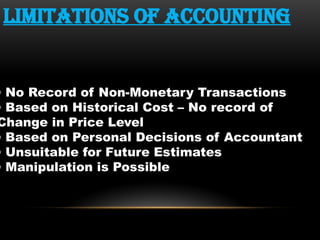
▪ No Record of Non-Monetary Transactions
▪ Based on Historical Cost – No record of
Change in Price Level
▪ Based on Personal Decisions of Accountant
▪ Unsuitable for Future Estimates
▪ Manipulation is Possible
LIMITATIONS OF ACCOUNTING
PPT BY SAKSHI GOLA

accounts theory.pptx Chapter 1 NCERT based content only

  • 1.
    INTRODUCTION TO ACCOUNTING Because –‘Accounting is the Language of Business’ In ancient times – ▪ Wants of humans were very limited due to which the number of business transactions were also limited ▪ There was no complexity in production and distribution ▪ Mostly barter system of exchange was practiced Because – ‘Accounting is the Language of Business’ ▪ As a result, the Businessman used to remember all his transactions orally because of his limited size of business or if required he used to record only limited transactions ▪ With the progress in science, the means of transportation and communication have increased and developed, which has raised the scope of trade and commerce up to national and international level
  • 2.
    WHAT IS BOOK-KEEPING…? Book-Keepingis the recording of transactions in a systematic manner. ▪ Book-keeping is – ▪ the recording of the financial transactions and information pertaining to a business, ▪ on a day-to-day basis (date-wise), ▪ The recording of transactions are made in specific book of Accounts ▪ It ensures that records of the individual financial transactions are correct, up-to-date and comprehensive.
  • 3.
    WHAT IS ACCOUNTING…? Accountingis a process of – ▪ Identifying, ▪ Measuring, ▪ Recording, ▪ classifying, and ▪ Summerising of Financial events of an organisation, on the basis of which related information can be communicated to the end user.
  • 4.
    Accounting is basedon – ▪ Universal Principles (GAAP) ▪ Accounting Concepts ▪ Accounting Conventions and ▪ Accounting Standards ▪ Which govern the accounting process in a uniform manner
  • 5.
    WHAT IS ACCOUNTANCY…? ACCOUNTANCYis a wider term than Accounting as it guides why accounts are maintained? How to maintain? In what way conclusions can be communicated to the related parties? Etc… ▪ In other words, Accountancy is a subject where one can learn the process, methods and techniques of Accounting and Book-keeping.
  • 6.
    OBJECTIVES OF ACCOUNTING Systematicrecording of business transaction in the books of accounts ▪ To ascertain Profit & Loss ▪ To ascertain Capital ▪ To Ascertain Debtors & Creditors ▪ To ascertain Financial Position
  • 7.
    QUALITATIVE CHARACTERISTICS OF ACCOUNTING INFORMATION ▪Understandability – Accounting information is useful only when it is understandable. To make it understandable, an information should be presented in simple terms and form ▪ Relevance – An information is relevant if the results in the information are meaningful and useful to the user for their decision-making. ▪ Reliability – Accounting information is reliable when it is free from errors and personal biasness. Accounting information should give a true and fair view of the financial affairs of the business ▪ Comparability – The quality of information that enables users to identify similarities in and differences between two or more sets of information is called comparability
  • 8.
    ADVANTAGES OF ACCOUNTING ▪Complementary to Memory ▪ Helpful in Tax Assessment ▪ Determination of Profit or Loss ▪ Determination of Financial Position ▪ Helpful in Comparative Study ▪ Helpful in Settlement of Disputes ▪ Helpful in Borrowings ▪ Control over Staff ▪ Helpful to get Government Grants
  • 9.
    ▪ No Recordof Non-Monetary Transactions ▪ Based on Historical Cost – No record of Change in Price Level ▪ Based on Personal Decisions of Accountant ▪ Unsuitable for Future Estimates ▪ Manipulation is Possible LIMITATIONS OF ACCOUNTING
  • 10.