Valuation Consulting
        49-50 The Hop Exchange,
24 Southwark Street, London, SE1 1TY
Tel: 020 7403 3344 Fax: 0207 499 2266
e-mail: valconsult@valconsulting.co.uk
    www.valuation-consulting.co.uk
VALUATION CONSULTING


STARTING AT THE TOP AND TRYING
       TO BUILD DOWN.

     THE LAWS OF PHYSICS
       AND VALUATION
   SUGGEST THAT THIS IS NOT
          POSSIBLE.
VALUATION CONSULTING


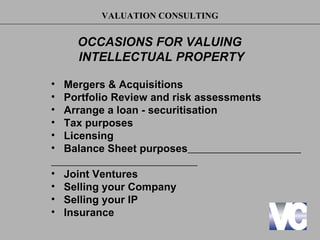
      OCCASIONS FOR VALUING
      INTELLECTUAL PROPERTY

•   Mergers & Acquisitions
•   Portfolio Review and risk assessments
•   Arrange a loan - securitisation
•   Tax purposes
•   Licensing
•   Balance Sheet purposes

•   Joint Ventures
•   Selling your Company
•   Selling your IP
•   Insurance
VALUATION CONSULTING

    METHODS OF VALUATION


Market Based

•   Comparable market transactions
VALUATION CONSULTING


COMPARABLE MARKET TRANSACTIONS

      • Few Sales
      • Lack of Information
      • Separate Values
      • Special Purchasers
      • Different Negotiating Skills
      • Distorting Effects of Varying Values
      • Assets Not Always Comparable
VALUATION CONSULTING

METHODS OF VALUATION

Cost Based

• Historical or replacement cost
VALUATION CONSULTING


HISTORICAL OR REPLACEMENT COST


   Caveats


   • Economic Benefits Excluded
   • Duration of benefit-economic life
   • Obsolescence difficult to quantify
   • Maintenance
   • Time value of money
VALUATION CONSULTING


    METHODS OF VALUATION

Income Approach


  • Capitalisation of historical profits

  • Future economic benefits
VALUATION CONSULTING

       CAPITALISATION OF HISTORICAL PROFITS

DRAWBACKS

  Profitability

  •   Problems of averaging
  •   Problems of extrapolating from past performance
  •   Decline & other key variables
  •   Net tangible assets not separately assessed

  Multiple

  • No reference point for price earnings multiple
  • Often no regard to established marketplace
  • Often no reconciliation with market capitalisation
VALUATION CONSULTING

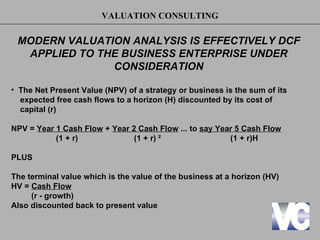
 MODERN VALUATION ANALYSIS IS EFFECTIVELY DCF
  APPLIED TO THE BUSINESS ENTERPRISE UNDER
               CONSIDERATION

• The Net Present Value (NPV) of a strategy or business is the sum of its
  expected free cash flows to a horizon (H) discounted by its cost of
  capital (r)

NPV = Year 1 Cash Flow + Year 2 Cash Flow ... to say Year 5 Cash Flow
           (1 + r)             (1 + r) ²                (1 + r)H

PLUS

The terminal value which is the value of the business at a horizon (HV)
HV = Cash Flow
     (r - growth)
Also discounted back to present value
VALUATION CONSULTING


HOW MUCH?

(CASHFLOWS)
VALUATION CONSULTING


GROSS PROFIT DIFFERENTIAL METHOD

  Assessment of margins

  • Generic or unbranded

  • Branded

  • Prices

  • Volumes

  • Maintenance
VALUATION CONSULTING


         GROSS PROFIT DIFFERENTIAL METHOD

Limitations

•   Net Tangible Assets and Rate of Return ignored
•   Cost & production efficiencies not isolated
•   Economies of scale not considered
•   Information about other product’s cost, volumes, etc not
    available
•   No generic brand name for comparison
•   If so differences in quantity, quality, availability
•   Market trends over time
•   Bias towards industries with lower variable costs to total costs
VALUATION CONSULTING

             EXCESS PROFITS METHOD

Features

• Calculate current market value of Net Tangible Assets
• Estimate Rate of Return to calculate required profits
• Excess above required level to induce investment
• Attribute excess to intangibles
• Capitalise this return
• Ensure careful segregation to identifiable products
• Those unidentifiable must be goodwill
VALUATION CONSULTING


                 EXCESS PROFITS METHOD

Limitations
•   Rate of Return can be a reflection of other factors
•   Does not allocate between parts
•   Tangible assets often incorporate intangible value ie value in
     use basis
•   Information about technological developments often not
    available
•   Assets being valued not employed in best manner
•   Asset values & reported profits often calculated on a different
    basis
•   Erosion of margin over time by competitive pressures
•   Benefit of lower depreciation of branded products
•   Required Rate of Return often an ingredient in sale price
•   Method ignores potential profit from extensions
VALUATION CONSULTING

    ROYALTIES FOREGONE/RELIEF FROM ROYALTY

Features

• Estimate future royalty stream
• Basic premise sale & lease-back
• Usually maximum basis with acceptable Rate of
  Return
• Alternatively payment for your use
• Royalty equivalent to excess profit component
• Greater availability of independent economic & trade
  association forecasts
• Facilitates comparison with Royalty Rates of
  similar intellectual property in marketplace
VALUATION CONSULTING


         ROYALTIES FOREGONE/RELIEF
               FROM ROYALTY

Problems
• Separation of intangible components

• Other factors often an ingredient in determining
  current Royalty Rate
            eg     geographical goodwill
                   or monopoly
• Comparable
           may be out of date
           lack of detailed information
           arrangements may preclude extensions
VALUATION CONSULTING


HOW LONG FOR?

 (TIME PERIODS)
VALUATION CONSULTING


   AT WHAT RISK?


 (COST OF CAPITAL)
VALUATION CONSULTING


                   MONTE CARLO

•   Effectively a DCF multiplier

•   Numerous DCF calculations accounting for
    various scenarios, say of revenue, market
    share, costs, internationality and other
    risks

•   With just 4 scenario changes of the stated
    assumptions above this means 256 models!

•   That is 4 values for each of income, different
    market share, costs, international penetration
    i.e. 4 x 4 x 4 x 4 = 256
VALUATION CONSULTING

                   1-10 – 100 RULE

•   Often scarce capital resources

•   Each stage in a technical development
    costs 10 times as much as the previous
    one

•   Assumption of success – the probability of failure
    at each stage could be 90% +

•   Even with 50% probability an inventor needs two
    ‘up his sleeve’, at each stage

•   Multiplier effect

Valuation methods

  • 1.
    Valuation Consulting 49-50 The Hop Exchange, 24 Southwark Street, London, SE1 1TY Tel: 020 7403 3344 Fax: 0207 499 2266 e-mail: valconsult@valconsulting.co.uk www.valuation-consulting.co.uk
  • 2.
    VALUATION CONSULTING STARTING ATTHE TOP AND TRYING TO BUILD DOWN. THE LAWS OF PHYSICS AND VALUATION SUGGEST THAT THIS IS NOT POSSIBLE.
  • 3.
    VALUATION CONSULTING OCCASIONS FOR VALUING INTELLECTUAL PROPERTY • Mergers & Acquisitions • Portfolio Review and risk assessments • Arrange a loan - securitisation • Tax purposes • Licensing • Balance Sheet purposes • Joint Ventures • Selling your Company • Selling your IP • Insurance
  • 4.
    VALUATION CONSULTING METHODS OF VALUATION Market Based • Comparable market transactions
  • 5.
    VALUATION CONSULTING COMPARABLE MARKETTRANSACTIONS • Few Sales • Lack of Information • Separate Values • Special Purchasers • Different Negotiating Skills • Distorting Effects of Varying Values • Assets Not Always Comparable
  • 6.
    VALUATION CONSULTING METHODS OFVALUATION Cost Based • Historical or replacement cost
  • 7.
    VALUATION CONSULTING HISTORICAL ORREPLACEMENT COST Caveats • Economic Benefits Excluded • Duration of benefit-economic life • Obsolescence difficult to quantify • Maintenance • Time value of money
  • 8.
    VALUATION CONSULTING METHODS OF VALUATION Income Approach • Capitalisation of historical profits • Future economic benefits
  • 9.
    VALUATION CONSULTING CAPITALISATION OF HISTORICAL PROFITS DRAWBACKS Profitability • Problems of averaging • Problems of extrapolating from past performance • Decline & other key variables • Net tangible assets not separately assessed Multiple • No reference point for price earnings multiple • Often no regard to established marketplace • Often no reconciliation with market capitalisation
  • 10.
    VALUATION CONSULTING MODERNVALUATION ANALYSIS IS EFFECTIVELY DCF APPLIED TO THE BUSINESS ENTERPRISE UNDER CONSIDERATION • The Net Present Value (NPV) of a strategy or business is the sum of its expected free cash flows to a horizon (H) discounted by its cost of capital (r) NPV = Year 1 Cash Flow + Year 2 Cash Flow ... to say Year 5 Cash Flow (1 + r) (1 + r) ² (1 + r)H PLUS The terminal value which is the value of the business at a horizon (HV) HV = Cash Flow (r - growth) Also discounted back to present value
  • 11.
  • 12.
    VALUATION CONSULTING GROSS PROFITDIFFERENTIAL METHOD Assessment of margins • Generic or unbranded • Branded • Prices • Volumes • Maintenance
  • 13.
    VALUATION CONSULTING GROSS PROFIT DIFFERENTIAL METHOD Limitations • Net Tangible Assets and Rate of Return ignored • Cost & production efficiencies not isolated • Economies of scale not considered • Information about other product’s cost, volumes, etc not available • No generic brand name for comparison • If so differences in quantity, quality, availability • Market trends over time • Bias towards industries with lower variable costs to total costs
  • 14.
    VALUATION CONSULTING EXCESS PROFITS METHOD Features • Calculate current market value of Net Tangible Assets • Estimate Rate of Return to calculate required profits • Excess above required level to induce investment • Attribute excess to intangibles • Capitalise this return • Ensure careful segregation to identifiable products • Those unidentifiable must be goodwill
  • 15.
    VALUATION CONSULTING EXCESS PROFITS METHOD Limitations • Rate of Return can be a reflection of other factors • Does not allocate between parts • Tangible assets often incorporate intangible value ie value in use basis • Information about technological developments often not available • Assets being valued not employed in best manner • Asset values & reported profits often calculated on a different basis • Erosion of margin over time by competitive pressures • Benefit of lower depreciation of branded products • Required Rate of Return often an ingredient in sale price • Method ignores potential profit from extensions
  • 16.
    VALUATION CONSULTING ROYALTIES FOREGONE/RELIEF FROM ROYALTY Features • Estimate future royalty stream • Basic premise sale & lease-back • Usually maximum basis with acceptable Rate of Return • Alternatively payment for your use • Royalty equivalent to excess profit component • Greater availability of independent economic & trade association forecasts • Facilitates comparison with Royalty Rates of similar intellectual property in marketplace
  • 17.
    VALUATION CONSULTING ROYALTIES FOREGONE/RELIEF FROM ROYALTY Problems • Separation of intangible components • Other factors often an ingredient in determining current Royalty Rate eg geographical goodwill or monopoly • Comparable may be out of date lack of detailed information arrangements may preclude extensions
  • 18.
    VALUATION CONSULTING HOW LONGFOR? (TIME PERIODS)
  • 19.
    VALUATION CONSULTING AT WHAT RISK? (COST OF CAPITAL)
  • 20.
    VALUATION CONSULTING MONTE CARLO • Effectively a DCF multiplier • Numerous DCF calculations accounting for various scenarios, say of revenue, market share, costs, internationality and other risks • With just 4 scenario changes of the stated assumptions above this means 256 models! • That is 4 values for each of income, different market share, costs, international penetration i.e. 4 x 4 x 4 x 4 = 256
  • 21.
    VALUATION CONSULTING 1-10 – 100 RULE • Often scarce capital resources • Each stage in a technical development costs 10 times as much as the previous one • Assumption of success – the probability of failure at each stage could be 90% + • Even with 50% probability an inventor needs two ‘up his sleeve’, at each stage • Multiplier effect