
Accessibility
Presented by
Anthony Floyd, AIA, LEED AP
Contact Anthony online at http://anthony.designarts.net
www.designarts.net | 1.800.264.9605 | info@designarts.net
Continuing Education for Design Professionals Since 1992
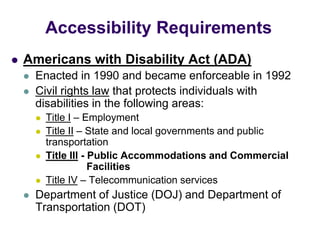
 Americans with Disability Act (ADA)
 Enacted in 1990 and became enforceable in 1992
 Civil rights law that protects individuals with
disabilities in the following areas:
 Title I – Employment
 Title II – State and local governments and public
transportation
 Title III - Public Accommodations and Commercial
Facilities
 Title IV – Telecommunication services
 Department of Justice (DOJ) and Department of
Transportation (DOT)
Accessibility Requirements
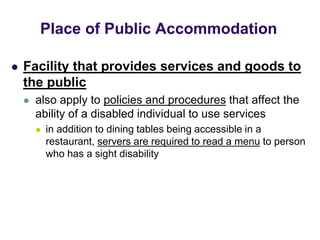
 Facility that provides services and goods to
the public
 also apply to policies and procedures that affect the
ability of a disabled individual to use services
 in addition to dining tables being accessible in a
restaurant, servers are required to read a menu to person
who has a sight disability
Place of Public Accommodation
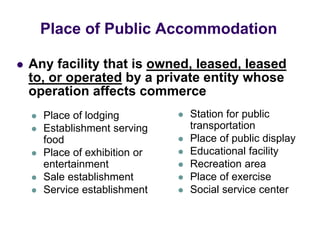
 Any facility that is owned, leased, leased
to, or operated by a private entity whose
operation affects commerce
Place of Public Accommodation
 Place of lodging
 Establishment serving
food
 Place of exhibition or
entertainment
 Sale establishment
 Service establishment
 Station for public
transportation
 Place of public display
 Educational facility
 Recreation area
 Place of exercise
 Social service center
 Operations that affect commerce but are
not generally open to the public
 must be compliant with the ADA for use by
employees
 Applies to:
 Factories
 Warehouses
 Telemarketing office
Commercial Facilities
1. Getting to and into the building
 Parking, accessible routes, ramps, walkways,
doors, signs, etc.
2. Accessing goods and services
 Counters, brochure racks, recreation areas offices,
library books & materials, computers, etc.
3. Accessible restrooms
 Stalls and toilets rooms, showers, etc.
4. All other
 Drinking fountains, telephones, etc.
Priorities for Accessibility
 Exemptions
 Facilities owned and operated by religious entities
 unless part of the facility is used as a place of public
accommodation
 One- and two-family dwellings
 unless used for business in which clients visit, then that
part of the residence must meet ADA
 Private clubs
 Certain government facilities
Accessibility Exemptions
 Fair Housing Act (FHA)
 Originally established in 1968 to regulate fair
housing and protects the consumer from
discrimination in housing when buying or renting
 Expanded in 1988 to include persons with
disabilities
 pertains to residential housing that has four or more
dwelling units, such as apartments and condos
 location of thermostats, electrical outlets, light switches,
and accessibility in hallways, bathrooms and kitchens
Accessibility Requirements
 Scoping requirements
 Number of accessible toilets, water fountains, doors,
etc.
 Technical requirements
 Specific requirements and dimensions that have to
be met for the door, sink, millwork, etc.
 Communications including visible alarm systems and
signage
ADA Accessibility Guidelines
(ADAAG)
 New Construction
 All aspects of the building design must comply
 Includes new tenant spaces within an existing
building
 Alterations
 Changes made to an area must comply to ADA
requirements unless such improvements are cost
prohibitive
 exceeds 20% of the cost of the overall alterations over a
3-year period
Levels of Compliance
 Existing Buildings
 Owners are expected to have facilities evaluated to
remove architectural barriers
 legal suits can be brought against the owner of a facility
 Law requires that an attempt to meet the ADA
guidelines be made “to the maximum extent feasible”
 exemption when determined it is not “readily achievable”
and considered an “undue burden”
Levels of Compliance
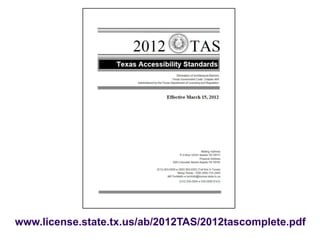
www.license.state.tx.us/ab/2012TAS/2012tascomplete.pdf
www.ada.gov/2010ADAstandards_index.htm
Texas Accessibility Standards
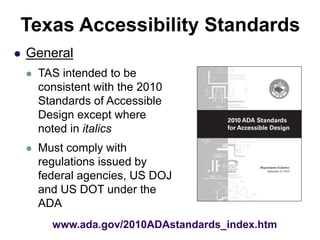
 General
 TAS intended to be
consistent with the 2010
Standards of Accessible
Design except where
noted in italics
 Must comply with
regulations issued by
federal agencies, US DOJ
and US DOT under the
ADA
Texas Accessibility Standards
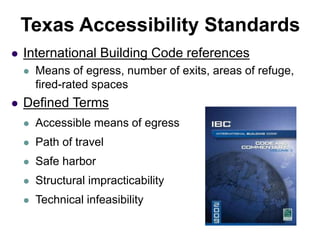
 International Building Code references
 Means of egress, number of exits, areas of refuge,
fired-rated spaces
 Defined Terms
 Accessible means of egress
 Path of travel
 Safe harbor
 Structural impracticability
 Technical infeasibility
 Scoping Requirements
 Existing building and facilities
 General exceptions
 Accessible routes
 Accessible means of egress
 Kitchens, kitchenettes and sinks
 Toilet and bathing facilities
 Dressing, fitting and locker rooms
 Dining and work surfaces
 Windows
 Residential Facilities
Texas Accessibility Standards
 Technical Requirements
 Building Blocks
 Accessible Routes
 General Site and Building Elements
 Plumbing Elements and Facilities
 Communication Elements and Features
 Special Rooms, Spaces and Elements
 Built-In Elements
 Recreation Facilities
Texas Accessibility Standards
Thank you
This concludes this continuing education program.
We rely on your feedback to evaluate our efforts to deliver high-quality learning
experiences.
Please take a moment to fill out the evaluation form so we may
improve the way we serve your continuing education needs.
Should you wish to contact Anthony,
you may do so online at http://anthony.designarts.net
www.designarts.net | 1.800.264.9605 | info@designarts.net
Continuing Education for Design Professionals Since 1992

Accessibility Building Codes: ADA

  • 1.
    Accessibility Presented by Anthony Floyd,AIA, LEED AP Contact Anthony online at http://anthony.designarts.net www.designarts.net | 1.800.264.9605 | info@designarts.net Continuing Education for Design Professionals Since 1992
  • 2.
     Americans withDisability Act (ADA)  Enacted in 1990 and became enforceable in 1992  Civil rights law that protects individuals with disabilities in the following areas:  Title I – Employment  Title II – State and local governments and public transportation  Title III - Public Accommodations and Commercial Facilities  Title IV – Telecommunication services  Department of Justice (DOJ) and Department of Transportation (DOT) Accessibility Requirements
  • 3.
     Facility thatprovides services and goods to the public  also apply to policies and procedures that affect the ability of a disabled individual to use services  in addition to dining tables being accessible in a restaurant, servers are required to read a menu to person who has a sight disability Place of Public Accommodation
  • 4.
     Any facilitythat is owned, leased, leased to, or operated by a private entity whose operation affects commerce Place of Public Accommodation  Place of lodging  Establishment serving food  Place of exhibition or entertainment  Sale establishment  Service establishment  Station for public transportation  Place of public display  Educational facility  Recreation area  Place of exercise  Social service center
  • 5.
     Operations thataffect commerce but are not generally open to the public  must be compliant with the ADA for use by employees  Applies to:  Factories  Warehouses  Telemarketing office Commercial Facilities
  • 6.
    1. Getting toand into the building  Parking, accessible routes, ramps, walkways, doors, signs, etc. 2. Accessing goods and services  Counters, brochure racks, recreation areas offices, library books & materials, computers, etc. 3. Accessible restrooms  Stalls and toilets rooms, showers, etc. 4. All other  Drinking fountains, telephones, etc. Priorities for Accessibility
  • 7.
     Exemptions  Facilitiesowned and operated by religious entities  unless part of the facility is used as a place of public accommodation  One- and two-family dwellings  unless used for business in which clients visit, then that part of the residence must meet ADA  Private clubs  Certain government facilities Accessibility Exemptions
  • 8.
     Fair HousingAct (FHA)  Originally established in 1968 to regulate fair housing and protects the consumer from discrimination in housing when buying or renting  Expanded in 1988 to include persons with disabilities  pertains to residential housing that has four or more dwelling units, such as apartments and condos  location of thermostats, electrical outlets, light switches, and accessibility in hallways, bathrooms and kitchens Accessibility Requirements
  • 9.
     Scoping requirements Number of accessible toilets, water fountains, doors, etc.  Technical requirements  Specific requirements and dimensions that have to be met for the door, sink, millwork, etc.  Communications including visible alarm systems and signage ADA Accessibility Guidelines (ADAAG)
  • 10.
     New Construction All aspects of the building design must comply  Includes new tenant spaces within an existing building  Alterations  Changes made to an area must comply to ADA requirements unless such improvements are cost prohibitive  exceeds 20% of the cost of the overall alterations over a 3-year period Levels of Compliance
  • 11.
     Existing Buildings Owners are expected to have facilities evaluated to remove architectural barriers  legal suits can be brought against the owner of a facility  Law requires that an attempt to meet the ADA guidelines be made “to the maximum extent feasible”  exemption when determined it is not “readily achievable” and considered an “undue burden” Levels of Compliance
  • 12.
  • 13.
    www.ada.gov/2010ADAstandards_index.htm Texas Accessibility Standards General  TAS intended to be consistent with the 2010 Standards of Accessible Design except where noted in italics  Must comply with regulations issued by federal agencies, US DOJ and US DOT under the ADA
  • 14.
    Texas Accessibility Standards International Building Code references  Means of egress, number of exits, areas of refuge, fired-rated spaces  Defined Terms  Accessible means of egress  Path of travel  Safe harbor  Structural impracticability  Technical infeasibility
  • 15.
     Scoping Requirements Existing building and facilities  General exceptions  Accessible routes  Accessible means of egress  Kitchens, kitchenettes and sinks  Toilet and bathing facilities  Dressing, fitting and locker rooms  Dining and work surfaces  Windows  Residential Facilities Texas Accessibility Standards
  • 16.
     Technical Requirements Building Blocks  Accessible Routes  General Site and Building Elements  Plumbing Elements and Facilities  Communication Elements and Features  Special Rooms, Spaces and Elements  Built-In Elements  Recreation Facilities Texas Accessibility Standards
  • 17.
    Thank you This concludesthis continuing education program. We rely on your feedback to evaluate our efforts to deliver high-quality learning experiences. Please take a moment to fill out the evaluation form so we may improve the way we serve your continuing education needs. Should you wish to contact Anthony, you may do so online at http://anthony.designarts.net www.designarts.net | 1.800.264.9605 | info@designarts.net Continuing Education for Design Professionals Since 1992