Presented by Aleksandra Posarac,
     Lead Economist, World Bank


                               1
 Assembles  the best available scientific
  information on disability today
 Recommends national and international
  action to improve the lives of people with
  disability
 Supports the implementation of the UN
  CRPD, which approaches disability both as
  both human rights and development issue.


                                         2
 International  Classification of Disability
  Functioning and Health (ICF, WHO 2001)
  adopted as the conceptual framework
 Defines disability as an umbrella term for
  impairment, activity limitation and
  participation restrictions.
 Disability refers to the negative aspects of
  the interaction between individuals with a
  health condition and personal and
  environmental factors (such as, negative
  attitudes, inaccessible transportation and
  public buildings and limited social support)

                                          3
 Almost  everyone will be temporarily or
  permanently impaired at some point in life
 Those who survive to old age will experience
  increasing difficulties in functioning
 Disability is complex and the interventions to
  overcome the disadvantage associated with
  disability are multiple and systemic – varying
  with the context


                                          4
 Higher  estimates of prevalence: 15 percent
  with some form of disability; 110-190 million
  with profound difficulties in functioning
 Growing numbers: aging, chronic health
  conditions, road traffic injuries, work related
  injuries, natural disasters, wars and civil
  conflicts…
 Diverse experience: negative interaction
  between an individual with impairment and
  her/his environment varies greatly
 Disproportionately affects vulnerable
  populations

                                           5
1. Understanding disability
2. Disability – a global
picture
3. General healthcare
4. Rehabilitation
5. Assistance and support
6. Enabling environments
7.   Education
8. Work and employment
9. The way forward
 Human   right
 Central in promoting inclusive and equitable
  societies
 Key determinant of personal well-being and
  welfare.


                                         7
 Exclusion has high social and economic costs.
 Countries cannot achieve Education for All or
  the Millennium Development Goal of
  universal completion of primary education
 Countries cannot fulfill their responsibilities
  under CRPD and CRC


                                           8
 For children with disabilities, education is
  vital in itself but also instrumental for
  participating in employment and other areas
  of social activity.
 In some cultures, attending school is part of
  becoming a complete person. Social relations
  can change the status of people with
  disabilities in society and affirm their rights.
 For children without disability, contact with
  children with a disability in an inclusive
  setting can, over the longer term, increase
  familiarity and reduce prejudice.

                                            9
 Less likely to start school and have lower rates
  of staying and being promoted in school.
 The correlations for both children and adults
  between low educational outcomes and having a
  disability is often stronger than the correlations
  between low educational outcome and other
  characteristics – such as gender, rural residence,
  and low economic status.
 The gap in primary school attendance rates
  ranges from 10% in India to 60% in Indonesia, and
  for secondary education, from 15% in Cambodia
  to 58% in Indonesia.

                                             10
  Enrolment rates also differ among
  impairments, with children with intellectual
  or sensory impairments fairing the worse.
 Even in countries with high primary school
  enrolment rates: such as in Eastern Europe,
  many children with disabilities do not attend
  school. In 2002 the enrollment rates of
  disabled children between the ages of 7 and
  15 years were:
       81%/96 in Bulgaria, 58%/97% in the Republic of
        Moldova, and 59%/93% in Romania.

                                                  11
 System-wide     problems
    Divided ministerial responsibility
    Lack of legislation, policy, targets, and plans
    Inadequate resources


                                              12
 School   level problems
    Curriculum and pedagogy
    Inadequate training and support for teachers
    Physical barriers
    Labelling
    Attitudinal barriers
    Violence, bulling and abuse


                                            13
 Ensuring   the inclusion of children with
  disabilities in education requires both
  systemic and school level change.
 It is a complex change and it requires vision,
  skills, incentives, resources, and an action
  plan.
 One of the most important elements in an
  inclusive educational system is strong and
  continuous leadership at the national and
  school levels – something that is cost-neutral.


                                          14
The success of inclusive systems of education
 depends largely on a country’s commitment
 to:
    Adopt appropriate legislation:
        Example: Italy - since the mid-1970s Italy has had
         legislation in place to support inclusive education for
         all children with disabilities resulting in high inclusion
         rates and positive educational outcomes
    Develop adequate policies:
        Clear national policies are essential for the
         development of more equitable education systems.
        UNESCO has produced guidelines to assist policy-
         makers and managers create policies and practices
         supportive of inclusion.

                                                           15
   Adopt national plans
     Creating/amending a NPA and establishing
      infrastructure and capacity to implement the
      plan key to including children with
      disabilities in education.
     The implications of Article 24 of the CRPD are
      that institutional responsibility for the
      education of children with disabilities should
      remain within the Ministry of Education, with
      coordination, as appropriate, with other
      relevant ministries.
     National plans for Education For All should
      reflect international commitments to the
      right of disabled children to be educated.
                                             16
and
 Provide adequate funding for implementation
   There are basically three ways to finance special
    needs education, whether in specialized
    institutions or mainstream schools:
     Through the national budget,
     Through financing the particular needs of
      institutions – for materials, teaching aids,
      training, and operational support,
     Through financing individuals to meet their
      needs.


                                              17
   Whichever funding model is used, it should:
     Be easy to understand.
     Be flexible and predictable.
     Provide sufficient funds.
     Be cost-based and allow for cost control.
     Connect special education to general
      education.
     Be neutral in identification and placement.


                                              18
 Recognizing     and addressing individual
 differences
    Education systems need to move away from more
     traditional pedagogies and adopt more learner-
     centered approaches which recognize that each
     individual has an ability to learn and a specific
     way of learning.
 Providing    additional supports
    To ensure the success of inclusive education
     policies some children with disabilities will
     require access to additional support services.


                                                19
   Building teacher capacity
       The appropriate training of mainstream teachers is
        crucial if they are to be confident and competent in
        teaching children with diverse educational needs.
 Removing physical barriers
 Overcoming negative attitudes
       The physical presence of children with disabilities in
        schools does not automatically ensure their
        participation. For participation to be meaningful and
        produce good learning outcomes, the ethos of the
        school – valuing diversity and providing a safe and
        supportive environment – is critical.


                                                       20
 Communities
 Parents
 Disabled people organizations
 Children with disabilities


                                  21
   Children with disabilities are less likely than children
    without disabilities to start school and have lower
    rates of staying and being promoted in school.
   While children with disabilities have historically been
    educated in separate special schools, inclusive
    mainstream schools in both urban and rural areas
    provide a cost-effective way forward.
   A range of barriers within education policies, systems
    and services limit disabled children’s mainstream
    educational opportunities.
   A broad range of stakeholders – policy-makers, school
    administrators, teachers, families, and children with
    and without disabilities – can contribute to improving
    educational opportunities and outcomes for children
    with disabilities.
                                                    22
 Formulateclear policies and improve data
 and information
    Develop a clear national policy on the inclusion
     of children with disabilities in education
    Identify, through surveys, the level and nature
     of need, so that the correct supports and
     accommodations can be introduced.
    Establish monitoring and evaluation systems.
    Share knowledge about how to achieve
     educational inclusion among policy-makers,
     educators, and families.


                                                23
 Adopt   strategies to promote inclusion
    Focus on educating children as close to the
     mainstream as possible.
    Do not build a new special schoolif no special
     schools exist.
    Ensure an inclusive educational infrastructure.
    Make teachers aware of their responsibilities
     towards all children and build and improve their
     skills for teaching children with disabilities.


                                              24
   Support teachers and schools to move away from
    a one-size-fits-all model towards flexible
    approaches that can cope with diverse needs of
    learners.
   Provide technical guidance to teachers.
   Clarify and reconsider policieson the assessment,
    classification, and placement of students.
   Promote deaf children’s right to education by
    recognizing linguistic rights.


                                              25
 Providespecialist services, where
 necessary
    Increase investment in school infrastructure and
     personnel.
    Make available speech and language therapy,
     occupational therapy, and.
    In the absence of specialist providers, use
     existing community-based rehabilitation services
     to support children in educational settings.
    Consider introducing teaching assistants to
     provide special support.


                                              26
   Support participation
       Involve parents and family members.
       Involve the broader community in activities related
        to the education of children with disabilities.
       Develop links between educational services and
        community-based rehabilitation – and other
        rehabilitation services, where they exist.
       Encourage adults with disabilities and disabled
        people’s organizationsto become more involved in
        promoting access to education for children with
        disabilities.
       Consult and involve children in decisions about their
        education.

                                                       27
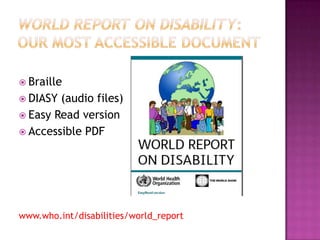
 Braille
 DIASY (audio files)
 Easy Read version
 Accessible PDF


www.who.int/disabilities/world_report
 AlanaOfficer - officera@who.int
 Tom Shakespeare - shakespearet@who.int


 Aleksandra   Posarac - aposarac@worldbank.org
THANK YOU

        30

World Report on Disability: Education

  • 1.
    Presented by AleksandraPosarac, Lead Economist, World Bank 1
  • 2.
     Assembles the best available scientific information on disability today  Recommends national and international action to improve the lives of people with disability  Supports the implementation of the UN CRPD, which approaches disability both as both human rights and development issue. 2
  • 3.
     International Classification of Disability Functioning and Health (ICF, WHO 2001) adopted as the conceptual framework  Defines disability as an umbrella term for impairment, activity limitation and participation restrictions.  Disability refers to the negative aspects of the interaction between individuals with a health condition and personal and environmental factors (such as, negative attitudes, inaccessible transportation and public buildings and limited social support) 3
  • 4.
     Almost everyone will be temporarily or permanently impaired at some point in life  Those who survive to old age will experience increasing difficulties in functioning  Disability is complex and the interventions to overcome the disadvantage associated with disability are multiple and systemic – varying with the context 4
  • 5.
     Higher estimates of prevalence: 15 percent with some form of disability; 110-190 million with profound difficulties in functioning  Growing numbers: aging, chronic health conditions, road traffic injuries, work related injuries, natural disasters, wars and civil conflicts…  Diverse experience: negative interaction between an individual with impairment and her/his environment varies greatly  Disproportionately affects vulnerable populations 5
  • 6.
    1. Understanding disability 2.Disability – a global picture 3. General healthcare 4. Rehabilitation 5. Assistance and support 6. Enabling environments 7. Education 8. Work and employment 9. The way forward
  • 7.
     Human right  Central in promoting inclusive and equitable societies  Key determinant of personal well-being and welfare. 7
  • 8.
     Exclusion hashigh social and economic costs.  Countries cannot achieve Education for All or the Millennium Development Goal of universal completion of primary education  Countries cannot fulfill their responsibilities under CRPD and CRC 8
  • 9.
     For childrenwith disabilities, education is vital in itself but also instrumental for participating in employment and other areas of social activity.  In some cultures, attending school is part of becoming a complete person. Social relations can change the status of people with disabilities in society and affirm their rights.  For children without disability, contact with children with a disability in an inclusive setting can, over the longer term, increase familiarity and reduce prejudice. 9
  • 10.
     Less likelyto start school and have lower rates of staying and being promoted in school.  The correlations for both children and adults between low educational outcomes and having a disability is often stronger than the correlations between low educational outcome and other characteristics – such as gender, rural residence, and low economic status.  The gap in primary school attendance rates ranges from 10% in India to 60% in Indonesia, and for secondary education, from 15% in Cambodia to 58% in Indonesia. 10
  • 11.
     Enrolmentrates also differ among impairments, with children with intellectual or sensory impairments fairing the worse.  Even in countries with high primary school enrolment rates: such as in Eastern Europe, many children with disabilities do not attend school. In 2002 the enrollment rates of disabled children between the ages of 7 and 15 years were:  81%/96 in Bulgaria, 58%/97% in the Republic of Moldova, and 59%/93% in Romania. 11
  • 12.
     System-wide problems  Divided ministerial responsibility  Lack of legislation, policy, targets, and plans  Inadequate resources 12
  • 13.
     School level problems  Curriculum and pedagogy  Inadequate training and support for teachers  Physical barriers  Labelling  Attitudinal barriers  Violence, bulling and abuse 13
  • 14.
     Ensuring the inclusion of children with disabilities in education requires both systemic and school level change.  It is a complex change and it requires vision, skills, incentives, resources, and an action plan.  One of the most important elements in an inclusive educational system is strong and continuous leadership at the national and school levels – something that is cost-neutral. 14
  • 15.
    The success ofinclusive systems of education depends largely on a country’s commitment to:  Adopt appropriate legislation:  Example: Italy - since the mid-1970s Italy has had legislation in place to support inclusive education for all children with disabilities resulting in high inclusion rates and positive educational outcomes  Develop adequate policies:  Clear national policies are essential for the development of more equitable education systems.  UNESCO has produced guidelines to assist policy- makers and managers create policies and practices supportive of inclusion. 15
  • 16.
    Adopt national plans  Creating/amending a NPA and establishing infrastructure and capacity to implement the plan key to including children with disabilities in education.  The implications of Article 24 of the CRPD are that institutional responsibility for the education of children with disabilities should remain within the Ministry of Education, with coordination, as appropriate, with other relevant ministries.  National plans for Education For All should reflect international commitments to the right of disabled children to be educated. 16
  • 17.
    and  Provide adequatefunding for implementation  There are basically three ways to finance special needs education, whether in specialized institutions or mainstream schools:  Through the national budget,  Through financing the particular needs of institutions – for materials, teaching aids, training, and operational support,  Through financing individuals to meet their needs. 17
  • 18.
    Whichever funding model is used, it should:  Be easy to understand.  Be flexible and predictable.  Provide sufficient funds.  Be cost-based and allow for cost control.  Connect special education to general education.  Be neutral in identification and placement. 18
  • 19.
     Recognizing and addressing individual differences  Education systems need to move away from more traditional pedagogies and adopt more learner- centered approaches which recognize that each individual has an ability to learn and a specific way of learning.  Providing additional supports  To ensure the success of inclusive education policies some children with disabilities will require access to additional support services. 19
  • 20.
    Building teacher capacity  The appropriate training of mainstream teachers is crucial if they are to be confident and competent in teaching children with diverse educational needs.  Removing physical barriers  Overcoming negative attitudes  The physical presence of children with disabilities in schools does not automatically ensure their participation. For participation to be meaningful and produce good learning outcomes, the ethos of the school – valuing diversity and providing a safe and supportive environment – is critical. 20
  • 21.
     Communities  Parents Disabled people organizations  Children with disabilities 21
  • 22.
    Children with disabilities are less likely than children without disabilities to start school and have lower rates of staying and being promoted in school.  While children with disabilities have historically been educated in separate special schools, inclusive mainstream schools in both urban and rural areas provide a cost-effective way forward.  A range of barriers within education policies, systems and services limit disabled children’s mainstream educational opportunities.  A broad range of stakeholders – policy-makers, school administrators, teachers, families, and children with and without disabilities – can contribute to improving educational opportunities and outcomes for children with disabilities. 22
  • 23.
     Formulateclear policiesand improve data and information  Develop a clear national policy on the inclusion of children with disabilities in education  Identify, through surveys, the level and nature of need, so that the correct supports and accommodations can be introduced.  Establish monitoring and evaluation systems.  Share knowledge about how to achieve educational inclusion among policy-makers, educators, and families. 23
  • 24.
     Adopt strategies to promote inclusion  Focus on educating children as close to the mainstream as possible.  Do not build a new special schoolif no special schools exist.  Ensure an inclusive educational infrastructure.  Make teachers aware of their responsibilities towards all children and build and improve their skills for teaching children with disabilities. 24
  • 25.
    Support teachers and schools to move away from a one-size-fits-all model towards flexible approaches that can cope with diverse needs of learners.  Provide technical guidance to teachers.  Clarify and reconsider policieson the assessment, classification, and placement of students.  Promote deaf children’s right to education by recognizing linguistic rights. 25
  • 26.
     Providespecialist services,where necessary  Increase investment in school infrastructure and personnel.  Make available speech and language therapy, occupational therapy, and.  In the absence of specialist providers, use existing community-based rehabilitation services to support children in educational settings.  Consider introducing teaching assistants to provide special support. 26
  • 27.
    Support participation  Involve parents and family members.  Involve the broader community in activities related to the education of children with disabilities.  Develop links between educational services and community-based rehabilitation – and other rehabilitation services, where they exist.  Encourage adults with disabilities and disabled people’s organizationsto become more involved in promoting access to education for children with disabilities.  Consult and involve children in decisions about their education. 27
  • 28.
     Braille  DIASY(audio files)  Easy Read version  Accessible PDF www.who.int/disabilities/world_report
  • 29.
     AlanaOfficer -officera@who.int  Tom Shakespeare - shakespearet@who.int  Aleksandra Posarac - aposarac@worldbank.org
  • 30.