ADA Workshop
ADAAG, and what does it stand for? What does ADA stand for? Americans with Disabilities Act Accessibility Guidelines Americans with Disabilities Act What portion of the ADA do we use as designers in our work?
What is the ADAAG based on? ANSI 117.1 (Created in 1980) ADA originally written in 1990, most recent revision is July 1, 1994 All dimensions are for adults Sets of guidelines for accessibility to places of public accommodation & commercial facilities by individuals with disabilities To be applied during design, construction and alteration
Contractual Wording  May…: denotes an option of alternative Shall…: denotes a mandatory specification Should…: denotes an advisory specification or recommendation
ADA Vocab Accessible: building, site, facility or a portion of that complies with these (ADAAG) guidelines Accessible Route: a continuous, unobstructed path connecting all accessible elements & spaces of a building or facility Ramp: a walking surface that has a slope of greater than 1:20 (max slope of 1:12) Signage: Displayed verbal, symbolic, tactile and pictorial information
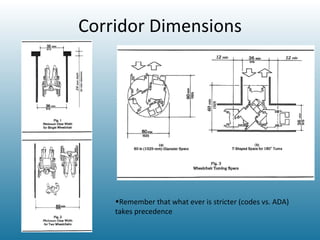
Corridor Dimensions Remember that what ever is stricter (codes vs. ADA) takes precedence
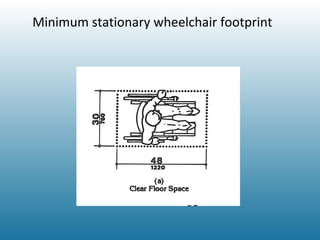
Minimum stationary wheelchair footprint
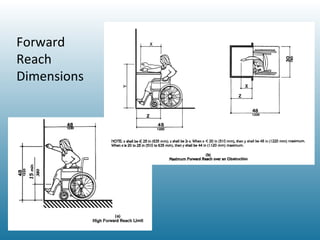
Forward Reach Dimensions
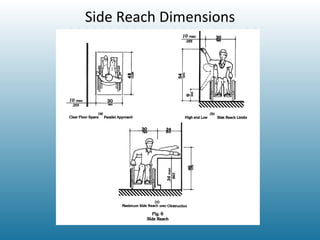
Side Reach Dimensions
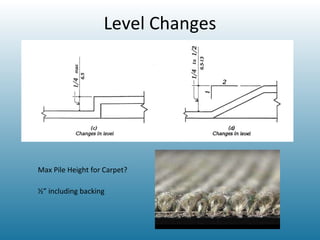
Level Changes Max Pile Height for Carpet? ½” including backing
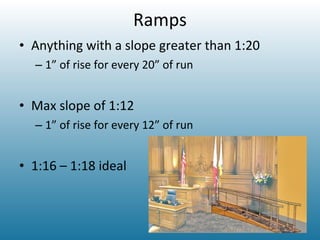
Ramps Anything with a slope greater than 1:20 1” of rise for every 20” of run Max slope of 1:12 1” of rise for every 12” of run 1:16 – 1:18 ideal
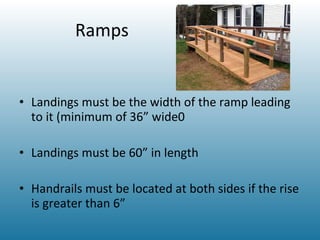
Ramps Landings must be the width of the ramp leading to it (minimum of 36” wide0 Landings must be 60” in length Handrails must be located at both sides if the rise is greater than 6”
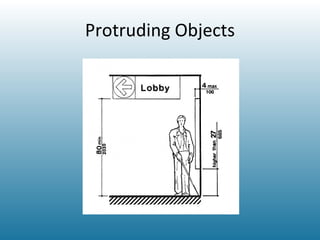
Protruding Objects
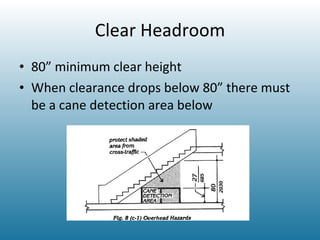
Clear Headroom 80” minimum clear height When clearance drops below 80” there must be a cane detection area below
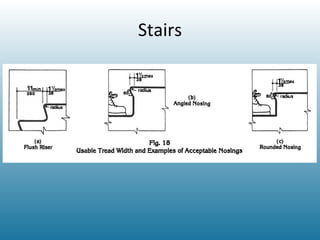
Stairs
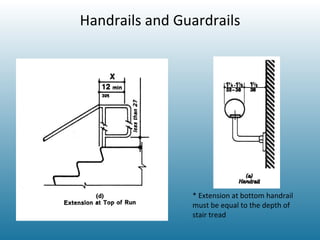
Handrails and Guardrails * Extension at bottom handrail must be equal to the depth of stair tread
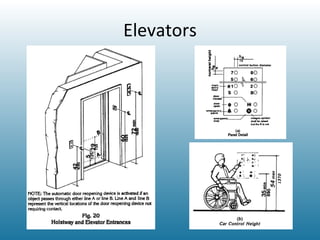
Elevators
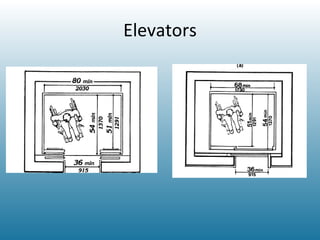
Elevators
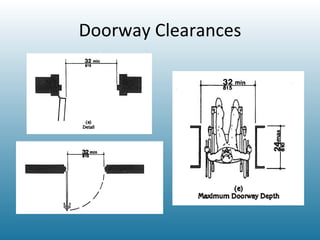
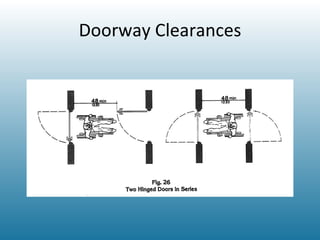
Doorway Clearances
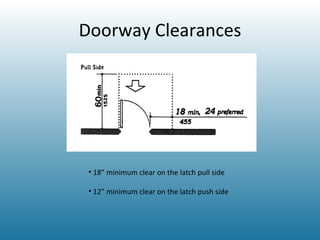
Doorway Clearances 18” minimum clear on the latch pull side 12” minimum clear on the latch push side
Doorway Clearances
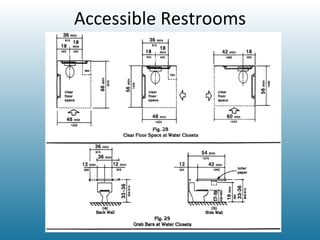
Accessible Restrooms
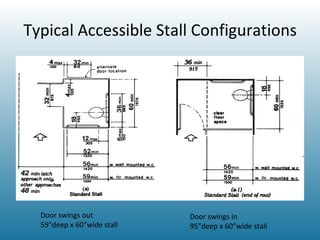
Typical Accessible Stall Configurations Door swings out 59”deep x 60”wide stall Door swings in 95”deep x 60”wide stall
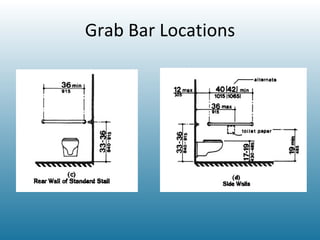
Grab Bar Locations
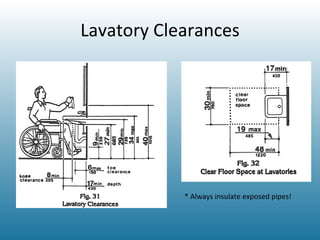
Lavatory Clearances * Always insulate exposed pipes!
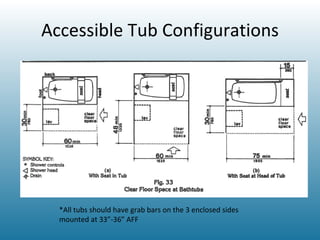
Accessible Tub Configurations *All tubs should have grab bars on the 3 enclosed sides mounted at 33”-36” AFF
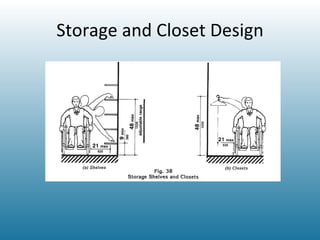
Storage and Closet Design
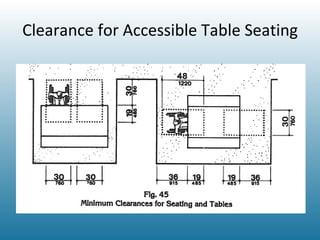
Clearance for Accessible Table Seating
Scoping Provisions Guidelines dictating number of required accessible fixtures, units or seats in a space Scoping provisions vary by code, and some are more stringent than the ADA
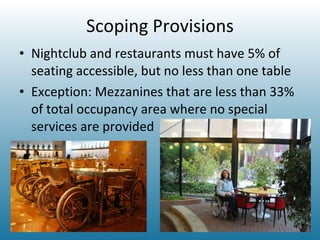
Scoping Provisions Nightclub and restaurants must have 5% of seating accessible, but no less than one table Exception: Mezzanines that are less than 33% of total occupancy area where no special services are provided
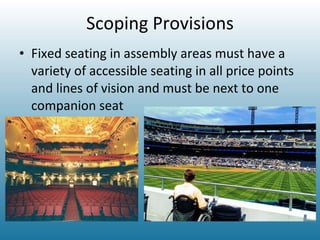
Scoping Provisions Fixed seating in assembly areas must have a variety of accessible seating in all price points and lines of vision and must be next to one companion seat
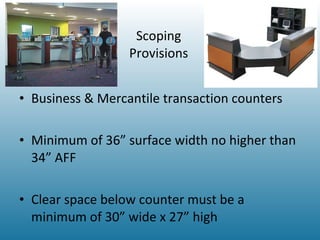
Scoping Provisions Business & Mercantile transaction counters Minimum of 36” surface width no higher than 34” AFF Clear space below counter must be a minimum of 30” wide x 27” high
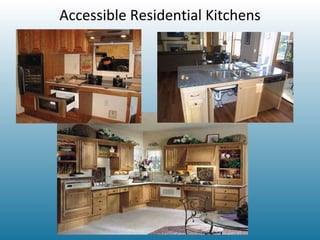
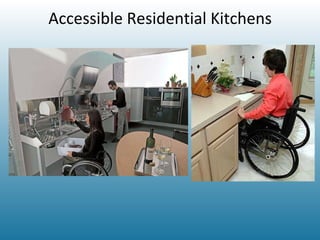
Accessible Residential Kitchens
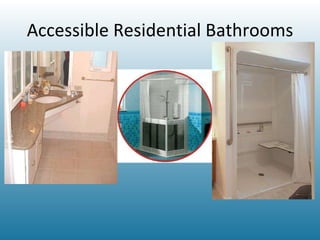
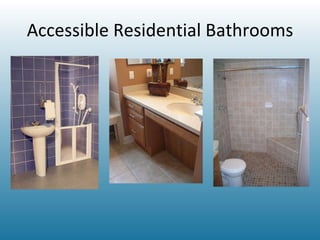
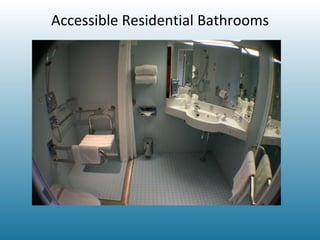
Accessible Residential Bathrooms

Ada Power Point by Jessica Gorman, NCIDQ