1
1
Post-implementation Issue
Lecture 20
Abdisalam Issa-Salwe
Thames Valley University
Abdisalam Issa-Salwe, Thames Valley University
2
Topic list
 Post-implementation review
 Systems maintenance
 End-user development and user
groups
2
Abdisalam Issa-Salwe, Thames Valley University
3
Post-implementation review
 It should be established whether the
objectives and targeted performance
criteria have been met
 In appraising the peroration of the
new system immediately after the
changeover. It will include:
 Consideration of throughout speed
 Use of computer storage
 The number of type of error/queries
 Cost of processing
Abdisalam Issa-Salwe, Thames Valley University
4
Post-implementation review (cont…)
 Report:
 A summary of their finding should be
provided, emphasising any area where the
system has been found unsatisfactory
 A review of system performance should be
provided
 A cost-benefit review comparing the
forecast costs and benefits
 Recommendations to be made as to any
further action or steps which should be
taken to improve performance.
3
Abdisalam Issa-Salwe, Thames Valley University
5
Systems maintenance
 Types of maintenance:
 Corrective
 Perfective
 Adaptive
Abdisalam Issa-Salwe, Thames Valley University
6
Systems maintenance (cont…)
 Corrective Maintenance:
 This type of maintenance refers to changes made
to repair design defects and programming errors.
It usually occurs in the early stage of installation
of the system and they need to correct them as
soon as possible because it may interrupt
company's operations. This type of maintenance
has no extra value or benefit to the system but
merely just to correct defects and errors. This
maintenance is highly performed immediately after
implementation and during the later operational
life.
4
Abdisalam Issa-Salwe, Thames Valley University
7
Systems maintenance (cont…)
Adaptive Maintenance
 Without a doubt, the system will need
changes due to evolving needs and
requirements. It usually happens in the
mid to late stages of the system. Adaptive
maintenance is not urgently required, but
it provides an improved functionality and
enhancement to the system. This
maintenance is performed during the
early, middle and later operational life.
Abdisalam Issa-Salwe, Thames Valley University
8
Systems maintenance (cont…)
 Perfective Maintenance
 Perfective maintenance relates to more
enhancement issues than adaptive
maintenance. For example, a company
may acquire to new version of Windows
and Microsoft Office or improvement
processing performance and interface
designs. Highly performed during the
middle of operational life of a the system.
5
Abdisalam Issa-Salwe, Thames Valley University
9
Abdisalam Issa-Salwe, Thames Valley University
10
Cause systems maintenance
 Errors:
 However carefully and diligently the
systems development staff carry out
systems testing and program testing, it is
likely that bugs will exist in a newly
implemented system,
 Constraints:
 cost constraints may have meant that
certain requested features were not
incorporated
6
Abdisalam Issa-Salwe, Thames Valley University
11
Cause systems maintenance
 Change in requirements:
 Although users should be consulted at all
stages of systems development, problems
may arise after a system is implemented
because users may have found it difficult
to express their requirement
 Poor documentation:
 If old systems are accompanied by poor
documentation, or even a complete lack of
documentation, it may be very difficult to
understand their programs
Abdisalam Issa-Salwe, Thames Valley University
12
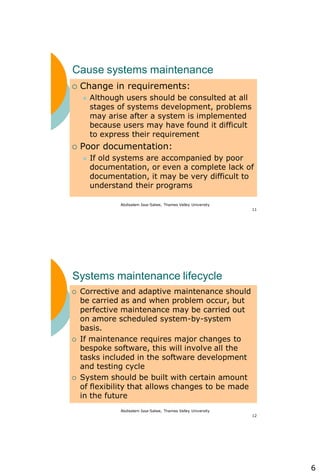
Systems maintenance lifecycle
 Corrective and adaptive maintenance should
be carried as and when problem occur, but
perfective maintenance may be carried out
on amore scheduled system-by-system
basis.
 If maintenance requires major changes to
bespoke software, this will involve all the
tasks included in the software development
and testing cycle
 System should be built with certain amount
of flexibility that allows changes to be made
in the future

InformationSystems(ACCA20(PostImplementationIssue))

  • 1.
    1 1 Post-implementation Issue Lecture 20 AbdisalamIssa-Salwe Thames Valley University Abdisalam Issa-Salwe, Thames Valley University 2 Topic list  Post-implementation review  Systems maintenance  End-user development and user groups
  • 2.
    2 Abdisalam Issa-Salwe, ThamesValley University 3 Post-implementation review  It should be established whether the objectives and targeted performance criteria have been met  In appraising the peroration of the new system immediately after the changeover. It will include:  Consideration of throughout speed  Use of computer storage  The number of type of error/queries  Cost of processing Abdisalam Issa-Salwe, Thames Valley University 4 Post-implementation review (cont…)  Report:  A summary of their finding should be provided, emphasising any area where the system has been found unsatisfactory  A review of system performance should be provided  A cost-benefit review comparing the forecast costs and benefits  Recommendations to be made as to any further action or steps which should be taken to improve performance.
  • 3.
    3 Abdisalam Issa-Salwe, ThamesValley University 5 Systems maintenance  Types of maintenance:  Corrective  Perfective  Adaptive Abdisalam Issa-Salwe, Thames Valley University 6 Systems maintenance (cont…)  Corrective Maintenance:  This type of maintenance refers to changes made to repair design defects and programming errors. It usually occurs in the early stage of installation of the system and they need to correct them as soon as possible because it may interrupt company's operations. This type of maintenance has no extra value or benefit to the system but merely just to correct defects and errors. This maintenance is highly performed immediately after implementation and during the later operational life.
  • 4.
    4 Abdisalam Issa-Salwe, ThamesValley University 7 Systems maintenance (cont…) Adaptive Maintenance  Without a doubt, the system will need changes due to evolving needs and requirements. It usually happens in the mid to late stages of the system. Adaptive maintenance is not urgently required, but it provides an improved functionality and enhancement to the system. This maintenance is performed during the early, middle and later operational life. Abdisalam Issa-Salwe, Thames Valley University 8 Systems maintenance (cont…)  Perfective Maintenance  Perfective maintenance relates to more enhancement issues than adaptive maintenance. For example, a company may acquire to new version of Windows and Microsoft Office or improvement processing performance and interface designs. Highly performed during the middle of operational life of a the system.
  • 5.
    5 Abdisalam Issa-Salwe, ThamesValley University 9 Abdisalam Issa-Salwe, Thames Valley University 10 Cause systems maintenance  Errors:  However carefully and diligently the systems development staff carry out systems testing and program testing, it is likely that bugs will exist in a newly implemented system,  Constraints:  cost constraints may have meant that certain requested features were not incorporated
  • 6.
    6 Abdisalam Issa-Salwe, ThamesValley University 11 Cause systems maintenance  Change in requirements:  Although users should be consulted at all stages of systems development, problems may arise after a system is implemented because users may have found it difficult to express their requirement  Poor documentation:  If old systems are accompanied by poor documentation, or even a complete lack of documentation, it may be very difficult to understand their programs Abdisalam Issa-Salwe, Thames Valley University 12 Systems maintenance lifecycle  Corrective and adaptive maintenance should be carried as and when problem occur, but perfective maintenance may be carried out on amore scheduled system-by-system basis.  If maintenance requires major changes to bespoke software, this will involve all the tasks included in the software development and testing cycle  System should be built with certain amount of flexibility that allows changes to be made in the future