BSE 3105 LECTURE 5- Evolution of 
Legacy Systems 
Based on Chapter 26 of Somerville, 6th Edition 
jagaba @cit 
1
Legacy systems 
• Legacy systems are old systems that remain 
vital to the organization. Such systems are 
developed specially for a given organisation and 
have a long lifetime. 
• Many software systems that are still in use were 
developed many years ago using technologies 
that are now obsolete 
• These systems are still business critical that is, 
they are essential for the normal functioning of 
the business 
2
Legacy system replacement 
• There is a significant business risk in simply 
scrapping a legacy system and replacing it with 
a system that has been developed using 
modern technology 
– Legacy systems rarely have a complete specification. During 
their lifetime they have undergone major changes which may 
not have been documented 
– Business processes are reliant on the legacy system 
– The system may embed business rules that are not formally 
documented elsewhere 
– New software development is risky and may not be 
successful 
3
Legacy system change 
• Systems must change in order to remain useful (recall 
the Lehman’s law of continuing change) 
• However, changing legacy systems is often expensive 
– Different parts implemented by different teams so no consistent 
programming style 
– The system may use an obsolete programming language 
– The system documentation is often out-of-date 
– The system structure may be corrupted by many years of maintenance 
– Techniques to save space or increase speed at the expense of 
understandability may have been used 
– File structures used may be incompatible 
4
The legacy dilemma 
• It is expensive and risky to replace the legacy 
system 
• It is expensive to maintain the legacy system 
• Businesses must weigh up the costs and risks 
and may choose to extend the system lifetime 
using techniques such as re-engineering. 
5
Legacy system structures 
• Legacy systems can be considered to be socio-technical 
systems and not simply software systems 
– System hardware - may be mainframe hardware 
– Support software - operating systems and utilities 
– Application software - several different programs 
– Application data - data used by these programs that is often critical 
business information 
– Business processes - the processes that support a business objective 
and which rely on the legacy software and hardware 
– Business policies and rules - constraints on business operations 
6
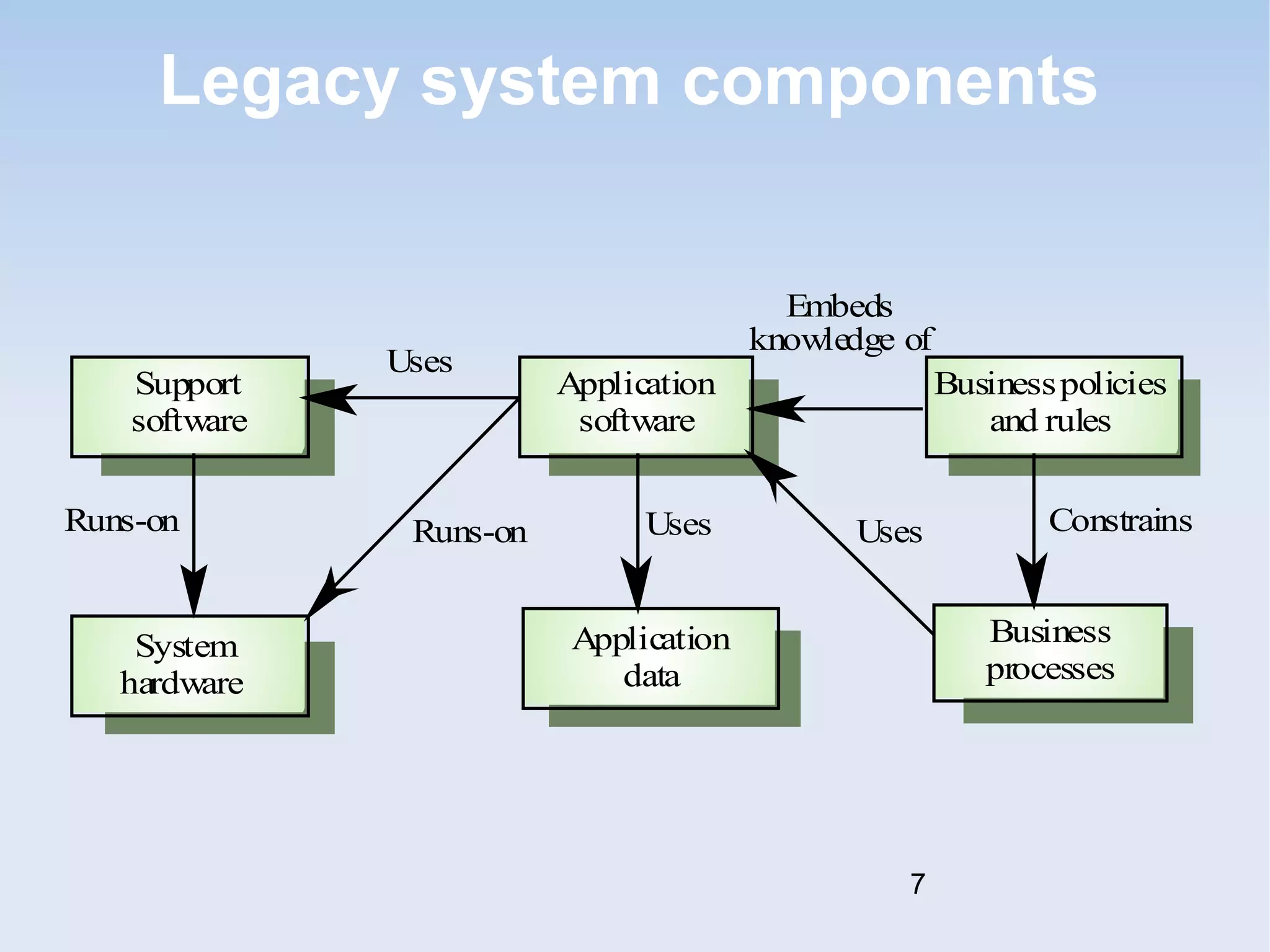
Legacy system components 
Runs-on Runs-on Uses Uses Constrains 
System 
hardware 
Business 
processes 
Application 
software 
Businesspolicies 
and rules 
Support 
software 
Application 
data 
Embeds 
knowledge of 
Uses 
7
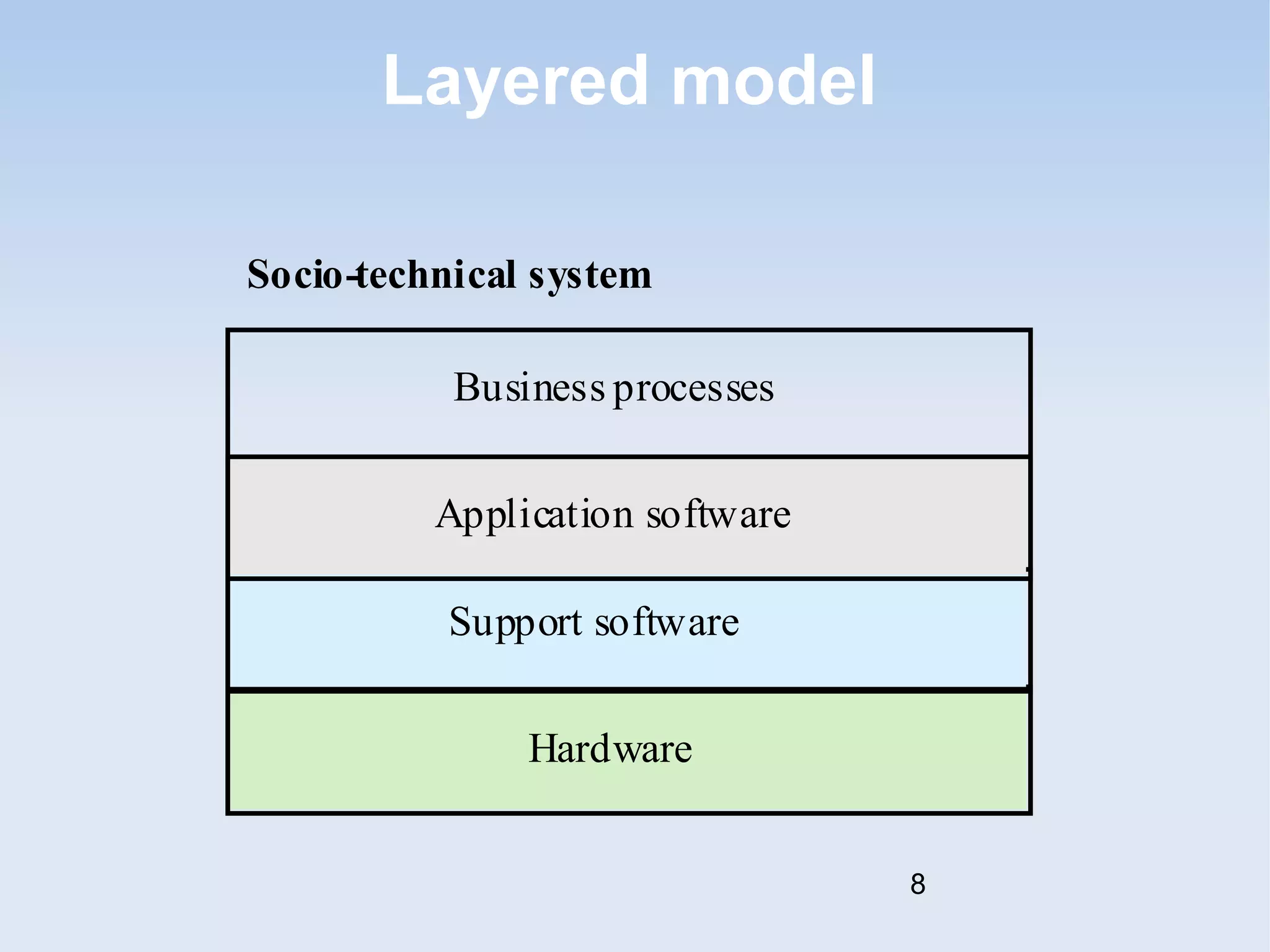
Layered model 
Socio-technical system 
Business processes 
Application software 
Support software 
Hardware 
8
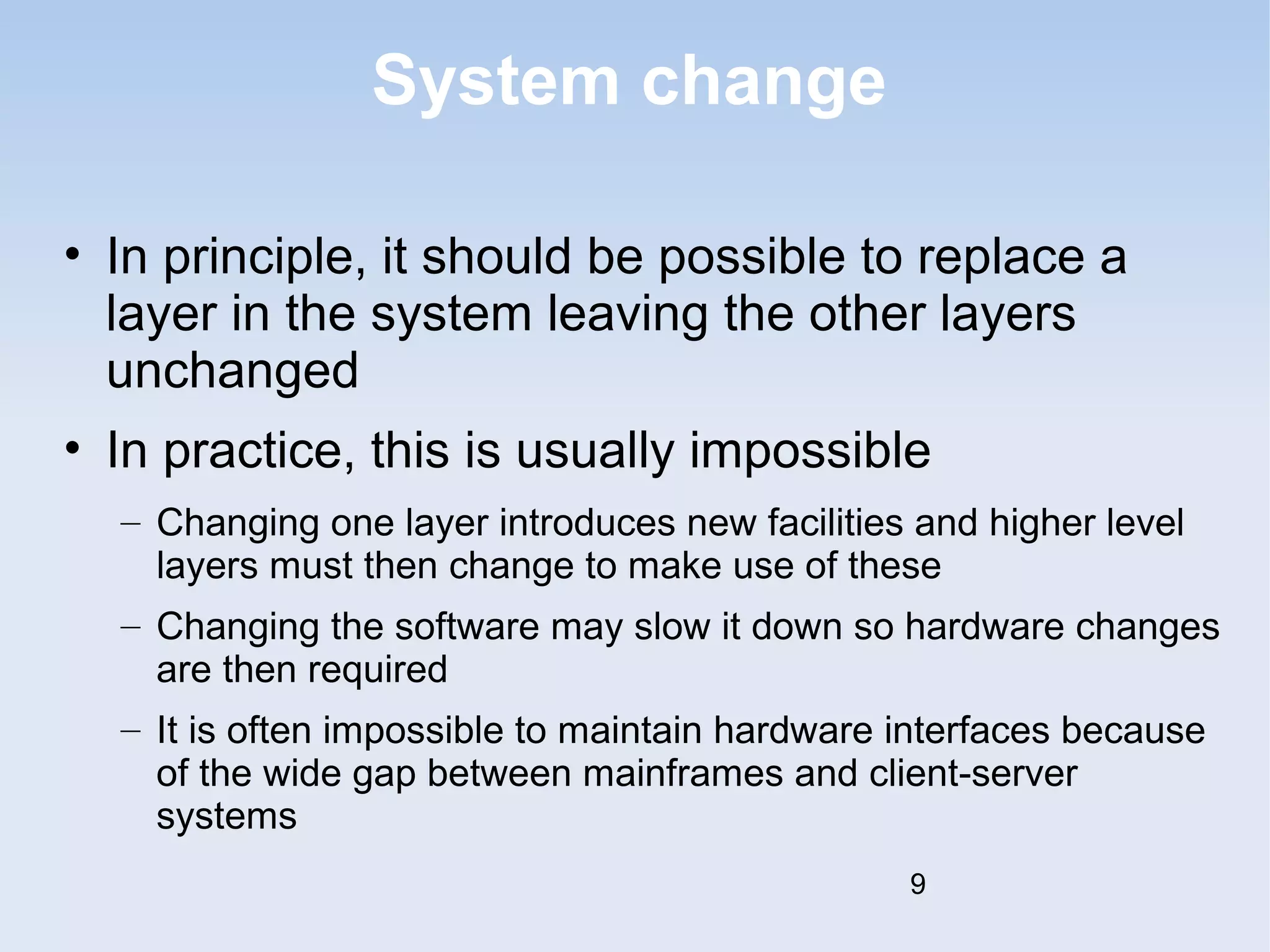
System change 
• In principle, it should be possible to replace a 
layer in the system leaving the other layers 
unchanged 
• In practice, this is usually impossible 
– Changing one layer introduces new facilities and higher level 
layers must then change to make use of these 
– Changing the software may slow it down so hardware changes 
are then required 
– It is often impossible to maintain hardware interfaces because 
of the wide gap between mainframes and client-server 
systems 
9
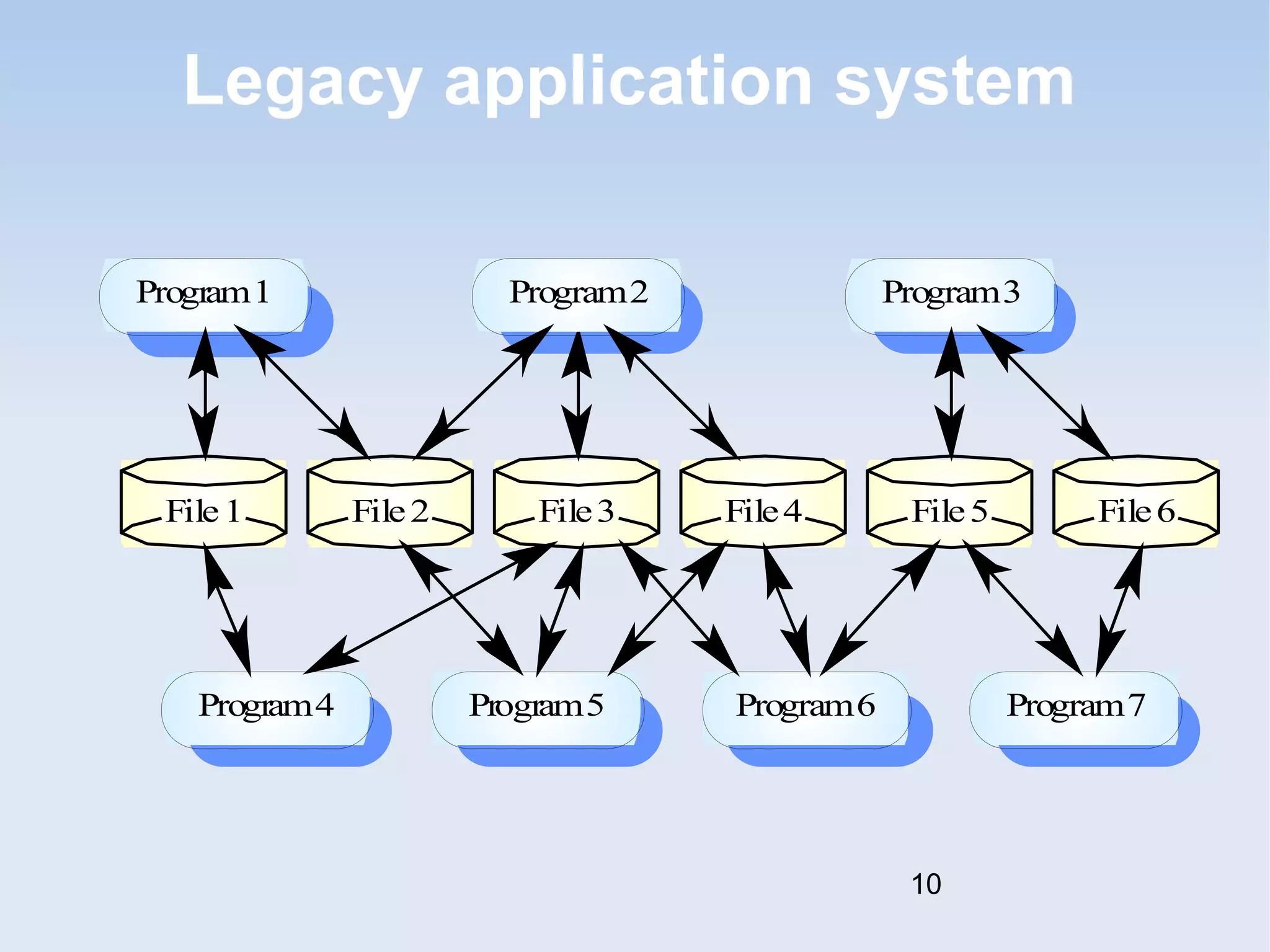
Legacy application system 
Program1 Program2 Program3 
File1 File2 File3 File4 File5 File6 
Program4 Program5 Program6 Program7 
10
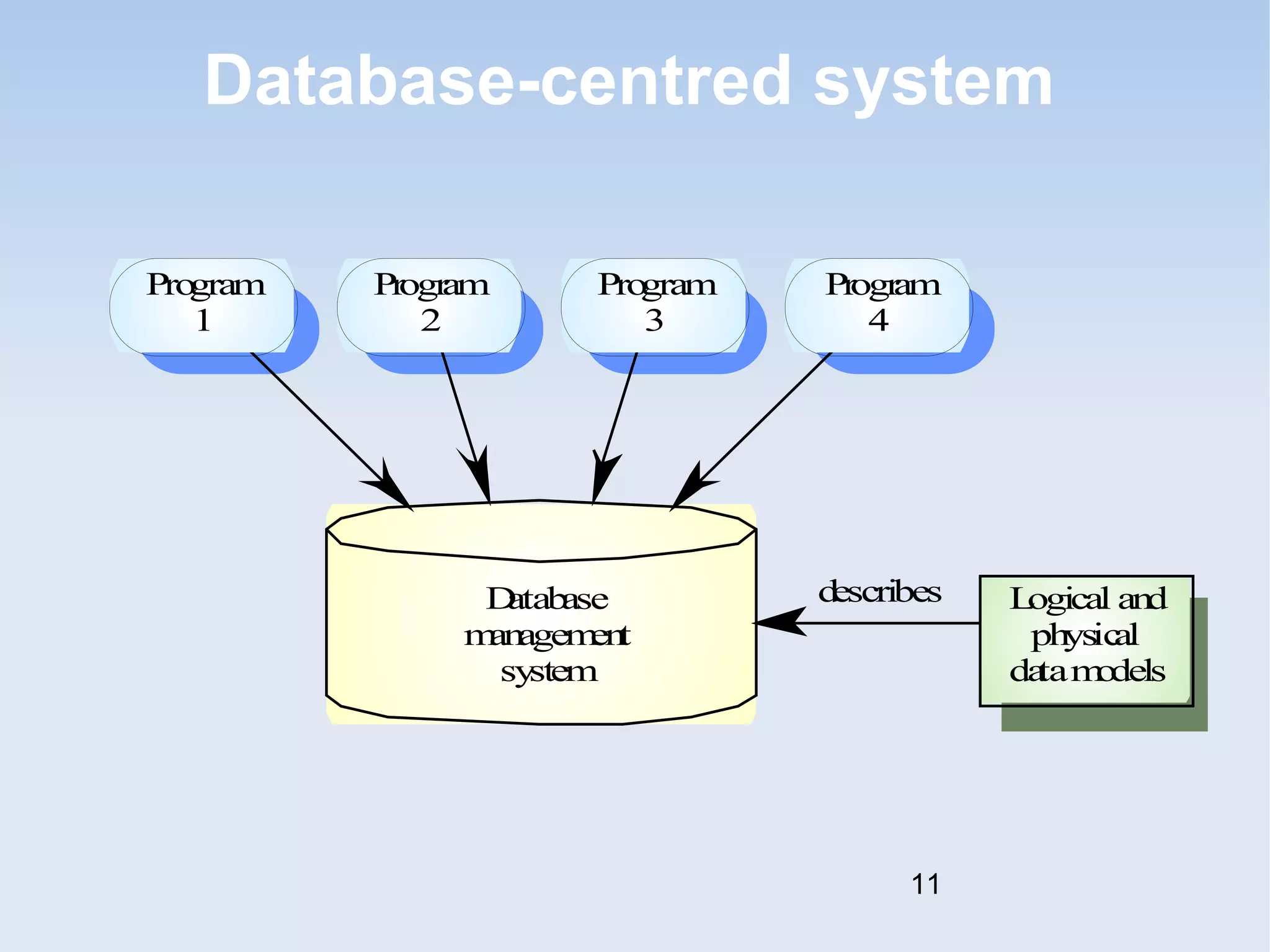
Database-centred system 
Program 
1 
Program 
2 
Program 
3 
Program 
4 
Database 
management 
system 
Logical and 
physical 
datamodels 
describes 
11
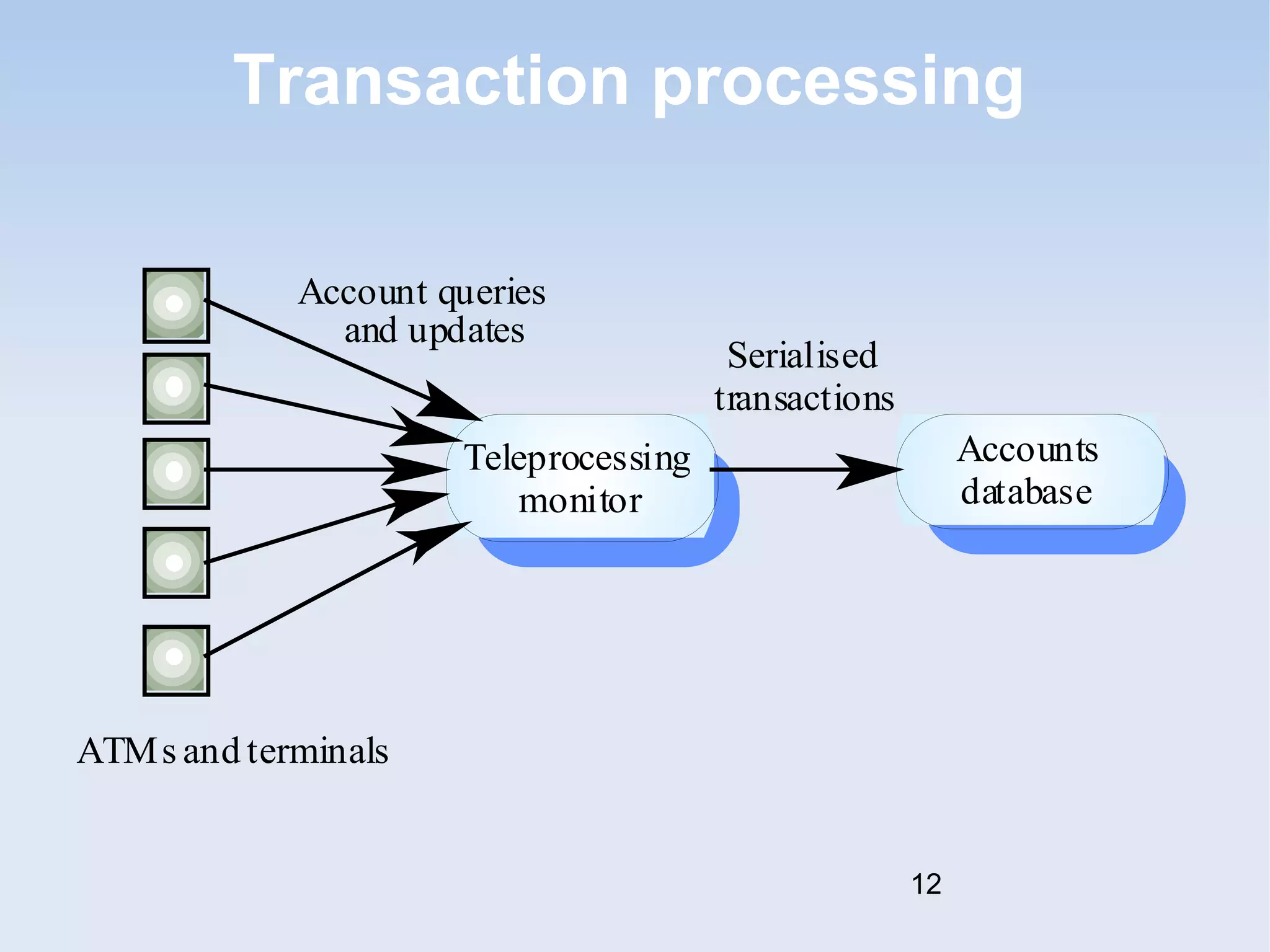
Transaction processing 
Serialised 
transactions 
Account queries 
and updates 
Teleprocessing 
monitor 
Accounts 
database 
ATMs and terminals 
12
Legacy data 
• The system may be file-based with incompatible 
files. The change required may be to move to a 
database-management system 
• In legacy systems that use a DBMS, the 
database management system may be obsolete 
and incompatible with other DBMSs used by the 
business 
• The teleprocessing monitor may be designed 
for a particular DB and mainframe. Changing to 
a new DB may require a new TP monitor 
13
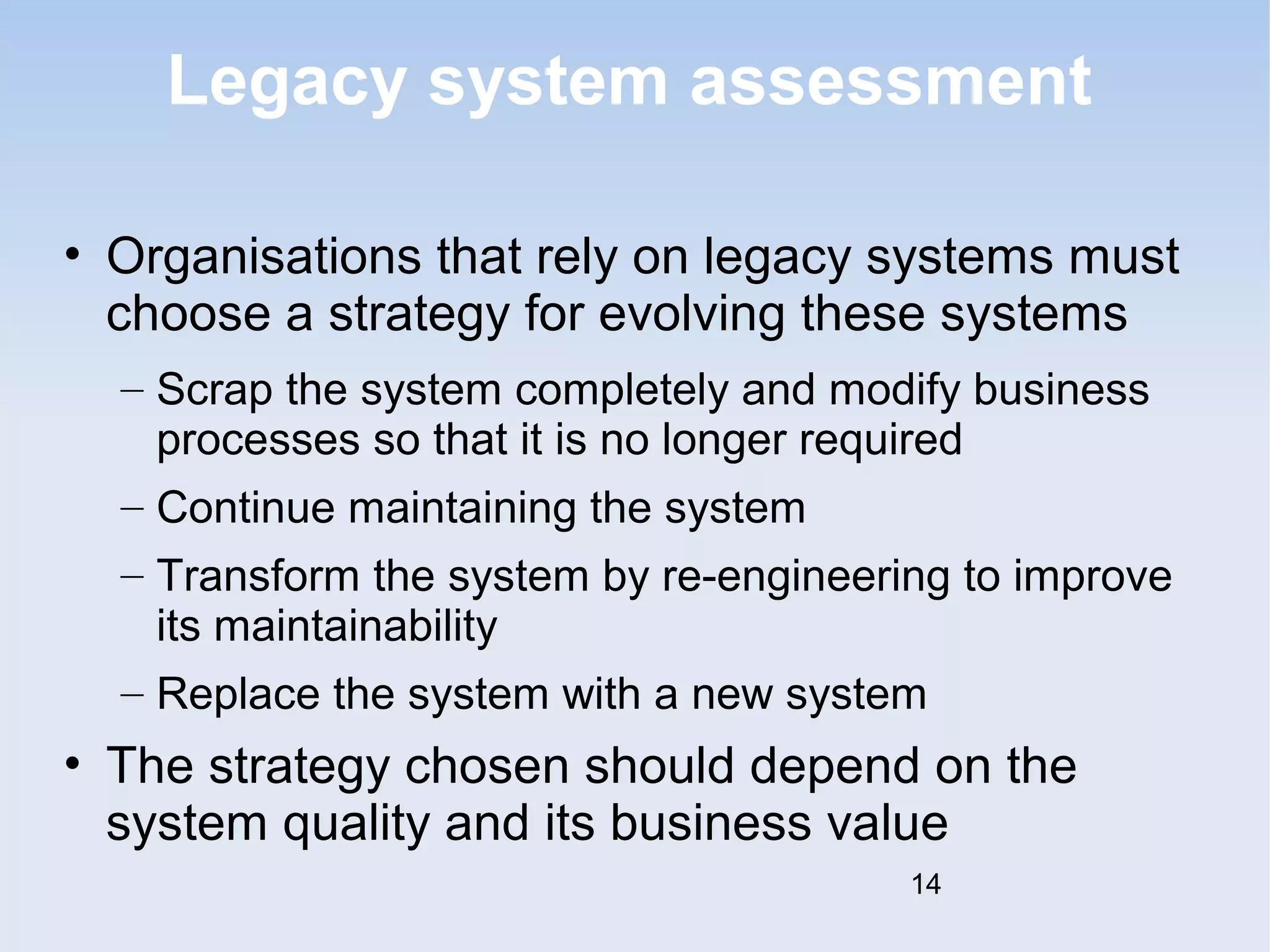
Legacy system assessment 
• Organisations that rely on legacy systems must 
choose a strategy for evolving these systems 
– Scrap the system completely and modify business 
processes so that it is no longer required 
– Continue maintaining the system 
– Transform the system by re-engineering to improve 
its maintainability 
– Replace the system with a new system 
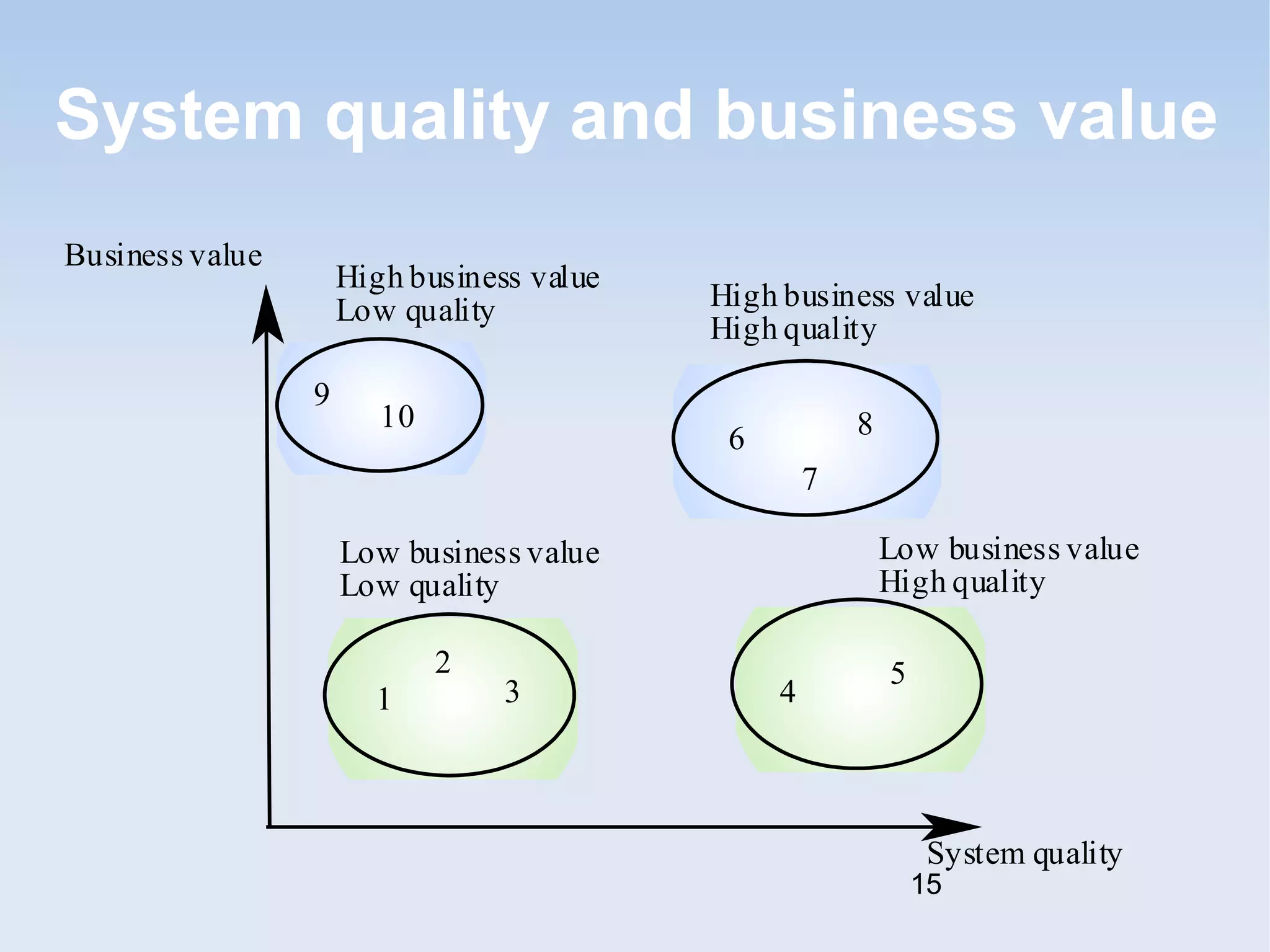
• The strategy chosen should depend on the 
system quality and its business value 
14
System quality and business value 
1 
2 
3 4 
5 
6 
7 
8 
9 
10 
System quality 
Business value 
High business value 
Low quality High business value 
High quality 
Low business value 
Low quality 
Low business value 
High quality 
15
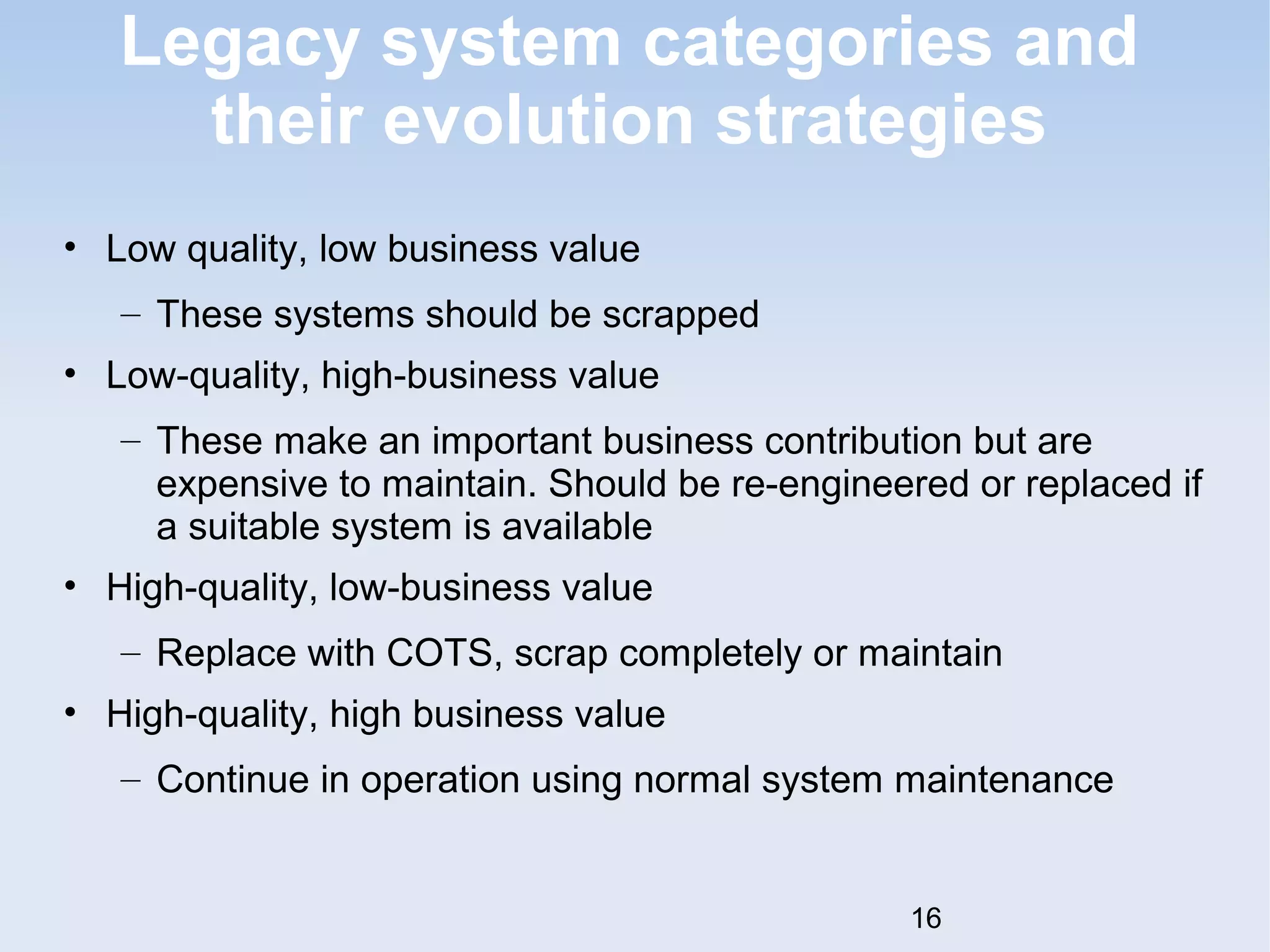
Legacy system categories and 
their evolution strategies 
• Low quality, low business value 
– These systems should be scrapped 
• Low-quality, high-business value 
– These make an important business contribution but are 
expensive to maintain. Should be re-engineered or replaced if 
a suitable system is available 
• High-quality, low-business value 
– Replace with COTS, scrap completely or maintain 
• High-quality, high business value 
– Continue in operation using normal system maintenance 
16
Business value assessment 
• Assessment should take different viewpoints 
into account 
– System end-users 
– Business customers 
– All classes of managers 
• Interview different stakeholders and collate 
results 
17
System quality assessment 
• Business process assessment 
– How well does the business process support the 
current goals of the business? 
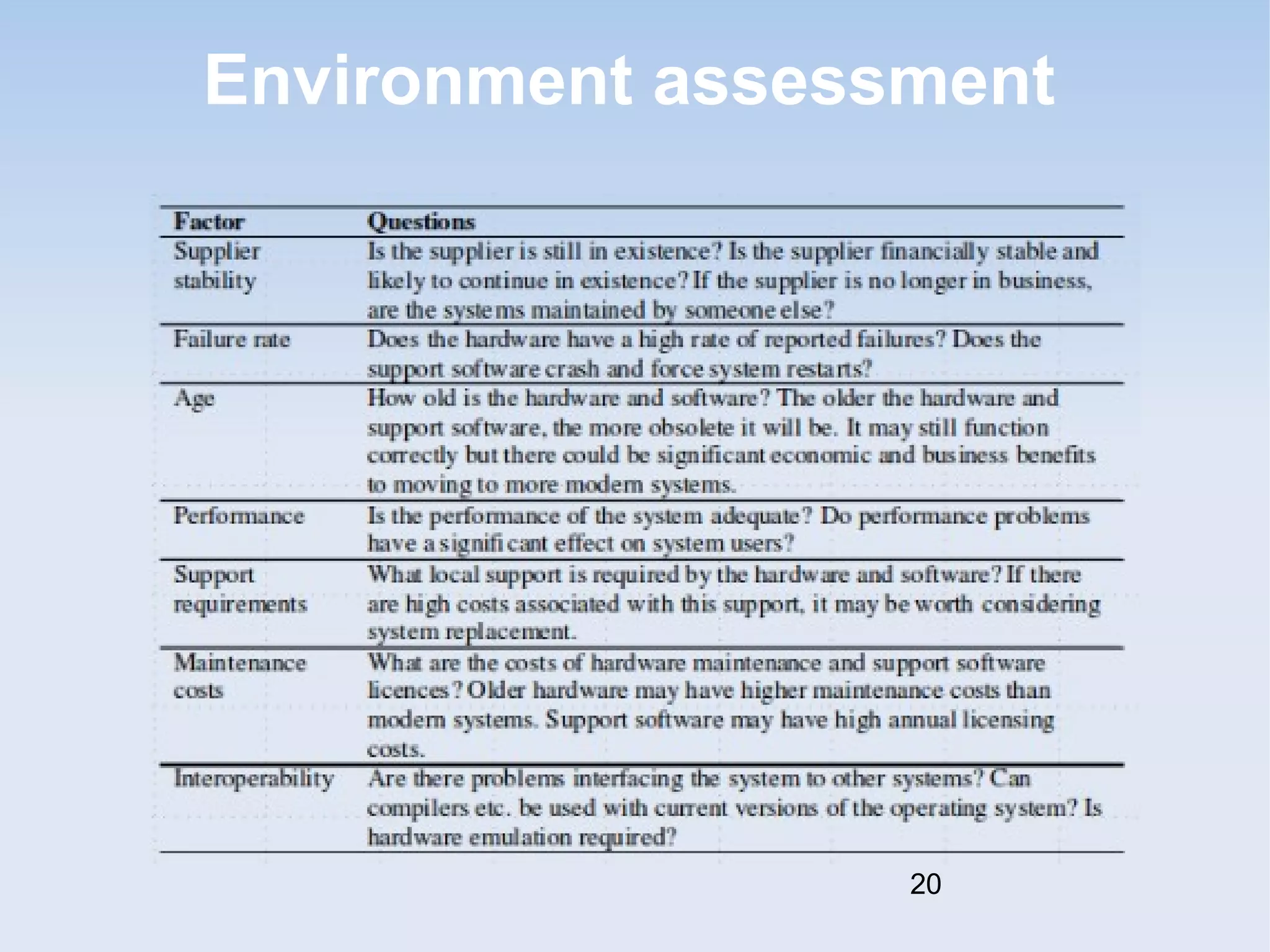
• Environment assessment 
– How effective is the system’s environment and how 
expensive is it to maintain 
• Application assessment 
– What is the quality of the application software 
system 
18
Business process assessment 
• Use a viewpoint-oriented approach and seek 
answers from system stakeholders 
– Is there a defined process model and is it followed? 
– Do different parts of the organisation use different 
processes for the same function? 
– How has the process been adapted? 
– What are the relationships with other business 
processes and are these necessary? 
– Is the process effectively supported by the legacy 
application software? 
19
Environment assessment 
20
Application assessment 
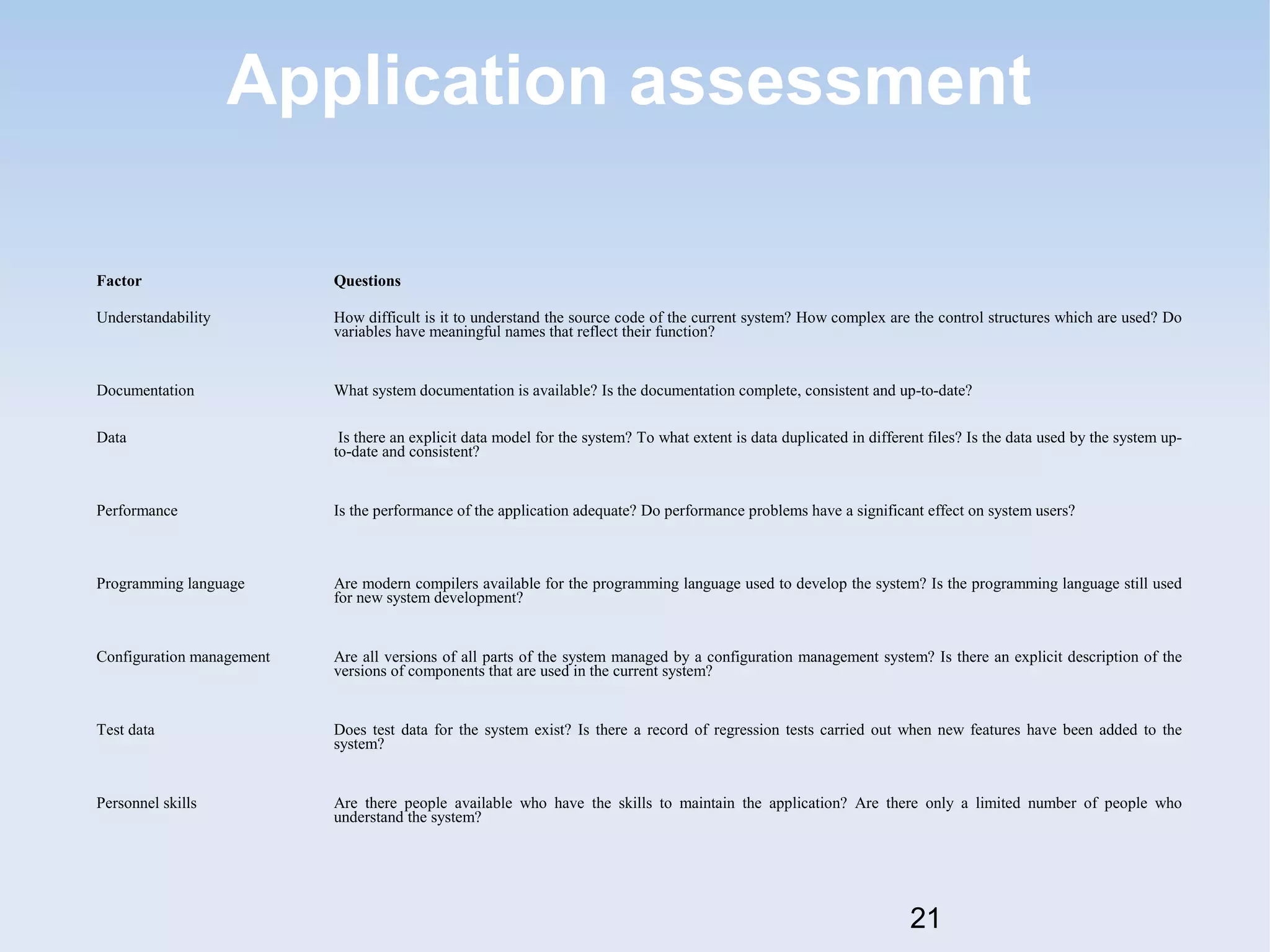
Factor Questions 
Understandability How difficult is it to understand the source code of the current system? How complex are the control structures which are used? Do 
21 
variables have meaningful names that reflect their function? 
Documentation What system documentation is available? Is the documentation complete, consistent and up-to-date? 
Data Is there an explicit data model for the system? To what extent is data duplicated in different files? Is the data used by the system up-to- 
date and consistent? 
Performance Is the performance of the application adequate? Do performance problems have a significant effect on system users? 
Programming language Are modern compilers available for the programming language used to develop the system? Is the programming language still used 
for new system development? 
Configuration management Are all versions of all parts of the system managed by a configuration management system? Is there an explicit description of the 
versions of components that are used in the current system? 
Test data Does test data for the system exist? Is there a record of regression tests carried out when new features have been added to the 
system? 
Personnel skills Are there people available who have the skills to maintain the application? Are there only a limited number of people who 
understand the system?
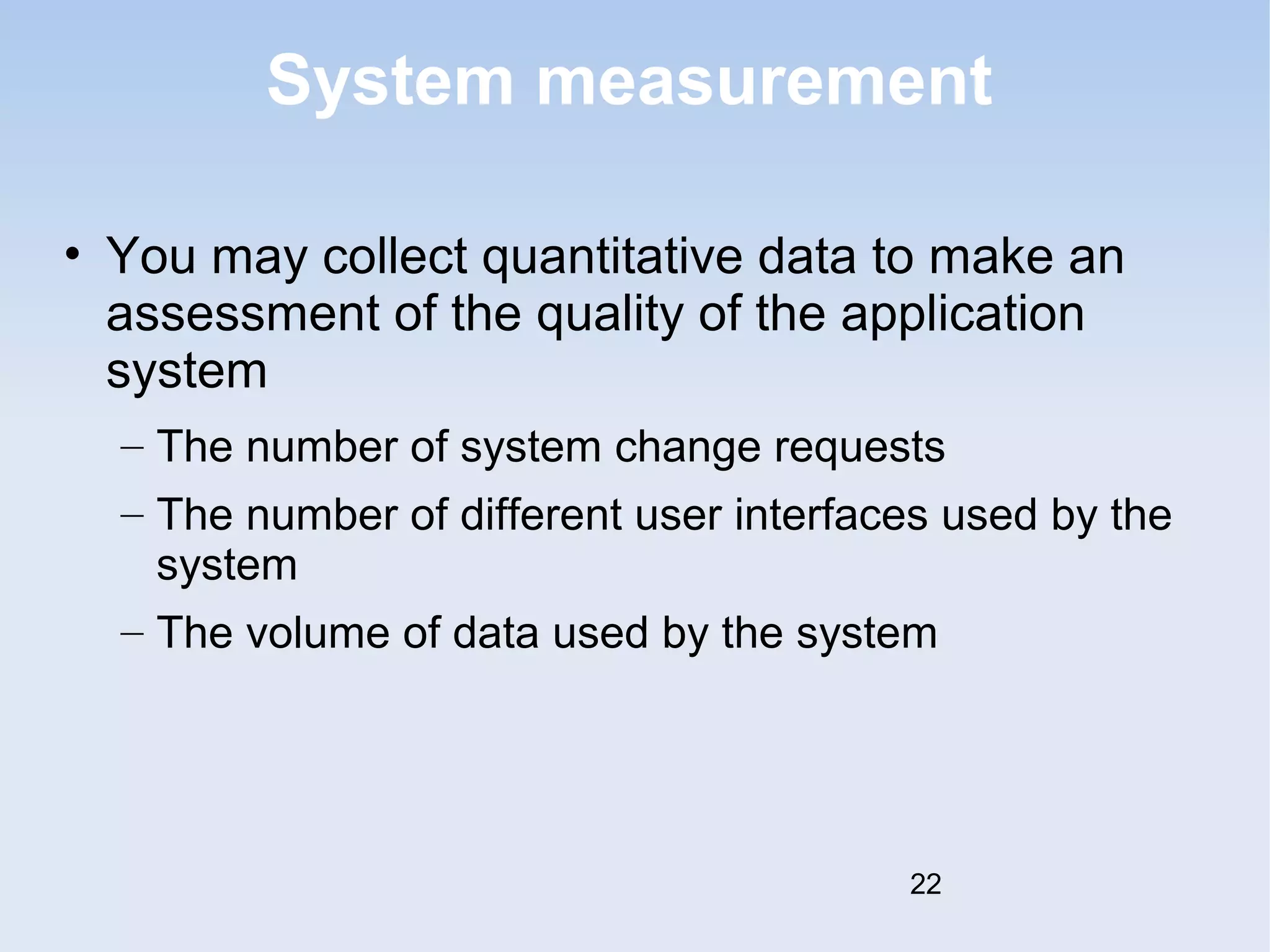
System measurement 
• You may collect quantitative data to make an 
assessment of the quality of the application 
system 
– The number of system change requests 
– The number of different user interfaces used by the 
system 
– The volume of data used by the system 
22
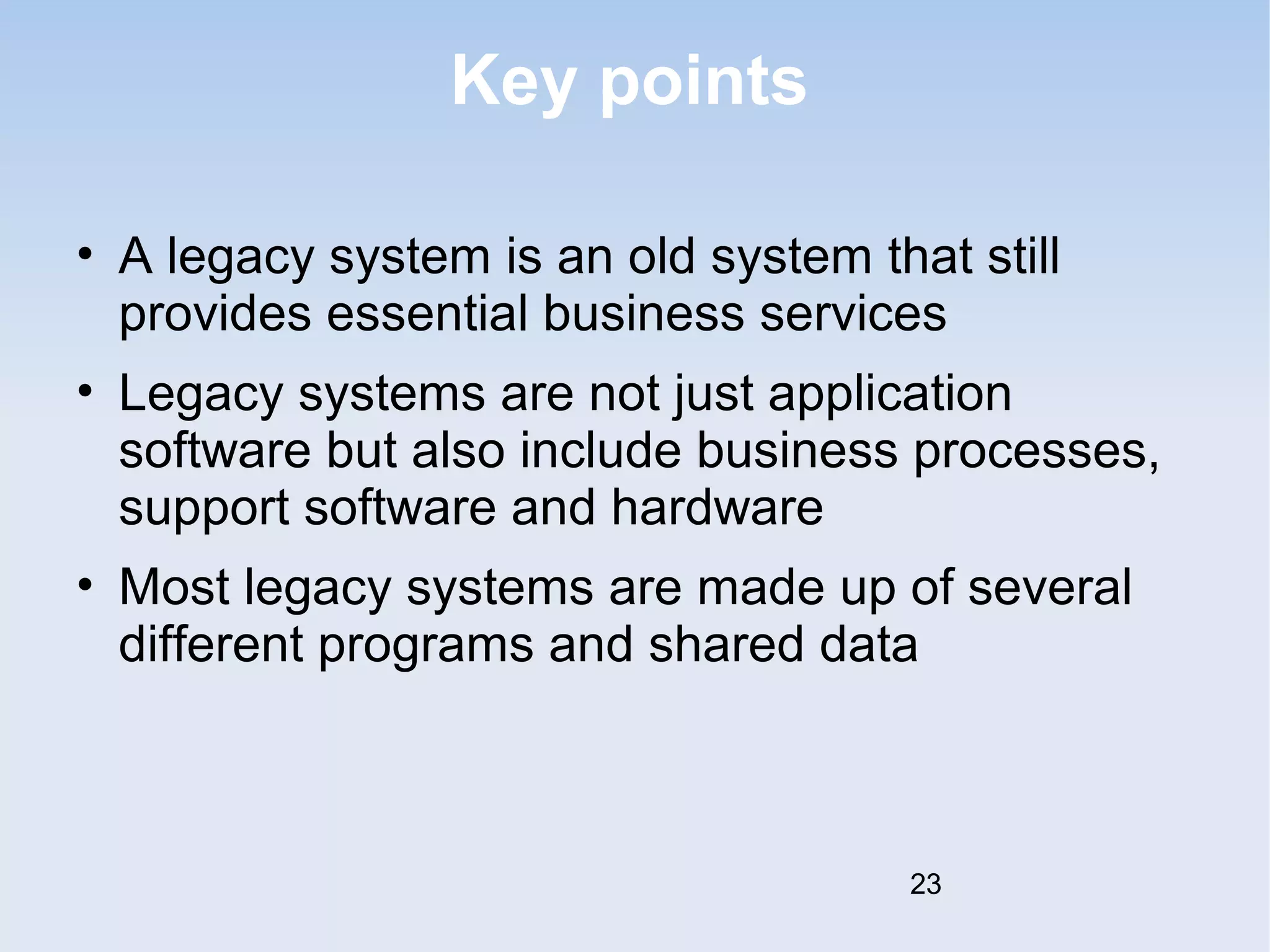
Key points 
• A legacy system is an old system that still 
provides essential business services 
• Legacy systems are not just application 
software but also include business processes, 
support software and hardware 
• Most legacy systems are made up of several 
different programs and shared data 
23
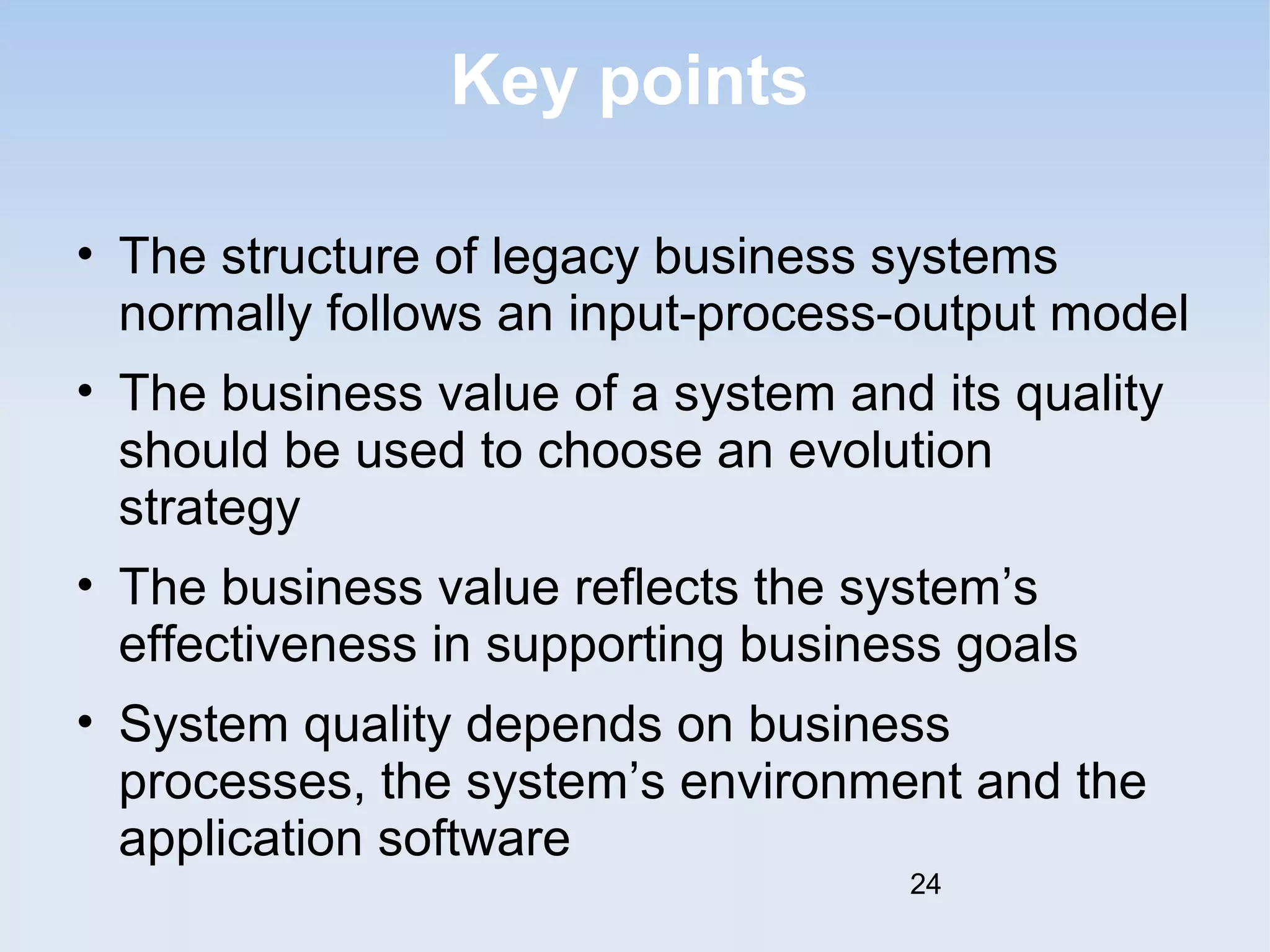
Key points 
• The structure of legacy business systems 
normally follows an input-process-output model 
• The business value of a system and its quality 
should be used to choose an evolution 
strategy 
• The business value reflects the system’s 
effectiveness in supporting business goals 
• System quality depends on business 
processes, the system’s environment and the 
application software 
24

Bse 3105 lecture 5-evolution of legacy systems

  • 1.
    BSE 3105 LECTURE5- Evolution of Legacy Systems Based on Chapter 26 of Somerville, 6th Edition jagaba @cit 1
  • 2.
    Legacy systems •Legacy systems are old systems that remain vital to the organization. Such systems are developed specially for a given organisation and have a long lifetime. • Many software systems that are still in use were developed many years ago using technologies that are now obsolete • These systems are still business critical that is, they are essential for the normal functioning of the business 2
  • 3.
    Legacy system replacement • There is a significant business risk in simply scrapping a legacy system and replacing it with a system that has been developed using modern technology – Legacy systems rarely have a complete specification. During their lifetime they have undergone major changes which may not have been documented – Business processes are reliant on the legacy system – The system may embed business rules that are not formally documented elsewhere – New software development is risky and may not be successful 3
  • 4.
    Legacy system change • Systems must change in order to remain useful (recall the Lehman’s law of continuing change) • However, changing legacy systems is often expensive – Different parts implemented by different teams so no consistent programming style – The system may use an obsolete programming language – The system documentation is often out-of-date – The system structure may be corrupted by many years of maintenance – Techniques to save space or increase speed at the expense of understandability may have been used – File structures used may be incompatible 4
  • 5.
    The legacy dilemma • It is expensive and risky to replace the legacy system • It is expensive to maintain the legacy system • Businesses must weigh up the costs and risks and may choose to extend the system lifetime using techniques such as re-engineering. 5
  • 6.
    Legacy system structures • Legacy systems can be considered to be socio-technical systems and not simply software systems – System hardware - may be mainframe hardware – Support software - operating systems and utilities – Application software - several different programs – Application data - data used by these programs that is often critical business information – Business processes - the processes that support a business objective and which rely on the legacy software and hardware – Business policies and rules - constraints on business operations 6
  • 7.
    Legacy system components Runs-on Runs-on Uses Uses Constrains System hardware Business processes Application software Businesspolicies and rules Support software Application data Embeds knowledge of Uses 7
  • 8.
    Layered model Socio-technicalsystem Business processes Application software Support software Hardware 8
  • 9.
    System change •In principle, it should be possible to replace a layer in the system leaving the other layers unchanged • In practice, this is usually impossible – Changing one layer introduces new facilities and higher level layers must then change to make use of these – Changing the software may slow it down so hardware changes are then required – It is often impossible to maintain hardware interfaces because of the wide gap between mainframes and client-server systems 9
  • 10.
    Legacy application system Program1 Program2 Program3 File1 File2 File3 File4 File5 File6 Program4 Program5 Program6 Program7 10
  • 11.
    Database-centred system Program 1 Program 2 Program 3 Program 4 Database management system Logical and physical datamodels describes 11
  • 12.
    Transaction processing Serialised transactions Account queries and updates Teleprocessing monitor Accounts database ATMs and terminals 12
  • 13.
    Legacy data •The system may be file-based with incompatible files. The change required may be to move to a database-management system • In legacy systems that use a DBMS, the database management system may be obsolete and incompatible with other DBMSs used by the business • The teleprocessing monitor may be designed for a particular DB and mainframe. Changing to a new DB may require a new TP monitor 13
  • 14.
    Legacy system assessment • Organisations that rely on legacy systems must choose a strategy for evolving these systems – Scrap the system completely and modify business processes so that it is no longer required – Continue maintaining the system – Transform the system by re-engineering to improve its maintainability – Replace the system with a new system • The strategy chosen should depend on the system quality and its business value 14
  • 15.
    System quality andbusiness value 1 2 3 4 5 6 7 8 9 10 System quality Business value High business value Low quality High business value High quality Low business value Low quality Low business value High quality 15
  • 16.
    Legacy system categoriesand their evolution strategies • Low quality, low business value – These systems should be scrapped • Low-quality, high-business value – These make an important business contribution but are expensive to maintain. Should be re-engineered or replaced if a suitable system is available • High-quality, low-business value – Replace with COTS, scrap completely or maintain • High-quality, high business value – Continue in operation using normal system maintenance 16
  • 17.
    Business value assessment • Assessment should take different viewpoints into account – System end-users – Business customers – All classes of managers • Interview different stakeholders and collate results 17
  • 18.
    System quality assessment • Business process assessment – How well does the business process support the current goals of the business? • Environment assessment – How effective is the system’s environment and how expensive is it to maintain • Application assessment – What is the quality of the application software system 18
  • 19.
    Business process assessment • Use a viewpoint-oriented approach and seek answers from system stakeholders – Is there a defined process model and is it followed? – Do different parts of the organisation use different processes for the same function? – How has the process been adapted? – What are the relationships with other business processes and are these necessary? – Is the process effectively supported by the legacy application software? 19
  • 20.
  • 21.
    Application assessment FactorQuestions Understandability How difficult is it to understand the source code of the current system? How complex are the control structures which are used? Do 21 variables have meaningful names that reflect their function? Documentation What system documentation is available? Is the documentation complete, consistent and up-to-date? Data Is there an explicit data model for the system? To what extent is data duplicated in different files? Is the data used by the system up-to- date and consistent? Performance Is the performance of the application adequate? Do performance problems have a significant effect on system users? Programming language Are modern compilers available for the programming language used to develop the system? Is the programming language still used for new system development? Configuration management Are all versions of all parts of the system managed by a configuration management system? Is there an explicit description of the versions of components that are used in the current system? Test data Does test data for the system exist? Is there a record of regression tests carried out when new features have been added to the system? Personnel skills Are there people available who have the skills to maintain the application? Are there only a limited number of people who understand the system?
  • 22.
    System measurement •You may collect quantitative data to make an assessment of the quality of the application system – The number of system change requests – The number of different user interfaces used by the system – The volume of data used by the system 22
  • 23.
    Key points •A legacy system is an old system that still provides essential business services • Legacy systems are not just application software but also include business processes, support software and hardware • Most legacy systems are made up of several different programs and shared data 23
  • 24.
    Key points •The structure of legacy business systems normally follows an input-process-output model • The business value of a system and its quality should be used to choose an evolution strategy • The business value reflects the system’s effectiveness in supporting business goals • System quality depends on business processes, the system’s environment and the application software 24