PRESENTATION BY : KARANVEER SINGH
SYSTEM MAINTENANCE
 SYSTEM MAINTENANCE
POST IMPLEMENTATION MAINTENANCE
SYSTEM MAINTENANCE
SYSTEM MAINTENANCE
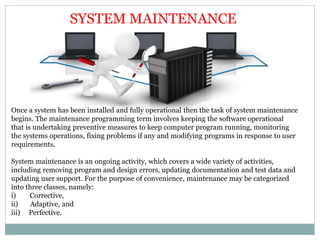
Once a system has been installed and fully operational then the task of system maintenance
begins. The maintenance programming term involves keeping the software operational
that is undertaking preventive measures to keep computer program running, monitoring
the systems operations, fixing problems if any and modifying programs in response to user
requirements.
System maintenance is an ongoing activity, which covers a wide variety of activities,
including removing program and design errors, updating documentation and test data and
updating user support. For the purpose of convenience, maintenance may be categorized
into three classes, namely:
i) Corrective,
ii) Adaptive, and
iii) Perfective.
i) Corrective Maintenance: - This type of maintenance implies removing errors in
a program, which might have crept in the system due to faulty design or wrong
assumptions. Thus, in corrective maintenance, processing or performance failures are
repaired.
ii) Adaptive Maintenance: - In adaptive maintenance, program functions are
changed to enable the information system to satisfy the information needs of the user.
This type of maintenance may become necessary because of organizational changes
which may include:
a) Change in the organizational procedures,
b) Change in organizational objectives, goals, policies, etc.
c) Change in forms,
d) Change in information needs of managers.
e) Change in system controls and security needs, etc.
CLASSES OF SYSTEM MAINTENANCE
iii) Perfective Maintenance: - Perfective maintenance means
adding new programs or modifying the existing programs to enhance the
performance of the information system. This type of maintenance
undertaken to respond to user’s additional needs which may be due to
the changes within or outside of the organization. Outside changes are
primarily environmental changes, which may in the absence of system
maintenance, render the information system ineffective and inefficient.
These environmental changes include:
a) Changes in governmental policies, laws, etc.,
b) Economic and competitive conditions, and
c) New technology.
 SYSTEM MAINTENANCE
POST IMPLEMENTATION MAINTENANCE
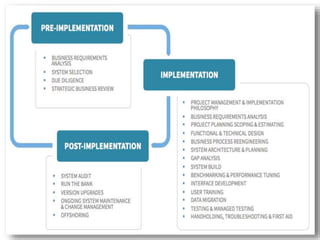
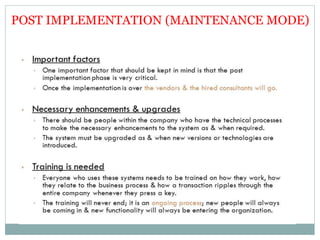
POST IMPLEMENTATION (MAINTENANCE MODE)
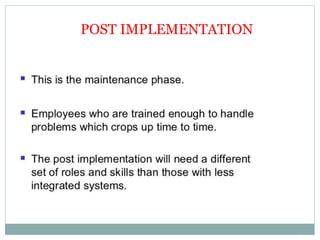
POST IMPLEMENTATION
System

System

  • 1.
    PRESENTATION BY :KARANVEER SINGH SYSTEM MAINTENANCE
  • 2.
     SYSTEM MAINTENANCE POSTIMPLEMENTATION MAINTENANCE
  • 3.
  • 4.
    SYSTEM MAINTENANCE Once asystem has been installed and fully operational then the task of system maintenance begins. The maintenance programming term involves keeping the software operational that is undertaking preventive measures to keep computer program running, monitoring the systems operations, fixing problems if any and modifying programs in response to user requirements. System maintenance is an ongoing activity, which covers a wide variety of activities, including removing program and design errors, updating documentation and test data and updating user support. For the purpose of convenience, maintenance may be categorized into three classes, namely: i) Corrective, ii) Adaptive, and iii) Perfective.
  • 5.
    i) Corrective Maintenance:- This type of maintenance implies removing errors in a program, which might have crept in the system due to faulty design or wrong assumptions. Thus, in corrective maintenance, processing or performance failures are repaired. ii) Adaptive Maintenance: - In adaptive maintenance, program functions are changed to enable the information system to satisfy the information needs of the user. This type of maintenance may become necessary because of organizational changes which may include: a) Change in the organizational procedures, b) Change in organizational objectives, goals, policies, etc. c) Change in forms, d) Change in information needs of managers. e) Change in system controls and security needs, etc. CLASSES OF SYSTEM MAINTENANCE
  • 6.
    iii) Perfective Maintenance:- Perfective maintenance means adding new programs or modifying the existing programs to enhance the performance of the information system. This type of maintenance undertaken to respond to user’s additional needs which may be due to the changes within or outside of the organization. Outside changes are primarily environmental changes, which may in the absence of system maintenance, render the information system ineffective and inefficient. These environmental changes include: a) Changes in governmental policies, laws, etc., b) Economic and competitive conditions, and c) New technology.
  • 7.
     SYSTEM MAINTENANCE POSTIMPLEMENTATION MAINTENANCE
  • 9.
  • 10.