HypertensionRole of New Combination TherapyAziz-ur-RehmanServices Institute of Medical SciencesLahore
Hypertension is very prevalent
Hypertension is one of the easiest condition to diagnosis
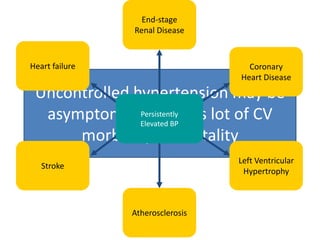
End-stageRenal DiseaseHeart failureCoronaryHeart DiseasePersistentlyElevated BPStrokeLeft VentricularHypertrophyAtherosclerosisUncontrolled hypertension may be asymptomatic but has lot of CV morbidity & mortality
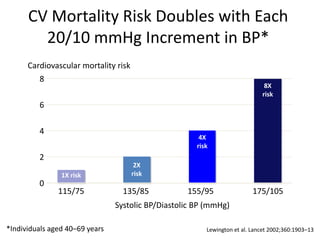
CV Mortality Risk Doubles with Each 20/10 mmHg Increment in BP*Cardiovascular mortality risk88X risk644X risk22X risk1X risk0115/75135/85155/95175/105Systolic BP/Diastolic BP (mmHg)Lewington et al. Lancet 2002;360:1903–13*Individuals aged 40–69 years
Treatment of Hypertension reduces CV morbidity & mortality
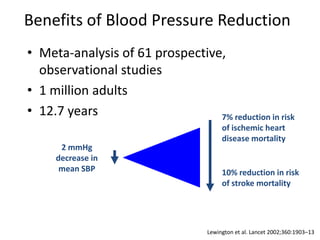
Benefits of Blood Pressure ReductionMeta-analysis of 61 prospective, observational studies1 million adults12.7 years7% reduction in risk of ischemic heart disease mortality2 mmHg decrease in mean SBP10% reduction in risk of stroke mortalityLewington et al. Lancet 2002;360:1903–13
Treatment of hypertension is very cost-effective
Majority of the patients are either not diagnosed or not treated adequately
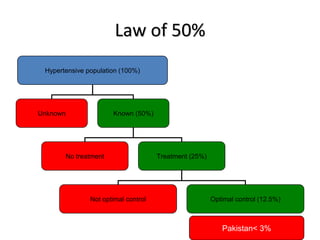
Law of 50%Pakistan< 3%
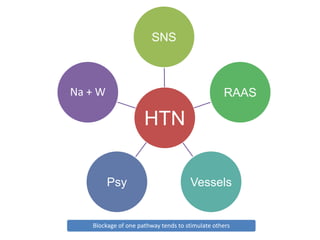
Hypertension is a multifactorialdisease
Limitations of Agents with a Single Mechanism of Action (MoA)Inadequate in 4060% of hypertensive patients1In majority two or more antihypertensive agents are required to achieve the recommended target BP of <130/80 mmHg2Multiple channels are needed to be  blocked31Materson et al. N Engl J Med 1993;328:914212Bakris et al. Am J Kidney Dis 2000;36:646613Milani. Am J Manag Care 2005;11:S2207
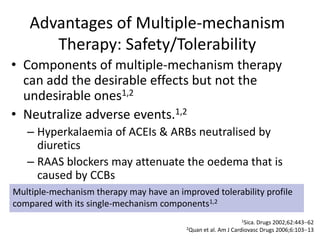
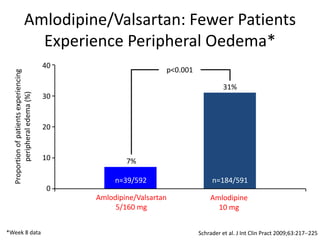
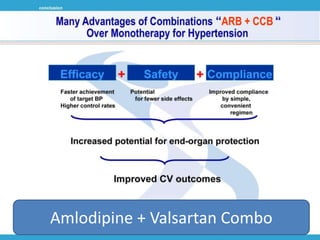
Advantages of Multiple-mechanism Therapy: Safety/TolerabilityComponents of multiple-mechanism therapy can add the desirable effects but not the undesirable ones1,2Neutralize adverse events.1,2Hyperkalaemia of ACEIs & ARBs neutralised by diureticsRAAS blockers may attenuate the oedema that is caused by CCBsMultiple-mechanism therapy may have an improved tolerability profile compared with its single-mechanism components1,21Sica. Drugs 2002;62:443622Quan et al. Am J Cardiovasc Drugs 2006;6:10313
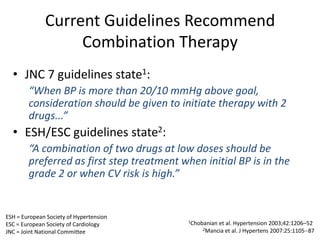
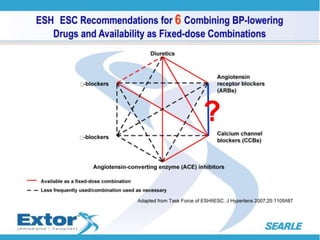
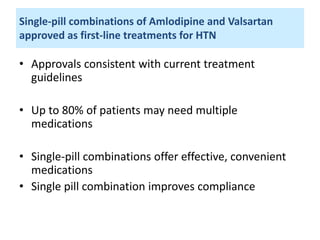
Current Guidelines Recommend Combination Therapy  JNC 7 guidelines state1:“When BP is more than 20/10 mmHg above goal, consideration should be given to initiate therapy with 2 drugs...”ESH/ESC guidelines state2:“A combination of two drugs at low doses should be preferred as first step treatment when initial BP is in the grade 2 or when CV risk is high.”ESH = European Society of HypertensionESC = European Society of CardiologyJNC = Joint National Committee1Chobanian et al. Hypertension 2003;42:1206–52 2Mancia et al. J Hypertens 2007:25:110587
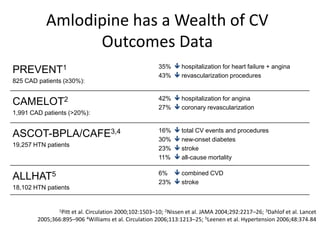
Amlodipine has a Wealth of CV Outcomes Data1Pitt et al. Circulation 2000;102:1503–10; 2Nissen et al. JAMA 2004;292:2217–26; 3Dahlof et al. Lancet 2005;366:895–906 4Williams et al. Circulation 2006;113:1213–25; 5Leenen et al. Hypertension 2006;48:374–84
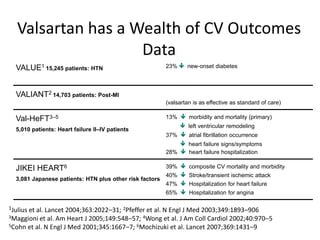
Valsartan has a Wealth of CV Outcomes Data1Julius et al. Lancet 2004;363:2022–31; 2Pfeffer et al. N Engl J Med 2003;349:1893–9063Maggioni et al. Am Heart J 2005;149:548–57; 4Wong et al. J Am Coll Cardiol 2002;40:970–55Cohn et al. N Engl J Med 2001;345:1667–7; 6Mochizuki et al. Lancet 2007;369:1431–9
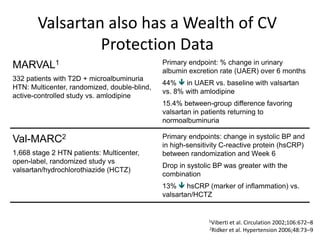
Valsartan also has a Wealth of CV Protection Data1Viberti et al. Circulation 2002;106:672–82Ridker et al. Hypertension 2006;48:73–9
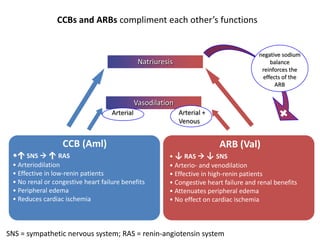
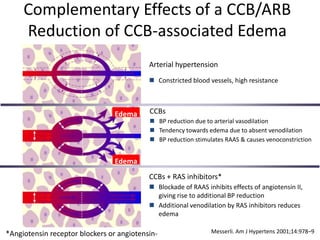
CCBs and ARBs compliment each other’s functionsnegative sodium balance reinforces the effects of the ARBNatriuresisVasodilation Arterial +VenousArterialCCB (Aml)↑ SNS  ↑RAS
Arteriodilation
 Effective in low-renin patients
 No renal or congestive heart failure benefits
 Peripheral edema
 Reduces cardiac ischemiaARB (Val)↓ RAS  ↓SNS
Arterio- and venodilation
 Effective in high-renin patients
 Congestive heart failure and renal benefits
 Attenuates peripheral edema
 No effect on cardiac ischemiaSNS = sympathetic nervous system; RAS = renin-angiotensin system
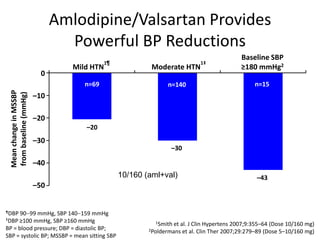
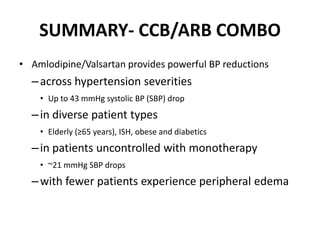
Amlodipine/Valsartan Provides Powerful BP ReductionsModerate HTN1‡Mild HTN1¶Baseline SBP≥180 mmHg20–10–20–30–40–50n=69n=15n=140Mean change in MSSBPfrom baseline (mmHg)–20–3010/160 (aml+val)–43¶DBP 9099 mmHg, SBP 140159 mmHg‡DBP ≥100 mmHg, SBP ≥160 mmHgBP = blood pressure; DBP = diastolic BP; SBP = systolic BP; MSSBP = mean sitting SBP1Smith et al. J Clin Hypertens 2007;9:355–64 (Dose 10/160 mg)2Poldermans et al. Clin Ther 2007;29:279–89 (Dose 5–10/160 mg)

Prof .Aziz-ur-Rehman

  • 1.
    HypertensionRole of NewCombination TherapyAziz-ur-RehmanServices Institute of Medical SciencesLahore
  • 2.
  • 3.
    Hypertension is oneof the easiest condition to diagnosis
  • 4.
    End-stageRenal DiseaseHeart failureCoronaryHeartDiseasePersistentlyElevated BPStrokeLeft VentricularHypertrophyAtherosclerosisUncontrolled hypertension may be asymptomatic but has lot of CV morbidity & mortality
  • 5.
    CV Mortality RiskDoubles with Each 20/10 mmHg Increment in BP*Cardiovascular mortality risk88X risk644X risk22X risk1X risk0115/75135/85155/95175/105Systolic BP/Diastolic BP (mmHg)Lewington et al. Lancet 2002;360:1903–13*Individuals aged 40–69 years
  • 7.
    Treatment of Hypertensionreduces CV morbidity & mortality
  • 8.
    Benefits of BloodPressure ReductionMeta-analysis of 61 prospective, observational studies1 million adults12.7 years7% reduction in risk of ischemic heart disease mortality2 mmHg decrease in mean SBP10% reduction in risk of stroke mortalityLewington et al. Lancet 2002;360:1903–13
  • 9.
    Treatment of hypertensionis very cost-effective
  • 10.
    Majority of thepatients are either not diagnosed or not treated adequately
  • 11.
  • 12.
    Hypertension is amultifactorialdisease
  • 15.
    Limitations of Agentswith a Single Mechanism of Action (MoA)Inadequate in 4060% of hypertensive patients1In majority two or more antihypertensive agents are required to achieve the recommended target BP of <130/80 mmHg2Multiple channels are needed to be blocked31Materson et al. N Engl J Med 1993;328:914212Bakris et al. Am J Kidney Dis 2000;36:646613Milani. Am J Manag Care 2005;11:S2207
  • 16.
    Advantages of Multiple-mechanismTherapy: Safety/TolerabilityComponents of multiple-mechanism therapy can add the desirable effects but not the undesirable ones1,2Neutralize adverse events.1,2Hyperkalaemia of ACEIs & ARBs neutralised by diureticsRAAS blockers may attenuate the oedema that is caused by CCBsMultiple-mechanism therapy may have an improved tolerability profile compared with its single-mechanism components1,21Sica. Drugs 2002;62:443622Quan et al. Am J Cardiovasc Drugs 2006;6:10313
  • 17.
    Current Guidelines RecommendCombination Therapy JNC 7 guidelines state1:“When BP is more than 20/10 mmHg above goal, consideration should be given to initiate therapy with 2 drugs...”ESH/ESC guidelines state2:“A combination of two drugs at low doses should be preferred as first step treatment when initial BP is in the grade 2 or when CV risk is high.”ESH = European Society of HypertensionESC = European Society of CardiologyJNC = Joint National Committee1Chobanian et al. Hypertension 2003;42:1206–52 2Mancia et al. J Hypertens 2007:25:110587
  • 19.
    Amlodipine has aWealth of CV Outcomes Data1Pitt et al. Circulation 2000;102:1503–10; 2Nissen et al. JAMA 2004;292:2217–26; 3Dahlof et al. Lancet 2005;366:895–906 4Williams et al. Circulation 2006;113:1213–25; 5Leenen et al. Hypertension 2006;48:374–84
  • 20.
    Valsartan has aWealth of CV Outcomes Data1Julius et al. Lancet 2004;363:2022–31; 2Pfeffer et al. N Engl J Med 2003;349:1893–9063Maggioni et al. Am Heart J 2005;149:548–57; 4Wong et al. J Am Coll Cardiol 2002;40:970–55Cohn et al. N Engl J Med 2001;345:1667–7; 6Mochizuki et al. Lancet 2007;369:1431–9
  • 21.
    Valsartan also hasa Wealth of CV Protection Data1Viberti et al. Circulation 2002;106:672–82Ridker et al. Hypertension 2006;48:73–9
  • 22.
    CCBs and ARBscompliment each other’s functionsnegative sodium balance reinforces the effects of the ARBNatriuresisVasodilation Arterial +VenousArterialCCB (Aml)↑ SNS  ↑RAS
  • 23.
  • 24.
    Effective inlow-renin patients
  • 25.
    No renalor congestive heart failure benefits
  • 26.
  • 27.
    Reduces cardiacischemiaARB (Val)↓ RAS  ↓SNS
  • 28.
  • 29.
    Effective inhigh-renin patients
  • 30.
    Congestive heartfailure and renal benefits
  • 31.
  • 32.
    No effecton cardiac ischemiaSNS = sympathetic nervous system; RAS = renin-angiotensin system
  • 33.
    Amlodipine/Valsartan Provides PowerfulBP ReductionsModerate HTN1‡Mild HTN1¶Baseline SBP≥180 mmHg20–10–20–30–40–50n=69n=15n=140Mean change in MSSBPfrom baseline (mmHg)–20–3010/160 (aml+val)–43¶DBP 9099 mmHg, SBP 140159 mmHg‡DBP ≥100 mmHg, SBP ≥160 mmHgBP = blood pressure; DBP = diastolic BP; SBP = systolic BP; MSSBP = mean sitting SBP1Smith et al. J Clin Hypertens 2007;9:355–64 (Dose 10/160 mg)2Poldermans et al. Clin Ther 2007;29:279–89 (Dose 5–10/160 mg)