DEVELOPING EFFECTIVE
LANGUAGES PROGRAMS K-10
May 9th 2015
Merryl Wahlin
Languages Consultant K-12
AIS NSW
SOME INITIAL THINKING….
What is the purpose of a
program?
What should the format be?
What are the key elements?
KEY QUESTIONS
 What topic/s will you be teaching?
 What is your goal for your students?
 How will your students demonstrate that they have achieved
this goal?
 How will you teach with this goal in mind?
 What BoS outcomes will you focus on?
 How will you assess student achievement?
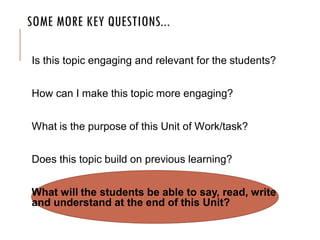
SOME MORE KEY QUESTIONS...
Is this topic engaging and relevant for the students?
How can I make this topic more engaging?
What is the purpose of this Unit of Work/task?
Does this topic build on previous learning?
What will the students be able to say, read, write
and understand at the end of this Unit?
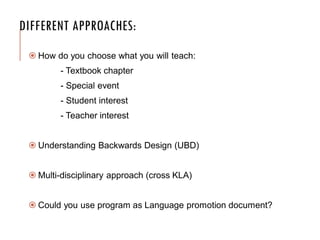
DIFFERENT APPROACHES:
 How do you choose what you will teach:
- Textbook chapter
- Special event
- Student interest
- Teacher interest
 Understanding Backwards Design (UBD)
 Multi-disciplinary approach (cross KLA)
 Could you use program as Language promotion document?
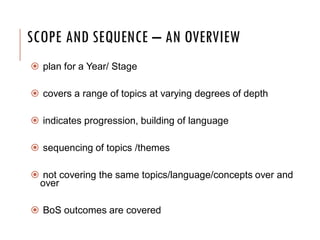
SCOPE AND SEQUENCE – AN OVERVIEW
 plan for a Year/ Stage
 covers a range of topics at varying degrees of depth
 indicates progression, building of language
 sequencing of topics /themes
 not covering the same topics/language/concepts over and
over
 BoS outcomes are covered
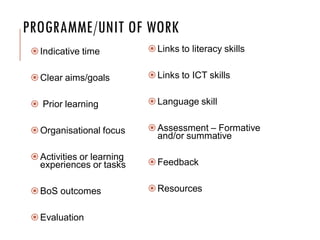
PROGRAMME/UNIT OF WORK
Indicative time
Clear aims/goals
 Prior learning
Organisational focus
Activities or learning
experiences or tasks
BoS outcomes
Evaluation
Links to literacy skills
Links to ICT skills
Language skill
Assessment – Formative
and/or summative
Feedback
Resources
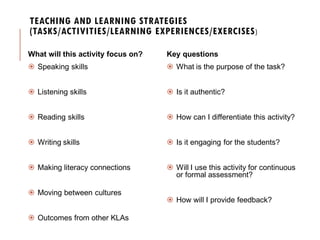
TEACHING AND LEARNING STRATEGIES
(TASKS/ACTIVITIES/LEARNING EXPERIENCES/EXERCISES)
What will this activity focus on?
 Speaking skills
 Listening skills
 Reading skills
 Writing skills
 Making literacy connections
 Moving between cultures
 Outcomes from other KLAs
Key questions
 What is the purpose of the task?
 Is it authentic?
 How can I differentiate this activity?
 Is it engaging for the students?
 Will I use this activity for continuous
or formal assessment?
 How will I provide feedback?
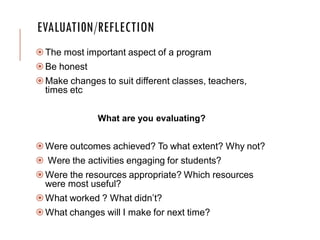
EVALUATI0N/REFLECTION
The most important aspect of a program
Be honest
Make changes to suit different classes, teachers,
times etc
What are you evaluating?
Were outcomes achieved? To what extent? Why not?
 Were the activities engaging for students?
Were the resources appropriate? Which resources
were most useful?
What worked ? What didn’t?
What changes will I make for next time?
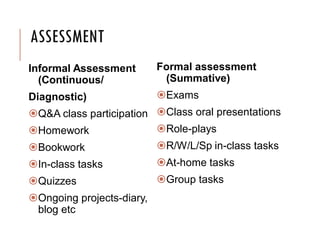
ASSESSMENT
Informal Assessment
(Continuous/
Diagnostic)
Q&A class participation
Homework
Bookwork
In-class tasks
Quizzes
Ongoing projects-diary,
blog etc
Formal assessment
(Summative)
Exams
Class oral presentations
Role-plays
R/W/L/Sp in-class tasks
At-home tasks
Group tasks
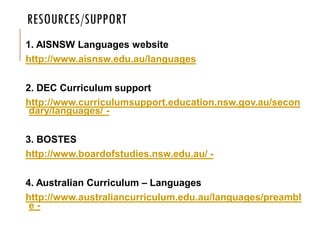
RESOURCES/SUPPORT
1. AISNSW Languages website
http://www.aisnsw.edu.au/languages
2. DEC Curriculum support
http://www.curriculumsupport.education.nsw.gov.au/secon
dary/languages/ -
3. BOSTES
http://www.boardofstudies.nsw.edu.au/ -
4. Australian Curriculum – Languages
http://www.australiancurriculum.edu.au/languages/preambl
e -

Effective Programming in Languages

  • 1.
    DEVELOPING EFFECTIVE LANGUAGES PROGRAMSK-10 May 9th 2015 Merryl Wahlin Languages Consultant K-12 AIS NSW
  • 2.
    SOME INITIAL THINKING…. Whatis the purpose of a program? What should the format be? What are the key elements?
  • 3.
    KEY QUESTIONS  Whattopic/s will you be teaching?  What is your goal for your students?  How will your students demonstrate that they have achieved this goal?  How will you teach with this goal in mind?  What BoS outcomes will you focus on?  How will you assess student achievement?
  • 4.
    SOME MORE KEYQUESTIONS... Is this topic engaging and relevant for the students? How can I make this topic more engaging? What is the purpose of this Unit of Work/task? Does this topic build on previous learning? What will the students be able to say, read, write and understand at the end of this Unit?
  • 5.
    DIFFERENT APPROACHES:  Howdo you choose what you will teach: - Textbook chapter - Special event - Student interest - Teacher interest  Understanding Backwards Design (UBD)  Multi-disciplinary approach (cross KLA)  Could you use program as Language promotion document?
  • 6.
    SCOPE AND SEQUENCE– AN OVERVIEW  plan for a Year/ Stage  covers a range of topics at varying degrees of depth  indicates progression, building of language  sequencing of topics /themes  not covering the same topics/language/concepts over and over  BoS outcomes are covered
  • 7.
    PROGRAMME/UNIT OF WORK Indicativetime Clear aims/goals  Prior learning Organisational focus Activities or learning experiences or tasks BoS outcomes Evaluation Links to literacy skills Links to ICT skills Language skill Assessment – Formative and/or summative Feedback Resources
  • 8.
    TEACHING AND LEARNINGSTRATEGIES (TASKS/ACTIVITIES/LEARNING EXPERIENCES/EXERCISES) What will this activity focus on?  Speaking skills  Listening skills  Reading skills  Writing skills  Making literacy connections  Moving between cultures  Outcomes from other KLAs Key questions  What is the purpose of the task?  Is it authentic?  How can I differentiate this activity?  Is it engaging for the students?  Will I use this activity for continuous or formal assessment?  How will I provide feedback?
  • 9.
    EVALUATI0N/REFLECTION The most importantaspect of a program Be honest Make changes to suit different classes, teachers, times etc What are you evaluating? Were outcomes achieved? To what extent? Why not?  Were the activities engaging for students? Were the resources appropriate? Which resources were most useful? What worked ? What didn’t? What changes will I make for next time?
  • 10.
    ASSESSMENT Informal Assessment (Continuous/ Diagnostic) Q&A classparticipation Homework Bookwork In-class tasks Quizzes Ongoing projects-diary, blog etc Formal assessment (Summative) Exams Class oral presentations Role-plays R/W/L/Sp in-class tasks At-home tasks Group tasks
  • 11.
    RESOURCES/SUPPORT 1. AISNSW Languageswebsite http://www.aisnsw.edu.au/languages 2. DEC Curriculum support http://www.curriculumsupport.education.nsw.gov.au/secon dary/languages/ - 3. BOSTES http://www.boardofstudies.nsw.edu.au/ - 4. Australian Curriculum – Languages http://www.australiancurriculum.edu.au/languages/preambl e -