CROSS CULTURAL UNDERSTANDING;
        AN INTRODUCTION


              NAILIL MUNA


       EBT. Sultan Agung English Club. 2011
What is CCU?
   CCU deals with understanding the similarity and
    differences of culture between and among
    people

   Its core is to establish and understand how
    people from different culture communicate with
    each other and comprises the shared values,
    understandings, assumptions, and goals

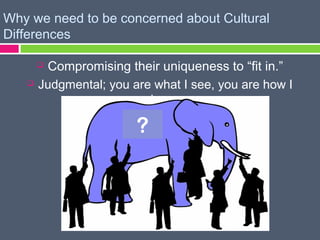
   Check this example out.
Why we need to be concerned about Cultural
Differences

       Compromising their uniqueness to “fit in.”
      Judgmental; you are what I see, you are how I
                     perceive you are

                        ?
Dimensions of Diversity
   Gender Religious beliefs
   Race Marital status
   Ethnicity Parental status
   Age Education
   Physical and mental ability Income
   Sexual orientation Occupation
   Language
   Geographic location
Why CCU Matters?
   Global Market
Why CCU Matters?
 Changing Demographics
1.International Citizenship
  In 2008: 15.205 expatriates live in Indonesia
  In 2011: 83.000 expatriates live in Indonesia

2.Trends of Global Changes; independency vs.
  dependency
  Lifestyle
  Ideology
  Cultural, political view
Developing Diversity
    Competence
   Awareness
   Recognize differences
   Respect the benefits of diverse values
   Accept that each culture finds some values more
    important and some behaviors more desirable than
    others
   Understand the effect of distrust
   Have a clear sense of your individual culture
   Recognize your own ethnocentricity
   Understand how the culture of your organization
    affects those whose culture is different

Developing Diversity
    Competence
   Knowledge
   Learn factual information about other cultures
   Engaged in cultural activities
   Learn a new language
   Make friends with people of different culture
   Explore your history and background.
Developing Diversity
    Competence
   Skill
   Take personal responsibility for the way you respond
    to difference.
   Make continued and sincere attempts to understand
   the world from others’ points of view.
   Develop skills in cross-cultural communication.
   Develop problem-solving skills.
   Develop skills in conflict management.
   Look for ways to work effectively with diverse groups
    of people.
Developing Diversity
Competence
   Action/Behavior
   Teach others about cultural differences.
   Develop a mentoring relationship with
    someone from a different culture or identity
    group.
   Show more patience when working and
    interacting with people who have different
    learning styles than you.
   Develop a personal plan for continued learning
    toward diversity competency
The Challenge of Diversity
   Diversity is an inside job, meaning that diversity is
    not about “them.”
   Diversity goes beyond race and gender.
   No one is the target of blame for current or past
    inequities.
   Human beings are ethnocentric, seeing the world
    through their own narrow view and judging the
    world by their familiar yardstick
   Human beings find comfort and trust in likeness
   It is difficult for people to share power
FINAL QUESTION


WOULD YOU TAKE THE CHALLANGE?

Cross cultural understanding

  • 1.
    CROSS CULTURAL UNDERSTANDING; AN INTRODUCTION NAILIL MUNA EBT. Sultan Agung English Club. 2011
  • 2.
    What is CCU?  CCU deals with understanding the similarity and differences of culture between and among people  Its core is to establish and understand how people from different culture communicate with each other and comprises the shared values, understandings, assumptions, and goals  Check this example out.
  • 3.
    Why we needto be concerned about Cultural Differences Compromising their uniqueness to “fit in.”  Judgmental; you are what I see, you are how I perceive you are ?
  • 4.
    Dimensions of Diversity  Gender Religious beliefs  Race Marital status  Ethnicity Parental status  Age Education  Physical and mental ability Income  Sexual orientation Occupation  Language  Geographic location
  • 5.
    Why CCU Matters?  Global Market
  • 6.
    Why CCU Matters? Changing Demographics 1.International Citizenship In 2008: 15.205 expatriates live in Indonesia In 2011: 83.000 expatriates live in Indonesia 2.Trends of Global Changes; independency vs. dependency Lifestyle Ideology Cultural, political view
  • 7.
    Developing Diversity Competence  Awareness  Recognize differences  Respect the benefits of diverse values  Accept that each culture finds some values more important and some behaviors more desirable than others  Understand the effect of distrust  Have a clear sense of your individual culture  Recognize your own ethnocentricity  Understand how the culture of your organization affects those whose culture is different 
  • 8.
    Developing Diversity Competence  Knowledge  Learn factual information about other cultures  Engaged in cultural activities  Learn a new language  Make friends with people of different culture  Explore your history and background.
  • 9.
    Developing Diversity Competence  Skill  Take personal responsibility for the way you respond to difference.  Make continued and sincere attempts to understand  the world from others’ points of view.  Develop skills in cross-cultural communication.  Develop problem-solving skills.  Develop skills in conflict management.  Look for ways to work effectively with diverse groups of people.
  • 10.
    Developing Diversity Competence  Action/Behavior  Teach others about cultural differences.  Develop a mentoring relationship with someone from a different culture or identity group.  Show more patience when working and interacting with people who have different learning styles than you.  Develop a personal plan for continued learning toward diversity competency
  • 11.
    The Challenge ofDiversity  Diversity is an inside job, meaning that diversity is not about “them.”  Diversity goes beyond race and gender.  No one is the target of blame for current or past inequities.  Human beings are ethnocentric, seeing the world through their own narrow view and judging the world by their familiar yardstick  Human beings find comfort and trust in likeness  It is difficult for people to share power
  • 12.
    FINAL QUESTION WOULD YOUTAKE THE CHALLANGE?