Maria Lobytsyna
• Using Authentic, Online, Audio-Visual
texts in the Language classroom.
• Open High School (Languages).
• Russian online courses (Russian
Continuers: Preliminary and HSC).
• maria.lobytsyna1@det.nsw.edu.au
The platforms:
• Moodle
• Edmodo
• Schoology
BOASTES (NSW) Board of Studies –Teaching
and Language Standards
• in their language curriculums explicitly
state the importance of using authentic texts
(including AV texts).
• Using audio-visual texts dovetails itself
with the “Quality Teaching (QT) in NSW
public schools discussion paper (2003). It
encourages teachers to use audio-visual
texts in a language classroom context.
The Open High School: e-learning
• This presentation is based on the practical
experience of teaching Russian audio-visual
texts incorporated in the new online
language courses for Year 11 and year 12
students (on Moodle). It refers to both face-
to-face and distance education modes (as
part of the new online course).
Teaching the AV texts: teaching comprehension
and understanding.
The challengers encountered:
• Encouraging students to comprehend the socio-
cultural and semantic context of the authentic AV
texts.
• Discussing and analysing the different cultural
“undercurrents” of the selected AV texts.
Quality Learning Environment
• Engagement Using prior knowledge and
analytical skills to examine the AV text vs
personal experiences.
• High expectations
• Understanding the context,
• making connections between local and
global issues.
Quality Learning Environment
• Higher-order thinking Evaluate, analyse, apply:
an impact of the national heritage on modern
culture.
• Analysing environmental issues in local and
global context.
• Moving between cultures.
• Metalanguage Making linguistic connections.
Discussing how the language works.
Significance of using the AV texts:
• Background knowledge gathered
• Cultural knowledge: linking the lessons content to different
socio-cultural groups demonstrating that different cultures
are accepted
• Knowledge integration: linking to other subjects (modern
history, legal studies,)
• Connectedness: learning outcomes are valuable beyond the
classroom and school (RE: students’ feedback)
• The AV texts were the triggers for the projects/students
shared their knowledge.
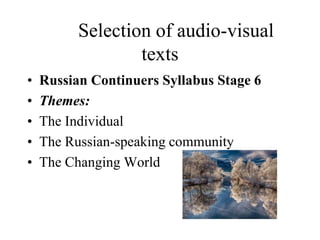
Selection of audio-visual
texts
• Russian Continuers Syllabus Stage 6
• Themes:
• The Individual
• The Russian-speaking community
• The Changing World
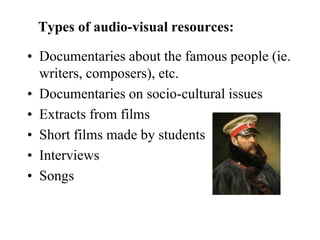
Types of audio-visual resources:
• Documentaries about the famous people (ie.
writers, composers), etc.
• Documentaries on socio-cultural issues
• Extracts from films
• Short films made by students
• Interviews
• Songs
Text type Topic Theme
Report
• Russian teenagers and the Internet
• Addictions
• Health and social issues
• Environment
• Teenage life
• Family life
TV interview
• TV interview with a popular media
presenter: “100 questions to an adult”
• People at work
• Career aspirations
• Relationships with family and friends
Films
An episode from a film by Akira Kurosava
“Dersy Uzala” (Russian/Japanese)
• Environment
• Conservation
Documentary
• Life and works of Russian composer
Tchaikovsky
• Modern culture and music
• Professional aspirations
Popular song
• Friendship
• Personal life
• Community
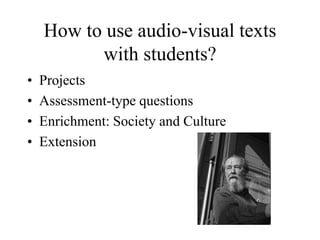
How to use audio-visual texts
with students?
• Projects
• Assessment-type questions
• Enrichment: Society and Culture
• Extension
Developing skills
• Speaking skills
• Discussion and debating skills
• Analytical skills
• High order thinking
My Pedagogy
• Students’ participation in the research and
selection process (ie films and
documentaries based on the literary texts)
• Students’ feedback
• Surveys
The Copyright Considerations
Australian Copyright Council
E-mail: info@copyright.org.au
Website: www.copyright.org.au
YouTube’s Copyright Center for users:
www.youtube.com/copyright/
Using other people’s material in YouTube videos
– Copyright expired material
– Pre-cleared material (video, images and footage that has
been pre-cleared for use on YouTube)
– Open licensed material (ie Creative Commons material)
– Fair Dealing (is tired to specific purposes such as . . .
reporting the news, research and study)
The Embedded link
• YouTube
• Click on Embed
• Copy the link
• Go to Moodle
• Click on Edit HTML Source
• Paste the link and unclick Word Wrap
• Update
• Enter the Questions/Tasks
• Save and Return to course
TubeChop
– Go to YouTube, select your film
– Click on Share and copy the link
– Open TubeChop
– Paste the link in the Search area
– Click on “Chop” and select the required episode.
– Copy the embed code for Moodle
– Or copy the link and create a hyperlink (if you use the
Word file).
Maria Lobytsyna - Using Authentic, Online texts

Maria Lobytsyna - Using Authentic, Online texts

  • 1.
    Maria Lobytsyna • UsingAuthentic, Online, Audio-Visual texts in the Language classroom. • Open High School (Languages). • Russian online courses (Russian Continuers: Preliminary and HSC). • maria.lobytsyna1@det.nsw.edu.au
  • 2.
    The platforms: • Moodle •Edmodo • Schoology
  • 3.
    BOASTES (NSW) Boardof Studies –Teaching and Language Standards • in their language curriculums explicitly state the importance of using authentic texts (including AV texts). • Using audio-visual texts dovetails itself with the “Quality Teaching (QT) in NSW public schools discussion paper (2003). It encourages teachers to use audio-visual texts in a language classroom context.
  • 4.
    The Open HighSchool: e-learning • This presentation is based on the practical experience of teaching Russian audio-visual texts incorporated in the new online language courses for Year 11 and year 12 students (on Moodle). It refers to both face- to-face and distance education modes (as part of the new online course).
  • 5.
    Teaching the AVtexts: teaching comprehension and understanding. The challengers encountered: • Encouraging students to comprehend the socio- cultural and semantic context of the authentic AV texts. • Discussing and analysing the different cultural “undercurrents” of the selected AV texts.
  • 6.
    Quality Learning Environment •Engagement Using prior knowledge and analytical skills to examine the AV text vs personal experiences. • High expectations • Understanding the context, • making connections between local and global issues.
  • 7.
    Quality Learning Environment •Higher-order thinking Evaluate, analyse, apply: an impact of the national heritage on modern culture. • Analysing environmental issues in local and global context. • Moving between cultures. • Metalanguage Making linguistic connections. Discussing how the language works.
  • 8.
    Significance of usingthe AV texts: • Background knowledge gathered • Cultural knowledge: linking the lessons content to different socio-cultural groups demonstrating that different cultures are accepted • Knowledge integration: linking to other subjects (modern history, legal studies,) • Connectedness: learning outcomes are valuable beyond the classroom and school (RE: students’ feedback) • The AV texts were the triggers for the projects/students shared their knowledge.
  • 9.
    Selection of audio-visual texts •Russian Continuers Syllabus Stage 6 • Themes: • The Individual • The Russian-speaking community • The Changing World
  • 10.
    Types of audio-visualresources: • Documentaries about the famous people (ie. writers, composers), etc. • Documentaries on socio-cultural issues • Extracts from films • Short films made by students • Interviews • Songs
  • 11.
    Text type TopicTheme Report • Russian teenagers and the Internet • Addictions • Health and social issues • Environment • Teenage life • Family life
  • 12.
    TV interview • TVinterview with a popular media presenter: “100 questions to an adult” • People at work • Career aspirations • Relationships with family and friends
  • 13.
    Films An episode froma film by Akira Kurosava “Dersy Uzala” (Russian/Japanese) • Environment • Conservation
  • 14.
    Documentary • Life andworks of Russian composer Tchaikovsky • Modern culture and music • Professional aspirations
  • 15.
    Popular song • Friendship •Personal life • Community
  • 16.
    How to useaudio-visual texts with students? • Projects • Assessment-type questions • Enrichment: Society and Culture • Extension
  • 17.
    Developing skills • Speakingskills • Discussion and debating skills • Analytical skills • High order thinking
  • 18.
    My Pedagogy • Students’participation in the research and selection process (ie films and documentaries based on the literary texts) • Students’ feedback • Surveys
  • 19.
    The Copyright Considerations AustralianCopyright Council E-mail: info@copyright.org.au Website: www.copyright.org.au YouTube’s Copyright Center for users: www.youtube.com/copyright/
  • 20.
    Using other people’smaterial in YouTube videos – Copyright expired material – Pre-cleared material (video, images and footage that has been pre-cleared for use on YouTube) – Open licensed material (ie Creative Commons material) – Fair Dealing (is tired to specific purposes such as . . . reporting the news, research and study)
  • 21.
    The Embedded link •YouTube • Click on Embed • Copy the link • Go to Moodle • Click on Edit HTML Source • Paste the link and unclick Word Wrap • Update • Enter the Questions/Tasks • Save and Return to course
  • 22.
    TubeChop – Go toYouTube, select your film – Click on Share and copy the link – Open TubeChop – Paste the link in the Search area – Click on “Chop” and select the required episode. – Copy the embed code for Moodle – Or copy the link and create a hyperlink (if you use the Word file).