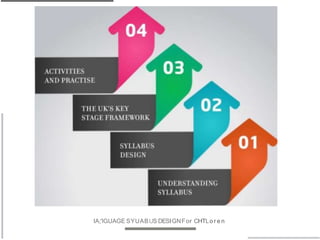
IA;'lGUAGE SYUABUS DESIGNFor CHTLo r e n
Presentaciones 
• Quien eres 
• Porque estas hacienda este curso 
• Que idea predeterminada tienes de la sesi6n sobre 
el syllabus 
•Que esperas aprender hoy o en que crees que 
puede ayudarte lo que vamos a trabajar
What is a Syllabus? 
An expression of opinion on the nature of language 
and learning: it acts as a guide for both teacher 
and learner by providing some goals to be attained. 
Curriculum is wider term as it covers all the activities 
and arrangements made by the institution out the 
academic year to facilitate the learners and the 
instructors. A Syllabus is limited to particular subject 
or a particular class.
Actividad 1 
• What would you expect from your dream syllabus? 
• A good syllabus should be:...
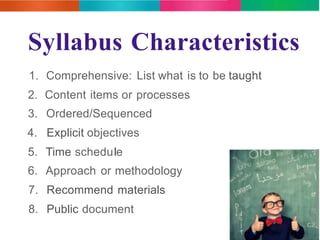
Syllabus Characteristics 
1. Comprehensive: List what is to be taught 
2. Content items or processes 
3. Ordered/Sequenced 
4. Explicit objectives 
5. Time schedule 
6. Approach or methodology 
7. Recommend materials 
8. Public document
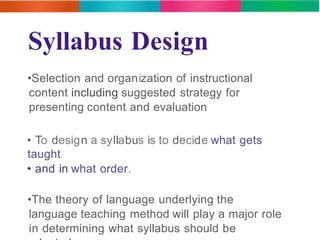
Syllabus Design 
•Selection and organization of instructional 
content including suggested strategy for 
presenting content and evaluation 
• To design a syllabus is to decide what gets 
taught 
• and in what order. 
•The theory of language underlying the 
language teaching method will play a major role 
in determining what syllabus should be 
adopted.
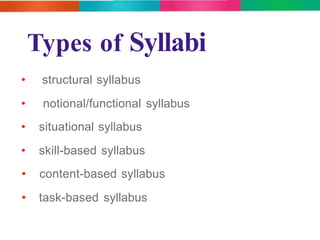
Types of Syllabi 
• structural syllabus 
• notional/functional syllabus 
• situational syllabus 
• skill-based syllabus 
• content-based syllabus 
• task-based syllabus
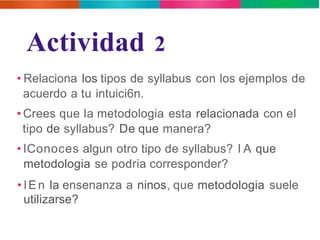
Actividad 2 
• Relaciona los tipos de syllabus con los ejemplos de 
acuerdo a tu intuici6n. 
•Crees que la metodologia esta relacionada con el 
tipo de syllabus? De que manera? 
• lConoces algun otro tipo de syllabus? l A que 
metodologia se podria corresponder? 
• lEn la ensenanza a ninos, que metodologia suele 
utilizarse?
Teachers Role 
Some teachers are consumers of other 
people,s syllabi and implement the plans of 
applied linguists or government agencies 
Others have a relatively free hand in 
designing their own sillabus. 
All should be given appropriate training to 
design and regard the syllabus open and 
negotiable
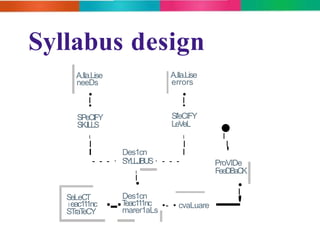
Syllabus design 
A.Ila.Lise 
neeDs 
A.Ila.Lise 
errors 
• • 
I I 
• 
SPeCIFY 
SK.ILLS 
I 
I 
• 
Sl'eCIFY 
LeVeL 
I 
I 
l Des1cn I 
- - - · SYLLJlBUS · - - - 
I 
I 
• 
Des1cn 
·-·Teac111nc marer1aLs 
•- • cvaLuare 
SeLeCT 
1eac111nc 
STraTeCY 
•I 
I 
' 
ProVIDe 
FeeDBaCK 
---' 
•I
Prilllary sillabus design 
• Integrated language curriculum 
• Defining key principles of language learning 
• Defining a policy and practice oriented to 
expected outcomes 
• Structures implied in an integrated curriculum for 
children's language learning from 3 to 12 years, 
and how would these structures accommodate 
the different language learning
Inside the frainework 
• What do you know about the framework? 
• Do you have any experience using the 
framework?
The fralllework 
1. Learning objectives and teaching activities 
2. Advice on curriculum management for users 
of the framework 
3. Planning progression and assessment. Sample 
teaching activities
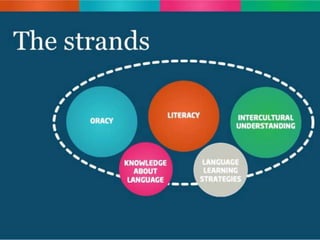
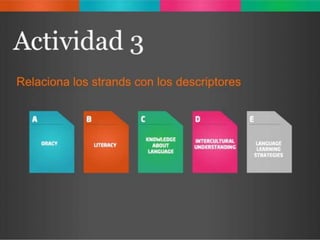
Oracy 
Children listen to the teacher, native speakers and 
recordings, and they learn to recognize familiar and 
unfamiliar sounds. They reproduce these sounds, 
create phrases sentences , and engage in 
conversations
Literacy 
Children understand, read and enjoy different forms 
of paper and electronic texts, such as stories, 
poems and messages. They write simple sentences 
and short texts, often using a frame or model 
. http://www.schoolsworld.tv /node/3105
Intercultural 
understanding 
It enables them to explore the lives of others and 
provides them with context for understanding their 
own lives. They become aware of the similarities 
and differences between 
peopleshttp://www.ra iseonlinetraining.eo.uk/videos/prima ry-span ish-el-camino 
de-la-escue la/
Knowledge about 
language 
Understanding of how language works, and this 
reinforces their understanding of their own 
language. They become aware of the rules or 
patterns in language
Language learning 
skills 
Children have regular opportunities to think about 
the best way for them to learn a new language, and 
they employ a range of strategies to help them do 
this
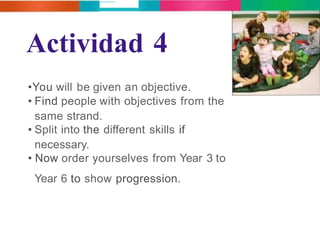
Actividad 4 
•You will be given an objective. 
• Find people with objectives from the 
same strand. 
• Split into the different skills if 
necessary. 
• Now order yourselves from Year 3 to 
Year 6 to show progression.
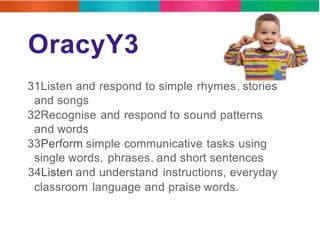
OracyY3 
31Listen and respond to simple rhymes, stories 
and songs 
32Recognise and respond to sound patterns 
and words 
33Perform simple communicative tasks using 
single words, phrases, and short sentences 
34Listen and understand instructions, everyday 
classroom language and praise words.
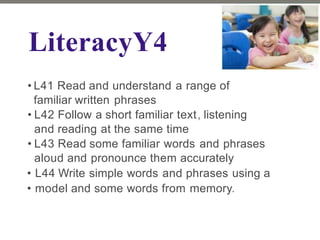
LiteracyY4 
• L41 Read and understand a range of 
familiar written phrases 
• L42 Follow a short familiar text , listening 
and reading at the same time 
• L43 Read some familiar words and phrases 
aloud and pronounce them accurately 
• L44 Write simple words and phrases using a 
• model and some words from memory.
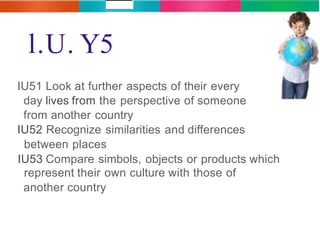
l.U. Y5 
IU51 Look at further aspects of their every 
day lives from the perspective of someone 
from another country 
IU52 Recognize similarities and differences 
between places 
IU53 Compare simbols, objects or products which 
represent their own culture with those of 
another country
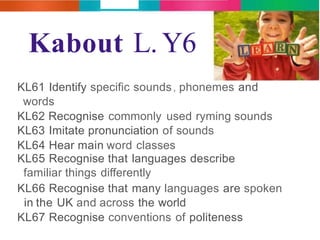
Kabout L. Y6 
KL61 Identify specific sounds, phonemes and 
words 
KL62 Recognise commonly used ryming sounds 
KL63 Imitate pronunciation of sounds 
KL64 Hear main word classes 
KL65 Recognise that languages describe 
familiar things differently 
KL66 Recognise that many languages are spoken 
in the UK and across the world 
KL67 Recognise conventions of politeness
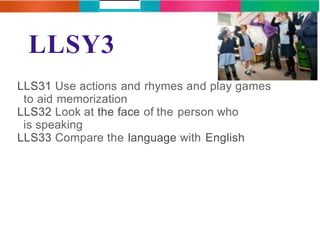
LLSY3 
LLS31 Use actions and rhymes and play games 
to aid memorization 
LLS32 Look at the face of the person who 
is speaking 
LLS33 Compare the language with English
The outcome of KS2 
• understand the main points of what people say; 
• engage in conversation, expressing their own opinion and 
responding to the opinions of others; 
• present ideas and information to a range of audiences, 
selecting appropriate ways of expressing themselves; 
• understand the main points of texts they read; 
• read aloud with expression and accuracy; 
• recognise and apply the links between the sounds and 
spelling; 
·empathise with other cultures and imagine how others 
may see their own way of life;
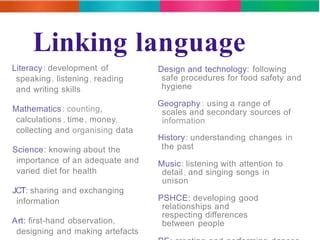
Linking language 
Literacy : development of 
speaking, listening, reading 
and writing skills 
Mathematics : counting, 
calculations , time, money, 
collecting and organising data 
Science: knowing about the 
importance of an adequate and 
varied diet for health 
JCT: sharing and exchanging 
information 
Art: first-hand observation, 
designing and making artefacts 
Design and technology: following 
safe procedures for food safety and 
hygiene 
Geography : using a range of 
scales and secondary sources of 
information 
History: understanding changes in 
the past 
Music: listening with attention to 
detail , and singing songs in 
unison 
PSHCE: developing good 
relationships and 
respecting differences 
between people 
PE: creating and performing dances.
Actividad 5 
Think of an activity that could be linked to your area of the curriculum 
http://www.schoolswor ld.tv/node/ 1997 
You might consider how to 
Link with the teaching of aspects of other subjects 
planning languages as an integral part of the whole curriculum 
and teaching some aspects of the Framework through other 
subject
Some examples 
children in the very early stages of learning a language, the class 
teacher begins each day by taking the register in German. The children 
have been taught to greet the teacher and each other and to choose 
their own reply when they hear their name. This simple routine puts 
language learning in a meaningful and memorable context, and helps 
to make language learning a normal part of the school curriculum. 
http://www.primarylanguages.org.uk/training_zone/teachers/ 
using_the_ks2_framework/intercultural_understanding/ 
reception_register.aspx 
Links with ICT curriculum: children learn to use e-mail to send and 
receive messages - children e-mail in English and receive e-mails in 
the foreign language; they also learn that ICT can be used to organise, 
reorganise and develop their ideas 
http://www.primarylanguages.org.uk/training_zone/teachers/ 
embedding/cross-curricular_links/maths_song.aspx
Y en Espafia tque? 
Bloques de contenidos 
• Escuchar, hablar y conversar 
• Leery escribir 
• Conocimiento de la lengua: uso y aprendizaje 
• Conocimientos linguisticos 
• Reflexion sobre el aprendizaje 
• Aspectos socioculturales y consciencia intercultural
Y en Espafia tque? 
• lPuedes encontrar algunas diferencias muy evidentes 
del contenido por ciclo? 
• l Te ha sorprendido algo? 
• l Conoces el Marco Comun Europeo de las Lenguas? 
lY el portfolio europeo de las lenguas? 
• http://www.youtube.com/watch?v=eYk4gzfinEs
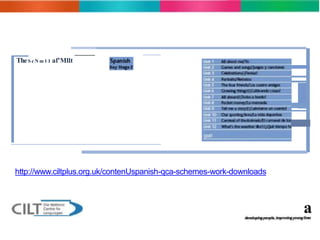
TheS cNm1 1 af'Mllt 
http://www.ciltplus.org.uk/contenUspanish-qca-schemes-work-downloads 
a
Your p.th: 
SCl'leme•hom• 
. . 
he unfts 
......... 
MFL Spanl •h . . key s t a g . 2 
k M m e • h e l p 
Wha.t b th'9- .ct .me otw o f t ? 
A.M W<ty 2 '°'*""of-..otft"""' wn..u for F/llf<'l<ft. Gt.t1'1'191'1 • f l d SPfl.th•" h f • • n cl•....!09t<I 
h . t oo...,.,. • • ol lile)'" 2 .Mideupg•sts • - y of •n•bing a.1.me-s lo mo1t lh 1 ob,llCWO• 
of tn. "-Y 2F • lor " ' {OreS. 2005).M u n b . , . now avai l bit on th'it .... . . 
Th9 f o , _ r OC6.U y s&age 2 otwott. t n .pulllli'Mld In 2000. has IMlln Nt l ' IC I bom tn• 
• • f K l • n o 
w t Tt te"'t !!'i Cx . J t IPCF: n 2 IC8) 
OwN't• o f Spt , . t"I ?'"ti t •12 r0F SI KB} 
On r y t •« 9 ' S pt r r • ) ! f " b t}:i.& (St KB) 
I.Intlt 3 .,:l">A1 p - I (Et l. ,Py)'Or- f-• J} e 2 f (478 KB) B! f (405 KB) 
I .Wt 14Yo llO)' ml$o:o ( 1 A e o . s.eM111') {'47 1 K8)a i f {409 KB) 
Uni!.1 $ Vlt'!'Ot _ ..C0 4 9 • fC)a . . . _ . , 10IChool) f g f f ' 6 1 KB) B!E{3.57KB) 
I .Wt 1 6 ,..scadol'9s . . .iMc ' l.. .11te-•cft - M)f:Rf: (''64 KB) B! f (374 KB) 
Unit 1 7 l a s c:u1tl0 ('nll9 tour Ml9 0 n l } f?.Clf(471 KB) .BlE(319 KB) 
Unit 1 1 L.oePl tMtN( l l i e ) f m : (.&63 K8) ! ! ! f {.)61 KB) 
I .Wt 1 1N!Mst!O P . . ld'IOOOec!f (<472 KB) B! f (406 KB) 
Unit 20 Nul'StJO f0ur90t lcll f:Qf: (473 KBJ 8 I I {421 KB) 
UnitJ t O N t !;111Q6Mlt'l9 fet l l l t l l O. c t f f ) fQE (415 KB)B ! f (473 1<8) 
l.Wt 22 EJ pau o o y . . ( fMt t a n d now) fQf . f ' 7 8 KB)B! f (4 13 KB) 
Unit23 En eto111:i.Jie c i . .no: - . o r : • s 11'1t r .me O I ) eQE(467 K8 ) 8 I f {371 KB) 
Unit 24 '°""l'IOliciMMt1 CN'*"t,, 11'111 ) e g f f ' f 7 KB) B!E (3$4 KB)
Actividad 6 
Piensa alguna actividad que pueda funcionar en 
la unidad de referencia teniendo en cuenta los 
objetivos de aprendizaje
'Above all, 
the Framework should 
be seen as a support, 
not a constraint; 
a climbing frame 
not a cage.'

PRIMARY SPANISH SYLLABUS

  • 2.
  • 3.
    Presentaciones • Quieneres • Porque estas hacienda este curso • Que idea predeterminada tienes de la sesi6n sobre el syllabus •Que esperas aprender hoy o en que crees que puede ayudarte lo que vamos a trabajar
  • 5.
    What is aSyllabus? An expression of opinion on the nature of language and learning: it acts as a guide for both teacher and learner by providing some goals to be attained. Curriculum is wider term as it covers all the activities and arrangements made by the institution out the academic year to facilitate the learners and the instructors. A Syllabus is limited to particular subject or a particular class.
  • 6.
    Actividad 1 •What would you expect from your dream syllabus? • A good syllabus should be:...
  • 7.
    Syllabus Characteristics 1.Comprehensive: List what is to be taught 2. Content items or processes 3. Ordered/Sequenced 4. Explicit objectives 5. Time schedule 6. Approach or methodology 7. Recommend materials 8. Public document
  • 9.
    Syllabus Design •Selectionand organization of instructional content including suggested strategy for presenting content and evaluation • To design a syllabus is to decide what gets taught • and in what order. •The theory of language underlying the language teaching method will play a major role in determining what syllabus should be adopted.
  • 10.
    Types of Syllabi • structural syllabus • notional/functional syllabus • situational syllabus • skill-based syllabus • content-based syllabus • task-based syllabus
  • 11.
    Actividad 2 •Relaciona los tipos de syllabus con los ejemplos de acuerdo a tu intuici6n. •Crees que la metodologia esta relacionada con el tipo de syllabus? De que manera? • lConoces algun otro tipo de syllabus? l A que metodologia se podria corresponder? • lEn la ensenanza a ninos, que metodologia suele utilizarse?
  • 12.
    Teachers Role Someteachers are consumers of other people,s syllabi and implement the plans of applied linguists or government agencies Others have a relatively free hand in designing their own sillabus. All should be given appropriate training to design and regard the syllabus open and negotiable
  • 13.
    Syllabus design A.Ila.Lise neeDs A.Ila.Lise errors • • I I • SPeCIFY SK.ILLS I I • Sl'eCIFY LeVeL I I l Des1cn I - - - · SYLLJlBUS · - - - I I • Des1cn ·-·Teac111nc marer1aLs •- • cvaLuare SeLeCT 1eac111nc STraTeCY •I I ' ProVIDe FeeDBaCK ---' •I
  • 14.
    Prilllary sillabus design • Integrated language curriculum • Defining key principles of language learning • Defining a policy and practice oriented to expected outcomes • Structures implied in an integrated curriculum for children's language learning from 3 to 12 years, and how would these structures accommodate the different language learning
  • 16.
    Inside the frainework • What do you know about the framework? • Do you have any experience using the framework?
  • 17.
    The fralllework 1.Learning objectives and teaching activities 2. Advice on curriculum management for users of the framework 3. Planning progression and assessment. Sample teaching activities
  • 21.
    Oracy Children listento the teacher, native speakers and recordings, and they learn to recognize familiar and unfamiliar sounds. They reproduce these sounds, create phrases sentences , and engage in conversations
  • 22.
    Literacy Children understand,read and enjoy different forms of paper and electronic texts, such as stories, poems and messages. They write simple sentences and short texts, often using a frame or model . http://www.schoolsworld.tv /node/3105
  • 23.
    Intercultural understanding Itenables them to explore the lives of others and provides them with context for understanding their own lives. They become aware of the similarities and differences between peopleshttp://www.ra iseonlinetraining.eo.uk/videos/prima ry-span ish-el-camino de-la-escue la/
  • 24.
    Knowledge about language Understanding of how language works, and this reinforces their understanding of their own language. They become aware of the rules or patterns in language
  • 25.
    Language learning skills Children have regular opportunities to think about the best way for them to learn a new language, and they employ a range of strategies to help them do this
  • 26.
    Actividad 4 •Youwill be given an objective. • Find people with objectives from the same strand. • Split into the different skills if necessary. • Now order yourselves from Year 3 to Year 6 to show progression.
  • 27.
    OracyY3 31Listen andrespond to simple rhymes, stories and songs 32Recognise and respond to sound patterns and words 33Perform simple communicative tasks using single words, phrases, and short sentences 34Listen and understand instructions, everyday classroom language and praise words.
  • 28.
    LiteracyY4 • L41Read and understand a range of familiar written phrases • L42 Follow a short familiar text , listening and reading at the same time • L43 Read some familiar words and phrases aloud and pronounce them accurately • L44 Write simple words and phrases using a • model and some words from memory.
  • 29.
    l.U. Y5 IU51Look at further aspects of their every day lives from the perspective of someone from another country IU52 Recognize similarities and differences between places IU53 Compare simbols, objects or products which represent their own culture with those of another country
  • 30.
    Kabout L. Y6 KL61 Identify specific sounds, phonemes and words KL62 Recognise commonly used ryming sounds KL63 Imitate pronunciation of sounds KL64 Hear main word classes KL65 Recognise that languages describe familiar things differently KL66 Recognise that many languages are spoken in the UK and across the world KL67 Recognise conventions of politeness
  • 31.
    LLSY3 LLS31 Useactions and rhymes and play games to aid memorization LLS32 Look at the face of the person who is speaking LLS33 Compare the language with English
  • 32.
    The outcome ofKS2 • understand the main points of what people say; • engage in conversation, expressing their own opinion and responding to the opinions of others; • present ideas and information to a range of audiences, selecting appropriate ways of expressing themselves; • understand the main points of texts they read; • read aloud with expression and accuracy; • recognise and apply the links between the sounds and spelling; ·empathise with other cultures and imagine how others may see their own way of life;
  • 33.
    Linking language Literacy: development of speaking, listening, reading and writing skills Mathematics : counting, calculations , time, money, collecting and organising data Science: knowing about the importance of an adequate and varied diet for health JCT: sharing and exchanging information Art: first-hand observation, designing and making artefacts Design and technology: following safe procedures for food safety and hygiene Geography : using a range of scales and secondary sources of information History: understanding changes in the past Music: listening with attention to detail , and singing songs in unison PSHCE: developing good relationships and respecting differences between people PE: creating and performing dances.
  • 34.
    Actividad 5 Thinkof an activity that could be linked to your area of the curriculum http://www.schoolswor ld.tv/node/ 1997 You might consider how to Link with the teaching of aspects of other subjects planning languages as an integral part of the whole curriculum and teaching some aspects of the Framework through other subject
  • 35.
    Some examples childrenin the very early stages of learning a language, the class teacher begins each day by taking the register in German. The children have been taught to greet the teacher and each other and to choose their own reply when they hear their name. This simple routine puts language learning in a meaningful and memorable context, and helps to make language learning a normal part of the school curriculum. http://www.primarylanguages.org.uk/training_zone/teachers/ using_the_ks2_framework/intercultural_understanding/ reception_register.aspx Links with ICT curriculum: children learn to use e-mail to send and receive messages - children e-mail in English and receive e-mails in the foreign language; they also learn that ICT can be used to organise, reorganise and develop their ideas http://www.primarylanguages.org.uk/training_zone/teachers/ embedding/cross-curricular_links/maths_song.aspx
  • 36.
    Y en Espafiatque? Bloques de contenidos • Escuchar, hablar y conversar • Leery escribir • Conocimiento de la lengua: uso y aprendizaje • Conocimientos linguisticos • Reflexion sobre el aprendizaje • Aspectos socioculturales y consciencia intercultural
  • 37.
    Y en Espafiatque? • lPuedes encontrar algunas diferencias muy evidentes del contenido por ciclo? • l Te ha sorprendido algo? • l Conoces el Marco Comun Europeo de las Lenguas? lY el portfolio europeo de las lenguas? • http://www.youtube.com/watch?v=eYk4gzfinEs
  • 38.
    TheS cNm1 1af'Mllt http://www.ciltplus.org.uk/contenUspanish-qca-schemes-work-downloads a
  • 39.
    Your p.th: SCl'leme•hom• . . he unfts ......... MFL Spanl •h . . key s t a g . 2 k M m e • h e l p Wha.t b th'9- .ct .me otw o f t ? A.M W<ty 2 '°'*""of-..otft"""' wn..u for F/llf<'l<ft. Gt.t1'1'191'1 • f l d SPfl.th•" h f • • n cl•....!09t<I h . t oo...,.,. • • ol lile)'" 2 .Mideupg•sts • - y of •n•bing a.1.me-s lo mo1t lh 1 ob,llCWO• of tn. "-Y 2F • lor " ' {OreS. 2005).M u n b . , . now avai l bit on th'it .... . . Th9 f o , _ r OC6.U y s&age 2 otwott. t n .pulllli'Mld In 2000. has IMlln Nt l ' IC I bom tn• • • f K l • n o w t Tt te"'t !!'i Cx . J t IPCF: n 2 IC8) OwN't• o f Spt , . t"I ?'"ti t •12 r0F SI KB} On r y t •« 9 ' S pt r r • ) ! f " b t}:i.& (St KB) I.Intlt 3 .,:l">A1 p - I (Et l. ,Py)'Or- f-• J} e 2 f (478 KB) B! f (405 KB) I .Wt 14Yo llO)' ml$o:o ( 1 A e o . s.eM111') {'47 1 K8)a i f {409 KB) Uni!.1 $ Vlt'!'Ot _ ..C0 4 9 • fC)a . . . _ . , 10IChool) f g f f ' 6 1 KB) B!E{3.57KB) I .Wt 1 6 ,..scadol'9s . . .iMc ' l.. .11te-•cft - M)f:Rf: (''64 KB) B! f (374 KB) Unit 1 7 l a s c:u1tl0 ('nll9 tour Ml9 0 n l } f?.Clf(471 KB) .BlE(319 KB) Unit 1 1 L.oePl tMtN( l l i e ) f m : (.&63 K8) ! ! ! f {.)61 KB) I .Wt 1 1N!Mst!O P . . ld'IOOOec!f (<472 KB) B! f (406 KB) Unit 20 Nul'StJO f0ur90t lcll f:Qf: (473 KBJ 8 I I {421 KB) UnitJ t O N t !;111Q6Mlt'l9 fet l l l t l l O. c t f f ) fQE (415 KB)B ! f (473 1<8) l.Wt 22 EJ pau o o y . . ( fMt t a n d now) fQf . f ' 7 8 KB)B! f (4 13 KB) Unit23 En eto111:i.Jie c i . .no: - . o r : • s 11'1t r .me O I ) eQE(467 K8 ) 8 I f {371 KB) Unit 24 '°""l'IOliciMMt1 CN'*"t,, 11'111 ) e g f f ' f 7 KB) B!E (3$4 KB)
  • 40.
    Actividad 6 Piensaalguna actividad que pueda funcionar en la unidad de referencia teniendo en cuenta los objetivos de aprendizaje
  • 41.
    'Above all, theFramework should be seen as a support, not a constraint; a climbing frame not a cage.'