Best Remedial Practices for
Pronunciation Problems
Using Active Learning
Medhat Mohsen Mohammed
A teacher of English
Luxor STEM School
About me..
 A teacher
 A student
 A life-long learner
Best Remedial Practices for Pronunciation Problems Using Active Learning - Medhat Mohsen 2
Agenda
 Pronunciation
 Error & Remedy
 Active learning
 Fun Practice
Best Remedial Practices for Pronunciation Problems Using Active Learning - Medhat Mohsen 3
Introduction
Think about something in English
pronunciation that your teacher taught
you, but you discovered it was WRONG!!
Best Remedial Practices for Pronunciation Problems Using Active Learning - Medhat Mohsen 4
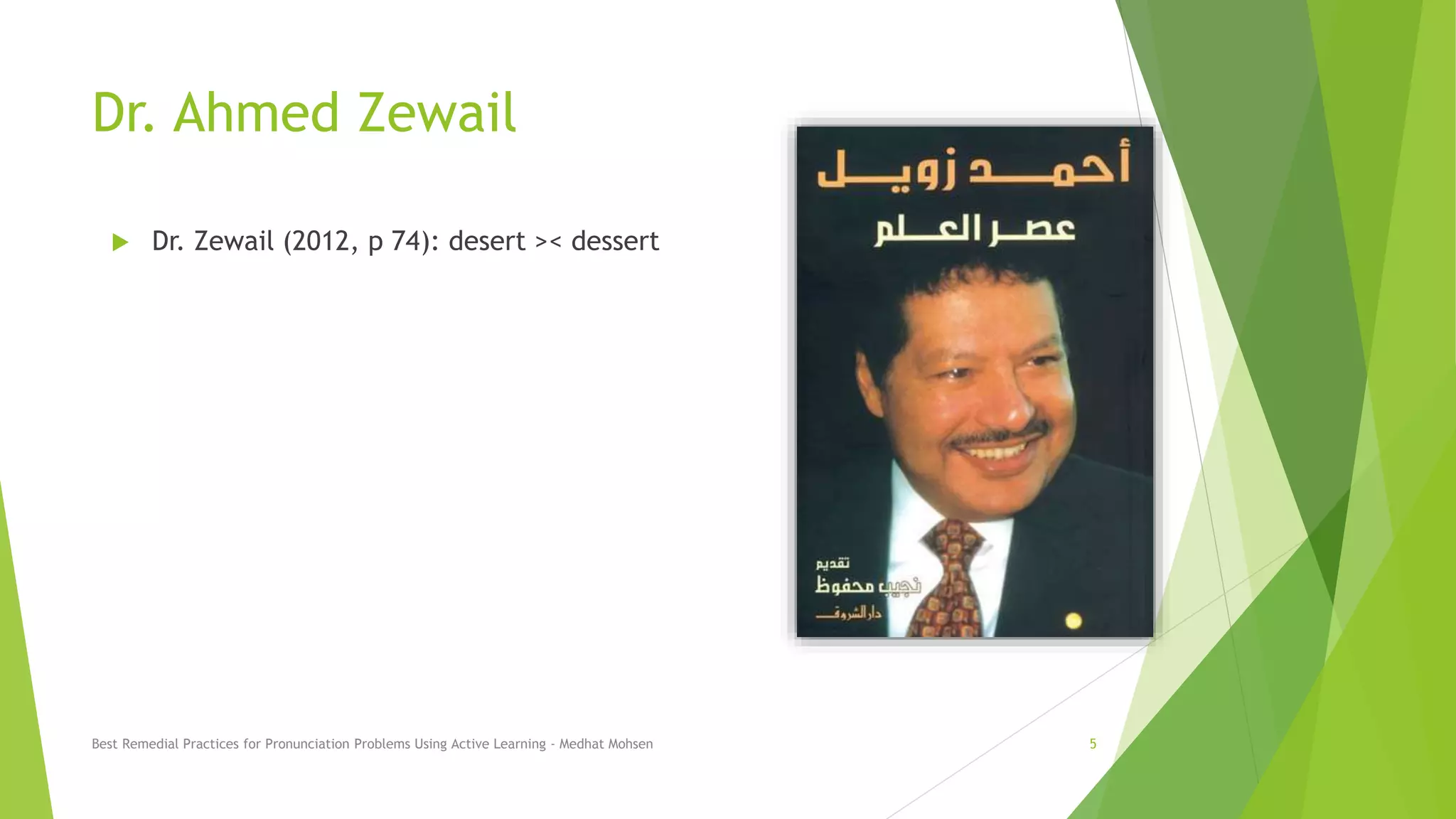
Dr. Ahmed Zewail
 Dr. Zewail (2012, p 74): desert >< dessert
Best Remedial Practices for Pronunciation Problems Using Active Learning - Medhat Mohsen 5
Pronunciation Teaching – Why?
 Wrong pronunciation leads to misunderstanding (bladder >< blood)
Vitanova and Miller (2002)
 Learners who speak with good pronunciation are more likely to be
understood, whereas who do not, are difficult to be understood,
even if their grammar was PERFECT. (social isolation & limited
opportunities)
 ‘The learner’s task in acquiring a second language is not so much to
reach a native speaker’s standard of pronunciation.” Wilkins (1981: 22)
 “Why not ‘edit’ your speech the way you edit an article?” Arabski and
Wojtaszek (2011, p. 14)
Best Remedial Practices for Pronunciation Problems Using Active Learning - Medhat Mohsen 6
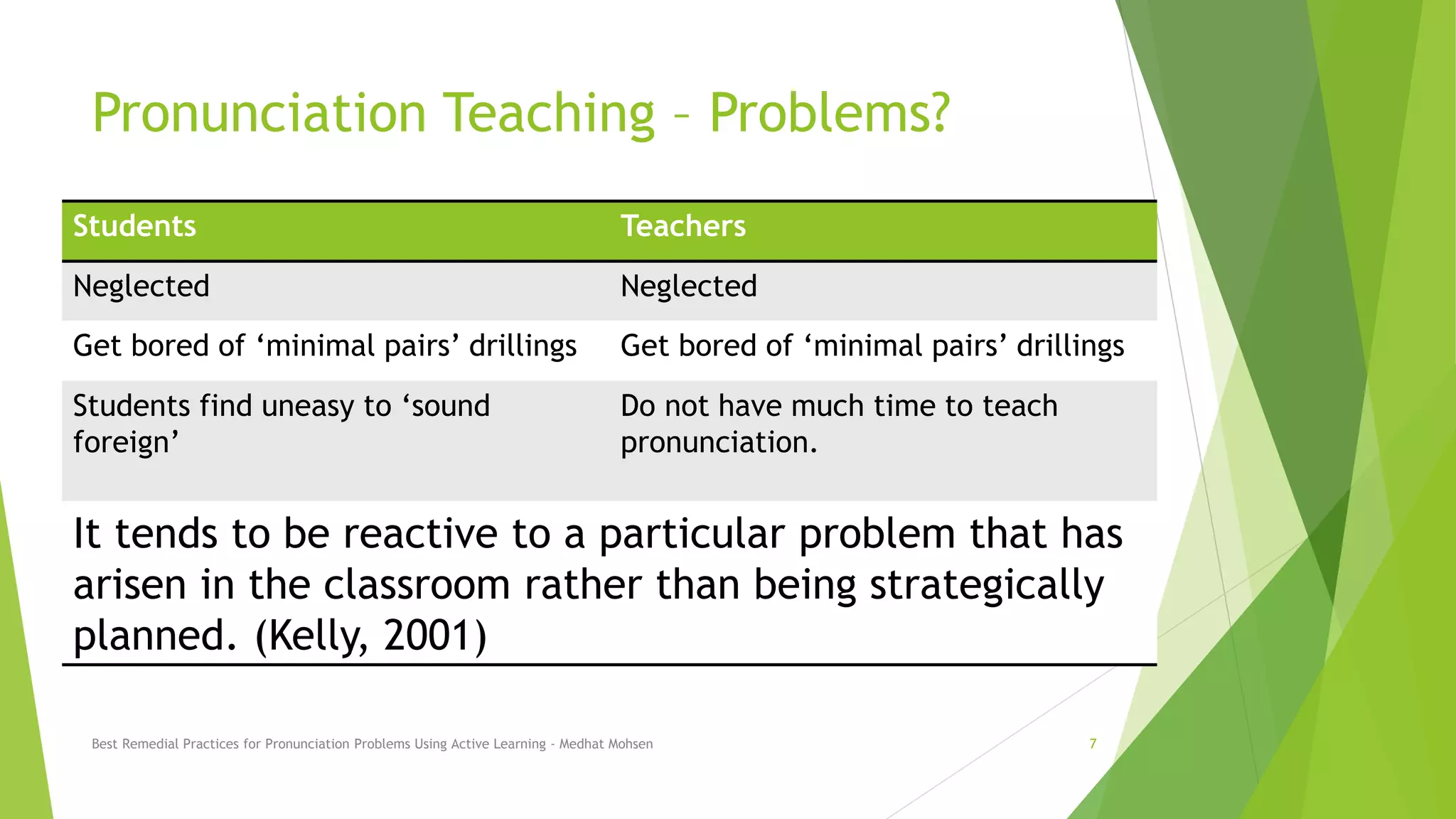
Pronunciation Teaching – Problems?
Students Teachers
Neglected Neglected
Get bored of ‘minimal pairs’ drillings Get bored of ‘minimal pairs’ drillings
Students find uneasy to ‘sound
foreign’
Do not have much time to teach
pronunciation.
It tends to be reactive to a particular problem that has
arisen in the classroom rather than being strategically
planned. (Kelly, 2001)
Best Remedial Practices for Pronunciation Problems Using Active Learning - Medhat Mohsen 7
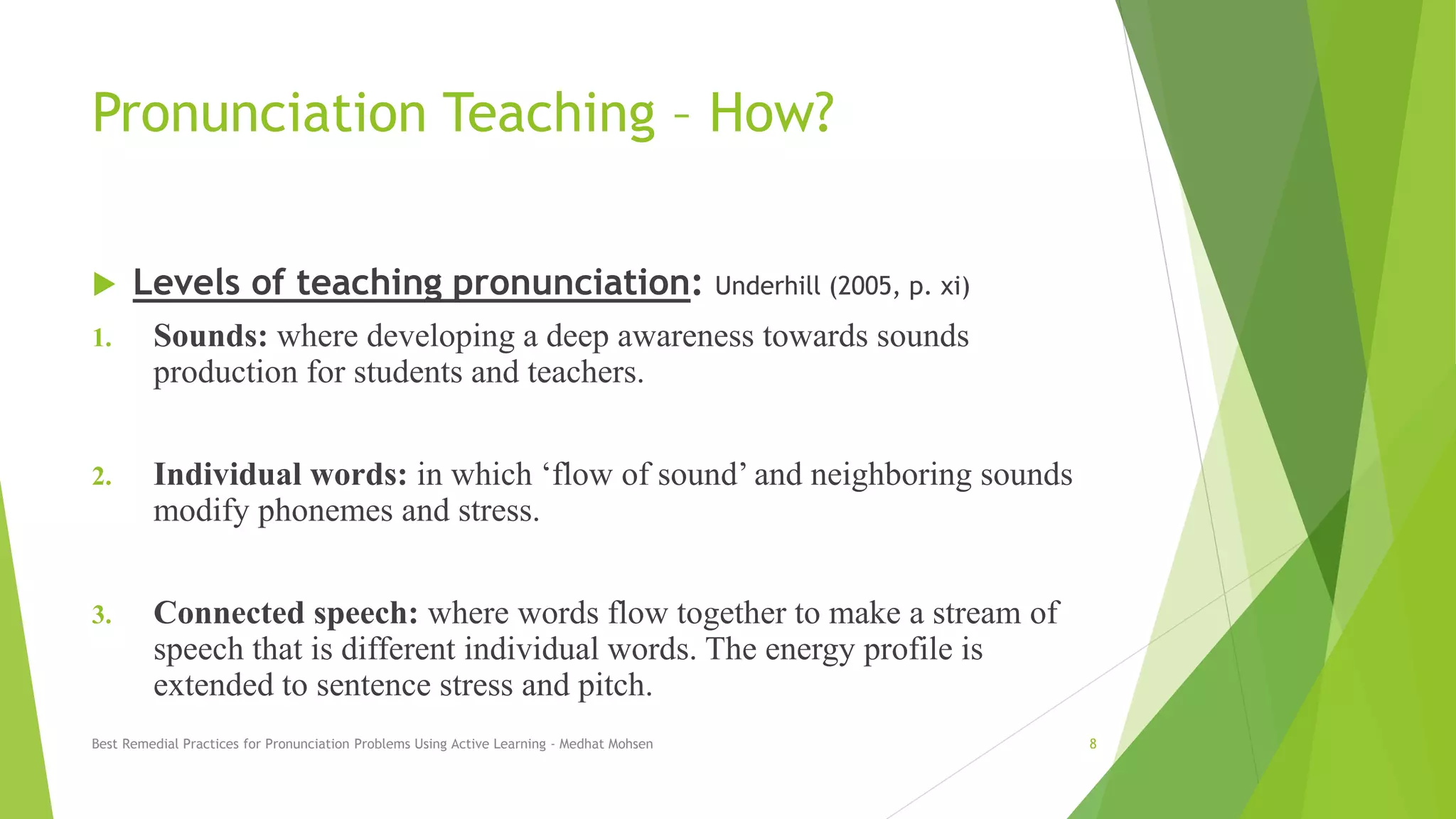
Pronunciation Teaching – How?
 Levels of teaching pronunciation: Underhill (2005, p. xi)
1. Sounds: where developing a deep awareness towards sounds
production for students and teachers.
2. Individual words: in which ‘flow of sound’ and neighboring sounds
modify phonemes and stress.
3. Connected speech: where words flow together to make a stream of
speech that is different individual words. The energy profile is
extended to sentence stress and pitch.
Best Remedial Practices for Pronunciation Problems Using Active Learning - Medhat Mohsen 8
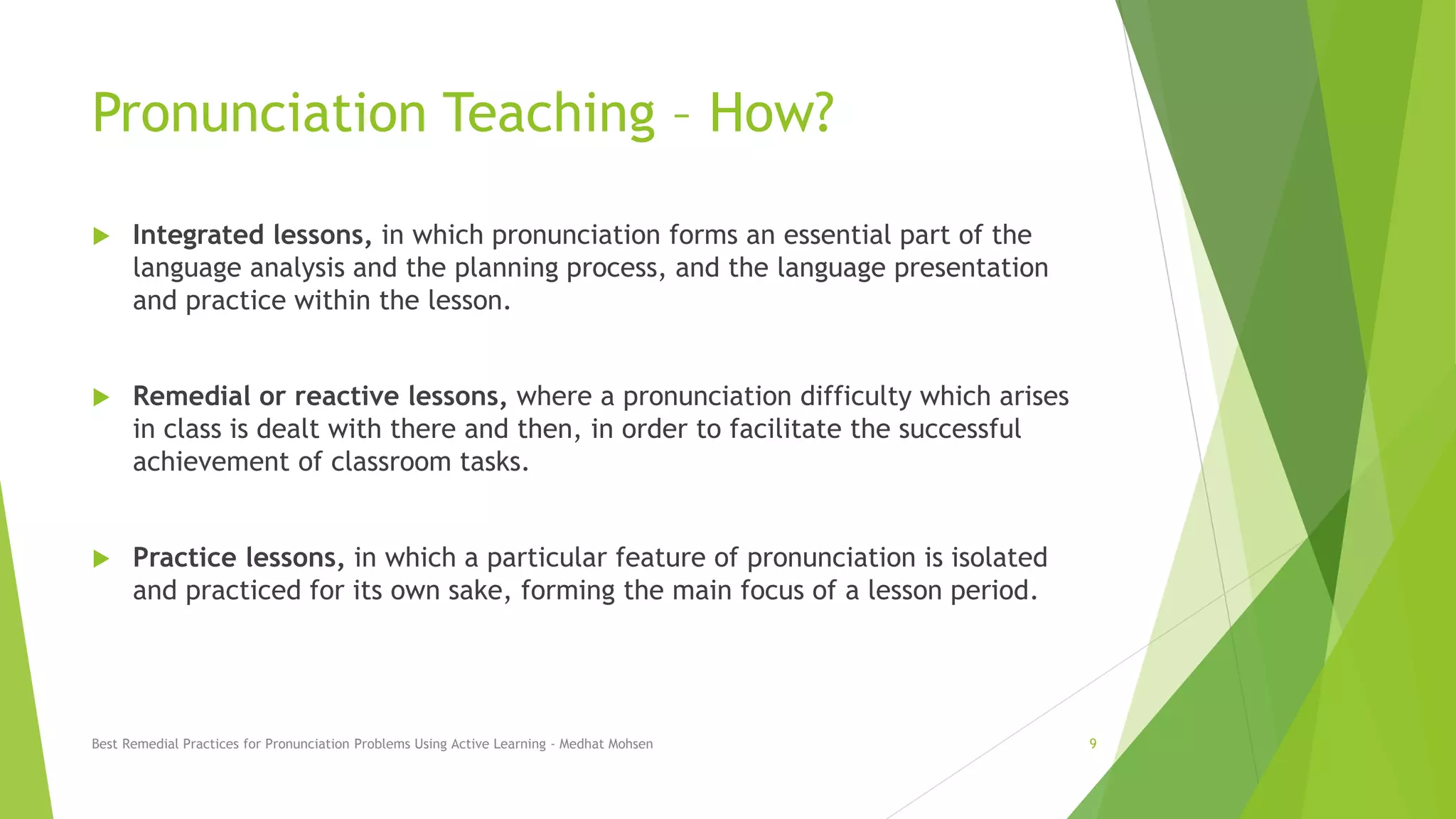
Pronunciation Teaching – How?
 Integrated lessons, in which pronunciation forms an essential part of the
language analysis and the planning process, and the language presentation
and practice within the lesson.
 Remedial or reactive lessons, where a pronunciation difficulty which arises
in class is dealt with there and then, in order to facilitate the successful
achievement of classroom tasks.
 Practice lessons, in which a particular feature of pronunciation is isolated
and practiced for its own sake, forming the main focus of a lesson period.
Best Remedial Practices for Pronunciation Problems Using Active Learning - Medhat Mohsen 9
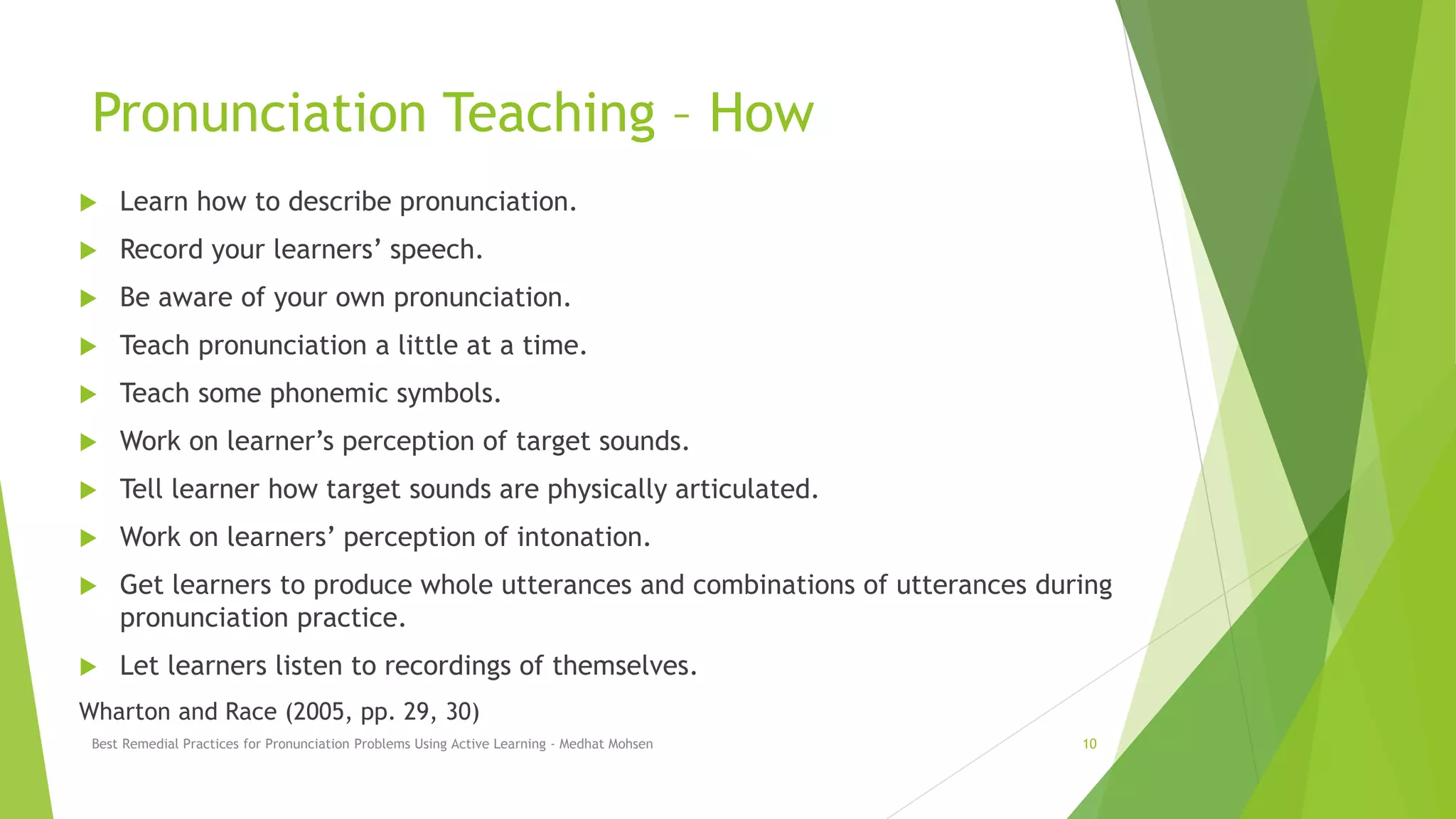
Pronunciation Teaching – How
 Learn how to describe pronunciation.
 Record your learners’ speech.
 Be aware of your own pronunciation.
 Teach pronunciation a little at a time.
 Teach some phonemic symbols.
 Work on learner’s perception of target sounds.
 Tell learner how target sounds are physically articulated.
 Work on learners’ perception of intonation.
 Get learners to produce whole utterances and combinations of utterances during
pronunciation practice.
 Let learners listen to recordings of themselves.
Wharton and Race (2005, pp. 29, 30)
Best Remedial Practices for Pronunciation Problems Using Active Learning - Medhat Mohsen 10
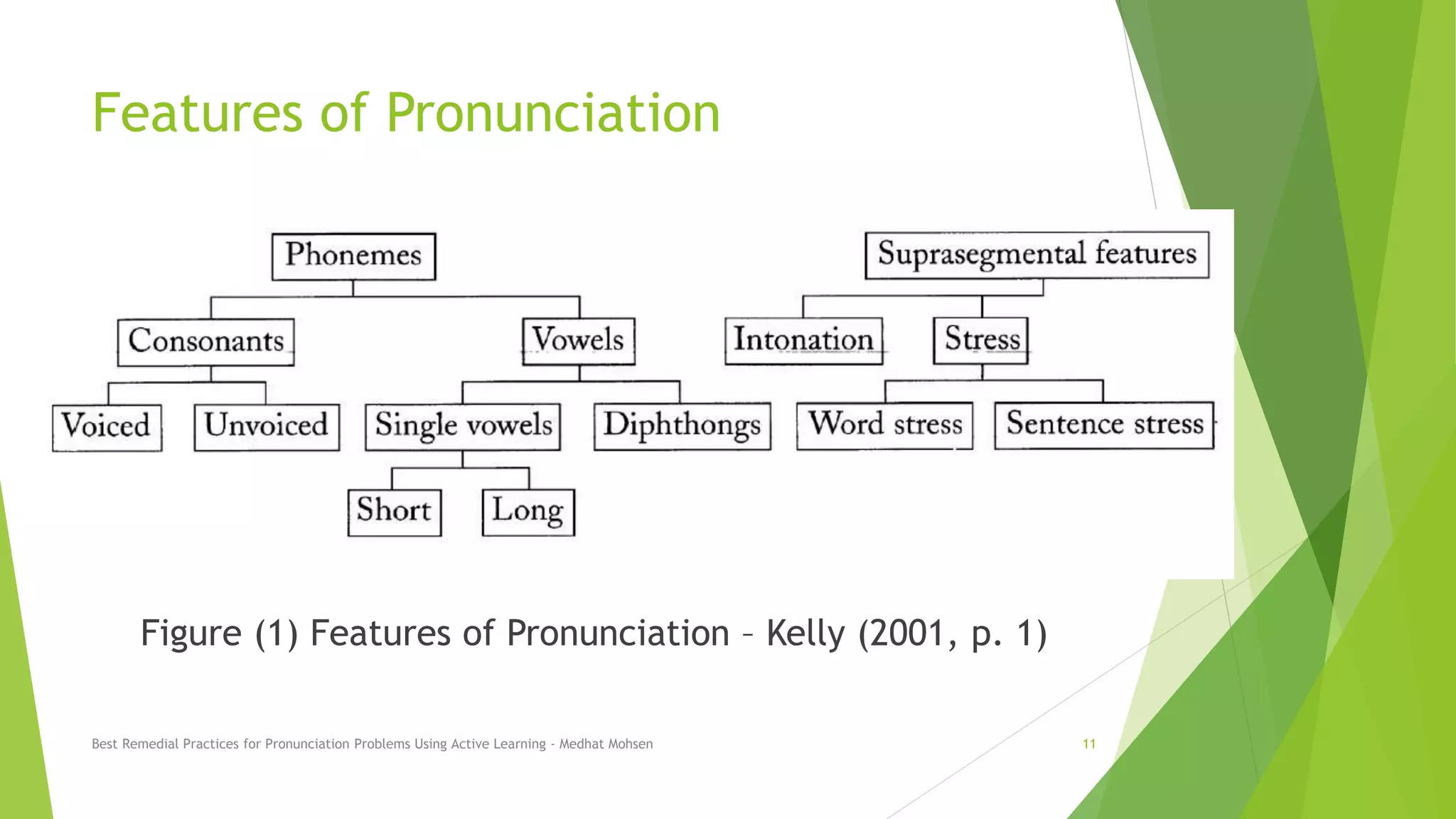
Features of Pronunciation
Figure (1) Features of Pronunciation – Kelly (2001, p. 1)
Best Remedial Practices for Pronunciation Problems Using Active Learning - Medhat Mohsen 11
Error & Remedy
An error or a mistake:
 Error: incorrect or false knowledge.
 Mistake: misunderstanding or misinterpretation (weaker) Mifflin (1992, p. 2524)
Errors in pronunciation:
 Errors happen when s/he finds difficulties with the timing or sequence of
commands that will lead to the addition, deletion, or substitution of sounds
and morphemes whereas mistakes were referred to be performance
limitations that a learner would be able to correct. Crystal (2008, p. 173)
Best Remedial Practices for Pronunciation Problems Using Active Learning - Medhat Mohsen 12
Importance of Errors:
 Learning steps: Many of the things we call mistakes and as
problems are in fact signals that our students are
successfully learning the language. They are taking the
necessary learning steps. Edge (1997, p. 14)
 They give language teachers an idea about the difficulty
for the students in which the frequency of errors is
proportional to the degree of learning difficulty.
(Mohammed, 1983, pp. 24, 25)
Best Remedial Practices for Pronunciation Problems Using Active Learning - Medhat Mohsen 13
Should ALL errors be corrected?
 With: They are ‘learning steps’ and the teacher should provide
students with feedback to know the effectiveness of their teaching.
(Martínez, 2006)
 Against: Students go through systematic stages in learning and they
just acquire a structure when they are ready for it, but not before.
 In-between: Students preferred not to be corrected for each speaking
and writing error because this practice undermined their confidence
and forced them to waste so much effort on details that they used to
lose the overall ability to use language. (the over-corrected teacher)
Best Remedial Practices for Pronunciation Problems Using Active Learning - Medhat Mohsen 14
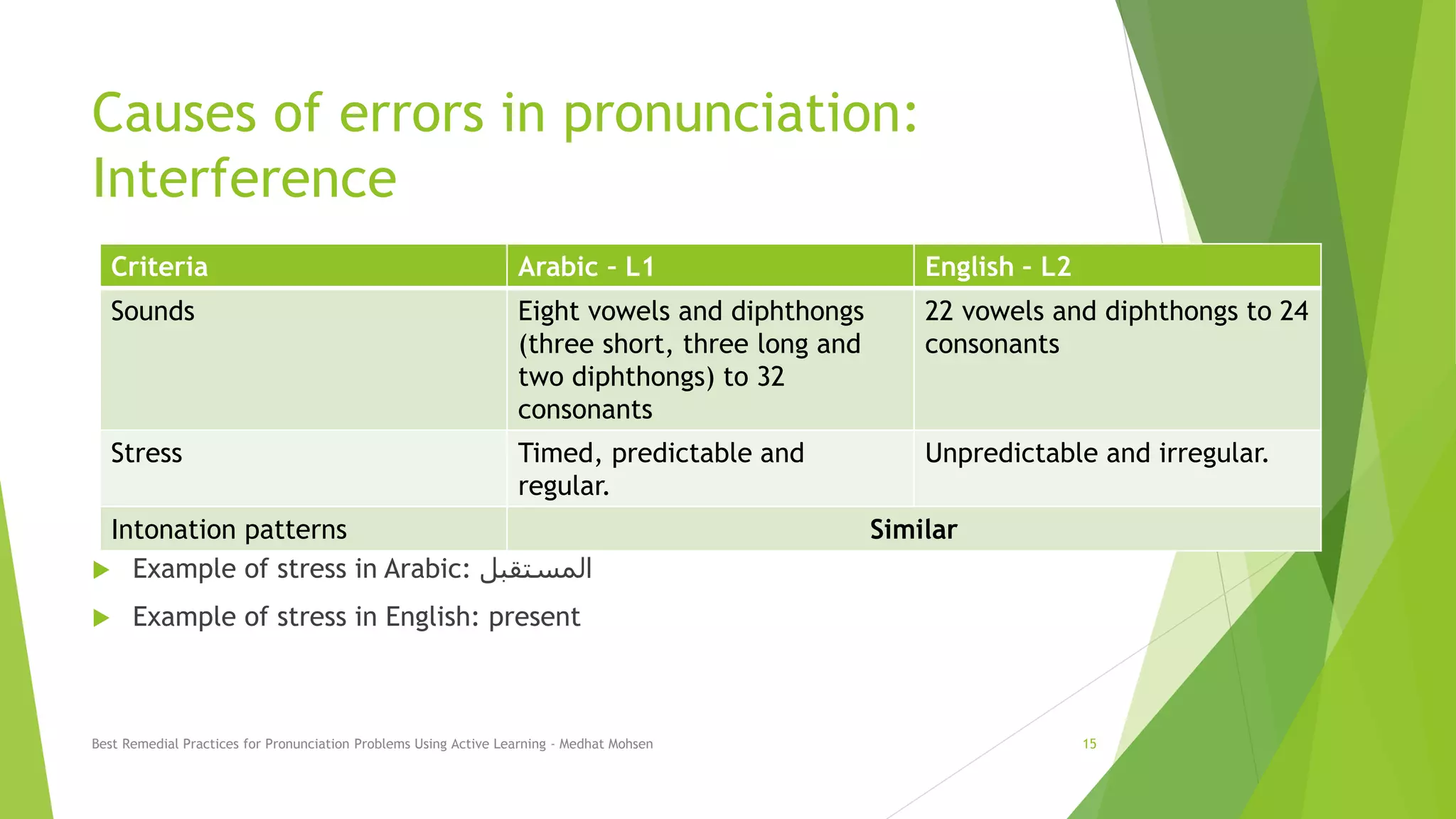
Causes of errors in pronunciation:
Interference
 Example of stress in Arabic: ‫المستقبل‬
 Example of stress in English: present
Criteria Arabic – L1 English – L2
Sounds Eight vowels and diphthongs
(three short, three long and
two diphthongs) to 32
consonants
22 vowels and diphthongs to 24
consonants
Stress Timed, predictable and
regular.
Unpredictable and irregular.
Intonation patterns Similar
Best Remedial Practices for Pronunciation Problems Using Active Learning - Medhat Mohsen 15
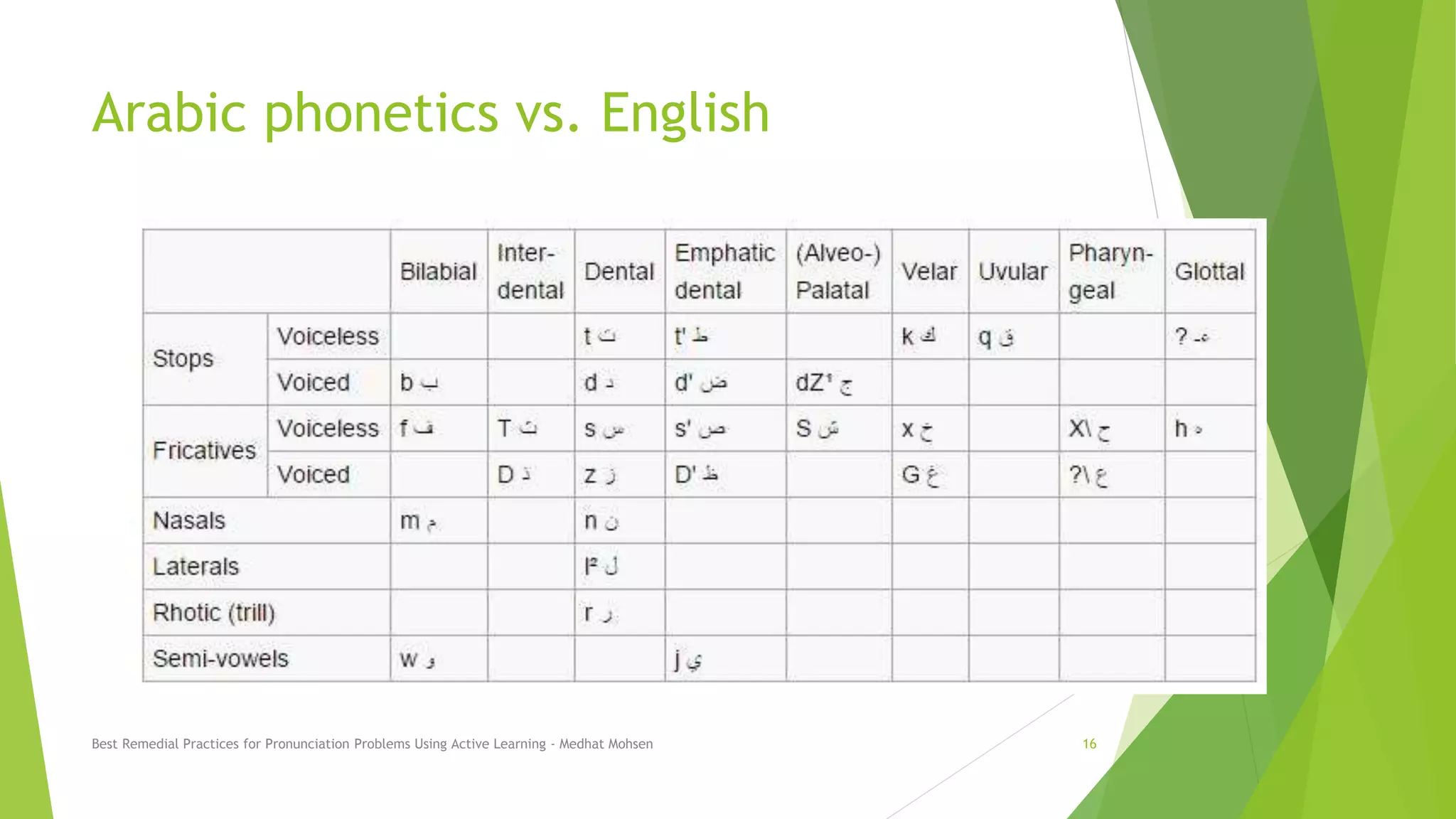
Arabic phonetics vs. English
Best Remedial Practices for Pronunciation Problems Using Active Learning - Medhat Mohsen 16
Best Remedial Practices for Pronunciation Problems Using Active Learning - Medhat Mohsen 17
Causes of errors in pronunciation:
Interference
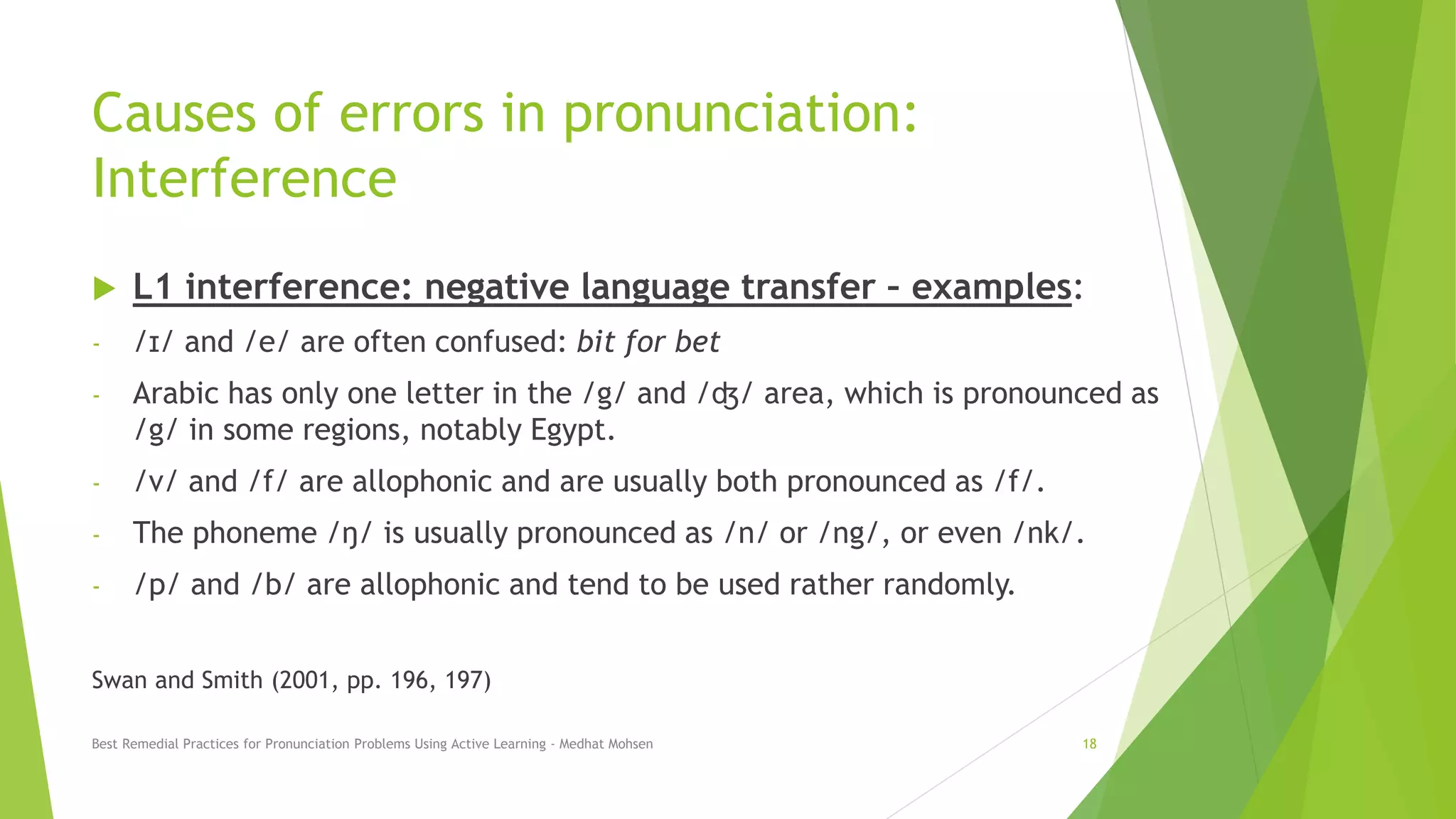
 L1 interference: negative language transfer – examples:
- /ɪ/ and /e/ are often confused: bit for bet
- Arabic has only one letter in the /g/ and /ʤ/ area, which is pronounced as
/g/ in some regions, notably Egypt.
- /v/ and /f/ are allophonic and are usually both pronounced as /f/.
- The phoneme /ŋ/ is usually pronounced as /n/ or /ng/, or even /nk/.
- /p/ and /b/ are allophonic and tend to be used rather randomly.
Swan and Smith (2001, pp. 196, 197)
Best Remedial Practices for Pronunciation Problems Using Active Learning - Medhat Mohsen 18
Causes of errors in pronunciation:
Spelling
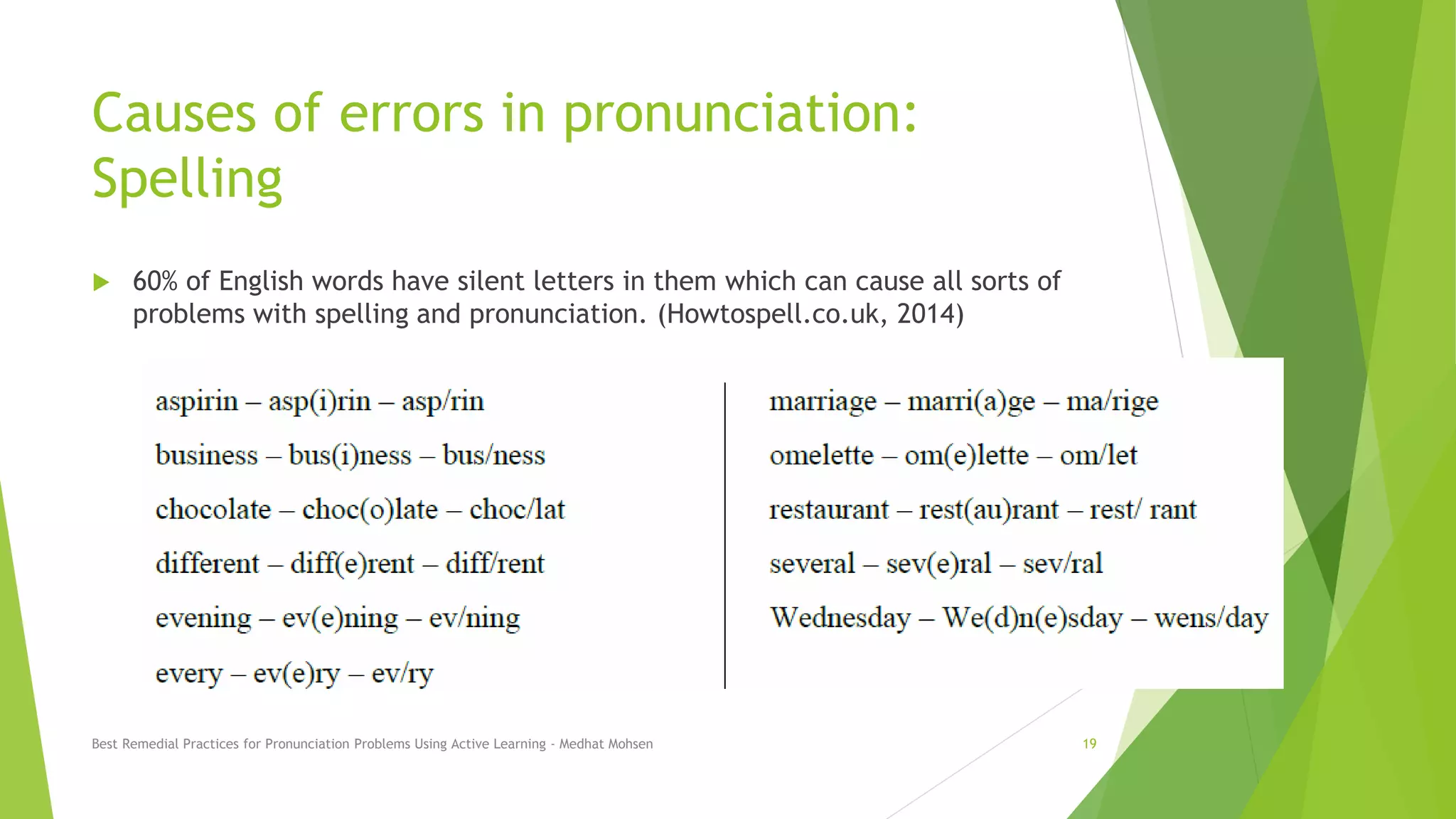
 60% of English words have silent letters in them which can cause all sorts of
problems with spelling and pronunciation. (Howtospell.co.uk, 2014)
Best Remedial Practices for Pronunciation Problems Using Active Learning - Medhat Mohsen 19
Causes of errors in pronunciation:
Spelling
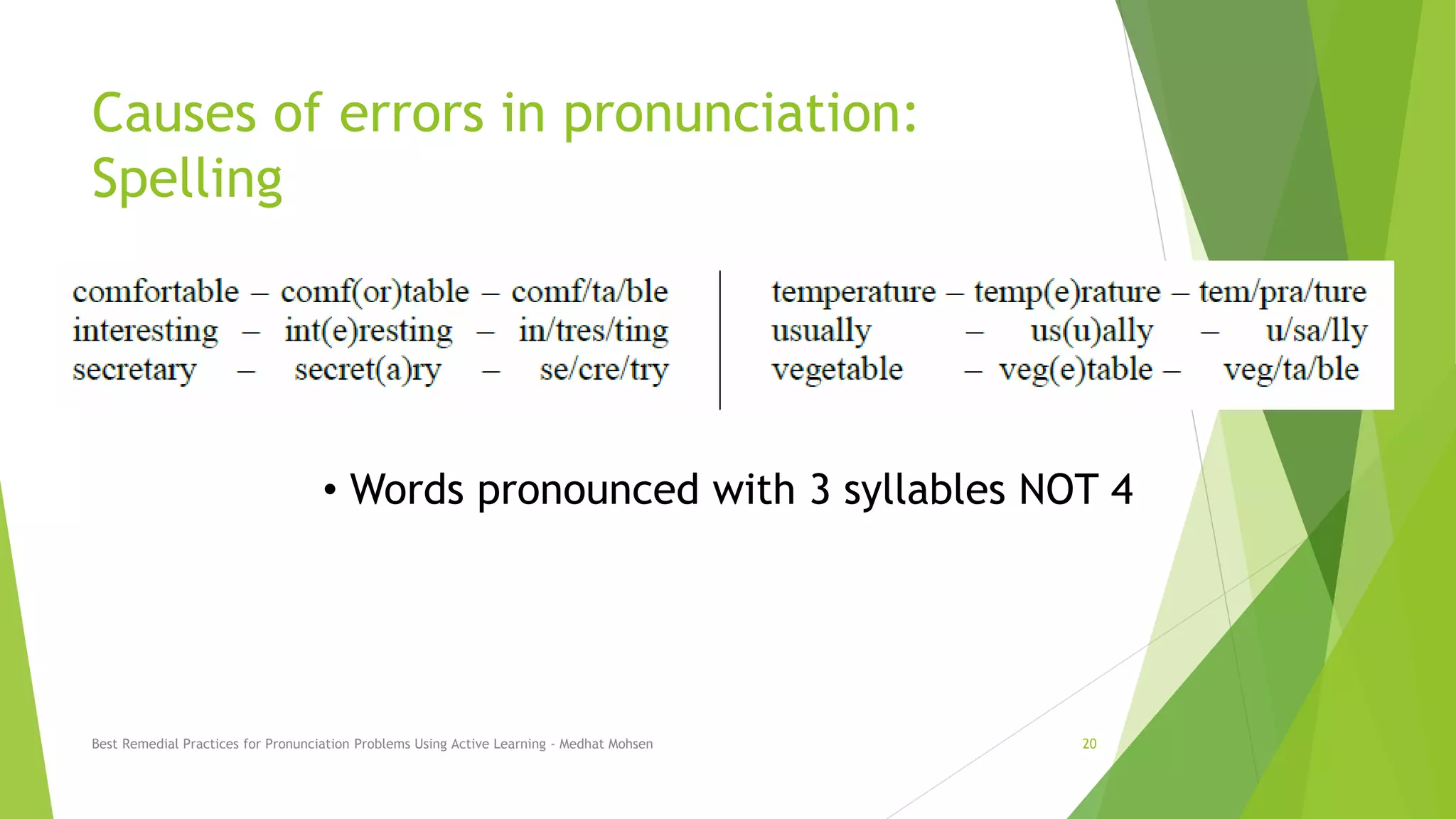
• Words pronounced with 3 syllables NOT 4
Best Remedial Practices for Pronunciation Problems Using Active Learning - Medhat Mohsen 20
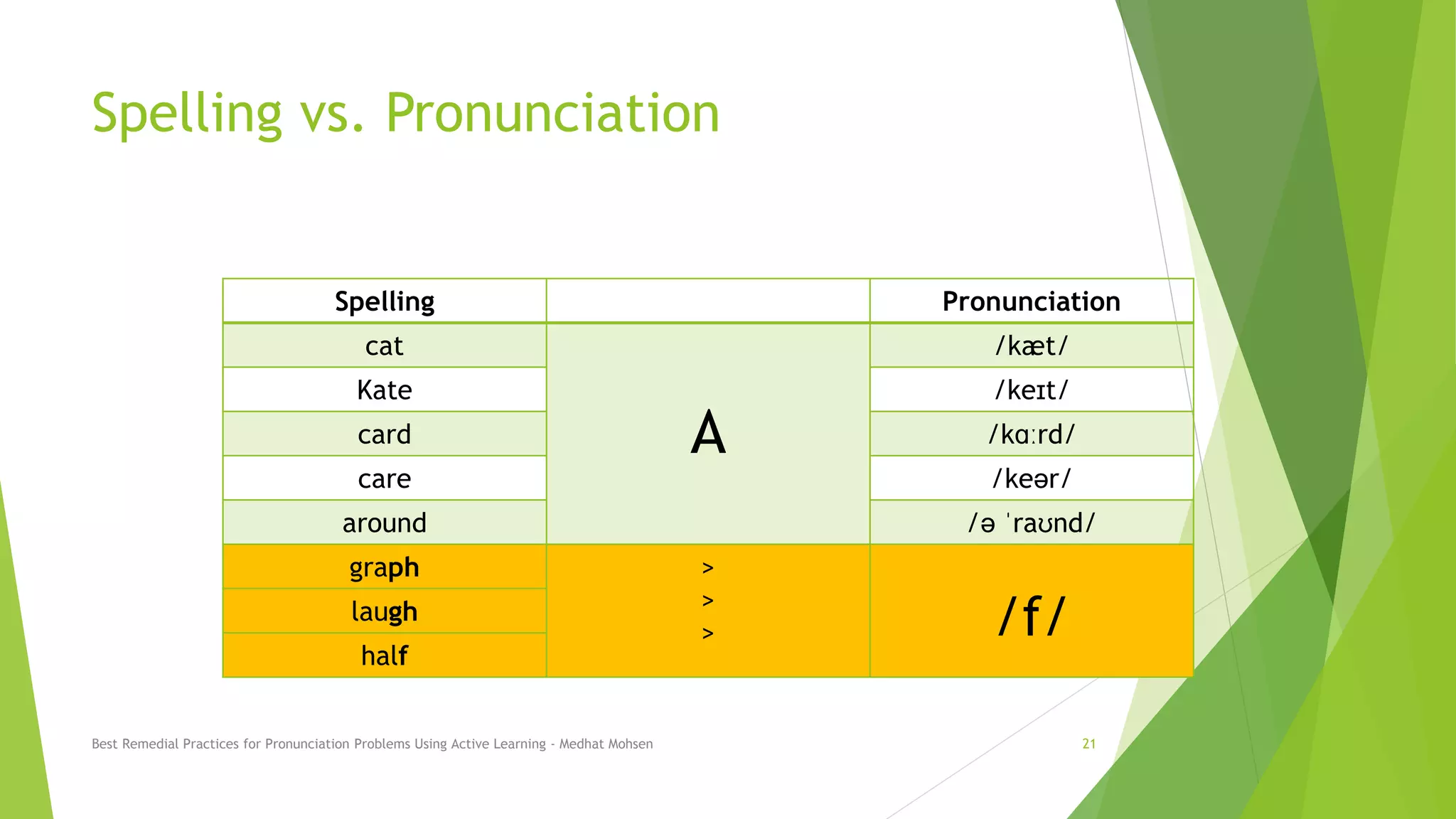
Spelling vs. Pronunciation
Spelling Pronunciation
cat
A
/kæt/
Kate /keɪt/
card /kɑːrd/
care /keər/
around /ə ˈraʊnd/
graph >
>
> /f/laugh
half
Best Remedial Practices for Pronunciation Problems Using Active Learning - Medhat Mohsen 21
Active learning – What?
 Any instructional method that engages students in the
learning process.
 Students do meaningful learning activities and think about
what they are doing. (Prince, 2004)
 A process whereby students engage in activities, such as
reading, writing, discussion, or problem solving that promote
analysis, synthesis, and evaluation of class content. (CRLT, 2014)
 “One must learn by doing the thing; though you think you
know it, you have no certainty until you try.” Sophocles
(496-406 BC)
Best Remedial Practices for Pronunciation Problems Using Active Learning - Medhat Mohsen 22
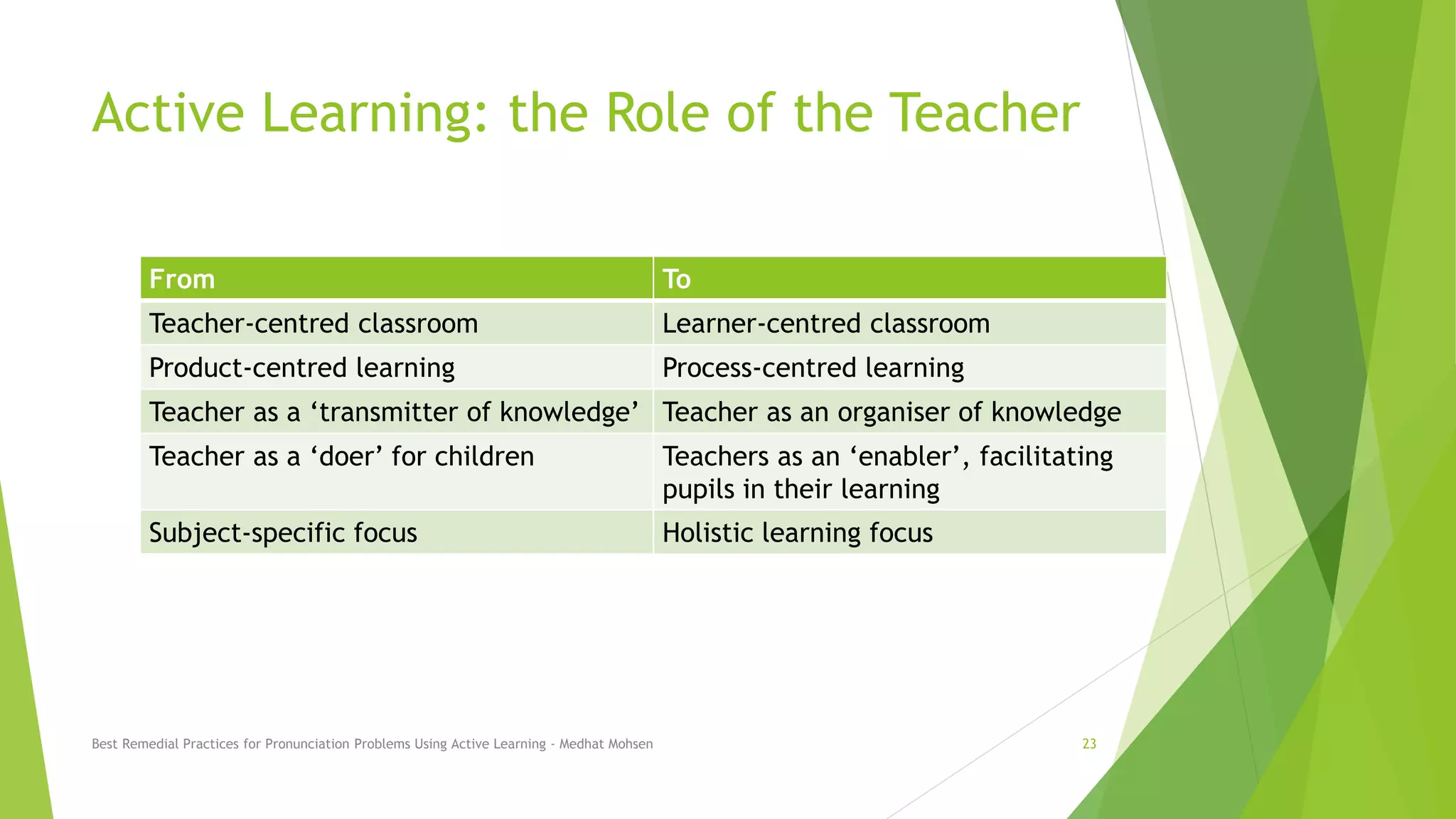
Active Learning: the Role of the Teacher
From To
Teacher-centred classroom Learner-centred classroom
Product-centred learning Process-centred learning
Teacher as a ‘transmitter of knowledge’ Teacher as an organiser of knowledge
Teacher as a ‘doer’ for children Teachers as an ‘enabler’, facilitating
pupils in their learning
Subject-specific focus Holistic learning focus
Best Remedial Practices for Pronunciation Problems Using Active Learning - Medhat Mohsen 23
Active Learning: the Role of the
Students
 The students’ energy and enthusiasm during the [active
learning activities] are contagious: once one has experienced
[this excitement], it is difficult to revert to lecturing to a
passive and mostly silent audience” (DyKnow.com, 2011)
From To
Being passive recipients of knowledge Active and participatory learners
Focus on answering questions Asking questions
Being ‘spoon fed’ Taking responsibility for their own
learning - reflective learners
Competing with one another Collaborating in their learning
Wanting to have their own say Actively listening to opinions of others
Learners of individual subjects Connecting their learning
Best Remedial Practices for Pronunciation Problems Using Active Learning - Medhat Mohsen 24
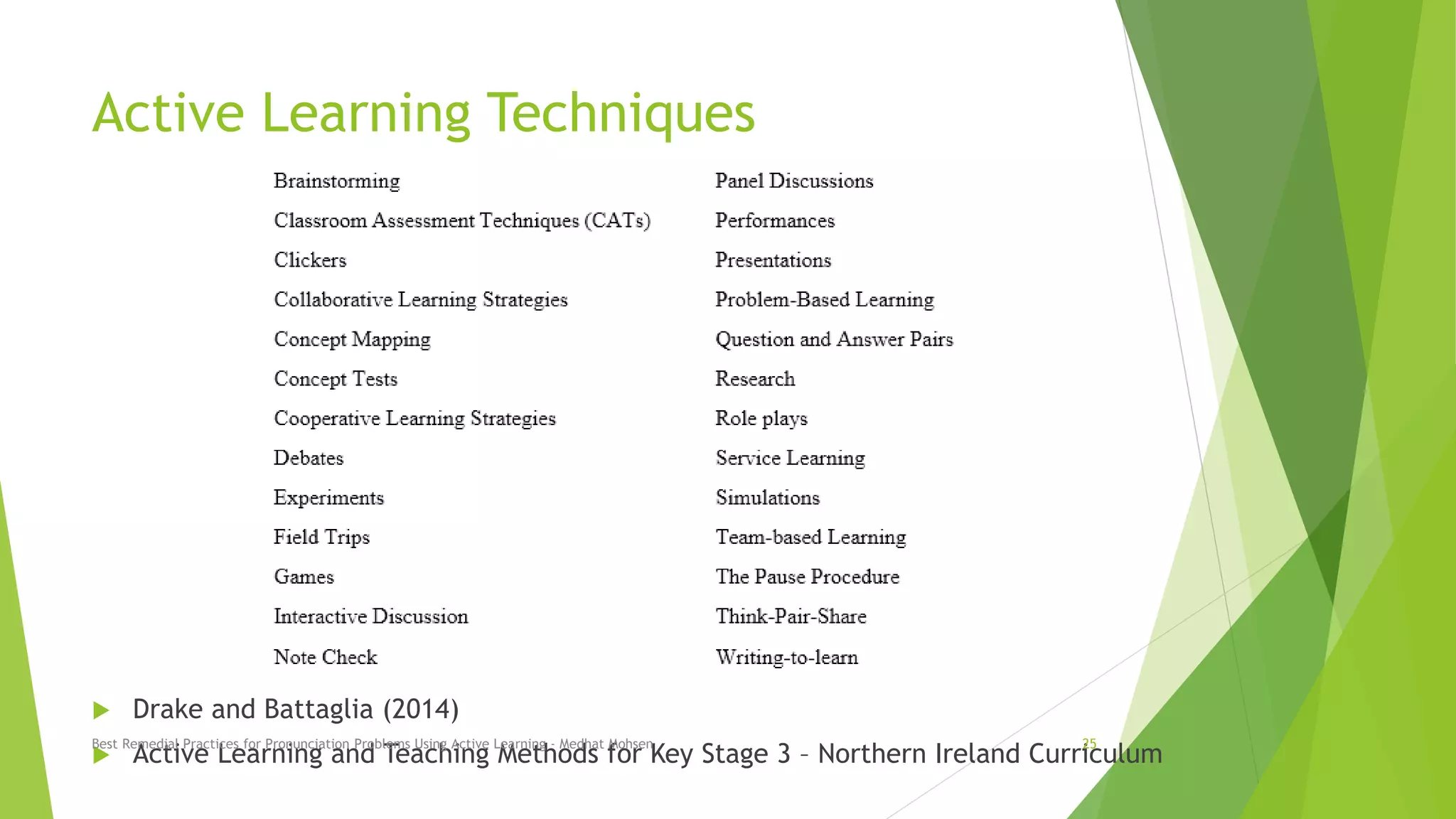
Active Learning Techniques
 Drake and Battaglia (2014)
 Active Learning and Teaching Methods for Key Stage 3 – Northern Ireland Curriculum
Best Remedial Practices for Pronunciation Problems Using Active Learning - Medhat Mohsen 25
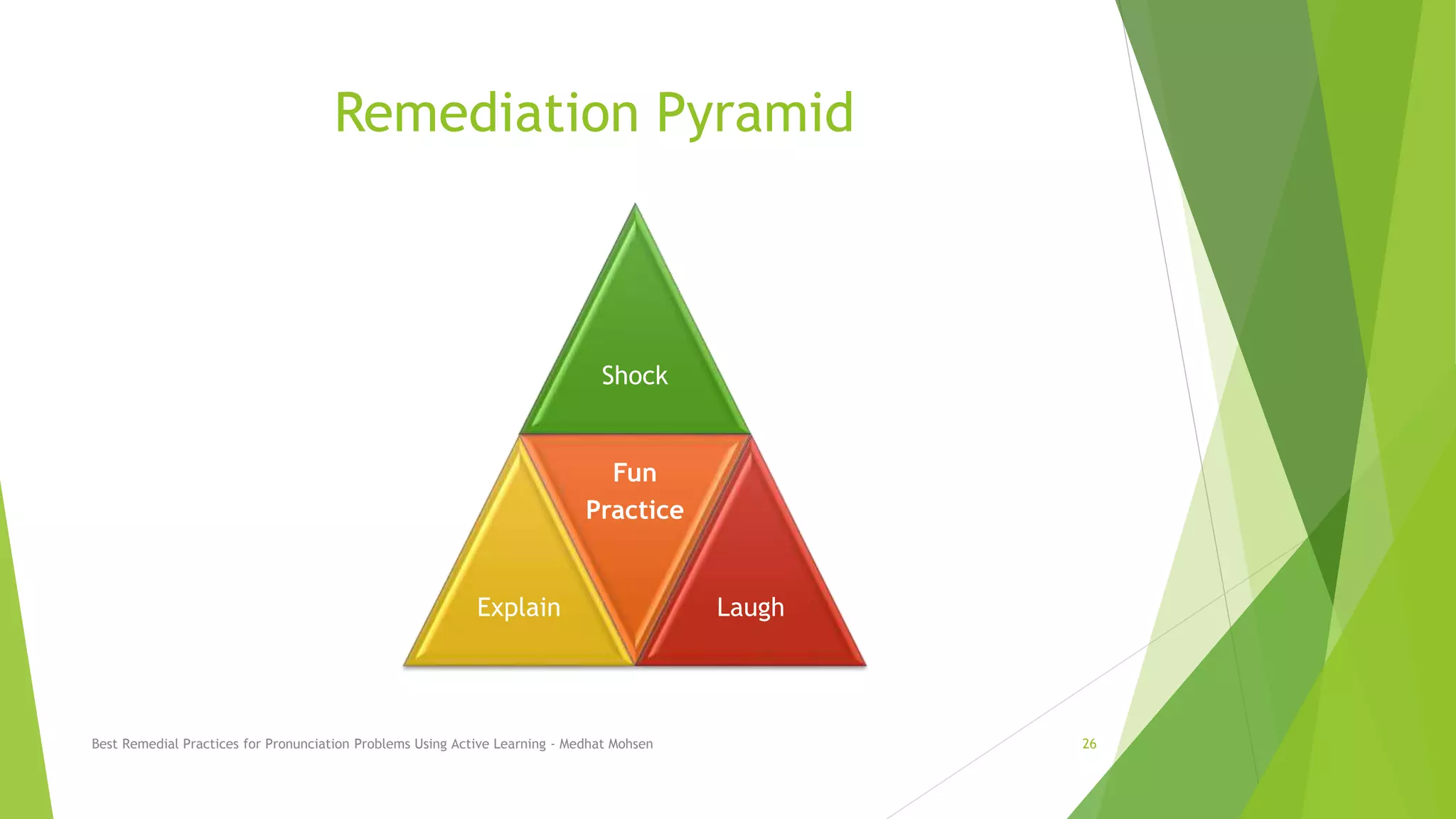
Remediation Pyramid
Shock
Explain
Fun
Practice
Laugh
Best Remedial Practices for Pronunciation Problems Using Active Learning - Medhat Mohsen 26
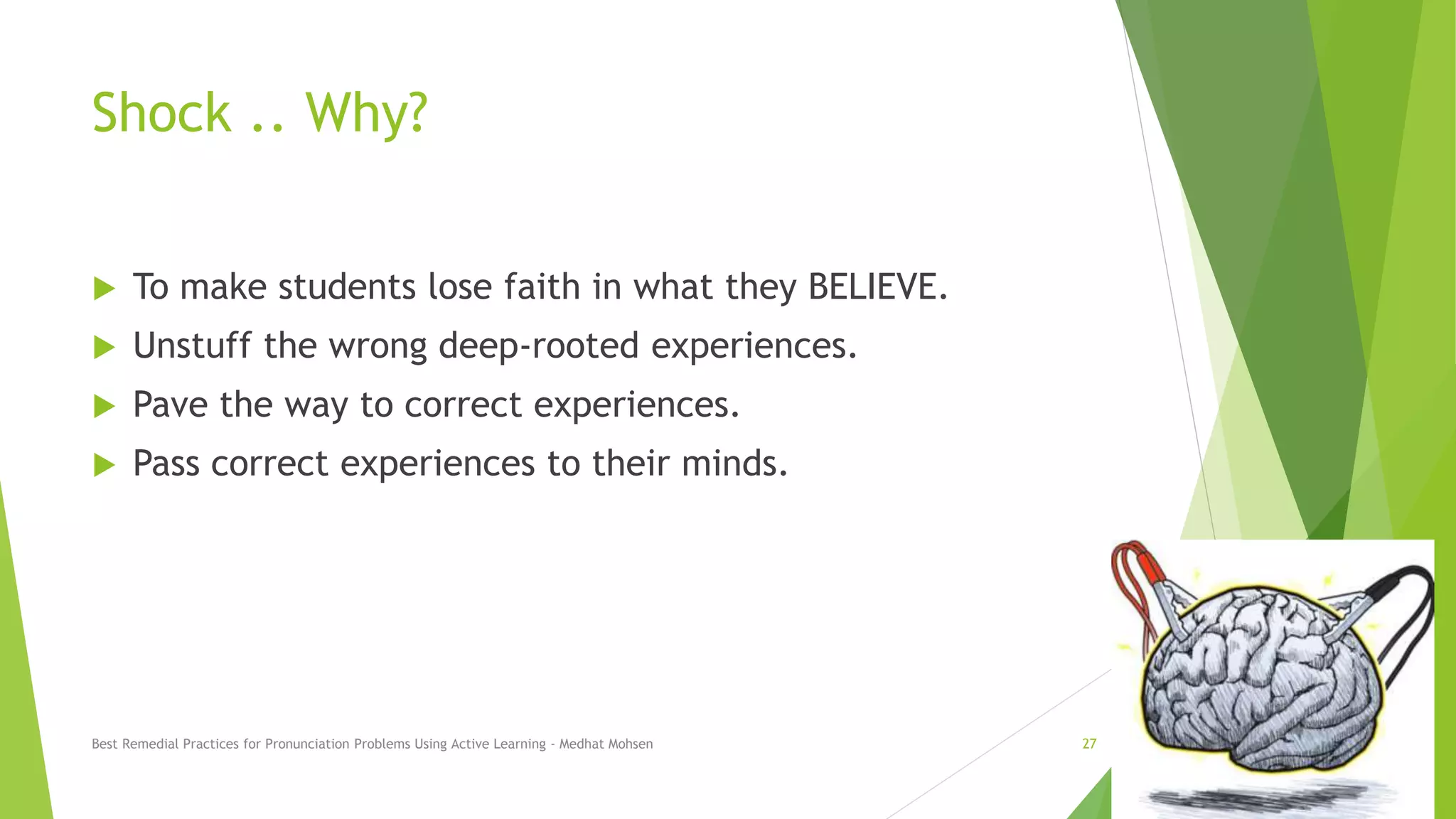
Shock .. Why?
 To make students lose faith in what they BELIEVE.
 Unstuff the wrong deep-rooted experiences.
 Pave the way to correct experiences.
 Pass correct experiences to their minds.
Best Remedial Practices for Pronunciation Problems Using Active Learning - Medhat Mohsen 27
Laugh .. Why?
 Humor activates our sense of wonder, which is where learning begins, so it
seems logical that humor could enhance retention.
 Neuroscience research reveals that humor systematically activates the brain's
dopamine reward system, and cognitive studies show that dopamine is
important for both goal-oriented motivation and long-term memory.
 Educational research indicates that correctly-used humor can be an effective
intervention to improve retention in students from kindergarten through
college.
Best Remedial Practices for Pronunciation Problems Using Active Learning - Medhat Mohsen 28
Remedial Program
 Adapted from: An Active-Learning Pronunciation Remedial Program for
Preparatory Stage Students (thesis).
Best Remedial Practices for Pronunciation Problems Using Active Learning - Medhat Mohsen 29
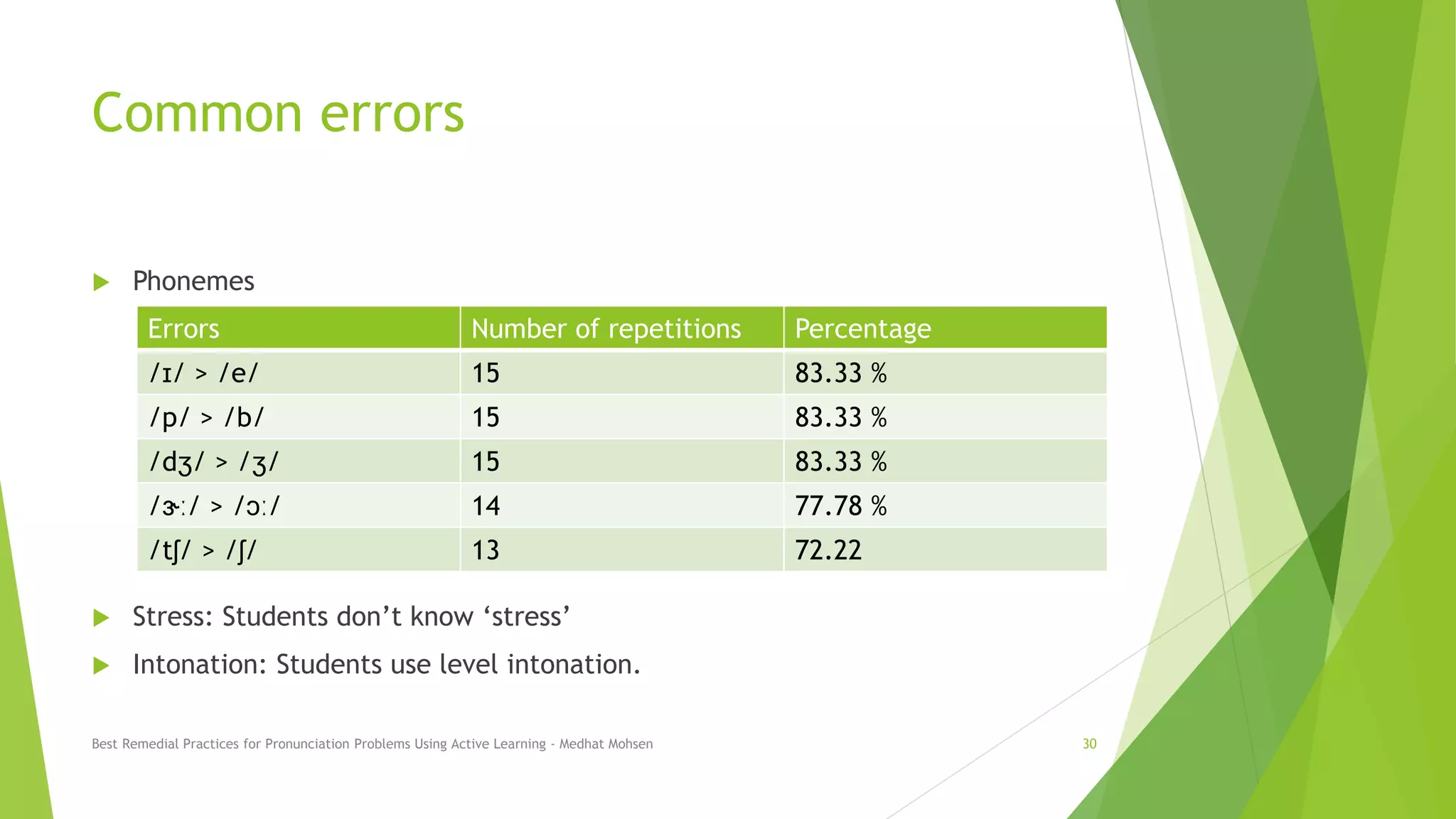
Common errors
 Phonemes
 Stress: Students don’t know ‘stress’
 Intonation: Students use level intonation.
Errors Number of repetitions Percentage
/ɪ/ > /e/ 15 83.33 %
/p/ > /b/ 15 83.33 %
/dʒ/ > /ʒ/ 15 83.33 %
/ɝː/ > /ɔː/ 14 77.78 %
/tʃ/ > /ʃ/ 13 72.22
Best Remedial Practices for Pronunciation Problems Using Active Learning - Medhat Mohsen 30
Phonological skills Arabski and Wojtaszek (2011, p. 83)
 Sound categorization that is deciding which words start or end
with the same or different sounds. (about – apple)
 Blending sounds, that is combining a string of sounds into a
recognizable word. (teen – a – ger)
 Segmenting, that is breaking apart words into constituent
sounds, for example syllables.
 Manipulation, for example deleting a particular sound or
substituting one sound with another. (but)
 Identification, which is identifying the sounds (phonemes) in
spoken words, identifying relationships between letters and
sounds they represent in words. (psycho)
 Rhyming, that is recognizing or creating rhyming words. (head)
Best Remedial Practices for Pronunciation Problems Using Active Learning - Medhat Mohsen 31
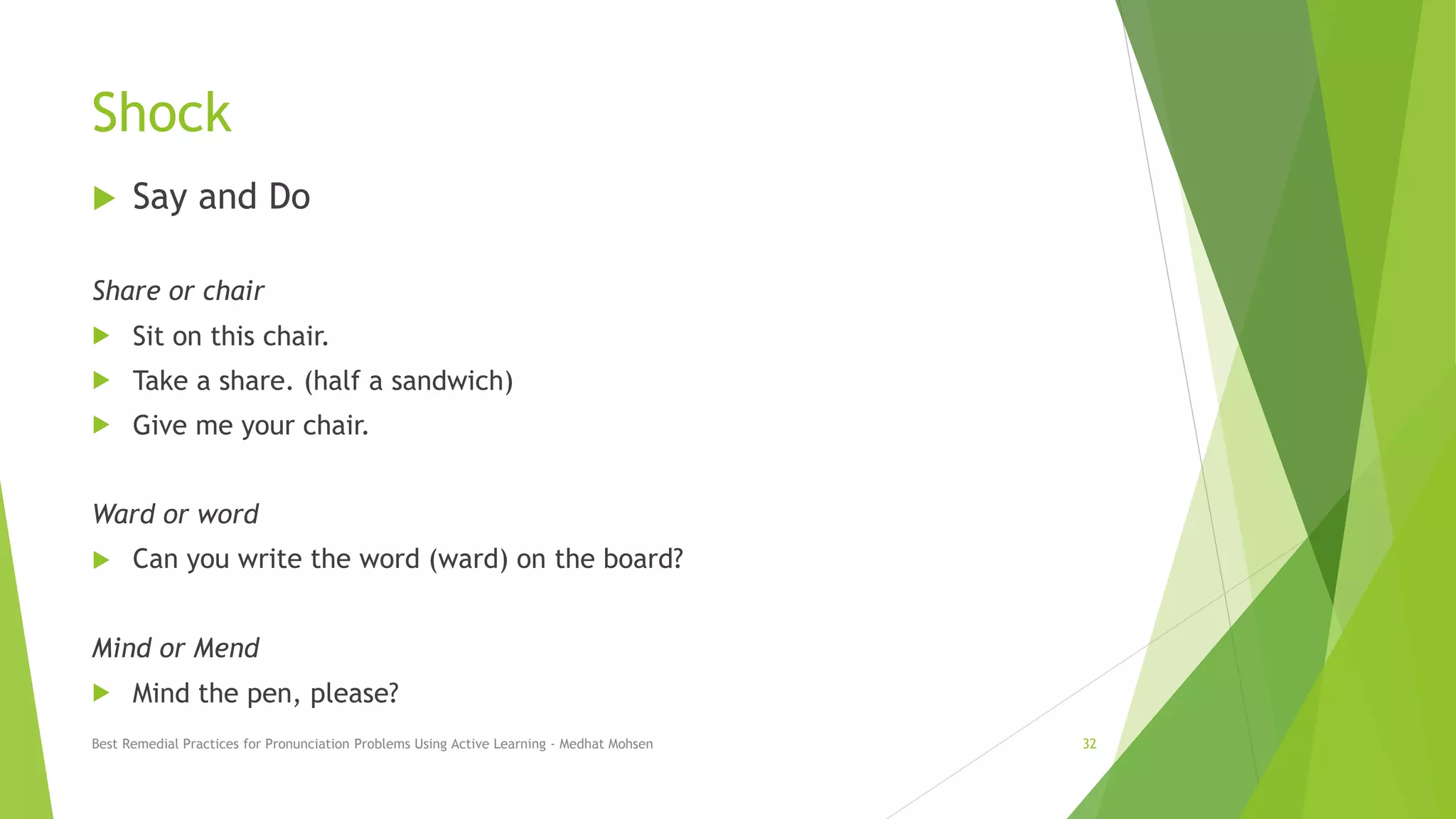
Shock
 Say and Do
Share or chair
 Sit on this chair.
 Take a share. (half a sandwich)
 Give me your chair.
Ward or word
 Can you write the word (ward) on the board?
Mind or Mend
 Mind the pen, please?
Best Remedial Practices for Pronunciation Problems Using Active Learning - Medhat Mohsen 32
Laugh
 A pen, a bin and a pan
 Story
 Authenticity
Best Remedial Practices for Pronunciation Problems Using Active Learning - Medhat Mohsen 33
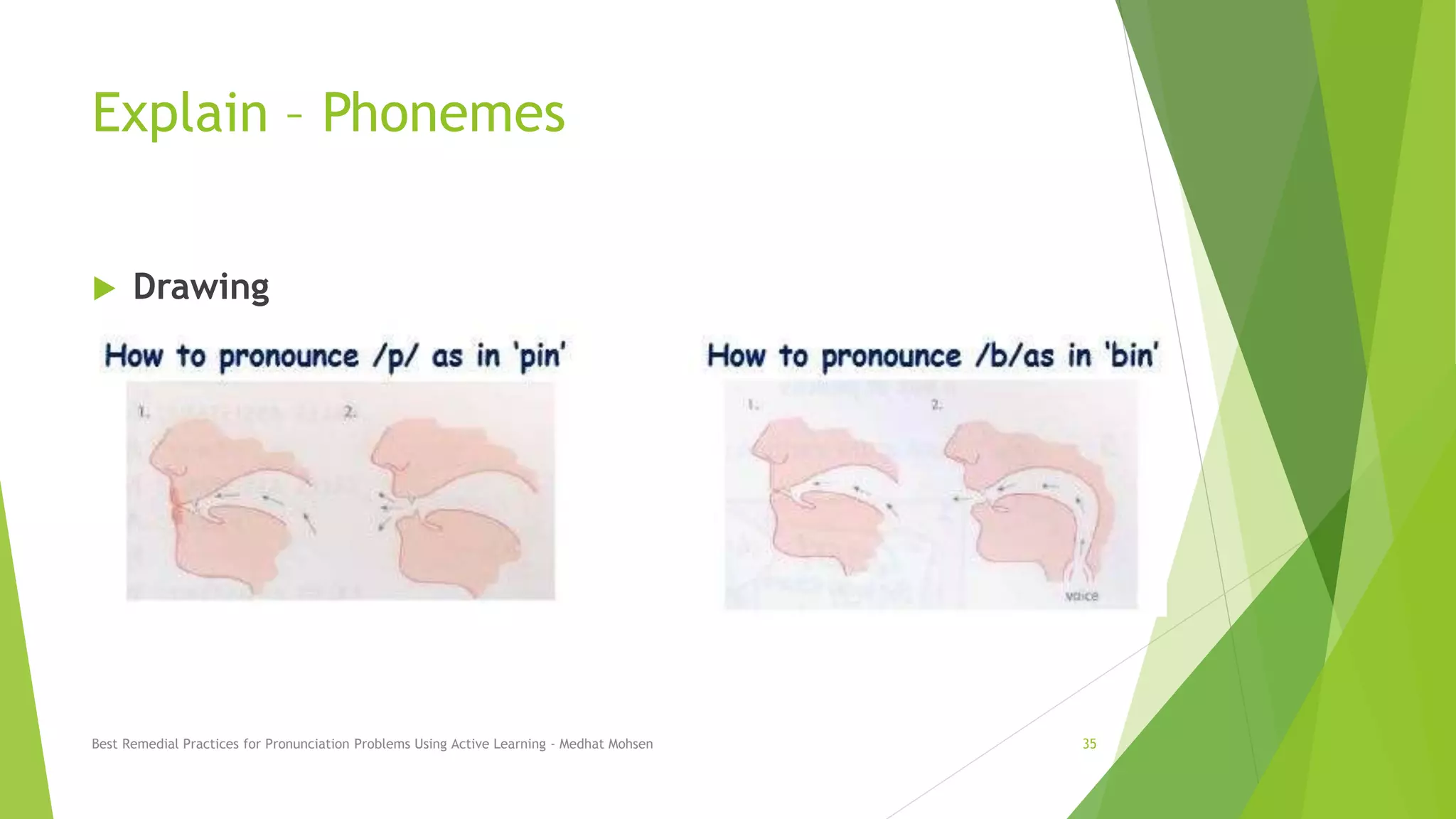
Explain – Phonemes
 Drawing
Best Remedial Practices for Pronunciation Problems Using Active Learning - Medhat Mohsen 35
Explain – Stress
Hassnaa – Mahmoud – Nassary – Yasmeen
QUAlify, baNana, and underSTAND
Stressed Syllable:
 It is l-o-n-g-e-r
 It is LOUDER
 It has a change in pitch from the syllables coming before and afterwards. The
pitch of a stressed syllable is usually higher.
 It is said more clearly -The vowel sound is purer. Compare the first and last
vowel sounds with the stressed sound.
 It uses larger facial movements - Look in the mirror when you say the word.
Look at your jaw and lips in particular.
Best Remedial Practices for Pronunciation Problems Using Active Learning - Medhat Mohsen 36
Explain – Intonation
 Mum: Hi Kate!
 Kate: Hello mum!
 Mum: What do you do in the kitchen?
 Kate: Nothing mum.
 Mum: You have eaten my cake, haven't you?
 Kate: Yes, mum.
 Mum: Kate, you have just eaten yours!
 Kate: You have eaten mine, mum
 Mum: Me?!
 Kate: Yes, you.
 Mum: Oh dear, sorry.
 Kate: It’s OK mum. It’s not your first time.
You can hum this conversation and clarify the intonations while humming.
Best Remedial Practices for Pronunciation Problems Using Active Learning - Medhat Mohsen 37
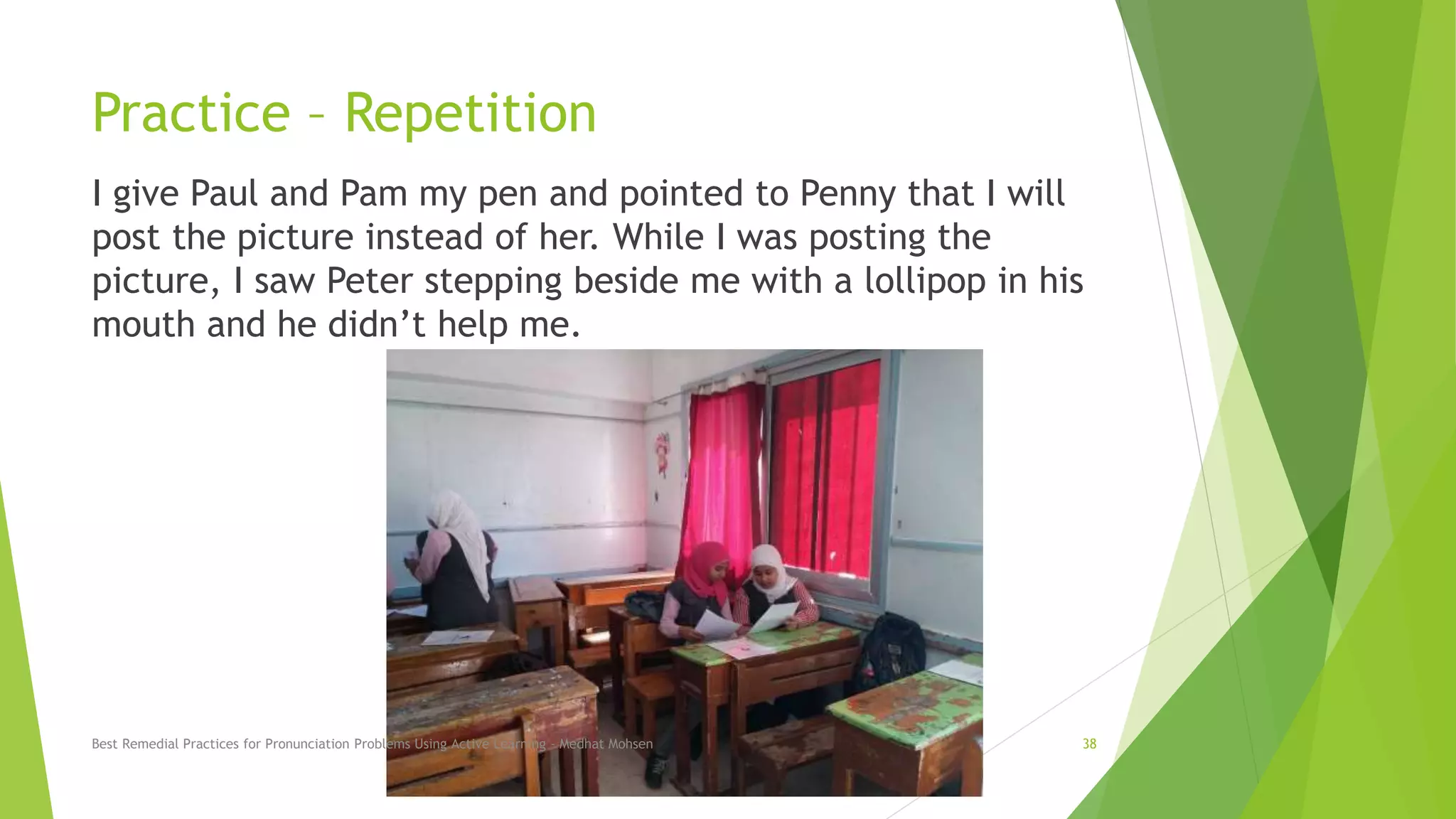
Practice – Repetition
I give Paul and Pam my pen and pointed to Penny that I will
post the picture instead of her. While I was posting the
picture, I saw Peter stepping beside me with a lollipop in his
mouth and he didn’t help me.
Best Remedial Practices for Pronunciation Problems Using Active Learning - Medhat Mohsen 38
Practice – Tongue Twisters
 Paul, please pause for proper applause.
 Red lolly, yellow lolly.
 Near an ear, a nearer ear, a nearly eerie ear.
 Valuable valley villas.
http://www.twisterking.com/
Best Remedial Practices for Pronunciation Problems Using Active Learning - Medhat Mohsen 39
Practice – Games
 Catch it if you can.
 Reading lips
Best Remedial Practices for Pronunciation Problems Using Active Learning - Medhat Mohsen 40
Catch it if you can – Phonemes & Intonation:
Rationale:
The aim of this game is to make learning phonemes, stress and intonation fun. In addition,
it will improve both perception and production skills.
Time: 10 minutes
Group work
Measures: pronunciation features.
Best Remedial Practices for Pronunciation Problems Using Active Learning - Medhat Mohsen 41
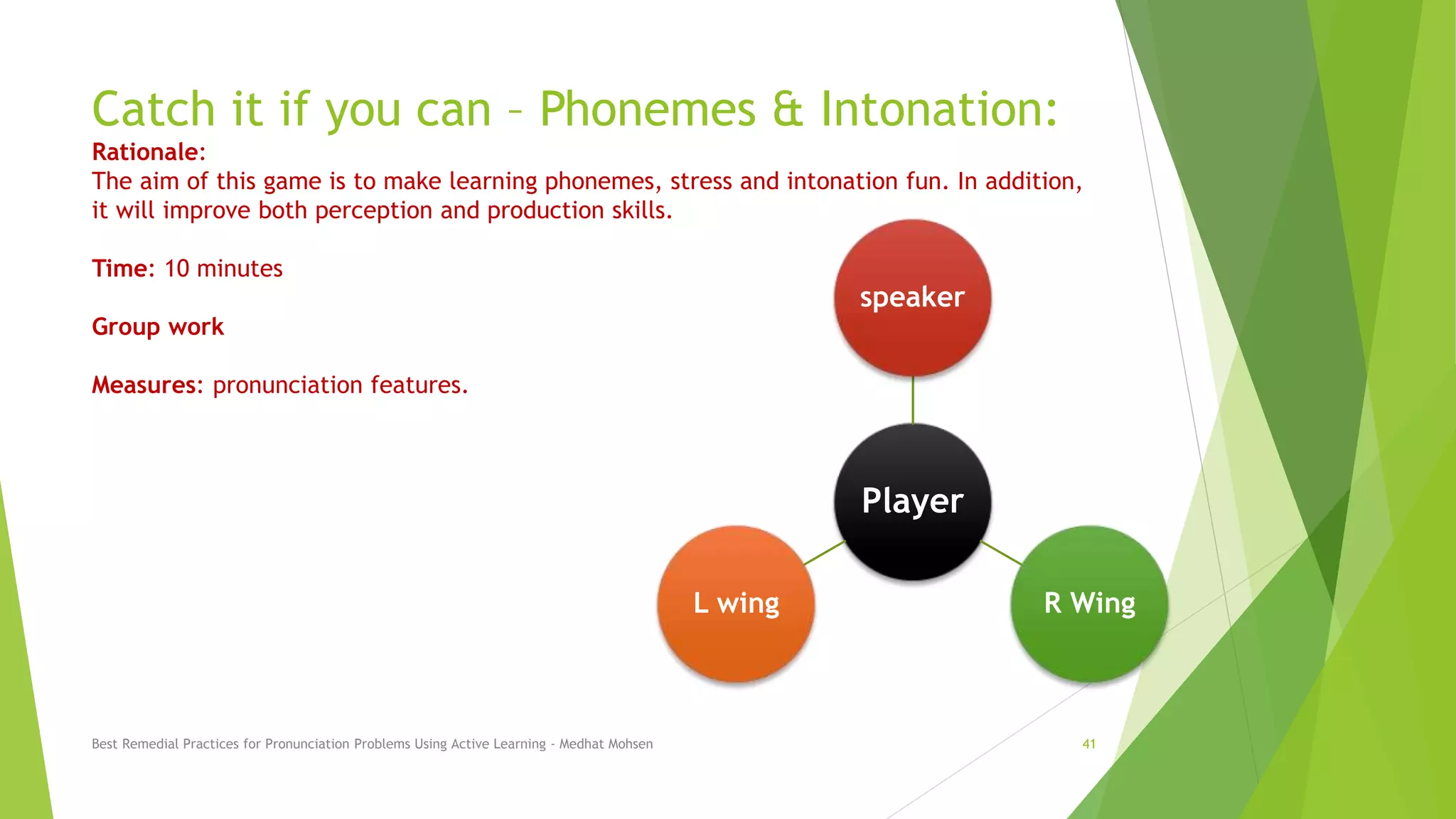
Player
speaker
R WingL wing
Catch it if you can – Phonemes & Intonation:
Method:
 The class will be divided into teams of 4 students.
 Each group will be divided into; a reader, a player and two wings.
 A student will be a reader who is going to have a list of words to pronounce.
 The narrator is going to pronounce minimal pairs.
 The other student will be a ‘player’ who is going to listen to the ‘narrator’ and will
have balls to throw on right and the other on left.
 The other two students, two wings, will have baskets/or without, in their hands
and a sign to be hanged on their baskets to tell the class and the player the sound
needed.
 Each team should work together and the group that what will get the highest score
will win
 The wings may represent two interchangeably used phonemes such as /i/ and /e/
or you can make it rising and falling intonations.
 If the ball fell, the team would lose a point. If they threw the ball to a wrong side,
they would lose a point, too.
Best Remedial Practices for Pronunciation Problems Using Active Learning - Medhat Mohsen 42
Stress
Best Remedial Practices for Pronunciation Problems Using Active Learning - Medhat Mohsen 43
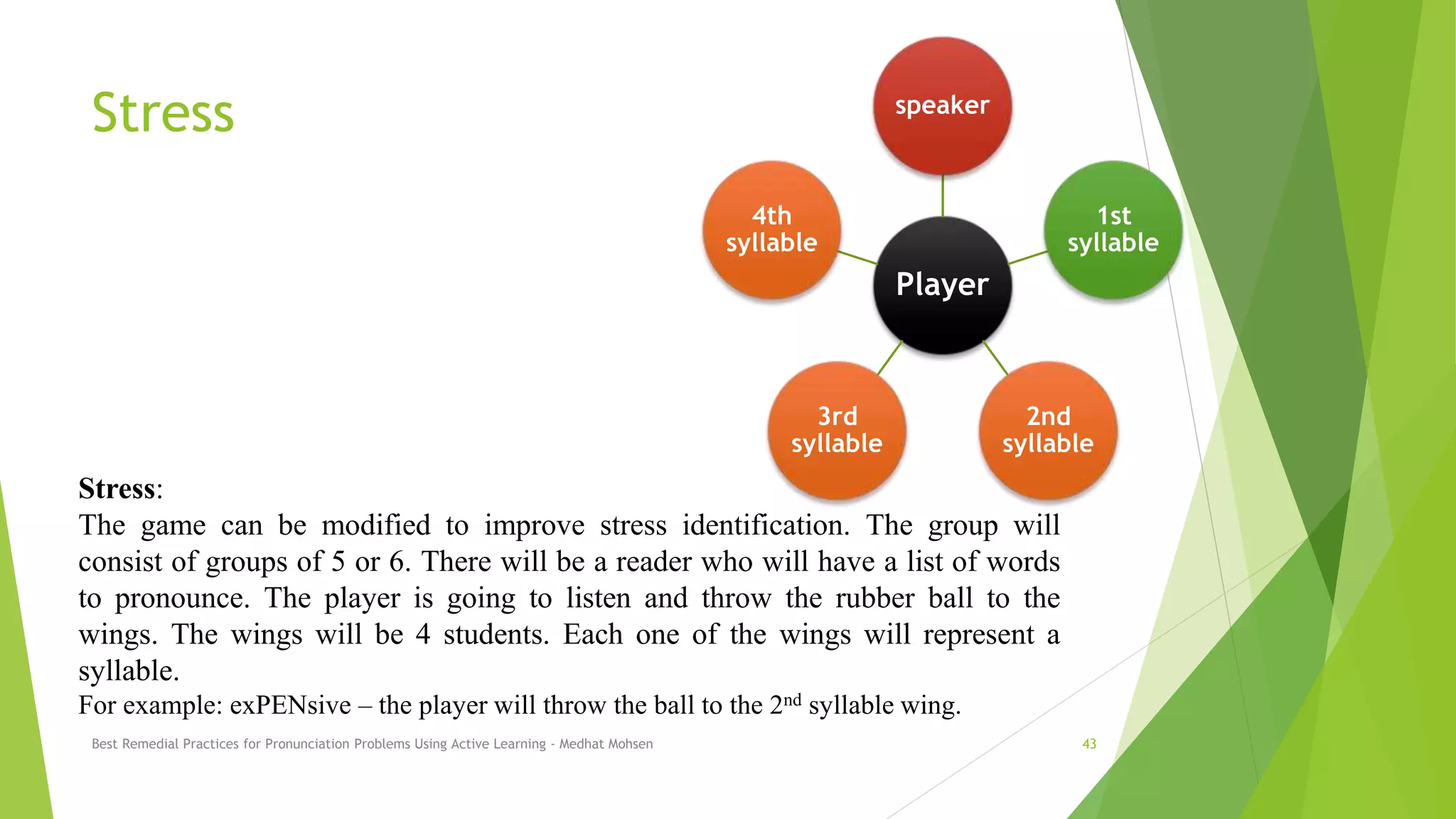
Player
speaker
1st
syllable
2nd
syllable
3rd
syllable
4th
syllable
Stress:
The game can be modified to improve stress identification. The group will
consist of groups of 5 or 6. There will be a reader who will have a list of words
to pronounce. The player is going to listen and throw the rubber ball to the
wings. The wings will be 4 students. Each one of the wings will represent a
syllable.
For example: exPENsive – the player will throw the ball to the 2nd syllable wing.
Reading Lips
Rationale:
 This activity is to help students use their vocal tract correctly, help them to focus of the vocal
organs while pronunciation to make it easy for them to grasp difficult sounds and know how to
pronounce them.
Time: 5 minutes
Group work
Measures: pronunciation features.
Method:
 Divide the whole class into 3 or 4 teams.
 Choose 3 or 4 students to pick a strip of paper.
 In each strip, write a sentence that students have to say with their lips only to each team
without making facial expressions, miming or making sound.
 The fastest group will pronounce the sentence correctly will be the winner.
 This activity can be a warm-up.
 You can make it using GIF images for online practice.
Best Remedial Practices for Pronunciation Problems Using Active Learning - Medhat Mohsen 44
Reading Lips
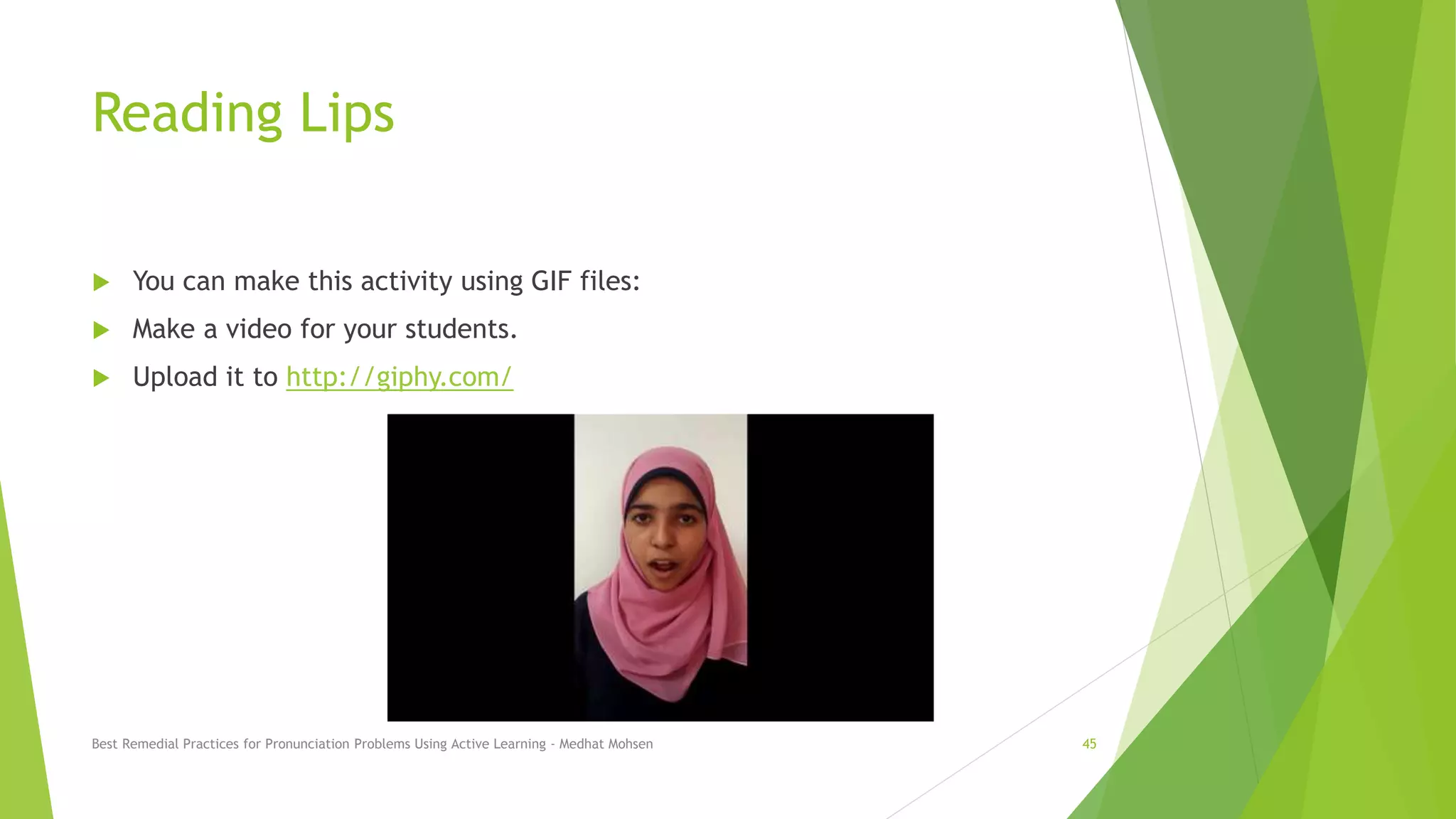
 You can make this activity using GIF files:
 Make a video for your students.
 Upload it to http://giphy.com/
Best Remedial Practices for Pronunciation Problems Using Active Learning - Medhat Mohsen 45
References
 Arabski, J., & Wojtaszek, A. (2011). The Acquisition of L2 Phonology. Ireland: Multilingual Matters.
 Swan, M., & Smith, B. (2001). Learner English (2nd ed.). UK: Cambridge University Press.
 Vitanova, G., & Miller, A. (2002). Reflective Practice in Pronunciation Learning. The Internet TESL
Journal, VIII, No. 1.
 Drake, E., & Battaglia, D. (2014). Teaching and Learning in Active Learning Classrooms. Retrieved Sep
24, 2014 http://goo.gl/dU9FHq
 DyKnow.com. (2011). Encouraging Active Learning: Best Practices and Supporting Technologies.
Retrieved Sep 25, 2014 from http://www.dyknow.com/wpcontent/uploads/2011/05/Encouraging-
Active-Learning-Whitepaper.pdf
 Howtospell.co.uk. (2014). Spelling and Pronunciation - some important differences. Retrieved Sep 19,
2014, from http://www.howtospell.co.uk/spellingvpronunciation.php
 Underhill, A. (2005). Sound Foundations (3rd ed.). Great Britain: Macmillan Publishers.
 Gilbert, J. B. (2008). Teaching Pronunciation Using the Prosody Pyramid. USA: Cambridge University
Press.
 Kelly, G. (2001). How to Teach Pronunciation (2nd ed.). UK: Pearson Education Ltd.
 Wharton, S., & Race, P. (2005). 500 TIPS for TESOL. London and New York: Taylor & Francis e-Library
(Routledgefalmer).
 http://www.edutopia.org/blog/laughter-learning-humor-boosts-retention-sarah-Henderson
 Prince, M. (2004). Does Active Learning Work? A Review of the Research. Journal of Engineering
Education, 93(3), 223-231.
 CRLT. (2014). Active Learning. Retrieved Sep 25, 2014, from
http://www.crlt.umich.edu/tstrategies/tsal Crystal
 Age of science: ‫أ‬ ،‫زويل‬) .2012(،‫العلم‬ ‫عصر‬)‫عشر‬ ‫الخامسة‬ ‫الطبعة‬(‫القاهرة‬ ،:‫الشروق‬ ‫دار‬.
Best Remedial Practices for Pronunciation Problems Using Active Learning - Medhat Mohsen 46
Thank you
For feedback and inquiries:
Email: dr.medhatmohsen@yahoo.com
Facebook: www.facebook.com/medhat.mohsen1
Best Remedial Practices for Pronunciation Problems Using Active Learning - Medhat Mohsen 47

Best Pronunciation Remedial Practices

  • 1.
    Best Remedial Practicesfor Pronunciation Problems Using Active Learning Medhat Mohsen Mohammed A teacher of English Luxor STEM School
  • 2.
    About me..  Ateacher  A student  A life-long learner Best Remedial Practices for Pronunciation Problems Using Active Learning - Medhat Mohsen 2
  • 3.
    Agenda  Pronunciation  Error& Remedy  Active learning  Fun Practice Best Remedial Practices for Pronunciation Problems Using Active Learning - Medhat Mohsen 3
  • 4.
    Introduction Think about somethingin English pronunciation that your teacher taught you, but you discovered it was WRONG!! Best Remedial Practices for Pronunciation Problems Using Active Learning - Medhat Mohsen 4
  • 5.
    Dr. Ahmed Zewail Dr. Zewail (2012, p 74): desert >< dessert Best Remedial Practices for Pronunciation Problems Using Active Learning - Medhat Mohsen 5
  • 6.
    Pronunciation Teaching –Why?  Wrong pronunciation leads to misunderstanding (bladder >< blood) Vitanova and Miller (2002)  Learners who speak with good pronunciation are more likely to be understood, whereas who do not, are difficult to be understood, even if their grammar was PERFECT. (social isolation & limited opportunities)  ‘The learner’s task in acquiring a second language is not so much to reach a native speaker’s standard of pronunciation.” Wilkins (1981: 22)  “Why not ‘edit’ your speech the way you edit an article?” Arabski and Wojtaszek (2011, p. 14) Best Remedial Practices for Pronunciation Problems Using Active Learning - Medhat Mohsen 6
  • 7.
    Pronunciation Teaching –Problems? Students Teachers Neglected Neglected Get bored of ‘minimal pairs’ drillings Get bored of ‘minimal pairs’ drillings Students find uneasy to ‘sound foreign’ Do not have much time to teach pronunciation. It tends to be reactive to a particular problem that has arisen in the classroom rather than being strategically planned. (Kelly, 2001) Best Remedial Practices for Pronunciation Problems Using Active Learning - Medhat Mohsen 7
  • 8.
    Pronunciation Teaching –How?  Levels of teaching pronunciation: Underhill (2005, p. xi) 1. Sounds: where developing a deep awareness towards sounds production for students and teachers. 2. Individual words: in which ‘flow of sound’ and neighboring sounds modify phonemes and stress. 3. Connected speech: where words flow together to make a stream of speech that is different individual words. The energy profile is extended to sentence stress and pitch. Best Remedial Practices for Pronunciation Problems Using Active Learning - Medhat Mohsen 8
  • 9.
    Pronunciation Teaching –How?  Integrated lessons, in which pronunciation forms an essential part of the language analysis and the planning process, and the language presentation and practice within the lesson.  Remedial or reactive lessons, where a pronunciation difficulty which arises in class is dealt with there and then, in order to facilitate the successful achievement of classroom tasks.  Practice lessons, in which a particular feature of pronunciation is isolated and practiced for its own sake, forming the main focus of a lesson period. Best Remedial Practices for Pronunciation Problems Using Active Learning - Medhat Mohsen 9
  • 10.
    Pronunciation Teaching –How  Learn how to describe pronunciation.  Record your learners’ speech.  Be aware of your own pronunciation.  Teach pronunciation a little at a time.  Teach some phonemic symbols.  Work on learner’s perception of target sounds.  Tell learner how target sounds are physically articulated.  Work on learners’ perception of intonation.  Get learners to produce whole utterances and combinations of utterances during pronunciation practice.  Let learners listen to recordings of themselves. Wharton and Race (2005, pp. 29, 30) Best Remedial Practices for Pronunciation Problems Using Active Learning - Medhat Mohsen 10
  • 11.
    Features of Pronunciation Figure(1) Features of Pronunciation – Kelly (2001, p. 1) Best Remedial Practices for Pronunciation Problems Using Active Learning - Medhat Mohsen 11
  • 12.
    Error & Remedy Anerror or a mistake:  Error: incorrect or false knowledge.  Mistake: misunderstanding or misinterpretation (weaker) Mifflin (1992, p. 2524) Errors in pronunciation:  Errors happen when s/he finds difficulties with the timing or sequence of commands that will lead to the addition, deletion, or substitution of sounds and morphemes whereas mistakes were referred to be performance limitations that a learner would be able to correct. Crystal (2008, p. 173) Best Remedial Practices for Pronunciation Problems Using Active Learning - Medhat Mohsen 12
  • 13.
    Importance of Errors: Learning steps: Many of the things we call mistakes and as problems are in fact signals that our students are successfully learning the language. They are taking the necessary learning steps. Edge (1997, p. 14)  They give language teachers an idea about the difficulty for the students in which the frequency of errors is proportional to the degree of learning difficulty. (Mohammed, 1983, pp. 24, 25) Best Remedial Practices for Pronunciation Problems Using Active Learning - Medhat Mohsen 13
  • 14.
    Should ALL errorsbe corrected?  With: They are ‘learning steps’ and the teacher should provide students with feedback to know the effectiveness of their teaching. (Martínez, 2006)  Against: Students go through systematic stages in learning and they just acquire a structure when they are ready for it, but not before.  In-between: Students preferred not to be corrected for each speaking and writing error because this practice undermined their confidence and forced them to waste so much effort on details that they used to lose the overall ability to use language. (the over-corrected teacher) Best Remedial Practices for Pronunciation Problems Using Active Learning - Medhat Mohsen 14
  • 15.
    Causes of errorsin pronunciation: Interference  Example of stress in Arabic: ‫المستقبل‬  Example of stress in English: present Criteria Arabic – L1 English – L2 Sounds Eight vowels and diphthongs (three short, three long and two diphthongs) to 32 consonants 22 vowels and diphthongs to 24 consonants Stress Timed, predictable and regular. Unpredictable and irregular. Intonation patterns Similar Best Remedial Practices for Pronunciation Problems Using Active Learning - Medhat Mohsen 15
  • 16.
    Arabic phonetics vs.English Best Remedial Practices for Pronunciation Problems Using Active Learning - Medhat Mohsen 16
  • 17.
    Best Remedial Practicesfor Pronunciation Problems Using Active Learning - Medhat Mohsen 17
  • 18.
    Causes of errorsin pronunciation: Interference  L1 interference: negative language transfer – examples: - /ɪ/ and /e/ are often confused: bit for bet - Arabic has only one letter in the /g/ and /ʤ/ area, which is pronounced as /g/ in some regions, notably Egypt. - /v/ and /f/ are allophonic and are usually both pronounced as /f/. - The phoneme /ŋ/ is usually pronounced as /n/ or /ng/, or even /nk/. - /p/ and /b/ are allophonic and tend to be used rather randomly. Swan and Smith (2001, pp. 196, 197) Best Remedial Practices for Pronunciation Problems Using Active Learning - Medhat Mohsen 18
  • 19.
    Causes of errorsin pronunciation: Spelling  60% of English words have silent letters in them which can cause all sorts of problems with spelling and pronunciation. (Howtospell.co.uk, 2014) Best Remedial Practices for Pronunciation Problems Using Active Learning - Medhat Mohsen 19
  • 20.
    Causes of errorsin pronunciation: Spelling • Words pronounced with 3 syllables NOT 4 Best Remedial Practices for Pronunciation Problems Using Active Learning - Medhat Mohsen 20
  • 21.
    Spelling vs. Pronunciation SpellingPronunciation cat A /kæt/ Kate /keɪt/ card /kɑːrd/ care /keər/ around /ə ˈraʊnd/ graph > > > /f/laugh half Best Remedial Practices for Pronunciation Problems Using Active Learning - Medhat Mohsen 21
  • 22.
    Active learning –What?  Any instructional method that engages students in the learning process.  Students do meaningful learning activities and think about what they are doing. (Prince, 2004)  A process whereby students engage in activities, such as reading, writing, discussion, or problem solving that promote analysis, synthesis, and evaluation of class content. (CRLT, 2014)  “One must learn by doing the thing; though you think you know it, you have no certainty until you try.” Sophocles (496-406 BC) Best Remedial Practices for Pronunciation Problems Using Active Learning - Medhat Mohsen 22
  • 23.
    Active Learning: theRole of the Teacher From To Teacher-centred classroom Learner-centred classroom Product-centred learning Process-centred learning Teacher as a ‘transmitter of knowledge’ Teacher as an organiser of knowledge Teacher as a ‘doer’ for children Teachers as an ‘enabler’, facilitating pupils in their learning Subject-specific focus Holistic learning focus Best Remedial Practices for Pronunciation Problems Using Active Learning - Medhat Mohsen 23
  • 24.
    Active Learning: theRole of the Students  The students’ energy and enthusiasm during the [active learning activities] are contagious: once one has experienced [this excitement], it is difficult to revert to lecturing to a passive and mostly silent audience” (DyKnow.com, 2011) From To Being passive recipients of knowledge Active and participatory learners Focus on answering questions Asking questions Being ‘spoon fed’ Taking responsibility for their own learning - reflective learners Competing with one another Collaborating in their learning Wanting to have their own say Actively listening to opinions of others Learners of individual subjects Connecting their learning Best Remedial Practices for Pronunciation Problems Using Active Learning - Medhat Mohsen 24
  • 25.
    Active Learning Techniques Drake and Battaglia (2014)  Active Learning and Teaching Methods for Key Stage 3 – Northern Ireland Curriculum Best Remedial Practices for Pronunciation Problems Using Active Learning - Medhat Mohsen 25
  • 26.
    Remediation Pyramid Shock Explain Fun Practice Laugh Best RemedialPractices for Pronunciation Problems Using Active Learning - Medhat Mohsen 26
  • 27.
    Shock .. Why? To make students lose faith in what they BELIEVE.  Unstuff the wrong deep-rooted experiences.  Pave the way to correct experiences.  Pass correct experiences to their minds. Best Remedial Practices for Pronunciation Problems Using Active Learning - Medhat Mohsen 27
  • 28.
    Laugh .. Why? Humor activates our sense of wonder, which is where learning begins, so it seems logical that humor could enhance retention.  Neuroscience research reveals that humor systematically activates the brain's dopamine reward system, and cognitive studies show that dopamine is important for both goal-oriented motivation and long-term memory.  Educational research indicates that correctly-used humor can be an effective intervention to improve retention in students from kindergarten through college. Best Remedial Practices for Pronunciation Problems Using Active Learning - Medhat Mohsen 28
  • 29.
    Remedial Program  Adaptedfrom: An Active-Learning Pronunciation Remedial Program for Preparatory Stage Students (thesis). Best Remedial Practices for Pronunciation Problems Using Active Learning - Medhat Mohsen 29
  • 30.
    Common errors  Phonemes Stress: Students don’t know ‘stress’  Intonation: Students use level intonation. Errors Number of repetitions Percentage /ɪ/ > /e/ 15 83.33 % /p/ > /b/ 15 83.33 % /dʒ/ > /ʒ/ 15 83.33 % /ɝː/ > /ɔː/ 14 77.78 % /tʃ/ > /ʃ/ 13 72.22 Best Remedial Practices for Pronunciation Problems Using Active Learning - Medhat Mohsen 30
  • 31.
    Phonological skills Arabskiand Wojtaszek (2011, p. 83)  Sound categorization that is deciding which words start or end with the same or different sounds. (about – apple)  Blending sounds, that is combining a string of sounds into a recognizable word. (teen – a – ger)  Segmenting, that is breaking apart words into constituent sounds, for example syllables.  Manipulation, for example deleting a particular sound or substituting one sound with another. (but)  Identification, which is identifying the sounds (phonemes) in spoken words, identifying relationships between letters and sounds they represent in words. (psycho)  Rhyming, that is recognizing or creating rhyming words. (head) Best Remedial Practices for Pronunciation Problems Using Active Learning - Medhat Mohsen 31
  • 32.
    Shock  Say andDo Share or chair  Sit on this chair.  Take a share. (half a sandwich)  Give me your chair. Ward or word  Can you write the word (ward) on the board? Mind or Mend  Mind the pen, please? Best Remedial Practices for Pronunciation Problems Using Active Learning - Medhat Mohsen 32
  • 33.
    Laugh  A pen,a bin and a pan  Story  Authenticity Best Remedial Practices for Pronunciation Problems Using Active Learning - Medhat Mohsen 33
  • 34.
    Explain – Phonemes Drawing Best Remedial Practices for Pronunciation Problems Using Active Learning - Medhat Mohsen 35
  • 35.
    Explain – Stress Hassnaa– Mahmoud – Nassary – Yasmeen QUAlify, baNana, and underSTAND Stressed Syllable:  It is l-o-n-g-e-r  It is LOUDER  It has a change in pitch from the syllables coming before and afterwards. The pitch of a stressed syllable is usually higher.  It is said more clearly -The vowel sound is purer. Compare the first and last vowel sounds with the stressed sound.  It uses larger facial movements - Look in the mirror when you say the word. Look at your jaw and lips in particular. Best Remedial Practices for Pronunciation Problems Using Active Learning - Medhat Mohsen 36
  • 36.
    Explain – Intonation Mum: Hi Kate!  Kate: Hello mum!  Mum: What do you do in the kitchen?  Kate: Nothing mum.  Mum: You have eaten my cake, haven't you?  Kate: Yes, mum.  Mum: Kate, you have just eaten yours!  Kate: You have eaten mine, mum  Mum: Me?!  Kate: Yes, you.  Mum: Oh dear, sorry.  Kate: It’s OK mum. It’s not your first time. You can hum this conversation and clarify the intonations while humming. Best Remedial Practices for Pronunciation Problems Using Active Learning - Medhat Mohsen 37
  • 37.
    Practice – Repetition Igive Paul and Pam my pen and pointed to Penny that I will post the picture instead of her. While I was posting the picture, I saw Peter stepping beside me with a lollipop in his mouth and he didn’t help me. Best Remedial Practices for Pronunciation Problems Using Active Learning - Medhat Mohsen 38
  • 38.
    Practice – TongueTwisters  Paul, please pause for proper applause.  Red lolly, yellow lolly.  Near an ear, a nearer ear, a nearly eerie ear.  Valuable valley villas. http://www.twisterking.com/ Best Remedial Practices for Pronunciation Problems Using Active Learning - Medhat Mohsen 39
  • 39.
    Practice – Games Catch it if you can.  Reading lips Best Remedial Practices for Pronunciation Problems Using Active Learning - Medhat Mohsen 40
  • 40.
    Catch it ifyou can – Phonemes & Intonation: Rationale: The aim of this game is to make learning phonemes, stress and intonation fun. In addition, it will improve both perception and production skills. Time: 10 minutes Group work Measures: pronunciation features. Best Remedial Practices for Pronunciation Problems Using Active Learning - Medhat Mohsen 41 Player speaker R WingL wing
  • 41.
    Catch it ifyou can – Phonemes & Intonation: Method:  The class will be divided into teams of 4 students.  Each group will be divided into; a reader, a player and two wings.  A student will be a reader who is going to have a list of words to pronounce.  The narrator is going to pronounce minimal pairs.  The other student will be a ‘player’ who is going to listen to the ‘narrator’ and will have balls to throw on right and the other on left.  The other two students, two wings, will have baskets/or without, in their hands and a sign to be hanged on their baskets to tell the class and the player the sound needed.  Each team should work together and the group that what will get the highest score will win  The wings may represent two interchangeably used phonemes such as /i/ and /e/ or you can make it rising and falling intonations.  If the ball fell, the team would lose a point. If they threw the ball to a wrong side, they would lose a point, too. Best Remedial Practices for Pronunciation Problems Using Active Learning - Medhat Mohsen 42
  • 42.
    Stress Best Remedial Practicesfor Pronunciation Problems Using Active Learning - Medhat Mohsen 43 Player speaker 1st syllable 2nd syllable 3rd syllable 4th syllable Stress: The game can be modified to improve stress identification. The group will consist of groups of 5 or 6. There will be a reader who will have a list of words to pronounce. The player is going to listen and throw the rubber ball to the wings. The wings will be 4 students. Each one of the wings will represent a syllable. For example: exPENsive – the player will throw the ball to the 2nd syllable wing.
  • 43.
    Reading Lips Rationale:  Thisactivity is to help students use their vocal tract correctly, help them to focus of the vocal organs while pronunciation to make it easy for them to grasp difficult sounds and know how to pronounce them. Time: 5 minutes Group work Measures: pronunciation features. Method:  Divide the whole class into 3 or 4 teams.  Choose 3 or 4 students to pick a strip of paper.  In each strip, write a sentence that students have to say with their lips only to each team without making facial expressions, miming or making sound.  The fastest group will pronounce the sentence correctly will be the winner.  This activity can be a warm-up.  You can make it using GIF images for online practice. Best Remedial Practices for Pronunciation Problems Using Active Learning - Medhat Mohsen 44
  • 44.
    Reading Lips  Youcan make this activity using GIF files:  Make a video for your students.  Upload it to http://giphy.com/ Best Remedial Practices for Pronunciation Problems Using Active Learning - Medhat Mohsen 45
  • 45.
    References  Arabski, J.,& Wojtaszek, A. (2011). The Acquisition of L2 Phonology. Ireland: Multilingual Matters.  Swan, M., & Smith, B. (2001). Learner English (2nd ed.). UK: Cambridge University Press.  Vitanova, G., & Miller, A. (2002). Reflective Practice in Pronunciation Learning. The Internet TESL Journal, VIII, No. 1.  Drake, E., & Battaglia, D. (2014). Teaching and Learning in Active Learning Classrooms. Retrieved Sep 24, 2014 http://goo.gl/dU9FHq  DyKnow.com. (2011). Encouraging Active Learning: Best Practices and Supporting Technologies. Retrieved Sep 25, 2014 from http://www.dyknow.com/wpcontent/uploads/2011/05/Encouraging- Active-Learning-Whitepaper.pdf  Howtospell.co.uk. (2014). Spelling and Pronunciation - some important differences. Retrieved Sep 19, 2014, from http://www.howtospell.co.uk/spellingvpronunciation.php  Underhill, A. (2005). Sound Foundations (3rd ed.). Great Britain: Macmillan Publishers.  Gilbert, J. B. (2008). Teaching Pronunciation Using the Prosody Pyramid. USA: Cambridge University Press.  Kelly, G. (2001). How to Teach Pronunciation (2nd ed.). UK: Pearson Education Ltd.  Wharton, S., & Race, P. (2005). 500 TIPS for TESOL. London and New York: Taylor & Francis e-Library (Routledgefalmer).  http://www.edutopia.org/blog/laughter-learning-humor-boosts-retention-sarah-Henderson  Prince, M. (2004). Does Active Learning Work? A Review of the Research. Journal of Engineering Education, 93(3), 223-231.  CRLT. (2014). Active Learning. Retrieved Sep 25, 2014, from http://www.crlt.umich.edu/tstrategies/tsal Crystal  Age of science: ‫أ‬ ،‫زويل‬) .2012(،‫العلم‬ ‫عصر‬)‫عشر‬ ‫الخامسة‬ ‫الطبعة‬(‫القاهرة‬ ،:‫الشروق‬ ‫دار‬. Best Remedial Practices for Pronunciation Problems Using Active Learning - Medhat Mohsen 46
  • 46.
    Thank you For feedbackand inquiries: Email: dr.medhatmohsen@yahoo.com Facebook: www.facebook.com/medhat.mohsen1 Best Remedial Practices for Pronunciation Problems Using Active Learning - Medhat Mohsen 47

Editor's Notes

  • #6 Age of science: زويل، أ. ) 2012 ( عصر العلم، )الطبعة الخامسة عشر(، القاهرة: دار الشروق.
  • #8 Gilbert, J. B. (2008). Teaching Pronunciation Using the Prosody Pyramid. USA: Cambridge University Press. Kelly, G. (2001). How to Teach Pronunciation (2nd ed.). UK: Pearson Education Ltd.
  • #9 Underhill (2005, p. xi) Underhill, A. (2005). Sound Foundations (3rd ed.). Great Britain: Macmillan Publishers.
  • #12 Figure 1: Kelly, G. (2001). How to Teach Pronunciation (2nd ed.). UK: Pearson Education Ltd.
  • #17 https://en.wikibooks.org/wiki/Arabic/Arabic_sounds
  • #18 http://web.uvic.ca/hrd/hist455/vowels/vowels_pres.htm
  • #28 Picture adapted from: http://www.dailymail.co.uk/sciencetech/article-2092704/500-electric-shock-machine-boost-learning-memory--scientists-worry-misused.html
  • #29 Picture adapted from: https://www.linkedin.com/pulse/smile-laugh-benefits-iresha-rubasinghe http://www.edutopia.org/blog/laughter-learning-humor-boosts-retention-sarah-Henderson