English
in scientific papers
A word of introduction
 Since English is not our native language, we
are bound to encounter many obstacles when
               writing in English.
While writing, keep in mind that many readers
  (addressees of the paper) are non-native
            speakers of English too.
  How to make your and your readers’ lives
                  easier?
     Use simple indicative sentences.
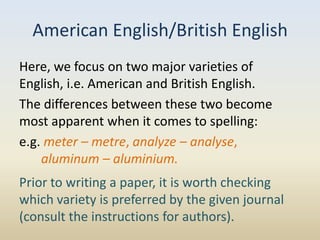
American English/British English
Here, we focus on two major varieties of
English, i.e. American and British English.
The differences between these two become
most apparent when it comes to spelling:
e.g. meter – metre, analyze – analyse,
    aluminum – aluminium.
Prior to writing a paper, it is worth checking
which variety is preferred by the given journal
(consult the instructions for authors).
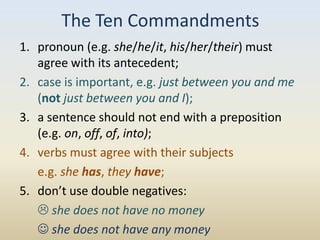
The Ten Commandments
1. pronoun (e.g. she/he/it, his/her/their) must
   agree with its antecedent;
2. case is important, e.g. just between you and me
   (not just between you and I);
3. a sentence should not end with a preposition
   (e.g. on, off, of, into);
4. verbs must agree with their subjects
   e.g. she has, they have;
5. don’t use double negatives:
    she does not have no money
    she does not have any money
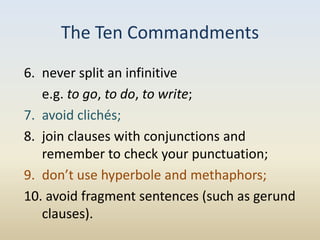
The Ten Commandments
6. never split an infinitive
   e.g. to go, to do, to write;
7. avoid clichés;
8. join clauses with conjunctions and
   remember to check your punctuation;
9. don’t use hyperbole and methaphors;
10. avoid fragment sentences (such as gerund
   clauses).
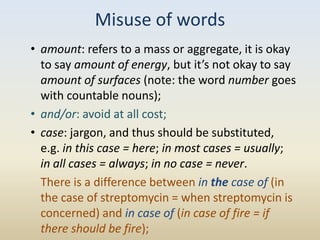
Misuse of words
• amount: refers to a mass or aggregate, it is okay
  to say amount of energy, but it’s not okay to say
  amount of surfaces (note: the word number goes
  with countable nouns);
• and/or: avoid at all cost;
• case: jargon, and thus should be substituted,
  e.g. in this case = here; in most cases = usually;
  in all cases = always; in no case = never.
  There is a difference between in the case of (in
  the case of streptomycin = when streptomycin is
  concerned) and in case of (in case of fire = if
  there should be fire);
Misuse of words
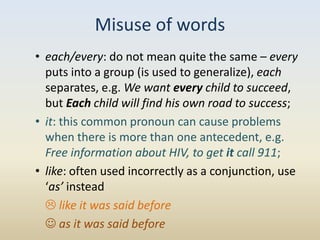
• each/every: do not mean quite the same – every
  puts into a group (is used to generalize), each
  separates, e.g. We want every child to succeed,
  but Each child will find his own road to success;
• it: this common pronoun can cause problems
  when there is more than one antecedent, e.g.
  Free information about HIV, to get it call 911;
• like: often used incorrectly as a conjunction, use
  ‘as’ instead
   like it was said before
   as it was said before
Misuse of words
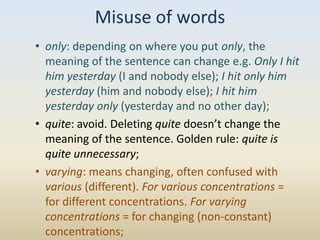
• only: depending on where you put only, the
  meaning of the sentence can change e.g. Only I hit
  him yesterday (I and nobody else); I hit only him
  yesterday (him and nobody else); I hit him
  yesterday only (yesterday and no other day);
• quite: avoid. Deleting quite doesn’t change the
  meaning of the sentence. Golden rule: quite is
  quite unnecessary;
• varying: means changing, often confused with
  various (different). For various concentrations =
  for different concentrations. For varying
  concentrations = for changing (non-constant)
  concentrations;
Misuse of words
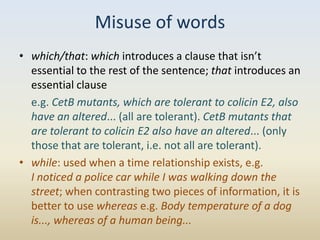
• which/that: which introduces a clause that isn’t
  essential to the rest of the sentence; that introduces an
  essential clause
  e.g. CetB mutants, which are tolerant to colicin E2, also
  have an altered... (all are tolerant). CetB mutants that
  are tolerant to colicin E2 also have an altered... (only
  those that are tolerant, i.e. not all are tolerant).
• while: used when a time relationship exists, e.g.
  I noticed a police car while I was walking down the
  street; when contrasting two pieces of information, it is
  better to use whereas e.g. Body temperature of a dog
  is..., whereas of a human being...
Tense
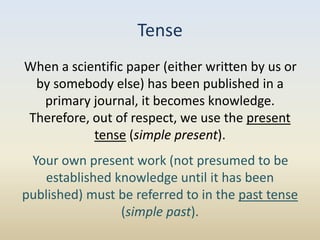
When a scientific paper (either written by us or
 by somebody else) has been published in a
  primary journal, it becomes knowledge.
Therefore, out of respect, we use the present
           tense (simple present).
 Your own present work (not presumed to be
   established knowledge until it has been
published) must be referred to in the past tense
                (simple past).
Ergo
  Most of the ABSTRACT should be in the past
   tense, because it refers to our own present
  results; much of the INTRODUCTION should
be in the present tense, because it emphasizes
 established knowledge; the MATERIALS AND
METHODS as well as the RESULTS should be in
  the past tense, as they describe our present
 findings; much of the DISCUSSION should be
   in the present tense, unless we’re referring
             our own present results.
Active and passive voice
In any type of writing, the passive voice is
usually less precise and more wordy than the
active voice.
Do not be afraid to use active voice and thus
to clearly name the agent of the action in the
sentence. It’s better to state: I/we/the authors
found than it was found, or this temperature
caused the following reaction rather than the
following reaction was caused by this
temperature.
Singulars and plurals
1. If you use first-person pronouns, use both
   the singular and plural forms as needed. Do
   not use the ‘editorial we’ instead of ‘I’. The
   use of ‘we’ by a single author is outrageously
   pedantic and unnecessary;
2. Quantities: you should say ‘10 g was added’
   not ‘10 g were added’.
   ‘10 g were added’ means that the 10 g were
   added 1 g at a time;
Singulars and plurals
3. plural noun modifiers are formulated as follows:
   six volts -> six-volt battery,
   ten miles -> ten-mile run,
   hundred litres -> hundred-litre container;
4. singular noun (the so-called ‘group’ nouns) + plural verb
   e.g. government/team/family are;
5. plural nouns that don’t end in ‘-s’:
   e.g. formula -> formulae, phenomenon -> phenomena,
   spectrum -> spectra, momentum -> momenta;
6. nouns that end in ‘-ics’ are usually singular:
   e.g. mathematics/physics/dynamics is.
Nouns
1. Lack of clarity and verbosity result from use
   of abstract nouns – therefore, instead of
   examination of... was carried out you should
   say we examined...;
   separation of the compounds was accomplished ->
   the compounds were separated;
   transformation of the equations was achieved ->
   the equations were transformed.
Nouns
2. Using nouns as adjectives – watch for too
   complicated clusters of nouns, which can be
   awkward and incomprehensible. Break them
   by using ‘of’:
    the transmission coefficient determination
    the determination of the transmission
     coefficient
3. Don’t be afraid to use of several times:
    the substances mixture temperature (unclear)
    the temperature of the mixture of substances
Numbers
1. From 1 to 9: spell out, ≥10: express in
   numerals, e.g. three experiments, but 13
   experiments;
2. EXCEPTION! With standard units of measure,
   ALWAYS use numerals: 10 mL, 3 kg, 7 L, etc.
3. The only exception to the exception is that
   you should not start a sentence with a
   numeral. In such a case, either reformulate
   the sentence or spell out both the number
   and the unit of measurement.
Punctuation
1. Beware of commas – they can change the
   meaning. Below are two versions of one
   sentence. Are they identical? No!
   Male-chauvinist version:
   Woman without her man is a savage.
   (A woman is a savage without a man)
   Feminist version:
   Woman, without her, man is a savage.
   (A man is a savage without a woman)



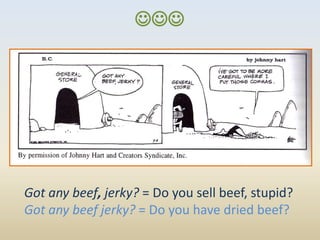
Got any beef, jerky? = Do you sell beef, stupid?
Got any beef jerky? = Do you have dried beef?
Paraphrasing
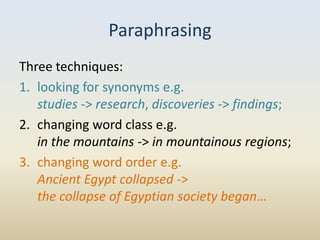
Three techniques:
1. looking for synonyms e.g.
   studies -> research, discoveries -> findings;
2. changing word class e.g.
   in the mountains -> in mountainous regions;
3. changing word order e.g.
   Ancient Egypt collapsed ->
   the collapse of Egyptian society began…
List of useful synonyms
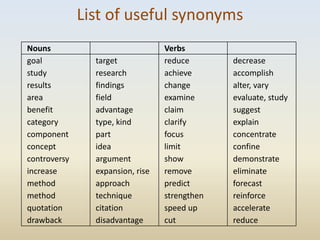
Nouns                             Verbs
goal            target            reduce       decrease
study           research          achieve      accomplish
results         findings          change       alter, vary
area            field             examine      evaluate, study
benefit         advantage         claim        suggest
category        type, kind        clarify      explain
component       part              focus        concentrate
concept         idea              limit        confine
controversy     argument          show         demonstrate
increase        expansion, rise   remove       eliminate
method          approach          predict      forecast
method          technique         strengthen   reinforce
quotation       citation          speed up     accelerate
drawback        disadvantage      cut          reduce
Cause and effect
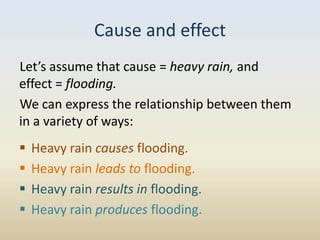
Let’s assume that cause = heavy rain, and
effect = flooding.
We can express the relationship between them
in a variety of ways:
   Heavy rain causes flooding.
   Heavy rain leads to flooding.
   Heavy rain results in flooding.
   Heavy rain produces flooding.
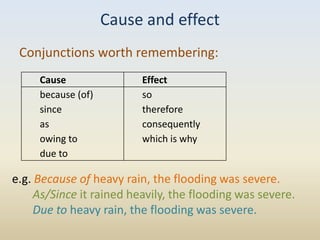
Cause and effect
 Conjunctions worth remembering:
     Cause                Effect
     because (of)         so
     since                therefore
     as                   consequently
     owing to             which is why
     due to

e.g. Because of heavy rain, the flooding was severe.
     As/Since it rained heavily, the flooding was severe.
     Due to heavy rain, the flooding was severe.
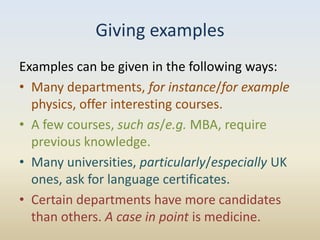
Giving examples
Examples can be given in the following ways:
• Many departments, for instance/for example
  physics, offer interesting courses.
• A few courses, such as/e.g. MBA, require
  previous knowledge.
• Many universities, particularly/especially UK
  ones, ask for language certificates.
• Certain departments have more candidates
  than others. A case in point is medicine.
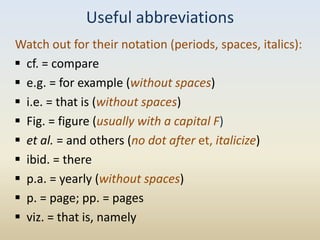
Useful abbreviations
Watch out for their notation (periods, spaces, italics):
 cf. = compare
 e.g. = for example (without spaces)
 i.e. = that is (without spaces)
 Fig. = figure (usually with a capital F)
 et al. = and others (no dot after et, italicize)
 ibid. = there
 p.a. = yearly (without spaces)
 p. = page; pp. = pages
 viz. = that is, namely
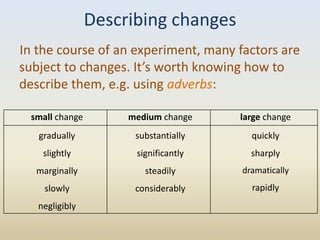
Describing changes
In the course of an experiment, many factors are
subject to changes. It’s worth knowing how to
describe them, e.g. using adverbs:

  small change        medium change    large change
   gradually           substantially     quickly
    slightly           significantly     sharply
   marginally            steadily      dramatically
     slowly            considerably      rapidly
   negligibly
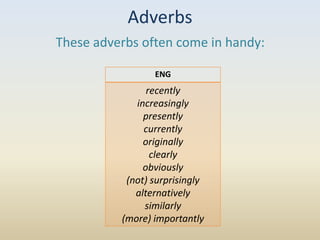
Adverbs
These adverbs often come in handy:

                 ENG
                recently
             increasingly
               presently
               currently
               originally
                 clearly
               obviously
           (not) surprisingly
             alternatively
               similarly
          (more) importantly
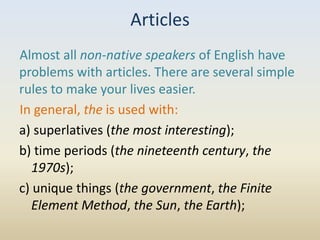
Articles
Almost all non-native speakers of English have
problems with articles. There are several simple
rules to make your lives easier.
In general, the is used with:
a) superlatives (the most interesting);
b) time periods (the nineteenth century, the
   1970s);
c) unique things (the government, the Finite
   Element Method, the Sun, the Earth);
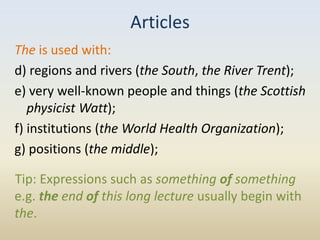
Articles
The is used with:
d) regions and rivers (the South, the River Trent);
e) very well-known people and things (the Scottish
   physicist Watt);
f) institutions (the World Health Organization);
g) positions (the middle);

Tip: Expressions such as something of something
e.g. the end of this long lecture usually begin with
the.
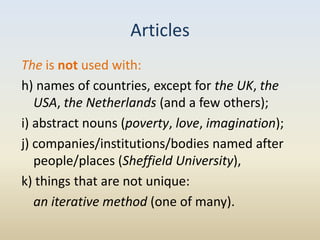
Articles
The is not used with:
h) names of countries, except for the UK, the
   USA, the Netherlands (and a few others);
i) abstract nouns (poverty, love, imagination);
j) companies/institutions/bodies named after
   people/places (Sheffield University),
k) things that are not unique:
   an iterative method (one of many).
Articles
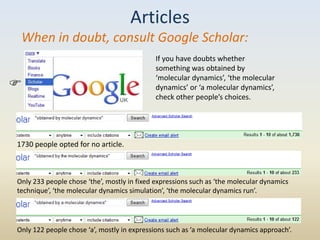
 When in doubt, consult Google Scholar:
                                            If you have doubts whether
                                            something was obtained by
                                            ‘molecular dynamics’, ‘the molecular
                                           dynamics’ or ‘a molecular dynamics’,
                                            check other people’s choices.


1730 people opted for no article.


Only 233 people chose ‘the’, mostly in fixed expressions such as ‘the molecular dynamics
technique’, ‘the molecular dynamics simulation’, ‘the molecular dynamics run’.


Only 122 people chose ‘a’, mostly in expressions such as ‘a molecular dynamics approach’.
Conjunctions
Conjunctions are indispensable for expressing
logical relationships in scientific papers. When
used correctly, they demonstrate a good grasp
of English.
Conjunctions worth knowing:
a) addition: Furthermore/Moreover/What is
  more, child mortality rates must be examined.
b) result: Prices are rising worldwide, and
  thus/therefore/hence the investors buy more.
Conjunctions

Conjunctions worth knowing:
c) reason: Due to/owing to its properties, this
   metal is commonly used…
d) order: Firstly/First of all, we investigated this...
e) opposition: Although/Even though/despite the
   fact that/in spite of the fact that this study
   concentrates mainly on...
Italics
When are italics used?
a) Foreign words and expressions (mostly Latin):
in vivo, in vitro, in silico, in vacuo, in toto, ab initio, ex nihilo, et al., ansatz, …

b) To emphasize something that the reader
  should notice:
We stress that any zero-temperature approach suffers from this problem.
In text that is already italicized, we emphasize by
de-italicizing a word/expression/sentence.
Italics
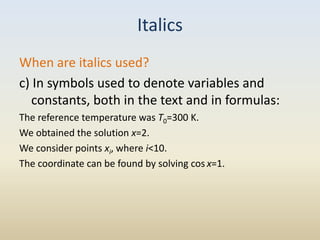
When are italics used?
c) In symbols used to denote variables and
   constants, both in the text and in formulas:
The reference temperature was T0=300 K.
We obtained the solution x=2.
We consider points xi, where i<10.
The coordinate can be found by solving cos x=1.
Italics
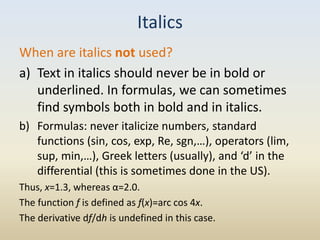
When are italics not used?
a) Text in italics should never be in bold or
   underlined. In formulas, we can sometimes
   find symbols both in bold and in italics.
b) Formulas: never italicize numbers, standard
   functions (sin, cos, exp, Re, sgn,…), operators (lim,
   sup, min,…), Greek letters (usually), and ‘d’ in the
   differential (this is sometimes done in the US).
Thus, x=1.3, whereas α=2.0.
The function f is defined as f(x)=arc cos 4x.
The derivative df/dh is undefined in this case.
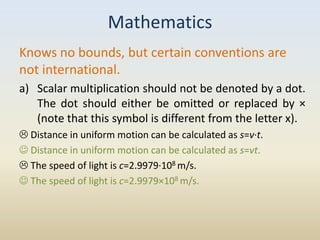
Mathematics
Knows no bounds, but certain conventions are
not international.
a) Scalar multiplication should not be denoted by a dot.
   The dot should either be omitted or replaced by ×
   (note that this symbol is different from the letter x).
 Distance in uniform motion can be calculated as s=v·t.
 Distance in uniform motion can be calculated as s=vt.
 The speed of light is c=2.9979·108 m/s.
 The speed of light is c=2.9979×10⁸ m/s.
Mathematics
Cont.
b) The decimal mark is denoted by a dot.
 The speed of light is c=2,9979×10⁸ m/s.
 The speed of light is c=2.9979×10⁸ m/s.
c) Tangents and cotangents should be denoted with
   ‘tan’ and ‘cot’:
 x=tg π.
 x=tan π.
d) When describing an axis on a graph, the units should
   be put in round brackets, not in square brackets.
 Velocity of the particle, v [m/s].
 Velocity of the particle, v (m/s).
Punctuation
Capitals
When do we use capitals?
a) Names of organisations (Sheffield Hallam
   University, Gdansk University of Technology);
b) Days and months (Friday 20th June);
c) Nationality words (Poland, the Poles, Polish);
d) Titles (main words only, do not capitalize
   words such as the, of)
   e.g. Different Applications of Nanotechnology
Apostrophes (’)

Apostrophes are mainly used in two situations:
a) to show contractions, e.g. It’s generally
believed (contractions are uncommon in
academic English, in a paper rather write It is…);
b) with possessives (note where the apostrophe
goes), e.g. the professor’s secretary
(singular), students’ marks (plural).
Semi-colons (;)
Semi-colons are used:
1. when a comma would be too weak and a full
   stop too strong:
e.g. Thirty people were interviewed for the first
  grant; thirty-one for the second.
2. to divide up items in a list, when they have a
   complex structure (e.g. contain commas).
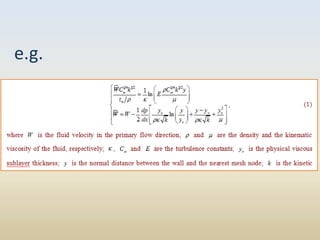
e.g.
Colons (:)
Colons are used:
a) to introduce explanations
   e.g. The meeting was postponed: the Dean
   was seriously ill.
b) to start a list
   e.g. Two factors were discussed: social and
   cultural.
c) to introduce a quotation
   e.g. As Einstein said: ‘God does not play dice’.
Quotation marks (“ ”/‘ ’)
In English, we use only upper quotation marks.
a) single quotation marks emphasize a word or
  introduce quotations from other writers:
  e.g. The word ‘quiz’ was first used in…
      Goodwin’s analysis of habitat indicates
      that ‘it will be more difficult to…’.
b) double quotation marks show quotations
  inside quotations:
  e.g. As James remarked: ‘Martin’s concept of
      “internal space” requires close analysis’.
Discussion
Words useful for discussing the positive and negative
aspects of the results:

       +                       -
       benefit                 drawback
       advantage               disadvantage
       a positive aspect       a negative aspect
       a positive feature      a negative feature
       pro                     con
       plus                    minus
       one major benefit of…   a serious drawback to…
Dictionary
  It is good to have at least one comprehensive
     (and up-to-date) bilingual dictionary, not
          necessarily scientific or technical.
              How to use a dictionary?
   First, check the word you are looking for in a
 STH-ENG dictionary, and then double check its
meaning with an ENG-STH dictionary in order to
avoid errors, such as ‘a spatial cubicle’ instead of
     ‘a spacious cubicle’, ‘favourite’ instead of
 ‘favourable’, or ‘sensible’ instead of ‘sensitive’.
Books worth consulting:

1. Robert A. Day, How to Write and Publish a
   Scientific Paper;
2. Michael Swan, Practical English Usage;
3. Stephen Bailey, Academic Writing – A
   Handbook for International Students;
4. Vernon Booth, Communicating in Science.
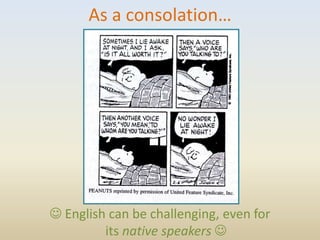
As a consolation…


 English can be challenging, even for
         its native speakers 
THE END
Thank you for your attention!

Scientific writing 2/3

  • 1.
  • 2.
    A word ofintroduction Since English is not our native language, we are bound to encounter many obstacles when writing in English. While writing, keep in mind that many readers (addressees of the paper) are non-native speakers of English too. How to make your and your readers’ lives easier? Use simple indicative sentences.
  • 3.
    American English/British English Here,we focus on two major varieties of English, i.e. American and British English. The differences between these two become most apparent when it comes to spelling: e.g. meter – metre, analyze – analyse, aluminum – aluminium. Prior to writing a paper, it is worth checking which variety is preferred by the given journal (consult the instructions for authors).
  • 4.
    The Ten Commandments 1.pronoun (e.g. she/he/it, his/her/their) must agree with its antecedent; 2. case is important, e.g. just between you and me (not just between you and I); 3. a sentence should not end with a preposition (e.g. on, off, of, into); 4. verbs must agree with their subjects e.g. she has, they have; 5. don’t use double negatives:  she does not have no money  she does not have any money
  • 5.
    The Ten Commandments 6.never split an infinitive e.g. to go, to do, to write; 7. avoid clichés; 8. join clauses with conjunctions and remember to check your punctuation; 9. don’t use hyperbole and methaphors; 10. avoid fragment sentences (such as gerund clauses).
  • 6.
    Misuse of words •amount: refers to a mass or aggregate, it is okay to say amount of energy, but it’s not okay to say amount of surfaces (note: the word number goes with countable nouns); • and/or: avoid at all cost; • case: jargon, and thus should be substituted, e.g. in this case = here; in most cases = usually; in all cases = always; in no case = never. There is a difference between in the case of (in the case of streptomycin = when streptomycin is concerned) and in case of (in case of fire = if there should be fire);
  • 7.
    Misuse of words •each/every: do not mean quite the same – every puts into a group (is used to generalize), each separates, e.g. We want every child to succeed, but Each child will find his own road to success; • it: this common pronoun can cause problems when there is more than one antecedent, e.g. Free information about HIV, to get it call 911; • like: often used incorrectly as a conjunction, use ‘as’ instead  like it was said before  as it was said before
  • 8.
    Misuse of words •only: depending on where you put only, the meaning of the sentence can change e.g. Only I hit him yesterday (I and nobody else); I hit only him yesterday (him and nobody else); I hit him yesterday only (yesterday and no other day); • quite: avoid. Deleting quite doesn’t change the meaning of the sentence. Golden rule: quite is quite unnecessary; • varying: means changing, often confused with various (different). For various concentrations = for different concentrations. For varying concentrations = for changing (non-constant) concentrations;
  • 9.
    Misuse of words •which/that: which introduces a clause that isn’t essential to the rest of the sentence; that introduces an essential clause e.g. CetB mutants, which are tolerant to colicin E2, also have an altered... (all are tolerant). CetB mutants that are tolerant to colicin E2 also have an altered... (only those that are tolerant, i.e. not all are tolerant). • while: used when a time relationship exists, e.g. I noticed a police car while I was walking down the street; when contrasting two pieces of information, it is better to use whereas e.g. Body temperature of a dog is..., whereas of a human being...
  • 10.
    Tense When a scientificpaper (either written by us or by somebody else) has been published in a primary journal, it becomes knowledge. Therefore, out of respect, we use the present tense (simple present). Your own present work (not presumed to be established knowledge until it has been published) must be referred to in the past tense (simple past).
  • 11.
    Ergo Mostof the ABSTRACT should be in the past tense, because it refers to our own present results; much of the INTRODUCTION should be in the present tense, because it emphasizes established knowledge; the MATERIALS AND METHODS as well as the RESULTS should be in the past tense, as they describe our present findings; much of the DISCUSSION should be in the present tense, unless we’re referring our own present results.
  • 12.
    Active and passivevoice In any type of writing, the passive voice is usually less precise and more wordy than the active voice. Do not be afraid to use active voice and thus to clearly name the agent of the action in the sentence. It’s better to state: I/we/the authors found than it was found, or this temperature caused the following reaction rather than the following reaction was caused by this temperature.
  • 13.
    Singulars and plurals 1.If you use first-person pronouns, use both the singular and plural forms as needed. Do not use the ‘editorial we’ instead of ‘I’. The use of ‘we’ by a single author is outrageously pedantic and unnecessary; 2. Quantities: you should say ‘10 g was added’ not ‘10 g were added’. ‘10 g were added’ means that the 10 g were added 1 g at a time;
  • 14.
    Singulars and plurals 3.plural noun modifiers are formulated as follows: six volts -> six-volt battery, ten miles -> ten-mile run, hundred litres -> hundred-litre container; 4. singular noun (the so-called ‘group’ nouns) + plural verb e.g. government/team/family are; 5. plural nouns that don’t end in ‘-s’: e.g. formula -> formulae, phenomenon -> phenomena, spectrum -> spectra, momentum -> momenta; 6. nouns that end in ‘-ics’ are usually singular: e.g. mathematics/physics/dynamics is.
  • 15.
    Nouns 1. Lack ofclarity and verbosity result from use of abstract nouns – therefore, instead of examination of... was carried out you should say we examined...; separation of the compounds was accomplished -> the compounds were separated; transformation of the equations was achieved -> the equations were transformed.
  • 16.
    Nouns 2. Using nounsas adjectives – watch for too complicated clusters of nouns, which can be awkward and incomprehensible. Break them by using ‘of’:  the transmission coefficient determination  the determination of the transmission coefficient 3. Don’t be afraid to use of several times:  the substances mixture temperature (unclear)  the temperature of the mixture of substances
  • 17.
    Numbers 1. From 1to 9: spell out, ≥10: express in numerals, e.g. three experiments, but 13 experiments; 2. EXCEPTION! With standard units of measure, ALWAYS use numerals: 10 mL, 3 kg, 7 L, etc. 3. The only exception to the exception is that you should not start a sentence with a numeral. In such a case, either reformulate the sentence or spell out both the number and the unit of measurement.
  • 18.
    Punctuation 1. Beware ofcommas – they can change the meaning. Below are two versions of one sentence. Are they identical? No! Male-chauvinist version: Woman without her man is a savage. (A woman is a savage without a man) Feminist version: Woman, without her, man is a savage. (A man is a savage without a woman)
  • 19.
     Got any beef,jerky? = Do you sell beef, stupid? Got any beef jerky? = Do you have dried beef?
  • 20.
    Paraphrasing Three techniques: 1. lookingfor synonyms e.g. studies -> research, discoveries -> findings; 2. changing word class e.g. in the mountains -> in mountainous regions; 3. changing word order e.g. Ancient Egypt collapsed -> the collapse of Egyptian society began…
  • 21.
    List of usefulsynonyms Nouns Verbs goal target reduce decrease study research achieve accomplish results findings change alter, vary area field examine evaluate, study benefit advantage claim suggest category type, kind clarify explain component part focus concentrate concept idea limit confine controversy argument show demonstrate increase expansion, rise remove eliminate method approach predict forecast method technique strengthen reinforce quotation citation speed up accelerate drawback disadvantage cut reduce
  • 22.
    Cause and effect Let’sassume that cause = heavy rain, and effect = flooding. We can express the relationship between them in a variety of ways:  Heavy rain causes flooding.  Heavy rain leads to flooding.  Heavy rain results in flooding.  Heavy rain produces flooding.
  • 23.
    Cause and effect Conjunctions worth remembering: Cause Effect because (of) so since therefore as consequently owing to which is why due to e.g. Because of heavy rain, the flooding was severe. As/Since it rained heavily, the flooding was severe. Due to heavy rain, the flooding was severe.
  • 24.
    Giving examples Examples canbe given in the following ways: • Many departments, for instance/for example physics, offer interesting courses. • A few courses, such as/e.g. MBA, require previous knowledge. • Many universities, particularly/especially UK ones, ask for language certificates. • Certain departments have more candidates than others. A case in point is medicine.
  • 25.
    Useful abbreviations Watch outfor their notation (periods, spaces, italics):  cf. = compare  e.g. = for example (without spaces)  i.e. = that is (without spaces)  Fig. = figure (usually with a capital F)  et al. = and others (no dot after et, italicize)  ibid. = there  p.a. = yearly (without spaces)  p. = page; pp. = pages  viz. = that is, namely
  • 26.
    Describing changes In thecourse of an experiment, many factors are subject to changes. It’s worth knowing how to describe them, e.g. using adverbs: small change medium change large change gradually substantially quickly slightly significantly sharply marginally steadily dramatically slowly considerably rapidly negligibly
  • 27.
    Adverbs These adverbs oftencome in handy: ENG recently increasingly presently currently originally clearly obviously (not) surprisingly alternatively similarly (more) importantly
  • 28.
    Articles Almost all non-nativespeakers of English have problems with articles. There are several simple rules to make your lives easier. In general, the is used with: a) superlatives (the most interesting); b) time periods (the nineteenth century, the 1970s); c) unique things (the government, the Finite Element Method, the Sun, the Earth);
  • 29.
    Articles The is usedwith: d) regions and rivers (the South, the River Trent); e) very well-known people and things (the Scottish physicist Watt); f) institutions (the World Health Organization); g) positions (the middle); Tip: Expressions such as something of something e.g. the end of this long lecture usually begin with the.
  • 30.
    Articles The is notused with: h) names of countries, except for the UK, the USA, the Netherlands (and a few others); i) abstract nouns (poverty, love, imagination); j) companies/institutions/bodies named after people/places (Sheffield University), k) things that are not unique: an iterative method (one of many).
  • 31.
    Articles When indoubt, consult Google Scholar: If you have doubts whether something was obtained by ‘molecular dynamics’, ‘the molecular  dynamics’ or ‘a molecular dynamics’, check other people’s choices. 1730 people opted for no article. Only 233 people chose ‘the’, mostly in fixed expressions such as ‘the molecular dynamics technique’, ‘the molecular dynamics simulation’, ‘the molecular dynamics run’. Only 122 people chose ‘a’, mostly in expressions such as ‘a molecular dynamics approach’.
  • 32.
    Conjunctions Conjunctions are indispensablefor expressing logical relationships in scientific papers. When used correctly, they demonstrate a good grasp of English. Conjunctions worth knowing: a) addition: Furthermore/Moreover/What is more, child mortality rates must be examined. b) result: Prices are rising worldwide, and thus/therefore/hence the investors buy more.
  • 33.
    Conjunctions Conjunctions worth knowing: c)reason: Due to/owing to its properties, this metal is commonly used… d) order: Firstly/First of all, we investigated this... e) opposition: Although/Even though/despite the fact that/in spite of the fact that this study concentrates mainly on...
  • 34.
    Italics When are italicsused? a) Foreign words and expressions (mostly Latin): in vivo, in vitro, in silico, in vacuo, in toto, ab initio, ex nihilo, et al., ansatz, … b) To emphasize something that the reader should notice: We stress that any zero-temperature approach suffers from this problem. In text that is already italicized, we emphasize by de-italicizing a word/expression/sentence.
  • 35.
    Italics When are italicsused? c) In symbols used to denote variables and constants, both in the text and in formulas: The reference temperature was T0=300 K. We obtained the solution x=2. We consider points xi, where i<10. The coordinate can be found by solving cos x=1.
  • 36.
    Italics When are italicsnot used? a) Text in italics should never be in bold or underlined. In formulas, we can sometimes find symbols both in bold and in italics. b) Formulas: never italicize numbers, standard functions (sin, cos, exp, Re, sgn,…), operators (lim, sup, min,…), Greek letters (usually), and ‘d’ in the differential (this is sometimes done in the US). Thus, x=1.3, whereas α=2.0. The function f is defined as f(x)=arc cos 4x. The derivative df/dh is undefined in this case.
  • 37.
    Mathematics Knows no bounds,but certain conventions are not international. a) Scalar multiplication should not be denoted by a dot. The dot should either be omitted or replaced by × (note that this symbol is different from the letter x).  Distance in uniform motion can be calculated as s=v·t.  Distance in uniform motion can be calculated as s=vt.  The speed of light is c=2.9979·108 m/s.  The speed of light is c=2.9979×10⁸ m/s.
  • 38.
    Mathematics Cont. b) The decimalmark is denoted by a dot.  The speed of light is c=2,9979×10⁸ m/s.  The speed of light is c=2.9979×10⁸ m/s. c) Tangents and cotangents should be denoted with ‘tan’ and ‘cot’:  x=tg π.  x=tan π. d) When describing an axis on a graph, the units should be put in round brackets, not in square brackets.  Velocity of the particle, v [m/s].  Velocity of the particle, v (m/s).
  • 39.
  • 40.
    Capitals When do weuse capitals? a) Names of organisations (Sheffield Hallam University, Gdansk University of Technology); b) Days and months (Friday 20th June); c) Nationality words (Poland, the Poles, Polish); d) Titles (main words only, do not capitalize words such as the, of) e.g. Different Applications of Nanotechnology
  • 41.
    Apostrophes (’) Apostrophes aremainly used in two situations: a) to show contractions, e.g. It’s generally believed (contractions are uncommon in academic English, in a paper rather write It is…); b) with possessives (note where the apostrophe goes), e.g. the professor’s secretary (singular), students’ marks (plural).
  • 42.
    Semi-colons (;) Semi-colons areused: 1. when a comma would be too weak and a full stop too strong: e.g. Thirty people were interviewed for the first grant; thirty-one for the second. 2. to divide up items in a list, when they have a complex structure (e.g. contain commas).
  • 43.
  • 44.
    Colons (:) Colons areused: a) to introduce explanations e.g. The meeting was postponed: the Dean was seriously ill. b) to start a list e.g. Two factors were discussed: social and cultural. c) to introduce a quotation e.g. As Einstein said: ‘God does not play dice’.
  • 45.
    Quotation marks (“”/‘ ’) In English, we use only upper quotation marks. a) single quotation marks emphasize a word or introduce quotations from other writers: e.g. The word ‘quiz’ was first used in… Goodwin’s analysis of habitat indicates that ‘it will be more difficult to…’. b) double quotation marks show quotations inside quotations: e.g. As James remarked: ‘Martin’s concept of “internal space” requires close analysis’.
  • 46.
    Discussion Words useful fordiscussing the positive and negative aspects of the results: + - benefit drawback advantage disadvantage a positive aspect a negative aspect a positive feature a negative feature pro con plus minus one major benefit of… a serious drawback to…
  • 47.
    Dictionary Itis good to have at least one comprehensive (and up-to-date) bilingual dictionary, not necessarily scientific or technical. How to use a dictionary? First, check the word you are looking for in a STH-ENG dictionary, and then double check its meaning with an ENG-STH dictionary in order to avoid errors, such as ‘a spatial cubicle’ instead of ‘a spacious cubicle’, ‘favourite’ instead of ‘favourable’, or ‘sensible’ instead of ‘sensitive’.
  • 48.
    Books worth consulting: 1.Robert A. Day, How to Write and Publish a Scientific Paper; 2. Michael Swan, Practical English Usage; 3. Stephen Bailey, Academic Writing – A Handbook for International Students; 4. Vernon Booth, Communicating in Science.
  • 49.
    As a consolation… English can be challenging, even for its native speakers 
  • 50.
    THE END Thank youfor your attention!