Duct Design –Undergraduate
Teaching
• Introduction to duct design with a focus on
theory and practical calculation methods.
2.
Introduction to DuctDesign
• - Ducts are used to distribute air in HVAC
systems.
• - Proper design ensures comfort, energy
efficiency, and low noise levels.
• - Key parameters: air flow rate, velocity,
pressure drop, and duct material.
3.
Types of Ducts
•- Rectangular Ducts: Easy to fabricate and
install in tight spaces.
• - Circular Ducts: More efficient in terms of
pressure drop.
• - Flexible Ducts: Used for short lengths and
connections.
4.
Duct Design Objectives
•- Ensure adequate air flow to all zones.
• - Minimize energy loss and pressure drop.
• - Use cost-effective and space-saving layouts.
• - Maintain acceptable noise levels.
5.
Basic Terminologies
• -Airflow Rate (CFM or m³/h): Volume of air
delivered.
• - Velocity (m/s or ft/min): Speed of air through
the duct.
• - Pressure Loss: Drop in air pressure due to
friction and fittings.
6.
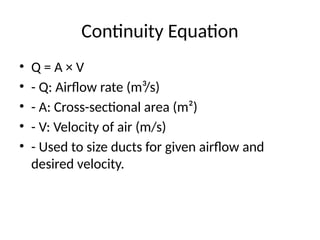
Continuity Equation
• Q= A × V
• - Q: Airflow rate (m³/s)
• - A: Cross-sectional area (m²)
• - V: Velocity of air (m/s)
• - Used to size ducts for given airflow and
desired velocity.
7.
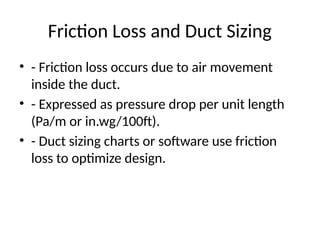
Friction Loss andDuct Sizing
• - Friction loss occurs due to air movement
inside the duct.
• - Expressed as pressure drop per unit length
(Pa/m or in.wg/100ft).
• - Duct sizing charts or software use friction
loss to optimize design.
8.
Equivalent Diameter –Theory
• - Used to convert rectangular ducts to circular
for comparison.
• - Formula: De = 1.30 × [(a × b) / (a + b)]
• where a = height, b = width of the
rectangular duct.
Design Tools andSoftware
• - Manual methods using ASHRAE charts and
tables.
• - Software: Ductulator tools, Revit MEP,
AutoCAD MEP, HAP, and Carrier software.
13.
Summary and LearningOutcomes
• - Students will understand airflow principles,
duct sizing, and equivalent diameter.
• - Capable of designing efficient duct networks
with given airflow requirements.
• - Able to apply theoretical knowledge to real-
world HVAC systems.


![Equivalent Diameter – Theory
• - Used to convert rectangular ducts to circular
for comparison.
• - Formula: De = 1.30 × [(a × b) / (a + b)]
• where a = height, b = width of the
rectangular duct.](https://image.slidesharecdn.com/ductdesignuglevelppt-250401042411-e8fb4264/85/Duct_Design-design-design-design-design-design-8-320.jpg)
![Example: Equivalent Diameter
Calculation
• - Rectangular duct size: 400 mm × 200 mm
• - De = 1.30 × [(400 × 200)/(400 + 200)]
• - De = 1.30 × (80000 / 600) = 173.33 mm](https://image.slidesharecdn.com/ductdesignuglevelppt-250401042411-e8fb4264/85/Duct_Design-design-design-design-design-design-9-320.jpg)