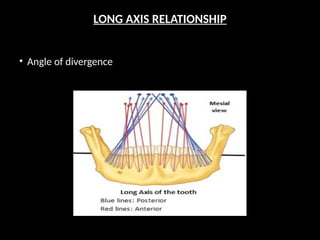
• Ideal requirements
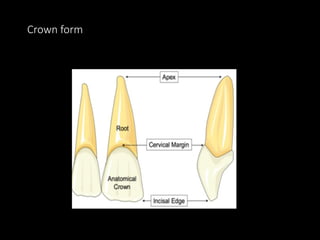
1.Ideal crown root ratio
2. Adequate thickness of enamel and dentin
3. Adequate bone support
4. Absence of periodontal disease
5. Proper gingival contour
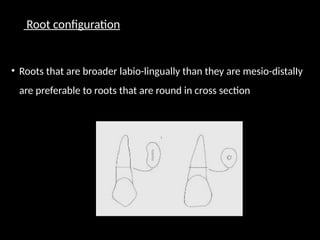
Root configuration
• Rootsthat are broader labio-lingually than they are mesio-distalIy
are preferable to roots that are round in cross section
11.
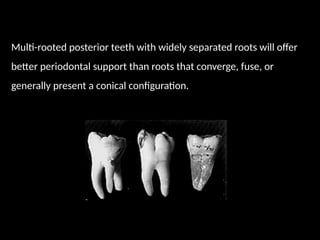
Multi-rooted posterior teethwith widely separated roots will offer
better periodontal support than roots that converge, fuse, or
generally present a conical configuration.
12.
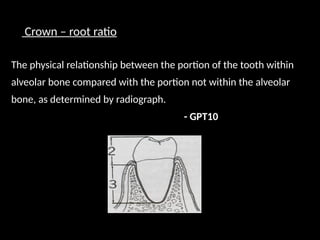
Crown – rootratio
The physical relationship between the portion of the tooth within
alveolar bone compared with the portion not within the alveolar
bone, as determined by radiograph.
- GPT10
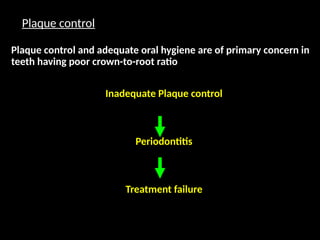
Plaque control
Plaque controland adequate oral hygiene are of primary concern in
teeth having poor crown-to-root ratio
Inadequate Plaque control
Periodontitis
Treatment failure
15.
Occlusal reduction
• Clinicalcrown occlusal reduction of extruded teeth is a valid
approach to improve the crown root ratio
16.
Increase stability
• Accordingto Nyman 1975 mobility commonly seen in poor
crown root ratio can be reduced by selective grinding occlusal
surface and minimizing horizontal forces in the existing
dentition.
• Mobile tooth can be retained through splinting.
Nyman S, Linghe J and Lundgren D. J Clin Periodontol 1975
17.
Periodontal Ligament Area
Another consideration in the evaluation of prospective abutment
teeth is the root surface area or area of periodontal ligament
attachment of the root to the bone.
Larger teeth have a greater surface area and are better able to
bear added stress.
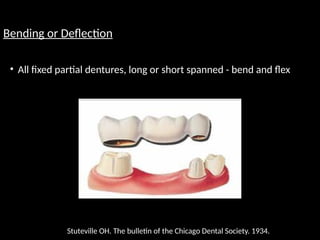
Bending or Deflection
•All fixed partial dentures, long or short spanned - bend and flex
Stuteville OH. The bulletin of the Chicago Dental Society. 1934.
22.
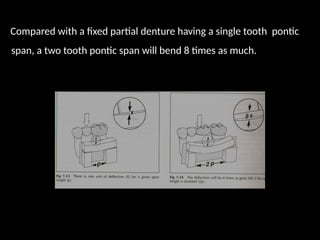
Compared with afixed partial denture having a single tooth pontic
span, a two tooth pontic span will bend 8 times as much.
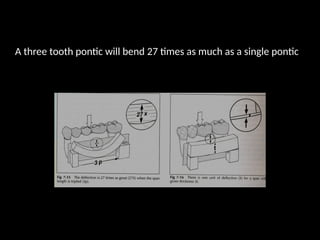
23.
A three toothpontic will bend 27 times as much as a single pontic
24.
Secondary abutment
• Doubleabutment can be used in case when there is unfavorable
crown root ratios and long spans.
• Secondary abutment must have at least as much root surface area
and as favorable a crown - root ratio as the primary.
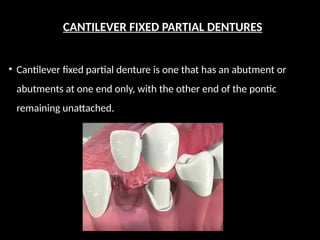
ARCH FORM
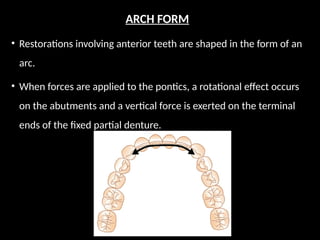
• Restorationsinvolving anterior teeth are shaped in the form of an
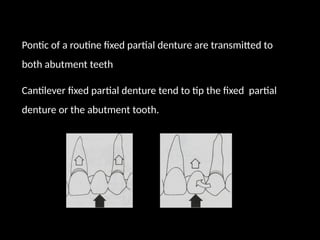
arc.
• When forces are applied to the pontics, a rotational effect occurs
on the abutments and a vertical force is exerted on the terminal
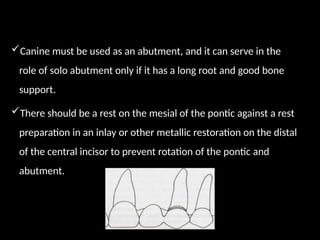
ends of the fixed partial denture.
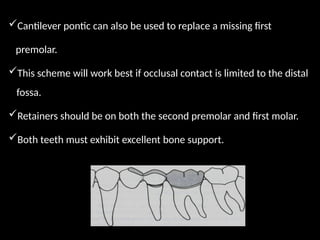
27.
RIGIDITY
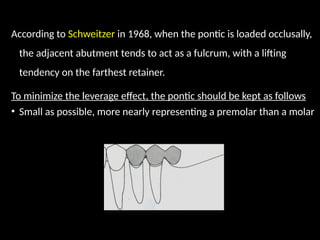
• All fixedpartial dentures, long or short spanned bend and flex
• The lack of sufficient rigidity in a fixed prosthesis is a frequent
cause of failure.
28.
• Flexure cancause damage to the abutments and may result in
eventual loosening of the retainers, and fatigue of the metal.
• The induced stresses must not exceed the yield strength of the
alloy used.
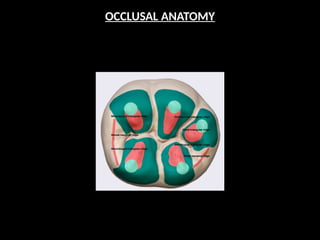
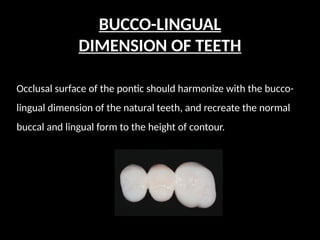
Occlusal surface ofthe pontic should harmonize with the bucco-
lingual dimension of the natural teeth, and recreate the normal
buccal and lingual form to the height of contour.
BUCCO-LINGUAL
DIMENSION OF TEETH
31.
Reducing the widthof the pontics does not materially reduce the
forces transmitted to the abutments, but merely places heavier per
unit stress on the restoration.
32.
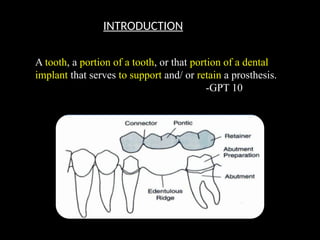
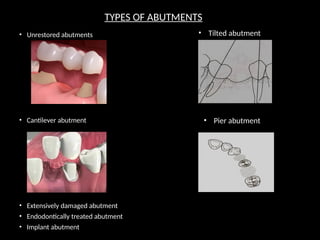
Unrestored abutments
• Anunrestored, caries free tooth is an ideal abutment. It can be
prepared conservatively for a strong retentive restoration with
optimum esthetics.
• In an adult patient, an unrestored tooth can be safely prepared
without affecting the pulp as long as the design and technique of
tooth preparation are wisely chosen.
33.
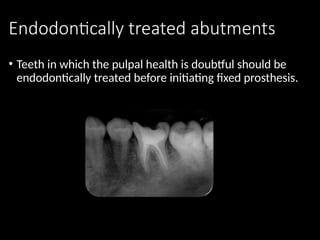
Endodontically treated abutments
•Teeth in which the pulpal health is doubtful should be
endodontically treated before initiating fixed prosthesis.
34.
Long term abutmentprognosis
• When there is some question of the ability of remaining
supporting structures to accept additional occlusal forces, the
bilateral bracing afforded by a removable prosthesis may be
advantageous.
• Also a tooth with sufficient loss of periodontal support and
questionable long term prognosis may be best treated with a
removable prosthesis.
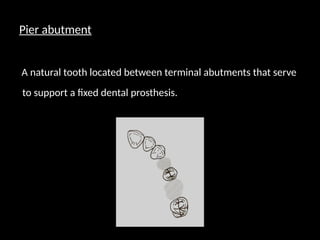
Pier abutment
A naturaltooth located between terminal abutments that serve
to support a fixed dental prosthesis.
37.
Rigid connectors betweenpontics and retainers are the
preferred way of fabricating most fixed partial dentures which
provides desirable strength and stability to the prosthesis while
minimizing the stresses associated with the restoration.
38.
• In somecases, a completely rigid restoration is not indicated.
• In case of pier abutment due to following reasons a rigid FPD is
contraindicated:-
Physiologic tooth movement
Arch position of the abutment
Disparity In the retentive capacity of the retainers
39.
• Because ofthe curvature of the arch, the faciolingual movement of
an anterior tooth occurs at a considerable angle to the faciolingual
movement of a molar.
• These movements of measurable magnitude and in divergent
directions can create stresses in a long-span prosthesis that will be
transferred to the abutments.
40.
• Because ofthe distance through which movement occurs, the
independent direction and magnitude of movement of the
abutment teeth, and the tendency of the prosthesis to flex,
stress can be concentrated around the abutment teeth as well
as between retainers and the abutment preparation.
41.
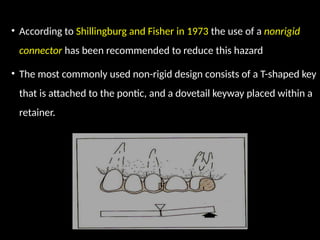
• According toShillingburg and Fisher in 1973 the use of a nonrigid
connector has been recommended to reduce this hazard
• The most commonly used non-rigid design consists of a T-shaped key
that is attached to the pontic, and a dovetail keyway placed within a
retainer.
42.
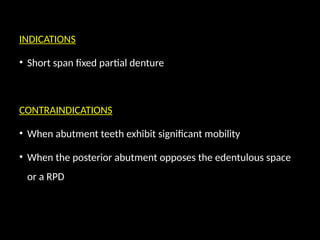
INDICATIONS
• Short spanfixed partial denture
CONTRAINDICATIONS
• When abutment teeth exhibit significant mobility
• When the posterior abutment opposes the edentulous space
or a RPD
43.
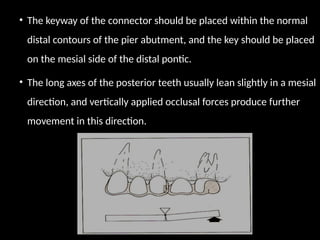
• The keywayof the connector should be placed within the normal
distal contours of the pier abutment, and the key should be placed
on the mesial side of the distal pontic.
• The long axes of the posterior teeth usually lean slightly in a mesial
direction, and vertically applied occlusal forces produce further
movement in this direction.
44.
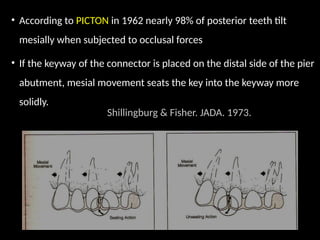
• According toPICTON in 1962 nearly 98% of posterior teeth tilt
mesially when subjected to occlusal forces
• If the keyway of the connector is placed on the distal side of the pier
abutment, mesial movement seats the key into the keyway more
solidly.
Shillingburg & Fisher. JADA. 1973.
45.
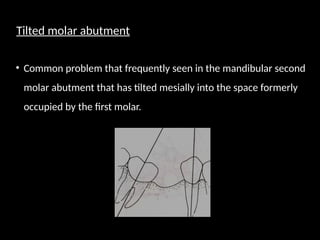
Tilted molar abutment
•Common problem that frequently seen in the mandibular second
molar abutment that has tilted mesially into the space formerly
occupied by the first molar.
46.
• In thesecases it is hard to prepare the abutment teeth for a fixed
partial denture along the long axes of the respective teeth and
achieve a common path of insertion.
• There is further complication if the third molar is present.
47.
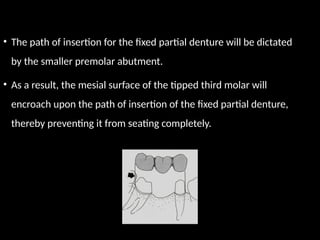
• The pathof insertion for the fixed partial denture will be dictated
by the smaller premolar abutment.
• As a result, the mesial surface of the tipped third molar will
encroach upon the path of insertion of the fixed partial denture,
thereby preventing it from seating completely.
48.
• If theencroachment is slight, the problem can be remedied by
restoring or recontouring the mesial surface of the third molar.
• However, the over tapered second molar preparation must
have its retention bolstered by the addition of facial and lingual
grooves.
49.
• If thetilting is severe, more extensive corrective measures are
called for and following treatment of choice will be followed:-
Up righting the molar
Proximal half crown preparation
Telescopic crown with coping
Use of non rigid connector
50.
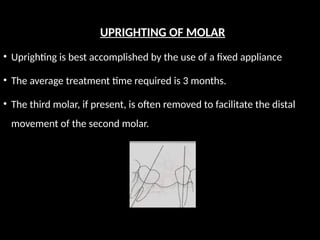
UPRIGHTING OF MOLAR
•Uprighting is best accomplished by the use of a fixed appliance
• The average treatment time required is 3 months.
• The third molar, if present, is often removed to facilitate the distal
movement of the second molar.
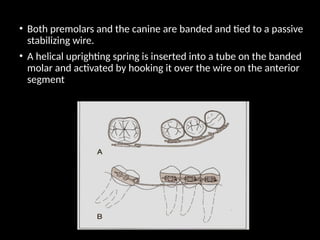
51.
• Both premolarsand the canine are banded and tied to a passive
stabilizing wire.
• A helical uprighting spring is inserted into a tube on the banded
molar and activated by hooking it over the wire on the anterior
segment
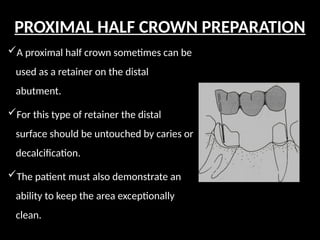
52.
A proximal halfcrown sometimes can be
used as a retainer on the distal
abutment.
For this type of retainer the distal
surface should be untouched by caries or
decalcification.
The patient must also demonstrate an
ability to keep the area exceptionally
clean.
PROXIMAL HALF CROWN PREPARATION
53.
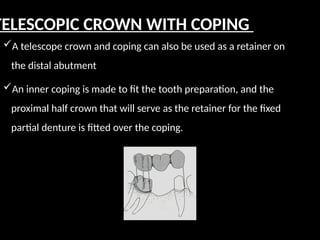
:-
A telescope crownand coping can also be used as a retainer on
the distal abutment
An inner coping is made to fit the tooth preparation, and the
proximal half crown that will serve as the retainer for the fixed
partial denture is fitted over the coping.
TELESCOPIC CROWN WITH COPING
54.
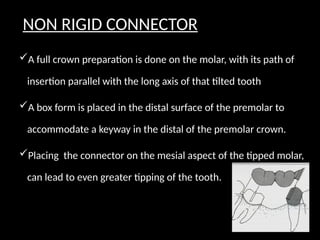
A full crownpreparation is done on the molar, with its path of
insertion parallel with the long axis of that tilted tooth
A box form is placed in the distal surface of the premolar to
accommodate a keyway in the distal of the premolar crown.
Placing the connector on the mesial aspect of the tipped molar,
can lead to even greater tipping of the tooth.
NON RIGID CONNECTOR
55.
CANINE-REPLACEMENT FIXED PARTIALDENTURES
• It is difficult to place a missing canine because the canine often
lies outside the inter-abutment axis
Prospective abutments are:-
• Lateral incisor (weakest tooth in the entire arch)
• First premolar (weakest posterior tooth)
56.
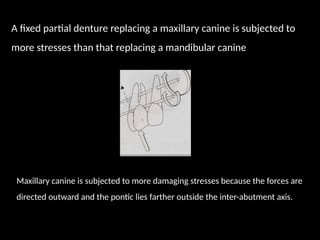
A fixed partialdenture replacing a maxillary canine is subjected to
more stresses than that replacing a mandibular canine
Maxillary canine is subjected to more damaging stresses because the forces are
directed outward and the pontic lies farther outside the inter-abutment axis.
57.
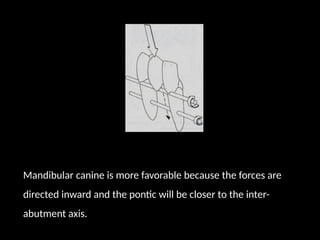
Mandibular canine ismore favorable because the forces are
directed inward and the pontic will be closer to the inter-
abutment axis.
58.
CANTILEVER FIXED PARTIALDENTURES
• Cantilever fixed partial denture is one that has an abut
ment or
abutments at one end only, with the other end of the pontic
remaining unattached.
59.
• In theroutine three-unit fixed partial denture, force that is
applied to the pontic is distributed equally to the abutment
teeth.
• When a cantilever pontic is employed to replace a missing tooth,
forces applied to the pontic have an entirely different effect on
the abutment tooth.
• The pontic acts as a lever that tends to be depressed under
forces with a strong occlusal forces.
60.
Pontic of aroutine fixed partial denture are transmitted to
both abutment teeth
Cantilever fixed partial denture tend to tip the fixed partial
denture or the abutment tooth.
61.
According to Ewingin 1957 prospective abutment teeth for cantilever
fixed partial dentures should be evaluated for:
Lengthy roots with a favorable configuration,
Long clinical crowns,
Good crown-root ratios and
Healthy periodontium
62.
Generally, cantilever fixedpartial dentures should replace only
one tooth and have at least two abutments
Ideally cantilever used for replacing a maxillary lateral incisor
There should be no occlusal contact on the pontic in either
centric or lateral excursions
Wright. JPD 1986
63.
Canine must beused as an abutment, and it can serve in the
role of solo abutment only if it has a long root and good bone
support.
There should be a rest on the mesial of the pontic against a rest
preparation in an inlay or other metallic restoration on the distal
of the central incisor to prevent rotation of the pontic and
abutment.
64.
Cantilever pontic canalso be used to replace a missing first
premolar.
This scheme will work best if occlusal contact is limited to the distal
fossa.
Retainers should be on both the second premolar and first molar.
Both teeth must exhibit excellent bone support.
65.
• Cantilever fixedpartial dentures can also be used to replace
molars when there is no distal abutment present.
• Most commonly, this type of fixed partial denture is used to
replace a first molar, Although occasionally it is used to replace
a second molar to prevent superaeruption of opposing teeth.
66.
According to Schweitzerin 1968, when the pontic is loaded occlusally,
the adjacent abutment tends to act as a fulcrum, with a lifting
tendency on the farthest retainer.
To minimize the leverage effect, the pontic should be kept as follows
• Small as possible, more nearly representing a premolar than a molar
67.
• Light occlusalcontact with absolutely no contact in any excursion
movement
• Maximum occluso-gingival height to ensure a rigid prosthesis
68.
CONCLUSION
• It canbe concluded that the proper selection of abutments
influences the prognosis of the treatment. Successful selection
abutments would require prompt diagnosis and meticulous
treatment planning.
69.
References
• Shillingburg HTet al. Fundamentals of fixed prosthodontics. 3st
ed.
Qintessence Publishing Co. Inc – 1991. p. 89-102.
• Rosenstiel SF, Land MF, Fujimoto J. contemporary fixed prosthodontics. 3rd
ed.
Missouri (CN). Mosby - 2001. p. 166 - 201.
• Glossary of Prosthodontics - 9th
edition.
• Singh S, Singh N. Treatment Planning for Fixed Partial Dentures. Int J Oral
Health Med Res 2015;2(2):99-101.
• Ante, I. H. The Fundamental Principles of Abutments. Mich. State Dent. Sot.
Bull. 8: 14.23, 1926.
#21 Stuteville in 1934 experimented and proved that bending (deflection) varies directly with the cube of the length and inversely with the cube of occluso-gingival thickness of the pontic.
#25 Architectutre of pdl is built in such a way that it resists forces better when they are transmitted through long axis
Criically inclined tooth- will not bear
#29 Indirect effect on forced directed
Ridges and grooves enhance sharpness and shearing action of teeth and minimizes friction between opposing teeth surfaces
Effective mastication and reduces forces