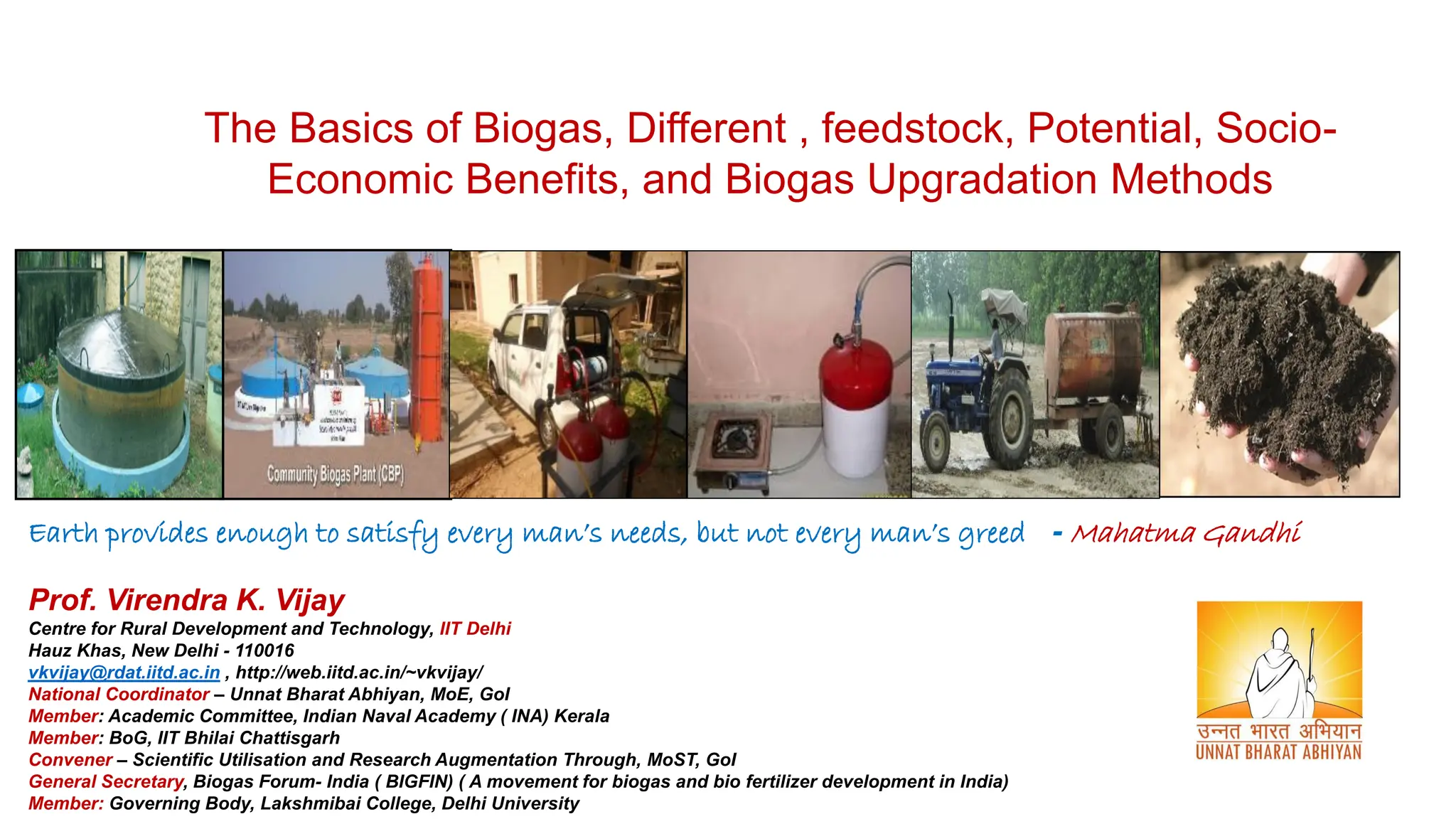
The Basics of Biogas, Different , feedstock, Potential, Socio-
Economic Benefits, and Biogas Upgradation Methods
Earth provides enough to satisfy every man’s needs, but not every man’s greed - Mahatma Gandhi
Prof. Virendra K. Vijay
Centre for Rural Development and Technology, IIT Delhi
Hauz Khas, New Delhi - 110016
vkvijay@rdat.iitd.ac.in , http://web.iitd.ac.in/~vkvijay/
National Coordinator – Unnat Bharat Abhiyan, MoE, GoI
Member: Academic Committee, Indian Naval Academy ( INA) Kerala
Member: BoG, IIT Bhilai Chattisgarh
Convener – Scientific Utilisation and Research Augmentation Through, MoST, GoI
General Secretary, Biogas Forum- India ( BIGFIN) ( A movement for biogas and bio fertilizer development in India)
Member: Governing Body, Lakshmibai College, Delhi University
Traditional Indian lifestyle of people focused on environment friendliness
ॐ सर्वे भर्वन्तु सुखिनः । सर्वे सन्तु ननरामयाः । र्वसुधेर्व क
ु टुम्बकम
सर्वे भद्रानि पश्यन्तु। मा कनित् दुः ि भाग्भर्वेत्॥
ॐ शाखन्तः शाखन्तः शाखन्तः ॥
21st Century – Environmental issues – in air, water, soil, health, agriculture etc
• Age-old traditions symbolize respect towards
environment
- many trees are considered sacred and are
worshipped
- some rivers and mountains are considered holy
- animals are worshipped too e.g. snakes, cows etc.
• Due to less technological development and
penetration, day-to-day functions were sourced from
locally-available resources e.g. biomass was a source
of energy in every household
• Water conservation and management has been a
household practice since Harappan times
• In general, living in harmony with the environment
was a way of life
Present lifestyle calls for a mega-shift to
sustainable energy sources
• Over Exploitation of resources, Green House Gases, climate change, SDGs
and Green Technologies
• Over-exploitation of resources is common without putting measures in
place to replenish them e.g. large scale deforestation for settlements,
mining etc.
• Commonly used energy sources comprise coal and oil, which meet 74% of
our energy demand today
• Pollution, global warming, greenhouse gas emissions, centralized
technologies and urban development models are ringing alarm bells
• As a result, natural calamities are increasingly making news such as disease
outbreaks, pandemics, flash floods, cyclones, earthquakes, landslides,
animal extinction etc.
There is an urgent need to move to sustainable energy solutions keeping
environmental priorities in mind.
POTENTIAL OF BIOGAS IN INDIA
 Total Bovine population (Cattle, Buffalo, Mithun and Yak) is
302.79 Million in 2019.
Farm families : 75 million
The total Poultry in the country is 851.81 Million in
2019,
Own 4 or more cattle : 43 million
Potential of setting up family size BGP : 12 million
Established 50.8 lakh (5.08 Million) upto Nov 2022
India Globally stands at 2nd position after China, in
dissemination of small family size Households Biogas
Plants.
4
Potential: UNIDO Study 2019
5
 Poultry Industry
 Sugar Industry (Press mud)
 Fruit and vegetable Processing industry
 Cattle farm (cattle dung).
Annual Biogas Generation Potential: 20,106 million m3
Can produce about 8.043 million Tonnes Bio-CNG or 5,138 MW Power.
Can be exploited to generate power or for thermal energy use and
cooking
Proper utilization of wastes would help in plug the power deficit of the
country.
Priority SME sector, where despite large waste generation and energy
potential, the existing resource remain unexploited for energy
conversion
Bioenergy
Environment
First
26-02-2023 6
Waste to Energy
Biomass
Biogas
Support
under
SATAT
Initiative
(Sustainable
Alternative Towards
Affordable
Transportation)
CBG Production Plant
Guarantee Production
offtake by Cascades /
Pipelines
Co-mingling of CBG
with Natural Gas in City
Gas Distribution
network for Transport
and Domestic purpose
OFFATKE of Biogas by OMCs
Offtake by Fertilizer
companies
Branding /
Retailing
OFFATKE of Biofertilizer by Fertilizer Companies
Minimum procurement price is Rs. 54/- per kg plus GST.
Biogas
Biofertilizer
Fertilizer companies to ensure offtake of FOM with chemical fertilizers.
Guarantee Production offtake where Public Sector OMC buy CBG at fixed rate
The potential for Compressed Bio-Gas production
from various sources in India is estimated at about
62 million tonnes per annum.
15 MMT CBG
5,000 CBG Plants
62 MMT CBG
POTENTIAL
5000 CBG plants are expected to produce 15 million
tonnes of CBG per annum by 2023
Letter of Intends for over 3,500 CBG plants issued
by OMCs by Aug 2022.
TARGET
37 CBG
commissioned
(9019TPD)
BioCNG
ACHIEVEMENT
Note: Achievement as on 30.09.2022
Plant type Capital Requirement
Biogas plant Rs 6-7 Cr for 12000
m3/day generation
capacity
BioCNG plant Rs 20-25 Cr for 4800
kg/day BioCNG
generation capacity
Power plant based
on Biogas
Rs 10-11 Cr per MW
OBJECTIVES
• To provide clean gaseous fuel mainly for cooking and lighting purposes for
individual households by setting up of small biogas plants in the capacity range
from 1 m3 to 25 m3;
• To promote setting up of biogas based power generation (off-grid) projects for
power generation in the capacity range (3 kW to 250 kW) and thermal
energy from the biogas produced from Biogas plants of size greater than 25 m3
up to 2500 m3 size
• To mitigate drudgery of rural women and reduce pressure on forests;
• Creation of a pool of skilled manpower for all developmental activities for biogas
technology and entrepreneurial ventures.
9
Biogas Programme
26-02-2023
Subsidy in Biogas Programme (1 to 25 m3)
10
S N Particulars Biogas Programme
A CFA 1m3 2-4 m3 6 m3 8-10
m3 15 m3 20-25
m3
1
NER States / Hilly States / Special
Category States and SC/ST of all
states
17 22 29.2 34.5 63.25 70.4
2 All other States (General Category) 9.8 14.35 22.7 23 37.95 52.8
B 1 CFA for linking with sanitary toilets 1.6 1.6 1.6 1.6 Nil Nil
B 2
CFA for biogas plant linked with
biogas slurry filter unit 1.6 1.6 1.6 1.6 1.6 1.6
C.
Turn-Key Job Fee for
construction, of biogas plants
• ₹ 3,000/- plant fixed dome design from 1 to 10 m3 and
• ₹ 5,000/- per plant for 15 to 25 m3
D. Adm Charges– to State PIA (Amount in ₹ )
1 100 - 1999 nos. Plants. 1,00,000
2 2,000 - 5,000 nos plants 10,50,000
3 Above 5,000 nos. plants 24,50,000
26-02-2023
• Administrative Charges towards Supervision, DPR & Inspection
• 20% additional CFA for SC/ST, NER, Island & Registered Gaushalas
Subsidy in Biogas Programme (>25 to 25000 m3)
11
Power
Gen. Capacity
(kW)
CFA Adm Charges for PIA
Power
Generation
Thermal
Application
Power
Generation
Thermal
application
3 KW – 50 kW ₹45,000 per kW ₹ 22,500 per
kWeq thermal/
cooling
10% of
the CFA
5% of the
CFA
>50 KW –200 kW ₹40,000 per kW ₹ 20,000/- per
kWeq
thermal/ cooling
₹2,00,000/-
(fixed)
₹1,00,000/-
(fixed)
>200 kW – 250 kW ₹35,000 per kW ₹17,500/-
per kWeq
thermal/ cooling
₹2,50,000/-
(fixed)
₹1,00,000/-
(fixed)
26-02-2023
Physical Targets / Budget under Biogas Programme
12
S N Year Proposed Physical Targets
(Nos. Of Biogas Plants)
( in numbers)
Proposed financial
outlay as per the
physical goals
(₹ in Crores)
Small size
biogas plants
Medium size
(>25m3 to 2500 m3)
1 2022-23 22,500 22 42.50 + 5.50 = 48.0
3 2023-24 46,000 22 89.50 + 5.50 = 95.0
4 2024-25 48,000 25 94.00 + 6.25= 100.25
5 2025-26 50,000 25 99.00+6.25 = 105.25
Total 1,66,500 94 325+23.50= 348.50
26-02-2023
Biogas Implementing Organizations and Strategy
 State Government/ Union Territories Departments ( Agriculture & Rural Development)
 State Government/ Union Territories Agencies
 Khadi and Village Industries Commission (KVIC)
 National Dairy Development Board (NDDB)
 Biogas Development and Training Centres (BDTCs)
 Implementation following cluster of Villages/ Blocks/Districts.
 Implementation approach through entrepreneurs mode.
 Implementation activities monitored through Monthly and Quarterly Progress Reports.
 CFA will be released to PIA based on actual achievements (quarterly )
13
26-02-2023
Eight BDTCs are being supported at various IITs/ Universities to cover all States/ UTs with the following
functions:-
i. Training of Users, Biogas Masons, SND/SNA, District/State Officers and Turn-Key Workers/ Rural Energy
Technicians (RETs)
ii. R&D on new biogas technologies / new models of biogas plants.
iii. Testing and evaluation of new models of biogas plants and burners/stoves in labs and field testing to
have assessment for long period field validations.
iv. Field monitoring and inspections of already installed and under installation biogas plants for further
implementation improvements and suggestions.
v. Development of Biogas Training & Awareness Material.
vi. Inspection of Biogas plants in a year in certain Blocks/ Talukas of the Districts, selected on random
basis.
Biogas Development and Training Centers (BDTCs)
14
26-02-2023
26-02-2023 15
Towards…..Suitable and sustainable solution
26-02-2023 16
MNRE Portal:
https://biourja.mnre.gov.in
https://biogas.mnre.gov.in
Email us:
biogas.mnre@gov.in
www.mnre.gov.in
26-02-2023
Benefits of
Biogas Plants
Environmentally
Friendly
Clean Cooking
Medium
(Minimal recurring cost over
lifetime)
Socio Economic Benefits:
Time saved for women - 2.30
~ 4 hrs. per day
18
Output of
biogas plant
Annual Biogas generation from a 2 m3 Biogas plant = 540 m3 /year
1 m3 Biogas
Equivalent
Equivalent
Quantity of
LPG produced
per year
No of
Domestic
cylinder
per year
Market
Rate of
LPG
Cylinder
Annual
Amount
saved
Subsidy
On LPG (PM-
Ujjwala)
Amount
saved on
LPG
Subsidy
per year
0.43 kg
of LPG
0.43x 540 =
232 Kg
232/14.2
= 16
₹ 1050 ₹ 16,800
/ yr
₹ 200/
cylinder
₹ 3,200
Output of
biogas
Annual Organic Manure (30 % Moisture) generation from a 2 m3 Biogas
plant= 10.2 Ton of organic manure / year/ Plant
Fertilizers Nutrient in Biogas
based Organic
Manure ( NPK)
Fertilizer
produced
(Equiv. Qty)
Market
Rate of
Fert. ₹/kg
Amt
saved
Subsidy
On ferti.
₹/kg
Amt saved
on ferti
Subsidy
Urea (46%N2) 2 % Nitrogen 434 Kg 5.36 2,300 98 ₹ 19,992
DAP(46%P2O5 1 % Phosphorus 220 Kg 22 4,800 66 6,732
MoP(60%K2O 1% Potash (K2O) 170 Kg 17.44 2,950 23 2,346
Total Yearly saved Amt on Fertilizer (₹) 10,050 29,070
26-02-2023
2/26/2023 MNRE | May 2020 19
Factors Affecting Optimum Biogas Production
• Temperature ( 35-37 C Mesophilic condition )
• C/N ratio ( optimum between 25:1 to 30:1) •pH ( optimally pH
between 6.8-7.2)
• Solid content ( feed material should have approx. 10:1 )
• Should not have toxic material/ harmful material to bacteria in
digester
• HRT ( Hydraulic Retention Time – 30, 40, 55 days)
• Loading rate
IIT Delhi Biogas Plant
20 m3/ Day
First biogas fuel-based
Vehicle of India
Pipeline for raw biogas use as a cooking fuel
Raw biogas cookstove
Biogas lamp Biogas Engine for electricity production
Utilization of Raw Biogas
Characteristics of Raw Biogas
Compound %
Methane CH4 55–65
Carbon dioxide CO2 35–45
Nitrogen N2 0–10
Hydrogen H2 0–1
Hydrogen Sulfide H2S 0–3
Moisture Saturated
Average calorific value of biogas is 20 MJ/m3 (4713 kcal/m3)
Equivalent quantity of fuel for 1 m
3
of biogas
Name of
the fuel
Kerosene Fire-wood Cowdung
cakes
Charcoal Soft coke Butane Furnace
Oil
Coal gas Electricity
Equivalent
quantities
to 1 m3 of
Bio-gas
0.620 3.474 kg 12.296 kg 1.458 kg 1.605 kg 0.433 kg 0.4171 1.177 m3 4.698 kWh
Commonly used
fuels
Calorific values
in Kilo calories
Thermal
efficiency
%
Bio-gas 4713/m
3
60
Dung cake 2093/kg 11
Firewood 4978/kg 17.3
Diesel (HSD) 10550/kg 66
Kerosene 10850/kg 50
Petrol 11100/kg ---
Conventional biogas plants in India
1. Fixed dome type
2. Floating drum type
3. Bag type
• Deenbandhu model with brick masonry
• Deenbandhu ferrocement model
• Pre-fabricated RCC fixed-dome
• Janta biogas plant
KVIC floating metal drum type
KVIC type plant with ferrocement digester and fibre
glass reinforced plastic gas holder
Pragati model
Flexi Model
Deenbandhu biogas plant
Mixing
tank
Gas outlet pipe
Plinth level
Outlet tank cover
Displacement Chamber
Outlet Tank
Slurry
Discharge
Hole
Digester
Outlet gate
Gas storage Area
Inlet Pipe
Foundation
Initial slurry level
Flexible Balloon Digester
Originated in Taiwan, China, in the 1960s.
Rectify - problems experienced with brick and metal digesters.
Material - Neoprene coated nylon
- PVC
- RMP – Red mud plastic (produced from the
residue from aluminum refineries)
The membrane digester is extremely light
Can be installed easily by excavating a shallow trench,
slightly deeper than the radius of the digester.
Simple construction, prefabricated, digester cost is low.
Flexible balloon biogas plant
Family size biogas plants
Biogas to Power
1m³ of biogas can be converted to around 1.7 kWhel
Some Biogas based Power Projects in India
Sant Shree Asa Ram Ji Gaushala Trust, Village – Khanpur, Jassar Road, Tehsil & District – Ludhiana, Punjab, 300 Cum per day, 50
KVA/40kW
The Lambra Kangri Multipurpose Coorporative Services Society Ltd., Hoshiyarpur,
100 Cum per day
Biogas-Toilets linked system under the Swachh Bharat scheme
Raw Biogas Upgraded Biogas
• A low Grade fuel (CH4 55-65 % &
CO2 35-45 %) with lower
percentage of methane.
• Mode of utilisation
• The presence of CO2 besides
being non combustible,
restrains its compressibility
there by making biogas
difficult to be stored in
containers.
• A high grade fuel (CH4 > 90 % and
< 10 % other gases) with high
percentage of methane.
• Mode of utilisation
• Remote applications
• Methane burns faster hence
yields a higher specific output
and thermal efficiency
compared to raw biogas when
used as engine fuel.
• Upgrading , compression and
bottling facilitates easy storage
and transportation as a vehicle
fuel
Upgraded and bottled biogas for use as
a cooking fuel
Cascades of Upgraded biogas being
transported
Biogas Motorcycle in Thailand
Biogas car in Sweden Biogas Train in Sweden Biogas Car in India
Utilization of Upgraded Biogas
Compression of Biogas
• The energy density of upgraded biogas is comparatively low at ambient pressure and as a
result it must be compressed at high pressures (e.g. 200-250 bar) to allow its sufficient
storage in bottles/cylinders.
• Biogas Compression
• reduces storage space requirements,
• concentrates energy content and
• increases pressure to the level needed to overcome resistance to gas flow.
• Compression can eliminate the mismatch of pressures and guarantee the efficient
operation of the equipment.
Techniques for Biogas Upgrading
Absorption Adsorption
Pressure
Swing
Adsorption
Cryogenic
Membrane
Water
Scrubbing
Physical
Scrubbing
Chemical
Scrubbing
Low Pressure
Gas – Liquid
separation
High Pressure
Gas – Gas
separation
 The established technologies for the removal of CO2 from biogas are based on the differences in molecular,
thermodynamic and transport properties of the gaseous components in biogas.
Water Scrubbing based BioCH4 and BioCO2 Production System at IIT Delhi
WS1
WS2
Mobile Biogas Upgradation System developed at IIT Delhi
Food waste to Biogas Plant in IIT Delhi
Food waste Segregation Pulverisation Homogeneous Food Waste
Introduction of Food waste + Water into biogas plant through Inlet
20m3/day Food waste based Biogas Plant
25m3/h Water Scrubbing based Biogas Upgradation Plant
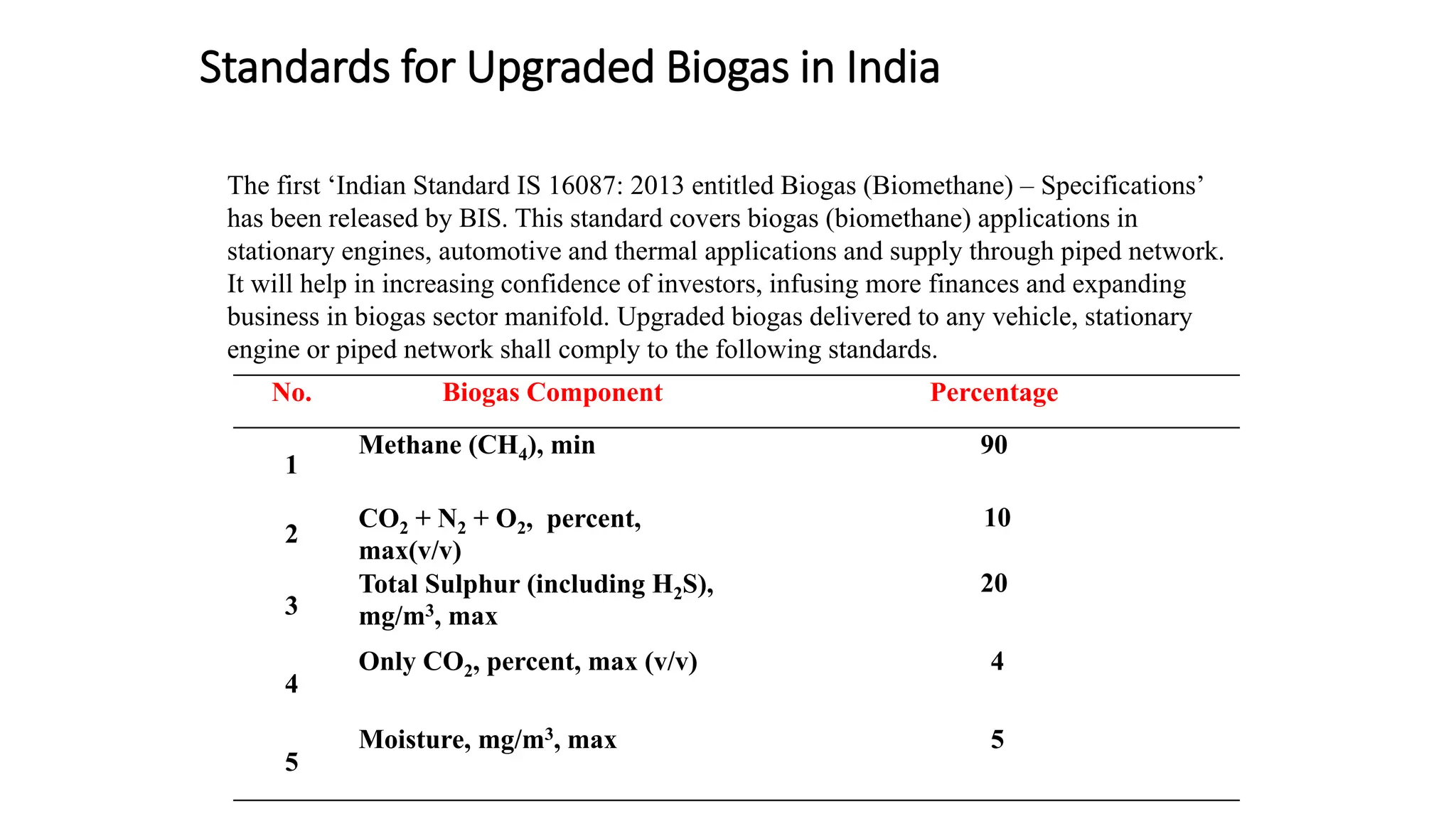
Standards for Upgraded Biogas in India
The first ‘Indian Standard IS 16087: 2013 entitled Biogas (Biomethane) – Specifications’
has been released by BIS. This standard covers biogas (biomethane) applications in
stationary engines, automotive and thermal applications and supply through piped network.
It will help in increasing confidence of investors, infusing more finances and expanding
business in biogas sector manifold. Upgraded biogas delivered to any vehicle, stationary
engine or piped network shall comply to the following standards.
No. Biogas Component Percentage
1
Methane (CH4), min 90
2
CO2 + N2 + O2, percent,
max(v/v)
10
3
Total Sulphur (including H2S),
mg/m3, max
20
4
Only CO2, percent, max (v/v) 4
5
Moisture, mg/m3, max 5
Models for Integrated Technology Packages for Commercialization
and Entrepreneurship
To fulfil the demand of cooking, power and transportation fuel in rural, semi-urban and
urban areas along with the sustainability.
• Model 1: Domestic biogas plants
– Domestic biogas plant in rural area (cattle manure based)
– Domestic biogas plant in urban area (kitchen waste based)
• Model 2: Commercial biogas plant through Entrepreneurial mode
– Biogas plant for gas distribution through pipeline network for cooking
– Biogas plant for small scale power generation
• Model 3: Rice straw based biogas plant for power generation
• Model 4: Industrial application of biogas plant in rural area
• Model 5: Large scale commercial biogas plant
– Biogas plant based on industrial waste/STP/MSW/ for bio-CNG production for automotive application
– Biogas plant based on industrial waste/STP/MSW/ for power generation
Rajasthan Go Seva Sangh Plant, Jaipur (1st pilot Model )
MGVAS Bhilwara Plant (2nd pilot Plant)
Community Level Biogas Plant for Piped
Distribution of Raw Biogas Near Valsad ( Gujarat)
Biogas upgradation and bottling plant at Nasik, Maharashtra
Water Scrubbing and PSA
system at Nasik
High Pressure Compressor
at Nasik plant
Cylinder Cascade for
bottled biogas
Biogas Production Plants
Biogas Upgrading and Bottling Plant at Tohana, Haryana
Biogas from kitchen waste in IIT Delhi campus,
biogas upgrading and filling in vehicle & other
field experiences
https://www.youtube.com/watch?v=1jwio9f2Xc4&t=16s - IIT Delhi pilot model of kitchen waste
biogas plant and biogas upgradation using water scrubber and filling in a car in IIT Delhi
https://youtu.be/ID3mzIgEc-0 -- Bhilwara Rajasthan Goshala System -biogas for cooking,
lighting and vehicular application
https://web.iitd.ac.in/~vkvijay/video/VID-20180320-WA0002.mp4 - Lamba Kangadi village
District Hoshiyarpur, Punjab System for piped biogas distribution in house holds for cooking
and slurry management in cooperative mode
IIT Delhi kitchen waste biogas and car video
Video – Bhilwara Rajasthan Gosala
Lamba Kangri village in Punjab- A model of
piped distribution of biogas
Bio – Slurry
Golden Resource for Soil health
Benefits of Biogas Digested Slurry
Biogas digested slurry produced through anaerobic digestion is a
nutrient-rich material generally directly applied after production
on agricultural land as a fertiliser, thereby replacing manmade
artificial fertilisers and/or soil conditioners.
• Enhanced soil quality
• Increased crop yields
Bio Slurry Utilisation
1. The cost of proper disposal of slurry would come to about Rs 1/ltr
2. Fortunately Organic carbon concept is getting traction in agriculture. Bio slurry is
the best source of it.
3. OC in slurry
Parameters Biogas slurry
Total N%
Total P2O5
Total K2O
Organic carbon
Zinc mg/kg
Copper mg/kg
Manganese mg/kg
1.40 -1.84
1.10 – 1.72
0.84 – 1.34
35 – 38.40
103.0 - 115.6
50.6 - 67.5
231.0 – 294.7
Utilisable Forms of Biogas Digested Slurry
• Whole digested
• Liquid (liquor) form
• Dried form
• Composted digested slurry
Bio-digested slurry outlet for filling the Tanker
Bio-digested slurry filled in the Tanker and sprayed in the fields
Organic / bio manure used in liquid form
Bio-fertilizer
Unnat Bharat Abhiyan
Transforming higher education and villages for atmnirbhar bharat
Fostering Community Engagement for Transforming Higher Educational Institutions of India
शिशित भारत – सिम भारत – स्वस्थ भारत – संपन्न भारत – आत्मशिभभर भारत
Prof. Virendra K. Vijay, IIT Delhi
National Coordinator: Unnat Bharat Abhiyan, a flagship program of MoE, GoI
Member: SERB, MoS&T, GoI
Member: BoG, IIT Bhilai, Chattisgarh
Member: Academic Committee , Indian Naval Academy ( INA), Kerala
• Adoption of 5 villages by every UBA institution
• Engagement with the village community through
participatory approach to understand rural problems
• Knowledge support focused at providing solutions to the
identified problems as per the local needs
• Engagement with relevant stakeholders such as UBA SEGs,
voluntary organizations, self-help groups, village
administration for effective implementation of rural
solutions on the ground
• Convergence with various government programmes and
schemes for efficient addressal of rural problems at large
• Opportunities for development of students and faculty of
education institutes
• Financial support for rural development initiatives
How Unnat Bharat Abhiyan works?
Knowledge - sharing
Field implementation
Convergence partners, 2021
Launch of Unnat Bharat Abhiyan book of achievements:
“Transforming Higher Education and Villages for Atmanirbhar Bharat”
• Launched on September 3, 2022 by Sh. Dharmendra Pradhan, Hon’ble Education Minister in the presence of Smt. Droupadi
Murmu, Hon’ble President of India at IIT Delhi
• Captures S&T interventions by participating institutes in villages across the country
“The completion of eight years of the
Unnat Bharat Abhiyan is a momentous
occasion.
Unnat Bharat Abhiyan is an initiative
that is playing the role of an enabler in
transforming the rural landscape. The
Abhiyan is pivotal in leveraging the
intent and energy of our talented minds
to devise solutions to accelerate
sustainable and holistic growth of rural
India.”
The need to orient the academic system to practically understand societal issues and
address real-life challenges in villages is realized!
Unnat Bharat Abhiyan facilitates sustainable rural development
through Higher Educational Institutions
Unnat Bharat Abhiyan has a pan-India network of Higher
Education Institutions and villages
Unnat Bharat Abhiyan – working towards
sustainable rural solutions
• Unnat Bharat Abhiyan is a flagship program of the Ministry of
Education, Government of India, launched in 2014
• Working towards sustainable and holistic development of villages
through involving the workforce in higher education institutes of
the country
• The focus is on achieving sustainability in all aspects such as
agriculture, water, basic amenities like education etc. including
renewable energy
• UBA works on the principles of knowledge sharing, participatory
approach, and convergence
Organic Farming Water Management Renewable Energy Basic Amenities Artisans, Industries and
Livelihood
• UBA has a network of 13 subject expert groups
spread across India which provide expert
guidance to the UBA network working in villages
S. No.
Subject Expert Groups- (SEG) Name
Institute
1 Rural Energy Systems IIT Delhi
2 Rural Craft and Artisans Development IIT Kanpur
3 Sanitation & Solid Waste Management IIT Madras
4 Liquid Waste Management IIT Delhi
5 Rural Infrastructure NIT Delhi
6 Ethos in Technical Institutions IIT Mumbai
7 Water Resource Management IIT Kharagpur & GSIT
Indore
8 Sustainable Agriculture System IARI New Delhi
9 Capacity Building ,Strategy for Convergence and
Implementation of Various Govt. Schemes
NIRD&PR, Hyderabad
10 Skill Development, Entrepreneurship, Start-ups and
Digital Knowhow
AICTE
11 Curriculum Reforms and Educational Institutions
Social Responsibility
UGC
12 Improvement in School Education IIT Delhi
13 Others and Covid 19 related IIT Delhi
Sustainable solutions
for village problems
Key success stories under UBA
8 Gram Sabhas organised Survey conducted through PRA
and identified problems
VDP made
with Gram
Panchayat and
worked on it
Development of rigid pavement road
network and underground drainage system
Design and development (in process)
of Sewage Treatment Plant
Convergence
with
Maharashtra
Government
Design and survey for plan for water supply system
Rajarambapu Institute of Technology, Rajaramnagar, Sakharale
Participatory
Rural
Appraisal
Knowledge
sharing
20 Gram Sabhas for
community engagement
and made village development
plan as per need identification
Provided agriculture seeds
as per geographical location
Women empowerment through livelihood generation using S&T intervention based on locally-available
resource material
Pattal making machine
( 13 SC/ST women )
Machine for Baria, Seviyan,
Pickle, Murabba, Cotton Razai
Mushroom cultivation training
Knowledge
sharing
Funding
through
institute and
Convergence
with KVK
Participatory
Rural
Appraisal
Career Point University, Hamirpur
Gram Sabhas
Khurampur Cluster
Vrindavan Cluster
24 Gov. schools and 10 villages in Vrindavan cluster with 12 interventions in School
Education
Easy accessible clinic at
Khurampur Cluster
Resource mapping at Agra
cluster by students through
rural internship
Convergence In Khurampur
• IREDA funded street solar lights
• National Backward Classes Finance &
Development Corporation (NBCFDC) funded
for Improved Pottery Kiln for livelihood
generation
• Ministry of Ayush
Indian Institute of Technology Delhi
Participatory
Rural
Appraisal
Convergence
Gram Sabha
Resource mapping at
Gandikhata by students
through rural internship
Pandit Deendayal Upadhyaya Gram Sankul Pariyojna
1. Model nursery construction
2. Plant distribution to villagers - Amla, lemon and lemon
grass
3. Seed distribution to farmers
Through ONGC Project
1. Smokeless cookstove
3. Mushroom cultivation
4. Family size biogas (in
process)
5. Grinding and marketing of
spices (in process)
2. Lemon grass cultivation
Other activities:
1. Govt. school visit with IITs students and UBA staff to
teach students and give career guidance
2. SHG formation and bring into NRLM folder
3. Farmer interaction along with District Agriculture/
Horticulture and dairy development officials with help of
Surabhi Foundation/ local NGO
Indian Institute of Technology Delhi
Gaindikhata cluster
Convergence
Participatory
Rural
Appraisal
Universal Load Carrier
Trolley
Problem: No nearby place of fuel refilling and huge
costs of fuel for transporting heavy load from one
place to another
Solution: Designed low cost electrically-propelled
load-carrying trolley
Problem: No mechanized system for installation, repair
and maintenance work in the village done at a height
from the ground
Solution: Provided low cost self-propelled hydraulic lift
to carry out activities such as roof corrections, solar
lighting maintenance, and fruit collection and
maintenance of trees
Indo Global College of Management and Technology, Punjab
Mobile Hydraulic Lift
Knowledge
sharing
• Provided pure drinking water free of cost to school children,
especially in tail-end areas
• Installed RO with a capacity to purify 100 litres of water per hour
• Hope to operate for about two to three hours a day so that it can
provide 500 litres - its full capacity per day
• The waste water that is generated at the RO plants is shared by
residents around the school for gardening and cleaning purposes
SRM Institute of Science and Technology, Chennai
Reverse osmosis plants for rural water treatment
Knowledge
sharing
We need Holistic Growth with Social justice
in 21st Century to mitigate climate change
Thank you

About Biogas and it utilization by Prof V.K Vijay IITD.pdf

  • 1.
    The Basics ofBiogas, Different , feedstock, Potential, Socio- Economic Benefits, and Biogas Upgradation Methods Earth provides enough to satisfy every man’s needs, but not every man’s greed - Mahatma Gandhi Prof. Virendra K. Vijay Centre for Rural Development and Technology, IIT Delhi Hauz Khas, New Delhi - 110016 vkvijay@rdat.iitd.ac.in , http://web.iitd.ac.in/~vkvijay/ National Coordinator – Unnat Bharat Abhiyan, MoE, GoI Member: Academic Committee, Indian Naval Academy ( INA) Kerala Member: BoG, IIT Bhilai Chattisgarh Convener – Scientific Utilisation and Research Augmentation Through, MoST, GoI General Secretary, Biogas Forum- India ( BIGFIN) ( A movement for biogas and bio fertilizer development in India) Member: Governing Body, Lakshmibai College, Delhi University
  • 2.
    Traditional Indian lifestyleof people focused on environment friendliness ॐ सर्वे भर्वन्तु सुखिनः । सर्वे सन्तु ननरामयाः । र्वसुधेर्व क ु टुम्बकम सर्वे भद्रानि पश्यन्तु। मा कनित् दुः ि भाग्भर्वेत्॥ ॐ शाखन्तः शाखन्तः शाखन्तः ॥ 21st Century – Environmental issues – in air, water, soil, health, agriculture etc • Age-old traditions symbolize respect towards environment - many trees are considered sacred and are worshipped - some rivers and mountains are considered holy - animals are worshipped too e.g. snakes, cows etc. • Due to less technological development and penetration, day-to-day functions were sourced from locally-available resources e.g. biomass was a source of energy in every household • Water conservation and management has been a household practice since Harappan times • In general, living in harmony with the environment was a way of life
  • 3.
    Present lifestyle callsfor a mega-shift to sustainable energy sources • Over Exploitation of resources, Green House Gases, climate change, SDGs and Green Technologies • Over-exploitation of resources is common without putting measures in place to replenish them e.g. large scale deforestation for settlements, mining etc. • Commonly used energy sources comprise coal and oil, which meet 74% of our energy demand today • Pollution, global warming, greenhouse gas emissions, centralized technologies and urban development models are ringing alarm bells • As a result, natural calamities are increasingly making news such as disease outbreaks, pandemics, flash floods, cyclones, earthquakes, landslides, animal extinction etc. There is an urgent need to move to sustainable energy solutions keeping environmental priorities in mind.
  • 4.
    POTENTIAL OF BIOGASIN INDIA  Total Bovine population (Cattle, Buffalo, Mithun and Yak) is 302.79 Million in 2019. Farm families : 75 million The total Poultry in the country is 851.81 Million in 2019, Own 4 or more cattle : 43 million Potential of setting up family size BGP : 12 million Established 50.8 lakh (5.08 Million) upto Nov 2022 India Globally stands at 2nd position after China, in dissemination of small family size Households Biogas Plants. 4
  • 5.
    Potential: UNIDO Study2019 5  Poultry Industry  Sugar Industry (Press mud)  Fruit and vegetable Processing industry  Cattle farm (cattle dung). Annual Biogas Generation Potential: 20,106 million m3 Can produce about 8.043 million Tonnes Bio-CNG or 5,138 MW Power. Can be exploited to generate power or for thermal energy use and cooking Proper utilization of wastes would help in plug the power deficit of the country. Priority SME sector, where despite large waste generation and energy potential, the existing resource remain unexploited for energy conversion
  • 6.
  • 7.
    Support under SATAT Initiative (Sustainable Alternative Towards Affordable Transportation) CBG ProductionPlant Guarantee Production offtake by Cascades / Pipelines Co-mingling of CBG with Natural Gas in City Gas Distribution network for Transport and Domestic purpose OFFATKE of Biogas by OMCs Offtake by Fertilizer companies Branding / Retailing OFFATKE of Biofertilizer by Fertilizer Companies Minimum procurement price is Rs. 54/- per kg plus GST. Biogas Biofertilizer Fertilizer companies to ensure offtake of FOM with chemical fertilizers. Guarantee Production offtake where Public Sector OMC buy CBG at fixed rate
  • 8.
    The potential forCompressed Bio-Gas production from various sources in India is estimated at about 62 million tonnes per annum. 15 MMT CBG 5,000 CBG Plants 62 MMT CBG POTENTIAL 5000 CBG plants are expected to produce 15 million tonnes of CBG per annum by 2023 Letter of Intends for over 3,500 CBG plants issued by OMCs by Aug 2022. TARGET 37 CBG commissioned (9019TPD) BioCNG ACHIEVEMENT Note: Achievement as on 30.09.2022 Plant type Capital Requirement Biogas plant Rs 6-7 Cr for 12000 m3/day generation capacity BioCNG plant Rs 20-25 Cr for 4800 kg/day BioCNG generation capacity Power plant based on Biogas Rs 10-11 Cr per MW
  • 9.
    OBJECTIVES • To provideclean gaseous fuel mainly for cooking and lighting purposes for individual households by setting up of small biogas plants in the capacity range from 1 m3 to 25 m3; • To promote setting up of biogas based power generation (off-grid) projects for power generation in the capacity range (3 kW to 250 kW) and thermal energy from the biogas produced from Biogas plants of size greater than 25 m3 up to 2500 m3 size • To mitigate drudgery of rural women and reduce pressure on forests; • Creation of a pool of skilled manpower for all developmental activities for biogas technology and entrepreneurial ventures. 9 Biogas Programme 26-02-2023
  • 10.
    Subsidy in BiogasProgramme (1 to 25 m3) 10 S N Particulars Biogas Programme A CFA 1m3 2-4 m3 6 m3 8-10 m3 15 m3 20-25 m3 1 NER States / Hilly States / Special Category States and SC/ST of all states 17 22 29.2 34.5 63.25 70.4 2 All other States (General Category) 9.8 14.35 22.7 23 37.95 52.8 B 1 CFA for linking with sanitary toilets 1.6 1.6 1.6 1.6 Nil Nil B 2 CFA for biogas plant linked with biogas slurry filter unit 1.6 1.6 1.6 1.6 1.6 1.6 C. Turn-Key Job Fee for construction, of biogas plants • ₹ 3,000/- plant fixed dome design from 1 to 10 m3 and • ₹ 5,000/- per plant for 15 to 25 m3 D. Adm Charges– to State PIA (Amount in ₹ ) 1 100 - 1999 nos. Plants. 1,00,000 2 2,000 - 5,000 nos plants 10,50,000 3 Above 5,000 nos. plants 24,50,000 26-02-2023
  • 11.
    • Administrative Chargestowards Supervision, DPR & Inspection • 20% additional CFA for SC/ST, NER, Island & Registered Gaushalas Subsidy in Biogas Programme (>25 to 25000 m3) 11 Power Gen. Capacity (kW) CFA Adm Charges for PIA Power Generation Thermal Application Power Generation Thermal application 3 KW – 50 kW ₹45,000 per kW ₹ 22,500 per kWeq thermal/ cooling 10% of the CFA 5% of the CFA >50 KW –200 kW ₹40,000 per kW ₹ 20,000/- per kWeq thermal/ cooling ₹2,00,000/- (fixed) ₹1,00,000/- (fixed) >200 kW – 250 kW ₹35,000 per kW ₹17,500/- per kWeq thermal/ cooling ₹2,50,000/- (fixed) ₹1,00,000/- (fixed) 26-02-2023
  • 12.
    Physical Targets /Budget under Biogas Programme 12 S N Year Proposed Physical Targets (Nos. Of Biogas Plants) ( in numbers) Proposed financial outlay as per the physical goals (₹ in Crores) Small size biogas plants Medium size (>25m3 to 2500 m3) 1 2022-23 22,500 22 42.50 + 5.50 = 48.0 3 2023-24 46,000 22 89.50 + 5.50 = 95.0 4 2024-25 48,000 25 94.00 + 6.25= 100.25 5 2025-26 50,000 25 99.00+6.25 = 105.25 Total 1,66,500 94 325+23.50= 348.50 26-02-2023
  • 13.
    Biogas Implementing Organizationsand Strategy  State Government/ Union Territories Departments ( Agriculture & Rural Development)  State Government/ Union Territories Agencies  Khadi and Village Industries Commission (KVIC)  National Dairy Development Board (NDDB)  Biogas Development and Training Centres (BDTCs)  Implementation following cluster of Villages/ Blocks/Districts.  Implementation approach through entrepreneurs mode.  Implementation activities monitored through Monthly and Quarterly Progress Reports.  CFA will be released to PIA based on actual achievements (quarterly ) 13 26-02-2023
  • 14.
    Eight BDTCs arebeing supported at various IITs/ Universities to cover all States/ UTs with the following functions:- i. Training of Users, Biogas Masons, SND/SNA, District/State Officers and Turn-Key Workers/ Rural Energy Technicians (RETs) ii. R&D on new biogas technologies / new models of biogas plants. iii. Testing and evaluation of new models of biogas plants and burners/stoves in labs and field testing to have assessment for long period field validations. iv. Field monitoring and inspections of already installed and under installation biogas plants for further implementation improvements and suggestions. v. Development of Biogas Training & Awareness Material. vi. Inspection of Biogas plants in a year in certain Blocks/ Talukas of the Districts, selected on random basis. Biogas Development and Training Centers (BDTCs) 14 26-02-2023
  • 15.
  • 16.
  • 17.
  • 18.
    Benefits of Biogas Plants Environmentally Friendly CleanCooking Medium (Minimal recurring cost over lifetime) Socio Economic Benefits: Time saved for women - 2.30 ~ 4 hrs. per day 18 Output of biogas plant Annual Biogas generation from a 2 m3 Biogas plant = 540 m3 /year 1 m3 Biogas Equivalent Equivalent Quantity of LPG produced per year No of Domestic cylinder per year Market Rate of LPG Cylinder Annual Amount saved Subsidy On LPG (PM- Ujjwala) Amount saved on LPG Subsidy per year 0.43 kg of LPG 0.43x 540 = 232 Kg 232/14.2 = 16 ₹ 1050 ₹ 16,800 / yr ₹ 200/ cylinder ₹ 3,200 Output of biogas Annual Organic Manure (30 % Moisture) generation from a 2 m3 Biogas plant= 10.2 Ton of organic manure / year/ Plant Fertilizers Nutrient in Biogas based Organic Manure ( NPK) Fertilizer produced (Equiv. Qty) Market Rate of Fert. ₹/kg Amt saved Subsidy On ferti. ₹/kg Amt saved on ferti Subsidy Urea (46%N2) 2 % Nitrogen 434 Kg 5.36 2,300 98 ₹ 19,992 DAP(46%P2O5 1 % Phosphorus 220 Kg 22 4,800 66 6,732 MoP(60%K2O 1% Potash (K2O) 170 Kg 17.44 2,950 23 2,346 Total Yearly saved Amt on Fertilizer (₹) 10,050 29,070 26-02-2023
  • 19.
    2/26/2023 MNRE |May 2020 19
  • 20.
    Factors Affecting OptimumBiogas Production • Temperature ( 35-37 C Mesophilic condition ) • C/N ratio ( optimum between 25:1 to 30:1) •pH ( optimally pH between 6.8-7.2) • Solid content ( feed material should have approx. 10:1 ) • Should not have toxic material/ harmful material to bacteria in digester • HRT ( Hydraulic Retention Time – 30, 40, 55 days) • Loading rate
  • 21.
    IIT Delhi BiogasPlant 20 m3/ Day First biogas fuel-based Vehicle of India
  • 22.
    Pipeline for rawbiogas use as a cooking fuel Raw biogas cookstove Biogas lamp Biogas Engine for electricity production Utilization of Raw Biogas
  • 23.
    Characteristics of RawBiogas Compound % Methane CH4 55–65 Carbon dioxide CO2 35–45 Nitrogen N2 0–10 Hydrogen H2 0–1 Hydrogen Sulfide H2S 0–3 Moisture Saturated Average calorific value of biogas is 20 MJ/m3 (4713 kcal/m3) Equivalent quantity of fuel for 1 m 3 of biogas Name of the fuel Kerosene Fire-wood Cowdung cakes Charcoal Soft coke Butane Furnace Oil Coal gas Electricity Equivalent quantities to 1 m3 of Bio-gas 0.620 3.474 kg 12.296 kg 1.458 kg 1.605 kg 0.433 kg 0.4171 1.177 m3 4.698 kWh Commonly used fuels Calorific values in Kilo calories Thermal efficiency % Bio-gas 4713/m 3 60 Dung cake 2093/kg 11 Firewood 4978/kg 17.3 Diesel (HSD) 10550/kg 66 Kerosene 10850/kg 50 Petrol 11100/kg ---
  • 24.
    Conventional biogas plantsin India 1. Fixed dome type 2. Floating drum type 3. Bag type • Deenbandhu model with brick masonry • Deenbandhu ferrocement model • Pre-fabricated RCC fixed-dome • Janta biogas plant KVIC floating metal drum type KVIC type plant with ferrocement digester and fibre glass reinforced plastic gas holder Pragati model Flexi Model
  • 29.
    Deenbandhu biogas plant Mixing tank Gasoutlet pipe Plinth level Outlet tank cover Displacement Chamber Outlet Tank Slurry Discharge Hole Digester Outlet gate Gas storage Area Inlet Pipe Foundation Initial slurry level
  • 30.
    Flexible Balloon Digester Originatedin Taiwan, China, in the 1960s. Rectify - problems experienced with brick and metal digesters. Material - Neoprene coated nylon - PVC - RMP – Red mud plastic (produced from the residue from aluminum refineries) The membrane digester is extremely light Can be installed easily by excavating a shallow trench, slightly deeper than the radius of the digester. Simple construction, prefabricated, digester cost is low.
  • 31.
  • 33.
  • 34.
    Biogas to Power 1m³of biogas can be converted to around 1.7 kWhel
  • 35.
    Some Biogas basedPower Projects in India Sant Shree Asa Ram Ji Gaushala Trust, Village – Khanpur, Jassar Road, Tehsil & District – Ludhiana, Punjab, 300 Cum per day, 50 KVA/40kW
  • 36.
    The Lambra KangriMultipurpose Coorporative Services Society Ltd., Hoshiyarpur, 100 Cum per day
  • 37.
    Biogas-Toilets linked systemunder the Swachh Bharat scheme
  • 38.
    Raw Biogas UpgradedBiogas • A low Grade fuel (CH4 55-65 % & CO2 35-45 %) with lower percentage of methane. • Mode of utilisation • The presence of CO2 besides being non combustible, restrains its compressibility there by making biogas difficult to be stored in containers. • A high grade fuel (CH4 > 90 % and < 10 % other gases) with high percentage of methane. • Mode of utilisation • Remote applications • Methane burns faster hence yields a higher specific output and thermal efficiency compared to raw biogas when used as engine fuel. • Upgrading , compression and bottling facilitates easy storage and transportation as a vehicle fuel
  • 39.
    Upgraded and bottledbiogas for use as a cooking fuel Cascades of Upgraded biogas being transported Biogas Motorcycle in Thailand Biogas car in Sweden Biogas Train in Sweden Biogas Car in India Utilization of Upgraded Biogas
  • 40.
    Compression of Biogas •The energy density of upgraded biogas is comparatively low at ambient pressure and as a result it must be compressed at high pressures (e.g. 200-250 bar) to allow its sufficient storage in bottles/cylinders. • Biogas Compression • reduces storage space requirements, • concentrates energy content and • increases pressure to the level needed to overcome resistance to gas flow. • Compression can eliminate the mismatch of pressures and guarantee the efficient operation of the equipment.
  • 41.
    Techniques for BiogasUpgrading Absorption Adsorption Pressure Swing Adsorption Cryogenic Membrane Water Scrubbing Physical Scrubbing Chemical Scrubbing Low Pressure Gas – Liquid separation High Pressure Gas – Gas separation  The established technologies for the removal of CO2 from biogas are based on the differences in molecular, thermodynamic and transport properties of the gaseous components in biogas.
  • 42.
    Water Scrubbing basedBioCH4 and BioCO2 Production System at IIT Delhi WS1 WS2
  • 44.
    Mobile Biogas UpgradationSystem developed at IIT Delhi
  • 45.
    Food waste toBiogas Plant in IIT Delhi Food waste Segregation Pulverisation Homogeneous Food Waste Introduction of Food waste + Water into biogas plant through Inlet
  • 46.
    20m3/day Food wastebased Biogas Plant
  • 47.
    25m3/h Water Scrubbingbased Biogas Upgradation Plant
  • 48.
    Standards for UpgradedBiogas in India The first ‘Indian Standard IS 16087: 2013 entitled Biogas (Biomethane) – Specifications’ has been released by BIS. This standard covers biogas (biomethane) applications in stationary engines, automotive and thermal applications and supply through piped network. It will help in increasing confidence of investors, infusing more finances and expanding business in biogas sector manifold. Upgraded biogas delivered to any vehicle, stationary engine or piped network shall comply to the following standards. No. Biogas Component Percentage 1 Methane (CH4), min 90 2 CO2 + N2 + O2, percent, max(v/v) 10 3 Total Sulphur (including H2S), mg/m3, max 20 4 Only CO2, percent, max (v/v) 4 5 Moisture, mg/m3, max 5
  • 49.
    Models for IntegratedTechnology Packages for Commercialization and Entrepreneurship To fulfil the demand of cooking, power and transportation fuel in rural, semi-urban and urban areas along with the sustainability. • Model 1: Domestic biogas plants – Domestic biogas plant in rural area (cattle manure based) – Domestic biogas plant in urban area (kitchen waste based) • Model 2: Commercial biogas plant through Entrepreneurial mode – Biogas plant for gas distribution through pipeline network for cooking – Biogas plant for small scale power generation • Model 3: Rice straw based biogas plant for power generation • Model 4: Industrial application of biogas plant in rural area • Model 5: Large scale commercial biogas plant – Biogas plant based on industrial waste/STP/MSW/ for bio-CNG production for automotive application – Biogas plant based on industrial waste/STP/MSW/ for power generation
  • 50.
    Rajasthan Go SevaSangh Plant, Jaipur (1st pilot Model )
  • 51.
    MGVAS Bhilwara Plant(2nd pilot Plant)
  • 52.
    Community Level BiogasPlant for Piped Distribution of Raw Biogas Near Valsad ( Gujarat)
  • 53.
    Biogas upgradation andbottling plant at Nasik, Maharashtra Water Scrubbing and PSA system at Nasik High Pressure Compressor at Nasik plant Cylinder Cascade for bottled biogas Biogas Production Plants
  • 54.
    Biogas Upgrading andBottling Plant at Tohana, Haryana
  • 55.
    Biogas from kitchenwaste in IIT Delhi campus, biogas upgrading and filling in vehicle & other field experiences https://www.youtube.com/watch?v=1jwio9f2Xc4&t=16s - IIT Delhi pilot model of kitchen waste biogas plant and biogas upgradation using water scrubber and filling in a car in IIT Delhi https://youtu.be/ID3mzIgEc-0 -- Bhilwara Rajasthan Goshala System -biogas for cooking, lighting and vehicular application https://web.iitd.ac.in/~vkvijay/video/VID-20180320-WA0002.mp4 - Lamba Kangadi village District Hoshiyarpur, Punjab System for piped biogas distribution in house holds for cooking and slurry management in cooperative mode
  • 56.
    IIT Delhi kitchenwaste biogas and car video
  • 57.
    Video – BhilwaraRajasthan Gosala
  • 58.
    Lamba Kangri villagein Punjab- A model of piped distribution of biogas
  • 59.
    Bio – Slurry GoldenResource for Soil health
  • 60.
    Benefits of BiogasDigested Slurry Biogas digested slurry produced through anaerobic digestion is a nutrient-rich material generally directly applied after production on agricultural land as a fertiliser, thereby replacing manmade artificial fertilisers and/or soil conditioners. • Enhanced soil quality • Increased crop yields
  • 61.
  • 62.
    1. The costof proper disposal of slurry would come to about Rs 1/ltr 2. Fortunately Organic carbon concept is getting traction in agriculture. Bio slurry is the best source of it. 3. OC in slurry Parameters Biogas slurry Total N% Total P2O5 Total K2O Organic carbon Zinc mg/kg Copper mg/kg Manganese mg/kg 1.40 -1.84 1.10 – 1.72 0.84 – 1.34 35 – 38.40 103.0 - 115.6 50.6 - 67.5 231.0 – 294.7
  • 63.
    Utilisable Forms ofBiogas Digested Slurry • Whole digested • Liquid (liquor) form • Dried form • Composted digested slurry
  • 64.
    Bio-digested slurry outletfor filling the Tanker
  • 65.
    Bio-digested slurry outletfor filling the Tanker
  • 66.
    Bio-digested slurry filledin the Tanker and sprayed in the fields
  • 67.
    Organic / biomanure used in liquid form
  • 68.
  • 69.
    Unnat Bharat Abhiyan Transforminghigher education and villages for atmnirbhar bharat Fostering Community Engagement for Transforming Higher Educational Institutions of India शिशित भारत – सिम भारत – स्वस्थ भारत – संपन्न भारत – आत्मशिभभर भारत Prof. Virendra K. Vijay, IIT Delhi National Coordinator: Unnat Bharat Abhiyan, a flagship program of MoE, GoI Member: SERB, MoS&T, GoI Member: BoG, IIT Bhilai, Chattisgarh Member: Academic Committee , Indian Naval Academy ( INA), Kerala
  • 70.
    • Adoption of5 villages by every UBA institution • Engagement with the village community through participatory approach to understand rural problems • Knowledge support focused at providing solutions to the identified problems as per the local needs • Engagement with relevant stakeholders such as UBA SEGs, voluntary organizations, self-help groups, village administration for effective implementation of rural solutions on the ground • Convergence with various government programmes and schemes for efficient addressal of rural problems at large • Opportunities for development of students and faculty of education institutes • Financial support for rural development initiatives How Unnat Bharat Abhiyan works? Knowledge - sharing Field implementation Convergence partners, 2021
  • 71.
    Launch of UnnatBharat Abhiyan book of achievements: “Transforming Higher Education and Villages for Atmanirbhar Bharat” • Launched on September 3, 2022 by Sh. Dharmendra Pradhan, Hon’ble Education Minister in the presence of Smt. Droupadi Murmu, Hon’ble President of India at IIT Delhi • Captures S&T interventions by participating institutes in villages across the country
  • 73.
    “The completion ofeight years of the Unnat Bharat Abhiyan is a momentous occasion. Unnat Bharat Abhiyan is an initiative that is playing the role of an enabler in transforming the rural landscape. The Abhiyan is pivotal in leveraging the intent and energy of our talented minds to devise solutions to accelerate sustainable and holistic growth of rural India.”
  • 74.
    The need toorient the academic system to practically understand societal issues and address real-life challenges in villages is realized! Unnat Bharat Abhiyan facilitates sustainable rural development through Higher Educational Institutions
  • 75.
    Unnat Bharat Abhiyanhas a pan-India network of Higher Education Institutions and villages
  • 76.
    Unnat Bharat Abhiyan– working towards sustainable rural solutions • Unnat Bharat Abhiyan is a flagship program of the Ministry of Education, Government of India, launched in 2014 • Working towards sustainable and holistic development of villages through involving the workforce in higher education institutes of the country • The focus is on achieving sustainability in all aspects such as agriculture, water, basic amenities like education etc. including renewable energy • UBA works on the principles of knowledge sharing, participatory approach, and convergence Organic Farming Water Management Renewable Energy Basic Amenities Artisans, Industries and Livelihood
  • 77.
    • UBA hasa network of 13 subject expert groups spread across India which provide expert guidance to the UBA network working in villages S. No. Subject Expert Groups- (SEG) Name Institute 1 Rural Energy Systems IIT Delhi 2 Rural Craft and Artisans Development IIT Kanpur 3 Sanitation & Solid Waste Management IIT Madras 4 Liquid Waste Management IIT Delhi 5 Rural Infrastructure NIT Delhi 6 Ethos in Technical Institutions IIT Mumbai 7 Water Resource Management IIT Kharagpur & GSIT Indore 8 Sustainable Agriculture System IARI New Delhi 9 Capacity Building ,Strategy for Convergence and Implementation of Various Govt. Schemes NIRD&PR, Hyderabad 10 Skill Development, Entrepreneurship, Start-ups and Digital Knowhow AICTE 11 Curriculum Reforms and Educational Institutions Social Responsibility UGC 12 Improvement in School Education IIT Delhi 13 Others and Covid 19 related IIT Delhi
  • 78.
    Sustainable solutions for villageproblems Key success stories under UBA
  • 79.
    8 Gram Sabhasorganised Survey conducted through PRA and identified problems VDP made with Gram Panchayat and worked on it Development of rigid pavement road network and underground drainage system Design and development (in process) of Sewage Treatment Plant Convergence with Maharashtra Government Design and survey for plan for water supply system Rajarambapu Institute of Technology, Rajaramnagar, Sakharale Participatory Rural Appraisal Knowledge sharing
  • 80.
    20 Gram Sabhasfor community engagement and made village development plan as per need identification Provided agriculture seeds as per geographical location Women empowerment through livelihood generation using S&T intervention based on locally-available resource material Pattal making machine ( 13 SC/ST women ) Machine for Baria, Seviyan, Pickle, Murabba, Cotton Razai Mushroom cultivation training Knowledge sharing Funding through institute and Convergence with KVK Participatory Rural Appraisal Career Point University, Hamirpur
  • 81.
    Gram Sabhas Khurampur Cluster VrindavanCluster 24 Gov. schools and 10 villages in Vrindavan cluster with 12 interventions in School Education Easy accessible clinic at Khurampur Cluster Resource mapping at Agra cluster by students through rural internship Convergence In Khurampur • IREDA funded street solar lights • National Backward Classes Finance & Development Corporation (NBCFDC) funded for Improved Pottery Kiln for livelihood generation • Ministry of Ayush Indian Institute of Technology Delhi Participatory Rural Appraisal Convergence
  • 82.
    Gram Sabha Resource mappingat Gandikhata by students through rural internship Pandit Deendayal Upadhyaya Gram Sankul Pariyojna 1. Model nursery construction 2. Plant distribution to villagers - Amla, lemon and lemon grass 3. Seed distribution to farmers Through ONGC Project 1. Smokeless cookstove 3. Mushroom cultivation 4. Family size biogas (in process) 5. Grinding and marketing of spices (in process) 2. Lemon grass cultivation Other activities: 1. Govt. school visit with IITs students and UBA staff to teach students and give career guidance 2. SHG formation and bring into NRLM folder 3. Farmer interaction along with District Agriculture/ Horticulture and dairy development officials with help of Surabhi Foundation/ local NGO Indian Institute of Technology Delhi Gaindikhata cluster Convergence Participatory Rural Appraisal
  • 83.
    Universal Load Carrier Trolley Problem:No nearby place of fuel refilling and huge costs of fuel for transporting heavy load from one place to another Solution: Designed low cost electrically-propelled load-carrying trolley Problem: No mechanized system for installation, repair and maintenance work in the village done at a height from the ground Solution: Provided low cost self-propelled hydraulic lift to carry out activities such as roof corrections, solar lighting maintenance, and fruit collection and maintenance of trees Indo Global College of Management and Technology, Punjab Mobile Hydraulic Lift Knowledge sharing
  • 84.
    • Provided puredrinking water free of cost to school children, especially in tail-end areas • Installed RO with a capacity to purify 100 litres of water per hour • Hope to operate for about two to three hours a day so that it can provide 500 litres - its full capacity per day • The waste water that is generated at the RO plants is shared by residents around the school for gardening and cleaning purposes SRM Institute of Science and Technology, Chennai Reverse osmosis plants for rural water treatment Knowledge sharing
  • 85.
    We need HolisticGrowth with Social justice in 21st Century to mitigate climate change Thank you