ABO BLOOD GROUP
DR. MOHAMMED H SAIEM ALDAHR
Faculty of Applied Medical Sciences
BLOOD BANK
MEDICAL TECNOLOGY
KAAU
ABO BLOOD GROUP
 History
1. Landsteiners discovered the ABO Blood Group
System in 1901
2. He and five co-workers began mixing each others red
blood cells and serum together and accidentally
performed the first forward and reverse ABO
groupings.
3. Landsteiners Rule: If an antigen (Ag) is present on a
patients red blood cells the corresponding antibody (Ab) will
NOT be present in the patients plasma, under ‘normal
conditions’.
ABO BLOOD GROUP
 Importance of ABO
There are two principles
1-almost all normal healthy individuals above 3-6
months of age have “ naturally occurring Abs” to the
ABO Ags that they lack
These Abs termed naturally occurring because they
were thought to arise without antigenic stimulation
ABO BLOOD GROUP
 Importance of ABO
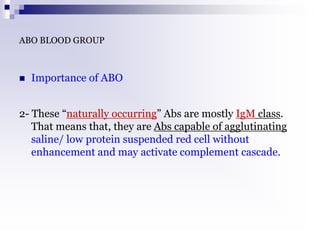
2- These “naturally occurring” Abs are mostly IgM class.
That means that, they are Abs capable of agglutinating
saline/ low protein suspended red cell without
enhancement and may activate complement cascade.
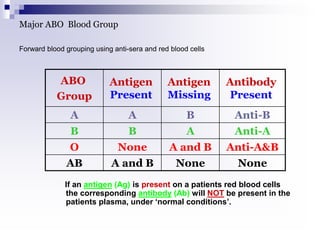
Major ABO Blood Group
Forward blood grouping using anti-sera and red blood cells
ABO
Group
Antigen
Present
Antigen
Missing
Antibody
Present
A A B Anti-B
B B A Anti-A
O None A and B Anti-A&B
AB A and B None None
If an antigen (Ag) is present on a patients red blood cells
the corresponding antibody (Ab) will NOT be present in the
patients plasma, under ‘normal conditions’.
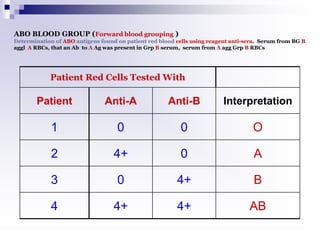
ABO BLOOD GROUP (Forward blood grouping )
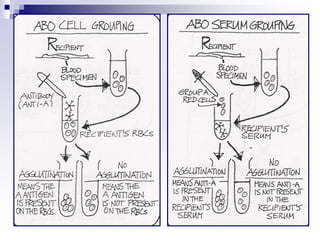
Determination of ABO antigens found on patient red blood cells using reagent anti-sera. Serum from BG B
aggl A RBCs, that an Ab to A Ag was present in Grp B serum, serum from A agg Grp B RBCs
Patient Red Cells Tested With
Interpretation
Anti-B
Anti-A
Patient
O
0
0
1
A
0
4+
2
B
4+
0
3
AB
4+
4+
4
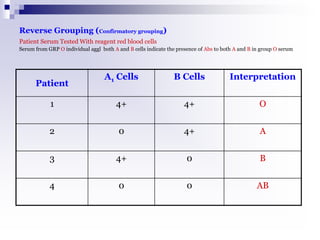
Reverse Grouping (Confirmatory grouping)
Patient Serum Tested With reagent red blood cells
Serum from GRP O individual aggl both A and B cells indicate the presence of Abs to both A and B in group O serum
Interpretation
B Cells
A1 Cells
Patient
O
4+
4+
1
A
4+
0
2
B
0
4+
3
AB
0
0
4
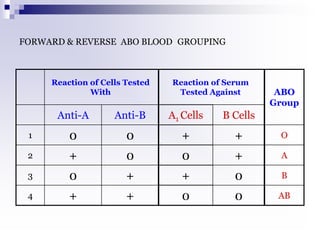
FORWARD & REVERSE ABO BLOOD GROUPING
Reaction of Cells Tested
With
Reaction of Serum
Tested Against ABO
Group
Anti-A Anti-B A1 Cells B Cells
1 0 0 + + O
2 + 0 0 + A
3 0 + + 0 B
4 + + 0 0 AB
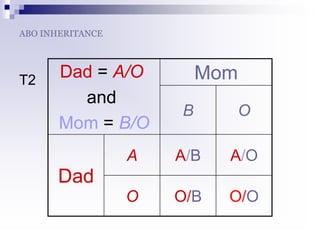
ABO INHERITANCE
T2
Dad = A/O
and
Mom = B/O
Mom
B O
Dad
A A/B A/O
O O/B O/O
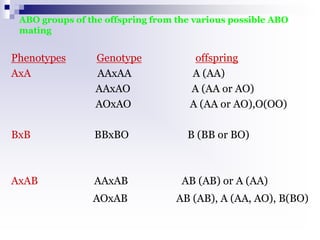
ABO groups of the offspring from the various possible ABO
mating
Phenotypes Genotype offspring
AxA AAxAA A (AA)
AAxAO A (AA or AO)
AOxAO A (AA or AO),O(OO)
BxB BBxBO B (BB or BO)
AxAB AAxAB AB (AB) or A (AA)
AOxAB AB (AB), A (AA, AO), B(BO)
Inheritance
 Definition
Isoagglutinins: are defined as antibodies that agglutinate
blood cells of some individuals of the same species
Glycosyltransferases: are enzyme that facilitate the
transfer of carbohydrate (sugar) molecules onto
carbohydrate precursor molecules
Immunodominant sugar: is the sugar molecule that
complete the antigenic determinant when combined with
the precursor substance
ABH ANTIGEN
 The inheritance of the ABO blood group was
demonstrated that each individual inherits one ABO gene
from each parent and these two genes determine which Ags
are present on RBCs membrane
 One position or Locus, on each chromosome number
nine is occupied by an A, B, or an O gene
ABH ANTIGEN
 A Locus termed H and the final product of the genes at
that locus, H antigen, was necessary for the expression of
normal ABO antigens (Allele: any alternate form of a gene that can occupy a given
chromosomal location (locus).
 ABH Ags of the RBC membrane are found partly as
glycolipids, but primarily as glycoproteins. It may also
occur in the secretion as glycoproteins.
ABH Antigens
 Ags belonging to ABH blood group system are present on
RBCs and other body cells and body fluids.
 The presence of A,B, and O Ags on RBCs depends upon
the allelic genes, A,B, and O
 An H genes at a separate locus codes for the precursor
substance on which the A and B gene products act
 The products of the A and B genes are enzymes that act as
a specific transferases
ABH Antigens
 H gene products is an enzyme that produce H substance
 The O gene is a silent allele
 It does not alter the structure of H substance.
Formation of A1B& H Antigen
 The ABO genes do not code for the production of ABO
antigens, BUT rather produce specific glycosyl
transferases
 ABO produces a specific glycosyl transferases that add
sugars to a basic precursor substance on the RBCs
 A donor nucleotide derivative supplies the sugar that
confers (gives) ABO specificity (is the sugar molecule that
complete the antigenic determinant when combined with
the precursor substance )
 The formation of ABH antigens results from the
interaction of ABO genes with several other separate,
independent blood groups.
Formation of A1B& H Antigen
 The inheritance of at least one H gene (HH or Hh) elicits
(obtain) the production of an enzyme called, α-2-L-
Fucosyl transferase, which transfers the sugar from the
Guanosine diphosphate L-fucose (GDP-Fuc) donor
nucleotide to the terminal galactose of the precursor
chain.
 The H substance must be formed for the other sugars to
be attached in response to an inherited A and /or B genes
ABH Ag
There are two potential precursors substance (PS) both are
comprised of identical sugar (galactos-N- acetyl
gluctosamin - galactose -glucose) but different in linkage.
 Type I PS has a terminal galactose (Gal) linked to a
subterminal N acetylgucoseamine (GlcNAc) in 1-3
linkage
 Type II PS, has the same sugar combine in 1-4 linkage
 ABH Ags on RBCs are derived from Type II chains.
ABO Genetics
 Genes at three separate loci control the occurrence and
location of A and B antigens
1. Hh genes – H and h alleles
 H allele codes for a fucosyltransferase enzyme that
adds a fucose on Type 2 chains (primarily) to form the
H antigen onto which A and B antigens are built on
red blood cells.
 h allele is a silent allele (amorph)
ABO Genetics
 A, B and H antigens are built
on oligosaccharide chains of 4
types. The most common
forms are Type 1 and Type 2.
Type 1: #1 carbon of Gal is
attached to the #3 carbon of
GlcNAc.
Type 2: #1 carbon of Gal is
attached to the #4 carbon of
GlcNAc.
ABO Genetics
2- Se genes – Se and se alleles
 Se allele codes for a fucosyltransferase enzyme that
adds fuscos onto Type 1 chains (primarily) in
secretory glands. Controls expression of H antigens in
secretions (i.e. saliva, body fluids, etc.)
 se allele is an a morph
3. ABO genes – A, B and O alleles
 A and B alleles code for (glycosyltransferase) a
fucosyltransferase enzymes that add a sugar onto H
antigens to produce A and B antigens
 O allele does not code a functional enzyme
ABO Genetics
1. Occurance
a. The presence or absence of the ABH antigens on
the red blood cell membrane is controlled by the H
gene
b. Presence or absence of the ABH antigens in
secretions is indirectly controlled by the
Se genes.
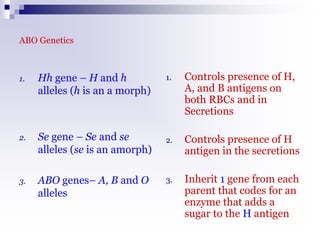
ABO Genetics
1. Hh gene – H and h
alleles (h is an a morph)
2. Se gene – Se and se
alleles (se is an amorph)
3. ABO genes– A, B and O
alleles
1. Controls presence of H,
A, and B antigens on
both RBCs and in
Secretions
2. Controls presence of H
antigen in the secretions
3. Inherit 1 gene from each
parent that codes for an
enzyme that adds a
sugar to the H antigen
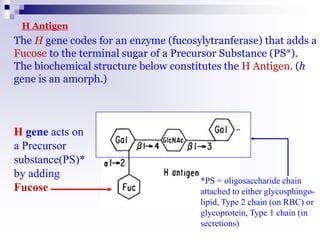
H gene acts on
a Precursor
substance(PS)*
by adding
Fucose
H Antigen
*PS = oligosaccharide chain
attached to either glycosphingo-
lipid, Type 2 chain (on RBC) or
glycoprotein, Type 1 chain (in
secretions)
The H gene codes for an enzyme (fucosylytranferase) that adds a
Fucose to the terminal sugar of a Precursor Substance (PS*).
The biochemical structure below constitutes the H Antigen. (h
gene is an amorph.)
ABO Genetics
 H antigen is the foundation upon which A and B
antigens are built. A and B genes code for
enzymes that add an immunodominant sugar to
the H antigen.
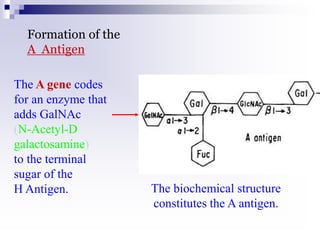
Formation of the
A Antigen
The A gene codes
for an enzyme that
adds GalNAc
(N-Acetyl-D
galactosamine)
to the terminal
sugar of the
H Antigen. The biochemical structure
constitutes the A antigen.
Formation of the
B Antigen
B gene codes for an
enzyme that adds
D-Galactose
to the terminal sugar
of the H Antigen.
The biochemical structure
constitutes the B Antigen.
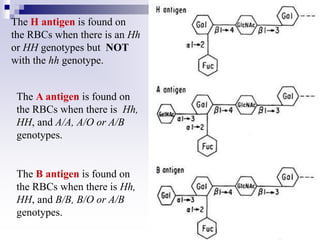
The H antigen is found on
the RBCs when there is an Hh
or HH genotypes but NOT
with the hh genotype.
The A antigen is found on
the RBCs when there is Hh,
HH, and A/A, A/O or A/B
genotypes.
The B antigen is found on
the RBCs when there is Hh,
HH, and B/B, B/O or A/B
genotypes.
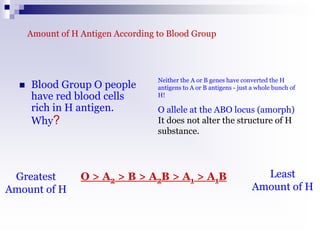
Amount of H Antigen According to Blood Group
 Blood Group O people
have red blood cells
rich in H antigen.
Why?
Neither the A or B genes have converted the H
antigens to A or B antigens - just a whole bunch of
H!
O allele at the ABO locus (amorph)
It does not alter the structure of H
substance.
Greatest
Amount of H
Least
Amount of H
O > A2 > B > A2B > A1 > A1B
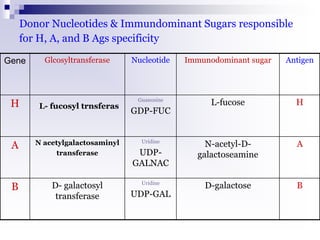
Donor Nucleotides & Immundominant Sugars responsible
for H, A, and B Ags specificity
Antigen
Immunodominant sugar
Nucleotide
Glcosyltransferase
Gene
H
L-fucose
Guanosine
GDP-FUC
L- fucosyl trnsferas
H
A
N-acetyl-D-
galactoseamine
Uridine
UDP-
GALNAC
N acetylgalactosaminyl
transferase
A
B
D-galactose
Uridine
UDP-GAL
D- galactosyl
transferase
B

abo_dr_moh_3.ppt

  • 1.
    ABO BLOOD GROUP DR.MOHAMMED H SAIEM ALDAHR Faculty of Applied Medical Sciences BLOOD BANK MEDICAL TECNOLOGY KAAU
  • 2.
    ABO BLOOD GROUP History 1. Landsteiners discovered the ABO Blood Group System in 1901 2. He and five co-workers began mixing each others red blood cells and serum together and accidentally performed the first forward and reverse ABO groupings. 3. Landsteiners Rule: If an antigen (Ag) is present on a patients red blood cells the corresponding antibody (Ab) will NOT be present in the patients plasma, under ‘normal conditions’.
  • 3.
    ABO BLOOD GROUP Importance of ABO There are two principles 1-almost all normal healthy individuals above 3-6 months of age have “ naturally occurring Abs” to the ABO Ags that they lack These Abs termed naturally occurring because they were thought to arise without antigenic stimulation
  • 4.
    ABO BLOOD GROUP Importance of ABO 2- These “naturally occurring” Abs are mostly IgM class. That means that, they are Abs capable of agglutinating saline/ low protein suspended red cell without enhancement and may activate complement cascade.
  • 5.
    Major ABO BloodGroup Forward blood grouping using anti-sera and red blood cells ABO Group Antigen Present Antigen Missing Antibody Present A A B Anti-B B B A Anti-A O None A and B Anti-A&B AB A and B None None If an antigen (Ag) is present on a patients red blood cells the corresponding antibody (Ab) will NOT be present in the patients plasma, under ‘normal conditions’.
  • 6.
    ABO BLOOD GROUP(Forward blood grouping ) Determination of ABO antigens found on patient red blood cells using reagent anti-sera. Serum from BG B aggl A RBCs, that an Ab to A Ag was present in Grp B serum, serum from A agg Grp B RBCs Patient Red Cells Tested With Interpretation Anti-B Anti-A Patient O 0 0 1 A 0 4+ 2 B 4+ 0 3 AB 4+ 4+ 4
  • 7.
    Reverse Grouping (Confirmatorygrouping) Patient Serum Tested With reagent red blood cells Serum from GRP O individual aggl both A and B cells indicate the presence of Abs to both A and B in group O serum Interpretation B Cells A1 Cells Patient O 4+ 4+ 1 A 4+ 0 2 B 0 4+ 3 AB 0 0 4
  • 8.
    FORWARD & REVERSEABO BLOOD GROUPING Reaction of Cells Tested With Reaction of Serum Tested Against ABO Group Anti-A Anti-B A1 Cells B Cells 1 0 0 + + O 2 + 0 0 + A 3 0 + + 0 B 4 + + 0 0 AB
  • 10.
    ABO INHERITANCE T2 Dad =A/O and Mom = B/O Mom B O Dad A A/B A/O O O/B O/O
  • 11.
    ABO groups ofthe offspring from the various possible ABO mating Phenotypes Genotype offspring AxA AAxAA A (AA) AAxAO A (AA or AO) AOxAO A (AA or AO),O(OO) BxB BBxBO B (BB or BO) AxAB AAxAB AB (AB) or A (AA) AOxAB AB (AB), A (AA, AO), B(BO)
  • 12.
    Inheritance  Definition Isoagglutinins: aredefined as antibodies that agglutinate blood cells of some individuals of the same species Glycosyltransferases: are enzyme that facilitate the transfer of carbohydrate (sugar) molecules onto carbohydrate precursor molecules Immunodominant sugar: is the sugar molecule that complete the antigenic determinant when combined with the precursor substance
  • 13.
    ABH ANTIGEN  Theinheritance of the ABO blood group was demonstrated that each individual inherits one ABO gene from each parent and these two genes determine which Ags are present on RBCs membrane  One position or Locus, on each chromosome number nine is occupied by an A, B, or an O gene
  • 14.
    ABH ANTIGEN  ALocus termed H and the final product of the genes at that locus, H antigen, was necessary for the expression of normal ABO antigens (Allele: any alternate form of a gene that can occupy a given chromosomal location (locus).  ABH Ags of the RBC membrane are found partly as glycolipids, but primarily as glycoproteins. It may also occur in the secretion as glycoproteins.
  • 15.
    ABH Antigens  Agsbelonging to ABH blood group system are present on RBCs and other body cells and body fluids.  The presence of A,B, and O Ags on RBCs depends upon the allelic genes, A,B, and O  An H genes at a separate locus codes for the precursor substance on which the A and B gene products act  The products of the A and B genes are enzymes that act as a specific transferases
  • 16.
    ABH Antigens  Hgene products is an enzyme that produce H substance  The O gene is a silent allele  It does not alter the structure of H substance.
  • 17.
    Formation of A1B&H Antigen  The ABO genes do not code for the production of ABO antigens, BUT rather produce specific glycosyl transferases  ABO produces a specific glycosyl transferases that add sugars to a basic precursor substance on the RBCs  A donor nucleotide derivative supplies the sugar that confers (gives) ABO specificity (is the sugar molecule that complete the antigenic determinant when combined with the precursor substance )  The formation of ABH antigens results from the interaction of ABO genes with several other separate, independent blood groups.
  • 18.
    Formation of A1B&H Antigen  The inheritance of at least one H gene (HH or Hh) elicits (obtain) the production of an enzyme called, α-2-L- Fucosyl transferase, which transfers the sugar from the Guanosine diphosphate L-fucose (GDP-Fuc) donor nucleotide to the terminal galactose of the precursor chain.  The H substance must be formed for the other sugars to be attached in response to an inherited A and /or B genes
  • 19.
    ABH Ag There aretwo potential precursors substance (PS) both are comprised of identical sugar (galactos-N- acetyl gluctosamin - galactose -glucose) but different in linkage.  Type I PS has a terminal galactose (Gal) linked to a subterminal N acetylgucoseamine (GlcNAc) in 1-3 linkage  Type II PS, has the same sugar combine in 1-4 linkage  ABH Ags on RBCs are derived from Type II chains.
  • 20.
    ABO Genetics  Genesat three separate loci control the occurrence and location of A and B antigens 1. Hh genes – H and h alleles  H allele codes for a fucosyltransferase enzyme that adds a fucose on Type 2 chains (primarily) to form the H antigen onto which A and B antigens are built on red blood cells.  h allele is a silent allele (amorph)
  • 21.
    ABO Genetics  A,B and H antigens are built on oligosaccharide chains of 4 types. The most common forms are Type 1 and Type 2. Type 1: #1 carbon of Gal is attached to the #3 carbon of GlcNAc. Type 2: #1 carbon of Gal is attached to the #4 carbon of GlcNAc.
  • 22.
    ABO Genetics 2- Segenes – Se and se alleles  Se allele codes for a fucosyltransferase enzyme that adds fuscos onto Type 1 chains (primarily) in secretory glands. Controls expression of H antigens in secretions (i.e. saliva, body fluids, etc.)  se allele is an a morph 3. ABO genes – A, B and O alleles  A and B alleles code for (glycosyltransferase) a fucosyltransferase enzymes that add a sugar onto H antigens to produce A and B antigens  O allele does not code a functional enzyme
  • 23.
    ABO Genetics 1. Occurance a.The presence or absence of the ABH antigens on the red blood cell membrane is controlled by the H gene b. Presence or absence of the ABH antigens in secretions is indirectly controlled by the Se genes.
  • 24.
    ABO Genetics 1. Hhgene – H and h alleles (h is an a morph) 2. Se gene – Se and se alleles (se is an amorph) 3. ABO genes– A, B and O alleles 1. Controls presence of H, A, and B antigens on both RBCs and in Secretions 2. Controls presence of H antigen in the secretions 3. Inherit 1 gene from each parent that codes for an enzyme that adds a sugar to the H antigen
  • 25.
    H gene actson a Precursor substance(PS)* by adding Fucose H Antigen *PS = oligosaccharide chain attached to either glycosphingo- lipid, Type 2 chain (on RBC) or glycoprotein, Type 1 chain (in secretions) The H gene codes for an enzyme (fucosylytranferase) that adds a Fucose to the terminal sugar of a Precursor Substance (PS*). The biochemical structure below constitutes the H Antigen. (h gene is an amorph.)
  • 26.
    ABO Genetics  Hantigen is the foundation upon which A and B antigens are built. A and B genes code for enzymes that add an immunodominant sugar to the H antigen.
  • 27.
    Formation of the AAntigen The A gene codes for an enzyme that adds GalNAc (N-Acetyl-D galactosamine) to the terminal sugar of the H Antigen. The biochemical structure constitutes the A antigen.
  • 28.
    Formation of the BAntigen B gene codes for an enzyme that adds D-Galactose to the terminal sugar of the H Antigen. The biochemical structure constitutes the B Antigen.
  • 29.
    The H antigenis found on the RBCs when there is an Hh or HH genotypes but NOT with the hh genotype. The A antigen is found on the RBCs when there is Hh, HH, and A/A, A/O or A/B genotypes. The B antigen is found on the RBCs when there is Hh, HH, and B/B, B/O or A/B genotypes.
  • 30.
    Amount of HAntigen According to Blood Group  Blood Group O people have red blood cells rich in H antigen. Why? Neither the A or B genes have converted the H antigens to A or B antigens - just a whole bunch of H! O allele at the ABO locus (amorph) It does not alter the structure of H substance. Greatest Amount of H Least Amount of H O > A2 > B > A2B > A1 > A1B
  • 31.
    Donor Nucleotides &Immundominant Sugars responsible for H, A, and B Ags specificity Antigen Immunodominant sugar Nucleotide Glcosyltransferase Gene H L-fucose Guanosine GDP-FUC L- fucosyl trnsferas H A N-acetyl-D- galactoseamine Uridine UDP- GALNAC N acetylgalactosaminyl transferase A B D-galactose Uridine UDP-GAL D- galactosyl transferase B