ABO Blood system
Muhammad Asif zeb
Lecturer –Hematology
Khyba medical university
Peshawar
BloodGrouping
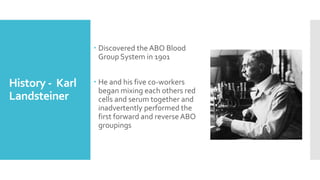
History - Karl
Landsteiner
 Discovered the ABO Blood
Group System in 1901
 He and his five co-workers
began mixing each others red
cells and serum together and
inadvertently performed the
first forward and reverse ABO
groupings
Landsteiners
Rule
Karl Landsteiner’s law :
If an antigen is present in the RBC’s of an
individual, the corresponding antibody
must be absent from the plasma
If an antigen is absent in the RBC’s of an
individual, the corresponding antibody
must be present from the plasma
’.
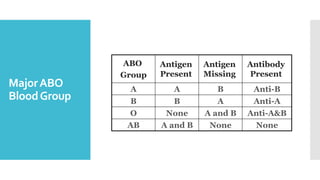
MajorABO
BloodGroup
ABO
Group
Antigen
Present
Antigen
Missing
Antibody
Present
A A B Anti-B
B B A Anti-A
O None A and B Anti-A&B
AB A and B None None
ABO Basics
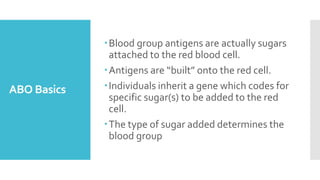
Blood group antigens are actually sugars
attached to the red blood cell.
Antigens are “built” onto the red cell.
Individuals inherit a gene which codes for
specific sugar(s) to be added to the red
cell.
The type of sugar added determines the
blood group
Principle of
blood
grouping
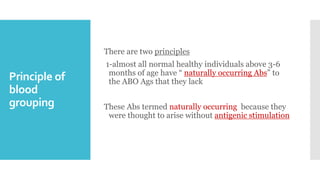
There are two principles
1-almost all normal healthy individuals above 3-6
months of age have “ naturally occurring Abs” to
the ABO Ags that they lack
These Abs termed naturally occurring because they
were thought to arise without antigenic stimulation
Principle of
blood
grouping
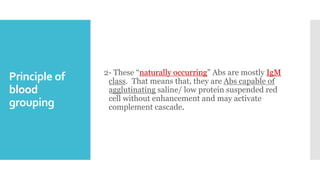
2- These “naturally occurring” Abs are mostly IgM
class. That means that, they are Abs capable of
agglutinating saline/ low protein suspended red
cell without enhancement and may activate
complement cascade.
ABO and H
Antigen
Genetics
ABO chromo
9
O gene on
chrom 19
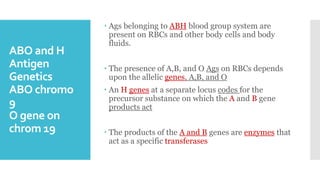
 Ags belonging to ABH blood group system are
present on RBCs and other body cells and body
fluids.
 The presence of A,B, and O Ags on RBCs depends
upon the allelic genes, A,B, and O
 An H genes at a separate locus codes for the
precursor substance on which the A and B gene
products act
 The products of the A and B genes are enzymes that
act as a specific transferases
Genetics
 The ABO genes do not code for the production of
ABO antigens, BUT rather produce specific glycosyl
transferases
 ABO produces a specific glycosyl transferases that
add sugars to a basic precursor substance on the
RBCs
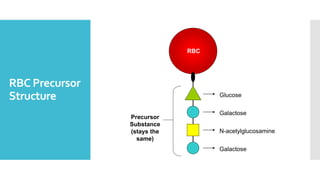
RBC Precursor
Structure Glucose
Galactose
N-acetylglucosamine
Galactose
Precursor
Substance
(stays the
same)
RBC
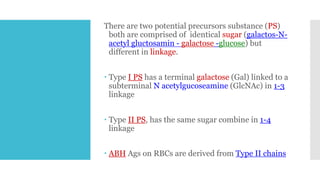
There are two potential precursors substance (PS)
both are comprised of identical sugar (galactos-N-
acetyl gluctosamin - galactose -glucose) but
different in linkage.
 Type I PS has a terminal galactose (Gal) linked to a
subterminal N acetylgucoseamine (GlcNAc) in 1-3
linkage
 Type II PS, has the same sugar combine in 1-4
linkage
 ABH Ags on RBCs are derived from Type II chains
HAntigen
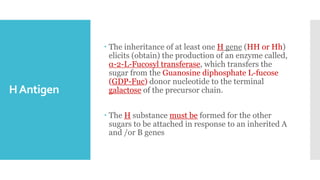
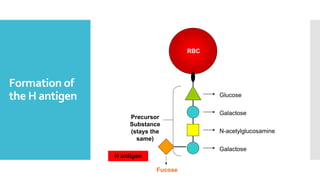
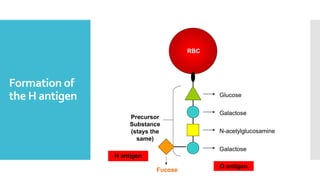
 The inheritance of at least one H gene (HH or Hh)
elicits (obtain) the production of an enzyme called,
α-2-L-Fucosyl transferase, which transfers the
sugar from the Guanosine diphosphate L-fucose
(GDP-Fuc) donor nucleotide to the terminal
galactose of the precursor chain.
 The H substance must be formed for the other
sugars to be attached in response to an inherited A
and /or B genes
Formation of
the H antigen Glucose
Galactose
N-acetylglucosamine
Galactose
Precursor
Substance
(stays the
same)
RBC
H antigen
Fucose
A and B
Antigen
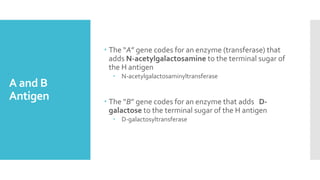
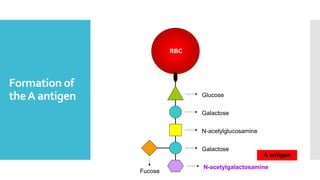
 The “A” gene codes for an enzyme (transferase) that
adds N-acetylgalactosamine to the terminal sugar of
the H antigen
 N-acetylgalactosaminyltransferase
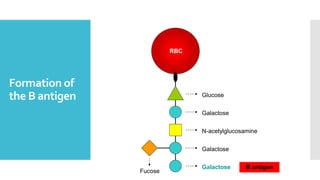
 The “B” gene codes for an enzyme that adds D-
galactose to the terminal sugar of the H antigen
 D-galactosyltransferase
Formation of
theA antigen Glucose
Galactose
N-acetylglucosamine
Galactose
RBC
Fucose
N-acetylgalactosamine
A antigen
Formation of
the B antigen Glucose
Galactose
N-acetylglucosamine
Galactose
RBC
Fucose
Galactose B antigen
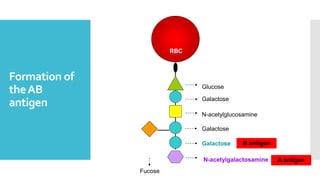
Formation of
theAB
antigen
Glucose
Galactose
N-acetylglucosamine
Galactose
RBC
Fucose
Galactose B antigen
N-acetylgalactosamine A antigen
Formation of
the H antigen Glucose
Galactose
N-acetylglucosamine
Galactose
Precursor
Substance
(stays the
same)
RBC
H antigen
Fucose
O antigen
H antigen
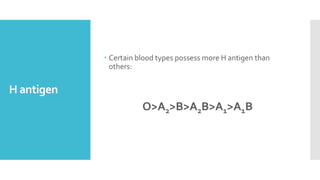
 Certain blood types possess more H antigen than
others:
O>A2>B>A2B>A1>A1B
Genetics
 The H antigen is found on the RBC when you have the
Hh or HH genotype, but NOT from the hh genotype
 The A antigen is found on the RBC when you have the
Hh, HH, and A/A, A/O, or A/B genotypes
 The B antigen is found on the RBC when you have the
Hh, HH, and B/B, B/O, orA/B genotypes
Bombay
Phenotype
(Oh)
 Inheritance of hh
 The h gene is an amorph and results in little or no
production of L-fucosyltransferase
 Originally found in Bombay
 Very rare (130 worldwide)
Bombay
Phenotype
(Oh)
 The hh causes NO H antigen to be produced
 Results in RBCs with no H, A, or B antigen (patient
types as O)
 Bombay RBCs are NOT agglutinated with anti-A, anti-
B, or anti-H (no antigens present)
 Bombay serum has strong anti-A, anti-B and anti-H,
agglutinating ALL ABO blood groups
 What bloodABO blood group would you use to
transfuse this patient??
Another Bombay
Group O RBCs cannot be given because they still
have the H antigen
You have to transfuse the patient with blood that
contains NO H antigen
ABO
antibodies
 GroupA serum contains anti-B
 Group B serum contains anti-A
 GroupAB serum contains no antibodies
 GroupO serum contains anti-A, anti-B, and anti-A,B
ABO
antibodies
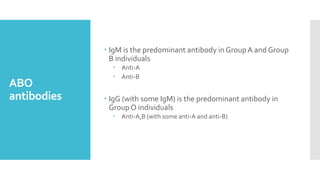
 IgM is the predominant antibody in GroupA and Group
B individuals
 Anti-A
 Anti-B
 IgG (with some IgM) is the predominant antibody in
GroupO individuals
 Anti-A,B (with some anti-A and anti-B)
ABO
antibodies
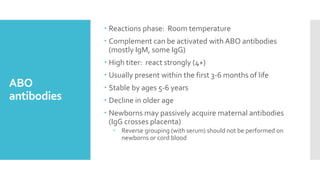
 Reactions phase: Room temperature
 Complement can be activated with ABO antibodies
(mostly IgM, some IgG)
 High titer: react strongly (4+)
 Usually present within the first 3-6 months of life
 Stable by ages 5-6 years
 Decline in older age
 Newborns may passively acquire maternal antibodies
(IgG crosses placenta)
 Reverse grouping (with serum) should not be performed on
newborns or cord blood
ABO
routine testing
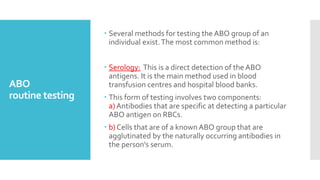
 Several methods for testing the ABO group of an
individual exist.The most common method is:
 Serology: This is a direct detection of the ABO
antigens. It is the main method used in blood
transfusion centres and hospital blood banks.
 This form of testing involves two components:
a) Antibodies that are specific at detecting a particular
ABO antigen on RBCs.
 b) Cells that are of a known ABO group that are
agglutinated by the naturally occurring antibodies in
the person's serum.
ABO
ROUTINE
TESTING
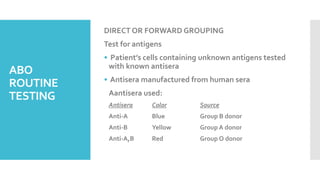
DIRECT OR FORWARD GROUPING
Test for antigens
• Patient’s cells containing unknown antigens tested
with known antisera
• Antisera manufactured from human sera
Aantisera used:
Antisera Color Source
Anti-A Blue Group B donor
Anti-B Yellow Group A donor
Anti-A,B Red Group O donor
Forward
Grouping
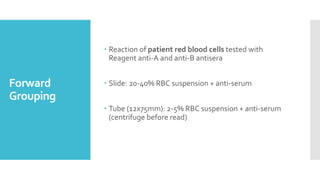
 Reaction of patient red blood cells tested with
Reagent anti-A and anti-B antisera
 Slide: 20-40% RBC suspension + anti-serum
 Tube (12x75mm): 2-5% RBC suspension + anti-serum
(centrifuge before read)
Forward
Grouping
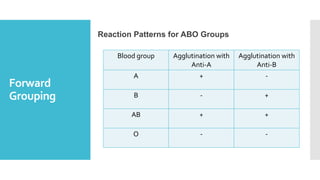
Reaction Patterns for ABO Groups
Blood group Agglutination with
Anti-A
Agglutination with
Anti-B
A + -
B - +
AB + +
O - -
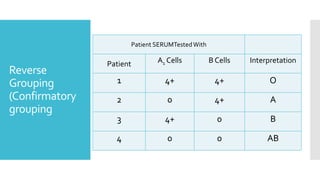
Reverse
grouping
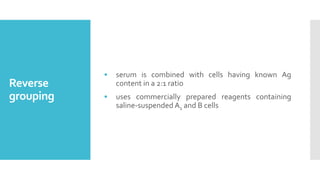
• serum is combined with cells having known Ag
content in a 2:1 ratio
• uses commercially prepared reagents containing
saline-suspended A1 and B cells
Reverse
grouping
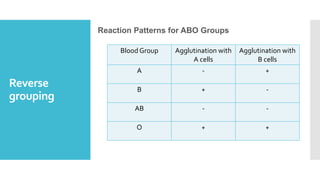
Reaction Patterns for ABO Groups
Blood Group Agglutination with
A cells
Agglutination with
B cells
A - +
B + -
AB - -
O + +
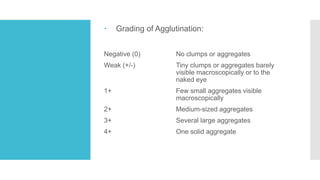
 Grading of Agglutination:
Negative (0) No clumps or aggregates
Weak (+/-) Tiny clumps or aggregates barely
visible macroscopically or to the
naked eye
1+ Few small aggregates visible
macroscopically
2+ Medium-sized aggregates
3+ Several large aggregates
4+ One solid aggregate
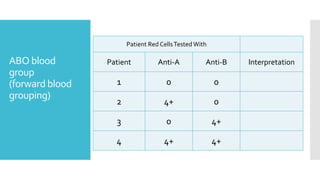
ABO blood
group
(forward blood
grouping)
Patient Red CellsTested With
Interpretation
Anti-B
Anti-A
Patient
0
0
1
0
4+
2
4+
0
3
4+
4+
4
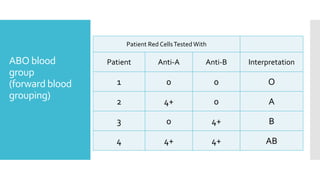
ABO blood
group
(forward blood
grouping)
Patient Red CellsTested With
Interpretation
Anti-B
Anti-A
Patient
O
0
0
1
A
0
4+
2
B
4+
0
3
AB
4+
4+
4
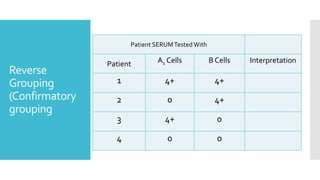
Reverse
Grouping
(Confirmatory
grouping
Patient SERUMTestedWith
Interpretation
B Cells
A1 Cells
Patient
4+
4+
1
4+
0
2
0
4+
3
0
0
4
Reverse
Grouping
(Confirmatory
grouping
Patient SERUMTestedWith
Interpretation
B Cells
A1 Cells
Patient
O
4+
4+
1
A
4+
0
2
B
0
4+
3
AB
0
0
4
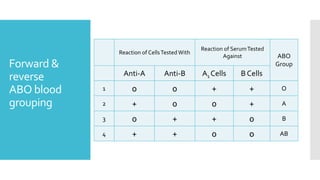
Forward &
reverse
ABO blood
grouping
Reaction of CellsTested With
Reaction of SerumTested
Against ABO
Group
Anti-A Anti-B A1 Cells B Cells
1 0 0 + + O
2 + 0 0 + A
3 0 + + 0 B
4 + + 0 0 AB
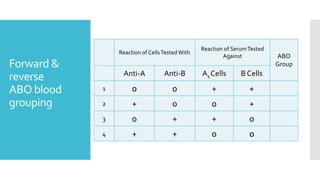
Forward &
reverse
ABO blood
grouping
Reaction of CellsTested With
Reaction of SerumTested
Against ABO
Group
Anti-A Anti-B A1 Cells B Cells
1 0 0 + +
2 + 0 0 +
3 0 + + 0
4 + + 0 0
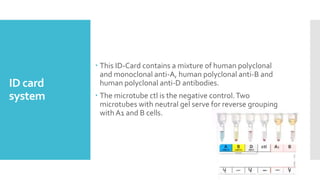
ID card
system
 This ID-Card contains a mixture of human polyclonal
and monoclonal anti-A, human polyclonal anti-B and
human polyclonal anti-D antibodies.
 The microtube ctl is the negative control.Two
microtubes with neutral gel serve for reverse grouping
with A1 and B cells.
Thank you….

abo blood group system.pdf

  • 1.
    ABO Blood system MuhammadAsif zeb Lecturer –Hematology Khyba medical university Peshawar
  • 2.
  • 3.
    History - Karl Landsteiner Discovered the ABO Blood Group System in 1901  He and his five co-workers began mixing each others red cells and serum together and inadvertently performed the first forward and reverse ABO groupings
  • 4.
    Landsteiners Rule Karl Landsteiner’s law: If an antigen is present in the RBC’s of an individual, the corresponding antibody must be absent from the plasma If an antigen is absent in the RBC’s of an individual, the corresponding antibody must be present from the plasma ’.
  • 5.
    MajorABO BloodGroup ABO Group Antigen Present Antigen Missing Antibody Present A A BAnti-B B B A Anti-A O None A and B Anti-A&B AB A and B None None
  • 6.
    ABO Basics Blood groupantigens are actually sugars attached to the red blood cell. Antigens are “built” onto the red cell. Individuals inherit a gene which codes for specific sugar(s) to be added to the red cell. The type of sugar added determines the blood group
  • 7.
    Principle of blood grouping There aretwo principles 1-almost all normal healthy individuals above 3-6 months of age have “ naturally occurring Abs” to the ABO Ags that they lack These Abs termed naturally occurring because they were thought to arise without antigenic stimulation
  • 8.
    Principle of blood grouping 2- These“naturally occurring” Abs are mostly IgM class. That means that, they are Abs capable of agglutinating saline/ low protein suspended red cell without enhancement and may activate complement cascade.
  • 9.
    ABO and H Antigen Genetics ABOchromo 9 O gene on chrom 19  Ags belonging to ABH blood group system are present on RBCs and other body cells and body fluids.  The presence of A,B, and O Ags on RBCs depends upon the allelic genes, A,B, and O  An H genes at a separate locus codes for the precursor substance on which the A and B gene products act  The products of the A and B genes are enzymes that act as a specific transferases
  • 10.
    Genetics  The ABOgenes do not code for the production of ABO antigens, BUT rather produce specific glycosyl transferases  ABO produces a specific glycosyl transferases that add sugars to a basic precursor substance on the RBCs
  • 11.
  • 12.
    There are twopotential precursors substance (PS) both are comprised of identical sugar (galactos-N- acetyl gluctosamin - galactose -glucose) but different in linkage.  Type I PS has a terminal galactose (Gal) linked to a subterminal N acetylgucoseamine (GlcNAc) in 1-3 linkage  Type II PS, has the same sugar combine in 1-4 linkage  ABH Ags on RBCs are derived from Type II chains
  • 13.
    HAntigen  The inheritanceof at least one H gene (HH or Hh) elicits (obtain) the production of an enzyme called, α-2-L-Fucosyl transferase, which transfers the sugar from the Guanosine diphosphate L-fucose (GDP-Fuc) donor nucleotide to the terminal galactose of the precursor chain.  The H substance must be formed for the other sugars to be attached in response to an inherited A and /or B genes
  • 14.
    Formation of the Hantigen Glucose Galactose N-acetylglucosamine Galactose Precursor Substance (stays the same) RBC H antigen Fucose
  • 15.
    A and B Antigen The “A” gene codes for an enzyme (transferase) that adds N-acetylgalactosamine to the terminal sugar of the H antigen  N-acetylgalactosaminyltransferase  The “B” gene codes for an enzyme that adds D- galactose to the terminal sugar of the H antigen  D-galactosyltransferase
  • 16.
    Formation of theA antigenGlucose Galactose N-acetylglucosamine Galactose RBC Fucose N-acetylgalactosamine A antigen
  • 17.
    Formation of the Bantigen Glucose Galactose N-acetylglucosamine Galactose RBC Fucose Galactose B antigen
  • 18.
  • 19.
    Formation of the Hantigen Glucose Galactose N-acetylglucosamine Galactose Precursor Substance (stays the same) RBC H antigen Fucose O antigen
  • 20.
    H antigen  Certainblood types possess more H antigen than others: O>A2>B>A2B>A1>A1B
  • 21.
    Genetics  The Hantigen is found on the RBC when you have the Hh or HH genotype, but NOT from the hh genotype  The A antigen is found on the RBC when you have the Hh, HH, and A/A, A/O, or A/B genotypes  The B antigen is found on the RBC when you have the Hh, HH, and B/B, B/O, orA/B genotypes
  • 22.
    Bombay Phenotype (Oh)  Inheritance ofhh  The h gene is an amorph and results in little or no production of L-fucosyltransferase  Originally found in Bombay  Very rare (130 worldwide)
  • 23.
    Bombay Phenotype (Oh)  The hhcauses NO H antigen to be produced  Results in RBCs with no H, A, or B antigen (patient types as O)  Bombay RBCs are NOT agglutinated with anti-A, anti- B, or anti-H (no antigens present)  Bombay serum has strong anti-A, anti-B and anti-H, agglutinating ALL ABO blood groups  What bloodABO blood group would you use to transfuse this patient?? Another Bombay Group O RBCs cannot be given because they still have the H antigen You have to transfuse the patient with blood that contains NO H antigen
  • 24.
    ABO antibodies  GroupA serumcontains anti-B  Group B serum contains anti-A  GroupAB serum contains no antibodies  GroupO serum contains anti-A, anti-B, and anti-A,B
  • 25.
    ABO antibodies  IgM isthe predominant antibody in GroupA and Group B individuals  Anti-A  Anti-B  IgG (with some IgM) is the predominant antibody in GroupO individuals  Anti-A,B (with some anti-A and anti-B)
  • 26.
    ABO antibodies  Reactions phase:Room temperature  Complement can be activated with ABO antibodies (mostly IgM, some IgG)  High titer: react strongly (4+)  Usually present within the first 3-6 months of life  Stable by ages 5-6 years  Decline in older age  Newborns may passively acquire maternal antibodies (IgG crosses placenta)  Reverse grouping (with serum) should not be performed on newborns or cord blood
  • 27.
    ABO routine testing  Severalmethods for testing the ABO group of an individual exist.The most common method is:  Serology: This is a direct detection of the ABO antigens. It is the main method used in blood transfusion centres and hospital blood banks.  This form of testing involves two components: a) Antibodies that are specific at detecting a particular ABO antigen on RBCs.  b) Cells that are of a known ABO group that are agglutinated by the naturally occurring antibodies in the person's serum.
  • 28.
    ABO ROUTINE TESTING DIRECT OR FORWARDGROUPING Test for antigens • Patient’s cells containing unknown antigens tested with known antisera • Antisera manufactured from human sera Aantisera used: Antisera Color Source Anti-A Blue Group B donor Anti-B Yellow Group A donor Anti-A,B Red Group O donor
  • 29.
    Forward Grouping  Reaction ofpatient red blood cells tested with Reagent anti-A and anti-B antisera  Slide: 20-40% RBC suspension + anti-serum  Tube (12x75mm): 2-5% RBC suspension + anti-serum (centrifuge before read)
  • 30.
    Forward Grouping Reaction Patterns forABO Groups Blood group Agglutination with Anti-A Agglutination with Anti-B A + - B - + AB + + O - -
  • 31.
    Reverse grouping • serum iscombined with cells having known Ag content in a 2:1 ratio • uses commercially prepared reagents containing saline-suspended A1 and B cells
  • 32.
    Reverse grouping Reaction Patterns forABO Groups Blood Group Agglutination with A cells Agglutination with B cells A - + B + - AB - - O + +
  • 33.
     Grading ofAgglutination: Negative (0) No clumps or aggregates Weak (+/-) Tiny clumps or aggregates barely visible macroscopically or to the naked eye 1+ Few small aggregates visible macroscopically 2+ Medium-sized aggregates 3+ Several large aggregates 4+ One solid aggregate
  • 34.
    ABO blood group (forward blood grouping) PatientRed CellsTested With Interpretation Anti-B Anti-A Patient 0 0 1 0 4+ 2 4+ 0 3 4+ 4+ 4
  • 35.
    ABO blood group (forward blood grouping) PatientRed CellsTested With Interpretation Anti-B Anti-A Patient O 0 0 1 A 0 4+ 2 B 4+ 0 3 AB 4+ 4+ 4
  • 36.
  • 37.
  • 38.
    Forward & reverse ABO blood grouping Reactionof CellsTested With Reaction of SerumTested Against ABO Group Anti-A Anti-B A1 Cells B Cells 1 0 0 + + O 2 + 0 0 + A 3 0 + + 0 B 4 + + 0 0 AB
  • 39.
    Forward & reverse ABO blood grouping Reactionof CellsTested With Reaction of SerumTested Against ABO Group Anti-A Anti-B A1 Cells B Cells 1 0 0 + + 2 + 0 0 + 3 0 + + 0 4 + + 0 0
  • 40.
    ID card system  ThisID-Card contains a mixture of human polyclonal and monoclonal anti-A, human polyclonal anti-B and human polyclonal anti-D antibodies.  The microtube ctl is the negative control.Two microtubes with neutral gel serve for reverse grouping with A1 and B cells.
  • 41.