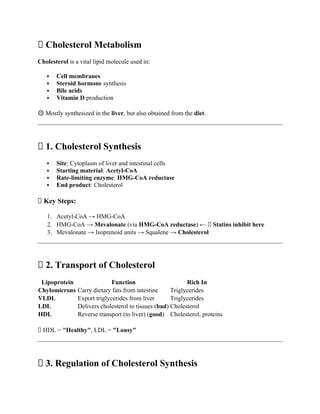
🧬 Cholesterol Metabolism
Cholesterolis a vital lipid molecule used in:
Cell membranes
Steroid hormone synthesis
Bile acids
Vitamin D production
🟡 Mostly synthesized in the liver, but also obtained from the diet.
🔹 1. Cholesterol Synthesis
Site: Cytoplasm of liver and intestinal cells
Starting material: Acetyl-CoA
Rate-limiting enzyme: HMG-CoA reductase
End product: Cholesterol
🧪 Key Steps:
1. Acetyl-CoA → HMG-CoA
2. HMG-CoA → Mevalonate (via HMG-CoA reductase) ← 🎯 Statins inhibit here
3. Mevalonate → Isoprenoid units → Squalene → Cholesterol
🔹 2. Transport of Cholesterol
Lipoprotein Function Rich In
Chylomicrons Carry dietary fats from intestine Triglycerides
VLDL Export triglycerides from liver Triglycerides
LDL Delivers cholesterol to tissues (bad) Cholesterol
HDL Reverse transport (to liver) (good) Cholesterol, proteins
✅ HDL = "Healthy", LDL = "Lousy"
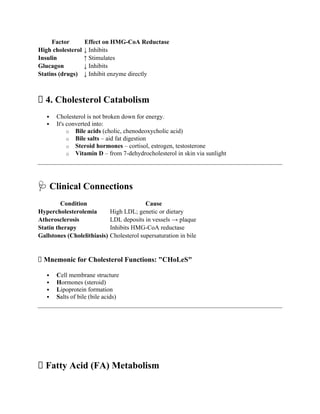
🔹 3. Regulation of Cholesterol Synthesis
2.
Factor Effect onHMG-CoA Reductase
High cholesterol ↓ Inhibits
Insulin ↑ Stimulates
Glucagon ↓ Inhibits
Statins (drugs) ↓ Inhibit enzyme directly
🔹 4. Cholesterol Catabolism
Cholesterol is not broken down for energy.
It's converted into:
o Bile acids (cholic, chenodeoxycholic acid)
o Bile salts – aid fat digestion
o Steroid hormones – cortisol, estrogen, testosterone
o Vitamin D – from 7-dehydrocholesterol in skin via sunlight
🩺 Clinical Connections
Condition Cause
Hypercholesterolemia High LDL; genetic or dietary
Atherosclerosis LDL deposits in vessels → plaque
Statin therapy Inhibits HMG-CoA reductase
Gallstones (Cholelithiasis) Cholesterol supersaturation in bile
🎯 Mnemonic for Cholesterol Functions: "CHoLeS"
Cell membrane structure
Hormones (steroid)
Lipoprotein formation
Salts of bile (bile acids)
🧬 Fatty Acid (FA) Metabolism
3.
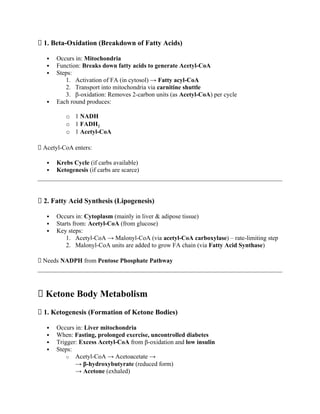
🔹 1. Beta-Oxidation(Breakdown of Fatty Acids)
Occurs in: Mitochondria
Function: Breaks down fatty acids to generate Acetyl-CoA
Steps:
1. Activation of FA (in cytosol) → Fatty acyl-CoA
2. Transport into mitochondria via carnitine shuttle
3. β-oxidation: Removes 2-carbon units (as Acetyl-CoA) per cycle
Each round produces:
o 1 NADH
o 1 FADH₂
o 1 Acetyl-CoA
✅ Acetyl-CoA enters:
Krebs Cycle (if carbs available)
Ketogenesis (if carbs are scarce)
🔹 2. Fatty Acid Synthesis (Lipogenesis)
Occurs in: Cytoplasm (mainly in liver & adipose tissue)
Starts from: Acetyl-CoA (from glucose)
Key steps:
1. Acetyl-CoA → Malonyl-CoA (via acetyl-CoA carboxylase) – rate-limiting step
2. Malonyl-CoA units are added to grow FA chain (via Fatty Acid Synthase)
✅ Needs NADPH from Pentose Phosphate Pathway
🔥 Ketone Body Metabolism
🔹 1. Ketogenesis (Formation of Ketone Bodies)
Occurs in: Liver mitochondria
When: Fasting, prolonged exercise, uncontrolled diabetes
Trigger: Excess Acetyl-CoA from β-oxidation and low insulin
Steps:
o Acetyl-CoA → Acetoacetate →
→ β-hydroxybutyrate (reduced form)
→ Acetone (exhaled)
4.
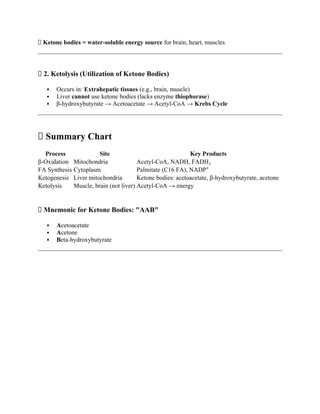
✅ Ketone bodies= water-soluble energy source for brain, heart, muscles
🔹 2. Ketolysis (Utilization of Ketone Bodies)
Occurs in: Extrahepatic tissues (e.g., brain, muscle)
Liver cannot use ketone bodies (lacks enzyme thiophorase)
β-hydroxybutyrate → Acetoacetate → Acetyl-CoA → Krebs Cycle
📌 Summary Chart
Process Site Key Products
β-Oxidation Mitochondria Acetyl-CoA, NADH, FADH₂
FA Synthesis Cytoplasm Palmitate (C16 FA), NADP⁺
Ketogenesis Liver mitochondria Ketone bodies: acetoacetate, β-hydroxybutyrate, acetone
Ketolysis Muscle, brain (not liver) Acetyl-CoA → energy
🧠 Mnemonic for Ketone Bodies: "AAB"
Acetoacetate
Acetone
Beta-hydroxybutyrate


![lipid_metabolism_by_bk_sir[1].pptx](https://cdn.slidesharecdn.com/ss_thumbnails/lipidmetabolismbybksir1-230618065601-fc55804f-thumbnail.jpg?width=640&height=640&fit=bounds)


![lipid_metabolism_by_bk_sir[1].pptx](https://cdn.slidesharecdn.com/ss_thumbnails/lipidmetabolismbybksir1-230620074327-f559ff35-thumbnail.jpg?width=640&height=640&fit=bounds)


