Abo system
ABO/ABH
The most important blood
group system.
4 groups (A, B, O, AB)
ABO incompatibility cause
intravascular hemolysis and
cause death.
ABO INCIDENCE
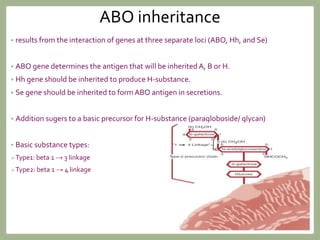
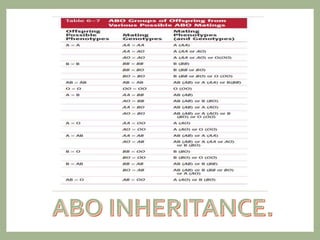
ABO inheritance
 results from the interaction of genes at three separate loci (ABO, Hh, and Se)
 ABO gene determines the antigen that will be inherited A, B or H.
 Hh gene should be inherited to produce H-substance.
 Se gene should be inherited to form ABO antigen in secretions.
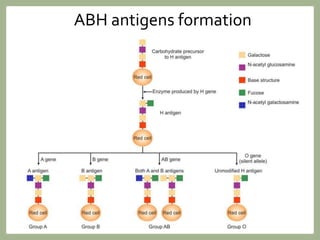
 Addition sugers to a basic precursor for H-substance (paragloboside/ glycan)
 Basic substance types:
Type1: beta 1 → 3 linkage
Type2: beta 1 → 4 linkage
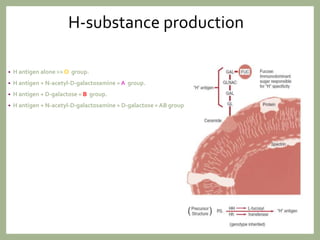
H-substance production
 H antigen alone >> O group.
 H antigen + N-acetyl-D-galactosamine = A group.
 H antigen + D-galactose = B group.
 H antigen + N-acetyl-D-galactosamine + D-galactose = AB group
ABH antigens formation
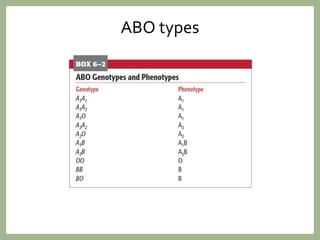
ABO types
Red cellABH antigens
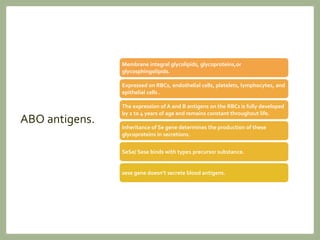
ABO antigens.
Membrane integral glycolipids, glycoproteins,or
glycosphingolipids.
Expressed on RBCs, endothelial cells, platelets, lymphocytes, and
epithelial cells .
The expression of A and B antigens on the RBCs is fully developed
by 2 to 4 years of age and remains constant throughout life.
Inheritance of Se gene determines the production of these
glycoproteins in secretions.
SeSe/ Sese binds with type1 precursor substance.
sese gene doesn’t secrete blood antigens.
ABO in sections vs membranes
ABO antibodies
initiate at birth and
become detectable at 3-6
months old.
Reach the peak at 5-10
years old.
Naturally occurring
antibodies against
different group.
IgM antibodies.
activate complement.
react at room
temperature or colder.
Produce strong
agglutination.
Individuals with A blood
group have serum
monoclonal anti-B
antibodies.
Individuals with B blood
group have serum
monoclonal anti-A
antibodies.
Individuals with O blood
group have serum
monoclonal anti-A, anti-
B, and polyclonal anti-A,B
antibodies.
Individuals with AB blood
group don’t have neither.
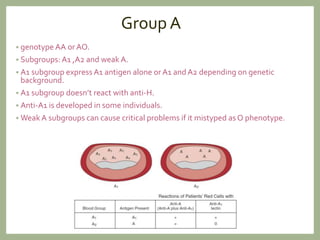
Group A
 genotype AA or AO.
 Subgroups: A1 ,A2 and weak A.
 A1 subgroup express A1 antigen alone or A1 and A2 depending on genetic
background.
 A1 subgroup doesn’t react with anti-H.
 Anti-A1 is developed in some individuals.
 Weak A subgroups can cause critical problems if it mistyped as O phenotype.
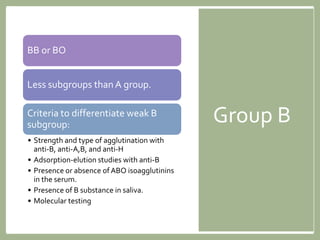
Group B
BB or BO
Less subgroups than A group.
Criteria to differentiate weak B
subgroup:
• Strength and type of agglutination with
anti-B, anti-A,B, and anti-H
• Adsorption-elution studies with anti-B
• Presence or absence of ABO isoagglutinins
in the serum.
• Presence of B substance in saliva.
• Molecular testing
B-subgroups
Group O
Inheritance at least
FUT 1(H) gene
(genotype HH or Hh)
and two O genes
(amorphous)
Serum anti bodies for
A, B and (A,B)
Anti-A,B antibody is a
separate “cross-
reacting” antibody that
is usually IgG in nature.
O subtypes: Bombay
inheritance of the hh
genotype (Oh)
fail to react with anti-A,
anti-B, and anti-H
antisera.
Not secretor
Only compatible with
Bombay blood group.
Have serum anti-A, B,
(A,B)and H.
Forward testing
Reverse testing
Reagents used in testing
Testing summery
Discrepancy
Unsuspected forward and/or
reverse results.
Should be resolver before
reporting.
Technical.
blood sample and test tube
labeling errors.
failure to add reagents.
incorrect reagents or sample.Subgroups
Serum and antiserum should
always be added first, followed
by the patient or reagent RBCs.
Technical errors
Resolving discrepancy
The most common.
Unexpected reverse grouping result.
Examples:
• Newborns (undetectable ABO antibody)
• Elderly patients (depressed ABO antibodies)
• Patients with a leukemia (e.g., chronic
lymphocytic leukemia) or lymphoma
demonstrating hypogammaglobulinemia
• Patients using immunosuppressive drugs that
yield hypogammaglobulinemia.
• Patients with congenital or acquired
agammaglobulinemia or immunodeficiency
diseases.
• Patients with bone marrow or hematopoietic
progenitor stem cell transplants.
• Patients whose existing ABO antibodies may
have been diluted by plasma transfusion or
exchange transfusion
• ABO subgroups
Group I Discrepancies
Group II Discrepancies
The least discrepancy.
Unexpected forward grouping result.
Examples:
• Subgroups of A or B may be present.
• Leukemias may yield weakenedA or B antigens and Hodgkin’s disease
has been reported in some cases to mimic the depression of antigens
found in leukemia.
• The “acquired B” phenomenon will show weak reactions with anti-B
antisera and is most often associated with diseases of the digestive
tract (e.g., cancer of the colon).
Common resolutions:
• Incubating the test mixture at room temperature for up to 30 minutes
to increase the association of the antibody with the RBC antigen. If the
reaction is still negative, incubate the text mixture at 4°C for 15 to 30
minutes.
• Include group O and autologous cells as controls.
• Pretreatment the RBC’s with enzymes and retested with reagent
antisera
Group III
Discrepancies
Between forward and reverse.
Abnormal protein production.
rouleaux formation or pseudoagglutination
(in vetro)
Examples:
• Elevated levels of globulin from certain disease states, such
as multiple myeloma, Waldenström’s macroglobulinemia.
• Elevated levels of fibrinogen.
• Plasma expanders, such as dextran and polyvinylpyrrolidone.
• Wharton’s jelly in cord blood samples.
Common resolution is by washing different
times with saline.
Group IV Discrepancies
Due to miscellaneous problems.
Cold reactive autoantibodies in which RBCs are so heavily
coated with antibody that they spontaneously agglutinate
independent of the specificity of the reagent antibody.
Circulating RBCs of more than one ABO group due to RBC
transfusion or marrow/stem cell transplant.
Unexpected ABO isoagglutinins.
Unexpected non-ABO alloantibodies.
Discrepancy
Reference: Modern Blood Banking &Transfusion Practices (Seventh Edition)

Abo

  • 1.
  • 2.
    ABO/ABH The most importantblood group system. 4 groups (A, B, O, AB) ABO incompatibility cause intravascular hemolysis and cause death.
  • 3.
  • 4.
    ABO inheritance  resultsfrom the interaction of genes at three separate loci (ABO, Hh, and Se)  ABO gene determines the antigen that will be inherited A, B or H.  Hh gene should be inherited to produce H-substance.  Se gene should be inherited to form ABO antigen in secretions.  Addition sugers to a basic precursor for H-substance (paragloboside/ glycan)  Basic substance types: Type1: beta 1 → 3 linkage Type2: beta 1 → 4 linkage
  • 5.
    H-substance production  Hantigen alone >> O group.  H antigen + N-acetyl-D-galactosamine = A group.  H antigen + D-galactose = B group.  H antigen + N-acetyl-D-galactosamine + D-galactose = AB group
  • 6.
  • 7.
  • 8.
  • 10.
    ABO antigens. Membrane integralglycolipids, glycoproteins,or glycosphingolipids. Expressed on RBCs, endothelial cells, platelets, lymphocytes, and epithelial cells . The expression of A and B antigens on the RBCs is fully developed by 2 to 4 years of age and remains constant throughout life. Inheritance of Se gene determines the production of these glycoproteins in secretions. SeSe/ Sese binds with type1 precursor substance. sese gene doesn’t secrete blood antigens.
  • 11.
    ABO in sectionsvs membranes
  • 12.
    ABO antibodies initiate atbirth and become detectable at 3-6 months old. Reach the peak at 5-10 years old. Naturally occurring antibodies against different group. IgM antibodies. activate complement. react at room temperature or colder. Produce strong agglutination. Individuals with A blood group have serum monoclonal anti-B antibodies. Individuals with B blood group have serum monoclonal anti-A antibodies. Individuals with O blood group have serum monoclonal anti-A, anti- B, and polyclonal anti-A,B antibodies. Individuals with AB blood group don’t have neither.
  • 13.
    Group A  genotypeAA or AO.  Subgroups: A1 ,A2 and weak A.  A1 subgroup express A1 antigen alone or A1 and A2 depending on genetic background.  A1 subgroup doesn’t react with anti-H.  Anti-A1 is developed in some individuals.  Weak A subgroups can cause critical problems if it mistyped as O phenotype.
  • 15.
    Group B BB orBO Less subgroups than A group. Criteria to differentiate weak B subgroup: • Strength and type of agglutination with anti-B, anti-A,B, and anti-H • Adsorption-elution studies with anti-B • Presence or absence of ABO isoagglutinins in the serum. • Presence of B substance in saliva. • Molecular testing
  • 16.
  • 17.
    Group O Inheritance atleast FUT 1(H) gene (genotype HH or Hh) and two O genes (amorphous) Serum anti bodies for A, B and (A,B) Anti-A,B antibody is a separate “cross- reacting” antibody that is usually IgG in nature. O subtypes: Bombay inheritance of the hh genotype (Oh) fail to react with anti-A, anti-B, and anti-H antisera. Not secretor Only compatible with Bombay blood group. Have serum anti-A, B, (A,B)and H.
  • 20.
  • 21.
  • 22.
  • 23.
  • 25.
    Discrepancy Unsuspected forward and/or reverseresults. Should be resolver before reporting. Technical. blood sample and test tube labeling errors. failure to add reagents. incorrect reagents or sample.Subgroups Serum and antiserum should always be added first, followed by the patient or reagent RBCs.
  • 26.
  • 27.
  • 28.
    The most common. Unexpectedreverse grouping result. Examples: • Newborns (undetectable ABO antibody) • Elderly patients (depressed ABO antibodies) • Patients with a leukemia (e.g., chronic lymphocytic leukemia) or lymphoma demonstrating hypogammaglobulinemia • Patients using immunosuppressive drugs that yield hypogammaglobulinemia. • Patients with congenital or acquired agammaglobulinemia or immunodeficiency diseases. • Patients with bone marrow or hematopoietic progenitor stem cell transplants. • Patients whose existing ABO antibodies may have been diluted by plasma transfusion or exchange transfusion • ABO subgroups Group I Discrepancies
  • 29.
    Group II Discrepancies Theleast discrepancy. Unexpected forward grouping result. Examples: • Subgroups of A or B may be present. • Leukemias may yield weakenedA or B antigens and Hodgkin’s disease has been reported in some cases to mimic the depression of antigens found in leukemia. • The “acquired B” phenomenon will show weak reactions with anti-B antisera and is most often associated with diseases of the digestive tract (e.g., cancer of the colon). Common resolutions: • Incubating the test mixture at room temperature for up to 30 minutes to increase the association of the antibody with the RBC antigen. If the reaction is still negative, incubate the text mixture at 4°C for 15 to 30 minutes. • Include group O and autologous cells as controls. • Pretreatment the RBC’s with enzymes and retested with reagent antisera
  • 30.
    Group III Discrepancies Between forwardand reverse. Abnormal protein production. rouleaux formation or pseudoagglutination (in vetro) Examples: • Elevated levels of globulin from certain disease states, such as multiple myeloma, Waldenström’s macroglobulinemia. • Elevated levels of fibrinogen. • Plasma expanders, such as dextran and polyvinylpyrrolidone. • Wharton’s jelly in cord blood samples. Common resolution is by washing different times with saline.
  • 31.
    Group IV Discrepancies Dueto miscellaneous problems. Cold reactive autoantibodies in which RBCs are so heavily coated with antibody that they spontaneously agglutinate independent of the specificity of the reagent antibody. Circulating RBCs of more than one ABO group due to RBC transfusion or marrow/stem cell transplant. Unexpected ABO isoagglutinins. Unexpected non-ABO alloantibodies.
  • 32.
  • 41.
    Reference: Modern BloodBanking &Transfusion Practices (Seventh Edition)