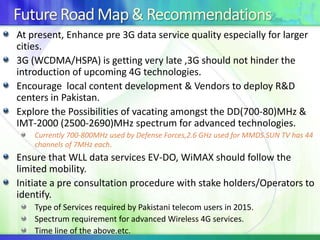
3G/4G status globally &Recommendations for Pakistan.Presented By:Muhammad Yousaf Sheikh               Asst. Director(Policy & Research)
Presentation outline
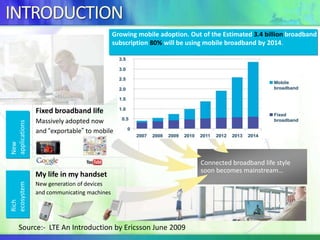
INTRODUCTIONGrowing mobile adoption. Out of the Estimated 3.4 billion broadband subscription 80% will be using mobile broadband by 2014.Fixed broadband lifeMassively adopted nowand “exportable” to mobile NewapplicationsConnected broadband life style soon becomes mainstream…My life in my handsetNew generation of devices and communicating machinesRichecosystemSource:-  LTE An Introduction by Ericsson June 2009
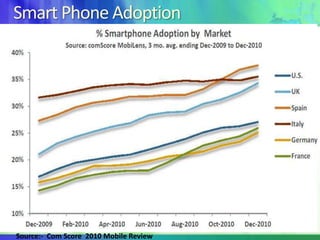
Smart Phone AdoptionSource:-  Com Score  2010 Mobile Review
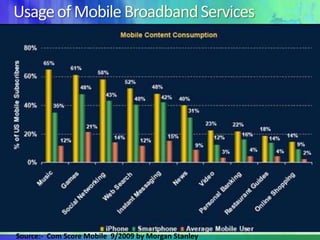
Usage of Mobile Broadband ServicesSource:-  Com Score Mobile  9/2009 by Morgan Stanley
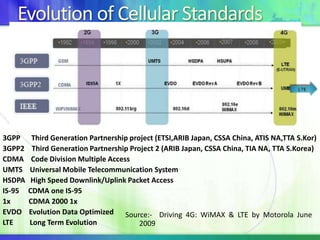
Evolution of Cellular StandardsLTE3GPP      Third Generation Partnership project (ETSI,ARIB Japan, CSSA China, ATIS NA,TTA S.Kor)3GPP2    Third Generation Partnership Project 2 (ARIB Japan, CSSA China, TIA NA, TTA S.Korea)CDMA    Code Division Multiple AccessUMTS    Universal Mobile Telecommunication SystemHSDPA   High Speed Downlink/Uplink Packet AccessIS-95     CDMA one IS-951x          CDMA 2000 1xEVDO    Evolution Data OptimizedLTE         Long Term Evolution Source:-  Driving 4G: WiMAX & LTE by Motorola June                             2009
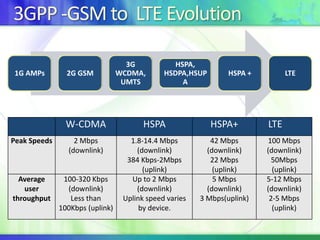
3GPP -GSM to  LTE Evolution
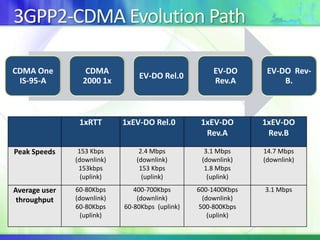
3GPP2-CDMA Evolution Path
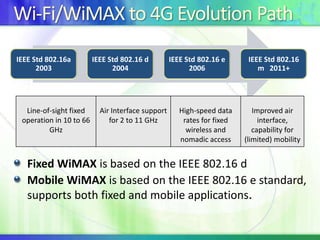
Wi-Fi/WiMAX to 4G Evolution PathFixed WiMAX is based on the IEEE 802.16 dMobile WiMAX is based on the IEEE 802.16 e standard, supports both fixed and mobile applications.
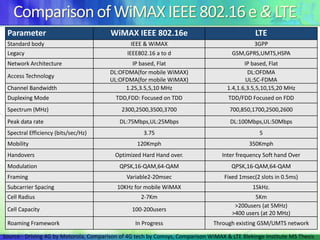
Comparison of WiMAX IEEE 802.16 e &LTE Source:- Driving 4G by Motorola, Comparison of 4G tech by Comsys, Comparison WiMAX & LTE Blekinge Institute MS Thesis
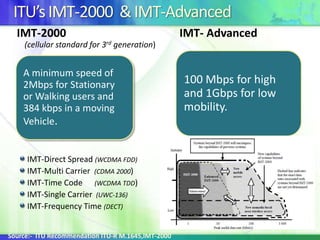
ITU’s IMT-2000  & IMT-AdvancedIMT-2000                                      (cellular standard for 3rd generation)IMT- AdvancedIMT-Direct Spread (WCDMA FDD)IMT-Multi Carrier  (CDMA 2000)IMT-Time Code      (WCDMA TDD)IMT-Single Carrier  (UWC-136)IMT-Frequency Time (DECT)Source:-  ITU Recommendation ITU-R M.1645,IMT-2000
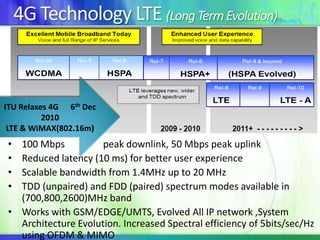
4G Technology LTE (Long Term Evolution)ITU Relaxes 4G      6th Dec 2010LTE & WiMAX(802.16m) 100 Mbps                peak downlink, 50 Mbps peak uplink
Reduced latency (10 ms) for better user experience
Scalable bandwidth from 1.4MHz up to 20 MHz
TDD (unpaired) and FDD (paired) spectrum modes available in (700,800,2600)MHz band
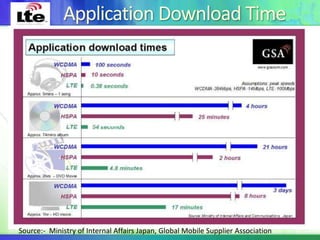
Works with GSM/EDGE/UMTS, Evolved All IP network ,System Architecture Evolution. Increased Spectral efficiency of 5bits/sec/Hz  using OFDM & MIMO Application Download Time Source:-  Ministry of Internal Affairs Japan, Global Mobile Supplier Association
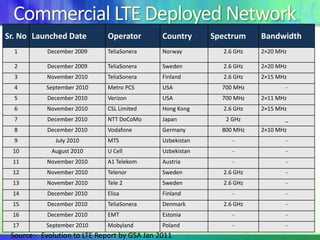
Commercial LTE Deployed NetworkSource:-  Evolution to LTE Report by GSA Jan 2011
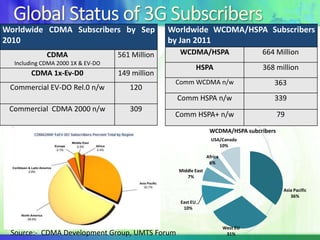
Global Status of 3G Subscribers Source:-  CDMA Development Group, UMTS Forum
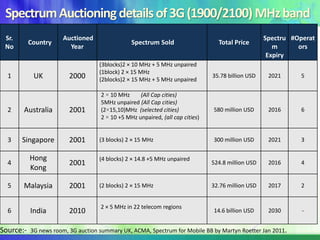
Spectrum Auctioning details of 3G (1900/2100) MHz bandSource:-  3G news room, 3G auction summary UK, ACMA, Spectrum for Mobile BB by MartynRoetter Jan 2011.
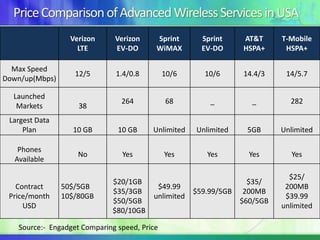
Price Comparison of Advanced Wireless Services in USASource:-  Engadget Comparing speed, Price
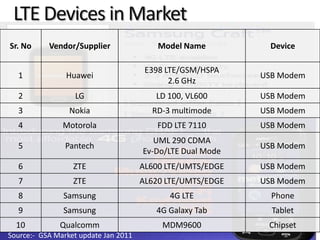
LTE Devices in MarketSource:-  GSA Market update Jan 2011
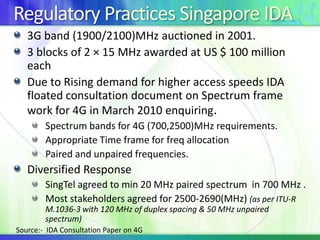
Regulatory Practices Singapore IDA3G band (1900/2100)MHz auctioned in 2001.3 blocks of 2 × 15 MHz awarded at US $ 100 million eachDue to Rising demand for higher access speeds IDA floated consultation document on Spectrum frame work for 4G in March 2010 enquiring.Spectrum bands for 4G (700,2500)MHz requirements.Appropriate Time frame for freq allocationPaired and unpaired frequencies.Diversified ResponseSingTel agreed to min 20 MHz paired spectrum  in 700 MHz .Most stakeholders agreed for 2500-2690(MHz) (as per ITU-R M.1036-3 with 120 MHz of duplex spacing & 50 MHz unpaired spectrum)Source:-  IDA Consultation Paper on 4G
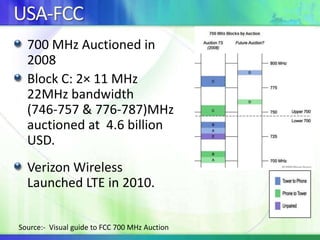
USA-FCC700 MHz Auctioned in 2008Block C: 2× 11 MHz 22MHz bandwidth                  (746-757 & 776-787)MHz auctioned at  4.6 billion USD.Verizon Wireless Launched LTE in2010.Source:-  Visual guide to FCC 700 MHz Auction
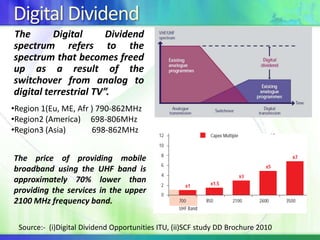
Digital Dividend      The Digital Dividend  spectrum refers to the spectrum that becomes freed up as a result of the switchover from analog to digital terrestrial TV”.Region 1(Eu, ME, Afr ) 790-862MHz
Region2 (America)     698-806MHz
Region3 (Asia)             698-862MHzThe price of providing mobile broadband using the UHF band is approximately 70% lower than providing the services in the upper 2100 MHz frequency band. Source:-  (i)Digital Dividend Opportunities ITU, (ii)SCF study DD Brochure 2010

3 G 4 G Status Globally

  • 1.
    3G/4G status globally&Recommendations for Pakistan.Presented By:Muhammad Yousaf Sheikh Asst. Director(Policy & Research)
  • 2.
  • 3.
    INTRODUCTIONGrowing mobile adoption.Out of the Estimated 3.4 billion broadband subscription 80% will be using mobile broadband by 2014.Fixed broadband lifeMassively adopted nowand “exportable” to mobile NewapplicationsConnected broadband life style soon becomes mainstream…My life in my handsetNew generation of devices and communicating machinesRichecosystemSource:- LTE An Introduction by Ericsson June 2009
  • 4.
    Smart Phone AdoptionSource:- Com Score 2010 Mobile Review
  • 5.
    Usage of MobileBroadband ServicesSource:- Com Score Mobile 9/2009 by Morgan Stanley
  • 6.
    Evolution of CellularStandardsLTE3GPP Third Generation Partnership project (ETSI,ARIB Japan, CSSA China, ATIS NA,TTA S.Kor)3GPP2 Third Generation Partnership Project 2 (ARIB Japan, CSSA China, TIA NA, TTA S.Korea)CDMA Code Division Multiple AccessUMTS Universal Mobile Telecommunication SystemHSDPA High Speed Downlink/Uplink Packet AccessIS-95 CDMA one IS-951x CDMA 2000 1xEVDO Evolution Data OptimizedLTE Long Term Evolution Source:- Driving 4G: WiMAX & LTE by Motorola June 2009
  • 7.
    3GPP -GSM to LTE Evolution
  • 8.
  • 9.
    Wi-Fi/WiMAX to 4GEvolution PathFixed WiMAX is based on the IEEE 802.16 dMobile WiMAX is based on the IEEE 802.16 e standard, supports both fixed and mobile applications.
  • 10.
    Comparison of WiMAXIEEE 802.16 e &LTE Source:- Driving 4G by Motorola, Comparison of 4G tech by Comsys, Comparison WiMAX & LTE Blekinge Institute MS Thesis
  • 11.
    ITU’s IMT-2000 & IMT-AdvancedIMT-2000 (cellular standard for 3rd generation)IMT- AdvancedIMT-Direct Spread (WCDMA FDD)IMT-Multi Carrier (CDMA 2000)IMT-Time Code (WCDMA TDD)IMT-Single Carrier (UWC-136)IMT-Frequency Time (DECT)Source:- ITU Recommendation ITU-R M.1645,IMT-2000
  • 12.
    4G Technology LTE(Long Term Evolution)ITU Relaxes 4G 6th Dec 2010LTE & WiMAX(802.16m) 100 Mbps peak downlink, 50 Mbps peak uplink
  • 13.
    Reduced latency (10ms) for better user experience
  • 14.
    Scalable bandwidth from1.4MHz up to 20 MHz
  • 15.
    TDD (unpaired) andFDD (paired) spectrum modes available in (700,800,2600)MHz band
  • 16.
    Works with GSM/EDGE/UMTS,Evolved All IP network ,System Architecture Evolution. Increased Spectral efficiency of 5bits/sec/Hz using OFDM & MIMO Application Download Time Source:- Ministry of Internal Affairs Japan, Global Mobile Supplier Association
  • 17.
    Commercial LTE DeployedNetworkSource:- Evolution to LTE Report by GSA Jan 2011
  • 18.
    Global Status of3G Subscribers Source:- CDMA Development Group, UMTS Forum
  • 19.
    Spectrum Auctioning detailsof 3G (1900/2100) MHz bandSource:- 3G news room, 3G auction summary UK, ACMA, Spectrum for Mobile BB by MartynRoetter Jan 2011.
  • 20.
    Price Comparison ofAdvanced Wireless Services in USASource:- Engadget Comparing speed, Price
  • 21.
    LTE Devices inMarketSource:- GSA Market update Jan 2011
  • 22.
    Regulatory Practices SingaporeIDA3G band (1900/2100)MHz auctioned in 2001.3 blocks of 2 × 15 MHz awarded at US $ 100 million eachDue to Rising demand for higher access speeds IDA floated consultation document on Spectrum frame work for 4G in March 2010 enquiring.Spectrum bands for 4G (700,2500)MHz requirements.Appropriate Time frame for freq allocationPaired and unpaired frequencies.Diversified ResponseSingTel agreed to min 20 MHz paired spectrum in 700 MHz .Most stakeholders agreed for 2500-2690(MHz) (as per ITU-R M.1036-3 with 120 MHz of duplex spacing & 50 MHz unpaired spectrum)Source:- IDA Consultation Paper on 4G
  • 23.
    USA-FCC700 MHz Auctionedin 2008Block C: 2× 11 MHz 22MHz bandwidth (746-757 & 776-787)MHz auctioned at 4.6 billion USD.Verizon Wireless Launched LTE in2010.Source:- Visual guide to FCC 700 MHz Auction
  • 24.
    Digital Dividend The Digital Dividend spectrum refers to the spectrum that becomes freed up as a result of the switchover from analog to digital terrestrial TV”.Region 1(Eu, ME, Afr ) 790-862MHz
  • 25.
  • 26.
    Region3 (Asia) 698-862MHzThe price of providing mobile broadband using the UHF band is approximately 70% lower than providing the services in the upper 2100 MHz frequency band. Source:- (i)Digital Dividend Opportunities ITU, (ii)SCF study DD Brochure 2010

Editor's Notes

  • #5 USA Smartphone Adoption is 27%,UK 34.3%.Iphone users and then smart phone users use large internet as compared to average mobile users.comScore defines smartphones as a mobile device with the following operating systems: RIM, Apple, Microsoft,Google, Palm, Symbian.
  • #6 USA Smartphone Adoption is 27%,UK 34.3%.Iphone users and then smart phone users use large internet as compared to average mobile users.comScore defines smartphones as a mobile device with the following operating systems: RIM, Apple, Microsoft,Google, Palm, Symbian.
  • #8 1G AMPS radio networks were analog-based and limited to voice services and capabilities only.GSM is 2G technology that offers both voice and data capabilities. GSM uses TDMA & FDMA. With EDGEupto 273 Kbps connectivity.W-CDMA brings GSM into 3G cellular network and is a high-speed transmission protocol used in UMTS which offers packet-based transmission for text, digitized voice, video, and multimedia content.HSPA is a mobile telephony protocol that helps improve the performance of UMTS. HSPA uses improved modulation schemes, while refining the protocols that mobile devices and base stations use to communicate. These processes improve radio bandwidth utilization provided by UMTS. HSDPA standard currently supports peak downlink speeds of up to 14.4 Mbps in 5 MHz bandwidth while HSUPA supports upto 5.76Mbps.HSPA+ provides speed upto 42 Mbps using MiMO & higher modulation scheme.
  • #9 CdmaOne, proved their effectiveness in delivering high-quality voice traffic to subscribers. 2G networks made the transition from analog signals to all-digital signals, expanding network capabilities to include both voice and data services.3G wireless technology CDMA2000 offered users increased voice and data services and supported a multitude of enhanced broadband data applications, such as broadband Internet access and multimedia downloads. This technology also doubled user capacity over CdmaOne, and with the advent of 1xRTT, packet data was available for the first time.CDMA2000 1xEV-DO Rel.0 introduced high-speed, packet-switched techniques designed for high-speed data transmissions; enabling peak data rates beyond 2 Mbps.CDMA2000 1xEV-DO Rev. A supports the framework for future quality of service (QoS) applications, reduces latency, and features peak speeds of 3.1 Mbps for downloads, and 1.8 Mbps for uploads.CDMA 2000 1xEV-DO Rev. B is a multi-carrier evolution of the Rev.A specification. It maintains the capabilities of Rev.A and provides further enhancement in data rate. The EVDO Rev. B standard supports up to 4.9 Mbps in each channel for a combined three-channel data speed of up to 14.7 Mbps on the downlink.
  • #11 LTE and WiMAX have many features and functions in common. Both are 4G wireless technologies designed to move data rather than voice. Both are all-IP technologies that strictly separate the wireless network from the applications that run on them.
  • #12 International Mobile Telecommunications-2000 (IMT-2000) known as 3rd Generation, is a family of standards for mobile telecommunications defined by the ITU which includes GSM, EDGE, UMTS, and CDMA2000 as well as non mobile wireless standards DECT and WiMAX. Services included in standard consist of wide-area wireless voice telephone, video calls & wireless data in a mobile environment. IMT-2000 is the result of collaboration of many entities, inside the ITU (ITU-R and ITU-T), and outside the ITU (3GPP, 3GPP2, UWCC). IMT-AdvancedEnhanced peak data rates to support advanced services and applications A high degree of commonality of functionality worldwide while retaining the flexibility to support a wide range of services and applications in a cost efficient manner.Compatibility of services within IMT and with fixed networks.Capability of worldwide roaming and interworking with other radio access systems.
  • #13 On December 6, 2010, ITU announced that current versions of LTE, WiMaX and other evolved 3G technologies that do not fulfill "IMT-Advanced" requirements could be considered "4G", provided they represent forerunners to IMT-Advanced and "a substantial level of improvement in performance and capabilities with respect to the initial third generation systems now deployedFirst version of LTE documented in Release 8 of the 3GPP specifications.High spectral efficiency — OFDM in Downlink, Robust against multipath interference & High affinity to advanced techniques such as Frequency domain channel-dependent scheduling & MIMO — DFTS-OFDM (“Single-Carrier FDMA”) in Uplink, Low PAPR, User orthogonality in frequency domain — Multi-antenna applicationVery low latency — Short setup time & Short transfer delay — Short HO latency and interruption time; Short TTI, RRC procedure, Simple RRC statesSupport of variable bandwidth — 1.4, 3, 5, 10, 15 and 20 MHzSimple protocol architecture — Shared channel based — PS mode only with VoIP capabilitySimple Architecture — eNodeB as the only E-UTRAN node — Smaller number of RAN interfaces, eNodeB « MME/SAE-Gateway (S1), eNodeB « eNodeB (X2)Compatibility and inter-working with earlier 3GPP ReleasesInter-working with other systems, e.g. cdma2000FDD and TDD within a single radio access technologyEfficient Multicast/Broadcast — Single frequency network by OFDMSupport of Self-Organising Network (SON) operation
  • #16 Number of WCDMA Networks Launched: 363 Number of HSPA Networks Launched: 339 Number of HSPA+ Networks Launched: 79 Number of UMTS900 Networks Launched: 22 Number of LTE Networks Launched: 20
  • #20 There has been a diversified response by the stakeholders mostly agreeing that minimum 20 MHz paired spectrum per operator is needed to deliver the full benefits of LTE. Sing Tel further supported the deployment of 4G services in the 700 MHz frequency band using the LTE technology due to the relative ease of upgrading from current 3G networks over to LTE mobile broadband, compared to the significant infrastructure build-out that WiMAX requires. Regarding the Spectrum arrangement most of the stakeholders agreed to divide the 2.5 GHz (2500- 2690 MHz) spectrum into 2 x 70 MHz of paired spectrum as per ITU-R Recommendation M.1036-3 with 120 MHz of duplex spacing and 50 MHz of unpaired spectrum.
  • #22 Digital Dividend spectrum is in the UHF range (200 MHz and 1 GHz) and excellent for extending mobile broadband to rural and semi-urban areas. This spectrum band offers an excellent balance between transmission capacity and distance coverage. It has very good propagation characteristics i.e. improved in-building performance in built-up areas This means UHF-based networks can be rolled out quickly and cost-effectively, bringing cheaper services to consumers.
  • #23 TRAIQ1. What are the types of services that are likely to be made available to Indian consumers over the next 5-10 years? Q2. What would be the spectrum needs to provide those services? Q3. How many slots of spectrum should be allocated/ auctioned per service area? Q4. What is the reasonable timeline for making this spectrum available? Q5. How to refarm spectrum and meet the communication needs of Government agencies? Q6. What alternate suitable means do you propose to enable the migration of services of Government Agencies in the commercial frequency bands? Q7. Keeping in view the requirements of advanced wireless services (based on IMT-Advanced), what should be the band plan for various commercial bands? Q8. What are the relevant considerations for backward compatibility with existing or soon-to-be deployed networks? Q9. What should be the minimum capacity requirement of the backhaul, core data network and in what time frame should the infrastructure capacity of core/backhaul network be built up so as to meet the challenges of high speed and low latency data transmission capabilities? Q10. What will be the capacity and infrastructure requirements of International gateways to meet these challenges? Q11. With next generation technologies being IP based, will existing IPv4 be sufficient or is there a need to migrate to IPv6? In case yes, then what should be the time frame for implementing IPv6?
  • #24 Questions,Should ACMA follow Region 3 arrangements.Benefits and risks invloved.How much DD required in Remote areasWhat potential services be available in vacated band.By the end of 2011 Telstra plans to sell dual mode LTE/HSPA+ mobile broadband devices that operate seamlessly across the 1800MHz and 850MHz spectrum ranges, giving customers the benefits of 4G where it is available.
  • #25 4 WiMAX Link direct,Qubec,Wateen,Link Direct.Mobile Cellular Policy which was introduced in 2004 with the objectives of Promotion of efficient use of radio spectrum.Private investment in the cellular mobile sector,Recognition of the rights and obligations of mobile cellular operators,Fair competition amongst mobile and fixed line operators,Increased choice for cellular subscribers at competitive and affordable rates.As a result two new GSM licenses were awarded to M/s Warid and M/s Telenor to come up with five GSM operators in Pakistan.For 3G, 2100 MHz spectrum was allocated and it was proposed to vacate the spectrum for UMTS, WCDMA technology by 2006. The spectrum was supposed to be auctioned in 2007 amongst the existing cellular license and the new entrants. Unfortunately despite the number of efforts by PTA and the GOP the WCDMA/UMTS 3G services couldn’t launch in Pakistan.