Creative Biogene
ABC Transporters Family
info@creative-biogene.com
Website: http://www.creative-biogene.com
Brief Introduction
ABC (ATP-binding cassette) proteins are one of the largest and most diverse
protein superfamilies, whose members can be found in all eukaryotic and
prokaryotic organisms studied to date. The most of ABC proteins are
transporters that translocate allocrites across biological membranes. Almost
half of the 48 human ABC transporter proteins are thought to facilitate the
ATP-dependent translocation of lipids or lipid-related compounds. Such
substrates include cholesterol, plant sterols, phospholipids, bile acids and
sphingolipids. Mutations in a substantial number of the 48 human ABC
transporters have been related to human disease.
1 The ABCs of Lipid Transport
2 Cellular Location
3 Lipid Transporters and Disease
4 Concluding Remarks
CONTENTS
5 Screening and Profiling Assay Services
LOGO
ABC transporters are transmembrane proteins that utilize the
hydrolysis of ATP to facilitate the movement of a wide variety of
substrates across membrane bilayers.
There are more than 250 members in the ABC superfamily that can be thought of as
importers or exporters. Importers are typically associated with the uptake of
hydrophilic nutrients, such as peptides, sugars and ions, into the cell, and are
common in bacteria and absent from eukaryotes. Both eukaryotes and prokaryotes
possess ABC transporters that function to export substrates out of the cytosol,
either into an organelle or across the plasma membrane and out of the cell.
The ABCs of lipid transport
LOGO
Proteins are classified as ABC transporters based on the organization of their ATP-binding cassette, a region that
spans 180 amino acids, and contains three highly conserved motifs: the Walker A/P-loop (12 amino acids), the Walker
B motif (5 amino acids) and a signature motif/C-loop (5 amino acids). Functional ABC transporters contain two
transmembrane domains (TMD), each commonly thought to consist of six transmembrane a-helices and two ABCs.
The ABCs of lipid transport
(a) Domain arrangement of ABC transporters. (b) Schematic of a single NBD.
LOGO Cellular location
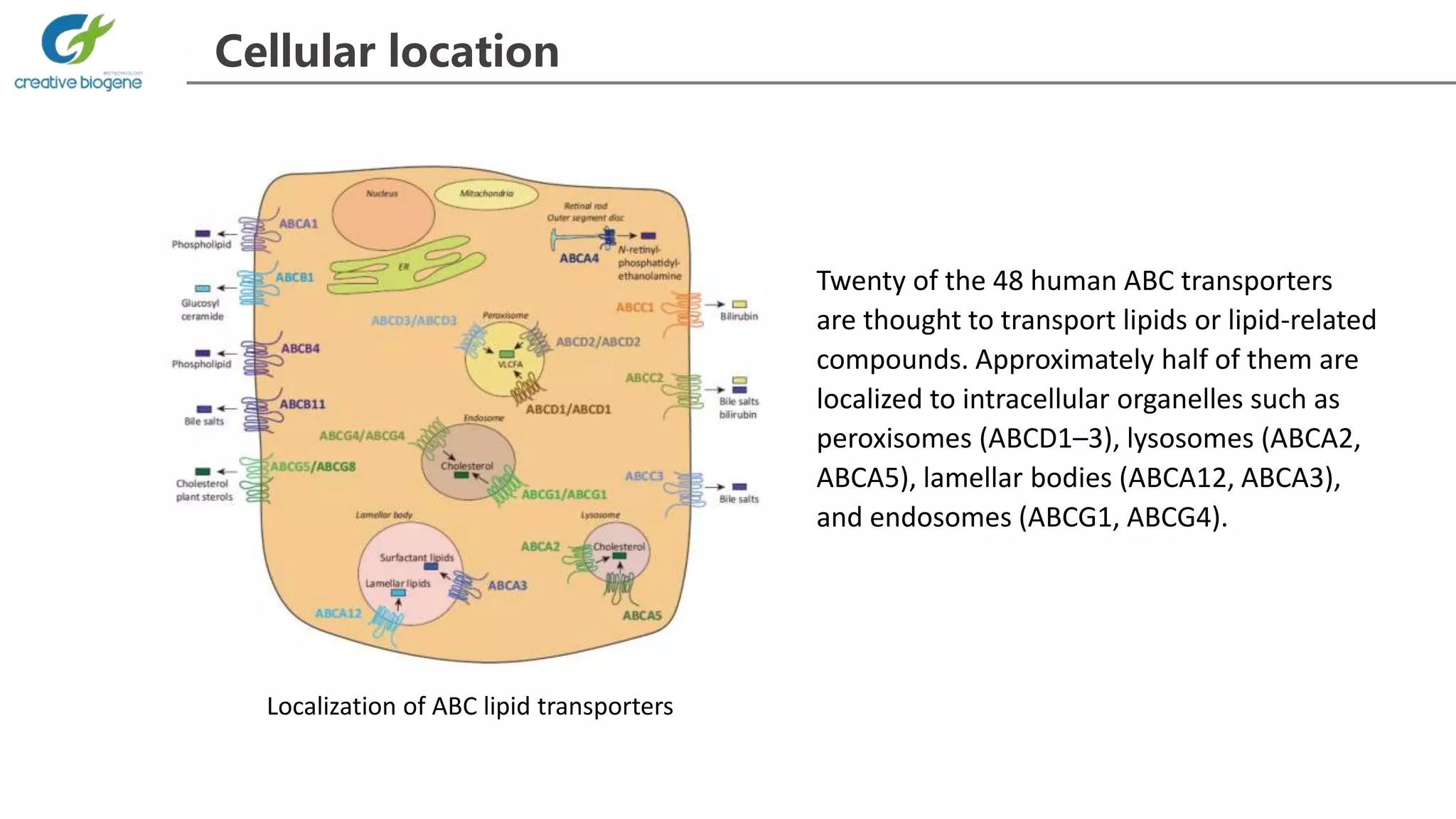
Localization of ABC lipid transporters
Twenty of the 48 human ABC transporters
are thought to transport lipids or lipid-related
compounds. Approximately half of them are
localized to intracellular organelles such as
peroxisomes (ABCD1–3), lysosomes (ABCA2,
ABCA5), lamellar bodies (ABCA12, ABCA3),
and endosomes (ABCG1, ABCG4).
LOGO
Despite contrasting reports about whether ABCG1 and/or ABCG4 are present at the
plasma membrane, it should be noted that loss of ABCG1 results in many specific
cell-intrinsic defects, suggesting that maintenance of intracellular lipid distribution
by ABCG1 is critical. This widespread intracellular localization of different ABC
transporters suggests that the precise distribution of lipids within membranes is
essential not only for membrane structure but also for cell and organelle function.
For example, loss of ABCD1 function results in the accumulation of saturated very
long chain fatty acids due to impaired import into the peroxisome where they would
normally undergo b-oxidation. Moreover, functional loss of ABCA3 or ABCA12 from
lamellar bodies results in the impaired import of lipids into this organelle, leading to
defects in pulmonary surfactant secretion (ABCA3) or maintenance of skin barrier
function (ABCA12).
Cellular location
LOGO
There are 48 ABC transporters in humans that can be subdivided by phylogenetic
analysis into seven distinct subfamilies A-G. Mammalian ABC transporters are involved
in the cellular export of several groups of molecules, including cholesterol and sterols,
lipids, bile acid, iron, retinoic acid derivatives, nucleosides, and peptides. The essential
nature of these functions is highlighted by the fact that defects in the associated
transporters have been observed in many genetic conditions, including Tangier (ABCA1)
and Stargardt (ABCA4) disease, immune deficiency and cancer (ABCB2/3; TAP
transporter), cystic fibrosis (cystic fibrosis transmembrane conductance regulator [CFTR];
ABCC7), and adrenoleukodystrophy (ABCD1), etc.
Lipid transporters and disease
ABC lipid transporters mutated in human disease
LOGO
Membrane distribution of intracellular lipids is crucial for cellular function and
signaling. In fact, mutations in many of these ABC lipid transporters results in
human diseases, such as Tangier disease, sitosterolemia and familial intrahepatic
cholestasis. The ABC transporter superfamily is a well-characterized protein
family, but the substrates and roles of a number of these proteins in human
disease are unknown.
In the case of ABC proteins that transport drugs or small molecules, direct
substrate transport can be demonstrated by the well-established in vitro vesicle-
transport assay. However, for ABC lipid transporters, those transport assays are
inherently more difficult because of the hydrophobic nature of the lipid substrate.
Identification of the molecular mechanism of lipid transport/movement by ABC
transporters will require the development of novel assays to overcome the
problems associated with the insolubility of the substrates.
Concluding Remarks
LOGO
Creative Biogene is a leading biotechnology company in the field of transporters
screening and profiling services. With years of experience and innovation of
transporters compounds assays, we can offer a wide range of targets coverage to help
you fulfill transporters drug discovery project effectively and high-quality.
Screening and Profiling Assay Services
Creative Biogene can offer a wide range of ABC transporters assays, including P-gp
(MDR1/ABCB1), BCRP (ABCG2) and BSEP (sPgp/ABCB11), etc. Our first-class staffs with
abundant know-how in different types of ABC transporters will work closely with your
team and find the best inhibitors of your target transporters.
LOGO
Providing functional
characterization of compound
activity by cell-based assays.
Drug transporter assays meet
various requirements.
Short turn-around time.
Key drug
transporters are covered.
Screening and Profiling Assay Services
THANKS!
info@creative-biogene.com
Website: http://www.creative-biogene.com

Abc transporters family

  • 1.
    Creative Biogene ABC TransportersFamily info@creative-biogene.com Website: http://www.creative-biogene.com
  • 2.
    Brief Introduction ABC (ATP-bindingcassette) proteins are one of the largest and most diverse protein superfamilies, whose members can be found in all eukaryotic and prokaryotic organisms studied to date. The most of ABC proteins are transporters that translocate allocrites across biological membranes. Almost half of the 48 human ABC transporter proteins are thought to facilitate the ATP-dependent translocation of lipids or lipid-related compounds. Such substrates include cholesterol, plant sterols, phospholipids, bile acids and sphingolipids. Mutations in a substantial number of the 48 human ABC transporters have been related to human disease.
  • 3.
    1 The ABCsof Lipid Transport 2 Cellular Location 3 Lipid Transporters and Disease 4 Concluding Remarks CONTENTS 5 Screening and Profiling Assay Services
  • 4.
    LOGO ABC transporters aretransmembrane proteins that utilize the hydrolysis of ATP to facilitate the movement of a wide variety of substrates across membrane bilayers. There are more than 250 members in the ABC superfamily that can be thought of as importers or exporters. Importers are typically associated with the uptake of hydrophilic nutrients, such as peptides, sugars and ions, into the cell, and are common in bacteria and absent from eukaryotes. Both eukaryotes and prokaryotes possess ABC transporters that function to export substrates out of the cytosol, either into an organelle or across the plasma membrane and out of the cell. The ABCs of lipid transport
  • 5.
    LOGO Proteins are classifiedas ABC transporters based on the organization of their ATP-binding cassette, a region that spans 180 amino acids, and contains three highly conserved motifs: the Walker A/P-loop (12 amino acids), the Walker B motif (5 amino acids) and a signature motif/C-loop (5 amino acids). Functional ABC transporters contain two transmembrane domains (TMD), each commonly thought to consist of six transmembrane a-helices and two ABCs. The ABCs of lipid transport (a) Domain arrangement of ABC transporters. (b) Schematic of a single NBD.
  • 6.
    LOGO Cellular location Localizationof ABC lipid transporters Twenty of the 48 human ABC transporters are thought to transport lipids or lipid-related compounds. Approximately half of them are localized to intracellular organelles such as peroxisomes (ABCD1–3), lysosomes (ABCA2, ABCA5), lamellar bodies (ABCA12, ABCA3), and endosomes (ABCG1, ABCG4).
  • 7.
    LOGO Despite contrasting reportsabout whether ABCG1 and/or ABCG4 are present at the plasma membrane, it should be noted that loss of ABCG1 results in many specific cell-intrinsic defects, suggesting that maintenance of intracellular lipid distribution by ABCG1 is critical. This widespread intracellular localization of different ABC transporters suggests that the precise distribution of lipids within membranes is essential not only for membrane structure but also for cell and organelle function. For example, loss of ABCD1 function results in the accumulation of saturated very long chain fatty acids due to impaired import into the peroxisome where they would normally undergo b-oxidation. Moreover, functional loss of ABCA3 or ABCA12 from lamellar bodies results in the impaired import of lipids into this organelle, leading to defects in pulmonary surfactant secretion (ABCA3) or maintenance of skin barrier function (ABCA12). Cellular location
  • 8.
    LOGO There are 48ABC transporters in humans that can be subdivided by phylogenetic analysis into seven distinct subfamilies A-G. Mammalian ABC transporters are involved in the cellular export of several groups of molecules, including cholesterol and sterols, lipids, bile acid, iron, retinoic acid derivatives, nucleosides, and peptides. The essential nature of these functions is highlighted by the fact that defects in the associated transporters have been observed in many genetic conditions, including Tangier (ABCA1) and Stargardt (ABCA4) disease, immune deficiency and cancer (ABCB2/3; TAP transporter), cystic fibrosis (cystic fibrosis transmembrane conductance regulator [CFTR]; ABCC7), and adrenoleukodystrophy (ABCD1), etc. Lipid transporters and disease
  • 9.
    ABC lipid transportersmutated in human disease
  • 10.
    LOGO Membrane distribution ofintracellular lipids is crucial for cellular function and signaling. In fact, mutations in many of these ABC lipid transporters results in human diseases, such as Tangier disease, sitosterolemia and familial intrahepatic cholestasis. The ABC transporter superfamily is a well-characterized protein family, but the substrates and roles of a number of these proteins in human disease are unknown. In the case of ABC proteins that transport drugs or small molecules, direct substrate transport can be demonstrated by the well-established in vitro vesicle- transport assay. However, for ABC lipid transporters, those transport assays are inherently more difficult because of the hydrophobic nature of the lipid substrate. Identification of the molecular mechanism of lipid transport/movement by ABC transporters will require the development of novel assays to overcome the problems associated with the insolubility of the substrates. Concluding Remarks
  • 11.
    LOGO Creative Biogene isa leading biotechnology company in the field of transporters screening and profiling services. With years of experience and innovation of transporters compounds assays, we can offer a wide range of targets coverage to help you fulfill transporters drug discovery project effectively and high-quality. Screening and Profiling Assay Services Creative Biogene can offer a wide range of ABC transporters assays, including P-gp (MDR1/ABCB1), BCRP (ABCG2) and BSEP (sPgp/ABCB11), etc. Our first-class staffs with abundant know-how in different types of ABC transporters will work closely with your team and find the best inhibitors of your target transporters.
  • 12.
    LOGO Providing functional characterization ofcompound activity by cell-based assays. Drug transporter assays meet various requirements. Short turn-around time. Key drug transporters are covered. Screening and Profiling Assay Services
  • 13.