Buddhism & Consciousness Mahasraddha's final talk in the current series, 'Buddhism, Science, Philosophy, and Consciousness'.  Given at the Manchester Buddhist Centre on Monday 23rd April 2007.
Consciousness “ Consciousness” derives from the Latin  conscientia  which primarily means moral conscience or, in the literal sense, shared knowledge Oxford Dictionary: 1. Awareness of 2. The totality of a person’s thoughts and feelings or a class of these
Centrality of the mind Skilful and unskilful mental states are preceded by mind, led by mind, made up of mind. If one speaks with an impure mind, suffering follows him even as the cartwheel follows the hoof of the ox. If one speaks or acts with a pure mind, happiness follows him like his shadow and never leaves.
Centrality of the mind “ Just as a fletcher straightens his arrow, so the wise man straightens his trembling, unsteady mind which is difficult to guard and hard to restrain” “ Hard it is to train the mind, which goes where it likes and does what it wants”
Centrality of the mind “… a trained mind brings happiness. The wise guard their minds, which are subtle and elusive, wandering at will. A guarded mind brings happiness. More than those who hate, more than all your enemies, greater is the harm done to oneself by a wrongly directed mind. Neither mother, father nor relative can do you as much good as a well-directed mind”
Milarepa
Milarepa’s questions In the house of the body, is there only one mind in the body or are there many? If many, how do they live together?
The Shepherd boy’s responses “ Dear Lama, last night I tried to find out what my mind is and how it works. I observed it carefully and found that I only had one mind. Even when we want to we cannot kill this mind. However much we try to dismiss it, it won’t go away. If we try to catch it, it cannot be grasped, nor can it be held by pressing it. If we want it to remain, it will not stay, if we want it to go, it will not go. If we try to gather it, it won’t be picked up. If we try to see it, it cannot be seen. If we try to understand it, it cannot be known. If we think it is an existing entity, and cast it off, it will not leave us. If we think it is non-existent, we feel it running on. The mind is something illuminating, aware, wide-awake, yet incomprehensible. In short, it is hard to say what the mind is”
The Five Skandhas Form Feeling Thought Volition Consciousness
Consciousness Vijnana Splits or divides our experience The six sense vijnanas or consciousnesses
Omnipresent mental events Sense impression (sparsa) Feeling (vedana) Interpretation or perception (samjna) Will or volition (cetana or samskara)
Omnipresent mental events “Whatever there exists of feeling, of perception and of consciousness, these things are associated, not disassociated, and it is impossible to separate one from the other and show their difference. For whatever one feels, one perceives and whatever one perceives of that one distinguishes.”
Omnipresent mental events “Impossible is it for anyone to explain…..the development of consciousness independent of corporeality, feeling, perception and mental formations”
Sutta Nipata “I will explain to you the truth, not based on hearsay. First, realise that this Way is one which can be known here and now, as a result of which a mindfully-living person releases hold on the world”
Sutta Nipata “In every direction there are things you know and recognise, above, below, around and within. Leave them: do not look to them for rest or relief, do not let consciousness dwell on the products of existence, on things that come and go”
The Buddha “I teach the end of suffering”
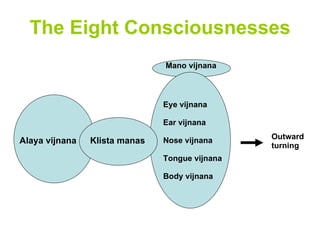
The Eight Consciousnesses   Alaya vijnana Klista manas Eye vijnana Ear vijnana Nose vijnana Tongue vijnana Body vijnana Mano vijnana Outward  turning
Consciousness “ luminous and undefiled by adventitious defilements” “ intrinsic naked awareness unobscured by thought coverings”
Consciousness “… when one seeks one’s mind in its true state, it is found to be quite intelligible, although invisible. In its true state, mind is naked, immaculate; not being made of anything, being of the Viodness: clear, vacuous, without duality, transparent; timeless, uncompounded, unimpeded, colourless; not realisable as a separate thing, but as the unity fo things, yet not composed of them; of one taste and transcendent over all differentiation”
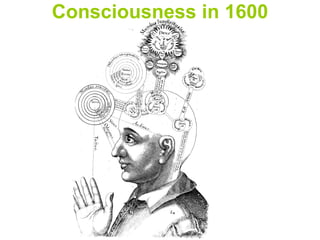
Consciousness in 1600
Consciousness Qualities such as:- Subjectivity Self-awareness Sentience (perception through the senses) Sapience (wisdom) Ability to perceive relationships between oneself and one’s environment
The human brain The most complex object yet discovered anywhere in  the Universe is the organ that fills the space between  our ears Although weighing only about 1300 to 1500 grams  (3 - 4 pounds) the human brain contains over 11 billion  specialised nerve cells or neurons It is not the number, but how they are organised and  interconnected that amazes
Processes, not definitions Karl Popper:- “Knowledge and understanding advance not through asking for definitions of what things are, but through asking why they occur and how they work”
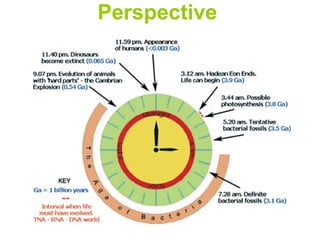
Perspective
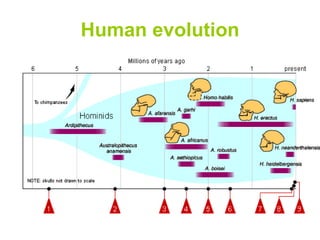
Human evolution
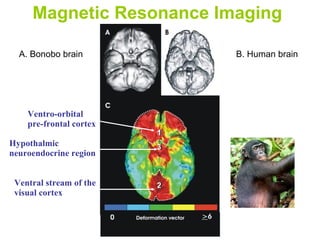
Magnetic Resonance Imaging   A. Bonobo brain B. Human brain Ventro-orbital pre-frontal cortex Ventral stream of the visual cortex Hypothalmic  neuroendocrine region
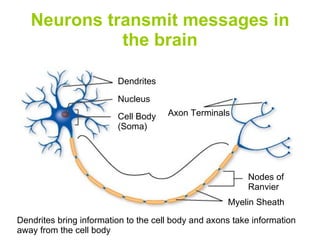
Neurons transmit messages in the brain Myelin Sheath Nodes of Ranvier Axon Terminals Dendrites Nucleus Cell Body (Soma) Dendrites bring information to the cell body and axons take information away from the cell body
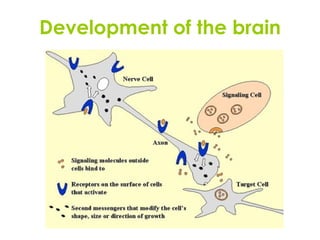
Development of the brain
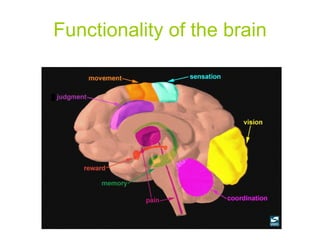
Functionality of the brain
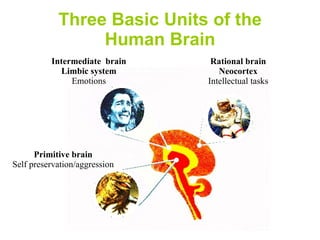
Three Basic Units of the Human Brain Rational brain Neocortex Intellectual tasks Intermediate  brain Limbic system Emotions Primitive brain Self preservation/aggression
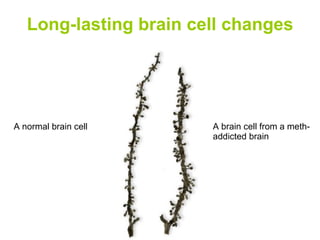
Long-lasting brain cell changes A normal brain cell A brain cell from a meth- addicted brain
Key concepts of consciousness Dynamic core Is the current but constantly changing pattern of reentrant neuronal groups that are active at any one time Process of their reentry is basis of consciousness How can the reentrant activity account for both the unitary nature of consciousness as well as its complexity and changeability?

Consciousness Wk 4

  • 1.
    Buddhism & ConsciousnessMahasraddha's final talk in the current series, 'Buddhism, Science, Philosophy, and Consciousness'. Given at the Manchester Buddhist Centre on Monday 23rd April 2007.
  • 2.
    Consciousness “ Consciousness”derives from the Latin conscientia which primarily means moral conscience or, in the literal sense, shared knowledge Oxford Dictionary: 1. Awareness of 2. The totality of a person’s thoughts and feelings or a class of these
  • 3.
    Centrality of themind Skilful and unskilful mental states are preceded by mind, led by mind, made up of mind. If one speaks with an impure mind, suffering follows him even as the cartwheel follows the hoof of the ox. If one speaks or acts with a pure mind, happiness follows him like his shadow and never leaves.
  • 4.
    Centrality of themind “ Just as a fletcher straightens his arrow, so the wise man straightens his trembling, unsteady mind which is difficult to guard and hard to restrain” “ Hard it is to train the mind, which goes where it likes and does what it wants”
  • 5.
    Centrality of themind “… a trained mind brings happiness. The wise guard their minds, which are subtle and elusive, wandering at will. A guarded mind brings happiness. More than those who hate, more than all your enemies, greater is the harm done to oneself by a wrongly directed mind. Neither mother, father nor relative can do you as much good as a well-directed mind”
  • 6.
  • 7.
    Milarepa’s questions Inthe house of the body, is there only one mind in the body or are there many? If many, how do they live together?
  • 8.
    The Shepherd boy’sresponses “ Dear Lama, last night I tried to find out what my mind is and how it works. I observed it carefully and found that I only had one mind. Even when we want to we cannot kill this mind. However much we try to dismiss it, it won’t go away. If we try to catch it, it cannot be grasped, nor can it be held by pressing it. If we want it to remain, it will not stay, if we want it to go, it will not go. If we try to gather it, it won’t be picked up. If we try to see it, it cannot be seen. If we try to understand it, it cannot be known. If we think it is an existing entity, and cast it off, it will not leave us. If we think it is non-existent, we feel it running on. The mind is something illuminating, aware, wide-awake, yet incomprehensible. In short, it is hard to say what the mind is”
  • 9.
    The Five SkandhasForm Feeling Thought Volition Consciousness
  • 10.
    Consciousness Vijnana Splitsor divides our experience The six sense vijnanas or consciousnesses
  • 11.
    Omnipresent mental eventsSense impression (sparsa) Feeling (vedana) Interpretation or perception (samjna) Will or volition (cetana or samskara)
  • 12.
    Omnipresent mental events“Whatever there exists of feeling, of perception and of consciousness, these things are associated, not disassociated, and it is impossible to separate one from the other and show their difference. For whatever one feels, one perceives and whatever one perceives of that one distinguishes.”
  • 13.
    Omnipresent mental events“Impossible is it for anyone to explain…..the development of consciousness independent of corporeality, feeling, perception and mental formations”
  • 14.
    Sutta Nipata “Iwill explain to you the truth, not based on hearsay. First, realise that this Way is one which can be known here and now, as a result of which a mindfully-living person releases hold on the world”
  • 15.
    Sutta Nipata “Inevery direction there are things you know and recognise, above, below, around and within. Leave them: do not look to them for rest or relief, do not let consciousness dwell on the products of existence, on things that come and go”
  • 16.
    The Buddha “Iteach the end of suffering”
  • 17.
    The Eight Consciousnesses Alaya vijnana Klista manas Eye vijnana Ear vijnana Nose vijnana Tongue vijnana Body vijnana Mano vijnana Outward turning
  • 18.
    Consciousness “ luminousand undefiled by adventitious defilements” “ intrinsic naked awareness unobscured by thought coverings”
  • 19.
    Consciousness “… whenone seeks one’s mind in its true state, it is found to be quite intelligible, although invisible. In its true state, mind is naked, immaculate; not being made of anything, being of the Viodness: clear, vacuous, without duality, transparent; timeless, uncompounded, unimpeded, colourless; not realisable as a separate thing, but as the unity fo things, yet not composed of them; of one taste and transcendent over all differentiation”
  • 20.
  • 21.
    Consciousness Qualities suchas:- Subjectivity Self-awareness Sentience (perception through the senses) Sapience (wisdom) Ability to perceive relationships between oneself and one’s environment
  • 22.
    The human brainThe most complex object yet discovered anywhere in the Universe is the organ that fills the space between our ears Although weighing only about 1300 to 1500 grams (3 - 4 pounds) the human brain contains over 11 billion specialised nerve cells or neurons It is not the number, but how they are organised and interconnected that amazes
  • 23.
    Processes, not definitionsKarl Popper:- “Knowledge and understanding advance not through asking for definitions of what things are, but through asking why they occur and how they work”
  • 24.
  • 25.
  • 26.
    Magnetic Resonance Imaging A. Bonobo brain B. Human brain Ventro-orbital pre-frontal cortex Ventral stream of the visual cortex Hypothalmic neuroendocrine region
  • 27.
    Neurons transmit messagesin the brain Myelin Sheath Nodes of Ranvier Axon Terminals Dendrites Nucleus Cell Body (Soma) Dendrites bring information to the cell body and axons take information away from the cell body
  • 28.
  • 29.
  • 30.
    Three Basic Unitsof the Human Brain Rational brain Neocortex Intellectual tasks Intermediate brain Limbic system Emotions Primitive brain Self preservation/aggression
  • 31.
    Long-lasting brain cellchanges A normal brain cell A brain cell from a meth- addicted brain
  • 32.
    Key concepts ofconsciousness Dynamic core Is the current but constantly changing pattern of reentrant neuronal groups that are active at any one time Process of their reentry is basis of consciousness How can the reentrant activity account for both the unitary nature of consciousness as well as its complexity and changeability?