HTN
   The Silent Killer
 ADA 2013 guidelines
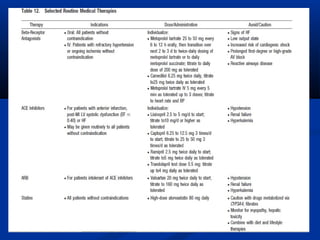
STEMI 2013 guidelines
 BHS 2011 guidelines

    Dr Ihab Suliman
      25/3/2013
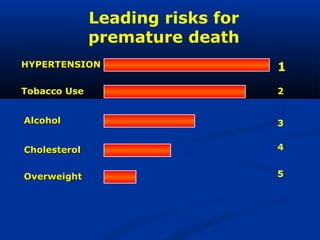
Leading risks for
              premature death
HYPERTENSION                                   1
Tobacco Use                                    2


Alcohol                                        3


Cholesterol                                    4


Overweight                                     5


                (World Health Organization 2002)
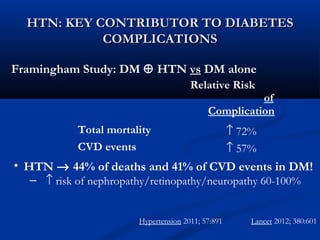
HTN: KEY CONTRIBUTOR TO DIABETES
            COMPLICATIONS

Framingham Study: DM ⊕ HTN vs DM alone
                                      Relative Risk
                                                     of
                                           Complication
           Total mortality                         ↑ 72%
           CVD events                              ↑ 57%
• HTN → 44% of deaths and 41% of CVD events in DM!
  ‒ ↑ risk of nephropathy/retinopathy/neuropathy 60-100%


                       Hypertension 2011; 57:891       Lancet 2012; 380:601
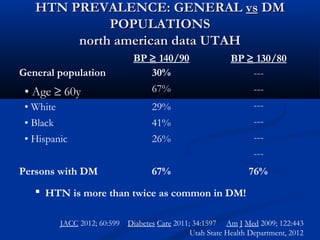
HTN PREVALENCE: GENERAL vs DM
             POPULATIONS
        north american data UTAH
                              BP ≥ 140/90                   BP ≥ 130/80
General population               30%                            ---
 • Age ≥ 60y                        67%                           ---
 • White                            29%                           ---
 • Black                            41%                           ---
 • Hispanic                         26%                           ---
                                                                  ---
Persons with DM                     67%                          76%
    HTN is more than twice as common in DM!

         JACC 2012; 60:599   Diabetes Care 2011; 34:1597 Am J Med 2009; 122:443
                                                Utah State Health Department, 2012
Background
•   Each 2 mmHg rise in systolic blood pressure
    associated with increased risk of mortality:
     – 7% from heart disease
    – 10% from stroke.
Properly Measured
   Cuff Size

   Bilateral

   Confirm with Manual

   No recent caffeine or Smoking
How many BP readings?
1.   3 – in sinus
     rhythm
2.    more if there
     are multiple
     ectopics or AF
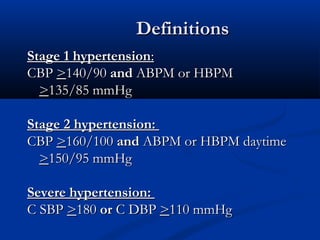
Definitions
Stage 1 hypertension:
CBP >140/90 and ABPM or HBPM
  >135/85 mmHg

Stage 2 hypertension:
CBP >160/100 and ABPM or HBPM daytime
  >150/95 mmHg

Severe hypertension:
C SBP >180 or C DBP >110 mmHg
Diagnosis
If C.B.P. >140/90 mmHg, offer ABPM to confirm the
diagnosis

ABPM:
–at least two measurements per hour, at least 14
measurements

HBPM:
–two consecutive seated measurements, at least 1 minute
apart
–BP twice a day for at least 4 days
–measurements on the first day are discarded
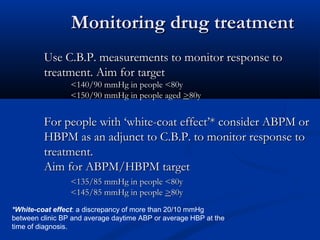
Monitoring drug treatment
         Use C.B.P. measurements to monitor response to
         treatment. Aim for target
                 <140/90 mmHg in people <80y
                 <150/90 mmHg in people aged >80y


         For people with ‘white-coat effect’* consider ABPM or
         HBPM as an adjunct to C.B.P. to monitor response to
         treatment.
         Aim for ABPM/HBPM target
                 <135/85 mmHg in people <80y
                 <145/85 mmHg in people >80y
*White-coat effect: a discrepancy of more than 20/10 mmHg
between clinic BP and average daytime ABP or average HBP at the
time of diagnosis.
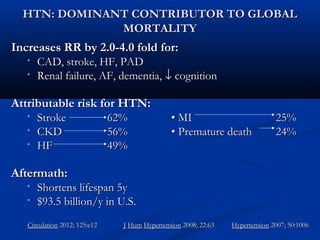
HTN: DOMINANT CONTRIBUTOR TO GLOBAL
              MORTALITY
Increases RR by 2.0-4.0 fold for:
   •   CAD, stroke, HF, PAD
   •   Renal failure, AF, dementia, ↓ cognition

Attributable risk for HTN:
   •   Stroke                  62%              • MI                            25%
   •   CKD                     56%              • Premature death               24%
   •   HF                      49%

Aftermath:
   •   Shortens lifespan 5y
   •   $93.5 billion/y in U.S.
   Circulation 2012; 125:e12     J Hum Hypertension 2008; 22:63   Hypertension 2007; 50:1006
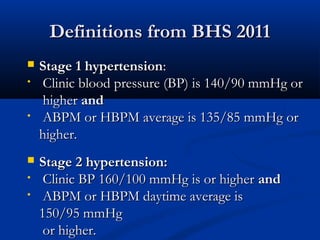
Definitions from BHS 2011
   Stage 1 hypertension:
•   Clinic blood pressure (BP) is 140/90 mmHg or
    higher and
•   ABPM or HBPM average is 135/85 mmHg or
    higher.
   Stage 2 hypertension:
•    Clinic BP 160/100 mmHg is or higher and
•    ABPM or HBPM daytime average is
    150/95 mmHg
     or higher.
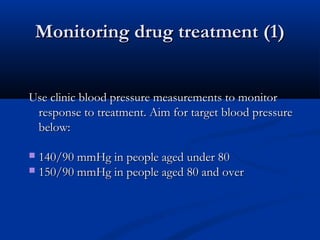
Monitoring drug treatment (1)


Use clinic blood pressure measurements to monitor
 response to treatment. Aim for target blood pressure
 below:

 140/90 mmHg in people aged under 80
 150/90 mmHg in people aged 80 and over
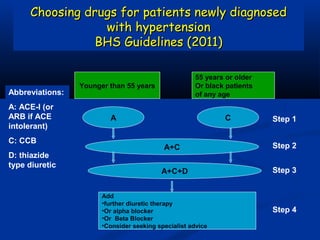
Choosing drugs for patients newly diagnosed
                 with hypertension
                BHS Guidelines (2011)

                                                     55 years or older
                 Younger than 55 years               Or black patients
Abbreviations:                                       of any age
A: ACE-I (or
ARB if ACE               A                                   C           Step 1
intolerant)
C: CCB
                                           A+C                           Step 2
D: thiazide
type diuretic
                                          A+C+D                          Step 3


                       Add
                       •further diuretic therapy
                       •Or alpha blocker                                 Step 4
                       •Or Beta Blocker
                       •Consider seeking specialist advice
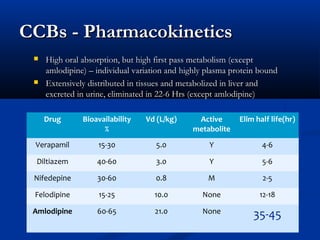
CCBs - Pharmacokinetics
    High oral absorption, but high first pass metabolism (except
     amlodipine) – individual variation and highly plasma protein bound
    Extensively distributed in tissues and metabolized in liver and
     excreted in urine, eliminated in 22-6 Hrs (except amlodipine)

     Drug      Bioavailability   Vd (L/kg)     Active       Elim half life(hr)
                     %                        metabolite
 Verapamil         15-30            5.0            Y               4-6

  Diltiazem        40-60            3.0            Y               5-6

 Nifedepine        30-60            0.8            M               2-5

 Felodipine         15-25          10.0          None             12-18

 Amlodipine        60-65            21.0         None
                                                                35-45
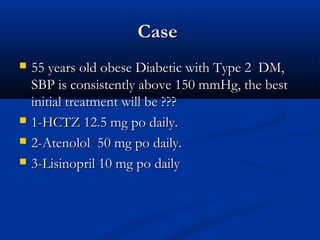
Case
   55 years old obese Diabetic with Type 2 DM,
    SBP is consistently above 150 mmHg, the best
    initial treatment will be ???
   1-HCTZ 12.5 mg po daily.
   2-Atenolol 50 mg po daily.
   3-Lisinopril 10 mg po daily
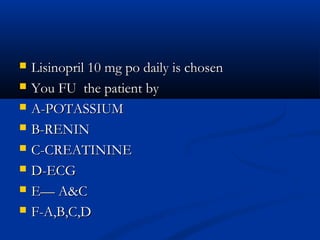
   Lisinopril 10 mg po daily is chosen
   You FU the patient by
   A-POTASSIUM
   B-RENIN
   C-CREATININE
   D-ECG
   E— A&C
   F-A,B,C,D
   E— A&C
   The patient after starting Lisinopril will be seen
    after with Basic Screen
    A- one week then 3 monthy
   B- every 3 months
   C- within 3 days then 3months
   A- one week then 3 monthy
   45 years old male with DM , Prior history of
    IHD, Last echo report EF 45%, SBP 155,
    Creatinine 140, potassium 4, started on
    lisinopril 10 mg po daily, after 3 month on a
    routine visit SBP 115, creatinine 155, potassium
    is 4.5 , No chest Pain or SOB, the next step will
    be ????
   A- DIC Lisinopril & Start Amlor .
   B- refer to cardiology.
   C-No change & B
   D- DIC lisinopril & start ARBs
   E- Start Aliskiren
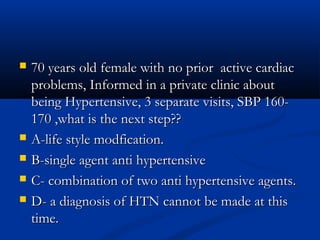
   70 years old female with no prior active cardiac
    problems, Informed in a private clinic about
    being Hypertensive, 3 separate visits, SBP 160-
    170 ,what is the next step??
   A-life style modfication.
   B-single agent anti hypertensive
   C- combination of two anti hypertensive agents.
   D- a diagnosis of HTN cannot be made at this
    time.
   C- combination of two anti hypertensive agents.
STANDARDS OF MEDICAL CARE
     IN DIABETES—2013
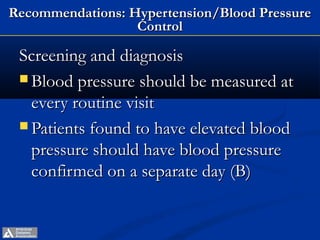
Recommendations: Hypertension/Blood Pressure
                  Control

 Screening and diagnosis
  Blood pressure should be measured at
   every routine visit
  Patients found to have elevated blood
   pressure should have blood pressure
   confirmed on a separate day (B)


       ADA. VI. Prevention, Management of Complications. Diabetes Care 2013;36(suppl 1):S28-S29.
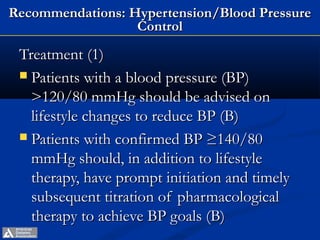
Recommendations: Hypertension/Blood Pressure
                  Control

 Treatment (1)
  Patients with a blood pressure (BP)
   >120/80 mmHg should be advised on
   lifestyle changes to reduce BP (B)
  Patients with confirmed BP ≥140/80
   mmHg should, in addition to lifestyle
   therapy, have prompt initiation and timely
   subsequent titration of pharmacological
   therapy to achieve BP goals (B)
         ADA. VI. Prevention, Management of Complications. Diabetes Care 2013;36(suppl 1):S29.
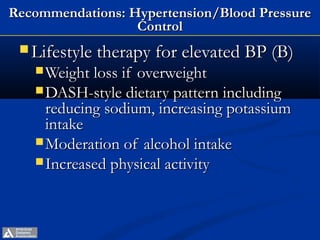
Recommendations: Hypertension/Blood Pressure
                  Control
  Lifestyle therapy for elevated BP (B)
    Weight loss ifoverweight
    DASH-style dietary pattern including
     reducing sodium, increasing potassium
     intake
    Moderation of alcohol intake
    Increased physical activity


         ADA. VI. Prevention, Management of Complications. Diabetes Care 2013;36(suppl 1):S29.
Recommendations: Hypertension/Blood
         Pressure Control
   Pharmacological therapy for patients with diabetes and
    hypertension (C)
       A regimen that includes either an ACE inhibitor or
        angiotensin II receptor blocker; if one class is not tolerated,
        substitute the other
   Multiple drug therapy (two or more agents at maximal
    doses) generally required to achieve BP targets (B)
   Administer one or more antihypertensive medications
    at bedtime (A)


               ADA. VI. Prevention, Management of Complications. Diabetes Care 2013;36(suppl 1):S29.
Recommendations: Hypertension/Blood Pressure
                  Control
    If ACE inhibitors, ARBs, or diuretics are used,
     kidney function, serum potassium levels should be
     monitored (E)
    In pregnant patients with diabetes and chronic
     hypertension, blood pressure target goals of 110–
     129/65–79 mmHg are suggested in interest of
     long-term maternal health and minimizing impaired
     fetal growth; ACE inhibitors, ARBs, contraindicated
     during pregnancy (E)


             ADA. VI. Prevention, Management of Complications. Diabetes Care 2013;36(suppl 1):S29.
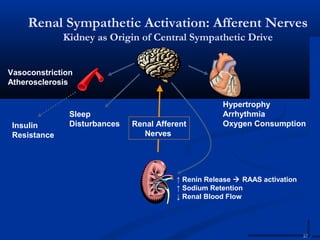
Renal Sympathetic Activation: Afferent Nerves
              Kidney as Origin of Central Sympathetic Drive


Vasoconstriction
Atherosclerosis

                                                     Hypertrophy
               Sleep                                 Arrhythmia
 Insulin       Disturbances   Renal Afferent         Oxygen Consumption
 Resistance                      Nerves


                                         ↑ Renin Release  RAAS activation
                                         ↑ Sodium Retention
                                         ↓ Renal Blood Flow


                                                                             37
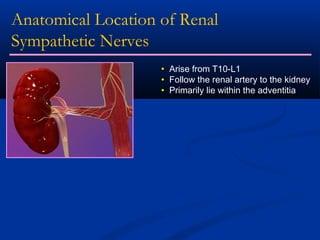
Anatomical Location of Renal
Sympathetic Nerves
                    • Arise from T10-L1
                    • Follow the renal artery to the kidney
                    • Primarily lie within the adventitia
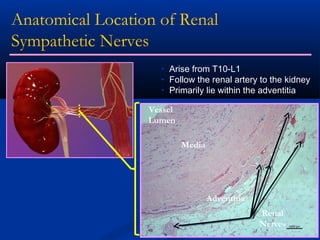
Anatomical Location of Renal
Sympathetic Nerves
                    • Arise from T10-L1
                    • Follow the renal artery to the kidney
                    • Primarily lie within the adventitia

                  Vessel
                  Lumen

                           Media


                                   Adventitia
                                                Renal
                                                Nerves
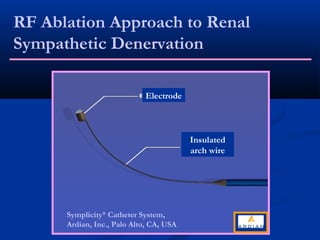
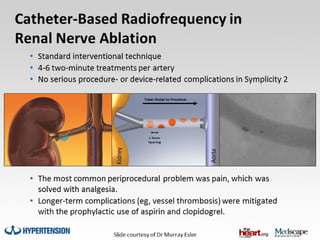
RF Ablation Approach to Renal
Sympathetic Denervation

                            Electrode


                                         Insulated
                                         arch wire


      Symplicity® Catheter System,
      Ardian, Inc., Palo Alto, CA, USA
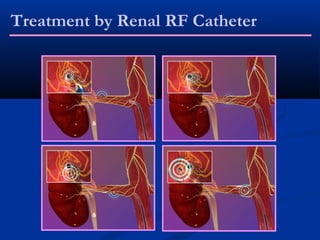
Treatment by Renal RF Catheter
‫وفي النهاية‬
‫، نسأل ا أن يعلمنا ما ينفعنا‬
    ‫،وأن ينفعنا بما علمنا‬

          ‫وأ علما‬

Hypertension the silent killer

  • 1.
    HTN The Silent Killer ADA 2013 guidelines STEMI 2013 guidelines BHS 2011 guidelines Dr Ihab Suliman 25/3/2013
  • 2.
    Leading risks for premature death HYPERTENSION 1 Tobacco Use 2 Alcohol 3 Cholesterol 4 Overweight 5 (World Health Organization 2002)
  • 3.
    HTN: KEY CONTRIBUTORTO DIABETES COMPLICATIONS Framingham Study: DM ⊕ HTN vs DM alone Relative Risk of Complication Total mortality ↑ 72% CVD events ↑ 57% • HTN → 44% of deaths and 41% of CVD events in DM! ‒ ↑ risk of nephropathy/retinopathy/neuropathy 60-100% Hypertension 2011; 57:891 Lancet 2012; 380:601
  • 4.
    HTN PREVALENCE: GENERALvs DM POPULATIONS north american data UTAH BP ≥ 140/90 BP ≥ 130/80 General population 30% --- • Age ≥ 60y 67% --- • White 29% --- • Black 41% --- • Hispanic 26% --- --- Persons with DM 67% 76%  HTN is more than twice as common in DM! JACC 2012; 60:599 Diabetes Care 2011; 34:1597 Am J Med 2009; 122:443 Utah State Health Department, 2012
  • 5.
    Background • Each 2 mmHg rise in systolic blood pressure associated with increased risk of mortality: – 7% from heart disease – 10% from stroke.
  • 6.
    Properly Measured  Cuff Size  Bilateral  Confirm with Manual  No recent caffeine or Smoking
  • 7.
    How many BPreadings? 1. 3 – in sinus rhythm 2. more if there are multiple ectopics or AF
  • 8.
    Definitions Stage 1 hypertension: CBP>140/90 and ABPM or HBPM >135/85 mmHg Stage 2 hypertension: CBP >160/100 and ABPM or HBPM daytime >150/95 mmHg Severe hypertension: C SBP >180 or C DBP >110 mmHg
  • 9.
    Diagnosis If C.B.P. >140/90 mmHg,offer ABPM to confirm the diagnosis ABPM: –at least two measurements per hour, at least 14 measurements HBPM: –two consecutive seated measurements, at least 1 minute apart –BP twice a day for at least 4 days –measurements on the first day are discarded
  • 10.
    Monitoring drug treatment Use C.B.P. measurements to monitor response to treatment. Aim for target <140/90 mmHg in people <80y <150/90 mmHg in people aged >80y For people with ‘white-coat effect’* consider ABPM or HBPM as an adjunct to C.B.P. to monitor response to treatment. Aim for ABPM/HBPM target <135/85 mmHg in people <80y <145/85 mmHg in people >80y *White-coat effect: a discrepancy of more than 20/10 mmHg between clinic BP and average daytime ABP or average HBP at the time of diagnosis.
  • 11.
    HTN: DOMINANT CONTRIBUTORTO GLOBAL MORTALITY Increases RR by 2.0-4.0 fold for: • CAD, stroke, HF, PAD • Renal failure, AF, dementia, ↓ cognition Attributable risk for HTN: • Stroke 62% • MI 25% • CKD 56% • Premature death 24% • HF 49% Aftermath: • Shortens lifespan 5y • $93.5 billion/y in U.S. Circulation 2012; 125:e12 J Hum Hypertension 2008; 22:63 Hypertension 2007; 50:1006
  • 12.
    Definitions from BHS2011  Stage 1 hypertension: • Clinic blood pressure (BP) is 140/90 mmHg or higher and • ABPM or HBPM average is 135/85 mmHg or higher.  Stage 2 hypertension: • Clinic BP 160/100 mmHg is or higher and • ABPM or HBPM daytime average is 150/95 mmHg or higher.
  • 13.
    Monitoring drug treatment(1) Use clinic blood pressure measurements to monitor response to treatment. Aim for target blood pressure below:  140/90 mmHg in people aged under 80  150/90 mmHg in people aged 80 and over
  • 14.
    Choosing drugs forpatients newly diagnosed with hypertension BHS Guidelines (2011) 55 years or older Younger than 55 years Or black patients Abbreviations: of any age A: ACE-I (or ARB if ACE A C Step 1 intolerant) C: CCB A+C Step 2 D: thiazide type diuretic A+C+D Step 3 Add •further diuretic therapy •Or alpha blocker Step 4 •Or Beta Blocker •Consider seeking specialist advice
  • 15.
    CCBs - Pharmacokinetics  High oral absorption, but high first pass metabolism (except amlodipine) – individual variation and highly plasma protein bound  Extensively distributed in tissues and metabolized in liver and excreted in urine, eliminated in 22-6 Hrs (except amlodipine) Drug Bioavailability Vd (L/kg) Active Elim half life(hr) % metabolite Verapamil 15-30 5.0 Y 4-6 Diltiazem 40-60 3.0 Y 5-6 Nifedepine 30-60 0.8 M 2-5 Felodipine 15-25 10.0 None 12-18 Amlodipine 60-65 21.0 None 35-45
  • 16.
    Case  55 years old obese Diabetic with Type 2 DM, SBP is consistently above 150 mmHg, the best initial treatment will be ???  1-HCTZ 12.5 mg po daily.  2-Atenolol 50 mg po daily.  3-Lisinopril 10 mg po daily
  • 17.
    Lisinopril 10 mg po daily is chosen  You FU the patient by  A-POTASSIUM  B-RENIN  C-CREATININE  D-ECG  E— A&C  F-A,B,C,D
  • 18.
    E— A&C  The patient after starting Lisinopril will be seen after with Basic Screen  A- one week then 3 monthy  B- every 3 months  C- within 3 days then 3months
  • 19.
    A- one week then 3 monthy
  • 20.
    45 years old male with DM , Prior history of IHD, Last echo report EF 45%, SBP 155, Creatinine 140, potassium 4, started on lisinopril 10 mg po daily, after 3 month on a routine visit SBP 115, creatinine 155, potassium is 4.5 , No chest Pain or SOB, the next step will be ????
  • 21.
    A- DIC Lisinopril & Start Amlor .  B- refer to cardiology.  C-No change & B  D- DIC lisinopril & start ARBs  E- Start Aliskiren
  • 22.
    70 years old female with no prior active cardiac problems, Informed in a private clinic about being Hypertensive, 3 separate visits, SBP 160- 170 ,what is the next step??  A-life style modfication.  B-single agent anti hypertensive  C- combination of two anti hypertensive agents.  D- a diagnosis of HTN cannot be made at this time.
  • 23.
    C- combination of two anti hypertensive agents.
  • 26.
    STANDARDS OF MEDICALCARE IN DIABETES—2013
  • 27.
    Recommendations: Hypertension/Blood Pressure Control Screening and diagnosis  Blood pressure should be measured at every routine visit  Patients found to have elevated blood pressure should have blood pressure confirmed on a separate day (B) ADA. VI. Prevention, Management of Complications. Diabetes Care 2013;36(suppl 1):S28-S29.
  • 28.
    Recommendations: Hypertension/Blood Pressure Control Treatment (1)  Patients with a blood pressure (BP) >120/80 mmHg should be advised on lifestyle changes to reduce BP (B)  Patients with confirmed BP ≥140/80 mmHg should, in addition to lifestyle therapy, have prompt initiation and timely subsequent titration of pharmacological therapy to achieve BP goals (B) ADA. VI. Prevention, Management of Complications. Diabetes Care 2013;36(suppl 1):S29.
  • 29.
    Recommendations: Hypertension/Blood Pressure Control  Lifestyle therapy for elevated BP (B)  Weight loss ifoverweight  DASH-style dietary pattern including reducing sodium, increasing potassium intake  Moderation of alcohol intake  Increased physical activity ADA. VI. Prevention, Management of Complications. Diabetes Care 2013;36(suppl 1):S29.
  • 30.
    Recommendations: Hypertension/Blood Pressure Control  Pharmacological therapy for patients with diabetes and hypertension (C)  A regimen that includes either an ACE inhibitor or angiotensin II receptor blocker; if one class is not tolerated, substitute the other  Multiple drug therapy (two or more agents at maximal doses) generally required to achieve BP targets (B)  Administer one or more antihypertensive medications at bedtime (A) ADA. VI. Prevention, Management of Complications. Diabetes Care 2013;36(suppl 1):S29.
  • 31.
    Recommendations: Hypertension/Blood Pressure Control  If ACE inhibitors, ARBs, or diuretics are used, kidney function, serum potassium levels should be monitored (E)  In pregnant patients with diabetes and chronic hypertension, blood pressure target goals of 110– 129/65–79 mmHg are suggested in interest of long-term maternal health and minimizing impaired fetal growth; ACE inhibitors, ARBs, contraindicated during pregnancy (E) ADA. VI. Prevention, Management of Complications. Diabetes Care 2013;36(suppl 1):S29.
  • 37.
    Renal Sympathetic Activation:Afferent Nerves Kidney as Origin of Central Sympathetic Drive Vasoconstriction Atherosclerosis Hypertrophy Sleep Arrhythmia Insulin Disturbances Renal Afferent Oxygen Consumption Resistance Nerves ↑ Renin Release  RAAS activation ↑ Sodium Retention ↓ Renal Blood Flow 37
  • 38.
    Anatomical Location ofRenal Sympathetic Nerves • Arise from T10-L1 • Follow the renal artery to the kidney • Primarily lie within the adventitia
  • 39.
    Anatomical Location ofRenal Sympathetic Nerves • Arise from T10-L1 • Follow the renal artery to the kidney • Primarily lie within the adventitia Vessel Lumen Media Adventitia Renal Nerves
  • 40.
    RF Ablation Approachto Renal Sympathetic Denervation Electrode Insulated arch wire Symplicity® Catheter System, Ardian, Inc., Palo Alto, CA, USA
  • 41.
    Treatment by RenalRF Catheter
  • 43.
    ‫وفي النهاية‬ ‫، نسألا أن يعلمنا ما ينفعنا‬ ‫،وأن ينفعنا بما علمنا‬ ‫وأ علما‬

Editor's Notes

  • #3 Slide 6: The slide illustrates the importance of hypertension in relationship to other risks for premature death. The data is from a study of the World Health Organization that found that hypertension is the leading risk for death in women and the second leading risk for death in men in countries like Canada.
  • #6 NOTES FOR PRESENTERS: Key points to raise: Hypertension is a major risk factor for ischaemic and haemorrhagic stroke, myocardial infarction, heart failure, chronic kidney disease, cognitive decline and premature death. Untreated hypertension is usually associated with a progressive rise in blood pressure. The vascular and renal damage that this may cause can culminate in a treatment-resistant state. Blood pressure is normally distributed in the population and there is no natural cut-off point above which &apos;hypertension&apos; definitively exists and below which it does not. The risk associated with increasing blood pressure is continuous, with each 2 mmHg rise in systolic blood pressure associated with a 7% increased risk of mortality from ischaemic heart disease and a 10% increased risk of mortality from stroke. Routine periodic screening for high blood pressure is now commonplace in the UK as part of National Service Frameworks for cardiovascular disease prevention. Consequently, the diagnosis, treatment and follow-up of people with hypertension is one of the most common interventions in primary care, accounting for approximately 12% of Primary Care consultation episodes and approximately £1billion in drug costs in 2006.
  • #13 NOTES FOR PRESENTERS: Definitions In this guideline the following definitions are used: Stage 1 hypertension Clinic blood pressure is 140/90 mmHg or higher and subsequent ambulatory blood pressure monitoring (ABPM) daytime average or home blood pressure monitoring (HBPM) average blood pressure is 135/85 mmHg or higher. Stage 2 hypertension Clinic blood pressure is 160/100 mmHg or higher and subsequent ABPM daytime average or HBPM average blood pressure is 150/95 mmHg or higher. Severe hypertension Clinic systolic blood pressure is 180 mmHg or higher or clinic diastolic blood pressure is 110 mmHg or higher. Additional information: ABPM – ambulatory blood pressure monitoring HBPM – home blood pressure monitoring
  • #14 NOTES FOR PRESENTERS: These recommendations are not key priorities but have been included as they direct the management of hypertension. Recommendations in full: Use clinic blood pressure measurements to monitor the response to antihypertensive treatment with lifestyle modifications or drugs. [new 2011] [1.5.4] Aim for a target clinic blood pressure below 140/90 mmHg in people aged under 80 years with treated hypertension. [new 2011] [1.5.5] Aim for a target clinic blood pressure below 150/90 mmHg in people aged 80 years and over, with treated hypertension. [new 2011] [1.5.6]
  • #27 “ Standards of Medical Care in Diabetes—2013” comprises all of the current and key clinical recommendations of the American Diabetes Association (ADA) These standards of care are intended to provide clinicians, patients, researchers, payers, and other interested individuals with the components of diabetes care, general treatment goals, and tools to evaluate the quality of care While individual preferences, comorbidities, and other patient factors may require modification of goals, targets that are desirable for most patients with diabetes are provided; specifically titled sections of the standards address children with diabetes, pregnant women, and people with prediabetes These standards are not intended to preclude clinical judgment or more extensive evaluation and management of the patient by other specialists as needed; for more detailed information about management of diabetes, refer to references The recommendations included are screening, diagnostic, and therapeutic actions that are known or believed to affect health outcomes of patients with diabetes favorably; a large number of these interventions have been shown to be cost-effective The slides are organized to correspond with sections within the “Standards of Medical Care in Diabetes—2013” While not every section in the document is represented, these slides do incorporate the most salient points from the Position Statement These standards of care are revised annually by the ADA’s multidisciplinary Professional Practice Committee, incorporating new evidence; subsequently, they are reviewed and approved by the Executive Committee of ADA’s Board of Directors Reference American Diabetes Association. Standards of medical care in diabetes—2013. Diabetes Care 2013;36(suppl 1):S11.
  • #28 Hypertension is a common comorbidity of diabetes that affects the majority of patients, with prevalence depending on type of diabetes, age, obesity, and ethnicity Hypertension is a major risk factor for both CVD and microvascular complications In type 1 diabetes, hypertension is often the result of underlying nephropathy, while in type 2 diabetes it usually coexists with other cardiometabolic risk factors This slide and the following five slides summarize recommendations for screening and diagnosis, goals, and treatment for hypertension/blood pressure control in patients with diabetes Slide 1 of 6 – Screening and Diagnosis Blood pressure should be measured at every routine visit Patients found to have elevated blood pressure should have blood pressure confirmed on a separate day (B) Reference American Diabetes Association. Standards of medical care in diabetes—2013. Diabetes Care 2013;36(suppl 1):S28-S29.
  • #29 This set of six slides summarize recommendations for screening and diagnosis, goals, and treatment for hypertension/blood pressure control in patients with diabetes Slide 3 of 6 – Treatment (Slide 1 of 4) Patients with a blood pressure &gt;120/80 mmHg should be advised on lifestyle changes to reduce blood pressure (B) Patients with confirmed blood pressure ≥140/80 mmHg should, in addition to lifestyle therapy, have prompt initiation and timely subsequent titration of pharmacological therapy to achieve blood pressure goals (B) Reference American Diabetes Association. Standards of medical care in diabetes—2013. Diabetes Care 2013;36(suppl 1):S29.
  • #30 This set of six slides summarize recommendations for screening and diagnosis, goals, and treatment for hypertension/blood pressure control in patients with diabetes Slide 4 of 6 – Treatment (Slide 2 of 4) Lifestyle therapy for elevated blood pressure consists of weight loss if overweight, DASH-style dietary pattern including reducing sodium and increasing potassium intake, moderation of alcohol intake, and increased physical activity (B) Reference American Diabetes Association. Standards of medical care in diabetes—2013. Diabetes Care 2013;36(suppl 1):S29.
  • #31 This set of six slides summarize recommendations for screening and diagnosis, goals, and treatment for hypertension/blood pressure control in patients with diabetes Slide 5 of 6 – Treatment (Slide 3 of 4) Pharmacologic therapy for patients with diabetes and hypertension should be paired with a regimen that included either an ACE inhibitor or an angiotensin II receptor blocker (ARB); if one class is not tolerated, the other should be substituted Multiple drug therapy (two or more agents at maximal doses) is generally required to achieve blood pressure targets (B) Administer one or more antihypertensive medications at bedtime (A) Reference American Diabetes Association. Standards of medical care in diabetes—2013. Diabetes Care 2013;36(suppl 1):S29.
  • #32 This set of six slides summarize recommendations for screening and diagnosis, goals, and treatment for hypertension/blood pressure control in patients with diabetes Slide 6 of 6 – Treatment (Slide 4 of 4) If ACE inhibitors, angiotensin II receptor blockers (ARBs), or diuretics are used, serum creatine/estimated glomerular filtration rate (eGFR) and serum potassium levels should be monitored (E) In pregnant women with diabetes and chronic hypertension, blood pressure target goals of 110-129/65-79 mmHg are suggested in the interest of long-term maternal health and minimizing impaired fetal growth ACE inhibitors and angiotensin II receptor blockers (ARBs) are contraindicated during pregnancy (E) Reference American Diabetes Association. Standards of medical care in diabetes—2013. Diabetes Care 2013;36(suppl 1):S29.