International Journal of Engineering Research and Development
ISSN: 2278-067X, Volume 1, Issue 8 (June 2012), PP.01-07
www.ijerd.com

       Optimization of conditions for the preparation of activated
                 carbon from mango nuts using ZnCl2
                                           A. Kwaghger1, E. Adejoh1
                   1
                       Department of Mechanical Engineering, University of Agriculture, Makurdi, Nigeria.


Abstract––Activated carbon was prepared from mango nuts by chemical activation method using ZnCl2. The effect of
preparation variables; concentration, impregnation ratio and activation time on surface area, carbon yield and ash content
were investigated. The response surface methodology (RSM) technique was used to optimize the process conditions. The
influence of the studied parameters was investigated using the analysis of variance (ANOVA) to identify the significant
parameters. The optimum conditions for the preparation of activated carbons were identified to be a concentration of
85.85%, mix ratio of 1:2.8g: ml, and activation time of 4.59 hours. The optimum conditions resulted in activation carbon
with surface area of 3551.1m2/g, carbon yield of 85.85% and ash content of 6.51% which compared favorably with works of
other authors.

Keywords––ZnCl2, activated carbon, optimization and mango- nuts

                                               I.       INTRODUCTION
          Mango, indica magnifera Indica is a major waste in Benue State especially the capital, Makurdi during its
harvesting season as farmers from different part of the state finds a ready market in Makurdi. The edible part of mango is the
peel and the fibrous material. The pit is not a consumable part of mango and is usually discarded as waste. Mango has
become and economically important species since its demand domestically and for export has become tremendous. Due to
its high consumption of the edible part, massive amount of mango nut are disposed causing gradual fermentation and
subsequent release of odor (Okonogi et al, 2007).To make better use of cheap and abundant agricultural waste, it is proposed
to convert mango nut waste into activated carbon. This conversion will address dual problems of unwanted agricultural
wastes been converted into waste been converted to useful, value- added adsorbent and also the use of agriculture by-
products to represent potential source of adsorbent which will contribute to solving part of waste management challenges
locally. However, not many studies have been reported on converting mango nut into activated carbon. Some relevant
studies found in literature were reported by Akpen et al,(2011); Ajmal et al, (1998); Kumar and Kumaran, (2005); Elizalde-
Gonzalez and Hernandez- Montoya, (2007).

          A challenge in activated carbon production is to produce very specific carbons which are suitable for certain
application. The most important characteristics of an activated carbon is it adsorption capacity which is highly influenced by
the preparation conditions. (Tan et al, 2008). In assessing the effect of the treatments on quality attribute the use of an
adequate experimental design is particularly important. Response Surface Methodology (RSM) has been formed to be a
useful tool to study the interaction of two or more variables (Karacan et al, 2007). Optimization of experimental conditions
using RSM has widely applied in various processes; however, its application in activated carbon production is rare.Some of
the previous studies found in applying RSM in preparation of activated carbon were using such as olive- waste cakes
(Bacaoui et al, 2001); Luscar char (Azargohar and Dalai, 2005); Turkish lignite (Karacan et al, 2007) and Tamarind Wood
(Sahu et al,2010). As far as known, no study has been done on preparation of activated carbon from mango nut with
chemical activation method using ZnCl2 treatment, by using RSM approach.

          In the present study, the optimal experimental condition required to obtain adequate activated carbon with suitable
properties in terms of carbon yield, surface area and ash content, which are critical in determining a good quality activated
carbon for a whole range of adsorption are determine. A modeling technique is applied to relate the experimental conditions
of the active process with properties of activated carbon. A good quality activated carbon should have low ash content as
possible. Faust and Aly, 1983 suggests that typical values of ash content should be in the range of 5 – 6% and around 85 –
90% for carbon content, the carbon content of the activated carbon increase, the surface area also increase. High carbon
content value is desired to achieve high surface area.Bacaoui et al, (2001) reported that for economic viability, activated
carbon should have a carbon yield of 10- 20% and a surface area of 1000- 1300 m2/g. Using olive- waste cake waste,
Ahmad and Alrozi (2010) reported a carbon yield of 20.76% using mango peel; Aloko and Adebayo (2007) reported
1620m2/g surface area, 148.20% ash content and 29.24% carbon yield; Sahu et al (2010) reported a carbon yield value of
46.08% using Tamarind wood; Hameed et al, (2009) reported a carbon yield of 17.96% and a surface area of 1141m2/g.

          The main objective of the paper is to determine the experimental activation time, concentration and impregnation
ratio required to prepare activated carbons from mango nuts suitable for effective use for a variety of adsorption application.
Also to select indigenous raw materials of agricultural origin (mango seeds), explore the potential of producing activated
carbons from mango nut wastes and carry out studies to explore the possibility of obtaining high quality activated carbons.


                                                              1
Optimization of conditions for the preparation of activated carbon from mango nuts using ZnCl 2

                                            II.          MATERIALS AND METHODS
Preparation of Mango Seeds
          The mango nuts were collection from Makurdi the Benue state capital, Nigeria. They were cracked to remove the
seeds which were cut into pieces (3cm in size approximately), dried in sunlight for about two weeks to ensure that
reasonable moisture was removed. The dried mango seeds were crushed with laboratory mortar and pestle. The resulting
particles were sieved and the particle sizes of 2.36mm were again dried in sunlight again for one day to ensure that the
moisture in the products was reasonably removed.

Activation Procedure
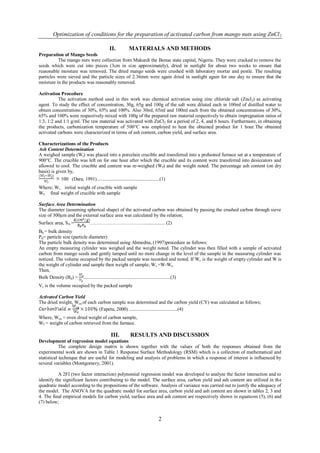
          The activation method used in this work was chemical activation using zinc chloride salt (Zncl2) as activating
agent. To study the effect of concentration, 30g, 65g and 100g of the salt were diluted each in 100ml of distilled water to
obtain concentrations of 30%, 65% and 100%. Also 30ml, 65ml and 100ml each from the obtained concentrations of 30%,
65% and 100% were respectively mixed with 100g of the prepared raw material respectively to obtain impregnation ratios of
1:3, 1:2 and 1:1 g/ml. The raw material was activated with ZnCl2 for a period of 2, 4, and 6 hours. Furthermore, in obtaining
the products, carbonization temperature of 500°C was employed to heat the obtained product for 1 hour.The obtained
activated carbons were characterized in terms of ash content, carbon yield, and surface area.

Characterizations of the Products
Ash Content Determination
A weighed sample (Wi) was placed into a porcelain crucible and transferred into a preheated furnace set at a temperature of
900°C. The crucible was left on for one hour after which the crucible and its content were transferred into desiccators and
allowed to cool. The crucible and content was re-weighed (Wf) and the weight noted. The percentage ash content (on dry
basis) is given by,
           100 (Dara, 1991)....................................................(1)
Where; Wi - initial weight of crucible with sample
Wf- final weight of crucible with sample

Surface Area Determination
The diameter (assuming spherical shape) of the activated carbon was obtained by passing the crushed carbon through sieve
size of 300µm and the external surface area was calculated by the relation;
Surface area, SA =            …………………………….................. (2)
Bb = bulk density
Pd= particle size (particle diameter)
The particle bulk density was determined using Ahmedna, (1997)procedure as follows:
An empty measuring cylinder was weighed and the weight noted. The cylinder was then filled with a sample of activated
carbon from mango seeds and gently tamped until no more change in the level of the sample in the measuring cylinder was
noticed. The volume occupied by the packed sample was recorded and noted. If Wc is the weight of empty cylinder and W is
the weight of cylinder and sample then weight of sample; Ws =W-Wc.
Then,
Bulk Density (Bd) = ........................................................................(3)
Vs is the volume occupied by the packed sample

Activated Carbon Yield
The dried weight, Wca of each carbon sample was determined and the carbon yield (CY) was calculated as follows;
                               (Fapetu, 2000) ........................................(4)
Where, Wca = oven dried weight of carbon sample,
Wf = weight of carbon retrieved from the furnace.

                                            III.          RESULTS AND DISCUSSION
Development of regression model equations
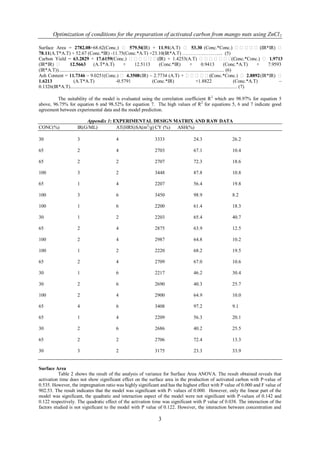
            The complete design matrix is shown together with the values of both the responses obtained from the
experimental work are shown in Table 1 Response Surface Methodology (RSM) which is a collection of mathematical and
statistical technique that are useful for modeling and analysis of problems in which a response of interest is influenced by
several variables (Montgomery, 2001).

           A 2FI (two factor interaction) polynomial regression model was developed to analyze the factor interaction and to
identify the significant factors contributing to the model. The surface area, carbon yield and ash content are utilized in th e
quadratic model according to the propositions of the software. Analysis of variance was carried out to justify the adequacy of
the model. The ANOVA for the quadratic model for surface area, carbon yield and ash content are shown in tables 2, 3 and
4. The final empirical models for carbon yield, surface area and ash content are respectively shown in equations (5), (6) and
(7) below;


                                                                             2
Optimization of conditions for the preparation of activated carbon from mango nuts using ZnCl 2

Surface Area = 2782.08+68.62(Conc.)  579.56                                  (IR) + 11.91(A.T)  53.30 (Conc.*Conc.)                                         (IR*IR) 
78.11(A.T*A.T) + 52.67 (Conc.*IR) -11.75(Conc.*A.T) +23.10(IR*A.T) …………………..... (5)
Carbon Yield = 63.2829 + 17.6159(Conc.)  + 1.4253(A.T)                      (IR)                                                        (Conc.*Conc.)  1.9713
(IR*IR)          12.5663             (A.T*A.T)               +         12.5113             (Conc.*IR)               +         0.9413            (Conc.*A.T)      +     7.9593
(IR*A.T))......................................................................................................................................... (6)
Ash Content = 11.7346 – 9.0251(Conc.)  4.3508 (IR) – 2.7734 (A.T) +                                                            (Conc.*Conc.)  2.8892 (IR*IR) 
1.6213               (A.T*A.T)                           -0.5791                       (Conc.*IR)                         +1.8822                       (Conc.*A.T)          –
0.1326(IR*A.T).......................................................................................................................................... (7)

         The suitability of the model is evaluated using the correlation coefficient R 2 which are 98.97% for equation 5
above, 96.75% for equation 6 and 98.52% for equation 7. The high values of R2 for equations 5, 6 and 7 indicate good
agreement between experimental data and the model prediction.

                               Appendix 1: EXPERIMENTAL DESIGN MATRIX AND RAW DATA
CONC(%)                    IR(G/ML)         AT(HRS) SA(m2/g) CY (%) ASH(%)

30                         3                           4                          3333                        24.3                        26.2

65                         2                           4                          2703                        67.1                        10.4

65                         2                           2                          2707                        72.3                        18.6

100                        3                           2                          3448                        87.8                        10.8

65                         1                           4                          2207                        56.4                        19.8

100                        3                           6                          3450                        98.9                        8.2

100                        1                           6                          2200                        61.4                        18.3

30                         1                           2                          2203                        65.4                        40.7

65                         2                           4                          2875                        63.9                        12.5

100                        2                           4                          2987                        64.8                        10.2

100                        1                           2                          2220                        68.2                        19.5

65                         2                           4                          2709                        67.0                        10.6

30                         1                           6                          2217                        46.2                        30.4

30                         2                           6                          2690                        40.3                        25.7

100                        2                           4                          2900                        64.9                        10.0

65                         4                           6                          3408                        97.2                        9.1

65                         1                           4                          2209                        56.3                        20.1

30                         2                           6                          2686                        40.2                        25.5

65                         2                           2                          2706                        72.4                        13.3

30                         3                           2                          3175                        23.3                        33.9


Surface Area
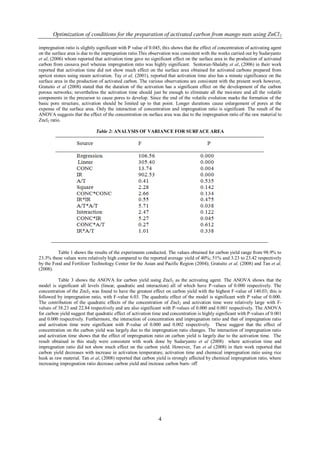
          Table 2 shows the result of the analysis of variance for Surface Area ANOVA. The result obtained reveals that
activation time does not show significant effect on the surface area in the production of activated carbon with P-value of
0.535. However, the impregnation ratio was highly significant and has the highest effect with P value of 0.000 and F value of
902.53. The result indicates that the model was significant with P- values of 0.000. However, only the linear part of the
model was significant, the quadratic and interaction aspect of the model were not significant with P-values of 0.142 and
0.122 respectively. The quadratic effect of the activation time was significant with P value of 0.038. The interaction of the
factors studied is not significant to the model with P value of 0.122. However, the interaction between concentration and

                                                                                     3
Optimization of conditions for the preparation of activated carbon from mango nuts using ZnCl 2

impregnation ratio is slightly significant with P value of 0.045, this shows that the effect of concentration of activating agent
on the surface area is due to the impregnation ratio.This observation was consistent with the works carried out by Sudaryanto
et al, (2006) whom reported that activation time gave no significant effect on the surface area in the production of activated
carbon from cassava peel whereas impregnation ratio was highly significant. Sentorun-Shalaby et al, (2006) in their work
reported that activation time did not show much effect on the surface area obtained for activated carbons prepared from
apricot stones using steam activation. Tay et al, (2001), reported that activation time also has a minute significance on the
surface area in the production of activated carbon. The various observations are consistent with the present work however,
Gratuito et al (2008) stated that the duration of the activation has a significant effect on the development of the carbon
porous networks; nevertheless the activation time should just be enough to eliminate all the moisture and all the volatile
components in the precursor to cause pores to develop. Since the end of the volatile evolution marks the formation of the
basic pore structure, activation should be limited up to that point. Longer durations cause enlargement of pores at the
expense of the surface area. Only the interaction of concentration and impregnation ratio is significant. The result of the
ANOVA suggests that the effect of the concentration on surface area was due to the impregnation ratio of the raw material to
Zncl2 ratio.

                              Table 2: ANALYSIS OF VARIANCE FOR SURFACE AREA


         Table 1 shows the results of the experiments conducted. The values obtained for carbon yield range from 98.9% to
23.3% these values were relatively high compared to the reported average yield of 40%; 51% and 3.23 to 23.42 respectively
by the Food and Fertilizer Technology Center for the Asian and Pacific Region (2004); Gratuito et al, (2008) and Tan et al,
(2008).

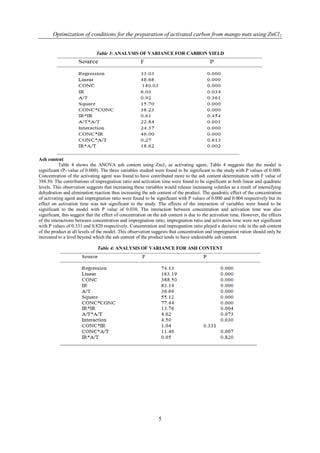
          Table 3 shows the ANOVA for carbon yield using Zncl 2 as the activating agent. The ANOVA shows that the
model is significant all levels (linear, quadratic and interaction) all of which have P-values of 0.000 respectively. The
concentration of the Zncl2 was found to have the greatest effect on carbon yield with the highest F-value of 140.03; this is
followed by impregnation ratio, with F-value 6.03. The quadratic effect of the model is significant with P value of 0.000.
The contribution of the quadratic effects of the concentration of Zncl 2 and activation time were relatively large with F-
values of 38.23 and 22.84 respectively and are also significant with P-values of 0.000 and 0.001 respectively. The ANOVA
for carbon yield suggest that quadratic effect of activation time and concentration is highly significant with P-values of 0.001
and 0.000 respectively. Furthermore, the interaction of concentration and impregnation ratio and that of impregnation ratio
and activation time were significant with P-value of 0.000 and 0.002 respectively. These suggest that the effect of
concentration on the carbon yield was largely due to the impregnation ratio changes. The interaction of impregnation ratio
and activation time shows that the effect of impregnation ratio on carbon yield is largely due to the activation time. The
result obtained in this study were consistent with work done by Sudaryanto et al (2008) where activation time and
impregnation ratio did not show much effect on the carbon yield. However, Tan et al (2008) in their work reported that
carbon yield decreases with increase in activation temperature, activation time and chemical impregnation ratio using rice
husk as raw material. Tan et al, (2008) reported that carbon yield is strongly affected by chemical impregnation ratio, where
increasing impregnation ratio decrease carbon yield and increase carbon burn- off


                                                               4
Optimization of conditions for the preparation of activated carbon from mango nuts using ZnCl 2


                              Table 3: ANALYSIS OF VARIANCE FOR CARBON YIELD


Ash content
           Table 4 shows the ANOVA ash content using Zncl 2 as activating agent, Table 4 suggests that the model is
significant (P- value of 0.000). The three variables studied were found to be significant to the study with P values of 0.000.
Concentration of the activating agent was found to have contributed more to the ash content determination with F value of
388.50. The contributions of impregnation ratio and activation time were found to be significant at both linear and quadratic
levels. This observation suggests that increasing these variables would release increasing volatiles as a result of intensifying
dehydration and elimination reaction thus increasing the ash content of the product. The quadratic effect of the concentration
of activating agent and impregnation ratio were found to be significant with P values of 0.000 and 0.004 respectively but its
effect on activation time was not significant to the study. The effects of the interaction of variables were found to be
significant to the model with P value of 0.030. The interaction between concentration and activation time was also
significant, this suggest that the effect of concentration on the ash content is due to the activation time. However, the effects
of the interactions between concentration and impregnation ratio, impregnation ratio and activation time were not significant
with P values of 0.331 and 0.820 respectively. Concentration and impregnation ratio played a decisive role in the ash content
of the product at all levels of the model. This observation suggests that concentration and impregnation ration should only be
increased to a level beyond which the ash content of the product tends to have undesirable ash content.

                               Table 4: ANALYSIS OF VARIANCE FOR ASH CONTENT


                                                               5
Optimization of conditions for the preparation of activated carbon from mango nuts using ZnCl 2


                                             Table 5: MODEL VALIDATION


Process optimization
          In the production of commercial activated carbons, high quality products are expected in terms of high surface
area, high carbon yield and low ash content for effective adsorption capacity and economic viability.

           However, to optimize all these responses under the same condition is difficult since the interest regions of factors
are different. This is because, while higher carbon yield and surface area are desirable, ash content has to be low for a good
quality activated carbon. In order to compromise between these three responses, the function of desirability was employed
using MINITAB version 16 software. The experimental conditions with the highest desirability were selected to be verified.
The MNAC was then prepared using the experimental conditions given in table 5 including the predicted and experimental
values. The optimal activated carbon using preparation conditions as: 85.85 % concentration, 1: 2.81 raw material: ZnCl 2
impregnation ratio and 4.95 hours activation time which resulted in 3351.10 m2/g surface area, 85.41% carbon content and
6.51% ash content. It was observed that the experimental values obtained were in good agreement with the values predicted
from the model, with relatively small errors between the predicted and the actual values as seen in table 5, which was only
0.03, 0.69 and 0.31% respectively for surface area, carbon yield and ash content. Through the process optimization, mango
nut was proved to be a potential precursor for production of activated carbons with high surface area, high carbon yield and
low ash content as required of good adsorbents.

                                               IV.        CONCLUSION
          Mango nuts are good precursor for the production of activated carbons with characteristic high quality. The RSM
methodology is an appropriate tool to study the optimization of the activation process of preparing activated carbons to be
used in a given technological process. In the present paper, the optimization was done to obtain activated carbons from
mango nuts with high surface, high carbon yield, low ash content suitable for adsorption applications. The experimental
parameter analyzed was concentration, impregnation ratio and activation time and the optimal values were 85.85%, 1:2.8
and 4.95 respectively.

                                                     REFERENCES
  [1].      Ahmad, M.A., R. Alrozi. (2010). Optimization of preparation conditions for mangosteen peel- based activated
            carbons for the removal of remazol brilliant blue R using response surface methodology. Chemical. Engr. J. 165:
            883- 890.
  [2].      Ahmedna, M., M.M. Johns, S.J. Clark, W.E. Marshall, and M.M. Rao.( 1997). Potential of agricultural by-product
            based activated carbon for use in raw sugar discolorization. J. of Sci. Food and Agric. 75: 117-124.
  [3].      Ajmal M, Mohammad R, Yusuf Y and Ahmed A (1998) Adsorption behaviour of Cadmium, Zinc, Nickel and
            Lead from aqueous solutions by Magnifera Indica seed shell. Indian J. Env. Hlth. 40 (1), 15-26.
  [4].      Akpen, D.G, I.L. Nwaogazie, and T.G. Leton. (2011). Optimization of conditions for the removal of colour from
            waste water by mango seed shells based activated carbons. Indian J. Sc. & Tech. Vol 4; no.8.
  [5].      Aloko, D.F and G.A Adebayo. (2008). Production and characterization of activated carbons from agricultural
            waste. J. Eng. Applied Sci.2 (2): 440-444.
  [6].      Azargohar, R., and A.K. Dalai. (2005). Production of activated carbon from luscar char: Experimental and
            modelling studies, Micropor. Mesopor. Mater 85: 219- 225
  [7].      Bacaoui, A., A. Yaacoubi, A. Dahbi, C. Bennouna, R. Phantanluu, F.J. Maldonado- Hodar, J. Rivera, and C.
            Moreno- Castilla. (2001). Optimization of conditions for the preparation of activated carbons from olive-waste.
            Carbon. 39: 425- 432.
  [8].      Dara, S.S (1991). Experiments and Calculations in Engineering Chemistry. S. Chand and Co. Ltd. New- Delhi,
            pp. 189- 191.
  [9].      Elizalde- Gonzalez, M.P and V. Hernandez- Montoya. (2007). Characterization of mango pit as raw material in the
            preparation of activated carbons for wastewater treatment. Biochem. Eng. J. 36: 230- 238.
  [10].     Fapetu, O.P. (2000). Production of carbon from biomass for industrial and metallurgical processes. Nig. J. Eng.
            Manag. 1: 34- 37.
  [11].     Faust, S. D and O. M. Aly. (1983). Chemistry of Water Treatment, Butterwort Pub. Woburn Food and Fertilizer
            Technology Center for the Asian and Pacific Regions (FFTCAPR). (2004). Processing of coconut shell into
            activated carbon/charcoal. http://www.agnet.org/library/pt/2004003/.
  [12].     Gratuito, M.K.B., T. Panyathanmaporn, R.A. chumnanklang, N. Sirinuntawittaya, A. Dutta. (2008). Production of

                                                              6
Optimization of conditions for the preparation of activated carbon from mango nuts using ZnCl 2

          activated carbon from coconut shell: optimization using response surface methodology. Bioresour. Technol. 99:
          4887- 4895.
[13].     Hameed, B.H., I.A.W. Tan and A.L. Ahmad. (2009). Preparation of oil palm empty fruit bunch- based activated
          carbon for removal of 2, 4, 6- trichlorophenol: Optimization using response surface methodology. J. Hazardous
          Mat. 164: 1316- 1324.
[14].     Karacan, F., U. Ozden, and S. Karacan. (2007). Optimization of manufacturing conditions for activated carbons
          from Turkish lignite by chemical activation using surface response methodology. Apl. Thermal Eng. 27 (7): 1212-
          1218
[15].     Kumar, K.V and Kumaran,A. (2005) Removal of methylene blue by mango seed kernel powder. Biochem. Eng. J.
          27, 83-93.
[16].     Montgomery, D.C. (2001). Design and Analysis of Experiments, 5 th ed. John Wiley and Sons, New York. USA.
[17].     Okonogi, S., C. Duangrat, S. Anuchpreeda, S. Tachakittirungrod, and S. Chowwanapoonpohn. (2007) comparison
          of antioxidant capacities and cytotoxicities of certain fruit peels. Food Chem. 103: 839- 846.
[18].     Sahu, J.N., J. Achrya, and B.C. Meikap. (2010). Optimization of production conditions for activated carbons
          from Tamarind wood by zinc chloride using response surface methodology. Bioresour. Technol. 101: 1974- 1982.
[19].     Sentorun- Shalaby, C., M.G. Ucak- Astarhoglu, L. Artok, and C. Sarici. (2006). Preparation and characterization
          of activated carbons by one- step steam pyrolysis/ activation from apricot stones. Micropor. Mesopor. Mater. 88:
          126-134
[20].     Sundaryanto, Y., S.B. Hartono, W. Irawaty, H. Hindarso, and S. Ismadji. (2006). High surface area activated
          carbon prepared from cassava peel by chemical activation. Bioresour. Technol. 97: 734- 739.
[21].     Tan, I.A.W., A.L. Ahmad and B.H. Hameed. (2008). Preparation of activated carbon from coconut husk:
          Optimization study on removal of 2, 4, 6- trichlorophenol using response surface area method. J. of Haz. Mater.
          153: 709- 717.
[22].     Tay, J.H., X.G. chen, S. Jeyaseelan, and N. Graham. (2001). Optimizing the preparation of activated carbon from
          digested sewage sludge and coconut husk. Chemosphere. 44: 45- 51.


                                                            7

www.ijerd.com

  • 1.
    International Journal ofEngineering Research and Development ISSN: 2278-067X, Volume 1, Issue 8 (June 2012), PP.01-07 www.ijerd.com Optimization of conditions for the preparation of activated carbon from mango nuts using ZnCl2 A. Kwaghger1, E. Adejoh1 1 Department of Mechanical Engineering, University of Agriculture, Makurdi, Nigeria. Abstract––Activated carbon was prepared from mango nuts by chemical activation method using ZnCl2. The effect of preparation variables; concentration, impregnation ratio and activation time on surface area, carbon yield and ash content were investigated. The response surface methodology (RSM) technique was used to optimize the process conditions. The influence of the studied parameters was investigated using the analysis of variance (ANOVA) to identify the significant parameters. The optimum conditions for the preparation of activated carbons were identified to be a concentration of 85.85%, mix ratio of 1:2.8g: ml, and activation time of 4.59 hours. The optimum conditions resulted in activation carbon with surface area of 3551.1m2/g, carbon yield of 85.85% and ash content of 6.51% which compared favorably with works of other authors. Keywords––ZnCl2, activated carbon, optimization and mango- nuts I. INTRODUCTION Mango, indica magnifera Indica is a major waste in Benue State especially the capital, Makurdi during its harvesting season as farmers from different part of the state finds a ready market in Makurdi. The edible part of mango is the peel and the fibrous material. The pit is not a consumable part of mango and is usually discarded as waste. Mango has become and economically important species since its demand domestically and for export has become tremendous. Due to its high consumption of the edible part, massive amount of mango nut are disposed causing gradual fermentation and subsequent release of odor (Okonogi et al, 2007).To make better use of cheap and abundant agricultural waste, it is proposed to convert mango nut waste into activated carbon. This conversion will address dual problems of unwanted agricultural wastes been converted into waste been converted to useful, value- added adsorbent and also the use of agriculture by- products to represent potential source of adsorbent which will contribute to solving part of waste management challenges locally. However, not many studies have been reported on converting mango nut into activated carbon. Some relevant studies found in literature were reported by Akpen et al,(2011); Ajmal et al, (1998); Kumar and Kumaran, (2005); Elizalde- Gonzalez and Hernandez- Montoya, (2007). A challenge in activated carbon production is to produce very specific carbons which are suitable for certain application. The most important characteristics of an activated carbon is it adsorption capacity which is highly influenced by the preparation conditions. (Tan et al, 2008). In assessing the effect of the treatments on quality attribute the use of an adequate experimental design is particularly important. Response Surface Methodology (RSM) has been formed to be a useful tool to study the interaction of two or more variables (Karacan et al, 2007). Optimization of experimental conditions using RSM has widely applied in various processes; however, its application in activated carbon production is rare.Some of the previous studies found in applying RSM in preparation of activated carbon were using such as olive- waste cakes (Bacaoui et al, 2001); Luscar char (Azargohar and Dalai, 2005); Turkish lignite (Karacan et al, 2007) and Tamarind Wood (Sahu et al,2010). As far as known, no study has been done on preparation of activated carbon from mango nut with chemical activation method using ZnCl2 treatment, by using RSM approach. In the present study, the optimal experimental condition required to obtain adequate activated carbon with suitable properties in terms of carbon yield, surface area and ash content, which are critical in determining a good quality activated carbon for a whole range of adsorption are determine. A modeling technique is applied to relate the experimental conditions of the active process with properties of activated carbon. A good quality activated carbon should have low ash content as possible. Faust and Aly, 1983 suggests that typical values of ash content should be in the range of 5 – 6% and around 85 – 90% for carbon content, the carbon content of the activated carbon increase, the surface area also increase. High carbon content value is desired to achieve high surface area.Bacaoui et al, (2001) reported that for economic viability, activated carbon should have a carbon yield of 10- 20% and a surface area of 1000- 1300 m2/g. Using olive- waste cake waste, Ahmad and Alrozi (2010) reported a carbon yield of 20.76% using mango peel; Aloko and Adebayo (2007) reported 1620m2/g surface area, 148.20% ash content and 29.24% carbon yield; Sahu et al (2010) reported a carbon yield value of 46.08% using Tamarind wood; Hameed et al, (2009) reported a carbon yield of 17.96% and a surface area of 1141m2/g. The main objective of the paper is to determine the experimental activation time, concentration and impregnation ratio required to prepare activated carbons from mango nuts suitable for effective use for a variety of adsorption application. Also to select indigenous raw materials of agricultural origin (mango seeds), explore the potential of producing activated carbons from mango nut wastes and carry out studies to explore the possibility of obtaining high quality activated carbons. 1
  • 2.
    Optimization of conditionsfor the preparation of activated carbon from mango nuts using ZnCl 2 II. MATERIALS AND METHODS Preparation of Mango Seeds The mango nuts were collection from Makurdi the Benue state capital, Nigeria. They were cracked to remove the seeds which were cut into pieces (3cm in size approximately), dried in sunlight for about two weeks to ensure that reasonable moisture was removed. The dried mango seeds were crushed with laboratory mortar and pestle. The resulting particles were sieved and the particle sizes of 2.36mm were again dried in sunlight again for one day to ensure that the moisture in the products was reasonably removed. Activation Procedure The activation method used in this work was chemical activation using zinc chloride salt (Zncl2) as activating agent. To study the effect of concentration, 30g, 65g and 100g of the salt were diluted each in 100ml of distilled water to obtain concentrations of 30%, 65% and 100%. Also 30ml, 65ml and 100ml each from the obtained concentrations of 30%, 65% and 100% were respectively mixed with 100g of the prepared raw material respectively to obtain impregnation ratios of 1:3, 1:2 and 1:1 g/ml. The raw material was activated with ZnCl2 for a period of 2, 4, and 6 hours. Furthermore, in obtaining the products, carbonization temperature of 500°C was employed to heat the obtained product for 1 hour.The obtained activated carbons were characterized in terms of ash content, carbon yield, and surface area. Characterizations of the Products Ash Content Determination A weighed sample (Wi) was placed into a porcelain crucible and transferred into a preheated furnace set at a temperature of 900°C. The crucible was left on for one hour after which the crucible and its content were transferred into desiccators and allowed to cool. The crucible and content was re-weighed (Wf) and the weight noted. The percentage ash content (on dry basis) is given by, 100 (Dara, 1991)....................................................(1) Where; Wi - initial weight of crucible with sample Wf- final weight of crucible with sample Surface Area Determination The diameter (assuming spherical shape) of the activated carbon was obtained by passing the crushed carbon through sieve size of 300µm and the external surface area was calculated by the relation; Surface area, SA = …………………………….................. (2) Bb = bulk density Pd= particle size (particle diameter) The particle bulk density was determined using Ahmedna, (1997)procedure as follows: An empty measuring cylinder was weighed and the weight noted. The cylinder was then filled with a sample of activated carbon from mango seeds and gently tamped until no more change in the level of the sample in the measuring cylinder was noticed. The volume occupied by the packed sample was recorded and noted. If Wc is the weight of empty cylinder and W is the weight of cylinder and sample then weight of sample; Ws =W-Wc. Then, Bulk Density (Bd) = ........................................................................(3) Vs is the volume occupied by the packed sample Activated Carbon Yield The dried weight, Wca of each carbon sample was determined and the carbon yield (CY) was calculated as follows; (Fapetu, 2000) ........................................(4) Where, Wca = oven dried weight of carbon sample, Wf = weight of carbon retrieved from the furnace. III. RESULTS AND DISCUSSION Development of regression model equations The complete design matrix is shown together with the values of both the responses obtained from the experimental work are shown in Table 1 Response Surface Methodology (RSM) which is a collection of mathematical and statistical technique that are useful for modeling and analysis of problems in which a response of interest is influenced by several variables (Montgomery, 2001). A 2FI (two factor interaction) polynomial regression model was developed to analyze the factor interaction and to identify the significant factors contributing to the model. The surface area, carbon yield and ash content are utilized in th e quadratic model according to the propositions of the software. Analysis of variance was carried out to justify the adequacy of the model. The ANOVA for the quadratic model for surface area, carbon yield and ash content are shown in tables 2, 3 and 4. The final empirical models for carbon yield, surface area and ash content are respectively shown in equations (5), (6) and (7) below; 2
  • 3.
    Optimization of conditionsfor the preparation of activated carbon from mango nuts using ZnCl 2 Surface Area = 2782.08+68.62(Conc.)  579.56 (IR) + 11.91(A.T)  53.30 (Conc.*Conc.)  (IR*IR)  78.11(A.T*A.T) + 52.67 (Conc.*IR) -11.75(Conc.*A.T) +23.10(IR*A.T) …………………..... (5) Carbon Yield = 63.2829 + 17.6159(Conc.)  + 1.4253(A.T)  (IR) (Conc.*Conc.)  1.9713 (IR*IR)  12.5663 (A.T*A.T) + 12.5113 (Conc.*IR) + 0.9413 (Conc.*A.T) + 7.9593 (IR*A.T))......................................................................................................................................... (6) Ash Content = 11.7346 – 9.0251(Conc.)  4.3508 (IR) – 2.7734 (A.T) +  (Conc.*Conc.)  2.8892 (IR*IR)  1.6213 (A.T*A.T) -0.5791 (Conc.*IR) +1.8822 (Conc.*A.T) – 0.1326(IR*A.T).......................................................................................................................................... (7) The suitability of the model is evaluated using the correlation coefficient R 2 which are 98.97% for equation 5 above, 96.75% for equation 6 and 98.52% for equation 7. The high values of R2 for equations 5, 6 and 7 indicate good agreement between experimental data and the model prediction. Appendix 1: EXPERIMENTAL DESIGN MATRIX AND RAW DATA CONC(%) IR(G/ML) AT(HRS) SA(m2/g) CY (%) ASH(%) 30 3 4 3333 24.3 26.2 65 2 4 2703 67.1 10.4 65 2 2 2707 72.3 18.6 100 3 2 3448 87.8 10.8 65 1 4 2207 56.4 19.8 100 3 6 3450 98.9 8.2 100 1 6 2200 61.4 18.3 30 1 2 2203 65.4 40.7 65 2 4 2875 63.9 12.5 100 2 4 2987 64.8 10.2 100 1 2 2220 68.2 19.5 65 2 4 2709 67.0 10.6 30 1 6 2217 46.2 30.4 30 2 6 2690 40.3 25.7 100 2 4 2900 64.9 10.0 65 4 6 3408 97.2 9.1 65 1 4 2209 56.3 20.1 30 2 6 2686 40.2 25.5 65 2 2 2706 72.4 13.3 30 3 2 3175 23.3 33.9 Surface Area Table 2 shows the result of the analysis of variance for Surface Area ANOVA. The result obtained reveals that activation time does not show significant effect on the surface area in the production of activated carbon with P-value of 0.535. However, the impregnation ratio was highly significant and has the highest effect with P value of 0.000 and F value of 902.53. The result indicates that the model was significant with P- values of 0.000. However, only the linear part of the model was significant, the quadratic and interaction aspect of the model were not significant with P-values of 0.142 and 0.122 respectively. The quadratic effect of the activation time was significant with P value of 0.038. The interaction of the factors studied is not significant to the model with P value of 0.122. However, the interaction between concentration and 3
  • 4.
    Optimization of conditionsfor the preparation of activated carbon from mango nuts using ZnCl 2 impregnation ratio is slightly significant with P value of 0.045, this shows that the effect of concentration of activating agent on the surface area is due to the impregnation ratio.This observation was consistent with the works carried out by Sudaryanto et al, (2006) whom reported that activation time gave no significant effect on the surface area in the production of activated carbon from cassava peel whereas impregnation ratio was highly significant. Sentorun-Shalaby et al, (2006) in their work reported that activation time did not show much effect on the surface area obtained for activated carbons prepared from apricot stones using steam activation. Tay et al, (2001), reported that activation time also has a minute significance on the surface area in the production of activated carbon. The various observations are consistent with the present work however, Gratuito et al (2008) stated that the duration of the activation has a significant effect on the development of the carbon porous networks; nevertheless the activation time should just be enough to eliminate all the moisture and all the volatile components in the precursor to cause pores to develop. Since the end of the volatile evolution marks the formation of the basic pore structure, activation should be limited up to that point. Longer durations cause enlargement of pores at the expense of the surface area. Only the interaction of concentration and impregnation ratio is significant. The result of the ANOVA suggests that the effect of the concentration on surface area was due to the impregnation ratio of the raw material to Zncl2 ratio. Table 2: ANALYSIS OF VARIANCE FOR SURFACE AREA Table 1 shows the results of the experiments conducted. The values obtained for carbon yield range from 98.9% to 23.3% these values were relatively high compared to the reported average yield of 40%; 51% and 3.23 to 23.42 respectively by the Food and Fertilizer Technology Center for the Asian and Pacific Region (2004); Gratuito et al, (2008) and Tan et al, (2008). Table 3 shows the ANOVA for carbon yield using Zncl 2 as the activating agent. The ANOVA shows that the model is significant all levels (linear, quadratic and interaction) all of which have P-values of 0.000 respectively. The concentration of the Zncl2 was found to have the greatest effect on carbon yield with the highest F-value of 140.03; this is followed by impregnation ratio, with F-value 6.03. The quadratic effect of the model is significant with P value of 0.000. The contribution of the quadratic effects of the concentration of Zncl 2 and activation time were relatively large with F- values of 38.23 and 22.84 respectively and are also significant with P-values of 0.000 and 0.001 respectively. The ANOVA for carbon yield suggest that quadratic effect of activation time and concentration is highly significant with P-values of 0.001 and 0.000 respectively. Furthermore, the interaction of concentration and impregnation ratio and that of impregnation ratio and activation time were significant with P-value of 0.000 and 0.002 respectively. These suggest that the effect of concentration on the carbon yield was largely due to the impregnation ratio changes. The interaction of impregnation ratio and activation time shows that the effect of impregnation ratio on carbon yield is largely due to the activation time. The result obtained in this study were consistent with work done by Sudaryanto et al (2008) where activation time and impregnation ratio did not show much effect on the carbon yield. However, Tan et al (2008) in their work reported that carbon yield decreases with increase in activation temperature, activation time and chemical impregnation ratio using rice husk as raw material. Tan et al, (2008) reported that carbon yield is strongly affected by chemical impregnation ratio, where increasing impregnation ratio decrease carbon yield and increase carbon burn- off 4
  • 5.
    Optimization of conditionsfor the preparation of activated carbon from mango nuts using ZnCl 2 Table 3: ANALYSIS OF VARIANCE FOR CARBON YIELD Ash content Table 4 shows the ANOVA ash content using Zncl 2 as activating agent, Table 4 suggests that the model is significant (P- value of 0.000). The three variables studied were found to be significant to the study with P values of 0.000. Concentration of the activating agent was found to have contributed more to the ash content determination with F value of 388.50. The contributions of impregnation ratio and activation time were found to be significant at both linear and quadratic levels. This observation suggests that increasing these variables would release increasing volatiles as a result of intensifying dehydration and elimination reaction thus increasing the ash content of the product. The quadratic effect of the concentration of activating agent and impregnation ratio were found to be significant with P values of 0.000 and 0.004 respectively but its effect on activation time was not significant to the study. The effects of the interaction of variables were found to be significant to the model with P value of 0.030. The interaction between concentration and activation time was also significant, this suggest that the effect of concentration on the ash content is due to the activation time. However, the effects of the interactions between concentration and impregnation ratio, impregnation ratio and activation time were not significant with P values of 0.331 and 0.820 respectively. Concentration and impregnation ratio played a decisive role in the ash content of the product at all levels of the model. This observation suggests that concentration and impregnation ration should only be increased to a level beyond which the ash content of the product tends to have undesirable ash content. Table 4: ANALYSIS OF VARIANCE FOR ASH CONTENT 5
  • 6.
    Optimization of conditionsfor the preparation of activated carbon from mango nuts using ZnCl 2 Table 5: MODEL VALIDATION Process optimization In the production of commercial activated carbons, high quality products are expected in terms of high surface area, high carbon yield and low ash content for effective adsorption capacity and economic viability. However, to optimize all these responses under the same condition is difficult since the interest regions of factors are different. This is because, while higher carbon yield and surface area are desirable, ash content has to be low for a good quality activated carbon. In order to compromise between these three responses, the function of desirability was employed using MINITAB version 16 software. The experimental conditions with the highest desirability were selected to be verified. The MNAC was then prepared using the experimental conditions given in table 5 including the predicted and experimental values. The optimal activated carbon using preparation conditions as: 85.85 % concentration, 1: 2.81 raw material: ZnCl 2 impregnation ratio and 4.95 hours activation time which resulted in 3351.10 m2/g surface area, 85.41% carbon content and 6.51% ash content. It was observed that the experimental values obtained were in good agreement with the values predicted from the model, with relatively small errors between the predicted and the actual values as seen in table 5, which was only 0.03, 0.69 and 0.31% respectively for surface area, carbon yield and ash content. Through the process optimization, mango nut was proved to be a potential precursor for production of activated carbons with high surface area, high carbon yield and low ash content as required of good adsorbents. IV. CONCLUSION Mango nuts are good precursor for the production of activated carbons with characteristic high quality. The RSM methodology is an appropriate tool to study the optimization of the activation process of preparing activated carbons to be used in a given technological process. In the present paper, the optimization was done to obtain activated carbons from mango nuts with high surface, high carbon yield, low ash content suitable for adsorption applications. The experimental parameter analyzed was concentration, impregnation ratio and activation time and the optimal values were 85.85%, 1:2.8 and 4.95 respectively. REFERENCES [1]. Ahmad, M.A., R. Alrozi. (2010). Optimization of preparation conditions for mangosteen peel- based activated carbons for the removal of remazol brilliant blue R using response surface methodology. Chemical. Engr. J. 165: 883- 890. [2]. Ahmedna, M., M.M. Johns, S.J. Clark, W.E. Marshall, and M.M. Rao.( 1997). Potential of agricultural by-product based activated carbon for use in raw sugar discolorization. J. of Sci. Food and Agric. 75: 117-124. [3]. Ajmal M, Mohammad R, Yusuf Y and Ahmed A (1998) Adsorption behaviour of Cadmium, Zinc, Nickel and Lead from aqueous solutions by Magnifera Indica seed shell. Indian J. Env. Hlth. 40 (1), 15-26. [4]. Akpen, D.G, I.L. Nwaogazie, and T.G. Leton. (2011). Optimization of conditions for the removal of colour from waste water by mango seed shells based activated carbons. Indian J. Sc. & Tech. Vol 4; no.8. [5]. Aloko, D.F and G.A Adebayo. (2008). Production and characterization of activated carbons from agricultural waste. J. Eng. Applied Sci.2 (2): 440-444. [6]. Azargohar, R., and A.K. Dalai. (2005). Production of activated carbon from luscar char: Experimental and modelling studies, Micropor. Mesopor. Mater 85: 219- 225 [7]. Bacaoui, A., A. Yaacoubi, A. Dahbi, C. Bennouna, R. Phantanluu, F.J. Maldonado- Hodar, J. Rivera, and C. Moreno- Castilla. (2001). Optimization of conditions for the preparation of activated carbons from olive-waste. Carbon. 39: 425- 432. [8]. Dara, S.S (1991). Experiments and Calculations in Engineering Chemistry. S. Chand and Co. Ltd. New- Delhi, pp. 189- 191. [9]. Elizalde- Gonzalez, M.P and V. Hernandez- Montoya. (2007). Characterization of mango pit as raw material in the preparation of activated carbons for wastewater treatment. Biochem. Eng. J. 36: 230- 238. [10]. Fapetu, O.P. (2000). Production of carbon from biomass for industrial and metallurgical processes. Nig. J. Eng. Manag. 1: 34- 37. [11]. Faust, S. D and O. M. Aly. (1983). Chemistry of Water Treatment, Butterwort Pub. Woburn Food and Fertilizer Technology Center for the Asian and Pacific Regions (FFTCAPR). (2004). Processing of coconut shell into activated carbon/charcoal. http://www.agnet.org/library/pt/2004003/. [12]. Gratuito, M.K.B., T. Panyathanmaporn, R.A. chumnanklang, N. Sirinuntawittaya, A. Dutta. (2008). Production of 6
  • 7.
    Optimization of conditionsfor the preparation of activated carbon from mango nuts using ZnCl 2 activated carbon from coconut shell: optimization using response surface methodology. Bioresour. Technol. 99: 4887- 4895. [13]. Hameed, B.H., I.A.W. Tan and A.L. Ahmad. (2009). Preparation of oil palm empty fruit bunch- based activated carbon for removal of 2, 4, 6- trichlorophenol: Optimization using response surface methodology. J. Hazardous Mat. 164: 1316- 1324. [14]. Karacan, F., U. Ozden, and S. Karacan. (2007). Optimization of manufacturing conditions for activated carbons from Turkish lignite by chemical activation using surface response methodology. Apl. Thermal Eng. 27 (7): 1212- 1218 [15]. Kumar, K.V and Kumaran,A. (2005) Removal of methylene blue by mango seed kernel powder. Biochem. Eng. J. 27, 83-93. [16]. Montgomery, D.C. (2001). Design and Analysis of Experiments, 5 th ed. John Wiley and Sons, New York. USA. [17]. Okonogi, S., C. Duangrat, S. Anuchpreeda, S. Tachakittirungrod, and S. Chowwanapoonpohn. (2007) comparison of antioxidant capacities and cytotoxicities of certain fruit peels. Food Chem. 103: 839- 846. [18]. Sahu, J.N., J. Achrya, and B.C. Meikap. (2010). Optimization of production conditions for activated carbons from Tamarind wood by zinc chloride using response surface methodology. Bioresour. Technol. 101: 1974- 1982. [19]. Sentorun- Shalaby, C., M.G. Ucak- Astarhoglu, L. Artok, and C. Sarici. (2006). Preparation and characterization of activated carbons by one- step steam pyrolysis/ activation from apricot stones. Micropor. Mesopor. Mater. 88: 126-134 [20]. Sundaryanto, Y., S.B. Hartono, W. Irawaty, H. Hindarso, and S. Ismadji. (2006). High surface area activated carbon prepared from cassava peel by chemical activation. Bioresour. Technol. 97: 734- 739. [21]. Tan, I.A.W., A.L. Ahmad and B.H. Hameed. (2008). Preparation of activated carbon from coconut husk: Optimization study on removal of 2, 4, 6- trichlorophenol using response surface area method. J. of Haz. Mater. 153: 709- 717. [22]. Tay, J.H., X.G. chen, S. Jeyaseelan, and N. Graham. (2001). Optimizing the preparation of activated carbon from digested sewage sludge and coconut husk. Chemosphere. 44: 45- 51. 7