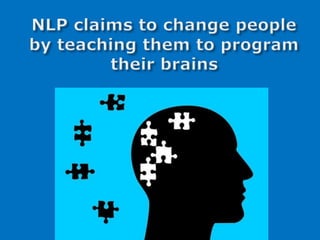
 It’s a set of training techniques, patterns
and strategies, a training philosophy.
 It’s not a language method
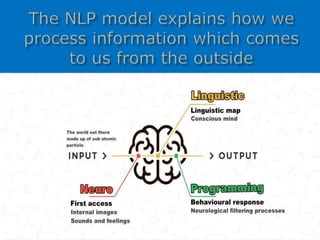
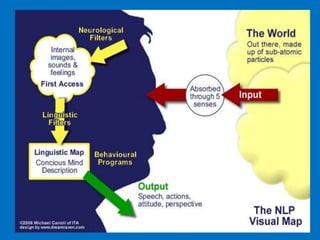
How people act and interact?
How the mind works?
 Developed by: John Grindler and Richard
Bandler.
 Mid-1970s.
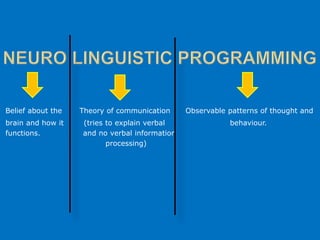
Belief about the Theory of communication Observable patterns of thought and
brain and how it (tries to explain verbal behaviour.
functions. and no verbal information
processing)
1 Outcome: the goals or ends
2 Rapport: Essential for effective communication
maximizing similarities, minimizing differences
between people.
3 Sensory Accuity: what another person is
communicating, consciously and nonverbally.
4 Flexibility: doing things differently if what you are
doing is not working.
 No matter what method the teacher uses.
 There are 13 presuppositions that guide the
application of NLP in language learning.
 Modelling
1. Mind and body are interconnected
2. The map is not the territory
3. There is no failure, only feeback
4. The map becomes the territory
5. Knowing what you want helps you get it
6. The resources we need are within us
7. Communication is nonverbal as well as verbal
8. The nonconscious mind is benevolent
9. Communication is nonconscious as well as conscious
10. All behaviour has positive intention
11. The meaning of my communication is the response I get
12. Modeling excellent behavior lads to excellence
13. In any system, the element with the greastest fexibility
will have the most influence on that system
 Modelling is central to NLP practice.
 Teachers are expected to model their
teaching on expert teachers they most
admire.
 Students will develop new skills if they
are exposed to models
 Example:
The teacher draws a mind map on the board
to show learners the relationship between
new words; in this way she is addressing the
visual intelligence of her learners.
 To exploit NLP in the classroom teachers
need to use a variety of techniques,
resources and methodologies to address
different types of intelligence in learners.
Tools as diverse as TPR (Total Physical
Response), Cuisenaire rods and playing
music all address different kinds of
intelligence.
 Communicate more effectively with others
 Manage your thoughts, moods and behaviors
more effectively
 Acquire skills and attitudes to do what you can’t
do right now but you would like to be able to do

Neurolinguistic Programming

  • 2.
     It’s aset of training techniques, patterns and strategies, a training philosophy.  It’s not a language method
  • 3.
    How people actand interact? How the mind works?
  • 4.
     Developed by:John Grindler and Richard Bandler.  Mid-1970s.
  • 5.
    Belief about theTheory of communication Observable patterns of thought and brain and how it (tries to explain verbal behaviour. functions. and no verbal information processing)
  • 12.
    1 Outcome: thegoals or ends 2 Rapport: Essential for effective communication maximizing similarities, minimizing differences between people. 3 Sensory Accuity: what another person is communicating, consciously and nonverbally. 4 Flexibility: doing things differently if what you are doing is not working.
  • 14.
     No matterwhat method the teacher uses.  There are 13 presuppositions that guide the application of NLP in language learning.  Modelling
  • 15.
    1. Mind andbody are interconnected 2. The map is not the territory 3. There is no failure, only feeback 4. The map becomes the territory 5. Knowing what you want helps you get it 6. The resources we need are within us 7. Communication is nonverbal as well as verbal 8. The nonconscious mind is benevolent 9. Communication is nonconscious as well as conscious 10. All behaviour has positive intention 11. The meaning of my communication is the response I get 12. Modeling excellent behavior lads to excellence 13. In any system, the element with the greastest fexibility will have the most influence on that system
  • 16.
     Modelling iscentral to NLP practice.  Teachers are expected to model their teaching on expert teachers they most admire.  Students will develop new skills if they are exposed to models
  • 17.
     Example: The teacherdraws a mind map on the board to show learners the relationship between new words; in this way she is addressing the visual intelligence of her learners.
  • 18.
     To exploitNLP in the classroom teachers need to use a variety of techniques, resources and methodologies to address different types of intelligence in learners. Tools as diverse as TPR (Total Physical Response), Cuisenaire rods and playing music all address different kinds of intelligence.
  • 19.
     Communicate moreeffectively with others  Manage your thoughts, moods and behaviors more effectively  Acquire skills and attitudes to do what you can’t do right now but you would like to be able to do