• Body language is nonverbal
communication that involves
body movement.
• “Gesturing” can also be
termed as body language
which is absolutely non-
verbal means of
communication.
• People in the workplace can
convey a great deal of
information without even
speaking; through nonverbal
communication.
What is Body Language ?
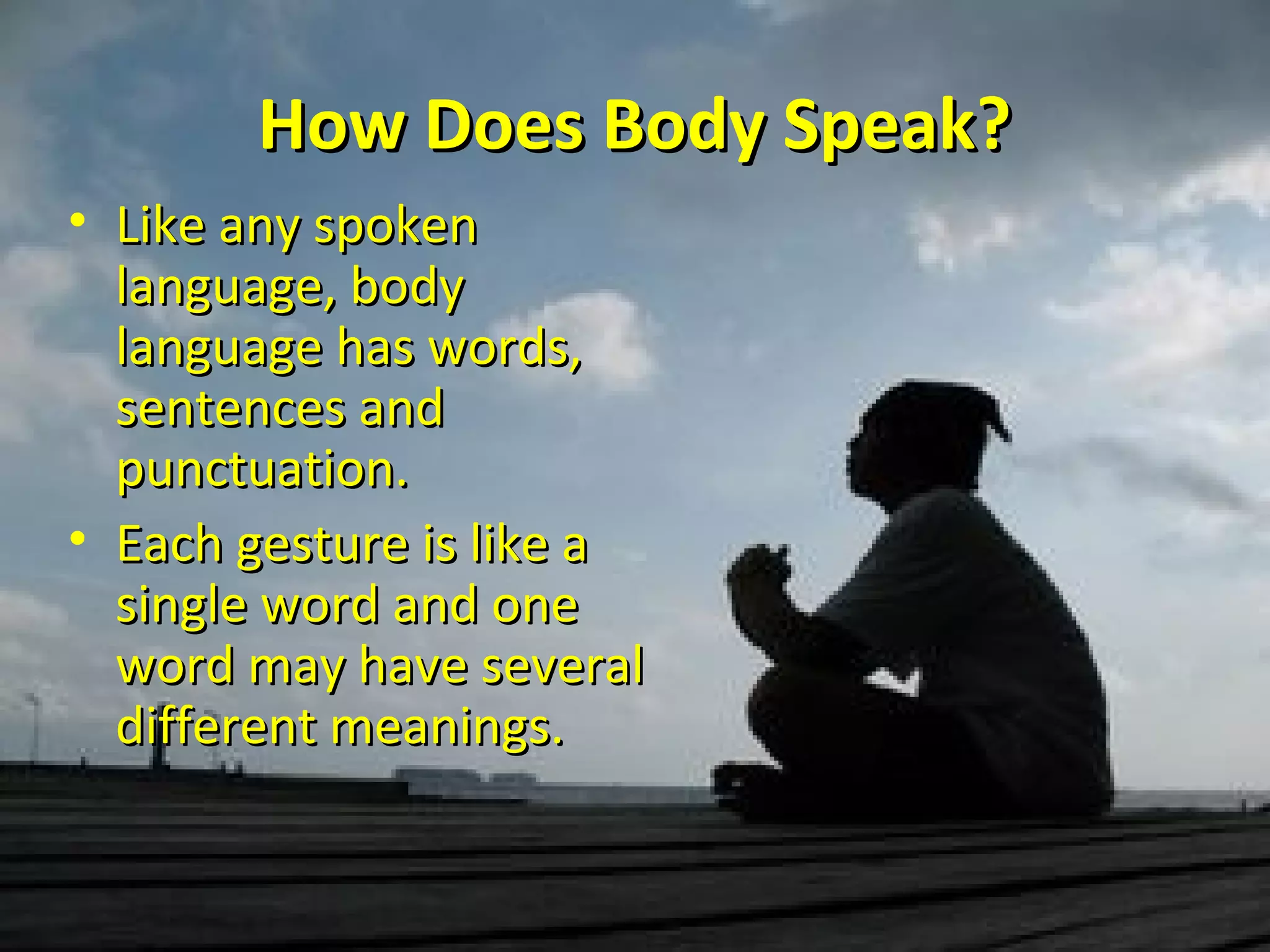
How Does Body Speak?How Does Body Speak?
• Like any spokenLike any spoken
language, bodylanguage, body
language has words,language has words,
sentences andsentences and
punctuation.punctuation.
• Each gesture is like aEach gesture is like a
single word and onesingle word and one
word may have severalword may have several
different meanings.different meanings.
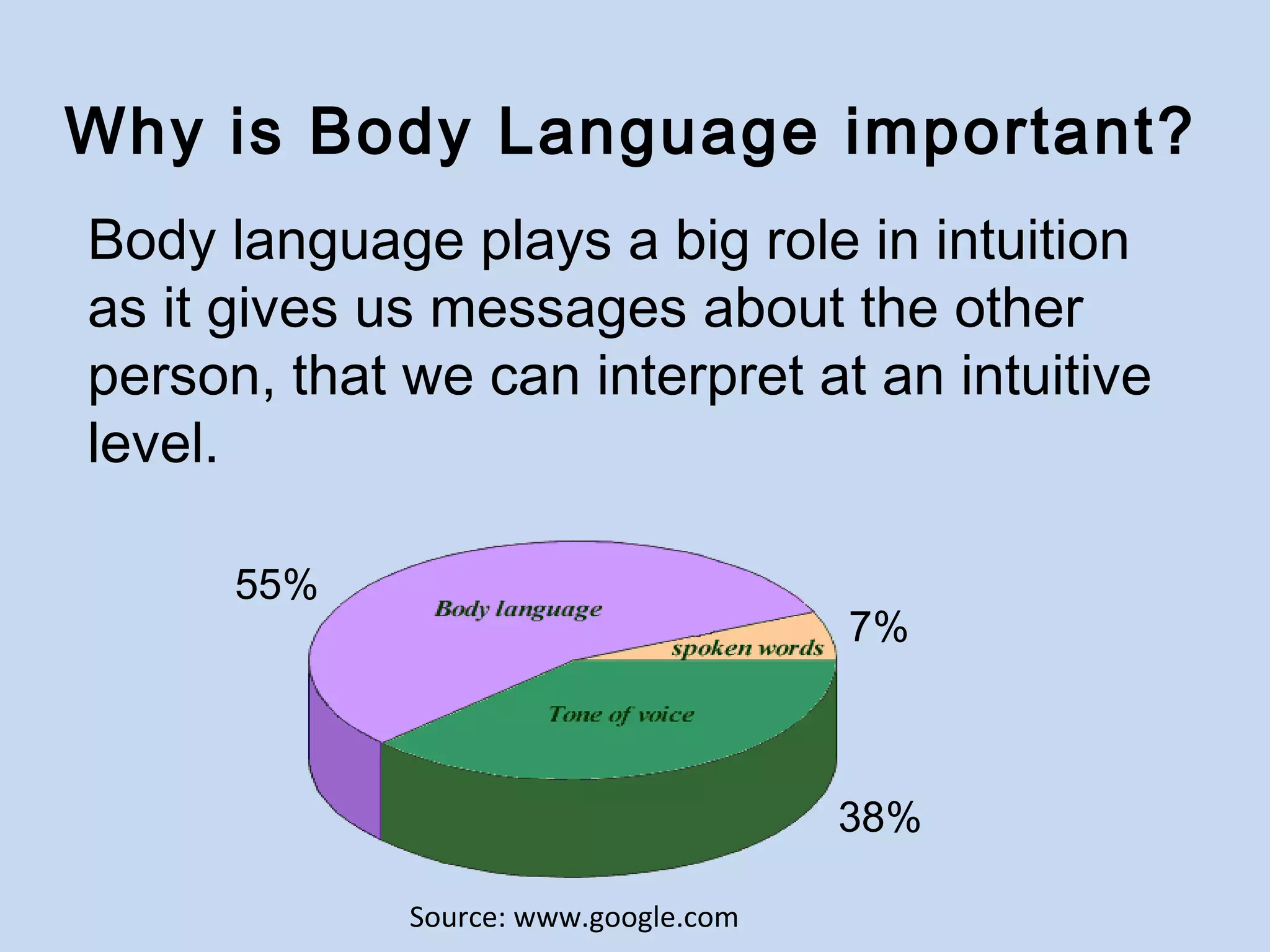
Why is Body Language important?
Body language plays a big role in intuition
as it gives us messages about the other
person, that we can interpret at an intuitive
level.
55%
38%
7%
Source: www.google.com
Body language
 Gesture
 Face
 Posture
Types Of Gestures
• Descriptive
– Clarify or enhance a
verbal message
• Emphatic
– Underscores a verbal
message
• Suggestive
– Symbols of ideas and
emotions
• Prompting
– Evoke a desired
response
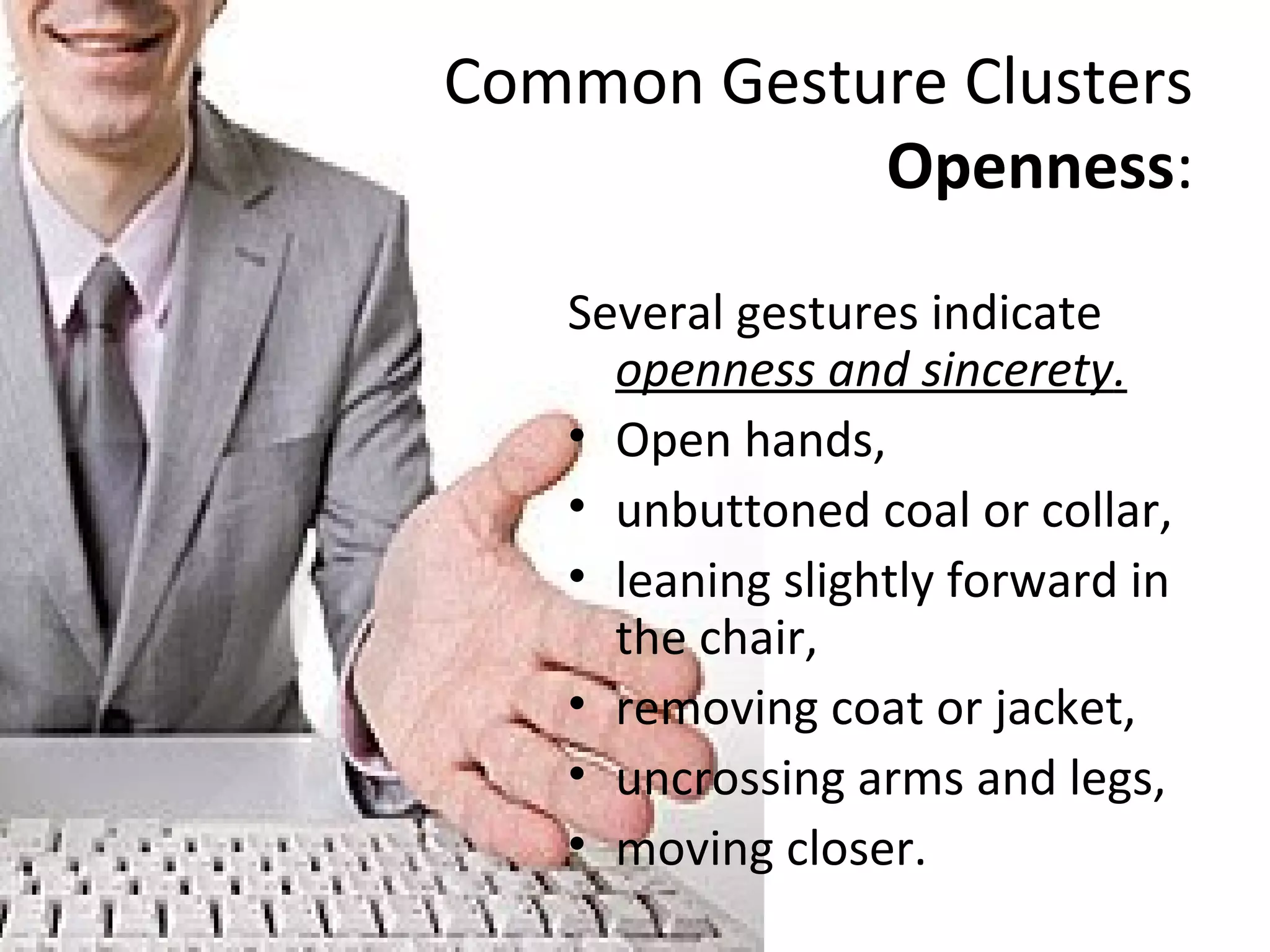
Common Gesture Clusters
Openness:
Several gestures indicate
openness and sincerety.
• Open hands,
• unbuttoned coal or collar,
• leaning slightly forward in
the chair,
• removing coat or jacket,
• uncrossing arms and legs,
• moving closer.
Common Gesture Clusters
Readiness
• Readiness is related to the
goal-oriented high
achiever with a concern
for getting things done.
• It communicates
dedication to a goal and is
usually communicated by
sitting forward at the
edge of a chair.
• This may negatively give
the appearence of being
overly anxious also.
Common Gesture Clusters
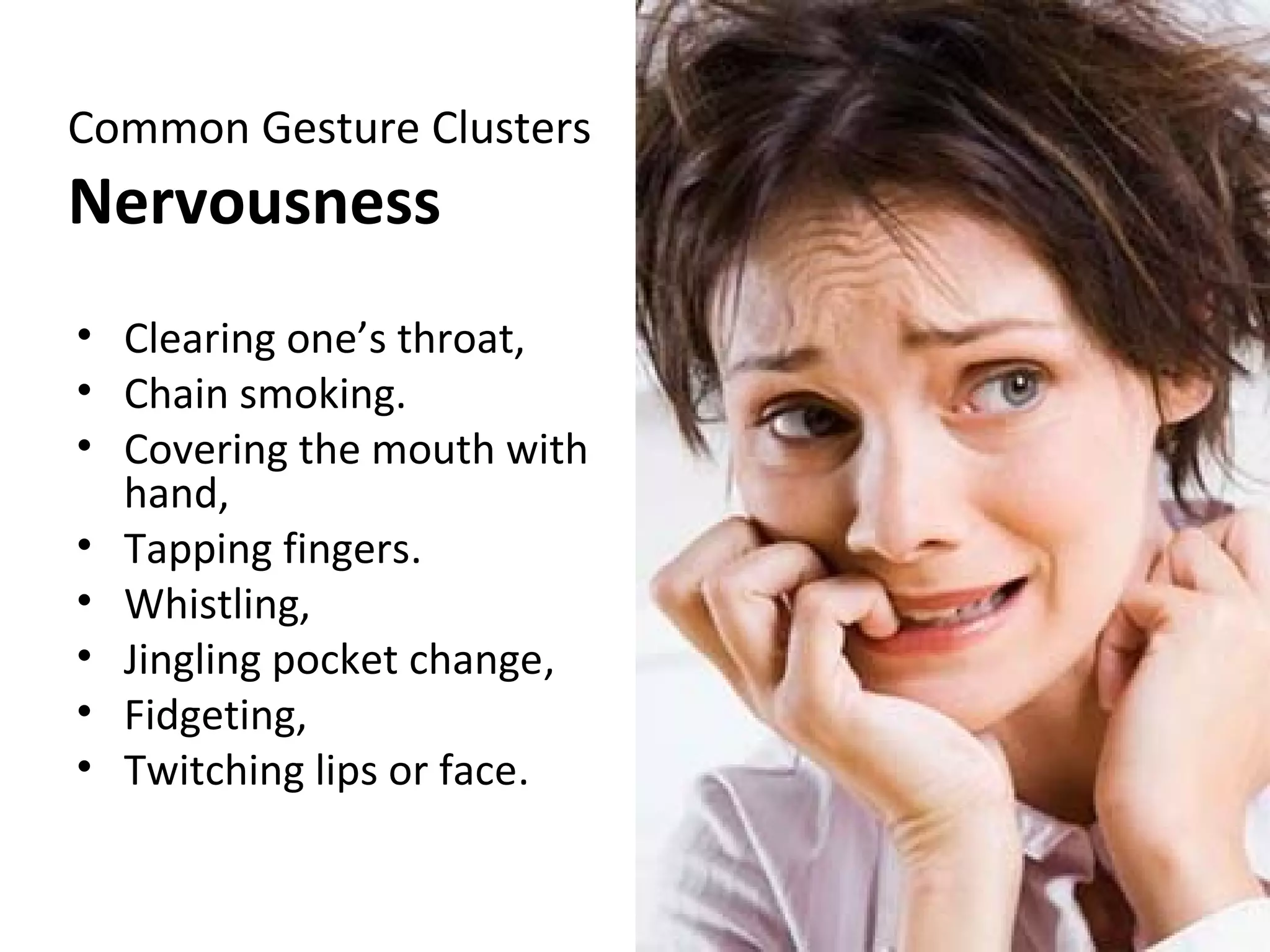
Nervousness
• Clearing one’s throat,
• Chain smoking.
• Covering the mouth with
hand,
• Tapping fingers.
• Whistling,
• Jingling pocket change,
• Fidgeting,
• Twitching lips or face.
Common Gesture ClustersCommon Gesture Clusters
EnthusiasmEnthusiasm
• This is an emotionThis is an emotion tthat youhat you
love to see in other peoplelove to see in other people
and they in you.and they in you.
• It is conveyed byIt is conveyed by
• A small upper or inward smileA small upper or inward smile,,
• Hands open and arms extendedHands open and arms extended
outwardoutward,,
• Eyes wide an alertEyes wide an alert,,
• A lively and bouncy walkA lively and bouncy walk,,
• A lively and well-modulatedA lively and well-modulated
voice.voice.
Let’s Examine How Body
Communicates, from head to toes
FACIAL EXPRESSIONS
Facial expressions reflect emotion, feelings and attitudes
• Your face is
watched whenever
you speak
• Often the key
determinant of the
meaning behind a
message
• Communicates
your attitudes,
feelings, and
emotions more so
than any other part
of your body.
EYE CONTACT
 To make people feel good and show your interest you must
maintain eye contact.
 The easiest way to maintain eye contact naturally is to look at
the persons whole face above the tip of their nose
• People avoid eye contact with
other person when an
uncomfortable question asked.
• Try to reduce tension and build
trust rather than increase tension.
• The raising of one eyebrow shows
disbelief and two shows surprise.
• People are classified as right
lookers and leftlookers. Right
lookers are more influenced by
logic and precision, left lookers are
found to be more emotional,
subjective and suggestible.

Body launguage by sagk

  • 2.
    • Body languageis nonverbal communication that involves body movement. • “Gesturing” can also be termed as body language which is absolutely non- verbal means of communication. • People in the workplace can convey a great deal of information without even speaking; through nonverbal communication. What is Body Language ?
  • 3.
    How Does BodySpeak?How Does Body Speak? • Like any spokenLike any spoken language, bodylanguage, body language has words,language has words, sentences andsentences and punctuation.punctuation. • Each gesture is like aEach gesture is like a single word and onesingle word and one word may have severalword may have several different meanings.different meanings.
  • 4.
    Why is BodyLanguage important? Body language plays a big role in intuition as it gives us messages about the other person, that we can interpret at an intuitive level. 55% 38% 7% Source: www.google.com
  • 6.
  • 7.
    Types Of Gestures •Descriptive – Clarify or enhance a verbal message • Emphatic – Underscores a verbal message • Suggestive – Symbols of ideas and emotions • Prompting – Evoke a desired response
  • 8.
    Common Gesture Clusters Openness: Severalgestures indicate openness and sincerety. • Open hands, • unbuttoned coal or collar, • leaning slightly forward in the chair, • removing coat or jacket, • uncrossing arms and legs, • moving closer.
  • 9.
    Common Gesture Clusters Readiness •Readiness is related to the goal-oriented high achiever with a concern for getting things done. • It communicates dedication to a goal and is usually communicated by sitting forward at the edge of a chair. • This may negatively give the appearence of being overly anxious also.
  • 10.
    Common Gesture Clusters Nervousness •Clearing one’s throat, • Chain smoking. • Covering the mouth with hand, • Tapping fingers. • Whistling, • Jingling pocket change, • Fidgeting, • Twitching lips or face.
  • 11.
    Common Gesture ClustersCommonGesture Clusters EnthusiasmEnthusiasm • This is an emotionThis is an emotion tthat youhat you love to see in other peoplelove to see in other people and they in you.and they in you. • It is conveyed byIt is conveyed by • A small upper or inward smileA small upper or inward smile,, • Hands open and arms extendedHands open and arms extended outwardoutward,, • Eyes wide an alertEyes wide an alert,, • A lively and bouncy walkA lively and bouncy walk,, • A lively and well-modulatedA lively and well-modulated voice.voice.
  • 12.
    Let’s Examine HowBody Communicates, from head to toes
  • 13.
    FACIAL EXPRESSIONS Facial expressionsreflect emotion, feelings and attitudes
  • 14.
    • Your faceis watched whenever you speak • Often the key determinant of the meaning behind a message • Communicates your attitudes, feelings, and emotions more so than any other part of your body.
  • 15.
    EYE CONTACT  Tomake people feel good and show your interest you must maintain eye contact.  The easiest way to maintain eye contact naturally is to look at the persons whole face above the tip of their nose
  • 17.
    • People avoideye contact with other person when an uncomfortable question asked. • Try to reduce tension and build trust rather than increase tension. • The raising of one eyebrow shows disbelief and two shows surprise. • People are classified as right lookers and leftlookers. Right lookers are more influenced by logic and precision, left lookers are found to be more emotional, subjective and suggestible.