Master of Science Thesis - SoM EX 07-11 www.infra.kth.se/sp
KTH Architecture and
the Built Environment
Author
Alazar G Ejigu
Supervisor
Dr. Nils Viking
Examiner
Professor Göran Cars
Head of Division of Urban Studies
Stockholm 2007
KTH, Department of Urban Planning and Environment
Division of Urban and Regional Studies
Kungliga Tekniska Högskolan
A Systems Approach to Infrastructure Planning:
Understanding Complexity and Uncertainty
Master of Science Thesis - SoM EX 07-11 www.infra.kth.se/sp
ABSTRACT
Infrastructure systems are socio-technical systems that are deeply embedded in
society. The task of infrastructure planning and design often has to cope with a
considerable amount of complexity and uncertainty that arise from the very nature of
infrastructure and from changes in social, technological and institutional settings.
The various disciplines involved in the planning and management of
infrastructure traditionally utilize a ‘reductionist’ approach in which infrastructure is
treated as linear object. Thus, a new framework is needed that better reflects the
complex evolutionary nature of infrastructures.
This thesis, with a qualitative method, attempts to use systems approach to study
the nature of infrastructure systems and analyze how they interact with other systems
and with each other. The premise is that understanding the complex nature of the
system is key to effective future planning and management.
Systems Approach to Infrastructure Planning
ii
ACKNOWLEDGMENTS
This thesis benefited from extensive advice from Dr Nils Viking. Professor Folke
Snickars, Mats Ohlsson and Dr Karl Kottenhoff commented on earlier drafts of the
paper. The author would like to thank the mentioned and the following for their valuable
comments and support during the study: Professor Lars Ingelstam, Professor Jane
Summerton, Mats Johansson (Associate Professor), and Peter Brokking.
A special thanks goes to Dr Nils Viking for giving his precious time to supervise this
thesis work and for providing moral and material support during the study.
Another special thanks should go for my father Gedamu Ejigu, who taught me the value
of learning and persistence.
Thank you LORD, for getting me here!
Master of Science Thesis - SoM EX 07-11 www.infra.kth.se/sp
TABLE OF CONTENTS
ABSTRACT.............................................................................................................................i
ACKNOWLEDGMENTS ........................................................................................................ ii
1 INTRODUCTION ................................................................................................... 1
1.1 Problem Formulation ......................................................................................................2
1.1.1 General Problem Field ............................................................................................2
1.1.2 Specific Problem Area.............................................................................................3
1.1.3 Research Problem...................................................................................................4
1.1.4 Delimitation..............................................................................................................5
1.2 Purpose of the study.......................................................................................................6
1.2.1 Long-term Aim.........................................................................................................6
1.2.2 Short-term Objectives..............................................................................................7
1.2.3 Scientific and Practical Significance........................................................................7
1.3 Theoretical framework ....................................................................................................7
1.4 Methodological Approach...............................................................................................8
1.5 Organization of the thesis...............................................................................................8
1.6 Summary of results.........................................................................................................9
2 Research Methodology ..................................................................................... 10
3 Systems Theory................................................................................................. 12
3.1 The basis and basics of the theory...............................................................................12
3.2 Application of systems thinking ....................................................................................15
3.2.1 Levels and Process of Application ........................................................................16
3.2.2 Understanding Complex Systems .........................................................................18
3.2.3 Coping with Uncertainty ........................................................................................19
3.2.4 Defining Sustainability of Systems ........................................................................21
3.3 Challenges and Opportunities in systemic Approaches ...............................................23
3.4 Relevance to infrastructure planning............................................................................25
4 Contexts ............................................................................................................. 26
4.1 Planning Approaches and Policies...............................................................................29
4.1.1 Swedish Practice...................................................................................................29
4.1.2 Case of Developing Countries...............................................................................33
4.2 Trends in Infrastructure Development ..........................................................................34
Systems Approach to Infrastructure Planning
ii
4.2.1 Social and Institutional Changes ...........................................................................35
4.2.2 Technological Development..................................................................................39
4.2.3 ICT Related Changes............................................................................................41
4.3 Challenges in infrastructure planning ...........................................................................42
5 Infrastructure Systems...................................................................................... 43
5.1 What is an infrasystem? ...............................................................................................43
5.2 Nature of Infrasystems .................................................................................................44
5.2.1 Infrasystems as Socio-Technical Systems............................................................45
5.2.2 Life cycle of Infrasystems ......................................................................................46
5.3 The Boundary...............................................................................................................47
5.4 Interplay of systems......................................................................................................49
5.4.1 Infrastructure-to-Economy “Tie” ............................................................................50
5.4.2 Social with Infrasystem Interplay...........................................................................52
5.4.3 Infrastructure and Environment .............................................................................54
5.4.4 Institutional and Political Settings..........................................................................55
5.4.5 Interplay among Infrasystems ...............................................................................56
5.4.6 Spatial Implications of Infrastructure .....................................................................58
5.5 The “Actor Problem” .....................................................................................................59
5.6 Towards Sustainability..................................................................................................60
6 Results................................................................................................................ 62
6.1 Findings........................................................................................................................62
6.2 Infrastructure as a Complex System ............................................................................63
6.2.1 Physical and Technical complexities.....................................................................64
6.2.2 Social and Institutional complexities......................................................................64
6.2.3 Complexities arising from Interactions ..................................................................64
6.3 Uncertainty in Infrastructure Planning ..........................................................................64
6.4 Interview Results ..........................................................................................................64
7 Discussion ......................................................................................................... 68
7.1 Reflection on research questions .................................................................................70
7.2 Challenges and Opportunities ......................................................................................72
7.2.1 Operational Challenges.........................................................................................72
7.2.2 Scientific and Practical Significance......................................................................73
7.3 Recommendations........................................................................................................74
Systems Approach to Infrastructure Planning
iii
To the Research community................................................................................................75
Future Research Recommendation:....................................................................................75
7.4 Conclusion....................................................................................................................76
8 Summary ............................................................................................................ 77
8.1 Lists of Figures .............................................................................................................77
8.2 List of Tables ................................................................................................................77
8.3 List of abbreviations......................................................................................................78
8.4 References ...................................................................................................................78
8.5 Appendices...................................................................................................................81
Appendix A. The Interviewees.............................................................................................81
Appendix B. Interview Questions.........................................................................................82
Appendix C. Screening Alternative Plans............................................................................84
Appendix D. Private Investment in Infrastructure ................................................................84
Appendix E. Transport Infrastructure to Location Effect ......................................................85
Appendix F. View of Strategic Choice .................................................................................85
Master of Science Thesis - SoM EX 07-11 www.infra.kth.se/sp
1 INTRODUCTION
Infrastructure systems are integral to the social, environmental and economic life of
nations. They affect the quality of our transportation, our buildings, and the water we
drink, access to electrical power and communications, and the efficacy and safety of our
waste treatment. It is known that the investments in infrastructure facilities are
enormous; that buildings, highways and systems for supplying water must be
maintained; and that new technologies are emerging which, if well applied, can both
improve the quality of our infrastructure systems and enable the more effective use of
public funds. Because they are so pervasive, complex and varied, the maintenance and
improvement of infrastructure systems often do not receive consistent attention.
Being large scale, complex and capital-intensive systems with long life cycles, most
of our physical infrastructure lack the flexibility to adapt to ever-changing social and
technological requirements.
Globalization being a major contributor, changes in technology and population size,
the introduction of new political and institutional systems and environmental fluctuations
all pose substantial challenge in predicting the future with complete accuracy. Thus, the
task of infrastructure planning and design often has to cope with a considerable amount
of uncertainty and complexity. Since infrastructures are deeply embedded in society,
they also have to stay in harmonization with institutional, economic and societal
developments. Infrastructures should be able to respond to new opportunities or threats,
caused by new technology, new governance models (e.g. related to deregulation,
liberalization and privatization). Moreover, infrastructure design and operation have to
deal with changing social requirements, for instance regarding ethical issues such as
corruption and environmental issues such as pollution.
This study dares to intellectually generalize some of the pervasive infrastructure
planning problems as problems arising from lack of systems understanding. Then it
attempts to strategically tackle them with a concept that has been known to some areas
of the scientific community for more than three decades. This regards the theory
commonly known as “Systems Approach” in scientific writings and books. By raising a
very important question - if lasting, fully functional and integrated urban and regional
infrastructure system could be designed, it introduces systems approach in
infrastructure planning with a hope to creating an innovative solution that is more
reliable than those given traditionally. Sustainable development in this sense will not be
a mere hope but a pursuable goal.
This thesis, in its approach, which possibly could be described as theoretic in nature,
sees infrastructure as a system in the regional and urban systems of
interconnectedness and relationships. Systems theory, or systems approach, or
systems thinking as it appears to take all the mentioned names and more, which also
Systems Approach to Infrastructure Planning
2
has diverse applications at various levels in different fields is used to deal with the
complexities and uncertainties in infrastructure planning. Though there have been
attempts of using system theory in infrastructure development and analysis, most of
these studies either were of very qualitative nature as in most Operational Researches
or were not very explicit in using the theory as a recognized scientific method to
addressing the physical facilities of infrastructure. The study builds itself on the premise
that systems theory through its holistic view can play a vital role in infrastructure
planning by enabling better understanding and knowledge of our infrastructure system.
The result could be the building of more sustainable infrastructure systems operating in
harmony with the urban and regional systems.
Although a wide coverage of research literatures in the area of systems
approaches and infrastructure planning is done, the paper does not claim to give
comprehensive view or review of any of the two areas. Instead with the help of its
extensive research front review, it discusses some of the prevailing challenges in
infrastructure development and planning. Fundamental principles introduced by the
various versions of systems approach are used as tools to investigate through these
challenges.
1.1 PROBLEM FORMULATION
Roughly considered, all planning solutions are accompanied by new challenges
following their implementation. Scientists and decision makers have ambitiously sought
to find solutions with lasting effects and having only minimum or no offshoots. Methods
of forecasting have been devised to make long term strategic plans and policy
frameworks. Concepts of sustainability and the various tools created with a belief to
assist sustainable development are demonstrations of the ambitions and relentless
attempts in the past. Yet, time after time, the hope to create a ‘perfect world’ seems to
be fading out, ultimately causing frustration both in the academic and the practice
worlds.
1.1.1 General Problem Field
It is mentioned in the introduction that globalization is the major contributor to changes
in technology, environmental fluctuations, changes in population sizes and even political
instabilities. All these changes pose substantial challenges in the development and
management of our infrastructure systems.
In US, GAO1
reported that, for all communities, the need to build and repair
infrastructure tops the list of growth-related challenges. If population increases and
especially if national and regional economy continues to expand, there will likely be
1
Community Development: Local Growth Issues-Federal Opportunities and Challenges (GAO/RCED-00-178, Sept. 6, 2000)
Systems Approach to Infrastructure Planning
3
more demand for infrastructure services. For example, a rise in population and vehicle
ownership would lead to increased traffic congestion. To address this congestion, new
and expanded transportation networks and technologies may be needed. Such
predictions and the potential effects signify that ‘strategic’ planning in infrastructure
development will continue to be a concern for practitioners and researchers for the next
decades.
From the policy perspective, the renewed concern with infrastructure can be
traced in two worldwide developments that took place over the last two decades. The
first one is the retrenchment of the public sector since the mid 1980s, in most industrial
and developing countries, from its dominant position in the provision of infrastructure,
under the increasing pressures of fiscal adjustment and consolidation. The second is
the opening up of infrastructure industries to private participation, part of a worldwide
drive toward increasing reliance on markets and private sector activity, which has been
reflected in widespread privatization of public utilities and multiplication of concessions
and other forms of public-private partnership.2
One of the challenges often mentioned in relation to infrastructure concerns the
insufficient resources to support an aging infrastructure network.3
Investment in
maintenance of aging infrastructure is constantly faced by new demands to meet
changing requirements in the infrastructure sector. Infrastructure systems underpin
national and regional economy and require regular maintenance and replacement as
they wear or complete their useful lives.
This thesis focuses on physical infrastructure which consists of a broad array of
systems and facilities that house and transport people and goods and provide services.
Among other things, this includes transportation networks, including roads, rail, and
mass transit; pipelines, and water supplies; and telecommunications services. These
systems and facilities do not exist in isolation: decisions about where to build or expand
roads affect decisions about housing and vice versa, and, in turn, these decisions affect
the need for and location of public facilities and communications and energy services.
1.1.2 Specific Problem Area
Infrastructure systems are better characterized as complex socio-technical systems,
which are composed of several interacting sub-systems. These sub-systems include,
but are not limited to, the technical components of the infrastructure, the economic
system through which transactions are organized and the political system in which
important decisions are made.4
Planning and management issues can only be
2
Calderon and Serven (2004)
3
Ibid,
4
Thissen and Herder (retrived Nov 12,2006), Stichting Next Generation Infrastructures, The Netherlands
Systems Approach to Infrastructure Planning
4
effectively tackled if the co-evolution of these systems is properly understood. Thus, a
new framework is needed that better reflects the complex evolutionary nature of
infrastructures. This study attempts to find a systemic way of analyzing infrastructure
systems at urban and regional levels. It also attempts to develop basic principles for the
planning of infrastructure based on the principles of Systems theory.
Due to its complex nature, infrastructure suffers a mix of problems with varied
nature – economic, social, ecological and technological to mention few. It can be argued
that there are promising improvements in the way we plan and manage our
infrastructure over the years, especially because of technological developments in
areas of construction and ICT which enabled relatively easier planning, building and
maintenance of our infrastructure facilities and provided dynamic tools that ease our
planning and service provision systems, respectively. However, persistent problems
whose cause and possible consequence is not clearly identified continue to be
challenges in infrastructure planning and management assignments. Though use of a
comprehensiveness approach and introduction of efficient methodology is deemed
necessary in the sector, no reliable scientific tool that can efficiently deal with the
uncertain and complex aspects of infrastructure development is devised.
It could be argued that one of the main reasons that contributed to the challenges
we are facing today is the fact that future studies were very less understood in the years
when most of our physical infrastructure was developed. However, considering the
increasing global changes that have their direct and indirect influences on our cities and
regions, predicting the future with accuracy continues to be a serious challenge to
planners and policy makers. As a result, decisions whose long term effects are not fully
understood are taken at every step on the way of infrastructure development. The
problem is even worse when it comes to least developed countries where multiple
challenges of economy, political and technological barriers are faced.
The starting point for this study is an observation that the predominant
conceptual frameworks underpinning the planning approaches towards infrastructures
are based on methodological assumptions that are often at odds with the reality of
present and future generation infrastructure requirements. The various disciplines
involved in the planning and management of infrastructure traditionally utilize a
mechanistic approach in which infrastructure is treated as linear object.
1.1.3 Research Problem
Research question
Infrastructure planning due to the socio-technical nature of the infrastructure system and
due to new trends in its development caused by external forces such as globalization,
privatization and liberalization, is continuously faced by challenges of complexity and
uncertainty that arises from these forces. Often such challenges are dealt traditionally
Systems Approach to Infrastructure Planning
5
through a “reductionistic” approach which tends to see problems as uni-directional
cause and effect relationships. Planners5
have suggested on the need for concepts of
systems and a holistic approach to installation, operation and management of
infrastructure in our planning practice. This study attempts to answer to the question:
What does a Systems Approach provide to infrastructure development planning - and
more particularly in understanding its complex nature and the uncertainty associated
with it?
And in the process of the investigation to find answers to the main research
question the following questions will be addressed: Is infrastructure complex - how?
What is the current infrastructure planning tradition like? How do decision makers know
if their decision was the best in terms of its impact – today and in the future? What are
the major forces that affect the development of our infrastructure? What makes a
sustainable infrastructure system?
Hypothesis
Traditional planning approaches are ignorant of the strong system nature of
infrastructure that urban areas and regions often suffer the negative consequences of
its lacks on the development of our physical infrastructures. The long term impact also
reflects on the natural, economic, social and spatial developments of nations and
localities. The study assumes that there is substantial lack of systems thinking in current
infrastructure planning development projects and infrastructure related decision making
processes. It builds itself on the premise that systems approach, through the holistic
view, could provide a better opportunity to infrastructure planning by enabling better
understanding and knowledge of our infrastructure system.
1.1.4 Delimitation
The central theme of the paper – Infrastructure – is a complex issue that needs to be
dealt with in a cross-disciplinary approach. The multiple meanings the term holds and
the various extents attached to these meanings necessitate a precise contextual
definition and careful limitation of the level the subject may be dealt at, in any study.
Such definition may generally be decided based on the size and scope of the study.
This study draws up its boundaries by dealing with only specific aspects of
infrastructure.
Systems approach is a theory with varying domains of application and with
considerable variations with which it may be framed for analysis or decision making. In
a specific problem setting a multilevel application of the concept ought to provide a
better result. In an academic study such as this, in depth understanding and vivid
briefing of those levels and applications is supposed to help. However, due to various
5
See Goodman and Hastak (2006:1-2.7)
Systems Approach to Infrastructure Planning
6
limitations this paper will neither in detail discuss the various application areas nor will it
considers all levels of the theory’s application in its analysis. Specifically, the study
keeps away from taking the theory to a level where it can be used to designing and
constructing a model for the infrastructure system, which had time and resources
allowed would have made the study more complete.
Of the two - mathematical and philosophic dimensions of the theory, which
combined would probably make up the full coin – this thesis has to assume away the
mathematical dimension, which otherwise would have required a lot more time and
resource than was available to do the study.
In the past, attempts to measure the impact of infrastructure in development have
resulted in arguments and debates in the research arena. The main point of argument
concerns the methods and tools used to measure the impact and the difficulty on setting
holistic and accurate6
standard measures. In a way, that describes the complex nature
of infrastructure. While bearing in mind that understanding and measuring or estimating
the impact of infrastructure in various aspects of urban and regional development is an
integral part of the infrastructure planning process, this thesis does not engage itself in a
discussion of which method or tool to use; but instead makes use of what is made
available by other authors.
1.2 PURPOSE OF THE STUDY
The study aims to exploring ways a systems approach may be used as a sustainability
tool in the practice of infrastructure planning. By looking at systemic ways by which
complexity and uncertainties in infrastructure may be addressed, the thesis intends to
contribute to knowledge on the subject of planning. In addition to suggesting a method
by which infrastructure may be analyzed, assessed and improved, the study has other
more specific objectives.
1.2.1 Long-term Aim
By describing the interconnectedness of infrastructure development with urban and
regional developments, the study aims to enhance understanding of systems among
planners. It intends to present a timely tool for the urban and regional planning
community and more specifically to those involved in infrastructure development
projects, programs and policy making works. In so doing it pursues an ambitious goal of
creating awareness among urban and regional planners who would further develop the
idea and the responsibility of developing contextual models and more efficient analytical
tools for dealing with infrastructure planning issues contextual to their localities.
Systems approach, in this study, by analyzing infrastructure as a system in a
more methodical manner, attempts to provide a framework for future discussion. This in
6
Whether or not there is an accurate measure is still an issue of debate and perhaps will continue to be so in the coming years.
Systems Approach to Infrastructure Planning
7
the long run is believed to encourage the continued application of system thinking in the
field of infrastructure planning and in a more explicit way.
1.2.2 Short-term Objectives
An objective of the study is to explore potential applications of systems theory in
infrastructure development and planning process. The intention is that the knowledge
gained in the process may be used to tackle prevailing and up-coming problems arising
from our physical infrastructure. To this end better understanding of the complex nature
of infrastructure systems is believe necessary in planning for uncertainty in
infrastructure development projects and programs. The study searches for and attempts
to highlight the key information and considerations needed for building a sustainable
infrastructure system.
1.2.3 Scientific and Practical Significance
Olsson and Sjöstedt7
highlight that a systems approach in science is expected to enable
better research questions as well as answers to those questions, and it also sometimes
aims to achieve changes, improvements through intervention, in the problem situation it
studies. An important objective to chase in this thesis would then be the reformulation of
some of the major questions to be posed in and during infrastructure development
projects and decision making. Questions of particular interest to this study are: (1) What
use can Systems Theory have in infrastructure planning? (2) How does an infrastructure
system operate; and what makes the system complex? (3) what makes a sustainable
infrastructure system? By striving to answer these questions the study attempts to shed
light on inherently complex issue.
1.3 THEORETICAL FRAMEWORK
As it emerges from the research front review, a system is often defined as a complex of
interacting elements. Systems theory in its development has introduced to the world
new concepts that apply to nearly all systems – natural, social, socio-economic,
technical, etc. These concepts regard views that attempt to discuss interactions
between systemic elements, which often are referred as “agents” or “actors”.8
The
critical question the theory deals with is what perceivable elements (agents or actors)
should be considered to be a part of the system and what factors should be seen as
belonging to its environment.
An important role systems theory could play in dealing with infrastructure issues
regards its ability in making the analysis of the naturally complex infrastructure system
7
Olsson and Sjöstedt (2004), p19
8
Ibid:p8
Systems Approach to Infrastructure Planning
8
manageable by way of introducing certain abstraction to it. The assumption is that such
attempt helps to simplify the complexity embedded in infrastructure planning and
development.
The scientific significance of the theory could be explained by its ability in enabling
better research questions and answers. Systems approach, as Olsson and Sjöstedt9
discuss, can serve both as a support of decisions and actions pertaining to how a
specific problem situation should preferably be studied and improved, and as offering
conclusions about how the outcome of a systemic intervention leads to new decision
support technologies and new ways of managing the situation as a consequence of the
intervention.
1.4 METHODOLOGICAL APPROACH
The study combines theoretical work with interviews and two case assessments. The
first part of the study follows an exploratory approach in developing the conceptual tools
necessary to model performance of the theory for the purpose of the situational
analysis. However, a descriptive approach characterizes the overall research process
and more specifically in the analysis of the problem situation. An intensive research
front review is carried to develop and expand the discussion in the literature which
describes infrastructure as an evolving system. Information from e-journals, books and
websites of ongoing and past research projects is used to discuss concepts embedded
in systems thinking and to analyze infrastructure as a system emerging from actions at
lower levels in the development process of regions and urban areas. To help
understand this system at higher levels, a descriptive approach is used in identifying
particulars about the system and sub-systems and the study of casual relationships
between the sub-systems. A theoretic presentation of the subject of systems approach
in infrastructure planning is the general intention of the thesis. A qualitative method is
believed more appropriate to achieve this goal. Semi-structured and unstructured in
depth interviews are also carried out.
1.5 ORGANIZATION OF THE THESIS
The organization of the study follows the IMRAD format. Viking’s10
“Thesis Work in
Regional Planning” is used as a reference in the development of the selected research
format and in keeping the methodological approach up to the standard of a scientific
writing.
9
Ibid: p319
10
Viking (2004)
Systems Approach to Infrastructure Planning
9
In the development of different sections of this writing, continued referencing of the
book “How to Write and Publish a Scientific Paper” by Day11
is made.
The first Chapter is dedicated to the Introduction where the nature and the scope of
the problem situation is presented. The purpose of the whole study is also made clear.
The chapter also contains brief summaries of the theory of Systems and the method
used in the study. In the second chapter the Research Methodology is presented in a
more extended way. A detailed account of Systems Theory and its relevance in the
whole study is given in the third section. The forth by presenting the planning and
development context and the fifth sections by analyzing infrastructure as a system, play
central role in the paper. Current planning contexts are explored in the fourth section
and an analysis of the physical Infrastructure system with the help of systems theory is
carried in the fifth section. In the results section findings of the investigation are
presented. The discussion section provides a thorough discussion of things originally
intended-to-be-settled and are settled or things that could not be settled through the
study. Relevant recommendations are also given at the end. The last section is
dedicated to the listing of references to figures, tables and sources used in the paper.
An appendix where information for further referencing is provided is the last but
important part of this section.
1.6 SUMMARY OF RESULTS
The final product of the study is intended to serve as an infrastructure planning support
for planners and policy-makers in the urban and regional development arena and those,
who directly or indirectly, are involved in the process of infrastructure development. It
assumes that more functional urban and regional systems could be developed by
understanding the interrelationship of between the systems.
The result of the study showed that there are three kinds of complexities in
infrastructure planning: (1) physical and technical complexities; (2) social and
institutional complexities and (3) complexities arising from the interactions with other
systems, components and actors. And the sources of uncertainty are identified to be (1)
changes with respect to the environment of the infrastructure, (2) Technological and
institutional change within the infrastructure system itself (3) Multi-actor, multi-
governance situation.
Systems approach, particularly tools used by Large Technical Systems study
proved to be helpful in analyzing how infrastructure works as a system and (2) how it
co-evolves and interacts with other systems.
11
Day (1998: 1-256)
Systems Approach to Infrastructure Planning
10
2 RESEARCH METHODOLOGY
A combined research method is used in this thesis to help fully grasp the concepts of
systems, which without making use of multiple methodologies would have been difficult
due to its multifaceted nature. In the presentation a broad description of systems theory
followed by a brief analysis of infrastructure as system is deemed necessary to help the
reader understand this relatively new concept that is not very well-known by the vast
community of planners. The assumption in the study is that systems theory provides the
necessary tools and methods in studying large and complex socio-technical systems
such as physical infrastructure.
The selection, formulation and detailed investigation of the problem dealt in this
paper are carried with the help of intense research front review and with ideas obtained
from interview with professionals. Qualitative study characterizes the overall all
approach used in the study.
Rigorous research front review is carried to understand the very concepts of the
theory and to assist in bringing its theoretic12
content closer to the reality of the problem
under investigation. The desktop study includes review of a number of e-journals made
available to KTH students, websites of statistics offices, project websites and reports of
research teams working on projects of relevance. Books on the subject dating from
1961 – the time when Forrester13
, introduced the concept of “urban dynamics” to recent
contributions on the field by the Dutch research team “Next Generation Infrastructure
Foundation” are referred in the desktop study. Researches by a number of writers
engaged in the field of system science and corresponding streams and published in E-
journals make up the soul of the desktop study.
And in the tradition of systemic approach, conceptual diagrams and demonstrative
examples are used as a way of conceptualizing issues being dealt. The process is
supposed to assist in developing the systemic tools for analyzing complex systems like
infrastructure and in understanding causal interrelationships between elements of a
system and sub-systems. Feedback loop diagrams constitute the main types of
diagrams used in the study.
Much focus is given to the exploration and description of systems theory in relation
to current urban and regional infrastructure planning challenges and development
trends. However, in analyzing the challenges and trends a comparable attention is given
12
Discussion of systems theory in this paper attains more of philosophic presentation. In other words the more advanced and qualitative
dimension of its application is intentionally avoided in accordance to the purpose of the study. It is important to note here that in other writer
works either or often both dimensions are included.
13
Forrester (1961)
Systems Approach to Infrastructure Planning
11
to the explanation of what causes the challenges and drives the trends. A method of
“analysis of effects”14
very much resembles this approach.
Internally a procedure that may help in reaching the intended objectives of the study
is employed. Descriptions of current practices different contexts are given and key
events, trends and assumptions are identified. An attempt is made then to identify key
interrelationships, influences, processes and unintended consequences. Summary of
knowledge gained in the study is presented and further discussed at the end. Relevant
recommendations are forwarded in the closing.
Semi-structured, in-depth interview questions are directed to two categories of
people, namely practicing planners and academicians. The intention is to investigate
how system thinking has been of use at a conceptual theoretic level like in most
scientific studies and what the practical application of the concept looks like in real world
projects and policy development processes. The belief is a study of the theoretic and
practical aspects of the systems approach might increase knowledge of its scientific
viability and potential usability. Embedded in this belief is the assumption is that
practicing planners and policy makers could be doing their work in accordance with the
methods of systems thinking without even knowing what the theory is all about. In a way
this assumption tends to agree with what Olsson and Sjöstedt15
discusses as “…in
practice systems analysis tends to have a somewhat different meaning and usefulness
for scientists and policy makers respectively”. As the authors suggested a comparison
of how systems analysis is assessed by different professional cultures – such as the
ones in which scientists and policy makers live – will help to enrich the overall
evaluation of the approach.
To make the presentation more comprehendible and less stressful, examples and
case presentations are included. Specific examples are taken - the Swedish planning
practice and the case of developing countries. Why Sweden is chosen very much
relates to where the study is carried. The information on Swedish planning practice was
the most accessible to the author during the study period. The author’s background and
passion also initiated the study on developing countries. These two cases explore
different approaches employed by different countries and how contextual differences
have their hands on the practices. Later in the Discussion section, how knowledge
gained from such studies and from applying systems approach to planning issues could
be of use in the future planning practice in the mentioned countries and more is
discussed. However, these case presentations do not make up the central part of the
study and were never intended to be comprehensive studies as in the common tradition
of “Case Studies”.
14
Viking (2004:18)
15
Olsson and Sjöstedt (2004:14)
Systems Approach to Infrastructure Planning
12
3 SYSTEMS THEORY
The study assumes a broad and yet shallow account of Systems Theory and its
relevance to infrastructure planning. And in this theoretic section, conceptual base of
the theory is first established to set the measure for its effective application later in the
situation analysis. More specifically concepts borrowed from the theory of Systems
Analysis and Systems Dynamics are used in the development of the scientific tool for
the study purpose. Principles introduced by system dynamics approach are thought to
form the ‘foundational’ core of these modern versions of systems approach and hence
are given in a relatively more detailed form. However, due to their capacity in assisting
the study of large and complex systems such as infrastructure, a number of valuable
ideas are taken from Large Technical Systems (LTS) field. A critic of the theoretic build-
up is then presented under the heading “Challenges and Opportunities in Systems
Approach” which is followed by a section where the relevance of the approach to
infrastructure planning is discussed.
3.1 THE BASIS AND BASICS OF THE THEORY
Dictionary meaning16
reveals that systems is (1) a group of interacting, interrelated, or
interdependent elements forming a complex whole or (2) a functionally related group of
elements.
As it appears in Wikipedia17
, Systems thinking, which is the general term used in
systems science, is defined as:
“…an approach to analysis that is based on the belief that the component parts
of a system will act differently when isolated from its environment or other parts
of the system. It includes viewing systems in a holistic manner, rather than
through purely reductionist techniques.”
“Systems thinking is about gaining insights into the whole by understanding the
linkages and interactions between the elements that comprise the whole
"system", consistent with systems philosophy. It recognizes that all human
activity systems are open systems; therefore, they are affected by the
environment in which they exist.”
16
Online dictionary, www.dictionary.com,, retrieved on Nov 12, 2006
17
Wikipedia – the online encyclopedia, retrieved Nov 22/ 2006.
Systems Approach to Infrastructure Planning
13
“Systems thinking recognizes that in complex systems, events are separated by
distance and time; therefore, small catalytic events can cause large changes in
the system. It acknowledges that a change in one area of a system can
adversely affect another area of the system; thus, it promotes organizational
communication at all levels in order to avoid the silo effect.”
The definitions show that Systems’ thinking is the art (and science) of simplifying
complexity. It is about seeing through chaos, managing interdependency, and
understanding choice. We see the world as increasingly more complex and chaotic
because we use inadequate concepts to explain it. When we understand something, we
no longer see it as chaotic or complex. The arguments in this study are founded on this
very understanding.
The distinction of systems thinking is its focus on the whole. What is then a
systems methodology and how can we get a handle on the whole? Gharajedaghi’s18
interpretation of systems methodology seems to inspire much of the writing in this
thesis. Gharajedaghi in his book “Systems Thinking: Managing Chaos and Complexity”
challenges the widely held belief that multidisciplinary approach produces a meaningful
perception of the whole. Instead he underlines that the ability to synthesize separate
findings into a coherent whole is far more critical than the ability to generate information
from different perspectives as is often the case with multidisciplinary approaches. For
him, without a well-defined synthesizing method, the process of discovery using a
multidiscipline approach would be an experience as frustrating as that of the blind men
trying to identify an elephant. Each may come-up with different findings but the sum of
all may not necessarily give the accurate picture of the elephant.
System Dynamics Modeling was formally introduced to the scientific community
in Forrester’s 1961 book entitled Urban Dynamics. By analyzing a complex and dynamic
system of continually interacting feedback loops, Forrester19
reveals that short term
fixes in large systems rarely produce effective long term results. The challenge of a
Systems modeling is to produce a model that points leaders and policy makers towards
the most effective long term solution. Forrester also noted that most programs and
initiatives undertaken by decision makers are those that address the symptoms rather
than the underlying problems. Unlike many simple feedback loops that incorporate only
one principle state variable, symptoms in complex systems do not have a simple cause
and effect relationship. Thus, the apparent cause and effect that jump out are usually
just two coincident symptoms arising from the dynamics of the larger system structure.
As human observers of this system we are easily fooled by time correlations between
18
Gharajedaghi (1999)
19
Forrester (1969)
Systems Approach to Infrastructure Planning
14
these coincident symptoms and are thus prevented from looking at the larger system
structure for our solution.
Despite the enormous appreciation Forrester’s model and methodology of
Systems Dynamics received, various writers20
have shown their concern that the
approach has made little progress in becoming an accepted planning tool. However,
recent development of the methodology in the other streams of the Systems field such
as in Critical Systems Thinking (CST), and Soft Systems Methodology (SSM), it has
become more vivid that there are much more aspects of the theory that need to be
further investigated and be used in various problem situations.
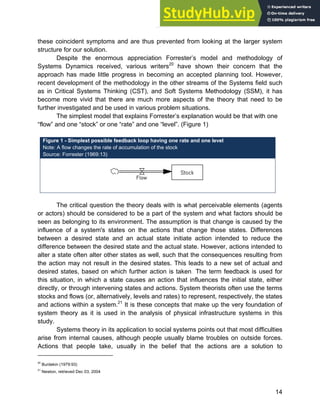
The simplest model that explains Forrester’s explanation would be that with one
“flow” and one “stock” or one “rate” and one “level”. (Figure 1)
Figure 1 - Simplest possible feedback loop having one rate and one level
Note: A flow changes the rate of accumulation of the stock
Source: Forrester (1969:13)
The critical question the theory deals with is what perceivable elements (agents
or actors) should be considered to be a part of the system and what factors should be
seen as belonging to its environment. The assumption is that change is caused by the
influence of a system's states on the actions that change those states. Differences
between a desired state and an actual state initiate action intended to reduce the
difference between the desired state and the actual state. However, actions intended to
alter a state often alter other states as well, such that the consequences resulting from
the action may not result in the desired states. This leads to a new set of actual and
desired states, based on which further action is taken. The term feedback is used for
this situation, in which a state causes an action that influences the initial state, either
directly, or through intervening states and actions. System theorists often use the terms
stocks and flows (or, alternatively, levels and rates) to represent, respectively, the states
and actions within a system.21
It is these concepts that make up the very foundation of
system theory as it is used in the analysis of physical infrastructure systems in this
study.
Systems theory in its application to social systems points out that most difficulties
arise from internal causes, although people usually blame troubles on outside forces.
Actions that people take, usually in the belief that the actions are a solution to
20
Burdekin (1979:93)
21
Newton, retrieved Dec 03, 2004
Systems Approach to Infrastructure Planning
15
difficulties, are often the cause of the problems being experienced. ‘Social System
Design Approach’ as Newton22
defines it, for example, deals with urban problems by
providing support or resources to people, rather than dealing with urban problems
through construction of buildings or infrastructure. The very nature of the dynamic
feedback structure of a system tends to mislead people into taking ineffective and even
counterproductive action. The implication of all these is that people have enough
information about a system to permit successful modeling or shaping.23
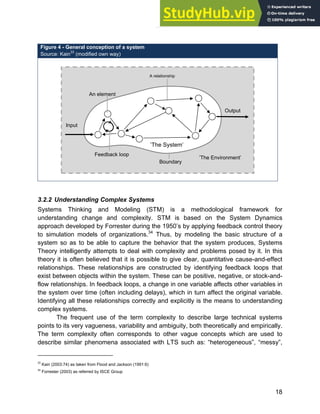
In a defined system there will be a collection of interrelated elements
circumscribed by an open boundary allowing physical and/or abstract input and output.
The processes within the system, transforming input into output, are also influenced and
stabilized by feedback loops and control mechanisms. On the other hand, as Kain24
suggests, systems may also be hierarchically understood as constituting sub-systems
to, or sub-elements within a wider system.
The usefulness of such abstraction in dealing with complex systems such as
infrastructure is suggested by different authors.25
Further discussion is given under
section 3.4.
3.2 APPLICATION OF SYSTEMS THINKING
Based on Newton’s contribution “An Introduction to System Dynamics”26
systems
concept could be used to help us design improved social systems and model desires,
expectations, perceptions and goals. It is also stated in his writing that System
Dynamics could be used to produce conditional, imprecise projections of dynamic
behavior modes. He boldly claims that the theory is a sustainability tool and that the
specific advantages of the approach over mental models and the success the model
must be measured against the mental models that would otherwise be used.
Gharajedaghi27
on the other hand explains the power in the idea of holistic
iterative thinking and shares his experience in utilizing and promoting the thinking.
According to him system thinking provides a competitive advantage. Though the focus
of his discussion on competitiveness is the kind that could possibly exist in businesses,
the concept that holistic thinking, by enabling better situational and contextual
understanding of problems, can provide a competitive advantage is something to be
noted.
22
ibid
23
Burdekin (1979::93)
24
Kain (2003:74)
25
See Forester (1969), Kain (2003), Gharajedaghi (1999)
26
Newton, retrieved Oct 25, 2006
27
Gharajedaghi (1999)
Systems Approach to Infrastructure Planning
16
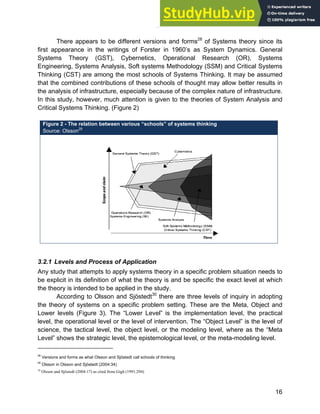
There appears to be different versions and forms28
of Systems theory since its
first appearance in the writings of Forster in 1960’s as System Dynamics. General
Systems Theory (GST), Cybernetics, Operational Research (OR), Systems
Engineering, Systems Analysis, Soft systems Methodology (SSM) and Critical Systems
Thinking (CST) are among the most schools of Systems Thinking. It may be assumed
that the combined contributions of these schools of thought may allow better results in
the analysis of infrastructure, especially because of the complex nature of infrastructure.
In this study, however, much attention is given to the theories of System Analysis and
Critical Systems Thinking. (Figure 2)
Figure 2 - The relation between various “schools” of systems thinking
Source: Olsson29
3.2.1 Levels and Process of Application
Any study that attempts to apply systems theory in a specific problem situation needs to
be explicit in its definition of what the theory is and be specific the exact level at which
the theory is intended to be applied in the study.
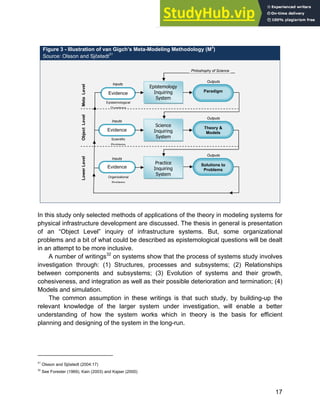
According to Olsson and Sjöstedt30
there are three levels of inquiry in adopting
the theory of systems on a specific problem setting. These are the Meta, Object and
Lower levels (Figure 3). The “Lower Level” is the implementation level, the practical
level, the operational level or the level of intervention. The “Object Level” is the level of
science, the tactical level, the object level, or the modeling level, where as the “Meta
Level” shows the strategic level, the epistemological level, or the meta-modeling level.
28
Versions and forms as what Olsson and Sjöstedt call schools of thinking
29
Olsson in Olsson and Sjöstedt (2004:34)
30
Olsson and Sjöstedt (2004:17) as cited from Gigh (1991:294)
Systems Approach to Infrastructure Planning
17
Figure 3 - Illustration of van Gigch’s Meta-Modeling Methodology (M3
)
Source: Olsson and Sjöstedt31
In this study only selected methods of applications of the theory in modeling systems for
physical infrastructure development are discussed. The thesis in general is presentation
of an “Object Level” inquiry of infrastructure systems. But, some organizational
problems and a bit of what could be described as epistemological questions will be dealt
in an attempt to be more inclusive.
A number of writings32
on systems show that the process of systems study involves
investigation through: (1) Structures, processes and subsystems; (2) Relationships
between components and subsystems; (3) Evolution of systems and their growth,
cohesiveness, and integration as well as their possible deterioration and termination; (4)
Models and simulation.
The common assumption in these writings is that such study, by building-up the
relevant knowledge of the larger system under investigation, will enable a better
understanding of how the system works which in theory is the basis for efficient
planning and designing of the system in the long-run.
31
Olsson and Sjöstedt (2004:17)
32
See Forester (1969), Kain (2003) and Kajser (2000)
Theory &
Models
Evidence
Science
Inquiring
System
Scientific
Problems
Inputs
Outputs
Solutions to
Problems
Evidence
Practice
Inquiring
System
Organizational
Problems
Inputs
Outputs
Epistemology
Inquiring
System
Evidence Paradigm
Epistemological
Questions
Inputs
Outputs
Philoshophy of Science
Meta
Level
Object
Level
Lower
Level
Systems Approach to Infrastructure Planning
18
3.2.2 Understanding Complex Systems
Systems Thinking and Modeling (STM) is a methodological framework for
understanding change and complexity. STM is based on the System Dynamics
approach developed by Forrester during the 1950’s by applying feedback control theory
to simulation models of organizations.34
Thus, by modeling the basic structure of a
system so as to be able to capture the behavior that the system produces, Systems
Theory intelligently attempts to deal with complexity and problems posed by it. In this
theory it is often believed that it is possible to give clear, quantitative cause-and-effect
relationships. These relationships are constructed by identifying feedback loops that
exist between objects within the system. These can be positive, negative, or stock-and-
flow relationships. In feedback loops, a change in one variable affects other variables in
the system over time (often including delays), which in turn affect the original variable.
Identifying all these relationships correctly and explicitly is the means to understanding
complex systems.
The frequent use of the term complexity to describe large technical systems
points to its very vagueness, variability and ambiguity, both theoretically and empirically.
The term complexity often corresponds to other vague concepts which are used to
describe similar phenomena associated with LTS such as: “heterogeneous”, “messy”,
33
Kain (2003:74) as taken from Flood and Jackson (1991:6)
34
Forrester (2003) as referred by ISCE Group
Figure 4 - General conception of a system
Source: Kain33
(modified own way)
’The Environment’
’The System’
A relationship
Input
An element
Output
Boundary
Feedback loop
Systems Approach to Infrastructure Planning
19
“hybrid” as well as the metaphor of the “seamless web”. The idea of systemic
complexity has been said to often be used “as a preliminary summary for a serious of
ascertained, suspected or simply presumed attributes such as the uncertainty,
imperspecuity, and uncontrollability of LTS.35
The use of systemic thinking in dealing with complex systems and the nature of
the process are very much explained in Gharajedaghi´s book.36
Gharajedaghi in his
book asserts that the imperatives of interdependency, the necessity of reducing endless
complexities, and the need to produce manageable simplicities require a workable
systems methodology and a holistic frame of reference that will allow us to focus on the
relevant issues and avoid the endless search for more details while drowning in
proliferating useless information. According to him, the rules of systems methodology
are relatively simple, but proficiency comes only with practice. He then advises to stay
appreciative of the imperatives of the systems dimensions in ‘life.’ He also underlines
that to understand complexity, “…one needs to discover the underlying rhythm, the
order by which things repeat themselves.”
To understand the complexity of a system it is important to analyze through (1)
the number and nature of components in the system, (2) the degree of differentiation
between these components, and (3) the degree of interdependence among
components.37
3.2.3 Coping with Uncertainty
Complex systems are perceived to evolve in often unpredictable and hence
unmanageable ways. The perception is that the requirements for such systems are
rarely stable, meaning that systems need to evolve continuously to reflect changes in
requirements. Eriksson38
in his contribution to the book “Systems Approaches and Their
Application” shares his views on uncertainty from his experience in Swedish defense
research at FOI. In this contribution he argues that, in the context of post cold war and
network environment, an effective approach to coping with uncertainty should
acknowledge ‘qualitative uncertainty’ – as distinct from quantitative (quantifiable). He
also argues that such approach should contain elements of what he calls ‘strategic
opportunism’ implemented through a ‘portfolio approach’ – as distinct from the more
traditional ‘structure-oriented’ approaches. Furthermore, he describes ‘exploratory
scenario analysis’ method as indispensable tool to cope uncertainty.
Eriksson uses some dichotomies to describe various dimensions of uncertainty
and to analyze the suitability of scenarios and related approaches in the treatment of
uncertainties. Qualitative vs. Quantitative, Intentional vs. Stochastic and Dynamic vs.
35
Ewertsson & Ingelstam in Olsson and Sjöstedt (2004:297)
36
Gharajedaghi (1999)
37
Gharajedaghi (1999)
38
Ericsson, in Olsson and Sjöstedt (2004:167-194)
Systems Approach to Infrastructure Planning
20
Static uncertainties are the dichotomies he uses to describe aspects of uncertainty. And
in He begins by looking at the various attitudes or extremes “scenario” methods are
being used in different settings. (Figure 5) A summary of part of his insightful discussion
is presented as a theoretic tool to managing uncertainties in this study.
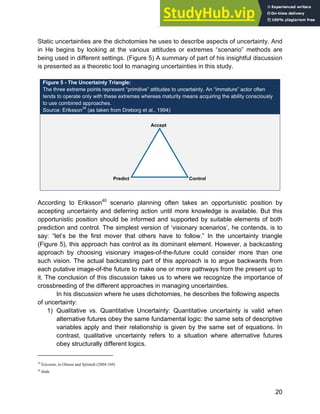
Figure 5 - The Uncertainty Triangle:
The three extreme points represent “primitive” attitudes to uncertainty. An “immature” actor often
tends to operate only with these extremes whereas maturity means acquiring the ability consciously
to use combined approaches.
Source: Eriksson39
(as taken from Dreborg et al., 1994)
According to Eriksson40
scenario planning often takes an opportunistic position by
accepting uncertainty and deferring action until more knowledge is available. But this
opportunistic position should be informed and supported by suitable elements of both
prediction and control. The simplest version of ‘visionary scenarios’, he contends, is to
say: “let’s be the first mover that others have to follow.” In the uncertainty triangle
(Figure 5), this approach has control as its dominant element. However, a backcasting
approach by choosing visionary images-of-the-future could consider more than one
such vision. The actual backcasting part of this approach is to argue backwards from
each putative image-of-the future to make one or more pathways from the present up to
it. The conclusion of this discussion takes us to where we recognize the importance of
crossbreeding of the different approaches in managing uncertainties.
In his discussion where he uses dichotomies, he describes the following aspects
of uncertainty:
1) Qualitative vs. Quantitative Uncertainty: Quantitative uncertainty is valid when
alternative futures obey the same fundamental logic: the same sets of descriptive
variables apply and their relationship is given by the same set of equations. In
contrast, qualitative uncertainty refers to a situation where alternative futures
obey structurally different logics.
39
Ericsson, in Olsson and Sjöstedt (2004:169)
40
ibids
Accept
Control
Predict
Systems Approach to Infrastructure Planning
21
2) Intentional vs. Stochastic Uncertainty: The question here is: are we up against a
cognizant actor with a capacity to foresee and monitor our options and actions, or
are we in a “game against blind Mother Nature”? In more complex settings,
intentional uncertainty is compounded by qualitative uncertainty. That is,
cognizant player may devise novel moves and as a consequence the “rules of
the game” change over time.
3) Dynamic vs. Static Uncertainty: In some situations of uncertainty it is possible to
identify early-warning indicators and defer action until we see indications of
possibly emerging events. An uncertainty is dynamic if the warning time is
greater than the response time, otherwise static.
In other sets of dichotomies, he presents ideas of ‘strategic opportunism’ and ‘portfolio-
oriented’ approach. Strategic opportunism, in contrast to ‘strategic commitment,’ implies
the opportunity for flexibility in technology. And portfolio-oriented approach, as opposed
to ‘structure-oriented’ approach, is a concept taken from the financial sector to represent
the approach that provides more room for challenging set of scenarios to detect both
the full scope of relevant tasks and the options with which to meet them. The approach
takes the position of extending the range of uncertainty beyond original “organizational
wisdom.” Eriksson describes the portfolio-oriented approach, as a much more dynamic
framework for managing uncertainties than the one- or two-step decision making
suggested by ‘structure-oriented’ approach.
The other most important discussion Eriksson raises regards the use of
‘exploratory scenarios’ over ‘prescriptive scenarios.’ He argues that exploratory
scenarios contain rich texture and strong logic and more iteration and dialogue, while
prescriptive scenarios may be abstract and simplistic. And particularly taking the case of
Swedish defense planning system he challenges prescriptive ways of dealing with
uncertainty where the higher level decides that a certain set of scenarios should be
used by subordinate levels in their assessment of decision alternatives. According to
him, top-down approach which often is typified by some higher-level policy formulation
fleshing out in successive steps for operation, tends to follow prescriptive scenario
development process.
The explanations by Eriksson give a good picture of what a systemic intervention
to uncertainty may look like. Though much of his arguments are forwarded against or to
the Swedish defense policy, similar arguments hold for many other domains such as the
planning policy on transport, energy, water treatment and telecommunication in Sweden
and other countries.
3.2.4 Defining Sustainability of Systems
The discussion of how to define sustainability is not new. But the question here is if
there is (or if we can establish) a definition for sustainability from systems point of view.
Systems Approach to Infrastructure Planning
22
Embedded in this saying is the reflection that such attempt has faced strong criticism
from some systemic thinkers41
in the past. The purpose of this section of the study is
then to present a shortly discussion of what other, in their attempt, established so that
the usability of such definition against the problem situation under study may be
evaluated in later discussions.
In spite of the criticism and argument against such attempts Sverdrup and
Svensson42
define sustainability with respect to three aspects:
̇ Natural Sustainability which defines the maximum long-term use of a natural
resource system as source of raw material and energy, the capacity of
destruction of waste and exploitation of living organisms.
̇ Social sustainability defines the self-organizing stability systems of a social
organization and its components. It defines the minimum requirement for system
resilience, individual rights, limitations and duties for sustainability. It also defines
necessary gradients and driving forces necessary for remaining stable, but still
respecting individual integrity.
̇ Economic sustainability in absolute value terms, derived from mass balance and
economic feedback principles.
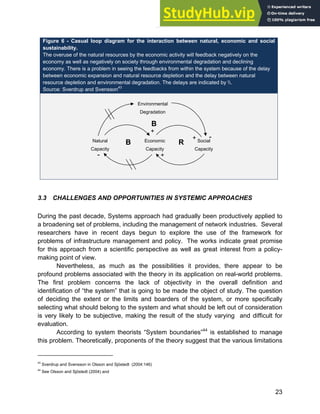
Sverdrup and Svensson then attempt to show the interaction between natural,
economic and social sustainability through a casual loop diagram. (Figure 6)
The other important aspect to consider in adopting sustainability in planning is time.
Sverdrup and Svensson emphasize the role of time and argue that a very long time
period, preferably at least according to the slowest process involved in the system, must
be chosen. They also discuss on how a long-term sustainability domain may be
established. Implying that natural sustainability is the least flexible, they assert that
sustainability limits are dynamic and changeable; depending on the design of economic
and social systems and a system is only long-term sustainable in the area where all the
sustainability domains overlap.
41
Ingelstam, during a discussion arranged for the purpose of this thesis, forwarded some of his strong criticism against such
attempts
42
Sverdrup and Svensson in Olsson and Sjöstedt (2004:145-148)
Systems Approach to Infrastructure Planning
23
Figure 6 - Casual loop diagram for the interaction between natural, economic and social
sustainability.
The overuse of the natural resources by the economic activity will feedback negatively on the
economy as well as negatively on society through environmental degradation and declining
economy. There is a problem in seeing the feedbacks from within the system because of the delay
between economic expansion and natural resource depletion and the delay between natural
resource depletion and environmental degradation. The delays are indicated by .
Source: Sverdrup and Svensson43
3.3 CHALLENGES AND OPPORTUNITIES IN SYSTEMIC APPROACHES
During the past decade, Systems approach had gradually been productively applied to
a broadening set of problems, including the management of network industries. Several
researchers have in recent days begun to explore the use of the framework for
problems of infrastructure management and policy. The works indicate great promise
for this approach from a scientific perspective as well as great interest from a policy-
making point of view.
Nevertheless, as much as the possibilities it provides, there appear to be
profound problems associated with the theory in its application on real-world problems.
The first problem concerns the lack of objectivity in the overall definition and
identification of “the system” that is going to be made the object of study. The question
of deciding the extent or the limits and boarders of the system, or more specifically
selecting what should belong to the system and what should be left out of consideration
is very likely to be subjective, making the result of the study varying and difficult for
evaluation.
According to system theorists “System boundaries”44
is established to manage
this problem. Theoretically, proponents of the theory suggest that the various limitations
43
Sverdrup and Svensson in Olsson and Sjöstedt (2004:146)
44
See Olsson and Sjöstedt (2004) and
Natural
Capacity
Economic
Capacity
Environmental
Degradation
Social
Capacity
B
B R
-
+
+
+ -
Systems Approach to Infrastructure Planning
24
imposed by the time and resource available to perform the study could be important
factors to consider in the boundary setting.45
However, it could still be argued that in a
world of interwoven systems where even the remote universe is not self-standing,
setting boundaries of any system is not an easy thing to do. And since there is no
consistent rule boldly declared by the theorists on how the boundary delineation should
be done it is likely that attempts to apply the theory on a specific problem situation will
suffer from subjective preferences based on individual values and interests. Without
setting scientific rules in delineating system boundaries the scientific viability of systems
approach will be endangered.
Researchers in the past have emphasized the need for comprehensiveness as a
highly desired quality in systems research. But the attempt to be all inclusive in systemic
study has often been far from possible. Even in studies where much resource and time
has been allocated, considering all elements, actors and processes of a system is
proved to be a serious challenge.46
In this context, the disentanglement between the
claims of the theory that emphasizes on comprehensiveness and the method it uses
(such as the method of setting system boundaries) could be seen more clearly.
Olsson and Sjöstedt47
present both the opportunities in using systems theory and
the practical and the “generic” problems associated with its application. In their
discussion of the generic problems they raise a number of important questions that
need to be answered in applying systems approach for a problem situation. A
summarized presentation of these questions is given below.
1) What kind of systems can we identify?
Here the question is more of purpose – whether the study is purely for scientific
reasons, or whether the person or organization initiating and funding the study is
looking for an answer. What characterizes the system that is going to be made
the subject of study? Does the system exist in reality or is it something that the
researcher has “found” out?
2) System Boundaries
What should belong to the system and what should be left out of consideration,
i.e., what should be considered a part of the system’s environment? This is what
is often called the boundary problem. Since for practical reasons it is not possible
to “sweep in” everything in a systems study, some things have to be excluded
from consideration. Practical and theoretical issues such as the time and
resource that is available to the study, what counts and should count to
knowledge in the investigation and question of rationality need to be all
answered.
3) The linkage between different kinds of systems
45
Olsson and Sjöstedt (2004:21)
46
See Olsson and Sjöstedt (2004)
47
Olsson and Sjöstedt (2004:20-25)
Systems Approach to Infrastructure Planning
25
Sometimes different kinds of systems are linked together in the analysis causing
problems in practical applications. “The question is if any kind of system really
can be meaningfully linked to any other kind of system and what, in such a case,
these linkages of different kinds of systems might look like.
4) The general treatment of systems properties and its consequences in analysis
How does the researcher treat the general system properties and their
consequences in the analysis? Examples of such system properties are
‘resilience,’ ‘redundancy,’ ‘adaptiveness,’ ‘dynamics,’ and ‘path dependence.’
Some such properties are considered more problematic and/or important (or
interesting) than others. To what extent the researcher is able or willing to
analyze and take the implications of these properties (or their restrictions) into
account is important here.
5) The ‘analytic toolbox’ and its effect
In what ways and to what extent does development of “research technology”
affect the performance of system studies? This is sometimes referred to as the
“analytical toolbox”.48
6) The ‘actor problem’
How is the problem situation affected by various actors, stakeholders and
participants? The “actor problem” is related to the means that the systems
approach offers in terms of communication. The systems theoretical framework
provides a “language” that might facilitate communicative clarity and thereby
increase the trust between analysts and other stakeholders.
7) The implementation problem
How should the study be designed and performed in order to make systems
intervention possible? How is the research result to be interpreted? In real-world
applications these two types of “implementation problems” need to be faced.
These points raised by Olsson and Sjöstedt are not mere problems found in systems
application but are often used by system analysts in applying the theory in various
situational studies which is why some of these points are further elaborated and used in
the analysis of infrastructure systems in this study later in section 5.
3.4 RELEVANCE TO INFRASTRUCTURE PLANNING
Large Technical Systems (LTS) could be seen as one branch of systems study focusing
on the study of large and complex socio-technical systems. Most of LTS’s contribution
came from the historical assessment of systems and from understanding the dynamics
48
See Kaijser (2003) and Olsson and Sjöstedt (2004)
Systems Approach to Infrastructure Planning
26
of societal changes and their impacts on socio-technical systems. Particularly in the
field of infrastructure LTS made a significant progress when Thomas Hughes, one of the
acclaimed pioneers of LTS, published his book on “Networks of Power” where he
regarded electricity systems as socio-technical systems and made a comparative study
of the establishment and growth of electrical systems in three countries – United States,
Germany and Britain. The result is, the study inspired large number of scholars to the
field and an “innovative” way of studying complex systems developed.49
Systems approach, with the variety of its system analytical tools, helps clarify
policy choices. In the study of “technical systems”, for example, or more specifically in
LTS, systems study by allowing consolidation and development of knowledge facilitates
the coupling of technological progress with new societal developments in an
increasingly globalized world where competitiveness is more and more demanded.
Various literatures50
devoted to the subject of Systems Approach depict that there are a
number of such cases where the tools provided by the approach in various areas of
development showed successful results.
It is earlier (in section 1) mentioned that the investments in infrastructure facilities
are enormous; that buildings, highways and systems for supplying water must be
maintained; and that new technologies are emerging which, if well applied, can both
improve the quality of our infrastructure systems and enable the more effective use of
public funds. But because infrastructures are large scale, complex and capital-intensive
systems with long life cycles, they lack the flexibility to adapt to ever-changing
demands. Systems approach, as presented in this section provides (or at least is
intended to provide) the theoretic tools that may be used to analyze infrastructure
systems and deal with issues of complexity and uncertainty in infrastructure planning
and development.
The persistent claims made by the different versions of systems approach and
indeed their capacity in intelligently analyzing different problem situations contextually
and from a non-linear point of view, make the basis of the presumption that similar
attempt could possibly result in a better result than traditional methods.
4 CONTEXTS
In this section, a situational analysis of infrastructure will be dealt largely through
methods of research front review. Background information on physical infrastructure
planning processes and practices and current trends in its development is given.
49
Olsson and Sjöstedt (2004)
50
See Olsson and Sjöstedt (2004) , Gharajedaghi (1999) and Forester (1998)
Systems Approach to Infrastructure Planning
27
Infrastructure is a concept that has no commonly accepted definition “…even if
public availability of durable capital in time and space can be regarded as a basic
dimension…” as Lundqvist, Mattsson and Kim51
in “Network Infrastructure and the
Urban Environment” describe it. Borrowing ideas from Johansson,52
they define physical
infrastructure as properties of the built environment in a region. Three characteristics
are mentioned, namely: temporal scale, spatial collectivity and function.
“…Temporal scale refers to the fact that infrastructure is a kind of capital that
changes slowly, with respect both to its capacity and spatial distribution, in
comparison with social and economic activities. By spatial collectivity is meant
the services from infrastructure are supplied to a collective of users, the spatial
extension is limited, and the benefits reduce as accessibility declines. Function
requires infrastructure to have at least one of the properties: (i) polyvalence, (ii)
generality over time, and (iii) a systems or network function that generates
accessibility.”
Such definition sounds abstract in the sense that it does not explicitly tell the various
layers and components of infrastructure. A better understanding of infrastructure,
however, may be attained by first slicing between the often confused material and the
non-material aspects of infrastructure. And a plain definition shows the different layers
as Weijnen and Bouwmans53
suggest. In their attempt to define infrastructure the
physical infrastructure system they describe three “layers” of infrastructure namely:
physical facilities, management and control and service provision. (Figure 7) In their
study of infrastructure systems they classify infrastructure into three sections: (1)
Transport & distribution networks, (2) Carriers, conversion and storage and (3)
Governance, management and control.
Jonsson’s,54
giving recognition to the different layers of infrastructure, gives us overview
of what infrastructure services (or ‘infrasystem’ services - as he describes it) are and
provides account of their nature. In his discussion he notes that infrasystem services
can be regarded as supportive inputs to certain processes. Such services include but
are not limited to clean water, energy for heating ad illumination, Internet access,
telephone services, transport of people and goods, gathering and treatment of refuse
and sewage. He also presents his argument for why profound understanding of the
nature of these services can hardly be underrated. One such reason he discusses
regards the role of new combination of services in the process of social changes that
give rise to social innovations. Infrastructure services such as electricity,
telecommunications, transportation, and water and sanitation play a critical role in a
51
Lundqvist, Mattsson and Kim, eds. (1998:3)
52
Johannson as referred by Lundqvist, Mattsson and Kim, eds. (1998:3-4)
53
Weijnen and Bouwmans (2006), online slide presentation, retrieved Jan 04, 2007
54
Jonsson (2005)
Systems Approach to Infrastructure Planning
28
country’s development and are directly and indirectly linked to living standards and
economic growth.
Figure 7 - Different Layers of Infrastructure
Source: Weijnen and Bouwmans55
Various authors, on the other hand, have argued that institutional infrastructures are
more important than physical infrastructures for long-term economic performance,
innovative capacity, and welfare growth.56
According to this notion, human capital is
more important than physical capital. Software confers more innovations than hardware.
Building a city government is more important than building a city. It is doubtful whether
this argument is really valid. Forrester,57
to the contrary, argues that “…physical
systems and human systems are of the same kind. Although social systems are more
complex than physical systems, they belong to the same class of high-order, nonlinear,
feedback systems as do physical systems.” He underlines that we live in an on-going
circular environment where each action is based on current conditions, such actions
affect future conditions, and changed conditions become the basis for later action. This
view stands in agreement with Snickars’ statement that “… all form an interactive web in
which development in one field supports and strengthen the development in another”.
In the present study, infrastructure is used to refer mainly the physical facilities of
infrastructure. Yet, due to their interwoven nature, service provision and management
and control issues will be side issues in some parts of the analysis. Highways, streets,
bridges, tunnels and parking; channels of water supply, treatment and distribution;
wastewater collection, treatment and disposal; and solid wastes collection, treatment
and disposal constitute the principal types of physical infrastructure that are involved in
the normal planning, construction and maintenance process.
55
ibid
56
See Snickars in Swedish Planning Towards Sustainable Development (1997)
57
Forrester (1998:2-3)
Service Provision
Management & Control
Physical Facilities
Systems Approach to Infrastructure Planning
29
4.1 PLANNING APPROACHES AND POLICIES
The methods of infrastructure planning range from fairly simple approaches, employing
professional judgment, to sophisticated mathematical optimization techniques. Often the
method depends on the type of project; the formal requirements of the planning
institution; the available personnel, money, and equipment for investigations; and the
capabilities and preferences of the planning staff.58
While following similar procedures
different planning protocols may apply to different types of infrastructure.
A common planning procedure may consist: (1) establishment of goals and
objectives which includes broad policies, long-range plans; integration of infrastructure
goals with broader policy objectives; (2) problem identification and analysis which
includes collection of data; projection of demand and supply relationships; uses of
water, land and air resources; identification of opportunities for development and
management; (3) solutions identification and impact assessment that includes structural
solutions; nonstructural (management) solutions; preliminary assessment of impacts; (4)
formulation of alternatives and analysis: criteria and procedures for comparison of
measures; detailed assessment of impacts; (5) Recommendation including priorities
and schedules for implementation; (6) Decisions including financing; (7) Implementation
which includes final design, construction planning, construction; and (8) Operation and
management including appropriate organizations to carry out these functions.59
In a systemic study the drives and rules motivating planning approaches and
procedures may be even more important. Such discussion should lead us to a policy or
system level inquiry. Often planning policies are specific to individual countries and at
times there even exists different procedures within a nation. The following overview of
planning practices in Sweden and developing countries intends to show these
differences as they arise from the dissimilar contexts in economically developed nations
like Sweden and developing countries. But it should be noted here that the case
presentation of Sweden is not meant to represent the situation in all developed nations.
4.1.1Swedish Practice
Planning has a long tradition in Sweden. Strong government machinery, an important
public sector, and self-governing primary local authorities all characterize the planning
sector. The main planning laws in Sweden are the “Naturresuslag” (NRL) (Natural
Resources Act) and the “Plan och Bygglag (PBL)” (Planning and Building Act). Besides
stating general objectives, the latter gives rules about contents, validities and
procedures of different kinds of plans, rules of permits and enforcements as well as
58
Goodman & Hastak (2006:1.5)
59
Ibid:1.6
Systems Approach to Infrastructure Planning
30
rules concerning appeals and compensations. The following kinds of plans are
regulated:60
a) Regionalplan (Regional Plan) may be adopted if matters concerning the use of
land and water areas in several municipalities require joint studies. They are
largely restricted to providing guidelines and only a few have been adopted.
b) Översiktsplan (ÖP) (municipal comprehensive plan) must, according to the PBL,
be adopted in each municipality for its whole area. It accounts for how national
interests will be considered at the local level and how the stipulations in the
(NRL) have been observed. They are, however, not binding for either the public
or the private sector.
c) Deatiljplan (DP) (detailed development plan) is adopted for a limited part of a
municipality, where continuous development or other reasons make such plan
necessary. It is legally binding for permits and other measures to implement the
development.
d) Fastighetsplan (FP) (property regulation plan) may be adopted in order to
facilitate the division of land into plots within a DP. It must conform to such a
plan.
Figure 8 - The Swedish physical planning procedure:
What controls what? Mutual ideal relationship between planning instruments. The non-binding
relationships indicate mutual influence. A detailed development plan may, for example, affect both
the comprehensive plan and the regional development plans.
Source: Alfredsson and Wiman61
60
EU Compendium (2000)
61
Alfredsson and Wiman in “Swedish Planning: Towards Sustainable planning” (1997:14)
Systems Approach to Infrastructure Planning
31
Looking at the nature of these plans and investigating the political and institutional roles
in initiating and executing them, a general understanding of the Swedish planning
system could be obtained. However, typical characteristics of the planning system, that
are comparable to the practice in other countries and are in direct relation to the
infrastructure planning tradition, have to be studied for the purpose of this thesis. The
EU Compendium of Spatial Planning Systems and Policies,62
in its comprehensive
study outlines these typical features of the planning system. Only few of these features,
thought to be relevant to this study are presented here.
- Powers of spatial planning in Sweden are highly decentralized to the
municipalities, giving municipalities a considerable degree of independence. A
detail plan which is the most implemented legally binding plan, for example,
could only be adopted after it has been approved by the municipality.
- County level planning in principle should be carried out in close cooperation with
the municipalities and can thus influence their spatial planning. But the formal
connections between economic-regional and municipal-physical planning are
weak.
- Of great importance for the planning system are laws aiming to protect the
environment as well as sectoral regulation concerning water, agriculture, forestry,
and infrastructure investments.
- Although most of the spatial planning decisions are taken on municipal level,
political priorities in the planning system affect the decision making. For example,
even at the municipalities, it is the politically-elected municipal council and their
executive representatives which give guidelines, determine planning
programmes and take the final decisions concerning local planning and
development.
- Sectoral policy characterizes especially the infrastructure planning system.
Regional and municipal planning must take into consideration the needs of
different authorities and interests within agriculture, forestry, road and traffic
planning, environment, etc. However, on national level the policy of different
sectors is determined by the Riksdag (parliament), Regering and central
authorities. The Regeringskansli (Government Chancellery) with ministries for
different branches of activity coordinates these policies.
Swedish planning has been criticized by different authors63
for its lacks at regional and
national level. Alfredsson and Wiman in their review of the “Planning in Sweden”
forward their concern that planning in Sweden has become more a question of being
62
The EU compendium
63
See Alfredsson and Wiman in Swedish Planning (1997), Brokking (2006) and EU Compendium (2000)
Systems Approach to Infrastructure Planning
32
prepared than of presenting unambiguous forecasts. And Brokking64
in his assessment
of the current regional transport planning practice in Sweden puts his finding in this way:
“...The evident connection between the improvement of regional transport
systems and regional development implies that the long-term development of a
regional should be a central issue in the planning of investment in regional
transportation systems. However, a closer study of current planning practices in
Sweden shows that these issues are not considered in cogent way. Regional
transport plans focus on minor adjustments in the road system rather than on
strategic actions that support the long-term development of regions.”
Brokking’s study clearly indicates that there is lack of systems thinking at the regional
level of planning in Sweden. This thought could be further strengthened by looking at
the railway infrastructure planning system in particular. Regional plans do not contain
any investments in rail infrastructure - which in actual terms provides a substantial
contribution to the vitality of regional economy. This partly is explained by the fact that
regions have only limited planning mandate which limits them from considering
investment in the national transport system that could have provided them the
precondition for the implementation of the long-term vision.
Another deficiency Brokking identifies regards the fragmentation of planning and
decision-making. The result is disintegration of planning of regional transportation
systems. With a clear statement he states that “…the disintegration involves that each
county optimizes its own plans, but the sum of the plans is not necessarily the optimal
solution for the entire country.” Again, this confirms the absence of holistic thinking
which systems approach highly emphasizes.
A third problem identified in Brokking’s study is the weak connection of the
transport planning with other fields of planning. Without a clear link between the
planning of regional transportation systems and the future development of the region, it
will be difficult to inter-relate different fields of planning.
The question then may be how this situation could be changed. It is natural that
governments often have strong elements of a bureaucratic mindset according to which
change – if there has to be change at all – must happen in a highly controlled fashion. In
the case of Sweden this element may be eased by the informality and cooperativeness
of the working culture. But on the other hand it is enforced by the curious constitutional
tradition banning what is termed ‘ministerial rule’. This means that Swedish
constitutional practices force their adherents to embrace the linear model of
organizational change.65
64
Brokking (2006:2)
65
Eriksson in Olsson and Sjöstedt (2004:171)
Systems Approach to Infrastructure Planning
33
4.1.2Case of Developing Countries
As there is no common procedure in all developing countries, the presentation here very
much focuses on the drives and forces behind the planning tradition.
Planning approaches and most often infrastructure planning and development
procedures in a developing country are often influenced by both international agencies
and the political and economic forces in the country. Thus an investigation through the
planning system should consider the influences coming from within and outside the
countries. Goodman and Hastak,66
discuss effects of these influences in their book -
“Infrastructure Planning Handbook” under their special coverage on “Special Planning
Issues for Developing Countries.” They use five dichotomies in their discussion. A short
summary of this discussion is presented below with an intention to give a conceptual
impression of the planning approaches in most developing countries.
1) Project Cycle vs. Program Approaches: The concept of “project” having
originated at the establishment of World Bank, ‘project cycle approach’ places
emphasis on those projects that are identified as providing output and services
that are desirable for specific economic sectors, and are concerned with
feasibility studies that will pass review by the World Bank or other lending
agency. The ideal ‘program approach’, on the other hand assumes that the
national public investment program for all economic sectors is developed to
implement broad nation economic and social objectives. It also assumes that
short-, medium-, and long-range planning horizons are considered extending
beyond the involvement of foreign entities. Most planners in developing countries
tend to follow the project approach, according to Goodman and Hastak.
2) Neoclassical vs. Structuralist Approaches: These two approaches have a
connotation of the economic situation of developing countries and consider the
economic planning and development strategies sought by the countries.
Neoclassical view corresponds to market-based development. Whereas,
‘structuralist’ view holds that “developing countries are characterized by
accumulated cultural, social, and institutional rigidities, which inhibit or prevent
change; and that only determined government action to change the structures of
production and trade, and to reallocate resources within the economy, can bring
about modernization and development.” Most developing countries have mixed
economies of some type.
3) Efficiency vs. Equity Approaches: These theories regard the way resources
(human, monetary, land… etc) are allocated for development purpose. Efficiency
approach refers to the allocation of resource among competing users, whereas
equity approach refers to the allocation of payments for resources such that the
needed resources are retained in the desired productive activities. Perception of
66
Goodman and Hastak (2006)
Systems Approach to Infrastructure Planning
34
equitable incomes in developing countries varies substantially from country to
country.
4) National vs. Sectoral Approaches: Here Goodman and Hastak discuss three
levels of government typical to planning responsibilities in developing countries:
(i) the national level, where national plans are formulated, priorities among
sectors are established, and macroeconomic framework of policies is put in
place; (ii) the local level, where priorities within each sector are determined and
the issues and problems affecting the development of the sector are addressed;
(iii) the project level, where individual projects are identified, prepared, and
implemented and attention is given to their technical, economic, social,
institutional, and other dimensions.
5) Top-Down vs. Bottom-Up Approaches: Here the planning process in developing
countries is described to have less space for open public participation and
characterized by weak connections between ‘the top’ and ‘the bottom’ except in
the abstract paper form.
These dichotomies used by Goodman and Hastak67
are very much about the economic
and financial drives of the planning practices. Even though, the financing of
infrastructure projects and the poor economy condition in the developing countries could
be argued to be major force affecting infrastructure development and planning in actual
terms, institutional settings and political issues also have their contribution in the
decision making process.
In the context of this study what kind of conditions for systemic intervention these
approaches provide is of greater importance. Since in principle systems approach could
be applied at different levels and in different situational settings, whether a ‘project
cycle’ approach or ‘program’ approach is pursued may not be big problem. However, if
Systems Approach means to be able to see systems as a whole, then no broad-scale
success could be sought with only ‘project cycle’ approach in place. Similar arguments
could be made to the other approaches discussed in the five points above.
4.2 TRENDS IN INFRASTRUCTURE DEVELOPMENT
Kain,68
says that today urban infrastructure is being re-problematised, renegotiated and
reconstructed as a result of a contemporary shift towards the disintegration of the
modern ideal. He also argues that privatization, liberalization, globalization and new
technologies have radically altered geopolitical and economic preconditions. An
understanding of these changes is then of interest to this study as each represents a
67
Goodman and Hastak (2006)
68
Kain (2003:129) referring Graham and Marvin (2001:90-136)
Systems Approach to Infrastructure Planning
35
major external force that directly or indirectly impacts the formation and development of
the physical infrastructure. The following is an account of these changes and their
present and future implication on infrastructure.
4.2.1 Social and Institutional Changes
4.2.1.1 GLOBALIZATION
The use of the term ‘globalization’, often found in the environmental field, suggests an
awareness of sharing the globe makes us see increasingly clearly that there is a
relationship (of interdependence) between what we do locally, regionally or nationally
and the actions of others in other parts of the globe.69
Due to especially the recent
technological developments in the ICT sector, which made global communication
possible, and due to improvements in the transport sector, the last two decades have
shown dramatic changes in such interrelationships. A concern in this study is how such
interrelationships and most importantly how the changes will affect infrastructure
development.
Engström and Cars70
point out that the most important change that will influence
future physical planning, alongside global threats to the environment, is the growing
worldwide commerce of goods and financial transactions. According to them, the
important quality for future businesses and modern knowledge-oriented industries will
be good mobility and lifestyle conditions. Weijnen and Bouwmans diagram of “Push and
Pull” in Figure 9 agrees with this argument as it partly shows the global forces
influencing development of infrastructure. The push comes from technological
development which provides the means for the improvement of physical facilities of
infrastructure which in turn allows for better mobility and lifestyle condition. And the pull
comes from the growing global market which implies a growing competitiveness. The
direct influence of such growing competition could be seen in the increased rate of
transformation of infrastructure services. An example could be new services being
added to the ICT infrastructure on continuous basis. Engström and Cars discussing the
spatial impact of such global forces state that increase in international competition
presses production locations to places where such conditions are most favorable. It
could be argued here that this has always been the case. Yet, an important point to note
would be the interrelationship of technological and market forces with infrastructure
development and the increasing rate of global changes in technology and market
situations.
69
See Lähteenmäki-Smith in Brocket and Dahlsröm, eds (2004:18)
70
Engström and Cars in Swedish Planning Towards Sustainable Development (1997:22)
Systems Approach to Infrastructure Planning
36
4.2.1.2 INTERNATIONALIZATION
Internationalization in this context is supposed to refer to the process whereby a co-
operation, an idea, or an infrastructure (eg. the building of a new highway) comes to
affect multiple nations of geographic proximity. The beginning of regional integration
between European countries – the establishment of the EU and the building of the
historic bridge of Oresund, for example, mark the breaking of age-long national
boundaries.
The impact of such global changes is often discussed along with globalization.
However, due to the different natures of the two, a separate discussion is needed here.
Internationalization like other external forces has its influence on various aspects of
planning at national and regional level. For instance, systems can be transformed from
national systems into transnational ones as a result of expansion over territorial
boarders. However, the long-term effects of such transformations is often uncertain that
the choice, for example, to be an EU member country or not becomes a challenge.
Snickars,71
gives an account of what such choice meant to Sweden when
Sweden decided to join the EU. He mentions that Sweden has for long maintained a
tradition of focusing considerable attention on in the field of foreign policy towards the
global level, strong support of the UN, priority given to assistance to developing
countries, with social ambitions, active voicing of moral concerns in protest against
political oppression. Showing his concern over Sweden’s choice and his fear on the
possible consequences he says:
“…The demise of the political systems in Eastern Europe entailed the first
irreversible change in Sweden’s long-term international standing. The decision
for Sweden and Finland, but not Norway, to join the EU was the second
irreversible change…. As a result, Sweden will no longer be able to protect large
amount of its labor force from international competition within the public sector.
Sweden will no longer be able to pay only lip-service to the cooperation. External
competitive threats will force more regional cooperation to occur not for
distributional reasons but for reasons of long-term economic survival.”
Snickars then forecasts that Europe will be facing increased regional economic
transformation as a consequence of the economic, cultural and political integration.
Agglomeration advantages, economies of scale and scope, accessibility in transport
and communications network; these strong long-term forces will work towards a
thorough transformation of the European urban system.
One of the impacts of such changes discussed by Duch researchers - Romein,
Trip and Vries,72
regards the creation of multi-level governance. Taking an example
71
Snickars in Swedish Planning (1997)
72
Romein, Trip and Vries (2003)
Systems Approach to Infrastructure Planning
37
from the Dutch-Flemish mega-corridor, the researchers examine how the role of ‘the
sovereign nation-state’ as the organizer of practices and policies within a well-defined
territory has decreased in favor of newly emerging governance structures – a transition
“from government to governance.”
4.2.1.3 URBANIZATION
Urbanization is defined as the transition process from a rural to an urban society, where
the proportion of the total population living in urban centers increases while the
proportion living in rural areas decreases.73
According to Tannerfeldt and Ljung natural
increase contributes more than migration to the growing population in urban centers, but
rural-urban migration is an important factor in less urbanized countries. One important
feature of urbanization is that the process of urbanization is inherent to economic and
cultural development and the trends are universal – local factors can temporarily speed
up or slow down the process but it can neither be stopped nor reversed.
Indifferent to urbanization, Tannerfeldt and Ljung define urban growth as the
growth of urban population and not the geographical expansion of urban centers –
although this normally is the consequence.
Though problems associated with urbanization are not pertinent to all nations,
urbanization could still be seen as one of the important forces impacting the
sustainability of infrastructure systems and confronting their management and service
provision. For example urbanization and urban growth (urban population growth) are
growing concern for developing countries due to their impact on existing urban
problems such as congestion, unemployment and inadequacy of public facilities.
Over the next 25 years, more than half of the developing world population will
become urbanized. In many countries the number, and even the share, of the
disadvantaged living in cities, and especially in the peri-urban areas, is increasing.
Almost by definition, the urban poor lack basic infrastructure services—safe water,
sanitation, solid waste collection and disposal, storm drainage, public transport, access
roads and footpaths, street lighting, public telephones, and often other neighborhood
amenities (safe play areas, community facilities), electricity connection, and social
services.74
4.2.1.4 LIBERALIZATION
Liberalization refers to a relaxation of government restrictions, usually in areas of social
or economic policy. Liberalization in the infrastructure sector, and also in the context of
this paper, refers to the separation of infrastructure from infrastructure services.
Although liberalization is often associated with privatization, the two can be quite
separate processes. For example, the European Union has liberalized gas and
73
See Tannerfeldt and Ljung (2006:20)
74
Kessides (1997)
Systems Approach to Infrastructure Planning
38
electricity markets, instituting a system of competition; but some of the leading
European energy companies remain partially or completely in government ownership.
Liberalized and privatized public services may be dominated by just a few big
companies, particularly in sectors with high capital costs, or high sunk cost, such as
water, gas and electricity. In some cases they may remain legal monopolies, at least for
some part of the market.75
The implication of liberalization on infrastructure development has often been
discussed from economic vantage point of view. Liberalization by encouraging private
participation is said to create the condition for competition which in the process is
believed to contribute to improvements in services and increase in economic benefits.
Liberalization in the Telecommunication sector could be an example for this. However,
there are also doubts over whether the system can ensure long-term security of supply.
The worldwide trend towards economic liberalization in many sectors, including
infrastructure, has led to experimentation with various institutional arrangements. This
experience has led to two important conclusions: that there are fewer activities requiring
public intervention than once was believed; and that public intervention, when justified,
can be exerted through less distorting policy instruments than those traditionally used.76
4.2.1.5 PRIVATIZATION
Privatization in simple words is the increased ownership of the private sector of the
used to be “public properties.” Kessides77
gives a detailed account of the current
development towards privatization and the possible impacts of this change on
infrastructure. According to him, public infrastructure monopolies were created in many
countries in order to exploit economies of scale, protect national interests, and mobilize
resources for basic system development. In practice, however, “… many of these
entities achieve neither efficiency nor distributional fairness, and they fail to generate
sustainable sources of finance…” This continued until the 1990s, when still most
developing countries relied on public sector monopolies to finance and operate their
infrastructure. But beginning in the late 1980s, countries began turning to the private
sector to take over the operation of existing infrastructure and to finance new
infrastructure development.
Private sector participation in infrastructure, like liberalization, is expected to expand
and improve services, create incentives for efficiency, and reduce the burden on
strained public resources. In many cases the biggest gains from private provision come
through increased investments to meet increasing demand and serve previously
75
See Wikipedia, retrieved Feb 05, 2007
76
Kessides (1997)
77
ibid
Systems Approach to Infrastructure Planning
39
unattended consumers. And in regards to service expansion, there are suggestions that
the private sector does as well, or better, than public provision.78
The way in which private intervention influences the planning is also said to be one
benefit and a starting point for encouraging the review of planning methods. In Sweden,
for example, there is a growing private sector interest in participating and influencing the
planning process.79
However, as Kessides80
suggests, the rational for private versus public involvement
in infrastructure must be clarified; institutional arrangements with appropriate
assignment of responsibilities to the public and private sectors must be chosen, and the
conditions for successful implementation of institutional arrangement must be created.
4.2.2 Technological Development
One of the development areas that is increasingly affecting nearly every of our systems
– social, economic and natural – is the development in technology. This has, in the past,
been an important reason for why studies in virtually all kinds of fields made it a
concern. Yet, it appears that we are in a time where we have more reasons for why we
need to be considerate of technology and technological changes. This statement
regards the acceleration in technological developments. In the context of this study the
question we should ask, then is if our infrastructure systems are coping with it? Since
the purpose of the section is rather more of giving the background information than
answering this question we shall first see in what ways technological development
affects infrastructure.
Not all technological changes are relevant to this discussion. The changing
technology mainly in the infrastructure sector is what is thought to be of more use to the
study. And the picture intended to show is that technology is one of the major forces
shaping the future of our infrastructures. The understanding comes from looking at the
significance of various technological alternatives to infrastructure development. What
having more and more of such options in the long run would mean to current
infrastructure planning is also of interest.
Benefits of options technological development provides are discussed by various
authors. Kessides81
lists some of the opportunities in relation to these options. Reducing
conditions for natural monopoly, permitting low-cost supply option, increasing range and
quality of service, facilitating the “unbundling” of assets and operations and expanding
options for demand management are the options he discusses. In further elaborating his
observation he mentions that technological change, in telecommunications has reduced
economies of scale in long-distance transmission, undermining natural monopoly in the
78
Swedish Planning – Towards Sustainable development (1997)
79
ibid
80
Kessides (1997)
81
ibid
Systems Approach to Infrastructure Planning
40
area. Intermediate sanitation technologies have allowed lower construction costs than
conventional sewerage, making them affordable for low-income communities.
Combined with electronic communication systems, intermodal transport has greatly
reduced transport costs and improved the quality and speed of trade logistics.
Technologies of “non-destructive-testing” and remote monitoring have permitted the
conditions of fixed infrastructure facilities to be assessed and problems diagnosed
“without costly” and time-consuming excavation or dismantling. In the road subsector,
electronic road pricing has permitted road user charges to be differentiated so as to
reflect the actual impact of different vehicle loads on road deterioration, to manage
congestion, and to internalize the social costs of pollution.
The lists given by Kessides largely show the supply options technological
development provides. However, the impact of technology on the physical facility
dimension of infrastructure is comparable and decisive in its own. This is generally
implied in Weijnen’s and Bouwamans’s diagram of “Push and Pull.” (Figure 9)
Figure 9 - Push and Pull: Forces of change in infrastructure development
Source: Weijnen and Bouwmans82
What would these all mean to future infrastructure planning, then? Provided more
options are made available, planners may seek new ways to increase the operational
capacity of existing systems as alternatives to new constructions. For example, new
electronic technologies for intelligent transport systems (ITS) have been successfully
adopted to improve the operation and management of existing systems.
Are our infrasystems coping with changes in – technological development? Arguably,
we can say no, not as much as they could. Being large scale, complex and capital-
intensive systems with long life cycles, most of our physical infrastructure lack the
flexibility to adapt to ever-changing social and technological requirements.
The challenge with adopting technological changes on the existing infrastructure
networks, considerably relates with the huge finance the process would require. Being
82
Weijnen and Bouwamans
Technology Push
Market Pull
Service Provision
Management & Control
Physical Facilities
Systems Approach to Infrastructure Planning
41
large scale, complex and capital-intensive systems with long life cycles, most of our
physical infrastructure lack the flexibility to adapt to ever-changing social and
technological requirements.
4.2.3 ICT Related Changes
ICT could be defined as traditional ICT such as telephone, radio, TV and print media
and new ICT, which consists of mobile phones and internet. ICT’s support in urban and
regional planning could be seen through its direct application in urban representation;
geospatial databases; data capture and conversion; analysis, modeling and simulation.
Other indirect impacts of ICT are discussed by different writers.
Over the last few years, especially due to the accelerated rate of technological
developments in the ICT sector, many academic observers, policy-makers, and
business leaders
Snickars,83
in “Infrastructure for the 21st
Century”, nearly a decade ago indicated that
the world is entering a new era in economic, social and political development as a result
of development in the fields of computerization, telecommunications, life-sciences, and
design activities. He then raises concern whether the new global society is suitable in
the broadest sense of the word or not.
Snickars84
argues that telecommunications innovations can be regarded as
corresponding to the transport innovations which carried the wave of the industrial
revolution. Though there had been significant changes in the way nations understand
the role of ICT in urban and regional developments, there seems to be little progress in
competitively integrating this new system with existing infrastructure systems. That
explains why Snickars suggestions still hold valuable message as discussed below.
What role the public sector agencies will be playing in providing the infrastructure
support faces three problems to address:
(1) Should resources be devoted to renewal of the transport infrastructures,
including the renewal of their associated institutions? This problem leads
towards resources being devoted to the deregulation of transport markets in
an international perspective, and towards an emphasis in positioning the
Swedish infrastructure projects in a European framework.
(2) Should priority be given to telecommunication infrastructures and their
associated institutions? This problem turns the attention towards the
regulation of communication systems, the rules for their public access, and
distributional questions relating to the equity of access to the services that
they provide.
83
Snickars in Swedish Planning Towards Sustainable Development (1997)
84
ibid
Systems Approach to Infrastructure Planning
42
(3) Will infrastructure investment in the public domain contribute to sustained
economic growth and transformation? This issue brings the attention to the
public responsibility for the creation of new infrastructure systems and the
renewal and environmental mitigation of the existing ones. The question is
whether it will be necessary for the public sector to become involved as an
actor in the market to reduce the risk of private monopoly power. The
tendency for the moment for the public sector is to withdraw from service-
production responsibilities and to concentrate on strategic planning and
regulatory systems.85
A central concern in Snickar’s article and a number of other researches works in
the ICT field is how nations should react to the fast development of ICT and related
changes.
4.3 CHALLENGES IN INFRASTRUCTURE PLANNING
This subsection attempts to summarize the discussions from sections 4.0 to 4.2.3 and
redirect the study to the research question – what can. So far the discussion primarily
was about the contextual situation we have – the situation that is and will continue to
influence our planning. The examples from Sweden and Developing countries attempt
to direct us to the things (forces) that dictate our planning. What the current changes in
social, institutional and technological settings would mean is also implied. The question
that still floats is how we can face the challenges (or make use of the opportunities.)
A little rephrasing of this situation with a scientific research tone and a reframing
to get into a more scientific and relevant discussion is needed here.
There are many challenges inherent in infrastructure planning – in providing the
physical facilities for public services; satisfying demands for services; solving problems
related to these services; and in taking account of water, land, air, and ecological
resources. These challenges relate first to an initial installation and then to their
functioning in a system. The later is that which is pervasive throughout the life cycle of
the infrastructure system.
Traditionally the success of infrastructure projects has been measured in terms
of its engineering feasibility, economic and financial viability, environmental and
socioeconomic impacts, legal and institutional constraints, and political acceptability.
But the question that need to be answered is are we giving an integrated, wholesome
solution package or are we depending on “smart” independent solutions designed to
meet the seemingly “independent” issues.
85
Snickars in Swedish Planning Towards Sustainable Development (1997)
Systems Approach to Infrastructure Planning
43
The fact is that infrastructure systems are large scale, complex and capital-
intensive systems deeply imbedded in society and having long life cycles, that without
proper understanding of how these systems work and without all rounded study that
sees the interrelationships of these systems with other systems, no efficient planning
could be thought of. Planning and management issues can only be effectively tackled if
the co-evolution of these systems is properly understood. It might be argued that this
has been the case with planning. But as generally implied in the examples (Section
4.1.1 and 4.1.2), that is not often the case and our planning often lacks such holistic
view. Pervasive problems in planning can also be better tackled with such view in place.
Two pervasive problems are identified in this thesis – complexity and uncertainty.
Decision makers in the infrastructure sector - both public and private - often lack
a systematic approach to analyzing complexity and uncertainty problems in
infrastructure and dealing with them as effectively as possible. Search for a solution to
this problem has initiated a number of scholarly attempts to 'Develop integrated
approaches’ to meet flexibility requirements of infrastructure in time, space and
functionality. Studies86
show that integration could be sought by: (1) addressing various
types and sources of complexity and uncertainty; (2) by taking into account a variety of
ways of dealing with them in a systematic way; and, (3) by paying attention to both
substantive and institutional issues in the analysis of infrastructure systems.
5 INFRASTRUCTURE SYSTEMS
In this section brief discussions of what infrastructure systems are and how they evolve
is given first and will be followed by a relatively detailed account of their characteristics.
After providing few suggestions on how a manageable boundary for analyzing
infrastructure systems is set, the interplay of subsystems in ‘the big system’ of
infrastructure are discussed. A discussion on sustainable systems intends to bridge the
analysis with the result section.
5.1 WHAT IS AN INFRASYSTEM?
The concept of ‘infrasystems’ – short for infrastructure systems - is first introduced by
the Swedish historian of technology Arne Kajser87
to denote a certain category of large
technological systems comprising of transportation, communication, energy and water
supply, and sewerage and garbage collection. Kaijser describes infrasystems at an
86
Stichting Next Generation Infrastructures, retrieved Dec 02, 2006
87
Kaijser (2003:153)
Systems Approach to Infrastructure Planning
44
abstract level as systems that facilitate movements of different kinds and consisting
partly of a flow passing through network of links and nodes. Based on this description
he notes three distinctive natures of infrastructure systems. (1) Those that have a
unidirectional flow from one or several central nodes to a large number of users are
described as Distributive Systems. This includes electricity, water and television. (2)
Those that have a reverse unidirectional flow, from many users to one or several central
nodes are termed as Accumulative Systems. Sewer and garbage collection represent
this group. (3) Systems that provide a two-way flow such as telecom, post and transport
systems are described as Communicative Systems.
Another way we can study infrasystems, is based on the characters of networks
or in particular the links in the systems. Those that presuppose the construction of
“specific networks” consisting of, for example, electric lines, water pipes and rails, which
are built solely for the particular system. These systems can be referred to as ‘grid-
based systems.’ Other categories of networks include “natural networks” such as water,
air or electro-magnetic waves in conjunction with harbors, airports, transmitters and
receivers and post system or the internet that uses “existing transport or communication
networks” in combination with terminals, post-boxes, servers and the like. And in terms
of their geographical shape and their point of access to users, networks can be
categorized as “point-shaped networks” such as airports, stations and harbors that are
accessible for users only in a limited number of exclusive nodes; “Line-shaped
networks” such as telephone and electricity lines – networks that are accessible along
their links where nodes can easily be arranged; and “Surface-shaped networks” such as
radio, TV and mobile phones, that are accessible in every point within a distribution
area.88
Besides giving a useful framework to the study and understanding of the nature
of infrastructure systems, this description of networks used by Kaijser is foundational to
the application of systems approach in infrastructure planning in the sense that the
concept of “networks” has a strong connotation of the existence of interrelationships,
and subsystems within the big net of infrasystem itself.
5.2 NATURE OF INFRASYSTEMS
The earlier accounts of characteristics of infrasystems were more of abstract nature. In
this sub-section a more direct account of their nature relevant for the investigation in this
thesis will be presented. The socio-technical nature is regarded as the most typical
nature common to all infrasystems. However, since infrasystems tend to attain different
characteristics during the different phases of their development, and because
88
Kaijser (2003:155)
Systems Approach to Infrastructure Planning
45
evolutionary study of systems, from systems approach stance is regarded useful, we
shall also investigate through the different phases of infrasystems.
5.2.1 Infrasystems as Socio-Technical Systems
Infrasystems are socio-technical systems, in which the institutional frameworks and the
system culture are as important as the technical components.89
LTS researchers have
expressed their concern that these ‘soft’ parts of infrasystems are less understood by
the public that often the belief on ‘technical fixes’ is very strong. Kajiser,90
one of the
leading LTS researchers, argues that a prerequisite for achieving lasting changes is that
system culture and the institutional conditions are altered and that the establishment of
infrasystems has often been dependent on a crucial institutional innovation, which made
it possible to overcome the initial uncertainty by distributing the huge capital costs for
building facilities and networks among many users.
Large technical systems constantly undergo change, even though they conjure
up images of stability and performance. Sometimes they are subject to dramatic
processes of reconfiguration.91
Figure 10 - Socio-technical Network
Source: Weijnen and Bouwmans92
Understanding Innovation in the infrastructure sector requires dealing with the
complexities of infrastructure, which originate from its socio-technical nature.93
Depending on the particular type of infrastructure and context of problem being
investigated, understanding other multi-dimensional facets of infrastructure systems is
also of paramount significance.
89
Kaijser (2003:172-73)
90
ibid
91
Ewertsson & Ingelstam in Olsson and Sjöstedt (2004:293)
92
Weijnen and Bouwmans, retrieved Jan 04, 2007
93
Stichting Next Generation Infrastructures, retrieved Dec 02, 2006
Physical Network Social Network
Socio-Technical Network
Social Network
Physical Network
Systems Approach to Infrastructure Planning
46
5.2.2 Life cycle of Infrasystems
Infrastructure systems arise, grow, mature and sometimes fade away. Three phases of
development – establishment, expansion and stagnation - are described by LTS
researchers.94
The establishment phase is characterized by high technical and institutional
uncertainty. Often the process involves more than one actor or party of interest, and the
state and local authorities are usually involved. The influence of each country’s specific
political, social, cultural, and geographical characteristics on the development of the
infrasystem, at this phase of its development, is enormous.95
The expansion phase is characterized by common confidence in the system and
its future growth. Other characteristics include increased geographic expansion or
expansion into new fields of utilization and development of a common view among
parties on its future development. The process of development is characterized by
increasing ‘momentum’, but also with an inner ‘inertia’ – it is hard to decide on
something that is not in line with the current system culture.96
The concept of
momentum points the impact of the past on the future direction of a system.97
But the expansion may be hampered by what LTS researchers call ‘reverse
salient.” ‘Reverse salient’ is a metaphor developed by Hughes to denote the kind of
problems that occur in expanding technological systems when certain components of a
system are (presumed as) lagging behind or out of phase with the others, thus
constraining continuing expansion or progress.98
The stagnation phase of the life cycle of infrasystems is characterized with
decreasing momentum. System growth decreases because the market has reached
saturation point or because of the competition from new systems. In principle, when the
development stagnates the system should consolidate on a stable level or follow
downward trend.99
The three phases of infrasystem development describe the dynamic nature of
infrasystems. The argument here, in reference to the research question under
investigation (section 1.1.3) is, if understanding the nature of systems is necessary to
dealing with the complexity and uncertainty challenges associated with it, then is this
evolutionary nature that we must understand perhaps more importantly.
94
See Kaijser (2003) and Jonsson (2005)
95
Kaijser (2003:159-162)
96
Kaijser (2003:159-162)
97
As cited by Olsson and Sjöstedt (2004:295)
98
Ewertsson & Ingelstam in Olsson and Sjöstedt (2004:295)
99
Kaijser (2003:159-162)
Systems Approach to Infrastructure Planning
47
5.3 THE BOUNDARY
The question of boundary was introduced to the study of systems as a way of delimiting
the problem situation. The idea is that only manageable size of the situation may be
analyzed. (Section 3.3 and 3.2.1) And since that depends on the time and resource that
is available to the study, it should be noted here that for a better result capacity building
may be the prior task. In a real world situation, where the resource is often limited, that
might mean co-operation between agencies or co-ordination of resources between
agencies. Since infrastructure planning by nature is a multi-disciplinary process,
whether by choice or by default, the co-operation of agencies is expected. That might
create a better condition to exercise applying a systemic approach.
The other thing mentioned earlier in the theory section (Section 3.2.1) is that
systems approach could be applied on a problem situation at “any” level. That in the
context of an infrasystem might mean (1) project level, (2) planning level or (3) policy
making level. Generally the project level systemic intervention for a number of reasons
is the less challenging. Some of the reasons include the long tradition we (both the
developed and developing world) have in “project works,” due to the “all-ready” limited
and defined situation at hand and often than not because a “project” assumes that
actors to be involved are known and have come to consensus already. Yet, that
agencies or interest groups are limited or few at a project level could imply that there is
less resource to devote. How the process and completion of the project is going to
affect the other systems around, in the short and long run, and how it is going to be
affected by the surrounding is an important question to ask. By identifying, for example,
the active, immediate systems with strong influences on the surrounding the boundary
could be set.
Depending on whether the planning to be carried is at local, regional or national
level, and depending on the institutional and political setting in the country, the exercise
of applying systems approach in planning can be less challenging or very challenging
process. In Sweden, for example, the institutional setting allows that municipalities
exercise more authority at their localities. This has an implication that there is a better
chance for the municipalities to “introduce” systems approach to their local planning
practice. However, the weak co-operation between the municipalities and the absence
of binding regional plan could create a big challenge in setting the boundary for the
analysis. Boundary setting in this case may be a matter of responsible-choice for the
municipal planners. Boundary setting at regional and national planning is very much a
question of co-operation. Some projects and planning acts may also require trans-
national co-operation. The Oresund Bridge and Dutch-Flemish mega corridor (section
4.2.1 and Romein, Trip and Vries 2003) could be immediate examples.
Since policy-making often is a political process, boundary setting for the purpose
of systems applications at policy-making level is very much a political choice. Political
Systems Approach to Infrastructure Planning
48
boundaries can by default become the boundaries. With an increasing effect of
globalization and internationalization, however, the decisiveness of such boundaries
could be questionable. For example, EU through its member organizations has
increased its influence on the policy scene in member countries.
The very purpose of boundary setting is to decide what should and does belong
to the system and what should be left out of consideration. And infrasystems are
complex socio-technical systems that (when they exist) are deeply embedded in the
social, economical, environmental and institutional fabric of the locality where they exist.
(section 4.3.1) The implication is that in the study of an infrasystem the social system,
the economic, the natural and the institutional system all should be considered as
important components of the infrastructure environment. Other important components
could be technology, population, political and legal issues, stakeholder needs and
expectations. Thorpe,100
lists more such components in a diagram he used for a study
of systems application on low volume road management. (Figure 12)
Figure 11 - Components of Infrastructure Environment
Source: Thorpe101
One way how a boundary could be set is by determining what counts to
knowledge in the investigation. In principle an infrastructure planning process involves
an intensive study of multi-disciplinary nature. It may also involve multi-actors of diverse
interests. This is what possibly could make determining what counts to knowledge
difficult in practical terms – coming to consensus. If a common goal is already
established, which arguably is often the case in planning, deciding the means would be
100
Thorpe (2000) retrieved Dec 27, 2006)
101
Thorpe (2000)
Systems Approach to Infrastructure Planning
49
a matter of negotiation. A typology from organizational theory presented in Roe’s102
book on “Taking Complexity Seriously” shows when negotiation would be important and
when other alternatives may be sought. (Table 1) And later in section 5.5 suggestions
how negotiations may be carried are given.
Table 1 - Typologies in organizational theory
Source: Thorpe103
Ends
Means
Agreement Lack of Agreement
Agreement Computation Bargaining
Lack of Agreement Majority Judgment Inspiration
In summary, it appears that at least the following three important considerations
should be in place in the task of boundary setting in infrastructure planning process: (1)
what should and actually does belong to the system, (2) what counts to knowledge (3)
what level of co-operation could be obtained during the planning process and in the
implementation.
5.4 INTERPLAY OF SYSTEMS
Often detailed descriptions of technical systems have been motivated by the complex,
multifaceted factors and relationships involved in the development of these systems
over time.104
The purpose of this section is to discuss these relationships. As is stated
over and over again, a systems approach in principle assumes study of relationships
and that knowledge obtained from such study is believed to play a crucial role in
planning complex systems such as infrasystems.
Infrasystems are better characterized as complex socio-technical systems, which
are composed of several interacting systems. These interacting systems include, but
are not limited to, the technical components of the infrastructure, the economic system
through which transactions are organized and the political system in which important
governance decisions are made.105
Other systems operating in close proximity to
infrasystems are the social system and the natural system. Prevalent planning problems
102
Roe (1998:3)
103
Thorpe (2000)
104
Olsson and Sjöstedt (2004:304)
105
Stichting Next Generation Infrastructures, retrieved Dec 02, 2006
Systems Approach to Infrastructure Planning
50
such as those arising from the complex nature of infrasystems and the uncertainty
associated with it could effectively be tackled, if the co-evolution of these systems is
properly understood.
Interrelationships between systems could be studied from different angles,
depending of the knowledge required. Whether the relationship is direct or indirect could
be determined; whether the systems are enforcing, neutral or destroying to each other
is another angle. If the interrelationship is strong or weak, and if it is short-lived or long-
lived, may also be of interest.
An important consideration in such study is at what phase of its life-cycle the
infrasystem is. Since infrasystems hold different characteristics at different phases of
their development, the nature of their interrelationship may also vary accordingly. Such
consideration could be even more important when considering the interplay among
infrasystems themselves.
“Interplay” is a term Kaijser106
uses to describe the interrelationship specifically
among the different kinds of infrasystems. In the context of this thesis, however, the
play between systems other than infrasystems is also referred as interplay. Kaijser107
in
another occasion refers Charles Perrow’s use of the terms “Tightly coupled” and
“loosely coupled” to describe the “reliability” of a system. Reliability of a system in the
context of Kaijser’s discussion can be more described as a characteristic than an
interrelationship. In the context of this reading, however, the terms are used to refer to a
wider system than an infrasystem.
A tightly coupled system is described as that system which is more vulnerable,
as a disturbance in one component rapidly spreads to other parts, while a loosely
coupled system has more redundancy. To obtain a sufficient degree of reliability in a
tightly coupled system, it is often necessary to have one or several system operators
coordinating the flows. In a loosely coupled system, like road traffic, the establishment –
and enforcement – of common rules and norms can often result in an acceptable
reliability.108
Last but not least, it is important to note that in the world of interconnectedness
and interrelationships feedbacks loops are realities. Understanding of the presence of
feedback loops in systems is central to systems approaches.
5.4.1 Infrastructure-to-Economy “Tie”
Traditionally the relationship between infrastructure development and economic growth
has been studied from uni-directional point of view asking the contribution of
infrastructure investment on economic development. Without proper consideration of
the development phase of the infrastructure system such studies are liable to fallacies.
106
Kaijser (2003: 163-165
107
Kaijser (2003:154)
108
Ibid:156
Systems Approach to Infrastructure Planning
51
At normal condition, economic return of infrasystem is supposedly higher between the
late establishment and the early expansion phase. Investment on an infrasystem that is
on its stagnation phase, for a political or any other reason could even be negative. The
intense debate over the economic return of infrastructure investment in western
countries could largely be the reflection of the aging of the infrastructure and stagnation
of the system in most of these countries. A comparative study done by the World Bank
shows that the productivity of infrastructure investment in developing countries is higher
than developed countries like US and Spain. (Table 2)
Table 2 - Distribution of study findings on impact of infrastructure investment on productivity
or growth
Source: Briceño-G., Estache and Shafik (2004)109
Note: The studies of multiple countries and the United States, as shown in the table,
offer mixed results: half or more find that infrastructure investment does not have a
significant effect on productivity or growth, and some find that it has a negative effect.
The results for the United States reflect the effects of higher infrastructure endowments
in a mature economy. Findings of negative effects can often be explained by
diminishing returns to some types of infrastructure, so-called “white elephants,” or by
negative externalities. Similar conclusions emerge from the cross-country data.110
Other studies have also provided useful information on the impact of
infrastructure on the economy. Recent publications of Working Papers of the Central
Bank of Chile, for example, indicated that (1) growth is positively affected by the stock of
infrastructure assets, and (2) income inequality declines with higher infrastructure
quantity and quality. A variety of specification tests suggest that these results do
capture the causal impact of the exogenous component of infrastructure quantity and
quality on growth and inequality.111
109
Briceño-G., Estache and Shafik (2004)
110
ibid
111
Working Papers series of the Central Bank of Chile (2004:3)
Systems Approach to Infrastructure Planning
52
In systems application, knowledge of interplay is more important than input-out
information. The implication is that as much as we strived to identify the impact of
infrasystem on the economic system, we should be able to see how the economic
system could have an impact on the infrasystem. In general this side of the
interrelationship has a cognitive nature. This is to mean that how much the economy
affects the infrastructure could be a matter of intelligent choice. An empirical
investigation through comparison between the investment culture in the infrastructure
sector in the developing world and the developed countries could provide useful
information.
Figure 12 - Infrastructure to Economic tie
Source: own
Developing countries face big challenges of finding finance for their primary
infrastructure needs. Studies on infrastructure development in the developing countries
are increasingly being dominated by the issue of “finding finance for the infrastructure”.
A naïve conclusion that could be made based on this fact is that economic capacity has
an impact on infrasystem development.
One serious challenge identifying the interrelationship between an infrasystem
and economic system could come from the difficulty of choosing a reasonable time
frame to determine the productivity of the infrasystem. In fact, Interrelationship between
systems could also be studied on the bases of time – as short-lived or long-lived.
Individuals and businesses make living on infrasystems especially during their early
establishment phase and during massive expansions may signify the presence of short-
short term relationship between infrasystems and economic systems.
5.4.2 Social with Infrasystem Interplay
Infrasystems and social systems intertwine in multiple ways. This makes the social
implications of infrastructural projects difficult to assess and anticipate.
Systems Approach to Infrastructure Planning
53
Forecasts of population and other demographic factors are needed for planning
infrastructure, but they are difficult to estimate for a dynamic economy. The migration of
people in or out of a community is a key factor in such forecasts and is related to the
behavior of individuals, business enterprises, and other groups.112
Changes in
population size, behavioral changes of individuals and enterprises and improved quality
of life are all common social changes that in many instances are also seen to occur
following an establishment of an infrasystem.
As infrasystems continue to expand they become deeply integrated to the social
system. During this phase additional system components are “drawn in” from the
environment (including new technology, additional interests and actor groups, and, with
them, new institutional elements, information, beliefs and values), at the same time as
some components are perhaps replaced by new ones.”113
The provision and maintenance of infrastructure systems is an important factor in
supporting the quality of life. Improved sewerage system, for example, can have direct
impact on the social system by enabling better health. (Figure 13)
Figure 13 - Infrastructure to Social system interrelationship
Source: own
How the social system affects the infrasystem is something that has to be
investigated. Increase in population due to urbanization or as a result of natural growth,
for example, creates congestion or shortage in the transport, communication, energy,
electric systems. New life style often initiates the development of new services in the
infrasystem.
A problem often associated with studying the interrelationship between
infrasystems and social systems is the difficulty of measuring (or quantifying) social
112
Goodman and Hastak (2006)
113
Ewertsson & Ingelstam in Olsson and Sjöstedt (2004:295)
Systems Approach to Infrastructure Planning
54
return. As a result of this, there is a difficulty of making comparisons. A study on World
Bank projects, as an instrument, uses the contribution of the projects on poverty
reduction efforts. (Table 3)
Table 3 - Social rates of return on World Bank Projects: Unweighted Average 1960-2000
Source: Briceño-G., Estache and Shafik (2004)114
5.4.3 Infrastructure and Environment
Environmental problems during initial development phase of infrasystems, particularly if
the development involves massive construction, indicate the presence of strong
relationship between the infrasystem and the environment at the establishment phase.
The natural system and infrasystem have an interplay that can be referred as
very “sensitive”. Perhaps the term “tightly coupled”115
might be a better term to use
here. In this context, “tightly coupled” could mean that the disturbance in one of these
systems has a way of spreading to the other. This particularly is true when considering
the impact of changes in the climate, or natural disasters on infrasystems. Extensive
methods used to “control risks” and plan for uncertainties in infrastructure planning are
evidence of this “vulnerable” relationship between infrasystems and the natural
environment.
Environmental degradation problems have direct and indirect relationships with
the kind of infrasystem we use like in the case of transport. Infrastructure can also have
a constructive impact on the environment, an example of which could be sewerage
pipes limiting the risk of pollution. (Figure 14)
114
Briceño-G., Estache and Shafik (2004) as taken from World Bank – Operations and Evaluation Department Database
115
The use of the term here is from practically different (and yet conceptually from somewhat similar) context than used by the
author who introduced them – Arne Kaijser. (Kaijser 2003)
Systems Approach to Infrastructure Planning
55
Figure 14 - Infrastructure to Environmental interrelationship
Source: own
Environment is an important component of an infrasystem planning. In other
words, due to sustainability concerns, environment is more and more allowed to
influence decisions related to infrasystems ultimately resulting in environment being one
of the most important factor and component of the infrasystem.
5.4.4 Institutional and Political Settings
Much of our infrasystem has characteristics that make it unsuitable to be provided solely
through competitive markets. Such features of “market failure” include economic and
technical conditions which create natural monopoly, “lumpy” investment requirements,
spillover effects on non-users, and the fact that some services are consumed jointly as
“public goods”. These factors create a legitimate public interest in infrastructure.116
The
situation has a strong implication of the institutional dimension of infrasystems. The
argument is that infrasystems are by nature large, complex and networked that they
often require large institutions managing and controlling them. And such institutional
arrangement in return will have a way of dictating how the infrasystems should grow,
expand and be maintained. Issues of ownership, planning or policy-making, regulation,
financing, investment, and operation and management all relate to institutional
arrangements.
The worldwide trend towards economic liberalization in many sectors, including
infrastructure, has led to experimentation with various institutional arrangements.117
The
result is a revolution in the infrastructure sector, particularly in service provision area.
New institutional arrangements by allowing more private participation have created the
116
See Kessides (1997)
117
Kessides (1997)
Systems Approach to Infrastructure Planning
56
condition for competition in infrasystem service provision. The Telecommunication
sector is a good example of this revolution. (Figure 15)
Figure 15 - Infrastructure to Institutional setting interrelationship
Source: own
The creation of multi-governance situation as a result of increased
internationalization is another case to look at how institutional systems are interrelated
to infrasystems. The move towards internationalization in Europe has resulted in the
emergence of mega corridors. (Section 4.2.1) What actually initiated such
developments in most cases could be very much other than political consensus, but it is
evident that the development is furthered by political and institutional changes at
regional levels, more specifically due to the development of transnational co-operations
and political interests. In turn, as some scholars118
suggested, the creation of across-
boarder infrasystems and increasing demand to do so has initiated the need for multi-
level governance.
5.4.5 Interplay among Infrasystems
In infrastructure planning one common concern is how different infrastructure systems
must be integrated: within a highway right of way, a physical facility carries automobiles,
public transit vehicles, goods movement vehicles, emergency vehicles, pedestrians, and
by cyclists. And within the same right of way are water and waste distribution systems,
power and telecommunications systems, and storm water distribution systems.119
New infrastructure development projects have often met by the question how the
new system integrates with the old system and with the other infrasystems. The
question more often than not, especially in the development of ‘grid-based’ network
118
Romein, Trip and Vries (2003)
119
Goodman and Hastak (2006)
Systems Approach to Infrastructure Planning
57
systems (Section 5.1) has focused on how the new system could be constructed without
disturbing the other systems. Technological developments, by allowing the use of
existing networks for the development of new infrasystem (especially in the
telecommunication network subsector), however, have encouraged planners and
engineers to think alternative ways to integrate systems.
The question that is more relevant to the investigation in this study is what kind of
interrelationship there exists between the different infrasystems. Thinking in terms of
“systems interplay,” the interrelationship among infrasystems can be even more
important than that exists between infrasystems and other systems. This is especially
due to the functional comparability of the systems. On such terms, the interplay among
systems could be competitive as is between gas and electricity; or systems can be
complementing to each other as were telegraph and railway, historically.120
Interplay
among mobile phones and fixed phones, is also another example of competing
interplay.
Comparative studies on the various kinds of infrasystems like those done by the
World Bank studies (table 3), are indicators of the growing search for finding reasons to
where an infrastructure investment should be directed to. That partly is due to the
stagnation of the old grid-based infrasystems that more spending on them has little or
no productivity. But it equally is, due to availability of other options made available as a
result of new technology.
About a decade ago, there was fear that ICT development might replace
transport. But this did not happen so. Yet the tendency to see ICT as a competitor, for
various reasons, still continues.
ICT – still could be the biggest competitor; but in many occasions it is also
proving to be a potential “complementor.” The increased direct and indirect support the
new ICTs give in the management, control and service provision of other infrastructure
imply that other infrastructure systems can benefit out of ICT’s development, contrary to
the fear. For example, ICT is very much used in traffic management and control.
(Section 4.2.3)
How does change in one affect the change in the other? Often new road
constructions in urban areas are carried together with installations of electrical and
telecommunication systems.121
Sewerage lines in most cases are built along the grids of
roads. Roads, due to the high cost of building they require and due to their high
relatively higher engineering requirements seem to make them the leader in this play.
This partly explains the physical interrelationship between grid-based infrastructure
systems.
120
ibid
121
At least, this is the current trend in Sweden as learned from interview with municipal planner Jesper.
Systems Approach to Infrastructure Planning
58
5.4.6 Spatial Implications of Infrastructure
The interrelationship between infrastructure and spatial development has historically
been evident in many ways. Kajser122
gives a historical analysis of how our
infrastructure systems first developed. Most infrasystems have first been built between
or within urban areas and the access to these systems became an important
competitive advantage for cities and towns in relation to rural areas and spurred a fast
urbanization. Those that were able to attract or build such systems at an early stage
often prospered and advanced in the urban hierarchy, while those that were late often
sank. Historically, the transportation systems have had the strongest structure-shaping
effects. A number of scholars, however, have predicted that, in the future ICT may
partly take over this role.123
Establishment of new infrastructure can initiate new settlement pattern. Thus, it is
absolutely essential to make assessments of the long-term structural effects when the
construction of new airports, streetcars, highways, bridges or other large infrasystem
projects are being considered and to let such assessments have a key role for the
decision. This often is not the case. Mega-cities in the third world are the most rapidly
growing cities in the world, and it is particularly important to develop and implement
policies for infrasystem development in these places, which focus on long-term
consequences for settlement patterns.
Figure 16 - Direct and indirect relationships between transport infrastructure and spatial
development
Source: Rietveld and Bruisma124
122
Kaijser (2003)
123
Snickars (1997), Kaijser (2003) and Kessis
124
Rietveld and Bruisma (1999)
Systems Approach to Infrastructure Planning
59
The interrelationship between an infrasystem and spatial development could be
studied with the help of casual loop diagram as is presented in Figure 16. In this
diagram various indirect relationships are identified. Among the feed-backs are the link
between transport flows and transport costs (via congestion), and the link between the
functioning of the transport system and government infrastructure policy.
5.5 THE “ACTOR PROBLEM”
The most important question a systems study would ask in terms of communication is
“how is the problem situation affected by various actors, stakeholders and participants?”
The “actor problem” is related to the means that the systems approach offers in terms of
communication. (Section 3.3)
Many different levels of government are involved in the infrastructure. The
planning, implementation, and operation of infrastructure involves organizations and
individuals at nation, regional, and local levels and, at the same time, at economic
sector and project levels. In the case of developing countries, implementation of major
infrastructural works usually cannot be accomplished without assistance from
international financial and technical institutions implying that there could even be more
number of actors. Transnational infrastructure development requires multi-layer
governance situation implying that actors of different experience and background will
have to come to terms and work for the same objective.
Theoretically, system analysis is often identified with problem-solving activities
for some well defined actor (a company, a government, a municipal agency, a protest
group, etc.) And the issue of who owns the problem and who has the right to “solve” it is
considered part and parcel of all systems analyses. The systems theoretical framework
is supposed to provide a “language” that might facilitate communicative clarity and
thereby increase the trust between analysts and other stakeholders.
Cars and Engström125
describe planning as a way of handling competing
interests and coordinating many sectors. They argue that planning systems should be
neither hierarchical nor of the down-up type. Instead, they should be characterized by
close cooperation between the governing bodies at different levels. And in conclusion of
their work, Cars and Engstöm suggest a scheme for a “desirable planning process” to
help facilitate negotiation between actors, interest groups and citizens. (Figure 14) The
scheme shows three phases of planning and activities where each actor will have the
chance to play strategic role in the planning process.
125
Cars and Engström in “Swedish Planning : Towards Sustainable Development” (1997)
Systems Approach to Infrastructure Planning
60
While the role of such strategic model in coordinating sectors is indeed of
paramount significance, the scheme can not guarantee an efficient planning or a
smooth procedure especially when dealing with highly sophisticated issue involving
many interest groups and requiring a number of other important considerations than
mere collection of interests. At the bottom of this statement lays the notion that complex
subjects such as infrastructure planning are likely to face problems of under or no
representation of some interests. This problem is even more serious when it comes to
many developing countries where the central government or the funding international
agency is the main actor that supposedly ‘takes the lead.’ On the other hand in a
country like Sweden, where sectoral policy dominates the infrastructure planning
process, planners are tempted to “leave the environmental- to the environmentalists” or
the “economic- to the economists”, which ultimately may result in poorly integrated
planning solution.
5.6 TOWARDS SUSTAINABILITY
Sustainability map used by Sverdrup and Svensson in section 3.2.4 partly explains the
missing investigation in this thesis – the interplay among the economic, social,
environmental and institutional systems, which is not covered because of limitations in
scope and time.
It can be argued that, in the past, sustainability has often been more a political
agenda than a vision. Though the political goal of sustainable development is well
established in many countries, the road to ensuring that sustainable development is
126
Cars and Engström in “Swedish Planning : Towards Sustainable Development” (1997)
Figure 17 - Outlines for a desirable planning process
Source: Cars and Engström126
Planning Phase
and Activities
Planning Phase
and Activities
Idea and research
phase
Planning Phase
and Activities
X Ideas and
suggestion
X Plan proposals
X Impact
X Communication on
proposals
X Negotiations
X Preliminary
agreements
X Final negotiations
X Public display
X Political decision
X Strategies for
implementation and
prevention of
negative influence
Systems Approach to Infrastructure Planning
61
accurately related into every day practice in both the public and private realms as yet
remains way off.127
In the context of this study two layers of sustainability can be thought of. The first
and lower level assumes the infrasystem, independently whereas the bigger level
assumes sustainability at a more general level where all systems in the infrasystem
environment are believed to operate in a sustainable fashion.
In defining sustainability of an infrasystem, a valuable question to ask could be
“Is the traditional sustainability definition comprehensive enough to describe the
sustainability of an infrasystem?” The prism model of Kain adds one more element to
the sustainability – the institutional imperative. (Figure 18) The environmental imperative
focuses on the pressure on the physical environment, whereas material welfare is the
main issues of the economic imperative. Institutional imperative comprises public
participation, democracy and regulation. The social imperative includes aspects, such
as cohesion, human integrity, health, housing, discrimination, social security and
unemployment. This model provides a better perspective of the actual situation with
infrasystems in that it shows that institutional sustainability is an important component.
By so doing it reaffirms the crucial role of institutional arrangement which this thesis
presented in lots of different ways.
Figure 18 - The Prism of Sustainability
Source: Kain128
How can we then redirect our infrasystems in a sustainable direction? When
trying to redirect infrastructure systems in a sustainable direction, it is crucial to make
127
Hiding-Rydevik in “Sustainable Development trends”, Nordregio (2004:90)
128
As cited by Kain (2003:29) from Valentin and Spangenberg (2000:383)
Economic
Imperative
Institutional
Imperative
Social
Imperative
Environmental
Imperative
Systems Approach to Infrastructure Planning
62
changes in their institutional frameworks and in their system culture in such a way that
strong incentives are created for finding solutions that are environmentally benign.129
Jonsson sees that the process of steering the infrasystems of today onto more
environmentally friendly paths is on the biggest challenges facing the realization of a
sustainable society. Jonsson also explores if sustainability could be regarded as an
infrasystem service.
Jonsson130
discusses how social innovations can be the agents of change in
infrasystem development towards sustainability. One way is to improve them, but
system efficiency improvements are probably not enough to reach ecological
sustainability. Striving for system synergies to reduce environmental impacts is another
way, but the largest potential-in the context of environmental improvements-can
probably be ascribed to social innovations.
6 RESULTS
The study, with an aim, at exploring potential ways systems approach can be of use in
infrastructure development and planning process, made an intensive research front
review to develop the theoretic and scientific tool for analyzing infrastructure as a
system. Qualitative study approach through interview was made with a special focus on
what the current infrastructure planning tradition is like and with an aim to find out the
sources of complexity and uncertainty in infrastructure development.
6.1 FINDINGS
The intensive research review enabled to find a number of useful information that gave
light to the main research question and to the secondary questions.
Different planning traditions exist in different countries. What could be seen as common
in those traditions, however, is that institutional settings have a crucial role in the
planning and development of the infrastructure system. In the case of developing,
countries the source of finance for the infrastructure development implied the presence
of additional key actor in the play. In Sweden, absence of strong regional mandate
results in fragmented planning, weak connection between different planning fields. The
two cases exhibited problem of systems thinking.
129
Kaijser (2003)
130
Jonsson (2005)
Systems Approach to Infrastructure Planning
63
Current global shifts towards privatization, liberalization, globalization and
internationalization are shaping infrastructure planning and development trend through
creating new institutional arrangement and by creating multi-governance situation. It is
also shown in the study that technology is an important factor that affects all layers of
infrastructure system by giving technical options to design, management and services.
The result of this study shows that infrastructure is not a linear object and should not be
treated in a mechanistic way. Infrastructure is a system that exists in close relationship
with other systems such as the economic-, social-, natural- and institutional systems.
Infrastructure systems are interrelated to each other and have strong spatial implication.
Infrastructure is a socio-technical system affected by actors, institutional settings and
political systems to a greater extent. Thus, dealing with it from only technical point of
view can not be complete. The socio-technical nature of infrastructure and its long life
cycle with evolutionary nature make infrastructure a complex system.
The study also showed that infrastructure planning is a multi-actor, multi-governance
process. Actors’ role may change during different phase of the infrastructure
development. Who owns or who manages the system implies where the power is and
where the communication role can be player at. Due to the high cost most infrastructure
systems require for establishing, power often shifts to the side of the funders at the
establishing phase. Different institutional arrangements also implied presence of
different number and kind of actors.
In the move towards sustainability of infrastructure systems “Institutional imperative”, as
it shows the actual role institutional arrangement plays in infrastructure systems, is
identified as the fourth dimension of sustainability.
6.2 INFRASTRUCTURE AS A COMPLEX SYSTEM
In this study different types of complexity involved with infrastructure or infrasystem
development are identified. First, there are physical and technical complexities. A
second type of complexity is related to the social and institutional context of
infrastructures. Different parties involved operate in their own social actor networks.
Conflicts of interest can easily lead to complex, intractable problems. The third type of
complexity is that which is caused by the interaction between infrastructure system and
the people, organizations or institutions involved.
Systems Approach to Infrastructure Planning
64
6.2.1Physical and Technical complexities
A study through the nature of infrastructure systems indicated that infrastructure,
especially of grid-based network, have long life cycle and evolutionary nature. The main
source of complexity, in this case arises from not understanding this evolutionary nature
and underrating the different characteristics infrastructure system exhibits at the three
phases of its development.
The network property of infrastructure system, though more of an abstract nature,
indicated the existence of complexity within the system itself.
6.2.2Social and Institutional complexities
The study also showed that (1) existing social and institutional settings and (2) current
global changes that are giving rise to new social and institutional arrangements are the
important forces influencing the development, management and operation of in
infrastructure systems. This interrelationship of infrastructure systems with social and
institutional systems exhibited a complex relationship.
6.2.3Complexities arising from Interactions
The third type of complexity related to the interactions of the physical facilities of
infrastructure systems with actors, organizations and institutions. To this end, the study
indicated that infrastructure planning is a (1) multi-disciplinary, (2) multi-layered (3)
multi-actor process which in some ways is (is becoming) a (4) multi-governance
process.
6.3 UNCERTAINTY IN INFRASTRUCTURE PLANNING
It is shown that uncertainties arise from the complexities in the system and from the
changes around. The kinds of uncertainties implied are: (1) technical and institutional
uncertainty that arises during establishment phase, (2) uncertainty that arises from
changes in the environment; (3) Uncertainty that arises from multi-actor situation.
6.4 INTERVIEW RESULTS
Interviews which can better be described as semi-formal discussions with semi-
structured and unstructured qualitative interview questions were carried with six
scholars and one practicing planner between December 2006 and April 2007. The
scholars were either from the field of systems studies or from infrastructure planning.
The results presented here are not word to word statements of the interviewees, but
Systems Approach to Infrastructure Planning
65
they are rather lessons learned from the discussions with each of them. Care is taken
not to distort the original opinion of the interviewee. The who-about of the interviewees
and pre-interview discussion questions are available in the Appendixes. (Appendix A
and Appendix B)
Folke Snickars, Professor
Considering his extended experience both in the regional planning field and in systems
studies, the purpose of this early discussion was getting the consent of Folke Snikars on
the content of the study – both from a systems study perspective and from infrastructure
planning side. The discussion focused on the present research direction of Systems
Approach, who are in the field and what project or research in Sweden currently makes
use of the approach.
Important lessons were:
• That a general study on Systems Approach in Infrastructure Planning would
be too broad, that focus on a particular area of application would be better. A
country bases case study, or relating the study with an ongoing project or
narrowing down the topic might help to be more focused
• Areas of interest may be on scenario development or negotiation between
actors… etc.
Karl Kottenholf, Dr
Besides getting answers to the prepared interview questions, the purpose of the
discussion was to learn the practical application of a systems approach in transport
planning. Two focuses of the discussion were on the interrelationship between systems
in life and Karl Kottenholf’s experience in transport planning in developing country.
Important lessons were:
• That all systems in life are interrelated and people being main actors affect
the functioning of the systems with their values. Culture and religion are
powerful makers of human values.
• How people value life affects how they take care of the environment, how
they use resources, how they drive, for example.
• Recommendation: These values should be important considerations of future
planning
Mats Johansson, (Associate Professor)
The discussion was arranged to learn what practical application of systems in planning
could be identified. Focus of the discussion was regional planning at EU level and
cross-boarder issues.
Important lessons:
Systems Approach to Infrastructure Planning
66
• That regional issues are more complicated, and a starting point for systems
study could be at regional level
Peter Brokking (Doctoral Student)
Considering Brokking’s involvement particularly in infrastructure planning area, the
interview was arranged to learn current infrastructure planning practice in Sweden and
how (and if) systems approach has been used in the planning process. Main focus was
the infrastructure planning challenges in Sweden.
Important lessons were:
• That Swedish planning follows the bottom-up approach that investment is
made based on the need at the local level. That might be an obstacle to
applying systems approach.
• Infrastructure planning is a very sectoral issue in Sweden that planners often
deal with the very technical aspect of the plan and they leave the
environmental issues to the environmental planners. That shows lack of
integration and the result could be not very well integrated plans.
• Since infrastructure development is project based, it creates opportunity of
high competence on individual base and makes the financing easier. That
creates room to apply systems approach both before and after the project is
implemented.
• Since development is project based there is less possibility of choosing one
project from the other resulting in high uncertainty.
• Recent attempt to integrate infrastructure planning in the regional
development plan has proved successful.
• Traditional planners are in general pragmatic about complexity. Their
argument is “why do we need to reduce the complexity when we know in
reality it is as complex as it is?”
• Decisions at regional level are often political. Eg. Railway project in Northern
Sweden is very much a political project than need based.
• Recommendation for a study like this thesis: In the future the usability of
systems approach (1) could be more helpful in the study of networks – how
change in one link affects the other; (2) will depend on the accessibility of the
knowledge; (3) its effect on regional development, labor market… etc should
also be dealt.
Lars Ingelstam, Professor
Ingelstam, for his extended involvement and contributions in Operational Research and
LTS study (streams of Systems Approach), was contacted with an aim to learn about
the usability of systems approach in researches and the practice world. Main areas of
Systems Approach to Infrastructure Planning
67
the discussion were what systems approach is about and its implementation in Swedish
planning.
Important lessons were:
• The most important things to consider in systems study are: (1) the dynamics
of the system; (2) feedbacks in the system – if the system has a way of
regulating itself and (3) who is in control – where is the power?
• Systems approach is about providing all the relevant planning in one
package. It is to do the best you can to the whole.
• Swedish municipalities have strong power but the planning offices lack
systemic competence.
• “Mathematics” makes systems application thin. A qualitative look is
necessary.
• Concept of sustainability in systems is something that cannot be fully realized.
Jane Summerton, Professor
This telephone interview was aimed at learning LTS ways of addressing infrastructure
planning issues. Much of the discussion focused on what LTS theory is about.
Important lessons were:
• LTS study is an attempt to study the factors that make the systems rather
than dealing with only techniques. In that way, (1) actors (2) institutional
changes and (3) politics are important.
• That LTS study is a way to look at the process - how systems develop.
History and social science are important in that context.
• The military concept of ‘reverse-salient’ as opposed to the traditional “bottle-
neck” idea and the concept of “system builders” are key concepts in LTS.
Reverse-salient is a term used to refer an advancing front like in a military
field – different disciplines attacking the same problem from all sides. ‘System
builders’ are those entrepreneurs who vision where the system should go.
• The strength of LTS as compared to other system approaches is its ability to
study the actual process by which the system develops.
Jesper Skiöld, trafikplanerare
The purpose of this interview was to learn how infrastructure planning in Swedish
planning offices goes. The main area of the discussion was the process of planning at
municipal level and particularly of Huddinge. Some of the thoughts in the list below are
generalizations based on Huddinge’s experience.
Important lessons are:
• Municipalities do their work nearly entirely independently. They are realizing
the problems of not working with other municipalities. But practically, it will
take years to change the situation.
Systems Approach to Infrastructure Planning
68
• How municipalities work with the regional planning office is as documented in
RUFS 2001, which is now under process of updating.
• The RUFS gives vision to the municipalities which gives them the opportunity
to prepare development project proposals. This process helps the
municipalities in marketing themselves and getting financing for the projects.
• The most common sources of funds for projects are the municipality itself, a
national office (Vägverket for transport project, for example) and a regional
office.
• In Huddinge, the electricity (and the decentralized heating) infrastructure
system is sold out to a private company. Telia owns the telecommunication
infrastructure system. Every new road project needs agreement with such
companies.
• Every detail planning for new project proposal takes between 1 & ½ to 2
years, the final product of which will be sent to all interest groups. A lot of
discussion is done with the groups so that there will be no conflict in the
implementation.
• Technical guidelines (not rules) on how to do the planning come from
governmental offices (like vägveket for transport, for example). Other than
that many technical decisions are very subjective.
• Uncertainty is seen only from technical point of view. Often there are
software that handle the scientific problems. There are no special “scientific
ways” like scenario-development or so. Often input from the research (or
academic) environment is obtained through arranged seminars.
• Success of projects is measured through qualitative survey of inhabitants’
responses – and more number of positive responses implied success. But for
systems like the traffic system, less traffic accidents… etc indicated success.
• Recommendation for a study like this thesis: Municipal boarder lines should
be thinner and more cooperation at regional level should be sought.
7 DISCUSSION
In the problem formulation it was stated that infrastructure, due to its complex nature,
suffers a mix of problems with varied nature. In contrary to its nature, though,
infrastructure in the planning practice is often treated as a linear object. Based on a
hypothesis that systems approach could provide a better opportunity to infrastructure
planning by enabling better understanding and knowledge of infrastructure system, the
study began with a search for ways the approach can be of use to infrastructure
planning and particularly to understanding the complex nature of infrastructure and the
uncertainty associated with it. Concepts, predominantly suggested by LTS and systems
Systems Approach to Infrastructure Planning
69
analysis were used to analyze infrastructure as a system as in section 5. Systems
theory, represented by these concepts, is supposed to produce new knowledge that will
assist in future planning.
The findings of the study presented in the result section shade light to the main
research question and to the secondary research questions in different ways. The most
important finding of the study in relevance to the main research question is the finding
that the complexity which arises in infrastructure planning has different causes and
sources – both of internal and external nature. This finding answers to the main body of
the research question in two ways. First, it answers to part of the question which is in
search for understanding the complex nature of infrastructure. By so doing it adds a
useful volume of knowledge that might be of use in dealing with infrastructure issues.
More practically speaking, the finding in this regard will have implications to how (1)
planners should see the problem in their future practice; (2) how actors should position
themselves to better address infrastructural issues. That also could mean that the
actors can intelligently choose their future, which could also mean some kind of return
for themselves or better fulfillment of their interests. For example, the knowledge that
infrastructure system exhibits different characteristics (in terms of market, kinds of
actors to be involved…etc) during the different phases of its development could mean
that an investor with a long term profit interest may keep away from investing on
infrastructure project in the sector that is already loosing its momentum. In the same
manner a planner who understands the complexity that emerges from the various
interaction of the system with other systems and components will have a better chance
to foresee more scenarios of the future of a new infrastructure development under study
will have. That enables the planner to plan systemically because he or she sees the
opportunities and challenges in the scenarios.
Secondly, the new volume of knowledge regarding the sources of complexity
proves the hypothesis that systems approach can provide understanding of the complex
nature of a system. In this regard the finding has a theoretic implication that systems
approach can effectively be applied to identify sources and causes of complexities in
other similar issues of complex nature. This agrees with findings of other studies which
suggested the usability of the approach in complex issues of diverse kind. Although, this
statement shows the cyclic nature of the finding, which will also be discussed later in the
conclusion, the fact that systems analysis and LTS as they are used in this thesis could
result in a better understanding of problem situations cannot be underrated.
The others, apparently fragmented pieces of findings reflect two rather contrary
messages. The positive message is that systems study in the way it is used in this study
(without underrating the contribution of methodology used) still has managed to produce
other useful knowledge that directly or indirectly could be used in the process of
infrastructure planning. Findings of particular significance and relevance include that
which identified the crucial role of institutional settings, that which implied the multi-actor
Systems Approach to Infrastructure Planning
70
and multi-governance situation of infrastructure planning and that which identified the
interrelationships of infrastructure system with other systems. In fact, it is possible to
categorize and see all the findings under these three key findings.
The role of institutional settings is seen in three ways. The two examples – one
being from Sweden and the other from Developing countries – showed the role of
existing institutional setting as it emerges from political or economic background. How
new institutional settings emerging from shifts in the modern ideal are affecting the
infrastructure system is also discussed. It was also represented in the sustainability
model that institutional imperatives are of importance in the sustainability of
infrastructure systems. Although, all these information developed one on top of the
other showing that they actually are one, they shed an important light on original
problem the thesis intended to address. This refers to, in the problem formulation, the
problem of seeing infrastructure challenges as merely technical challenges. In this
regard, by showing the crucial role of institutional arrangement, this finding answers to
this problem.
The multi-actor, multi-governance situation identified in the result has several
implications. The most useful information that can be drawn from this is its implication of
the complexity of infrastructure planning. This has been discussed earlier.
The third finding which identified the different kinds of systems and components
that are in interrelationship with infrastructure has two interconnected implications. The
first, which already is discussed, is its implication that infrastructure is a complex system
that is not independent. This addresses the problem, in the problem formulation, that
there is a tendency to see infrastructure a linear object. On the other side, but perhaps
similar to the first implication, the finding confirms the promise the theory of systems
analysis gave in the theory section. Systems analysis is assumed to enable better
understanding of systems and their interrelationships. In this way the understanding of
the co-evolution of the systems identified could be of use for planning and management
of infrastructure systems.
These three being the positive messages the fragmented findings give, the
negative message is that the fragmentation somewhat implies a problem which could be
either methodological or theoretical. An account of this is given in “Challenges and
opportunities sub-section”.
The question of uncertainty which is consisted in the main research question is
that which obviously is not clearly addressed in this study.
7.1 REFLECTION ON RESEARCH QUESTIONS
How the main research question is answered by the findings in the result section is
already discussed. The study also contained secondary (or “supportive” is perhaps a
better word) research questions that were partly answered. The following is concise
Systems Approach to Infrastructure Planning
71
discussion how they were addressed. Comments on the formulation of the questions
are also given.
Is infrastructure complex - how?
This question was relevant and central question in the study. Much of the analysis and
some of the findings indicate that the question has been very useful in addressing the
main problems identified in the problem formulation. The theoretic tool used – systems
approach, proved to be to be an appropriate tool to use to address this question.
How do decision makers know if their decision was the best in terms of its impact –
today and in the future?
The question directed at finding how uncertainty in a very practical sense is handled.
This question was the most difficult to address as the methodology chosen – research
front review, was not the best in terms of getting complete answer to it. The study and
the findings show that the question is only slightly addressed. The discussion with
planner Jesper, in the interview results reveled that in Sweden and particularly in
Huddinge commune, uncertain is seen only from technical point of view as software is
believed to “handle” the problem in most cases. That public response is considered as
main measure of success implied that infrastructure planning projects are likely to be
politically influenced. This agrees with interview answers got from Peter Brokking and
with the research front review which reveled that in Sweden, due to the politically-
elected municipal councils, spatial planning decisions at municipal level are affected
politically. This knowledge sheds light on the original hypothesis that assumes
infrastructure planning decisions are often at odds with the realities of the present and
the future.
What is the current infrastructure planning tradition like?
This question was relevant to the problem formulation which hypothesized that current
planning practice lacks systemic thinking. The studies on the examples from Sweden
and developing countries were meant find answer to this question. A complete case
study would have addressed it much better. The findings in the two examples together
with interviews with Jesper and Brokking implied the hypothesis was up to the realities.
What are the major forces that affect the development of our infrastructure?
This question was very central in the overall investigation. The theoretic tool has helped
to identify some useful information implying that in part it reaffirms that systems
approach could be useful to infrastructure planning. The major forces identified, which
during the study process are described as systems and components, include social and
institutional settings, economic and environmental factors, technology and actors within
the system.
Systems Approach to Infrastructure Planning
72
What makes a sustainable infrastructure system?
Although it gave direction to the study, the issue of sustainability, being wide topic in
itself, proved in the study to be unmanageable, provided that the study has a specific
study area of its own.
7.2 CHALLENGES AND OPPORTUNITIES
There were a number of challenges as well as opportunities identified during the study.
Most of the challenges are operational in nature and will be discussed in a more
generalized form under the sub-heading “operational challenges.” Since these
operational challenges also had their implication on the methodology, methodological
difficulties will also be discussed all along. The opportunities identified were of two
kinds. One is the scientific opportunity systems theory provides and the other is
practical significance in systems thinking.
7.2.1Operational Challenges
The main challenges of this study were challenges arising from using the theory as a
scientific tool. In this regard the first problem was in identifying a clear boundary to
define the system. In most cases what “the system” meant was clear but difficulty of
delineating the boundary to the “the system” surfaced in the often shifting of its
definition. In fact, this was expected to be a challenge according to system theorists.
The other problem was since the subject of system approach is relatively a new
subject only limited resources were available to the study. Only handful of literature
materials are devoted to the subject in terms of its application to defined infrastructure
issues. Therefore a lot of time was required to finding and reading relevant literature
material. This reflected in the overuse of some materials in various sections of the
study.
The study also reflected a biased focus on the theory itself. This partly is
explained by the fact that much time was overspent to grasp concepts of the theory. But
it partly is meant to clarify this relatively new concept which is not familiar to majority
planners - who are assumed to be the target readers of the material.
Some of the findings of the study reflected that a cyclic nature of problem-theory-
result-theory-problem. This made writing the discussion part difficult. The implication
could be that there was no other way to compare the result with. Or probably, there was
a tendency in the study to proving systems theory within itself. Still another reason may
have accounted for this: that there was no a real case (or case study) dealt or
considered in this study by which the result could have been compared against the
It was mentioned in the earlier section of the discussion (section 7.1) that the
fragmentation of the findings has some negative messages. The implication was that
Systems Approach to Infrastructure Planning
73
this could be result of methodological or theoretical problem in the thesis. The
methodological problem could mean the research front review was not well focused.
The theoretical implication could mean that the theory may have not been well handled.
As one systems expert (-) indicated, accuracy in systems thinking comes with more
practice.
The same reason partly explains why part of the main research question was not
well addressed. This refers to the “uncertainty” part of the research question.
Methodologically problems have also surfaced in the result. Some of these
methodological challenges are already explained in the earlier section. That some of
secondary research questions were not very well targeted at addressing the problem
situation from systems approach point of view, is one problem that is reflected. Some of
the interview questions, which were prepared at an early stage of the study, also lack
similar input.
A constructive question was raised during an interview with Brokking, in this
study – “why do we need to reduce the complexity when we know in reality it is as
complex as it is?” This argument, also raised by opponents of the approach, is a
reasonable question to ask as some of the findings in this study also indicated that
infrastructure has assumed more complex form than it has. If more understanding of the
system means more components are added (because they are now identified), then we
are actually adding to the complexity.
In conclusion, it is important to note here that not all problems listed above are
specific to this problem, as some are also faced by similar systems studies.131
7.2.2 Scientific and Practical Significance
The most important goal of the study was to explore potential applications of systems
theory in infrastructure development and planning process. The findings of the study
show that there are potential ways to use systems theory as a scientific tool in the
planning of physical infrastructure. The contributions from the different schools of
systems approach and from the recent version of the approach – LTS demonstrate
capacity of addressing the complex issues of infrastructure. In this thesis, ideas from
three schools of thought have demonstrated different potentials:
‐ LTS for Historical and Social
‐ Systems Analysis for analyzing a problem situation
‐ Systems dynamics for ‘simplification’
One important reasons for employing systems approach lies in its contribution to
enhancing the “basic understanding” of a phenomenon or situation, which in turn may
allow to systematically deal with inherently complex issues.
131
Olsson and Sjöstedt (2004)
Systems Approach to Infrastructure Planning
74
Scientifically, the theory is adjustable to any problem situation. Particularly the capacity
of systems approach in addressing issues at different levels is the most important one.
It is also stated in the reading of this thesis that this adjustability allows systems
approach to be applying (1) at project or (2) planning or (3) policy making level; or in the
context of both a developed and a developing country.
What would a systemic intervention mean in infrastructure planning?
What would these all mean to future infrastructure planning, then? Provided that
systemic competence grows there will be more options made available for planners and
actors in the infrastructure system circle. New ways to increase the operational capacity
of existing systems is an important implication.
Practically, use of systemic tool and identification of its applicability in socio-
technical systems, like is done in this study, may result in direct and indirect economic
and social benefits. The outcomes could potentially contribute to benefits in the form of
improved infrastructure planning and management. Or at a paradigm level the individual
planner or stakeholder might be widened to face challenges systemically.
As a new and emerging theme, there is a potential that the study can contribute
to an emerging research literature and assist in the re-thinking of a critical areas of the
planning and management of infrastructure system.
As is shown in the study systems theoretical framework is supposed to provide a
“language” that might facilitate communicative clarity and thereby increase the trust
between analysts and other stakeholders. The planner of the main actor in the play with
this enlightenment may play the appropriate communicative role more strategically.
7.3 RECOMMENDATIONS
It was hypothesized earlier and later implied in the result that lack of systems thinking
prevails among planners. Moreover, in the infrastructure planning practice the tendency
to treat infrastructure as a linear object was noted. With increasing challenges of
complexity arising from within and outside of the infrastructure system, the
consequence of this tendency could be worse. Important recommendation for planners
would be:-
(1) Planners should develop competence in systems thinking and also use the
analytic tools it provides in their practice.
(2) Planners should take their role of coordinating the process with holistic view. The
planners in terms of technical role are the most strategically located in the
system.
Systems Approach to Infrastructure Planning
75
The study also suggests that there should be more accessibility of systems knowledge
made available to all actors involved in the planning process. How can the knowledge
be accessible and usable to all actors in the planning process? Some suggestions are:
(1) Simplified materials understandable by the average person should be made
available to encourage systems thinking at individual level
(2) Seminars, as is the culture with many municipalities in Sweden, may be a good
way to approach actors.
Cooperation is a word that has been emphasized in the study. Facilitating systems
approach implied cooperation among stakeholders. So cooperation must be sought by
all actors. The study in the analysis has implied that the planning system should not be
hierarchical nor should it be bottom-up as it often looks so. Instead, close cooperation
between governing bodies at different levels should be sought.
And on the right of politicians and funders, who often appear to be the key actors
influencing the planning process to a great deal, they must understand the negative
consequences they impose on the possibility of infrastructure development.
Holistic thinking, systems approach promotes, encourages a thinking of innovation and
change in complex process terms – in contrast to the linear model: idea – decision –
implementation. For the traditional planner who is engaged in project planning routine,
that is a starting point to think alternatively, as a way of innovativeness.
To the Research community
Two kinds of recommendations are forwarded. Two are particularly for system
researchers and the other one is for researchers in the field of infrastructure planning.
(1) There is no explicit methodology used in systems application. That might
overshadow the scientific usability of it. So, explicit workable methodology should
be developed for application in the future.
(2) Systems researchers should not make systems knowledge remain a concern of
“higher science” or of “advanced mathematics.” They should make the
knowledge available to the average person to involve as an actor in a complex
issue such as infrastructure planning.
(3) The approach may also be developed to guidelines specific to systemic
infrastructure planning practices.
Future Research Recommendation:
This study, through hybridizing ideas from different schools in systems approach, has
identified causes and sources of complexity and other useful information that might
facilitate effective planning of infrastructure systems in the future. This limited master’s
Systems Approach to Infrastructure Planning
76
study is indicates that, with more resources made available and with better competence,
much better result could be achieved.
Moreover, the results of the study have indicated that there are a number of
areas that may be better addressed with the same analytical tools this study used. This,
in the context of Sweden, for example, refers to regional planning issues, transnational
national infrastructure planning issues and municipal-divide issues. In the future, further
study in the usability of systemic analytic tools in these areas should be fruitful.
Subject based study such as railway or gas, etc could also be potential areas of
systems application. A systems study on the rise and expansion of very specific
infrastructure systems such as the tram or bus and train transits is believed to provide
more useful information for planning.
With transnational issues being priorities of EU, there could also be funding
possibilities for planning at transnational level.
7.4 CONCLUSION
This thesis was a search for finding a theoretic tool that might be of use to infrastructure
planning. With an ambition to address two of the most prevalent infrastructure planning
challenges identified as complexity and uncertainty, it explored ways systems approach
may be of use and how. The findings reveled that the approach can assist in addressing
the problems in many ways but more specifically by enabling better understanding of
the infrastructure system. The sources and causes of complexity were identified. Hybrid
of concepts particularly from systems analysis and largely from LTS provided the tool to
the analysis and historical and social investigation of the system.
The study showed that complexity in infrastructure arises from political and
technical complexities, from social and institutional settings and changes in their
arrangements, and from interactions of the infrastructure systems with other
components in the system. The findings also highlighted the crucial role of institutional
arrangements in infrastructure planning. It showed two other important aspects of
infrastructure planning: that infrastructure planning is a multi-actor and increasingly
becoming multi-governance issue. That infrastructure systems exist imbedded in other
systems is an important part of its finding.
Important lessons learned from the study and more related to the methodological
problems include: (1) that systems approach at this stage of its use is not a package of
solution nor does it provide the complete set of tools to solve problems. But it is rather a
call to holistic view – a call to new paradigm of looking at our problems. (2) Effective
application of the approach would require an actual, specific case to deal, without which
the study will be abstract.
To this end, the study has indicated that there are a number of areas that the
analytical tools used in this study can address more effectively. This, in the context of
Systems Approach to Infrastructure Planning
77
Sweden, for example, could be a regional planning issue, transnational and national
infrastructure planning issue, or municipal-divide issues. These being geographical,
subject based study such as railway or gas, etc could also be potential areas of systems
application.
The growing need for planners to handle complex issues of infrastructure, calls
for systemic efforts. Systems approach is a promising framework for the study of
infrastructural systems. It has the potential to integrate hitherto separate bodies of
research into a more unified approach.
8 SUMMARY
8.1 LISTS OF FIGURES
Figure 1 - Simplest possible feedback loop having one rate and one level................... 14
Figure 2 - The relation between various “schools” of systems thinking ......................... 16
Figure 3 - Illustration of van Gigch’s Meta-Modeling Methodology (M3
) ........................ 17
Figure 4 - General conception of a system.................................................................... 18
Figure 5 - The Uncertainty Triangle:.............................................................................. 20
Figure 6 - Casual loop diagram for the interaction between natural, economic and social
sustainability.................................................................................................................. 23
Figure 7 - Different Layers of Infrastructure................................................................... 28
Figure 8 - The Swedish physical planning procedure:................................................... 30
Figure 9 - Push and Pull: Forces of change in infrastructure development ................... 40
Figure 10 - Socio-technical Network ............................................................................. 45
Figure 11 - Components of Infrastructure Environment................................................. 48
Figure 12 - Infrastructure to Economic tie ..................................................................... 52
Figure 13 - Infrastructure to Social system interrelationship.......................................... 53
Figure 14 - Infrastructure to Environmental interrelationship......................................... 55
Figure 15 - Infrastructure to Institutional setting interrelationship .................................. 56
Figure 16 - Direct and indirect relationships between transport infrastructure and spatial
development.................................................................................................................. 58
Figure 17 - Outlines for a desirable planning process ................................................... 60
Figure 18 - The Prism of Sustainability.......................................................................... 61
Figure 19 - A view of strategic choice............................................................................ 86
8.2 LIST OF TABLES
Table 1 - Typologies in organizational theory................................................................ 49
Table 2 - Distribution of study findings on impact of infrastructure investment on
productivity or growth .................................................................................................... 51
Systems Approach to Infrastructure Planning
78
Table 3 - Social rates of return on World Bank Projects: Unweighted Average 1960-
2000 .............................................................................................................................. 54
8.3 LIST OF ABBREVIATIONS
CST - Critical Systems Thinking
FOI – Swedish Defense Research Agency
GAO – General Accounting Office of the United States
GST - General Systems Theory
LDC – Least Developed Countries
LTS – Large Technical Systems
OR - Operational Research
SSM - Soft systems Methodology
STM – Systems Thinking and Modeling
ICT – Information and Communications Technology
PBL – Planning and Building Act (of Sweden)
NRL – Natural Resources Act (of Sweden)
ML – Environment Protection Act (of Sweden)
VL – Water Act (of Sweden)
IIASA – International Institute for Applied Systems Analysis
8.4 REFERENCES
Brockett, S. and Dahlstöm, M. (Eds) (2004). Spatial Development Trends: Nordic
Countries in a European Context. Nordregio, R2006:6
Burdekin, R. (1979) A dynamic spatial urban model: A generalization of Forrester's
urban dynamics model • Urban Systems, Volume 4, Issue 2, 1979, Pages 93-
120, Pergamon Prerc Ltd. Great Britain
Calderón, C. and Servén L. (Sept 2004). The Effects of Infrastructure Development on
Growth and Income Distribution,
Cars, G. and Engström, C. “Current Trends in Swedish Planning”, in Swedish Planning
Towards Sustainable Development. The Swedish Society for Town and Country
Planning (1997)
Day, Robert (1998), How to Write and Publish a Scientific Paper, 5th
edition, Oryx
EU Compendium of Spatial Planning Systems and Policies: Sweden. European
Communities. Luxembourg. 2000
Forrester, J. (1969). Urban Dynamics. The MIT Press.
Systems Approach to Infrastructure Planning
79
GAO (October 2001). Physical Infrastructure - Crosscutting Issues Planning Conference
Report / United States General Accounting Office, Staff Study
Gharajedaghi, J. (1999). Systems Thinking: Managing Chaos and Complexity. Elsevier.
ISBN 10: 0-7506-7973-5
Goodman, A. and Hastak, M. (2006). Infrastructure Planning Handbook: Planning,
Engineering, and Economics. McGraw-Hill, USA
Guinchard, C.G.,(1997). Swedish Planning – Towards Sustainable Development, PLAN
– The Swedish Journal of Planning. The Swedish Society for Town and Country
Planning
Jonsson, D. (2005). The Nature of Infrasystem Services. Journal of Infrasystems, March
2005. PP 1-8
Kain, J-H. (2003). Socio-technical Knowledge. Chalmers University of Technology.
Göteborg, Sweden.
Kaijser, A. (2003). Redirecting Infrasystems towards Sustainability. Individual and
Structural Determinants of Environmental Practice, PP 152-179
Kessides, C. (1997). World Bank Experience with the Provision of Infrastructure
Services for the Urban Poor: Preliminary Identification and Review of Best
Practices. World Bank
Kessides, I. N. (2004). Reforming infrastructure: Privatization, Regulation and
Competition. World Bank and Oxford University Press. PP. 29-78
Khisty, C. & Ayvalik2, C. (2002). Automobile Dominance and the Tragedy of the Land-
Use/Transport System: Some Critical Issues, Systemic Practice and Action
Research, Vol. 16, No. 1, February 2003
Lundqvist, Mattsson and Kim, eds (1998). Network Infrastructure and the Urban
Environment: Advances in Spatial Systems Modelling. Springer, Berlin.
Olmstead, J. A. (2002). Creating the Functionally Competent Organization: An Open
Systems Approach, Westport, CT, USA: Greenwood Publishing Group
Olsson, M-O and Sjöstedt, G. (Eds) (2004), Systems Approaches and Their Application:
Examples from Sweden. Kluwer Academic Publishers. The Netherlands
Regional Development Studies – The EU Compendium of Spatial Planning Systems
and Policies – Sweden, European Commission, 2000
Rietveld, P and Bruisma, F. 1999. Is transport infrastructure effective? Transport
infrastructure and accessibility: Impacts on the space economy. Springer
Verglag, New York.
Roe, E. (1998). “Taking Complexity Seriously: Policy Analysis, Triangulation and
Sustainable Development”. Kluwer Academic Publishers
Romein, A., Trip, J. and Vries, J. (2003). The Multi-scalar Complexity of Infrastructure
Planning: Evidence from the Dutch-Flemish mega-corridor. Journal of Transport
Geography. Pergamon
Systems Approach to Infrastructure Planning
80
Summerton, J. eds (1994). Changing Large Technical Systems. Westview Press.
Oxford
Snickars, F. “Developing Infrastructure for the 21st
Century”, in Swedish Planning
Towards Sustainable Development. The Swedish Society for Town and Country
Planning (1997)
Tannerfeldt, G. & Ljung, P. (2006). More Urban Less Poor: An Introduction to Urban
Development and Management. Earthscan
Viking, Nils (2004), Thesis Work in Regional Planning. KTH
Website References:
Briceño-G., C, Estache, A., and Shafik, N. (2004). Infrastructure Services in Developing
Countries: Access, Quality, Costs and Policy Reform. World Bank Policy
Research Working Paper 3468, December 2004. @ http://econ.worldbank.org,
retrieved Feb 2007
Forrester, J. (1998). Designing the Future. Universidad de Sevilla. Spain @
http://72.14.221.104/search?q=cache:uBJ83QNGjMEJ:sysdyn.clexchange.org/sd
ep/papers/Designjf.pdf+%22social+system+design%22&hl=en&ct=clnk&cd=5,
retrieved December 18, 2006.
Infrastructure for the 21st Century: Framework for a Research Agenda, Committee on
Infrastructure Innovation, National Research Council, ISBN: 0-309-07814-8,
http://www.nap.edu/execsumm_pdf/798.pdf, retrieved on Jan 03, 2007
IIASA @ http://www.iiasa.ac.at/Research/POP/pde/htmldocs/system.html, retrieved on
Dec 18, 2006
ISCE Group. Assessing sustainable urban development using system dynamics: The
case of New Zealand’s urban water systems @
http://isce.edu/ISCE_Group_Site/web-
content/ISCE%20Events/Christchurch_2005/Papers/Winz.pdf, retrieved on Nov
23, 2006
Newton, P. An Introduction To System Dynamics @
http://www.stewardshipmodeling.com/AN%20INTRODUCTION%20TO%20SYST
EM%20DYNAMICS.htm, retrieved Oct 2006
Stitching Next Generation Infrastructures. Delft. The Netherlands @
http://www.nginfra.nl, retrieved on Dec 24, 2007
Thorpe, D. (2000) A Systems Approach for the Development and Management of
Physical Infrastructure, Conference presentation at the 1st
International
Conference on Systems Thinking in Management @ http://ftp.informatik.rwth-
aachen.de/Publications/CEUR-WS/Vol-72/097%20Thorpe%20Systems.pdf
Weijnen and Bouwmans, Online presentation slide to Stitching Next Generation
Infrastructures, Delft. @ http://www.nginfra.nl, retrieved Nov 07, 2006
Systems Approach to Infrastructure Planning
81
8.5 APPENDICES
Appendix A. The Interviewees
Folke Snickars, Professor of Regional Planning
Facility Dean at the Royal Institute of Technology. Coordinating Editor of Advances in
Spatial Science (A book series, Springer). He has published a number of works in
regional science, infrastructure and spatial sciences.
Karl Kottenholf, Dr
Head of Public Transport Research at Traffic & Logistics (KTH), PhD in Traffic and
Transport Planning, Engineer and Technical development planner at Stockholm
Transport (1979-85) Technical development at the Swedish Transport Research Board
(1985-91).
Mats Johansson, (Associate Professor)
Researcher in Regional Sciences. ESPON contact point for Sweden. Book Review
editor to Journal of Nordrigeo. Contribution includes studies in EU enlargement,
transnational policy and development issues. Swedish Institute for Growth Policy
Studies (ITPS).
Peter Brokking (Doctoral Student)
He is the head teacher in Urban Infrastructure course given to Masters and PhD
students of KTH. Research involvement includes studies in planning of regional
transportation systems and the planning process for large infrastructure projects.
Lars Ingelstam, Tekn Dr, Professor at the Department of Technology and Social
Change, Linköping University 1980-2002. Former head of the Secretariat for Future
Studies (1973-1980). He has published works on mathematics, operations research,
planning theory, the post-industrial society and socio-technical systems. Most recently,
Ingelstam authored an analytical survey Systems – Thinking about Society and
Technology (2002, in Swedish)
Jane Summerton, Professor at the Department of Technology and Social Change,
Linköping University. Samhällsvetenskaplig ledare, Program Energisystem.
Responsible (with Boel Berner) for a research program "Technique, practice, Identity.”
Guest professor at University of California/Berkeley, 1998 and 2001.
Jesper Skiöld, trafikplanerare
Gatukontoret Väg- och trafikavdelningen, MSB, Huddinge kommun
Systems Approach to Infrastructure Planning
82
www.huddinge.se
Appendix B. Interview Questions
(1) Forwarded to selected academicians and researchers
Objectives of the interview
- Understanding Infrastructure as a system and identifying sub-systems and factors
- Understanding potential application of systems theory in infrastructure planning and
development
Terminology
In this study infrastructure is used to refer mainly the physical facilities of infrastructure. Yet, due to their
interwoven nature service provision and management and control issues will be side issues in parts of the
study. Highways, streets, bridges, tunnels and parking; channels of water supply, treatment and
distribution; wastewater collection, treatment and disposal; and solid wastes collection, treatment and
disposal constitute the principal types of physical infrastructure that are involved in the normal planning,
construction and maintenance process.
• Is infrastructure a linear object or it can better be referred as a system? Why?
• If seen as a system what do you think makes up the system? What are the things
that should be considered as part of the system?
• What makes a sustainable infrastructure system? Which are the most important
sub-systems and factors operating in Infrastructure that influence sustainable
development?
• How could complex issues such as infrastructure be approached in terms of
simplification? Are there any particular methods or procedures you know or
suggest?
• How can uncertainties be dealt?
• What significance do you think can Systems Approach has in infrastructure
planning and development? How?
• Have you in any of your early research works or writings dealt with this theory? In
what ways?
• What recommendation do you have for a study like this?
(2) Questions forwarded to practicing planners
Objectives of the interview
- Understanding the current planning practice
- Identifying trends and changes
Systems Approach to Infrastructure Planning
83
Terminology
In this study infrastructure is used to refer mainly the physical facilities of infrastructure. Yet, due to their
interwoven nature service provision and management and control issues will be side issues in some parts
of the study. Highways, streets, bridges, tunnels and parking; channels of water supply, treatment and
distribution; wastewater collection, treatment and disposal; and solid wastes collection, treatment and
disposal constitute the principal types of physical infrastructure that are involved in the normal planning,
construction and maintenance process.
• How do you plan the physical infrastructure for your locality? What is the general
procedure?
• How do you deal with the complexity of Infrastructure planning? Any method
used to simplify the challenge?
• What motivates your planning or building new infrastructure? A public demand, a
government order or any hope for economic and/or social returns?
• Who are the stakeholders involved? What roles do they play? How do you meet
their needs and expectations?
• Who owns the infrastructure, who builds it and who provides the service?
• How do you manage the financing and pricing?
• How do you use various data in your planning? How does information flows
within the planning group?
• How do you deal with risks and uncertainties associated with infrastructure
development? Its environmental impact? Unexpected changes following its
implementation?
• What future considerations do you have in your planning?
• What does the legal and institutional (or political) aspect look like in the planning?
• How do you measure your success or evaluate your performance?
• Is there any change you expect in the trend of any of the areas we discussed? In
the way you deal with the complexity and uncertainty of infrastructure
development? What would you improve or change if you were able to?
Master of Science Thesis - SoM EX 07-11 www.infra.kth.se/sp
Appendix C. Screening Alternative Plans
Screening alternative plans
Source: Goodman and Hastak132
Appendix D. Private Investment in Infrastructure
Private investment share
132
ibid
Systems Approach to Infrastructure Planning
85
Effect of private investment on infrastructure
Appendix E. Transport Infrastructure to Location Effect
Effects of improvement of transport infrastructure on the location of economic
activity (Source: Rietveld and Bruisma133
)
Appendix F. View of Strategic Choice
133
Rietveld and Bruisma (1999)
Systems Approach to Infrastructure Planning
86
Figure 19 - A view of strategic choice
Source: Goodman and Hastak134
134
Goodman and Hastak (2006: ) as referred from Friend and Hickling 1997

A Systems Approach To Infrastructure Planning Understanding Complexity And Uncertainty

  • 1.
    Master of ScienceThesis - SoM EX 07-11 www.infra.kth.se/sp KTH Architecture and the Built Environment Author Alazar G Ejigu Supervisor Dr. Nils Viking Examiner Professor Göran Cars Head of Division of Urban Studies Stockholm 2007 KTH, Department of Urban Planning and Environment Division of Urban and Regional Studies Kungliga Tekniska Högskolan A Systems Approach to Infrastructure Planning: Understanding Complexity and Uncertainty
  • 2.
    Master of ScienceThesis - SoM EX 07-11 www.infra.kth.se/sp ABSTRACT Infrastructure systems are socio-technical systems that are deeply embedded in society. The task of infrastructure planning and design often has to cope with a considerable amount of complexity and uncertainty that arise from the very nature of infrastructure and from changes in social, technological and institutional settings. The various disciplines involved in the planning and management of infrastructure traditionally utilize a ‘reductionist’ approach in which infrastructure is treated as linear object. Thus, a new framework is needed that better reflects the complex evolutionary nature of infrastructures. This thesis, with a qualitative method, attempts to use systems approach to study the nature of infrastructure systems and analyze how they interact with other systems and with each other. The premise is that understanding the complex nature of the system is key to effective future planning and management.
  • 3.
    Systems Approach toInfrastructure Planning ii ACKNOWLEDGMENTS This thesis benefited from extensive advice from Dr Nils Viking. Professor Folke Snickars, Mats Ohlsson and Dr Karl Kottenhoff commented on earlier drafts of the paper. The author would like to thank the mentioned and the following for their valuable comments and support during the study: Professor Lars Ingelstam, Professor Jane Summerton, Mats Johansson (Associate Professor), and Peter Brokking. A special thanks goes to Dr Nils Viking for giving his precious time to supervise this thesis work and for providing moral and material support during the study. Another special thanks should go for my father Gedamu Ejigu, who taught me the value of learning and persistence. Thank you LORD, for getting me here!
  • 4.
    Master of ScienceThesis - SoM EX 07-11 www.infra.kth.se/sp TABLE OF CONTENTS ABSTRACT.............................................................................................................................i ACKNOWLEDGMENTS ........................................................................................................ ii 1 INTRODUCTION ................................................................................................... 1 1.1 Problem Formulation ......................................................................................................2 1.1.1 General Problem Field ............................................................................................2 1.1.2 Specific Problem Area.............................................................................................3 1.1.3 Research Problem...................................................................................................4 1.1.4 Delimitation..............................................................................................................5 1.2 Purpose of the study.......................................................................................................6 1.2.1 Long-term Aim.........................................................................................................6 1.2.2 Short-term Objectives..............................................................................................7 1.2.3 Scientific and Practical Significance........................................................................7 1.3 Theoretical framework ....................................................................................................7 1.4 Methodological Approach...............................................................................................8 1.5 Organization of the thesis...............................................................................................8 1.6 Summary of results.........................................................................................................9 2 Research Methodology ..................................................................................... 10 3 Systems Theory................................................................................................. 12 3.1 The basis and basics of the theory...............................................................................12 3.2 Application of systems thinking ....................................................................................15 3.2.1 Levels and Process of Application ........................................................................16 3.2.2 Understanding Complex Systems .........................................................................18 3.2.3 Coping with Uncertainty ........................................................................................19 3.2.4 Defining Sustainability of Systems ........................................................................21 3.3 Challenges and Opportunities in systemic Approaches ...............................................23 3.4 Relevance to infrastructure planning............................................................................25 4 Contexts ............................................................................................................. 26 4.1 Planning Approaches and Policies...............................................................................29 4.1.1 Swedish Practice...................................................................................................29 4.1.2 Case of Developing Countries...............................................................................33 4.2 Trends in Infrastructure Development ..........................................................................34
  • 5.
    Systems Approach toInfrastructure Planning ii 4.2.1 Social and Institutional Changes ...........................................................................35 4.2.2 Technological Development..................................................................................39 4.2.3 ICT Related Changes............................................................................................41 4.3 Challenges in infrastructure planning ...........................................................................42 5 Infrastructure Systems...................................................................................... 43 5.1 What is an infrasystem? ...............................................................................................43 5.2 Nature of Infrasystems .................................................................................................44 5.2.1 Infrasystems as Socio-Technical Systems............................................................45 5.2.2 Life cycle of Infrasystems ......................................................................................46 5.3 The Boundary...............................................................................................................47 5.4 Interplay of systems......................................................................................................49 5.4.1 Infrastructure-to-Economy “Tie” ............................................................................50 5.4.2 Social with Infrasystem Interplay...........................................................................52 5.4.3 Infrastructure and Environment .............................................................................54 5.4.4 Institutional and Political Settings..........................................................................55 5.4.5 Interplay among Infrasystems ...............................................................................56 5.4.6 Spatial Implications of Infrastructure .....................................................................58 5.5 The “Actor Problem” .....................................................................................................59 5.6 Towards Sustainability..................................................................................................60 6 Results................................................................................................................ 62 6.1 Findings........................................................................................................................62 6.2 Infrastructure as a Complex System ............................................................................63 6.2.1 Physical and Technical complexities.....................................................................64 6.2.2 Social and Institutional complexities......................................................................64 6.2.3 Complexities arising from Interactions ..................................................................64 6.3 Uncertainty in Infrastructure Planning ..........................................................................64 6.4 Interview Results ..........................................................................................................64 7 Discussion ......................................................................................................... 68 7.1 Reflection on research questions .................................................................................70 7.2 Challenges and Opportunities ......................................................................................72 7.2.1 Operational Challenges.........................................................................................72 7.2.2 Scientific and Practical Significance......................................................................73 7.3 Recommendations........................................................................................................74
  • 6.
    Systems Approach toInfrastructure Planning iii To the Research community................................................................................................75 Future Research Recommendation:....................................................................................75 7.4 Conclusion....................................................................................................................76 8 Summary ............................................................................................................ 77 8.1 Lists of Figures .............................................................................................................77 8.2 List of Tables ................................................................................................................77 8.3 List of abbreviations......................................................................................................78 8.4 References ...................................................................................................................78 8.5 Appendices...................................................................................................................81 Appendix A. The Interviewees.............................................................................................81 Appendix B. Interview Questions.........................................................................................82 Appendix C. Screening Alternative Plans............................................................................84 Appendix D. Private Investment in Infrastructure ................................................................84 Appendix E. Transport Infrastructure to Location Effect ......................................................85 Appendix F. View of Strategic Choice .................................................................................85
  • 7.
    Master of ScienceThesis - SoM EX 07-11 www.infra.kth.se/sp 1 INTRODUCTION Infrastructure systems are integral to the social, environmental and economic life of nations. They affect the quality of our transportation, our buildings, and the water we drink, access to electrical power and communications, and the efficacy and safety of our waste treatment. It is known that the investments in infrastructure facilities are enormous; that buildings, highways and systems for supplying water must be maintained; and that new technologies are emerging which, if well applied, can both improve the quality of our infrastructure systems and enable the more effective use of public funds. Because they are so pervasive, complex and varied, the maintenance and improvement of infrastructure systems often do not receive consistent attention. Being large scale, complex and capital-intensive systems with long life cycles, most of our physical infrastructure lack the flexibility to adapt to ever-changing social and technological requirements. Globalization being a major contributor, changes in technology and population size, the introduction of new political and institutional systems and environmental fluctuations all pose substantial challenge in predicting the future with complete accuracy. Thus, the task of infrastructure planning and design often has to cope with a considerable amount of uncertainty and complexity. Since infrastructures are deeply embedded in society, they also have to stay in harmonization with institutional, economic and societal developments. Infrastructures should be able to respond to new opportunities or threats, caused by new technology, new governance models (e.g. related to deregulation, liberalization and privatization). Moreover, infrastructure design and operation have to deal with changing social requirements, for instance regarding ethical issues such as corruption and environmental issues such as pollution. This study dares to intellectually generalize some of the pervasive infrastructure planning problems as problems arising from lack of systems understanding. Then it attempts to strategically tackle them with a concept that has been known to some areas of the scientific community for more than three decades. This regards the theory commonly known as “Systems Approach” in scientific writings and books. By raising a very important question - if lasting, fully functional and integrated urban and regional infrastructure system could be designed, it introduces systems approach in infrastructure planning with a hope to creating an innovative solution that is more reliable than those given traditionally. Sustainable development in this sense will not be a mere hope but a pursuable goal. This thesis, in its approach, which possibly could be described as theoretic in nature, sees infrastructure as a system in the regional and urban systems of interconnectedness and relationships. Systems theory, or systems approach, or systems thinking as it appears to take all the mentioned names and more, which also
  • 8.
    Systems Approach toInfrastructure Planning 2 has diverse applications at various levels in different fields is used to deal with the complexities and uncertainties in infrastructure planning. Though there have been attempts of using system theory in infrastructure development and analysis, most of these studies either were of very qualitative nature as in most Operational Researches or were not very explicit in using the theory as a recognized scientific method to addressing the physical facilities of infrastructure. The study builds itself on the premise that systems theory through its holistic view can play a vital role in infrastructure planning by enabling better understanding and knowledge of our infrastructure system. The result could be the building of more sustainable infrastructure systems operating in harmony with the urban and regional systems. Although a wide coverage of research literatures in the area of systems approaches and infrastructure planning is done, the paper does not claim to give comprehensive view or review of any of the two areas. Instead with the help of its extensive research front review, it discusses some of the prevailing challenges in infrastructure development and planning. Fundamental principles introduced by the various versions of systems approach are used as tools to investigate through these challenges. 1.1 PROBLEM FORMULATION Roughly considered, all planning solutions are accompanied by new challenges following their implementation. Scientists and decision makers have ambitiously sought to find solutions with lasting effects and having only minimum or no offshoots. Methods of forecasting have been devised to make long term strategic plans and policy frameworks. Concepts of sustainability and the various tools created with a belief to assist sustainable development are demonstrations of the ambitions and relentless attempts in the past. Yet, time after time, the hope to create a ‘perfect world’ seems to be fading out, ultimately causing frustration both in the academic and the practice worlds. 1.1.1 General Problem Field It is mentioned in the introduction that globalization is the major contributor to changes in technology, environmental fluctuations, changes in population sizes and even political instabilities. All these changes pose substantial challenges in the development and management of our infrastructure systems. In US, GAO1 reported that, for all communities, the need to build and repair infrastructure tops the list of growth-related challenges. If population increases and especially if national and regional economy continues to expand, there will likely be 1 Community Development: Local Growth Issues-Federal Opportunities and Challenges (GAO/RCED-00-178, Sept. 6, 2000)
  • 9.
    Systems Approach toInfrastructure Planning 3 more demand for infrastructure services. For example, a rise in population and vehicle ownership would lead to increased traffic congestion. To address this congestion, new and expanded transportation networks and technologies may be needed. Such predictions and the potential effects signify that ‘strategic’ planning in infrastructure development will continue to be a concern for practitioners and researchers for the next decades. From the policy perspective, the renewed concern with infrastructure can be traced in two worldwide developments that took place over the last two decades. The first one is the retrenchment of the public sector since the mid 1980s, in most industrial and developing countries, from its dominant position in the provision of infrastructure, under the increasing pressures of fiscal adjustment and consolidation. The second is the opening up of infrastructure industries to private participation, part of a worldwide drive toward increasing reliance on markets and private sector activity, which has been reflected in widespread privatization of public utilities and multiplication of concessions and other forms of public-private partnership.2 One of the challenges often mentioned in relation to infrastructure concerns the insufficient resources to support an aging infrastructure network.3 Investment in maintenance of aging infrastructure is constantly faced by new demands to meet changing requirements in the infrastructure sector. Infrastructure systems underpin national and regional economy and require regular maintenance and replacement as they wear or complete their useful lives. This thesis focuses on physical infrastructure which consists of a broad array of systems and facilities that house and transport people and goods and provide services. Among other things, this includes transportation networks, including roads, rail, and mass transit; pipelines, and water supplies; and telecommunications services. These systems and facilities do not exist in isolation: decisions about where to build or expand roads affect decisions about housing and vice versa, and, in turn, these decisions affect the need for and location of public facilities and communications and energy services. 1.1.2 Specific Problem Area Infrastructure systems are better characterized as complex socio-technical systems, which are composed of several interacting sub-systems. These sub-systems include, but are not limited to, the technical components of the infrastructure, the economic system through which transactions are organized and the political system in which important decisions are made.4 Planning and management issues can only be 2 Calderon and Serven (2004) 3 Ibid, 4 Thissen and Herder (retrived Nov 12,2006), Stichting Next Generation Infrastructures, The Netherlands
  • 10.
    Systems Approach toInfrastructure Planning 4 effectively tackled if the co-evolution of these systems is properly understood. Thus, a new framework is needed that better reflects the complex evolutionary nature of infrastructures. This study attempts to find a systemic way of analyzing infrastructure systems at urban and regional levels. It also attempts to develop basic principles for the planning of infrastructure based on the principles of Systems theory. Due to its complex nature, infrastructure suffers a mix of problems with varied nature – economic, social, ecological and technological to mention few. It can be argued that there are promising improvements in the way we plan and manage our infrastructure over the years, especially because of technological developments in areas of construction and ICT which enabled relatively easier planning, building and maintenance of our infrastructure facilities and provided dynamic tools that ease our planning and service provision systems, respectively. However, persistent problems whose cause and possible consequence is not clearly identified continue to be challenges in infrastructure planning and management assignments. Though use of a comprehensiveness approach and introduction of efficient methodology is deemed necessary in the sector, no reliable scientific tool that can efficiently deal with the uncertain and complex aspects of infrastructure development is devised. It could be argued that one of the main reasons that contributed to the challenges we are facing today is the fact that future studies were very less understood in the years when most of our physical infrastructure was developed. However, considering the increasing global changes that have their direct and indirect influences on our cities and regions, predicting the future with accuracy continues to be a serious challenge to planners and policy makers. As a result, decisions whose long term effects are not fully understood are taken at every step on the way of infrastructure development. The problem is even worse when it comes to least developed countries where multiple challenges of economy, political and technological barriers are faced. The starting point for this study is an observation that the predominant conceptual frameworks underpinning the planning approaches towards infrastructures are based on methodological assumptions that are often at odds with the reality of present and future generation infrastructure requirements. The various disciplines involved in the planning and management of infrastructure traditionally utilize a mechanistic approach in which infrastructure is treated as linear object. 1.1.3 Research Problem Research question Infrastructure planning due to the socio-technical nature of the infrastructure system and due to new trends in its development caused by external forces such as globalization, privatization and liberalization, is continuously faced by challenges of complexity and uncertainty that arises from these forces. Often such challenges are dealt traditionally
  • 11.
    Systems Approach toInfrastructure Planning 5 through a “reductionistic” approach which tends to see problems as uni-directional cause and effect relationships. Planners5 have suggested on the need for concepts of systems and a holistic approach to installation, operation and management of infrastructure in our planning practice. This study attempts to answer to the question: What does a Systems Approach provide to infrastructure development planning - and more particularly in understanding its complex nature and the uncertainty associated with it? And in the process of the investigation to find answers to the main research question the following questions will be addressed: Is infrastructure complex - how? What is the current infrastructure planning tradition like? How do decision makers know if their decision was the best in terms of its impact – today and in the future? What are the major forces that affect the development of our infrastructure? What makes a sustainable infrastructure system? Hypothesis Traditional planning approaches are ignorant of the strong system nature of infrastructure that urban areas and regions often suffer the negative consequences of its lacks on the development of our physical infrastructures. The long term impact also reflects on the natural, economic, social and spatial developments of nations and localities. The study assumes that there is substantial lack of systems thinking in current infrastructure planning development projects and infrastructure related decision making processes. It builds itself on the premise that systems approach, through the holistic view, could provide a better opportunity to infrastructure planning by enabling better understanding and knowledge of our infrastructure system. 1.1.4 Delimitation The central theme of the paper – Infrastructure – is a complex issue that needs to be dealt with in a cross-disciplinary approach. The multiple meanings the term holds and the various extents attached to these meanings necessitate a precise contextual definition and careful limitation of the level the subject may be dealt at, in any study. Such definition may generally be decided based on the size and scope of the study. This study draws up its boundaries by dealing with only specific aspects of infrastructure. Systems approach is a theory with varying domains of application and with considerable variations with which it may be framed for analysis or decision making. In a specific problem setting a multilevel application of the concept ought to provide a better result. In an academic study such as this, in depth understanding and vivid briefing of those levels and applications is supposed to help. However, due to various 5 See Goodman and Hastak (2006:1-2.7)
  • 12.
    Systems Approach toInfrastructure Planning 6 limitations this paper will neither in detail discuss the various application areas nor will it considers all levels of the theory’s application in its analysis. Specifically, the study keeps away from taking the theory to a level where it can be used to designing and constructing a model for the infrastructure system, which had time and resources allowed would have made the study more complete. Of the two - mathematical and philosophic dimensions of the theory, which combined would probably make up the full coin – this thesis has to assume away the mathematical dimension, which otherwise would have required a lot more time and resource than was available to do the study. In the past, attempts to measure the impact of infrastructure in development have resulted in arguments and debates in the research arena. The main point of argument concerns the methods and tools used to measure the impact and the difficulty on setting holistic and accurate6 standard measures. In a way, that describes the complex nature of infrastructure. While bearing in mind that understanding and measuring or estimating the impact of infrastructure in various aspects of urban and regional development is an integral part of the infrastructure planning process, this thesis does not engage itself in a discussion of which method or tool to use; but instead makes use of what is made available by other authors. 1.2 PURPOSE OF THE STUDY The study aims to exploring ways a systems approach may be used as a sustainability tool in the practice of infrastructure planning. By looking at systemic ways by which complexity and uncertainties in infrastructure may be addressed, the thesis intends to contribute to knowledge on the subject of planning. In addition to suggesting a method by which infrastructure may be analyzed, assessed and improved, the study has other more specific objectives. 1.2.1 Long-term Aim By describing the interconnectedness of infrastructure development with urban and regional developments, the study aims to enhance understanding of systems among planners. It intends to present a timely tool for the urban and regional planning community and more specifically to those involved in infrastructure development projects, programs and policy making works. In so doing it pursues an ambitious goal of creating awareness among urban and regional planners who would further develop the idea and the responsibility of developing contextual models and more efficient analytical tools for dealing with infrastructure planning issues contextual to their localities. Systems approach, in this study, by analyzing infrastructure as a system in a more methodical manner, attempts to provide a framework for future discussion. This in 6 Whether or not there is an accurate measure is still an issue of debate and perhaps will continue to be so in the coming years.
  • 13.
    Systems Approach toInfrastructure Planning 7 the long run is believed to encourage the continued application of system thinking in the field of infrastructure planning and in a more explicit way. 1.2.2 Short-term Objectives An objective of the study is to explore potential applications of systems theory in infrastructure development and planning process. The intention is that the knowledge gained in the process may be used to tackle prevailing and up-coming problems arising from our physical infrastructure. To this end better understanding of the complex nature of infrastructure systems is believe necessary in planning for uncertainty in infrastructure development projects and programs. The study searches for and attempts to highlight the key information and considerations needed for building a sustainable infrastructure system. 1.2.3 Scientific and Practical Significance Olsson and Sjöstedt7 highlight that a systems approach in science is expected to enable better research questions as well as answers to those questions, and it also sometimes aims to achieve changes, improvements through intervention, in the problem situation it studies. An important objective to chase in this thesis would then be the reformulation of some of the major questions to be posed in and during infrastructure development projects and decision making. Questions of particular interest to this study are: (1) What use can Systems Theory have in infrastructure planning? (2) How does an infrastructure system operate; and what makes the system complex? (3) what makes a sustainable infrastructure system? By striving to answer these questions the study attempts to shed light on inherently complex issue. 1.3 THEORETICAL FRAMEWORK As it emerges from the research front review, a system is often defined as a complex of interacting elements. Systems theory in its development has introduced to the world new concepts that apply to nearly all systems – natural, social, socio-economic, technical, etc. These concepts regard views that attempt to discuss interactions between systemic elements, which often are referred as “agents” or “actors”.8 The critical question the theory deals with is what perceivable elements (agents or actors) should be considered to be a part of the system and what factors should be seen as belonging to its environment. An important role systems theory could play in dealing with infrastructure issues regards its ability in making the analysis of the naturally complex infrastructure system 7 Olsson and Sjöstedt (2004), p19 8 Ibid:p8
  • 14.
    Systems Approach toInfrastructure Planning 8 manageable by way of introducing certain abstraction to it. The assumption is that such attempt helps to simplify the complexity embedded in infrastructure planning and development. The scientific significance of the theory could be explained by its ability in enabling better research questions and answers. Systems approach, as Olsson and Sjöstedt9 discuss, can serve both as a support of decisions and actions pertaining to how a specific problem situation should preferably be studied and improved, and as offering conclusions about how the outcome of a systemic intervention leads to new decision support technologies and new ways of managing the situation as a consequence of the intervention. 1.4 METHODOLOGICAL APPROACH The study combines theoretical work with interviews and two case assessments. The first part of the study follows an exploratory approach in developing the conceptual tools necessary to model performance of the theory for the purpose of the situational analysis. However, a descriptive approach characterizes the overall research process and more specifically in the analysis of the problem situation. An intensive research front review is carried to develop and expand the discussion in the literature which describes infrastructure as an evolving system. Information from e-journals, books and websites of ongoing and past research projects is used to discuss concepts embedded in systems thinking and to analyze infrastructure as a system emerging from actions at lower levels in the development process of regions and urban areas. To help understand this system at higher levels, a descriptive approach is used in identifying particulars about the system and sub-systems and the study of casual relationships between the sub-systems. A theoretic presentation of the subject of systems approach in infrastructure planning is the general intention of the thesis. A qualitative method is believed more appropriate to achieve this goal. Semi-structured and unstructured in depth interviews are also carried out. 1.5 ORGANIZATION OF THE THESIS The organization of the study follows the IMRAD format. Viking’s10 “Thesis Work in Regional Planning” is used as a reference in the development of the selected research format and in keeping the methodological approach up to the standard of a scientific writing. 9 Ibid: p319 10 Viking (2004)
  • 15.
    Systems Approach toInfrastructure Planning 9 In the development of different sections of this writing, continued referencing of the book “How to Write and Publish a Scientific Paper” by Day11 is made. The first Chapter is dedicated to the Introduction where the nature and the scope of the problem situation is presented. The purpose of the whole study is also made clear. The chapter also contains brief summaries of the theory of Systems and the method used in the study. In the second chapter the Research Methodology is presented in a more extended way. A detailed account of Systems Theory and its relevance in the whole study is given in the third section. The forth by presenting the planning and development context and the fifth sections by analyzing infrastructure as a system, play central role in the paper. Current planning contexts are explored in the fourth section and an analysis of the physical Infrastructure system with the help of systems theory is carried in the fifth section. In the results section findings of the investigation are presented. The discussion section provides a thorough discussion of things originally intended-to-be-settled and are settled or things that could not be settled through the study. Relevant recommendations are also given at the end. The last section is dedicated to the listing of references to figures, tables and sources used in the paper. An appendix where information for further referencing is provided is the last but important part of this section. 1.6 SUMMARY OF RESULTS The final product of the study is intended to serve as an infrastructure planning support for planners and policy-makers in the urban and regional development arena and those, who directly or indirectly, are involved in the process of infrastructure development. It assumes that more functional urban and regional systems could be developed by understanding the interrelationship of between the systems. The result of the study showed that there are three kinds of complexities in infrastructure planning: (1) physical and technical complexities; (2) social and institutional complexities and (3) complexities arising from the interactions with other systems, components and actors. And the sources of uncertainty are identified to be (1) changes with respect to the environment of the infrastructure, (2) Technological and institutional change within the infrastructure system itself (3) Multi-actor, multi- governance situation. Systems approach, particularly tools used by Large Technical Systems study proved to be helpful in analyzing how infrastructure works as a system and (2) how it co-evolves and interacts with other systems. 11 Day (1998: 1-256)
  • 16.
    Systems Approach toInfrastructure Planning 10 2 RESEARCH METHODOLOGY A combined research method is used in this thesis to help fully grasp the concepts of systems, which without making use of multiple methodologies would have been difficult due to its multifaceted nature. In the presentation a broad description of systems theory followed by a brief analysis of infrastructure as system is deemed necessary to help the reader understand this relatively new concept that is not very well-known by the vast community of planners. The assumption in the study is that systems theory provides the necessary tools and methods in studying large and complex socio-technical systems such as physical infrastructure. The selection, formulation and detailed investigation of the problem dealt in this paper are carried with the help of intense research front review and with ideas obtained from interview with professionals. Qualitative study characterizes the overall all approach used in the study. Rigorous research front review is carried to understand the very concepts of the theory and to assist in bringing its theoretic12 content closer to the reality of the problem under investigation. The desktop study includes review of a number of e-journals made available to KTH students, websites of statistics offices, project websites and reports of research teams working on projects of relevance. Books on the subject dating from 1961 – the time when Forrester13 , introduced the concept of “urban dynamics” to recent contributions on the field by the Dutch research team “Next Generation Infrastructure Foundation” are referred in the desktop study. Researches by a number of writers engaged in the field of system science and corresponding streams and published in E- journals make up the soul of the desktop study. And in the tradition of systemic approach, conceptual diagrams and demonstrative examples are used as a way of conceptualizing issues being dealt. The process is supposed to assist in developing the systemic tools for analyzing complex systems like infrastructure and in understanding causal interrelationships between elements of a system and sub-systems. Feedback loop diagrams constitute the main types of diagrams used in the study. Much focus is given to the exploration and description of systems theory in relation to current urban and regional infrastructure planning challenges and development trends. However, in analyzing the challenges and trends a comparable attention is given 12 Discussion of systems theory in this paper attains more of philosophic presentation. In other words the more advanced and qualitative dimension of its application is intentionally avoided in accordance to the purpose of the study. It is important to note here that in other writer works either or often both dimensions are included. 13 Forrester (1961)
  • 17.
    Systems Approach toInfrastructure Planning 11 to the explanation of what causes the challenges and drives the trends. A method of “analysis of effects”14 very much resembles this approach. Internally a procedure that may help in reaching the intended objectives of the study is employed. Descriptions of current practices different contexts are given and key events, trends and assumptions are identified. An attempt is made then to identify key interrelationships, influences, processes and unintended consequences. Summary of knowledge gained in the study is presented and further discussed at the end. Relevant recommendations are forwarded in the closing. Semi-structured, in-depth interview questions are directed to two categories of people, namely practicing planners and academicians. The intention is to investigate how system thinking has been of use at a conceptual theoretic level like in most scientific studies and what the practical application of the concept looks like in real world projects and policy development processes. The belief is a study of the theoretic and practical aspects of the systems approach might increase knowledge of its scientific viability and potential usability. Embedded in this belief is the assumption is that practicing planners and policy makers could be doing their work in accordance with the methods of systems thinking without even knowing what the theory is all about. In a way this assumption tends to agree with what Olsson and Sjöstedt15 discusses as “…in practice systems analysis tends to have a somewhat different meaning and usefulness for scientists and policy makers respectively”. As the authors suggested a comparison of how systems analysis is assessed by different professional cultures – such as the ones in which scientists and policy makers live – will help to enrich the overall evaluation of the approach. To make the presentation more comprehendible and less stressful, examples and case presentations are included. Specific examples are taken - the Swedish planning practice and the case of developing countries. Why Sweden is chosen very much relates to where the study is carried. The information on Swedish planning practice was the most accessible to the author during the study period. The author’s background and passion also initiated the study on developing countries. These two cases explore different approaches employed by different countries and how contextual differences have their hands on the practices. Later in the Discussion section, how knowledge gained from such studies and from applying systems approach to planning issues could be of use in the future planning practice in the mentioned countries and more is discussed. However, these case presentations do not make up the central part of the study and were never intended to be comprehensive studies as in the common tradition of “Case Studies”. 14 Viking (2004:18) 15 Olsson and Sjöstedt (2004:14)
  • 18.
    Systems Approach toInfrastructure Planning 12 3 SYSTEMS THEORY The study assumes a broad and yet shallow account of Systems Theory and its relevance to infrastructure planning. And in this theoretic section, conceptual base of the theory is first established to set the measure for its effective application later in the situation analysis. More specifically concepts borrowed from the theory of Systems Analysis and Systems Dynamics are used in the development of the scientific tool for the study purpose. Principles introduced by system dynamics approach are thought to form the ‘foundational’ core of these modern versions of systems approach and hence are given in a relatively more detailed form. However, due to their capacity in assisting the study of large and complex systems such as infrastructure, a number of valuable ideas are taken from Large Technical Systems (LTS) field. A critic of the theoretic build- up is then presented under the heading “Challenges and Opportunities in Systems Approach” which is followed by a section where the relevance of the approach to infrastructure planning is discussed. 3.1 THE BASIS AND BASICS OF THE THEORY Dictionary meaning16 reveals that systems is (1) a group of interacting, interrelated, or interdependent elements forming a complex whole or (2) a functionally related group of elements. As it appears in Wikipedia17 , Systems thinking, which is the general term used in systems science, is defined as: “…an approach to analysis that is based on the belief that the component parts of a system will act differently when isolated from its environment or other parts of the system. It includes viewing systems in a holistic manner, rather than through purely reductionist techniques.” “Systems thinking is about gaining insights into the whole by understanding the linkages and interactions between the elements that comprise the whole "system", consistent with systems philosophy. It recognizes that all human activity systems are open systems; therefore, they are affected by the environment in which they exist.” 16 Online dictionary, www.dictionary.com,, retrieved on Nov 12, 2006 17 Wikipedia – the online encyclopedia, retrieved Nov 22/ 2006.
  • 19.
    Systems Approach toInfrastructure Planning 13 “Systems thinking recognizes that in complex systems, events are separated by distance and time; therefore, small catalytic events can cause large changes in the system. It acknowledges that a change in one area of a system can adversely affect another area of the system; thus, it promotes organizational communication at all levels in order to avoid the silo effect.” The definitions show that Systems’ thinking is the art (and science) of simplifying complexity. It is about seeing through chaos, managing interdependency, and understanding choice. We see the world as increasingly more complex and chaotic because we use inadequate concepts to explain it. When we understand something, we no longer see it as chaotic or complex. The arguments in this study are founded on this very understanding. The distinction of systems thinking is its focus on the whole. What is then a systems methodology and how can we get a handle on the whole? Gharajedaghi’s18 interpretation of systems methodology seems to inspire much of the writing in this thesis. Gharajedaghi in his book “Systems Thinking: Managing Chaos and Complexity” challenges the widely held belief that multidisciplinary approach produces a meaningful perception of the whole. Instead he underlines that the ability to synthesize separate findings into a coherent whole is far more critical than the ability to generate information from different perspectives as is often the case with multidisciplinary approaches. For him, without a well-defined synthesizing method, the process of discovery using a multidiscipline approach would be an experience as frustrating as that of the blind men trying to identify an elephant. Each may come-up with different findings but the sum of all may not necessarily give the accurate picture of the elephant. System Dynamics Modeling was formally introduced to the scientific community in Forrester’s 1961 book entitled Urban Dynamics. By analyzing a complex and dynamic system of continually interacting feedback loops, Forrester19 reveals that short term fixes in large systems rarely produce effective long term results. The challenge of a Systems modeling is to produce a model that points leaders and policy makers towards the most effective long term solution. Forrester also noted that most programs and initiatives undertaken by decision makers are those that address the symptoms rather than the underlying problems. Unlike many simple feedback loops that incorporate only one principle state variable, symptoms in complex systems do not have a simple cause and effect relationship. Thus, the apparent cause and effect that jump out are usually just two coincident symptoms arising from the dynamics of the larger system structure. As human observers of this system we are easily fooled by time correlations between 18 Gharajedaghi (1999) 19 Forrester (1969)
  • 20.
    Systems Approach toInfrastructure Planning 14 these coincident symptoms and are thus prevented from looking at the larger system structure for our solution. Despite the enormous appreciation Forrester’s model and methodology of Systems Dynamics received, various writers20 have shown their concern that the approach has made little progress in becoming an accepted planning tool. However, recent development of the methodology in the other streams of the Systems field such as in Critical Systems Thinking (CST), and Soft Systems Methodology (SSM), it has become more vivid that there are much more aspects of the theory that need to be further investigated and be used in various problem situations. The simplest model that explains Forrester’s explanation would be that with one “flow” and one “stock” or one “rate” and one “level”. (Figure 1) Figure 1 - Simplest possible feedback loop having one rate and one level Note: A flow changes the rate of accumulation of the stock Source: Forrester (1969:13) The critical question the theory deals with is what perceivable elements (agents or actors) should be considered to be a part of the system and what factors should be seen as belonging to its environment. The assumption is that change is caused by the influence of a system's states on the actions that change those states. Differences between a desired state and an actual state initiate action intended to reduce the difference between the desired state and the actual state. However, actions intended to alter a state often alter other states as well, such that the consequences resulting from the action may not result in the desired states. This leads to a new set of actual and desired states, based on which further action is taken. The term feedback is used for this situation, in which a state causes an action that influences the initial state, either directly, or through intervening states and actions. System theorists often use the terms stocks and flows (or, alternatively, levels and rates) to represent, respectively, the states and actions within a system.21 It is these concepts that make up the very foundation of system theory as it is used in the analysis of physical infrastructure systems in this study. Systems theory in its application to social systems points out that most difficulties arise from internal causes, although people usually blame troubles on outside forces. Actions that people take, usually in the belief that the actions are a solution to 20 Burdekin (1979:93) 21 Newton, retrieved Dec 03, 2004
  • 21.
    Systems Approach toInfrastructure Planning 15 difficulties, are often the cause of the problems being experienced. ‘Social System Design Approach’ as Newton22 defines it, for example, deals with urban problems by providing support or resources to people, rather than dealing with urban problems through construction of buildings or infrastructure. The very nature of the dynamic feedback structure of a system tends to mislead people into taking ineffective and even counterproductive action. The implication of all these is that people have enough information about a system to permit successful modeling or shaping.23 In a defined system there will be a collection of interrelated elements circumscribed by an open boundary allowing physical and/or abstract input and output. The processes within the system, transforming input into output, are also influenced and stabilized by feedback loops and control mechanisms. On the other hand, as Kain24 suggests, systems may also be hierarchically understood as constituting sub-systems to, or sub-elements within a wider system. The usefulness of such abstraction in dealing with complex systems such as infrastructure is suggested by different authors.25 Further discussion is given under section 3.4. 3.2 APPLICATION OF SYSTEMS THINKING Based on Newton’s contribution “An Introduction to System Dynamics”26 systems concept could be used to help us design improved social systems and model desires, expectations, perceptions and goals. It is also stated in his writing that System Dynamics could be used to produce conditional, imprecise projections of dynamic behavior modes. He boldly claims that the theory is a sustainability tool and that the specific advantages of the approach over mental models and the success the model must be measured against the mental models that would otherwise be used. Gharajedaghi27 on the other hand explains the power in the idea of holistic iterative thinking and shares his experience in utilizing and promoting the thinking. According to him system thinking provides a competitive advantage. Though the focus of his discussion on competitiveness is the kind that could possibly exist in businesses, the concept that holistic thinking, by enabling better situational and contextual understanding of problems, can provide a competitive advantage is something to be noted. 22 ibid 23 Burdekin (1979::93) 24 Kain (2003:74) 25 See Forester (1969), Kain (2003), Gharajedaghi (1999) 26 Newton, retrieved Oct 25, 2006 27 Gharajedaghi (1999)
  • 22.
    Systems Approach toInfrastructure Planning 16 There appears to be different versions and forms28 of Systems theory since its first appearance in the writings of Forster in 1960’s as System Dynamics. General Systems Theory (GST), Cybernetics, Operational Research (OR), Systems Engineering, Systems Analysis, Soft systems Methodology (SSM) and Critical Systems Thinking (CST) are among the most schools of Systems Thinking. It may be assumed that the combined contributions of these schools of thought may allow better results in the analysis of infrastructure, especially because of the complex nature of infrastructure. In this study, however, much attention is given to the theories of System Analysis and Critical Systems Thinking. (Figure 2) Figure 2 - The relation between various “schools” of systems thinking Source: Olsson29 3.2.1 Levels and Process of Application Any study that attempts to apply systems theory in a specific problem situation needs to be explicit in its definition of what the theory is and be specific the exact level at which the theory is intended to be applied in the study. According to Olsson and Sjöstedt30 there are three levels of inquiry in adopting the theory of systems on a specific problem setting. These are the Meta, Object and Lower levels (Figure 3). The “Lower Level” is the implementation level, the practical level, the operational level or the level of intervention. The “Object Level” is the level of science, the tactical level, the object level, or the modeling level, where as the “Meta Level” shows the strategic level, the epistemological level, or the meta-modeling level. 28 Versions and forms as what Olsson and Sjöstedt call schools of thinking 29 Olsson in Olsson and Sjöstedt (2004:34) 30 Olsson and Sjöstedt (2004:17) as cited from Gigh (1991:294)
  • 23.
    Systems Approach toInfrastructure Planning 17 Figure 3 - Illustration of van Gigch’s Meta-Modeling Methodology (M3 ) Source: Olsson and Sjöstedt31 In this study only selected methods of applications of the theory in modeling systems for physical infrastructure development are discussed. The thesis in general is presentation of an “Object Level” inquiry of infrastructure systems. But, some organizational problems and a bit of what could be described as epistemological questions will be dealt in an attempt to be more inclusive. A number of writings32 on systems show that the process of systems study involves investigation through: (1) Structures, processes and subsystems; (2) Relationships between components and subsystems; (3) Evolution of systems and their growth, cohesiveness, and integration as well as their possible deterioration and termination; (4) Models and simulation. The common assumption in these writings is that such study, by building-up the relevant knowledge of the larger system under investigation, will enable a better understanding of how the system works which in theory is the basis for efficient planning and designing of the system in the long-run. 31 Olsson and Sjöstedt (2004:17) 32 See Forester (1969), Kain (2003) and Kajser (2000) Theory & Models Evidence Science Inquiring System Scientific Problems Inputs Outputs Solutions to Problems Evidence Practice Inquiring System Organizational Problems Inputs Outputs Epistemology Inquiring System Evidence Paradigm Epistemological Questions Inputs Outputs Philoshophy of Science Meta Level Object Level Lower Level
  • 24.
    Systems Approach toInfrastructure Planning 18 3.2.2 Understanding Complex Systems Systems Thinking and Modeling (STM) is a methodological framework for understanding change and complexity. STM is based on the System Dynamics approach developed by Forrester during the 1950’s by applying feedback control theory to simulation models of organizations.34 Thus, by modeling the basic structure of a system so as to be able to capture the behavior that the system produces, Systems Theory intelligently attempts to deal with complexity and problems posed by it. In this theory it is often believed that it is possible to give clear, quantitative cause-and-effect relationships. These relationships are constructed by identifying feedback loops that exist between objects within the system. These can be positive, negative, or stock-and- flow relationships. In feedback loops, a change in one variable affects other variables in the system over time (often including delays), which in turn affect the original variable. Identifying all these relationships correctly and explicitly is the means to understanding complex systems. The frequent use of the term complexity to describe large technical systems points to its very vagueness, variability and ambiguity, both theoretically and empirically. The term complexity often corresponds to other vague concepts which are used to describe similar phenomena associated with LTS such as: “heterogeneous”, “messy”, 33 Kain (2003:74) as taken from Flood and Jackson (1991:6) 34 Forrester (2003) as referred by ISCE Group Figure 4 - General conception of a system Source: Kain33 (modified own way) ’The Environment’ ’The System’ A relationship Input An element Output Boundary Feedback loop
  • 25.
    Systems Approach toInfrastructure Planning 19 “hybrid” as well as the metaphor of the “seamless web”. The idea of systemic complexity has been said to often be used “as a preliminary summary for a serious of ascertained, suspected or simply presumed attributes such as the uncertainty, imperspecuity, and uncontrollability of LTS.35 The use of systemic thinking in dealing with complex systems and the nature of the process are very much explained in Gharajedaghi´s book.36 Gharajedaghi in his book asserts that the imperatives of interdependency, the necessity of reducing endless complexities, and the need to produce manageable simplicities require a workable systems methodology and a holistic frame of reference that will allow us to focus on the relevant issues and avoid the endless search for more details while drowning in proliferating useless information. According to him, the rules of systems methodology are relatively simple, but proficiency comes only with practice. He then advises to stay appreciative of the imperatives of the systems dimensions in ‘life.’ He also underlines that to understand complexity, “…one needs to discover the underlying rhythm, the order by which things repeat themselves.” To understand the complexity of a system it is important to analyze through (1) the number and nature of components in the system, (2) the degree of differentiation between these components, and (3) the degree of interdependence among components.37 3.2.3 Coping with Uncertainty Complex systems are perceived to evolve in often unpredictable and hence unmanageable ways. The perception is that the requirements for such systems are rarely stable, meaning that systems need to evolve continuously to reflect changes in requirements. Eriksson38 in his contribution to the book “Systems Approaches and Their Application” shares his views on uncertainty from his experience in Swedish defense research at FOI. In this contribution he argues that, in the context of post cold war and network environment, an effective approach to coping with uncertainty should acknowledge ‘qualitative uncertainty’ – as distinct from quantitative (quantifiable). He also argues that such approach should contain elements of what he calls ‘strategic opportunism’ implemented through a ‘portfolio approach’ – as distinct from the more traditional ‘structure-oriented’ approaches. Furthermore, he describes ‘exploratory scenario analysis’ method as indispensable tool to cope uncertainty. Eriksson uses some dichotomies to describe various dimensions of uncertainty and to analyze the suitability of scenarios and related approaches in the treatment of uncertainties. Qualitative vs. Quantitative, Intentional vs. Stochastic and Dynamic vs. 35 Ewertsson & Ingelstam in Olsson and Sjöstedt (2004:297) 36 Gharajedaghi (1999) 37 Gharajedaghi (1999) 38 Ericsson, in Olsson and Sjöstedt (2004:167-194)
  • 26.
    Systems Approach toInfrastructure Planning 20 Static uncertainties are the dichotomies he uses to describe aspects of uncertainty. And in He begins by looking at the various attitudes or extremes “scenario” methods are being used in different settings. (Figure 5) A summary of part of his insightful discussion is presented as a theoretic tool to managing uncertainties in this study. Figure 5 - The Uncertainty Triangle: The three extreme points represent “primitive” attitudes to uncertainty. An “immature” actor often tends to operate only with these extremes whereas maturity means acquiring the ability consciously to use combined approaches. Source: Eriksson39 (as taken from Dreborg et al., 1994) According to Eriksson40 scenario planning often takes an opportunistic position by accepting uncertainty and deferring action until more knowledge is available. But this opportunistic position should be informed and supported by suitable elements of both prediction and control. The simplest version of ‘visionary scenarios’, he contends, is to say: “let’s be the first mover that others have to follow.” In the uncertainty triangle (Figure 5), this approach has control as its dominant element. However, a backcasting approach by choosing visionary images-of-the-future could consider more than one such vision. The actual backcasting part of this approach is to argue backwards from each putative image-of-the future to make one or more pathways from the present up to it. The conclusion of this discussion takes us to where we recognize the importance of crossbreeding of the different approaches in managing uncertainties. In his discussion where he uses dichotomies, he describes the following aspects of uncertainty: 1) Qualitative vs. Quantitative Uncertainty: Quantitative uncertainty is valid when alternative futures obey the same fundamental logic: the same sets of descriptive variables apply and their relationship is given by the same set of equations. In contrast, qualitative uncertainty refers to a situation where alternative futures obey structurally different logics. 39 Ericsson, in Olsson and Sjöstedt (2004:169) 40 ibids Accept Control Predict
  • 27.
    Systems Approach toInfrastructure Planning 21 2) Intentional vs. Stochastic Uncertainty: The question here is: are we up against a cognizant actor with a capacity to foresee and monitor our options and actions, or are we in a “game against blind Mother Nature”? In more complex settings, intentional uncertainty is compounded by qualitative uncertainty. That is, cognizant player may devise novel moves and as a consequence the “rules of the game” change over time. 3) Dynamic vs. Static Uncertainty: In some situations of uncertainty it is possible to identify early-warning indicators and defer action until we see indications of possibly emerging events. An uncertainty is dynamic if the warning time is greater than the response time, otherwise static. In other sets of dichotomies, he presents ideas of ‘strategic opportunism’ and ‘portfolio- oriented’ approach. Strategic opportunism, in contrast to ‘strategic commitment,’ implies the opportunity for flexibility in technology. And portfolio-oriented approach, as opposed to ‘structure-oriented’ approach, is a concept taken from the financial sector to represent the approach that provides more room for challenging set of scenarios to detect both the full scope of relevant tasks and the options with which to meet them. The approach takes the position of extending the range of uncertainty beyond original “organizational wisdom.” Eriksson describes the portfolio-oriented approach, as a much more dynamic framework for managing uncertainties than the one- or two-step decision making suggested by ‘structure-oriented’ approach. The other most important discussion Eriksson raises regards the use of ‘exploratory scenarios’ over ‘prescriptive scenarios.’ He argues that exploratory scenarios contain rich texture and strong logic and more iteration and dialogue, while prescriptive scenarios may be abstract and simplistic. And particularly taking the case of Swedish defense planning system he challenges prescriptive ways of dealing with uncertainty where the higher level decides that a certain set of scenarios should be used by subordinate levels in their assessment of decision alternatives. According to him, top-down approach which often is typified by some higher-level policy formulation fleshing out in successive steps for operation, tends to follow prescriptive scenario development process. The explanations by Eriksson give a good picture of what a systemic intervention to uncertainty may look like. Though much of his arguments are forwarded against or to the Swedish defense policy, similar arguments hold for many other domains such as the planning policy on transport, energy, water treatment and telecommunication in Sweden and other countries. 3.2.4 Defining Sustainability of Systems The discussion of how to define sustainability is not new. But the question here is if there is (or if we can establish) a definition for sustainability from systems point of view.
  • 28.
    Systems Approach toInfrastructure Planning 22 Embedded in this saying is the reflection that such attempt has faced strong criticism from some systemic thinkers41 in the past. The purpose of this section of the study is then to present a shortly discussion of what other, in their attempt, established so that the usability of such definition against the problem situation under study may be evaluated in later discussions. In spite of the criticism and argument against such attempts Sverdrup and Svensson42 define sustainability with respect to three aspects: ̇ Natural Sustainability which defines the maximum long-term use of a natural resource system as source of raw material and energy, the capacity of destruction of waste and exploitation of living organisms. ̇ Social sustainability defines the self-organizing stability systems of a social organization and its components. It defines the minimum requirement for system resilience, individual rights, limitations and duties for sustainability. It also defines necessary gradients and driving forces necessary for remaining stable, but still respecting individual integrity. ̇ Economic sustainability in absolute value terms, derived from mass balance and economic feedback principles. Sverdrup and Svensson then attempt to show the interaction between natural, economic and social sustainability through a casual loop diagram. (Figure 6) The other important aspect to consider in adopting sustainability in planning is time. Sverdrup and Svensson emphasize the role of time and argue that a very long time period, preferably at least according to the slowest process involved in the system, must be chosen. They also discuss on how a long-term sustainability domain may be established. Implying that natural sustainability is the least flexible, they assert that sustainability limits are dynamic and changeable; depending on the design of economic and social systems and a system is only long-term sustainable in the area where all the sustainability domains overlap. 41 Ingelstam, during a discussion arranged for the purpose of this thesis, forwarded some of his strong criticism against such attempts 42 Sverdrup and Svensson in Olsson and Sjöstedt (2004:145-148)
  • 29.
    Systems Approach toInfrastructure Planning 23 Figure 6 - Casual loop diagram for the interaction between natural, economic and social sustainability. The overuse of the natural resources by the economic activity will feedback negatively on the economy as well as negatively on society through environmental degradation and declining economy. There is a problem in seeing the feedbacks from within the system because of the delay between economic expansion and natural resource depletion and the delay between natural resource depletion and environmental degradation. The delays are indicated by . Source: Sverdrup and Svensson43 3.3 CHALLENGES AND OPPORTUNITIES IN SYSTEMIC APPROACHES During the past decade, Systems approach had gradually been productively applied to a broadening set of problems, including the management of network industries. Several researchers have in recent days begun to explore the use of the framework for problems of infrastructure management and policy. The works indicate great promise for this approach from a scientific perspective as well as great interest from a policy- making point of view. Nevertheless, as much as the possibilities it provides, there appear to be profound problems associated with the theory in its application on real-world problems. The first problem concerns the lack of objectivity in the overall definition and identification of “the system” that is going to be made the object of study. The question of deciding the extent or the limits and boarders of the system, or more specifically selecting what should belong to the system and what should be left out of consideration is very likely to be subjective, making the result of the study varying and difficult for evaluation. According to system theorists “System boundaries”44 is established to manage this problem. Theoretically, proponents of the theory suggest that the various limitations 43 Sverdrup and Svensson in Olsson and Sjöstedt (2004:146) 44 See Olsson and Sjöstedt (2004) and Natural Capacity Economic Capacity Environmental Degradation Social Capacity B B R - + + + -
  • 30.
    Systems Approach toInfrastructure Planning 24 imposed by the time and resource available to perform the study could be important factors to consider in the boundary setting.45 However, it could still be argued that in a world of interwoven systems where even the remote universe is not self-standing, setting boundaries of any system is not an easy thing to do. And since there is no consistent rule boldly declared by the theorists on how the boundary delineation should be done it is likely that attempts to apply the theory on a specific problem situation will suffer from subjective preferences based on individual values and interests. Without setting scientific rules in delineating system boundaries the scientific viability of systems approach will be endangered. Researchers in the past have emphasized the need for comprehensiveness as a highly desired quality in systems research. But the attempt to be all inclusive in systemic study has often been far from possible. Even in studies where much resource and time has been allocated, considering all elements, actors and processes of a system is proved to be a serious challenge.46 In this context, the disentanglement between the claims of the theory that emphasizes on comprehensiveness and the method it uses (such as the method of setting system boundaries) could be seen more clearly. Olsson and Sjöstedt47 present both the opportunities in using systems theory and the practical and the “generic” problems associated with its application. In their discussion of the generic problems they raise a number of important questions that need to be answered in applying systems approach for a problem situation. A summarized presentation of these questions is given below. 1) What kind of systems can we identify? Here the question is more of purpose – whether the study is purely for scientific reasons, or whether the person or organization initiating and funding the study is looking for an answer. What characterizes the system that is going to be made the subject of study? Does the system exist in reality or is it something that the researcher has “found” out? 2) System Boundaries What should belong to the system and what should be left out of consideration, i.e., what should be considered a part of the system’s environment? This is what is often called the boundary problem. Since for practical reasons it is not possible to “sweep in” everything in a systems study, some things have to be excluded from consideration. Practical and theoretical issues such as the time and resource that is available to the study, what counts and should count to knowledge in the investigation and question of rationality need to be all answered. 3) The linkage between different kinds of systems 45 Olsson and Sjöstedt (2004:21) 46 See Olsson and Sjöstedt (2004) 47 Olsson and Sjöstedt (2004:20-25)
  • 31.
    Systems Approach toInfrastructure Planning 25 Sometimes different kinds of systems are linked together in the analysis causing problems in practical applications. “The question is if any kind of system really can be meaningfully linked to any other kind of system and what, in such a case, these linkages of different kinds of systems might look like. 4) The general treatment of systems properties and its consequences in analysis How does the researcher treat the general system properties and their consequences in the analysis? Examples of such system properties are ‘resilience,’ ‘redundancy,’ ‘adaptiveness,’ ‘dynamics,’ and ‘path dependence.’ Some such properties are considered more problematic and/or important (or interesting) than others. To what extent the researcher is able or willing to analyze and take the implications of these properties (or their restrictions) into account is important here. 5) The ‘analytic toolbox’ and its effect In what ways and to what extent does development of “research technology” affect the performance of system studies? This is sometimes referred to as the “analytical toolbox”.48 6) The ‘actor problem’ How is the problem situation affected by various actors, stakeholders and participants? The “actor problem” is related to the means that the systems approach offers in terms of communication. The systems theoretical framework provides a “language” that might facilitate communicative clarity and thereby increase the trust between analysts and other stakeholders. 7) The implementation problem How should the study be designed and performed in order to make systems intervention possible? How is the research result to be interpreted? In real-world applications these two types of “implementation problems” need to be faced. These points raised by Olsson and Sjöstedt are not mere problems found in systems application but are often used by system analysts in applying the theory in various situational studies which is why some of these points are further elaborated and used in the analysis of infrastructure systems in this study later in section 5. 3.4 RELEVANCE TO INFRASTRUCTURE PLANNING Large Technical Systems (LTS) could be seen as one branch of systems study focusing on the study of large and complex socio-technical systems. Most of LTS’s contribution came from the historical assessment of systems and from understanding the dynamics 48 See Kaijser (2003) and Olsson and Sjöstedt (2004)
  • 32.
    Systems Approach toInfrastructure Planning 26 of societal changes and their impacts on socio-technical systems. Particularly in the field of infrastructure LTS made a significant progress when Thomas Hughes, one of the acclaimed pioneers of LTS, published his book on “Networks of Power” where he regarded electricity systems as socio-technical systems and made a comparative study of the establishment and growth of electrical systems in three countries – United States, Germany and Britain. The result is, the study inspired large number of scholars to the field and an “innovative” way of studying complex systems developed.49 Systems approach, with the variety of its system analytical tools, helps clarify policy choices. In the study of “technical systems”, for example, or more specifically in LTS, systems study by allowing consolidation and development of knowledge facilitates the coupling of technological progress with new societal developments in an increasingly globalized world where competitiveness is more and more demanded. Various literatures50 devoted to the subject of Systems Approach depict that there are a number of such cases where the tools provided by the approach in various areas of development showed successful results. It is earlier (in section 1) mentioned that the investments in infrastructure facilities are enormous; that buildings, highways and systems for supplying water must be maintained; and that new technologies are emerging which, if well applied, can both improve the quality of our infrastructure systems and enable the more effective use of public funds. But because infrastructures are large scale, complex and capital-intensive systems with long life cycles, they lack the flexibility to adapt to ever-changing demands. Systems approach, as presented in this section provides (or at least is intended to provide) the theoretic tools that may be used to analyze infrastructure systems and deal with issues of complexity and uncertainty in infrastructure planning and development. The persistent claims made by the different versions of systems approach and indeed their capacity in intelligently analyzing different problem situations contextually and from a non-linear point of view, make the basis of the presumption that similar attempt could possibly result in a better result than traditional methods. 4 CONTEXTS In this section, a situational analysis of infrastructure will be dealt largely through methods of research front review. Background information on physical infrastructure planning processes and practices and current trends in its development is given. 49 Olsson and Sjöstedt (2004) 50 See Olsson and Sjöstedt (2004) , Gharajedaghi (1999) and Forester (1998)
  • 33.
    Systems Approach toInfrastructure Planning 27 Infrastructure is a concept that has no commonly accepted definition “…even if public availability of durable capital in time and space can be regarded as a basic dimension…” as Lundqvist, Mattsson and Kim51 in “Network Infrastructure and the Urban Environment” describe it. Borrowing ideas from Johansson,52 they define physical infrastructure as properties of the built environment in a region. Three characteristics are mentioned, namely: temporal scale, spatial collectivity and function. “…Temporal scale refers to the fact that infrastructure is a kind of capital that changes slowly, with respect both to its capacity and spatial distribution, in comparison with social and economic activities. By spatial collectivity is meant the services from infrastructure are supplied to a collective of users, the spatial extension is limited, and the benefits reduce as accessibility declines. Function requires infrastructure to have at least one of the properties: (i) polyvalence, (ii) generality over time, and (iii) a systems or network function that generates accessibility.” Such definition sounds abstract in the sense that it does not explicitly tell the various layers and components of infrastructure. A better understanding of infrastructure, however, may be attained by first slicing between the often confused material and the non-material aspects of infrastructure. And a plain definition shows the different layers as Weijnen and Bouwmans53 suggest. In their attempt to define infrastructure the physical infrastructure system they describe three “layers” of infrastructure namely: physical facilities, management and control and service provision. (Figure 7) In their study of infrastructure systems they classify infrastructure into three sections: (1) Transport & distribution networks, (2) Carriers, conversion and storage and (3) Governance, management and control. Jonsson’s,54 giving recognition to the different layers of infrastructure, gives us overview of what infrastructure services (or ‘infrasystem’ services - as he describes it) are and provides account of their nature. In his discussion he notes that infrasystem services can be regarded as supportive inputs to certain processes. Such services include but are not limited to clean water, energy for heating ad illumination, Internet access, telephone services, transport of people and goods, gathering and treatment of refuse and sewage. He also presents his argument for why profound understanding of the nature of these services can hardly be underrated. One such reason he discusses regards the role of new combination of services in the process of social changes that give rise to social innovations. Infrastructure services such as electricity, telecommunications, transportation, and water and sanitation play a critical role in a 51 Lundqvist, Mattsson and Kim, eds. (1998:3) 52 Johannson as referred by Lundqvist, Mattsson and Kim, eds. (1998:3-4) 53 Weijnen and Bouwmans (2006), online slide presentation, retrieved Jan 04, 2007 54 Jonsson (2005)
  • 34.
    Systems Approach toInfrastructure Planning 28 country’s development and are directly and indirectly linked to living standards and economic growth. Figure 7 - Different Layers of Infrastructure Source: Weijnen and Bouwmans55 Various authors, on the other hand, have argued that institutional infrastructures are more important than physical infrastructures for long-term economic performance, innovative capacity, and welfare growth.56 According to this notion, human capital is more important than physical capital. Software confers more innovations than hardware. Building a city government is more important than building a city. It is doubtful whether this argument is really valid. Forrester,57 to the contrary, argues that “…physical systems and human systems are of the same kind. Although social systems are more complex than physical systems, they belong to the same class of high-order, nonlinear, feedback systems as do physical systems.” He underlines that we live in an on-going circular environment where each action is based on current conditions, such actions affect future conditions, and changed conditions become the basis for later action. This view stands in agreement with Snickars’ statement that “… all form an interactive web in which development in one field supports and strengthen the development in another”. In the present study, infrastructure is used to refer mainly the physical facilities of infrastructure. Yet, due to their interwoven nature, service provision and management and control issues will be side issues in some parts of the analysis. Highways, streets, bridges, tunnels and parking; channels of water supply, treatment and distribution; wastewater collection, treatment and disposal; and solid wastes collection, treatment and disposal constitute the principal types of physical infrastructure that are involved in the normal planning, construction and maintenance process. 55 ibid 56 See Snickars in Swedish Planning Towards Sustainable Development (1997) 57 Forrester (1998:2-3) Service Provision Management & Control Physical Facilities
  • 35.
    Systems Approach toInfrastructure Planning 29 4.1 PLANNING APPROACHES AND POLICIES The methods of infrastructure planning range from fairly simple approaches, employing professional judgment, to sophisticated mathematical optimization techniques. Often the method depends on the type of project; the formal requirements of the planning institution; the available personnel, money, and equipment for investigations; and the capabilities and preferences of the planning staff.58 While following similar procedures different planning protocols may apply to different types of infrastructure. A common planning procedure may consist: (1) establishment of goals and objectives which includes broad policies, long-range plans; integration of infrastructure goals with broader policy objectives; (2) problem identification and analysis which includes collection of data; projection of demand and supply relationships; uses of water, land and air resources; identification of opportunities for development and management; (3) solutions identification and impact assessment that includes structural solutions; nonstructural (management) solutions; preliminary assessment of impacts; (4) formulation of alternatives and analysis: criteria and procedures for comparison of measures; detailed assessment of impacts; (5) Recommendation including priorities and schedules for implementation; (6) Decisions including financing; (7) Implementation which includes final design, construction planning, construction; and (8) Operation and management including appropriate organizations to carry out these functions.59 In a systemic study the drives and rules motivating planning approaches and procedures may be even more important. Such discussion should lead us to a policy or system level inquiry. Often planning policies are specific to individual countries and at times there even exists different procedures within a nation. The following overview of planning practices in Sweden and developing countries intends to show these differences as they arise from the dissimilar contexts in economically developed nations like Sweden and developing countries. But it should be noted here that the case presentation of Sweden is not meant to represent the situation in all developed nations. 4.1.1Swedish Practice Planning has a long tradition in Sweden. Strong government machinery, an important public sector, and self-governing primary local authorities all characterize the planning sector. The main planning laws in Sweden are the “Naturresuslag” (NRL) (Natural Resources Act) and the “Plan och Bygglag (PBL)” (Planning and Building Act). Besides stating general objectives, the latter gives rules about contents, validities and procedures of different kinds of plans, rules of permits and enforcements as well as 58 Goodman & Hastak (2006:1.5) 59 Ibid:1.6
  • 36.
    Systems Approach toInfrastructure Planning 30 rules concerning appeals and compensations. The following kinds of plans are regulated:60 a) Regionalplan (Regional Plan) may be adopted if matters concerning the use of land and water areas in several municipalities require joint studies. They are largely restricted to providing guidelines and only a few have been adopted. b) Översiktsplan (ÖP) (municipal comprehensive plan) must, according to the PBL, be adopted in each municipality for its whole area. It accounts for how national interests will be considered at the local level and how the stipulations in the (NRL) have been observed. They are, however, not binding for either the public or the private sector. c) Deatiljplan (DP) (detailed development plan) is adopted for a limited part of a municipality, where continuous development or other reasons make such plan necessary. It is legally binding for permits and other measures to implement the development. d) Fastighetsplan (FP) (property regulation plan) may be adopted in order to facilitate the division of land into plots within a DP. It must conform to such a plan. Figure 8 - The Swedish physical planning procedure: What controls what? Mutual ideal relationship between planning instruments. The non-binding relationships indicate mutual influence. A detailed development plan may, for example, affect both the comprehensive plan and the regional development plans. Source: Alfredsson and Wiman61 60 EU Compendium (2000) 61 Alfredsson and Wiman in “Swedish Planning: Towards Sustainable planning” (1997:14)
  • 37.
    Systems Approach toInfrastructure Planning 31 Looking at the nature of these plans and investigating the political and institutional roles in initiating and executing them, a general understanding of the Swedish planning system could be obtained. However, typical characteristics of the planning system, that are comparable to the practice in other countries and are in direct relation to the infrastructure planning tradition, have to be studied for the purpose of this thesis. The EU Compendium of Spatial Planning Systems and Policies,62 in its comprehensive study outlines these typical features of the planning system. Only few of these features, thought to be relevant to this study are presented here. - Powers of spatial planning in Sweden are highly decentralized to the municipalities, giving municipalities a considerable degree of independence. A detail plan which is the most implemented legally binding plan, for example, could only be adopted after it has been approved by the municipality. - County level planning in principle should be carried out in close cooperation with the municipalities and can thus influence their spatial planning. But the formal connections between economic-regional and municipal-physical planning are weak. - Of great importance for the planning system are laws aiming to protect the environment as well as sectoral regulation concerning water, agriculture, forestry, and infrastructure investments. - Although most of the spatial planning decisions are taken on municipal level, political priorities in the planning system affect the decision making. For example, even at the municipalities, it is the politically-elected municipal council and their executive representatives which give guidelines, determine planning programmes and take the final decisions concerning local planning and development. - Sectoral policy characterizes especially the infrastructure planning system. Regional and municipal planning must take into consideration the needs of different authorities and interests within agriculture, forestry, road and traffic planning, environment, etc. However, on national level the policy of different sectors is determined by the Riksdag (parliament), Regering and central authorities. The Regeringskansli (Government Chancellery) with ministries for different branches of activity coordinates these policies. Swedish planning has been criticized by different authors63 for its lacks at regional and national level. Alfredsson and Wiman in their review of the “Planning in Sweden” forward their concern that planning in Sweden has become more a question of being 62 The EU compendium 63 See Alfredsson and Wiman in Swedish Planning (1997), Brokking (2006) and EU Compendium (2000)
  • 38.
    Systems Approach toInfrastructure Planning 32 prepared than of presenting unambiguous forecasts. And Brokking64 in his assessment of the current regional transport planning practice in Sweden puts his finding in this way: “...The evident connection between the improvement of regional transport systems and regional development implies that the long-term development of a regional should be a central issue in the planning of investment in regional transportation systems. However, a closer study of current planning practices in Sweden shows that these issues are not considered in cogent way. Regional transport plans focus on minor adjustments in the road system rather than on strategic actions that support the long-term development of regions.” Brokking’s study clearly indicates that there is lack of systems thinking at the regional level of planning in Sweden. This thought could be further strengthened by looking at the railway infrastructure planning system in particular. Regional plans do not contain any investments in rail infrastructure - which in actual terms provides a substantial contribution to the vitality of regional economy. This partly is explained by the fact that regions have only limited planning mandate which limits them from considering investment in the national transport system that could have provided them the precondition for the implementation of the long-term vision. Another deficiency Brokking identifies regards the fragmentation of planning and decision-making. The result is disintegration of planning of regional transportation systems. With a clear statement he states that “…the disintegration involves that each county optimizes its own plans, but the sum of the plans is not necessarily the optimal solution for the entire country.” Again, this confirms the absence of holistic thinking which systems approach highly emphasizes. A third problem identified in Brokking’s study is the weak connection of the transport planning with other fields of planning. Without a clear link between the planning of regional transportation systems and the future development of the region, it will be difficult to inter-relate different fields of planning. The question then may be how this situation could be changed. It is natural that governments often have strong elements of a bureaucratic mindset according to which change – if there has to be change at all – must happen in a highly controlled fashion. In the case of Sweden this element may be eased by the informality and cooperativeness of the working culture. But on the other hand it is enforced by the curious constitutional tradition banning what is termed ‘ministerial rule’. This means that Swedish constitutional practices force their adherents to embrace the linear model of organizational change.65 64 Brokking (2006:2) 65 Eriksson in Olsson and Sjöstedt (2004:171)
  • 39.
    Systems Approach toInfrastructure Planning 33 4.1.2Case of Developing Countries As there is no common procedure in all developing countries, the presentation here very much focuses on the drives and forces behind the planning tradition. Planning approaches and most often infrastructure planning and development procedures in a developing country are often influenced by both international agencies and the political and economic forces in the country. Thus an investigation through the planning system should consider the influences coming from within and outside the countries. Goodman and Hastak,66 discuss effects of these influences in their book - “Infrastructure Planning Handbook” under their special coverage on “Special Planning Issues for Developing Countries.” They use five dichotomies in their discussion. A short summary of this discussion is presented below with an intention to give a conceptual impression of the planning approaches in most developing countries. 1) Project Cycle vs. Program Approaches: The concept of “project” having originated at the establishment of World Bank, ‘project cycle approach’ places emphasis on those projects that are identified as providing output and services that are desirable for specific economic sectors, and are concerned with feasibility studies that will pass review by the World Bank or other lending agency. The ideal ‘program approach’, on the other hand assumes that the national public investment program for all economic sectors is developed to implement broad nation economic and social objectives. It also assumes that short-, medium-, and long-range planning horizons are considered extending beyond the involvement of foreign entities. Most planners in developing countries tend to follow the project approach, according to Goodman and Hastak. 2) Neoclassical vs. Structuralist Approaches: These two approaches have a connotation of the economic situation of developing countries and consider the economic planning and development strategies sought by the countries. Neoclassical view corresponds to market-based development. Whereas, ‘structuralist’ view holds that “developing countries are characterized by accumulated cultural, social, and institutional rigidities, which inhibit or prevent change; and that only determined government action to change the structures of production and trade, and to reallocate resources within the economy, can bring about modernization and development.” Most developing countries have mixed economies of some type. 3) Efficiency vs. Equity Approaches: These theories regard the way resources (human, monetary, land… etc) are allocated for development purpose. Efficiency approach refers to the allocation of resource among competing users, whereas equity approach refers to the allocation of payments for resources such that the needed resources are retained in the desired productive activities. Perception of 66 Goodman and Hastak (2006)
  • 40.
    Systems Approach toInfrastructure Planning 34 equitable incomes in developing countries varies substantially from country to country. 4) National vs. Sectoral Approaches: Here Goodman and Hastak discuss three levels of government typical to planning responsibilities in developing countries: (i) the national level, where national plans are formulated, priorities among sectors are established, and macroeconomic framework of policies is put in place; (ii) the local level, where priorities within each sector are determined and the issues and problems affecting the development of the sector are addressed; (iii) the project level, where individual projects are identified, prepared, and implemented and attention is given to their technical, economic, social, institutional, and other dimensions. 5) Top-Down vs. Bottom-Up Approaches: Here the planning process in developing countries is described to have less space for open public participation and characterized by weak connections between ‘the top’ and ‘the bottom’ except in the abstract paper form. These dichotomies used by Goodman and Hastak67 are very much about the economic and financial drives of the planning practices. Even though, the financing of infrastructure projects and the poor economy condition in the developing countries could be argued to be major force affecting infrastructure development and planning in actual terms, institutional settings and political issues also have their contribution in the decision making process. In the context of this study what kind of conditions for systemic intervention these approaches provide is of greater importance. Since in principle systems approach could be applied at different levels and in different situational settings, whether a ‘project cycle’ approach or ‘program’ approach is pursued may not be big problem. However, if Systems Approach means to be able to see systems as a whole, then no broad-scale success could be sought with only ‘project cycle’ approach in place. Similar arguments could be made to the other approaches discussed in the five points above. 4.2 TRENDS IN INFRASTRUCTURE DEVELOPMENT Kain,68 says that today urban infrastructure is being re-problematised, renegotiated and reconstructed as a result of a contemporary shift towards the disintegration of the modern ideal. He also argues that privatization, liberalization, globalization and new technologies have radically altered geopolitical and economic preconditions. An understanding of these changes is then of interest to this study as each represents a 67 Goodman and Hastak (2006) 68 Kain (2003:129) referring Graham and Marvin (2001:90-136)
  • 41.
    Systems Approach toInfrastructure Planning 35 major external force that directly or indirectly impacts the formation and development of the physical infrastructure. The following is an account of these changes and their present and future implication on infrastructure. 4.2.1 Social and Institutional Changes 4.2.1.1 GLOBALIZATION The use of the term ‘globalization’, often found in the environmental field, suggests an awareness of sharing the globe makes us see increasingly clearly that there is a relationship (of interdependence) between what we do locally, regionally or nationally and the actions of others in other parts of the globe.69 Due to especially the recent technological developments in the ICT sector, which made global communication possible, and due to improvements in the transport sector, the last two decades have shown dramatic changes in such interrelationships. A concern in this study is how such interrelationships and most importantly how the changes will affect infrastructure development. Engström and Cars70 point out that the most important change that will influence future physical planning, alongside global threats to the environment, is the growing worldwide commerce of goods and financial transactions. According to them, the important quality for future businesses and modern knowledge-oriented industries will be good mobility and lifestyle conditions. Weijnen and Bouwmans diagram of “Push and Pull” in Figure 9 agrees with this argument as it partly shows the global forces influencing development of infrastructure. The push comes from technological development which provides the means for the improvement of physical facilities of infrastructure which in turn allows for better mobility and lifestyle condition. And the pull comes from the growing global market which implies a growing competitiveness. The direct influence of such growing competition could be seen in the increased rate of transformation of infrastructure services. An example could be new services being added to the ICT infrastructure on continuous basis. Engström and Cars discussing the spatial impact of such global forces state that increase in international competition presses production locations to places where such conditions are most favorable. It could be argued here that this has always been the case. Yet, an important point to note would be the interrelationship of technological and market forces with infrastructure development and the increasing rate of global changes in technology and market situations. 69 See Lähteenmäki-Smith in Brocket and Dahlsröm, eds (2004:18) 70 Engström and Cars in Swedish Planning Towards Sustainable Development (1997:22)
  • 42.
    Systems Approach toInfrastructure Planning 36 4.2.1.2 INTERNATIONALIZATION Internationalization in this context is supposed to refer to the process whereby a co- operation, an idea, or an infrastructure (eg. the building of a new highway) comes to affect multiple nations of geographic proximity. The beginning of regional integration between European countries – the establishment of the EU and the building of the historic bridge of Oresund, for example, mark the breaking of age-long national boundaries. The impact of such global changes is often discussed along with globalization. However, due to the different natures of the two, a separate discussion is needed here. Internationalization like other external forces has its influence on various aspects of planning at national and regional level. For instance, systems can be transformed from national systems into transnational ones as a result of expansion over territorial boarders. However, the long-term effects of such transformations is often uncertain that the choice, for example, to be an EU member country or not becomes a challenge. Snickars,71 gives an account of what such choice meant to Sweden when Sweden decided to join the EU. He mentions that Sweden has for long maintained a tradition of focusing considerable attention on in the field of foreign policy towards the global level, strong support of the UN, priority given to assistance to developing countries, with social ambitions, active voicing of moral concerns in protest against political oppression. Showing his concern over Sweden’s choice and his fear on the possible consequences he says: “…The demise of the political systems in Eastern Europe entailed the first irreversible change in Sweden’s long-term international standing. The decision for Sweden and Finland, but not Norway, to join the EU was the second irreversible change…. As a result, Sweden will no longer be able to protect large amount of its labor force from international competition within the public sector. Sweden will no longer be able to pay only lip-service to the cooperation. External competitive threats will force more regional cooperation to occur not for distributional reasons but for reasons of long-term economic survival.” Snickars then forecasts that Europe will be facing increased regional economic transformation as a consequence of the economic, cultural and political integration. Agglomeration advantages, economies of scale and scope, accessibility in transport and communications network; these strong long-term forces will work towards a thorough transformation of the European urban system. One of the impacts of such changes discussed by Duch researchers - Romein, Trip and Vries,72 regards the creation of multi-level governance. Taking an example 71 Snickars in Swedish Planning (1997) 72 Romein, Trip and Vries (2003)
  • 43.
    Systems Approach toInfrastructure Planning 37 from the Dutch-Flemish mega-corridor, the researchers examine how the role of ‘the sovereign nation-state’ as the organizer of practices and policies within a well-defined territory has decreased in favor of newly emerging governance structures – a transition “from government to governance.” 4.2.1.3 URBANIZATION Urbanization is defined as the transition process from a rural to an urban society, where the proportion of the total population living in urban centers increases while the proportion living in rural areas decreases.73 According to Tannerfeldt and Ljung natural increase contributes more than migration to the growing population in urban centers, but rural-urban migration is an important factor in less urbanized countries. One important feature of urbanization is that the process of urbanization is inherent to economic and cultural development and the trends are universal – local factors can temporarily speed up or slow down the process but it can neither be stopped nor reversed. Indifferent to urbanization, Tannerfeldt and Ljung define urban growth as the growth of urban population and not the geographical expansion of urban centers – although this normally is the consequence. Though problems associated with urbanization are not pertinent to all nations, urbanization could still be seen as one of the important forces impacting the sustainability of infrastructure systems and confronting their management and service provision. For example urbanization and urban growth (urban population growth) are growing concern for developing countries due to their impact on existing urban problems such as congestion, unemployment and inadequacy of public facilities. Over the next 25 years, more than half of the developing world population will become urbanized. In many countries the number, and even the share, of the disadvantaged living in cities, and especially in the peri-urban areas, is increasing. Almost by definition, the urban poor lack basic infrastructure services—safe water, sanitation, solid waste collection and disposal, storm drainage, public transport, access roads and footpaths, street lighting, public telephones, and often other neighborhood amenities (safe play areas, community facilities), electricity connection, and social services.74 4.2.1.4 LIBERALIZATION Liberalization refers to a relaxation of government restrictions, usually in areas of social or economic policy. Liberalization in the infrastructure sector, and also in the context of this paper, refers to the separation of infrastructure from infrastructure services. Although liberalization is often associated with privatization, the two can be quite separate processes. For example, the European Union has liberalized gas and 73 See Tannerfeldt and Ljung (2006:20) 74 Kessides (1997)
  • 44.
    Systems Approach toInfrastructure Planning 38 electricity markets, instituting a system of competition; but some of the leading European energy companies remain partially or completely in government ownership. Liberalized and privatized public services may be dominated by just a few big companies, particularly in sectors with high capital costs, or high sunk cost, such as water, gas and electricity. In some cases they may remain legal monopolies, at least for some part of the market.75 The implication of liberalization on infrastructure development has often been discussed from economic vantage point of view. Liberalization by encouraging private participation is said to create the condition for competition which in the process is believed to contribute to improvements in services and increase in economic benefits. Liberalization in the Telecommunication sector could be an example for this. However, there are also doubts over whether the system can ensure long-term security of supply. The worldwide trend towards economic liberalization in many sectors, including infrastructure, has led to experimentation with various institutional arrangements. This experience has led to two important conclusions: that there are fewer activities requiring public intervention than once was believed; and that public intervention, when justified, can be exerted through less distorting policy instruments than those traditionally used.76 4.2.1.5 PRIVATIZATION Privatization in simple words is the increased ownership of the private sector of the used to be “public properties.” Kessides77 gives a detailed account of the current development towards privatization and the possible impacts of this change on infrastructure. According to him, public infrastructure monopolies were created in many countries in order to exploit economies of scale, protect national interests, and mobilize resources for basic system development. In practice, however, “… many of these entities achieve neither efficiency nor distributional fairness, and they fail to generate sustainable sources of finance…” This continued until the 1990s, when still most developing countries relied on public sector monopolies to finance and operate their infrastructure. But beginning in the late 1980s, countries began turning to the private sector to take over the operation of existing infrastructure and to finance new infrastructure development. Private sector participation in infrastructure, like liberalization, is expected to expand and improve services, create incentives for efficiency, and reduce the burden on strained public resources. In many cases the biggest gains from private provision come through increased investments to meet increasing demand and serve previously 75 See Wikipedia, retrieved Feb 05, 2007 76 Kessides (1997) 77 ibid
  • 45.
    Systems Approach toInfrastructure Planning 39 unattended consumers. And in regards to service expansion, there are suggestions that the private sector does as well, or better, than public provision.78 The way in which private intervention influences the planning is also said to be one benefit and a starting point for encouraging the review of planning methods. In Sweden, for example, there is a growing private sector interest in participating and influencing the planning process.79 However, as Kessides80 suggests, the rational for private versus public involvement in infrastructure must be clarified; institutional arrangements with appropriate assignment of responsibilities to the public and private sectors must be chosen, and the conditions for successful implementation of institutional arrangement must be created. 4.2.2 Technological Development One of the development areas that is increasingly affecting nearly every of our systems – social, economic and natural – is the development in technology. This has, in the past, been an important reason for why studies in virtually all kinds of fields made it a concern. Yet, it appears that we are in a time where we have more reasons for why we need to be considerate of technology and technological changes. This statement regards the acceleration in technological developments. In the context of this study the question we should ask, then is if our infrastructure systems are coping with it? Since the purpose of the section is rather more of giving the background information than answering this question we shall first see in what ways technological development affects infrastructure. Not all technological changes are relevant to this discussion. The changing technology mainly in the infrastructure sector is what is thought to be of more use to the study. And the picture intended to show is that technology is one of the major forces shaping the future of our infrastructures. The understanding comes from looking at the significance of various technological alternatives to infrastructure development. What having more and more of such options in the long run would mean to current infrastructure planning is also of interest. Benefits of options technological development provides are discussed by various authors. Kessides81 lists some of the opportunities in relation to these options. Reducing conditions for natural monopoly, permitting low-cost supply option, increasing range and quality of service, facilitating the “unbundling” of assets and operations and expanding options for demand management are the options he discusses. In further elaborating his observation he mentions that technological change, in telecommunications has reduced economies of scale in long-distance transmission, undermining natural monopoly in the 78 Swedish Planning – Towards Sustainable development (1997) 79 ibid 80 Kessides (1997) 81 ibid
  • 46.
    Systems Approach toInfrastructure Planning 40 area. Intermediate sanitation technologies have allowed lower construction costs than conventional sewerage, making them affordable for low-income communities. Combined with electronic communication systems, intermodal transport has greatly reduced transport costs and improved the quality and speed of trade logistics. Technologies of “non-destructive-testing” and remote monitoring have permitted the conditions of fixed infrastructure facilities to be assessed and problems diagnosed “without costly” and time-consuming excavation or dismantling. In the road subsector, electronic road pricing has permitted road user charges to be differentiated so as to reflect the actual impact of different vehicle loads on road deterioration, to manage congestion, and to internalize the social costs of pollution. The lists given by Kessides largely show the supply options technological development provides. However, the impact of technology on the physical facility dimension of infrastructure is comparable and decisive in its own. This is generally implied in Weijnen’s and Bouwamans’s diagram of “Push and Pull.” (Figure 9) Figure 9 - Push and Pull: Forces of change in infrastructure development Source: Weijnen and Bouwmans82 What would these all mean to future infrastructure planning, then? Provided more options are made available, planners may seek new ways to increase the operational capacity of existing systems as alternatives to new constructions. For example, new electronic technologies for intelligent transport systems (ITS) have been successfully adopted to improve the operation and management of existing systems. Are our infrasystems coping with changes in – technological development? Arguably, we can say no, not as much as they could. Being large scale, complex and capital- intensive systems with long life cycles, most of our physical infrastructure lack the flexibility to adapt to ever-changing social and technological requirements. The challenge with adopting technological changes on the existing infrastructure networks, considerably relates with the huge finance the process would require. Being 82 Weijnen and Bouwamans Technology Push Market Pull Service Provision Management & Control Physical Facilities
  • 47.
    Systems Approach toInfrastructure Planning 41 large scale, complex and capital-intensive systems with long life cycles, most of our physical infrastructure lack the flexibility to adapt to ever-changing social and technological requirements. 4.2.3 ICT Related Changes ICT could be defined as traditional ICT such as telephone, radio, TV and print media and new ICT, which consists of mobile phones and internet. ICT’s support in urban and regional planning could be seen through its direct application in urban representation; geospatial databases; data capture and conversion; analysis, modeling and simulation. Other indirect impacts of ICT are discussed by different writers. Over the last few years, especially due to the accelerated rate of technological developments in the ICT sector, many academic observers, policy-makers, and business leaders Snickars,83 in “Infrastructure for the 21st Century”, nearly a decade ago indicated that the world is entering a new era in economic, social and political development as a result of development in the fields of computerization, telecommunications, life-sciences, and design activities. He then raises concern whether the new global society is suitable in the broadest sense of the word or not. Snickars84 argues that telecommunications innovations can be regarded as corresponding to the transport innovations which carried the wave of the industrial revolution. Though there had been significant changes in the way nations understand the role of ICT in urban and regional developments, there seems to be little progress in competitively integrating this new system with existing infrastructure systems. That explains why Snickars suggestions still hold valuable message as discussed below. What role the public sector agencies will be playing in providing the infrastructure support faces three problems to address: (1) Should resources be devoted to renewal of the transport infrastructures, including the renewal of their associated institutions? This problem leads towards resources being devoted to the deregulation of transport markets in an international perspective, and towards an emphasis in positioning the Swedish infrastructure projects in a European framework. (2) Should priority be given to telecommunication infrastructures and their associated institutions? This problem turns the attention towards the regulation of communication systems, the rules for their public access, and distributional questions relating to the equity of access to the services that they provide. 83 Snickars in Swedish Planning Towards Sustainable Development (1997) 84 ibid
  • 48.
    Systems Approach toInfrastructure Planning 42 (3) Will infrastructure investment in the public domain contribute to sustained economic growth and transformation? This issue brings the attention to the public responsibility for the creation of new infrastructure systems and the renewal and environmental mitigation of the existing ones. The question is whether it will be necessary for the public sector to become involved as an actor in the market to reduce the risk of private monopoly power. The tendency for the moment for the public sector is to withdraw from service- production responsibilities and to concentrate on strategic planning and regulatory systems.85 A central concern in Snickar’s article and a number of other researches works in the ICT field is how nations should react to the fast development of ICT and related changes. 4.3 CHALLENGES IN INFRASTRUCTURE PLANNING This subsection attempts to summarize the discussions from sections 4.0 to 4.2.3 and redirect the study to the research question – what can. So far the discussion primarily was about the contextual situation we have – the situation that is and will continue to influence our planning. The examples from Sweden and Developing countries attempt to direct us to the things (forces) that dictate our planning. What the current changes in social, institutional and technological settings would mean is also implied. The question that still floats is how we can face the challenges (or make use of the opportunities.) A little rephrasing of this situation with a scientific research tone and a reframing to get into a more scientific and relevant discussion is needed here. There are many challenges inherent in infrastructure planning – in providing the physical facilities for public services; satisfying demands for services; solving problems related to these services; and in taking account of water, land, air, and ecological resources. These challenges relate first to an initial installation and then to their functioning in a system. The later is that which is pervasive throughout the life cycle of the infrastructure system. Traditionally the success of infrastructure projects has been measured in terms of its engineering feasibility, economic and financial viability, environmental and socioeconomic impacts, legal and institutional constraints, and political acceptability. But the question that need to be answered is are we giving an integrated, wholesome solution package or are we depending on “smart” independent solutions designed to meet the seemingly “independent” issues. 85 Snickars in Swedish Planning Towards Sustainable Development (1997)
  • 49.
    Systems Approach toInfrastructure Planning 43 The fact is that infrastructure systems are large scale, complex and capital- intensive systems deeply imbedded in society and having long life cycles, that without proper understanding of how these systems work and without all rounded study that sees the interrelationships of these systems with other systems, no efficient planning could be thought of. Planning and management issues can only be effectively tackled if the co-evolution of these systems is properly understood. It might be argued that this has been the case with planning. But as generally implied in the examples (Section 4.1.1 and 4.1.2), that is not often the case and our planning often lacks such holistic view. Pervasive problems in planning can also be better tackled with such view in place. Two pervasive problems are identified in this thesis – complexity and uncertainty. Decision makers in the infrastructure sector - both public and private - often lack a systematic approach to analyzing complexity and uncertainty problems in infrastructure and dealing with them as effectively as possible. Search for a solution to this problem has initiated a number of scholarly attempts to 'Develop integrated approaches’ to meet flexibility requirements of infrastructure in time, space and functionality. Studies86 show that integration could be sought by: (1) addressing various types and sources of complexity and uncertainty; (2) by taking into account a variety of ways of dealing with them in a systematic way; and, (3) by paying attention to both substantive and institutional issues in the analysis of infrastructure systems. 5 INFRASTRUCTURE SYSTEMS In this section brief discussions of what infrastructure systems are and how they evolve is given first and will be followed by a relatively detailed account of their characteristics. After providing few suggestions on how a manageable boundary for analyzing infrastructure systems is set, the interplay of subsystems in ‘the big system’ of infrastructure are discussed. A discussion on sustainable systems intends to bridge the analysis with the result section. 5.1 WHAT IS AN INFRASYSTEM? The concept of ‘infrasystems’ – short for infrastructure systems - is first introduced by the Swedish historian of technology Arne Kajser87 to denote a certain category of large technological systems comprising of transportation, communication, energy and water supply, and sewerage and garbage collection. Kaijser describes infrasystems at an 86 Stichting Next Generation Infrastructures, retrieved Dec 02, 2006 87 Kaijser (2003:153)
  • 50.
    Systems Approach toInfrastructure Planning 44 abstract level as systems that facilitate movements of different kinds and consisting partly of a flow passing through network of links and nodes. Based on this description he notes three distinctive natures of infrastructure systems. (1) Those that have a unidirectional flow from one or several central nodes to a large number of users are described as Distributive Systems. This includes electricity, water and television. (2) Those that have a reverse unidirectional flow, from many users to one or several central nodes are termed as Accumulative Systems. Sewer and garbage collection represent this group. (3) Systems that provide a two-way flow such as telecom, post and transport systems are described as Communicative Systems. Another way we can study infrasystems, is based on the characters of networks or in particular the links in the systems. Those that presuppose the construction of “specific networks” consisting of, for example, electric lines, water pipes and rails, which are built solely for the particular system. These systems can be referred to as ‘grid- based systems.’ Other categories of networks include “natural networks” such as water, air or electro-magnetic waves in conjunction with harbors, airports, transmitters and receivers and post system or the internet that uses “existing transport or communication networks” in combination with terminals, post-boxes, servers and the like. And in terms of their geographical shape and their point of access to users, networks can be categorized as “point-shaped networks” such as airports, stations and harbors that are accessible for users only in a limited number of exclusive nodes; “Line-shaped networks” such as telephone and electricity lines – networks that are accessible along their links where nodes can easily be arranged; and “Surface-shaped networks” such as radio, TV and mobile phones, that are accessible in every point within a distribution area.88 Besides giving a useful framework to the study and understanding of the nature of infrastructure systems, this description of networks used by Kaijser is foundational to the application of systems approach in infrastructure planning in the sense that the concept of “networks” has a strong connotation of the existence of interrelationships, and subsystems within the big net of infrasystem itself. 5.2 NATURE OF INFRASYSTEMS The earlier accounts of characteristics of infrasystems were more of abstract nature. In this sub-section a more direct account of their nature relevant for the investigation in this thesis will be presented. The socio-technical nature is regarded as the most typical nature common to all infrasystems. However, since infrasystems tend to attain different characteristics during the different phases of their development, and because 88 Kaijser (2003:155)
  • 51.
    Systems Approach toInfrastructure Planning 45 evolutionary study of systems, from systems approach stance is regarded useful, we shall also investigate through the different phases of infrasystems. 5.2.1 Infrasystems as Socio-Technical Systems Infrasystems are socio-technical systems, in which the institutional frameworks and the system culture are as important as the technical components.89 LTS researchers have expressed their concern that these ‘soft’ parts of infrasystems are less understood by the public that often the belief on ‘technical fixes’ is very strong. Kajiser,90 one of the leading LTS researchers, argues that a prerequisite for achieving lasting changes is that system culture and the institutional conditions are altered and that the establishment of infrasystems has often been dependent on a crucial institutional innovation, which made it possible to overcome the initial uncertainty by distributing the huge capital costs for building facilities and networks among many users. Large technical systems constantly undergo change, even though they conjure up images of stability and performance. Sometimes they are subject to dramatic processes of reconfiguration.91 Figure 10 - Socio-technical Network Source: Weijnen and Bouwmans92 Understanding Innovation in the infrastructure sector requires dealing with the complexities of infrastructure, which originate from its socio-technical nature.93 Depending on the particular type of infrastructure and context of problem being investigated, understanding other multi-dimensional facets of infrastructure systems is also of paramount significance. 89 Kaijser (2003:172-73) 90 ibid 91 Ewertsson & Ingelstam in Olsson and Sjöstedt (2004:293) 92 Weijnen and Bouwmans, retrieved Jan 04, 2007 93 Stichting Next Generation Infrastructures, retrieved Dec 02, 2006 Physical Network Social Network Socio-Technical Network Social Network Physical Network
  • 52.
    Systems Approach toInfrastructure Planning 46 5.2.2 Life cycle of Infrasystems Infrastructure systems arise, grow, mature and sometimes fade away. Three phases of development – establishment, expansion and stagnation - are described by LTS researchers.94 The establishment phase is characterized by high technical and institutional uncertainty. Often the process involves more than one actor or party of interest, and the state and local authorities are usually involved. The influence of each country’s specific political, social, cultural, and geographical characteristics on the development of the infrasystem, at this phase of its development, is enormous.95 The expansion phase is characterized by common confidence in the system and its future growth. Other characteristics include increased geographic expansion or expansion into new fields of utilization and development of a common view among parties on its future development. The process of development is characterized by increasing ‘momentum’, but also with an inner ‘inertia’ – it is hard to decide on something that is not in line with the current system culture.96 The concept of momentum points the impact of the past on the future direction of a system.97 But the expansion may be hampered by what LTS researchers call ‘reverse salient.” ‘Reverse salient’ is a metaphor developed by Hughes to denote the kind of problems that occur in expanding technological systems when certain components of a system are (presumed as) lagging behind or out of phase with the others, thus constraining continuing expansion or progress.98 The stagnation phase of the life cycle of infrasystems is characterized with decreasing momentum. System growth decreases because the market has reached saturation point or because of the competition from new systems. In principle, when the development stagnates the system should consolidate on a stable level or follow downward trend.99 The three phases of infrasystem development describe the dynamic nature of infrasystems. The argument here, in reference to the research question under investigation (section 1.1.3) is, if understanding the nature of systems is necessary to dealing with the complexity and uncertainty challenges associated with it, then is this evolutionary nature that we must understand perhaps more importantly. 94 See Kaijser (2003) and Jonsson (2005) 95 Kaijser (2003:159-162) 96 Kaijser (2003:159-162) 97 As cited by Olsson and Sjöstedt (2004:295) 98 Ewertsson & Ingelstam in Olsson and Sjöstedt (2004:295) 99 Kaijser (2003:159-162)
  • 53.
    Systems Approach toInfrastructure Planning 47 5.3 THE BOUNDARY The question of boundary was introduced to the study of systems as a way of delimiting the problem situation. The idea is that only manageable size of the situation may be analyzed. (Section 3.3 and 3.2.1) And since that depends on the time and resource that is available to the study, it should be noted here that for a better result capacity building may be the prior task. In a real world situation, where the resource is often limited, that might mean co-operation between agencies or co-ordination of resources between agencies. Since infrastructure planning by nature is a multi-disciplinary process, whether by choice or by default, the co-operation of agencies is expected. That might create a better condition to exercise applying a systemic approach. The other thing mentioned earlier in the theory section (Section 3.2.1) is that systems approach could be applied on a problem situation at “any” level. That in the context of an infrasystem might mean (1) project level, (2) planning level or (3) policy making level. Generally the project level systemic intervention for a number of reasons is the less challenging. Some of the reasons include the long tradition we (both the developed and developing world) have in “project works,” due to the “all-ready” limited and defined situation at hand and often than not because a “project” assumes that actors to be involved are known and have come to consensus already. Yet, that agencies or interest groups are limited or few at a project level could imply that there is less resource to devote. How the process and completion of the project is going to affect the other systems around, in the short and long run, and how it is going to be affected by the surrounding is an important question to ask. By identifying, for example, the active, immediate systems with strong influences on the surrounding the boundary could be set. Depending on whether the planning to be carried is at local, regional or national level, and depending on the institutional and political setting in the country, the exercise of applying systems approach in planning can be less challenging or very challenging process. In Sweden, for example, the institutional setting allows that municipalities exercise more authority at their localities. This has an implication that there is a better chance for the municipalities to “introduce” systems approach to their local planning practice. However, the weak co-operation between the municipalities and the absence of binding regional plan could create a big challenge in setting the boundary for the analysis. Boundary setting in this case may be a matter of responsible-choice for the municipal planners. Boundary setting at regional and national planning is very much a question of co-operation. Some projects and planning acts may also require trans- national co-operation. The Oresund Bridge and Dutch-Flemish mega corridor (section 4.2.1 and Romein, Trip and Vries 2003) could be immediate examples. Since policy-making often is a political process, boundary setting for the purpose of systems applications at policy-making level is very much a political choice. Political
  • 54.
    Systems Approach toInfrastructure Planning 48 boundaries can by default become the boundaries. With an increasing effect of globalization and internationalization, however, the decisiveness of such boundaries could be questionable. For example, EU through its member organizations has increased its influence on the policy scene in member countries. The very purpose of boundary setting is to decide what should and does belong to the system and what should be left out of consideration. And infrasystems are complex socio-technical systems that (when they exist) are deeply embedded in the social, economical, environmental and institutional fabric of the locality where they exist. (section 4.3.1) The implication is that in the study of an infrasystem the social system, the economic, the natural and the institutional system all should be considered as important components of the infrastructure environment. Other important components could be technology, population, political and legal issues, stakeholder needs and expectations. Thorpe,100 lists more such components in a diagram he used for a study of systems application on low volume road management. (Figure 12) Figure 11 - Components of Infrastructure Environment Source: Thorpe101 One way how a boundary could be set is by determining what counts to knowledge in the investigation. In principle an infrastructure planning process involves an intensive study of multi-disciplinary nature. It may also involve multi-actors of diverse interests. This is what possibly could make determining what counts to knowledge difficult in practical terms – coming to consensus. If a common goal is already established, which arguably is often the case in planning, deciding the means would be 100 Thorpe (2000) retrieved Dec 27, 2006) 101 Thorpe (2000)
  • 55.
    Systems Approach toInfrastructure Planning 49 a matter of negotiation. A typology from organizational theory presented in Roe’s102 book on “Taking Complexity Seriously” shows when negotiation would be important and when other alternatives may be sought. (Table 1) And later in section 5.5 suggestions how negotiations may be carried are given. Table 1 - Typologies in organizational theory Source: Thorpe103 Ends Means Agreement Lack of Agreement Agreement Computation Bargaining Lack of Agreement Majority Judgment Inspiration In summary, it appears that at least the following three important considerations should be in place in the task of boundary setting in infrastructure planning process: (1) what should and actually does belong to the system, (2) what counts to knowledge (3) what level of co-operation could be obtained during the planning process and in the implementation. 5.4 INTERPLAY OF SYSTEMS Often detailed descriptions of technical systems have been motivated by the complex, multifaceted factors and relationships involved in the development of these systems over time.104 The purpose of this section is to discuss these relationships. As is stated over and over again, a systems approach in principle assumes study of relationships and that knowledge obtained from such study is believed to play a crucial role in planning complex systems such as infrasystems. Infrasystems are better characterized as complex socio-technical systems, which are composed of several interacting systems. These interacting systems include, but are not limited to, the technical components of the infrastructure, the economic system through which transactions are organized and the political system in which important governance decisions are made.105 Other systems operating in close proximity to infrasystems are the social system and the natural system. Prevalent planning problems 102 Roe (1998:3) 103 Thorpe (2000) 104 Olsson and Sjöstedt (2004:304) 105 Stichting Next Generation Infrastructures, retrieved Dec 02, 2006
  • 56.
    Systems Approach toInfrastructure Planning 50 such as those arising from the complex nature of infrasystems and the uncertainty associated with it could effectively be tackled, if the co-evolution of these systems is properly understood. Interrelationships between systems could be studied from different angles, depending of the knowledge required. Whether the relationship is direct or indirect could be determined; whether the systems are enforcing, neutral or destroying to each other is another angle. If the interrelationship is strong or weak, and if it is short-lived or long- lived, may also be of interest. An important consideration in such study is at what phase of its life-cycle the infrasystem is. Since infrasystems hold different characteristics at different phases of their development, the nature of their interrelationship may also vary accordingly. Such consideration could be even more important when considering the interplay among infrasystems themselves. “Interplay” is a term Kaijser106 uses to describe the interrelationship specifically among the different kinds of infrasystems. In the context of this thesis, however, the play between systems other than infrasystems is also referred as interplay. Kaijser107 in another occasion refers Charles Perrow’s use of the terms “Tightly coupled” and “loosely coupled” to describe the “reliability” of a system. Reliability of a system in the context of Kaijser’s discussion can be more described as a characteristic than an interrelationship. In the context of this reading, however, the terms are used to refer to a wider system than an infrasystem. A tightly coupled system is described as that system which is more vulnerable, as a disturbance in one component rapidly spreads to other parts, while a loosely coupled system has more redundancy. To obtain a sufficient degree of reliability in a tightly coupled system, it is often necessary to have one or several system operators coordinating the flows. In a loosely coupled system, like road traffic, the establishment – and enforcement – of common rules and norms can often result in an acceptable reliability.108 Last but not least, it is important to note that in the world of interconnectedness and interrelationships feedbacks loops are realities. Understanding of the presence of feedback loops in systems is central to systems approaches. 5.4.1 Infrastructure-to-Economy “Tie” Traditionally the relationship between infrastructure development and economic growth has been studied from uni-directional point of view asking the contribution of infrastructure investment on economic development. Without proper consideration of the development phase of the infrastructure system such studies are liable to fallacies. 106 Kaijser (2003: 163-165 107 Kaijser (2003:154) 108 Ibid:156
  • 57.
    Systems Approach toInfrastructure Planning 51 At normal condition, economic return of infrasystem is supposedly higher between the late establishment and the early expansion phase. Investment on an infrasystem that is on its stagnation phase, for a political or any other reason could even be negative. The intense debate over the economic return of infrastructure investment in western countries could largely be the reflection of the aging of the infrastructure and stagnation of the system in most of these countries. A comparative study done by the World Bank shows that the productivity of infrastructure investment in developing countries is higher than developed countries like US and Spain. (Table 2) Table 2 - Distribution of study findings on impact of infrastructure investment on productivity or growth Source: Briceño-G., Estache and Shafik (2004)109 Note: The studies of multiple countries and the United States, as shown in the table, offer mixed results: half or more find that infrastructure investment does not have a significant effect on productivity or growth, and some find that it has a negative effect. The results for the United States reflect the effects of higher infrastructure endowments in a mature economy. Findings of negative effects can often be explained by diminishing returns to some types of infrastructure, so-called “white elephants,” or by negative externalities. Similar conclusions emerge from the cross-country data.110 Other studies have also provided useful information on the impact of infrastructure on the economy. Recent publications of Working Papers of the Central Bank of Chile, for example, indicated that (1) growth is positively affected by the stock of infrastructure assets, and (2) income inequality declines with higher infrastructure quantity and quality. A variety of specification tests suggest that these results do capture the causal impact of the exogenous component of infrastructure quantity and quality on growth and inequality.111 109 Briceño-G., Estache and Shafik (2004) 110 ibid 111 Working Papers series of the Central Bank of Chile (2004:3)
  • 58.
    Systems Approach toInfrastructure Planning 52 In systems application, knowledge of interplay is more important than input-out information. The implication is that as much as we strived to identify the impact of infrasystem on the economic system, we should be able to see how the economic system could have an impact on the infrasystem. In general this side of the interrelationship has a cognitive nature. This is to mean that how much the economy affects the infrastructure could be a matter of intelligent choice. An empirical investigation through comparison between the investment culture in the infrastructure sector in the developing world and the developed countries could provide useful information. Figure 12 - Infrastructure to Economic tie Source: own Developing countries face big challenges of finding finance for their primary infrastructure needs. Studies on infrastructure development in the developing countries are increasingly being dominated by the issue of “finding finance for the infrastructure”. A naïve conclusion that could be made based on this fact is that economic capacity has an impact on infrasystem development. One serious challenge identifying the interrelationship between an infrasystem and economic system could come from the difficulty of choosing a reasonable time frame to determine the productivity of the infrasystem. In fact, Interrelationship between systems could also be studied on the bases of time – as short-lived or long-lived. Individuals and businesses make living on infrasystems especially during their early establishment phase and during massive expansions may signify the presence of short- short term relationship between infrasystems and economic systems. 5.4.2 Social with Infrasystem Interplay Infrasystems and social systems intertwine in multiple ways. This makes the social implications of infrastructural projects difficult to assess and anticipate.
  • 59.
    Systems Approach toInfrastructure Planning 53 Forecasts of population and other demographic factors are needed for planning infrastructure, but they are difficult to estimate for a dynamic economy. The migration of people in or out of a community is a key factor in such forecasts and is related to the behavior of individuals, business enterprises, and other groups.112 Changes in population size, behavioral changes of individuals and enterprises and improved quality of life are all common social changes that in many instances are also seen to occur following an establishment of an infrasystem. As infrasystems continue to expand they become deeply integrated to the social system. During this phase additional system components are “drawn in” from the environment (including new technology, additional interests and actor groups, and, with them, new institutional elements, information, beliefs and values), at the same time as some components are perhaps replaced by new ones.”113 The provision and maintenance of infrastructure systems is an important factor in supporting the quality of life. Improved sewerage system, for example, can have direct impact on the social system by enabling better health. (Figure 13) Figure 13 - Infrastructure to Social system interrelationship Source: own How the social system affects the infrasystem is something that has to be investigated. Increase in population due to urbanization or as a result of natural growth, for example, creates congestion or shortage in the transport, communication, energy, electric systems. New life style often initiates the development of new services in the infrasystem. A problem often associated with studying the interrelationship between infrasystems and social systems is the difficulty of measuring (or quantifying) social 112 Goodman and Hastak (2006) 113 Ewertsson & Ingelstam in Olsson and Sjöstedt (2004:295)
  • 60.
    Systems Approach toInfrastructure Planning 54 return. As a result of this, there is a difficulty of making comparisons. A study on World Bank projects, as an instrument, uses the contribution of the projects on poverty reduction efforts. (Table 3) Table 3 - Social rates of return on World Bank Projects: Unweighted Average 1960-2000 Source: Briceño-G., Estache and Shafik (2004)114 5.4.3 Infrastructure and Environment Environmental problems during initial development phase of infrasystems, particularly if the development involves massive construction, indicate the presence of strong relationship between the infrasystem and the environment at the establishment phase. The natural system and infrasystem have an interplay that can be referred as very “sensitive”. Perhaps the term “tightly coupled”115 might be a better term to use here. In this context, “tightly coupled” could mean that the disturbance in one of these systems has a way of spreading to the other. This particularly is true when considering the impact of changes in the climate, or natural disasters on infrasystems. Extensive methods used to “control risks” and plan for uncertainties in infrastructure planning are evidence of this “vulnerable” relationship between infrasystems and the natural environment. Environmental degradation problems have direct and indirect relationships with the kind of infrasystem we use like in the case of transport. Infrastructure can also have a constructive impact on the environment, an example of which could be sewerage pipes limiting the risk of pollution. (Figure 14) 114 Briceño-G., Estache and Shafik (2004) as taken from World Bank – Operations and Evaluation Department Database 115 The use of the term here is from practically different (and yet conceptually from somewhat similar) context than used by the author who introduced them – Arne Kaijser. (Kaijser 2003)
  • 61.
    Systems Approach toInfrastructure Planning 55 Figure 14 - Infrastructure to Environmental interrelationship Source: own Environment is an important component of an infrasystem planning. In other words, due to sustainability concerns, environment is more and more allowed to influence decisions related to infrasystems ultimately resulting in environment being one of the most important factor and component of the infrasystem. 5.4.4 Institutional and Political Settings Much of our infrasystem has characteristics that make it unsuitable to be provided solely through competitive markets. Such features of “market failure” include economic and technical conditions which create natural monopoly, “lumpy” investment requirements, spillover effects on non-users, and the fact that some services are consumed jointly as “public goods”. These factors create a legitimate public interest in infrastructure.116 The situation has a strong implication of the institutional dimension of infrasystems. The argument is that infrasystems are by nature large, complex and networked that they often require large institutions managing and controlling them. And such institutional arrangement in return will have a way of dictating how the infrasystems should grow, expand and be maintained. Issues of ownership, planning or policy-making, regulation, financing, investment, and operation and management all relate to institutional arrangements. The worldwide trend towards economic liberalization in many sectors, including infrastructure, has led to experimentation with various institutional arrangements.117 The result is a revolution in the infrastructure sector, particularly in service provision area. New institutional arrangements by allowing more private participation have created the 116 See Kessides (1997) 117 Kessides (1997)
  • 62.
    Systems Approach toInfrastructure Planning 56 condition for competition in infrasystem service provision. The Telecommunication sector is a good example of this revolution. (Figure 15) Figure 15 - Infrastructure to Institutional setting interrelationship Source: own The creation of multi-governance situation as a result of increased internationalization is another case to look at how institutional systems are interrelated to infrasystems. The move towards internationalization in Europe has resulted in the emergence of mega corridors. (Section 4.2.1) What actually initiated such developments in most cases could be very much other than political consensus, but it is evident that the development is furthered by political and institutional changes at regional levels, more specifically due to the development of transnational co-operations and political interests. In turn, as some scholars118 suggested, the creation of across- boarder infrasystems and increasing demand to do so has initiated the need for multi- level governance. 5.4.5 Interplay among Infrasystems In infrastructure planning one common concern is how different infrastructure systems must be integrated: within a highway right of way, a physical facility carries automobiles, public transit vehicles, goods movement vehicles, emergency vehicles, pedestrians, and by cyclists. And within the same right of way are water and waste distribution systems, power and telecommunications systems, and storm water distribution systems.119 New infrastructure development projects have often met by the question how the new system integrates with the old system and with the other infrasystems. The question more often than not, especially in the development of ‘grid-based’ network 118 Romein, Trip and Vries (2003) 119 Goodman and Hastak (2006)
  • 63.
    Systems Approach toInfrastructure Planning 57 systems (Section 5.1) has focused on how the new system could be constructed without disturbing the other systems. Technological developments, by allowing the use of existing networks for the development of new infrasystem (especially in the telecommunication network subsector), however, have encouraged planners and engineers to think alternative ways to integrate systems. The question that is more relevant to the investigation in this study is what kind of interrelationship there exists between the different infrasystems. Thinking in terms of “systems interplay,” the interrelationship among infrasystems can be even more important than that exists between infrasystems and other systems. This is especially due to the functional comparability of the systems. On such terms, the interplay among systems could be competitive as is between gas and electricity; or systems can be complementing to each other as were telegraph and railway, historically.120 Interplay among mobile phones and fixed phones, is also another example of competing interplay. Comparative studies on the various kinds of infrasystems like those done by the World Bank studies (table 3), are indicators of the growing search for finding reasons to where an infrastructure investment should be directed to. That partly is due to the stagnation of the old grid-based infrasystems that more spending on them has little or no productivity. But it equally is, due to availability of other options made available as a result of new technology. About a decade ago, there was fear that ICT development might replace transport. But this did not happen so. Yet the tendency to see ICT as a competitor, for various reasons, still continues. ICT – still could be the biggest competitor; but in many occasions it is also proving to be a potential “complementor.” The increased direct and indirect support the new ICTs give in the management, control and service provision of other infrastructure imply that other infrastructure systems can benefit out of ICT’s development, contrary to the fear. For example, ICT is very much used in traffic management and control. (Section 4.2.3) How does change in one affect the change in the other? Often new road constructions in urban areas are carried together with installations of electrical and telecommunication systems.121 Sewerage lines in most cases are built along the grids of roads. Roads, due to the high cost of building they require and due to their high relatively higher engineering requirements seem to make them the leader in this play. This partly explains the physical interrelationship between grid-based infrastructure systems. 120 ibid 121 At least, this is the current trend in Sweden as learned from interview with municipal planner Jesper.
  • 64.
    Systems Approach toInfrastructure Planning 58 5.4.6 Spatial Implications of Infrastructure The interrelationship between infrastructure and spatial development has historically been evident in many ways. Kajser122 gives a historical analysis of how our infrastructure systems first developed. Most infrasystems have first been built between or within urban areas and the access to these systems became an important competitive advantage for cities and towns in relation to rural areas and spurred a fast urbanization. Those that were able to attract or build such systems at an early stage often prospered and advanced in the urban hierarchy, while those that were late often sank. Historically, the transportation systems have had the strongest structure-shaping effects. A number of scholars, however, have predicted that, in the future ICT may partly take over this role.123 Establishment of new infrastructure can initiate new settlement pattern. Thus, it is absolutely essential to make assessments of the long-term structural effects when the construction of new airports, streetcars, highways, bridges or other large infrasystem projects are being considered and to let such assessments have a key role for the decision. This often is not the case. Mega-cities in the third world are the most rapidly growing cities in the world, and it is particularly important to develop and implement policies for infrasystem development in these places, which focus on long-term consequences for settlement patterns. Figure 16 - Direct and indirect relationships between transport infrastructure and spatial development Source: Rietveld and Bruisma124 122 Kaijser (2003) 123 Snickars (1997), Kaijser (2003) and Kessis 124 Rietveld and Bruisma (1999)
  • 65.
    Systems Approach toInfrastructure Planning 59 The interrelationship between an infrasystem and spatial development could be studied with the help of casual loop diagram as is presented in Figure 16. In this diagram various indirect relationships are identified. Among the feed-backs are the link between transport flows and transport costs (via congestion), and the link between the functioning of the transport system and government infrastructure policy. 5.5 THE “ACTOR PROBLEM” The most important question a systems study would ask in terms of communication is “how is the problem situation affected by various actors, stakeholders and participants?” The “actor problem” is related to the means that the systems approach offers in terms of communication. (Section 3.3) Many different levels of government are involved in the infrastructure. The planning, implementation, and operation of infrastructure involves organizations and individuals at nation, regional, and local levels and, at the same time, at economic sector and project levels. In the case of developing countries, implementation of major infrastructural works usually cannot be accomplished without assistance from international financial and technical institutions implying that there could even be more number of actors. Transnational infrastructure development requires multi-layer governance situation implying that actors of different experience and background will have to come to terms and work for the same objective. Theoretically, system analysis is often identified with problem-solving activities for some well defined actor (a company, a government, a municipal agency, a protest group, etc.) And the issue of who owns the problem and who has the right to “solve” it is considered part and parcel of all systems analyses. The systems theoretical framework is supposed to provide a “language” that might facilitate communicative clarity and thereby increase the trust between analysts and other stakeholders. Cars and Engström125 describe planning as a way of handling competing interests and coordinating many sectors. They argue that planning systems should be neither hierarchical nor of the down-up type. Instead, they should be characterized by close cooperation between the governing bodies at different levels. And in conclusion of their work, Cars and Engstöm suggest a scheme for a “desirable planning process” to help facilitate negotiation between actors, interest groups and citizens. (Figure 14) The scheme shows three phases of planning and activities where each actor will have the chance to play strategic role in the planning process. 125 Cars and Engström in “Swedish Planning : Towards Sustainable Development” (1997)
  • 66.
    Systems Approach toInfrastructure Planning 60 While the role of such strategic model in coordinating sectors is indeed of paramount significance, the scheme can not guarantee an efficient planning or a smooth procedure especially when dealing with highly sophisticated issue involving many interest groups and requiring a number of other important considerations than mere collection of interests. At the bottom of this statement lays the notion that complex subjects such as infrastructure planning are likely to face problems of under or no representation of some interests. This problem is even more serious when it comes to many developing countries where the central government or the funding international agency is the main actor that supposedly ‘takes the lead.’ On the other hand in a country like Sweden, where sectoral policy dominates the infrastructure planning process, planners are tempted to “leave the environmental- to the environmentalists” or the “economic- to the economists”, which ultimately may result in poorly integrated planning solution. 5.6 TOWARDS SUSTAINABILITY Sustainability map used by Sverdrup and Svensson in section 3.2.4 partly explains the missing investigation in this thesis – the interplay among the economic, social, environmental and institutional systems, which is not covered because of limitations in scope and time. It can be argued that, in the past, sustainability has often been more a political agenda than a vision. Though the political goal of sustainable development is well established in many countries, the road to ensuring that sustainable development is 126 Cars and Engström in “Swedish Planning : Towards Sustainable Development” (1997) Figure 17 - Outlines for a desirable planning process Source: Cars and Engström126 Planning Phase and Activities Planning Phase and Activities Idea and research phase Planning Phase and Activities X Ideas and suggestion X Plan proposals X Impact X Communication on proposals X Negotiations X Preliminary agreements X Final negotiations X Public display X Political decision X Strategies for implementation and prevention of negative influence
  • 67.
    Systems Approach toInfrastructure Planning 61 accurately related into every day practice in both the public and private realms as yet remains way off.127 In the context of this study two layers of sustainability can be thought of. The first and lower level assumes the infrasystem, independently whereas the bigger level assumes sustainability at a more general level where all systems in the infrasystem environment are believed to operate in a sustainable fashion. In defining sustainability of an infrasystem, a valuable question to ask could be “Is the traditional sustainability definition comprehensive enough to describe the sustainability of an infrasystem?” The prism model of Kain adds one more element to the sustainability – the institutional imperative. (Figure 18) The environmental imperative focuses on the pressure on the physical environment, whereas material welfare is the main issues of the economic imperative. Institutional imperative comprises public participation, democracy and regulation. The social imperative includes aspects, such as cohesion, human integrity, health, housing, discrimination, social security and unemployment. This model provides a better perspective of the actual situation with infrasystems in that it shows that institutional sustainability is an important component. By so doing it reaffirms the crucial role of institutional arrangement which this thesis presented in lots of different ways. Figure 18 - The Prism of Sustainability Source: Kain128 How can we then redirect our infrasystems in a sustainable direction? When trying to redirect infrastructure systems in a sustainable direction, it is crucial to make 127 Hiding-Rydevik in “Sustainable Development trends”, Nordregio (2004:90) 128 As cited by Kain (2003:29) from Valentin and Spangenberg (2000:383) Economic Imperative Institutional Imperative Social Imperative Environmental Imperative
  • 68.
    Systems Approach toInfrastructure Planning 62 changes in their institutional frameworks and in their system culture in such a way that strong incentives are created for finding solutions that are environmentally benign.129 Jonsson sees that the process of steering the infrasystems of today onto more environmentally friendly paths is on the biggest challenges facing the realization of a sustainable society. Jonsson also explores if sustainability could be regarded as an infrasystem service. Jonsson130 discusses how social innovations can be the agents of change in infrasystem development towards sustainability. One way is to improve them, but system efficiency improvements are probably not enough to reach ecological sustainability. Striving for system synergies to reduce environmental impacts is another way, but the largest potential-in the context of environmental improvements-can probably be ascribed to social innovations. 6 RESULTS The study, with an aim, at exploring potential ways systems approach can be of use in infrastructure development and planning process, made an intensive research front review to develop the theoretic and scientific tool for analyzing infrastructure as a system. Qualitative study approach through interview was made with a special focus on what the current infrastructure planning tradition is like and with an aim to find out the sources of complexity and uncertainty in infrastructure development. 6.1 FINDINGS The intensive research review enabled to find a number of useful information that gave light to the main research question and to the secondary questions. Different planning traditions exist in different countries. What could be seen as common in those traditions, however, is that institutional settings have a crucial role in the planning and development of the infrastructure system. In the case of developing, countries the source of finance for the infrastructure development implied the presence of additional key actor in the play. In Sweden, absence of strong regional mandate results in fragmented planning, weak connection between different planning fields. The two cases exhibited problem of systems thinking. 129 Kaijser (2003) 130 Jonsson (2005)
  • 69.
    Systems Approach toInfrastructure Planning 63 Current global shifts towards privatization, liberalization, globalization and internationalization are shaping infrastructure planning and development trend through creating new institutional arrangement and by creating multi-governance situation. It is also shown in the study that technology is an important factor that affects all layers of infrastructure system by giving technical options to design, management and services. The result of this study shows that infrastructure is not a linear object and should not be treated in a mechanistic way. Infrastructure is a system that exists in close relationship with other systems such as the economic-, social-, natural- and institutional systems. Infrastructure systems are interrelated to each other and have strong spatial implication. Infrastructure is a socio-technical system affected by actors, institutional settings and political systems to a greater extent. Thus, dealing with it from only technical point of view can not be complete. The socio-technical nature of infrastructure and its long life cycle with evolutionary nature make infrastructure a complex system. The study also showed that infrastructure planning is a multi-actor, multi-governance process. Actors’ role may change during different phase of the infrastructure development. Who owns or who manages the system implies where the power is and where the communication role can be player at. Due to the high cost most infrastructure systems require for establishing, power often shifts to the side of the funders at the establishing phase. Different institutional arrangements also implied presence of different number and kind of actors. In the move towards sustainability of infrastructure systems “Institutional imperative”, as it shows the actual role institutional arrangement plays in infrastructure systems, is identified as the fourth dimension of sustainability. 6.2 INFRASTRUCTURE AS A COMPLEX SYSTEM In this study different types of complexity involved with infrastructure or infrasystem development are identified. First, there are physical and technical complexities. A second type of complexity is related to the social and institutional context of infrastructures. Different parties involved operate in their own social actor networks. Conflicts of interest can easily lead to complex, intractable problems. The third type of complexity is that which is caused by the interaction between infrastructure system and the people, organizations or institutions involved.
  • 70.
    Systems Approach toInfrastructure Planning 64 6.2.1Physical and Technical complexities A study through the nature of infrastructure systems indicated that infrastructure, especially of grid-based network, have long life cycle and evolutionary nature. The main source of complexity, in this case arises from not understanding this evolutionary nature and underrating the different characteristics infrastructure system exhibits at the three phases of its development. The network property of infrastructure system, though more of an abstract nature, indicated the existence of complexity within the system itself. 6.2.2Social and Institutional complexities The study also showed that (1) existing social and institutional settings and (2) current global changes that are giving rise to new social and institutional arrangements are the important forces influencing the development, management and operation of in infrastructure systems. This interrelationship of infrastructure systems with social and institutional systems exhibited a complex relationship. 6.2.3Complexities arising from Interactions The third type of complexity related to the interactions of the physical facilities of infrastructure systems with actors, organizations and institutions. To this end, the study indicated that infrastructure planning is a (1) multi-disciplinary, (2) multi-layered (3) multi-actor process which in some ways is (is becoming) a (4) multi-governance process. 6.3 UNCERTAINTY IN INFRASTRUCTURE PLANNING It is shown that uncertainties arise from the complexities in the system and from the changes around. The kinds of uncertainties implied are: (1) technical and institutional uncertainty that arises during establishment phase, (2) uncertainty that arises from changes in the environment; (3) Uncertainty that arises from multi-actor situation. 6.4 INTERVIEW RESULTS Interviews which can better be described as semi-formal discussions with semi- structured and unstructured qualitative interview questions were carried with six scholars and one practicing planner between December 2006 and April 2007. The scholars were either from the field of systems studies or from infrastructure planning. The results presented here are not word to word statements of the interviewees, but
  • 71.
    Systems Approach toInfrastructure Planning 65 they are rather lessons learned from the discussions with each of them. Care is taken not to distort the original opinion of the interviewee. The who-about of the interviewees and pre-interview discussion questions are available in the Appendixes. (Appendix A and Appendix B) Folke Snickars, Professor Considering his extended experience both in the regional planning field and in systems studies, the purpose of this early discussion was getting the consent of Folke Snikars on the content of the study – both from a systems study perspective and from infrastructure planning side. The discussion focused on the present research direction of Systems Approach, who are in the field and what project or research in Sweden currently makes use of the approach. Important lessons were: • That a general study on Systems Approach in Infrastructure Planning would be too broad, that focus on a particular area of application would be better. A country bases case study, or relating the study with an ongoing project or narrowing down the topic might help to be more focused • Areas of interest may be on scenario development or negotiation between actors… etc. Karl Kottenholf, Dr Besides getting answers to the prepared interview questions, the purpose of the discussion was to learn the practical application of a systems approach in transport planning. Two focuses of the discussion were on the interrelationship between systems in life and Karl Kottenholf’s experience in transport planning in developing country. Important lessons were: • That all systems in life are interrelated and people being main actors affect the functioning of the systems with their values. Culture and religion are powerful makers of human values. • How people value life affects how they take care of the environment, how they use resources, how they drive, for example. • Recommendation: These values should be important considerations of future planning Mats Johansson, (Associate Professor) The discussion was arranged to learn what practical application of systems in planning could be identified. Focus of the discussion was regional planning at EU level and cross-boarder issues. Important lessons:
  • 72.
    Systems Approach toInfrastructure Planning 66 • That regional issues are more complicated, and a starting point for systems study could be at regional level Peter Brokking (Doctoral Student) Considering Brokking’s involvement particularly in infrastructure planning area, the interview was arranged to learn current infrastructure planning practice in Sweden and how (and if) systems approach has been used in the planning process. Main focus was the infrastructure planning challenges in Sweden. Important lessons were: • That Swedish planning follows the bottom-up approach that investment is made based on the need at the local level. That might be an obstacle to applying systems approach. • Infrastructure planning is a very sectoral issue in Sweden that planners often deal with the very technical aspect of the plan and they leave the environmental issues to the environmental planners. That shows lack of integration and the result could be not very well integrated plans. • Since infrastructure development is project based, it creates opportunity of high competence on individual base and makes the financing easier. That creates room to apply systems approach both before and after the project is implemented. • Since development is project based there is less possibility of choosing one project from the other resulting in high uncertainty. • Recent attempt to integrate infrastructure planning in the regional development plan has proved successful. • Traditional planners are in general pragmatic about complexity. Their argument is “why do we need to reduce the complexity when we know in reality it is as complex as it is?” • Decisions at regional level are often political. Eg. Railway project in Northern Sweden is very much a political project than need based. • Recommendation for a study like this thesis: In the future the usability of systems approach (1) could be more helpful in the study of networks – how change in one link affects the other; (2) will depend on the accessibility of the knowledge; (3) its effect on regional development, labor market… etc should also be dealt. Lars Ingelstam, Professor Ingelstam, for his extended involvement and contributions in Operational Research and LTS study (streams of Systems Approach), was contacted with an aim to learn about the usability of systems approach in researches and the practice world. Main areas of
  • 73.
    Systems Approach toInfrastructure Planning 67 the discussion were what systems approach is about and its implementation in Swedish planning. Important lessons were: • The most important things to consider in systems study are: (1) the dynamics of the system; (2) feedbacks in the system – if the system has a way of regulating itself and (3) who is in control – where is the power? • Systems approach is about providing all the relevant planning in one package. It is to do the best you can to the whole. • Swedish municipalities have strong power but the planning offices lack systemic competence. • “Mathematics” makes systems application thin. A qualitative look is necessary. • Concept of sustainability in systems is something that cannot be fully realized. Jane Summerton, Professor This telephone interview was aimed at learning LTS ways of addressing infrastructure planning issues. Much of the discussion focused on what LTS theory is about. Important lessons were: • LTS study is an attempt to study the factors that make the systems rather than dealing with only techniques. In that way, (1) actors (2) institutional changes and (3) politics are important. • That LTS study is a way to look at the process - how systems develop. History and social science are important in that context. • The military concept of ‘reverse-salient’ as opposed to the traditional “bottle- neck” idea and the concept of “system builders” are key concepts in LTS. Reverse-salient is a term used to refer an advancing front like in a military field – different disciplines attacking the same problem from all sides. ‘System builders’ are those entrepreneurs who vision where the system should go. • The strength of LTS as compared to other system approaches is its ability to study the actual process by which the system develops. Jesper Skiöld, trafikplanerare The purpose of this interview was to learn how infrastructure planning in Swedish planning offices goes. The main area of the discussion was the process of planning at municipal level and particularly of Huddinge. Some of the thoughts in the list below are generalizations based on Huddinge’s experience. Important lessons are: • Municipalities do their work nearly entirely independently. They are realizing the problems of not working with other municipalities. But practically, it will take years to change the situation.
  • 74.
    Systems Approach toInfrastructure Planning 68 • How municipalities work with the regional planning office is as documented in RUFS 2001, which is now under process of updating. • The RUFS gives vision to the municipalities which gives them the opportunity to prepare development project proposals. This process helps the municipalities in marketing themselves and getting financing for the projects. • The most common sources of funds for projects are the municipality itself, a national office (Vägverket for transport project, for example) and a regional office. • In Huddinge, the electricity (and the decentralized heating) infrastructure system is sold out to a private company. Telia owns the telecommunication infrastructure system. Every new road project needs agreement with such companies. • Every detail planning for new project proposal takes between 1 & ½ to 2 years, the final product of which will be sent to all interest groups. A lot of discussion is done with the groups so that there will be no conflict in the implementation. • Technical guidelines (not rules) on how to do the planning come from governmental offices (like vägveket for transport, for example). Other than that many technical decisions are very subjective. • Uncertainty is seen only from technical point of view. Often there are software that handle the scientific problems. There are no special “scientific ways” like scenario-development or so. Often input from the research (or academic) environment is obtained through arranged seminars. • Success of projects is measured through qualitative survey of inhabitants’ responses – and more number of positive responses implied success. But for systems like the traffic system, less traffic accidents… etc indicated success. • Recommendation for a study like this thesis: Municipal boarder lines should be thinner and more cooperation at regional level should be sought. 7 DISCUSSION In the problem formulation it was stated that infrastructure, due to its complex nature, suffers a mix of problems with varied nature. In contrary to its nature, though, infrastructure in the planning practice is often treated as a linear object. Based on a hypothesis that systems approach could provide a better opportunity to infrastructure planning by enabling better understanding and knowledge of infrastructure system, the study began with a search for ways the approach can be of use to infrastructure planning and particularly to understanding the complex nature of infrastructure and the uncertainty associated with it. Concepts, predominantly suggested by LTS and systems
  • 75.
    Systems Approach toInfrastructure Planning 69 analysis were used to analyze infrastructure as a system as in section 5. Systems theory, represented by these concepts, is supposed to produce new knowledge that will assist in future planning. The findings of the study presented in the result section shade light to the main research question and to the secondary research questions in different ways. The most important finding of the study in relevance to the main research question is the finding that the complexity which arises in infrastructure planning has different causes and sources – both of internal and external nature. This finding answers to the main body of the research question in two ways. First, it answers to part of the question which is in search for understanding the complex nature of infrastructure. By so doing it adds a useful volume of knowledge that might be of use in dealing with infrastructure issues. More practically speaking, the finding in this regard will have implications to how (1) planners should see the problem in their future practice; (2) how actors should position themselves to better address infrastructural issues. That also could mean that the actors can intelligently choose their future, which could also mean some kind of return for themselves or better fulfillment of their interests. For example, the knowledge that infrastructure system exhibits different characteristics (in terms of market, kinds of actors to be involved…etc) during the different phases of its development could mean that an investor with a long term profit interest may keep away from investing on infrastructure project in the sector that is already loosing its momentum. In the same manner a planner who understands the complexity that emerges from the various interaction of the system with other systems and components will have a better chance to foresee more scenarios of the future of a new infrastructure development under study will have. That enables the planner to plan systemically because he or she sees the opportunities and challenges in the scenarios. Secondly, the new volume of knowledge regarding the sources of complexity proves the hypothesis that systems approach can provide understanding of the complex nature of a system. In this regard the finding has a theoretic implication that systems approach can effectively be applied to identify sources and causes of complexities in other similar issues of complex nature. This agrees with findings of other studies which suggested the usability of the approach in complex issues of diverse kind. Although, this statement shows the cyclic nature of the finding, which will also be discussed later in the conclusion, the fact that systems analysis and LTS as they are used in this thesis could result in a better understanding of problem situations cannot be underrated. The others, apparently fragmented pieces of findings reflect two rather contrary messages. The positive message is that systems study in the way it is used in this study (without underrating the contribution of methodology used) still has managed to produce other useful knowledge that directly or indirectly could be used in the process of infrastructure planning. Findings of particular significance and relevance include that which identified the crucial role of institutional settings, that which implied the multi-actor
  • 76.
    Systems Approach toInfrastructure Planning 70 and multi-governance situation of infrastructure planning and that which identified the interrelationships of infrastructure system with other systems. In fact, it is possible to categorize and see all the findings under these three key findings. The role of institutional settings is seen in three ways. The two examples – one being from Sweden and the other from Developing countries – showed the role of existing institutional setting as it emerges from political or economic background. How new institutional settings emerging from shifts in the modern ideal are affecting the infrastructure system is also discussed. It was also represented in the sustainability model that institutional imperatives are of importance in the sustainability of infrastructure systems. Although, all these information developed one on top of the other showing that they actually are one, they shed an important light on original problem the thesis intended to address. This refers to, in the problem formulation, the problem of seeing infrastructure challenges as merely technical challenges. In this regard, by showing the crucial role of institutional arrangement, this finding answers to this problem. The multi-actor, multi-governance situation identified in the result has several implications. The most useful information that can be drawn from this is its implication of the complexity of infrastructure planning. This has been discussed earlier. The third finding which identified the different kinds of systems and components that are in interrelationship with infrastructure has two interconnected implications. The first, which already is discussed, is its implication that infrastructure is a complex system that is not independent. This addresses the problem, in the problem formulation, that there is a tendency to see infrastructure a linear object. On the other side, but perhaps similar to the first implication, the finding confirms the promise the theory of systems analysis gave in the theory section. Systems analysis is assumed to enable better understanding of systems and their interrelationships. In this way the understanding of the co-evolution of the systems identified could be of use for planning and management of infrastructure systems. These three being the positive messages the fragmented findings give, the negative message is that the fragmentation somewhat implies a problem which could be either methodological or theoretical. An account of this is given in “Challenges and opportunities sub-section”. The question of uncertainty which is consisted in the main research question is that which obviously is not clearly addressed in this study. 7.1 REFLECTION ON RESEARCH QUESTIONS How the main research question is answered by the findings in the result section is already discussed. The study also contained secondary (or “supportive” is perhaps a better word) research questions that were partly answered. The following is concise
  • 77.
    Systems Approach toInfrastructure Planning 71 discussion how they were addressed. Comments on the formulation of the questions are also given. Is infrastructure complex - how? This question was relevant and central question in the study. Much of the analysis and some of the findings indicate that the question has been very useful in addressing the main problems identified in the problem formulation. The theoretic tool used – systems approach, proved to be to be an appropriate tool to use to address this question. How do decision makers know if their decision was the best in terms of its impact – today and in the future? The question directed at finding how uncertainty in a very practical sense is handled. This question was the most difficult to address as the methodology chosen – research front review, was not the best in terms of getting complete answer to it. The study and the findings show that the question is only slightly addressed. The discussion with planner Jesper, in the interview results reveled that in Sweden and particularly in Huddinge commune, uncertain is seen only from technical point of view as software is believed to “handle” the problem in most cases. That public response is considered as main measure of success implied that infrastructure planning projects are likely to be politically influenced. This agrees with interview answers got from Peter Brokking and with the research front review which reveled that in Sweden, due to the politically- elected municipal councils, spatial planning decisions at municipal level are affected politically. This knowledge sheds light on the original hypothesis that assumes infrastructure planning decisions are often at odds with the realities of the present and the future. What is the current infrastructure planning tradition like? This question was relevant to the problem formulation which hypothesized that current planning practice lacks systemic thinking. The studies on the examples from Sweden and developing countries were meant find answer to this question. A complete case study would have addressed it much better. The findings in the two examples together with interviews with Jesper and Brokking implied the hypothesis was up to the realities. What are the major forces that affect the development of our infrastructure? This question was very central in the overall investigation. The theoretic tool has helped to identify some useful information implying that in part it reaffirms that systems approach could be useful to infrastructure planning. The major forces identified, which during the study process are described as systems and components, include social and institutional settings, economic and environmental factors, technology and actors within the system.
  • 78.
    Systems Approach toInfrastructure Planning 72 What makes a sustainable infrastructure system? Although it gave direction to the study, the issue of sustainability, being wide topic in itself, proved in the study to be unmanageable, provided that the study has a specific study area of its own. 7.2 CHALLENGES AND OPPORTUNITIES There were a number of challenges as well as opportunities identified during the study. Most of the challenges are operational in nature and will be discussed in a more generalized form under the sub-heading “operational challenges.” Since these operational challenges also had their implication on the methodology, methodological difficulties will also be discussed all along. The opportunities identified were of two kinds. One is the scientific opportunity systems theory provides and the other is practical significance in systems thinking. 7.2.1Operational Challenges The main challenges of this study were challenges arising from using the theory as a scientific tool. In this regard the first problem was in identifying a clear boundary to define the system. In most cases what “the system” meant was clear but difficulty of delineating the boundary to the “the system” surfaced in the often shifting of its definition. In fact, this was expected to be a challenge according to system theorists. The other problem was since the subject of system approach is relatively a new subject only limited resources were available to the study. Only handful of literature materials are devoted to the subject in terms of its application to defined infrastructure issues. Therefore a lot of time was required to finding and reading relevant literature material. This reflected in the overuse of some materials in various sections of the study. The study also reflected a biased focus on the theory itself. This partly is explained by the fact that much time was overspent to grasp concepts of the theory. But it partly is meant to clarify this relatively new concept which is not familiar to majority planners - who are assumed to be the target readers of the material. Some of the findings of the study reflected that a cyclic nature of problem-theory- result-theory-problem. This made writing the discussion part difficult. The implication could be that there was no other way to compare the result with. Or probably, there was a tendency in the study to proving systems theory within itself. Still another reason may have accounted for this: that there was no a real case (or case study) dealt or considered in this study by which the result could have been compared against the It was mentioned in the earlier section of the discussion (section 7.1) that the fragmentation of the findings has some negative messages. The implication was that
  • 79.
    Systems Approach toInfrastructure Planning 73 this could be result of methodological or theoretical problem in the thesis. The methodological problem could mean the research front review was not well focused. The theoretical implication could mean that the theory may have not been well handled. As one systems expert (-) indicated, accuracy in systems thinking comes with more practice. The same reason partly explains why part of the main research question was not well addressed. This refers to the “uncertainty” part of the research question. Methodologically problems have also surfaced in the result. Some of these methodological challenges are already explained in the earlier section. That some of secondary research questions were not very well targeted at addressing the problem situation from systems approach point of view, is one problem that is reflected. Some of the interview questions, which were prepared at an early stage of the study, also lack similar input. A constructive question was raised during an interview with Brokking, in this study – “why do we need to reduce the complexity when we know in reality it is as complex as it is?” This argument, also raised by opponents of the approach, is a reasonable question to ask as some of the findings in this study also indicated that infrastructure has assumed more complex form than it has. If more understanding of the system means more components are added (because they are now identified), then we are actually adding to the complexity. In conclusion, it is important to note here that not all problems listed above are specific to this problem, as some are also faced by similar systems studies.131 7.2.2 Scientific and Practical Significance The most important goal of the study was to explore potential applications of systems theory in infrastructure development and planning process. The findings of the study show that there are potential ways to use systems theory as a scientific tool in the planning of physical infrastructure. The contributions from the different schools of systems approach and from the recent version of the approach – LTS demonstrate capacity of addressing the complex issues of infrastructure. In this thesis, ideas from three schools of thought have demonstrated different potentials: ‐ LTS for Historical and Social ‐ Systems Analysis for analyzing a problem situation ‐ Systems dynamics for ‘simplification’ One important reasons for employing systems approach lies in its contribution to enhancing the “basic understanding” of a phenomenon or situation, which in turn may allow to systematically deal with inherently complex issues. 131 Olsson and Sjöstedt (2004)
  • 80.
    Systems Approach toInfrastructure Planning 74 Scientifically, the theory is adjustable to any problem situation. Particularly the capacity of systems approach in addressing issues at different levels is the most important one. It is also stated in the reading of this thesis that this adjustability allows systems approach to be applying (1) at project or (2) planning or (3) policy making level; or in the context of both a developed and a developing country. What would a systemic intervention mean in infrastructure planning? What would these all mean to future infrastructure planning, then? Provided that systemic competence grows there will be more options made available for planners and actors in the infrastructure system circle. New ways to increase the operational capacity of existing systems is an important implication. Practically, use of systemic tool and identification of its applicability in socio- technical systems, like is done in this study, may result in direct and indirect economic and social benefits. The outcomes could potentially contribute to benefits in the form of improved infrastructure planning and management. Or at a paradigm level the individual planner or stakeholder might be widened to face challenges systemically. As a new and emerging theme, there is a potential that the study can contribute to an emerging research literature and assist in the re-thinking of a critical areas of the planning and management of infrastructure system. As is shown in the study systems theoretical framework is supposed to provide a “language” that might facilitate communicative clarity and thereby increase the trust between analysts and other stakeholders. The planner of the main actor in the play with this enlightenment may play the appropriate communicative role more strategically. 7.3 RECOMMENDATIONS It was hypothesized earlier and later implied in the result that lack of systems thinking prevails among planners. Moreover, in the infrastructure planning practice the tendency to treat infrastructure as a linear object was noted. With increasing challenges of complexity arising from within and outside of the infrastructure system, the consequence of this tendency could be worse. Important recommendation for planners would be:- (1) Planners should develop competence in systems thinking and also use the analytic tools it provides in their practice. (2) Planners should take their role of coordinating the process with holistic view. The planners in terms of technical role are the most strategically located in the system.
  • 81.
    Systems Approach toInfrastructure Planning 75 The study also suggests that there should be more accessibility of systems knowledge made available to all actors involved in the planning process. How can the knowledge be accessible and usable to all actors in the planning process? Some suggestions are: (1) Simplified materials understandable by the average person should be made available to encourage systems thinking at individual level (2) Seminars, as is the culture with many municipalities in Sweden, may be a good way to approach actors. Cooperation is a word that has been emphasized in the study. Facilitating systems approach implied cooperation among stakeholders. So cooperation must be sought by all actors. The study in the analysis has implied that the planning system should not be hierarchical nor should it be bottom-up as it often looks so. Instead, close cooperation between governing bodies at different levels should be sought. And on the right of politicians and funders, who often appear to be the key actors influencing the planning process to a great deal, they must understand the negative consequences they impose on the possibility of infrastructure development. Holistic thinking, systems approach promotes, encourages a thinking of innovation and change in complex process terms – in contrast to the linear model: idea – decision – implementation. For the traditional planner who is engaged in project planning routine, that is a starting point to think alternatively, as a way of innovativeness. To the Research community Two kinds of recommendations are forwarded. Two are particularly for system researchers and the other one is for researchers in the field of infrastructure planning. (1) There is no explicit methodology used in systems application. That might overshadow the scientific usability of it. So, explicit workable methodology should be developed for application in the future. (2) Systems researchers should not make systems knowledge remain a concern of “higher science” or of “advanced mathematics.” They should make the knowledge available to the average person to involve as an actor in a complex issue such as infrastructure planning. (3) The approach may also be developed to guidelines specific to systemic infrastructure planning practices. Future Research Recommendation: This study, through hybridizing ideas from different schools in systems approach, has identified causes and sources of complexity and other useful information that might facilitate effective planning of infrastructure systems in the future. This limited master’s
  • 82.
    Systems Approach toInfrastructure Planning 76 study is indicates that, with more resources made available and with better competence, much better result could be achieved. Moreover, the results of the study have indicated that there are a number of areas that may be better addressed with the same analytical tools this study used. This, in the context of Sweden, for example, refers to regional planning issues, transnational national infrastructure planning issues and municipal-divide issues. In the future, further study in the usability of systemic analytic tools in these areas should be fruitful. Subject based study such as railway or gas, etc could also be potential areas of systems application. A systems study on the rise and expansion of very specific infrastructure systems such as the tram or bus and train transits is believed to provide more useful information for planning. With transnational issues being priorities of EU, there could also be funding possibilities for planning at transnational level. 7.4 CONCLUSION This thesis was a search for finding a theoretic tool that might be of use to infrastructure planning. With an ambition to address two of the most prevalent infrastructure planning challenges identified as complexity and uncertainty, it explored ways systems approach may be of use and how. The findings reveled that the approach can assist in addressing the problems in many ways but more specifically by enabling better understanding of the infrastructure system. The sources and causes of complexity were identified. Hybrid of concepts particularly from systems analysis and largely from LTS provided the tool to the analysis and historical and social investigation of the system. The study showed that complexity in infrastructure arises from political and technical complexities, from social and institutional settings and changes in their arrangements, and from interactions of the infrastructure systems with other components in the system. The findings also highlighted the crucial role of institutional arrangements in infrastructure planning. It showed two other important aspects of infrastructure planning: that infrastructure planning is a multi-actor and increasingly becoming multi-governance issue. That infrastructure systems exist imbedded in other systems is an important part of its finding. Important lessons learned from the study and more related to the methodological problems include: (1) that systems approach at this stage of its use is not a package of solution nor does it provide the complete set of tools to solve problems. But it is rather a call to holistic view – a call to new paradigm of looking at our problems. (2) Effective application of the approach would require an actual, specific case to deal, without which the study will be abstract. To this end, the study has indicated that there are a number of areas that the analytical tools used in this study can address more effectively. This, in the context of
  • 83.
    Systems Approach toInfrastructure Planning 77 Sweden, for example, could be a regional planning issue, transnational and national infrastructure planning issue, or municipal-divide issues. These being geographical, subject based study such as railway or gas, etc could also be potential areas of systems application. The growing need for planners to handle complex issues of infrastructure, calls for systemic efforts. Systems approach is a promising framework for the study of infrastructural systems. It has the potential to integrate hitherto separate bodies of research into a more unified approach. 8 SUMMARY 8.1 LISTS OF FIGURES Figure 1 - Simplest possible feedback loop having one rate and one level................... 14 Figure 2 - The relation between various “schools” of systems thinking ......................... 16 Figure 3 - Illustration of van Gigch’s Meta-Modeling Methodology (M3 ) ........................ 17 Figure 4 - General conception of a system.................................................................... 18 Figure 5 - The Uncertainty Triangle:.............................................................................. 20 Figure 6 - Casual loop diagram for the interaction between natural, economic and social sustainability.................................................................................................................. 23 Figure 7 - Different Layers of Infrastructure................................................................... 28 Figure 8 - The Swedish physical planning procedure:................................................... 30 Figure 9 - Push and Pull: Forces of change in infrastructure development ................... 40 Figure 10 - Socio-technical Network ............................................................................. 45 Figure 11 - Components of Infrastructure Environment................................................. 48 Figure 12 - Infrastructure to Economic tie ..................................................................... 52 Figure 13 - Infrastructure to Social system interrelationship.......................................... 53 Figure 14 - Infrastructure to Environmental interrelationship......................................... 55 Figure 15 - Infrastructure to Institutional setting interrelationship .................................. 56 Figure 16 - Direct and indirect relationships between transport infrastructure and spatial development.................................................................................................................. 58 Figure 17 - Outlines for a desirable planning process ................................................... 60 Figure 18 - The Prism of Sustainability.......................................................................... 61 Figure 19 - A view of strategic choice............................................................................ 86 8.2 LIST OF TABLES Table 1 - Typologies in organizational theory................................................................ 49 Table 2 - Distribution of study findings on impact of infrastructure investment on productivity or growth .................................................................................................... 51
  • 84.
    Systems Approach toInfrastructure Planning 78 Table 3 - Social rates of return on World Bank Projects: Unweighted Average 1960- 2000 .............................................................................................................................. 54 8.3 LIST OF ABBREVIATIONS CST - Critical Systems Thinking FOI – Swedish Defense Research Agency GAO – General Accounting Office of the United States GST - General Systems Theory LDC – Least Developed Countries LTS – Large Technical Systems OR - Operational Research SSM - Soft systems Methodology STM – Systems Thinking and Modeling ICT – Information and Communications Technology PBL – Planning and Building Act (of Sweden) NRL – Natural Resources Act (of Sweden) ML – Environment Protection Act (of Sweden) VL – Water Act (of Sweden) IIASA – International Institute for Applied Systems Analysis 8.4 REFERENCES Brockett, S. and Dahlstöm, M. (Eds) (2004). Spatial Development Trends: Nordic Countries in a European Context. Nordregio, R2006:6 Burdekin, R. (1979) A dynamic spatial urban model: A generalization of Forrester's urban dynamics model • Urban Systems, Volume 4, Issue 2, 1979, Pages 93- 120, Pergamon Prerc Ltd. Great Britain Calderón, C. and Servén L. (Sept 2004). The Effects of Infrastructure Development on Growth and Income Distribution, Cars, G. and Engström, C. “Current Trends in Swedish Planning”, in Swedish Planning Towards Sustainable Development. The Swedish Society for Town and Country Planning (1997) Day, Robert (1998), How to Write and Publish a Scientific Paper, 5th edition, Oryx EU Compendium of Spatial Planning Systems and Policies: Sweden. European Communities. Luxembourg. 2000 Forrester, J. (1969). Urban Dynamics. The MIT Press.
  • 85.
    Systems Approach toInfrastructure Planning 79 GAO (October 2001). Physical Infrastructure - Crosscutting Issues Planning Conference Report / United States General Accounting Office, Staff Study Gharajedaghi, J. (1999). Systems Thinking: Managing Chaos and Complexity. Elsevier. ISBN 10: 0-7506-7973-5 Goodman, A. and Hastak, M. (2006). Infrastructure Planning Handbook: Planning, Engineering, and Economics. McGraw-Hill, USA Guinchard, C.G.,(1997). Swedish Planning – Towards Sustainable Development, PLAN – The Swedish Journal of Planning. The Swedish Society for Town and Country Planning Jonsson, D. (2005). The Nature of Infrasystem Services. Journal of Infrasystems, March 2005. PP 1-8 Kain, J-H. (2003). Socio-technical Knowledge. Chalmers University of Technology. Göteborg, Sweden. Kaijser, A. (2003). Redirecting Infrasystems towards Sustainability. Individual and Structural Determinants of Environmental Practice, PP 152-179 Kessides, C. (1997). World Bank Experience with the Provision of Infrastructure Services for the Urban Poor: Preliminary Identification and Review of Best Practices. World Bank Kessides, I. N. (2004). Reforming infrastructure: Privatization, Regulation and Competition. World Bank and Oxford University Press. PP. 29-78 Khisty, C. & Ayvalik2, C. (2002). Automobile Dominance and the Tragedy of the Land- Use/Transport System: Some Critical Issues, Systemic Practice and Action Research, Vol. 16, No. 1, February 2003 Lundqvist, Mattsson and Kim, eds (1998). Network Infrastructure and the Urban Environment: Advances in Spatial Systems Modelling. Springer, Berlin. Olmstead, J. A. (2002). Creating the Functionally Competent Organization: An Open Systems Approach, Westport, CT, USA: Greenwood Publishing Group Olsson, M-O and Sjöstedt, G. (Eds) (2004), Systems Approaches and Their Application: Examples from Sweden. Kluwer Academic Publishers. The Netherlands Regional Development Studies – The EU Compendium of Spatial Planning Systems and Policies – Sweden, European Commission, 2000 Rietveld, P and Bruisma, F. 1999. Is transport infrastructure effective? Transport infrastructure and accessibility: Impacts on the space economy. Springer Verglag, New York. Roe, E. (1998). “Taking Complexity Seriously: Policy Analysis, Triangulation and Sustainable Development”. Kluwer Academic Publishers Romein, A., Trip, J. and Vries, J. (2003). The Multi-scalar Complexity of Infrastructure Planning: Evidence from the Dutch-Flemish mega-corridor. Journal of Transport Geography. Pergamon
  • 86.
    Systems Approach toInfrastructure Planning 80 Summerton, J. eds (1994). Changing Large Technical Systems. Westview Press. Oxford Snickars, F. “Developing Infrastructure for the 21st Century”, in Swedish Planning Towards Sustainable Development. The Swedish Society for Town and Country Planning (1997) Tannerfeldt, G. & Ljung, P. (2006). More Urban Less Poor: An Introduction to Urban Development and Management. Earthscan Viking, Nils (2004), Thesis Work in Regional Planning. KTH Website References: Briceño-G., C, Estache, A., and Shafik, N. (2004). Infrastructure Services in Developing Countries: Access, Quality, Costs and Policy Reform. World Bank Policy Research Working Paper 3468, December 2004. @ http://econ.worldbank.org, retrieved Feb 2007 Forrester, J. (1998). Designing the Future. Universidad de Sevilla. Spain @ http://72.14.221.104/search?q=cache:uBJ83QNGjMEJ:sysdyn.clexchange.org/sd ep/papers/Designjf.pdf+%22social+system+design%22&hl=en&ct=clnk&cd=5, retrieved December 18, 2006. Infrastructure for the 21st Century: Framework for a Research Agenda, Committee on Infrastructure Innovation, National Research Council, ISBN: 0-309-07814-8, http://www.nap.edu/execsumm_pdf/798.pdf, retrieved on Jan 03, 2007 IIASA @ http://www.iiasa.ac.at/Research/POP/pde/htmldocs/system.html, retrieved on Dec 18, 2006 ISCE Group. Assessing sustainable urban development using system dynamics: The case of New Zealand’s urban water systems @ http://isce.edu/ISCE_Group_Site/web- content/ISCE%20Events/Christchurch_2005/Papers/Winz.pdf, retrieved on Nov 23, 2006 Newton, P. An Introduction To System Dynamics @ http://www.stewardshipmodeling.com/AN%20INTRODUCTION%20TO%20SYST EM%20DYNAMICS.htm, retrieved Oct 2006 Stitching Next Generation Infrastructures. Delft. The Netherlands @ http://www.nginfra.nl, retrieved on Dec 24, 2007 Thorpe, D. (2000) A Systems Approach for the Development and Management of Physical Infrastructure, Conference presentation at the 1st International Conference on Systems Thinking in Management @ http://ftp.informatik.rwth- aachen.de/Publications/CEUR-WS/Vol-72/097%20Thorpe%20Systems.pdf Weijnen and Bouwmans, Online presentation slide to Stitching Next Generation Infrastructures, Delft. @ http://www.nginfra.nl, retrieved Nov 07, 2006
  • 87.
    Systems Approach toInfrastructure Planning 81 8.5 APPENDICES Appendix A. The Interviewees Folke Snickars, Professor of Regional Planning Facility Dean at the Royal Institute of Technology. Coordinating Editor of Advances in Spatial Science (A book series, Springer). He has published a number of works in regional science, infrastructure and spatial sciences. Karl Kottenholf, Dr Head of Public Transport Research at Traffic & Logistics (KTH), PhD in Traffic and Transport Planning, Engineer and Technical development planner at Stockholm Transport (1979-85) Technical development at the Swedish Transport Research Board (1985-91). Mats Johansson, (Associate Professor) Researcher in Regional Sciences. ESPON contact point for Sweden. Book Review editor to Journal of Nordrigeo. Contribution includes studies in EU enlargement, transnational policy and development issues. Swedish Institute for Growth Policy Studies (ITPS). Peter Brokking (Doctoral Student) He is the head teacher in Urban Infrastructure course given to Masters and PhD students of KTH. Research involvement includes studies in planning of regional transportation systems and the planning process for large infrastructure projects. Lars Ingelstam, Tekn Dr, Professor at the Department of Technology and Social Change, Linköping University 1980-2002. Former head of the Secretariat for Future Studies (1973-1980). He has published works on mathematics, operations research, planning theory, the post-industrial society and socio-technical systems. Most recently, Ingelstam authored an analytical survey Systems – Thinking about Society and Technology (2002, in Swedish) Jane Summerton, Professor at the Department of Technology and Social Change, Linköping University. Samhällsvetenskaplig ledare, Program Energisystem. Responsible (with Boel Berner) for a research program "Technique, practice, Identity.” Guest professor at University of California/Berkeley, 1998 and 2001. Jesper Skiöld, trafikplanerare Gatukontoret Väg- och trafikavdelningen, MSB, Huddinge kommun
  • 88.
    Systems Approach toInfrastructure Planning 82 www.huddinge.se Appendix B. Interview Questions (1) Forwarded to selected academicians and researchers Objectives of the interview - Understanding Infrastructure as a system and identifying sub-systems and factors - Understanding potential application of systems theory in infrastructure planning and development Terminology In this study infrastructure is used to refer mainly the physical facilities of infrastructure. Yet, due to their interwoven nature service provision and management and control issues will be side issues in parts of the study. Highways, streets, bridges, tunnels and parking; channels of water supply, treatment and distribution; wastewater collection, treatment and disposal; and solid wastes collection, treatment and disposal constitute the principal types of physical infrastructure that are involved in the normal planning, construction and maintenance process. • Is infrastructure a linear object or it can better be referred as a system? Why? • If seen as a system what do you think makes up the system? What are the things that should be considered as part of the system? • What makes a sustainable infrastructure system? Which are the most important sub-systems and factors operating in Infrastructure that influence sustainable development? • How could complex issues such as infrastructure be approached in terms of simplification? Are there any particular methods or procedures you know or suggest? • How can uncertainties be dealt? • What significance do you think can Systems Approach has in infrastructure planning and development? How? • Have you in any of your early research works or writings dealt with this theory? In what ways? • What recommendation do you have for a study like this? (2) Questions forwarded to practicing planners Objectives of the interview - Understanding the current planning practice - Identifying trends and changes
  • 89.
    Systems Approach toInfrastructure Planning 83 Terminology In this study infrastructure is used to refer mainly the physical facilities of infrastructure. Yet, due to their interwoven nature service provision and management and control issues will be side issues in some parts of the study. Highways, streets, bridges, tunnels and parking; channels of water supply, treatment and distribution; wastewater collection, treatment and disposal; and solid wastes collection, treatment and disposal constitute the principal types of physical infrastructure that are involved in the normal planning, construction and maintenance process. • How do you plan the physical infrastructure for your locality? What is the general procedure? • How do you deal with the complexity of Infrastructure planning? Any method used to simplify the challenge? • What motivates your planning or building new infrastructure? A public demand, a government order or any hope for economic and/or social returns? • Who are the stakeholders involved? What roles do they play? How do you meet their needs and expectations? • Who owns the infrastructure, who builds it and who provides the service? • How do you manage the financing and pricing? • How do you use various data in your planning? How does information flows within the planning group? • How do you deal with risks and uncertainties associated with infrastructure development? Its environmental impact? Unexpected changes following its implementation? • What future considerations do you have in your planning? • What does the legal and institutional (or political) aspect look like in the planning? • How do you measure your success or evaluate your performance? • Is there any change you expect in the trend of any of the areas we discussed? In the way you deal with the complexity and uncertainty of infrastructure development? What would you improve or change if you were able to?
  • 90.
    Master of ScienceThesis - SoM EX 07-11 www.infra.kth.se/sp Appendix C. Screening Alternative Plans Screening alternative plans Source: Goodman and Hastak132 Appendix D. Private Investment in Infrastructure Private investment share 132 ibid
  • 91.
    Systems Approach toInfrastructure Planning 85 Effect of private investment on infrastructure Appendix E. Transport Infrastructure to Location Effect Effects of improvement of transport infrastructure on the location of economic activity (Source: Rietveld and Bruisma133 ) Appendix F. View of Strategic Choice 133 Rietveld and Bruisma (1999)
  • 92.
    Systems Approach toInfrastructure Planning 86 Figure 19 - A view of strategic choice Source: Goodman and Hastak134 134 Goodman and Hastak (2006: ) as referred from Friend and Hickling 1997