Download to read offline
![IJRET: International Journal of Research in Engineering and Technology eISSN: 2319-1163 | pISSN: 2321-7308
______________________________________________________________________________________
Volume: 03 Issue: 01 | Jan-2014, Available @ http://www.ijret.org 272
A STUDY ON IMPROVEMENT ACTIVITIES FOR INDIAN
MANUFACTURING INDUSTRIES
Arun Kumar1
, M.S. Narwal2
, Lalit3
1, 3
D. C. R University of Science and Technology, Murthal, Haryana, India
2
Associate Professor,Mechanical Engineering Department
Abstract
This paper presents findings of an extensive survey of Indian manufacturing industries. The survey encompassed three sectors:
Four Wheeler Automobile Industries, Two Wheeler Automobile Industries and General Manufacturing Industries. Various
Improvement Activities such as Advance Manufacturing Technology, Integrated Information System and Advance Management
System have been identified and assessed the degree of investment in Improvement Activities in Indian manufacturing
environment. Their sub classifications are also made. Sector wise comparisons of these Improvement Activities are provided.
Correlation is also made between the various Improvement Activities. Our results showed that most of the Indian industries are
still emphasizing Advanced Management Systems. Four Wheeler Automobile Industries and General Manufacturing Industries
are emphasizing on Total Quality Management. However Two Wheeler Automobile Industries are investing more on Activity
Based Costing. But, in overall sector it is observed from data analysis that all sectors are emphasizing on Total Quality
Management.
Key words: Improvement activities, Advance Manufacturing Technology, Integrated Information System, Advance Management
System.
--------------------------------------------------------------------***----------------------------------------------------------------------
1. INTRODUCTION
Indian manufacturing industries are under increasingly
diverse and mounting pressures due to more sophisticated
markets, changing the customer choice and global
competition. The markets for products are becoming
increasingly international. In such a competitive scenario
industries have to search for new processes, new vendors,
new materials, new shop floor design, and new channels to
produce their products and services at very competitive price.
Indian industries are no exception to this. Indian industries
have quite often followed an opportunistic approach to
growth. Indian manufacturing are paying very little attention
to improvement activities in the last few decades. This was
reflected in poor quality of products, lack of awareness about
competitiveness, and most importantly no integration of
various business functions such as marketing/sales and
production. The manufacturing environment in India was
traditionally identified by its regulative and protective
characteristics. Till 1990, the Indian economy was protected
and inward-looking from global competition. In the absence
of competition, industries did not develop the technological
capability needed for penetrating the global market. The
short-term orientation was due to high cost of capital,
frequent government policy changes, and highly protective
environment. The eradication of license system in 1991
meant the end of old regime of protection and control.
Today, Indian industries are facing a very different
competitive scenario as compared to the past. They are facing
competition from imports and from MNCs in the domestic
markets. Several industries also have to compete as new
entrants in global markets. Earlier, industries would segregate
these two markets and serve them with different quality
products and services, while perhaps compromising on
quality in the home market. Therefore, many strategies that
may have worked in the past are not likely to succeed in the
future. The new competition is in terms of improved quality,
reduced cost, products with higher performance, better
service, and a wider range of products all delivered
simultaneously.
2. LITERATURE REVIEW
The purpose of literature review is to provide background
information on the issues to be considered in this paper and
to emphasize the relevance of the present paper. In the
present paper the literature review is more concerned in
Indian context. Sambasivarao, K.V. et. al. [7], They have
discussed various strategic issues, such as finance position,
technology position, market position, product conception and
resources, and developed a four-stage framework for
implementing FMSs. Suresh Kotha et. al. [8], They
investigated the complex relationships among strategy,
advanced manufacturing technology AMT and performance
using survey responses. G.S. Dangayacha et. al. [1], They
gave the extensive survey of Indian manufacturing
companies. The survey encompassed four sectors:
Automobile, Electronics, Machinery, and Process Industry.
Various improvement activities have been identified and
assessed in Indian context. Sector wise comparison of
improvement activities is provided. Manufacturing
competence index is also computed for each sector.
Lakshman S. Thakur et. al. [4], They explored the issues of](https://image.slidesharecdn.com/astudyonimprovementactivitiesforindian-140808021557-phpapp01/85/A-study-on-improvement-activities-for-indian-1-320.jpg)
![IJRET: International Journal of Research in Engineering and Technology eISSN: 2319-1163 | pISSN: 2321-7308
______________________________________________________________________________________
Volume: 03 Issue: 01 | Jan-2014, Available @ http://www.ijret.org 272
A STUDY ON IMPROVEMENT ACTIVITIES FOR INDIAN
MANUFACTURING INDUSTRIES
Arun Kumar1
, M.S. Narwal2
, Lalit3
1, 3
D. C. R University of Science and Technology, Murthal, Haryana, India
2
Associate Professor,Mechanical Engineering Department
Abstract
This paper presents findings of an extensive survey of Indian manufacturing industries. The survey encompassed three sectors:
Four Wheeler Automobile Industries, Two Wheeler Automobile Industries and General Manufacturing Industries. Various
Improvement Activities such as Advance Manufacturing Technology, Integrated Information System and Advance Management
System have been identified and assessed the degree of investment in Improvement Activities in Indian manufacturing
environment. Their sub classifications are also made. Sector wise comparisons of these Improvement Activities are provided.
Correlation is also made between the various Improvement Activities. Our results showed that most of the Indian industries are
still emphasizing Advanced Management Systems. Four Wheeler Automobile Industries and General Manufacturing Industries
are emphasizing on Total Quality Management. However Two Wheeler Automobile Industries are investing more on Activity
Based Costing. But, in overall sector it is observed from data analysis that all sectors are emphasizing on Total Quality
Management.
Key words: Improvement activities, Advance Manufacturing Technology, Integrated Information System, Advance Management
System.
--------------------------------------------------------------------***----------------------------------------------------------------------
1. INTRODUCTION
Indian manufacturing industries are under increasingly
diverse and mounting pressures due to more sophisticated
markets, changing the customer choice and global
competition. The markets for products are becoming
increasingly international. In such a competitive scenario
industries have to search for new processes, new vendors,
new materials, new shop floor design, and new channels to
produce their products and services at very competitive price.
Indian industries are no exception to this. Indian industries
have quite often followed an opportunistic approach to
growth. Indian manufacturing are paying very little attention
to improvement activities in the last few decades. This was
reflected in poor quality of products, lack of awareness about
competitiveness, and most importantly no integration of
various business functions such as marketing/sales and
production. The manufacturing environment in India was
traditionally identified by its regulative and protective
characteristics. Till 1990, the Indian economy was protected
and inward-looking from global competition. In the absence
of competition, industries did not develop the technological
capability needed for penetrating the global market. The
short-term orientation was due to high cost of capital,
frequent government policy changes, and highly protective
environment. The eradication of license system in 1991
meant the end of old regime of protection and control.
Today, Indian industries are facing a very different
competitive scenario as compared to the past. They are facing
competition from imports and from MNCs in the domestic
markets. Several industries also have to compete as new
entrants in global markets. Earlier, industries would segregate
these two markets and serve them with different quality
products and services, while perhaps compromising on
quality in the home market. Therefore, many strategies that
may have worked in the past are not likely to succeed in the
future. The new competition is in terms of improved quality,
reduced cost, products with higher performance, better
service, and a wider range of products all delivered
simultaneously.
2. LITERATURE REVIEW
The purpose of literature review is to provide background
information on the issues to be considered in this paper and
to emphasize the relevance of the present paper. In the
present paper the literature review is more concerned in
Indian context. Sambasivarao, K.V. et. al. [7], They have
discussed various strategic issues, such as finance position,
technology position, market position, product conception and
resources, and developed a four-stage framework for
implementing FMSs. Suresh Kotha et. al. [8], They
investigated the complex relationships among strategy,
advanced manufacturing technology AMT and performance
using survey responses. G.S. Dangayacha et. al. [1], They
gave the extensive survey of Indian manufacturing
companies. The survey encompassed four sectors:
Automobile, Electronics, Machinery, and Process Industry.
Various improvement activities have been identified and
assessed in Indian context. Sector wise comparison of
improvement activities is provided. Manufacturing
competence index is also computed for each sector.
Lakshman S. Thakur et. al. [4], They explored the issues of](https://image.slidesharecdn.com/astudyonimprovementactivitiesforindian-140808021557-phpapp01/75/A-study-on-improvement-activities-for-indian-1-2048.jpg)
![IJRET: International Journal of Research in Engineering and Technology eISSN: 2319-1163 | pISSN: 2321-7308
______________________________________________________________________________________
Volume: 03 Issue: 01 | Jan-2014, Available @ http://www.ijret.org 273
measurement and comparison of the current state of
advanced manufacturing technology (AMT) adopted in
Indian manufacturing industries, including important
information technology (IT) factors. G. S. Sureshchandar et.
al. [2], They stated that manufacturing landscape of the
corporate world has undergone a quality revolution, resulting
in a plethora of research works on the tools, techniques,
critical dimensions and other organizational requirements for
the effective implementation of total quality management
(TQM). Mahender Singh, et. al. [5], they have presented
some findings of Indian manufacturing sectors viz.
automobile (especially two-wheeler), tractor and general
manufacturing industry. Various improvement activities have
been identified and assessed in Indian context. Sector wise
comparison of improvement activities was provided. They
also observed that Indian companies are investing more in
AMS as compared to IIS and AMT.
3 IMPROVEMENT ACTIVITIES
Based on literature review identified three broad
improvement activities. These are Advanced Manufacturing
Technology (AMT), Integrated Information Systems (IIS)
and Advanced Management Systems (AMS). These further
can be classified into 26 important improvement activities
which are common in various research papers.
3.1. Advanced Manufacturing Technology
AMTs are defined as technologies concerned with the
application of mechanical, electronic systems, and computer-
based systems to operate and control production. It consist a
range of programmable machinery that executes, monitor,
and connect the production process. Advance Manufacturing
Technology has eleven dimensions
• Computer Aided Design (CAD)
• Computer aided engineering(CAE)
• Computer aided process planning (CAPP)
• Computer numerical control (CNC) machines
• Direct numerical control (DNC)
• Robotics (RO)
• Group technology (GT)
• Flexible manufacturing system (FMS)
• Automated material handling systems (AMHS)
• Automated guided vehicles (AGVs)
• Bar coding (BC)
3.2. Integrated Information Systems (IIS)
Integrated information system (IIS) integrates the various
business functions through information systems. Integrated
Information systems have four dimensions
• Material requirement planning (MRP)
• Manufacturing resource planning (MRPII)
• Enterprise resource planning (ERP)
• Activity based costing (ABC)
3.3. Advanced Management Systems (AMS)
Advance management systems are soft technologies used for
simplification of processes. Advance management systems
are having the eleven dimensions.
• Customer relations (CR)
• Total quality management (TQM)
• Recycling (RC)
• Business process reengineering (BPR)
• Statistical process control (SPC)
• Just-in-time manufacturing (JIT)
• Benchmarking (BM)
• Workforce involvement (WI)
• Employee empowerment (EE)
• Management training (MT)
4. RESEARCH METHODOLOGY
Research methodology is based on empirical data collected
through a questionnaire survey. The survey methodology is
used for study. The main objective of survey is observing the
status of improvement activities of Indian manufacturing
industries. The problem was selected on the gap identified in
literature. The questionnaire was administered in 80
industries in the northern region of India. The databases of 80
manufacturing industries located in northern part of India
have been extracted industries directories. This is having
name of the company, their location and postal address. The
companies in which number of employee are more than 100,
are included in survey. In Indian scenario, major
manufacturing industries are Automobile (Two Wheeler and
Four Wheeler) and General Manufacturing Industries.
4.1 Development of Questionnaire
Based on literature (T. Laosirihongthong, 2005 and G.S.
Dangayach, 2005) a questionnaire was designed in Indian
context. The questionnaire has been developed on a five
point Likert scale. The improvement activities such as
Advance Manufacturing Technology, Integrated Information
System and Advance Management System have been
incorporated relevant to Indian context. Questionnaire is
related to company profile, number of employee, degree of
importance given by company to the improvement activities
and degree of investment in different type of improvement
activities.
4.2 Profile of Respondents
After the phone calls, email and remainder, out of 80 sending
questionnaire, 26 filled responses have been received from
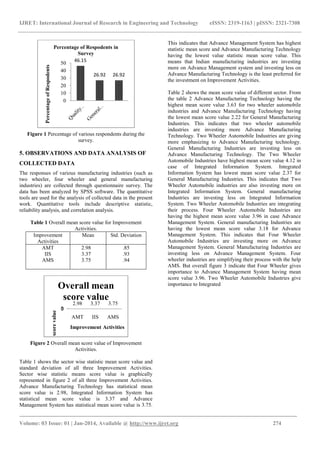
the industries, which gives response rate 32.5%. Out of 26
respondents, 12(45.45%) were from quality control
department manager. Seven (26.92%) were factory/plant
manager. seven (26.92%) were general manager.](https://image.slidesharecdn.com/astudyonimprovementactivitiesforindian-140808021557-phpapp01/85/A-study-on-improvement-activities-for-indian-2-320.jpg)
![IJRET: International Journal of Research in Engineering and Technology eISSN: 2319-1163 | pISSN: 2321-7308
______________________________________________________________________________________
Volume: 03 Issue: 01 | Jan-2014, Available @ http://www.ijret.org 276
Table 4 Least Preferred Improvement Activities
Rank Four wheeler
automobile industries
Two wheeler
automobile industries
General manufacturing
industries
Overall manufacturing
industries
1. Robotics (AMT) Automated guided
vehicles (AMT)
Direct numerical
control (AMT)
Automated guided vehicles
(AMT)
2. Automated guided
vehicles (AMT)
Bar coding (AMT) Computer aided process
planning (AMT)
Automated guided vehicles
(AMT)
3. Automated material
handling systems
(AMT)
Statistical process
control (AMS)
Computer aided
engineering (AMT)
Direct numerical control
(AMT)
4. Group technology
(AMT)
Recycling (AMS) Business process re-
engineering (AMT)
Robotics (AMT)
5. Direct numerical
control (AMT)
Computer numerical
control (AMT)
Group technology
(AMT)
Computer aided
engineering (AMT)
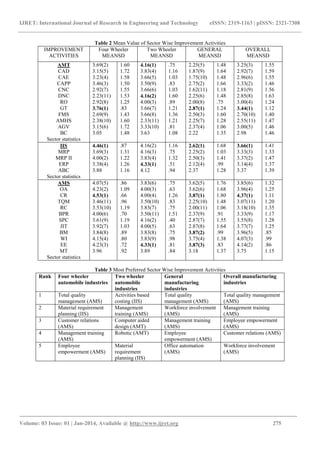
Information System having mean score value 4.12. General
Manufacturing Industries give importance to Advance
Management System having mean score value 3.18.
The most preferred improvement activities for Indian
manufacturing industries are given in table 3. It shows that
top preferred improvement activities for overall
manufacturing industries are Total Quality Management
(AMS), Management Training (AMS) and Employee
Empowerment (AMS). Whereas least preferred activities are
Robotics (AMT), Automated Guided Vehicles (AMT),
Automated Material Handling Systems (AMT), Group
Technology (AMT) and Direct Numerical Control (AMT).
Indian manufacturing industries are much attention to
Advance Management System. Advance Management
System used to simplify the process. Indian manufacturing
industries are not paying much attention Advance
Manufacturing Technology.
If Indian manufacturing industries are giving more
importance to improve their technology, they have to invest
a large amount of capital on technology. If the technology
changes, they have change manufacturing environment like
change of management and adaptability of such technology
in Indian context. Various researchers and academicians are
also made this type of observations for Indian
manufacturing industries (Dangyach and Deshmukh, 2003,
Dangyach and Deshmukh, 2006).
6. CONCLUSIONS
From data analysis it is observed that Indian manufacturing
industries are investing more on Advance Management
Systems as compared Integrated Information System and
Advance manufacturing technology. It indicates that Indian
industries want to gain competitive advantage by giving
more emphasis on Advance Management System as
compared to technology. From the data analysis it is
observed that Indian manufacturing industries are
simplifying the process with the help of Advance
Management Systems such as Total Quality Management,
Management Training, and Employee Empowerment etc.
After simplification Indian manufacturing industries are
integrating the various functions through information
systems such as Material Requirement Planning, Enterprise
Resource Planning, Material Resource Planning and
Activity Based Costing. At last Indian manufacturing
industries are giving importance to automation. Indian
manufacturing industries are automating their processes
with the help of Advance Manufacturing Technology such
as Flexible Manufacturing System, Computer Numerical
Control, Computer Aided Design, Group Technology etc.
REFERENCES
[1] G.S. Dangayacha and S.G. Deshmukh, 2002, Evidence
of manufacturing strategies in Indian industry: a survey,
International. Journal of Production Economics, 83, 279–
298.
[2] G. S. Sureshchandar, Chandrasekharan Rajendran & R.
N. Anantharaman, 2010, A Conceptual model for total
quality management in service organizations, Total Quality
Management, 12, 3, 343-363.
[3] K.V. Sambasivarao and S.G. Deshmukh 1995, Selection
and implementation of advanced manufacturing
technologies, Classification and literature review of issues,
International Journal of Operations & Production
Management, 15, 10, 43-62.
[4] Lakshman S. Thakur and Vijay K. Jain 2008, Advanced
manufacturing techniques and information technology
adoption in India: A current perspective and some
comparisons, International Journal Advance Manufacturing
Technology, 36, 618–631.
[5] Mahender Singh, P.C. Basak and Rajbir Singh 2013,
Manufacturing strategy issues in selected Indian
manufacturing industry, Management Science Letters, 3,
731–742.
[6].Pankaj Chandra and Trilochan Sastry, 1998,
competitiveness of Indian manufacturing, Vikalpas, 23, 25-
36.
[7] Sambasivarao, K.V. and Deshmukh, S.G. 1994, Strategic
framework for implementing the flexible manufacturing
systems in India, International Journal of Operations &
Production Management, 14, 4, 52-65.](https://image.slidesharecdn.com/astudyonimprovementactivitiesforindian-140808021557-phpapp01/85/A-study-on-improvement-activities-for-indian-5-320.jpg)
![IJRET: International Journal of Research in Engineering and Technology
_________________________________________________________
Volume: 03 Issue: 01 | Jan-2014, Available @
[8] Suresh Kotha and Paul M. Swamidass, 1999, Strategy,
advanced manufacturing technology and performance:
empirical evidence from U.S. manufacturing firms, Journal
of Operations Management 18, 257–277.
BIOGRAPH
Arun Kumar is a Mechanical engineer
and is pursuing his Master Degree from
DCRUST, Murthal, Sonepat, Haryana
Dr. M.S. Narwal is Associate Professor
Engineering Department, D. C. R University of Science and
Technology, Murthal, Haryana
Lalit is a Mechanical engineer and is
pursuing his Master Degree from
DCRUST, Murthal, Sonepat, Haryana
IJRET: International Journal of Research in Engineering and Technology eISSN: 2319
______________________________________________________________________________________
, Available @ http://www.ijret.org
ass, 1999, Strategy,
advanced manufacturing technology and performance:
empirical evidence from U.S. manufacturing firms, Journal
Arun Kumar is a Mechanical engineer
and is pursuing his Master Degree from
RUST, Murthal, Sonepat, Haryana
in Mechanical
Engineering Department, D. C. R University of Science and
is a Mechanical engineer and is
pursuing his Master Degree from
, Murthal, Sonepat, Haryana
eISSN: 2319-1163 | pISSN: 2321-7308
_____________________________
277](https://image.slidesharecdn.com/astudyonimprovementactivitiesforindian-140808021557-phpapp01/85/A-study-on-improvement-activities-for-indian-6-320.jpg)

This paper analyzes improvement activities in Indian manufacturing industries, focusing on four-wheeler and two-wheeler automobile sectors, as well as general manufacturing. It identifies the prominence of advanced management systems and total quality management, with two-wheeler industries notably investing in activity-based costing and advanced manufacturing technologies. The findings indicate that while there is a shift towards integrating these improvement activities, overall investment in advanced manufacturing technology remains low compared to advanced management systems.


![1.[1 8]research results on the japanese approach to supply chain management](https://cdn.slidesharecdn.com/ss_thumbnails/1-1-8researchresultsonthejapaneseapproachtosupplychainmanagement-111125091139-phpapp01-thumbnail.jpg?width=640&height=640&fit=bounds)


